1. Introduction
The “dual carbon” goals mark two critical milestones in the ongoing energy transition [
1], reflecting a global consensus on low-carbon energy development. Considering China’s energy resource endowment—“relatively rich in coal, poor in oil, scarce in natural gas, and deficient in uranium”—coal is expected to remain the dominant energy source in the short term [
2,
3,
4,
5]. In the context of Chinese-style modernization, the development of low-carbon energy faces three interconnected challenges: a coal-heavy energy structure, rigidly growing energy demand, and the urgent need to achieve carbon neutrality. Addressing these challenges requires consideration of China’s fundamental national conditions and the characteristics of the new development stage. Achieving carbon peaking and carbon neutrality is not merely a process of “de-coalification”; rather, it involves a coordinated, system-level transition toward a cleaner energy consumption structure through approaches such as “building before breaking, breaking while building, and systematic integration,” enabling high-carbon, low-carbon, and zero-carbon energy sources to complement and reinforce one another [
6,
7].
Beyond technological and managerial innovations, market mechanisms play a crucial role in mobilizing various social entities—including governments, enterprises, and institutions—to actively participate in emission reduction. The carbon-emission trading market (hereinafter, the carbon market) represents a significant institutional innovation, using market-based mechanisms to regulate greenhouse gas emissions and facilitate green, low-carbon development. It is also a key policy instrument for realizing China’s carbon peaking and carbon neutrality targets. In September 2010, the State Council issued the “Decision on Accelerating the Cultivation and Development of Strategic Emerging Industries,” which first proposed establishing and improving a trading system for major pollutants and carbon-emission rights (carbon trading). Beginning with pilot projects in 2011 across seven provinces and cities, China’s carbon market has undergone nearly a decade of iterative exploration and now comprises eight pilot carbon trading markets. At the end of 2020, China officially initiated the first compliance period of the national carbon market. On the morning of 16 July 2021, the national carbon market commenced online trading, including over 2000 key emission units from the power generation industry in the initial batch, covering approximately 4.5 billion tons of carbon dioxide emissions. The national carbon-emission trading system, covering about 4.5 billion tons annually, accounts for approximately 70% of the country’s total emissions, making it the largest carbon market in the world in terms of greenhouse gas coverage.
China remains the largest global consumer, producer, and importer of coal. Studies indicate that under baseline and security scenarios for 2060, secure coal demand will range from 280 million to 610 million tons of standard coal, with coal gradually returning to a role primarily as a raw material and backup energy source, used for peak regulation and industrial applications [
8,
9]. Even after achieving full carbon neutrality by 2060, coal will still be necessary for peak power regulation, as a reducing agent, and to ensure the security of oil and gas supplies, with estimated demand between 1.2 and 1.5 billion tons [
10]. For a considerable period, coal will serve as a stabilizing and balancing element in China’s energy system, bridging the transition to green and low-carbon energy. According to the National Energy Administration, China’s total installed capacity for renewable energy generation has surpassed 1.1 billion kilowatts, representing over 30% of the world’s total renewable capacity. The country leads globally in installed capacity for hydropower, wind power, photovoltaic generation, biomass power, and nuclear power under construction. China’s power system—the largest in the world—has an installed generation capacity of 2.47 billion kilowatts, exceeding the combined capacity of the G7 countries. Transmission lines of 35 kV and above extend 2.26 million kilometers, with 33 operational ultra-high-voltage corridors delivering nearly 300 million kilowatts from west to east, complemented by ten cross-border transmission lines.
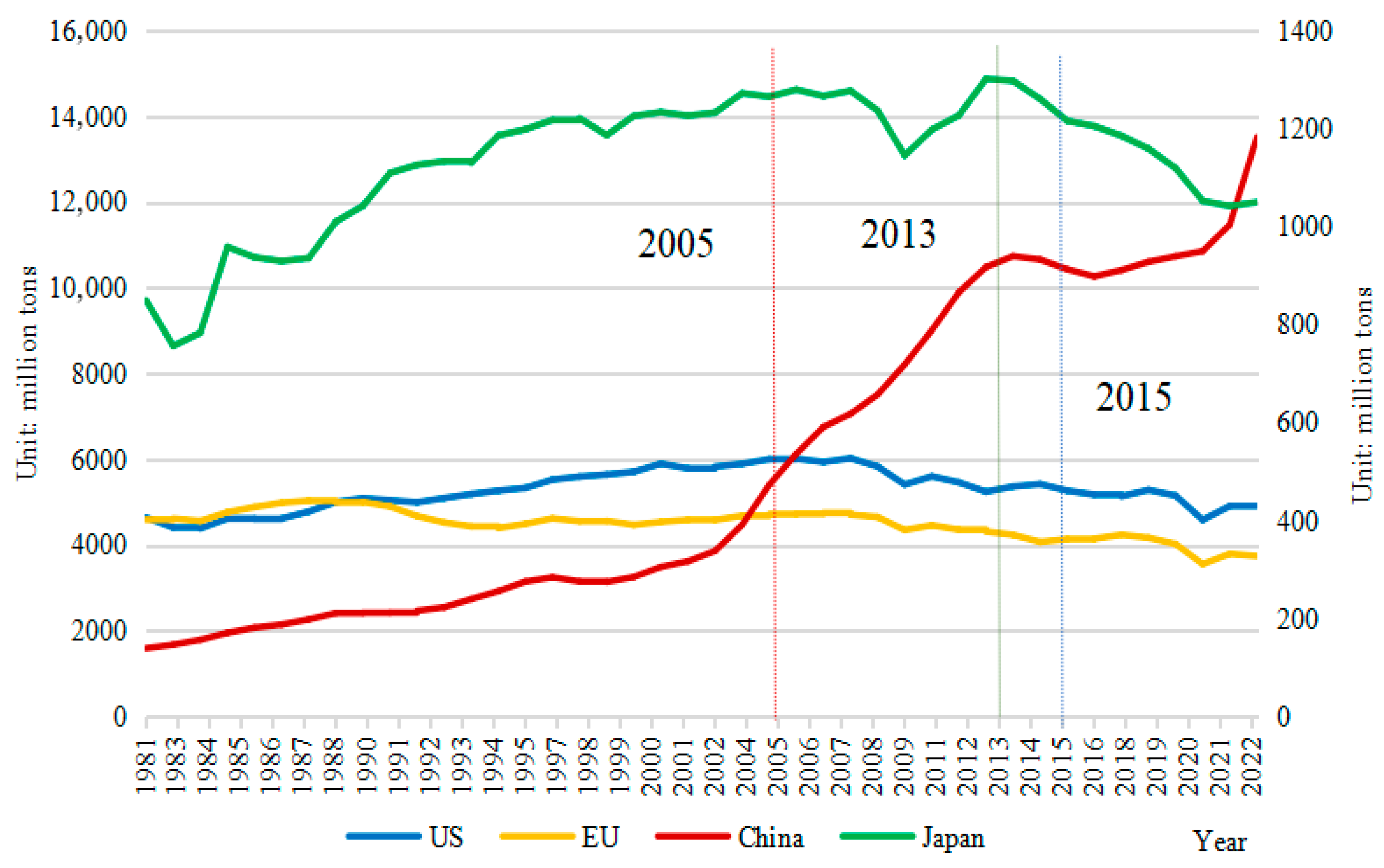
Foreign carbon markets have already demonstrated significant effects on energy conservation and emission reduction, with total carbon emissions exhibiting a declining trend following the implementation of carbon trading (see
Figure 1). In China, regional carbon markets have been shown to effectively reduce carbon dioxide emissions [
11,
12] and enhance carbon sequestration in pilot regions [
13]. Following two compliance periods, the national carbon market has established a comprehensive institutional framework, featuring well-defined responsibilities, a preliminary carbon pricing discovery mechanism, and initial evidence of both incentive and constraint effects on emission reductions [
14,
15]. Currently, the national carbon market covers only the power generation sector. During the 14th Five-Year Plan period, it is expected to expand to two to three additional industrial sectors, aiming for full inclusion of eight major industries by the 15th Five-Year Plan. The market will continue to refine its institutional systems, update supporting regulations, and diversify traded products, ultimately serving as a key driver for the low-carbon transition across multiple scales of society.
Price mechanisms are central to market operations, with market-determined prices playing a decisive role in resource allocation. Price fluctuations are an inherent characteristic of markets, and different products exhibit varying degrees of correlation. Under increasing financialization, interconnections among markets have intensified, with linked volatility observed in commodity returns. These dynamic linkages contribute to the formation of an integrated, complex system across markets. Extensive studies have measured volatility spillovers among multiple assets and explored transmission relationships in other domains [
16]. In the context of carbon and energy markets, correlations and co-fluctuations of prices enhance market liquidity and strengthen the mechanisms of price discovery and guidance [
17,
18,
19,
20]. For the world’s largest carbon, coal, new energy, and electricity markets, understanding these dynamic cross-market patterns is essential not only for promoting high-quality development within each market but also for facilitating the construction of a modern, resilient energy system. Moreover, such insights support China’s active participation in global energy governance, contribute to establishing a shared global energy framework, and reinforce the stability and security of the international energy supply-and-demand system.
2. Literature Review
The existing literature generally agrees that carbon-emission trading prices are influenced by multiple factors, including government policies, intrinsic market mechanisms, and external market conditions [
21]. Within intrinsic market mechanisms, interactions between energy prices and carbon trading prices are significant, with oil prices exerting the largest influence. External conditions, such as regional quarterly GDP growth, temperature, and precipitation, also contribute to variations in carbon prices [
22]. Moreover, carbon price fluctuations are shaped by energy prices, macroeconomic conditions, climate factors, supply-and-demand dynamics, industrial development, and financial market evolution [
23,
24]. Conversely, changes in carbon trading prices can feed back into macroeconomic performance, highlighting the coupled, dynamic nature of these systems.
Price fluctuations in energy markets significantly affect carbon markets, which, in turn, affect global economic stability [
25]. International studies have extensively explored these dynamics. For example, Daskalakis et al. developed statistical models demonstrating a short-term positive correlation among carbon, oil, and natural gas prices [
26]. Reboredo et al. investigated systemic dependencies and volatility between oil and renewable energy stocks [
27]. Chevallier et al. analyzed the influence of political events and policy shifts on carbon and energy prices [
28], aligning with Bredin et al.’s GARCH-based findings on European carbon futures [
29]. Ortas et al. used wavelet coherence to estimate time-varying correlations between carbon assets and energy commodities at multiple frequencies [
30]. Meanwhile, Nazlioglu et al. revealed multiscale causal relationships between energy consumption and GNI [
31]. Recent research considering geopolitical events, such as the Russia–Ukraine conflict, shows spillover effects between European electricity and fossil-fuel markets, including bidirectional interactions with carbon markets [
32].
Regarding market fractal characteristics, Aslam et al. documented multifractal structures in the EU ETS carbon market and four major fossil fuel markets (Brent Crude Oil, Richards Bay Coal, UK Natural Gas, and FTSE350 Power Index), finding that all examined markets exhibit multifractal cross-correlations, with coal being the least efficient and oil the most efficient [
33]. Dhamija et al. used a multivariate BEKK-MGARCH model. They identified strong co-movement in volatility between the EUA market and energy markets, especially coal, natural gas, and Brent Crude Oil, with significant spillover effects from energy to carbon markets [
34]. ARDL and cointegration studies further indicate that rising crude oil prices increase carbon emissions, which in turn elevate demand for carbon allowances, driving up carbon prices [
35,
36,
37].
Collectively, these studies highlight the complex, multiscale interactions between international carbon and energy markets, shaped by macroeconomic, political, and policy factors [
38,
39,
40]. Domestic research has leveraged China’s regional carbon markets to investigate volatility and correlation patterns with energy markets, revealing heterogeneity across regions due to differences in economic development, industrial structure, and energy consumption [
41,
42].
Building on this foundation, the present study employs multifractal analysis to investigate the dynamic cross-correlations between carbon and energy markets. Initially, correlation test statistics are used to qualitatively illustrate cross-market linkages and highlight their multifractal nature [
43,
44,
45,
46]. Subsequently, multifractal detrended cross-correlation analysis (MF-DCCA) and multifractal spectrum analysis are applied to quantitatively measure the strength and scale of multifractality. This study focuses on price data from China’s national carbon-emission trading market, which began trading on 16 July 2021, selecting the coal market, new energy market, and electricity market as representatives of high-carbon primary energy, low-carbon clean energy, and end-use energy markets, respectively. The MF-DCCA framework enables a detailed examination of nonlinear dependencies and potential dynamic mechanisms underlying cross-market multifractality.
3. Methodology
This paper constructs a comprehensive analytical framework that goes from “external policy shocks” to “internal nonlinear characteristics”. First, it uses the GARCH-DCC model with integrated exogenous variables to quantify the dynamic interconnections among markets under policy intervention; second, it employs the multiple fractal trend cross-correlation analysis (MF-DCCA) to assess the complexity of cross-market correlations.
3.1. Volatility Spillover and Policy Effect Model
Firstly, this paper constructs a GARCH-DCC model that incorporates exogenous variables to quantify the impact of external interventions on market price levels and volatility characteristics.
3.1.1. Mean Equation and Policy Impact Effect
By introducing policy dummy variables and continuous policy indices into the mean equation, the direct impact of external shocks on the returns of various markets can be captured:
Among them, represents various exogenous policy variables that affect the market, and measures the direction and intensity of the impact of different policies on the yield.
3.1.2. Variance Equation and Waveform Spillover
To further examine the contribution of the policy to market risk (volatility), the same exogenous terms are introduced into the variance equation:
By examining the significance of the parameter , it is possible to determine whether the policy intervention has intensified or mitigated the degree of market volatility.
3.1.3. Dynamic Correlation Coefficient Setting
For each market, a GARCH(1,1) model can be set up to describe the volatility of prices. The formula is as follows:
where
is the return rate of the market at time
;
is the mean of the return rate;
is the disturbance term at time
.
is the volatility at time
;
is a white noise process, following a standard normal distribution;
,
and
are the model parameters.
The policy variable is introduced as an exogenous variable into the GARCH model, and the formula is as follows:
where
is the policy variable at a certain time
;
is the coefficient of the policy variable, indicating the impact of the policy on market volatility.
The DCC model describes the dynamic correlations among markets. The formula is as follows:
where
is the conditional covariance matrix at time t;
is the unconditional mean of the covariance matrix;
is the conditional correlation coefficient matrix at time t; a and b are the model parameters.
3.2. Construction of the Multifractal Detrended Cross-Correlation Analysis (MF-DCCA) Model
Zhou [
47] combines the MF-DFA method with the DCCA method proposed by Podobnik [
48] and proposes the MF-DCCA method, which is mainly used to study the correlation and multifractal characteristics of two non-stationary series, thus providing a new method for this study. We suppose that there are two time series
and
. We have
, when L is the length of the two time series. We will introduce the MF-DCCA method with the following steps:
The first step: Determine the profile of the time series as follows:
In which the following applies: .
The second step: Divided the profile time series and into non-overlapping segments of equal length . Since N is usually not an integer multiple of s, in order not to neglect the last series, the segmentation process is repeated from the tail of the series to obtain 2Ls sub-series.
The third step: The local trends
and
for each segment u
are evaluated by least squares fits of the time series, then fitting 2Ls subseries with m-order polynomials, eliminating trend covariance:
When
, the following applies:
When . Therefore, the trends and denote the fitting polynomial with order m in each part u.
The fourth step: Calculate the qth-order detrended covariance function:
The fifth step: By analyzing the Log–Log plots, the scaling behavior of the covariance fluctuations under each fixed parameter q is determined. If two time series exhibit long-range power-law interactions on a larger scale s, their relationship can be expressed as follows:
In the formula, represents the cross-correlation index, which is used to describe the power-law dependence relationship between two sequences. This framework has strong universality. For instance, when the two input sequences are exactly the same, the entire process naturally reduces to the MF-DFA model; while when the value of q is 2, this method is equivalent to the standard DCCA analysis.
The nature of the cross-correlation characteristics between two sequences largely depends on the dynamic behavior of this index. Specifically, if fluctuates as q takes different values, this indicates that the cross-correlation between the two sequences has multifractal characteristics; conversely, if this index remains constant regardless of the change in q, it manifests as a single fractal. From the perspective of specific numerical trends, when > 0.5, it indicates that the cross-correlation of the sequence’s return fluctuations has long-term persistence, which is the same-direction trend often observed in reality, such as “bull markets follow bull markets”. When < 0.5, the sequence fluctuations exhibit anti-persistence, meaning that the price increase of one often leads to a price decrease of the other. And if this index is exactly equal to 0.5, it indicates that at a specific q level, there is no significant cross-correlation relationship between the yield fluctuations of the two sequences.
To further quantify the strength of this degree of multiplicative fractality, the variation amplitude ΔH is usually introduced as a measurement indicator. Its calculation formula is as follows:
It is easy to see logically that the larger the range of values of ΔH, the greater the variation in ΔH, and the richer the multifractal structure contained in the two sequences. In the context of financial research, this stronger multifractal feature usually indicates that the pricing efficiency of the market is at a relatively low level.
It is pointed out that there is the following relationship between the
qth-order cross-correlation exponent
and the multifractal quality exponent (Renyi exponent)
.
If the scaling exponent formula
is linear to q, the cross-correlations of the series are considered to be monofractal. If the scaling exponent formula
is not linear to q, the cross-correlations of the two time series are considered to be multifractal. Through the Legendre transformation, the following relations can be obtained:
From the MF-DFA method,
can be used to describe the degree of multifractality. The greater
is, the stronger the multifractality will be, which indicates a large fluctuation in the market. The multifractal spectrum
describes the singularity content of the time series. In addition, the width of the multifractal spectrum reflects the size of market fluctuation [
44]. The larger
is, the more uneven the distribution of the time series is and the stronger the multifractal character is.
is expressed as follows:
Furthermore, to capture the time-varying evolution of these multifractal characteristics, we implement a rolling-window MF-DCCA procedure. While the standard MF-DCCA provides a global measure of cross-correlations, the rolling-window approach, as proposed by Cajueiro and Tabak [
44], allows for the observation of dynamic market behaviors over time. In this study, we set a fixed window length of
trading days with a sliding step of
day. By moving this window across the entire sample period and repeating the calculation process from Step 1 to Step 5 for each window, we generate a chronological sequence of scaling exponents
. This procedure is essential for verifying the robustness of the nonlinear dependencies and identifying how the market cross-correlations respond to temporal shocks.
4. Indicators and Data Sources
China’s carbon-emission trading pilot program began in 2013, with initial launches in cities such as Shenzhen, Shanghai, and Tianjin, gradually expanding to additional regions and industries. Through these pilot projects, China explored carbon market mechanisms, encouraging enterprises to reduce carbon emissions and promoting sustainable development. Over time, the carbon-emission trading system was gradually improved. On 16 July 2021, the national carbon market was officially launched, becoming the world’s largest market by covered greenhouse gas emissions—a significant step toward achieving carbon neutrality. On the first day of trading, the opening price was 48 yuan per ton, and within just 10 min, the cumulative transaction amount exceeded 22 million yuan. By the end of the day, the total transaction volume reached 4.1 million tons, with a total transaction amount of 210.23 million yuan, and the closing price was 51.23 yuan per ton, representing a 6.73% increase. According to data from Eastmoney Choice, from its launch on 16 July 2021 to 30 January 2026, the national carbon market has completed two full compliance cycles, spanning 1096 trading days. Overall, the market has demonstrated increasing liquidity, with transaction prices reflecting a steady upward trend and stable systemic operation. According to the Shanghai Environment and Energy Exchange, as of late January 2026, the cumulative transaction volume of carbon-emission allowances (CEA) in the national carbon market has significantly expanded compared to the initial phase, with the price discovery mechanism becoming more refined following the official relaunch of the China Certified Emission Reduction (CCER) market in early 2024. During the extended sample period from 2024 to 2026, China’s carbon and energy policies maintained a high degree of continuity and stability, providing a consistent institutional environment for analyzing long-term market linkages.
By the end of 2025, China’s total installed power generation capacity reached approximately 3.2 billion kilowatts (3200 GW), with non-fossil energy capacity surpassing fossil fuels for the first time in history, signaling a pivotal structural shift. Although reliance on coal is declining strategically, it still accounted for about 52–54% of total energy consumption in 2024, underscoring its lingering role as a ballast for energy security. Notably, China’s wind and solar installed capacities each exceeded 600 million kilowatts by late 2025, maintaining its global leadership. The new energy vehicle (NEV) market continued its explosive growth, with annual sales surpassing 10 million units in 2025. These developments provide a dynamic and complex macro backdrop for analyzing price co-movement within the “carbon-energy” nexus during this transformative period.
This paper selects the average price of carbon-emission quotas in the national carbon market, the Wind power industry price index, the Wind new energy industry price index, and the Shenwan thermal coal industry price index as the research objects. The time span is from 16 July 2021 to 30 January 2026. Invalid data are excluded. Each indicator contains 1096 data points (totaling 4384 observations) and is represented as CEAP, WEID, SWCP, and WNID, as shown in
Table 1.
To better explain the volatility correlation between the national carbon market, coal market, new energy market, and electricity market, this paper calculates the logarithmic returns of price data from the carbon market and energy markets. The daily price return for each market is denoted by
, with the time-series return being the difference in the natural logarithms of daily prices
. The specific calculation formula is shown in Equation (17).
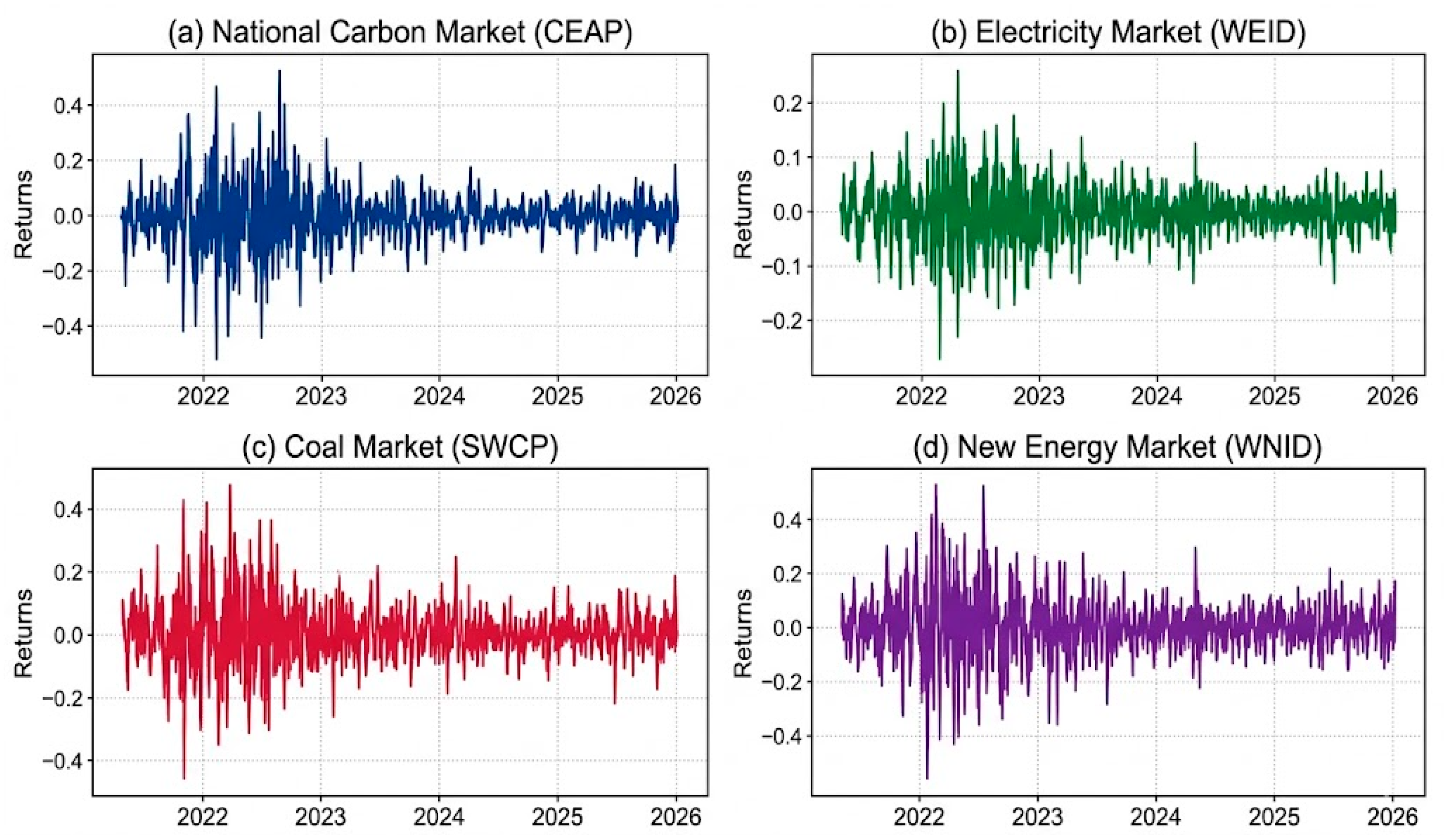
The price-return trends for the carbon, electricity, coal, and new energy markets are shown in
Figure 2.
By observing
Figure 2, it can be seen that the daily return sequences of the four markets all exhibit significant intense fluctuations and “volatility clustering” effects. Combined with the standard deviation indicators in
Table 2, the volatility of each market presents a strict descending order: the national carbon market > the coal market > the new energy market > the power market. The underlying reason for this stepped distribution of volatility lies in the differences in the pricing mechanisms and the sensitivity to policy intervention among the various markets:
(1) The carbon market has the highest volatility. As an emerging policy-driven market, the price of carbon-emission quotas (CEA) is highly dependent on the rigid constraints imposed by macro-scale emission-reduction targets. Especially after the restart of CCER (National Certified Voluntary Emission Reductions) in 2024 and the subsequent expectations of expansion for industries such as aluminum smelting and cement, the carbon market witnessed a new round of intense policy impacts and price discovery processes. The intense game of supply-and-demand expectations pushed overall market volatility higher.
(2) The volatility of the coal market ranks second. As the fundamental energy source of our country, the price of coal is influenced not only by internal factors such as “supply guarantee and price stability” and the production capacity cycle within the country, but also by imported risks to international energy prices stemming from geopolitical conflicts. In addition, adjustments to structural policies, such as zero tariffs on coal imports, have increased its price elasticity when facing external shocks.
(3) The market for new energy sources is less volatile. Although the new energy industry is in a period of rapid expansion, it benefits from highly continuous and stable macro policy support as it closely aligns with the country’s “dual carbon” strategy. Additionally, clean energy generation technologies such as wind and solar power have gradually matured and scaled up, reducing the fluctuations in early technological premium, thereby giving this market a strong “buffering effect” against short-term shocks.
(4) Lowest volatility in the electricity market. This is mainly attributed to the strong regulatory nature and trading structure of China’s electricity market. Electricity transactions are mainly based on long-term contracts, with the spot market playing a supplementary role. Moreover, each province generally has established relatively strict mechanisms for setting upper and lower limits of electricity price fluctuations. This dual support of “long-term contract pricing” and “macro-control” has greatly smoothed out the price jumps caused by supply-and-demand mismatches, making it the most stable terminal link among the four markets.
The descriptive statistics summarize the general behavior of all four time series, as shown in
Table 2.
From
Table 2, the standard deviation of the carbon market price return series is the highest (0.0258), followed by the coal market (0.0194) and the new energy market (0.0153), while the standard deviation of the power market is the lowest (0.0116). This statistical feature is highly consistent with the fluctuation amplitude and clustering effect shown in
Figure 2, indicating that the price dispersion and inherent risks of the carbon market are significantly higher than those of traditional and emerging energy markets. Additionally, the Jarque–Bera (J-B) statistic test results show that the return series of all markets strongly reject the null hypothesis of normal distribution at the 1% significance level. From the distribution shape, the skewness of the return series of the carbon market, power market, coal market, and new energy market is 0.6137, 0.0743, −0.0161, and −0.2261, respectively, and the kurtosis is as high as 12.1062, 6.7914, 5.3556, and 5.6058, respectively. Since the kurtosis of each market is far beyond the theoretical value of 3 for the standard normal distribution, it further confirms that the return series of these four markets have typical “leptokurtosis and heavy tails” (Leptokurtosis and heavy tails) characteristics.
5. Measurement of Spillover Effects Based on Policy Simulation
5.1. Define the Variables for Policy Changes
The policy variables for the carbon market are carbon-emission restrictions; for the electricity market, annual electricity production targets; for the new energy market, investment in new energy technology research and development; and for the coal market, dummy variables. In this section, the GARCH-DCC model is chosen to quantify the impact of policies on each market. In the research, there are many forms of policy quantification, including continuous, discrete, dummy (binary), count, categorical, time-trend, lagged, interaction-term, and index/score data, among others. According to the research object and the relevant policies introduced by China in recent years, continuous data are used for policy quantification in the carbon, electricity, and new energy markets, and binary variables (dummy variables) are used for policy quantification modeling in the coal market. The specific policy variables are constructed as follows (see
Table 3):
Regarding the frequency alignment, the annual policy variables
are treated as step-wise exogenous shocks. Given that macro-level policy targets and emission caps are legally binding for the entire fiscal year, they provide a constant institutional backdrop for daily trading activities. Following the common practice in energy economics [
28], these annual indicators are assigned to each trading day within the corresponding year to capture the baseline shift in market volatility caused by shifting policy stringency.
5.2. Application of Virtual Variables in the Model
In econometrics and statistics, dummy variables (also known as indicator variables) are a powerful tool for representing qualitative or categorical data. This study selected a specific dummy variable, namely whether the zero-tariff policy for coal imports was implemented, to investigate its potential impacts on the carbon market, electricity market, new energy market, and coal market. Therefore, the zero-tariff policy for coal imports was implemented on 1 May 2022, with 0 before implementation and 1 after implementation.
The definition of the dummy variable for the zero-tariff policy on coal imports. This section defines a dummy variable where the following applies:
represents the period during which the zero-tariff policy was implemented;
represents the period during which the zero-tariff policy was not implemented.
Since market price data are a time series, dummy variables can be included alongside other explanatory variables in a time-series regression model to examine the short- and long-term effects of zero-tariff policies across markets. For the carbon market, the model can be expressed as follows:
represents the carbon price in period t; is a defined dummy variable; represents other control variables that may affect the carbon price; is the error term.
By estimating the above model, the estimated value can be obtained, which represents the average change in the carbon price after implementing the zero-tariff policy. The same method can also be applied to the electricity, new energy, and coal markets. If is significant and positive, it means that the average carbon price has risen after implementing the zero-tariff policy. Conversely, if is significant and negative, it indicates a decrease in the price. Through this method, the policy’s impact on each market can be quantified, and quantitative information on its effects can be provided to policymakers. The dummy variable is an effective tool for understanding and quantifying the impact of policy changes on the market, providing strong support for policy evaluation and decision-making.
5.3. Model Estimation Results
When studying the relationship between the price fluctuations of the carbon market, the electricity market, the new energy market, and the coal market, relevant policy variables were incorporated, namely carbon-emission restrictions (CER), electricity production targets (EPT), investment in new energy technology research (INT), and coal import policies (CIP). The relevant data were obtained from government reports and statistical yearbooks. The estimated results from the GARCH-DCC model, including the policy variables, are shown in
Table 4.
As shown in the estimated results in
Table 4.
(1) The Carbon Market (CEAP) and Carbon-Emission Limitation Policy (CER). The coefficient of the total carbon-emission quota (CER) is a significant negative value (−0.00008). From the perspective of economic supply and demand logic, this negative correlation reveals the “scarcity pricing” mechanism of the quotas: when the government implements stricter emission reduction policies (i.e., reducing the CER issuance volume), the scarcity of carbon quotas in the market intensifies, directly pushing up the transaction price and yield of the carbon market; conversely, if the quota issuance is relatively relaxed, it will lead to a downward pressure on prices. This indicates that the total control policy is the most core tool for effectively regulating the carbon market price signal.
(2) The Electricity Market (WEID) and Electricity Production Target Policy (EPT). The coefficient of the electricity production target (EPT) is −0.0006. This means that when higher macro-level electricity supply or production targets are set, the yield of the electricity index will decline. The underlying logic is that excessively high production target expectations often disrupt the original tight balance between supply and demand, triggering market concerns about a temporary oversupply of electricity and thereby depressing the market trading price and short-term profit expectations of power enterprises. In China’s price-controlled environment, this transmission is mainly reflected through two channels. Firstly, the marketization of industrial and commercial electricity prices enables the carbon-related cost pressures to be partially reflected in the transaction premiums. Secondly, the tightening of policies has sent signals about future emission restrictions, prompting investors to immediately reprice power-sector assets based on the expected compliance burden.
(3) The New Energy Market (WNID) and New Energy Technology Research and Development Investment Policy (INT). The coefficient of research and development investment (INT) is −0.0002. Although increasing government investment in new energy technology research and development is a long-term benefit, from a short-term yield perspective, it shows a slight negative impact. This is mainly because the huge early research and development investment will increase the financial and sunk costs of the related industrial chain; at the same time, the “cost reduction and efficiency improvement” brought by technological progress will rapidly lower the market terminal prices of new energy components (such as photovoltaic panels, wind turbines), and the elimination of this technological premium will have a downward squeeze on the sector yield in the short term.
(4) The Coal Market (SWCP) and Coal Import Policy (CIP). The coefficient of the coal import policy (CIP) is −0.0021. During the sample period, China implemented supply guarantee policies (such as zero tariffs on coal imports) (CIP tended to be loose). This negative coefficient accurately captures the effect of this policy: the relaxation of import restrictions directly increased the marginal supply volume in the domestic coal market, effectively mitigating the coal supply gap and thus exerting a significant “cooling” and inhibitory effect on domestic coal prices and the yield of related indices. The policy exogenous variables across the four markets all exhibit a significant negative correlation, fully demonstrating that macro policies have played a powerful “structural ballast stone” role in guiding the green and low-carbon transformation of energy, suppressing the overheating of traditional energy prices, and ensuring energy security. In addition, combining the variance equation and DCC parameters, it can be seen that the volatility of the four markets is extremely high (β values are generally greater than 0.9), and the long-term dynamic correlation across markets is significant (dccb1 = 0.9135). This indicates that the market has a long digestion cycle for external shocks, and risks are prone to resonate in the “carbon-electricity-coal-new” system for a long time. Therefore, in practical operations, when the government introduces or adjusts environmental protection and energy policies, it needs to fully assess the cross-market resonance risks triggered by these policies and reasonably set a buffer period for policy implementation to achieve a win-win situation of environmental benefits and stable economic operation.
5.4. Comparative Analysis of the Presence or Absence of Policy Intervention
Policy intervention, as an important macroeconomic tool, has a profound impact on the operation and stability of the financial market. In the current energy and environmental economic field, the influence of policy-induced factors cannot be ignored. Especially in the carbon, power, new energy, and coal markets, the stability and development of these markets are closely related to the formulation and implementation of policies. To further explore the actual effects of policy-induced factors, this section will conduct a comparative analysis of the model estimation results of these four markets with and without policy-induced influences. This comparison can not only reveal the specific impacts of policies on the dynamics of each market but also provide valuable references for future policy decisions. The model estimation results are detailed in
Table 5.
By closely comparing the estimated results in
Table 5 before and after the introduction of the macro policies, it can be observed that the implementation of these policies not only exerted a general downward pressure on the yield centers of various markets but also substantially reshaped the risk contagion network across different markets.
From the mean equations of each market, policy intervention has led to a significant “profit suppression” phenomenon. Specifically, in the carbon market, after introducing policy variables, the exogenous term coefficient is significantly −0.00008, which indicates that strict emission restrictions directly increase the compliance costs of emission control enterprises, thereby suppressing their short-term profit expectations. This pressure caused by the policy also spreads to the energy system: in the electricity market, the policy coefficient of −0.0006 indicates that the macro-oriented encouragement of clean energy has put traditional power suppliers under the pressure of reevaluating their market share; although the new energy market is supported by policies, its research and development policy coefficient is −0.0002, which is mainly attributed to the financial friction caused by the initial high R&D investment and the short-term reduction in technology costs that depress the terminal product prices; while in the coal market, the policy coefficient of −0.0021 precisely confirms that the national-level “supply guarantee and price stability” and import relaxation policies have effectively increased marginal supply, thereby significantly suppressing the irrational premiums and yields of front-end coal.
Although policy intervention led to an overall pressure on the average yields of all markets, the cross-market spillover effect of volatility showed a significantly enhanced trend. The joint dynamic correlation parameters in the model provided direct empirical evidence. After introducing policy variables, the parameters representing short-term and long-term correlations, dcca1 and dccb1, respectively, increased from 0.0115 and 0.9080 to 0.0128 and 0.9135. This simultaneous rise clearly indicates that macro policies do not act independently in a single market, but rather serve as a powerful systemic shock source, promoting closer information transmission and interaction between markets, thereby intensifying cross-border risk resonance within the “carbon-electricity-coal-new” network.
In sharp contrast to the significant changes in the yield center and correlation, the underlying fluctuation structure of each market has demonstrated extremely strong endogenous stability before and after policy intervention. The parameters of the variance equation, ω, α, and β, remain highly consistent in both scenarios. Particularly, the volatility persistence parameters (β) of the three major energy markets have consistently remained at a high level above 0.90, and the β value of the carbon market has also maintained around 0.38. This long-term stability in variance and shock response speed implies that, on the one hand, market participants usually have strong ability to digest expectations, and often complete the repricing of assets before the policy is officially implemented; on the other hand, although macro-control has changed the supply and demand boundaries, it has not distorted the original trading mechanism, liquidity characteristics, and decision-making patterns of micro entities in the market. The intrinsic fluctuation mechanism in each market still maintains strong long-term resilience.
In driving the overall green and low-carbon transformation of a country through macro environmental and energy policies, these measures inevitably increase the operating costs of traditional energy sources and force enterprises to explore low-carbon production methods. Although this has caused varying degrees of pressure on returns across markets in the short term, it is, from a long-term perspective, an inevitable stage toward an optimized energy structure. At the same time, the strengthening of policy signals’ influence on market interconnections also reminds decision-makers that, when subsequent dual-carbon policies are introduced or adjusted, they need to pay close attention to prevent cross-market transmission of systemic risks caused by policy shocks.
While policies may be partially anticipated upon announcement, their official implementation remains a primary structural shock due to enforcement uncertainty, a focus justified by the significant volatility and correlation shifts observed in our empirical results (
Table 4 and
Table 5).
6. Research on Nonlinear Multifractal Characteristics
6.1. Cross-Correlations Test
This paper used cross-correlation statistics,
, to study the nonlinear cross-correlations between returns and trading volume of European carbon futures markets. Here, for the two series,
and
, we have
. The test statistic and the cross-correlation function are expressed as the following two functions:
If the cross-correlation statistic approximately obeys the chi-square distribution with degree of freedom m, there are no cross-correlations between two time return series; otherwise, the cross-correlations are significant at a specified significance level.
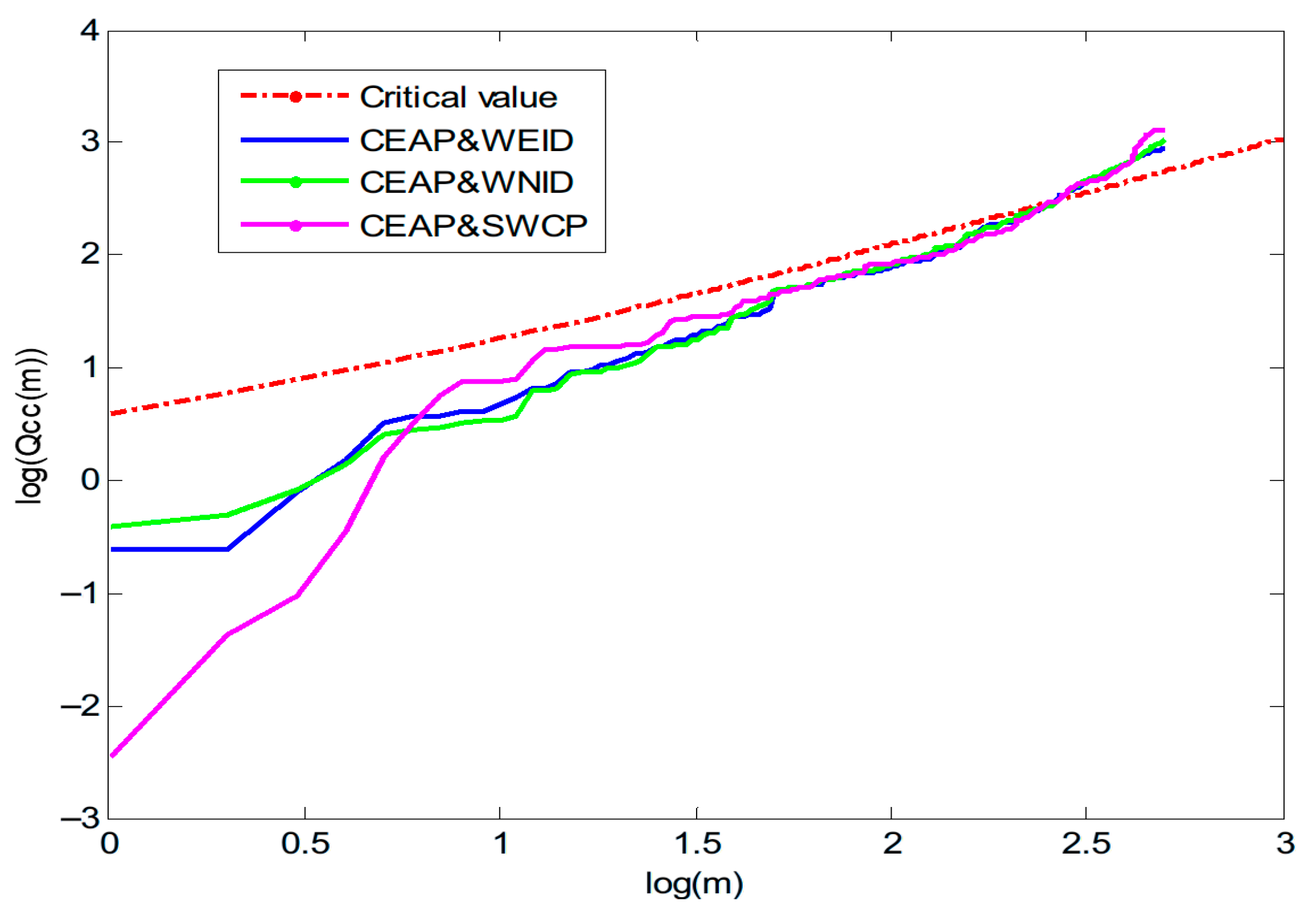
Figure 3 shows the Log–Log plot of the cross-correlation statistic
, with the degree of freedom m ranging from 1 to 1000 as the control. The critical value of the chi-square distribution at 95% confidence level is also given in
Figure 3. Obviously, the cross-correlation statistic
deviates from the critical value of the chi-square distribution with degrees of freedom
m. Therefore, the original hypothesis of no cross-correlation is rejected, which indicates that there is an interactive correlation between carbon and energy markets.
To reinforce the robustness of our empirical analysis, this study also incorporates the statistical metric introduced by Podobnik et al. [
43] to gauge the underlying dependency between the sequences. This cross-correlation coefficient is mathematically formulated as a proportional relationship, calculated by dividing the detrended covariance function
by the detrended variances of the individual series
. From a procedural standpoint, the method requires isolating the residual signals. By stripping the local polynomial trends away from the original integrated trajectories, we obtain what is known as the detrended walk. It is precisely upon these isolated residuals that the local covariance within each partitioned window or box is subsequently evaluated.
The detrended covariance function is as follows:
The formula is as follows:
In the above formula, the value of
ranges between
. If
, there is no cross-correlation between two time series. If
, there has been a perfect cross-correlation between two time series. If
, this indicates a perfect anti-cross-correlation existing in the time series. In this paper, we have calculated the DCCA cross-correlation coefficient, and
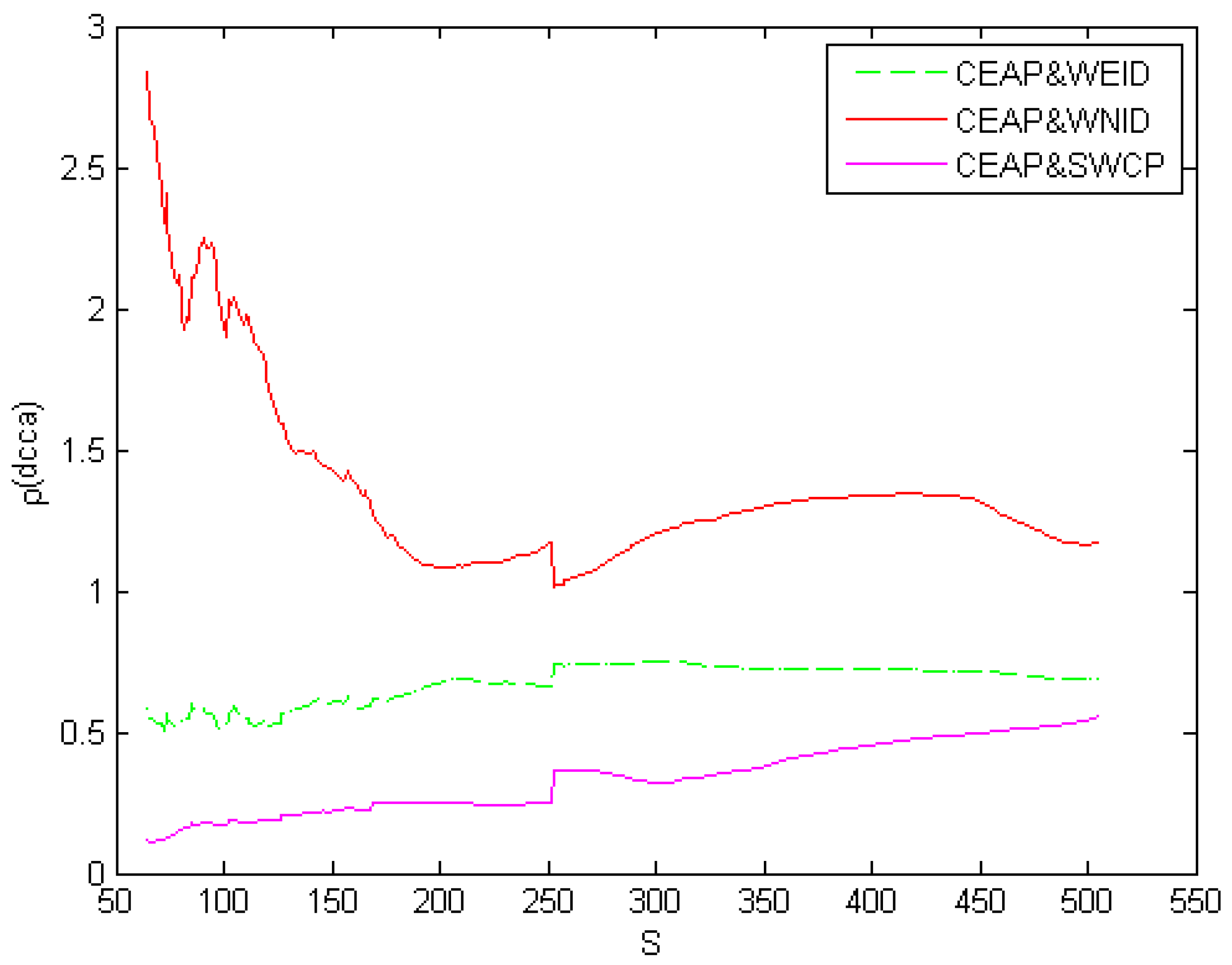
Figure 4 shows
for all the bivariate time series for different scale sizes (
n). From
Figure 4, we can see that all binary time series have long-range cross-correlation. Because of the finite size of time series, even if there is no cross-correlation,
is not equal to 0. This cross-correlation coefficient test is used to detect cross-correlation. Therefore, to determine whether the cross-correlation is long-range or anti-correlated, the DCCA method and its variants need to be applied to our study.
6.2. Analysis of the MF-DCCA Method
The cross-correlation statistic can only qualitatively detect the presence of cross-correlation between the carbon and energy markets. Based on the MF-DCCA method proposed above, this section will delve into whether there is a nonlinear dependence and multifractal characteristics between the carbon market and the electricity market, the carbon market and the coal market, and the carbon market and the new energy market. The correlation coefficient exponent is used to determine whether there is a long-term memory characteristic between the prices of the two markets. Therefore, to further validate the results obtained above, this section will employ the MF-DCCA method proposed by Podobnik and Stanley to quantitatively test the cross-correlation between markets.
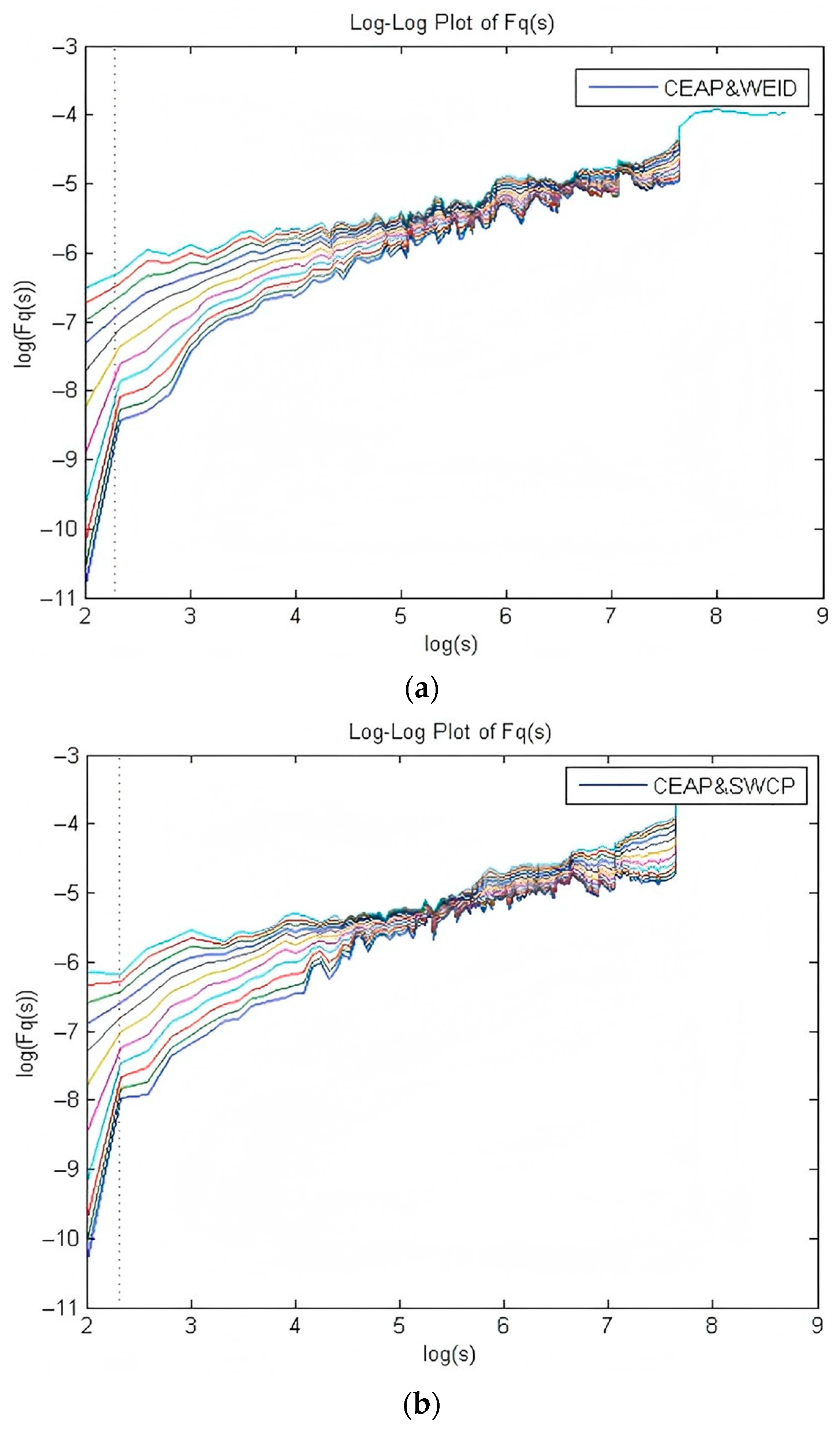
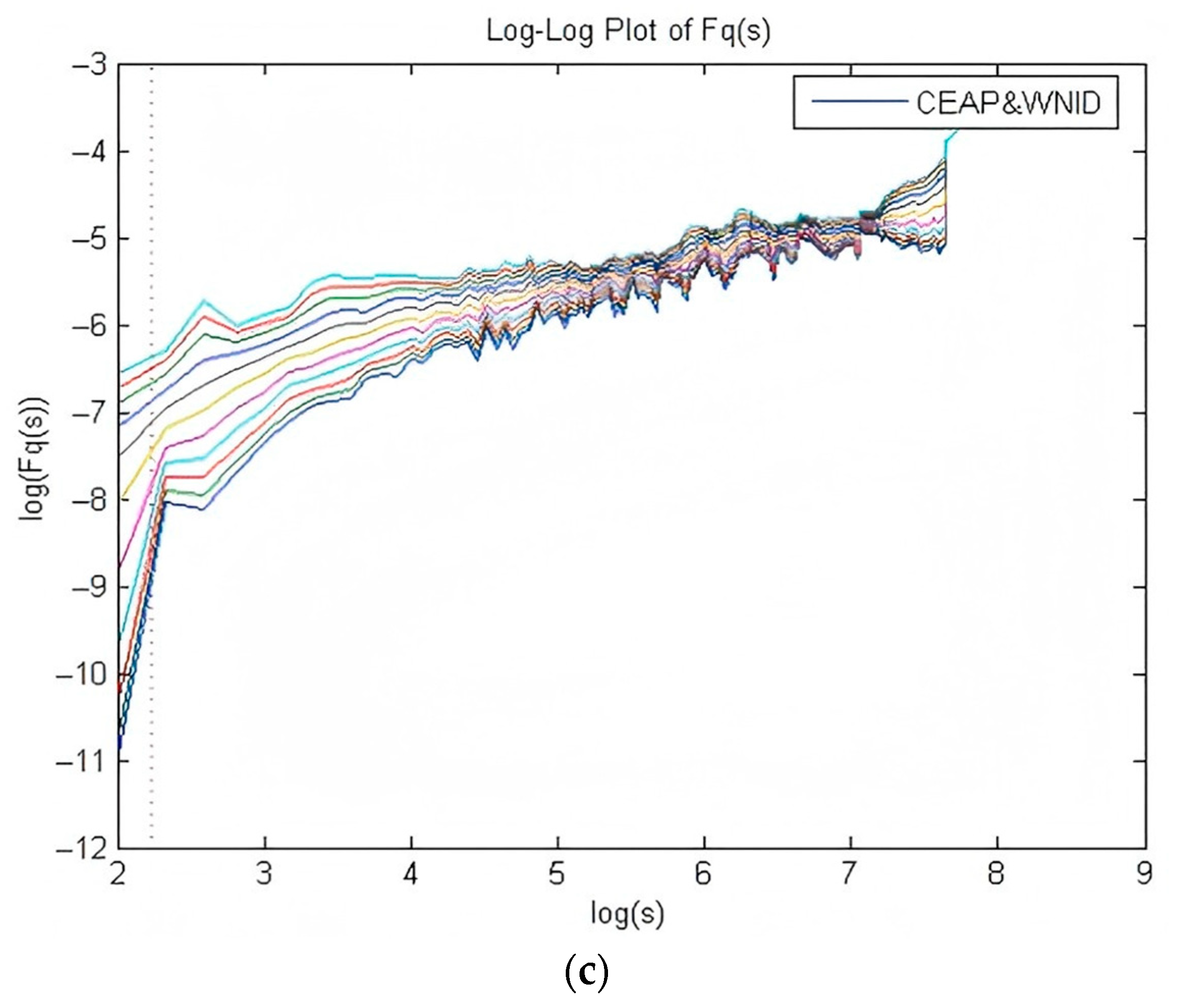
According to the Multifractal Detrended Cross-Correlation Analysis (MF-DCCA) method,
Figure 5 shows the Log–Log plot of the fluctuation function
with respect to the time scale
for the carbon market and the electricity, new energy, and coal markets, where
. As shown in
Figure 5, all curves exhibit linearity over a certain range across different q values, indicating power-law cross-correlations between the national carbon market and the electricity (as well as new energy and coal) markets. By observing the linear trend of the curves, it can be seen that they undergo a fundamental change at a certain point, referred to as the “crossing point,” denoted by
. The introduction of the “crossing point” is to distinguish between long-term characteristics
and short-term characteristics
. There is a close relationship between the fluctuation function and the time scale. In many cases, the fluctuation function changes with the time scale. In other words, the volatility of the data varies across different time scales. For example, financial markets may experience significant short-term volatility while exhibiting a more stable trend over longer time scales. The short-term behavior of financial markets is easily influenced by external market factors, such as major events, whereas long-term behavior is determined by internal factors. Over time, short-term shocks gradually dissipate as the market’s long-term supply-and-demand mechanisms take effect.
According to the Log–Log plot in
Figure 5, it can be seen that the “crossing point” between the carbon market (CEAP) and the electricity market (WEID) is located at approximately
(i.e., around 191 days, or about 6.28 months). The “crossing point” between the carbon market (CEAP) and the new energy market (WNID) is approximately at
(i.e., around 170 days, or about 5.58 months). The “crossing point” between the carbon market (CEAP) and the coal market (SWCP) is around
(i.e., approximately 208 days, or about 6.93 months). To further investigate differences in cross-correlation indices between the carbon market and the electricity, new energy, and coal markets, the scaling cross-correlation indices were recalculated following Steps 1 through 5 for the long and short terms. The relevant calculation results are detailed in
Table 6.
These crossing points (5.58–6.93 months) align with China’s quarterly policy cycles, reflecting the typical two-quarter timeframe required for the market to fully internalize Green-squeezing shocks and transition from short-term volatility to long-term rebalancing.
As seen from
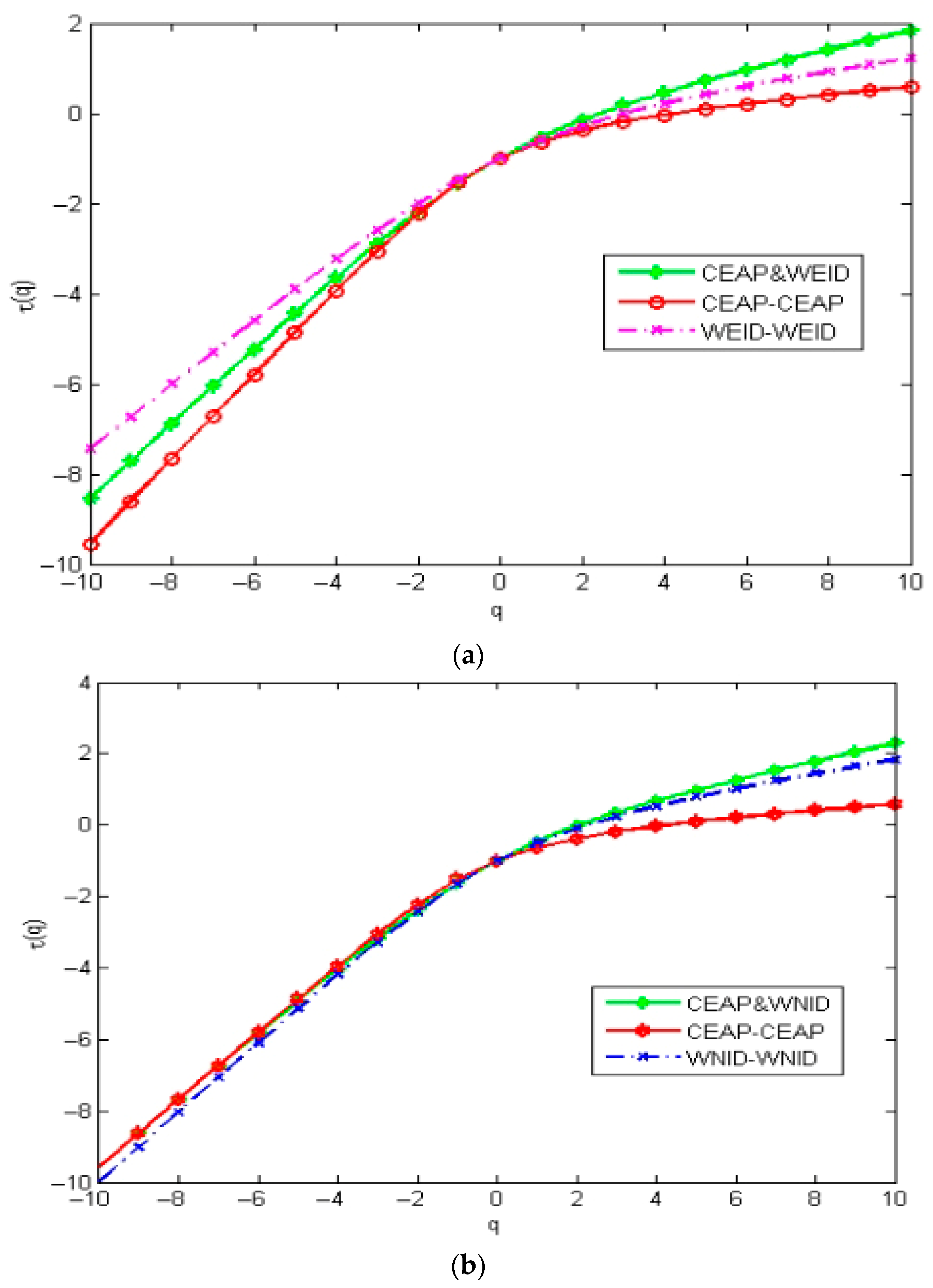
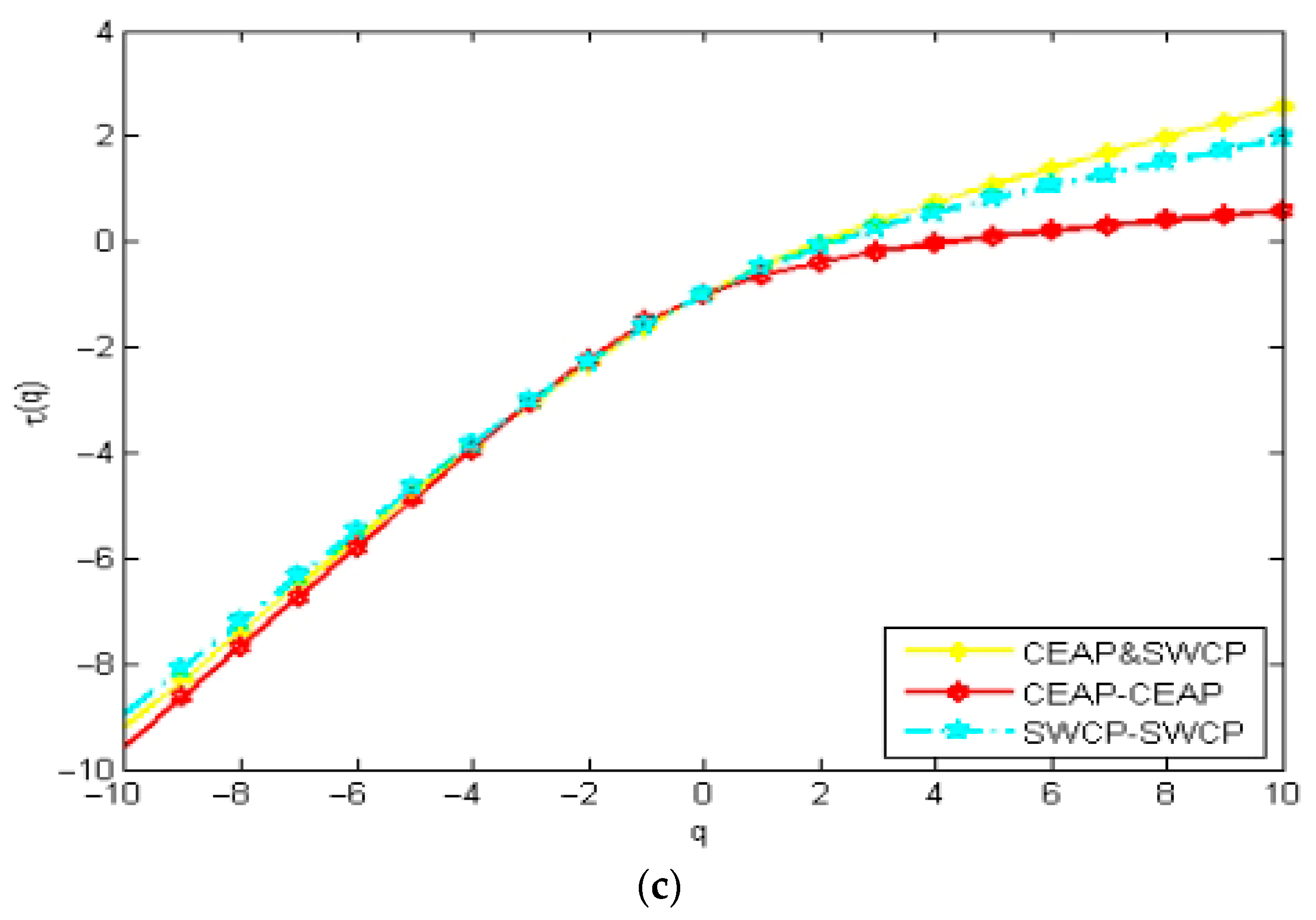
Table 6 and
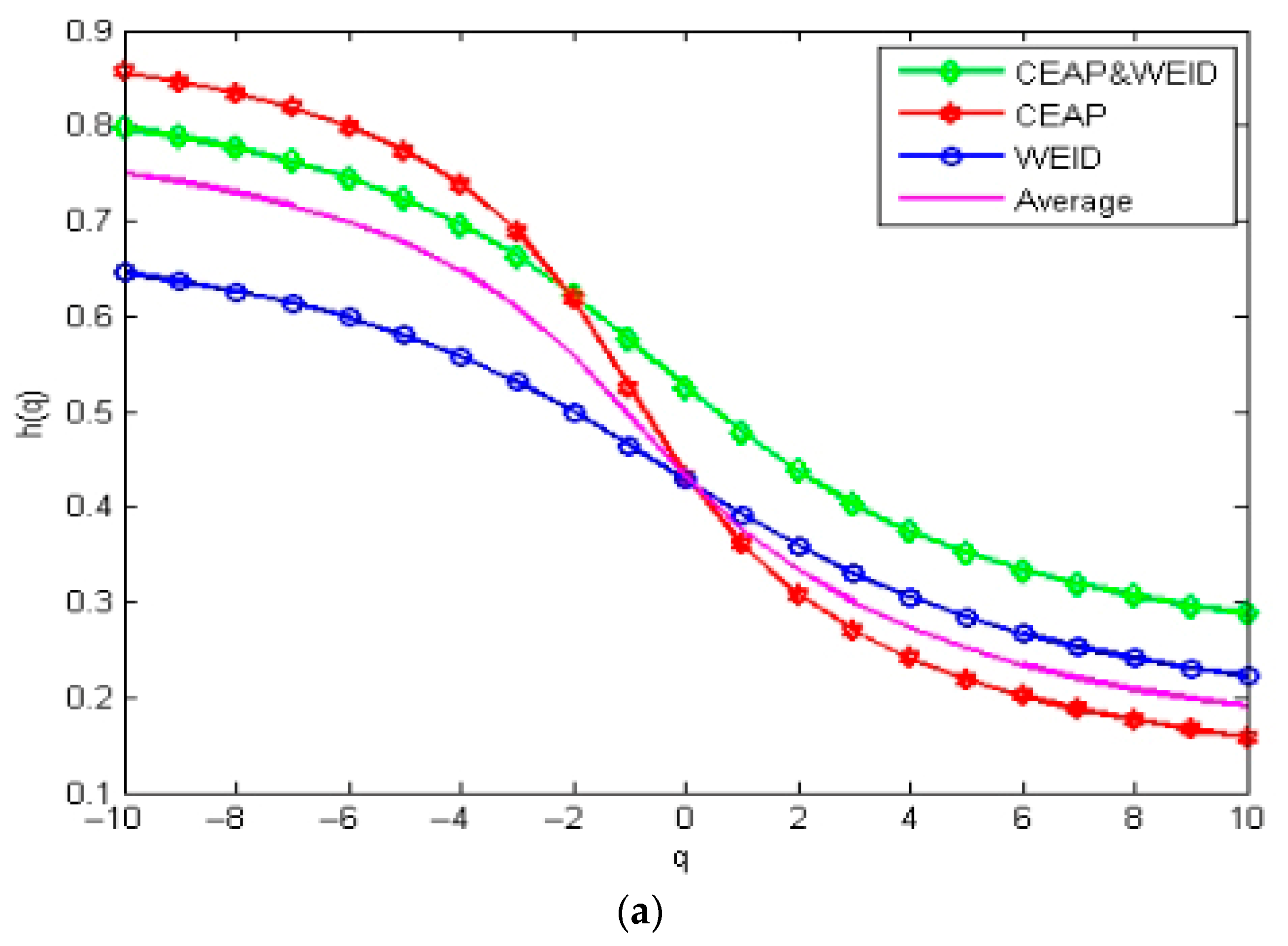
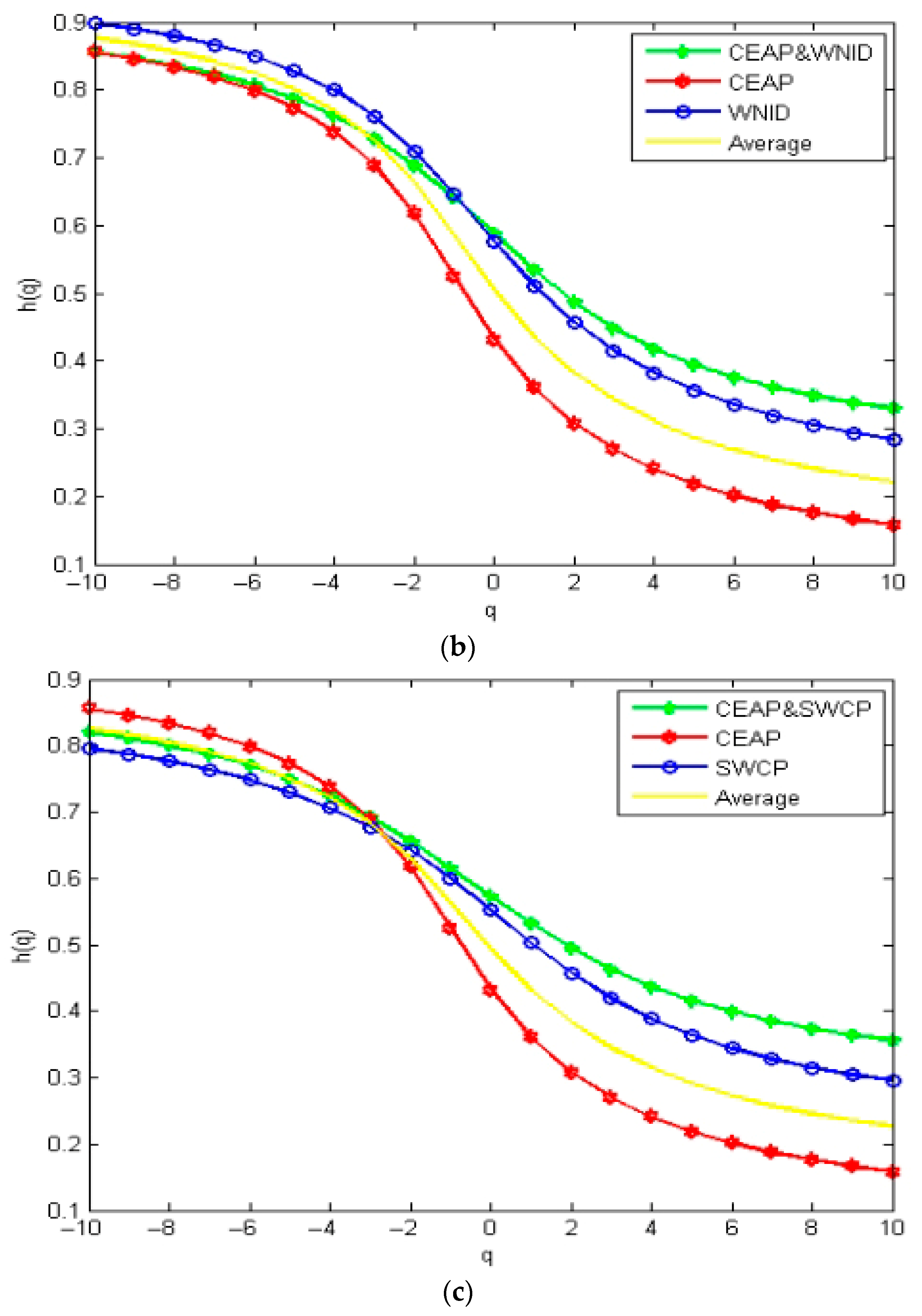
Figure 6, different values of q correspond to different cross-correlation indices. This indicates that there are different power-law correlations between the returns of the three pairs of markets: the carbon market and the electricity market (
Figure 6a), the carbon market and the new energy market (
Figure 6b), and the carbon market and the coal market (
Figure 6c). Moreover, the cross-correlation index
strongly depends on q. Therefore, the relationship between the markets exhibits characteristics of nonlinear dependence and multifractality. As q changes from −10 to +10, the cross-correlation index between the carbon market and the electricity market decreases from 0.7981 to 0.2873, the index between the carbon market and the new energy market decreases from 0.8556 to 0.3300, and the index between the carbon market and the coal market decreases from 0.8209 to 0.3556. The figure shows that the cross-correlation index
is significantly non-constant, indicating that the relationship between the carbon market and the energy markets has a clear multifractal nature. According to Formula (7) and the relationship between the Hurst exponent and the generalized Hurst exponent, when
, the cross-correlation index
corresponds to the general Hurst exponent.
6.3. Analysis of Multifractal Detrended Fluctuation
From Formula (13), we calculate
(i.e., the Renyi exponent). As shown in
Figure 7, the exponent
we calculated from Equation (8) is nonlinearly dependent on
, which can also indicate that multifractality does exist in the relationship of electricity, new energy, carbon, and coal markets.
Figure 7 illustrates the relationship between the mass exponent
and q for the price return series of the carbon market and the electricity, new energy, and coal markets. From
Figure 6, the following observations can be made: First, for all pairs, whether it is the carbon market and the electricity market, the carbon market and the new energy market, or the carbon market and the coal market
increases with the increase in q in a nonlinear manner. This suggests that the interactions between the markets exhibit a complex fractal structure. This nonlinear relationship is attributed to the heterogeneity of market participants, the diversity of trading strategies, and the influence of external economic factors. Second, the similarity of the lines between CEAP/WEID, CEAP/WNID, and CEAP/SWCP indicates that the interaction between the carbon market and these three markets (electricity, new energy, and coal) is structurally similar. This similarity arises because these markets are closely related to energy and environmental policies, and their interactions may be influenced by similar macroeconomic and policy factors. Lastly, considering the curvature of the lines, the interaction between the carbon market and the electricity market exhibits slightly higher multifractal strength compared to the interactions with the new energy and coal markets. This suggests that the interaction between the carbon and electricity markets is more complex, involving a broader range of trading strategies and market mechanisms.
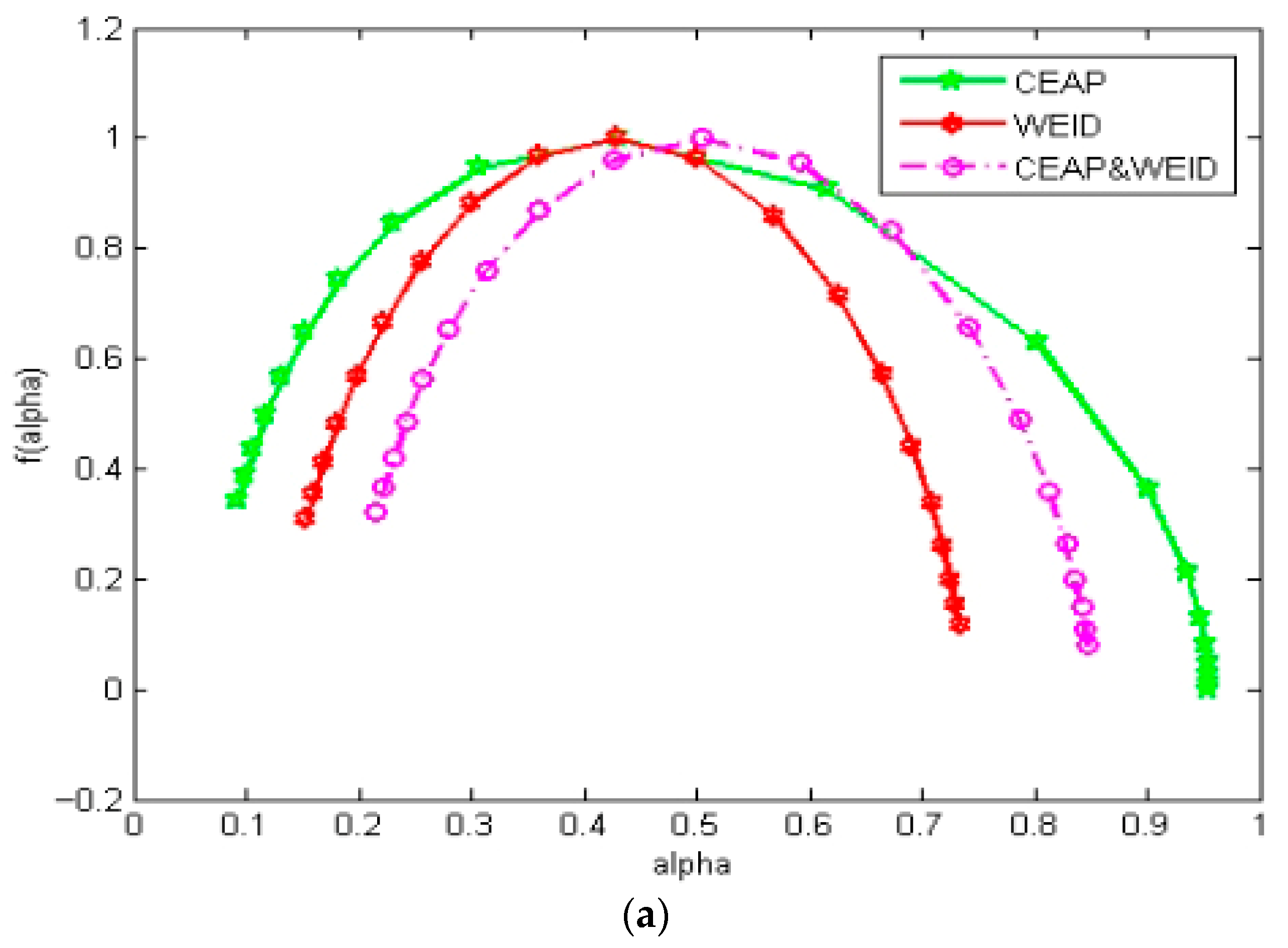
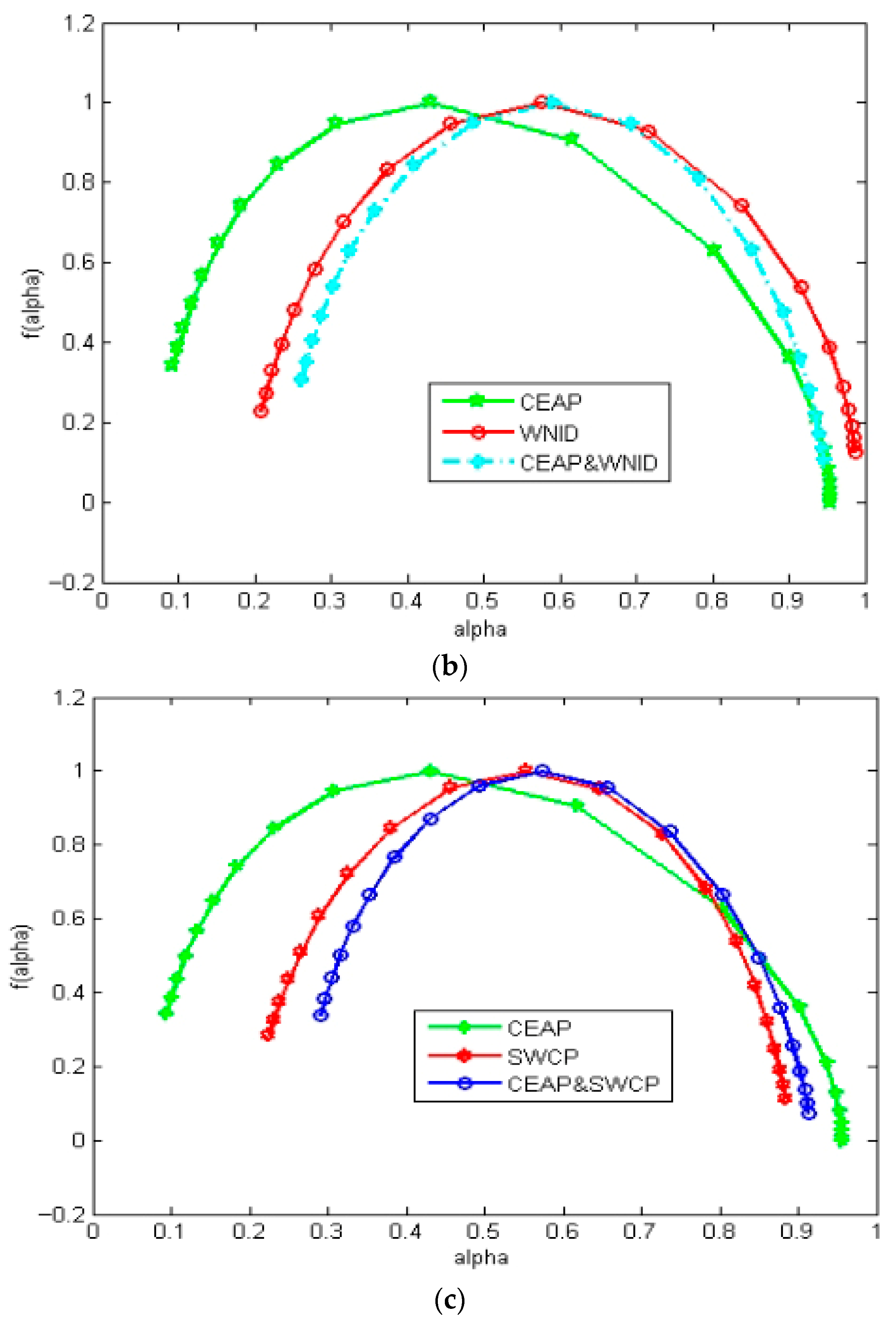
To better study the multifractal characteristics between the carbon market and the electricity, new energy, and coal markets, the multifractal strength of these markets was calculated using Formula (9). If the multifractal spectrum is represented by a single point, it is a monofractal. As shown in
Figure 8, the multifractal spectra of the carbon market and the electricity (
Figure 8a), new energy (
Figure 8b), and coal markets (
Figure 8c) are not single points, indicating that all three pairs of markets exhibit multifractal characteristics. Multifractality exists not only in the prices of carbon, electricity, new energy, and coal markets but also in the cross-correlation relationships between these prices. The width of the multifractal spectrum, as seen in the figure, is greater than zero, suggesting that multifractality is present in the cross-correlations between the prices of the carbon market and those of the electricity, new energy, and coal markets. Additionally, the width of the multifractal spectrum can be used to estimate the strength of the multifractality.
From
Figure 8, it is evident that the multifractal strength between the prices of the carbon market and the new energy market is stronger than that between the carbon market and the electricity or coal markets, implying that the multifractal characteristics between the carbon and new energy markets are more pronounced and complex. Compared to the carbon market’s interactions with the electricity or coal markets, the cross-correlation between the carbon and new energy markets is more intricate and variable. This further suggests that the price dynamics or trading behavior between the carbon and new energy markets exhibit a higher level of complexity or uncertainty.
As
increases from small to large, the value of the multifractal spectrum function
remains positive, indicating a certain degree of synergy or linkage between market prices. The calculation results of the multifractal spectrum width
for the four return series and the corresponding three pairs of cross-correlation series are shown in
Table 7.
Table 7 presents the multifractal spectrum width
for four different markets: the carbon market (CEAP), the electricity market (WEID), the new energy market (WNID), and the coal market (SWCP). From the table, it can be seen that the cross-correlation multifractal spectrum width
between the carbon market (CEAP) and the electricity market (WEID) is 0.6317. The cross-correlation multifractal spectrum width
between the carbon market (CEAP) and the new energy market (WNID) is 0.6837. The cross-correlation multifractal spectrum width
between the carbon market (CEAP) and the coal market (SWCP) is 0.6234. The cross-correlation multifractal spectrum width between CEAP and WNID is the largest, indicating that the cross-correlation between the carbon and new energy markets is the most complex. Regarding the autocorrelation parameter
\(a
\) in the table, the multifractal spectrum width of the carbon market (CEAP) is 0.8624. The multifractal spectrum width for the electricity market (WEID) is 0.5796. The multifractal spectrum width for the new energy market (WNID) is 0.7785. The multifractal spectrum width for the coal market (SWCP) is 0.6589. From these data, it can be observed that the carbon market (CEAP) has the largest autocorrelation multifractal spectrum width, suggesting that the price dynamics or trading behavior in the carbon market exhibits the highest level of complexity or uncertainty.
6.4. Analysis of the Causes of Multifractality
The multifractal properties observed in empirical time series generally originate from two distinct underlying mechanisms. The first source is the presence of long-range temporal correlations, commonly referred to as long-term memory, which can occur even when the data’s probability density function exhibits finite moments, such as a standard Gaussian distribution. Alternatively, multifractality can emerge independently from the distributional characteristics of the data itself, specifically when the sequence features heavy-tailed (or fat-tailed) probability distributions [
14,
15,
33].
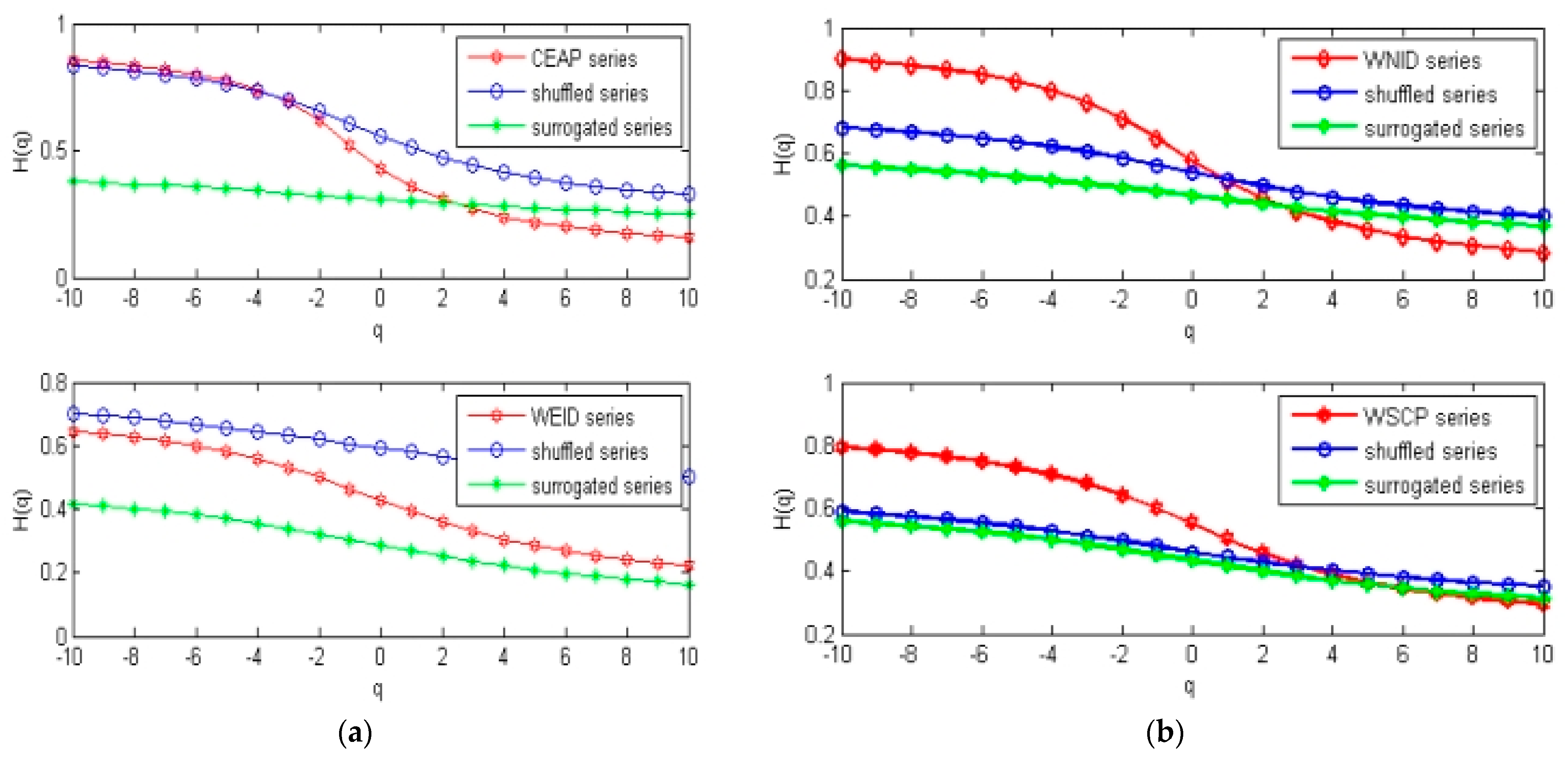
To empirically isolate and quantify the respective contributions of these two mechanisms, researchers typically employ two distinct data transformation procedures: random shuffling and phase randomization. By applying a random rearrangement to the original dataset, the intrinsic chronological order is completely destroyed. This eliminates any long-term memory effects while perfectly preserving the original empirical probability distribution. Consequently, if the observed multifractal nature is entirely driven by temporal correlations, this shuffling process will reduce the time series to a monofractal state, typically driving the scaling exponent toward a constant value of H(q) = 0.5.
Conversely, to test for the impact of heavy-tailed distributions, a phase adjustment technique is utilized. This procedure alters the non-Gaussian distributional properties of the sequence without disrupting its inherent linear correlation structure. If the multifractality stems primarily from fat tails, the scaling exponent of the phase-randomized surrogate data will become independent of the variable q. Methodologically, generating these phase-adjusted surrogates is performed sequentially [
39]. The original series first undergoes a discrete Fourier transform to move into the frequency domain, after which the phase angles are replaced with independent uniform random variables. Finally, an inverse Fourier transform is applied to reconstruct the surrogate data in the time domain.
In this study, the return series of the carbon, electricity, new energy, and coal markets were subjected to random shuffling and phase adjustment. After processing, two new sets of sequences were obtained: shuffled and surrogate sequences.
Figure 9 and
Table 8 show the original, shuffled, and surrogate sequences for the carbon, electricity, new energy, and coal markets. It is evident that the variations in the original, shuffled, and surrogate sequences are clearly distinguishable, indicating that long-term correlations and heavy-tailed distributions play significant roles in the data’s multifractal nature.
6.5. Sample Test of Rolling Windows Method
The multifractal properties observed in empirical time series generally originate from two distinct underlying mechanisms. In the year 2004, Cajueiro D O and Tabak B M [
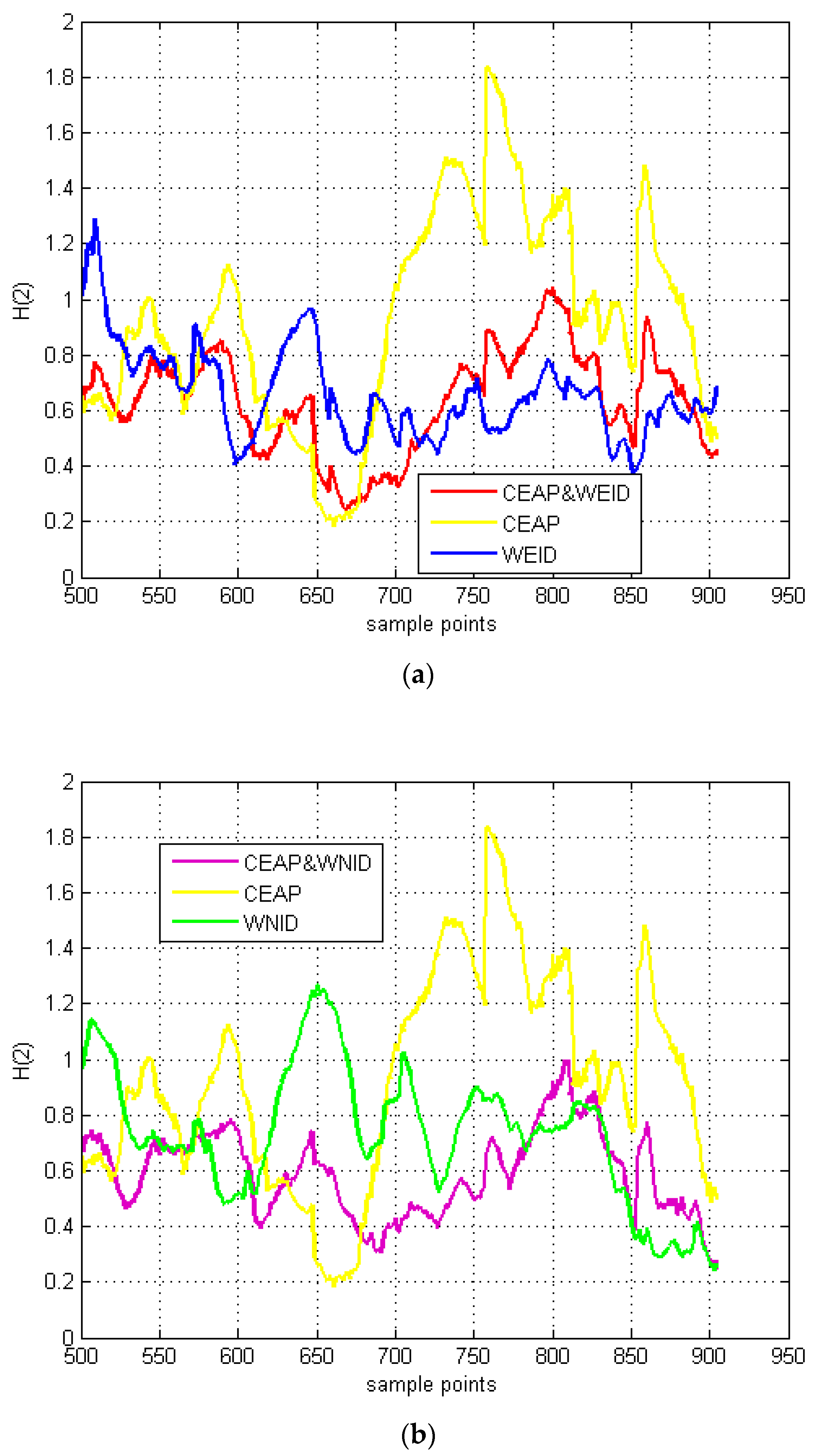
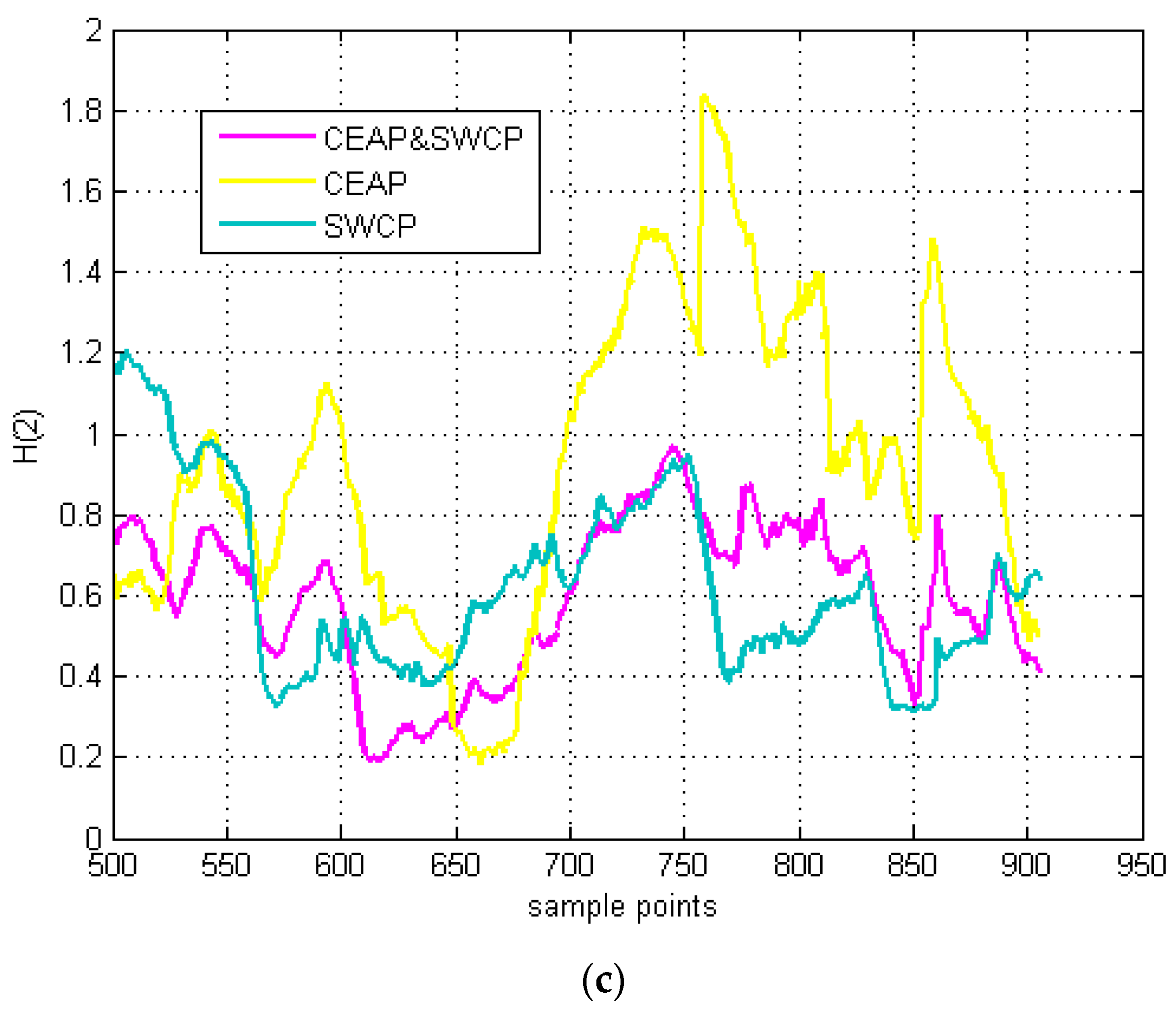
45] applied the rolling window method to study the emerging financial markets, in which they proposed the calculation of the Hurst exponent over time using a time window with 4 years of data. On this basis, more and more scholars began applying the rolling window method to the study of financial markets. For example, the rolling windows method is introduced to study the effectiveness of China’s stock market and the nonlinear relationship between A-share and B-share markets. The window size should be chosen according to the different research questions. In this paper, a 100-day rolling window is used to study the dynamics of short-term cross-correlations. The results of
Figure 10 show that the conclusions of this study are robust.
From Hurst exponents, we can see that for all binary time series, the value of
Hxy (
q) depends on the value of q, which shows that there is obvious multifractality in the relationship between price and volume. According to the study results of Podobnik and Stanley [
38], when
q = 2, the cross-correlation exponent is equal to the average of the individual Hurst exponents for two fractionally autoregressive integrated moving average (ARFIMA) processes sharing the same random noise [
23]. Therefore, in our research, we also calculate the average of generalized Hurst exponents (blue lines in
Figure 6), which is defined as the mean of the two time series analyzed by the MF-DFA method (see Equation (25)).
Combining the average scaling index changes shown in
Figure 6, the following observations can be made:
① For the carbon market and the electricity market, regardless of the value of q, the cross-correlation index is consistently greater than the average scaling index. This means that the association between the two market prices (the cross-correlation index) is always stronger than the autocorrelation of each individual time series (the average scaling index).
② For the carbon market and the new energy market, when , the cross-correlation index is less than the average scaling index, whereas when , the cross-correlation index is greater than the average scaling index. This indicates that when , the association between the two time series is weaker, while when , the association is stronger.
③ For the carbon market and the coal market, when , the cross-correlation index is approximately equal to the average scaling index, while when , the cross-correlation index is greater than the average scaling index. This means that when , the association between the two market prices is comparable to the autocorrelation of each time series individually, whereas when , the multifractal cross-correlation features between the two market prices are stronger.
Overall, these results indicate strong multifractal correlations between the carbon and electricity markets. The correlation between the carbon and new energy markets varies with different values of q. The multifractal correlation features between the carbon and coal markets also exhibit significant changes with different values of q.
7. Conclusions and Suggestion
7.1. Conclusions
This study uses China’s national carbon-emission trading market, launched on 16 July 2021, as the primary research context, selecting the electricity, new energy, and coal markets as representative components of the broader energy system. Extending the sample period to 30 January 2026, a comprehensive analytical framework of “policy effects—dynamic correlations—nonlinear evolution” is established. The main findings are summarized as follows:
(1) Carbon market as a core, high-volatility price signal with systemic spillovers.
The carbon market exhibits the highest volatility, functioning as a central price signal with significant spillover effects across the energy system. Empirical evidence shows strong dynamic correlations between the carbon market and other energy markets. Descriptive statistics confirm that carbon market volatility is substantially higher than that of the coal, new energy, and electricity markets, with all series displaying volatility clustering and leptokurtic, heavy-tailed distributions. As a systemic signal, shocks in the carbon market propagate through the broader energy system, and as market maturity and capacity expand, these interconnections strengthen, highlighting the carbon market’s core role in price discovery during the energy transition.
(2) Macro policies exert heterogeneous “green-squeezing” effects on market returns.
By introducing exogenous policy variables—including carbon-emission restrictions, electricity production targets, new energy R&D investments, and coal import policies—into the mean equation, the analysis demonstrates that all policy interventions negatively impact short-term market returns. These results confirm the effectiveness of macro-control measures in curbing high-carbon expansion and optimizing energy supply-and-demand structures. Notably, the coal market experiences the strongest policy shock (coefficient: −0.0021), followed by the electricity market (−0.0006) and new energy market (−0.0002), reflecting the heterogeneous regulatory impact across traditional fossil-fuel and emerging low-carbon sectors.
(3) Policy interventions enhance dynamic risk correlations without undermining long-term volatility resilience.
Incorporating policy variables significantly increases the dynamic correlation coefficients (DCCs) between the carbon market and various energy markets, indicating that policy actions not only influence individual markets but also strengthen systemic risk propagation via multi-market linkages. Despite these changes, GARCH model volatility parameters remain largely unchanged before and after policy interventions, suggesting that the endogenous volatility mechanism maintains long-term stability and the market can absorb policy shocks without fundamental structural changes.
(4) Cross-market linkages exhibit pronounced multifractal and nonlinear temporal patterns.
Analysis using the MF-DCCA model demonstrates that the correlations between carbon and energy markets are not purely linear, but exhibit deep multifractal structures. The “crossing points” of linkage characteristics are approximately 6.28 months for electricity, 5.58 months for new energy, and 6.96 months for coal. This multifractality arises primarily from long-term price correlations and heavy-tailed, non-normal distributions, reflecting the complex, nonlinear evolution and multiscale dynamics of the energy system.
7.2. Policy Recommendations
Based on the above findings, and with the goal of enhancing the synergy and resilience of China’s carbon–energy market system while mitigating systemic risks, the following policy recommendations are proposed:
(1) Establish a multi-market collaborative monitoring system to detect nonlinear warning signals.
Given the pronounced nonlinear correlations and multifractal characteristics observed between carbon and energy markets, regulatory authorities should move beyond single-market oversight and develop a cross-market comprehensive monitoring platform. Emphasis should be placed on the 5–7 month characteristic cycles (turning points) identified in the study, with dynamic monitoring of abnormal price fluctuations at key temporal nodes. Integrating nonlinear indicators into this framework will improve the early detection and predictive capacity for cross-market risk propagation, reflecting the complex multiscale dynamics of the system.
(2) Implement differentiated regulatory strategies based on market heterogeneity.
The study reveals that policy impacts and multifractal behaviors vary across energy markets. Therefore, carbon-reduction and energy-transition policies should account for the specific resilience and linkage patterns of each market. For high-carbon sectors such as coal, buffering mechanisms should be introduced to mitigate abrupt policy shocks. For emerging low-carbon sectors, such as new energy, long-term R&D investment guidance and incentive policies can leverage their unique linkage patterns to enhance their price competitiveness and systemic integration. This differentiated approach respects the heterogeneous multiscale responses inherent in complex energy systems.
(3) Prioritize extreme risk management and build a resilient energy market system.
Given the heavy-tailed distributions and volatility clustering commonly observed in market returns, market participants should not rely solely on traditional linear risk models for asset allocation or hedging. Financial institutions and regulators should develop hedging instruments specifically addressing cross-market linkage risks and consider the persistence of risks arising from long-term correlations. Such measures will enhance the overall systemic resilience to shocks, particularly in environments characterized by frequent policy interventions and nonlinear interactions.
(4) Deepen market-oriented energy reforms and optimize policy transmission mechanisms.
Policies serve as a key driver for cross-market linkages; therefore, the mechanisms governing electricity, carbon, and fossil fuel pricing should be further rationalized. Improving the access system, product varieties, and trading efficiency of the national carbon market will facilitate the transmission of carbon prices to power and end-user markets. Simultaneously, policy consistency and transparency are essential to minimize irrational market fluctuations induced by abrupt policy changes, supporting a smoother transition from a “policy-driven” energy structure to a self-regulating, market-oriented system.