1. Introduction
Over the past few decades, numerous researchers have conducted extensive studies on cyclic constitutive models to characterize cyclic hardening and softening behavior and ratcheting effects of materials, developing various macroscopic phenomenological cyclic constitutive models based on macroscopic experimental phenomena. Kang [
1,
2], Sun [
3], Chaboche [
4], Hassan and Bari [
5], and Chen [
6] et al. have reviewed existing macroscopic phenomenological cyclic constitutive models, which can be divided into two categories. One type of model is an extension and improvement of the Armstrong–Frederick nonlinear dynamic hardening model [
7], which primarily employs the nonlinear evolution of back stress to characterize the anisotropic plastic flow of materials during cyclic loading and thus predict the ratcheting effect of the materials.
The other category of models is the two-surface model, which was initially proposed by Dafalias and Popov (1975) [
8]. The plastic flow of the material is mainly characterized by the evolution of the plastic modulus. The Armstrong–Frederick models have demonstrated strong predictive capability for ratcheting deformation and have been extensively adopted. The following section will concentrate on reviewing key research developments associated with the AF nonlinear kinematic hardening model. Armstrong and Frederick [
7] first proposed a well-known nonlinear kinematic hardening model incorporating a dynamic recovery term in 1996, named the AF model, as a foundation for cyclic constitutive models capable of predicting ratchetting deformation. The kinematic hardening model, consisting of a linear hardening term and a dynamic recovery term, predicts a linearly increasing ratcheting strain. However, its predictions often significantly exceed the experimental ratcheting strain values of the material—frequently by an order of magnitude or more. This discrepancy is primarily attributed to an overly strong dynamic recovery term. Nonetheless, due to its well-established physical foundation, many advanced kinematic hardening models proposed by researchers have been developed and refined based on the AF model framework. These improved models mainly aim to predict ratcheting behavior more accurately by appropriately moderating the influence of the dynamic recovery term. Among the most successful and representative improvements are the Chaboche model (Chaboche, 1991) [
9,
10,
11], the Ohno–Wang I model [
12], the Ohno–Wang II model (Ohno and Wang, 1993a, b) [
13], and the Ohno–Abdel-Karim model (Abdel-Karim and Ohno, 2000) [
14], etc.
The Chaboche model [
9] assumes that the back stress is composed of three superimposed Armstrong–Frederick (AF) kinematic hardening components. Later, Chaboche [
10,
11] introduced a fourth back stress term with a threshold value, which is superimposed with the others. Only when the back stress exceeds a critical value does the dynamic recovery term in the fourth back stress component become active. This model can provide more reasonable predictions of the material’s ratcheting effect. N. Ohno and J.D. Wang [
12,
13] extended the Chaboche model by assuming that each back stress component of the kinematic hardening law has a threshold for dynamic recovery, and further proposed the concept of a critical state at which the dynamic recovery term is activated. Research findings indicate that the ratcheting strain predicted by the Ohno–Wang model is substantially lower than that of the A-F model. Within the elastoplastic theoretical framework, the Ohno–Wang I model fails to provide reasonable predictions of ratcheting behavior, whereas the Ohno–Wang II model demonstrates effective capability in predicting both the ratcheting strain and its evolution rate.
In the Ohno–Wang II model, a larger power exponent parameter mi leads to higher-order nonlinearity, making the numerical implementation of the model extremely challenging. To overcome this drawback, Ohno and Abdel-Karim [
14] developed the Ohno–Abdel-Karim model by introducing the ratcheting parameter μ and by performing a linear superposition of the A-F model [
13] and the Ohno–Wang I model [
12]. By adjusting the ratcheting parameter, the simulation of ratcheting strain can be effectively regulated. Furthermore, the Ohno–Abdel-Karim model features a relatively low nonlinear order, which makes it particularly well-suited for numerical implementation in finite element codes. Prediction results show that the AF-OW I elastoplastic cyclic constitutive model can reasonably capture the trend in which ratcheting strain increases with cycle number, but it fails to adequately represent the evolution pattern where the ratcheting strain rate gradually decreases from an initially high value before eventually stabilizing at a constant level.
Ding et al. [
15] developed the AF-OW II model through linear superposition of the A-F model and the Ohno–Wang II model. The introduction of power exponent terms enables this model to provide reasonably accurate predictions of the ratcheting strain rate evolution process. Kan et al. [
16] developed a nonlinear kinematic hardening model with static recovery based on the Ohno–Abdel-Karim model, which can reasonably describe the uniaxial time-dependent ratcheting behavior of 304 stainless steel within the unified visco-plasticity framework. However, the study did not account for the influence of multiple factors, such as loading paths, on the ratcheting behavior. Guo et al. [
17] extended the Ohno–Karim nonlinear kinematic hardening model by introducing a new evolution equation for the ratcheting parameter, where the ratcheting parameter was defined to vary with the accumulation of plastic strain. The proposed model demonstrated excellent capability in describing the quasi-stabilization of the ratcheting effect observed in alloy matrix and composite materials.
In recent years, based on the Ohno–Abdel-Karim kinematic hardening model, Qin et al. [
18] developed a modified cyclic elastoplastic constitutive model considering the variational dynamic recovery term of back stress by introducing a dynamic recovery term coefficient into both the dynamic recovery term and the back stress critical surface, to describe the cyclic deformation behavior of the powder metallurgy superalloy FGH95. Xu et al. [
19] developed a new elastoplastic constitutive model by introducing an improved Chaboche kinematic hardening rule and a nonlinear isotropic hardening rule extended with a strain memory surface, which can more accurately describe the stress–strain hysteresis loops of BLY160 steel exhibiting cyclic hardening and softening effects. The above model only predicts cyclic deformation under strain-controlled conditions and does not account for the prediction of ratcheting behavior under asymmetric stress cycling. Bai et al. [
20] introduced a linear function describing the evolution of the plastic modulus with equivalent peak stress and stress amplitude under cyclic loading into the modified Chaboche kinematic hardening model, establishing a constitutive model capable of characterizing the cyclic elastoplastic behavior of metals. This model can effectively describe uniaxial cyclic hardening, ratcheting strain, and stress–strain hysteresis loops.
Kan et al. [
21] established a temperature-dependent cyclic plasticity constitutive model by introducing a new temperature-dependent evolution equation to extend the A-F model to account for the effects of dynamic strain aging and ambient temperature on the cyclic plastic deformation of U75VG rail steel. However, the aforementioned models fail to account for the effects of loading rate and complex loading paths on ratcheting behavior. Xu et al. [
22] introduced a new evolution equation incorporating Tanaka’s non-proportionality parameter into both the isotropic hardening rule and kinematic hardening rule of a cyclic plasticity constitutive model, achieving improved predictions of cyclic softening/hardening characteristics and non-proportional multiaxial ratcheting behavior in U75V rail steel. Moslemi et al. [
23] applied the Chaboche nonlinear kinematic hardening model to simulate the uniaxial and biaxial ratcheting behavior of AISI 316L pipes under experimental loading conditions. They effectively identified the parameters of the Chaboche model from the monotonic response of cold-worked samples using particle swarm optimization techniques, but did not consider the influence of loading rate on cyclic deformation. Zhao et al. [
24] proposed a cyclic elastoplastic constitutive model based on dissipative plastic energy by introducing dissipative plastic energy and dissipative plastic energy rate into the ratchetting parameter evolution equation and isotropic evolution rules, respectively, and the improved model was applied to simulate the cyclic softening characteristics and ratcheting behaviors of EA4T axle steel, verifying the predictive ability of the model. Zhao and Kan et al. [
25] established the Ohno–Abdel-Karim cyclic viscoplastic constitutive model by introducing the rate-dependent isotropic resistance and ratcheting factor into isotropic and kinematic hardening rules, respectively. The proposed model can reasonably simulate both uniaxial strain-controlled and stress-controlled cyclic deformation of rail steel U75VG under different loading rates, while providing accurate predictions of cyclic softening and ratcheting behavior under a wide range of loading rates.
To describe the historical memory effect and time-dependent behavior of materials, Zhao et al. [
26] established a fractional viscoplastic cyclic constitutive model by utilizing fractional derivatives to represent the cumulative plastic strain rate and nonlinear kinematic hardening law, based on the Ohno–Abdel-Karim elastoplastic cyclic model. The results indicate that fractional derivatives are a flexible mathematical tool for describing the viscosity and time-dependent ratcheting behavior of materials.
However, existing cyclic constitutive models still fail to fully describe cyclic softening, hardening, and ratcheting behaviors across different materials under various loading paths and strain rates. In particular, research on time-dependent non-proportional multiaxial ratcheting behavior remains insufficient. Currently, to better characterize the time-dependent ratcheting behavior of materials, many established cyclic constitutive models introduce a static recovery term into the kinematic hardening law [
16]. Although this approach can achieve a certain degree of simulation effectiveness, it is not very satisfactory for simulating non-proportional multiaxial ratcheting behavior. Furthermore, the modified constitutive models become more complex compared to their original versions, and the number of material parameters also increases. However, the existing cyclic constitutive models have limited accuracy in predicting time-dependent ratcheting behavior, and there is relatively little research on non-proportional multiaxial time-dependent ratcheting. Therefore, to more accurately predict the rate-dependent uniaxial and multiaxial ratcheting behavior of metallic materials, it is necessary to develop more reasonable and effective time-dependent cyclic constitutive models.
Fractional-order calculus is an effective tool for describing temporal memory and historical dependence, and has been successfully applied across various disciplines [
27,
28,
29,
30]. Early studies have demonstrated that fractional-order models are more capable of accurately characterizing the viscoelastic behavior of materials compared to integer-order models [
31,
32]. However, fractional-order models have rarely been employed to describe the viscoplastic behavior of materials, especially cyclic viscoplastic deformation behavior. Sumelka [
28] generalizes Perzyna’s type viscoplasticity [
29] using fractional calculus, which is called fractional viscoplasticity. In this approach, the fractional gradient provides the non-associative plastic flow without the necessity of an additional potential assumption. Sun et al. [
30] established a constitutive model incorporating fractional calculus to simulate the cumulative deformation of ballast from the onset of loading up to a large number of load cycles. Fractional calculus serves as an effective tool for modeling such phenomena and has consequently been integrated into constitutive models for predicting cumulative deformation. Krasnobrizha et al. [
31] developed a collaborative elastoplastic damage model incorporating fractional derivatives, which combines an elastic–plastic damage model with a fractional derivative model. The collaborative model is a new tool to represent visco-elastoplastic damaged material behavior, including hysteresis loops for woven composites under cyclic loading.
In order to better characterize the evolution law of ratcheting strain rate, this study develops and improves a fractional-order cyclic constitutive model capable of describing the rate-dependent ratcheting behavior of materials by defining the ratcheting parameter as a function of the accumulated plastic strain rate and expressing the plastic strain rate in a fractional-order form. The newly improved fractional-order constitutive model was subsequently employed to simulate and predict the cyclic softening/hardening characteristics and ratcheting response of axle steel EA4T under different loading rates [
32,
33], with the computational results demonstrating good agreement with experimental data, thereby validating the rationality of the improved fractional-order cyclic constitutive model.
2. A Cyclic Constitutive Model Based on Fractional-Order Derivatives
Based on the fundamental postulates of initial isotropic elasticity and infinitesimal deformation, the improved cyclic constitutive model derived from fractional derivatives consists of the following governing equations: the additive decomposition of the total strain tensor, the elastic stress–strain constitutive relationship, the yield function, and the plastic flow equation.
In Equation (1), ε, εp and εe are the second-order tensors representing the total strain, plastic strain, and elastic strain, respectively. In Equation (2), σ is the stress tensor, and De is the elastic matrix tensor. In Equation (3), s and α are the deviatoric stress tensor and the back stress tensor, respectively, while Y is the isotropic deformation resistance.
Under the assumption that plastic strain rate evolves following a fractional-order formulation within the plastic flow equation, a novel plastic flow rule can be obtained. The corresponding expression is provided as follows:
In the formula,
represents the Caputo fractional derivative operator [
34,
35] of order
β (
). 0 and
ςtp are the operational intervals for Caputo fractional calculus. Here,
β is a physical quantity characterizing the viscosity of a material, defined as
where
tp and
t represent the accumulated time of plastic deformation and the accumulated time of total deformation, respectively, while
m is a material parameter governing rate effects.
This investigation utilizes a revised Ohno–Abdel-Karim nonlinear kinematic hardening law [
14] to characterize the time-dependent ratcheting performance of materials. In this constitutive formulation, the back stress evolution adopts a fractional-order representation, with its specific mathematical description presented as
To enable a more physically realistic simulation of ratcheting strain rate development, the current study models the ratcheting parameter
as a function of the accumulated plastic strain rate. Its governing evolution equation is defined below:
In the equation, μ0 denotes the initial value of the ratcheting parameter, while e1 and e2 are material parameters governing the evolution rate of ratcheting strain.
Under multiaxial loading conditions, the proper characterization of the additional non-proportional hardening effect induced by multiaxial cyclic deformation requires the introduction of the concept of non-proportionality degree. This study employs the non-proportionality parameter initially formulated by Tanaka et al. [
36], which is expressed as
where C is a fourth-order tensor and
cc is a material constant.
To reasonably predict the cyclic softening and hardening phenomena of materials during strain cycling, this study incorporates the nonlinear isotropic hardening rule proposed by J.L. Chaboche and D. Nouailhas [
37].
In this equation, Ysa and Y0 denote the saturated and initial values of isotropic deformation resistance under minimum non-proportionality, respectively, whereas Ysa and Y01 correspond to the saturated and initial values under maximum non-proportionality, respectively. The expression captures cyclic hardening behavior when Ysa > Y, and cyclic softening behavior when Ysa < Y. Here, γ serves as a parameter governing the evolution rate of isotropic deformation resistance Y. The condition Φ = 0 corresponds to uniaxial loading, while 0 < Φ < 1 represents non-proportional multiaxial loading.
4. Determination of Material Parameters
The parameters ς and m are material parameters related to rate-dependent effects, which can be determined through trial-and-error methods using monotonic tensile tests at different strain rates.
- 2.
Determination of material parameters related to back stress [
38,
41]
The enhanced kinematic hardening formulation bears resemblance to the Ohno–Abdel-Karim kinematic hardening model, being constructed through multi-segment linear superposition. Here, M denotes the quantity of back stress components. Therefore, an increase in
M—which corresponds to the use of more back stress components—enhances the model’s accuracy in predicting stress–strain hysteresis loops and ratcheting strain. Ohno and Wang (1993b) [
13] concluded through their research that M = 8 is sufficient to achieve a reasonable simulation of stress–strain cyclic deformation curves and ratcheting behavior.
For cyclically stable materials, the parameters
ξ(i) and
r(i) can be obtained directly from the monotonic tensile curve, as the influence of isotropic hardening is disregarded. The simulated material in this work is the cyclic softening steel EA4T (a low-alloy steel widely employed in railway axles), where the effect of cyclic hardening/softening behavior must be excluded. The relationship between the maximum stress amplitude (
σmax) per cycle and the accumulated plastic strain (
p) was fitted using strain-controlled cyclic tests, in accordance with the following expression:
By subtracting the elastic stress–strain effect from the material’s monotonic tensile curve, the plastic strain-stress curve under monotonic loading can be obtained. This curve is then processed according to the formula
, ensuring the elimination of cyclic hardening/softening effects. Finally, the following equation can be used to determine
- 3.
Determination of the relevant material parameters in the isotropic hardening law
The relationship expression between
Ysa and
p under uniaxial strain cycling can be obtained by integrating both sides of the nonlinear isotropic hardening criterion (10), as shown in the following equation:
γ is a physical quantity characterizing the evolution rate of isotropic deformation resistance, which can be obtained by fitting experimental curves.
- 4.
Determination of parameters related to ratcheting effects
The initial value of the ratcheting parameter μ0, as well as the material parameters e1 and e2 that govern the ratcheting evolution rate, have minimal impact on the uniaxial tensile curve and cyclic softening/hardening behavior under strain-controlled loading. Nevertheless, these parameters play a significant role in shaping the evolution of ratcheting strain under asymmetric stress cycling. They can be determined through a trial-and-error procedure based on the ratcheting strain evolution curve obtained under a particular loading condition.
The parameters of the cyclically softened axle steel EA4T, determined using the parameter identification method in the previous subsection, are listed in
Table 1.
5. The Simulated Results of Axle Steel EA4T
This section will utilize the newly determined material parameters in
Table 1 to simulate and predict the uniaxial and multiaxial cyclic deformation behavior of the cyclic softening material, EA4T axle steel [
39], in order to validate the predictive capability of the improved fractional-order cyclic constitutive model.
5.1. Simulation Results of Uniaxial Tensile Curves at Different Strain Rates
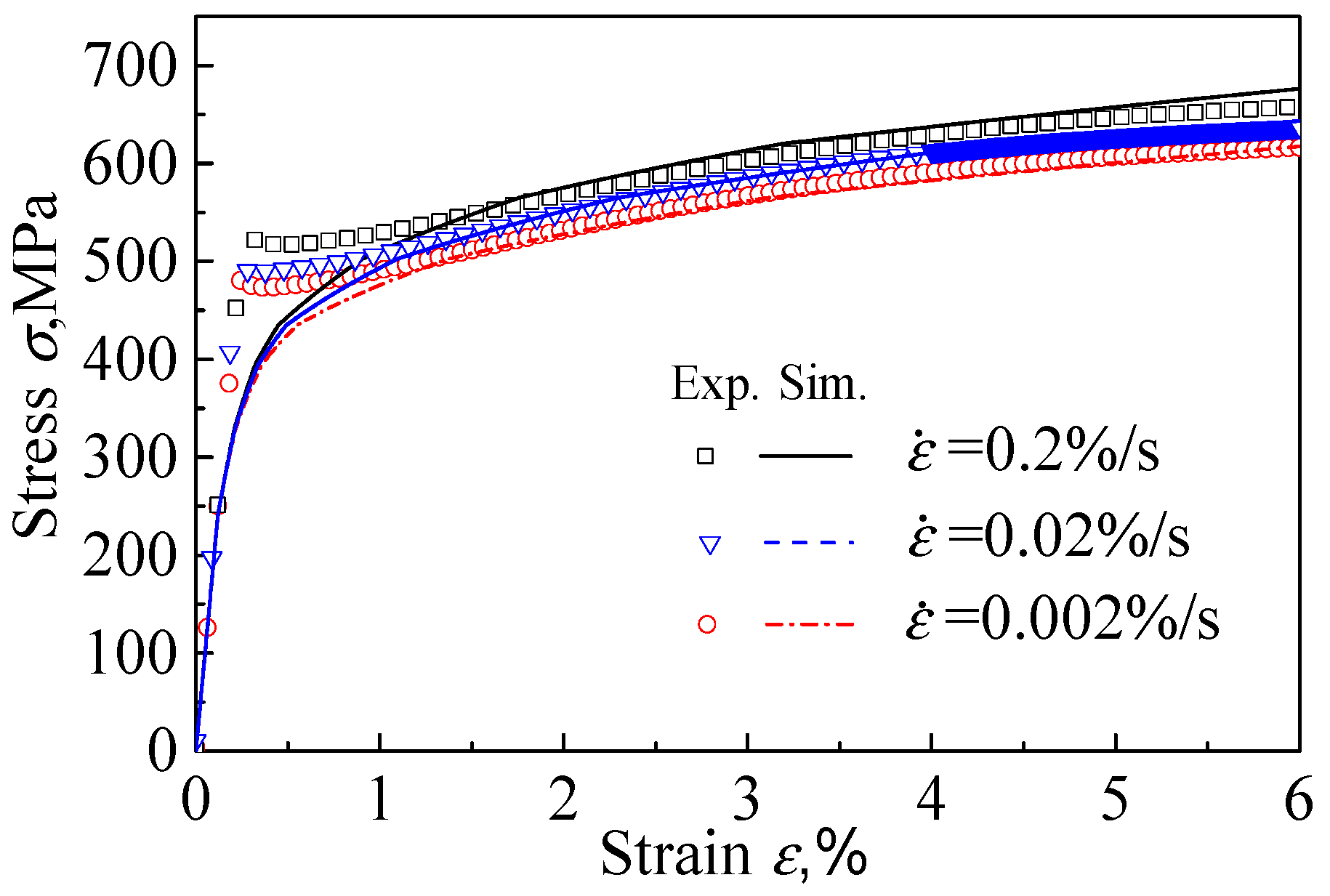
Firstly,
Figure 3 displays the simulation results of monotonic tensile curves for axle steel EA4T under three distinct strain rates: 0.2%/s, 0.02%/s, and 0.002%/s. It should be noted that EA4T steel exhibits a brief yield plateau upon initial yielding. In practical numerical simulations, it is common practice to smooth this portion of the stress–strain curve and derive the material parameters from the smoothed curve.
5.2. Simulation Results of Uniaxial Cyclic Deformation
As shown in
Figure 3, the newly enhanced fractional-order cyclic constitutive model delivers satisfactory simulations of monotonic tensile curves across different strain rates. This outcome stems mainly from two factors: first, the incorporation of fractional derivatives into the cyclic constitutive model; and second, the direct determination of most material parameters from the monotonic tensile curve itself.
Subsequently, simulations and predictions were conducted using the newly enhanced cyclic constitutive model founded on fractional-order derivatives. This model was applied to analyze the cyclic softening behavior of EA4T axle steel subjected to symmetric strain-controlled cycles, along with its uniaxial ratcheting behavior under asymmetric stress-controlled cycling conditions.
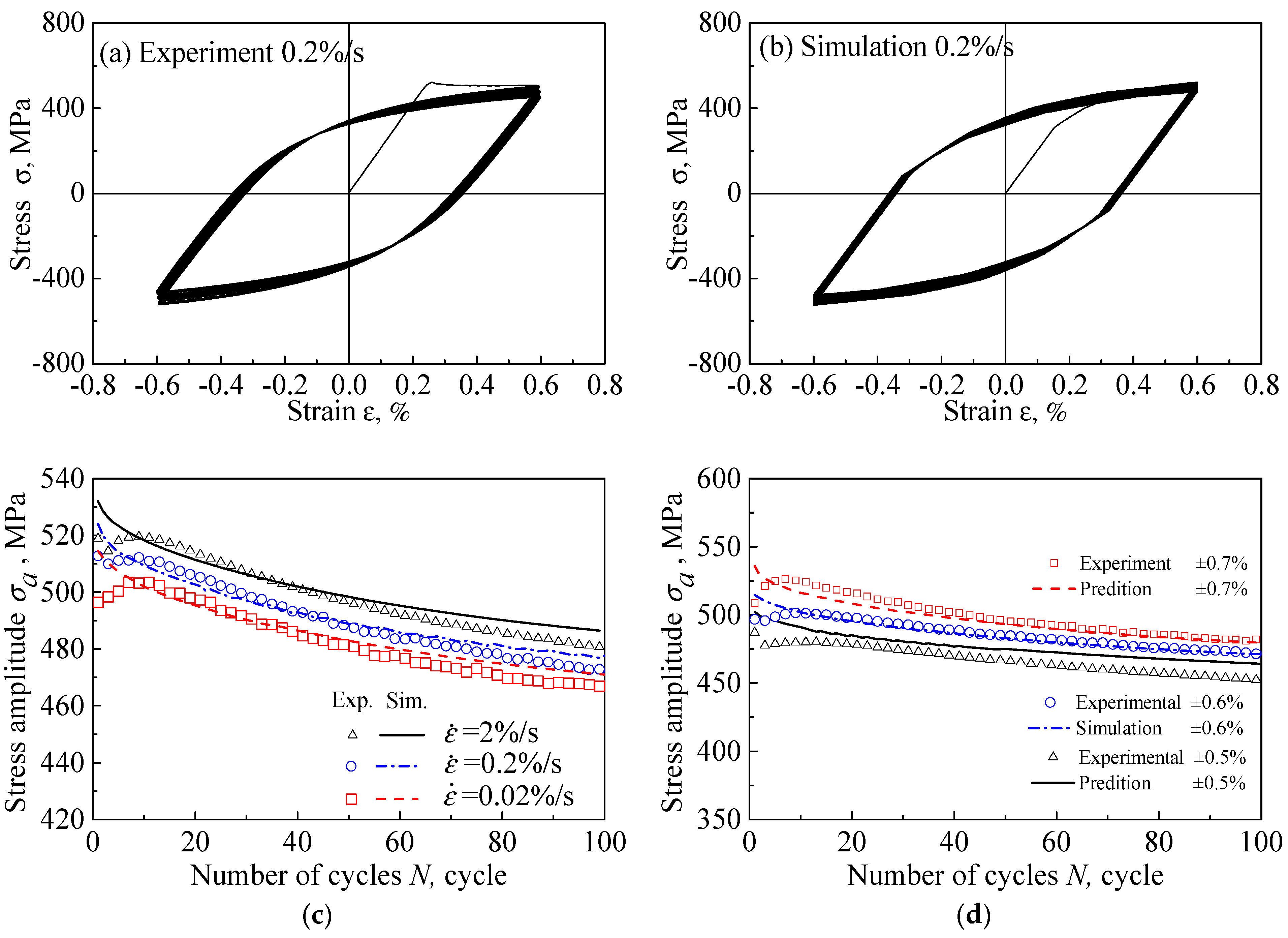
Figure 4a,b present the experimental and simulated results of the cyclic stress–strain curves under a strain amplitude of ±0.6% with a strain rate of 0.2%/s, respectively.
Figure 4c displays the simulated cyclic softening behavior of the axle steel at a fixed strain amplitude of ±0.6% under three different strain rates (2%/s, 0.2%/s, and 0.02%/s).
Figure 4d illustrates the simulated cyclic softening responses of EA4T axle steel at a constant strain rate of 0.02%/s under three different strain amplitudes (±0.5%, ±0.6%, and ±0.7%).
The simulation results demonstrate the following: (1) Under strain-controlled cycling, the stress–strain hysteresis loops predicted by the newly improved fractional-order cyclic constitutive model show satisfactory shapes and align reasonably well with experimental data. (2) Furthermore, by incorporating a nonlinear isotropic hardening rule and a fractional-order plastic flow law, the enhanced model effectively captures the cyclic softening behavior of EA4T axle steel under varying strain amplitudes and strain rates. Specifically, it reflects a gradual decrease in stress amplitude with increasing cycle numbers, while higher applied strain amplitudes and strain rates result in greater stress amplitudes and accelerate the material softening rate. The apparent slight cyclic hardening observed in the initial cycles, attributable to testing machine response limitations, can be disregarded. It is particularly noteworthy that, owing to the introduction of fractional derivatives, the newly improved model can predict cyclic softening behavior under different strain rates—a capability not achievable with conventional elastoplastic cyclic constitutive models.
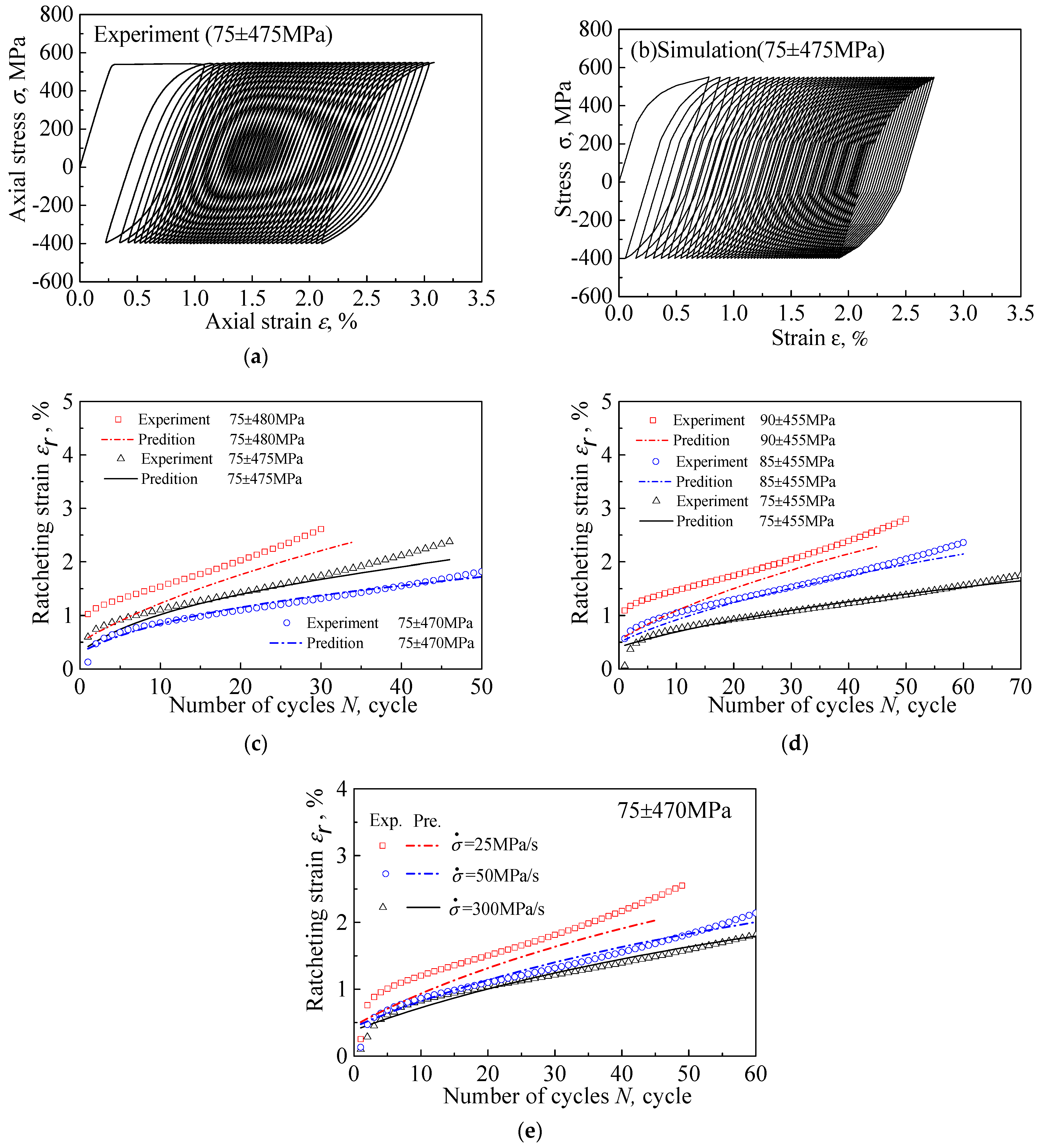
Figure 5a,b presents the experimental and simulated results of typical stress–strain hysteresis loop curves for EA4T axle steel under a stress rate of 50 MPa/s and a stress loading level of 75 ± 475 MPa;
Figure 5c shows the simulated results of uniaxial ratcheting evolution curves for EA4T axle steel under various stress amplitudes at a stress rate of 50 MPa/s and a constant mean stress of 75 MPa;
Figure 5d provides the simulated results of uniaxial ratcheting evolution curves for EA4T axle steel under different mean stresses at a constant stress amplitude of 455 MPa;
Figure 5e presents the simulation results of uniaxial ratcheting behavior of EA4T axle steel under a stress loading condition of 75 ± 470 MPa at three different stress rates (25 MPa/s, 50 MPa/s, and 300 MPa/s).
Based on the simulation results, the following conclusions can be drawn:
(1) The newly improved fractional-order cyclic constitutive model provides a good simulation of the hysteresis loop curves. The hysteresis loops are initially slightly narrow but gradually widen with increasing cycles, which reflects the cyclic softening characteristics of the material under stress cycling. This evolution trend matches the experimental observations.
(2) Based on the ratcheting strain evolution curves, it can be inferred that by treating ratcheting parameters as functions of the accumulated plastic strain rate, the newly improved fractional-order cyclic constitutive model provides reasonable predictions for both the uniaxial ratcheting strain and its evolution rate. Specifically, the uniaxial ratcheting strain accumulates gradually with increasing cycle numbers, while the ratcheting strain rate initially declines from a high value and eventually stabilizes at a constant level, which indicates a steady progression of ratcheting behavior.
(3) The newly improved fractional-order cyclic constitutive model can also effectively predict the dependence of uniaxial ratcheting deformation on both stress amplitude and mean stress.
(4) By characterizing the evolution of plastic strain rate and back stress in fractional-order form, the enhanced fractional-order cyclic constitutive model can accurately simulate the rate-dependent characteristics of uniaxial ratcheting behavior. Specifically, lower stress rates lead to larger accumulated ratcheting strain and faster ratcheting development in the axle steel.
(5) Furthermore, a comparison of the predicted results reveals that the initial ratcheting strain values under different stress rates, as forecast by the fractional-order cyclic constitutive model, show little variation. It is only with the progressive increase in cycle numbers that the time-memory effect of the fractional order causes the rate dependence of the predicted ratcheting behavior to become increasingly pronounced. Consequently, the predicted ratcheting strain also aligns more closely with the experimental data.
5.3. Simulation Results of Multiaxial Ratcheting
This section will simulate and predict the rate-dependent ratcheting behavior of EA4T axle steel under three non-proportional multiaxial loading paths, including the axial holding path, diamond path, and circular path.
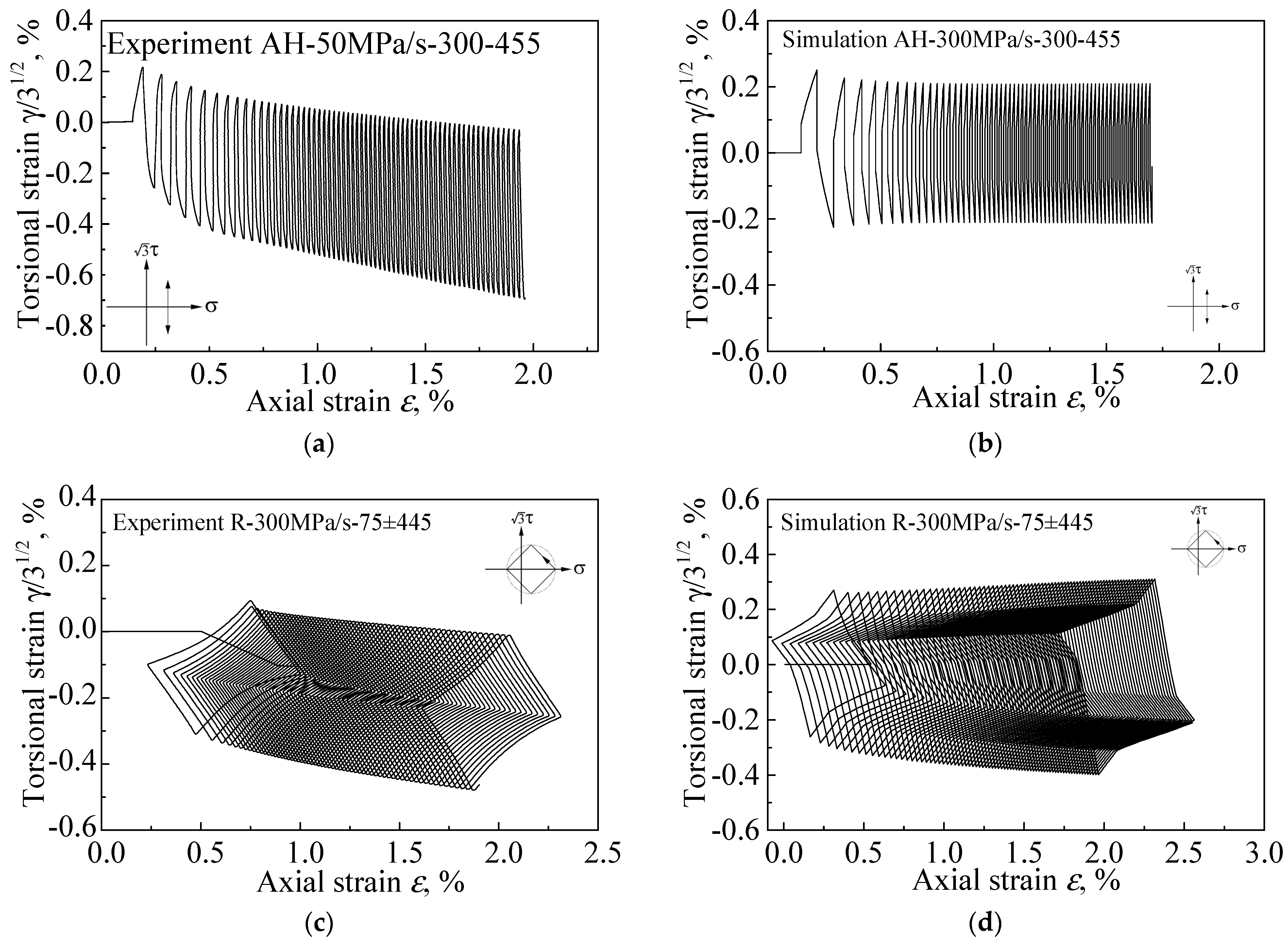
Figure 6a and
Figure 6b, respectively, show the experimental and simulated results of axial strain versus equivalent shear strain curves under the axial holding path (with constant axial stress of 300 MPa and equivalent shear stress of ±435 MPa) at a stress rate of 300 MPa/s.
Figure 6c and
Figure 6d, respectively, show the experimental and simulated results of the axial strain and equivalent shear strain curves under the rhombic path (with axial stress of 75 ± 445 MPa and equivalent shear stress of ±445 MPa) at a stress rate of 300 MPa/s.
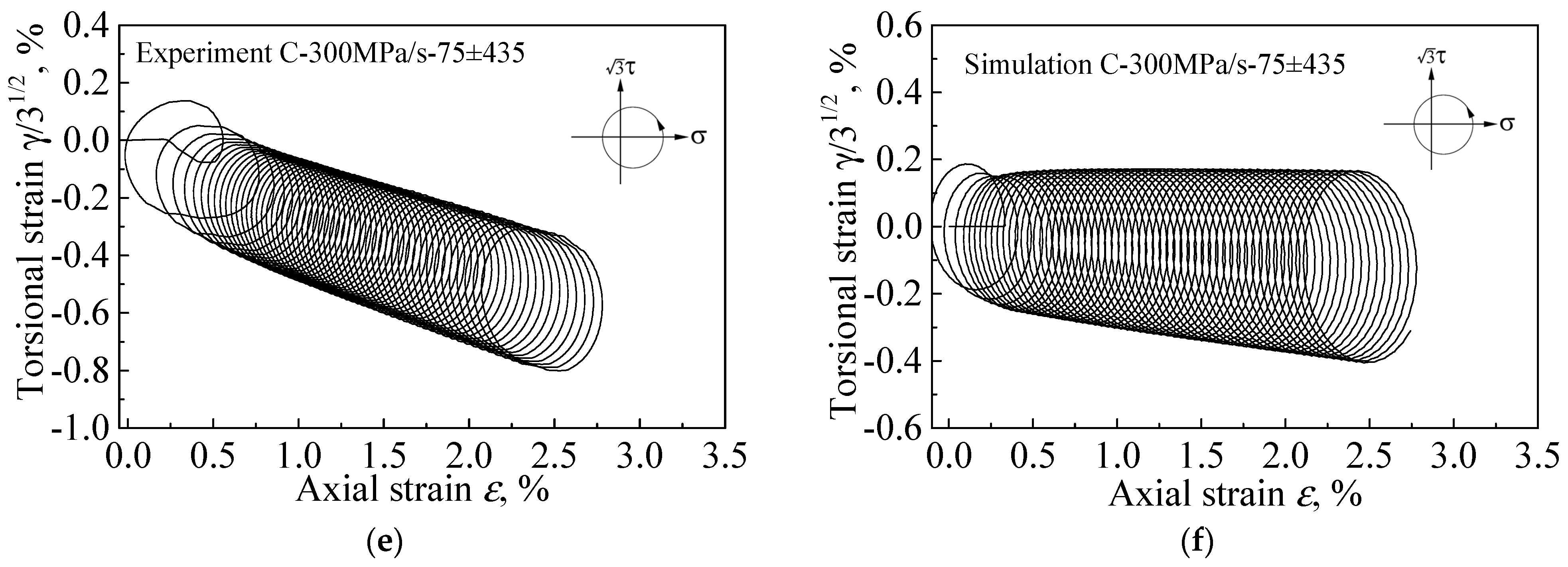
Figure 6e and
Figure 6f present the experimental and simulated results of the axial strain and equivalent shear strain curves, respectively, under the circular path (with axial stress of 75 ± 435 MPa and equivalent shear stress of ±435 MPa) at a stress rate of 300 MPa/s.
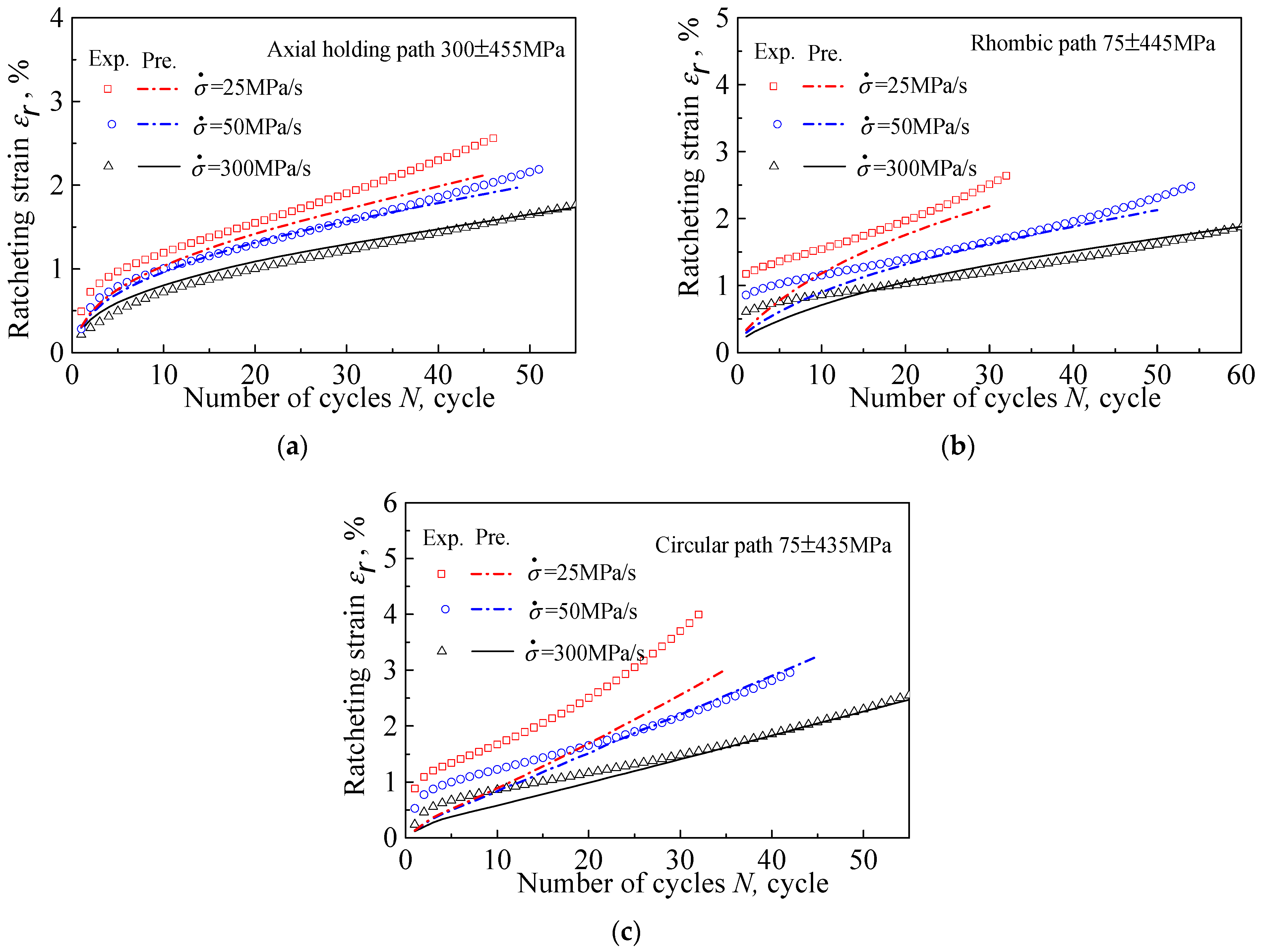
Figure 7a presents the predicted axial ratcheting strain curves of EA4T axle steel under the axial stress holding path at three different stress rates (25 MPa/s, 50 MPa/s, and 300 MPa/s).
Figure 7b presents the predicted axial ratcheting strain curves for EA4T axle steel under the diamond path (with axial stress of 75 ± 445 MPa and equivalent shear stress of ±445 MPa) at three different stress rates (25 MPa/s, 50 MPa/s, and 300 MPa/s).
Figure 7c shows the predicted axial ratcheting strain curves of EA4T axle steel under the circular path (with axial stress of 75 ± 435 MPa and equivalent shear stress of ±435 MPa) at three different stress rates (25 MPa/s, 50 MPa/s, and 300 MPa/s).
The simulation results support the following conclusion: (1) Through the incorporation of a suitable non-proportionality factor, the newly enhanced fractional-order cyclic constitutive model can reliably predict how multiaxial ratcheting strain depends on different loading paths.
(2) By formulating the ratcheting parameters as functions of the accumulated plastic strain rate, the newly improved fractional-order cyclic constitutive model effectively captures both the multiaxial ratcheting strain and its evolution rate. The evolution trend of multiaxial ratcheting is similar to that observed under uniaxial conditions: the ratcheting strain rate initially decreases markedly before stabilizing at a constant level, which reflects a steady progression of ratcheting behavior.
(3) The simulation results further confirm that by modeling the evolution of plastic strain rate and back stress using fractional-order formulations, the newly improved fractional-order cyclic constitutive model is capable of representing the rate dependence of multiaxial ratcheting behavior. In particular, lower stress rates lead to greater ratcheting strain in the axle steel, as well as a faster evolution rate of ratcheting.
(4) The simulation results further indicate that during the initial cycles, the multiaxial ratcheting strains predicted by the fractional-order cyclic constitutive model exhibit minimal variation across different loading rates. This suggests that the model has a limited capacity to accurately characterize rate-dependent ratcheting behavior in the early stage. However, as cyclic loading continues—with increasing cycle numbers and loading duration—the time–memory effect inherent in the fractional-order formulation progressively improves the model’s ability to reflect the rate dependence of ratcheting. This leads to the sensitivity to stress rate becoming increasingly evident in the model’s predictions.
It can also be seen that the prediction results for the axial holding path have the smallest deviation from the experimental results, indicating the best simulation accuracy. The simulation of the rhombus path is slightly less accurate, while the circular path shows the poorest simulation accuracy. This indicates that the newly improved fractional-order cyclic constitutive model still possesses certain limitations in predicting multiaxial ratcheting behavior, especially yielding less satisfactory outcomes for more complex multiaxial loading paths. Further in-depth research is required to enhance the fractional-order cyclic constitutive model for accurately simulating rate-dependent multiaxial ratcheting.
6. Conclusions
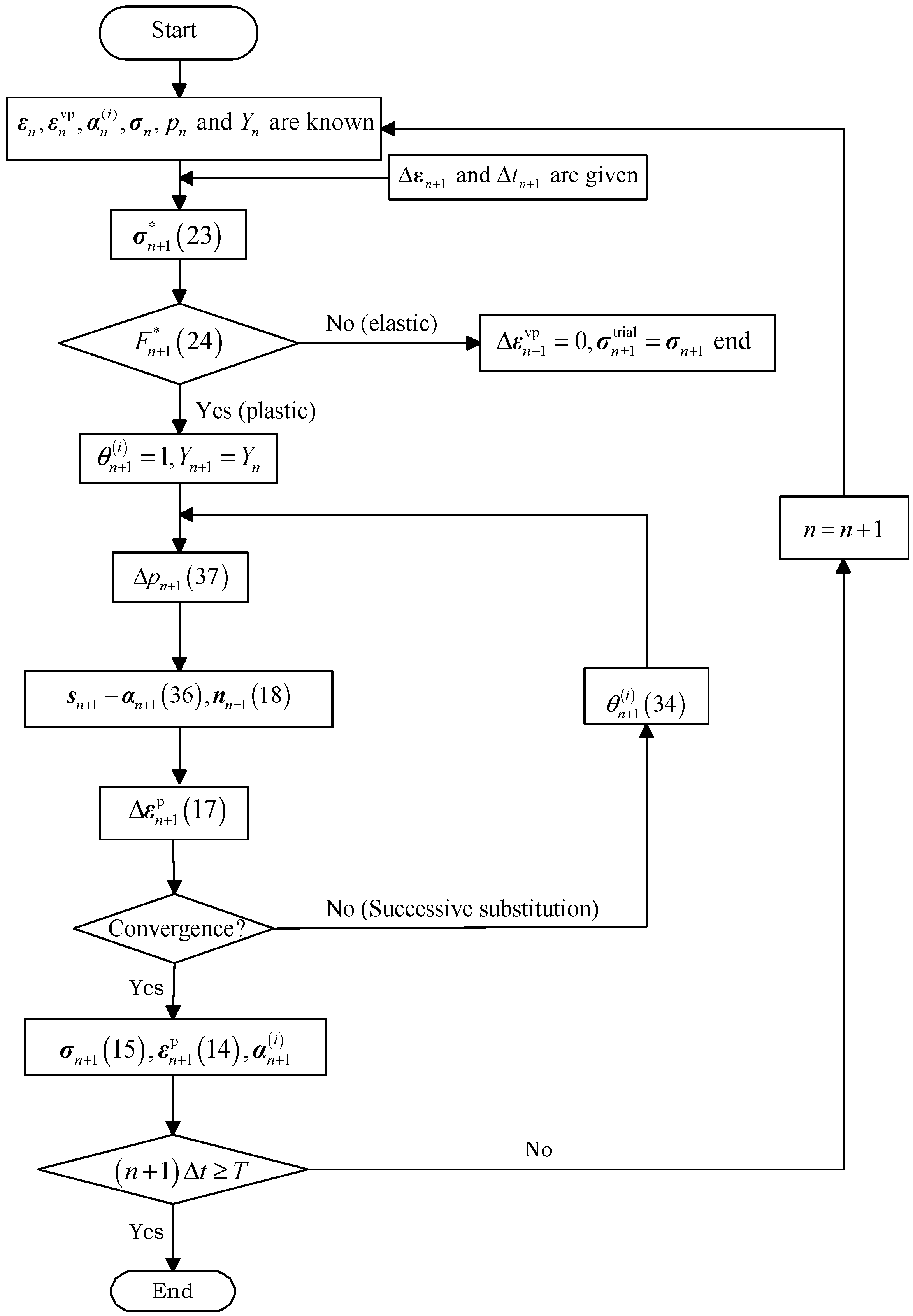
This paper develops and improves a fractional-order cyclic constitutive model capable of describing rate-dependent ratcheting behavior by defining the ratcheting parameter as a function of the cumulative plastic strain rate and describing the plastic strain rate and back stress in a fractional-order form from a macroscopic perspective. The numerical implementation procedure and parameter determination method for the model are also presented. Subsequently, the newly enhanced fractional-order model is employed to simulate and predict the cyclic deformation behavior of the cyclic softening material, EA4T axle steel. The following conclusions can be drawn from the simulation results:
(1) Due to the introduction of the fractional-order formulation, the enhanced model is capable of predicting the material’s monotonic tensile response and cyclic softening behavior under different strain rates, which cannot be captured by conventional elastoplastic cyclic constitutive models. The incorporation of a fractional-order formulation enables the enhanced model to predict the material’s monotonic tensile response and cyclic softening behavior under varying strain rates—a capability that conventional elastoplastic cyclic constitutive models do not possess.
(2) By formulating the ratcheting parameter as a function of accumulated plastic strain rate, the improved fractional-order cyclic constitutive model can effectively simulate the evolution of both uniaxial ratcheting and non-proportional multiaxial ratcheting behavior. Specifically, the ratcheting strain accumulates gradually with increasing cycle numbers, while the ratcheting strain rate shows an initial decline from a higher value before eventually stabilizing at a constant level, resulting in a steady progression of ratcheting strain. Nevertheless, the newly improved fractional-order cyclic constitutive model still exhibits certain limitations in predicting multiaxial ratcheting, demonstrating less satisfactory predictive accuracy under more complex multiaxial loading paths.
(3) By describing the evolution of plastic strain rate and back stress in a fractional-order form, the newly improved fractional-order cyclic constitutive model can reasonably predict the rate-dependent behavior of both uniaxial and multiaxial ratcheting. Specifically, under the same stress levels and loading paths, a lower stress rate leads to greater ratcheting strain and faster ratcheting development.
However, the model predicts minimal initial differences in ratcheting strain under different stress rates. It is only as cycles progressively accumulate that the fractional-order time–memory effect gradually strengthens the rate dependence of the simulated ratcheting behavior. This results in increasingly close agreement between the predicted ratcheting strains and the experimental data.