Article

Numerical Solution for Gas Dynamics Equation Involving Caputo-Time Fractional Derivative Using a Family of Shifted Chebyshev Polynomials


by
Waleed Mohamed Abd-Elhameed
1,*,
Ahmed H. Al-Mehmadi
2,
Naher Mohammed A. Alsafri
2,
Omar Mazen Alqubori
2,
Amr Kamel Amin
3 and
Ahmed Gamal Atta
4
1
Department of Mathematics, Faculty of Science, Cairo University, Giza 12613, Egypt
2
Department of Mathematics and Statistics, College of Science, University of Jeddah, Jeddah 23831, Saudi Arabia
3
Department of Mathematics, Adham University College, Umm Al-Qura University, Makkah 28653, Saudi Arabia
4
Department of Mathematics, Faculty of Education, Ain Shams University, Roxy, Cairo 11341, Egypt
*
Author to whom correspondence should be addressed.
Fractal Fract. 2026, 10(5), 299; https://doi.org/10.3390/fractalfract10050299
Submission received: 16 March 2026 / Revised: 25 April 2026 / Accepted: 26 April 2026 / Published: 28 April 2026

Abstract

This study develops an effective numerical method for addressing the time-fractional gas dynamics equation formulated with the Caputo time-fractional derivative. Novel basis functions are utilized, formulated as particular generalized Fibonacci polynomials contingent on a free parameter. This family generalizes the second kind of Chebyshev family. For the proposed polynomials, we establish basic analytical properties, including closed-form series expansion, inverse relation, moment and linearization formulas, and operational matrices for both integer-order and Caputo fractional derivatives. Using these tools, the fractional model, together with its underlying conditions, can be transformed into a finite system of nonlinear algebraic equations via a collocation strategy. Using Newton’s iterative method, the resulting system can be treated. A full convergence analysis of the double generalized Chebyshev expansion is provided. We demonstrate the accuracy and reliability of the presented method through several numerical simulations. Comparisons with existing numerical methods show that this approach achieves higher accuracy and faster execution.

1. Introduction

Special functions play an essential role in numerous branches of applied mathematics, including engineering, physics, numerical analysis, and number theory. See [1] for an illustration of how the famous Fibonacci and Lucas polynomials are used in various contexts. Numerous special functions have applications in numerical analysis and approximation theory because they can be used to approximate solutions of various differential equations (e.g., see [2,3]).
Polynomial sequences are essential in both theoretical and practical mathematics, and they are used in many scientific disciplines. The two primary categories of polynomial sequences are orthogonal and non-orthogonal polynomials. References such as [4,5,6] may be found in the literature about classical orthogonal polynomials and their modified and generalized variants. Numerous polynomial sequences were employed to numerically solve various DEs. For example, the modified Lucas polynomials, namely, Vieta–Lucas polynomials, were utilized in [7] for handling nonlinear stochastic Itô–Volterra integral equations. Other modified Fibonacci polynomials, namely, Vieta–Fibonacci polynomials, were used through the employment of the collocation approach to treat a type of telegraph fractional differential equations (FDEs) in [8]. Certain generalized Fermat polynomials, namely, convolved Fermat polynomials, were investigated and employed in [9] to handle the fractional Burgers’ equation using a matrix collocation approach. A specific class of shifted Horadam polynomials was utilized in [10] to find numerical solutions of certain non-linear KdV equations. Romanovski–Jacobi polynomials were used in [11] to treat some DEs. New Pell coefficient polynomials were presented and used to solve linear hyperbolic first-order partial DEs in [12]. A technique based on utilizing Lucas polynomials along with the Galerkin approach was proposed in [13] for treating some fuzzy-type differential models. Bernstein polynomials were utilized in [14] to solve a kind of integral equations. Certain Dickson polynomials were used together with the spectral tau method to handle the fractional-order logistic equations in [15]. The shifted Jacobi polynomials were used in [5] for tempered fractional quadratic integro-DEs. Bernoulli polynomials were utilized in [16] to handle variable-order FDEs.
Chebyshev polynomials (CPs) play significant roles in many areas of applied science. Their importance is especially evident in analysis and related applications. There are four well-known types of the Chebyshev polynomials, which are special cases of Jacobi polynomials. All these types have trigonometric representations. Many contributions have been devoted to the use of these polynomials in the solution of several DEs; see, for example, Refs. [17,18]. Many authors were interested in introducing many generalizations and modifications of CPs. In [19], a collocation numerical strategy was developed for the FitzHugh–Nagumo equation by employing a specific family of Chebyshev polynomials. Other combined CPs were introduced and utilized in [20] to handle heat FDEs.
Fractional differential equations (FDEs) are widely recognized as a robust framework for characterizing nonlinear systems influenced by memory, inheritance, or nonlocal interactions. This property of FDEs, along with that of integer-order counterparts, enables their application in scenarios involving natural phenomena that classical integer-order models fail to elucidate, including flow in porous media, wave propagation in complex media, and viscoelastic materials. Engineers often use them to model systems with memory that changes over time and properties that depend on frequency in electrical circuits, control theory, and signal processing. For some uses of FDEs, see [21,22,23,24]. The Caputo fractional derivative reflects memory effects in physical systems, meaning that the current state depends on the past history of the process. This is important in gas dynamics, where nonlocal and anomalous behaviors may arise. Moreover, it allows the use of classical initial conditions with a clear physical interpretation.
Due to the nonavailability of exact solutions to the majority of FDEs, many numerical approaches were followed for the numerical treatment of such equations. The authors in [25] presented a spline-based numerical framework for addressing the space–time fractional convection–diffusion equations. Another scheme was derived in [26] utilizing enhanced quintic B-spline functions to address time-fractional fourth-order diffusion problems. In [27], a different method based on the variational iteration approach was used to study the fractional Rössler system. The variational iteration method was also used in [28] to find approximate solutions to the space-fractional Schrödinger equation. In [29], higher-order predictor-corrector strategies with better predictors were introduced to numerically solve FDEs. Additionally, the study employed a more robust predictor-corrector method (see [30]). In [31], a q-homotopy analysis method was used to obtain approximate solutions to Abel-type DEs. In [32], the homotopy perturbation method was used to find solutions to time-fractional nonlinear variable-order delay partial DEs. A local radial basis function methodology was examined in [33] for treating the time-fractional delay partial DEs. In [34], physics-informed neural networks were used to find solutions for FDEs by putting the laws of physics into neural networks. The Adomian decomposition method was utilized in [35] to address fractional-order partial DEs, whereas a Laplace–Adomian decomposition approach was introduced in [36] for solving certain fractional optimal control problems. Finally, the Laplace residual series method was introduced in [37] as a useful approach for solving time-fractional Fisher-type equations that combines analysis and computation.
The modeling of gas flow and energy transfer in engines, propulsion systems, and high-speed flow applications is based on gas dynamics. Nonlinear time-fractional gas dynamics equations are challenging to solve exactly due to their strong nonlinearity and analytical complexity, even though such models are essential for explaining such processes. Various analytical and numerical approaches were employed to solve these equations. Here, we list some methods employed to address such problems.
  • The authors of [38] used the Laplace transform method to derive approximate analytical solutions of the fractional gas dynamics equation.
  • The authors of [39] employed the Shehu transform to construct semi-analytical solutions for fractional-order gas dynamics equations.
  • The authors of [40] applied a Pythagorean fuzzy Laplace transform iterative method to treat fractional gas dynamic equations.
  • The authors of [41] used the homotopy perturbation method combined with the natural transform to solve the fractional gas dynamics equation.
  • The authors of [42] applied the natural homotopy perturbation method to obtain approximate solutions of nonlinear fractional gas dynamics equations.
  • The authors of [43] employed the Laplace–Adomian decomposition method to solve the time-fractional gas dynamics equation.
  • The authors of [44] used the Elzaki decomposition method to construct analytical solutions for the fractional gas dynamics model.
  • The authors of [45] developed an approximate analytical framework for solving temporal fractional gas dynamics equations.
  • The authors of [46] proposed an approximate analytical method to treat fractional gas dynamics equations.
  • The authors of [47,48] developed collocation and Galerkin schemes based on B-spline basis functions to solve time-fractional gas dynamics problems.
  • The authors of [49] employed trigonometric B-spline functions to obtain numerical solutions for Caputo-type fractional gas dynamics models.
  • The authors of [50] introduced hybrid techniques combining integral transforms with projected differential transform methods for solving fractional gas dynamics equations.
  • The authors of [51] applied the q-homotopy analysis method to efficiently solve time–space fractional gas dynamics equations.
Spectral methods provide an effective framework for numerically solving differential and integral equations. This is because they can get approximate solutions close to the exact ones and converge exponentially, particularly for smooth enough solutions. These methods work by writing the unknown solution as a global basis of functions, which can be either orthogonal or non-orthogonal polynomials. Spectral methods can be classified into three primary approaches, which make them more useful and adaptable. They are Galerkin, tau, and the collocation methods. The collocation method is frequently used in numerical analysis as it accommodates a wide range of differential equation models; see, for instance, Refs. [52,53]. Regarding the tau and Galerkin methods, they require the selection of two sets of basis functions: the trial and test functions. In tau methods, they are different (see, for example, ref. [54]), but in the Galerkin method, they should be the same (see [55,56]).
The paper’s primary goal is to develop an effective spectral collocation scheme for the Caputo-derivative-based time-fractional gas dynamics model. New formulas for a class of the shifted generalized Chebyshev polynomials (SGCPs), which are selected to be the basis functions, are derived and used to design the proposed numerical algorithm.
To motivate the use of the generalized Chebyshev polynomials adopted in this work, we highlight several key features that make them particularly suitable for constructing efficient and flexible spectral schemes:
  • The idea of introducing parameters into polynomial bases is well established. For example, ultraspherical polynomials generalize both Chebyshev polynomials of the first and second kinds and are widely used due to the presence of a free parameter. Although our introduced polynomials generalize the Chebyshev polynomials of the second kind, they are different from the well-known ultraspherical polynomials.
  • The availability of a free parameter allows the construction of a family of approximation spaces, rather than a single fixed basis, which enhances flexibility in capturing different solution behaviors.
  • Classical Chebyshev polynomials are not always optimal for all problems; the proposed generalization offers improved approximation capability in certain cases, as supported by numerical experiments.
  • The considered polynomials generalize the second-kind Chebyshev polynomials through a distinct framework based on generalized Fibonacci polynomials, offering an alternative structure that can be better suited for specific applications.
  • The derivation of explicit and closed-form formulas (including representations, inverse relations, and operational matrices) facilitates their efficient implementation within spectral methods.
In this paper, we study the influence of the parameter a of the generalized polynomials. This parameter introduces flexibility that directly affects accuracy and convergence. While a = 2 (corresponding to Chebyshev polynomials of the second kind) is commonly used, it is not always optimal. Numerical results show that it is not the optimal case. In addition, we show that moderate values of a = 1 , 2 , 3 yield good performance, whereas larger values, such as a = 13 and greater, tend to reduce accuracy and worsen conditioning. This confirms the importance of selecting an appropriate value of a to obtain highly accurate solutions.
To the best of our knowledge, the application of a spectral collocation method based on this class of polynomials to this model has not been previously investigated. The proposed approach benefits from the well-known advantages of spectral collocation methods, including high accuracy and rapid convergence with relatively few basis functions, and leads to an efficient computational procedure suitable for nonlinear fractional problems.
The organization of this article is outlined below. The next section presents some necessary preliminaries and the fundamental properties of a family of generalized Fibonacci polynomials. In Section 3, new theoretical formulas for the SGCPs are derived, including explicit integer and fractional derivatives, which are essential for designing the proposed scheme. Section 4 designs a collocation scheme for the time-fractional gas dynamics model. The convergence behavior together with a detailed error analysis of the proposed method is discussed in Section 5. Section 6 presents numerical examples and comparative results that confirm the method’s accuracy and applicability. Concluding remarks and possible future directions are presented in Section 7.

2. Preliminaries and Fundamentals

This section presents some fundamentals of the Caputo fractional derivative. In addition, an overview of certain generalized Fibonacci polynomials is provided.

2.1. Caputo Fractional Derivative

Definition 1.
The Caputo fractional derivative of order α > 0 for a function u ( τ ) is defined by [57]
D α u ( τ ) = 1 Γ ( m α ) 0 τ ( τ σ ) m α 1 d m u ( σ ) d σ m d σ , τ > 0 ,
where m N satisfies m 1 < α m .
For the Caputo operator D α with m 1 < α m , the following properties are satisfied:
D α c = 0 , c   is   a   constant ,
D α τ k = 0 , k N 0 , k < α , k ! Γ ( k α + 1 ) τ k α , k N 0 , k α ,
where N = { 1 , 2 , } , N 0 = { 0 , 1 , 2 , } , and α denotes the ceiling function.

2.2. An Overview of Generalized Fibonacci Polynomials

The generalized Fibonacci polynomials can be constructed through the recurrence relation given below:
F j a , b ( x ) = a x F j 1 a , b ( x ) + b F j 2 a , b ( x ) , F 0 a , b ( x ) = 1 , F 1 a , b ( x ) = a x .
They have the following explicit series form:
F n a , b ( x ) = m = 0 n 2 a n 2 m b m n m m x n 2 m ,
where · denotes the floor function.
  • The inverse formula for (5) is given by
x n = k = 0 n / 2 ( 1 ) k b k k ! a n ( n 2 k + 1 ) ( n k + 2 ) k 1 F n 2 k ( a , b ) ( x ) .
Furthermore, the moment formula associated with F k ( a , b ) ( x ) can be written as
x r F k a , b ( x ) = m = 0 r r m a r ( b ) m F k + r 2 m a , b ( x ) .
Remark 1.
In this paper, we will introduce a class of shifted polynomials that includes one parameter defined as
W j a ( x ) = F j a , a 2 4 ( 2 x 1 ) .
Remark 2.
The choice of b = a 2 4 is motivated by the fact that, in this case, we can derive new simplified formulas that are pivotal in our study. In addition, these polynomials generalize the shifted second-kind CPs, that is
U j ( x ) = U j ( 2 x 1 ) = W j 2 ( x ) .
Remark 3.
Setting b = a 2 4 , we can write the series form of the generalized Chebyshev polynomials of the second kind in the form
F j a ( x ) = a j m = 0 j / 2 1 4 m j m m x j 2 m .

3. New Theoretical Formulas for the SGCPs

In this section, several new identities associated with the introduced SGCPs are presented, forming the foundation of the proposed numerical algorithm. Specifically, we establish the following formulas:
  • The series form of the introduced SGCPs and their inverse relation.
  • The explicit expressions for the integer-order and fractional-order derivatives of the SGCPs.
  • The linearization formula for the SGCPs.
Remark 4.
It is worth noting that these results also provide further motivation for the use of the proposed polynomials. The results developed in this section generalize several known formulas of the classical shifted Chebyshev polynomials of the second kind, which are recovered as a special case for a = 2 . While some formulas of the generalized polynomials, such as the series representation, the integer derivatives, and the linearization formula, are reduced to known results, the fractional-order derivative formula of the shifted Chebyshev polynomials of the second kind is new.
Lemma 1.
For every positive integer j, the following series form for W j a ( x ) holds
W j a ( x ) = r = 0 j ( 1 ) r 2 j 2 r a j ( 2 + 2 j 2 r ) r r ! x j r ,
where ( α ) r denotes the Pochhammer symbol.
Proof. 
Based on the series form in (9), and if we replace x by 2 x 1 , we get
W j a ( x ) = a j s = 0 j / 2 1 4 s j s s ( 2 x 1 ) j 2 s .
Next, applying the binomial expansion to ( 2 x 1 ) j 2 s yields
( 2 x 1 ) j 2 s = = 0 j 2 s ( 1 ) j 2 s 2 j 2 s x .
Substituting (12) into (11) gives the following formula:
W j a ( x ) = a j s = 0 j / 2 1 4 s j s s = 0 j 2 s ( 1 ) j 2 s 2 j 2 s x .
Rearranging Formula (13) gives
W j a ( x ) = a j r = 0 j ( 1 ) r 2 j r s = 0 r / 2 1 4 s j s s j 2 s j r x j r .
To find a simplified formula for the above formula, we use the following transformation:
s = 0 r / 2 1 4 s j s s j 2 s j r = j ! ( j r ) ! r ! s = 0 r / 2 r 2 s 1 r 2 s ( j ) s s ! ,
which can be written in terms of the hypergeometric function form as
s = 0 r / 2 1 4 s j s s j 2 s j r = j ! ( j r ) ! r ! F 1 2 r 2 , 1 r 2 j | 1 .
Using the Chu–Vandermonde identity [58], one can derive the following form:
s = 0 r / 2 1 4 s j s s j 2 s j r = ( 2 j 2 r + 2 ) r 2 r r ! .
Substituting (17) into (14) immediately leads to (10), which completes the proof. □
Remark 5.
The series form in (10) may be expressed alternatively as
W j a ( x ) = r = 0 j γ r , j x r ,
where
γ r , j = ( 1 ) j r 2 j + 2 r a j ( 2 r + 2 ) j r ( j r ) ! .
In what follows, the inverse relation associated with (10) is stated and proved.
Lemma 2.
The following inversion formula is valid for every positive integer j:
x j = r = 0 j 2 1 j r ( 1 + j r ) ( 2 j + 1 ) ! a r j r ! ( 2 j r + 2 ) ! W j r a ( x ) .
Proof. 
First, define
G j ( x ) = r = 0 j 2 1 j r ( 1 + j r ) ( 2 j + 1 ) ! a r j r ! ( 2 j r + 2 ) ! W j r a ( x ) .
We will show that G j ( x ) = x j . Inserting the power form (10) into the right-hand side of (21) yields
G j ( x ) = r = 0 j 2 1 j r ( 1 + j r ) ( 2 j + 1 ) ! r ! ( 2 j r + 2 ) ! L = 0 j r ( 1 ) L 2 j 2 L r L ! ( 2 + 2 j 2 r 2 L ) L x j r L .
Rearranging the summation by setting k = r + L gives
G j ( x ) = k = 0 j 2 1 2 k ( 2 j + 1 ) ! r = 0 k ( 1 ) k r ( 1 + j r ) ( 2 + 2 j 2 k ) k r r ! ( k r ) ! ( 2 j r + 2 ) ! x j k .
The inner sum gives the following closed form:
r = 0 k ( 1 ) k r ( 1 + j r ) ( 2 + 2 j 2 k ) k r r ! ( k r ) ! ( 2 j r + 2 ) ! = 1 2 ( 2 j + 1 ) ! δ k , 0 ,
where δ k , 0 is the Kronecker delta. Substituting (24) into (23) yields
G j ( x ) = x j .
Hence, the inverse formula (20) follows, completing the proof. □
By exploiting the expansion given in (10) and the corresponding inverse relation, an explicit derivative formula can be derived as in the following theorem.
Theorem 1.
Let n , m N with n m . Then the m-th derivative of W n a ( x ) admits the expansion
d m d x m W n a ( x ) = = 0 n m U , n , m W a ( x ) ,
where
U , n , m = ( + 1 ) ( 1 ) n m 2 n + + 2 m a n n + + m 2 ! n + m 2 1 ! β n , , m ( m 1 ) ! n + m 2 + 1 ! n m 2 ! ,
and
β n , , m = 1 , if ( n m ) is even , 0 , otherwise .
Proof. 
We start from the series representation stated in (10) and compute its mth derivative with respect to the variable x. This differentiation yields
d m d x m W n a ( x ) = a n r = 0 n m ( 1 ) r 2 n 2 r ( 2 + 2 n 2 r ) r ( 1 + n m r ) m r ! x n r m .
Next, we substitute the inverse expansion given in (20) into (27), which leads to the following double-sum expression:
d m d x m W n a ( x ) = a n r = 0 n m ( 1 ) r 2 n 2 r ( 2 + 2 n 2 r ) r ( 1 + n m r ) m r ! × = 0 n r m 2 1 n + m + r a n + m + r + ( 1 + n m r ) 1 + 2 ( n m r ) ! 2 + 2 ( n m r ) ! ! × W n m r a ( x ) .
To simplify the above expression, we rearrange the order of summation by introducing the new index s = r + . This transformation results in
d m d x m W n a ( x ) = s = 0 n m 2 1 s + m ( 1 n + s + m ) a s + m Z s , m , n W n m s a ( x ) ,
where the coefficients Z s , m , n are defined by
Z s , m , n = r = 0 s ( 1 ) r + 1 ( 1 + 2 n 2 m 2 r ) ! ( n r ) ! ( 1 + 2 n r ) ! ( 1 + 2 n 2 r ) ! ( s r ) ! ( 2 + 2 n s 2 m r ) ! ( n m r ) ! r ! .
In order to evaluate the finite sum appearing in (30), we apply Zeilberger’s algorithm [59]. This approach produces the recurrence relation
( s + 1 ) ( n s ) Z 2 s + 2 , m , n ( n m s + 1 ) ( s + m ) Z 2 s , m , n = 0 ,
together with the initial values
Z 0 , m , n = n ! 2 ( n m + 1 ) ! , Z 1 , m , n = 0 .
Solving the recurrence relation (31), we obtain
Z s , m , n = 0 , if s is odd , ( m ) s / 2 n s 2 ! 2 s 2 ! n m s 2 + 1 ! , if s is even .
Consequently, this result can be written in the closed form
Z 2 s , m , n = 1 ( m 1 ) ! ( n s ) ! ( s + m 1 ) ! s ! ( n s m + 1 ) ! , Z 2 s + 1 , m , n = 0 .
Substituting the expression in (33) into (29) and carrying out straightforward simplifications, we arrive at
d m d x m W n a ( x ) = 1 ( m 1 ) ! s = 0 ( n m ) / 2 2 2 s + m ( 1 n + 2 s + m ) a 2 s + m ( n s ) ! ( s + m 1 ) ! s ! ( n s m + 1 ) ! × W n m 2 s a ( x ) .
Finally, the result in (34) can be equivalently rewritten in the form
d m W n a ( x ) d x m = = 0 n m U , n , m W a ( x ) ,
where
U , n , m = ( + 1 ) ( 1 ) n m 2 n + + 2 m a n 1 2 ( n + + m ) ! 1 2 ( n + m ) 1 ! β n , , m ( m 1 ) ! 1 2 ( n + m ) + 1 ! 1 2 ( n m ) ! ,
with
β n , , m = 1 , ( n m ) is even , 0 , otherwise .
This completes the proof. □
Corollary 1.
For n 1 , the first derivative of W n a ( x ) can be written as
d W n a ( x ) d x = = 0 n 1 U , n , 1 W a ( x ) ,
where the coefficients U , n , 1 are given by
U , n , 1 = ( 1 ) 1 + n 2 2 n + a n ( + 1 ) β n , , 1 .
Proof. 
The result follows immediately by setting m = 1 in Theorem 1. □
Theorem 2.
Consider ζ > 0 , m = ζ , which denotes the ceiling of ζ. The fractional derivative of W n a ( t ) has the following form:
D t ζ W n a ( t ) = t ζ p = 0 n γ p , n a W p a ( t ) ,
where
γ p , n a = ( 1 ) n + 1 ( p + 1 ) Γ m 1 2 ( 2 m + 1 ) ! 2 n 2 m + p ( n + m + 1 ) ! a n p π ( n m ) ! × F ˜ 3 4 m n , m + 1 , 1 , n + m + 2 m p + 1 , m + p + 3 , m ζ + 1 | 1 ,
and F ˜ 3 4 ( 1 ) denotes the regularized hypergeometric function [58].
Proof. 
We start from the power representation in the form
W n a ( t ) = a n r = 0 n ( 1 ) n r 2 n + 2 r ( 2 + 2 r ) n r ( n r ) ! t r .
We apply the Caputo fractional derivative D t ζ formula (40), and make use of the following property:
D t ζ t r = r ! Γ ( r + 1 ζ ) t r ζ , r m = ζ , 0 , r < m ,
to obtain the following formula:
D t ζ W n a ( t ) = a n r = m n ( 1 ) n r 2 n + 2 r ( 2 + 2 r ) n r r ! ( n r ) ! Γ ( r + 1 ζ ) t r ζ ,
which is also equivalent to
D t ζ W n a ( t ) = t ζ a n r = m n ( 1 ) n r 2 n + 2 r ( 2 + 2 r ) n r r ! ( n r ) ! Γ ( r + 1 ζ ) t r .
The application of (20) converts the previous expression into the form
D t ζ W n a ( t ) = t ζ r = m n L = 0 r ( 1 ) n r 2 1 n + L ( L + 1 ) a n L ( 2 + 2 r ) n r r ! ( 2 r + 1 ) ! ( n r ) ! Γ ( r + 1 ζ ) ( r L ) ! ( 2 + L + r ) ! W L a ( t ) .
The last identity can also be expressed as
D t ζ W n a ( t ) = t ζ p = 0 n γ p , n a W p a ( t ) ,
where γ p , n a has the following form:
γ p , n a = ( 1 ) n + 1 ( p + 1 ) Γ m 1 2 ( 2 m + 1 ) ! 2 n 2 m + p ( n + m + 1 ) ! a n p π ( n m ) ! × F ˜ 3 4 m n , m + 1 , 1 , n + m + 2 m p + 1 , m + p + 3 , m ζ + 1 | 1 ,
and this completes the proof. □
In the following, we give a new expression for the fractional derivatives of the shifted Chebyshev polynomials of the second kind in terms of their original ones.
Corollary 2.
Consider ζ > 0 , m = ζ . The fractional derivative of the shifted Chebyshev polynomials of the second-kind U n ( t ) is given by
D t ζ U n ( t ) = t ζ p = 0 n γ p , n U p ( t ) ,
where
γ p , n = ( 1 ) n + 1 ( p + 1 ) Γ m 1 2 ( 2 m + 1 ) ! 2 2 m ( n + m + 1 ) ! π ( n m ) ! × F ˜ 3 4 m n , m + 1 , 1 , n + m + 2 m p + 1 , m + p + 3 , m ζ + 1 | 1 .
Proof. 
The result follows directly from Theorem 2 by setting a = 2 , noting that in this case W n 2 ( t ) = U n ( t ) . □
Remark 6.
To the best of our knowledge, we mention here that the fractional-order derivative formula given in (44) is new. Such a representation may be useful in the numerical treatment of FDEs when shifted Chebyshev polynomials are employed as basis functions.
Theorem 3.
Let m and n be positive integers. The following linearization formula applies:
W m a ( x ) W n a ( x ) = k = 0 m a 2 2 k W m + n 2 k a ( x ) .
Proof. 
Using the series form of W m a ( x ) , we can write
W m a ( x ) W n a ( x ) = s = 0 m / 2 ( 1 ) s 2 2 s a m m s s x m 2 s W n a ( x ) .
If we make use of the moment formula in (7) (for b = a 2 4 ), then we get
W m a ( x ) W n a ( x ) = s = 0 m 2 ( 1 ) s 2 2 s a m m s s r = 0 m 2 s m 2 s r 4 r a 2 r m + 2 s W m + n 2 r 2 s a ( x ) ,
which can be rearranged to give
W m a ( x ) W n a ( x ) = k = 0 m s = 0 k ( 1 ) s m s s m 2 s k s a 2 2 k W m + n 2 k a ( x ) .
We make use of the following combinatorial identity:
s = 0 k ( 1 ) s m s s m 2 s k s = 1 , 0 k m ,
to simplify formula (49) into
W m a ( x ) W n a ( x ) = k = 0 m a 2 2 k W m + n 2 k a ( x ) ,
which completes the proof. □
Remark 7.
Setting a = 2 in formula (46) gives as a particular case the following well-known linearization formula of the shifted Chebyshev polynomials of the second kind:
U m ( x ) U n ( x ) = k = 0 m U m + n 2 k ( x ) .

4. Collocation Approach for the Time-Fractional Gas Dynamics Model

In this section, we will derive a collocation scheme for the numerical treatment of the following time-fractional gas dynamics model (TFGDM) [45,60]:
D t ζ Q ( ρ , t ) μ Q ( ρ , t ) 1 Q ( ρ , t ) + ζ Q ( ρ , t ) Q ( ρ , t ) ρ = f ( ρ , t ) , 0 < ζ < 1 ,
subject to the conditions
Q ( ρ , 0 ) = g 0 ( ρ ) , 0 < ρ 1 ,
Q ( 0 , t ) = g 1 ( t ) , Q ( 1 , t ) = g 2 ( t ) , 0 < t 1 ,
where μ and ν are reaction and convection parameters, Q ( ρ , t ) represents the evolution of the state across both space and time and f ( ρ , t ) is an appropriate predetermined function.
  • Now, define
Ω M ( Λ ) = span { W i a ( ρ ) W j a ( t ) : i , j = 0 , 1 , 2 , , M } ,
where Λ = ] 0 , 1 ] 2 . For any Q M ( ρ , t ) Ω M ( Λ ) may be written as
Q M ( ρ , t ) = i = 0 M j = 0 M c i j W i a ( ρ ) W j a ( t ) .
The residual R ( ρ , t ) of Equation (51) can be written as
R ( ρ , t ) = D t ζ Q M ( ρ , t ) μ Q M ( ρ , t ) 1 Q M ( ρ , t ) + ν Q M ( ρ , t ) Q M ( ρ , t ) ρ f ( ρ , t ) = D t ζ Q M ( ρ , t ) μ Q M ( ρ , t ) + μ Q M ( ρ , t ) 2 + ν Q M ( ρ , t ) Q M ( ρ , t ) ρ f ( ρ , t ) .
Based on Theorems 2 and 3, Corollary 1, and Equation (55), the following expressions can be written:
D t ζ Q M ( ρ , t ) = i = 0 M j = 0 M p = 0 j c i j γ p , j a W i a ( ρ ) t ζ W p a ( t ) ,
Q M ( ρ , t ) 2 = i = 0 M j = 0 M r = 0 M s = 0 M p = 0 i q = 0 j c i j c r s a 2 2 ( p + q ) W j + s 2 q a ( t ) W i + r 2 p a ( ρ ) ,
Q M ( ρ , t ) Q M ( ρ , t ) ρ = i = 0 M j = 0 M r = 0 M s = 0 M L = 0 r 1 p = 0 i q = 0 j c i j c r s U L , r , 1 a 2 2 ( p + q ) W i + L 2 p a ( ρ ) W j + s 2 q a ( t ) .
Inserting Equations (57)–(59) into Equation (56), one obtains
R ( ρ , t ) = i = 0 M j = 0 M p = 0 j c i j γ p , j a W i a ( ρ ) t ζ W p a ( t ) μ i = 0 M j = 0 M c i j W i a ( ρ ) W j a ( t ) + μ i = 0 M j = 0 M r = 0 M s = 0 M p = 0 i q = 0 j c i j c r s a 2 2 ( p + q ) W j + s 2 q a ( t ) W i + r 2 p a ( ρ ) + ν i = 0 M j = 0 M r = 0 M s = 0 M L = 0 r 1 p = 0 i q = 0 j c i j c r s U L , r , 1 a 2 2 ( p + q ) W i + L 2 p a ( ρ ) W j + s 2 q a ( t ) f ( ρ , t ) .
The collocation approach results in
R m M + 1 , n M + 1 = 0 , 1 m M 1 , 1 n M .
In addition, the collocation approach, when imposed on the initial and boundary conditions (52) and (53), yields
i = 0 M j = 0 M c i j W i a m M + 1 W j a ( 0 ) = g 0 m M + 1 , m : 1 , , M + 1 , i = 0 M j = 0 M c i j W i a ( 0 ) W j a n M + 1 = g 1 n M + 1 , n : 1 , , M , i = 0 M j = 0 M c i j W i a ( 1 ) W j a n M + 1 = g 2 n M + 1 , n : 1 , , M .
Finally, the nonlinear system of ( M + 1 ) 2 equations formulated in (61) and (62) is handled through Newton’s iterative algorithm to obtain an approximate solution.

5. Investigating the Convergence and Error Analysis

This section investigates the convergence and error analysis of the proposed double Chebyshev expansion. In this regard, some lemmas and Theorems are presented.
Lemma 3
([61]). The following inequality holds:
i = 0 t n + 2 i i ! ( i + n ) ! = I n ( 2 t ) ,
where I n ( t ) is the modified Bessel function of order n of the first kind.
Lemma 4
([62]). The following inequality holds
| I n ( t ) | t n cosh ( t ) 2 n Γ ( n + 1 ) , t > 0 .
Lemma 5.
The following inequality holds for W i a ( t ) :
| W i a ( t ) | ( i + 1 ) a 2 i , t ] 0 , 1 ] .
Proof. 
The application of the power formula of W i a ( t ) enables us to write
| W i a ( t ) | = k = 0 i γ k , i t k k = 0 i γ k , i = ( i + 1 ) a 2 i ,
which is the desired result. □
Lemma 6.
Consider an infinitely differentiable function ψ ( t ) at t = 0 , expressible in the form
ψ ( t ) = n = 0 s = n ψ ( s ) ( 0 ) ( n + 1 ) ( 2 s + 1 ) ! a n 2 n 2 s + 1 ( s n ) ! ( n + s + 2 ) ! s ! W n a ( t ) .
Proof. 
The function ψ ( t ) may be expanded as
ψ ( t ) = n = 0 ψ ( n ) ( 0 ) n ! t n .
Invoking the identity (20) results in
ψ ( t ) = n = 0 r = 0 n ψ ( n ) ( 0 ) ( r + 1 ) ( 2 n + 1 ) ! 2 2 n + r + 1 a r ( n r ) ! ( n + r + 2 ) ! n ! W r a ( t ) .
After straightforward algebraic manipulations, the preceding equation can be rewritten as
ψ ( t ) = n = 0 s = n ψ s ( 0 ) ( n + 1 ) ( 2 s + 1 ) ! a n 2 n 2 s + 1 ( s n ) ! ( n + s + 2 ) ! s ! W n a ( t ) .
Hence, the proof is concluded. □
Theorem 4.
If ψ ( t ) is defined on [ 0 , 1 ] , and | ψ ( n ) ( 0 ) | λ n , n > 0 , where λ > 0 , and ψ ( t ) = n = 0 c n W n a ( t ) , then we get
| c n | e λ + 1 λ 2 a n 2 n ! , n 0 .
Furthermore, the series converges absolutely.
Proof. 
The application of Lemma 6 implies the following result:
| c n | = s = n ψ s ( 0 ) ( n + 1 ) ( 2 s + 1 ) ! a n 2 n 2 s + 1 ( s n ) ! ( n + s + 2 ) ! s ! s = n λ s ( n + 1 ) ( 2 s + 1 ) ! a n 2 n 2 s + 1 ( s n ) ! ( n + s + 2 ) ! s ! ,
which can be rewritten in another form after replacing s = n + k , as
| c n | k = 0 ( n + 1 ) 2 2 ( k + n ) + n + 1 a n ( 2 ( k + n ) + 1 ) ! λ k + n ( k + n n ) ! ( k + 2 n + 2 ) ! ( k + n ) ! .
Lemma 3 can be applied to rewrite the last equation as
| c n | e λ / 2 2 n + 2 ( n + 1 ) a n I n + 1 λ 2 λ .
By virtue of Lemma 4, we can write Equation (74) as
| c n | e λ + 1 λ 2 a n 2 n ! , n 0 .
This completes the proof of the first part.
  • Now, based on the inequalities (65) and (75), we can write
n = 0 c n W n a ( t ) = n = 0 c n W n a ( t ) 1 2 e λ + 1 n = 0 ( n + 1 ) λ 4 n n ! = 1 8 e λ / 4 e λ + 1 ( λ + 4 ) ,
so the series converges absolutely. □
Theorem 5.
Let Q ( ρ , t ) = ψ 1 ( ρ ) ψ 2 ( t ) = i = 0 j = 0 c i j W i a ( ρ ) W j a ( t ) , with | ψ 1 ( i ) ( 0 ) | λ 1 i , and | ψ 2 ( i ) ( 0 ) | λ 2 i , where λ 1 and λ 2 are positive constants. We get
| c i j | e λ 1 + 1 e λ 2 + 1 λ 1 2 a i λ 2 2 a j 4 i ! j ! .
Furthermore, the series converges absolutely.
Proof. 
The application of Lemma 6, taking into consideration the assumption Q ( ρ , t ) = ψ 1 ( ρ ) ψ 2 ( t ) , enables us to write
c i j = s = i q = j ψ 1 s ( 0 ) ψ 2 q ( 0 ) ( i + 1 ) ( j + 1 ) ( 2 q + 1 ) ! ( 2 s + 1 ) ! a i j 2 i + j 2 ( q + s 1 ) ( s i ) ! ( i + s + 2 ) ! ( q j ) ! ( j + q + 2 ) ! s ! q ! .
Using the assumption | ψ 1 ( i ) ( 0 ) | λ 1 i and | ψ 2 ( i ) ( 0 ) | λ 2 i , we can write
| c i j | s = i λ 1 s ( i + 1 ) ( 2 s + 1 ) ! a i 2 i 2 s + 1 ( s i ) ! ( i + s + 2 ) ! s ! × q = j λ 2 q ( j + 1 ) ( 2 q + 1 ) ! ( 1 ) 2 q 2 j 2 j 2 q + 1 a j ( q j ) ! ( j + q + 2 ) ! q ! .
Ultimately, by following the steps analogous to the proof of Theorem 4, we obtain
| c i j | e λ 1 + 1 e λ 2 + 1 λ 1 2 a i λ 2 2 a j 4 i ! j ! .
Theorem 6.
The estimate below holds whenever Q ( ρ , t ) meets the assumptions stated in Theorem 5.
Q ( ρ , t ) Q M ( ρ , t ) < e λ 1 + 1 e λ 2 + 1 2 2 ( M + 4 ) A 1 λ 1 , λ 2 λ 1 M + 1 + A 2 λ 1 , λ 2 λ 2 M + 1 M ! ,
where
A 1 λ 1 , λ 2 = e λ 1 / 4 ( λ 1 + 4 ) + 4 e λ 2 / 4 ( λ 2 + 4 ) ,
and
A 2 λ 1 , λ 2 = e λ 1 / 4 ( λ 1 + 4 ) e λ 2 / 4 ( λ 2 + 4 ) + 4 .
Proof. 
Using the expansions of Q ( ρ , t ) and Q M ( ρ , t ) allows to write
| Q ( ρ , t ) Q M ( ρ , t ) | = i = 0 j = 0 c i j W i a ( ρ ) W j a ( t ) i = 0 M j = 0 M c i j W i a ( ρ ) W j a ( t ) i = 0 M j = M + 1 c i j W i a ( ρ ) W j a ( t ) + i = M + 1 j = 0 c i j W i a ( ρ ) W j a ( t ) .
Using Theorem 5 and Lemma 5, the following may be obtained:
i = 0 M e λ 1 + 1 ( i + 1 ) λ 1 4 i 2 i ! < 1 8 e λ 1 / 4 e λ 1 + 1 ( λ 1 + 4 ) ,
j = M + 1 e λ 2 + 1 ( j + 1 ) λ 2 4 j 2 j ! < e λ 2 + 1 2 2 M 3 λ 2 M + 1 + e λ 2 / 4 ( λ 2 + 4 ) 4 M λ 2 4 M + 1 M ! ,
i = M + 1 e λ 1 + 1 ( i + 1 ) λ 1 4 i 2 i ! < e λ 1 + 1 2 2 M 3 λ 1 M + 1 + e λ 1 / 4 ( λ 1 + 4 ) 4 M λ 1 4 M + 1 M ! ,
j = 0 e λ 2 + 1 ( j + 1 ) λ 2 4 j 2 j ! = 1 8 e λ 2 / 4 e λ 2 + 1 ( λ 2 + 4 ) .
Using the previous estimations, we get
Q ( ρ , t ) Q M ( ρ , t ) < e λ 1 + 1 e λ 2 + 1 2 2 ( M + 4 ) A 1 λ 1 , λ 2 λ 1 M + 1 + A 2 λ 1 , λ 2 λ 2 M + 1 M ! ,
where
A 1 λ 1 , λ 2 = e λ 1 / 4 ( λ 1 + 4 ) + 4 e λ 2 / 4 ( λ 2 + 4 ) ,
and
A 2 λ 1 , λ 2 = e λ 1 / 4 ( λ 1 + 4 ) e λ 2 / 4 ( λ 2 + 4 ) + 4 .
Theorem 7 (Stability).
Under the assumptions of Theorem 5, one gets
Q M + 1 ( ρ , t ) Q M ( ρ , t ) 2 2 ( M + 4 ) A 1 λ 1 , λ 2 λ 1 M + 1 + A 2 λ 1 , λ 2 λ 2 M + 1 M ! ,
where the expression z 1 z 2 means that, z 1 n z 2 , for a constant n.
Proof. 
The application of Theorem 6 along with the following inequality enables us to write
Q M + 1 ( ρ , t ) Q M ( ρ , t ) Q ( ρ , t ) Q M ( ρ , t ) + Q ( ρ , t ) Q M + 1 ( ρ , t ) 2 2 ( M + 4 ) A 1 λ 1 , λ 2 λ 1 M + 1 + A 2 λ 1 , λ 2 λ 2 M + 1 M ! .
This completes the proof of this theorem. □

6. Numerical Examples

This section reports numerical tests and comparative studies that verify the effectiveness and accuracy of the presented algorithm.
Example 1
([63]). Consider the problem
D t ζ Q ( ρ , t ) Q ( ρ , t ) 1 Q ( ρ , t ) + Q ( ρ , t ) Q ( ρ , t ) ρ = f ( ρ , t ) , 0 < ζ < 1 ,
subject to the conditions
Q ( ρ , 0 ) = 0 , 0 < ρ 1 ,
Q ( 0 , t ) = Q ( 1 , t ) = 0 , 0 < t 1 ,
where
f ( ρ , t ) = 1 Γ ( 2 ζ ) t 1 ζ ρ ρ 2 + t ρ t ρ 3 2 ρ + 1 + ρ 1 ,
and the exact solution of this problem is Q ( ρ , t ) = t ( ρ ρ 2 ) .
A quantitative comparison of the L and L 2 errors produced by the present method with M = 2 and a = 1 and those obtained in [63] for different time is provided in Table 1. Table 2 gives the corresponding error measures at ζ = 0.9 for several values of a. The variation in the absolute errors (AEs) with respect to ζ and a for M = 3 is displayed in Figure 1.
Example 2.
Consider the problem
D t ζ Q ( ρ , t ) Q ( ρ , t ) 1 Q ( ρ , t ) + Q ( ρ , t ) Q ( ρ , t ) ρ = f ( ρ , t ) , 0 < ζ < 1 ,
subject to the conditions
Q ( ρ , 0 ) = 0 , 0 < ρ 1 ,
Q ( 0 , t ) = Q ( 1 , t ) = 0 , 0 < t 1 ,
where f ( ρ , t ) is chosen such that the exact solution of this problem is Q ( ρ , t ) = t 3 sin ( π ρ ) .
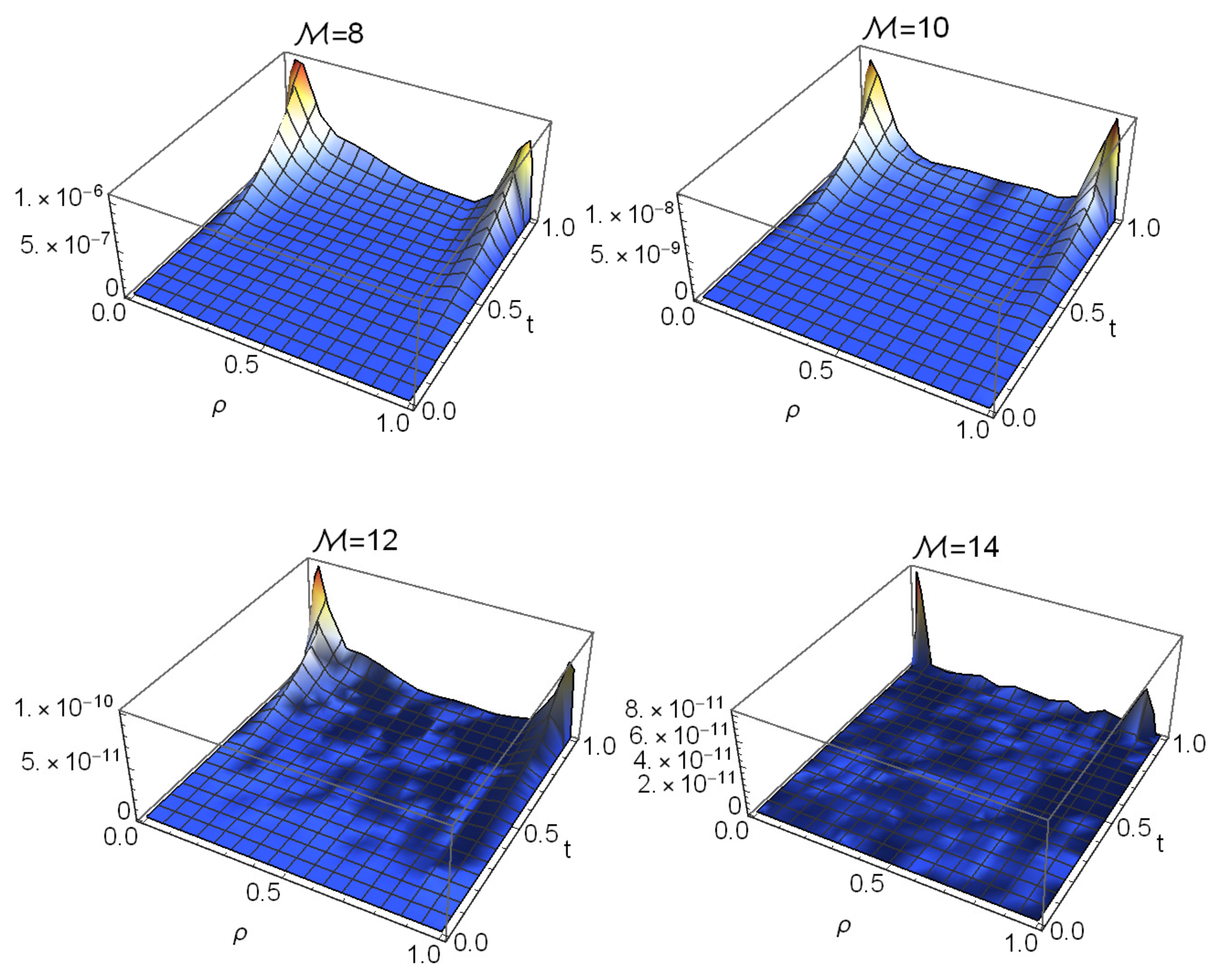
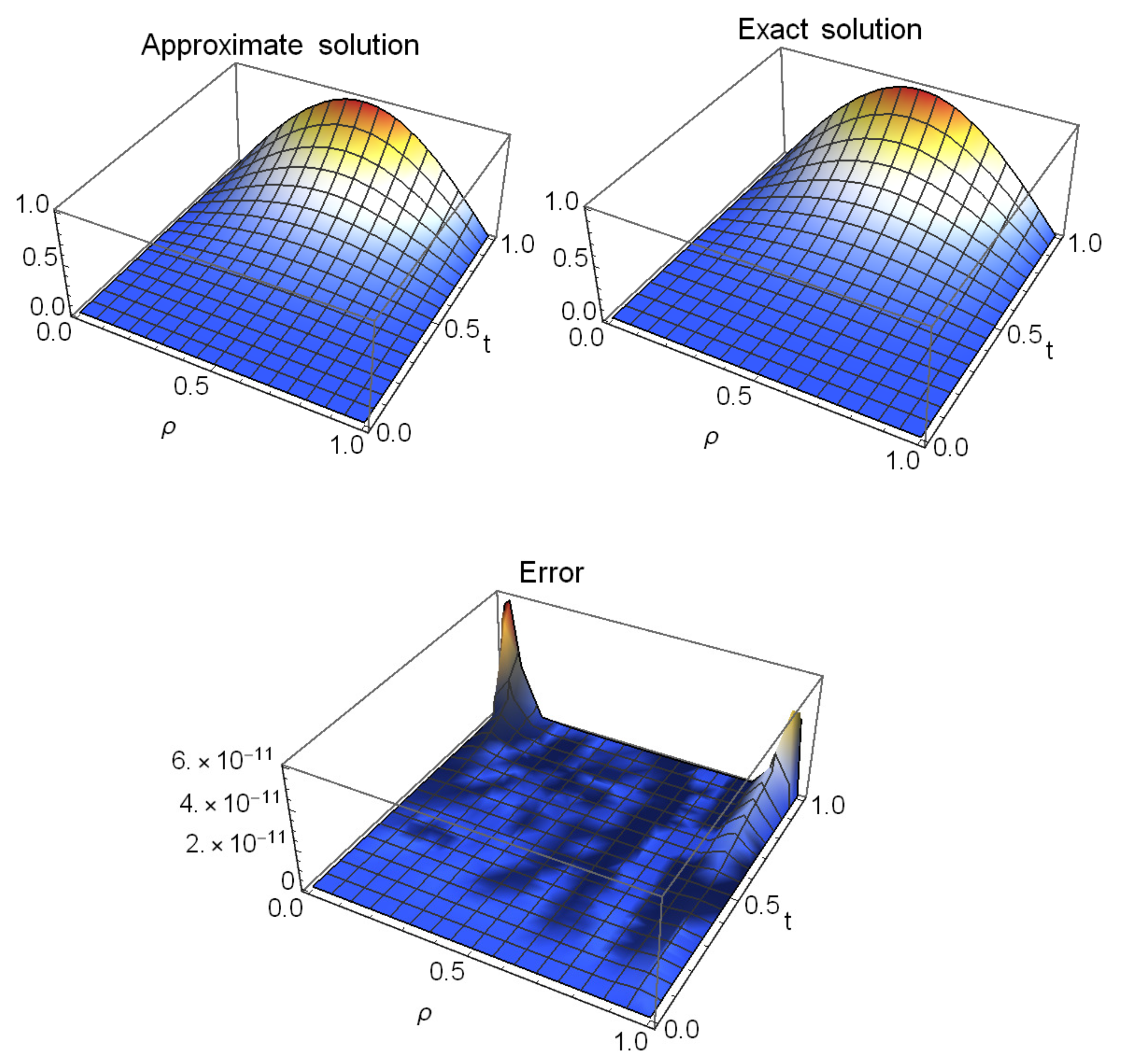
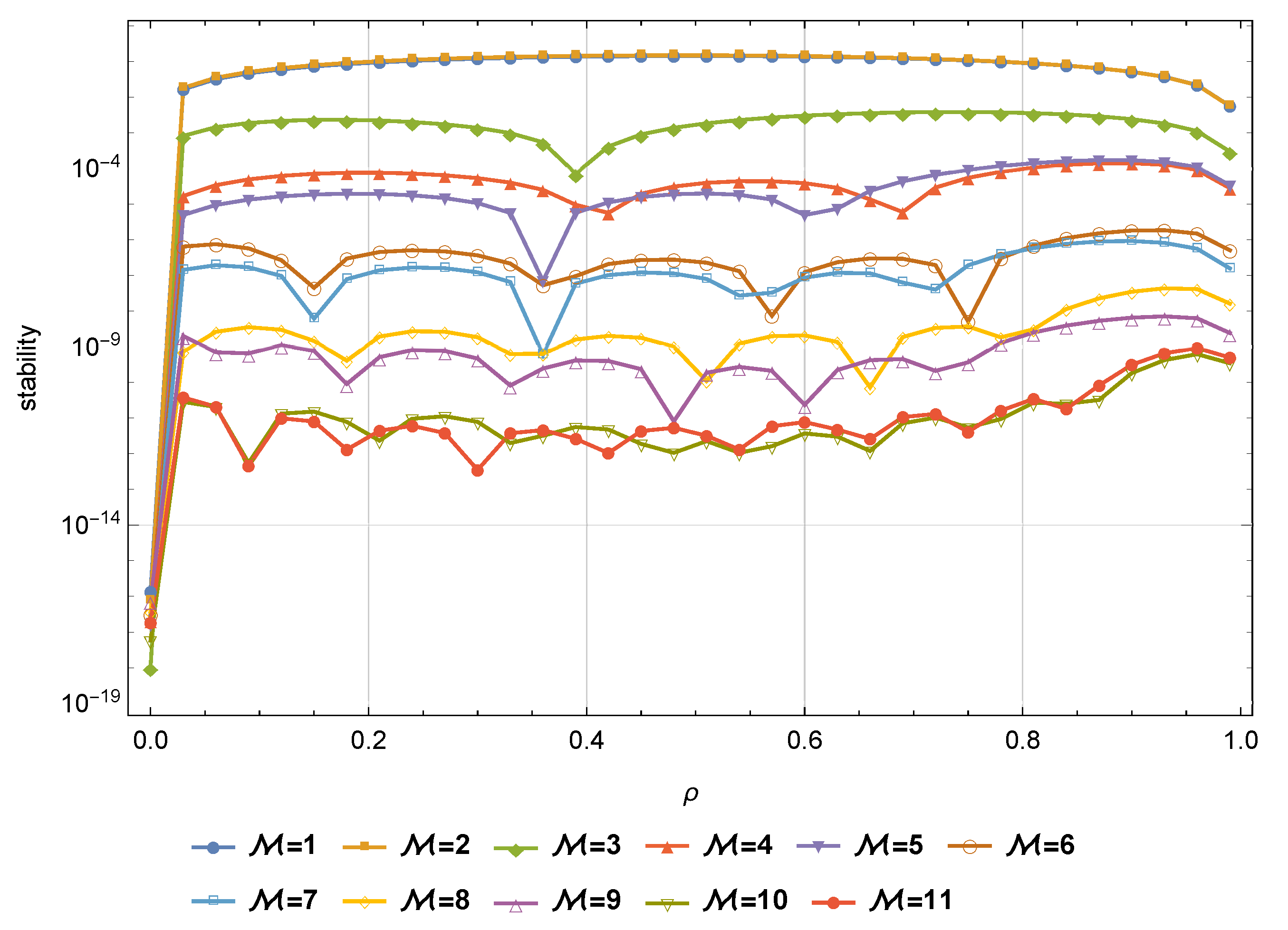
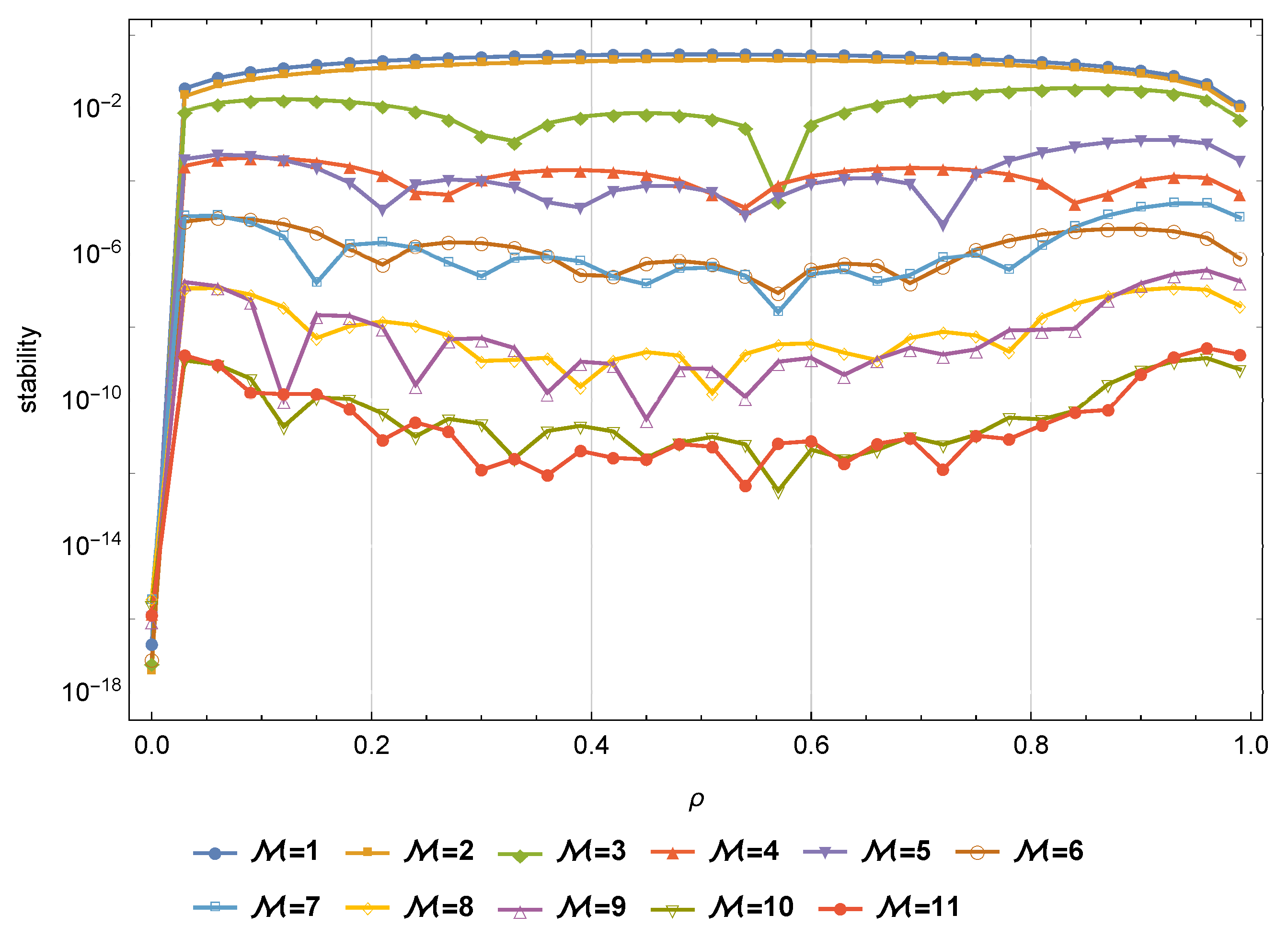
The distribution of AEs for ζ = 0.2 and a = 2 over different truncation levels M is illustrated in Figure 2. Table 3 provides the CPU time used and the AEs obtained for different a when ζ = 0.5 and M = 14 . The corresponding L and L 2 norms for varying M at ζ = 0.9 and a = 3 , along with the CPU time used, are reported in Table 4. Figure 3 displays both numerical and exact solutions along with the associated AEs for ζ = 0.9 , a = 3 , and M = 14 . Figure 4 and Figure 5 show the stability | Q M + 1 ( ρ , t ) Q M ( ρ , t ) | at different values of t when a = 3 and ζ = 0.9 . Table 5 presents the AEs at different values of a when ζ = 0.5 and M = 5 . This table shows that the moderate positive values of a, such as a = 1.4 , 2 , yield the best accuracy, while negative values or excessively large values of a, such as a = 6 , 5 , 17 , lead to a noticeable deterioration in the numerical results.
Remark 8.
From the numerical results in Table 3, it can be noted that the approximation based on the classical shifted Chebyshev polynomials of the second kind (corresponding to a = 2 ) is not always optimal. This clearly demonstrates the significant effect of the parameter a in the proposed generalized basis Chebyshev basis.
Example 3
([60]). Consider the problem
D t ζ Q ( ρ , t ) Q ( ρ , t ) 1 Q ( ρ , t ) + Q ( ρ , t ) Q ( ρ , t ) ρ = f ( ρ , t ) , 0 < ζ < 1 ,
subject to the conditions
Q ( ρ , 0 ) = 0 , 0 < ρ 1 ,
Q ( 0 , t ) = Q ( 1 , t ) = 0 , 0 < t 1 ,
where f ( ρ , t ) is selected to meet the exact solution of this problem is Q ( ρ , t ) = t 2 + ζ sin ( π ρ ) .
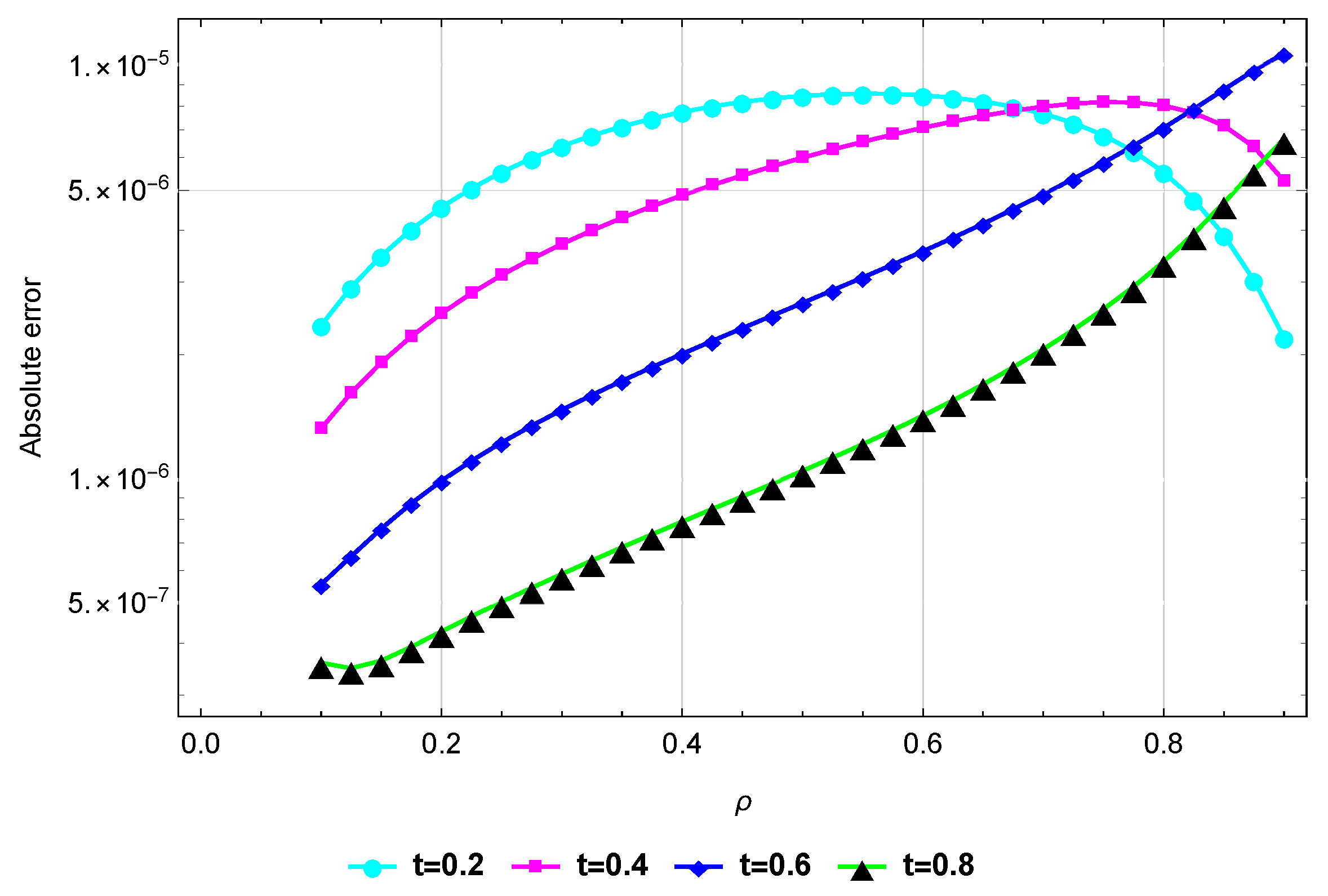
A comparison of the L error over ] 0 , 1 ] × ] 0 , 0.01 ] between the proposed method with M = 16 and a = 1 and the approach in [60] is reported in Table 6. Table 7 presents the AEs for different time levels at ζ = 0.9 with M = 12 . This table shows that the moderate positive values of a = 1.5 , 2 , 3.5 yield the best accuracy, while the large values of a, such as a = 13 , lead to a noticeable deterioration in the numerical results. The variation in the AEs with respect to t for ζ = 0.3 , a = 1.5 , and M = 12 is shown in Figure 6.
Remark 9.
The parameter a plays a significant role in the accuracy and stability of the proposed method. Numerical results in Table 3, Table 5 and Table 7 show that moderate positive values of a (such as a = 1 , 2 , 3 ) yield the best accuracy, while negative values or excessively large values of a lead to a noticeable deterioration in the numerical results. In particular, for large values of a, the method may become unstable due to the ill-conditioning of the resulting algebraic system. Therefore, moderate values of a are recommended in practical computations to achieve a balance between stability and accuracy.

7. Concluding Remarks

In this article, a collocation-based spectral strategy was analyzed for the numerical treatment of a time-fractional gas dynamics equation governed by the Caputo fractional derivative. A class of generalized Chebyshev polynomials of the second kind was introduced and investigated theoretically to act as the basis functions. The collocation method was utilized to convert the equation, together with its associated conditions, into a system of nonlinear equations, which could be solved successfully using an iterative nonlinear solver. The theoretical analysis confirmed that the proposed approximation possessed strong convergence properties, with explicit bounds that explained the rapid decay of the truncation error. The numerical results presented demonstrate the algorithm’s good performance. In addition, The results show that the parameter a significantly affects performance. While a = 2 is common, it is not always optimal. Moderate values such as a = 1 , 2 , 3 yield better accuracy and stability, whereas larger values reduce accuracy and worsen conditioning. The extension of the presented technique to other types of fractional derivatives is an interesting topic and will be considered in future work. Also, we aim to apply the Chebyshev family presented in this paper to other important models in the applied sciences.

Author Contributions

Conceptualization, W.M.A.-E. and A.G.A.; Methodology, W.M.A.-E., A.H.A.-M., N.M.A.A., O.M.A. and A.G.A.; Software, W.M.A.-E. and A.G.A.; Validation, W.M.A.-E., A.H.A.-M., N.M.A.A., O.M.A. and A.K.A.; Formal analysis, W.M.A.-E., A.H.A.-M. and A.G.A.; Investigation, W.M.A.-E., N.M.A.A., O.M.A., A.K.A. and A.G.A.; Data curation, A.G.A.; Writing—original draft, W.M.A.-E., A.H.A.-M. and A.G.A.; Writing—review & editing, W.M.A.-E.; Supervision, W.M.A.-E.; Funding acquisition, A.K.A. All authors have read and agreed to the published version of the manuscript.

Funding

This research work was funded by the Umm Al-Qura University, Saudi Arabia, under grant number 26UQU4331287GSSR01.

Data Availability Statement

Data are contained within the article.

Acknowledgments

The authors extend their appreciation to Umm Al-Qura University, Saudi Arabia for: funding this research work through grant number 26UQU4331287GSSR01.

Conflicts of Interest

The authors declare no conflicts of interest.

References

  1. Koshy, T. Fibonacci and Lucas Numbers with Applications; John Wiley & Sons: New York, NY, USA, 2011; Volume 51. [Google Scholar]
  2. Boyd, J.P. Chebyshev and Fourier Spectral Methods, 2nd ed.; Dover Publications: New York, NY, USA, 2001. [Google Scholar]
  3. Shen, J.; Tang, T.; Wang, L.L. Spectral Methods: Algorithms, Analysis and Applications; Springer Series in Computational Mathematics; Springer: Berlin/Heidelberg, Germany, 2011; Volume 41. [Google Scholar]
  4. Arfan, M.; Khan, Z.A.; Zeb, A.; Shah, K. Study of numerical solution to some fractional order differential equation using Hermite polynomials. Int. J. Appl. Comput. Math. 2022, 8, 60. [Google Scholar] [CrossRef]
  5. Senfiazad, P.; Heydari, M.H.; Bayram, M.; Baleanu, D. A numerical method based on the shifted Jacobi polynomials for a class of tempered fractional quadratic integro-differential equations. Results Appl. Math. 2025, 27, 100601. [Google Scholar] [CrossRef]
  6. Ayalew, M.; Ayalew, M.; Aychluh, M. Numerical approximation of space-fractional diffusion equation using Laguerre spectral collocation method. Int. J. Math. Ind. 2025, 17, 2450029. [Google Scholar] [CrossRef]
  7. Barzegar, N.; Mirzaee, F.; Solhi, E. New technique based on Vieta–Lucas polynomials for solving nonlinear stochastic Itô-Volterra integral equation. Int. J. Numer. Model. Electron. Netw. Devices Fields 2025, 38, e70044. [Google Scholar] [CrossRef]
  8. Sadri, K.; Hosseini, K.; Baleanu, D.; Salahshour, S. A high-accuracy Vieta-Fibonacci collocation scheme to solve linear time-fractional telegraph equations. Waves Random Complex Media 2026, 35, 12674–12697. [Google Scholar] [CrossRef]
  9. Abd-Elhameed, W.M.; Alqubori, O.M.; Alsafri, N.M.A.; Amin, A.K.; Atta, A.G. A matrix approach by convolved Fermat polynomials for solving the fractional Burgers’ equation. Mathematics 2025, 13, 1135. [Google Scholar] [CrossRef]
  10. Abd-Elhameed, W.M.; Alqubori, O.M.; Atta, A.G. A collocation approach for the nonlinear fifth-order KdV equations using certain shifted Horadam polynomials. Mathematics 2025, 13, 300. [Google Scholar] [CrossRef]
  11. Hafez, R.M.; Abdelkawy, M.A.; Ahmed, H.M. A refined spectral Galerkin approach leveraging Romanovski–Jacobi polynomials for differential equations. Mathematics 2025, 13, 1461. [Google Scholar] [CrossRef]
  12. Abd-Elhameed, W.M.; Abdelkawy, M.A.; Alqubori, O.M.; Atta, A.G. Pell coefficient polynomials for solving linear hyperbolic first-order partial differential equations via the Tau approach. Electron. Res. Arch. 2025, 33, 6012. [Google Scholar] [CrossRef]
  13. Arqub, O.A.; Abukhaled, M.; Sweis, H.; Shawagfeh, N. Numerical analysis of Lucas polynomials innovative technique within the Galerkin strategy for solving fuzzy-type differential models with an application in the electrical circuit engineering field. Results Eng. 2025, 26, 106298. [Google Scholar] [CrossRef]
  14. Aourir, E.; Laeli Dastjerdi, H.; Oudani, M.; El Harraki, I. Bernstein polynomial for solving third kind VIEs with nonlinear vanishing delays. Appl. Anal. 2026, 105, 259–287. [Google Scholar] [CrossRef]
  15. El-Sayed, A.A.E.; Boulaaras, S.; Sweilam, N.H. Numerical solution of the fractional-order logistic equation via the first-kind Dickson polynomials and spectral tau method. Math. Methods Appl. Sci. 2023, 46, 8004–8017. [Google Scholar] [CrossRef]
  16. Nemati, S.; Lima, P.M.; Torres, D.F.M. Numerical solution of variable-order fractional differential equations using Bernoulli polynomials. Fractal Fract. 2021, 5, 219. [Google Scholar] [CrossRef]
  17. Bouakkaz, M.; Arar, N.; Meflah, M. Enhanced numerical resolution of the Duffing and Van der Pol equations via the spectral homotopy analysis method employing chebyshev polynomials of the first kind. J. Appl. Math. Comput. 2025, 71, 1159–1187. [Google Scholar] [CrossRef]
  18. Abdelgaber, K.M.; Fathy, M.; Hassan, A.; Sayed, E.A. Computational study of fractional partial differential equations using the second-kind Chebyshev collocation technique with error analysis. Bound. Value Probl. 2026, 2026, 20. [Google Scholar] [CrossRef]
  19. Abd-Elhameed, W.M.; Alqubori, O.M.; Atta, A.G. A collocation procedure for the numerical treatment of FitzHugh–Nagumo equation using a kind of Chebyshev polynomials. AIMS Math. 2025, 10, 1201–1223. [Google Scholar] [CrossRef]
  20. Abd-Elhameed, W.M.; Ahmed, H.M. Spectral solutions for the time-fractional heat differential equation through a novel unified sequence of Chebyshev polynomials. AIMS Math. 2024, 9, 2137–2166. [Google Scholar] [CrossRef]
  21. Podlubny, I. Fractional Differential Equations; Academic Press: Cambridge, MA, USA, 1999. [Google Scholar]
  22. Kilbas, A.A.; Srivastava, H.M.; Trujillo, J.J. Theory and Applications of Fractional Differential Equations; North-Holland Mathematics Studies; Elsevier: Amsterdam, The Netherlands, 2006; Volume 204. [Google Scholar]
  23. Sandev, T.; Tomovski, Y. Fractional Equations and Models: Theory and Applications; Springer: Berlin/Heidelberg, Germany, 2019. [Google Scholar]
  24. Liang, Y.; Wang, K. The modified variational principles of the fractal Rosenau–Burgers equation. Fractals 2026. [Google Scholar] [CrossRef]
  25. Sorgentone, C.; Pellegrino, E.; Pitolli, F. A spline-based framework for solving the space–time fractional convection–diffusion problem. Appl. Math. Lett. 2025, 161, 109370. [Google Scholar] [CrossRef]
  26. Alam, M.P.; Khan, A.; Roul, P. High-resolution numerical method for the time-fractional fourth-order diffusion problems via improved quintic B-spline function. J. Appl. Math. Comput. 2025, 71, 133–171. [Google Scholar] [CrossRef]
  27. Panchal, V.; Singh, T.R. Novel approximation approach to fractional Rössler system illustrating chaotic behavior using the variational iteration method. Phys. Scr. 2025, 100, 085255. [Google Scholar] [CrossRef]
  28. Guleroglu, A.; Zarali, E.G. Variational Iteration Method for Space Fractional Schrödinger Equation. In Nonlinear Dynamical Control, Computer Simulation and Optimization Systems: Theory and Applications; World Scientific: Singapore, 2026; pp. 135–145. [Google Scholar]
  29. Bu, S.; Jeon, Y. Higher-order predictor-corrector methods with an enhanced predictor for fractional differential equations. Int. J. Comput. Math. 2025, 102, 1057–1080. [Google Scholar] [CrossRef]
  30. Huang, J.; Lv, J.; Arshad, S. An improved fractional predictor-corrector method for nonlinear fractional differential equations with initial singularity. Fract. Calc. Appl. Anal. 2025, 28, 453–472. [Google Scholar] [CrossRef]
  31. Şengül, S.; Bekiryazici, Z.; Merdan, M. Approximate solutions of fractional differential equations using optimal q-homotopy analysis method: A case study of Abel differential equations. Fractal Fract. 2024, 8, 533. [Google Scholar] [CrossRef]
  32. Farhood, A.K.; Mohammed, O.H. Homotopy perturbation method for solving time-fractional nonlinear variable-order delay partial differential equations. Partial Differ. Equ. Appl. Math. 2023, 7, 100513. [Google Scholar] [CrossRef]
  33. Kamran; Athar, K.; Khan, Z.A.; Haque, S.; Mlaiki, N. Analysis of Time-Fractional Delay Partial Differential Equations Using a Local Radial Basis Function Method. Fractal Fract. 2024, 8, 683. [Google Scholar] [CrossRef]
  34. Vellappandi, M.; Lee, S. Physics-informed neural fractional differential equations. Appl. Math. Model. 2025, 145, 116127. [Google Scholar] [CrossRef]
  35. Wang, F.; Wen, S.Y.; Fang, Q.; Wang, P. Application of Adomian decomposition method to fractional order partial differential equations. Therm. Sci. 2025, 29, 1375–1381. [Google Scholar] [CrossRef]
  36. Sebaq, M.S.; Qamlo, A.H.; Bahaa, G.M. Numerical solutions for fractional optimal control problems of coupled diffusion systems via Laplace Adomian Decomposition Method. Bound. Value Probl. 2025, 2025, 131. [Google Scholar] [CrossRef]
  37. Al-deiakeh, R.; Alhazmi, S.; Al-Omari, S.; Al-Smadi, M.; Momani, S. On the Laplace Residual Series Method and Its Application to Time-Fractional Fisher’s Equations. Fractal Fract. 2025, 9, 275. [Google Scholar] [CrossRef]
  38. Kumar, S.; Kocak, H.; Yildirim, A. A fractional model of gas dynamics equations and its analytical approximate solution using Laplace transform. Z. Naturforsch. A 2012, 67, 389–396. [Google Scholar] [CrossRef]
  39. Shah, R.; Alshehry, A.; Weera, W. A semi-analytical method to investigate fractional-order gas dynamics equations by Shehu transform. Symmetry 2022, 14, 1458. [Google Scholar] [CrossRef]
  40. Tarate, S.; Kshirsagar, K.; Nikam, V.; Osman, M. Solving fractional gas dynamic equations with the Pythagorean fuzzy Laplace transform iterative method. Creat. Math. Inform. 2025, 34, 467–480. [Google Scholar] [CrossRef]
  41. Khongtham, W. Solution of fractional gas dynamic equation by using homotopy perturbation with natural transform method. Lect. Notes Eng. Comput. Sci. 2018, 2235, 1–6. [Google Scholar]
  42. Jassim, H.K.; Mohammed, M.G. Natural homotopy perturbation method for solving nonlinear fractional gas dynamics equations. Int. J. Nonlinear Anal. Appl. 2021, 12, 812–820. [Google Scholar]
  43. Kumar, R.; Singh, J.; Kumar, D. Numerical solution of time fractional gas dynamics equation using Laplace–Adomian decomposition method. Alex. Eng. J. 2018, 57, 1987–1996. [Google Scholar]
  44. Gowda, K.; Prakasha, D.G.; Veeresha, P. Solution of time-fractional gas dynamics equation using Elzaki decomposition method. PLoS ONE 2024, 19, e0300436. [Google Scholar]
  45. Alaroud, M.; Ababneh, O.; Tahat, N.; Al-Omari, S. Analytic technique for solving temporal time-fractional gas dynamics equations with Caputo fractional derivative. AIMS Math. 2022, 7, 17647–17669. [Google Scholar] [CrossRef]
  46. Das, S.; Kumar, R. Approximate analytical solutions of fractional gas dynamic equations. Appl. Math. Comput. 2011, 217, 9905–9915. [Google Scholar] [CrossRef]
  47. Esen, A.; Tasbozan, O. Cubic B-spline collocation method for solving time fractional gas dynamics equation. Tbil. Math. J. 2015, 8, 221–231. [Google Scholar] [CrossRef]
  48. Esen, A.; Tasbozan, O. An approach to time fractional gas dynamics equation: Quadratic B-spline Galerkin method. Appl. Math. Comput. 2015, 261, 330–336. [Google Scholar] [CrossRef]
  49. Noureen, R.; Naeem, M.N.; Baleanu, D.; Mohammed, P.O.; Almusawa, M.Y. Application of trigonometric B-spline functions for solving Caputo time fractional gas dynamics equation. AIMS Math. 2023, 8, 25343–25370. [Google Scholar] [CrossRef]
  50. Shah, K.; Singh, T.; Kilicman, A. Combination of integral and projected differential transform methods for time-fractional gas dynamics equations. Ain Shams Eng. J. 2018, 9, 1683–1688. [Google Scholar] [CrossRef]
  51. Saad, K.M.; AL-Shareef, E.H.; Mohamed, M.S.; Yang, X. Optimal q-homotopy analysis method for time-space fractional gas dynamics equation. Eur. Phys. J. Plus 2017, 132, 23. [Google Scholar] [CrossRef]
  52. Chiranahalli Vijaya, D.K.; Doddabhadrappla Gowda, P.; Hadimani, B. A numerical study on the dynamics of SIR epidemic model through Genocchi wavelet collocation method. Sci. Rep. 2025, 15, 9780. [Google Scholar] [CrossRef] [PubMed]
  53. Abd-Elhameed, W.M.; Abdelkawy, M.A.; Alsafri, N.M.A.; Atta, A.G. Numerical treatment of the time-fractional Kuramoto–Sivashinsky equation using a combined Chebyshev-collocation approach. Fractal Fract. 2025, 9, 727. [Google Scholar] [CrossRef]
  54. Abd-Elhameed, W.M.; Abdelkawy, M.A.; Alqubori, O.M.; Atta, A.G. An accurate tau-based spectral algorithm for the time fractional bioheat transfer model. Bound. Value Probl. 2025, 2025, 124. [Google Scholar] [CrossRef]
  55. Atta, A.G.; Abdelkawy, M.A.; Napoli, A.; Abd-Elhameed, W.M. Galerkin approach by certain shifted Jacobi polynomials for solving the time-fractional Black–Scholes equation. Bound. Value Probl. 2025, 2025, 138. [Google Scholar] [CrossRef]
  56. Abd-Elhameed, W.M.; Abdelkawy, M.A.; Alsafri, N.M.A.; Atta, A.G. Galerkin-based solution for the time-fractional diffusion-wave equation. Electron. Res. Arch. 2025, 33, 5179. [Google Scholar] [CrossRef]
  57. Podlubny, I. Fractional Differential Equations: An Introduction to Fractional Derivatives, Fractional Differential Equations, to Methods of Their Solution and Some of Their Applications; Elsevier: Amsterdam, The Netherlands, 1998; Volume 198. [Google Scholar]
  58. Andrews, G.; Askey, R.; Roy, R. Special Functions; Cambridge University Press: Cambridge, UK, 1999; Volume 71. [Google Scholar]
  59. Koepf, W. Hypergeometric Summation, 2nd ed.; Springer Universitext Ser.; Springer: Berlin/Heidelberg, Germany, 2014. [Google Scholar]
  60. Yousif, M.A.; Guirao, J.L.G.; Mohammed, P.O.; Chorfi, N.; Baleanu, D. A computational study of time-fractional gas dynamics models by means of conformable finite difference method. AIMS Math. 2024, 9, 19843–19858. [Google Scholar] [CrossRef]
  61. Abramowitz, M.; Stegun, I.A. Handbook of Mathematical Functions: With Formulas, Graphs, and Mathematical Tables; Courier Corp.: Washington, DC, USA, 1965; Volume 55. [Google Scholar]
  62. Luke, Y.L. Inequalities for generalized hypergeometric functions. J. Approx. Theory 1972, 5, 41–65. [Google Scholar] [CrossRef]
  63. Noureen, R.; Naeem, M.N.; Iqbal, M.K.; Elkenany, E.B.; Abbas, M. A numerical scheme for gas dynamics equation involving Caputo-Fabrizio time-fractional derivative. Preprint 2023. [Google Scholar] [CrossRef]
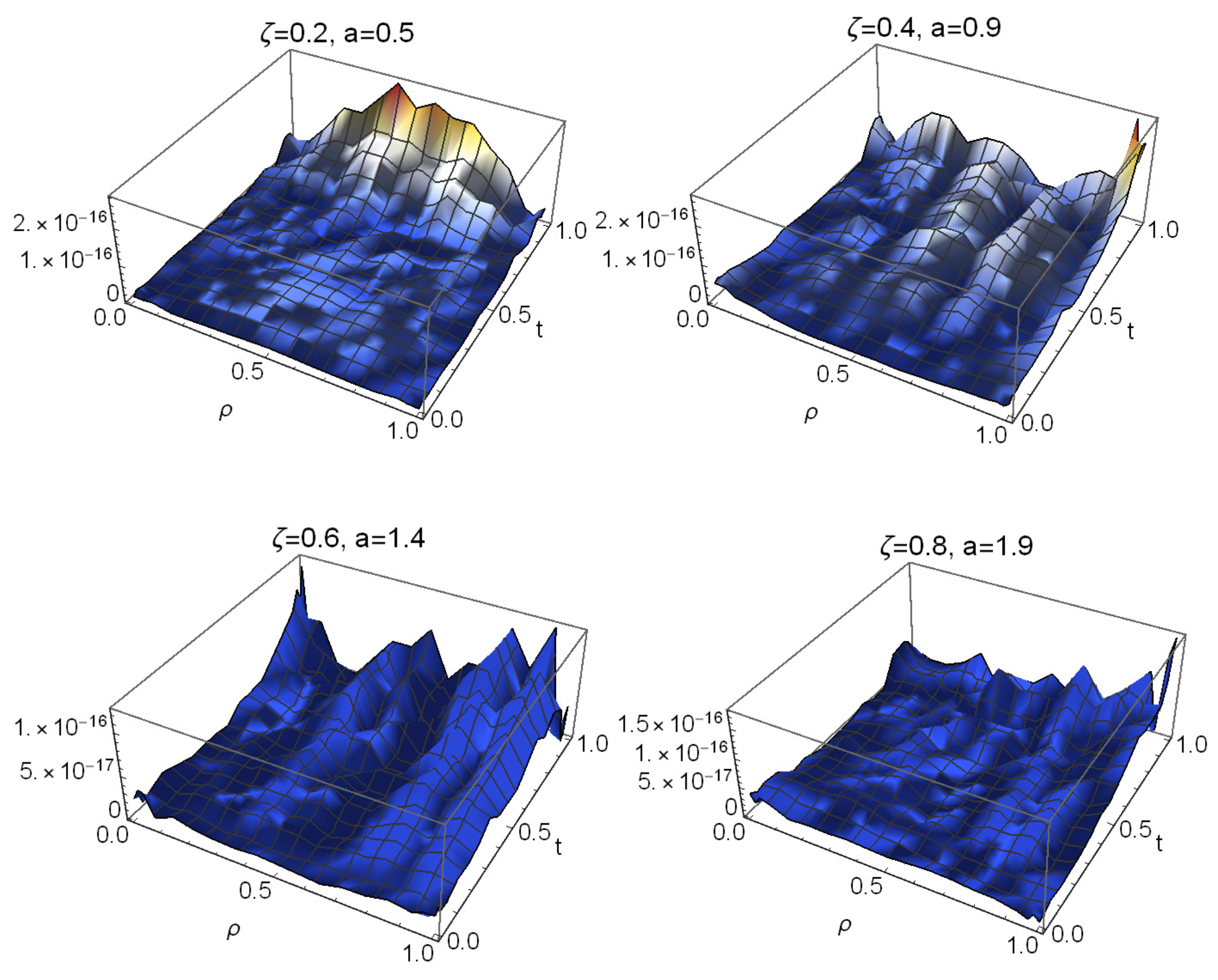
Figure 1. The AEs of Example 1 at different values of ζ and a when M = 3 .
Fractalfract 10 00299 g001
Figure 2. The AEs of Example 2 at ζ = 0.2 , a = 2 and different values of M .
Fractalfract 10 00299 g002
Figure 3. The approximate, exact solutions and AEs of Example 2 at ζ = 0.9 , a = 3 when M = 14 .
Fractalfract 10 00299 g003
Figure 4. Stability | Q M + 1 ( ρ , t ) Q M ( ρ , t ) | of Example 2 at t = 0.2 when a = 3 and ζ = 0.9 .
Fractalfract 10 00299 g004
Figure 5. Stability | Q M + 1 ( ρ , t ) Q M ( ρ , t ) | of Example 2 at t = 0.8 when a = 3 and ζ = 0.9 .
Fractalfract 10 00299 g005
Figure 6. The AEs of Example 3 at ζ = 0.3 , a = 1.5 and different values of t when M = 12 .
Fractalfract 10 00299 g006
Table 1. Comparison of L and L 2 errors for Example 1 at ζ = 0.5 .
Method in [63] at Δ τ = h = 1 180 Proposed Method at M = 2 and a = 1
t L L 2 L L 2
0.25 3.67319 × 10 5 5.38499 × 10 6 1.73472 × 10 17 6.46192 × 10 20
0.5 1.65966 × 10 4 3.84436 × 10 5 2.42861 × 10 17 2.46549 × 10 18
0.75 2.79673 × 10 4 1.42568 × 10 4 5.55112 × 10 18 6.58092 × 10 18
1 2.89235 × 10 4 1.85557 × 10 4 1.11022 × 10 16 1.22817 × 10 17
Table 2. L and L 2 errors for Example 1 at ζ = 0.9 .
a = 1 a = 2 a = 3
t L L 2 L L 2 L L 2
0.25 2.21743 × 10 17 4.16391 × 10 18 4.71508 × 10 17 1.43459 × 10 17 5.38096 × 10 17 2.23078 × 10 18
0.5 2.27227 × 10 17 6.68872 × 10 18 3.98986 × 10 17 1.6749 × 10 17 9.87131 × 10 17 1.19926 × 10 18
0.75 4.4781 × 10 17 1.23929 × 10 17 5.55112 × 10 17 2.05192 × 10 17 1.59768 × 10 16 9.14394 × 10 18
1 1.64618 × 10 16 4.91725 × 10 17 9.46471 × 10 17 4.23953 × 10 17 1.82532 × 10 16 2.55246 × 10 17
Table 3. The AEs of Example 2 at ζ = 0.5 , and M = 14 .
ρ = t a = 0.7 CPU Time a = 1.4 CPU Time a = 2 CPU Time a = 2.2 CPU Time
0.1 8.55382 × 10 14 4.15678 × 10 14 1.2916 × 10 13 3.17712 × 10 14
0.2 4.87024 × 10 15 9.3996 × 10 15 5.8174 × 10 15 1.25594 × 10 15
0.3 9.9816 × 10 15 6.16174 × 10 15 2.37518 × 10 14 5.95357 × 10 15
0.4 2.42931 × 10 14 1.09426 × 10 14 3.31887 × 10 14 3.19883 × 10 15
0.5 1.60705 × 10 14 59.345 1.2601 × 10 14 52.282 2.09555 × 10 15 57.377 4.16334 × 10 16 53.579
0.6 4.91274 × 10 15 6.55032 × 10 15 3.91909 × 10 14 6.85563 × 10 15
0.7 4.996 × 10 16 1.11577 × 10 14 2.42584 × 10 14 1.16018 × 10 14
0.8 9.54792 × 10 15 1.5099 × 10 14 1.28231 × 10 14 9.49241 × 10 15
0.9 5.15421 × 10 14 2.10387 × 10 14 5.85088 × 10 14 6.01186 × 10 14
Table 4. L and L 2 errors for Example 2 at ζ = 0.9 .
M 24681012
L error 2.09343 × 10 1 1.9508 × 10 3 3.41463 × 10 5 8.94025 × 10 7 1.61705 × 10 9 4.94263 × 10 12
CPU time1.6442.1723.3757.12516.79540.063
L 2 error 1.13144 × 10 1 2.29312 × 10 4 3.06988 × 10 6 5.10875 × 10 8 3.40171 × 10 10 2.07203 × 10 12
CPU time1.6442.1723.3757.14116.8140.11
Table 5. The AEs of Example 2 at ζ = 0.5 and M = 5 .
ρ = t a = 6 a = 5 a = 1.4 a = 2 a = 17
0.1 4.81731 × 10 2 6.26262 × 10 2 2.3414703040271 × 10 5 2.3414703040295 × 10 5 1.02371 × 10 1
0.2 1.31868 × 10 1 2.69072 × 10 2 8.1475531220499 × 10 6 8.1475531220776 × 10 6 5.12028 × 10 2
0.3 2.31804 × 10 1 2.07588 × 10 2 3.0703283966267 × 10 6 3.0703283966267 × 10 6 2.5269 × 10 3
0.4 4.11941 × 10 1 3.22507 × 10 2 1.8955133992422 × 10 5 1.8955133992498 × 10 5 2.23337 × 10 2
0.5 6.39006 × 10 1 1.8633 × 10 2 2.3769453911123 × 10 5 2.3769453911304 × 10 5 8.0671 × 10 3
0.6 7.36946 × 10 1 9.05262 × 10 2 1.9695422899618 × 10 5 1.9695422899507 × 10 5 1.15176 × 10 2
0.7 4.57684 × 10 1 3.75378 × 10 1 3.1528190774510 × 10 5 3.1528190774454 × 10 5 1.10076 × 10 2
0.8 4.73452 × 10 2 5.04926 × 10 1 3.7107932165331 × 10 4 3.7107932165342 × 10 4 2.41379 × 10 2
0.9 2.83431 × 10 1 4.33696 × 10 1 1.4902460451470 × 10 3 1.4902460451470 × 10 3 1.67676 × 10 1
Table 6. Comparison of L errors in interval ] 0 , 1 ] × ] 0 , 0.01 ] for Example 3.
ζ Technique in [60]Proposed Technique at M = 16
0.5 10 4 6.43671 × 10 6
Table 7. The AEs of Example 3 at ζ = 0.9 , and M = 12 .
ρ = t a = 1.5 a = 2 a = 2.5 a = 3.5 a = 13
0.1 1.425781344 × 10 6 1.42578135862 × 10 6 1.42578134197 × 10 6 1.42578134431 × 10 6 6.84442 × 10 2
0.2 2.821081334 × 10 6 2.82108132909 × 10 6 2.82108133038 × 10 6 2.82108132991 × 10 6 1.15645 × 10 3
0.3 4.144884898 × 10 6 4.14488489526 × 10 6 4.14488488523 × 10 6 4.14488488465 × 10 6 2.24282 × 10 3
0.4 5.210604511 × 10 6 5.21060450479 × 10 6 5.21060450500 × 10 6 5.21060450749 × 10 6 2.04122 × 10 3
0.5 5.935851910 × 10 6 5.93585190761 × 10 6 5.93585190533 × 10 6 5.93585191063 × 10 6 9.34697 × 10 5
0.6 6.408297182 × 10 6 6.40829717976 × 10 6 6.40829716583 × 10 6 6.40829717166 × 10 6 4.73184 × 10 4
0.7 6.839320127 × 10 6 6.83932012340 × 10 6 6.83932010692 × 10 6 6.83932011075 × 10 6 3.93576 × 10 4
0.8 7.452382491 × 10 6 7.45238248395 × 10 6 7.452382481232 × 10 6 7.45238247641 × 10 6 8.72603 × 10 6
0.9 7.909321515 × 10 6 7.90932151867 × 10 6 7.909321540211 × 10 6 7.90932151373 × 10 6 1.15845 × 10 2
Disclaimer/Publisher’s Note: The statements, opinions and data contained in all publications are solely those of the individual author(s) and contributor(s) and not of MDPI and/or the editor(s). MDPI and/or the editor(s) disclaim responsibility for any injury to people or property resulting from any ideas, methods, instructions or products referred to in the content.