Article

Study of the Variable-Order Fractional Arneodo System: Bifurcation, Chaos, and Dynamic Behavior

1
Mathematics Department, College of Science, Jouf University, Sakaka 72388, Saudi Arabia
2
Department of Mathematics and Statistics, College of Science, King Faisal University, Al-Ahsa 31982, Saudi Arabia
3
Department of Applied Science, Ajlun College, Al-Balqa Applied University, Ajlun 19117, Jordan
4
Department of Mathematics, College of Science, Qassim University, P.O. Box 6644, Buraydah 51452, Saudi Arabia
5
Department of Basic Sciences, Common First Year Deanship, King Saud University, P.O. Box 1142, Riyadh 12373, Saudi Arabia
6
Faculty of Engineering FEQS, INTI-IU-University, Nilai 71800, Malaysia
7
Faculty of Management, Shinawatra University, Pathum Thani 12160, Thailand
*
Authors to whom correspondence should be addressed.
Fractal Fract. 2026, 10(5), 296; https://doi.org/10.3390/fractalfract10050296
Submission received: 24 March 2026 / Revised: 20 April 2026 / Accepted: 24 April 2026 / Published: 28 April 2026

Abstract

In this study, we analyze the solution characteristics and dynamics of a variable-order fractional (V-OF) Arneodo system using the Liouville–Caputo fractional operator with variable order. The V-OF operator is used to describe the time-dependent memory effect in the system, which leads to more complex and diverse dynamics compared to integer-order systems. In this work, numerical simulations are performed to observe the effect of the order functions on the dynamic behaviors of the system. In addition, the phase portraits, time series graphs, and three-dimensional diagrams are used to analyze the dynamic behaviors and different types of oscillations present in the system. Furthermore, the bifurcations, chaotic behaviors, and stability of the system with variable orders are studied, and it is found that the system has more complex dynamics compared to the integer-order case. In this case, the Lyapunov exponents indicate that the system under investigation is sensitive to the initial conditions, and the memory effect can control the chaotic oscillation depending on the order of the functions.

1. Introduction

An important contribution of fractional calculus in recent times is its application as a potent tool to extend the classical approach of calculus, or generalized classical calculus, to non-integer order. Fractional calculus gives us the ability to model highly nonlinear dynamical systems accurately [1,2,3].
Fractional-order models are naturally suited for systems where memory effects, heredity, or long-range interactions are prominent, as often encountered in biological, physical, and engineering systems. Such process innovation is discussed in [4,5,6,7]. Fractional order models, unlike integer-order models, inherently account for the historical values of the systems for more precise modeling of the actual emergence of intricate systems. Various studies have proved the potential of fractional-order models for precise modeling of the complex behavior of the systems, such as chaotic oscillations, compared to integer-order models [8,9,10,11,12]. These aspects are of high relevance for the current technological/industrial scenario, where memory effects are of significant value.
It has been identified that fixed-order fractional-order systems have inherent limitations, where the memory properties of the system change over time. In such cases, a fixed order of fractional derivatives cannot precisely model the time-varying memory effects of the system. For this purpose, a variable-order fractional derivative has also been introduced, where the order of differentiation, spatial coordinates, or other system-dependent parameters can be time-dependent, allowing for more precise modeling of the nonstationary and heterogeneous nature of the systems, thereby enhancing the potential of fractional calculus for more precise modeling of the complex nature of the systems [13,14,15,16,17].
Recently, research on V-OF chaotic systems has been on the rise because of their strong ability in characterizing time-dependent memory effects and chaotic behavior. V-OF chaotic systems are more realistic in modeling nonlinear processes with time-dependent dynamical properties. Due to the difficulties in solving V-OF chaotic systems analytically, numerical analysis is used in the research of V-OF chaotic systems. In addition, the application of V-OF models is on the rise because of the success in the application of V-OF models in real problems, in which the characterization of the model is of great importance [18,19,20].
The application of V-OF models is not limited to different fields of science. The V-OF derivative was successfully used in nonlinear epidemic models in the characterization of the spread of smoking habits and pediculosis disease. V-OF models in control theory and engineering fields are also significant in the characterization of the stability of the system and the control of the system. Advanced techniques in the resolution of models of V-OF are also a clear indication of the application of V-OF models [21,22,23,24,25].
The general framework of this approach is as follows: first, the theoretical analysis of the dynamics of VFDEs is carried out, followed by nonlinear and stability analyses, and finally, the development of computational techniques to efficiently solve the equations numerically.
A list of the most analytical methods in chaos theory includes bifurcation mapping, Lyapunov spectrum evaluation, and temporal evolution tracking. These methods are used to investigate complex chaotic phenomena, hidden attractors, and the variable-order sensitivity of the system under investigation [26,27,28]. This approach can be used to obtain deeper insight into the complex systems [29,30].
The present work’s originality lies in the construction and analysis of the V-OF Arneodo model, where the Liouville–Caputo fractional operators of varying orders are employed. The memory structure in the model is time-dependent, moving beyond integer-order as well as fixed-order fractional systems. Specifically, the variable-order model displays memory-induced bifurcations between periodic, quasiperiodic, and chaotic dynamics significantly influenced by variable-order effects.
Table 1 presents a comparison of existing studies based on key analytical aspects. Most previous studies concentrate on specific aspects, such as chaos or bifurcation analysis, while overlooking others, including Lyapunov methods, time-series analysis, and solution construction. Only a limited number of studies integrate multiple techniques, and none offer a comprehensive framework. This study, on the other hand, looks at all of the factors that were taken into account, such as V-OF, Lyapunov analysis, chaos, bifurcation, time-series analysis, and solutions. This shows a more complete and integrated approach. × indicates “no” and ∘ indicates “yes.”
The primary contributions of this study are outlined as follows:
  • Developing the V-OF formulation of the Arneodo system with time-evolving memory characteristics.
  • Analysis of the influence of the time-dependent fractional dynamical system and qualitative behavior.
  • Numerical investigation combining planar state projections, temporal signal evolution, and spatial trajectory reconstruction to uncover the system’s intricate nonlinear structure.
  • Examination of bifurcation structures and Lyapunov exponents, showing how evolving memory can enhance or suppress chaos.
  • Identification of the parameter regions where variable-order effects contribute to the stabilization of chaotic oscillations.
While variable-order fractional chaotic systems have been extensively analyzed, the Arneodo system remains unexplored. Due to the cubic nonlinearity and unique couplings in this system, the dynamics are very different from their fixed-order counterparts, making this research vital.

2. Mathematical Formulation of the Variable-Order Fractional

The following part presents the mathematical formulation of VFDs based on the Liouville–Caputo definition.

2.1. Definitions

Definition 1 
([38]). Let Y ( t ) be a sufficiently smooth function and let α be a constant fractional order such that 0 < α < 1 . The Liouville–Caputo (LC) fractional derivative of order α is defined by
D t α LC Y ( t ) = 1 Γ ( 1 α ) 0 t Y ( ξ ) ( t ξ ) α d ξ , 0 < α < 1 ,
Definition 2 
([39]). Assume now that the differentiation order varies with time and is described by a function α ( t ) satisfying 0 < α ( t ) < 1 . The Liouville–Caputo variable-order (LCV) fractional derivative is then defined as
D t α ( t ) 0 LCV Y ( t ) = 1 Γ 1 α ( t ) 0 t Y ( ξ ) ( t ξ ) α ( t ) d ξ , 0 < α ( t ) < 1 .
In this case, the memory kernel explicitly depends on time through α ( t ) , allowing the operator to model processes whose hereditary characteristics evolve during the system’s progression.

2.2. Variable-Order Fractional Arneodo System

The Arneodo system [40] is a standard nonlinear chaotic system used to study oscillations and bifurcations. Due to its simplicity and its well-known chaotic characteristics, it is an efficient way of extending the application of the proposed approach based on the use of the variable order. With the introduction of the variable order, the nonlinear chaotic system can have properties of memory and adaptability, as in physical and engineering systems. Such an approach provides flexibility and accuracy in the modeling of nonstationary hereditary processes. The proposed method can be extended to other nonlinear chaotic systems.
The fractional Arneodo system is expressed as
D α u ( t ) = v ( t ) , D α v ( t ) = w ( t ) , D α w ( t ) = a u ( t ) b v ( t ) c w ( t ) + d u 3 ( t ) ,
Following [34], the governing parameters of the system are defined as
( a , b , c , d ) = ( 5.5 , 3.5 , 1 , 1 )
where ( u ( t ) , v ( t ) , w ( t ) ) represent the system states, and D α denotes the fractional-order derivative, subject to the initial conditions following [41]: u ( 0 ) = 0.2 ,   v ( 0 ) = 0.5 ,   w ( 0 ) = 0.2 .
The Arneodo system is well adapted to a V-OF framework because of its nonlinear cubic component, which causes the system’s dynamics to be extremely sensitive to memory. Allowing the fractional order to vary with respect to time enables the modeling of the time-dependent hereditary characteristics of real-world systems such as mechanical oscillators, electrical circuits, and energy conversion processes.
The V-OF Arneodo system is written as
D α ( t ) u ( t ) = v ( t ) , D α ( t ) v ( t ) = w ( t ) , D α ( t ) w ( t ) = a u ( t ) b v ( t ) c w ( t ) + d u 3 ( t ) ,
where 0 < α ( t ) < 1 and D α ( t ) denotes the Liouville–Caputo V-OF derivative.

3. Stability Analysis of the Variable-Order Fractional Arneodo System

Equilibrium Points and Linearization

The Jacobian matrix of system (5) is given by
J ( u , v , w ) = 0 1 0 0 0 1 ( a 3 d u 2 ) b c .
The equilibrium points are
E 0 = ( 0 , 0 , 0 ) , E 1 , 2 = ± a d , 0 , 0 .
For ( a , b , c , d ) = ( 5.5 , 3.5 , 1 , 1 ) , we obtain
E 1 , 2 = ( ± 5.5 , 0 , 0 ) .
The corresponding eigenvalues are:
At E 0 :
λ 1 = 1 , λ 2 , 3 = 1 ± 3 2 2 i .
At E 1 , 2 :
λ 1 = 2 , λ 2 , 3 = 1 2 ± 21 2 i .
  • Constant Fractional-Order Case
    For a commensurate fractional-order system with constant order α ( 0 , 1 ) , local asymptotic stability is determined by Matignon’s condition
    | arg ( λ i ) | > α π 2 .
    Accordingly, E 0 is unstable for all α ( 0 , 1 ] , while E 1 , 2 are locally asymptotically stable if
    0 < α < α c 0.863 ,
    and unstable otherwise.
  • Variable-Order Case: Stability Interpretation
    For the variable-order system D α ( t ) , the direct use of Matignon’s condition is not rigorous, since it is derived for constant-order systems. The system can be expressed as a nonlinear Volterra integral equation with a time-dependent kernel, indicating that stability depends on both the eigenvalues and the memory structure induced by α ( t ) .
    To proceed, a quasi-static (frozen-time) approximation is adopted. Under the assumption of slow variation,
    | α ˙ ( t ) | 1 ,
    the system is locally approximated by a constant-order system of order α ( t 0 ) . In this sense, the condition
    | arg ( λ i ) | > α ( t ) π 2
    is used as a heuristic indicator of instantaneous stability.
    Accordingly, the present analysis provides a consistent and widely adopted approximation framework for variable-order systems, rather than a strict extension of constant-order stability theory.
    Based on this interpretation, E 0 remains unstable, while E 1 , 2 are stable during intervals where
    α ( t ) < α c 0.863 ,
    provided that the slow-variation assumption holds. A practical indicator of persistent stability is
    sup t α ( t ) < 0.863 .
    Due to the nonlocal nature of fractional operators, stability is path-dependent and may exhibit delayed transitions when α ( t ) crosses the critical value.
  • Incommensurate Variable-Order Case
    For the incommensurate system D α i ( t ) , stability regions become time-dependent. Classical criteria are used here only as analogy-based indicators of local stability trends, rather than rigorous conditions.
  • Dissipativity of the Variable-Order Fractional Arneodo System
The vector field is
F = ( F 1 , F 2 , F 3 ) = v , w , a u b v c w + d u 3 .
The divergence is computed as
· F = F 1 u + F 2 v + F 3 w .
Since
F 1 u = 0 , F 2 v = 0 , F 3 w = c ,
we obtain
· F = c .
Because c = 1 > 0 , the divergence is negative:
· F = 1 < 0 .
Therefore, it is a dissipative system, and the volume in phase space contracts exponentially as time progresses in the V-OF framework, which may alter the qualitative behavior of trajectories.

4. Computational Scheme for the Arneodo System with Variable Fractional Order

Numerical scheme for approximating the variable-order fractional Arneodo system, following [42].
A general system governed by variable-order Liouville–Caputo derivatives is
D 0 , t α ( t ) * Y ( t ) = G ( Y ( t ) ) , Y ( 0 ) = Y 0 ,
where D α ( t ) * denotes the chosen V-OF derivative operator, t [ 0 , T ] , and Y approximates Y ( t ) .
Equation (18) can be equivalently expressed as
Y ( t ) = Y ( 0 ) + 1 Γ ( α ( t ) ) 0 t ϕ ( σ , Y ( σ ) ) ( t σ ) α ( t ) 1 d σ ,
with
ϕ ( σ , Y ( σ ) ) = G ( Y ( σ ) ) .
Evaluating at discrete time t ρ + 1 gives
Y ρ + 1 Y 0 = 1 Γ ( α ( t ρ + 1 ) ) = 0 ρ t t + 1 ϕ ( σ , Y ( σ ) ) ( t ρ + 1 σ ) α ( t ρ + 1 ) 1 d σ .
To approximate the integrand over [ t , t + 1 ] , we use second-order Lagrange interpolation:
ϕ ( σ , Y ( σ ) ) L ( σ ) = ϕ ( t , Y ) h ( σ t 1 ) ϕ ( t 1 , Y 1 ) h ( σ t ) ,
with h = t + 1 t .
Substituting into (20) yields the fully discrete form:
Y ρ + 1 = Y 0 + 1 Γ ( α ( t ρ + 1 ) ) = 0 ρ [ ϕ ( t , Y ) h t t + 1 ( σ t 1 ) ( t ρ + 1 σ ) α ( t ρ + 1 ) 1 d σ ϕ ( t 1 , Y 1 ) h t t + 1 ( σ t ) ( t ρ + 1 σ ) α ( t ρ + 1 ) 1 d σ ] .
Define auxiliary coefficients for convenience:
A α , , 1 = h α + 1 α Γ ( α + 1 ) ( ρ + 1 ) α ( ρ + 2 + α ) ( ρ ) α ( ρ + 2 + 2 α ) ,
A α , , 2 = h α + 1 α Γ ( α + 1 ) ( ρ + 1 ) α + 1 ( ρ ) α ( ρ + 1 + α ) ,
where α = α ( t ρ + 1 ) .
The numerical update formula then becomes:
Y ρ + 1 = Y 0 + 1 Γ ( α ) = 0 ρ ϕ ( t , Y ) A α , , 1 ϕ ( t 1 , Y 1 ) A α , , 2 .
For the Arneodo system (5), define
ϕ = ( v , w , a u b v c w + d u 3 ) T .
The numerical approximation associated with each state variable ( u , v , w ) is
x j , ρ + 1 = x j ( 0 ) + 1 Γ ( α ( t ρ + 1 ) ) = 0 ρ ϑ j ( t , u , v , w ) A α , , 1 ϑ j ( t 1 , u 1 , v 1 , w 1 ) A α , , 2 , j = 1 , 2 , 3 ,
where
ϑ 1 = v , ϑ 2 = w , ϑ 3 = a u b v c w + d u 3 .
Remarks on Variable-Order Effects:
The different functional forms of the variable order α ( t ) have been proposed to measure the effects of different types of changes in the temporal memory properties on the system dynamics and to validate the numerical scheme. The variable-order fractional model, α ( t ) characterizes the strength of the memory effects. Its values can change in accordance with the changes in the physical/environmental conditions. There are three different cases for α ( t ) .
  • Case 1: α ( t ) = 0.96 + 0.03 sin ( t / 7 ) —In this case, the variation α ( t ) with respect to t is periodic. Periodic variations model systems with periodic characteristics.
  • Case 2: α ( t ) = 0.97 + 1 1 + 3 e 6 t —In this case, α ( t ) changes monotonously in accordance with the exponential function. Exponential variations model irreversible processes like material ageing or relaxation.
  • Case 3: α ( t ) = 0.99 + 0.05 cos ( t / 5 ) —In this case, α ( t ) changes in accordance with the harmonic function. Harmonic variations model oscillating environments.

5. Numerical Solutions

The numerical results presented in Table 2, Table 3 and Table 4 have been computed using system (5) with ( a , b , c , d ) = ( 5.5 , 3.5 , 1 , 1 ) , where ( u ( t ) , v ( t ) , w ( t ) ) represents the system states, D α represents the fractional-order derivative, and the initial values are u ( 0 ) = 0.2 , v ( 0 ) = 0.5 , and w ( 0 ) = 0.2 , with 500 s computation and a time step size h = 0.005 .
In Table 2, we present the results for Case 1, which demonstrate a smooth variation in system states as the step size h increases.
Similarly, Table 3 indicates that for Case 2, the system states evolve with a similar pattern but with a faster rate compared to Case 1.
Lastly, Table 4 indicates that for Case 3, a time-varying fractional order results in stronger dynamic effects, which cause a rapid reduction in u and v, as well as a strong negative progression in w.

6. Dynamics of the Variable-Order Fractional Arneodo System

The dynamical behavior is investigated using the attractor and Lyapunov exponent in order to measure the sensitivity of the V-OF Arneodo system (5) to the initial conditions. The time series analysis shows that there are chaotic behaviors in which no patterns occur, while the bifurcation diagram shows that small changes in parameters lead to qualitative changes. The parameters are chosen as ( a , b , c , d ) = ( 5.5 , 3.5 , 1 , 1 ) . The initial conditions are u ( 0 ) = 0.2 , v ( 0 ) = 0.5 , and w ( 0 ) = 0.2 . The computational time is 500   s with a time step of h = 0.005 . The figures were generated using MATLAB software (R2025b).

6.1. Chaos Behavior

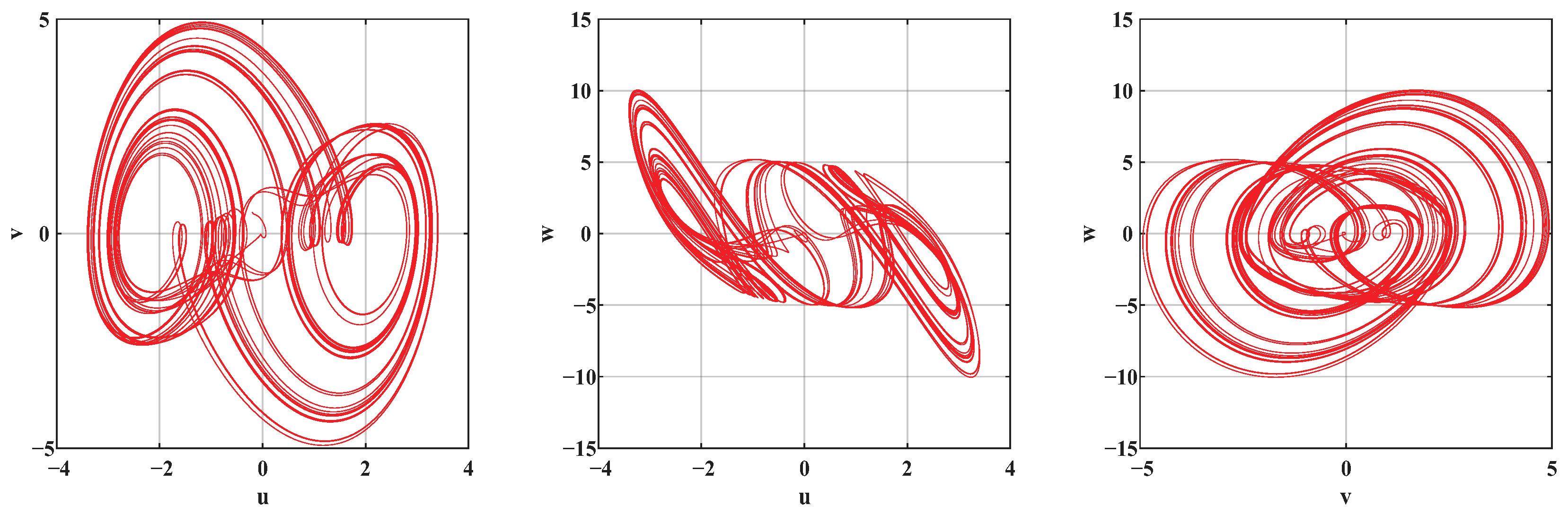
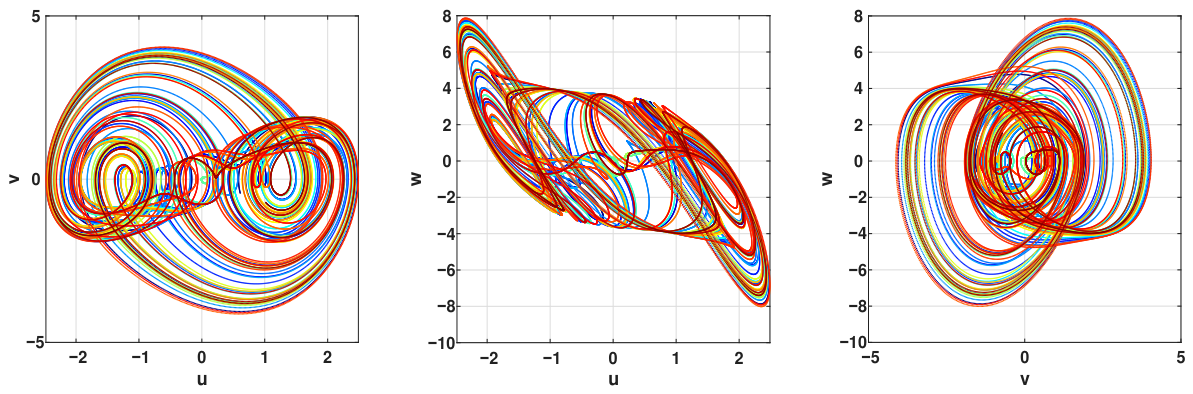
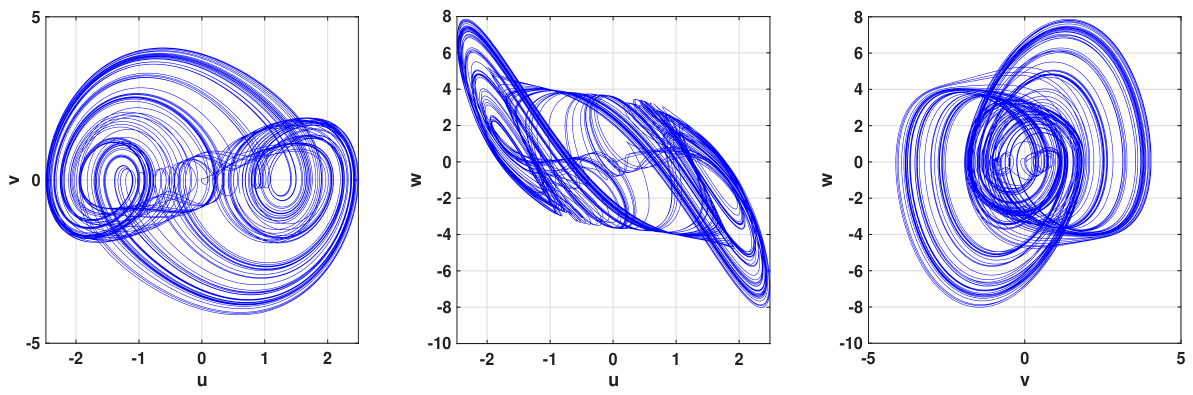
To illustrate the complex dynamic behaviors of the proposed V-OF system, numerical simulations were conducted under α ( t ) . The resulting two-dimensional phase portraits in the u v , u w , and v w planes are presented across three distinct cases.
Figure 1 illustrates the phase space projections of the Arneodo system, showcasing the complexity of the strange attractor’s geometry. The different trajectories on the u w , v w , and u v planes indicate the highly sensitive nature of the system to its initial condition.
Figure 2 shows the behavior of the fractional-order Arneodo system, which is inherently nonlinear and chaotic. The presence of bounded attractors suggests sensitivity to initial conditions and unpredictable long-term behavior.
Figure 3 presents the phase portraits of the proposed system for Case 1, where the order of the derivative changes periodically according to the sine function α ( t ) = 0.96 + 0.03 sin ( t / 7 ) . It can be observed that the trajectories of the system have a dense bounded double-scroll chaotic attractor, proving that the continuous periodic change of the order of the derivative does not affect the chaos but rather sustains the highly complex topological structure of the chaotic attractor.
Further investigations into the system’s adaptability are depicted in Figure 4 and Figure 5. For Case 2, shown in Figure 4, a transient, sigmoid-like fractional-order function α ( t ) = 0.97 + 1 / ( 1 + 3 e 6 t ) is applied. The resulting blue phase portraits maintain the fundamental chaotic topology, indicating that the chaotic states are robust even when the system’s memory effect undergoes a rapid initial transition before settling toward a constant value.
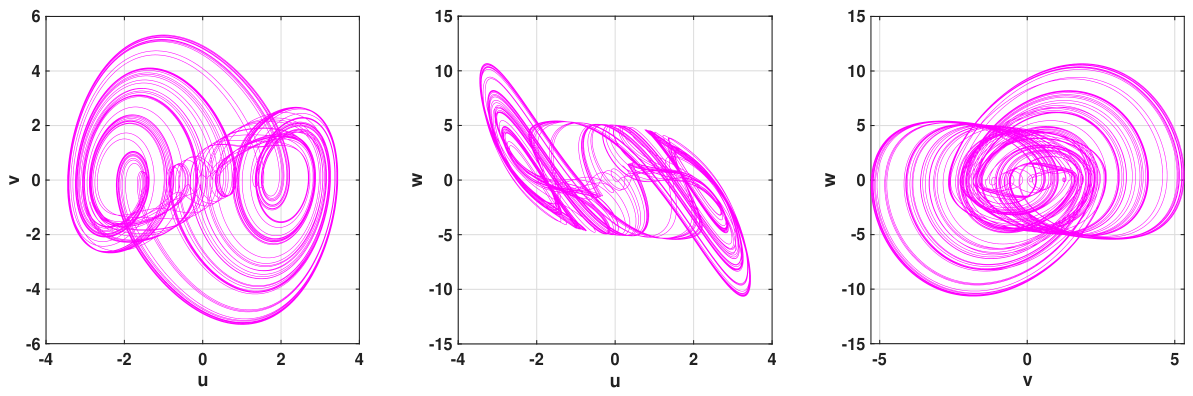
Lastly, Case 3, as represented in Figure 5, focuses on the response of the system when exposed to a different periodic function, Case 3. As represented by the different magenta-colored curves in the figure, the chaotic characteristic of the system is maintained, but the volume in the phase space is increased. More precisely, the amplitude of the curves in the w-axis is increased up to ± 15 , which is much larger than the spatial bounds observed in the different cases presented in the previous figures. All the different phase portraits presented in the discussion above confirm the importance of the functional representation of the variable-order derivative in the definition of the scale and amplitude of the different curves in the phase space, despite the fact that the chaotic characteristic of the system is maintained in different functional updates.

6.2. Time-Series Dynamics

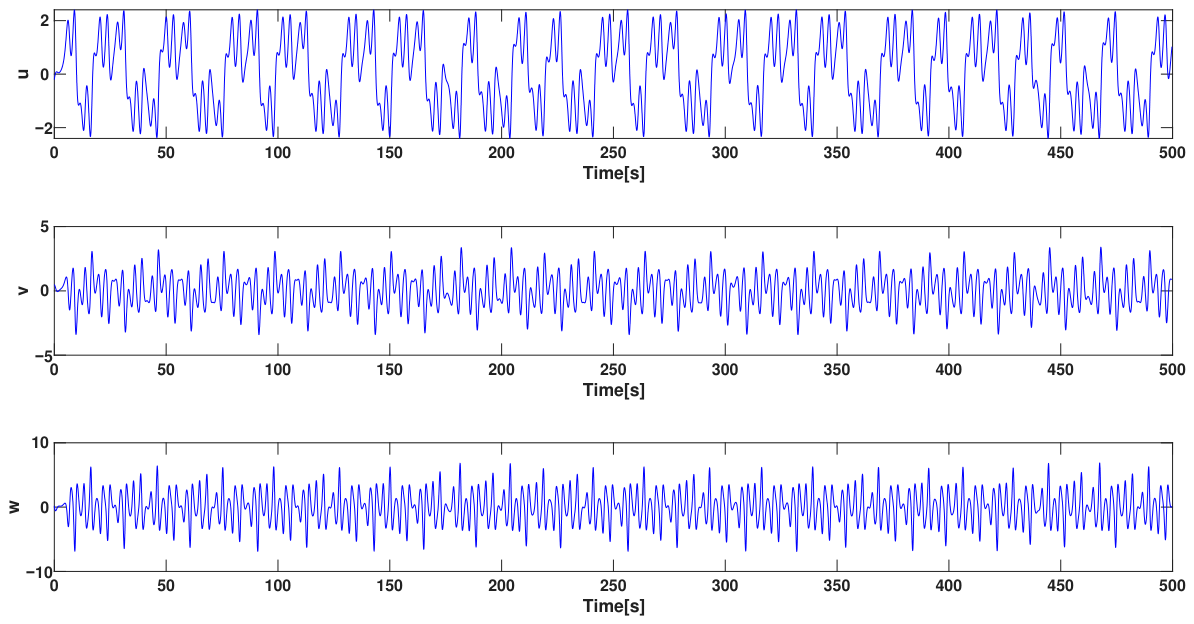
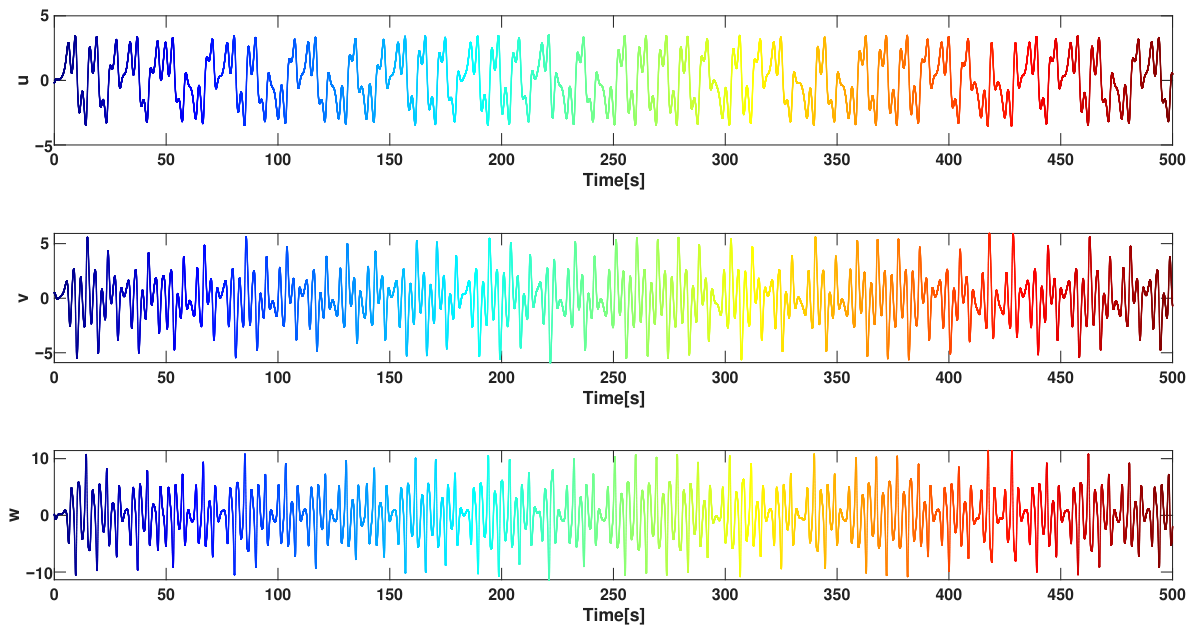
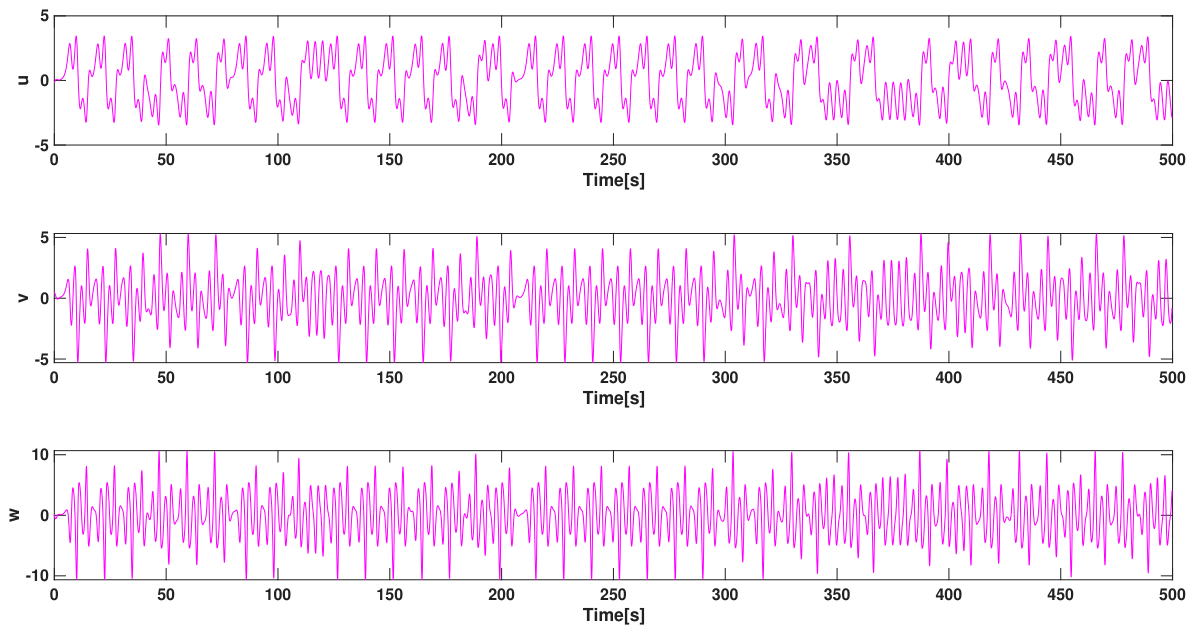
To further clarify the dynamic behavior of the proposed variable-order system, the evolutionary behavior of state variables u, v, and w was investigated for each of the three proposed functional updates of α ( t ) . The respective time series are given in Figure 6, Figure 7 and Figure 8. Each figure shows the respective time series over a simulation period of 500 s.
Figure 6 shows the respective time series for Case 1, where the order of the system was given by Case 1. The evolutionary behavior of each state variable shows continuously oscillating, highly irregular, and non-periodic behavior. Moreover, the oscillations are strictly bounded over the entire simulation period; this is a key property of chaotic systems. The non-periodic oscillations demonstrate that the system does not converge to an equilibrium point or a limit cycle despite the periodic fluctuation in the order of the derivative.
In Figure 7, where the time evolution of Case 2, with the sigmoid-like fractional-order function of Case 2, is presented, the time evolution similarly shows the sustained chaotic oscillations in the state variables u, v, and w.

6.3. Lyapunov–Bifurcation Analysis of Dynamical Systems

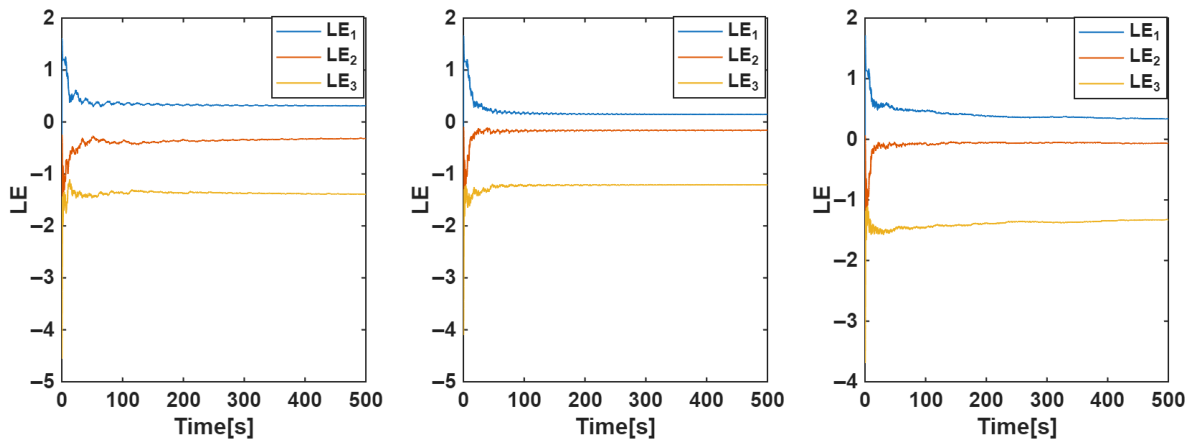
In this part, we investigate Lyapunov exponents and bifurcations. To numerically validate the chaotic dynamics of the variable-order system, the spectrum of Lyapunov exponents (LEs) was computed. Figure 9 shows the time series of the three Lyapunov exponents ( L E 1 , L E 2 , and L E 3 ) for Case 1 (left), Case 2 (middle), and Case 3 (right).
In all three different functional forms of α ( t ) , the system maintains a strong and stable dynamical pattern. Following a short transient phase, the dominant Lyapunov exponent ( L E 1 ) obviously tends to a positive constant, thus indicating sensitivity to initial conditions and the emergence of chaos. Meanwhile, L E 2 tends to zero, and L E 3 tends to a strongly negative value. Moreover, the sum of all three exponents ( L E 1 + L E 2 + L E 3 ) remains definitively negative in all three cases. This clearly indicates that despite the time-varying fractional derivative, the system remains dissipative, with its rich chaotic dynamics being rigorously confined to a bounded region in the phase space.
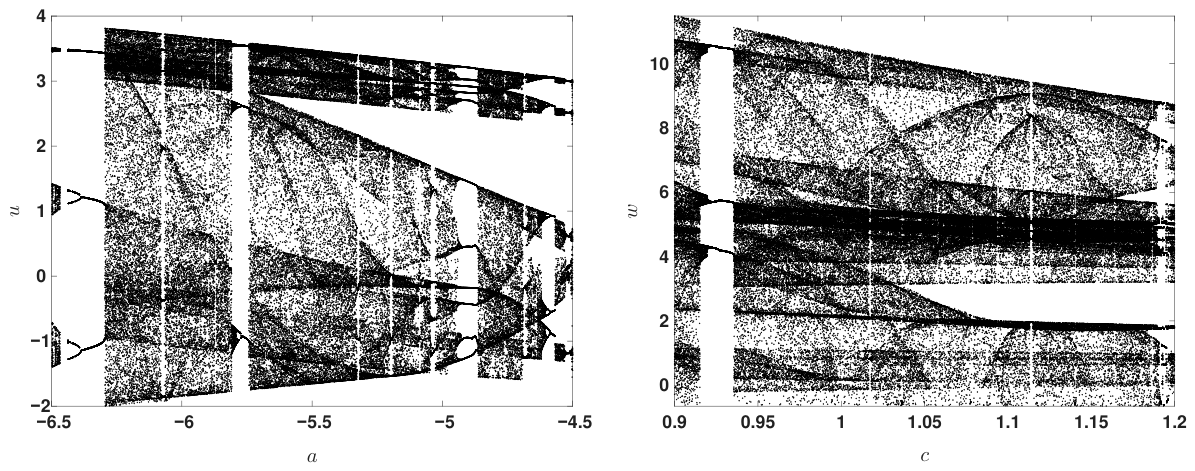
The bifurcation diagrams in Figure 10 for the V-OF Arneodo System (5) essentially map the topological changes in the phase space of the system. They point to the complex relationship between the control parameters and the V-OF derivatives that govern the memory of the system.
  • State u vs. Parameter a for  a [ 6.5 , 4.5 ] : The system evolves from stable periodic limit cycles to dense chaotic attractors in a likely period-doubling route. The sharp vertical gaps in the figure represent periodic windows to a stable periodic orbit before returning to chaotic behavior.
  • State w vs. Parameter c for  c [ 0.9 , 1.2 ] : This regime exhibits high parameter sensitivity. After the initial chaotic state, a broad periodic window exists for c [ 0.92 , 0.94 ] . As c continues to increase, different bands of chaotic behavior begin to merge, which means different chaotic sub-attractors are merging into one chaotic state.
The varying order of this system guarantees that its memory effect is a changing rather than a constant feature. The dense nature of the chaotic zones confirms that the trajectories are indeed bounded and highly sensitive to initial conditions. The identification of the precise stable periodic windows in the chaotic zones is of crucial interest for engineering purposes.
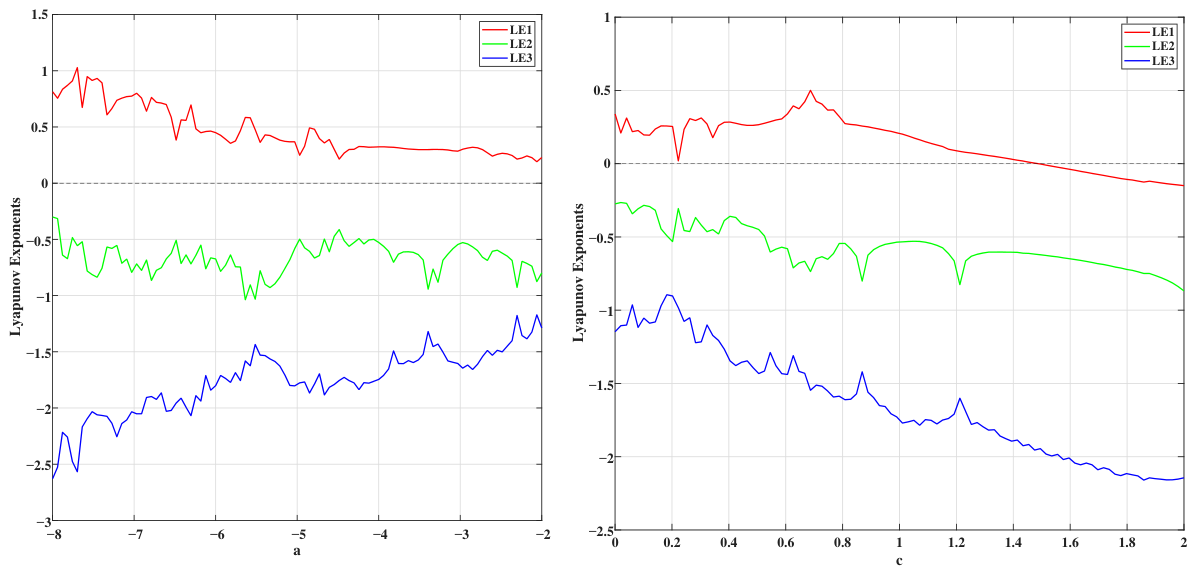
  • Figure 11: The LE diagrams for parameters a and c reveal the system’s dynamical evolution. While parameter a shows a persistent chaotic state ( L E 1 > 0 ), parameter c exhibits a clear transition toward periodic behavior as L E 1 drops below zero near c 1.5 .
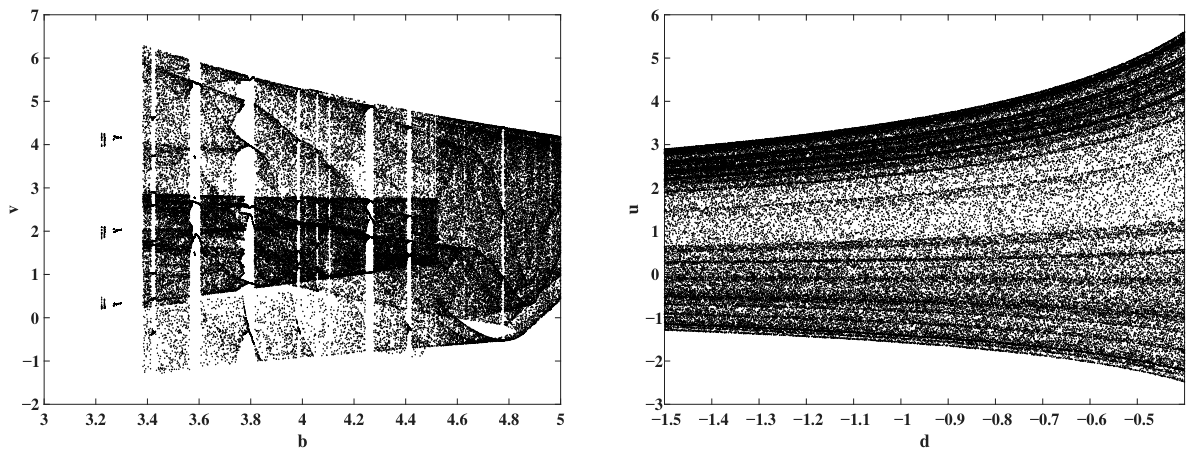
Bifurcation diagrams in Figure 12 represent the evolution of the dynamical behavior of the system based on the variation of the parameters b and d. In the case of parameter b, there are several period doublings resulting in chaos and also some periods when there is stability through the existence of stable cycles, hence showing a typical route to chaos.
In the case of parameter d, the behavior seems smooth, and there is a spreading out of trajectories, hence showing a change of behavior from either stability or quasiperiodicity to chaos. The widening bands show a lot of variability of the system dynamics and possibly the existence of multiple attractors.
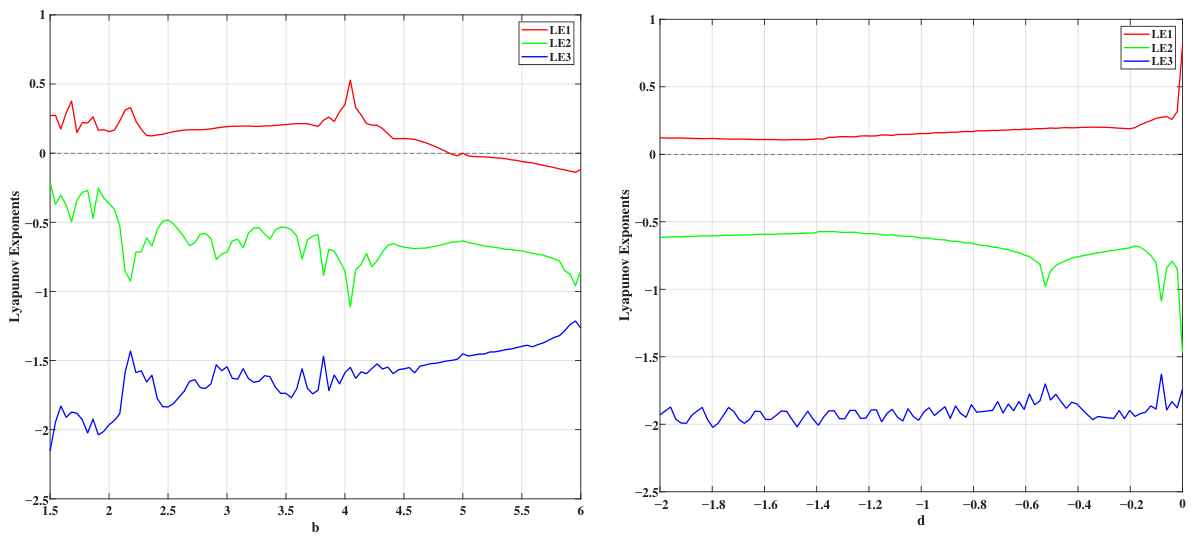
  • Figure 13: The LE spectra for b and d demonstrate the system’s structural stability. The parameter b supports a stable chaotic attractor, whereas the fluctuations in the diagram for d indicate the presence of narrow periodic windows within the chaotic zone.

7. Discussion

The findings derived in this work offer greater insight into the dynamical effects of the variable-order formulation for system (5). Contrary to conventional models described by differential equations with fixed orders, the incorporation of fractional differential operators with memory dependence implies significant history dependence that affects the system dynamics. The simulations indicate that the effect of the variable order on dynamical behavior does not only imply increased complexity but also involves structural changes in the dynamics.
Stability analysis reveals that the order parameter plays a crucial role in governing equilibrium dynamics. For instance, non-constant and time-dependent orders affect the stability domain and may cause bifurcations from stable equilibria to chaotic attractors. This finding is further confirmed by the estimated Lyapunov exponents, which suggest that changes in the order parameter lead to changes in chaotic behavior.
In addition, the numerical simulations (see Table 2, Table 3 and Table 4) show that slight changes in the order cause considerable changes in the quantitative aspects of the trajectories. This implies that the bifurcation diagram exhibits sensitivity as transitions from periodic to chaotic dynamics depend on the value of the order. Hence, the bifurcation diagram serves as proof that the variable-order model introduces another parameter that does not exist in both the constant-order and the integer-order models.
The significance of this study is that the proposed approach provides more control options when modeling nonlinear phenomena. This can be attributed to the fact that the order function can either dampen or promote chaos in the system.
  • Main findings: The variable-order formulation introduces a controllable memory effect that significantly alters stability, bifurcation structure, and chaotic behavior compared to constant-order models.
  • Comparative insight: The results confirm that the variable-order system exhibits richer dynamics than the fractional constant-order case, as demonstrated through phase portraits, Lyapunov exponents, and bifurcation analysis.
  • Literature context: As shown in Table 1, most existing studies focus on isolated aspects such as chaos or bifurcation. In contrast, this work integrates multiple analytical tools, including V-OF modeling, Lyapunov analysis, bifurcation, time-series analysis, and solution behavior, providing a more comprehensive framework.
  • Limitations: The analysis is primarily numerical, and the results depend on the chosen order functions and discretization parameters. A rigorous theoretical analysis of convergence and a broader exploration of order function classes remain open problems.
  • Future directions: Further work will focus on the quantitative characterization of chaos (e.g., entropy and fractal dimension), detailed routes to chaos, and the development of analytical stability conditions for variable-order systems.
Overall, it can be said that the current research has clearly shown that variable-order fractional calculus models are not only extensions of previous models but have also offered a greater understanding of the control of complex systems.

8. Conclusions

This paper explores the dynamics of the V-OF Arneodo system in terms of the Liouville–Caputo fractional derivative. This study reveals that the implementation of the concept of variable-order operators in the system can improve its dynamical characteristics by accounting for the effect of memory on its behavior. It is established that various order functions have an essential impact on the behavior of trajectories, stability, and the transition to different dynamical regimes such as periodic, quasi-periodic, and chaotic states. Bifurcation analysis and computation of the Lyapunov exponents reveal the complex behavior of the system along with high sensitivity to the initial state. A key contribution of this work is the development of a unified V-OF framework that integrates Lyapunov analysis, bifurcation behavior, chaos characterization, time-series analysis, and solution construction within a single model. This comprehensive approach offers deeper insight into nonlinear dynamics, unlike conventional studies that treat these aspects separately. Moreover, applying the V-OF formulation to the Arneodo system—an area not previously explored—emphasizes its novelty and practical relevance for the modeling, analysis, and control of complex systems. Future work will focus on solving additional fractional models, such as those presented in [43,44,45], and comparing the results with other numerical methods [46,47,48].

Author Contributions

Formal analysis, M.E., N.A.-k., R.S., M.H., A.H.A., M.S.J. and M.A.A.; Methodology, M.E., R.S. and M.A.A.; Software, M.E. and M.A.A.; Investigation, M.E., N.A.-k., M.H., M.S.J. and M.A.A.; Resources, R.S.; Writing—original draft, M.E., N.A.-k., R.S., M.H., A.H.A., M.S.J. and M.A.A.; Writing—review & editing, M.E., N.A.-k., R.S., M.H., A.H.A., M.S.J. and M.A.A. All authors have read and agreed to the published version of the manuscript.

Funding

This work was supported by the Deanship of Scientific Research, Vice Presidency for Graduate Studies and Scientific Research, King Faisal University, Saudi Arabia [Grant No. KFU262142].

Data Availability Statement

The original contributions in this study are included in the article.

Conflicts of Interest

The authors declare no conflicts of interest.

References

  1. Younas, U.; Hussain, E.; Muhammad, J.; Sharaf, M.; Meligy, M.E. Chaotic structure, sensitivity analysis and dynamics of solitons to the nonlinear fractional longitudinal wave equation. Int. J. Theor. Phys. 2025, 64, 42. [Google Scholar] [CrossRef]
  2. Dimitrov, Y.; Slavi, G.; Venelin, T.; Jordan, H. Advances in Fractional Modeling and Computation. Fractal Fract. 2026, 10, 45. [Google Scholar] [CrossRef]
  3. Mumtaz, A.; Masood, K.; Shakeel, M.; Shah, N.A. Exploring complex dynamics in nonlinear Riemann wave models using fractional calculus-based expansion. Sci. Rep. 2025, 15, 43559. [Google Scholar] [CrossRef]
  4. Elbadri, M.; Abdoon, M.A.; Alzahrani, A.B.M.; Saadeh, R.; Berir, M. A Comparative Study and Numerical Solutions for the Fractional Modified Lorenz–Stenflo System Using Two Methods. Axioms 2025, 14, 20. [Google Scholar] [CrossRef]
  5. Kadri, I.; Gundogdu, H.; Modawy, Y.M.; Imam, A.; Helal, K.A.; Elshamy, I.; Tahir, R.A. A Comparative Analysis of the Non-linear Time Fractional Whitham-Broer-Kaup Equations under Aboodh Decomposition Transform. Eur. J. Pure Appl. Math. 2025, 18, 6626. [Google Scholar] [CrossRef]
  6. Kadri, I.; Gündoğdu, H.; Abdoon, M.A.; Afif, E.; Modawy, Y.M.; Cattani, C. Numerical Approach to Fractional Model for Dispersion, Dissipation, and Diffusion with a Logistic Reaction. Int. J. Adv. Soft Comput. Appl. 2025, 17. [Google Scholar] [CrossRef]
  7. Alhawael, G.; Abdoon, M.A.; Khashan, K.H.; Elgezouli, D.E. Chaos Analysis of the Fractional Genesio-Tesi System with Constant and Variable-Order Dynamics. Mathematics 2025, 13, 3992. [Google Scholar] [CrossRef]
  8. Abdoon, A.; Elbadri, M.; Alzahrani, A.B.M.; Berir, M.; Ahmed, A. Analyzing the Inverted Fractional Rössler System Through Two Approaches: Numerical Scheme and LHAM. Phys. Scr. 2024, 99, 115220. [Google Scholar] [CrossRef]
  9. Wang, C.; Li, Y.; Yang, G.; Deng, Q. A review of fractional-order chaotic systems of memristive neural networks. Mathematics 2025, 13, 1600. [Google Scholar] [CrossRef]
  10. Fantaye, A.K.; Ergete, K.T.; Alshowaikh, F.; Hafez, M.; Voon, B.W.N.; Alkhazaleh, S. Atangana Baleanu Caputo Fractional Order Modeling and Analysis for the Transmission of Coffee Berry Disease. Prog. Fract. Differ. Appl. 2025, 11, 229–243. [Google Scholar] [CrossRef]
  11. Elbadri, M.; AlMutairi, D.M.; Almutairi, D.; Hassan, A.A.; Hdidi, W.; Abdoon, M.A. Efficient numerical techniques for investigating chaotic behavior in the fractional-order inverted Rössler system. Symmetry 2025, 17, 451. [Google Scholar] [CrossRef]
  12. Elbadri, M.; Abdoon, M.A.; Almutairi, D.K.; Almutairi, D.M.; Berir, M. Numerical Simulation and Solutions for the Fractional Chen System via Newly Proposed Methods. Fractal Fract. 2024, 8, 709. [Google Scholar] [CrossRef]
  13. Patnaik, S.; Hollkamp, J.P.; Semperlotti, F. Applications of variable-order fractional operators: A review. Proc. R. Soc. A Math. Phys. Eng. Sci. 2020, 476, 20190498. [Google Scholar] [CrossRef]
  14. Hui, Z.; Liu, H.; Sheng, C.; Xu, C. On Probabilistic Methods for Linear PDEs Involving Variable-Order fractional Laplacian in High Dimensions. J. Sci. Comput. 2026, 107, 29. [Google Scholar] [CrossRef]
  15. Patnaik, S.; Semperlotti, F. Application of variable-and distributed-order fractional operators to the dynamic analysis of nonlinear oscillators. Nonlinear Dyn. 2020, 100, 561–580. [Google Scholar] [CrossRef]
  16. Ding, W.; Patnaik, S.; Sidhardh, S.; Semperlotti, F. Applications of distributed-order fractional operators: A review. Entropy 2021, 23, 110. [Google Scholar] [CrossRef] [PubMed]
  17. Ahmed, A.I.; Elbadri, M.; Al-Kuleab, N.; AlMutairi, D.M.; Taha, N.E.; Dafaalla, M.E. Chaos and Bifurcations in the Dynamics of the Variable-Order Fractional Rössler System. Mathematics 2025, 13, 3695. [Google Scholar] [CrossRef]
  18. Sawar, S.; Ayaz, M.; Aldhabani, M.S.; Abd El-Rahman, M.; Hussain, S.; Jebran, S. Modeling nonlinear variable-order fractional chaotic systems using the Caputo-Fabrizio operator and radial basis function neural networks. Sci. Rep. 2026, 16, 7912. [Google Scholar] [CrossRef] [PubMed]
  19. Al-Sharif, M.; Ahmed, A.; Salim, M. Fractional-order Chelyshkov collocation method for solving variable-order fractional differential equations. J. Inequalities Appl. 2026, 2026, 9. [Google Scholar] [CrossRef]
  20. Saadeh, R.; Taha, N.E.; Hafez, M.; Al-Mutairi, G.S.; Ashmaig, M.A. Dynamics and Solution Behavior of the Variable-Order Fractional Newton–Leipnik System. Mathematics 2026, 14, 312. [Google Scholar] [CrossRef]
  21. Sun, H.; Chang, A.; Zhang, Y.; Chen, W. A review on variable-order fractional differential equations: Mathematical foundations, physical models, numerical methods and applications. Fract. Calc. Appl. Anal. 2019, 22, 27–59. [Google Scholar] [CrossRef]
  22. Hassani, H.; Machado, J.T.; Avazzadeh, Z. An effective numerical method for solving nonlinear variable-order fractional functional boundary value problems through optimization technique. Nonlinear Dyn. 2019, 97, 2041–2054. [Google Scholar] [CrossRef]
  23. Soltanpour Moghadam, A.; Arabameri, M.; Baleanu, D.; Barfeie, M. Numerical solution of variable fractional order advection-dispersion equation using Bernoulli wavelet method and new operational matrix of fractional order derivative. Math. Methods Appl. Sci. 2020, 43, 3936–3953. [Google Scholar] [CrossRef]
  24. El-Sayed, A.A.; Agarwal, P. Numerical solution of multiterm variable-order fractional differential equations via shifted Legendre polynomials. Math. Methods Appl. Sci. 2019, 42, 3978–3991. [Google Scholar] [CrossRef]
  25. Bhrawy, A.; Zaky, M. Numerical simulation for two-dimensional variable-order fractional nonlinear cable equation. Nonlinear Dyn. 2015, 80, 101–116. [Google Scholar] [CrossRef]
  26. Ghanbari, B.; Gómez-Aguilar, J. Modeling the dynamics of nutrient–phytoplankton–zooplankton system with variable-order fractional derivatives. Chaos Solitons Fractals 2018, 116, 114–120. [Google Scholar] [CrossRef]
  27. Abdulrhman, T. Stability analysis of fractional chaotic and fractional-order hyperchain systems using lyapunov functions. Eur. J. Pure Appl. Math. 2025, 18, 5576. [Google Scholar] [CrossRef]
  28. Khan, N.A.; Hameed, T.; Razzaq, O.A.; Ayaz, M. Tracking the chaotic behaviour of fractional-order Chua’s system by Mexican hat wavelet-based artificial neural network. J. Low Freq. Noise Vib. Act. Control 2019, 38, 1279–1296. [Google Scholar] [CrossRef]
  29. Hou, T.; Yu, J.; Hu, C.; Jiang, H. Finite-time synchronization of fractional-order complex-variable dynamic networks. IEEE Trans. Syst. Man Cybern. Syst. 2019, 51, 4297–4307. [Google Scholar] [CrossRef]
  30. Bouridah, M.S.; Bouden, T.; Boulkroun, A. Image Secure Transmission Using Lornez and Arneodo Systems and Chaotic Synchronization. In Proceedings of the International Conference on Automatic Control, Telecommunications and Signals, Annaba, Algeria, 12–14 November 2017. [Google Scholar]
  31. Rabah, K.; Ladaci, S. A novel fractional order adaptive Sliding Mode Controller design for chaotic Arneodo systems synchronization. In Proceedings of the 2017 6th International Conference on Systems and Control (ICSC), Batna, Algeria, 7–9 May 2017; IEEE: New York, NY, USA, 2017; pp. 465–469. [Google Scholar]
  32. Emin, B.; Akgul, A.; Horasan, F.; Gokyildirim, A.; Calgan, H.; Volos, C. Secure encryption of biomedical images based on Arneodo chaotic system with the lowest fractional-order value. Electronics 2024, 13, 2122. [Google Scholar] [CrossRef]
  33. Ladaci, S.; Rabah, K.; Lashab, M. Robust synchronization of fractional-order arneodo chaotic systems using a fractional sliding mode control strategy. In Advanced Synchronization Control and Bifurcation of Chaotic Fractional-Order Systems; IGI Global Scientific Publishing: Hershey, PA, USA, 2018; pp. 1–22. [Google Scholar]
  34. Lu, J.G. Chaotic dynamics and synchronization of fractional-order Arneodo’s systems. Chaos Solitons Fractals 2005, 26, 1125–1133. [Google Scholar] [CrossRef]
  35. Rabah, K.; Ladaci, S. A fractional adaptive sliding mode control configuration for synchronizing disturbed fractional-order chaotic systems. Circuits Syst. Signal Process. 2020, 39, 1244–1264. [Google Scholar] [CrossRef]
  36. Elbadri, M.; Ashmaig, M.A.; Hassan, A.A.; Hdidi, W.; Barakat, H.M.; Al-Mutairi, G.S.; Abdoon, M.A. Exploring Stability and Chaos in the Fractional-Order Arneodo System via Grünwald–Letnikov Scheme. Mathematics 2025, 13, 3925. [Google Scholar] [CrossRef]
  37. Gokyildirim, A.; Akgul, A.; Calgan, H.; Demirtas, M. Parametric fractional-order analysis of Arneodo chaotic system and microcontroller-based secure communication implementation. AEU—Int. J. Electron. Commun. 2024, 175, 155080. [Google Scholar] [CrossRef]
  38. Oldham, K.; Spanier, J. The Fractional Calculus Theory and Applications of Differentiation and Integration to Arbitrary Order; Elsevier: Amsterdam, The Netherlands, 1974; Volume 111. [Google Scholar]
  39. Solís-Pérez, J.; Gómez-Aguilar, J.; Atangana, A. Novel numerical method for solving variable-order fractional differential equations with power, exponential and Mittag-Leffler laws. Chaos Solitons Fractals 2018, 114, 175–185. [Google Scholar] [CrossRef]
  40. Arneodo, A.; Coullet, P.; Spiegel, E.; Tresser, C. Asymptotic chaos. Phys. D Nonlinear Phenom. 1985, 14, 327–347. [Google Scholar] [CrossRef]
  41. Petráš, I. Fractional-Order Nonlinear Systems: Modeling, Analysis and Simulation; Springer Science & Business Media: Berlin/Heidelberg, Germany, 2011. [Google Scholar]
  42. Alqahtani, A.M.; Chaudhary, A.; Dubey, R.S.; Sharma, S. Comparative analysis of the chaotic behavior of a five-dimensional fractional hyperchaotic system with constant and variable order. Fractal Fract. 2024, 8, 421. [Google Scholar] [CrossRef]
  43. Ullah, Z.; Billah, M. Numerical Simulation of Mathematical Model of Fractional Order Partial Differential Equation by Asymptotic Homotopy Perturbatin Method. Appl. Decis. Anal. 2026, 2, 1–14. [Google Scholar]
  44. Nadeem, M.; Iambor, L.F. Approximate Solution to Fractional Order Models Using a New Fractional Analytical Scheme. Fractal Fract. 2023, 7, 530. [Google Scholar] [CrossRef]
  45. Hedrih, K.R.S. New Class of Complex Models of Materials with Piezoelectric Properties with Differential Constitutive Relations of Fractional Order: An Overview. Fractal Fract. 2025, 9, 170. [Google Scholar] [CrossRef]
  46. Ray, S.S.; Sahoo, S. New Analytical Approximate Solutions of Fractional Differential Equations. In Generalized Fractional Order Differential Equations Arising in Physical Models; Chapman and Hall/CRC: Boca Raton, FL, USA, 2018; pp. 47–107. [Google Scholar] [CrossRef]
  47. Phang, C.; Kanwal, A.; Loh, J.R. New collocation scheme for solving fractional partial differential equations. Hacet. J. Math. Stat. 2020, 49, 1107–1125. [Google Scholar] [CrossRef]
  48. Berir, M. The Impact of White Noise on Chaotic Behavior in a Financial Fractional System with Constant and VariableOrder: A Comparative Study. Eur. J. Pure Appl. Math. 2024, 17, 3915–3931. [Google Scholar] [CrossRef]
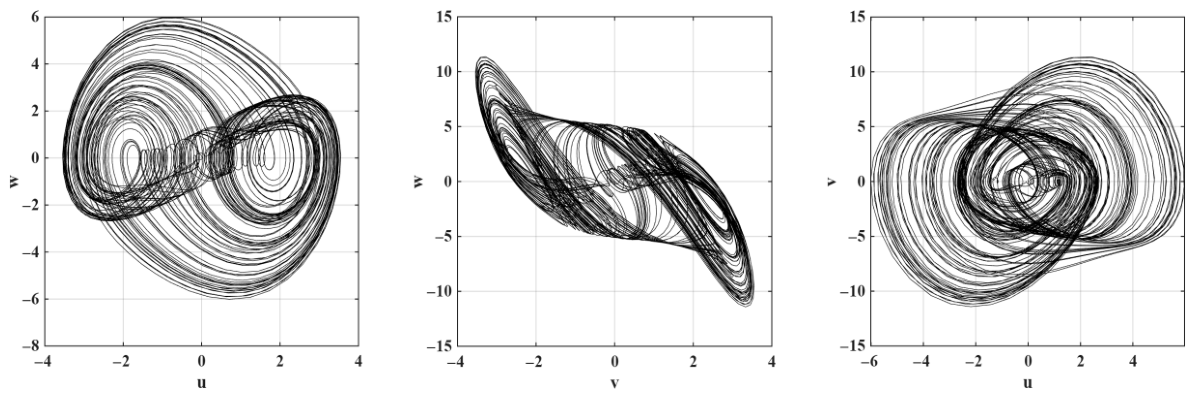
Figure 1. Original dynamics of the Arneodo system.
Fractalfract 10 00296 g001
Figure 2. Chaotic phase portraits for the fractional-order Arneodo system.
Fractalfract 10 00296 g002
Figure 3. Case 1: Chaotic phase portraits for selected state variables.
Fractalfract 10 00296 g003
Figure 4. Case 2: Chaotic phase portraits for selected state variables.
Fractalfract 10 00296 g004
Figure 5. Case 3: Chaotic phase portraits for selected state variables.
Fractalfract 10 00296 g005
Figure 6. Time Series of Case 1:  α ( t ) = 0.96 + 0.03 sin ( t / 7 ) .
Fractalfract 10 00296 g006
Figure 7. Time series of Case 2:  α ( t ) = 0.97 + 1 / ( 1 + 3 e 6 t ) .
Fractalfract 10 00296 g007
Figure 8. Time series of Case 3.  α ( t ) = 0.99 + 0.05 cos ( t / 5 ) .
Fractalfract 10 00296 g008
Figure 9. Time evolution of the Lyapunov exponents for Case 1 (left), Case 2 (middle), and Case 3 (right).
Fractalfract 10 00296 g009
Figure 10. Bifurcation diagrams versus parameters a and c showing transitions to chaos and periodic windows.
Fractalfract 10 00296 g010
Figure 11. LE spectra vs. parameters a and c displaying chaos-to-periodic transitions.
Fractalfract 10 00296 g011
Figure 12. Bifurcation diagrams versus parameters b and d showing transitions to chaos and periodic windows.
Fractalfract 10 00296 g012
Figure 13. LE spectra vs. parameters b and d displaying chaos-to-periodic transitions.
Fractalfract 10 00296 g013
Table 1. Comparison of key analysis features across studies.
ReferencesV-OFLyapunovChaosBifurcationTime-SeriesSolutions
[31]×××××
[32]××××
[33]××××
[34]×××××
[35]××××
[36]××
[37]×××
This study
Table 2. Numerical results obtained for solving system (5) corresponding to Case 1.
Timeuvw
0.01−0.1932205388465940.4911117844613620.176800381693763
0.02−0.1846661622345340.4847835845992880.139787743263059
0.03−0.1777651992694720.4818465481893300.106636474748362
0.04−0.1714843443149490.4799216139322300.075438267406557
0.05−0.1655372084780940.4783729945471710.045614909401830
0.06−0.1598031926202190.4769424141593940.016902331992236
0.07−0.1542204579906940.475502347019652−0.010845915543675
0.08−0.1487534417703970.473982460061194−0.037721024570974
0.09−0.1433801415310800.472341321839527−0.063784364772103
0.10−0.1380862731698950.470553628296133−0.089079632588735
Table 3. Numerical results obtained for solving system (5) corresponding to Case 2.
Timeuvw
0.01−0.1910693030756930.4861722787697230.173962520687514
0.02−0.1808020317618260.4759552688369600.134592421533977
0.03−0.1730200656112820.4709590366040010.100334660844798
0.04−0.1661675201110380.4676109421553570.068590798323171
0.05−0.1598148613517280.4649608763411710.038570755955721
0.06−0.1537810158205730.4626229214240150.009911386839347
0.07−0.1479726876074130.460405842766598−0.017590379646189
0.08−0.1423357529085490.458203332278996−0.044062246293978
0.09−0.1368362785127330.455951900636242−0.069591131148981
0.10−0.1314518166253330.453611901824122−0.094239699194784
Table 4. Numerical results obtained for solving system (5) corresponding to Case 3.
Timeuvw
0.01−0.1757533838384140.4516986464646340.121172585662850
0.02−0.1545638178906010.4162829928558450.043721268372091
0.03−0.1415966752428960.398109043591081−0.008285590788008
0.04−0.1315835797111690.385496106259776−0.049872748293579
0.05−0.1231316488232640.375494697388425−0.085265266495446
0.06−0.1156645248034230.366939939965296−0.116336337907621
0.07−0.1088873021368460.359264166017998−0.144111258044021
0.08−0.1026285696020260.352154173136843−0.169226090827748
0.09−0.0967797673469460.345422514029592−0.192109957061896
0.10−0.0912677421043590.338950509850621−0.213070407280622
Disclaimer/Publisher’s Note: The statements, opinions and data contained in all publications are solely those of the individual author(s) and contributor(s) and not of MDPI and/or the editor(s). MDPI and/or the editor(s) disclaim responsibility for any injury to people or property resulting from any ideas, methods, instructions or products referred to in the content.