Article

Application of Fractal Dimension for Pore Structure Evolution in Graphene Oxide-Modified Silica Fume Cementitious Composites

1
School of Civil Engineering, Northwest Minzu University, Lanzhou 730030, China
2
Industrial Research Institute of Prefabricated Buildings and Energy-Saving Materials, Northwest Minzu University, Lanzhou 730030, China
3
School of Civil Engineering, Putian University, Putian 351100, China
4
Engineering Research Center of Disaster Prevention and Mitigation of Southeast Coastal Engineering Structures (JDGC03), Fujian Province University, Putian 351100, China
5
Department of Architecture and Civil Engineering, City University of Hong Kong, 83 Tat Chee Avenue, Kowloon Tong, Hong Kong 999077, China
*
Authors to whom correspondence should be addressed.
Fractal Fract. 2026, 10(5), 294; https://doi.org/10.3390/fractalfract10050294
Submission received: 3 April 2026 / Revised: 19 April 2026 / Accepted: 24 April 2026 / Published: 27 April 2026
(This article belongs to the Section Engineering)

Abstract

Silica fume (SF) is a valuable industrial by-product for low-carbon cementitious systems, but it weakens early-age strength due to slow pozzolanic activation. To overcome this limitation and, crucially, to elucidate the influence of pore system geometry on macroscopic performance, graphene oxide (GO) was introduced as a modifying agent. Concurrently, the fractal dimension (D) of the pore network was adopted as a pivotal descriptor linking microstructure to macroscopic strength. Results show that GO compensates for the early strength loss caused by SF and further amplifies long-term gains by accelerating hydration and promoting gel continuity. SF reduces total porosity through filler and pozzolanic reactions, while GO dramatically increases geometric complexity of pores, producing the highest fractal dimension and the most refined pore structure in the matrix. Critically, the proposed log–log interaction model demonstrates that compressive strength is jointly controlled by porosity and fractal dimension, rather than porosity alone. Higher fractal dimension intensifies strength gains in low-porosity matrices by reflecting improved pore connectivity control and energy-dissipation pathways. This establishes fractal dimension as a powerful, mechanistically interpretable index for predicting performance and guiding structural design in SF–GO modified cementitious composites.

1. Introduction

Concrete remains the most widely used construction material worldwide, yet its production exerts a heavy environmental and energy burden. The manufacture of Portland cement alone is responsible for roughly 7–8% of global anthropogenic CO2 emissions due to the decomposition of limestone and the high energy demand of clinker calcination [1,2,3]. Simultaneously, the increasing accumulation of industrial by-products such as fly ash, slag, and silica fume (SF) presents a growing challenge to sustainable waste management [4,5]. These two issues—high cement-related emissions and underutilized industrial residues—have converged to drive the development of cementitious composites that combine enhanced durability with reduced environmental impact. The rational recycling of these industrial by-products as supplementary cementitious materials (SCMs) not only reduces clinker consumption but also improves the long-term performance of concrete through pozzolanic and filler effects.
Among the available SCMs, SF, an ultrafine amorphous SiO2-rich by-product of the ferrosilicon industry, holds exceptional promise for sustainable reuse [6,7]. Owing to its extremely small particle size (0.1–1 μm), high specific surface area, and high silica content (>90%), SF can react pozzolanically with calcium hydroxide (CH) released during cement hydration to form additional calcium silicate hydrate (C–S–H) gel. This secondary C–S–H contributes to microstructural densification, reduction in permeability, and improvement of long-term strength and durability [8,9]. However, the reactivity of SF is not immediate. At early ages, the pozzolanic reaction proceeds slowly because amorphous silica requires sufficient alkalinity and calcium availability to dissolve and react effectively [10]. Consequently, the partial replacement of cement with SF often results in delayed strength development or even strength reduction during the first few days of curing. This drawback restricts its application in structural components requiring rapid demolding or early loading capacity, such as precast and high-performance concretes.
To overcome this early-age limitation while maintaining the long-term benefits of SF, graphene oxide (GO) has emerged as an advanced nano-modifier capable of improving both hydration kinetics and microstructural organization. GO is a two-dimensional nanomaterial derived from graphite, characterized by its monolayered sheet structure, high aspect ratio, and abundant oxygen-containing functional groups (hydroxyl, carboxyl, epoxy) [11,12,13]. These chemical moieties impart strong hydrophilicity and interfacial activity, enabling GO to disperse uniformly in aqueous cement systems and interact chemically with hydration products. GO has been shown to serve as a nucleation substrate for C–S–H growth, accelerating cement hydration reactions; simultaneously, its nanosheet morphology provides crack-bridging capacity, enhancing tensile strength and fracture resistance. In addition, GO can adsorb Ca2+ and SiO44− ions, thereby influencing the morphology and polymerization degree of hydration products [14]. When used in combination with silica fume, GO has the potential to form a synergistic system in which SF supplies reactive silica for secondary hydration, while GO promotes nucleation and structural integration, jointly producing a dense and well-organized matrix.
Despite extensive studies on individual modifications with SF or GO, the mechanistic understanding of their combined effects remains limited. Most prior research has evaluated performance improvements primarily through macroscopic parameters—such as compressive strength [15], water absorption, and chloride penetration [16]—without establishing a coherent framework linking chemical reactions, pore structure evolution, and mechanical outcomes. The complexity arises because SF and GO operate through distinct but interdependent mechanisms: SF affects the chemical domain by altering phase composition and hydration reactions, whereas GO influences the physical and volumetric domain by modifying pore geometry, crack resistance, and gel connectivity. The coupling between these domains produces nonlinear and multi-scale effects that cannot be captured adequately by conventional empirical or linear models. As a result, the true nature of SF–GO synergy—how chemical reactions, pore structure evolution, and mechanical performance interact across scales—remains an open question.
A key limitation lies in the traditional characterization of pore structure. Traditional pore structure characterization methods, while useful, are often insufficient for capturing this complexity. Parameters such as total porosity (P) or average pore diameter describe volume fractions but not the geometrical intricacy of the pore network, which plays a crucial role in determining transport and mechanical properties. In recent years, fractal geometry has provided a promising approach to describe the irregular, hierarchical features of pore systems in cement-based materials [17,18,19]. The fractal dimension (D) serves as a quantitative descriptor of pore complexity and tortuosity, with higher D values indicating more convoluted, interconnected microstructures. Numerous studies have demonstrated strong correlations between D and properties such as compressive strength [20], permeability [21], and freeze–thaw resistance [17], suggesting that D may function as a universal parameter bridging microstructure and macroscopic behavior.
However, current studies tend to treat D and P as independent variables, assuming their effects on mechanical performance to be additive. In reality, porosity and pore complexity evolve in a coupled manner during hydration; as hydration products fill voids and reduce pore volume, they simultaneously increase the tortuosity and heterogeneity of the microstructure. This interdependence implies that the contribution of D to strength enhancement may vary with the degree of densification. For example, when porosity is high, the strength may be dominated by pore volume effects, whereas when porosity is low, the influence of structural complexity becomes more pronounced. Capturing this interaction requires a model that goes beyond linear regressions and incorporates multiplicative relationships reflecting physical interdependence.
To address this conceptual gap, the present study introduces a log–log interaction model that links compressive strength (fc) with porosity (P), fractal dimension (D), and curing age (T). By employing a multiplicative form, the model quantifies both independent and coupled contributions of pore volume and pore complexity to mechanical performance. Unlike traditional linear models, this formulation reflects the nonlinear scaling behavior inherent to fractal systems and provides a mechanistically interpretable structure–performance relationship. The resulting function is expected to describe how variations in pore geometry and hydration progression collectively govern strength evolution.
To substantiate this framework, a multi-scale experimental approach was adopted. At the macroscopic level, compressive strength tests were conducted at 3, 7, 28, and 90 days to quantify performance evolution. At the mesoscopic level, pore structure parameters were obtained through low-field nuclear magnetic resonance (NMR), enabling the calculation of total porosity and fractal dimension. Beyond addressing early-age performance limitations and microstructural refinement challenges, this study advances the theoretical understanding of pore-governed mechanical behavior in cementitious systems. By demonstrating that porosity and fractal dimension evolve synergistically during hydration—and by quantifying their interaction through a log–log multiplicative model—the work establishes fractal dimension not merely as a descriptive index, but as a governing indicator of structural efficiency. Collectively, these contributions provide a mechanistic and modeling foundation for the design of low-carbon, high-performance composites with hierarchically optimized microstructures.

2. Experimental Details

2.1. Materials

The cementitious binder used in this study was P·O 42.5 ordinary Portland cement (OPC) supplied by Hailuo Cement Co., Ltd. of Wuhu, China. The main chemical composition of the OPC was determined by X-ray fluorescence (XRF) and is summarized in Table 1. The cement exhibited a specific surface area of 350 m2/kg and a specific gravity of 3.14 g/cm3. Silica fume (SF) was obtained from a local resource company, consisting primarily of amorphous SiO2 (>92%) with a median particle size of approximately 0.15 μm and a specific surface area exceeding 20,000 m2/kg. The highly pozzolanic nature of SF promotes secondary hydration reactions with calcium hydroxide (CH) to form additional calcium silicate hydrate (C–S–H) gel, although its fine particle size may reduce early-age hydration kinetics. Graphene oxide (GO) nanosheets were synthesized via a modified Hummers’ method. The GO possessed a thickness of 0.8–1.2 nm, a lateral dimension of 1–5 μm, and an oxygen-to-carbon atomic ratio (O/C) of approximately 0.42. GO generally contains oxygen-bearing functional groups, including hydroxyl, epoxy, carbonyl, and carboxyl groups. Hydroxyl and epoxy groups are mainly distributed on the basal plane, whereas carboxyl and carbonyl groups are generally located at sheet edges and defect sites. These oxygen-containing groups provide potential active sites for Ca2+ adsorption, C–S–H nucleation, and interfacial interaction with hydration products. It should be noted that the functional-group ratio of the GO used in this study was not directly quantified by XPS or FTIR deconvolution; therefore, the present work discusses the role of GO functional groups qualitatively rather than assigning an unsupported exact ratio.
A polycarboxylate-based high-range water-reducing admixture (PCE) was employed to ensure workability at low water-to-binder ratios. The PCE had a solid content of 30% and a water-reducing efficiency of approximately 25%, effectively dispersing cement particles and stabilizing GO suspensions through electrostatic and steric hindrance. Referring to previous studies [22,23], ISO standard quartz sand, sourced from Xiamen ISO Sand Co., was used as the fine aggregate. The sand exhibited a SiO2 content above 98%, a bulk density of 1.54 g/cm3, and a fineness modulus of 2.68, ensuring good reproducibility and mechanical consistency in the mortars.

2.2. Sample Preparation

Seven mortar mixtures were prepared to evaluate the individual and synergistic effects of SF and GO on cementitious systems. The control group (G0) contained only ordinary Portland cement (OPC) without any mineral or nanomaterial additives. Three SF-only groups (G0S5, G0S10, G0S15) incorporated 5%, 10%, and 15% SF by mass as cement replacement. The three hybrid groups (G7S5, G7S10, G7S15) combined the same SF replacement levels with 0.07% GO (by total binder mass). The water-to-binder ratio (w/b) was fixed at 0.50 for all mixtures. Each mix contained 450 g of total binder (OPC + SF) and 1350 g of ISO standard quartz sand, corresponding to a sand-to-binder ratio of 3:1. A polycarboxylate-based high-range water reducer was used at varying dosages of binder mass to control the fluidity. The mix proportion is tabulated in Table 2.
GO nanosheets were pre-dispersed in part of the mixing water by magnetic stirring (10 min), followed by short ultrasonic agitation (40 kHz, 5–10 min). The water reducer solution was then added to the GO dispersion to form a stable suspension. The dry components (OPC, SF, and standard sand) were first mixed for 60 s in a planetary mortar mixer. The liquid phase (GO–PCE dispersion + remaining water) was added gradually during low-speed mixing for 120 s, followed by a 60 s rest and another 120 s of medium-speed mixing. The fresh mortar was cast into 40 × 40 × 160 mm molds, compacted on a vibrating table, sealed, and demolded after 24 h. Specimens were then cured in standard conditions (20 ± 2 °C, RH ≥ 95%) until the specified testing ages. Samples for compressive strength were determined at 3, 7, 28, and 90 days; whilst Low-field NMR porosity was tested for samples at 3, 7, and 28 days. All samples of each mix were produced in one batch to ensure consistency across tests.

2.3. Testing

Regarding the compressive strength, mortar prisms (40 × 40 × 160 mm) were cast and cured as described in the sample preparation section. At ages of 3, 7, 28, and 90 days, specimens were surface-dried to a saturated surface-dry (SSD) condition and tested at 20 ± 2 °C. Flexural testing was first performed on each prism to obtain two halves for compression, and the compressive strength was then measured on the halves using a calibrated hydraulic testing machine with a loading rate of 2.4 ± 0.2 kN·s−1 (equivalent to ~0.5 MPa·s−1 on the 40 × 40 mm face). For each mix and age, at least six halves (from three prisms) were tested and averaged.
Regarding low-field NMR, bulk porosity, and pore size distribution proxies were determined at 3, 7, and 28 days using a time domain LF-NMR relaxometer operating at ~20 MHz proton resonance. Prior to testing, specimens (≈20 × 20 × 20 mm) were vacuum-saturated (−0.095 MPa, 24 h) and then immersed for an additional 24 h to ensure full saturation. Transverse relaxation (T2) was recorded using a CPMG (Carr–Purcell–Meiboom–Gill) pulse train with echo time TE = 0.2 ms, 10,000–20,000 echoes, 16–32 scans, and a recycle delay ≥5 s to avoid saturation effects. The T2 distributions were obtained by non-negative least squares (NNLS) inversion with Tikhonov regularization.
LF-NMR characterizes the pore structure by measuring the transverse relaxation time of water confined in pores. Shorter T2 components are generally associated with smaller pores, whereas longer T2 components correspond to larger capillary pores or more weakly confined water. The conversion from T2 relaxation spectra to pore size distribution is based on the relationship between relaxation time, surface relaxivity, and pore geometry. Therefore, the obtained pore size distribution should be regarded as an equivalent pore size distribution rather than a direct geometrical measurement. Calibration of signal intensity was performed using fully saturated specimens to ensure that the NMR signal reflected the water-filled pore volume.

3. Results and Discussion

3.1. Compressive Strength

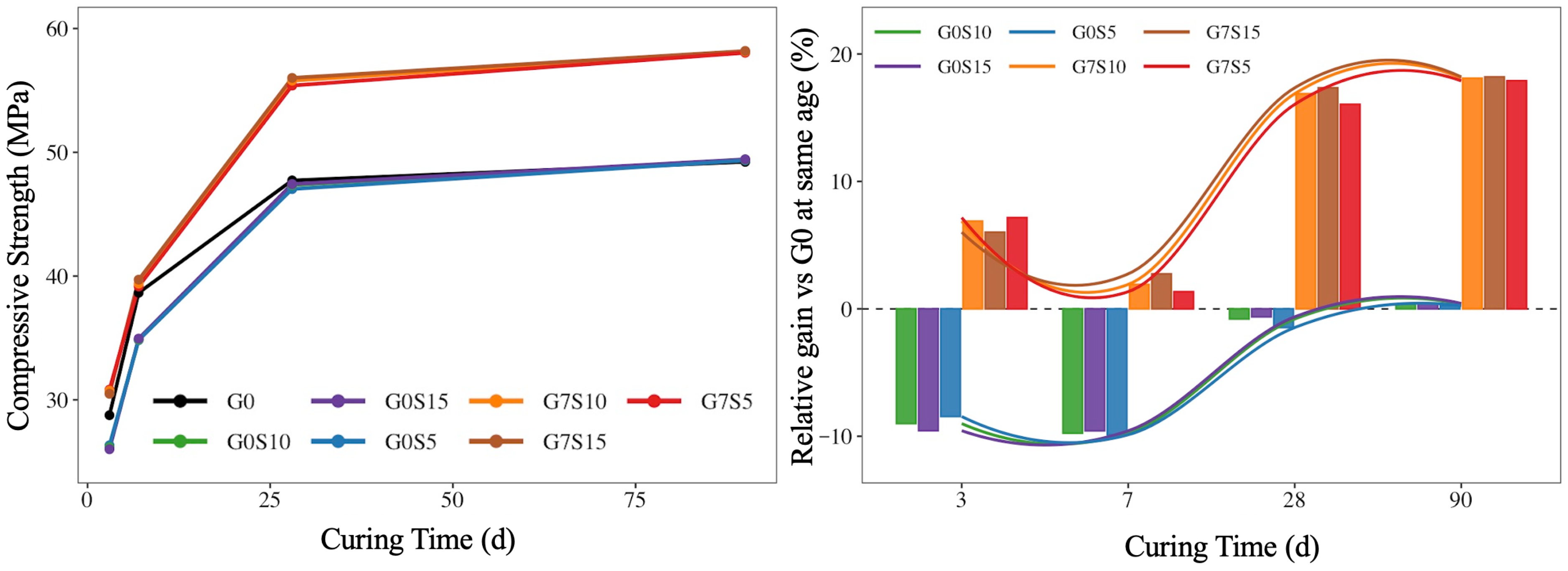
The compressive strength development of cement mortars incorporating SF alone and SF combined with graphene oxide (SF–GO) at 3, 7, 28, and 90 days is presented in Figure 1. This figure illustrates the evolution of compressive strength and the corresponding relative performance enhancement of cementitious composites over curing age. The up panel presents the absolute strength development of different mixtures, where each curve represents the temporal growth trend of mechanical performance as a function of hydration and microstructural densification. The down panel shows the relative gain with respect to the reference mix (G0) at each curing age. The relative gain curve provides an interpolated trend derived from discrete experimental data, offering an integrated visualization of how various modifications influence strength development compared with the baseline system. Together, the two subfigures depict the absolute and relative dimensions of strength evolution, enabling a clear interpretation of overall performance progression and enhancement efficiency.
For mortars containing only SF, the early-age strength was consistently lower than that of the plain control, and the reduction became more evident as the replacement level increased. At 3 and 7 days, the compressive strength of SF-bearing mortars remained below that of the control, reflecting the relatively slow pozzolanic reactivity of SF at early stages. With prolonged curing, however, the secondary hydration of reactive SiO2 progressively consumed portlandite and generated additional C–S–H gels, leading to a gradual strength recovery. By 90 days, mortars with 15% SF replacement achieved 49.44 MPa, slightly surpassing the control specimen (49.23 MPa), which indicates that the beneficial effect of SF requires sufficient curing time to become evident, and that long-term improvements offset the early-age drawbacks.
A markedly different trend was observed when GO was introduced into the system. Across all curing ages, the incorporation of GO yielded significant strength enhancement, and this effect was further amplified in the presence of SF. At 3 days, mortars containing both SF and GO exhibited 6.20–7.16% higher strength than the control, while at 7 days the gain increased to 7.45–9.26%, suggesting that GO not only accelerates hydration reactions but also offsets the initial strength reduction induced by SF replacement. At later ages, the synergistic action of SF and GO became increasingly prominent. At 28 days, the compressive strength of the 15% SF + GO mixture reached 56.01 MPa, representing a 17.35% increase compared with the control, and at 90 days the same mixture achieved 58.19 MPa, corresponding to an 18.20% improvement. The combined contribution of GO-induced nucleation and crack-bridging [24] with the pozzolanic effect of SF [10] thus enabled both early-age acceleration and long-term enhancement.
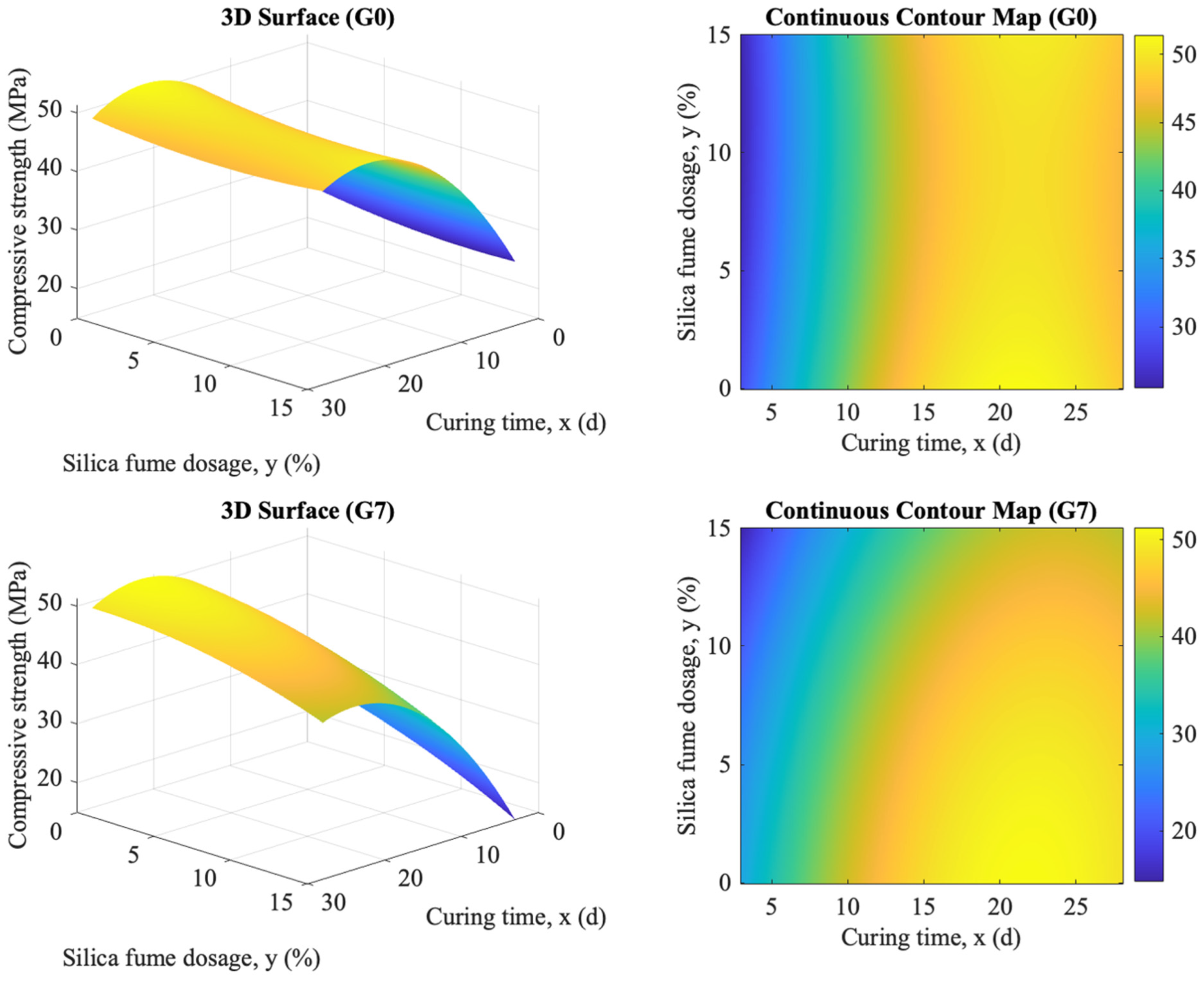
Furthermore, Figure 2 presents the three-dimensional response surfaces and corresponding contour maps that describe the relationship between compressive strength, curing time, and silica fume (SF) dosage for two composite systems: G0 series (without graphene oxide) and G7 series (with graphene oxide).
Note:
fG0(x, y) = 20.92 + 2.88x − 0.58y − 0.068x2 + 0.0075xy + 0.023y2, R2 = 0.972
fG7(x, y) = 21.28 + 2.75x − 0.50y − 0.063x2 + 0.0177xy − 0.033y2, R2 = 0.956
x indicates the curing time; y indicates the silica fume dosage.
For the G0 series, the fitted quadratic surface is depicted by Equation (1).
G 0 x , y = 20.92 + 2.88 x 0.58 y 0.68 x 2 + 0.0075 x y + 0.023 y 2
With x indicating the curing time, y indicating the silica fume dosage, and R2 = 0.972, it captures a clear upward trend of strength with curing age, while the influence of silica fume is less pronounced. The contour map indicates that compressive strength rises rapidly up to around 15 days and gradually approaches a plateau near 47–49 MPa in 28 days, showing that hydration dominates early development, and the pozzolanic reaction of SF contributes moderately at later ages.
For the G7 series, the fitted surface is plotted by Equation (2).
G 7 x , y = 21.28 + 2.75 x 0.50 y 0.063 x 2 + 0.0177 x y 0.033 y 2
With x indicating the curing time, y indicating the silica fume dosage, and R2 = 0.956. It exhibits a more distinct curvature and stronger combined effects of curing and SF content. The 3D surface and contour map show that strength increases sharply with both curing time and SF dosage, reaching 55–58 MPa when the SF content is 10–15% and the curing age exceeds 25 days. Compared with G0, the G7 series not only achieves higher overall strength but also demonstrates a more responsive surface curvature, reflecting the synergistic interaction between graphene oxide and silica fume. This synergy arises from the nucleation and micro-filling roles of GO, which accelerate early hydration and improve the dispersion and reactivity of SF particles. The hydration-accelerating effect of GO can be reconciled with molecular-level evidence of C–S–H growth on reduced graphene oxide surfaces by considering the multiscale role of graphene-based interfaces. In the present system, GO is considered to promote hydration mainly by providing heterogeneous nucleation sites and by enriching Ca2+ near oxygen-containing functional groups, particularly carboxyl and hydroxyl groups. The locally accumulated Ca2+ can further interact with silicate species released from cement hydration and silica fume dissolution, thereby facilitating the precipitation of C–S–H. Molecular-level studies on GO/C–S–H interfaces further indicate that graphene-based surfaces can support C–S–H growth and enhance interfacial stiffness through functional-group-dependent bonding. Therefore, the acceleration effect observed in the present GO-modified cementitious system and the reported molecular evidence of C–S–H growth on GO surfaces are complementary rather than contradictory. GO primarily contributes chemically active nucleation sites, while graphene-based interfacial phases contribute to the subsequent organization, growth, and reinforcement of C–S–H. This multiscale mechanism explains why GO can accelerate hydration, refine the pore structure, and improve compressive strength. Consequently, the G7 surface shifts upward and broadens toward higher strength regions, indicating a reinforced microstructure and more efficient utilization of supplementary cementitious materials.
These results confirm that the influence of SF and GO on strength development is both distinct and complementary. Whereas SF alone delays early hydration and strength evolution but contributes to long-term densification through secondary pozzolanic reactions, GO consistently improves strength at all ages by promoting nucleation, accelerating hydration, and enhancing interfacial bonding. The co-incorporation of SF and GO therefore establishes a multi-stage strengthening mechanism: GO ensures early performance stability and mitigates the initial strength loss associated with SF, while SF contributes to sustained strength growth at later ages. The observed synergistic effect highlights the potential of SF–GO composites to overcome the limitations of single-admixture systems. The underlying microstructural evolution will be further elucidated in subsequent pore structure and hydration product analyses.

3.2. Pore Structure

3.2.1. Pore Structure Evolution from LF-NMR

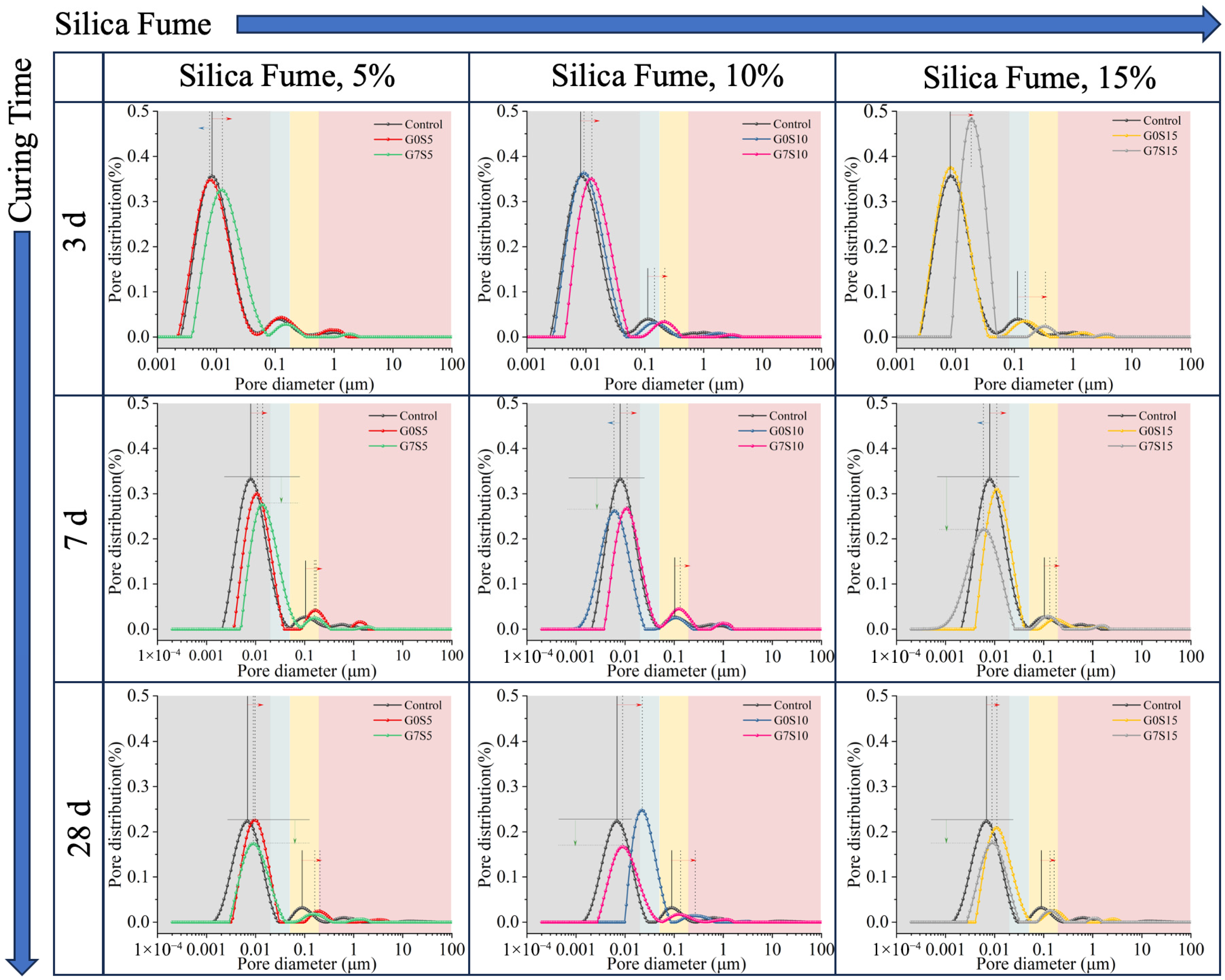
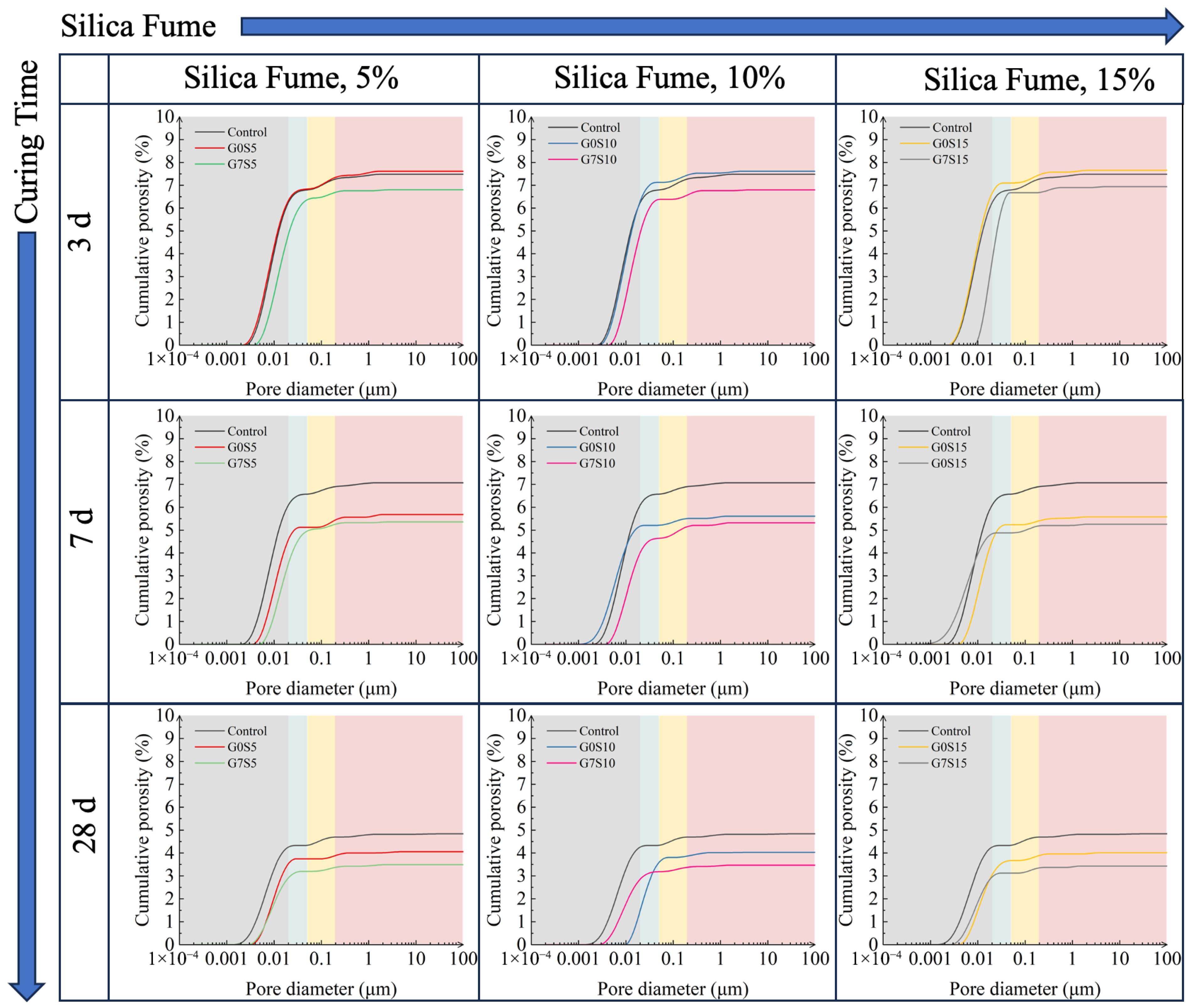
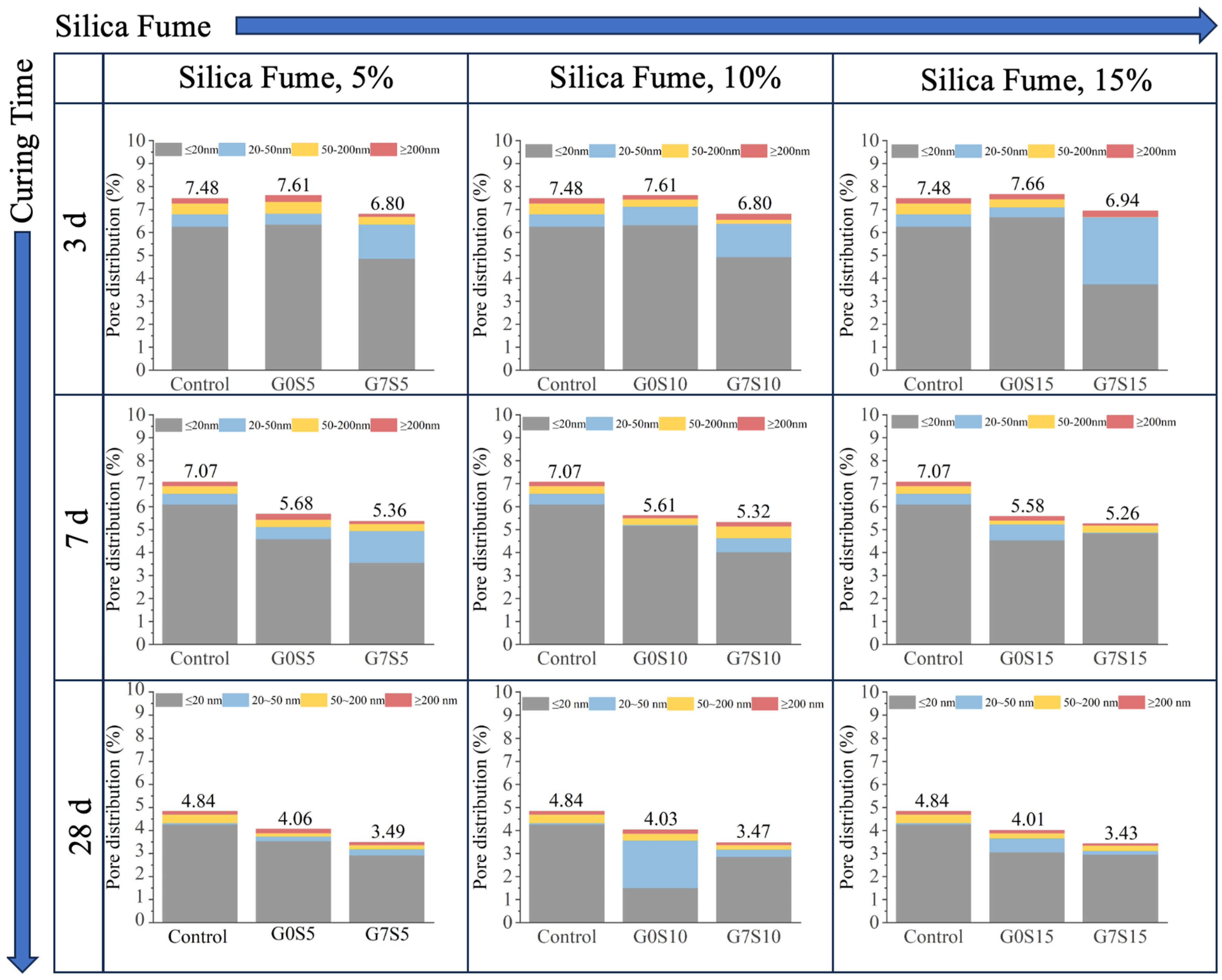
The pore size distribution curves, porosity, and pore size fractions derived from LF-NMR for the control, SF-modified mortars, and SF–GO composites at 3, 7, and 28 days are presented in Figure 3, Figure 4 and Figure 5. At all ages, the pore size distribution curves of the different specimens displayed a typical three-peak pattern. The first peak, attributed primarily to harmless and less harmful pores, exhibited the highest intensity and widest span, the second peak, dominated by harmful and partially multi-harmful pores, showed intermediate magnitude; and the third peak, associated with multi-harmful pores, presented the lowest intensity. The evolution of peak positions and intensities suggests that the refinement of pore structure proceeded with hydration, accompanied by gradual densification of the matrix.
At 3 days, the porosity of SF-blended mortars ranged from 7.61% to 7.66%, slightly higher than the plain control, reflecting the incomplete activation of SF pozzolanic reactions at this early stage. In contrast, the porosity of SF–GO composites decreased to 6.80–6.94%, demonstrating that the incorporation of GO effectively mitigated the negative impact of SF on early pore structure by promoting nucleation of hydration products and filling microdefects. This effect is consistent with the narrower peak distribution of harmless pores, where the SF–GO specimens already exhibited a more compact internal structure than their SF-only counterparts.
By 7 days, the porosity of SF mortars declined to 5.58–5.68%, a reduction of about 1.39–1.49% compared with the control, indicating the progressive contribution of pozzolanic activity. The SF–GO composites displayed even lower porosity, ranging from 5.26% to 5.36%, which represents a further decrease of 1.71–1.81% relative to the control. Notably, the amount and proportion of large harmful pores diminished significantly in the SF–GO mortars, and the shift of the second peak toward smaller pore sizes implied that the synergistic action of GO and SF accelerated the transformation of harmful pores into less harmful ones, thereby optimizing the pore network connectivity.
At 28 days, the porosity of SF mortars fell within 4.01–4.06%, while the SF–GO composites achieved even lower values of 3.43–3.49%. This progressive decline highlights the long-term beneficial effects of SF, whose secondary hydration gradually consumed Ca(OH)2 and generated additional C–S–H gels, leading to matrix densification [25,26]. The simultaneous presence of GO further reinforced this process by reducing the number and proportion of harmful and multi-harmful pores, resulting in the most refined pore structure among all mixtures. The three-peak pattern of pore size distribution curves remained evident, but the intensities of the second and third peaks were markedly suppressed in the composites, illustrating the microstructural advantage of combined modification.
LF-NMR analysis thereby reveals that SF replacement alone tends to enlarge early-age porosity but promotes long-term pore refinement through pozzolanic reactions, while GO consistently reduces porosity and accelerates pore refinement by enhancing hydration and bridging microcracks. Their combined incorporation establishes a complementary mechanism in which GO mitigates the early drawbacks of SF and amplifies its long-term benefits. This synergy leads to a more compact and less connected pore network, which forms the structural basis for the strength enhancement and durability improvements observed in the mechanical tests.

3.2.2. Relationship Between Porosity and the Compressive Strength

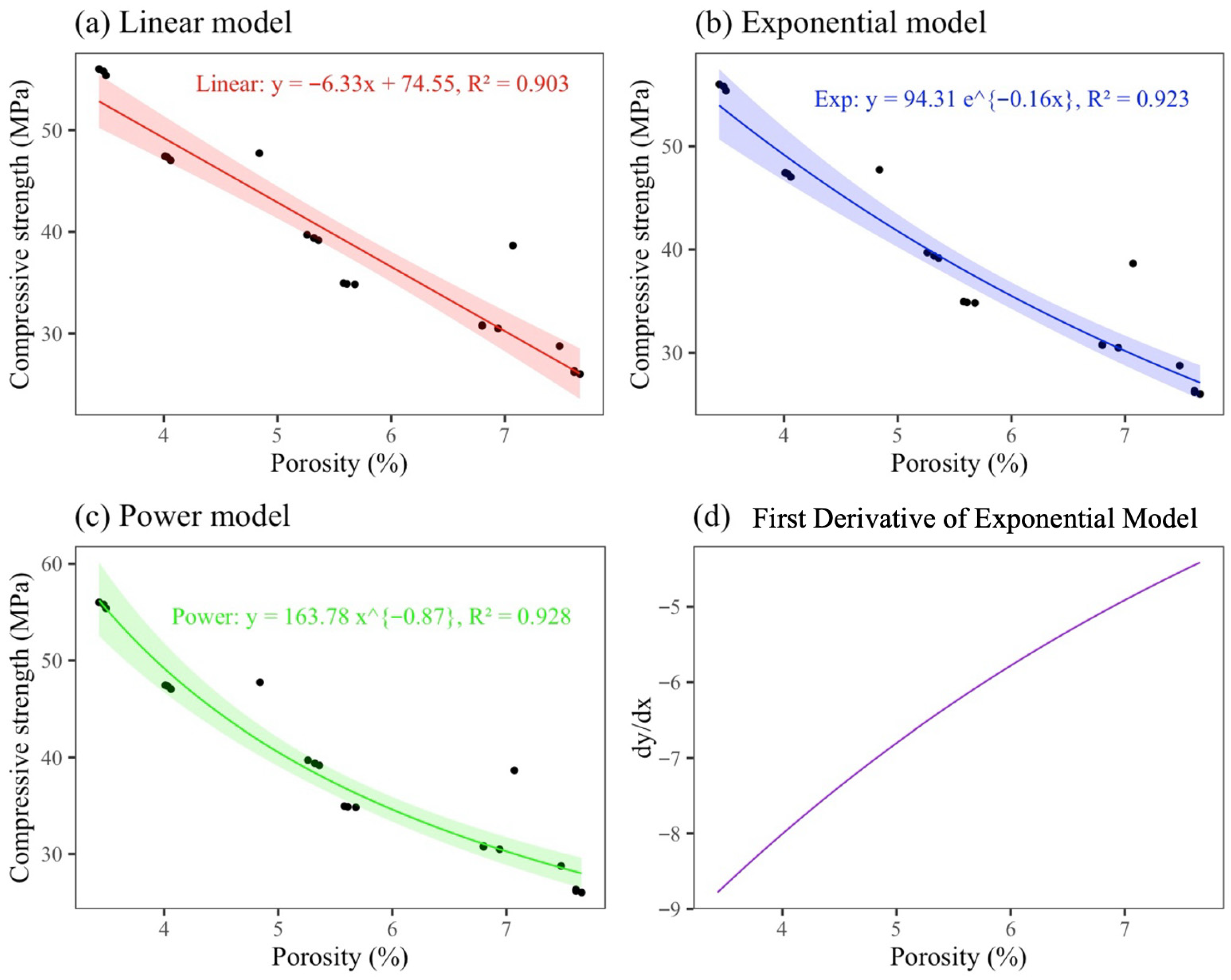
The correlation between compressive strength and total porosity derived from LF-NMR analysis is presented in Figure 6. This figure illustrates the quantitative relationship between porosity and compressive strength of cementitious composites. The left subplot presents three fitting models—linear, exponential, and power functions—applied to the experimental data at different curing ages (3, 7, and 28 days), which are distinguished by color. All three models show a strong negative correlation, indicating that compressive strength increases significantly as porosity decreases. This suggests that the compressive strength of the studied mortars does not decrease in a simple linear fashion with porosity, but rather follows a nonlinear decay consistent with the classical porosity–strength theories of cement-based materials. Among them, the power law model (red solid line) exhibits the best fitting performance (R2 = 0.928), capturing the nonlinear relationship between strength and porosity more accurately. The right subplot shows the derivative of the exponential fit curve (dy/dx of Exp function), which reflects the rate of strength change with respect to porosity. The derivative becomes less negative as porosity decreases, implying that strength improvement slows down at lower porosity levels as the microstructure approaches a dense and stable state. Overall, this figure reveals the intrinsic coupling between pore structure evolution and mechanical performance, providing valuable insight into the densification and strengthening mechanisms of cementitious materials.
From a quantitative perspective, plain mortars (G0) exhibited higher porosity at all ages (7.48% at 3 d, 7.07% at 7 d, and 4.84% at 28 d), corresponding to relatively lower compressive strengths of 28.76, 38.65, and 47.73 MPa, respectively. In contrast, the incorporation of silica fume alone gradually reduced porosity over time, with values falling to approximately 4.01–4.06% at 28 d, which was associated with a modest recovery of compressive strength (47.03–47.43 MPa). The inclusion of GO markedly enhanced this trend: porosity was reduced more effectively to 3.43–3.49% at 28 d, yielding significantly higher compressive strengths of 55.39–56.01 MPa. The results confirm that the improvement in compressive performance is structurally rooted in the reduction in total porosity and, more critically, in the transformation of harmful pores into harmless pores, as revealed by the pore size distribution curves.
The strong agreement of experimental data with the power law function demonstrates that strength enhancement arises disproportionately from reductions in porosity at lower ranges. As porosity declines below approximately 5%, incremental densification yields disproportionately larger gains in compressive strength. This explains why the synergistic action of SF and GO is particularly effective: GO facilitates early hydration and pore filling, thereby mitigating the initial porosity increase induced by SF, while the secondary pozzolanic reaction of SF progressively consumes Ca(OH)2 and produces additional C–S–H gels at later ages, further refining the pore network. The combination of these mechanisms results in a highly compacted microstructure, reflected in both the lowest porosity values and the highest compressive strength among all mixtures.
Therefore, the compressive strength–porosity relationship provides a mechanistic bridge between macroscopic performance and microstructural evolution. At the nanoscale, graphene-based sheets can improve the stiffness and load-transfer capacity of C–S–H-rich regions through interfacial bonding, confinement, and functional group-mediated interactions. A previous study on C–S–H/graphene indicate that graphene-based interfacial phases can increase local elastic properties, such as Young’s modulus, shear modulus, and bulk modulus [13]. This suggests that when C–S–H forms on or near GO surfaces, the local hydration product region may become mechanically stiffer and more resistant to deformation. At the micro/macroscale, GO sheets can further contribute to crack resistance by bridging microcracks, delaying crack opening, and improving stress transfer across weak zones. However, this crack-bridging effect depends strongly on interfacial bonding between GO and the surrounding cementitious matrix. If the GO–C–S–H interface is weak, GO sheets may be pulled out easily and the bridging effect will be limited. By contrast, nanoscale elastic enhancement and interfacial bonding improve the anchorage of GO within C–S–H, allowing GO sheets to more effectively transfer stress and restrain crack propagation. Therefore, the nanoscale elastic property improvement provides the interfacial basis for the macroscopic crack-bridging effect. The two mechanisms are sequential and complementary: GO first modifies the local C–S–H interface by improving bonding and stiffness; this strengthened interface then enables more effective crack bridging, load transfer, and microcrack resistance at larger scales. The power law model captures the intrinsic sensitivity of strength to porosity refinement, and the experimental data confirm that the synergy of SF and GO is capable of shifting the strength–porosity trajectory upward, establishing a more favorable balance between microstructural densification and mechanical performance.
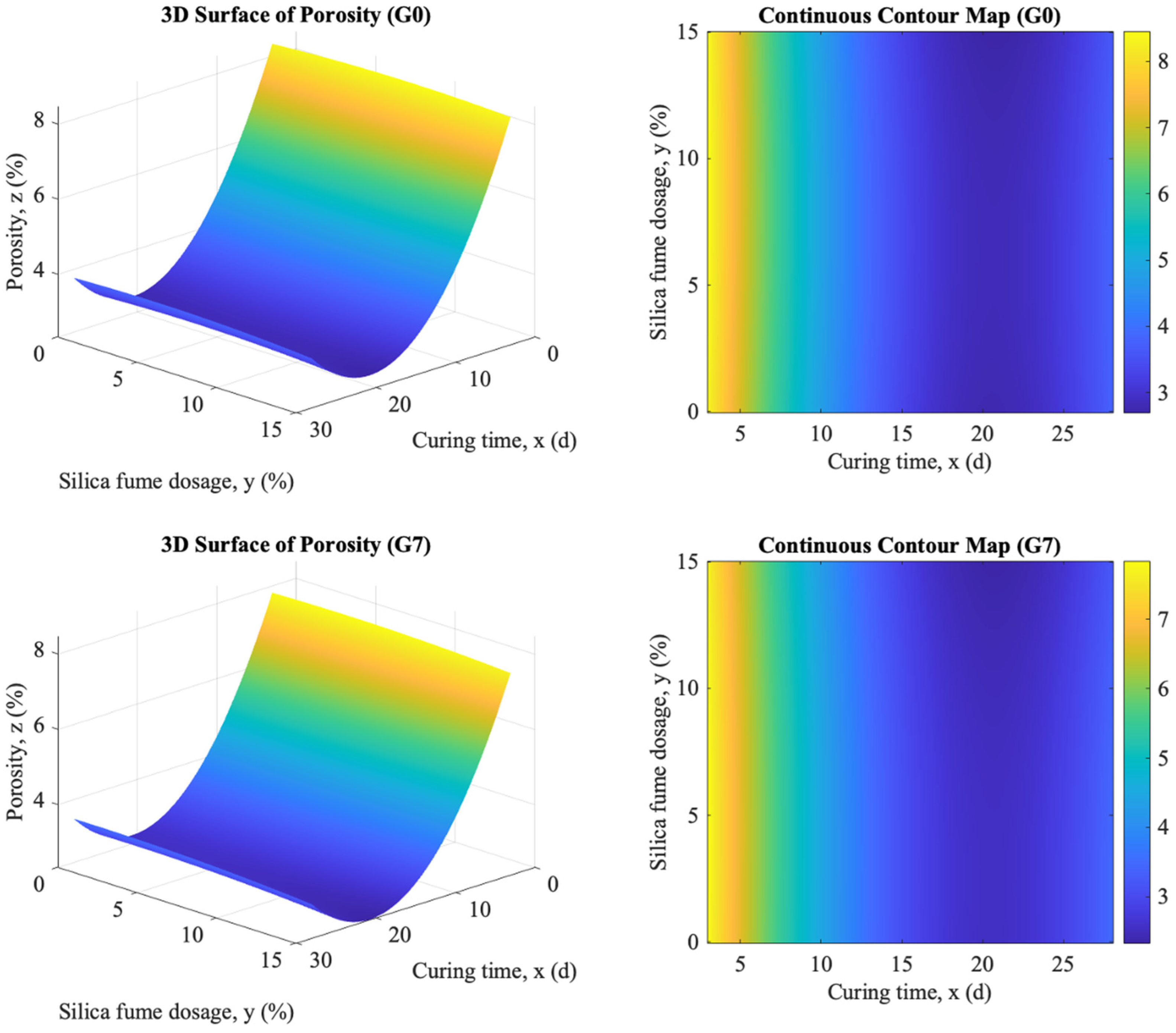
Furthermore, Figure 7 presents the three-dimensional response surfaces and contour maps describing how porosity (P) evolves as a function of curing time (x) and silica fume dosage (y) for the G0 (without GO) and G7 (with 7% GO) series. The fitted quadratic models for the G0 series and the G7 series are established by Equations (3) and (4).
G 0 x , y = 10.38 0.74 x + 0.033 y + 0.018 x 2 0.00053 x y 0.0018 y 2
G 7 x , y = 9.76 0.70 x + 0.014 y + 0.017 x 2 0.00037 x y 0.0014 y 2
The models capture the coupled effects of hydration age and supplementary material incorporation on pore evolution. The negative linear time terms (−0.74x and −0.70x) indicate a pronounced early-age densification as hydration proceeds and primary C–S–H gel fills capillary pores. The positive quadratic time terms (+0.018x2 and 0.017x2) represent the gradual slowdown of this densification, producing a parabolic time dependence. Using the standard vertex relation x = −b/(2a), the minimum porosity occurs at approximately 21 days, consistent with the valleys observed in both the 3D surfaces and contour maps. This critical point marks the transition from the rapid pore refinement stage to a steady, near-saturated hydration state.
The silica fume terms show a small positive linear component and a larger negative quadratic one, forming an inverted parabola relationship with dosage. At low silica fume content, the densification effect is limited, but beyond a threshold (~10%), pozzolanic reactions between silica fume and portlandite significantly reduce porosity. The negative interaction term (−xy) further reveals that silica fume becomes more effective as curing proceeds, reflecting its delayed secondary hydration kinetics, an interpretable signature of its delayed pozzolanic reaction consuming CH and generating secondary C–S–H. Comparing both systems, the G7 series consistently exhibits a downward-shifted surface, with overall lower porosity and weaker sensitivity to silica fume dosage. The smaller coefficients of the interaction and quadratic terms for G7 suggest that GO primarily enhances early-age nucleation, accelerates hydration, and improves the uniformity of the pore structure, thus lowering the initial porosity baseline. Silica fume then governs the later-age pore refinement through its pozzolanic reaction.
Note:
fG0(x, y) = 10.38 − 0.74x + 0.033y + 0.018x2 − 0.00053xy − 0.0018y2, R2 = 0.960
fG7(x, y) = 9.76 − 0.7x + 0.014y + 0.017x2 − 0.00037xy − 0.0014y2, R2 = 0.973
The contour maps highlight an optimal low-porosity region near 20–24 days of curing and 12–15% silica fume content, where G0 achieves P ≈ 4.01% and G7 further reduces it to P ≈ 3.43%, a further ∼0.6% absolute reduction. This implies a synergistic interaction between GO and silica fume, where GO provides early structural compactness and SF contributes to long-term matrix densification. The synergistic effect between silica fume and GO can be further interpreted by considering the interaction mechanism of C–S–H moieties on graphene-based substrates. Silica fume provides highly reactive amorphous SiO2, which dissolves under alkaline conditions and releases silicate species for secondary C–S–H formation. GO, in contrast, provides oxygen-containing functional groups and high-specific-surface-area substrates. Carboxyl and hydroxyl groups on GO can adsorb or coordinate Ca2+, producing Ca-enriched interfacial zones that favor the adsorption of dissolved silicate species and the localized precipitation of C–S–H. Molecular-level studies on functionalized GO/C–S–H systems further suggest that graphene-based substrates can strengthen the C–S–H interface and enhance local elastic properties through functional-group-dependent interactions. Therefore, the silica fume–GO synergy should not be regarded only as the sum of filler effect and nucleation effect. Instead, it involves a coupled chemical nucleation–pozzolanic reaction–interfacial reinforcement mechanism: GO enriches Ca2+ and provides nucleation sites, silica fume supplies reactive silicate species, and the resulting C–S–H formed near graphene-based interfaces contributes to pore refinement, increased pore network tortuosity, improved interfacial stiffness, and enhanced compressive strength. Mechanistically, the time–SF synergy (negative xy terms) reflects accelerated pore closure from secondary C–S–H, while GO reduces percolation and coarseness of the pore network from the outset, leading to lower porosity at every age. Practically, these surfaces not only provide a quantitative fit (R2 > 0.96) but also serve as predictive tools to identify the optimal curing regime for achieving the densest and most durable cementitious microstructure. It also provides a design map: select y in the mid-high range and cure beyond ~3 weeks to approach the porosity minimum, with GO shifting the entire response toward denser microstructures. However, extrapolation beyond the tested domain should be avoided, as quadratic models are local approximations.

3.3. Fractal Dimension

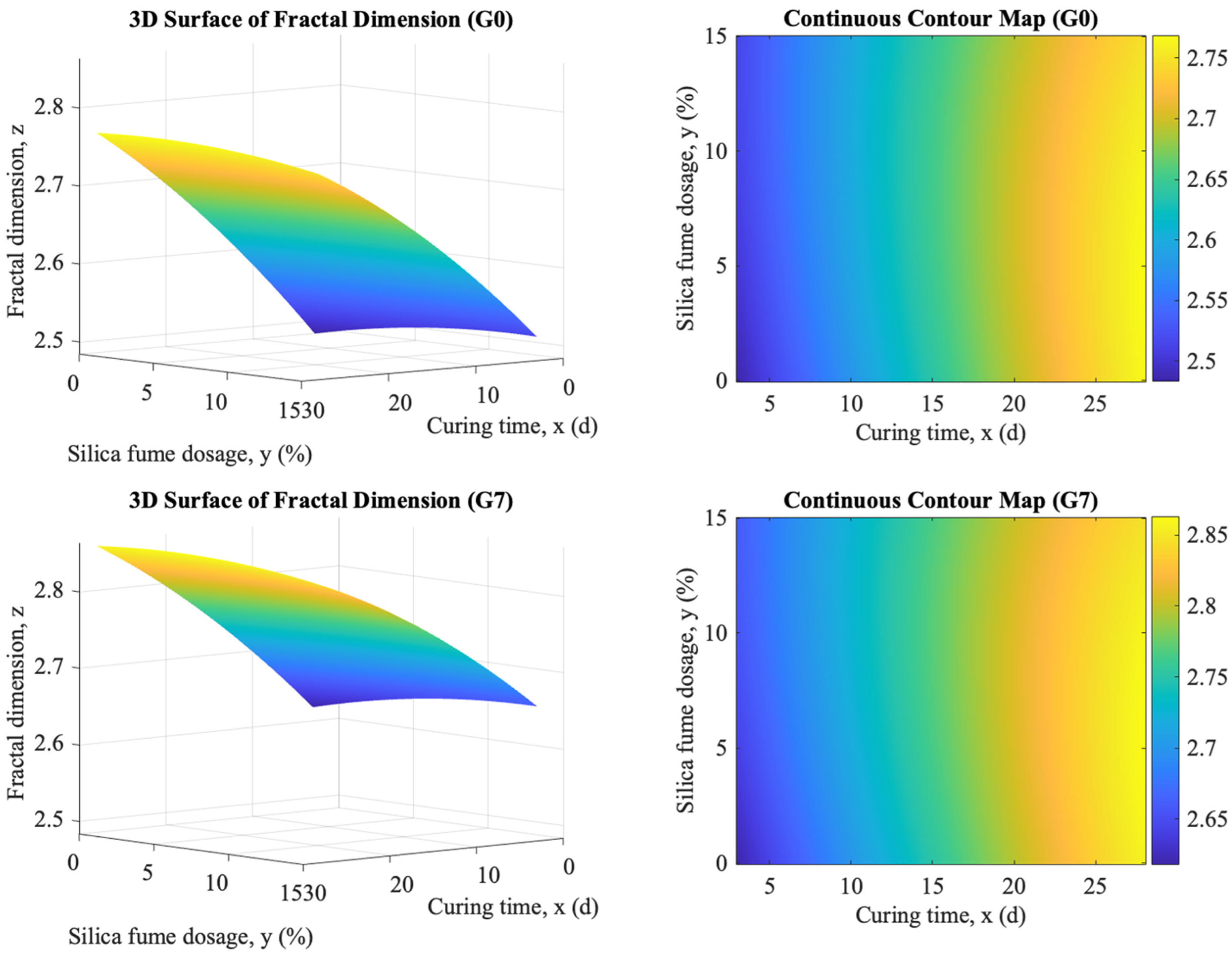
The evolution of the overall fractal dimension (D) of pore structure with curing age is summarized in Figure 8. For the plain mortar (G0), D values increased only slightly from 2.59 at 3 days to 2.65 at 28 days, reflecting a relatively slow densification process of the pore network. Mortars containing only SF exhibited a modest increase in D, with values ranging from 2.57–2.63 at 3 days to 2.68–2.69 at 28 days, indicating that the pozzolanic reaction of SF progressively refined the pore system and increased its structural complexity. However, the extent of improvement remained limited during early hydration due to the delayed activity of SF. By contrast, the incorporation of GO markedly elevated the fractal dimension at all ages. At 3 days, the D values of SF–GO mortars ranged from 2.79 to 2.84, considerably higher than those of the control or SF-only systems. With curing, D further increased to approximately 2.90–2.93 at 28 days, indicating the formation of a highly intricate and tortuous pore structure. The higher fractal dimension demonstrates that GO significantly enhanced the heterogeneity and connectivity of hydration products, accelerating the transition of harmful pores into finer pore classes and yielding a denser, more complex pore network.
The close correspondence between compressive strength, porosity, and fractal dimension highlights the underlying mechanistic linkage. As porosity decreased, D values increased, and compressive strength rose accordingly. This trend was particularly evident in the SF–GO composites, which achieved the lowest porosity, the highest fractal dimensions, and the greatest strength enhancements. The power-law function established earlier between strength and porosity is further substantiated when incorporating fractal dimension, as it explains why the same reduction in porosity translates into disproportionately higher strength in systems with greater structural complexity. Thus, the fractal dimension serves as a crucial bridging parameter, linking microstructural refinement to macroscopic mechanical performance, and providing theoretical validation for the synergistic action of SF and GO.
Note:
fG0(x, y) = 2.44 + 0.015x + 0.005y − 1.2 × 10−4x2 − 1.3 × 10⁻⁴xy − 1.7 × 10⁻⁴y2, R2 = 0.945
fG7(x, y) = 2.58 + 0.013x + 0.006y − 1.1 × 10−4x2 − 1.4 × 10⁻⁴xy − 1.9 × 10⁻⁴y2, R2 = 0.963
x indicates the curing time; y indicates the silica fume dosage.

3.3.1. D–P–fc Correlation and Role of SF–GO Synergy in Microstructural Refinement

The incorporation of supplementary materials induced distinct but interrelated effects on the evolution of compressive strength (fc), porosity (P), and fractal dimension (D) during curing. SF replacement initially reduced early-age strength owing to its delayed pozzolanic activity; however, it contributed significantly to strength enhancement at later ages due to the progressive formation of secondary hydration products [10,25,27]. The addition of GO effectively counteracted the early-age strength reduction caused by SF, while synergistically amplifying the long-term strengthening effect. This synergy reflects GO’s role in promoting nucleation, accelerating hydration kinetics, and reinforcing the microstructure.
P exhibited a consistent decrease with curing age, reflecting densification of the pore system. The presence of SF further lowered porosity, particularly at later ages when its pozzolanic reaction became more active. GO incorporation imposed an additional densifying effect, markedly reducing porosity at early ages as well as enhancing the late-age pore refinement provided by SF. This dual action underscores the complementary contributions of SF and GO in suppressing harmful pore classes and converting them into finer, less detrimental pores. D, an indicator of pore structural complexity [20], increased progressively with curing time due to the accumulation of hydration products and refinement of pore geometry. SF addition enhanced D, especially at later stages, by increasing the tortuosity and heterogeneity of the pore network. GO further intensified this trend through an overlaying effect, leading to significantly higher D values even at early ages. This suggests that GO not only accelerated the development of microstructural complexity but also improved the connectivity of hydration products, thereby amplifying the overall structural refinement.
The interplay among fc, P, and D reveals a hierarchical control mechanism. Compressive strength is jointly governed by porosity and fractal dimension. At higher porosity levels, the detrimental effect of pore volume dominates, and the contribution of D to strength improvement remains limited. In contrast, when porosity is reduced, the influence of pore complexity becomes increasingly significant. Under such conditions, higher fractal dimensions amplify the sensitivity of compressive strength to porosity changes—i.e., the same reduction in P results in disproportionately larger strength gains in systems with elevated D. This highlights the critical bridging role of D, which links microstructural refinement with macroscopic performance and explains the pronounced synergistic improvement observed in SF–GO composites.

3.3.2. Quantitative Log–Log Interaction Model

The relationship between pore structure descriptors and compressive strength was quantitatively established through a log–log interaction model, as Equation (5) and values in Table 3.
l n f c = c + α l n D + β l n P + κ l n D × l n P + τ T
where f c is the compressive strength; D is the fractal dimension; P is the porosity; c is the constant term, representing the theoretical baseline of compressive strength at the reference curing age (3 d in this study); α is the fractal dimension coefficient, quantifing the main effect of pore structural complexity. A one-unit increase in lnD (equivalent to doubling the fractal dimension) is expected to increase in lnfc by α, under constant porosity. Thus, α reflects the direct strengthening contribution of pore tortuosity and heterogeneity; β is the porosity coefficient describing the influence of pore volume on strength. At fixed fractal dimension, a doubling of porosity (lnP increases by one unit) alters strength according to β.
κ is the interaction coefficient capturing the coupled effect of fractal dimension and porosity. It describes whether the contribution of pore complexity depends on pore volume, and vice versa. When κ < 0, the positive effect of higher fractal dimension is attenuated at high porosity, but becomes more pronounced in dense matrices with low porosity. When κ > 0, fractal dimension and porosity act synergistically, such that their combined effect is greater than the sum of their independent contributions.
τ T is the age effect coefficient. The dummy variable quantifies additional strength contributions at later curing ages (7 and 28 d), relative to the 3 d baseline. They isolate the role of hydration and microstructural densification over time from the direct effects of D and P.
The relationship provides mechanistic insights into the coupled roles of pore complexity, porosity, and hydration age in governing strength. First, the coefficient of the fractal dimension (αD = 3.83) is large and statistically significant, confirming that pore networks with greater structural complexity contribute positively to compressive strength. Fractal geometry has been shown to enhance stress transfer efficiency and inhibit the coalescence of microcracks, thereby improving the mechanical integrity of cementitious matrices. The significance of this term underscores the importance of microstructural topology, beyond simple porosity, in defining mechanical performance. The positive relationship between fractal dimension and mechanical performance should be interpreted from a multiscale perspective. In this study, fractal dimension is used as a pore network descriptor rather than a direct measure of solid-phase stiffness. An increase in fractal dimension indicates that the pore system becomes more refined, tortuous, and geometrically complex, usually accompanied by fewer continuous capillary pores and a denser hydration-product network. Such pore network reorganization improves mechanical performance by reducing stress concentration, delaying crack initiation, and enhancing load-transfer continuity. Atomistic simulations of C–S–H–graphene systems, by contrast, describe stiffness enhancement at the solid-phase interface, where graphene-based sheets improve local elastic properties through interfacial bonding and confinement. These two mechanisms are complementary: nanoscale C–S–H–graphene interactions enhance local interfacial stiffness and promote the formation of compact hydration products, while the resulting pore refinement is reflected at the mesoscale by an increased fractal dimension. Therefore, the observed correlation between higher fractal dimension and improved strength is consistent with, rather than contradictory to, atomistic evidence of C–S–H–graphene interfacial stiffening.
Furthermore, the inclusion of the negative coefficient of the interaction term (κ = −1.13) indicates that the beneficial influence of increasing fractal dimension is progressively attenuated as porosity rises. In dense matrices with low porosity, an increment in fractal dimension yields pronounced strength gains, while in highly porous systems, the same increment produces limited benefit. This finding highlights that pore volume and pore geometry cannot be considered independently, and their interplay is decisive for mechanical performance. The age-related coefficients (τ7 = 0.317; τ28 = 0.696) capture the progressive enhancement of compressive strength with hydration time. These increments reflect microstructural densification, secondary hydration, and refinement of the pore network, processes that amplify the role of pore complexity in later stages. The results therefore support the notion that the contribution of fractal dimension to strength is time-dependent, becoming more pronounced as hydration products progressively reduce pore connectivity and stabilize microstructural heterogeneity.
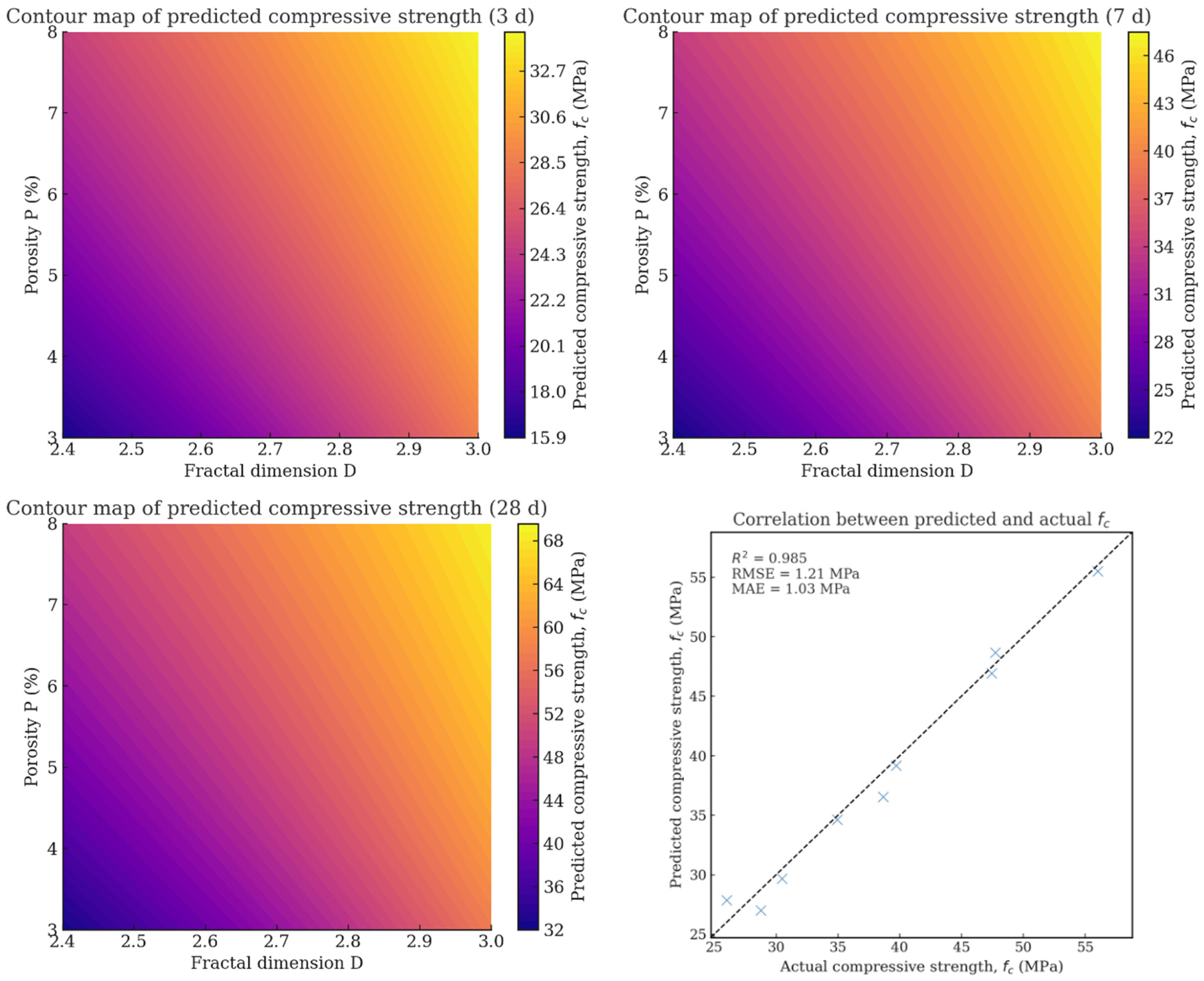
Figure 9 collectively illustrates how the D and P jointly govern the predicted fc across different curing ages, as well as how well the proposed model reproduces the experimental data. The contour maps for 3 d, 7 d, and 28 d display smooth gradients, where strength increases with higher D and lower P, forming a consistent diagonal enhancement pattern. As the curing age increases, the entire strength field shifts upward, reflecting the progressive densification and maturation of the microstructure captured by the model. The correlation plot further confirms the reliability of the predictive equation: all data points cluster closely around the 1:1 line, with a high coefficient of determination and low RMSE and MAE values (1.21 MPa and 1.03 MPa, respectively). This strong agreement demonstrates that the fractal–porosity–strength relationship provides an accurate framework for linking pore structural characteristics to the macroscopic mechanical performance of cementitious materials across different ages.
The multiplicative coupling between porosity and fractal dimension was adopted because these two descriptors do not affect mechanical performance independently. Porosity represents the amount of void space, whereas fractal dimension describes the geometric complexity, tortuosity, and spatial organization of the pore network. The same porosity may result in different mechanical responses depending on pore connectivity and distribution, while the influence of fractal dimension also depends on the available pore volume. Therefore, the interaction term reflects the coupled effect of pore volume and pore network geometry on load transfer, stress concentration, and crack initiation. Mechanistic insights from graphene/C–S–H interfacial studies further support this interpretation. Graphene-based substrates may enhance local stiffness and load-transfer capacity through interfacial bonding, confinement, and functional-group-dependent interactions. In GO-modified silica fume-containing systems, these nanoscale interactions can promote C–S–H formation around GO surfaces, reduce effective pore volume, and reorganize the pore network into a more refined and tortuous structure. Thus, porosity reduction and fractal-dimension increase can be regarded as coupled mesoscale manifestations of hydration-product growth and interfacial reinforcement. Future work should introduce interfacial bonding energy, local elastic modulus, Ca–O coordination number, and load-transfer efficiency as additional descriptors to validate whether the porosity–fractal interaction coefficient reflects nanoscale GO–C–S–H interfacial reinforcement.
This model thereby provides a mechanistically interpretable framework that integrates both pore-scale metrics and temporal evolution. Unlike purely empirical polynomial fits, the log–log interaction form is consistent with physical scaling laws and offers a clear interpretation of structural parameters. The results highlight that achieving superior strength requires not only reducing total porosity but also optimizing the geometrical complexity of the pore network, particularly in the later stages of hydration when microstructural reorganization is most active. This dual perspective advances the understanding of pore–structure–performance relationships in cementitious systems and supports the use of fractal-based descriptors as meaningful predictors of performance reliability.
Although fractal dimension provides a quantitative descriptor of pore network complexity, it should not be regarded as a direct measure of the fundamental GO–C–S–H interaction mechanism. Fractal dimension reflects the geometric irregularity, tortuosity, and spatial complexity of the pore structure, but it does not directly quantify C–S–H adsorption, heterogeneous nucleation, Ca2+ coordination, interfacial bonding energy, or local elastic reinforcement on graphene-based surfaces. Therefore, the increase in fractal dimension observed in this study should be interpreted as a mesoscale structural manifestation of hydration-product growth and pore network reorganization rather than direct evidence of nanoscale chemical bonding. Moreover, different mechanisms may produce similar fractal-dimension values; for example, beneficial C–S–H densification and unfavorable GO agglomeration may both increase structural irregularity but have different mechanical consequences. Thus, fractal dimension should be used together with porosity, hydration-product characterization, and mechanical data to avoid overinterpretation. Future models should integrate molecular-level descriptors, including GO functional group density, C/O ratio, Ca–O coordination number, C–S–H adsorption energy, interfacial bonding energy, and local elastic modulus. These descriptors could be linked with mesoscale parameters such as pore size distribution, connectivity, porosity, and fractal dimension to develop a hierarchical chemomechanical model capable of connecting graphene–C–S–H interfacial interactions with macroscopic strength development.

4. Conclusions

In summary, this fractal dimension-dominated multi-scale investigation elucidates how SF and GO interact across chemical and physical domains to refine hydration, restructure pore networks, and enhance macroscopic performance.
(1) SF and GO produced a clear synergy in strength development. GO compensated for the early-age strength loss driven by the delayed pozzolanic reactivity of SF and substantially amplified long-term gains by accelerating hydration, bridging microcracks, and stabilizing the microstructure.
(2) Pore refinement was governed by dual mechanisms: SF reduced total porosity through filler and pozzolanic effects, while GO reorganized the pore network by promoting uniform gel deposition and increasing pore-system complexity. Their combined action yielded the lowest porosity and the most compact pore geometry, forming the structural basis for improved mechanical efficiency.
(3) The log–log interaction model establishes fractal dimension as a governing descriptor of microstructural efficiency. The model demonstrates that porosity and fractal dimension do not act independently but interact multiplicatively to control strength. Pore complexity (captured by fractal dimension) becomes a dominant contributor in dense matrices with low porosity, whereas its influence weakens in highly porous systems. By incorporating hydration age and microstructural descriptors, the model provides a mechanistically interpretable and statistically reliable framework for predicting structure–performance relationships.
Although silica fume contributes to sustainability by recycling an industrial by-product and partially replacing clinker, the environmental implication of GO incorporation should also be considered. GO production may involve energy-intensive oxidation, purification, and drying processes, and therefore its environmental burden cannot be neglected even when the dosage is low. The sustainability benefit of GO-modified silica fume systems should be evaluated by balancing the additional embodied energy of GO against the improvement in mechanical performance, pore refinement, and potential service life extension. Future studies should include life cycle assessment and sensitivity analysis considering GO dosage, production route, and strength-normalized carbon emissions.

Author Contributions

C.-G.L., W.-Z.C.: Carried out the Measurements, Experiments, and Draft Writing; Y.P., X.-F.C.: Methodology, Reviewing, Project Administration, Funding Acquisition, and supervision. All authors have read and agreed to the published version of the manuscript.

Funding

This project was funded by Northwest Minzu University’s research project for Introducing talents (xbmuyjrc202637) and the Major Cultivation Project of Research and Innovation Platform for Universities in Gansu Province (2024CXPT-19). The project is also funded by the Fundamental Research Funds for the Central Universities of Northwest Minzu University, Project No.: 31920260078.

Data Availability Statement

The data presented in this study are available on request from the corresponding author.

Acknowledgments

Special recognition goes to the ‘Testing Technology Center for Materials and Devices of Tsinghua Shenzhen International Graduate School’ for their invaluable testing-related services.

Conflicts of Interest

The authors declare no conflicts of interest.

References

  1. Wang, W.; Ye, M.; Shi, Y.; Xiao, D. Plant-Level Intensity of Energy and CO2 Emissions for Portland Cement in Guizhou of Southwest China 2019–2022. Sci. Data 2024, 11, 759. [Google Scholar] [CrossRef]
  2. Santana-Carrillo, J.L.; Burciaga-Díaz, O.; Escalante-Garcia, J.I. Blended Limestone-Portland Cement Binders Enhanced by Waste Glass Based and Commercial Sodium Silicate—Effect on Properties and CO2 Emissions. Cem. Concr. Compos. 2022, 126, 104364. [Google Scholar] [CrossRef]
  3. Supriya; Chaudhury, R.; Sharma, U.; Thapliyal, P.C.; Singh, L.P. Low-CO2 Emission Strategies to Achieve Net Zero Target in Cement Sector. J. Clean. Prod. 2023, 417, 137466. [Google Scholar] [CrossRef]
  4. Chen, W.-Z.; Chen, X.-F.; Liang, R.; Sun, G. Synergistic Enhancement of Microstructure-Property Relationship in High-Volume Industry Waste Cementitious Composites via Graphene Oxide/Silica Fume Hybridization. Constr. Build. Mater. 2025, 490, 142520. [Google Scholar] [CrossRef]
  5. Zhang, X.-C.; Peng, Y. Fractal Geometry–Porosity-Coupled Mathematical Modeling of Mechanical Degradation in Low-Carbon Marine Concrete with High-Volume SCMs Under Sulfate–Chloride–Carbonate–Magnesium Attack. Fractal Fract. 2026, 10, 160. [Google Scholar] [CrossRef]
  6. Bai, W.; Song, Z.; Yuan, C.; Guan, J.; Xie, C.; Huang, H.; Ma, Y. Study on Mechanical Properties and Damage Mechanism of Recycled Concrete Containing Silica Fume in Freeze–Thaw Environment. Constr. Build. Mater. 2023, 375, 130872. [Google Scholar] [CrossRef]
  7. Ashraf, M.J.; Idrees, M.; Akbar, A. Performance of Silica Fume Slurry Treated Recycled Aggregate Concrete Reinforced with Carbon Fibers. J. Build. Eng. 2023, 66, 105892. [Google Scholar] [CrossRef]
  8. Ma, Y.; Jin, M.; Wang, F.; Jacques, D.; Shen, X.; Zhang, J.; Gao, C.; Zeng, H.; Liu, J.; Liu, J. Heating-Induced Transformations in Calcium Silicate Hydrate (C-S-H): In-Situ Investigations of Composition, Structure, and Morphology. Cem. Concr. Res. 2025, 190, 107819. [Google Scholar] [CrossRef]
  9. Zhang, Y.; Guo, L.; Shi, J.; Luo, Q.; Jiang, J.; Hou, D. Full Process of Calcium Silicate Hydrate Decalcification: Molecular Structure, Dynamics, and Mechanical Properties. Cem. Concr. Res. 2022, 161, 106964. [Google Scholar] [CrossRef]
  10. Mao, Y.; Jiao, D.; Hu, X.; Jiang, Z.; Shi, C. Effect of Dispersion Behavior of Silica Fume on the Rheological Properties and Early Hydration Characteristics of Ultra-High Strength Mortar. Cem. Concr. Compos. 2024, 152, 105654. [Google Scholar] [CrossRef]
  11. Esmaeili, J.; Romouzi, V.; Kasaei, J.; Andalibi, K. An Investigation of Durability and the Mechanical Properties of Ultra-High Performance Concrete (UHPC) Modified with Economical Graphene Oxide Nano-Sheets. J. Build. Eng. 2023, 80, 107908. [Google Scholar] [CrossRef]
  12. Yang, J.; Ye, C.; Wen, L.; Yu, B.; Tao, W.; Yang, Z.; Yuan, S. Study on the Microscale Structure and Sulfate Attack Resistance of Cement Mortars Containing Graphene Oxide Nanoplatelets. J. Build. Eng. 2023, 78, 107727. [Google Scholar] [CrossRef]
  13. Izadifar, M.; Dolado, J.S.; Thissen, P.; Ukrainczyk, N.; Koenders, E.; Ayuela, A. Theoretical Elastic Constants of Tobermorite Enhanced with Reduced Graphene Oxide through Hydroxyl vs Epoxy Functionalization: A First-Principles Study. J. Phys. Chem. C 2023, 127, 18117–18126. [Google Scholar] [CrossRef]
  14. Zhou, Y.; Xiong, C.; Peng, Z.; Huang, J.; Chang, H. Molecular Dynamics Simulation of the Interfacial Interaction Mechanism between Functional Groups on Graphene-Based Two-Dimensional Matrix and Calcium Silicate Hydrate. Constr. Build. Mater. 2021, 284, 122804. [Google Scholar] [CrossRef]
  15. Wang, F.; Sun, X.; Tao, Z.; Pan, Z. Effect of Silica Fume on Compressive Strength of Ultra-High-Performance Concrete Made of Calcium Aluminate Cement/Fly Ash Based Geopolymer. J. Build. Eng. 2022, 62, 105398. [Google Scholar] [CrossRef]
  16. Alawi Al-Sodani, K.A. Effect of Exposure Temperatures on Chloride Penetration Resistance of Concrete Incorporating Polypropylene Fibers, Silica Fume and Metakaolin. Constr. Build. Mater. 2022, 346, 128445. [Google Scholar] [CrossRef]
  17. Zhou, S.; Wu, C.; Li, J.; Shi, Y.; Luo, M.; Guo, K. Study on the Influence of Fractal Dimension and Size Effect of Coarse Aggregate on the Frost Resistance of Hydraulic Concrete. Constr. Build. Mater. 2024, 431, 136526. [Google Scholar] [CrossRef]
  18. Yin, Y.; Ren, Q.; Lei, S.; Zhou, J.; Xu, L.; Wang, T. Mesoscopic Crack Pattern Fractal Dimension-Based Concrete Damage Identification. Eng. Fract. Mech. 2024, 296, 109829. [Google Scholar] [CrossRef]
  19. Jin, Z.; Xie, F.; Yang, T.; Han, X.; Chen, X.; Zhang, Y. Fractal Dimension Analysis of Concrete Specimens under Different Strain Rates. J. Build. Eng. 2023, 76, 107044. [Google Scholar] [CrossRef]
  20. Han, X.; Wang, B.; Feng, J. Relationship between Fractal Feature and Compressive Strength of Concrete Based on MIP. Constr. Build. Mater. 2022, 322, 126504. [Google Scholar] [CrossRef]
  21. Wang, B.; Guo, J.; Liu, J.; Wang, Q. Prediction Method of Permeability of Textile-Reinforced Concrete Based on Fractal Dimension Theory. Constr. Build. Mater. 2022, 327, 126868. [Google Scholar] [CrossRef]
  22. Huang, S.; Cai, C.; Xu, J.; Zhu, S.; Pi, Z.; Li, H. Experimental Investigation on the Performance of Cement Mortar by Partial Replacement of the Standard Sands with Sulfide-Contained Iron Tailings. J. Mater. Civ. Eng. 2024, 36, 4024141. [Google Scholar] [CrossRef]
  23. Feng, X.; Yao, J.; Wu, P.; Zhang, S.; Sunahara, G.; Ni, W. Effect of Water Quenched Silicomanganese Slag as Fine Aggregate on Mechanical Properties and Microstructure Characteristics of Solid Waste-Based Mortar and Concrete. J. Build. Eng. 2024, 88, 109115. [Google Scholar] [CrossRef]
  24. Cheng, Z.; Lu, S.; Chen, W.; Wang, S.; Gao, Y. Kirigami Structure Enhancing the Crack-Bridging Effects of Graphene Oxide on the Calcium Silicate Hydrate. Mater. Des. 2025, 256, 114334. [Google Scholar] [CrossRef]
  25. Xu, D.; Tang, J.; Hu, X.; Zhou, Y.; Yu, C.; Han, F.; Liu, J. Influence of Silica Fume and Thermal Curing on Long-Term Hydration, Microstructure and Compressive Strength of Ultra-High Performance Concrete (UHPC). Constr. Build. Mater. 2023, 395, 132370. [Google Scholar] [CrossRef]
  26. Ma, X.; He, T.; Xu, Y.; Yang, R.; Sun, Y. Hydration Reaction and Compressive Strength of Small Amount of Silica Fume on Cement-Fly Ash Matrix. Case Stud. Constr. Mater. 2022, 16, e00989. [Google Scholar] [CrossRef]
  27. Luo, T.; Hua, C.; Sun, Q.; Tang, L.; Yi, Y.; Pan, X. Early-Age Hydration Reaction and Strength Formation Mechanism of Solid Waste Silica Fume Modified Concrete. Molecules 2021, 26, 5663. [Google Scholar] [CrossRef] [PubMed]
Figure 1. Compressive strength and the relative gains of the silica fume and graphene oxide single or co-doped samples.
Fractalfract 10 00294 g001
Figure 2. Three-dimensional response surface of compressive strength corresponding to curing time and silica fume dosage, and the contour maps.
Fractalfract 10 00294 g002
Figure 3. Pore size distribution. Note: the pore size distribution is divided by various colors, with grey for pores <20 nm, light blue for pores between 20 and 50 nm, yellow for pores between 50 and 200 nm, and pink for pores >200 nm.
Fractalfract 10 00294 g003
Figure 4. Cumulative pore size distribution. Note: the pore size distribution is divided by various colors, with grey for pores <20 nm, light blue for pores between 20 and 50 nm, yellow for pores between 50 and 200 nm, and pink for pores >200 nm.
Fractalfract 10 00294 g004
Figure 5. Pore structure and total porosity.
Fractalfract 10 00294 g005
Figure 6. Correlation between the porosity and the compressive strength, and the derivative of the exponential fit curve reflecting the change rate. Note: the colored curves represent the fitted functions, and the shaded regions denote the 95% confidence intervals of the fitting curves.
Fractalfract 10 00294 g006
Figure 7. Three-dimensional response surface of porosity corresponding to curing time and silica fume dosage, and the contour maps.
Fractalfract 10 00294 g007
Figure 8. Three-dimensional response surface of fractal dimensions corresponding to curing time and silica fume dosage, and the contour maps.
Fractalfract 10 00294 g008
Figure 9. Contour map of the predicted compressive strength and the correlation performance.
Fractalfract 10 00294 g009
Table 1. Chemical compositions of cement.
ComponentContent (wt%)
CaO63.2
SiO220.43
Al2O35.14
Fe2O33.36
MgO2.13
SO32.84
Na2O0.28
K2O0.62
Loss on ignition2
Table 2. Mix proportion.
GroupOPC (g)SF (g)GO (g)Sand (g)Water (g)PCE (g)w/b
G04500013502252.250.5
G0S5427.522.5013502252.250.5
G0S1040545013502252.250.5
G0S15382.567.5013502252.250.5
G7S5427.522.50.31513502253.60.5
G7S10405450.31513502253.60.5
G7S15382.567.50.31513502253.60.5
Table 3. Values of the coefficient and 95% confidence intervals (CI).
CoefficientEstimateCI_LowerCI_Upper
cConst.−1.059−3.8171.698
αln_D3.831.3936.267
βln_P1.431−0.0222.884
κlnD_lnP−1.133−2.4860.221
τTT_70.3170.2360.397
T_280.6960.5140.877
Note: the R2 value of the established equation is 0.985.
Disclaimer/Publisher’s Note: The statements, opinions and data contained in all publications are solely those of the individual author(s) and contributor(s) and not of MDPI and/or the editor(s). MDPI and/or the editor(s) disclaim responsibility for any injury to people or property resulting from any ideas, methods, instructions or products referred to in the content.