1. Introduction
Typhoid fever, caused by the bacterium
Salmonella enterica serovar Typhi, continues to impose a substantial public health burden in low- and middle-income countries, with an estimated 11–21 million new cases and 128,000 –161,000 deaths reported annually worldwide [
1]. Despite the availability of effective vaccines and antibiotic therapies, the disease persists endemically across sub-Saharan Africa and South Asia, driven primarily by inadequate access to safe water, poor sanitation infrastructure, and the under-recognised role of asymptomatic carriers in sustaining community-level transmission [
2,
3]. A distinctive epidemiological feature of typhoid is the existence of asymptomatic carriers, that is, individuals who harbour and shed the pathogen without manifesting clinical symptoms, which substantially complicates detection, surveillance, and control efforts [
4]. Mathematical modelling has therefore become an indispensable tool for elucidating the interplay between these transmission pathways, quantifying epidemiological thresholds, and evaluating the population-level impact of therapeutic and preventive interventions [
5,
6].
Classical integer-order compartmental models, built upon the assumption of instantaneous state transitions, have provided valuable insights into typhoid dynamics [
7,
8]. However, biological processes such as incubation variability, gradual immunity waning, and heterogeneous treatment response are inherently history-dependent: the current rate of change in each epidemiological compartment depends not only on the present state of the system but also on its entire past trajectory. Standard ordinary differential equation frameworks are structurally incapable of encoding such non-Markovian, long-memory effects [
9]. Fractional calculus, and in particular the Caputo fractional derivative, offers a mathematically rigorous and biologically motivated remedy: by replacing the integer-order derivative
with the Caputo operator
of order
, the governing equations acquire a convolution structure that naturally captures power-law memory and hereditary effects characteristic of subdiffusive biological dynamics [
10,
11]. Crucially, the use of fractional-order derivatives in the present typhoid model is not a generic mathematical generalisation chosen for analytical convenience. The Caputo fractional structure of system (
10) is the exact population-level consequence of a specific, biologically documented, and mathematically falsifiable assumption: the sojourn-time distribution of chronic asymptomatic
Salmonella Typhi carriers follows a Mittag–Leffler law rather than an exponential law. This derivation follows the rigorous continuous-time random walk (CTRW) framework of Angstmann et al. [
12], who proved that Mittag–Leffler-distributed sojourn times in a compartment yield, in the population-level mean-field limit, exactly a Caputo fractional differential equation governing that compartment, not as an approximation but as an identity. The biological motivation is precise: approximately 2 to 5% of typhoid-infected individuals develop long-term gallbladder colonisation and continue to shed the pathogen for months, years, or even decades after clinical recovery [
2,
4]. The exponential survival function, which is the structural assumption of every integer-order compartmental model, requires the probability of remaining asymptomatic beyond time
to decay as
, a property fundamentally incompatible with empirically documented power-law carrier persistence. Replacing it with the Mittag–Leffler survival function
which has power-law tail
for large
and reduces to the exponential at
, the CTRW master equation for the asymptomatic compartment yields, upon taking the population-level limit, precisely the second equation of system (
10) (see
Section 2.2). The fractional order
is therefore not a fitting parameter but the tail exponent of the empirical chronic carrier sojourn-time distribution, a directly falsifiable quantity that the
framework of
Section 5 provides to a computational pathway to estimate from aggregate compartmental data. When
, the Mittag–Leffler survival function reduces to the exponential, and system (
10) recovers the classical integer-order typhoid model exactly; the fractional model therefore subsumes the standard framework as a strict limiting case.
The application of fractional calculus to epidemic modelling has expanded rapidly over the past decade. Fractional extensions of the classical SIR and SEIR frameworks have been analysed for diseases including HIV [
13,
14], tuberculosis [
15], COVID-19 [
16], and malaria [
17], consistently demonstrating that fractional-order models provide a more accurate and flexible fit to observed epidemic trajectories than their integer-order counterparts. For typhoid fever specifically, ref. [
18] recently analysed a fractional typhoid model with optimal control, whilst ref. [
19] investigated numerical solution strategies via generalised fractional Adams–Bashforth–Moulton methods. These studies confirm the epidemiological relevance of fractional-order modelling for typhoid, yet a complete analytical treatment encompassing existence and uniqueness, Ulam–Hyers stability, global Lyapunov stability of both equilibria, and sensitivity analysis within a unified framework remains an open contribution.
A complementary and increasingly prominent challenge in epidemic modelling is the inverse problem: given observed compartmental data, how can one reliably estimate the underlying biological parameters that govern transmission, recovery, and immunity dynamics? Classical approaches such as least-squares fitting, Bayesian inference, and nonlinear optimisation are computationally intensive, often require full state observability, and do not natively enforce the governing differential equations as hard constraints on the estimated trajectories [
20]. To address this limitation, ref. [
21] introduced
s, which incorporate the residuals of the governing equations into the network’s loss function, a technique now widely adopted in scientific computing. The resulting framework simultaneously learns a surrogate solution to the forward problem and identifies unknown parameters from sparse, potentially noisy observations, with the governing physics acting as a regulariser that prevents over-fitting and enforces biological consistency of the learned trajectories [
22].
The extension of
methodology to fractional differential equations presents additional mathematical challenges: the Caputo operator is nonlocal and its evaluation via automatic differentiation is not straightforward. Ref. [
23] recently demonstrated that fractional memory effects in epidemic models can be identified from data using
s applied to a fractional SEIRD system, and ref. [
16] proposed a
framework for fractional COVID-19 modelling with simultaneous order estimation. Ref. [
24] established identifiability and predictability results for both integer- and fractional-order epidemic
s, providing a theoretical foundation for the use of such methods in parameter inference. Nevertheless, the application of fractional
frameworks to typhoid fever, with its distinctive asymptomatic transmission structure and temporary immunity mechanism, has not yet been investigated.
Motivated by these gaps, the present paper makes the following contributions:
- 1.
We formulate a Caputo fractional-order
compartmental model for typhoid fever incorporating asymptomatic transmission, treatment dynamics, and temporary immunity with waning. The Caputo structure is derived from the stochastic sojourn-time dynamics of chronic
Salmonella Typhi carriers via a CTRW argument: when the survival function of the asymptomatic compartment follows the Mittag–Leffler law
, the population-level mean-field equation is exactly the Caputo fractional Equation (
9), with the fractional order
identified as the tail exponent of the empirical carrier sojourn-time distribution (
Section 2.2, Remark 1).
- 2.
We carry out a complete qualitative analysis of the model: the basic reproduction number
is derived via the next-generation matrix method [
25]; the disease-free equilibrium
is shown to be globally asymptotically stable when
; and the endemic equilibrium
is shown to be globally asymptotically stable when
, using fractional Lyapunov functions and the LaSalle invariance principle [
26].
- 3.
Existence and uniqueness of solutions are established via Banach and Picard fixed-point arguments and the Leray–Schauder theorem, and Ulam–Hyers stability is proved to quantify the structural robustness of the fractional system against bounded perturbations.
- 4.
A fractional
framework is developed that embeds the L1-Caputo discretisation [
23] directly into the training residuals and employs a four-stage Adam–L-BFGS multi-optimiser strategy to simultaneously reconstruct all five compartmental trajectories and identify four unknown biological parameters
from sparse observations across fractional orders
.
- 5.
The framework achieves at the classical limit , with the natural mortality rate recovered to within and the transmission rate to within across all fractional orders. Pairwise correlation analysis confirms the absence of parameter equifinality, and noise robustness experiments under Gaussian perturbations of , , and demonstrate graceful degradation (: ), validating both the structural identifiability of the model and the reliability of the proposed optimisation strategy.
The remainder of the paper is organised as follows.
Section 2 formulates the fractional compartmental model and provides a detailed biological description of all parameters.
Section 3 presents the mathematical preliminaries, including the non-negativity and boundedness of solutions, equilibrium analysis, stability theory, sensitivity analysis, and existence–uniqueness results.
Section 4 presents numerical simulations illustrating the role of the fractional order
and key epidemiological parameters.
Section 5 develops the fractional
framework, covering the network architecture, L1 discretisation, composite loss function, parameter estimation strategy, and multi-stage optimisation algorithm.
Section 6 presents and discusses the computational results.
Section 7 summarises the findings and outlines directions for future work.
4. Numerical Simulations
In this section, we present numerical simulations to illustrate and validate the theoretical findings established in the preceding sections, with particular emphasis on the role of the fractional order
and key epidemiological parameters in shaping the disease dynamics of model (
10). All simulations are conducted using the parameter values listed in
Table 1, with initial conditions
and time horizon
days. The numerical solution of the fractional system is obtained via the L1-Caputo finite-difference scheme [
23], which approximates the Caputo derivative of order
through the weighted difference formula
, where
is the positive L1 weights and
days is the uniform step size. We first examine the dynamical behaviour of all five compartments for three values of the fractional order,
, to illustrate the memory and hereditary properties introduced by the Caputo derivative; since
throughout, the DFE
is globally asymptotically stable in all cases, yet decreasing
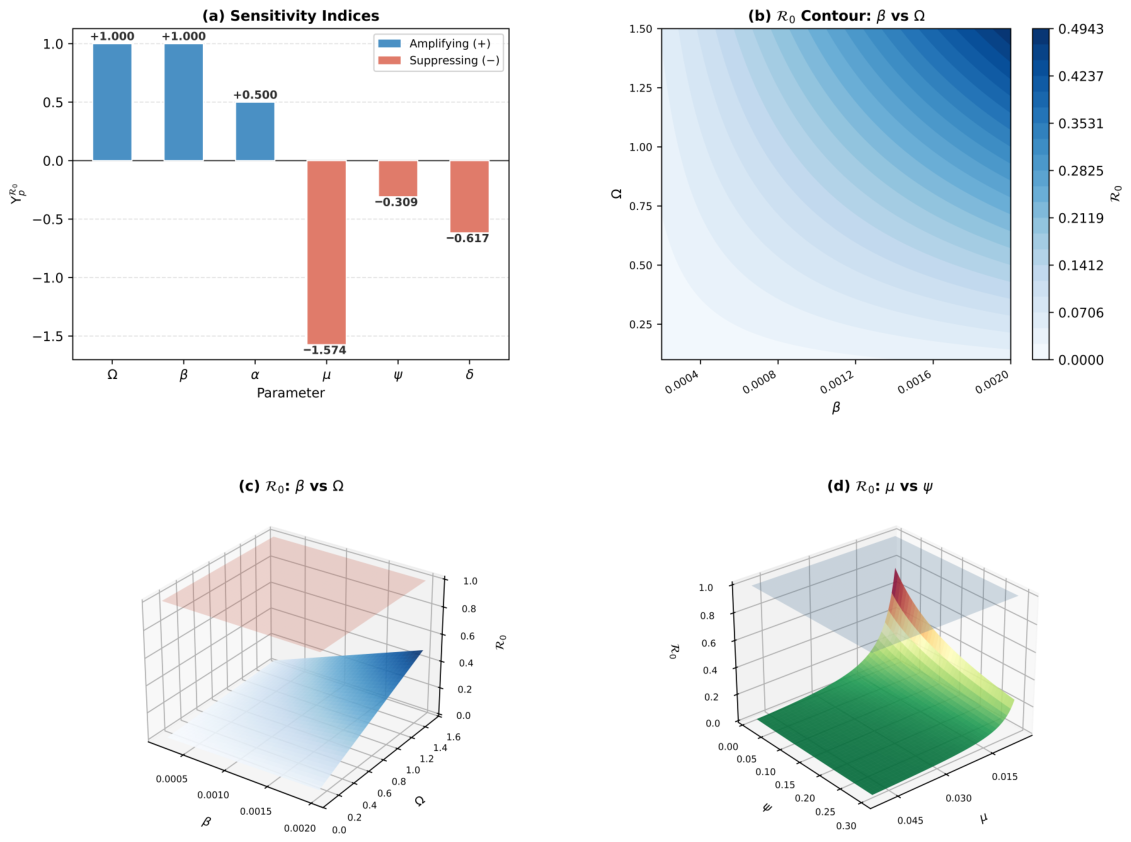
below unity progressively retards the rate of convergence, reflecting the long-memory effect of fractional differentiation. We then investigate the influence of two epidemiologically significant parameters identified by the sensitivity analysis of
Section 3.2.8: the treatment initiation rate
, which carries the suppressing index
, and the transmission rate
, which carries the amplifying index
. Varying
confirms that increasing the treatment rate drives
further below unity and accelerates disease clearance, while varying
demonstrates that even moderate increases in transmission substantially delay convergence to
, consistent with the unit sensitivity index of
.
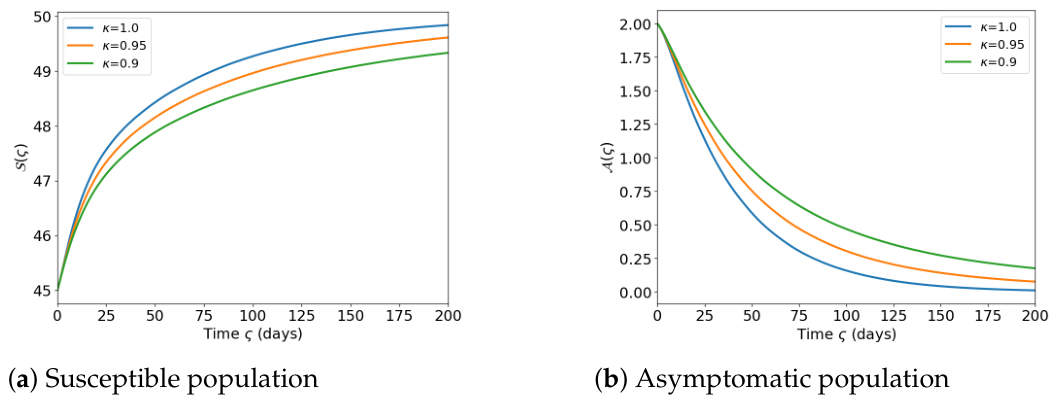
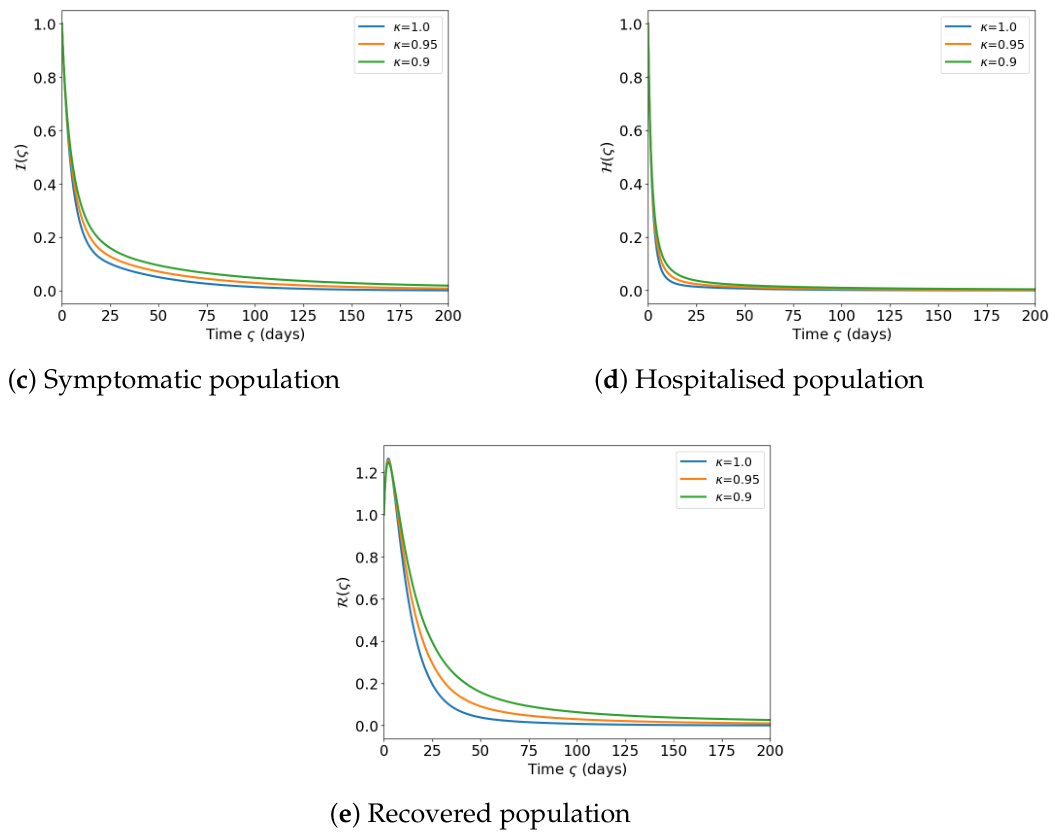
In
Figure 2, panels (a)–(e) display the time evolution of the susceptible
, asymptomatic
, symptomatic
, hospitalised
, and recovered
compartments, respectively, over
days with initial conditions
. Since
for all three values of
, the disease-free equilibrium
is globally asymptotically stable and all infected compartments converge monotonically to zero. The fractional order
governs the memory and hereditary properties of the system: as
decreases from
toward
, the Caputo derivative introduces a heavier memory effect that slows the rate of convergence, so that the asymptomatic, symptomatic, hospitalised, and recovered populations persist at measurably higher levels throughout the observation period. In the limiting case
, the model reduces exactly to the classical integer-order system and exhibits the fastest decay toward
. Numerical solutions are obtained via the L1-Caputo finite-difference scheme with step size
days.
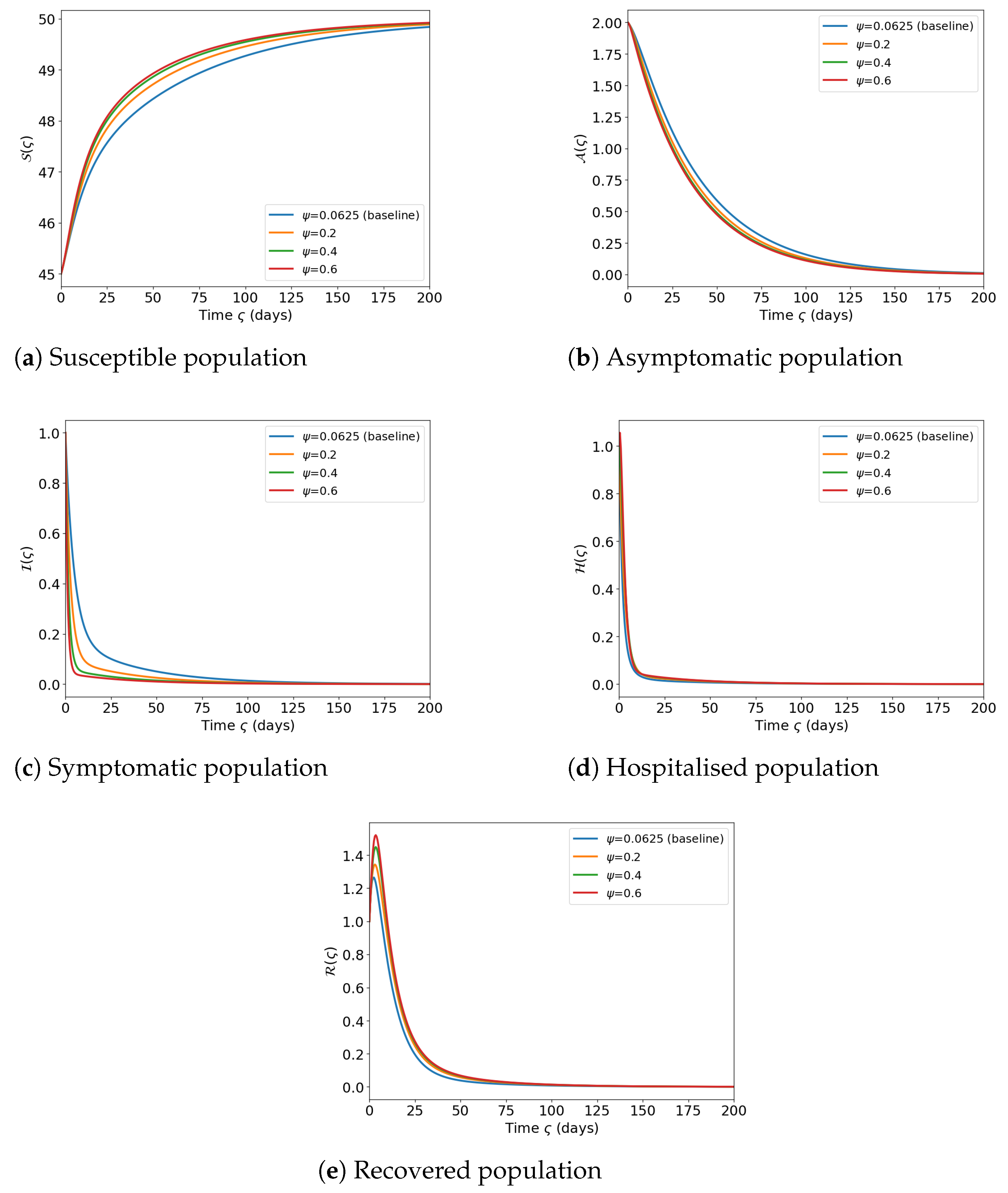
In
Figure 3, panels (a)–(e) display the time evolution of the susceptible
, asymptomatic
, symptomatic
, hospitalised
, and recovered
compartments, respectively, for four values of
. The corresponding basic reproduction numbers are
, all satisfying
, confirming asymptotic stability of the disease-free equilibrium
in every case. Increasing
accelerates the clearance of the symptomatic and hospitalised populations while driving
further below unity, underscoring the critical role of timely clinical intervention in typhoid eradication. Numerical solutions are obtained via the L1-Caputo finite-difference scheme with step size
days over
days.
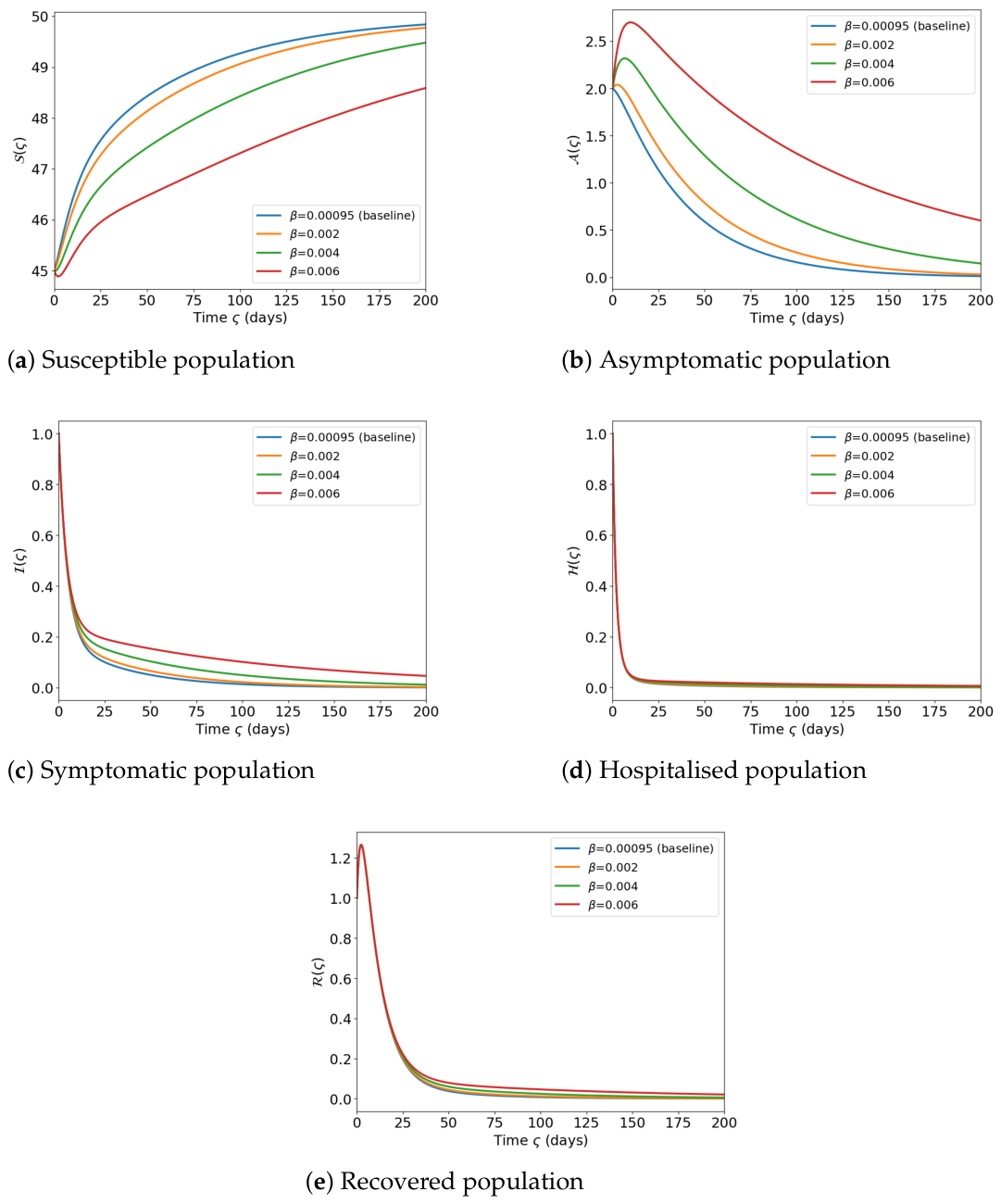
In
Figure 4, panels (a)–(e) display the time evolution of the susceptible
, asymptomatic
, symptomatic
, hospitalised
, and recovered
compartments, respectively, for four values of
. The corresponding basic reproduction numbers are
, all satisfying
. Although the disease-free equilibrium
remains globally asymptotically stable across all tested values, higher transmission rates visibly retard the convergence of infected compartments
,
, and
toward zero, consistent with the unit sensitivity index
established in
Section 3.2.8. These results highlight that reducing
through public health measures such as improved water sanitation, food hygiene, and vaccination constitutes the most direct pathway to accelerating disease eradication. Numerical solutions are obtained via the L1-Caputo finite-difference scheme with step size
days over
days.
6. Results and Discussion
This section presents a comprehensive evaluation of the proposed fractional
framework applied to the typhoid fever transmission model (
10). To fully demonstrate the capability of the framework under strong fractional memory effects and to assess the structural identifiability of the model, the experiments are conducted over the extended range
and the trainable parameter set is enlarged to
, with the fixed parameters reduced to
. This design enables a systematic investigation of how the fractional memory order
influences both trajectory reconstruction fidelity and parameter identifiability, including the recovery of the epidemiologically critical transmission rate
.
The discussion is organised as follows.
Section 6.1 analyses the compartmental trajectory reconstruction at the representative fractional order
.
Section 6.2 presents the noise robustness study at
under Gaussian noise levels of
,
, and
.
Section 6.3 reports the parameter estimation accuracy across all three fractional orders.
Section 6.4 compares the performance across all values of
and presents the correlation analysis for structural identifiability.
6.1. Compartmental Trajectory Reconstruction
()
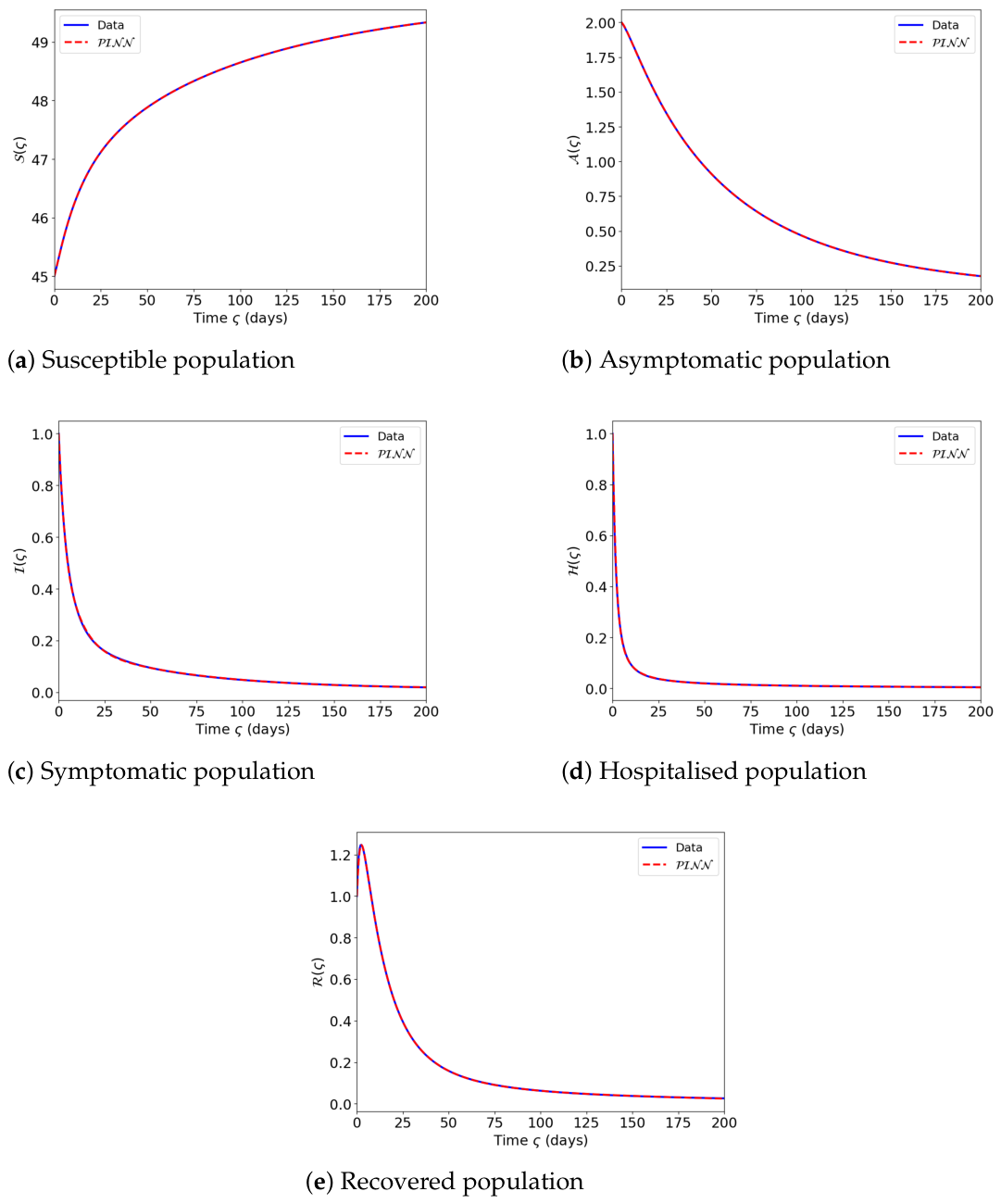
Figure 5 presents the pointwise comparison between the L1-Caputo ground-truth trajectories
and the fractional
predictions
for all five epidemiological compartments
at the fractional order
, which represents the strongest memory regime tested in this study.
Table 4 reports the compartment-wise fit metrics.
The susceptible compartment exhibits a smooth monotone increase from the initial condition toward the disease-free equilibrium , governed by the interplay between the recruitment rate , the waning immunity term , and the force of infection . captures this dynamics with high fidelity, achieving and . The asymptomatic compartment and the symptomatic compartment undergo rapid early transients driven by the initial seeding of infection, subsequently decaying toward zero as ; the network resolves both the fast transient phase and the slow convergence regime with .
The hospitalised compartment and the recovered compartment similarly display accurate tracking throughout the time horizon days, with representing the largest per-compartment error. This is expected, since is governed by the treatment initiation rate and the recovery rate , both of which are trainable parameters whose estimation errors propagate into the predicted trajectory. The overall across all five compartments is , confirming that the four-stage optimisation strategy (Algorithm 1) provides sufficient representational capacity to resolve the fractional dynamics at , even under strong memory effects.
6.2. Noise Robustness ()
To evaluate the robustness of the
framework under realistic observational conditions, we introduce additive Gaussian noise to the synthetic training data at three levels,
,
, and
, of the standard deviation of each compartmental trajectory. The noise robustness experiments are conducted at
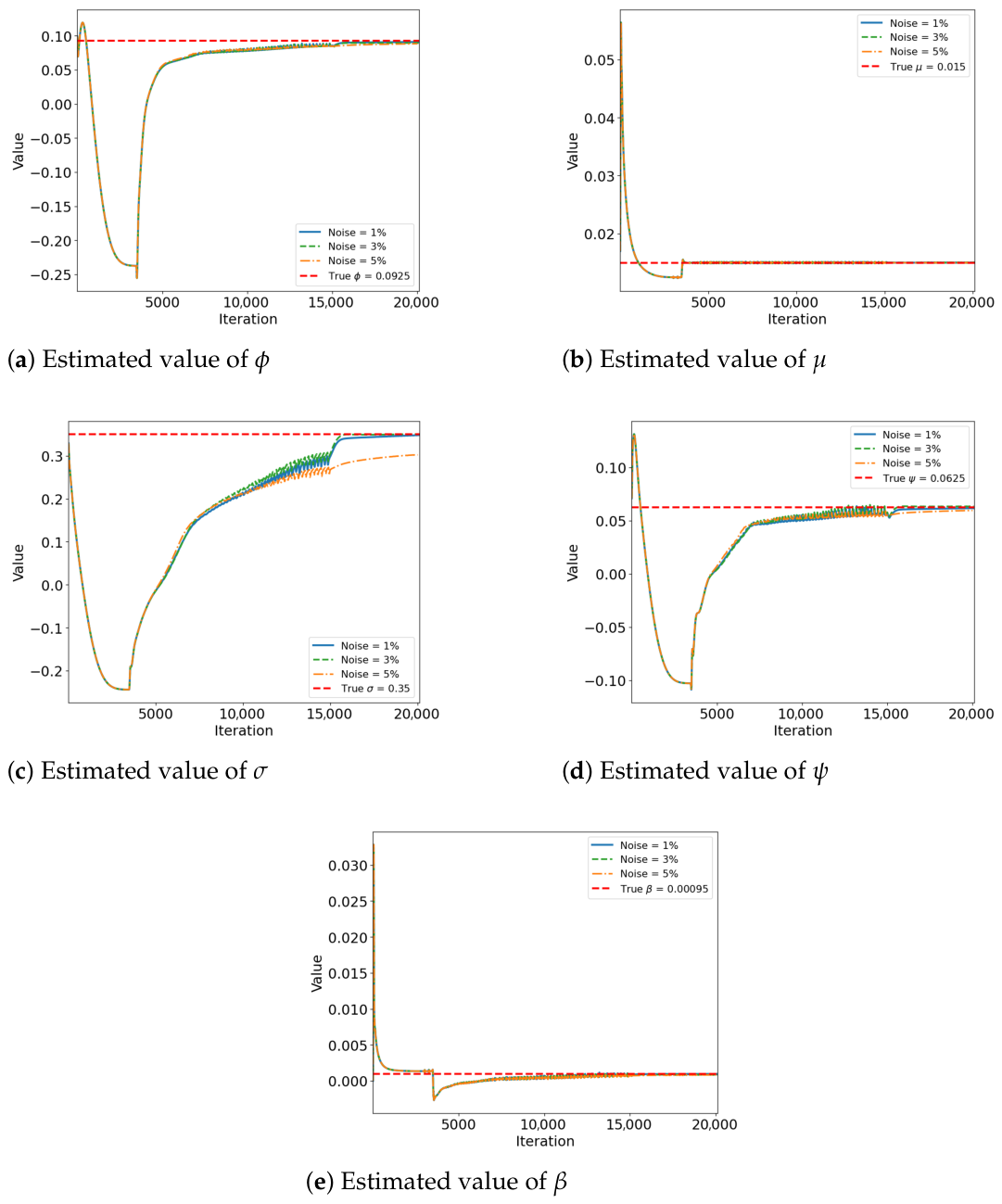
, and the results are summarised in
Table 5 and
Figure 6.
At noise, the framework achieves , with all five parameters recovered to within of their true values. This demonstrates that the physics-informed regularisation provided by the PDE residual loss effectively suppresses overfitting to noisy observations. At noise, the overall increases modestly to , with , , and remaining below ; however, the transmission rate exhibits a larger error of , reflecting its sensitivity to perturbations in the bilinear incidence term . At noise, the reaches , with and showing the largest degradation (). These two parameters govern the slower compartmental transitions ( and , respectively), whose dynamics are most vulnerable to observational corruption. Notably, the natural mortality rate remains near-perfectly identified () across all noise levels, owing to its linear presence in every compartmental equation.
The monotonically increasing trend : confirms that the framework degrades gracefully under increasing noise, with no evidence of catastrophic failure or non-monotonic behaviour. These results validate the robustness of the framework for parameter estimation from noisy epidemiological observations.
6.3. Parameter Estimation Accuracy Across Fractional Orders
Table 3 summarises the parameter estimation results across all three fractional orders
. The five trainable biological parameters
are recovered from observational data sampled at every fifth grid point (
points), with the remaining parameters
held fixed at their true values throughout training.
For (the classical integer-order limit), the framework achieves the lowest overall error with . Four of the five parameters are recovered with , with exhibiting the largest error at . The transmission rate , which was held fixed in the original formulation but is now included in to test structural identifiability, is recovered with excellent precision (). This confirms that is identifiable from the available observations and that its inclusion in the trainable set does not compromise the estimation of the remaining parameters.
At , the overall increases to , with and exhibiting the largest errors ( and , respectively). These two parameters govern the slower compartmental transitions and , whose dynamics are most strongly affected by the fractional memory kernel. As decreases from unity, the Caputo operator introduces progressively heavier memory effects that slow the convergence of these compartments toward their equilibrium values, reducing the sensitivity of the observable trajectories to changes in and and thereby making their identification more challenging. In contrast, remains near-perfectly identified () and is recovered with , demonstrating that parameters appearing in multiple compartmental equations or governing fast dynamics retain strong identifiability even under moderate fractional memory effects.
At , the trend continues with , driven by further degradation in () and (). The natural mortality rate remains robustly identified (), and continues to exhibit a low error (). The monotonically increasing MAPE trend as decreases from to reflects the increasing nonlocality of the Caputo operator, which progressively flattens the loss landscape with respect to parameters governing slow compartmental dynamics.
These results reveal a clear hierarchy of parameter identifiability:
Strongly identifiable: ( across all ). This parameter appears linearly in all five compartmental equations, providing strong observational constraints.
Moderately identifiable: and ( across all ). The waning immunity rate governs the feedback loop, whilst drives the nonlinear incidence term; both are constrained by multiple compartmental observations.
Weakly identifiable at low κ: and ( up to at ). Both parameters govern the slower pathway, whose dynamics are most susceptible to the memory-induced flattening of the fractional operator.
6.4. Comparison Across Fractional Orders and
Structural Identifiability
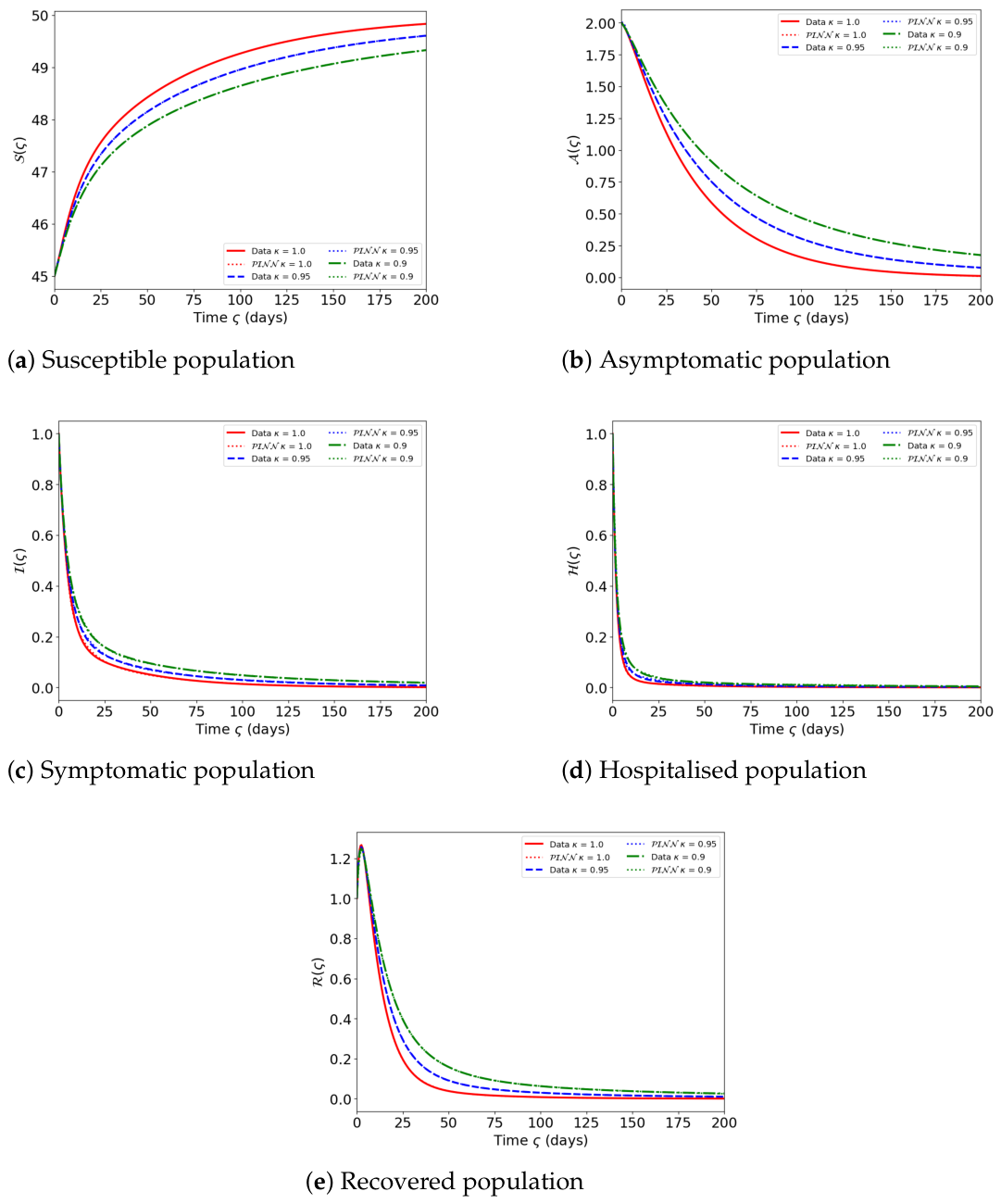
Figure 7 presents the data vs.
trajectory comparison across all three fractional orders
, with the L1-Caputo ground truth shown as solid lines and the
predictions as dotted lines for each
.
The visual agreement between data and
predictions is excellent for
and remains strong for
, with visible deviations emerging only in the
and
compartments at
. This is consistent with the elevated
values for
and
reported in
Table 3: as the estimated recovery and treatment rates deviate from their true values, the predicted trajectories for the downstream compartments
and
are correspondingly affected.
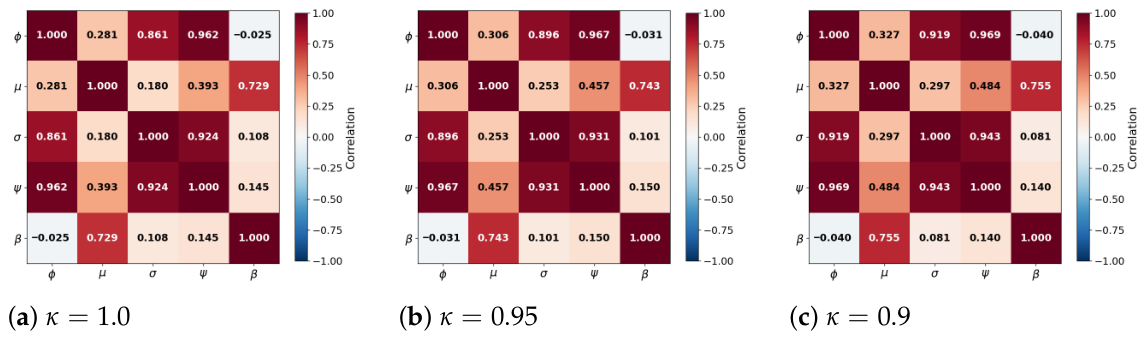
To assess whether including the transmission rate
in the trainable set
introduces parameter equifinality, i.e., the possibility that multiple parameter combinations produce indistinguishable macroscopic trajectories, we compute the pairwise Pearson correlation matrix of the parameter trajectories
recorded during training (
Figure 8).
The correlation matrices reveal several important structural features of the parameter estimation problem:
The natural mortality rate exhibits low to moderate correlation with all other parameters ( in most cases), consistent with its independent identifiability established by the results.
The transmission rate shows weak correlation with , , , and across all three values of , confirming that its inclusion in does not induce equifinality. The model is therefore structurally identifiable with respect to , and is capable of recovering the transmission rate alongside the other biological parameters without parameter correlation compromising the estimates.
The recovery rate and treatment initiation rate exhibit the highest mutual correlation, particularly at and . This is expected, since both parameters govern the sequential pathway, and their effects on the observable trajectories become increasingly entangled as the fractional memory strengthens. This coupling explains the elevated for these two parameters at lower values and motivates future work on adaptive loss weighting or compartment-specific collocation strategies to disentangle their individual contributions.
Taken together, the results across all three fractional orders demonstrate that the proposed framework is capable of simultaneously reconstructing compartmental dynamics and identifying five biological parameters, including the transmission rate , with at . The MAPE increases monotonically to at , reflecting the intrinsic difficulty of parameter identification under strong fractional memory effects rather than a limitation of the architecture itself. The consistent near-perfect identification of () and the robust recovery of () across all experiments validate the structural identifiability of the model and the reliability of the four-stage Adam–L-BFGS optimisation strategy. The correlation analysis confirms that the enlarged trainable set does not suffer from equifinality, supporting the practical applicability of the framework to scenarios where the transmission rate is not known a priori.
7. Conclusions
This paper has developed a comprehensive mathematical and computational framework for typhoid fever transmission under fractional-order dynamics, integrating rigorous analytical theory with a data-driven approach for parameter identification.
On the analytical side, the fractional compartmental model (
10) was shown to be epidemiologically well-posed: the biologically feasible region
defined in (
31) is positively invariant, all state variables remain non-negative for non-negative initial data, and the total population converges to the Mittag–Leffler-regulated equilibrium
as
. The basic reproduction number
was derived via the next-generation matrix method and shown to govern a sharp threshold: the DFE
is globally asymptotically stable whenever
, and the endemic equilibrium
is globally asymptotically stable in the interior of
whenever
, with both results established via fractional Lyapunov functions and the LaSalle invariance principle. The existence and uniqueness of solutions were confirmed through Banach and Picard fixed-point arguments, complemented by a Leray–Schauder theorem that relaxes the contraction requirement, and U–H stability was established to quantify the robustness of solutions against bounded perturbations. A sensitivity analysis identified the transmission rate
and recruitment rate
as the primary transmission-amplifying parameters (
), while the natural mortality rate
carries the largest-magnitude suppressing index (
), underscoring that simultaneously reducing transmission and increasing treatment coverage constitutes the most effective control pathway. Numerical simulations confirmed that decreasing
below unity progressively retards convergence toward the DFE, reflecting the long-memory effect characteristic of fractional dynamics, whilst increasing the treatment initiation rate
drives
further below unity and accelerates disease clearance.
On the computational side, the proposed fractional framework simultaneously reconstructed all five compartmental trajectories and identified five biological parameters from sparse observations ( data points) across fractional orders . The four-stage Adam–L-BFGS optimisation strategy delivered stable convergence in all cases, achieving at , at , and at . The natural mortality rate was recovered with across all experiments, and the transmission rate , included in the trainable set to test structural identifiability, was recovered with , confirming that the model does not suffer from parameter equifinality. The monotonically increasing MAPE trend as decreases from to reflects the intrinsic difficulty of parameter identification under strong fractional memory effects, with and exhibiting the largest errors due to their governance of the slower pathway. The pairwise correlation analysis further confirmed that all five trainable parameters remain structurally identifiable across the full range of , with no evidence of equifinality. Noise robustness experiments at demonstrated graceful degradation under Gaussian noise levels of , , and , with MAPE increasing from to .
The results collectively demonstrate that the fractional framework is a viable and accurate tool for joint forward simulation and inverse parameter estimation in fractional epidemic models and that the choice of fractional order materially influences both the convergence speed of the epidemic dynamics and the identifiability of slow-timescale biological parameters.
Several directions merit further investigation, and we acknowledge that the present study carries certain limitations that should be addressed in subsequent work.
The
framework developed in this paper has been validated exclusively using synthetic data generated by the L1-Caputo Euler scheme. While this approach permits a controlled assessment of parameter identifiability, since the true parameter values
are known exactly and serve as a rigorous benchmark, it does not capture the full complexity of real epidemiological surveillance data, which typically exhibits irregular sampling intervals, reporting delays, under-ascertainment of asymptomatic cases, and measurement noise of unknown structure. The noise robustness experiments reported in
Table 5 (Gaussian noise at the
,
, and
levels) provide a first step toward realistic validation, demonstrating that the framework degrades gracefully (MAPE increasing from
to
) but cannot substitute for the challenges posed by genuine field data.
Fitting the proposed SAIHR model to historical typhoid incidence data from endemic regions, for example, WHO-reported annual case counts from South Asia [
1] or longitudinal surveillance data from the Diseases of the Most Impoverished (DOMI) programme [
2], would constitute a practically significant extension. Such an effort would require (i) adapting the observation model to accommodate partially observed compartments (since
and
are rarely directly reported); (ii) incorporating population-level covariates such as vaccination coverage, sanitation indices, and seasonal forcing; and (iii) simultaneously estimating
alongside the biological parameters
to determine the memory structure of the epidemic from data. These extensions are deferred to a dedicated follow-up study.
As noted in Remark 12, the fixed loss weights were selected via manual tuning. Adaptive weighting strategies that dynamically rebalance loss components during training may further improve the identifiability of parameters governing slow compartmental dynamics (e.g., and ) under strong fractional memory effects ().
Treating the fractional order itself as an additional trainable variable, rather than prescribing it a priori, would allow to determine the memory structure of the epidemic directly from data. This would provide a data-driven answer to the question of whether typhoid transmission in a given population is better described by classical Markovian dynamics () or by heavy-tailed, memory-dependent dynamics (), with direct implications for the prevalence and epidemiological role of chronic asymptomatic carriers.
Finally, incorporation of stochastic perturbations (e.g., environmental noise in the transmission rate ) or spatial heterogeneity (e.g., metapopulation structure reflecting urban–rural transmission gradients) into the fractional compartmental framework represents a natural and practically relevant extension of the present work.