Article

On the Center-Radius Order (P,m)-Superquadratic Interval Valued Functions and Their Fractional Perspective with Applications

1
Department of Mathematics, COMSATS University Islamabad, Lahore Campus, Lahore 54000, Pakistan
2
Department of Mathematics, University of Balochistan, Quetta 87300, Pakistan
3
Department of Mathematics, Dong-A University, Busan 49315, Republic of Korea
*
Author to whom correspondence should be addressed.
Fractal Fract. 2026, 10(4), 264; https://doi.org/10.3390/fractalfract10040264
Submission received: 24 February 2026 / Revised: 6 April 2026 / Accepted: 10 April 2026 / Published: 16 April 2026
(This article belongs to the Section General Mathematics, Analysis)

Abstract

In this paper, we introduce, for the first time, a novel class of (center-radius order ( P , m ) -superquadratic interval-valued functions) cr - ( P , m ) -superquadratic IVF s, and systematically investigate their fundamental structural properties. Building upon these properties, we establish new Jensen and Hermite–Hadamard ( HH ) type inequalities, together with their fractional extensions formulated via Riemann–Liouville ( RL ) fractional integral operators within the setting of interval calculus. The validity and sharpness of the derived results are illustrated through numerical examples and graphical representations. Moreover, the theoretical developments are further enriched by applications in information theory, leading to meaningful generalizations and notable improvements over several existing results reported in the literature.

1. Introduction

Inequality is the comparison between two quantities while in mathematics it signifies inconsistency between the quantities. In many branches of mathematics, including calculus, numerical analysis, functional analysis, and other engineering disciplines, the notion of inequality is widely used. Since mathematical inequalities have a greater influence on error estimates, during the past few decades, a number of authors have studied the error analysis of different Newton–Cotes type quadrature procedures. In the modern sense, inequality is essentially a necessary component of all disciplines of applied mathematics. It is discovered that inequalities have a broad spectrum of applications in several scientific fields, such as the physical and engineering sciences. One of its area of applications is the notion of convexity; therefore there exists a nice link between mathematical inequalities and the theory of convex functions.
Definition 1
([1]). A function ψ : J R R is convex, if
ψ ρ δ o + ( 1 ρ ) τ o ρ ψ ( δ o ) + ( 1 ρ ) ψ ( τ o ) ,
holds ρ [ 0 , 1 ] and δ o , τ o J .
The most intriguing aspect of the theory of inequalities is to get the modified or refined inequalities for convex function and these modified inequalities can be determined while working on the refined version of the convex type functions. Several types of the generalization of the convex functions have been obtained and one of the generalization is the superquadratic function.
Abramovich et al. were the first to propose the concept of superquadraticity [2]. The theory of integral inequalities is significantly improved by superquadraticity, which offers tighter and better limits than general convexity. In applied mathematics applications, where improved approximation results in higher modeling accuracy, and in optimization problems, where the best solution depends on the quality of the boundary estimate, such an enhancement is greatly sought.
If the function ψ is superquadratic on [ 0 , ) , then
ψ ( w 1 ) ψ ( w 2 ) + C w 2 ( w 1 w 2 ) + ψ ( | w 1 w 2 | ) ,
holds w 2 0 , where C w 2 R . Moreover, the function ψ is subquadratic, if the inequality (2) is reversed.
Let us consider a function ψ ( w ) = w k defined on [ 0 , ) . This function is superquadratic for k 2 , and subquadratic for 0 k < 2 . In the case C w is set equal to k w t 1 , equality holds in (2) at k = 2 .
It is to be noted that every superquadratic function fulfills the three extra conditions listed by the following lemma:
Lemma 1.
If the function ψ is superquadratic, then
  • ψ ( 0 ) 0 .
  • ψ ( w ) = C w for ψ being a differentiable function at w > 0 and ψ ( 0 ) = ψ ( 0 ) = 0 .
  • ψ is convex, in the case ψ is positive and ψ ( 0 ) = ψ ( 0 ) = 0 .
The following lemma explains the relationship between convexity and superquadraticity.
Lemma 2.
The function ψ is superquadratic, if ψ is convex and ψ ( 0 ) = ψ ( 0 ) = 0 . Its converse is false.
The definition of superquadraticity based on line of support is given in (2), while an alternative definition was also introduced by Abramovich et al. [2], stated as follows.
Definition 2.
If the function ψ is superquadratic, then
ψ ( ( 1 ρ ) w 1 + ρ w 2 ) ( 1 ρ ) ψ ( w 1 ) + ρ ψ ( w 2 ) ρ ψ ( ( 1 ρ ) | w 1 w 2 | ) ( 1 ρ ) ψ ( ρ | w 1 w 2 | ) ,
holds for every ρ ( 0 , 1 ) and w 1 , w 2 0 .
Remark 1.
The function ψ is subquadratic, if the inequality sign in (3) is reversed.
Two fundamental inequalities that have greatly contributed to the advances in the theory of superquadraticity are the Jensen and HH -type inequalities. These results are among the most significant and widely applied in the study of superquadratic functions.
Theorem 1.
If the function ψ is superquadratic, then
i = 1 n ρ i ψ ( w i ) ψ ( w ¯ ) + i = 1 n ρ i ψ ( | w i w ¯ | ) ,
holds w i 0 , and 0 ρ i 1 , where w ¯ = i = 1 n ρ i w i , and i = 1 n ρ i = 1 .
In the context of superquadraticity, Banić et al. [3] derived the HH -type inequalities presented below.
Theorem 2.
Let the function ψ is superquadratic on J = [ δ o , τ o ] [ 0 , ] , then
ψ δ o + τ o 2 + 1 τ o δ o δ o τ o ψ | w δ o + τ o 2 | d w 1 τ o δ o δ o τ o ψ ( w ) d w ψ ( δ o ) + ψ ( τ o ) 2 1 ( τ o δ o ) 2 δ o τ o [ ( τ o w ) ψ ( w δ o ) + ( w δ o ) ψ ( τ o w ) ] d w .
Building on this basis, the authors of [4] made a substantial expansion of superquadraticity into the field of fractional calculus by investigating the fractional viewpoint of the inequalities of HH -type using RL fractional integrals.
Theorem 3.
Let ψ : J [ 0 , ) R be a superquadratic function on J = [ δ o , τ o ] then
ψ δ o + τ o 2 + γ 2 ( τ o δ o ) γ δ o τ o ψ | δ o + τ o 2 w | ( ( τ o w ) γ 1 + ( w δ o ) γ 1 ) d w Γ ( 1 + γ ) 2 ( τ o δ o ) γ J δ o + γ ψ ( τ o ) + J τ o γ ψ ( δ o ) ψ ( δ o ) + ψ ( τ o ) 2 γ 2 ( τ o δ o ) γ δ o τ o w δ o τ o δ o ψ ( τ o w ) + τ o w τ o δ o ψ ( w δ o ) × ( ( τ o w ) γ 1 + ( w δ o ) γ 1 ) d w ,
where J δ o + γ and J τ o γ are given by
I o + γ ψ ( w ) = 1 Γ ( γ ) δ o w ( w x ) γ 1 ψ ( x ) d x , ( w > δ o ) ,
and
I o γ ψ ( w ) = 1 Γ ( γ ) w τ o ( x w ) γ 1 ψ ( x ) d x , ( w < τ o ) .
The notations I o + γ ψ ( w ) and I o γ ψ ( w ) are the left and right sided operators. Where Γ is stated as a gamma function and given by Γ ( γ ) = 0 w γ 1 e w d w .
Superquadratic functions have been recently explored in depth, particularly regarding their applications to information theory [5]. Further developments were made by Alomari et al. [6]. They initiated the notion of h-superquadratic function, investigated its properties and inequalities. In this direction, Mario Krnić and collaborators further contributed to the field by introducing the notion of a multiplicatively superquadratic function in [7]. Khan et al. [8] further this line of inquiry by proposing the (P, m)-superquadratic function, a more generic form that enriches the functional landscape of superquadraticity by incorporating instances, important features, integral inequalities, and real-world applications.
Definition 3.
If ψ is (P, m)-superquadratic function on J = [ 0 , k ] for k > 0 and some fixed m ( 0 , 1 ] , then
ψ ρ δ o + m ( 1 ρ ) τ o ρ [ ψ ( δ o ) ψ ( ( 1 ρ ) | δ o τ o | ) ] + m ( 1 ρ ) [ ψ ( τ o ) ψ ( ρ | δ o τ o | ) ] ,
holds δ o , τ o J and ρ [ 0 , 1 ] . The function ψ is (P, m)-subquadratic, provided ψ is (P, m)-superquadratic.
Butt and Khan [9] proposed a new form of superquadraticity, superquadratic IVF , and its inequalities and applications in information theory within the framework of fractional interval calculus. For readers interested in convexity and superquadraticity, we refer to [10,11,12,13,14], and the references cited in them for a complete understanding of the applications and uses in the framework of inequality theory.
Uncertainty is a major consideration in many practical problems. When these problems are modeled with the use of exact numerical values, there may be significant errors, resulting in the generation of unreliable results. Thus, the challenge of finding effective ways to reduce these errors has remained an important consideration. The idea of interval analysis was first proposed by Moore [15] in 1969 as a means of automated error evaluation. The method addressed the problem by improving the accuracy of computations and attracting much research interest. In interval analysis, interval numbers are considered as variables, and arithmetic calculations are performed with the use of intervals instead of exact numbers, since intervals contain uncertainty.
Several researchers, including Chalco-Cano et al. [16], Flores-Franulič et al. [17], and Costa et al. [18], have expanded classical inequalities to interval and fuzzy calculi. In particular, Zhao et al. [19] formulated an h-convex IVF and established corresponding inequalities through the interval inclusion relation. Later, in 2021, Khan et al. [20] defined h-convex IVF , by employing the Kulisch-Miranker order, deriving various inequalities for these classes of convex functions.
However, inequalities based on partial order relations, such as fuzzy, inclusion, or pseudo-order relations, tend to be less accurate because two intervals under such relations may not always be comparable. Consequently, identifying an appropriate ordering framework for studying inequalities involving interval-valued functions remains a challenging issue. To address this, Bhunia et al. [21] introduced the cr -order in 2014, establishing a complete ranking relation that enables the comparison of any two intervals. Building upon this idea, Khan and Butt [22] made a significant contribution by developing cr -superquadratic IVF s and their integer and fractional version inequalities, demonstrating their effectiveness through multiple applications. For additional studies on interval based inequalities, readers may refer to [23,24,25,26].
We begin by presenting the essential mathematical preliminaries associated with the cr order relation to formulate the idea of cr -superquadratic functions.
As stated by Moore [15], interval numbers generalize the concept of real numbers, while interval arithmetic extends the operations of real arithmetic. An interval number [ Υ ] is defined as follows:
[ Υ ] = [ Υ ̲ , Υ ¯ ] = { w : Υ ̲ w Υ ¯ , w R } .
Each real number w R can be represented as an interval number [ w , w ] having zero width. Interval numbers can alternatively be represented in the cr form. In this representation, an interval [ Υ ] = [ Υ ̲ , Υ ¯ ] is expressed as follows:
[ Υ ] = Υ c , Υ r = { w : Υ c Υ r w Υ c + Υ r , w R } .
where Υ c = Υ ̲ + Υ ¯ 2 is the formula for computing the center and Υ r = Υ ¯ Υ ̲ 2 is the formula for computing the radius of [ Υ ̲ , Υ ¯ ] .
Definition 4
([24]). The addition, subtraction and multiplication of cr -intervals are defined as follows: [ Υ ] = Υ c , Υ r and [ τ ] = τ c , τ r are defined as follows:
  • [ Υ ] + [ τ ] = Υ c , Υ r + τ c , τ r = Υ c + τ c , Υ r + τ r
  • [ Υ ] [ τ ] = Υ c , Υ r τ c , τ r = Υ c , Υ r + τ c , τ r
    = Υ c τ c , Υ r τ r
  • For any ρ R we have
    ρ [ Υ ] = ρ Υ c , Υ r = ρ Υ c , ρ Υ r , i f ρ 0 ρ Υ c , ρ Υ r , i f ρ < 0 .
    or
    ρ [ Υ ] = ρ Υ c , Υ r = ρ Υ c , | ρ | Υ r .
Definition 5
([21]). Let Υ = [ Υ ̲ , Υ ¯ ] = Υ c , Υ r , Θ = [ Θ ̲ , Θ ¯ ] = Θ c , Θ r R I , then the cr order relation is defined as follows:
Υ c r Θ Υ c < Θ c , i f Υ c Θ c Υ r Θ r , i f Υ c = Θ c .
For any Υ , Θ R J , either Υ c r Θ or Θ c r Υ .
The relation c r satisfies properties of total order relation for every Υ = [ Υ ̲ , Υ ¯ ] = Υ c , Υ r , Θ = [ Θ ̲ , Θ ¯ ] = Θ c , Θ r and z = [ z ̲ , z ¯ ] = z c , z r :
  • Reflexivity: Υ c r Υ .
  • Anti-symmetry: Υ c r Θ and Θ c r Υ .
  • Comparability: Υ c r Θ or Θ c r Υ .
Theorem 4
([23]). Let the function ψ : [ δ o , τ o ] R J be an interval valued such that ψ = [ ψ ̲ , ψ ¯ ] , then ψ is interval Riemann integrable on [ δ o , τ o ] if and only if ψ ̲ and ψ ¯ are Riemann integrable on [ δ o , τ o ] such that
( I R ) δ o τ o ψ ( w ) d w = ( R ) δ o τ o ψ ̲ ( w ) d w , ( R ) δ o τ o ψ ¯ ( w ) d w .
In the framework of the cr -order relation, the integral maintains the order of intervals.
Theorem 5.
Let the functions ψ , g : [ δ o , τ o ] R J be interval valued such that ψ = [ ψ ̲ , ψ ¯ ] and g = [ g ̲ , g ¯ ] . If ψ ( w ) c r g ( w ) , w [ δ o , τ o ] , then
δ o τ o ψ ( w ) d w c r δ o τ o g ( w ) d w .
This study is distinctive in employing the concepts of (P, m)-superquadratic functions and its fractional counterpart to establish inequalities within the cr -ordered relation, a direction not previously explored in the literature. It further integrates classical integral inequalities, including Jensen’s, HH -type, and fractional HH -type inequalities, into the framework of cr -interval valued function, thereby providing novel insights and extensions in the field of inequalities. It is noteworthy that the cr -ordered interval valued analysis fundamentally differs from the conventional interval valued analysis, as intervals here are characterized through their centers and radii.

Motivation Behind Introducing the Concept of cr -(P, m)-Superquadratic IVF

In many practical situations involving uncertainty, quantities cannot be described by precise real numbers and are instead represented by intervals. Classical approaches for comparing such intervals often rely on partial order relations, such as inclusion or pseudo-order relations. However, a major limitation of these relations is that two intervals are not always comparable, which makes it difficult to establish meaningful inequality relations. To illustrate this limitation informally, consider the task of finding the home of Mr. A in a street containing 200 houses. If no additional information is available, searching for the exact house would be extremely difficult. If we instead know that Mr. A’s home lies somewhere between house number 10 and house number 120, the problem becomes easier because the search space is reduced to an interval; nevertheless, locating the house within such a wide range may still be challenging. A more informative description would be to specify the location using a center and radius type interval; for example, stating that the house is around the 50th house with a deviation of about 6 houses. This description immediately indicates that the house lies between the 44th and 56th houses, which significantly reduces the search region and makes the task much easier. In a similar way, the center-radius order provides a more informative and effective way to compare intervals than classical partial orders, since it incorporates both the midpoint and the spread of the interval and therefore allows a more structured comparison of uncertain quantities. Motivated by this advantage, the present work integrates the center-radius order framework with the concept of (P, m)-superquadratic functions to obtain refined analytical results. In particular, the definition of (P, m)-superquadratic functions involves the subtraction of two additional terms on the left-hand side, which leads to a more refined approximation compared with classical convexity. Moreover, the parameter m provides additional flexibility in describing the behavior of the function; for instance, by taking m = 1 we recover the results corresponding to P-superquadratic functions. This parameterized structure allows us to capture richer information about the function’s behavior, whereas the classical superquadratic function typically provides information only for a single fixed form. Another advantage is that many results derived under the (P, m)-superquadratic framework remain comparatively simpler and more flexible than those obtained directly from the standard superquadraticity framework. Therefore, the combination of the center-radius order with the (P, m)-superquadratic structure enables the development of sharper and more informative inequalities for interval-valued functions. These refined inequalities further lead to improved divergence measures in information theory, particularly in situations where uncertainty or imprecise data must be modeled through interval-valued quantities.
The structure of the paper is as follows:
The background information and prerequisites for interval valued analysis and associated inequalities are given in Section 1. With the help of numerical estimations and graphical representations, we present the idea of cr -ordered interval valued (P, m)-superquadratic functions in Section 2. We also establish new interval versions of Jensen and HH -type inequalities related to cr -superquadratic function. By creating fractional HH -type inequalities for cr -interval valued superquadratic function, Section 3 expands these findings to the fractional domain. Numerous examples, graphical representations, and numerical analyses are provided to support the theoretical findings. The information theory applications of the obtained results are highlighted in Section 4. Lastly, Section 5 provides closing thoughts and suggests possible paths of inquiry for further study.

2. cr -(P, m)-Superquadratic IVF and Its Integer Order Inequalities

In this section, we first present the definitions of cr - m -superquadratic IVF and cr -P-superquadratic functions. Building upon these definitions, we introduce the concept of the cr - ( P , m ) -superquadratic IVF , discuss its properties in detail, and derive the associated inequalities.
Definition 6.
An interval valued function ψ : J R R J , such that ψ = [ ψ ̲ , ψ ¯ ] is said to be cr -m-superquadratic function on J = [ 0 , t ] , where t > 0 and m [ 0 , 1 ] , if the following inequality
ψ ρ δ o + m ( 1 ρ ) τ o c r ρ [ ψ ( δ o ) ψ ( ( 1 ρ ) | δ o τ o | ) ] + m ( 1 ρ ) [ ψ ( τ o ) ψ ( ρ | δ o τ o | ) ] .
holds for any δ o , τ o J and ρ [ 0 , 1 ] . We say that ψ is a cr - m -subquadratic function if ψ is cr - m -superquadratic IVF function. Note that in this scenario ψ ̲ is m-superquadratic and ψ ¯ is m -subquadratic function on J .
The idea of conventional cr -superquadratic functions on J for m = 1 is obviously recaptured in this formulation.
Definition 7.
An interval valued function ψ : J R R J , such that ψ = [ ψ ̲ , ψ ¯ ] , is called cr -P-superquadratic function on J , if
ψ ρ δ o + ( 1 ρ ) τ o c r [ ψ ( δ o ) ψ ( ( 1 ρ ) | δ o τ o | ) ] + [ ψ ( τ o ) ψ ( ρ | δ o τ o | ) ] .
holds δ o , τ o J and ρ [ 0 , 1 ] . Here, ψ ̲ is P-subquadratic and ψ ¯ is P-superquadratic function on J .
Remark 2.
When the inequality in (11) holds in the opposite direction, the function ψ is called cr -P-subquadratic.
Definition 8.
An interval valued function ψ : J R R J , such that ψ = [ ψ ̲ , ψ ¯ ] , is called cr - ( P , m ) -superquadratic function on J = [ 0 , t ] , where t > 0 , if
ψ ρ δ o + m ( 1 ρ ) τ o c r [ ψ ( δ o ) ψ ( ( 1 ρ ) | δ o τ o | ) ] + m [ ψ ( τ o ) ψ ( ρ | δ o τ o | ) ] .
holds δ o , τ o J , ρ ( 0 , 1 ) and m ( 0 , 1 ] .
Remark 3.
When the inequality in (12) holds in the opposite direction, the function ψ is called cr - ( P , m ) -subquadratic.
Remark 4.
If m = 1 is substituted into (12), the definition reduces to that of the cr -P-superquadratic function.
We now present a simple example of cr - ( P , m ) -superquadratic and cr - ( P , m ) -subquadratic IVF s to illustrate the underlying concept of cr - ( P , m ) -superquadraticity. It should be observed that if ψ is cr - ( P , m ) -subquadratic IVF , then ψ becomes cr - ( P , m ) -superquadratic. Furthermore, for a cr - ( P , m ) -subquadratic IVF ψ , the direction of the order symbol c r in (12) is reversed.
Example 1.
The below mentioned function is a cr - ( P , m ) -superquadratic on [ δ o , τ o ] if and only if τ o δ o = 1 , for every w 2 and p 2 .
ψ ( w ) = w p , 2 w p .
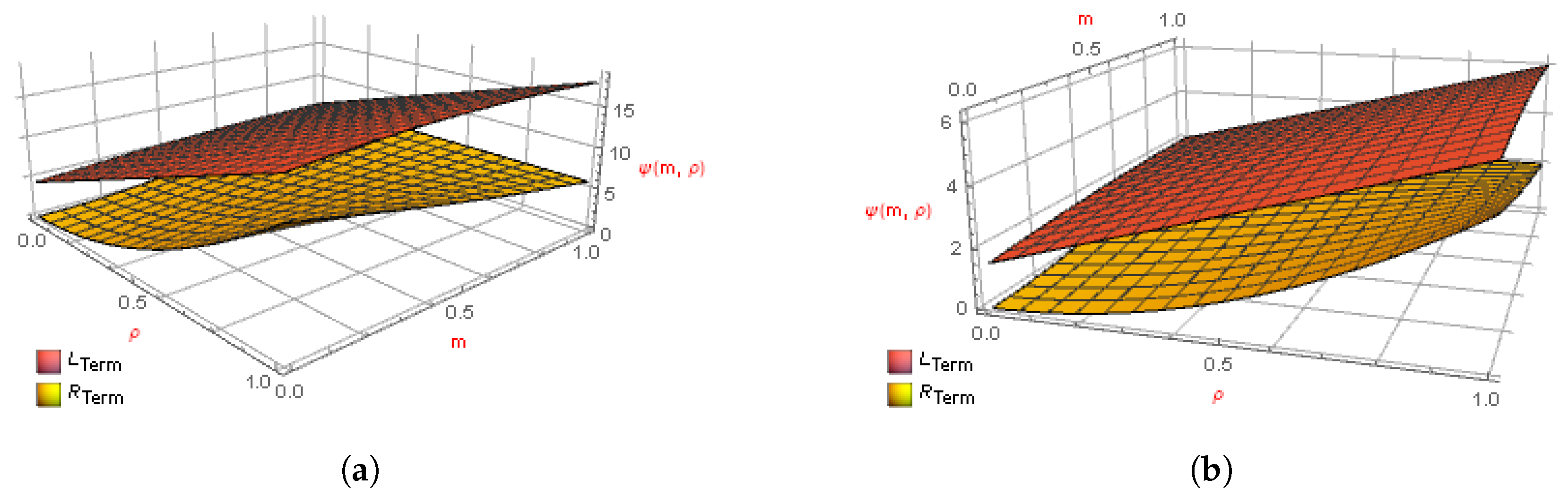
The center of the interval is ψ c ( w ) = ψ ̲ ( w ) + ψ ¯ ( w ) 2 = w p 2 , while the radius of the interval is ψ r ( w ) = ψ ¯ ( w ) ψ ̲ ( w ) 2 = 3 w p 2 The Graphs a and b given by Figure 1 validate the above mentioned function for p = 2 by employing Definition 8 for various values of δ o , τ o and ρ.
In the subsequent section, we investigate the distinctive characteristics of cr - ( P , m ) -superquadratic IVF .
Proposition 1.
Let ψ and g are cr - ( P , m ) -superquadratic IVF s such that ψ = [ ψ ̲ , ψ ¯ ] and g = [ g ̲ , g ¯ ] , respectively, then ψ + g and K ψ , where K > 0 are cr - ( P , m ) -superquadratic IVF s.
Proof. 
Suppose that ψ and g are considered to be cr - ( P , m ) -superquadratic IVF s, i.e., δ o , τ o I , ρ ( 0 , 1 ) and m ( 0 , 1 ] , we have
ψ ρ δ o + m ( 1 ρ ) τ o c r ψ ( δ o ) ψ ( ( 1 ρ ) | δ o τ o | ) + m ψ ( τ o ) ψ ( ρ | δ o τ o | ) ) ,
or
ψ c ρ δ o + m ( 1 ρ ) τ o , ψ r ρ δ o + m ( 1 ρ ) τ o c r ψ c ( δ o ) ψ c ( ( 1 ρ ) | δ o τ o | ) + m ψ c ( τ o ) ψ c ( ρ | δ o τ o | ) ) , ψ r ( δ o ) ψ r ( ( 1 ρ ) | δ o τ o | ) + m ψ r ( τ o ) ψ r ( ρ | δ o τ o | ) ) .
and
g ρ δ o + m ( 1 ρ ) τ o c r g ( δ o ) g ( ( 1 ρ ) | δ o τ o | ) + m g ( τ o ) g ( ρ | δ o τ o | ) ) ,
or
g c ρ δ o + m ( 1 ρ ) τ o , g r ρ δ o + m ( 1 ρ ) τ o c r g c ( δ o ) g c ( ( 1 ρ ) | δ o τ o | ) + m g c ( τ o ) g c ( ρ | δ o τ o | ) ) , g r ( δ o ) g r ( ( 1 ρ ) | δ o τ o | ) + m g r ( τ o ) g r ( ρ | δ o τ o | ) ) .
Next adding (14) and (15), and using the properties of center and radius values, we achieve that
( ψ + g ) ρ δ o + m ( 1 ρ ) τ o = ψ ρ δ o + m ( 1 ρ ) τ o + g ρ δ o + m ( 1 ρ ) τ o c r ψ ( δ o ) ψ ( ( 1 ρ ) | δ o τ o | ) + m ψ ( τ o ) ψ ( ρ | δ o τ o | ) ) + g ( δ o ) g ( ( 1 ρ ) | δ o τ o | ) + m g ( τ o ) g ( ρ | δ o τ o | ) = ( ψ + g ) ( δ o ) ( ψ + g ) ( ( 1 ρ ) | δ o τ o | ) + m ( ψ + g ) ( τ o ) ( ψ + g ) ( ρ | δ o τ o | ) .
Thus
( ψ + g ) ρ δ o + m ( 1 ρ ) τ o c r ( ψ + g ) ( δ o ) ( ψ + g ) ( ( 1 ρ ) | δ o τ o | ) + m ( ψ + g ) ( τ o ) ( ψ + g ) ( ρ | δ o τ o | ) .
Similarly
K ψ ρ δ o + m ( 1 ρ ) τ o c r K ψ ( δ o ) ψ ( ( 1 ρ ) | δ o τ o | ) + m ψ ( τ o ) ψ ( ρ | δ o τ o | ) = K ψ ( δ o ) K ψ ( ( 1 ρ ) | δ o τ o | ) + m K ψ ( τ o ) K ψ ( ρ | δ o τ o | ) .
Thus
K ψ ρ δ o + m ( 1 ρ ) τ o c r ( K ψ ( δ o ) K ψ ( ( 1 ρ ) | δ o τ o | ) + m K ψ ( τ o ) K ψ ( ρ | δ o τ o | ) .
Thus, by (16) and (17), we infer that ψ + g and K ψ are cr - ( P , m ) -superquadratic.
Proposition 2.
Let ψ is a cr - ( P , m ) -superquadratic IVF such that ψ = [ ψ ̲ , ψ ¯ ] and g is a cr - m -convex function such that g = [ g ̲ , g ¯ ] on J , then ψ g is a cr - ( P , m ) -superquadratic IVF .
Proof. 
Since δ o , τ o J and ρ ( 0 , 1 ) then we have
( ψ g ) ρ δ o + m ( 1 ρ ) τ o ( ψ c g c ) ρ δ o + m ( 1 ρ ) τ o , ( ψ r g r ) ρ δ o + m ( 1 ρ ) τ o .
It implies that
( ψ c g c ) ρ δ o + m ( 1 ρ ) τ o = ψ c ( g c ρ δ o + m ( 1 ρ ) τ o ) ψ ρ g c ( δ o ) + m ( 1 ρ ) g c ( τ o ) ψ c ( g c ( δ o ) ) ψ c ( ( 1 ρ ) | g c ( δ o ) g c ( τ o ) | ) + m ψ c ( g c ( τ o ) ) ψ ( ρ | g c ( δ o ) g c ( τ o ) | ) .
and
( ψ r g r ) ρ δ o + m ( 1 ρ ) τ o ψ r ( g r ( δ o ) ) ψ r ( ( 1 ρ ) | g r ( δ o ) g r ( τ o ) | ) + m ψ r ( g r ( τ o ) ) ψ ( ρ | g r ( δ o ) g r ( τ o ) | ) .
By Definition 5, the results (19) and (20) can be combined and written as follows:
( ψ g ) ρ δ o + m ( 1 ρ ) τ o c r ψ ( g ( δ o ) ) ψ ( ( 1 ρ ) | g ( δ o ) g ( τ o ) | ) + m ψ ( g ( τ o ) ) ψ ( ρ | g ( δ o ) g ( τ o ) | ) .
This demonstrates that ψ g is a cr - ( P , m ) -superquadratic IVF . □
Proposition 3.
If ψ is a non-negative cr - m -superquadratic IVF function such that ψ = [ ψ ̲ , ψ ¯ ] , then ψ is a cr - ( P , m ) -superquadratic.
Proof. 
Let ψ is a cr - m -superquadratic IVF function, so we have
ψ ρ δ o + m ( 1 ρ ) τ o c r ρ [ ψ ( δ o ) ψ ( ( 1 ρ ) | δ o τ o | ) ] + m ( 1 ρ ) [ ψ ( τ o ) ψ ( ρ | δ o τ o | ) ] ,
for any δ o , τ o J and m ( 0 , 1 ] .
By Definition 5, the results (21) can be written as follows:
ψ c ρ δ o + m ( 1 ρ ) τ o ρ [ ψ c ( δ o ) ψ c ( ( 1 ρ ) | δ o τ o | ) ] + m ( 1 ρ ) [ ψ c ( τ o ) ψ c ( ρ | δ o τ o | ) ] .
and
ψ r ρ δ o + m ( 1 ρ ) τ o ρ [ ψ r ( δ o ) ψ r ( ( 1 ρ ) | δ o τ o | ) ] + m ( 1 ρ ) [ ψ r ( τ o ) ψ r ( ρ | δ o τ o | ) ] .
First consider (22) and we have
ψ c ρ δ o + m ( 1 ρ ) τ o [ ψ c ( δ o ) ψ c ( ( 1 ρ ) | δ o τ o | ) ] + m [ ψ c ( τ o ) ψ c ( ρ | δ o τ o | ) ] .
Next we consider (23) and we have
ψ r ρ δ o + m ( 1 ρ ) τ o [ ψ r ( δ o ) ψ r ( ( 1 ρ ) | δ o τ o | ) ] + m [ ψ r ( τ o ) ψ r ( ρ | δ o τ o | ) ] .
Again by Definition 5, we can combine the (24) and (25)
ψ ρ δ o + m ( 1 ρ ) τ o c r [ ψ ( δ o ) ψ ( ( 1 ρ ) | δ o τ o | ) ] + m [ ψ ( τ o ) ψ ( ρ | δ o τ o | ) ] .
Hence the proof. □
Remark 5.
Proposition 3, states that cr - ( P , m ) -superquadratic IVF is cr - m -superquadratic IVF as well.
Proposition 4.
Let ψ , g : J R R J be the cr - ( P , m ) -superquadratic IVF such that ψ = [ ψ ̲ , ψ ¯ ] and g = [ g ̲ , g ¯ ] , then ψ ( w ) = m a x { ψ ( w ) , g ( w ) } is cr - ( P , m ) -superquadratic IVF .
Proof. 
Since for every δ o , τ o J as well as 0 < ρ < 1 , one derives that
ψ ρ δ o + m ( 1 ρ ) τ o = m a x { ψ ρ δ o + m ( 1 ρ ) τ o , g ρ δ o + m ( 1 ρ ) τ o } c r m a x { [ ψ ( δ o ) ψ ( ( 1 ρ ) | δ o τ o | ) ] + m [ ψ ( τ o ) ψ ( ρ | δ o τ o | ) ] , [ g ( δ o ) g ( ( 1 ρ ) | δ o τ o | ) ] + m [ g ( τ o ) g ( ρ | δ o τ o | ) ] } .
Again by Definition 5, the result (26) can be split as
ψ c ρ δ o + m ( 1 ρ ) τ o m a x { [ ψ c ( δ o ) ψ c ( ( 1 ρ ) | δ o τ o | ) ] + m [ ψ c ( τ o ) ψ c ( ρ | δ o τ o | ) ] , [ g c ( δ o ) g c ( ( 1 ρ ) | δ o τ o | ) ] + m [ g c ( τ o ) g c ( ρ | δ o τ o | ) ] } ,
and
ψ r ρ δ o + m ( 1 ρ ) τ o m a x { [ ψ r ( δ o ) ψ r ( ( 1 ρ ) | δ o τ o | ) ] + m [ ψ r ( τ o ) ψ r ( ρ | δ o τ o | ) ] , [ g r ( δ o ) g r ( ( 1 ρ ) | δ o τ o | ) ] + m [ g r ( τ o ) g r ( ρ | δ o τ o | ) ] } .
First consider (27), we get
ψ c ρ δ o + m ( 1 ρ ) τ o m a x { ψ c ( δ o ) , g c ( δ o ) } m a x { ψ c ( ( 1 ρ ) | δ o τ o | ) , g c ( ( 1 ρ ) | δ o τ o | ) } + ( m ) m a x { ψ c ( τ o ) , g c ( τ o ) } ( m ) m a x { ψ c ( ρ | δ o τ o | ) , g c ( ρ | δ o τ o | ) } = [ ψ c ( δ o ) ψ c ( ( 1 ρ ) | δ o τ o | ) ] + m [ ψ c ( τ o ) ψ c ( ρ | δ o τ o | ) ] .
Similarly by considering (28), we get
ψ r ρ δ o + m ( 1 ρ ) τ o m a x { ψ r ( δ o ) , g r ( δ o ) } m a x { ψ r ( ( 1 ρ ) | δ o τ o | ) , g r ( ( 1 ρ ) | δ o τ o | ) } + ( m ) m a x { ψ r ( τ o ) , g r ( τ o ) } ( m ) m a x { ψ r ( ρ | δ o τ o | ) , g r ( ρ | δ o τ o | ) } = [ ψ r ( δ o ) ψ r ( ( 1 ρ ) | δ o τ o | ) ] + m [ ψ r ( τ o ) ψ r ( ρ | δ o τ o | ) ] .
Again using Definition 5, the results (29) and (30) can be combined as follows:
ψ ρ δ o + m ( 1 ρ ) τ o c r [ ψ ( δ o ) ψ ( ( 1 ρ ) | δ o τ o | ) ] + m [ ψ ( τ o ) ψ ( ρ | δ o τ o | ) ] .
Consequently, ψ ( w ) is termed as a cr - ( P , m ) -superquadratic IVF . □
Theorem 6.
Let ψ : J R ( 0 , ) be a cr - ( P , m ) -superquadratic IVF for all points w 1 , w 2 , w 3 J such that w 1 < w 2 < w 3 such that ψ = [ ψ ̲ , ψ ¯ ] , then the inequality
ψ w 2 c r ψ ( w 1 ) ψ | ( w 2 w 1 ) ( w 3 w 1 ) m w 3 w 1 | + ψ ( w 3 ) ψ | ( m w 3 w 2 ) ( w 3 w 1 ) m w 3 w 1 | .
holds, m [ 0 , 1 ] .
Proof. 
Let ψ is a cr - ( P , m ) -superquadratic IVF , then
ψ ρ w + m ( 1 ρ ) w o c r ψ ( w ) ψ ( ( 1 ρ ) | w w o | ) + m ψ ( w o ) ψ ( ρ | w w o | ) .
By Definition 5, the result (31) can be split as follows:
ψ c ρ w + m ( 1 ρ ) w o ψ c ( w ) ψ c ( ( 1 ρ ) | w w o | ) + m ψ c ( w o ) ψ c ( ρ | w w o | ) .
and
ψ r ρ w + m ( 1 ρ ) w o ψ r ( w ) ψ r ( ( 1 ρ ) | w w o | ) + m ψ r ( w o ) ψ r ( ρ | w w o | ) .
Setting
w 2 = ρ w + m ( 1 ρ ) w o .
Next putting w = w 1 and w o = w 3 in (34), we get
w 2 = ρ w 1 + m ( 1 ρ ) w 3 . ρ = m w 3 w 2 m w 3 w 1 .
Substituting w = w 1 , w o = w 3 and ρ = m w 3 w 2 m w 3 w 1 in (32), we get
ψ c w 2 ψ c ( w 1 ) ψ c | ( w 2 w 1 ) ( w 3 w 1 ) m w 3 w 1 | + ψ c ( w 3 ) ψ c | ( m w 3 w 2 ) ( w 3 w 1 ) m w 3 w 1 | .
It implies that
ψ c ( w 1 ) ψ c | ( w 2 w 1 ) ( w 3 w 1 ) m w 3 w 1 | + ψ c ( w 3 ) ψ c | ( m w 3 w 2 ) ( w 3 w 1 ) m w 3 w 1 | ψ c w 2 0 .
Similarly by considering (33) and moving in the same fashion as before, we get
ψ r ( w 1 ) ψ r | ( w 2 w 1 ) ( w 3 w 1 ) m w 3 w 1 | + ψ r ( w 3 ) ψ r | ( m w 3 w 2 ) ( w 3 w 1 ) m w 3 w 1 | ψ r w 2 0 .
Again by Definition 5, the inequalities (36) and (37) can be merged and we get the required result. □
Theorem 7
(Jensen inequality). Let w i , ρ i 0 . i = 1 , . . . , n , and m ( 0 , 1 ] ψ : J R . If ψ is a cr - ( P , m ) -superquadratic IVF on J such that ψ = [ ψ ̲ , ψ ¯ ] , then
ψ i = 1 n ρ i w i c r i = 1 n m n i ψ w i m n i i = 1 n m n i ψ | w i m n i i = 1 n ρ i w i m n i | ,
where i = 1 n ρ i = 1 .
Proof. 
Since by Definition 5, the result (38) can be split as follows:
ψ c i = 1 n ρ i w i i = 1 n m n i ψ c w i m n i i = 1 n m n i ψ c | w i m n i i = 1 n ρ i w i m n i | ,
and
ψ r i = 1 n ρ i w i i = 1 n m n i ψ r w i m n i i = 1 n m n i ψ r | w i m n i i = 1 n ρ i w i m n i | ,
First considering (39) and (40) and setting n = 2 , we get
ψ c ρ 1 w 1 + ρ 2 w 2 ψ c ( w 2 ) ψ c ρ 1 | w 2 w 1 m | + m ψ c w 1 m ψ c ρ 2 | w 2 w 1 m | ,
and
ψ r ρ 1 w 1 + ρ 2 w 2 ψ r ( w 2 ) ψ r ρ 1 | w 2 w 1 m | + m ψ r w 1 m ψ r ρ 2 | w 2 w 1 m | ,
respectively. Again by Definition 5, the results (41) and (42) can be combined as follows:
ψ ρ 1 w 1 + ρ 2 w 2 c r ψ ( w 2 ) ψ ρ 1 | w 2 w 1 m | + m ψ w 1 m ψ ρ 2 | w 2 w 1 m | ,
Thus, the statement (38) is true for n = 2 .
Let us assume that the relation (38) holds true for n 1 . Consequently, we get
ψ i = 1 n 1 ρ i w i c r i = 1 n 1 m n 1 i ψ w i m n 1 i i = 1 n 1 m n 1 i ψ | w i m n 1 i i = 1 n 1 ρ i w i m n 1 i | .
Now, let us demonstrate that (38) holds for n , so we first consider the center value of the function
ψ c i = 1 n ρ i w i = ψ c ρ n w n + m ρ i = 1 n 1 ρ i w i m ρ .
where ρ = i = 1 n 1 ρ i , then it implies that
ψ c i = 1 n ρ i w i ψ c ( w n ) + m ψ c i = 1 n 1 ρ i w i m ρ ψ c ρ | w n i = 1 n 1 ρ i w i m ρ | m ψ c ρ n | w n i = 1 n 1 ρ i w i m ρ | .
Using the center value result of (44) in (45), we obtain
ψ c i = 1 n ρ i w i ψ c ( w n ) + i = 1 n 1 m n i ψ c w i m n i i = 1 n 1 m n i ψ c | w i m n i i = 1 n 1 ρ i w i m n i | ψ c ρ | w n i = 1 n 1 ρ i w i m ρ | m ψ c ρ n | w n i = 1 n 1 ρ i w i m ρ | = m n n ψ c w n m n n + i = 1 n 1 m n i ψ c w i m n i i = 1 n 1 m n i ψ c | w i m n i i = 1 n 1 ρ i w i m n i | ψ c ρ | w n i = 1 n 1 ρ i w i m ρ | m ψ c ρ n | w n i = 1 n 1 ρ i w i m ρ | i = 1 n m n i ψ c w i m n i i = 1 n 1 m n i ψ c | w i m n i i = 1 n 1 ρ i w i m n i | ψ c ρ | w n i = 1 n 1 ρ i w i m n i ρ | = i = 1 n m n i ψ c w i m n i i = 1 n 1 m n i ψ c | w i m n i i = 1 n 1 ρ i w i m n i | m n n ψ c | w n m n n ρ n w n m n n i = 1 n 1 ρ i w i m n i | = i = 1 n m n i ψ c w i m n i i = 1 n 1 m n i ψ c | w i m n i i = 1 n 1 ρ i w i m n i | m n n ψ c | w n m n n ρ n w n m n n i = 1 n 1 ρ i w i m n i | = i = 1 n m n i ψ c w i m n i i = 1 n 1 m n i ψ c | w i m n i i = 1 n 1 ρ i w i m n i | m n n ψ c | w n m n n i = 1 n ρ i w i m n i | = i = 1 n m n i ψ c w i m n i i = 1 n m n i ψ c | w i m n i i = 1 n ρ i w i m n i | .
Likewise, taking the radius values into account and following the same steps, we attain
ψ r i = 1 n ρ i w i i = 1 n m n i ψ r w i m n i i = 1 n m n i ψ r | w i m n i i = 1 n ρ i w i m n i | .
Again by Definition 5, the results (46) and (47) can be combined as follows:
ψ i = 1 n ρ i w i c r i = 1 n m n i ψ w i m n i i = 1 n m n i ψ | w i m n i i = 1 n ρ i w i m n i | .
Hence the proof. □
Next, we provide the proof of HH -type inequalities for cr - ( P , m ) -superquadratic IVF .
Theorem 8.
Let ψ : J ( 0 , ) be a cr - ( P , m ) -superquadratic IVF such that ψ = [ ψ ̲ , ψ ¯ ] , for m ( 0 , 1 ] . If ψ ̲ , ψ ¯ J w [ δ o , τ o m ] with δ o < τ o , then
ψ δ o + τ o 2 + 1 + m τ o δ o δ o τ o ψ | ( δ o + τ o ) ( m + 1 ) w 2 m | d w c r 1 τ o δ o δ o τ o ψ ( w ) d w + m δ o m τ o m ψ ( w ) d w c r ψ ( δ o ) + m ψ τ o m + ψ δ o m + ψ τ o m 2 1 τ o δ o { δ o τ o ( ψ | ( w δ o ) ( τ o m δ o ) m ( τ o δ o ) | + m ψ | ( τ o w ) ( τ o m δ o ) m ( τ o δ o ) | + m ψ | ( τ o w ) ( τ o m δ o ) m 2 ( τ o δ o ) | + m 2 ψ | ( w δ o ) ( τ o m δ o ) m 2 ( τ o δ o ) | ) d w } ,
holds.
Proof. 
Since ψ is a cr - ( P , m ) -superquadratic IVF , therefore we have
ψ w + w o 2 c r ψ ( w ) ψ 1 2 | w w o m | + m ψ w o m ψ 1 2 | w w o m | .
By Definition 5, the result (49) can be split as follows:
ψ c w + w o 2 ψ c ( w ) ψ c 1 2 | w w o m | + m ψ c w o m ψ c 1 2 | w w o m | ,
and
ψ r w + w o 2 ψ r ( w ) ψ r 1 2 | w w o m | + m ψ r w o m ψ r 1 2 | w w o m | .
First considering (50) and changing w by ρ δ o + ( 1 ρ ) τ o and w o by ρ τ o + ( 1 ρ ) δ o , we attain
ψ c δ o + τ o 2 ψ c ( ρ δ o + ( 1 ρ ) τ o ) + m ψ c ρ τ o + ( 1 ρ ) δ o m ( 1 + m ) ψ c | ( 1 + m ) ( δ o ρ + τ o ( 1 ρ ) ) ( δ o + τ o ) 2 m | .
Integrating (52) with respect to ρ over [ 0 , 1 ] , we have
ψ c δ o + τ o 2 0 1 ψ c ( ρ δ o + ( 1 ρ ) τ o ) d ρ + m 0 1 ψ c ρ τ o + ( 1 ρ ) δ o m d ρ ( 1 + m ) 0 1 ψ c | ( 1 + m ) ( δ o ρ + τ o ( 1 ρ ) ) ( δ o + τ o ) 2 m | d ρ .
It implies that
ψ c δ o + τ o 2 1 τ o δ o δ o τ o ψ c ( w ) d w + m δ o m τ o m ψ c ( w ) d w 1 + m τ o δ o δ o τ o ψ c | ( δ o + τ o ) ( m + 1 ) w 2 m | d w .
Thus
ψ c δ o + τ o 2 + 1 + m τ o δ o δ o τ o ψ c | ( δ o + τ o ) ( m + 1 ) w 2 m | d w 1 τ o δ o δ o τ o ψ c ( w ) d w + m δ o m τ o m ψ c ( w ) d w .
Similarly considering (51), and moving in the same way, we get
ψ r δ o + τ o 2 + 1 + m τ o δ o δ o τ o ψ r | ( δ o + τ o ) ( m + 1 ) w 2 m | d w 1 τ o δ o δ o τ o ψ r ( w ) d w + m δ o m τ o m ψ r ( w ) d w .
Again by Definition 5, the results (53) and (54) can be merged as follows:
ψ δ o + τ o 2 + 1 + m τ o δ o δ o τ o ψ | ( δ o + τ o ) ( m + 1 ) w 2 m | d w 1 τ o δ o δ o τ o ψ ( w ) d w + m δ o m τ o m ψ ( w ) d w .
As ψ c is a ( P , m ) -superquadratic, it follows that
ψ c ( ρ δ o + ( 1 ρ ) τ o ) + m ψ c ρ τ o + ( 1 ρ ) δ o m = ψ c ρ δ o + m ( 1 ρ ) ( τ o m ) + m ψ c ( 1 ρ ) δ o m + m ρ τ o m 2 ψ c ( δ o ) ψ c ( 1 ρ ) | m δ o τ o m | + m ψ c τ o m ψ c ρ | m δ o τ o m | + m ψ c δ o m ψ c ρ | m δ o τ o m 2 | + m 2 ψ c τ o m 2 ψ c ( 1 ρ ) | m δ o τ o m 2 | .
Integrating (54) with respect to ρ over [ 0 , 1 ] , we have
0 1 ψ c ( ρ δ o + ( 1 ρ ) τ o ) d ρ + m 0 1 ψ c ρ τ o + ( 1 ρ ) δ o m d ρ 0 1 ψ c ( δ o ) ψ c ( 1 ρ ) | m δ o τ o m | d ρ + m 0 1 ψ c τ o m ψ c ρ | m δ o τ o m | d ρ + m 0 1 ψ c δ o m ψ c ρ | m δ o τ o m 2 | d ρ + m 2 0 1 ψ c τ o m 2 ψ c ( 1 ρ ) | m δ o τ o m 2 | d ρ .
It implies
1 τ o δ o δ o τ o ψ c ( w ) d w + m δ o m τ o m ψ c ( w ) d w ψ c ( δ o ) + m ψ c τ o m + ψ c δ o m + ψ c τ o m 2 1 τ o δ o { δ o τ o ( ψ c | ( w δ o ) ( τ o m δ o ) m ( τ o δ o ) | + m ψ c | ( τ o w ) ( τ o m δ o ) m ( τ o δ o ) | + m ψ c | ( τ o w ) ( τ o m δ o ) m 2 ( τ o δ o ) | + m 2 ψ c | ( w δ o ) ( τ o m δ o ) m 2 ( τ o δ o ) | ) d w } .
Similarly considering ψ r as ( P , m ) -superquadratic function, we get
1 τ o δ o δ o τ o ψ r ( w ) d w + m δ o m τ o m ψ r ( w ) d w ψ r ( δ o ) + m ψ r τ o m + ψ r δ o m + ψ r τ o m 2 1 τ o δ o { δ o τ o ( ψ r | ( w δ o ) ( τ o m δ o ) m ( τ o δ o ) | + m ψ r | ( τ o w ) ( τ o m δ o ) m ( τ o δ o ) | + m ψ r | ( τ o w ) ( τ o m δ o ) m 2 ( τ o δ o ) | + m 2 ψ r | ( w δ o ) ( τ o m δ o ) m 2 ( τ o δ o ) | ) d w } .
Again by Definition 5, the results (58) and (59) can be merged as follows:
1 τ o δ o δ o τ o ψ ( w ) d w + m δ o m τ o m ψ ( w ) d w c r ψ ( δ o ) + m ψ τ o m + ψ δ o m + ψ τ o m 2 1 τ o δ o { δ o τ o ( ψ r | ( w δ o ) ( τ o m δ o ) m ( τ o δ o ) | + m ψ | ( τ o w ) ( τ o m δ o ) m ( τ o δ o ) | + m ψ | ( τ o w ) ( τ o m δ o ) m 2 ( τ o δ o ) | + m 2 ψ | ( w δ o ) ( τ o m δ o ) m 2 ( τ o δ o ) | ) d w } .
Merging (55) and (60), we get the required result. □
Corollary 1.
Reversing the inequality in (48) yields the HH -inequalities for cr - ( P , m ) -subquadratic IVF s.
Corollary 2.
If m = 1 is put in (48), we attain HH -inequalities for cr -P-superquadratic function:
1 2 ψ δ o + τ o 2 + 1 τ o δ o δ o τ o ψ | w δ o + τ o 2 | d w c r 1 τ o δ o δ o τ o ψ ( w ) d w c r ψ ( δ o ) + ψ ( τ o ) 1 τ o δ o δ o τ o ψ ( w δ o ) + ψ ( τ o w ) d w .
The following example describes the truth of the statement of Theorem 8 for the cr - ( P , m ) -superquadratic function.
Example 2.
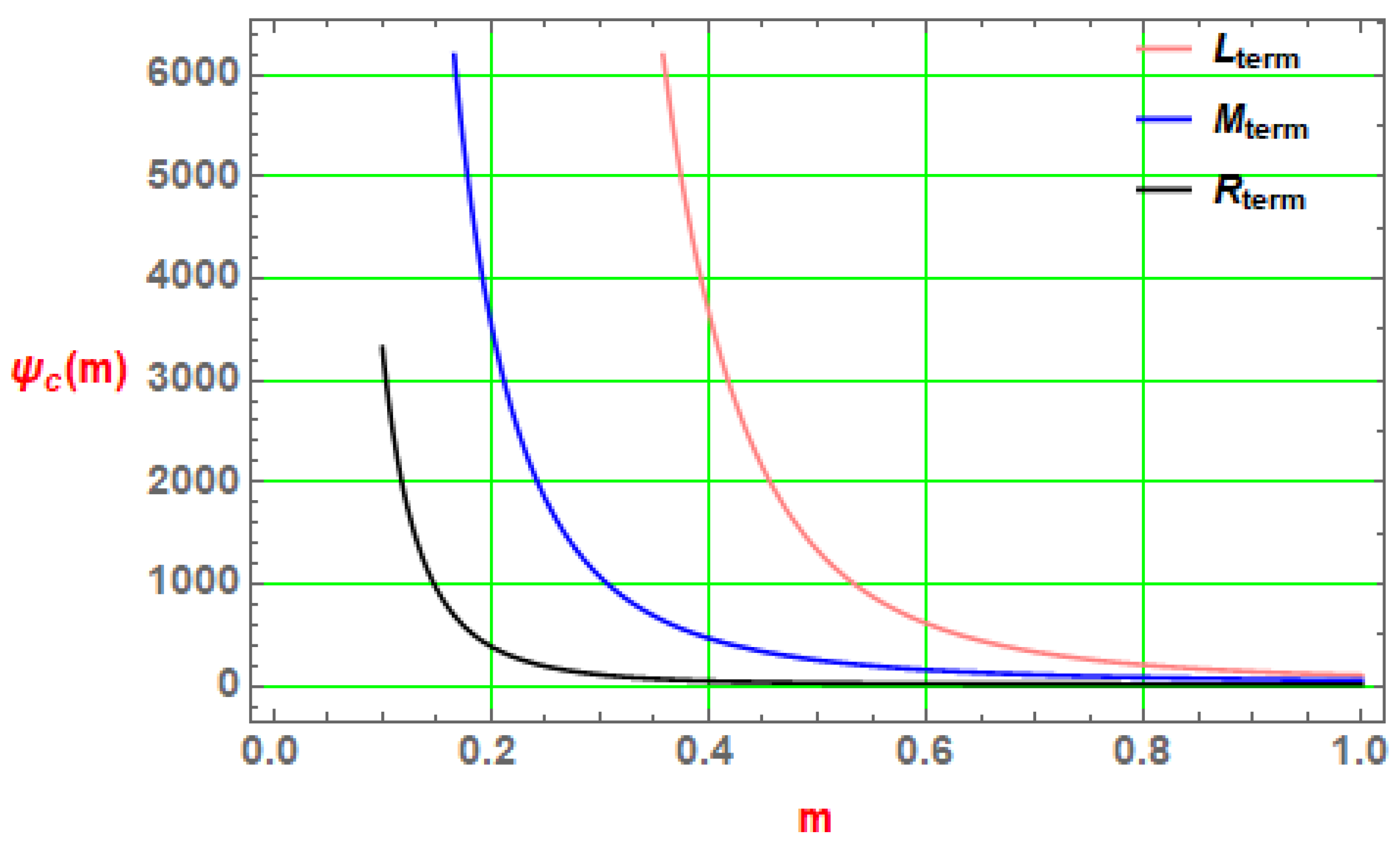
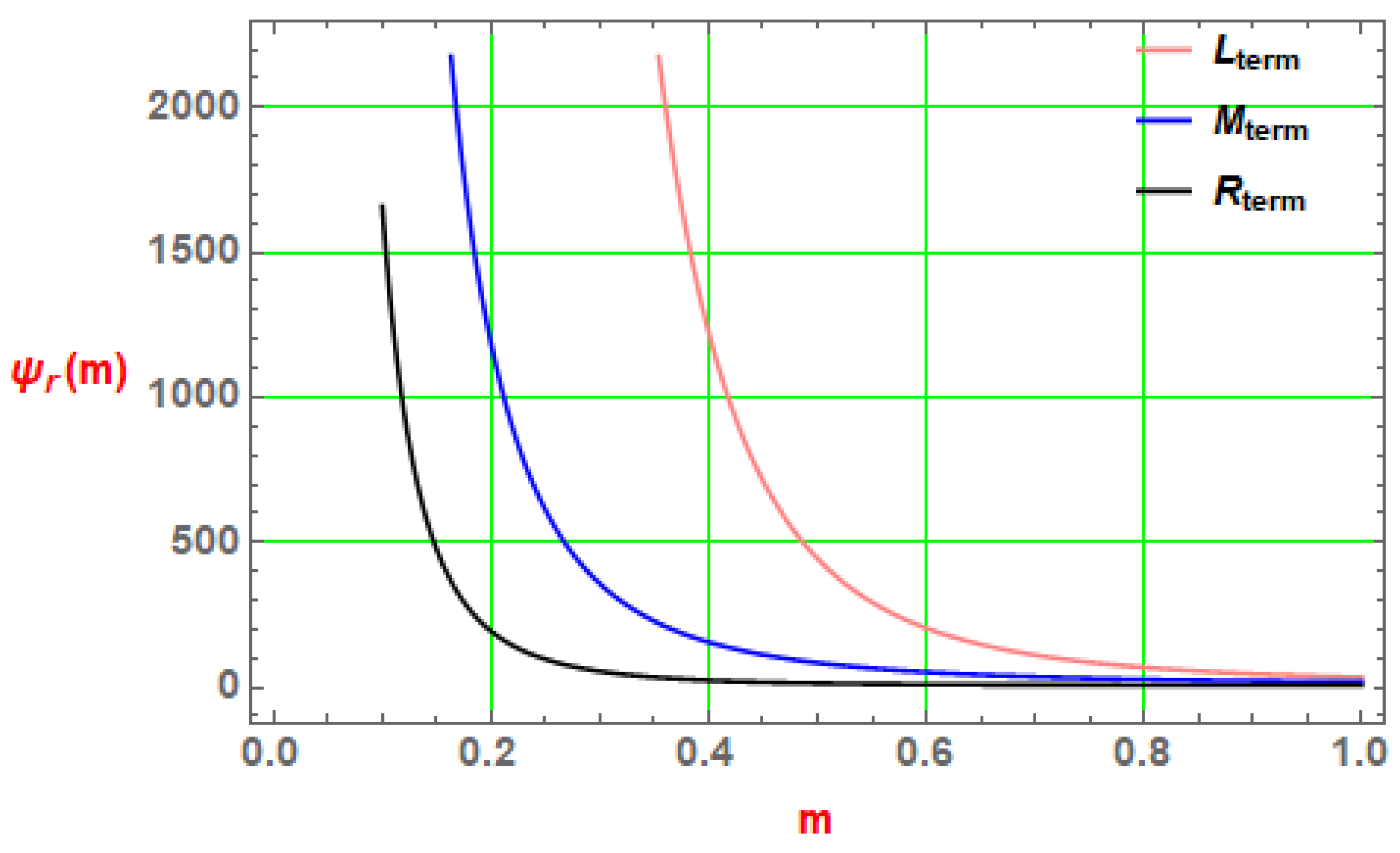
Since ψ ( w ) = w p , 2 w p is a cr - ( P , m ) -superquadratic function on J = [ 2 , ) for p = 3 as shown in Example 1, then Figure 2 and Table 1, describe the right, middle and left terms denoted by R t e r m , M t e r m and L t e r m , respectively, for the Theorem 8.
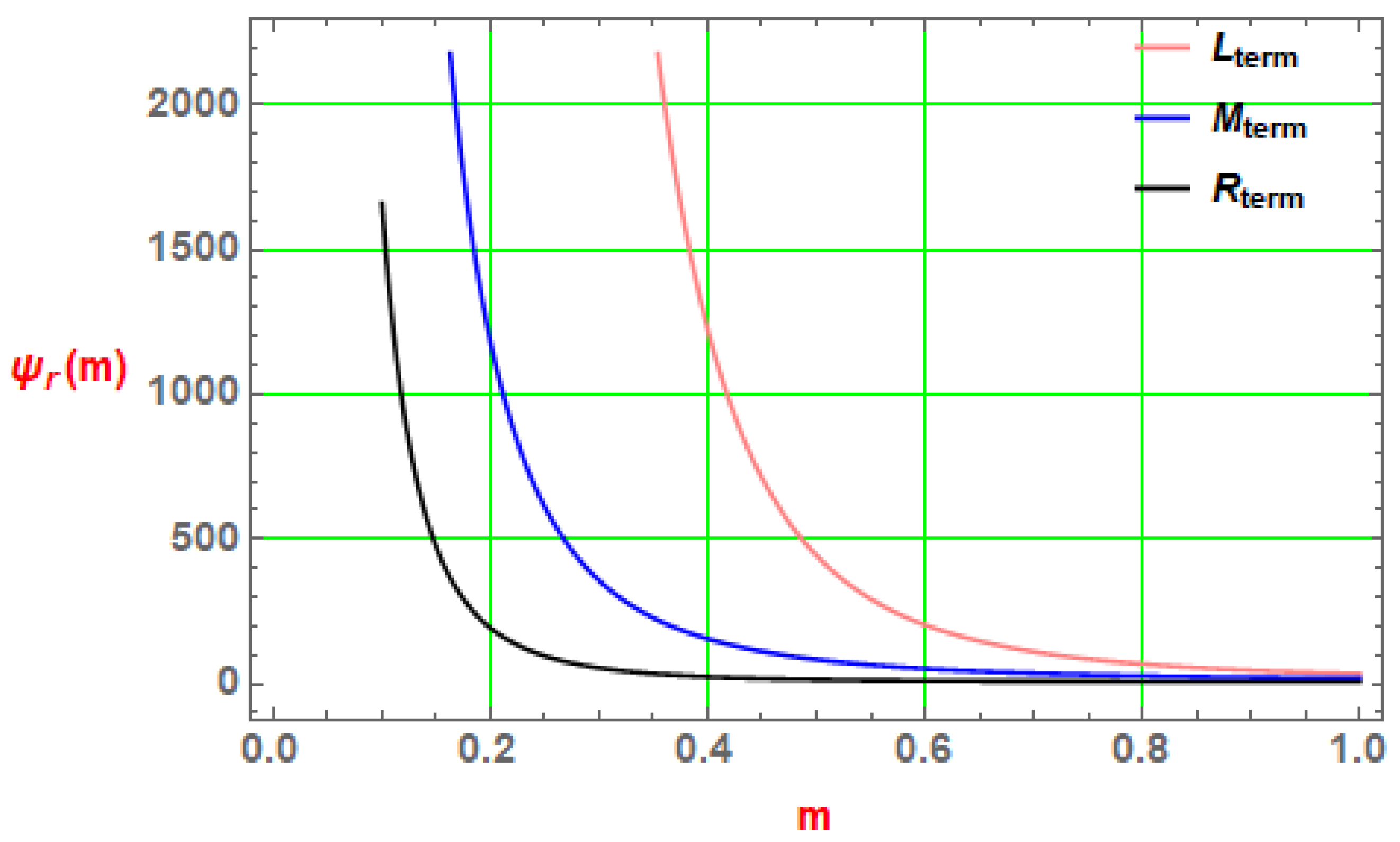
Similarly considering the function ψ c ( w ) = 3 w 3 2 , we get following Figure 3 and Table 2 showing the authenticity of Theorem 8.

3. Fractional Version of HH ’s Inequalities for cr - ( P , m ) -Superquadratic Function

We now proceed to derive the fractional extensions of HH -inequalities via the RL fractional integral operators formulated in interval calculus.
Theorem 9.
Let the function ψ : J R ( 0 , ) be a cr - ( P , m ) -superquadratic such that ψ = [ ψ ̲ , ψ ¯ ] , for m ( 0 , 1 ] . If ψ ̲ , ψ ¯ I w [ δ o , τ o m ] with δ o < τ o , then
ψ δ o + τ o 2 + 2 ( 1 + m ) γ ( τ o δ o ) γ δ o δ o + τ o 2 ( τ o w ) γ 1 ψ | ( δ o + τ o ) ( m + 1 ) w 2 m | d w c r Γ ( 1 + γ ) ( τ o δ o ) γ I δ o + γ ψ ( τ o ) + m γ I τ o m γ ψ δ o m c r ψ ( δ o ) + m ψ τ o m + ψ δ o m + ψ τ o m 2 γ ( τ o δ o ) γ { δ o τ o ( τ o w ) γ 1 ( ψ | ( w δ o ) ( τ o m δ o ) m ( τ o δ o ) | + m ψ | ( τ o w ) ( τ o m δ o ) m ( τ o δ o ) | + m ψ | ( τ o w ) ( τ o m δ o ) m 2 ( τ o δ o ) | + m 2 ψ | ( w δ o ) ( τ o m δ o ) m 2 ( τ o δ o ) | ) d w } ,
holds γ ( 0 , 1 ) .
Proof. 
Since the function ψ is cr - ( P , m ) -superquadratic therefore we attain
ψ w + w o 2 c r ψ ( w ) ψ 1 2 | w w o m | + m ψ w o m ψ 1 2 | w w o m | ,
By Definition 5, the result (63) can be split as follows:
ψ c w + w o 2 c r ψ c ( w ) ψ c 1 2 | w w o m | + m ψ c w o m ψ c 1 2 | w w o m | ,
and
ψ r w + w o 2 c r ψ r ( w ) ψ r 1 2 | w w o m | + m ψ r w o m ψ r 1 2 | w w o m | ,
Considering (64) and changing w by ρ δ o + ( 1 ρ ) τ o and w o by ρ τ o + ( 1 ρ ) δ o , we attain:
ψ c δ o + τ o 2 ψ c ( ρ δ o + ( 1 ρ ) τ o ) + m ψ c ρ τ o + ( 1 ρ ) δ o m ( 1 + m ) ψ c | ( 1 + m ) ( δ o ρ + τ o ( 1 ρ ) ) ( δ o + τ o ) 2 m | .
Multiplying (66) by ρ γ 1 and then integrating it with respect to ρ over [ 0 , 1 ] , we have
1 γ ψ c δ o + τ o 2 0 1 ρ γ 1 ψ c ( ρ δ o + ( 1 ρ ) τ o ) d ρ + m 0 1 ρ γ 1 ψ c ρ τ o + ( 1 ρ ) δ o m d ρ ( 1 + m ) 0 1 ρ γ 1 ψ c | ( 1 + m ) ( δ o ρ + τ o ( 1 ρ ) ) ( δ o + τ o ) 2 m | d ρ .
It implies that
1 γ ψ c δ o + τ o 2 1 ( τ o δ o ) γ δ o τ o ( τ o w ) γ 1 ψ c ( w ) d w + m γ δ o m τ o m w δ o m γ 1 ψ ( w ) d w 1 + m ( τ o δ o ) γ δ o τ o ( τ o w ) γ 1 ψ c | ( δ o + τ o ) ( m + 1 ) w 2 m | d w .
Thus
1 γ ψ c δ o + τ o 2 + 1 + m ( τ o δ o ) γ δ o τ o ( τ o w ) γ 1 ψ c | ( δ o + τ o ) ( m + 1 ) w 2 m | d w Γ ( γ ) ( τ o δ o ) γ I δ o + γ ψ c ( τ o ) + m γ I τ o m γ ψ c δ o m .
Similarly considering (65), and moving in the same fashion we attain
1 γ ψ r δ o + τ o 2 + 1 + m ( τ o δ o ) γ δ o τ o ( τ o w ) γ 1 ψ r | ( δ o + τ o ) ( m + 1 ) w 2 m | d w Γ ( γ ) ( τ o δ o ) γ I δ o + γ ψ r ( τ o ) + m γ I τ o m γ ψ r δ o m .
Again by Definition 5, the results (67) and (68) can be merged as follows:
1 γ ψ δ o + τ o 2 + 1 + m ( τ o δ o ) γ δ o τ o ( τ o w ) γ 1 ψ | ( δ o + τ o ) ( m + 1 ) w 2 m | d w c r Γ ( γ ) ( τ o δ o ) γ I δ o + γ ψ ( τ o ) + m γ I τ o m γ ψ δ o m .
As ψ c is a ( P , m ) -superquadratic, therefore we attain
ψ c ( ρ δ o + ( 1 ρ ) τ o ) + m ψ c ρ τ o + ( 1 ρ ) δ o m = ψ c ρ δ o + m ( 1 ρ ) ( τ o m ) + m ψ c ( 1 ρ ) δ o m + m ρ τ o m 2 ψ c ( δ o ) ψ c ( 1 ρ ) | m δ o τ o m | + m ψ c τ o m ψ c ρ | m δ o τ o m | + m ψ c δ o m ψ c ρ | m δ o τ o m 2 | + m 2 ψ c τ o m 2 ψ c ( 1 ρ ) | m δ o τ o m 2 | .
Multiplying (70) by ρ γ 1 and then integrating it with respect to ρ over [ 0 , 1 ] , we have
0 1 ρ γ 1 ψ c ( ρ δ o + ( 1 ρ ) τ o ) d ρ + m 0 1 ρ γ 1 ψ c ρ τ o + ( 1 ρ ) δ o m d ρ 0 1 ρ γ 1 ψ ( δ o ) ψ c ( 1 ρ ) | m δ o τ o m | d ρ + m 0 1 ρ γ 1 ψ c τ o m ψ c ρ | m δ o τ o m | d ρ + m 0 1 ρ γ 1 ψ c δ o m ψ c ρ | m δ o τ o m 2 | d ρ + m 2 0 1 ρ γ 1 ψ c τ o m 2 ψ c ( 1 ρ ) | m δ o τ o m 2 | d ρ .
It implies that
1 ( τ o δ o ) γ δ o τ o ( τ o w ) γ 1 ψ c ( w ) d w + m γ δ o m τ o m w δ o m γ 1 ψ c ( w ) d w 1 γ ψ c ( δ o ) + 1 γ m ψ c τ o m + ψ c δ o m + ψ c τ o m 2 1 ( τ o δ o ) γ { δ o τ o ( τ o w ) γ 1 ( ψ c | ( w δ o ) ( τ o m δ o ) m ( τ o δ o ) | + m ψ c | ( τ o w ) ( τ o m δ o ) m ( τ o δ o ) | + m ψ c | ( τ o w ) ( τ o m δ o ) m 2 ( τ o δ o ) | + m 2 ψ c | ( w δ o ) ( τ o m δ o ) m 2 ( τ o δ o ) | ) d w } .
Thus
Γ ( γ ) ( τ o δ o ) γ I δ o + γ ψ c ( τ o ) + m γ I τ o m γ ψ c δ o m 1 γ ψ c ( δ o ) + 1 γ m ψ c τ o m + ψ δ o m + ψ c τ o m 2 1 ( τ o δ o ) γ { δ o τ o ( τ o w ) γ 1 ( ψ c | ( w δ o ) ( τ o m δ o ) m ( τ o δ o ) | + m ψ c | ( τ o w ) ( τ o m δ o ) m ( τ o δ o ) | + m ψ c | ( τ o w ) ( τ o m δ o ) m 2 ( τ o δ o ) | + m 2 ψ c | ( w δ o ) ( τ o m δ o ) m 2 ( τ o δ o ) | ) d w } .
Similarly for ψ r we attain
Γ ( γ ) ( τ o δ o ) γ I δ o + γ ψ r ( τ o ) + m γ I τ o m γ ψ r δ o m 1 γ ψ r ( δ o ) + 1 γ m ψ r τ o m + ψ δ o m + ψ r τ o m 2 1 ( τ o δ o ) γ { δ o τ o ( τ o w ) γ 1 ( ψ r | ( w δ o ) ( τ o m δ o ) m ( τ o δ o ) | + m ψ r | ( τ o w ) ( τ o m δ o ) m ( τ o δ o ) | + m ψ r | ( τ o w ) ( τ o m δ o ) m 2 ( τ o δ o ) | + m 2 ψ r | ( w δ o ) ( τ o m δ o ) m 2 ( τ o δ o ) | ) d w } .
Again by Definition 5, the results (72) and (73) can be merged as follows:
Γ ( γ ) ( τ o δ o ) γ I δ o + γ ψ ( τ o ) + m γ I τ o m γ ψ δ o m c r 1 γ ψ ( δ o ) + 1 γ m ψ τ o m + ψ δ o m + ψ τ o m 2 1 ( τ o δ o ) γ { δ o τ o ( τ o w ) γ 1 ( ψ | ( w δ o ) ( τ o m δ o ) m ( τ o δ o ) | + m ψ | ( τ o w ) ( τ o m δ o ) m ( τ o δ o ) | + m ψ | ( τ o w ) ( τ o m δ o ) m 2 ( τ o δ o ) | + m 2 ψ | ( w δ o ) ( τ o m δ o ) m 2 ( τ o δ o ) | ) d w } .
The proof is completed by merging inequalities (69) and (74). □
Corollary 3.
Reversing the inequalities in (62) yields the fractional HH -inequalities for cr - ( P , m ) -subquadratic IVF s using RL fractional integrals.
Corollary 4.
If the parameter γ is set to 1 in (62), it reduces to (48), termed as the HH inequalities for cr - ( P , m ) -superquadratic IVF s.
Corollary 5.
If we let m = 1 in (62), we derive the fractional HH -inequalities for cr -P-superquadratic functions through RL fractional integrals.
1 2 ψ δ o + τ o 2 + γ ( τ o δ o ) γ δ o τ o ( τ o w ) γ 1 ψ | δ o + τ o 2 w | d w c r Γ ( 1 + γ ) 2 ( τ o δ o ) γ I δ o + γ ψ ( τ o ) + I τ o γ ψ ( δ o ) c r ψ ( δ o ) + ψ ( τ o ) γ ( τ o δ o ) γ δ o τ o ( τ o w ) γ 1 ψ ( | w δ o | ) + ψ ( | τ o w | ) d w .
Corollary 6.
If both parameters m and γ are set to 1 in (62), it simplifies to the HH -inequalities for cr -P-superquadratic functions. This finding is novel within the scope of superquadraticity theory and is formulated as follows:
1 2 ψ δ o + τ o 2 + 1 τ o δ o δ o τ o ψ | w δ o + τ o 2 | d w c r 1 τ o δ o δ o τ o ψ ( w ) d w c r ψ ( δ o ) + ψ ( τ o ) 1 τ o δ o δ o τ o ψ ( w δ o ) + ψ ( τ o w ) d w .
Example 3.
Since ψ ( w ) = w p , 2 w p is a cr - ( P , m ) -superquadratic function on J = [ 2 , ) for p = 3 as shown in Example 1, then Figure 4 and Table 3, describe the right, middle and left terms denoted by R t e r m , M t e r m and L t e r m , respectively, for the Theorem 9.
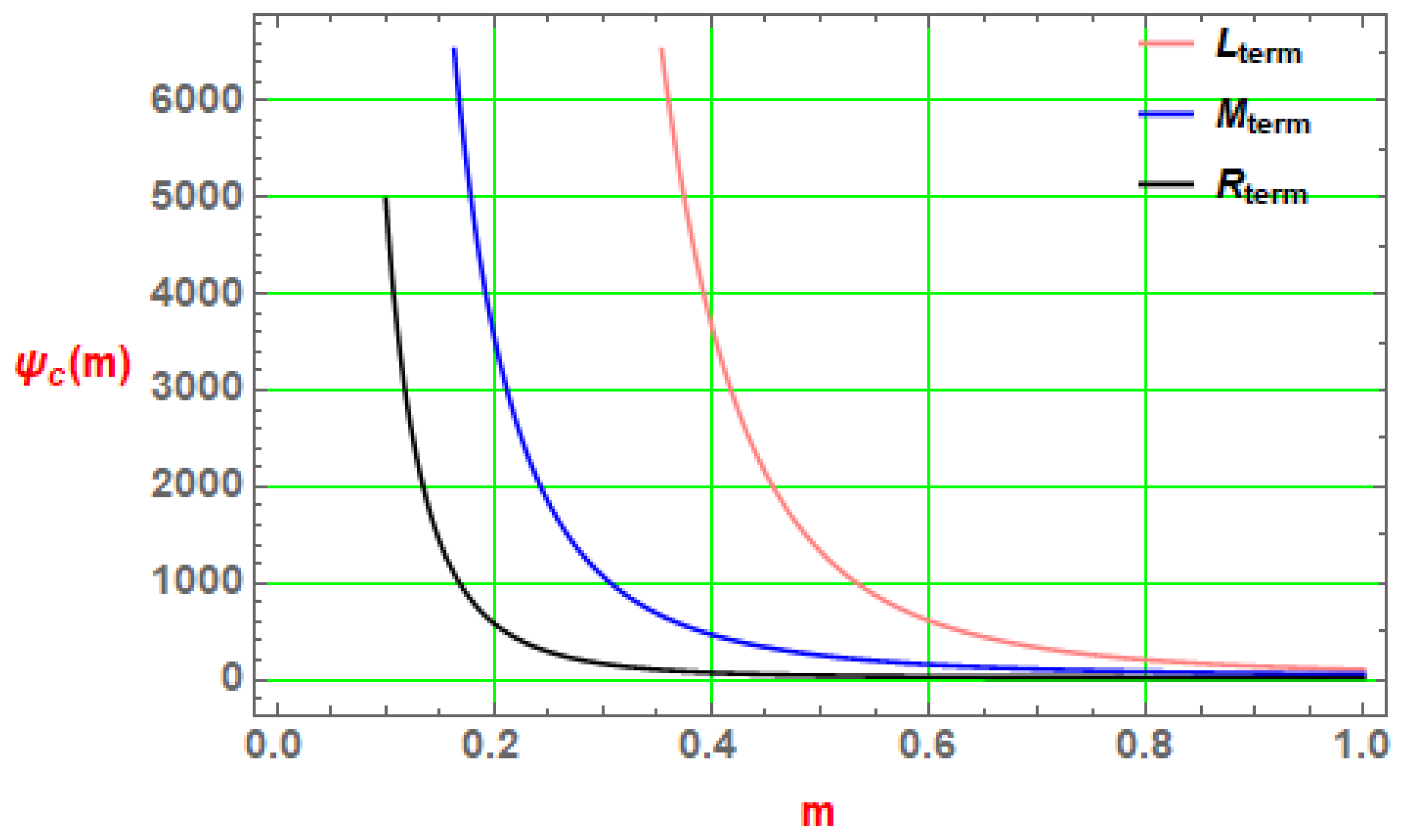
Similarly considering the function ψ c ( w ) = 3 w 3 2 , we get the following Figure 5 and Table 4 showing the authenticity of Theorem 9.

4. Applications to Information Theory

The task of distinguishing between two probability distributions is fundamental in fields such as statistics, information theory, and machine learning. Divergence measures serve as quantitative instruments for evaluating the dissimilarity between probability distributions. In 1991, Lin [27] introduced a new class of divergence measures derived from Shannon entropy, a core concept in information theory employed to quantify both uncertainty and information content within a probability distribution. Lin’s divergence offered a principled, information theoretic approach to measuring distributional discrepancy. Building upon this work, Shioya and Da-te [28] extended Lin’s method in 1995 by introducing the HH   ψ -divergence. Their formulation leveraged the HH inequality, a classical mathematical result associated with convex functions, to establish a more general and flexible framework. As a result of this advancement, the applicability of divergence measures was greatly extended, facilitating novel analyses and insights into probability distributions.
In order to ensure clarity, we limit ourselves to the definitions that are relevant to the results obtained below.
Definition 9
(Csiszár ψ -divergence [29]).
D ψ ( p o | | q o ) = q o ( w ) ψ p o ( w ) q o ( w ) d μ ( w ) , p o , q o P .
Here, P represents the class of all probability densities with respect to a σ-finite measure δ, , and ψ is convex on ( 0 , + ) .
P = p o | p o : , p o ( w ) 0 , p o ( w ) d μ ( w ) = 1 .
Remark 6.
Taking ψ to be a ( P , m ) -superquadratic function yields the Csiszár ψ-divergence for ( P , m ) -superquadratic functions.
Definition 10
( HH   ψ -divergence [30]).
D H H ψ ( p o | | q o ) = q o ( w ) 1 p o ( w ) q o ( w ) ψ ( w ) d w p o ( w ) q o ( w ) 1 d μ ( w ) , p o , q o P .
Definition 11
( RL fractional HH   ψ -divergence [31]).
D H H ψ γ ( p o | | q o ) = q o ( w ) ( I 1 + γ ψ ) p o ( w ) q o ( w ) + ( I p o ( w ) q o ( w ) γ ψ ( 1 ) ) 2 p o ( w ) q o ( w ) 1 γ d μ ( w ) , p o , q o P .
where Theorem 3, specifies the fractional integrals utilized in (76).
Remark 7.
By taking γ = 1 in (76), we recover (75).
We now establish the results associated with fractional HH -divergence and HH -divergence for cr -(P, m)-superquadratic IVF :
Theorem 10.
Let ψ : J × , on J ( 0 , ) , is a cr -(P, m)-superquadratic IVF and ψ ( 1 ) = 0 , then
S D ψ 1 2 q o + 1 2 p o | | q o + η 1 c r 2 S D H H ψ ( p o | | q o ) c r 2 S D ψ ( p o | | q o ) η 2 .
p o , q o P , where
S D H H ψ ( p o | | q o ) = q o ( w ) p o ( w ) q o ( w ) 1 1 p o ( w ) q o ( w ) ψ w d w d μ ( w ) , η 1 = q o ( w ) ( 2 ) p o ( w ) q o ( w ) 1 1 p o ( w ) q o ( w ) ψ | q o ( w ) + p o ( w ) 2 q o ( w ) w | d w d μ ( w ) ,
and
η 2 = { q o ( w ) p o ( w ) q o ( w ) 1 ( 1 p o ( w ) q o ( w ) ( ψ | ( w 1 ) ( p o ( w ) q o ( w ) m ) m ( p o ( w ) q o ( w ) 1 ) | + m ψ | ( p o ( w ) q o ( w ) w ) ( p o ( w ) q o ( w ) m ) m ( p o ( w ) q o ( w ) 1 ) | + m ψ | ( p o ( w ) q o ( w ) w ) ( p o ( w ) q o ( w ) m ) m 2 ( p o ( w ) q o ( w ) 1 ) | + m 2 ψ | ( w 1 ) ( p o ( w ) q o ( w ) m ) m 2 ( p o ( w ) q o ( w ) 1 ) | ) d w ) d μ ( w ) } .
Proof. 
The HH -type inequalities for cr -(P, m)-superquadratic IVF , as stated in Theorem 8, are considered.
ψ δ o + τ o 2 + 1 + m τ o δ o δ o τ o ψ | ( δ o + τ o ) ( m + 1 ) w 2 m | d w c r 1 τ o δ o δ o τ o ψ ( w ) d w + m δ o m τ o m ψ ( w ) d w c r ψ ( δ o ) + m ψ τ o m + ψ δ o m + ψ τ o m 2 1 τ o δ o { δ o τ o ( ψ | ( w δ o ) ( τ o m δ o ) m ( τ o δ o ) | + m ψ | ( τ o w ) ( τ o m δ o ) m ( τ o δ o ) | + m ψ | ( τ o w ) ( τ o m δ o ) m 2 ( τ o δ o ) | + m 2 ψ | ( w δ o ) ( τ o m δ o ) m 2 ( τ o δ o ) | ) d w } .
Now setting δ o = 1 , and τ o = p o ( w ) q o ( w ) , in (78), we obtain
ψ q o ( w ) + p o ( w ) 2 q o ( w ) + 1 + m p o ( w ) q o ( w ) 1 1 p o ( w ) q o ( w ) ψ | q o ( w ) + p o ( w ) 2 m q o ( w ) ( m + 1 ) w 2 m | d w c r 1 p o ( w ) q o ( w ) 1 1 p o ( w ) q o ( w ) ψ ( w ) d w + m 1 m p o ( w ) m q o ( w ) ψ w d w c r ψ ( 1 ) + m ψ p o ( w ) m q o ( w ) + ψ 1 m + ψ p o ( w ) m 2 q o ( w ) 1 p o ( w ) q o ( w ) 1 { 1 p o ( w ) q o ( w ) ( ψ ( w 1 ) p o ( w ) q o ( w ) m m p o ( w ) q o ( w ) 1 + m ψ | ( p o ( w ) q o ( w ) w ) ( p o ( w ) q o ( w ) m ) m ( p o ( w ) q o ( w ) 1 ) | + m ψ | ( p o ( w ) q o ( w ) w ) ( p o ( w ) q o ( w ) m ) m 2 ( p o ( w ) q o ( w ) 1 ) | + m 2 ψ | ( w 1 ) ( p o ( w ) q o ( w ) m ) m 2 ( p o ( w ) q o ( w ) 1 ) | ) d w } .
Since ψ ( 1 ) = 0 , it follows that
ψ q o ( w ) + p o ( w ) 2 q o ( w ) + 1 + m p o ( w ) q o ( w ) 1 1 p o ( w ) q o ( w ) ψ | q o ( w ) + p o ( w ) 2 m q o ( w ) ( m + 1 ) w 2 m | d w c r 1 p o ( w ) q o ( w ) 1 1 p o ( w ) q o ( w ) ψ ( w ) d w + m 1 m p o ( w ) m q o ( w ) ψ w d w c r m ψ p o ( w ) m q o ( w ) + ψ 1 m + ψ p o ( w ) m 2 q o ( w ) 1 p o ( w ) q o ( w ) 1 { 1 p o ( w ) q o ( w ) ( ψ ( w 1 ) p o ( w ) q o ( w ) m m p o ( w ) q o ( w ) 1 + m ψ | ( p o ( w ) q o ( w ) w ) ( p o ( w ) q o ( w ) m ) m ( p o ( w ) q o ( w ) 1 ) | + m ψ | ( p o ( w ) q o ( w ) w ) ( p o ( w ) q o ( w ) m ) m 2 ( p o ( w ) q o ( w ) 1 ) | + m 2 ψ | ( w 1 ) ( p o ( w ) q o ( w ) m ) m 2 ( p o ( w ) q o ( w ) 1 ) | ) d w } .
For all w , multiply both sides of (80) by q o ( w ) 0 and integrate over ℧ to obtain
q o ( w ) ψ q o ( w ) + p o ( w ) 2 q o ( w ) d μ ( w ) + q o ( w ) ( 1 + m ) p o ( w ) q o ( w ) 1 1 p o ( w ) q o ( w ) ψ | q o ( w ) + p o ( w ) 2 m q o ( w ) ( m + 1 ) w 2 m | d w d μ ( w ) c r q o ( w ) p o ( w ) q o ( w ) 1 1 m p o ( w ) q o ( w ) ψ ( w ) d w d μ ( w ) + m q o ( w ) p o ( w ) q o ( w ) 1 1 m p o ( w ) m q o ( w ) ψ w d w d μ ( w ) c r m { q o ( w ) ψ p o ( w ) m q o ( w ) d μ ( w ) + q o ( w ) ψ 1 m d μ ( w ) + q o ( w ) ψ p o ( w ) m 2 q o ( w ) d μ ( w ) } { q o ( w ) p o ( w ) q o ( w ) 1 ( 1 p o ( w ) q o ( w ) ( ψ | ( w 1 ) ( p o ( w ) q o ( w ) m ) m ( p o ( w ) q o ( w ) 1 ) | + m ψ | ( p o ( w ) q o ( w ) w ) ( p o ( w ) q o ( w ) m ) m ( p o ( w ) q o ( w ) 1 ) | + m ψ | ( p o ( w ) q o ( w ) w ) ( p o ( w ) q o ( w ) m ) m 2 ( p o ( w ) q o ( w ) 1 ) | + m 2 ψ | ( w 1 ) ( p o ( w ) q o ( w ) m ) m 2 ( p o ( w ) q o ( w ) 1 ) | ) d w ) d μ ( w ) } .
Hence, the desired conclusion follows from the definitions of divergence and HH -divergence. □
Theorem 11.
Let ψ : J × R , on J ( 0 , ) , is a cr -(P, m)-superquadratic IVF and ψ ( 1 ) = 0 , then
S D ψ 1 2 q o + 1 2 p o | | q o Γ ( 1 + γ ) + 2 γ ( 1 + m ) τ 1 Γ ( 1 + γ ) c r 2 S D m H H ψ γ ( p o | | q o ) c r m Γ ( 1 + γ ) S D ψ ( p o | | m q o ) + q o ( w ) ψ 1 m d μ ( w ) + m γ S D ψ ( p o | | m 2 q o ) γ τ 2 Γ ( 1 + γ ) .
p o , q o P , and γ > 0 , where
S D m H H ψ γ ( p o | | q o ) = q o ( w ) 2 p o ( w ) q o ( w ) 1 γ [ I 1 + γ ψ p o ( w ) q o ( w ) + m γ I p o ( w ) m q o ( w ) γ ψ 1 m ] d μ ( w ) ,
τ 1 = q o ( w ) p o ( w ) q o ( w ) 1 γ 1 q o ( w ) + p o ( w ) 2 q o ( w ) p o ( w ) q o ( w ) w γ 1 ψ | ( 1 + p o ( w ) q o ( w ) ) ( m + 1 ) w 2 m | d w d μ ( w ) ,
and
τ 2 = q o ( w ) p o ( w ) q o ( w ) 1 γ ( 1 p o ( w ) q o ( w ) p o ( w ) q o ( w ) w γ 1 ( ψ | ( w 1 ) ( p o ( w ) q o ( w ) m ) m ( p o ( w ) q o ( w ) 1 ) | + m ψ | ( p o ( w ) q o ( w ) w ) ( p o ( w ) q o ( w ) m ) m ( p o ( w ) q o ( w ) 1 ) | + m ψ | ( p o ( w ) q o ( w ) w ) ( p o ( w ) q o ( w ) m ) m 2 ( p o ( w ) q o ( w ) 1 ) | + m 2 ψ | ( w 1 ) ( p o ( w ) q o ( w ) m ) m 2 ( p o ( w ) q o ( w ) 1 ) | ) d w ) d μ ( w ) .
Proof. 
Theorem 9 presents fractional HH -type inequalities for cr -(P, m)-superquadratic IVF formulated using RL integral operators of order γ > 0 .
ψ δ o + τ o 2 + 2 ( 1 + m ) γ ( τ o δ o ) γ δ o δ o + τ o 2 ( τ o w ) γ 1 ψ | ( δ o + τ o ) ( m + 1 ) w 2 m | d w c r Γ ( 1 + γ ) ( τ o δ o ) γ I δ o + γ ψ ( τ o ) + m γ I τ o m γ ψ δ o m c r ψ ( δ o ) + m ψ τ o m + ψ δ o m + ψ τ o m 2 γ ( τ o δ o ) γ { δ o τ o ( τ o w ) γ 1 ( ψ | ( w δ o ) ( τ o m δ o ) m ( τ o δ o ) | + m ψ | ( τ o w ) ( τ o m δ o ) m ( τ o δ o ) | + m ψ | ( τ o w ) ( τ o m δ o ) m 2 ( τ o δ o ) | + m 2 ψ | ( w δ o ) ( τ o m δ o ) m 2 ( τ o δ o ) | ) d w } ,
Now setting δ o = 1 , and τ o = p o ( w ) q o ( w ) , in (82), we obtain
ψ q o ( w ) + p o ( w ) 2 q o ( w ) + 2 γ ( 1 + m ) p o ( w ) q o ( w ) 1 γ × 1 q o ( w ) + p o ( w ) 2 q o ( w ) p o ( w ) q o ( w ) w γ 1 ψ | ( 1 + p o ( w ) q o ( w ) ) ( m + 1 ) w 2 m | d w c r Γ ( 1 + γ ) ( p o ( w ) q o ( w ) 1 ) γ I 1 + γ ψ p o ( w ) q o ( w ) + m γ I p o ( w ) m q o ( w ) γ ψ 1 m c r ψ ( 1 ) + m ψ p o ( w ) m q o ( w ) + ψ 1 m + ψ p o ( w ) m 2 q o ( w ) γ p o ( w ) q o ( w ) 1 γ { 1 p o ( w ) q o ( w ) p o ( w ) q o ( w ) w γ 1 ( ψ | ( w 1 ) ( p o ( w ) q o ( w ) m ) m ( p o ( w ) q o ( w ) 1 ) | + m ψ | ( p o ( w ) q o ( w ) w ) ( p o ( w ) q o ( w ) m ) m ( p o ( w ) q o ( w ) 1 ) | + m ψ | ( p o ( w ) q o ( w ) w ) ( p o ( w ) q o ( w ) m ) m 2 ( p o ( w ) q o ( w ) 1 ) | + m 2 ψ | ( w 1 ) ( p o ( w ) q o ( w ) m ) m 2 ( p o ( w ) q o ( w ) 1 ) | ) d w } .
Given that ψ ( 1 ) = 0 , it implies that
ψ q o ( w ) + p o ( w ) 2 q o ( w ) + 2 γ ( 1 + m ) p o ( w ) q o ( w ) 1 γ × 1 q o ( w ) + p o ( w ) 2 q o ( w ) p o ( w ) q o ( w ) w γ 1 ψ | ( 1 + p o ( w ) q o ( w ) ) ( m + 1 ) w 2 m | d w c r Γ ( 1 + γ ) ( p o ( w ) q o ( w ) 1 ) γ I 1 + γ ψ p o ( w ) q o ( w ) + m γ I p o ( w ) m q o ( w ) γ ψ 1 m c r m ψ p o ( w ) m q o ( w ) + ψ 1 m + ψ p o ( w ) m 2 q o ( w ) γ p o ( w ) q o ( w ) 1 γ { 1 p o ( w ) q o ( w ) p o ( w ) q o ( w ) w γ 1 ( ψ | ( w 1 ) ( p o ( w ) q o ( w ) m ) m ( p o ( w ) q o ( w ) 1 ) | + m ψ | ( p o ( w ) q o ( w ) w ) ( p o ( w ) q o ( w ) m ) m ( p o ( w ) q o ( w ) 1 ) | + m ψ | ( p o ( w ) q o ( w ) w ) ( p o ( w ) q o ( w ) m ) m 2 ( p o ( w ) q o ( w ) 1 ) | + m 2 ψ | ( w 1 ) ( p o ( w ) q o ( w ) m ) m 2 ( p o ( w ) q o ( w ) 1 ) | ) d w } .
Multiplying (83), both sides by q o ( w ) 0 , where w and then integrating the result on ℧, we obtain:
1 Γ ( 1 + γ ) q o ( w ) ψ q o ( w ) + p o ( w ) 2 q o ( w ) d μ ( w ) + 2 γ ( 1 + m ) Γ ( 1 + γ ) × q o ( w ) p o ( w ) q o ( w ) 1 γ 1 q o ( w ) + p o ( w ) 2 q o ( w ) p o ( w ) q o ( w ) w γ 1 ψ | ( 1 + p o ( w ) q o ( w ) ) ( m + 1 ) w 2 m | d w d μ ( w ) c r q o ( w ) p o ( w ) q o ( w ) 1 γ I 1 + γ ψ p o ( w ) q o ( w ) + m γ I p o ( w ) m q o ( w ) γ ψ 1 m d μ ( w ) c r m Γ ( 1 + γ ) { q o ( w ) ψ p o ( w ) m q o ( w ) d μ ( w ) + q o ( w ) ψ 1 m d μ ( w ) + q o ( w ) ψ p o ( w ) m 2 q o ( w ) d μ ( w ) } γ Γ ( 1 + γ ) { q o ( w ) p o ( w ) q o ( w ) 1 γ ( 1 p o ( w ) q o ( w ) p o ( w ) q o ( w ) w γ 1 ( ψ | ( w 1 ) ( p o ( w ) q o ( w ) m ) m ( p o ( w ) q o ( w ) 1 ) | + m ψ | ( p o ( w ) q o ( w ) w ) ( p o ( w ) q o ( w ) m ) m ( p o ( w ) q o ( w ) 1 ) | + m ψ | ( p o ( w ) q o ( w ) w ) ( p o ( w ) q o ( w ) m ) m 2 ( p o ( w ) q o ( w ) 1 ) | + m 2 ψ | ( w 1 ) ( p o ( w ) q o ( w ) m ) m 2 ( p o ( w ) q o ( w ) 1 ) | ) d w ) d μ ( w ) } .
Employing the definitions of divergence, HH -divergence and RL fractional HH -divergence, consequently, the stated result is established. □
Remark 8.
The result of Theorem 10 follows directly by taking γ = 1 in Theorem 11.

5. Conclusions

In this study, we introduced and systematically developed a novel class of cr - ( P , m ) -superquadratic IVF and investigated their fundamental structural properties. By employing these properties, we successfully derived new forms of Jensen and HH -type inequalities, along with their fractional counterparts involving the RL fractional integral operators within the framework of interval calculus. The analytical results were further validated through illustrative numerical computations and graphical demonstrations, confirming the robustness and generality of the proposed approach. Additionally, applications to information theory highlight the theoretical significance and practical relevance of the presented findings. The developed results not only generalize but also refine several existing inequalities reported in the literature, thereby enriching the landscape of modern inequality theory and fractional analysis.
Future research may proceed in several promising directions.
Problem 1.
Fractional Inequalities of cr - ( P , m ) -superquadratic IVF via Generalized Proportional Fractional Operators.
Problem 2.
Fractional Perspective of cr - ( P , m ) -superquadratic IVF via Katugampola Fractional Operators.
Problem 3.
Fractional Variants of cr - ( P , m ) -superquadratic IVF via Atangana-Baleanu Fractional Operators.
Problem 4.
Fractional Estimates of cr - ( P , m ) -superquadratic IVF via Conformable Fractional Operators.
Another potential avenue is to investigate stochastic, fuzzy, or quantum variants of these inequalities, which may uncover deeper insights into uncertainty modeling and quantum information theory. Moreover, extending the established results to multi-dimensional or operator-valued settings could open up further applications in functional analysis, optimization, and applied mathematical modeling.


Author Contributions

Conceptualization, S.I.B. and Y.S.; methodology, D.K. and S.I.B.; software, A.Y.; validation, S.I.B., D.K., and Y.S.; formal analysis, D.K.; investigation, A.Y. and D.K.; writing—original draft preparation, D.K.; writing—review and editing, S.I.B. and D.K.; visualization, A.Y.; supervision, Y.S.; project administration, Y.S.; funding acquisition, Y.S. All authors have read and agreed to the published version of the manuscript.

Funding

This research received no external funding.

Data Availability Statement

Data are contained within the article.

Acknowledgments

This work was supported by the Dong-A University research fund. This research was supported by the Global-Learning Academic Research Institution for Master’s-PhD Students and Postdocs (LAMP) Program of the National Research Foundation of Korea (NRF) grant funded by the Ministry of Education (RS-2025-25440216).

Conflicts of Interest

The authors declare no conflicts of interest.

References

  1. Niculescu, C.P.; Persson, L.E. Convex Functions and Their Applications: A Contemporary Approach, 2nd ed.; Springer: New York, NY, USA, 2018. [Google Scholar]
  2. Abramovich, S.; Jameson, G.; Sinnamon, G. Refining Jensen’s inequality. Bull. Math. Sci. Math. Roum. 2004, 47, 3–14. [Google Scholar]
  3. Banić, S.; Pečarić, J.; Varošanec, S. Superquadratic functions and refinements of some classical inequalities. J. Korean Math. Soc. 2008, 45, 513–525. [Google Scholar] [CrossRef]
  4. Li, G.; Chen, F. Hermite-Hadamard type inequalities for superquadratic functions via fractional integrals. Abstr. Appl. Anal. 2014, 2014, 851271. [Google Scholar] [CrossRef]
  5. Bari, J.; Pečarić, D.; Pečarić, J. Superquadratic functions in information theory. J. Math. Inequalities 2020, 14, 1321–1331. [Google Scholar] [CrossRef]
  6. Alomari, M.W.; Chesneau, C. On h-superquadratic functions. Afr. Mat. 2022, 33, 41. [Google Scholar] [CrossRef]
  7. Krnić, M.; Moradi, H.R.; Sababheh, M. On logarithmically superquadratic functions. Mediterr. J. Math. 2023, 20, 2–18. [Google Scholar] [CrossRef]
  8. Khan, D.; Butt, S.I.; Seol, Y. Analysis of (P,m)-superquadratic function and related fractional integral inequalities with applications. J. Inequalities Appl. 2024, 2024, 137. [Google Scholar] [CrossRef]
  9. Butt, S.I.; Khan, D. Superquadratic function and its applications in information theory via interval calculus. Chaos Solitons Fractals 2025, 190, 115748. [Google Scholar] [CrossRef]
  10. Abramovich, S.; Jameson, G.; Sinnamon, G. Inequalities for averages of convex and superquadratic functions. J. Inequalities Pure Appl. Math. 2004, 5, 91. [Google Scholar]
  11. Abramovich, S. On superquadraticity. J. Math. Inequalities 2009, 3, 329–339. [Google Scholar] [CrossRef]
  12. Valdés, J.E.N.; Rabossi, F.; Samaniego, A.D. Convex functions: Ariadne’s thread or Charlotte’s Spiderweb? Adv. Math. Model. Appl. 2020, 5, 176–191. [Google Scholar]
  13. Vivas-Cortez, M.; Kérus, P.; Valdés, J.E.N. Some generalized Hermite-Hadamard-Fejér inequality for convex functions. Adv. Differ. Equ. 2021, 2021, 199. [Google Scholar] [CrossRef]
  14. Zhang, L.; Peng, Y.; Du, T. On multiplicative Hermite-Hadamard- and Newton-type inequalities for multiplicatively (P, m)-convex functions. J. Math. Anal. Appl. 2024, 534, 128117. [Google Scholar] [CrossRef]
  15. Moore, R.E. Interval Analysis; Prentice Hall: Englewood Cliffs, NJ, USA, 1966; Volume 4, pp. 8–13. [Google Scholar]
  16. Chalco-Cano, Y.; Flores-Franulič, A.; Román-Flores, H. Ostrowski type inequalities for interval-valued functions using generalized Hukuhara derivative. Comput. Appl. Math. 2012, 31, 457–472. [Google Scholar]
  17. Flores-Franulič, A.; Chalco-Cano, Y.; Román-Flores, H. An Ostrowski type inequality for interval-valued functions. In 2013 Joint IFSA World Congress and NAFIPS Annual Meeting (IFSA/NAFIPS); IEEE: Piscataway, NJ, USA, 2013; Volume 35, pp. 1459–1462. [Google Scholar]
  18. Costa, T.M.; Román-Flores, H.; Chalco-Cano, Y. Opial-type inequalities for interval-valued functions. Fuzzy Sets Syst. 2019, 358, 48–63. [Google Scholar] [CrossRef]
  19. Zhao, D.; An, T.; Ye, G.; Liu, W. New Jensen and Hermite-Hadamard type inequalities for h-convex interval-valued functions. J. Inequalities Appl. 2018, 2018, 302. [Google Scholar] [CrossRef]
  20. Khan, M.B.; Noor, M.A.; Mohammed, P.O.; Guirao, J.L.G.; Noor, K.I. Some integral inequalities for generalized convex fuzzy-interval-valued functions via fuzzy Riemann integrals. Int. J. Comput. Intell. Syst. 2021, 14, 158. [Google Scholar] [CrossRef]
  21. Bhunia, A.; Samanta, S. A study of interval metric and its application in multi-objective optimization with interval objectives. Comput. Ind. Eng. 2014, 74, 169–178. [Google Scholar] [CrossRef]
  22. Khan, D.; Butt, S.I. Superquadraticity and its fractional perspective via center-radius cr-order relation. Chaos Solitons Fractals 2024, 182, 114821. [Google Scholar] [CrossRef]
  23. Markov, S. Calculus for interval functions of a real variable. Computing 1979, 22, 325–337. [Google Scholar] [CrossRef]
  24. Karmakar, S.; Mahato, S.K.; Bhunia, A.K. Interval oriented multi-section techniques for global optimization. J. Comput. Appl. Math. 2009, 224, 476–491. [Google Scholar] [CrossRef]
  25. Zhao, D.; Ye, G.; Liu, W.; Torres, D.F. Some inequalities for interval-valued functions on time scales. Soft Comput. 2019, 23, 6005–6015. [Google Scholar] [CrossRef]
  26. Sahoo, S.K.; Latif, M.A.; Alsalami, O.M.; Treantǎ, S.; Sudsutad, W.; Kongson, J. Hermite-Hadamard, Fejér and Pachpatte-Type Integral Inequalities for Center-Radius Order Interval-Valued Preinvex Functions. Fractal Fract. 2022, 6, 506. [Google Scholar] [CrossRef]
  27. Lin, J. Divergence measures based on the Shannon entropy. IEEE Trans. Inf. Theory 1991, 37, 145–151. [Google Scholar] [CrossRef]
  28. Shioya, H.; Da-Te, T. A generalization of Lin divergence and the derivation of a new information divergence. Electron. Commun. Jpn. (Part III Fundam. Electron. Sci.) 1995, 78, 34–40. [Google Scholar] [CrossRef]
  29. Csiszár, I. Information-type measures of difference of probability distributions and indirect observations. Stud. Sci. Math. Hung. 1967, 2, 299–318. [Google Scholar] [CrossRef]
  30. Basu, A.; Shioya, H.; Park, C. Statistical Inference: The Minimum Distance Approach; Chapman & Hall/CRC Monographs on Statistics & Applied Probability; CRC Press: Boca Raton, FL, USA, 2011. [Google Scholar]
  31. Agahi, H.; Yadollahzadeh, M. A generalization of HH f-divergence. J. Comput. Appl. Math. 2018, 343, 309–317. [Google Scholar] [CrossRef]
Figure 1. Graphical description of ψ ( w ) = ψ c , ψ r via Definition 8. (a) δ o and τ o are fixed while m and ρ are varies such that δ o = 2 , τ o = 3 , m ( 0 , 1 ] and ρ ( 0 , 1 ) for ψ c . (b) m and ρ are varied while δ o and τ o are fixed such that m ( 0 , 1 ] , ρ ( 0 , 1 ) , δ o = 2 and τ o = 3 for ψ r .
Fractalfract 10 00264 g001
Figure 2. Graphical description of ψ r ( w ) = w 3 2 via Theorem 8 for δ o = 2 , τ o = 3 and m ( 0 , 1 ] .
Fractalfract 10 00264 g002
Figure 3. Graphical description of ψ c ( w ) = 3 w 3 2 via Theorem 8 for δ o = 2 , τ o = 3 and m ( 0 , 1 ] .
Fractalfract 10 00264 g003
Figure 4. Graphical description of ψ r ( w ) = w 3 2 via Theorem 9 for δ o = 2 , τ o = 3 , γ = 0.6 and m ( 0 , 1 ] .
Fractalfract 10 00264 g004
Figure 5. Graphical description of ψ c ( w ) = 3 w 3 2 via Theorem 9 for δ o = 2 , τ o = 3 , γ = 0.6 and m ( 0 , 1 ] .
Fractalfract 10 00264 g005
Table 1. Numerical description of ψ r ( w ) = w 3 2 via Theorem 8 for δ o = 2 , τ o = 3 and m ( 0 , 1 ] .
m L term M term R term
0.11659.769402.021.12027 × 10 6
0.2193.9561183.4735,374.7
0.355.5304357.2654822.68
0.424.471156.151222.89
0.514.524384.531443.538
0.610.696552.8744204.199
0.79.069436.7738111.501
0.88.347127.73569.0718
0.98.026822.274347.0432
1.07.890918.782634.4327
Table 2. Numerical description of ψ c ( w ) = 3 w 3 2 via Theorem 8 for δ o = 2 , τ o = 3 and m ( 0 , 1 ] .
m L term M term R term
0.14979.2728,206.13.3608 × 10 6
0.2581.8673550.41106,124
0.3166.5911071.814,468
0.473.4129468.4493668.66
0.543.5759253.5931330.62
0.632.0894158.623612.597
0.727.2082110.321334.503
0.825.041483.2049207.215
0.924.080666.8228141.13
1.023.672856.3479103.298
Table 3. Numerical description of ψ r ( w ) = w 3 2 via Theorem 9 for δ o = 2 , τ o = 3 , γ = 0.6 and m ( 0 , 1 ] .
m L term M term R term
0.11127.718133.131.0469 × 10 6
0.2123.8191023.7534,060.7
0.335.3573309.0514746.36
0.416.7789135.0781220.65
0.511.202173.125446
0.69.1865745.7407205.822
0.78.3807631.813112.322
0.88.0431623.994169.4525
0.97.9012219.270447.2093
1.07.8437516.2534.5
Table 4. Numerical description of ψ c ( w ) = 3 w 3 2 via Theorem 9 for δ o = 2 , τ o = 3 , γ = 0.6 and m ( 0 , 1 ] .
m L term M term R term
0.13383.1324,399.43.14069 × 10 6
0.2371.4563071.25102,182
0.3106.072927.15314,239.1
0.450.3366405.2343661.94
0.533.6064219.3751338
0.627.5597137.222617.467
0.725.142395.4391336.965
0.824.129571.9824208.357
0.923.703757.8112141.628
1.023.531348.75103.5
Disclaimer/Publisher’s Note: The statements, opinions and data contained in all publications are solely those of the individual author(s) and contributor(s) and not of MDPI and/or the editor(s). MDPI and/or the editor(s) disclaim responsibility for any injury to people or property resulting from any ideas, methods, instructions or products referred to in the content.