Article

Stability of a Fractional HIV/AIDS Epidemic Model with Drug Control by Continuous-Time Random Walk

1
School of Mathematical Sciences, Inner Mongolia University, Hohhot 010021, China
2
School of Mathematics and Statistics, Beijing Jiaotong University, Beijing 100044, China
*
Author to whom correspondence should be addressed.
Fractal Fract. 2026, 10(4), 248; https://doi.org/10.3390/fractalfract10040248
Submission received: 13 March 2026 / Revised: 5 April 2026 / Accepted: 7 April 2026 / Published: 9 April 2026
(This article belongs to the Special Issue Fractional Calculus and Nonlinear Analysis: Theory and Applications)

Abstract

In recent years, fractional HIV models have received increasing attention. This study derives a fractional HIV model using the continuous-time random walk (CTRW) method, endowing the mathematical model with physical significance. Based on the transmission characteristics of HIV, the proposed model considers extrinsic infectivity, intrinsic infectivity, and drug control, specifically as follows: the extrinsic infectivity is a constant independent of the infection time; the intrinsic infectivity is a power-law function that depends on drug efficacy and infection time; the drug efficacy rate follows a Mittag–Leffler distribution with a long-term effect. Based on these considerations, a fractional HIV model with drug control is established in this paper. In addition, the global asymptotic stability of the equilibrium and the sensitivity analysis of the basic reproduction number R 0 are studied, and the theoretical results are verified by numerical simulations. The results show that reducing extrinsic infectivity, controlling intrinsic infectivity, and the drug efficacy rate are crucial in controlling the spread of HIV.

1. Introduction

Human Immunodeficiency Virus (HIV) is the pathogen that causes Acquired Immunodeficiency Syndrome (AIDS). It attacks C D 4 + T lymphocytes in the human body, gradually impairing the immune function of infected individuals and leading to various severe opportunistic infections and tumors. It is mainly transmitted through sexual contact, blood exposure, and mother-to-child transmission [1]. There are approximately 38.4 million infected people worldwide, making the prevention and control of HIV transmission a persistent public health challenge [2]. Mathematically, integer-order differential models have been established to describe the transmission of HIV [3,4,5]: for example, Li et al. constructed an integer-order differential equation model [3]; Hyman et al. proposed an integer-order homogeneous AIDS model [4]; Huo et al. have fully characterized the entire course of HIV from infection to onset of the disease [5].
With the advancement of science and technology, Antiretroviral Therapy (ART) has been widely applied in the clinical treatment of HIV [6], which effectively suppresses viral replication in vivo, maintains viral load at an extremely low level, delays disease progression, improves the quality of life of infected individuals, and prolongs their survival time [7]. Mathematically, to describe HIV transmission with ART control, researchers typically abstract ART treatment as a compartment T to establish coupled differential equations [8,9,10]: for example, Yusuf et al. proposed the application of ART in the HIV epidemic model [8]; Silva et al. also proposed an integer-order HIV/AIDS transmission model that incorporates treatment factors [9].
It is obvious that the transmission characteristics of HIV do not depend solely on the current viral activity and host status; the past infection process and the historical persistence of the virus in the body are equally important [11]. However, the integer-order HIV models only describe the current state and are difficult to characterize features such as memory, non-locality, and long-term dependence in the transmission process of HIV [12]. To overcome these difficulties, scholars consider fractional HIV models [13,14,15,16,17]: for example, Alharbi et al. proposed a fractional HIV transmission dynamics model with treatment [14]; Mangal et al. proposed a deterministic fractional epidemic model [15]; Silva et al. studied and explored the Caputo fractional HIV/AIDS model with treatment and investigated the stability of the model [17].
Despite these advances, most existing fractional HIV models are not derived from the actual HIV transmission process; they merely replace integer-order derivatives with fractional derivatives without being deduced from the fundamental microscopic processes of HIV transmission. Angstmann et al. established epidemic models based on the spread of diseases using the CTRW method, demonstrating how fractional derivatives naturally emerge through CTRW [18,19]. By introducing the probability distributions of waiting times and jump lengths, and performing Fourier–Laplace transforms, CTRW can convert microscopic processes into macroscopic fractional equations, enabling the construction of various models [20]. For instance, Angstmann et al. utilized the CTRW method to illustrate the physical processes of the SIR model from different perspectives, including those of infected individuals and recovered individuals [21]. Furthermore, Wang et al. established the SIS and SIRS models of infectious diseases based on CTRW and proved the global stability of the equilibrium [22,23]. In light of the transmission characteristics of HIV, this paper aims to establish a model that truly describes HIV transmission using CTRW and endow fractional derivatives with physical meanings related to HIV transmission.
Based on the above work, the main innovations of this paper are summarized as follows:
  • Based on extrinsic infectivity, intrinsic infectivity, and drug control, a fractional HIV model is established using CTRW.
  • Taking into account the long-term efficacy of ART, the drug efficacy rate with a heavy-tail distribution is considered in this paper.
  • Based on the transmission characteristics of HIV and the therapeutic effects of ART, this paper studies the intrinsic infectivity, which depends on the drug effect and the long-term infection.
  • Theoretically, the boundedness of the proposed fractional HIV model, the basic reproduction number, the conditions for the existence of equilibriums, and the global stability of the equilibrium are analyzed.
  • Numerical simulations have verified the correctness of the theoretical results, which indicate that reducing extrinsic infectivity, controlling intrinsic infectivity, and the drug efficacy rate are crucial for controlling the spread of HIV.
The structure of this paper is as follows. The basic definitions and lemmas are given in Section 2. The model and the basic properties are derived in Section 3. The local and global asymptotic stabilities of the equilibrium are proved in Section 4. Numerical simulations are carried out in Section 5. Finally, Section 6 provides the conclusions.

2. Preliminaries

This section begins with some definitions and lemmas.
Definition 1
([24]). The Riemann–Liouville fractional derivative is defined by
D t p a f ( t ) = 1 Γ ( n p ) d n d t n a t ( t τ ) n p 1 f ( τ ) d τ , ( n 1 p < n ) ,
where Γ ( n p ) is the Gamma function.
In particular, when 0 < p < 1 , the Riemann–Liouville fractional derivative is as follows:
D t p a f ( t ) = 1 Γ ( 1 p ) d d t a t f ( τ ) ( t τ ) p d τ , ( 0 < p < 1 ) .
Definition 2
([24]). The two-parameter Mittag–Leffler function E α , β ( z ) is defined by
E α , β ( z ) = k = 0 z k Γ ( α k + β ) .
Lemma 1
([24]). The Laplace transform of the Riemann–Liouville fractional derivative of a function f ( t ) is given by
L { 0 D t p f ( t ) ; u } = u p F ( u ) k = 0 n 1 u k D t p k 1 0 f ( t ) t = 0 , ( n 1 p < n ) .
Remark 1.
When 0 < p < 1 , the Riemann–Liouville fractional derivative of a continuous function f ( t ) is as follows:
D t p 0 f ( t ) = 0 t L 1 u p f ( t t ) d t , ( 0 < p < 1 ) .
Proof. 
According to Lemma 1, the following formula holds:
L { 0 D t p f ( t ) ; u } = u p F ( u ) I 0 + 1 p f ( t ) t = 0 , ( 0 < p < 1 ) ,
where I 0 + 1 p f ( t ) is the Riemann–Liouville fractional integral I 0 + 1 p f ( t ) = 1 Γ ( 1 p ) 0 t f ( τ ) ( t τ ) p d τ , ( 0 < p < 1 ) .
According to [25], and since f ( t ) is a continuous function in [0, t], I 0 + 1 p f ( t ) t = 0 can be simplified to the following form:
I 0 + 1 p f ( t ) t = 0 = lim t 0 I 0 + 1 p f ( t ) = Γ ( p ) lim t 0 t 1 p f ( t ) = Γ ( p ) lim t 0 t 1 p lim t 0 f ( t ) = 0 .
Then the Riemann–Liouville fractional derivative is as follows: D t p 0 f ( t ) = 0 t L 1 u p f ( t t ) d t .
Lemma 2
([24]). For the function t α k + β 1 E α , β ( k ) ( ± z t α ) , the specific form of the Laplace transform can be expressed as follows:
L t α k + β 1 E α , β ( k ) ( ± a t α ; u ) = k ! u α β ( u α a ) k + 1 ,
where E α , β ( k ) ( y ) d k d y k E α , β ( y ) .
Lemma 3
([18]). For the function e q t D t p 0 ( f ( t ) e q t ) , the specific form of the Laplace transform is given by
L e q t D t p 0 f ( t ) e q t ; u = L f ( t ) ( u + q ) p .
Lemma 4
([24]). The Riemann–Liouville fractional derivative of t α k + β 1 E α , β ( k ) ( λ t α ) is given as follows:
D t p 0 ( t α k + β 1 E α , β ( k ) ( λ t α ) ) = t α k + β p 1 E α , β p ( k ) ( λ t α ) .
Definition 3
([25]). The α-exponential function is defined by
e α η t = t α 1 E α , α ( η t α ) , η C .
Lemma 5
([25]). There is the following relationship between the Riemann–Liouville fractional derivative and the α-exponential function:
D t p 0 e p η t = η e p η t .
Lemma 6
((Comparison theorem) [26]). Consider the following two scalar ordinary differential equations:
d x ( t ) d t = f t , x ( t ) , x ( 0 ) = x 0 ,
and
d y ( t ) d t = g t , y ( t ) , y ( 0 ) = y 0 ,
where x ( t ) , y ( t ) R are scalar state variables, and f , g : [ 0 , + ) × R R are continuous. If x 0 y 0 and f ( t , x ( t ) ) g ( t , y ( t ) ) for all t 0 , then x ( t ) y ( t ) holds for all t 0 .
Lemma 7
((Descartes’ Rule of Signs) [27]). Let P ( x ) = a n x n + a n 1 x n 1 + + a 1 x + a 0 be a polynomial with real coefficients. There are the following two cases for judging the positivity and negativity of the roots for the polynomial P ( t ) :
(I) 
Positive Roots: The number of positive real roots of P ( x ) is either equal to the number of sign changes in the sequence of its coefficients a n , a n 1 , , a 0 or less than that by a positive even integer.
(II) 
Negative Roots: The number of negative real roots of P ( x ) is either equal to the number of sign changes in the sequence of coefficients of P ( x ) or less than that by a positive even integer.
Definition 4
([3]). For the matrix A = a 11 a 12 a 13 a 21 a 22 a 23 a 31 a 32 a 33 , the second additive compound matrix A [ 2 ] is given by
A [ 2 ] = a 11 + a 22 a 23 a 13 a 32 a 11 + a 33 a 12 a 31 a 21 a 22 + a 33 .
Definition 5
([3]). For the matrix A = a 11 a 12 a 13 a 14 a 21 a 22 a 23 a 24 a 31 a 32 a 33 a 34 a 41 a 42 a 43 a 44 , the second additive compound matrix A [ 2 ] is given by
A [ 2 ] = a 11 + a 22 a 23 a 24 a 13 a 14 0 a 32 a 11 + a 33 a 34 a 12 0 a 14 a 42 a 43 a 11 + a 44 0 a 12 a 13 a 31 a 21 0 a 22 + a 33 a 34 a 24 a 41 0 a 21 a 43 a 22 + a 44 a 23 0 a 41 a 31 a 42 a 32 a 33 + a 44 .
Lemma 8
([3]). Let J be an m × m real matrix. Assume the following conditions hold:
(I)  
The second compound matrix J [ 2 ] of the matrix J is stable;
(II)  
( 1 ) m det ( J ) > 0 ,
where det ( J ) denotes the determinant of matrix J. Then the matrix J is stable.
Lemma 9
((Poincaré–Bendixson property) [28]). If Ω is a limit set corresponding to the model d Z d t = f ( Z ) , and the limit set satisfies the three conditions of being non-empty, closed, and bounded, and there is no equilibrium of the model in Ω, then Ω must be a closed orbit.
Lemma 10
((Global-stability principle) [22]). Let Z f ( Z ) R n be a continuous function with continuous first derivatives, where Z belongs to the open set F R n . Consider the system of equations in R n :
d Z d t = f ( Z ) .
Assume the following conditions hold:
  • (H1) F is simply connected;
  • (H2) A compact absorbing set K F ;
  • (H3) The Poincaré–Bendixson property holds in model (3);
  • (H4) If Z * is stable, then Z * is the unique equilibrium of model (3) in F.
It can be concluded that the equilibrium point Z * of model (3) has global asymptotic stability within the set F.
If it is proven that Z * is the unique equilibrium of model (3), the key lies in excluding the existence of periodic solutions; that is, any periodic solution of model (3) is orbitally asymptotically stable.
Lemma 11
([22]). Suppose that d Z d t = f ( Z ) has a periodic solution Z ( t ) = q ( t ) with the orbit O = { q ( t ) : 0 t m } and the minimal period satisfies m > 0 , then the following linear system can be defined:
d Y ( t ) d t = f [ 2 ] Z q ( t ) Y ( t ) ,
where f [ 2 ] Z denotes the second additive compound matrix of the Jacobi matrix J for the function f ( Z ) . If a periodic orbit O = { q ( t ) : 0 t m } has an asymptotic phase and is asymptotically orbitally stable, then the model (4) is required to be asymptotically stable.

3. Model Description

In this section, the establishment of the HIV/AIDS model and some basic properties of the proposed model are introduced.

3.1. Model Establishment

In modeling HIV/AIDS, the most classic model is the S-I-A (susceptible–symptomatic–clinical) model [4]:
d S d t = μ ( S 0 S ( t ) ) λ ( t ) S ( t ) , d I d t = λ ( t ) S ( t ) ( μ + ν ) I ( t ) , d A d t = ν I ( t ) ( δ + μ ) A ( t ) ,
where μ S 0 is the input flow rate; μ is the natural death rate; ν is the AIDS infection rate; δ is the disease-induced death rate; λ ( t ) is the HIV infection rate given by λ ( t ) = β I ( t ) S ( t ) + I ( t ) ; β is the contact rate.
With the development of science and technology, ART treatment has been introduced into the treatment of HIV. It can enable infected individuals to maintain better immune function and quality of life. Therefore, based on the above SIA model, an S-I-T-A (susceptible–symptomatic–treated–clinical) model is mathematically constructed [10]:
d S d t = Λ β S I μ 1 S d S , d I d t = β S I + α 1 T d I k 1 I k 2 I , d T d t = k 2 I α 1 T ( d + δ 2 + α 2 ) T , d A d t = k 1 I ( δ 1 + d ) A + α 2 T ,
where Λ is the recruitment rate; μ 1 is the habit changing rate; d is the natural death rate; β is the contact rate; k 1 is the AIDS infection rate; k 2 is the treatment rate; δ 1 and δ 2 are the disease-induced death rates; α 1 is the treatment success rate; α 2 is the treatment failure rate.
The two models mentioned above describe only the local characteristics of HIV transmission. However, HIV transmission depends not only on its current state but also on its past states, exhibiting a non-local transmission property [11], and fractional derivatives can well characterize non-local property and “retain memory” of past states [29]. Therefore, scholars have proposed a series of fractional models based on ART treatment to describe the transmission of HIV. For example, Silva et al. investigated the stability of a Caputo fractional HIV/AIDS model with treatment [17]:
D t α 0 C S ( t ) = Λ β I ( t ) + η T ( t ) T ( t ) + η A A ( t ) S ( t ) μ S ( t ) , D t α 0 C I ( t ) = β I ( t ) + η T ( t ) T ( t ) + η A A ( t ) S ( t ) ( ρ + ϕ + μ ) I ( t ) + ω T ( t ) + γ A ( t ) , D t α 0 C T ( t ) = ϕ I ( t ) ( ω + μ ) T ( t ) , D t α 0 C A ( t ) = ρ I ( t ) ( γ + μ + d ) A ( t ) ,
where β is the contact rate; μ is the natural death rate; ηT(t) and ηA(t) are the modification parameters; ϕ is the HIV treatment rate; ρ is the disease progression rate; γ is the AIDS treatment rate; ω is the treatment rate; d is the death rate by AIDS
However, the fractional HIV/AIDS models directly replace integer-order derivatives with fractional derivatives, without the actual transmission of HIV. Therefore, Angstmann et al. proposed the CTRW method to incorporate actual transmission [18]. Therefore, according to [18], this paper adopts the CTRW method and considers factors such as drug control, extrinsic infectivity, and intrinsic infectivity to modify the above HIV/AIDS model.
It is known that an infected individual can leave the infection compartment I in three possible ways. Be treated by ART and transferred to the treatment compartment T; or natural death; or develop clinical symptoms and move to the clinical compartment A. Assume that these three possibilities are independent, then survival function Q ( t ˜ , t ) can be written as
Q ( t ˜ , t ) = ψ ( t t ˜ ) ξ ( t ˜ , t ) ,
Among them, ψ ( t t ˜ ) denotes the probability that an individual remains in compartment I continuously from t ˜ to t without being transferred to treatment compartment T, which can be interpreted as the probability of treatment failure. So, ψ ( t ) is defined as the drug failure rate. Therefore ψ ( 0 ) = 1 ; ξ ( t ˜ , t ) = ξ 1 ( t ˜ , t ) ξ 2 ( t ˜ , t ) . ξ 1 ( t ˜ , t ) denotes the death survival rate and ξ 2 ( t ˜ , t ) denotes the HIV clinical symptoms survival rate. Assuming that the death rate is taken as μ , then within the time period [ t ˜ , t ] , the probability of death occurring can be written as μ ( t ) Δ t + o ( Δ t ) ; and due to the disease progression rate, ω ( t ) is ω ( t ) Δ t + o ( Δ t ) (where Δ t = t t ˜ represents the time interval); then the death survival rate and the HIV clinical symptom survival rate can be written:
ξ 1 ( t ˜ , t ) = e t ˜ t μ ( u ) d u , ξ 2 ( t ˜ , t ) = e t ˜ t ω ( u ) d u .
It is set that within the time interval [ t ˜ , t ] , the probability that an infected individual infects a susceptible individual is σ ( t ˜ , t ) Δ t + o ( Δ t ) , and the number of susceptible individuals is S ( t ) , so the number of new infections is
σ ( t ˜ , t ) S ( t ) Δ t + o ( Δ t ) ,
where σ ( t ˜ , t ) = β ( t ) ρ ( t t ˜ ) is influenced by extrinsic infectivity and intrinsic infectivity, which are independent of each other [21]. β ( t ) represents the probability of extrinsic infectivity dependent on the contact time t; ρ ( t ) is the probability of intrinsic infectivity and dependent on the drug failure rate ψ ( t ) and infection time Δ t , then ρ ( t ) = f ( ψ ( t ) , t ) and the specific form of the function f ( ψ ( t ) , t ) is given in the following analysis.
Define a flow M + ( I , t ) that enters the infected compartment at time t, which is constructed from fluxes at earlier times; then there is the following expression:
M + ( I , t ) = t σ ( t ˜ , t ) S ( t ) Q ( t ˜ , t ) M + ( I , t ˜ ) d t ˜ .
The function r ( 0 , t ˜ ) represents the total number of individuals who were infected before time 0 and still remain infectious at time 0. Therefore, it can be expressed in the following form:
M + ( I , t ˜ ) = r ( 0 , t ˜ ) Q ( t ˜ , 0 ) , t ˜ < 0 .
Therefore, Equation (5) can be expressed in the following specific form:
M + ( I , t ) = 0 t β ( t ) ρ ( t t ˜ ) S ( t ) Q ( t ˜ , t ) M + ( I , t ˜ ) d t ˜ + 0 β ( t ) ρ ( t t ˜ ) S ( t ) Q ( t ˜ , t ) r ( 0 , t ˜ ) Q ( t ˜ , 0 ) d t ˜ .
Therefore, the number of infected cases I ( t ) can be obtained:
I ( t ) = I 0 ( t ) + 0 t Q ( t ˜ , t ) M + ( I , t ˜ ) d t ˜ ,
where 0 t Q ( t ˜ , t ) M + ( I , t ˜ ) d t ˜ denotes the number of infectious individuals at any time between 0 and t, and I 0 ( t ) represents the number of individuals who were infected at time 0 and still have infectious capacity until time t. Therefore, the function I 0 ( t ) can be simplified to the following expression
I 0 ( t ) = 0 Q ( t ˜ , t ) r ( 0 , t ˜ ) Q ( t ˜ , 0 ) d t ˜ .
Differentiate Equation (7) to produce
d I ( t ) d t = M + ( I , t ) 0 t Φ ( t t ˜ ) ξ ( t ˜ , t ) M + ( I , t ˜ ) d t ˜ [ μ ( t ) + ω ( t ) ] I ( t ) + ξ ( 0 , t ) d d t I 0 ( t ) ξ ( 0 , t ) ,
where Φ ( t ) denotes the drug efficacy rate. It should be noted that there is a key connection between Φ ( t ) and the continuous random variable X, which represents the time until an individual is cleared from the infected compartment I [30]. Let the cumulative distribution function of the continuous random variable X be B ( t ) = P ( X t ) satisfies the relationship B ( t ) = 1 ψ ( t ) . So, the drug efficacy rate is Φ ( t ) = d ψ ( t ) d t .
For simplicity, let r ( 0 , t ) = r 0 δ ( t ) ( r 0 = 1 ), where δ ( t ) is a Dirac delta function. Hence, I 0 ( t ) has the following form:
I 0 ( t ) = 0 Q ( t ˜ , t ) Q ( t ˜ , 0 ) δ ( t ˜ ) d t ˜ = Q ( 0 , t ) = ψ ( t ) ξ ( 0 , t ) .
Substituting Equation (9) and Equation (6) into Equation (8) yields the following equation:
d I ( t ) d t = β ( t ) S ( t ) ξ ( 0 , t ) 0 t ρ ( t t ˜ ) ψ ( t t ˜ ) M + ( I , t ˜ ) ξ ( 0 , t ˜ ) d t ˜ + ρ ( t ) Q ( 0 , t ) ξ ( 0 , t ) 0 t Φ ( t t ˜ ) M + ( I , t ˜ ) ξ ( 0 , t ˜ ) d t ˜ [ μ ( t ) + ω ( t ) ] I ( t ) ξ ( 0 , t ) Φ ( t ) .
Since ξ ( 0 , t ) satisfies the relation
ξ ( t ˜ , t ) = ξ ( 0 , t ) ξ ( 0 , t ˜ ) .
Equation (7) can be rewritten as follows:
I ( t ) ξ ( 0 , t ) ψ ( t ) = 0 t ψ ( t t ˜ ) M + ( I , t ˜ ) ξ ( 0 , t ˜ ) d t ˜ .
Applying Laplace transform to Equation (11) yields
L I ( t ) ξ ( 0 , t ) ψ ( t ) = L { ψ ( t ) } L M + ( I , t ) ξ ( 0 , t ) .
Considering the first integral of Equation (10), one has
L 0 t ρ ( t t ˜ ) ψ ( t t ˜ ) M + ( I , t ˜ ) ξ ( 0 , t ˜ ) d t ˜ = L { ρ ( t ) ψ ( t ) } L M + ( I , t ) ξ ( 0 , t ) .
Substituting Equation (12) into Equation (13) gives
L 0 t ρ ( t t ˜ ) ψ ( t t ˜ ) M + ( I , t ˜ ) ξ ( 0 , t ˜ ) d t ˜ = L 0 t K I ( t t ˜ ) I ( t ˜ ) ξ ( 0 , t ˜ ) d t ˜ L ρ ( t ) ψ ( t ) .
Here, K I ( t ) denotes the memory kernel, defined as
K I ( t ) = L 1 L ρ ( t ) ψ ( t ) L ψ ( t ) .
From Equation (15), it follows that
0 t ρ ( t t ˜ ) ψ ( t t ˜ ) M + ( I , t ˜ ) ξ ( 0 , t ˜ ) d t ˜ = 0 t K I ( t t ˜ ) I ( t ˜ ) ξ ( 0 , t ˜ ) d t ˜ ρ ( t ) ψ ( t ) .
Considering the second integral of Equation (10), one has
L 0 t Φ ( t t ˜ ) M + ( I , t ˜ ) ξ ( 0 , t ˜ ) d t ˜ = L { Φ ( t ) } L M + ( I , t ) ξ ( 0 , t ) .
Substituting Equation (12) into Equation (17) yields
L 0 t Φ ( t t ˜ ) M + ( I , t ˜ ) ξ ( 0 , t ˜ ) d t ˜ = L 0 t K T ( t t ˜ ) I ( t ˜ ) ξ ( 0 , t ˜ ) d t ˜ L Φ ( t ) .
Here, K T ( t ) denotes the memory kernel, defined as
K T ( t ) = L 1 L Φ ( t ) L ψ ( t ) .
Using Equation (19), it follows that
0 t Φ ( t t ˜ ) M + ( I , t ˜ ) ξ ( 0 , t ˜ ) d t ˜ = 0 t K T ( t t ˜ ) I ( t ˜ ) ξ ( 0 , t ˜ ) d t ˜ Φ ( t ) .
Then, using Equation (16) and Equation (20) to transform Equation (10), the following form is obtained:
d I ( t ) d t = β ( t ) S ( t ) ξ ( 0 , t ) 0 t K I ( t t ˜ ) I ( t ˜ ) ξ ( 0 , t ˜ ) d t ˜ ξ ( 0 , t ) 0 t K T ( t t ˜ ) I ( t ˜ ) ξ ( 0 , t ˜ ) d t ˜ [ μ ( t ) + ω ( t ) ] I ( t ) .
Next, the kernel function K T ( t ) is discussed by combining the characteristics of HIV transmission and the drug efficacy rate.
Although ART can improve the condition of infected individuals by delaying disease progression and restoring immune function, long-term ART treatment leads to drug resistance in individuals, which causes drug failure and a significant reduction in treatment efficacy. However, due to individual differences, there remains the possibility that the drug is effective for a long time [31]. In this case, the drug efficacy rate Φ ( t ) exhibits a power-law tail characteristic, Φ ( t ) t 1 α [32].
Therefore, according to [33], the drug efficacy rate Φ ( t ) can be expressed in the following form:
Φ ( t ) = t α 1 τ α E α , α t τ α , 0 < α 1 ,
where τ is a parameter used for scaling. Therefore, the drug failure rate ψ ( t ) can be written as
ψ ( t ) = E α , 1 t τ α .
According to Lemma 2, K T ( t ) can be directly computed from Equation (19):
L K T ( t ) = L Φ ( t ) L ψ ( t ) = s 1 α τ α .
Combining Remark 1 with Equation (24) yields
0 t K T ( t t ˜ ) I ( t ˜ ) ξ ( 0 , t ˜ ) d t ˜ = τ α D t 1 α 0 I ( t ) ξ ( 0 , t ) .
Remark 2.
When long-term ART treatment leads to complete drug failure, the treatment efficacy decreases exponentially: Φ ( t ) e τ t . Then L K T ( t ) = L Φ ( t ) L ψ ( t ) = 1 τ , and 0 t K T ( t t ˜ ) I ( t ˜ ) ξ ( 0 , t ˜ ) d t ˜ = 1 τ 0 t I ( t ˜ ) ξ ( 0 , t ˜ ) δ ( t t ˜ ) d t ˜ = 1 τ I ( t ) ξ ( 0 , t ) .
Next, the kernel function K I ( t ) is discussed by combining the characteristics of HIV transmission and intrinsic infectivity.
When infected individuals receive ART treatment after being infected with HIV, the drug failure rate is relatively low. However, in the early stage of infection, the viral load in the infected individual is high, and their infectivity is relatively strong [31]. As the disease progresses, leading to a high drug failure rate, the immune system is damaged, and the body becomes extremely weak, resulting in reduced infectivity. Therefore, ρ ( t ) is inversely proportional to ψ ( t ) [34].
Meanwhile, as the disease progresses, the intrinsic infectivity continues to decrease but does not disappear. This situation corresponds to long-term intrinsic infectivity. Therefore, ρ ( t ) is also related to the power-law tail distribution. In the above two cases, the intrinsic infectivity ρ ( t ) satisfies the following asymptotic relationship: ρ ( t ) t 1 α γ ψ ( t ) .
Therefore, according to [33], the intrinsic infectivity ρ ( t ) is considered to take the following form:
ρ ( t ) = 1 ψ ( t ) t γ 1 τ γ E α , γ t τ α , 0 < α γ 1 .
From Lemma 4, the following equation can be derived.
t γ 1 E α , γ t τ α = D t 1 γ 0 ψ ( t ) ,
where ψ ( t ) = E α , 1 t τ α .
The intrinsic infectivity ρ ( t ) can be expressed in the following form:
ρ ( t ) = τ γ ψ ( t ) D t 1 γ 0 ψ ( t ) .
It is easy to see from Equation (15) that the following equation holds:
L K I ( t ) = s 1 γ τ γ .
Combining Lemma 1 with Equation (28) yields
0 t K I ( t t ˜ ) I ( t ˜ ) ξ ( 0 , t ˜ ) d t ˜ = τ γ D t 1 γ 0 ( I ( t ) ξ ( 0 , t ) ) .
Remark 3.
For γ = α , ρ ( t ) can be simplified to the following form:
ρ ( t ) = Φ ( t ) ψ ( t ) ,
where the intrinsic infectivity ρ ( t ) is the relative efficacy of the drug and is independent of the duration of infection. Then L K I ( t ) = L Φ ( t ) L ψ ( t ) = s 1 α τ α and 0 t K I ( t t ˜ ) I ( t ˜ ) ξ ( 0 , t ˜ ) d t ˜ = τ α D t 1 α 0 I ( t ) ξ ( 0 , t ) = 0 t K T ( t t ˜ ) I ( t ˜ ) ξ ( 0 , t ˜ ) d t ˜ .
Remark 4.
When the intrinsic infectivity is independent of drug effects and time of infection, ρ ( t ) is a constant, which is defined as ρ ( t ) = 1 ζ . Then L K I ( t ) = L ρ ( t ) ψ ( t ) L ψ ( t ) = ρ ( t ) = 1 ζ , and 0 t K I ( t t ˜ ) I ( t ˜ ) ξ ( 0 , t ˜ ) d t ˜ = 1 ζ 0 t I ( t ˜ ) ξ ( 0 , t ˜ ) δ ( t t ˜ ) d t ˜ = 1 ζ I ( t ) ξ ( 0 , t ) .
Substituting Equation (25) and Equation (29) into Equation (21) yields
d I ( t ) d t = β ( t ) S ( t ) τ γ ξ ( 0 , t ) D t 1 γ 0 I ( t ) ξ ( 0 , t ) 1 τ α ξ ( 0 , t ) D t 1 α 0 I ( t ) ξ ( 0 , t ) μ ( t ) + ω ( t ) I ( t ) .
The master equations for the S, T, and A compartments are given as follows, respectively:
d S ( t ) d t = Λ ( t ) β ( t ) S ( t ) τ γ ξ ( 0 , t ) 0 D t 1 γ I ( t ) ξ ( 0 , t ) μ ( t ) S ( t ) , d T ( t ) d t = 1 τ α ξ ( 0 , t ) 0 D t 1 α I ( t ) ξ ( 0 , t ) μ ( t ) + d T ( t ) T ( t ) , d A ( t ) d t = ω ( t ) I ( t ) μ ( t ) + d A ( t ) A ( t ) ,
where Λ ( t ) denotes the recruitment rate; μ ( t ) denotes the natural death rate; ω ( t ) denotes the disease progression rate; d A ( t ) denotes the AIDS-induced death rate; d T ( t ) denotes the ART-induced death rate.
According to Equation (31) and Equation (32), the fractional SITA model has the following form:
d S ( t ) d t = Λ ( t ) β ( t ) S ( t ) τ γ ξ ( 0 , t ) D t 1 γ 0 I ( t ) ξ ( 0 , t ) μ ( t ) S ( t ) , d I ( t ) d t = β ( t ) S ( t ) τ γ ξ ( 0 , t ) D t 1 γ 0 I ( t ) ξ ( 0 , t ) 1 τ α ξ ( 0 , t ) D t 1 α 0 I ( t ) ξ ( 0 , t ) μ ( t ) + ω ( t ) I ( t ) , d T ( t ) d t = 1 τ α ξ ( 0 , t ) 0 D t 1 α I ( t ) ξ ( 0 , t ) μ ( t ) + d T ( t ) T ( t ) , d A ( t ) d t = ω ( t ) I ( t ) μ ( t ) + d A ( t ) A ( t ) .
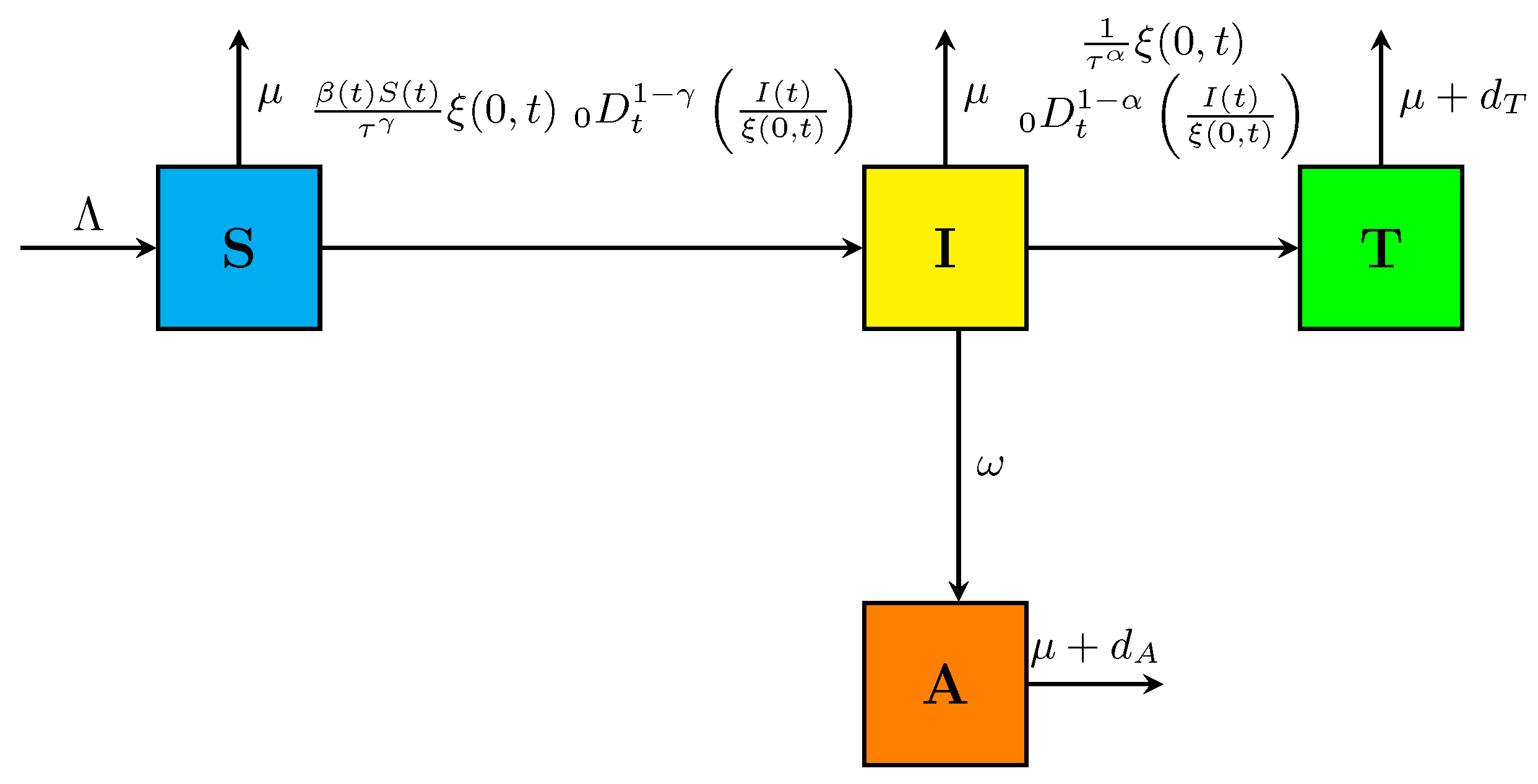
Therefore, the flow chart of HIV transmission dynamics is shown as follows (Figure 1).
Remark 5.
According to Remarks 2 and 4, when the drug efficacy rate is in an exponential distribution and the intrinsic infectivity is a constant independent of infection time and drug, it corresponds to the integer-order HIV/AIDS model:
d S ( t ) d t = Λ β S ( t ) τ I ( t ) μ S ( t ) , d I ( t ) d t = β S ( t ) τ I ( t ) 1 ζ I ( t ) ( μ + ω ) I ( t ) , d T ( t ) d t = 1 ζ I ( t ) ( μ + d T ) T ( t ) , d A ( t ) d t = ω I ( t ) ( μ + d A ) A ( t ) .
However, if the drug efficacy follows a power-law tail distribution, the intrinsic infectivity is a power-law function that depends on drug efficacy and infection time, and the transmission of HIV can be described by the fractional model (33).

3.2. Basic Properties of Model (33)

To reduce the computational complexity, Λ ( t ) is simplified to Λ , β ( t ) to β , μ ( t ) to μ , d T ( t ) to d T , ω ( t ) to ω , and d A ( t ) to d A , respectively. Under this circumstance, the survival function has the following expression:
ξ ( 0 , t ) = e ( μ + ω ) t .
Therefore, model (33) can be simplified as follows:
d S ( t ) d t = Λ β S ( t ) τ γ e ( μ + ω ) t D t 1 γ 0 ( I ( t ) e ( μ + ω ) t ) μ S ( t ) , d I ( t ) d t = β S ( t ) τ γ e ( μ + ω ) t D t 1 γ 0 ( I ( t ) e ( μ + ω ) t ) 1 τ α e ( μ + ω ) t D t 1 α 0 ( I ( t ) e ( μ + ω ) t ) ( μ + ω ) I ( t ) , d T ( t ) d t = 1 τ α e ( μ + ω ) t D t 1 α 0 ( I ( t ) e ( μ + ω ) t ) ( μ + d T ) T ( t ) , d A ( t ) d t = ω I ( t ) ( μ + d A ) A ( t ) ,
with initial conditions S ( 0 ) = S 0 , I ( 0 ) = I 0 , T ( 0 ) = T 0 , A ( 0 ) = A 0 .
Remark 6.
The fractional orders γ and α represent the intrinsic infectivity parameter and the drug efficacy parameter, respectively.
Next, the basic properties of model (35) are considered.
Theorem 1
(Non-negativity and boundedness). When the initial conditions S 0 > 0 , I 0 > 0 , T 0 0 , A 0 0 , the solution of model (35) is non-negative, and the positive invariant set of the model (35) is
T : = ( S , I , T , A ) R + 4 : 0 S + I + T + A Λ μ .
Proof. 
Establish the comparison system corresponding to model (35):
d S ˜ ( t ) d t = β S ˜ ( t ) τ γ e ( μ + ω ) t D t 1 γ 0 ( I ˜ ( t ) e ( μ + ω ) t ) μ S ˜ ( t ) , d I ˜ ( t ) d t = β S ˜ ( t ) τ γ e ( μ + ω ) t D t 1 γ 0 ( I ˜ ( t ) e ( μ + ω ) t ) 1 τ α e ( μ + ω ) t D t 1 α 0 ( I ˜ ( t ) e ( μ + ω ) t ) ( μ + ω ) I ˜ ( t ) , d T ˜ ( t ) d t = 1 τ α e ( μ + ω ) t D t 1 α 0 ( I ˜ ( t ) e ( μ + ω ) t ) ( μ + d T ) T ˜ ( t ) , d A ˜ ( t ) d t = ω I ( t ) ( μ + d A ) A ˜ ( t ) .
with the initial condition S ˜ ( 0 ) = I ˜ ( 0 ) = T ˜ ( 0 ) = A ˜ ( 0 ) = 0 , and then ( 0 , 0 , 0 , 0 ) is the solution of model (36). According to Lemma 6, the solution of model (35) is non-negative.
Let N ( t ) = S ( t ) + I ( t ) + T ( t ) + A ( t ) be the total population. It follows from model (35) that
d N ( t ) d t = Λ μ N ( t ) d T T ( t ) d A A ( t ) .
It is implied by Equation (37) that
d N ( t ) d t Λ μ N ( t ) ,
and therefore,
N ( t ) Λ μ + N ( 0 ) Λ μ e μ t .
Thus, if N ( 0 ) Λ μ , one has 0 N ( t ) Λ μ for all t 0 . Therefore, T is a positive invariant set. □
Theorem 2.
Model (35) has a unique disease-free equilibrium E 0 = ( Λ μ , 0 , 0 , 0 ) .
Proof. 
For the disease-free equilibrium E 0 = ( Λ μ , 0 , 0 , 0 ) of model (35), the following limits hold:
lim t S ( t ) = S 0 , lim t I ( t ) = I 0 = 0 , lim t T ( t ) = T 0 = 0 , lim t A ( t ) = A 0 = 0 .
By taking the limit as t on both ends of model (35), the following form of equation can be derived:
Λ lim t β S ( t ) τ γ e ( μ + ω ) t 0 D t 1 γ ( I ( t ) e ( μ + ω ) t ) μ S 0 = 0 .
According to Lemma 3, the Taylor expansion of ( u + μ + ω ) 1 γ is as follows:
L e ( μ + ω ) t D t 1 γ 0 ( I ( t ) e ( μ + ω ) t ) = I ^ ( u ) ( u + μ + ω ) 1 γ = I ^ ( u ) ( μ + ω ) 1 γ + ( 1 γ ) ( μ + ω ) γ u + O ( u 2 ) .
Taking the inverse Laplace transform of Equation (39) gives
e ( μ + ω ) t D t 1 γ 0 ( I ( t ) e ( μ + ω ) t ) = ( μ + ω ) 1 γ I ( t ) + ( 1 γ ) ( μ + ω ) γ d I ( t ) d t + L 1 ( I 0 ) + L 1 { O ( u 2 ) } .
Combine this with the following facts:
lim t L 1 { O ( u 2 ) } = lim u 0 u O ( u 2 ) = 0 .
lim t d I ( t ) d t + L 1 ( I 0 ) = lim u 0 u 2 I ^ ( u ) = 0 .
Therefore, the limit of e ( μ + ω ) t D t 1 γ 0 ( I ( t ) e ( μ + ω ) t ) satisfies the following equation:
lim t e ( μ + ω ) t D t 1 γ 0 ( I ( t ) e ( μ + ω ) t ) = ( μ + ω ) 1 γ I 0 = 0 .
Substituting Equation (41) into Equation (38) yields
Λ β τ γ ( μ + ω ) 1 γ S 0 I 0 μ S 0 = 0 .
Then one has S 0 = Λ μ . Therefore, there exists a unique disease-free equilibrium E 0 = ( Λ μ , 0 , 0 , 0 ) for model (35). □
The basic reproduction number R 0 is an important indicator in epidemiology for measuring the infectivity of infectious diseases. It represents the average number of susceptible individuals that an infected individual will infect during their infectious period in a completely susceptible population. Next, the basic reproduction number of model (35) is considered.
Theorem 3.
The basic reproduction number R 0 of model (35) is as follows:
R 0 = Λ β τ γ μ ( μ + ω ) α γ ( μ + ω ) α + ( 1 τ ) α .
Proof. 
According to the definition of the basic reproduction number R 0 , it is calculated as follows:
R 0 = N 0 0 β ρ ( t ) Φ ( 0 , t ) d t = N 0 β 0 ρ ( t ) Q ( t ) ξ ( 0 , t ) d t = N 0 β 0 e ( μ + ω ) t τ γ t γ 1 E α , γ ( t τ ) α d t = N 0 β τ γ ( μ + ω ) α γ ( μ + ω ) α + 1 τ α = Λ β τ γ μ ( μ + ω ) α γ ( μ + ω ) α + ( 1 τ ) α ,
where N 0 = S 0 + I 0 + T 0 + A 0 = Λ μ .
Theorem 4.
When the basic reproduction number R 0 > 1 , model (35) has a unique endemic equilibrium E * = ( S * , I * , T * , A * ) , where
S * = τ α ( μ + ω ) 1 α + ( μ + ω ) β τ γ ( μ + ω ) 1 γ , I * = Λ μ τ α ( μ + ω ) 1 α + ( μ + ω ) β τ γ ( μ + ω ) 1 γ τ α ( μ + ω ) 1 α + ( μ + ω ) ,
T * = τ α ( μ + ω ) 1 α μ + d T I * , A * = ω μ + d A I * .
Proof. 
For the endemic equilibrium E * = ( S * , I * , T * , A * ) of model (35), the following formula limits hold:
lim t S ( t ) = S * , lim t I ( t ) = I * , lim t T ( t ) = T * , lim t A ( t ) = A * .
Taking the limit as t on both sides of model (35) yields the following form:
Λ lim t β S ( t ) τ γ e ( μ + ω ) t D t 1 γ 0 ( I ( t ) e ( μ + ω ) t ) μ S * = 0 , lim t β S ( t ) τ γ e ( μ + ω ) t D t 1 γ 0 ( I ( t ) e ( μ + ω ) t ) lim t 1 τ α e ( μ + ω ) t D t 1 α 0 ( I ( t ) e ( μ + ω ) t ) ( μ + ω ) I * = 0 , lim t 1 τ α e ( μ + ω ) t D t 1 α 0 ( I ( t ) e ( μ + ω ) t ) ( μ + d T ) T * = 0 , ω I * ( μ + d A ) A * = 0 .
According to Equations (40) and (41), the limit e ( μ + ω ) t D t 1 γ 0 ( I ( t ) e ( μ + ω ) t ) satisfies the following equation
lim t e ( μ + ω ) t D t 1 γ 0 ( I ( t ) e ( μ + ω ) t ) = ( μ + ω ) 1 γ I * .
Using Equation (44) then yields
lim t S ( t ) e ( μ + ω ) t D t 1 γ 0 ( I ( t ) e ( μ + ω ) t ) = ( μ + ω ) 1 γ S * I * .
Similar to Equation (44), the following equation can be obtained:
lim t e ( μ + ω ) t D t 1 α 0 ( I ( t ) e ( μ + ω ) t ) = ( μ + ω ) 1 α I * .
Substituting Equations (45) and (46) into model (43) yields
Λ β τ γ ( μ + ω ) 1 γ S * I * μ S * = 0 , β τ γ ( μ + ω ) 1 γ S * I * τ α ( μ + ω ) 1 α I * ( μ + ω ) I * = 0 , τ α ( μ + ω ) 1 α I * ( μ + d T ) T * = 0 , ω I * ( μ + d A ) A * = 0 .
Therefore, when R 0 > 1 , there exists a unique endemic equilibrium E * = ( S * , I * , T * , A * ) of model (35), where
S * = τ α ( μ + ω ) 1 α + ( μ + ω ) β τ γ ( μ + ω ) 1 γ , I * = Λ μ τ α ( μ + ω ) 1 α + ( μ + ω ) β τ γ ( μ + ω ) 1 γ τ α ( μ + ω ) 1 α + ( μ + ω ) ,
T * = τ α ( μ + ω ) 1 α μ + d T I * , A * = ω μ + d A I * .
Remark 7.
Calculating the standard sensitivity of R 0 to the intrinsic infectivity parameter γ and the drug efficacy parameter α yields
1 R 0 R 0 γ = l n ( τ ( μ + ω ) ) , 1 R 0 R 0 α = l n ( τ ( μ + ω ) ) τ ( μ + ω ) α + 1 .
According to the above formula, the following conclusions can be drawn:
(i)  
When 0 < τ ( μ + ω ) < 1 , it follows that ln ( τ ( μ + ω ) ) < 0 , R 0 γ > 0 , and R 0 α < 0 , indicating that R 0 increases monotonically with γ and decreases monotonically with α.
(ii)  
When τ ( μ + ω ) = 1 , ln ( τ ( μ + ω ) ) = 0 and R 0 γ = 0 , which implies that R 0 remains invariant to changes in γ or α.
(iii)  
When τ ( μ + ω ) > 1 , it follows that ln ( τ ( μ + ω ) ) > 0 , R 0 γ < 0 , and R 0 α > 0 , indicating that R 0 decreases monotonically with γ and increases monotonically with α.
Remark 8.
The influence of the intrinsic infectivity parameter γ and the drug efficacy parameter α on R 0 :
| 1 R 0 R 0 γ | = | l n ( τ ( μ + ω ) ) | , | 1 R 0 R 0 α | = | l n ( τ ( μ + ω ) ) | τ ( μ + ω ) α + 1 .
According to the above formula, the following conclusions can be drawn:
When τ ( μ + ω ) 1 , the impact of γ on R 0 is greater than that of α, indicating that the intrinsic infectivity of individuals has a greater impact on those infected than the effect of drugs. From the perspective of HIV/AIDS prevention and control, infected individuals should prioritize their own infection prevention and protection, enhance their personal physical fitness, and should not rely solely on medication for control. Instead, individuals should establish a dual safeguard combining self-protection and drug treatment.

4. Stability Analysis

In this section, the stability of the disease-free equilibrium E 0 and the endemic equilibrium E * are considered.

4.1. Stability of the Disease-Free Equilibrium E 0

Theorem 5.
If R 0 < 1 , the disease-free equilibrium E 0 = Λ μ , 0 , 0 , 0 of model (35) is locally asymptotically stable; if R 0 > 1 , the disease-free equilibrium E 0 is unstable.
Proof. 
According to Equation (40), it can be obtained that
I e ( μ + ω ) t D t 1 γ 0 ( I e ( μ + ω ) t ) = ( μ + ω ) 1 γ .
According to Equation (48), the Jacobi matrix of model (35) at the disease-free equilibrium E 0 is as follows:
J ( E 0 ) = μ β S 0 τ γ ( μ + ω ) 1 γ 0 0 0 β S 0 τ γ ( μ + ω ) 1 γ 1 τ α ( μ + ω ) 1 α μ ω 0 0 0 1 τ α ( μ + ω ) 1 α ( μ + d T ) 0 0 ω 0 ( d A + μ ) .
Then, the characteristic equation of J ( E 0 ) is as follows:
( λ + μ ) ( λ + μ + d T ) ( λ + μ + d A ) λ β S τ γ ( μ + ω ) 1 γ + 1 τ α ( μ + ω ) 1 α + μ + ω = 0 .
Thus, the eigenvalues of J ( E 0 ) are given by
λ 1 = μ < 0 , λ 2 = ( μ + d T ) < 0 , λ 3 = ( μ + d A ) < 0 ,
λ 4 = β S 0 τ γ ( μ + ω ) 1 γ 1 τ α ( μ + ω ) 1 α μ ω = ( R 0 1 ) ( μ + ω ) 1 α ( μ + ω ) α + ( 1 τ ) α .
Therefore, when R 0 < 1 , one has λ 4 < 0 . When R 0 > 1 , one has λ 4 > 0 . If R 0 < 1 , all characteristic roots of J ( E 0 ) have negative real parts, and the disease-free equilibrium E 0 is locally asymptotically stable. If R 0 > 1 , then the Jacobian matrix J ( E 0 ) has the eigenvalue with a positive real part, so the disease-free equilibrium E 0 is unstable. □
Theorem 6.
If R 0 < 1 , the disease-free equilibrium E 0 = Λ μ , 0 , 0 , 0 of model (35) is globally asymptotically stable.
Proof. 
Similar to the proof in [22]. Since S ( t ) < Λ μ , multiplying both sides of Equation (31) by e ( μ + ρ ) t and integrating over [ 0 , t ] yields
0 t e ( μ + ω ) t ˜ d I ( t ˜ ) = β τ γ 0 t S ( t ˜ ) 0 D t 1 γ I ( t ˜ ) ξ ( 0 , t ˜ ) d t ˜ 1 τ α 0 t D t 1 α 0 I ( t ˜ ) ξ ( 0 , t ˜ ) d t ˜ 0 t ( μ + ω ) e ( μ + ω ) t ˜ I ( t ˜ ) d t ˜ < β τ γ 1 Γ ( γ ) Λ μ 0 t ( t t ˜ ) γ 1 e ( μ + ω ) t ˜ I ( t ˜ ) d t ˜ 1 τ α Γ ( α ) 0 t ( t t ˜ ) α 1 e ( μ + ω ) t ˜ I ( t ˜ ) d t ˜ 0 t ( μ + ω ) e ( μ + ω ) t ˜ I ( t ˜ ) d t ˜ .
Then, simplifying Equation (50) and letting u = t ˜ t yields the following equation:
I ( t ) < I ( 0 ) e ( μ + ω ) t + β τ γ 1 Γ ( γ ) Λ μ t 0 ( u ) γ 1 e ( μ + ω ) u I ( u + t ) d u 1 τ α Γ ( α ) t 0 ( u ) α 1 e ( μ + ω ) u I ( u + t ) d u .
The function I is defined in the following form:
I = lim sup t I ( t ) .
Assuming I > 0 , by the definition of I , ε > 0 , there exists T such that for t > T , I ( t ) < I + ε , which implies
I ( 0 ) e ( μ + ω ) t < ε ,
β τ γ 1 Γ ( γ ) Λ μ t ( u ) γ 1 e ( μ + ω ) u d u 1 τ α Γ ( α ) t ( u ) α 1 e ( μ + ω ) u d u < ε .
Therefore, Equation (51) can be simplified to
I ( t ) ε + ( I + ε ) ε + 0 e ( μ + ω ) u I ( u + t ) ( u ) γ 1 β Λ τ γ μ Γ ( γ ) ( u ) α 1 τ α Γ ( α ) d u , ( t > T ) .
Define the function I ˜ ( t ) as follows:
I ˜ ( t ) = 0 e ( μ + ω ) u I ( u + t ) ( u ) γ 1 β Λ τ γ μ Γ ( γ ) ( u ) α 1 τ α Γ ( α ) d u .
When ( u ) γ 1 β Λ τ γ μ Γ ( γ ) > ( u ) α 1 τ α Γ ( α ) and R 0 < 1 , the following inequality holds:
I ˜ ( t ) < ( I + ε ) 0 e ( μ + ω ) u ( u ) γ 1 β Λ τ γ μ Γ ( γ ) ( u ) α 1 τ α Γ ( α ) d u < ( I + ε ) R 0 1 R 0 τ ( μ + ω ) α < ( I + ε ) R 0 .
Therefore, when ε is sufficiently small such that ε ( 1 + R 0 + I + ε ) < I ( 1 R 0 ) , the following formula holds:
I ( t ) < ε + ε R 0 + ε I + ε 2 + R 0 I < ε ( 1 + R 0 + I + ε ) + R 0 I < I .
When ( u ) γ 1 β Λ τ γ μ Γ ( γ ) < ( u ) α 1 τ α Γ ( α ) , one has I ˜ ( t ) 0 . Take ε to be sufficiently small such that ε ( 1 + I + ε ) < I holds; then the following formula is valid:
I ( t ) < ε + ε I + ε 2 < I .
Equations (53) and (54) are different from the definition of the function I . Therefore, when t , I = 0 and I ( t ) 0 . It follows that S ( t ) Λ μ , T ( t ) 0 , A ( t ) 0 as t . Therefore, based on Theorem 5, it can be concluded that the disease-free equilibrium E 0 is globally asymptotically stable when R 0 < 1 . □

4.2. Stability of the Endemic Equilibrium E *

Theorem 7.
If R 0 > 1 , the endemic equilibrium E * = ( S * , I * , T * , A * ) of model (35) is locally asymptotically stable.
Proof. 
Similar to the proof in [23]. According to Definition 3 and Lemma 5, one has
1 e ( μ + ω ) t τ α D t 1 α 0 e 1 α η t · e ( ω + μ ) t · e ( ω + μ ) t = η τ α e 1 α η t · e ( ω + μ ) t .
Inspired by Hethcote and Driessche [35], the following assumptions are made:
I ( t ) e 1 α η t · e ( ω + μ ) t .
Thus, by Equations (55) and (56), the following equation is derived:
1 e ( ω + μ ) t τ α D t 1 α 0 e ( ω + μ ) t I ( t ) η τ α I ( t ) .
So model (35) can be reduced to
d S ( t ) d t = Λ β η τ γ S ( t ) I ( t ) μ S ( t ) , d I ( t ) d t = β η τ γ S ( t ) I ( t ) η τ α I ( t ) ( μ + ω ) I ( t ) , d T ( t ) d t = η τ α I ( t ) ( μ + d T ) T ( t ) , d A ( t ) d t = ω I ( t ) ( μ + d A ) A ( t ) .
Calculate the Jacobi matrix of the endemic equilibrium E * for model (58) as follows:
J ( E * ) = β η τ γ I * μ β η τ γ S * 0 0 β η τ γ S * β η τ γ S * η τ α ( μ + ω ) 0 0 0 η τ α ( d T + μ ) 0 0 ω 0 ( d A + μ ) .
According to the definition of the endemic equilibrium E * , the equation β η τ γ S * η τ α ( μ + ω ) = 0 holds.
The determinant of J ( E * ) is given by
d e t | J ( E * ) | = ( d T + μ ) ( d A + μ ) ( β η τ γ S * ) 2 > 0 .
Thus, the following equation holds:
( 1 ) 4 det | J ( E * ) | > 0 .
The second additive compound matrix J [ 2 ] ( E * ) is calculated according to Definition 5, and it follows that
J [ 2 ] ( E * ) = β η τ γ I * μ 0 0 0 0 0 η τ α a 0 e 0 0 ω 0 b 0 e 0 0 f 0 c 0 0 0 0 f 0 d 0 0 0 0 ω η τ α 2 μ d T d A ,
where a = β η τ γ I * + 2 μ + d T , b = β η τ γ I * + 2 μ + d A , c = μ + d T , d = μ + d A , e = β η τ γ S * , f = β η τ γ I * .
Thus, the eigenvalues of J [ 2 ] ( E * ) are obtained as follows:
λ 1 = β η τ γ I * μ , λ 2 = 2 μ d T d A .
The other eigenvalues satisfy the following equations:
λ 4 + A λ 3 + B λ 2 + C λ + D = 0 ,
where A = a + b + c + d , B = a c + 2 e f + b d + a b + c b + a d + c d , C = a c b + e f b + a c d + e f d + a b d + a e f + b c d + c e f , D = a b c d + b d e f + a c e f + e 2 f 2 .
By Lemma 7, all eigenvalues of J [ 2 ] ( E * ) have negative real parts, implying that J [ 2 ] ( E * ) is stable. Lemma 8 further shows that J ( E * ) is stable, from which the endemic equilibrium E * is locally asymptotically stable. □
Theorem 8.
If R 0 > 1 , the endemic equilibrium E * = ( S * , I * , T * , A * ) of model (35) is global asymptotically stable.
Proof. 
The proof idea of Theorem 8 refers to the references [3,22].
It is easy to see that T ˚ = ( S , I , T , A ) R + 4 : S + I + T + A Λ μ is simple and ( H 1 ) holds for Lemma 10.
Next, consider the existence of an absorbing set for model (35). To illustrate that there exists an absorbing compact set in the set T ˚ is actually equivalent to proving that model (35) has uniform persistence. First, T = S + I + T + A = Λ μ is a positively invariant set for model (35). Second, on this boundary T , there always exists and only exists one disease-free equilibrium E 0 = Λ μ , 0 , 0 , 0 . Therefore, the largest invariant set on T is the isolated set { E 0 } , containing only the point E 0 . According to [36], the two conclusions that the model has uniform persistence and the disease-free equilibrium E 0 is unstable are equivalent. Therefore, according to Theorem 6, when the basic reproduction number R 0 > 1 , the disease-free equilibrium E 0 is unstable. It can thus be inferred that model (35) has uniform persistence. At the same time, the boundary T at this time exactly constitutes a compact absorbing set in the set T , and this also satisfies the condition ( H 2 ) in Lemma 10.
Let Ω be an ω -limit set of model (35) in T ˚ . Consider the following two cases:
(i)
If Ω does not contain E * , and since E * is the unique interior equilibrium, Ω does not have any equilibrium at all. Therefore, according to Lemma 9, Ω is a closed orbit.
(ii)
If Ω contains E * , and since E * is locally asymptotically stable in T ˚ , when R 0 > 1 , nearby orbits can converge to E * , then Ω = { E * } .
These results imply that model (35) satisfies the Poincaré–Bendixson property. Therefore, ( H 3 ) in Lemma 10 holds.
Finally, verify ( H 4 ) of Lemma 10.
According to Theorem 7, consider the stability of the following model:
d S ( t ) d t = Λ β η τ γ S ( t ) I ( t ) μ S ( t ) , d I ( t ) d t = β η τ γ S ( t ) I ( t ) η τ α I ( t ) ( μ + ω ) I ( t ) , d T ( t ) d t = η τ α I ( t ) ( μ + d T ) T ( t ) .
Assume q ( t ) is the periodic orbital solution of model (59). The Jacobi matrix of model (59) at point q ( t ) is given as follows:
J ( q ( t ) ) = β η τ γ I ( t ) μ β η τ γ S ( t ) 0 β η τ γ I ( t ) β η τ γ S ( t ) η τ α μ ω 0 0 η τ α μ + d T .
According to Definition 4, the second additive matrix of J ( q ( t ) ) is as follows:
J [ 2 ] ( q ( t ) ) = β η τ γ I + β η τ γ S η τ α 2 μ ω 0 0 η τ α β η τ γ I 2 μ d T β η τ γ S 0 z η τ β I β η τ γ S η τ α 2 μ ω d T .
According to Lemma 11, the second compound system of the matrix J [ 2 ] ( q ( t ) ) can be written as follows:
X = β η τ γ I + β η τ γ S η τ α 2 μ ω X , Y = η τ α X + β η τ γ I 2 μ d T Y + β η τ γ S Z , Z = z η τ β I Y + β η τ γ S η τ α 2 μ ω d T Z .
Calculating the right-hand derivatives of | X | , | Y | , and | Z | yields
D + | X ( t ) | β η τ γ I + β η τ γ S η τ α 2 μ ω | X ( t ) | ,
D + | Y ( t ) | η τ α | X ( t ) | + β η τ γ I 2 μ d T | Y ( t ) | + β η τ γ S | Z ( t ) | ,
and
D + | Z ( t ) | β η τ γ I | Y | + β η τ γ S η τ α 2 μ ω d T | Z ( t ) | .
Using Equations (62) and (63), one has
D + I T ( | Y ( t ) | + | Z ( t ) | ) = I I T T I T ( | Y ( t ) | + | Z ( t ) | ) + I T D + ( | Y ( t ) | + | Z ( t ) | ) I T η τ α | X ( t ) | + I I T T 2 μ d T I T ( | Y ( t ) | + | Z ( t ) | ) .
Define the function:
V ( X , Y , Z ; S , I , T ) = sup | X | , I T ( | Y | + | Z | ) .
Relations Equations (61) and (64) lead to
D + V ( t ) max { g 1 ( t ) , g 2 ( t ) } V ( t ) ,
where
g 1 ( t ) = β η τ γ I + β η τ γ S η τ α 2 μ ω , g 2 ( t ) = I I T T 2 μ d T + η τ α I T .
According to model (59), there is the following equation:
I I = β η τ γ S μ ω , T T = η τ α I T μ d T .
From Equations (66) and (67), it can be found that
max { g 1 ( t ) , g 2 ( t ) } I I μ .
Thus, for the minimal period m, the following equation holds:
0 w max { g 1 ( t ) , g 2 ( t ) } d t log I ( t ) | 0 m μ t | 0 m = μ m < 0 ,
which implies that V ( t ) 0 as t . As a result, the second compound model (60) is asymptotically stable. Then ( H 4 ) in Lemma 10 holds. Therefore, by Lemma 10, the endemic equilibrium E * is globally asymptotically stable when R 0 > 1 . □

5. Numerical Simulation

In this section, numerical simulations are conducted to illustrate the stability of the disease-free equilibrium E 0 and the endemic equilibrium E * .

5.1. Sensitivity Analysis of Parameters in R 0

The partial rank correlation coefficient (PRCC) is a statistic for analyzing variable correlations. It is often combined with methods like Latin hypercube sampling (LHS) to assess how parameters in infectious disease models affect outcome variables [37]. By calculating the PRCC, it is possible to determine which parameters have a more significant impact on the transmission and development of the infectious disease.
The basic reproduction number is crucial for the transmission and control of HIV. Therefore, the following mainly elaborates on the sensitivity analysis of parameters to the basic reproduction number R 0 .

5.1.1. The Sensitivity Analysis of 0 < τ ( μ + ω ) < 1

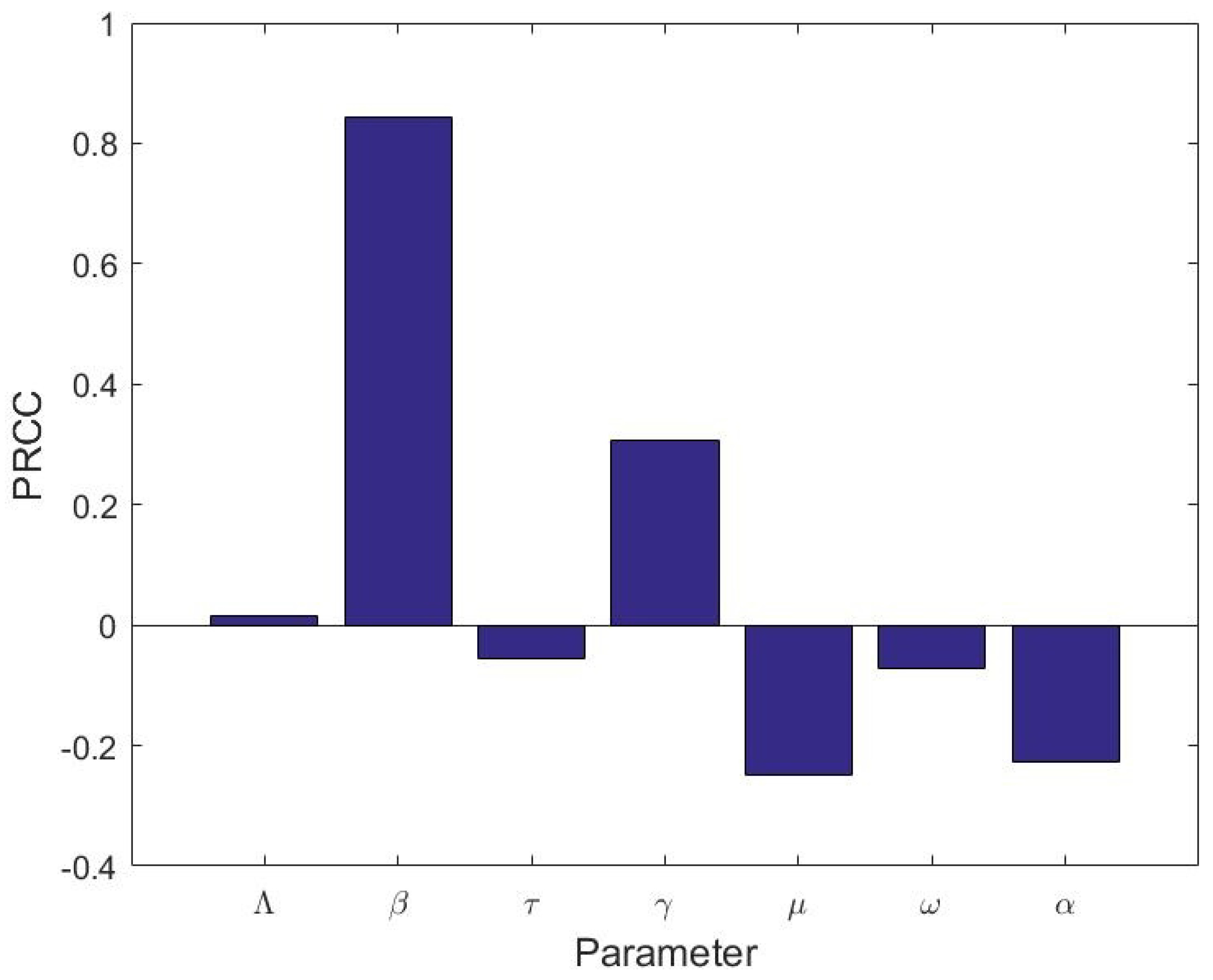
Table 1 presents the PRCC values of each of the seven parameters related to the basic reproduction number R 0 , while Figure 2 visually shows the distribution of these PRCC values. By analyzing Table 1 and Figure 2, the following conclusions can be drawn:
(1)
The increase in γ leads to an increase in R 0 , while the increase in α leads to a decrease in R 0 , which is consistent with Remark 7. The effect of γ is greater than that of α , which is consistent with Remark 8.
(2)
The positive impact of the extrinsic infectivity β is the most significant, with PRCC ( β ) = 0.844107 > PRCC( γ ) = 0.306272. This reflects that the positive impact of the extrinsic infectivity β on HIV is more significant than that of the intrinsic infectivity γ . In other words, the higher the extrinsic infectivity, the greater the possibility of HIV transmission. Therefore, taking good protection measures can effectively prevent HIV.
(3)
The negative impact of the natural death rate μ is the most significant, with PRCC ( μ ) = 0.249230 . Therefore, increasing the natural mortality rate can effectively reduce R 0 , thereby reducing the number of infected individuals with HIV.
However, it is usually assumed that the natural mortality rate is constant [38]. Therefore, when 0 < τ ( μ + ω ) < 1 , it is necessary to reduce the extrinsic infectivity. In this way, the possibility of HIV transmission can be reduced, and the disease can be effectively controlled.

5.1.2. The Sensitivity Analysis of  τ ( μ + ω ) > 1

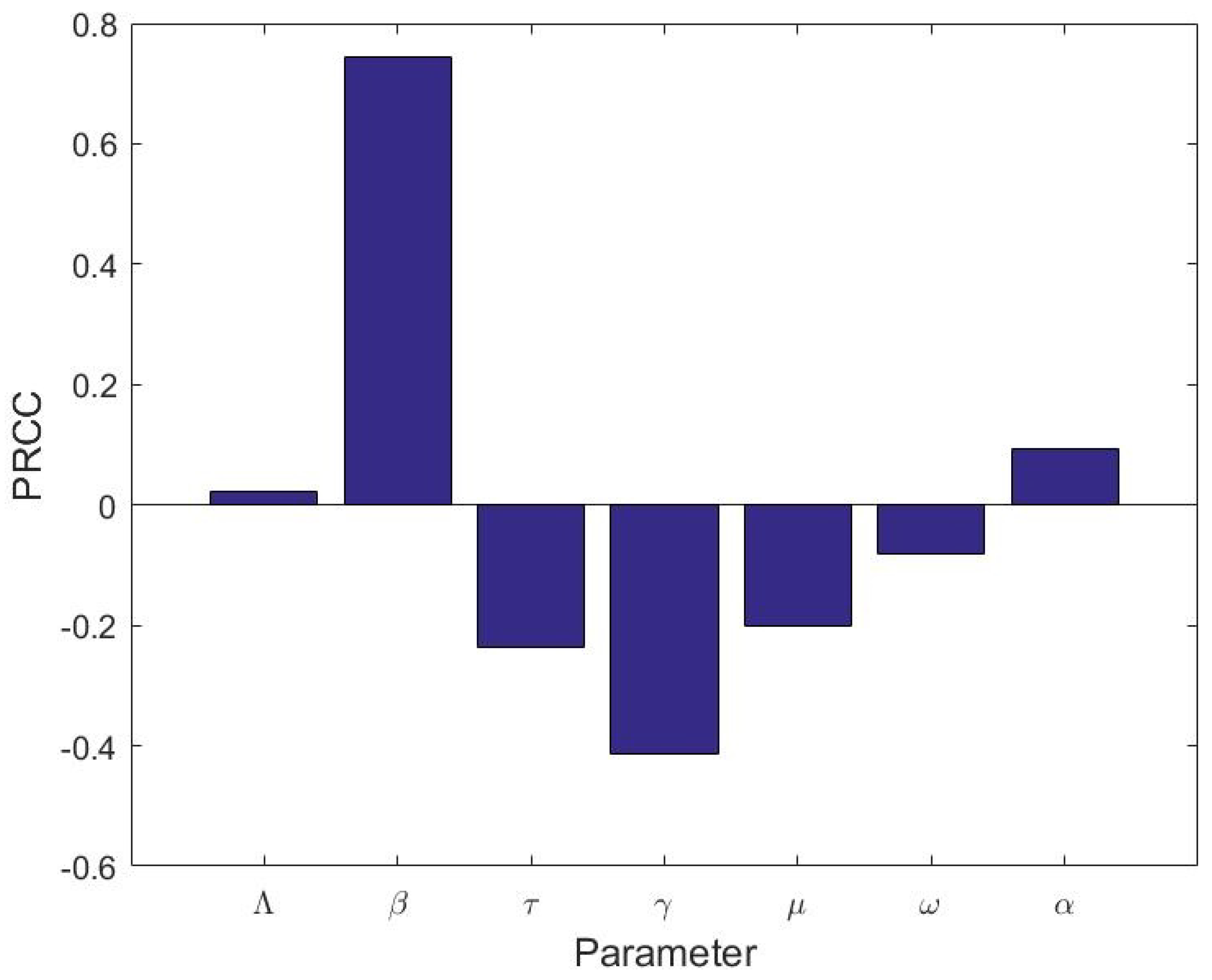
Table 2 lists the PRCC values of the model parameters related to R 0 , and Figure 3 shows the histogram of the PRCC values. Compared with Table 1, Table 2 only changes the range of τ . The following conclusions can be drawn from Table 2 and Figure 3:
(1)
An increase in γ leads to a decrease in R 0 , whereas an increase in α results in an increase in R 0 , consistent with Remark 7. The effect of γ is greater than that of α , which is consistent with Remark 8.
(2)
The positive impact of the extrinsic infectivity β is the most significant, with PRCC ( β ) = 0.745119 > PRCC( α ) = 0.092606. This reflects that the positive impact of the extrinsic infectivity β on HIV is more significant than that of the drug treatment rate α . Therefore, under any circumstances τ ( μ + ω ) > 1 or 0 < τ ( μ + ω ) < 1 , improving self-protection is the most effective way to control HIV.
(3)
The negative impact of the intrinsic infectivity parameter γ is the most significant, with PRCC ( γ ) = 0.412282 . Therefore, increasing the intrinsic infectivity in infected individuals can effectively reduce R 0 and thus reduce the number of individuals infected with HIV.
Therefore, when τ ( μ + ω ) > 1 , reducing the extrinsic infectivity, and increasing the intrinsic infectivity can effectively control the HIV.
Remark 9.
When τ ( μ + ω ) > 1 , reducing the drug efficacy parameter α and increasing the intrinsic infectivity parameter γ reduces the transmission of HIV disease, for which there is a discrepancy with the actual situation.

5.2. Stability Analysis

In this section, the numerical simulation of τ ( μ + ω ) > 1 is similar to that of 0 < τ ( μ + ω ) < 1 , so the numerical simulation is performed for 0 < τ ( μ + ω ) < 1 .
In this section, the theoretical results are verified through numerical simulation. The Adams–Bashforth–Moulton predictor–corrector method [39] is adopted to solve model (35).

5.2.1. Parameter α = γ

According to Remark 3, when α = γ , the intrinsic infectivity ρ is only related to the relative efficacy rate of the drug, and the corresponding fractional model is as follows:
d S ( t ) d t = Λ β S ( t ) τ γ e ( μ + ω ) t D t 1 α 0 ( I ( t ) e ( μ + ω ) t ) μ S ( t ) , d I ( t ) d t = β S ( t ) τ γ e ( μ + ω ) t D t 1 α 0 ( I ( t ) e ( μ + ω ) t ) 1 τ α e ( μ + ω ) t D t 1 α 0 ( I ( t ) e ( μ + ω ) t ) ( μ + ω ) I ( t ) , d T ( t ) d t = 1 τ α e ( μ + ω ) t D t 1 α 0 ( I ( t ) e ( μ + ω ) t ) ( μ + d T ) T ( t ) , d A ( t ) d t = ω I ( t ) ( μ + d A ) A ( t ) .
According to Remark 5, when α = γ = 1 , the corresponding model is the integer-order model (34).
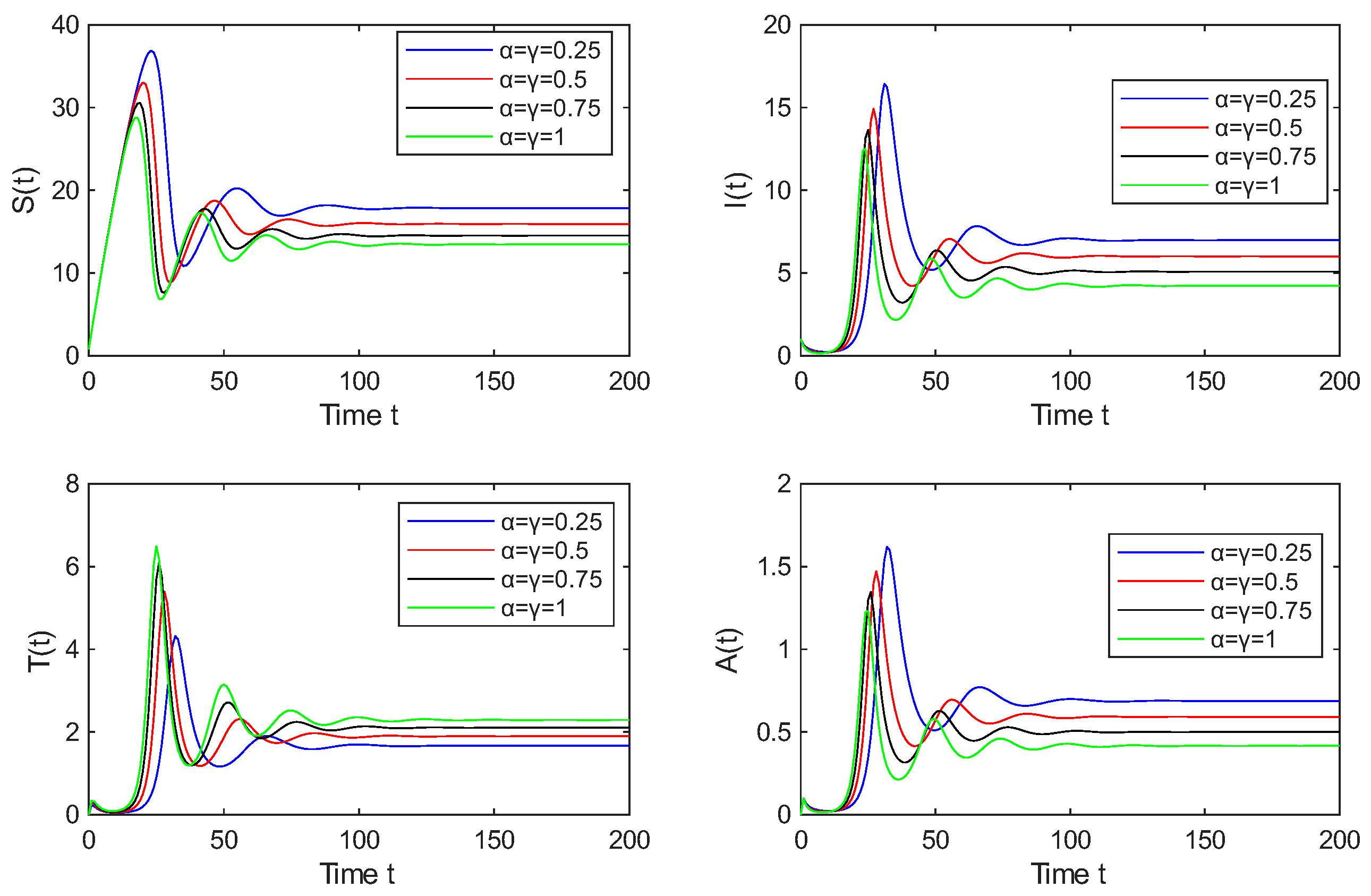
Assign the values in Table 3 to the parameters of the model (68) and β = 0.001 .
Next, the stability of the disease-free equilibrium E 0 is discussed under four scenarios where α is equal to γ .
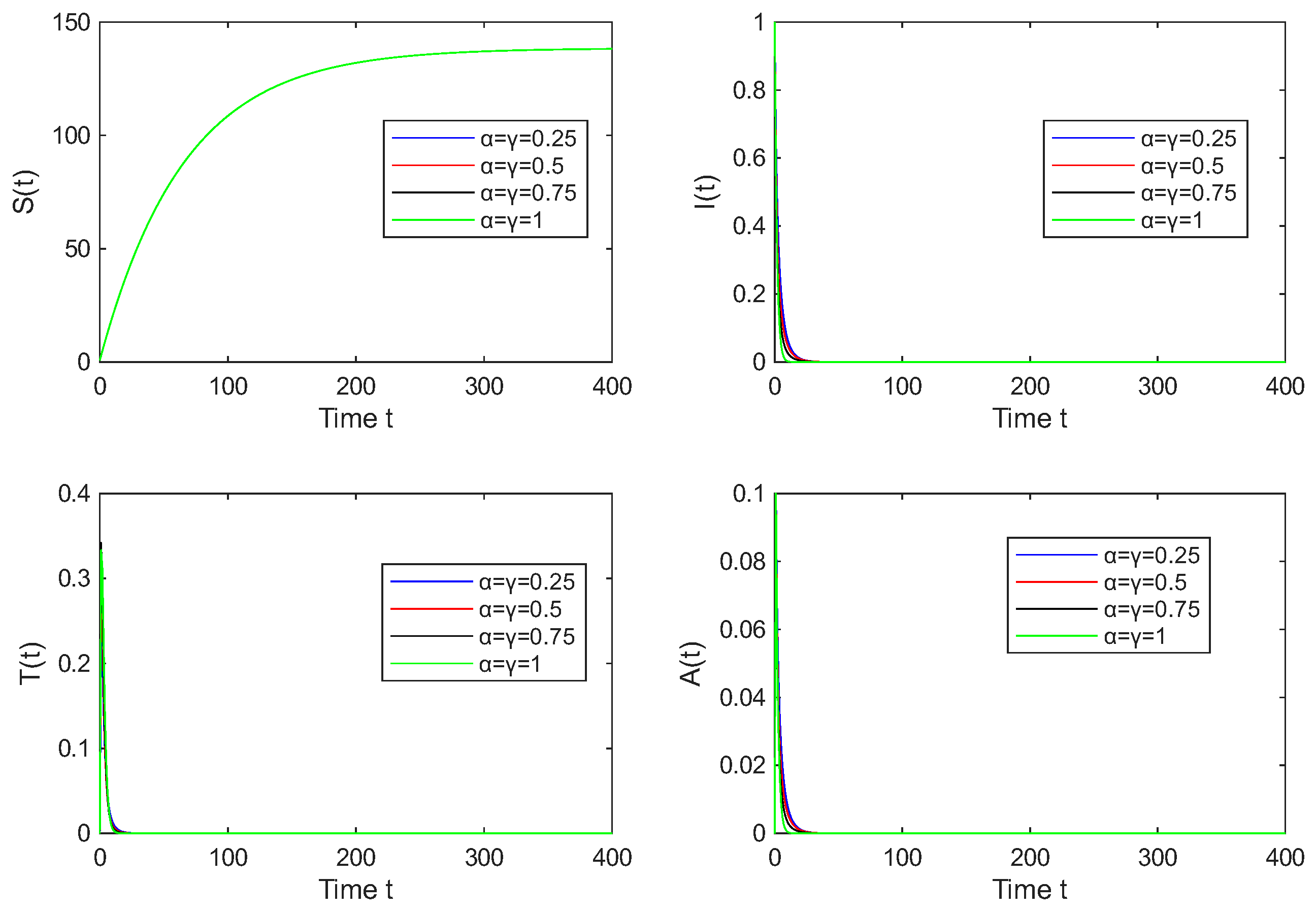
In this case, model (68) has a unique disease-free equilibrium E 0 . It can be concluded from Table 4 that R 0 < 1 . According to Theorem 6, the disease-free equilibrium E 0 = ( 138.474 , 0 , 0 , 0 ) of model (68) is globally asymptotically stable, which can be verified by Figure 4. It can be observed from Figure 4 and Table 4 that α has no impact on the value of the disease-free equilibrium E 0 .
Assign the values in Table 3 to the parameters of model (68), with β = 0.1 . The stability of the endemic equilibrium E * is discussed in the following under four scenarios, where α is equal to γ .
In this case, model (68) has a unique endemic equilibrium E * . It can be concluded from Table 5 that R 0 > 1 . According to Theorem 8, the endemic equilibrium E * of model (68) is globally asymptotically stable, which can be verified by Figure 5.
According to Table 4 and Table 5 and Figure 4 and Figure 5, when α = γ , the basic reproduction number R 0 decreases as α increases, and the stable value of the endemic equilibrium also decreases as α increases. In addition, as α increases, the time for the spread of HIV to reach peak advances, which corresponds to an improvement in the efficiency of virus transmission and an earlier outbreak of HIV; when α decreases, the time to reach the endemic equilibrium E * is shortened, indicating a reduction in the harmfulness of HIV and a decrease in prevention and control costs. Based on the above analysis, when the intrinsic infectivity ρ is only related to the relative efficacy of the drug, reducing the drug efficacy rate parameter α and the intrinsic infectivity parameter γ is helpful for reducing the spread of HIV, which is consistent with the analysis under the condition of 0 < τ ( μ + ω ) < 1 .

5.2.2. Parameter α γ

When the parameter α γ , the intrinsic infectivity ρ is affected by the drug effect and the duration of infection. In this case, the corresponding fractional model (35) is considered.
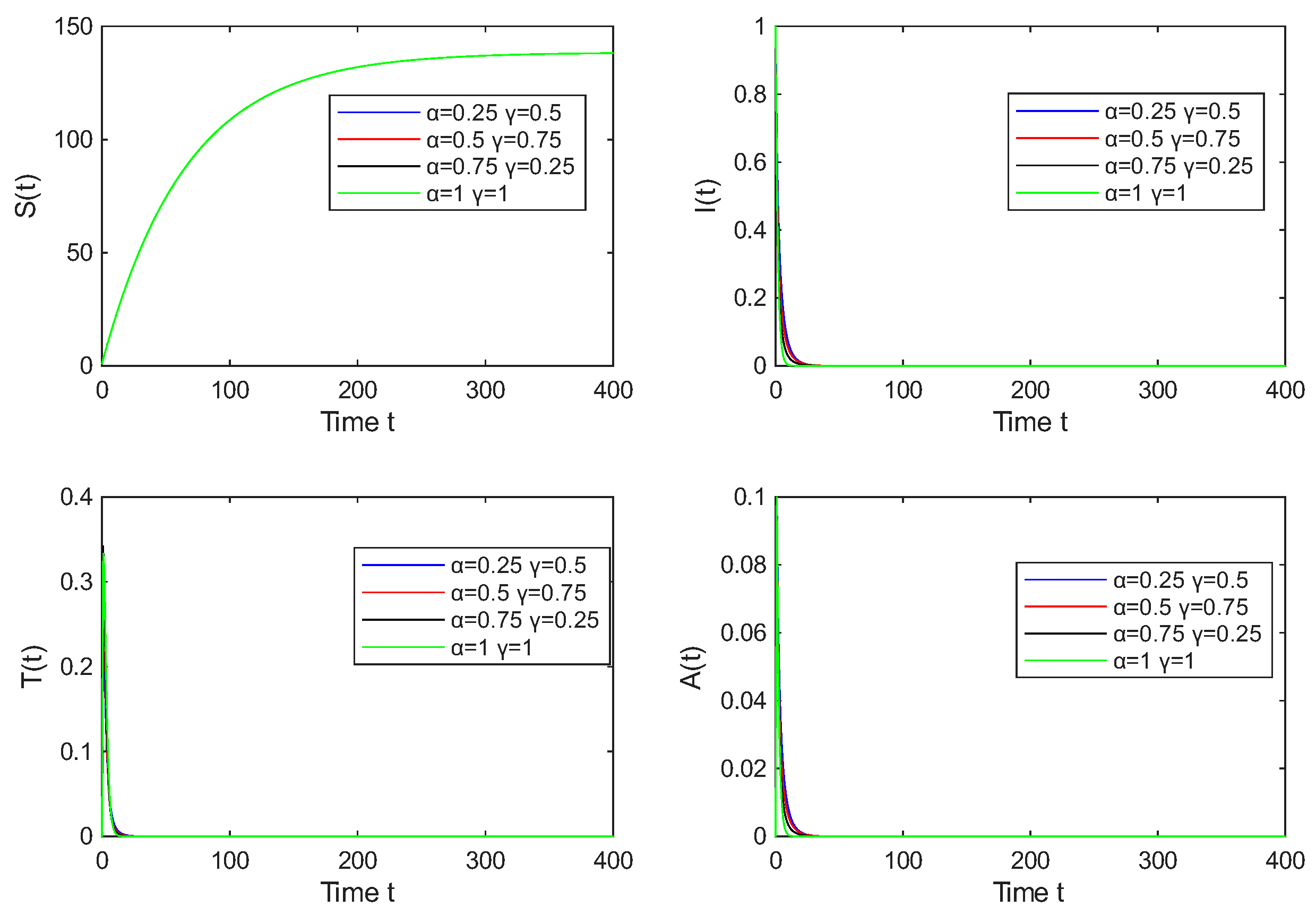
Using the parameter values of Table 3 and β = 0.001. The stability of the disease-free equilibrium E 0 is discussed under four scenarios where α and γ take different values.
In this case, model (35) has a unique disease-free equilibrium E 0 . It can be concluded from Table 6 that R 0 < 1 . According to Theorem 6, the disease-free equilibrium E 0 = ( 138.474 , 0 , 0 , 0 ) of model (35) is globally asymptotically stable, which can be verified by Figure 6. It can be observed from Figure 6 and Table 6 that α and γ have no impact on the value of the disease-free equilibrium E 0 .
Using the parameter values from Table 3 and β = 0.1. The stability of the endemic equilibrium E * is discussed under four scenarios where α and γ take different values.
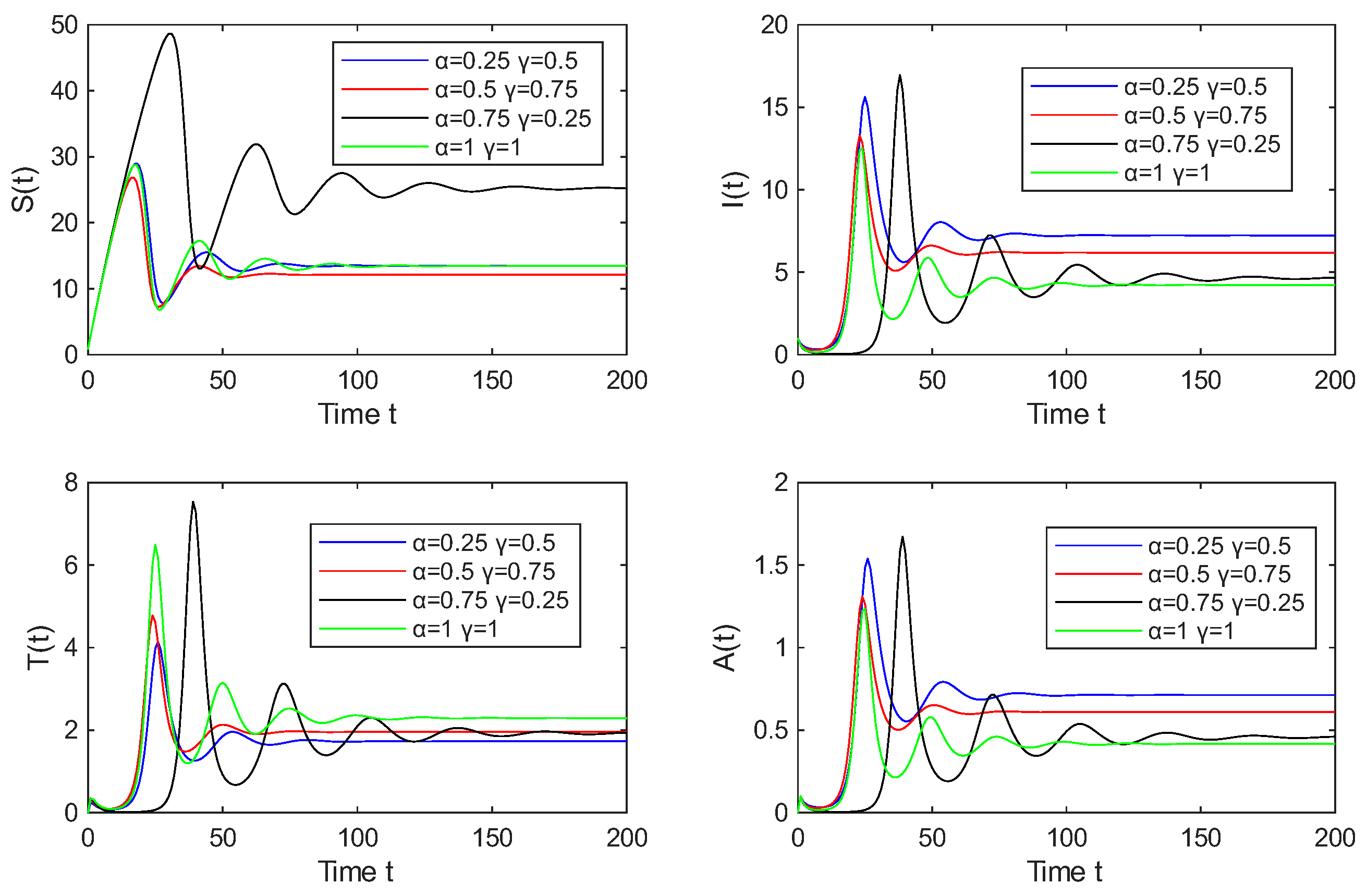
In this scenario, model (35) has a unique endemic equilibrium E * . Based on Table 7, it can be determined that the basic reproduction number R 0 > 1 . According to Theorem 8, the endemic equilibrium E * of model (35) is global asymptotic stability, which can be verified by Figure 7.
In the numerical simulations, observations from Table 7 and Figure 7 show the following:
(1)
When α = 0.5 and γ = 0.75 , the time to reach the peak of HIV transmission is early, and the time to reach the endemic equilibrium E * is short. This indicates that the transmission efficiency of HIV is high, and the disease breaks out early, which is not conducive to formulating disease response strategies. However, it reduces the harm of HIV, and correspondingly, the cost of prevention and control also decrease. In terms of disease control, this leads to the rapid death of infected individuals, which is not conducive to the survival of HIV-infected people.
(2)
When α = 0.75 and γ = 0.25 , the time to reach the peak of HIV transmission is delayed, and the time to reach the endemic equilibrium E * is longer. This indicates that the transmission efficiency of HIV is relatively low, and the disease breaks out later, which is conducive to formulating disease response strategies. Nevertheless, it increases the harm of HIV, corresponding to higher prevention and control costs.
Based on the above analysis, when the intrinsic infectivity ρ is affected by the effect of drugs and the duration of infection, improving the effectiveness of drugs and reducing the intrinsic infectivity are conducive to reducing the transmission efficiency of HIV, delaying the outbreak of the disease. This is consistent with the analysis under the condition of 0 < τ ( μ + ω ) < 1 .
To investigate the impact of different values of α and γ on HIV/AIDS, the values of other parameters are kept constant. By comparing Figure 5 and Figure 7, it can be observed that the size of γ affects the peak of HIV disease transmission and the time to reach the endemic equilibrium E * : as γ increases, both the time to reach the peak and the time to reach the endemic equilibrium E * are advanced; as γ decreases, both the time to reach the peak and the time to reach the endemic equilibrium E * are delayed. This indicates that reducing the intrinsic infectivity parameter γ decreases the transmission of HIV disease but increases the costs. This is consistent with the conclusion of the sensitivity analysis under the condition of 0 < τ ( μ + ω ) < 1 .

6. Conclusions

Based on the transmission characteristics of HIV, this paper establishes an HIV model using the CTRW method by considering extrinsic infectivity, intrinsic infectivity, and drug control. The extrinsic infectivity depends on the individual contact and then is considered as a constant independent of infection time. However, the intrinsic infectivity and the drug efficacy rate are related to the infection time and immunity. The following is an analysis of the relevant situations regarding intrinsic infectivity and drug efficacy. Firstly, when the intrinsic infectivity is a power law dependent on the drug effect and the infection time, the drug efficacy rate follows Mittag–Leffler distribution with a long-term effect, and the fractional HIV model (35) is naturally established, which implies the non-local property of the Riemann–Liouville fractional derivative. Secondly, when long-term drug use results in complete drug failure, the drug effect exhibits an exponential distribution; when the intrinsic infectivity is a constant independent of infection time and drug, the integer-order HIV model (34) is proposed [10], which implies the local property of the integer-order derivative.
Theoretically, the non-negativity and boundedness of model (35) are studied. Subsequently, the global asymptotic stability of model (35) is analyzed by the basic reproduction number R 0 : when R 0 < 1 , the disease-free equilibrium E 0 is globally asymptotically stable; when R 0 > 1 , the endemic equilibrium E * is globally asymptotically stable using the second additive matrix. Further, the sensitivity analysis implies that, when 0 < τ ( μ + ω ) < 1 , it indicates that R 0 increases monotonically with γ and decreases monotonically with α . When τ ( μ + ω ) > 1 , it indicates that R 0 decreases monotonically with γ and increases monotonically with α . Moreover, the intrinsic infectivity of individuals has a greater impact on those infected than the effect of drugs whether 0 < τ ( μ + ω ) < 1 or τ ( μ + ω ) > 1 .
Finally, numerical simulations are conducted to validate the conclusions regarding the global asymptotic stability of model (35) and the results of the sensitivity analysis. In addition, by applying the PRCC values, the extrinsic infectivity rate β is the most sensitive parameter for the basic reproduction number R 0 when 0 < τ ( μ + ω ) < 1 and τ ( μ + ω ) > 1 , which implies that enhancing public awareness and promoting self-protection measures are crucial for reducing extrinsic infectivity. However, when the intrinsic rate is only related to the related efficacy rate ( α = γ ), reducing the drug efficacy rate parameter α and the intrinsic infectivity parameter γ is helpful for reducing the spread of HIV ( 0 < τ ( μ + ω ) < 1 ); when the intrinsic infectivity rate is Equation (26) ( α γ ), improving the drug efficacy rate parameter α and reducing the intrinsic infectivity parameter γ is helpful for reducing the spread of HIV and delaying the outbreak of the disease ( 0 < τ ( μ + ω ) < 1 ).
It is worth noting that the transmission of HIV with 0 < τ ( μ + ω ) < 1 is only considered in the numerical simulation, and the numerical analysis method of τ ( μ + ω ) > 1 is consistent with 0 < τ ( μ + ω ) < 1 , but the numerical results are completely opposite to those of 0 < τ ( μ + ω ) < 1 , which has been discussed theoretically in Remarks 7 and 8. This is omitted in this paper.
Future directions of this study include introducing time-varying extrinsic infectivity to reflect dynamic changes in transmission contact patterns. In addition, follow-up research will focus on optimizing the combination of the drug efficacy parameter α and the intrinsic infectivity parameter γ , thereby achieving optimal control of HIV transmission. Meanwhile, real clinical data will be used to calibrate model parameters to improve the model’s prediction accuracy. Finally, consideration should also be given to whether phenomena such as backward bifurcation will occur when the basic reproduction number R 0 = 1 , all of which constitute future research content.

Author Contributions

Conceptualization, J.L. and Z.L.; methodology, J.L., Z.L. and W.X.; software, J.L. and Z.L.; validation, J.L., Y.Y., Z.L. and W.X.; writing—original draft preparation, J.L.; writing—review and editing, Y.Y., Z.L. and W.X.; supervision, Y.Y. and Z.L.; funding acquisition, Z.L. All authors have read and agreed to the published version of the manuscript.

Funding

This work is supported by Inner Mongolia University 2024 “Horse Racin” Program Research Start up Fund (No. 10000-A24107002), 2023 Annual Research Support for High-Level Talents Introduced by the Autonomous Region of Inner Mongolia at the Central Level (No. 13100-15112047).

Data Availability Statement

Date are contained within the article.

Conflicts of Interest

The authors declare that they have no conflicts of interest.

References

  1. Baggaley, R.F.; White, R.G.; Marie-Claude, B. HIV transmission risk through anal intercourse: Systematic review, meta-analysis and implications for HIV prevention. Int. J. Epidemiol. 2010, 39, 1048–1063. [Google Scholar] [CrossRef]
  2. Walker, N.; Grassly, N.C.; Garnett, G.P. Estimating the global burden of HIV/AIDS: What do we really know about the HIV pandemic? Lancet 2004, 363, 2180–2185. [Google Scholar] [CrossRef] [PubMed]
  3. Li, M.Y.; Graef, J.R.; Wang, L.; Karsai, J. Global dynamics of a SEIR model with varying total population size. Math. Biosci. 1999, 160, 191–213. [Google Scholar] [CrossRef]
  4. Hyman, J.M.; Li, J. An intuitive formulation for the reproductive number for the spread of diseases in heterogeneous populations. Math. Biosci. 2000, 167, 65–86. [Google Scholar] [CrossRef]
  5. Huo, H.F.; Feng, L.X. Global stability for an HIV/AIDS epidemic model with different latent stages and treatment. Appl. Math. Model. 2013, 37, 1480–1489. [Google Scholar] [CrossRef]
  6. Sutton, S.S.; Ahuja, D.; Magagnoli, J. What is the effect of pill burden on adherence to HIV antiretroviral therapy? JAAPA-J Am. Acad. Phys. 2016, 29, 16. [Google Scholar] [CrossRef]
  7. Croda, J.; Croda, M.G.; Neves, A.; De Sousa dos Santos, S. Benefit of antiretroviral therapy on survival of human immunodeficiency virus-infected patients admitted to an intensive care unit. Crit. Care. Med. 2009, 37, 1605–1611. [Google Scholar] [CrossRef] [PubMed]
  8. Yusuf, T.T.; Benyah, F. Optimal strategy for controlling the spread of HIV/AIDS disease: A case study of South Africa. J. Biol. Dyn. 2012, 6, 475–494. [Google Scholar] [CrossRef]
  9. Silva, C.J.; Torres, D.F.M. Modeling and optimal control of HIV/AIDS prevention through PrEP. Discret. Contin. Dyn. Syst. Ser. S 2018, 11, 119–141. [Google Scholar]
  10. Huo, H.F.; Chen, R.; Wang, X.Y. Modelling and stability of HIV/AIDS epidemic model with treatment. Appl. Math. Model. 2016, 40, 6550–6559. [Google Scholar] [CrossRef]
  11. Potts, M.; Halperin, D.T.; Kirby, D.; Swidler, A.; Marseille, E.; Klausner, J.D.; Hearst, N.; Wamai, R.G.; Kahn, J.G.; Walsh, J. Reassessing HIV prevention. Am. Assoc. Advan. Sci. 2008, 320, 749–750. [Google Scholar] [CrossRef] [PubMed][Green Version]
  12. Aggarwal, R.; Raj, Y.A. A fractional order HIV-TB co-infection model in the presence of exogenous reinfection and recurrent TB. Nonilinear Dynam. 2021, 104, 4701–4725. [Google Scholar]
  13. Khan, M.; Khan, N.; Ullah, I.; Shah, K.; Abdeljawad, T.; Abdalla, B. A novel fractal fractional mathematical model for HIV/AIDS transmission stability and sensitivity with numerical analysis. Sci. Rep. 2025, 15, 9291. [Google Scholar] [CrossRef]
  14. Alharbi, S.A.; Almuallem, N.A. Computational Study of a Fractional-Order HIV Epidemic Model with Latent Phase and Treatment. Fractal Fract. 2025, 9, 28. [Google Scholar] [CrossRef]
  15. Mangal, S.; Misra, O.P.; Dhar, J. Fractional-order deterministic epidemic model for the spread and control of HIV/AIDS with special reference to Mexico and India. Math. Comput. Simulat. 2023, 210, 82–102. [Google Scholar] [CrossRef]
  16. Wang, H.; Jahanshahi, H.; Wang, M.K.; Bekiros, S.; Liu, J.; Aly, A.A. A Caputo–Fabrizio Fractional-Order Model of HIV/AIDS with a Treatment Compartment: Sensitivity Analysis and Optimal Control Strategies. Mol. Divers. 2021, 23, 610. [Google Scholar] [CrossRef]
  17. Silva, C.J.; Torres, D.F.M. Stability of a fractional HIV/AIDS model. Math. Comput. Simulat. 2019, 164, 180–190. [Google Scholar] [CrossRef]
  18. Angstmann, C.N.; Henry, B.I.; McGann, A.V. A fractional-order infectivity SIR model. Phys. A 2016, 452, 86–93. [Google Scholar] [CrossRef]
  19. Angstmann, C.N.; Henry, B.I.; Mcgann, A.V. A fractional order recovery SIR model from a stochastic process. Bull. Math. Biol. 2015, 78, 468–499. [Google Scholar] [CrossRef]
  20. Gorenflo, R.; Vivoli, A.; Mainardi, F. Discrete and Continuous Random Walk Models for Space-Time Fractional Diffusion. J. Math. Sci. 2006, 132, 614–628. [Google Scholar] [CrossRef]
  21. Angstmann, C.N.; Henry, B.I.; Mcgann, A.V. A Fractional-Order Infectivity and Recovery SIR Model. Fractal Fract. 2017, 1, 11. [Google Scholar] [CrossRef]
  22. Wu, Z.; Cai, Y.; Wang, Z.; Wang, W. Global stability of a fractional order SIS epidemic model. J. Differ. Equ. 2023, 352, 221–248. [Google Scholar] [CrossRef]
  23. Wu, Z.; Cai, Y.; Wang, Z.; He, D.; Wang, W. Global dynamics of a fractional order SIRS epidemic model by the way of generalized continuous time random walk. Math. Biol. 2025, 90, 39. [Google Scholar] [CrossRef]
  24. Podlubny, I. Fractional Differential Equations; Academic Press: New York, NY, USA, 1999. [Google Scholar]
  25. Kilbas, A.A.; Srivastava, H.M.; Trujillo, J.J. Theory and Applications of Fractional Differential Equations; Elsevier: Amsterdam, The Netherlands, 2006; Volume 204. [Google Scholar]
  26. Hartman, P. Ordinary Differential Equations; Siam. Rev.; SIAM: Philadelphia, PA, USA, 2002. [Google Scholar]
  27. Anderson, B.; Jackson, J.; Sitharam, M. Descartes’ Rule of Signs Revisited. Am. Math. Mon. 1998, 105, 447–451. [Google Scholar] [CrossRef]
  28. Hirsch, M.W.; Smale, S.; Devaney, R.L. Differential Equations, Dynamical Systems, and an Introduction to Chaos; Academic Press: Cambridge, MA, USA, 2013. [Google Scholar]
  29. Du, M.; Wang, Z.; Hu, H. Measuring memory with the order of fractional derivative. Sci. Rep. 2013, 3, 3431. [Google Scholar] [CrossRef] [PubMed]
  30. Monteiro, N.Z.; Mazorche, S.R. Fractional Derivatives Applied to Epidemiology. Sci. Elo. Brasil. 2021, 22, 157–177. [Google Scholar] [CrossRef]
  31. Hoffmann, C.; Rockstroh, J.K. HIV Medicine 2006; Printed by Druckhaus Süd GmbH & Co. KG: Cologne, Germany, 2006. [Google Scholar]
  32. Bateman, H.; Erdélyi, A. Higher Transcendental Functions; Mc Graw-Hill Book Company: Columbus, OH, USA, 1953; Volume I–III. [Google Scholar]
  33. Hilfer, R.; Anton, L. Fractional master equations and fractal time random walks. Phys. Rev. E 1995, 51, R848–R851. [Google Scholar] [CrossRef] [PubMed]
  34. Yeni, P.G.; Hammer, S.M.; Hirsch, M.S.; Saag, M.S.; Schechter, M.; Carpenter, C.J.; Fischl, M.A.; Gatell, J.M.; Gazzard, B.G.; Jacobsen, D.M. Treatment for adult HIV infection: 2004 recommendations of the International AIDS Society-USA Panel. JAMA-J Am. Med. Assoc. 2004, 292, 251–265. [Google Scholar] [CrossRef]
  35. Driessche, H.W.H. An SIS epidemic model with variable population size and a delay. Math. Biol. 1995, 34, 177. [Google Scholar] [CrossRef]
  36. Freedman, H.I.; Ruan, S.; Tang, M. Uniform persistence and flows near a closed positively invariant set. Dyn. Differ. Equ. 1994, 6, 583–600. [Google Scholar] [CrossRef]
  37. Zhang, K.; Ji, Y.P.; Pan, Q.W.; Wei, Y.M.; Liu, H. Sensitivity analysis and optimal treatment control for a mathematical model of Human Papillomavirus infection. Aims. Math. 2020, 5, 2646–2670. [Google Scholar] [CrossRef]
  38. Plagányi, É.E.; Blamey, L.K.; Rogers, J.G.D.; Tulloch, V.J.D. Playing the detective: Using multispecies approaches to estimate natural mortality rates. Fish. Res. 2022, 249, 106229. [Google Scholar] [CrossRef]
  39. Zayernouri, M.; Matzavinos, A. Fractional Adams–Bashforth/Moulton methods: An application to the fractional Keller–Segel chemotaxis system. J. Comput. Phys. 2016, 317, 1–14. [Google Scholar] [CrossRef]
Figure 1. Flow chart of the transmission dynamics of HIV/AIDS.
Fractalfract 10 00248 g001
Figure 2. The sensitivity analysis of R 0 for 0 < τ ( μ + ω ) < 1 .
Fractalfract 10 00248 g002
Figure 3. The sensitivity analysis of R 0 for τ ( μ + ω ) > 1 .
Fractalfract 10 00248 g003
Figure 4. Stability of the disease-free equilibrium when α = γ .
Fractalfract 10 00248 g004
Figure 5. Stability of the endemic equilibrium when α = γ .
Fractalfract 10 00248 g005
Figure 6. Stability of the disease-free equilibrium when α γ .
Fractalfract 10 00248 g006
Figure 7. Stability of the endemic equilibrium when α γ .
Fractalfract 10 00248 g007
Table 1. The range and PRCC values of the estimated parameters with respect to R 0 .
Input ParameterRangePRCC Valuesp-Value
Λ ( 2.0 , 2.2 ) 0.0149660.503534591326171
β ( 0.001 , 0.1 ) 0.8441070
τ ( 2.0 , 5 ) −0.0543960.0149755949466072
γ ( 0.0001 , 1.0 ) 0.3062721.06867387438046 × 10 44
μ ( 0.01 , 0.02 ) −0.2492301.06867290624587 × 10 29
ω ( 0.05 , 0.15 ) −0.0723480.00120476544317485
α ( 0.0001 , 1.0 ) −0.2274287.06005572764163 × 10 25
Table 2. The range and PRCC values of the estimated parameters with respect to R 0 .
Input ParameterRangePRCC Valuesp-Value
Λ ( 2.0 , 2.2 ) 0.0212490.342201810130729
β ( 0.001 , 0.1 ) 0.7451190
τ ( 2.0 , 100 ) −0.2364608.14831212243924 × 10 27
γ ( 0.0001 , 1.0 ) −0.4122826.40636952710194 × 10 83
μ ( 0.01 , 0.02 ) −0.1998101.85814587730984 × 10 19
ω ( 0.05 , 0.15 ) −0.0818960.000245982042579989
α ( 0.0001 , 1.0 ) 0.0926063.35686518983627 × 10 5
Table 3. Parameter values for the HIV/AIDS fractional model (35).
ParameterDescriptionValue
Λ Recruitment rate2.1 [17]
μ Natural death rate1/69.54 [17]
ω the disease progression rate0.1 [17]
d T ART-induced death rate0.6
d A AIDS-induced death rate1 [17]
( S ( 0 ) , I ( 0 ) , T ( 0 ) , A ( 0 ) ) Initial value(0.8, 0.1, 0, 0) [17]
τ A scaling parameter3
Table 4. The equilibrium and R 0 of model (35) when α = γ .
α = γ 0.250.50.751
R 0 0.07840.08720.09550.1029
E 0 (138.474, 0, 0, 0)(138.474, 0, 0, 0)(138.474, 0, 0, 0)(138.474, 0, 0, 0)
Table 5. The equilibrium and R 0 of model (35) when α = γ .
α = γ 0.250.50.751
R 0 19.976816.560515.048314.3790
E * (17.7, 6.9, 1.7, 076)(15.9, 6.0, 1.9, 0.6)(14.6, 5.1, 2.1, 0.5)(13.5, 4.2, 2.3, 0.4)
Table 6. The equilibrium and R 0 of model (35) when α γ .
α 0.250.50.751
γ 0.50.750.251
R 0 0.10220.11380.05610.1029
E 0 (138.474, 0, 0, 0)(138.474, 0, 0, 0)(138.474, 0, 0, 0)(138.474, 0, 0, 0)
Table 7. The equilibrium and R 0 of model (35) when α γ .
α 0.250.50.751
γ 0.50.750.251
R 0 8.84257.330376.804814.3790
E * (13.5, 7.1, 1.7, 0.7)(12.1, 6.2, 2.0, 0.6)(24.7, 4.7, 1.9, 0.5)(13.5, 4.2, 2.3, 0.4)
Disclaimer/Publisher’s Note: The statements, opinions and data contained in all publications are solely those of the individual author(s) and contributor(s) and not of MDPI and/or the editor(s). MDPI and/or the editor(s) disclaim responsibility for any injury to people or property resulting from any ideas, methods, instructions or products referred to in the content.