
Article

Fractional Memory Effects in Dust-Acoustic Solitons: Multi-Soliton Dynamics and Analytical Advances for Lunar Terminator Plasma—Part (I), Planar Analysis

1
Mathematics Department, Faculty of Science, King Abdulaziz University, Jeddah 21589, Saudi Arabia
2
Department of Physics, COMSATS University Islamabad, Park Road, Chak Shahzad, Islamabad 44000, Pakistan
3
National Centre for Physics (NCP), CoE Physics, Quaid-i-Azam University Campus, Shahdra Valley Road, Islamabad 44000, Pakistan
4
National Centre for Physics (NCP), Quaid-i-Azam University Campus, Shahdra Valley Road 2141, Islamabad 44000, Pakistan
5
Department of Physics, College of Science, Princess Nourah bint Abdulrahman University, P.O. Box 84428, Riyadh 11671, Saudi Arabia
6
Department of Electrical and Computer Engineering, King Abdulaziz University, Jeddah 21589, Saudi Arabia
7
Department of Physics, Faculty of Science, Al-Baha University, P.O. Box 1988, Al-Baha 65779, Saudi Arabia
8
Department of Physics, Faculty of Science, Port Said University, Port Said 42521, Egypt
*
Author to whom correspondence should be addressed.
Fractal Fract. 2026, 10(4), 237; https://doi.org/10.3390/fractalfract10040237
Submission received: 10 February 2026 / Revised: 21 March 2026 / Accepted: 30 March 2026 / Published: 1 April 2026
(This article belongs to the Special Issue Time-Fractal and Fractional Models in Physics and Engineering)

Abstract

In this investigation, the nonlinear dust-acoustic waves in the lunar terminator region are studied in a three-component complex plasma comprising Boltzmann-distributed electrons and ions and inertial, cold, negatively charged dust grains. The fluid model is reduced, via the reductive perturbation technique, to a planar Korteweg–de Vries (KdV) equation that governs the evolution of small-amplitude dust-acoustic structures in this environment. Hirota’s direct method is then employed to derive exact multiple-soliton solutions, which allow us to examine the parameter dependence of dust-acoustic solitons and to characterize their overtaking collisions. The analysis shows that the soliton polarity and amplitude are controlled by the equilibrium electron–ion density ratio and the electron-to-ion temperature ratio, and that multi-soliton interactions remain elastic, with only finite phase shifts after collision. In the second part of the study, the planar integer KdV model is generalized to a time-fractional KdV (FKdV) equation to incorporate nonlocal temporal memory effects in the dust-acoustic dynamics. This FKdV equation is analyzed using two analytical approximation schemes: the Tantawy technique, recently proposed as a direct and rapidly convergent approach to fractional evolution equations, and the new iterative method, a widely used high-accuracy scheme in the fractional literature. For both methods, higher-order approximations are constructed, and their absolute and global maximum residual errors are quantified. The results demonstrate that the Tantawy technique provides compact approximations with superior accuracy and stability compared with the new iterative method for the present FKdV-soliton problem. The combined integer- and fractional-analytic framework provides a physically transparent framework for understanding how nonlinearity, dispersion, and fractional memory jointly shape dust-acoustic solitary structures in the electrostatically complex lunar terminator plasma, which is of paramount interest for future lunar missions like Luna-25 and Luna-27.

1. Introduction

The Moon’s exterior is blanketed with a fine layer of regolith, dust that carries an electric charge and actively interacts with the solar wind plasma surrounding it. These dust–plasma couplings form what is regarded as a complex plasma environment [1]. Understanding this environment is essential, not only for deciphering the Moon’s surface dynamics but also for mitigating the practical challenges it introduces. Lunar dust tends to be abrasive and sticky, which can damage mechanical systems, adhere to equipment, present inhalation risks, and influence surface heat balance [2,3]. Understanding its dynamics is a key objective for upcoming lunar missions, especially the Russian Luna-27 lander, which will carry 15 scientific instruments to study the regolith, measure exospheric plasma and dust, and monitor seismic activity [4,5].
The first evidence of dust dynamics above the surface came from the American Surveyor spacecraft. Surveyor 5, 6, and 7 observed a faint horizon glow and streamers extending along the western horizon after sunset, with a characteristic vertical extent of 10–30 cm and a depth of 10–100 cm along the line of sight [6]. This phenomenon was conclusively interpreted as sunlight being forward-scattered by a population of electrostatically charged dust particles levitating just above the lunar surface [7]. Later, the Apollo 17 Lunar Ejecta and Meteorites (LEAM) experiment detected unexpected streams of slow-moving (100–1000 m/s), highly charged ( Q > 10 12 C) particles, with counting rates increasing significantly during the passage of the terminator [8,9]. More recently, NASA’s Lunar Atmosphere and Dust Environment Explorer (LADEE) mission used the Lunar Dust Experiment (LDEX) to map a permanent, asymmetric dust cloud around the Moon. LDEX detected dust grains with radii larger than 0.3 μ m at altitudes from 3 to 250 km, with number densities in the range of ( 0.4 4 ) × 10 9 cm−3 [10]. The LADEE data strongly suggests that these high-altitude particles are primarily ejecta from meteoroid impacts, while finding no evidence for a population of electrostatically lofted nanoparticles at high altitudes [11].
A region of intense interest for electrostatic dust dynamics is the lunar terminator. The plasma conditions on either side of this boundary are fundamentally different. On the illuminated dayside, solar electromagnetic radiation with photon energies greater than the work function of lunar regolith (typically 5–6 eV [12]) knocks out photoelectrons. This process charges the lunar surface positively and creates a photoelectron sheath. The density of these photoelectrons immediately at the surface can range from 10 2 to 10 5 cm−3, depending on the solar activity and the quantum yield of the regolith, with a characteristic temperature of T e 0.1 –2 eV [13,14]. This dense, low-temperature photoelectron population allows sub-micron dust grains to acquire a positive charge. The competition between the upward electrostatic force and downward gravity and adhesion forces can lead to dust levitation, with calculated number densities reaching up to 10 3 cm−3 for nanoscale particles in the near-surface layer [4,15].
In contrast, on the dark nightside, photoemission ceases. The lunar surface charges negatively under the flux of solar wind electrons, which have a high temperature ( T e 12 eV) and thus a significant velocity component perpendicular to the solar wind flow direction [16]. In this environment, dust grains charge negatively. The number density of charged dust on the nightside can be estimated from the relationship n d n e , S / | Z d | , where n e , S is the solar wind electron density and Z d is the dust charge number. For 100 nm particles, this yields a much lower density of n d 10 2 10 1 cm−3 [17].
This sharp discontinuity in plasma parameters across the terminator, maintained by the Moon’s rotation, leads to a non-equilibrium state. Popel et al. [17,18] have shown that this configuration gives rise to a steady-state structure, in the frame of the moving terminator, that resembles a planar plasma sheath. Electrons from the dayside, being highly mobile, are lost to the nightside more rapidly than the positively charged dust, creating a net positive space charge on the dayside of the terminator. This establishes a potential drop in the terminator region, with the dayside plasma being positive relative to the terminator itself ( ϕ < 0 in the sheath). This sheath is confined to a region with a width of the order of the ion Debye length, λ D i 10 m. Within this sheath, significant horizontal electric fields are generated, with theoretical estimates reaching E 300 V/m [17]. These fields can impart enough energy to charged dust grains to lift 2–3 μm particles to altitudes of about 30 cm, providing a direct explanation for the Surveyor horizon glow observations [6,17].
The dusty plasma in this dynamic region of terminator is a medium capable of supporting various wave modes. The dust-acoustic wave (DAW) is a fundamental mode in such plasmas, where the inertia is provided by the heavy dust fluid and the restoring force comes from the electron and ion pressures [19]. In the long-wavelength, small-amplitude limit, the evolution of nonlinear dust-acoustic waves (DAWs) is governed by the Korteweg–de Vries (KdV) equation. This equation admits localized pulse solutions known as solitons, which arise from a balance between nonlinear wave steepening and dispersive spreading. A defining feature of solitons for integrable systems, like the one owing KdV equation, is their ability to undergo elastic collisions, emerging from the interaction with their original shape and speed intact, having experienced only a phase shift [20,21].
While the formation of a sheath-like structure in the terminator region has been established [17,18], the properties and interactions of nonlinear dust-acoustic structures within this specific environment have not been thoroughly investigated. Studying these solitons is crucial, as they represent coherent mechanisms for energy and momentum transport that could influence dust dynamics.
Fractional differential equations (FDEs) have emerged over the last few decades as a powerful generalization of the classical (integer) calculus framework, in which derivatives and integrals can assume non-integer orders [22,23]. Also, for further details, I encourage the reader to consult the foundational books in this field [24,25,26,27]. This extension naturally incorporates memory and hereditary effects into the governing equations, because fractional operators are intrinsically nonlocal and depend on the whole history of the evolving field. In contrast, conventional integer-order models typically encode only local interactions in time or space and may therefore fail to capture complex relaxation, anomalous transport, and multiscale dissipation that are ubiquitous in real media. For these reasons, fractional models have been successfully adopted in heat and mass transfer, viscoelasticity, anomalous diffusion, electromagnetism, control theory, and many other branches of physics and engineering, where experimental data often reveal power-law responses and long-range correlations incompatible with classical exponential laws [26,27,28,29,30]. These references are among the most important and leading primary sources in fractional calculus and its applications across various fields. From a modeling standpoint, in plasma physics and related disciplines [31,32,33], fractional evolution equations can be viewed as effective models that incorporate unresolved kinetic effects, nonlocal interactions, and memory in a fluid-like description without explicitly solving the full Vlasov–Maxwell system. Consequently, fractional approaches often yield a better quantitative and qualitative agreement with experiments and observations than their integer-order counterparts, particularly in regimes where standard closures or local constitutive laws break down.
Over the past two decades, researchers studying plasma waves have increasingly turned to fractional differential equations to better describe the nonlinear waves and the organized structures that repeatedly appear in experiments and observations [31,32,33]. Whether it is the messy plasmas found in space, around stars, or produced in labs, they all seem to exhibit persistent memory effects, such as long-range correlations in particle motion, non-Gaussian velocity distributions, and transport that is anything but normal. Thus, the standard fluid equations in their current form cannot account for such complex behavior across various nonlinear phenomena. Accordingly, researchers began to modify the usual wave models, the classics like the KdV equation, its offshoots, KdV-Burgers with a hint of damping, the Kawahara for higher-order effects, and even nonlinear Schrödinger equations, shaping them into fractional versions [34,35,36]. By doing so, they effectively weave temporal memory into the very fabric of dispersion and dissipation, allowing the plasma’s background to “remember” and respond nonlocally. The gist of all this is that solitons, which appear and behave differently, shocks that evolve in unusual ways, decay rates that align more closely with experimental data, and entirely new ways in which waves can bifurcate are crucial for interpreting satellite observations or laboratory measurements in various plasma models [31,32,33]. Additionally, a significant outcome achieved by Litvinenko and Effenberger [37] involved the analysis of a fractional diffusion–advection equation about cosmic-ray transport and the characterization of energetic particle transport accelerated by a moving heliospheric shock. The results affirm the essential role of modeling FDEs for natural phenomena, illustrating how fractional transport equations yield active-particle characteristics that differ from those predicted by conventional transport equations (integer cases). Another important work that highlighted the vital role of various applications of FDEs in the accurate modeling of natural phenomena is the study of the Parker transport equation [38], which replaces the classical second-order diffusion operator with nonlocal Caputo derivatives, thereby incorporating superdiffusive particle transport into the model. Based on this generalized framework, the authors obtain steady-state solutions at planar shocks and derive modified acceleration times that depart from the predictions of standard diffusive shock acceleration theory [38]. The resulting solutions, expressed in terms of Mittag–Leffler functions, naturally yield stretched-exponential profiles near the shock and power-law spatial tails upstream, consistent with observed anomalous particle signatures in space and astrophysical plasmas. Thus, the study highlights how FDEs can capture major nonlocal and multiscale effects that traditional integer-order models fail to describe.
Special attention has been given to fractional KdV (FKdV)-type equations for describing nonlinear ion-acoustic waves [39,40] in multi-component plasmas. This family of FDEs was analyzed using a range of analytical and numerical methods and numerous analytical approximations were derived to simulate the nonlinear phenomena prevalent in various plasma systems and other physical and engineering systems. For instance, the residual power series method (RPSM) was extensively applied to time-FKdV and related equations, yielding highly accurate series solutions that capture the effects of fractional dispersion and nonlinearity on solitary waves [41,42,43]. Other analytical and semi-analytical techniques, including Adomian decomposition methods [44,45], homotopy perturbation techniques [46,47], and new iterative method (NIM) [48], were also used to treat a wide variety of fractional evolutionary wave equations in plasma physics and many other physical and engineering mediums. Despite the abundance of analytical and numerical methods that have successfully analyzed various types of fractional evolution equations (FEEs), numerous contemporary initiatives focus on developing novel methodologies for their analysis. This is not due to shortcomings in older methods of analysis or accuracy, but rather to simplify the analysis process and avoid problems encountered when applying these methods to more complicated EEEs. Furthermore, it aims to eliminate complex calculations that require high-performance computing equipment. For this purpose, a recent method, known as the Tantawy technique (TT), has been developed, overcoming numerous computational challenges while offering speed and accuracy [49,50,51,52,53]. This technique’s adaptability in addressing diverse FDEs has led to its widespread adoption among researchers modeling various nonlinear phenomena in plasma physics and fluid mechanics and in any other scientific mediums, alleviating previous challenges [49,50,51,52,53]. For instance, it has had real success applying it to families of fractional Burgers-type equations [49], yielding highly accurate approximations for modeling nonlinear waves observed in viscous plasma flows and standard fluid dynamics. Additionally, this technique has been widely applied in the analysis of various nonlinear structures in plasmas, such as studying fractional ion-acoustic solitons in a nonthermal plasma [50], studying fractional dust-acoustic solitons in a polarized complex plasma [51], investigating fractional Kinetic Alfvén solitons in an Oxygen–Hydrogen Plasma [52], and studying fractional electron-acoustic cnoidal waves in a nonthermal Plasma, in addition to many different studies of nonlinear waves in different plasma models [53].
In parallel, the NIM has been used on a large scale for fractional partial differential equations owing to the high accuracy and convergence of the approximations they generate [54,55,56]. These often pair with Laplace, Aboodh, Elzaki, or Mohand transforms for analyzing various types of fractional differential equations, including those with memory [57,58,59,60]. For KdV family stuff, the NIM has been a go-to, spitting out series for FKdV-type equations that let you see how fractionality messes with nonlinearity and dispersion [40]. Head-to-head with the TT, they match qualitatively up to the second order, but higher-order approximations become unwieldy, slowing progress and making it hard to push beyond a couple of iterations without high-efficiency devices [40].
From a physical standpoint, the present work is motivated by the need to obtain a self-consistent description of dust-acoustic solitary structures in the specific, strongly inhomogeneous conditions of the lunar terminator, where sharp gradients, charging asymmetries, and long-lived relaxation processes coexist. While planar KdV models for dust-acoustic waves in dusty plasmas have been extensively discussed in the literature, very few studies have explicitly focused on the lunar terminator sheath and the multi-soliton interactions that can mediate energy and momentum transport in this region. On the methodological side, Hirota’s bilinear formalism is chosen because it provides closed-form, exact multi-soliton solutions of the integer KdV equation and thus yields a transparent picture of how the plasma parameters control the amplitude, width, and phase shifts of dust-acoustic solitons. The time-fractional generalization of the KdV equation is then introduced not merely as a formal extension, but also as an effective way to encode temporal memory and nonlocality in the dust-acoustic response, in line with recent advances in fractional modeling of transport and wave phenomena in plasmas and related complex media. In this framework, the TT and the new iterative method are applied to the same FKdV model to assess their relative efficiency and accuracy. The TT is particularly attractive because it builds fractional corrections around a physically meaningful initial profile (here, the KdV-soliton) and generates higher-order terms in an algebraically compact form, whereas the NIM represents a well-established benchmark scheme. This dual analysis enables quantification of the advantages and limitations of each approach for fractional dust-acoustic soliton dynamics.
In this paper, we present a theoretical model for dust-acoustic solitons (DASs) in the lunar terminator region. The plasma model comprises inertial, cold, negatively charged dust grains and inertialess electrons and ions, with the latter following Boltzmann distributions. Using the reductive perturbation technique (RPT) [61], we derive the planar integer KdV equation appropriate for DAWs in the terminator plasma environment and analyze it by means of Hirota’s direct method [62] to obtain exact multi-soliton solutions. This allows us to investigate systematically how the soliton parameters and their overtaking interactions depend on the lunar plasma ratios. In the second part of the work, we convert the integer KdV equation into the FKdV equation following the methodology of Refs. [31,32,33], and we apply both the TT and NIM to construct higher-order analytical approximations. By comparing the associated residuals and absolute errors, we show that the TT yields more accurate and robust fractional dust-acoustic soliton profiles for the present problem. In this way, the paper goes beyond previous studies by combining an application-driven lunar-terminator model, exact multi-soliton solutions of the planar KdV equation, and a detailed comparative assessment of two analytical schemes for the corresponding time-fractional generalization.

2. Physical Model and Fluid Equations

The dynamics of DAWs in the plasma present in the lunar terminator region are governed by a set of fundamental equations. We consider a three-component, unmagnetized, collisionless plasma comprising inertialess Boltzmann-distributed electrons and ions, and inertial, cold dust grains. The dust grains are assumed to be negatively charged, which is typical for plasma conditions where the electron thermal speed far exceeds the ion thermal speed. The following model describes the nonlinear behavior of this system.
The dust component is described by fluid equations, where the continuity and momentum equations account for the conservation of dust mass and the force balance on dust grains, respectively. Poisson’s equation closes the system by determining the electrostatic potential generated by the charge separation in the plasma
t n d + x ( n d v d ) = 0 , t v d + v d x v d = q d m d x ϕ , x 2 ϕ = 4 π e ( n e + Z d n d n i ) .
Here, n d , n e , and n i represent the number densities of dust, electrons, and ions, respectively; v d is the dust fluid velocity; ϕ is the electrostatic potential; and Z d is the charge number residing on the dust grains (the dust charge is q d = Z d e ).
The electrons and ions, being much lighter and hotter than the dust, are assumed to follow Boltzmann distributions as they rapidly equilibrate to the local potential:
n e = n e 0 exp e ϕ T e , n i = n i 0 exp e ϕ T i ,
with T e and T i being the electron and ion temperatures.
To simplify the analysis and reveal the fundamental scaling, the equations are normalized using characteristic scales relevant to dust-acoustic dynamics. Densities are scaled by their equilibrium values ( n d 0 , n e 0 , n i 0 ). The velocity is normalized by the dust-acoustic speed c s = Z d T e / m d , which is the characteristic phase speed of linear DAWs. Lengths are scaled by the electron Debye length λ D = T e / ( 4 π n e 0 e 2 ) , which defines the scale over which electrostatic perturbations are screened. Time is normalized by the inverse dust–plasma frequency ω p d 1 = m d / ( 4 π n d 0 Z d e 2 ) . The electrostatic potential is normalized by ϕ = T e / e . This yields the following set of normalized equations:
t n d + x ( n d v d ) = 0 , t v d + v d x v d = x ϕ , x 2 ϕ = n d + μ e n e μ i n i ,
with
n e = e ϕ & n i = e σ ϕ ,
where μ e = β 1 β , μ i = 1 1 β , β = n e 0 / n i 0 , and σ = T e / T i . These dimensionless parameters are crucial: β represents the relative density of electrons to ions (electron concentration), influencing the background charge neutrality, while σ is the electron-to-ion temperature ratio, which governs the relative pressures.
To derive the planar integer KdV equation, which describes the evolution of small-amplitude, long-wavelength nonlinear waves, we employ the RPT. This method introduces stretched coordinates [61] that follow the wave, separating the slow evolution of the wave’s shape from its rapid propagation. This is physically motivated by the observation that weak nonlinearity and dispersion can balance each other to form stable solitary waves.
The independent variables are stretched as:
ξ = ϵ 1 / 2 ( x λ t ) & τ = ϵ 3 / 2 t ,
where ϵ is a small, dimensionless parameter ( 0 < ϵ 1 ) that measures the weakness of the nonlinearity. The coordinate ξ moves with the phase velocity λ of the wave, while τ describes the slow time evolution of the wave’s profile due to nonlinear and dispersive effects.
The dependent variables are expanded as power series in ϵ , representing small perturbations from their equilibrium values:
n d = 1 + ϵ n d 1 + ϵ 2 n d 2 + , v d = ϵ v d 1 + ϵ 2 v d 2 + , ϕ = ϵ ϕ 1 + ϵ 2 ϕ 2 + .
Substituting these expansions into the normalized equations yields a hierarchy of equations at different orders of ϵ .
For the first order ( O ( ϵ 3 / 2 ) ), the continuity and momentum equations give:
n d 1 = 1 λ v d 1 & v d 1 = 1 λ ϕ 1 .
These relations show that the first-order density, velocity, and potential perturbations are all directly proportional to each other, which is a characteristic of linear waves.
The Poisson equation at this order provides the relation that closes the system:
β + σ 1 β ϕ 1 = n d 1 ,
Combining these results yields the linear dispersion relation:
λ = 1 β β + σ 1 2 .
This result is physically significant: it defines the phase velocity λ of infinitesimal DAWs in our plasma model. The velocity depends solely on the density and temperature ratios, β and σ , and is independent of the wave number, indicating the non-dispersive nature of the waves in the long-wavelength limit at the linear level.
Proceeding to the next order, we obtain equations that incorporate the effects of nonlinearity and dispersion, which were absent in the linear analysis. The equations at this order are:
λ ξ n d 2 + ξ v d 2 = τ n d 1 ξ ( n d 1 v d 1 ) , λ ξ v d 2 + ξ ϕ 2 = τ v d 1 + v d 1 ξ v d 1 , n d 2 + β + σ 1 β ϕ 2 = σ 2 β / 2 1 β ϕ 1 2 + ξ 2 ϕ 1 .
The terms on the right-hand sides of the first two equations in system (10) are nonlinear source terms, arising from the self-interaction of the first-order waves. The term 2 Φ 1 / ξ 2 that is appeared in the third equation in system (10) introduces dispersion, representing the deviation from perfect charge neutrality at smaller scales.
Simultaneously solving the system (10) and eliminating the second-order quantities ( n d 2 , v d 2 , ϕ 2 ), we arrive at the desired KdV equation for the first-order potential perturbation:
τ V + A V ξ V + B ξ 3 V = 0 ,
where the coefficients A and B are:
A = λ 3 2 σ 2 β 1 β 3 2 λ & B = λ 3 2 .
Here, V V ( ξ , τ ) ϕ 1 ( ξ , τ ) and the term τ V represents the slow temporal evolution of the wave profile. The nonlinear term A V ( ξ V ) causes wave steepening. The coefficient A is the nonlinear coefficient; its sign determines whether the soliton is compressive (hump) or rarefactive (dip). Finally, the dispersive term B ( ξ 3 V ) causes the wave to spread out. The coefficient B is the dispersion coefficient. The KdV Equation (11) describes a fundamental balance: the tendency of the wave to steepen due to nonlinearity is exactly counteracted by its tendency to spread due to dispersion. This dynamic balance results in the formation of stable, localized structures known as solitons.

3. Hirota Direct Method and Multiple-Soliton Solutions

The derived KdV Equation (11) is a classic example of an integrable system, admitting exact multi-soliton solutions. These solutions are obtained most efficiently using the Hirota bilinear method [20,62]. We begin with the KdV Equation (11), which is bilinearized through the following dependent variable Hirota logarithm transformation (HLT):
V = 12 B A ξ 2 ln f .
For simplicity, the auxiliary function (AF) f f ( ξ , τ ) is considered.
Substituting HLT (13) into the KdV Equation (11) and integrating once with respect to ξ yields the following Hirota bilinear form (HBF):
D ξ ( D τ + B D ξ 3 ) ( f · f ) = 0 ,
where D ξ and D τ are Hirota’s D-operators, defined by their action on a product of functions:
D ξ l D τ m ( f · g ) = ξ ξ l τ τ m f ( ξ , τ ) . g ( ξ , τ ) ξ = ξ , τ = τ .
The HBF to the KdV Equation (11) reads:
f f x t f x f t + B f f 4 x 4 f x f 3 x + 3 f x x 2 = 0 .
To solve the bilinear Equation (14), we employ a perturbation technique, expanding f in a power series of a small parameter ϵ :
f = 1 + ϵ f 1 + ϵ 2 f 2 + ϵ 3 f 3 + .
Substituting this expansion into Equation (14) and collecting terms of equal order in ϵ generates a soluble hierarchy of equations.

3.1. Single Soliton Solution

For the single soliton solution, the coefficient of ϵ leads to:
ξ ( τ f 1 + B ξ 3 f 1 ) = 0 ,
which is a linear differential equation for f 1 .
The solution f 1 corresponding to a solitary wave is chosen as follows:
f 1 = e η 1 , η 1 = P 1 ξ + Ω 1 τ + η 0 1 ,
where, P 1 and η 0 1 are arbitrary constants representing the wave number and phase of the soliton, respectively, and Ω 1 denotes the dispersion relation (DR) or the frequency. Now, by inserting the following value of the AF f for single soliton:
f = 1 + e η 1 , η 1 = P 1 ξ + Ω 1 τ + η 0 1 ,
into the HBF (15) and collect the coefficients of e η 1 , we ultimately get
Ω 1 + B P 1 3 e η 1 = 0 ,
which leads to the following DR,
Ω 1 = B P 1 3 .
Also, if we use the plane solution V = e η 1 in the linear terms in KdV Equation (11), we can get the same results for DRs. Accordingly, the general form to the DRs and phase variable can be written as follows:
Ω i = B P i 3 , i = 1 , 2 , 3 , ,
and
η i = P i ξ + Ω i τ + η 0 i ,
The power series truncates at f 1 , resulting in the following exact solution for a single soliton:
F 1 f = 1 + e η 1 .
Now, to find the one soliton solution, we insert AF (24) into HLT (13) as follows:
V = 12 B A ξ 2 ln ( F 1 ) .
This can be simplified to the familiar sech2-profile and for η 0 1 = 0 , as follows:
V = 3 B P 1 2 A sech 2 P 1 ξ B P 1 3 τ 2 .

3.2. Two-Soliton Solution

The two-soliton solution is constructed from a superposition of exponential terms. We define the first-order term in the expansion as
f 1 = e η 1 + e η 2 ,
where the phases η 1 , η 2 and DRs Ω 1 , Ω 2 are defined in Equations (22) and (23).
The interaction between the two solitons is captured by a second-order term in the expansion (16),
f 2 = a 12 e η 1 + η 2 ,
where a 12 is an interaction parameter (sometimes is called the phase shifts for the corresponding soliton collisions). This parameter is determined by substituting the expansion into the ϵ 2 -order component of the HBF (15), which finally we get,
a 12 = P 1 P 2 2 P 1 + P 2 2 .
A key implication of this relation is that two KdV-solitons characterized by identical wave numbers ( P 1 = P 2 ) will not interact, as a 12 will vanish.
The choice of functions f 1 and f 2 leads to a truncation of the infinite series for f at second order, resulting in the compact expression
F 2 f = 1 + e η 1 + e η 2 + a 12 e η 1 + η 2 .
Applying HLT defined in Equation (13) provides the two-soliton solution for the electrostatic potential:
V = 12 B A ξ 2 ln F 2 .
This solution describes the overtaking interaction of two dust-acoustic solitons. Their collision is elastic; the taller soliton, which possesses a greater velocity, will overtake the shorter, slower one. After the interaction, both solitons emerge from the collision maintaining their original identities, i.e., amplitude, shape, and speed, having experienced only a measurable phase shift.

3.3. Three-Soliton Solution

The pattern continues for the three-soliton solution. The function f is constructed from all possible combinations of the three soliton exponents and their pairwise interactions:
F 3 f = 1 + i = 1 3 e η i + i = 1 < j 3 a i j e η i + η j + a 123 e η 1 + η 2 + η 3 ,
where a 123 = a 12 a 13 a 23 , for i , j = 1 , 2 , 3 ( i < j ):
η i = P i ξ B P i 3 τ + η 0 ( i ) & a i j = ( P i P j ) 2 ( P i + P j ) 2 .
The three-soliton solution is then given by:
V = 12 B A ξ 2 ln F 3 ,
with f defined in Equation (32). The existence of this precise, closed-form three-soliton solution is a definitive confirmation of the integrability of the derived dust-acoustic KdV equation [63].

4. Tantawy Technique (TT) for Modeling Dust-Acoustic Fractional Solitons

In this section, the algorithm of the TT for analyzing the time-FKdV equation is introduced, starting from the integer KdV equation derived via the RPT and then moving to its fractional form. As discussed above, the RPT is applied to the governing fluid equations of the current plasma model, which leads to the planar integer KdV Equation (11) for the electrostatic potential V ϕ 1 ( ξ , τ ) in a suitable moving frame ( ξ , τ ) :
τ V + A V ξ V + B ξ 3 V = 0 ,
where A and B are nonlinear and dispersive coefficients depending on plasma parameters (ion mass ratio Q, negative ion concentration η , and nonthermal parameter α ). The planar KdV-soliton solution has the following form:
V = V max sech 2 ξ u 0 τ w ,
with amplitude and width given by V max = 3 u 0 / A and w = 4 B / u 0 , where u 0 is the soliton speed in the moving frame.
To incorporate temporal memory effects, the first-order time derivative in the KdV Equation (11) is replaced by a Caputo fractional derivative (CFD) of order 0 < p 1 , yielding the following time-FKdV equation [31,32,33]:
R D τ p V + A V ξ V + B ξ 3 V = 0 , 0 < p 1 ,
with an initial condition (IC) at τ = 0 chosen as the KdV-soliton profile:
V ( ξ , 0 ) = V 0 ( ξ ) = V max sech 2 ξ w .
Here, D τ p represents the CFD in time.
In the context of our work, the CFD is adopted rather than other fractional operators because it accommodates standard, physically meaningful initial and boundary conditions in terms of integer-order derivatives (see in Equation (38)), which are the natural quantities accessible in experiments and observations. Unlike some alternative operators (such as the Riemann–Liouville derivative or other operators), the Caputo formulation allows a direct and transparent continuation of classical differential models, so that the fractional generalization can be introduced without redefining the underlying physical data. At the same time, the Caputo derivative retains the essential nonlocal memory and hereditary effects characteristic of fractional calculus, making it particularly suitable for modeling transport and dynamical processes in complex media.
The explicit definition of the CFD in time for a sufficiently smooth function V ξ , τ is introduced as follows. For an order p n 1 , n , the Caputo time-fractional derivative of V ξ , τ with respect to the time τ , with initial time τ 0 , is defined by [24,25]
D τ p V ξ , τ = 1 Γ n p τ 0 τ τ τ ˜ n p 1 τ ˜ n V ξ , τ ˜ d τ ˜ , n 1 < p < n & n N , τ n V ξ , τ , p = n & n N .
According to the problem Equation (37) n = 1 and in our study we can consider τ 0 = 0 . Thus, the definition (39) can be reduced to the following form:
D τ p V ξ , τ = 1 Γ 1 p 0 τ τ τ ˜ p τ ˜ V ξ , τ ˜ d τ ˜ , τ V ξ , τ .
For a power function of the form τ γ , the CFD of order p 0 , 1 with respect to τ is given by the standard power-rule formula for Caputo operators applied with exponent γ . In general, for p 0 , 1 and any real (or complex) γ > 0 ,
D τ p τ γ = Γ ( γ + 1 ) Γ ( γ + 1 p ) τ γ p , γ > 0 , 0 , γ = 0 .
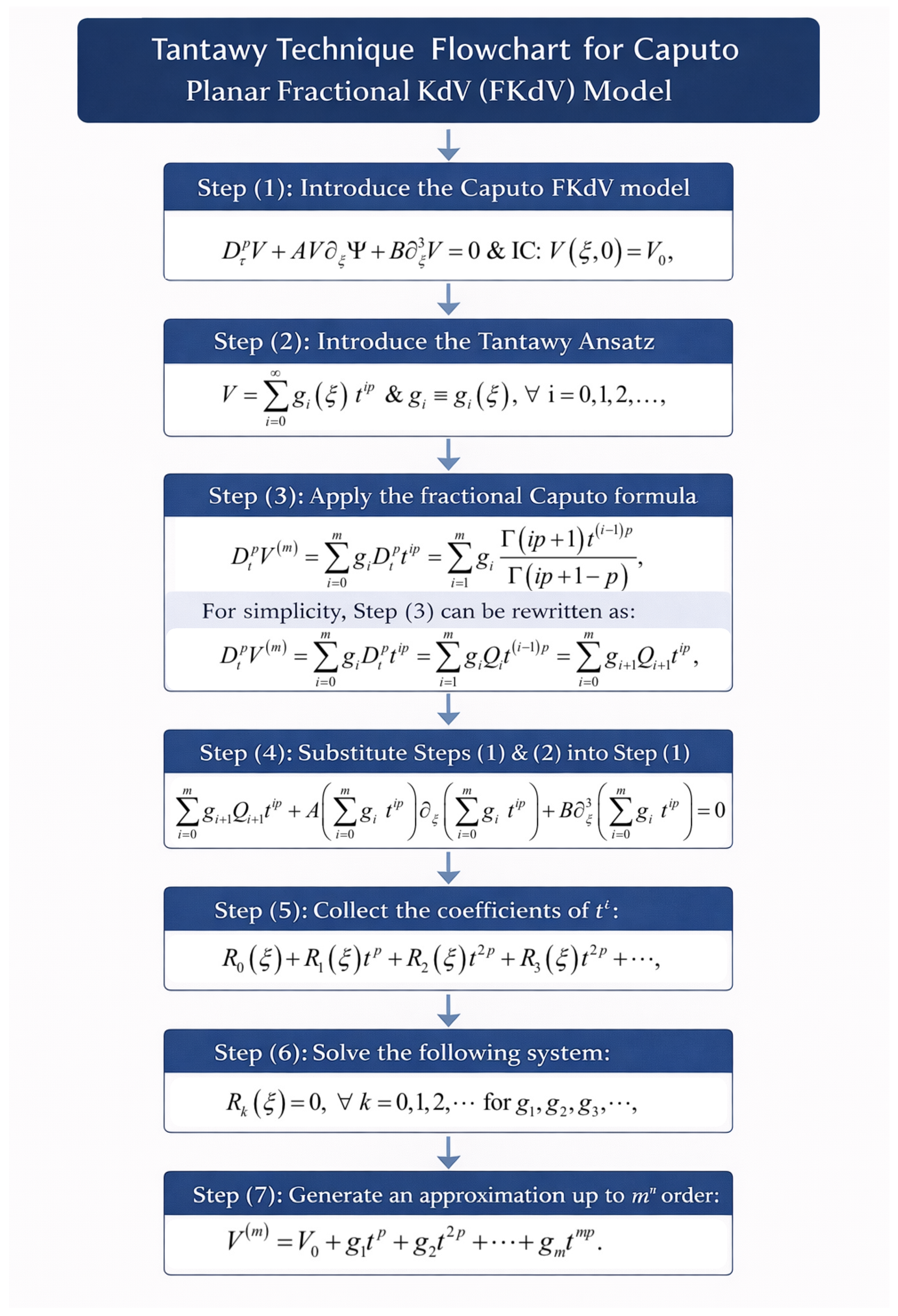
The outline of the TT is briefly introduced in the flowchart (Figure 1). Moreover, the step-by-step details for analyzing FKdV (38) are given as follows [49,50,51,52,53]:
Step (1):
The TT starts by postulating an approximate solution V in the form of a series expansion in powers of τ p :
V = i = 0 τ i p g i ( ξ ) = V 0 ( ξ ) + i = 1 τ i p g i ( ξ ) ,
or, for a truncated m-term approximation,
V = V ( m ) = V 0 + i = 1 m τ i p g i ,
where the unknown spatial functions g i g i ( ξ ) are determined successively by inserting the ansatz (43) into the FKdV Equation (37) and matching coefficients of equal powers of τ p . Remember that g 0 ( ξ ) = V 0 ( ξ ) V 0 .
Step (2):
Action of the Caputo derivative on the ansatz: For 0 < p < 1 , the CFD of order p of a monomial in time reads
D τ p τ i p = Q i τ i p p ,
while D τ p V 0 ( ξ ) = 0 since V 0 ( ξ ) is independent on time and
Q i = Γ ( i p + 1 ) Γ ( i 1 p + 1 ) , i 1 .
Now, by applying CFD D τ p to the truncated series (43), we get
D τ p V ( m ) = i = 1 m Q i g i τ i p p = i = 0 m Q i + 1 τ i p g i + 1 .
Step (3):
Treatment of both nonlinear and dispersive terms in power series form: Using ansatz (43), both nonlinear and dispersive terms in the FKdV Equation (37) are expanded as follows:
V ( m ) ξ V ( m ) = V 0 + i = 1 m τ i p g i ξ V 0 + i = 1 m τ i p ξ g i , ξ 3 V ( m ) = ξ 3 V 0 + i = 1 m τ i p ξ 3 g i .
Multiplying out the nonlinear term and collecting equal powers of τ p leads to
V ( m ) ξ V ( m ) = S 0 ( ξ ) + i = 1 2 m τ i p S i ( ξ ) , i 1 ,
with
S 0 ( ξ ) = V 0 ξ V 0 , S i ( ξ ) = ξ V 0 g i + j = 1 i 1 g j ξ g i j , i 1 ,
where g i = 0 , for i > m .
Step (4):
Collecting all terms of FKdV (i.e., Equation (37)) by substituting the truncated series and its derivatives into Equation (37), we get
R D τ p V + A V ξ V + B ξ 3 V = i = 0 m 1 Q i + 1 τ i p g i + 1 + A S 0 ( ξ ) + i = 1 2 m τ i p S i ( ξ ) + B ξ 3 V 0 + i = 1 m τ i p ξ 3 g i .
Step (5):
Expression (47) can be rearranged as a formal power series in τ p as follows:
i = 0 τ i p R i ( ξ ) = 0 ,
with the following implicit form to R i ( ξ ) :
R i ( ξ ) = Q i + 1 g i + 1 + A S i ( ξ ) + B ξ 3 g i ,
so that the coefficient functions R i ( ξ ) must vanish for all values of i. The implicit values of R i ( ξ ) read
R 0 ( ξ ) = Q 1 g 1 + A V 0 V 0 + B V 0 , R 1 ( ξ ) = Q 2 g 2 + A ξ V 0 g 1 + B g 1 , R 2 ( ξ ) = Q 3 g 3 + A ξ V 0 g 2 + A g 1 g 1 + B g 2 , R 3 ( ξ ) = Q 4 g 4 + A ξ V 0 g 3 + A g 1 g 2 + g 2 g 1 + B g 3 , R 4 ( ξ ) = Q 5 g 5 + A ξ V 0 g 4 + A g 1 g 3 + g 2 g 2 + g 3 g 1 + B g 4 , .
The system R i ( ξ ) = 0 , ∀ i = 0 , 1 , 2 , , is then solved sequentially for g 1 , g 2 , g 3 , .
Step (6):
Solving the system R i ( ξ ) = 0 in g i i = 0 , 1 , 2 , , we obtain the following implicit values of g 1 , g 2 , g 3 , ,
g 1 = 1 Q 1 A V 0 V 0 + B V 0 , g 2 = 1 Q 2 A ξ V 0 g 1 + B g 1 , g 3 = 1 Q 3 A ξ V 0 g 2 + A g 1 g 1 + B g 2 , g 4 = 1 Q 4 A ξ V 0 g 3 + A g 1 g 2 + g 2 g 1 + B g 3 , g 5 = 1 Q 5 A ξ V 0 g 4 + A g 1 g 3 + g 2 g 2 + g 3 g 1 + B g 4 , .
Step (7):
For KdV-soliton, the explicit values of g 1 ( ξ ) , g 2 ( ξ ) , g 3 ( ξ ) , can be obtained by using the IC given in Equation (38) in system (51), and after tedious calculations, one gets
g 1 ( ξ ) = 2 V max Y 0 sech 4 η tanh η w 3 Γ 1 , g 2 ( ξ ) = 2 V max sech 8 η w 6 Γ 2 B 2 Y 1 + A w 2 V max Y 2 , g 3 ( ξ ) = 4 V max sech 10 η tanh η w 9 Γ 1 2 Γ 3 B 3 Γ 1 2 Y 3 + A w 2 V max Γ 2 Y 4 + Γ 1 2 Y 5 , ,
with
Y 0 = 2 B cosh 2 η 10 B + A w 2 V max , Y 1 = 1208 + 1191 cosh 2 η 120 cosh 4 η + cosh 6 η , Y 2 = 2 B 74 68 cosh 2 η + 5 cosh 4 η + A w 2 V max 4 + 3 cosh 2 η , Y 3 = 450995 408364 cosh 2 η + 46828 cosh 4 η 1012 cosh 6 η + cosh 8 η , Y 4 = B 2 356 327 cosh 2 η 36 cosh 4 η + cosh 6 η + A w 2 V max B 65 52 cosh 2 η + 3 cosh 4 η + A w 2 V max 3 + 2 cosh 2 η , Y 5 = 2 B 2 30445 + 26115 cosh 2 η 2619 cosh 4 η + 41 cosh 6 η + A w 2 V max B 2219 1660 cosh 2 η + 111 cosh 4 η + A w 2 V max 23 + 12 cosh 2 η ,
where η = ξ / w and Γ i = Γ ( i p + 1 ) i = 1 , 2 , 3 , .
Step (8):
Collecting the contributions from V 0 ( ξ ) , g 1 ( ξ ) , g 2 ( ξ ) , g 3 ( ξ ) in the ansatz (43), the third-order Tantawy approximation to the FKdV Equation (37) reads as follows:
V T T V 4 = V 0 ( ξ ) + τ p g 1 ( ξ ) + τ 2 p g 2 ( ξ ) + τ 3 p g 3 ( ξ ) = V 0 ( ξ ) + 2 V max Y 0 sech 4 η tanh η w 3 Γ 1 τ p + 2 V max sech 8 η w 6 Γ 2 B 2 Y 1 + A w 2 V max Y 2 τ 2 p + 4 V max sech 10 η tanh η w 9 Γ 1 2 Γ 3 B 3 Γ 1 2 Y 3 + A w 2 V max Γ 2 Y 4 + Γ 1 2 Y 5 τ 3 p .
The structure of the approximation shows that the fractional corrections preserve the localized sech 2 -type profile but modify its amplitude and shape via higher powers of sech ( η ) weighted by fractional-time factors τ i p .
Step (9)
Practical aspects and advantages: A key practical feature of the TT is that, once the series ansatz is adopted, each new correction function g i ( ξ ) is obtained from an algebraic-differential equation with known source terms constructed from lower-order functions. There is no need for smallness parameters, perturbative expansions in amplitude, or linearization about a trivial state; the method directly constructs corrections around a physically relevant initial profile, such as the KdV soliton. Moreover, because each g i ( ξ ) is expressed in terms of a small number of basis profiles (powers of sech in this case), the final approximations remain compact and can be written explicitly up to relatively high orders, making the method both computationally efficient and analytically transparent.

5. New Iterative Method (NIM) for Modeling Dust-Acoustic Fractional Solitons

This section presents a detailed derivation of the NIM for analyzing FKdV Equation (37), using the same IC as given in Equation (38).
Step (1):
Laplace transform (LT) for Caputo derivative: The LT in τ for the function V V ξ , τ is defined by
L V ξ , τ = U ξ , s = 0 e s τ V ξ , τ d τ , s > 0 ,
where s is transform parameter.
Now, the LT to the CFD D τ p V ξ , τ of order p n 1 , n with n N , is defined by
L D τ p V = s p L V k = 0 n 1 D τ k V ξ , 0 s k + 1 p , = s p U ξ , s k = 0 n 1 D τ k V ξ , 0 s k + 1 p .
For the current problem, we have only one IC V 0 ξ V ξ , 0 , i.e., n = 1 ; thus, the definition (55) can be reduced to the following form:
L D τ p V = s p U ξ , s s p 1 V ξ , 0 .
Step (2):
Reformulation of the FKdV Equation (37) by isolating the Caputo derivative as follows:
D τ p V = A V ξ V + B ξ 3 V N V + L V ,
where N V and L V denote the nonlinear and linear spatial operators acting on V V ξ , τ .
Step (3):
Applying LT to Equation (57) gives
L D τ p V = L A V ξ V + B ξ 3 V L N V + L V ,
and by using definition (56), we get
s p U ξ , s s p 1 V 0 ξ = L A V ξ V + B ξ 3 V .
Solving Equation (59) for U ξ , s yields
U ξ , s = s 1 V 0 ξ 1 s p L A V ξ V + B ξ 3 V .
Step (4):
Taking the inverse LT of relation (60) leads to an equivalent integral equation:
V = L 1 s 1 V 0 ξ L 1 1 s p L A V ξ V + B ξ 3 V .
However, NIM is more conveniently framed by separating the initial contribution explicitly and using an iterative correction form. In the notation of the original derivation, the integral equation is written as
V = V 0 ξ L 1 1 s p L A V ξ V + B ξ 3 V ,
Step (5):
The NIM assumes that the solution can be represented as a convergent series
V = n = 0 V n ,
with the IC chosen as
V 0 ( ξ , τ ) = V 0 ( ξ ) = V max sech 2 ξ w ,
where the components V n V n ( ξ , τ ) can be determined recursively from Equation (62).
Step (6):
The nonlinear term N V = V ξ V can be decomposed according to the NIM prescription as follows:
N V = V ξ V = k = 0 V k ξ m = 0 V m = n = 0 G n ,
where the Adomian-like polynomials (but generated without explicit formulas) are defined recursively as
G 0 = V 0 ξ V 0 & G n = k = 0 n V k ξ V n k , n 1 .
Also, the explicit form to the decomposed nonlinear term reads
N V = V 0 ξ V 0 + n = 1 k = 0 n V k ξ k = 0 n V k k = 0 n 1 V k ξ k = 0 n 1 V k ,
Similarly, the linear third-derivative term L V = ξ 3 V can be decomposed as follows:
L V = ξ 3 V = ξ 3 n = 0 V n .
Step (7):
Inserting Equations (63), (65) and (67) into Equation (62) yields the following implicit form:
n = 0 V n = V 0 ξ L 1 1 s p L A n = 0 G n + B ξ 3 n = 0 V n .
Also, the explicit form can be constructed as follows:
n = 0 V n = V 0 ξ L 1 B s p L ξ 3 k = 0 n V k L 1 A s p L V 0 ξ V 0 + n = 1 k = 0 n V k ξ k = 0 n V k k = 0 n 1 V k ξ k = 0 n 1 V k .
Step (6):
In Equation (69) by comparing terms in both sides in Equation (69), the following recurrence relation is obtained:
V n + 1 = L 1 B s p L ξ 3 k = 0 n V k L 1 A s p L V 0 ξ V 0 L 1 A s p L n = 1 k = 0 n V k ξ k = 0 n V k k = 0 n 1 V k ξ k = 0 n 1 V k ,
for n 0 . Thus each new correction V n + 1 is constructed from the nonlinear combinations of all previously computed terms. the first few iterations can be written in the following expanded form:
V 1 = L 1 B s p L ξ 3 V 0 L 1 A s p L V 0 ξ V 0 , V 2 = L 1 B s p L ξ 3 V 1 L 1 1 s p L A V 0 + V 1 ξ V 0 + V 1 V 0 ξ V 0 , V 3 = L 1 B s p L ξ 3 V 2 L 1 1 s p L A k = 0 2 V k ξ k = 0 2 V k k = 0 1 V k ξ k = 0 1 V k , V 4 = L 1 B s p L ξ 3 V 3 L 1 1 s p L A k = 0 3 V k ξ k = 0 3 V k k = 0 2 V k ξ k = 0 2 V k ,
Step (7):
The first iteration V 1 is obtained as
V 1 = L 1 A s p L V 0 ξ V 0 L 1 B s p L ξ 3 V 0 .
Since V 0 and all its derivatives do not depend on τ , thus, their Laplace transforms introduce only factors of 1 / s , i.e.,
L V 0 ξ V 0 = 1 s V 0 ξ V 0 , L ξ 3 V 0 = 1 s ξ 3 V 0 ,
which leads to
V 1 = L 1 A s p 1 s V 0 ξ V 0 L 1 B s p 1 s ξ 3 V 0 = L 1 A s p + 1 V 0 ξ V 0 L 1 B s p + 1 ξ 3 V 0 .
Since L 1 s p 1 = τ p / Γ ( p + 1 ) , one obtains
V 1 = τ p Γ ( p + 1 ) A V 0 ξ V 0 + B ξ 3 V 0 .
Using the IC as given in Equation (64) and simplifying as before leads to an expression structurally similar to g 1 ( ξ ) in the Tantawy approximation, namely,
V 1 = 2 V max τ p sech 4 η tanh η w 3 Γ 1 2 B cosh 2 η 10 B + A w 2 V max .
Step (8):
The second iteration V 2 is obtained as follows:
V 2 = L 1 B s p L ξ 3 V 1 L 1 1 s p L A V 0 + V 1 ξ V 0 + V 1 V 0 ξ V 0 .
Using the IC as given in Equation (64) and simplifying the obtained results, we ultimately, get:
V 2 = 2 V max τ 2 p sech 8 η w 7 Γ 1 2 Γ 2 Γ 3 A 2 w 2 V max 2 H 1 + B 2 w Γ 1 2 Γ 3 H 2 + 2 A B V max H 3 2 A 3 w 4 V max 3 τ p Γ 2 2 tanh η 5 sech 2 η 4 ,
with
H 1 = 8 B τ p Γ 2 2 3 sinh 2 η + 2 tanh η 15 sech 2 η 16 + w 3 Γ 1 2 Γ 3 3 cosh 2 η 4 , H 2 = 1191 cosh 2 η 120 cosh 4 η + cosh 6 η 1208 , H 3 = w 3 Γ 1 2 Γ 3 74 68 cosh 2 η + 5 cosh 4 η 4 B τ p Γ 2 2 40 sinh 2 η sinh 4 η + 60 tanh η 3 sech 2 η 4 ,
Step (9):
After computing V 0 , V 1 , V 2 , one obtains a second-order NIM approximation
V N I M V ( 2 ) = V 0 ( ξ ) + V 1 ( ξ , τ ) + V 2 ( ξ , τ ) ,
The third-order term V 3 ( ξ , τ ) is also computed but is not displayed explicitly due to its length; nevertheless, it is used in the numerical error comparison with the Tantawy approximation.

6. Results and Discussion

In this section, we present a numerical analysis of the DASs based on the derived KdV equation. The soliton solution is a function of the plasma ratios β = n e 0 / n i 0 and σ = T e / T i . In the present context, Hirota’s method has the advantage that it produces explicit multi-soliton solutions for the dust-acoustic KdV equation in the lunar terminator model, thereby allowing a detailed study of overtaking interactions and phase shifts in terms of the physical plasma parameters. Next, we investigate the effect of these ratios on single solitons and the overtaking interactions of multi-solitons for the characteristic parameters of lunar terminator. The typical plasma parameters of the lunar terminator [16,18] are T i = 7 × 10 4 K , T e = 1.1 × 10 5 K , n i 0 = 8.8 cm 3 , n e 0 = 7.0 cm 3 , Z d 10 , and n d 0 10 3 cm 3 . For these parameters, the ratios turn out to be β 0.899 and σ 1.571 .

6.1. Effect on a Single Soliton

The characteristics of a single dust-acoustic solitary wave given by Equation (26) are highly sensitive to the ambient plasma conditions. A key observation is that all solitary structures are rarefactive ( ϕ 1 < 0 ), which is consistent with the theoretical predictions for this plasma model.
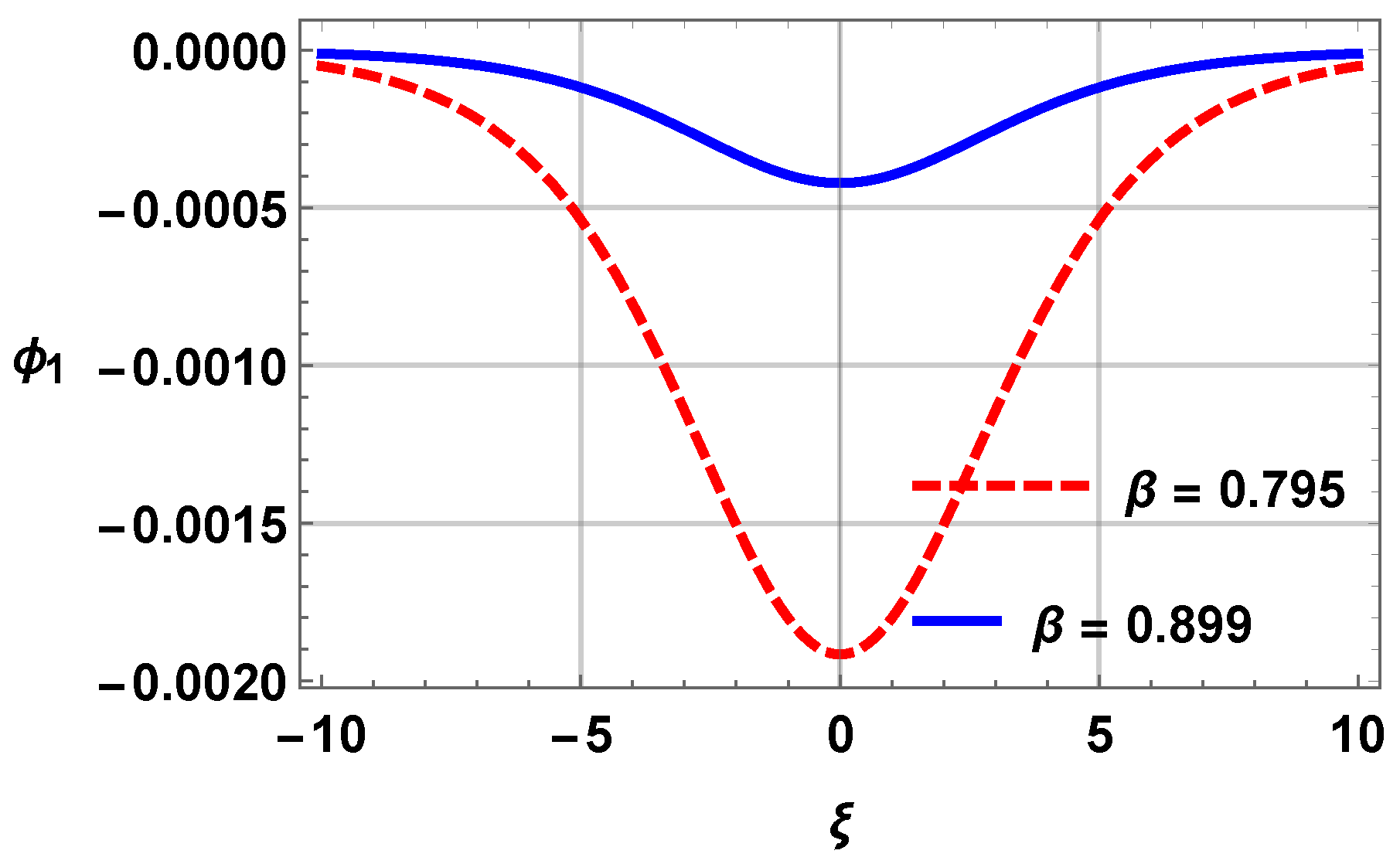
The behavior of the electrostatic potential ϕ 1 for varying β is illustrated in Figure 2. When the density ratio between electrons and ions increases from β = 0.795 to β = 0.899 , the height of the soliton decreases appreciably. This outcome is expected, since the nonlinear coefficient A becomes increasingly negative with larger β , which lowers the ratio 3 B P 1 2 / A . The stronger electron dominance enhances the screening effect, thereby weakening the restoring pressure and preventing the development of pronounced nonlinear potential structures.
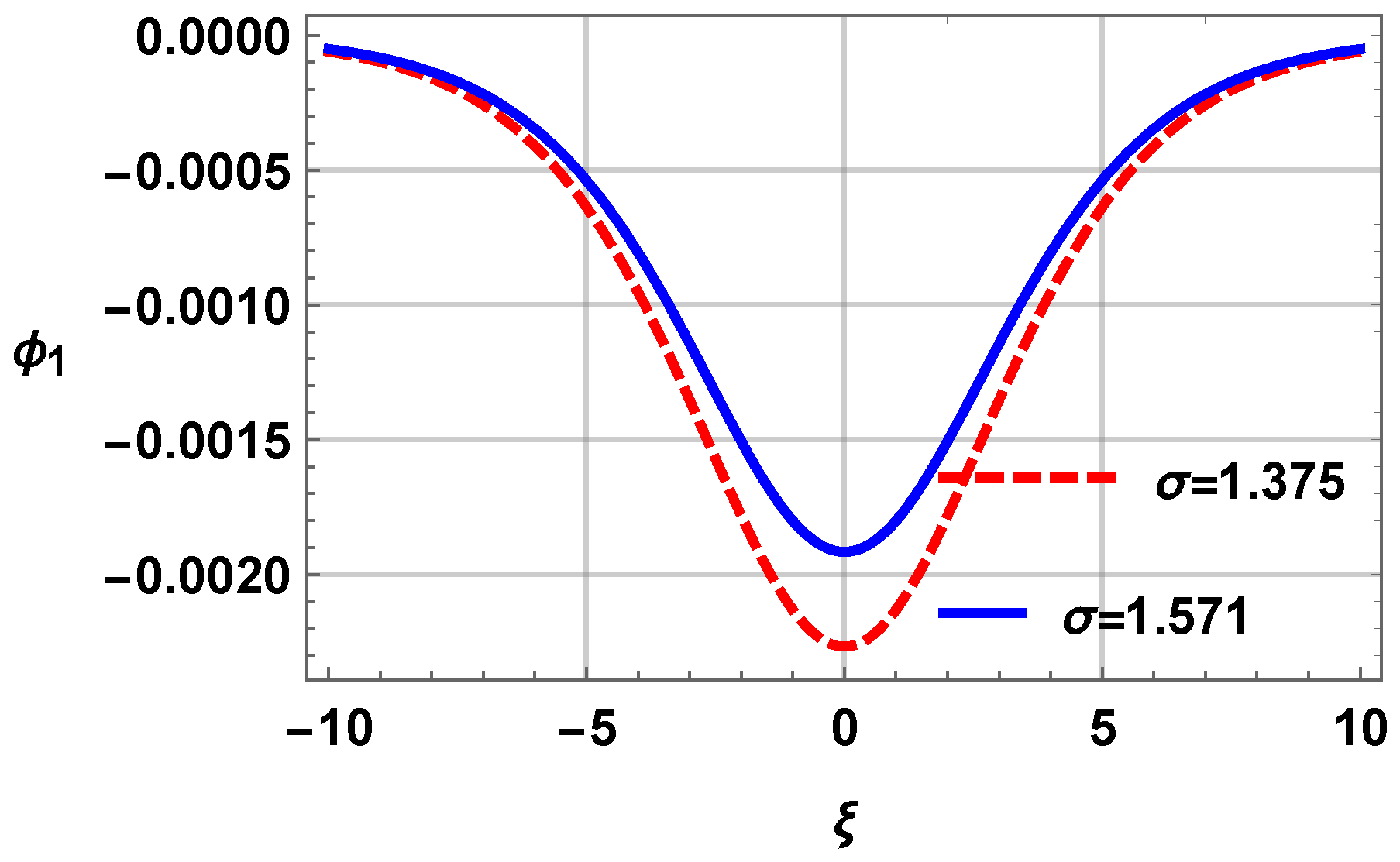
Figure 3 displays the response of the electrostatic potential to variations in the electron-to-ion temperature ratio, σ . Unlike the effect of β , raising σ from 1.375 to 1.571 produces a marked increase in soliton amplitude. Physically, a higher σ corresponds to a hotter electron population relative to the ions. These energetic electrons exert a stronger restoring pressure on the dust-acoustic disturbance. The enhanced pressure sharpens the potential well, yielding steeper, more pronounced soliton structures. Consequently, both the amplitude and the propagation velocity rise, a behavior faithfully captured by the s e c h 2 -profile of the solution.

6.2. Effect on Overtaking Interaction of Two Solitons

Elastic collisions between dust-acoustic solitons stand as a defining signature of the integrable planar KdV framework. To probe this overtaking process quantitatively, we employ the exact two-soliton solution, which captures the nonlinear phase shift and amplitude preservation characteristic of integrable systems. The relative velocity governing how the leading (taller) soliton catches up with its trailing (shorter) counterpart depends sensitively on the plasma parameters β and σ , since these quantities set the individual phase speeds through the nonlinear dispersion relation.
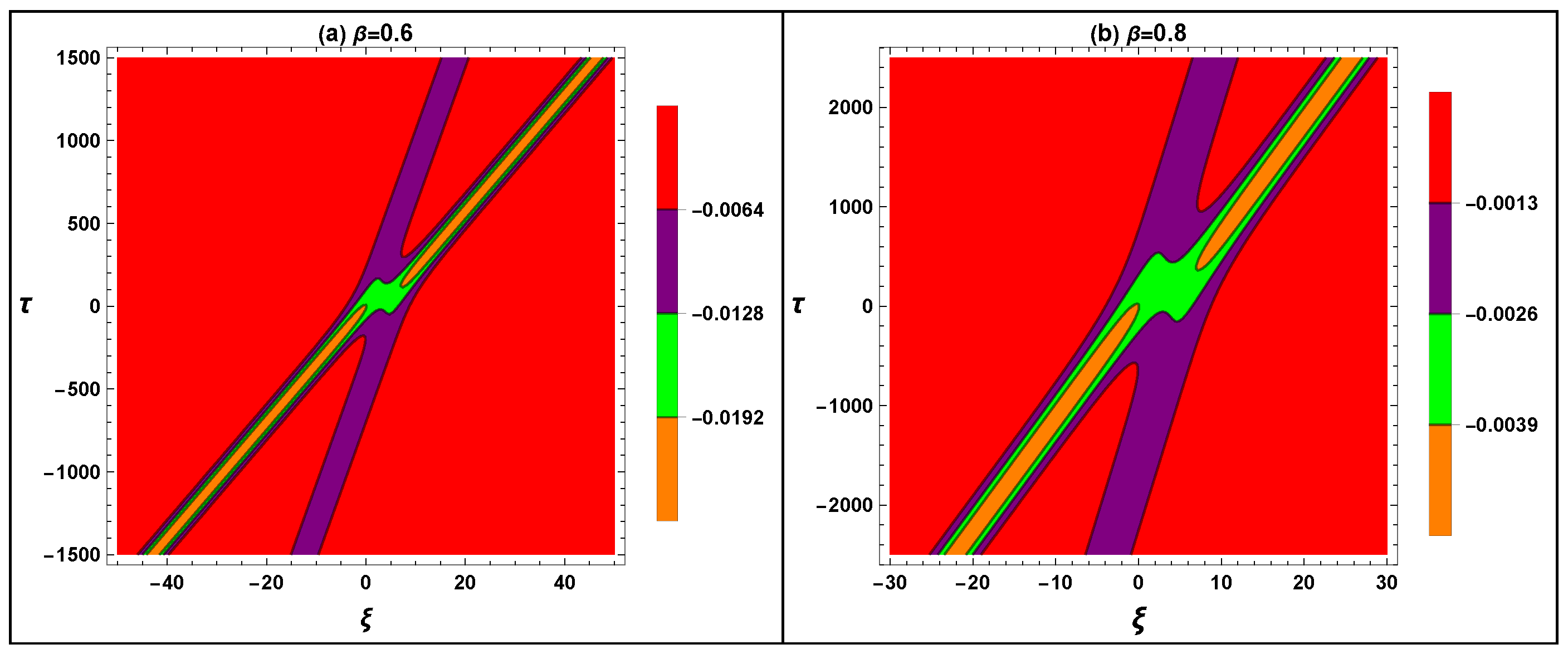
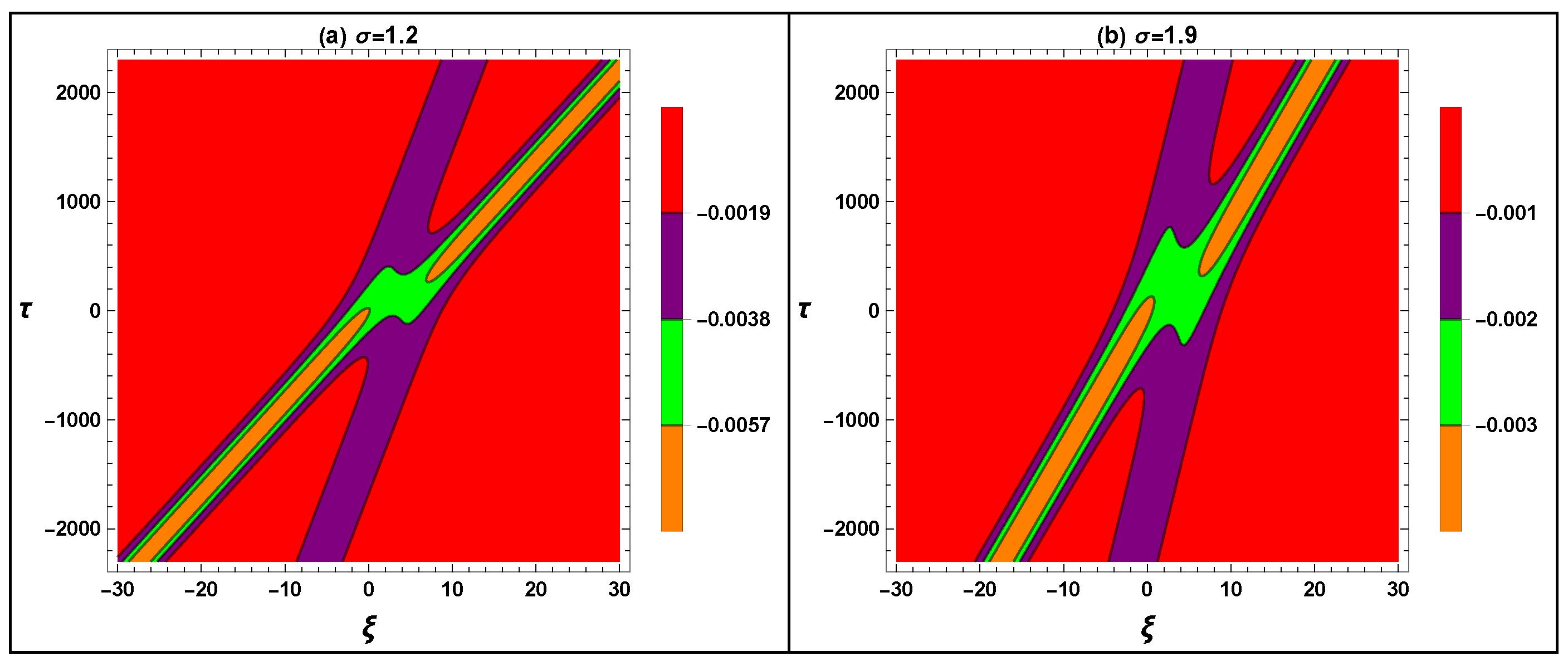
Contour plots in Figure 4 illustrate this effect. At the lower β value ( β = 0.6 ), the legs of the soliton trajectories on ξ scale are more widely separated, indicating a faster overtaking process. As β increases ( β = 0.8 ), the separation decreases, leading to a slower overtaking. This is because a higher β reduces the amplitude of the soliton and, consequently, the speed difference between them. Conversely, Figure 5 shows that increasing the temperature ratio accelerates the overtaking interaction of two solitons. A higher value of σ generates taller and faster solitons, causing the gap between them to shrink, leading to quicker interaction, as reflected by the reduced separation between the trajectories. The ratio of the propagation vectors ( k 1 , k 2 ) plays a decisive role in shaping the composite structure at the point of interaction during the collision of the solitons. Different values of k 2 relative to k 1 determine whether the combined potential at the moment of collision forms a single merged hump or a more complex multi-humped structure. These features arise entirely from the nonlinear superposition of the two solitary potentials.
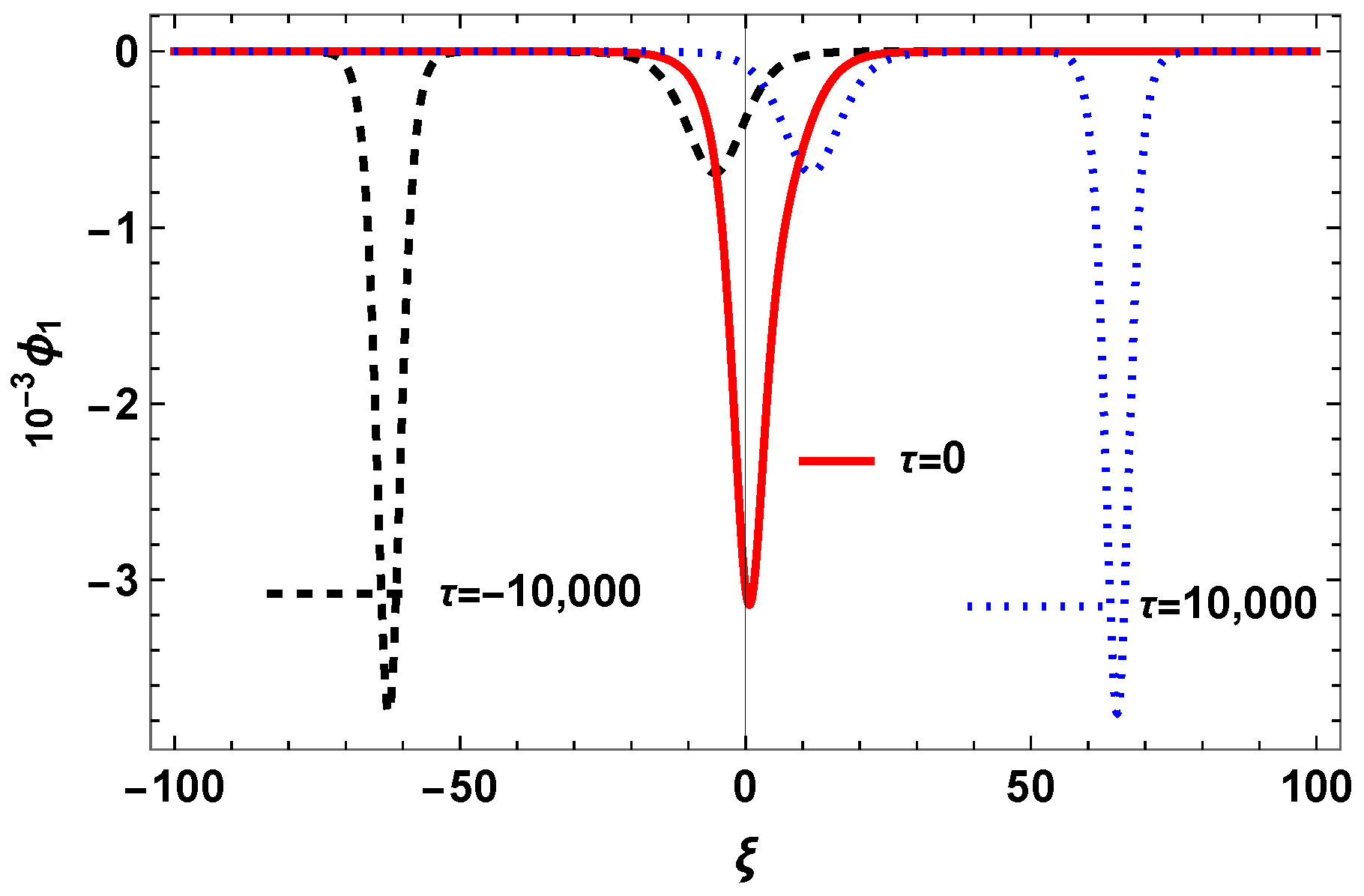
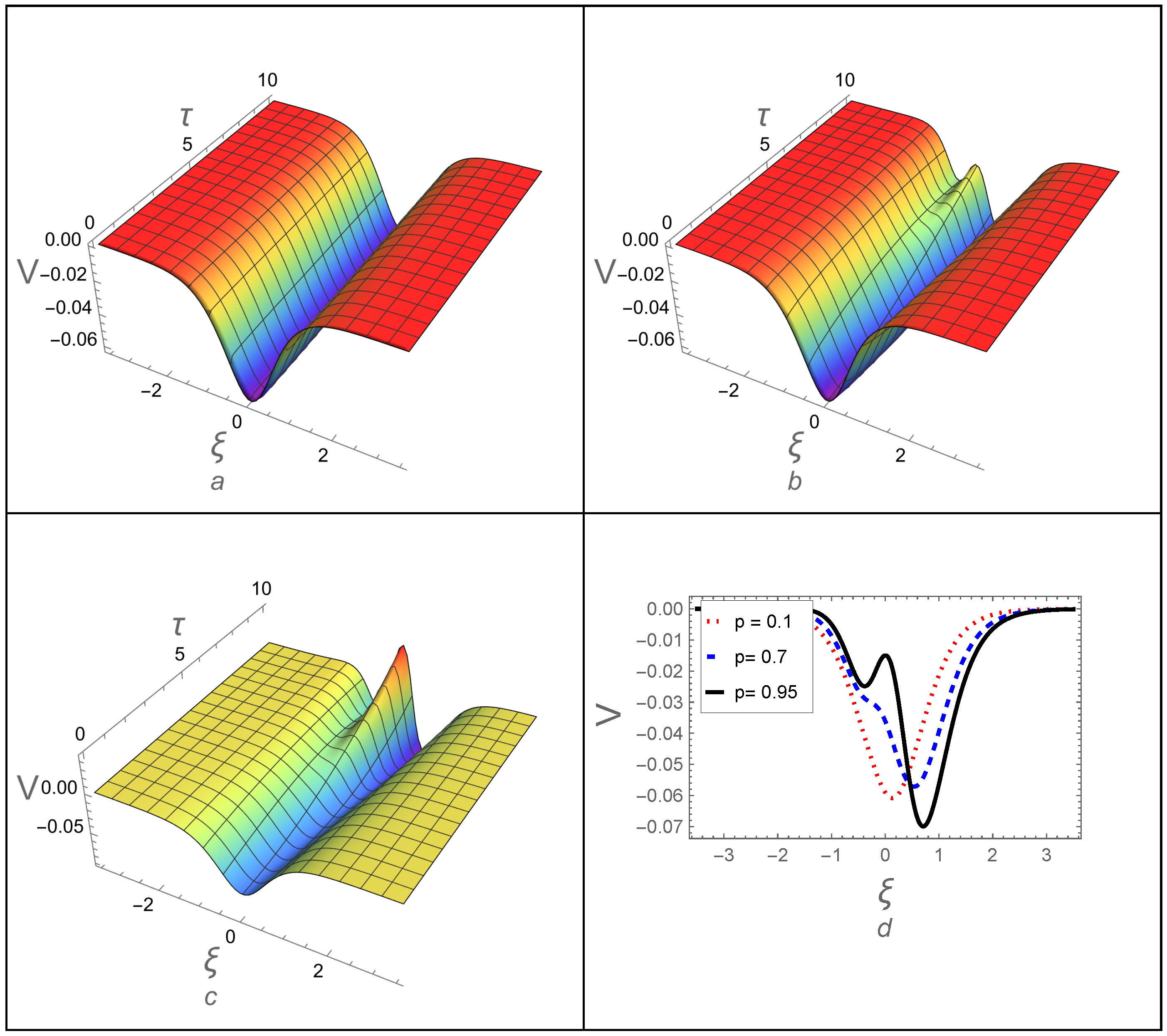
Single-Humped Structure: Figure 6 shows that when the solitons have significantly different propagation vectors, the stronger soliton ( k 1 = 0.7 ) overtakes the weaker one ( k 2 = 0.3 ). At the moment of interaction, their nonlinear superposition produces a single combined peak. The weaker soliton does not generate a separate maximum because its contribution is small compared to the dominant potential of the stronger soliton. After the collision, both solitons fully recover their identities, indicating an elastic interaction.
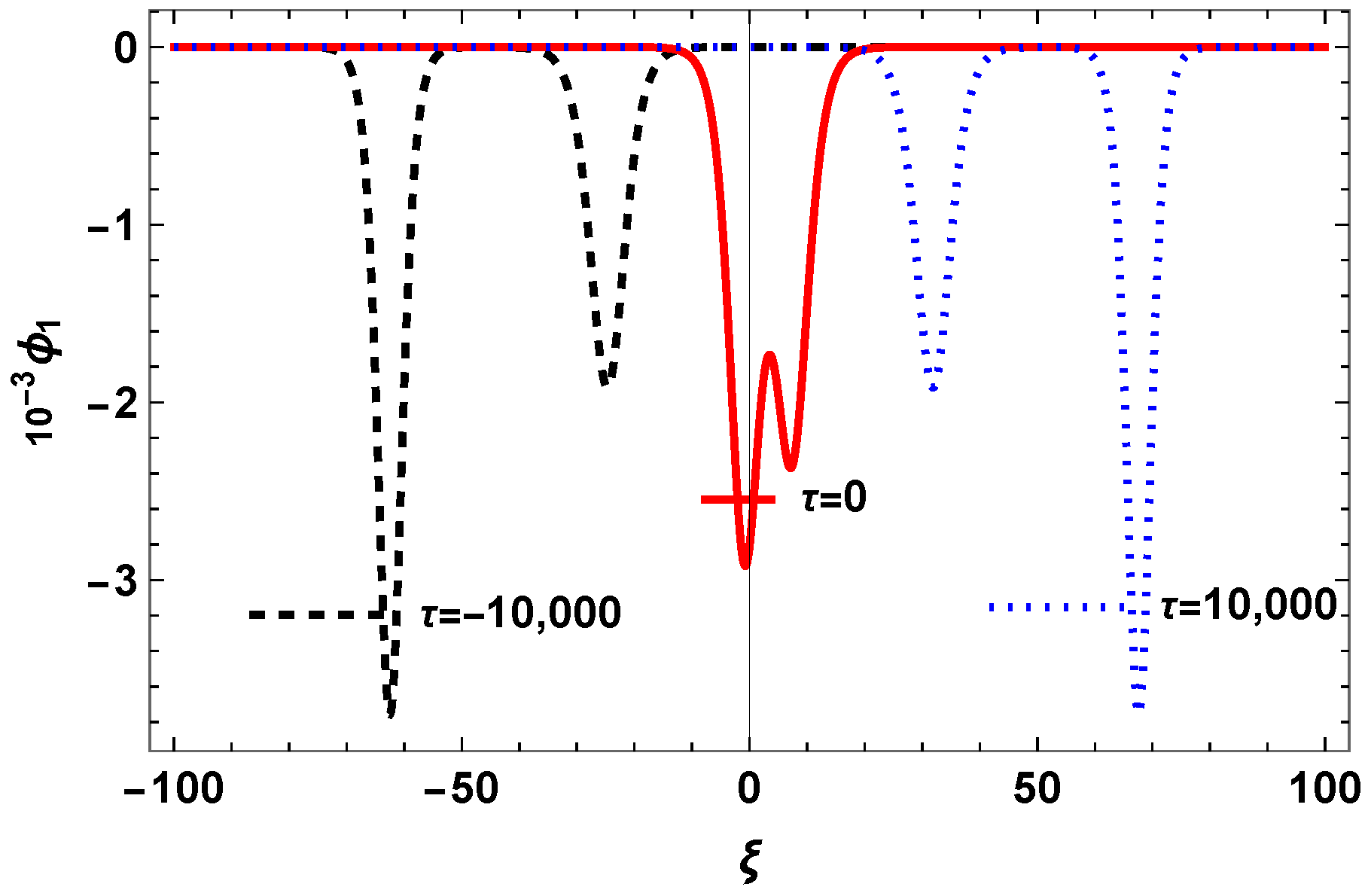
Double-Humped Structure: When the ratio of propagation vectors is close enough, for example k 1 = 0.7 and k 2 = 0.45 , the amplitudes of the two solitons become more comparable. Figure 7 shows that at τ = 0 , the collision does not produce a merged peak. Instead the double-humped structure appears. One can see that the humped structure has two adjacent maxima. We think the humped structure forms because both solitons add a lot to the total potential. The overlapping tails of the solitons create a nonlinear interference pattern. The reduced speed difference also prolongs the interaction, allowing the two peaks to remain distinguishable.

6.3. Complex Interaction of Three Solitons

The robustness of the model is further demonstrated through the nonlinear interaction of three DASs. Depending on the spacing between their propagation vectors ( k 1 , k 2 , k 3 ) , the composite potential during collision may exhibit well-separated humps, merged structures, or strongly distorted multi-hump patterns. These behaviors provide deeper insight into how multi-soliton systems evolve in plasmas.
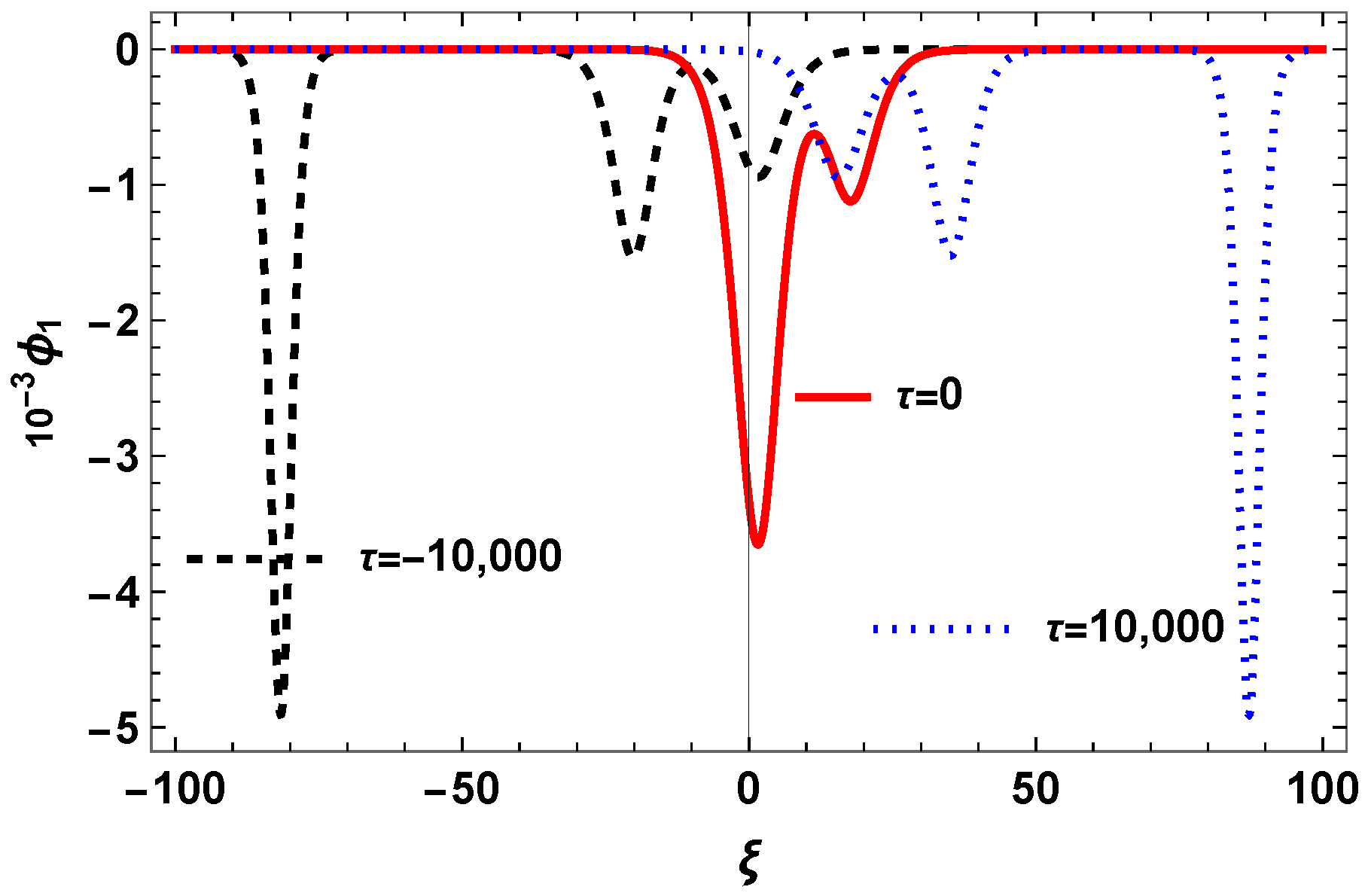
Multi-stage Overtaking: For the parameter set ( k 1 , k 2 , k 3 ) = ( 0.95 , 0.65 , 0.35 ) , the solitons have well-separated amplitudes. Figure 8 shows that:
  • The tallest soliton ( k 1 ) catches the middle soliton ( k 2 ), producing a transient two-hump potential.
  • As all three solitons overlap near τ = 0 , the potential becomes strongly distorted and exhibits multiple adjacent peaks.
  • Once the interactions complete, each soliton re-emerges with its original shape and amplitude, demonstrating the elastic nature of these collisions.
This behavior is characteristic of integrable multi-soliton dynamics, where even complex, overlapping interactions preserve coherence.
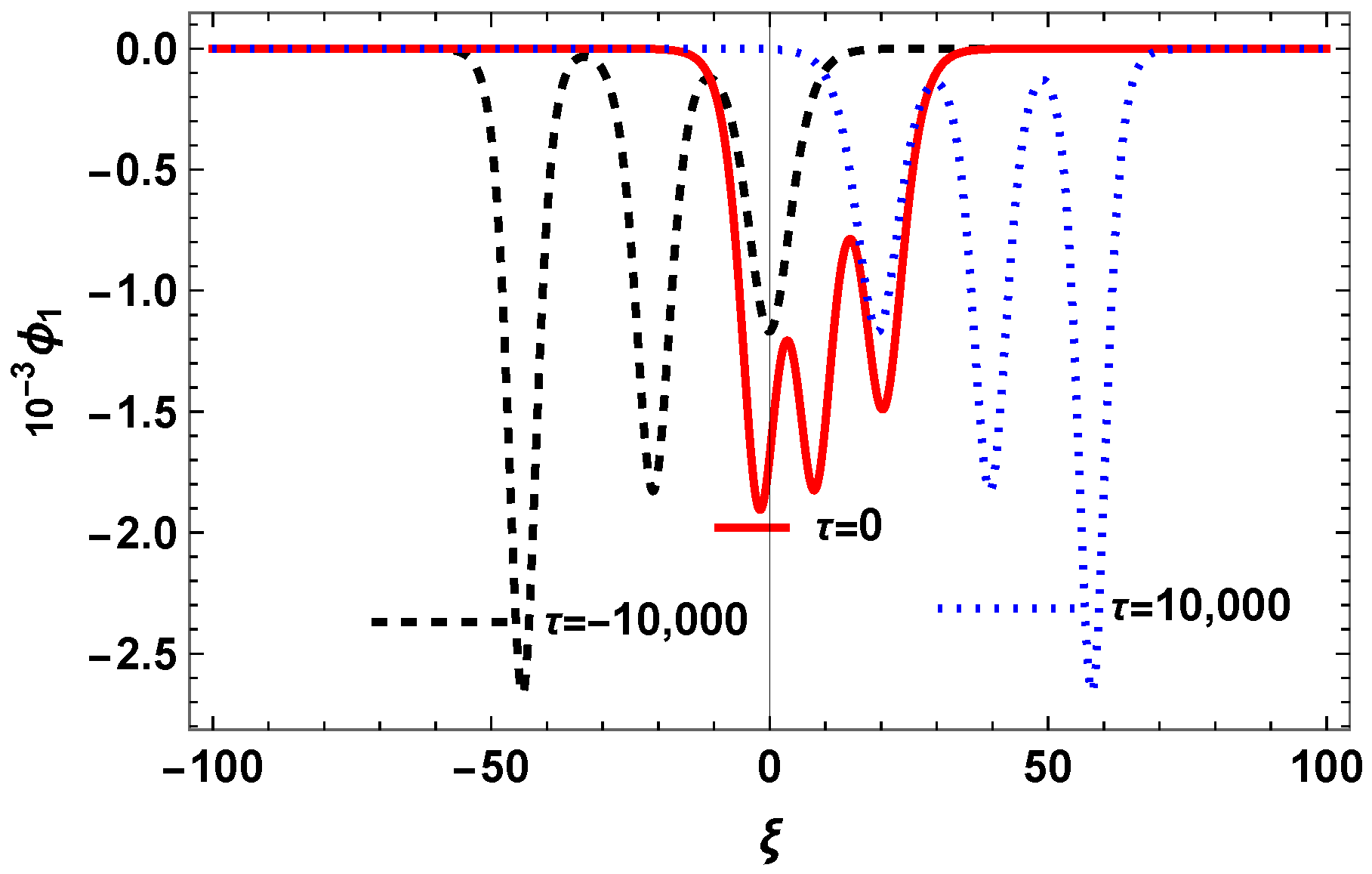
Gradual and Symmetric Interaction: When the propagation vectors are closer in magnitude, as in ( k 1 , k 2 , k 3 ) = ( 0.59 , 0.49 , 0.39 ) , the solitons have comparable amplitudes as illustrated in Figure 9. From this figure, we observed that:
  • None of the solitons overwhelmingly dominates the others.
  • Their overlap produces a smoother multi-hump potential, with the peaks more symmetric compared to Figure 8.
  • The overtaking sequence proceeds more slowly due to the smaller relative speed differences.
In both cases, the potential profiles at τ = 10,000 show that the three solitons reappear with unchanged shapes and amplitudes. This clean separation after a highly nonlinear interaction confirms the integrable and coherent nature of the three-soliton collision process.

6.4. The Interplay Between Fractionality and Soliton Morphology

The rationale for introducing a time-fractional generalization of the KdV equation in this dust-acoustic model stems from the intrinsic properties of the dust component and the terminator environment. Dust grains are much heavier than the background electrons and ions, and their charging and dynamical response typically involve a spectrum of time scales associated with grain charging, plasma dust collisions, and surface processes. In the lunar terminator sheath, these processes occur in a plasma that is strongly non-stationary and spatially asymmetric, so that the dust does not respond instantaneously to local perturbations but retains a memory of its previous dynamical state. Time-fractional derivatives provide an effective way to encode such nonlocal temporal behavior in a fluid-like evolution equation: the fractional order controls the weight of past states in the present dynamics and therefore modifies the time evolution of dust-acoustic solitary structures, even when the underlying spatial nonlinearity and dispersion coefficients remain unchanged. In this sense, the time-FKdV equation used here can be viewed as a reduced, phenomenological model of the dust-acoustic response in a complex plasma with memory, where the fractional order encapsulates the cumulative history of the complex plasma interaction rather than serving merely as a formal replacement for the time derivative.
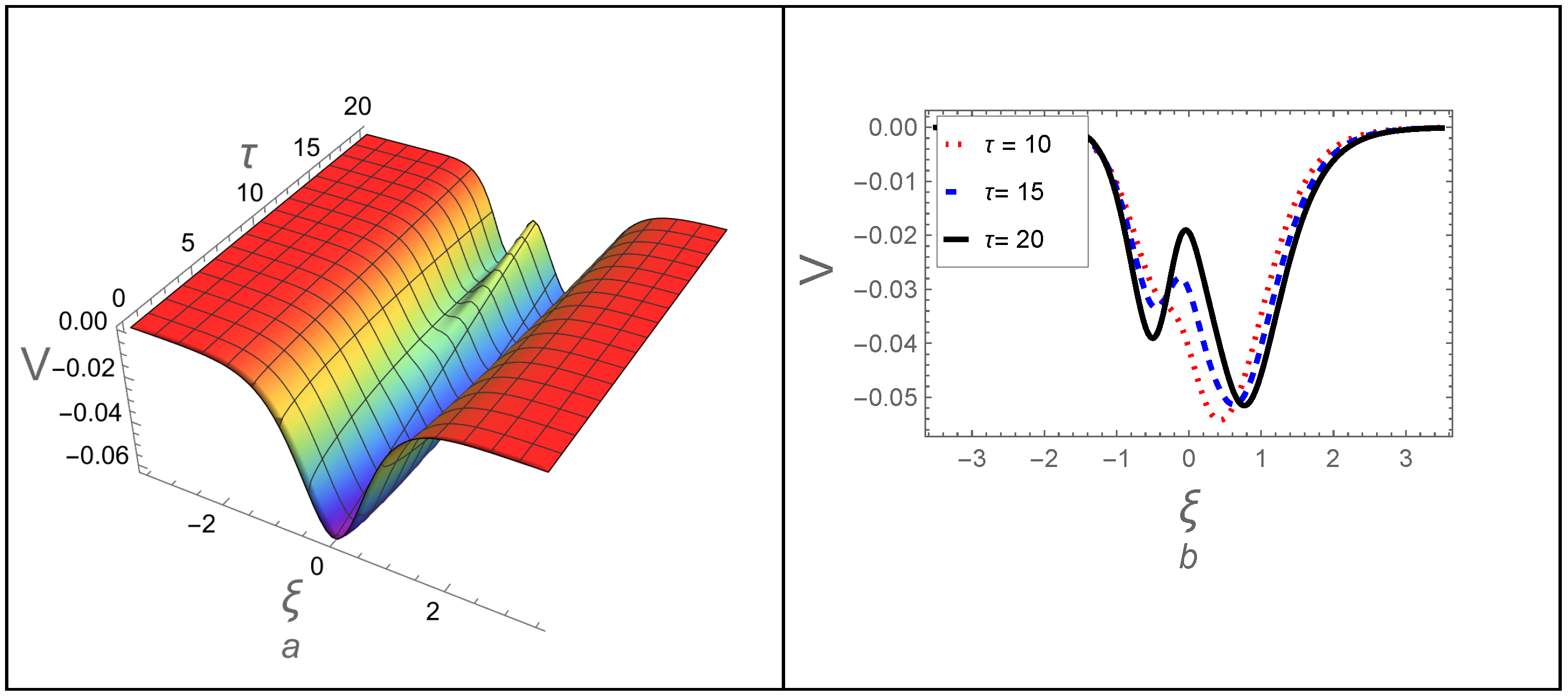
For the DA FKdV-soliton, the fractional factor p plays the effective role of a memory parameter that continuously interpolates between static profiles ( p 0 ) and the classical KdV dynamics ( p = 1 ). To understand the propagation dynamics of the DA FKdV-soliton under the influence of fractionality p, we analyzed the approximations (53) or (76), as shown in Figure 10. It is clear that the fractional soliton amplitude decreases as the fractional factor decreases, whereas increasing the fractionality enhances the fractional soliton amplitude. Moreover, the temporal evolution of the fractional soliton profile is studied at a fixed fractional factor. As shown in Figure 11, the wave initially propagates as a single pulse, splitting into two branches with increasing time. The temporal evolution of fractional DASs reveals unexpected dynamical richness absent from integer models. In particular, rarefactive DA FKdV-solitons exhibit shapes and temporal behaviors that differ from their integer-order counterparts, which may help explain discrepancies between experimental observations or satellite measurements and predictions based solely on classical KdV theory. Because fractional operators encapsulate nonlocal temporal responses, they provide a flexible way to model cumulative effects of collisions, trapping, or other kinetic processes that leave a long-lived imprint on the plasma response.

6.5. Comparison of the Two Fractional Techniques

The Tantawy and NIM approximations (53) and (76) are compared against the exact KdV-soliton for the integer case ( p = 1 ), by estimating the total residual error and absolute error of the derived approximations to assess their accuracy and validate each proposed method. In Table 1, the absolute errors of the second-order i . e . , V 3 & 4 = 0 approximations (53) and (76), are numerically estimated and compared with each other according to the following relation:
L T T 2 = V T T V E x . V 3 & 4 = 0 , L N I M 2 = V N I M V E x . V 3 = 0 .
Moreover, in Table 2, the absolute errors of the third-order i . e . , V 4 = 0 approximations (53) and (76) are numerically examined according to the following relation:
L T T 3 = V T T V E x . V 4 = 0 , L N I M 3 = V N I M V E x . V 3 0 .
The absolute errors of the Tantawy approximation are observed to be significantly smaller across the parameter range of interest. The numerical data summarized in the corresponding tables show that, for a fixed set of parameters: β = 0.795 & σ = 1.35 & u 0 = 0.1 , both the second-order Tantawy and NIM approximations (53) and (76) exhibit errors of order 10 10 . However, at the same values of the relevant physical parameters and for the third-order Tantawy approximation (53) exhibits errors of order 10 12 , whereas NIM third-order approximation yields poor, unstable results for the current problem, as illustrated in Table 2. Conversely, the TT approximations for various orders (second-, third-, and fourth-order approximations) yield more accurate and stable results as the approximation order increases, as shown in Table 3.
L T T 2 = V T T V E x . V 3 & 4 = 0 , L T T 3 = V T T V E x . V 4 = 0 , L T T 4 = V T T V E x . V 4 0 .
This indicates that the TT not only is more efficient in producing higher-order terms with manageable algebraic size, but it also provides superior accuracy and stability compared to NIM for the FKdV-soliton problem at hand.
Additionally, we estimated the maximum residual errors of the second-, third-, and fourth-order approximations (53) and (76) to verify the convergence of the derived approximations and their suitability for modeling the most sensitive phenomena, which are prevalent not only in plasma physics but also in many interdisciplinary fields such as optical fibers, communications, the Poisson–Einstein method, fluids, etc.,
R N I M 2 = max Ω D τ p V N I M + A V N I M ξ V N I M + B ξ 3 V N I M V 3 = 0 = 0.00538016 , at x = 0.646493 & t = 3 , R N I M 3 = max Ω D τ p V N I M + A V N I M ξ V N I M + B ξ 3 V N I M V 3 0 = 0.0588641 , at x = 0.356572 & t = 3 , R T T 2 = max Ω D τ p V T T + A V T T ξ V T T + B ξ 3 V T T V 3 & 4 = 0 = 0.00417929 , at x = 0.415422 & t = 3 , R T T 3 = max Ω D τ p V T T + A V T T ξ V T T + B ξ 3 V T T V 4 = 0 = 0.0022828 , at x = 0.178 & t = 3 , R T T 4 = max Ω D τ p V T T + A V T T ξ V T T + B ξ 3 V T T V 4 0 = 0.000866341 , at x = 0.00314306 & t = 3 ,
where Ω 4 x 4 & 0 t 4 .
The analysis results demonstrate the high accuracy of the TT approximations and their high stability over long time intervals. This confirms the method’s efficiency, which is a promising approach for analyzing various fractional differential equations.
We can conclude that both the absolute and maximum residual errors of all derived approximations by the TT at different orders are outperformed the NIM approximations. Additionally, by increasing the order in the Tantawy approximations, we observe that the accuracy increases, meaning that both the absolute and maximum residual errors decrease as evident in Table 1, Table 2 and Table 3, and Equation (77). This, in turn, indicates that the TT is more stable and convergent over longer time intervals than the NIM. Further, it is not easy to obtain higher-order approximations beyond the third using NIM. This is in contrast to the TT, where approximations can be generated up to higher orders, and all generated higher-order approximations can also be included in the text, unlike the NIM, where it is not possible to insert the approximation up to the third order in the text due to the length of this approximation. This confirms the TT’s efficiency, which is a promising approach for analyzing various fractional differential equations.
From a physical perspective, this memory effect is closely tied to the dust component and to the non-stationary character of the terminator plasma. The charging state and velocity of a dust grain at a given time are influenced not only by the instantaneous electric field and plasma densities but also by the preceding history of exposure to photoemission, plasma currents, and collisional processes. In a classical integer-order KdV description, this history is effectively collapsed into local values for the fields, so the medium responds as if it has no memory beyond the current state. In contrast, the time-fractional derivative in the FKdV equation introduces an explicit dependence of the present dust-acoustic potential on its past values, with the fractional order p controlling how strongly past states are weighted. The trends observed in our simulations, a reduction of soliton amplitude and a modification of temporal evolution as p decreases, reflect the fact that a medium with stronger memory (smaller p) responds more sluggishly because a larger portion of the previous dynamical state is retained. In this way, the fractional description provides an effective macroscopic representation of temporally nonlocal dust dynamics in the lunar terminator sheath.

7. Conclusions

This study has theoretically investigated the formation and overtaking interactions of one-dimensional dust-acoustic solitary waves (DASWs) for the lunar terminator. By applying the reductive perturbation technique to the fluid model equations, the planar integer Korteweg–de Vries (KdV) equation has been successfully derived. At this point, the study has been divided into two main parts. In the first part, Hirota’s direct method has been applied to derive and analyze the multiple-soliton solutions that arise and propagate in the model under investigation. In the second part, the planar integer KdV has been transformed into its fractional counterpart using a suitable transformation to study the effects of memory and nonlocality on the propagation dynamics of solitons in the plasma model under investigation. To this end, this equation has been analyzed using both the Tantawy technique (TT) and the Laplace new iterative method (NIM). The most important results have been summarized as follows:
  • Our analysis has unequivocally demonstrated that all supported solitary structures in this environment are rarefactive. The properties and interaction dynamics of these solitons have been observed to be profoundly dependent on the fundamental plasma parameters. Specifically, an increase in the density ratio β = n e 0 / n i 0 has led to a decrease in soliton amplitude and a slower overtaking process during collisions. Conversely, an increase in the temperature ratio σ = T e / T i has resulted in a significant enhancement of the soliton amplitude and a faster overtaking interaction. Furthermore, the morphology of the interaction has been shown to be dictated by the ratio of the propagation vectors ( P 1 , P 2 ) of the colliding solitons: a large disparity has produced a single merged hump in the composite potential at collision, whereas comparable vectors have generated a distinct double-hump structure due to strong nonlinear interference. The interaction of three solitons has further revealed complex, multi-stage overtaking processes that preserve the individual soliton identities.
  • The second main part of the study has introduced a time-fractional KdV (FKdV) equation as an effective model for incorporating temporal memory into the dust-acoustic dynamics. Using the Caputo derivative, the fractional order has been treated as a memory parameter that continuously interpolates between static profiles and classical KdV evolution. Two analytical approximation schemes have been applied and compared: the TT and the NIM. Both methods recover the classical KdV-soliton in the integer limit, but their behavior in the fractional regime differs significantly. For the dust-acoustic FKdV-soliton problem considered here, the TT produces higher-order approximations that remain compact and show systematically smaller absolute and residual errors than those generated by the NIM at comparable truncation orders, indicating superior accuracy and numerical stability.
From a physical perspective, the fractional analysis has revealed that decreasing the fractional order reduces the effective soliton amplitude and modifies the temporal evolution of dust-acoustic structures in ways inaccessible within the purely integer KdV framework. This sensitivity to the fractional order reflects the influence of long-lived, nonlocal temporal processes, such as cumulative charging and collisional or trapping effects, on the dust response in the terminator sheath. The combined integer and fractional results therefore provide a more flexible description of dust-acoustic solitary waves in complex lunar plasmas and may help reconcile discrepancies between classical KdV predictions and potential future measurements of electrostatic structures near the terminator.
Future Work: The present work can be extended in several directions:
  • One natural generalization is to formulate space-fractional and fully space–time-fractional dust-acoustic KdV-type models, in which non-integer spatial derivatives capture long-range coupling and anomalous transport across the direction of propagation in addition to temporal memory, following the ideas that have already been explored for other plasma and transport systems [31,32,33].
  • Another avenue is to develop nonplanar cylindrical and spherical dust-acoustic KdV-type equations with fractional dynamics [64], which would be more appropriate for describing localized structures in curved geometries, such as those relevant to complex lunar or planetary environments. Finally, confronting the present and future fractional models with in situ and laboratory data, once sufficiently resolved measurements become available, will be essential for constraining the physically relevant fractional order and derivative definition and for assessing the predictive power of fractional dust-acoustic wave theories.

Author Contributions

Methodology, R.A.A., M.B., R.J. and S.A.E.-T.; Software, R.J., K.D. and S.A.E.-T.; Validation, S.A.E.-T.; Formal analysis, R.A.A., H.A.A. and S.A.E.-T.; Investigation, M.B., R.J. and S.A.E.-T.; Writing—original draft, M.B. and S.A.E.-T.; Writing—review & editing, R.A.A., W.M., H.A.A., K.D. and S.A.E.-T.; Supervision, W.M. and K.D. All authors contributed equally and approved the final version of the current manuscript.

Funding

The project was funded by the Deanship of Scientific Research (DSR), King Abdulaziz University, Jeddah, Saudi Arabia, under grant No. (KEP-16-135-42). The authors, therefore, acknowledge with thanks to DSR for their technical and financial support. The authors express their gratitude to Princess Nourah bint Abdulrahman University Researchers Supporting Project Number (PNURSP2026R17), Princess Nourah bint Abdulrahman University, Riyadh, Saudi Arabia.

Data Availability Statement

El-Tantawy performed all derivations, calculations, and analyses using MATHEMATICA V13.2 or V14 and any version above. Also, he can provide all Mathematica codes that were used upon request.

Acknowledgments

The project was funded by the Deanship of Scientific Research (DSR), King Abdulaziz University, Jeddah, Saudi Arabia, under grant No. (KEP-16-135-42). The authors, therefore, acknowledge with thanks to DSR for their technical and financial support. The authors express their gratitude to Princess Nourah bint Abdulrahman University Researchers Supporting Project Number (PNURSP2026R17), Princess Nourah bint Abdulrahman University, Riyadh, Saudi Arabia.

Conflicts of Interest

The authors declare that they have no conflicts of interest.

References

  1. Fortov, V.E.; Ivlev, A.V.; Khrapak, S.A.; Khrapak, A.G.; Morfill, G.E. Complex (dusty) plasmas: Current status, open issues, perspectives. Phys. Rep. 2005, 421, 1–103. [Google Scholar] [CrossRef]
  2. Colwell, J.E.; Batiste, S.; Horányi, M.; Robertson, S.; Sture, S. Lunar surface: Dust dynamics and regolith mechanics. Rev. Geophys. 2007, 45, RG2006. [Google Scholar] [CrossRef]
  3. Stubbs, T.J.; Vondrak, R.R.; Farrell, W.M. A dynamic fountain model for lunar dust. Adv. Space Res. 2006, 37, 59–66. [Google Scholar] [CrossRef]
  4. Popel, S.I.; Zelenyi, L.M. Future lunar missions and investigation of dusty plasma processes on the Moon. J. Plasma Phys. 2013, 79, 405–411. [Google Scholar] [CrossRef]
  5. Popel, S.I.; Golub’, A.P.; Kassem, A.I.; Zelenyi, L.M. Dust dynamics in the lunar dusty plasmas: Effects of magnetic fields and dust charge variations. Phys. Plasmas 2022, 29, 013701. [Google Scholar] [CrossRef]
  6. Rennilson, J.J.; Criswell, D.R. Surveyor observations of lunar horizon-glow. Earth Moon Planets 1974, 10, 121–142. [Google Scholar] [CrossRef]
  7. Zook, H.A.; McCoy, J.E. Large scale lunar horizon glow and a high altitude lunar dust exosphere. Geophys. Res. Lett. 1991, 18, 2117–2120. [Google Scholar] [CrossRef]
  8. Berg, O.E.; Richardson, F.F.; Burtona, H. 16. Lunar Ejecta and Meteorites Experiment. In Apollo 17 Preliminary Science Report; NASA: Washington, DC, USA, 1973; pp. 16-1–16-9. [Google Scholar]
  9. Grün, E.; Horányi, M. A new look at Apollo 17 LEAM data: Nighttime dust activity in 1976. Planet. Space Sci. 2013, 89, 2–14. [Google Scholar] [CrossRef]
  10. Horányi, M.; Sternovsky, Z.; Lankton, M.; Dumont, C.; Gagnard, S.; Gathright, D.; Grün, E.; Hansen, D.; James, D.; Kempf, S.; et al. The Lunar Dust Experiment (LDEX) Onboard the Lunar Atmosphere and Dust Environment Explorer (LADEE) Mission. Space Sci. Rev. 2014, 185, 93–113. [Google Scholar] [CrossRef]
  11. Szalay, J.R.; Horányi, M. The search for electrostatically lofted grains above the Moon with the Lunar Dust Experiment. Geophys. Res. Lett. 2015, 42, 5141–5146. [Google Scholar] [CrossRef]
  12. Sternovsky, Z.; Robertson, S.; Sickafoose, A.; Colwell, J.; Horányi, M. Contact charging of lunar and Martian dust simulants. J. Geophys. Res. 2002, 107, 15-1–15-8. [Google Scholar] [CrossRef]
  13. Popel, S.I.; Golub’, A.P.; Izvekova, Y.N.; Afonin, V.V.; Dol’nIkov, G.G.; Zakharov, A.V.; Zelenyi, L.M.; Lisin, E.A.; Petrov, O.F. On the distributions of photoelectrons over the illuminated part of the moon. JETP Lett. 2014, 99, 115–120. [Google Scholar] [CrossRef]
  14. Walbridge, E. Lunar photoelectron layer. J. Geophys. Res. 1973, 78, 3668–3687. [Google Scholar] [CrossRef]
  15. Golub’, A.P.; Dol’nIkov, G.G.; Zakharov, A.V.; Zelenyi, L.M.; Izvekova, Y.N.; Kopnin, S.I.; Popel, S.I. Dusty plasma system in the surface layer of the illuminated part of the Moon. JETP Lett. 2012, 95, 182–187. [Google Scholar] [CrossRef]
  16. Popel, S.; Zelenyi, L.; Golub’, A.; Dubinskii, A. Lunar dust and dusty plasmas: Recent developments, advances, and unsolved problems. Planet. Space Sci. 2018, 156, 71–84. [Google Scholar] [CrossRef]
  17. Popel, S.I.; Zelenyi, L.M.; Atamaniuk, B. Dusty plasma sheath-like structure in the region of lunar terminator. Phys. Plasmas 2015, 22, 123701. [Google Scholar] [CrossRef]
  18. Popel, S.I.; Zelenyi, L.M.; Atamaniuk, B. Dusty plasma in the region of the lunar terminator. Plasma Phys. Rep. 2016, 42, 543–548. [Google Scholar] [CrossRef]
  19. Rao, N.; Shukla, P.; Yu, M. Dust-acoustic waves in dusty plasmas. Planet. Space Sci. 1990, 38, 543–546. [Google Scholar] [CrossRef]
  20. Hirota, R. Exact solution of the korteweg—De Vries equation for multiple collisions of solitons. Phys. Rev. Lett. 1971, 27, 1192–1194. [Google Scholar] [CrossRef]
  21. Jahangir, R.; Masood, W. Interaction of electron acoustic waves in the presence of superthermal electrons in terrestrial magnetosphere. Phys. Plasmas 2020, 27, 042105. [Google Scholar] [CrossRef]
  22. Hassaballa, A.A.; Baber, M.Z.; Butt, A.; Yasin, M.W.; Safdar, R.; Bittaye, E. Dynamical description and analytical study of traveling wave solutions for generalized Benjamin-Ono equation. Sci. Rep. 2025, 15, 33923. [Google Scholar] [CrossRef] [PubMed]
  23. Bilal, M.; Alawaideh, Y.M.; Rehman, S.U.; Yousif, M.A.; Baleanu, D.; Mohammed, P.O.; Abdeljawad, T. Propagation of solitary waves for hydrodynamical nonlinear complex model in a fractional derivative setting. Sci. Rep. 2026, 16, 853. [Google Scholar] [CrossRef] [PubMed]
  24. Podlubny, I. Fractional Differential Equations: An Introduction to Fractional Derivatives, Fractional Differential Equations, to Methods of Their Solution and Some of Their Applications; Academic Press: Cambridge, MA, USA, 1999. [Google Scholar]
  25. Kilbas, A.A.; Srivastava, H.M.; Trujillo, J.J. Theory and Applications of Fractional Differential Equations, North-Holland Mathematics Studies; Elsevier: Amsterdam, The Netherlands, 2006; Volume 204. [Google Scholar]
  26. Mainardi, F. Fractional Calculus and Waves in Linear Viscoelasticity: An Introduction to Mathematical Models; World Scientific: Singapore, 2010. [Google Scholar]
  27. Metzler, R.; Klafter, J. The random walk’s guide to anomalous diffusion: A fractional dynamics approach. Phys. Rep. 2000, 339, 1–77. [Google Scholar] [CrossRef]
  28. Hilfer, R.; Butzer, P.L.; Westphal, U.; West, B.J.; Grigolini, P.; Zaslavsky, G.M.; Douglas, J.F.; Schiessel, H.; Friedrich, C.; Blumen, A.; et al. (Eds.) Applications of Fractional Calculus in Physics; World Scientific: Singapore, 2000. [Google Scholar]
  29. Diethelm, K. The Analysis of Fractional Differential Equations: An Application-Oriented Exposition Using Differential Operators of Caputo Type; Springer: Berlin/Heidelberg, Germany, 2010. [Google Scholar]
  30. Tarasov, V.E.; Tenreiro Machado, J.A.; Lopes, A.M.; Stanislavsky, A.; Weron, K.; Luchko, Y.; Gorenflo, R.; Mainardi, F.; Kelly, J.F.; Meerschaert, M.M.; et al. Handbook of Fractional Calculus with Applications. Volume 4: Applications in Physics, Part A; W De Gruyter: Berlin, Germany, 2019. [Google Scholar]
  31. El-Wakil, S.A.; Abulwafa, E.M.; El-Shewy, E.K.; Mahmoud, A.A. Time-fractional KdV equation for plasma of two different temperature electrons and stationary ion. Phys. Plasmas 2011, 18, 092116. [Google Scholar] [CrossRef]
  32. El-Wakil, S.A.; Abulwafa, E.M.; Zahran, M.A.; Mahmoud, A.A. Time-fractional KdV equation: Formulation and solution using variational methods. Nonlinear Dyn. 2010, 65, 55–63. [Google Scholar] [CrossRef]
  33. El-Wakil, S.A.; Abulwafa, E.M.; El-Shewy, E.K.; Mahmoud, A.A. Time-fractional kdv equation for electron-acoustic waves in plasma of cold electron and two different temperature isothermal ions. Astrophys. Space Sci. 2011, 333, 269–276. [Google Scholar] [CrossRef]
  34. Lee, H.G.; Kwak, S.; Jyoti; Nam, Y.; Kim, J. A normalized time-fractional Korteweg–de Vries equation. Alex. Eng. J. 2025, 125, 83–89. [Google Scholar] [CrossRef]
  35. Hussain, A.; Ibrahim, T.F.; Birkea, F.M.O.; Yahya, M.S.; Hassaballa, A.A.; Mukalazi, H. Abundant different types of soliton solutions for fractional modified KdV equation using auxiliary equation method. Sci. Rep. 2025, 15, 43518. [Google Scholar] [CrossRef]
  36. Ahmad, J.; Akram, S.; Noor, K.; Nadeem, M.; Bucur, A.; Alsayaad, Y. Soliton solutions of fractional extended nonlinear Schrödinger equation arising in plasma physics and nonlinear optical fiber. Sci. Rep. 2023, 13, 10877. [Google Scholar] [CrossRef]
  37. Litvinenko, Y.E.; Effenberger, F. Analytical Solutions of a Fractional Diffusion-advection Equation for Solar Cosmic-Ray Transport. Astrophys. J. 2014, 796, 125. [Google Scholar] [CrossRef]
  38. Zimbardo, G.; Perri, S.; Effenberger, F.; Fichtner, H. Fractional Parker equation for the transport of cosmic rays: Steady-state solutions. Astron. Astrophys. 2017, 607, A7. [Google Scholar] [CrossRef]
  39. El-Qahtani, Z.M.; Almalki, F.; Al-Mutairi, T.; Algarni, A.; Albogami, T.M.; Abdel-Salam, E.-B. Nonlinear space–time fractional KdV model for ion-acoustic shock waves in isothermal-electron, warm-ion plasmas. Alex. Eng. J. 2025, 134, 358–374. [Google Scholar] [CrossRef]
  40. El-Tantawy, S.A.; Bacha, S.I.H.; Khalid, M.; Alhejaili, W. Application of the Tantawy technique for modeling fractional ion-acoustic waves in electronegative plasmas having Cairns distributed-electrons, Part (I): Fractional KdV Solitary Waves. Braz. J. Phys. 2025, 55, 123. [Google Scholar] [CrossRef]
  41. Şenol, M.; Ata, A. Approximate solution of time-fractional KdV equations by residual power series method. Balıkesir Üniversitesi Fen Bilim. Enstitüsü Derg. 2018, 20, 430–439. [Google Scholar] [CrossRef]
  42. Almusawa, M.Y.; Almusawa, H. Numerical analysis of the fractional nonlinear waves of fifth-order KdV and Kawahara equations under Caputo operator. AIMS Math. 2024, 9, 31898–31925. [Google Scholar] [CrossRef]
  43. Alhejaili, W.; A Az-Zo’bI, E.; Shah, R.; A El-Tantawy, S. On the analytical soliton approximations to fractional forced Korteweg–de Vries equation arising in fluids and plasmas using two novel techniques. Commun. Theor. Phys. 2024, 76, 085001. [Google Scholar] [CrossRef]
  44. El-Wakil, S.; Elhanbaly, A.; Abdou, M. Adomian decomposition method for solving fractional nonlinear differential equations. Appl. Math. Comput. 2006, 182, 313–324. [Google Scholar] [CrossRef]
  45. Momani, S. An explicit and numerical solutions of the fractional KdV equation. Math. Comput. Simul. 2005, 70, 110–118. [Google Scholar] [CrossRef]
  46. Wang, Q. Homotopy perturbation method for fractional KdV equation. Appl. Math. Comput. 2007, 190, 1795–1802. [Google Scholar] [CrossRef]
  47. Singh, J.; Kumar, D.; Kılıçman, A. Homotopy Perturbation Method for Fractional Gas Dynamics Equation Using Sumudu Transform. Abstr. Appl. Anal. 2013, 2013, 934060. [Google Scholar] [CrossRef]
  48. Jawarneh, Y.; Alsheekhhussain, Z.; Al-Sawalha, M.M. Fractional View Analysis System of Korteweg–de Vries Equations Using an Analytical Method. Fractal Fract. 2024, 8, 40. [Google Scholar] [CrossRef]
  49. Almuqrin, A.H.; Tiofack, C.; Mohamadou, A.; Alim, A.; Ismaeel, S.M.; Alhejaili, W.; A El-Tantawy, S. On the “Tantawy Technique” and other methods for analyzing the family of fractional Burgers’ equations: Applications to plasma physics. J. Low Freq. Noise, Vib. Act. Control. 2025, 44, 1323–1352. [Google Scholar] [CrossRef]
  50. El-Tantawy, S.A.; Khalid, M.; Bacha, S.I.H.; Alyousef, H.A.; El-Sherif, L.S. On the Tantawy Technique for Modeling Fractional Ion-Acoustic KdV Solitary Waves in a Nonthermal Plasma Having Electron Beams. Braz. J. Phys. 2025, 55, 191. [Google Scholar] [CrossRef]
  51. A El-Tantawy, S.; Rahman, A.-U.; A Alyousef, H.; Al-Johani, A.S. On the Tantawy technique for modeling fractional dissipative dust-acoustic solitons in a polarized complex plasma, part (I): Fractional damped KdV equation. J. Low Freq. Noise, Vib. Act. Control. 2025, 44, 2073–2090. [Google Scholar] [CrossRef]
  52. Shan, S.A.; Albalawi, W.; Alharbey, R.A.; El-Tantawy, S.A. The Tantawy Technique for Modeling Fractional Kinetic Alfvén Solitary Waves in an Oxygen–Hydrogen Plasma in Earth’s Upper Ionosphere. Fractal Fract. 2025, 9, 705. [Google Scholar] [CrossRef]
  53. El-Tantawy, S.A.; Alhejaili, W.; Al-Johani, A.S. On the Tantawy technique for analyzing (in)homogeneous fractional physical wave equations. J. Supercomput. 2025, 81, 1377. [Google Scholar] [CrossRef]
  54. Daftardar-Gejji, V.; Jafari, H. An iterative method for solving nonlinear functional equations. J. Math. Anal. Appl. 2006, 316, 753–763. [Google Scholar] [CrossRef]
  55. Jafari, H.; Nazari, M.; Baleanu, D.; Khalique, C.M. A new approach for solving a system of fractional partial differential equations. Comput. Math. Appl. 2013, 66, 838–843. [Google Scholar] [CrossRef]
  56. Hemeda, A.A. New Iterative Method: An Application for Solving Fractional Physical Differential Equations. Abstr. Appl. Anal. 2013, 2013, 617010. [Google Scholar] [CrossRef]
  57. Ali, L.; Shah, R.; Weera, W. Fractional View Analysis of Cahn–Allen Equations by New Iterative Transform Method. Fractal Fract. 2022, 6, 293. [Google Scholar] [CrossRef]
  58. Yan, L. Numerical solutions of fractional Fokker-Planck equations using iterative Laplace transform method. Abstr. Appl. Anal. 2013, 2013, 465160. [Google Scholar] [CrossRef]
  59. Prakash, A.; Kumar, M.; Baleanu, D. A new iterative technique for a fractional model of nonlinear Zakharov-Kuznetsov equations via Sumudu transform. Appl. Math. Comput. 2018, 334, 30–40. [Google Scholar] [CrossRef]
  60. Awuya, M.A.; Subasi, D. Aboodh Transform Iterative Method for Solving Fractional Partial Differential Equation with Mittag–Leffler Kernel. Symmetry 2021, 13, 2055. [Google Scholar] [CrossRef]
  61. Washimi, H.; Taniuti, T. Propagation of ion-acoustic solitary waves of small amplitude. Phys. Rev. Lett. 1966, 17, 996–998. [Google Scholar] [CrossRef]
  62. Hirota, R. Exact solution of the modified Korteweg-de Vries equation for multiple collisions of solitons. J. Phys. Soc. Jpn. 1972, 33, 1456–1458. [Google Scholar] [CrossRef]
  63. Hietarinta, J. Irota’s Bilinear Method and Its Connection with Integrability. In Integrability; Mikhailov, A.V., Ed.; Lecture Notes in Physics; Springer: Berlin/Heidelberg, Germany, 2009; Volume 767. [Google Scholar]
  64. El-Tantawy, S.A.; Salas, A.H.; Albalawi, W.; Alharby, A.A.; Malaikah, H. On the Ansatz and Tantawy Techniques for Analyzing (Non)Fractional Nonplanar Kuramoto-Sivashinsky-Type Equations and Modeling Dust-Acoustic Shock Waves in a Complex Plasma–Part (II), Nonplanar Case. Fractal Fract. 2026, 10, 120. [Google Scholar] [CrossRef]
Figure 1. The Tantawy technique flowchart for analyzing fractional planar KdV equation.
Fractalfract 10 00237 g001
Figure 2. Electrostatic potential ϕ 1 profile of a single dust-acoustic soliton for different values of the density ratio β with σ = 1.375 .
Fractalfract 10 00237 g002
Figure 3. Electrostatic potential ϕ 1 profile for different values of the temperature ratio σ with β = 0.795 .
Fractalfract 10 00237 g003
Figure 4. Contour plots of the two-soliton potential ϕ 1 ( ξ , τ ) showing the effect of the density ratio β on the overtaking interaction (a) for β = 0.6 , and (b) for β = 0.8 .
Fractalfract 10 00237 g004
Figure 5. Contour plots of the two-soliton potential ϕ 1 ( ξ , τ ) showing the effect of the temperature ratio σ (a) for σ = 1.2 , and (b) for σ = 1.9 .
Fractalfract 10 00237 g005
Figure 6. (Color online) Overtaking interaction of two solitons with propagation vectors k 1 = 0.7 and k 2 = 0.3   ( σ = 1.571 , β = 0.795 ) .
Fractalfract 10 00237 g006
Figure 7. (Color online) Overtaking interaction of solitons with closer propagation vectors k 1 = 0.7 and k 2 = 0.5   ( σ = 1.571 , β = 0.795 ) .
Fractalfract 10 00237 g007
Figure 8. (Color online) Interaction of three dust-acoustic solitons with propagation vectors k 1 = 0.8 , k 2 = 0.45 , and k 3 = 0.35 for σ = 1.571 and β = 0.795 .
Fractalfract 10 00237 g008
Figure 9. (Color online) Interaction of three solitons with closer propagation vectors k 1 = 0.59 , k 2 = 0.49 , and k 3 = 0.39 .
Fractalfract 10 00237 g009
Figure 10. The FKdV-soliton approximation (53) is examined against the fractional factor p: (a) 3D graph for V ξ , τ at p = 0.1 , (b) 3D graph for V ξ , τ at p = 0.7 , (c) 3D graph for V ξ , τ at p = 0.95 , and (d) 2D graph for V ξ , 1 at several values of p.
Fractalfract 10 00237 g010
Figure 11. The FKdV-soliton approximation (53) is examined at p = 0.5 : (a) 3D graph for V ξ , τ and (b) 2D graph for V ξ , τ at several values of τ .
Fractalfract 10 00237 g011
Table 1. The absolute error L for the Tantawy second-order approximation (53) and the LNIM second-order approximation (76) is estimated at τ = 0.1 . Here, β , σ , u 0 = 0.795 , 1.35 , 0.1 .
ξ V TT p = 1 V LNIM p = 1 Exact 10 10 × L TT 2 10 10 × L LNIM 2
−5−4.86731 ×  10 7 −4.86731 ×  10 7 −4.8673 ×  10 7 0.01495590.0149552
−4−6.71536 ×  10 6 −6.71536 ×  10 6 −6.71534 ×  10 6 0.2062710.206134
−3−0.0000925919−0.0000925919−0.00009259162.830092.80402
−2−0.0012655−0.0012655−0.001265536.090631.4104
−1−0.0153902−0.0153902−0.0153902101.31284.537
0−0.0624544−0.0624544−0.062454412.347112.3471
1−0.0161049−0.0161049−0.016104998.7335287.114
2−0.00133297−0.00133297−0.0013329736.525731.8455
3−0.0000975773−0.0000975773−0.00009757762.867242.84118
4−7.0772 ×  10 6 −7.0772 ×  10 6 −7.07722 ×  10 6 0.2089950.208857
5−5.12959 ×  10 7 −5.12959 ×  10 7 −5.1296 ×  10 7 0.01515350.0151528
Table 2. The absolute error L for the Tantawy third-order approximation (53) and the LNIM third-order approximation (76) is estimated at τ = 0.1 . Here, β , σ , u 0 = 0.795 , 1.35 , 0.1 .
ξ V TT p = 1 V LNIM p = 1 Exact 10 10 × L TT 3 10 10 × L LNIM 3
−5−4.8673 ×  10 7 −4.73616 ×  10 7 −4.8673 ×  10 7 0.0000982547131.138
−4−6.71534 ×  10 6 −6.53442 ×  10 6 −6.71534 ×  10 6 0.001354571809.2
−3−0.0000925916−0.0000900988−0.00009259160.018480124,927.3
−2−0.0012655−0.00123177−0.00126550.216617337,307
−1−0.0153902−0.0150328−0.01539021.269213.57357 ×  10 6
0−0.0624544−0.0624544−0.062454412.347177.182
1−0.0161049−0.0164623−0.01610491.307393.57357 ×  10 6
2−0.00133297−0.0013667−0.001332970.218478337,307
3−0.0000975776−0.00010007−0.00009757760.018672724,927.3
4−7.07722 ×  10 6 −7.25814 ×  10 6 −7.07722 ×  10 6 0.001368851809.2
5−5.1296 ×  10 7 −5.26074 ×  10 7 −5.1296 ×  10 7 0.0000992916131.138
Table 3. The absolute error for various order approximations (53) using the TT is examined at τ = 0.1 . Here, β , σ , u 0 = 0.795 , 1.35 , 0.1 .
ξ 2 nd Tantawy p = 1 3 rd Tantawy p = 1 4 th Tantawy p = 1 Exact 10 10 L TT 2 10 11 L TT 3 10 14 L TT 4
−5−4.86731 ×  10 7 −4.8673 ×  10 7 −4.8673 ×  10 7 −4.8673 ×  10 7 0.01495590.0009825470.00516149
−4−6.71536 ×  10 6 −6.71534 ×  10 6 −6.71534 ×  10 6 −6.71534 ×  10 6 0.2062710.01354570.0710997
−3−0.0000925919−0.0000925916−0.0000925916−0.00009259162.830090.1848010.958996
−2−0.0012655−0.0012655−0.0012655−0.001265536.09062.166179.28331
−1−0.0153902−0.0153902−0.0153902−0.0153902101.3112.6921189.831
0−0.0624544−0.0624544−0.0624544−0.062454412.3471123.47112.0473
1−0.0161049−0.0161049−0.0161049−0.016104998.733513.0739192.019
2−0.00133297−0.00133297−0.00133297−0.0013329736.52572.184789.32928
3−0.0000975773−0.0000975776−0.0000975776−0.00009757762.867240.1867270.967213
4−7.0772 ×  10 6 −7.07722 ×  10 6 −7.07722 ×  10 6 −7.07722 ×  10 6 0.2089950.01368850.0717234
5−5.12959 ×  10 7 −5.1296 ×  10 7 −5.1296 ×  10 7 −5.1296 ×  10 7 0.01515350.0009929160.00520682
Disclaimer/Publisher’s Note: The statements, opinions and data contained in all publications are solely those of the individual author(s) and contributor(s) and not of MDPI and/or the editor(s). MDPI and/or the editor(s) disclaim responsibility for any injury to people or property resulting from any ideas, methods, instructions or products referred to in the content.