


Abstract
The dominant pores governing methane adsorption in coal are micropores (pore size < 2 nm). Their spatial heterogeneity can be quantitatively characterized using multifractal theory; however, the evolution patterns and mechanisms of microporous structures across different coalification degrees remain unclear. This research selected a series of coal samples from different ranks and identified the coalification degree using the maximum vitrinite reflectance (Rₒ,max). By comprehensively employing low-temperature CO2 adsorption experiments and multifractal analysis, the evolution patterns of the microporous structures and their multifractal spectral parameters were systematically revealed, and the underlying control mechanisms were explored. Results indicate that micropore volume (PV) and specific surface area (SSA) first exhibit a decrease and then increase as Rₒ,max increases, with the trough occurring during the second coalification jump at Rₒ,max = 1.2–1.4%. The pore sizes exhibit bimodal distributions, with the primary peak occurring in the range of 0.45–0.65 nm and the secondary peak occurring in the range of 0.8–0.9 nm. All microporous structures possess pronounced multifractal characteristics. The generalized dimension spectrum width (ΔD) and singularity spectrum width (Δα) exhibit an increasing–decreasing–increasing trend with Rₒ,max, whereas the Hurst exponent (H) follows an inverted parabolic curve, first increases then decreases. This contrasts with the trends in PV and SSA, indicating that the evolution of pore-space heterogeneity and connectivity is independent of and lags the changes in micropore quantity. These patterns are governed by a structural phase transition within the coal macromolecular network. Marked by the second coalification jump, the microporous system shifts from a flexible degradation–polycondensation paradigm to a rigid ordering–construction paradigm. This transition drives the asynchronous, synergistic evolutions of pore quantity, spatial heterogeneity (ΔD and Δα), and topological connectivity (H). This research provides a theoretical basis for quantitatively evaluating pore heterogeneity in coal reservoirs.
1. Introduction
Coal possesses a complex, highly developed internal pore system that serves as the primary storage site and migration pathway for coalbed methane. This system governs the migration processes of methane adsorption, desorption, and diffusion. A correct understanding of coal’s pore structure is crucial for the efficient development of coalbed methane, the preparation of coal-based adsorbent materials, and the geological sequestration of carbon dioxide (CO2) [1,2,3]. Advancements in testing techniques and deepening insights into methane behavior across multiscale pores have driven the proposal of various pore classification schemes. For instance, B.B. Hodot categorized pores based on coal’s mechanical and permeation properties into micropores (<10 nm), small pores (10–100 nm), mesopores (100–1000 nm), and macropores (>1000 nm) [4,5]. Furthermore, the International Union of Pure and Applied Chemistry (IUPAC) categorizes pores based on gas adsorption mechanisms into macropores (>50 nm), mesopores (2–50 nm), and micropores (<2 nm), with micropores further subdivided into ultramicropores (0.7–2 nm) and micropores (<0.7 nm) [6]. Regarding methane occurrence–migration behavior, Hu et al. proposed classifying pores based on their function as inaccessible (<0.38 nm), filling (0.38–1.50 nm), diffusion (1.50–100 nm), and flow (>100 nm) pores [7]. Numerous studies indicate that micropores with diameters <2 nm predominantly contribute to the coal’s specific surface area (SSA). Their pore volume and SSA correlate positively with methane adsorption capacity, establishing micropores as the dominant pores governing methane adsorption [8,9]. Extensive experimental data indicate that over 80–90% of adsorbed methane exists as micropore-filled methane within pores smaller than 2 nm, with such pores regarded as storage tanks [10,11] for methane molecules. Therefore, elucidating the structural distribution and complex properties of sub-2 nm micropores within coal is fundamental to understanding the porous characteristics of coal and coal-based materials.
The formation and evolution of coal’s pore system result from the combined influence of multiple factors, including coalification degree, in situ stress, and coal rock microconstituents. Among these factors, coalification degree plays a pivotal role as the most fundamental geological driving force [12,13]. The coalification process essentially constitutes the geochemical evolution of coal’s organic matter under the combined effects of temperature, pressure, and time. This process systematically remodels the physical structure of coal and directly and intrinsically governs its porosity characteristics [10,14]. Research indicates that as coal ranks evolve from low to high, the pore size distribution undergoes systematic transformations. The sources contributing to total porosity undergo drastic shifts. In particular, the volume fraction of micropores (<2 nm) increases from approximately 60% to 95.2%, with their contribution to total porosity rising by nearly 58% and those of macropores and mesopores declining substantially by over 80%. This pronounced increase in nanoscale pores directly increases coal’s SSA with advancing coalification, providing the primary space for gas adsorption [15,16]. However, numerous newly formed micropores tend toward closure or semiclosure, impairing pore connectivity reducing effective permeable pores, thereby lowering total permeability [17,18]. Consequently, the coalification degree fundamentally determines the development pattern, storage capacity (pore volume and SSA), and transport potential (pore size distribution and connectivity) of the pore network by controlling the ordering and aromatization of the organic matter’s chemical structure. The coalification degree is a prerequisite and controlling factor for understanding the occurrence and migration of coalbed methane.
To gain a deeper understanding of the role of coal pore systems in gas storage and transport, these systems must be precisely tested and quantitatively characterized. For critical micropores smaller than 2 nm, low-temperature CO2 adsorption remains the most effective testing method and techniques such as small-angle neutron or X-ray scattering provide important complementary insights [10,19]. Following the acquisition of conventional parameters, such as pore volume and SSA, conducting an in-depth and accurate quantitative characterization of pore heterogeneity is crucial. Under the aforementioned background, fractal theory has emerged as a core mathematical tool. In single-fractal models (e.g., Frenkel–Halsey–Hill and Barrett–Joyner–Halenda) analysis, the fractal dimension is widely used to quantify the complexity of pore structures. However, this approach provides only an averaged and global characterization of complex systems and is insufficient to capture their detailed structural variability [9,20,21]. Consequently, a single fractal dimension cannot adequately describe local heterogeneity and scale-dependent variations in pore structures. Recent developments in multifractal theory provide a more robust framework for elucidating the multiscale structural complexity and functional heterogeneity of porous media. Multifractal analysis utilizes continuous descriptors, such as the singularity spectrum and generalized dimension spectrum, to characterize self-similarity, thereby enabling a comprehensive quantification of spatial variations in fractal properties across different regions of the system [22,23]. A multifractal system can be interpreted as a superposition of multiple monofractal subsets with distinct fractal dimensions [24,25], whose collective behavior reflects both the intrinsic complexity and singularity of the system. Multifractal theory has been successfully applied in diverse fields, including financial analysis, medical imaging, geomorphology, and the identification of geological anomalies [26,27,28,29]. In this context, multifractal analysis provides an effective approach for characterizing the multiscale and multidimensional pore size distributions of coals with varying ranks, offering new insights into reservoir characterization and evaluation. Micropore distribution is key to determining multifractal characteristics, and fractal parameters are influenced by factors such as coalification degree [30,31]. Although valuable research has been conducted on the pore structure of different coal ranks from various perspectives, limitations in early experimental techniques have resulted in a lack of systematic analysis covering the entire coal rank evolution process for micropore (below 2 nm) distribution characteristics. Consequently, the intrinsic patterns and mechanisms governing the evolution of microporous structures and multifractal characteristics with coalification degree remain unclear.
To address the aforementioned knowledge gap, this research selected low-, medium-, and high-rank coal samples. Low-temperature CO2 adsorption experiments were employed to obtain their micropore structural parameters, and multifractal theory was applied to systematically analyze the fractal characteristics of the micropore structure. By examining the relationship between microporous structure, multifractal parameters, and coal rank, this research quantitatively characterized the heterogeneity and connectivity of coal microporous systems. It further investigated the evolution patterns and governing mechanisms of multifractal characteristics throughout the entire coal rank evolution process, aiming to provide scientific foundations for coalbed methane extraction, coal-based adsorbent material development, and catalyst research.
2. Experimental Samples and Methods
2.1. Selection of Coal Samples
This research selected representative coal samples of different ranks from the Xinjiang Xigou Coal Mine, Shanxi Baode Coal Mine, Shanxi Jining Mine, Lu’an Yuwu Coal Mine, Inner Mongolia Wuhai Coal Mine, Yongcheng Coal and Electricity Holding Group Chenshilou Mine, Shanxi Yuxi Mine, Jiaozuo Zhongma Coal Mine, and Pingdingshan No. 2, No. 8, No. 11, and No. 12 Coal Mine. Sampling strictly adhered to China’s national standard GB/T 482-2008 [32] Sampling of Coal Seams. Coal samples were crushed and screened to a particle size of <0.2 mm (80 mesh), with 20 g of air-dried coal samples reserved for subsequent analysis. In accordance with the national standard GB/T 6948-2008 [33] Method of Determining Microscopically the Reflectance of Vitrinite in Coal, the maximum vitrinite reflectance (Rₒ,max) was measured for the 12 coal samples using an MSPII microphotometer from Leica Microsystems GmbH (Wetzlar, Germany). Concurrently, corresponding industrial analyses were completed according to the national standard GB/T 212-2008 [34] Proximate Analysis of Coal. The vitrinite reflectance and industrial analysis results for the coal samples are presented in Table 1.
Table 1.
Vitrinite reflectance and industrial analysis results for coal samples.
2.2. Experimental Methods
Pore size is defined as the diameter of a cylindrical pore or the distance between two opposing walls of a slit-shaped pore (following GB/T 21650.3-2011 [35]). In this study, the IUPAC pore size classification method was adopted [36,37]. Considering the particularity of coal reservoir pore systems, the pores were explicitly divided into three categories: macropores (pore size > 50 nm), mesopores (pore size 2−50 nm), and micropores (pore size < 2 nm). Gas adsorption methods for pore structure characterization can employ a variety of adsorbates, such as CO2, N2, and Ar. Different adsorbates are associated with distinct analytical models and accessible pore size ranges [19,38]. The measurement temperatures for low-temperature N2 and Ar adsorption are determined by their boiling points under standard conditions, whereas the temperature for CO2 adsorption is governed by its physicochemical properties, including saturation vapor pressure, liquefaction temperature, and triple point [39,40]. At 77 K, the activated diffusion of N2 molecules is significantly suppressed due to the low thermal energy, limiting their accessibility to narrow pore structures. In contrast, CO2 adsorption at 273 K involves substantially higher thermal energy, which enhances molecular mobility. It has been reported that, at 273 K, the diffusion rate of CO2 molecules through cylindrical pores of the same size can be up to two orders of magnitude higher than that of N2 molecules at 77 K, enabling CO2 to rapidly access smaller pores [11,41,42,43]. Adsorption of CO2 at 273 K has become an accepted method for studying carbonaceous materials with micropores and has been described in various textbooks and studies [44,45,46,47]. Therefore, low-temperature CO2 adsorption experiments can effectively characterize the structural parameters of micropores with pore sizes < 2 nm.
In this study, such an experiment was conducted at 273 K based on the small molecular kinetic diameter and short adsorption time of CO2. The experiment was conducted via the static adsorption capacity method (following GB/T 21650.3-2011) using a QuadraWin SI SSA and pore size analyzer (Quantachrome Instruments, Boynton Beach, FL, USA). The samples were pretreated as follows [7,48]. Coal samples were first crushed to 60–80 mesh (0.18–0.25 mm) using a QM-3SP4 planetary ball mill (Nanjing Nanda Instrument Co., Ltd.). Approximately 5–10 g of powdered sample was then dried at 110 °C for 12 h to remove moisture, followed by degassing under vacuum for 12 h to eliminate residual gases within the sample. Subsequently, the sample tube was placed in an ice-water bath at 273.15 K and the adsorption measurements were conducted at a series of pressure points within the relative pressure (P/P0) range of 0–0.035, where P denotes the absolute system pressure and P0 represents the saturated vapor pressure of CO2 at 273.15 K (approximately 3.48 MPa). The criterion for determining adsorption equilibrium at each pressure point is a pressure change of less than 0.0811 kPa within the equilibrium time. Upon reaching equilibrium, the system automatically proceeded to the next pressure point for testing. Based on the obtained adsorption data, a CO2 nonlocal density functional theory (NLDFT) model was employed to calculate the sample’s micropore volume (PV), SSA, and pore size distribution. The NLDFT model provides a microscopic description of adsorption behavior and reflects the thermodynamic properties of pore fluids, making it one of the most effective methods for characterizing micropore structures to date [31,49].
2.3. Multifractal Theory
Multifractality encompasses two mathematical descriptions of the generalized fractal dimension spectrum q ~ D(q) and multifractal singularity spectrum α ~ f(α). Researchers typically employ the box-counting method for multifractal analysis [50,51]. To perform multifractal analysis on a porous medium within the interval I = [a, b], the interval must be divided into ε-length boxes. The binomial method has been extensively employed to address this issue, where the box length is equally divided as , with boxes in total. Among these boxes, the mass probability function Pi(ε) for the i-th ε-length box can be expressed as [45,50].
where Ni(ε) denotes the gas adsorption amount in the i-th box (i = 1, 2, 3,...) and Nt represents the total gas adsorption amount.
To gain an intuitive understanding of the distribution characteristics of this series of subsets, we adopt the definition of statistical moments from statistical physics and introduce the partition function , which is a weighted sum of the probabilities for each box [52]. This approach amplifies the influence of specific portions of the distribution on the overall value, thereby revealing the contributions of different magnitudes of Pi(ε). The q-order partition function for multifractals is computed as follows:
where q denotes the order of the statistical moment (a real number), taking any integer within the range [−10, 10] and is the mass scaling function for q.
The mass scaling function may also be expressed as [50].
Variations in the statistical moment order partition the test interval into subsets with differing proportions of adsorption. The generalized dimension is calculated via Equation (4) to represent the adsorption distribution [50]:
When q > 0, it reflects the characteristics of regions with high probability in the adsorption distribution; when q < 0, it reflects the characteristics of regions with low probability. Clearly, when q = 1, the aforementioned equation does not apply. Therefore, as q approaches 1, applying L’Hôpital’s rule to the aforementioned equation yields [51].
Furthermore, based on the multifractal dimension spectrum, several characteristic parameters can be derived. Equations (6)–(8) provide the calculation formulas for typical multifractal dimension parameters [45].
In multifractal analysis, D0, D1, and D2 denote the capacity, information, and correlation dimensions, respectively [53]. D0, also termed the Hausdorff dimension, reflects the geometric dimensional properties of the research subject and is independent of the probability P of the uneven distribution of physical quantities. As all the subjects are one-dimensional objects and each box is nonempty, the value of D0 is uniformly 1. When q = 1, D1 characterizes the probability nonuniformity across all boxes. Equal probabilities yield maximum information entropy, and greater probability nonuniformity results in lower information entropy, i.e., smaller D1 indicates more uneven pore distribution and higher pore distribution concentration. When q = 2, D2 exhibits minimal amplification effects in high-to-medium-probability regions, which enables it to characterize the influence of medium-probability regions on the overall probability distribution [45,54].
H denotes the Hurst dimension, which is expressed by the following equation [20]:
H exhibits a linear relationship with D2, enabling the characterization of pore heterogeneity. Given that pore clustering and connectivity correlate between distinct pore segments, where stronger clustering implies higher connectivity, H further characterizes connectivity between pores of varying diameters. The value typically ranges from 0.5 to 1.0, where higher values denote greater connectivity.
and denote the structural complexities of low-probability and high-probability regions, respectively [45,55]. These complexities characterize the overall distribution’s heterogeneity, where a larger value indicates stronger heterogeneity [51].
ε is a measurement unit considerably smaller than the linear dimensions of the research object and can be expressed in the following exponential form [50]:
where a denotes the singularity index, reflecting the local singularity intensity, whose value depends on the position of the box. denotes the number of small boxes sharing the same value of a, and it is related to the box size as follows [50]:
From a physical perspective, is the fractal dimension of the subset sharing the same value of a. A fractal body exhibiting multifractal characteristics can be internally partitioned into a series of distinct a values, each corresponding to a distinct . This is termed the multifractal singularity spectrum, an important parameter characterizing multifractal features that intuitively represents the complexity and singularity of a fractal structure.
When the relationship between and follows a linear function, for computational convenience, the multifractal singular spectrum can be calculated in any global dimension. When and are differentiable, the Legendre transformation yields the following equations [52]:
By combining multifractal singularity spectra, several key parameters can be extracted as follows [56]:
where the value a corresponding to is denoted as , representing the overall concentration of the distribution. is used to quantify the aperture distribution singularity. The parameter describes the shape of . When , takes the form of a left-skewed convex function, primarily influenced by the dense distribution region; when , it assumes a right-skewed convex shape, predominantly affected by sparse areas [57]. represents the quantitative difference between the maximum and minimum probability subsets. indicates a high frequency of low-probability regions, and vice versa [58].
3. Experimental Results and Discussion
3.1. Basic Properties of Samples
According to the data presented in Table 1, the Rₒ,max for the 12 coal samples was 0.46–3.31%. Employing the classification methodology outlined in Reference [59] and considering the correlation between Rₒ,max and volatile matter content (Vdaf) in characterizing coal rank (higher Rₒ,max correlates with lower volatile matter content and higher coal rank), the coal samples can be categorized into three groups: (1) low-rank lignite (XJXG): Vdaf = 46.58%; (2) medium-rank bituminous coal (SXBD, PMSY, PMEK, PMBK, PMSE, SXJN, LAYW, and NMWH): Vdaf = 10.38–36.26%; (3) high-rank anthracite (YMCSL, SXYX, and JZZM): Vdaf = 5.50–7.32%. With increasing rank, vitrinite reflectance and fixed carbon content progressively increased, whereas volatile matter content gradually decreased. Moisture content exhibited a U-shaped trend, initially decreasing and then increasing.
3.2. Characteristics of Micropore Size, Pore Volume, and Specific Surface Area
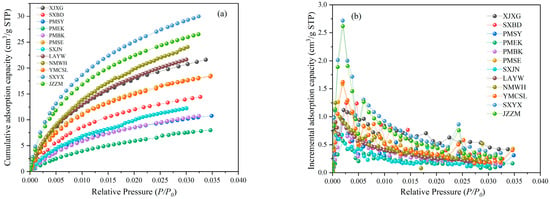
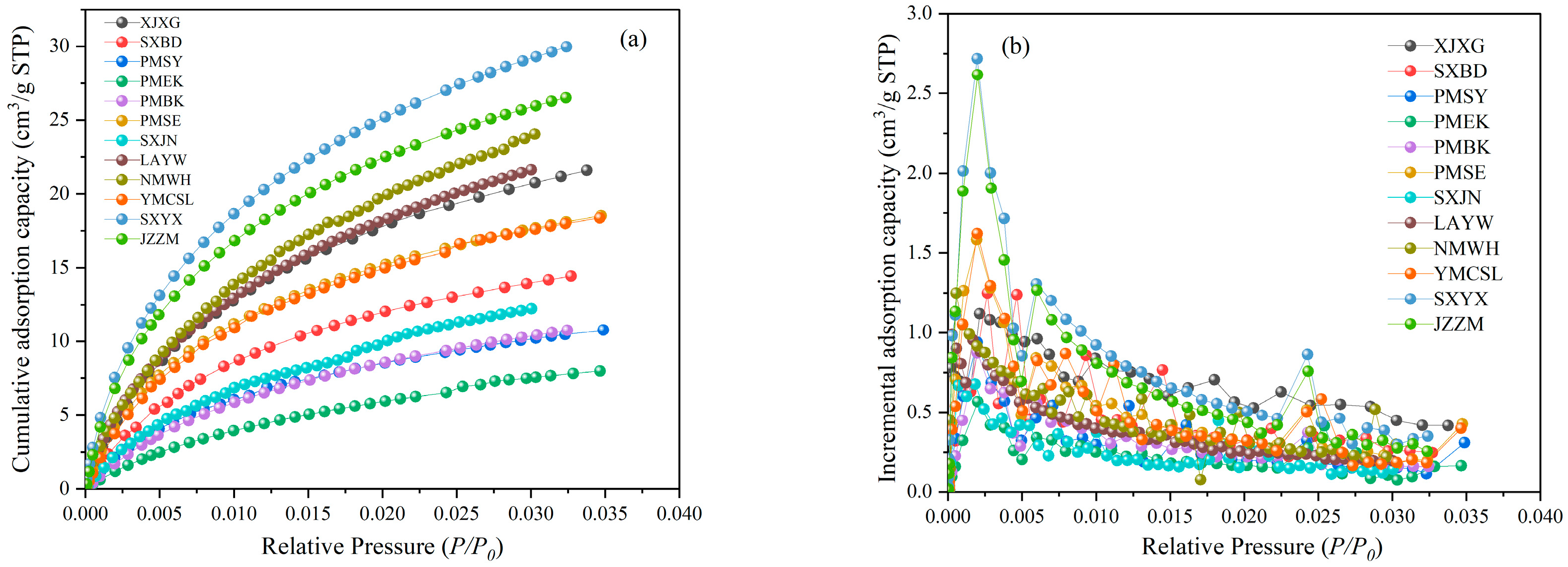
Figure 1 shows the low-temperature CO2 adsorption isotherms for 12 coal samples. All curves exhibit similar morphologies. The adsorption capacity increased with increasing P/P0; however, the rate of increase gradually decreased. According to the IUPAC classification standards, these adsorption curves represent Type I adsorption isotherms. At low P/P0, the adsorption capacity increased rapidly, indicating the rapid adsorption of CO2 molecules onto micropore surfaces. As P/P0 increased, CO2 adsorption capacity gradually diminished, reflecting progressive micropore filling. This confirms that all coal samples possessed well-developed micropore systems of a considerable scale. Adsorption capacity varied among coal samples. The high-rank sample SXYX and medium-rank sample PDEK exhibited the highest and lowest adsorption capacities, respectively, and the low-rank sample XJXG exhibited an intermediate adsorption capacity.
Figure 1.
Low-pressure CO2 adsorption isotherms of coal samples. (a) the relationship between the cumulative adsorption capacity and relative pressure (P/P0); (b) the relationship between the incremental adsorption capacity and relative pressure (P/P0).
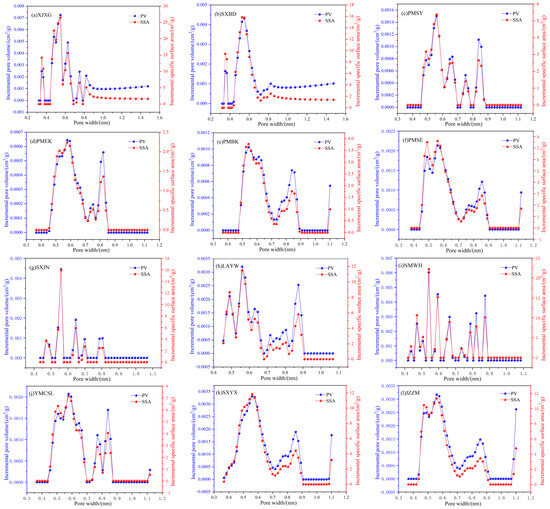
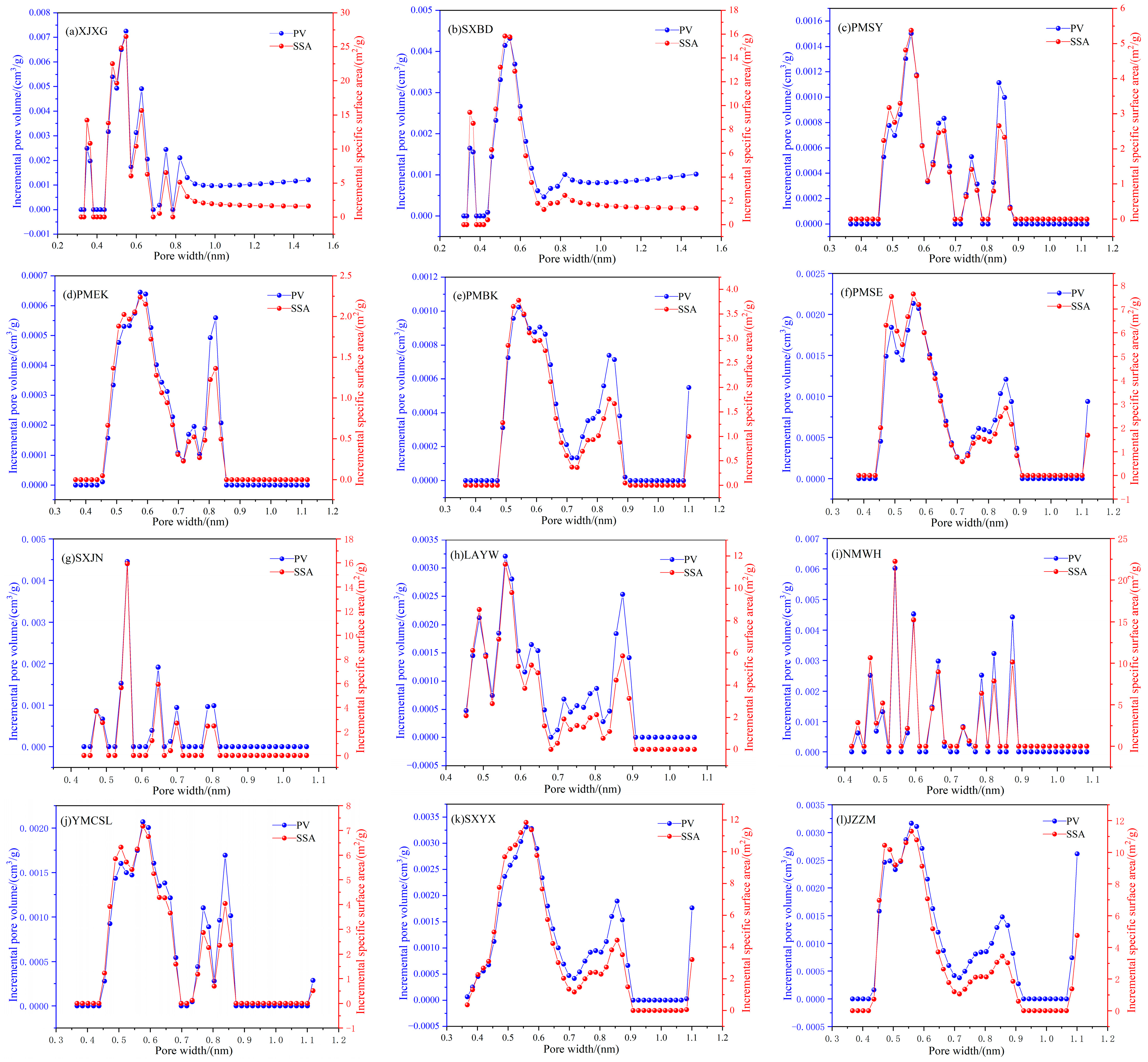
Analysis of CO2 adsorption data based on the NLDFT model yielded pore size distribution curves and associated pore structure parameters with an effective analysis range of 0.3–1.5 nm. Micropore distributions across all coal rank samples exhibited multipeak characteristics (Figure 2), with the primary peak occurring between 0.45 and 0.65 nm (peak at approximately 0.55 nm) and a secondary peak within 0.8–0.9 nm (peak at approximately 0.85 nm). For pores larger than 0.9 nm, the contribution of PV and SSA markedly diminished; pores larger than 1.0 nm exhibited negligible volume and surface area.
Figure 2.
Micropore volume (PV) and specific surface area (SSA) distribution characteristics of coal samples based on the LTCA experiment. Coal samples: (a) XJXG; (b) SXBD; (c) PMSY; (d) PMEK; (e) PMBK; (f) PMSE; (g) SXJN; (h) LAYW; (i) NMWH; (j) YMCSL; (k) SXYX; (l) JZZM.
Regarding pore structure parameters (Table 2), the PV and SSA values of low-rank coal are 0.062 cm3/g and 209.408 m2/g, respectively; those of medium-rank coal are 0.008–0.044 cm3/g and 61.401–190.381 m2/g, with average values of 0.023 cm3/g and 119.412 m2/g, respectively; those of high-rank coal are 0.026–0.046 cm3/g and 134.072–223.674 m2/g, with average values of 0.039 cm3/g and 184.551 m2/g respectively. Despite the relatively minor contribution of PV, the substantial SSA provides abundant active sites for gas adsorption [60].
Table 2.
Pore structure parameters of the coal samples.
3.3. Generalized Fractal Characteristics of Micropores
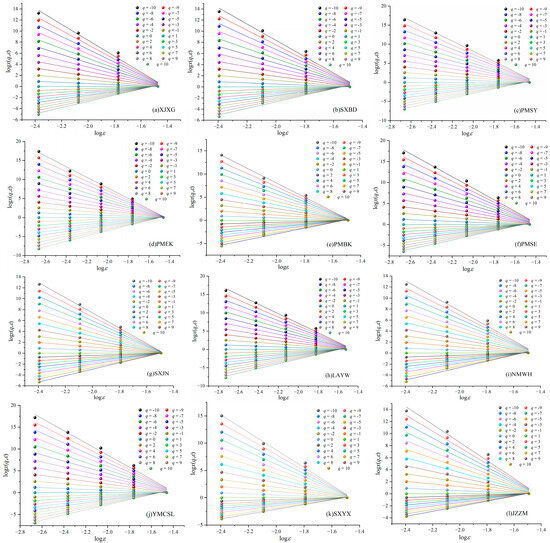
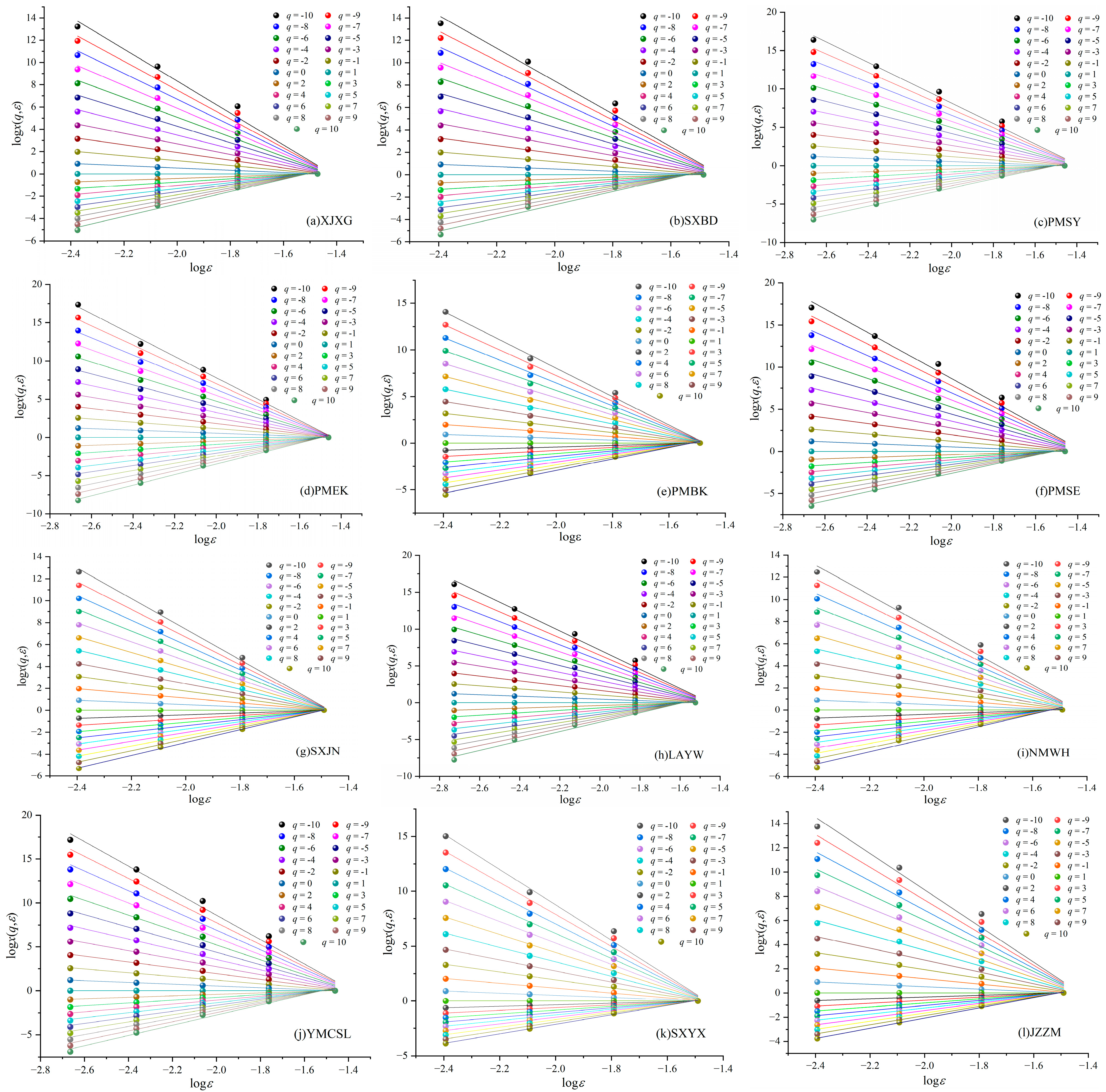
Based on multifractal theory, the microporous scale interval I = [0, 2.0 nm] was selected, with the statistical moment order q encompassing all integers in [−10, 10]. A good linear relationship between log ε and log x(q, ε) indicates multifractal characteristics in the research subject [61]. Therefore, it is first necessary to determine whether the pores in the coal samples satisfy this condition within the research scale. Figure 3 displays the double-logarithmic relationship between the micropore distribution function and the subinterval length ε for the 12 samples with varying coal ranks. Fitting results reveal a pronounced linear relationship between log ε and log x(q, ε) for all coal samples, with the correlation coefficient R2 ranging from 0.9652 to 0.9999. This indicates the widespread presence of robust multifractal characteristics in the micropore distributions across the coal samples.
Figure 3.
Double-logarithmic relationship between the multifractal distribution function and the measure ε for 12 coal samples. Coal samples: (a) XJXG; (b) SXBD; (c) PMSY; (d) PMEK; (e) PMBK; (f) PMSE; (g) SXJN; (h) LAYW; (i) NMWH; (j) YMCSL; (k) SXYX; (l) JZZM.
Multifractal analysis of low-temperature CO2 adsorption data (Figure 3) reveals that when the statistical moment order satisfies q > 0, log x(q, ε) and log ε exhibit a negative correlation; conversely, when q < 0, they show a positive correlation. As q increases gradually from −10 to 10, the fitted curves transition from a negative to positive correlation, with the intercurve spacing for different q values progressively narrowing.
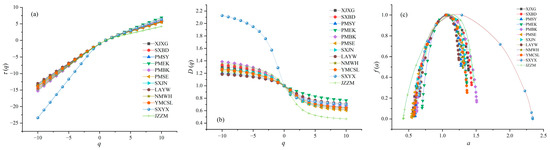
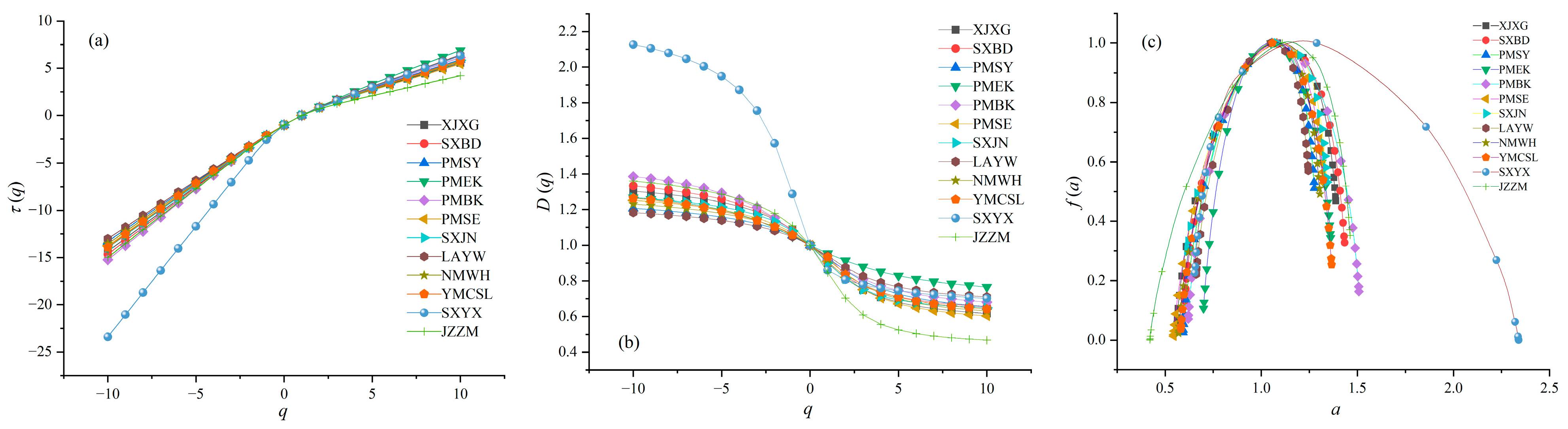
Furthermore, the relationship between the mass scaling function and the statistical moment order q exhibits distinct nonlinear convex characteristics (Figure 4a). For multifractal sequences, the curve varies nonlinearly with q, with markedly different slopes on either side of q = 0, reflecting the nonuniformity of the micropore distribution. Consequently, the nonlinear characteristics of the q curve further confirm the multifractal nature of microporous structures across different coal ranks.
Figure 4.
Multifractal characteristics of microporous structures in 12 coal samples; (a) the relationship between the mass scaling function and the statistical moment order q; (b) multifractal generalized dimension spectrum of microporous structures; (c) multifractal singular spectra of microporous structures.
Figure 4b shows that the generalized dimension spectra q–D(q) of all coal samples exhibit an inverted S shape. As q increases, D(q) decreases monotonically. When q > 0, D(q) characterizes the regions of high probability (concentration) in the micropore distribution; when q < 0, D(q) denotes the regions of low probability (dispersion). Table 3 lists the relevant multifractal parameters. The capacity dimension D0 is uniformly equal to 1, corresponding to a one-dimensional object where each box is nonempty, representing the maximum value of the singularity spectrum. The information dimension D1 ranges from 0.8354 to 0.9535; lower values indicate more uneven pore distribution and higher local clustering. The correlation dimension D2 ranges from 0.7028 to 0.9134; lower values suggest (i) more uneven point distributions within the microporous system or (ii) stronger correlations, indicating greater structural complexity. The spectrum width ΔD(D−10–D10), ranging from 0.4728 to 1.5330, reflects the curvature of the generalized dimensionality spectrum. A larger ΔD indicates greater local variability in the pore structure. In particular, the left spectrum width Δ(D−10–D0) corresponds to the low CO2 adsorption capacity region, whereas the right spectrum width Δ(D0–D10) corresponds to the high CO2 adsorption capacity region.
Table 3.
Parameters of the multifractal generalized fractal dimension spectra for microporous structures of different coal ranks.
The Hurst exponent H typically indicates pore connectivity, with higher values signifying higher connectivity 20, 28. The H values for the microporous structures of all coal samples ranged from 0.8514 to 0.9567, with the PMEK and LAYW samples exhibiting the highest H values, indicating the highest microporous connectivity.
3.4. Singular Fractal Characteristics of Microporous Structures
The fractal exponents α–f(α) for microporous structures across different coal ranks all exhibit convex parabolic profiles (Figure 4c), with excellent quadratic function fitting (R2 > 0.95). Table 4 lists the corresponding multifractal singularity spectrum parameters, where the singularity exponent α0 ranges from 1.0484 to 1.1132, reflecting the most concentrated scale position in the microporosity distribution. The spectrum width Δα = αmax − αmin is a key parameter characterizing microporosity distribution heterogeneity, where higher values indicate more pronounced microporosity fluctuations and stronger heterogeneity. In this research, Δα ranged from 0.5830 to 1.8004, with the PMBK samples exhibiting the highest Δα, indicating the strongest micropore heterogeneity. The parameter Δf(α) = f(10) − f(−10) represents the height difference between the right and left branches of the singular spectrum [62]. All samples exhibited Δf(α) > 0, presenting right-hooked spectral shapes, indicating that the micropore distributions were predominantly governed by the high-probability-density regions. The spectral shifts were further quantified using the symmetry parameter Rd = (α0 − α10) − (α−10 − α0). All 12 coal samples in this research exhibited negative Rd values, indicating a pronounced bias toward high-probability (concentrated) regions in their pore size distributions. This correlates with the right-hooked spectral shapes, further confirming that the microporous structures exhibited typical multifractal characteristics.
Table 4.
Multifractal singular spectrum parameters for microporous structures across different coal ranks.
3.5. Comparative Analysis of Micropore Heterogeneity
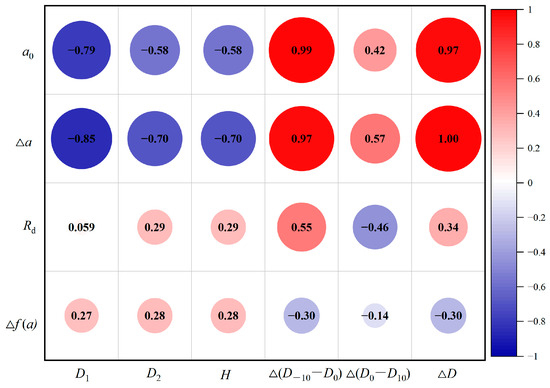
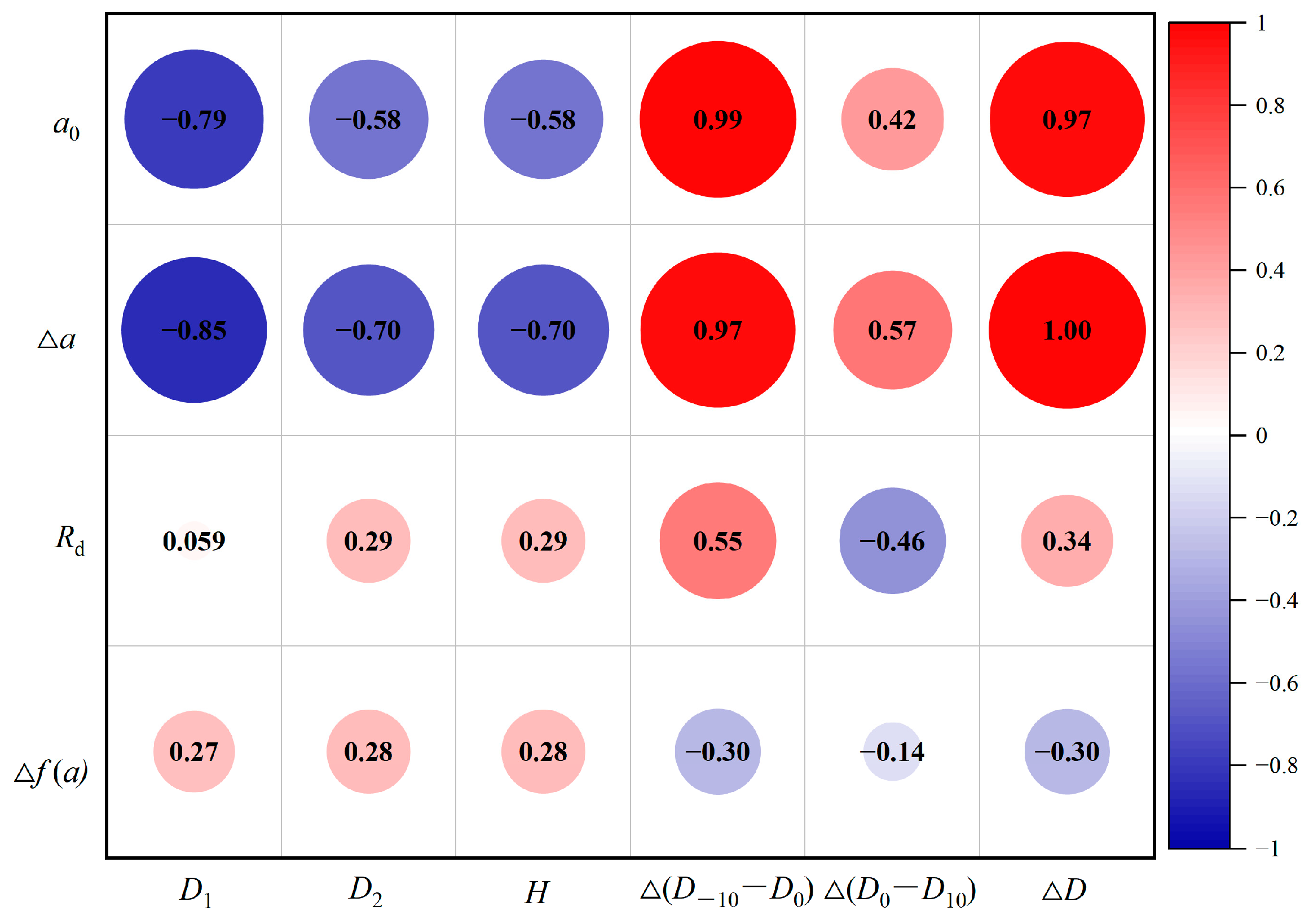
Multifractal distribution sequences typically exhibit four characteristics [54,57]. (1) The distribution function follows a power-law relationship with the scale parameter ε (Figure 3). (2) The mass-scale function maintains a nonlinear relationship with the statistical moment order q (Figure 4a). (3) The fractal dimension spectrum D(q) exhibits a monotonically decreasing trend with q (Figure 4b). (4) The multifractal singular spectrum α–f(α) exhibits an upward-convex parabolic characteristic (Figure 4c). This research demonstrates that the micropore distributions of coal across different rank categories satisfy these four characteristics, exhibiting pronounced multifractal properties. Multifractal systems can be characterized through two sets of parameters, i.e., the generalized dimension spectrum q–D(q) and the singular spectrum α–f(a). Pearson correlation analysis was employed to investigate the intrinsic relationship between these parameters and evaluate the correlations between key characteristic parameters (Figure 5). For the micropore distributions of different coal ranks, the singularity spectrum width △a exhibited pronounced positive correlations with the generalized dimension spectrum width △D, singularity index a0, and left-side spectrum width △(D−10–D0), with corresponding Pearson correlation coefficients exceeding 0.97. Notably, the Pearson correlation coefficient between Δa and ΔD was 1.00, indicating a high degree of consistency between the two. Both can serve as effective indicators for characterizing the nonuniformity of the micropore distribution. This analysis demonstrates that the generalized dimension spectrum and the singular spectrum, as two parameter systems describing multifractal structures, possess a close mathematical relationship and are equally important in characterizing pore heterogeneity.
Figure 5.
Pearson correlation coefficient matrix for the characteristic parameters of the multifractal generalized dimension spectrum and the singularity spectrum.
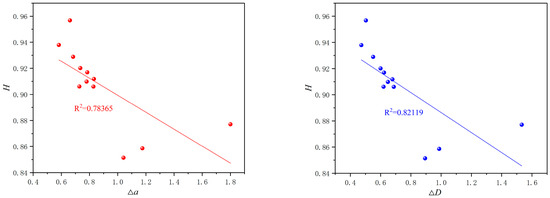
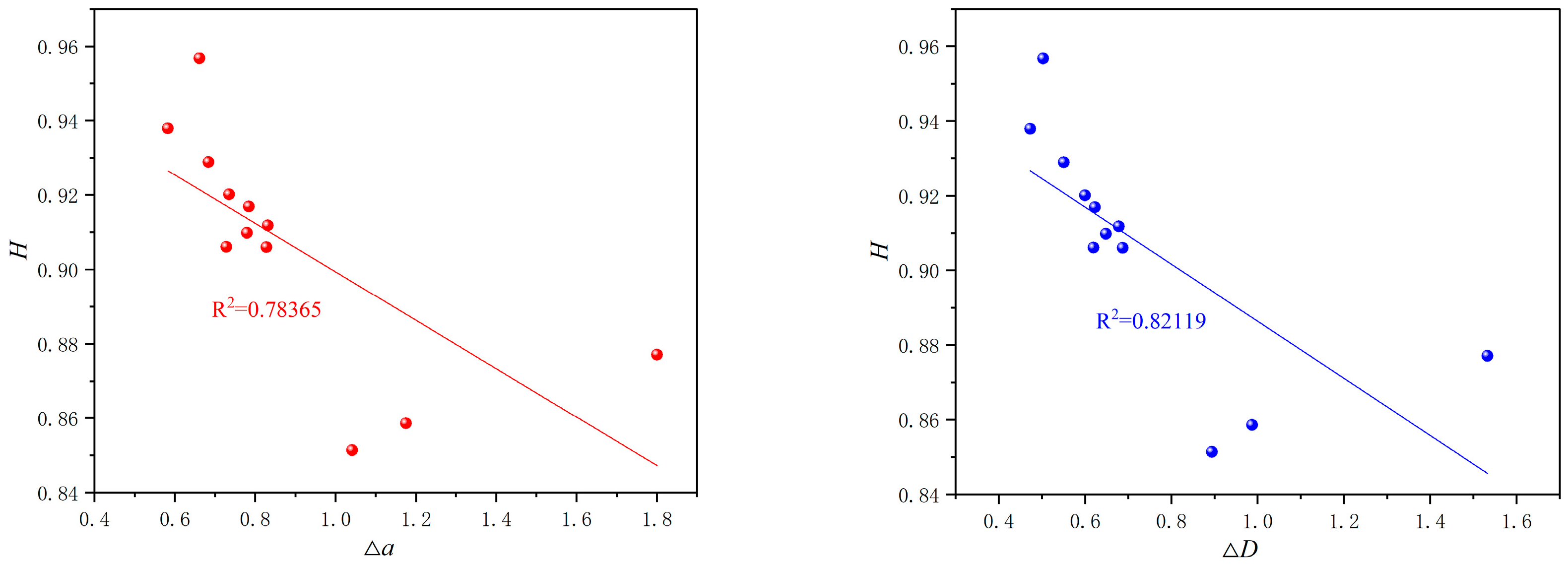
△D, the singularity spectrum width Δa, and H are key quantitative parameters in multifractal analysis. ΔD and Δα are commonly used to characterize pore heterogeneity, while H reflects. Figure 6 shows that ΔD and Δα exhibit significant negative correlations with H across the micropore distributions of different coal ranks, i.e., as ΔD and Δα increase, H decreases. This indicates that enhanced pore heterogeneity corresponds to diminished connectivity. Consequently, highly heterogeneous pore structures are often associated with poor connectivity.
Figure 6.
Correlations among the multifractal generalized dimension spectrum width ΔD, singularity spectrum width Δa, and Hurst index H.
3.6. Factors Influencing the Heterogeneity of Microporous Structures
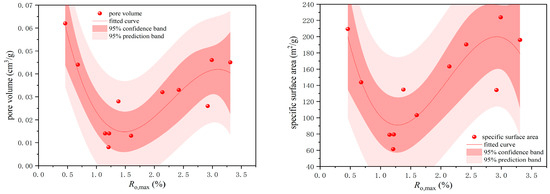
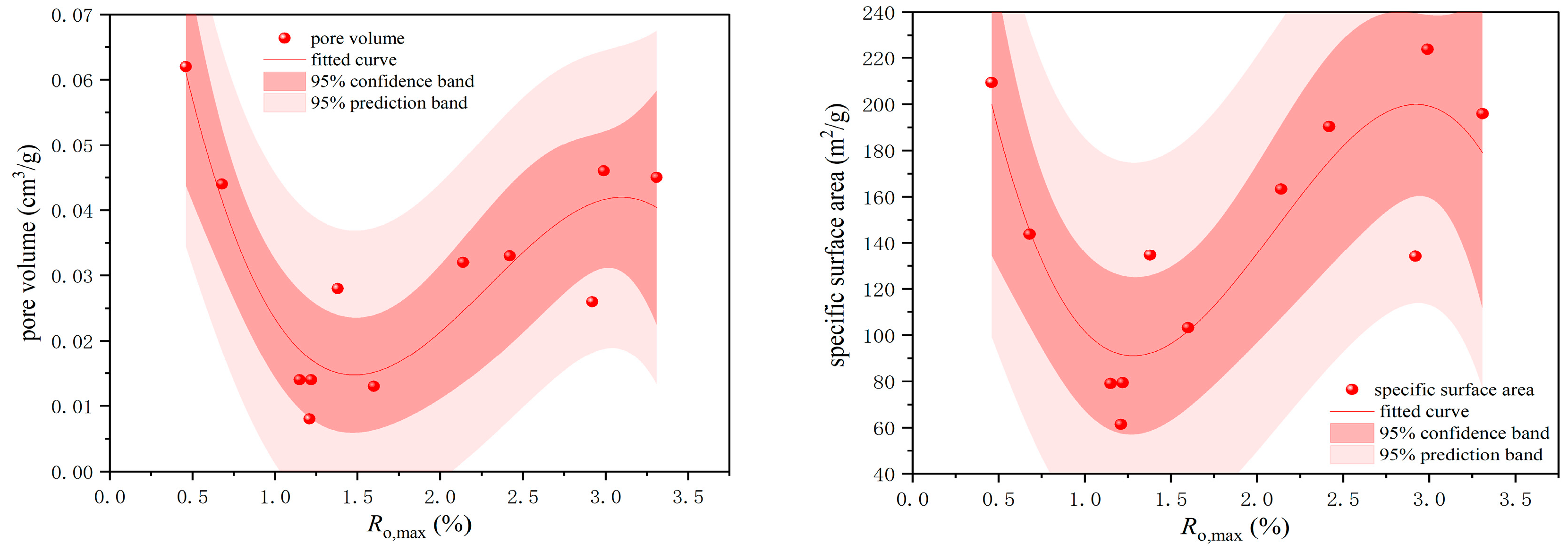
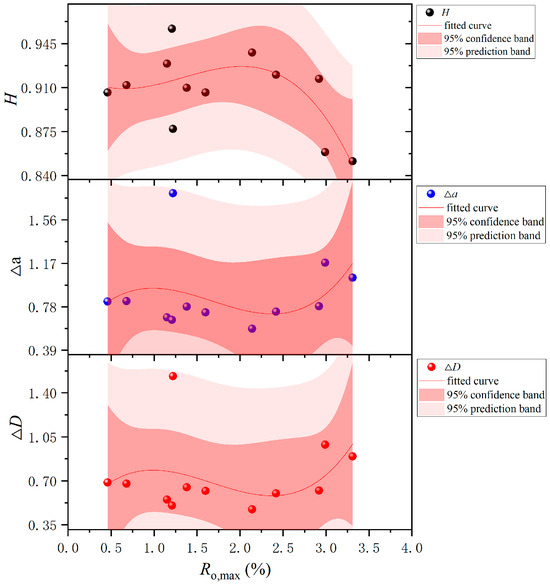
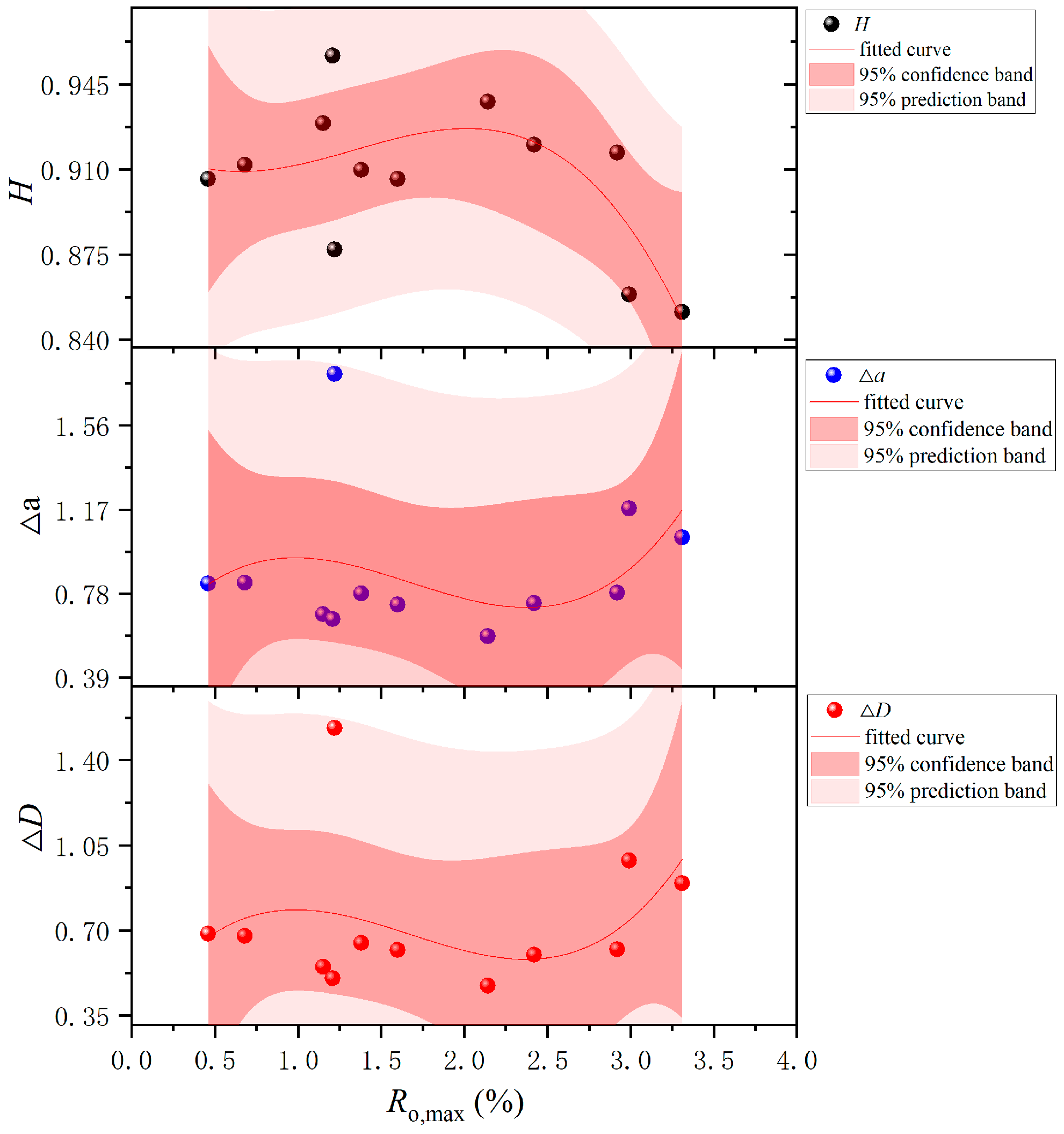
The formation and evolution of coal reservoir pore structures are governed by multiple factors, including coalification degree, coal rock microconstituents, mineral composition, and disturbance degree, collectively contributing to their structural complexity [25,63]. Figure 7 shows that as Rₒ,max increases, micropore volume and specific surface area exhibit a U-shaped trend, decreasing initially before increasing, reaching a minimum at Rₒ,max = 1.2–1.4%. This reflects the strong influence of the second coalification jump on microporous structures smaller than 2 nm. This phenomenon indicates that coalification exerts a pronounced stage-dependent control on micropore (<2 nm) structures. Low-rank coals, which are in the early stages of coalification, exhibit relatively loose structures, with matrix pores primarily inherited from the original plant tissues. In addition, low-rank coals contain abundant small molecular functional groups (e.g., –OH and –COOH), resulting in relatively large micropore volumes and specific surface areas [44,64]. During the transition from low- to medium-rank coals (Rₒ,max < 1.2%), the coal matrix undergoes a series of thermal evolution processes, including dehydration, decarboxylation, and volatile matter release. These processes induce polycondensation and structural rearrangement of macromolecular networks, leading to progressive densification of the pore system [59,65]. Consequently, pre-existing micropores are compressed or even collapse, resulting in a continuous decrease in micropore volume and specific surface area. As coalification approaches the second coalification jump (Rₒ,max = 1.2–1.4%.), aromatic structures become significantly enhanced, and molecular arrangements transition from disordered to locally ordered states [66,67,68]. This is accompanied by a restructuring of the coal macromolecular network. During this stage, pore reduction reaches its maximum extent, while newly formed pores have not yet fully developed, leading to a minimum in micropore volume. This stage represents a critical turning point in pore structure evolution. With further increases in coal rank (Rₒ,max > 1.4%), high-rank coals are subjected to intensified temperature and pressure conditions, driving the structure toward a highly aromatic and ordered configuration. The stacking of aromatic layers generates abundant structural defects and interlayer spaces, while the continued release of volatile components promotes the formation and expansion of nanoscale pores [8,65,69]. As a result, micropore volume and specific surface area increase again. Furthermore, with increasing Rₒ,max, the generalized dimension spectrum width (ΔD) and singularity spectrum width (Δa) exhibit an increasing–decreasing–increasing trend and the Hurst exponent (H) shows an increasing–decreasing trend, contrasting with the trends exhibited by PV and SSA (Figure 8).
Figure 7.
Relationships among coal maturity at different coal ranks, pore volume (PV), and specific surface area (SSA).
Figure 8.
Relationships among coal maturity at different coal ranks and multifractal parameters.
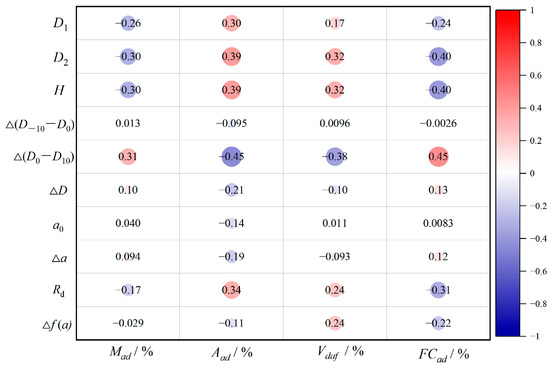
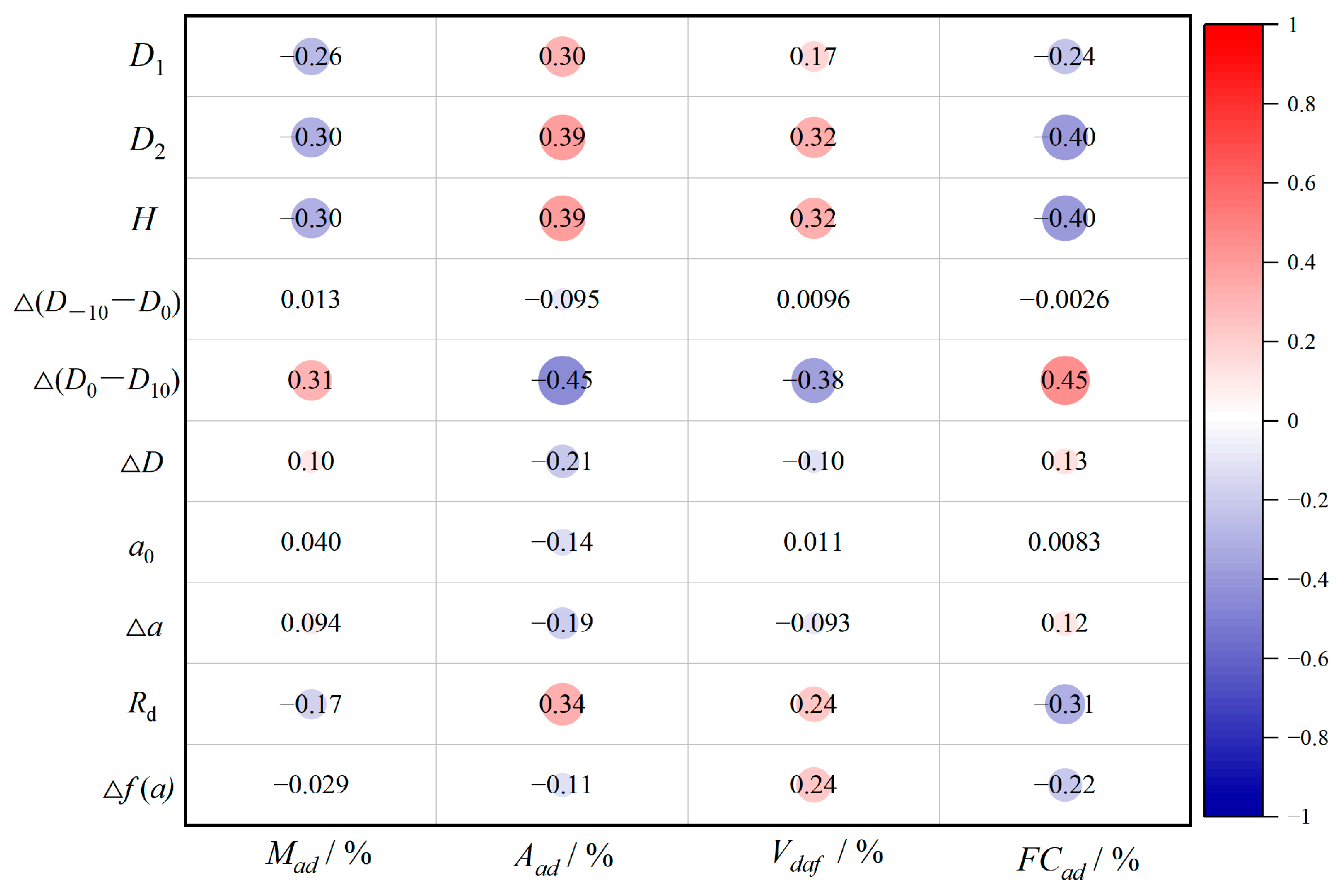
Correlation analysis revealed no significant associations between the industrial component content of coal and the multifractal parameters of its micropore structure (Figure 9). This outcome stems from two primary reasons. First, multifractal parameters describe the geometric heterogeneity of pore distribution and are highly sensitive to extreme distributions in microscopic regions; whereas the industrial constituents reflect the overall chemical composition of coal, failing to capture the local inhomogeneity that dominates multifractal behavior [70,71]. Second, the coalification degree (Rₒ,max) is a key parameter that simultaneously governs the ordering of coal’s chemical composition and the restructuring of its physical pore architecture. Within this unified geological process, the response mechanisms are not entirely synchronized with thresholds for chemical evolution and pore structure evolution [8,72]. Consequently, even with similar chemical compositions, coal pore structures may exhibit distinct multifractal characteristics owing to variations in local stresses, mineral fillings, and other factors [54]. These findings indicate that the coalification degree is not only a fundamental variable governing PV and SSA but also fundamentally determines the heterogeneous distribution and transport connectivity of the pore system by influencing the physicochemical structural evolution of organic matter. Consequently, when investigating coal’s adsorption, desorption, and permeation capacities, the coalification degree constitutes a key geological parameter requiring prioritized evaluation.
Figure 9.
Pearson correlations between coal rank components and micropore multifractal parameters.
3.7. Influence of Coalification Degree on the Multifractal Evolution Patterns of Microporous Structures
The microporous structure of coal (pore size <2 nm) is pivotal in determining its adsorption and reservoir capacity. Its spatial complexity can be quantitatively characterized through multifractal parameters—the generalized dimension spectrum width (ΔD), the fractal dimension spectrum width (Δa), and the Hurst exponent (H). The Rₒ,max, as a key indicator of coalification degree, governs the evolutionary pathway of the micropore system. This research reveals that as Rₒ,max increases, micropore volume and specific surface area exhibit U-shaped variations (with troughs occurring at Rₒ,max = 1.2–1.4%) (Figure 7). Furthermore, the multifractal parameters ΔD and Δα follow an increasing–decreasing–increasing trend, while the Hurst index and connectivity display an increasing–decreasing trend (inverted parabolic pattern; Figure 8). These synergistic evolution trends fundamentally stem from the second coalification jump (Rₒ,max = 1.2–1.4%), marking a paradigm shift in the macromolecular structure from flexible degradation–polycondensation to rigid ordering–construction [73,74,75].
The evolution of microporous structures can be divided into three stages. (1) During the low-to-medium coal rank stage (Rₒ,max < 1.2%), the primary manifestations were physicochemical synergistic densification and enhanced heterogeneity [65]. Coalification was dominated by aromatization and the removal of aliphatic side chains and oxygen-containing functional groups [59,76]. The combined effects of physical compaction and chemical condensation led to the compression and extinction of numerous open micropores, manifesting as a continuous decline in PV and SSA (the left branch of the U-shaped curve; Figure 7). The disappearance of pores was not a homogeneous process and was influenced by variations in original constituents as well as the localized nature of chemical reactions. It exacerbated the uneven distribution of pore spaces, resulting in increased values for ΔD and Δα (Figure 8). Moreover, the spatially continuous regional processes [65,77] of compaction and condensation exhibited strong long-range positive correlations in pore reduction trends. Consequently, the Hurst exponent (H) showed an upward trajectory. It macroscopically manifested as the pore network tending toward more interconnected main channels during simplification, thereby achieving preliminary connectivity improvements (Figure 8). (2) The second coalification jump (Rₒ,max = 1.2–1.4%) primarily manifested as a structural reset and homogenization inflection point. This stage witnessed the intense pyrolysis of fatty structures alongside rearrangement, orientation, and stacking of aromatic nuclei, resembling a nanoscale structural annealing process [78,79]. Numerous unstable micropores were healed during rapid structural reorganization, with the coal matrix achieving its most compact state throughout the evolutionary sequence. PV and SSA reached their lowest points (U-shaped trough). This global compaction strongly suppressed spatial heterogeneity, paradoxically rendering pore distribution uniform at extremely low levels and causing a transient narrowing of ΔD and Δα value ranges. During this stage, the densification trend exhibited high spatial consistency, with H reaching its peak value. The topological structure of the pore network might be most efficient at this point, achieving optimal connectivity. (3) The medium-to-high coal rank stage (Rₒ,max > 1.4%) was primarily characterized by the rigid construction and complex regeneration of aromatic structures [8,65]. Beyond the transition point, coalification entered a stage of high aromaticity [69]. Rigid aromatic sheets (fundamental structural units) increased in size and, through defect mechanisms such as nonparallel stacking and dislocations, constructed numerous stable slit-like micropores [8,48]. This drove a systematic recovery in PV and SSA (the right branch of the U shape) (Figure 7). However, the generation of new pores was entirely governed by localized discrete nanoscale defects. This process exhibited high randomness, resulting in an extremely patchy distribution of newly formed micropores. Consequently, the system’s heterogeneity and complexity increased sharply, leading to renewed significant increases in ΔD and Δα values. As a localized event, pore formation exhibited no long-range spatial correlation, manifested by a decrease in H. Despite increased pore counts, these locally defect-induced micropores often remained isolated or as dead-ends, failing to form effective flow networks. Consequently, macroscopic connectivity diminished rather than increased, contradicting the trends observed in PV and SSA.
In summary, the control exerted by the coalification degree over the multifractal characteristics of the microporous system constitutes a unified process of synergistic evolution among three factors: quantity (PV, SSA), heterogeneity (ΔD, Δα), and connectivity (H). This control essentially represents a structural phase transition of the coal organic macromolecular network under geothermal dynamics. The second coalification jump (Rₒ,max = 1.2–1.4%) represents a pivotal turning point governing the evolution of the microporous system. However, the evolution of micropore quantity (PV, SSA) diverges from that of spatial distribution heterogeneity (ΔD and Δα) and connectivity (H), with the restructuring of heterogeneity and connectivity lagging the quantitative changes.
3.8. Implication and Limitation
Recent studies have demonstrated that multifractal statistical mechanics provides an effective framework for characterizing the spatial heterogeneity and topological complexity of coal micropores, thereby offering a robust theoretical basis for the quantitative description of complex pore systems [30,50,56]. Within the multifractal framework, key features such as micropore quantity, distribution, connectivity, and their evolution during coalification can be systematically quantified, enabling a more accurate evaluation of gas adsorption capacity and transport behavior in coal reservoirs [18,64]. Accordingly, this approach not only facilitates a deeper understanding of the formation and evolution mechanisms of micropores in coal, but also provides quantitative support for practical applications, including coalbed methane resource estimation, evaluation of gas production efficiency, and reservoir modeling [14,44].
In practical terms, multifractal analysis can further guide the optimization of pore structures, enhancement of adsorption performance, and the design of coal-derived functional materials, such as porous carbons for energy storage, catalysis, and gas adsorption [6,61]. Moreover, the proposed approach can be extended to other complex porous systems, providing a general framework for pore characterization, fractal-based design, and performance optimization of advanced porous materials.
The present results demonstrate that low-temperature CO2 adsorption is highly effective for characterizing micropore (<2 nm) structures and their multifractal evolution in coal. However, as noted by the reviewer, under the low-pressure conditions employed in this study, CO2 adsorption predominantly reflects micropore filling behavior, and its capability to characterize mesopores (2–50 nm) and macropores (>50 nm) remains limited. Previous studies have shown that N2 adsorption at 77 K is particularly effective in resolving mesopore and macropore structures, thereby providing complementary information to CO2-based micropore analysis.
Accordingly, future work will involve conducting low-temperature N2 adsorption experiments on the same coal samples, followed by a systematic comparison with CO2 adsorption results. Furthermore, integrating CO2 and N2 adsorption data within a multifractal statistical mechanics framework will enable the establishment of a multiscale, multifractal joint characterization system for coal pore structures. Such an approach is expected to provide deeper insights into the heterogeneity, connectivity, and coalification-driven evolution of pore systems across different length scales.
4. Conclusions
- (1)
- As coalification progressed, the micropore volume and specific surface area of coal from different rank groups exhibited a U-shaped trend, first decreasing and then increasing with the rise in Rₒ,max. These parameters reached their lowest values when Rₒ,max = 1.2–1.4%. The micropore size distributions of all coal rank samples exhibited multipeak patterns, with the main peak occurring within the range of 0.45–0.65 nm (peak value approximately 0.55 nm) and a secondary peak occurring within the range of 0.8–0.9 nm (peak value approximately 0.85 nm).
- (2)
- Micropores in coal of different ranks all display pronounced multifractal characteristics. Their fractal dimension spectrum assumed an inverted S shape, while the singularity spectrum exhibited a convex parabolic shape. The width of the fractal dimension spectrum ΔD and the singularity spectrum width Δα first increased, then decreased, and finally increased again with increasing Rₒ,max, whereas the Hurst index H first increased and then decreased, exhibiting an opposite trend to those of PV and SSA. The values of ΔD, Δα, and H can be used to quantitatively characterize the heterogeneity and connectivity of the pore structure.
- (3)
- The coalification degree governed the evolution of the coal microporous system, essentially representing a structural phase transition of the coal macromolecular network under geothermal influences. The second coalification jump (Rₒ,max = 1.2–1.4%) served as a pivotal turning point, marking a paradigm shift from flexible degradation–polycondensation to rigid ordering–construction. This process drove the synergistic evolution of three groups of parameters: micropore quantity (PV, SSA), spatial distribution heterogeneity (ΔD and Δα), and topological connectivity (H). Notably, these three groups of parameters evolved asynchronously, with the reconstruction of heterogeneity and connectivity considerably lagging the evolution of micropore quantity, reflecting the multiscale nature and complexity of microporous structure evolution.
Author Contributions
Conceptualization, J.R., B.L. and X.W.; data curation, J.R., B.L., X.W., F.Z., C.Y., P.J., J.L. and Y.Q.; formal analysis, J.R., B.L., X.W., F.Z.,C.Y., P.J., J.L., Y.Q., H.L. and Z.S.; funding acquisition, J.R., B.L., P.J. and Z.S.; methodology, J.R., B.L., X.W., F.Z.,C.Y., P.J., J.L., Y.Q., H.L. and Z.S.; supervision, J.R. and B.L.; visualization, J.R., B.L., Y.Q., H.L. and Z.S.; writing—original draft, J.R. and B.L.; writing—review and editing, J.R. and B.L. All authors have read and agreed to the published version of the manuscript.
Funding
This study was sponsored by the National Natural Science Foundation of China (Grant Nos. 42372205, 42172189 and 42002185), the Natural Science Foundation of Henan province (No. 202300410099), the Scientific and Technological Research Projects of Henan Province (Nos. 242102320348, 232102320243), and the Key Research Project of Higher Education in Henan Province (26B170004).
Data Availability Statement
The original contributions presented in the study are included in the article; further inquiries can be directed to the corresponding author.
Conflicts of Interest
Author Chengtao Yang was employed by the company Henan Energy Industry Group Research Institute Co., Ltd. The remaining authors declare that the research was conducted in the absence of any commercial or financial relationships that could be construed as a potential conflict of interest.
References
- Liu, G.; Liu, H.; Xian, B.; Gao, D.; Wang, X.; Zhang, Z. Fuzzy Pattern Recognition Model of Geological Sweetspot for Coalbed Methane Development. Pet. Explor. Dev. 2023, 50, 924–933. [Google Scholar] [CrossRef] [Scilit]
- Li, L.; Liu, D.; Cai, Y.; Wang, Y.; Jia, Q. Coal Structure and Its Implications for Coalbed Methane Exploitation: A Review. Energy Fuels 2021, 35, 86–110. [Google Scholar] [CrossRef] [Scilit]
- Wang, Z.; Fu, X.; Pan, J.; Deng, Z. Effect of N2/CO2 Injection and Alternate Injection on Volume Swelling/Shrinkage Strain of Coal. Energy 2023, 275, 127377. [Google Scholar] [CrossRef] [Scilit]
- Mou, P.; Pan, J.; Niu, Q.; Wang, Z.; Li, Y.; Song, D. Coal Pores: Methods, Types, and Characteristics. Energy Fuels 2021, 35, 7467–7484. [Google Scholar] [CrossRef] [Scilit]
- Hodot, B. Outburst of Coal and Coalbed Gas; China Coal Industry Press: Beijing, China, 1966; Volume 318. (In Chinese) [Google Scholar]
- Farber, E.M.; Seraphim, N.M.; Tamakuwala, K.; Stein, A.; Rücker, M.; Eisenberg, D. Porous Materials: The next Frontier in Energy Technologies. Science 2025, 390, eadn9391. [Google Scholar] [CrossRef] [Scilit] [PubMed]
- Hu, B.; Cheng, Y.; He, X.; Wang, Z.; Jiang, Z.; Wang, C.; Li, W.; Wang, L. New Insights into the CH4 Adsorption Capacity of Coal Based on Microscopic Pore Properties. Fuel 2020, 262, 116675. [Google Scholar] [CrossRef] [Scilit]
- Xu, C.; Wang, W.; Wang, K.; Guo, L.; Yang, T.; Nie, Z.; Shi, Y. Non-Homogeneous Characterisation of Nanopore Structures in Low-, Medium- and High-Rank Coals Based on Gas Adsorption and Multifractal Theory. Fuel 2025, 401, 135947. [Google Scholar] [CrossRef] [Scilit]
- Niu, Q.; Pan, J.; Jin, Y.; Wang, H.; Li, M.; Ji, Z.; Wang, K.; Wang, Z. Fractal Study of Adsorption-Pores in Pulverized Coals with Various Metamorphism Degrees Using N2 Adsorption, X-Ray Scattering and Image Analysis Methods. J. Pet. Sci. Eng. 2019, 176, 584–593. [Google Scholar] [CrossRef] [Scilit]
- Ren, J.; Song, Z.; Li, B.; Liu, J.; Lv, R.; Liu, G. Structure Feature and Evolution Mechanism of Pores in Different Metamorphism and Deformation Coals. Fuel 2021, 283, 119292. [Google Scholar] [CrossRef] [Scilit]
- Mahajan, O.P. Physical Characterization of Coal. Powder Technol. 1984, 40, 1–15. [Google Scholar] [CrossRef] [Scilit]
- Liu, D.; Zou, Z.; Cai, Y.; Qiu, Y.; Zhou, Y.; He, S. An Updated Study on CH4 Isothermal Adsorption and Isosteric Adsorption Heat Behaviors of Variable Rank Coals. J. Nat. Gas Sci. Eng. 2021, 89, 103899. [Google Scholar] [CrossRef] [Scilit]
- Ye, J.; Tao, S.; Zhao, S.; Li, S.; Chen, S.; Cui, Y. Characteristics of Methane Adsorption/Desorption Heat and Energy with Respect to Coal Rank. J. Nat. Gas Sci. Eng. 2022, 99, 104445. [Google Scholar] [CrossRef] [Scilit]
- Song, D.; Ji, X.; Li, Y.; Zhao, H.; Song, B.; He, K. Heterogeneous Development of Micropores in Medium-High Rank Coal and Its Relationship with Adsorption Capacity. Int. J. Coal Geol. 2020, 226, 103497. [Google Scholar] [CrossRef] [Scilit]
- Chen, S.; Tao, S.; Tang, D.; Xu, H.; Li, S.; Zhao, J.; Jiang, Q.; Yang, H. Pore Structure Characterization of Different Rank Coals Using N2 and CO2 Adsorption and Its Effect on CH4 Adsorption Capacity: A Case in Panguan Syncline, Western Guizhou, China. Energy Fuels 2017, 31, 6034–6044. [Google Scholar] [CrossRef] [Scilit]
- Shen, Z.; Meng, Z.; Liu, Y.; Lei, J.; Shen, W.; Ren, H.; Gao, T.; Zhang, K.; Wang, Y.; Tan, L. Relationship between Multiscale Nanopore Structure and Coal Connectivity during Coalification Process. Microporous Mesoporous Mater. 2023, 360, 112717. [Google Scholar] [CrossRef] [Scilit]
- Wang, Z.; Xiong, J.; Zhang, Y.; Tao, G.; Pan, J.; Niu, Q. Investigation of Permeability Stress Induced Damage Evolution of Shallow and Deep Coal Reservoirs in the Junggar Basin, China. Rock Mech. Rock Eng. 2025. [Google Scholar] [CrossRef] [Scilit]
- Lu, Y.; Cui, M.; Liu, D.; Cai, Y.; Zhou, Y.; Yin, W.; Xu, B.; Liu, Y.; Zhang, C. Pore Fractal Characteristics of Coal and Their Effect on Permeability: A Case Study of the Gujiao Block. Energy Fuels 2026, 40, 1218–1228. [Google Scholar] [CrossRef] [Scilit]
- Ravikovitch, P.I.; Vishnyakov, A.; Russo, R.; Neimark, A.V. Unified Approach to Pore Size Characterization of Microporous Carbonaceous Materials from N2, Ar, and CO2 Adsorption Isotherms. Langmuir 2000, 16, 2311–2320. [Google Scholar] [CrossRef] [Scilit]
- Feng, G.; Li, W.; Zhu, Y.; Wang, X.; Wang, Y.; Song, Y.; Zheng, S.; Shang, F. Matrix Compressibility and Multifractal Nature of Nanoporous Shale. Energy Fuels 2024, 38, 4057–4075. [Google Scholar] [CrossRef] [Scilit]
- Feng, K.; Liu, G.; Zhang, Z.; Liu, H.; Lv, R.; Wang, X.; Chang, P.; Lin, J.; Barakos, G. Fractal Strategy for Improving Characterization of N2 Adsorption–Desorption in Mesopores. Fractal Fract. 2024, 8, 617. [Google Scholar] [CrossRef] [Scilit]
- Muller, J. Characterization of Pore Space in Chalk by Multifractal Analysis. J. Hydrol. 1996, 187, 215–222. [Google Scholar] [CrossRef] [Scilit]
- Paz Ferreiro, J.; Miranda, J.G.V.; Vidal Vázquez, E. Multifractal Analysis of Soil Porosity Based on Mercury Injection and Nitrogen Adsorption. Vadose Zone J. 2010, 9, 325–335. [Google Scholar] [CrossRef] [Scilit]
- Zhang, M.; Duan, C.; Li, G.; Fu, X.; Zhong, Q.; Liu, H.; Dong, Z. Determinations of the Multifractal Characteristics of the Pore Structures of Low-, Middle-, and High-Rank Coal Using High-Pressure Mercury Injection. J. Pet. Sci. Eng. 2021, 203, 108656. [Google Scholar] [CrossRef] [Scilit]
- Wang, S.; Chen, F.; Yue, S.; Hu, J.; Ding, H.; Lu, A. Multifractal Characterization of Pore Structure of Coals Using Gas Adsorption Experiment and Mercury Intrusion Porosimetry (MIP). Fractal Fract. 2025, 9, 183. [Google Scholar] [CrossRef] [Scilit]
- Jiang, Z.-Q.; Xie, W.-J.; Zhou, W.-X.; Sornette, D. Multifractal Analysis of Financial Markets: A Review. Rep. Prog. Phys. 2019, 82, 125901. [Google Scholar] [CrossRef] [Scilit]
- Braverman, B.; Tambasco, M. Scale-Specific Multifractal Medical Image Analysis. Comput. Math. Methods Med. 2013, 2013, 262931. [Google Scholar] [CrossRef] [Scilit]
- Kusák, M. Application of Fractal and Multifractal Analysis on Blue Nile Drainage Patterns in the Morphostructural Analysis of the Ethiopian Highlands, Ethiopia. Prog. Phys. Geogr. Earth Environ. 2022, 46, 357–370. [Google Scholar] [CrossRef] [Scilit]
- Sadeghi, B. Simulated-Multifractal Models: A Futuristic Review of Multifractal Modeling in Geochemical Anomaly Classification. Ore Geol. Rev. 2021, 139, 104511. [Google Scholar] [CrossRef] [Scilit]
- Liu, H.; Zhang, S.; Qiao, Y.; Xie, D.; Chang, L. Multifractal Characterization of Pore Heterogeneity and Water Distribution in Medium- and High-Rank Coals via Nuclear Magnetic Resonance. Fractal Fract. 2025, 9, 290. [Google Scholar] [CrossRef] [Scilit]
- Wang, L.; Wu, S.; Han, S.; Hu, B.; Wang, Q.; Zhang, K.; Song, T. Fractal Analysis of Coal Pore Structure Based on Low-Pressure Gas Adsorption and Its Influence on Methane Adsorption Capacity: A Perspective from Micropore Filling Model. Energy Fuels 2024, 38, 4031–4046. [Google Scholar] [CrossRef] [Scilit]
- GB/T 482-2008; Sampling of Coal Seams. Chinese National Standard: Beijing, China, 2008. (In Chinese)
- GB/T 6948-2008; Method of Determining Microscopically the Reflectance of Vitrinite in Coal. Chinese National Standard: Beijing, China, 2008. (In Chinese)
- GB/T 212-2008; Proximate Analysis of Coal. Chinese National Standard: Beijing, China, 2008. (In Chinese)
- GB/T 21650.3-2011; Pore Size Distribution and Porosity of Solid Materials by Mercury Porosimetry and Gas Adsorption—Part3: Analysis of Micropores by Gas Adsorption. Chinese National Standard: Beijing, China, 2011. (In Chinese)
- Thommes, M.; Kaneko, K.; Neimark, A.V.; Olivier, J.P.; Rodriguez-Reinoso, F.; Rouquerol, J.; Sing, K.S.W. Physisorption of Gases, with Special Reference to the Evaluation of Surface Area and Pore Size Distribution (IUPAC Technical Report). Pure Appl. Chem. 2015, 87, 1051–1069. [Google Scholar] [CrossRef] [Scilit]
- Sing, K.S.W. Reporting Physisorption Data for Gas/Solid Systems with Special Reference to the Determination of Surface Area and Porosity (Recommendations 1984). Pure Appl. Chem. 1985, 57, 603–619. [Google Scholar] [CrossRef] [Scilit]
- Jagiello, J.; Thommes, M. Comparison of DFT Characterization Methods Based on N2, Ar, CO2, and H2 Adsorption Applied to Carbons with Various Pore Size Distributions. Carbon 2004, 42, 1227–1232. [Google Scholar] [CrossRef]
- Fomkin, A.A. Adsorption of Gases, Vapors and Liquids by Microporous Adsorbents. Adsorption 2005, 11, 425–436. [Google Scholar] [CrossRef] [Scilit]
- Wang, Z.; Song, D.; Li, Y.; Zhai, Y.; Pan, J.; Shi, X.; Wei, G. Model Optimization and Data Analysis Methods for Low-Temperature CO2 and N2 Adsorption Experiments on Carbonaceous Materials. Energy Fuels 2025, 39, 6300–6309. [Google Scholar] [CrossRef] [Scilit]
- Mastalerz, M.; He, L.; Melnichenko, Y.B.; Rupp, J.A. Porosity of Coal and Shale: Insights from Gas Adsorption and SANS/USANS Techniques. Energy Fuels 2012, 26, 5109–5120. [Google Scholar] [CrossRef] [Scilit]
- Mahajan, O.P. CO2 Surface Area of Coals: The 25-Year Paradox. Carbon 1991, 29, 735–742. [Google Scholar] [CrossRef] [Scilit]
- Şenel, İ.G.; Gürüz, A.G.; Yücel, H.; Kandas, A.W.; Sarofim, A.F. Characterization of Pore Structure of Turkish Coals. Energy Fuels 2001, 15, 331–338. [Google Scholar] [CrossRef] [Scilit]
- Cao, Z.; Liu, S.; Huang, F.; Zhang, H.; Sang, S.; Han, S.; Li, Z. Integrated Multifractal Framework for Characterizing Full-Scale Pore Architecture and Reservoir-Controlling Mechanisms of Deep Low-Rank Coal in the Turpan–Hami Basin. ACS Omega 2026, 11, 4782–4798. [Google Scholar] [CrossRef] [Scilit] [PubMed]
- Liu, G.; Fang, Z.; Zhang, Z.; Liu, H.; Lv, R.; Wang, X.; Chang, P.; Lin, J.; Barakos, G. Improved Strategy for Multifractal Characterization of CO2 Adsorption in Micropores. Energy Fuels 2024, 38, 20449–20461. [Google Scholar] [CrossRef] [Scilit]
- Lowell, S.; Shields, J.E.; Thomas, M.A.; Thommes, M. Characterization of Porous Solids and Powders: Surface Area, Pore Size and Density; Springer Science & Business Media: Berlin/Heidelberg, Germany, 2012; ISBN 978-1-4020-2303-3. [Google Scholar]
- Rouquerol, J.; Rouquerol, F.; Llewellyn, P.; Maurin, G.; Sing, K. Adsorption by Powders and Porous Solids: Principles, Methodology and Applications; Academic Press: Cambridge, MA, USA, 2013; ISBN 978-0-08-097036-3. [Google Scholar]
- Jiang, J.; Yang, W.; Cheng, Y.; Zhao, K.; Zheng, S. Pore Structure Characterization of Coal Particles via MIP, N2 and CO2 Adsorption: Effect of Coalification on Nanopores Evolution. Powder Technol. 2019, 354, 136–148. [Google Scholar] [CrossRef] [Scilit]
- Landers, J.; Gor, G.Y.; Neimark, A.V. Density Functional Theory Methods for Characterization of Porous Materials. Colloids Surf. A Physicochem. Eng. Asp. 2013, 437, 3–32. [Google Scholar] [CrossRef] [Scilit]
- Stanley, H.E.; Meakin, P. Multifractal Phenomena in Physics and Chemistry. Nature 1988, 335, 405–409. [Google Scholar] [CrossRef] [Scilit]
- Li, W.; Liu, H.; Song, X. Multifractal Analysis of Hg Pore Size Distributions of Tectonically Deformed Coals. Int. J. Coal Geol. 2015, 144–145, 138–152. [Google Scholar] [CrossRef] [Scilit]
- Liu, H.; Liu, G.; Zhang, Z.; Si, N.; Wang, X.; Chang, P.; Barakos, G. Improved Characterization of the Pore Size Distribution in Full and across Scale by a Fractal Strategy. Phys. Fluids 2025, 37, 046602. [Google Scholar] [CrossRef] [Scilit]
- Zhu, J.; He, F.; Zhang, Y.; Zhang, R.; Zhang, B. Fractal Analysis in Pore Size Distributions of Different Bituminous Coals. Sci. Rep. 2019, 9, 18162. [Google Scholar] [CrossRef] [Scilit]
- Li, R.; Hou, X.; Chen, L.; Fang, H.; Zheng, C. Multifractal Investigation on Multi-Scale Pore Structure Heterogeneity of High Rank Coal Reservoirs. Nat. Resour. Res. 2022, 31, 1665–1685. [Google Scholar] [CrossRef] [Scilit]
- Sun, M.; Zou, C.; Xin, D. Pore Structure Evolution Mechanism of Cement Mortar Containing Diatomite Subjected to Freeze-Thaw Cycles by Multifractal Analysis. Cem. Concr. Compos. 2020, 114, 103731. [Google Scholar] [CrossRef] [Scilit]
- Feng, K.; Liu, G.; Zhang, Z.; Liu, H.; Lv, R.; Wang, X.; Chang, P.; Lin, J.; Barakos, G. Multifractal Characterization of Methane Adsorption in Coal Pores. Langmuir 2025, 41, 14548–14559. [Google Scholar] [CrossRef] [Scilit]
- Yu, S.; Bo, J.; Pei, S.; Jiahao, W. Matrix Compression and Multifractal Characterization for Tectonically Deformed Coals by Hg Porosimetry. Fuel 2018, 211, 661–675. [Google Scholar] [CrossRef] [Scilit]
- Liu, K.; Ostadhassan, M.; Kong, L. Multifractal Characteristics of Longmaxi Shale Pore Structures by N2 Adsorption: A Model Comparison. J. Pet. Sci. Eng. 2018, 168, 330–341. [Google Scholar] [CrossRef] [Scilit]
- Xin, F.; Xu, H.; Tang, D.; Yang, J.; Chen, Y.; Cao, L.; Qu, H. Pore Structure Evolution of Low-Rank Coal in China. Int. J. Coal Geol. 2019, 205, 126–139. [Google Scholar] [CrossRef] [Scilit]
- Li, Q.; Liu, D.; Cai, Y.; Zhou, Y.; Yin, T. Investigation on the Methane Adsorption Capacity in Coals: Considerations from Nanopores by Multifractal Analysis. Energy Fuels 2021, 35, 6633–6643. [Google Scholar] [CrossRef] [Scilit]
- Zhang, Z.; Liu, G.; Chang, P.; Wang, X.; Lin, J. Fractal Characteristics for Coal Chemical Structure: Principle, Methodology and Implication. Chaos Solitons Fractals 2023, 173, 113699. [Google Scholar] [CrossRef] [Scilit]
- Wang, F.; Zai, Y. Fractal and Multifractal Characteristics of Shale Nanopores. Results Phys. 2021, 25, 104277. [Google Scholar] [CrossRef] [Scilit]
- Gao, J.; Li, Z.; Tao, X.; Li, X.; Zhu, K. A Comprehensive Study of Multiscale Pore Structural Characteristics in Deep-Buried Coals of Different Ranks. Sci. Rep. 2025, 15, 8299. [Google Scholar] [CrossRef] [Scilit]
- Yan, J.; Meng, Z.; Li, G. Diffusion Characteristics of Methane in Various Rank Coals and the Control Mechanism. Fuel 2021, 283, 118959. [Google Scholar] [CrossRef] [Scilit]
- Tao, S.; Chen, S.; Tang, D.; Zhao, X.; Xu, H.; Li, S. Material Composition, Pore Structure and Adsorption Capacity of Low-Rank Coals around the First Coalification Jump: A Case of Eastern Junggar Basin, China. Fuel 2018, 211, 804–815. [Google Scholar] [CrossRef] [Scilit]
- Li, H.; Chen, S.; Tang, D. Coal Pore Size Distribution and Adsorption Capacity Controlled by the Coalification in China. Int. J. Hydrog. Energy 2024, 88, 594–603. [Google Scholar] [CrossRef] [Scilit]
- Sun, Y.; Wang, L.; Wang, R.; Zheng, S.; Liao, X.; Zhu, Z.; Zhao, Y. Insight on Microscopic Mechanisms of CH4 and CO2 Adsorption of Coal with Different Ranks. Fuel 2022, 330, 125715. [Google Scholar] [CrossRef] [Scilit]
- Feng, P.; Li, S.; Tang, S.; Tang, D.; Zhang, C.; Zhong, G.; Fan, L.; Zhang, Z. Unraveling the Nanopores Evolution: Chemical Structure Control in Coal during Coalification. Energy Fuels 2024, 38, 8688–8699. [Google Scholar] [CrossRef] [Scilit]
- Rahman, T.; Hazra, B.; Vishal, V. Pore Structure Evolution of Jharia Coal for Potential Underground Coal Thermal Treatment and Associated CO2 Sequestration. Fuel 2025, 381, 133577. [Google Scholar] [CrossRef] [Scilit]
- Han, W.; Zhou, G.; Gao, D.; Zhang, Z.; Wei, Z.; Wang, H.; Yang, H. Experimental Analysis of the Pore Structure and Fractal Characteristics of Different Metamorphic Coal Based on Mercury Intrusion-nitrogen Adsorption Porosimetry. Powder Technol. 2020, 362, 386–398. [Google Scholar] [CrossRef] [Scilit]
- Zhang, S.; Liu, H.; Wu, C.; Jin, Z. Influence of Particle Size on Pore Structure and Multifractal Characteristics in Coal Using Low-Pressure Gas Adsorption. J. Pet. Sci. Eng. 2022, 212, 110273. [Google Scholar] [CrossRef] [Scilit]
- Lin, Y.; Qin, Y.; Qiao, J.; Li, G.; Zhang, H. Effect of Coalification and Maceration on Pore Differential Development Characteristics of High-Volatile Bituminous Coal. Fuel 2022, 318, 123634. [Google Scholar] [CrossRef] [Scilit]
- Chen, X.; Li, M.; Xiang, J.; Shao, Y. Micropores Manipulation of Medium-Rank Coal through Aggregate Structure Evolution during Coalification: A Study Based on HRTEM Analysis. Fuel 2023, 346, 128380. [Google Scholar] [CrossRef] [Scilit]
- Peng, L.; Cheng, H.; Chen, F.; Yang, J.; Zheng, B. Exploring the Ultramicropore Structure Evolution and the Methane Adsorption of Tectonically Deformed Coals in Molecular Terms. Sci. Rep. 2024, 14, 26316. [Google Scholar] [CrossRef] [Scilit] [PubMed]
- Zhou, S.; Liu, D.; Karpyn, Z.T.; Cai, Y.; Yao, Y. Effect of Coalification Jumps on Petrophysical Properties of Various Metamorphic Coals from Different Coalfields in China. J. Nat. Gas Sci. Eng. 2018, 60, 63–76. [Google Scholar] [CrossRef] [Scilit]
- Hou, H.; Shao, L.; Tang, Y.; Zhao, S.; Yuan, Y.; Li, Y.; Mu, G.; Zhou, Y.; Liang, G.; Zhang, J. Quantitative Characterization of Low-Rank Coal Reservoirs in the Southern Junggar Basin, NW China: Implications for Pore Structure Evolution around the First Coalification Jump. Mar. Pet. Geol. 2020, 113, 104165. [Google Scholar] [CrossRef] [Scilit]
- Sun, B.; Yang, Q.; Zhu, J.; Shao, T.; Yang, Y.; Hou, C.; Li, G. Pore Size Distributions and Pore Multifractal Characteristics of Medium and Low-Rank Coals. Sci. Rep. 2020, 10, 22353. [Google Scholar] [CrossRef] [Scilit]
- Yan, J.; Lei, Z.; Li, Z.; Wang, Z.; Ren, S.; Kang, S.; Wang, X.; Shui, H. Molecular Structure Characterization of Low-Medium Rank Coals via XRD, Solid State 13C NMR and FTIR Spectroscopy. Fuel 2020, 268, 117038. [Google Scholar] [CrossRef] [Scilit]
- Zhang, S.; Zhang, C.; Zhang, M.; Liu, X.; Xue, S. Model Construction and Optimization of Coal Molecular Structure. J. Mol. Struct. 2023, 1290, 135960. [Google Scholar] [CrossRef] [Scilit]

Disclaimer/Publisher’s Note: The statements, opinions and data contained in all publications are solely those of the individual author(s) and contributor(s) and not of MDPI and/or the editor(s). MDPI and/or the editor(s) disclaim responsibility for any injury to people or property resulting from any ideas, methods, instructions or products referred to in the content. |
© 2026 by the authors. Licensee MDPI, Basel, Switzerland. This article is an open access article distributed under the terms and conditions of the Creative Commons Attribution (CC BY) license.