Article

On the Ansatz and Tantawy Techniques for Analyzing (Non)Fractional Nonplanar Kuramoto-Sivashinsky-Type Equations and Modeling Dust-Acoustic Shock Waves in a Complex Plasma–Part (II), Nonplanar Case


1
Department of Physics, Faculty of Science, Al-Baha University, P.O. Box 1988, Al-Baha 65779, Saudi Arabia
2
Department of Physics, Faculty of Science, Port Said University, Port Said 42521, Egypt
3
FIZMAKO Research Group, Department of Mathematics and Statistics, Universidad Nacional de Colombia, Manizales 170001, Colombia
4
Department of Mathematical Sciences, College of Science, Princess Nourah bint Abdulrahman University, P.O. Box 84428, Riyadh 11671, Saudi Arabia
5
Department of Mathematics, College of Sciences, Qassim University, P.O. Box 6644, Buraidah 51452, Saudi Arabia
6
Mathematics Department, Faculty of Science, King Abdulaziz University, Jeddah 21589, Saudi Arabia
*
Author to whom correspondence should be addressed.
Fractal Fract. 2026, 10(2), 120; https://doi.org/10.3390/fractalfract10020120
Submission received: 16 December 2025 / Revised: 30 January 2026 / Accepted: 5 February 2026 / Published: 12 February 2026
(This article belongs to the Special Issue Time-Fractal and Fractional Models in Physics and Engineering)

Abstract

The Kuramoto–Sivashinsky (KS) equation and its fractional form (FKS) are widely used across scientific fields, including fluid dynamics, plasma physics, and chemical processes, to model nonlinear phenomena such as shock waves. It is worth emphasizing that this contribution is part (II) of a larger, systematic research program aimed at modeling, for the first time, completely nonintegrable, nonplanar, and fractional nonplanar evolutionary wave equations. This work focuses on the nonplanar KS framework and its applications to dust–acoustic shock waves in a complex plasma composed of inertial dust grains and inertialess nonextensive ions. This study analyzes both the nonplanar integer KS and nonplanar FKS equations, accounting for geometric effects. This is because the nonplanar model is most suitable for analyzing various nonlinear phenomena (e.g., shock waves) that arise and propagate in plasma physics, fluids, and other physical and engineering systems. Since the nonplanar KS equation is a fully non-integrable problem, its analysis poses a significant challenge for studying the properties of nonplanar shock waves in plasma physics. Therefore, the primary objective of this study is to analyze the nonplanar KS equation using the Ansatz method, thereby deriving semi-analytical solutions that simulate the propagation mechanism of nonplanar shock waves in various physical systems. Following this, we investigate the effect of the fractional factor on the profiles of nonplanar dust–acoustic shock waves to elucidate their propagation mechanism and assess the impact of the memory factor on their behavior. To achieve the second goal, we face a significant challenge because the model under study does not support exact solutions and is more complex than simpler physical models. Thus, the Tantawy technique is employed to overcome this challenge and to analyze this model for generating highly accurate analytical approximations suitable for modeling nonplanar fractional shock waves in various plasma models and in other physical and engineering systems.

1. Introduction

This study builds on our previous work [1] on the planar FKS equation. Nonplanar evolutionary wave equations constitute one of the most realistic mathematical frameworks for modeling nonlinear phenomena in a wide variety of physical, engineering, optical, and communication systems [2,3,4,5]. In particular, nonlinear wave structures arising in the laboratory, space, and astrophysical plasmas are more accurately described by nonplanar models than by their planar counterparts, since curvature effects play a fundamental role in wave propagation, energy redistribution, and amplitude evolution [6,7,8,9]. In plasma physics, numerous experimental and observational studies have shown that cylindrical and spherical wavefronts naturally emerge in the propagation of electrostatic and electromagnetic disturbances. Consequently, nonplanar evolutionary equations have been widely employed to investigate ion–acoustic, dust–acoustic, and magneto–acoustic nonlinear waves, shock structures, and solitary excitations [10,11]. In these models, the geometric curvature introduces explicit time-dependent terms that significantly modify the amplitude, width, and stability of nonlinear waves relative to the planar case.
Among these models, the Kuramoto–Sivashinsky equation (KSE) occupies a distinguished position due to its ability to capture the combined effects of nonlinearity, instability, dissipation, and higher-order dispersion, leading to shock waves, pattern formation, and spatio-temporal complexity [12,13,14,15,16]:
V t + α V V x β V x x + γ V x x x x = 0 ,
where the wave function V V x , t has a real value and α indicates the coefficient of the nonlinear term and β , γ represent, respectively, the coefficients of the second-order unstable (or dissipative) diffusion term and fourth-order dissipation that regularizes the small scales. The values of these coefficients are related to the model under study, as they contain several different physical parameters that simulate the configuration system. Since one application of this equation in this study will be shock waves arising in a complex plasma composed of inertial dust grains and inertialess nonextensive ions, the values of these coefficients will be derived as functions of the various parameters relevant to this plasma model.
Originally introduced in the context of reaction–diffusion systems and flame-front instabilities, the KS equation has since been successfully applied to plasma waves, interfacial dynamics, and non-equilibrium transport phenomena. In most existing studies, the KSE is formulated under the assumption of planar geometry. While this approximation is mathematically convenient, it fails to capture the intrinsic curvature effects that dominate wave propagation in realistic laboratory and space plasma environments. Dust–acoustic (DA) shock waves, ion–acoustic disturbances, and nonlinear structures in complex plasmas often propagate in cylindrical or spherical geometries, where geometric spreading plays a decisive role in shaping the wave profile and energy distribution [10,11]. Consequently, nonplanar evolutionary wave equations provide a far more accurate and physically consistent description of such systems.
In parallel with geometric generalizations, fractional calculus has emerged as a robust mathematical framework for modeling memory, nonlocality, and hereditary effects in complex media and various physical, chemical, biological, and engineering systems [17,18,19,20,21]. Fractional-order evolution equations have been shown to describe anomalous transport, viscoelastic effects, and long-range temporal correlations that classical integer models cannot capture [22,23,24,25,26]. In plasma physics, fluid dynamics, and many other scientific media, time-fractional extensions of Burgers [27,28], KdV [29,30,31], nonlinear Schrödinger [32,33], and KS [34,35] equations have demonstrated remarkable success in modeling experimental observations and numerical simulations. Despite these advances, the combined effects of nonplanar geometry and fractional time dynamics on KS-type equations remain largely unexplored. This is primarily due to the severe analytical challenges posed by models—the nonplanar KSE is fully non-integrable, and its fractional counterpart lacks exact solutions and standard variational structures. Most existing work is limited to either planar geometries or purely numerical approaches, resulting in a significant gap in analytical understanding. Many researchers have analyzed various versions of the FKS-type equations, but all have been based on the planar versions, and no one has addressed the nonplanar versions, which are stiff and completely non-integrable. For example, the natural decomposition method was employed to analyze the planar FKSE and to generate some approximate solutions [36]. Also, the planar FKSE was analyzed, and an analytical approximation was derived using the q-homotopy analysis transform method [37]. The Riccati equation method was applied to solve the planar stochastic FKSE, yielding analytical approximations [38]. The planar FKSE was solved via a novel approach employing the fractional complex transform, yielding some exact solutions [39]. In the framework of Atangana–Baleanu and Caputo–Fabrizio fractional derivatives, the planar FKSE was analyzed using the Laplace transform, and the homotopy transform methods [40]. Furthermore, the sub-equation method was successfully applied to determine exact traveling wave solutions of the conformable planar generalized FKSE [41]. This is in addition to numerous numerical methods that have successfully analyzed various forms of the FKS-type equations, including only their planar forms [42,43]. As is evident, all these studies focused on the integral planar forms of the KS equation and examined it in fractional forms. The gap between theoretical results and real-world experiments and observations persists as long as these studies are based on the planar forms of the FKSE. To bridge this gap, various physical effects must be accounted for, including geometric, collisional, noise, and perturbative effects.
Motivated by these challenges, the present work develops novel direct analytical techniques to investigate both integer- and fractional-order nonplanar KS equations. This study is a natural continuation of our recent work on planar FKS models [1] and, to the best of our knowledge, represents the first comprehensive analytical treatment of nonplanar FKS equations relevant to dust–acoustic shock waves in complex plasmas. The objectives of this work are twofold. First, we analyze the integer nonplanar KS equation using a physically motivated Ansatz method [10,11] that allows the construction of semi-analytical shock-wave solutions with explicitly time-dependent amplitude, width, and velocity. This approach offers straightforward explanations for the role of curvature in cylindrical and spherical shock-wave propagation and establishes a reliable analytical reference solution. Second, we extend the analysis to the nonplanar FKS equation by employing the Caputo fractional derivative and applying the recently developed Tantawy Technique (TT) [44,45,46,47,48]. This novel technique enables the derivation of stable, high-order analytical approximations in situations where neither exact solutions nor standard numerical schemes are feasible. This technique has successfully analyzed several fractional evolutionary wave equations (FEWEs) widely used to model natural and engineering phenomena, such as the fractional Burgers-type equations [44,45], the fractional KdV [46] and modified KdV [47] equations, the fractional KdV–Burgers equation [45], fractional linear KdV-type equations [48], and many others. Given the promising results of this technique on more complex FEWEs, we can apply it to analyze the current problem. As a concrete physical application, the obtained results can be applied to investigate dust–acoustic shock waves in electron-depleted, nonextensive dusty plasmas [49], where the reductive perturbation technique (RPT) can be applied to reduce the fluid model equations to the nonplanar integer KSE, thereby establishing a direct connection between plasma parameters and the coefficients of the evolution equation. Comprehensive numerical investigations are performed to examine the influence of geometry, viscosity, and fractional order on shock-wave profiles. Residual- and absolute-error analyses are presented to assess the accuracy and convergence of the proposed approximations rigorously.
The paper is organized as follows. Section 2 presents the Ansatz-based analysis of the integer nonplanar KSE and derives semi-analytical shock solutions. Section 3 introduces the TT and applies it to the time-fractional nonplanar KSE. Numerical simulations and error analyses are discussed in detail. Finally, conclusions and perspectives for future work are summarized.

Notation and Parameter Conventions

For the reader’s convenience, we summarize here the principal notations and parameters used throughout this work as follows:
  • The independent variables x and t denote the spatial and temporal variables in the nonplanar evolution equations after applying the RPT; r is the radial coordinate in the underlying fluid models.
  • The physical quantity φ φ ( x , t ) denotes the wave function or electrostatic potential associated with the dust–acoustic shock wave in the framework of nonplanar geometry. When the physical quantity V ( x , t ) is written, we refer specifically to an exact planar KS shock solution used as input for the Ansatz construction.
  • The coefficients α , β , and δ denote, respectively, the nonlinear steepening, second-order dissipative/unstable diffusion, and fourth-order dissipative coefficients in the KS equation. Their explicit expressions in terms of plasma parameters are given after the RPT reduction of the fluid model.
  • The curvature coefficient ϕ t = υ 2 t (where υ = 0 for planar case and υ = 1 2 for cylindrical (spherical) geometry).
  • In the fractional model, D t p φ represents the time fractional Caputo derivative (TFCD) of order 0 < p < 1 with respect to time, which introduces a genuine memory effect into the model. The case p = 1 corresponds to the integer nonplanar KS equation.
  • The functions g ( t ) , h ( t ) , λ ( t ) , and Θ ( t ) = k x μ t in the Ansatz method denote the time-dependent amplitude, inverse width, velocity, and phase variable of the nonplanar shock, respectively. From now on, we can use Θ ( T i ) = k x μ T i to denote the initial value phase variable.
  • In the Tantawy Technique (TT), g j ( x ) , ∀ j = 1 , 2 , , denote spatial coefficient functions of the fractional series expansion, and should not be confused with the time-dependent amplitude g ( t ) of the Ansatz method.

2. Ansatz Method to Analyze the Nonplanar Integer KSE

In certain fluid media, such as plasma physics, the nonplanar KSE can be derived from the fluid equations for some plasma models when specific physical effects are considered. For instance, if the geometrical effect is considered, then the fluid equations for the model under consideration can be reduced to the following nonplanar KSE after applying the reductive perturbation technique
R φ t + α φ φ x β φ x x + γ φ x x x x + ϕ t φ = 0 , φ ( x , T i ) = f ( x ) , T i t T f   and X x X .
Remember that the term ϕ ( t ) φ appeared due to taking the nonplanar geometrical impact into account, as this effect is widely spread in studying the characteristics of nonlinear phenomena in experimental and space plasmas. Also, this term embodies the curvature (nonplanar) contribution that decays over time and reduces to the planar configuration as time t increases.
The basic steps for applying the Ansatz method [10,11] to analyze and solve Equation (1) can be summarized as follows:
Step (1)
To begin the analysis of problem (1) using the Ansatz method, we first consider the following exact solution to the planar integer KS equation, i.e., problem (1) at υ = 0 :
V t + α V V x β V x x + γ V x x x x = 0 ,
where V V ( x , t ) indicates any exact solution to Equation (2), such as the following shock-wave solution [1]
V = A + B tanh Θ + C tanh 3 Θ , β > 0 ,
with
B = 45 β 3 / 2 19 α 19 γ , C = 15 β 3 / 2 19 α 19 γ , k = 1 2 β 19 γ &   μ = A α 2 β 19 γ ,
where Θ Θ ( x , t ) = k x μ t indicates the phase variable and A is a free and non-zero parameter. It should be mentioned here that the shock-wave solution (3) satisfies the integer planar KS Equation (2).
Step (2)
After that, the analytical approximation to problem (1) can be introduced in the subsequent Ansatz form:
φ = g t V ( h t x , λ t ) g V ( h x , λ ) g V ( Θ t ) ,
where Θ t indicates the phase function in the framework of nonplanar KSE, φ φ ( x , t ) , g g ( t ) indicates the amplitude of the shock waves, h h ( t ) indicates the inverse of the width of the shock waves, and the shock-wave velocity is given by λ λ ( t ) . Note that, for simplicity, the following notations are considered: g ˙ g ( t ) , h ˙ h ( t ) , and λ ˙ λ ( t ) .
It is important to note that Formula (4) is based on a valid physical idea. Specifically, when considering the impact of wave curvature, the wave’s amplitude, width, and velocity would vary with time, resulting in a non-stationary wave. Hence, the structure is constructed so that the wave’s amplitude, width, and speed vary with time.
Step (3)
We rewrite the fourth-order spatial derivative V x x x x in Equation (2) in the following form:
V x x x x = 1 γ ( V t + α V V x β V x x ) x , t ( h x , λ ) ,
Step (4)
Next, we calculate each term separately, building on Ansatz (4). By inserting Ansatz (17) into each term in problem (1), we obtain the following:
φ t = g ˙ V ( h x , λ ) + g λ ˙ t V ( Θ t ) + x h ˙ t V ( Θ t ) , α φ φ x = α g 2 h V ( Θ t ) x V ( Θ t ) , β φ x x = β g h 2 x 2 V ( Θ t ) , γ φ x x x x = g h 4 t V ( Θ t ) + α V ( Θ t ) x V ( Θ t ) β x 2 V ( Θ t ) , ϕ t φ = g V ( Θ t ) ϕ t .
Step (5)
Substituting the results given in Equation (6) into Equation (1) yields:
R g ˙ V ( Θ t ) + g λ ˙ t V ( Θ t ) + x h ˙ t V ( Θ t ) + α g 2 h V ( Θ t ) x V ( Θ t ) β g h 2 x 2 V ( Θ t ) g h 4 t V ( Θ t ) + α V ( Θ t ) x V ( Θ t ) β x 2 V ( Θ t ) + ϕ t g V ( Θ t ) ,
which leads to
R g λ ˙ h 4 t V ( Θ t ) + α g h g h 3 V ( Θ t ) x V ( Θ t ) + g ˙ + ϕ t g V ( Θ t ) + β g h 2 h 2 1 x 2 V ( Θ t ) + x g h ˙ t V ( Θ t ) .
Step (6)
From Equation (8), the following choice is considered:
λ ˙ h 4 = 0 , g ˙ + ϕ g = 0 , g h 3 = 0 .
Note that for h = 1 , the planar case is recovered.
Step (7)
According to choice (9), the following residual error is obtained:
R ( x , t ) β g h 2 h 2 1 x 2 V ( Θ t ) + x g h ˙ t V ( Θ t ) .
Step (8)
By solving system (9) at initial conditions (ICs) g T i = 1 and λ T i = 0 , we have
g = exp T i t ϕ ( τ ) d τ = exp T i t υ 2 τ d τ = T i t υ 2 ,
h = g 1 3 = T i t υ 6 ,
λ = T i t h 4 d τ = T i t T i τ υ 6 4 d τ = T i t T i τ 2 υ 3 d τ = T i 1 T i t 2 υ 3 1 2 υ 3 1 .
Step (9)
By inserting the obtained values of the time functions g , h , λ given in Equations (11)–(13) into Ansatz Formula (4), we obtain the following general analytical approximation to the nonplanar integer KS equation:
φ = T i t υ 2 V T i t υ 6 · x , T i 1 T i t 2 υ 3 1 2 υ 3 1 .
Step (10)
To obtain an explicit form of the analytical approximation (14), we combine the exact shock-wave solution (3) with the general analytical approximation (14), which leads to the following explicit form of the analytical approximation of the nonplanar integer KS equation
φ = g t A + B tanh Θ t + C tanh 3 Θ t = T i t υ 2 A + B tanh Θ t + C tanh 3 Θ t ,
with
Θ t = k x T i t υ 6 μ T i 1 T i t 2 υ 3 1 2 υ 3 1 .
Step (11)
Explicit form of the residual error according to the relation (10) reads
R β T i t υ 2 T i t υ 3 T i t υ 3 1 x 2 V T i t υ 6 x , T i 1 T i t 2 υ 3 1 2 υ 3 1 + x T i t υ 2 t T i t υ 6 t V T i t υ 6 x , T i 1 T i t 2 υ 3 1 2 υ 3 1 .
The Ansatz construction employed in this work is deliberately tailored to any single-front nonplanar structures, such as shock-like ones. By starting from an exact planar KS shock and allowing for time-dependent amplitude, width, velocity, and phase modulation, the Ansatz Formula (4) captures a broad class of monotone-front profiles relevant for nonplanar dust–acoustic structures, such as single-front nonplanar shock waves. In particular, the Ansatz accounts for the key physical features observed in experiments and simulations, namely a localized transition layer, geometric attenuation at large times, and curvature-induced modification of the effective width and speed. In general, this family can cover all possible single-front solutions of the nonplanar KS equation. It is also easy to generalize, making it suitable for any evolutionary equation of ascent in multidimensional space or even for studying multi-wave interaction. However, the current investigation focuses on physically motivated, single-front nonplanar shocks.

A Plasma Application and Numerical Example

We can apply our findings to plasma physics models as a realistic application for studying acoustic nonplanar shock waves in a plasma. As a practical application, we can follow Prof. Mamun’s work on the study of dustic–acoustic shock waves in electron-free dust plasmas containing inertialess nonextensive positive ions and inertial negatively charged dust grains [49]. In this model, the research team reduced the fluid model equations to the planar Burgers equation. However, our idea is to reformulate the model equations from their planar form to their corresponding nonplanar form and apply the RPT to obtain the nonplanar Burgers equation. Thus, the following fluid governing equations for the dust plasma model in nonplanar form read [49]:
τ n d + 1 r υ r r υ n d u d = 0 , τ u d + u d r v r u d r ϕ η r v r r υ r u d = 0 , 1 r v r r υ r ϕ n d + n i = 0 ,
where n d & u d represent the normalized density and velocity of the dust grains, ϕ indicates the normalized electrostatic wave potential, while η denotes the normalized kinematic dust viscosity.
The inertialess ions follow the nonextensive distribution as follows [49]:
n i = μ i 1 q 1 ϕ q + 1 2 q 1 ,
where q indicates the nonextensive parameter and μ i represents the ion concentration. In this model, the neutrality condition reads: n i 0 = Z d n d 0 , which is equivalent to μ i = n i 0 / Z d n d 0 = 1 , where n i 0 and n d 0 indicate the unperturbed values for the ion and dust number densities, respectively, and Z d is the number of charges that inhabit the surface of dust particles.
Now, to derive the nonplanar Burgers equation, the RPT is employed. According to this method, the following stretching for independent variables is considered
x = ε r V p &   t = ε 2 τ .
Additionally, the following expansion for the dependent physical quantities is introduced
n d u d ϕ = 1 0 0 + j = 1 ε j n d j u d j ϕ j .
By inserting both the stretching (19) and expansion (20) into the system (17), we can ultimately obtain the following nonplanar Burgers equation:
φ t + α φ φ x β φ x x + υ 2 t φ = 0 ,
where the coefficients of the nonlinear and dissipative terms, respectively, are given by
α = V p 3 2 3 V p 4 + μ i 4 q + 1 q 3   &   β = η 2 ,
where the phase velocity V p is defined as
V p = 2 μ i q + 1 .
The planar form to Equation (21), i.e., υ = 0 , supports the following shock-wave solution
φ = φ m 1 tanh k x u 0 t ,
where ϕ m = u 0 / α indicates the amplitude of shock waves and k = u 0 / 2 β indicates the inverse of the shock-waves width.
However, due to some other factors such as noise, perturbations, or other effects, one may observe a discrepancy between the theoretical results and the lab results, or space observation results. To overcome this gap, we follow the same approach discussed in Ref. [10] by adding a corrective term (fourth-order dissipative term) to the nonplanar Burgers Equation (21), which ultimately leads to the following nonplanar KSE:
φ t + α φ φ x β φ x x + γ φ x x x x + υ 2 t φ = 0 ,
where the coefficient γ has a minimal positive value 0 < γ 1 because this is a corrective term. When analyzing this model, the following IC is considered:
φ ( x , T i ) = A + B tanh ( Θ ( T i ) ) + C tanh 3 ( Θ ( T i ) ) .
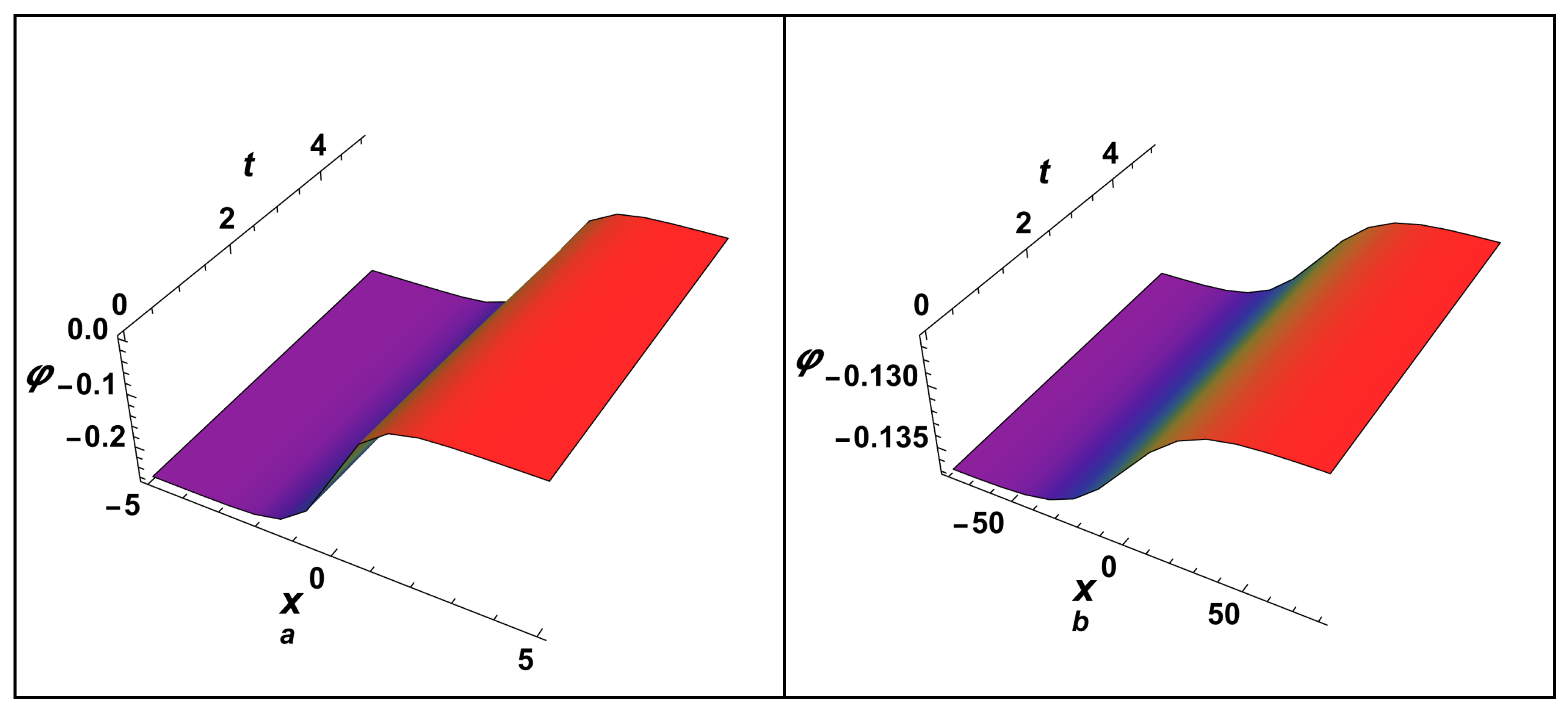
First, let us clarify the difference between the shock-wave profiles described by both the planar ( υ = 0 ) Burgers Equation (21) and KSE (23). Figure 1 demonstrates the comparison analysis between the two planar ( υ = 0 ) shock-wave profiles (3) and (22). As is evident from Figure 1, there is a significant difference between the two profiles due to the fourth-order dissipative effect. This may explain some of the discrepancies between theoretical and experimental results. Therefore, KSE can sometimes bridge the gap between theoretical and experimental results when the theoretical results do not agree with the Burgers Equation (21).
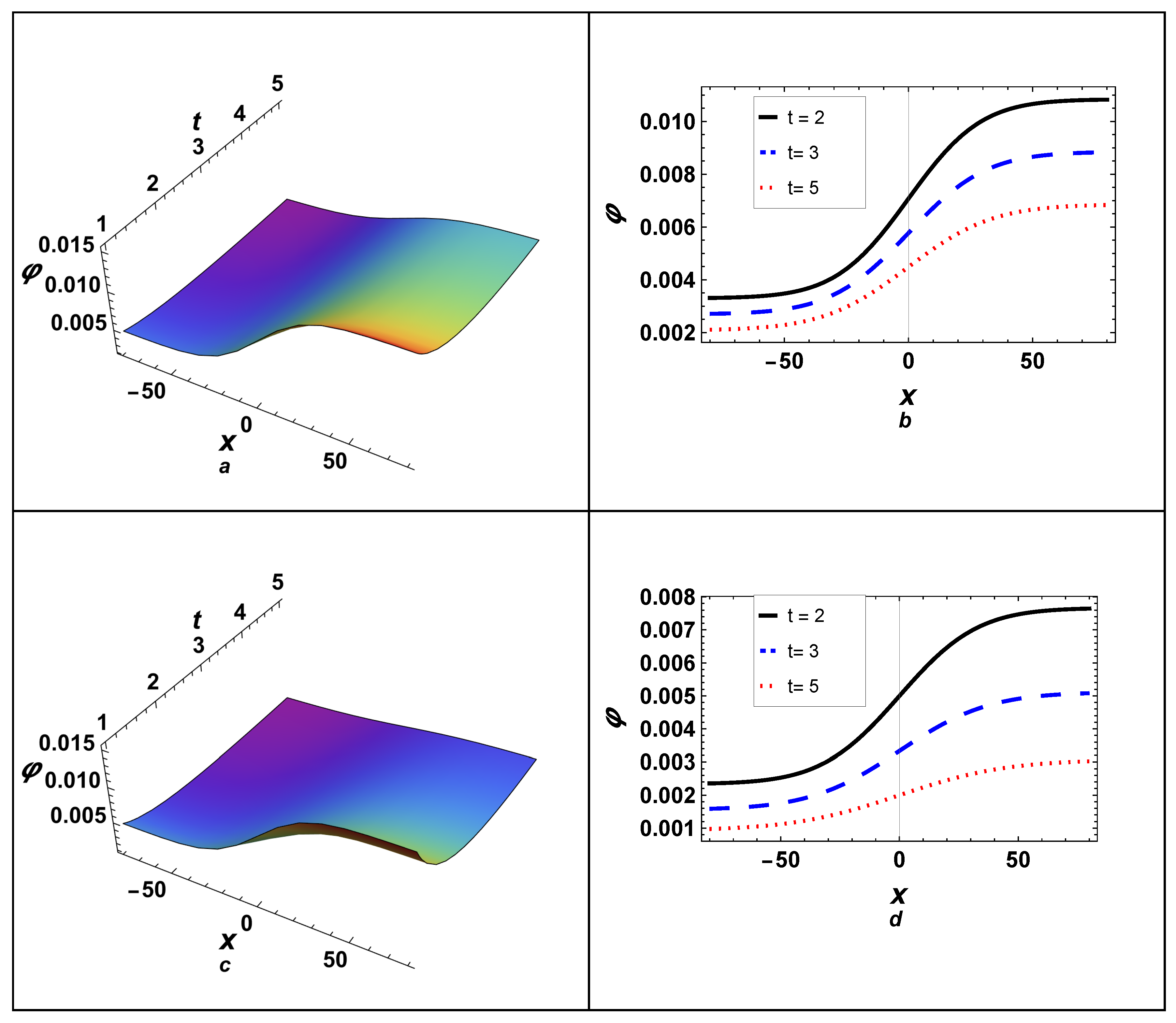
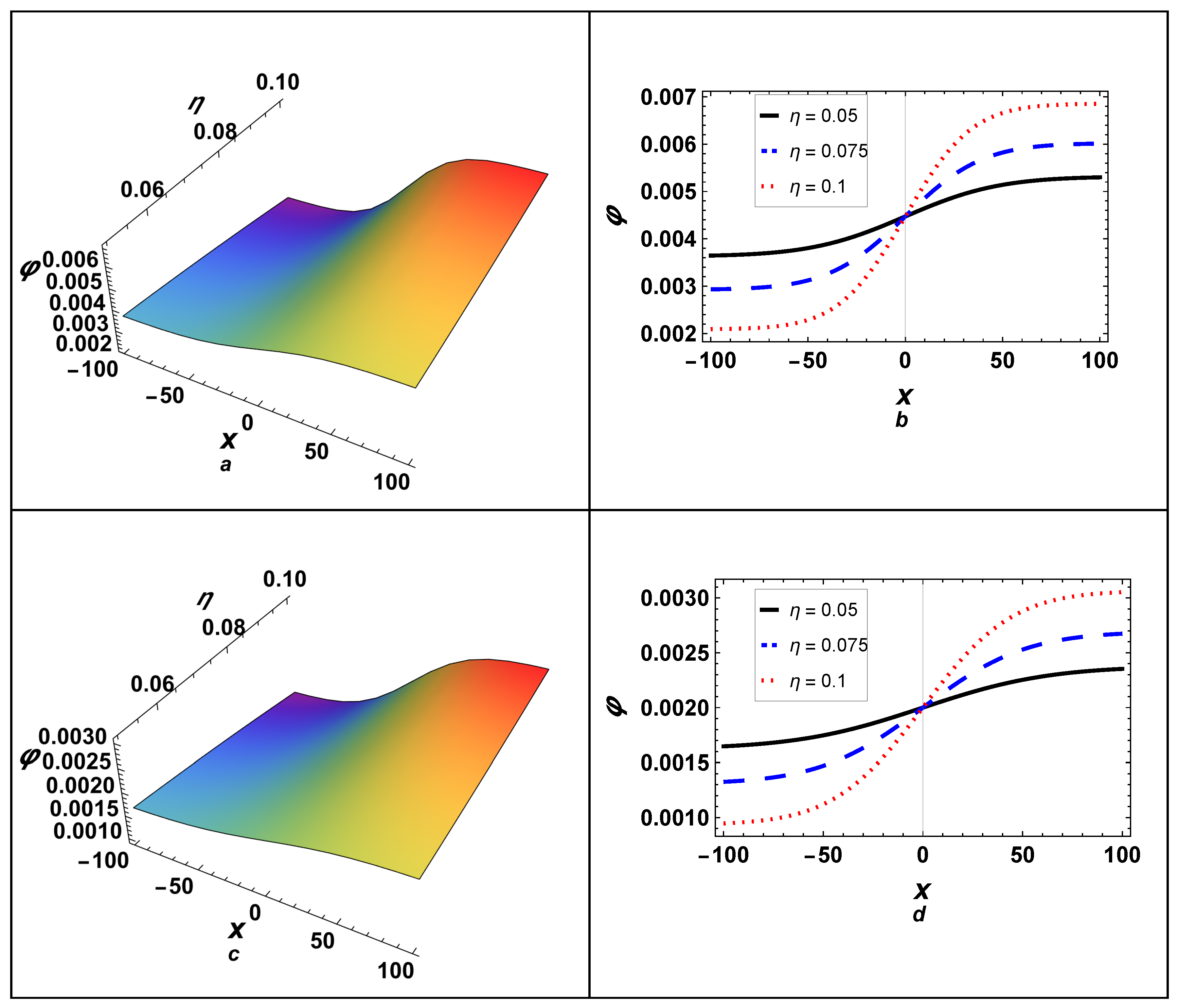
The profiles of both cylindrical and spherical shock waves of the problem (23) according to the approximation (15) are investigated graphically, as displayed in Figure 2 and Figure 3. In Figure 2, we examined how time affects the behavior of dust–acoustic cylindrical (Figure 2a,b) and spherical (Figure 2c,d) fractional shock waves. It is observed that, as time progresses, the dust–acoustic shock-wave profile contracts, i.e., its amplitude and width decrease until it resembles the planar case. In this state, the effect of the geometric term diminishes until it disappears after an extended period, i.e., at the limit t . Furthermore, we investigate the effect of the dust kinematic viscosity η on the profile of cylindrical (Figure 3a,b) and spherical (Figure 3c,d) dust–acoustic fractional shock waves, as shown in Figure 3. It is clear from this figure that both the amplitude and width of the wave decrease with increasing values of the viscosity parameter η . For t > 0 , a comparison between the cylindrical and spherical dust–acoustic shock waves reveals that cylindrical waves exhibit a significantly larger amplitude than their spherical counterparts, but for t < 0 , both cylindrical and spherical dust–acoustic shock waves have opposite behavior. Moreover, the numerical values of the maximum residual error R ( x , t ) max Ω T φ t + α φ φ x β φ x x + γ φ x x x x + υ 2 t φ to both cylindrical and spherical shock-wave approximations are estimated over the domain Ω T x i , x f × t i , t f = 80 , 80 × 1 , 30 at A = 0.01 as follows:
  R ( x , t ) υ = 1 = 0.000906767 , R ( x , t ) υ = 2 = 0.00367054 .
In the integer nonplanar case, the Ansatz construction starts from an exact planar shock solution V ( x , t ) of the classical KS Equation (2) and introduces slowly varying amplitude, width, and phase functions g ( t ) , h ( t ) and Θ ( t ) through the Ansatz formula given in Equation (4). This choice has two important consequences. First, by construction, the profile V already satisfies the planar KS balance between the nonlinear, quadratic-gradient, and fourth-order dissipative terms. Second, the residual associated with the nonplanar geometry appears entirely through the explicit time-dependent curvature contribution and the slow modulation of the three time-dependent functions.
Inserting the Ansatz into the nonplanar KS equation and enforcing the algebraic conditions in Equation (8) reduces the full PDE to the low-dimensional dynamical system (11)–(13) for g, h, and Θ . For these ODEs, one can derive standard Gronwall-type bounds on the time variables ( g ( t ) , h ( t ) , Θ ( t ) ) . In particular, for the physically relevant range of times and parameter values used in our plasma application, the solutions ( g ( t ) , h ( t ) , Θ ( t ) ) remain bounded and smooth, which implies that the corresponding Ansatz profile R ( x , t ) is a stable modulation of the underlying planar shock. The residual error R ( x , t ) of the Ansatz approximation is given by Equation (10). After inserting the explicit form of V and the solutions of Equations (11)–(13), this residual error is a smooth function of ( x , t ) that can be estimated uniformly on the computational domain. Numerically, we compute
R ( x , t ) = max Ω T | φ t + α φ φ x β φ x x + γ φ x x x x + υ 2 t φ | υ ,
for the cylindrical and spherical geometries, and obtain the values reported in Equation (25). Here, Ω T 80 , 80 × 1 , 30 indicates the whole study domain, which is a crucial point because we calculated the residual maximum error along the entire domain. We also expanded the domain (i.e., using large values for the independent variables x and t) to verify the stability and convergence of the derived approximations at any point within it, regardless of the specific value. These maxima errors are of order 10−4–10−3, which is consistent with a second-to third-order truncation of a regular perturbation expansion in the small curvature parameter.

3. Tantawy Technique (TT) for Analyzing Nonplanar FKSE

In part (I) [1], the following planar FKSE was analyzed using the TT and an analytical approximation was derived in detail:
D t p φ + α φ φ x β φ x x + γ φ x x x x = 0 , φ ( x , T i ) = f ( x ) , 0 t T   and X x X ,
where D t p φ represents the TFCD of order p. Here, p indicates the fractional-order parameter in the range 0 < p < 1 , and at p = 1 , the planar integer KSE is recovered.
For 0 < p < 1 , the TFCD of a sufficiently smooth function φ φ x , t with respect to t is defined by [50,51]
D t p C φ x , t D t p φ = 1 Γ ( 1 p ) T i t τ φ x , τ ( t τ ) p d τ , t T i ,
where Γ ( · ) denotes the Gamma function. This operator represents a nonlocal, memory-dependent generalization of the classical first-order time derivative, since the present value of D t p φ depends on the entire past history of τ φ x , τ over 0 τ t .
The initial condition (IC) f ( x ) , can be obtained from the exact shock-wave solution (3) at t = T i , as follows:
f ( x ) = A + B ψ + C ψ 3 ,
where ψ ψ ( x ) = tanh k x .
The explicit form of the generated third-order approximation of the planar model (26) reads [1]
φ = f ( x ) k sech 2 ( k x ) Γ 1 A B α + Y 0 tanh ( k x ) t p 2 k 2 sech 2 ( k x ) Γ 2 j = 1 8 Y j t 2 p + ,
where the coefficients Y j j = 0 , 1 , , 8 , were defined in Part-I [1] and Γ n Γ 1 + n p , n = 1 , 2 , 3 , .
However, the second goal of the current investigation is to analyze the fractional model (26), taking the nonplanar geometric effects (cylindrical and spherical geometry) into account, as follows:
D t p φ + α φ φ x β φ x x + γ φ x x x x + ϕ t φ = 0 , φ ( x , T i ) = f ( x ) , T i t T f   and X x X ,
with ϕ t = υ 2 t , where υ = 0 corresponds to the planar case and υ = 1 2 corresponds to the cylindrical (spherical) geometry. Note that the IC f ( x ) can be obtained from the planar shock-wave solution (3) at t = T i as follows:
f ( x ) = A + B ψ + C ψ 3 .
For the nonplanar case, the condition T i T f > 0 is satisfied.
To analyze problem (29), we first introduce the following transformations:
t = τ + T i , φ φ ( x , τ + T i ) , 0 τ T f T i ,
which lead to
Z D τ p φ + α φ φ x β φ x x + γ φ x x x x + υ 2 ( τ + T i ) φ = 0 .
Now, we can apply the TT to analyze model (32).
For simplicity, we can summarize the algorithm of this technique in the following brief points [44,45,46,47,48]:
Step (1)
According to the TT, the solution to the problem (32) is presumed to take the following Ansatz form:
φ = f ( x ) + j = 1 g j ( x ) τ j p ,
where g j g j ( x ) , ∀ j = 1 , 2 , 3 , , , are unknown space functions that will be determined later and f f ( x ) indicates any initial solution to this problem.
For simplicity, we can consider the first four terms in Ansatz (32), i.e., ( j = 4 ):
φ = f ( x ) + j = 1 4 g j ( x ) τ j p .
Step (2)
The time fractional Caputo derivative D τ p φ can be defined as follows:
D τ p φ = j = 1 4 g i j D τ p τ j p = j = 1 4 g j Γ j p + 1 Γ ( j 1 ) p + 1 τ ( j 1 ) p .
Step (3)
Inserting Equations (34) and (35) into model (32) yields
Z j = 1 4 g j Γ j p + 1 Γ ( j 1 ) p + 1 τ ( j 1 ) p + α f ( x ) + j = 1 4 g j ( x ) τ j p f ( x ) + j = 1 4 g j ( x ) τ j p x β f ( x ) + j = 1 4 g j ( x ) τ j p x x + γ f ( x ) + j = 1 4 g j ( x ) τ j p x x x x + υ 2 ( τ + T i ) f ( x ) + j = 1 4 g j ( x ) τ j p = 0 .
Step (4)
After rearranging all terms of Equation (36) and collecting the coefficients of τ i p , we ultimately obtain the following form:
Z W 0 τ 0 + W 1 τ p + W 2 τ 2 p + W 3 τ 3 p + = 0 ,
with
W 0 = Γ 1 g 1 + υ 2 ( τ + T i ) + α f 1 f 0 β f 2 + γ f 4 , W 1 = Γ 2 Γ 1 g 2 + υ 2 ( τ + T i ) + α f 1 g 1 + α f 0 g ˙ 1 β g 1 . . + γ g 1 . . . . , W 2 = Γ 3 Γ 2 g 3 + υ 2 ( τ + T i ) + α f 1 g 2 + α g 1 g ˙ 1 + α f 0 g ˙ 2 β g 2 . . + γ g 2 . . . . , W 3 = Γ 4 Γ 3 g 4 + υ 2 ( τ + T i ) + α f 1 g 3 + α g 2 g ˙ 1 + α g 1 g ˙ 2 + α f 0 g ˙ 3 β g 3 . . + γ g 3 . . . . , ,
Here, the following notations are considered for any i:
f ( j ) ( x ) f ( j ) f j , f ( x ) f f 0 , g ˙ j g j , g ¨ j g j , g j g j , g j g ,
where Γ j Γ j p + 1 , j = 1 , 2 , 3 , .
Step (5)
Equating the above coefficients W j j = 0 , 1 , 2 , 3 , , to zero and integrating the resulting equations over 0 τ T ¯ , T ¯ = T f T i , yields
υ 2 f 0 log T f T i + T ¯ Γ 1 g 1 + α f 1 f 0 β f 2 + γ f 4 = 0 , υ 2 g 1 log T f T i + T ¯ Γ 2 Γ 1 g 2 + α f 1 g 1 + α f 0 g ˙ 1 β g 1 . . + γ g 1 . . . . = 0 , υ 2 g 2 log T f T i + T ¯ Γ 3 Γ 2 g 3 + α f 1 g 2 + α g 1 g ˙ 1 + α f 0 g ˙ 2 β g 2 . . + γ g 2 . . . . = 0 , υ 2 g 3 log T f T i + T ¯ Γ 4 Γ 3 g 4 + α f 1 g 3 + α g 2 g ˙ 1 + α g 1 g ˙ 2 + α f 0 g ˙ 3 β g 3 . . + γ g 3 . . . . = 0 , .
Step (6)
By solving system (38) in the time functions g 1 , g 2 , g 3 , and g 4 , the following values are obtained:
g 1 = 1 2 T ¯ Γ 1 f 0 M + 2 T ¯ β f 2 + γ f 4 , g 2 = Γ 1 2 T ¯ Γ 2 g 1 M + 2 T ¯ α f 0 g ˙ 1 β g 1 . . + γ g 1 . . . . , g 3 = Γ 2 2 T ¯ Γ 3 g 2 M + 2 T ¯ α g 1 g ˙ 1 + α f 0 g ˙ 2 β g 2 . . + γ g 2 . . . . , g 4 = Γ 3 2 T ¯ Γ 4 g 3 M + 2 T ¯ α g 2 g ˙ 1 + α g 1 g ˙ 2 + α f 0 g ˙ 3 β g 3 . . + γ g 3 . . . . , .
with
M = 2 α f 1 T ¯ + υ log T f T i .
Remember that f j f ( j ) ( x ) for j = 1 , 2 , 3 , . . , and f 0 f ( x ) .
Step (7)
To obtain explicit values for g 1 , g 2 , g 3 , and g 4 in the IC f 0 , the system (39) can be solved using MATHEMATICA with the help of the following values of the IC (30) and its derivatives:
f 0 = A + B ψ + C ψ 3 , f 1 = k ψ 2 ( B 3 C ) + k B 3 k C ψ 4 , f 2 = 2 k 2 ψ 3 ( B 9 C ) 2 k 2 φ ( B 3 C ) + 12 k 2 C ψ 5 , f 3 = 6 k 3 ψ 4 ( B 19 r ) + 4 k 3 ψ 2 ( 2 B 15 C ) 2 k 3 B 60 k 3 C ψ 6 + 6 k 3 C , f 4 = 24 k 4 ψ 5 ( B 34 C ) 8 k 4 ψ 3 ( 5 B 72 C ) + 8 k 4 ψ ( 2 B 15 C ) + 360 k 4 C ψ 7 ,
where ψ ( x ) ψ = tanh k x μ T i = tanh Θ T i .
In general, we can receive any derivatives for f using the following simple MATHEMATICA code:
f x _ : = A + B ψ x + C ψ x 3 ; D e v 1 = T a b l e D ψ x k 1 ψ x 2 , x , j , j , 0 , 100 ; D e v 2 = T a b l e f j D e r i v a t i v e j f x , j , 0 , 50 / / . D e v 1
Note that we refrained from including these expressions here because of their considerable size; however, acquiring them is straightforward.
Step (8)
By substituting the obtained values of g 1 , g 2 , g 3 , and g 4 , into the Ansatz (34), the following analytical approximation to the i.v.p. (29) up to fourth order is obtained:
φ = f ( x ) + g 1 ( x ) ( t T i ) p + g 2 ( x ) ( t T i ) 2 p + g 3 ( x ) ( t T i ) 3 p + g 4 ( x ) ( t T i ) 4 p = A + B ψ + C ψ 3 1 2 T ¯ Γ 1 f 0 M + 2 T ¯ β f 2 + γ f 4 ( t T i ) p Γ 1 2 T ¯ Γ 2 g 1 M + 2 T ¯ α f 0 g ˙ 1 β g 1 . . + γ g 1 . . . . ( t T i ) 2 p Γ 2 2 T ¯ Γ 3 g 2 M + 2 T ¯ α g 1 g ˙ 1 + α f 0 g ˙ 2 β g 2 . . + γ g 2 . . . . ( t T i ) 3 p Γ 3 2 T ¯ Γ 4 g 3 M + 2 T ¯ α g 2 g ˙ 1 + α g 1 g ˙ 2 + α f 0 g ˙ 3 β g 3 . . + γ g 3 . . . . ( t T i ) 4 p .
It should be noted here that the approximation (40) covers the approximate solution to the planar FKSE (26) at υ = 0 . For simplicity, we denote the second-order approximation by φ 2 , the third-order approximation by φ 3 , and the fourth-order approximation by φ 4 .

3.1. A Plasma Application and Numerical Example

Here, we consider the same above-discussed plasma model and use the same numerical values for the related physical parameters q , η , as used in Ref. [49]. For example, at q , η = 0.7 , 0.1 , we obtain α , β , γ = 0.759257 , 0.05 , 1 . Thus, following the nonplanar time FKS problem reads
D t p φ + α φ φ x β φ x x + γ φ x x x x + υ 2 t φ = 0 , φ ( x , T i ) = A + B tanh k x μ T i + C tanh 3 tanh k x μ T i .
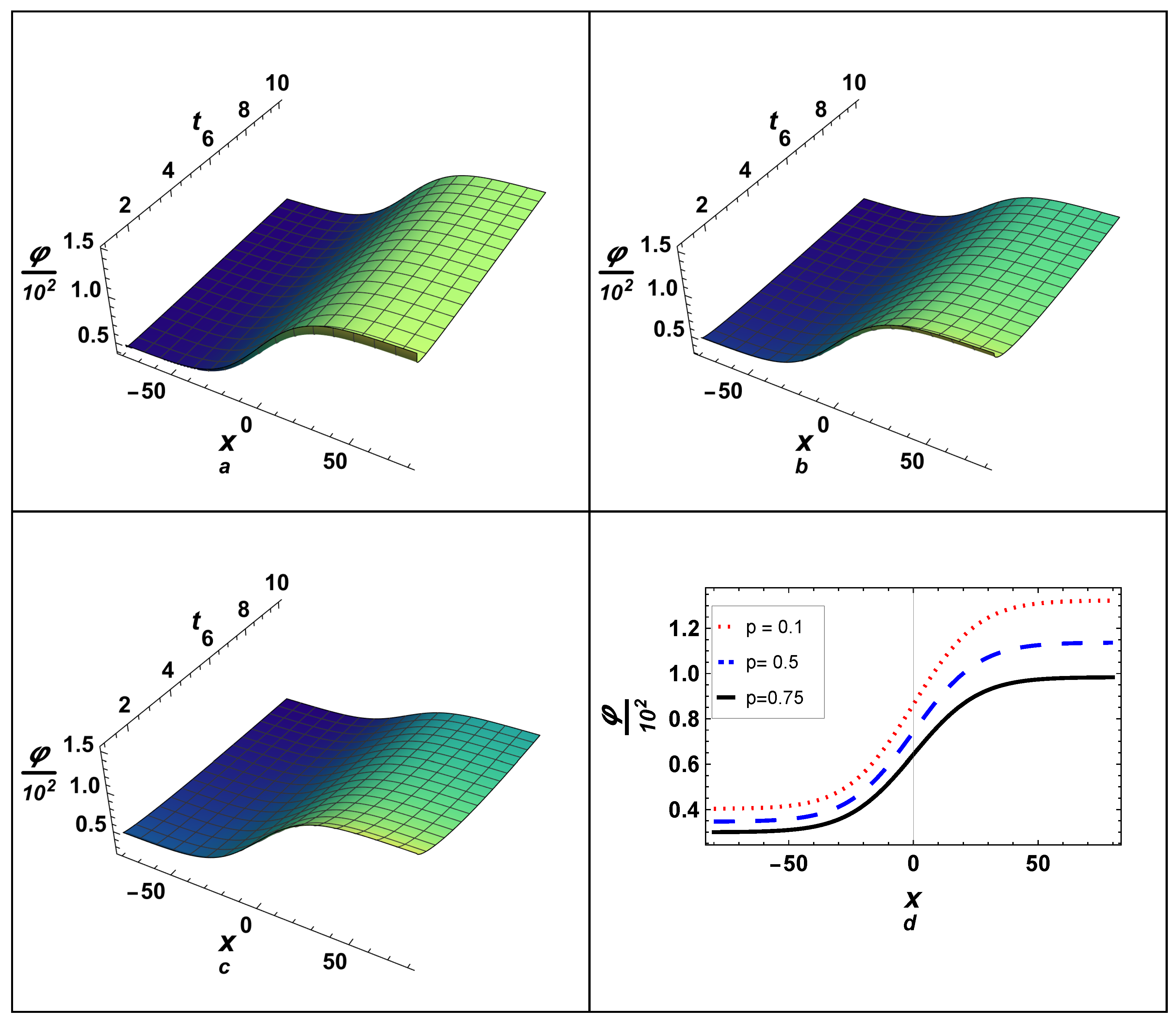
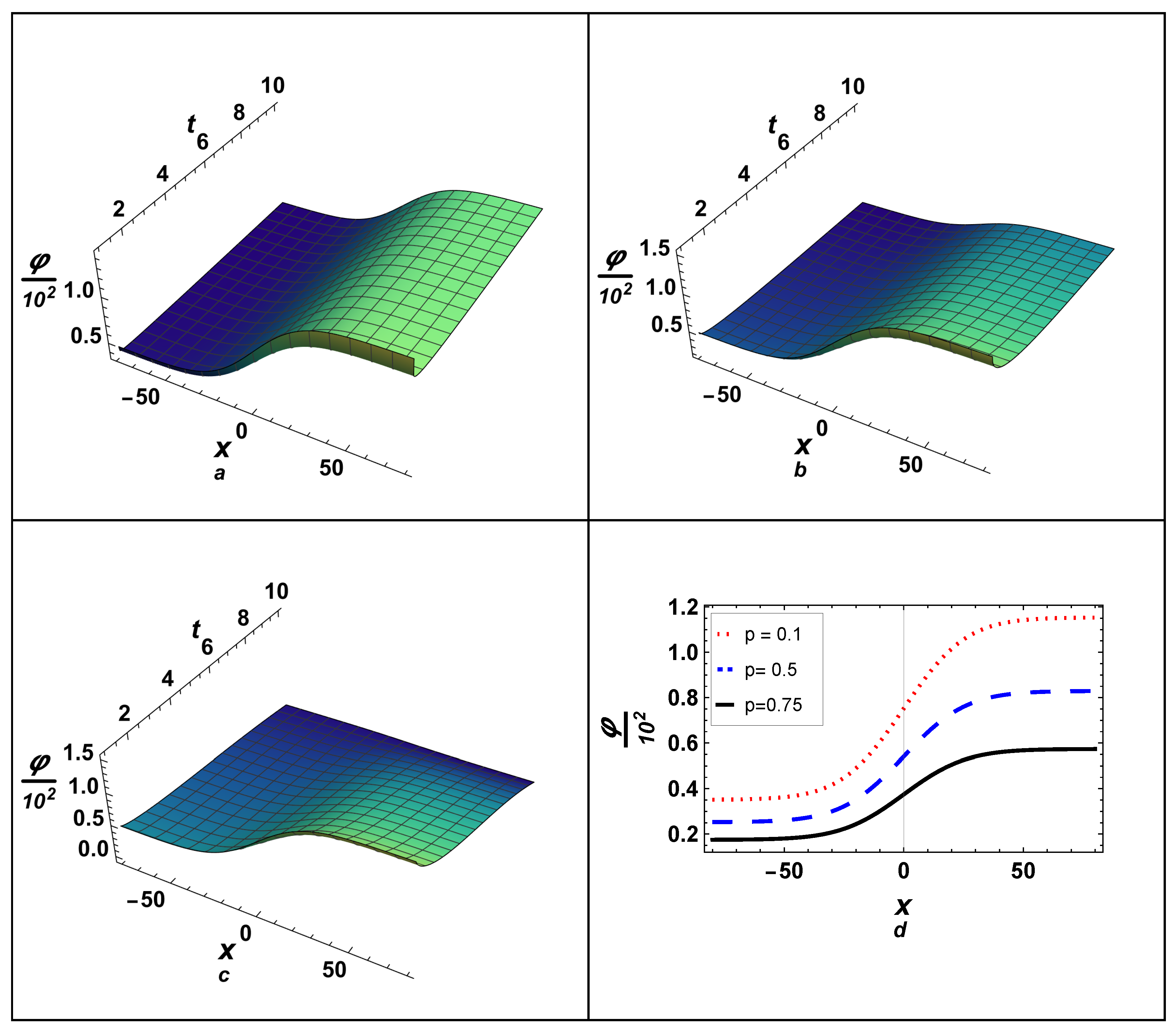
The approximation (40) for both cylindrical and spherical cases is numerically investigated, as presented in Figure 4 and Figure 5, respectively. In both cases, the effect of the fractional parameter p on the nonplanar fractional shock-wave profile is examined. It is observed that the shock wave’s amplitude and the width decrease with increasing fractionality p. Furthermore, it is noted that the influence of the fractional parameter p on the profile of fractional spherical shock waves is more significant compared to cylindrical ones. Moreover, the maximum residual error R ( x , t ) max Ω T D t p φ + α φ φ x β φ x x + γ φ x x x x + υ 2 t φ for the second-order approximations is estimated for both the cylindrical and spherical cases during the domain Ω T x i , x f × t i , t f = 80 , 80 × 1 , 10 at A = 0.01 and at different values of the fractional parameter values p as follows:
R ( x , t ) υ = 1 , p = 0.1 = 0.0112129 , R ( x , t ) υ = 1 , p = 0.7 = 0.00424911 , R ( x , t ) υ = 1 , p = 0.9 = 0.00475565 ,
and
R ( x , t ) υ = 2 , p = 0.1 = 0.0214968 , R ( x , t ) υ = 1 , p = 0.7 = 0.00234912 , R ( x , t ) υ = 1 , p = 0.9 = 0.00526444 ,
We also calculated the absolute error of the derived approximations, as shown in Table 1 and Table 2 for the cylindrical and spherical cases, respectively. However, the comparison is not performed with an exact solution of the nonplanar integer KS equation, since it does not support an exact solution; instead, the comparison is carried out with the semi-analytical solution (15) derived above using the Ansatz method:
L = max x , t Ω φ Approx φ Ref .
For the second- and third-order approximations, denoted by φ ( 2 ) and φ ( 3 ) , respectively, the L norm can be written as follows:
L 2 = max x , t Ω φ ( 15 ) φ ( 40 ) 2 , L 3 = max x , t Ω φ ( 15 ) φ ( 40 ) 3 .
The analytical results clearly indicate that the generated approximations exhibit both accuracy and stability across the whole study domain. Consequently, the analytical results confirm the efficacy of the employed approach.
Physically, the analysis clarifies how fractional time-derivatives encode memory and hereditary effects in the evolution of planar shock waves, and how these effects modify the amplitude, width, and propagation speed of structures supported by KS-type equations in complex plasmas and viscous fluids. In the present model, the fractional parameter p is not fixed a priori by a single microscopic derivation. Rather, it plays the role of an effective phenomenological exponent that can be tuned to reproduce empirically observed relaxation rates and wave damping profiles. In particular, values p < 1 correspond to slower than exponential decay of disturbances and to enhanced memory of past states, which is consistent with laboratory observations of dusty plasmas and with space plasma measurements, where dust and non-Maxwellian ions coexist. The integer limit p 1 recovers the classical nonplanar KS description, thereby providing a natural bridge between standard dissipative models and their fractional, memory-rich counterparts. The technique proposed, therefore, provides a flexible and robust analytical tool for modeling fractional shock waves in plasmas and fluids, and it can be extended to other non-integrable fractional evolution equations in engineering and mathematical physics, where an accurate representation of memory effects is essential.

3.2. Comparison with Other Analytical and Numerical Methods

Several analytical and semi-analytical techniques, as well as numerical schemes, have been applied to analyze planar FKS-type problems and derive analytical and numerical approximations [36,37,38,39,40,41,42,43]. For instance, Alshehry et al. [36] used a new fractional-derivative-based version of the natural decomposition method to obtain an accurate approximation solution to the planar FKS-type equation: D τ p φ + φ φ χ + x φ χ χ + y φ χ χ χ + z φ χ χ χ χ = 0 . Veeresha and Prakasha [37] applied the q-homotopy analysis transform method, an approach blending Laplace transforms with the homotopy analysis framework, to construct accurate approximations to the subsequent planar FKS-type equation: D τ p φ + φ φ χ φ χ χ + φ χ χ χ χ = 0 . Mohammed et al. [38] derived analytical solutions to the planar space-fractional stochastic SK-type equation, formulated with a conformable derivative, by employing the Riccati equation method. Sahoo and Saha [39] solved the planar FKS equation D τ p φ + a φ φ χ + b φ χ χ + k φ χ χ χ χ = 0 , and derived analytical solutions for this problem using a newly proposed method based on the fractional complex transform and Jumarie’s modified Riemann–Liouville derivative. Nadeem and Iambor [40] introduced the Sumudu Homotopy Transform Method (SHTM), which combines the Sumudu transform with homotopy perturbation to efficiently solve planar nonlinear FKS-type equations with Caputo derivatives, delivering accurate series solutions after minimal iterations. Additionally, in the framework of the Sumudu transform with the Adomian decomposition method, the planar FKS-type equation— D t p φ + φ φ x + μ φ x x + β φ x x x + γ φ x x x x = 0 —was analyzed [42]. Choudhary and Kumar [43] developed a numerical scheme combining backward Euler time-stepping with quintic B-spline spatial collocation to analyze the planar linear FKS-type equation in the Caputo sense. All these methods and investigations have proven effective for problems where either an exact planar solution is available as a benchmark or the geometry is strictly planar, and the coefficients are relatively simple. However, the TT differs from these approaches in several respects; first, it directly treats the nonplanar geometry and the fully nonlinear structure of the FKS operator, without requiring linearization or truncation at low orders in the nonlinearity. Second, the TT generates a systematically improvable series expansion in the fractional time variable, with coefficients obtained from an algebraic system that can be handled symbolically for general initial data. Third, the technique yields closed-form expressions that are valid for both integer and fractional orders and that reduce to the known integer KS shock in the limit p 1 , thereby providing a unified framework for comparing integer and fractional dynamics. Additionally, the current investigation addressed a different form of a real-world problem related to a real-world physics application, as we discussed above.
On the other hand, the TT is not a comprehensive replacement for numerical methods but rather a technique that is easily applicable to analyze more complicated problems. Furthermore, the approximations generated by this technique are stable and convergent despite their simplicity. We can study the current problem using other analytical and numerical methods in future work and compare it with the current research. In general, we emphasize that the TT is particularly well suited for deriving accurate semi-analytical benchmarks in parameter regimes where numerical or some other analytical methods are expensive.

3.3. Extension to Other Plasma Configurations

In this study, we picked a specific dust–acoustic shock model that is important in physics, which includes electron depletion and nonextensive ions, to test the nonplanar integer and fractional KS equations. The reduction from the fluid system to the nonplanar KS equation uses the RPT and a particular ordering of parameters, which are tailored to this dusty plasma configuration. However, this method can also be used for other plasma models where nonplanar shock-like structures happen when the balance between nonlinearity and dispersion is upset, along with other factors that cause nonplanar shock waves in plasmas. Examples include nonplanar ion-acoustic shocks in multi-ion or pair-ion plasmas, degenerate quantum plasmas, and electronegative plasmas with different electron distributions, several of which have been studied at the level of Burgers- or KdV-type equations. In these situations, the reductive perturbation method usually results in a nonplanar evolution equation that has the same KS structure but with different coefficients that represent the specific fluid model. After receiving the integer or fractional nonplanar KS form, we can use the Ansatz method and the TT as they are, which will provide us with semi-analytical and fractional shock profiles for these different plasma types. We briefly outline this generalization route and provide references to existing nonplanar shock models that can be recast within the present framework.

4. Conclusions

In this study, one of the most challenging problems encountered by many researchers in analyzing acoustic shock waves—namely, the integer and fractional nonplanar Kuramoto–Sivashinsky (KS) equations—has been addressed. The study has been divided into two main parts.
  • The first part focused on the integer nonplanar KS equation and its analysis, yielding an analytical approximation to understand the dynamical behavior of shock waves that can arise and propagate in various plasma systems. To this end, the Ansatz method has been applied, yielding some semi-analytical approximations for this model. As a practical application, the fluid equations governing the propagation of acoustic shock waves in a non-Maxwellian dust plasma have been reduced to the integer nonplanar KS equation using the reductive perturbation method. After that, this equation was analyzed using the derived semi-analytical approximations, and the influence of various physical parameters on the profiles of acoustic shock waves was numerically discussed.
  • As for the second objective, the integer nonplanar KS equation has been transformed into its fractional counterpart (fractional KS (FKS) equation) to study the effect of the memory factor on the dynamical behavior of the dust–acoustic shock waves. This equation has been analyzed using one of the most modern, accurate, and user-friendly analytical methods, namely, the Tantawy technique. A fourth-order analytical approximation has been generated, and based on it, the effect of fractionality on the behavior of dust–acoustic shock waves has been examined. To verify the accuracy of the derived approximations and the efficiency of the used technique, the maximum residual errors of the derived approximations have been calculated for both cylindrical and spherical fractional dust–acoustic shock waves, in addition to calculating the absolute error of these approximations compared to the semi-analytical solution for the integer case. The results of the analysis showed promising results, which enhances the efficiency of the methods used.
  • The nonplanar FKS has been thoroughly examined in the concluding phase of the present study, leading to the derivation of a highly precise analytical approximation for this equation. It was found that the analytical approximation for the nonplanar FKS equation covers the analytical approximation for the planar case, i.e., the planar FKS equation.
Last but not least, the proposed technique presents a pragmatic and precise approach to solving and analyzing the nonplanar fractional KS-type equations. This method is advantageous for examining diverse engineering and mathematical physics issues without any challenges. Our novel methodology provides a powerful tool for analyzing intricate systems. It has potential applications across a range of challenges in fluid dynamics, plasma physics, chemical processes, and other engineering fields. This study is the first to address stiff evolutionary wave equations governing the propagation of nonlinear, nonplanar structures in various physical and engineering media. Therefore, it is expected to serve as a foundational work for researchers interested in multiple physical and engineering phenomena, as this type of problem offers the most comprehensive and realistic approach to modeling diverse natural phenomena.
Finally, this study provides a basis for systematic comparisons of experimental and observational data on nonplanar shock structures in complex plasmas and associated dissipative media. Comparisons will be crucial for assessing the predictive capacity of fractional nonplanar models and for delineating regimes where memory and geometric effects influence wave evolution. This paper presents a versatile and scalable methodology for forthcoming theoretical, computational, and experimental investigations of nonlinear waves in intricate systems.

Future Work

The present contribution opens several concrete directions that we intend to pursue in forthcoming studies, closely connected to the current (non)planar fractional damped KS framework.
(i)
In a direct continuation of the analysis developed here, the next part of this research program will address the same nonplanar KS-type problem and some related physical problems while explicitly incorporating collisional forces between the charged/neutral particles in a plasma [52]. In particular, we shall account for momentum transfer between neutral and charged constituents of the plasma, as well as collisions among the charged species themselves, and investigate how these additional dissipative and dispersive effects reshape the structure and evolution of (non)planar dissipative dust–acoustic fractional shock waves.
(ii)
Additionally, the new iterative method [53,54,55] can be applied for analyzing the (non)planar fractional (un)damped KS problem and making a comparison between its approximations and the approximations generated via the TT. Such a comparison, carried out for both planar and nonplanar fractional (un)damped KS problems, will make it possible to quantify the relative convergence rates, stability properties, and error levels of the two approaches over a broad range of physical parameters.
(iii)
Finally, we envisage extending the collisional, nonplanar fractional methodology beyond the dust–acoustic regime considered here. In particular, the same analytical machinery can be adapted to ion–acoustic and magneto–acoustic shocks in multi-component plasmas, where both curvature and collisions play a decisive role, hence offering a broader testing ground for the new iterative method and for the TT.

Author Contributions

S.A.E.-T.: Formal analysis, Investigation, Methodology, Supervision, Software, Writing—review and editing; A.H.S.: Formal analysis, Investigation, Methodology, Software; W.A.: Conceptualization; Supervision, Writing—review and editing; A.A.A.: Investigation, Methodology, Writing—original draft; H.M.: Investigation, Methodology, Writing—review and editing. All authors have read and agreed to the published version of the manuscript.

Funding

The Researchers would like to thank the Deanship of Graduate Studies and Scientific Research at Qassim University for financial support (QU-APC-2026). The authors express their gratitude to Princess Nourah bint Abdulrahman University Researchers Supporting Project Number (PNURSP2026R157), Princess Nourah bint Abdulrahman University, Riyadh, Saudi Arabia.

Data Availability Statement

The authors declare that all data supporting the present study are available within the article.

Acknowledgments

The Researchers would like to thank the Deanship of Graduate Studies and Scientific Research at Qassim University for financial support (QU-APC-2026). The authors express their gratitude to Princess Nourah bint Abdulrahman University Researchers Supporting Project Number (PNURSP2026R157), Princess Nourah bint Abdulrahman University, Riyadh, Saudi Arabia.

Conflicts of Interest

The authors declare no conflicts of interest regarding this article.

References

  1. El-Tantawy, S.A.; Salas, A.H.; Albalawi, W.; Alharbey, R.A.; Alharby, A.A. On the Tantawy Technique for Analyzing Fractional Kuramoto–Sivashinsky-Type Equations and Modeling Shock Waves in Plasmas and Fluids—Part (I), Planar Case. Fractal Fract. 2026, 10, 105. [Google Scholar] [CrossRef]
  2. Mamun, A.A.; Shukla, P.K. Dust-acoustic shock waves in dusty plasmas. Phys. Rev. E 1999, 60, 4341–4347. [Google Scholar]
  3. Shukla, P.K.; Mamun, A.A. Introduction to Dusty Plasma Physics; Institute of Physics Publishing: Bristol, UK, 2002. [Google Scholar]
  4. Wazwaz, A.-M. A variety of distinct kinds of multiple soliton solutions for a (3+1)-dimensional nonlinear evolution equations. Math. Appl. Sci. 2013, 36, 349–357. [Google Scholar] [CrossRef]
  5. Mihalache, D. Multidimensional localized structures in optical and matter-wave media: A topical survey of recent literature. Rom. Rep. Phys. 2017, 69, 403. [Google Scholar]
  6. Mamun, A.A.; Shukla, P.K. Nonplanar dust ion-acoustic solitary and shock waves in a dusty plasma with electrons following a vortex-like distribution. Phys. Lett. A 2010, 374, 472–475. [Google Scholar] [CrossRef]
  7. Ema, S.A.; Hossen, M.R.; Mamun, A.A. Planar and Nonplanar Shock Waves in a Degenerate Quantum Plasma. Contrib. Plasma Phys. 2015, 55, 551–559. [Google Scholar] [CrossRef]
  8. Affan, H.; Ullah, S. Nonplanar ion acoustic waves in e-p-i plasmas with non-Maxwellian distributed electrons and positrons. Phys. Scr. 2024, 99, 075602. [Google Scholar] [CrossRef]
  9. El-Tantawy, S.A. Nonlinear dynamics of soliton collisions in electronegative plasmas: The phase shifts of the planar KdV-and mkdV-soliton collisions. Chaos Solitons Fractals 2016, 93, 162. [Google Scholar] [CrossRef]
  10. Alharthi, M.R.; Alharbey, R.A.; El-Tantawy, S.A. Novel analytical approximations to the nonplanar Kawahara equation and its plasma applications. Eur. Phys. J. Plus 2022, 137, 1172. [Google Scholar] [CrossRef]
  11. El-Tantawy, S.A.; Salas, A.H.; Alyousef, H.A.; Alharthi, M.R. Novel approximations to a nonplanar nonlinear Schrödinger equation and modeling nonplanar rogue waves/breathers in a complex plasma. Chaos Solitons Fractals 2022, 163, 112612. [Google Scholar] [CrossRef]
  12. Kuramoto, Y.; Tsuzuki, T. Persistent propagation of concentration waves in dissipative media far from thermal equilibrium. Prog. Theor. Phys. 1976, 55, 356–369. [Google Scholar] [CrossRef]
  13. Rademacher, J.; Wattenberg, R. Viscous shocks in the destabilized Kuramoto–Sivashinsky. J. Comput. Nonlinear Dyn. 2006, 1, 336–347. [Google Scholar] [CrossRef]
  14. Sivashinsky, G.I. Instabilities, pattern-formation, and turbulence in flames. Ann. Rev. Fluid Mech. 1983, 15, 179–199. [Google Scholar] [CrossRef]
  15. Hooper, A.P.; Grimshaw, R. Nonlinear instability at the interface between two viscous fluids. Phys. Fluids 1985, 28, 37–45. [Google Scholar] [CrossRef]
  16. Lakestani, M.; Dehghan, M. Numerical solutions of the generalized Kuramoto–Sivashinsky equation using B-spline functions. Appl. Math. Model. 2012, 36, 605–617. [Google Scholar] [CrossRef]
  17. Odibat, Z.; Momani, S. Numerical methods for nonlinear partial differential equations of fractional order. Appl. Math. Model. 2008, 32, 28–39. [Google Scholar] [CrossRef]
  18. Metzler, R.; Klafter, J. The random walk’s guide to anomalous diffusion: A fractional dynamics approach. Phys. Rep. 2000, 339, 1–77. [Google Scholar] [CrossRef]
  19. Mainardi, F. Fractional Calculus and Waves in Linear Viscoelasticity; Imperial College Press: London, UK, 2010. [Google Scholar]
  20. Podlubny, I. Geometric and physical interpretation of fractional integration and fractional differentiation. Fract. Calc. Appl. Anal. 2002, 5, 367–386. [Google Scholar]
  21. Baleanu, D.; Diethelm, K.; Scalas, E.; Trujillo, J.J. Fractional Calculus: Models and Numerical Methods; World Scientific: Singapore, 2012. [Google Scholar]
  22. Podlubny, I. Fractional Differential Equations: An Introduction to Fractional Derivatives, Fractional Differential Equations, to Methods of Their Solution and Some of Their Applications; Academic Press: New York, NY, USA, 1999. [Google Scholar]
  23. Miller, K.S.; Ross, B. An Introduction to the Fractional Calculus and Fractional Differential Equations; Wiley: New York, NY, USA, 1993. [Google Scholar]
  24. Oldham, K.B.; Spanier, J. The Fractional Calculus; Academic Press: New York, NY, USA, 1974. [Google Scholar]
  25. Kilbas, A.A.; Trujillo, J.J. Differential equations of fractional order: Methods, results problems. Appl Anal. 2001, 78, 153–192. [Google Scholar] [CrossRef]
  26. Baleanu, D.; Wu, G.C.; Zeng, S.D. Chaos analysis and asymptotic stability of generalized Caputo fractional differential equations. Chaos Solitons Fractals 2017, 102, 99–105. [Google Scholar] [CrossRef]
  27. Eltayeb, H.; Mesloub, S. Solution for Time-Fractional Coupled Burgers Equations by Generalized-Laplace Transform Methods. Fractal Fract. 2024, 8, 692. [Google Scholar] [CrossRef]
  28. Akram, T.; Abbas, M.; Riaz, M.B.; Ismail, A.I.; Ali, N.M. An efficient numerical technique for solving time fractional Burgers equation. Alex. Eng. J. 2020, 59, 2201–2220. [Google Scholar] [CrossRef]
  29. El-Wakil, S.A.; Abulwafa, E.M.; El-Shewy, E.; Mahmoud, A.A. Time-fractional kdv equation for plasma of two different temperature electrons and stationary ion. Phys. Plasmas 2011, 18, 092116. [Google Scholar] [CrossRef]
  30. El-Wakil, S.A.; Abulwafa, E.M.; Zahran, M.A.; Mahmoud, A.A. Time-fractional kdv equation: Formulation and solution using variational methods. Nonlinear Dyn. 2011, 65, 55–63. [Google Scholar] [CrossRef]
  31. El-Wakil, S.A.; Abulwafa, E.M.; El-Shewy, E.K.; Mahmoud, A.A. Time fractional kdv equation for electron-acoustic waves in plasma of cold electron and two different temperature isothermal ions. Astrophys. Space Sci. 2011, 333, 269–276. [Google Scholar]
  32. Naber, M. Time fractional Schrödinger equation. J. Math. Phys. 2004, 45, 3339–3352. [Google Scholar] [CrossRef]
  33. Alazman, I.; Jleli, M.; Samet, B. A Time-Fractional Schrödinger Equation with Singular Potentials on the Boundary. Fractal Fract. 2023, 7, 417. [Google Scholar] [CrossRef]
  34. Abd-Elhameed, W.M.; Abdelkawy, M.A.; Alsafri, N.M.A.; Atta, A.G. Numerical Treatment of the Time-Fractional Kuramoto–Sivashinsky Equation Using a Combined Chebyshev-Collocation Approach. Fractal Fract. 2025, 9, 727. [Google Scholar] [CrossRef]
  35. Feng, D. Exact Solutions of Kuramoto-Sivashinsky Equation. Int. J. Educ. Manag. Eng. 2012, 2, 61–66. [Google Scholar] [CrossRef]
  36. Alshehry, A.S.; Imran, M.; Khan, A.; Shah, R.; Weera, W. Fractional View Analysis of Kuramoto–Sivashinsky Equations with Non-Singular Kernel Operators. Symmetry 2022, 14, 1463. [Google Scholar] [CrossRef]
  37. Veeresha, P.; Prakasha, D.G. Solution for Fractional Kuramoto–Sivashinsky Equation Using Novel Computational Technique. Int. J. Appl. Comput. Math. 2021, 7, 33. [Google Scholar] [CrossRef]
  38. Mohammed, W.W.; Albalahi, A.M.; Albadrani, S.; Aly, E.S.; Sidaoui, R.; Matouk, A.E. The Analytical Solutions of the Stochastic Fractional Kuramoto–Sivashinsky Equation by Using the Riccati Equation Method. Math. Probl. Eng. 2022, 2022, 5083784. [Google Scholar] [CrossRef]
  39. Sahoo, S.; Ray, S.S. New approach to find exact solutions of time-fractional Kuramoto-Sivashinsky equation. Physica A 2015, 434, 240–245. [Google Scholar] [CrossRef]
  40. Nadeem, M.; Iambor, L.F. Advanced Numerical Scheme for Solving Nonlinear Fractional Kuramoto–Sivashinsky Equations Using Caputo Operators. Fractal Fract. 2025, 9, 418. [Google Scholar] [CrossRef]
  41. Rezazadeh, H.; Ziabary, B.P. Sub-equation Method for the Conformable Fractional Generalized KuramotoSivashinsky Equation. Comput. Res. Prog. Appl. Sci. Eng. 2016, 2, 106–109. [Google Scholar]
  42. Aziz, H.; Jwamer, K.H.F. Analytical Solution of Nonlinear Time-Fractional Kuramoto-Sivashinsky Equation by Sumudu Adomian Decomposition Method. Bas. J. Sci. 2025, 43, 67. [Google Scholar]
  43. Choudhary, R.; Kumar, D. Numerical solution of linear time-fractional Kuramoto-Sivashinsky equation via quintic B-splines. Int. J. Comput. Math. 2023, 100, 1512–1531. [Google Scholar] [CrossRef]
  44. Alhejaili, W.; Alzaben, L.; El-Tantawy, S.A. Modeling Fractional Dust-Acoustic Shock Waves in a Complex Plasma Using Novel Techniques. Fractal Fract. 2025, 9, 674. [Google Scholar] [CrossRef]
  45. Almuqrin, A.H.; Tiofack, C.G.L.; Mohamadou, A.; Alim, A.; Ismaeel, S.M.E.; Alhejaili, W.; El-Tantawy, S.A. On the “Tantawy Technique” and other methods for analyzing the family of fractional Burgers’ equations: Applications to plasma physics. Journal of Low Frequency Noise. Vib. Act. Control 2025, 44, 1323–1352. [Google Scholar] [CrossRef]
  46. El-Tantawy, S.A.; Bacha, S.I.H.; Khalid, M.; Alhejaili, W. Application of the Tantawy technique for modeling fractional ion-acoustic waves in electronegative plasmas having Cairns distributed-electrons, Part (I): Fractional KdV Solitary Waves. Braz. J. Phys. 2025, 55, 123. [Google Scholar] [CrossRef]
  47. El-Tantawy, S.A.; Alhejaili, W.; Khalid, M.; Al-Johani, A.S. Application of the Tantawy Technique for Modeling Fractional Ion-Acoustic Waves in Electronegative nonthermal Plasmas, Part (II): Fractional modifed KdV-Solitary Waves. Braz. J. Phys. 2025, 55, 176. [Google Scholar] [CrossRef]
  48. El-Tantawy, S.A.; Alhejaili, W.; Al-Johani, A.S. On the Tantawy technique for analyzing (in) homogeneous fractional physical wave equations. J. Supercomput. 2025, 81, 1377. [Google Scholar] [CrossRef]
  49. Ferdousi, M.; Miah, M.R.; Sultana, S.; Mamun, A.A. Dust-acoustic shock waves in an electron depleted nonextensive dusty plasma. Astrophys. Space Sci. 2015, 360, 43. [Google Scholar] [CrossRef]
  50. Das, S. Functional Fractional Calculus; Springer: Berlin/Heidelberg, Germany, 2011. [Google Scholar]
  51. Diethelm, K. The Analysis of Fractional Differential Equations; Springer: Berlin/Heidelberg, Germany, 2010. [Google Scholar]
  52. Sahu, B. Nonplanar ion acoustic waves in collisional quantum plasma. Physica A 2018, 509, 162–168. [Google Scholar] [CrossRef]
  53. Daftardar-Gejji, V.; Jafari, H. An iterative method for solving nonlinear functional equations. J. Math. Anal. Appl. 2006, 316, 753–763. [Google Scholar] [CrossRef]
  54. Jafari, H.; Nazari, M.; Baleanu, D.; Khalique, C.M. A new approach for solving a system of fractional partial differential equations. Comput. Math. Appl. 2013, 66, 838–843. [Google Scholar] [CrossRef]
  55. Hemeda, A.A. New Iterative Method: An Application for Solving Fractional Physical Differential Equations. Abstr. Appl. Anal. 2013, 2013, 617010. [Google Scholar] [CrossRef]
Figure 1. Profiles of planar ( υ = 0 ) shock-wave solutions (22) and (3) to the planar Burgers Equation (21) and the planar KS Equation (23), respectively, are compared: (a) the planar ( υ = 0 ) Burgers-shock-wave solution (22) in the plane x , t and (b) the planar ( υ = 0 ) KS-shock wave solution (3) in the plane x , t . Here, q , η , γ , λ = 0.7 , 0.1 , 1 , 0.1 , which leads to α , β = 0.759257 , 0.05 .
Fractalfract 10 00120 g001
Figure 2. The nonplanar dust–acoustic shock-wave approximation (15) of problem (23) is examined for t > 0 : (a) a three-dimensional graph for cylindrical case ( υ = 1 ) in the plane x , t , (b) a two-dimensional graph for the cylindrical case ( υ = 1 ) at different values of t, (c) a three-dimensional graph for spherical case ( υ = 2 ) in the plane x , t , (d) a two-dimensional graph for spherical case ( υ = 2 ) at different values of t > 0 . Here, q , η , A , T i = 0.7 , 0.1 , 0.01 , 2 .
Fractalfract 10 00120 g002
Figure 3. The nonplanar dust–acoustic shock-wave approximation (15) of problem (23) is examined with respect to η for t > 0 : (a) a three-dimensional graph for the cylindrical case ( υ = 1 ) in the plane x , η ; (b) a two-dimensional graph for the cylindrical case ( υ = 1 ) at different values of η ; (c) a three-dimensional graph for spherical case ( υ = 2 ) in the plane x , η ; (d) a two-dimensional graph for the spherical case ( υ = 2 ) at different values of η for t > 0 . Here, q , η , A , T i = 0.7 , 0.1 , 0.01 , 5 .
Fractalfract 10 00120 g003
Figure 4. The cylinderical ( υ = 1 ) approximation (40) of problem (41) is plotted in the ( x , t ) –plane for different values of the fractional parameter ρ : (a) ρ = 0.1 , (b) ρ = 0.5 , (c) ρ = 0.75 , and (d) a comparison between (ac) cases at t = 6 .
Fractalfract 10 00120 g004
Figure 5. The spherical ( υ = 2 ) approximation (40) of problem (41) is plotted in ( x , t ) –plane for different values of the fractional parameter ρ : (a) ρ = 0.1 , (b) ρ = 0.5 , (c) ρ = 0.75 , and (d) a comparison between (ac) cases at t = 6 .
Fractalfract 10 00120 g005
Table 1. The absolute error of the cylindrical second-order approximation (40) for cylindrical fractional dust–acoustic shock waves is estimated at τ = 2 .
x φ ( 15 ) φ ( 40 ) 2 p = 1 φ ( 40 ) 3 p = 1 L 2 L 3
−800.003313440.004114610.004112980.000801170.000799539
−700.00333320.00412720.004125560.0007939950.00079236
−600.003378940.004160330.004158680.0007813860.000779738
−500.003480590.004244330.004242650.0007637360.000762055
−400.003693360.004445160.00444340.0007518010.000750043
−300.004102010.004884030.00488210.000782020.000780092
−200.004799640.005725290.005723030.0009256470.000923393
−100.005822430.007074160.007071380.001251730.00124895
00.007071930.008805240.008801780.001733310.00172985
100.008321260.01053570.01053150.002214410.00221027
200.009343640.01188310.01187840.002539460.00253477
300.01004080.0127230.01271790.002682120.00267709
400.01044920.01316090.01315570.002711740.00270653
500.01066170.01336130.0133560.002699520.00269422
600.01076330.0134450.01343970.002681750.00267642
700.0108090.01347810.01347270.00266910.00266376
800.01082870.01349060.01348530.002661910.00265656
Table 2. The absolute error of the spherical second-order approximation (40) for spherical fractional dust–acoustic shock waves is estimated at τ = 2 . Remember that at τ = 1 , we can obtain the same results of cylindrical case.
x φ ( 15 ) φ ( 40 ) 2 p = 1 φ ( 40 ) 3 p = 1 L 2 L 3
−800.002354430.00363140.003618350.001276970.00126393
−700.002379090.003642510.003629430.001263420.00125034
−600.002429860.003671750.003658560.001241890.0012287
−500.002530070.003745880.003732430.001215810.00120235
−400.002716530.003923120.003909040.001206590.00119251
−300.00303680.004310430.004294980.001273630.00125817
−200.003532640.005052860.005034760.001520220.00150213
−100.004207880.006243280.006220940.00203540.00201306
00.005000480.007771020.007743220.002770540.00274274
100.005793010.009298230.009264950.003505230.00347194
200.006468060.01048750.01044990.00401940.00398181
300.006963670.01122870.01118850.004265070.00422478
400.007283760.01161530.01157360.004331530.00428983
500.007470090.01179210.01174980.004322040.00427968
600.007570220.01186610.01182340.004295850.00425323
700.007620950.01189520.01185250.004274280.00423155
800.007645590.01190630.01186350.004260720.00421795
Disclaimer/Publisher’s Note: The statements, opinions and data contained in all publications are solely those of the individual author(s) and contributor(s) and not of MDPI and/or the editor(s). MDPI and/or the editor(s) disclaim responsibility for any injury to people or property resulting from any ideas, methods, instructions or products referred to in the content.