1. Introduction
The field of fixed point (fp) theory remains one of the most active and captivating branches of modern mathematical analysis, largely due to its deep connections with the structure of metric spaces (mss), which provide a rigorous framework for measuring distances and analyzing convergence, thereby offering an ideal setting for investigating the existence and uniqueness of fps. The notion of a ms, introduced by Fréchet [
1], represents one of the central foundations of modern mathematics. Owing to its broad applicability in analysis and related disciplines, this concept has been extended and refined in numerous directions. Over time, various meaningful advancements of mss have been proposed. In this context, Bakhtin [
2] introduced an important extension which was subsequently developed by Czerwik [
3] under the name of
b-ms, where the classical triangle inequality is transformed by incorporating a real number
. This adjustment significantly broadened the scope of analytical techniques and applications.
Subsequently, Fagin et al. [
4] introduced the thought of an
s-relaxed
p metric and demonstrated that each of these spaces satisfies the conditions of a
b-ms, although the reverse implication does not generally hold. Khamsi et al. [
5] later reexamined this framework under the terminology of mss, establishing several fp results in this setting. Branciari [
6] further generalized the structure by defining rectangular mss, replacing the conventional triangle inequality by a four-point rectangular inequality. Building on this progress, Jleli et al. [
7] put forward the concept of an
-ms, which unifies and extends some earlier thoughts.
In current research, Panda et al. [
8] enhanced the conception of
-mss by defining a new structure called an extended
-ms (
-ms). This new framework generalizes the classical
-metric structure by allowing greater flexibility in the definition of the distance function, thereby accommodating a wider class of mappings and operators. Albargi et al. [
9] defined the notion of Kannan-type interpolative cyclic contractions and proved some new fp theorems for such contractions.
Building on these successive generalizations of mss, one of the primary motivations has been to extend cornerstone results in fp theory to more flexible frameworks. Among these, the Banach contraction principle [
10] stands as the earliest and most fundamental theorem, guaranteeing the existence and uniqueness of a fp for continuous self-mappings satisfying a contraction condition. Thereafter, Kannan [
11] loosened the continuity assumption and developed a fp result subject to a less restrictive contractive condition. Reich [
12] unified the contractive conditions of Banach and Kannan by establishing a more general fp theorem, thereby extending the scope of classical contraction principles. This theory has undergone significant generalizations beyond classical ms to accommodate more complex structures and relationships among elements. One such direction was initiated by Jachymski [
13], who in 2008 introduced the notion of graphic contractions in mss endowed with a directed graph. This approach arose from the observation that many mappings arising in applied sciences, economics, and computer science naturally preserve certain relational structures, which cannot be captured by the ordinary metric framework alone. By embedding a graph structure on the underlying set, Jachymski [
13] unified and extended several existing fp theorems, particularly the BCP to cases where the contractive condition is required only along edges of the graph rather than globally. Subsequently, Bojor [
14] advanced the incorporation of graph structures into fp theory and established a result that generalizes Kannan’s fp theorem. Additional insights can be found in [
15,
16].
In recent decades, many researchers have focused on extending and refining these classical results by introducing more general and flexible contractive conditions, which led to the development of interpolative and hybrid contraction mappings. Kirk et al. [
17] presented the notion of cyclic contractions to analyze mappings alternating linking distinct subsets of a ms. Inspired by these advancements, Karapınar [
18] proposed the idea of interpolative Kannan-type contractions, providing deeper insights into the relationship among classical and contemporary contraction principles and fostering further progress in generalized metric structures. Subsequently, Karapınar et al. [
19] introduced interpolative Reich–Rus–Ćirić type contractions within the framework of partial mss, thereby extending the earlier concept of interpolative Kannan-type contractions. Thangaraj et al. [
20] introduced a controlled Kannan iterated function system and developed the concepts of controlled Kannan attractors and multivalued fractals by extending the Kannan fp theorem to new generalized mss. Hussain et al. [
21] contributed to the development of
-mss by establishing several generalized fp theorems within this setting. Subsequently, Al-Mazrooei et al. [
22] investigated fp problems for rational-type contractions with non-negative parameters in
-mss. In due course, Alnaser et al. [
23] additionally expanded this framework by deriving new fp theorems and applying them to the study of some differential equations. In addition, Hussain et al. [
24,
25,
26] extended the theory by solving different fractional differential equations. Additional contributions and related advancements in this area are discussed in [
27,
28].
The present study is devoted to develop novel fp theorems in the framework of -mss, focusing on two main directions:
1. Graphic rational contractions in -mss: We introduce the concept of graphic rational contractions, which combine the flexibility of -metrics with the structure of directed graphs, allowing the study of self-mappings that preserve relational constraints among elements. For these mappings, we establish several new existence and uniqueness results for fps.
2. Interpolative Ćirić–Reich–Rus-type cyclic contractions: We extend classical cyclic and interpolative contraction principles to -mss, unifying and generalizing earlier results such as Kannan, Reich, and cyclic contraction theorems. This framework provides a robust tool for analyzing mappings alternating among subsets of a ms.
To demonstrate the practical relevance of the proposed theory, we provide illustrative examples and apply the results to investigate the solution of fractional differential equations and nonlinear Volterra integral equations, highlighting both theoretical depth and applicability.
The remainder of the research article is organized as follows:
Section 2 presents essential preliminaries, including fundamental notions of ms,
-ms, and an
-ms, together with classical and generalized contraction mappings. These concepts lay the groundwork for the main theoretical developments.
Section 3 contains the principal results, where we introduce graphic rational contractions and interpolative Ćirić–Reich–Rus-type cyclic contractions in
-mss, establishing corresponding fp theorems that generalize and amalgamate several prior results.
Section 4 illustrates the applicability of the obtained theorems by solving fractional differential equations and nonlinear Volterra integral equations, highlighting the practical significance of the theoretical findings.
2. Preliminaries
We begin this section by outlining the necessary definitions, supporting lemmas, and foundational concepts that underpin the main results presented later.
The concept of a ms was introduced by Fréchet [
1] as follows:
Definition 1 ([1]). Let . A function is a metric if, for all :
and ⟺
The couple is called a ms.
In [
3], Czerwik formulated the definition of a
b-ms in such fashion.
Definition 2 ([3]). Let and . A real-valued function is said to be a b-metric if it satisfies ()-(), and, for all :The pair is called a b-ms. According to Fagin et al. [
4] an
s-relaxed
p-ms is described as follows:
Definition 3 ([4]). Let , and let fulfill conditions ()- and
- (Dsp3)
there exists such that, for any two points , for every integer (set of natural numbers), , and for any finite sequence with , the inequality is satisfied. In this case, the ordered pair is called an s-relaxed p-ms.
Jleli et al. [
7] introduced a significant extension of the classical notion of a ms through the formulation of the thought of an
-ms.
Let represents the family of mappings satisfying the following conditions:
- ()
ℏ is non-decreasing, that is, for all we have
- ()
for any sequence
,
Definition 4 ([7]). Let , and let . Suppose there exists a pair such that d fulfills conditions and and in addition fulfills the following inequality:
- ()
for any couple for each integer , and for any sequence with the implicationholds. On the basis of these assumptions, the function d is called an -metric on X, and the couple is said to be an -ms.
Panda et al. [
8] gave the idea of an extended
-ms (
-ms) in this manner.
Definition 5 ([8]). Let , and let . Suppose that there exists a pair such that d satisfy fulfills conditions and and additionally satisfies the inequality given below:
- ()
there exists such that, for every couple and each integer , if is a sequence with , then Under these assumptions, is called an -ms.
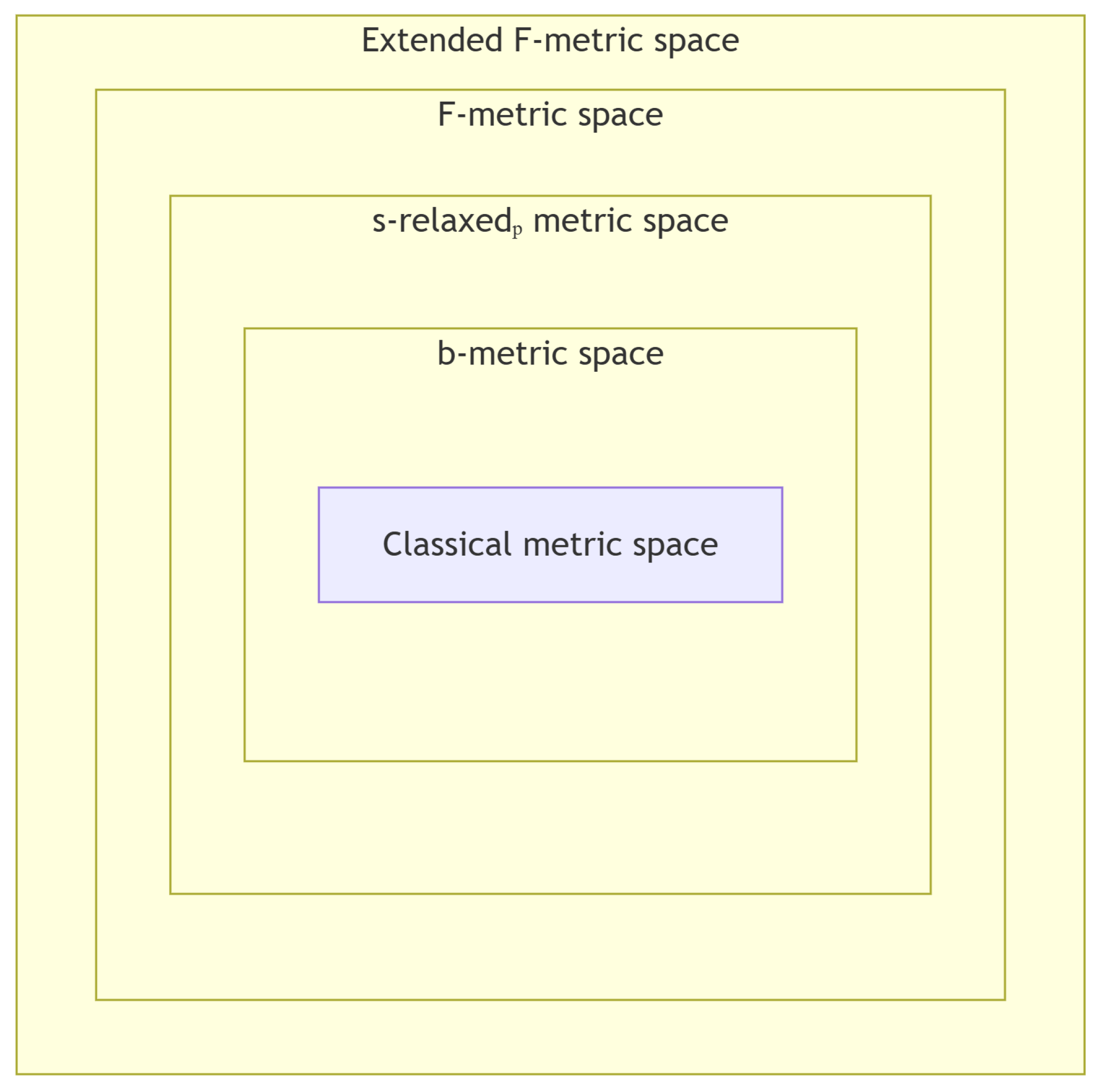
Note that each -ms is an -ms when the control function for all The additional function in the extended setting serves as a variable control that adjusts the influence of intermediate distances in the generalized triangle inequality. This extra flexibility allows the -metric framework to encompass a wider range of generalized distance structures and to handle situations where uniform control (as in the -metric case) is too restrictive. Consequently, the concept of -ms unifies and extends the metric, b-metric, s-relaxedp-metric, and -mss, providing a richer environment for developing new fp results and their applications.
The following diagram (
Figure 1) summarizes the hierarchy of extended
-metric spaces.
Definition 6 ([8]). Let be an -ms.
(1) -Convergence: A sequence in X is said to be -convergent to if is converges to υ with respect to an -metric d.
(2) -Cauchy Sequence: A sequence in X is called -Cauchy, if (3) -Completeness: The space is -complete if every -Cauchy sequence in X is -convergent to some element of X.
Remark 1. It follows directly from the definitions that every -ms is automatically an -ms, however, the reverse implication is not valid in general. In fact, by takingthe generalized condition corresponding to an -ms reduces precisely to condition that characterizes an -ms. Consequently, the concept of an -ms proposed by Panda et al. [8] strictly extends the framework of -ms introduced by Jleli et al. [7]. Theorem 1. (Classical Fixed Point Results). Let () be a complete MS.
(a) ℜ is edge-preserving, that is, for all with we have
(b) there exists such that, ∀
with , we haveand there exists with then ℜ has a fp in Moreover, if G is weakly connetced, then this fp is unique. 3. Main Results
The primary results of this work are established in this section. We begin by introducing the concept of graphic rational contractions within the framework of -mss and establish several fp theorems associated with these self-mappings. Subsequently, we define the notion of interpolative Ćirić–Reich–Rus-type cyclic contractions in the same setting and derive corresponding fp theorems that further broaden and consolidate existing theories.
Let be a directed graph associated with an -ms
The graph
G is said to be loop-inclusive if every vertex is connected to itself; that is,
Furthermore,
G is assumed to contain no multiple edges, meaning that between any ordered pair of vertices there exists at most one directed edge.
A path from
to
in
G of length
N (a natural number) is a sequence
of
vertices such that
,
and
∀
Let
denote the symmetric graph obtained from
G by ignoring the direction of edges, i.e.,
where
is the converse graph of
G, defined by
The graph G is said to be weakly connected if the symmetric graph is connected, i.e., if for any two distinct vertices , there exists a path from to in
Definition 7. Let be an -ms equipped with a directed graph G. A self-mapping is said to be graphic rational contraction if
(i) ℜ is edge-preserving, that is, for all (ii) there exists some with such that for all , we have Theorem 2. Let be an -complete -ms endowed with a directed graph and let be a graphic rational contraction with constant . Suppose that the following assertions hold:
(i) there exists a such that
(ii) for any initial point the sequence {} defined by satisfywhere (iii) either ℜ is G-continuous or, if is a sequence such that as and then , ∀ Then ℜ has a fp.
Moreover, ℜ has a unique fp if in addition
(iv) for any two fps , there exists a finite directed path in G joining and (i.e., G is path-connected on the set of fps).
Proof. Let
with
Define the iterative sequence
for all
By edge-preserving property (
1) and the fact
for
it follows inductively that
for all
Apply (
2) to successive pairs
to obtain
By induction,
for all
For
consider the chain (
(
Then using the
-metric triangle inequality (
), we have
Since
By using the inequality (
4), we have
By substituting inequality (
5) into (
4) and using the property (
), we have
Since
the series
converges (by the ratio test). Let
and
Since
for
Since
converges, so there exists some
such that
for
Since
by condition (
), for the fixed number
there is
such that
Now by (
7), (
8) and (
9), we have
for
Thus, by (
6) and (
10), we have
This shows, by condition (
) that for all
we have
proving that the sequence {
} is
-Cauchy. As
is
-complete, a point
exists such that
is
-convergent to
under the
-metric, i.e.,
Next, we show that
is a fp of self-mapping
ℜ Suppose
ℜ is
G-continuous. Since
by
G-continuity of
we have
Taking the limit in (
3) as
we obtain
Hence,
is a fp of
Further if
is a sequence such that
as
and
then by the assumption, we get
, ∀
Now apply the contraction (
2) to each pair
That yields by (
2)
By (
), we have
Since
So, by (
12) and (
), we have
, i.e.
. Thus,
is a fp of
Now we prove the uniqueness of fp. We start by supposing that, for the sake of contradiction, that
ℜ has two fps, that are,
such that
and
but
By assumption (iv), there exists a finite directed path {
such that
and
for all
. We prove by induction that
for all
For
, since
applying the contraction condition (
2) gives
Since
is a fp of
then
Therefore,
Since
this inequality implies
Hence,
Assume now that
for some
We need to show
. Since
and
(by the induction hypothesis), we have
Applying (
2) and using the fact that
we have
Because
we must have
which implies
By induction, we conclude that
Since
by the definition of the directed path, we have
This contradicts our initial assumption that
Hence, fp is unique. □
As a special case of our main Theorem 2, we recover the well-known fp result established by Panda et al. [
8] for contraction mappings in
-mss. This demonstrates that our theorem not only generalizes existing results but also unifies earlier contraction principles within a broader graph-theoretic framework.
Corollary 1 ([8]). Let be an -complete -ms. Suppose satisfiesfor some constant Then ℜ has a unique fp in Proof. Apply Theorem 2 with the directed graph □
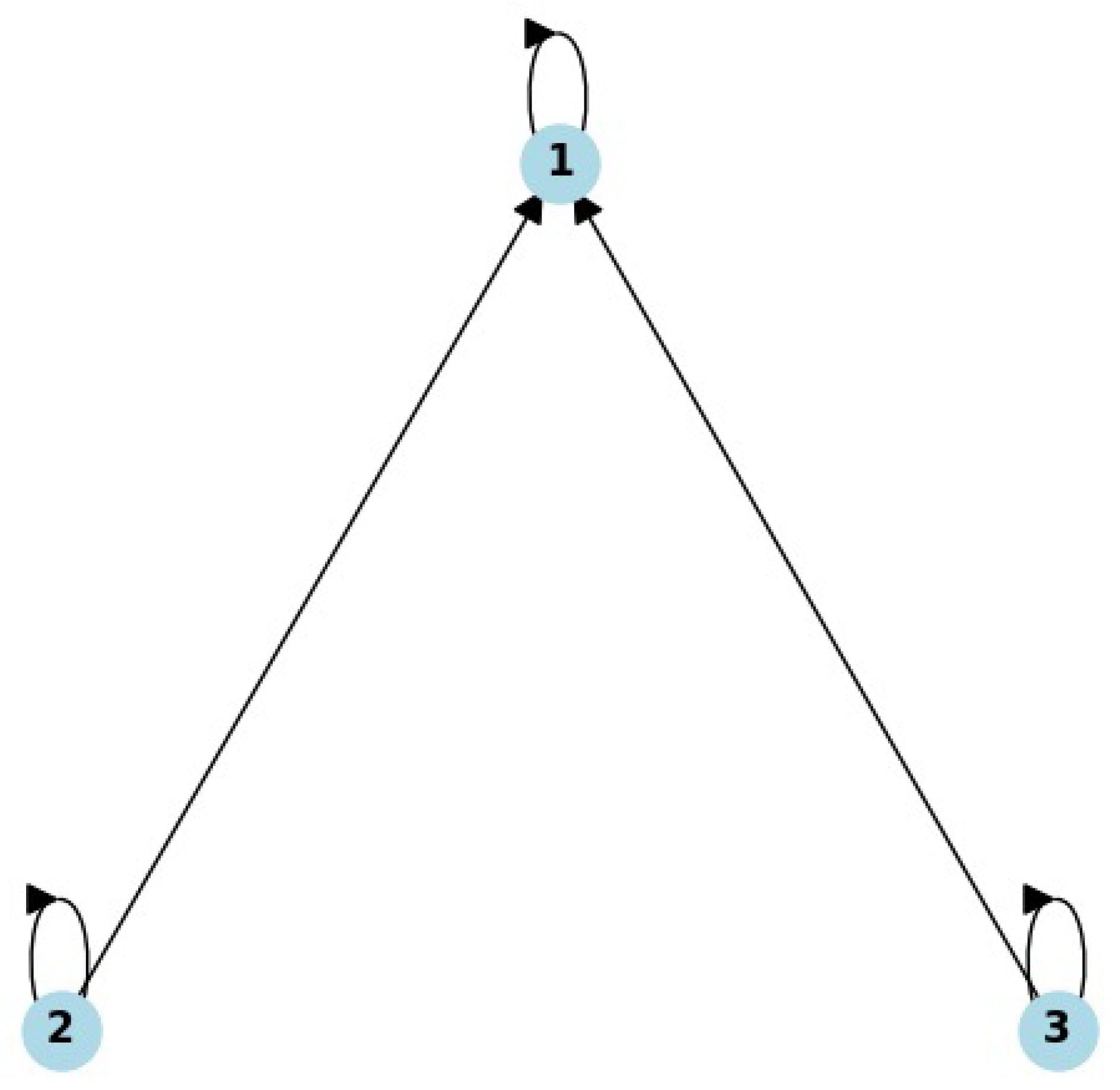
Remark 2. (i) By defining the control function as in Definition 5, the -ms reduces to a standard -ms. Consequently, Theorem 2 coincides with the main result of Jleli et al. [7]. (ii) If we choose for and for and define in Definition 5, then the -ms reduces to a b-ms. Considering the graph Theorem 2 specializes to the leading fp theorem of Czerwik [3]. (iii) Defining and choosing for with in Definition 5, the -ms reduces to a classical ms. In this case, Theorem 2 recovers the well-known fp theorem of Jachymski [13]. (iv) Finally, by taking along with the setting in (iii), Theorem 2 reduces to the classical Banach contraction principle [10]. Example 1. Let . Define the -metric (non-negative real numbers) by and the function by Then is an -ms with for and . Moreover, the set X is finite, so an -ms is -complete. Define the directed graph by specifying the edge set(i.e., edges and plus self-loops). The structure of the directed graph is illustrated in Figure 2. Define the self-mapping byNow if then equals either or or each of which is in So (1) holds. Now ifthenIfthenThus, the inequality (2) holds with and . Hence, the self-mapping is a graphic rational contraction. Take ThenSo condition (i) of Theorem 2 is satisfied. For any initial the Picard sequence for all from any start becomes eventually or So and as Thus, we haveTherefore,Thus, the condition (ii) holds. Since X is finite, so every function is continuous with respect to Hence, ℜ is continuous and therefore G-continuous. So condition (iii) holds. All hypotheses of the Theorem 2 are satisfied, so ℜ has a fp. Indeed . However, the main result of Panda et al. [8] (the Banach-type contraction theorem in -mss) is not applicable here, since the contractive condition fails for the non-edge pair Indeed,showing that no global contraction constant can satisfy the required inequality for all pairs in Hence, the result of [8] cannot be applied, while our graph-based theorem remains valid. Example 2. Let . Define the -metric by and the function by Then is an -ms with for and . Moreover, the set X is finite, so an -ms is -complete. Define the directed graph by specifying the edge setSo every vertex has a directed edge to 1
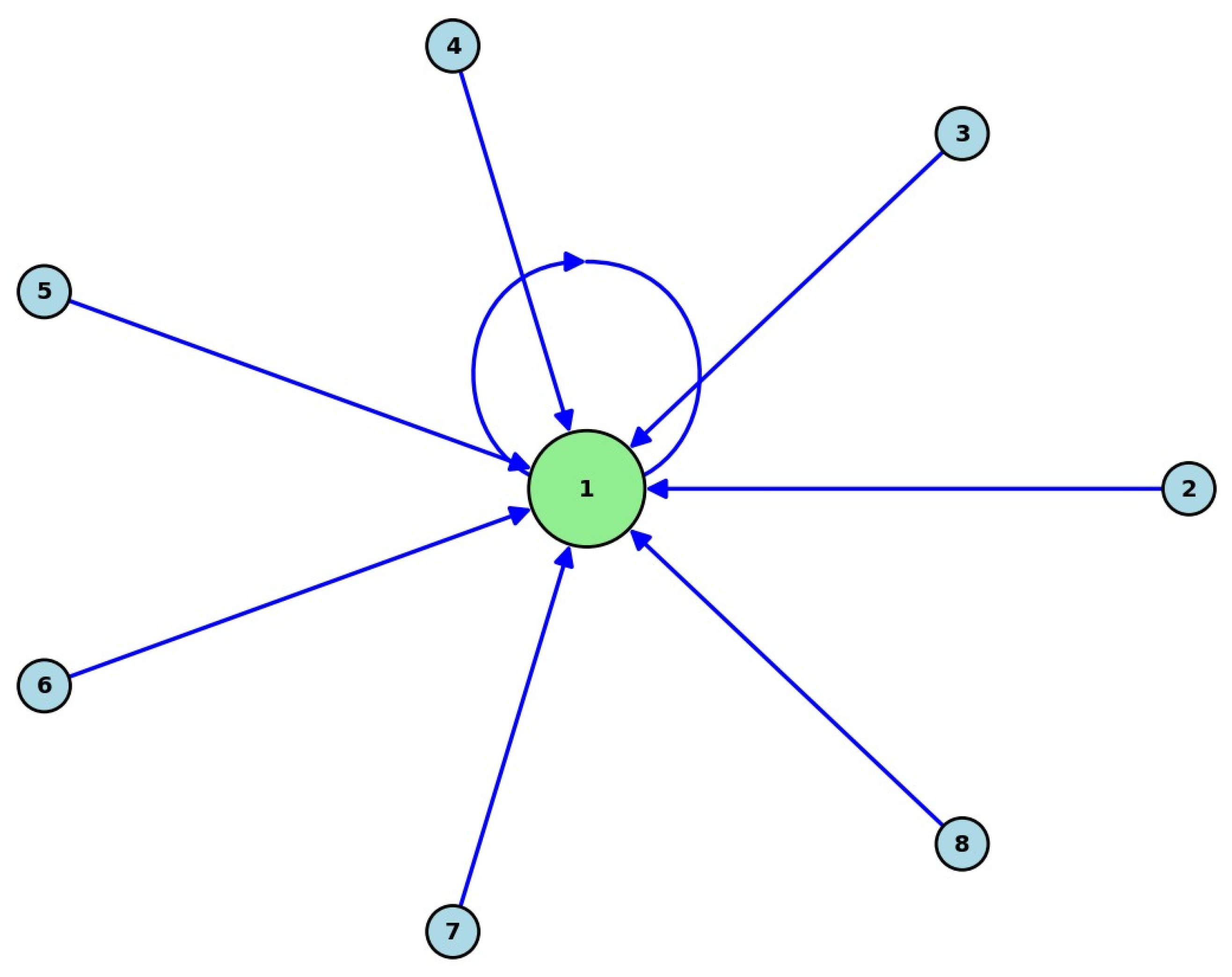
, and 1
has a self-loop. Define the self-mapping byfor every Now for we haveThus, ℜ is edge-preserving. Now if then either (so ) or and (so ). In every casefor and Thus, the inequality (2) holds. Hence, the self-mapping is a graphic contraction. Let Then and by definition. So condition (i) of Theorem 2 is satisfied. For any initial define the Picard sequence for all Because ℜ is constant equal to 1
, we haveSo and as Thus, we haveTherefore,Thus, the condition (ii) holds. The mapping ℜ is constant, hence continuous and therefore G-continuous. So condition (iii) holds. All hypotheses of the Theorem 2 are satisfied; hence,so 1
is a fp. Figure 3 displays the directed graph , with its vertices and edge relations. Definition 8. Let be an -ms and let be non-empty subsets. A self mapping ℜ is said to be an interpolative Ćirić–Reich–Rus-type cyclic contraction if there exist and positive reals such that andfor all with , where represents the collection of all fps of ℜ. Example 3. Let . Define by and by Select by for and , then () is an -ms. Define two non-empty subsetsClearly,Define a mapping byfor all Thenso ℜ is cyclic. Moreover,Choose positive constantsso and For any with we haveOn the other hand,Hence,for all with Therefore, ℜ is an interpolative Ćirić–Reich–Rus-type cyclic contraction on Theorem 3. Let be an -complete -ms and let be non-empty subsets. If ℜ is an interpolative Ćirić–Reich–Rus-type cyclic contraction. Given any starting point consider the sequence {} generated recursively byIfwhere then ℜ has a unique fp in Proof. Consider the sequence
defined recursively as
Set
then
and so forth. In view of (
13), we obtain
which implies that
that is,
∀
where
In the same way, through (
13), we have
which implies that
that is,
∀
where
It follows from (
14) and (
15) that
∀
By following the same approach as in the proof of Theorem 2, we conclude that the sequence {
} is
-Cauchy. Because
is
-complete, there exists a point
to which the sequence
converges in the
-metric; that is,
It is evident that the subsequence {
} lies entirely in
while {
} belongs to
Because both subsequences approach the same point
we conclude that
Next, we verify that
is indeed a fp of
ℜ By (
), we get
Since
Hence, using (
17) and condition (
), we obtain
, which implies
. Therefore,
is a fp of
Assuming the opposite for contradiction, suppose that
ℜ has two fps
and
, so that
Then
By (
13), we have
whcih is possible only if
□
This theorem generalizes classical cyclic contraction results to the framework of
-mss by introducing an interpolative control involving the parameters
and
The inequality (
13) balances the distances
and
, allowing the contraction strength to vary adaptively between iterates. The restriction
guarantees that the overall contractive influence remains below unity, leading to convergence of the generated sequence toward a unique fp in
Hence, this result unifies and extends various cyclic and interpolative fp theorems from metric,
-metric, and
-metric settings.
As a special case of Theorem 3, we now present a fp result for interpolative Ćirić–Reich–Rus-type contractions in an -complete -ms, obtained by removing the cyclic structure (i.e., taking
Corollary 2. Let be an -complete -ms and let . Suppose the existence of and positive reals such that and with . Given any starting point consider the sequence {} generated recursively byIfwhere then ℜ has a unique fp in Proof. The result follows directly from Theorem 3 by setting thereby eliminating the cyclic condition. □
Remark 3. Similar to Remark 2, by defining the control function asin Definition 5, the -ms reduces to an -ms. Consequently, the corresponding result for interpolative Ćirić–Reich–Rus-type cyclic contractions in the framework of an -mss can be deduced directly from Theorem 3. Moreover, analogous results in b-mss and classical mss can be obtained by taking for and with and further letting respectively.
Example 4. Let . Define by
∀
and by Select by for and , then () is an -complete -ms. TakeThen and Consider a cyclic mapping defined bythen Choose positive constantsso and For all pairs in the set , we findIn fact, when it holds thatNow define the orbit: for any Each sequence converges to Therefore, and so we haveso,Now computeHence,This fulfills the additional sequence requirement of Theorem 3, and hence, ℜ has a unique fp at . 4. Applications
The theory of fps has emerged as a powerful analytical tool for studying the existence and uniqueness of solutions to various types of functional, integral, and differential equations. In recent years, the incorporation of fractional derivatives into mathematical models has attracted significant interest because of their capacity to describe memory and hereditary properties of various complex systems in physics, biology, engineering, and finance. Fractional differential equations (FDEs) provide a natural framework for modeling such phenomena, yet finding their exact analytical solutions often poses significant challenges.
This section employs the fp theorems obtained earlier in the preceding sections to investigate the existence and uniqueness of solutions for a certain class of FDEs. By constructing a suitable operator associated with the given fractional problem and defining an appropriate -mss, we demonstrate that the operator satisfies the required contractive condition. Consequently, the solution of the FDE is obtained as the fp of this operator.
Through this method, the effectiveness of fp theory is clearly shown in handling nonlinear fractional systems but also provides a unifying framework that can be extended to various boundary value problems and integral formulations involving fractional derivatives. Thus, the following example/application illustrates the practical significance of our theoretical results in solving real-world fractional models.
Let
Consider the fractional differential equation:
where
denotes a fractional derivative,
is a given continuous,
is the unknown function to be determined.
The fractional derivative
(with
) leads to the standard Volterra representation
where
and
are constants determined by the two boundary conditions, and
represents the Gamma function. From
we get
So
Use the second (nonlocal) boundary condition
to determine
Compute
Compute
Evaluate the double integral by Fubini:
Substituting Equation (
22) into Equation (
21) and using the fact that
we get
Since
, so comparing the Equation (
20) with Equation (
23), we obtain
Multiply by
and we get
Substituting the value of
in the Equation (
19), we have
Thus,
where the Green’s function
is:
For
For
Let
with the sup norm
. Define
by
for all
and
by
Then (
) is an
-complete
-ms with
and
Theorem 4. Let () be an -complete -ms endowed with the directed graph , where Let us assume that the following conditions are satisfied:
(i) the function is continuous in t and and Lipschitz in that is, for all and for some constant (ii) Let be the Green kernel. SetAssume (i.e., ). Then the boundary-value problem (18) has a unique solution. Moreover the solution is the unique fp of the operatorand the Picard iterates converge exponentially to this solution for any initial Proof. The operator
ℜ is edge-preserving relative to this graph because every ordered pair is an edge: for any
and also
trivially true since
For
we have
By the assumption (i), we have
Taking the supremum over
we have
By hypothesis (ii), we have
Thus
Now choose any
, then
trivially holds because
Since
So
Since
we have
so
Thus, all the conditions of Theorem 2 are satisfied, and the operator has unique fp
which is a solution of the boundary-value problem (
18). □
Example 5. Let Consider the fractional boundary-value problemwhere denotes the fractional derivative of order and is the unknown function. Define The function is continuous since
is continuous;
is continuous on ;
sums and scalar multiples of continuous functions are continuous.
Moreover, for all and Thus, g is Lipschitz continuous in the second variable with Lipschitz constant Hence, assumption (i) of Theorem 4 is satisfied. As derived in the theorem, the solution of problem satisfies the equivalent integral equationwhere the Green’s function is: For For Since the Gamma value satisfiesThe function is continuous on the compact set Therefore,A direct estimate yieldsNow defineTherefore, assumption (ii) holds. Let endowed with the -metricDefine by Then () is an -complete -ms with and All hypotheses of Theorem 4 are satisfied. Hence, the operator defined byadmits a unique fp , which is the unique solution of the fractional boundary-value problem (24). Applications to Integral Equations
This section demonstrates the use of the fp theorems obtained earlier to solve specific integral equations. In particular, we apply the developed theorems to a nonlinear mixed Volterra–Fredholm integral equation and demonstrate that the existence and uniqueness of its solution can be guaranteed within the framework of -mss. This application emphasizes the robustness and broad utility of the given fp results in dealing with nonlinear integral problems.
Consider the nonlinear mixed Volterra–Fredholm integral equation
where
is a given continuous function;
are continuous kernels;
denotes the unknown function to be solved.
Assume the following hold.
(cond1): the kernals and are Lipschitz continuous in the third argument; that is,
there exist
such that, for all
and
(cond
2): the kernal functions
are nondecreasing; i.e., if
then
(cond3):
(cond
4): there exists some
such that
for all
where
(cond
5): the Picard sequence {
} is uniformly bounded in
by some
and
Theorem 5. Under assumptions (cond1)–(cond6) the nonlinear mixed Volterra–Fredholm integral Equation (25) has a unique solution Proof. Let
be equipped with the
-metric
given by
and
by
then
form an
-complete
-ms with
for
and
. Let
G be the graph with vertices
X and edges
Then
G is the pointwise order graph which is a directed graph.
For any
continuity of
g and
K (and boundedness on compact domain) imply
Now for
with (
)
Then
for all
Thus, by the assumption (cond
2), we have
for all
Hence,
so
Thus,
ℜ is edge-preserving. Now for any
with (
)
, we get for
Since
we have
Evaluating the supremum over the interval
gives
holds for
By the assumption (cond
5), there exists
with
Define
Since
ℜ is edge-preserving, so
By (cond
5), the sequence {
} is uniformly bounded and there exists
such that
Taking the limit and supremum, we have
By assumption (cond
3),
From (cond
5), we have
Hence,
Therefore, condition (ii) of Theorem 2 is satisfied. Moreover, since
ℜ is Lipschitz in sup-norm, it is
G-continuous. Also, if
uniformly and (
then
for all
so (
Hence, condition (iii) holds. Thus,
ℜ admits a unique fp, representing the unique solution of the nonlinear mixed Volterra–Fredholm integral Equation (
25). □
These examples demonstrate that the abstract fp results developed in this work are not only of theoretical value but also directly applicable to mathematical models involving memory effects and hereditary phenomena, such as those described by fractional differential equations. The ability to reformulate such equations as operator equations in a suitable -ms provides a systematic approach for proving the existence and uniqueness of solutions. This framework can be readily extended to other models in applied mathematics, including reaction–diffusion systems, population dynamics, and viscoelastic materials.
Example 6. Consider the nonlinear mixed Volterra–Fredholm integral equationHere,For all we haveThus,Thus, condition (cond1) is satisfied. Since both kernels and are linear and increasing, we haveimpliesThus, condition (cond2) is satisfied. Since, the function is continuous on . Moreover,Hence, the condition (cond3) holds. Choose Then,Thus,and (cond4) is satisfied. Define the Picard sequenceTaking the supremum norm, we obtainBy induction, it follows thatHence, the Picard sequence is uniformly bounded with Moreover,andSinceso condition (cond5) is satisfied. All assumptions (cond1)–(cond5) of the theorem are satisfied. Therefore, the nonlinear mixed Volterra–Fredholm integral Equation (25) admits a unique solution 5. Conclusions
In this study, we introduced the notion of graphic rational contractions and interpolative Ćirić–Reich–Rus-type cyclic contractions in the setting of -mss and obtained some new fp theorems for these generalized contractions. Unlike previous studies, which considered the Banach contraction principle in -mss, our work explores graphic and interpolative cyclic contractions in -mss for the first time. Furthermore, we provide a fp approach for solving mixed Volterra–Fredholm integral equations in this framework, and our graphic rational contraction theorem serves as a generalization of Banach contraction principle in -ms, offering broader applicability under more flexible conditions.
Importantly, our theoretical contributions are broad and flexible: under certain natural simplifications, the developed framework recovers classical fp results, including well-established theorems in standard -mss, b-mss, and classical mss. This highlights both the generality and foundational relevance of our approach.
To demonstrate the significance and applicability of the results, we provided illustrative examples and validated the practical utility of the derived theorems through their successful application in solving fractional differential equations and mixed Volterra–Fredholm integral equations. Overall, this study not only advances the theory of generalized mss but also offers tools with tangible applications in mathematical analysis and related fields.