High-Precision and Stability-Preserving Approximations to the Time-Fractional Harry Dym Model Using the Tantawy Technique



Abstract
1. Introduction
2. Anatomy of the FHD Model Using the TT
2.1. Fractional Model and Caputo Operator
2.2. Outline of the TT
- Step (1)
- Consider the fractional power series ansatz: In this step, the solution is considered a series in fractional powers of t, accordingly to the following Tantawy ansatz:with so that the ansatz (13) automatically satisfies the IC (7) by construction and , ∀. This choice reflects the fact that, under Caputo differentiation, powers are mapped to other powers according to Equation (12). In other words, the fractional power series structure is preserved by the Caputo operator, which makes the ansatz (13) a natural and efficient ansatz for developing the solution.The physical meaning of the ansatz (13) is straightforward: the function encodes the initial profile, while the higher-order terms describe successive fractional-time corrections driven by the nonlinearity and dispersion in Equation (6). The fractional parameter p controls how strongly the past influences the present evolution: when , the series tends to the usual Taylor expansion; when , the same expansion is stretched in time, reflecting slower dynamics with memory.
- Step (2)
- Truncation and residual construction: For an -order approximation, the ansatz (13) is truncated as followsAt this stage, we are simply translating the differential equation into an identity that must hold term-by-term in the fractional power series. The rationale for this truncation is that we are interested in a finite-order approximation m that already offers a high level of accuracy, while keeping the algebraic expressions manageable. In the present work, we go up to , which turns out to be a good compromise between compactness and precision.
- Step (3)
- Application of the Caputo operator to the Tantawy ansatz: Using the two definitions (11) and (12), we compute the Caputo derivative term is explicitly as follows:withNotice that the sum in Equation (16) starts from because the Caputo derivative of the constant term vanishes, as in condition (10). This is another reason why Caputo is particularly convenient here: the IC enters only through , and it does not generate additional singular contributions in the derivative.
- Step (4)
- Expansion of the nonlinear term: The second term in Equation (15) involves the cubic nonlinearity , and the third spatial derivative , which can be expanded as follows:
- (i)
- The third spatial derivative can expand as
- (ii)
- The cubic nonlinearity can expand asExecuting the cubic product explicitly, each term in the expansion derives from a triple productSumming over all triples with non-negative integer entries leads towhere the coefficient collects all contributions with the same time exponent . Thus, the expression of readsFinally, we haveThe coefficient of in this product arises from all pairs with , sinceTherefore, we may write the cubic nonlinear term as follows:with
- Step (5)
- Finding the coefficients of equal powers of time: Now, by substituting the obtained series representations (17) and (23) into the governing Equation (6), we obtainThe two series on the left and on the right are written in terms of the same basis functions , with . For two such series to be equal for all t in an interval, it is necessary and sufficient that the coefficients of each power coincide. Therefore, for every integer , we haveThis relation is the basic recurrence that links the coefficient to the previously determined coefficients through .
- Step (6)
- Explicit recursive formula and the first few coefficients: Solving Equation (26) in , the recurrence relation for generating the -coefficient can be written in the following beauty formula:withwhere , , , andTo see how this works in practice, we begin calculating the first few approximations using this relationship.
- (i)
- Determination of : For , relation (27) becomesTo compute , we use relation (24) with . The only way to have with is to take and , so, we haveFrom relation (21), the only admissible triple with is , and hence, we obtain
- (ii)
- Determination of : For , relation (27) readsThe coefficient is obtained by setting in Equation (24):since the pairs with are and . We already know from Equation (31). Now, to find , we set in relation (21), which leads toThe triples with sum 1 are permutations of . There are three such permutations, so, we haveConsequently, we obtain
- (iii)
- Determination of : For , relation (27) readsThe coefficient is obtained by setting in Equation (28):
- (iv)
- Determination of : For , relation (27) readsThe coefficient is obtained by setting in Equation (28):
- (v)
- Determination of : For , relation (27) readsThe coefficient is obtained by setting in Equation (28):
- Step (7)
- Another way to collect the coefficients up to fifth-order (traditional way): By removing the above steps (5) and (6) and substituting both the Caputo operator expansion (16) and the expansion of the nonlinear term into Equation (15), it yieldsAfterward, collecting like powers of in yieldswithwhere the notation .
- Step (8)
- Determination of the spatial coefficients: According to the TT, the coefficients of Equation (52) are matching the following conditionswhich forms a triangular (recursive) algebraic system for the unknown functions in terms of the known initial profile and its derivatives [20,21,22,23]. The reason for collecting coefficients in this way is that it disentangles the contributions of different fractional orders. Each can be viewed as a balance condition at order between the time-fractional derivative and the nonlinear dispersive term.Now, by solving the system (53) in , we ultimately obtain the values of as functions of initial profile and its derivatives as follows:withwhere .This step is where the structure of the TT becomes particularly advantageous. Because the method works directly with the original equation and the Caputo operator, the computed coefficients incorporate both the nonlinear and fractional features of the model without any auxiliary transformations. Moreover, the resulting expressions remain relatively compact, which facilitates their use in subsequent analysis.
- Step (9)
- Construction of the approximate solution: Once the coefficients have been determined, the 5th-order Tantawy approximation to the solution of the model (6) is given byIn the present work, explicit expressions are derived up to , yielding a fifth-order approximation that remains compact enough to be expressed in closed form, unlike the corresponding higher-order series obtained by other methods. The approximation (55) is entirely congruent with the solution derived by the HPM as given in Ref. [55]. We emphasize that the HPM results do not always need to be consistent with the TT; rather, that depends on the form and structure of the fractional differential equation to be studied.
- Step (10)
- Consistency checks and further remarks: Using the NIM algorithm [57], the following approximate solution up to the second-order is obtained:A third-order expression using NIM can also be generated, but its cumbersome length renders it unsuitable for inclusion in the main text. This stands in sharp contrast to the TT, through which a fifth-order solution is derived in a notably compact form that fits naturally within the manuscript. In addition, the same strategy can be employed to obtain even higher-order approximations, which can be incorporated into the analysis without difficulty.Now, we can perform two tests to verify the high accuracy and efficiency of the generated approximations using the TT. First, in the case of limit (the integer case), the derived approximations (55) reduce to the exact solution (8) of the classical HD model (1). This confirms that the fractional solution generated by TT is consistent with the established integer-order theorem. Second, the NIM approximation (56) will be used in to compare absolute error and global maximum residual error (MRE) against the approximations (55).
- Step (11)
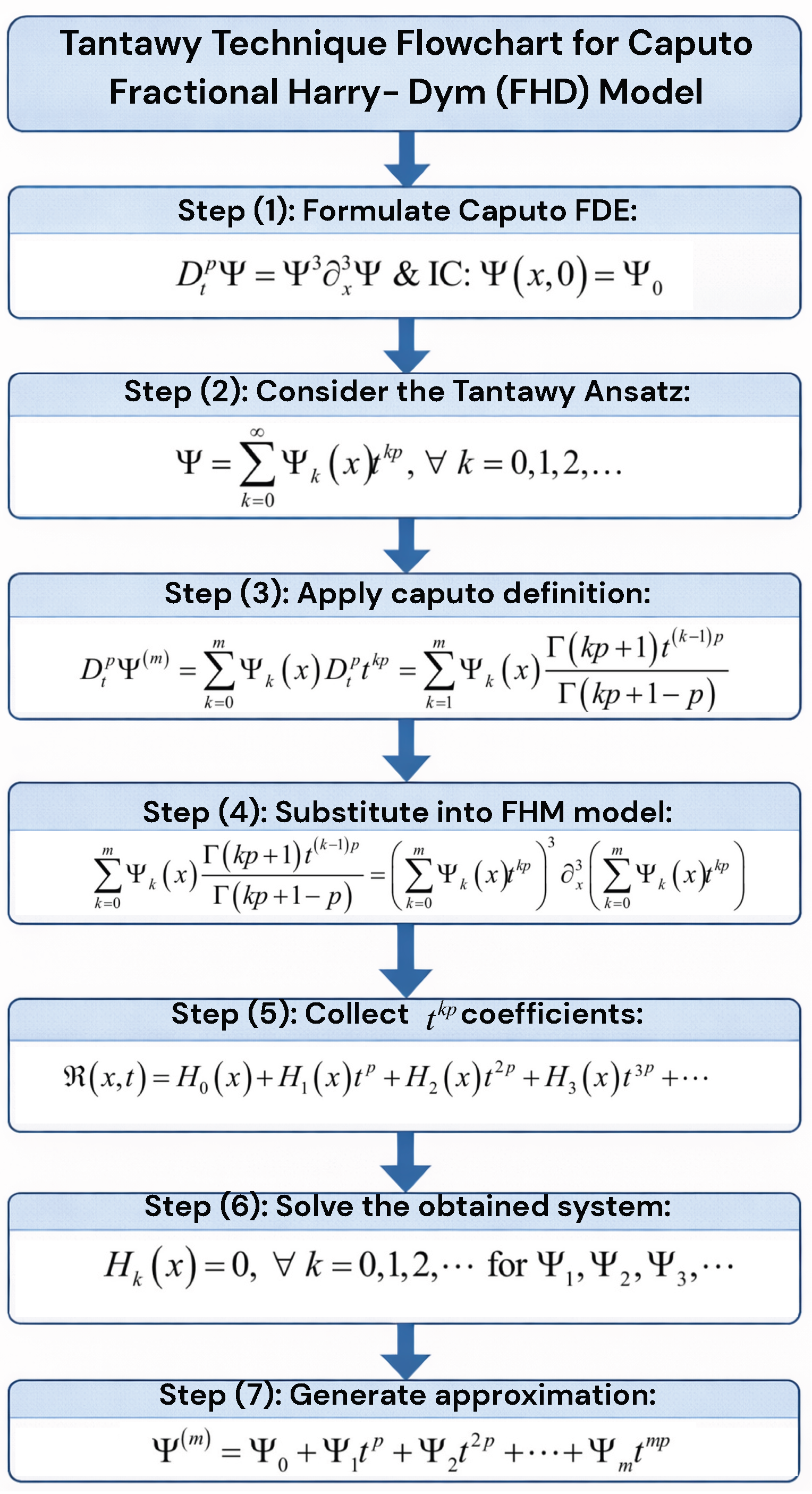
- The steps for analyzing any fractional differential equation using the TT are summarized in the flowchart as illustrated in Figure 1.
3. Results and Discussion
- Accuracy diagnostics: For the integer case , the absolute error for the generated approximations (55) using the TT (third-order approximation , fourth-order approximation , & fifth-order approximation ) and the approximation (56) using the the NIM (third-order approximation ) as compared to the exact reference solution (8), are defined bySince in fractional models the quality of the generated approximation is also tied to how well it satisfies the differential equation itself, we further introduce the following (residual) defect:and its maximum over the computational domain , readswhere indicates any generated approximation (, , , , etc.) for the FHD model (6) and represents the exact reference solution for the integer case given in Equation (8). Here, the quantity (59) indicates the global MRE, which is widely used as a stability/consistency indicator in fractional computations. Accordingly, for the generated approximations (55) and (56), the global MRE for the approximation , , , and can be written as follows:
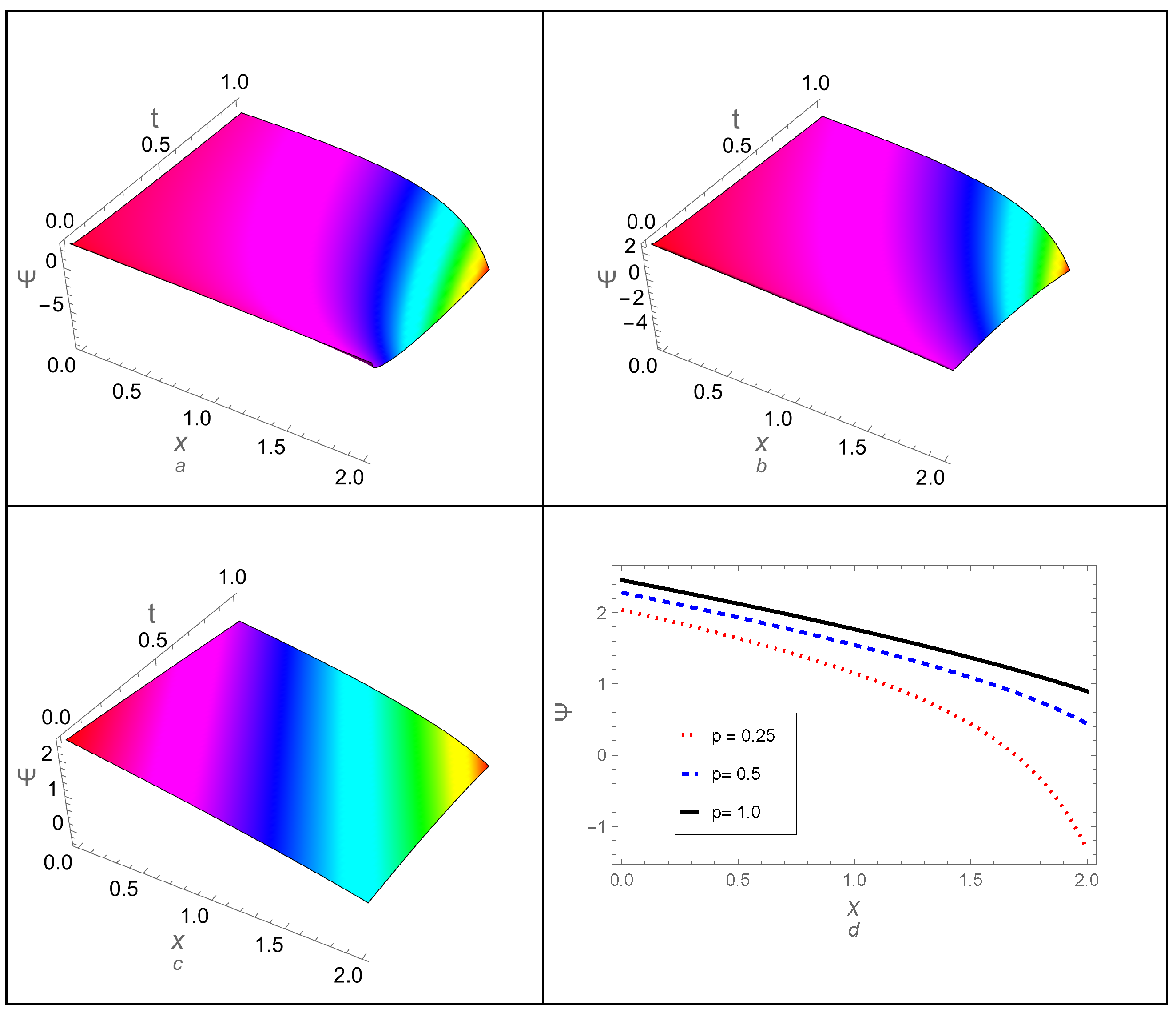
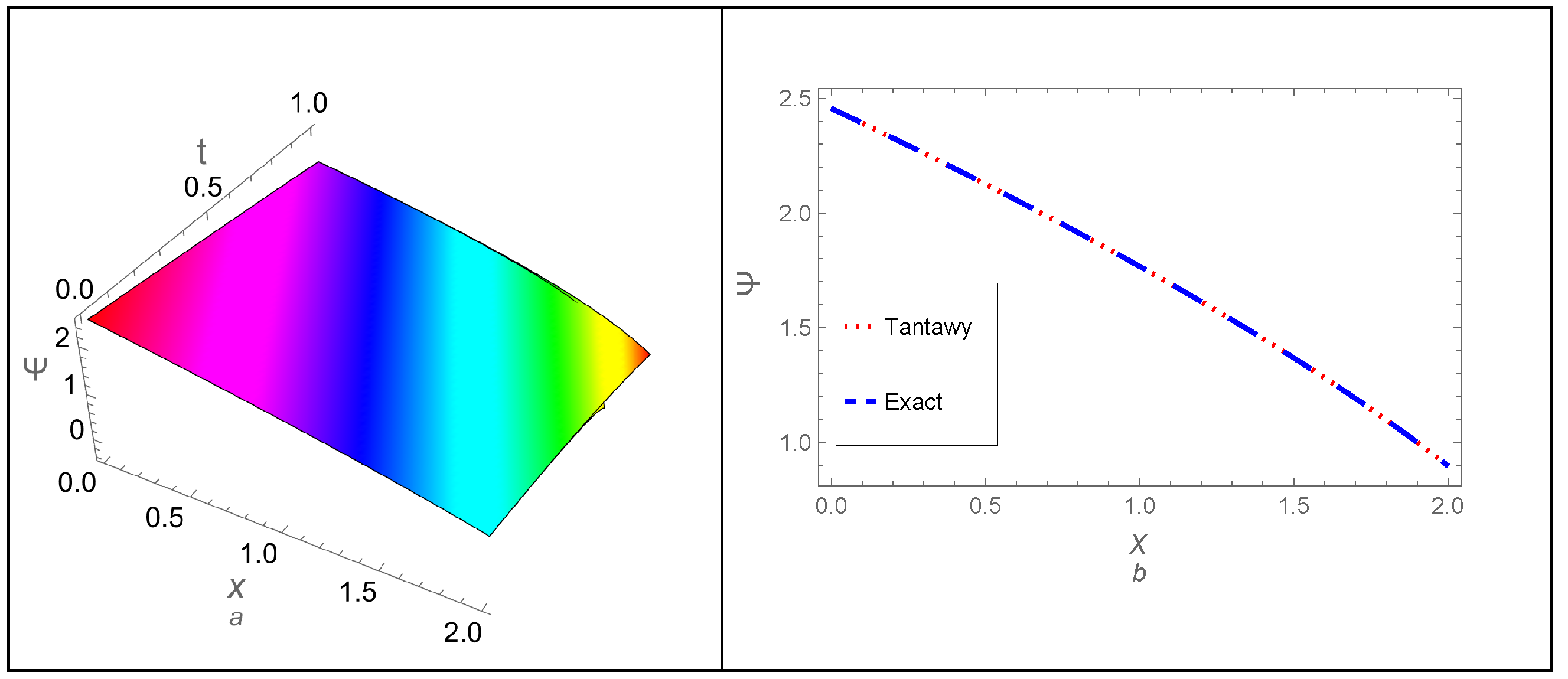
- Effect of the fractional order: Figure 2 illustrates the generated approximation (55) (truncated at third order ) for different values of the fractional order p, namely , , and . A clear and physically consistent trend is observed: decreasing p slows the time evolution and produces a more pronounced “memory-dominated” response, as expected in Caputo-type fractional dynamics [13,14,15]. In contrast, as , the fractional dynamics continuously approaches the classical HD model behavior, and the approximation (55) surface becomes nearly indistinguishable from the integer-order solution at (see also Figure 3), which provides an important internal consistency check [42,55]. This smooth recovery of the classical limit is essential for fractional generalizations intended for physical modeling [13,14,15].
- Matching with exact solution: To quantify the agreement of the generated approximations (55) with the exact solution (8), Figure 3 compares the generated approximation (55) (third-order truncation ) with the exact profile at . It is observed that the two curves are visually indistinguishable at the scale of the figure over the considered domain, indicating that even the third-order TT-truncation already captures the dominant nonlinear dispersive dynamics with high fidelity. This visual agreement is reinforced by the numerical error levels reported in Table 6, where the pointwise absolute errors remain extremely small across the sampled spatial points for .
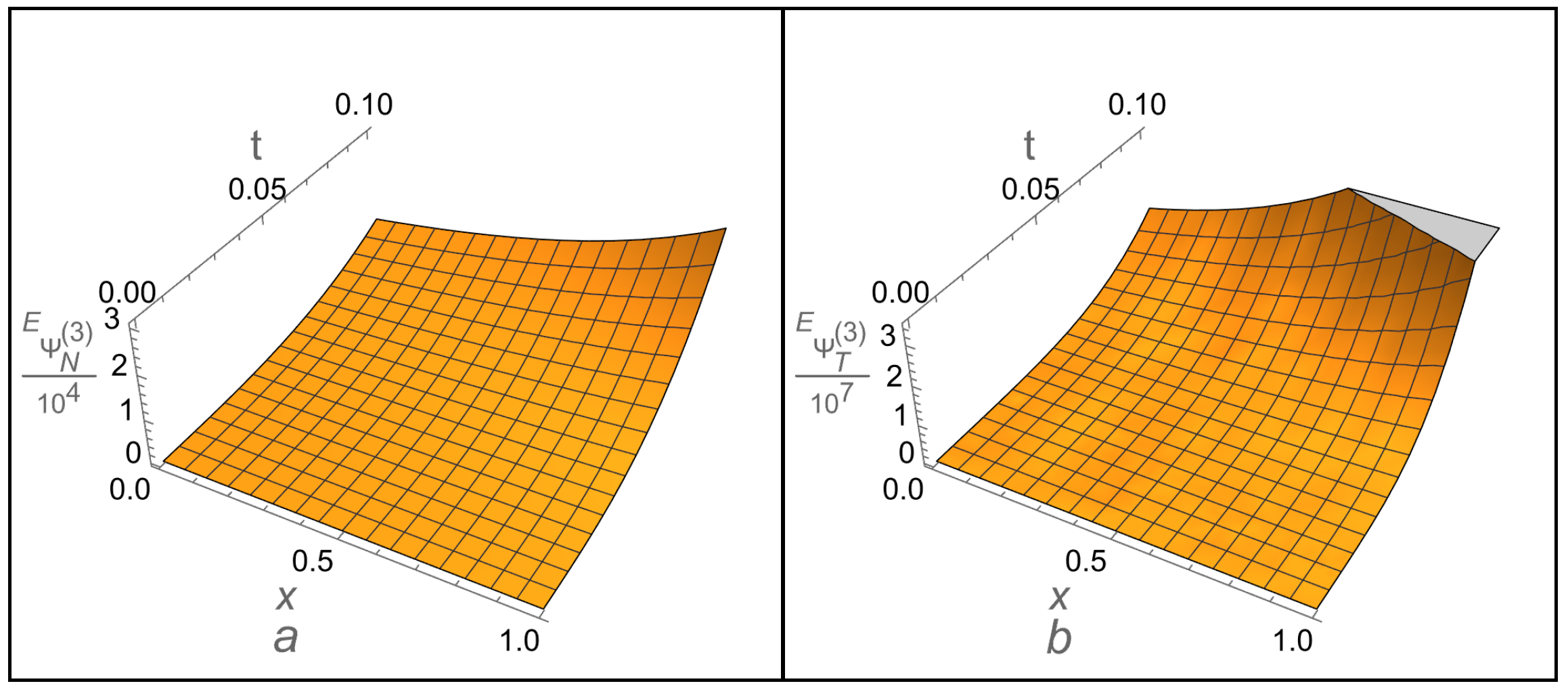
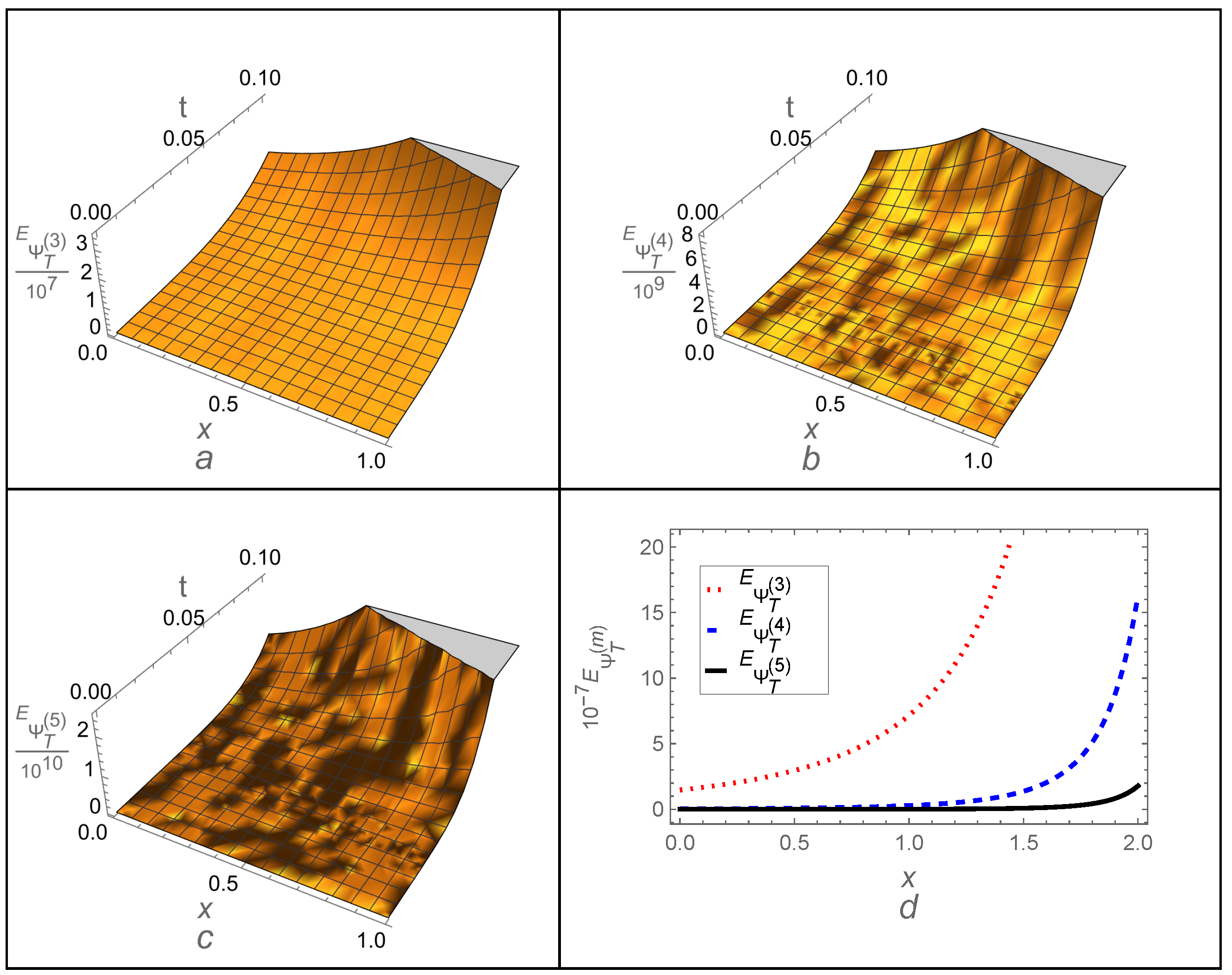
- Estimated error and comparison: The comparison between the absolute error of the third-order approximation (56) using the NIM and the third-order approximation (55) using the TT is numerically computed at as illustrated in Table 5. Additionally, the absolute error of the third-order approximations (56) and (55) is graphically compared with each other as evident in Figure 4a,b, respectively. One can notice that the accuracy of the third-order approximation (55) using the TT surpasses the third-order approximation (56) using the NIM at the same order. Moreover, the absolute error of the third-, fourth-, and fifth-order approximations (55) using the TT at is numerically estimated as illustrated in Table 7. Furthermore, the absolute error of the third-, fourth-, and fifth-order approximations (55) using the TT is graphically compared with each other as elucidated in Figure 5. It is observed that the absolute error decreases with increasing the order of approximation, i.e., , which confirms that the accuracy of the generated approximation increases with increasing the order of approximation. This, in turn, enhances the efficiency of the used approach and confirms its convergence and stability throughout the entire study domain. This behavior is consistent with the algebraic structure of the TT coefficients, which remain manageable at higher orders, unlike many iterative expansions where terms grow quickly in complexity and may degrade numerical robustness.Furthermore, the global MRE according to relation (61) for the third-order approximation (56) using the NIM and third-, fourth-, and fifth-order approximations (55) using the TT, through the domain is estimated as follows:Thus, even at the same nominal order, the NIM-truncation exhibits a much larger residual than the TT-truncation, while the fourth- and fifth-order TT correction drive the residual down to the level. The monotone decrease of is the signature of a stable, rapidly convergent construction of the generated approximations [39,40,41]. In practical terms, these residual levels imply that the TT approximation not only matches the benchmark solution at but also remains consistent with the governing nonlinear operator, which is crucial when the same approximation is used for parameter sweeps or as an initial guess in hybrid symbolic–numerical procedures [60].
- Physical interpretation and computational implications: Physically, the observed dependence on the fractional order p reflects the role of history effects in dispersive nonlinear media, which for smaller p delays the temporal development of the wave profile and effectively spreads the influence of past states over the present dynamics, in line with fractional relaxation mechanisms [61,62]. From a computational standpoint, the present results highlight a key advantage of the TT: high-order corrections can be derived in closed form while retaining compact expressions (cf. (55)), which makes the method attractive for fast evaluation, symbolic manipulation, and residual-based validation [39,40,41]. In contrast, the NIM series becomes less reliable in the present problem as indicated by its large residual at the third order, which can be interpreted as slower convergence and weaker stability for this nonlinear dispersive fractional operator [32,57]. It should be emphasized that the TT is not necessarily superior to the NIM in every case, as each problem is independent. While it may have been superior to the NIM in the current problem and some other studied problems [39], the accuracy might differ when analyzing other problems. However, in general, the method is easily applicable to all types of fractional differential equations, posing no particular challenge to researchers. These features make the TT a strong candidate for the analysis of other fractional nonlinear evolution equations arising in plasma physics and nonlinear wave theory, where both accuracy and stability are mandatory.
4. Conclusions
- (i)
- In this study, the time fractional one-dimensional HD model (6) has been investigated. However, with incoming works, it would be worthwhile to extend this remarkably precise technique to analyze the following -dimensional HD model [63]:Additionally, the study can be extended to include multi-dimensional fractional structures [64].
- (ii)
- A second line of work worth pursuing involves applying the TT to fractional evolutionary equations with richer structures: think higher-order nonlinearities, stronger dispersion terms, or added higher-order dissipation that crop up in plasma waves, condensed matter flows, or even complex fluids. We have already seen it work well with fractional Burgers equations, easily handling shock fronts and dissipation; it also deals with multi-dimensional diffusion problems, following unusual transport patterns; and it effectively manages fourth-order fractional Cahn–Hilliard models, clearly identifying phase boundaries and spinodal decomposition. At the same time, using the technique on fractional third-order dispersion KdV-type equations has shown that it can effectively model solitary and cnoidal wave patterns in nonthermal plasmas. Based on these results, it is natural to envisage systematic studies of coupled fractional systems, such as higher-order dissipative fractional Burgers-type equations, higher-order dispersion and nonlinearity KdV-type equations, fractional Zakharov–Kuznetsov models, and fractional nonlinear Schrödinger-type equations, where multiple mechanisms of nonlinearity, dispersion, dissipation, diffusion, and memory act simultaneously [65,66].
- (iii)
- By developing hybrid TT-spectral or TT-finite-difference schemes for large-scale simulations, compact analytical approximations can serve as highly accurate initial predictors.
Author Contributions
Funding
Data Availability Statement
Acknowledgments
Conflicts of Interest
References
- Batiha, I.M.; Alshorm, S.; Jebril, I.H.; Hammad, M. A Brief Review About Fractional Calculus. Int. J. Open Probl. Compt. Math. 2022, 15, 39. [Google Scholar]
- Barbero, G.; Evangelista, L.R.; Zola, R.S.; Lenzi, E.K.; Scarfone, A.M. A Brief Review of Fractional Calculus as a Tool for Applications in Physics: Adsorption Phenomena and Electrical Impedance in Complex Fluids. Fractal Fract. 2024, 8, 369. [Google Scholar] [CrossRef]
- Batiha, I.M.; Obeidat, A.; Alshorm, S.; Alotaibi, A.; Alsubaie, H.; Momani, S.; Albdareen, M.; Zouidi, F.; Eldin, S.M.; Jahanshahi, H. A Numerical Confirmation of a Fractional-Order COVID-19 Model’s Efficiency. Symmetry 2022, 14, 2583. [Google Scholar] [CrossRef]
- Singh, V.P.; Singh, S. Fractional Calculus and Its Applications: A Comprehensive Review. IJSAT-Int. J. Sci. Technol. 2025, 16, 1. [Google Scholar]
- Kulish, V.V.; Lage, J.L. Application of fractional calculus to fluid mechanics. J. Fluids Eng. 2002, 124, 803–806. [Google Scholar] [CrossRef]
- Das, S. Application of generalized fractional calculus in electrical circuit analysis and electromagnetics. In Functional Fractional Calculus; Springer: Berlin/Heidelberg, Germany, 2011; pp. 387–436. [Google Scholar]
- El-Wakil, S.A.; Abulwafa, E.M.; Zahran, M.A.; Mahmoud, A.A. Time-Fractional KdV Equation: Formulation and Solution Using Variational Methods. Nonlinear Dyn. 2011, 65, 55–63. [Google Scholar] [CrossRef]
- El-Wakil, S.A.; Abulwafa, E.M.; El-shewy, E.K.; Mahmoud, A.A. Time-fractional KdV equation for electron-acoustic waves in plasma of cold electron and two different temperature isothermal ions. Astrophys. Space Sci. 2011, 333, 269–276. [Google Scholar] [CrossRef]
- El-Wakil, S.A.; Abulwafa, E.M.; El-shewy, E.K.; Mahmoud, A.A. Ion-acoustic waves in unmagnetized collisionless weakly relativistic plasma of warm-ion and isothermal-electron using time-fractional KdV equation. Adv. Space Res. 2012, 49, 1721–1727. [Google Scholar] [CrossRef]
- Aguilar, J.G.; Hernández, J.R.; Jiménez, R.E.; Astorga-Zaragoza, C.; Peregrino, V.O.; Fraga, T.C. Fractional electromagnetic waves in plasma. Proc. Rom. Acad. A 2014, 17, 31–38. [Google Scholar]
- Oldham, K.B.; Spanier, J. The Fractional Calculus; Academic Press: New York, NY, USA, 1974. [Google Scholar]
- Miller, K.S.; Ross, B. An Introduction to the Fractional Calculus and Ractional Differential Equations; John Willey and Sons, Inc.: New York, NY, USA, 2003. [Google Scholar]
- Podlubny, I. Fractional Differential Equations: An Introduction to Fractional Derivatives, Fractional Differential Equations, to Methods of Their Solution and Some of Their Applications, 1st ed.; Academic Press: New York, NY, USA, 1998; Volume 198. [Google Scholar]
- Benchohra, M.; Karapinar, E.; Lazreg, J.E.; Salim, A. Fractional Differential Equations; Springer: Berlin/Heidelberg, Germany, 2023. [Google Scholar]
- Kilbas, A.A.; Srivastava, H.M.; Trujillo, J.J. Theory and Application of Fractional Differential Equations; Elsevier: Amsterdam, The Netherlands, 2006; Volume 204. [Google Scholar]
- Shen, X. Applications of Fractional Calculus in Chemical Engineering. Doctoral Dissertation, Université d’Ottawa/University of Ottawa, Ottawa, ON, Canada, 2018. [Google Scholar]
- Ionescu, C.; Lopes, A.; Copot, D.; Machado, J.T.; Bates, J.H. The role of fractional calculus in modeling biological phenomena: A review. Commun. Nonlinear Sci. Numer. Simul. 2017, 51, 141–159. [Google Scholar] [CrossRef]
- Magin, R. Fractional calculus in bioengineering, part 3. Crit. Biomed. Eng. 2004, 32, 195–377. [Google Scholar] [CrossRef]
- Yang, Y.; Zhang, H.H. Fractional Calculus with Its Applications in Engineering and Technology; Morgan & Claypool Publishers: San Rafael, CA, USA, 2019. [Google Scholar]
- El-Tantawy, S.A.; Bacha, S.A.H.; Khalid, M.; Alhejaili, W. Application of the Tantawy technique for modeling fractional ion-acoustic waves in electronegative plasmas having Cairns distributed-electrons, Part (I): Fractional KdVSolitary Waves. Braz. J. Phys. 2025, 55, 123. [Google Scholar] [CrossRef]
- El-Tantawy, S.A.; Alhejaili, W.; Khalid, M.; Al-Johani, A.S. Application of the Tantawy Technique for Modeling Fractional Ion-Acoustic Waves in Electronegative nonthermal Plasmas, Part (II): Fractional Modifed KdV-Solitary Waves. Braz. J. Phys. 2025, 55, 176. [Google Scholar] [CrossRef]
- El-Tantawy, S.A.; Khan, D.; Khan, W.; Khalid, M.; Alhejaili, W. A Novel Approximation to the Fractional KdV Equation Using the Tantawy Technique and Modeling Fractional Electron-Acoustic Cnoidal Waves in a Nonthermal Plasma. Braz. J. Phys. 2025, 55, 163. [Google Scholar] [CrossRef]
- El-Tantawy, S.A.; Khalid, M.; Bacha, S.I.H.; Alyousef, H.A.; El-Sherif, L.S. On the Tantawy Technique for Modeling Fractional Ion-Acoustic KdV Solitary Waves in a Nonthermal Plasma Having Electron Beams. Braz. J. Phys. 2025, 55, 191. [Google Scholar] [CrossRef]
- He, J.H. Homotopy perturbation method: A new nonlinear analytical technique. Appl. Math. Comput. 2003, 135, 73–79. [Google Scholar] [CrossRef]
- Wang, Q. Homotopy perturbation method for fractional KdV equation. Appl. Math. Comput. 2007, 190, 1795–1802. [Google Scholar] [CrossRef]
- Wang, Q. Homotopy perturbation method for fractional KdV-Burgers equation. Chaos Solitons Fractals 2008, 35, 843–850. [Google Scholar] [CrossRef]
- Jafari, H.; Khalique, C.M.; Nazari, M. Application of the Laplace decomposition method for solving linear and nonlinear fractional diffusion–wave equations. Appl. Math. Lett. 2011, 24, 1799–1805. [Google Scholar] [CrossRef]
- Wazwaz, A.-M. A reliable modification of Adomian decomposition method. Appl. Math. Comput. 1999, 102, 77–86. [Google Scholar] [CrossRef]
- Wang, Q. Numerical solutions for fractional KdV–Burgers equation by Adomian decomposition method. Appl. Math. Comput. 2006, 182, 1048–1055. [Google Scholar] [CrossRef]
- Odibat, Z.; Momani, S.; Erturk, V.S. Generalized differential transform method: Application to differential equations of fractional order. Appl. Math. Comput. 2008, 197, 467–477. [Google Scholar] [CrossRef]
- Jafari, H.; Nazari, M.; Baleanu, D.; Khalique, C.M. A new approach for solving a system of fractional partial differential equations. Comput. Math. Appl. 2013, 66, 838–843. [Google Scholar] [CrossRef]
- Batiha, B.; Ghanim, F.; Batiha, K. Application of the New Iterative Method (NIM) to the Generalized Burgers-Huxley Equation. Symmetry 2023, 15, 688. [Google Scholar] [CrossRef]
- Batiha, B.; Heilat, A.S.; Ghanim, F. Closed-Form Solutions for Cauchy-Euler Differential Equations through the New Iterative Method (NIM). Appl. Math. 2023, 17, 459–467. [Google Scholar]
- Liaqat, M.I.; Okyere, E. Comparative Analysis of the Time-Fractional Black-Scholes Option Pricing Equations (BSOPE) by the Laplace Residual Power Series Method (LRPSM). J. Math. 2023, 2023, 6092283. [Google Scholar] [CrossRef]
- El-Ajou, A. Adapting the Laplace transform to create solitary solutions for the nonlinear time-fractional dispersive PDEs via a new approach. Eur. Phys. J. Plus 2021, 136, 229. [Google Scholar] [CrossRef]
- Luo, X.; Nadeem, M. Laplace residual power series method for the numerical solution of time-fractional Newell-Whitehead-Segel model. Int. J. Numer. Methods Heat Fluid Flow 2023, 33, 2377–2391. [Google Scholar] [CrossRef]
- Vargas, A.M. Finite difference method for solving fractional differential equations at irregular meshes. Math. Comput. Simul. 2022, 193, 204–216. [Google Scholar] [CrossRef]
- Li, C.; Zeng, F. Finite difference methods for fractional differential equations. Int. J. Bifurc. Chaos 2012, 22, 1230014. [Google Scholar] [CrossRef]
- Almuqrin, A.H.; Tiofack, C.G.L.; Mohamadou, A.; Alim, A.; Ismaeel, S.M.E.; Alhejaili, W.; El-Tantawy, S.A. On the “Tantawy Technique” and other methods for analyzing the family of fractional Burgers’ equations: Applications to plasma physics. J. Low Freq. Noise Vib. Act. Control 2025, 44, 1323–1352. [Google Scholar] [CrossRef]
- Alhejaili, W.; Khan, A.; Al-Johani, A.S.; El-Tantawy, S.A. Novel Approximations to the Multi-Dimensional Fractional Diffusion Models Using the Tantawy Technique and Two Other Transformed Methods. Fractal Fract. 2025, 9, 423. [Google Scholar] [CrossRef]
- El-Tantawy, S.A.; Al-Johani, A.S.; Almuqrin, A.H.; Khan, A.; El-Sherif, L.S. Novel approximations to the fourth-order fractional Cahn–Hillard equations: Application to the Tantawy Technique and other two techniques with Yang transform. J. Low Freq. Noise Vib. Act. Control 2025, 44, 1374–1400. [Google Scholar] [CrossRef]
- Mokhtari, R. Exact solutions of the Harry-Dym equation. Commun. Theor. Phys. 2011, 55, 204–208. [Google Scholar] [CrossRef]
- Kruskal, M.D.; Moser, J. Dynamical systems theory and applications. Lect. Notes Phys. 1975, 38, 310–354. [Google Scholar]
- Halim, A.A. Soliton solutions of the (2 + 1)-dimensional Harry Dym equation via Darboux transformation. Chaos Solitons Fractals 2008, 36, 646–653. [Google Scholar] [CrossRef]
- Rao, T.R.R. Numerical Simulation of Harry Dym Equation. AIP Conf. Proc. 2019, 2112, 020175. [Google Scholar] [CrossRef]
- Shafiq, F.; Malik, M. Fractional Derivatives with Applications: A Review. Math. Sci. Appl. 2023, 2, 33–50. [Google Scholar]
- Vatsala, A.S.; Sambandham, B. Remarks on Sequential Caputo Fractional Differential Equations with Fractional Initial and Boundary Conditions. Mathematics 2024, 12, 3970. [Google Scholar] [CrossRef]
- Li, C.; Qian, D.; Chen, Y.-Q. On Riemann-Liouville and Caputo Derivatives. Discret. Dyn. Nat. Soc. 2011, 2011, 562494. [Google Scholar] [CrossRef]
- Bountis, T.; Cantisán, J.; Maraver, J.C.; Macías-Díaz, J.E.; Kevrekidis, P.G. The dissipative effect of Caputo–time-fractional derivatives and its implications for the solutions of nonlinear wave equations. Partial. Differ. Equ. Appl. Math. 2024, 11, 100807. [Google Scholar] [CrossRef]
- Rawashdeh, M. A new approach to solve the fractional Harry Dym equation using the FRDTM. Int. J. Pure Appl. Math. 2014, 95, 553–566. [Google Scholar] [CrossRef]
- Al-Khaled, K.; Alquran, M. An approximate solution for a fractional model of generalized Harry Dym equation. Math. Sci. 2014, 8, 125–130. [Google Scholar] [CrossRef]
- Kumar, D.; Singh, J.; Kılıçman, A. An efcient approach for fractional Harry Dym equation by using Sumudu transform. Abstr. Appl. Anal. 2013, 2013, 608943. [Google Scholar] [CrossRef]
- Nadeem, M.; Li, Z.; Alsayyad, Y. Analytical approach for the approximate solution of Harry Dym equation with Caputo fractional derivative. Math. Probl. Eng. 2022, 2022, 4360735. [Google Scholar] [CrossRef]
- Iyiola, O.S.; Gaba, Y.U. An analytical approach to time-fractional Harry Dym equation. Appl. Math. Inf. Sci. 2016, 10, 409–412. [Google Scholar] [CrossRef]
- Kumar, S.; Tripathi, M.P.; Singh, O.P. A fractional model of Harry Dym equation and its approximate solution. Ain Shams Eng. J. 2013, 4, 111–115. [Google Scholar] [CrossRef]
- Ünal, S.Ç. Approximate solutions of the fractional Harry Dym equation. Sigma J. Eng. Nat. Sci. 2024, 42, 1604–1611. [Google Scholar] [CrossRef]
- Nasir, M.; Yang, S.; Ahmad, H.; Radwan, T. Analyzing the Harry Dym System Using the Laplace Residual Power Series Technique and New Iterative Technique with Caputo Derivative. Symmetry 2025, 17, 882. [Google Scholar] [CrossRef]
- Huang, Q.; Zhdanov, R. Symmetries and exact solutions of the time fractional Harry-Dym equation with Riemann-Liouville derivative. Phys. Stat. Mech. Its Appl. 2014, 409, 110–118. [Google Scholar] [CrossRef]
- Yokuş, A.; Gülbahar, S. Numerical solutions with linearization techniques of the fractional Harry Dym equation. Appl. Math. Nonlinear Sci. 2019, 4, 35–42. [Google Scholar] [CrossRef]
- Diethelm, K. The Analysis of Fractional Differential Equations: An Application-Oriented Exposition Using Differential Operators of Caputo Type; Springer: Berlin/Heidelberg, Germany, 2010. [Google Scholar]
- Mainardi, F. Fractional Calculus and Waves in Linear Viscoelasticity: An Introduction to Mathematical Models; World Scientific: Singapore, 2010. [Google Scholar]
- Metzler, R.; Klafter, J. The random walk’s guide to anomalous diffusion: A fractional dynamics approach. Phys. Rep. 2000, 339, 1–77. [Google Scholar]
- Wang, G.; Tan, Z.; Gao, X.-Y.; Liu, J.-G. A new (2 + 1)-dimensional like-Harry-Dym equation with derivation and soliton solutions. Appl. Math. Lett. 2026, 172, 109720. [Google Scholar] [CrossRef]
- Sun, J. Analytical approximate solutions of (N + 1)-dimensional fractal harry dym equations. Fractals 2018, 26, 1850094. [Google Scholar] [CrossRef]
- El-Tantawy, S.A.; Salas, A.H.; Alyousef, H.A.; Alharthi, M.R. Novel approximations to a nonplanar nonlinear Schrödinger equation and modeling nonplanar rogue waves/breathers in a complex plasma. Chaos Solitons Fractals 2022, 163, 112612. [Google Scholar]
- El-Tantawy, S.A.; Salas, H.A.; Alharthi, M.R. On the Analytical and Numerical Solutions of the Linear Damped NLSE for Modeling Dissipative Freak Waves and Breathers in Nonlinear and Dispersive Mediums: An Application to a Pair-Ion Plasma. Front. Phys. 2021, 9, 580224. [Google Scholar] [CrossRef]



| j | Constraint | Partitions of | Sum |
|---|---|---|---|
| 0 |
| j | Constraint | Partitions of | Sum |
|---|---|---|---|
| 0 | |||
| 1 |
| j | Constraint | Partitions of | Sum |
|---|---|---|---|
| 0 | & | ||
| 1 | |||
| 2 |
| j | Constraint | Partitions of | Sum |
|---|---|---|---|
| 0 | & & | ||
| 1 | & | ||
| 2 | |||
| 3 |
| j | Constraint | Partitions of | Sum |
|---|---|---|---|
| 0 | 15 Partitions | ||
| 1 | 10 Partitions | ||
| 2 | 6 Partitions | ||
| 3 | 3 Partitions | ||
| 4 | 1 Partition |
| x | |||||
|---|---|---|---|---|---|
| 0 | 2.45645 | 2.45655 | 2.45645 | 0.102821 × | 0.147234 × |
| 0.1 | 2.39222 | 2.39233 | 2.39222 | 0.11232 × | 0.167408 × |
| 0.2 | 2.32712 | 2.32724 | 2.32712 | 0.123125 × | 0.191328 × |
| 0.3 | 2.2611 | 2.26123 | 2.2611 | 0.135478 × | 0.219888 × |
| 0.4 | 2.1941 | 2.19425 | 2.1941 | 0.149681 × | 0.254249 × |
| 0.5 | 2.12605 | 2.12622 | 2.12606 | 0.16611 × | 0.295929 × |
| 0.6 | 2.05691 | 2.05709 | 2.05691 | 0.185241 × | 0.346948 × |
| 0.7 | 1.98658 | 1.98678 | 1.98658 | 0.207683 × | 0.41002 × |
| 0.8 | 1.91498 | 1.91521 | 1.91498 | 0.234219 × | 0.488848 × |
| 0.9 | 1.84202 | 1.84228 | 1.84202 | 0.265877 × | 0.58857 × |
| 1 | 1.76758 | 1.76788 | 1.76758 | 0.304022 × | 0.716443 × |
| x | |||||||
|---|---|---|---|---|---|---|---|
| 0 | 2.45645 | 2.45645 | 2.45645 | 2.45645 | 0.147234 × | 0.036887 × | 0.100054 × |
| 0.1 | 2.39222 | 2.39222 | 2.39222 | 2.39222 | 0.167408 × | 0.0435789 × | 0.122819 × |
| 0.2 | 2.32712 | 2.32712 | 2.32712 | 2.32712 | 0.191328 × | 0.0518295 × | 0.152003 × |
| 0.3 | 2.2611 | 2.2611 | 2.2611 | 2.2611 | 0.219888 × | 0.0620893 × | 0.189801 × |
| 0.4 | 2.1941 | 2.1941 | 2.1941 | 2.1941 | 0.254249 × | 0.074967 × | 0.239295 × |
| 0.5 | 2.12605 | 2.12606 | 2.12605 | 2.12605 | 0.295929 × | 0.091295 × | 0.304891 × |
| 0.6 | 2.05691 | 2.05691 | 2.05691 | 2.05691 | 0.346948 × | 0.112228 × | 0.392972 × |
| 0.7 | 1.98658 | 1.98658 | 1.98658 | 1.98658 | 0.41002 × | 0.139394 × | 0.512966 × |
| 0.8 | 1.91498 | 1.91498 | 1.91498 | 1.91498 | 0.488848 × | 0.175125 × | 0.679055 × |
| 0.9 | 1.84202 | 1.84202 | 1.84202 | 1.84202 | 0.58857 × | 0.222824 × | 0.913035 × |
| 1 | 1.76758 | 1.76758 | 1.76758 | 1.76758 | 0.716443 × | 0.287566 × | 1.2492 × |
Disclaimer/Publisher’s Note: The statements, opinions and data contained in all publications are solely those of the individual author(s) and contributor(s) and not of MDPI and/or the editor(s). MDPI and/or the editor(s) disclaim responsibility for any injury to people or property resulting from any ideas, methods, instructions or products referred to in the content. |
© 2026 by the authors. Licensee MDPI, Basel, Switzerland. This article is an open access article distributed under the terms and conditions of the Creative Commons Attribution (CC BY) license.
Share and Cite
Alzaben, L.; Albalawi, W.; Matoog, R.T.; El-Tantawy, S.A. High-Precision and Stability-Preserving Approximations to the Time-Fractional Harry Dym Model Using the Tantawy Technique. Fractal Fract. 2026, 10, 217. https://doi.org/10.3390/fractalfract10040217
Alzaben L, Albalawi W, Matoog RT, El-Tantawy SA. High-Precision and Stability-Preserving Approximations to the Time-Fractional Harry Dym Model Using the Tantawy Technique. Fractal and Fractional. 2026; 10(4):217. https://doi.org/10.3390/fractalfract10040217
Chicago/Turabian StyleAlzaben, Linda, Wedad Albalawi, Rajaa T. Matoog, and Samir A. El-Tantawy. 2026. "High-Precision and Stability-Preserving Approximations to the Time-Fractional Harry Dym Model Using the Tantawy Technique" Fractal and Fractional 10, no. 4: 217. https://doi.org/10.3390/fractalfract10040217
APA StyleAlzaben, L., Albalawi, W., Matoog, R. T., & El-Tantawy, S. A. (2026). High-Precision and Stability-Preserving Approximations to the Time-Fractional Harry Dym Model Using the Tantawy Technique. Fractal and Fractional, 10(4), 217. https://doi.org/10.3390/fractalfract10040217