Article

Solitary and Cnoidal Structures in Plasmas Described by a Residual-Controlled Time-Fractional Gardner Equation


by
Alvaro H. Salas
1,*,
Weaam Alhejaili
2 and
Samir A. El-Tantawy
3,4
1
FIZMAKO Research Group, Department of Mathematics and Statistics, Universidad Nacional de Colombia, Manizales 170001, Colombia
2
Department of Mathematical Sciences, College of Science, Princess Nourah bint Abdulrahman University, P.O. Box 84428, Riyadh 11671, Saudi Arabia
3
Department of Physics, Faculty of Science, Al-Baha University, P.O. Box 1988, Al-Baha 65779, Saudi Arabia
4
Department of Physics, Faculty of Science, Port Said University, Port Said 42521, Egypt
*
Author to whom correspondence should be addressed.
Fractal Fract. 2026, 10(4), 211; https://doi.org/10.3390/fractalfract10040211
Submission received: 20 January 2026 / Revised: 19 March 2026 / Accepted: 20 March 2026 / Published: 24 March 2026
(This article belongs to the Special Issue Advances in Fractional Modeling and Computation, Second Edition)

Abstract

The present work is devoted to the analysis of a time-fractional Gardner equation arising in the modeling of nonlinear plasma waves in media endowed with memory and anomalous transport effects. Building on a physically motivated soliton profile, we construct a finite-time fractional ansatz in which the integer-order time variable is replaced by a fractional reparametrization that encodes the Caputo memory kernel. Within this framework, the governing evolution equation is not treated via a formal infinite expansion but rather via a finite approximation, whose quality is assessed directly via the associated residual. The Caputo fractional derivative is evaluated by a strong finite-difference formula that is second-order accurate in time and preserves the nonlocal convolution structure of the fractional operator. This combination of a finite fractional ansatz and a strong Caputo discretization allows us to compute the residual of the time analytically fractional Gardner equation and to use it as a quantitative diagnostic of accuracy and consistency. Two representative classes of nonlinear structures supported by the Gardner equation are examined in detail: a smooth solitary-wave profile and a cnoidal-wave configuration. For each example, the approximate fractional solution is generated, the corresponding residual is evaluated in space–time, and global and final-time residual norms are determined to quantify the influence of the fractional order on the wave dynamics and on the quality of the approximation. The numerical results show that the proposed residual-controlled approach yields residual magnitudes that remain one to two orders of magnitude smaller than those associated with truncated residual power-series approximations constructed from the same data, while preserving the expected qualitative features of fractional solitary and cnoidal waves in non-Markovian plasma environments.

1. Introduction

Differential equations of all types form one of the basic languages for describing the evolution of physical, engineering, and chemical systems across a wide range of space and time scales. In physics, engineering, and chemistry, they arise whenever one seeks to relate the rate of change of a quantity to the state of the system: from fluid velocity fields in hydrodynamics to temperature distributions in heat conduction to reaction rates in complex chemical networks. Over the last century, nonlinear evolution equations have proved particularly effective in capturing the behavior of waves and coherent structures, since they balance dispersion against nonlinearity in ways that allow localized or periodic patterns to persist. In plasma physics, this paradigm has led to the systematic derivation of reduced models for weakly nonlinear dispersive waves, in which, under appropriate ordering assumptions, the underlying fluid or kinetic descriptions can be approximated by Korteweg–de Vries (KdV)-type equations and related variants [1,2]. In this setting, ion-acoustic (IA), electron-acoustic (EA), and dust-acoustic (DA) disturbances in multicomponent plasmas can often be followed over long distances by studying suitable nonlinear partial differential equations for a single scalar field, such as the electrostatic potential or a density perturbation [3,4].
Within this broad class of reduced models, the Gardner (or combined KdV-modified KdV (mKdV)) equation (GE) occupies a special place. By incorporating both quadratic and cubic nonlinear contributions, it provides a natural bridge between the quadratic KdV and cubic mKdV equations, and hence can describe regimes in which neither a purely quadratic nor a purely cubic nonlinearity alone can provide an adequate asymptotic description [5,6,7,8,9,10]. From a physical point of view, this extended nonlinearity allows the model to accommodate changes in polarity, the coexistence of different families of solitary waves, and more complex amplitude-dependent behavior—features that are encountered in a variety of plasma configurations, including nonthermal, electronegative, and dusty plasmas [3,4,11]. As a consequence, the GE has been used repeatedly as an effective tool for analyzing the formation and propagation of nonlinear structures in magnetized and unmagnetized plasmas, both in space environments and in laboratory devices.
Classical formulations of these evolution equations rely on integer-order time derivatives, implicitly assuming that the medium’s temporal response is local and essentially Markovian. However, a considerable body of experimental and theoretical work has shown that many natural and laboratory systems exhibit nonlocal temporal behavior, long-time correlations, and anomalous transport, which classical models do not adequately capture. Plasmas provide a prominent example of this situation. In space, astrophysical, and dusty plasmas, as well as in turbulent laboratory devices, one observes phenomena such as particle trapping, long-range interactions, and self-organized structures that lead to deviations from exponential relaxation and to power-law decay of temporal correlations [12,13]. These features are often associated with anomalous diffusion and nonlocal kinetic processes [14]. In this setting, fractional calculus has emerged as a natural extension of classical differential calculus, allowing one to incorporate memory and hereditary effects directly into the governing equations [15,16,17,18].
The basic idea of fractional modeling is to replace an integer-order time derivative by a fractional derivative of order 0 < ρ < 1 , defined in a suitable sense (for instance, in the Caputo sense), so that the present state of the system depends on its entire past history through a long-memory convolution kernel. In fractional plasma models, the order ρ acquires a transparent physical meaning: it quantifies the strength of memory and anomalous transport, with ρ 1 recovering the classical Markovian limit and smaller values of ρ corresponding to stronger nonlocality in time [15,16,18]. This viewpoint has been exploited in several studies of nonlinear plasma waves, where fractional KdV-type equations have been employed to analyze time-fractional IA waves (IAWs), EA waves (EAWs), and related nonlinear excitations in multi-species plasmas [19,20,21]. In particular, El-Wakil and co-workers used time-fractional KdV models to describe both IAWs and EAWs in plasmas with two-temperature electrons or ions, demonstrating how the fractional order modifies wave amplitude, width, and stability in a way that is consistent with nonlocal plasma transport [19,20,21].
In parallel with these developments, a variety of fractional evolution equations have been introduced to model different classes of nonlinear plasma waves, including time-fractional KdV, modified KdV, Burgers, and KdV–Burgers equations. Such models have been analyzed by means of analytical, semi-analytical, and numerical techniques, and have been shown to provide insight into the influence of memory effects on shock formation, soliton dynamics, and the development of cnoidal and other periodic structures in plasmas and related media [22,23,24]. More recently, modern semi-analytical approaches and hybrid schemes have been proposed to tackle fractional nonlinear evolution equations, including the residual power series method [25,26,27] and several variants of the homotopy [28,29] and decomposition [30,31,32] techniques. In various plasma models, these methodologies have been applied, for example, to fractional Burgers and KdV-type equations describing fractional IAWs, DA waves (DAWs), and EAWs [33,34,35]. The so-called Tantawy technique provides a unified framework for constructing approximate solutions to a wide family of fractional evolution equations, combining time-fractional reparametrizations with spectral or collocation ideas [33,34,35].
Motivated by this background, the present paper focuses on the time-fractional GE (FGE)
D t ρ   C u + 6 u + α u 2 𝜕 x u + 𝜕 x 3 u = 0 , 0 < ρ < 1 ,
where D t ρ   C denotes the Caputo fractional derivative of order ρ , u u ( x , t ) represents the wave amplitude, and α is a nonlinearity parameter linked to the plasma composition and equilibrium configuration. When ρ = 1 , Equation (1) reduces to the classical GE and admits well-known solitary and periodic solutions [5,6,7,8,9,10]. For 0 < ρ < 1 , the same nonlinear and dispersive structure is retained, but the temporal evolution is modified by the presence of memory, which affects the propagation, interaction, and stability of nonlinear excitations. The goal of this work is to investigate how such memory effects influence the dynamics of solitary and cnoidal waves governed by the FGE and to develop a robust approximation strategy that allows one to quantify these effects in a controlled manner.
From a mathematical and numerical standpoint, the analysis of fractional nonlinear evolution equations poses specific challenges. The nonlocal nature of the Caputo derivative leads to history-dependent operators, so that straightforward extensions of classical time-stepping schemes may suffer from accuracy loss or from uncontrolled error accumulation. Moreover, semi-analytical approaches based on formal series expansions, such as the residual power series method, typically generate solutions in the form of truncated fractional series whose convergence properties are difficult to assess in nonlinear settings [25,26,27]. In plasma applications, where the physical interpretation of the solution and its quantitative reliability are essential, it is desirable to use approximation strategies that provide direct information about how well the approximate solution satisfies the original evolution equation.
To address these issues, we adopt a residual-controlled perspective here. Instead of constructing a formal infinite series, we introduce a finite time-fractional ansatz built upon a physically relevant solitary-wave or cnoidal-wave profile, and we evaluate the Caputo fractional derivative by means of a strong finite-second difference scheme-order that is accurate in terms of time and preserves the exact integration of the power-law memory kernel [22,24]. The approximate solution is then substituted into the FGE, and the resulting residual is computed explicitly at each space-time grid point. In this way, the residual becomes a quantitative measure of the consistency error of the approximation, and its global and final-time norms provide a direct diagnostic of accuracy, stability, and the influence of the fractional order on the wave dynamics. This residual-based framework is conceptually related to defect-correction and backward-error analyses used in classical numerical analysis, but its explicit implementation in the context of time-fractional Gardner models for plasma waves has, to the best of our knowledge, received limited attention.
The remainder of the paper is organized as follows. In Section 2, we present the general form of the FGE and recall the main properties of the Caputo fractional derivative needed in our analysis [15,16,17,18]. Section 3, Section 4 and Section 5 are devoted to the construction of the time-fractional ansatz, to the derivation of the strong finite-difference approximation of the Caputo derivative, and to the formulation of the residual and its associated global and local error measures. In Section 6, we apply the proposed framework to two representative examples: a solitary-wave initial condition and a cnoidal-wave initial condition, illustrating how the fractional order affects the evolution of the wave profiles and the behavior of the residual. The physical interpretation of the results in terms of plasma wave dynamics with memory, together with a discussion of the role of the fractional order and of the advantages of the residual-controlled approach over classical series-based methods, is presented in Section 6. Finally, Section 7 summarizes the main findings and outlines several directions for future research, including the extension to forced and damped models, to spatially fractional dispersive operators, and to more complex plasma configurations.

2. Problem Formulation and Fractional Preliminaries

In this section, we present the fundamental fractional evolutionary wave equation, the FGE considered in this work, which is widely used to analyze a range of nonlinear phenomena in plasma physics, fluid mechanics, optical fibers, and other diverse scientific disciplines. We also provide a brief introduction to the definition and fundamental properties of the fractional Caputo derivative, a tool which we employ in our study. The standard form to the time planar FGE reads: [5,6,7]
D t ρ   C u + β u + α u 2 𝜕 x u + γ 𝜕 x 3 u = 0 , x R , t > 0 ,
where D t ρ   C denotes the Caputo fractional derivative (CFD) of order ρ to the function u u ( x , t ) , and 0 < p < 1 . Here, α indicate the coefficient associated with cubic nonlinearity effects.
Equation (2) generalizes the classical GE ( 𝜕 t u + β u + α u 2 𝜕 x u + γ 𝜕 x 3 u = 0 ) by incorporating temporal memory effects through the fractional derivative. Note that the integer or classical GE is converted to the fractional form by following the same methodology as that described in Refs. [19,20,21]. In the limiting case ρ = 1 , the CFD reduces to the ordinary first-order time derivative and Equation (2) recovers the standard GE. However, for 0 < ρ < 1 , the evolution of the wave field depends on its entire past history, modeling non-Markovian plasma dynamics and anomalous transport processes. In plasma physics, Gardner-type equations arise in the description of various nonlinear structures, such as various acoustic solitons, shocks, and cnoidal waves near critical parameter regimes, where both quadratic and cubic nonlinearities are relevant. The fractional extension (2) provides an effective framework for incorporating memory effects associated with particle trapping, long-time correlations, and nonlocal relaxation mechanisms observed in various plasma environments. Throughout this investigation, Equation (2) is supplemented with the initial condition (IC)
u ( x , 0 ) u 0 = f ( x ) ,
where f ( x ) is chosen as the profile for any nonlinear structure (e.g., soliton-type profile) motivated by the classical integer GE. This choice allows us to draw a direct comparison between classical and fractional dynamics and provides a physically relevant reference state for plasma wave propagation.
The time CFD of order 0 < p < 1 to a sufficiently smooth function u u x , t is defined as [36,37]
D t ρ   C u x , t = 1 Γ ( 1 ρ ) 0 t 𝜕 s u x , s ( t s ) ρ d s , 0 < p < 1 ,
where Γ ( · ) denotes the Gamma function.
The CFD is particularly suitable for physical applications because it allows the use of standard initial conditions (ICs) expressed in terms of integer-order derivatives. In contrast to the Riemann–Liouville (RL) derivative, the Caputo formulation ensures that D t ρ   C c = 0 for any constant c, which is consistent with classical physical intuition. A key feature of the CFD is its nonlocal character: the value of D t ρ   C u ( t ) depends on the entire history of u over the interval [ 0 , t ] . This property naturally captures the memory effects and power-law relaxation behavior commonly observed in plasma systems exhibiting anomalous transport.
For monomial functions, the Caputo derivative of order 0 < ρ < 1 applied to the function t β β 0 satisfies [38]
D t ρ   C t β = Γ ( β + 1 ) Γ ( β + 1 ρ ) t β ρ , β           0 , 0 , β = 0 ,
a property that will be repeatedly used to construct fractional approximations and in the explicit evaluation of residuals.

3. Strong Finite Difference Approximation of the CFD

Here, we employ a strong finite difference approximation to the time CFD, which is evaluated pointwise at discrete time levels and based on a second-order interpolation of the solution within each time interval. This subsection presents the precise formula used in the numerical implementation and explains its derivation. Now, we can demonstrate our idea in the following steps:
Step 1:
CFD and temporal grid: for 0 < ρ < 1 , the CFD of the function f ( t ) reads
D t ρ   C f ( t ) = 1 Γ ( 1 ρ ) 0 t f ( s ) ( t s ) ρ d s ,
and introduce a uniform temporal grid
t k = k h , k = 0 , 1 , , n ,
where h = T / n is the time step and the CFD is evaluated at the grid point t k .
Step 2:
Second-order local interpolation: The CFD can be written as a sum over subintervals as follows:
D t ρ   C f ( t k ) = 1 Γ ( 1 ρ ) j = 1 k t j 1 t j f ( s ) ( t k s ) ρ d s .
On each subinterval [ t j 1 , t j ] , the function f ( s ) is approximated by a quadratic interpolant using the values f ( t j 1 ) , f ( t j 1 2 ) , and f ( t j ) . Differentiating this interpolant yields a second-order approximation of f ( s ) on [ t j 1 , t j ] . Substituting this approximation into Equation (6) and integrating exactly over each subinterval leads to the discrete formula, known as strong Caputo finite difference formula. The resulting strong finite difference approximation of the CFD at t = t k is given by
D t ρ   C f ( t k ) ( k h ) 1 ρ Γ ( 2 ρ ) f ( 0 ) 1 h 2 Γ ( 3 ρ ) j = 1 k ( k j ) h 2 ρ ( k j + 1 ) h 2 ρ × f ( t j 1 ) 2 f ( t j 1 2 ) + f ( t j ) ,
where h = T / n . Formula (7) is exactly the Caputo finite difference approximation employed in the numerical computations of this investigation. Despite the high accuracy and analytical strength of the relation (7), it is only true for the existence of  f ( 0 ) .
Step 3:
Strong character of the approximation: The approximation (7) is strong in the sense that: (i) The fractional derivative is evaluated pointwise at t k , (ii) no weak formulation or temporal averaging is introduced, and (iii) the local curvature of the solution in time is explicitly accounted for through the second-order difference f ( t j 1 ) 2 f ( t j 1 2 ) + f ( t j ) . As a consequence, the scheme captures both the memory effect encoded in the kernel ( t k s ) ρ and the local temporal structure of the solution with higher fidelity than first-order schemes.
Step 4:
The main features of the proposed Caputo finite difference formula: The strong Caputo finite difference approximation (7) employed in this work possesses the following key features:
  • Pointwise evaluation in time: The fractional derivative is approximated directly at the discrete time levels t k , without resorting to weak formulations, time averaging, or integral test functions. This makes the scheme particularly suitable for residual-based error diagnostics.
  • Second-order local temporal interpolation: Unlike first-order schemes, this method incorporates a quadratic interpolation of the solution within each time subinterval, explicitly accounting for local temporal curvature through midpoint evaluations. This significantly improves accuracy in nonlinear problems.
  • Exact treatment of the memory kernel: The power law kernel ( t k s ) ρ is integrated analytically over each subinterval, preserving the nonlocal character of the Caputo derivative and avoiding numerical quadrature errors.
  • Explicit convolution structure: The scheme yields a fully explicit discrete convolution with respect to past time levels, involving simple weights proportional to differences of ( k j ) 2 p . No implicit solves or iterative corrections are required.
  • Strong compatibility with residual control: Because the approximation is pointwise and explicit, the residual of the fractional evolution equation can be evaluated directly at each time level, allowing the accuracy of truncated solutions to be quantified rather than assumed.
  • Improved representation of nonlinear dynamics: By capturing second-order temporal information, the scheme provides a more faithful approximation of nonlinear fractional evolution equations, where time curvature and memory effects interact nontrivially.
  • Stability friendly structure: The convolution weights are monotone and decay algebraically, reflecting the fading memory property of fractional dynamics and contributing to numerical stability in long-time simulations.
  • Natural suitability for plasma applications: The method is well adapted to fractional plasma models, where accurate tracking of memory effects, soliton dynamics, and residual growth is essential for physical interpretation.

4. Time Fractional Ansatz Method

Let u ( x , t ) denotes the solution of the time FGE (2), then the following function represents the approximate solution to the time FGE:
u ρ ( x , t ) = u x , τ , τ = t ρ Γ ( 1 + ρ ) ,
where u ρ ( x , t ) is known as the time fractional ansatz or the time reparametrization ansatz.
Assume that 0 t T = T max , and the following Chebyshev approximation is considered
t ρ 1 3 4 ρ 24 8 3 ρ + 3 4 ρ T 1 + ρ t 1 3 2 3 2 ρ 7 + 2 1 + 2 ρ 5 3 ρ T 2 + ρ t 2 + 1 3 4 2 ρ 2 2 3 ρ + 4 ρ T 3 + ρ t 3 : = φ ( t ) ,
then, we can write the approximation u ρ ( x , t ) in the following form
u ρ ( x , t ) = u x , φ ( t ) Γ ( 1 + ρ ) .
Accordingly, the CFD of u ρ ( x , t ) at the point ( x i , t k ) may be estimated using Formula (7) as follows:
D t ρ   C u ( x i , t k ) ( k h ) 1 ρ Γ ( 2 ρ ) 4 ρ 3 8 3 ρ + 3 4 ρ + 24 T ρ 1 u ( 0 , 1 ) ( x i , 0 ) 1 h 2 Γ ( 3 ρ ) j = 1 k ( k j ) h 2 ρ ( k j + 1 ) h 2 ρ × f ( x i , t j 1 ) 2 f ( x i , t j 1 2 ) + f ( x i , t j ) .
The residual at the point ( x i , t k ) reads
R = D t ρ   C u i k + 6 u i k 𝜕 x u i k + α u i k 2 𝜕 x u i k + 𝜕 x 3 u i k ,
with
x i = L + i d x , t k = j d t , d x = 2 L m , d t = h = T max n ,
where R R ( x i , t k ) and u i k u i k ( x i , t k ) .
The global residual error is then estimated using the following formula
E = max i , k R ( x i , t k ) ,
and the local residual error at the final time reads
E = max i R ( x i , T max ) .

5. Residual Estimation via Chebyshev Time-Interpolation

Here, to demonstrate the residual estimation via Chebyshev time-interpolation, the following steps are introduced:
Step 1:
To generate the polynomial approximation in time, we consider
U ( x , t ) = u ex x , ϕ ( t ) , ϕ ( t ) = t ρ Γ ( 1 + ρ ) , 0 < ρ < 1 .
For each fixed spatial point x = x i , the function t U ( x i , t ) is approximated on [ 0 , T ] by a Chebyshev interpolation polynomial of degree N as follows
U N ( x i , t ) = P N [ U ( x i , · ) ] ( t ) = j = 0 N U ( x i , t j ) j ( t ) ,
where the Chebyshev–Gauss–Lobatto nodes read
t j = T 2 1 cos π j N , j = 0 , , N ,
and j ( t ) are the Lagrange basis polynomials. Here, the N degree controls the approximation order in time.
Step 2:
In order to evaluate the CFD of the function
U ( x , t ) = u ex x , t ρ Γ ( 1 + ρ ) ,
we approximate the time dependence by Chebyshev interpolation polynomials of increasing degrees.
For each fixed spatial point x, we construct
U N ( x , t ) = P N [ U ( x , · ) ] ( t ) ,
where P N is the degree-N Chebyshev–Gauss–Lobatto interpolant on [ 0 , T ] .
Step 3:
For N = 2 , the interpolation produces a quadratic polynomial in t:
U 2 ( x , t ) = U ( x , 0 ) + A 1 ( x ) t + A 2 ( x ) t 2 ,
where the coefficients A 1 ( x ) and A 2 ( x ) are explicit linear combinations of the functions
U ( x , 0 ) , U x , T ρ Γ ( 1 + ρ ) , U x , 2 ρ T ρ Γ ( 1 + ρ ) .
Step 4:
For N = 3 , the approximation becomes cubic:
U 3 ( x , t ) = U ( x , 0 ) + B 1 ( x ) t + B 2 ( x ) t 2 + B 3 ( x ) t 3 ,
where each coefficient B k ( x ) involves combinations of the functions
U ( x , 0 ) , U x , T ρ Γ ( 1 + ρ ) , U x , ( 3 / 4 ) ρ T ρ Γ ( 1 + ρ ) , U x , ( 1 / 4 ) ρ T ρ Γ ( 1 + ρ ) .
The symbolic expressions shown in the computation confirm that the coefficients are rational combinations of these values.
Step 5:
For N = 4 , the Chebyshev–Gauss–Lobatto nodes on [ 0 , T ] read
t j = T 2 1 cos π j 4 , j = 0 , 1 , 2 , 3 , 4 ,
which leads to
t 0 = 0 , t 1 = T 4 ( 2 2 ) , t 2 = T 2 , t 3 = T 4 ( 2 + 2 ) , t 4 = T .
Since the time-warped profile is evaluated at ϕ ( t ) = t ρ / Γ ( 1 + ρ ) , the interpolation data have the five values
U ( x , 0 ) , U x , T ρ Γ ( 1 + ρ ) , U x , 2 2 4 T ρ Γ ( 1 + ρ ) , U x , 1 2 T ρ Γ ( 1 + ρ ) , U x , 2 + 2 4 T ρ Γ ( 1 + ρ ) .
Accordingly, the following shorthand is introduced
U 0 : = U ( x , 0 ) , U 1 : = U x , T ρ Γ ( 1 + ρ ) , U : = U x , 2 2 4 T ρ Γ ( 1 + ρ ) , U 1 / 2 : = U x , 1 2 T ρ Γ ( 1 + ρ ) , U + : = U x , 2 + 2 4 T ρ Γ ( 1 + ρ ) .
Then, the degree-4 interpolant produced by polo operator can be written as follows
U 4 ( x , t ) = U 0 + C 1 ( x ) t + C 2 ( x ) t 2 + C 3 ( x ) t 3 + C 4 ( x ) t 4 ,
with explicit coefficients:
C 1 ( x ) = 1 T 11 U 0 + U 1 + 4 U 1 / 2 ( 2 + 2 ) U ( 2 2 ) U + , C 2 ( x ) = 1 T 2 34 U 0 + 10 U 1 + 36 U 1 / 2 4 ( 10 + 3 2 ) U + 4 ( 10 + 3 2 ) U + , C 3 ( x ) = 8 T 3 5 U 0 3 U 1 8 U 1 / 2 + ( 8 + 2 ) U + ( 8 2 ) U + , C 4 ( x ) = 16 T 4 U 0 + U 1 + 2 U 1 / 2 2 U + U + .
Therefore, U 4 ( x , t ) is an explicit polynomial in t whose coefficients are simple linear combinations of U evaluated at the five Chebyshev-distributed time locations. In particular, the radicals 2 appear because the nodes t 1 , t 3 are located at T 4 ( 2 2 ) .
Finally, once Equation (13) is available, the CFD follows exactly from the monomial rule
D t ρ   C t k = Γ ( k + 1 ) Γ ( k + 1 ρ ) t k ρ , k 1 ,
so D t ρ   C U 4 ( x , t ) is computed as a finite explicit sum.
These arise naturally from the cosine definition of the Chebyshev nodes. The appearance of square roots in the coefficients is therefore not accidental, but intrinsic to the node structure.
Step 6:
For N = 5 , the Chebyshev–Gauss–Lobatto nodes on [ 0 , T ] read
t j = T 2 1 cos π j 5 , j = 0 , 1 , 2 , 3 , 4 , 5 ,
hence, we get
t 0 = 0 , t 1 = T 8 ( 5 5 ) , t 2 = T 8 ( 3 5 ) , t 3 = T 8 ( 3 + 5 ) , t 4 = T 8 ( 5 + 5 ) , t 5 = T .
Because our time-warped profile is evaluated at ϕ ( t ) = t ρ / Γ ( 1 + ρ ) , the interpolation data used by the scheme are the six values
U ( x , 0 ) , U x , T ρ Γ ( 1 + ρ ) , U x , 5 5 8 T ρ Γ ( 1 + ρ ) , U x , 3 5 8 T ρ Γ ( 1 + ρ ) , U x , 3 + 5 8 T ρ Γ ( 1 + ρ ) , U x , 5 + 5 8 T ρ Γ ( 1 + ρ ) .
Accordingly, the following shorthand is introduced
U 0 : = U ( x , 0 ) , U 1 : = U x , T ρ Γ ( 1 + ρ ) , U 5 : = U x , 5 5 8 T ρ Γ ( 1 + ρ ) , U 3 : = U x , 3 5 8 T ρ Γ ( 1 + ρ ) , U 3 + : = U x , 3 + 5 8 T ρ Γ ( 1 + ρ ) , U 5 + : = U x , 5 + 5 8 T ρ Γ ( 1 + ρ ) .
Then, the degree-5 interpolant produced by polo operator can be written as follows
U 5 ( x , t ) = U 0 + A 1 ( x ) t + A 2 ( x ) t 2 + A 3 ( x ) t 3 + A 4 ( x ) t 4 + A 5 ( x ) t 5 ,
with explicit coefficients
A 5 ( x ) = 256 5 T 5 U 0 U 1 2 U 5 U 3 + U 3 + U 5 + , A 4 ( x ) = 4 5 T 4 104 U 0 20 U 1 ( 23 + 5 5 ) U 3 + ( 73 + 13 5 ) U 5 + ( 23 + 5 5 ) U 3 + + ( 73 13 5 ) U 5 + , A 3 ( x ) = 64 5 T 3 12 U 0 8 U 1 ( 21 + 5 ) U 3 + ( 19 + 5 ) U 5 ( 21 5 ) U 3 + + ( 19 5 ) U 5 + , A 2 ( x ) = 16 T 2 53 U 0 + 21 U 1 + ( 77 + 9 5 ) U 3 + ( 61 7 5 ) U 5 + ( 77 9 5 ) U 3 + + ( 61 + 7 5 ) U 5 + , A 1 ( x ) = 1 5 T 85 U 0 + 5 U 1 + 4 ( 5 + 3 5 ) U 3 5 ( 3 + 3 5 ) U 5 + 4 ( 5 3 5 ) U 3 + 5 ( 3 3 5 ) U 5 + .
Equation (14) gives the explicit closed form of the degree-5 time-interpolant used in the Caputo evaluation. Once U 5 ( x , t ) is available in the polynomial form (14), its Caputo derivative follows immediately from the monomial rule
D t ρ   C t k = Γ ( k + 1 ) Γ ( k + 1 ρ ) t k ρ , k 1 ,
so that D t ρ   C U 5 ( x , t ) is computed exactly as a finite sum. The symbolic output confirms that the coefficients are again explicit linear combinations of U evaluated at these Chebyshev-distributed time locations.
Step 7:
Since each U N ( x , t ) is a polynomial in t,
U N ( x , t ) = k = 0 N a k ( x ) t k ,
its Caputo derivative is computed exactly via the relation
D t ρ   C U N ( x , t ) = k = 1 N a k ( x ) Γ ( k + 1 ) Γ ( k + 1 ρ ) t k ρ .
Therefore, we can draw the following conclusions: (i) no numerical memory quadrature is required, (ii) the Caputo derivative is evaluated analytically, and (iii) the approximation only comes from interpolation error. Additionally, the following facts are determined: Let R N denote the residual obtained using U N , then, as degree-N increases, we get the following: (i) the interpolation error decreases, the Caputo derivative approximation is improved, and (ii) the residual magnitude R N decreases. Hence, the polynomial degree-N acts as a direct accuracy control parameter. The symbolic expansions shown above explicitly demonstrate how the approximation structure evolves as N increases.
Step 8:
We define the residual associated with the polynomial approximation U N for the FGE as follows
R N ( x , t ) = D t ρ   C U N + 6 U N + α U N 2 𝜕 x U N + 𝜕 x 3 U N .
Note that if the approximation U N equals exact solution, then R N 0 . Hence, R N directly measures the consistency error. Because U N converges spectrally to U as N increases (for smooth time dependence), we expect that R N 0 as N . In practice, we compute both the global residual error E N global and the local residual error at final time as follows
E N global = max x [ L , L ] , t [ 0 , T ] | R N ( x , t ) | ,
E N final = max x [ L , L ] | R N ( x , T ) | .
The quantities (16) and (17) provide some facts about the convergence of the derived approximations: (i) a quantitative measure of approximation accuracy is provided; (ii) the residual decay with N confirms the stability of the Caputo evaluation; and (iii) we have direct verification of spectral convergence. Additionally, persistent peaks near t = 0 reflect the fractional initial layer, which is not necessarily a failure of the method. Thus, the Chebyshev interpolation degree becomes a controllable parameter governing the trade-off between computational cost and residual accuracy.

6. Numerical Results and Discussion

In this section, we apply the residual-controlled time-fractional ansatz to two representative classes of nonlinear structures supported by the time-FGE: a localized solitary-wave profile and a periodic cnoidal-wave configuration. For each case, we construct the corresponding approximate fractional solution, evaluate the Caputo derivative numerically using a strong finite-difference scheme, and compute the residual on a discrete space–time grid. The resulting solution profiles and residual surfaces allow us to assess, in a quantitative and physically transparent way, how the fractional-order ρ influences the dynamics of the nonlinear waves and the quality of the approximation.

6.1. Fractional Solitary Waves

We first consider a smooth, localized solitary-wave-type initial condition corresponding to the exact soliton solution of the classical GE ( ρ = 1 ). The parameters are chosen so that the integer-order solution is a single, symmetric pulse with rapidly decaying tails, which is typical of ion-acoustic and related solitary structures in plasmas. The initial condition is then evolved under the time-fractional Gardner dynamics for several values of the fractional order 0 < ρ < 1 . Accordingly, we consider the following time general FGE [39]
D t ρ   C u + β u + α u 2 𝜕 x u + γ 𝜕 x 3 u = 0 , x [ L , L ] , t > 0 .
with the following exact soliton solution to the integer case, i.e., ρ = 1 ,
u = 6 λ β 1 + 1 β β 2 + 6 α λ cosh λ γ ( x λ t ) ,
and at α , β , γ , λ = 1 , 6 , 1 , 0.1 , the following soliton IC is obtained
u ( x , 0 ) = 0.1 1 + 1.0083 cosh ( 0.316228 x ) ,
which represents a smooth, localized solitary-wave-type profile with rapidly decaying tails.
The numerical parameters are chosen as L = 30 , T max = 4 , h = 0.1 , Δ x = 0.5 , and number of divisions in the x-direction m x and in the t-direction n t reads
m x = F l o o r 2 L d x = F l o o r 60 0.5 = 120 , n t = F l o o r T max h = F l o o r 4 0.1 = 40 .
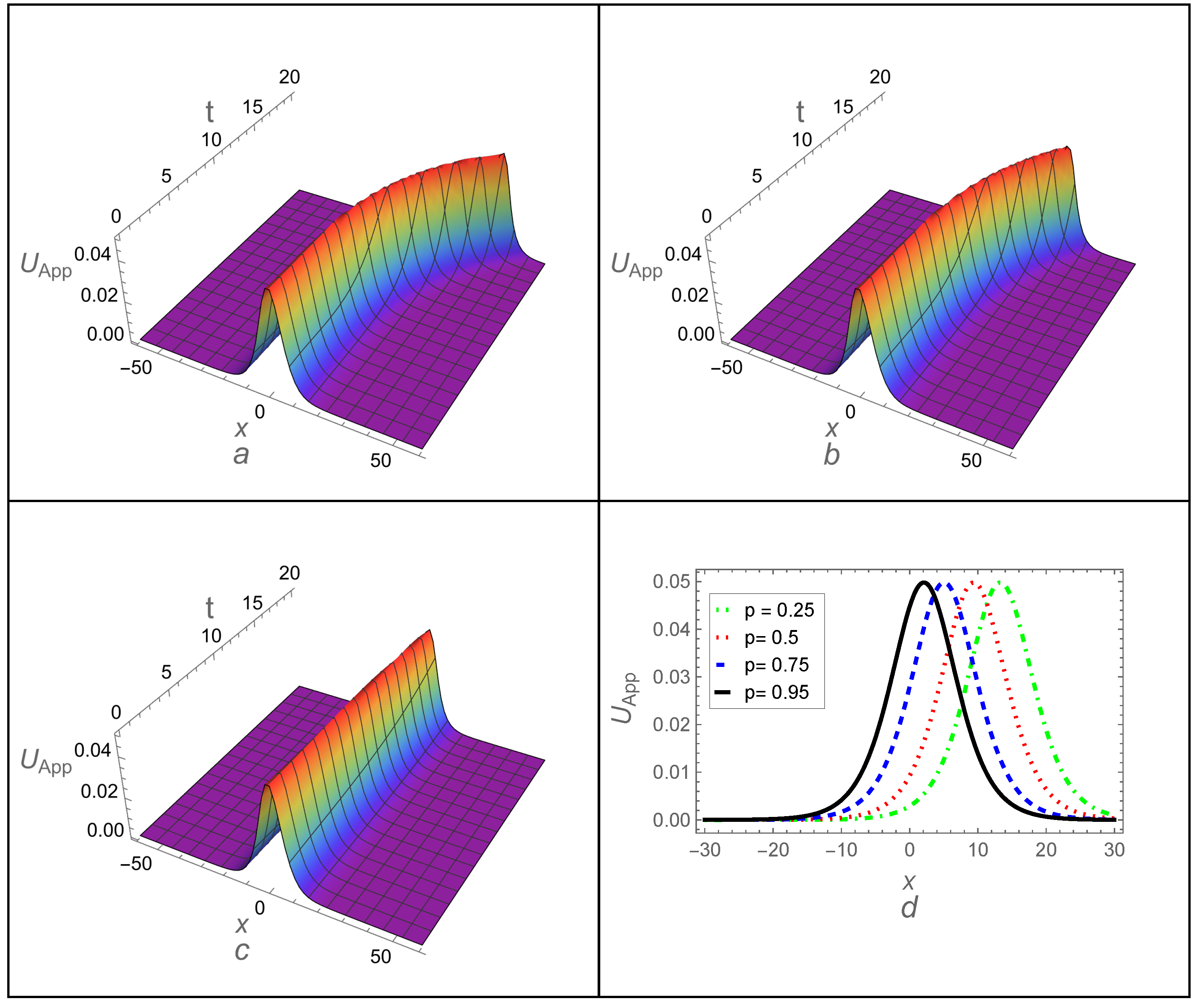
Figure 1 displays the numerical solution surface according to the approximation U ap ( x i , t j ) over the space–time domain for representative values of fractional parameter ρ . It is clear that the fractional soliton profile remains localized and exhibits a gradual decay of its amplitude due to the presence of fractional memory effects. It is also observed that at values of fractional parameter ρ that are close to one, the approximate solution becomes very similar to the exact solution for the integer case without a shift in the spatial point. However, as the fractionality ρ decreases to much less than one, the memory effects become more pronounced. In particular, the numerical results show a systematic shift of the fractional solitary structure in the positive x-direction as the fractionality ρ decreases, reflecting the fact that the effective time evolution is slowed down by the nonlocal memory kernel so that the wave covers a smaller effective distance for a given physical time. These trends align with the physical interpretation of the CFD in plasmas exhibiting anomalous transport. Lower values of fractionality indicate stronger temporal nonlocality and longer relaxation times. This, in turn, causes a delayed nonlinear response and a slower redistribution of wave energy. As a result, the fractional soliton stays coherent, but its amplitude and position become sensitive to the information stored in the memory kernel. From a plasma standpoint, this behavior is qualitatively consistent with observations of solitary structures in media with trapping, long-range correlations, or turbulent fluctuations, in which the propagation speed and amplitude can deviate from the predictions of classical, memoryless models.
To quantify how well U ap U ap ( x i , t j ) satisfies model (18), we compute the pointwise residual
R h R h ( x i , t j ) = D t ρ   C U ap + β U ap + α U ap 2 𝜕 x U ap + γ 𝜕 x 3 U ap .
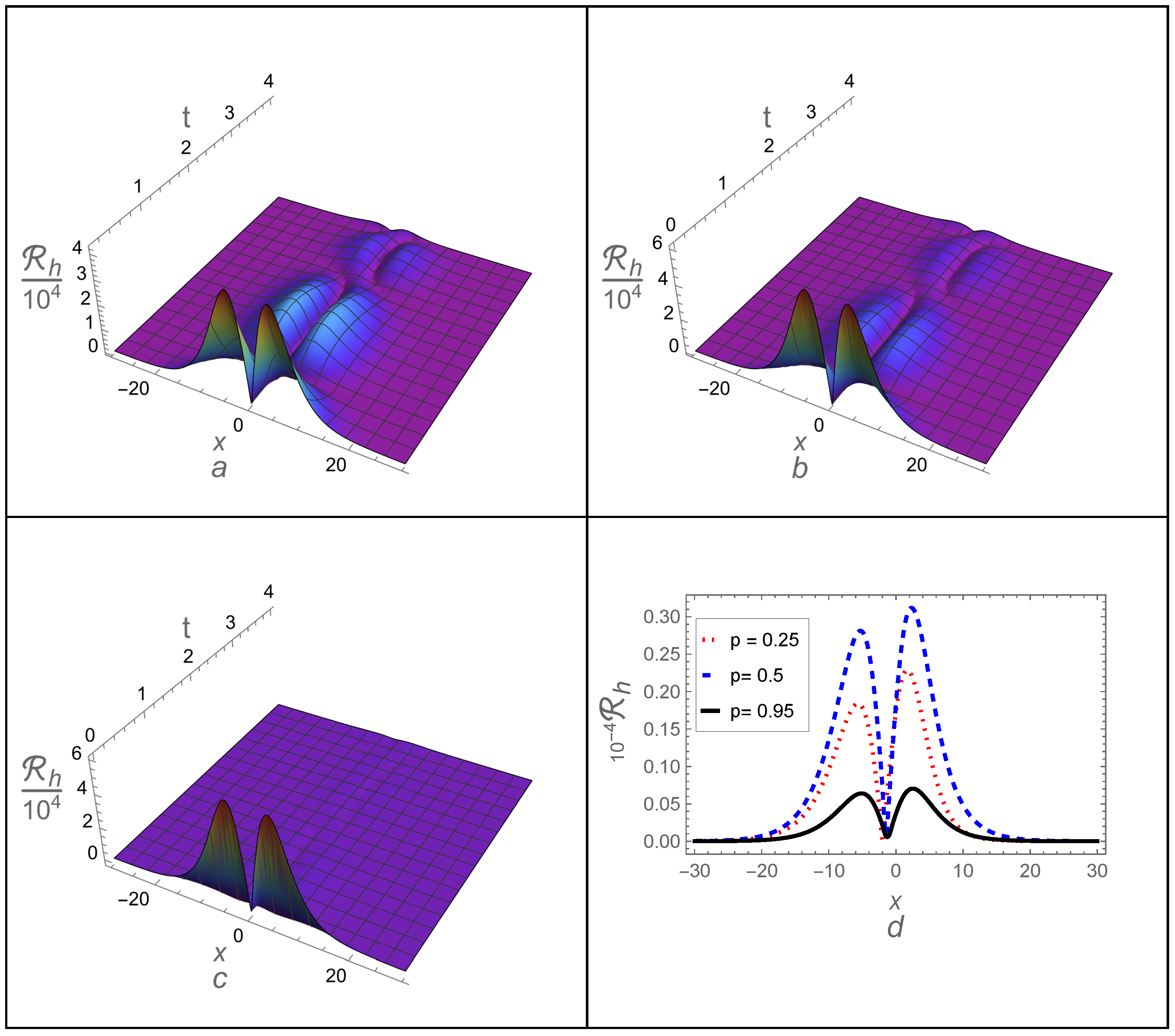
at each grid point, using the strong finite-difference operator for the Caputo derivative and consistent spatial discretizations. The corresponding residual surface R h , shown in Figure 2 for different values of the fractionality ρ , remains small throughout the computational domain. For moderate fractionality, the residual is typically concentrated in a narrow space–time region following the pulse, while for the fractionality ρ close to unity it becomes nearly uniform and extremely small. The global and final-time residual norms confirm this picture: they remain several orders of magnitude below the characteristic amplitude of the solution over the whole range of the fractionality ρ considered. This behavior indicates that the finite ansatz, when combined with the strong Caputo discretization, provides a numerically stable and internally consistent approximation of the fractional solitary wave dynamics.
Moreover, to quantify the accuracy of the fully discrete scheme, the global maximum residual error according to relation (16) in the domain Ω = L , L × t i , t f = 60 , 60 × 0 , 4 and local maximum residual error according to relation (17) in the domain Ω t = T = L , L = 60 , 60 are estimated against the fractionality ρ as follows
E N global ρ = 0.25 = max Ω | R h | = 1.92397 × 10 6 & E N final ρ = 0.25 = max Ω t = T | R h | = 4.78223 × 10 8 , E N global ρ = 0.5 = max Ω | R h | = 1.92397 × 10 6 & E N final ρ = 0.5 = max Ω t = T | R h | = 7.98354 × 10 8 , E N global ρ = 0.75 = max Ω | R h | = 1.92397 × 10 6 & E N final ρ = 0.75 = max Ω t = T | R h | = 1.8287 × 10 8 ,

6.2. Fractional Cnoidal Waves

We next examine a periodic cnoidal-wave solution of the classical GE and use it as initial data for the time-fractional evolution. The chosen parameters correspond to a smooth cnoidal pattern with a well-defined period and amplitude, representative of nonlinear wave trains in plasmas where dispersion and nonlinearity balance over extended spatial regions. As in the solitary case, the exact integer-order profile is embedded in the fractional framework via the time-fractional ansatz, and the resulting solution is then evolved for several values of the fractionality ρ . Accordingly, the following exact cnoidal wave solution to the integer form ( ρ = 1 ) to the FGE (18) is considered
u = β 2 α + 3 2 M β 2 + 4 α λ α 2 2 M 1 c n β 2 + 4 α λ 4 α γ 2 M 1 x λ t , M
and at α , β , γ , λ , M = 1 , 6 , 1 , 0.1 , 0.7 , the following soliton IC is obtained
u ( x , 0 ) = 3 + 9.77497 c n 4.7697 x , 0.7 .
The Caputo derivative introduces memory and typically generates a short startup layer near t = 0 , so a residual analysis is the most transparent way to verify the computation. To start, the following numerical values are considered L = 5 , T max = 5 , h = 0.02 , Δ x = 0.2 , and the number of divisions in the x-direction m x and in the t-direction n t reads
m x = F l o o r 2 L d x = F l o o r 10 0.2 = 50 , n t = F l o o r T max h = F l o o r 5 0.05 = 100 .
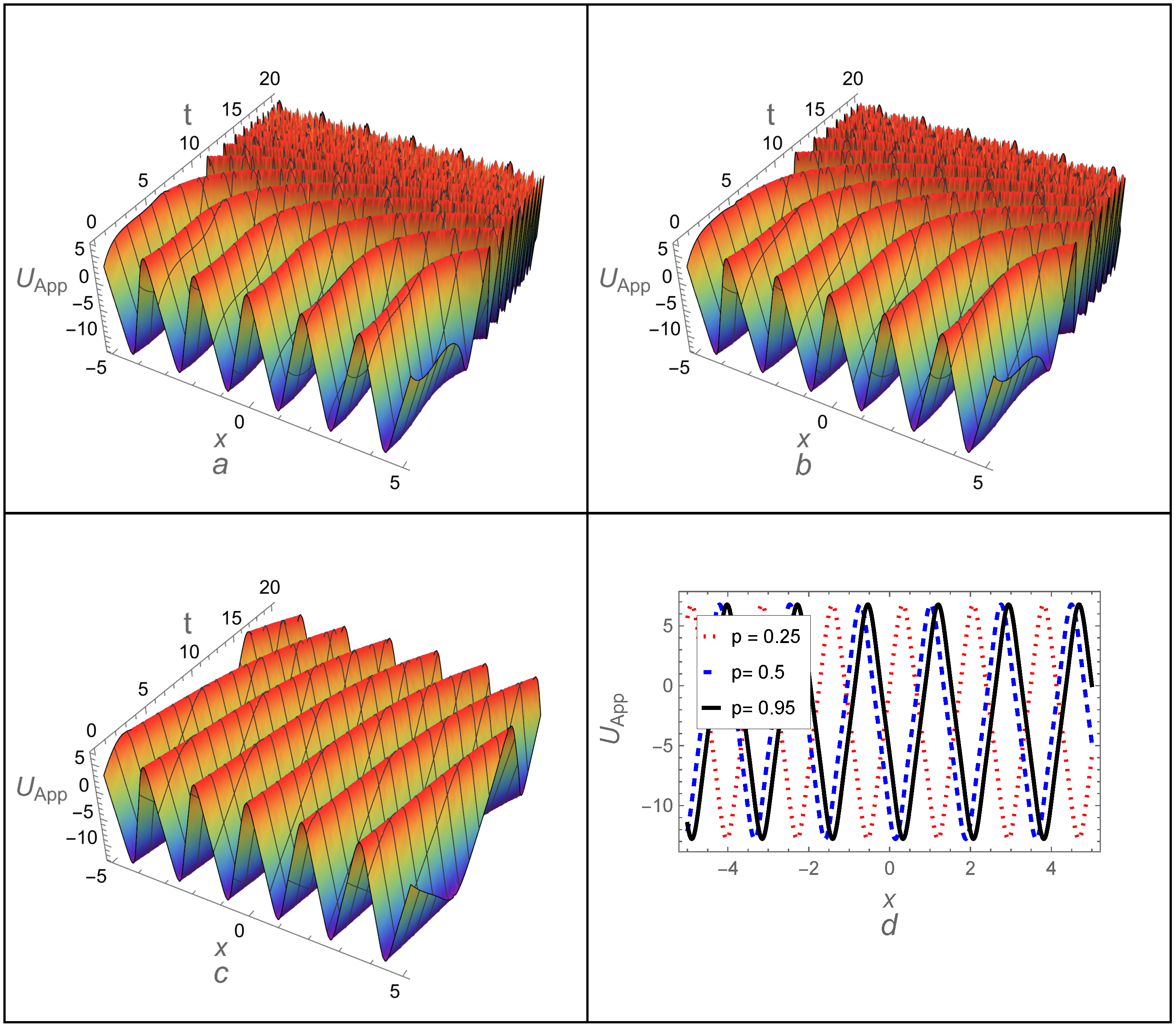
Figure 3 illustrates the numerical solution surface of the fractional cnoidal wave approximation U ap ( x i , t j ) on the interval 0 t 5 against the fractionality ρ . In the computation, it is generated by evaluating the exact profile at a fractional time map, i.e., the time argument is replaced by a smooth function of t consistent with the fractionality ρ . The profile remains smooth, bounded, and free of spurious oscillations over the entire space–time window, demonstrating that the derived approximations U ap ( x i , t j ) are stable along the entire domain of study. The persistence of the periodic structure in the presence of strong memory indicates that the fractional Gardner model can sustain long-lived nonlinear wave trains, even when the plasma response is non-Markovian. From a physical point of view, this behavior is again consistent with the interpretation of the fractional derivative as a measure of anomalous transport and memory. In plasmas with long-lived correlations or nonlocal interactions, the propagation of nonlinear wave trains can be delayed or attenuated compared with classical predictions without necessarily losing coherence. The dependence of the cnoidal waveform on the fractionality ρ revealed by the simulations suggests that the fractional order acts as an effective control parameter for the phase and amplitude evolution of nonlinear wave trains in such environments.
Taken together, the solitary and cnoidal examples demonstrate that the residual-controlled time-fractional ansatz provides a robust numerical and analytical framework for studying nonlinear wave structures governed by the time-FGE. In both cases, the solution profiles exhibit physically reasonable dependence on the fractional order, and the residual norms remain small throughout the space-time domain, even when memory effects are strong. These results confirm that the proposed methodology can capture the essential features of fractional solitary and cnoidal waves in non-Markovian plasma environments and can serve as a reliable tool for exploring how anomalous transport and long-time correlations modify classical Gardner-type dynamics.

6.3. Physical Interpretation and Plasma Applications

The time-FGE studied in this work provides an effective macroscopic description of nonlinear plasma wave propagation in environments where memory effects and anomalous transport are significant. In what follows, we discuss the physical meaning of the fractional order, interpret the residual-controlled approximation from a plasma physics perspective, and outline relevant application contexts:
  • Physical Interpretation of the Fractional Order: Classical plasma models rely on local time derivatives that embody Markovian dynamics, in which the system’s evolution depends solely on its current configuration. Real plasma environments, however, frequently manifest non-Markovian memory through mechanisms such as particle trapping, long-range Coulomb interactions, turbulent cascades, and emergent collective modes. The fractional Caputo derivative elegantly captures this hereditary response by integrating the system’s entire past trajectory into its instantaneous evolution. The fractional order 0 < ρ < 1 appearing in the Caputo derivative quantifies the strength of this temporal memory. Values of ρ close to unity correspond to weak memory effects and nearly classical plasma behavior, while smaller values of ρ represent increasingly strong memory and anomalous transport. From a physical standpoint, decreasing ρ reflects longer relaxation times and the power-law decay of temporal correlations, as commonly reported in space plasmas, dusty plasmas, and turbulent laboratory plasmas.
  • Interpretation of Fractional Gardner Dynamics: The GE incorporates both quadratic and cubic nonlinear terms, enabling it to describe plasma environments where several nonlinear mechanisms act simultaneously. When extended to the fractional framework, these nonlinear effects are influenced by inherent memory effects, leading to altered wave dynamics beyond the scope of conventional integer-order formulations. The presence of the fractional derivative alters the balance between nonlinearity and dispersion. Instead of creating solitons that retain their shape, the FGE describes waveforms whose evolution over time is influenced by the plasma’s past conditions. This manifests as slower temporal evolution, delayed nonlinear interactions, and modified stability properties, all of which are physically consistent with plasmas exhibiting anomalous transport.
  • Residual control as a criterion of physical consistency: From the standpoint of plasma modeling, an approximate solution attains physical relevance only when it satisfies the underlying evolution equation with adequate accuracy throughout the considered time interval. In nonlinear fractional equations, local errors can be amplified by memory effects, making traditional series truncation criteria unreliable. The residual-controlled framework adopted in this work provides a physically transparent consistency criterion: the residual directly measures the extent to which the approximate solution violates the FGE. Small residuals indicate that the plasma wave dynamics predicted by the approximation are consistent with the assumed physical model. This viewpoint is particularly relevant in plasma applications, where exact solutions are rarely available and physical reliability is more important than formal convergence of a series expansion. By explicitly controlling the residual, the proposed ansatz method ensures that the fractional plasma model remains self-consistent.
  • Comparison with residual power series methods (RPSMs): In RPSMs, the approximation is generated by cutting off a fractional series expansion after a finite number of terms. This procedure works reasonably well near the initial time, where the approximation remains locally valid. However, as time progresses, accuracy often declines, particularly in nonlinear fractional systems, due to memory buildup and the dominance of wave behavior. In contrast, the present ansatz method is designed to minimize the residual directly, thereby improving global accuracy and physical reliability. The numerical results demonstrate that, for the same initial data and fractional order, the residuals obtained with the ansatz method are one to two orders of magnitude smaller than those produced by truncated residual power series approximations.

7. Conclusions and Future Work

In this study, we have examined a time-FGE motivated by the description of nonlinear plasma waves in media where memory effects and anomalous transport cannot be neglected. Starting from the classical Gardner equation (GE), which combines quadratic and cubic nonlinearities and is widely used to model solitary and periodic structures in various plasma configurations [5,6,7,8,9,10,11], we introduced a time-fractional extension in which the usual first-order time derivative is replaced by a Caputo derivative of order 0 < ρ < 1 [15,16,17,18]. This extension yields a model in which the nonlinearity–dispersion balance is preserved, while the temporal evolution is modified by a power-law memory kernel that encodes non-Markovian plasma behavior [12,13,14,19,20,21].
To construct accurate and physically meaningful approximations of the resulting evolution problem, we proposed a finite time-fractional ansatz built upon physically relevant solitary-wave and cnoidal-wave profiles and combined it with a strong finite-difference approximation of the Caputo derivative that preserves the convolution structure of the memory kernel and achieves second-order temporal accuracy [22,23,24]. The approximate fractional solution was substituted into the governing time-fractional GE (FGE), and the resulting residual was computed explicitly on a discrete space-time grid. The global residual norm and the final-time residual norm were then used as quantitative diagnostics of consistency and accuracy, in direct analogy with defect-based assessments commonly employed in numerical analysis.
The numerical investigations conducted for representative solitary and cnoidal initial conditions yield several concrete conclusions. For solitary-wave initial profiles, the numerical simulations showed that the approximate fractional soliton remains localized and retains its overall shape, while its amplitude, width, and propagation speed become sensitive to the value of ρ , with stronger memory effects (smaller ρ ) leading to slower evolution and noticeable shifts in the wave position. Similarly, for cnoidal-wave initial conditions, the approximate fractional cnoidal structures preserved their smooth, bounded character over the considered time intervals, and the residual analysis confirmed the absence of spurious oscillations or numerical instabilities. In both cases, global and final-time residual norms decreased with increasing interpolation degree and with the use of the strong Caputo discretization, indicating that the finite ansatz combined with residual control yields a consistent and robust approximation. From a physical perspective, these findings support the view that time-fractional Gardner models, when treated with explicit residual control, offer an effective macroscopic representation of nonlinear waves in non-Markovian plasma environments, including space, dusty, and turbulent laboratory plasmas, and that the fractional order can be interpreted as a tunable parameter encoding the strength of memory and anomalous transport [12,13,14,19,20,21]. Potential applications of the present results include modeling ion-acoustic and dust-acoustic structures in complex plasmas with trapping and long-range interactions, as well as interpreting observations in space and astrophysical plasmas, where nonlocal transport is known to be significant.
This work represents several promising future research directions, the most important of which are the following:
  • Nonplanar (curvature) effects: A first extension would be to derive a nonplanar time-FGE by starting from a fluid model formulated in cylindrical or spherical coordinates. In such a setting, the curvature terms enter explicitly into the evolution equation and alter the balance between nonlinearity and dispersion. Studying solitary and cnoidal profiles within this nonplanar fractional Gardner framework would clarify how geometric spreading, together with fractional memory, modifies the amplitude, width, and speed of nonlinear structures, for example, in expanding space plasmas and columnar laboratory configurations.
  • Collisional and damping mechanisms: A second natural step is to incorporate collisional or effective damping processes into the present model, leading to a damped time-FGE. This can be achieved by introducing appropriate loss terms that represent ion-neutral collisions, viscosity, or resistive dissipation at the fluid level. The resulting equation would enable one to trace how dissipation, acting simultaneously with the fractional memory kernel, influences the lifetime of solitary waves and the persistence of cnoidal patterns, and whether new regimes, such as slowly decaying shocks or strongly attenuated wave trains, emerge in collisional or weakly ionized plasmas.
  • Nonplanar damped fractional Gardner models: Combining curvature and damping effects within a single model would yield nonplanar damped time-FGE. These equations could be employed to examine the joint impact of geometry, dissipation, and long-time memory on nonlinear plasma structures—for instance, in dusty or electronegative plasmas where spherical or cylindrical fronts, together with collisional processes, play an important role in wave dynamics.

Author Contributions

A.H.S.: Methodology, Investigation, Writing—original draft; W.A.: Formal analysis, Validation, Software, Writing—original draft; S.A.E.-T.: Formal analysis, Investigation, Methodology, Supervision, Writing—review and editing. All authors have read and agreed to the published version of the manuscript.

Funding

The authors express their gratitude to Princess Nourah bint Abdulrahman University Researchers Supporting Project number (PNURSP2026R229), Princess Nourah bint Abdulrahman University, Riyadh, Saudi Arabia.

Data Availability Statement

All numerical simulations reported in this study were carried out using standard RK methods via MATHEMATICA V. 14.2. The data supporting the findings of this work are generated directly from the governing equations and initial conditions described in the manuscript. No external datasets were used. The code used to produce the numerical results is available from the author upon reasonable request.

Acknowledgments

The authors express their gratitude to Princess Nourah bint Abdulrahman University Researchers Supporting Project number (PNURSP2026R229), Princess Nourah bint Abdulrahman University, Riyadh, Saudi Arabia.

Conflicts of Interest

The authors declare that there is no conflict of interest regarding the publication of this paper.

References

  1. Korteweg, D.J.; De Vries, G. XLI. On the change of form of long waves advancing in a rectangular canal, and on a new type of long stationary waves. Lond. Edinb. Dublin Philos. Mag. J. Sci. 1985, 39, 422–443. [Google Scholar] [CrossRef]
  2. Washimi, H.; Taniuti, T. Propagation of ion-acoustic solitary waves of small amplitude. Phys. Rev. Lett. 1966, 17, 996–998. [Google Scholar] [CrossRef]
  3. Shukla, P.K.; Mamun, A.A. Introduction to Dusty Plasma Physics; Institute of Physics: Bristol, UK, 2002. [Google Scholar]
  4. Verheest, F. Waves in Dusty Space Plasmas; Springer Science & Business Media: Berlin/Heidelberg, Germany, 2012. [Google Scholar]
  5. Gardner, C.S. Korteweg-de Vries equation and generalizations. IV. The Korteweg-de Vries equation as a Hamiltonian system. J. Math. Phys. 1971, 12, 1548–1551. [Google Scholar] [CrossRef]
  6. Pandir, Y.; Duzgun, H.H. New exact solutions of time fractional Gardner equation by using new version of F-expansion method. Commun. Theor. Phys. 2017, 67, 9. [Google Scholar] [CrossRef]
  7. Guo, S.; Mei, L.; Zhang, Z. Time-fractional Gardner equation for ion-acoustic waves in negative-ion-beam plasma with negative ions and nonthermal nonextensive electrons. Phys. Plasmas 2015, 22, 052306. [Google Scholar] [CrossRef]
  8. Miura, R.M.; Gardner, C.S.; Kruskal, M.D. Korteweg-de Vries equation and generalizations. II. Existence of conservation laws and constants of motion. J. Math. Phys. 1968, 9, 1204–1209. [Google Scholar] [CrossRef]
  9. Wadati, M. The modified Korteweg-de Vries equation. J. Phys. Soc. Jpn. 1973, 34, 1289–1296. [Google Scholar] [CrossRef]
  10. Wazwaz, A.M. Partial Differential Equations and Solitary Waves Theory; Springer: Berlin/Heidelberg, Germany, 2010. [Google Scholar]
  11. El-Tantawy, S.A.; Aboelenen, T.; Ismaeel, S.M.E. Local discontinuous Galerkin method for modeling the nonplanar structures (solitons and shocks) in an electronegative plasma. Phys. Plasmas 2019, 26, 022115. [Google Scholar] [CrossRef]
  12. Zaslavsky, G.M. Chaos, fractional kinetics, and anomalous transport. Phys. Rep. 2002, 371, 461–580. [Google Scholar] [CrossRef]
  13. Tarasov, V.E. Fractional Dynamics: Applications of Fractional Calculus to Dynamics of Particles, Fields and Media; Springer: Berlin/Heidelberg, Germany, 2011. [Google Scholar]
  14. Del-Castillo-Negrete, D. Fractional diffusion models of nonlocal transport. Phys. Plasmas 2006, 13, 082308. [Google Scholar] [CrossRef]
  15. Podlubny, I. Fractional Differential Equations: An Introduction to Fractional Derivatives, Fractional Differential Equations, to Methods of Their Solution and Some of Their Applications; Elsevier: Amsterdam, The Netherlands, 1998; Volume 198. [Google Scholar]
  16. Kilbas, A.A.; Srivastava, H.M.; Trujillo, J.J. Theory and Applications of Fractional Differential Equations; Elsevier: Amsterdam, The Netherlands, 2006. [Google Scholar]
  17. Diethelm, K. The Analysis of Fractional Differential Equations; Lecture Notes in Mathematics; Springer: Berlin/Heidelberg, Germany, 2010. [Google Scholar]
  18. Mainardi, F. Fractional Calculus and Waves in Linear Viscoelasticity; Imperial College Press: London, UK, 2010. [Google Scholar]
  19. El-Wakil, S.A.; Abulwafa, E.M.; El-Shewy, E.K.; Mahmoud, A.A. Time-fractional KdV equation for plasma of two different temperature electrons and stationary ion. Phys. Plasmas 2011, 18, 092116. [Google Scholar]
  20. El-Wakil, S.A.; Abulwafa, E.M.; El-shewy, E.K.; Mahmoud, A.A. Time-fractional KdV equation for electron-acoustic waves in plasma of cold electron and two different temperature isothermal ions. Astrophys. Space Sci. 2011, 333, 269–276. [Google Scholar] [CrossRef]
  21. El-Wakil, S.A.; Abulwafa, E.M.; El-Shewy, E.K.; Mahmoud, A.A. Ion-acoustic waves in unmagnetized collisionless weakly relativistic plasma of warm-ion and isothermal-electron using time-fractional KdV equation. Adv. Space Res. 2012, 49, 1721–1727. [Google Scholar] [CrossRef]
  22. Lin, Y.; Xu, C. Finite difference/spectral approximations for the time-fractional diffusion equation. J. Comput. Phys. 2007, 225, 1533–1552. [Google Scholar] [CrossRef]
  23. Meerschaert, M.M.; Tadjeran, C. Finite difference approximations for fractional advection–dispersion flow equations. J. Comput. Appl. Math 2004, 172, 65–77. [Google Scholar] [CrossRef]
  24. Li, C.; Zeng, F. Finite difference methods for fractional differential equations. Int. J. Bifurc. Chaos 2012, 22, 1230014. [Google Scholar] [CrossRef]
  25. Liu, C.; Shi, Y.; Feng, Y.; Jiang, J.; Yu, J. Bilateral Least Squares Residual Power Series Method for Fractional Differential Equations. Lobachevskii J. Math. 2025, 46, 3556–3567. [Google Scholar] [CrossRef]
  26. Abu Arqub, O. Application of residual power series method for the solution of time-fractional Schrödinger equations in one-dimensional space. Fundam. Informaticae 2019, 166, 87–110. [Google Scholar] [CrossRef]
  27. Zhang, Y.; Kumar, A.; Kumar, S.; Baleanu, D.; Yang, X.J. Residual power series method for time-fractional Schrödinger equations. J. Nonlinear Sci. Appl. 2016, 9, 5821–5829. [Google Scholar] [CrossRef]
  28. Wang, Q. Homotopy perturbation method for fractional KdV equation. Appl. Math. Comput. 2007, 190, 1795–1802. [Google Scholar] [CrossRef]
  29. Alaje, A.I.; Olayiwola, M.O.; Adedokun, K.A.; Adedeji, J.A.; Oladapo, A.O. Modified homotopy perturbation method and its application to analytical solitons of fractional-order Korteweg–de Vries equation. Beni-Suef Univ. J. Basic Appl. Sci. 2022, 11, 139. [Google Scholar] [CrossRef]
  30. Veeresha, P.; Prakasha, D.G.; Singh, J. Solution for fractional forced KdV equation using fractional natural decomposition method. Aims Math. 2020, 5, 798. [Google Scholar] [CrossRef]
  31. Alshammari, M.; Iqbal, N.; Mohammed, W.W.; Botmart, T. The solution of fractional-order system of KdV equations with exponential-decay kernel. Results Phys. 2022, 38, 105615. [Google Scholar] [CrossRef]
  32. Wang, Q. Numerical solutions for fractional KdV—Burgers equation by Adomian decomposition method. Appl. Math. Comput. 2006, 182, 1048–1055. [Google Scholar] [CrossRef]
  33. Almuqrin, A.H.; Tiofack, C.G.L.; Mohamadou, A.; Alim, A.; Ismaeel, S.M.E.; Alhejaili, W.; El-Tantawy, S.A. On the “Tantawy Technique” and other methods for analyzing the family of fractional Burgers’ equations: Applications to plasma physics. J. Low Freq. Noise Vib. Act. Control 2025, 44, 1323–1352. [Google Scholar] [CrossRef]
  34. El-Tantawy, S.A.; Bacha, S.I.H.; Khalid, M.; Alhejaili, W. Application of the Tantawy technique for modeling fractional ion-acoustic waves in electronegative plasmas having Cairns distributed-electrons, Part (I): Fractional KdV Solitary Waves. Braz. J. Phys. 2025, 55, 123. [Google Scholar] [CrossRef]
  35. Alhejaili, W.; Alzaben, L.; El-Tantawy, S.A. Modeling Fractional Dust-Acoustic Shock Waves in a Complex Plasma Using Novel Techniques. Fractal Fract. 2025, 9, 67. [Google Scholar] [CrossRef]
  36. Alawad, F.A.; Yousif, E.A.; Arbab, A.I. A new technique of laplace variational iteration method for solving space-time fractional telegraph equations. Int. J. Differ. Equ. 2013, 2013, 256593. [Google Scholar] [CrossRef]
  37. Jafari, H.; Nazari, M.; Baleanu, D.; Khalique, C.M. A new approach for solving a system of fractional partial differential equations. Comput. Math. Appl. 2013, 66, 838–843. [Google Scholar] [CrossRef]
  38. Pue-on, P. Employing the Sadik Residual Power Series Method to Analyze a System of Nonlinear Caputo Time-Fractional Partial Differential Equations. Eur. J. Pure Appl. Math. 2024, 17, 3826–3846. [Google Scholar] [CrossRef]
  39. El-Tantawy, S.A.; Salas, A.H.; Khalid, M.; Bacha, S.I.H.; Al-Ghamdi, H. The Tantawy technique for analyzing fractional Gardner equation and modeling fractional ion-acoustic solitary waves in electronegative plasmas. Eur. Phys. J. D 2025, 79, 156. [Google Scholar] [CrossRef]
Figure 1. The approximate fractional soliton solution U ( x , t ) against the fractionality ρ : (a) three-dimensional surface plot in x , t -plane at ρ = 0.25 , (b) three-dimensional surface plot in x , t -plane at ρ = 0.5 , (c) two-dimensional surface plot in x , t -plane at ρ = 0.95 , and (d) three-dimensional surface plot in the x , 15 -plane at different values of ρ .
Fractalfract 10 00211 g001
Figure 2. The residual surface R h (21) is examined against the fractionality ρ : (a) three-dimensional surface plot in x , t -plane at ρ = 0.25 , (b) three-dimensional surface plot in x , t -plane at ρ = 0.5 , (c) two-dimensional surface plot in x , t -plane at ρ = 0.95 , and (d) three-dimensional surface plot in the x , 15 -plane at different values of ρ .
Fractalfract 10 00211 g002
Figure 3. The approximate fractional cnoidal wave solution U ( x , t ) against the fractionality ρ : (a) three-dimensional surface plot in x , t -plane at ρ = 0.25 , (b) three-dimensional surface plot in x , t -plane at ρ = 0.5 , (c) two-dimensional surface plot in x , t -plane at ρ = 0.95 , and (d) three-dimensional surface plot in the x , 20 -plane at different values of ρ .
Fractalfract 10 00211 g003
Disclaimer/Publisher’s Note: The statements, opinions and data contained in all publications are solely those of the individual author(s) and contributor(s) and not of MDPI and/or the editor(s). MDPI and/or the editor(s) disclaim responsibility for any injury to people or property resulting from any ideas, methods, instructions or products referred to in the content.