Article

The Filtering-Based Multi-Innovation Hierarchical Fractional Least Mean Square Algorithm for Parameter Estimation of Bilinear-in-Parameter Autoregressive System

1
Engineering Research Center for Metallurgical Automation and Measurement Technology of Ministry of Education, Wuhan University of Science and Technology, Wuhan 430081, China
2
School of Mathematics and Systems Science, Wuhan University of Science and Technology, Wuhan 430081, China
3
Institute of Robotics and Intelligent Systems, Wuhan University of Science and Technology, Wuhan 430081, China
*
Author to whom correspondence should be addressed.
Fractal Fract. 2026, 10(3), 197; https://doi.org/10.3390/fractalfract10030197
Submission received: 30 January 2026 / Revised: 11 March 2026 / Accepted: 12 March 2026 / Published: 17 March 2026
(This article belongs to the Section Numerical and Computational Methods)

Abstract

This paper mainly considers the fractional parameter identification algorithms of the bilinear-in-parameter autoregressive (AR-BIP) system. The data filtering technique is introduced to improve the parameter estimation accuracy of the AR-BIP system, which involves using a filter to filter the data of the identification model. The filtering-based hierarchical fractional least mean square algorithm (F-HFLMS) and the filtering-based multi-innovation hierarchical fractional least mean square algorithm (F-MHFLMS) are proposed for effective and accurate parameter estimation of the AR-BIP system. Using the multi-innovation theory and expanding the scalar innovation into the innovation vector, the F-MHFLMS could take full advantage of the input and output data information of the system. The performance of the F-MHFLMS algorithm is compared with the F-HFLMS strategy for the AR-BIP system using the values of the mean square error (MSE) and the average predicted output error. The effectiveness and accuracy of F-HFLMS and F-MHFLMS algorithms are demonstrated under the numerical experimentation based on different noise variances, fractional orders and innovation lengths. Compared with the F-HFLMS algorithm, the F-MHFLMS algorithm can acquire more accurate and robust parameter estimation.

1. Introduction

1.1. Literature Review

System identification and parameter estimation play a very significant role in a large number of research fields, such as nonlinear systems [1,2], multilinear systems [3], bilinear systems [4], time-delay nonlinear systems [5], input-nonlinear output-error systems [6], signal processing [7,8,9], and industrial processes [10,11,12]. Fractional system identification is an important research field of system identification, and researchers have shown great interest in modeling complicated nonlinear systems by using fractional derivatives in the last few decades. Compared to integer-order differential systems, fractional differential systems are closer to the genetic and global characteristics of actual systems, and fractional differential operators can pass on memory effects to the target models [13]. Therefore, fractional system identification has been extensively applied in many fields, such as chaotic systems [14], fractional-order composite systems [15], gene regulation network systems [16], neural networks [17], nonlinear fractional-order systems [18], power systems [19], lithium-ion batteries [20], and so on. Wang et al. introduced a fast speed fractional gradient descent algorithm and successfully applied this algorithm in BP neural networks [21]. Chaudhary NI et al. formulated a fractional hierarchical gradient descent method for more accurate parameter estimates of nonlinear control autoregressive systems under different noise levels and fractional orders [22]. Zhu et al. proposed the auxiliary model and hierarchical normalized fractional least mean square strategies for effectively solving parameter estimation of bilinear-in-parameter systems by using the auxiliary model idea and the hierarchical identification principle [23]. Hu et al. investigated the joint two-stage multi-innovation recursive least squares parameter and fractional-order identification algorithm for achieving more effective parameter identification of a fractional-order input nonlinear output-error autoregressive system by using the hierarchical identification principle and the multi-innovation identification theory [24].
Many identification algorithms based on the data filtering technique have been widely applied to the effective parameter estimation problem of nonlinear systems with colored noise interference in recent years [25]. The data filtering technique is to use a linear filter to multiply both sides of the model equation and change the original stochastic system interfered by colored noise into the new system interfered by white noise so as to improve the parameter estimation accuracy. Thus, the data filtering technique only changes the structure of the original identification system but not the relationship between the input and output data of the system, and can also make the estimation problem of the original system simpler [26]. Furthermore, the data filtering technique can combine the auxiliary model identification idea and the multi-innovation theory to investigate parameter estimation problems of different nonlinear systems [27]. Fan et al. proposed the filtering-based multi-innovation forgetting gradient algorithm based on the data filtering technique to decrease the noise interference and enhance the estimation performance [28]. Sun et al. presented a filtered multi-innovation-based iterative identification algorithm for multivariate equation-error autoregressive moving average (ARMA) systems to obtain more effective parameter estimates [29].
Recently, the parameter estimation problem of bilinear-in-parameter (BIP) systems and generalized bilinear-in-parameter (GBIP) systems has attracted great interest from many researchers. One of the characteristics of the BIP systems is that these special systems include the product terms of the information matrices and the parameter vectors. Another feature of these systems is that the output of these systems is the linear function about one of the parameter vectors when the others are stabilized [30]. Lots of complicated nonlinear systems, such as Hammerstein systems [31], Wiener systems [32] and the combination of these two systems [33,34], can be described more clearly by the BIP systems or the GBIP systems. Wang et al. derived a hierarchical least squares strategy for BIP systems by using the model decomposition technique and investigated the convergence of the proposed hierarchical algorithm [35]. Chen et al. presented an iterative algorithm based on generalized extended gradient and another iterative algorithm based on generalized extended least squares for BIP systems with ARMA noise to improve the parameter estimation accuracy [36]. Chen et al. proposed a gradient-based iterative algorithm to estimate all the unknown parameters of the BIP system and pointed out that the presented iterative algorithm can obtain higher parameter estimation accuracy compared to the stochastic gradient strategies [37].
To further enhance the estimation accuracy and convergence rate of the fractional-order identification model, Zhang et al. presented a multi-innovative Levenberg–Marquardt algorithm to estimate a fractional-order Hammerstein ARMAX system with colored noise [38]. Hu et al. provided a filtering-based gradient joint estimation strategy for nonlinear fractional models, which was disturbed with colored noises to reduce the noise interference and to improve the convergence rate by introducing the forgetting factor to the presented filtering-based algorithm [13]. Chaudhary NI et al. proposed a multi-innovation fractional least mean square method for the parameter estimation of input nonlinear control AR systems to yield better convergence speed by extending the innovation vector length [39]. Zhu et al. presented the K-HFLMS algorithm and the K-MHFLMS algorithm for the parameter estimation of the GBIP system based on the multi-innovation theory and hierarchical identification principle [40].

1.2. Contribution

On the basis of the work in [39,40], this article presents the F-HFLMS algorithm and the F-MHFLMS algorithm for the parameter identification of the AR-BIP system based on the data filtering technique and multi-innovation theory. The estimation accuracy and convergence speed of the F-MHFLMS strategy are analyzed by comparing with the F-HFLMS algorithm for different values of noise variance, fractional order and length of innovation vector. The main contributions of this article are provided in the following aspects.
  • An F-HFLMS algorithm is proposed by combining the fractional order derivative to improve the parameter estimates accuracy of the AR-BIP system by using the hierarchical identification principle and the data filtering technique.
  • An F-MHFLMS algorithm is designed based on the multi-innovation theory to hasten the convergence rate of the presented F-HFLMS algorithm.
  • The effectiveness and accuracy of the presented fractional adaptive strategies are demonstrated through numerical experimentation based on different noise variances, fractional orders and innovation lengths.
  • The comparison analysis of the F-MHFLMS and F-HFLMS strategies is conducted with the HFLMS algorithm based on the values of MSE and the average predicted output error.

1.3. Paper Outline

The rest of this article is organized as follows. Section 2 briefly introduces the identification model of the AR-BIP system by using the key term separation principle. A hierarchical fractional adaptive algorithm is proposed in Section 3 based on the hierarchical identification principle. Section 4 presents an F-HFLMS algorithm for the identification model by using the data filtering technique. Section 5 discusses an F-MHFLMS algorithm by making use of the multi-innovation theory for the AR-BIP system. Section 6 provides a numerical experiment for the proposed algorithms with a comparative analysis based on different performance measures. Section 7 provides some concluding remarks with some research directions in the relevant fields.

2. System Description and Identification Model

The identification model for the AR-BIP system is described as follows [35,36,37]:
y ( t ) = a T F ( t ) b + 1 C ( z ) v ( t ) ,
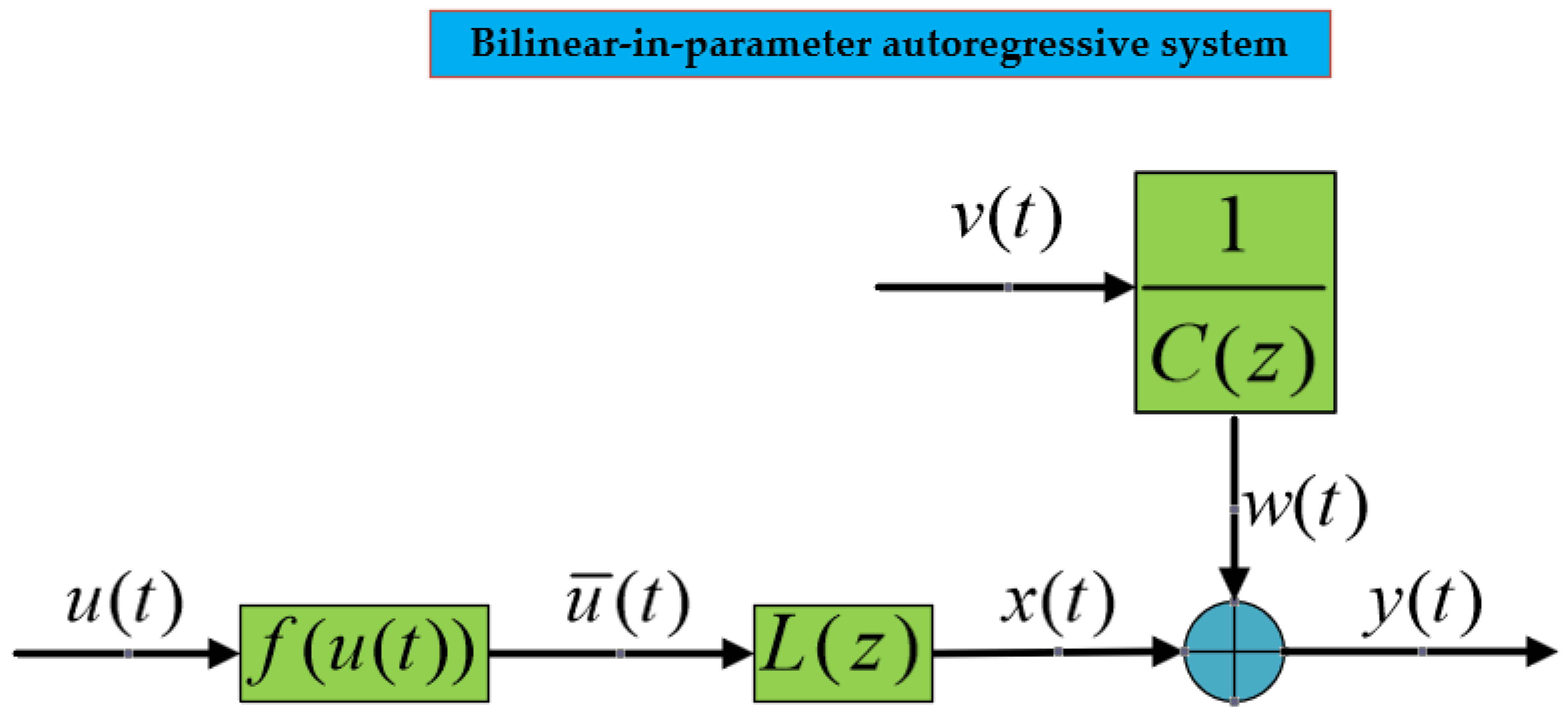
where u ( t ) R and y ( t ) R are the input and output of the identification system, respectively, F ( t ) R n a × n b is the information matrix, v ( t ) R is the stochastic disturbance sequence with zero mean and variance σ 2 , and a = [ a 1 , a 2 , , a n a ] T R n a , b = [ b 1 , b 2 , , b n b ] T R n b and c = [ c 1 , c 2 , , c n c ] T R n c are the unknown parameter vectors, which will be identified. Polynomials C ( z ) = 1 + i = 1 n c c i z i , where z 1 is the unit backward shift operator, and z 1 y ( t ) = y ( t 1 ) , assuming that the orders n a ,   n b ,   n c are known, y ( t ) = 0 , u ( t ) = 0 and v ( t ) = 0 as t 0 . The graphical abstract of the AR-BIP system is shown in Figure 1.
The information matrix can be defined as [40] the following:
F ( t ) = [ f ( u ( t 1 ) ) , , f ( u ( t n b ) ) ] R n a × n b ,
where f ( u ( t j ) ) = [ f 1 ( u ( t j ) ) , , f n a ( u ( t j ) ) ] T R n a ,   j = 1 , 2 , , n b .
By taking advantage of the auxiliary model identification idea for the AR-BIP system [41], we defined the intermediate variable as follows:
w ( t ) : = v ( t ) C ( z ) ,
where the colored noise w ( t ) R is the AR noise. Then, Equation (3) is given as follows:
w ( t ) = [ 1 C ( z ) ] w ( t ) + v ( t ) = k = 1 n c c k w ( t k ) + v ( t ) ,
= φ T ( t ) c + v ( t ) ,
where φ ( t ) = [ w ( t 1 ) , , w ( t n c ) ] T R n c is the disturbance information vector, and c is the disturbance parameter vector. Equation (5) is the disturbance identification model. Based on Figure 1, the polynomial L ( z ) = i = 1 n b b i z i , and the nonlinear block u ¯ ( t ) is a linear combination of known basis functions f i ( u ( t ) ) , so u ¯ ( t ) is expressed as follows:
u ¯ ( t ) = i = 1 n a a i f i ( u ( t ) ) = f T ( u ( t ) ) a ,
where u ( t ) is the input of the AR-BIP system, and then, Equation (1) can be written as below:
y ( t ) = a T F ( t ) b + w ( t ) ,
= a T F ( t ) b + φ T ( t ) c + v ( t ) ,
= L ( z ) u ¯ ( t ) + φ T ( t ) c + v ( t ) ,
    = j = 1 n b b j u ¯ ( t j ) + φ T ( t ) c + v ( t ) .
To improve the accuracy of identification and the computational efficiency, we use the key term separation principle. This principle is proposed by Jozef Vörös; it plays a crucial role in the identification of nonlinear systems, such as Hammerstein nonlinear systems and Wiener nonlinear systems. Using the nonlinear output as a key term, Vörös investigated the parameter identification of output nonlinear systems, discontinuous nonlinear systems, and special input nonlinear systems [1].
For any constant α 0 , ( α L ( z ) , u ¯ ( t ) α ) and ( L ( z ) , u ¯ ( t ) ) will result in the same input and output identification relationship for Equation (8). The normalization of L ( z ) or u ¯ ( t ) is done to ensure that the system parameters are identifiable. Based on different normalization models, two commonly used normalization assumptions are presented as follows:
Assumption 1.
Let   a 1 = 1  or    b 1 = 1 ; another method is to normalize any nonzero coefficient   a i = 1  or    b i = 1 .
Assumption 2.
Let   i = 1 n a a i 2 = 1   a 1 > 0 , or let   i = 1 n a b i 2 = 1   b 1 > 0 .
To simplify the identification model, the first assumption scheme is adopted in this paper, that is, b 1 = 1 [42].
By choosing u ¯ ( t 1 ) as a key term, and letting b 1 = 1 , Equation (9) can be rewritten as follows:
y ( t ) = i = 1 n a a i f i ( u ( t 1 ) ) + i = 2 n b b i u ¯ ( t i ) ) + φ T ( t ) c + v ( t ) ,
= f T ( u ( t 1 ) ) a + ξ T ( t ) θ + φ T ( t ) c + v ( t ) ,
where ξ ( t ) = [ u ¯ ( t 2 ) , , u ¯ ( t n b ) ] T R n θ , θ = [ b 2 , , b n b ] T = [ θ 1 , , θ n θ ] T R n θ , n θ = n b 1 .
Equation (11) is the estimation model of the AR-BIP system, which is defined in Equation (1). A novel fractional adaptive identification algorithm using the filtering technique will be proposed for identifying the unknown parameter vectors a ,   θ and c .

3. Hierarchical Fractional Adaptive Identification Algorithm

For comparison, a hierarchical fractional adaptive algorithm is proposed simply for the AR-BIP system by using the hierarchical identification principle in this section.
Before presenting the hierarchical fractional adaptive algorithm, it is necessary to briefly introduce the basic concepts of fractional calculus. There are many definitions of fractional derivative and integral in many literatures of fractional calculus; the most commonly used definitions are the Caputo and Riemann–Liouville (RL) definitions [43,44].
The Caputo definition for the function g ( x ) is written as follows:
D x λ a C g ( x ) = 1 Γ ( n λ ) a x ( x τ ) n λ 1 g ( n ) ( τ ) d τ x > a ,   n 1 < λ n .
And the RL definition for the function g ( x ) is given as follows:
D x λ a R L g ( x ) = 1 Γ ( n λ ) d n d x n a x ( x τ ) n λ 1 g ( τ ) d τ x > a ,   n 1 < λ n ,
where λ represents the fractional order derivative, n N , and the gamma function Γ is given as follows:
Γ ( k ) = 0 x k 1 e x d x ,
For the polynomial function g ( x ) = x n , the fractional order derivative is calculated as [43] follows:
D x λ a x n = Γ ( n + 1 ) Γ ( n λ + 1 ) x n λ ,
The equivalence of expressions (12) and (13) is well established for some known functions in the literature of fractional calculus [45].
The quadratic criterion functions for the proposed AR-BIP model are defined as [46] follows:
J ( t ) = E [ | e ( t ) | 2 ] = [ y ( t ) d ( t ) ] 2 ,
where E ( ) shows a statistical expectation operator, and e ( t ) is the estimation error, and it represents the difference between the desired response y ( t ) and the estimated response d ( t ) , so it can be written as follows:
e ( t ) = y ( t ) d ( t )   = y ( t ) β ^ T ( t ) u ( t ) ,
where β ^ ( t ) and u ( t ) represent the estimated weight and the input vectors, respectively.
By taking the first-order derivative about β ^ , and minimizing the quadratic criterion function (16), we have the following:
J ( t ) β ^ = 2 e ( t ) u ( t ) ,
Using (15) and (17), the fractional derivative of the quadratic criterion function (16) is provided as [47] follows:
λ J ( t ) β ^ λ = 2 e ( t ) λ β ^ λ [ y ( t ) β ^ T ( t ) u ( t ) ] ,
= 2 e ( t ) u ( t ) λ β ^ T ( t ) β ^ λ ,
= 2 e ( t ) u ( t ) 1 Γ ( 2 λ ) β ^ 1 λ ( t ) .
The recursive mechanism of the conventional fractional adaptive algorithm for weight update is given as [48,49] follows:
β ^ ( t ) = β ^ ( t 1 ) μ 1 2 J ( t ) β ^ μ λ 2 λ J ( t ) β ^ λ ,
where μ 1 and μ λ are the step size parameters for the first-order derivative and fractional derivative of the quadratic criterion function.
Using (18) and (21) in (22), and assuming β ^ 1 δ ( t ) β ^ 1 δ ( t 1 ) , the FLMS algorithm for the AR-BIP system could be rewritten as follows:
β ^ ( t ) = β ^ ( t 1 ) + μ 1 e ( t ) u ( t ) + μ λ Γ ( 2 λ ) e ( t ) u ( t ) β ^ 1 λ ( t 1 ) ,
where the expression β ^ ( t ) means the absolute value of the estimated parameter vector β ^ ( t ) , which is used to avoid complex entries. Since parameters may also take negative values, the absolute value of β ^ ( t ) is taken to ensure the convergence of the proposed fractional adaptive algorithm. And we use the element-wise operation symbol to define the multiplication of the elements of the input vector u ( t ) with the elements of the parameter vector β ^ ( t ) .
The hierarchical fractional adaptive algorithm can decompose the identification system into several sub-systems with fewer variables and smaller dimensions, and then it can reduce the computational burden for identifying the AR-BIP system in (11). By using the hierarchical identification principle [50,51], three intermediate variables are defined below:
y a ( t ) = y ( t ) ξ T ( t ) θ φ T ( t ) c ,
y θ ( t ) = y ( t ) f T ( u ( t 1 ) ) a φ T ( t ) c ,
y c ( t ) = y ( t ) f T ( u ( t 1 ) ) a ξ T ( t ) θ .
Then, we can decompose Equation (11) into the three fictitious subsystems:
y a ( t ) = f T ( u ( t 1 ) ) a + v ( t ) ,
y θ ( t ) = ξ T ( t ) θ + v ( t ) ,
y c ( t ) = φ T ( t ) c + v ( t ) .
According to the subsystems (27)–(29), we can define three quadratic criterion functions:
J a ( a ) : = y a ( t ) f T ( u ( t 1 ) ) a 2 ,
J θ ( θ ) : = y θ ( t ) ξ T ( t ) θ 2 ,
J c ( c ) : = y c ( t ) φ T ( t ) c 2 ,
Based on Equation (23), we have the following:
a ^ ( t ) = a ^ ( t 1 ) μ a ( t ) 2 J a ( a ^ ( t 1 ) ) a ^ μ λ ( t ) 2 λ [ J a ( a ^ ( t 1 ) ) ] a ^ ,
= a ^ ( t 1 ) + μ a ( t ) e ( t ) f ( u ( t 1 ) ) + μ λ Γ ( 2 λ ) e ( t ) f ( u ( t 1 ) ) a ^ 1 λ ( t 1 ) ,
μ a ( t ) = 1 r a ε ( t ) , 1 2 < ε 1 ,
r a ( t ) = r a ( t 1 ) + f ( u ( t 1 ) ) 2 , r a ( 0 ) = 1 ,
We let μ a ( t ) = μ λ to enhance the convergence speed of the presented HFLMS algorithm, and then Equation (34) can be rewritten as the following:
a ^ ( t ) = a ^ ( t 1 ) + μ a e ( t ) f ( u ( t 1 ) ) + 1 Γ ( 2 λ ) μ a e ( t ) f ( u ( t 1 ) ) a ^ 1 λ ( t 1 ) .
Minimizing the three criterion functions (30)–(32), and then the HFLMS algorithm for the AR-BIP system is provided as follows:
a ^ ( t ) = a ^ ( t 1 ) + μ a e ( t ) f ( u ( t 1 ) ) [ 1 + 1 Γ ( 2 λ ) a ^ 1 λ ( t 1 ) ] ,
e ( t ) = y ( t ) f T ( u ( t 1 ) ) a ^ ( t 1 ) ξ ^ T ( t ) θ ^ ( t 1 ) φ ^ T ( t ) c ^ ( t 1 ) ,
θ ^ ( t ) = θ ^ ( t 1 ) + μ θ ( t ) e ( t ) ξ ^ ( t ) + μ λ Γ ( 2 λ ) e ( t ) ξ ^ ( t ) θ ^ 1 λ ( t 1 ) ,
μ θ ( t ) = 1 r θ ε ( t ) ,   1 2 < ε 1 ,
r θ ( t ) = r θ ( t 1 ) + ξ ^ ( t ) 2 ,   r θ ( 0 ) = 1 ,
c ^ ( t ) = c ^ ( t 1 ) + μ c ( t ) e ( t ) φ ^ ( t ) + μ λ Γ ( 2 λ ) e ( t ) φ ^ ( t ) c ^ 1 λ ( t 1 ) ,
μ c ( t ) = 1 r c ε ( t ) ,   1 2 < ε 1 ,
r c ( t ) = r c ( t 1 ) + φ ^ ( t ) 2 ,   r c ( 0 ) = 1 ,
ξ ^ ( t ) = [ u ¯ ^ ( t 2 ) , , u ¯ ^ ( t n b ) ] T ,
u ¯ ^ ( t i ) = f T ( u ( t i ) ) a ^ ( t i ) ,
φ ^ ( t ) = [ w ^ ( t 1 ) , , w ^ ( t n c ) ] T ,
w ^ ( t ) = y ( t ) f T ( u ( t 1 ) ) a ^ ( t ) ξ ^ T ( t ) θ ^ ( t ) ,
where μ a ( t ) ,   μ θ ( t ) and μ c ( t ) are the first-order derivative step-size parameters, ε is the convergence index, i = 2 , 3 , , n b . When μ λ = 0 , the HFLMS algorithm (35)–(36) and (39)–(49) can be reduced to the traditional integer order hierarchical stochastic gradient algorithm.

4. The Filtering-Based Fractional Adaptive Identification Algorithm

For the autoregressive noise, we use the filtering technique to simplify this special colored noise into white noise, so as to avoid using the auxiliary model to simplify the colored noise, and then it could make the identification model simpler than the estimation model (11). In order to improve the identification accuracy and decrease the noise interference, a filtering-based fractional adaptive identification algorithm is proposed for the AR-BIP system in Equation (1) by using the data filtering technique [27].
Using the linear filter C ( z ) , we define the filtering variables:
y f ( t ) = C ( z ) y ( t ) R ,
u ¯ f ( t ) = C ( z ) u ¯ ( t ) R ,
Using the filter C ( z ) to multiply both sides of Equation (1), and owing to the intermediate variable x ( t ) = a T F ( t ) b = L ( z ) u ¯ ( t ) , we have the following:
y f ( t ) = L ( z ) u ¯ f ( t ) + v ( t ) = i = 1 n b b i u ¯ f ( t i ) + v ( t ) .
Equation (50) can be updated as follows:
y f ( t ) = i = 1 n c c i y ( t i ) + y ( t ) .
And Equation (51) can be rewritten as follows:
u ¯ f ( t ) = i = 1 n c c i u ¯ ( t i ) + u ¯ ( t ) .
Substituting Equation (53) into Equation (52), we have:
y ( t ) = i = 1 n b b i u ¯ f ( t i ) i = 1 n c c i y ( t i ) + v ( t ) .
The two filtering information vectors are defined as follows:
ξ f ( t ) = [ u ¯ f ( t 2 ) , u ¯ f ( t 3 ) , , u ¯ f ( t n b ) ] T ,
φ f ( t ) = [ u ¯ ( t 2 ) y ( t 1 ) , u ¯ ( t 3 ) y ( t 2 ) , , u ¯ ( t 1 n c ) y ( t n c ) ] T ,
Choosing u ¯ f ( t 1 ) as a key term, and letting b 1 = 1 , Equation (55) can be formulated as follows:
y ( t ) = u ¯ f ( t 1 ) ) + i = 2 n b b i u ¯ f ( t i ) ) i = 1 n c c i y ( t i ) + v ( t ) ,
= u ¯ ( t 1 ) + i = 1 n c c i u ¯ ( t 1 i ) ) + i = 2 n b b i u ¯ f ( t i ) ) i = 1 n c c i y ( t i ) + v ( t ) ,
= i = 1 n a a i f i ( u ( t 1 ) ) + i = 2 n b b i u ¯ f ( t i ) ) + i = 1 n c c i [ u ¯ ( t 1 i ) ) y ( t i ) ] + v ( t ) ,
= f T ( u ( t 1 ) ) a + ξ f T ( t ) θ + φ f T ( t ) c + v ( t ) .  
We define three fictitious intermediate variables:
η a ( t ) = y ( t ) ξ f T ( t ) θ φ f T ( t ) c ,
η θ ( t ) = y ( t ) f T ( u ( t 1 ) ) a φ f T ( t ) c ,
η c ( t ) = y ( t ) f T ( u ( t 1 ) ) a ξ f T ( t ) θ .
Then, Equation (61) can be further decomposed into three fictitious subsystems:
η a ( t ) = f T ( u ( t 1 ) ) a + v ( t ) ,
η θ ( t ) = ξ f T ( t ) θ + v ( t ) ,
η c ( t ) = φ f T ( t ) c + v ( t ) .
According to the subsystems (65)–(67), three criterion functions can be defined as follows:
J 1 ( a ) : = η a ( t ) f T ( u ( t 1 ) ) a 2 ,
J 2 ( θ ) : = η θ ( t ) ξ f T ( t ) θ 2 ,
J 3 ( c ) : = η c ( t ) φ f T ( t ) c 2 .
By using the data filtering technique and based on Equation (23), the F-HFLMS algorithm is proposed as follows:
a ^ f ( t ) = a ^ f ( t 1 ) + μ λ e f ( t ) f ( u ( t 1 ) ) [ 1 + 1 Γ ( 2 λ ) a ^ f 1 λ ( t 1 ) ] ,
e f ( t ) = y ( t ) f T ( u ( t 1 ) ) a ^ f ( t 1 ) ξ ^ f T ( t ) θ ^ f ( t 1 ) φ ^ f T ( t ) c ^ f ( t 1 ) ,
θ ^ f ( t ) = θ ^ f ( t 1 ) + μ θ f ( t ) e f ( t ) ξ ^ f ( t ) + μ λ Γ ( 2 λ ) e f ( t ) ξ ^ f ( t ) θ ^ f 1 λ ( t 1 ) ,
μ θ f ( t ) = 1 r θ f ε ( t ) ,   1 2 < ε 1 ,
r θ f ( t ) = r θ f ( t 1 ) + ξ ^ f ( t ) 2 , r θ f ( 0 ) = 1 ,
c ^ f ( t ) = c ^ f ( t 1 ) + μ c f ( t ) e f ( t ) φ ^ f ( t ) + μ λ Γ ( 2 λ ) e f ( t ) φ ^ f ( t ) c ^ f 1 λ ( t 1 ) ,
μ c f ( t ) = 1 r c f ε ( t ) , 1 2 < ε 1 ,
r c f ( t ) = r c f ( t 1 ) + φ ^ f ( t ) 2 , r c f ( 0 ) = 1 ,
ξ ^ f ( t ) = [ u ¯ ^ f ( t 2 ) , u ¯ ^ f ( t 3 ) , , u ¯ ^ f ( t n b ) ] T ,
φ ^ f ( t ) = [ u ¯ ^ f ( t 2 ) y ( t 1 ) , u ¯ ^ f ( t 3 ) y ( t 2 ) , , u ¯ ^ f ( t 1 n c ) y ( t n c ) ] T ,
u ¯ ^ f ( t i ) = j = 1 n a a ^ f j ( t i ) f j ( u ( t i ) ) = f T ( u ( t i ) ) a ^ f ( t i ) ,
where μ θ f ( t ) and μ c   f ( t ) are the first-order derivative step-size parameter of the F-HFLMS algorithm, i = 2 , 3 , , n b .
Compared with the HFLMS algorithm, our proposed F-HFLMS algorithm avoids the use of auxiliary models, thereby reducing computational complexity. This can be seen directly from the two expressions of (49) and (81); Equation (81) depends solely on the parameter a ^ ( t ) , whereas Equation (49) also involves the parameter θ ^ ( t ) .

5. The Multi-Innovation Hierarchical Fractional Adaptive Strategy Based on Data Filtering Technique

To further enhance the convergence rate and the estimation accuracy of the proposed F-HFLMS algorithm, the F-MHFLMS algorithm is deduced by using the multi-innovation theory [52]. Based on the multi-innovation theory, the innovation length P is introduced to the F-HFLMS algorithm in (71)–(81) to expand the scalar innovation e f ( t ) R to the innovation vector E ( p , t ) R p , and the information vectors f ( u ( t 1 ) ) R n a , ξ ^ f ( t ) R n θ and φ ^ f ( t ) R n c to the information matrices Φ ( p , t 1 ) R n a × p , Ψ ^ ( p , t ) R n θ × p and Ω ^ ( p , t ) R n c × p .
The stacked output vector and the stacked information matrices are defined below:
Y ( p , t ) = [ y ( t ) , , y ( t p + 1 ) ] T R p ,
Φ ( p , t 1 ) = [ f ( u ( t 1 ) ) , , f ( u ( t p ) ) ] R n a × p ,
Ψ ^ ( p , t ) = [ ξ ^ f ( t ) , , ξ ^ f ( t p + 1 ) ] R n θ × p ,
Ω ^ ( p , t ) = [ φ ^ f ( t ) , , φ ^ f ( t p + 1 ) ] R n c × p .
We provide the innovation vector as follows:
E f ( p , t ) =   e f ( t )       e f ( t 1 ) e f ( t p + 1 ) ,
= y ( t ) f T ( u ( t 1 ) ) a ^ f ( t 1 ) ξ ^ f T ( t ) θ ^ f ( t 1 ) φ ^ f T ( t ) c ^ f ( t 1 )   y ( t 1 ) f T ( u ( t 2 ) ) a ^ f ( t 1 ) ξ ^ f T ( t 1 ) θ ^ f ( t 1 ) φ ^ f T ( t 1 ) c ^ f ( t 1 ) y ( t p + 1 ) f T ( u ( t p ) ) a ^ f ( t 1 ) ξ ^ f T ( t p + 1 ) θ ^ f ( t 1 ) φ ^ f T ( t p + 1 ) c ^ f ( t 1 ) .
Using (82)–(85), the innovation vector (87) can be rewritten as follows:
E f ( p , t ) = Y ( p , t ) Φ T ( p , t 1 )   a ^ f ( t 1 ) Ψ ^ T ( p , t )   θ ^ f ( t 1 ) Ω ^ T ( p , t )   c ^ f ( t 1 ) .
Then, the F-MHFLMS algorithm for the AR-BIP system is provided below:
a ^ f ( t ) = a ^ f ( t 1 ) + μ λ Φ ( p , t 1 ) E f ( p , t ) [ 1 + 1 Γ ( 2 λ ) a ^ f 1 λ ( t 1 ) ] ,
θ ^ f ( t ) = θ ^ f ( t 1 ) + μ λ Ψ ^ ( p , t ) E f ( p , t ) [ 1 + 1 Γ ( 2 λ ) θ ^ f 1 λ ( t 1 ) ] ,
c ^ f ( t ) = c ^ f ( t 1 ) + μ λ Ω ^ ( p , t ) E f ( p , t ) [ 1 + 1 Γ ( 2 λ ) c ^ f 1 λ ( t 1 ) ] ,
ξ ^ f ( t ) = [ u ¯ ^ f ( t 2 ) , u ¯ ^ f ( t 3 ) , , u ¯ ^ f ( t n b ) ] T ,
φ ^ f ( t ) = [ u ¯ ^ f ( t 2 ) y ( t 1 ) , u ¯ ^ f ( t 3 ) y ( t 2 ) , , u ¯ ^ f ( t 1 n c ) y ( t n c ) ] T ,
u ¯ ^ f ( t i ) = j = 1 n a a ^ f j ( t i ) f j ( u ( t i ) ) = f T ( u ( t i ) ) a ^ f ( t i ) .
The F-MHFLMS algorithm (82)–(85) and (88)–(94) can improve the identification performance by using the newest P measure data to estimate the system parameters at each recursive step, where i = 2 , 3 , , n b . When p = 1 , the F-HFLSM algorithm is a special case of the F-MHFLMS algorithm.
The computational efficiency of the algorithm can be evaluated by the floating-point operations. Table 1 lists the number of additions, multiplications and fractional-order operations for each recursive computation of the HFLMS algorithm, F-HFLMS algorithm, and F-MHFLMS algorithm for computational complexity analysis, where n 0 = n a + n θ + n c , n 1 = n a + n θ . To evaluate the overall computational burden more comprehensively, the total floating point operations (Total FLOPs) take the sum of additions, multiplications and fractional-order operations into consideration. From Table 1, we can see that the computational efficiencies of the three algorithms are N 1 flops, N 2 flops and N 3 flops at each step, respectively, that is, N 1 = 10 n 0 + 2 n 1 + 5 , N 2 = 10 n 0 + 4 and N 3 = ( 4 p + 5 ) n 0 . It can be drawn directly that N 2 < N 1 . For example, when the model orders are n a = 3 ,   n θ = 2 ,   n c = 2 and the innovation length is p = 2 , it yields n 0 = 7 , n 1 = 5 and N 1 N 2 = 11 , and then the total flops of the HFLMS algorithm, F-HFLMS algorithm and F-MHFLMS algorithm in the running process are Σ 1 = N 1 t = 850,000 , Σ 2 = N 2 t = 740,000 and Σ 3 = N 3 t = 910,000 with t = 10,000 . It illustrates that the F-HFLMS algorithm based on the data filtering technique could greatly decrease computational burden in the underlying structure compared with the HFLMS algorithm; and although the total computational amount of the F-MHFLMS algorithm increases moderately due to the introduction of the multi-innovation mechanism, its newly added computational overhead originates solely from the linear multiplications and additions. Such a moderate computational burden is exchanged for a significant improvement in parameter estimation accuracy and convergence speed, especially for complex AR-BIP systems.

6. Numerical Experimentation with Discussion

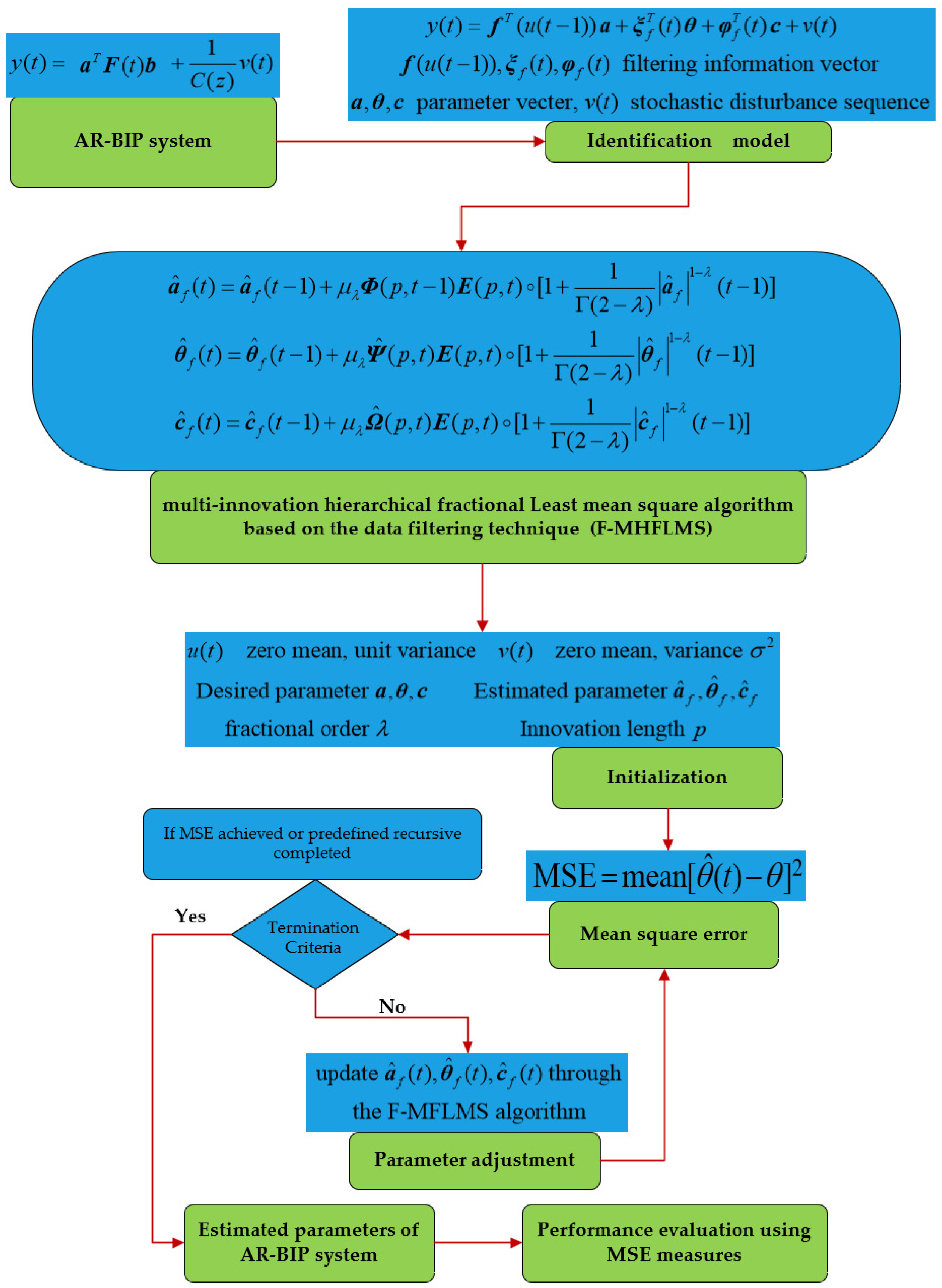
In this section, we propose a numerical experiment to validate the effectiveness of the presented F-MHFLMS and F-HFLMS algorithms in comparison with the HFLMS algorithm for the AR-BIP system using different innovation lengths, noise variances, and fractional orders. The block diagram of the presented fractional algorithms is shown in Figure 2, and the pseudocode of the F-HFLMS algorithm is provided in Algorithm 1. All the numerical experimentation is conducted in MATLAB R2016a with a Window 10 environment on a Dell Inspiron 15 5501, Intel i5-1035G1, 1.2GHz processor, 16GB RAM.
Algorithm 1: Pseudocode of the F-HFLMS algorithm for parameter estimation of the AR-BIP system
Inputs: Create parameter vector Π with elements equal to the unknown parameters of the AR-BIP system Π ^ . Obtain input data sequence u ( t ) , output data sequence y ( t ) , linear filter L ( z ) , and algorithmic hyperparameters.
Output: The final parameter estimation vector Π of the F-HFLMS algorithm and the mean square error M S E .
Start F-HFLMS
Step 1: Initialization: Small real numbers are generated to initialize parameter estimation vector Π .
Initialize all past inputs, outputs, filtered variables, and historical gradients to zero.
Set the total data length L e for the execution.
Set the algorithmic hyperparameters: first-order derivative step size μ 1 ,
fractional-order derivative step size μ λ , fractional order λ , and convergence index ε .
Set the stopping tolerance threshold ρ and time step t = 1 .
Step 2: Data Filtering: Apply the linear filter L ( z ) to both sides of the AR-BIP system model to transform the colored noise interference into white noise and compute the filtered variables y f ( t ) and u f ( t ) . Apply the key term separation principle to decompose the AR-BIP system into three fictitious subsystems and construct the filtered information vectors f ( u ( t 1 ) ) ,   ξ ^ f ( t ) , φ ^ f ( t ) using Equations (79)–(81).
Step 3: Scalar Innovation Calculation: Calculate the scalar innovation for each respective fictitious subsystem using Equation (72).
Step 4: Update Mechanism: Compute the normalization denominators r θ f ( t ) and r c   f ( t ) using Equations (75) and (78). Update the parameter estimation vectors a ^ f ( t ) , θ ^ f ( t ) and c ^ f ( t ) of the F-HFLMS algorithm as defined in Equations (71), (73) and (76), respectively, by summing the first-order gradient and fractional-order historical derivative terms.
Step 5: Performance Evaluation: Calculate the current mean square error (MSE) to monitor algorithmic convergence.
Step 6: Termination: Terminate the F-HFLMS execution processing in case of the following:
(a) Number of defined data lengths L e are completed ( t > L e ) ;
(b) Limit of tolerance, i.e., the difference between present and previous MSE, is achieved ( M S E ( t ) M S E ( t 1 ) ρ ).
If any of the above termination criteria are achieved, output the final parameter estimates and terminate. Otherwise, increment the time step t = t + 1 and go to Step 2.
End F-HFLMS

6.1. The Example

In order to illustrate the superior performance of the presented fractional algorithms, the AR-BIP system (1) with the known orders n a = 3 , n b = 3 , n c = 2 for the example is given as follows:
F ( t ) = f 1 ( u ( t 1 ) ) f 2 ( u ( t 1 ) ) f 3 ( u ( t 1 ) ) f 1 ( u ( t 2 ) ) f 2 ( u ( t 2 ) ) f 3 ( u ( t 2 ) ) f 1 ( u ( t 3 ) ) f 2 ( u ( t 3 ) ) f 3 ( u ( t 3 ) ) = u ( t 1 ) u 2 ( t 1 ) u 3 ( t 1 ) u ( t 2 ) u 2 ( t 2 ) u 3 ( t 2 ) u ( t 3 ) u 2 ( t 3 ) u 3 ( t 3 ) R 3 × 3 ,
a = a 1 , a 2 , a 3 T = 0.30 , 1.20 , 0.80 T R 3 ,   b = b 1 , b 2 , b 3 T = 1 , 0.60 , 1.50 T R 3 ,
θ = [ θ 1 , θ 2 ] T = [ b 2 , b 3 ] T = [ 0.60 , 1.50 ] T ,   C ( z ) = 1 + c 1 z 1 + c 2 z 2 = 1 + 0.4 z 1 + 0.1 z 2 ,
c = [ c 1 , c 2 ] T = [ 0.40 , 0.10 ] T ,   n θ = 2 .
Then, the parameter vector of the AR-BIP system is given as follows:
Π : = [ a T , θ T , c T ] T = [ 0.30 , 1.20 , 0.80 , 0.60 , 1.50 , 0.40 , 0.10 ] T R 7 .
In the numerical experimentation, the input u ( t ) is an independent stochastic sequence with the uniform distribution and zero mean and unit variance; v ( t ) is a stochastic white noise interference with the normal distribution and zero mean and variance σ 2 . The performance of the filtering-based fractional adaptive methods is usually analyzed for the AR-BIP identification model in the view of the estimation error based on two evaluation metrics: fitness function (Fitness) and mean square error (MSE). They are formulated below [53]:
Fitness :   = Π ^ Π Π ,
MSE :   = mean ( Π ^ Π ) 2 ,
where Π represents the actual parameter vector, and Π ^ is the estimated parameter vector using the F-HFLMS and F-MHFLMS strategies. For the perfect model, the optimum values of MSE are zero.
The data length is taken as L = 10,500 . We use the first 10,000 measure data and apply the F-HFLMS algorithm and the F-MHFLMS algorithm to identify the parameter vector Π of this example. To further demonstrate the effectiveness of the filtering hierarchical fractional adaptive algorithm, we use the remaining L   r = 500 data for model validation. The fractional step-size parameter μ λ is chosen as 0.0001 empirically. We select the convergence index as ε = 0.65 . The robustness assessment of the fractional least mean square algorithms is conducted by taking four noise variances σ 2 = 0.3 2 ,   0 0.5 2 ,   0.7 2 ,   0.9 2 . The five different fractional orders are investigated as λ = 0.4 ,   0.6 ,   0.8 ,   1.0 . We select five different innovation lengths p = 1 ,   2 ,   3 ,   4 ,   5 to test the proposed F-MHFLMS algorithm. The filtering fractional adaptive algorithms are examined in terms of the MSE criterion, and the parameter estimates and error results are shown in the Figures and Tables.

6.2. The Impact of Noise Variances on the Performance of the Filtering-Based Fractional Adaptive Strategies

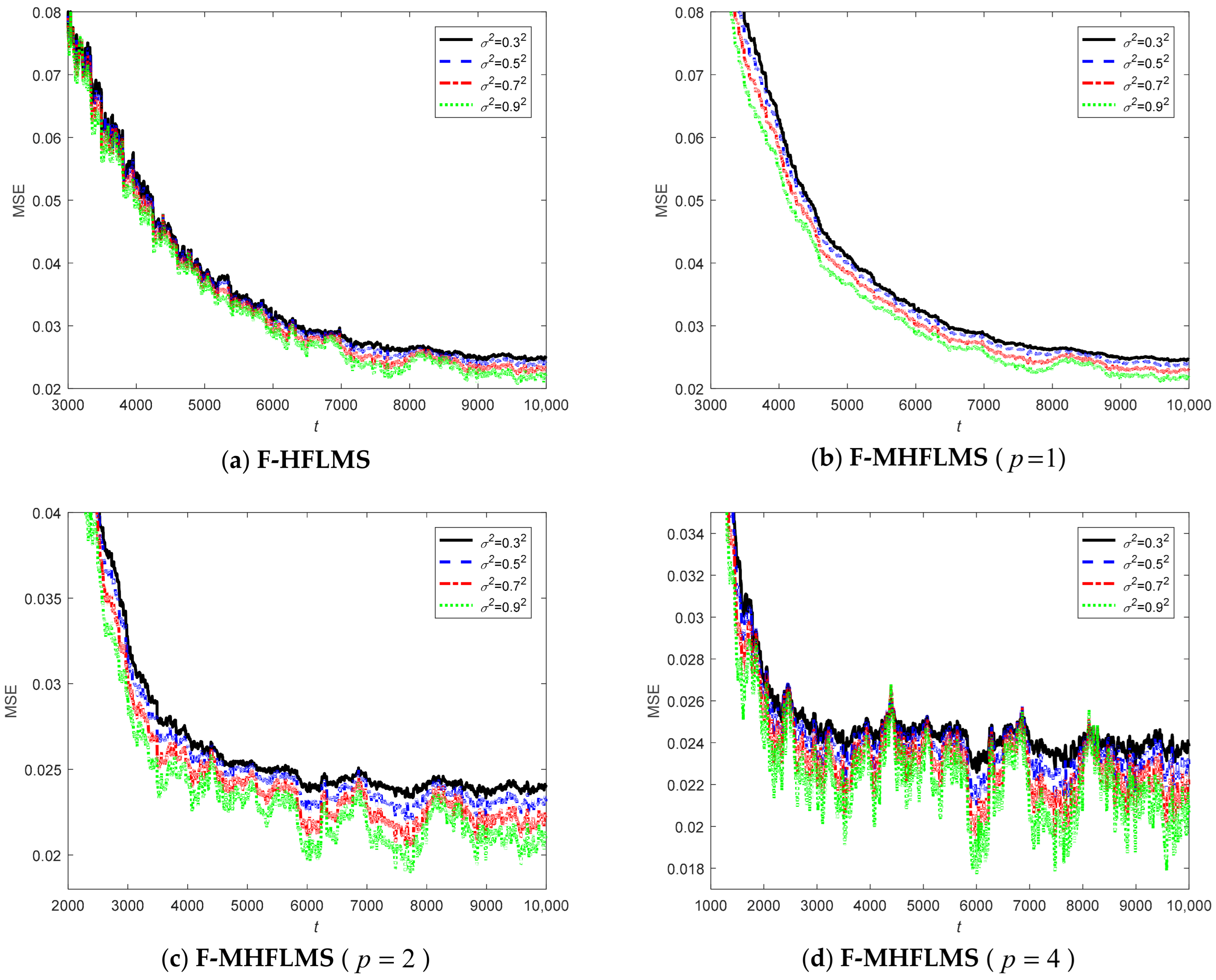
The performance of the F-HFLMS and F-MHFLMS adaptive algorithms for the AR-BIP identification model is evaluated with four noise variances, namely σ 2 = 0.3 2 ,   0.5 2 ,   0.7 2 ,   0.9 2 , and the fractional order is given as λ = 0.8 . The effectiveness of the proposed F-MHFLMS algorithms is examined in detail for three different innovation lengths p = 1 ,   2 ,   4 . The corresponding results are shown in Table 2 and Figure 3 based on the MSE values for these noise variances. From Table 2 and Figure 3, it is clearly observed that the designed filtering-based hierarchical fractional least mean square strategies are all convergent and effective for the four noise variances, and the MSE values of both F-HFLMS and F-MHFLMS algorithms decrease while the noise variances increase. All the proposed hierarchical fractional algorithms provided more accurate results for higher noise interference. But as the noise variance increases, the MSE value fluctuates more significantly, as shown in Figure 3c,d. So, we can take σ 2 = 0.9 2 for the rest of the study.

6.3. The Impact of Fractional Orders on the Performance of the Filtering-Based Fractional Adaptive Strategies

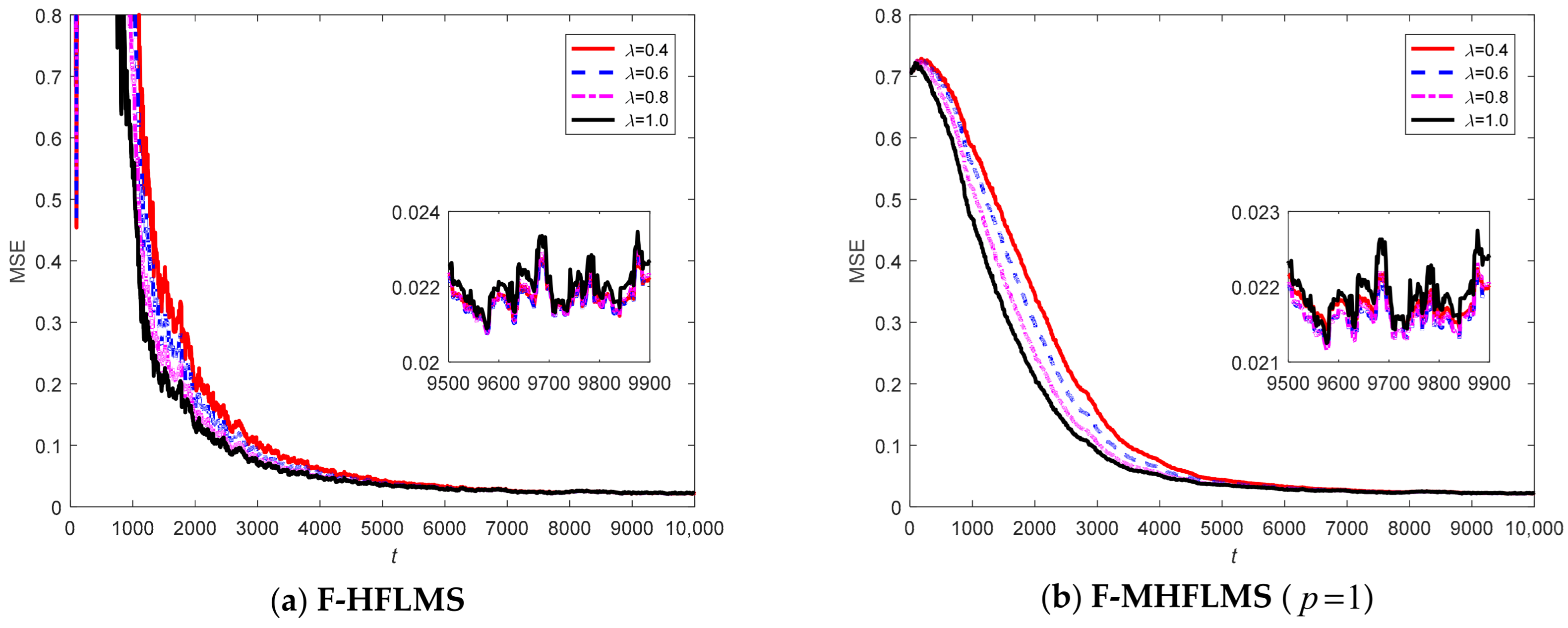
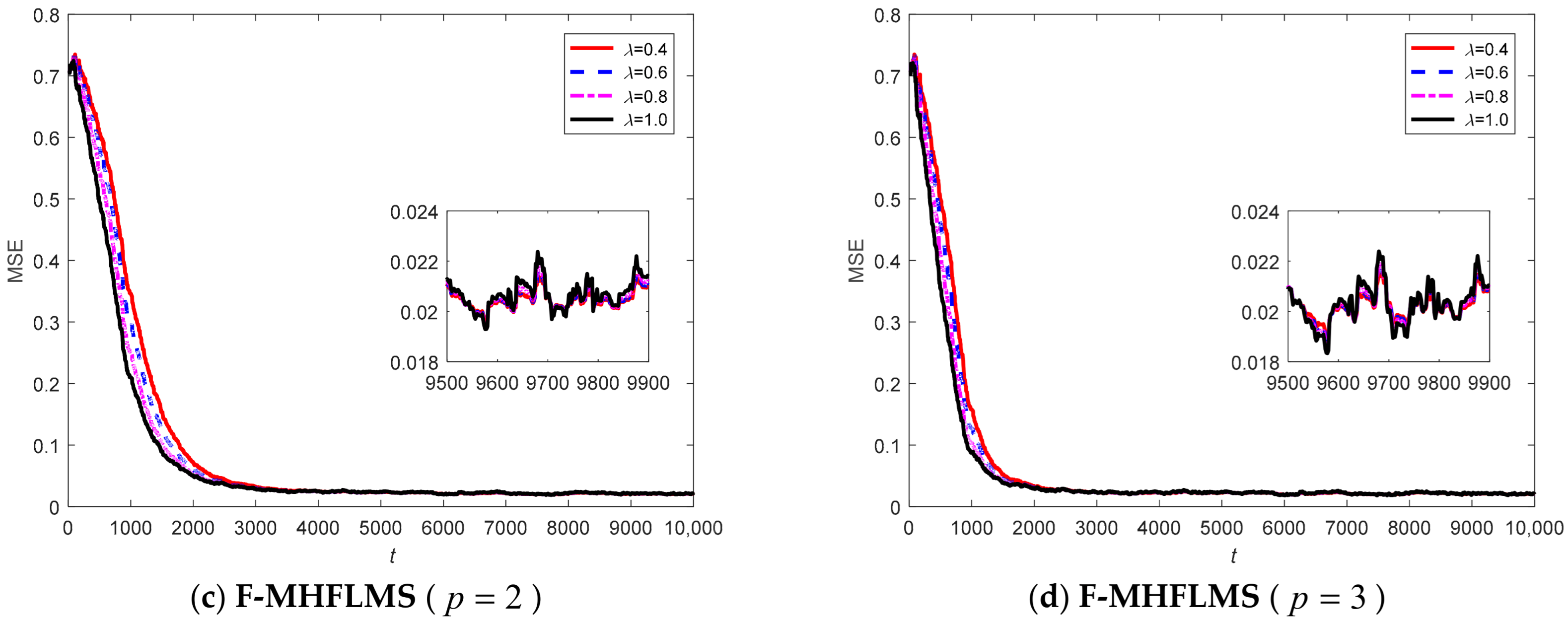
It is one of the most important, but a bit tricky to select the fractional order λ in the F-HFLMS algorithms. The proposed fractional algorithms are examined for five distinct values λ = 0.4 ,   0.6 ,   0.8 ,   1.0 ; to select a suitable fractional order λ , the noise variances and the innovation lengths of the F-MHFLMS algorithm are chosen as σ 2 = 0.9 2 and p = 1 ,   2 ,   3 , respectively. The results are presented in Table 3 and Figure 4 based on the MSE values as before. From Table 3 and Figure 4, it can be observed that the presented hierarchical fractional strategies are accurate for the tested values of the fractional orders, and the convergence speed of both F-HFLMS and F-MHFLMS strategies increases with the increase in fractional order, but from Figure 4a,b, the convergence is becoming slightly worse when λ = 1.0 . Then, it is justifiable to take λ = 0.8 for the rest of the study.

6.4. The Impact of Innovation Lengths on the Performance of the Filtering-Based Multi-Innovation Fractional Strategy

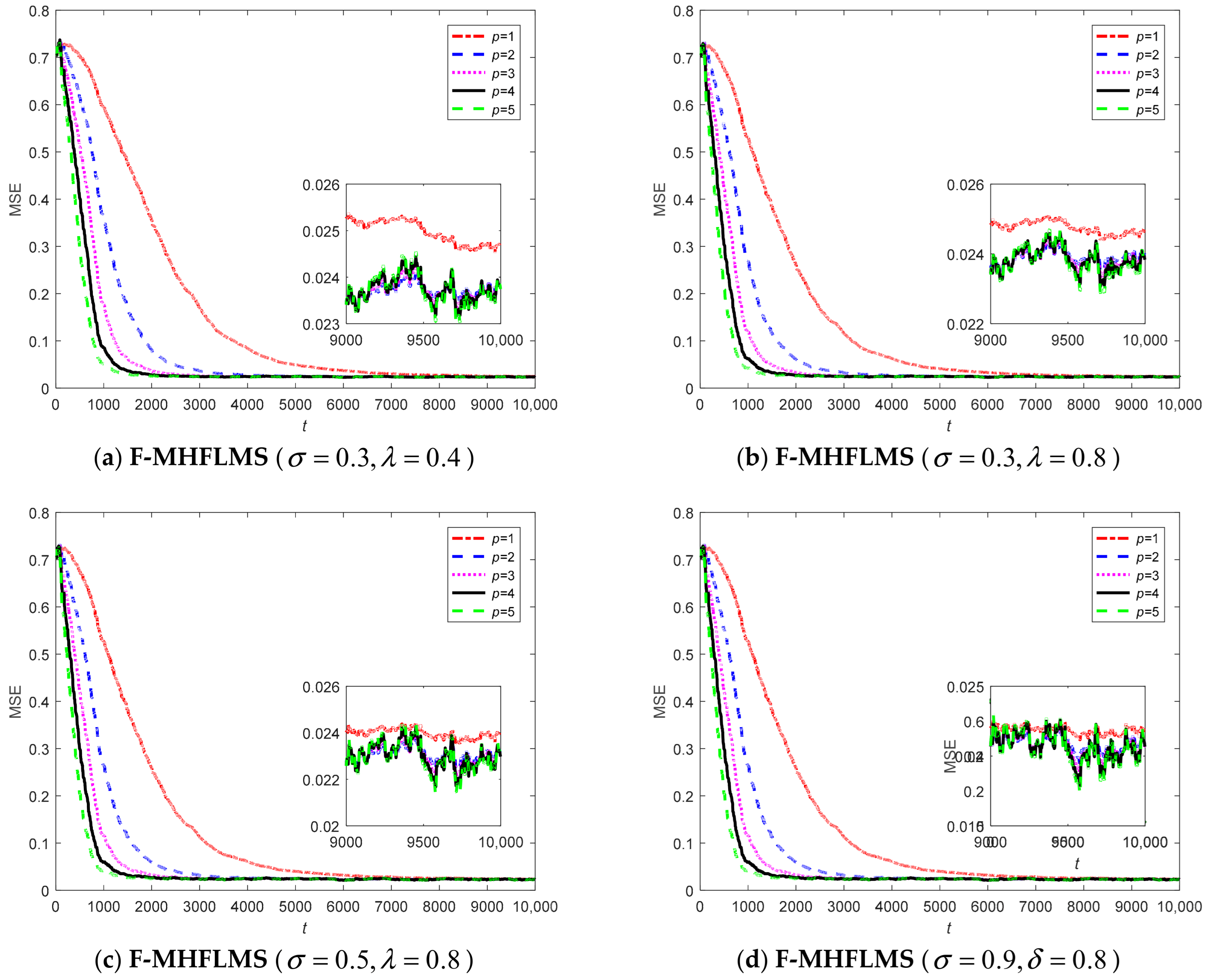
In order to evaluate the impact of innovation lengths on the presented multi-innovation hierarchical fractional algorithm, the performance of the F-MHFLMS algorithm is investigated for five innovation lengths, namely p = 1 ,   2 ,   3 ,   4 ,   5 . The fractional orders and the noise variances are selected as four groups, i.e., λ = 0.4 ( σ 2 = 0.3 2 ) and λ = 0.8 ( σ 2 = 0.3 2 , σ 2 = 0.5 2 , σ 2 = 0.9 2 ). The results are shown in Table 4 and Figure 5 based on the values of MSE. It can be concluded that the F-MHFLMS algorithm is accurate and effective for the five innovation lengths, and the convergence rate enhances when the innovation lengths increase from p = 1 to p = 5 , and the F-MHFLMS ( p = 5 ) is the most effective strategy based on the MSE values of the proposed five multi-innovation hierarchical strategies.

6.5. The Comparative Analysis of the Filtering-Based Hierarchical Fractional Adaptive Algorithm

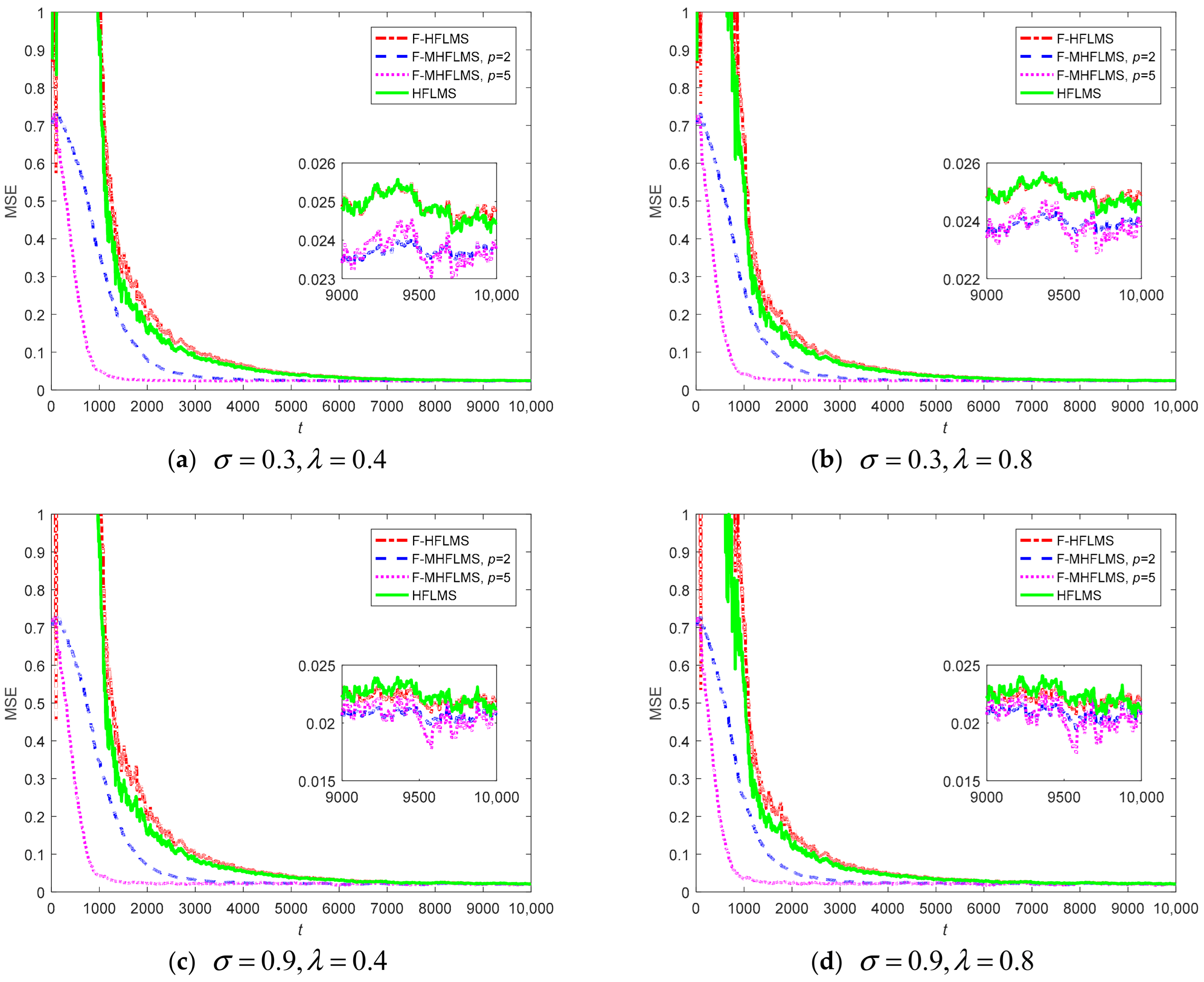
The results of comparative analysis regarding the estimation error curves versus t for the proposed F-HFLMS algorithm and the F-MHFLMS algorithm, with the HFLMS algorithm in terms of σ 2 = 0.3 2 ,   0.9 2 and λ = 0.4 ,   0.8 are presented in Table 5 and Table 6 and Figure 6. From Table 5 and Table 6 and Figure 6, it can be seen that the performance of the F-MHFLMS strategy is better than that of the F-HFLMS and HFLMS strategies, and the F-MHFLMS strategy has a faster convergence speed compared to the two hierarchical adaptive algorithms. Moreover, the F-MHFLMS strategy provides better parameter estimates and values of MSE than the HFLMS adaptive strategy. This also further verifies the effectiveness and precision of the presented F-MHFLMS strategy.

6.6. Model Validation

To further validate the effectiveness of the proposed F-MHFLMS algorithm, the estimated parameters when σ 2 = 0.9 2 , λ = 0.8 , t = 10,000 are selected, and we choose the remainder of the 450 datapoints to compute the predicted output y ^ ( t ) .
The average predicted output error of the F-MHFLMS estimation algorithms is defined as [54] follows:
Error ( L e ) = [ 1 L e t = t 0 + 1 t 0 + L e [ y ^ ( t ) y ( t ) ] 2 ] 1 2 .
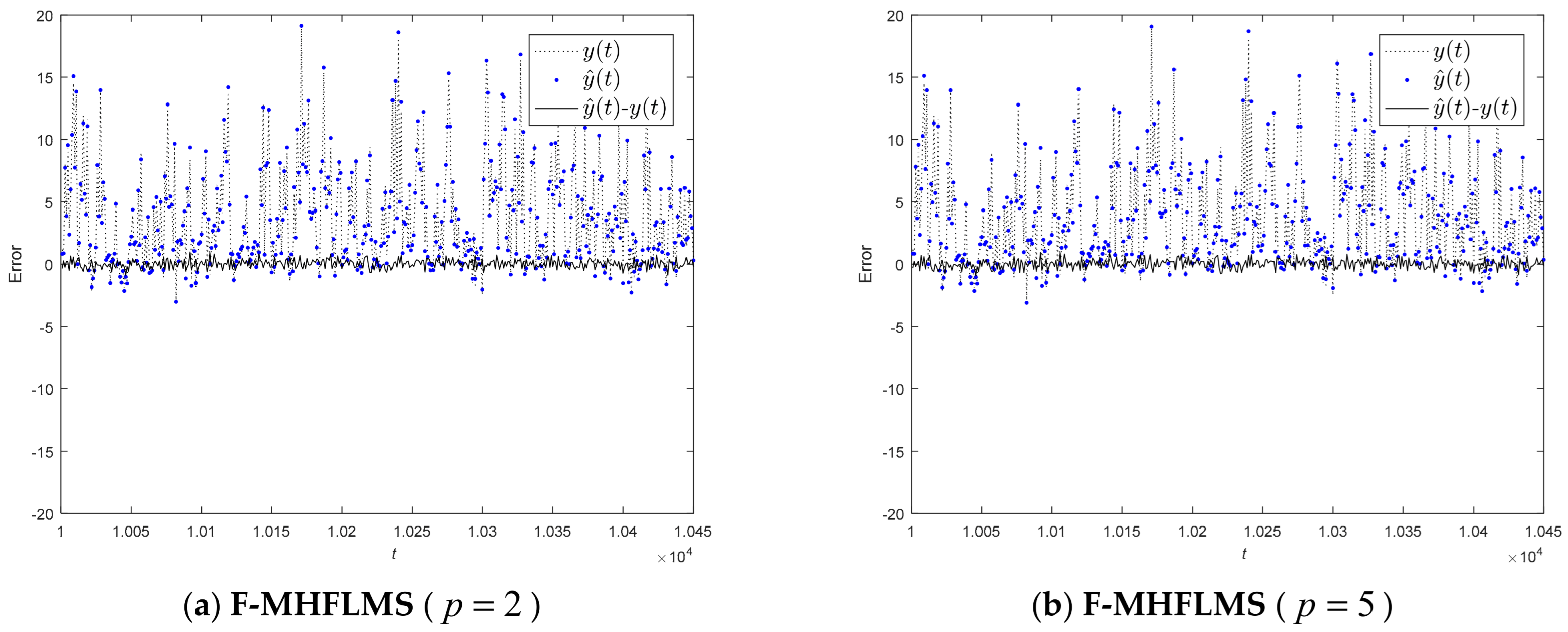
The desired output y ( t ) , the predicted output y ^ ( t ) , and their prediction errors are shown in Figure 7. Based on Expression (95), the average predicted output errors of the F-MHFLMS (p = 2) strategy and the F-MHFLMS (p = 5) strategy are 0.33499 and 0.35169 , respectively. From the two average predicted output errors and Figure 7, it can be seen that the predicted outputs are very close to the actual outputs of the F-MHFLMS strategies. This can also verify that the proposed F-MHFLMS algorithm is effective.

6.7. Statistical Robustness Analysis of the Experiments

To obtain a reliable statistical inference regarding the performance of the F-HFLMS algorithm in the parameter estimation of the AR-BIP system, we conducted 100 independent Monte Carlo trials. The statistical indicators of the parameter estimation errors, including the minimum, mean, and standard deviation, are calculated for all considered noise levels from σ 2 = 0.3 2 ,   0.5 2 ,   0.7 2 ,   0.9 2 , as well as fractional orders ranging from λ = 0.4 ,   0.6 ,   0.8 ,   1.0 , and the specific results are summarized in Table 7.
Statistical analysis reveals a distinctive trend where the mean values of the MSE decrease steadily as the noise variance σ 2 increases. For instance, the mean value of the MSE for λ = 0.4 is 2.5347 × 10 2 at the noise level of σ 2 = 0.3 2 , and this value further reduces to 2.2674 × 10 2 when σ 2 reaches σ 2 = 0.9 2 . This finding is highly consistent with the conclusions presented in Section 6.2 of the paper and provides strong evidence that the filtering-based fractional algorithm can more effectively suppress noise and extract system characteristic parameters in strong interference environments.
Regarding the impact of the fractional order, the results indicate that the estimation accuracy and convergence speed generally improve as λ increases from 0.4 toward the optimal value. It is observed that the performance reaches a superior state when the fractional order is set to 0.8 , which provides the best balance between fast convergence and steady-state precision. Furthermore, the SD across all test groups remains consistently at a low magnitude of 10 4 , verifying the exceptional numerical stability and repeatability of the algorithm.
The statistical results further validate the effectiveness of the F-HFLMS algorithm, demonstrating that its estimation accuracy possesses robust anti-noise capabilities and exhibits wide adaptability to the selection of fractional parameters.

7. Conclusions

By combining fractional calculus concepts, this paper mainly investigated the parameter identification problems of the AR-BIP system based on the multi-innovation theory and the data filtering technique.
  • The F-HFLMS algorithm and the F-MHFLMS algorithm are presented to enhance the estimation accuracy, and the HFLMS algorithm is proposed for comparison.
  • The F-MHFLMS algorithm is extended from the F-HFLMS algorithm by making use of the multi-innovation theory.
  • The designed filtering-based hierarchical fractional adaptive strategies are effective and convergent for the four noise variances, and it can be seen that more accurate results are obtained for higher noise variances.
  • The proposed filtering-based hierarchical fractional algorithms are accurate and robust for the five fractional orders, and the fractional identification algorithms with higher fractional orders could achieve better convergence on the whole.
  • It can be observed that the proposed F-MHFLMS strategy is effective and accurate for the five innovation lengths, and the multi-innovation hierarchical fractional algorithms with higher innovation lengths can achieve relatively better convergence speeds based on the values of MSE.
  • The results of the comparative analysis and the model validation illustrate that the F- MHFLMS algorithm has more robust and accurate performance than the F-HFLMS and the HFLMS counterparts, and it can also be validated that the F-MHFLMS algorithm could achieve better parameter estimation results than the traditional HFLMS strategy.
In future work, the fractional adaptive algorithms based on the data filtering technique and the multi-innovation theory can be applied to solve more complicated identification problems of CARMA systems [55], finite impulse response systems [25], Hammerstein OEMA systems [56], input nonlinear control autoregressive systems [57], and multi-input multi-output nonlinear systems [51]. The proposed approaches in this article can also be expanded to study the parameter estimation problems of other linear and nonlinear stochastic systems with different structures and ARMA noises [58,59,60], and can also be applied to other fields, such as information processing systems [61], adaptive channel equalization [62], image processing [63], power signal [64], and control engineering systems [65].

Author Contributions

Conceptualization, Y.-C.Z.; methodology, Y.-C.Z.; validation, Z.-H.Z. and M.H.; formal analysis, H.Q.; writing—original draft preparation, Y.-C.Z.; writing—review and editing, H.-Y.W., H.Q., Z.-H.C., Z.-H.Z. and M.H.; visualization, Z.-H.C.; supervision, H.-Y.W. All authors have read and agreed to the published version of the manuscript.

Funding

This research was funded by the Natural Science Foundation of China (NSFC) under grant numbers NSFC62303360, NSFC62203339 and NSFC62073250.

Data Availability Statement

No new data were created or analyzed in this study. Data sharing is not applicable to this article.

Conflicts of Interest

The authors declare no conflicts of interest.

References

  1. Ji, Y.; Zhang, C.; Kang, Z.; Yu, T. Parameter estimation for block-oriented nonlinear systems using the key term separation. Int. J. Robust Nonlinear Control 2020, 30, 3727–3752. [Google Scholar] [CrossRef]
  2. Wang, J.; Ji, Y.; Zhang, X.; Xu, L. Two-stage gradient-based iterative algorithms for the fractional-order nonlinear systems by using the hierarchical identification principle. Int. J. Adapt Control Signal Process. 2022, 36, 1778–1796. [Google Scholar] [CrossRef]
  3. Wang, Y.; Yang, L. An efficient recursive identification algorithm for multilinear systems based on tensor decomposition. Int. J. Robust Nonlinear Control 2021, 31, 7920–7936. [Google Scholar] [CrossRef]
  4. Li, M.; Liu, X. Iterative identification methods for a class of bilinear systems by using the particle filtering technique. Int. J. Adapt. Control Signal Process. 2021, 35, 2056–2074. [Google Scholar] [CrossRef]
  5. Gu, Y.; Zhu, Q.; Nouri, K. Bias compensation-based parameter and state estimation for a class of time-delay nonlinear state-space models. IET Control Theory Appl. 2020, 14, 2176–2185. [Google Scholar] [CrossRef]
  6. Ding, F.; Xu, L.; Zhang, X.; Ma, H. Hierarchical gradient- and least-squares-based iterative estimation algorithms for input-nonlinear output-error systems by using the over-parameterization. Int. J. Robust Nonlinear Control 2024, 34, 1120–1147. [Google Scholar] [CrossRef]
  7. Xu, L.; Xiong, W.; Alsaedi, A.; Hayat, T. Hierarchical parameter estimation for the frequency response based on the dynamical window data. Int. J. Control. Autom Syst. 2018, 16, 1756–1764. [Google Scholar] [CrossRef]
  8. Xu, L.; Song, G. A recursive parameter estimation algorithm for modeling signals with multi-frequencies. Circuits Syst. Signal Process. 2020, 39, 4198–4224. [Google Scholar] [CrossRef]
  9. Xu, L.; Chen, F.; Ding, F.; Alsaedi, A.; Hayat, T. Hierarchical recursive signal modeling for multi-frequency signals based on discrete measured data. Int. J. Adapt Control Signal Process. 2021, 35, 676–693. [Google Scholar] [CrossRef]
  10. Wang, Y.; Wu, M. Recursive parameter estimation algorithm for multivariate output-error systems. J. Frankl. Inst. 2018, 355, 5163–5518. [Google Scholar] [CrossRef]
  11. Niedzwiecki, M.; Meller, M.; Chojnacki, D. Lattice-filter-based multivariate autoregressive spectral estimation with joint model order and estimation bandwidth adaptation. IEEE Trans. Autom. Control 2019, 64, 4968–4981. [Google Scholar] [CrossRef]
  12. Yang, S.; Tao, G.; Jiang, B. Robust adaptive control of nonlinearly parametrized multivariable systems with unmatched disturbances. Int. J. Robust Nonlinear Control 2020, 30, 3582–3606. [Google Scholar] [CrossRef]
  13. Hu, C.; Ji, Y. Filtering-based gradient joint identification algorithms for nonlinear fractional-order models with colored noises. Commun. Nonlinear Sci. Numer. Simul. 2024, 130, 107759. [Google Scholar] [CrossRef]
  14. Shoaiba, B.; Qureshib, I.M.; Shafqatullahc; Ihsanulhaq. Adaptive step-size modified fractional least mean square algorithm for chaotic time series prediction. Chin. Phys. B 2014, 23, 050503. [Google Scholar] [CrossRef]
  15. Zhang, Z.; Ushio, T.; Ai, Z.; Jing, Z. Novel stability condition for delayed fractional-order composite systems based on vector Lyapunov function. Nonlinear Dyn. 2020, 99, 1253–1267. [Google Scholar]
  16. Zhang, Z.; Zhang, J.; Ai, Z. A novel stability criterion of the time-lag fractional-order gene regulatory network system for stability analysis. Commun. Nonlinear Sci. Numer. Simul. 2019, 66, 96–108. [Google Scholar] [CrossRef]
  17. Rahmani, M.R.; Mohammad, F. Fractional-order Hammerstein state-space modeling of nonlinear dynamic systems from input–output measurements. ISA Trans. 2020, 96, 177–184. [Google Scholar] [CrossRef]
  18. Yang, C.; Gao, Z.; Li, X.; Huang, X. Adaptive fractional-order Kalman filters for continuous-time nonlinear fractional-order systems with unknown parameters and fractional-orders. Int. J. Syst. Sci. 2022, 52, 2777–2797. [Google Scholar] [CrossRef]
  19. Guha, D.; Roy, P.K.; Banerjee, S. Adaptive fractional-order sliding-mode disturbance observer-based robust theoretical frequency controller applied to hybrid wind-diesel power system. ISA Trans. 2023, 133, 160–183. [Google Scholar] [CrossRef]
  20. Hu, C.; Liu, H.; Ji, Y. Parameter and order estimation algorithms and convergence analysis for lithium-ion batteries. Int. J. Robust Nonlinear Control 2023, 33, 11411–11433. [Google Scholar] [CrossRef]
  21. Wang, Y.; He, Y.; Zhu, Z. Study on fast speed fractional order gradient descent method and its application in neural networks. Neurocomputing 2022, 489, 366–376. [Google Scholar] [CrossRef]
  22. Chaudhary, N.I.; Raja, M.A.Z.; Khan, Z.A.; Mehmood, A.; Shah, S.M. Design of fractional hierarchical gradient descent algorithm for parameter estimation of nonlinear control autoregressive systems. Chaos Solitons Fractals 2022, 157, 111913. [Google Scholar] [CrossRef]
  23. Zhu, Y.; Wu, H.; Chen, Z.; Chen, Y.; Zheng, X. Design of auxiliary model and hierarchical normalized fractional adaptive algorithms for parameter estimation of bilinear-in-parameter systems. Int. J. Adapt. Control Signal Process. 2022, 36, 2562–2584. [Google Scholar] [CrossRef]
  24. Hu, C.; Ji, Y.; Ma, C. Joint two-stage multi-innovation recursive least squares parameter and fractional-order estimation algorithm for the fractional-order input nonlinear output-error autoregressive model. Int. J. Adapt. Control Signal Process. 2023, 37, 1650–1670. [Google Scholar] [CrossRef]
  25. Ding, F.; Shao, X.; Xu, L.; Zhang, X.; Xu, H.; Zhou, Y. Filtered generalized iterative parameter identification for equation-error autoregressive models based on the filtering identification idea. Int. J. Adapt. Control Signal Process. 2024, 38, 1363–1385. [Google Scholar] [CrossRef]
  26. Zheng, J.; Ding, F. A filtering-based recursive extended least squares algorithm and its convergence for finite impulse response moving average systems. Int. J. Robust Nonlinear Control 2024, 34, 6063–6082. [Google Scholar] [CrossRef]
  27. Ding, F.; Xu, L.; Zhang, X.; Zhou, Y. Filtered auxiliary model recursive generalized extended parameter estimation methods for Box–Jenkins systems by means of the filtering identification idea. Int. J. Robust Nonlinear Control 2023, 33, 5510–5535. [Google Scholar] [CrossRef]
  28. Fan, Y.; Liu, X. Data filtering-based multi-innovation forgetting gradient algorithms for input nonlinear FIR-MA systems with piecewise-linear characteristics. J. Frankl. Inst. 2021, 358, 9818–9840. [Google Scholar] [CrossRef]
  29. Sun, S.; Xu, L.; Ding, F.; Sheng, J. Filtered multi-innovation-based iterative identification methods for multivariate equation-error ARMA systems. Int. J. Adapt. Control Signal Process. 2023, 37, 836–855. [Google Scholar] [CrossRef]
  30. Wang, X.; Ding, F. The filtering based parameter identification for bilinear-in-parameter systems. J. Frankl. Inst. 2019, 365, 514–538. [Google Scholar] [CrossRef]
  31. Wang, J.; Zhang, Q.; Ljung, L. Revisiting Hammerstein system identification through the two-stage algorithm for bilinear parameter estimation. Automatica 2009, 45, 2627–2633. [Google Scholar] [CrossRef]
  32. Li, J.; Zheng, W.X.; Gu, J.; Hua, L. A recursive identification algorithm for Wiener nonlinear systems with linear state-space subsystem. Circuits Syst. Signal Process. 2018, 37, 2374–2393. [Google Scholar] [CrossRef]
  33. Yu, F.; Mao, Z.; Jia, M.; Yuan, P. Recursive parameter identification of Hammerstein-Wiener systems with measurement noise. Signal Process. 2014, 105, 137–147. [Google Scholar] [CrossRef]
  34. Ding, F.; Wang, X. Hierarchical stochastic gradient algorithm and its performance analysis for a class of bilinear-in-parameter systems. Circuits Syst. Signal Process. 2017, 36, 1393–1405. [Google Scholar] [CrossRef]
  35. Wang, X.; Ding, F.; Alsaadi, F.E.; Hayat, T. Convergence analysis of the hierarchical least squares algorithm for bilinear-in-parameter systems. Circuits Syst. Signal Process. 2016, 35, 4307–4330. [Google Scholar] [CrossRef]
  36. Chen, M.; Ding, F.; Xu, L.; Hayat, T.; Alsaedi, A. Iterative identification algorithms for bilinear-in-parameter systems with autoregressive moving average noise. J. Frankl. Inst. 2017, 354, 7885–7898. [Google Scholar] [CrossRef]
  37. Chen, M.; Ding, F.; Yang, E. Gradient-based iterative parameter estimation for bilinear-in-parameter systems using the model decomposition technique. IET Control Theory Appl. 2018, 12, 2380–2389. [Google Scholar] [CrossRef]
  38. Zhang, Q.; Wang, H.; Liu, C. Identification of fractional-order Hammerstein nonlinear ARMAX system with colored noise. Nonlinear Dyn. 2021, 106, 3215–3230. [Google Scholar] [CrossRef]
  39. Chaudhary, N.I.; Raja, M.A.Z.; He, Y.; Khan, Z.A.; Machado, J.A.T. Design of multi innovation fractional LMS algorithm for parameter estimation of input nonlinear control autoregressive systems. Appl. Math. Model. 2021, 93, 412–425. [Google Scholar] [CrossRef]
  40. Zhu, Y.; Wu, H.; Chen, Z.; Zhu, Z.; Chen, Y.; Zheng, X. Design of multi-innovation hierarchical fractional adaptive algorithm for generalized bilinear-in-parameter system using the key term separation principle. Sci. Rep. 2024, 14, 32013. [Google Scholar] [CrossRef]
  41. Xu, L.; Ding, F.; Yang, E. Auxiliary model multiinnovation stochastic gradient parameter estimation methods for nonlinear sandwich systems. Int. J. Robust Nonlinear Control 2021, 31, 148–165. [Google Scholar] [CrossRef]
  42. Ding, F.; Ma, H.; Pan, J.; Yang, E. Hierarchical gradient- and least squares-based iterative algorithms for input nonlinear output-error systems using the key term separation. J. Frankl. Inst. 2021, 358, 5113–5135. [Google Scholar] [CrossRef]
  43. Podlubny, I. Fractional Differential Equations; Academic Press: New York, NY, USA, 1999. [Google Scholar]
  44. Anatoly, A.K.; Hari, M.S.; Juan, J.T. Theory and Applications of Fractional Differential Equations; North Holland Mathematics Studies; Elsevier: New York, NY, USA, 2006; Volume 204. [Google Scholar]
  45. Dumitru, B.; Kai, D.; Enrico, S. Fractional Calculus: Models and Numerical Methods; World Scientific: Singapore, 2012; Volume 3. [Google Scholar]
  46. Zahoor, R.M.A.; Qureshi, I.M. A modified least mean square algorithm using fractional derivative and its application to system identification. Eur. J. Sci. Res. 2009, 35, 14–21. [Google Scholar]
  47. Aslam, M.S.; Raja, M.A.Z. A new adaptive strategy to improve online secondary path modeling in active noise control systems using fractional signal processing approach. Signal Process. 2015, 107, 433–443. [Google Scholar] [CrossRef]
  48. Chaudhary, N.I.; Raja, M.A.Z.; Kha, A.U.R. Design of modified fractional adaptive strategies for Hammerstein nonlinear control autoregressive systems. Nonlinear Dyn. 2015, 82, 1811–1830. [Google Scholar] [CrossRef]
  49. Chaudhary, N.I.; Khan, Z.A.; Zubair, S.; Raja, M.A.Z.; Dedovic, N. Normalized fractional adaptive methods for nonlinear control autoregressive systems. Appl. Math. Model. 2019, 66, 457–471. [Google Scholar] [CrossRef]
  50. Meng, X.; Ji, Y.; Wang, J. Iterative parameter estimation for photovoltaic cell models by using the hierarchical principle. Int. J. Control Autom. Syst. 2022, 20, 2583–2593. [Google Scholar] [CrossRef]
  51. Xing, H.; Ding, F.; Pan, F.; Yang, E. Hierarchical recursive least squares parameter estimation methods for multiple-input multiple-output systems by using the auxiliary models. Int. J. Adapt. Control Signal Process. 2023, 37, 2983–3007. [Google Scholar] [CrossRef]
  52. Ma, P.; Wang, L. Filtering-based recursive least squares estimation approaches for multivariate equation-error systems by using the multiinnovation theory. Int. J. Adapt. Control Signal Process. 2021, 35, 1898–1915. [Google Scholar] [CrossRef]
  53. Chaudhary, N.I.; Ahmed, M.; Khan, Z.A.; Zubair, S.; Raja, M.A.Z.; Dedovic, N. Design of normalized fractional adaptive algorithms for parameter estimation of control autoregressive autoregressive systems. Appl. Math. Model. 2018, 55, 698–715. [Google Scholar] [CrossRef]
  54. Ding, F. System Identification—Multi-Innovation Identification Theory and Methods; Science Press: Beijing, China, 2016. [Google Scholar]
  55. Sun, H.; Xiong, W.; Ding, F.; Yang, E. Hierarchical estimation methods based on the penalty term for controlled autoregressive systems with colored noises. Int. J. Robust Nonlinear Control 2024, 34, 6804–6826. [Google Scholar] [CrossRef]
  56. Xu, C.; Mao, Y. Auxiliary model-based multi-innovation fractional stochastic gradient algorithm for hammerstein output-error systems. Machines 2021, 9, 247. [Google Scholar] [CrossRef]
  57. Altaf, F.; Chang, C.; Chaudhary, N.I.; Cheema, K.M.; Raja, M.A.Z.; Shu, C.; Milyani, A.H. Novel fractional swarming with key term separation for input nonlinear control autoregressive systems. Fractal Fract. 2022, 6, 348. [Google Scholar] [CrossRef]
  58. Ji, Y.; Kang, Z.; Zhang, X. Model recovery for multi-input signal-output nonlinear systems based on the compressed sensing recovery theory. J. Frankl. Inst. 2022, 359, 2317–2339. [Google Scholar] [CrossRef]
  59. Xu, L. Hierarchical multi-innovation generalised extended stochastic gradient methods for multivariable equation-error autoregressive moving average systems. IET Control Theory Appl. 2020, 14, 1276–1286. [Google Scholar] [CrossRef]
  60. Pan, J.; Ma, H.; Zhang, X.; Liu, Q.; Ding, F.; Chang, Y.; Sheng, J. Recursive coupled projection algorithms for multivariable output-error-like systems with coloured noises. IET Signal Process. 2020, 14, 455–466. [Google Scholar] [CrossRef]
  61. Nurdin, H.I.; Guta, M. Parameter estimation and system identification for continuously-observed quantum systems. Annu. Rev. Control 2022, 54, 295–304. [Google Scholar] [CrossRef]
  62. Shah, S.M.; Samar, R.; Khan, N.M.; Raja, M.A.Z. Design of fractional-order variants of complex LMS and NLMS algorithms for adaptive channel equalization. Nonlinear Dyn. 2017, 88, 839–858. [Google Scholar] [CrossRef]
  63. Ghanbari, B.; Atangana, A. A new application of fractional Atangana–Baleanu derivatives: Designing ABC-fractional masks in image processing. Phys. A Stat. Mech. Its Appl. 2020, 542, 123516. [Google Scholar] [CrossRef]
  64. Chaudhary, N.I.; Latif, R.; Raja, M.A.Z.; Machado, J.T. An innovative fractional order LMS algorithm for power signal parameter estimation. Appl. Math. Model. 2020, 83, 703–718. [Google Scholar] [CrossRef]
  65. Xiong, J.; Pan, J.; Chen, G. Sliding mode dual-channel disturbance rejection attitude control for a quadrotor. IEEE Trans. Ind. Electron. 2022, 69, 10489–10499. [Google Scholar] [CrossRef]
Figure 1. Graphical abstract of AR-BIP model.
Fractalfract 10 00197 g001
Figure 2. Block diagram of proposed fractional algorithms for AR-BIP system.
Fractalfract 10 00197 g002
Figure 3. The MSE curves with different noise variances σ 2 in the example.
Fractalfract 10 00197 g003
Figure 4. The MSE curves with different fractional order λ in the example.
Fractalfract 10 00197 g004aFractalfract 10 00197 g004b
Figure 5. The MSE curves with different innovation length p in the example.
Fractalfract 10 00197 g005
Figure 6. The MSE curves of the hierarchical fractional adaptive strategies in the example.
Fractalfract 10 00197 g006
Figure 7. The prediction errors for the F-MHFLMS estimates in the example.
Fractalfract 10 00197 g007
Table 1. The computational complex analysis of the HFLMS algorithm, F-HFLMS algorithm and F-MHFLMS algorithm.
AlgorithmsExpressionsNumber of MultiplicationNumber of AdditionsNumber of Fractional Operations
HFLMS e ( t ) = y ( t ) f T ( u ( t 1 ) ) a ^ ( t 1 ) ξ ^ T ( t ) θ ^ ( t 1 ) φ ^ T ( t ) c ^ ( t 1 ) n 0 n 0 0
r a ( t ) = r a ( t 1 ) + f ( u ( t 1 ) ) 2 n a n a 0
r θ ( t ) = r θ ( t 1 ) + ξ ^ ( t ) 2 n θ n θ 0
r c ( t ) = r c ( t 1 ) + φ ^ ( t ) 2 n c n c 0
a ^ ( t ) = a ^ ( t 1 ) + μ a e ( t ) f ( u ( t 1 ) ) [ 1 + 1 Γ ( 2 λ ) a ^ 1 λ ( t 1 ) ] 3 n a + 1 2 n a n a
θ ^ ( t ) = θ ^ ( t 1 ) + μ θ ( t ) e ( t ) ξ ^ ( t ) + μ λ Γ ( 2 λ ) e ( t ) ξ ^ ( t ) θ ^ 1 λ ( t 1 ) 3 n θ + 2 2 n θ n θ
c ^ ( t ) = c ^ ( t 1 ) + μ c ( t ) e ( t ) φ ^ ( t ) + μ λ Γ ( 2 λ ) e ( t ) φ ^ ( t ) c ^ 1 λ ( t 1 ) 3 n c + 2 2 n c n c
w ^ ( t ) = y ( t ) f T ( u ( t 1 ) ) a ^ ( t ) ξ ^ T ( t ) θ ^ ( t ) n a + n θ n a + n θ 0
Total 5 n 0 + n 1 + 5 4 n 0 + n 1 n 0
Total Flops N 1 = 10 n 0 + 2 n 1 + 5
F-HFLMS e f ( t ) = y ( t ) f T ( u ( t 1 ) ) a ^ f ( t 1 ) ξ ^ f T ( t ) θ ^ f ( t 1 ) φ ^ f T ( t ) c ^ f ( t 1 ) n 0 n 0 0
r θ f ( t ) = r θ f ( t 1 ) + ξ ^ f ( t ) 2 n θ n θ 0
r c f ( t ) = r c f ( t 1 ) + φ ^ f ( t ) 2 n c n c 0
a ^ f ( t ) = a ^ f ( t 1 ) + μ λ e f ( t ) f ( u ( t 1 ) ) [ 1 + 1 Γ ( 2 λ ) a ^ f 1 λ ( t 1 ) ] 3 n a + 1 2 n a n a
θ ^ f ( t ) = θ ^ f ( t 1 ) + μ θ f ( t ) e f ( t ) ξ ^ f ( t ) + μ λ Γ ( 2 λ ) e f ( t ) ξ ^ f ( t ) θ ^ f 1 λ ( t 1 ) 3 n θ + 2 2 n θ n θ
c ^ f ( t ) = c ^ f ( t 1 ) + μ c f ( t ) e f ( t ) φ ^ f ( t ) + μ λ Γ ( 2 λ ) e f ( t ) φ ^ f ( t ) c ^ f 1 λ ( t 1 ) 3 n c + 2 2 n c n c
u ¯ ^ f ( t i ) = f T ( u ( t i ) ) a ^ f ( t i ) n a n a 1 0
Total 5 n 0 + 5 4 n 0 1 n 0
Total Flops N 2 = 10 n 0 + 4
F-MHFLMS E f ( p , t ) = Y ( p , t ) Φ T ( p , t 1 )   a ^ f ( t 1 ) Ψ ^ T ( p , t )   θ ^ f ( t 1 ) Ω ^ T ( p , t )   c ^ f ( t 1 ) p n 0 p n 0 0
a ^ f ( t ) = a ^ f ( t 1 ) + μ a Φ ( p , t 1 ) E f ( p , t ) [ 1 + 1 Γ ( 2 λ ) a ^ f 1 λ ( t 1 ) ] ( p + 3 ) n a ( p + 1 ) n a n a
θ ^ f ( t ) = θ ^ f ( t 1 ) + μ λ Ψ ^ ( p , t ) E f ( p , t ) [ 1 + 1 Γ ( 2 λ ) θ ^ f 1 λ ( t 1 ) ] ( p + 3 ) n θ ( p + 1 ) n θ n θ
c ^ f ( t ) = c ^ f ( t 1 ) + μ λ Ω ^ ( p , t ) E f ( p , t ) [ 1 + 1 Γ ( 2 λ ) c ^ f 1 λ ( t 1 ) ] ( p + 3 ) n c ( p + 1 ) n c n c
u ¯ ^ f ( t i ) = f T ( u ( t i ) ) a ^ f ( t i ) n a n a 1 0
Total ( 2 p + 3 ) n 0 ( 2 p + 1 ) n 0 n 0
Total Flops N 3 = ( 4 p + 5 ) n 0
Table 2. The F-MHFLMS ( p = 4 ) parameter estimates and errors for the example with σ = 0.3 ,   0.5 ,   0.7 ,   0.9 ,   λ = 0.8 .
σ t a 1 a 2 a 3 θ 1 θ 2 c 1 c 2 MSE
20000.358421.136500.760400.643751.53608−0.00590−0.015140.02718
40000.353991.195590.782190.594421.496500.00203−0.006530.02472
0.3 60000.342261.195100.778810.613371.515710.01925−0.007650.02275
80000.330471.190420.770350.608951.518420.00793−0.009120.02399
10,0000.329731.201400.795270.590501.506030.00596−0.004580.02389
20000.357791.133270.753170.651071.540740.00235−0.018220.02662
40000.356601.197050.786720.588751.493830.00708−0.011560.02434
0.5 60000.342581.193170.778390.622151.528600.03690−0.013960.02121
80000.328041.184620.761790.614521.533240.01716−0.016630.02342
10,0000.330811.203210.800890.583851.512710.01530−0.010350.02308
20000.356991.130970.746040.658451.547070.01480−0.022850.02572
40000.359011.199570.791500.582971.491780.01426−0.017070.02377
0.7 60000.342621.192210.778100.631201.543170.05668−0.020280.01965
80000.325541.179550.753770.619911.549610.02889−0.024530.02276
10,0000.331621.205740.806400.577101.521060.02804−0.017600.02203
20000.356071.129450.738880.665921.554690.03069−0.028660.02459
40000.361321.203220.796460.577101.489830.02285−0.022520.02310
0.9 60000.342471.192210.777810.640591.559180.07759−0.025920.01819
80000.323051.175300.746180.625081.567000.04227−0.032120.02208
10,0000.332201.208990.811670.570211.530500.04343−0.025650.02086
Π 0.300001.200000.800000.600001.500000.400000.100000
Table 3. The F-MHFLMS ( p = 2 ) parameter estimates and errors for the example with λ = 0.4 ,   0.6 ,   0.8 ,   1.0 ,   σ = 0.9 .
λ t a 1 a 2 a 3 θ 1 θ 2 c 1 c 2 MSE
20000.311660.890540.714050.546261.33839−0.17484−0.093750.07147
40000.338271.136260.794470.612791.545070.01496−0.038970.02505
0.4 60000.328681.179990.780060.628891.552010.05168−0.027530.02039
80000.318921.187740.756410.618151.553060.04292−0.021290.02111
10,0000.328591.201840.802630.592341.538400.03924−0.015950.02085
20000.322310.924170.719200.589161.38502−0.14298−0.081620.06061
40000.346521.143000.792160.610071.542820.01807−0.037790.02461
0.6 60000.335201.181500.777010.628821.550960.05431−0.027540.02019
80000.324021.188180.753370.618511.552810.04257−0.021830.02123
10,0000.333921.201890.800620.591441.538310.03930−0.016620.02091
20000.338180.949310.719230.624671.41611−0.11581−0.073390.05351
40000.360071.146300.786760.608461.542590.01999−0.036890.02453
0.8 60000.346461.182140.771540.629111.550720.05838−0.028070.01997
80000.333301.188510.748700.618721.552490.04225−0.023620.02146
10,0000.343001.201560.796470.590831.538610.03981−0.018520.02103
20000.358720.963510.714170.649501.43072−0.09673−0.070300.04996
40000.378351.145620.778430.608631.543930.02010−0.035810.02490
1.0 60000.362081.181660.763820.629641.551610.06385−0.029200.01982
80000.346511.188500.742580.618661.552420.04226−0.027230.02184
10,0000.355461.200710.790190.590611.539480.04133−0.022470.02121
Π 0.300001.200000.800000.600001.500000.400000.100000
Table 4. The F-MHFLMS parameter estimates and errors for the example with p = 1 ,   2 ,   3 ,   4 ,   5 ,   σ = 0.9 ,   λ = 0.8 .
p t a 1 a 2 a 3 θ 1 θ 2 c 1 c 2 MSE
20000.284400.603910.606290.286880.72977−0.35302−0.206270.24932
40000.341710.936700.749330.604211.41156−0.12010−0.084040.05512
1 60000.343271.082280.762900.663281.566140.00602−0.044340.02879
80000.338381.142990.756270.643141.574310.03369−0.027390.02349
10,0000.345421.173730.786060.616551.563920.03530−0.018410.02205
20000.338180.949310.719230.624671.41611−0.11581−0.073390.05351
40000.360071.146300.786760.608461.542590.01999−0.036890.02453
2 60000.346461.182140.771540.629111.550720.05838−0.028070.01997
80000.333301.188510.748700.618721.552490.04225−0.023620.02146
10,0000.343001.201560.796470.590831.538610.03981−0.018520.02103
20000.349221.080280.737320.678111.55453−0.00082−0.038870.02996
40000.360731.190100.793810.582691.508720.02539−0.027350.02296
3 60000.343771.191610.775040.632801.551660.06960−0.026590.01879
80000.326851.182620.746090.621711.560240.04237−0.027610.02175
10,0000.337081.205570.805060.579901.533780.04203−0.022520.02088
20000.356071.129450.738880.665921.554690.03069−0.028660.02459
40000.361321.203220.796460.577101.489830.02285−0.022520.02310
4 60000.342471.192210.777810.640591.559180.07759−0.025920.01819
80000.323051.175300.746180.625081.567000.04227−0.032120.02208
10,0000.332201.208990.811670.570211.530500.04343−0.025650.02086
20000.362461.148760.738580.656801.539650.03767−0.024330.02312
40000.361621.208320.797540.576911.478740.02004−0.019170.02335
5 60000.341291.192390.780210.647471.565820.08345−0.024610.01778
80000.319861.169030.746880.627091.571560.04215−0.036660.02239
10,0000.327401.211290.816570.561901.527890.04432−0.028150.02090
Π 0.300001.200000.800000.600001.500000.400000.100000
Table 5. The HFLMS, F-HFLMS, F-MHFLMS (p = 2), and F-MHFLMS (p = 5) parameter estimates and errors with σ = 0.3 ,   λ = 0.4 .
Algorithms t a 1 a 2 a 3 θ 1 θ 2 c 1 c 2 MSE
20000.254810.488700.589990.722581.88431−0.14763−0.192680.15720
40000.314890.841610.734710.680471.60412−0.07353−0.094110.05888
HFLMS60000.325361.034420.770130.654531.56397−0.01266−0.043790.03243
80000.326231.124730.776690.639881.54144−0.00205−0.021890.02667
10,0000.328341.166260.788960.612071.524040.00364−0.009670.02456
20000.254060.489490.587610.881192.05949−0.14527−0.206970.19081
40000.314800.839650.734370.757351.70241−0.07042−0.098110.06581
F-HFLMS60000.325291.032530.770100.680251.61190−0.00859−0.045900.03383
80000.326181.123110.776810.641791.56138−0.00121−0.022800.02696
10,0000.328311.165080.789150.609111.531330.00148−0.010700.02490
20000.315550.874960.732180.522151.31098−0.21841−0.080400.08104
40000.332591.130560.782800.630731.53582−0.01578−0.017410.02787
F-MHFLMS (p = 2)60000.329101.180750.783050.616351.522270.00942−0.009200.02382
80000.324261.191770.776280.608111.515910.00759−0.005770.02382
10,0000.326211.198380.793190.597851.509500.00551−0.002240.02384
20000.339991.157620.769890.632661.52423−0.00063−0.009690.02550
40000.337171.199640.790940.592791.490820.00188−0.006020.02448
F-MHFLMS (p = 5)60000.328311.195060.786250.614521.517280.01934−0.007750.02258
80000.319131.188190.775450.609661.520620.00809−0.009610.02389
10,0000.319381.202460.800830.588481.504820.00616−0.004340.02379
Π 0.300001.200000.800000.600001.500000.400000.100000
Table 6. The HFLMS, F-HFLMS, F-MHFLMS (p = 2) and F-MHFLMS (p = 5) parameter estimates and errors with σ = 0.9 ,   λ = 0.8 .
Algorithms t a 1 a 2 a 3 θ 1 θ 2 c 1 c 2 MSE
20000.285730.582370.624590.796791.78825−0.08880−0.186330.12217
40000.342570.911040.750090.692371.55784−0.03531−0.089650.04645
HFLMS60000.343791.066560.762850.715771.569640.03394−0.053950.02815
80000.338881.138760.756300.684101.563190.03450−0.035480.02431
10,0000.345611.174400.785180.630801.549170.04013−0.021010.02150
20000.285910.584370.618930.906141.96093−0.08196−0.202370.14884
40000.344360.908950.748560.724011.65458−0.03029−0.095230.05027
F-HFLMS60000.345531.064980.761770.703701.631610.04754−0.054580.02828
80000.340741.137210.755830.645931.590040.03551−0.037090.02420
10,0000.347351.173040.784770.594371.559670.03375−0.024380.02234
20000.338180.949310.719230.624671.41611−0.11581−0.073390.05351
40000.360071.146300.786760.608461.542590.01999−0.036890.02453
F-MHFLMS (p = 2)60000.346461.182140.771540.629111.550720.05838−0.028070.01997
80000.333301.188510.748700.618721.552490.04225−0.023620.02146
10,0000.343001.201560.796470.590831.538610.03981−0.018520.02103
20000.362461.148760.738580.656801.539650.03767−0.024330.02312
40000.361621.208320.797540.576911.478740.02004−0.019170.02335
F-MHFLMS (p = 5)60000.341291.192390.780210.647471.565820.08345−0.024610.01778
80000.319861.169030.746880.627091.571560.04215−0.036660.02239
10,0000.327401.211290.816570.561901.527890.04432−0.028150.02090
Π 0.300001.200000.800000.600001.500000.400000.100000
Table 7. Results of statistical measures for all considered σ 2 and λ .
σ 2 λ MiniMeanSD
0.3 2 0.42.4656 × 10−22.5347 × 10−22.1466 × 10−4
0.62.4538 × 10−22.5063 × 10−22.0766 × 10−4
0.82.4195 × 10−22.4921 × 10−22.8232 × 10−4
1.02.4378 × 10−22.5098 × 10−23.2663 × 10−4
0.5 2 0.42.4054 × 10−22.4765 × 10−23.4352 × 10−4
0.62.3702 × 10−22.4392 × 10−23.2463 × 10−4
0.82.3494 × 10−22.4294 × 10−23.9745 × 10−4
1.02.3368 × 10−22.4425 × 10−24.6916 × 10−4
0.7 2 0.42.2449 × 10−22.3721 × 10−24.9644 × 10−4
0.62.2416 × 10−22.3453 × 10−24.1904 × 10−4
0.82.1968 × 10−22.3329 × 10−25.1409 × 10−4
1.02.1952 × 10−22.3629 × 10−26.8960 × 10−4
0.9 2 0.42.1162 × 10−22.2674 × 10−25.7529 × 10−4
0.62.1099 × 10−22.2354 × 10−26.1487 × 10−4
0.82.0517 × 10−22.2192 × 10−25.8570 × 10−4
1.02.0745 × 10−22.2358 × 10−28.4058 × 10−4
Disclaimer/Publisher’s Note: The statements, opinions and data contained in all publications are solely those of the individual author(s) and contributor(s) and not of MDPI and/or the editor(s). MDPI and/or the editor(s) disclaim responsibility for any injury to people or property resulting from any ideas, methods, instructions or products referred to in the content.