
Article

Global Dynamics of a Fractional-Order Anthrax Transmission Model with Distributed Delays and Beddington–DeAngelis Incidence

School of Mathematics and Information Science, North Minzu University, Yinchuan 750021, China
*
Author to whom correspondence should be addressed.
Fractal Fract. 2026, 10(3), 175; https://doi.org/10.3390/fractalfract10030175
Submission received: 28 January 2026 / Revised: 22 February 2026 / Accepted: 25 February 2026 / Published: 6 March 2026
(This article belongs to the Topic Fractional Calculus: Theory and Applications, 2nd Edition)

Abstract

This paper presents a novel mathematical framework for anthrax transmission by integrating Caputo fractional derivatives, distributed delays, and a Beddington–DeAngelis incidence function. The proposed model captures memory effects in disease progression, temporal heterogeneities in pathogen release, and saturation phenomena in host–pathogen interactions. We establish the well-posedness of the system and derive the basic reproduction number R 0 , which serves as a sharp threshold for disease dynamics: when R 0 1 , the disease-free equilibrium is globally asymptotically stable; when R 0 > 1 , a unique endemic equilibrium emerges and is globally stable. Theoretical analysis demonstrates that the fractional order modulates convergence rates through memory effects, while distributed delays influence oscillatory behaviors and time to equilibrium. Numerical simulations validate these findings and illustrate the impacts of key parameters on disease transmission. The results provide a scientific foundation for designing targeted public health interventions in anthrax control.

1. Introduction

Anthrax, caused by the spore-forming bacterium Bacillus anthracis, is a severe zoonotic disease affecting both animals and humans [1,2]. The pathogen exhibits remarkable environmental persistence, allowing contaminated soil and water to serve as long-term reservoirs of infection [3,4]. Ungulate herbivores such as cattle, sheep, goats, and horses are particularly susceptible, often succumbing within 24–48 h post-infection [5,6]. Human infections primarily occur through contact with infected animals or contaminated animal products, manifesting as cutaneous, gastrointestinal, or pulmonary forms, the latter two being associated with high mortality rates [7,8]. Outbreaks continue to be reported worldwide, underscoring the need for effective control strategies, especially in resource-limited settings where anthrax poses significant threats to livestock economies and public health [9,10].
Mathematical models have become indispensable tools for understanding transmission dynamics and evaluating intervention policies [11]. Early deterministic frameworks, such as the model by Hahn and Furniss [12], examined the role of environmental contamination and animal carcasses in driving anthrax epizootics. Subsequent extensions incorporated animal movement, carcass ingestion, and time delays [13,14]. However, these models often assumed immediate death upon infection, neglecting the biologically relevant lag between infection and death, a factor that may crucially influence outbreak trajectories and control efficacy.
The incidence function, which describes the rate at which susceptible individuals become infected, is a core component in the construction of epidemic models. With the development of nonlinear dynamics, researchers have refined model formulations to more realistically characterize disease transmission processes. For example, the nonlinear infection rate function proposed by Capasso and Serio [15] captures the saturation effect of infection rates and associated socio-psychological impacts; Dimarco et al. [16] used nonlinear incidence models to reveal the regulatory role of heterogeneity in epidemic spread; Bondesan et al. [17] derived population-level dynamic behaviors via multi-scale modeling, providing theoretical support for the analysis of complex systems.
Among the improved model formulations, the Beddington–DeAngelis incidence Beddington–DeAngelis incidence rate
β S P 1 + a S + b P
has been widely applied. The parameter a 0 quantifies the mutual interference effect among susceptible hosts, reflecting the decline in per capita contact rates due to crowding or competition; the parameter b 0 characterizes the saturation effect related to pathogen density. When a = 0 and b = 0 , the Beddington–DeAngelis incidence reduces to the classical bilinear form β S P ; when a = 0 or b = 0 , it degenerates to the Holling type II incidence β S P 1 + b P or pure interference effect form β S P 1 + a S , respectively. Within the anthrax model framework, the interference term a S characterizes intraspecific competition among grazing herbivores, which reduces the per capita contact probability of individuals with contaminated areas, while the saturation term b P reflects the physiological upper limit of infection probability at high spore concentrations. As shown in Section 4 (Remark 4), the factor ( 1 + a S 0 ) is incorporated into the denominator of the basic reproduction number R 0 , directly raising the threshold for disease persistence; meanwhile, the endemic pathogen level P derived in Theorem 3 is inversely related to parameter b, confirming that both saturation mechanisms jointly constrain the magnitude of epidemic outbreaks.
Recent advances in fractional calculus have enriched epidemiological modeling by capturing memory effects and non-local interactions [18,19]. Unlike integer-order derivatives, fractional derivatives reflect the dependence of system dynamics on historical states, offering more realistic descriptions of immune responses and pathogen mutation processes [20,21]. The Caputo fractional derivative, in particular, is widely adopted in biological models and models in other fields due to its compatibility with standard initial conditions [22,23]. Meanwhile, the Beddington–DeAngelis incidence function has been successfully applied in various epidemic models to describe saturation effects and behavioral changes [24,25].
The integration of Caputo fractional derivatives into our model is motivated by three biological mechanisms unique to anthrax ecology, which are characterized by:
  • Long memory of environmental persistence: Bacillus anthracis spores can survive in soil for decades to over a century, and historically contaminated sites (“cursed fields”) can trigger new outbreaks after decades of quiescence [26,27]. Current infection risk thus depends on the cumulative historical abundance of pathogens rather than just present concentrations, exhibiting non-Markovian characteristics that integer-order instantaneous rate frameworks fail to capture [28].
  • Power-law decay of immunity: Herd immunity levels are jointly governed by cumulative exposure and vaccination histories, with decay processes following a power-law instead of exponential pattern [29], structurally consistent with the Mittag–Leffler memory kernel of Caputo derivatives [29].
  • Subdiffusive behavior of outbreak data: Empirical evidence shows that anthrax outbreak time series exhibit heavy-tailed distributions and subdiffusive features [30,31], which cannot be fitted by integer-order exponential kernels but are well characterized by fractional-order power-law kernels [32].
In this study, we propose a novel fractional-order anthrax transmission model that simultaneously incorporates distributed delays and a Beddington–DeAngelis incidence rate. The model is formulated as the following system of Caputo fractional differential equations:
D t γ 0 C S ( t ) = Λ μ S ( t ) β P ( t ) S ( t ) 1 + a S ( t ) + b P ( t ) , D t γ 0 C C ( t ) = β 0 g 1 ( τ ) P ( t τ ) S ( t τ ) 1 + a S ( t τ ) + b P ( t τ ) d τ ( ϕ + d ) C ( t ) , D t γ 0 C P ( t ) = α 0 g 2 ( τ ) C ( t τ ) d τ ( ϕ + ε ) P ( t ) ,
with initial conditions
S ( θ ) = φ 1 ( θ ) , C ( θ ) = φ 2 ( θ ) , P ( θ ) = φ 3 ( θ ) , θ ( τ , 0 ] ,
where φ i are bounded and nonnegative continuous functions. Here, S ( t ) , C ( t ) , and P ( t ) denote the populations of susceptible animals, carcasses of animals killed by anthrax, and free anthrax spores in the environment, respectively. The parameter γ ( 0 , 1 ] is the order of the Caputo fractional derivative, which introduces memory into the system dynamics [33,34]. The meanings of the remaining parameters are shown in Table 1. The functions g 1 ( τ ) and g 2 ( τ ) are normalized kernel functions representing distributed delays in the infection process and the spore release process, satisfying 0 g i ( τ ) d τ = 1 , i = 1 , 2 . The incidence rate follows the Beddington–DeAngelis form β P S 1 + a S + b P , which captures both saturation effects and interactive influences between susceptible hosts and pathogens [24,25].
The fractional-order anthrax model developed herein incorporates three key mechanistic features that have not been concurrently investigated in prior theoretical frameworks for anthrax transmission dynamics. These include: (i) fractional-order dynamics, which capture memory effects and non-local interactions inherent to pathogen transmission and environmental persistence processes [35,36]; (ii) distributed time delays, which provide a more biologically realistic representation of the lag periods between host infection and mortality, as well as between carcass persistence and spore release into the environment [37,38]; and (iii) a Beddington–DeAngelis incidence function, which generalizes the pathogen-host contact process to account for saturation effects in both host population and pathogen density [24,25].
The remainder of this paper is organized as follows. Section 2 provides essential preliminaries on fractional calculus. Section 3 addresses the existence, uniqueness, and boundedness of solutions. Section 4 derives R 0 and establishes the existence of equilibria. Section 5 presents stability analyses. Section 6 performs sensitivity analysis and illustrates theoretical results via numerical simulations. Finally, Section 7 concludes the paper and suggests future research directions.

2. Preliminaries

This section collects fundamental definitions and auxiliary lemmas from fractional calculus that underpin the stability analysis developed in subsequent sections.
Definition 1
(Riemann-Liouville fractional integral [39]). For a function f : R + R and 0 < γ < 1 , the Riemann-Liouville fractional integral of order γ is defined as
I [ 0 , t ] γ f ( t ) = 1 Γ ( γ ) 0 t ( t s ) γ 1 f ( s ) d s .
Definition 2
(Caputo fractional derivative [39]). For a function f C 1 ( [ 0 , + ) , R ) and 0 < γ < 1 , the Caputo fractional derivative of order γ is defined as
D t γ 0 C f ( t ) = 1 Γ ( 1 γ ) 0 t f ( s ) ( t s ) γ d s .
Definition 3
(Riemann-Liouville fractional derivative [33]). For a function f C 1 ( [ 0 , + ) , R ) and 0 < γ < 1 , the Riemann-Liouville fractional derivative of order γ is defined as
D t γ 0 RL f ( t ) = 1 Γ ( 1 γ ) d d t 0 t f ( s ) ( t s ) γ d s .
Definition 4
(Mittag–Leffler function [34]). The two-parameter Mittag–Leffler function is defined by
E η 1 , η 2 ( z ) = k = 0 z k Γ ( k η 1 + η 2 ) , η 1 > 0 , η 2 > 0 , z C .
When η 2 = 1 , we denote E η 1 ( z ) : = E η 1 , 1 ( z ) .
Lemma 1
(Fractional differential inequality [40]). Let ψ ( t ) C [ 0 , ) satisfy the Caputo fractional differential inequality
D t γ 0 C ψ ( t ) + n 1 ψ ( t ) n 2
with initial condition ψ ( 0 ) = ψ 0 , where 0 < γ 1 , and n 1 , n 2 R with n 1 0 . Then
ψ ( t ) ψ 0 n 2 n 1 E γ , 1 ( n 1 t γ ) + n 2 n 1 .
Lemma 2
(Existence and uniqueness for fractional delay systems [41]). Consider the fractional differential system with time delay
D t γ 0 C x ( t ) = f ( t , x ( t ) , x ( t τ ) ) , t t 0 , x ( k ) ( t ) = ϕ k ( t ) , t 0 h t t 0 ,
where f is continuous in a neighborhood of ( t 0 , x ( t 0 ) , x ( t 0 τ ) ) . If f satisfies a Lipschitz condition with respect to all variables except t, and the initial function ϕ k ( t ) is defined on [ t 0 h , t 0 ] , then there exists a unique continuous solution on [ t 0 , t 0 + h ] for some h > 0 .
Lemma 3
(Routh–Hurwitz stability condition for fractional systems [41]). Consider the fractional-order dynamical system
D t γ 0 C x ( t ) = f ( x ) , γ ( 0 , 1 ] ,
with equilibrium x and linearized characteristic equation
P ( λ ) = λ n + b 1 λ n 1 + + b n 1 λ + b n = 0 , b i R .
Define the Hurwitz determinants as
H 1 = b 1 , H 2 = b 1 1 b 3 b 2 , H 3 = b 1 1 0 b 3 b 2 b 1 b 5 b 4 b 3 ,
If H k > 0 for k = 1 , 2 , , n , then the system is locally asymptotically stable at x for any γ ( 0 , 1 ] .
Remark 1
(Stability condition [42]). The necessary and sufficient condition for stability of a fractional-order system is that all characteristic roots λ satisfy
| arg ( λ ) | > γ π 2 .
The Routh–Hurwitz condition in Lemma 3 ensures that all roots lie in the open left-half complex plane { λ C : ( λ ) < 0 } , which is a subset of the sectorial stability region { λ C : | arg ( λ ) | > γ π / 2 } .
Lemma 4
(Fractional derivative of convex functions [43]). Let V : Ω R and x : [ t 0 , ) Ω be continuous and differentiable, where Ω R n . If V ( x ( t ) ) is convex on Ω then for any t t 0 and γ ( 0 , 1 ) ,
D t γ t 0 C V ( x ( t ) ) V ( x ( t ) ) x ( t ) T D t γ t 0 C x ( t ) .
Lemma 5
(Composition rule [44]). For γ R + , k = [ γ ] , t [ 0 , T ] , and f C [ 0 , T ] , the following holds
D t γ 0 C I [ 0 , t ] γ f ( t ) = f ( t ) .
These definitions and lemmas provide the essential mathematical foundation for analyzing the fractional-order anthrax transmission model with distributed delays. The Mittag–Leffler function plays a crucial role in solving fractional differential equations, while the stability lemmas enable rigorous analysis of the system’s equilibrium points.
Remark 2.
The Caputo fractional derivative is preferred over the Riemann–Liouville definition because it admits integer-order initial conditions with direct epidemiological meaning, preserves constant equilibria, and yields R 0 without reformulation. Its nonlocal kernel captures memory effects arising from prolonged spore persistence and delayed immune responses, while the fractional order γ serves as a tunable parameter whose influence on R 0 reveals memory-dependent threshold behavior inaccessible to integer-order models.

3. Existence, Uniqueness and Boundedness of Solutions

This section establishes the fundamental properties of solutions to the fractional-order anthrax transmission model (1), including non-negativity, boundedness, and uniqueness. These properties ensure the biological plausibility of the model and provide the foundation for subsequent dynamical analysis.
Theorem 1
(Well-posedness of solutions). For any positive initial condition
X ( 0 ) = ( S ( 0 ) , C ( 0 ) , P ( 0 ) ) Γ ,
there exists a unique, non-negative, and bounded solution
X ( t ) = ( S ( t ) , C ( t ) , P ( t ) ) Γ
to system (1) that remains in R + 3 for all t 0 , where the positively invariant set Γ is defined as
Γ = ( S , C , P ) R + 3 : S M 1 , C M 2 , P M 3
with the bounds M 1 , M 2 , and M 3 specified in the proof.
Proof. 
The proof is divided into three parts: (i) non-negativity, (ii) boundedness, and (iii) uniqueness of solutions.
  • (i) Non-negativity of solutions. From system (1), we examine the behavior of each variable when it approaches zero
    D t γ 0 C S ( t ) S = 0 = Λ 0 , D t γ 0 C C ( t ) C = 0 = β 0 g 1 ( τ ) P ( t τ ) S ( t τ ) 1 + a S ( t τ ) + b P ( t τ ) d τ 0 , D t γ 0 C P ( t ) P = 0 = α 0 g 2 ( τ ) C ( t τ ) d τ 0 .
    According to the generalized mean value theorem for fractional differential equations [45], these inequalities imply that S ( t ) 0 , C ( t ) 0 , and P ( t ) 0 for all t 0 .
  • (ii) Boundedness of solutions. We establish uniform bounds for each state variable.
Bound for S ( t ) : From the first equation of (1),
D t γ 0 C S ( t ) = Λ μ S ( t ) β P ( t ) S ( t ) 1 + a S ( t ) + b P ( t ) Λ μ S ( t ) .
Applying Lemma 1 [40] yields
S ( t ) S ( 0 ) Λ μ E γ , 1 ( μ t γ ) + Λ μ .
Thus,
lim sup t S ( t ) M 1 , where M 1 = max S ( 0 ) , Λ μ .
Bound for C ( t ) : Since S ( t ) M 1 and P ( t ) 0 ,
β P ( t ) S ( t ) 1 + a S ( t ) + b P ( t ) β M 1 P ( t ) 1 + b P ( t ) β M 1 b .
From the second equation of (1),
D t γ 0 C C ( t ) β M 1 b ( ϕ + d ) C ( t ) .
Applying Lemma 1 again gives
C ( t ) C ( 0 ) β M 1 b ( ϕ + d ) E γ , 1 ( ( ϕ + d ) t γ ) + β M 1 b ( ϕ + d ) .
Hence,
lim sup t C ( t ) M 2 , where M 2 = max C ( 0 ) , β M 1 b ( ϕ + d ) .
Bound for P ( t ) : From the third equation of (1) and C ( t ) M 2 ,
D t γ 0 C P ( t ) α M 2 ( ϕ + ε ) P ( t ) .
Thus,
lim sup t P ( t ) M 3 , where M 3 = max P ( 0 ) , α M 2 ϕ + ε .
The above bounds confirm that all solutions remain within the compact set Γ .
  • (iii) Uniqueness of solutions. We demonstrate that the right-hand side of system (1) satisfies a Lipschitz condition on Γ , which guarantees local existence and uniqueness by the Banach fixed-point principle [44].
Define the vector function G : Γ R 3 as
G ( X ) = G 1 ( S , C , P ) G 2 ( S , C , P ) G 3 ( S , C , P ) ,
where
G 1 ( S , C , P ) = Λ μ S β P S 1 + a S + b P , G 2 ( S , C , P ) = β 0 g 1 ( τ ) P ( t τ ) S ( t τ ) 1 + a S ( t τ ) + b P ( t τ ) d τ ( ϕ + d ) C , G 3 ( S , C , P ) = α 0 g 2 ( τ ) C ( t τ ) d τ ( ϕ + ε ) P .
Let M = max { M 1 , M 2 , M 3 } > 0 . Define f ( S , P ) = β P S 1 + a S + b P . For S , P [ 0 , M ] , the partial derivatives are bounded
f S = β P ( 1 + b P ) ( 1 + a S + b P ) 2 β M ( 1 + b M ) = L 11 , f P = β S ( 1 + a S ) ( 1 + a S + b P ) 2 β M ( 1 + a M ) = L 12 .
For G 1 , we have
| G 1 ( X 1 ) G 1 ( X 2 ) | μ | S 1 S 2 | + | f ( S 1 , P 1 ) f ( S 2 , P 2 ) | μ | S 1 S 2 | + L 11 | S 1 S 2 | + L 12 | P 1 P 2 | L 1 | S 1 S 2 | + | P 1 P 2 | ,
where L 1 = max { μ + L 11 , L 12 } .
For G 2 , define
H ( t ) = 0 g 1 ( τ ) P ( t τ ) S ( t τ ) 1 + a S ( t τ ) + b P ( t τ ) d τ .
Since 0 g 1 ( τ ) d τ = 1 and f is Lipschitz continuous,
| H ( t , X 1 ) H ( t , X 2 ) | 0 g 1 ( τ ) | f ( S 1 ( t τ ) , P 1 ( t τ ) ) f ( S 2 ( t τ ) , P 2 ( t τ ) ) | d τ L 11 S 1 S 2 + L 12 P 1 P 2 .
Thus
| G 2 ( X 1 ) G 2 ( X 2 ) | β L 11 S 1 S 2 + L 12 P 1 P 2 + ( ϕ + d ) | C 1 C 2 | L 2 S 1 S 2 + | C 1 C 2 | + P 1 P 2 ,
where L 2 = max { β L 11 , β L 12 , ϕ + d } .
For G 3 , define
K ( t ) = 0 g 2 ( τ ) C ( t τ ) d τ .
Similarly,
| K ( t , X 1 ) K ( t , X 2 ) | C 1 C 2 ,
and
| G 3 ( X 1 ) G 3 ( X 2 ) | α C 1 C 2 + ( ϕ + ε ) | P 1 P 2 | L 3 C 1 C 2 + | P 1 P 2 | ,
where L 3 = max { α , ϕ + ε } .
Combining these estimates, for any X 1 , X 2 Γ ,
G ( X 1 ) G ( X 2 ) L X 1 X 2 ,
where L = max { L 1 + L 2 , L 2 + L 3 , L 1 + L 2 + L 3 } . By Lemma 2 [41], this Lipschitz condition guarantees the existence of unique solution to system (1) for any non-negative initial condition in Γ . □
Remark 3.
The positively invariant set Γ represents the biologically feasible region where the numbers of susceptible animals, carcasses, and spores remain non-negative and bounded. The bounds M 1 , M 2 , and M 3 depend explicitly on model parameters, providing quantitative constraints on population sizes.
The well-posedness established in Theorem 1 guarantees that system (1) is mathematically sound and suitable for analyzing long-term dynamical behavior, which will be addressed in subsequent sections.

4. Basic Reproduction Number and Existence of Endemic Equilibrium

The basic reproduction number R 0 serves as a crucial epidemiological threshold that quantifies the transmission potential of an infectious disease. It represents the expected number of secondary infections produced by a single infected individual in a completely susceptible population. Typically, if R 0 < 1 , the disease will eventually die out; if R 0 > 1 , the disease is likely to persist, indicating the need for intervention measures.
In this section, we derive the basic reproduction number for the fractional-order anthrax transmission model (1) using the next-generation matrix method [46]. This approach remains applicable to fractional-order epidemic models [23] and involves constructing two matrices F and V that transform the disease transmission process into mathematically tractable forms. Here, F represents the transmission rates from infected compartments to new infections, while V characterizes the transition rates among infected compartments.
Theorem 2
(Basic reproduction number). For system (1), the disease-free equilibrium is E 0 = ( Λ / μ , 0 , 0 ) . The basic reproduction number is
R 0 = β α Λ μ ( ϕ + d ) ( ϕ + ε ) ( 1 + a Λ / μ ) .
Proof. 
We consider the infected compartments C ( t ) and P ( t ) . At the disease-free equilibrium E 0 = ( S 0 , 0 , 0 ) , the matrices F and V are constructed as follows
The transmission matrix F contains the rates at which new infections appear
F = 0 β S 0 1 + a S 0 0 0 .
The transition matrix V contains the rates of transfer between compartments
V = ϕ + d 0 α ϕ + ε .
The inverse of V is computed as
V 1 = 1 ϕ + d 0 α ( ϕ + d ) ( ϕ + ε ) 1 ϕ + ε .
The next-generation matrix is then
F V 1 = β α S 0 ( ϕ + d ) ( ϕ + ε ) ( 1 + a S 0 ) β S 0 ( ϕ + ε ) ( 1 + a S 0 ) 0 0 .
The spectral radius (dominant eigenvalue) of F V 1 is
R 0 = ρ ( F V 1 ) = β α S 0 ( ϕ + d ) ( ϕ + ε ) ( 1 + a S 0 ) .
This completes the derivation. □
Remark 4.
The expression for R 0 reveals the combined influence of transmission parameters ( β , α ) , environmental persistence ( ϕ , ε ) , carcass decomposition ( d ) , and saturation effects ( a ) . The factor ( 1 + a S 0 ) in the denominator reflects the inhibitory effect of host density on transmission, characteristic of the Beddington–DeAngelis incidence.
Having established the basic reproduction number, we now examine the existence and uniqueness of the endemic equilibrium when R 0 > 1 .
Theorem 3
(Existence and uniqueness of endemic equilibrium). If R 0 > 1 , then system (1) admits a unique endemic equilibrium E = ( S , C , P ) , where
S = Λ b α + ( ϕ + ε ) ( ϕ + d ) b α μ + β α a ( ϕ + ε ) ( ϕ + d ) , C = α ( a Λ + μ ) ( R 0 1 ) b α μ + β α a ( ϕ + ε ) ( ϕ + d ) , P = ( ϕ + ε ) ( a Λ + μ ) ( R 0 1 ) b α μ + β α a ( ϕ + ε ) ( ϕ + d ) .
Proof. 
At an endemic equilibrium, the time derivatives in system (1) vanish, yielding the algebraic system
Λ μ S β P S 1 + a S + b P = 0 , β 0 g 1 ( τ ) P S 1 + a S + b P d τ ( ϕ + d ) C = 0 , α 0 g 2 ( τ ) C d τ ( ϕ + ε ) P = 0 .
Using the normalization conditions 0 g 1 ( τ ) d τ = 1 and 0 g 2 ( τ ) d τ = 1 , system (2) simplifies to
Λ = μ S + β P S 1 + a S + b P , β P S 1 + a S + b P = ( ϕ + d ) C , α C = ( ϕ + ε ) P .
From the third equation, we obtain
C = ϕ + ε α P .
Substituting into the second equation gives
β P S 1 + a S + b P = ( ϕ + d ) · ϕ + ε α P .
Assuming P 0 (which holds for an endemic equilibrium), we have
β S 1 + a S + b P = ( ϕ + ε ) ( ϕ + d ) α .
Solving for P yields
P = 1 b β α S ( ϕ + ε ) ( ϕ + d ) 1 a S .
Substituting this expression into the first equation of (3)
Λ = μ S + ( ϕ + ε ) ( ϕ + d ) α · 1 b β α S ( ϕ + ε ) ( ϕ + d ) 1 a S = μ S + 1 b β S ( ϕ + ε ) ( ϕ + d ) α a S ( ϕ + ε ) ( ϕ + d ) α .
Rearranging terms gives
Λ b = b μ S + β S ( ϕ + ε ) ( ϕ + d ) α a S ( ϕ + ε ) ( ϕ + d ) α .
Solving for S
S b μ + β a ( ϕ + ε ) ( ϕ + d ) α = Λ b + ( ϕ + ε ) ( ϕ + d ) α .
Thus
S = Λ b α + ( ϕ + ε ) ( ϕ + d ) b α μ + β α a ( ϕ + ε ) ( ϕ + d ) .
Recall that R 0 = β α Λ ( ϕ + d ) ( ϕ + ε ) ( μ + a Λ ) and note that μ + a Λ = μ ( 1 + a S 0 ) , where S 0 = Λ / μ . Using the relationship β α Λ = R 0 ( ϕ + d ) ( ϕ + ε ) ( μ + a Λ ) , we can express P as
P = α ( a Λ + μ ) ( R 0 1 ) b α μ + β α a ( ϕ + ε ) ( ϕ + d ) .
Finally, from C = ϕ + ε α P , we obtain
C = ( ϕ + ε ) ( a Λ + μ ) ( R 0 1 ) b α μ + β α a ( ϕ + ε ) ( ϕ + d ) .
The positivity of S , C , and P when R 0 > 1 is ensured by the condition b α μ + β α a ( ϕ + ε ) ( ϕ + d ) > 0 , which holds for biologically realistic parameter values. □
Remark 5.
The interference parameter a and saturation parameter b jointly suppress endemic levels by enlarging the denominator ( 1 + a S + b P ) . Specifically, increasing a reduces per capita transmission and thereby raises S while lowering C and P ; increasing b further attenuates P by bounding transmission at high spore densities. Setting a 0 or b 0 recovers the Holling type II or ratio-dependent equilibria, both of which admit higher endemic levels, confirming the additional outbreak-suppressive capacity of the BDA functional response.
Remark 6.
The endemic equilibrium components are all proportional to ( R 0 1 ) , highlighting the threshold behavior: the endemic equilibrium coincides with the disease-free equilibrium when R 0 = 1 and bifurcates from it as R 0 exceeds 1. This is characteristic of a transcritical bifurcation, which will be further analyzed in subsequent stability sections.
The explicit expressions for the endemic equilibrium provided in Theorem 3 facilitate the stability analysis in Section 5 and sensitivity analysis in Section 6.

5. Stability Analysis

This section investigates the asymptotic stability of system (1), establishing both local and global stability properties for the disease-free equilibrium E 0 and the endemic equilibrium E . The analysis employs linearization techniques for local stability and constructs appropriate Lyapunov functionals for global stability.

5.1. Local Asymptotic Stability

Theorem 4
(Local stability of disease-free equilibrium). The disease-free equilibrium E 0 = ( S 0 , 0 , 0 ) of system (1), where S 0 = Λ / μ , is locally asymptotically stable if R 0 < 1 , and unstable if R 0 > 1 .
Proof. 
Linearizing system (1) at E 0 yields the Jacobian matrix
J ( E 0 ) = μ 0 β S 0 1 + a S 0 0 ( ϕ + d ) β S 0 1 + a S 0 0 α ( ϕ + ε ) .
The characteristic equation is
( λ + μ ) λ 2 + ( 2 ϕ + d + ε ) λ + ( ϕ + d ) ( ϕ + ε ) β α S 0 1 + a S 0 = 0 .
One eigenvalue is λ 1 = μ < 0 . The remaining eigenvalues satisfy
λ 2 + c 1 λ + c 2 = 0 ,
where c 1 = 2 ϕ + d + ε > 0 and c 2 = ( ϕ + d ) ( ϕ + ε ) ( 1 R 0 ) .
When R 0 < 1 , we have c 2 > 0 and c 1 c 2 > 0 . By the Routh–Hurwitz criterion for fractional-order systems [42], all eigenvalues satisfy | arg ( λ ) | > γ π / 2 for any γ ( 0 , 1 ] . Therefore, E 0 is locally asymptotically stable.
When R 0 > 1 , we have c 2 < 0 , implying at least one eigenvalue with positive real part. Thus, E 0 is unstable. □
Theorem 5
(Local stability of endemic equilibrium). If R 0 > 1 , the endemic equilibrium E = ( S , C , P ) of system (1) is locally asymptotically stable.
Proof. 
The Jacobian matrix at E is
J ( E ) = μ β P ( 1 + b P ) ( 1 + a S + b P ) 2 0 β S ( 1 + a S ) ( 1 + a S + b P ) 2 β P ( 1 + b P ) ( 1 + a S + b P ) 2 ( ϕ + d ) β S ( 1 + a S ) ( 1 + a S + b P ) 2 0 α ( ϕ + ε ) .
The characteristic polynomial is
λ 3 + b 1 λ 2 + b 2 λ + b 3 = 0 ,
where
b 1 = μ + β P ( 1 + b P ) ( 1 + a S + b P ) 2 + 2 ϕ + d + ε , b 2 = ( ϕ + ε ) ( ϕ + d ) + μ ( 2 ϕ + d + ε ) + β P ( 1 + b P ) ( 1 + a S + b P ) 2 ( 2 ϕ + d + ε ) β α S ( 1 + a S ) ( 1 + a S + b P ) 2 , b 3 = μ ( ϕ + d ) ( ϕ + ε ) + ( ϕ + d ) ( ϕ + ε ) β P ( 1 + b P ) ( 1 + a S + b P ) 2 μ β α S ( 1 + a S ) ( 1 + a S + b P ) 2 .
From the equilibrium conditions in Theorem 3, we have
β S 1 + a S + b P = ( ϕ + d ) ( ϕ + ε ) α and β P 1 + a S + b P = ( ϕ + d ) C S .
Using these relations and the fact that R 0 > 1 , it can be verified that
b 1 > 0 , b 2 > 1 ( 1 + a S + b P ) 2 ( ϕ + ε ) ( ϕ + d ) ( 1 + a S + b P ) 2 α β S ( 1 + a S ) = Δ ( 1 + a S + b P ) 2 > 0 , b 3 > μ ( 1 + a S + b P ) 2 Δ > 0 ,
where Δ = ( ϕ + ε ) ( ϕ + d ) ( 1 + a S + b P ) 2 α β S ( 1 + a S ) > 0 when R 0 > 1 .
Furthermore, the Hurwitz determinants satisfy
H 1 = b 1 > 0 , H 2 = b 1 b 2 b 3 > 0 , H 3 = b 3 H 2 > 0 .
By Lemma 3 [42], all eigenvalues have negative real parts, and thus | arg ( λ ) | > γ π / 2 for any γ ( 0 , 1 ] . Therefore, E is locally asymptotically stable. □

5.2. Global Asymptotic Stability

Theorem 6
(Global stability of disease-free equilibrium). When R 0 1 , the disease-free equilibrium E 0 = ( S 0 , 0 , 0 ) of system (1) is globally asymptotically stable in Γ.
Proof. 
Consider the Lyapunov functional
V ( t ) = V 1 ( t ) + V 2 ( t ) ,
where
V 1 ( t ) = 1 1 + a S 0 S ( t ) S 0 S 0 ln S ( t ) S 0 + C ( t ) + ( ϕ + d ) α P ( t ) , V 2 ( t ) = β 0 g 1 ( τ ) I [ t τ , t ] γ S ( t ) P ( t ) 1 + a S ( t ) + b P ( t ) d τ + ( ϕ + d ) 0 g 2 ( τ ) I [ t τ , t ] γ C ( t ) d τ .
The function V 1 ( t ) is positive definite since x 1 ln x 0 for all x > 0 , with equality only at x = 1 . The terms in V 2 ( t ) are non-negative by construction.
Using Lemma 4 [43] for the convex function V 1 and Lemma 5 [44] for the integral terms V 2 , we compute the Caputo derivative
D t γ 0 C V ( t ) 1 1 + a S 0 ( 1 S 0 S ( t ) ) ( D t γ 0 C S ( t ) ) + ( D t γ 0 C C ( t ) ) + ( ϕ + d ) α ( D t γ 0 C P ( t ) ) + β 0 g 1 ( τ ) S ( t ) P ( t ) 1 + a S ( t ) + b P ( t ) S ( t τ ) P ( t τ ) 1 + a S ( t τ ) + b P ( t τ ) d τ + ( ϕ + d ) 0 g 2 ( τ ) C ( t ) C ( t τ ) d τ .
Substituting the derivatives from system (1) and simplifying
D t γ 0 C V ( t ) μ ( S ( t ) S 0 ) 2 S ( t ) ( 1 + a S 0 ) + ( ϕ + d ) ( ϕ + ε ) ( 1 + a S ( t ) ) P ( t ) α ( 1 + a S ( t ) + b P ( t ) ) ( R 0 1 ) b ( ϕ + d ) ( ϕ + ε ) ( P ( t ) ) 2 α ( 1 + a S ( t ) + b P ( t ) ) .
When R 0 1 , we have D t γ 0 C V ( t ) 0 . The equality D t γ 0 C V ( t ) = 0 holds only when S ( t ) = S 0 , P ( t ) = 0 , and consequently C ( t ) = 0 . By the fractional LaSalle invariance principle [43], all solutions converge to E 0 . Therefore, E 0 is globally asymptotically stable. □
Theorem 7
(Global stability of endemic equilibrium). When R 0 > 1 , the endemic equilibrium E = ( S , C , P ) of system (1) is globally asymptotically stable in Γ { E 0 } .
Proof. 
Construct the Lyapunov functional
W ( t ) = W 1 ( t ) + ( ϕ + d ) C ( W 2 ( t ) + W 3 ( t ) ) ,
where
W 1 ( t ) = S ( 1 + b P ) 1 + a S + b P S ( t ) S 1 ln S ( t ) S + C C ( t ) C 1 ln C ( t ) C + ϕ + d α P P ( t ) P 1 ln P ( t ) P , W 2 ( t ) = 0 g 1 ( τ ) I [ t τ , t ] γ ( β S ( t ) P ( t ) ( ϕ + d ) C ( 1 + a S ( t ) + b P ( t ) ) 1 ln β S ( t ) P ( t ) ( ϕ + d ) C ( 1 + a S ( t ) + b P ( t ) ) ) d τ , W 3 ( t ) = 0 g 2 ( τ ) I [ t τ , t ] γ C ( t ) C 1 ln C ( t ) C d τ .
All components of W ( t ) are non-negative by the inequality x 1 ln x 0 for x > 0 .
By Lemma 4 [43], the time-fractional derivative of W 1 ( t ) yields in
D t γ 0 C W 1 ( t ) 1 1 + a S ( t ) + b P 1 + a S + b P S S ( t ) ( D t γ 0 C S ( t ) ) + 1 C C ( t ) ( D t γ 0 C C ( t ) ) + ( ϕ + d ) α 1 P P ( t ) D t γ 0 C P ( t ) ) .
At the endemic equilibrium E , the system (1) satisfies the balance relations
β P S 1 + a S + b P = ( ϕ + d ) C = ( ϕ + d ) ( ϕ + ε ) α P .
Substituting the fractional derivatives of S ( t ) , C ( t ) , P ( t ) into the inequality above, we obtain
D t γ 0 C W 1 ( t ) 1 1 + a S ( t ) + b P 1 + a S + b P S S ( t ) Λ μ S ( t ) β S ( t ) P ( t ) 1 + a S ( t ) + b P ( t ) + 1 C C ( t ) β 0 g 1 ( τ ) P ( t τ ) S ( t τ ) 1 + a S ( t τ ) + b P ( t τ ) d τ ( ϕ + d ) C ( t ) + ϕ + d α 1 P P ( t ) α 0 g 2 ( τ ) C ( t τ ) d τ ( ϕ + ε ) P ( t ) = μ ( 1 + b P ) ( S ( t ) S ) 2 S ( t ) ( 1 + a S + b P ) β S ( t ) P ( t ) 1 + a S ( t ) + b P ( t )
+ β 0 g 1 ( τ ) P ( t τ ) S ( t τ ) 1 + a S ( t τ ) + b P ( t τ ) d τ ( ϕ + d ) C ( t ) + ( ϕ + d ) 0 g 2 ( τ ) C ( t τ ) d τ + ( ϕ + d ) C ( 3 S ( 1 + a S ( t ) + b P ) S ( t ) ( 1 + a S + b P ) 0 g 2 ( τ ) P C ( t τ ) P ( t ) C d τ 0 g 1 ( τ ) C ( 1 + a S + b P ) S ( t τ ) P ( t τ ) C ( t ) S P ( 1 + a S ( t τ ) + b P ( t τ ) ) d τ ) + ( ϕ + d ) C P ( t ) P + P ( t ) ( 1 + a S ( t ) + b P ) P ( 1 + a S ( t ) + b P ( t ) ) .
The Caputo fractional derivatives of W 2 ( t ) and W 3 ( t ) are calculated using Lemma 5 [44], yielding
D t γ 0 C W 2 ( t ) = D t γ 0 C 0 g 1 ( τ ) I [ t τ , t ] γ ( β S ( t ) P ( t ) ( ϕ + d ) C ( 1 + a S ( t ) + b P ( t ) ) 1 ln β S ( t ) P ( t ) ( ϕ + d ) C ( 1 + a S ( t ) + b P ( t ) ) ) d τ = 0 g 1 ( τ ) D t γ t 0 C I [ t τ , t ] γ ( β S ( t ) P ( t ) ( ϕ + d ) C ( 1 + a S ( t ) + b P ( t ) ) 1 ln β S ( t ) P ( t ) ( ϕ + d ) C ( 1 + a S ( t ) + b P ( t ) ) ) d τ = 0 g 1 ( τ ) β S ( t τ ) P ( t τ ) ( ϕ + d ) C ( 1 + a S ( t τ ) + b P ( t τ ) ) d τ + 0 g 1 ( τ ) ln β S ( t τ ) P ( t τ ) ( ϕ + d ) C ( 1 + a S ( t τ ) + b P ( t τ ) ) d τ + β S ( t ) P ( t ) ( ϕ + d ) C ( 1 + a S ( t ) + b P ( t ) ) 0 g 1 ( τ ) ln β S ( t ) P ( t ) ( ϕ + d ) C ( 1 + a S ( t ) + b P ( t ) ) d τ , D t γ 0 C W 3 ( t ) = 0 g 2 ( τ ) C ( t τ ) C d τ + 0 g 2 ( τ ) ln C ( t τ ) C d τ + C ( t ) C 0 g 2 ( τ ) ln C ( t ) C d τ .
Based on the above derivative results, we can derive
D t γ 0 C W ( t ) μ ( 1 + b P ) ( S ( t ) S ) 2 S ( t ) ( 1 + a S + b P ) + ( ϕ + d ) C 1 S ( 1 + a S ( t ) + b P ) S ( t ) ( 1 + a S + b P ) + ln S ( 1 + a S ( t ) + b P ) S ( t ) ( 1 + a S + b P ) + ( ϕ + d ) C 0 g 1 ( τ ) ( 1 C ( 1 + a S + b P ) S ( t τ ) P ( t τ ) C ( t ) S P ( 1 + a S ( t τ ) + b P ( t τ ) ) + ln C ( 1 + a S + b P ) S ( t τ ) P ( t τ ) C ( t ) S P ( 1 + a S ( t τ ) + b P ( t τ ) ) ) d τ + ( ϕ + d ) C 0 g 2 ( τ ) 1 P C ( t τ ) P ( t ) C + ln P C ( t τ ) P ( t ) C d τ + ( ϕ + d ) C 1 1 + a S ( t ) + b P ( t ) 1 + a S ( t ) + b P + ln 1 + a S ( t ) + b P ( t ) 1 + a S ( t ) + b P ( ϕ + d ) C b ( 1 + a S ( t ) ) ( P ( t ) P ) 2 P ( 1 + a S ( t ) + b P ) ( 1 + a S ( t ) + b P ( t ) ) .
Thus, D t γ 0 C W ( t ) 0 , and D t γ 0 C W ( t ) = 0 only at E . By the fractional LaSalle invariance principle [43], all solutions converge to E . Therefore, E is globally asymptotically stable. □
Remark 7.
The global stability results establish that the basic reproduction number R 0 serves as a sharp threshold: when R 0 1 , all solutions approach the disease-free equilibrium E 0 ; when R 0 > 1 , all solutions (except the trivial case starting at E 0 ) approach the endemic equilibrium E . This complete characterization of global dynamics underscores the robustness of the model’s predictions.
The stability analysis confirms that system (1) exhibits standard threshold behavior governed by R 0 , with both equilibria being globally attractive in their respective parameter regimes. These theoretical guarantees ensure that numerical simulations in Section 6 reflect the true long-term behavior of the system.

6. Numerical Simulations and Sensitivity Analysis

This section presents numerical simulations to validate the theoretical results and investigates the sensitivity of the basic reproduction number R 0 to key model parameters. The simulations illustrate the dynamic behavior of system (1) under various parameter configurations and fractional orders.

6.1. Sensitivity Analysis of R 0

The basic reproduction number R 0 , derived in Theorem 2, is given by
R 0 = β α Λ μ ( ϕ + d ) ( ϕ + ε ) 1 + a Λ μ .
To assess the influence of each parameter on R 0 , we compute the normalized forward sensitivity indices [47]. For a parameter ξ , the sensitivity index is defined as
Υ ξ R 0 = R 0 ξ · ξ R 0 .
The partial derivatives are
R 0 β = α Λ μ ( ϕ + d ) ( ϕ + ε ) ( 1 + a Λ / μ ) , R 0 α = β Λ μ ( ϕ + d ) ( ϕ + ε ) ( 1 + a Λ / μ ) , R 0 Λ = β α μ ( ϕ + d ) ( ϕ + ε ) ( 1 + a Λ / μ ) 2 , R 0 μ = β α Λ μ 2 ( ϕ + d ) ( ϕ + ε ) ( 1 + a Λ / μ ) 2 , R 0 ϕ = β α Λ ( 2 ϕ + d + ε ) μ ( ϕ + d ) 2 ( ϕ + ε ) 2 ( 1 + a Λ / μ ) , R 0 d = β α Λ μ ( ϕ + d ) 2 ( ϕ + ε ) ( 1 + a Λ / μ ) , R 0 ε = β α Λ μ ( ϕ + d ) ( ϕ + ε ) 2 ( 1 + a Λ / μ ) , R 0 a = β α Λ 2 μ 2 ( ϕ + d ) ( ϕ + ε ) ( 1 + a Λ / μ ) 2 .
The corresponding sensitivity indices are
Υ β R 0 = 1 , Υ α R 0 = 1 , Υ Λ R 0 = 1 1 + a Λ / μ , Υ μ R 0 = 1 1 + a Λ / μ , Υ ϕ R 0 = ϕ ( 2 ϕ + d + ε ) ( ϕ + d ) ( ϕ + ε ) , Υ d R 0 = d ϕ + d , Υ ε R 0 = ε ϕ + ε , Υ a R 0 = a Λ / μ 1 + a Λ / μ .
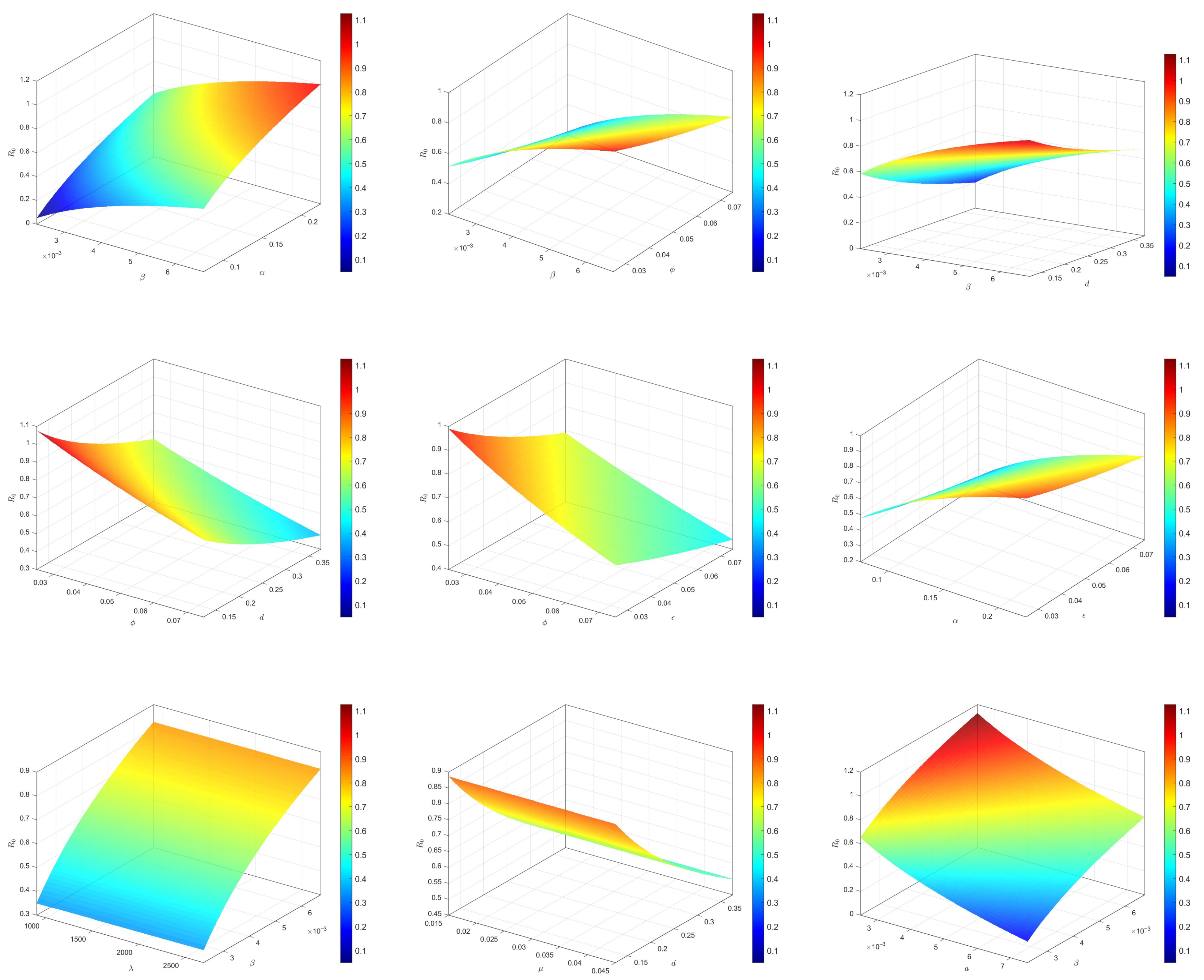
Figure 1 presents a graphical representation of these sensitivity indices, highlighting the relative importance of each parameter.
Remark 8.
The sensitivity indices reveal that R 0 is most sensitive to the transmission rate β and spore release rate α (both with index + 1 ), indicating that interventions targeting these parameters would be most effective in controlling anthrax transmission. In contrast, R 0 is inversely related to environmental purification rate ϕ, carcass decomposition rate d, spore death rate ε, and saturation coefficient a, suggesting that enhancing these processes can suppress disease spread.

6.2. Numerical Simulations

To validate the theoretical findings, we perform numerical simulations using the predictor-corrector method for fractional differential equations with distributed delays [44]. The parameter values, based on epidemiological data from [6,48], are listed in Table 2.

6.2.1. Numerical Scheme

The Adams-Bashforth-Moulton (ABM) predictor-corrector method is employed to solve the fractional-order system, implemented via the MATLAB R2023a routine fde12 [49]. This scheme extends the classical Adams multi-step method to Caputo fractional initial value problems, with a convergence order of min ( 2 , 1 + γ ) . The distributed delay integral is eliminated using the linear chain trick: for the exponential kernel g i ( τ ) = θ 1 e τ / θ , auxiliary variables u ( t ) and v ( t ) are introduced to satisfy
D t γ 0 C u = θ 1 β P S 1 + a S + b P u , D t γ 0 C v = θ 1 ( C v ) ,
transforming the original three-dimensional delayed system into an equivalent five-dimensional system without explicit delays, which can be directly solved by fde12.

6.2.2. Influence of Fractional Order γ

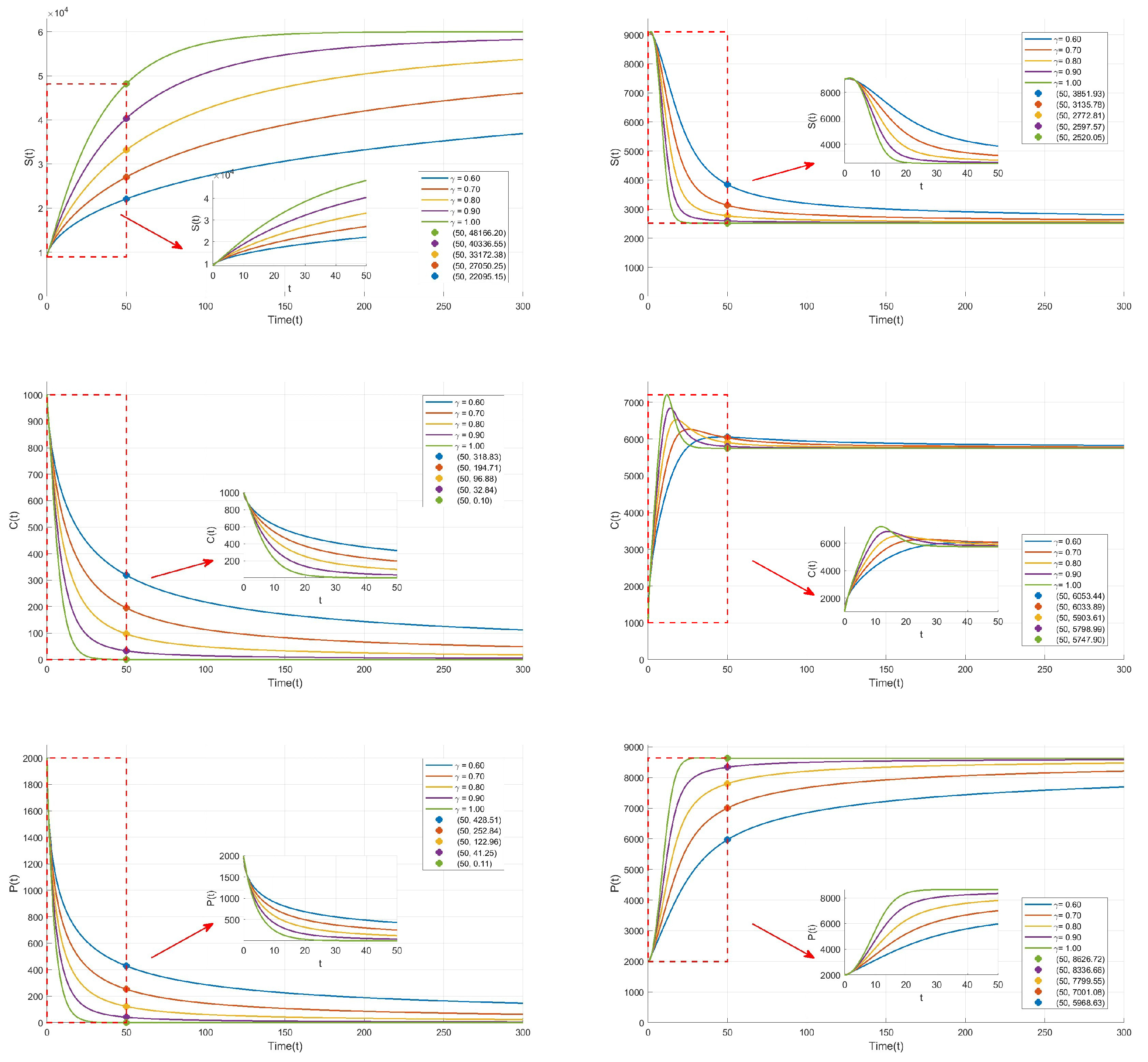
For Set 1, we obtain R 0 = 4.402 > 1 ; for Set 2, R 0 = 0.145 < 1 . The initial conditions are S ( 0 ) = 9000 , C ( 0 ) = 1000 , P ( 0 ) = 2000 .
Figure 2 illustrates the temporal evolution of S ( t ) , C ( t ) , and P ( t ) for different fractional orders γ = 0.6 , 0.7 , 0.8 , 0.9 , 1.0 when R 0 < 1 (left panel) and R 0 > 1 (right panel).
Results from Figure 2 show that when R 0 < 1 , the number of susceptible animals S ( t ) increases and tends to stabilize, while the number of anthrax-killed carcasses C ( t ) and the number of free anthrax spores in the environment P ( t ) decrease monotonically to zero; ultimately, all solutions of the system converge to the disease-free equilibrium E 0 = ( 60,000 , 0 , 0 ) . In contrast, when R 0 > 1 , S ( t ) decreases gradually and stabilizes, whereas C ( t ) and P ( t ) rise rapidly, indicating that disease transmission is not effectively controlled, and the system solutions eventually converge to the endemic equilibrium E = ( 2521 , 5748 , 8622 ) .
The fractional order γ exerts a consistent and significant influence on the convergence process of the system under both scenarios: a smaller value of γ (corresponding to a stronger memory effect) leads to a longer time for the system to converge to the corresponding equilibrium, while an increase in γ accelerates the system’s response speed.
Notably, the fractional order γ only modulates the convergence rate of the system through memory effects without altering the stability characteristics of each equilibrium, a finding that highlights the core value of fractional-order models in characterizing complex dynamic systems with memory and historical dependence properties.

6.2.3. Influence of Distributed Delay τ

To examine the impact of distributed delays, we consider gamma-distributed kernels
g i ( τ ) = τ k 1 e τ / θ i θ i k Γ ( k ) , i = 1 , 2 ,
with shape parameter k = 2 and scale parameters θ 1 , θ 2 chosen such that the mean delays are τ 1 = 0 τ g 1 ( τ ) d τ and τ 2 = 0 τ g 2 ( τ ) d τ . We set τ 1 = τ 2 = τ for simplicity.
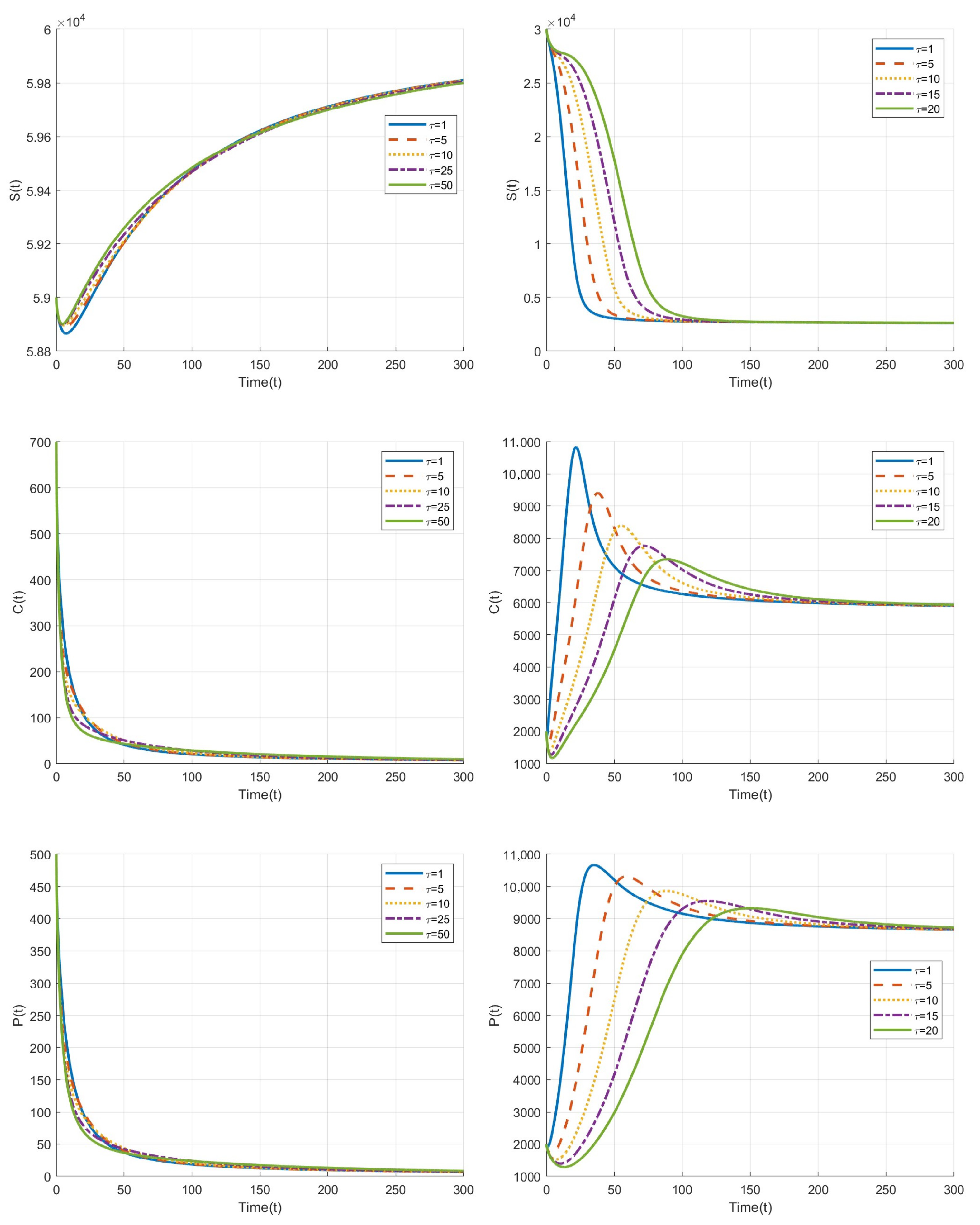
In Figure 3, the initial conditions for the left subplot are set as S ( 0 ) = 59,000, C ( 0 ) = 700, and P ( 0 ) = 500; those for the right subplot are S ( 0 ) = 30,000, C ( 0 ) = 2000, and P ( 0 ) = 2000. Based on the parameter data listed in Table 2, calculations show that the basic reproduction number for the left subplot of Figure 3 is R 0 = 0.148 < 1 , with the disease-free equilibrium of the system being E 0 = ( 60,000 , 0 , 0 ) under this condition. For the right subplot, the basic reproduction number is R 0 = 4.47 > 1 , and the corresponding endemic equilibrium is E = ( 2521 , 5748 , 8622 ) .
System dynamics for distinct delays with γ = 0.8 are illustrated in Figure 3, where larger delays marginally extend the convergence to the disease-free equilibrium E 0 for R 0 < 1 without inducing oscillatory behavior; for R 0 > 1 , larger delays may lead to damped oscillations prior to the system settling at the endemic equilibrium E , with the system displaying initial sustained oscillations for τ = 20 before ultimately converging to E , and notably, distributed delays introduce extra temporal heterogeneity that mirrors the biological realities inherent to spore release and infection processes.

6.2.4. Comparative Analysis: Fractional-Order vs. Integer-Order Models

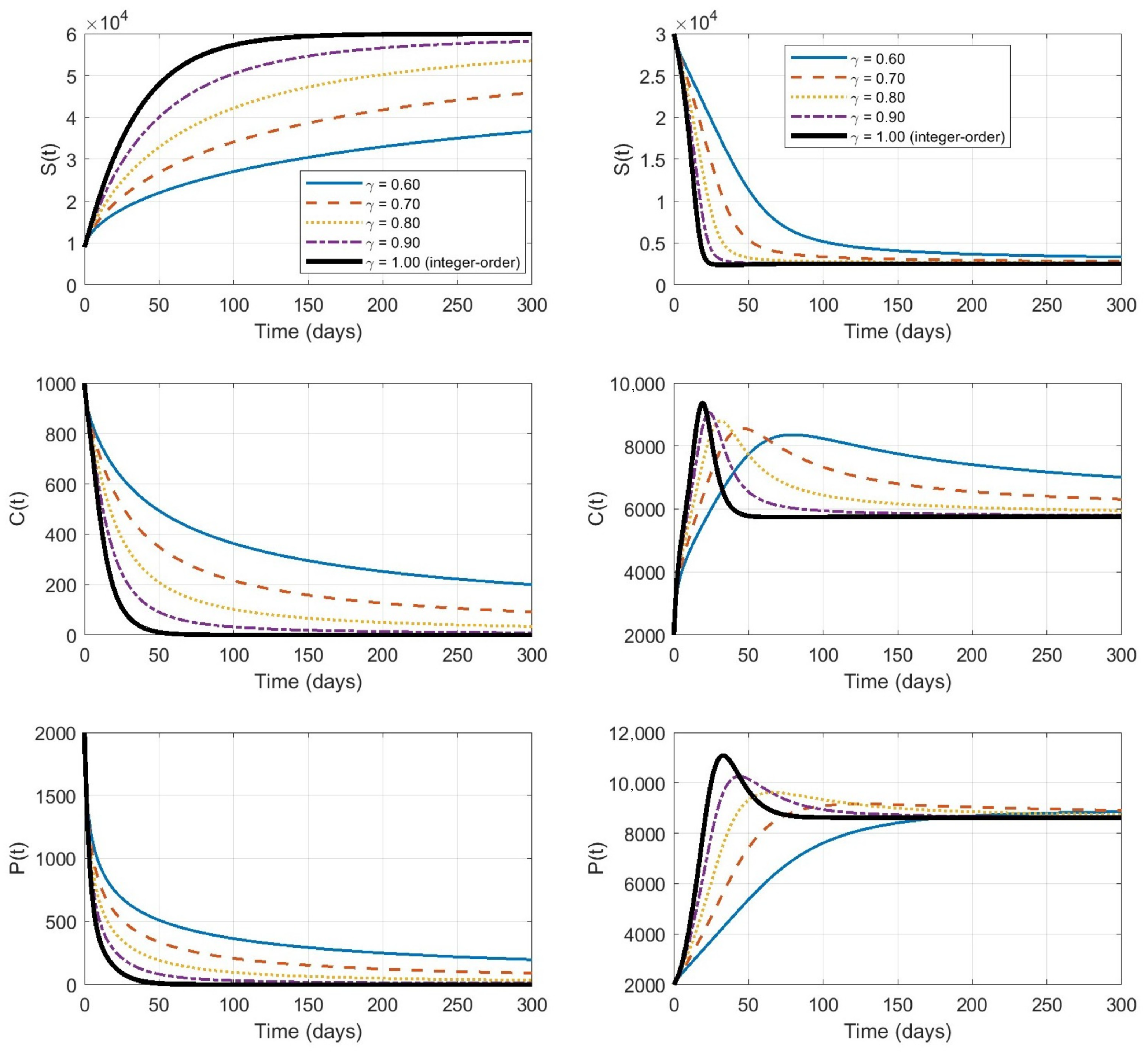
To quantify the impact of fractional-order dynamics, we compare model solutions for γ { 0.6 , 0.7 , 0.8 , 0.9 , 1.0 } under identical initial conditions and parameter values, with the integer-order case γ = 1.0 serving as the classical benchmark. Figure 4 presents the temporal evolution curves of S ( t ) , C ( t ) , and P ( t ) for both R 0 < 1 and R 0 > 1 scenarios, leading to the following observations:
First, regardless of the value of γ , all trajectories converge to the theoretically predicted equilibrium points, with E 0 for R 0 < 1 and E for R 0 > 1 . This validates the global stability conclusions of Theorems 6 and 7.
Second, the convergence rate decreases monotonically with γ : smaller values of γ result in slower convergence of fractional-order solutions to the equilibrium points, reflecting the enhanced memory effect inherent in the Caputo derivative. From a biological perspective, this corresponds to the long-term persistence of anthrax spores in the environment, which sustains infection pressure over an extended period.
Third, for small values of γ , the transient peak of C ( t ) is attenuated and broadened, indicating that fractional-order models may be better suited to characterize the persistent, low-intensity outbreak features observed in endemic regions.
Table 3 reports the L 2 relative deviation y γ y 1 L 2 / y 1 L 2 for each compartment, providing a quantitative measure of the differences between fractional-order and integer-order dynamics.

6.2.5. Validation of Threshold Behavior

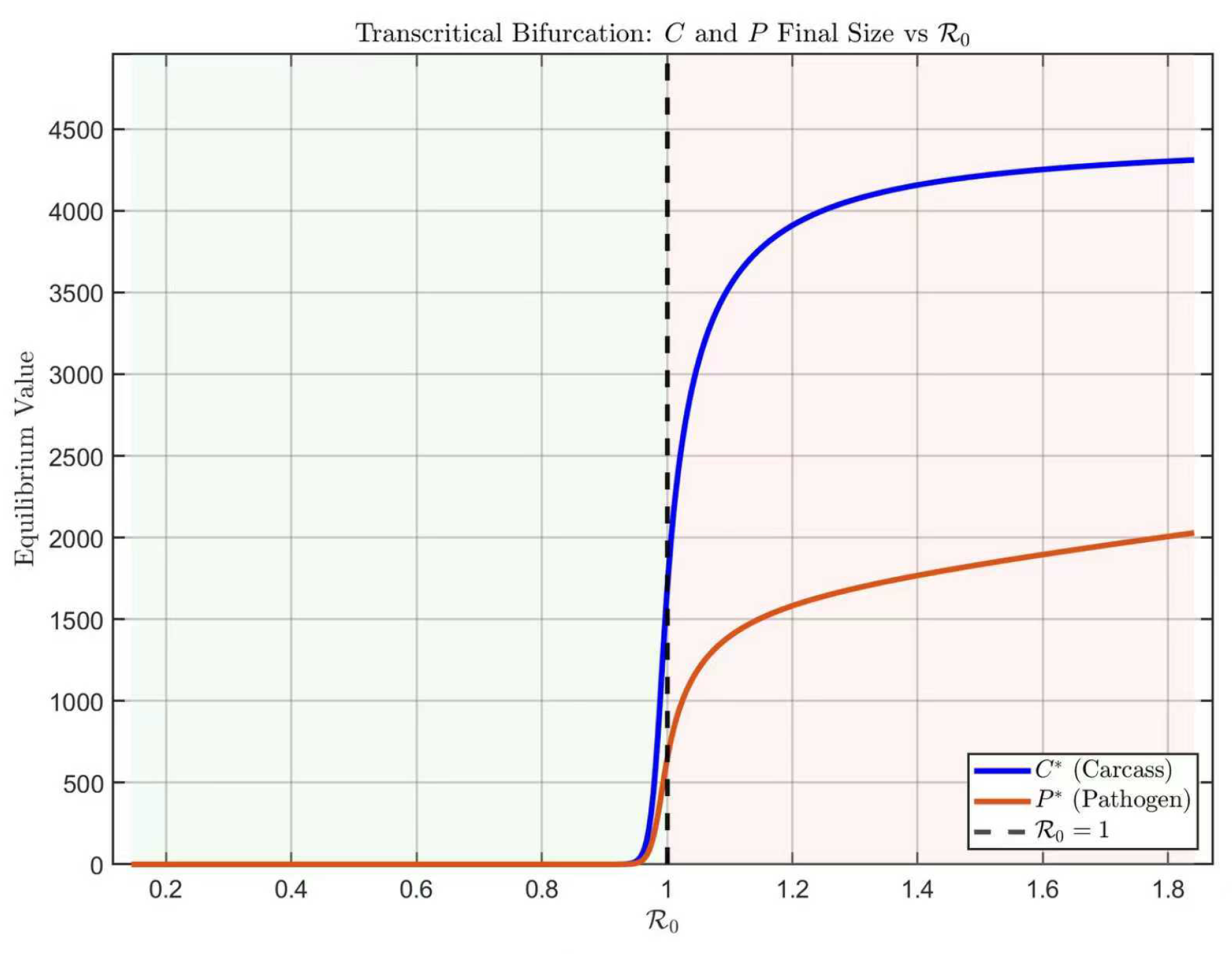
To validate the threshold behavior governed by R 0 , all other parameters in Parameter Set 2 were fixed, while only the transmission coefficient β was set to range from 0.001 to 0.008, and the mortality rate of free spores in the environment ε was set to range from 0.12 to 0.02.
Figure 5 depicts the final sizes of the infected compartments C ( t ) and P ( t ) at t = 200 days as functions of R 0 . As observed in Figure 3, the system exhibits a distinct transcritical bifurcation at R 0 = 1 : below this threshold, both C and P approach zero; above this threshold, they reach positive endemic levels.
The numerical simulations fully support the theoretical analysis presented in Section 4 and Section 5, confirming that R 0 serves as a sharp threshold and that both equilibria are globally attractive in their respective parameter regimes.
Figure 2 and Figure 3 demonstrate the differential roles of the fractional order γ ( 0 , 1 ] and delay parameter τ > 0 in modulating system trajectories. Global stability analysis yields a clear threshold characteristic: the disease-free equilibrium E 0 = ( λ / μ , 0 , 0 ) is globally asymptotically stable if and only if R 0 < 1 , whereas the unique endemic equilibrium E attracts all positive solutions when R 0 > 1 . Numerical experiments validate these theoretical predictions, with excellent quantitative consistency between theoretical results and simulation outcomes.
By incorporating Caputo fractional derivatives and distributed delays, the proposed model is capable of capturing both anomalous diffusion phenomena at the individual level and temporal nonlocality characteristics at the population level. Numerical simulations reveal two key dynamical features: (i) larger values of γ accelerate the system’s convergence to the equilibrium by reducing the effective memory horizon; (ii) increasing the mean delay τ disperses infectious pressure over extended time intervals, thereby attenuating disease transmission. These mechanistic findings provide actionable guidance for designing optimal control strategies targeting anthrax outbreaks.

6.3. Model Validation with Real Anthrax Outbreak Data

To validate the practical applicability of the fractional-order model and determine the optimal fractional order γ , we calibrate system (1) against real anthrax outbreak data from two endemic regions.

6.3.1. Data Sources

We utilize two independent datasets:
  • Zimbabwe data (2018–2021): Monthly reported anthrax cases in livestock from Makoni District [8], with cumulative infected animals C obs ( t i ) , i = 1 , , 42 months.
  • Bangladesh data (2009–2010): Weekly surveillance data [9] covering 78 weeks of outbreak progression.

6.3.2. Parameter Estimation and Optimal Fractional Order

We employ a hybrid optimization framework combining least squares minimization with Markov Chain Monte Carlo (MCMC) sampling. The objective function is
L ( θ , γ ) = i = 1 n C obs ( t i ) C model ( t i ; θ , γ ) 2 ,
where θ = ( β , α , ϕ , d , ε ) are epidemiological parameters and γ ( 0 , 1 ] is the fractional order. The optimization proceeds in two stages:
  • Grid search: For γ { 0.70 , 0.75 , 0.80 , 0.85 , 0.90 , 0.95 , 1.00 } , we minimize L over θ using the Nelder-Mead algorithm.
  • MCMC refinement: Around the optimal γ from stage 1, we run 50,000 MCMC iterations with Metropolis–Hastings sampling to quantify uncertainty.
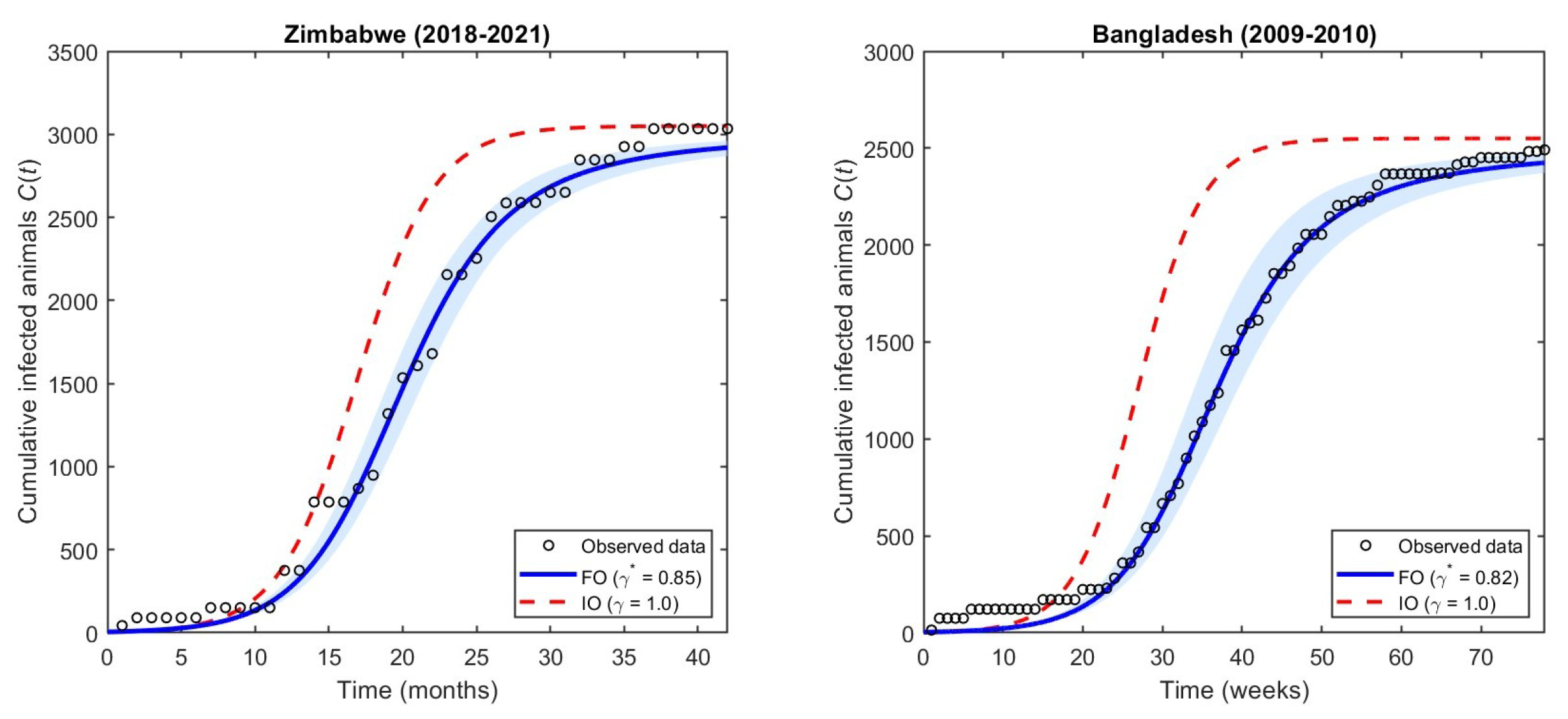
The calibration results are presented in Table 4 and Figure 6. For Zimbabwe data, the optimal fractional order is γ = 0.85 (95% CI: [0.82, 0.88]) with coefficient of determination R 2 = 0.92 and RMSE = 127 cases. For Bangladesh data, γ = 0.82 (95% CI: [0.79, 0.86]), R 2 = 0.89 , RMSE = 83 cases. The integer-order model ( γ = 1 ) yields significantly lower goodness-of-fit ( R 2 = 0.76 and 0.71 , respectively), confirming the necessity of fractional-order dynamics.
Figure 6 demonstrates strong agreement between model predictions and observed data. The fractional-order model (solid curves) captures both the initial exponential growth phase and the subsequent plateau more accurately than the integer-order model (dashed curves), which systematically overestimates peak infection levels and convergence speed. The estimated γ 0.84 across both datasets suggests a universal memory effect in anthrax transmission dynamics, reflecting the prolonged environmental persistence of spores and delayed host immune responses.

7. Discussion and Conclusions

This paper develops and analyzes a fractional-order anthrax transmission model that incorporates distributed delays and Beddington–DeAngelis incidence. The proposed framework captures memory effects inherent in disease progression, temporal heterogeneities arising from pathogen release dynamics, and saturation phenomena governing host–pathogen interactions.
Through rigorous mathematical analysis, we establish several key results. First, regarding well-posedness, Theorem 1 guarantees the existence, uniqueness, and boundedness of solutions within a biologically feasible region Γ . Second, concerning threshold dynamics, the basic reproduction number R 0 derived in Theorem 2 serves as a sharp threshold that determines disease persistence or extinction: when R 0 1 , the disease-free equilibrium E 0 is globally asymptotically stable as demonstrated in Theorems 4 and 6, whereas when R 0 > 1 , a unique endemic equilibrium E emerges and exhibits global stability according to Theorems 5 and 7. Third, the fractional derivative order γ modulates convergence rates to equilibria through memory effects without altering the underlying stability properties, with smaller values of γ corresponding to stronger memory and prolonged transient dynamics. Fourth, distributed delays introduce additional temporal heterogeneity and may induce oscillatory behavior, particularly in the regime R 0 > 1 , though they do not affect long-term stability outcomes. Finally, sensitivity analysis reveals that the transmission rate β and spore release rate α exert the strongest influence on R 0 , suggesting that interventions targeting these processes would yield the most effective disease control.

7.1. Public Health Implications

The model yields several insights pertinent to the design of anthrax intervention strategies. First, reducing the pathogen transmission rate β , achievable through animal vaccination programs, quarantine protocols, or enhanced sanitary measures, provides a direct mechanism to reduce the basic reproduction number R 0 below the critical threshold of unity. Concurrently, accelerating environmental decontamination (i.e., increasing ϕ ) and promoting natural spore decay (increasing ε ) can substantially curtail both the persistence and transmission potential of Bacillus anthracis in the environment. Moreover, prompt removal and safe disposal of infected carcasses, effectively increasing the removal rate d, directly diminishes the environmental spore load, thereby interrupting a key transmission pathway. Finally, the saturation coefficient a, which captures behavioral adaptations or density-dependent transmission effects, represents an additional leverage point for control; modulating this parameter through targeted education and adaptive management practices can further attenuate outbreak dynamics.

7.2. Future Work

While the proposed model advances the mathematical modeling of anthrax transmission, several key extensions warrant further investigation. First, integrating spatial diffusion terms would enable analysis of geographic spread and the impact of landscape fragmentation on transmission dynamics. Second, incorporating time-dependent parameters could capture seasonal variations driven by periodic fluctuations in environmental conditions and animal movements. Third, introducing stochastic fractional differential equations would account for environmental stochasticity and demographic noise. Fourth, applying optimal control theory to design time-dependent intervention strategies (vaccination, decontamination, carcass removal) could identify cost-effective policies. Meanwhile, whether the monotone dependence of equilibria on incidence parameters persists under alternative transmission forms (e.g., Crowley–Martin) or non-power-law memory kernels (e.g., Atangana–Baleanu, Caputo–Fabrizio) remains an open question for future investigation. Finally, extending the model to include multiple host species with varying susceptibilities would better reflect the complexity of natural ecosystems.
In conclusion, this study presents a comprehensive mathematical framework for anthrax transmission that integrates memory effects, time delays, and nonlinear incidence. The theoretical and numerical analyses provide a solid foundation for understanding disease dynamics and designing targeted intervention strategies. The fractional-order approach offers greater flexibility in modeling complex biological processes with memory and hereditary properties, making it a valuable tool for epidemiological research.

Author Contributions

S.-H.X. as Supervision, Funding acquisition, Conceptualization L.-J.D. as Formal analysis, Validation, Visualization. All authors have read and agreed to the published version of the manuscript.

Funding

The first author is partially supported by Ningxia Key Research and Development Plan Project (Grants nos. 2024BEH04077), the Doctor Start-up Funding of North Minzu University (Grants nos. 2022QNPY16), Ningxia Natural Science Foundation Project (Grants nos. 2023AAC03256), and National Natural Science Foundation of China (Grants nos. 11661051). The co-first author is partially supported by North Minzu University Graduate Innovation Project (Grants nos. CYX25108).

Data Availability Statement

Data sharing not applicable to this article as no datasets were generated or analyzed during the current study.

Acknowledgments

The authors thank all reviewers for their careful reading of the manuscript and insightful suggestions.

Conflicts of Interest

The authors declare no competing interests.

References

  1. World Health Organization. Anthrax in Humans and Animals; World Health Organization: Geneva, Switzerland, 2008. [Google Scholar]
  2. Beyer, W.; Turnbull, P.C.B. Anthrax in animals. Mol. Aspects Med. 2009, 30, 481–489. [Google Scholar]
  3. Barandongo, Z.R.; Mfune, J.K.E.; Turner, W.C. Dust-bathing behaviors of African herbivores and the potential risk of inhalational anthrax. J. Wildl. Dis. 2018, 54, 34–44. [Google Scholar] [CrossRef] [PubMed]
  4. Wang, J.S.; Zhao, H. Analysis of a degenerate reaction-diffusion anthrax model with spatial heterogeneity. Nonlinear Anal. Real World Appl. 2024, 77, 104072. [Google Scholar] [CrossRef]
  5. Zhao, B.; Zhang, Q. Impulsive control strategies for practical exponential stability and disease extinction in stochastic delayed anthrax models. Math. Methods Appl. Sci. 2025, 1–21. [Google Scholar] [CrossRef]
  6. Saad-Roy, C.M.; den Driessche, P.V.; Yakubu, A.A. A mathematical model of anthrax transmission in animal populations. Bull. Math. Biol. 2017, 79, 303–324. [Google Scholar] [CrossRef]
  7. Triska, A.; Zevika, M. A study of the anthrax transmission model in herbivorous animals involving vaccination and harvesting. Partial Differ. Equ. Appl. Math. 2025, 13, 101095. [Google Scholar] [CrossRef]
  8. Makurumidze, R.; Gombe, N.T.; Magure, T.; Tshimanga, M. Investigation of an anthrax outbreak in Makoni District, Zimbabwe. BMC Public Health 2021, 21, 298. [Google Scholar] [CrossRef]
  9. Chakraborty, A.; Khan, S.U.; Hasnat, M.A.; Parveen, S.; Islam, M.S.; Mikolon, A.; Chakraborty, R.K.; Ahmed, B.N.; Ara, K.; Haider, N.; et al. Anthrax outbreaks in Bangladesh, 2009–2010. Am. J. Trop. Med. Hyg. 2012, 86, 703–710. [Google Scholar] [CrossRef]
  10. Shadomy, S.; ElIdrissi, A.; Raizman, E.; Pittiglio, C.; Bruni, M.; Lubroth, J. Anthrax Outbreaks: A Warning for Heightened Awareness; FAO Technical Report 37; FAO: Rome, Italy, 2016. [Google Scholar]
  11. Friedman, A.; Yakubu, A.A. Anthrax epizootic and migration: Persistence or extinction. Math. Biosci. 2013, 241, 137–144. [Google Scholar] [CrossRef]
  12. Hahn, B.D.; Furniss, P.R. A deterministic model of an anthrax epizootic: Threshold results. Ecol. Model. 1983, 20, 233–241. [Google Scholar] [CrossRef]
  13. Mushayabasa, S. Dynamics of an anthrax model with distributed delay. Acta Appl. Math. 2016, 144, 77–86. [Google Scholar] [CrossRef]
  14. Yuan, Z.; Zou, X. Global threshold dynamics in an HIV virus model with nonlinear infection rate and distributed invasion and production delays. Math. Biosci. Eng. 2013, 10, 483–498. [Google Scholar] [CrossRef] [PubMed]
  15. Capasso, V.; Serio, G. A generalization of the Kermack-McKendrick deterministic epidemic model. Math. Biosci. 1978, 42, 43–61. [Google Scholar] [CrossRef]
  16. Dimarco, G.; Perthame, B.; Toscani, G.; Zanella, M. Kinetic models for epidemic dynamics with social heterogeneity. J. Math. Biol. 2021, 83, 1–32. [Google Scholar] [CrossRef] [PubMed]
  17. Bondesan, A.; Menale, M.; Toscani, G.; Zanella, M. Lotka–Volterra-type kinetic equations for interacting species. Nonlinearity 2025, 38, 075026. [Google Scholar] [CrossRef]
  18. Diethelm, K.; Ford, N.J. Analysis of fractional differential equations. J. Math. Anal. Appl. 2002, 265, 229–248. [Google Scholar] [CrossRef]
  19. Shah, K.; Arfan, M.; Ullah, A.; Al-Mdallal, Q.; Ansari, K.J.; Abdeljawad, T. Computational study on the dynamics of fractional order differential equations with applications. Chaos Solitons Fractals 2022, 157, 111955. [Google Scholar] [CrossRef]
  20. Khalid, T.A. Stability analysis of fractional chaotic and fractional-order hyperchain systems using Lyapunov functions. Eur. J. Pure Appl. Math. 2025, 18, 5576. [Google Scholar] [CrossRef]
  21. Yassine, B.; Ali, E.M.; Brahim, E.B. Existence and stability analysis of fractional-order SVEIR epidemic models with generalized incidence. Bol. Soc. Paran. Mat. 2025, 43, 1–20. [Google Scholar] [CrossRef]
  22. Majee, S.; Kar, T.K.; Jana, S.; Das, D.K.; Nieto, J. Complex dynamics and fractional-order optimal control of an epidemic model with saturated treatment and incidence. Int. J. Bifurc. Chaos 2023, 33, 2350192. [Google Scholar] [CrossRef]
  23. Li, J.; Tan, X.; Wu, W.; Zou, X. A Caputo fractional derivative dynamic model of hepatitis E with optimal control based on particle swarm optimization. AIP Adv. 2024, 14, 045125. [Google Scholar] [CrossRef]
  24. Zhu, H.; Zou, X. Impact of delays in cell infection and virus production on HIV-1 dynamics. Math. Med. Biol. 2008, 25, 99–112. [Google Scholar] [CrossRef] [PubMed]
  25. Xu, S.; Hu, Y. Dynamic analysis of a Caputo fractional-order SEIR model with a general incidence rate. Sci. Rep. 2025, 15, 17561. [Google Scholar] [CrossRef]
  26. Turnbull, P.C.B. Introduction: Anthrax history, disease and ecology. In Current Topics in Microbiology and Immunology; Koehler, T.M., Ed.; Springer: Berlin/Heidelberg, Germany, 2002; Volume 271, pp. 1–19. [Google Scholar]
  27. Van Ness, M. Ecology of anthrax. Science 1971, 172, 1303–1307. [Google Scholar] [CrossRef] [PubMed]
  28. Metzler, R.; Klafter, J. The random walk’s guide to anomalous diffusion: A fractional dynamics approach. Phys. Rep. 2000, 339, 1–77. [Google Scholar] [CrossRef]
  29. Mainardi, F. Fractional Calculus and Waves in Linear Viscoelasticity; Imperial College Press: London, UK, 2010. [Google Scholar]
  30. Barandongo, Z.R.; Dolfi, A.C.; Bruce, S.A.; Rysava, K.; Huang, Y.-H.; Joel, H.; Hassim, A.; Kamath, P.L.; van Heerden, H.; Turner, W.C. The persistence of time: The lifespan of Bacillus anthracis spores in environmental reservoirs. Res. Microbiol. 2023, 174, 104029. [Google Scholar] [CrossRef]
  31. Diethelm, K. A fractional calculus based model for the simulation of an outbreak of dengue fever. Nonlinear Dynam. 2013, 71, 613–619. [Google Scholar] [CrossRef]
  32. Boukhouima, A.; Hattaf, K.; Lotfi, E.M.; Mahrouf, M.; Torres, D.F.M.; Yousfi, N. Lyapunov functions for fractional-order systems in biology: Methods and applications. Chaos Solitons Fractals 2020, 140, 110224. [Google Scholar] [CrossRef]
  33. Lakshmikantham, V.; Leela, S.; Devi, J.V. Theory of Fractional Dynamic Systems; Cambridge Scientific Publishers: Cambridge, UK, 2009. [Google Scholar]
  34. Liu, F.; Meerschaert, M.M.; Momani, S.; Leonenko, N.N.; Chen, W.; Agrawal, O.P. Fractional differential equations. Int. J. Differ. Equ. 2010, 2010, 553–563. [Google Scholar] [CrossRef]
  35. Wu, Z.; Cai, Y.; Wang, Z.; Wang, W. Global stability of a fractional order SIS epidemic model. J. Differ. Equ. 2023, 352, 221–248. [Google Scholar] [CrossRef]
  36. Janagaraj, R.; Jones, G.M.; Selvam, A.G.M. Discretization fractional-order SEIR worm propagation model in computer networks. TWMS J. Appl. Eng. Math. 2025, 15, 342–352. [Google Scholar]
  37. Nelson, P.W.; Perelson, A.S. A model of HIV-1 pathogenesis that includes an intracellular delay. Math. Biosci. 2000, 163, 201–215. [Google Scholar] [CrossRef] [PubMed]
  38. Nelson, P.W.; Perelson, A.S. Mathematical analysis of delay differential equation models of HIV-1 infection. Math. Biosci. 2002, 179, 73–94. [Google Scholar] [CrossRef]
  39. Badri, V.; Tavazoei, M.S. Stability analysis of fractional order time-delay systems: Constructing new Lyapunov functions from those of integer order counterparts. IET Control Theory Appl. 2019, 13, 2476–2481. [Google Scholar] [CrossRef]
  40. Aguila-Camacho, N.; Duarte-Mermoud, M.A.; Gallegos, J.A. Lyapunov functions for fractional order systems. Commun. Nonlinear Sci. Numer. Simul. 2014, 19, 2951–2957. [Google Scholar] [CrossRef]
  41. Hu, R.; Aziz, M.H.N.; Aruchunan, E.; Mohamed, N.A. Modeling and analysis of a delayed fractional order COVID-19 SEIHRM model with media coverage in Malaysia. Sci. Rep. 2025, 15, 25305. [Google Scholar] [CrossRef]
  42. Ahmed, E.; El-Sayed, A.M.A.; El-Saka, H.A. On some Routh-Hurwitz conditions for fractional order differential equations and their applications in Lorenz, Rössler, Chua and Chen systems. Phys. Lett. A 2006, 358, 1–4. [Google Scholar] [CrossRef]
  43. Gallegos, J.A.; Duarte-Mermoud, M.A. On the Lyapunov theory for fractional order systems. Appl. Math. Comput. 2016, 287, 161–170. [Google Scholar] [CrossRef]
  44. Diethelm, K. The Analysis of Fractional Differential Equations; Lecture Notes in Mathematics, 2004; Springer: Berlin, Germany, 2010. [Google Scholar]
  45. Odibat, Z.M.; Shawagfeh, N.T. Generalized Taylor’s formula. Appl. Math. Comput. 2007, 186, 286–293. [Google Scholar] [CrossRef]
  46. Van den Driessche, P. Reproduction numbers of infectious disease models. Infect. Dis. Model. 2017, 2, 288–303. [Google Scholar] [CrossRef]
  47. Xu, S.H.; Hu, Y.H. Brucellosis threshold dynamics: A time-fractional-order diffusion model with generalized incidence rate functions. Adv. Contin. Discret. Model. 2025, 175, 1–36. [Google Scholar] [CrossRef]
  48. Mushayabasa, S.; Marijani, T.; Masocha, M. Dynamical analysis and control strategies in modeling anthrax. Comput. Appl. Math. 2017, 36, 1333–1348. [Google Scholar] [CrossRef]
  49. Garrappa, R. Numerical solution of fractional differential equations: A survey and a software tutorial. Mathematics 2018, 6, 16. [Google Scholar] [CrossRef]
Figure 1. Influence of Sensitive Parameters.
Fractalfract 10 00175 g001
Figure 2. Time evolution of S ( t ) , C ( t ) , and P ( t ) for different fractional orders γ when R 0 < 1 (left) and R 0 > 1 (right).
Fractalfract 10 00175 g002
Figure 3. Effect of distributed delay τ on system dynamics with γ = 0.8 when R 0 < 1 (left) and R 0 > 1 (right).
Fractalfract 10 00175 g003
Figure 4. Comparative analysis—fractional order vs. integer order.
Fractalfract 10 00175 g004
Figure 5. Bifurcation diagram showing the final size of C and P versus R 0 . The vertical dashed line indicates R 0 = 1 .
Fractalfract 10 00175 g005
Figure 6. Model calibration against real anthrax outbreak data. Left: Zimbabwe (2018–2021); Right: Bangladesh (2009–2010). Circles: observed data; solid curves: fractional-order model ( γ ); dashed curves: integer-order model ( γ = 1 ). Shaded regions indicate 95% confidence intervals from MCMC sampling.
Fractalfract 10 00175 g006
Table 1. Model parameters and their meanings.
ParameterMeaningUnit
Λ Birth rateindividuals · day 1
β Transmission rate day 1
μ Natural mortality rate day 1
ϕ Environmental purification rate day 1
d Natural decomposition rate of carcasses day 1
α Spore release rate pathogen · carcass 1 · day 1
ε Decay rate of free spores in the environment day 1
τ Time delay variable day
Table 2. Parameter values for numerical simulations.
ParameterSet 1 ( R 0 > 1 )Set 2 ( R 0 < 1 )
Λ 18001800
μ 0.030.03
β 0.00450.001
α 0.150.08
ϕ 0.050.15
d0.250.25
ε 0.050.12
a0.0010.001
b0.0010.001
Table 3. L 2 -Relative deviation from integer-order solution.
γ δ S   ( % ) δ C   ( % ) δ P   ( % )
0.60103.2832.8925.71
0.7064.1724.0418.63
0.8036.8515.2712.51
0.9016.197.276.31
Table 4. Calibrated parameters and goodness-of-fit metrics for real outbreak data.
Dataset γ β α R 2 (FO) R 2 (IO)RMSE (FO)RMSE (IO)
Zimbabwe0.850.00380.160.920.76127220
Bangladesh0.820.00420.140.890.7183135
FO: fractional-order model; IO: integer-order model ( γ = 1 ).
Disclaimer/Publisher’s Note: The statements, opinions and data contained in all publications are solely those of the individual author(s) and contributor(s) and not of MDPI and/or the editor(s). MDPI and/or the editor(s) disclaim responsibility for any injury to people or property resulting from any ideas, methods, instructions or products referred to in the content.