
Creep Behavior and Fractional-Order Viscoelastic-Plastic Damage Model of Polyethylene Fiber-Modified High-Water Material


Abstract
1. Introduction
2. Time-Dependent Behavior of PE Fiber-Modified HWM
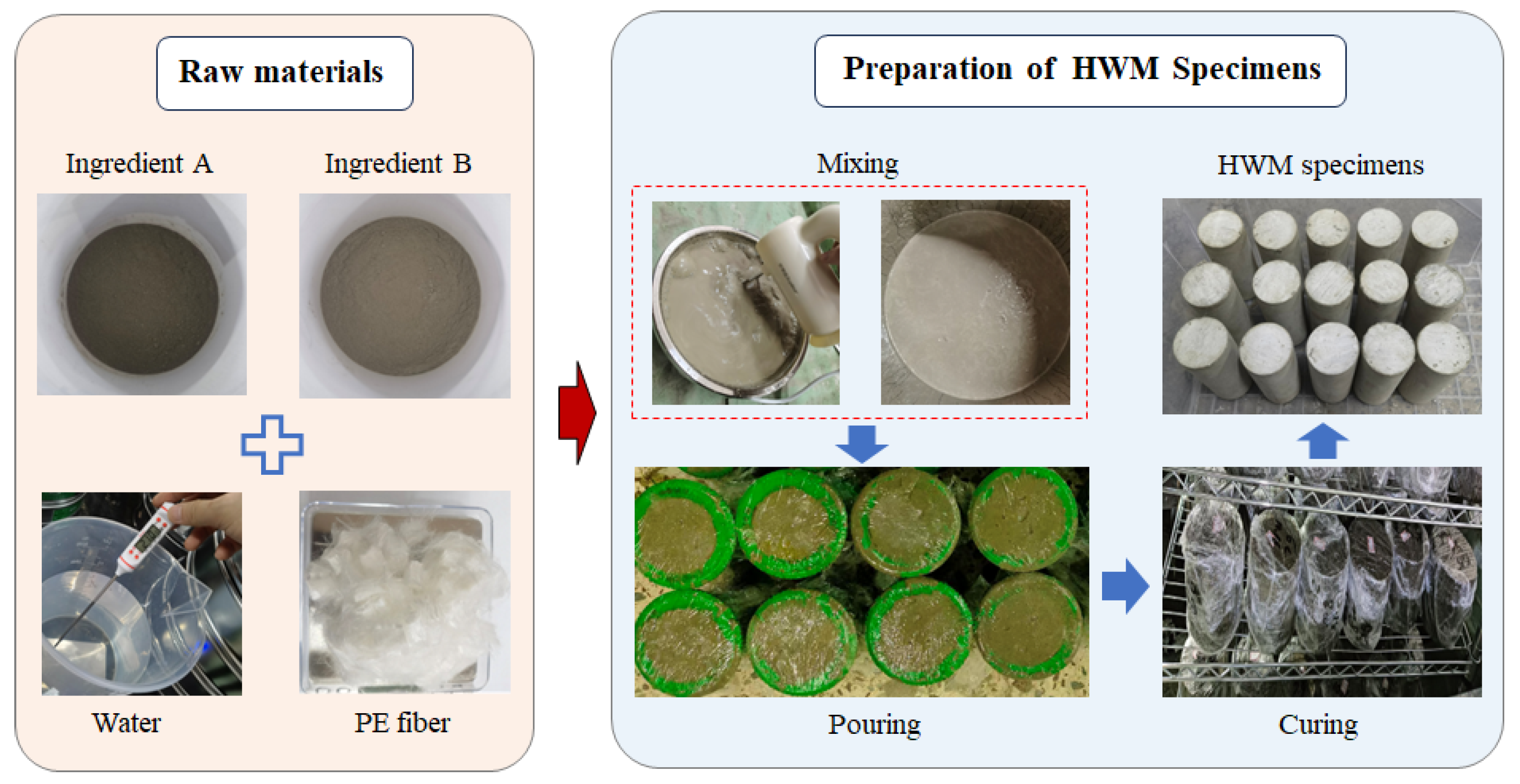
2.1. Raw Materials and Specimen Preparation
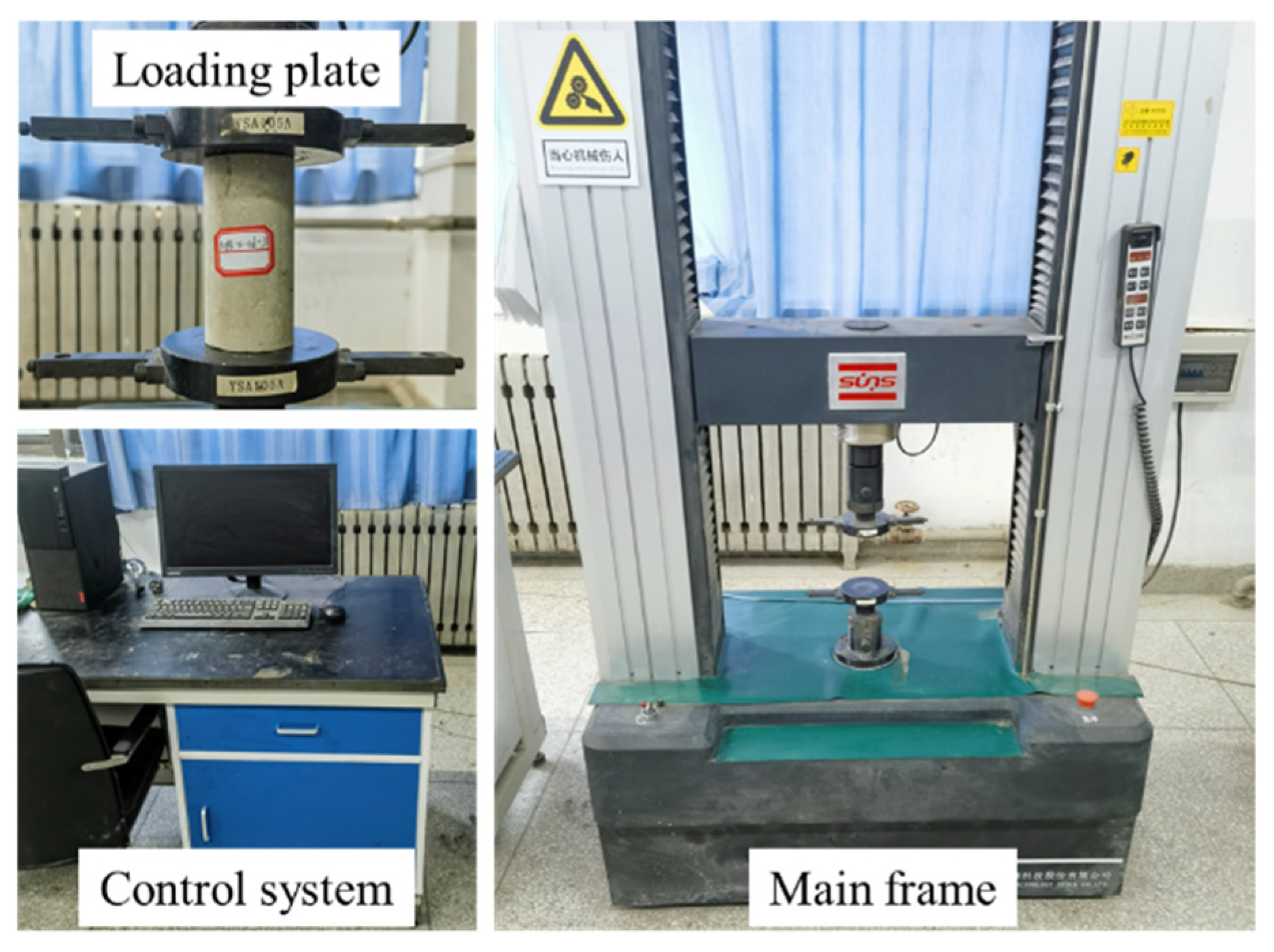
2.2. Test Scheme and Equipment
2.3. Result Analysis of Creep Test
2.3.1. Deformation Characteristics
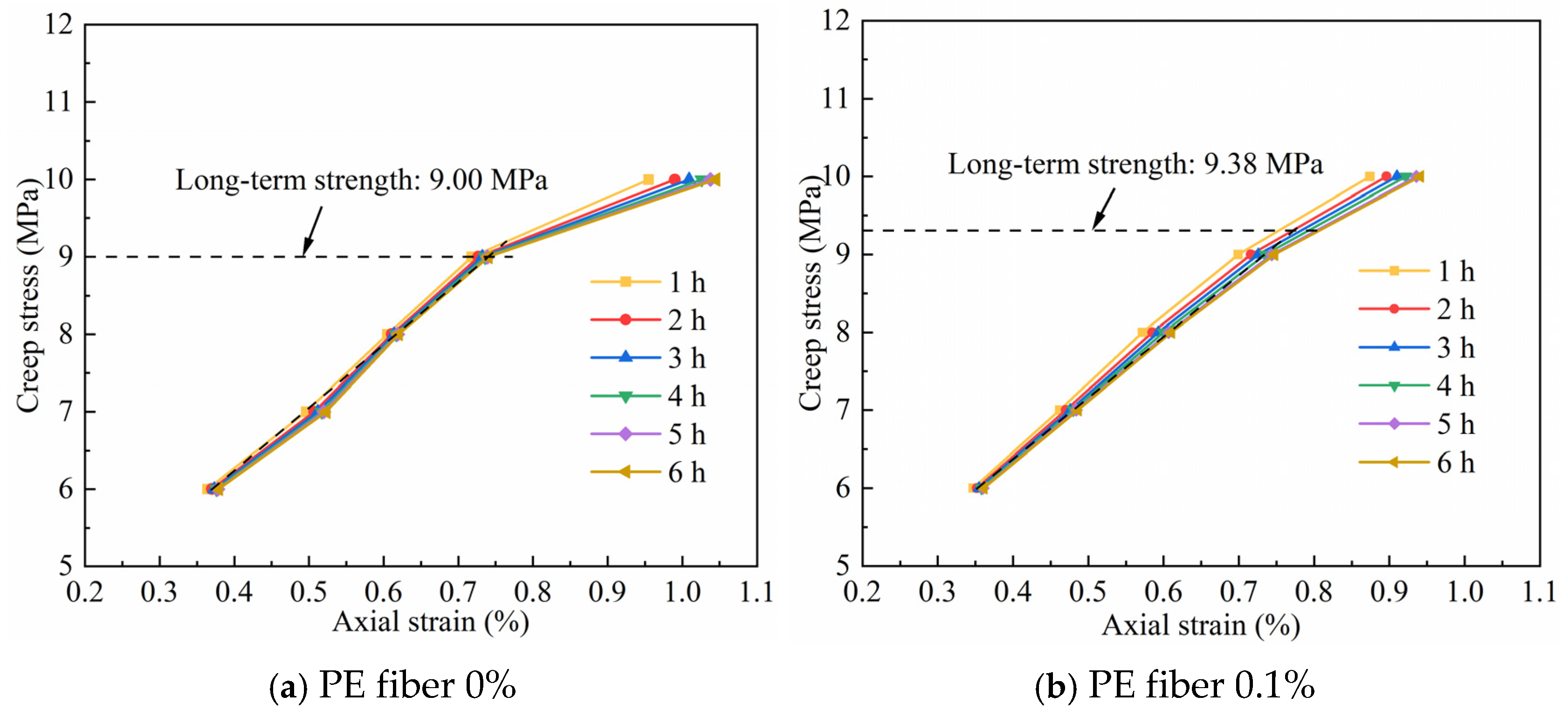
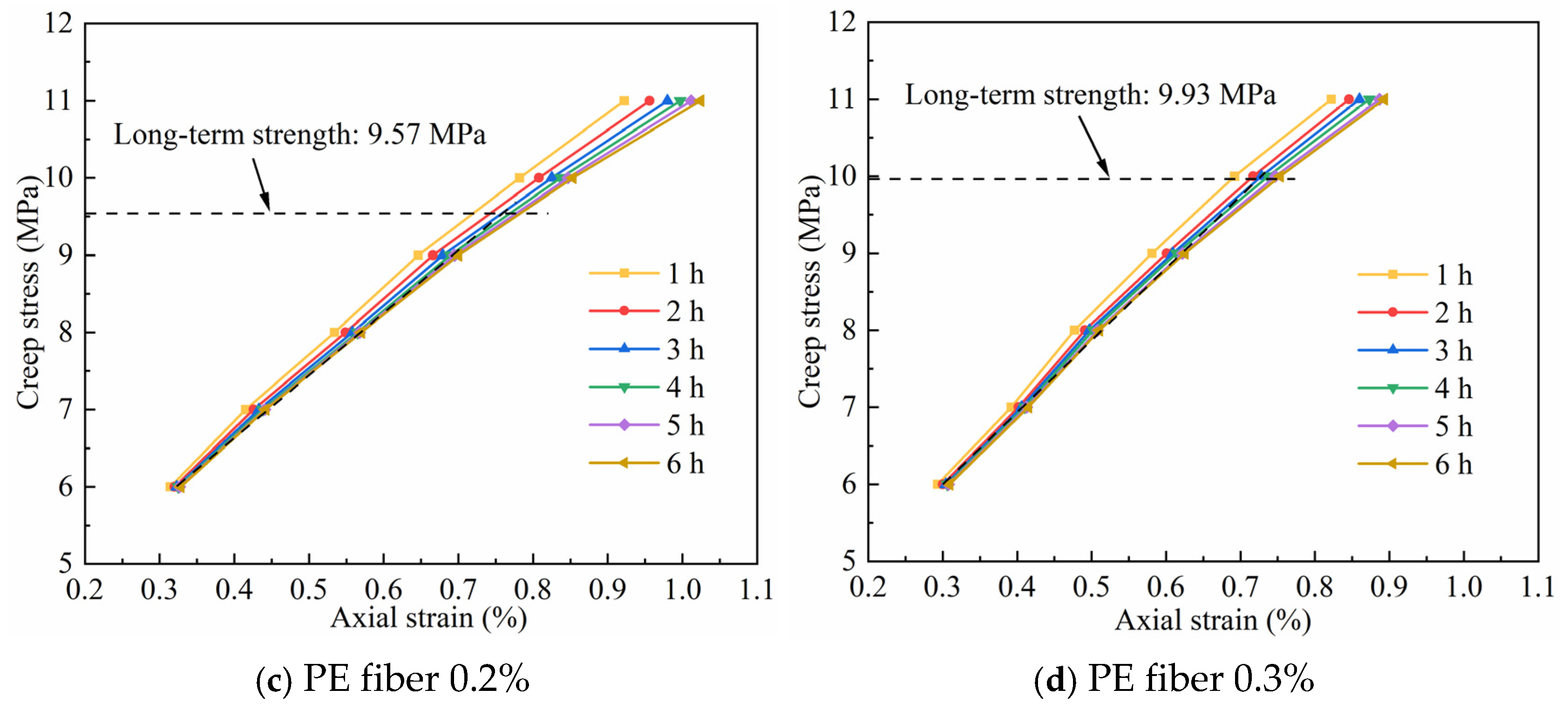
2.3.2. Long-Term Strength
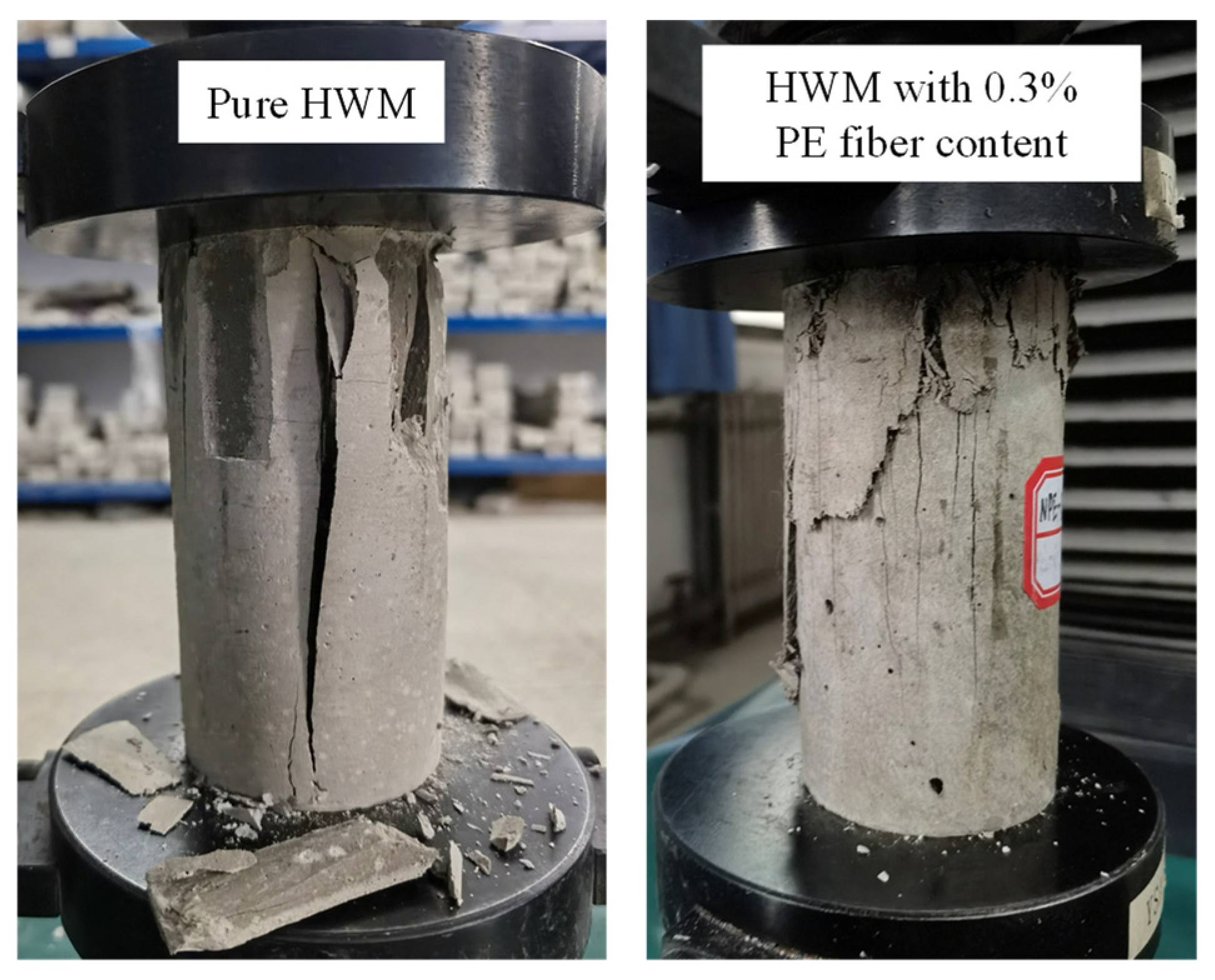
2.3.3. Creep Failure Time and Failure Mode
3. Fractional-Order Creep Model for PE Fiber-Reinforced HWM
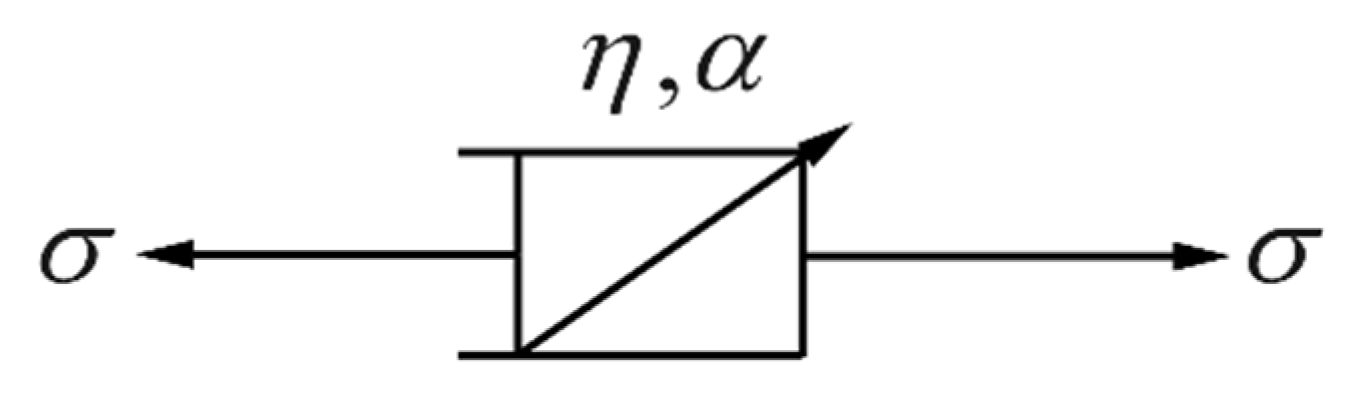
3.1. Fractional-Order Dashpot
3.2. Fractional Viscoplastic Component
3.3. Fractional Viscoplastic Component Considering PE Fiber Content
3.4. Fractional-Order Viscoelastic-Plastic Damage Model
4. Verification of the Creep Model and Parameter Sensitivity Analysis
4.1. Verification of the Creep Model
4.2. Parametric Analysis of the Proposed Model
5. Conclusions
- (1)
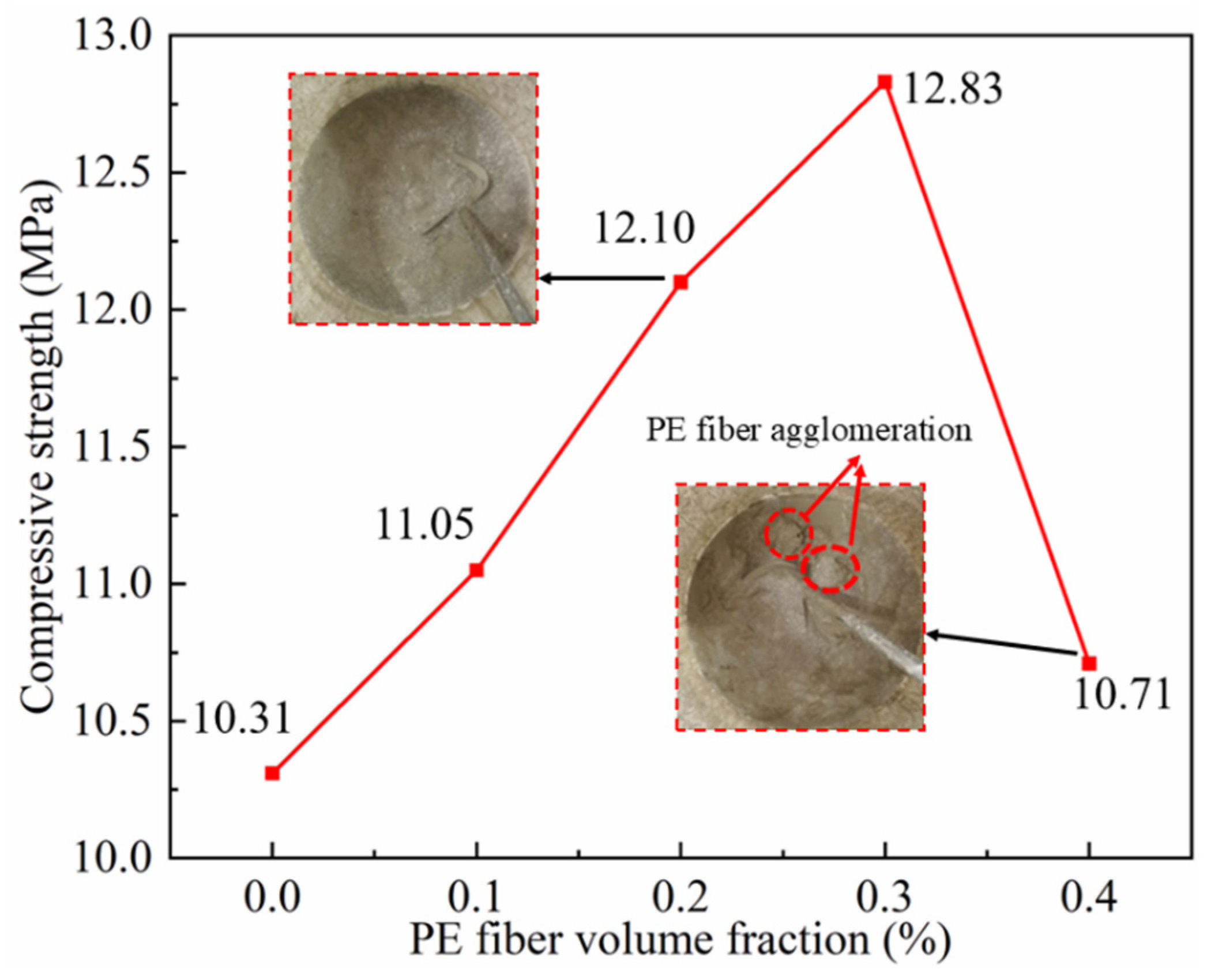
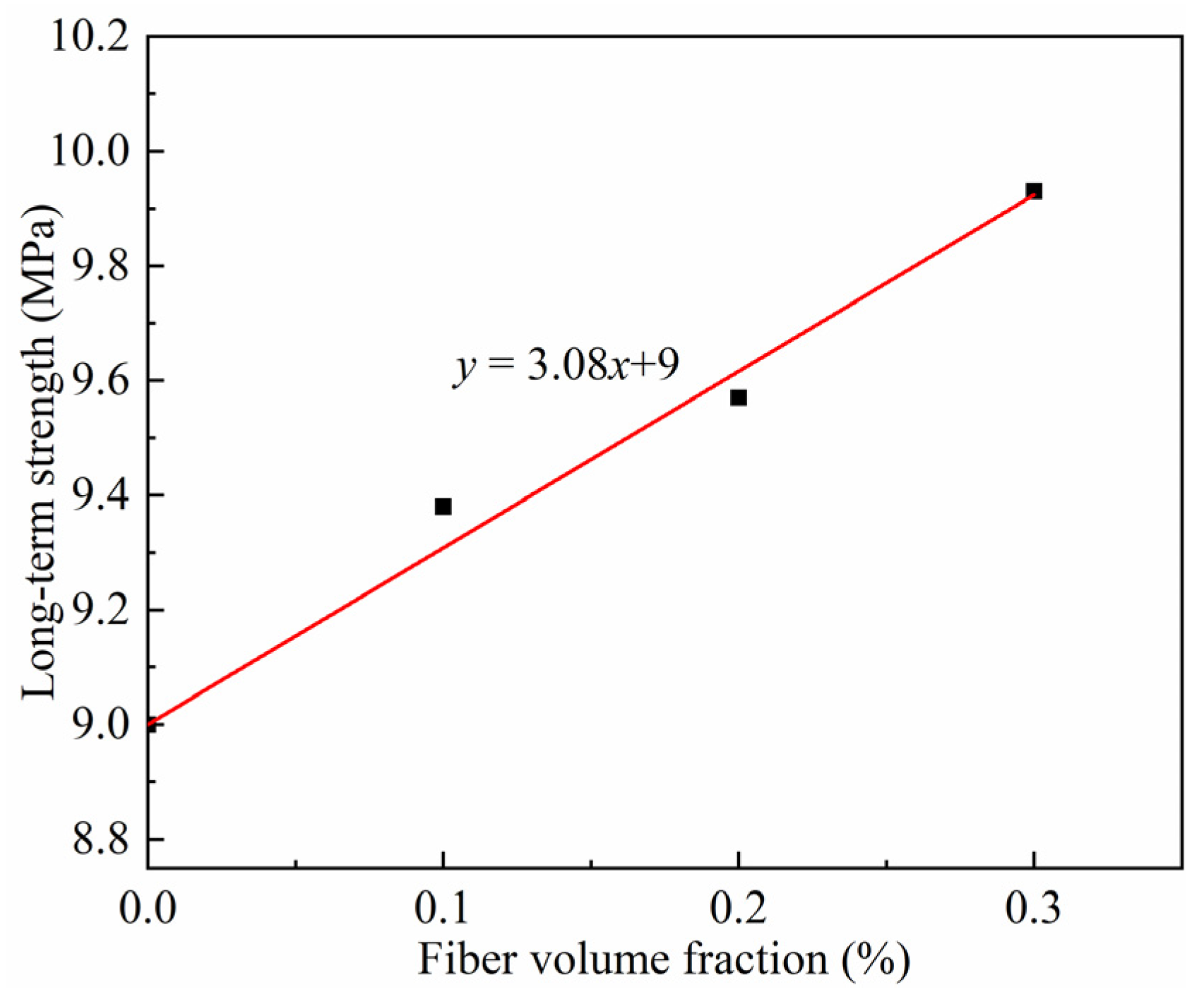
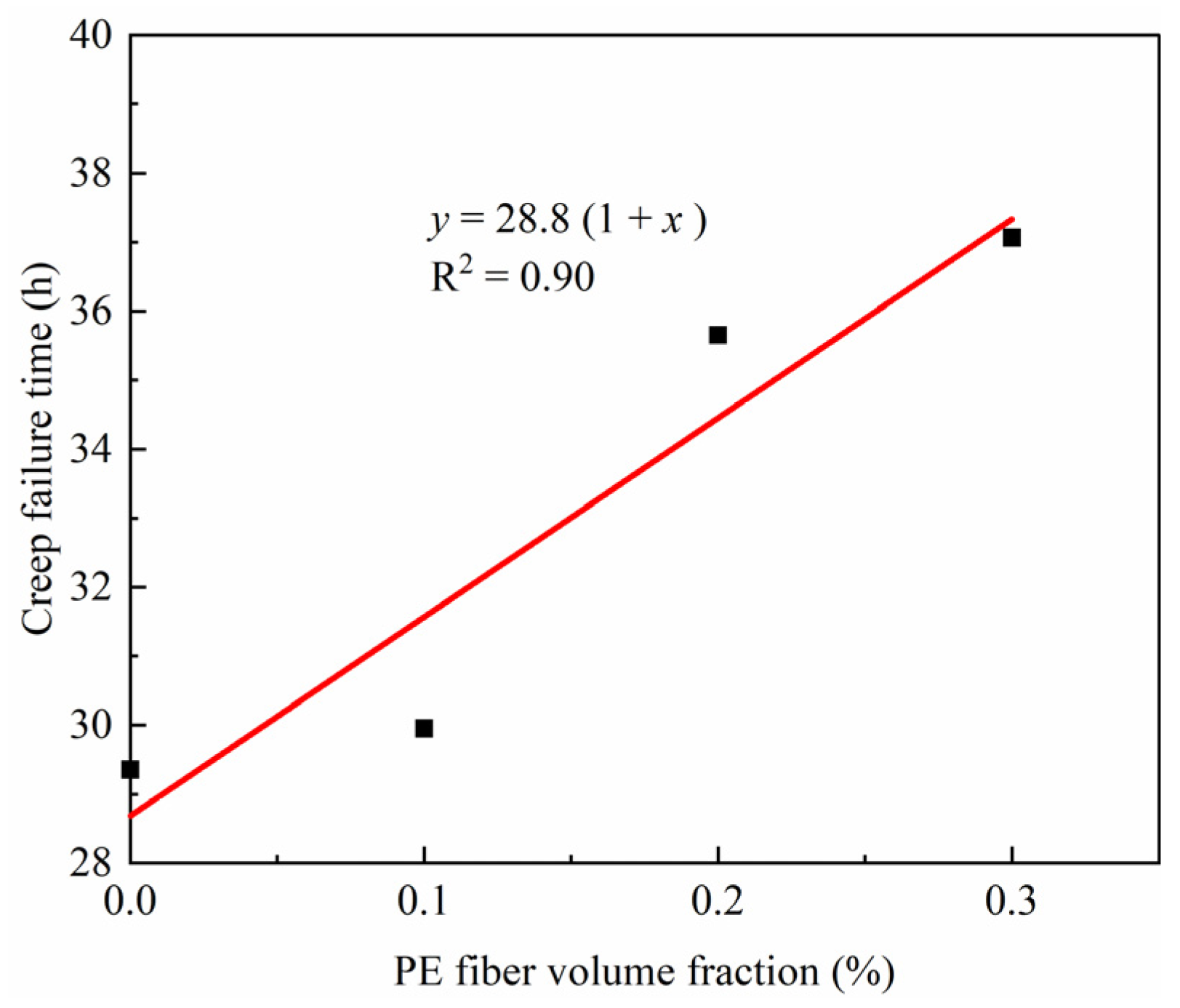
- The incorporation of PE fiber significantly improves the long-term mechanical performance of HWM. The uniaxial compressive strength and long-term strength of modified HWM first increase linearly and then decrease with increasing PE fiber content, with an optimal volume fraction of 0.3%. At this optimal content, the long-term strength reaches 9.93 MPa, which is 10.3% higher than that of pure HWM, and the creep failure time is extended by 26.2% compared to the unfilled group. Based on the test results, it is recommended to use HWM reinforced with 0.3% volumetric PE fiber for backfilling roads in deep mines to ensure superior creep stability.
- (2)
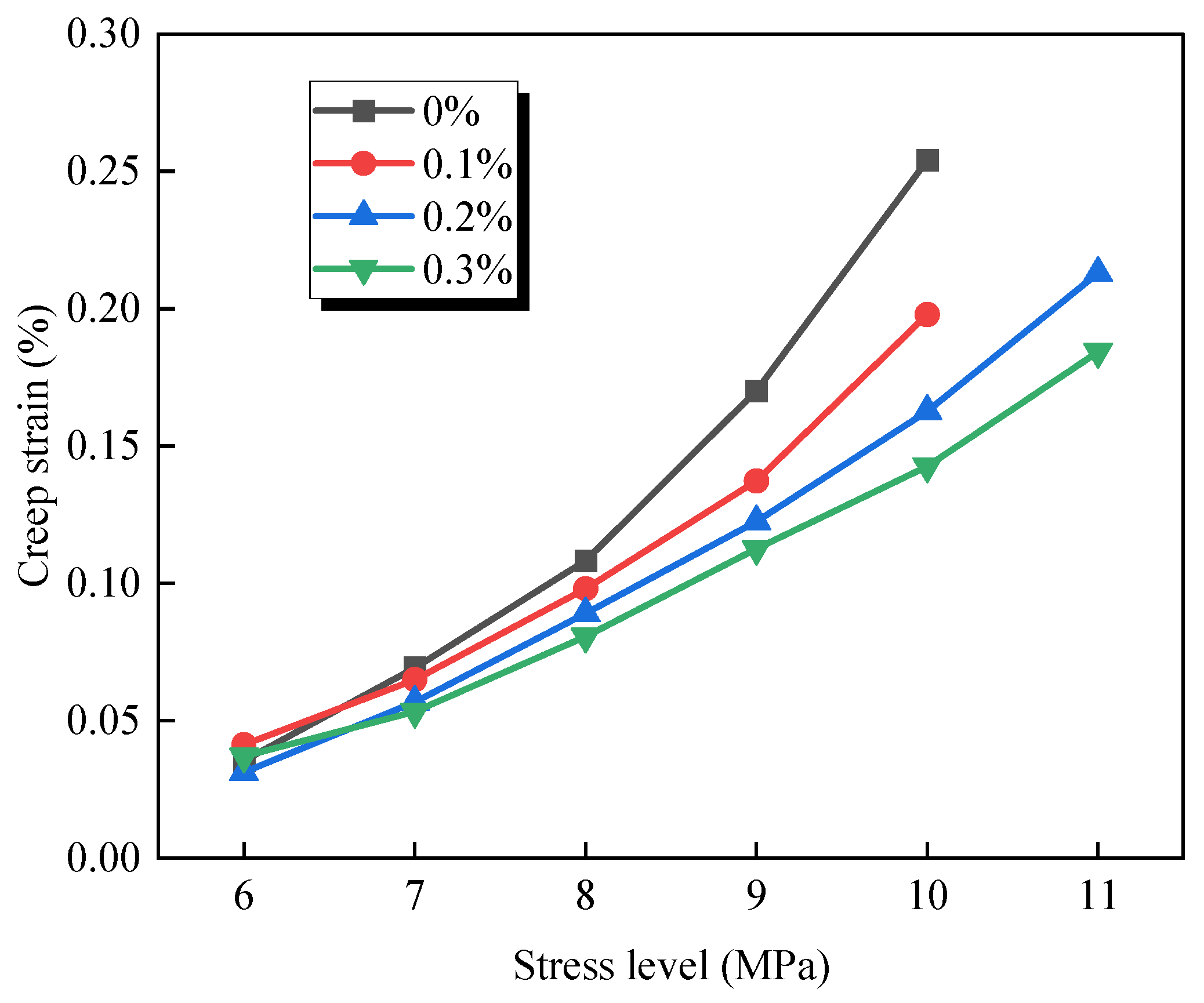
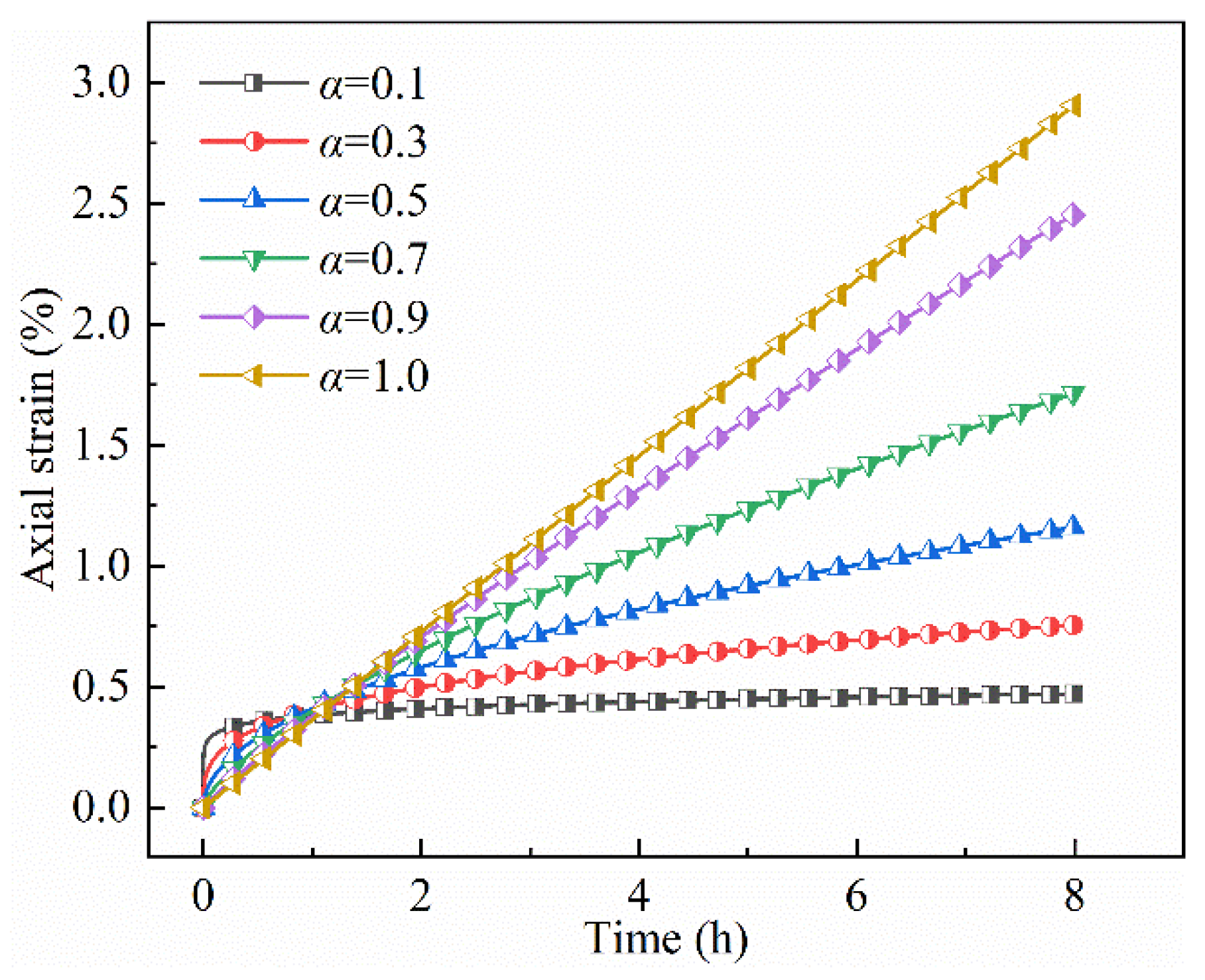
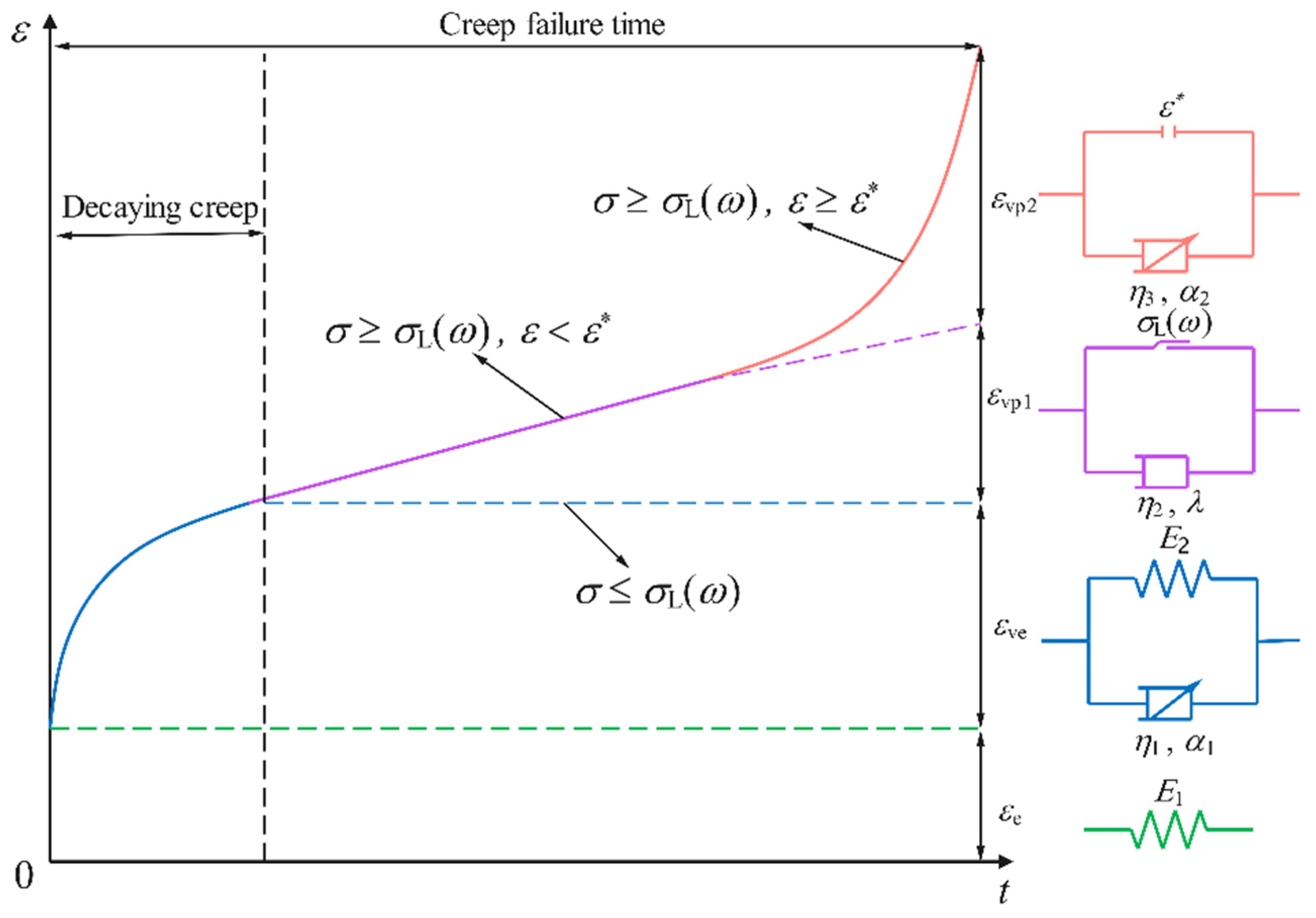
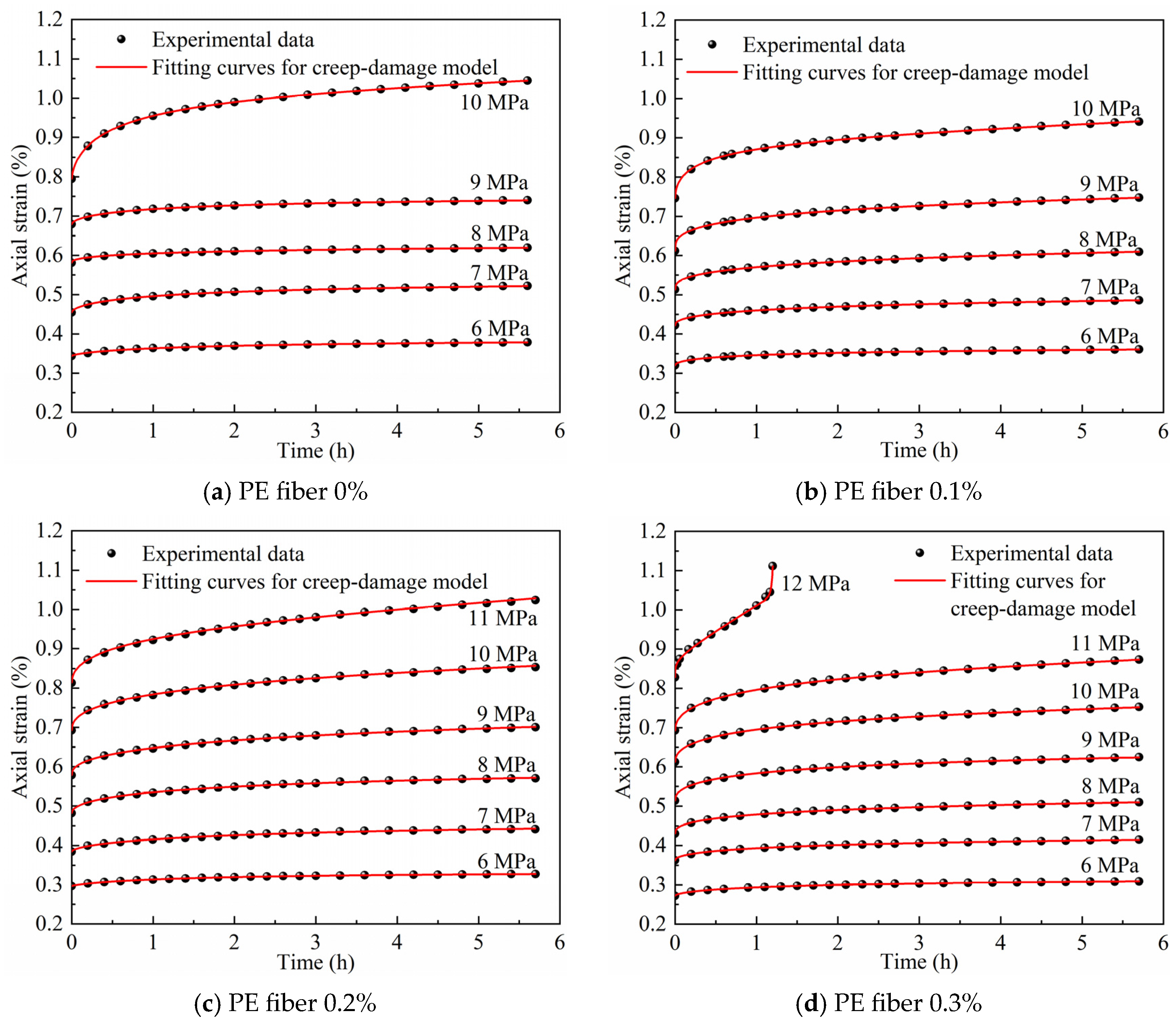
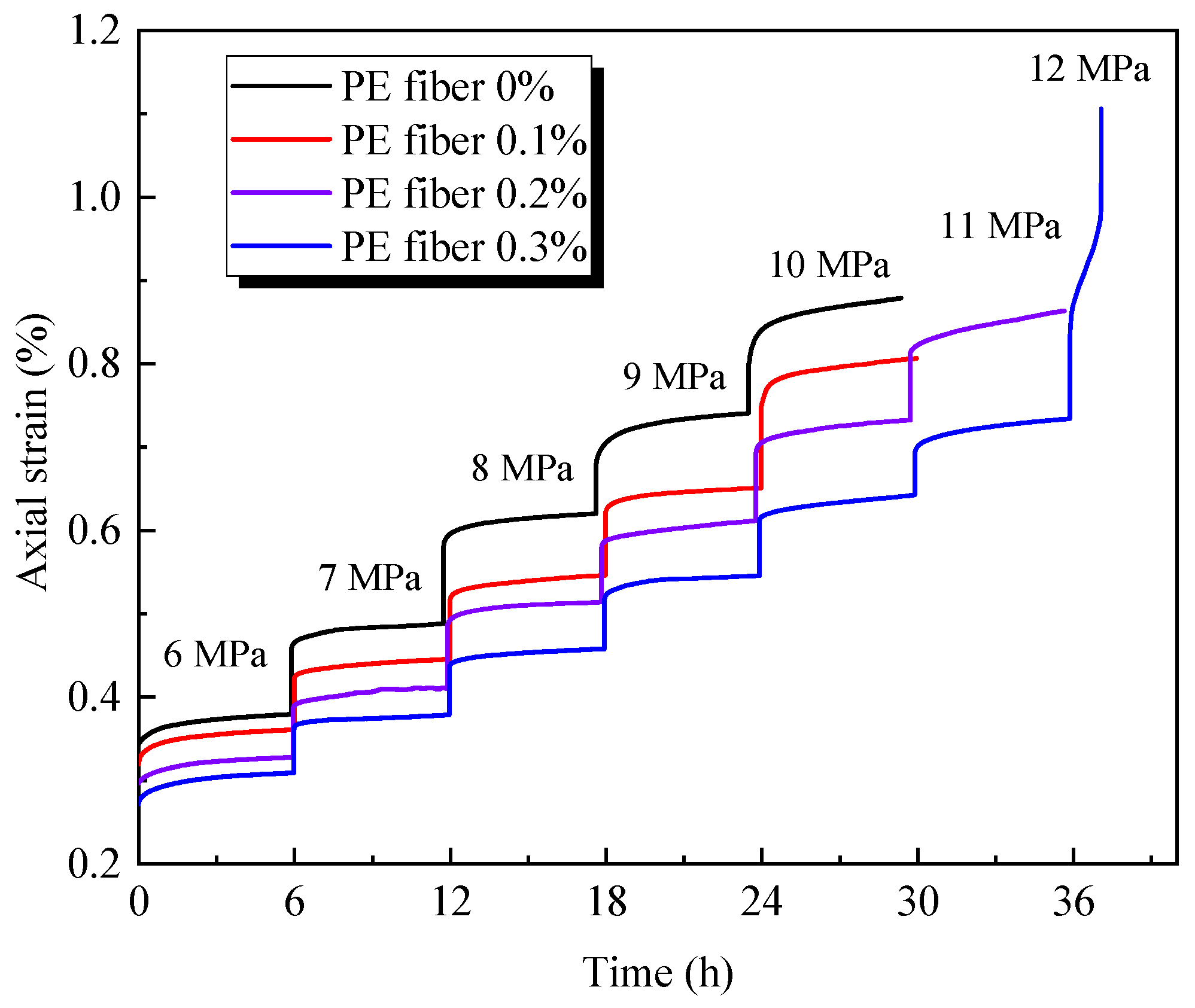
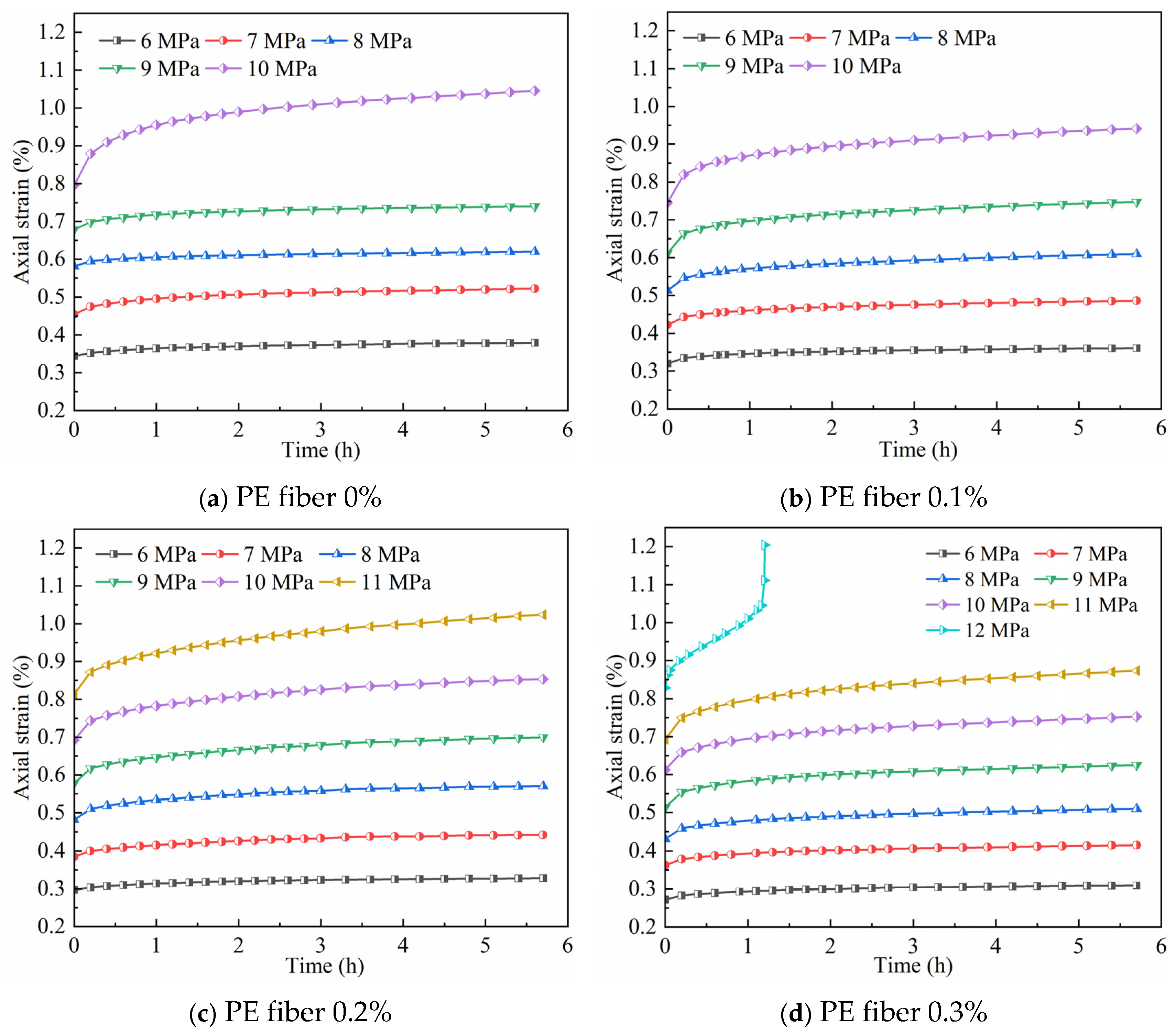
- The creep behavior of PE fiber-modified HWM exhibits significant stress dependence. When the applied stress is lower than the long-term strength, the creep process only undergoes the attenuation creep stage, and the deformation gradually stabilizes with time; when the stress exceeds the long-term strength, the creep curve presents three typical stages: attenuation creep, steady-state creep, and accelerated creep. At the same stress level, the creep strain of modified HWM decreases with the increase in PE fiber content, and the inhibition effect on creep deformation is more pronounced under high-stress conditions.
- (3)
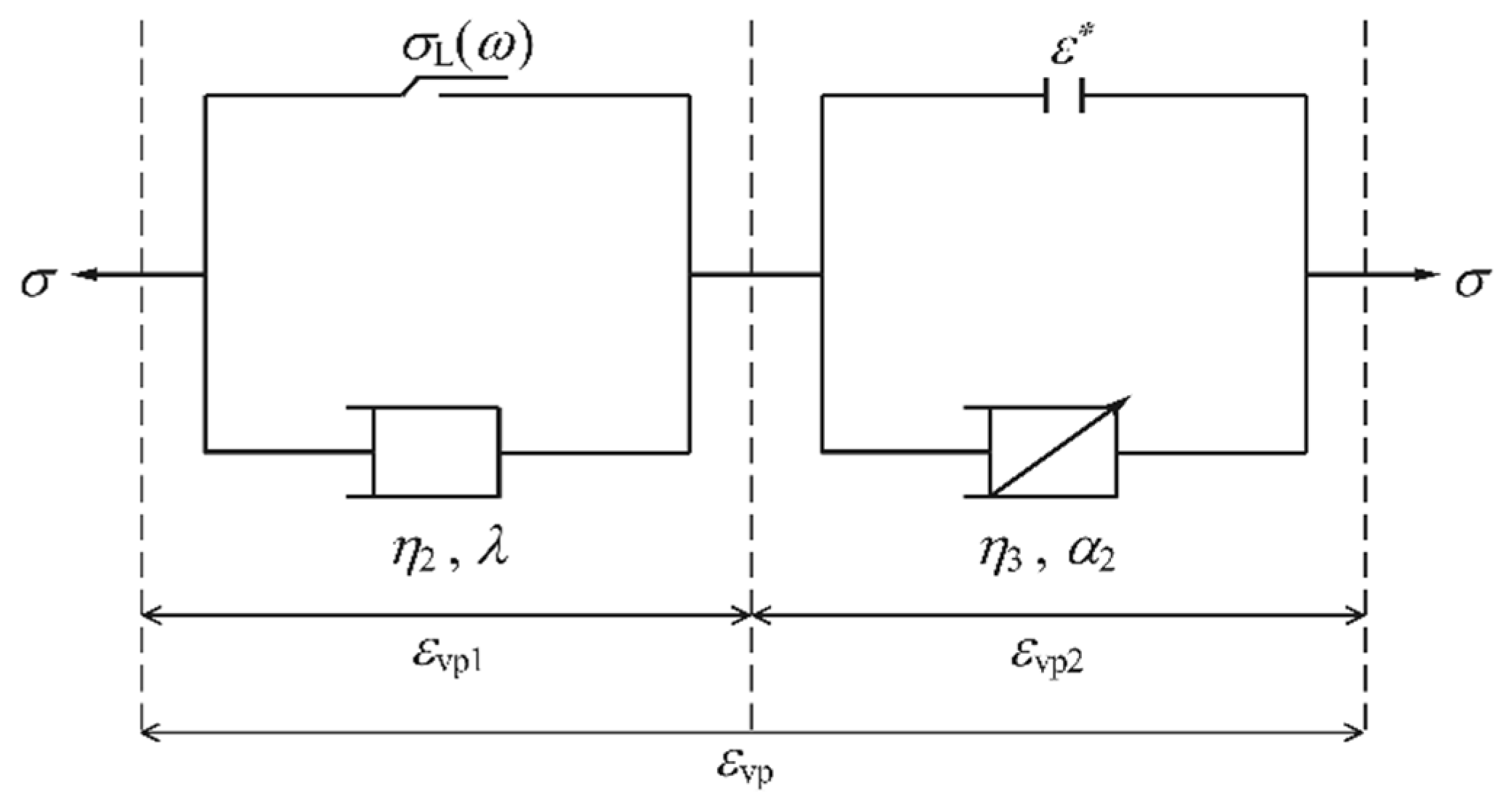
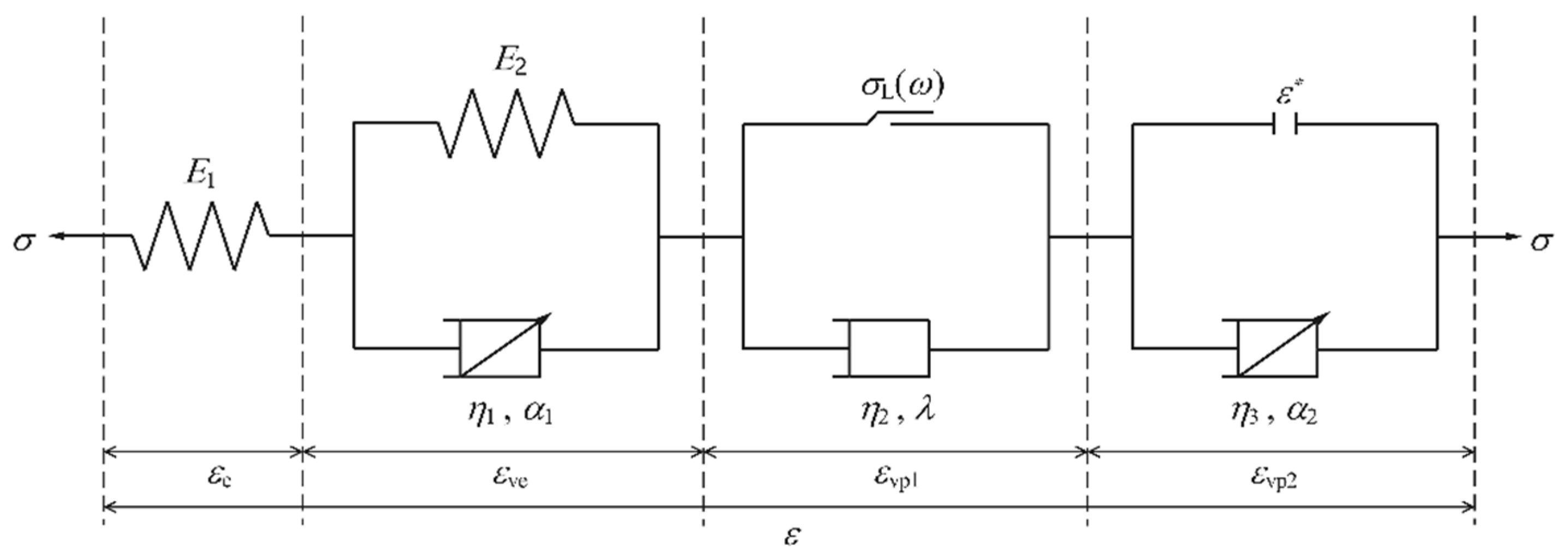
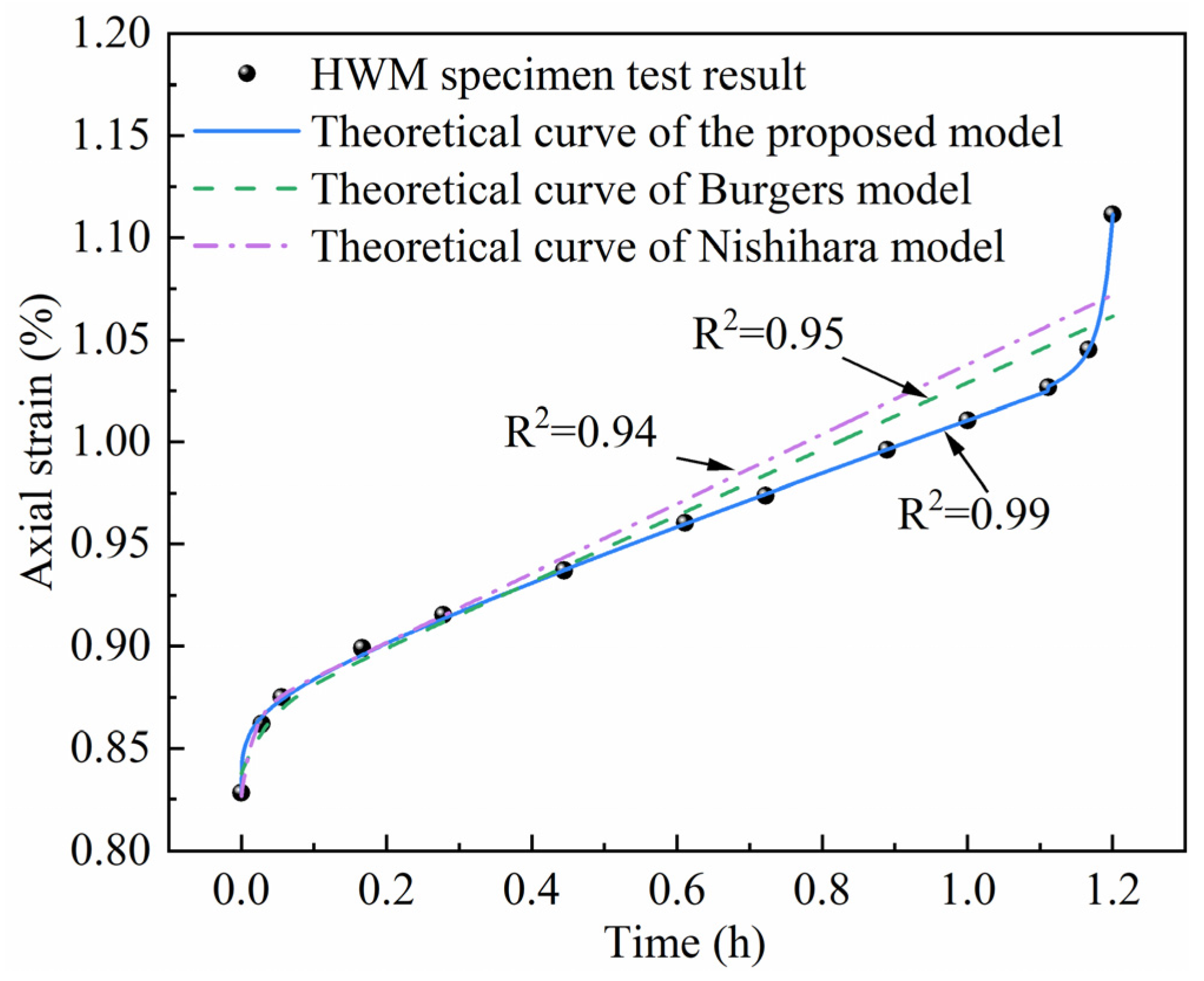
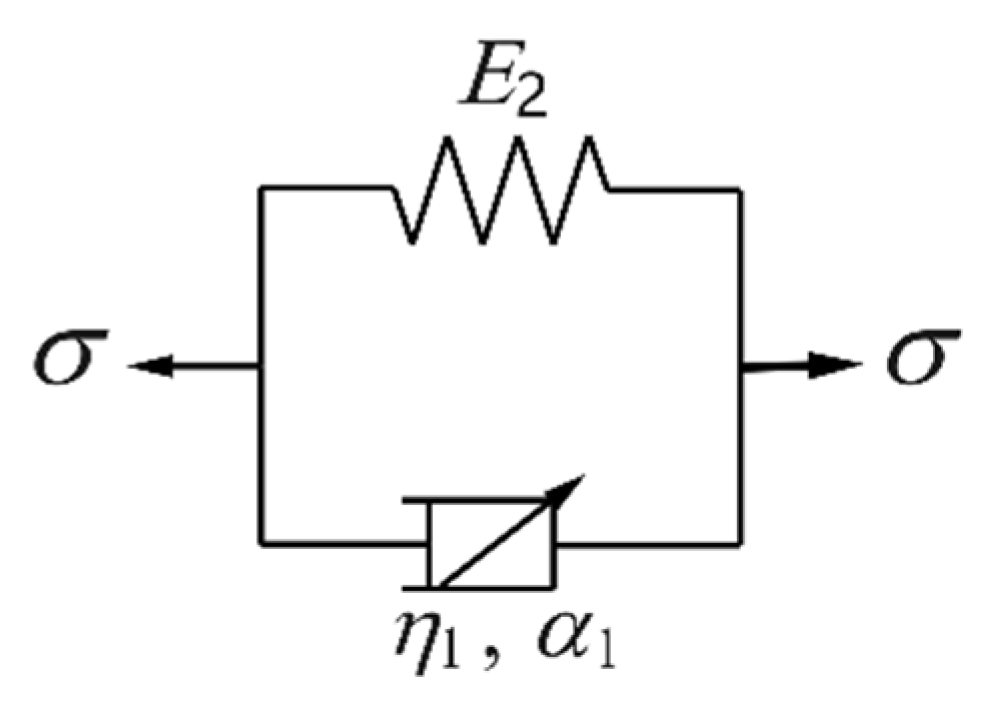
- A fractional-order viscoelastic-plastic damage model integrating the Riemann–Liouville fractional integral operator and time-dependent damage evolution equation is proposed. The model combines the Hookean body, fractional-order Kelvin model, and improved viscoplastic damage element, which can accurately describe the entire creep process (decaying, steady-state, and accelerated creep) of PE fiber-modified HWM under different stress levels. The fitting results show that the correlation coefficient between the model prediction curve and the experimental data is higher than 0.98, indicating excellent prediction accuracy and reliability. However, to enhance the model’s applicability under conditions that more closely resemble realistic mining environments, the key directions for subsequent research should encompass incorporating three-dimensional stress states and accounting for the effects of the temperature field.
- (4)
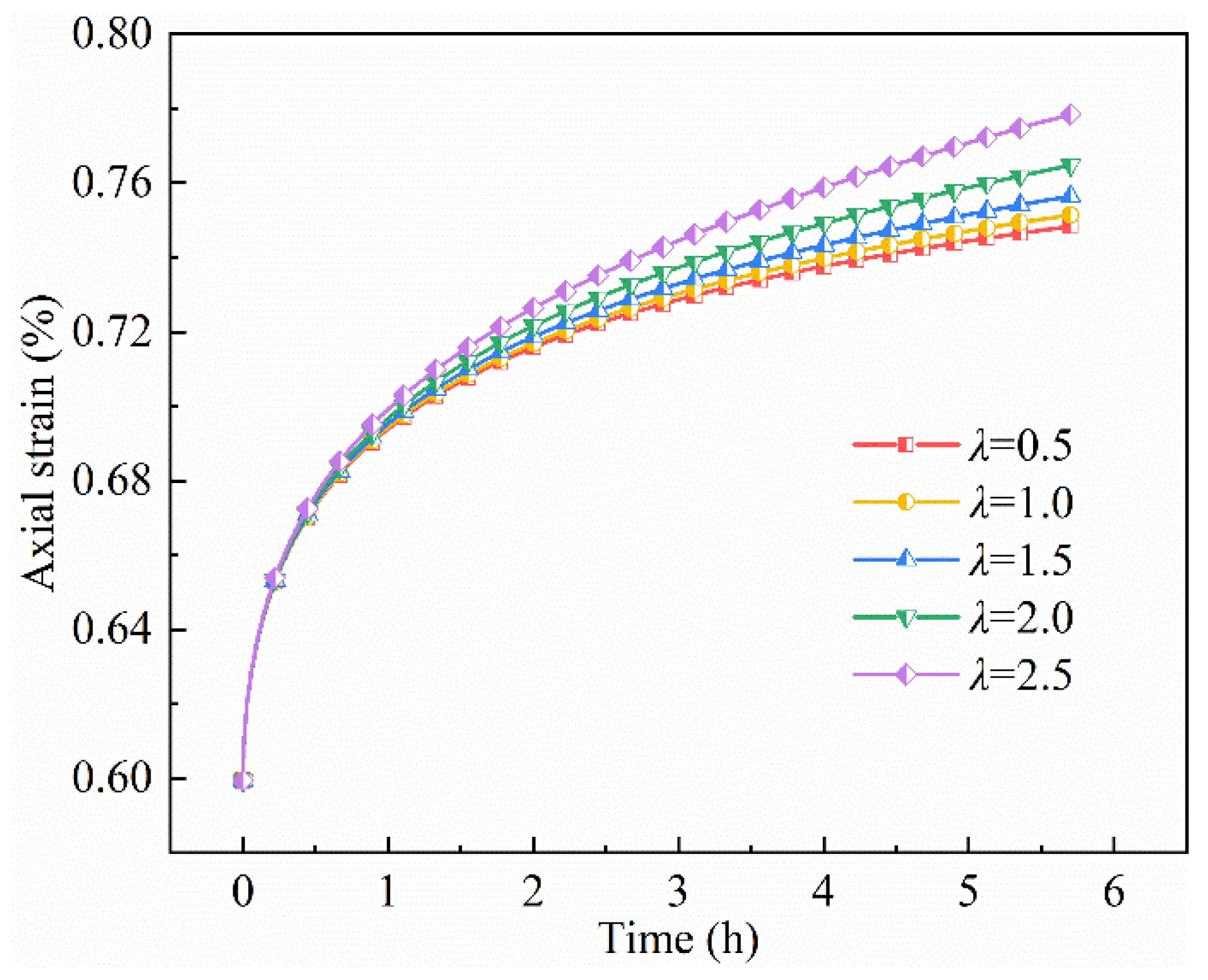
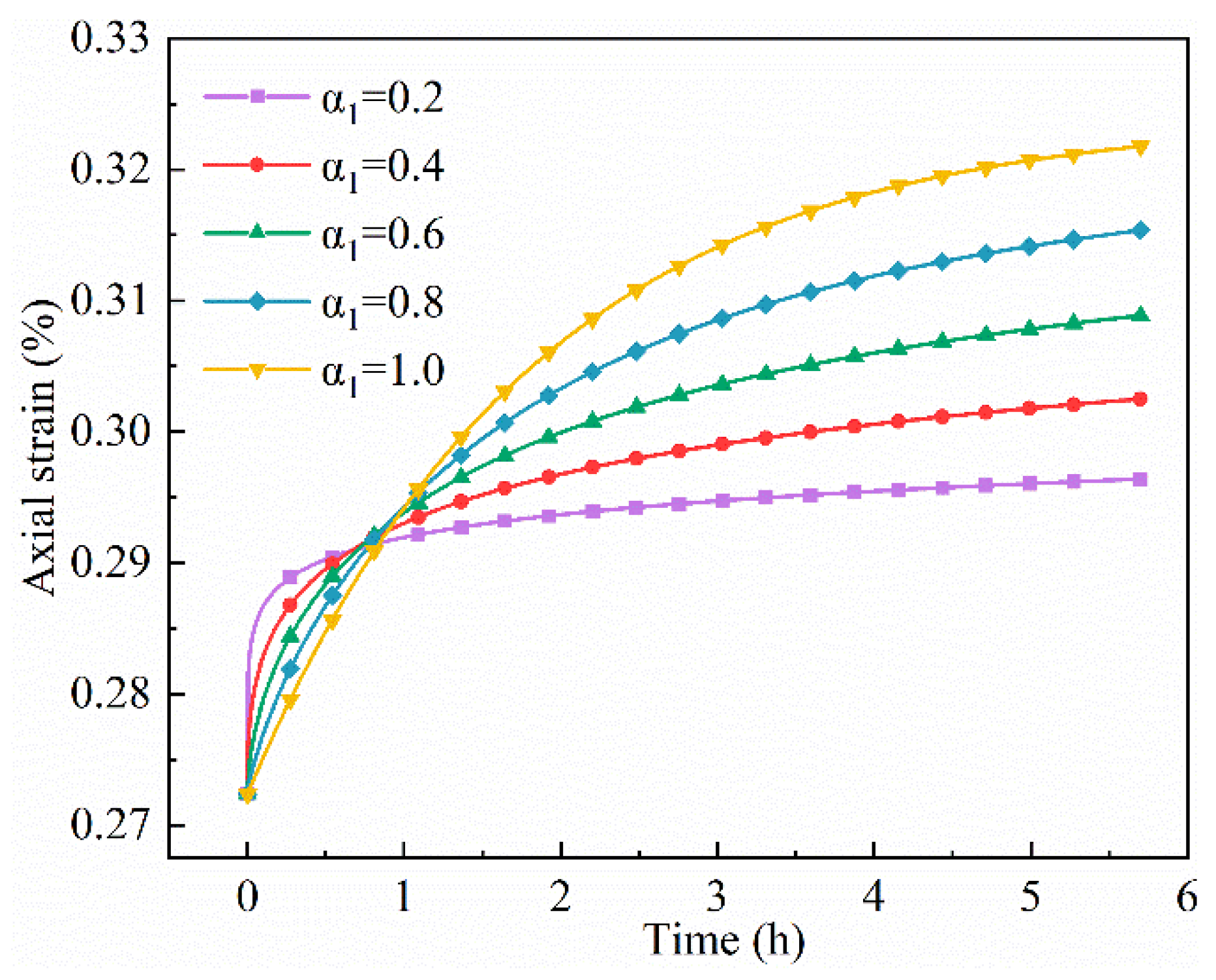
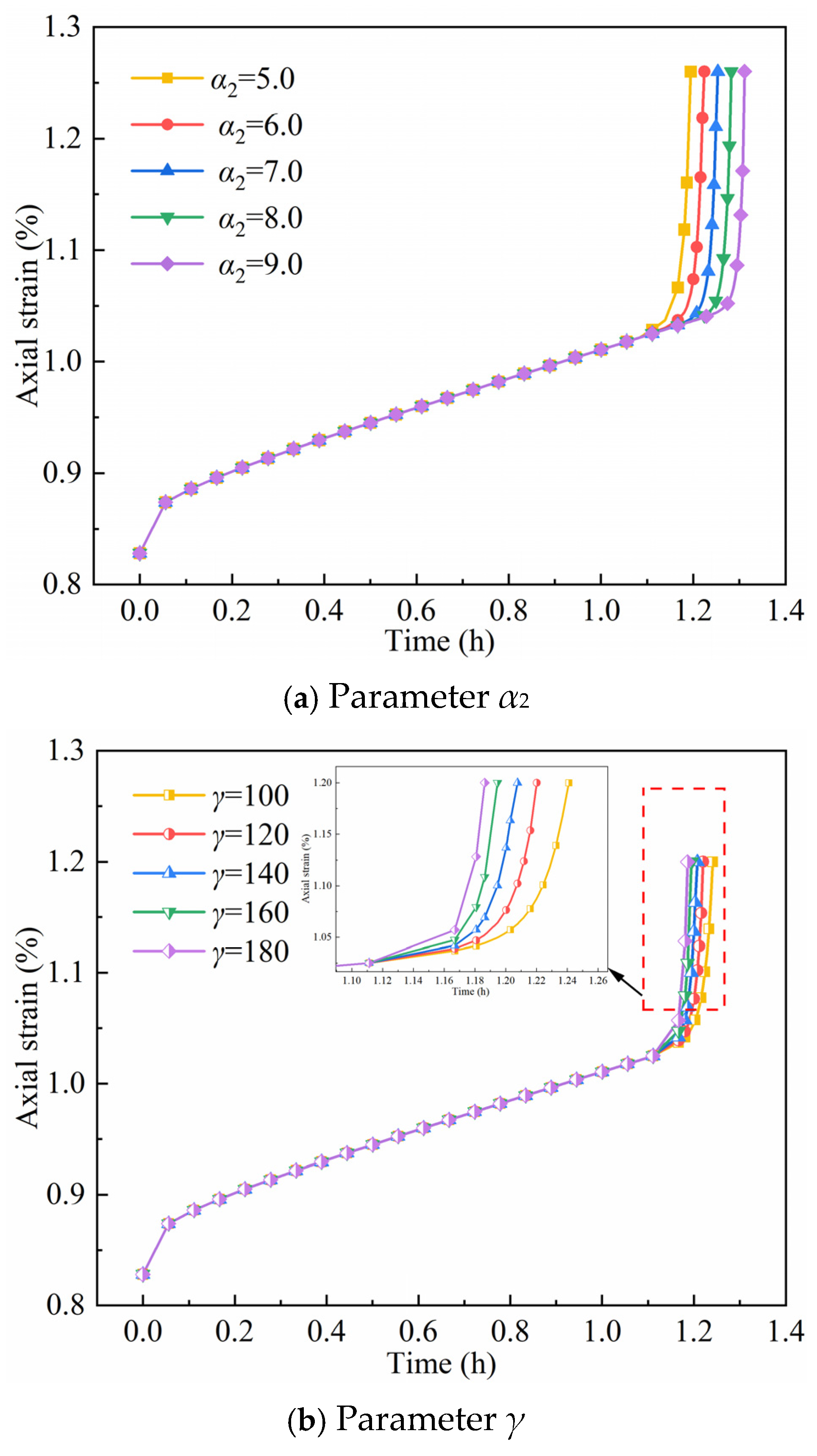
- Parameter sensitivity analysis reveals that the fractional-order parameter α1 is a core parameter regulating the attenuation creep behavior, and its variation in the range of 0.6–0.8 significantly alters the viscoelastic response of the material. The parameter λ controls the steady-state creep rate by affecting the decay of the viscosity coefficient, while α2 and γ jointly regulate the accelerated creep stage: α2 is negatively correlated with the accelerated creep rate and delays the onset of accelerated creep, whereas γ promotes damage accumulation and accelerates creep failure.
Author Contributions
Funding
Data Availability Statement
Conflicts of Interest
References
- Yang, G.; Yang, X.J.; He, M.C.; Zhang, J.; Wang, H.S.; Shi, Z.; Yang, F.; Hou, S.L. Experimental and numerical investigations of goaf roof failure and bulking characteristics based on gob-side entry retaining by roof cutting. Eng. Fail. Anal. 2024, 158, 108000. [Google Scholar] [CrossRef] [Scilit]
- Wu, B.W.; Wang, X.Y.; Bai, J.B.; Wu, W.D.; Zhu, X.X.; Li, G.D. Study on crack evolution mechanism of roadside backfill body in gobside entry retaining based on UDEC trigon model. Rock Mech. Rock Eng. 2019, 52, 3385–3399. [Google Scholar] [CrossRef] [Scilit]
- Bai, J.B.; Shen, W.L.; Guo, G.L.; Wang, X.Y.; Yu, Y. Roof deformation, failure characteristics, and preventive techniques of gob-side entry driving heading adjacent to the advancing working face. Rock Mech. Rock Eng. 2015, 48, 2447–2458. [Google Scholar] [CrossRef] [Scilit]
- Yang, J.; He, M.C.; Cao, C. Design principles and key technologies of gob side entry retaining by roof pre-fracturing. Tunn. Undergr. Space Technol. 2019, 90, 309–318. [Google Scholar] [CrossRef] [Scilit]
- Zhu, G.L.; Sousa, R.L.; He, M.C.; Zhou, P.; Yang, J. Stability analysis of a non-pillar-mining approach using a combination of discrete fracture network and discrete-element method modeling. Rock Mech. Rock Eng. 2020, 53, 269–289. [Google Scholar] [CrossRef] [Scilit]
- Tan, Y.L.; Yu, F.H.; Ning, J.G.; Zhao, T.B. Design and construction of entry retaining wall along a gob side under hard roof stratum. Int. J. Rock Mech. Min. Sci. 2015, 77, 115–121. [Google Scholar] [CrossRef] [Scilit]
- Xin, J.L.; Zhang, Z.Z.; Yu, W.J.; Deng, M. Stability analysis of roof-filling body system in gob-side entry retained. Geomech. Eng. 2024, 36, 27–37. [Google Scholar]
- Sun, X.M.; Zhao, C.W.; Li, G.; Zhang, B.; Wang, J.W.; Cai, F. Physical model experiment and numerical analysis on innovative gob-side entry retaining with thick and hard roofs. Arab. J. Geosci. 2020, 13, 1245. [Google Scholar] [CrossRef] [Scilit]
- Zhang, Z.Z.; Bai, J.B.; Wang, X.Y.; Xu, Y.; Yan, S.; Liu, H.L.; Wu, W.D.; Zhang, W.G. Review and development of surrounding rock control technology for gob-side entry retaining in China. J. China Coal Soc. 2023, 48, 3979–4000. (In Chinese) [Google Scholar]
- Li, T.; Cheng, G.B.; Qin, Z.C.; Li, Q.H.; Cao, B.; Liu, Y.L. The gob-side entry retaining with the high-water filling material in Xin’an Coal Mine. Geomech. Eng. 2020, 22, 541–552. [Google Scholar]
- Chang, Q.L.; Tang, W.J.; Xu, Y.; Zhou, H.Q. Research on the width of filling body in gob-side entry retaining with high-water materials. Int. J. Min. Sci. Technol. 2018, 28, 519–524. [Google Scholar] [CrossRef] [Scilit]
- Xie, S.R.; Wang, E.; Cheng, D.D.; Li, H.; Jiang, Z.S.; Yang, H.Z. Stability analysis and control technology of gob-side entry retaining with double roadways by filling with high-water material in gently inclined coal seam. Int. J. Coal Sci. Technol. 2022, 9, 52. [Google Scholar] [CrossRef] [Scilit]
- Zhou, J.L.; Pan, J.F.; Xia, Y.X.; Du, T.T.; Liu, W.G.; Zhang, C.Y. Mechanism and prevention of coal bursts in gob-side roadway floor under thick and hard roof in the deep mining area of Ordos. Int. J. Coal Sci. Technol. 2024, 11, 80. [Google Scholar] [CrossRef] [Scilit]
- Zhao, X.Q.; Bai, J.B.; Wen, J.T.; Deng, M.; Zhang, D.; Zhu, Q.C. Impact of non-isostatic curing conditions on the engineering properties of early-age high water-resistant concrete materials. Constr. Build. Mater. 2024, 418, 135265. [Google Scholar] [CrossRef] [Scilit]
- Sun, C.D.; Zhang, D.S.; Wang, X.F.; Zhou, R. Large-size test on creep characteristics of high water material for filling body beside roadway. J. Min. Saf. Eng. 2012, 29, 487–491. (In Chinese) [Google Scholar]
- Zuo, J.P.; Hong, Z.J.; Xiong, Z.Q.; Wang, C.; Song, H.Q. Influence of different W/C on the performances and hydration progress of dual liquid high water backfilling material. Constr. Build. Mater. 2018, 190, 910–917. [Google Scholar] [CrossRef] [Scilit]
- Zhou, X.L.; Liu, C.W.; Liu, Y.; Wang, C.; Ma, Y.J. Effect of dry-wet cycling on the mechanical properties of high-water materials. Adv. Civ. Eng. 2020, 2020, 2605751. [Google Scholar] [CrossRef] [Scilit]
- Li, X.F.; Xiong, Z.Q.; Wang, P. Experimental study on improvement of mechanical properties of high-water filling materials in gob-side entry retaining. China Saf. Sci. J. 2020, 30, 95–100. (In Chinese) [Google Scholar]
- Li, X.F.; Xiong, Z.Q.; Zhang, Y.H.; Su, C.D. Modification test and engineering application of high-water filling material in gob-side entry retaining. J. Chongqing Univ. 2020, 43, 94–106. (In Chinese) [Google Scholar]
- Li, X.L.; Liu, C.W. Creep mechanical properties and creep model of high water material under step loading. J. Appl. Polym. Sci. 2021, 138, e50707. [Google Scholar] [CrossRef] [Scilit]
- Zhou, Q.; Liu, J.H. Study on creep property and damage evolution of rich-water packing material for mining. J. China Coal Soc. 2018, 43, 1878–1883. (In Chinese) [Google Scholar]
- Xie, H.; Chen, Y. Experimental research on creep laws of high-water material under real pressure water environment. Key Eng. Mater. 2016, 705, 350–354. [Google Scholar] [CrossRef] [Scilit]
- Wang, D.; Zeng, J.H.; Liu, C.W.; Xu, Y.H. Creep law and rheological model of high-water rapid-setting material in water environment. J. Sichuan Univ. (Eng. Sci. Ed.) 2014, 46, 1–6. [Google Scholar]
- Yan, X.Y.; Wang, F.X.; Luo, Y.H.; Liu, X.H.; Yang, Z.X.; Mao, H.M. Mechanical performance study of basalt-polyethylene fiber reinforced concrete under dynamic compressive loading. Constr. Build. Mater. 2023, 409, 133935. [Google Scholar] [CrossRef] [Scilit]
- Xie, H.Z.; Wei, P.; Liu, N.; Gao, J.; Yang, L.Y.; Li, J.H.; Chen, S.Y. Study on failure characteristics of basalt fiber reactive powder concrete under uniaxial loading. Constr. Build. Mater. 2023, 404, 133246. [Google Scholar] [CrossRef] [Scilit]
- Wu, S.K.; Zhang, J.W.; Xu, Y.L.; Song, Z.X.; Fan, W.B.; Zhang, Y.; Dong, X.K.; Cheng, Z.S.; Xiao, B.; Zhang, J.T. Research and engineering application on physical and mechanical properties of coal mine high water filling materials. J. Min. Saf. Eng. 2023, 40, 754–763. (In Chinese) [Google Scholar]
- Jiao, H.Z.; Chen, X.; Yang, Y.X.; Chen, X.M.; Yang, L.H.; Yang, T.Y. Mechanical properties and meso-structure of concrete under the interaction between basalt fiber and polymer. Constr. Build. Mater. 2023, 404, 133223. [Google Scholar] [CrossRef] [Scilit]
- Liu, A.; Kong, D.W.; Jiang, J.T.; Wang, L.L.; Liu, C.; He, R.Y. Mechanical properties and microscopic mechanism of basalt fiber-reinforced red mud concrete. Constr. Build. Mater. 2024, 416, 135155. [Google Scholar] [CrossRef] [Scilit]
- Hoang, T.V.; Widjaja, J.; Qiang, L.Y.; Liu, M.K.; Alexander, T.J.; Runge, A.F.J.; Sterke, C.M.D. Nonlinear wave propagation governed by a fractional derivative. Nat. Commun. 2025, 16, 5469. [Google Scholar] [CrossRef] [Scilit] [PubMed]
- Bouras, Y.; Vrcelj, Z. Fractional and fractal derivative-based creep models for concrete under constant and time-varying loading. Constr. Build. Mater. 2023, 367, 130324. [Google Scholar] [CrossRef] [Scilit]
- Bouras, Y.; Zorica, D.; Atanacković, M.T.; Vrcelj, Z. A non-linear thermo-viscoelastic rheological model based on fractional derivatives for high temperature creep in concrete. Appl. Math. Model. 2018, 55, 55551–55568. [Google Scholar] [CrossRef] [Scilit]
- Praveenkumar, B.; Veeresha, P. Chaos and control in a fractional-order financial model: A non-local dynamical approach. Int. J. Dyn. Control 2025, 13, 360. [Google Scholar] [CrossRef] [Scilit]
- Wang, R.; Zhuo, Z.; Zhou, H.W.; Liu, J.F. A fractal derivative constitutive model for three stages in granite creep. Results Phys. 2017, 7, 2632–2638. [Google Scholar] [CrossRef] [Scilit]
- Cao, P.; Wen, Y.D.; Wang, Y.X.; Yuan, H.P.; Yuan, B.X. Study on nonlinear damage creep constitutive model for high-stress soft rock. Environ. Earth Sci. 2016, 75, 900. [Google Scholar] [CrossRef] [Scilit]
- Yang, S.Q.; Cheng, L. Non-stationary and nonlinear visco-elastic shear creep model for shale. Int. J. Rock Mech. Min. Sci. 2011, 48, 1011–1020. [Google Scholar] [CrossRef] [Scilit]
- Hou, R.B.; Zhang, K.; Tao, J.; Xue, X.R.; Chen, Y.L. A nonlinear creep damage coupled model for rock considering the effect of initial damage. Rock Mech. Rock Eng. 2019, 52, 1275–1285. [Google Scholar] [CrossRef] [Scilit]
- Hou, R.; Cui, Q.; Guo, Y.; Shi, Y.; Fu, J. A new elasto-visco-plastic damage model and numerical simulation method used for time-dependent behavior prediction of deep tunnel. Comput. Geotech. 2024, 168, 106129. [Google Scholar] [CrossRef] [Scilit]
- Kabwe, E.; Karakus, M.; Chanda, K.E. Isotropic damage constitutive model for time-dependent behaviour of tunnels in squeezing ground. Comput. Geotech. 2020, 127, 103738. [Google Scholar] [CrossRef] [Scilit]
- Wang, J.B.; Zhang, Q.; Song, Z.P.; Feng, S.J.; Zhang, Y.W. Nonlinear creep model of salt rock used for displacement prediction of salt cavern gas storage. J. Energy Storage 2022, 48, 103951. [Google Scholar] [CrossRef] [Scilit]
- Krajcinovic, D. Damage mechanics. Mech. Mater. 1989, 8, 117–197. [Google Scholar] [CrossRef] [Scilit]










| Raw Material | CaO | Al2O3 | SiO2 | Fe2O3 | SO3 | MgO | |
|---|---|---|---|---|---|---|---|
| CAS | 43.37 | 32.16 | 8.73 | 3.61 | 7.23 | 1.21 | 3.69 |
| Gypsum | 37.84 | 0.92 | 3.12 | 0.32 | 45.25 | 3.58 | 8.97 |
| Lime | 71.22 | 0.85 | 2.43 | 0.87 | 0.54 | 1.98 | 22.11 |
| Density (g/cm3) | Diameter (μm) | Length (mm) | Tensile Strength (GPa) | Elastic Modulus (GPa) | Fracture Elongation (%) |
|---|---|---|---|---|---|
| 0.97 | 16 | 12 | 3.8 | 140 | 3.5 |
| Volume Fraction of PE Fiber (%) | Specimen ID | Compressive Strength (MPa) | Average Compressive Strength (MPa) | Standard Deviation (MPa) |
|---|---|---|---|---|
| 0 | PE0-1 | 9.84 | 10.31 | 0.36 |
| PE0-2 | 10.70 | |||
| PE0-3 | 10.39 | |||
| 0.1 | BF0.1-1 | 11.08 | 11.05 | 0.18 |
| BF0.1-2 | 11.15 | |||
| BF0.1-3 | 10.92 | |||
| 0.2 | BF0.2-1 | 12.09 | 12.10 | 0.27 |
| BF0.2-2 | 11.77 | |||
| BF0.2-3 | 12.44 | |||
| 0.3 | BF0.3-1 | 12.51 | 12.83 | 0.30 |
| BF0.3-2 | 12.75 | |||
| BF0.3-3 | 13.23 | |||
| 0.4 | BF0.4-1 | 10.71 | 10.71 | 0.14 |
| BF0.4-2 | 10.87 | |||
| BF0.4-3 | 10.54 |
| Creep Stress (MPa) | ||||||
|---|---|---|---|---|---|---|
| 1st | 2nd | 3rd | 4th | 5th | 6th | 7th |
| 6 | 7 | 8 | 9 | 10 | 11 | 12 |
| Fiber Content | Stress (MPa) | E1 (GPa) | E2 (GPa) | η1 (GPa·h) | α1 | η2 (GPa·h) | η3 (GPa·h) | α2 | λ | γ |
|---|---|---|---|---|---|---|---|---|---|---|
| 0% | 6 | 1.74 | 12.95 | 23.07 | 0.67 | |||||
| 7 | 1.54 | 7.67 | 12.13 | 0.60 | ||||||
| 8 | 1.37 | 11.16 | 27.33 | 0.45 | ||||||
| 9 | 1.32 | 11.08 | 16.17 | 0.59 | ||||||
| 10 | 1.25 | 4.15 | 3.58 | 0.64 | 13.96 | 0.05 | ||||
| 0.1% | 6 | 1.87 | 10.02 | 16.39 | 0.51 | |||||
| 7 | 1.65 | 5.23 | 15.72 | 0.45 | ||||||
| 8 | 1.56 | 2.17 | 13.55 | 0.37 | ||||||
| 9 | 1.47 | 1.78 | 10.10 | 0.34 | ||||||
| 10 | 1.34 | 5.56 | 4.28 | 0.55 | 13.96 | 0.54 | ||||
| 0.2% | 6 | 2.02 | 15.89 | 26.71 | 0.74 | |||||
| 7 | 1.81 | 7.86 | 18.94 | 0.62 | ||||||
| 8 | 1.66 | 5.43 | 12.17 | 0.53 | ||||||
| 9 | 1.55 | 2.65 | 12.23 | 0.44 | ||||||
| 10 | 1.44 | 3.85 | 9.26 | 0.47 | 13.96 | 0.22 | ||||
| 11 | 1.35 | 5.37 | 7.54 | 0.52 | 13.96 | 0.14 | ||||
| 0.3% | 6 | 2.20 | 11.75 | 20.94 | 0.61 | |||||
| 7 | 1.93 | 7.83 | 18.47 | 0.51 | ||||||
| 8 | 1.85 | 4.33 | 14.57 | 0.41 | ||||||
| 9 | 1.75 | 4.80 | 10.01 | 0.47 | ||||||
| 10 | 1.66 | 4.97 | 7.42 | 0.54 | 13.96 | 0.94 | ||||
| 11 | 1.58 | 6.58 | 6.81 | 0.58 | 13.96 | 0.09 | ||||
| 12 | 1.44 | 13.18 | 8.01 | 0.33 | 13.96 | 4.92 | 5.69 | 2.10 | 133.97 |
| Stress (MPa) | E1 (GPa) | E2 (GPa) | η1 (GPa·h) | α1 | η2 (GPa·h) | η3 (GPa·h) | α2 | λ | γ |
|---|---|---|---|---|---|---|---|---|---|
| 6 | 2.20 | 11.75 | 20.94 | 0.61 | |||||
| 10 | 1.66 | 4.97 | 7.42 | 0.54 | 13.96 | 0.93 | |||
| 12 | 1.44 | 13.18 | 8.01 | 0.33 | 13.96 | 4.92 | 5.69 | 2.10 | 133.97 |
Disclaimer/Publisher’s Note: The statements, opinions and data contained in all publications are solely those of the individual author(s) and contributor(s) and not of MDPI and/or the editor(s). MDPI and/or the editor(s) disclaim responsibility for any injury to people or property resulting from any ideas, methods, instructions or products referred to in the content. |
© 2026 by the authors. Licensee MDPI, Basel, Switzerland. This article is an open access article distributed under the terms and conditions of the Creative Commons Attribution (CC BY) license.
Share and Cite
Shi, Y.; Hou, R.; Yang, Y.; Xu, R.; Zhao, P.; Li, L.; Wu, H. Creep Behavior and Fractional-Order Viscoelastic-Plastic Damage Model of Polyethylene Fiber-Modified High-Water Material. Fractal Fract. 2026, 10, 95. https://doi.org/10.3390/fractalfract10020095
Shi Y, Hou R, Yang Y, Xu R, Zhao P, Li L, Wu H. Creep Behavior and Fractional-Order Viscoelastic-Plastic Damage Model of Polyethylene Fiber-Modified High-Water Material. Fractal and Fractional. 2026; 10(2):95. https://doi.org/10.3390/fractalfract10020095
Chicago/Turabian StyleShi, Yanke, Rongbin Hou, Yabin Yang, Rongchao Xu, Pengtuan Zhao, Lixiang Li, and Hanhan Wu. 2026. "Creep Behavior and Fractional-Order Viscoelastic-Plastic Damage Model of Polyethylene Fiber-Modified High-Water Material" Fractal and Fractional 10, no. 2: 95. https://doi.org/10.3390/fractalfract10020095
APA StyleShi, Y., Hou, R., Yang, Y., Xu, R., Zhao, P., Li, L., & Wu, H. (2026). Creep Behavior and Fractional-Order Viscoelastic-Plastic Damage Model of Polyethylene Fiber-Modified High-Water Material. Fractal and Fractional, 10(2), 95. https://doi.org/10.3390/fractalfract10020095