Article

Guaranteed Cost Data-Driven Feedback Control of Delta Discrete Fractional-Order Systems

1
School of Mathematical Sciences, Shanxi Normal University, No. 339, Taiyu Road, Taiyuan 030001, China
2
School of Electrical and Information Engineering, Tianjin University, No. 92, Weijin Road, Tianjin 300072, China
*
Author to whom correspondence should be addressed.
Fractal Fract. 2026, 10(2), 78; https://doi.org/10.3390/fractalfract10020078
Submission received: 30 December 2025 / Revised: 19 January 2026 / Accepted: 22 January 2026 / Published: 24 January 2026

Abstract

This paper aims to address the data-driven feedback control problem of Delta fractional-order systems. First, we convert the studied system into an integer-order discrete-time system with progressively increasing time delays. A novel stability condition is then established for the resulting system. Leveraging this stability condition and a data-driven approach, we proceed to analyze the design of both the state feedback controller and the guaranteed-cost data-driven feedback controller, utilizing state data and input–output data, respectively. Finally, we demonstrate the effectiveness of our obtained data-driven control strategies through two simulation examples.

1. Introduction

Fractional calculus, which extends traditional integer-order calculus to arbitrary real or complex orders, provides a more powerful framework for modeling complex physical processes [1,2,3]. Compared to their integer-order counterparts, fractional-order models demonstrate a superior capability in characterizing phenomena such as material viscoelasticity [4], the mechanical behavior of biological tissues [5], anomalous diffusion processes [6,7], and long-range dependence in signals [8], etc. Over the past two decades, numerous results have been witnessed in the field of analysis and control of continuous-time fractional-order systems [9,10,11,12]. However, many engineering applications—including digital signal processing, computer-controlled systems and communications—are inherently discrete in time. This practical consideration has spurred growing interest in discrete fractional-order systems [13,14,15]. Research in this area can be broadly divided into two streams: one based on the forward difference (i.e., delta fractional-order systems) [16,17,18] and the other on the backward difference (i.e., nabla fractional-order systems) [19,20]. It is noteworthy that most current studies on discrete fractional-order systems rely on the fact that a precise system model is known. In practice, however, obtaining a precise mathematical model is often challenging.
Data-driven control refers to a class of methodologies and theoretical frameworks in control engineering that perform system performance analysis and design controllers directly from collected input–output data, without relying on a priori system model knowledge. These methods have been successfully applied to areas such as system identification [21], controller design [22], fault detection and diagnosis [23], and predictive control [24].
A pioneering work for data-driven control was initiated by Willems and colleagues, who introduced a fundamental lemma [25]. It states that, under a persistent excitation (PE) condition, the full behavior of an LTI system can be completely characterized by using a finite input–output data sequence. This lemma has spurred the development of numerous control strategies within the behavioral framework [26,27,28].
Further extending these ideas, van Waarde et al. developed a novel framework that relaxes the stringent PE requirement [29]. They introduced the concept of data informativity for analysis and control, demonstrating that data-driven methods can remain effective even if the data is insufficient to uniquely identify the system. This framework has opened new avenues for analyzing and designing solutions to diverse data-driven control problems. For instance, it has been applied to fundamental problems such as controllability analysis [30] and dissipativity analysis [31]. Further, research efforts have extended this framework to optimal and robust control designs, including linear quadratic regulation (LQR) [32] and H 2 / H [33,34], etc.
Motivated by the above discussions, this paper is devoted to tackling the problem of guaranteed-cost data-driven feedback control for delta-domain discrete fractional-order systems. The major contributions of this work are outlined below:
  • By utilizing the definition of the delta fractional difference, the original delta discrete fractional-order system is reformulated as an equivalent integer-order system with progressively increasing time delays. It is noteworthy that the resulting system differs significantly from conventional time-delay systems, as the number of delay terms increases with the discrete-time index k. To analyze the stability of this unique class of systems, we have established novel stability conditions based on the Lyapunov method, which are ultimately expressed as linear matrix inequalities (LMIs).
  • Within the informativity framework established in [29], sufficient conditions are derived under which a finite sequence of input-state data is informative on state feedback stabilization. Directly from the data, a state feedback controller is synthesized, solely on the data, without recourse to prior knowledge of the system matrices.
  • This work pioneers the establishment of data informativity conditions for guaranteed-cost control within delta discrete fractional-order systems. Accordingly, a guaranteed-cost controller is synthesized directly from state and input data, ensuring prescribed performance bounds.
The rest of the paper is structured as follows: Section 2 is devoted to introducing the essential preliminaries. Section 3 presents the main results, including a novel stability condition for the transformed system and a data-driven state feedback control design. Section 4 addresses the guaranteed-cost data-driven feedback control problem. Section 5 validates the proposed method through numerical simulations. Finally, Section 6 summarizes the paper.

2. Preliminaries

Consider the Delta discrete fractional-order systems given by
Δ α x ( k + 1 ) = A x ( k ) + B u ( k ) ,
where 0 < α < 1 , k N , x ( k ) R n denotes the system state vector, u ( k ) R m represents the input vector, and A R n × n and B R n × m are the unknown system matrices. In system (1), the fractional difference is defined as
Δ α x ( k ) = i = 0 k ( 1 ) i α i x ( k i ) ,
where the binomial coefficient is given by
α i = 1 , i = 0 , α ( α 1 ) ( α i + 1 ) i ! , i = 1 , 2 , .
Substituting into (1), the Delta discrete fractional-order linear system can be rewritten as
x ( k + 1 ) = A α x ( k ) + i = 1 k c i ( α ) x ( k i ) + B u ( k ) ,
where A α = A + α I and c i ( α ) = ( 1 ) i α i + 1 for i = 1 , 2 , .
Remark 1.
As is shown above, the considered delta discrete fractional-order system (Equation (1)) is mathematically equivalent to the integer-order discrete-time system (Equation (4)). However, unlike conventional time-delay systems, the number of delay terms in Equation (4) increases progressively with the discrete-time index k, which introduces unique challenges and interests in the corresponding feedback control design.
Now, we can infer that the coefficient c i ( α ) of time-delay term has the properties described below.
Property 1.
For 0 < α < 1 and i = 0 , 1 , 2 , , the coefficients
c i ( α ) = ( 1 ) i α i + 1
satisfy the following:
(i)
c i ( α ) > 0 ;
(ii)
c i ( α ) decays monotonically as i increases;
(iii)
i = 1 c i ( α ) = 1 α .
Proof. 
It is straightforward from the definition of c i ( α ) that (i) and (ii) hold. Now we prove conclusion (iii). For 0 < α < 1 , recall the generalized binomial expansion
( 1 + z ) α = j = 0 α k z j .
Setting z = 1 leads to
j = 0 α j ( 1 ) j = 0 .
Separate the first two terms of the series, we have
α 0 α 1 + j = 2 ( 1 ) j α j = 0 ,
thus
j = 2 ( 1 ) j α j = α 1 .
Let j = i + 1 . Then
i = 1 c i ( α ) = i = 1 ( 1 ) i α i + 1 = j = 2 ( 1 ) j α j = 1 α .
The following inequality plays a key role for our subsequent stability analysis:
Lemma 1.
Let R R n × n , R 0 , x j R n and scalar constants a j 0 ( j = 1 , 2 , ). If the series converges, then we have the inequality
j = 1 + a j x j T R j = 1 + a j x j j = 1 + a j j = 1 + a j x j T R x j .
Subsequently, the informativity framework for data-driven analysis and control is introduced.
Consider a true system S belonging to a model class Σ . In our data-driven setting, the true system dynamics S are unknown; instead, we have access to the input–output data D produced by S . The set Σ D Σ consists of all systems in Σ that explain the data D . For a given system property P , let Σ P denote the set of all systems in Σ that possess the property P .
The core idea of the informativity framework is as follows: if every system compatible with the data D also possesses property P , then we can reasonably conclude that the true system S must also satisfy P . This is formalized in the following definition:
Definition 1
([29]). The data D is said to be informative for property P if
Σ D Σ P .

3. Stability Analysis and Data-Driven Controller Design

This section presents a new sufficient criterion for ensuring the asymptotic stability of Equation (1). Subsequently, a data-driven state feedback control design is proposed for the same system.
Theorem 1.
Consider the unforced system (Equation (4)) with u ( k ) = 0 . If there exist symmetric matrices P 0 and Q 0 satisfy
Φ = A α P A α P + c ¯ Q A α P P A α P 1 c ¯ Q 0 ,
where A α = A + α I and c ¯ = j = 1 c j ( α ) = 1 α , then Equation (4) is asymptotically stable.
Proof. 
To analyze the asymptotic stability of Equation (4), we introduce the following Lyapunov functional candidate:
V ( x ( k ) ) = x T ( k ) P x ( k ) + i = 1 k j = k i k 1 x T ( j ) c i ( α ) Q x ( j ) .
Since P 0 and Q 0 , the first term x T ( k ) P x ( k ) is positive for any nonzero x ( k ) . The double summation term is nonnegative because each term x T ( j ) c i ( α ) Q x ( j ) 0 for all i and j, given that c i ( α ) > 0 by Property 1 and Q 0 . Consequently, V ( x ( k ) ) > 0 for any nonzero state variables.
Evaluating the dynamics along the state trajectory of Equation (4) yields that
V ( x ( k ) ) = x T ( k + 1 ) P x ( k + 1 ) x T ( k ) P x ( k ) + i = 1 k c i ( α ) x T ( k ) Q x ( k )                                                             + c k + 1 ( α ) j = 0 k x T ( j ) Q x ( j ) i = 1 k x T ( k i ) c i ( α ) Q x ( k i ) .
Based on the monotonic convergence of the partial sums i = 1 k c i ( α ) and their upper bound 1 α , and applying Lemma 1, we can conclude
i = 1 k x T ( k i ) c i ( α ) Q x ( k i ) 1 i = 1 k c i ( α ) i = 1 k c i ( α ) x ( k i ) T Q i = 1 k c i ( α ) x ( k i ) 1 i = 1 c i ( α ) i = 1 k c i ( α ) x ( k i ) T Q i = 1 k c i ( α ) x ( k i ) = 1 c ¯ i = 1 k c i ( α ) x ( k i ) T Q i = 1 k c i ( α ) x ( k i ) .
Since j = 1 k c i ( α ) < j = 1 c i ( α ) = 1 α and c k + 1 ( α ) 0 as k , from Equations (7) and (8), we consequently obtain
V ( x ( k ) ) ξ T ( k ) Φ ξ ( k ) ,
where ξ ( k ) = x T ( k ) i = 1 k c i ( α ) x ( k i ) T T .
From Equation (9) and the condition Φ 0 in Equation (5), we have
V ( x ( k ) ) ξ T ( k ) Φ ξ ( k ) σ ξ ( k ) 2 ,
where σ = λ min ( Φ ) > 0 . This inequality implies V ( x ( k ) ) < 0 for all nonzero ξ ( k ) , and hence for all nonzero state trajectories. Since V ( x ( k ) ) is positive definite and strictly decreasing; hence,
0 V ( x ( k ) ) V ( x ( 0 ) ) k 0 ,
which guarantees boundedness of the functional. Moreover, the monotonic convergence of V ( x ( k ) ) to a limit V * 0 and the negativity of its difference imply
k = 0 ξ ( k ) 2 V ( x ( 0 ) ) V * σ ,
and consequently
lim k ξ ( k ) 2 = 0 .
Since ξ ( k ) = x T ( k ) i = 1 k c i ( α ) x ( k i ) T T , the convergence of ξ ( k ) to zero forces
lim k x ( k ) = 0 .
Therefore, the origin of Equation (4) is asymptotically stable. The proof is finished. □
For Equation (1), our objective is to construct a memoryless state feedback controller of the form
u ( k ) = K x ( k ) ,
guaranteeing that the resulting closed-loop system
x ( k + 1 ) = ( A α + B K ) x ( k ) + i = 1 k c i ( α ) x ( k i )
is asymptotically stable. Here, K R m × n is the constant feedback gain matrix, which is unknown and needs to be determined.
A sufficient condition will be established for the existence of a state feedback controller for Equation (1).
Theorem 2.
For Equation (1), if there exist three constant matrices K, P 0 and Q 0 fulfilling that
P + c ¯ Q 0 ( A α + B K ) T P 1 c ¯ Q P P 0 ,
where A α = A + α I , c ¯ = i = 1 c i ( α ) = 1 α . Then a stabilizing state feedback controller u ( k ) = K x ( k ) can be achieved, which asymptotically stabilizes the closed-loop Equation (11).
Proof. 
By replacing matrix A α in Theorem 1 with A α + B K and using Schur Complement Lemma, the proof can be completed. □
Remark 2.
The stability conditions in Theorems 1 and 2 use the aggregate constant c ¯ = 1 α to bound all delay terms, which simplifies the analysis but may introduce conservatism. While more precise delay-dependent conditions exist, they typically lead to more complex LMIs that are difficult to use in data-driven settings. Future research will focus on developing less conservative, delay-dependent conditions while maintaining computational feasibility.
We now design a state feedback controller for Equation (1) by data-driven method. Suppose that q sets of state and input data, generated by Equation (1), are available,
X = x 1 ( 0 ) , , x 1 ( T 1 ) , , x q ( 0 ) , , x q ( T q ) , U = u 1 ( 0 ) , , u 1 ( T 1 1 ) , , u q ( 0 ) , , u q ( T q 1 ) .
Define matrices
X = x 1 ( 0 ) , , x 1 ( T 1 1 ) , , x q ( 0 ) , , x q ( T q 1 ) , X + = x 1 ( 1 ) , , x 1 ( T 1 ) , , x q ( 1 ) , , x q ( T q ) , U = u 1 ( 0 ) , , u 1 ( T 1 1 ) , , u q ( 0 ) , , u q ( T q 1 ) .
Expanding Equation (4) yields that
x j ( 1 ) = A x j ( 0 ) + c 0 ( α ) x j ( 0 ) + B u j ( 0 ) , x j ( 2 ) = A x j ( 1 ) + c 0 ( α ) x j ( 1 ) + c 1 ( α ) x j ( 0 ) + B u j ( 1 ) , x j ( T j ) = A x j ( T j 1 ) + c 0 ( α ) x j ( T j 1 ) + + c T j 2 ( α ) x j ( 0 ) + B u j ( T j 1 ) .
where j ( j { 1 , 2 , , q } ) represents j-th data set among the q data groups. Define matrix G as
G = G T 1 0 0 0 G T 2 0 0 0 G T q ,
where G T j R ( T j 1 ) × ( T j 1 ) and
G T j = 0 c 1 ( α ) c 2 ( α ) c T j 1 ( α ) 0 0 c 1 ( α ) c T j 2 ( α ) 0 0 0 c 1 ( α ) 0 0 0 0 .
Based on the Delta discrete fractional linear Equation (1) and its data ( X , U ) , we can obtain the relation equation on data ( X + , X , U ) as
X + = A α X + X G + B U .
Define the set of all the Delta discrete fractional systems in the form of Equation (1) and compatible with data X and U as
Σ ( X , U ) : = ( A , B ) X + X G = A α B X U .
Given a feedback gain K R m × n , we define the set of all systems that are stabilized by the control law u ( k ) = K x ( k ) as
Σ K : = ( A , B ) | the closed - loop system ( 11 ) is asymptotically stable .
We now present the definition of when the data ( X , U ) are informative for state feedback stabilization of Equation (1).
Definition 2.
The data ( X , U ) is informative on state feedback stabilization of Equation (1) if
Σ ( X , U ) Σ K .
The following theorem states a sufficient condition under which the data ( X , U ) is informative for state feedback stabilization of Equation (1).
Theorem 3.
Consider the data ( X , U ) produced by Equation (1). The data are said to be informative for state feedback stabilization If X has full row rank and hence admits a right inverse X R , and there exsit matrices P 0 and Q 0 such that
P + c ¯ Q 0 ( X + X G ) X R P 1 c ¯ Q P P 0 ,
with the corresponding state feedback gain given by K = U X R .
Proof. 
Assume X R to exist, and that there are matrices P 0 and Q 0 such that inequality (17) holds. We now prove that the data ( X , U ) are informative on state feedback stabilization. For any ( A , B ) Σ ( X , U ) , we have
X + X G = A X + B U .
Let K = U X R . Then,
( X + X G ) X R = A + B K .
Substituting this into Equation (17) yields Equation (12). By Theorem 2, it follows that ( A , B ) Σ K which implies that ( X , U ) are informative on state feedback stabilization of Equation (1). □
Remark 3.
The rank condition rank ( X ) = n required in our informativity results is strictly weaker than the classical persistent excitation (PE) condition. Traditional PE demands rank ( [ X U ] ) = n + m , which guarantees identifiability of the system matrices. In contrast, our condition only requires that the collected state data alone span the full state space, allowing controller design even when the data are not informative enough to uniquely identify ( A , B ) . This relaxation is a key advantage of the informativity framework in data-scarce scenarios.
Remark 4.
The condition rank ( X ) = n can be verified directly from the collected data matrix X using singular value decomposition (SVD). Let σ ^ 1 σ ^ 2 σ ^ n 0 denote the singular values of X , where σ ^ 1 is the largest and σ ^ n the smallest singular value. The matrix is considered numerically full row rank if σ ^ n > ϵ tol · σ ^ 1 for a chosen tolerance ϵ tol (e.g., 10 6 ). In practice, one should first ensure the data length satisfies j = 1 q T j n + q to provide sufficient columns. If the rank condition is not met, additional data with richer excitation should be collected.
Remark 5.
Since matrix Equation (16) involves a matrix inverse and is computationally challenging, we now derive an equivalent linear matrix inequality (LMI) condition for verifying whether the data ( X , U ) are informative on state feedback stabilization.
Theorem 4.
The data ( X , U ) produced by Equation (1) are informative on state feedback stabilization if there exist matrices W 0 , L 0 and Y such that
L = X Y
and
L + c ¯ W 0 ( X + X G ) Y 1 c ¯ W L L 0 ,
where the corresponding state feedback gain is proposed as K = U Y L 1 .
Proof. 
Suppose there exist W 0 , L 0 and Y satisfying Equations (18) and (19). Since L = X Y 0 , we obtain a right inverse of X as X R = Y L 1 .
Now, pre- and post-multiplying Equation (19) by Θ and Θ , respectively, where Θ = diag ( L 1 , L 1 , L 1 ) , and letting P = L 1 and Q = L 1 W L 1 , we find that P 0 , Q 0 and Equation (17) is satisfied. The conclusion then follows from Theorem 2. □

4. Guaranteed-Cost Feedback Controller Design

Consider the Delta discrete fractional-order Equation (1), this section aims to discuss its guaranteed-cost feedback control with the aid of the measured state and input data ( X , U ) . Consider the following quadratic performance index:
J = k = 0 x ( k ) R x ( k ) + u ( k ) S u ( k ) ,
where R 0 and S 0 are given weighting matrices.
Our objective is to design a memoryless state feedback controller
u ( k ) = K x ( k )
with K R m × n , ensuring the closed-loop system
x ( k + 1 ) = ( A α + B K ) x ( k ) + i = 1 c i ( α ) x ( k i )
is asymptotically stable, and the corresponding cost
J = k = 0 x ( k ) ( R + K S K ) x ( k )
satisfies J J * for a prescribed performance bound J * .
The focus of the subsequent discussion is the guaranteed-cost controller design problem for Equation (1) by establishing a sufficient condition for its existence.
Theorem 5.
Consider the Delta discrete fractional-order linear Equation (1), if there exist matrices K, P 0 , Q 0 , R 0 and S 0 such that
( A α + B K ) T P ( A α + B K ) P + c ¯ Q + R + K T S K ( A α + B K ) T P P ( A α + B K ) P 1 c ¯ Q 0 ,
where c ¯ = i = 1 c i ( α ) , then the control law u ( k ) = K x ( k ) renders the closed-loop Equation (22) asymptotically stable while serving as a guaranteed-cost controller.
Proof. 
Similarly to the stability performance analysis, consider the Lyapunov functional candidate
V ( x ( k ) ) = x ( k ) P x ( k ) + i = 1 k j = k i k 1 x ( j ) c i ( α ) Q x ( j ) .
Following the procedure in Theorem 1, evaluating the forward difference Δ V ( x ( k ) ) along the trajectories of the closed-loop Equation (22) and applying matrix Equation (24) yields
Δ V ( x ( k ) ) < x ( k ) ( R + K S K ) x ( k ) .
Summing both sides from k = 0 to ∞ gives
J = k = 0 x ( k ) ( R + K S K ) x ( k ) V ( x ( 0 ) ) = x ( 0 ) P x ( 0 ) = J * ,
which completes the proof. □
Under known system matrices A and B, Theorem 6 offers a sufficient condition to ensure the existence of a guaranteed-cost controller for Equation (1). We now extend this result to a data-driven setting, where A and B are unknown, by establishing conditions for the existence of such a controller directly from the data ( X , U ) generated by the system.
Consider a feedback gain matrix K R m × n and its corresponding closed-loop Equation (22). Define Σ K as the set of all systems that are asymptotically stabilizable by K while also satisfying the performance bound J J * , that is,
Σ K : = ( A , B ) System ( 22 ) is asymptotically stable and J J * .
We now present the definition of when the data ( X , U ) are informative on guaranteed-cost control of Equation (1).
Definition 3.
The data ( X , U ) is informative on guaranteed cost stabilization of Equation (1) if
Σ ( X , U ) Σ K ¯ .
The following theorem states a sufficient criterion on the data to be informative with respect to guaranteed cost control.
Theorem 6.
Consider the data ( X , U ) generated by Equation (1), the data ( X , U ) is informative on guaranteed cost control of Equation (1) if the right inverse X R of X exists, there exist matrices P 0 , Q 0 , R 0 and S ¯ 0 such that
P + c ¯ Q + R 0 ( X + X G ) ( X R ) T P ( U X R ) T P 1 c ¯ Q P 0 P 0 S ¯ 0 .
where the corresponding guaranteed-cost controller is given by K = U X R .
Proof. 
Assume that X R exists and there exist matrices P 0 , Q 0 and S ¯ 0 such that matrix Equation (27) holds. Let K = U X R . We now prove that the data ( X , U ) are informative.
For any ( A , B ) Σ ( X , U ) , we have
X + X G = A α X + B U .
Multiplying both sides by X R and recalling that K = U X R yields
[ X + X G ] X R = A α + B K .
Substituting this into (27), setting S = S ¯ 1 , and the application of the Schur complement lemma enables us to establish the feasibility of matrix Equation (24). By Theorem 5, the closed-loop Equation (22) is asymptotically stable and satisfies J J * under the guaranteed-cost controller K = U X R . Hence, ( A , B ) Σ K , which implies Σ ( X , U ) Σ K . This completes the proof. □
Remark 6.
It is worth noting that Equation (27) involves a matrix inverse and is computationally challenging, we now derive an equivalent LMI condition.
Theorem 7.
Consider the data ( X , U ) generated by Equation (1), the data ( X , U ) is informative on guaranteed cost control if there exist matrices L 0 , W 0 , R ¯ 0 , S ˜ 0 and Y such that
L = X Y 0
and
L + c ¯ W + R ¯ 0 ( X + X G ) Y T ( U Y ) T 1 c ¯ W L 0 L 0 S ˜ 0 .
Meanwhile, the guaranteed cost controller is given by K = U Y L 1 .
Proof. 
Assume there exist five constant matrices L 0 , W 0 , R ¯ 0 , S ˜ 0 , and Y satisfying Equations (28) and (29). Since L = X Y 0 , a right inverse of X is given by X R = Y L 1 .
Now, pre- and post-multiplying Equation (29) by Θ and Θ , respectively, where Θ = diag ( L 1 , L 1 , L 1 , L 1 ) , and setting
P = L 1 , Q = L 1 W L 1 , R = L 1 R ¯ L 1 , S ¯ = L 1 S ˜ L 1 ,
we obtain P 0 , Q 0 , R 0 , S ¯ 0 , and verify that Equation (27) holds. The conclusion then follows from Theorem 6. □

5. Numerical Examples

Example 1.
Consider a Delta fractional-order Equation (1) with fractional order α = 0.3 . The experimental input-state data collected from the system are as follows
X = 1.0 2.0 0.0 1.0 , U = 0.5 0.2 , X + = 2.2 3.1 0.8 1.6 .
The fractional coefficient yields c 1 ( 0.3 ) = 0.105 , and consequently, the matrix G is given by
G = 0 0.105 0 0 .
The data compatibility condition is expressed as
X + X G = A α B X U ,
where X U R ( n + m ) × N with n = 2 , m = 1 , N = 2 . Since rank X U = 2 < n + m = 3 , the solution space for A α B is not unique. However, by imposing plausible physical constraints (e.g., bounded parameter ranges A i j [ 0.5 , 2.0 ] and B i > 0 ), the set of feasible solutions is restricted to only two distinct systems as
System I:
A α ( 1 ) = 1.2 0.86 0.4 0.96 , B ( 1 ) = 2.0 0.8 .
System II:
A α ( 2 ) = 1.7 0.34 0.2 1.44 , B ( 2 ) = 1.0 1.2 .
Thus, the set of all systems compatible with the data is
Σ ( X , U ) = ( A ( 1 ) , B ( 1 ) ) , ( A ( 2 ) , B ( 2 ) ) .
A common state feedback controller that simultaneously stabilizes both systems is found to be
K = 0.85 0.72 .
The closed-loop matrices A ˜ α ( i ) = A α ( i ) + B ( i ) K ( i = 1 , 2 ) have all eigenvalues strictly inside the unit circle, confirming asymptotic stability. Since both systems in Σ ( X , U ) are stabilized by the same K, we have
Σ ( X , U ) Σ K ,
which satisfies Definition 2. Hence, the data ( X , U ) are informative for state feedback stabilization, even though only two systems are compatible with the data.
Example 2.
Consider the Delta discrete fractional-order linear Equation (1) with matrices
A = 0.5 0.2 0.1 1 0.4 0.1 0.1 0.2 1 , B = 2 1 0 1 1 0.5
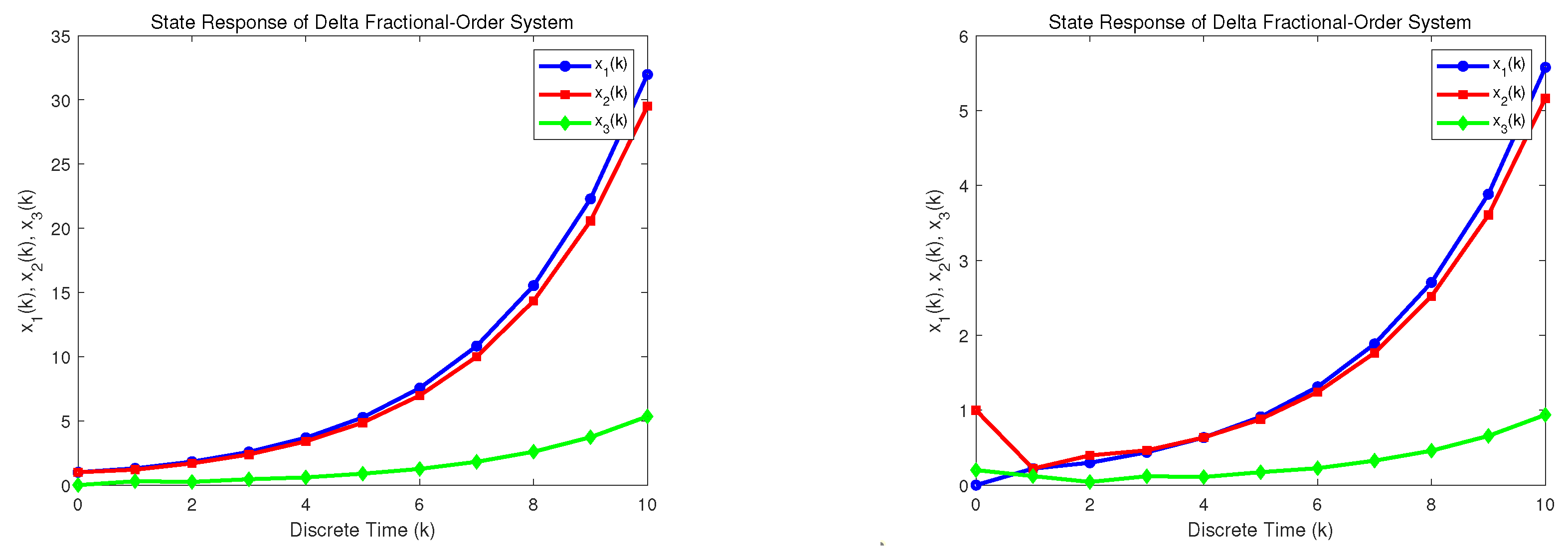
and fractional order α = 0.6 . When u ( k ) = 0 , Figure 1 depicts the state trajectories of open-loop Equation (1) under initial conditions x ( 0 ) = 1 1 0 and x ˜ ( 0 ) = 0 1 0.2 , respectively. As shown in Figure 1, the open-loop system is divergent in both cases.
Next, we construct a state feedback controller for Equation (1) using a data-driven approach. Firstly, construct two sets of data, that is q = 2 . Let T 1 = 2 , T 2 = 3 and
X = 1 3.8 0 0.22 3.598 1 1.7 1 1.22 1.696 0 0.45 0.2 1.12 0.658 , X + = 3.8 3.595 0.22 3.598 3.7576 1.7 3.215 1.22 1.696 3.5738 0.45 0.4 1.12 0.658 0.8587 , U = 1 0 0.5 1 0 0.5 1 1 1 0.5 , G = 0 0.12 0 0 0 0 0 0 0 0 0 0 0 0.12 0.056 0 0 0 0 0.12 .
One can readily verify that the data ( X , X + , U ) are compatible with true Equation (1), which satisfies Equation (15).
Solving the LMI (19) yields the following feasible solution:
L = 13.7512 0.0524 0.2357 0.0524 13.9196 0.0673 0.2357 0.0673 13.6315 , W = 11.4363 0.0051 0.0231 0.0051 11.4528 0.0066 0.0231 0.0066 11.4246 ,
Y = 7.5311 36.5453 28.6003 5.8819 61.3104 16.6337 5.0071 25.9713 10.2110 2.7728 23.1145 21.1368 0.4666 73.4817 24.1368 .
Meanwhile, the feedback gain matrix can be desigend as
K = U Y L 1 = 0.1667 0.0333 0.1500 0.8444 0.2444 0.1000 .
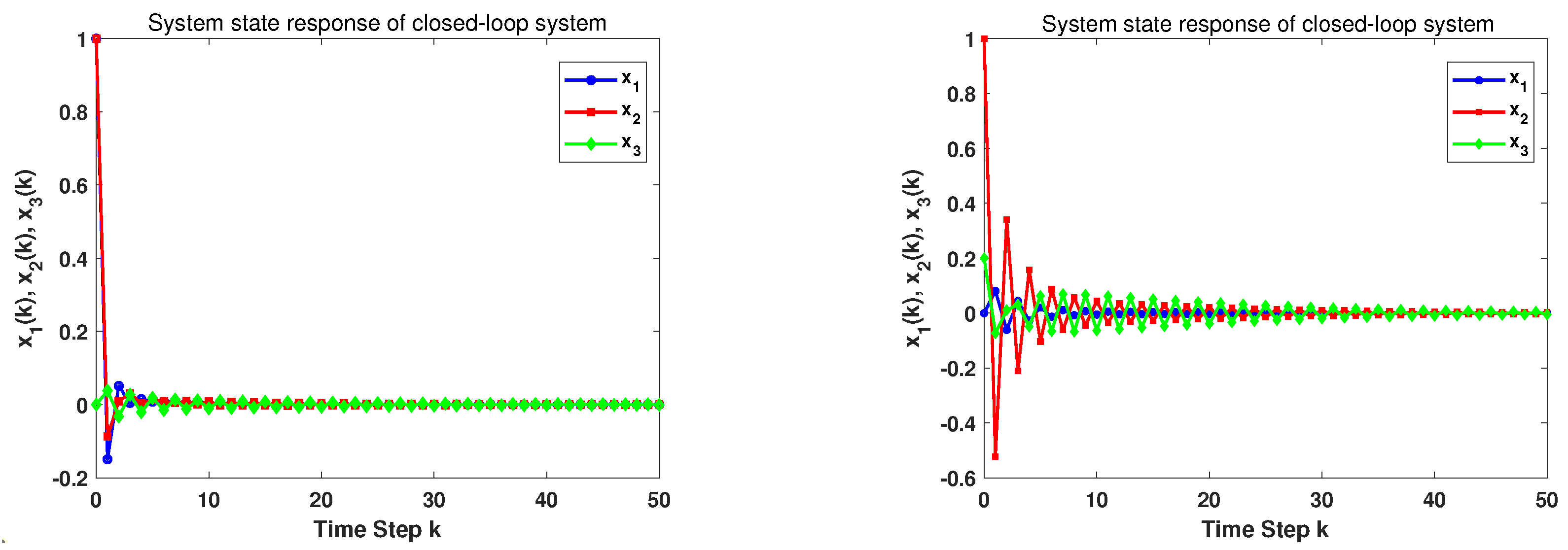
Since the control gain matrix K is designed directly from the data ( X + , X , U ) without using the system matrices A and B, to validate the proposed data-driven approach, we apply u ( k ) = K x ( k ) to Equation (1). The resulting state trajectories under the two initial conditions are shown in Figure 2. The asymptotic stability observed in both cases directly validates the effectiveness of the data-driven state feedback controller.
The effectiveness of designing a data-driven guaranteed cost controller is further demonstrated by using the aforementioned dataset ( X + , X , U ) .
Solving LMI Equations (28) and (29) in Theorem 7, we obtain feasible solutions as
L = 7.4019 1.5488 2.0609 0.4385 14.2269 1.0519 1.7654 0.4051 9.9436 , W = 5.8561 1.0609 1.6845 1.0609 13.4016 0.5385 1.6845 0.5385 8.8303 ,
R ¯ = 0.7586 0.2949 0.3809 0.2949 2.1791 0.5441 0.3809 0.5441 1.1601 , S ˜ = 14.8180 2.4267 2.4267 26.6850 ,
Y = 2.6696 38.1665 16.5578 1.9925 62.9252 7.8608 2.4006 27.1785 4.8431 0.0591 23.8802 13.3497 0.6913 76.0359 11.5150 .
Correspondingly, one can design the data-driven feedback control gain as
K = U Y L 1 = 0.2192 0.0288 0.1276 0.8056 0.2680 0.0958 .
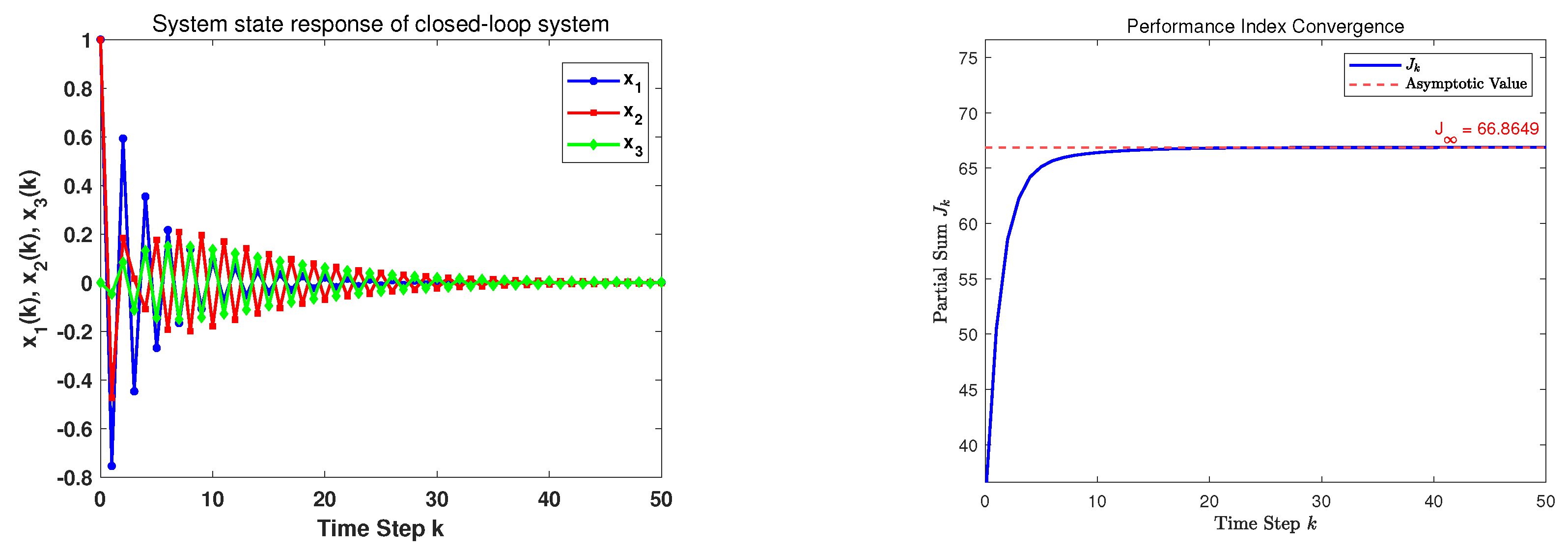
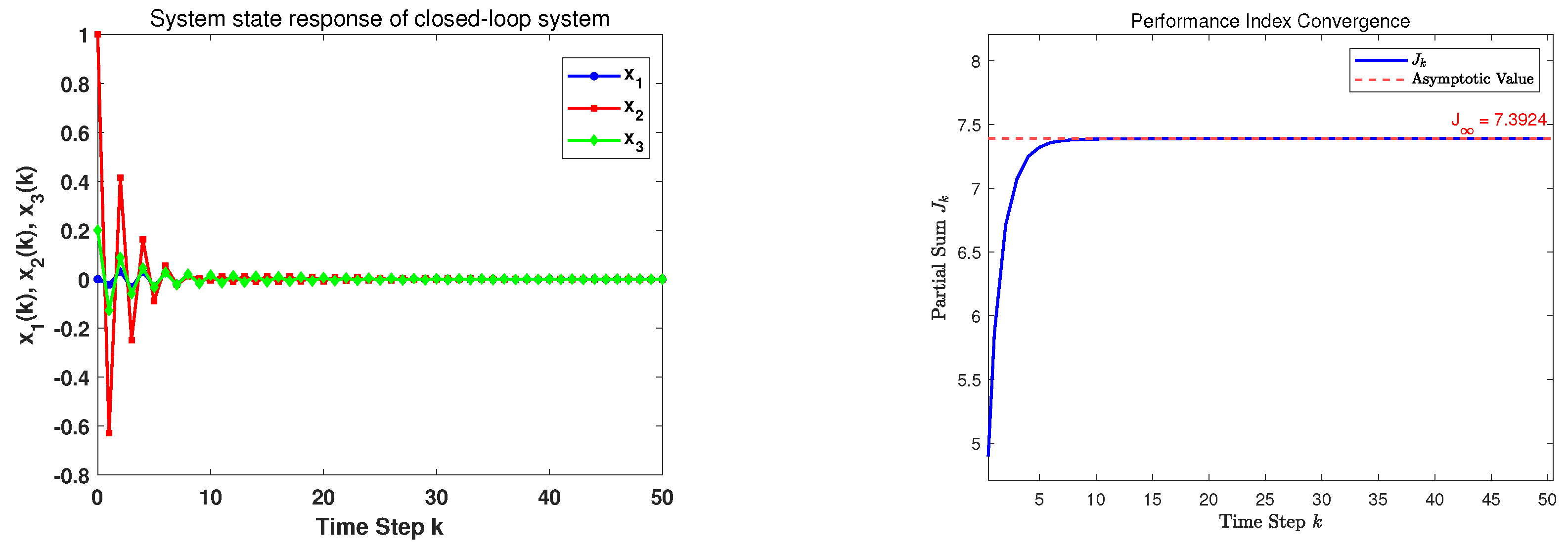
Figure 3 shows the state trajectories of the closed-loop system with the data-driven feedback controller, which are generated from the initial conditions x ( 0 ) = [ 1 , 1 , 0 ] and x ˜ ( 0 ) = [ 0 , 1 , 0.2 ] , while the evolution of the partial sum
J k = j = 0 k x ( j ) ( R + K S K ) x ( j )
is shown in Figure 4. These results demonstrate that the data-driven controller not only stabilizes the system but also serves as a guaranteed-cost controller.

6. Conclusions

This paper has established stability conditions for Delta discrete fractional-order systems and derived existence conditions for guaranteed-cost controllers from a data-driven perspective. Based on these conditions, we have further proposed informativity-based criteria to determine when state and input data are sufficient for designing both state feedback and guaranteed-cost controllers. Corresponding data-based design methods have been developed for each case. Numerical simulations confirm the validity of the theoretical findings. We note that research on data-driven methods for discrete-time fractional-order systems remains in its early stages. Several important directions remain open for future investigation:
  • Reducing conservatism: The current formulation uses the aggregate bound c ¯ = 1 α for all delay terms. Future work will develop delay-dependent or α -dependent conditions that can reduce conservatism while preserving computational tractability.
  • Robustness to noisy data: While the informativity framework offers a promising starting point, extending the results to handle measurement noise and uncertainties through robust LMI formulations or set-membership approaches is an essential step toward practical implementation.
  • Nonlinear extensions: Generalizing the proposed data-driven framework to nonlinear fractional-order systems, possibly via linear parameter-varying (LPV) embeddings or Koopman operator representations, would significantly broaden its applicability.
  • Scarce-data settings: Investigating informativity conditions and controller synthesis under limited data records, where rank ( X ) < n , could enhance the method’s practicality in experimental settings with constrained data acquisition.
  • Continuous-time counterparts: Developing parallel informativity-based designs for continuous-time fractional-order systems would complement the discrete-time results presented here.
  • Application Prospects: The theoretical framework developed in this study can be directly applied to practical systems with fractional-order characteristics, such as viscoelastic material control and lithium-ion battery management (whose dynamics exhibit memory effects), as well as thermal process control in additive manufacturing (involving fractional diffusion). A common feature of these application scenarios is the difficulty in obtaining precise system models, whereas the data-driven approach proposed in this paper can directly design controllers based on operational data, thereby circumventing modeling challenges and demonstrating the engineering translational potential of the theoretical results.

Author Contributions

Methodology, C.W.; writing—original draft preparation, C.W. and L.D.; writing—review and editing, X.H. and F.G.; funding acquisition, C.W. All authors have read and agreed to the published version of the manuscript.

Funding

The research was supported by the Research Project Supported by Shanxi Scholarship Council of China: 2023-107, National Science and Technology Major Project on “Intelligent Manufacturing Systems and Robots” under Grant 2025ZD1606500 and Foundation of National Natural Science of China: 61907027.

Data Availability Statement

The data presented in this study are available on request from the corresponding author.

Conflicts of Interest

The authors declare that they have no conflicts of interest regarding the publication of this paper.

References

  1. Monje, C.A.; Chen, Y.; Vinagre, B.M.; Xue, D.; Feliu, V. Fractional-Order Systems and Controls: Fundamentals and Applications; Springer: London, UK, 2010. [Google Scholar]
  2. Caponetto, R.; Dongola, G.; Fortuna, L.; Petras, I. Fractional Order Systems: Modeling and Control Applications; World Scientific: Singapore, 2010. [Google Scholar]
  3. Efe, M.Ö. Fractional order systems in industrial automation—A survey. IEEE Trans. Ind. Inf. 2011, 7, 582–591. [Google Scholar] [CrossRef]
  4. Meng, R.; Cao, L.; Zhang, Q. Study on the performance of variable-order fractional viscoelastic models to the order function parameters. Appl. Math. Model. 2023, 121, 430–444. [Google Scholar] [CrossRef]
  5. Magin, R.L. Fractional calculus models of complex dynamics in biological tissues. Comput. Math. Appl. 2010, 59, 1586–1593. [Google Scholar] [CrossRef]
  6. Sierociuk, D.; Skovranek, T.; Macias, M.; Podlubny, I.; Petras, I.; Dzielinski, A.; Ziubinski, P. Diffusion process modeling by using fractional-order models. Appl. Math. Comput. 2015, 257, 2–11. [Google Scholar] [CrossRef]
  7. Ge, F.; Chen, Y. Event-triggered control for boundary controlled time-fractional diffusion systems with spatially-varying coefficients. Appl. Math. Comput. 2024, 478, 128830. [Google Scholar] [CrossRef]
  8. Makowiec, D.; Gała, R.; Dudkowska, A.; Rynkiewicz, A.; Zwierz, M. Long-range dependencies in heart rate signals—revisited. Physica A 2006, 369, 632–644. [Google Scholar] [CrossRef]
  9. Zhang, X.; Chen, S.; Zhang, J.X. Adaptive sliding mode consensus control based on neural network for singular fractional order multi-agent systems. Appl. Math. Comput. 2022, 434, 127442. [Google Scholar] [CrossRef]
  10. Zhang, X.; Chen, Y. Admissibility and robust stabilization of continuous linear singular fractional order systems with the fractional order α: The 0 < α < 1 case. ISA Trans. 2018, 82, 42–50. [Google Scholar] [CrossRef] [PubMed]
  11. Shen, J.; Lam, J. Non-existence of finite-time stable equilibria in fractional-order nonlinear systems. Automatica 2014, 50, 547–551. [Google Scholar] [CrossRef]
  12. Luo, C.; Wu, G.C.; Huang, L.L. Fractional uncertain differential equations with general memory effects: Existences and alpha-path solutions. Nonlinear Anal. Model. Control 2023, 28, 152–179. [Google Scholar] [CrossRef]
  13. Goodrich, C.; Peterson, A.C. Discrete Fractional Calculus; Springer: Cham, Switzerland, 2015. [Google Scholar]
  14. Wu, G.C.; Wu, Z.Q.; Ji, L. Machine learning to discover discrete fractional chaotic models. J. Comput. Appl. Math. 2026, 473, 116869. [Google Scholar] [CrossRef]
  15. Alessandretti, A.; Pequito, S.; Pappas, G.J.; Aguiar, A.P. Finite-dimensional control of linear discrete-time fractional-order systems. Automatica 2020, 115, 108512. [Google Scholar] [CrossRef]
  16. Busłowicz, M. Robust stability of positive discrete-time linear systems of fractional order. Bull. Pol. Acad. Sci.-Tech. Sci. 2010, 58, 567–572. [Google Scholar] [CrossRef]
  17. Wei, Y.; Zhou, S.; Chen, Y.; Cao, J. Explicit stability condition for delta fractional order systems with α∈(0,+). ISA Trans. 2024, 150, 121–133. [Google Scholar] [CrossRef]
  18. Mozyrska, D.; Torres, D.F.; Wyrwas, M. Solutions of systems with the Caputo–Fabrizio fractional delta derivative on time scales. Nonlinear Anal. Hybrid Syst. 2019, 32, 168–176. [Google Scholar] [CrossRef]
  19. Wei, Y. Lyapunov stability theory for nonlinear nabla fractional order systems. IEEE Trans. Circuits Syst. II Exp. Briefs 2021, 68, 3246–3250. [Google Scholar] [CrossRef]
  20. Wei, Y.; Chen, Y. Converse Lyapunov theorem for nabla asymptotic stability without conservativeness. IEEE Trans. Syst. Man Cybern. Syst. 2021, 52, 2676–2687. [Google Scholar] [CrossRef]
  21. Klus, S.; Nüske, F.; Peitz, S.; Niemann, J.H.; Clementi, C.; Schütte, C. Data-driven approximation of the Koopman generator: Model reduction, system identification, and control. Physica D 2020, 406, 132416. [Google Scholar] [CrossRef]
  22. Tanaskovic, M.; Fagiano, L.; Novara, C.; Morari, M. Data-driven control of nonlinear systems: An on-line direct approach. Automatica 2017, 75, 1–10. [Google Scholar] [CrossRef]
  23. Asgari, S.; Gupta, R.; Puri, I.K.; Zheng, R. A data-driven approach to simultaneous fault detection and diagnosis in data centers. Appl. Soft Comput. 2021, 110, 107638. [Google Scholar] [CrossRef]
  24. Rosolia, U.; Zhang, X.; Borrelli, F. Data-driven predictive control for autonomous systems. Annu. Rev. Control Robot. Auton. Syst. 2018, 1, 259–286. [Google Scholar] [CrossRef]
  25. Willems, J.C.; Rapisarda, P.; Markovsky, I.; De Moor, B.L. A note on persistency of excitation. Syst. Control Lett. 2005, 54, 325–329. [Google Scholar] [CrossRef]
  26. Markovsky, I.; Rapisarda, P. On the linear quadratic data-driven control. In Proceedings of the 2007 European Control Conference (ECC), Kos, Greece, 2–5 July 2007; pp. 5313–5318. [Google Scholar]
  27. Markovsky, I.; Rapisarda, P. Data-driven simulation and control. Int. J. Control 2008, 81, 1946–1959. [Google Scholar] [CrossRef]
  28. Maupong, T.M.; Rapisarda, P. Data-driven control: A behavioral approach. Syst. Control Lett. 2017, 101, 37–43. [Google Scholar] [CrossRef]
  29. van Waarde, H.J.; Eising, J.; Trentelman, H.L.; Camlibel, M.K. Data informativity: A new perspective on data-driven analysis and control. IEEE Trans. Autom. Control 2020, 65, 4753–4768. [Google Scholar] [CrossRef]
  30. Rapisarda, P.; van Waarde, H.J.; Çamlibel, M.K. Orthogonal polynomial bases for data-driven analysis and control of continuous-time systems. IEEE Trans. Autom. Control 2023, 69, 4307–4319. [Google Scholar] [CrossRef]
  31. van Waarde, H.J.; Camlibel, M.K.; Rapisarda, P.; Trentelman, H.L. Data-driven dissipativity analysis: Application of the matrix S-lemma. IEEE Control Syst. Mag. 2022, 42, 140–149. [Google Scholar] [CrossRef]
  32. van Waarde, H.J.; Camlibel, M.K.; Eising, J.; Trentelman, H.L. Quadratic matrix inequalities with applications to data-based control. SIAM J. Control Optim. 2023, 61, 2251–2281. [Google Scholar] [CrossRef]
  33. van Waarde, H.J.; Camlibel, M.K.; Mesbahi, M. From noisy data to feedback controllers: Nonconservative design via a matrix S-lemma. IEEE Trans. Autom. Control 2020, 67, 162–175. [Google Scholar] [CrossRef]
  34. van Waarde, H.J.; Mesbahi, M. Data-driven parameterizations of suboptimal LQR and 2 controllers. IFAC-PapersOnLine 2020, 53, 4234–4239. [Google Scholar] [CrossRef]
Figure 1. State trajectories x 1 ( k ) , x 2 ( k ) , and x 3 ( k ) of open-loop Delta fractional-order Equation (1) under two different initial conditions: (i) x ( 0 ) = [ 1 , 1 , 0 ] , (ii) x ( 0 ) = [ 0 , 1 , 0.2 ] , with fractional order α = 0.6 .
Fractalfract 10 00078 g001
Figure 2. State trajectories x 1 ( k ) , x 2 ( k ) , and x 3 ( k ) of closed-loop Equation (11) under the data-driven state feedback controller u ( k ) = K x ( k ) with gain K in Equation (30). Initial conditions are the same as in Figure 1.
Fractalfract 10 00078 g002
Figure 3. State trajectories x 1 ( k ) , x 2 ( k ) , x 3 ( k ) and evolution of the partial cost index J k = j = 0 k x ( j ) ( R + K S K ) x ( j ) for the closed-loop system under the guaranteed-cost controller (Theorem 7) with initial condition x ( 0 ) = [ 1 , 1 , 0 ] .
Fractalfract 10 00078 g003
Figure 4. State trajectories x 1 ( k ) , x 2 ( k ) , x 3 ( k ) and evolution of the partial cost index J k for the closed-loop system under the same guaranteed-cost controller as in Figure 3, but with initial condition x ( 0 ) = [ 0 , 1 , 0.2 ] .
Fractalfract 10 00078 g004
Disclaimer/Publisher’s Note: The statements, opinions and data contained in all publications are solely those of the individual author(s) and contributor(s) and not of MDPI and/or the editor(s). MDPI and/or the editor(s) disclaim responsibility for any injury to people or property resulting from any ideas, methods, instructions or products referred to in the content.