Article

Exploring Dynamic Behavior in the Fractional-Order Reaction–Diffusion Model

1
Institute of Economics and Management, Jining Normal University, Ulanqab 012000, China
2
College of Civil Engineering, Inner Mongolia University of Technology, Hohhot 010051, China
*
Author to whom correspondence should be addressed.
Fractal Fract. 2026, 10(2), 77; https://doi.org/10.3390/fractalfract10020077
Submission received: 17 November 2025 / Revised: 14 January 2026 / Accepted: 20 January 2026 / Published: 23 January 2026

Abstract

This paper presents a novel high-order numerical method. The proposed scheme utilizes polynomial generating functions to achieve p order accuracy in time for the Grünwald–Letnikov fractional derivatives, while maintaining second-order spatial accuracy. By incorporating a short-memory principle, the method remains computationally efficient for long-time simulations. The authors rigorously analyze the stability of equilibrium points for the fractional vegetation–water model and perform a weakly nonlinear analysis to derive amplitude equations. Convergence analysis confirms the scheme’s consistency, stability, and convergence. Numerical simulations demonstrate the method’s effectiveness in exploring how different fractional derivative orders influence system dynamics and pattern formation, providing a robust tool for studying complex fractional systems in theoretical ecology.

1. Introduction

Arid and semi-arid ecosystems, covering over one-third of the Earth’s land surface, exhibit remarkable self-organized spatial patterns as a fundamental adaptation to water scarcity [1,2]. These patterns—including bands, spots, and labyrinths—are not merely aesthetic phenomena but represent critical indicators of ecosystem health and resilience [3]. The mathematical modeling of these patterns has emerged as an essential tool for understanding dryland ecology and predicting responses to climate change.
The formation of vegetation patterns is fundamentally driven by scale-dependent feedbacks: local facilitation through improved water infiltration near vegetation clumps, and long-range competition for scarce water resources [4]. Early pioneering work by Klausmeier [3] demonstrated how simple reaction–diffusion models can capture this basic mechanism. However, these initial models often simplified the complex hydrological processes governing water redistribution in drylands.
To address this limitation, Rietkerk et al. [4] developed a more physiologically based model that explicitly separates soil moisture and surface water dynamics. Building on this framework, we consider an extended three-component model that couples vegetation biomass (V), soil moisture (W), and surface water (H) through the following system of partial differential equations:
V t = r W V d V + D V 2 V , W t = α H c W r W V + D W 2 W , H t = I α H f V H + D H 2 H + β · ( H z ) .
This model incorporates several key advances: (i) explicit representation of surface water hydrology with advective transport driven by topography ( β · ( H z ) ), (ii) vegetation interception losses ( f V H ), and (iii) distinct diffusion processes for each component. However, the classical integer-order derivative framework in Equation (1) assumes Markovian (memoryless) dynamics and normal diffusion, which may not fully capture the anomalous transport and memory effects observed in ecological systems [5].
Recent evidence suggests that biological and hydrological processes in drylands often exhibit memory effects and long-range dependencies [6]. For instance, plant growth responses to rainfall events can display temporal correlations, while water transport in heterogeneous soils may follow anomalous rather than Fickian diffusion. These phenomena are naturally described using fractional calculus [7].
This study builds upon the extensive literature on fractional differential equations—spanning theoretical foundations [7,8], stability analysis [9,10], applications in control theory [11,12], and numerical methods [13,14]. These papers introduce a time-fractional generalization of the classical vegetation–water model. In this paper, we study the dynamic behavior of the following fractional model:
D t α 1 V = r W V d V + D V 2 V , D t α 2 W = α H c W r W V + D W 2 W , D t α 3 H = I α H f V H + D H 2 H + β · ( H z ) ,
where D t α i denotes the Grünwald–Letnikov fractional derivative of order α i [7]. When α 1 = α 2 = α 3 = 1 , the system reduces to the classical model in Equation (1). Table 1 and Table 2 provide a detailed description of all state variables and parameters in the system.
The main contributions of this paper are as follows:
  • This paper presents a new high-order numerical method for fractional-order reaction–diffusion systems. The scheme uses polynomial generating functions to achieve p-th order accuracy in time for the Grünwald–Letnikov fractional derivatives, while maintaining second-order accuracy in space, and incorporates a short-memory principle for computational efficiency.
  • This paper provides a thorough theoretical foundation for the proposed method, including a stability analysis of the fractional system’s equilibrium points, a weakly nonlinear analysis to derive amplitude equations, and a rigorous convergence analysis that proves the scheme’s consistency, stability, and convergence.
  • It effectively applies the developed numerical framework to a fractional three-component vegetation–water model, demonstrating its utility in exploring how fractional derivative orders (and the memory effects they represent) influence system dynamics and pattern formation in theoretical ecology.
This paper is organized as follows. In Section 2, we establish the stability analysis of the fractional-order vegetation–water model. In Section 3, we perform the weakly nonlinear analysis. In Section 4, we develop a high-order numerical scheme for the fractional system. In Section 5, we present numerical simulations of pattern formation. Finally, in Section 6, we present the conclusion.

2. Stability Analysis

To find the equilibrium points (steady states) of the system, we set the time derivatives and spatial derivatives to zero
D t α 1 V = 0 , D t α 2 W = 0 , D t α 3 H = 0 , 2 V = 0 , 2 W = 0 , 2 H = 0 , z = 0 .
This gives us the system of algebraic equations
r W V d V = 0 , α H c W r W V = 0 , I α H f V H = 0 .
Thus, we can get two equilibrium points: E 0 = ( V 0 , W 0 , H 0 ) = 0 , I c , I α , E 1 = ( V * , W * , H * ) = V * , d r , d α c r + V * .
The Jacobian matrix of the reaction terms (without diffusion) is
J ( V , W , H ) = r W d r V 0 r W c r V α f H 0 α f V .
The characteristic equation of the Jacobian matrix J for the fractional system is given by
det ( J diag ( λ α 1 , λ α 2 , λ α 3 ) ) = 0 ,
where λ represents the eigenvalues, and α 1 , α 2 , α 3 are the orders of the fractional derivatives.
At E 0 = 0 , I c , I α , the Jacobian matrix is
J ( E 0 ) = r I c d 0 0 r I c c α f I α 0 α .
If all α i are rational numbers, let
m = lcm denom ( α 1 ) , denom ( α 2 ) , denom ( α 3 ) ,
where denom ( α i ) denotes the denominator of the reduced fraction form of α i . Then the characteristic matrix is
J ( E 0 ) diag ( λ α 1 , λ α 2 , λ α 3 ) = r I c d λ m α 1 0 0 r I c c λ m α 2 α f I α 0 α λ m α 3 .
This is a block triangular matrix. Thus, the characteristic equation at E 0 is
r I c d λ m α 1 c + λ m α 2 α + λ m α 3 = 0 .
The eigenvalues are determined by solving
λ m α 1 = r I c d , λ m α 2 = c , λ m α 3 = α .
At E 1 = V * , d r , H * , where H * = d α c r + V * , the Jacobian matrix is
J ( E 1 ) = 0 r V * 0 d c r V * α f H * 0 α f V * .
The characteristic matrix is
J ( E 1 ) diag ( λ m α 1 , λ m α 2 , λ m α 3 ) = λ m α 1 r V * 0 d c r V * m λ α 2 α f H * 0 α f V * λ m α 3 .
The characteristic equation is given by
det λ m α 1 r V * 0 d c r V * λ m α 2 α f H * 0 α f V * λ m α 3 = 0 .
Expanding this determinant along the first row, the characteristic equation at E 1 simplifies to
λ m α 1 ( c + r V * + λ m α 2 ) ( α + f V * + λ m α 3 ) + r V * d α f c r + λ m α 3 = 0 .
Corollary 1.
If all eigenvalues λ i satisfy | arg ( λ i ) | > π 2 m , then the system at the equilibrium point is globally asymptotically stable. If there exists one eigenvalue λ i to satisfy | arg ( λ i ) | < π 2 m , then the system at the equilibrium point is unstable. If eigenvalue λ i satisfies m a x { | arg ( λ i ) | } = π 2 m , then bifurcation occurs in the system.
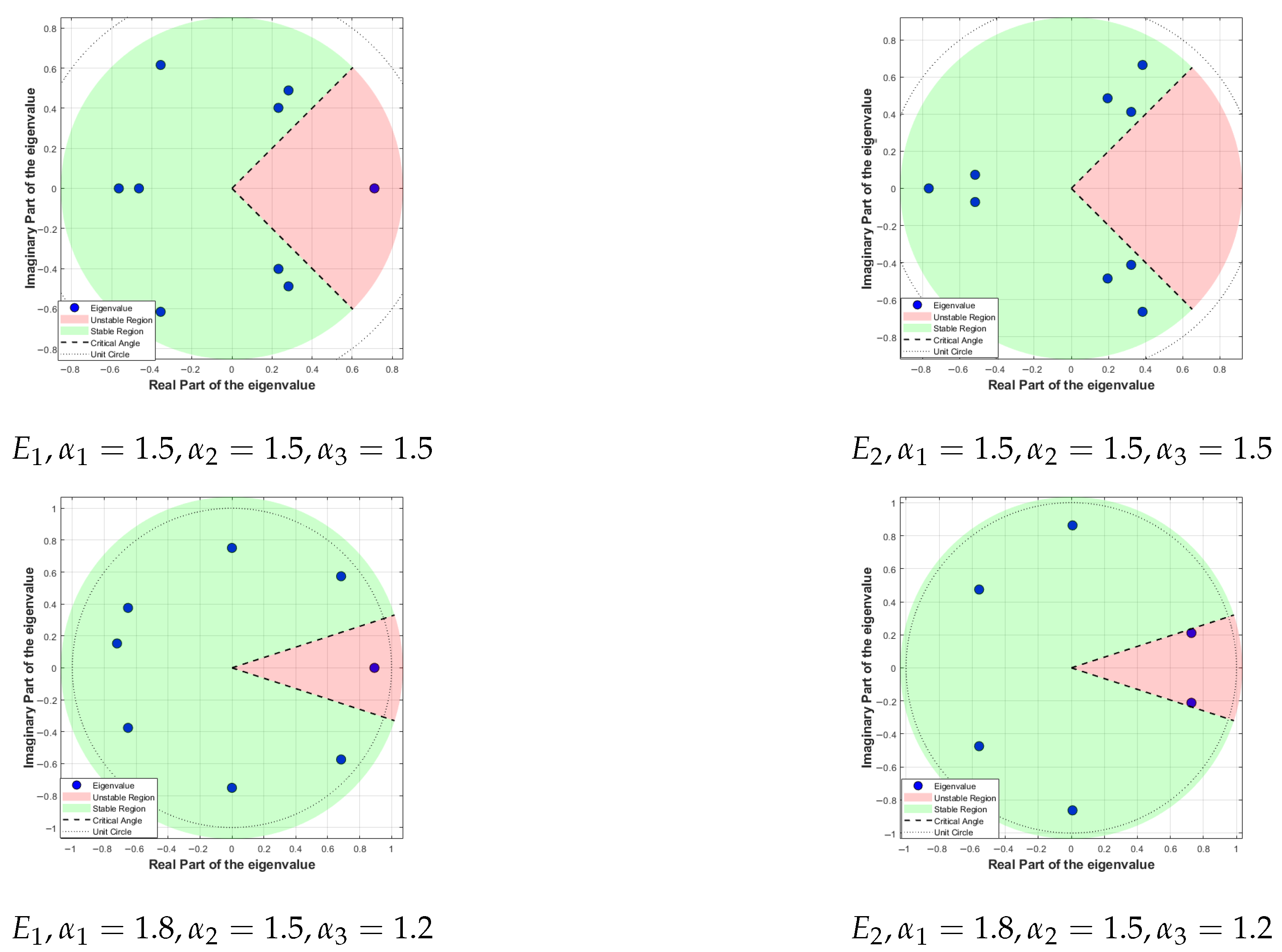
We set r = 0.120 ,   d = 0.060 ,   D V = 0 ,   α = 0.180 ,   c = 0.100 ,   D W = 0 ,   I = 0.350 ,   f = 0.120 ,   D H = 0 ,   β = 0.015 , and obtain the equilibrium points E 1 ( 0.000000 ,   3.500000 ,   1.944444 ) , E 2 ( 1.810095 ,   0.500000 ,   0.881143 ) .
Figure 1 illustrates how the order of fractional derivatives influences the stability regions of equilibrium points in the fractional vegetation–water model. The figure consists of four subfigures comparing stability under different fractional orders for two equilibrium points. At the same equilibrium point, but with different fractional derivatives α i , it can be seen that the stability region has changed.
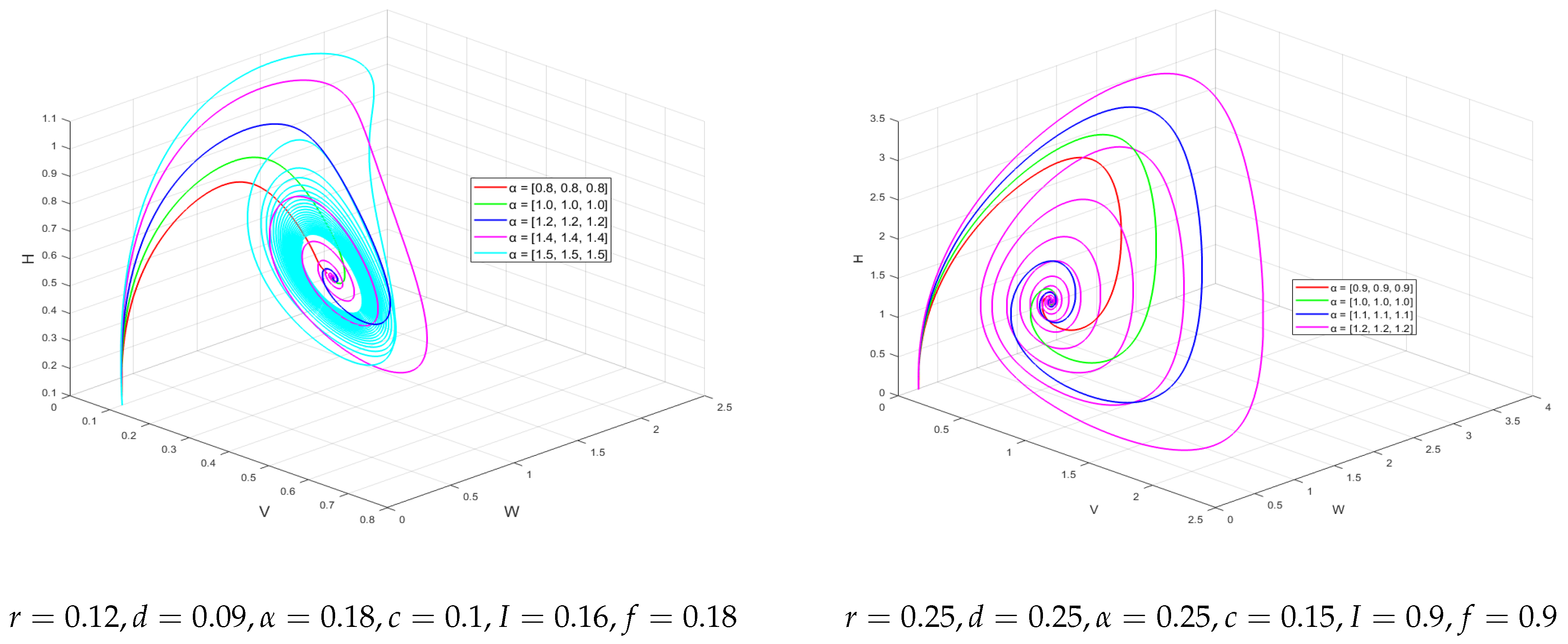
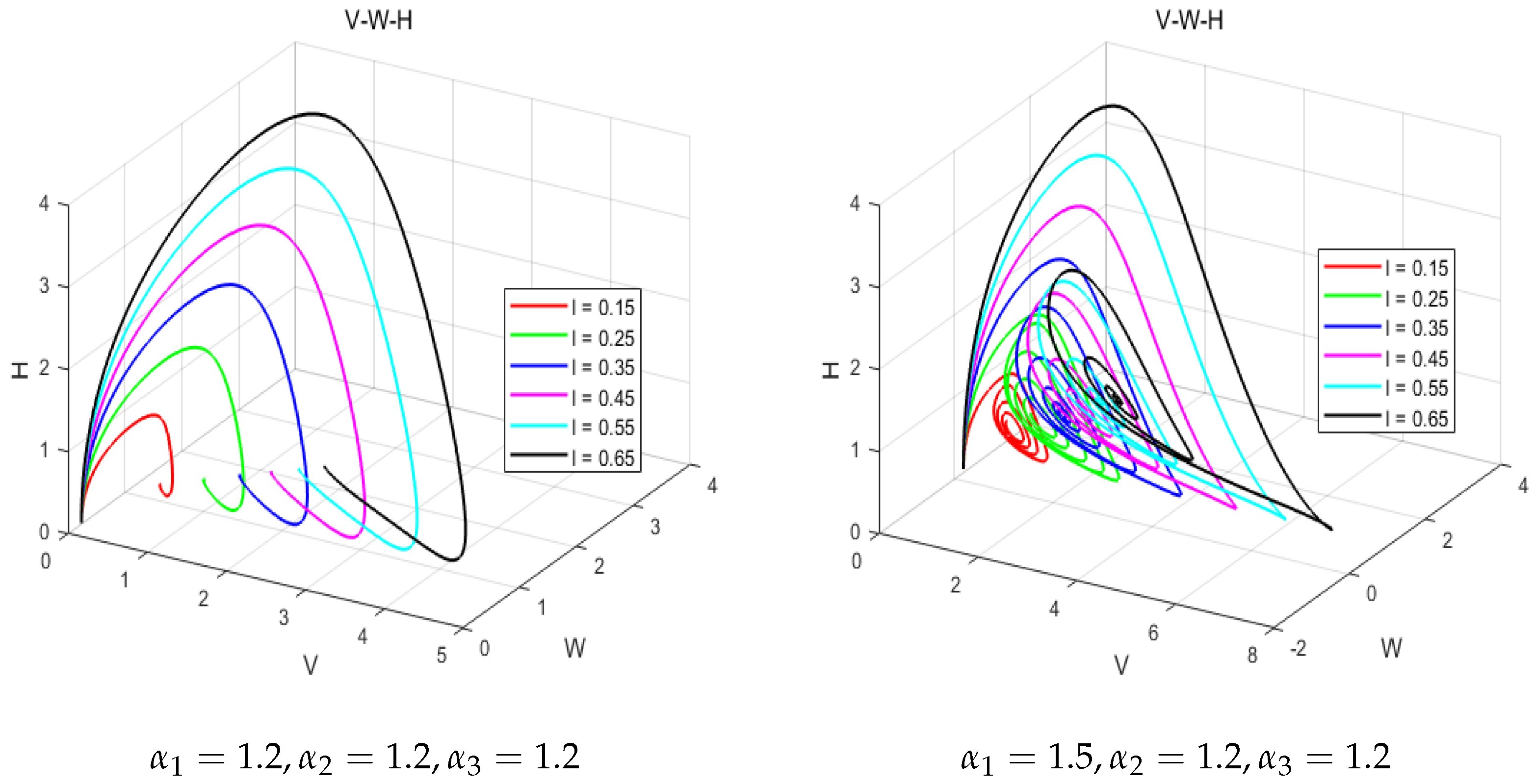
Figure 2 and Figure 3 show the significant differences in the dynamic behavior of the system under different fractional derivative orders.

3. Weakly Nonlinear Analysis

Define the nonlinear reaction terms:
F 1 ( V ,   W ,   H ) = r W V d V , F 2 ( V ,   W ,   H ) = α H c W r W V , F 3 ( V ,   W ,   H ) = I α H f V H .
Let E * = ( V * ,   W * ,   H * ) be an equilibrium point, satisfying
F 1 ( V * ,   W * ,   H * ) = 0 , F 2 ( V * ,   W * ,   H * ) = 0 , F 3 ( V * ,   W * ,   H * ) = 0 .
Introduce small perturbations around the equilibrium:
V ˜ = V V * ,   W ˜ = W W * ,   H ˜ = H H * .
The multivariate Taylor expansion of a function F ( X ) around X * is
F ( X ) = F ( X * ) + i F X i | X * X ˜ i + 1 2 ! i , j 2 F X i X j | X * X ˜ i X ˜ j + 1 3 ! i , j , k 3 F X i X j X k | X * X ˜ i X ˜ j X ˜ k + ,
where X = ( V , W , H ) and X ˜ = ( V ˜ , W ˜ , H ˜ ) .
The Taylor expansions of the reaction terms up to the first order are
F 1 ( V , W , H ) = ( r W * d ) V ˜ + r V * W ˜ + r V ˜ W ˜ , F 2 ( V , W , H ) = r W * V ˜ ( c + r V * ) W ˜ + α H ˜ r V ˜ W ˜ , F 3 ( V , W , H ) = f H * V ˜ ( α + f V * ) H ˜ f V ˜ H ˜ .
Substituting into the original fractional PDE system and renaming V ˜ ,   W ˜ ,   H ˜ back to V ,   W ,   H for notational convenience yields
D t α 1 V = ( r W * d ) V + r V * W + D V 2 V + r V W , D t α 2 W = r W * V ( c + r V * ) W + α H + D W 2 W r V W , D t α 3 H = f H * V ( α + f V * ) H + D H 2 H + β · ( H z ) f V H .
Define the state vector U = V W H . For the fractional derivative form (5), we write
D t α U = J ( E * ) U + D 2 U + A U + N ( U ) ,  
where D t α = diag ( D t α 1 ,   D t α 2 ,   D t α 3 ) , J ( E * ) is the Jacobian at equilibrium:
J ( E * ) = r W * d r V * 0 r W * c r V * α f H * 0 α f V * ,  
  • D = diag ( D V ,   D W ,   D H ) is the diffusion matrix, and A is the advection operator:
A = 0 0 0 0 0 0 0 0 β · ( z · ) .
  • The nonlinear operator N ( U ) contains the quadratic terms
N ( U ) = r V W r V W f V H .
If α 1 = α 2 = α 3 , the system (5) can be written as
U t = L U + N ( U ) ,  
where L is the linear operator and N ( U ) is the nonlinear operator. The linear operator L consists of the reaction–diffusion–advection terms:
L = ( r W * d ) + D V 2 r V * 0 r W * ( c + r V * ) + D W 2 α f H * 0 ( α + f V * ) + D H 2 + β · ( z · ) .
More explicitly, the action of L on U is
L U = ( r W * d ) V + r V * W + D V 2 V r W * V ( c + r V * ) W + α H + D W 2 W f H * V ( α + f V * ) H + D H 2 H + β · ( H z ) .
The system can be written as
U t = L U + N ( U ) ,  
where
U = V W H ,   N ( U ) = r V W r V W f V H .
The linear operator L is decomposed as
L = L c + ( κ κ c ) M ,  
where
L c = L ( κ c ) ,   M = b 11 b 12 b 13 b 21 b 22 b 23 b 31 b 32 b 33 .
Introduce multiple time scales
T 0 = t ,   T 1 = ε t ,   T 2 = ε 2 t ,   T 3 = ε 3 t ,  
so the time derivative becomes
t = T 0 + ε T 1 + ε 2 T 2 + ε 3 T 3 + O ( ε 4 ) .
Expand the solution in powers of ε
U = ε U 1 + ε 2 U 2 + ε 3 U 3 + O ( ε 4 ) ,  
where U i = ( V i ,   W i ,   H i ) T .
Substituting (9) into (8) gives
t U = ε T 0 U 1 + ε 2 T 0 U 2 + T 1 U 1 + ε 3 T 0 U 3 + T 1 U 2 + T 2 U 1 + O ( ε 4 ) .
Substituting (9) into the nonlinear term N ( U ) yields
N ( U ) = r V W r V W f V H = r ( ε V 1 + ε 2 V 2 + ) ( ε W 1 + ε 2 W 2 + ) r ( ε V 1 + ε 2 V 2 + ) ( ε W 1 + ε 2 W 2 + ) f ( ε V 1 + ε 2 V 2 + ) ( ε H 1 + ε 2 H 2 + )   = ε 2 r V 1 W 1 r V 1 W 1 f V 1 H 1 + ε 3 r ( V 1 W 2 + V 2 W 1 ) r ( V 1 W 2 + V 2 W 1 ) f ( V 1 H 2 + V 2 H 1 ) + O ( ε 4 ) .
Thus
N ( U ) = ε 2 N 1 + ε 3 N 2 + O ( ε 4 ) ,
where
N 1 = N 1 ( U 1 ) = r V 1 W 1 r V 1 W 1 f V 1 H 1 , N 2 = N 2 ( U 1 , U 2 ) = r ( V 1 W 2 + V 2 W 1 ) r ( V 1 W 2 + V 2 W 1 ) f ( V 1 H 2 + V 2 H 1 ) .
The system can be written compactly as
  ε T 0 U 1 + ε 2 T 0 U 2 + T 1 U 1 + ε 3 T 0 U 3 + T 1 U 2 + T 2 U 1 + O ( ε 4 )   = ε L c U 1 + ε 2 ( L c U 2 + κ 1 M U 1 ) + ε 3 ( L c U 3 + κ 1 M U 2 + κ 2 M U 1 ) + ε 2 N 1 + ε 3 N 2 + O ( ε 4 ) .
Assuming T 0 = 0 , and collecting terms by order of ε
O ( ε ) : L c U 1 = 0 ,
O ( ε 2 ) : L c U 2 = T 1 U 1 κ 1 M U 1 N 1 ,
O ( ε 3 ) : L c U 3 = T 1 U 2 + T 2 U 1 κ 1 M U 2 κ 2 M U 1 N 2 .
Since L c is a linear operator, the solution of L c U 1 = 0 is a linear combination of eigenvectors with zero eigenvalue. Write the solution corresponding to the wave vector k c as
U 1 = A ( T 1 , T 2 ) ϕ 1 ϕ 2 ϕ 3 e i k c · r + c . c . ,
where ϕ = ( ϕ 1 ,   ϕ 2 ,   ϕ 3 ) T is the eigenvector of L c corresponding to the zero eigenvalue at the critical wavenumber k c , and c.c. denotes the complex conjugate.
The nonlinear terms become
N 1 = | A | 2 N 1 ( 0 ) + A 2 N 1 ( 2 ) e 2 i k c · r + c . c . , N 2 = | A | 2 A N 2 ( 1 ) e i k c · r + A 3 N 2 ( 3 ) e 3 i k c · r + c . c . + ,
where the specific forms of N 1 ( 0 ) ,   N 1 ( 2 ) ,   N 2 ( 1 ) ,   N 2 ( 3 ) depend on the quadratic and cubic interactions between the modes.
The solvability condition for the O ( ε 2 ) equation requires
ψ , T 1 U 1 κ 1 M U 1 N 1 = 0 ,
where ψ is the left eigenvector of L c corresponding to the zero eigenvalue, and · , · denotes the inner product.
This leads to the amplitude equation:
A T 1 = μ 1 κ 1 A + η 1 | A | 2 A + ,
where μ 1 and η 1 are coefficients determined by the eigenvectors and nonlinear terms.
Similarly, the O ( ε 3 ) equation provides the next order correction. For Equation (14) to have a solution, the right-hand side must be orthogonal to the left eigenvector ψ of L c :
ψ , T 1 U 2 + T 2 U 1 κ 1 M U 2 κ 2 M U 1 N 2 = 0 ,
where f , g = f * · g d r denotes the inner product.
Substituting the expressions for U 1 and U 2 , we obtain
ψ , T 2 U 1 = ψ , A T 2 ϕ e i θ + c . c . = A T 2 ψ , ϕ + c . c . , ψ , κ 2 M U 1 = κ 2 ψ , M ( A ϕ e i θ + c . c . ) = κ 2 A ψ , M ϕ + c . c . , ψ , T 1 U 2 = ψ , T 1 | A | 2 U 2 ( 0 ) + A 2 U 2 ( 2 ) e 2 i θ + A T 1 U 2 ( 1 ) e i θ + c . c . = 2 A * A T 1 ψ , U 2 ( 0 ) + 2 A A T 1 ψ , U 2 ( 2 ) e 2 i θ + 2 A T 1 2 ψ , U 2 ( 1 ) e i θ + c . c . , ψ , κ 1 M U 2 = κ 1 ψ , M | A | 2 U 2 ( 0 ) + A 2 U 2 ( 2 ) e 2 i θ + A T 1 U 2 ( 1 ) e i θ + c . c .   = κ 1 | A | 2 ψ , M U 2 ( 0 ) + A 2 ψ , M U 2 ( 2 ) e 2 i θ + A T 1 ψ , M U 2 ( 1 ) e i θ + c . c . , ψ , N 2 = ψ , | A | 2 A N 2 ( 1 ) e i θ + A 3 N 2 ( 3 ) e 3 i θ + | A | 2 A T 1 N 2 ( 1 a ) e i θ + c . c .   = | A | 2 A ψ , N 2 ( 1 ) e i θ + A 3 ψ , N 2 ( 3 ) e 3 i θ + | A | 2 A T 1 ψ , N 2 ( 1 a ) e i θ + c . c .
Collecting all terms proportional to e i θ and using the normalization ψ , ϕ = 1 , we obtain the amplitude equation:
A T 2 = μ 2 κ 2 A + ν 1 κ 1 A T 1 + ν 2 | A | 2 A T 1 + η 2 | A | 2 A + η 3 | A | 4 A + ,
where the coefficients are
  μ 2 = ψ , M ϕ , ν 1 = ψ , M U 2 ( 1 ) e i θ , ν 2 = ψ , N 2 ( 1 a ) e i θ ,   η 2 = ψ , N 2 ( 1 ) e i θ + κ 1 ψ , M U 2 ( 0 ) + κ 1 ψ , M U 2 ( 2 ) e 2 i θ ,   η 3 = ψ , r F 13 r F 13 f F 23 ,
with
F 13 = 2 ϕ 1 W 3 ( 1 ) + 2 U 3 , 1 ( 1 ) ϕ 2 + U 2 , 1 ( 0 ) U 2 , 2 ( 0 ) + 2 U 2 , 1 ( 0 ) U 2 , 2 ( 2 ) + 2 U 2 , 1 ( 2 ) U 2 , 2 ( 0 ) , F 23 = 2 ϕ 1 H 3 ( 1 ) + 2 U 3 , 1 ( 1 ) ϕ 3 + U 2 , 1 ( 0 ) U 2 , 3 ( 0 ) + 2 U 2 , 1 ( 0 ) U 2 , 3 ( 2 ) + 2 U 2 , 1 ( 2 ) U 2 , 3 ( 0 ) .
The coefficient η 3 determines the saturation of patterns at higher amplitudes and plays a crucial role in distinguishing between subcritical and supercritical bifurcations.
Combining the results from O ( ε 2 ) and O ( ε 3 ) , and returning to the original time scale t = ε 2 T 2 , we obtain the final amplitude equation:
A t = μ κ A + ν A t + η | A | 2 A + ζ | A | 4 A + ,
where
μ = μ 1 + ε μ 2 + ,   ν = ε ν 1 + ε 2 ν 2 + ,   η = η 1 + ε η 2 + ,   ζ = ε η 3 + .

4. Numerical Scheme

Several advanced numerical methods have been developed for solving fractional differential equations. The matrix approach to discrete fractional calculus provides a unified framework for constructing numerical schemes through Toeplitz matrix representations of fractional operators [15,16]. Finite difference methods offer efficient discretization techniques for both space–time-fractional PDEs, with second-order accurate schemes being developed for various fractional diffusion equations [17]. The predictor-corrector approach delivers higher accuracy through iterative refinement of numerical solutions [18], while finite element methods extend variational formulations to time-fractional problems [19]. Recent developments include the reproducing kernel method, which constructs analytical solutions through kernel Hilbert spaces and effectively handles various fractional equations. Comprehensive overviews of numerical approximations are provided in specialized monographs [20], and practical applications demonstrate these methods’ effectiveness in solving complex problems in finance, ecology, and fluid dynamics [21]. These numerical approaches balance computational efficiency with accuracy, enabling reliable simulations of fractional-order systems across multiple disciplines. This paper presents a new high-order numerical method for fractional-order reaction–diffusion systems. The scheme uses polynomial generating functions to achieve p-th order accuracy in time for the Grünwald–Letnikov fractional derivatives, while maintaining second-order accuracy in space, and incorporates a short-memory principle for computational efficiency.

4.1. Discretization of Fractional Time Derivatives

The core of the numerical scheme lies in the discretization of the fractional time derivative. We begin with the Grünwald–Letnikov definition.
Definition 1
(Grünwald–Letnikov Fractional Derivative). The α-th Grünwald–Letnikov fractional derivative for a function f ( t ) is given by
D t α t 0 f ( t ) = lim h 0 1 h α j = 0 t t 0 h ( 1 ) j α j f ( t j h ) ,   t [ t 0 , T ] ,
  • where · denotes the floor function and the binomial coefficients are defined as
( 1 ) j α j = ( 1 ) j Γ ( α + 1 ) Γ ( j + 1 ) Γ ( α j + 1 ) .
A direct numerical approximation is given by
D t α t 0 f ( t ) 1 h α j = 0 N c j f ( t j h ) ,
where N = ( t t 0 ) / h and c j = ( 1 ) j α j . However, computing c j using Gamma functions for large j is numerically unstable. A stable recursive computation is preferred:
c 0 = 1 ,   c j = 1 α + 1 j c j 1 ,   j = 1 , 2 , , N .
The approximation (19) with coefficients from (20) has an accuracy of O ( h ) .
To achieve higher-order accuracy, we replace the first-order backward difference with a p-th order generating function.
Definition 2.
A p-order polynomial generating function for the first-order derivative is defined as
g p ( z ) = k = 1 p 1 k ( 1 z ) k = k = 0 p η k z k .
The coefficients { η k } k = 0 p are uniquely determined by the condition that g p ( z ) approximates ln ( z ) to p-th order near z = 1 .
Theorem 1.
The coefficients { η k } k = 0 p in (21) satisfy the following ( p + 1 ) × ( p + 1 ) linear system:
η 0 + η 1 + η 2 + + η p = 0 η 0 + 2 η 1 + 3 η 2 + + ( p + 1 ) η p = 1 η 0 + 2 2 η 1 + 3 2 η 2 + + ( p + 1 ) 2 η p = 2 η 0 + 2 p η 1 + 3 p η 2 + + ( p + 1 ) p η p = p .
Proof. 
From (21), we have the identity
k = 0 p η k z k = k = 1 p 1 k ( 1 z ) k .
Substituting z = 1 immediately gives the first equation: k = 0 p η k = 0 .
To derive the subsequent equations, we define an operator L m and apply it to both sides of (23). Consider the operator
L m [ f ( z ) ] = z d d z m f ( z ) z = 1 .
Applying L 0 (evaluation at z = 1 ) gives the first equation.
Now, apply L 1 to the left-hand side of (23):
L 1 k = 0 p η k z k = k = 0 p k η k .
Apply L 1 to the right-hand side of (23):
L 1 k = 1 p 1 k ( 1 z ) k = z d d z k = 1 p 1 k ( 1 z ) k z = 1   = z k = 1 p ( 1 z ) k 1 z = 1 = 1 .
Equating the left-hand side of (23) and the right-hand side of (23) gives the second equation: k = 0 p k η k = 1 . Note that the index shift accounts for the ( p + 1 ) terms.
Applying L 2
L 2 k = 0 p η k z k = k = 0 p k 2 η k . L 2 k = 1 p 1 k ( 1 z ) k = z d d z z k = 1 p ( 1 z ) k 1 z = 1   = k = 1 p ( 1 z ) k 1 + z k = 2 p ( k 1 ) ( 1 z ) k 2 z = 1 = 2 .
Thus, k = 0 p k 2 η k = 2 .
This process can be continued for m = 3 , , p , yielding the system (22). The key observation is that L m [ ( 1 z ) k ] | z = 1 = 0 for k > m , and the dominant contribution for each m leads to the constant m on the right-hand side of (23). □
We now extend this to fractional derivatives.
Definition 3.
The p-order generating function for the fractional derivative of order α is defined as
g p α ( z ) = g p ( z ) α = k = 0 p η k z k α .
Let its series expansion be
g p α ( z ) = k = 0 c k ( α ) z k .
Theorem 2.
The coefficients c k ( α ) in (25) can be computed recursively by
  c 0 ( α ) = η 0 α ,   c m ( α ) = 1 m η 0 i = 1 min ( m , p ) i ( 1 + α ) m η i c m i ( α ) ,   for m 1 .
Proof. 
We start from the identity
k = 0 p η k z k k = 0 c k ( α ) z k = k = 0 p η k z k 1 + α .
Differentiating both sides with respect to z
k = 1 p k η k z k 1 k = 0 c k ( α ) z k + k = 0 p η k z k k = 1 k c k ( α ) z k 1 = ( 1 + α ) k = 0 p η k z k α k = 1 p k η k z k 1 .
Multiplying both sides by z
k = 1 p k η k z k k = 0 c k ( α ) z k + k = 0 p η k z k k = 1 k c k ( α ) z k = ( 1 + α ) k = 0 p η k z k α k = 1 p k η k z k .
Now, using the definition (25), k = 0 p η k z k α = k = 0 c k ( α ) z k . Substituting this in
k = 1 p k η k z k k = 0 c k ( α ) z k + k = 0 p η k z k k = 1 k c k ( α ) z k = ( 1 + α ) k = 0 c k ( α ) z k k = 1 p k η k z k .
Rearranging terms
k = 0 p η k z k k = 1 k c k ( α ) z k = k = 1 p k η k z k k = 0 ( 1 + α ) c k ( α ) c k ( α ) z k = α k = 1 p k η k z k k = 0 c k ( α ) z k .
Expanding the Cauchy products and equating coefficients for z m ( m 1 ) on both sides
i = 0 min ( m , p ) η i ( m i ) c m i ( α ) = α i = 1 min ( m , p ) i η i c m i ( α ) .
Isolating the i = 0 term from the left sum ( η 0 m c m ( α ) )
η 0 m c m ( α ) + i = 1 min ( m , p ) η i ( m i ) c m i ( α ) = α i = 1 min ( m , p ) i η i c m i ( α ) .
Solving for c m ( α )
η 0 m c m ( α ) = i = 1 min ( m , p ) α i ( m i ) η i c m i ( α ) = i = 1 min ( m , p ) i ( 1 + α ) m η i c m i ( α ) .
Thus
c m ( α ) = 1 m η 0 i = 1 min ( m , p ) i ( 1 + α ) m η i c m i ( α ) ,   m 1 .
This is the desired recursive Formula (26). □
The high-order numerical approximation for the fractional derivative is then
D t α t 0 f ( t k ) 1 τ α j = 0 k c j ( α ) f ( t k j ) .
This approximation has a local truncation error of O ( τ p ) .

4.2. Spatial Discretization

Let the spatial domain be discretized uniformly with step h in both x and y directions, and the time domain with step τ . Grid points are denoted as ( x i ,   y j ,   t k ) .
The Laplacian is discretized using the standard second-order central difference:
2 ϕ Δ h ϕ i , j = ϕ i + 1 , j 2 ϕ i , j + ϕ i 1 , j h 2 + ϕ i , j + 1 2 ϕ i , j + ϕ i , j 1 h 2 .
The advection term · ( H z ) is discretized using a conservative central difference scheme:
· ( H z ) h · ( H i , j h z i , j ) = 1 h H i + 1 2 , j z i + 1 , j z i , j h H i 1 2 , j z i , j z i 1 , j h     + 1 h H i , j + 1 2 z i , j + 1 z i , j h H i , j 1 2 z i , j z i , j 1 h ,
where H i + 1 2 , j = ( H i + 1 , j + H i , j ) / 2 , etc. This ensures discrete conservation properties.
Applying the high-order time discretization (27) and spatial discretizations to the model (2), we obtain the full numerical scheme:
V i , j k + 1 m = 0 N k c m ( α 1 ) V i , j k m τ α 1 = r W i , j k V i , j k d V i , j k + D V Δ h V i , j k W i , j k + 1 m = 0 N k c m ( α 2 ) W i , j k m τ α 2 = a H i , j k c W i , j k r W i , j k V i , j k + D W Δ h W i , j k H i , j k + 1 m = 0 N k c m ( α 3 ) H i , j k m τ α 3 = I a H i , j k f V i , j k H i , j k + D H Δ h H i , j k + β h · ( H i , j k h z i , j )
where N k = min ( k , L / τ ) implements the short-memory principle with memory length L.
This is an explicit scheme. The solution at time t k + 1 is computed directly from known solutions at previous time steps.

5. Convergence Analysis

Let U i , j k = ( V i , j k ,   W i , j k ,   H i , j k ) T be the exact solution of the continuous problem evaluated at the grid point, and let F ( U i , j k ) represent the discrete right-hand side of (30), including the nonlinear and spatial derivative terms.
The local truncation error T i , j k is defined by substituting the exact solution into the numerical scheme:
T i , j k = U i , j k + 1 m = 0 N k C m ( α ) U i , j k m τ α F ( U i , j k ) ,
where C m ( α ) = diag ( c m ( α 1 ) ,   c m ( α 2 ) ,   c m ( α 3 ) ) and τ α = ( τ α 1 ,   τ α 2 ,   τ α 3 ) T (component-wise in the denominator).
Property 1.
Assuming the exact solution U is sufficiently smooth (e.g., V , W , H C 4 , 4 , p + 1 ( Ω × [ 0 , T ] ) ), the local truncation error is bounded by
T i , j k C ( τ p + h 2 + L α min ) ,
where α min = min ( α 1 ,   α 2 ,   α 3 ) and C is a constant independent of τ, h and L.
Proof. 
The error T i , j k has three components. From the high-order GL scheme (27), the error in approximating D t α U is O ( τ p ) for each component. The central difference for the Laplacian (28) has an error of O ( h 2 ) . The central difference for the advection term also has an error of O ( h 2 ) for smooth H and z. The short-memory principle truncates the history at L. The error introduced by this truncation is bounded by O ( L α ) for each fractional derivative. Taking the worst case gives O ( L α min ) . Combining these errors using the triangle inequality gives the overall bound. □

6. Numerical Simulation

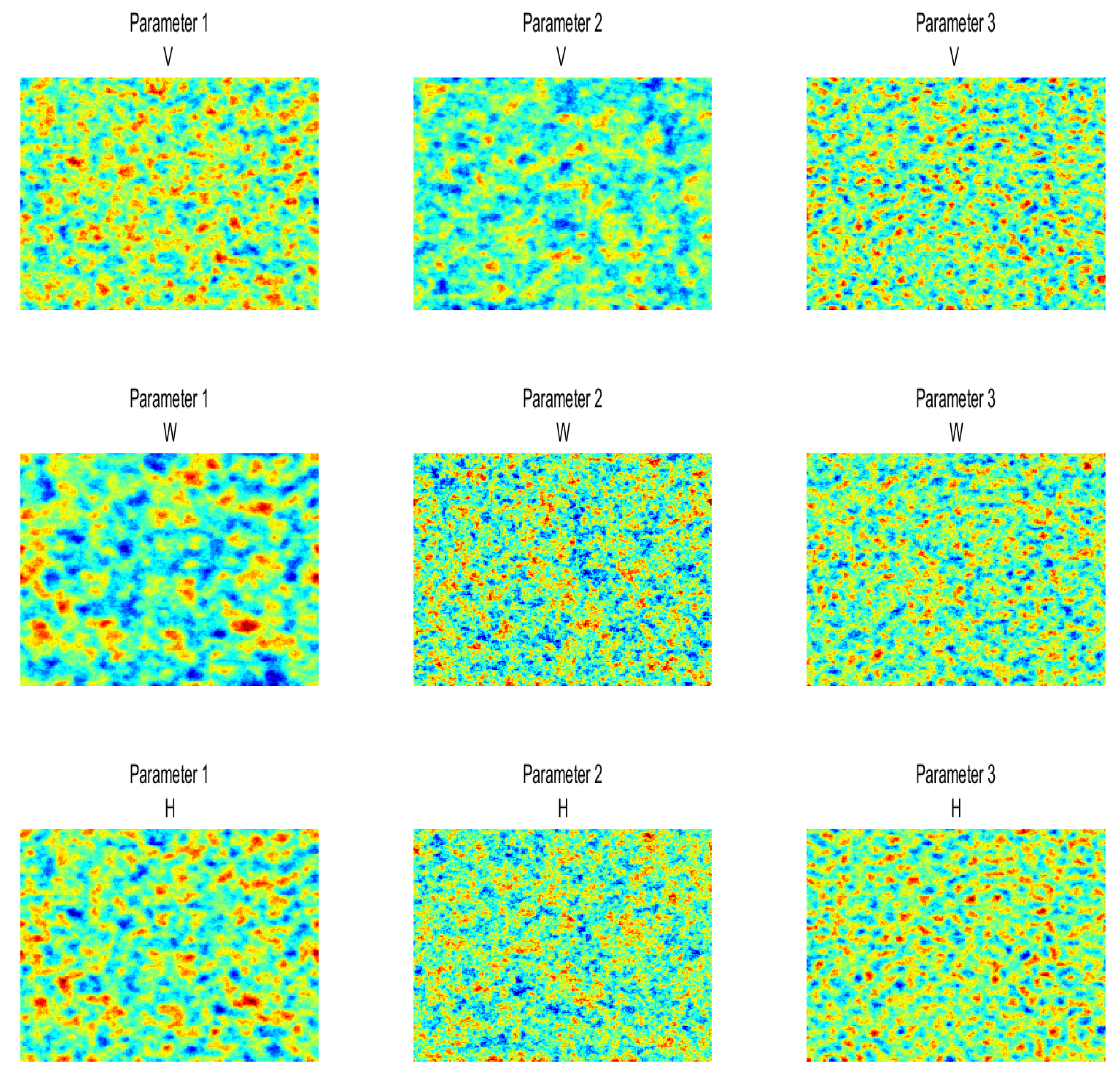
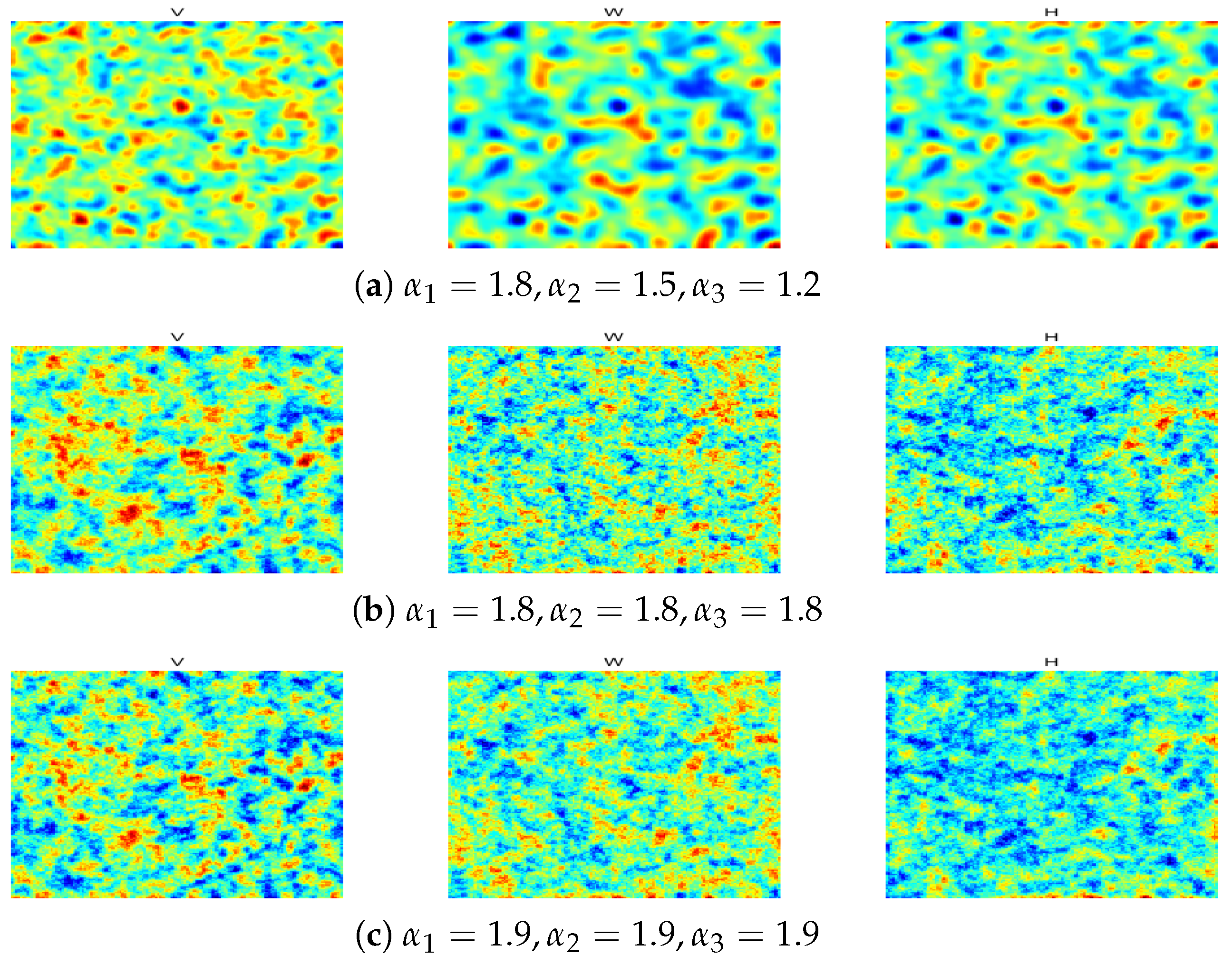
We set parameter r = 0.05 ,   d = 0.02 ,   α = 0.8 ,   c = 0.15 ,   I = 0.4 ,   f = 0.1 ,   β = 0.15 , D V = 0.1 ,   D W = 2.5 ,   D H = 5.0 ,   h = 1 , τ = 0.1 ,   n = 200 .   m = 15,000 , where a comparison of patterns in different fractional derivative at α 1 = 1.8 ,   α 2 = 1.5 ,   α 3 = 1.2 , α 1 = 1.8 ,   α 2 = 1.8 ,   α 3 = 1.8 , and α 1 = 1.9 ,   α 2 = 1.9 ,   α 3 = 1.9 is shown in Figure 4. Figure 4 shows the dynamic behavior of the pattern under three sets of parameters. Parameters are shown in Table 3. Figure 5 shows the influence of different fractional derivative orders on the formation of patterns in the system under fixed parameters.
Figure 4 illustrates the dynamic behavior of vegetation patterns under three distinct sets of parameters, as detailed in Table 3. Each parameter set corresponds to different ecological driving factors, including the plant growth rate r, water evaporation rate c, and diffusion coefficients D V , D W , and D H .
The comparison reveals that variations in these parameters significantly alter the spatial structure, morphology (such as stripes, spots, and labyrinthine structures), and stability of the self-organized patterns. Even with the same fractional derivative orders, the system exhibits diverse pattern characteristics due to parameter changes. This sensitivity underscores the importance of accurately estimating ecological parameters in modeling arid and semi-arid ecosystems. The results demonstrate that parameter tuning can lead to qualitatively different pattern regimes, reflecting the complex interplay between vegetation growth, water transport, and environmental constraints in shaping ecosystem self-organization.
Figure 5 examines the impact of varying fractional derivative orders on pattern formation while keeping all ecological parameters fixed. The three subfigures correspond to different fractional order combinations: ( α 1 = 1.8 ,   α 2 = 1.5 ,   α 3 = 1.2 ) , ( α 1 = 1.8 ,   α 2 = 1.8 ,   α 3 = 1.8 ) , and ( α 1 = 1.9 ,   α 2 = 1.9 ,   α 3 = 1.9 ) .
The results show that fractional derivative orders significantly influence the morphology, distribution, and dynamic evolution of vegetation patterns. Different orders represent varying memory effects and non-local transport characteristics in the system. Higher fractional orders generally enhance memory effects, leading to faster system responses and smoother pattern structures. In contrast, asymmetric fractional orders among the three components (V, W, H) can induce non-uniform dynamics, resulting in richer pattern diversity.

7. Conclusions

This study presents and analyzes a high-order numerical scheme for solving a nonlinear fractional-order vegetation–water model. The method utilizes polynomial generating functions to discretize the Grünwald–Letnikov fractional derivatives, achieving p-th order accuracy in time while maintaining second-order spatial accuracy. The incorporation of a short-memory principle ensures the scheme’s computational feasibility for long-time simulations.
Rigorous convergence analysis proves that the method is consistent, stable, and convergent. The global error is bounded by O ( τ p + h 2 + L α min ) , providing a solid theoretical foundation for numerical experiments. This approach serves as an effective tool for exploring dynamics and pattern formation in complex fractional-order systems, demonstrating how fractional derivative orders significantly influence the system’s behavior.


Author Contributions

Conceptualization, methodology, software, data curation, formal analysis and funding acquisition, writing—original draft, and writing—review and editing: W.Z. and H.Z. All authors have read and agreed to the published version of the manuscript.

Funding

The Doctoral Innovation Research Fund Project of Jining Normal University: (jsbsjj2355).

Institutional Review Board Statement

Not applicable.

Data Availability Statement

The data used to support the findings of this study are available from the corresponding author upon request.

Conflicts of Interest

The authors declare no conflicts of interest.

References

  1. Rietkerk, M.; Dekker, S.C. Self-organized patchiness and catastrophic shifts in ecosystems. Science 2004, 305, 1926–1929. [Google Scholar] [CrossRef] [PubMed]
  2. Borgogno, F.; D’Odorico, P.; Laio, F.; Ridolfi, L. Mathematical models of vegetation pattern formation in ecohydrology. Rev. Geophys. 2009, 47, RG1005. [Google Scholar] [CrossRef]
  3. Klausmeier, C.A. Regular and irregular patterns in semiarid vegetation. Science 1999, 284, 1826–1828. [Google Scholar] [CrossRef] [PubMed]
  4. Rietkerk, M.; Boerlijst, M.C.; van Langevelde, F.; HilleRisLambers, R.; van de Koppel, J.; Kumar, L.; Prins, H.H.T.; de Roos, A.M. Self-organization of vegetation in arid ecosystems. Am. Nat. 2002, 160, 524–530. [Google Scholar] [CrossRef] [PubMed]
  5. Méndez, V.; Fedotov, S.; Horsthemke, W. Reaction-Transport Systems: Mesoscopic Foundations, Fronts, and Spatial Instabilities; Springer: Berlin/Heidelberg, Germany, 2010. [Google Scholar]
  6. Sandev, T.; Tomovski, Ž. Fractional Equations and Models: Theory and Applications; Springer: Berlin/Heidelberg, Germany, 2017. [Google Scholar] [CrossRef]
  7. Podlubny, I. Fractional Differential Equations; Academic Press: Cambridge, MA, USA, 1999. [Google Scholar] [CrossRef]
  8. Samko, S.G.; Kilbas, A.A.; Marichev, O.I. Fractional Integrals and Derivatives: Theory and Applications; Gordon and Breach Science Publishers: London, UK, 1993. [Google Scholar]
  9. Yang, J.Y.; Wang, Y.L.; Li, Z.Y. Exploring dynamics and pattern formation of a fractional-order three-variable Oregonator model. Netw. Heterog. Media 2025, 20, 1201–1229. [Google Scholar] [CrossRef]
  10. Zhang, H.L.; Li, Z.Y.; Li, X.Y. Numerical simulation of pattern and chaos dynamic behaviour in the fractional-order-in-time Lengyel-Epstein reaction-diffusion system. Int. J. Comput. Math. 2026. [Google Scholar] [CrossRef]
  11. Podlubny, I.; Petras, I.; Vinagre, B.M.; O’Leary, P.; Dorcak, L. Analogue realizations of fractional-order controllers. Nonlinear Dyn. 2002, 29, 281–296. [Google Scholar] [CrossRef]
  12. Xue, D.Y. Analysis and design of fractional-order proportional-integral-derivative controllers. Acta Autom. Sin. 2018, 44, 3650–3656. [Google Scholar]
  13. Zhang, S.; Zhang, H.L.; Wang, Y.L.; Li, Z.Y. Dynamic properties and numerical simulations of a fractional phytoplankton-zooplankton ecological model. Netw. Heterog. Media 2025, 20, 648–669. [Google Scholar] [CrossRef]
  14. Che, H.; Wang, Y.-L.; Li, Z.-Y. Novel patterns in a class of fractional reaction-diffusion models with the Riesz fractional derivative. Math. Comput. Simul. 2022, 202, 149–163. [Google Scholar] [CrossRef]
  15. Podlubny, I. Matrix approach to discrete fractional calculus. Fract. Calc. Appl. Anal. 2000, 3, 359–386. [Google Scholar]
  16. Podlubny, I.; Chechkin, A.; Skovranek, T.; Chen, Y.Q.; Vinagre, J.M. Matrix approach to discrete fractional calculus II: Partial fractional differential equations. J. Comput. Phys. 2009, 228, 3137–3153. [Google Scholar] [CrossRef]
  17. Tadjeran, C.; Meerschaert, M.M. A second-order accurate numerical method for the two-dimensional fractional diffusion equation. J. Comput. Phys. 2007, 220, 813–823. [Google Scholar] [CrossRef]
  18. Diethelm, K.; Ford, N.J.; Freed, A.D. A predictor-corrector approach for the numerical solution of fractional differential equations. Nonlinear Dyn. 2004, 29, 3–22. [Google Scholar] [CrossRef]
  19. Ford, N.J.; Xiao, J.Y.; Yan, Y.B. A Finite Element Method for Time-Fractional Partial Differential Equations. Fract. Calc. Appl. Anal. 2011, 14, 454–474. [Google Scholar] [CrossRef]
  20. Li, C.P.; Chen, A.; Ye, J.J. Numerical approaches to fractional calculus and fractional ordinary differential equation. J. Comput. Phys. 2011, 230, 3352–3368. [Google Scholar] [CrossRef]
  21. Zhang, H.L.; Wang, Y.L.; Bi, J.X.; Bao, S.H. Novel pattern dynamics in a vegetation-water reaction-diffusion model. Math. Comput. Simul. 2026, 241, 97–116. [Google Scholar] [CrossRef]
Figure 1. Stability at r = 0.120 ,   d = 0.060 ,   α = 0.180 ,   c = 0.100 ,   I = 0.350 ,   f = 0.120 .
Fractalfract 10 00077 g001
Figure 2. Comparing phase diagrams at t = 800 ,   τ = 0.01 .
Fractalfract 10 00077 g002
Figure 3. Comparing phase diagrams at r = 0.120 ,   d = 0.060 ,   α = 0.180 ,   c = 0.100 ,   f = 0.120 .
Fractalfract 10 00077 g003
Figure 4. Comparison of patterns in different parameters, and h = 1 ,   τ = 0.1 ,   n = 200 ,   t = 750 .
Fractalfract 10 00077 g004
Figure 5. Comparison of patterns in different fractional derivative at r = 0.05 ,   d = 0.02 ,   α = 0.8 ,   c = 0.15 ,   I = 0.4 ,   f = 0.1 ,   β = 0.15 ,   D V = 0.1 ,   D W = 2.5 ,   D H = 5.0 ,   h = 1 ,   τ = 0.1 ,   n = 200 , m = 15,000.
Fractalfract 10 00077 g005
Table 1. Description.
FormDescription
r W V Biomass production proportional to both existing vegetation density and available soil moisture
d V Vegetation loss due to natural mortality, grazing, or other factors
+ D V 2 V Spatial spread of vegetation through seed dispersal or clonal growth
+ α H Water input from surface water infiltration into the soil profile
c W Loss of soil water through evaporation to the atmosphere
r W V Water extraction by plant roots for transpiration and growth
+ D W 2 W Horizontal movement of soil water through porous media
+ I External water input from precipitation
α H Water loss from surface to soil through infiltration
f V H Rainfall capture by vegetation canopies before reaching the
soil surface
+ D H 2 H Overland flow modeled as diffusive process
+ β · ( H z ) Advective transport driven by gravitational forces on sloped terrain
Table 2. Description of variables and parameters.
SymbolDescription
V ( x , t ) Vegetation biomass density per unit area
W ( x , t ) Soil water content in the root zone
H ( x , t ) Surface water height
z ( x ) Topographic elevation
rPlant growth rate per unit soil moisture
dVegetation mortality rate
D V Vegetation dispersal coefficient
α Infiltration rate of surface water into soil
cSoil water evaporation rate
D W Soil water diffusivity
IRainfall intensity
fVegetation interception rate of surface water
D H Surface water diffusion coefficient
β Topographic flow coefficient
Gradient operator ( x , y )
2 Laplacian operator ( 2 x 2 + 2 y 2 )
Table 3. Parameter in Figure 4.
ParameterParameter 1Parameter 2Parameter 3
α V 1.81.51.2
α W 1.81.81.8
α H 1.91.91.9
r0.050.080.03
d0.020.0150.025
α 0.81.00.7
c0.150.120.18
I0.40.50.35
f0.10.080.12
β 0.550.70.45
D V 0.10.50.15
D W 2.52.02.0
D H 5.05.04.0
Disclaimer/Publisher’s Note: The statements, opinions and data contained in all publications are solely those of the individual author(s) and contributor(s) and not of MDPI and/or the editor(s). MDPI and/or the editor(s) disclaim responsibility for any injury to people or property resulting from any ideas, methods, instructions or products referred to in the content.