Article

Optical Solitons, Optimal Systems and Conserved Quantities of the Schrödinger Equation with Spatio-Temporal and Inter-Modal Dispersions


Department of Mathematics, Faculty of Science, Bartın University, 74100 Bartın, Turkey
Fractal Fract. 2026, 10(2), 112; https://doi.org/10.3390/fractalfract10020112
Submission received: 6 December 2025 / Revised: 29 January 2026 / Accepted: 2 February 2026 / Published: 5 February 2026

Abstract

In this study, we present a unified symmetry-conservation solution analysis of a well-posed resonant nonlinear Schrödinger (NLS)-type equation incorporating spatio-temporal dispersion and inter-modal dispersion. Working within the truncated M-fractional derivative framework, we first construct exact traveling-wave solution families via the Kudryashov expansion method, together with the corresponding parameter constraints and limiting cases. We then determine the admitted Lie point symmetries and establish the associated Lie algebra, including the commutator structure, adjoint representation, and an optimal system of one-dimensional subalgebras for classification. Using the conservation theorem, we derive conserved vectors associated with the fundamental invariances of the model; in the NLS setting and under suitable conditions, these quantities can be interpreted as generalized power (mass), momentum, and energy-type invariants. Overall, the results provide explicit wave profiles and structural invariants that enhance the interpretability of the model and offer benchmark expressions useful for further qualitative, numerical, and stability investigations in nonlinear dispersive wave dynamics.

1. Introduction

Optical solitons constitute one of the rapidly expanding research directions in optoelectronics and nano-electronics due to their remarkable ability to preserve localized pulse shapes during propagation. Their importance is closely tied to modern optical technologies, including nonlinear optical fibers, birefringent media, and engineered metamaterials, where stable solitary structures arise through a delicate balance between dispersion and nonlinearity. Representative studies on dark/singular solitons and soliton-like structures in Schrödinger-type settings are reported in [1,2,3]. Foundational monographs that establish the physical background of nonlinear fiber propagation and non-Kerr optical solitons can be found in [4,5]. Additional explicit soliton constructions and traveling-wave formulations in related optical models are presented in [6,7,8]. Soliton solutions under generalized dispersive effects and parabolic- or dual-power law media are discussed in [9,10]. Symmetry-based modeling and analysis perspectives relevant to nonlinear wave equations are illustrated in [11,12]. Computational and fractional-method references that support the analytical framework used in such contexts are given in [13,14]. From a mathematical and physical standpoint, nonlinear Schrödinger (NLS)-type equations have become fundamental models for describing nonlinear dispersive wave phenomena in a wide range of contexts such as nonlinear optics, plasma physics, fluid dynamics, and Bose–Einstein condensates. Representative traveling-wave and first-integral-type approaches for nonlinear evolution models are presented in [15,16,17]. Transform-based and equation-reduction techniques used in nonlinear wave theory are discussed in [18,19]. Closely related soliton dynamics and conservation-law studies in dispersive nonlinear systems can be found in [20,21]. Resonant and non-Kerr optical-soliton models, including settings with additional dispersive effects, are reported in [22,23]. Further exact-solution schemes based on Riccati-/trial-function and projective methods are developed in [24,25,26,27]. Additional traveling-wave solution constructions for nonlinear evolution equations are provided in [28]. Unlike the linear Schrödinger equation, the nonlinear counterpart supports rich dynamical behaviors, including self-focusing, modulational instability, and the emergence of coherent structures. In addition to constructing explicit wave patterns, it is often crucial to reveal the structural properties of the governing equations. Lie symmetry analysis provides a systematic framework for identifying invariances, generating similarity reductions, and organizing solution families in a classification-oriented manner [29,30,31,32]. Complementarily, conservation laws supply invariant integral constraints of the evolution, which are useful in qualitative analysis and in validating analytical or numerical computations. While Noether’s theorem is traditionally associated with variational systems, modern conservation-law approaches allow systematic constructions for broader classes of PDEs, including non-variational models, thereby expanding the applicability of conservation analysis in nonlinear science [33,34,35].
It is known that the nonlinear dynamics of optical solitons (and related hydrodynamic-type formulations such as Madelung fluids) can be described by resonant nonlinear Schrödinger-type equations. In particular, resonant terms have been considered relevant in the modeling of chiral solitons arising in the quantum Hall effect. Moreover, it has been emphasized in the literature that the governing equation for optical-soliton propagation becomes well-posed when additional spatio-temporal dispersion (STD) is incorporated; in the presence of inter-modal dispersion (IMD), this leads to a well-posed resonant NLS-type model as adopted in [22]. Motivated by this established modeling framework, we consider the following nonlinear dynamical equation for the complex wave envelope q ( x , t ) :
i q t + α q x x + β q x t + d F ( | q | 2 ) q + γ | q | x x | q | q i σ q x = 0 , i = 1 .
Here, x and t denote the spatial and temporal variables, respectively, and q ( x , t ) is the complex wave profile. The coefficients α and β correspond to group-velocity dispersion and spatio-temporal dispersion (STD), respectively, while σ characterizes the inter-modal dispersion (IMD). The nonlinear response is described by the term F ( | q | 2 ) q , where F is assumed to be a real-valued sufficiently smooth function, and the parameters γ and d control, respectively, the strength of the resonant nonlinear contribution and the non-Kerr-type correction appearing in Equation (1). In this study, Equation (1) is investigated within the framework of the truncated M-fractional derivative. This setting enables an analytical examination of the fractional-order dynamics and the associated structural features of the model (symmetries, conservation laws, and exact solution structures).
This paper aims to provide a unified analysis of the considered resonant NLS-type model in terms of both structural features and explicit solution content. The main outcomes can be summarized as follows: (i) we obtain explicit families of exact traveling-wave solutions by means of the Kudryashov expansion method (KEM), together with parameter conditions and relevant limiting cases; (ii) we determine the Lie point symmetries and compute the associated algebraic structure (commutators and adjoint representation) needed for classification; and (iii) we construct the optimal system of one-dimensional subalgebras and derive conservation laws, thereby complementing the solution results with structural invariants. This combined set of results is intended to improve the interpretability of the model and to provide benchmark expressions useful for further analytical investigation and validation in related nonlinear dispersive systems.
The remainder of the paper is organized as follows. Section 2 introduces the truncated M-fractional derivative and fixes the notation used throughout the manuscript. Section 3 presents the analytical-solution framework: Section 3.1 outlines the Kudryashov expansion method (KEM), and Section 3.2 reports the resulting exact solution families for the truncated M-fractional form of the model. In Section 4, we carry out the Lie symmetry analysis, including the Lie bracket computations, the nonzero commutators (together with the remaining brackets), and the adjoint representation. Section 5 constructs the optimal system of one-dimensional subalgebras and derives the associated conservation laws (Section 5.3). Finally, Section 6 concludes the paper and briefly discusses the significance of the results and possible directions for further work.

2. The Truncated M -Fractional Derivative

2.1. Definition and Basic Properties

In this section, we recall the basic definitions and properties of the truncated M-fractional derivative needed in the subsequent analysis [36]. The motivation for employing a fractional formulation is that wave propagation in nonlinear dispersive media may exhibit memory and hereditary effects (i.e., nonlocal response in time and/or space), which may not be adequately captured by purely integer-order models. In the present study, the truncated M-fractional framework introduces additional flexibility through the fractional order δ (and the parameter η ), enabling a mathematically tractable treatment of fractional-order behavior within the considered resonant NLS-type model. In particular, the classical model is recovered in the limit δ 1 , whereas 0 < δ < 1 represents deviations associated with fractional-order dynamics. Accordingly, Equation (1) is investigated in its truncated M-fractional form (see Equation (10)), and the analytical developments in Section 3 are carried out within this setting.
Definition 1.
If we let h : [ 0 , ) R , then the new M-fractional derivative of h with order δ is
D M δ , η { ( h ) ( t ) } = lim ϵ 0 h ( t E η ( ϵ t 1 δ ) ) h ( t ) ϵ , t > 0 , 0 < δ < 1 , η > 0 ,
where E η ( . ) is a truncated Mittag–Leffler function of one parameter [36].
Theorem 1
(see [36]). Let 0 < δ 1 , η > 0 , q , r R , and g , h δ-differentiable at a point t > 0 . Then:
1. 
D M δ , η { ( q g + r h ) ( t ) } = q D M δ , η { g ( t ) } + r D M δ , η { h ( t ) } .
2. 
D M δ , η { ( g . h ) ( t ) } = g ( t ) D M δ , η { h ( t ) } + h ( t ) D M δ , η { g ( t ) } .
3. 
D M δ , η { g h ( t ) } = h ( t ) D M δ , η { g ( t ) } g ( t ) D M δ , η { h ( t ) } [ h ( t ) ] 2 .
4. 
D M δ , η { c } = 0 , where g ( t ) = c is a constant.
5. 
D M δ , η { g ( t ) } = t 1 δ Γ ( η + 1 ) d g ( t ) d t if g is differentiable.

2.2. Regularity Assumptions on the Nonlinear Term

Soliton structures arise from a balance between dispersion and nonlinearity. In Equation (1) (and its truncated M-fractional counterpart), the regularity of the nonlinear mapping F ( | q | 2 ) q : C C is required. Identifying C with R 2 , we assume that F ( | q | 2 ) q is k-times continuously differentiable (locally) so that the analytical manipulations in Section 3 are justified. In particular, we may express this assumption in the form
F ( | q | 2 ) q m , n = 1 C k ( ( n , n ) × ( m , m ) ; I R 2 ) .

3. Analytical Solutions

3.1. Analysis of the KEM

In this section, the Kudryashov expansion method (KEM) is summarized and then applied to the truncated M-fractional model. Consider a general local truncated M-fractional partial differential equation of the form
P ( q , D M , x δ , η q , D M , x 2 δ , η q , D M , t δ , η q , D M , t δ , η D M , x δ , η q , ) = 0 .
To obtain traveling-wave solutions, we use the transformation
q ( x , t ) = K ( ξ ) , ξ = Γ ( η + 1 ) δ μ ( x δ ρ t δ ) ,
where K ( ξ ) is an unknown function, μ 0 is a constant, and ρ denotes the wave speed. Substituting (5) into (4) reduces the governing equation to a nonlinear ordinary differential equation
D ( K , K , K , ) = 0 ,
where the prime denotes differentiation with respect to ξ .
In KEM, the solution is assumed in the polynomial form
K ( ξ ) = r = 0 N A r Q r ( ξ ) , A N 0 ,
where A r are constants to be determined and Q ( ξ ) satisfies an auxiliary first-order equation. In this work, Q ( ξ ) is taken to satisfy the following equation:
Q = ϖ Q ( Q 1 ) .
Solving (8) by separation of variables yields
Q ( ξ ) = 1 1 + ζ e ϖ ξ .
The positive integer N in (7) is determined by balancing the highest-order derivative term with the highest-power nonlinear term in (6). Substituting (7) and the derivatives generated via (8) into (6) produces a polynomial in powers of Q ( ξ ) . Equating the coefficients of like powers of Q to zero gives an algebraic system for A r (and possible parameter relations), whose solution provides explicit, exact traveling-wave solutions of the original truncated M-fractional PDE.

3.2. Solutions

Here, we construct analytical traveling-wave solutions of the truncated M-fractional resonant nonlinear Schrödinger equation given by
i ( D M , t δ , η q σ D M , x δ , η q ) + α D M , x 2 δ , η q + β D M , x δ , η D M , t δ , η q + d F ( | q | 2 ) q + γ D M , x 2 δ , η | q | | q | q = 0 ,
Consider the amplitude–phase form
q ( x , t ) = K ( ξ ) e i Γ ( η + 1 ) k x δ + ω t δ + Ω δ , ξ = Γ ( η + 1 ) x δ ρ t δ δ .
where K ( ξ ) is a real-valued amplitude, k is the wave number, ω is the frequency, Ω is a phase constant, and ρ is the wave speed. Substituting (11) into (10) and separating the real and imaginary parts, we obtain the reduced ordinary differential equation
( α β ρ + γ ) K + ( ω ( β k 1 ) σ k α k 2 ) K + d F ( K 2 ) K = 0
together with the relation
ρ = σ + 2 α k β ω β k 1 .
For the Kerr-law nonlinearity F ( K 2 ) = K 2 , Equation (12) becomes
( α β ρ + γ ) K + ( ω ( β k 1 ) σ k α k 2 ) K + d K 3 = 0 .
Balancing the terms K and K 3 gives N = 1 in the expansion (7). Hence, the KEM trial form is
K ( ξ ) = A 0 + A 1 Q ( ξ ) . A 1 0 ,
where Q ( ξ ) satisfies (8) and (9). Substituting (15) and its derivatives (computed using (8)) into (14) yields a polynomial in powers of Q ( ξ ) . Equating coefficients of like powers of Q to zero produces an algebraic system for A 0 , A 1 , ϖ , and the parameter combinations appearing in (14). Solving this system leads to the explicit exact solutions reported below.
(I): When
A 0 = i ϖ α + β σ + γ + β 2 γ k 2 2 β γ k β 2 ( d ) ϖ 2 + 2 β 2 k 2 d 4 β k d + 2 d ,
A 1 = 2 i ϖ α + β σ + γ + β 2 γ k 2 2 β γ k d β 2 ϖ 2 + 2 β 2 k 2 4 β k + 2 ,
ω = ϖ 2 ( α + β σ + γ ) + 2 α β k 3 2 k 2 ( α β σ ) + β k ϖ 2 ( γ α ) 2 k σ 2 ( β k 1 ) 2 β 2 ϖ 2 ,
we have
q I ( x , t ) = e i Γ ( η + 1 ) t δ α δ 2 + β δ 3 + γ δ 2 2 α β k 3 + 2 α k 2 2 β δ k 2 + α β δ 2 k β γ δ 2 k + 2 δ k β 2 δ 2 2 β 2 k 2 + 4 β k 2 k x δ + Ω δ × ( ( 2 i δ α + β δ + γ + β 2 γ k 2 2 β γ k / d β 2 δ 2 + 2 β 2 k 2 4 β k + 2 × η e Γ ( η + 1 ) x δ t δ δ β α δ 2 + β δ 3 + γ δ 2 2 α β k 3 + 2 α k 2 2 β δ k 2 + α β δ 2 k β γ δ 2 k + 2 δ k β 2 δ 2 2 β 2 k 2 + 4 β k 2 + 2 α k β k 1 + 1 ) + i δ α + β δ + γ + β 2 γ k 2 2 β γ k β 2 δ 2 d + 2 β 2 k 2 d 4 β k d + 2 d )
(II): When A 0 = i ϖ β γ k 3 γ k 2 + k σ + ω 2 β d k 3 2 d k 2 β d k ϖ 2 d ϖ 2 , A 1 = 2 i ϖ β γ k 3 γ k 2 + k σ + ω d 2 β k 3 + 2 k 2 + β k ϖ 2 + ϖ 2 , α = β ϖ 2 ( σ β ω ) + 2 β k 2 ( β ω σ ) + γ ϖ 2 ( 1 β k ) + 2 k ( σ 2 β ω ) + 2 ω 2 k 2 ( β k 1 ) ϖ 2 ( β k + 1 ) , we have
q I I ( x , t ) = e i Γ ( η + 1 ) k x δ + ω t δ + Ω δ ( ( 2 i δ β γ k 3 γ k 2 + δ k + ω / d δ 2 + 2 β k 3 2 k 2 β δ 2 k × η e Γ ( η + 1 ) x δ t δ β ω + δ + 2 k β 2 δ 2 ω + β δ 3 + γ δ 2 + 2 β 2 k 2 ω 2 β δ k 2 β γ δ 2 k 4 β k ω + 2 δ k + 2 ω δ 2 + 2 β k 3 2 k 2 β δ 2 k β k 1 + 1 ) + i δ β γ k 3 γ k 2 + δ k + ω δ 2 d + 2 β d k 3 2 d k 2 β δ 2 d k ) .
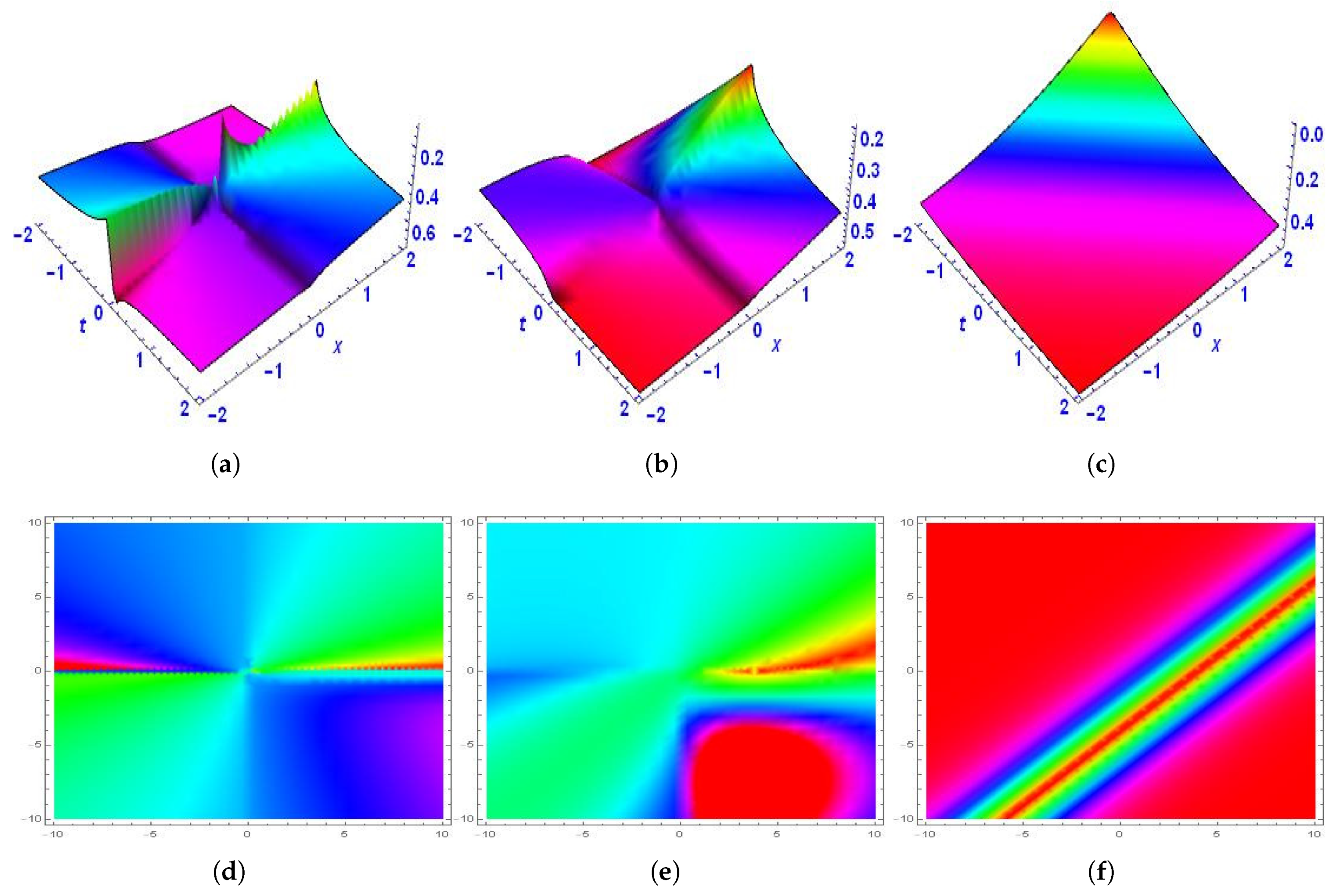
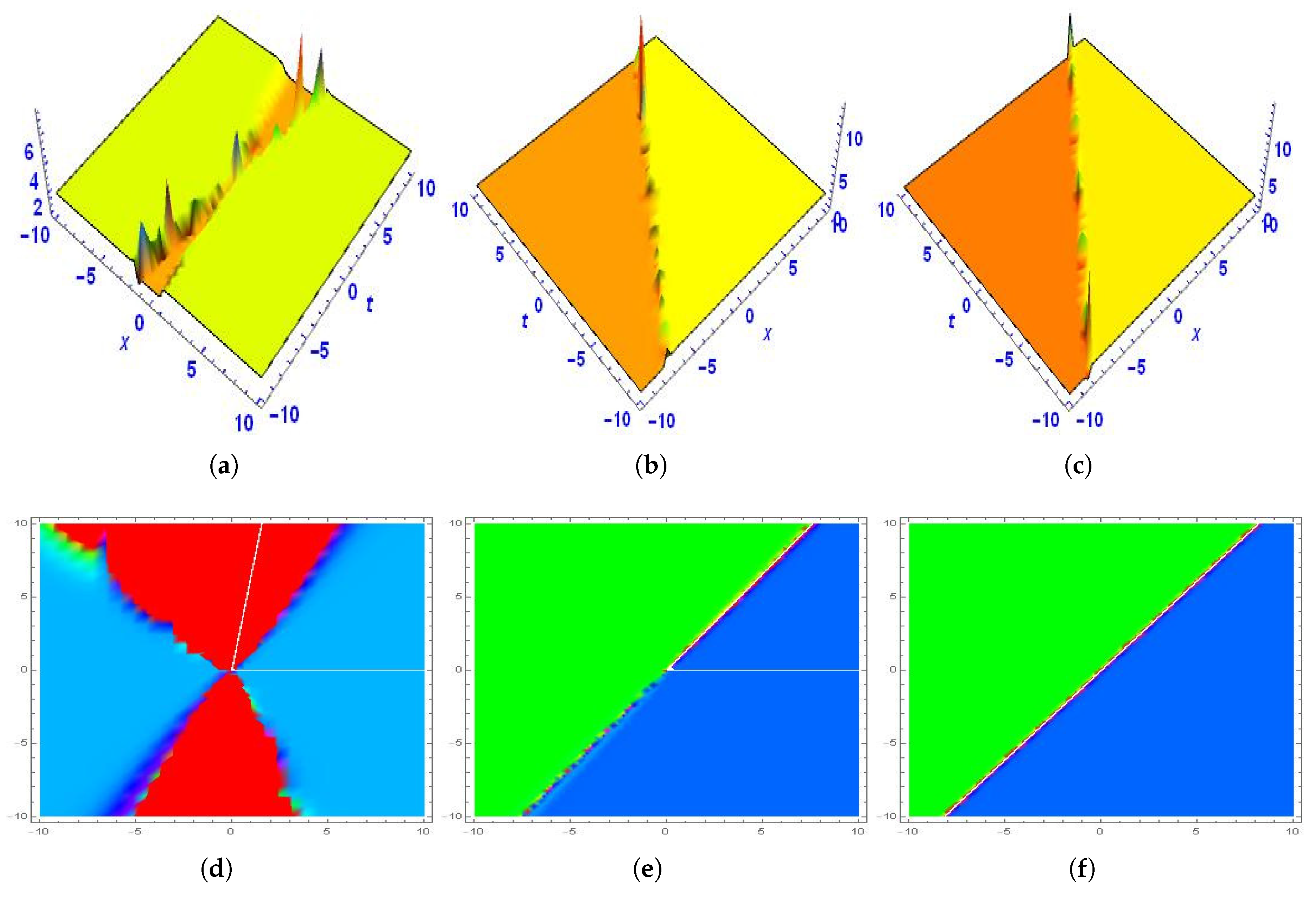
The 3D and density profiles of Equations (19) and (20) are illustrated in Figure 1 and Figure 2.

4. Lie Symmetry Analysis

In this section, we perform a Lie point symmetry analysis of the governing resonant nonlinear Schrödinger-type model. The symmetry generators obtained here are subsequently used in the structural study of the equation (in particular, in the classification step and in the conservation-law analysis presented later).
To determine Lie symmetries, we express the complex envelope in amplitude-phase form as
q ( x , t ) = u ( x , t ) e i υ ( x , t ) ,
where u ( x , t ) and υ ( x , t ) are real-valued functions representing the amplitude and phase, respectively. Substituting (21) into Equation (1) and separating the real and imaginary parts yields the coupled real system
u υ t = d u 3 + σ u υ x β u υ t υ x α u ( υ x ) 2 + β u x t + α u x x + γ u x x , u t = σ u x β υ t u x β u t υ x 2 α u x υ x β u υ x t α u υ x x .
we analyze system (22) for the functions u ( x , t ) and υ ( x , t ) . Assume β 0 whenever division by β is required. Let
X = ξ 1 x + ξ 2 t + η 1 u + η 2 v .
be the general Lie point symmetry generator of system (22). Solving the associated determining equations gives the infinitesimal coefficients
ξ 1 = x C 2 + C 4 , ξ 2 = C 1 + t C 2 , η 1 = u C 2 , η 2 = x C 2 + t σ C 2 β C 3 β .
where C 1 , C 2 , C 3 , C 4 are arbitrary constants. Hence, a basis for the Lie algebra of symmetries can be chosen as
  • C 1 = 1 (others 0): ξ 1 = 0 , ξ 2 = 1 , η 1 = 0 , η 2 = 0 , so
    X 1 = t
  • C 2 = 1 (others 0): ξ 1 = x , ξ 2 = t , η 1 = u , η 2 = ( x + δ t ) / β , so
    X 2 = x x + t t u u x + δ t β v
  • C 3 = 1 (others 0): ξ 1 = 0 , ξ 2 = 0 , η 1 = 0 , η 2 = 1 , so
    X 3 = v
  • C 4 = 1 (others 0): ξ 1 = 1 , ξ 2 = 0 , η 1 = 0 , η 2 = 0 , so
    X 4 = x
These generators admit standard physical interpretations for NLS-type models: X 1 and X 4 correspond to invariance under translations in time and space, respectively (homogeneity in t and x). The generator X 3 expresses invariance under a constant phase shift (global gauge/phase invariance). The scaling-type generator X 2 represents a self-similar transformation mixing ( x , t , u , υ ) and is often associated with the scaling behavior of wave profiles. Such invariances reflect the intrinsic structural properties of the model and provide a natural foundation for the subsequent classification and conservation-law analysis.

4.1. Lie Bracket Formula

For two vector fields
X = ξ 1 X x + ξ 2 X t + η 1 X u + η 2 X v , Y = ξ 1 Y x + ξ 2 Y t + η 1 Y u + η 2 Y v ,
Their Lie bracket is defined by
[ X , Y ] = X ( ξ 1 Y ) Y ( ξ 1 X ) x + X ( ξ 2 Y ) Y ( ξ 2 X ) t + X ( η 1 Y ) Y ( η 1 X ) u + X ( η 2 Y ) Y ( η 2 X ) v ,
where, for any smooth function F ( x , t , u , υ ) ,
X ( F ) = ξ 1 X F x + ξ 2 X F t + η 1 X F u + η 2 X F v .

4.2. Compute Nonzero Commutators

In this subsection, we compute the nonzero commutators [ X 1 , X 2 ] , [ X 2 , X 4 ] ; the remaining commutators vanish. We use the coefficient representation in the order ( ξ 1 , ξ 2 , η 1 , η 2 ) . Recall the basis generators
X 1 = t , X 2 = x x + t t u u x + σ t β v
Thus, the corresponding coefficient vectors are
X 1 : ( 0 , 1 , 0 , 0 ) , X 2 : ( x , t , u , x + σ t β ) , X 4 = ( 1 , 0 , 0 , 0 ) .
Commutator [ X 1 , X 2 ] .
Using the definition in Section 4.1, we compute each component:
( 1 ) x - coef : X 1 ( ξ 1 ( 2 ) ) X 2 ( ξ 1 ( 1 ) ) = t ( x ) X 2 ( 0 ) = 0 . ( 2 ) t - coef : X 1 ( ξ 2 ( 2 ) ) X 2 ( ξ 2 ( 1 ) ) = t ( t ) X 2 ( 1 ) = 1 0 = 1 . ( 3 ) u - coef : X 1 ( η 1 ( 2 ) ) X 2 ( η 1 ( 1 ) ) = X 1 ( u ) X 2 ( 0 ) = t ( u ) = 0 . ( 4 ) v - coef : X 1 ( η 2 ( 2 ) ) X 2 ( η 2 ( 1 ) ) = t x + σ t β 0 = σ β .
Collecting
[ X 1 , X 2 ] = 1 · t σ β v = X 1 σ β X 3 .
By antisymmetry,
[ X 2 , X 1 ] = X 1 + σ β X 3 .
Commutator [ X 2 , X 4 ] .
Since X 4 = x , we obtain
( 1 ) x - coef : X 2 ( ξ 1 ( 4 ) ) X 4 ( ξ 1 ( 2 ) ) = X 2 ( 1 ) x ( x ) = 0 1 = 1 . ( 2 ) t - coef : X 2 ( ξ 2 ( 4 ) ) X 4 ( ξ 2 ( 2 ) ) = X 2 ( 0 ) x ( t ) = 0 0 = 0 . ( 3 ) u - coef : X 2 ( η 1 ( 4 ) ) X 4 ( η 1 ( 2 ) ) = 0 x ( u ) = 0 . ( 4 ) v - coef : X 2 ( η 2 ( 4 ) ) X 4 ( η 2 ( 2 ) ) = 0 x x + σ t β = 1 β .
Thus
[ X 2 , X 4 ] = x + 1 β v = X 4 + 1 β X 3 ,
and hence
[ X 4 , X 2 ] = X 4 1 β X 3 .

Other Brackets

One checks directly (by computing derivatives of constant coefficients) that
[ X 1 , X 4 ] = 0 , [ X i , X 3 ] = 0 for all i ,
so X 3 is central.
Thus, the only nonzero commutators are
[ X 1 , X 2 ] = X 1 σ β X 3 , [ X 2 , X 4 ] = X 4 + 1 β X 3 .
We present the commutator table (rows = left argument):
[ · , · ] X 1 X 2 X 3 X 4 X 1 0 X 1 σ β X 3 0 0 X 2 X 1 + σ β X 3 0 0 X 4 + 1 β X 3 X 3 0 0 0 0 X 4 0 X 4 1 β X 3 0 0

4.3. Adjoint Representation

Recall that Ad ( e ε X ) = exp ( ε ad X ) where ad X ( Y ) = [ X , Y ] . In this problem, since the nested commutators quickly approach zero (or the central element X3), the adjoint effect can be obtained in closed form (exact).

4.3.1. Ad by X 1

From [ X 1 , X 2 ] = X 1 σ β X 3 and [ X 1 , others ] = 0 ,
Ad ( e ε X 1 ) X 2 = X 2 + ε X 1 σ β X 3 ,
and X 1 , X 3 , X 4 are fixed:
Ad ( e ε X 1 ) X 1 = X 1 , Ad ( e ε X 1 ) X 3 = X 3 , Ad ( e ε X 1 ) X 4 = X 4 .

4.3.2. Ad by X 4

From [ X 4 , X 2 ] = X 4 1 β X 3 and [ X 4 , others ] = 0 , we get
Ad ( e ε X 4 ) X 2 = X 2 + ε X 4 1 β X 3 ,
with X 1 , X 3 , X 4 fixed.

4.3.3. Ad by X 3

Since X 3 is the central element, [ X 3 , X j ] = 0 (for all j) and therefore Ad ( e ε X 3 ) is an identity transformation on the Lie algebra.

4.3.4. Ad by X 2

To obtain the effect of Ad ( e ε X 2 ) X j , we use the effect of X 2 on X 1 and X 4
[ X 2 , X 1 ] = X 1 + σ β X 3 , [ X 2 , X 4 ] = X 4 + 1 β X 3 ,
Therefore, we solve the flow equation in the subspaces { X 1 , X 3 } and { X 4 , X 3 } .
Effect on X 1 : Let Y ( ε ) = a ( ε ) X 1 + b ( ε ) X 3 ; Y ( 0 ) = X 1 , and d d ε Y = [ X 2 , Y ] From this
d d ε Y = a ( ε ) [ X 2 , X 1 ] = a ( ε ) X 1 + σ β X 3 .
and the following ODE system is obtained:
a ( ε ) = a ( ε ) , b ( ε ) = σ β a ( ε ) ,
with a ( 0 ) = 1 , b ( 0 ) = 0 .
Solution
a ( ε ) = e ε , b ( ε ) = σ β 1 e ε .
Therefore
Ad ( e ε X 2 ) X 1 = e ε X 1 + σ β 1 e ε X 3 .
Effect on X 4 : similarly, taking Z ( ε ) = p ( ε ) X 4 + q ( ε ) X 3 , we have Z ( 0 ) = X 4 and d d ε Z = [ X 2 , Z ] . From this,
d d ε Z = p ( ε ) [ X 2 , X 4 ] = p ( ε ) X 4 + 1 β X 3 .
and the ODE system
p = p , q = 1 β p , p ( 0 ) = 1 , q ( 0 ) = 0 ,
is obtained. The solution
p ( ε ) = e ε , q ( ε ) = 1 β 1 e ε ,
is therefore
Ad ( e ε X 2 ) X 4 = e ε X 4 + 1 β 1 e ε X 3 .
Also Ad ( e ε X 2 ) X 2 = X 2 and X 3 is fixed. This completes the adjoint table.
These adjoint transformations provide the main tool for classifying one-dimensional subalgebras of the Lie algebra. In particular, the adjoint action generates equivalence transformations on the symmetry generators, allowing an arbitrary linear combination to be simplified to canonical representatives. Therefore, in the next section, the computed adjoint maps are used to eliminate equivalent subalgebras and to construct an optimal system of one-dimensional subalgebras.

5. Optimal System of 1-Dimensional Subalgebras and Conservation Laws

In what follows, we classify one-dimensional subalgebras up to conjugacy under the adjoint action. By combining adjoint transformations with rescaling, a general generator is reduced to canonical representatives, yielding an optimal system of one-dimensional subalgebras:
X = a 1 X 1 + a 2 X 2 + a 3 X 3 + a 4 X 4 , a i R .
We use adjoint actions and rescaling ( X X , d 0 ) to find canonical representatives.

5.1. Case A: a 2 0

Scale X by 1 / a 2 so a 2 = 1 , i.e.,
X = a 1 X 1 + X 2 + a 3 X 3 + a 4 X 4 .
Apply Ad ( e ε X 1 ) with ε = a 1 :
Ad ( e a 1 X 1 ) X = a 1 X 1 + X 2 a 1 X 1 + σ β a 1 X 3 + a 3 X 3 + a 4 X 4 .
Collecting terms gives X X 2 + a 3 X 3 + a 4 X 4 with
a 3 = a 3 + σ β a 1 , and the X 1 coefficient is zero .
Next apply Ad ( e η X 4 ) with η = a 4 to eliminate the X 4 term:
Ad ( e a 4 X 4 ) ( X 2 + a 3 X 3 + a 4 X 4 ) = X 2 + a 4 X 4 a 4 β X 3 + a 3 X 3 + a 4 X 4 a 4 X 4 ,
so the final form is
X X 2 + c X 3 , c = a 3 + a 4 β .
Thus any generator with a 2 0 is conjugate to X 2 + c X 3 .

5.2. Case B: a 2 = 0

Then X = a 1 X 1 + a 3 X 3 + a 4 X 4 .
  • If a 1 = a 4 = 0 we get X = a 3 X 3 X 3 .
  • If a 1 0 , a 4 = 0 : scale to a 1 = 1 and obtain X 1 + c X 3 .
  • If a 4 0 , a 1 = 0 : scale to a 4 = 1 and obtain X 4 + c X 3 .
  • If a 1 0 and a 4 0 : scale to a 1 = 1 and write
    X = X 1 + μ X 4 + c X 3 , μ = a 4 a 1 .
    Under Ad ( e ε X 2 ) both X 1 and X 4 scale by e ε (with central shifts), so the ratio μ is invariant under that scaling. Therefore the canonical family is X 1 + μ X 4 + c X 3 , with μ 0 .
Thus an optimal system of 1D subalgebras is
(i)
X 3 ,
(ii)
X 2 + c X 3 , c R ,
(iii)
X 1 + c X 3 , c R ,
(iv)
X 4 + c X 3 , c R ,
(v)
X 1 + μ X 4 + c X 3 , μ 0 , c R .

5.3. Conservation Laws

In this subsection, we present conservation laws associated with the Lie point symmetries X 1 X 4 derived via the conservation theorem in [30]. Since the theorem is formulated in a nonlocal setting, the conserved vectors may involve auxiliary (adjoint) variables; nonetheless, each conserved vector is divergence free and yields an invariant integral under suitable boundary conditions. In NLS-type models, such invariants are commonly interpreted as generalized power (mass), momentum, and energy-type quantities, providing structural insight into wave propagation and soliton dynamics.
  • The symmetry X 1 = t yields the nonlocal conserved vector
    C 1 x = 1 2 β p u t t β r u υ t t 2 u t β p t 2 + ( α + γ ) p x + r σ + β υ t + 2 α υ x υ t u β r t + 2 α r x + r β u t + 2 α u x + 2 p u σ + β υ t + 2 α υ x + 2 ( α + γ ) p u x t 2 α r u υ x t , C 1 t = 1 2 β u t p x 2 σ r u x + r u x β υ t + 4 α υ x + p 2 d u 3 + 2 u υ x σ + α υ x β u x t 2 ( α + γ ) u x x + u β υ t r x + r β υ x t + 2 α υ x x .
    Associated with time-translation invariance, this conservation law can be viewed as an energy-type (Hamiltonian-like) invariant in the generalized/nonlocal formulation.
  • The symmetry X 2 = t t u u + x x ( x β + t δ β ) υ yields the nonlocal conserved vector
    C 2 x = 1 2 x + t δ + t β υ t + x β υ x u β r t + 2 α r x r β u t + 2 α u x + 2 p u δ β υ t 2 α υ x β u + t u t + x u x β p t + 2 ( α + γ ) p x + r 2 δ + 2 β υ t + 4 α υ x + β p 2 u t + t u t t + x u x t r u δ + β υ t + t υ t t + x υ x t + 2 ( α + γ ) p 2 u x + t u x t + x u x x 2 α r u 1 + β υ x + t υ x t + x υ x x β + 2 x p d u 3 u υ t + δ + β υ t υ x + α υ x 2 + β u x t + ( α + γ ) u x x + r u x δ + β υ t + 2 α υ x + u t 1 + β υ x + u β υ x t + α υ x x , C 2 t = 1 2 β p 2 d t β u 3 2 u x + t δ + β υ x 2 ( x + t δ ) + ( t α + x β ) υ x + β 2 2 u x t u x t + β ( x β 2 t ( α + γ ) ) u x + β β p x t u t + x u x + u β p x + r x x + t δ + t β υ t + x β υ x r u x ( 3 ( x + t δ ) + t β υ t + ( 4 t α 3 x β ) υ x + u 3 3 β υ x + t β υ x t + ( 2 t α x β ) υ x x .
    Associated with the scaling-type symmetry, it represents a generalized scaling invariant relevant to the structural classification of solution families.
  • The symmetry X 3 = υ determines the conserved vector
    C 3 x = 1 2 u β r t + 2 α r x + r β u t + 2 α u x + p u δ + β υ t + 2 α υ x , C 3 t = 1 2 β u r x + β r u x + p u 1 + β υ x .
    Associated with global phase invariance, it is typically interpreted as a power (mass)-type conserved quantity in NLS-type dynamics.
  • The symmetry X 4 = x determines the nonlocal conserved vector
    C 4 x = 1 2 β p t + 2 ( α + γ ) p x u x + u β r t + 2 α r x υ x p 2 u d u 2 υ t + α ( υ x ) 2 + β u x t + r 2 α u x υ x + u t 2 + β υ x + β u υ x t , C 4 t = 1 2 β p x u x + u υ x β r x 2 p 1 + β υ x + β p u x x + r u x 2 + 3 β υ x β u υ x x .
Associated with spatial translation invariance, it can be interpreted as a momentum-type invariant (or momentum flux) in the generalized/nonlocal setting.
Overall, the obtained conservation laws complement the symmetry structure reported in Section 4 by providing explicit divergence-free quantities associated with the fundamental invariances of the considered NLS-type model. Although the expressions are lengthy due to the spatio-temporal and inter-modal dispersion terms and the nonlocal formulation, they encode conserved integral constraints that can be useful for qualitative analysis and for validating symbolic computations.

6. Conclusions

In this study, the Lie symmetry structure, conservation laws, and analytical soliton-type solutions of a nonlinear Schrödinger equation incorporating space-time dispersion and inter-mode dispersion effects were investigated. First, Lie point symmetries are identified and the corresponding Lie algebra is constructed. To clarify the algebraic structure, commutator relations, adjoint representation, and an optimal system for one-dimensional subalgebras were presented. Subsequently, using conservation theorems, various conserved vectors (nonlocal if necessary) related to the fundamental invariants of the considered NLS-type model were obtained. These conservation laws can be interpreted as invariants of generalized power (mass), momentum, and energy types, yielding zero divergence under appropriate conditions; they also provide structural verification (control) capabilities for analytical calculations. Finally, new exact moving wave solutions were obtained by applying the Kudryashov expansion method. In general, this approach, which jointly addresses symmetry-conservation exact solution analysis, provides a consistent structural framework for the equation under investigation and can form a basis for qualitative investigations of related nonlinear wave models. In particular, the obtained symmetries, conservation quantities, and exact wave profiles are meaningful in qualitative analyses of dispersive wave propagation; they can also provide reference results for comparison (benchmarking) purposes in numerical schemes and stability investigations in the nonlinear optical context.
Compared with recent solution-oriented studies on complex nonlinear Schrödinger-type models such as [6], where the improved Bernoulli sub-equation function method is employed to construct traveling-wave structures (e.g., periodic and breather-type waves) for a modified unstable complex NLS equation, our work addresses a different resonant NLS-type model incorporating spatio-temporal dispersion and inter-modal dispersion. It complements explicit wave profiles with a full structural analysis. In particular, while the above-mentioned line of research primarily emphasizes the generation and visualization of traveling-wave families, the present study additionally provides the admitted Lie symmetry algebra, the optimal system for one-dimensional subalgebras, and conservation laws, thereby offering a systematic symmetry-invariant-solution framework for the considered equation.
Accordingly, the main novelty of this paper is not limited to producing exact wave solutions; rather, it lies in presenting a unified symmetry, conservation, and solution treatment for the considered resonant NLS-type model with spatio-temporal and inter-modal dispersion. Beyond constructing explicit traveling-wave families via the Kudryashov expansion method (together with the associated parameter constraints and limiting cases), we provide a complete Lie symmetry analysis that clarifies the admitted algebraic structure and yields an optimal system for classification. We further complement these results by deriving conservation laws that lead to physically interpretable invariant quantities of generalized power (mass), momentum, and energy types under suitable conditions.
Although the study does not rely on externally generated datasets, its main contribution is analytical: we deliver reproducible closed-form expressions for new exact traveling-wave solution families, together with structural invariants obtained from symmetry and conservation analysis. These outcomes provide benchmark references that can be used to verify analytical manipulations and to support future numerical simulations and stability investigations in nonlinear dispersive wave dynamics and related nonlinear optical contexts.

Funding

This research received no external funding.

Data Availability Statement

No new data were created or analyzed in this study. Data sharing is not applicable to this article.

Conflicts of Interest

The authors declare that they have no conflicts of interest.

References

  1. El-Borai, M.M.; Owaidy, H.M.E.; Ahmed, H.M.; Arnous, A.H.; Moshokoa, S.; Biswas, A.; Belic, M. Dark and singular optical solitons with spatiotemporal dispersion using modified simple equation method. Optik 2016, 130, 324–331. [Google Scholar] [CrossRef]
  2. Li, H.; Tian, J.; Yang, R.; Song, L. Self-similar soliton-like solution for coupled higher-order nonlinear Schrödinger equation with variable coefficients. Optik 2016, 126, 1191–1195. [Google Scholar] [CrossRef]
  3. Savescu, M.; Khan, K.R.; Naruka, P.; Jafari, H.; Moraru, L.M.; Biswas, A. Optical solitons in photonic nano waveguides with an improved nonlinear Schrödinger equation. J. Comput. Theor. Nanosci. 2013, 10, 1182–1191. [Google Scholar] [CrossRef]
  4. Agarwal, G.P. Nonlinear Fiber Optics; Academic Press: Rochester, NY, USA, 2013; 629p. [Google Scholar]
  5. Biswas, A.; Konar, S. Introduction to Non-Kerr Law Optical Solitons; CRC Press: Boca Raton, FL, USA, 2006. [Google Scholar]
  6. Muhamad, K.A. On the traveling wave solutions to the complex nonlinear second-order modified unstable (1+1)-dimensional Schrödinger equation. Int. J. Math. Comput. Eng. 2025, 3, 349–364. [Google Scholar] [CrossRef]
  7. Das, A.; Ganguly, A. Explicit bright and dark solitons for the variable coefficient Biswas–Milovic equation with competing nonlinearity. Optik 2016, 127, 8732–8750. [Google Scholar] [CrossRef]
  8. Geng, X.; Lv, Y. Darboux transformation for an integrable generalization of the nonlinear Schrödinger equation. Optik 2012, 69, 1621–1630. [Google Scholar] [CrossRef]
  9. Inc, M.; Kilic, B.; Baleanu, D. Optical soliton solutions of the pulse propagation generalized equation in parabolic-law media with space-modulated coefficients. Optik 2016, 127, 1056–1058. [Google Scholar] [CrossRef]
  10. Tchier, F.; Yusuf, A.; Aliyu, A.I.; Inc, M. Optical and other solitons for the fourth-order dispersive nonlinear Schrödinger equation with dual-power law nonlinearity. Superlattices Microstruct. 2017, 105, 183–197. [Google Scholar]
  11. Khalique, C.M.; Adeyemo, O.D.; Monashane, M.S. Exact solutions, wave dynamics and conservation laws of a generalized geophysical Korteweg–de Vries equation in ocean physics using Lie symmetry analysis. Adv. Math. Models Appl. 2024, 9, 147–172. [Google Scholar]
  12. Adeyemo, O.D.; Khalique, C.M.; Gasimov, Y.S.; Villecco, F. Variational and non-variational approaches with Lie algebra of a generalized (3+1)-dimensional nonlinear potential Yu–Toda–Sasa–Fukuyama equation in engineering and physics. Alex. Eng. J. 2023, 63, 17–43. [Google Scholar] [CrossRef]
  13. Jafari, H.; Tajadodi, H.; Gasimov, Y.S. Modern Computational Methods for Fractional Differential Equations; Chapman and Hall/CRC: New York, NY, USA, 2025. [Google Scholar]
  14. Khalique, C.M.; Sebogodi, B.P. A study of Lie point symmetries, optimal system, analytical solutions and conserved vectors of the mixed doubly nonlinear dispersive Burgers equation. Adv. Math. Models Appl. 2025, 10, 208–223. [Google Scholar]
  15. Inc, M.; Aliyu, A.I.; Yusuf, A. Traveling wave solutions and conservation laws of some fifth-order nonlinear equations. Eur. Phys. J. Plus 2017, 132, 224. [Google Scholar] [CrossRef]
  16. Baleanu, D.; Kilic, B.; Inc, M. First integral method for Wu–Zhang nonlinear system with time dependent coefficients. Proc. Rom. Acad. Ser. A 2015, 16, 160–167. [Google Scholar]
  17. Hosseini, K.; Ansari, R.; Gholamina, P. Exact solutions of some nonlinear systems of partial differential equations by using the first integral method. J. Math. Anal. Appl. 2012, 387, 807–814. [Google Scholar] [CrossRef]
  18. Vakhnenko, V.O.; Parkes, E.J.; Morrison, A.J. A Backlund transformation and the inverse scattering transform method for the generalized Vakhnenko equation. Chaos Solitons Fractals 2003, 17, 683–692. [Google Scholar] [CrossRef]
  19. Jawad, M.A.; Petkovic, M.D.; Biswas, A. Modified simple equation method for nonlinear evolution equations. Appl. Math. Comput. 2010, 217, 869–877. [Google Scholar] [CrossRef]
  20. Mirzazadeh, M.; Eslami, M.; Biswas, A. Soliton solutions to KdV6 equation. Nonlinear Dyn. 2015, 80, 387–396. [Google Scholar] [CrossRef]
  21. Kara, A.H.; Razborova, P.; Biswas, A. Solitons and conservation laws of coupled Ostrovsky equation for internal waves. Appl. Math. Comput. 2015, 258, 95–99. [Google Scholar] [CrossRef]
  22. Zhou, Q.; Wei, C.; Zhang, H.; Lu, J.; Yu, H.; Yao, P. Exact solutions to the resonance nonlinear Schrödinger equation with both spatio-temporal and inter-modal dispersions. Proc. Rom. Acad. Ser. A 2016, 17, 307–313. [Google Scholar]
  23. Biswas, A.; Topkara, E.; Johnson, S.; Zerrad, E.; Konar, S. Quasi-Stationary Optical Solitons in Non-Kerr Law Media with Full Nonlinearity. J. Nonlinear Opt. Phys. Mater. 2011, 20, 309–325. [Google Scholar] [CrossRef]
  24. Arnous, A.H.; Mirzazadeh, M.; Eslami, M. Exact solutions of the Drinfel-Sokolov-Wilson equation using the Backlund transformation of Riccati equation and trial function approach. Pramana J. Phys. 2016, 86, 1153–1160. [Google Scholar] [CrossRef]
  25. Yang, X.F.; Deng, Z.C.; Wei, Y. A Riccati-Bernoulli sub-ODE method for nonlinear partial differential equations and its application. Adv. Differ. Equ. 2015, 2015, 117. [Google Scholar] [CrossRef]
  26. Mirzazadeh, M.; Eslami, M.; Biswas, A. Dispersive optical solitons by Kudryashov’s method. Optik 2014, 125, 6874–6880. [Google Scholar] [CrossRef]
  27. Chen, Y.; Li, B. General projective Riccati equation method and exact solutions for generalized KdV-type and KdV–Burgers-type equations with nonlinear terms of any order. Chaos Solitons Fractals 2004, 19, 977–984. [Google Scholar] [CrossRef]
  28. Kumar, H.; Chand, F. Exact traveling wave solutions of some nonlinear evolution equations. J. Theor. Appl. Phys. 2014, 8, 114–123. [Google Scholar] [CrossRef]
  29. Zheng, B. A new Bernoulli sub-ODE method for constructing travelling wave solutions for nonlinear equations. U.P.B. Sci. Bull. Ser. A 2011, 73, 85–94. [Google Scholar]
  30. Ibragimov, N.H. Nonlinear self-adjointness and conservation laws. J. Phys. A Math. Theor. 2011, 44, 432002. [Google Scholar] [CrossRef]
  31. Ibragimov, N.H. A new conservation theorem. J. Math. Anal. Appl. 2007, 333, 311–328. [Google Scholar] [CrossRef]
  32. Wang, G.; Fakhar, K. Lie symmetry analysis, nonlinear self-adjointness and conservation laws to an extended (2 + 1) dimensional Zakharov-Kuznetsov-Burgers equation. Comput. Fluids 2016, 119, 143–148. [Google Scholar] [CrossRef]
  33. Bozhkov, Y.; Dimas, S.; Ibragimov, N.H. Conservation laws for a coupled variable coefficient modified Korteweg–de Vries system in a two layer fluid model. Commun. Nonlinear Sci. Numer. Simul. 2013, 18, 1127–1135. [Google Scholar] [CrossRef]
  34. Ibragimov, N.H. Integrating factors, adjoint equations and Lagrangians. J. Math. Anal. Appl. 2006, 318, 742–757. [Google Scholar] [CrossRef]
  35. Olver, P.J. Application of Lie Groups to Differential Equations; Springer: Berlin, Germany, 1986. [Google Scholar]
  36. Sousa, J.V.D.C.; de Oliveira, E.C. A new truncated M-fractional derivative type unifying some fractional derivative types with classical properties. Int. J. Anal. Appl. 2018, 16, 83–96. [Google Scholar] [CrossRef]
Figure 1. (ac) Equation (19) solution’s 3D surface profiles over (x,t)-plane; (df) the corresponding density profiles. The colour scale represents the magnitude of the plotted field (low values to high values).
Fractalfract 10 00112 g001
Figure 2. (ac) Equation (20) solution’s 3D surface profiles over (x,t)-plane; (df) the corresponding density profiles. The colour scale represents the magnitude of the plotted field (low values to high values).
Fractalfract 10 00112 g002
Disclaimer/Publisher’s Note: The statements, opinions and data contained in all publications are solely those of the individual author(s) and contributor(s) and not of MDPI and/or the editor(s). MDPI and/or the editor(s) disclaim responsibility for any injury to people or property resulting from any ideas, methods, instructions or products referred to in the content.