Article

Polygonal Crack Evolution in Multilayered Rocks Under Cooling Contraction

1
State Key Laboratory of Coastal and Offshore Engineering, Dalian University of Technology, Dalian 116024, China
2
China Nuclear Huachen Construction Engineering Co., Ltd., Xi’an 712000, China
3
X Institute, Shenzhen 518055, China
4
School of Earth Sciences, China University of Geosciences, Wuhan 430074, China
*
Author to whom correspondence should be addressed.
Fractal Fract. 2026, 10(2), 107; https://doi.org/10.3390/fractalfract10020107
Submission received: 28 November 2025 / Revised: 12 January 2026 / Accepted: 27 January 2026 / Published: 3 February 2026
(This article belongs to the Special Issue Applications of Fractal Dimensions in Rock Mechanics and Geomechanics)

Abstract

Multilayered geological structures are common in geotechnical engineering, where cooling shrinkage induces polygonal cracks in interlayers, compromising rock mass strength, permeability, and long-term stability. Existing thermo-mechanical studies on layered rock cracking insufficiently address the combined effects of weak interlayer geometry or interface-regulated mechanisms. To address this gap, based on meso-damage mechanics and thermodynamics, this study adopts a thermo-mechanical coupling simulation method considering rock heterogeneity, innovatively focusing on the understudied stress transfer effect at strong–weak interlayer interfaces. Systematic investigations were conducted on the initiation, propagation, and saturation of polygonal cracks in plate-like layered rocks under surface cooling, analyzing the influences of weak interlayer thickness, number, and position, and comparing surface vs. inner interlayer behaviors. Results showed that stress transfer interruption at weak–strong layer interfaces can inhibit crack propagation. Inter weak interlayers produce significantly more cracks and fragments than surface weak interlayers, with a stratified crack length distribution, and the maximum fragment area increases exponentially with weak interlayer thickness. Crack development is strongly influenced by weak interlayer thickness, with thinner layers dominated by non-penetrating cracks and thicker layers tending to develop penetrating lattice-like cracks. The inter layer stress and crack distribution exhibit fractal characteristics, with crack density decreasing layer by layer and no new cracks forming after saturation. This study clarifies the regulatory mechanism of weak interlayer features and surface cooling on crack evolution, quantifies interface effects and fractal characteristics, and provides a theoretical basis for instability prediction of layered rock structures in low-temperature geotechnical engineering.

1. Introduction

Multilayered rocks are formed by rock masses with different compositions and properties that are deposited and compacted in a certain order under tectonic movements, geological changes, and natural effects [1,2]. This type of rock mass is ubiquitous in geotechnical engineering, including in the construction of tunnels, slopes, and transportation infrastructure. It is regarded as a highly complex natural geological body. Layered rock bodies usually develop a variety of discontinuities, including interlayer surfaces, faults, and basement cracks. Additionally, they typically have higher moisture content as well as lower density and strength [1,2].
The deformation of sedimentary sequences in reservoir basins may have undergone both tensile and compressive stages during their geological evolution, resulting in the formation of brittle and ductile overlapping structures [3]. In multilayered stratified rock masses, significant anisotropy and heterogeneity are observed due to lithological variations between layers and the characteristics of their interfaces. Layer interfaces often act as mechanically weak zones and are preferentially developed fracture regions. Under the influence of multi-physical fields such as in-situ stress and temperature, crack propagation paths become complex, potentially leading to interlayer propagation along weakened interfaces or through-layer failure.
Previous experimental and numerical studies have examined the influence of lithological variations and interlayer characteristics on the mechanical behavior of multilayered rock masses. Li et al. [4] employed uniaxial and triaxial compression tests on rock salt specimens, including those inter bedded and composite in nature. It was determined that the thickness of the inter bedded layer had a significant impact on the overall mechanical properties, particularly in regard to the formation of localized fractures. Jiang et al. [5] conducted an analysis of the shear properties and damage mechanisms of laminated rock bodies, based on the results of indoor tests and numerical simulations. Aliabadian et al. [6] demonstrated that the position of initial fissures was affected by the transversely isotropic orientation and load distribution. Rong et al. [7] examined the impact of mudstone interlayers on the mechanical state of sandstone-mudstone-sandstone composite rock bodies and their deformation characteristics. Xia et al. [8] investigated the damage mechanism of fractured laminated rock bodies using the established uniaxial compression analysis model. Xie et al. [9] employed the discrete element method to simulate a uniaxial compression test of a layered rock body, with the objective of analyzing the effect of weak inclusions on the strength and deformation of the layered rock body. However, the majority of these studies were confined to an analysis of the cracking process in the direction parallel to the joint plane, with a paucity of modelling of crack propagation vertical to the layered structure.
The study of layered rocks has revealed that open tensile fractures are a common structural feature of such rocks [10]. Furthermore, these fractures are typically bounded and terminated by layer boundaries [10]. Bai et al. [11] employed a three-layer elastic model to simulate the insertion of vertical cracks into pre-existing cracks in the central layer. Tang et al. [12], on the other hand, utilized a strain-dependent finite element degradation-based model to simulate the entire evolution of a crack from emergence to saturation.
In multilayered geological structures, under biaxial horizontal loading, cracks along the interlayer plane often develop into polygonal patterns. The formation of polygonal cracks (the polygonal cracks referred to in this study are 2D projections of 3D crack networks formed in multilayered rocks) in rocks is predominantly influenced by environmental factors, material properties and mechanical states [13,14,15,16,17,18,19,20,21,22,23]. Polygonal cracks are frequently observed in natural and engineered multilayered structures [24]. In geological settings, polygonal cracks occur in both small-scale rock masses and large tectonic structures, and their spatial distribution is a key factor controlling rock mass deformation and strength. Quantifying surface crack characteristics enables the reconstruction of a rock mass’s geological history and stress state, providing insights into the formation and evolution of polygonal cracks. Such understanding helps elucidate the mechanisms underlying geological tectonics and seismic activity, and is therefore crucial for disaster prevention and seismic risk assessment. Polygonal cracking arises when tensile stresses reach the material’s strength limit; these stresses may result not only from external mechanical loading but also from environmental influences. For example, temperature fluctuations can induce thermal expansion or contraction, generating thermal stresses sufficient to initiate cracking [25].
Regarding polygonal crack studies in non-layered materials, current research primarily focuses on columnar joints in basalt. It is generally accepted that the formation mechanism of columnar joints involves the inward propagation of contraction cracks. Jagla et al. [26,27] demonstrated that this process adheres to the principle of maximum energy release rate. During the initial cooling stage, the lava surface gradually solidifies, where microcracks initiate and propagate progressively to form a random crack network. Aydin et al. [28] found that within such networks, surface cracks exhibit highly heterogeneous distribution, with most intersections forming T-junctions. With the cooling of the lava’s lower portion, surface cracks penetrate the solidified layer and propagate inward, and the intersection pattern at crack junctions gradually transitions from T-shaped (at the surface) to Y-shaped, resulting in the cross-sectional shape of the columns approximating a quasi-equilateral hexagon [29]. Bahr et al. [30] observed interactions between adjacent crack fronts: specifically, as one crack propagates, the surrounding stress relaxes, inhibiting the extension of neighboring cracks. This leads to the eventual merging of some adjacent blocks, causing intermittent increases in cross-sectional area as cracking progresses. Through a series of such processes, the polygonal pattern ultimately transitions into a quasi-uniform structure with near-constant crack density. Studies [31] have shown that polygonal cracks, initially randomly distributed on the model surface, evolve into more regular polygonal structures (predominantly hexagonal) with increasing depth. Goehring et al. [32] conducted experimental studies on columnar joint formation using drying starch, attempting to experimentally replicate the formation process of basalt columns. In experiments with drying corn starch, Goehring [33] found that for a given initial evaporation rate, a stable column diameter exists within a specific range of final evaporation rates. Jaeger [34] proposed that columnar joints are thermal cracks perpendicular to the direction of maximum tensile stress, with propagation occurring normal to the isothermal surface. It is now widely recognized that tensile cracks often initiate at the edges of cooling lava [35], and their tips subsequently propagate inward along the solidification front, dividing the rock into prismatic columns [36].
The advancements of cryogenic engineering technologies, such as underground LNG storage and freezing-assisted mining, have created an urgent need to quantitatively assess rock mass stability under extreme thermal shock. This challenge is particularly acute in multilayered geological formations, where differing thermomechanical responses across lithologies can lead to deformation incompatibility under abrupt cooling, resulting in cracking and heightened structural instability. A deeper understanding of this process is critical for risk assessment and the implementation of protective measures in engineering projects. However, a significant research gap persists. Most existing studies focus on mechanical behavior within the normal-to-low-temperature range, leaving a scarcity of systematic models and experimental data on crack initiation, propagation, and coalescence in multilayered rocks under truly cryogenic conditions (≤−60 °C). Furthermore, the specific governing role of weak interlayer geometry (e.g., thickness, number, position) on polygonal crack evolution during cooling remains inadequately quantified.
Therefore, this study aims to bridge this critical knowledge gap by investigating the mechanisms and governing laws of polygonal crack formation in plate-like multilayered rock structures subjected to surface cooling. The primary objectives are: (1) to develop a coupled thermo-mechanical numerical model based on mesoscopic damage mechanics and thermodynamics that can simulate the complete process from crack initiation to saturation; (2) to elucidate the fundamental relationship between polygonal crack propagation patterns and the geometric attributes (thickness, number, spatial position) of weak interlayers; and (3) to analyze and compare the crack saturation mechanisms and fragmentation outcomes resulting from different weak interlayers configurations.
The importance of this work is twofold. From a practical perspective, it provides a quantitative framework for predicting fracture-induced instability in layered rock masses under cryogenic environments, thereby directly informing the safety design of relevant geotechnical engineering projects. From a scientific standpoint, it advances the state-of-the-art in low-temperature rock mechanics by extending beyond conventional temperature ranges and establishing a systematic analysis of the geometric regulation of thermal cracking. By integrating thermodynamic principles with a detailed parametric study of layer geometry, this study offers novel insights into the sequential cooling processes of complex rock systems, thereby contributing to a more profound understanding of cracking phenomena in anisotropic geological materials under thermal stress.

2. Materials and Methods

2.1. Numerical Method

2.1.1. Implementation of Heterogeneity

RFPA is the acronym for Realistic Failure Process Analysis [37,38]. It is a numerical simulation method based on finite element stress analysis and statistical damage theory, which realizes the full-process simulation of materials from progressive fracturing to instability failure. The nonlinear characteristics of materials are simulated by accounting for the heterogeneity of material properties. The core features of the RFPA method are summarized as follows:
In the computational model, material heterogeneity parameters are introduced to more realistically reflect the physical properties of materials. The macroscopic failure phenomenon is essentially the cumulative process of mesoscopic model element failures.
The mechanical properties of elements are assumed to follow either linear elastic–brittle or brittle–plastic constitutive models. The elastic modulus, strength, and other relevant parameters of elements conform to specific statistical distributions, such as the normal distribution, Weibull distribution, or uniform distribution.
When the stress of an element meets the failure criterion, the element undergoes fracturing, and stiffness degradation treatment is applied to the failed element. Therefore, the continuum mechanics method can be adopted to effectively address physical discontinuity problems from a mathematically continuous perspective. By representing discontinuous media in the model as element failure and stiffness variation, the simulation and analysis of actual cracking behaviors are achieved.
The damage variable and microfracturing degree of the model are proportional to the number of failed elements.
Owing to the inherent consideration of material heterogeneity in RFPA, after introducing heterogeneity parameters into model elements, the stress distribution state also exhibits heterogeneity under the influence of material properties. This makes the simulation more consistent with the crack initiation and propagation processes of real materials. In terms of crack model processing, RFPA assumes that cracks are distributed within the entire element, which is similar to the smeared crack model and the blunt crack model. Thus, there is no need to define dedicated singular elements in the model calculation.
A single element inside the model is characterized by homogeneity and isotropy. However, after introducing the Weibull distribution for material properties, the mechanical properties differ among individual elements. Therefore, even if some elements reach the damage threshold, they still retain a certain degree of stiffness and load-bearing capacity. In RFPA, an element is deemed completely damaged only when its maximum tensile principal strain reaches the ultimate strain. At this point, the completely damaged element is converted into an empty element (mathematically continuous but physically discontinuous). In RFPA, heat conduction in rocks is treated as a static problem owing to its slow rate. Specifically, for coupled static-thermal fracture simulations, external loads (or displacements) and temperature are imposed stepwise. With progressive loading, mesoscale elements accumulate damage gradually, accompanied by material property degradation. Upon element failure in a loading step, iterative calculations are conducted under fixed external loads and environmental conditions until no further element damage occurs. This iteration updates stress redistribution and temperature field variations induced by element damage and failure. The process then advances to the next time step for physical field analysis, with the above steps repeated until loading concludes.
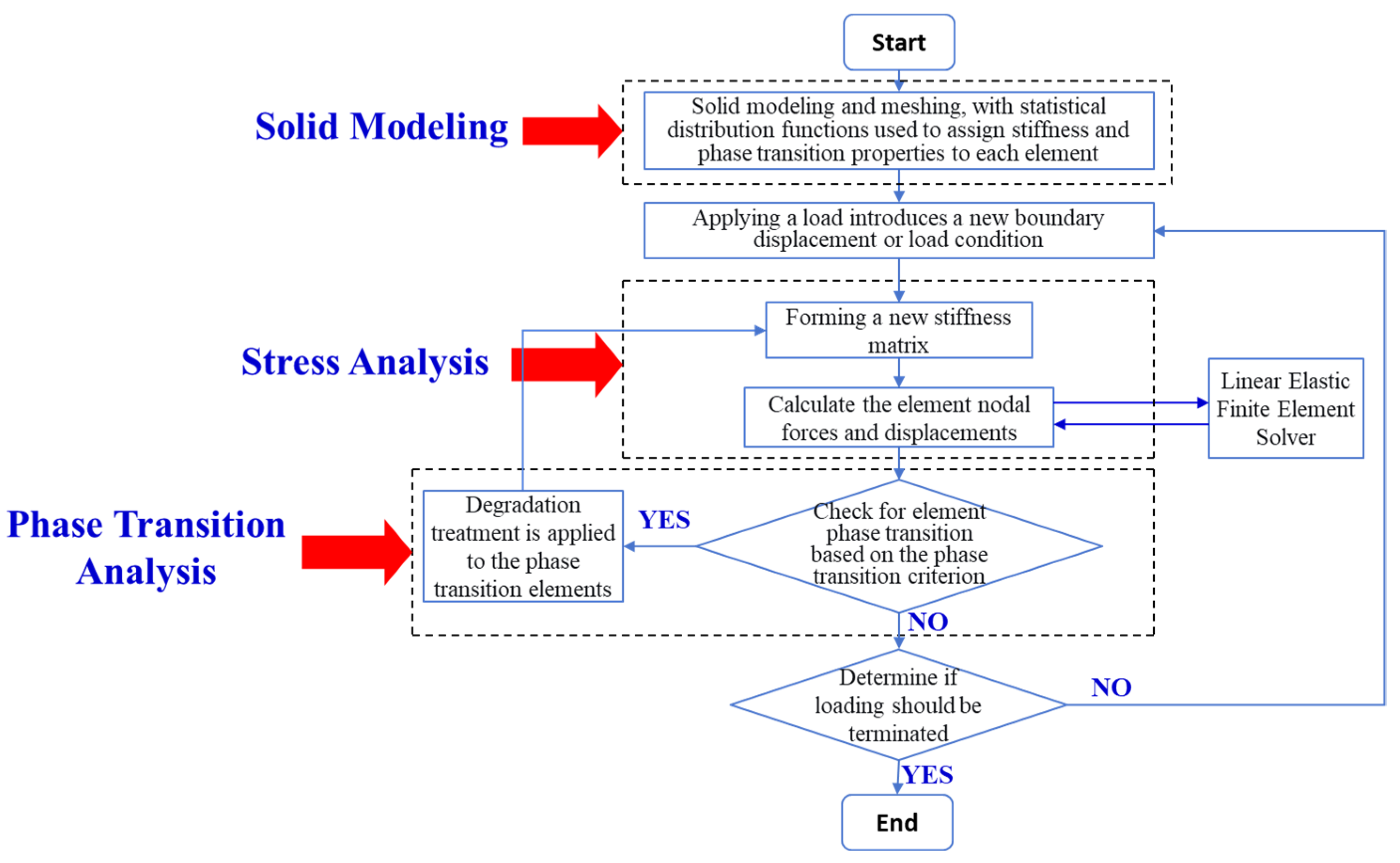
An important distinctive feature of RFPA is that there is no need to predefine the crack propagation path; instead, the path is randomly determined under the control of the Weibull distribution. Furthermore, due to the setting of empty element properties, the model does not require the addition of new elements or nodes after crack formation, which ensures high computational efficiency and enables the careful consideration of multi-crack propagation problems. In RFPA, the crack propagation behavior is affected by the number of elements, so the size of computational elements directly influences the crack propagation state. Therefore, the model should be discretized into sufficiently fine meshes during the setup phase. It should be noted that compressive stress is defined as positive and tensile stress as negative in the RFPA framework. The flow chart is presented in Figure 1.
At the mesoscopic scale, the nonlinear behavior of rock stems from its intrinsic heterogeneity [37,38]. To incorporate this heterogeneity into the model, mesoscopic material parameters were generated using a Monte Carlo approach to construct a sample space based on the Weibull distribution function:
f u = m u 0 u u 0 m 1 e u u 0 m
where u is the element parameter (such as strength, elastic modulus, thermal expansion coefficient, etc.); u 0 is the average value of the parameter, and f u is the statistic quantity of the material parameter. m is the shape function of the distribution function, which can be termed the heterogeneity index. Further, the heterogeneity index is related to rock mineralogy. The higher the heterogeneity index m , the more uniform the material is. It should be determined by experiment for a specific kind of rock.

2.1.2. Thermodynamic Coupled Equations

The thermodynamic coupling solution involves three main steps: (1) compute the temperature field under the prescribed thermal conditions, (2) solve the stress field under the given mechanical conditions, and (3) update material parameters through damage evolution.
The energy balance equation is as follows:
k x 2 T x 2 + k y 2 T y 2 + k z 2 T z 2 + Q = ρ c T t in   Ω e
where Q is the heat generation rate; k x , k y , k z are the thermal conductivities in the x , y and z directions, respectively; ρ is the density; and c is specific heat. Ω e is the entire solution domain.
T P , t | P ϵ S 1 = φ ( P , t )
k n T n | P ϵ S 2 = q S 2 ¯
k n T n | P ϵ S 3 = h ( T S T )
T | t = t 0 = T P ,   t 0
S 1 e , S 2 e , and S 3 e denote the first, second, and third thermal boundary conditions, respectively; t 0 represents the initial time; φ ( P , t ) is the temperature distribution function at boundary point P over time; q S 2 ¯ is the heat flux at the boundary; h is the heat transfer coefficient between the model boundary and the external environment; T s is the ambient temperature.
The equilibrium equation is:
σ i j , j + F b i = 0
The geometric equation is:
ε i j = u i , j + u j , i / 2
The constitutive equation is:
σ i j = λ ε m m δ i j + 2 G ε i j 3 λ + 2 G α Δ T δ i j
where σ i j is the stress; ε i j is the strain; F b i is the body force; and Δ T is the temperature change, defined as Δ T = T T 0 ; δ i j is the Kronecker function; λ is the Lamey constant; G is the shear modulus; α is the coefficient of thermal expansion.

2.1.3. Damage Evolution

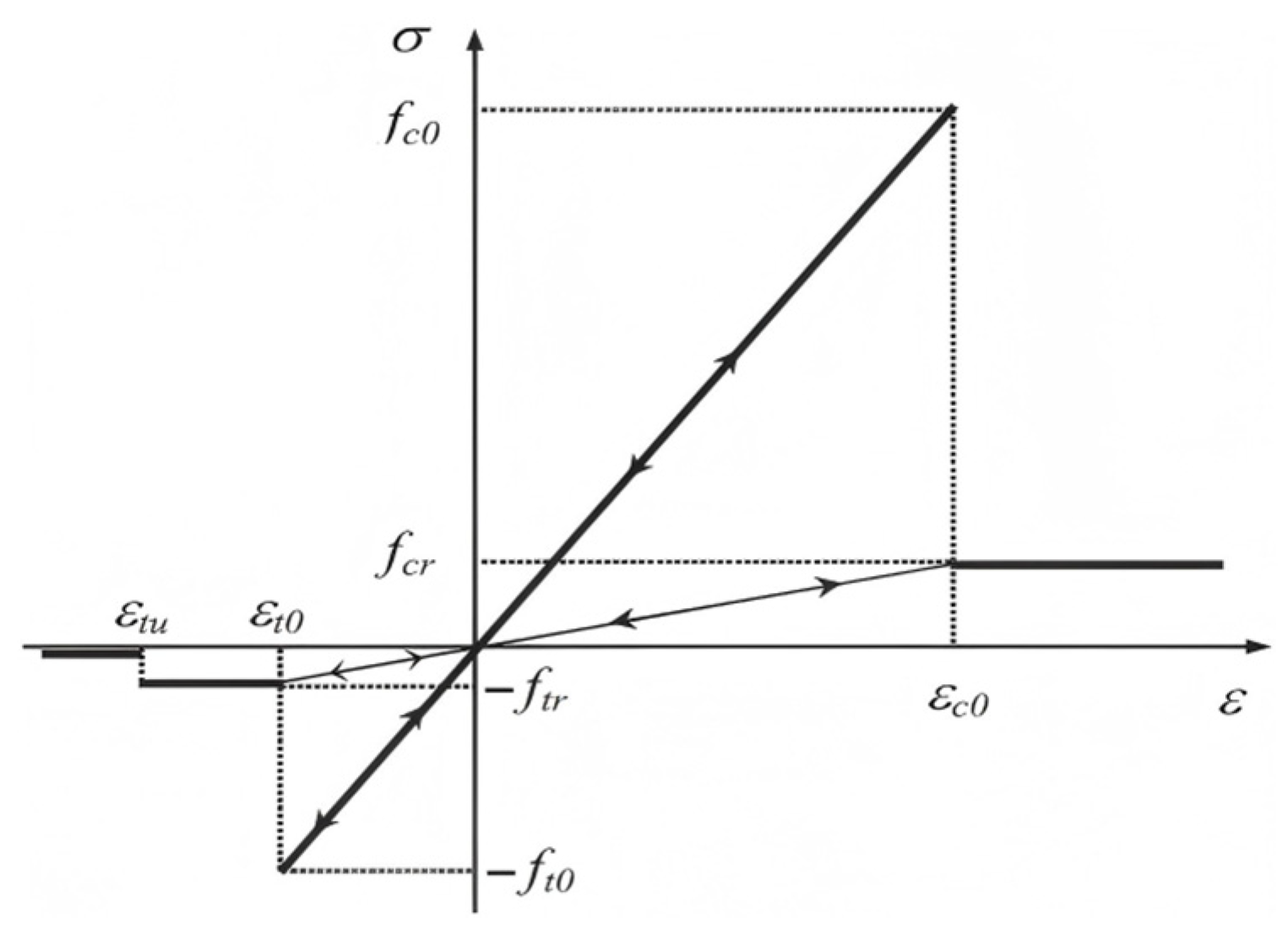
At the macroscopic scale, rock shows nonlinear behavior, whereas a mesoscopic element can be approximated as elastic–brittle, as illustrated in Figure 2. σ and ε stand for stress and strain; f t 0 and f t r represent the uniaxial tensile strength and residual tensile strength; ε t 0 is the tensile strain corresponding to the ultimate elastic state and the initial damage threshold of the element; and ε t u is the ultimate tensile strain which is also related to the complete damage threshold of the element; f c 0 and f c r represent the uniaxial compressive and residual compressive strength; ε c 0 serves as the strains corresponding to f c 0 .
Damage occurs when the stress state satisfies either the tensile strength criterion or the Mohr–Coulomb criterion. The cumulative damage expression of the elastic modulus is:
E = 1 ω E 0
where E is the value of the elastic modulus after damage; E0 is the initial value of the elastic modulus; and ω is the damage variable.
Thermal conductivities of each direction are also subject to damage evolution:
k = 1 ω k 0
When the element meets the tensile strength criterion, the damage variable ω is defined as:
ω = 0 ε > ε t 0 1 λ ε t 0 ε ε t u < ε ε t 0 1 ε ε t u
where λ is the residual strength coefficient which is defined as λ = f t r f t 0 .
When the mesoscopic element satisfies the Mohr-Coulomb criterion, the damage variable can be determined as:
ω = 0 1 λ ε c 0 ε ε < ε c 0 ε ε c 0
where ε c 0 is the ultimate compressive strain.

2.1.4. Image Processing Method

When analyzing cracking phenomena, in addition to conducting stress variation analysis from a mechanical perspective, this study also investigates the morphological characteristics, geometric structures, and distribution patterns of the cracking outcome images. In terms of image processing, the primary tool employed is the Crack Image Analysis System (CIAS) image processing tool developed by Tang Chaosheng’s research team at Nanjing University [39,40]. Built on the MATLAB (R2022b) platform, CIAS is a professional software tailored for the automatic identification and quantitative analysis of fractures and blocks in fracture images; it can rapidly extract a comprehensive set of geometric morphology parameters, including fracture nodes, endpoints, fracture count, single fracture length, total fracture length, average width of individual fractures, overall average fracture width, single fracture area, total fracture area, fracture ratio, fracture fractal dimension, single block area, block perimeter, and shape coefficient, thus enabling accurate quantitative characterization of fractures and blocks in various geomaterials such as rock and soil mass. In comparison with conventional quantification methods, this software demonstrates distinct advantages, namely straightforward operation, high precision and efficiency, batch image processing functionality, and superior reproducibility of analytical results.
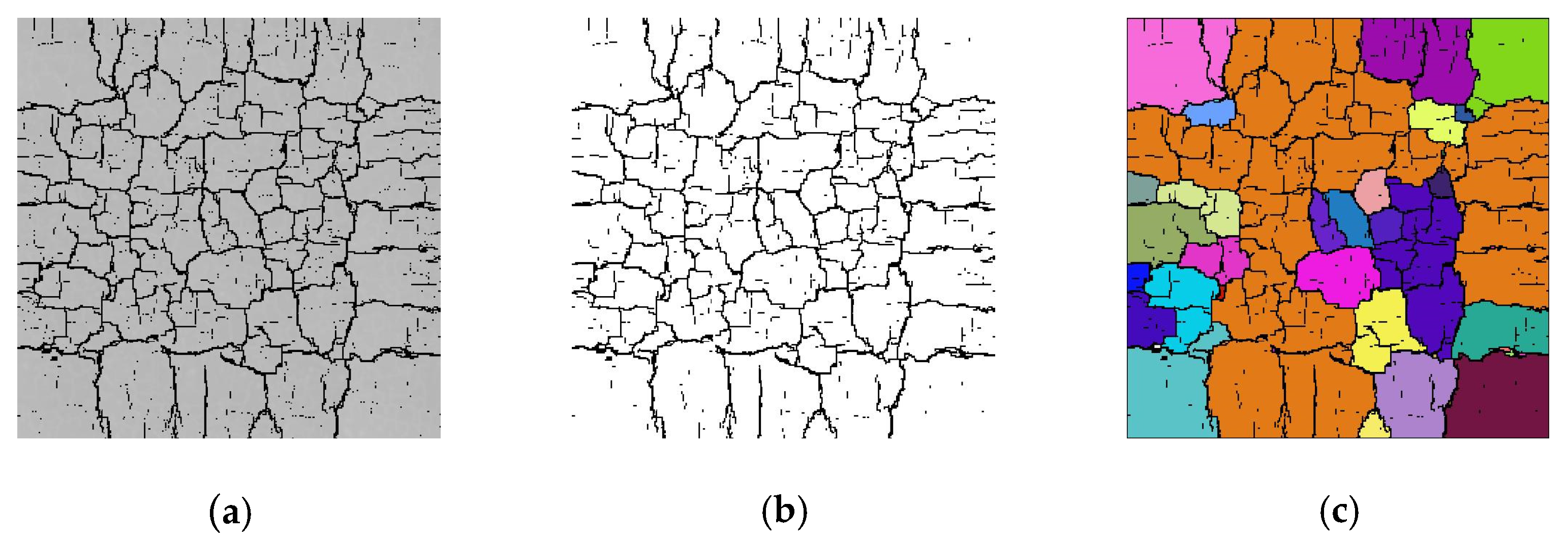
Therefore, in the extraction of information from desiccation crack images, this study primarily focuses on parameters such as the number of cracks, crack length, and number of aggregates. Typically, images obtained from numerical simulations cannot be directly used for quantitative analysis. Preprocessing steps, such as binarization and noise removal, are required based on the research objectives before relevant information can be extracted (Figure 3). This projection-based quantification method is a well-established and widely adopted approach in characterizing desiccation or thermal-induced crack patterns in rock mechanics [12,40].
This paper employs the CIAS-NJU system with three core components: crack analysis, aggregate statistics, and fractal dimension computation [39,40]. The area-perimeter method is well-suited for fractal objects with relatively strict self-similarity. It also exhibits high applicability in fractal dimension evaluation of block regions. Thus, it was selected as the preferred approach for fractal dimension computation in this work.
(1)
The CIAS-NJU software processes aggregate parameters (e.g., perimeter, area), automatically outputting these metrics for each aggregate within desiccation crack networks post-identification.
(2)
Crack quantification determines network node counts, with crack lengths/quantities extracted separately from output tables and intersection angles additionally acquired.
Fractal dimension characterizes the complexity of a pattern—a higher dimension denotes a more complex morphology. Within CIAS, it is computed using two approaches: the box-counting method and the area-perimeter method. Since desiccation crack patterns possess a statistically self-similar fractal structure, the box-counting method is adopted for their analysis. Conversely, the area-perimeter method is applicable to fractals exhibiting more exact self-similarity. The definition of the fractal dimension via the area-perimeter method is as follows [41]:
L o g P e r i m e t e r = D 2 × L o g A r e a + C
In the equation, Perimeter represents the perimeter of a soil aggregate in the desiccation crack image, Area refers to its corresponding area, C is a constant, and D is the fractal dimension of the aggregates. These variables are all automatically acquired by the CIAS system.

2.2. Numerical Models and Boundary Conditions

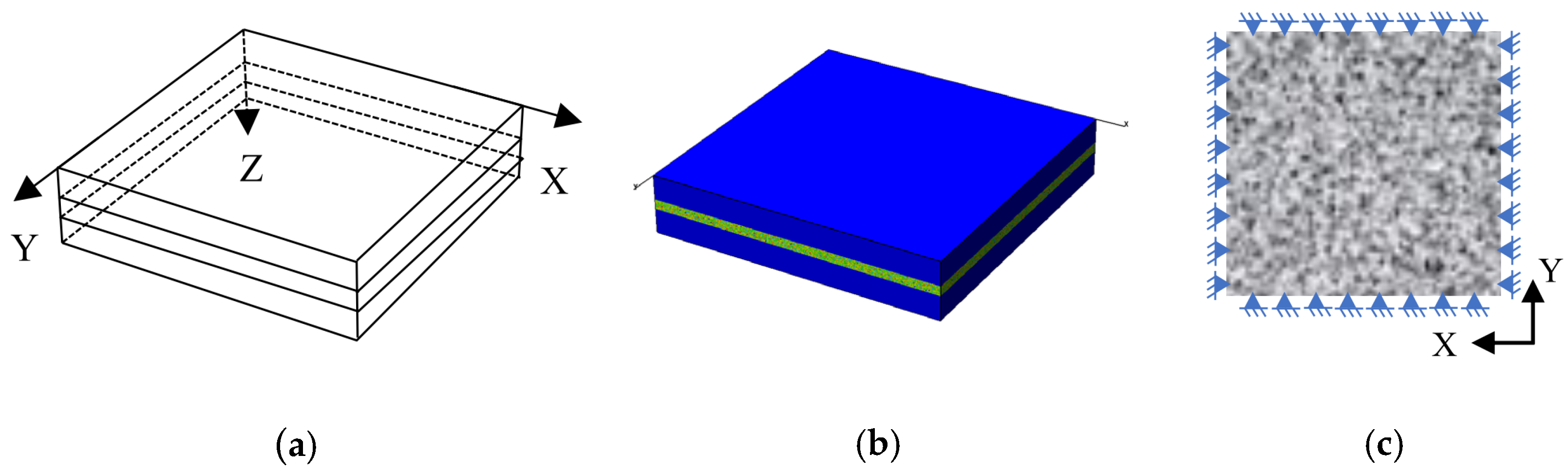
The objective of this study is to analyze the process and mechanism of internal cracking in layered rock induced by cooling shrinkage. A multilayer model (150 mm× 150 mm × 30 mm) composed of two materials (Table 1) is simulated (Figure 4) and discretized into 5,400,000 hexahedral elements. To validate the rationality of the mesh size used in this study, we refer to the research findings on mesh size effects presented by Liang’s Ph.D. thesis [38]. Liang [38] demonstrated that for a model with dimensions of 80 mm × 80 mm × 40 mm, a mesh discretization of 300 × 300 × 60 elements (corresponding to an element side length of 1 mm) is sufficient to meet the calculation requirements and eliminate the influence of boundary conditions. In contrast, the model employed in this study has dimensions of 150 mm × 150 mm × 30 mm and is discretized into 300 × 300 × 60 elements, resulting in a total of 5,400,000 elements with an element side length of 0.5 mm. This finer mesh size is well within the range that can neglect the mesh size effect, as it more closely matches the mesoscopic characteristic scale of the rock.
In these models, the layers within the model are collectively designated as “weak interlayers”. Ideal contact without relative displacement is assumed between adjacent layers. The analysis focuses on the effects of weak interlayer thickness and the number of weak interlayers on polygonal fracture formation. An implicit solver with an energy-based convergence criterion (tolerance set at 1 × 10⁻⁶) was used for the coupled thermo-mechanical analysis.
Simulations are carried out with the Dirichlet boundary condition, the bottom is fixed at a temperature of 20 °C, and the top is subjected to an initial temperature of T = 20 °C, whereby the fixed boundary conditions are applied on the other four sides. Cooling is simulated by linearly decreasing the top surface temperature, reduced by 0.4 °C per step for computational stability and efficiency. For purposes of comparison, the central portion of the model is cooled to a similar extent (−19.8 °C) as that described by Chen et al. [24,42,43].
It should be noted that rocks are subjected to a variety of boundary conditions, including ambient confinement, uniaxial confinement, and fully unconfined states. This study defines its numerical model’s boundary conditions to reproduce the constraint state of layered rock masses during cooling, with key settings and rationality elaborated as follows: the lateral and bottom boundaries adopt fixed displacement constraints (full restriction of horizontal and vertical displacements) to simulate the confinement of underlying and surrounding rock, which inhibits lateral contraction-induced stress release and ensures effective accumulation of cooling-induced thermal stress in weak layers—a prerequisite for polygonal tensile crack formation consistent with laboratory observations; the top boundary allows free vertical deformation to match the unconstrained state of rock surfaces in actual cooling scenarios. This configuration ensures accurate reflection of thermal stress evolution, enabling reliable simulation of polygonal crack initiation, propagation, and coalescence.
Chen et al. carried out an exhaustive and systematic investigation into the evolution laws of rock cracks under different boundary conditions, and the findings indicated that distinct boundary conditions would give rise to slightly different crack propagation modes [24]: under uniaxial confinement, horizontal cracks perpendicular to the constrained direction are prone to initiation and propagation; under ambient confinement, a globally distributed reticulated crack network is formed throughout the rock matrix; under fully unconfined conditions, a composite crack pattern emerges, characterized by a reticulated crack network in the central region and parallel cracks in the peripheral zones. Nevertheless, across all these boundary conditions, crack formation is uniformly governed by two critical factors, namely layer thickness and layer number, and the overarching evolutionary trend remains consistent—an increase in layer thickness leads to the formation of larger rock blocks separated by cracks, while an increase in the number of layers results in a gradual reduction in cracking susceptibility for layers located further away from the rock surface.
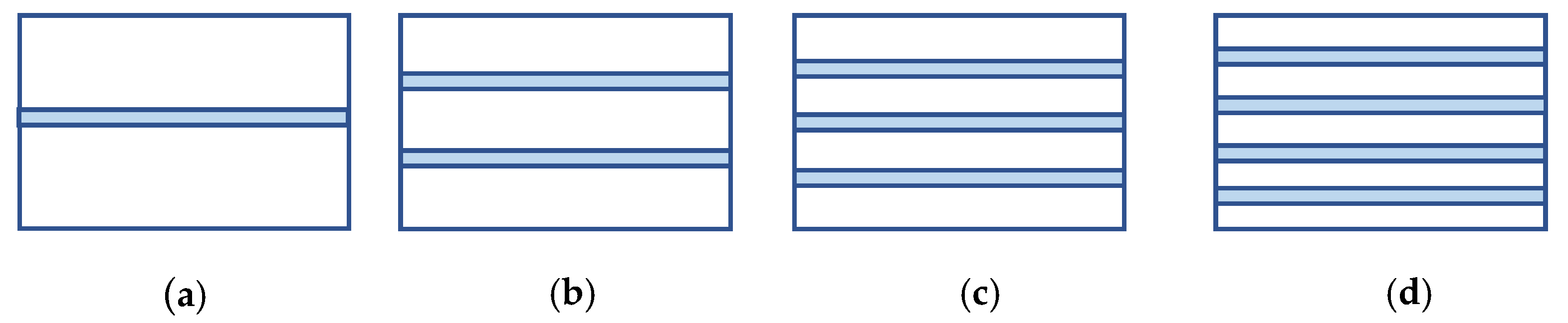
The thicknesses of the weak interlayers, denoted by h, are set to 1 mm, 3 mm, 5 mm, 7 mm, and 9 mm, respectively, for the five models with varying thicknesses. For the models examining the impact of weak interlayer numbers, the weak interlayer thickness is maintained at h = 3 mm, while the number of weak interlayers is varied to 1, 2, 3, or 4. In Figure 5, blue represents weak interlayers and white represents strong layers. It should be noted that the classification criteria for “strong layers” and “weak interlayers” in this study are not based on their elastic moduli; that is, layers with higher elastic moduli are not necessarily defined as strong layers, nor are those with lower elastic moduli equivalent to weak interlayers. On the contrary, “weak interlayers” specifically refer to crack-susceptible layers, whereas “strong layers” denote crack-resistant layers. Each material is heterogeneous, with a random distribution of the mechanical parameters following a Weibull distribution. The material parameters are listed in Table 1, as outlined by Chen et al. [24].

3. Results

3.1. The Formation of Polygonal Cracks Within Multilayered Rocks

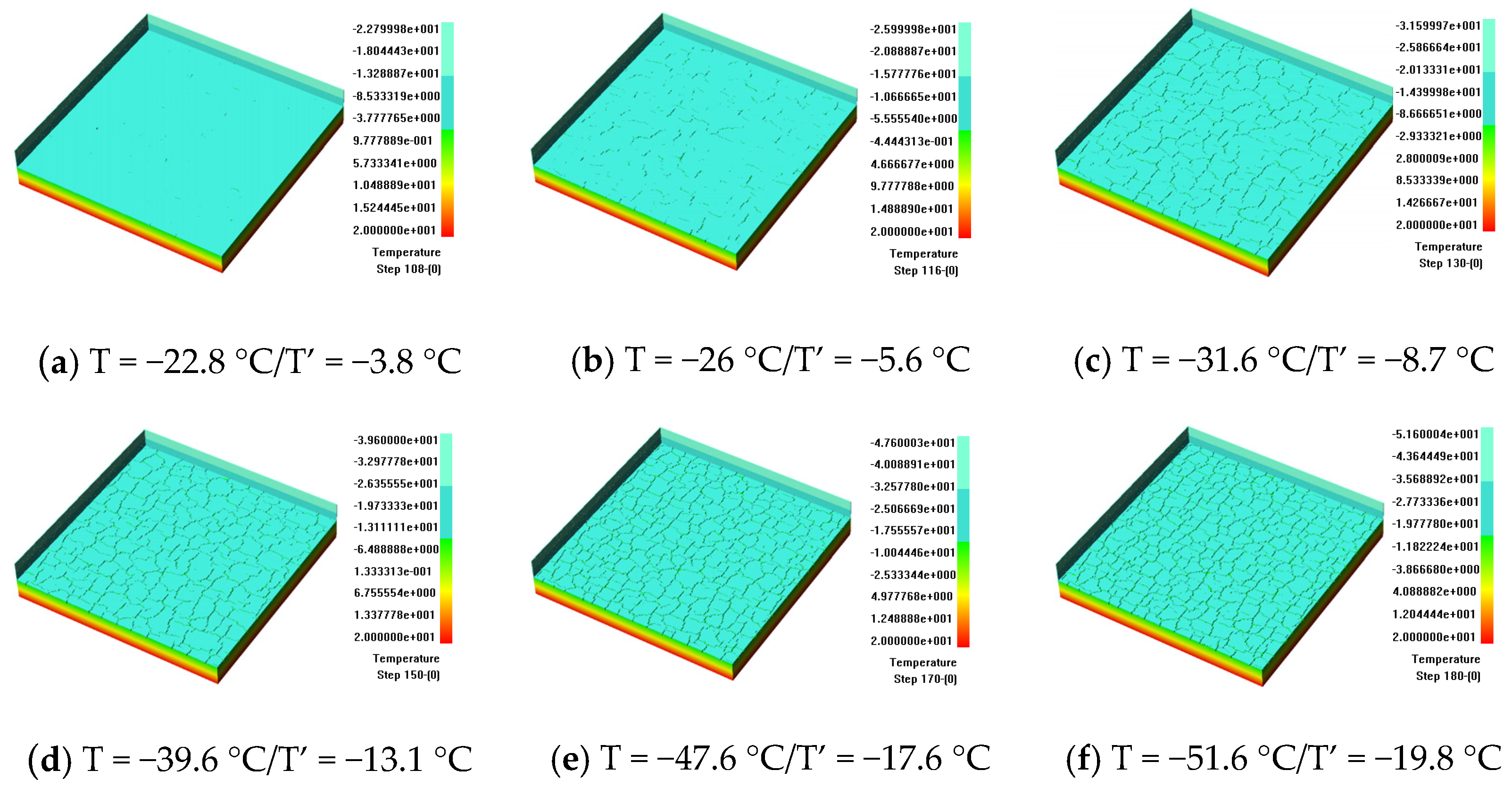
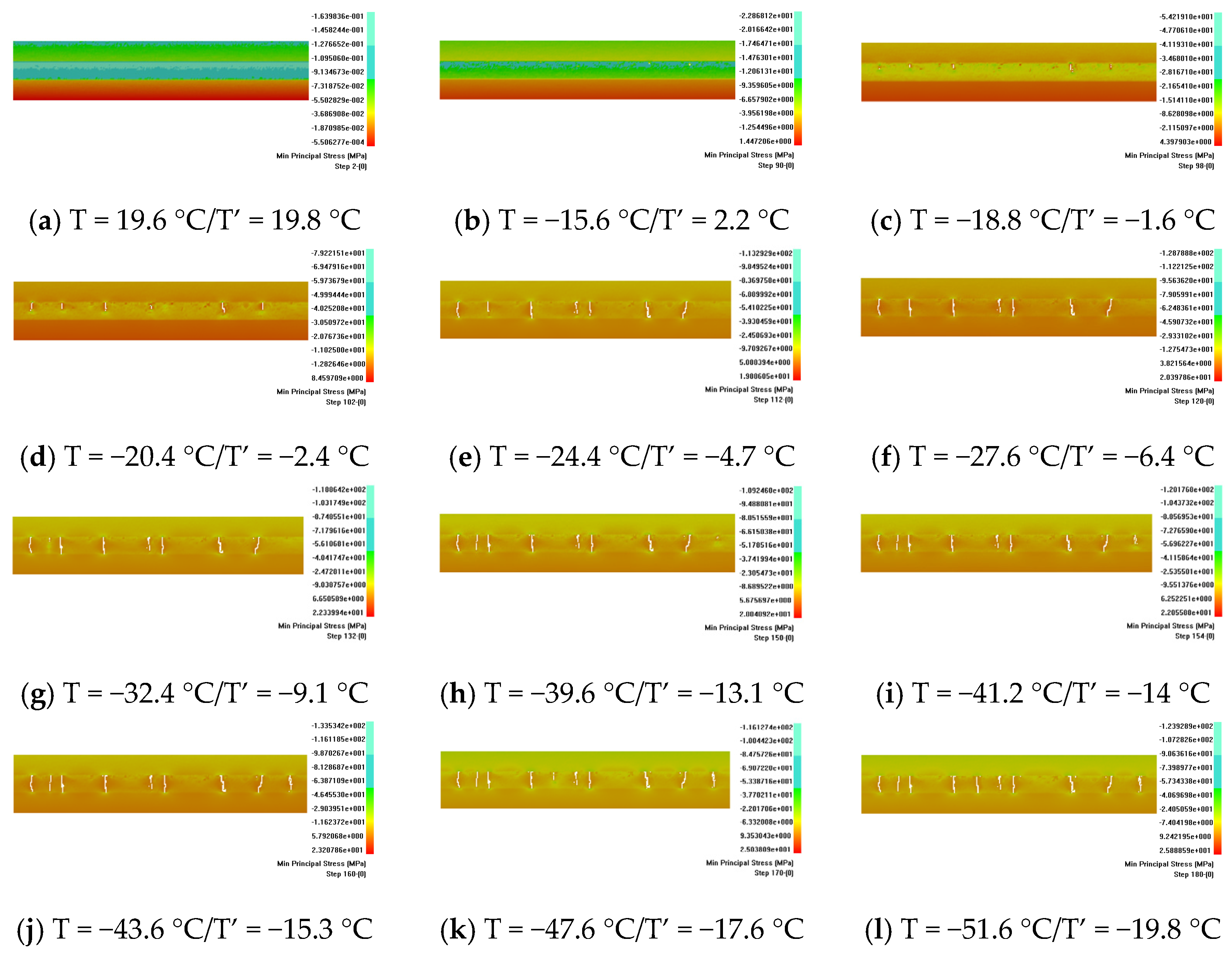
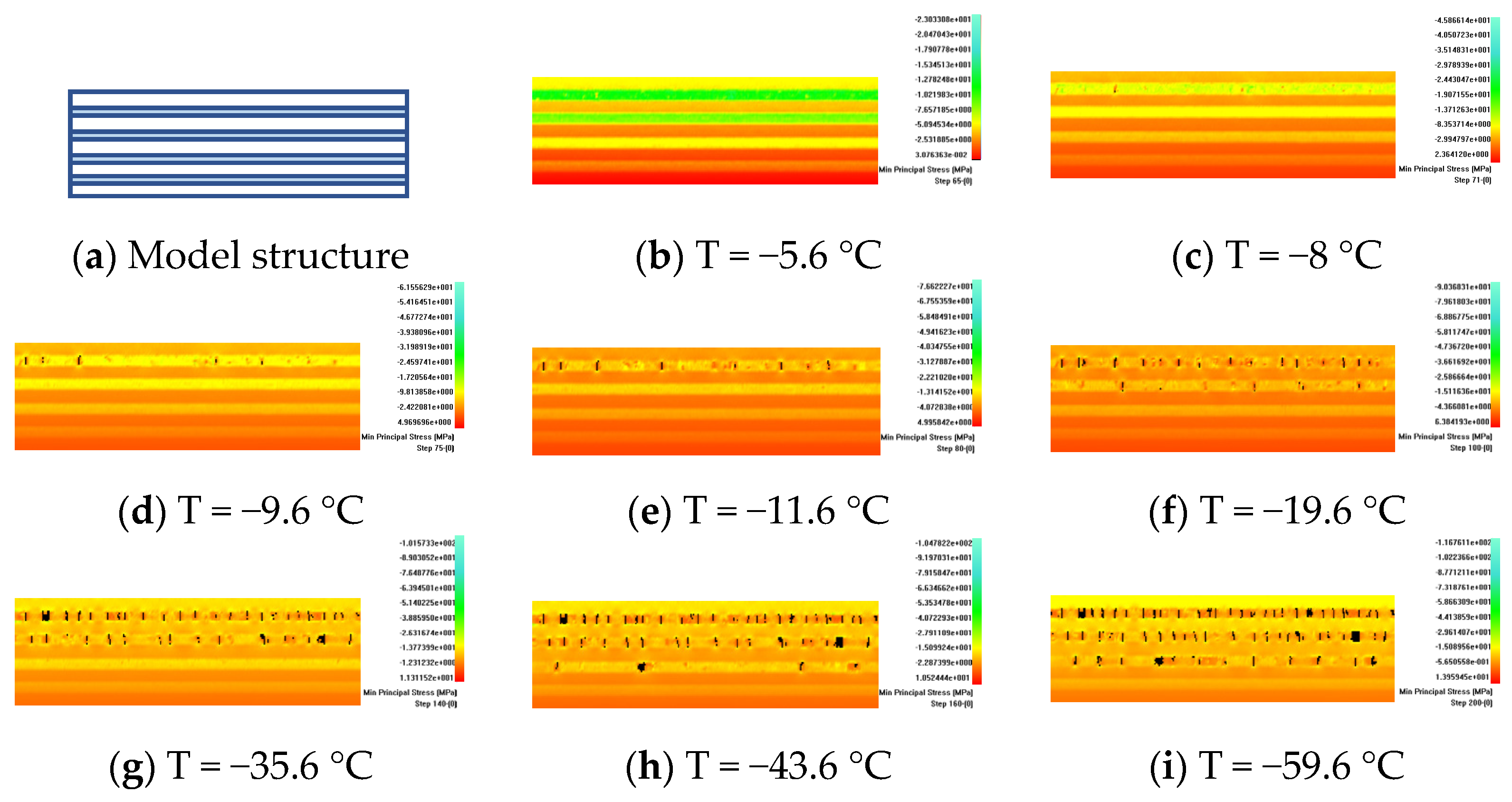
Figure 6 depicts the progression of cracks in the interlayer model during the cooling process. T and T’ represent the top surface and center temperatures in the model, respectively. Figure 6 illustrates that as the temperature decreases, cracks in the weak layer initiate, propagate, and eventually penetrate, leading to a stabilization in the number of cracks.
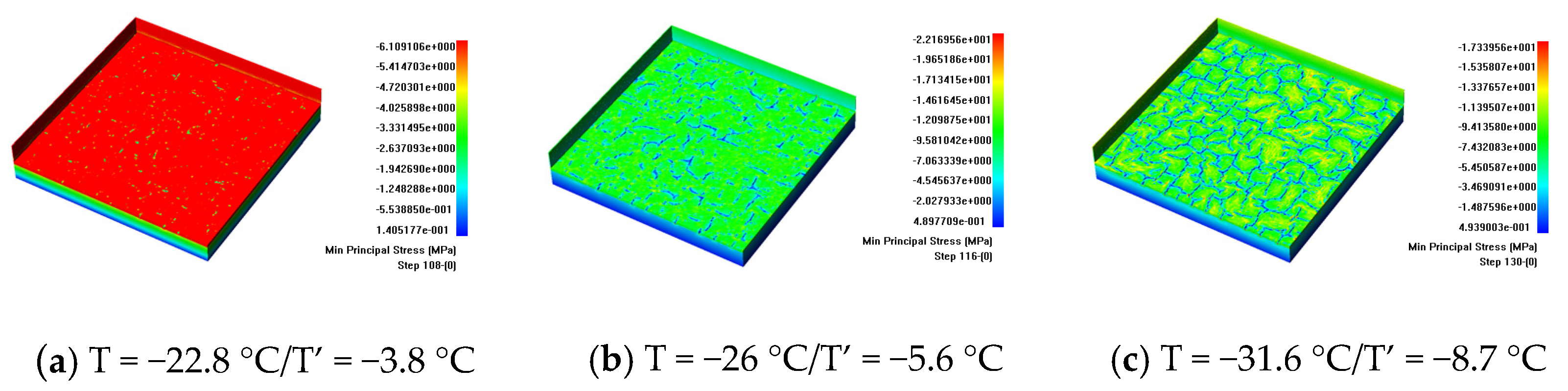
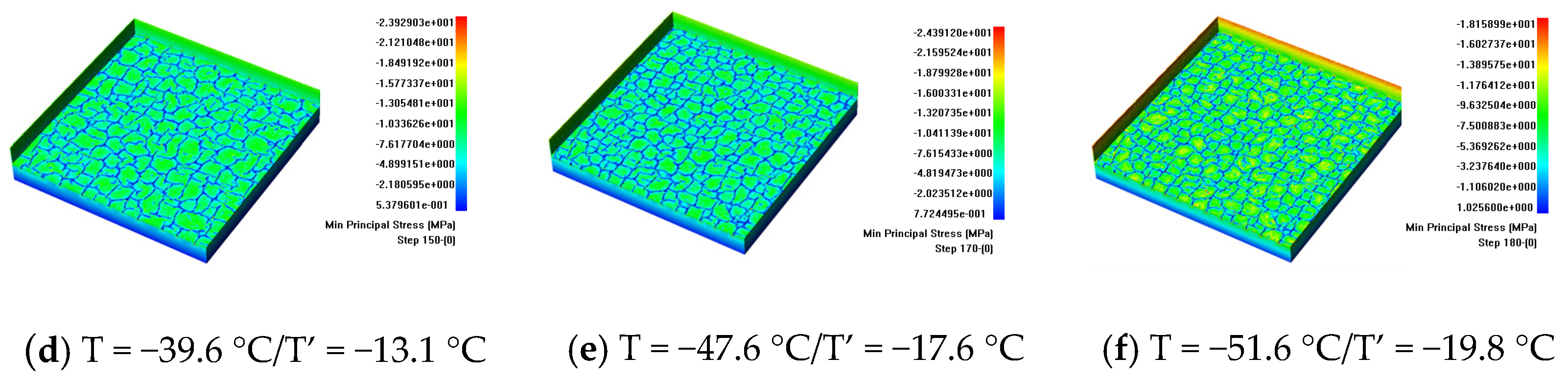
Figure 7 reveals the stress variations during the initiation and propagation of cracks. In the initial stages, a substantial concentration of tensile stress is evident in the weak interlayers, leading to a widespread occurrence of damage points. Since the temperature continues to decrease, cracks begin to penetrate the weak interlayers. After the cracks begin to penetrate, regions of compressive stress emerge on either side of the cracks. As observed by Chen et al. [25], the development of cracks around the model is initially constrained and predominantly occurs along the crack tip, exhibiting a similar distribution of compressive stress zones. Once a significant number of cracks have penetrated, the stress distribution throughout the model reaches a state of relative equilibrium. As the temperature continues to decrease, no further cracks appear. Figure 7f illustrates that the maximum tensile stress is concentrated at the matrix of the weak layer, indicating a downward trend in the crack penetration area. Following the restraint of the strong layers, the inter cracks in the weak layer stabilize and penetrate downwards but are unable to enter the strong layers, resulting in interlayer delamination. Since cracking in the weak layer necessitates strain transfer from the adjacent strong layers, the onset of delamination between the weak and strong layers signifies the cessation of the strain transfer path, thereby halting further crack propagation inside the weak layer. This phenomenon is referred to as polygonal crack saturation.
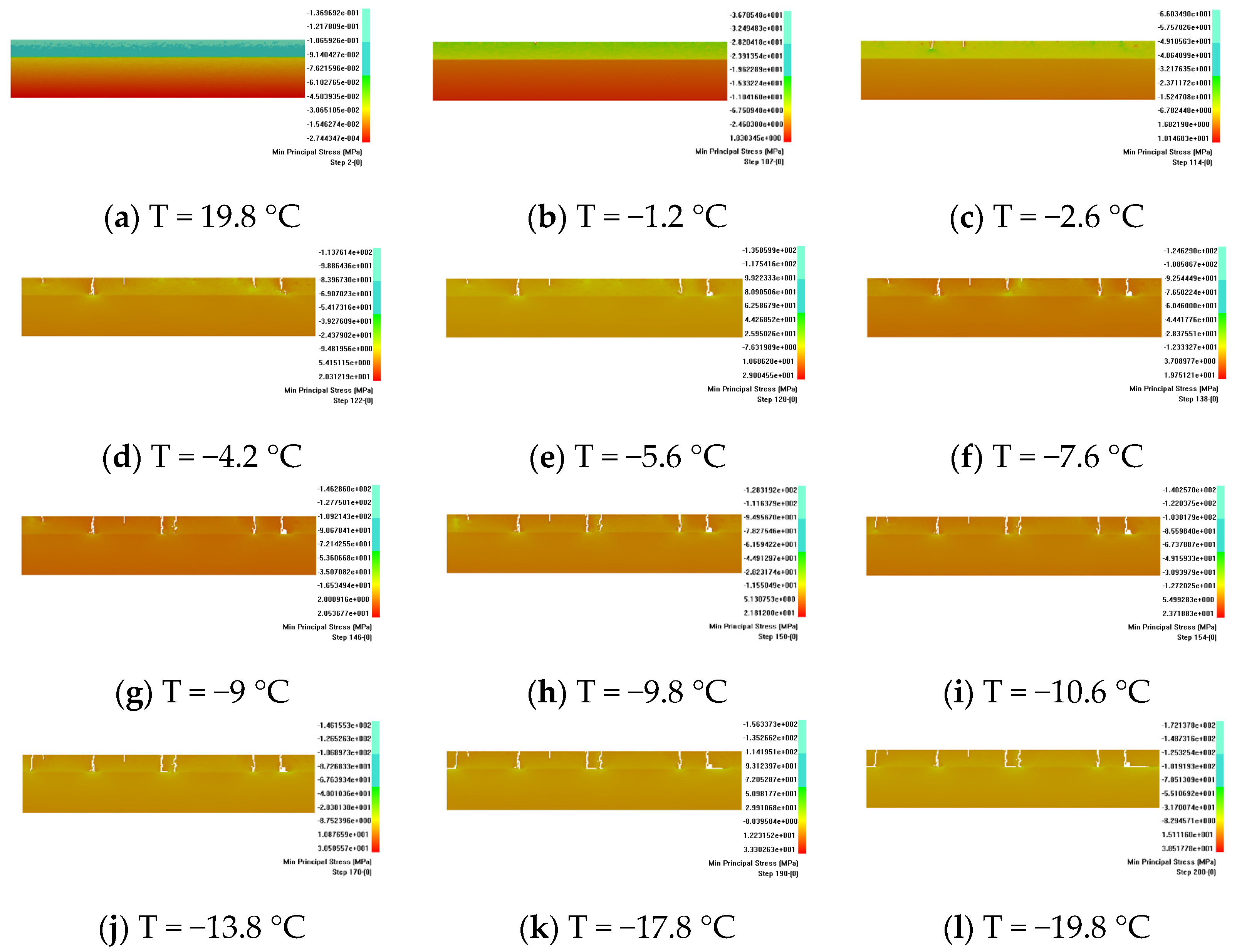
In order to discuss the influence of the weak layer position on the density of cracks, Figure 8 and Figure 9 compare the stress distribution during crack propagation in the inter weak layer model with that in the surface weak layer model, both with a weak interlayer thickness of h = 9 mm. The comparison illustrates that the density of cracks in the inter-weak-layer model is greater than that of the surface weak-layer model, indicating that the number of blocks in the inter weak-layer model is significantly higher than that in the surface weak-layer model.
A comparison of Figure 8 and Figure 9 shows the distribution of minimum principal stresses in the inter weak layer model and the surface weak layer model, respectively. With the temperature decline, the distribution of stresses within the model changes due to thermal gradients, influencing the process of crack initiation and propagation. In the inter weak layer model (as shown in Figure 8), constrained by the upper and lower layers, it continues to generate new cracks, resulting in a higher crack density than the surface weak interlayers model. Nevertheless, as the number of cracks increases, interlayer delamination occurs in the inter weak-layer model. Figure 9 illustrates that in the surface weak layer model, the propagation of cracks is oriented downwards as the temperature declines. Once a certain temperature is reached, no further cracks are initiated, but the existing cracks continue to propagate, resulting in interlayer delamination, and finally, the weak layer gradually separates from the substrate layer. Prior research [44,45] has investigated interlayer delamination phenomena, and the numerical simulation presented here provides a more detailed explanation of this phenomenon. In the progression of the interlayer delamination process, the polygonal cracks gradually reach saturation. The occurrence of interlayer delamination is preceded by the formation of polygonal cracks.
Comparing Figure 8 and Figure 9, it is found that the cracks initiate earlier in the surface weak layer model than in the inter weak layer model. As this model cools from top to bottom with a constant bottom temperature, the central region of the model is less affected by the thermal gradient than the surface region. When the weak layer is on the surface, with constant cooling and only constrained from below, the surface weak layer is more influenced by the thermal gradient compared to the inter weak layer. In this case, if the weak layer is located on the model surface and experiences a significant thermal gradient and continuous cooling, it is more likely to accumulate the stress required for failure. In contrast, if it is in the center of the model, although cooling to the same temperature, the environmental temperature difference is less pronounced, resulting in greater stress accumulation required for failure. The simulation results indicate that the inter weak layer model exhibits a higher density of cracks than the surface weak layer model. This can be attributed to the role of the upper and lower strong layers in the lateral deformation constraints during the cracking of weak interlayers. Therefore, damage occurring in the inter weak layer results in a greater number of cracks than in the surface weak layer, which only receives constraint from the lower strong layer. This is due to the greater strain transfer from the upper and lower layers, which makes it more difficult for saturation to be reached.

3.2. The Effect of Weak Interlayers Thicknesses on the Formation of Polygonal Cracks

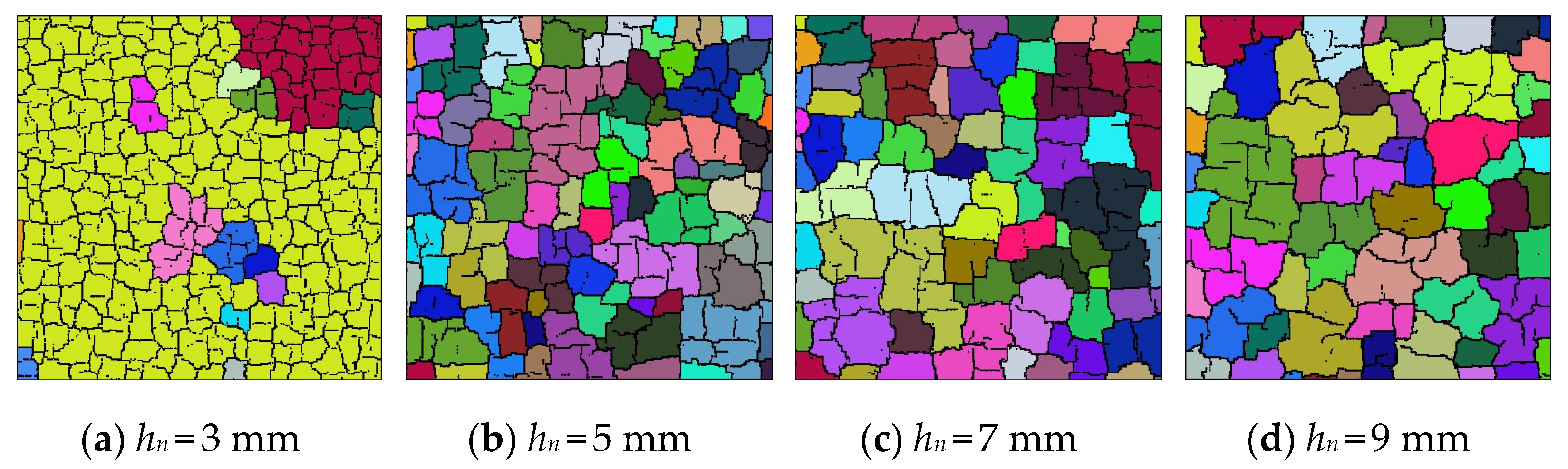
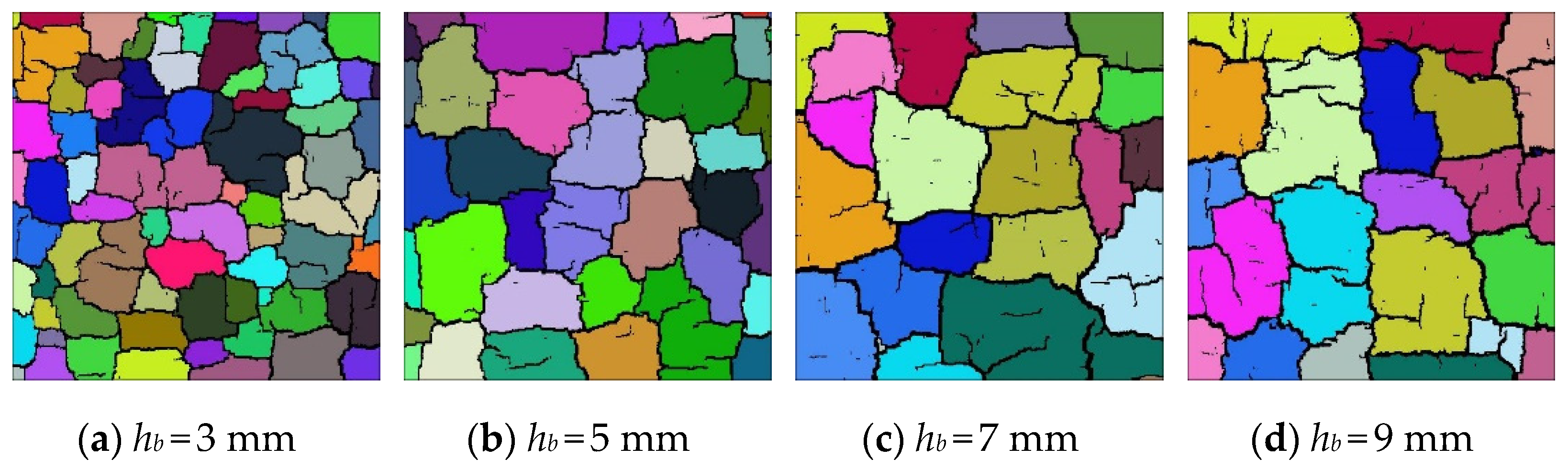
In order to investigate the influence of the weak interlayers thickness on the cracking pattern within the model, a series of weak interlayers thicknesses were set, including h = 1 mm, 3 mm, 5 mm, 7 mm, and 9 mm. The material parameters outlined in Table 1 were employed in this investigation. As illustrated in Figure 10, the area of the blocks formed by cracks demonstrates a gradual increase in proportion to the thickness of the weak layer. The formation of larger individual block areas is a consequence of thicker inter weak interlayers. This finding aligns with the observed trend of crack block area relative to weak interlayer thickness when the weak layer is situated at the top.
From Figure 10, it can be seen that as the model cools to the same degree (−19.8 °C) there is a certain regularity in the formation of cracks within the thicker inter weak layer. Furthermore, when cracks are produced on the surface of the model, the crack mesh gradually increases with the thickness of the weak layer. When h = 1 mm, almost no cracks are formed. During the cooling process, with crack initiation in the weak layer which is in the center of the model, the stress state is mainly influenced by the cooling conditions and constraints from the top and bottom layers. Under certain circumstances, if the weak layer is too thin, the strength and stiffness of the model increases and higher thermal stresses are required for cracks to initiate. Moreover, as the weak layer is thin, the thermal difference between the upper and lower surfaces of the weak layer is small. There is seldom damage observed in Figure 10a.
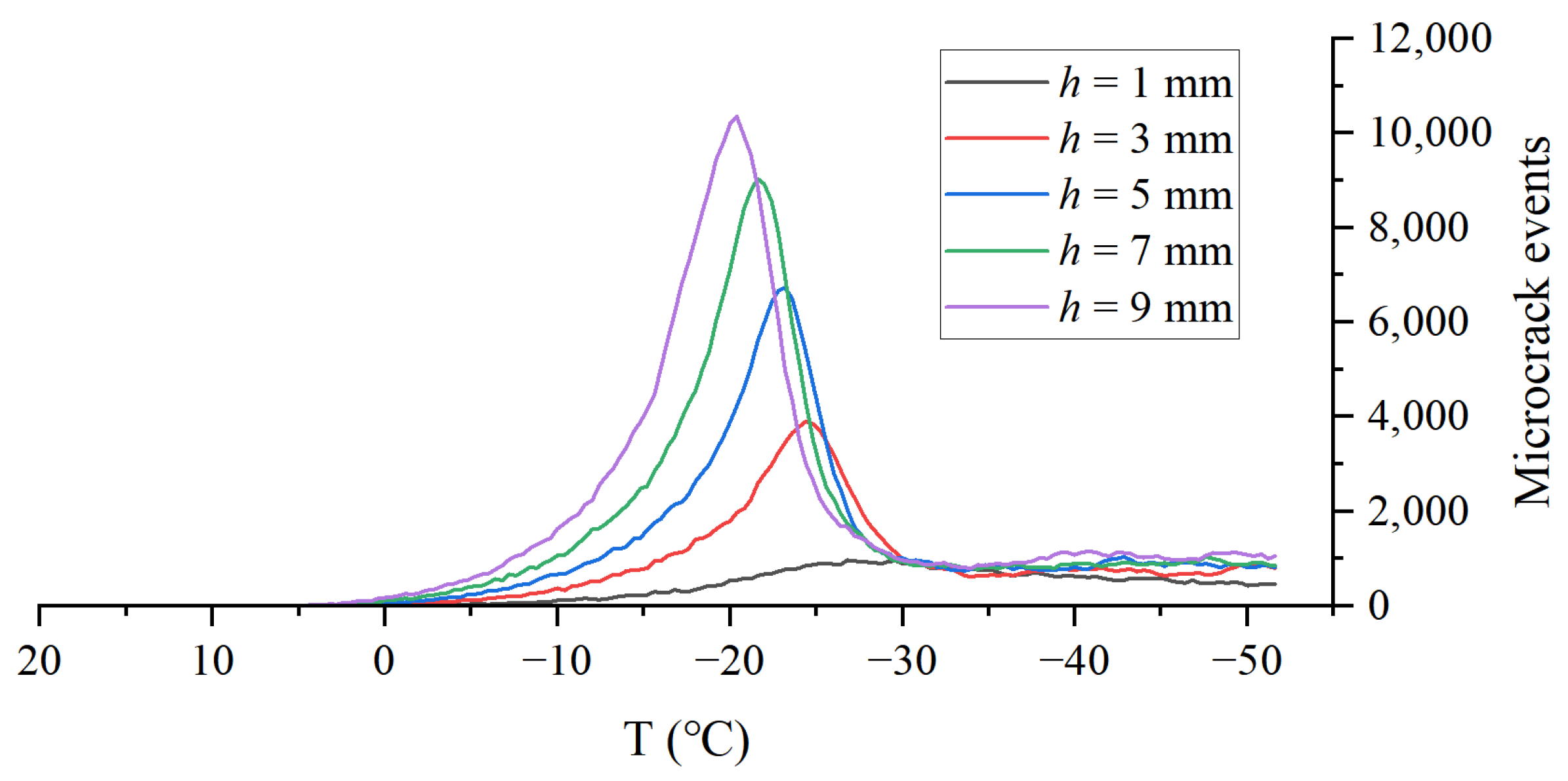
As illustrated in Figure 11, the number of micro-rupture events exhibits a trend of first increasing and then decreasing, which can be employed to elucidate the crack initiation–accumulation–saturation evolution process. During the rupture of the weak interlayer, the number of micro-rupture events also follows the pattern of increasing first and then decreasing. Moreover, the energy peaks in Figure 11 are closely correlated with the evolutionary stages of micro-rupture events—these energy peaks do not correspond to the generation of a single main crack, but rather represent the critical stage where a large number of microcracks develop synchronously and coalesce gradually. This process can be tightly linked to three typical damage stages of the weak interlayer, as detailed below.
Crack initiation stage (early cooling period): At this stage, stress accumulation is insufficient, and only randomly distributed damage points appear on the model surface. The number of micro-rupture events increases slowly, with no obvious energy peaks observed in Figure 11. This characteristic reflects the discrete and independent initiation state of individual microcracks.
Crack accumulation stage (continuous cooling period): As the temperature decreases continuously, the damage points expand rapidly and interact with each other, triggering the synchronous development of a large number of microcracks. The continuous superposition of energy released during microcrack propagation leads to the emergence of distinct energy peaks in Figure 11. This stage is the core period for crack network formation, and the peak value exhibits a positive correlation with the thickness of the weak interlayer.
Crack saturation stage (stable cooling period): After the formation of the global crack lattice, the energy peaks disappear, and the number of micro-rupture events drops sharply to a level close to zero. This phenomenon is referred to as crack saturation, during which no new micro-rupture events occur even under external loading.
The cessation of new crack initiation in the later stage is attributed to the stabilization of the thermal gradient, which achieves thermal stress equilibrium. As the temperature difference diminishes, the induced tensile stress falls below the tensile strength of the rock, thereby inhibiting the formation of new cracks.
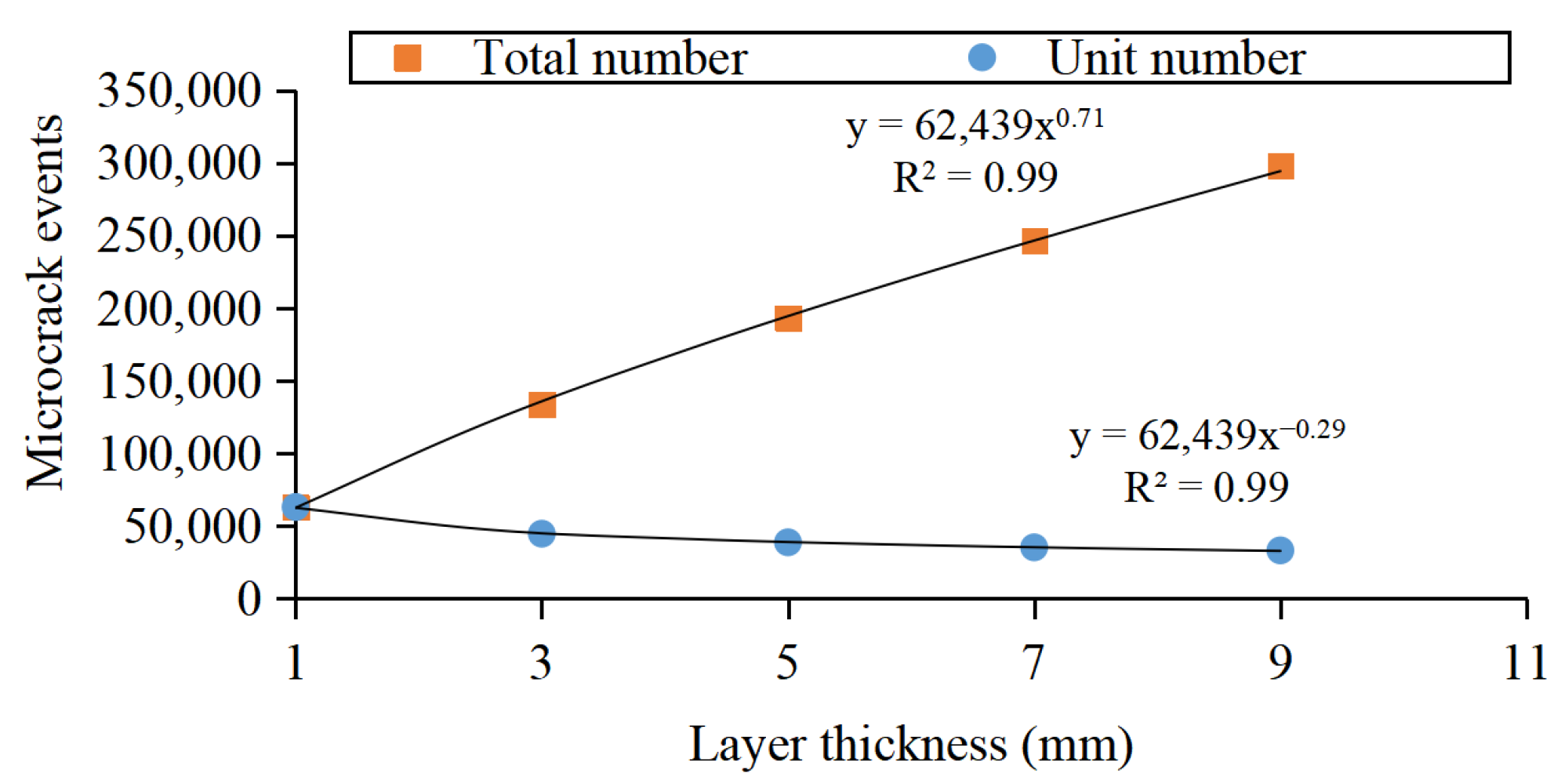
Furthermore, an increase in layer thickness results in an initial rise in the number of micro-rupture events, followed by a subsequent decline. It is evident that the thinner the weak layer, the more pronounced the decline in the number of micro-rupture events. In the h = 1 mm model, the curve of the number of micro-rupture events exhibits minimal fluctuations, and while there is evidence of damage, no obvious cracks are observed. With an increase in layer thickness, the number of micro-rupture events rises gradually. However, when the number of micro-rupture events is divided by the thickness of the layer, the resultant micro-rupture event number curve per unit thickness indicates that the number of micro-rupture events per unit thickness is higher than that of the weak layer. The curve depicting the number of rupture events demonstrates that while the total number of micro rupture events increases with thickness, the micro rupture events per unit thickness exhibit a decreasing trend. As the layer thickness increases, the total number of microcrack events increases, but the value of microcrack events per unit thickness shows a decreasing trend (Figure 12).
The influence of thermal stress on cracking is significant. The formation of thermal stress is contingent upon the thermal gradient. As the thickness of the weak layer increases, the number of cracks gradually decreases, while the average area of individual blocks increases. As the model with h = 1 mm did not exhibit cracks under the same cooling conditions, only models with crack occurrence were selected for statistical analysis. Figure 13 illustrates that, although the model with h = 3 mm shows a large number of dense cracks, these are not fully interconnected. This is because the 3 mm-thick weak layer enables the formation of an effective vertical temperature difference under top-to-bottom sequential cooling, which induces sufficient tensile stress accumulation; meanwhile, the relatively small thickness restricts the development of extensive compressive stress zones within the model, causing the tensile stress to exceed the rock’s ultimate tensile strength and thus triggering intensive cracking. This explains why the crack density peaks at h = 3 mm. Consequently, with an increase in weak interlayer thickness, the cracks gradually interconnect, forming larger block areas. A further increase in weak layer thickness will amplify the temperature difference but promote the formation of more extensive compressive stress zones inside the model, which counteract the tensile stress driving crack initiation and propagation, leading to a sharp reduction in crack density. Figure 14 presents the research results from Chen et al. [24] regarding the influence of thickness on the formation of polygonal cracks in rocks with a weak layer at the surface. It can be clearly observed that, similar to the case with a weak layer in the inter part, the size of polygonal blocks increases with the increase in the thickness of the weak layer.
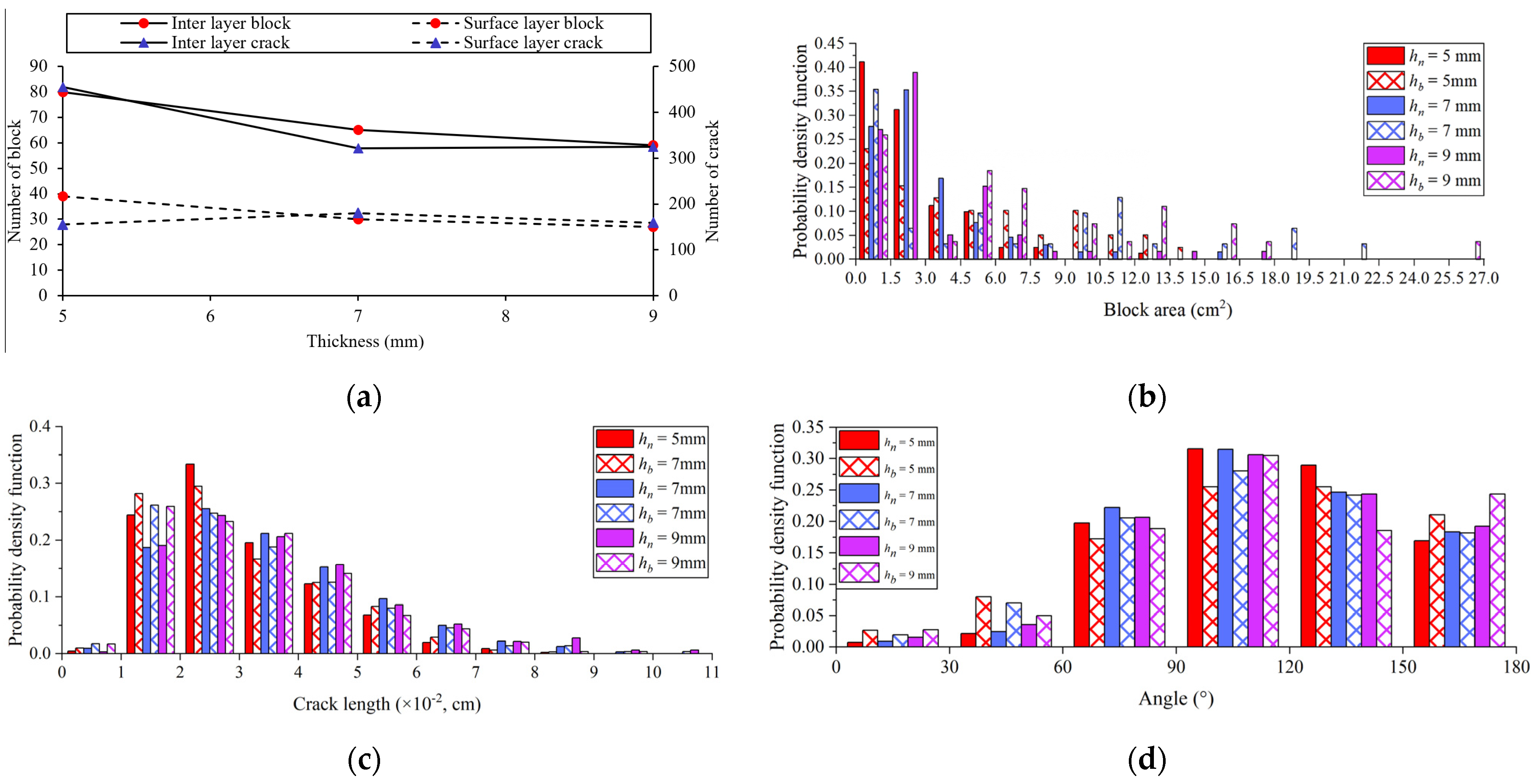
Crack geometric characteristics of surface layer models and interlayer models with different thicknesses are counted in Figure 15, demonstrating that the number of blocks and cracks in the inter weak layer model is markedly higher than in the surface weak layer model. Given that fully constrained boundary conditions were imposed on all boundaries of the model, such boundary conditions exerted a substantial restriction on the overall deformation behavior of the specimen. Under these circumstances, the variation amplitude of crack width was negligible, with its minimal fluctuations being primarily correlated with the minor overall deformation of the model. To ensure that the analysis strictly focused on the dominant variation trends of the core parameters, the crack width data were thus deliberately excluded from the scope of the comparative analysis in this study. Similarly, an increase in layer thickness is associated with a reduction in the number of cracks and blocks. The block area in the inter weak layer model is notably smaller than that in the surface weak layer model, with a relatively higher proportion of microcracks in the latter. However, the overall trend remains consistent. Figure 15b illustrates that over 60% of the block area in the inter weak layer model is concentrated within the range of 0 to 4.5 cm2. The largest block area for h = 5 mm is observed to fall within the range of 12 to 13.5 cm2, for h = 7 mm within the range of 15 to 16.5 cm2, and for h = 9 mm within the range of 16.5 to 18 cm2. It can be observed that models with greater thickness are more likely to produce larger individual block areas under the same cooling conditions. The overall trend is analogous to that observed in the surface weak layer model. Figure 15c illustrates a comparable trend in the length distribution of all cracks. Over 50% of crack lengths fall within the range of 1 to 4 × 10⁻² cm, with the most common range of crack lengths being 2 to 3 × 10⁻² cm. The proportion of short cracks in the inter weak layer model is markedly higher than in the surface weak layer model. The longest crack for h = 5 mm falls within the range of 7 to 8 × 10⁻² cm, for h = 7 mm within the range of 9 to 10 × 10−2 cm, and for h = 9 mm within the range of 10 to 11 × 10−2 cm. The distribution of crack lengths is positively correlated with block area. Figure 15d shows that more than 60% of the crack angles are in the range of 90° to 180°, and the crack angle distribution trend is similar for all models.
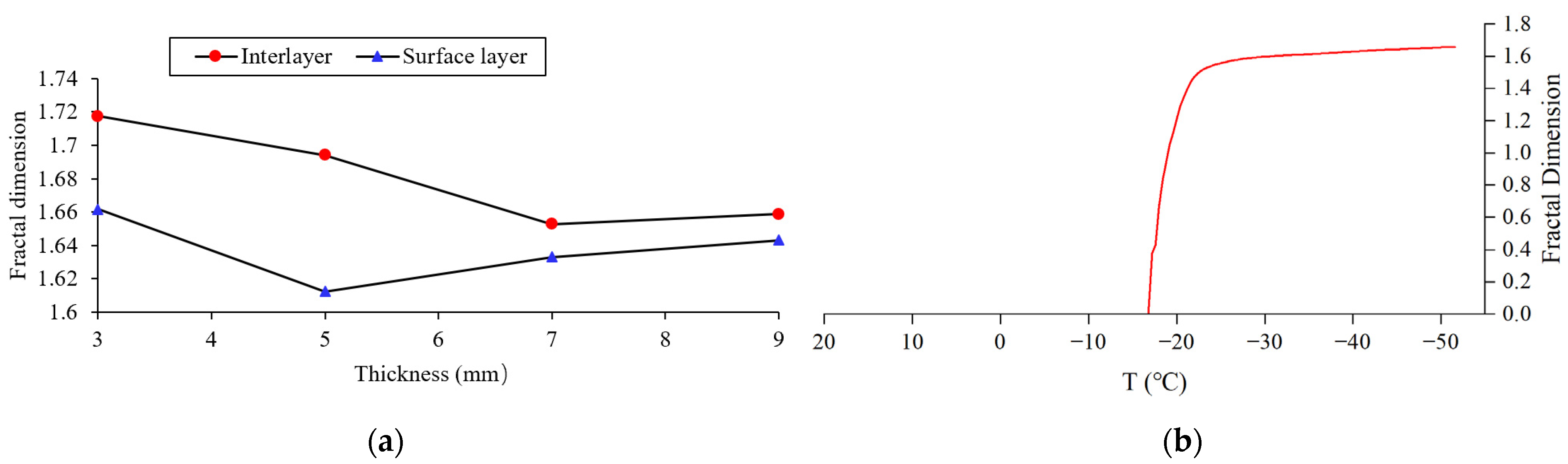
Figure 16a compares the fractal dimension of the interlayer and the surface layer after an equivalent degree of cooling. The fractal dimension of the inter mediate layer is generally higher than that of the surface layer. An exception occurs at h = 5 mm, where the trends diverge. Otherwise, the trends are similar. The fractal dimension reaches a maximum at h = 3 mm. It then decreases. For the surface layer, the minimum fractal dimension occurs at h = 5 mm. For the interlayer, the minimum fractal dimension occurs at h = 7 mm. In both cases, the fractal dimension at h = 9 mm exceeds that at h = 7 mm. This indicates increasing structural complexity. Although a thicker layer yields fewer blocks, the relative number of cracks increases. Therefore, the fractal dimension correspondingly increases. Figure 16b presents the evolution of the fractal dimension with decreasing temperature for the model with an inter weak layer thickness h = 9 mm. The surface fractal dimension begins to increase when the temperature drops to about −17 °C. Between −17 °C and −26 °C, the fractal dimension rises approximately linearly. Below −26 °C, the increase transitions to a slow, near-horizontal trend, approaching a plateau. Combined with the microcrack evolution curve in Figure 11, microcrack activity grows almost linearly from −15 °C to −20 °C. Around −25 °C, the microcrack response attenuates to a steady state. Thereafter, the curve remains nearly horizontal. This indicates that only minor crack extension occurs within the model, and no new large-scale cracks are generated. The evolution of the fractal dimension provides a direct diagnostic of the model state. When changes in fractal dimension tend to stabilize, crack growth approaches a stable regime. Under steady external conditions, large-scale fracturing is unlikely.

3.3. The Effect of Weak Interlayer Numbers on the Formation of Polygonal Cracks

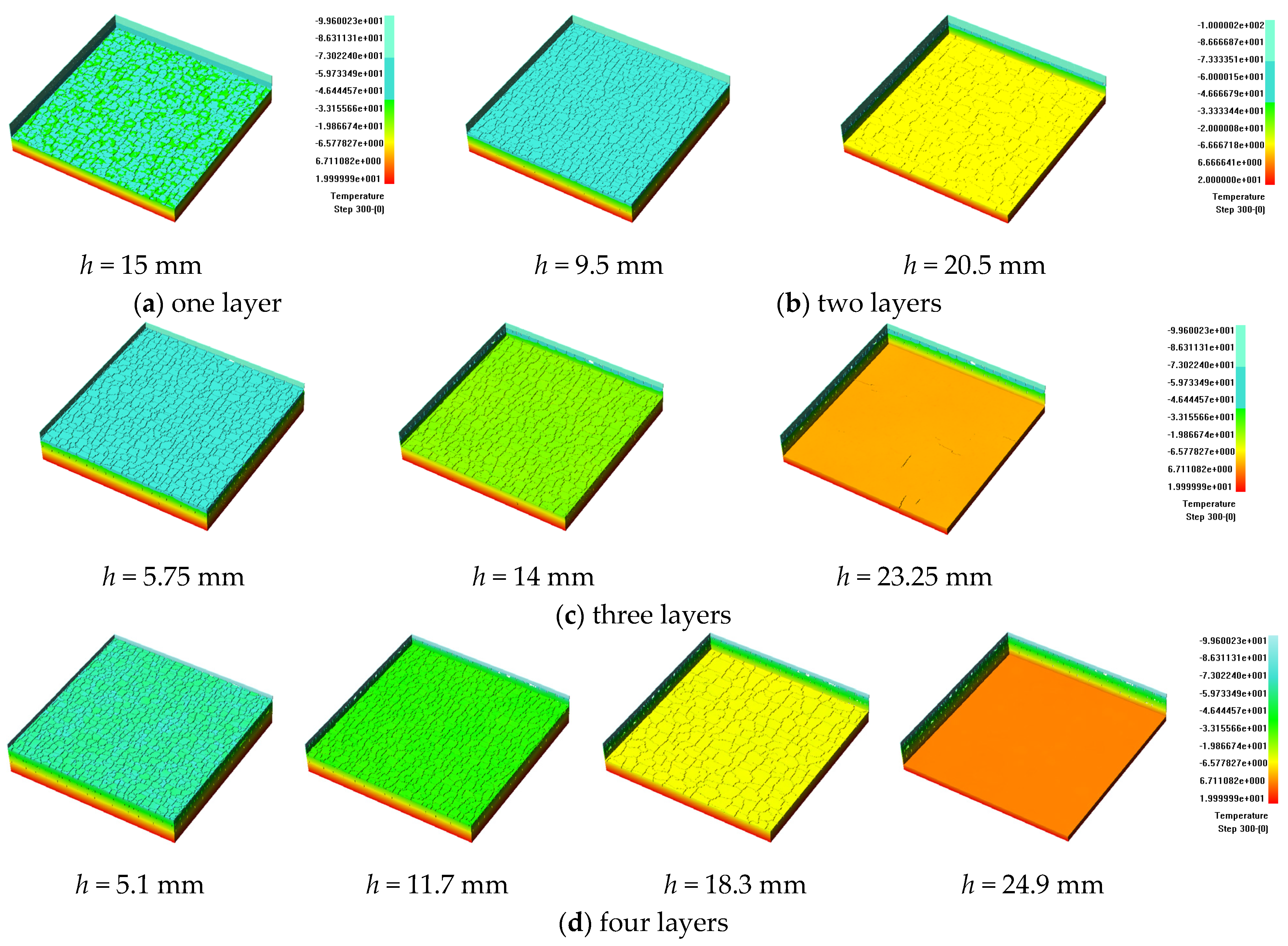
The cracking behavior of weak interlayers situated at disparate positions beneath the same degree of cooling was observed by setting weak interlayers with varying numbers of layers in the model (Figure 17). In the case of a single layer, the central height of the weak layer is given by the equation h = 15 mm. For the model with two weak interlayers, the respective central heights are 9.5 mm and 20.5 mm. For the model with three weak interlayers, the respective central heights are 5.75 mm, 14 mm, and 23.25 mm. For the model with four weak interlayers, the respective central heights for each layer are as follows: h = 5.1 mm, h = 11.7 mm, h = 18.3 mm, and h = 24.9 mm. Figure 17 illustrates that as the number of weak interlayers increases, the overall degree of fragmentation also rises. Nevertheless, the degree of fragmentation is observed to be less pronounced in the lower layers. This is due to the fact that during the cooling process, the model’s top surface undergoes a rapid decrease in temperature, resulting in the formation of a thermal gradient at the upper portion of the model. This gives rise to a concentration of tensile stresses. As the cooling process continues and the temperature decreases from the model surface downwards, with the bottom temperature maintained at 20 °C in this model, it becomes increasingly challenging to cause cooling shrinkage closer to the bottom. The absence of a substantial thermal gradient impedes the generation of concentrated tensile stresses, thereby reducing the likelihood of damage occurring at the model’s base.
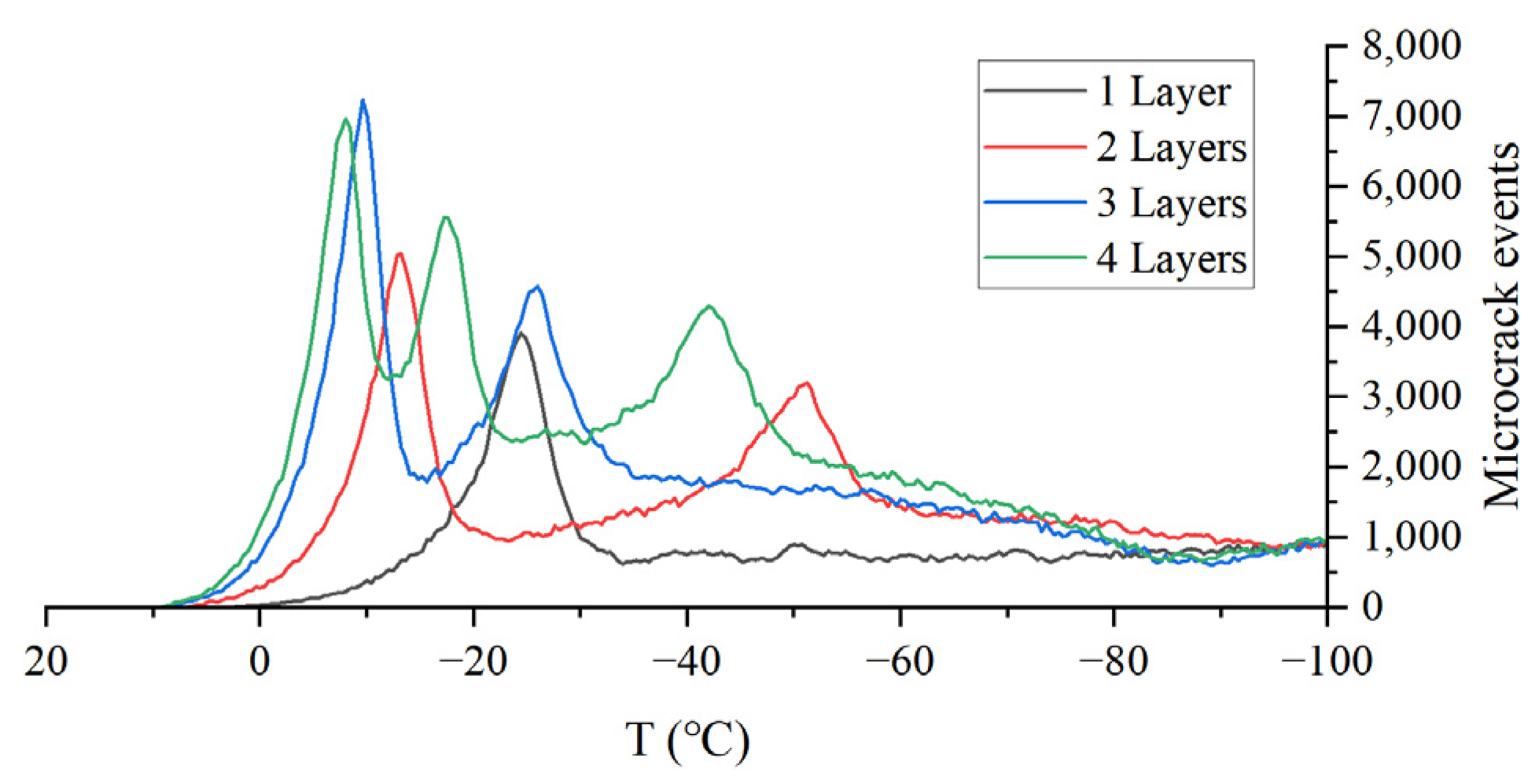
As demonstrated in Figure 18, an increase in the number of weak interlayers corresponds to an increase in the number of microcrack events. Furthermore, the occurrence of peaks in the number of microcrack events is influenced by the number of weak interlayers. All models were cooled down to −99.6 °C. In the case of a single weak layer, the curves show one peak. In the case of a model with two weak interlayers, two peaks are observed. A model with three weak interlayers shows two peaks. A model with four weak interlayers shows three peaks. It has been observed that the location of the weak layer affects the location of the quantitative peaks associated with microcrack events. The proximity of the weak layer to the upper surface has been found to influence the likelihood of microcrack occurrence and the timing of the peaks in the number of microcrack events. Models positioned closer to the bottom are less likely to fracture, with the height of the weakest layer determined to be h = 24.9 mm in a model containing four weak interlayers. However, the graphs demonstrate that the height of the second weakest layer in the model with two weak interlayers is h = 20.5 mm, which peaks late in loading. In the model consisting of three weak interlayers, the third weak layer with a height of h = 23.25 mm also showed some cracking after cooling down to −99.6 °C. The third weak layer, with a height of h = 23.25 mm, also showed some cracks in the model.
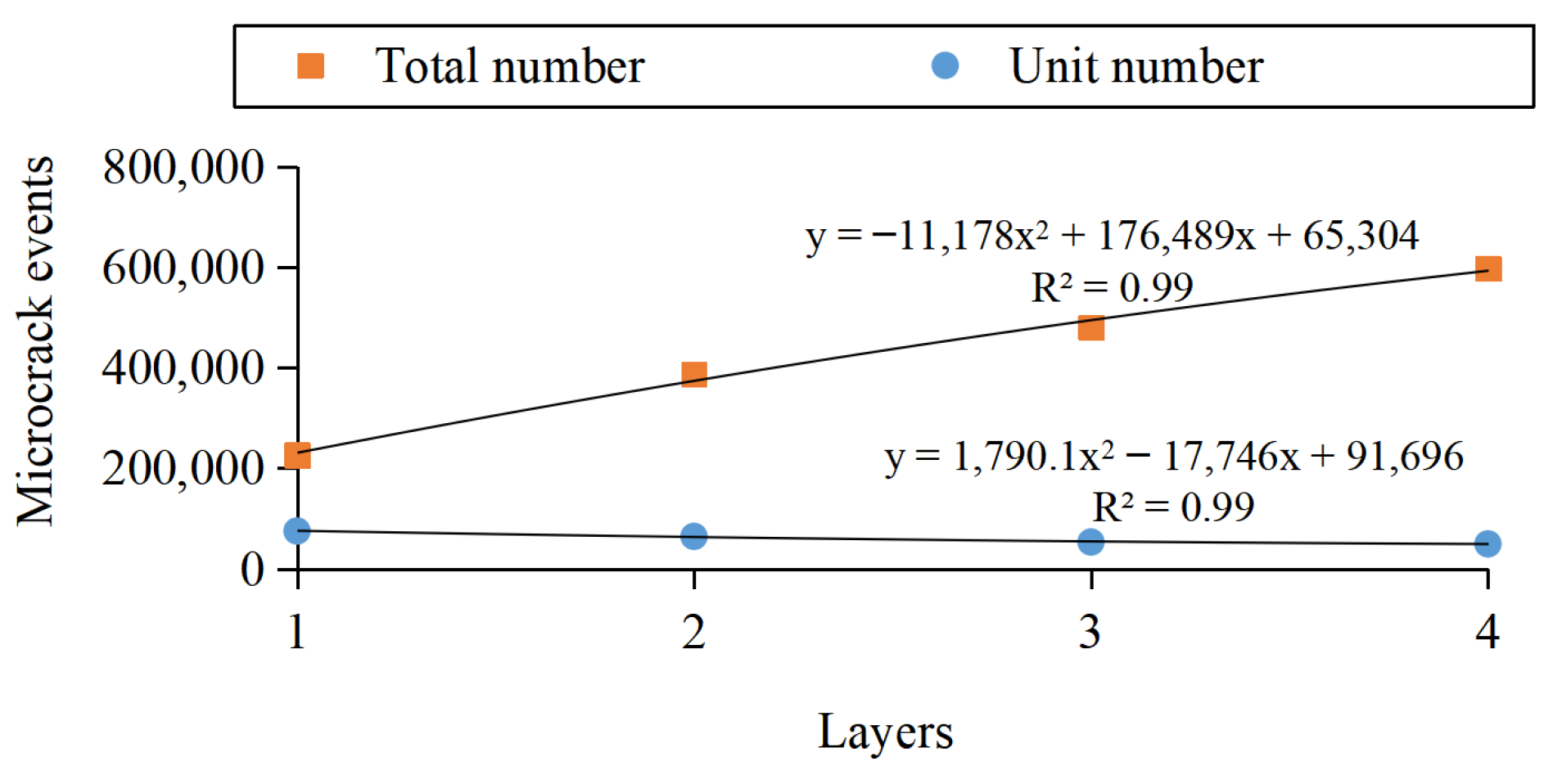
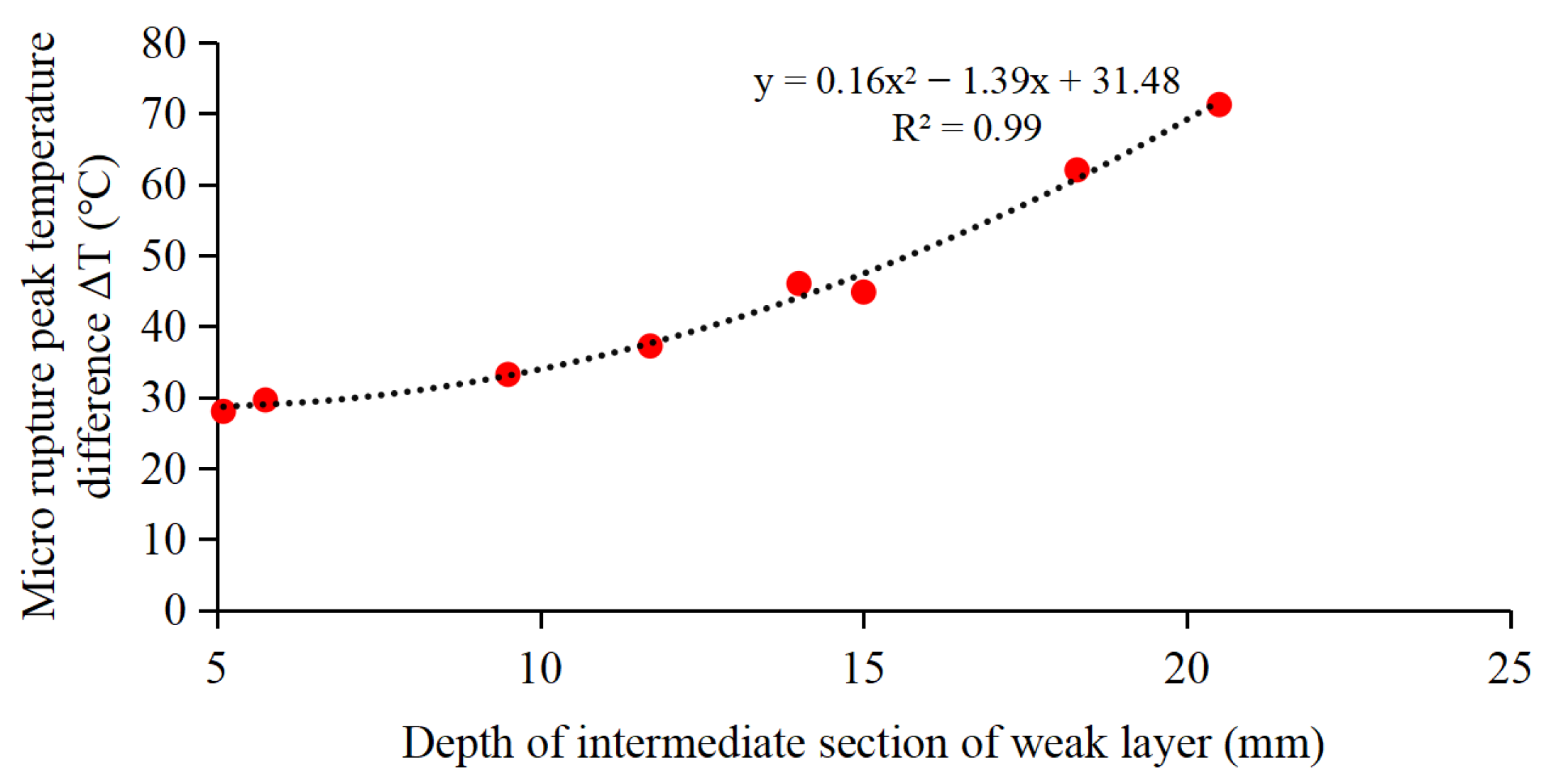
As the number of weak interlayers increases, the number of microcrack events also increases, but the number of microcrack events divided by the total thickness of the weak layer is shown to decrease. This indicates that, although the total number of microcrack events increases with the increase of the number of weak interlayers, the number of microcrack events per unit thickness is showing a decreasing trend (Figure 19). As the depth at which the weak layer is located increases, the temperature difference required for rupture to occur increases relatively (Figure 20).
In the event that there are four weak interlayers, and as the temperature decreases from the top to the bottom, each weak layer will undergo a process of crack initiation, propagation, and saturation. The overlapping distribution of strong and weak interlayers and the difference in temperature variation of layers result in significant variations in the stress distribution across each layer of the model during the initial stages of cooling. Figure 21b shows that the tensile stress distribution at the top is greater than at the bottom, and the tensile stress distribution in the weak layer is notably higher than in the strong layer. When the temperature is further reduced, the tensile stress region becomes increasingly concentrated in the area where the first weak layer is located, resulting in the initiation of cracks in the aforementioned layer (Figure 21c–e). After the cracks propagate within the initial weak layer, increasing to a certain extent, a compressive stress zone begins to form in the central region of the crack. With the temperature continuing to decrease, cracks begin to appear in the second weak layer, where the tensile stress distribution is greater than that in the first weak layer at this stage.
When cracks in the second layer reach a specific extent (Figure 21g), the area between the cracks in the first layer undergoes compressive stress, indicating the difficulty of further crack propagation. At this juncture, with a persistent decline in temperature, fissures commence to emerge in the third weak layer. When the temperature drops further, the number of cracks in the third weak layer increases gradually. However, the overall model still demonstrates a greater quantity of cracks in the first layer than in the second and third layers.
Furthermore, as demonstrated in Figure 21j–l, even as the temperature continues declining, no additional fissures are evident in the first three weak interlayers. Once cracks have extended to a certain extent, saturation of the cracks occurs. Concurrently, the fourth weak layer remains free of any cracks. The number of cracks in the weak interlayers diminishes gradually. This phenomenon can be attributed to the influence of the stress field distribution. In this model, the weak interlayers are predominantly affected by the thermal gradient effect. Given that the temperature at the base of the model is maintained at a constant level, the thermal gradient diminishes in proximity to the base, thereby rendering it more challenging for tensile stress to meet the strength of the material. This observation corroborates the findings of Chen et al. [25] regarding crack spacing and layer thickness. The saturation of cracks indicates a cessation of new crack formation even with further temperature decreases.

4. Conclusions

This study investigates the initiation, propagation, and saturation of polygonal cracks in multilayer plate-like rock structures under surface cooling conditions. Numerical simulations were performed on models with alternating weak and strong layers, integrating microscopic damage mechanics and thermodynamics. The analysis focused on the effects of weak interlayer thickness, number of weak interlayers, and their positions (surface or internal) on cracking behavior and polygonal block formation. The relationships between the geometric attributes of weak interlayers and crack evolution, as well as the associated stress transfer and interlayer interaction processes during cooling, were systematically explored. The main conclusions are as follows:
  • There are differences in the crack development mechanism between models with surface weak interlayers and internal weak interlayers. In the surface weak layer model, after crack penetration, the maximum tensile stress transfers to the bottom of the weak layer, triggering interlayer peeling. When the interface between the weak and strong layers peels off, the stress transfer path is interrupted, leading to the stagnation of crack development. Compared with the surface weak layer model, the internal intermediate weak layer model exhibits an approximately 40% higher crack density due to stress transfer from both the upper and lower strong layers. Crack extension in this model shows a gradual development pattern, and the failure of internal contact elements only occurs after reaching the critical state.
  • Statistical comparisons of cracks and blocks between the two models reveal that the internal weak layer model has a significantly higher block density (average 0.26/cm2) than the surface model (average 0.12/cm2), and a notably higher crack density (average 1.63/cm2) compared to the surface model (average 0.73/cm2). The crack length distribution presents clear stratification: short cracks (length 1~4 × 10⁻² cm) account for 70%, medium cracks (length 4~7 × 10⁻² cm) account for approximately 27%, and long cracks (length 7~11 × 10−2 cm) account for about 3%. The maximum block area increases exponentially with weak interlayer thickness: it ranges from 16.5 to 18 cm2 when h = 9 mm, representing a 33% increase compared to h = 5 mm.
  • Crack development is significantly affected by weak interlayer thickness. At h = 1 mm, the internal weak layer is almost crack-free, while the surface weak layer still generates cracks due to the temperature difference effect (approximately 3.07 cracks/cm2). The maximum microcrack density occurs at h = 3 mm; beyond this thickness, the crack density decreases nonlinearly until it reaches a plateau. Thin layers (h ≤ 3 mm) are dominated by non-through microcracks (>80%), whereas thicker layers (h ≥ 5 mm) develop typical lattice-like through cracks, with the extended length of a single crack increasing by 2–3 times.
  • The fractal dimension of cracks is generally higher in internal layers than in surface layers. It peaks at h = 3 mm and then decreases with increasing thickness; however, at h = 9 mm, the fractal dimension increases again in both layers. This indicates enhanced structural complexity, as thicker layers develop more cracks relative to blocks. For h = 9 mm, the fractal dimension increases linearly as the temperature decreases from −17 °C to −26 °C; below −26 °C, it stabilizes, signifying that crack growth enters a stable stage. This plateau is correlated with attenuated microcrack activity, implying minimal risk of large-scale fracturing under steady cooling conditions once the fractal dimension stabilizes.
  • The behavior of multilayer structures is influenced by interlayer correlation. The four-layer weak interlayer model exhibits a distinct layered response: the unit vertical crack density peaks at 32 in the first layer and decreases to 17 in the third layer. Energy release events show significant stratification characteristics: a single independent energy peak in the single weak interlayers model, two independent energy peaks in the double and triple weak interlayers models, and three independent energy peaks in the four weak interlayers model. The top weak layer fractures at a temperature difference of ΔT = 28 °C, while the bottom weak layer requires ΔT > 60 °C. Although the model temperature decreases linearly, the temperature difference required to reach the peak microcrack density in weak interlayers increases nonlinearly.
  • The stress field in the multilayer structure evolves hierarchically. As the temperature decreases sequentially from top to bottom, tensile stress concentrates in the first interlayer weak layer, initiating cracks; after crack propagation, a compressive stress zone forms internally. With further temperature decrease, the tensile stress in the second interlayer weak layer exceeds that in the first layer, triggering new cracks, while the first layer experiences compressive stress concentration, making it difficult to initiate new cracks. A subsequent temperature decrease leads to increased cracking in the third layer; beyond this stage, even with continued temperature decrease, almost no new cracks form in the first and second layers, and the fourth layer remains crack-free. The total number of cracks gradually decreases until crack saturation is reached, after which no new cracks are generated.

5. Discussion

(1)
Interpretation of Cracking Mechanisms and Practical Significance
The results of this study reveal the hierarchical and position-dependent cracking characteristics of multilayer plate-like rock structures under surface cooling, which hold important implications for engineering scenarios involving rock mass cooling (e.g., geothermal exploitation, cold-region tunnel engineering, and nuclear waste disposal). The distinct crack development mechanisms between surface and internal weak interlayers—driven by differences in stress transfer paths—indicate that the spatial distribution of weak interlayers is a key factor controlling rock mass stability during cooling. For surface weak interlayers, interlayer peeling acts as a “stress barrier” that inhibits further crack propagation, whereas internal weak interlayers suffer from bidirectional stress loading from adjacent strong layers, leading to higher crack density and structural fragmentation.
The exponential increase in maximum block area with weak interlayer thickness (h = 5~9 mm) suggests that thick weak interlayers tend to form larger, more unstable blocks, posing greater risks to engineering safety. In contrast, thin weak interlayers (h ≤ 3 mm) are dominated by non-through microcracks, which have a limited impact on overall structural integrity. This finding provides a basis for optimizing the design of rock engineering structures in cold environments—for example, by reinforcing thick weak interlayers or adjusting the spatial layout of weak and strong layers to reduce cracking risk.
(2)
Comparison with Existing Research
The rationality of the mesh size adopted in this study is verified by referencing Liang’s Ph.D. thesis [38]. Liang demonstrated that a mesh discretization of 300 × 300 × 60 elements (element side length 1 mm) is sufficient to eliminate boundary condition effects for an 80 mm × 80 mm × 40 mm model. In this study, the model size is 150 mm × 150 mm × 30 mm, with the same element number (300 × 300 × 60), resulting in a finer mesh (element side length 0.5 mm). This finer mesh not only avoids mesh size effects but also better matches the mesoscopic characteristic scale of rock, ensuring the reliability of numerical simulation results.
Existing studies on rock cooling cracking have mostly focused on single-layer structures or homogeneous rocks, while this study extends the research to multilayer alternating weak–strong layer systems. The observed layered stress evolution and energy release characteristics complement previous findings, highlighting the importance of considering interlayer interactions in multilayer rock structures. The fractal dimension variation law—peaking at h = 3 mm and stabilizing below −26 °C—aligns with the results of Zhang et al., [2], who reported that fractal dimensions can effectively characterize the degree of rock cracking and structural stability.
(3)
Effects of Freeze–Thaw on Rock Mass Cracking Behavior
Freeze–thaw cycles are a key environmental factor affecting rock mass stability in cold regions, and their mechanism is closely linked to the cooling-induced cracking behavior investigated in this study. The core theory of freeze–thaw action on rock mass involves two main processes: volume expansion of pore water upon freezing and repeated thermal stress cycles. When rock is subjected to freeze–thaw, pore water freezes into ice, causing a volume increase of approximately 9%, which generates internal tensile stress in the rock matrix. This freeze-induced stress superimposes with the cooling-induced thermal stress studied herein, further promoting crack initiation and propagation.
For multilayer rock structures, freeze–thaw cycles can exacerbate the differences in cracking behavior between surface and internal weak interlayers. Surface weak interlayers are more exposed to freeze–thaw cycles, leading to more frequent interlayer peeling and crack propagation; internal weak interlayers, while protected by outer strong layers, may experience cumulative damage due to repeated stress loading from freeze–thaw and cooling. Additionally, the nonlinear increase in the temperature difference required for peak microcracking in weak interlayers (as observed in this study) implies that freeze–thaw cycles with larger temperature amplitudes will have a more significant impact on internal weak interlayers, potentially triggering sudden failure of deep weak interlayers.
It is worth noting that the current study focuses on a single cooling process, while actual freeze–thaw environments involve repeated heating and cooling cycles. Future research should integrate freeze–thaw cycle effects to clarify the cumulative damage law of multilayer rock structures under long-term cold exposure.
(4)
Research Limitations
This study has several limitations that need to be addressed in future work. First, the numerical model assumes idealized weak and strong layers with homogeneous mechanical properties, whereas natural rock masses contain irregular pores, fractures, and mineral inclusions that may affect crack initiation locations and propagation paths. Second, the study only considers surface cooling conditions and does not account for the influence of internal heat sources or uneven cooling rates, which are common in engineering practice. Third, the interaction between pore water and freezing processes is not incorporated into the model, limiting the applicability of the results to saturated rock masses in freeze–thaw environments.
(5)
Future Research Directions
Based on the findings and limitations of this study, future research on rock mass cracking due to cooling regimes will focus on the following aspects:
Integrate freeze–thaw cycle mechanics into the numerical model: Establish a coupled thermo-hydro-mechanical (THM) model that considers pore water freezing, volume expansion, and repeated thermal stress to simulate the cumulative damage of multilayer rock structures under long-term freeze–thaw conditions. This will clarify the synergistic effect of cooling and freeze–thaw on crack evolution.
Conduct experimental validation of numerical results: Perform laboratory tests on multilayer rock specimens with controlled weak interlayer parameters (thickness, number, position) under cooling and freeze–thaw conditions. Compare the experimental crack patterns, fractal dimensions, and stress evolution with numerical simulations to improve model accuracy.
Explore the influence of non-uniform and dynamic cooling rates: Investigate how uneven cooling (e.g., different cooling rates on the top and side surfaces) and dynamic cooling processes (e.g., rapid cooling in engineering emergencies) affect the stress field and cracking behavior of multilayer rock structures.
Extend to three-dimensional complex rock mass structures: Develop three-dimensional numerical models that incorporate natural rock heterogeneities (pores, fractures, mineral composition) to simulate real-world engineering scenarios more accurately, providing targeted guidance for rock mass stability control in cold regions.

Author Contributions

T.C.: Data Curation, Methodology, Software, Investigation, Formal Analysis, Writing—Original Draft; Y.J.: Data Curation, Formal Analysis, Investigation, Writing—Review & Editing; Z.L.: Methodology; Writing—Review & Editing; C.T.: Investigation, Methodology; T.G.: Methodology, Investigation, Formal Analysis, Writing—Review & Editing. All authors have read and agreed to the published version of the manuscript.

Funding

This research was funded by the National Natural Science Foundation of China (Grant No. 52379098), and the Project of Xingliao Talents Program (XLYC2203008) for which the authors are grateful.

Data Availability Statement

The data that support the findings of this study are available upon request.

Conflicts of Interest

Author Yu Jiang is employed by the company China Nuclear Huachen Construction Engineering Co., Ltd. The remaining authors declare that the research was conducted in the absence of any commercial or financial relationships that could be construed as a potential conflict of interest.

References

  1. Shi, Z.M.; Shen, D.Y.; Zhang, Q.Z.; Peng, M.; Li, Q.D. Experimental study on the coupled shear flow behavior of jointed rock samples. Eur. J. Environ. Civ. Eng. 2018, 22, 333–350. [Google Scholar] [CrossRef]
  2. Zhang, X.T.; Bian, H.B.; Jia, Y.; Shao, J.F. Numerical modelling of long-term stability of the rock joint. Eur. J. Environ. Civ. Eng. 2018, 22, 415–433. [Google Scholar] [CrossRef]
  3. Price, N.J.; Cosgrove, J.W. Analysis of Geological Structures; Cambridge University Press: Cambridge, UK, 1990. [Google Scholar]
  4. Li, A.; Shao, G.; Fan, H.; Du, P.; Zhu, Y. Investigation of mechanical properties of soft and hard innerbeddedlayered rock mass based on meso-level heterogeneity. Chin. J. Rock. Mech. Eng. 2014, 33, 3042–3049. [Google Scholar]
  5. Jiang, F.; Wang, G.; He, P.; Hou, B.; Zhang, S.B.; Sun, S.Q.; Zheng, C.C.; Wu, Y. Mechanical failure analysis during direct shear of double-joint rock mass. Bull. Eng. Geol. Environ. 2022, 81, 410. [Google Scholar] [CrossRef]
  6. Aliabadian, Z.; Zhao, G.F.; Russell, A.R. An analytical study of failure of transversely isotropic rock discs subjected to various diametrical loading configurations. Procedia Eng. 2017, 191, 1194–1202. [Google Scholar] [CrossRef]
  7. Rong, P.; Zuo, Y.J.; Lin, J.Y.; Chen, Q.G.; Zheng, L.L.; Jin, K.Y. Study of mechanical properties and failure characteristics of combined rock mass with weak innerlayer. Geomech. Geophys. Geo 2022, 8, 89. [Google Scholar] [CrossRef]
  8. Xia, K.W.; Ren, R.; Liu, F. Numerical analysis of mechanical behavior of stratified rocks containing a single flaw by utilizing the particle flow code. Eng. Anal. Bound. Elem. 2022, 137, 91–104. [Google Scholar] [CrossRef]
  9. Xie, L.Q.; Jin, P.; Su, T.C.; Li, X.B.; Liang, Z.L. Numerical simulation of uniaxial compression tests on layered rock specimens using the discrete element method. Comput. Part. Mech. 2020, 7, 753–762. [Google Scholar] [CrossRef]
  10. Wu, H.Q.; Pollard, D.D. An experimental study of the relationship between joint spacing and layer thickness. J. Struct. Geol. 1995, 17, 887–905. [Google Scholar] [CrossRef]
  11. Bai, T.; Pollard, D.D.; Gao, H. Explanation for fracture spacing in layered materials. Nature 2000, 403, 753–756. [Google Scholar] [CrossRef]
  12. Tang, C.A.; Liang, Z.Z.; Zhang, Y.B.; Chang, X.; Tao, X.; Wang, D.G.; Zhang, J.X.; Liu, J.S.; Zhu, W.C.; Elsworth, D. Fracture spacing in layered materials: A new explanation based on two-dimensional failure process modeling. Am. J. Sci. 2008, 308, 49–72. [Google Scholar] [CrossRef]
  13. Becker, A.; Gross, M.R. Mechanism for joint saturation in mechanically layered rocks: An example from southern Israel. Tectonophysics 1996, 257, 223–237. [Google Scholar] [CrossRef]
  14. Hall, K.; André, M.F. Rock thermal data at the grain scale: Applicability to granular disintegration in cold environments. Earth Surf. Proc. Land. 2003, 28, 823–836. [Google Scholar] [CrossRef]
  15. García-Rodríguez, M.; Gómez-Heras, M.; Álvarez-De-Buergo, M.; Fort, R.; Aroztegui, J. Polygonal cracking in granite and considerations for a morphological classification (La Pedriza de Manzanares, Spain). J. Iber. Geol. 2016, 41, 365–383. [Google Scholar] [CrossRef]
  16. Gómez-Heras, M.; Smith, B.J.; Fort, R. Influence of surface heterogeneities of building granite on its thermal response and its potential for the generation of thermoclasty. Environ. Geol. 2008, 56, 547–560. [Google Scholar] [CrossRef]
  17. Smith, B.J. Rock temperature measurements from the northwest Sahara and their implications for rock weathering. Catena 1977, 4, 41–63. [Google Scholar] [CrossRef]
  18. McKenzie, D.P. The compaction of igneous and sedimentary rocks. J. Geol. Soc. Lond. 2007, 144, 299–307. [Google Scholar] [CrossRef]
  19. Rice, A. Insolation warmed over. Geology 1976, 4, 61–62. [Google Scholar] [CrossRef]
  20. Riley, P.; Murray, A.B.; Tikoff, B. Geometric scale invariance, genesis, and self-organization of polygonal fracture networks in granitic rocks. J. Struct. Geol. 2012, 42, 34–48. [Google Scholar] [CrossRef]
  21. Siegesmund, S.; Menningen, J.; Shushakova, V. Marble decay: Towards a measure of marble degradation based on ultrasonic wave velocities and thermal expansion data. Environ. Earth Sci. 2021, 80, 395. [Google Scholar] [CrossRef]
  22. Siegesmund, S.; Ullemeyer, K.; Weiss, T.; Tschegg, E.K. Physical weathering of marbles caused by anisotropic thermal expansion. Int. J. Earth Sci. 2000, 89, 170–182. [Google Scholar] [CrossRef]
  23. Williams, R.; Robinson, D. Origin and distribution of polygonal cracking of rock surfaces. Geogr. Ann. Ser. A Phys. Geogr. 2017, 71, 145–159. [Google Scholar]
  24. Chen, T.T.; Foulger, G.R.; Tang, C.A.; Mathias, S.A.; Gong, B. Numerical investigation on origin and evolution of polygonal cracks on rock surfaces. Eng. Geol. 2022, 311, 106913. [Google Scholar] [CrossRef]
  25. Chen, T.T.; Ji, S.C.; Tang, C.A.; Foulger, G.R.; Gong, B. Fracture spacings of fiber inclusions in a ductile geological matrix and development of microboudins: 3D numerical modeling. J. Struct. Geol. 2023, 174, 104920. [Google Scholar] [CrossRef]
  26. Jagla, E.A.; Rojo, A.G. Sequential fragmentation: The origin of columnar quasihexagonal patterns. Phys. Rev. E 2002, 65, 026203. [Google Scholar] [CrossRef]
  27. Jagla, E.A. Maturation of crack patterns. Phys. Rev. E 2004, 69, 056212. [Google Scholar] [CrossRef] [PubMed]
  28. Aydin, A.; Degraff, J.M. Evoluton of polygonal fracture patterns in lava flows. Science 1988, 239, 471–476. [Google Scholar]
  29. Hofmann, M.; Anderssohn, R.; Bahr, H.A.; Weiss, H.J.; Nellesen, J. Why Hexagonal Basalt Columns? Phys. Rev. Lett. 2015, 115, 154301. [Google Scholar] [CrossRef]
  30. Bahr, H.A.; Hofmann, M.; Weiss, H.J.; Bahr, U.; Fischer, G.; Balke, H. Diameter of basalt columns derived from fracture mechanics bifurcation analysis. Phys. Rev. E 2009, 79, 056103. [Google Scholar] [CrossRef]
  31. Akiba, Y.; Takashima, A.; Shima, H. Universal fluctuation of polygonal crack geometry in solidified lava. Phys. Rev. E 2021, 104, 025009. [Google Scholar] [CrossRef]
  32. Goehring, L.; Morris, S.W. Order and disorder in columnar joints. Europhys. Lett. 2005, 69, 739. [Google Scholar] [CrossRef]
  33. Goehring, L.; Morris, S.W.; Lin, Z. Experimental investigation of the scaling of columnar joints. Phys. Rev. E 2006, 74, 036115. [Google Scholar] [CrossRef]
  34. Jaeger, J.C. The cooling of irregularly shaped igneous bodies. Am. J. Sci. 1961, 259, 721–734. [Google Scholar] [CrossRef]
  35. Peck, D.L.; Minakami, T. The formation of columnar joints in the upper part of Kilauean lava lakes, Hawaii. Geol. Soc. Am. Bull. 1968, 79, 1151–1166. [Google Scholar] [CrossRef]
  36. Ryan, M.P.; Sammis, C.G. Cyclic fracture mechanism in cooling basalt. Geol. Soc. Am. Bull. 1978, 89, 1295–1308. [Google Scholar] [CrossRef]
  37. Tang, C.A. Numerical simulation of progressive rock failure and associated seismicity. Int. J. Rock Mech. Min. 1997, 34, 249–261. [Google Scholar] [CrossRef]
  38. Liang, Z.Z. Three Dimensional Failure Process Analysis of Rock and Associated Numerical Tests. Ph.D. Thesis, Northeastern University, Shenyang, China, 2005. [Google Scholar]
  39. Tang, C.S.; Shi, B.; Liu, C.; Zhao, L.; Wang, B. Influencing factors of geometrical structure of surface shrinkage cracks in clayey soils. Eng. Geol. 2008, 101, 204–219. [Google Scholar] [CrossRef]
  40. Tang, C.S.; Cui, Y.J.; Tang, A.M.; Shi, B. Experiment evidence on the temperature dependence of desiccation cracking behavior of clayey soils. Eng. Geol. 2010, 114, 261–266. [Google Scholar] [CrossRef]
  41. Wang, B.J.; Shi, B.; Liu, B.Z.; Cai, Y. Fractal study on microstructure of clayey soil by GIS. Chin. J. Geotech. Eng. 2004, 26, 4. [Google Scholar]
  42. Bao, C.Y. Numerical Analysis and Mechanism of Fracture Spacing in Bedded Rock Materials. Ph.D. Thesis, Dalian University of Technology, Dalian, China, 2018. [Google Scholar]
  43. Tang, S.B. Mesoscopic Numerical Model of Thermo-Hygro Cracking Process Concrete. Ph.D. Thesis, Dalian University of Technology, Dalian, China, 2009. [Google Scholar]
  44. Mueller, G. Experimental simulation of joint morphology. J. Struct. Geol. 2001, 23, 45–49. [Google Scholar] [CrossRef]
  45. Vagaggini, E.; Domergue, J.M.; Evans, A.G. Relationships between hysteresis measurements and the constituent properties of ceramic matrix composites: I., Theory. J. Am. Ceram. Soc. 1995, 78, 2709–2720. [Google Scholar] [CrossRef]
Figure 1. Flowchart of the RFPA analysis process.
Fractalfract 10 00107 g001
Figure 2. Damage constitutive law of each element.
Fractalfract 10 00107 g002
Figure 3. CIAS-NJU image processing method: (a) The original image; (b) binary image processing; (c) data extraction images.
Fractalfract 10 00107 g003
Figure 4. Model diagram: (a) Model sketch; (b) numerical model; (c) model boundary.
Fractalfract 10 00107 g004
Figure 5. Multilayer model structure diagram. (In the model, blue represents the weak layers and white represents the strong layers. From (ad), it indicates that the number of weak layers is 1 to 4 respectively. The model measures 150 mm × 150 mm × 30 mm and is discretized into a mesh of 300 × 300 × 60 elements.)
Fractalfract 10 00107 g005
Figure 6. Temperature diagram of the interlayer with h = 3 mm.
Fractalfract 10 00107 g006
Figure 7. Minimum principal stress diagram in the process of crack formation and propagation in the interlayer with h = 3 mm (In the model, compressive stress is defined as positive while tensile stress is defined as negative, with blue and red representing compressive and tensile stress, respectively. The model measures 150 mm × 150 mm × 30 mm and is discretized into a mesh of 300 × 300 × 60 elements.)
Fractalfract 10 00107 g007aFractalfract 10 00107 g007b
Figure 8. Minimum principal stress diagram in the process of crack formation and propagation in the interlayer model with h = 9 mm. (In the model, compressive stress is defined as positive while tensile stress is defined as negative, with red and blue representing compressive and tensile stress, respectively. The model measures 150 mm × 150 mm × 30 mm and is discretized into a mesh of 300 × 300 × 60 elements.)
Fractalfract 10 00107 g008
Figure 9. Minimum principal stress diagram in the process of crack formation and propagation in the surface layer model with h = 9 mm. (In the model, compressive stress is defined as positive while tensile stress is defined as negative, with red and blue representing compressive and tensile stress, respectively. The model measures 150 mm × 150 mm × 30 mm and is discretized into a mesh of 300 × 300 × 60 elements.)
Fractalfract 10 00107 g009
Figure 10. Minimum principal stress diagram of interlayer models with different thicknesses under the same cooling condition. (In the model, low and high temperatures are represented by blue and red, respectively. The model measures 150 mm × 150 mm × 30 mm and is discretized into a mesh of 300 × 300 × 60 elements.)
Fractalfract 10 00107 g010
Figure 11. Microcrack event curves of different thicknesses of interlayer models under the same cooling conditions.
Fractalfract 10 00107 g011
Figure 12. Distribution curve of the total number of microcrack events versus the number of microcrack events per unit thickness as the layer thickness increases.
Fractalfract 10 00107 g012
Figure 13. Statistical diagram of interlayer crack distribution with different thicknesses under the same temperature reduction condition. (In the model, cracks are represented by black lines, while blocks are depicted by colored regions. The model measures 150 mm × 150 mm × 30 mm and is discretized into a mesh of 300 × 300 × 60 elements).
Fractalfract 10 00107 g013
Figure 14. Statistical diagram of surface layer crack distribution with different thicknesses under the same temperature reduction condition [24]. (In the model, cracks are represented by black lines, while blocks are depicted by colored regions. The model measures 150 mm × 150 mm × 30 mm and is discretized into a mesh of 300 × 300 × 60 elements).
Fractalfract 10 00107 g014
Figure 15. Crack characteristics statistics of surface layer models (hb) and interlayer models (hn) with different thicknesses: (a) Number of blocks and cracks; (b) block area; (c) crack length; (d) inter section angles.
Fractalfract 10 00107 g015
Figure 16. Fractal dimension analysis: (a) Different thicknesses of inter and surface layers; (b) changes in the fractal dimension during the cooling process of the interlayer with h = 9 mm.
Fractalfract 10 00107 g016
Figure 17. Crack distribution of models with different number of weak interlayers when the temperature of the top surface is −99.6 °C. (In the model, low and high temperatures are represented by blue and red, respectively. The model measures 150 mm × 150 mm × 30 mm and is discretized into a mesh of 300 × 300 × 60 elements).
Fractalfract 10 00107 g017
Figure 18. Microcrack event curves of different models with different numbers of weak layers under the same cooling condition.
Fractalfract 10 00107 g018
Figure 19. Distribution curve of the total number of microcrack events versus the number of microcrack events per unit thickness as the number of weak interlayer increases.
Fractalfract 10 00107 g019
Figure 20. Curve of the temperature difference between the location of the weak layer and the temperature difference required for the weak layer to undergo large-scale microcracking.
Fractalfract 10 00107 g020
Figure 21. The minimum principal stress distribution in the weak four-layer model during the process of crack formation and insertion. (In the model, compressive stress is defined as positive while tensile stress is defined as negative, with red and blue representing compressive and tensile stress, respectively. The model measures 150 mm × 150 mm × 30 mm and is discretized into a mesh of 300 × 300 × 60 elements.)
Fractalfract 10 00107 g021aFractalfract 10 00107 g021b
Table 1. Material parameters of multilayer rock.
LayerElastic Modulus
E/GPa
Poisson’s Ratio
ν
Compressive Strength
σ c /(MPa)
Heterogeneity
m
Thermal Expansion
Coefficient
1/K
Thermal Capacity
J/(m3K)
Thermal Conductivity
W/(mK)
Weak layer300.25200615 × 10−62.1 × 1062.5
Strong layer100.35300815 × 10−62.1 × 1062.5
Disclaimer/Publisher’s Note: The statements, opinions and data contained in all publications are solely those of the individual author(s) and contributor(s) and not of MDPI and/or the editor(s). MDPI and/or the editor(s) disclaim responsibility for any injury to people or property resulting from any ideas, methods, instructions or products referred to in the content.