Article

Constructing New Fractal-like Particle Aggregates Using Seeded DLA and Concentration Gradient Diffusion Approaches


by
Sancho Salcedo-Sanz
1,
Pablo Álvarez-Couso
2,
Luis Castelo-Sardina
2 and
Jorge Pérez-Aracil
1,*
1
Department of Signal Processing and Communications, Universidad de Alcalá, 28805 Alcalá de Henares, Spain
2
Department of Design and Image, Universidad Complutense de Madrid, 28040 Madrid, Spain
*
Author to whom correspondence should be addressed.
Fractal Fract. 2026, 10(1), 68; https://doi.org/10.3390/fractalfract10010068
Submission received: 27 October 2025 / Revised: 28 December 2025 / Accepted: 15 January 2026 / Published: 19 January 2026
(This article belongs to the Special Issue Multifractal Analysis and Complex Systems)

Abstract

Hybridization of existing fractal aggregate construction methods has been used to obtain new fractal-like structures, with different properties and fractal dimensions to aggregates obtained using the hybridized methods alone. In this paper we propose the hybridization of the Diffusion-Limited Aggregation (DLA) approach with other methods for constructing fractal-like aggregates, such as Iterated Function Systems (IFSs), Lindenmayer systems (L-Systems), Strange Attractors (SAs) or Percolation-based fractal construction approaches. The proposed approach is a variation of the seeded DLA algorithm used previously in the literature, which consists of considering existing fractal aggregates as condensation nuclei before the DLA simulation. In this case, we revisit the seeded DLA scheme and test different existing fractals as nuclei, such as Strange Attractors or different IFS fractals. We also introduce a simple algorithm for simulating the diffusion of particle aggregate structures, based on concentration gradient diffusion. We show how different fractal aggregates diffuse using this model, and how the diffused versions of the fractal aggregates can then be used themselves as condensation nuclei for the seeded DLA algorithm, obtaining new fractal aggregates. We characterize the new fractal-like aggregates constructed by means of their fractal dimensions, calculated by using the box-counting approach. The obtained fractal-like aggregates have potential applications in computer graphics and multi-media art, due to their esthetic and visually attractive structures based on particles. Applications of the aggregates in statistical and material physics, as well as the modeling of new aggregate types using condensation nuclei and their applications in the development of algorithms, mathematical operators or antenna design, are also reported.

1. Introduction

Non-equilibrium growth models such as Diffusion-Limited Aggregation (DLA) [1,2] and related approaches [3,4] have attracted the attention of the statistical physics research community because of their capacity for generating self-organized fractal aggregates and fractal-like particle clusters [5,6,7]. Specifically, DLAs have been applied to model different phenomena in physics and biology, such as electrodeposition [8], bacterial colonies growth [9], neurite formation for neural shape studies [10], flocculation processes [11], nanomaterial growth [12] or adsorption processes [13], among others [14]. DLA has also been used to study and analyze different systems, such as the study of the potential radiation pattern of a fractal cluster [15], the analysis of distribution networks [16] or the study of fractal dendrite-like patterns in lead Pb by electroless deposition [17], etc.
There are other ways of generating self-organized fractal-like particle clusters and aggregates [18,19,20], for instance, Iterated Function Systems (IFSs) [21], random and Percolation fractals [22] or Strange Attractors (SAs) [23,24]. Moreover, even Lindenmayer systems (L-systems) [25] may be modified to produce fractal-like particle structures.
In recent years there have been different studies on hybrid approaches which merge two of these basic fractal generation techniques to obtain alternative or advanced fractal construction algorithms, with different characteristics. For example, a hybrid system involving DLAs with Eden growth surface kinetics was proposed in [26]. A recent study has also discussed an approach which can make the system behave as a DLA or a Eden growth approach, depending on just one design parameter [27]. DLA-and-L-System hybrids have been explored in [28] for generating alternative fractal structures which combine the properties of both methods. In [29], a hybrid approach to construct multi-fractals with multi-resolution was introduced. The approach combined DLA with SAs, in such a way that the particles in an initial DLA aggregate were substituted by SAs, obtaining multi-resolution fractal clusters. In [30], a growth model combined with DLA and oriented attachment was developed for understanding the growth process of pine-needle-like structures. The works by P. Bourke on DLA fractals [31,32] deserve special attention. In [31], the concept of seeded DLA was introduced, producing artwork images with different surfaces as seeds. In [32], 3D versions of these fractals were introduced.
In this paper we propose a novel way of combining methods to obtain fractal particle aggregates or clusters, including DLA and other construction approaches. We first revisit the seeded DLA scheme, proposing the use of existing fractal cluster structures as condensation nuclei at the beginning of the DLA procedure. Specifically, Strange Attractors are used to obtain highly esthetic new clusters, and we use these seeds to study the fractal dimension variations when different attachment radii in the DLA are used. We also propose in this paper an algorithm for diffusing particle aggregate structures, based on a simplified simulation of concentration gradient diffusion in liquids. We will show how different fractal aggregates diffuse using this model, and how the diffused versions of the fractal aggregates can in turn be used as condensation nuclei for the seeded DLA algorithm, to obtain different fractal particle clusters from them. Again, the characterization of the new fractal structures and diffused aggregates has been carried out by calculating their fractal dimensions with a box-counting algorithm. Potential applications of the generated new fractal structures are finally discussed in this paper, including their esthetic value in visual computer-aided art and multi-media, and their possible use to model aggregates of new materials, and in the development of algorithms, mathematical operators or antenna design, among others.
The remainder of the paper has been structured as follows: The next section details the classical algorithms for constructing fractal aggregates and structures, including DLA, SAs, IFSs, L-Systems and Percolation approaches. Section 3 presents the seeded DLA method for obtaining new fractal aggregates, and also describes the diffusion procedure from fractal aggregates, which can be used as well as part of the seeded DLA. In this section we also introduce the Box-Counting method to calculate the fractal dimension of the different aggregates generated. Section 4 presents the experiments and simulation results obtained. We first illustrate the process of concentration gradient diffusion in three different fractal aggregates. We then show different fractal particle clusters obtained with the seeded DLA approach, using different condensation nuclei from SAs, IFSs, L-Systems, Percolation-based fractal aggregates and concentration gradient diffusion. We finally carry out a study on the fractal dimension of the new aggregates, and discuss their potential applications in arts, science and engineering.

2. Classical Fractal-like Aggregate Formation Methods

This section summarizes the description of several methods which are commonly used to obtain fractal 2D aggregates (fractal-like particle clusters in the plane).

2.1. Diffusion-Limited Aggregation

Diffusion-Limited Aggregation (DLA) [1,33] is a simple method for forming fractal-like clusters or aggregates, in which random particles stick together after some kind of random walk [6]. In this paper we consider implementation of the DLA version described in [34]. This DLA model starts with a single seed at the beginning of the simulations, located at the center of a given discrete lattice. Then, a number of particles are sequentially released at a circle distant from the cluster, and their position are modified as a random walk defined as follows:
x n + 1 y n + 1 = x n y n + cos ( φ + λ θ n ) sin ( φ + λ θ n ) ,
where x n and y n are the particle position at the nth step of the random walk, φ [ π , π ] is a random angle that defines the direction of the particle’s trajectory, λ [ 0 , 1 ] is a parameter that introduces the random component of the trajectories, and θ n [ π , π ] is a random direction.
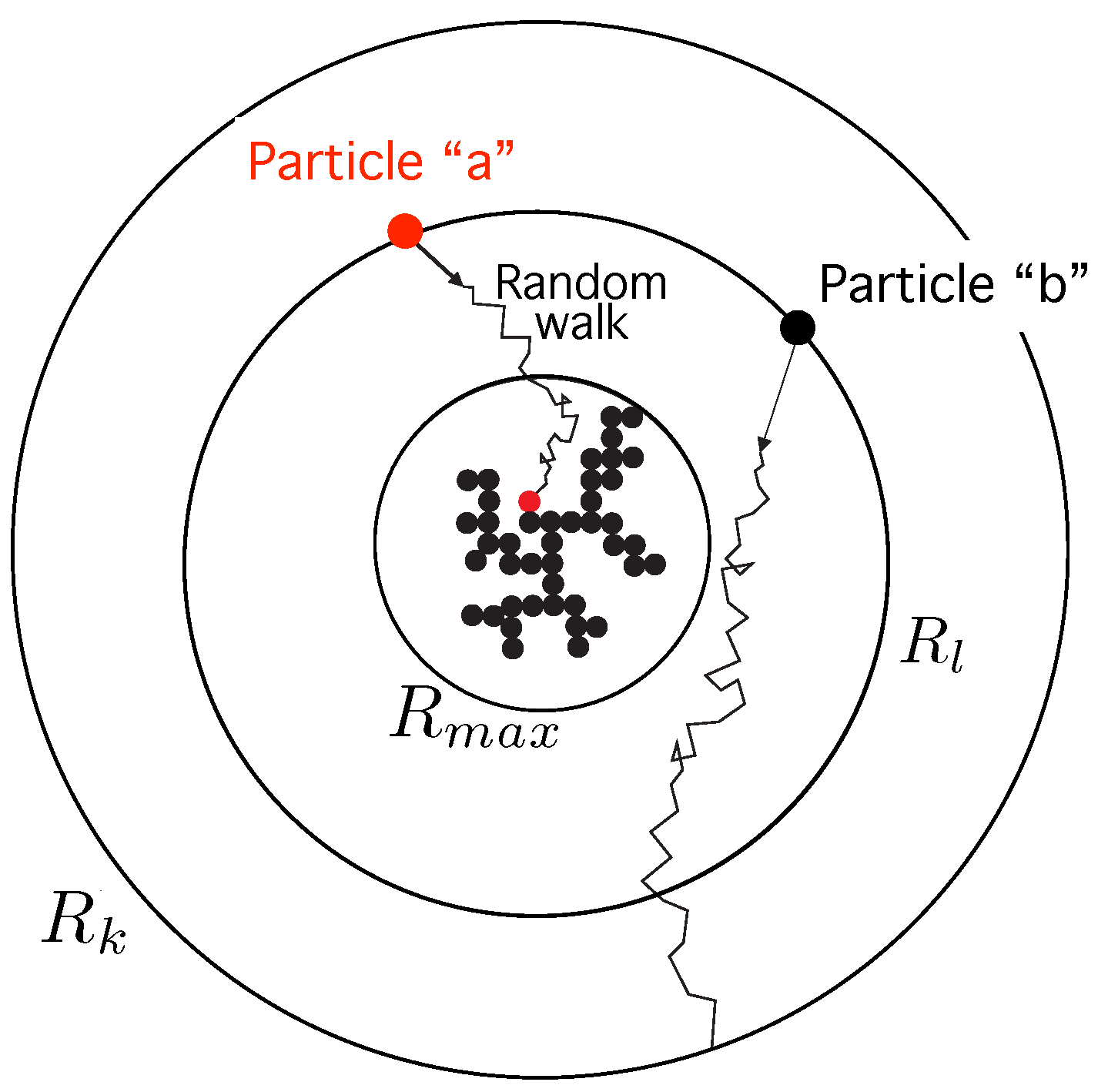
Note that the random walk of each released particle ends if the particle attaches to the current aggregate, or if the distance to the cluster is larger than a killing radius R k . In this latter case, the particle is eliminated and a new one is released at the launching circle R l . The relationship between R l and R k is defined as
R l = R m a x + R 0 ,
where R m a x is the maximum distance from the center of the lattice of a particle belonging to the cluster, and R 0 is a defined radius. The killing radius R k is defined as
R k = 2 R m a x + R 0 = R m a x + R l ,
which gives the relationship between R l and R k .
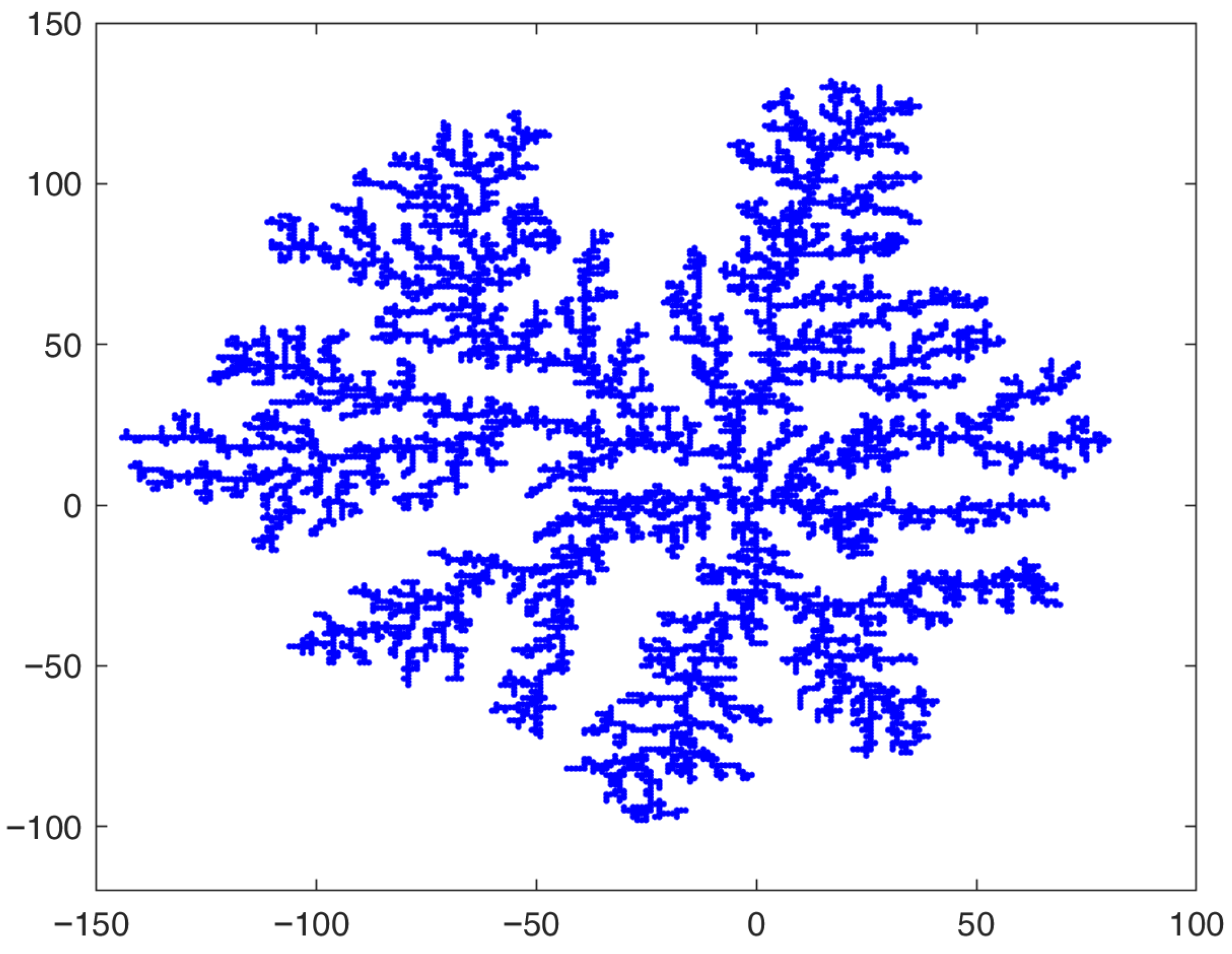
Figure 1 shows an example of the DLA simulation construction by means of circles of radius R m a x , R l and R k . In this figure we have represented two particles, labeled “a” and “b”, along with their random walk trajectories. Note that the random walk of Particle “a” ends successfully by reaching the cluster (particle in red aggregated to the cluster). On the contrary, Particle “b” has a unsuccessful random walk (particle trajectory killed after reaching circle with radius R k ). Figure 2 shows an example of a fractal structure generated by DLA simulation.
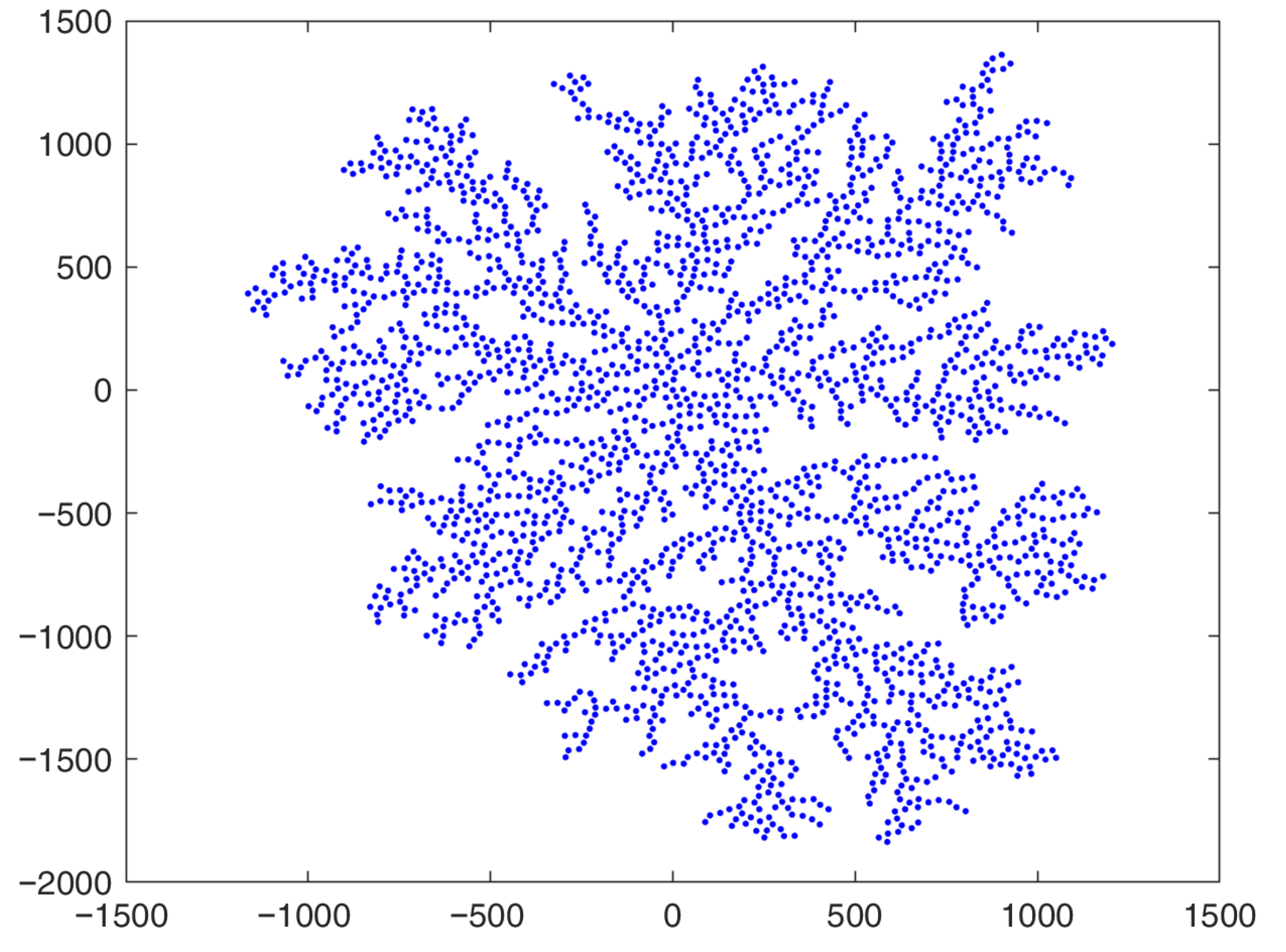
In [29,35], alternative DLA aggregates were considered, defined using an attachment radius R a or distance d, in such a way that a given particle is attached into the DLA aggregate as soon as it finds an existing particle within a distance of R a from it. Figure 3 shows an example of a DLA aggregate constructed using this model with R a 30 , with around N = 2600 particles.

2.2. Strange Attractors

Another method to obtain fractal structures is to consider Strange Attractors (SA) of dynamical systems [23,24,36]. An SA can be seen as a solution to a nonlinear dynamic system (usually chaotic), in such a way that the pattern generated in the phase space is fractal in nature. In this case, we have considered the use of a general two-dimensional iterated quadratic map to generate SAs, which can be described as follows:
x n + 1 = a 1 + a 2 x n + a 3 x n 2 + a 4 x n y n + a 5 y n + a 6 y n 2 , y n + 1 = a 7 + a 8 x n + a 9 x n 2 + a 10 x n y n + a 11 y n + a 12 y n 2 ,
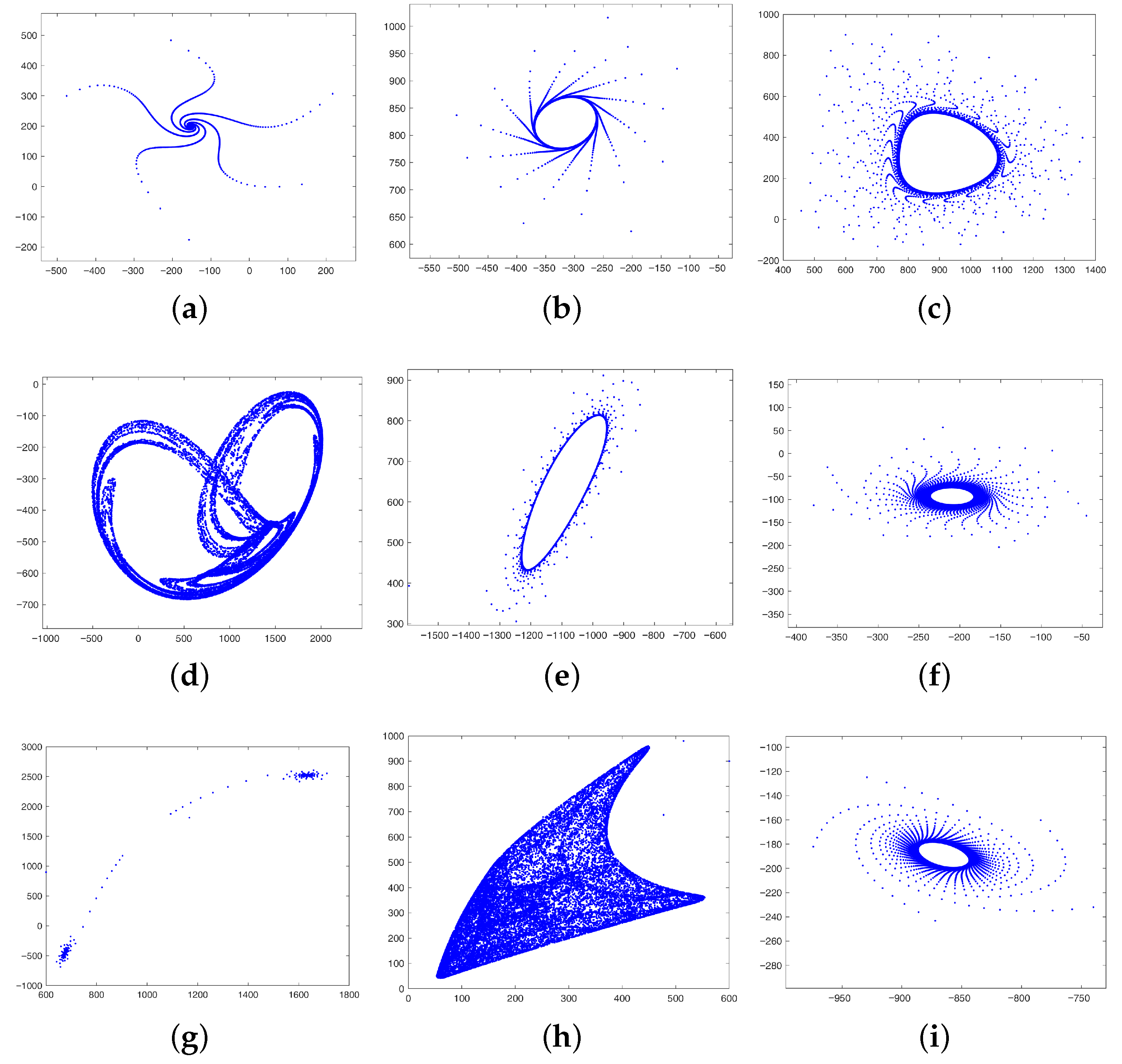
As reported in [37], a small percentage of the solutions from Equation (4) are SAs (depending on the parameters { a 1 , , a 12 } ), and in fact, some of them are chaotic, but there are others that are intermittent or convergent to a periodic orbit. Figure 4 shows some examples of SAs, obtained from Equation (4), initialized with ( x 0 , y 0 ) = ( 0.6 , 0.9 ) . Note that each SA generated by Equation (4) is completely defined by the 12 parameters { a 1 , a 2 , , a 12 } , which are able to expand any set of M points in the phase space, given an initial point ( x 0 , y 0 ) .

2.3. Iterated Function Systems

An Iterated Function System (IFS) [21,38,39] is a way of generating fractal structures and geometric patterns based on the iteration of one or more affine transformations with a given probability [40,41]. They have the following general form in R 2 :
x n + 1 y n + 1 = a b c d · x n y n + e f .
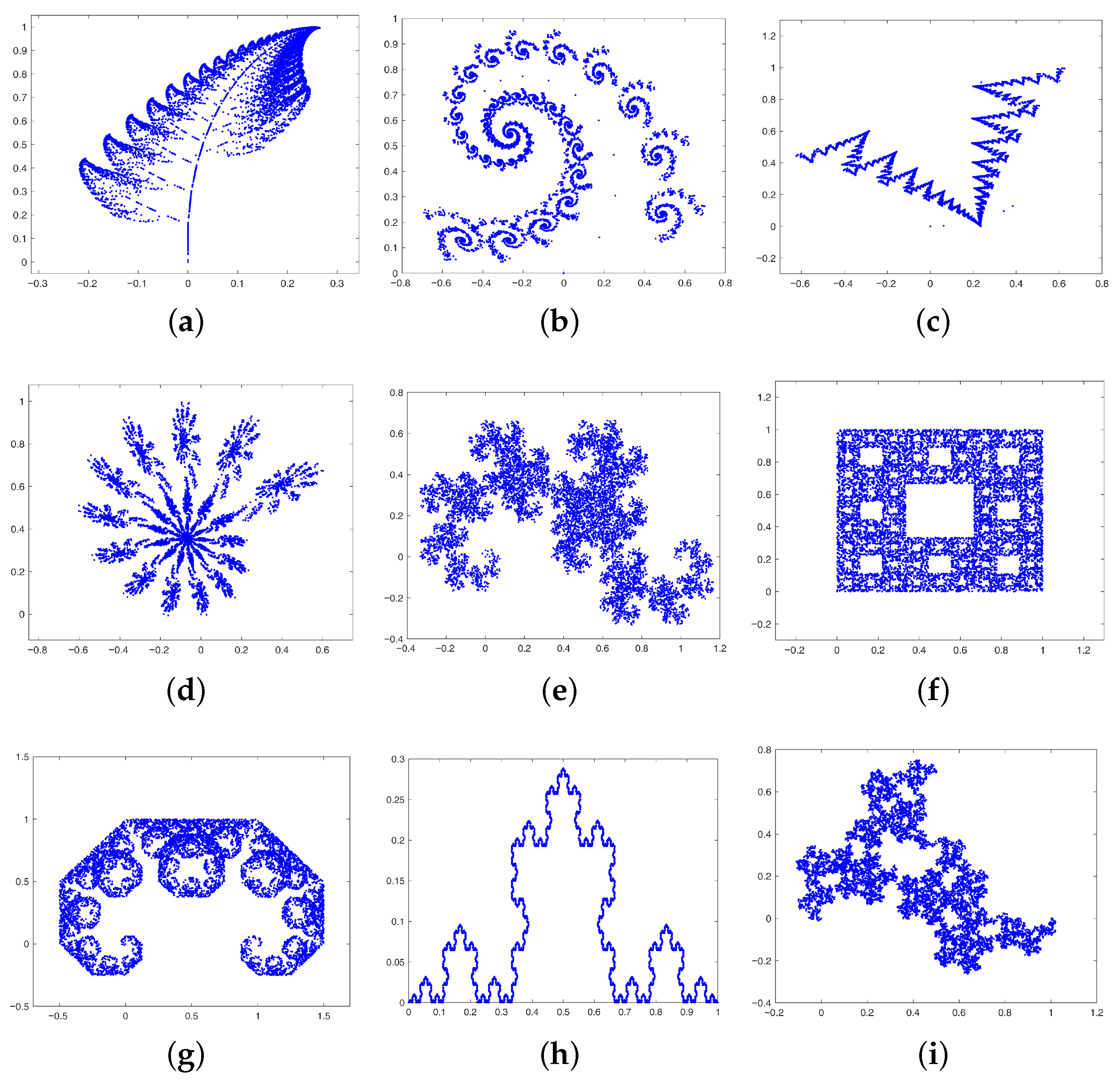
We illustrate the application of IFSs to obtain fractal structures in Figure 5, where nine well-known IFSs are shown. The IFS equations to generate these fractal forms are detailed in the Appendix A, Appendix B and Appendix C of the paper.

2.4. Lindenmayer Systems (L-Systems)

A Lindenmayer system or L-system [25,42] is a method to obtain fractal images, consisting of a generative grammar, formed by an encoder, which produces a sequence of symbols (variables and constants, starting with a given axiom) by applying some specific rules, and a decoder, which interprets the symbols to obtain a final object or graph, usually with fractal properties. L-Systems have been used quite often to model plants and plant growth in the literature [43]. We illustrate the L-systems procedure in the generation of the well-known Sierpinski triangle. The L-system to generate this fractal form is as follows:
  • Encoder:
    • Variables: A , B .
    • Constants: + , .
    • Seed point: A.
    • Rule 1: ( A + B A B + ).
    • Rule 2: ( B A + B + A ).
  • Decoder:
    • A: draw forward.
    • B: draw forward.
    • +: turn left 60 degrees.
    • −: turn right 60 degrees.
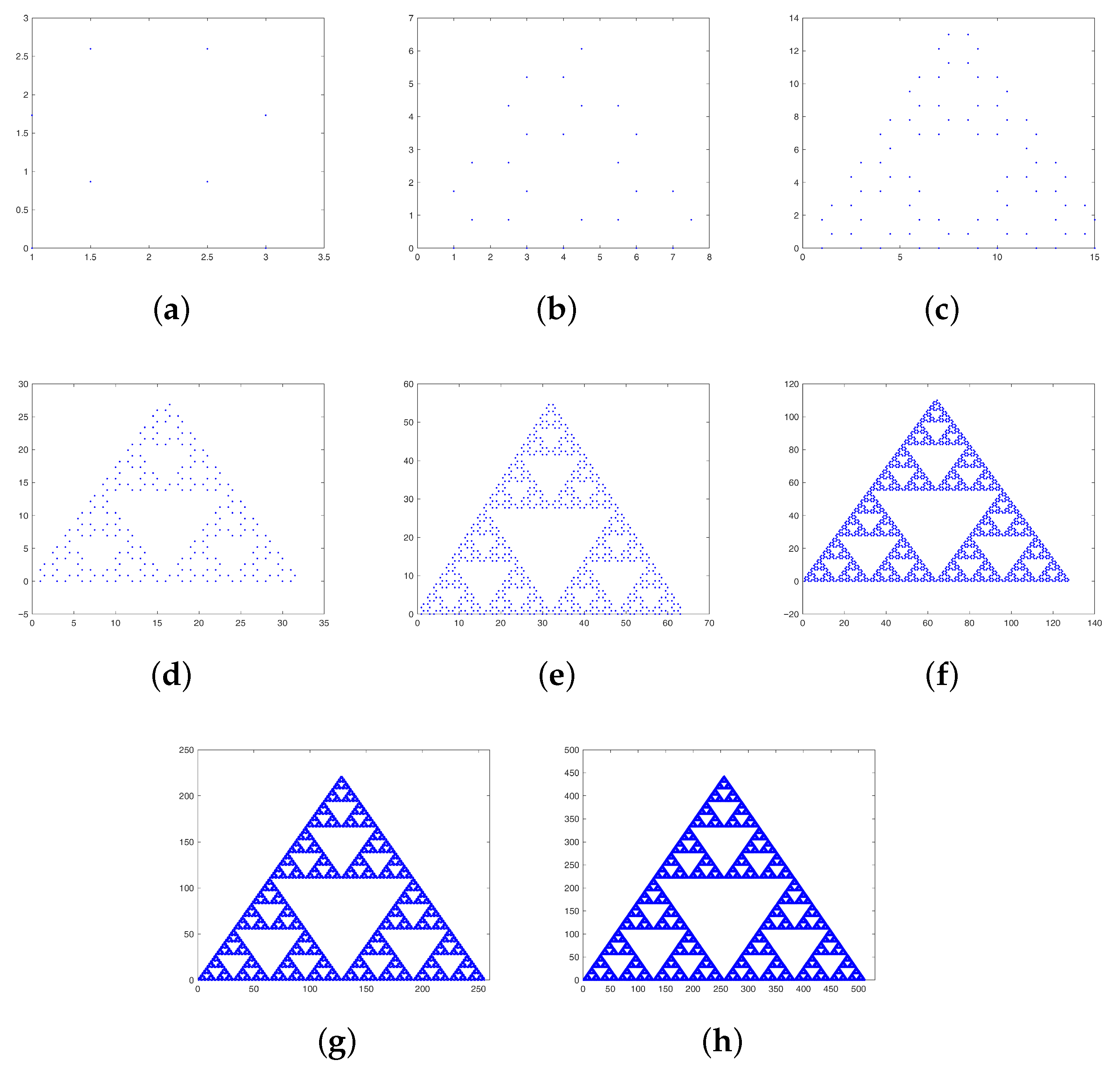
As result, the iterative application of this L-system produces the Sierpinski triangle, as illustrated in Figure 6. The point [ 0 , 0 ] is chosen as the starting point, and unitary segments are considered.

2.5. Percolation-Based Aggregates

Percolation is a pure random process of fractal-like cluster and aggregate construction, and functions by choosing sites to be randomly occupied or empty with certain probabilities [44]. It is a well studied phenomenon [22,45]. In this work we consider a particular case of Percolation fractal construction from a square regular integer lattice, considering a neighborhood K and particle removal (random empty based on the number of particles in a neighborhood K).
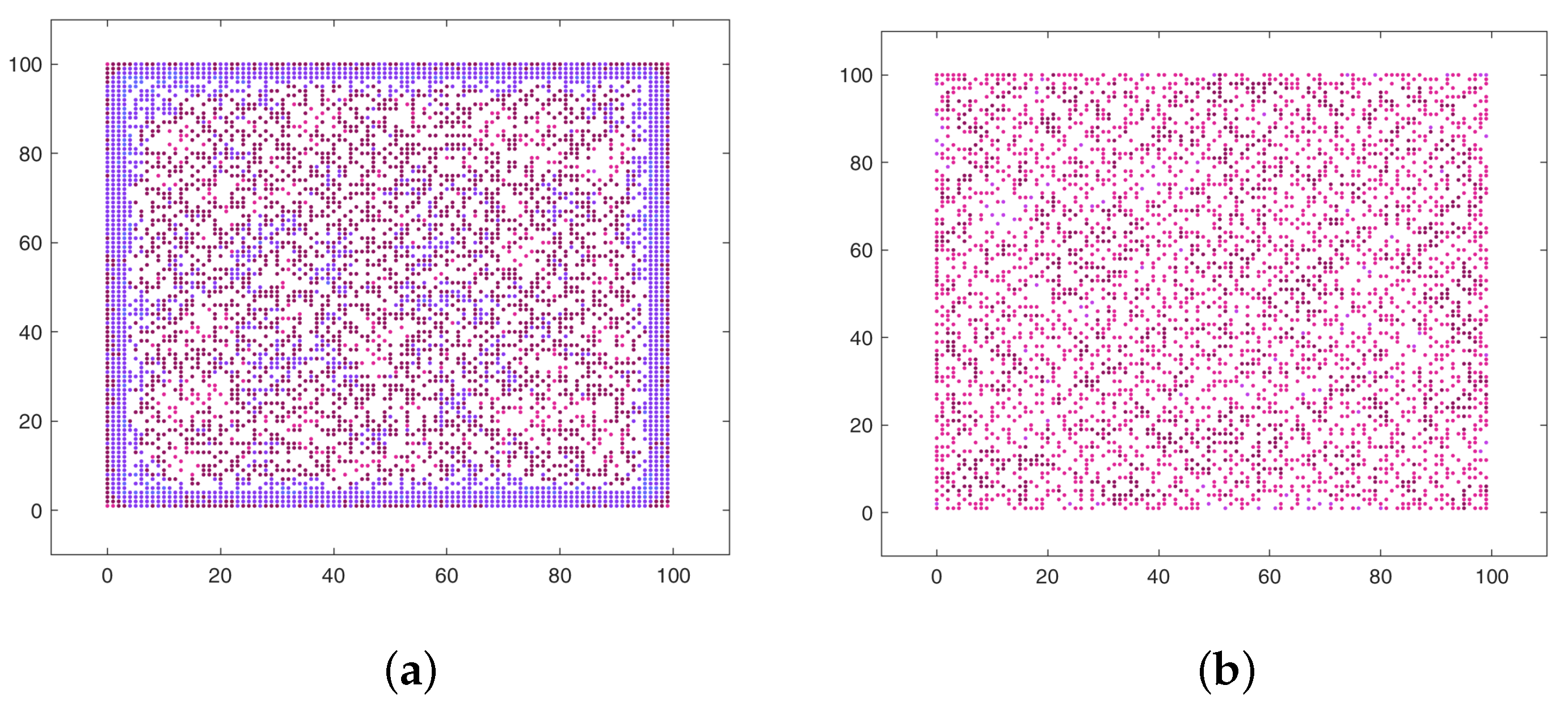
Let us consider a square regular lattice, such as the one in Figure 7a, in such a way that the total number of particles considered is N p a r t = N × N ( 10 4 particles in the case of Figure 7a, with a square regular lattice with N = 100 ). Let us consider the number of particles in the K neighborhood of current particle k, v n ( k ) . In this case we have taken a 4 neighborhood for each particle (k), so the maximum possible number of neighbor particles for k is 32. Starting from the complete regular lattice N × N (with all the particles), the process to obtain a Percolation fractal is straightforward: First, choose a particle which fulfills a given condition on v n , and remove it from the lattice with a given probability. Recalculate the value of v n ( k ) for all k, and repeat the process until no particle fulfills the condition on v n . For example, Figure 7 shows two different Percolation fractal structures. Both are defined on a 100 × 100 regular lattice. In the case of Figure 7a, the condition to remove particles is v n ( k ) = 32 with a removal probability of 50 % . Note that in this case, the particles at the edge of the lattice are unremovable, and form a frame for the fractal structure produced inside the lattice. Figure 7b shows a Percolation fractal structure based on removing particles such as v n ( k ) > 16 , with probability 50 % .

3. Proposed Hybridization Procedures

In this work we propose two different new procedures for hybridization of classical fractal construction methods, to obtain new fractal-like clusters structures. The first one is the seeded DLA procedure, which allows direct hybridization with other methods for fractal-like cluster construction. The second procedure we present here is the diffusion of particles based on a concentration gradient, which can be applied to any cluster or structure of aggregates, including any fractal-like particle cluster, and can then be further included in the seeded DLA approach.

3.1. Seeded DLA

The seeded DLA approach is an easy way of hybridizing different classical fractal construction methods leading to fractal-like particle clusters, by leveraging the versatility of the DLA procedure. Note that in the classical DLA approach (see Section 2.1), the procedure starts with an initial point in the aggregate structure, which can be seen as a condensation nucleus. Particles are then randomly launched, and if they pass close enough to the condensation nucleus in the aggregate, they join to the aggregate, which grows accordingly. The idea of seeded DLA is to start the procedure with another fractal aggregate as the initial condensation nucleus in the DLA procedure. For this, we have to adapt the initial fractal aggregate ( L 0 ), previously obtained by one of the previously revised classical fractal construction approaches, in the following way:
1.
We start with a re-scaling operation, if necessary, in the initial aggregate L 0 , in such a way that its size is modified to adjust to aggregates at integer coordinates. This re-scaling operation is carried out point by point in the structure by multiplying it by a large-enough value. Usually, re-scaling by 2 or 3 orders of magnitude should be enough ( L 0 · 100 or L 0 · 1000 ), but this will depend on each particular case.
2.
As mentioned before, we consider DLA fractals over integer points to facilitate the fractal construction procedure, so a round operation must be applied r o u n d ( L 0 ) after the re-scaling.
3.
The initial aggregate L 0 is ready, so it is now considered to be the initial condensation nucleus for the DLA instead of the previous initial point [ 0 , 0 ] , i.e., [ 0 , 0 ] L 0 .
4.
The DLA procedure described in Section 2.1 is carried out, without any other change to it, for a pre-fixed number of particles. After this, the new fractal aggregate L will be obtained.
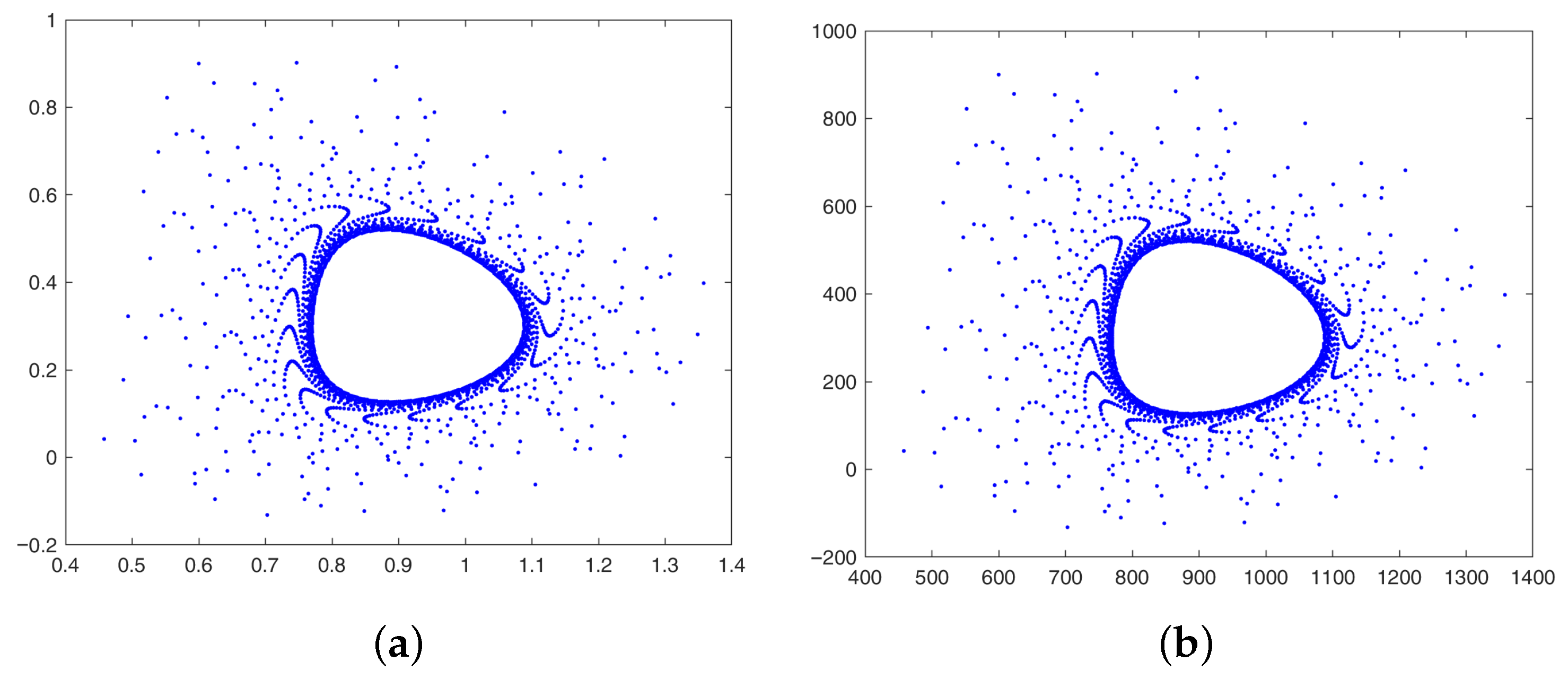
Figure 8 shows an example of the original Strange Attractor (Figure 8a), and the final aggregate L 0 after re-scaling and round operation (Figure 8b). The application of the DLA over this L 0 will produce a new fractal aggregate, hybridizing Strange Attractors and DLA.

3.2. Fractal Aggregate Diffusion Due to Concentration Gradient

Particle diffusion processes have been modeled in different works related to fractal construction and chaos [46], mainly in the context of Brownian motion modeling [47,48]. On the other hand, concentration gradient diffusion can be defined as the movement of particles in a fluid from a region of higher concentration to a region of lower concentration [49]. Following Fick’s first law, the diffusion flux J (quantity and direction of particle transfer) is proportional to the negative gradient of spatial concentration,
J = D · n ( x , t ) ,
where n ( x , t ) stands for the spatial concentration of particles, and D is the diffusion coefficient, which we consider constant for diffusion in a given fluid.
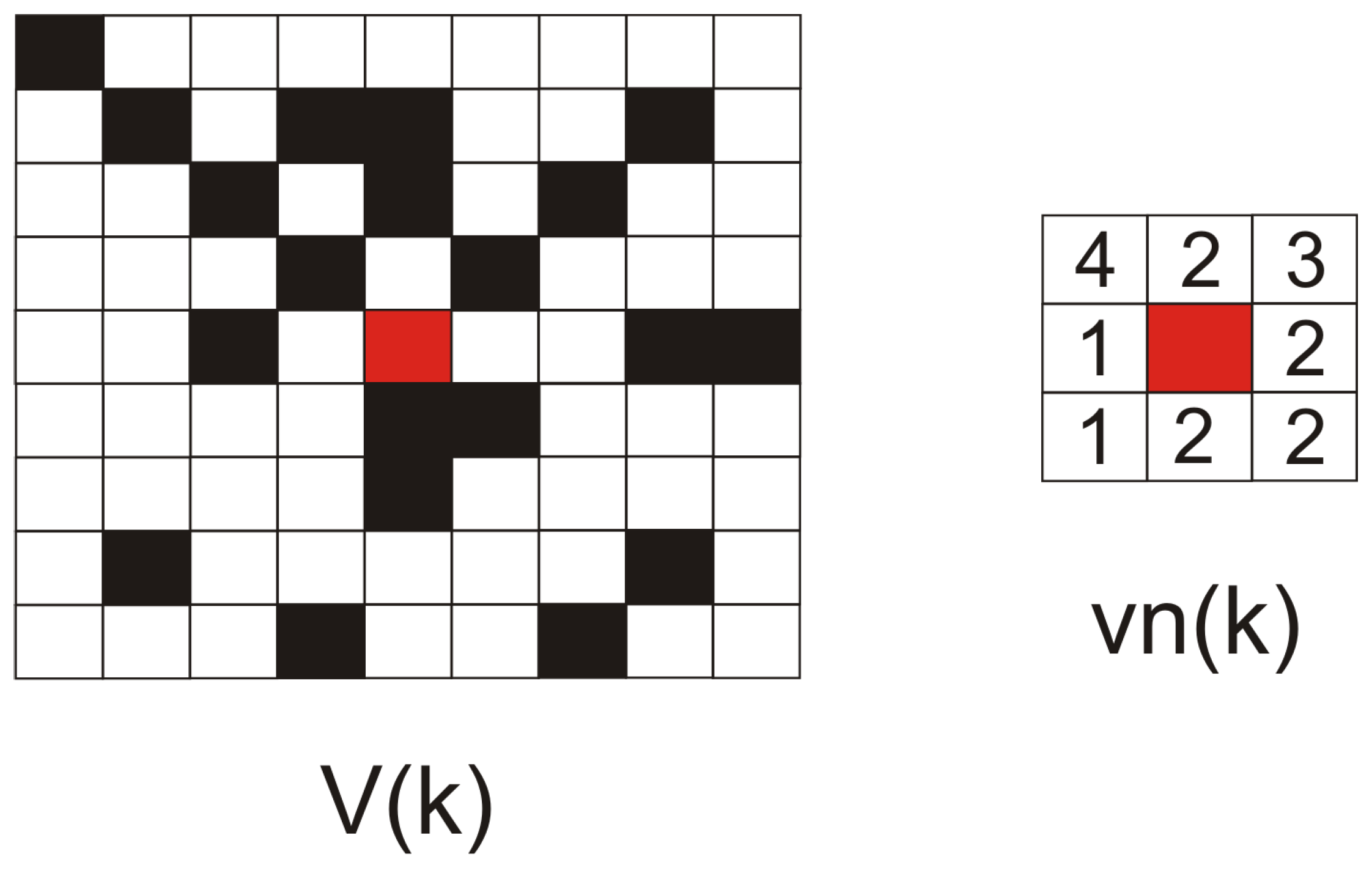
The question is whether we can simulate a diffusion process affecting individual particles in an aggregate which produces an emerging behavior similar to that modeled by Equation (6). In order to establish this procedure, let us consider an aggregate or particle cluster, formed of a number N of particles. Let us suppose that at each time t, each particle k experiences a force depending on the particles in a V ( k ) neighborhood, where V ( k ) takes into account the number of particles in eight directions, starting from the particle (up, down, right, left, and the four diagonals). The idea is shown in Figure 9, where the neighborhood V ( k ) considered in this work is depicted, and we also show v n ( k ) , which summarizes the number of particles applying a force over the objective particle (red one in the middle). The final force experienced by particle k in direction d (eight different directions) can be modeled as a vector F d :
F d = D · r · ( 4 v n ( k ) d ) ,
where d stands for the opposite direction to d, D is the diffusion coefficient and r stands for a random number from a uniform probability distribution in ( 0 , 1 ) . This way we obtain eight different components of the force to be applied to a particle, depending on the other particles in all directions surrounding k. We then compose these forces to obtain the final force vector (module and direction), applied to particle k. Note that this procedure produces diffusion of the particles which are not completely surrounded by other particles in the neighborhood. In the case that a particle is completely surrounded by other particles (i.e., d = 1 8 v n ( k ) d = 32 ), the particle does not experience any force, and it does not diffuse at that time step. Also, note that if the particle k does not have any neighbor particles in V ( k ) (i.e., d = 1 8 v n ( k ) d = 0 ), we consider that the particle follows Brownian motion, so in this case, the final force is modeled as a random variable from a Gaussian distribution N ( 0 , 1 ) in one of the eight directions around the particle, also randomly chosen.
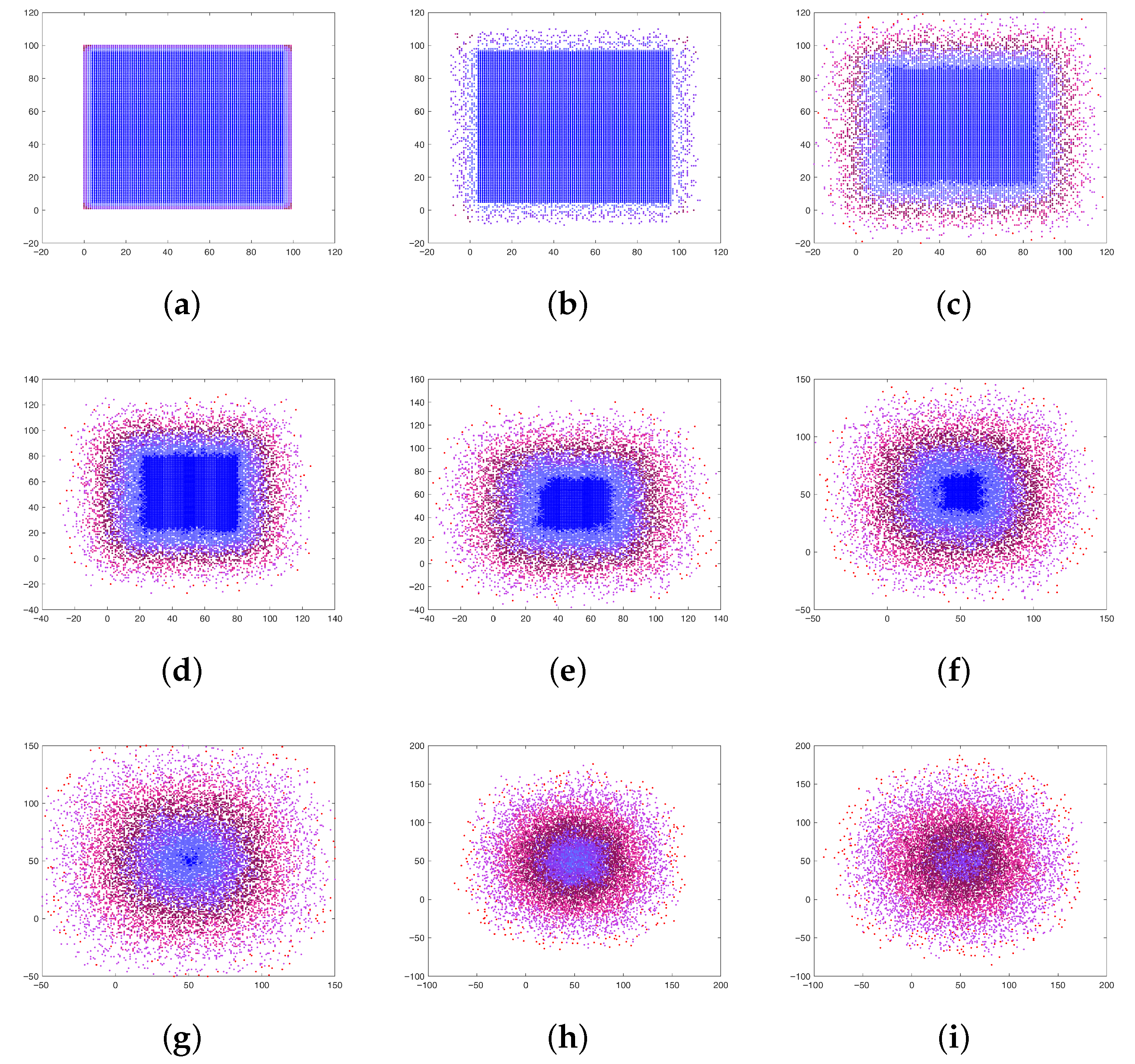
Let us illustrate this proposed concentration gradient diffusion procedure with an example over a regular lattice of particles ( 100 × 100 ), shown in Figure 10a. The particles are colored depending on the value of d = 1 8 v n ( k ) d , which is why the particles closer to the edge of the lattice have a slightly different color to those in the lattice center, where d = 1 8 v n ( k ) d = 32 . The rest of subfigures, from (b) to (i), show the diffusion of this structure, at different time steps, from t = 1 (Figure 10b) to t = 100 (Figure 10i). Free particles that have reached Brownian motion are shown in a red color in the figures.

3.3. Fractal Dimension Calculation

We can characterize the fractals obtained with the non-linear transformations applied, by obtaining the fractal dimensions of the new fractals. For this, we have calculated the fractal dimensions using the well-known box-counting method [50,51,52,53]. Let C be a fractal structure in 2D, and the box-counting method is a procedure to obtain the fractal dimension of C. To calculate this dimension for a fractal C, the box-counting algorithm works by counting how many boxes are required to cover the set. The box-counting dimension is obtained by calculating how this number changes as we make the grid finer. Let us suppose that n ( r ) is the number of boxes of size r required to cover the set. Then the box-counting dimension is defined as
α = lim r 0 l o g ( n ( r ) ) l o g ( r ) .
In other words, if C is a fractal set, with fractal dimension α < 2 , then n ( r ) scales as r α . Note that α is also known as the Minkowski–Bouligand dimension, Kolmogorov dimension, or box-counting dimension.
In this paper we have used the implementation of the box-counting method provided by Matlab® R2020a. It operates by counting the number n of 2-dimensional boxes of size r needed to cover the nonzero elements of C, uploaded as a binary matrix. The box sizes are, in this case, considered to be powers of two, i.e., r = 1 , 2 , 4 , , 2 P , where P is the smallest integer such that
max ( s i z e ( C ) ) 2 P .
If the size of C over each dimension is smaller than 2 P , C is padded with zeros to size 2 P over each dimension (for instance, a 400 × 200 image is padded to 512 × 512 ). The output vectors n ( r ) and r are of size P + 1 . Equation (8) is then considered to obtain the fractal dimension α , as the slope of the log–log plot r vs. n ( r ) .
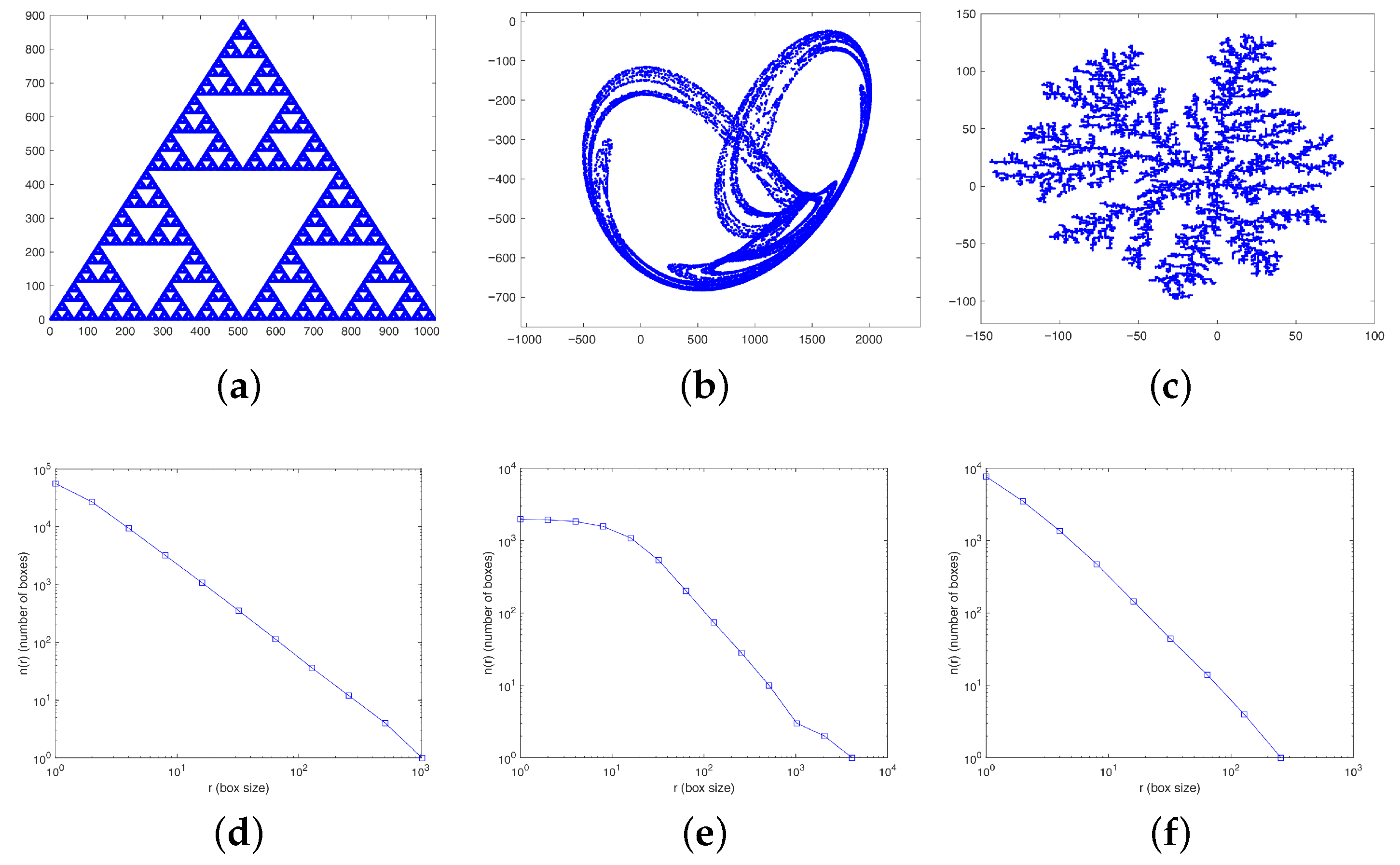
In order to test the performance of the Matlab® routine used for box-counting, we calculate the fractal dimensions of the three fractal structures shown in Figure 11a–c, so we can compare with the actual (known) fractal dimensions. The log–log plots for each fractal are displayed in Figure 11d–f. These log–log plots give a value of α = 1.58 for the Sierpinski triangle, α = 1.43 for the SA and α = 1.71 for the DLA aggregate, very close to the known values for the fractal dimensions of these aggregates [54,55].

4. Experiments and Simulation Results

In this section we show the new fractal aggregates obtained by the methods described in Section 3, both seeded DLA and concentration gradient diffusion of fractals. We will start with some examples of fractal aggregates diffusion, and then we will show new fractal aggregates obtained by applying the seeded DLA approach.

4.1. Simulation of Fractal Aggregate Concentration Gradient Diffusion

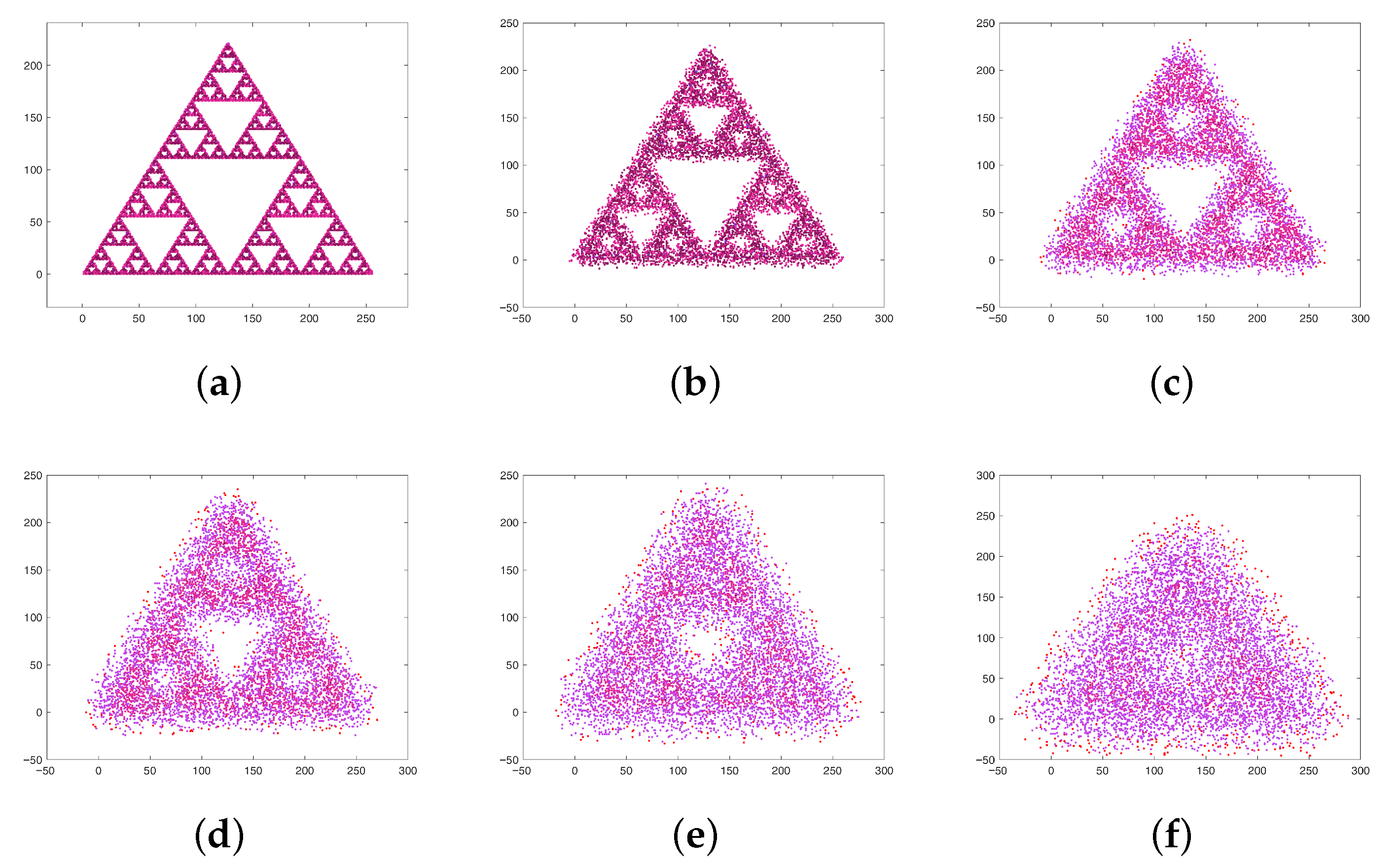
Here, we illustrate the diffusion of three different fractal aggregates due to concentration gradient, the Sierpinski triangle (L-system aggregate), an SA (Figure 4b) and the Sierpinski carpet (IFS aggregate). Figure 12 shows the diffusion process applied to the Sierpinski triangle. We show the process by showing the original aggregate and the state of the aggregate after different times steps of the concentration gradient diffusion process ( t = 1 , 5 , 10 , 20 and 50). The light red colors of the triangle show that the particles are not very close other. A value of D = 1 was applied in this experiment, obtaining the diffusion images shown in the figure.
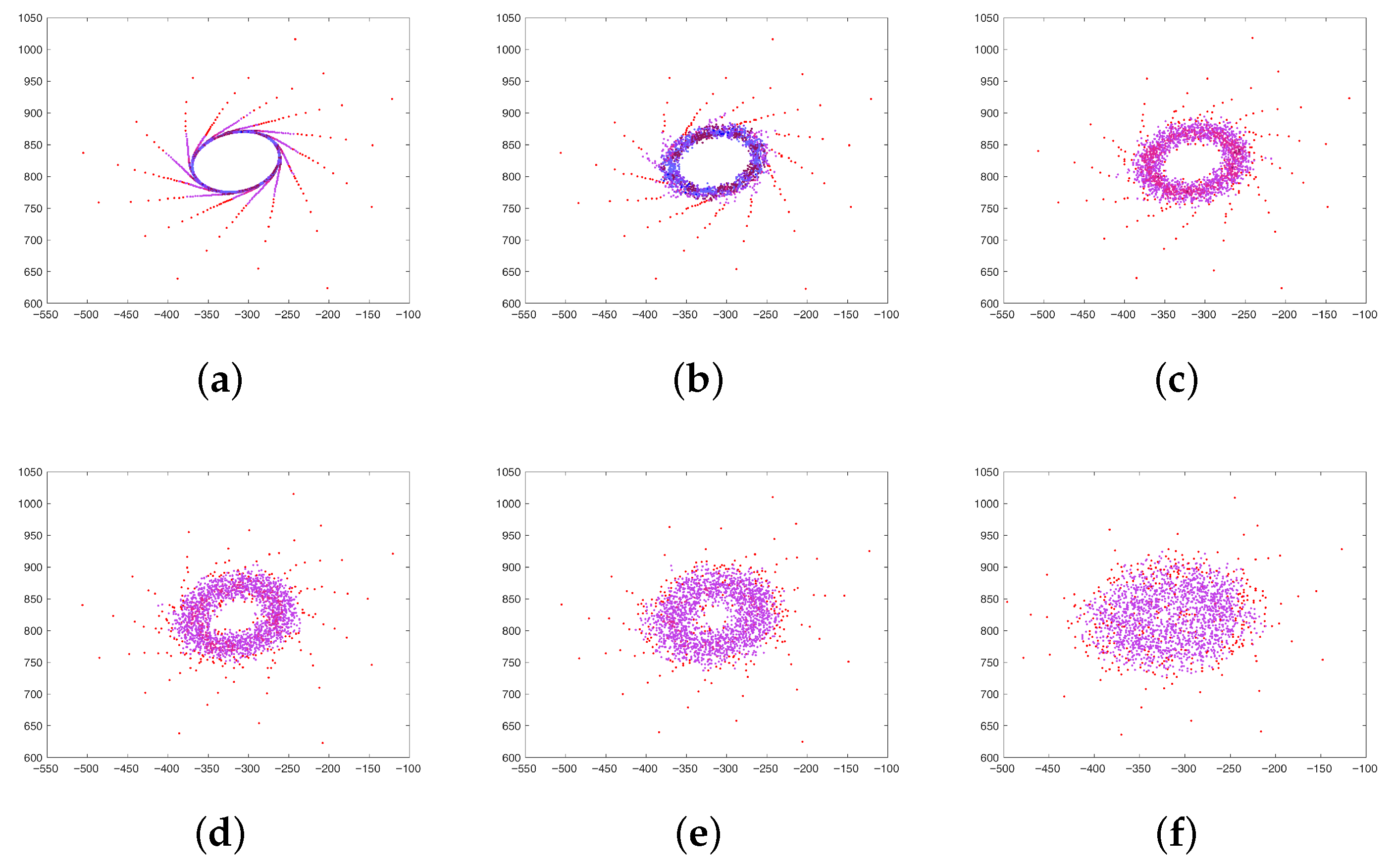
Figure 13 shows the concentration gradient diffusion process of the SA mentioned before. In this case, the SA aggregate has the form of a kind of spiral, where the bars present points separate enough to be free particles (Brownian motion applies), but in the circle center, the points are close enough to experience concentration gradient forces. In general, SAs need higher values of D to diffuse in a reasonable time due to the concentration gradient. In this experiment, we used a value D = 20 , obtaining diffusion up to t = 50 , as shown in the figure. Note that the diffusion coefficient D in this case is considered larger than in the previous simulation, so the diffusion of the fractals is faster than before, and it is therefore comparable to the case of the Sierpinski triangle. Note that the Sierpinski triangle is formed of particles closer to each other than the SA, so if the same value of D is used in the simulation, the diffusion of the SA would take much more time than that of the Sierpinski triangle.
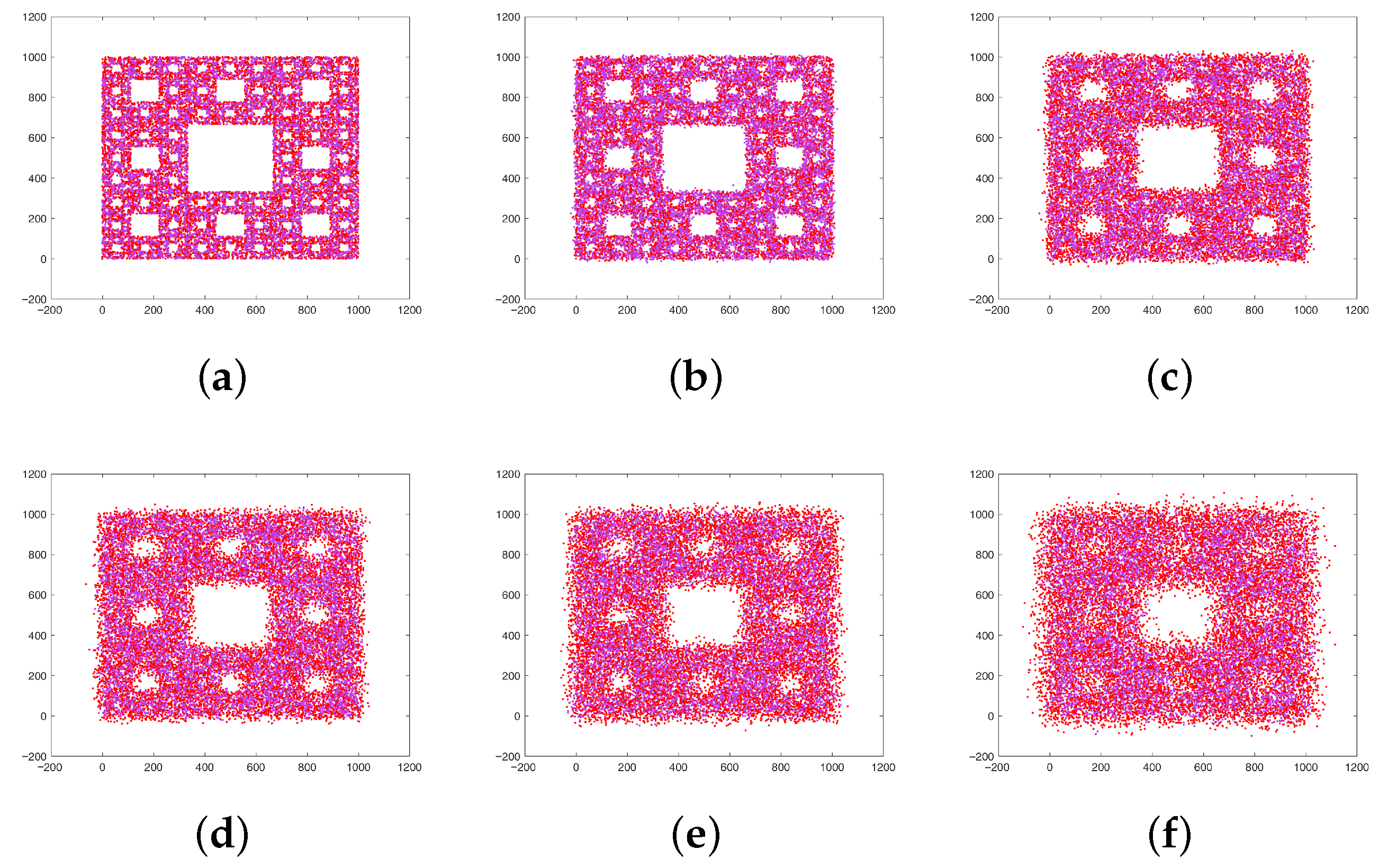
Finally, Figure 14 shows the concentration gradient diffusion process of the IFS known as the Sierpinski carpet. It is possible to see that even in the original aggregate, there are many free particles (without any particle neighbors) with Brownian motion. The number of particles with neighbor particles is relatively small, so it is expected that the diffusion process will be somewhat similar to that of the Sierpinski triangle (Figure 12) above. As in the case of the Sierpinski triangle, in this experiment, we used a value of D = 1 , obtaining diffusion up to t = 50 , as shown in the figure. It seems that the diffusion process of the Sierpinski carpet is even slower than in the Sierpinski triangle case above when using the same diffusion coefficient D.

4.2. Fractal Aggregates from Seeded DLA

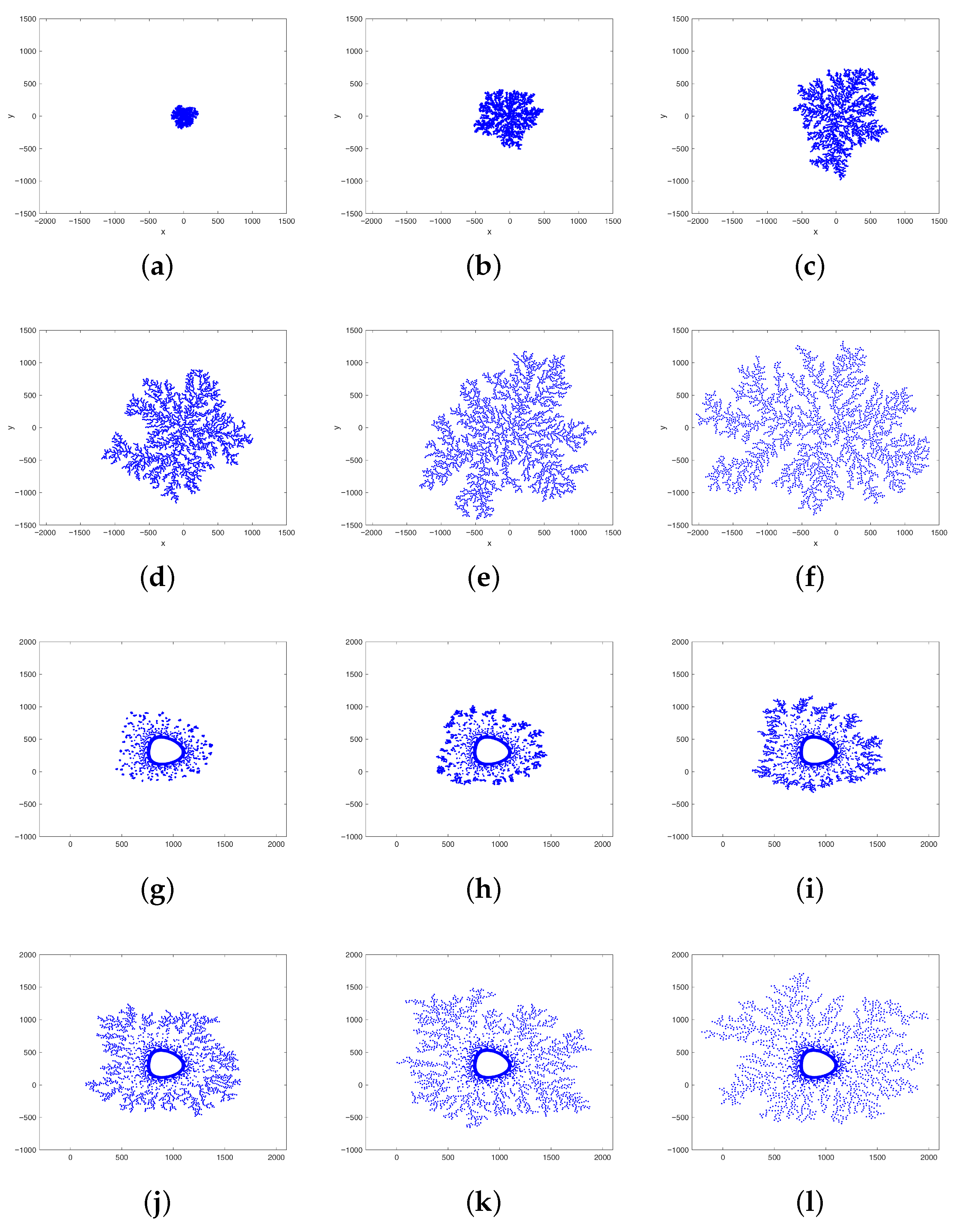
We now present the fractal aggregates obtained by applying the seeded DLA procedure described in Section 3.1. We start with a discussion on the effect of parameter R a in the final aggregates obtained with the seeded DLA approach. Let us consider the SA of Figure 8b as a seed, and then we apply the complete DLA algorithm with different values of R a (5, 10, 15, 20, 25 and 30). The results are shown in Figure 15, together with traditional DLA aggregates (only one particle at ( 0 , 0 ) at the beginning of the process) with the same values of R a for comparison. In all cases, a total of 10,000 particles were launched in the DLA process, and 8000 in the seeded DLA, though depending on the case, the number of particles in the aggregates is much lower (low probability of success). We kept the scale of the figures invariant so that the different forms of the aggregates can be fairly compared. Regarding the seeded DLA aggregates obtained, the seeded DLA approach with R a < 5 produces an aggregate with a low number of attached particles from the DLA, so the SA in which particles act as condensation nuclei predominates in the final aggregate. When the R a parameter is growing (Figure 15h–j), it seems there is a greater balance between the initial condensation nuclei and the particles from the DLA simulation, especially for the cases R a < 15 and R a < 20 , so in the final aggregate, it does not predominate any of the hybrid (or the initial SA seed, or the DLA particles). If we continue increasing the value of R a , we will progressively give more importance to DLA instead of to the initial condensation nucleus. This can be better seen in Figure 15k,l, with R a < 25 and R a < 30 . However this, the form of the condensation nucleus is still clearly seen in the aggregate. Note also that the number of particles in the aggregate is much larger in this case, since it is easier for particles to join it in the DLA simulation due to the large value of R a .
This discussion can be further improved by calculating the fractal dimensions of the aggregates shown in Figure 15. Table 1 shows the fractal dimension of the DLA and seeded DLA aggregates in Figure 15, using the box-counting method described above. For comparison purposes, note that the fractal dimension of the SA used as the seed in these simulations is 1.62 . As can be seen in the table, the fractal dimension of the DLA aggregates is around 1.71, with a maximum value of 1.77 for the case of R a = 10 . The fractal dimension of the seeded DLA aggregates varies depending on R a . For the case of low values of R a , the fractal dimension of the aggregate is closer to that of the seed, with values of 1.63 and 1.62 for R a = 5 and R a = 10 , respectively. From R a = 15 onwards, the fractal dimension of the seeded DLA aggregates obtained grows to a value comparable with the DLA aggregates, as expected. As a final conclusion, note that the effect of different condensation nuclei can be seen in the small range of R a , while for large R a values, the dimensions of the different seeded DLA clusters are very similar, and similar to those of the original DLA clusters.
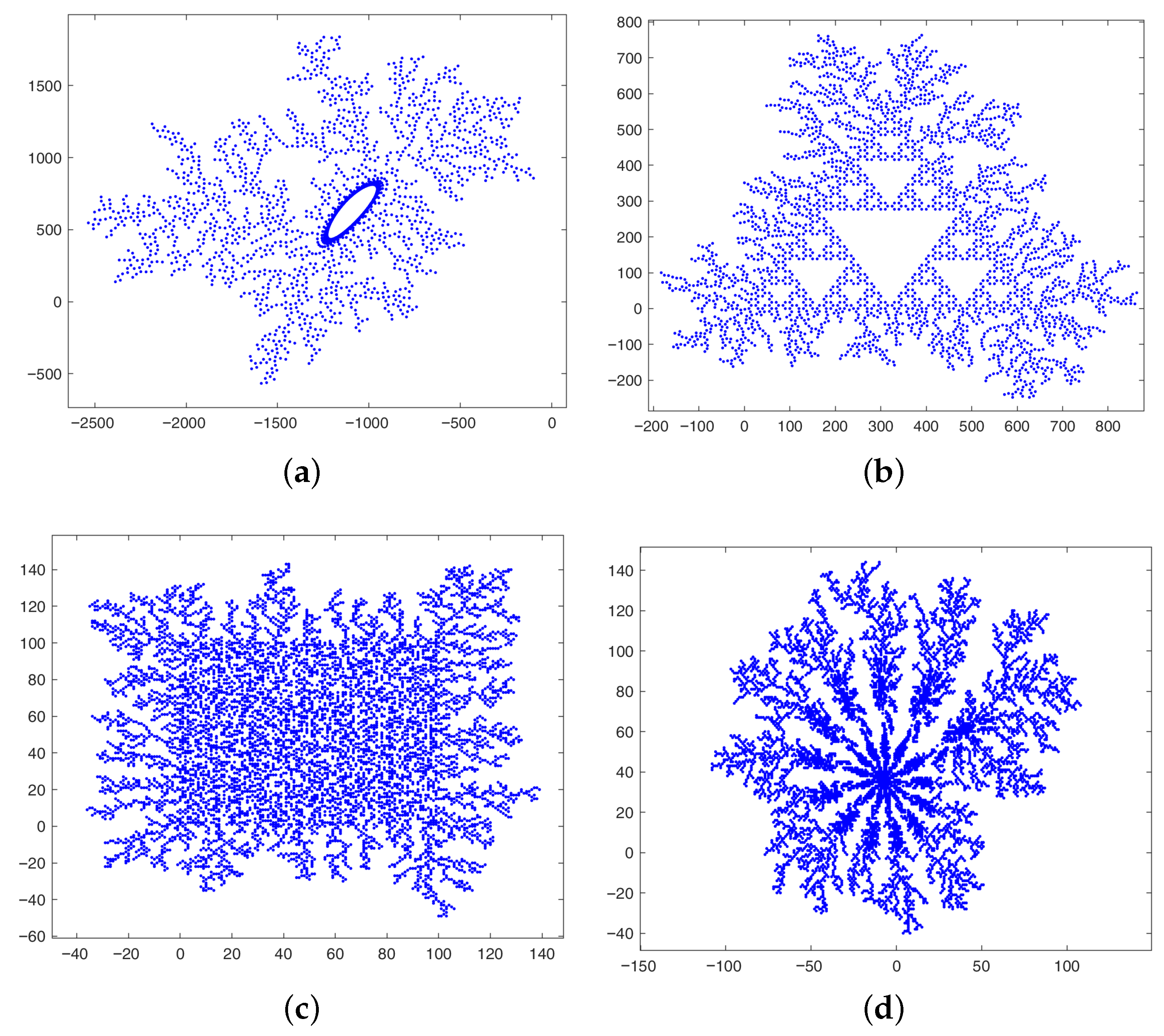
We now show other aggregates obtained by seeded DLA simulation. Figure 16a shows a new seeded DLA aggregate with an SA as seed, with R a < 30 . Figure 16b used the Sierpinski triangle (from an L-System) as condensation nucleus in this case, with R a < 10 . Figure 16c shows a seeded DLA simulation with a Percolation fractal as a condensation nucleus, and R a < 5 . Finally, Figure 16d shows a seeded DLA simulation using a IFS as a condensation nucleus, with R a < 5 . Regarding the use of the Sierpinski triangle or the Percolation fractal as nuclei, note that we are aware that no particle from a DLA will get into the nuclei, but they will attach to the fractal surface, having the same effect as using a normal triangle or a square as nuclei, instead of the Sierpinski triangle and Percolation fractal. In spite of this, using the fractals as nuclei will produce esthetic versions of both cases, as will be shown below.
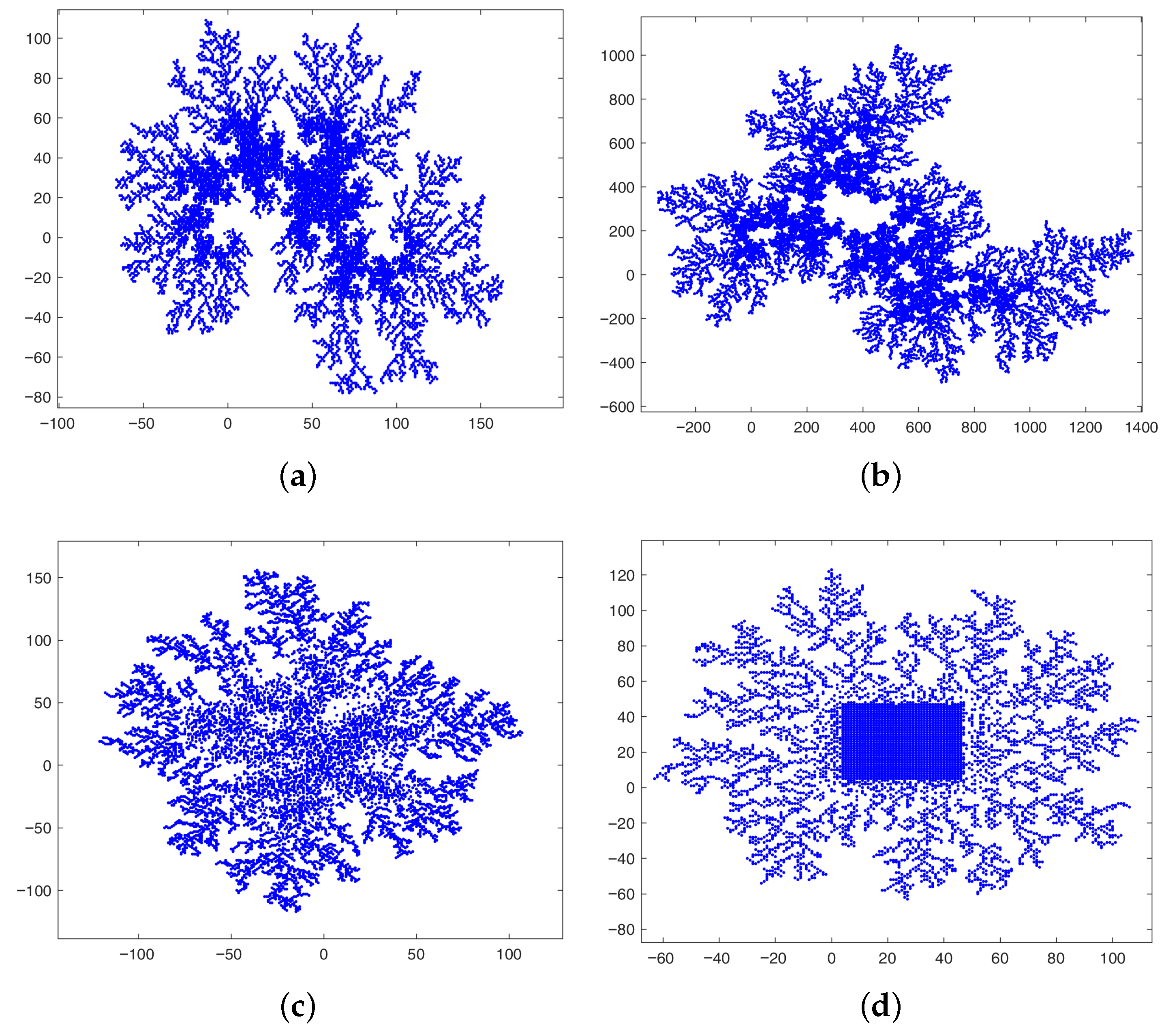
The last group of new fractal aggregates obtained correspond to IFSs and diffused structures as condensation nuclei. Figure 17a shows a new fractal aggregated using the seeded DLA using the Dragon curve (IFS) as condensation nuclei, and R a < 10 . The combination of the IFS and the DLA produces a visually attractive new fractal aggregate, similar to roots and sprouts in some bulbous plants such as ginger. A quite similar structure can be obtained using the McWorter’s Pentigree fractal (IFS) as a condensation nucleus, as shown in Figure 17b. The aggregates in Figure 17c,d are two examples of condensation nuclei from diffusion of other aggregates. Specifically, Figure 17c shows a seeded DLA structure which used the diffusion of a DLA ( t = 1 ) as a condensation nucleus. The final aggregate is a hybridization of a diffused with a non-diffused fractal of the same type (DLA in this case). Figure 17d shows an aggregate from seeded DLA using a diffused ( t = 1 ) regular lattice as a condensation nucleus, obtaining a hybrid fractal aggregate.

4.3. Final Discussion: Fractal Dimension Analysis

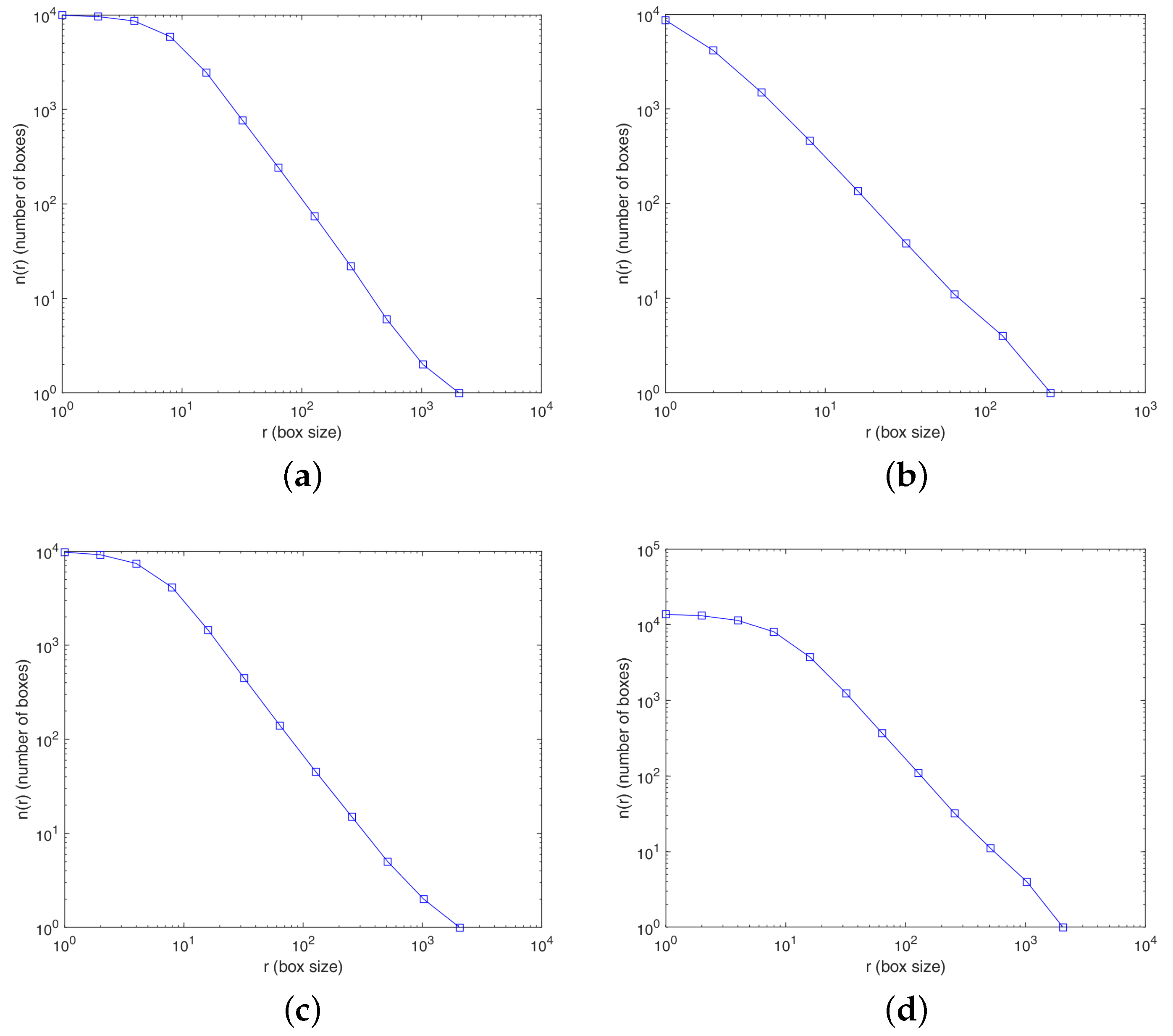
We now proceed to characterize some of the seeded DLA fractal aggregates obtained in this work by comparing the difference in fractal dimensions from the initial condensation nuclei to the final aggregate obtained after the DLA process. We conduct this analysis for the fractal aggregates in Figure 16 and Figure 17. Table 2 shows the fractal dimensions obtained with the box-counting algorithm for the fractal-like aggregates obtained with the seeded DLA approach. The table shows the fractal dimensions of the condensation nuclei, and the final seeded DLA aggregate. As can be seen, in general, the aggregates obtained with the seeded DLA procedure present a fractal dimension larger than that of the corresponding condensation nuclei. The aggregates from the Percolation fractal (Figure 16c) and the IFS (Figure 17d) are the only exceptions to this in the experiments carried out. Figure 18 shows the log–log plots r vs. n ( r ) for the Dragon Curve and McWorter’s Pentigree IFS fractal aggregates as an example, where it is possible to see the differences between the plots for the condensation nuclei and the final seeded DLA aggregate.
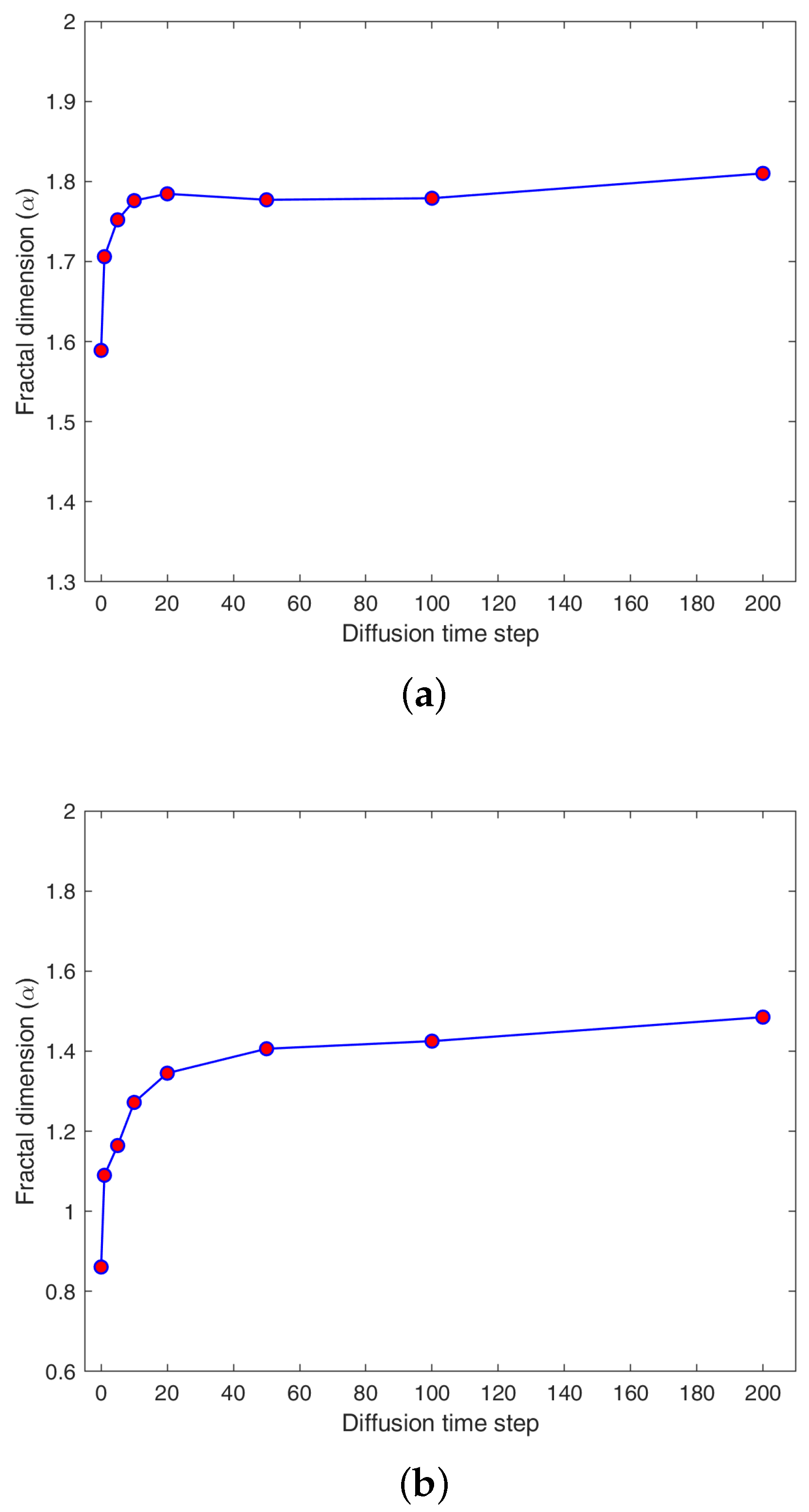
We next study how the fractal dimension ( α ) of a fractal aggregate varies when a concentration gradient diffusion process is applied to it. We consider the concentration gradient diffusion process shown in Figure 12 for the Sierpinski triangle and that for a SA (Figure 13). Figure 19 shows the variation in the fractal dimension at different times of the diffusion process, from t = 1 to t = 200 , for these two fractal aggregates (we also show the original fractal dimension of the aggregate ( t = 0 )). As can be seen, in both cases, the fractal dimension grows in a diffusion process, up to a point when it does not show further evolution. In the case of the Sierpinski triangle, it seems that the fractal dimension grows up to around 1.8 , when the aggregate has been totally diffused. The diffusion of the SA in 200 time steps is quite different, reaching a maximum around 1.5 when it has been almost completely diffused. Note that in 200 time steps, both aggregates still keep their approximate initial form (triangular in the case of the Sierpinski aggregate, and circular in the case of the SA). Following the colors of the aggregates in Figure 12 and Figure 13, in both cases there are still certain concentration gradient forces, and not only Brownian motion is found in the diffused aggregates at t = 200 . However, it is expected that the fractal dimension will not vary a lot from this time step.
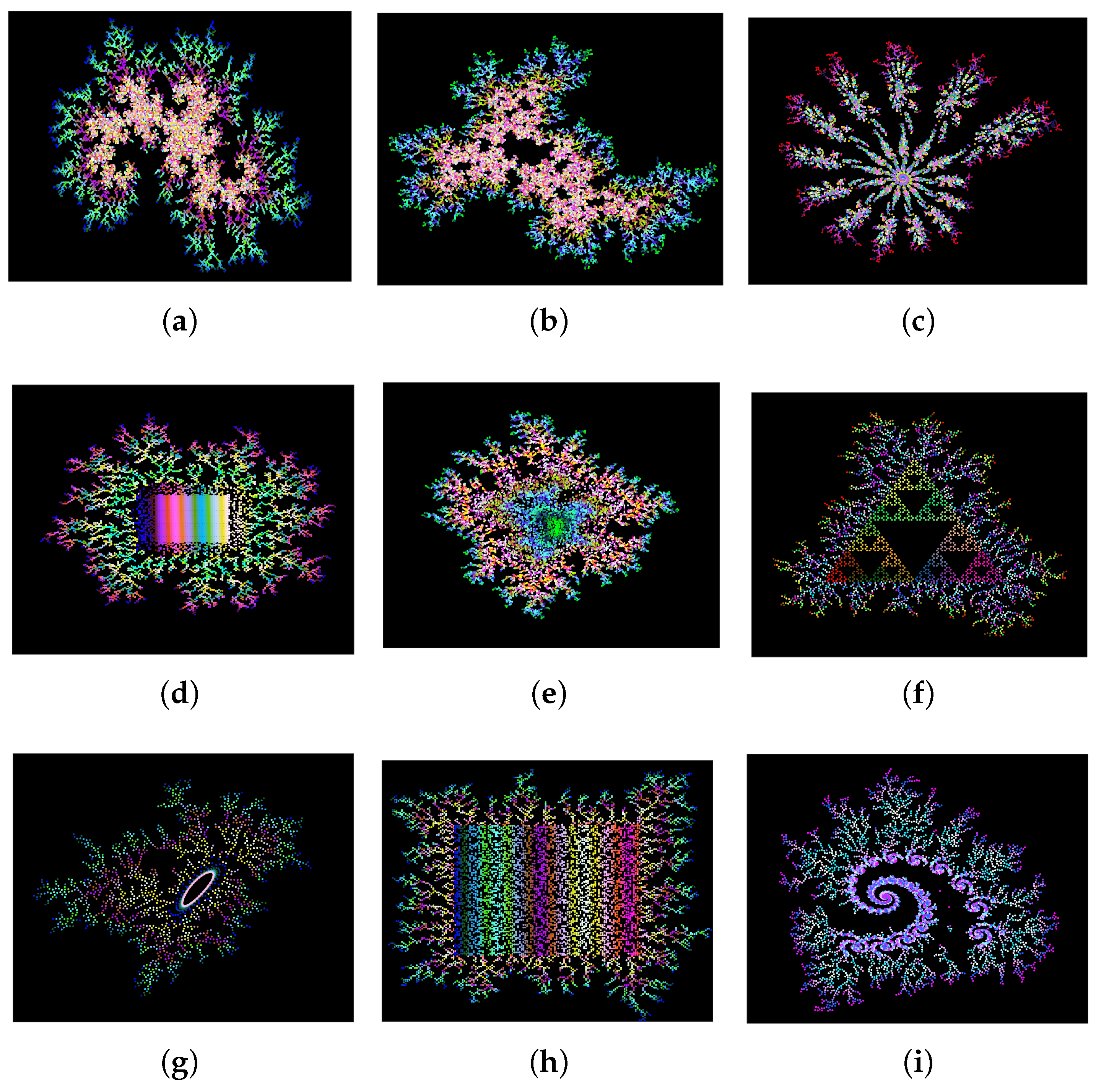
We close this discussion section with a note on the potential applications on the fractal aggregates constructed in this work. Given the esthetic of many fractal-like aggregates constructed, the proposed seeded DLA method can be useful in computer graphics, to generate visually attractive structures based on particles, with use in visual and computer-aided art [56,57,58,59]. Figure 20 shows some aggregates with potential to be considered aesthetic artwork in fractal art studies. The procedure used to color the aggregates is shown in Appendix C. The concentration gradient diffusion of fractal aggregates can also be used in computer-aided multi-media art, to generate ordered motion from fractal-like structures [60,61]. Both the seeded DLA and the concentration gradient diffusion proposed can have applications in statistical physics and physics of materials, to create new types of aggregates using condensation nuclei with different forms and properties, such as in [62]. In these cases, it could be important that the new fractals have specific properties, such as multi-band behavior due to the hybrid structure (seed + DLA), tunable porosity, etc. Finally, many non-linear and fractal systems have been applied to improve modern optimization algorithms, inspiring new designs [41] or improving search operators [63], and in other engineering applications, specially in antenna design [64], where new fractal structures can lead to special radiation diagrams with particular properties. In these cases, multi-scale symmetry seems to be a good property exhibited by the fractals to be considered in antenna design.

5. Conclusions

In this paper we have proposed and evaluated hybrid techniques for forming new fractal-like structures, by mixing DLA with other fractal generation methods producing particle aggregates. The proposed technique consists of using existing fractal aggregates as condensation nuclei at the beginning of the DLA procedure, producing new fractal aggregates with the esthetic properties of both a DLA cluster and the condensation nuclei used. We have also proposed a simplified simulation of particle concentration gradient diffusion that can be applied to any fractal-like aggregate. We have evaluated these proposed techniques by obtaining new fractal aggregates and diffusing existing cluster structures, showing that the diffused versions of fractal aggregates can in turn be used as condensation nuclei for obtaining other fractal aggregates. The fractal dimension analysis of the new aggregates shows differences from that of the condensation nuclei depending on the specific case. In some simulations using SA or Iterated Function Systems as condensation nuclei, the fractal dimension differences between the initial nuclei and the final aggregate is important. In other cases, such as when using diffused structures as condensation nuclei, the fractal dimension of the final aggregate does not vary significantly. In any case, the proposed methods for generating new fractal-like aggregates generate visually attractive structures based on particles, with potential applications in visual and computer-aided art, multi-media art, simulation of new physical and chemical-based material aggregates, development of new computational algorithms for optimization based on non-linear processes, and engineering design processes, such as antenna design.

Author Contributions

Conceptualization, S.S.-S. and J.P.-A.; Methodology, S.S.-S. and J.P.-A.; Software, S.S.-S.; Validation, S.S.-S., L.C.-S. and J.P.-A.; Formal analysis, S.S.-S., L.C.-S. and J.P.-A.; Investigation, S.S.-S. and P.Á.-C.; Resources, S.S.-S., P.Á.-C. and L.C.-S.; Data curation, S.S.-S. and P.Á.-C.; Writing—original draft, S.S.-S. and P.Á.-C.; Writing—review & editing, S.S.-S. and L.C.-S.; Visualization, S.S.-S. and L.C.-S.; Supervision, P.Á.-C., L.C.-S. and J.P.-A.; Project administration, P.Á.-C. and L.C.-S.; Funding acquisition, S.S.-S. All authors have read and agreed to the published version of the manuscript.

Funding

This research was partially supported by the project PID2023-150663NB-C21 of the Spanish Ministry of Science and Innovation (MICINN).

Data Availability Statement

Data is fully contained within the article and its appendices.

Conflicts of Interest

The authors declare no conflicts of interest.

Appendix A. Strange Attractor Fractal Construction

Table A1. Parameters of the quadratic map to generate the SAs depicted in Figure 4 (initial point [ 0.6 , 0.9 ] ).
AttractorQuadratic Map Parameters ( a 1 a 12 ), Equation (4)
(a)( 0.1 , 0.8 , 0.7 , 0.5 , 1.1 , 1.1 , 0.4 , 0.6 , 0.3 , 0.2 , 0.5 , 0.6 )
(b)( 0.3 , 0.1 , 0.6 , 0.7 , 1.1 , 1.0 , 0.4 , 0.9 , 0.1 , 0.3 , 1.1 , 1.0 )
(c)( 1.1 , 0.7 , 0.7 , 0.5 , 1.2 , 0.0 , 0.3 , 0.6 , 0.3 , 0.1 , 0.8 , 0.8 )
(d)( 1.0 , 1.1 , 0.9 , 0.7 , 1.0 , 0.5 , 0.6 , 0.3 , 0.0 , 1.2 , 0.5 , 0.6 )
(e)( 1.0 , 0.6 , 0.2 , 1.1 , 1.2 , 0.8 , 0.9 , 0.7 , 1.0 , 0.7 , 0.9 , 0.1 )
(f)( 0.2 , 0.4 , 0.5 , 0.6 , 0.8 , 1.1 , 0.1 , 0.9 , 1.0 , 1.0 , 0.2 , 1.2 )
(g)( 1.39 , 0.49 , 0.51 , 0.33 , 0.55 , 0.02 , 0.8 , 1.73 , 0.75 , 2.0 , 0.88 , 0.01 )
(h)( 0.64 , 0.23 , 1.39 , 0 , 1.91 , 1.52 , 0.34 , 1.15 , 0.19 , 1.96 , 1.29 , 0.02 )
(i)( 0.6 , 0.8 , 0.9 , 1.0 , 0.5 , 0.3 , 0.5 , 0.0 , 0.2 , 0.2 , 0.8 , 1.2 )

Appendix B. IFS Fractal Construction

T 1 = x n + 1 y n + 1 = 0 0 0 0.16 · x n y n + 0 0 p = 0.01 x n + 1 y n + 1 = 0.85 0.4 0.4 0.85 · x n y n + 0 1.6 p = 0.85 x n + 1 y n + 1 = 0.2 0.26 0.23 0.22 · x n y n + 0 1.6 p = 0.07 x n + 1 y n + 1 = 0.15 0.28 0.26 0.24 · x n y n + 0 0.44 p = 0.07
where p stands for the probability of applying each affine transformation. This IFS leads to the fractal form given in Figure 5a (Barnsley Fern fractal).
T 2 = x n + 1 y n + 1 = 0.787879 0.424242 0.242424 0.859848 · x n y n + 0.1758647 0.1408065 p = 0.896 x n + 1 y n + 1 = 0.121212 0.257576 0.151515 0.053030 · x n y n + 0.6721654 0.1377236 p = 0.052 x n + 1 y n + 1 = 0.181818 0.136364 0.090909 0.181818 · x n y n + 0.6086107 0.1568035 p = 0.052
This IFS produces the fractal pattern given in Figure 5b (IFS spiral fractal).
T 3 = x n + 1 y n + 1 = 0.632407 0.614815 0.545370 0.659259 · x n y n + 0.3840822 0.1282321 p = 0.888 x n + 1 y n + 1 = 0.036111 0.444444 0.210185 0.037037 · x n y n + 0.2071081 0.8330552 p = 0.112
This IFS produces the fractal pattern given in Figure 5c (IFS triangle fractal).
T 4 = x n + 1 y n + 1 = 0.74545 0.459091 0.406061 0.887121 · x n y n + 0.1460279 0.0691072 p = 0.92 x n + 1 y n + 1 = 0.424242 0.065152 0.175758 0.218182 · x n y n + 0.3809567 0.6741476 p = 0.08
The IFS used to obtain the fractal form given in Figure 5d (IFS palm fractal).
T 5 = x n + 1 y n + 1 = 0.5 0.5 0.5 0.5 · x n y n + 0 0 p = 0.5 x n + 1 y n + 1 = 0.5 0.5 0.5 0.5 · x n y n + 1 0 p = 0.5
The IFS used to obtain the fractal form given in Figure 5e (IFS Dragon curve).
T 6 = x n + 1 y n + 1 = 1 / 3 0 0 1 / 3 · x n y n + 0 0 p = 1 / 8 x n + 1 y n + 1 = 1 / 3 0 0 1 / 3 · x n y n + 0 1 / 3 p = 1 / 8 x n + 1 y n + 1 = 1 / 3 0 0 1 / 3 · x n y n + 0 2 / 3 p = 1 / 8 x n + 1 y n + 1 = 1 / 3 0 0 1 / 3 · x n y n + 1 / 3 0 p = 1 / 8 x n + 1 y n + 1 = 1 / 3 0 0 1 / 3 · x n y n + 1 / 3 2 / 3 p = 1 / 8 x n + 1 y n + 1 = 1 / 3 0 0 1 / 3 · x n y n + 2 / 3 0 p = 1 / 8 x n + 1 y n + 1 = 1 / 3 0 0 1 / 3 · x n y n + 2 / 3 1 / 3 p = 1 / 8 x n + 1 y n + 1 = 1 / 3 0 0 1 / 3 · x n y n + 2 / 3 2 / 3 p = 1 / 8
The IFS used to obtain the fractal form given in Figure 5f (Sierpinsky carpet fractal).
T 7 = x n + 1 y n + 1 = 0.5 0.5 0.5 0.5 · x n y n + 0 0 p = 0.5 x n + 1 y n + 1 = 0.5 0.5 0.5 0.5 · x n y n + 0.5 0.5 p = 0.5
The IFS used to obtain the fractal form given in Figure 5g (IFS Levy Dragon fractal).
T 8 = x n + 1 y n + 1 = 1 / 3 0 1 / 3 0 · x n y n + 0 0 p = 0.25 x n + 1 y n + 1 = 1 / 6 3 / 6 3 / 6 1 / 6 · x n y n + 1 / 3 0 p = 0.25 x n + 1 y n + 1 = 1 / 6 3 / 6 3 / 6 1 / 6 · x n y n + 1 / 2 3 / 6 p = 0.25 x n + 1 y n + 1 = 1 / 3 0 1 / 3 0 · x n y n + 2 / 3 0 p = 0.25
The IFS used to obtain the fractal form given in Figure 5h (Koch curve).
T 9 = x n + 1 y n + 1 = 0.309 0.255 0.255 0.309 · x n y n + 0 0 p = 1 / 6 x n + 1 y n + 1 = 0.118 0.363 0.363 0.118 · x n y n + 0.309 0.225 p = 1 / 6 x n + 1 y n + 1 = 0.309 0.255 0.255 0.309 · x n y n + 0.191 0.588 p = 1 / 6 x n + 1 y n + 1 = 0.118 0.363 0.363 0.118 · x n y n + 0.500 0.363 p = 1 / 6 x n + 1 y n + 1 = 0.309 0.255 0.255 0.309 · x n y n + 0.382 0 p = 1 / 6 x n + 1 y n + 1 = 0.309 0.255 0.255 0.309 · x n y n + 0.691 0.225 p = 1 / 6
The IFS used to obtain the fractal form given in Figure 5i (McWorter’s Pentigree).

Appendix C. Color Procedure

The color of the aggregates in Figure 20 were obtained with a procedure based on modifying the vector I = ( R , G , B ) for each particle i in the aggregate, based on sine and cosine functions with different frequencies. Specifically, permutations on ( R , G , B ) assignments with the following values are considered:
R = s i n 2 π · 2 · i L ;
G = c o s 2 π · 8 · i L ;
B = s i n 2 π · 0.5 · i L ;
where L stands for the length of the aggregate.

References

  1. Witten, T.A.; Sander, L.M. Diffusion-limited aggregation. Phys. Rev. B 1983, 27, 5686. [Google Scholar] [CrossRef]
  2. Meakin, P. Formation of fractal clusters and networks by irreversible diffusion-limited aggregation. Phys. Rev. Lett. 1983, 51, 1119. [Google Scholar] [CrossRef]
  3. Vicsek, T. Fractal models for diffusion controlled aggregation. J. Phys. A Math. Gen. 1983, 16, L647. [Google Scholar] [CrossRef]
  4. Thouy, R.; Jullien, R. A cluster-cluster aggregation model with tunable fractal dimension. J. Phys. A Math. Gen. 1994, 27, 2953. [Google Scholar] [CrossRef]
  5. Stanley, H.E.; Bunde, A.; Havlin, S.; Lee, J.; Roman, E.; Schwarzer, S. Recent approaches to understanding diffusion limited aggregation. Phys. A Stat. Mech. Its Appl. 1990, 168, 23–48. [Google Scholar] [CrossRef]
  6. Stanley, H.; Coniglio, A.; Havlin, S.; Lee, J.; Schwarzer, S.; Wolf, M. Diffusion limited aggregation: A paradigm of disorderly cluster growth. Phys. A Stat. Mech. Its Appl. 1994, 205, 254–271. [Google Scholar] [CrossRef]
  7. Barabási, A.L.; Stanley, H.E. Fractal Concepts in Surface Growth; Cambridge University Press: Cambridge, UK, 1995. [Google Scholar]
  8. Matsushita, M.; Sano, M.; Hayakawa, Y.; Honjo, H.; Sawada, Y. Fractal structures of zinc metal leaves grown by electrodeposition. Phys. Rev. Lett. 1984, 53, 286. [Google Scholar] [CrossRef]
  9. Matsushita, M.; Fujikawa, H. Diffusion-limited growth in bacterial colony formation. Phys. A Stat. Mech. Its Appl. 1990, 168, 498–506. [Google Scholar]
  10. Caserta, F.; Stanley, H.; Eldred, W.; Daccord, G.; Hausman, R.; Nittmann, J. Physical mechanisms underlying neurite outgrowth: A quantitative analysis of neuronal shape. Phys. Rev. Lett. 1990, 64, 95. [Google Scholar] [CrossRef]
  11. Liu, D.; Zhou, W.; Qiu, Z.; Song, X. Fractal simulation of flocculation processes using a diffusion-limited aggregation model. Fractal Fract. 2017, 1, 12. [Google Scholar] [CrossRef]
  12. Lee, J.; Kim, S.W.; Kim, I.; Seo, D.; Choi, H.J. Growth of silicon nanosheets under diffusion-limited aggregation environments. Nanoscale Res. Lett. 2015, 10, 429. [Google Scholar] [CrossRef][Green Version]
  13. Guo, X.; Wang, J. Modeling of the fractal-like adsorption systems based on the diffusion limited aggregation model. J. Mol. Liq. 2021, 324, 114692. [Google Scholar] [CrossRef]
  14. Bazant, M.Z.; Choi, J.; Davidovitch, B. Advection-diffusion-limited aggregation. Chaos Interdiscip. J. Nonlinear Sci. 2004, 14, S7. [Google Scholar] [CrossRef]
  15. Shapovalov, P.G.; Tishchenko, A.A. Polarization radiation from a fractal cluster. Nucl. Instrum. Methods Phys. Res. Sect. A Accel. Spectrometers Detect. Assoc. Equip. 2025, 1073, 170266. [Google Scholar] [CrossRef]
  16. Retière, N.; Sidqi, Y.; Frankhauser, P. A steady-state analysis of distribution networks by diffusion-limited-aggregation and multifractal geometry. Phys. A Stat. Mech. Its Appl. 2022, 600, 127552. [Google Scholar]
  17. Baki, M.A.; Badr, L. Electroless, diffusion limited aggregation of lead dendrites. Chaos Solitons Fractals 2021, 143, 110586. [Google Scholar] [CrossRef]
  18. Zhou, L.; Wang, S.J. Fractal aggregates on geometric graphs. Fractals 2018, 26, 1850038. [Google Scholar] [CrossRef]
  19. Polimeno, M.; Kim, C.; Blanchette, F. Toward a realistic model of diffusion-limited aggregation: Rotation, size-dependent diffusivities, and settling. ACS Omega 2022, 7, 40826–40835. [Google Scholar] [CrossRef]
  20. Tomchuk, O. Models for Simulation of Fractal-like Particle Clusters with Prescribed Fractal Dimension. Fractal Fract. 2023, 7, 866. [Google Scholar] [CrossRef]
  21. Barnsley, M.; Hutchinson, J.; Stenflo, Ö. A fractal valued random iteration algorithm and fractal hierarchy. Fractals 2005, 13, 111–146. [Google Scholar] [CrossRef]
  22. Bunde, A.; Havlin, S. Percolation I. In Fractals and Disordered Systems; Springer: Berlin/Heidelberg, Germany, 1991; pp. 51–96. [Google Scholar]
  23. Grassberger, P.; Procaccia, I. Measuring the strangeness of strange attractors. Phys. D Nonlinear Phenom. 1983, 9, 189–208. [Google Scholar]
  24. Grassberger, P.; Procaccia, I. Characterization of strange attractors. Phys. Rev. Lett. 1983, 50, 346. [Google Scholar] [CrossRef]
  25. Lindenmayer, A. Mathematical models for cellular interactions in development I. Filaments with one-sided inputs. J. Theor. Biol. 1968, 18, 280–299. [Google Scholar] [CrossRef]
  26. Batchelor, M.; Henry, B. Diffusion-limited aggregation with Eden growth surface kinetics. Phys. A Stat. Mech. Its Appl. 1994, 203, 566–582. [Google Scholar] [CrossRef]
  27. Tian, X.; Xia, H. Crossover effects and dynamic scaling properties from Eden growth to diffusion-limited aggregation. Phys. Lett. A 2024, 508, 129494. [Google Scholar] [CrossRef]
  28. Salcedo-Sanz, S.; Cuadra, L. Hybrid L-systems–diffusion limited aggregation schemes. Phys. A Stat. Mech. Its Appl. 2019, 514, 592–605. [Google Scholar] [CrossRef]
  29. Salcedo-Sanz, S.; Cuadra, L. Multi-fractal multi-resolution structures from DLA–Strange Attractors Hybrids. Commun. Nonlinear Sci. Numer. Simul. 2020, 83, 105092. [Google Scholar]
  30. Xia, Z. The growth simulation of pine-needle like structure with diffusion-limited aggregation and oriented attachment. RSC Adv. 2022, 12, 22946–22950. [Google Scholar]
  31. Bourke, P. Paul Bourke Fractal Art. 2018. Available online: https://paulbourke.net/fractals/ (accessed on 26 October 2025).
  32. Bourke, P. Constrained diffusion-limited aggregation in 3 dimensions. Comput. Graph. 2006, 30, 646–649. [Google Scholar] [CrossRef]
  33. Halsey, T.C. Diffusion-limited aggregation: A model for pattern formation. Phys. Today 2000, 53, 36–41. [Google Scholar] [CrossRef]
  34. Ferreira, S., Jr.; Alves, S.; Brito, A.F.; Moreira, J. Morphological transition between diffusion-limited and ballistic aggregation growth patterns. Phys. Rev. E—Stat. Nonlinear Soft Matter Phys. 2005, 71, 051402. [Google Scholar] [CrossRef][Green Version]
  35. Salcedo-Sanz, S.; Cuadra, L. Quasi scale-free geographically embedded networks over DLA-generated aggregates. Phys. A Stat. Mech. Its Appl. 2019, 523, 1286–1305. [Google Scholar] [CrossRef]
  36. Ben-Mizrachi, A.; Procaccia, I.; Grassberger, P. Characterization of experimental (noisy) strange attractors. Phys. Rev. A 1984, 29, 975. [Google Scholar] [CrossRef]
  37. Sprott, J.C. Strange Attractors: Creating Patterns in Chaos; M & T Books: New York, NY, USA, 1993; Volume 9. [Google Scholar]
  38. Barnsley, M.F. Superfractals; Cambridge University Press: Cambridge, UK, 2006. [Google Scholar]
  39. Barnsley, M.F. Transformations between self-referential sets. Am. Math. Mon. 2009, 116, 291–304. [Google Scholar] [CrossRef]
  40. Williams, G. Using the Fractal Paintbrush. J. Math. Arts 2009, 3, 85–96. [Google Scholar] [CrossRef]
  41. Salcedo-Sanz, S. Modern meta-heuristics based on nonlinear physics processes: A review of models and design procedures. Phys. Rep. 2016, 655, 1–70. [Google Scholar] [CrossRef]
  42. Prusinkiewicz, P. Graphical applications of L-systems. Proc. Graph. Interface 1986, 86, 247–253. [Google Scholar]
  43. Prusinkiewicz, P.; Lindenmayer, A. The Algorithmic Beauty of Plants; Springer Science & Business Media: Berlin/Heidelberg, Germany, 2012. [Google Scholar]
  44. Cruz, M.Á.M.; Ortiz, J.P.; Ortiz, M.P.; Balankin, A. Percolation on fractal networks: A survey. Fractal Fract. 2023, 7, 231. [Google Scholar] [CrossRef]
  45. Saberi, A.A. Recent advances in percolation theory and its applications. Phys. Rep. 2015, 578, 1–32. [Google Scholar] [CrossRef]
  46. Paoluzzi, M.; Leoni, M.; Marchetti, M.C. Fractal aggregation of active particles. Phys. Rev. E 2018, 98, 052603. [Google Scholar] [CrossRef]
  47. Addison, P.S. Fractals and Chaos: An Illustrated Course; CRC Press: Boca Raton, FL, USA, 1997. [Google Scholar]
  48. Hänggi, P.; Marchesoni, F. Introduction: 100years of Brownian motion. Chaos Interdiscip. J. Nonlinear Sci. 2005, 15, 026101. [Google Scholar] [CrossRef] [PubMed]
  49. He, J.H.; Qian, M.Y. A fractal approach to the diffusion process of red ink in a saline water. Therm. Sci. 2022, 26, 2447–2451. [Google Scholar] [CrossRef]
  50. Voss, R.F. Random fractals: Characterization and measurement. In Scaling Phenomena in Disordered Systems; Springer: Berlin/Heidelberg, Germany, 1986; pp. 1–11. [Google Scholar]
  51. Block, A.; Von Bloh, W.; Schellnhuber, H. Efficient box-counting determination of generalized fractal dimensions. Phys. Rev. A 1990, 42, 1869. [Google Scholar] [CrossRef]
  52. Freiberg, U.; Kohl, S. Box dimension of fractal attractors and their numerical computation. Commun. Nonlinear Sci. Numer. Simul. 2021, 95, 105615. [Google Scholar] [CrossRef]
  53. Wang, R.; Singh, A.K.; Kolan, S.R.; Tsotsas, E. Investigation of the relationship between the 2D and 3D box-counting fractal properties and power law fractal properties of aggregates. Fractal Fract. 2022, 6, 728. [Google Scholar] [CrossRef]
  54. Termonia, Y.; Alexandrowicz, Z. Fractal dimension of strange attractors from radius versus size of arbitrary clusters. Phys. Rev. Lett. 1983, 51, 1265. [Google Scholar] [CrossRef]
  55. Martínez-Cruz, M.Á.; Patiño-Ortiz, J.; Patiño-Ortiz, M.; Balankin, A.S. Some Insights into the Sierpiński Triangle Paradox. Fractal Fract. 2024, 8, 655. [Google Scholar] [CrossRef]
  56. Mureika, J.R.; Dyer, C.; Cupchik, G. Multifractal structure in nonrepresentational art. Phys. Rev. E—Stat. Nonlinear Soft Matter Phys. 2005, 72, 046101. [Google Scholar] [CrossRef]
  57. Dierking, I. Liquid crystals, fractals and art. Liq. Cryst. Today 2012, 21, 54–65. [Google Scholar] [CrossRef]
  58. Husain, A.; Nanda, M.N.; Chowdary, M.S.; Sajid, M. Fractals: An eclectic survey, part-I. Fractal Fract. 2022, 6, 89. [Google Scholar] [CrossRef]
  59. McDonough, J.; Herczyński, A. Fractal contours: Order, chaos, and art. Chaos Interdiscip. J. Nonlinear Sci. 2024, 34, 063126. [Google Scholar] [CrossRef]
  60. Lutton, E. Evolution of fractal shapes for artists and designers. Int. J. Artif. Intell. Tools 2006, 15, 651–672. [Google Scholar] [CrossRef]
  61. Fernandes, C.M.; Mora, A.M.; Merelo, J.J.; Rosa, A.C. KANTS: A stigmergic ant algorithm for cluster analysis and swarm art. IEEE Trans. Cybern. 2013, 44, 843–856. [Google Scholar] [CrossRef]
  62. Dawar, A.; Chandra, A. Fractal forming species and hierarchical growth in polymer electrolyte composites: Raman mapping and role of seed particles. Commun. Nonlinear Sci. Numer. Simul. 2013, 18, 959–972. [Google Scholar] [CrossRef]
  63. Salcedo-Sanz, S.; Aybar-Ruíz, A.; Camacho-Gómez, C.; Pereira, E. Efficient fractal-based mutation in evolutionary algorithms from iterated function systems. Commun. Nonlinear Sci. Numer. Simul. 2018, 56, 434–446. [Google Scholar] [CrossRef]
  64. Husain, A.; Nanda, M.N.; Chowdary, M.S.; Sajid, M. Fractals: An eclectic survey, part-II. Fractal Fract. 2022, 6, 379. [Google Scholar] [CrossRef]
Figure 1. Example of a DLA simulation construction.
Fractalfract 10 00068 g001
Figure 2. Example of a fractal structure in the phase space (x vs. y), obtained by means of a classical DLA simulation (around 8000 particles).
Fractalfract 10 00068 g002
Figure 3. Example of a DLA aggregate in the phase space (x vs. y) ( N = 2600 particles) obtained with Equation (1) and R a 30 .
Fractalfract 10 00068 g003
Figure 4. (ai) Examples of SAs in the phase space (x vs. y), from Equation (4).
Fractalfract 10 00068 g004
Figure 5. (ai) Examples of IFS fractals in the phase space (x vs. y); see Appendix A, Appendix B and Appendix C for the generative equations.
Fractalfract 10 00068 g005
Figure 6. Sierpinski triangle construction from an L-system in the phase space (x vs. y): (a) n = 2 ( + B A B + ); (b) n = 3 ; (c) n = 4 ; (d) n = 5 ; (e) n = 6 ; (f) n = 7 ; (g) n = 8 ; (h) n = 9 .
Fractalfract 10 00068 g006
Figure 7. (a,b) Example of Percolation-based fractals in the phase space (x vs. y), based on neighborhood of particles.
Fractalfract 10 00068 g007
Figure 8. Example of original and re-scaled Strange Attractor in the phase space (x vs. y), with the latter prepared to be the initial aggregate L 0 for a DLA process; (a) Original SA; (b) Re-scaled SA.
Fractalfract 10 00068 g008
Figure 9. Example of the K neighborhood for a given particle k (in red). Horizontal, vertical and diagonal positions from the particle are considered to establish the neighborhood. The total number of particles in each direction is v n ( k ) .
Fractalfract 10 00068 g009
Figure 10. Diffusion of a regular square lattice in the phase space (x vs. y) ( 100 × 100 particles): (a) original aggregate; (b) diffusion t = 1 ; (c) diffusion t = 5 ; (d) diffusion t = 10 ; (e) diffusion t = 20 ; (f) diffusion t = 30 ; (g) diffusion t = 50 ; (h) diffusion t = 70 ; (i) diffusion t = 100 .
Fractalfract 10 00068 g010
Figure 11. Evaluation of the fractal dimension calculation using the box-counting algorithm: (a) Sierpinski triangle in the phase space (x vs. y); (b) SA in the phase space (x vs. y) (Figure 4b); (c) DLA (8000 samples) in the phase space (x vs. y); (d) log–log plot r vs. n ( r ) for the Sierpinski triangle; (e) log–log plot r vs. n ( r ) for the SA; (f) log–log plot r vs. n ( r ) for the DLA aggregate.
Fractalfract 10 00068 g011
Figure 12. Diffusion of the Sierpinski triangle aggregate in the phase space (x vs. y): (a) original aggregate; (b) diffusion t = 1 ; (c) diffusion t = 5 ; (d) diffusion t = 10 ; (e) diffusion t = 20 ; (f) diffusion t = 50 .
Fractalfract 10 00068 g012
Figure 13. Diffusion of a Strange Attractor aggregate in the phase space (x vs. y): (a) original aggregate; (b) diffusion t = 1 ; (c) diffusion t = 5 ; (d) diffusion t = 10 ; (e) diffusion t = 20 ; (f) diffusion t = 50 .
Fractalfract 10 00068 g013
Figure 14. Diffusion of an IFS aggregate (Sierpinski carpet) in the phase space (x vs. y): (a) original aggregate; (b) diffusion t = 1 ; (c) diffusion t = 5 ; (d) diffusion t = 10 ; (e) diffusion t = 20 ; (f) diffusion t = 50 .
Fractalfract 10 00068 g014
Figure 15. DLA and seeded DLA fractal aggregates in the phase space (x vs. y), with a SA as condensation nucleus and different values of R a in the DLA procedure: (a) DLA R a < 5 ; (b) DLA R a < 10 ; (c) DLA R a < 15 ; (d) DLA R a < 20 ; (e) DLA R a < 25 ; (f) DLA R a < 30 ; (g) seeded DLA R a < 5 ; (h) seeded DLA R a < 10 ; (i) seeded DLA R a < 15 ; (j) seeded DLA R a < 20 ; (k) seeded DLA R a < 25 ; (l) seeded DLA R a < 30 .
Fractalfract 10 00068 g015
Figure 16. Seeded DLA fractal aggregates in the phase space (x vs. y) using SA, L-System, Percolation and IFS fractals as initial condensation nuclei.
Fractalfract 10 00068 g016
Figure 17. (ad) Seeded DLA fractal aggregates in the phase space (x vs. y) using IFS and concentration gradient diffused structures as initial condensation nuclei.
Fractalfract 10 00068 g017
Figure 18. log–log plots r vs. n ( r ) for the Dragon Curve and McWorter’s Pentigree IFS fractal aggregates obtained with the seeded DLA algorithm: (a) Dragon curve (condensation nucleus); (b) seeded DLA with Dragon curve; (c) McWorter’s Pentigree (condensation nuclei); (d) seeded DLA with McWorter’s Pentigree.
Fractalfract 10 00068 g018
Figure 19. Fractal dimension variation in concentration gradient diffusion processes: (a) diffusion of the Sierpinski triangle (Figure 12); (b) diffusion of an SA (Figure 13).
Fractalfract 10 00068 g019
Figure 20. (ai) Different aggregates obtained from seeded DLA procedure with potential application in computational graphs and fractal art (see Appendix C).
Fractalfract 10 00068 g020
Table 1. Fractal dimensions of the DLA aggregates and seeded DLA aggregate in Figure 15. α S stands for the fractal dimension of the DLA aggregates, α D stands for the fractal dimension of the seeded DLA aggregate, and N S and N D stand for the number of particles in the final aggregates in each case.
Fractal Aggregate α S α D N S N D
R a = 5 (Figure 15a,g)1.721.6320473081
R a = 10 (Figure 15b,h)1.771.6226953132
R a = 15 (Figure 15c,i)1.701.7228693211
R a = 20 (Figure 15d,j)1.711.7028673315
R a = 25 (Figure 15e,k)1.711.7429443519
R a = 30 (Figure 15f,l)1.711.7228763354
Table 2. Fractal dimensions of some seeded DLA aggregates constructed. α C stands for the fractal dimension of the initial condensation nuclei, and α D stands for the fractal dimension of the corresponding seeded DLA aggregate.
Fractal Aggregate α C α D
Figure 16a1.331.65
Figure 16b1.581.69
Figure 16c1.841.80
Figure 16d1.591.67
Figure 17a1.691.80
Figure 17b1.651.75
Figure 17c1.711.78
Figure 17d1.761.76
Disclaimer/Publisher’s Note: The statements, opinions and data contained in all publications are solely those of the individual author(s) and contributor(s) and not of MDPI and/or the editor(s). MDPI and/or the editor(s) disclaim responsibility for any injury to people or property resulting from any ideas, methods, instructions or products referred to in the content.