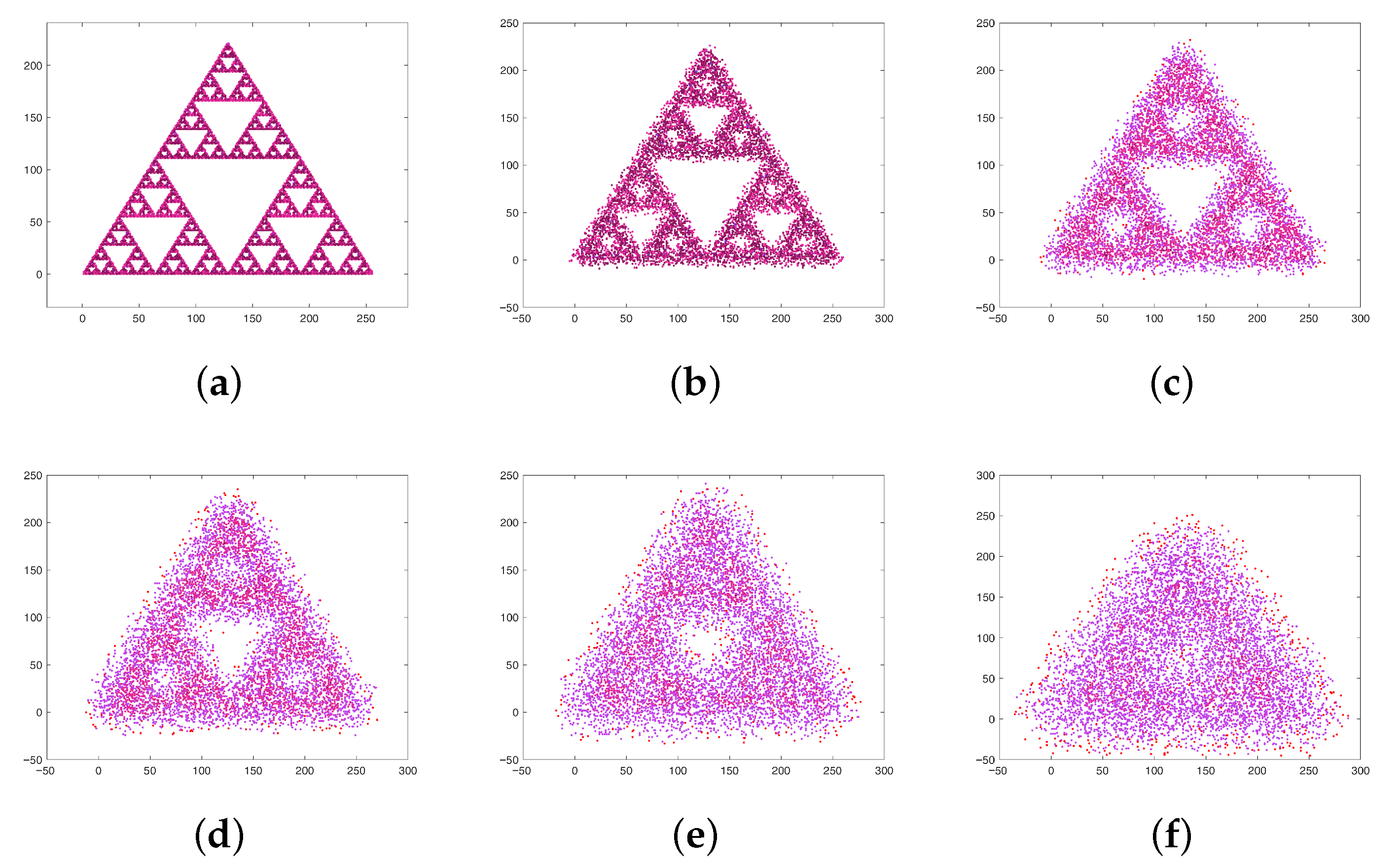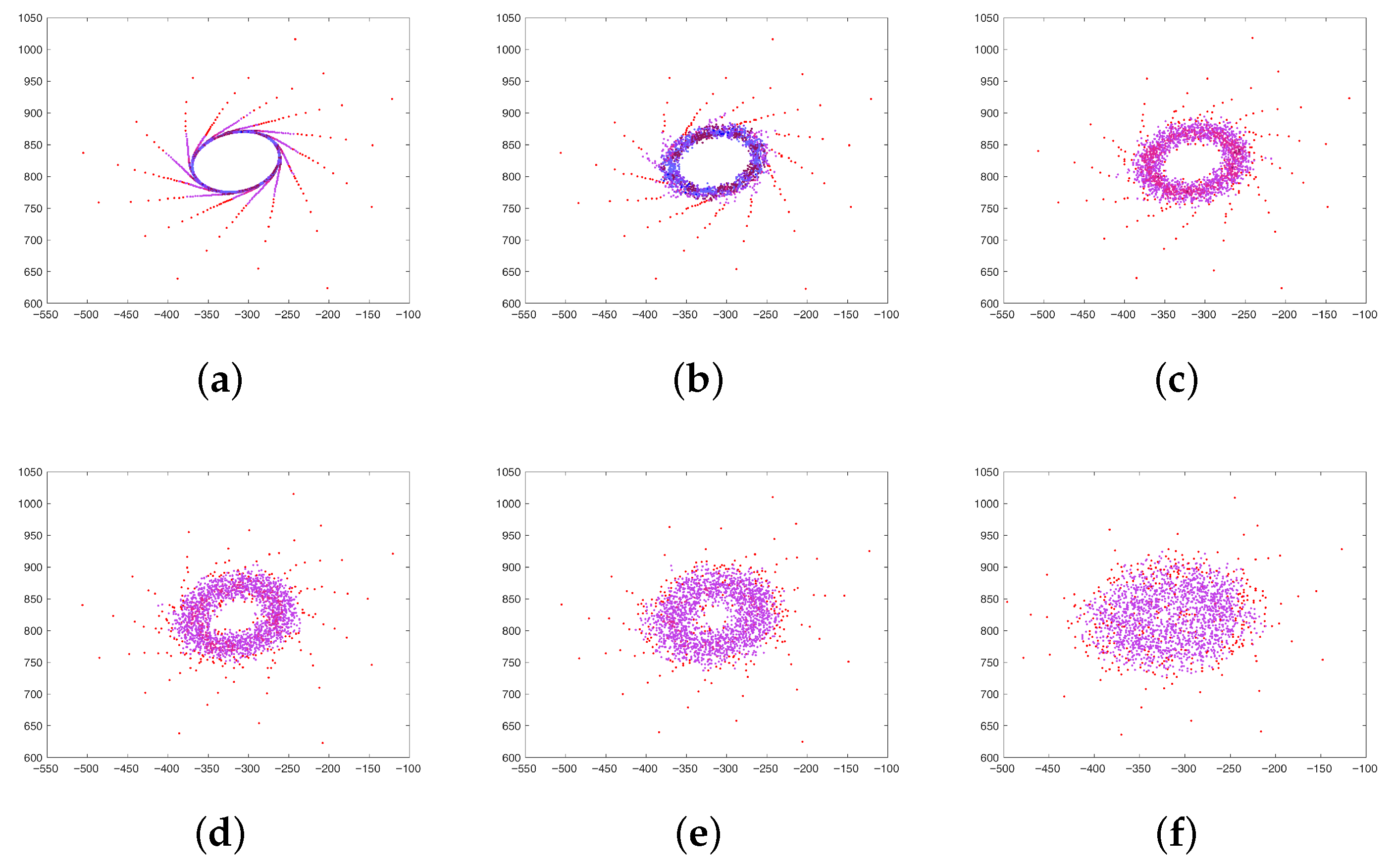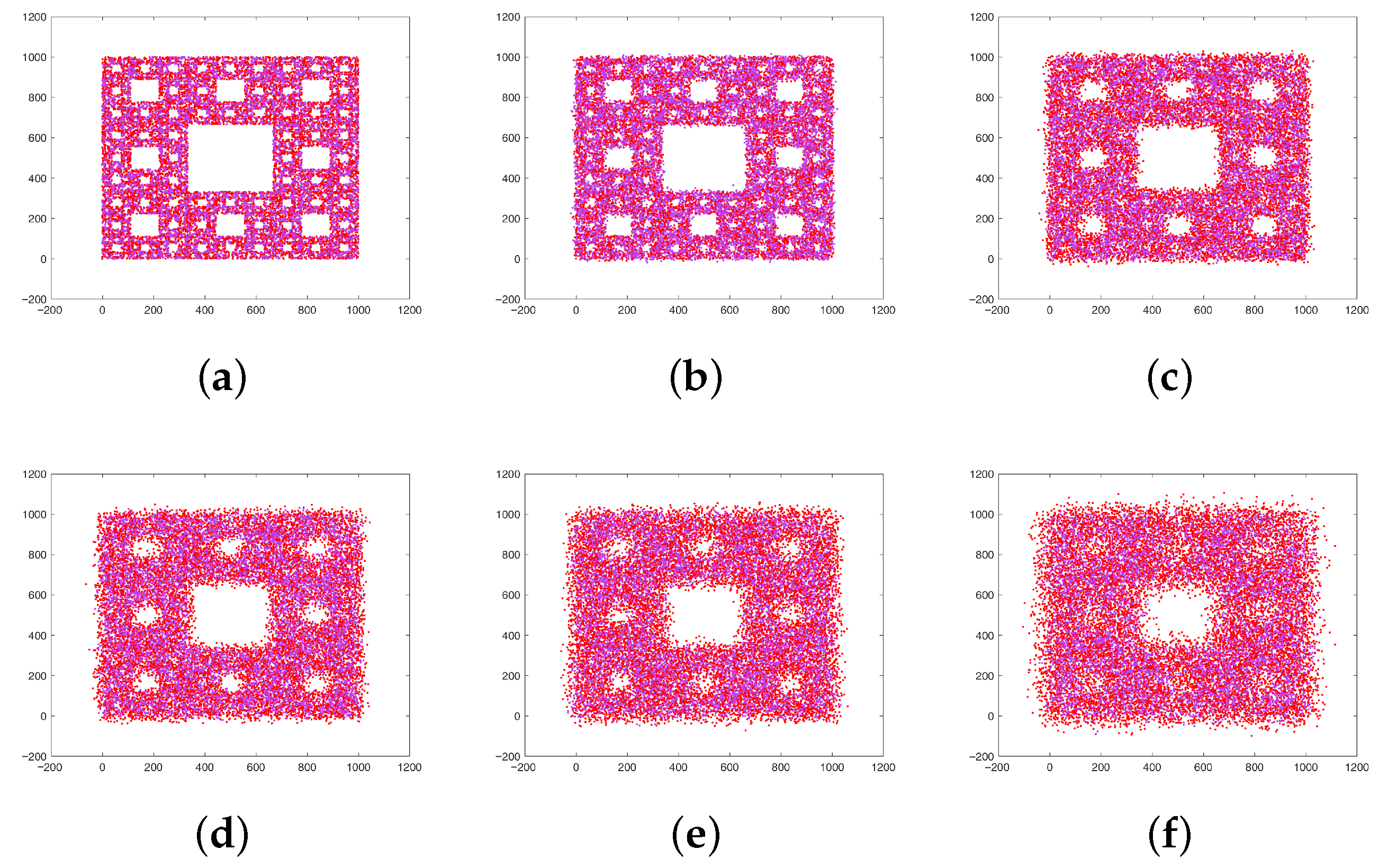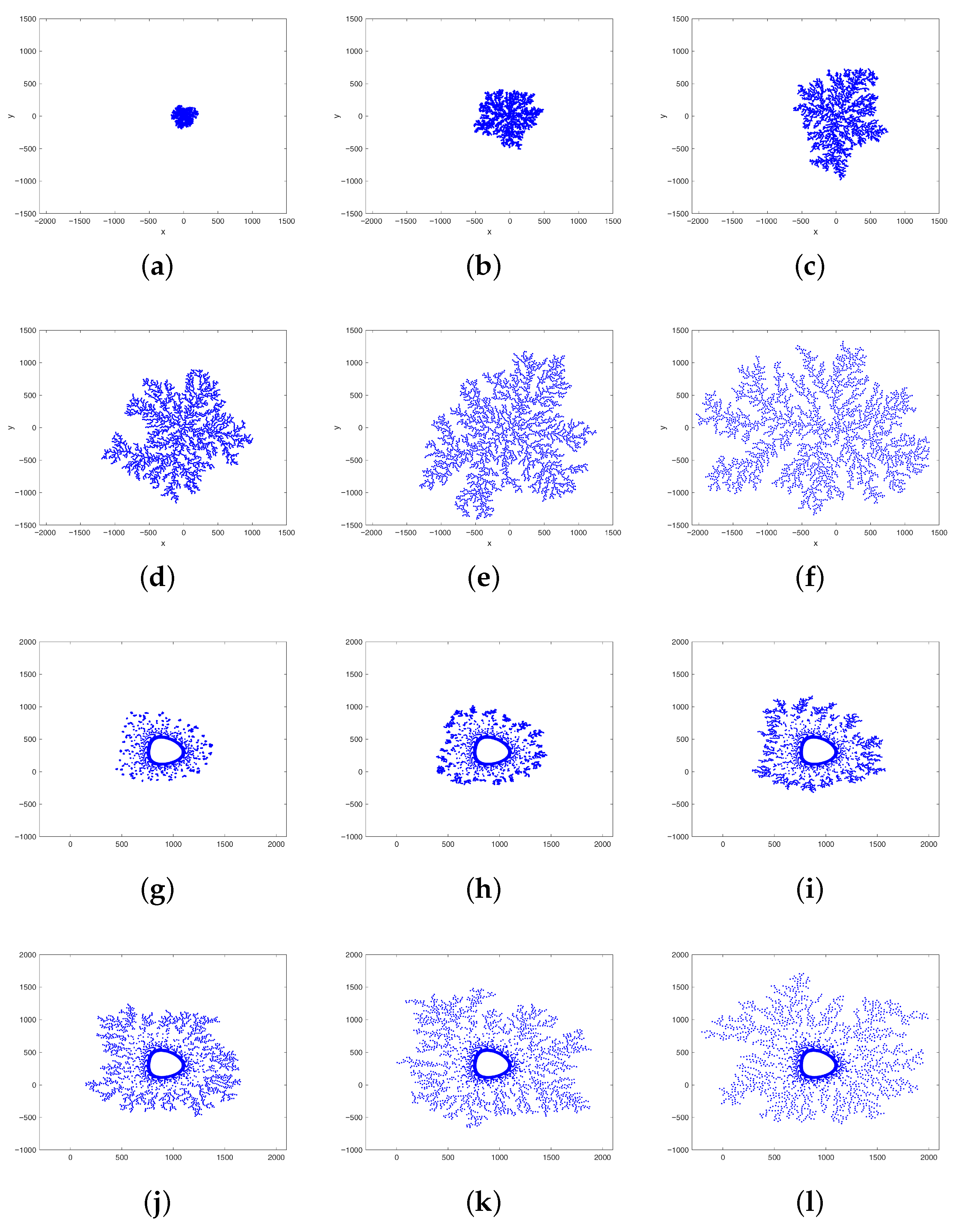

Constructing New Fractal-like Particle Aggregates Using Seeded DLA and Concentration Gradient Diffusion Approaches





Abstract
1. Introduction
2. Classical Fractal-like Aggregate Formation Methods
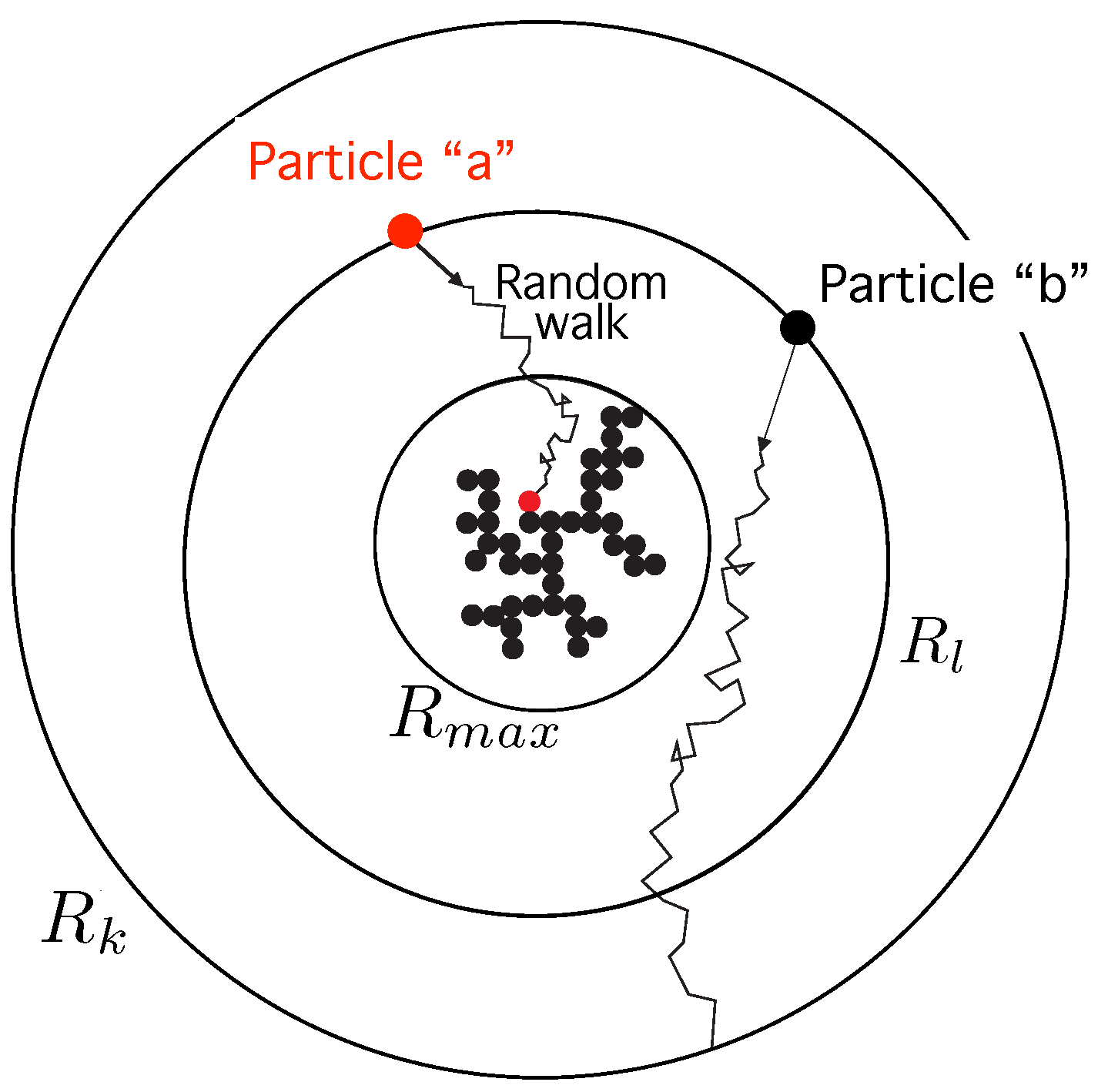
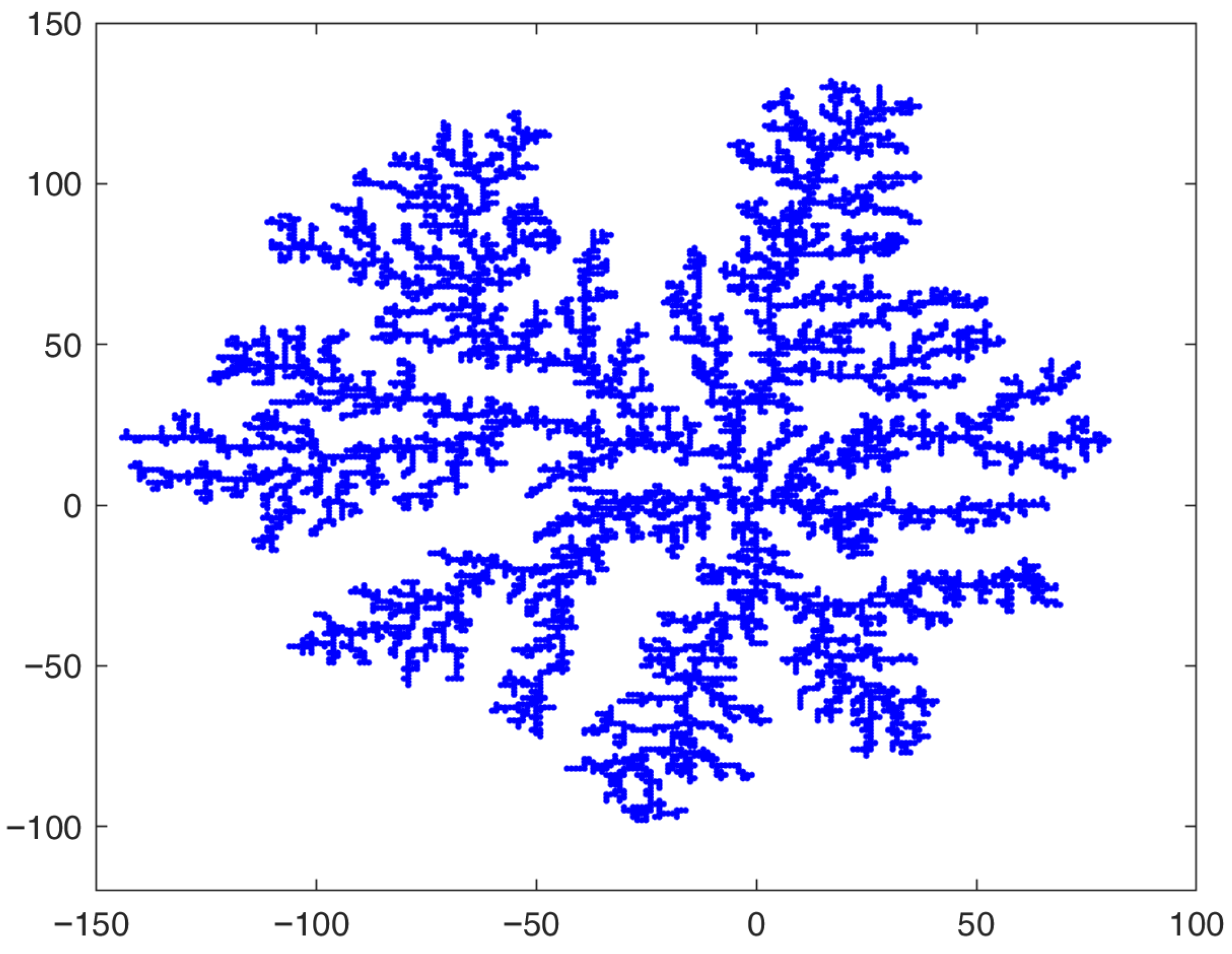
2.1. Diffusion-Limited Aggregation
2.2. Strange Attractors
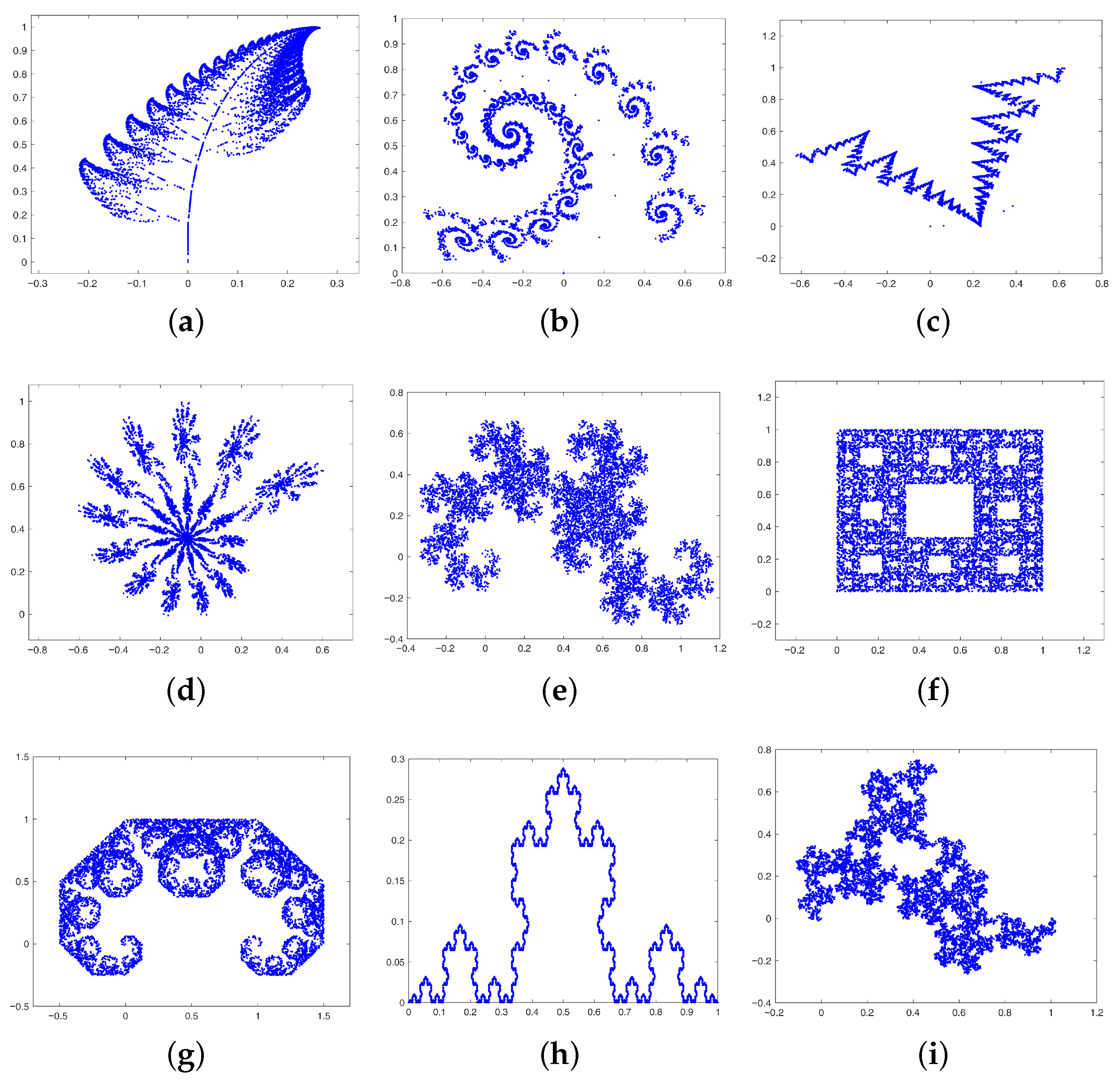
2.3. Iterated Function Systems
2.4. Lindenmayer Systems (L-Systems)
- Encoder:
- Variables: .
- Constants:.
- Seed point: A.
- Rule 1: ().
- Rule 2: ().
- Decoder:
- A: draw forward.
- B: draw forward.
- +: turn left 60 degrees.
- −: turn right 60 degrees.
2.5. Percolation-Based Aggregates
3. Proposed Hybridization Procedures
3.1. Seeded DLA
- 1.
- We start with a re-scaling operation, if necessary, in the initial aggregate , in such a way that its size is modified to adjust to aggregates at integer coordinates. This re-scaling operation is carried out point by point in the structure by multiplying it by a large-enough value. Usually, re-scaling by 2 or 3 orders of magnitude should be enough ( or ), but this will depend on each particular case.
- 2.
- As mentioned before, we consider DLA fractals over integer points to facilitate the fractal construction procedure, so a round operation must be applied after the re-scaling.
- 3.
- The initial aggregate is ready, so it is now considered to be the initial condensation nucleus for the DLA instead of the previous initial point , i.e., .
- 4.
- The DLA procedure described in Section 2.1 is carried out, without any other change to it, for a pre-fixed number of particles. After this, the new fractal aggregate L will be obtained.
3.2. Fractal Aggregate Diffusion Due to Concentration Gradient
3.3. Fractal Dimension Calculation
4. Experiments and Simulation Results
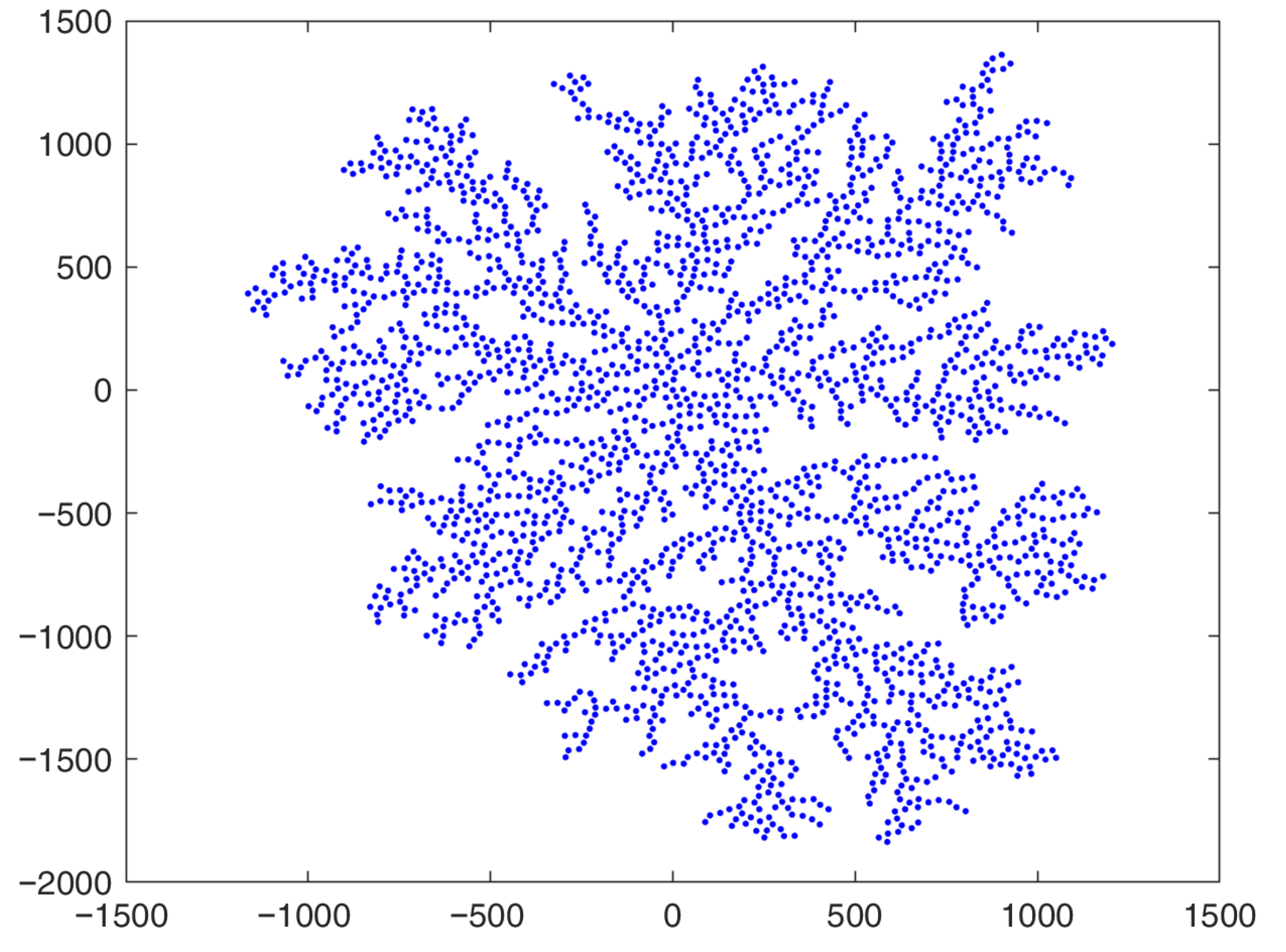
4.1. Simulation of Fractal Aggregate Concentration Gradient Diffusion
4.2. Fractal Aggregates from Seeded DLA
4.3. Final Discussion: Fractal Dimension Analysis
5. Conclusions
Author Contributions
Funding
Data Availability Statement
Conflicts of Interest
Appendix A. Strange Attractor Fractal Construction

Appendix B. IFS Fractal Construction
Appendix C. Color Procedure
References
- Witten, T.A.; Sander, L.M. Diffusion-limited aggregation. Phys. Rev. B 1983, 27, 5686. [Google Scholar] [CrossRef]
- Meakin, P. Formation of fractal clusters and networks by irreversible diffusion-limited aggregation. Phys. Rev. Lett. 1983, 51, 1119. [Google Scholar] [CrossRef]
- Vicsek, T. Fractal models for diffusion controlled aggregation. J. Phys. A Math. Gen. 1983, 16, L647. [Google Scholar] [CrossRef]
- Thouy, R.; Jullien, R. A cluster-cluster aggregation model with tunable fractal dimension. J. Phys. A Math. Gen. 1994, 27, 2953. [Google Scholar] [CrossRef]
- Stanley, H.E.; Bunde, A.; Havlin, S.; Lee, J.; Roman, E.; Schwarzer, S. Recent approaches to understanding diffusion limited aggregation. Phys. A Stat. Mech. Its Appl. 1990, 168, 23–48. [Google Scholar] [CrossRef]
- Stanley, H.; Coniglio, A.; Havlin, S.; Lee, J.; Schwarzer, S.; Wolf, M. Diffusion limited aggregation: A paradigm of disorderly cluster growth. Phys. A Stat. Mech. Its Appl. 1994, 205, 254–271. [Google Scholar] [CrossRef]
- Barabási, A.L.; Stanley, H.E. Fractal Concepts in Surface Growth; Cambridge University Press: Cambridge, UK, 1995. [Google Scholar]
- Matsushita, M.; Sano, M.; Hayakawa, Y.; Honjo, H.; Sawada, Y. Fractal structures of zinc metal leaves grown by electrodeposition. Phys. Rev. Lett. 1984, 53, 286. [Google Scholar] [CrossRef]
- Matsushita, M.; Fujikawa, H. Diffusion-limited growth in bacterial colony formation. Phys. A Stat. Mech. Its Appl. 1990, 168, 498–506. [Google Scholar]
- Caserta, F.; Stanley, H.; Eldred, W.; Daccord, G.; Hausman, R.; Nittmann, J. Physical mechanisms underlying neurite outgrowth: A quantitative analysis of neuronal shape. Phys. Rev. Lett. 1990, 64, 95. [Google Scholar] [CrossRef]
- Liu, D.; Zhou, W.; Qiu, Z.; Song, X. Fractal simulation of flocculation processes using a diffusion-limited aggregation model. Fractal Fract. 2017, 1, 12. [Google Scholar] [CrossRef]
- Lee, J.; Kim, S.W.; Kim, I.; Seo, D.; Choi, H.J. Growth of silicon nanosheets under diffusion-limited aggregation environments. Nanoscale Res. Lett. 2015, 10, 429. [Google Scholar] [CrossRef][Green Version]
- Guo, X.; Wang, J. Modeling of the fractal-like adsorption systems based on the diffusion limited aggregation model. J. Mol. Liq. 2021, 324, 114692. [Google Scholar] [CrossRef]
- Bazant, M.Z.; Choi, J.; Davidovitch, B. Advection-diffusion-limited aggregation. Chaos Interdiscip. J. Nonlinear Sci. 2004, 14, S7. [Google Scholar] [CrossRef]
- Shapovalov, P.G.; Tishchenko, A.A. Polarization radiation from a fractal cluster. Nucl. Instrum. Methods Phys. Res. Sect. A Accel. Spectrometers Detect. Assoc. Equip. 2025, 1073, 170266. [Google Scholar] [CrossRef]
- Retière, N.; Sidqi, Y.; Frankhauser, P. A steady-state analysis of distribution networks by diffusion-limited-aggregation and multifractal geometry. Phys. A Stat. Mech. Its Appl. 2022, 600, 127552. [Google Scholar]
- Baki, M.A.; Badr, L. Electroless, diffusion limited aggregation of lead dendrites. Chaos Solitons Fractals 2021, 143, 110586. [Google Scholar] [CrossRef]
- Zhou, L.; Wang, S.J. Fractal aggregates on geometric graphs. Fractals 2018, 26, 1850038. [Google Scholar] [CrossRef]
- Polimeno, M.; Kim, C.; Blanchette, F. Toward a realistic model of diffusion-limited aggregation: Rotation, size-dependent diffusivities, and settling. ACS Omega 2022, 7, 40826–40835. [Google Scholar] [CrossRef]
- Tomchuk, O. Models for Simulation of Fractal-like Particle Clusters with Prescribed Fractal Dimension. Fractal Fract. 2023, 7, 866. [Google Scholar] [CrossRef]
- Barnsley, M.; Hutchinson, J.; Stenflo, Ö. A fractal valued random iteration algorithm and fractal hierarchy. Fractals 2005, 13, 111–146. [Google Scholar] [CrossRef]
- Bunde, A.; Havlin, S. Percolation I. In Fractals and Disordered Systems; Springer: Berlin/Heidelberg, Germany, 1991; pp. 51–96. [Google Scholar]
- Grassberger, P.; Procaccia, I. Measuring the strangeness of strange attractors. Phys. D Nonlinear Phenom. 1983, 9, 189–208. [Google Scholar]
- Grassberger, P.; Procaccia, I. Characterization of strange attractors. Phys. Rev. Lett. 1983, 50, 346. [Google Scholar] [CrossRef]
- Lindenmayer, A. Mathematical models for cellular interactions in development I. Filaments with one-sided inputs. J. Theor. Biol. 1968, 18, 280–299. [Google Scholar] [CrossRef]
- Batchelor, M.; Henry, B. Diffusion-limited aggregation with Eden growth surface kinetics. Phys. A Stat. Mech. Its Appl. 1994, 203, 566–582. [Google Scholar] [CrossRef]
- Tian, X.; Xia, H. Crossover effects and dynamic scaling properties from Eden growth to diffusion-limited aggregation. Phys. Lett. A 2024, 508, 129494. [Google Scholar] [CrossRef]
- Salcedo-Sanz, S.; Cuadra, L. Hybrid L-systems–diffusion limited aggregation schemes. Phys. A Stat. Mech. Its Appl. 2019, 514, 592–605. [Google Scholar] [CrossRef]
- Salcedo-Sanz, S.; Cuadra, L. Multi-fractal multi-resolution structures from DLA–Strange Attractors Hybrids. Commun. Nonlinear Sci. Numer. Simul. 2020, 83, 105092. [Google Scholar]
- Xia, Z. The growth simulation of pine-needle like structure with diffusion-limited aggregation and oriented attachment. RSC Adv. 2022, 12, 22946–22950. [Google Scholar]
- Bourke, P. Paul Bourke Fractal Art. 2018. Available online: https://paulbourke.net/fractals/ (accessed on 26 October 2025).
- Bourke, P. Constrained diffusion-limited aggregation in 3 dimensions. Comput. Graph. 2006, 30, 646–649. [Google Scholar] [CrossRef]
- Halsey, T.C. Diffusion-limited aggregation: A model for pattern formation. Phys. Today 2000, 53, 36–41. [Google Scholar] [CrossRef]
- Ferreira, S., Jr.; Alves, S.; Brito, A.F.; Moreira, J. Morphological transition between diffusion-limited and ballistic aggregation growth patterns. Phys. Rev. E—Stat. Nonlinear Soft Matter Phys. 2005, 71, 051402. [Google Scholar] [CrossRef][Green Version]
- Salcedo-Sanz, S.; Cuadra, L. Quasi scale-free geographically embedded networks over DLA-generated aggregates. Phys. A Stat. Mech. Its Appl. 2019, 523, 1286–1305. [Google Scholar] [CrossRef]
- Ben-Mizrachi, A.; Procaccia, I.; Grassberger, P. Characterization of experimental (noisy) strange attractors. Phys. Rev. A 1984, 29, 975. [Google Scholar] [CrossRef]
- Sprott, J.C. Strange Attractors: Creating Patterns in Chaos; M & T Books: New York, NY, USA, 1993; Volume 9. [Google Scholar]
- Barnsley, M.F. Superfractals; Cambridge University Press: Cambridge, UK, 2006. [Google Scholar]
- Barnsley, M.F. Transformations between self-referential sets. Am. Math. Mon. 2009, 116, 291–304. [Google Scholar] [CrossRef]
- Williams, G. Using the Fractal Paintbrush. J. Math. Arts 2009, 3, 85–96. [Google Scholar] [CrossRef]
- Salcedo-Sanz, S. Modern meta-heuristics based on nonlinear physics processes: A review of models and design procedures. Phys. Rep. 2016, 655, 1–70. [Google Scholar] [CrossRef]
- Prusinkiewicz, P. Graphical applications of L-systems. Proc. Graph. Interface 1986, 86, 247–253. [Google Scholar]
- Prusinkiewicz, P.; Lindenmayer, A. The Algorithmic Beauty of Plants; Springer Science & Business Media: Berlin/Heidelberg, Germany, 2012. [Google Scholar]
- Cruz, M.Á.M.; Ortiz, J.P.; Ortiz, M.P.; Balankin, A. Percolation on fractal networks: A survey. Fractal Fract. 2023, 7, 231. [Google Scholar] [CrossRef]
- Saberi, A.A. Recent advances in percolation theory and its applications. Phys. Rep. 2015, 578, 1–32. [Google Scholar] [CrossRef]
- Paoluzzi, M.; Leoni, M.; Marchetti, M.C. Fractal aggregation of active particles. Phys. Rev. E 2018, 98, 052603. [Google Scholar] [CrossRef]
- Addison, P.S. Fractals and Chaos: An Illustrated Course; CRC Press: Boca Raton, FL, USA, 1997. [Google Scholar]
- Hänggi, P.; Marchesoni, F. Introduction: 100years of Brownian motion. Chaos Interdiscip. J. Nonlinear Sci. 2005, 15, 026101. [Google Scholar] [CrossRef] [PubMed]
- He, J.H.; Qian, M.Y. A fractal approach to the diffusion process of red ink in a saline water. Therm. Sci. 2022, 26, 2447–2451. [Google Scholar] [CrossRef]
- Voss, R.F. Random fractals: Characterization and measurement. In Scaling Phenomena in Disordered Systems; Springer: Berlin/Heidelberg, Germany, 1986; pp. 1–11. [Google Scholar]
- Block, A.; Von Bloh, W.; Schellnhuber, H. Efficient box-counting determination of generalized fractal dimensions. Phys. Rev. A 1990, 42, 1869. [Google Scholar] [CrossRef]
- Freiberg, U.; Kohl, S. Box dimension of fractal attractors and their numerical computation. Commun. Nonlinear Sci. Numer. Simul. 2021, 95, 105615. [Google Scholar] [CrossRef]
- Wang, R.; Singh, A.K.; Kolan, S.R.; Tsotsas, E. Investigation of the relationship between the 2D and 3D box-counting fractal properties and power law fractal properties of aggregates. Fractal Fract. 2022, 6, 728. [Google Scholar] [CrossRef]
- Termonia, Y.; Alexandrowicz, Z. Fractal dimension of strange attractors from radius versus size of arbitrary clusters. Phys. Rev. Lett. 1983, 51, 1265. [Google Scholar] [CrossRef]
- Martínez-Cruz, M.Á.; Patiño-Ortiz, J.; Patiño-Ortiz, M.; Balankin, A.S. Some Insights into the Sierpiński Triangle Paradox. Fractal Fract. 2024, 8, 655. [Google Scholar] [CrossRef]
- Mureika, J.R.; Dyer, C.; Cupchik, G. Multifractal structure in nonrepresentational art. Phys. Rev. E—Stat. Nonlinear Soft Matter Phys. 2005, 72, 046101. [Google Scholar] [CrossRef]
- Dierking, I. Liquid crystals, fractals and art. Liq. Cryst. Today 2012, 21, 54–65. [Google Scholar] [CrossRef]
- Husain, A.; Nanda, M.N.; Chowdary, M.S.; Sajid, M. Fractals: An eclectic survey, part-I. Fractal Fract. 2022, 6, 89. [Google Scholar] [CrossRef]
- McDonough, J.; Herczyński, A. Fractal contours: Order, chaos, and art. Chaos Interdiscip. J. Nonlinear Sci. 2024, 34, 063126. [Google Scholar] [CrossRef]
- Lutton, E. Evolution of fractal shapes for artists and designers. Int. J. Artif. Intell. Tools 2006, 15, 651–672. [Google Scholar] [CrossRef]
- Fernandes, C.M.; Mora, A.M.; Merelo, J.J.; Rosa, A.C. KANTS: A stigmergic ant algorithm for cluster analysis and swarm art. IEEE Trans. Cybern. 2013, 44, 843–856. [Google Scholar] [CrossRef]
- Dawar, A.; Chandra, A. Fractal forming species and hierarchical growth in polymer electrolyte composites: Raman mapping and role of seed particles. Commun. Nonlinear Sci. Numer. Simul. 2013, 18, 959–972. [Google Scholar] [CrossRef]
- Salcedo-Sanz, S.; Aybar-Ruíz, A.; Camacho-Gómez, C.; Pereira, E. Efficient fractal-based mutation in evolutionary algorithms from iterated function systems. Commun. Nonlinear Sci. Numer. Simul. 2018, 56, 434–446. [Google Scholar] [CrossRef]
- Husain, A.; Nanda, M.N.; Chowdary, M.S.; Sajid, M. Fractals: An eclectic survey, part-II. Fractal Fract. 2022, 6, 379. [Google Scholar] [CrossRef]







| Fractal Aggregate | ||||
|---|---|---|---|---|
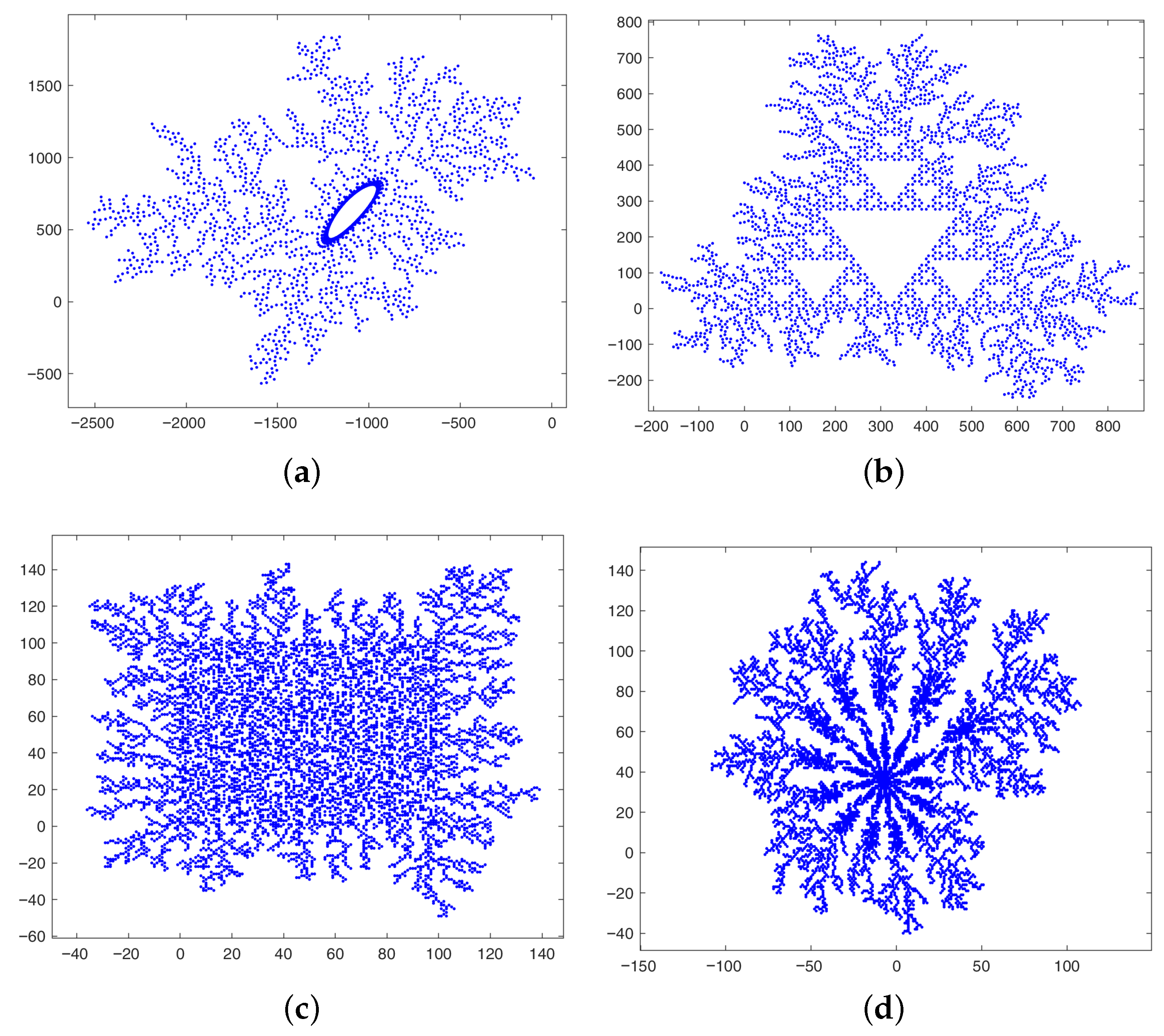
| (Figure 15a,g) | 1.72 | 1.63 | 2047 | 3081 |
| (Figure 15b,h) | 1.77 | 1.62 | 2695 | 3132 |
| (Figure 15c,i) | 1.70 | 1.72 | 2869 | 3211 |
| (Figure 15d,j) | 1.71 | 1.70 | 2867 | 3315 |
| (Figure 15e,k) | 1.71 | 1.74 | 2944 | 3519 |
| (Figure 15f,l) | 1.71 | 1.72 | 2876 | 3354 |
| Fractal Aggregate | ||
|---|---|---|
| Figure 16a | 1.33 | 1.65 |
| Figure 16b | 1.58 | 1.69 |
| Figure 16c | 1.84 | 1.80 |
| Figure 16d | 1.59 | 1.67 |
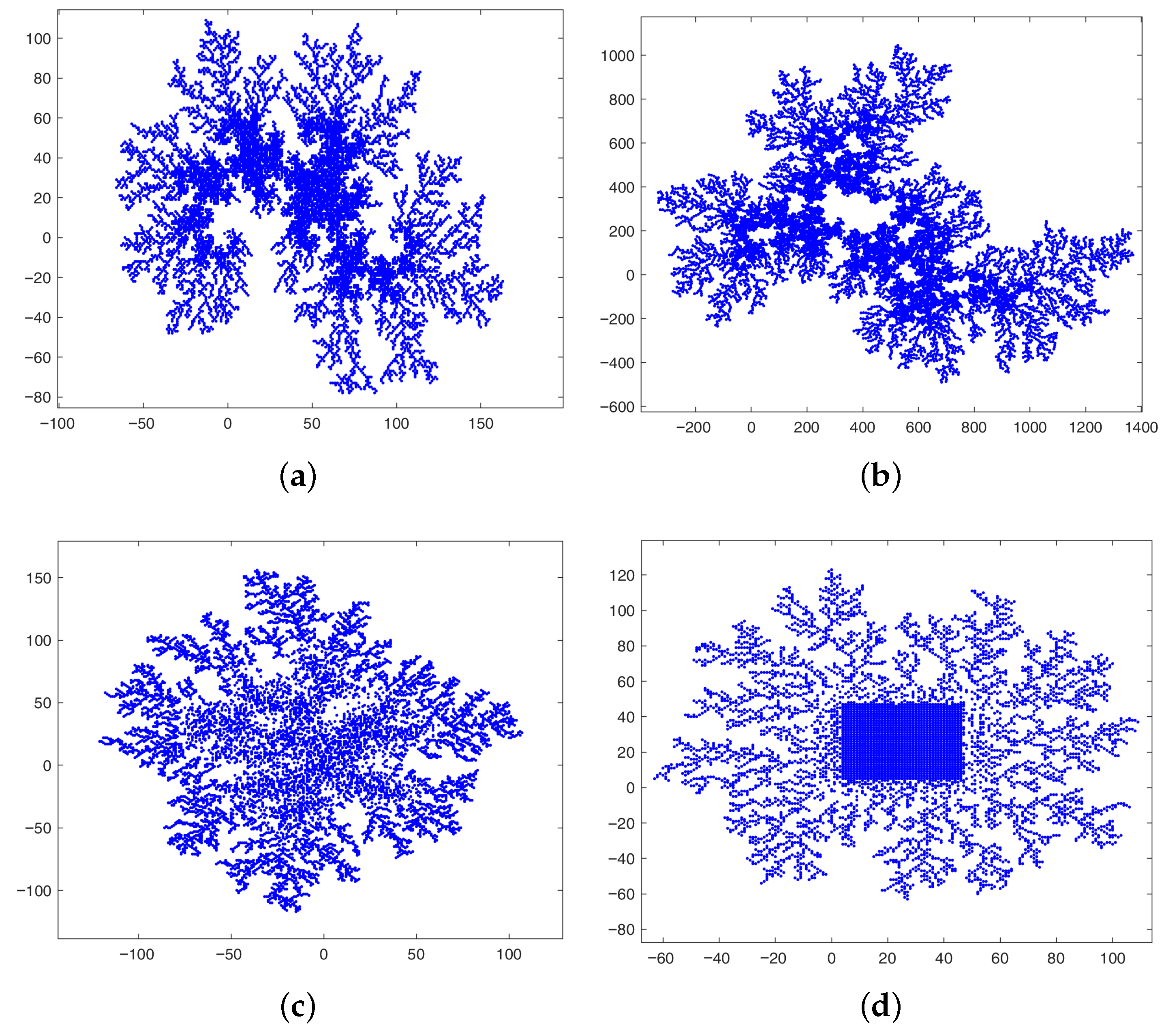
| Figure 17a | 1.69 | 1.80 |
| Figure 17b | 1.65 | 1.75 |
| Figure 17c | 1.71 | 1.78 |
| Figure 17d | 1.76 | 1.76 |
Disclaimer/Publisher’s Note: The statements, opinions and data contained in all publications are solely those of the individual author(s) and contributor(s) and not of MDPI and/or the editor(s). MDPI and/or the editor(s) disclaim responsibility for any injury to people or property resulting from any ideas, methods, instructions or products referred to in the content. |
© 2026 by the authors. Licensee MDPI, Basel, Switzerland. This article is an open access article distributed under the terms and conditions of the Creative Commons Attribution (CC BY) license.
Share and Cite
Salcedo-Sanz, S.; Álvarez-Couso, P.; Castelo-Sardina, L.; Pérez-Aracil, J. Constructing New Fractal-like Particle Aggregates Using Seeded DLA and Concentration Gradient Diffusion Approaches. Fractal Fract. 2026, 10, 68. https://doi.org/10.3390/fractalfract10010068
Salcedo-Sanz S, Álvarez-Couso P, Castelo-Sardina L, Pérez-Aracil J. Constructing New Fractal-like Particle Aggregates Using Seeded DLA and Concentration Gradient Diffusion Approaches. Fractal and Fractional. 2026; 10(1):68. https://doi.org/10.3390/fractalfract10010068
Chicago/Turabian StyleSalcedo-Sanz, Sancho, Pablo Álvarez-Couso, Luis Castelo-Sardina, and Jorge Pérez-Aracil. 2026. "Constructing New Fractal-like Particle Aggregates Using Seeded DLA and Concentration Gradient Diffusion Approaches" Fractal and Fractional 10, no. 1: 68. https://doi.org/10.3390/fractalfract10010068
APA StyleSalcedo-Sanz, S., Álvarez-Couso, P., Castelo-Sardina, L., & Pérez-Aracil, J. (2026). Constructing New Fractal-like Particle Aggregates Using Seeded DLA and Concentration Gradient Diffusion Approaches. Fractal and Fractional, 10(1), 68. https://doi.org/10.3390/fractalfract10010068