Article

Multifractal Characteristics of the Pore Structure and Resistance to Chloride Ion Penetration of Cement Mortar Modified with a Waterborne Nanosilicate-Based Densifier


1
Faculty of Civil Engineering and Mechanics, Kunming University of Science and Technology, Kunming 650500, China
2
Yunnan Key Laboratory of Disaster Reduction in Civil Engineering, Kunming 650500, China
3
International Joint Laboratory for Green Construction and Intelligent Maintenance of Yunnan Province, Kunming 650500, China
*
Author to whom correspondence should be addressed.
Fractal Fract. 2026, 10(1), 58; https://doi.org/10.3390/fractalfract10010058
Submission received: 21 November 2025 / Revised: 22 December 2025 / Accepted: 10 January 2026 / Published: 14 January 2026
(This article belongs to the Special Issue Fractal Analysis and Its Applications in Materials Science)

Abstract

Cementitious composites are heterogeneous porous materials whose pore structure plays a critical role in resistance to chloride-ion penetration. A waterborne nano-silicate-based densifier (CF-S5) was used to examine its influence on the pore structure and resistance to the chloride ion penetration of mortar. We investigated the resistance to the chloride ion penetration of mortar with added CF-S5 admixture through the Rapid Chloride Permeability Test (RCPT). We investigated the pore structure characteristics of mortar by mercury intrusion porosimetry (MIP) coupled with fractal theory and investigated the degree of hydration of the cement paste by thermogravimetric analysis (TG). Ultimately, the degree of correlation between multifractal parameters and the chloride ion migration coefficient of mortar was examined using gray relational analysis (GRA). Results indicate that the CF-S5 admixture reduces mortar porosity and the content of harmful pores while increasing pore tortuosity, thus improving the resistance to the chloride ion penetration of mortar. Multifractal analysis indicated that the CF-S5 admixture decreased the connectivity and increased the complexity of the mortar pore structure. The CF-S5 admixture did not reduce the hydration degree of cement paste at 28 d. Additionally, the multifractal parameters show a high gray relational degree with the chloride migration coefficient; therefore, they may serve as potential indicators to reflect the resistance to the chloride ion penetration of mortar.

1. Introduction

Reinforced concrete (RC) is widely used in the construction of infrastructure such as bridges, tunnels, and marine engineering due to its excellent mechanical properties, durability, and cost-effectiveness [1,2]. However, when RC structures are exposed to chloride-rich environments over extended periods, chloride ion corrosion erodes the passivation film on reinforcing steel surfaces and induces electrochemical corrosion. This procedure leads to the rust expansion of the bars, and the cracking and spalling of the concrete, significantly weakening the structure’s durability and shortening its service life, and thus increasing subsequent maintenance expenses and safety risks [3,4,5,6,7]. Therefore, enhancing the service performance of RC structures in chloride-containing environments has become one of the core research topics in concrete durability studies.
In a chloride salt environment, the durability of RC structures largely depends on the concrete’s resistance to the penetration of chloride-corrosive media [8]. This resistance is closely related to the microstructure of the concrete matrix, which is particularly influenced by pore structure characteristics and the interface transition zone (ITZ) [9,10]. Meanwhile, as a typical porous composite material, concrete often exhibits high porosity and complex pore connectivity, which provides channels for chloride ion penetration and diffusion [11], and this facilitates chloride ion accumulation on the surface of reinforcing steel, thereby accelerating the corrosion rate of the reinforcement [12,13]. Therefore, regulating the geometric features of the concrete pore structure at the microscopic scale and weakening the connectivity of pore pathways are key approaches to enhancing the resistance to chloride ion penetration in reinforced concrete.
Currently, common strategies for optimizing the pore structure of cementitious composites to improve their durability include reducing the water–cement ratio [14,15,16], introducing mineral admixtures (SCMs) [17,18,19,20,21], and using nanomaterials [22,23,24,25,26]. However, these approaches afford only limited protective efficacy in highly corrosive environments [27]. Furthermore, the modification efficiency and engineering value of certain SCMs and nanomaterials are constrained by poor dispersibility, slow reaction rates, and relatively high economic costs [28]. In recent years, various functional chemical admixtures have been introduced into cementitious material systems to refine the pore structure and enhance material durability [29,30]. For example, lignosulfonate-based waterproofing admixtures can significantly reduce concrete porosity, thereby improving its resistance to chloride ion penetration [29,31]; polydimethylsiloxane-based hydrophobic admixtures (PDMs) effectively diminish the connectivity of the pore network, markedly enhancing the impermeability and durability of cement mortars [32,33]; crystalline admixtures (CAs) can substantially reduce the porosity of cement-based composites and promote the transformation of macropores into mesopores, thereby enhancing the material’s impermeability and self-healing capability [34,35], while polycarboxylate superplasticizers (PCE) and their derivative admixtures improve the overall density and impermeability of cement paste by optimizing its pore structure [36,37]. Additionally, some scholars have pointed out that the compatibility between chemical admixtures and cementitious materials may affect their stability and applicability in engineering applications [38]. Incompatibility can lead to issues such as slump loss or bleeding and segregation in cement-based materials [30]. Overall, although a range of chemical admixtures are known to improve the pore structure and durability of cementitious materials, systematic research on CF-S5 admixtures remains scarce. Its effects on the pore structure characteristics and the resistance to the chloride ion penetration of mortar have yet to be thoroughly elucidated.
Existing studies have demonstrated that, within the conventional Euclidean (geometry-based) framework, pore structure analysis typically relies on geometric statistical parameters (porosity, pore volume, specific surface area, and characteristic pore diameter) to describe the global features of the pore structure [39,40,41]. However, the pore structure of cementitious composites exhibits multiscale complex characteristics, including a wide range of pore size distributions, irregular shapes, and disordered spatial arrangements [20,42]. Therefore, relying solely on traditional geometric statistical parameters for pores is insufficient to capture the complex and non-uniform characteristics of the pore structure in cementitious materials [43,44]. Fractal theory serves as an important tool for characterizing irregular geometries and chaotic systems and has found wide applications in the microstructural analysis of porous media such as soils [45,46], rocks [47,48], and coal [49,50]. It has thereby provided new insights and methodologies for the quantitative characterization of pore structures in cementitious materials [51,52]. Existing fractal analysis methods include single-fractal and multifractal analysis [53]. Among these, single-fractal analysis characterizes the overall complexity of pore structures solely through a single fractal dimension [54]. Multifractal analysis, on the other hand, captures internal variability by analyzing the local density (probability distribution) of pore distribution, and further employs the multifractal singularity spectrum and generalized dimension spectrum to quantify the multiscale features and spatial heterogeneity of pore structures [49,50]. Consequently, multifractal analysis offers greater potential for pore structure characterization [47,48,53,54]. In recent years, multifractal theory has been widely applied to reveal the quantitative relationship between the fractal characteristics of pores in mortar and concrete and their macroscopic properties. For example, Wang et al. [55] employed multifractal analysis to reveal the influence of nanofillers on the porosity connectivity and impermeability of ultra-high performance cementitious composites (UHPCCs). Sun et al. [56] used multifractal theory to systematically examine pore structure evolution in diatomaceous earth mortar under freeze–thaw cycles and verified that multifractal parameters can reliably characterize the heterogeneity and connectivity of the pore structure, confirming the reliability of multifractal parameters in characterizing pore structure heterogeneity and connectivity. Additionally, Zhu et al. [57] examined how cellulose nanocrystals (CNCs) affect the pore structure and drying shrinkage of alkali-activated regenerative ultra-high-performance concrete (A-RUHPC) by means of multifractal analysis and established a linear relationship between the multifractal indices and the drying shrinkage rate. Therefore, multifractal theory holds promise for providing new theoretical references and research methodologies to deepen our understanding of the evolution of mortar pore structure under the influence of the CF-S5 admixture and the mechanism of mortar’s resistance to chloride ion penetration.
In summary, this study first investigates the effect of different dosages of the CF-S5 admixture on the resistance to the chloride ion penetration of mortar. Subsequently, by combining mercury intrusion porosimetry (MIP) with multifractal analysis, we systematically characterize the mortar’s pore structure and elucidate, from a pore structure perspective, the microscopic mechanisms by which CF-S5 enhances durability. The degree of hydration of the cement pastes and the amounts of hydration products are quantified from thermogravimetric (TG) results. Finally, relationships between multifractal parameters and the chloride ion migration coefficient of mortar are examined using gray relational analysis and linear regression. Overall, this study aims to elucidate the evolution of the mortar pore structure under the influence of the CF-S5 admixture and the mechanisms by which it enhances resistance to chloride ion penetration, thereby supplying a theoretical underpinning and technical support for its deployment in practical engineering projects.

2. Materials and Methods

2.1. Materials

The cement mortar mixture in this study consists of the following materials: (1) ordinary Portland cement (P.O. 42.5) supplied by Yunnan Huaxin Cement Co., Ltd. (Kunming, China), with its chemical composition shown in Table 1; (2) ISO-standard sand conforming to GB/T 17671-2021 [58], supplied by Xiamen ISO Standard Sand Co., Ltd. (Xiamen, China); (3) polycarboxylic acid high-performance water-reducing agent concentrate (HLX Standard Type), with a solid content of 39.7 wt.%, supplied by Shanxi Feike New Material Technology Co., Ltd. (Yuncheng, China); (4) laboratory tap water as the mixing water; (5) a CF-S5 chemical admixture (waterborne nano-silicate-based densifier), supplied by Landun (Yunnan) Engineering Technology Co., Ltd. (Kunming, China). The CF-S5 admixture is a multi-component system mainly comprising nano-silicate, silicon dioxide (SiO2), and titanate coupling agents; the total solid (non-volatile) content of the CF-S5 admixture was measured to be approximately 13.7 wt.%.

2.2. Mixture Design and Specimen Preparation

As shown in Table 2, all mixtures were prepared using a constant cement: standard sand: water mass ratio of 1:2.85:0.40, with the water-reducing agent dosage fixed at 0.22% by mass of cement. The dosage of the CF-S5 admixture was varied at 0%, 0.1%, 0.2%, and 0.3% by mass of cement. It should be noted that the dosages of both the water-reducing agent and CF-S5 admixture are based on the masses of the as-supplied commercial liquid products, rather than on an active-solids basis. The mixture without the CF-S5 admixture was designated as OPC, serving as the baseline control group, while mixtures with the CF-S5 admixture were labeled according to dosage as S5-0.1, S5-0.2, and S5-0.3. The fluidity of fresh cement mortar was measured using the flow table test in accordance with GB/T 2419-2005 [59] and reported as the spread diameter (mm).
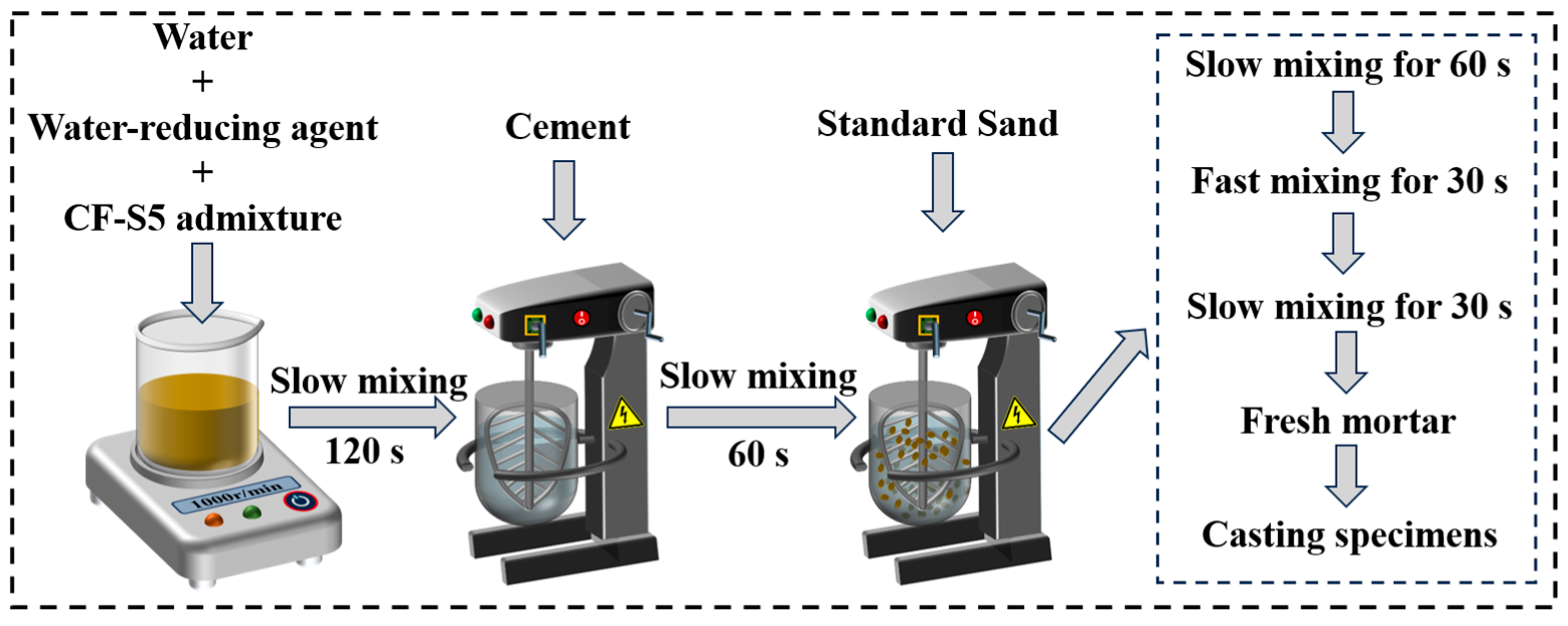
In accordance with to the mix proportions in Table 2, the cement mortars were prepared following the process flow shown in Figure 1. The fresh cement mortar was cast into specimens of the following dimensions: (1) 40 mm × 40 mm × 160 mm prismatic specimens for compressive strength testing; (2) cylindrical specimens of Φ100 mm × 50 mm for testing chloride ion permeability. To avoid moisture loss, the specimens were promptly covered with plastic film as soon as they were cast. Following 24 h of curing, the molds were removed, and the specimens were transferred to a standard curing chamber (20 ± 5 °C; RH > 95%) for continuous curing. Performance tests were conducted at an age of 28 d.

2.3. Compressive Strength Test

Following GB/T 17671-2021 [58], compressive strength was tested by first imposing a 500 N preload and subsequently loading the specimens to failure at a constant rate of 2.5 kN/s. The data are presented as the average of six specimens. The experiments were carried out on a computer-controlled oil–electric hybrid servo compression tester (WANCE, HCT206E; maximum capacity 2000 kN).

2.4. Test on Chlorine Ion Permeation Performance

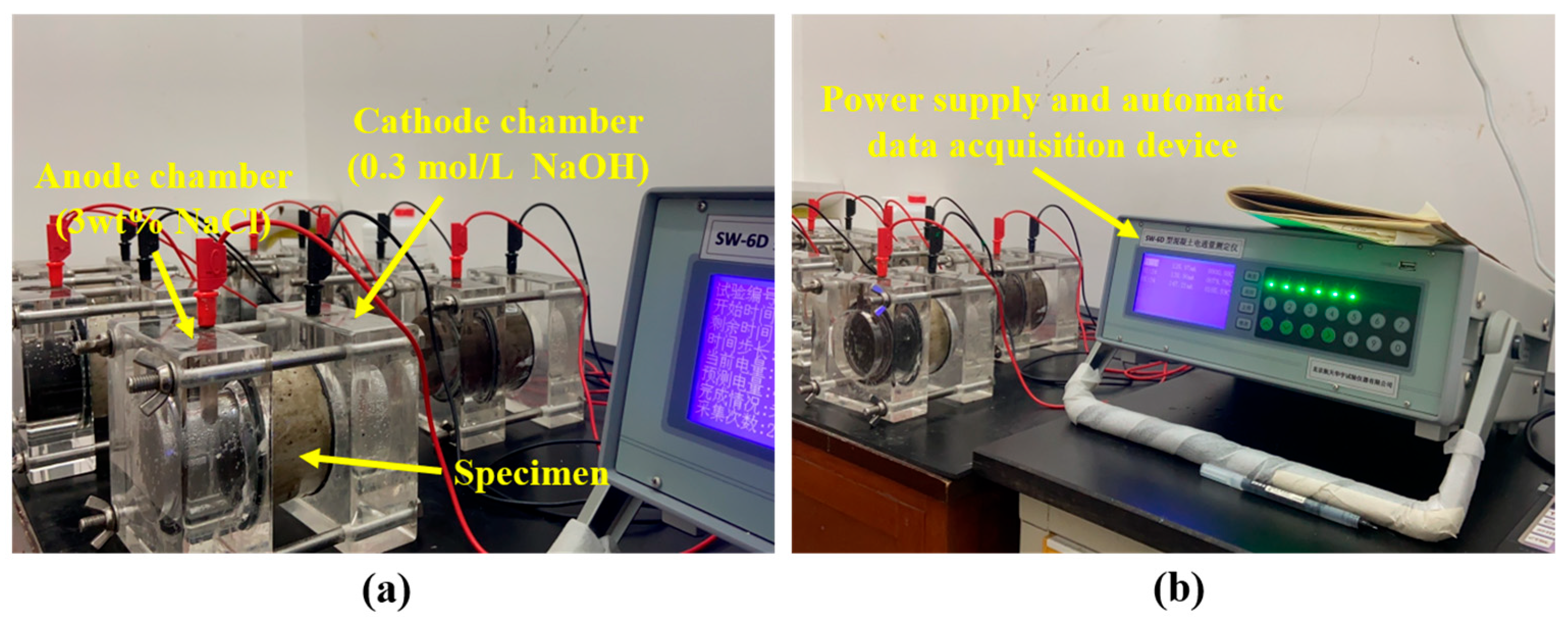
In this study, the resistance to chloride ion penetration in mortar was investigated in accordance with ASTM C1202, the Rapid Chloride Permeability Test (RCPT) [60]. Before the RCPT, we sealed the side surfaces of the specimens using an epoxy resin coating to avoid chloride ion leakage. First, we placed the specimen in the vacuum saturation apparatus. We evacuated it to an absolute pressure of 1–5 kPa within 5 min and held this vacuum for 3 h. Subsequently, while maintaining the vacuum, we introduce deionized water until the specimen was completely submerged. We maintained the vacuum for an additional 1 h; then, we restored the chamber to atmospheric pressure and continued immersion for 18 h ± 2 h. We then removed the specimen and blotted the surface dry. As shown in Figure 2, the specimen was mounted on a dedicated two-chamber test cell. The anode chamber was filled with 0.3 mol/L NaOH, while the cathode chamber was filled with 3 wt.% NaCl. A constant 60 V DC voltage was then applied for 6 h. The current was logged every 10 min with an automatic data acquisition system (±0.5 mA accuracy), and the temperatures of both chambers were monitored throughout. Each group included three replicate specimens to ensure data reliability. According to the testing principle (RCPT, ASTM C1202), the total electric flux Q passing through the specimen within 6 h can be calculated using Equation (1).
Q = 900 I 0 + 2 I 30 + 2 I 60 + + 2 I 330 + I 360 × 95 100 2
where Q is the total electric flux (C) passing through a 95 mm diameter specimen within 6 h, It is the current (A) at time t, and t is the time (min).
After completion of the RCPT, the specimens were split along the longitudinal axis using a universal testing machine. The freshly exposed fracture surfaces were sprayed with a 0.1 mol/L AgNO3 solution to develop color. Once white AgCl precipitation fully appeared, and the depth of chloride ion penetration was determined using a vernier caliper with a precision of 0.01 mm.

2.5. Mercury Intrusion Porosimetry (MIP)

The pore structure of the specimens was determined using mercury intrusion porosimetry (MIP) with an AutoPore IV 9600 apparatus (Micromeritics Instrument Corporation, Norcross, GA, USA). In accordance with ASTM D4404 [61], the contact angle between mercury and the solid was set to 130°, and the mercury surface tension was set to 0.485 N·m−1. The applied pressure ranged from 3.45 kPa to 414 MPa. Following RILEM TC 238-SCM [62], hydration was stopped by isopropanol solvent exchange. The specimens were then dried at 60 °C to constant mass, cooled to room temperature in a desiccator, and subsequently tested.

2.6. Thermogravimetric Analysis (TG/DTG)

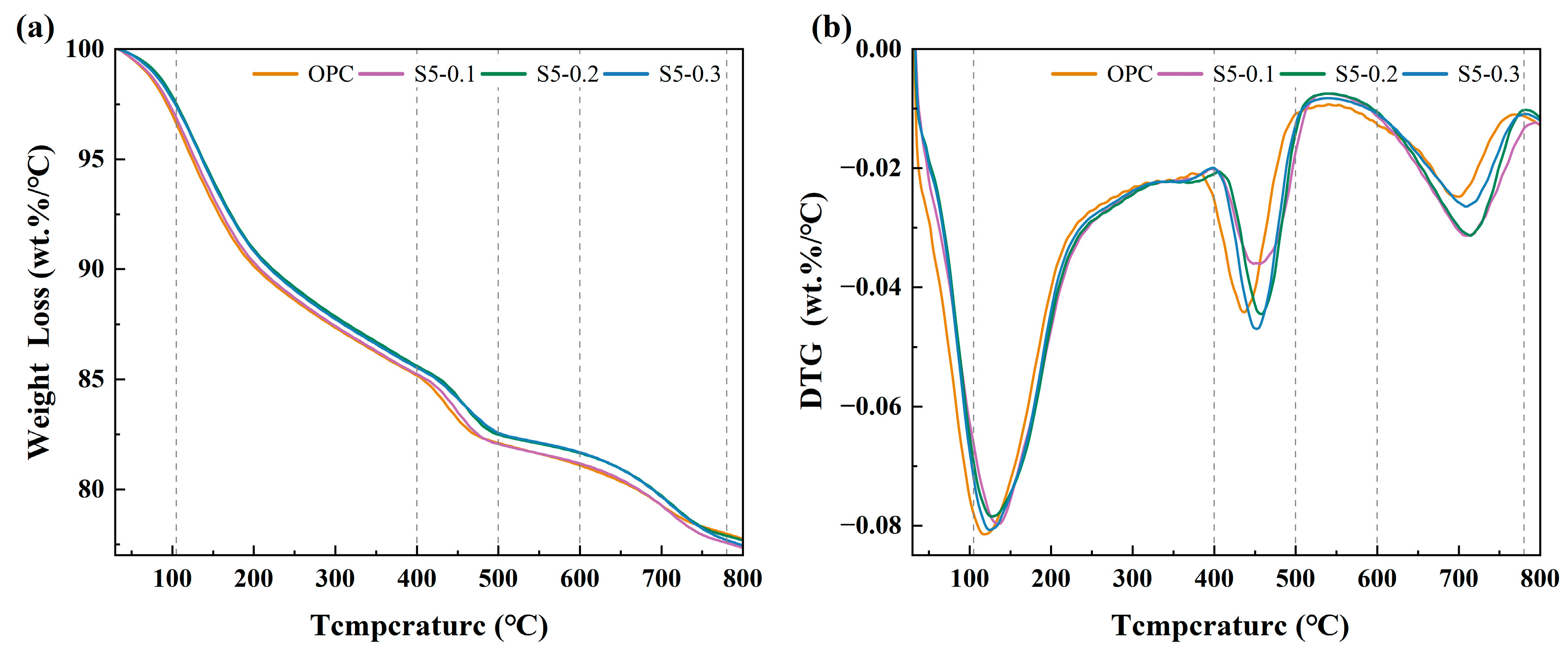
Thermogravimetric analysis (TG) is commonly applied to assess the degree of hydration and the contents of hydration products in cement paste [63]. In this study, TG measurements were performed on a PerkinElmer, Waltham, MA, USA, instrument. Approximately 20 mg of powdered specimen was heated from room temperature to 800 °C at 10 °C·min−1 under a nitrogen atmosphere. To eliminate the influence of free water, 105 °C was taken as the reference temperature, assuming complete evaporation of free water at this point; subsequent calculations were based on the 105 °C-corrected pseudo-dry mass [64]. The temperature intervals for each thermal decomposition stage were delineated with reference to previous studies [63,64,65] together with the TGA–DTG curves obtained herein. On this basis, the calcium hydroxide (Ca(OH)2) content (Equation (2)), the calcium carbonate (CaCO3) content (Equation (3)), and the degree of hydration, δ, were calculated; δ was determined according to Bhatty’s method [65] using Equations (4) and (5).
C a ( O H ) 2 ( % ) = ( M 400 ° C M 500 ° C ) M 105 ° C × 74.09 18.01 × 100 %
C a C O 3 ( % ) = ( M 600 ° C M 780 ° C ) M 105 ° C × 100.09 44.01 × 100 %
W B = L d h + L d X + 0.41 × L d c
δ ( % ) = W B 0.24 × 100 %
where M105°C, M400°C, M500°C, M600°C, and M780°C indicate the residual mass (g) of the specimen at temperatures of 105 °C, 400 °C, 500 °C, 600 °C, and 780 °C, respectively. Additionally, WB indicates the content of chemically bound water, while Ldh, Ldx, and Ldc denote the relative mass losses during C–S–H gel dehydration, Ca(OH)2 de-hydroxylation, and CaCO3 decarbonation.

2.7. Multifractal Analysis

To reveal the influence of the CF-S5 admixture on the multiscale characteristics of mortar pore systems, this study quantitatively characterized the pore structure features using multifractal analysis based on pore information obtained via MIP. The specific process of multifractal analysis is as follows.
First, assume that the cementitious composite has a pore size distribution interval of J = [a, b]; using a dyadic partition at level k, subdivide J into 2k equal-length subintervals {Jj}, as shown in Equation (6).
l = L × 2 k , N ( l ) = 2 k
where L denotes the total length of pore size distribution interval J, l is the length of each subinterval, N(l) indicates the number of subintervals, and k = 0, 1, 2, 3, …; in this study, the range of J spans from 0.003 µm to 4 µm.
Since the pore size distribution spans multiple orders of magnitude, to ensure uniformity in scale division, the original pore size interval J must be mapped to the logarithmic scale interval [0, log10(b) − log10(a)]. Within this logarithmic domain, the j-th subinterval can be represented as Equation (7).
J j = log 10 a j a 1 , log 10 a j + 1 a 1
where a1 = a denotes the lower bound of the pore size interval. To guarantee that every subinterval contains the corresponding measurement data, we select a maximum partition order of k = 5, which divides the interval into 25 = 32 equal-length subintervals. For every subinterval, the relative pore-volume fraction Pj(l) is derived by normalizing the pore-volume data, as given in Equation (8),
P j ( l ) = v j j = 1 N ( l ) v j
where vj denotes the mercury volume entering the j-th subinterval. Based on this, the distribution function x(q, l) is introduced, as given in Equation (9),
x ( q , l ) = j = 1 N ( l ) P j ( l ) q
where q is a real parameter. For q < 1, the allocation function x(q, l) places greater weight on regions with smaller Pj(l); For q > 1, x(q, l) emphasizes regions with larger Pj(l). In this study, the value range of q is [−10, 10].
The generalized fractal dimension (Dq) is calculated using Equations (10) and (11).
D q = lim l 0 1 q 1 log 10 x ( q , l ) log 10 l , q 1
D q = lim l 0 j = 1 N ( l ) P j ( l ) log 10 P j ( l ) log 10 l , q = 1
Finally, the singularity index αq and multifractal singularity dimension f(α) are calculated from Equation (12) and Equation (13), respectively.
α q = lim l 0 j = 1 N ( l ) μ j ( q , l ) log 10 P j ( l ) log 10 l
f α q = lim l 0 j = 1 N ( l ) μ j ( q , l ) log 10 μ j ( q , l ) log 10 l
where µj(q, l) represents the weighted probability distribution under order q, as shown in Equation (14).
μ j ( q , l ) = P j ( l ) q j = 1 N ( l ) P j ( l ) q

2.8. Gray Relational Analysis

Gray Relational Analysis (GRA) constitutes a vital component of gray system theory [66]. Within gray system theory, “gray” signifies incomplete or uncertain information. GRA does not rely on specific assumptions about data distribution. Even under conditions of limited specimen size and insufficient information, it can quantitatively identify the influence of different factors on the target variable by calculating the gray relational degree between each comparison sequence and the reference sequence [67]. In this study, the computational process of gray relational analysis is as follows.
First, the reference sequence and comparison sequence are defined by Equation (15) and Equation (16), respectively.
X 0 = X 0 ( k ) k = 1 , 2 , , n
X i = X i ( k ) k = 1 , 2 , , n ; i = 1 , 2 , , m
where X0 is the reference sequence, representing the system’s target characteristics; Xi is the comparison sequence, representing potential influencing factors; here, n and m denote the numbers of specimens and comparison sequences, respectively.
To eliminate differences in units and magnitude among the raw data, each sequence was normalized using the extreme value method, as shown in Equation (17).
X 0 ( k ) = X 0 ( k ) X 0 ( k ) min X 0 ( k ) max X 0 ( k ) min , X i ( k ) = X i ( k ) X i ( k ) min X i ( k ) max X i ( k ) min
Subsequently, in accordance with Equation (18), compute the difference sequences between the reference sequence and each comparative sequence.
Δ i ( k ) = X 0 ( k ) X i ( k )
where Δi(k) represents the absolute difference at position k between the i-th comparison sequence and the reference sequence.
On this basis, the gray relational coefficient (ξi(k)) is calculated using Equation (19).
ξ i ( k ) = min i , k Δ i ( k ) + ρ max i , k Δ i ( k ) Δ i ( k ) + ρ max i , k Δ i ( k )
where ρ denotes the resolution coefficient, with a value range of 0 < ρ < 1; in this study, it is set to 0.5.
Finally, to comprehensively reflect the overall correlation between each comparison sequence and the reference sequence, the correlation coefficients are averaged to obtain the gray relational degree, as shown in Equation (20).
Ψ i = 1 n k = 1 n ξ i ( k )
where Ψi denotes the gray relational degree between the i-th comparison sequence and the reference sequence. A higher value indicates a stronger association between that factor and the reference sequence.

3. Results and Discussion

3.1. Compressive Strength

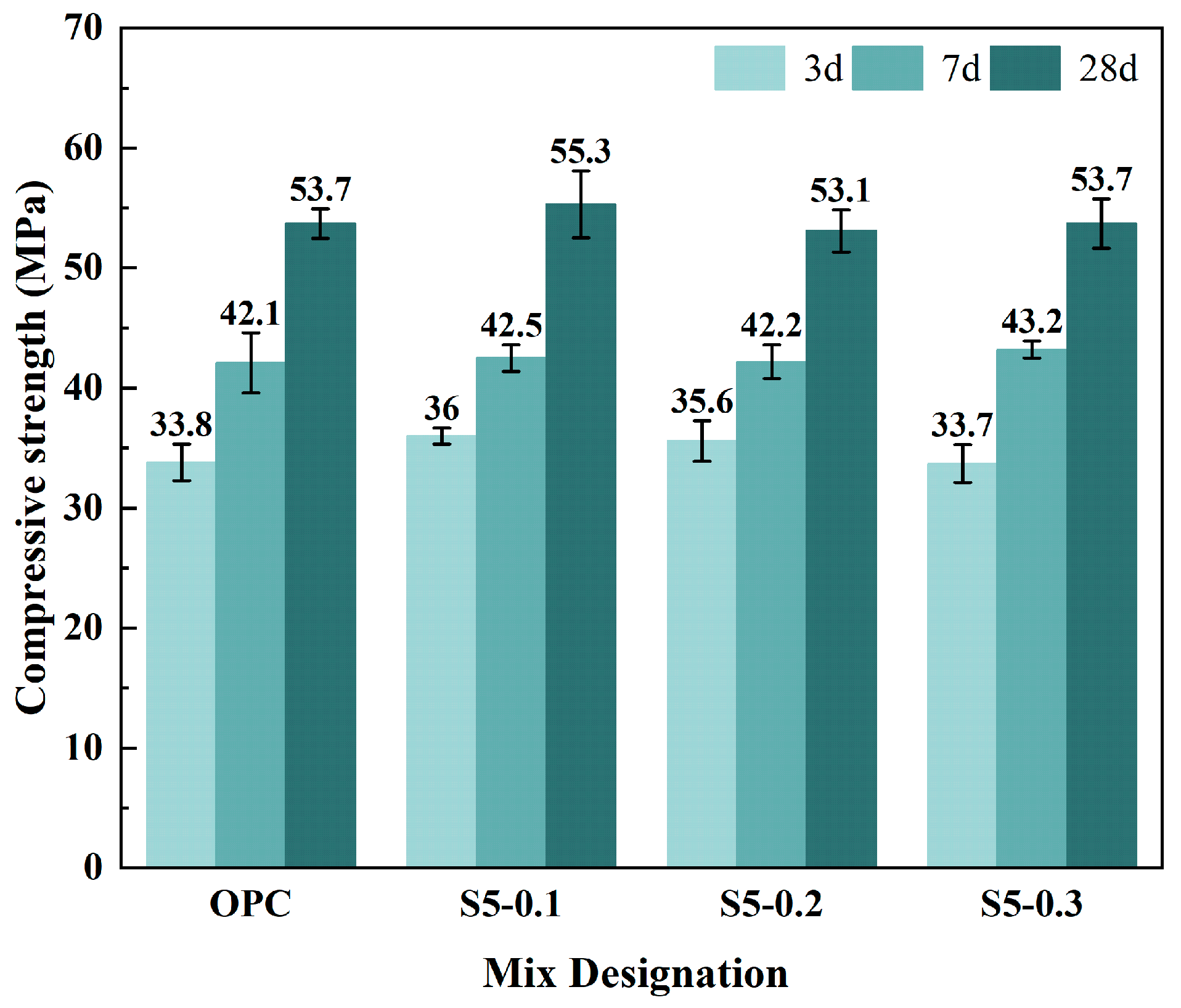
Figure 3 presents the compressive strength of specimen at 3 d, 7 d, and 28 d under different dosages of the CF-S5 admixture. It can be observed that, with the incorporation of the CF-S5 admixture, the change in the compressive strength of the specimen is relatively small, while the variation trend shows no obvious regular pattern.
To further examine whether the difference in compressive strength between the specimen with the CF-S5 admixture and the OPC specimen is statistically significant, this study conducted an independent-sample t-test at a 95% confidence level (significance level = 0.05). The null hypothesis (H0) was set as follows: the addition of CF-S5 admixture does not significantly affect the compressive strength of specimen at 3 d, 7 d, and 28 d. This study conducted nine independent-sample t-tests, each comparing the compressive strengths of the CF-S5 admixture specimens at 3 d, 7 d, and 28 d against that of the OPC specimen. In each inspection, the OPC specimen served as the first variable, while the specific CF-S5 admixture specimen acted as the second variable. The statistical results in Table 3 indicate that the p-values for all specimens with the CF-S5 admixture exceed 0.05. At the 95% confidence level, the null hypothesis cannot be rejected. This demonstrates that there are no significant differences in compressive strength between specimens with the CF-S5 admixture and the OPC specimen at 3 d, 7 d, and 28 d. Thus, the incorporation of the CF-S5 admixture does not adversely affect the compressive strength of mortar.

3.2. Resistance to Chloride Ion Penetration

3.2.1. Electric Flux

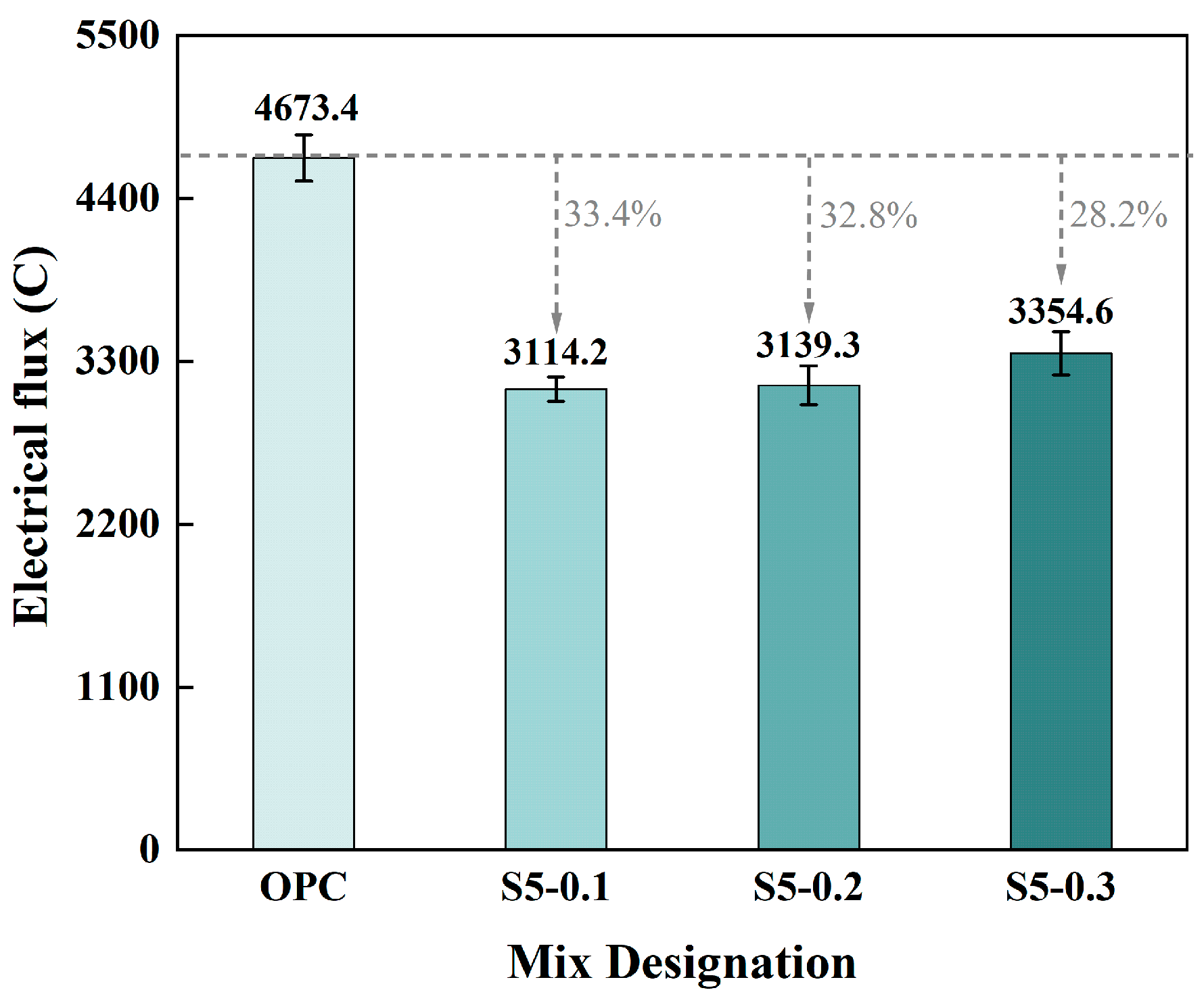
Figure 4 displays the electric flux values (Q) calculated for each mortar specimen according to Equation (1). As shown in Figure 4, the reference specimen (OPC) exhibits a Q value of 4673.4 C, while the Q values of mortars incorporating the CF-S5 admixture are lower. Specifically, the Q values for the S5-0.1, S5-0.2, and S5-0.3 specimens were 3114.2 C, 3139.3 C, and 3354.6 C, respectively, representing reductions of 33.4%, 32.8%, and 28.2% compared to that of the OPC specimen. This indicates that the CF-S5 admixture demonstrates a positive effect in enhancing the resistance to the chloride ion penetration of mortar.

3.2.2. Chloride Migration Coefficients

Although the Q value can provide an initial manifestation of the resistance to the chloride ion penetration of mortar, it struggles to accurately reflect the actual migration behavior of chloride ions within the mortar matrix. For example, the Q measured by the conventional RCPT reflects not only chloride-ion transport but also the contribution of other conductive ions in the pore solution [68]. Additionally, RCPT is prone to generating Joule heating effects, causing localized temperature increases in the specimen and consequently overestimating the Q value [69,70,71,72]. Therefore, to more accurately evaluate the resistance to the chloride ion penetration of mortar, this study employed the AgNO3 colorimetric method to determine the chloride ion permeation depth (Xd) after the RCPT. The chloride migration coefficients (Dnssm) were then calculated based on Equation (21) [22,69].
D n s s m = 0.0239 ( 273 + T ) d ( U 2 ) t h X d 0.0145 ( 273 + T ) d X d U 2
where Dnssm is the chloride migration coefficient (×10−12 m2/s), T is the average temperature of the anodic solution (°C), d is the specimen thickness (mm), U is the applied voltage (V), th is the test duration (h), and Xd is the average penetration depth (mm).
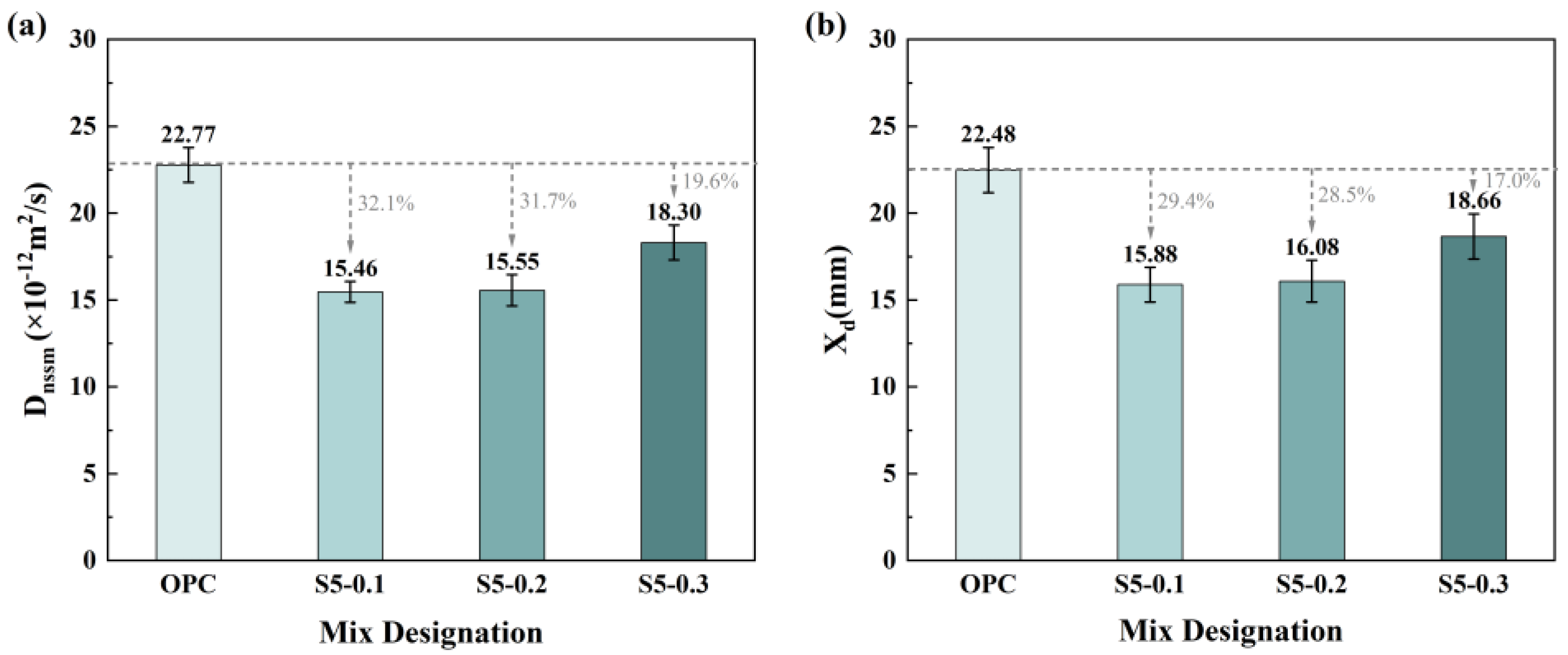
Figure 5 shows the Dnssm and Xd results for the different mortar specimens. The OPC specimen had a Dnssm of 22.77 × 10⁻¹² m2/s and an Xd of 22.48 mm. Incorporation of the CF-S5 admixture reduced both metrics (Dnssm = 15.46–18.30 × 10⁻¹² m2/s, Xd = 15.88–18.66 mm), corresponding to reductions of 19.6–32.1% and 17.0–29.4%, respectively, relative to the OPC specimen. This indicates the inhibition of chloride migration and therefore enhancements in the resistance to the chloride ion penetration of mortar. Among the specimens, the S5-0.1 specimen performed best, with Dnssm and Xd reduced by 32.1% and 29.4%, respectively, relative to the OPC specimen. The S5-0.2 specimen showed the next best improvement (Dnssm and Xd decreased by 31.7% and 28.5%, respectively, relative to the OPC specimen), whereas the S5-0.3 specimen demonstrated relatively limited enhancement (Dnssm and Xd decreased by 19.6% and 17.0%, respectively, relative to the OPC specimen). This trend aligns with the variation pattern of the electrical flux value, further validating that the CF-S5 admixture enhances the resistance to the chloride ion penetration of mortar. This performance improvement may be related to the CF-S5 admixture’s regulation of the mortar’s pore structure, with the specific mechanism to be discussed in detail in subsequent sections.

3.3. Mercury Intrusion Porosimetry (MIP)

3.3.1. Pore Size Distribution

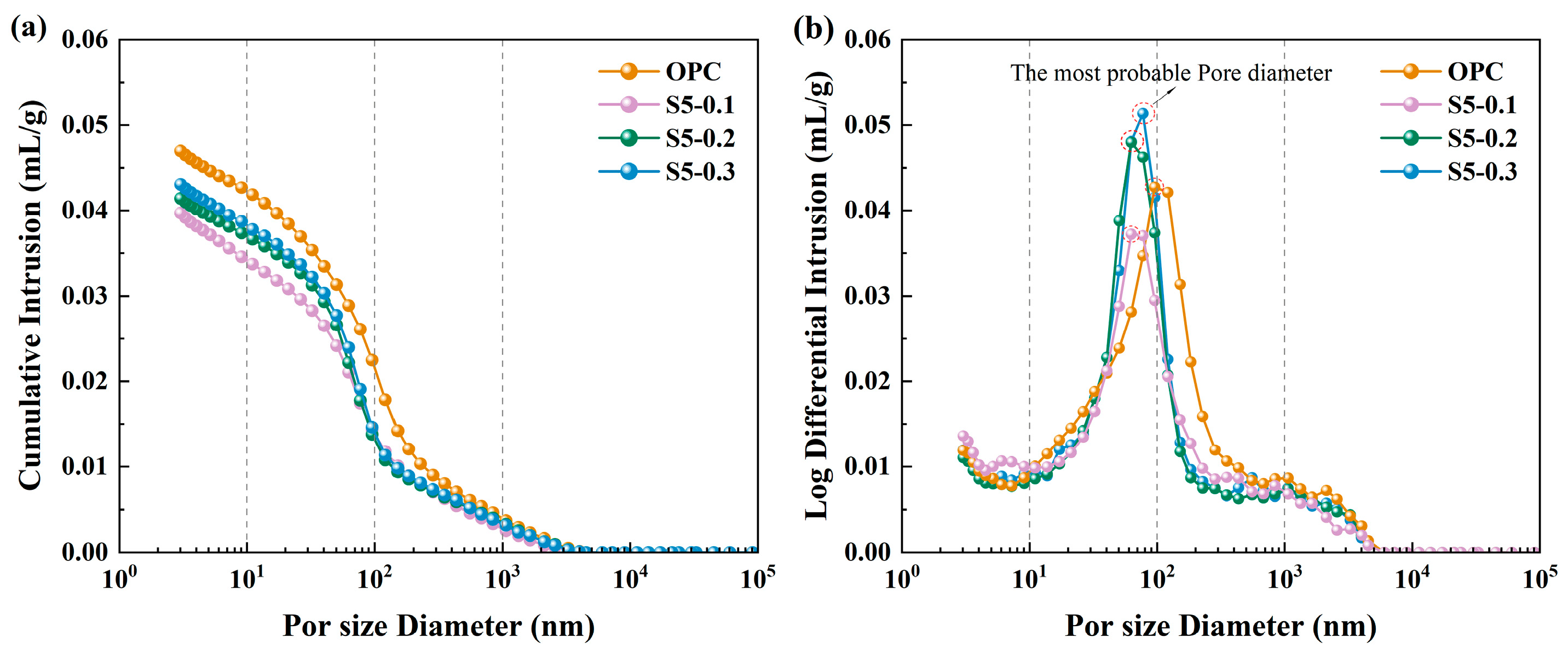
Figure 6 presents the cumulative pore size distribution (PSD) and differential pore size distribution (DPSD) curves for all mortar specimens. As shown in Figure 6a, the cumulative PSD curves have similar overall shapes across specimens, with mercury intrusion occurring primarily within the 0.003–4 µm range, indicating that the mortar matrix is generally dense. The PSD curve for the OPC specimen consistently lies above those of the other specimens, indicating the largest pore volume. Compared with the cumulative PSD, the DPSD more intuitively reveals subtle differences among specimens. As Figure 6b shows, all specimens exhibit essentially unimodal DPSD curves, with main peaks concentrated in the 50–100 nm range. The DPSD curves for the S5-0.1, S5-0.2, and S5-0.3 specimens show that the main peak has moved toward smaller pore sizes compared to the OPC specimen. Among these, the S5-0.1 specimen exhibits the lowest and narrowest main peak, indicating the most concentrated pore size distribution. Previous studies indicate that the pore size corresponding to the maximum peak of the DPSD curve is typically defined as the most probable pore diameter, representing the characteristic scale governing dominant transport behavior within the pore network [73]. The present findings demonstrate that the incorporation of CF-S5 leads to a noticeable decrease in the most probable pore diameter of the mortar.
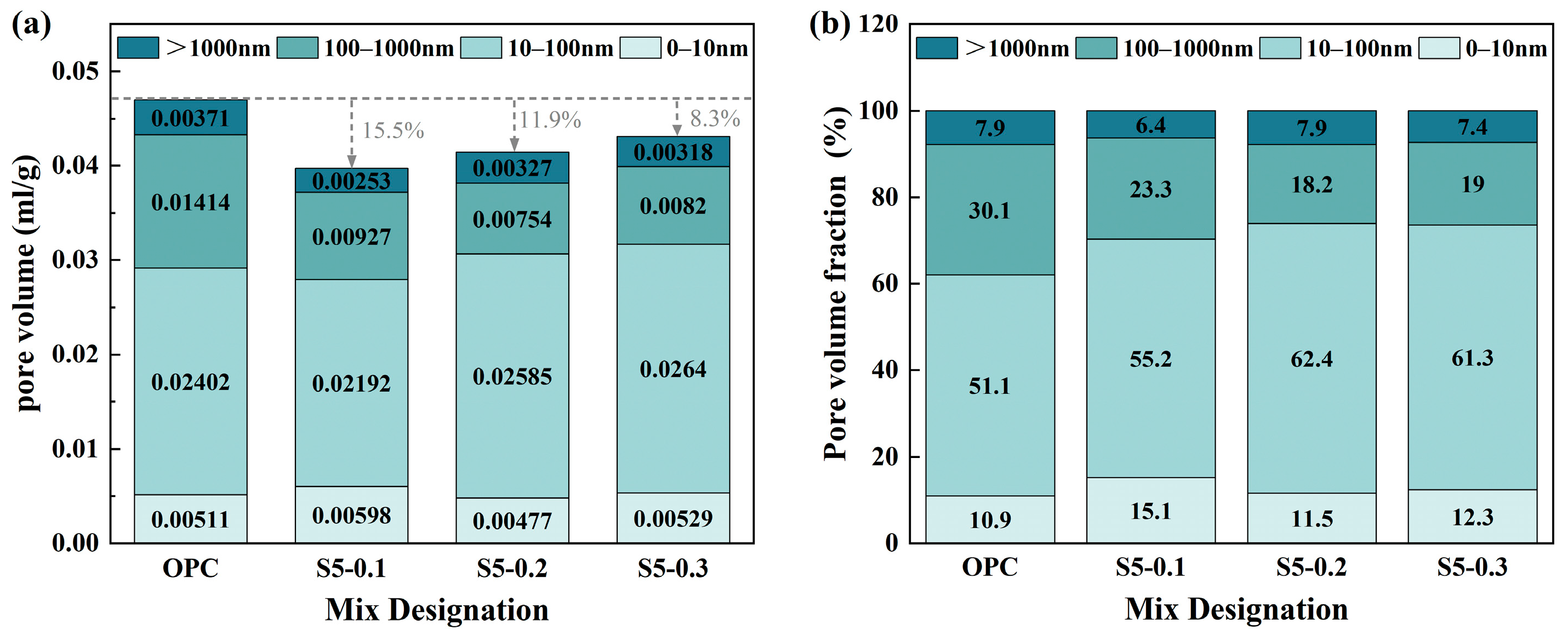
This study classifies pore sizes into four categories based on the pore size classification criteria found in the literature [52]: large pores (>1000 nm), capillary pores (100–1000 nm), transitional pores (10–100 nm), and gel pores (<10 nm). Figure 7 shows the pore volume distribution and pore volume fraction for each mortar specimen, broken down by pore size range. As shown in Figure 7a, the total pore volume of the specimen with the CF-S5 admixture was markedly lower than that of the OPC specimen. Specifically, the reductions for the S5-0.1, S5-0.2, and S5-0.3 specimens were 15.5%, 11.9%, and 8.3%, respectively, indicating a marked improvement in the density of the mortar matrix. Concurrently, the large pore volume decreased from 0.00371 mL/g in the OPC specimen to 0.00253–0.00327 mL/g in the CF-S5-modified mortar specimen, while the capillary pore volume also decreased from 0.01414 mL/g to 0.00754–0.00927 mL/g, indicating that the CF-S5 admixture effectively reduced the harmful pore content of the mortar.
As shown in Figure 7b, the pore systems of all mortar specimens primarily consist of transition pores and capillary pores, while gel pores and macropores account for relatively smaller proportions. Compared to the OPC specimen, the proportion of capillary pores in the specimen with the CF-S5 admixture decreased from 30.1% in the OPC specimen to 18.2–23.3%, while the proportions of gel pores and transition pores increased. Additionally, the proportion of macropores in the S5-0.1 specimen decreased from 7.9% in the OPC specimen to 6.4%. These trends indicate that the CF-S5 admixture promotes a refinement in the mortar’s pore structure. According to Zhang [74], the refinement of pore size in cementitious materials typically reduces the connectivity of the pore network, thereby increasing the resistance to chloride ion permeation and diffusion. Therefore, the pore structure refinement effect of the CF-S5 admixture contributes to an enhancement in the durability of mortar.

3.3.2. Characteristic Parameters of Pore Structure

Table 4 summarizes the typical pore structure characteristic parameters of mortar, including total porosity, total pore volume, median pore diameter, most probable pore diameter, and pore tortuosity. Porosity, total pore volume, and median pore diameter are obtained from the MIP report. The most probable pore diameter is identified by the differential pore size distribution (DPSD) curve, whereas pore tortuosity is estimated by an equivalent calculation based on a porous-media geometric model (Equation (22)) [75].
τ = 1 2 1 + 1 2 1 φ + 1 φ × 1 1 φ 1 2 + 1 4 1 1 φ
where τ represents the average curvature, and φ represents the porosity.
As shown in Table 4, the total porosity of the S5-0.1, S5-0.2, and S5-0.3 mortar specimens decreased by 7.75%, 7.36%, and 4.67%, respectively, compared to that of the OPC specimen. Concurrently, the total pore volume also decreased, indicating a reduction in the overall pore content within the mortar matrix. The median pore diameter decreased from 90.96 nm in the OPC specimen to 67.02–69.51 nm, while the most probable diameter decreased from 95.62 nm in OPC to 62.66–77.32 nm. Regarding pore tortuosity, the OPC specimen exhibited a tortuosity of 5.336, while the S5-0.1, S5-0.2, and S5-0.3 specimens showed increased tortuosity values of 5.773, 5.750, and 5.599, respectively. The most probable pore diameter and pore tortuosity, respectively, reflect the characteristics of mortar pore networks from different dimensions. The former embodies the scale effect of potential interconnected pathways within the pore network, while the latter reflects the geometric complexity of these pathways. The reduction in the most probable pore diameter implies compressed pore channels, thereby enhancing resistance to chloride ion penetration in cementitious materials [22,73]. Meanwhile, increased pore tortuosity further complicates and extends chloride ion migration pathways [76]. In summary, the CF-S5 admixture achieves multidimensional optimization of the pore structure by reducing the total porosity and total pore volume of the mortar, refining the pore size distribution, and increasing pore tortuosity. This provides robust microstructural support for enhancing the mortar’s resistance to chloride ion penetration.

3.4. Multifractal Analysis

3.4.1. Multifractal Characteristics Verifiability Calculation

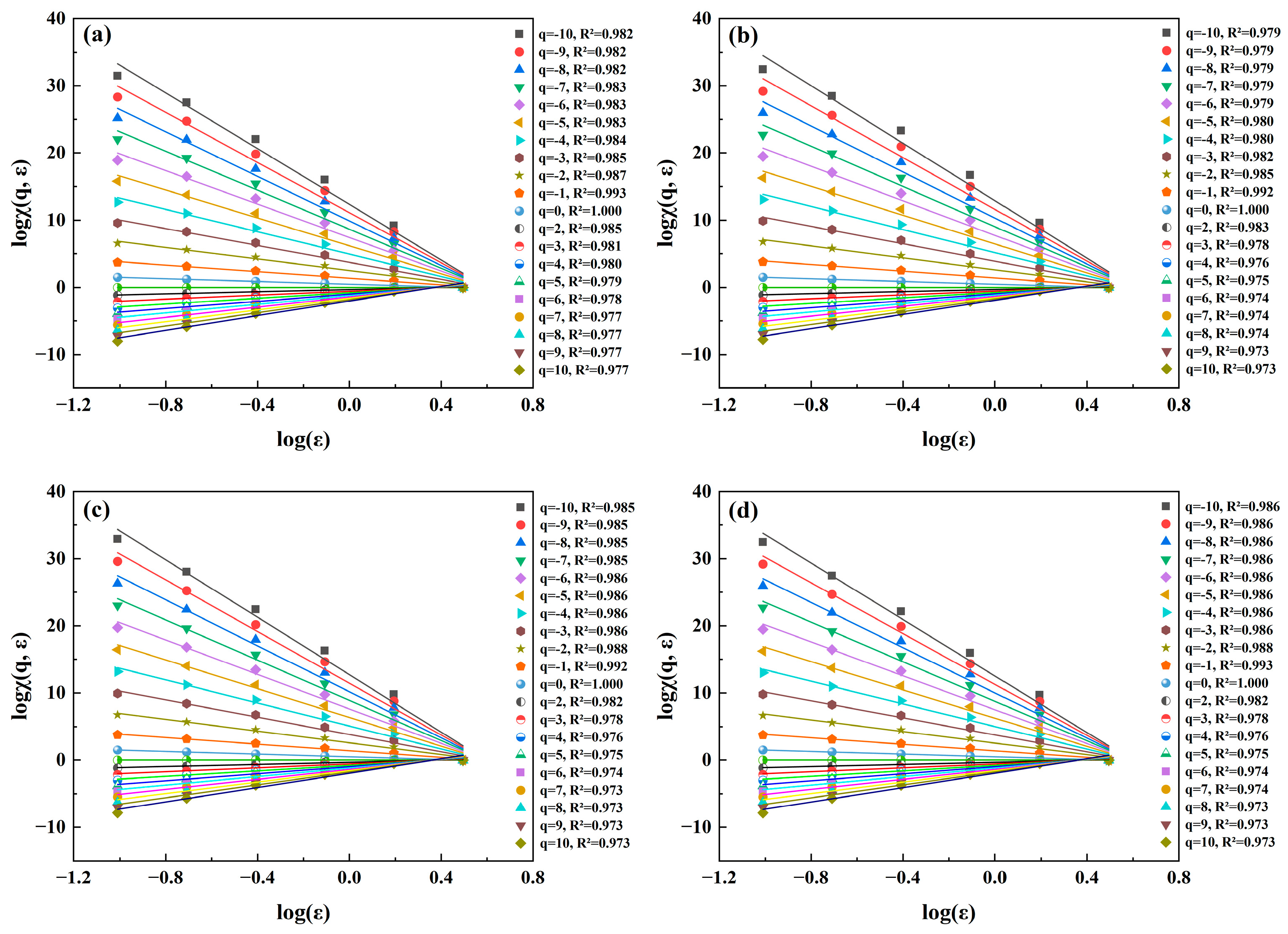
According to reference [77], when log[χ(q, ε)] exhibits a power-law scaling or linear relationship with log(ε), this indicates that the pore size distribution (PSD) within the porous medium possesses multifractal characteristics. Figure 8 displays the double logarithmic relationship between the partition function χ(q, ε) and the box size ε for each mortar specimen. As shown in Figure 8, the log[χ(q, ε)] values of all mortar specimens exhibit a satisfactory linear correlation with log(ε) across different q values, with linear fitting coefficients R2 exceeding 0.97. This result confirms that the pore structures of all mortars possess typical multifractal characteristics, which is a necessary prerequisite for analyzing their multifractal properties.

3.4.2. Generalized Dimension Spectrum

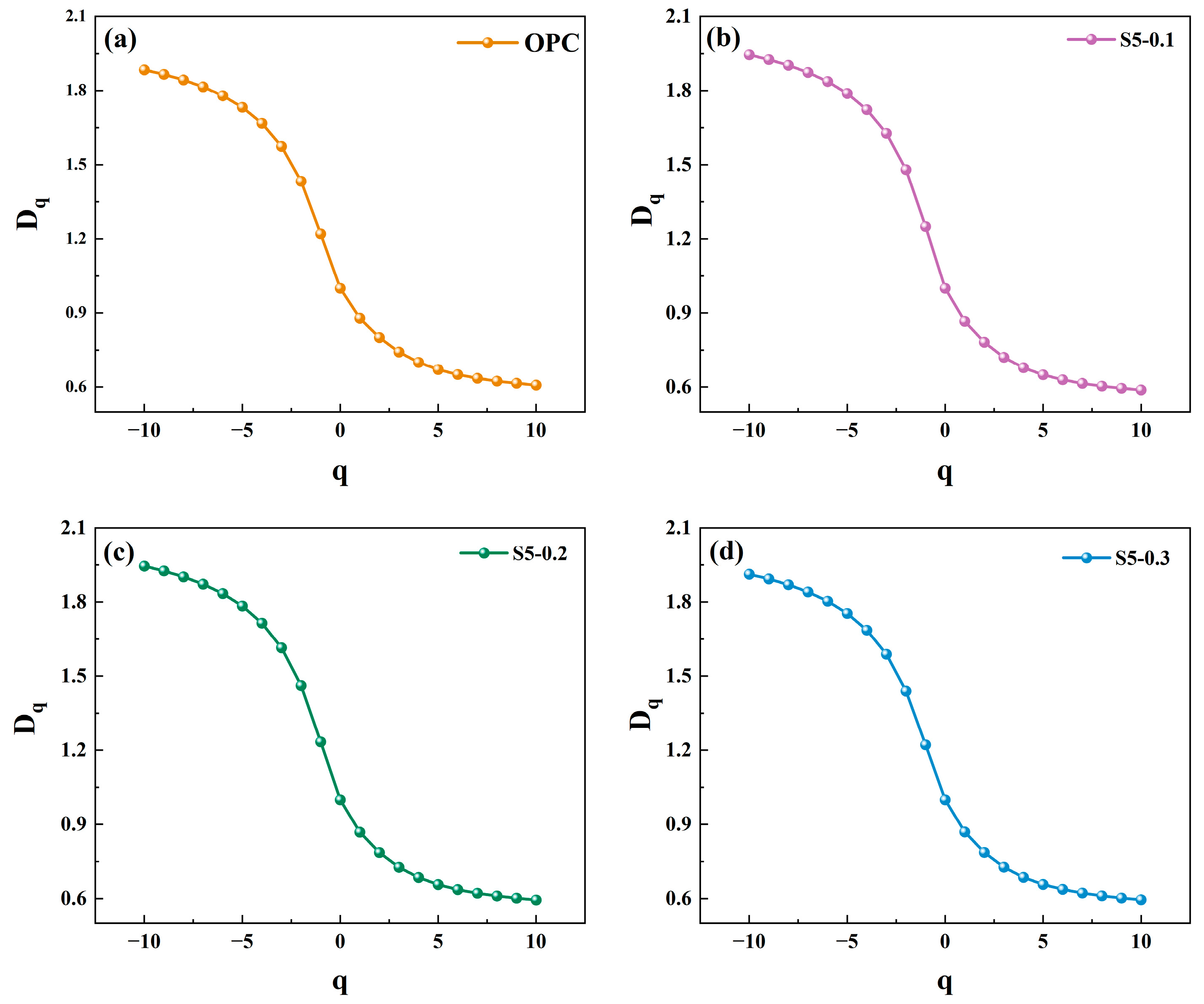
The generalized dimension spectra q-Dq of the pore structures for all mortar specimens are shown in Figure 9, and the corresponding multifractal parameters are summarized in Table 5. According to [48,50], when q > 0, the variation in Dq is primarily governed by the high-concentration porosity region, whereas when q < 0, the variation in Dq is mainly influenced by the low-concentration porosity region [78]. As illustrated in Figure 9, the generalized dimension spectra q-Dq of the pore structures for all mortar specimens exhibit a typical sigma-shaped curve, with Dq values gradually decreasing as q increases. This further indicates that the pore structures of all mortar specimens possess multifractal characteristics [50]. This result is consistent with the observations in Figure 8. This phenomenon arises because cementitious matrix materials, as typical porous media, exhibit pore sizes spanning from the nanoscale to the micrometer scale. The formation mechanisms, geometric morphologies, and spatial distributions of these pores differ markedly, leading to pronounced scale dependence and multifractal characteristics in their fractal dimensions [79,80,81,82].
As shown in Table 5, the multifractal parameters of the pore structures obtained from the generalized dimension spectrum include the capacity dimension D0, information dimension D1, correlation dimension D2, Hurst exponent H, spectrum width D−10D10, and corresponding left- and right-side widths D−10D0 and D0D10.
The capacity dimension D0 is the scaling exponent for the number of non-empty boxes, for which a higher value means that the pore size distribution is wider [50]. As shown in Table 5, the D0 value for all specimens in this study was 1, corresponding to the Euclidean dimension characteristic of a one-dimensional distribution, indicating that the overall pore size distribution range was consistent across all mortar specimens. This observation is consistent with the findings of Paz Ferreiro et al. [78]: at each hierarchical scale, a certain number of pores are contained within each box, and local variations in pore count do not materially affect the D0 value.
The information dimension D1 reflects the degree of concentration in pore distribution [78]. When the D1 value approaches the D0 value, it indicates more uniform pore distribution over the whole pore size range [83]; conversely, a smaller D1 value suggests that most pores are concentrated within a localized pore size interval, indicating higher internal pore size distribution non-uniformity [84]. Table 5 shows that the OPC specimen has the highest D1 value (0.8788), which is closer to D0. This means that the pore size distribution is more even. In contrast, the D1 values for S5-0.1, S5-0.2, and S5-0.3 are 0.8664, 0.8683, and 0.8692, all lower than that of the OPC specimen. This result indicates that the addition of the CF-S5 admixture concentrates pores within the local pore size range in the mortar matrix, consistent with the pore size distribution results in Section 3.3.1 (see Figure 6b). This further demonstrates the effectiveness of D1 in characterizing pore size distribution heterogeneity.
The correlation dimension D2 characterizes the cross-scale correlation of the pore size distribution across different pore size segments, with higher D2 values corresponding to stronger correlation [85]. The Hurst exponent H, defined as H = (D2 + 1)/2, is often used as an indicator of pore–network connectivity in terms of transport-effective pathway continuity; a higher H value is generally associated with more continuous pore pathways [49,86]. As shown in Table 5, the OPC specimen shows the highest D2 (0.8008) and H (0.9004) values, whereas the specimens with the CF-S5 admixture exhibit lower values (D2 = 0.7818–0.7859 and H = 0.8909–0.8930). This suggests that, compared with the OPC specimen, the incorporation of the CF-S5 admixture weakens cross-scale correlation in the pore-size distribution and thus lowers the connectivity of the pore network.
The spectrum width parameters D−10D10, D−10D0, and D0D10, respectively, serve as indicators of pore structure heterogeneity across the entire pore size range, the low-concentration porosity region, and the high-concentration porosity region [50]. Higher values of D−10D10, D−10D0, and D0D10 are indicative of a more complex pore structure within the corresponding pore size range [78]. As shown in Table 5, the D−10D10, D−10D0, and D0D10 values for the OPC specimen (1.2766, 0.8846, and 0.3920, respectively) were all lower than those for the mortar specimens containing the CF-S5 admixture (D−10D10 = 1.3166–1.3572, D−10D0 = 0.9122–0.9454, and D0D10 = 0.4044–0.4118). This indicates that the incorporation of the CF-S5 admixture enhances the complexity of the mortar’s pore structure. For all mortar specimens in this study, the D−10D0 values (0.8846–0.9454) were greater than the D0D10 values (0.3920–0.4118), showing that the complexity of the pore structure is mainly governed by the low-concentration porosity region, whereas the high-concentration porosity region further intensifies this complexity. According to the pore size distribution results in Section 3.3.1, large pores (>1000 nm) occupy the smallest fraction of the total pore volume, whereas transition pores in the 10–100 nm range account for more than 50% of the volume. These two pore size ranges can therefore be regarded as representative low-concentration and high-concentration porosity regions, respectively. The results of this study indicate that, although large pores are limited in number in the pore structures of each mortar specimen, they make the greatest contribution to the complexity of the pore structure. Transitional pores, owing to their high total pore volume and broad spatial coverage, further enhance the overall complexity of the pore structure.

3.4.3. Multifractal Singularity Spectrum

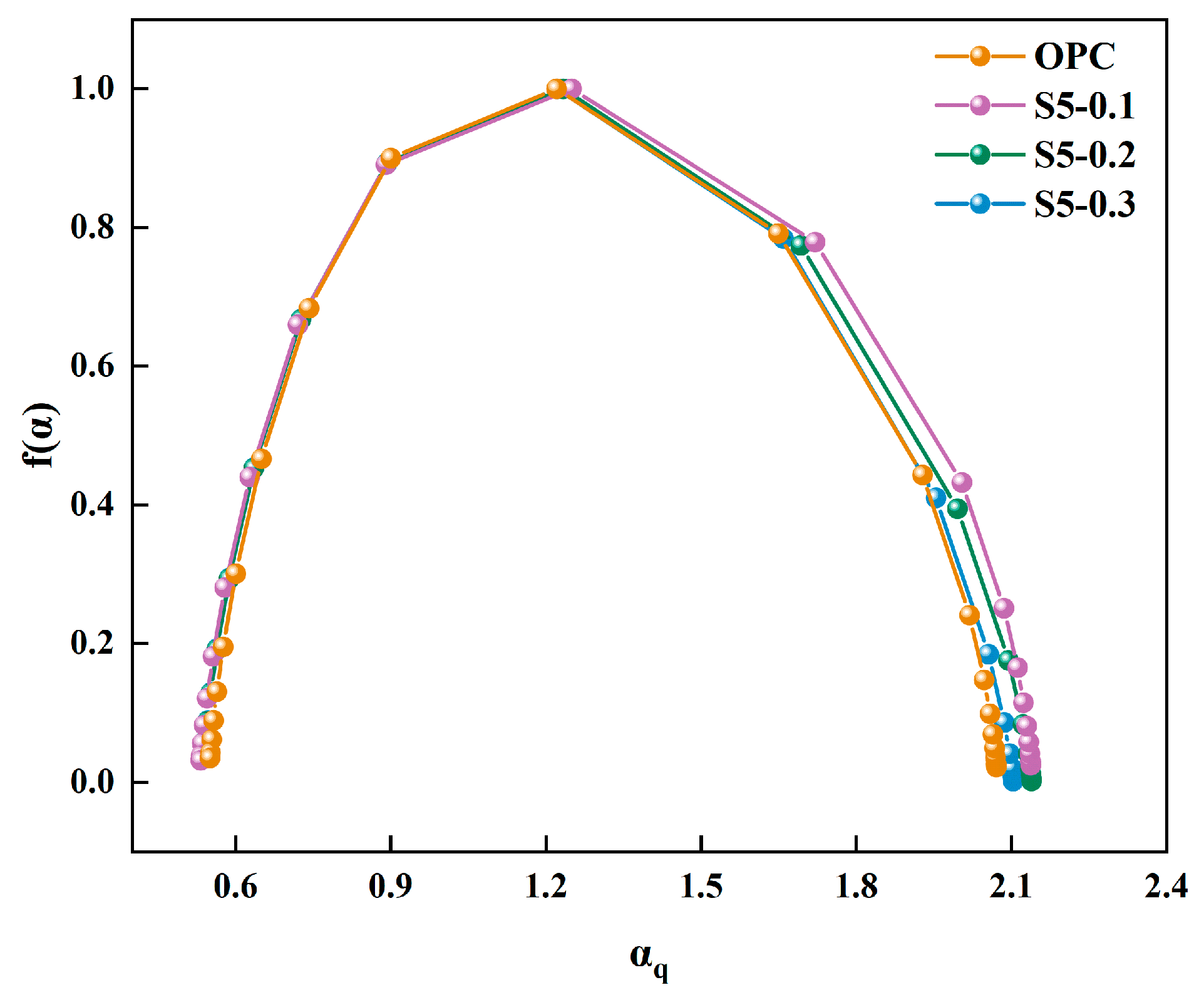
The multifractal singularity spectra α-f(α) of the pore structures for all mortar specimens are shown in Figure 10, and the corresponding multifractal parameters are summarized in Table 6. As shown in Figure 10, the multifractal singularity spectra α-f(α) of all mortar specimens exhibit an asymmetric convex shape. This indicates that the pore structures of all mortar specimens exhibit multifractal characteristics, consistent with the results from the double-logarithmic relationship, i.e., log(ε) versus log[χ(q, ε)] (see Figure 8) and the generalized dimension spectra q-Dq (see Figure 9). This reflects that during pore formation, pores of different origins and scales superimpose and combine within localized regions, thereby forming a highly spatially heterogeneous pore network [87].
The multifractal singularity exponent α0 is commonly used to indicate the concentration tendency of the pore size distribution, and a higher α0 value is often associated with the stronger localization of pores within the local pore size range [49]. As shown in Table 6, the OPC specimen shows an α0 value of 1.2207, whereas the specimens incorporating the CF-S5 admixture exhibit slightly higher α0 values (1.2217–1.2497). This trend in α0 is consistent with the interpretation based on the information dimension D1 in Table 5, suggesting that CF-S5 admixture promotes a more localized (concentrated) pore size distribution.
The multifractal singularity spectrum width α−10α10 reflects the heterogeneity of the pore size distribution. The greater the α−10α10 value, the more heterogeneous the pore size distribution and the more complex the pore structure [47]. As shown in Table 6, the α−10α10 value of the OPC specimen was 1.5202, whereas specimens incorporating the CF-S5 admixture exhibited higher α−10α10 values, ranging from 1.5638 to 1.6050. This indicates that the pore structure of specimens incorporating the CF-S5 admixture is more complex. The index Rd (Rd = (α0α10) − (α−10α0)) is commonly employed to quantify the left–right asymmetry of the multifractal singularity spectrum α-f(α). A positive Rd value indicates that the complexity of the pore structure primarily originates from the high-concentration porosity region, whereas a negative Rd value signifies that the complexity of the pore structure mainly stems from the low-concentration porosity region [49]. As shown in Table 6, all specimens in this study exhibited Rd values below zero, indicating that the complexity of the mortar pore structure primarily originates from the low-concentration porosity regions. The aforementioned analytical results are consistent with those from the generalized dimension spectra q-Dq analysis presented in Section 3.4.2.
Numerous studies indicate that the multifractal parameters obtained from the generalized dimension spectrum and those obtained from the multifractal singularity spectrum are often highly correlated, consistently characterizing the multifractal properties of pore structures [49,88,89]. In this study, the trends presented in Table 5 and Table 6 similarly demonstrate that both approaches can corroborate each other in characterizing the multifractal features of pore structures. Consequently, to avoid information redundancy, this study employs only multifractal parameters derived from the generalized dimension spectrum in subsequent analyses.
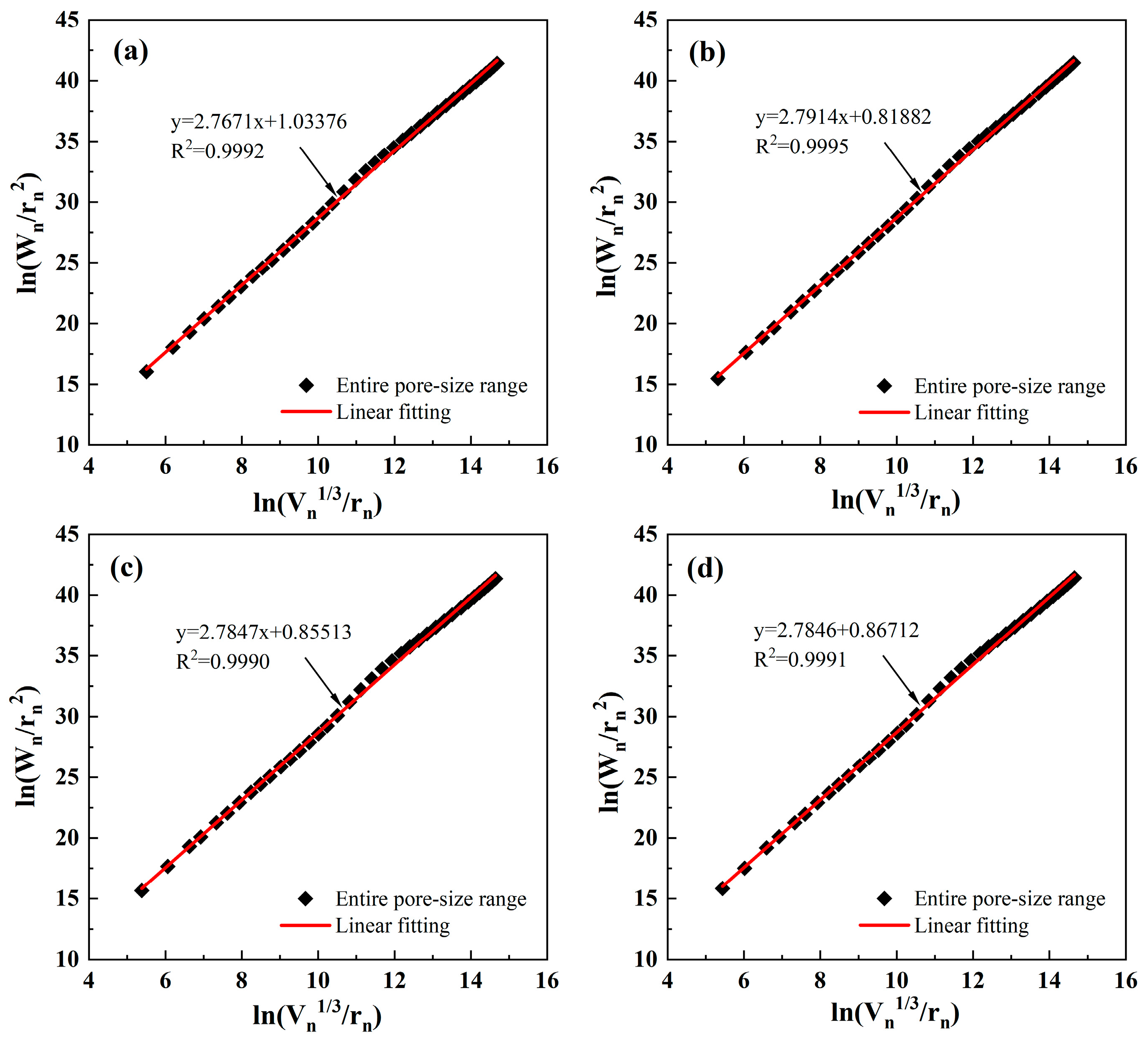
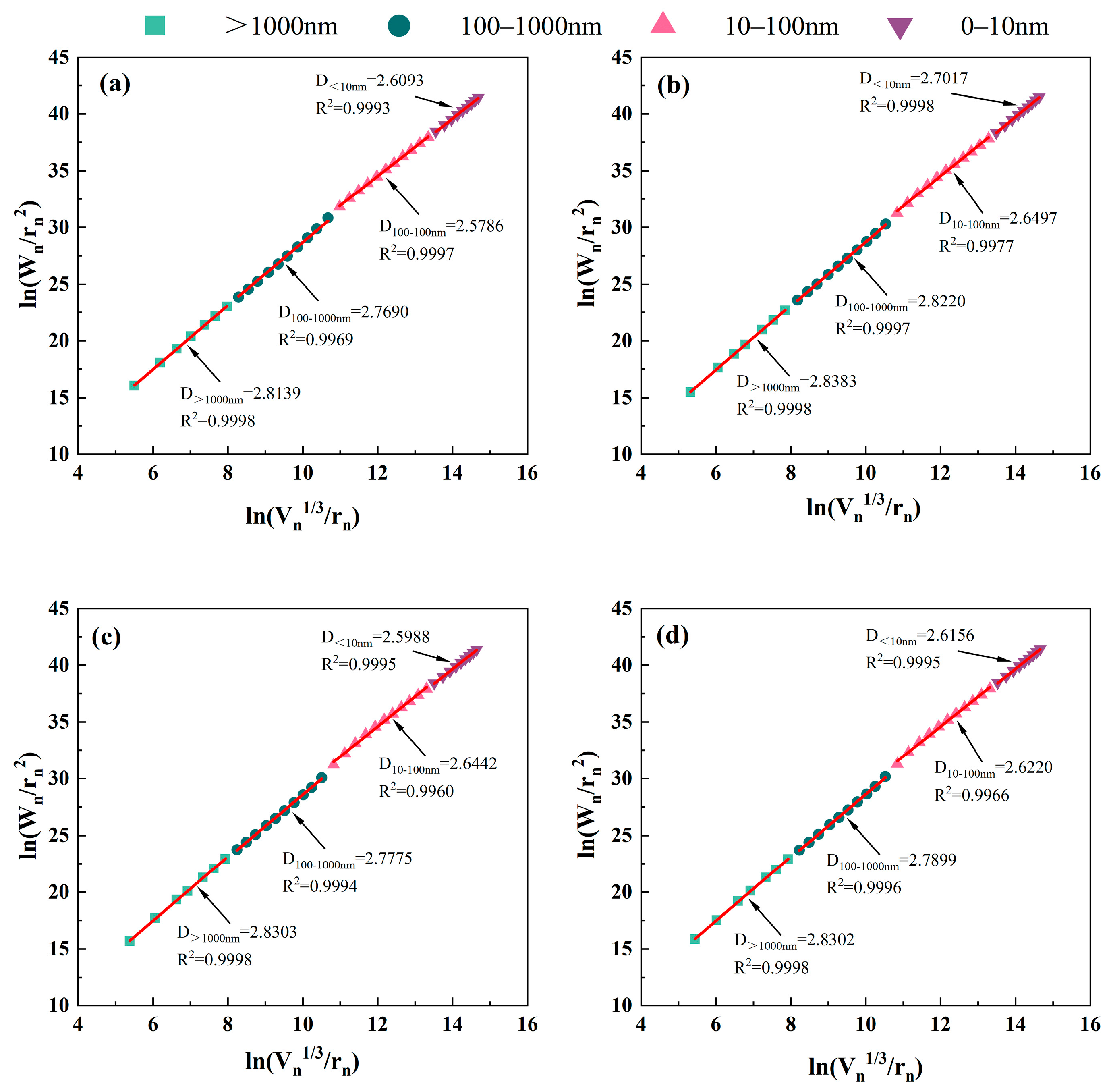
Prior research has shown that conventional fractal theory effectively characterizes the complexity and roughness of internal pore patterns in materials [90,91]. The Zhang model, which is based on the fractal theory and energy conservation principles, is widely used to determine the pore surface fractal dimension of cementitious materials because it is highly reliable and computationally accurate in characterizing pore structures [92,93,94]. To validate the efficacy and thoroughness of multifractal analysis, this study utilized the Zhang model [95] to compute the pore surface fractal dimension for each mortar specimen. Equations (23) and (24) show how the calculations can be performed, and Figure 11 and Figure 12 show the results. The corresponding pore surface fractal dimensions are summarized in Table 7.
ln W n r n 2 = D s ln V n 1 3 r n + C
W n = i = 1 n P i Δ V i
where Wn is the cumulative work performed by mercury intrusion; Pi and ΔVi are the injection pressure (Pa) and the corresponding mercury intrusion volume (m3), respectively, for the i-th step; Vn is the cumulative mercury intrusion volume (m3); rn is the corresponding pore radius (m) for that step; and C is a constant. By performing linear regression between ln(Wn/r2n) and ln(V1/3n/rn), from the fitted line, the pore surface fractal dimension Ds is obtained as its slope.
Within the framework of fractal theory, the pore surface fractal dimension is considered to be between 2 and 3 [95]. Figure 11 and Figure 12 and Table 7 indicate that the pore surface fractal dimension values for all the mortar specimens in this work meet the requirements of fractal theory. This means that the pore structures of all the mortar specimens exhibit typical fractal characteristics. Table 7 demonstrates that the fractal dimension values for the larger pore size range (more than 100 nm) are always higher than those for the smaller pore size range (less than 100 nm). These findings may indicate that the packing patterns of cement hydration particles exhibit greater structural complexity and heterogeneity compared to the microstructure of hydration products [96,97]. Furthermore, compared to the OPC specimen, mortar specimens incorporating the CF-S5 admixture generally exhibited higher pore surface fractal dimension values, indicating that the addition of the CF-S5 admixture enhanced the complexity of the mortar’s pore structure. This observation corresponds with the conclusions derived from multifractal analysis.

3.5. Thermogravimetric Analysis (TG/DTG)

Figure 13a and b present the thermogravimetric analysis (TG) and differential thermogravimetric analysis (DTG) curves for each cement paste specimen, respectively. All pastes exhibit identical thermal decomposition temperature ranges, indicating that the addition of the CF-S5 admixture did not alter the types of primary hydration products. The weight loss peak at 105–400 °C originates from the decomposition of C–S–H gel [64], while the peak at 400–500 °C is attributed to calcium hydroxide decomposition [65]. The weight loss peak formed between 600 and 780 °C results from calcium carbonate decomposition [63]. During the thermal decomposition stage from 105 to 500 °C, the DTG curve peaks of the CF-S5 admixture-modified paste exhibited a slight overall shift toward higher temperatures compared to the unmodified paste. This shift may be related to the thermal stability of the hydration products [98].
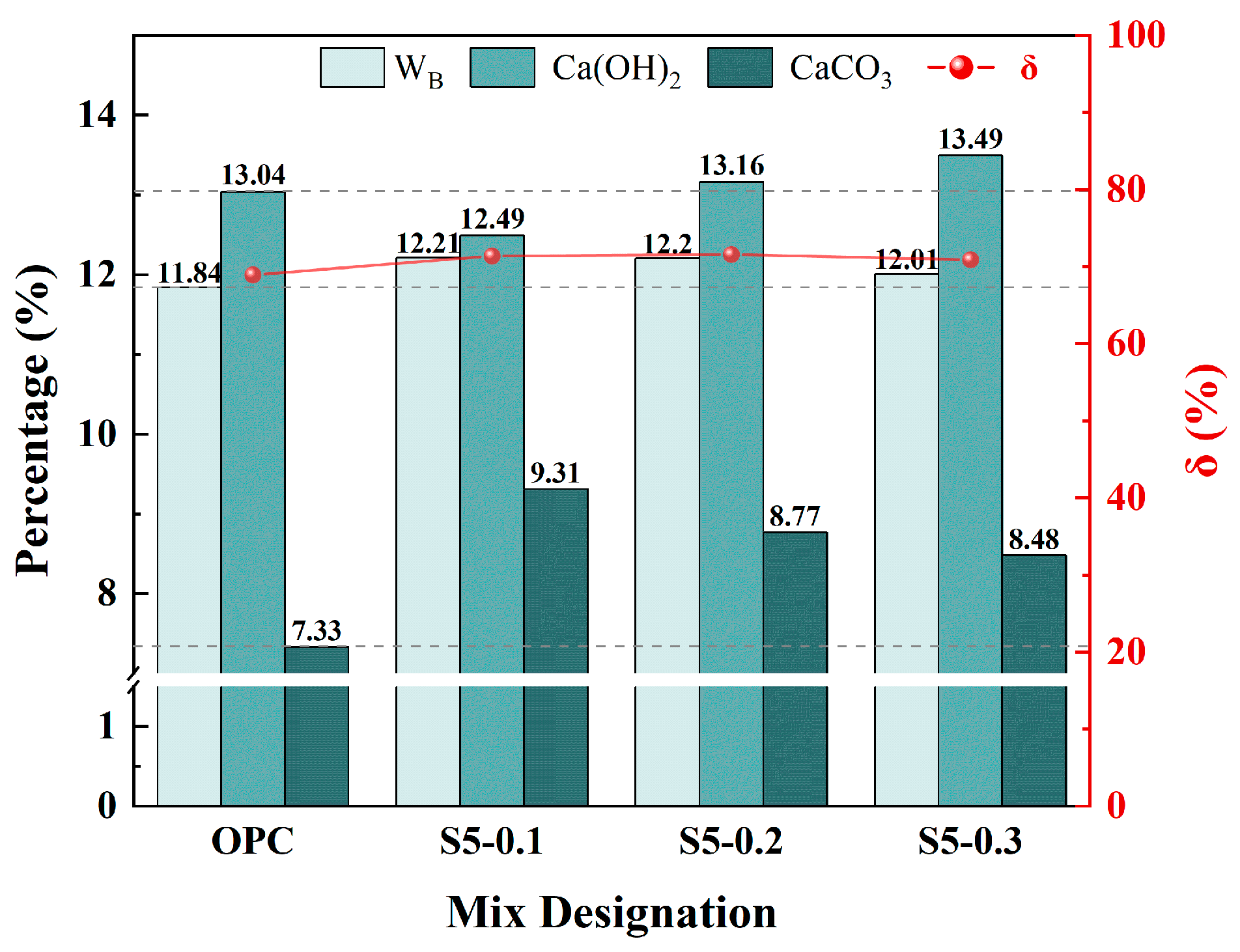
Figure 14 displays the degree of hydration (δ) and the pyrolytic phase content for each cement paste specimen. As shown in Figure 14, the δ value of the OPC specimen was 68.95%, while the δ values of the CF-S5 admixture specimen ranged from 70.89% to 71.58. This means that the CF-S5 admixture did not lower the hydration level of the cement paste. The degree of hydration is a key factor governing the mechanical properties of cementitious materials [99]. Since the CF-S5 admixture has a limited effect on the δ value of the cement paste, it did not bring about statistically significant changes in the compressive strength of the mortar. Additionally, the cement paste with the CF-S5 admixture had more CaCO3 than the OPC specimen, which shows that adding the CF-S5 admixture promotes carbonate formation in the cement paste. Researchers have already shown that calcium carbonate formation helps fill internal pores and cracks within cementitious materials [100], reducing porosity and thereby enhancing the density of the mortar matrix and its resistance to chloride ion penetration [101]. There was almost 27% more CaCO3 in the S5-0.1 specimen than in the OPC specimen. This indicates that it had a big effect on filling pores. As the dosage of the CF-S5 admixture further increased, the CaCO3 content gradually decreased, corresponding to a weakening pore-filling effect. This trend is consistent with the pore structure analysis results in Section 3.3. Some research [102,103] shows that the silicate components in silicate-based chemical admixtures can react with hydration products Ca(OH)2 to form C-S-H gel. This provides a reasonable explanation for the trends in Ca(OH)2 content and chemically bound water content observed in Figure 14.

4. Further Discussion

4.1. Relationship Between Multifractal Parameters and Traditional Characteristic Parameters of Pore Structure

This study further investigates the relationships between the traditional characteristic parameters of pore structure (total porosity, total pore volume, median pore diameter, most probable pore diameter, and pore tortuosity) and multifractal parameters through bivariate correlation analysis. Pearson’s correlation coefficients (r) were obtained using IBM SPSS Statistics (version 27.0.1; IBM Corp., Armonk, NY, USA), and the corresponding outcomes are reported in Table 8.
As shown in Table 8, the total porosity and total pore volume exhibit significant positive correlations with D1, D2, and H (r = 0.957–0.970, p < 0.05). They also show significant negative correlations with the spectrum-width parameters D−10D10 (r = −0.994, p < 0.01 for total porosity; r = −0.986, p < 0.05 for total pore volume) and D−10D0 (r = −0.984 to −0.963, p < 0.05). These results suggest that as total porosity or total pore volume increases, the pore size distribution becomes more uniform (higher D1), the cross-scale correlation of the pore size distribution across different pore size segments becomes stronger (higher D2), and the connectivity of the pore network increases (higher H), while the complexity of the pore structure decreases (smaller D−10D10 and D−10D0).
As shown in Table 8, the median pore diameter showed significant positive correlations with D1, D2, and H (r = 0.984–0.988, p < 0.05). However, the correlations between median pore diameter and the spectral width parameters D−10D10 and D−10D0 were negative but did not reach statistical significance in this study. In addition, the most probable pore diameter exhibited highly significant negative correlations with the spectrum-width parameters D−10D10 and D−10D0 (r = −0.996 and −0.994, respectively; p < 0.01). This means that when the most probable pore diameter shifts toward larger apertures, the multifractal spectrum width decreases (smaller D−10D10 and D−10D0), reflecting a reduction in the complexity of the pore structure, as quantified by these width parameters.
Additionally, as shown in Table 8, pore tortuosity shows significant negative correlations with D1, D2, and H (r = −0.970 to −0.957, p < 0.05), while showing significant positive correlations with the spectrum width parameters D−10D10 (r = 0.955, p < 0.01) and D−10D0 (r = 0.984, p < 0.05). This implies that pore structures with higher complexity (larger D−10D10 and D−10D0) and lower pore–network connectivity (lower H) tend to exhibit more tortuous pore pathways.
Overall, multifractal parameters not only reveal the complexity and spatial distribution characteristics of pore structures but also exhibit significant correlations with characteristic parameters of pore structure. This demonstrates their reliability and applicability as comprehensive indicators for characterizing pore structures.

4.2. Gray Relational Analysis of Multifractal Parameters and Chloride Ion Migration Coefficients

Gray relational analysis (GRA) has been widely applied to identify key factors influencing the performance of cementitious materials [104,105,106]. To investigate the effect of different multifractal parameters on the resistance to chloride ion permeation in cement mortar, this study employs the GRA method to analyze the gray relational degree between multifractal parameters and the chloride ion migration coefficient. (Dnssm) Here, Dnssm is set as the reference sequence, while each multifractal parameter is designated as a comparison sequence. The corresponding outcomes are listed in Table 9.
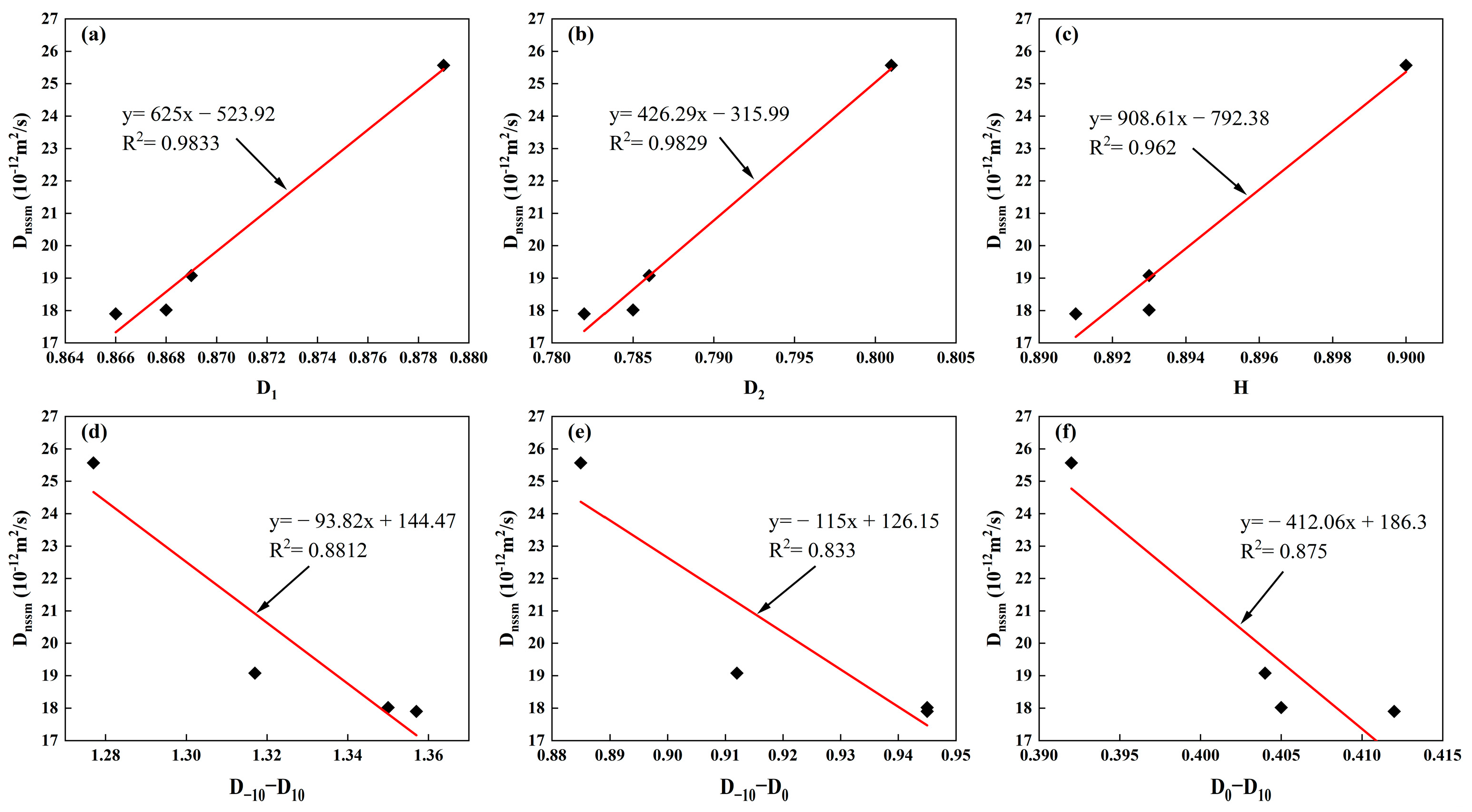
As shown in Table 9, the gray relational degrees between each multifractal parameter and Dnssm are all greater than 0.68, indicating a strong correlation between the multifractal parameters and Dnssm. The order of gray relational degrees from highest to lowest is D2 > D1 > H > D0D10 > D−10D10 > D−10D0. Evidently, D2, D1, and H exhibit the highest gray relational degree with Dnssm, indicating that, among the multifractal parameters, they act as the primary controlling factors for characterizing and predicting the resistance to the chloride ion penetration of mortar. In other words, compared with the other multifractal parameters, D2, D1, and H show greater potential for application in characterizing and predicting the resistance to the chloride ion penetration of mortar. On the other hand, spectral width parameters (D0D10, D−10D10, D−10D0) have lower gray relational degrees with Dnssm than D1, D2, and H. This discrepancy likely stems from spectral width parameters emphasizing the complexity and heterogeneity of pore structures rather than directly reflecting the pore connectivity relied upon for chloride ion migration. In conjunction with the linear regression analysis results in Figure 15a–f, D2, D1, and H exhibit strong positive linear correlations with Dnssm (R2 > 0.96 for all). This indicates that as the D1, D2, and H values increase, the Dnssm value rises, leading to a corresponding decrease in the resistance to the chloride ion penetration of mortar. In contrast, spectral width parameters (D0D10, D−10D10, and D−10D0) exhibit a linear negative correlation with Dnssm (R2 > 0.83), indicating that as pore structure complexity increases, Dnssm decreases, thereby enhancing the resistance to the chloride ion penetration of mortar. This relationship exists because a higher D1 value indicates a more uniform pore size distribution, while higher D2 and H values, respectively, denote a stronger correlation between pore size distributions across different size segments and greater connectivity within the pore network; these characteristics facilitate chloride ion transport within the mortar matrix, thereby increasing the Dnssm value. Conversely, larger spectral width parameters (such as D0D10, D−10D10, and D−10D0) indicate a more complex pore structure, which often impedes chloride ion transport, thereby reducing Dnssm.

4.3. Mechanistic Discussion Based on TG, MIP and Multifractal Results

The CF-S5 admixture (a water-based nano-silicate densifier) primarily functions as a pore densifier, with key functional components including sodium metasilicate, silica (SiO2), and titanate coupling agents. TG/DTG results (see Figure 14) indicate that the degree of hydration δ of the cement paste containing the CF-S5 admixture (70.89–71.58%) was slightly higher than that of the OPC specimen (68.95%), with no new major decomposition peaks observed in the hydration product range, indicating that the CF-S5 admixture does not alter the types of cement paste hydration products. Instead, it exerts its effects by influencing the formation process and microstructural evolution of existing hydration products.
The enhancement mechanism of the CF-S5 admixture is governed by the synergistic actions of its nano-SiO2 and nano-silicate components through two coupled pathways: on the one hand, nano-silicate in the CF-S5 admixture can participate in secondary reactions with Ca(OH)2, contributing to additional C–S–H gel formation and the filling of pore space; on the other hand, nano-SiO2 provides additional nucleation sites, promoting the nucleation and precipitation of hydration products like C–S–H gel, thereby accelerating pore refinement and matrix densification. Similar synergistic effects of nano-SiO2 and sodium silicate in cementitious systems have been reported in previous studies [107,108]. This mechanism aligns with the pore structure results obtained via MIP (Section 3.3), where the CF-S5 admixture reduces the mortar’s total porosity/pore volume and decreases the proportion of detrimental macropores, while the pore size distribution shifts toward smaller apertures.
The nucleation sites provided by nano-SiO2 in the CF-S5 admixture, combined with the active silicate reaction between nano-silicate and Ca(OH)2, promote the formation and deposition of hydration products like C–S–H within the pore network. This results in an overall refinement of the pore structure and a reduction in the connectivity of the pore network. As effective connectivity diminishes, the pore network evolves from a continuous morphology into clusters of weakly connected pores. Concurrently, pore pathways become more tortuous, resulting in a more complex pore structure within the mortar matrix. Furthermore, a small number of discrete coarse pores remain within the dense matrix during this process. Although these coarse pores are not dominant in volume fraction, their larger geometric scale and discrete distribution still enhance the structural complexity of the pore network. Chloride ions must migrate through increasingly restricted pore channels. In combination, a denser microstructure with more tortuous/less continuous transport pathways provides a reasonable explanation for the reduced chloride migration observed in Figure 5 (lower Dnssm and Xd).

5. Conclusions

This study systematically investigated the effects of the CF-S5 admixture on the pore structure and the resistance to the chloride ion penetration of mortar. Using mercury intrusion porosimetry (MIP), multifractal analysis, and thermogravimetric analysis (TG), we elucidated how CF-S5 modulates mortar pore structure and influences the hydration of the cement paste. Gray relational analysis and linear regression revealed the relationship between multifractal parameters and chloride ion migration coefficients. The key findings are as follows:
(1)
The addition of the CF-S5 admixture can enhance the resistance to the chloride ion penetration of mortar without compromising its mechanical properties. Among the different dosages of the CF-S5 admixture, 0.1% has the best effect. Compared with the control specimen, the electric flux and chloride ion migration coefficient decreased by about 33.4% and 32.1%, respectively.
(2)
The addition of the CF-S5 admixture did not reduce the degree of cement paste hydration or alter the primary types of hydration products. Concurrently, the CF-S5 admixture promoted the formation of calcium carbonate and partial CS-H gel, thereby facilitating pore filling in the mortar.
(3)
MIP analysis indicates that the CF-S5 admixture improves the pore structure of mortar by reducing the total porosity and fraction of the harmful pore volume, refining the pore structure, and increasing pore tortuosity.
(4)
Multifractal analysis shows that the addition of the CF-S5 admixture changes the multifractal characteristics of the mortar pore structure. Specifically, the addition of the CF-S5 admixture reduces the connectivity and distribution uniformity of the mortar’s pore structure and enhances its complexity and spatial heterogeneity.
(5)
The multifractal parameters exhibit significant correlations with traditional characteristic pore structure parameters and can serve as a comprehensive index for characterizing mortar pore structure. In addition, there is a good gray relational degree and linear correlation between the multifractal parameters and the chloride ion migration coefficient, in which D1, D2 and H can be used as potential indicators to characterize and predict the resistance to the chloride ion penetration of mortar.
In summary, the CF-S5 admixture effectively inhibits chloride ion penetration by multidimensionally optimizing the pore structure of mortar. Consequently, this admixture demonstrates promising application potential in enhancing the service performance of cementitious materials under chloride-rich environments, providing a viable technical approach for the durability design of engineering structures.

Author Contributions

Conceptualization, R.G. and X.W.; methodology, X.W., D.G. and Z.L.; software, X.W. and D.G.; validation, X.W., D.G. and Z.L.; formal analysis, X.W. and D.G.; investigation, X.W., D.G. and Z.L.; resources, X.W., R.G. and H.X.; data curation, X.W. and Z.L.; writing—original draft preparation, X.W.; writing—review and editing, X.W., D.G. and R.G.; visualization, X.W. and D.G.; supervision, R.G.; project administration, R.G.; funding acquisition, R.G. and H.X. All authors have read and agreed to the published version of the manuscript.

Funding

This research was funded by the National Natural Science Foundation of China, grant number 12462014, and the Yunnan Provincial Science and Technology Department major science and technology special plan, grant number 202102AG050043.

Data Availability Statement

The data presented in this study are available on request from the corresponding author.

Conflicts of Interest

The authors declare no conflicts of interest.

References

  1. Zheng, Y.; Fan, C.; Ma, J.; Wang, S. Review of Research on Bond–Slip of Reinforced Concrete Structures. Constr. Build. Mater. 2023, 385, 131437. [Google Scholar] [CrossRef]
  2. Zhao, L.; Feng, P.; Shen, X.; Rong, H.; Miao, C.; Geng, G. Mitigating Chloride Attack in Cementitious Materials without Compromising Other Properties via the Use of Viscosity Modifying Admixture. Cem. Concr. Compos. 2024, 147, 105441. [Google Scholar] [CrossRef]
  3. Chen, W.; Zhu, H.; He, Z.; Yang, L.; Zhao, L.; Wen, C. Experimental Investigation on Chloride-Ion Penetration Resistance of Slag Containing Fiber-Reinforced Concrete under Drying-Wetting Cycles. Constr. Build. Mater. 2021, 274, 121829. [Google Scholar] [CrossRef]
  4. Alexander, M.; Beushausen, H. Durability, Service Life Prediction, and Modelling for Reinforced Concrete Structures—Review and Critique. Cem. Concr. Res. 2019, 122, 17–29. [Google Scholar] [CrossRef]
  5. Qian, R.; Wan-Wendner, L.; Yang, C.; Zhao, R.; Ye, Z.; Kong, D.; Zhang, Y. Investigations on Carbon-Sequestration Optimization of Recycled Coarse-Aggregate and Its Effects on Concrete Performances. J. Build. Eng. 2024, 90, 109453. [Google Scholar] [CrossRef]
  6. Ghafari, E.; Feys, D.; Khayat, K. Feasibility of Using Natural SCMs in Concrete for Infrastructure Applications. Constr. Build. Mater. 2016, 127, 724–732. [Google Scholar] [CrossRef]
  7. Navarro, I.J.; Martí, J.V.; Yepes, V. Reliability-Based Maintenance Optimization of Corrosion Preventive Designs under a Life Cycle Perspective. Environ. Impact Assess. Rev. 2019, 74, 23–34. [Google Scholar] [CrossRef]
  8. Noushini, A.; Castel, A.; Aldred, J.; Rawal, A. Chloride Diffusion Resistance and Chloride Binding Capacity of Fly Ash-Based Geopolymer Concrete. Cem. Concr. Compos. 2020, 105, 103290. [Google Scholar] [CrossRef]
  9. Guo, Y.; Zhang, T.; Du, J.; Wang, C.; Wei, J.; Yu, Q. Evaluating the Chloride Diffusion Coefficient of Cement Mortars Based on the Tortuosity of Pore Structurally-Designed Cement Pastes. Microporous Mesoporous Mater. 2021, 317, 111018. [Google Scholar] [CrossRef]
  10. Basheer, L.; Kropp, J.; Cleland, D.J. Assessment of the Durability of Concrete from Its Permeation Properties: A Review. Constr. Build. Mater. 2001, 15, 93–103. [Google Scholar] [CrossRef]
  11. Pang, B.; Zhou, Z.; Cheng, X.; Du, P.; Xu, H. ITZ Properties of Concrete with Carbonated Steel Slag Aggregate in Salty Freeze-Thaw Environment. Constr. Build. Mater. 2016, 114, 162–171. [Google Scholar] [CrossRef]
  12. Wang, X.; Ba, M.; Yi, B.; Liu, J. Experimental and Numerical Investigation on the Effect of Cracks on Chloride Diffusion and Steel Corrosion in Concrete. J. Build. Eng. 2024, 86, 108521. [Google Scholar] [CrossRef]
  13. Ye, H.; Jin, X.; Fu, C.; Jin, N.; Xu, Y.; Huang, T. Chloride Penetration in Concrete Exposed to Cyclic Drying-Wetting and Carbonation. Constr. Build. Mater. 2016, 112, 457–463. [Google Scholar] [CrossRef]
  14. Hu, X.; Shi, C.; Li, J.; Wu, Z. Chloride Migration in Cement Mortars with Ultra-Low Water to Binder Ratio. Cem. Concr. Compos. 2021, 118, 103974. [Google Scholar] [CrossRef]
  15. Tam, C.M.; Tam, V.W.Y.; Ng, K.M. Assessing Drying Shrinkage and Water Permeability of Reactive Powder Concrete Produced in Hong Kong. Constr. Build. Mater. 2012, 26, 79–89. [Google Scholar] [CrossRef]
  16. Li, J.; Wu, Z.; Shi, C.; Yuan, Q.; Zhang, Z. Durability of Ultra-High Performance Concrete—A Review. Constr. Build. Mater. 2020, 255, 119296. [Google Scholar] [CrossRef]
  17. Siddique, R.; Bennacer, R. Use of Iron and Steel Industry By-Product (GGBS) in Cement Paste and Mortar. Resour. Conserv. Recycl. 2012, 69, 29–34. [Google Scholar] [CrossRef]
  18. Wu, K.; Shi, H.; Xu, L.; Ye, G.; De Schutter, G. Microstructural Characterization of ITZ in Blended Cement Concretes and Its Relation to Transport Properties. Cem. Concr. Res. 2016, 79, 243–256. [Google Scholar] [CrossRef]
  19. Amran, M.; Murali, G.; Khalid, N.H.A.; Fediuk, R.; Ozbakkaloglu, T.; Lee, Y.H.; Haruna, S.; Lee, Y.Y. Slag Uses in Making an Ecofriendly and Sustainable Concrete: A Review. Constr. Build. Mater. 2021, 272, 121942. [Google Scholar] [CrossRef]
  20. Wang, L.; Jin, M.; Wu, Y.; Zhou, Y.; Tang, S. Hydration, Shrinkage, Pore Structure and Fractal Dimension of Silica Fume Modified Low Heat Portland Cement-Based Materials. Constr. Build. Mater. 2021, 272, 121952. [Google Scholar] [CrossRef]
  21. Mohammed, M.K.; Dawson, A.R.; Thom, N.H. Macro/Micro-Pore Structure Characteristics and the Chloride Penetration of Self-Compacting Concrete Incorporating Different Types of Filler and Mineral Admixture. Constr. Build. Mater. 2014, 72, 83–93. [Google Scholar] [CrossRef]
  22. Du, H.; Gao, H.J.; Pang, S.D. Improvement in Concrete Resistance against Water and Chloride Ingress by Adding Graphene Nanoplatelet. Cem. Concr. Res. 2016, 83, 114–123. [Google Scholar] [CrossRef]
  23. Uthaman, S.; George, R.P.; Vishwakarma, V.; Harilal, M.; Philip, J. Enhanced Seawater Corrosion Resistance of Reinforcement in Nanophase Modified Fly Ash Concrete. Constr. Build. Mater. 2019, 221, 232–243. [Google Scholar] [CrossRef]
  24. Li, H.; Xiao, H.; Guan, X.; Wang, Z.; Yu, L. Chloride Diffusion in Concrete Containing Nano-TiO2 under Coupled Effect of Scouring. Compos. Part B Eng. 2014, 56, 698–704. [Google Scholar] [CrossRef]
  25. Sumesh, M.; Alengaram, U.J.; Jumaat, M.Z.; Mo, K.H.; Alnahhal, M.F. Incorporation of Nano-Materials in Cement Composite and Geopolymer Based Paste and Mortar—A Review. Constr. Build. Mater. 2017, 148, 62–84. [Google Scholar] [CrossRef]
  26. Zhou, P.; Xu, J.; Guo, M.-Z.; Wang, Z. Laboratory Investigation of the Chloride Ingress into Cement Mortar Incorporating a Novel Core–Shell Nanomaterial. Constr. Build. Mater. 2023, 379, 131306. [Google Scholar] [CrossRef]
  27. Pan, X.; Shi, Z.; Shi, C.; Ling, T.-C.; Li, N. A Review on Concrete Surface Treatment Part I: Types and Mechanisms. Constr. Build. Mater. 2017, 132, 578–590. [Google Scholar] [CrossRef]
  28. Liu, C.; Hunag, X.; Wu, Y.-Y.; Deng, X.; Zheng, Z.; Yang, B. Studies on Mechanical Properties and Durability of Steel Fiber Reinforced Concrete Incorporating Graphene Oxide. Cem. Concr. Compos. 2022, 130, 104508. [Google Scholar] [CrossRef]
  29. Matar, P.; Barhoun, J. Effects of Waterproofing Admixture on the Compressive Strength and Permeability of Recycled Aggregate Concrete. J. Build. Eng. 2020, 32, 101521. [Google Scholar] [CrossRef]
  30. Liu, J.; Yu, C.; Shu, X.; Ran, Q.; Yang, Y. Recent Advance of Chemical Admixtures in Concrete. Cem. Concr. Res. 2019, 124, 105834. [Google Scholar] [CrossRef]
  31. Chen, M.; Cai, Y.; Zhang, M.; Yu, L.; Wu, F.; Jiang, J.; Yang, H.; Bi, R.; Yu, Y. Novel Ca-SLS-LDH Nanocomposites Obtained via Lignosulfonate Modification for Corrosion Protection of Steel Bars in Simulated Concrete Pore Solution. Appl. Clay Sci. 2021, 211, 106195. [Google Scholar] [CrossRef]
  32. Wang, F.; Lei, S.; Ou, J.; Li, W. Effect of PDMS on the Waterproofing Performance and Corrosion Resistance of Cement Mortar. Appl. Surf. Sci. 2020, 507, 145016. [Google Scholar] [CrossRef]
  33. Ruan, S.; Chen, S.; Lu, J.; Zeng, Q.; Liu, Y.; Yan, D. Waterproof Geopolymer Composites Modified by Hydrophobic Particles and Polydimethylsiloxane. Compos. Part B Eng. 2022, 237, 109865. [Google Scholar] [CrossRef]
  34. De Souza Oliveira, A.; Da Fonseca Martins Gomes, O.; Ferrara, L.; De Moraes Rego Fairbairn, E.; Toledo Filho, R.D. An Overview of a Twofold Effect of Crystalline Admixtures in Cement-Based Materials: From Permeability-Reducers to Self-Healing Stimulators. J. Build. Eng. 2021, 41, 102400. [Google Scholar] [CrossRef]
  35. Zhang, C.; Lu, R.; Li, Y.; Guan, X. Effect of Crystalline Admixtures on Mechanical, Self-Healing and Transport Properties of Engineered Cementitious Composite. Cem. Concr. Compos. 2021, 124, 104256. [Google Scholar] [CrossRef]
  36. Plank, J.; Sakai, E.; Miao, C.W.; Yu, C.; Hong, J.X. Chemical Admixtures—Chemistry, Applications and Their Impact on Concrete Microstructure and Durability. Cem. Concr. Res. 2015, 78, 81–99. [Google Scholar] [CrossRef]
  37. Karakuzu, K.; Kobya, V.; Mardani-Aghabaglou, A.; Felekoğlu, B.; Ramyar, K. Adsorption Properties of Polycarboxylate Ether-Based High Range Water Reducing Admixture on Cementitious Systems: A Review. Constr. Build. Mater. 2021, 312, 125366. [Google Scholar] [CrossRef]
  38. Alonso, M.M.; Palacios, M.; Puertas, F. Compatibility between Polycarboxylate-Based Admixtures and Blended-Cement Pastes. Cem. Concr. Compos. 2013, 35, 151–162. [Google Scholar] [CrossRef]
  39. Zhu, D.; Wen, A.; Mu, D.; Tang, A.; Jiang, L.; Yang, W. Investigation into Compressive Property, Chloride Ion Permeability, and Pore Fractal Characteristics of the Cement Mortar Incorporated with Zeolite Powder. Constr. Build. Mater. 2024, 411, 134522. [Google Scholar] [CrossRef]
  40. Yang, Y.; Wang, B.; Yuan, Q.; Huang, D.; Peng, H. Characterization, Factors, and Fractal Dimension of Pore Structure of Fly Ash-Based Geopolymers. J. Mater. Res. Technol. 2023, 26, 3395–3407. [Google Scholar] [CrossRef]
  41. Gao, Y.; Jiang, J.; De Schutter, G.; Ye, G.; Sun, W. Fractal and Multifractal Analysis on Pore Structure in Cement Paste. Constr. Build. Mater. 2014, 69, 253–261. [Google Scholar] [CrossRef]
  42. Han, X.; Feng, J.; Wang, B. Relationship between Fractal Feature and Compressive Strength of Fly Ash-Cement Composite Cementitious Materials. Cem. Concr. Compos. 2023, 139, 105052. [Google Scholar] [CrossRef]
  43. Tang, S.; Huang, J.; Duan, L.; Yu, P.; Chen, E. A Review on Fractal Footprint of Cement-Based Materials. Powder Technol. 2020, 370, 237–250. [Google Scholar] [CrossRef]
  44. Pan, T.; Guo, R.; Yan, Y.; Fu, C.; Lin, R. Texture Feature Analysis of the Microstructure of Cement-Based Materials During Hydration. Fractal Fract. 2025, 9, 543. [Google Scholar] [CrossRef]
  45. Torre, I.G.; Martín-Sotoca, J.J.; Losada, J.C.; López, P.; Tarquis, A.M. Scaling Properties of Binary and Greyscale Images in the Context of X-Ray Soil Tomography. Geoderma 2020, 365, 114205. [Google Scholar] [CrossRef]
  46. Martín-Sotoca, J.J.; Saa-Requejo, A.; Grau, J.B.; Tarquis, A.M. New Segmentation Method Based on Fractal Properties Using Singularity Maps. Geoderma 2017, 287, 40–53. [Google Scholar] [CrossRef]
  47. Liu, K.; Ostadhassan, M.; Zou, J.; Gentzis, T.; Rezaee, R.; Bubach, B.; Carvajal-Ortiz, H. Multifractal Analysis of Gas Adsorption Isotherms for Pore Structure Characterization of the Bakken Shale. Fuel 2018, 219, 296–311. [Google Scholar] [CrossRef]
  48. Guan, M.; Liu, X.; Jin, Z.; Lai, J. The Heterogeneity of Pore Structure in Lacustrine Shales: Insights from Multifractal Analysis Using N2 Adsorption and Mercury Intrusion. Mar. Pet. Geol. 2020, 114, 104150. [Google Scholar] [CrossRef]
  49. Zhang, M.; Duan, C.; Li, G.; Fu, X.; Zhong, Q.; Liu, H.; Dong, Z. Determinations of the Multifractal Characteristics of the Pore Structures of Low-, Middle-, and High-Rank Coal Using High-Pressure Mercury Injection. J. Pet. Sci. Eng. 2021, 203, 108656. [Google Scholar] [CrossRef]
  50. Li, W.; Liu, H.; Song, X. Multifractal Analysis of Hg Pore Size Distributions of Tectonically Deformed Coals. Int. J. Coal Geol. 2015, 144–145, 138–152. [Google Scholar] [CrossRef]
  51. Kim, J.; Hong, G.; Oh, S.; Choi, S. Application of Various Fractal Models in Characterizing the Morphology of Pore Structures of Hydrating Cement Pastes. J. Mater. Res. Technol. 2022, 20, 3818–3835. [Google Scholar] [CrossRef]
  52. Jin, S.; Zhang, J.; Han, S. Fractal Analysis of Relation between Strength and Pore Structure of Hardened Mortar. Constr. Build. Mater. 2017, 135, 1–7. [Google Scholar] [CrossRef]
  53. Pan, L.; Carrillo, J.; Cao, M.; Sha, G. Multifractal-Spectrum Shape Parameters for Characterizing Distribution and Evolution of Multiple Cracks in Concrete Structures. Eng. Fract. Mech. 2022, 264, 108329. [Google Scholar] [CrossRef]
  54. Hou, X.; Zhu, Y.; Chen, S.; Wang, Y.; Liu, Y. Investigation on Pore Structure and Multifractal of Tight Sandstone Reservoirs in Coal Bearing Strata Using LF-NMR Measurements. J. Pet. Sci. Eng. 2020, 187, 106757. [Google Scholar] [CrossRef]
  55. Wang, J.; Wang, X.; Ding, S.; Ashour, A.; Yu, F.; Lv, X.; Han, B. Micro-Nano Scale Pore Structure and Fractal Dimension of Ultra-High Performance Cementitious Composites Modified with Nanofillers. Cem. Concr. Compos. 2023, 141, 105129. [Google Scholar] [CrossRef]
  56. Sun, M.; Zou, C.; Xin, D. Pore Structure Evolution Mechanism of Cement Mortar Containing Diatomite Subjected to Freeze-Thaw Cycles by Multifractal Analysis. Cem. Concr. Compos. 2020, 114, 103731. [Google Scholar] [CrossRef]
  57. Zhu, S.; Luo, L.; Qin, Y.; Li, Y. Study on the Effect of Cellulose Nanocrystals on the Pore Structure and Drying Shrinkage of Alkali-Activated Recycled Ultra-High Performance Concrete: A Multifractal Theory. Constr. Build. Mater. 2025, 463, 140113. [Google Scholar] [CrossRef]
  58. GB/T 17671-2021; Test Method of Cement Mortar Strength (ISO Method). National Standard of the People’s Republic of China: Beijing, China, 2021.
  59. GB/T 2419-2005; Test Method for Fluidity of Cement Mortar. Standardization Administration of the People’s Republic of China: Beijing, China, 2005.
  60. ASTM C1202-19; Standard Test Method for Electrical Indication of Concrete’s Ability to Resist Chloride Ion Penetration. ASTM International: West Conshohocken, PA, USA, 2019.
  61. ASTM D4404-21; Standard Test Method for Determination of Pore Volume and Pore Volume Distribution of Soil and Rock by Mercury Intrusion Porosimetry. ASTM International: West Conshohocken, PA, USA, 2021.
  62. Snellings, R.; Chwast, J.; Cizer, Ö.; De Belie, N.; Dhandapani, Y.; Durdzinski, P.; Elsen, J.; Haufe, J.; Hooton, D.; Patapy, C.; et al. RILEM TC-238 SCM Recommendation on Hydration Stoppage by Solvent Exchange for the Study of Hydrate Assemblages. Mater. Struct. 2018, 51, 172. [Google Scholar] [CrossRef]
  63. Pane, I.; Hansen, W. Investigation of Blended Cement Hydration by Isothermal Calorimetry and Thermal Analysis. Cem. Concr. Res. 2005, 35, 1155–1164. [Google Scholar] [CrossRef]
  64. Monteagudo, S.M.; Moragues, A.; Gálvez, J.C.; Casati, M.J.; Reyes, E. The Degree of Hydration Assessment of Blended Cement Pastes by Differential Thermal and Thermogravimetric Analysis. Morphological Evolution of the Solid Phases. Thermochim. Acta 2014, 592, 37–51. [Google Scholar] [CrossRef]
  65. Bhatty, J.I. Hydration versus Strength in a Portland Cement Developed from Domestic Mineral Wastes—A Comparative Study. Thermochim. Acta 1986, 106, 93–103. [Google Scholar] [CrossRef]
  66. Ju-Long, D. Control Problems of Grey Systems. Syst. Control Lett. 1982, 1, 288–294. [Google Scholar] [CrossRef]
  67. Zhao, D.; Xu, J.; Han, Z.; Liu, Y.; Liu, Y.; Yang, X. Study on the Correlation between Pore Structure Characterization and Early Mechanical Properties of Foamed Concrete Based on X-CT. Constr. Build. Mater. 2024, 450, 138603. [Google Scholar] [CrossRef]
  68. Sengul, O. Use of Electrical Resistivity as an Indicator for Durability. Constr. Build. Mater. 2014, 73, 434–441. [Google Scholar] [CrossRef]
  69. Bassuoni, M.; Nehdi, M.; Greenough, T. Enhancing the Reliability of Evaluating Chloride Ingress in Concrete Using the ASTM C 1202 Rapid Chloride Penetrability Test. J. ASTM Int. 2006, 3, 1–13. [Google Scholar] [CrossRef]
  70. Julio-Betancourt, G.A.; Hooton, R.D. Study of the Joule Effect on Rapid Chloride Permeability Values and Evaluation of Related Electrical Properties of Concretes. Cem. Concr. Res. 2004, 34, 1007–1015. [Google Scholar] [CrossRef]
  71. Moffatt, E.G.; Thomas, M.D.A.; Fahim, A. Performance of High-Volume Fly Ash Concrete in Marine Environment. Cem. Concr. Res. 2017, 102, 127–135. [Google Scholar] [CrossRef]
  72. Gao, P.; Wei, J.; Zhang, T.; Hu, J.; Yu, Q. Modification of Chloride Diffusion Coefficient of Concrete Based on the Electrical Conductivity of Pore Solution. Constr. Build. Mater. 2017, 145, 361–366. [Google Scholar] [CrossRef]
  73. Halamickova, P.; Detwiler, R.J.; Bentz, D.P.; Garboczi, E.J. Water Permeability and Chloride Ion Diffusion in Portland Cement Mortars: Relationship to Sand Content and Critical Pore Diameter. Cem. Concr. Res. 1995, 25, 790–802. [Google Scholar] [CrossRef]
  74. Zhang, J.; Ma, Y.; Hu, J.; Wang, H.; Zhang, Z. Review on Chloride Transport in Alkali-Activated Materials: Role of Precursors, Activators and Admixtures. Constr. Build. Mater. 2022, 328, 127081. [Google Scholar] [CrossRef]
  75. Bo-Ming, Y.; Jian-Hua, L. A Geometry Model for Tortuosity of Flow Path in Porous Media. Chin. Phys. Lett. 2004, 21, 1569–1571. [Google Scholar] [CrossRef]
  76. Huang, D.; Wang, X.; Li, X.; Su, L.; Tian, J. Advanced Nuclear Magnetic Resonance Technology Analysis of Hybrid Fiber Reinforced Concrete for Optimized Pore Structure and Strength. Constr. Build. Mater. 2025, 467, 140383. [Google Scholar] [CrossRef]
  77. Muller, J. Characterization of Pore Space in Chalk by Multifractal Analysis. J. Hydrol. 1996, 187, 215–222. [Google Scholar] [CrossRef]
  78. Paz Ferreiro, J.; Vidal Vázquez, E. Multifractal Analysis of Hg Pore Size Distributions in Soils with Contrasting Structural Stability. Geoderma 2010, 160, 64–73. [Google Scholar] [CrossRef]
  79. Zeng, Q.; Li, K.; Fen-Chong, T.; Dangla, P. Surface Fractal Analysis of Pore Structure of High-Volume Fly-Ash Cement Pastes. Appl. Surf. Sci. 2010, 257, 762–768. [Google Scholar] [CrossRef]
  80. Han, X.; Wang, B.; Feng, J. Relationship between Fractal Feature and Compressive Strength of Concrete Based on MIP. Constr. Build. Mater. 2022, 322, 126504. [Google Scholar] [CrossRef]
  81. Hou, D.; Li, D.; Hua, P.; Jiang, J.; Zhang, G. Statistical Modelling of Compressive Strength Controlled by Porosity and Pore Size Distribution for Cementitious Materials. Cem. Concr. Compos. 2019, 96, 11–20. [Google Scholar] [CrossRef]
  82. Zhang, B.; Liu, W.; Liu, X. Scale-Dependent Nature of the Surface Fractal Dimension for Bi- and Multi-Disperse Porous Solids by Mercury Porosimetry. Appl. Surf. Sci. 2006, 253, 1349–1355. [Google Scholar] [CrossRef]
  83. Wang, X.; Pan, T.; Yang, Y.; Qi, R.; Guan, D.; Dong, K.; Lin, R.-S.; Guo, R. Fractal Feature of Manufactured Sand Ultra-High-Performance Concrete (UHPC) Based on MIP. Fractal Fract. 2025, 9, 448. [Google Scholar] [CrossRef]
  84. Caniego, F.J.; Martı́, M.A.; San José, F. Rényi Dimensions of Soil Pore Size Distribution. Geoderma 2003, 112, 205–216. [Google Scholar] [CrossRef]
  85. San José Martínez, F.; Martín, M.A.; Caniego, F.J.; Tuller, M.; Guber, A.; Pachepsky, Y.; García-Gutiérrez, C. Multifractal Analysis of Discretized X-Ray CT Images for the Characterization of Soil Macropore Structures. Geoderma 2010, 156, 32–42. [Google Scholar] [CrossRef]
  86. Han, Y.; Jiang, Z.; Liang, Z.; Lai, Z.; Wu, Y.; Shi, X.; Duan, X.; Zhang, Y.; Li, Y. Study on the Multifractal Characterization and Seepage of the Shale Matrix: A Case Study of the Longmaxi Formation in Southwestern Sichuan Basin, China. Geoenergy Sci. Eng. 2024, 238, 212924. [Google Scholar] [CrossRef]
  87. Su, P.; Xia, Z.; Wang, P.; Ding, W.; Hu, Y.; Zhang, W.; Peng, Y. Fractal and Multifractal Analysis of Pore Size Distribution in Low Permeability Reservoirs Based on Mercury Intrusion Porosimetry. Energies 2019, 12, 1337. [Google Scholar] [CrossRef]
  88. Zhang, J.; Wei, C.; Chu, X.; Vandeginste, V.; Ju, W. Multifractal Analysis in Characterizing Adsorption Pore Heterogeneity of Middle- and High-Rank Coal Reservoirs. ACS Omega 2020, 5, 19385–19401. [Google Scholar] [CrossRef]
  89. Zhong, B.; Zhu, Y.; Feng, G.; Xiang, J.; Wang, Y. Matrix Compression and Pore Heterogeneity in the Coal-Measure Shale Reservoirs of the Qinshui Basin: A Multifractal Analysis. Fractal Fract. 2024, 8, 580. [Google Scholar] [CrossRef]
  90. Lan, X.; Zeng, X.; Zhu, H.; Long, G.; Xie, Y. Experimental Investigation on Fractal Characteristics of Pores in Air-Entrained Concrete at Low Atmospheric Pressure. Cem. Concr. Compos. 2022, 130, 104509. [Google Scholar] [CrossRef]
  91. Zeng, Q.; Luo, M.; Pang, X.; Li, L.; Li, K. Surface Fractal Dimension: An Indicator to Characterize the Microstructure of Cement-Based Porous Materials. Appl. Surf. Sci. 2013, 282, 302–307. [Google Scholar] [CrossRef]
  92. Kim, J.; Choi, Y.C.; Choi, S. Fractal Characteristics of Pore Structures in GGBFS-Based Cement Pastes. Appl. Surf. Sci. 2018, 428, 304–314. [Google Scholar] [CrossRef]
  93. Li, D.; Niu, D.; Fu, Q.; Luo, D. Fractal Characteristics of Pore Structure of Hybrid Basalt–Polypropylene Fibre-Reinforced Concrete. Cem. Concr. Compos. 2020, 109, 103555. [Google Scholar] [CrossRef]
  94. Liu, P.; Cui, S.; Li, Z.; Xu, X.; Guo, C. Influence of Surrounding Rock Temperature on Mechanical Property and Pore Structure of Concrete for Shotcrete Use in a Hot-Dry Environment of High-Temperature Geothermal Tunnel. Constr. Build. Mater. 2019, 207, 329–337. [Google Scholar] [CrossRef]
  95. Zhang, B.; Li, S. Determination of the Surface Fractal Dimension for Porous Media by Mercury Porosimetry. Ind. Eng. Chem. Res. 1995, 34, 1383–1386. [Google Scholar] [CrossRef]
  96. Yang, J.; Wang, F.; He, X.; Su, Y. Pore Structure of Affected Zone around Saturated and Large Superabsorbent Polymers in Cement Paste. Cem. Concr. Compos. 2019, 97, 54–67. [Google Scholar] [CrossRef]
  97. Cui, L.; Chen, S.; Liao, B.; Chen, D.; Lv, Z.; Zhang, S.; Guo, M.; Rong, H.; Xiang, T. Silica Fume Modified Superhydrophobic Cement-Based Materials with Enhanced Anti-Corrosion Property and Its Mechanism. Constr. Build. Mater. 2025, 489, 142405. [Google Scholar] [CrossRef]
  98. Chang, N.; Li, H.; Liu, W.; Jiao, X.; Zheng, W.; Yan, Z.; Yuan, W.; Zhou, Z.; Mai, Q.; Zhang, L.; et al. Mechanical Strength, Hydration Products, and Microstructure of Waste-Derived Composite-Activated Cementitious Materials by Varying Titanium Gypsum Phase Composition. Constr. Build. Mater. 2024, 456, 139328. [Google Scholar] [CrossRef]
  99. Li, Y.; Fang, J.; Cheng, L.; He, X.; Su, Y.; Tan, H. Mechanical Performance, Hydration Characteristics and Microstructures of High Volume Blast Furnace Ferronickel Slag Cement Mortar by Wet Grinding Activation. Constr. Build. Mater. 2022, 320, 126148. [Google Scholar] [CrossRef]
  100. Zaker, Z.; Hosseini, A.; Azizi, S.; Habibnejad Korayem, A. An Atomic Approach to Pore Refinement in Concrete: Carbon Dioxide to Carbonate Calcium. Cem. Concr. Res. 2023, 172, 107241. [Google Scholar] [CrossRef]
  101. Li, X.; Chu, H.; Yao, N.; Long, B.; Li, W.; Jiang, L. Experimental Study of Styrene-Acrylic Emulsion Modified Mortar with Manufactured Sand and Its Performance Exposed to Combined Chloride-Sulfate Attack. Constr. Build. Mater. 2025, 458, 139682. [Google Scholar] [CrossRef]
  102. Munemo, R.; Kruger, J.; Van Zijl, G.P.A.G. Surface Treatment of 3DPC Interlayers with Silicate-Based Solution for Enhanced Interfacial Bonding. Cem. Concr. Res. 2025, 196, 107948. [Google Scholar] [CrossRef]
  103. Song, Z.; Xue, X.; Li, Y.; Yang, J.; He, Z.; Shen, S.; Jiang, L.; Zhang, W.; Xu, L.; Zhang, H.; et al. Experimental Exploration of the Waterproofing Mechanism of Inorganic Sodium Silicate-Based Concrete Sealers. Constr. Build. Mater. 2016, 104, 276–283. [Google Scholar] [CrossRef]
  104. Song, W.; Zhang, M.; Wu, H. Gray Correlation Analysis between Mechanical Performance and Pore Characteristics of Permeable Concrete. J. Build. Eng. 2024, 86, 108793. [Google Scholar] [CrossRef]
  105. Shen, A.; Lin, S.; Guo, Y.; He, T.; Lyu, Z. Relationship between Flexural Strength and Pore Structure of Pavement Concrete under Fatigue Loads and Freeze-Thaw Interaction in Seasonal Frozen Regions. Constr. Build. Mater. 2018, 174, 684–692. [Google Scholar] [CrossRef]
  106. Prusty, J.K.; Pradhan, B. Multi-Response Optimization Using Taguchi-Grey Relational Analysis for Composition of Fly Ash-Ground Granulated Blast Furnace Slag Based Geopolymer Concrete. Constr. Build. Mater. 2020, 241, 118049. [Google Scholar] [CrossRef]
  107. Liu, X.; Xie, X.; Liu, R.; Lyu, K.; Zuo, J.; Li, S.; Liu, L.; Shah, S.P. Research on the Durability of Nano-SiO2 and Sodium Silicate Co-Modified Recycled Coarse Aggregate (RCA) Concrete. Constr. Build. Mater. 2023, 378, 131185. [Google Scholar] [CrossRef]
  108. Kim, K.-M.; Heo, Y.-S.; Kang, S.-P.; Lee, J. Effect of Sodium Silicate- and Ethyl Silicate-Based Nano-Silica on Pore Structure of Cement Composites. Cem. Concr. Compos. 2014, 49, 84–91. [Google Scholar] [CrossRef]
Figure 1. Mixing procedure for cement mortar mixtures.
Fractalfract 10 00058 g001
Figure 2. Rapid chloride ion permeability test equipment: (a) test cell (anode and cathode chambers); (b) power supply and automatic data acquisition device.
Fractalfract 10 00058 g002
Figure 3. Compressive strength of different mortars.
Fractalfract 10 00058 g003
Figure 4. Electrical flux of different mortars.
Fractalfract 10 00058 g004
Figure 5. (a) Chloride migration coefficient (Dnssm) and (b) penetration depth (Xd) of different mortar specimens.
Fractalfract 10 00058 g005
Figure 6. Pore size distribution curves of different mortar specimens: (a) PSD (cumulative pore size distribution); (b) DPSD (differential pore size distribution).
Fractalfract 10 00058 g006
Figure 7. Pore volume distribution of different mortar specimens: (a) pore volume in different pore size ranges; (b) pore volume fraction in different pore size ranges.
Fractalfract 10 00058 g007
Figure 8. Verifiability calculation of multifractal characteristics of pore structures in different mortar specimens; double logarithmic relationship between log[χ(q, ε)] and log(ε): (a) OPC; (b) S5-0.1; (c) S5-0.2; (d) S5-0.3.
Fractalfract 10 00058 g008
Figure 9. Generalized dimension spectra q-Dq of the pore structures: (a) OPC; (b) S5-0.1; (c) S5-0.2; and (d) S5-0.3.
Fractalfract 10 00058 g009
Figure 10. Multifractal singularity spectra α-f(α) of the pore structures in different mortar specimens.
Fractalfract 10 00058 g010
Figure 11. Pore surface fractal dimension (DS) across the entire pore size range for each mortar specimen: (a) OPC; (b) S5-0.1; (c) S5-0.2; and (d) S5-0.3.
Fractalfract 10 00058 g011
Figure 12. Pore surface fractal dimensions corresponding to different pore size ranges for each mortar specimen: (a) OPC; (b) S5-0.1; (c) S5-0.2; and (d) S5-0.3.
Fractalfract 10 00058 g012
Figure 13. Thermogravimetric results of the pastes: (a) TG curves; (b) DTG curves.
Fractalfract 10 00058 g013
Figure 14. Degree of hydration (δ) and the pyrolytic phase content for each cement paste specimen.
Fractalfract 10 00058 g014
Figure 15. Linear relationships between the chloride ion migration coefficient (Dnssm) and multifractal parameters: (a) D1; (b) D2; (c) H; (d) D−10D10; (e) D−10D0; and (f) D0D10.
Fractalfract 10 00058 g015
Table 1. Chemical composition of the cement (wt.%).
MaterialsCaOSiO2Fe2O3Al2O3K2OTiO2Na2OSO3MgO
Cement62.2119.423.516.200.781.230.353.931.95
Table 2. Mix proportions and fresh properties of the mortar mixtures.
Mix
Designation
Cement
(C = 1) a
Standard Sand (S/C) aWater (W/C) aWater-Reducing Agent (% by Mass of Cement)CF-S5 Dosage (% by Mass of Cement)Fluidity (mm)
OPC12.850.400.220.0190
S5-0.112.850.400.220.1195
S5-0.212.850.400.220.2195
S5-0.312.850.400.220.3200
a The amounts of cement, standard sand, and water are reported as mass ratios normalized to that of cement (C = 1).
Table 3. t-test p-values for differences in compressive strength between CF-S5 admixture specimens and OPC specimens.
Mix DesignationAge (d)Compressive Strength (MPa)St. Dev. (MPa) ap-Value
OPC333.81.52
742.12.51
2853.71.24
S5-0.1336.00.680.106
742.51.100.730
2855.32.780.267
S5-0.2335.61.680.269
742.21.420.909
2853.11.760.517
S5-0.3333.71.580.487
743.20.720.338
2853.72.070.914
a Standard deviation of compressive strength.
Table 4. Chloride ion penetration resistance test Results of cement mortars.
Mix
Designation
Total Porosity (%)Total Pore Volume (mL/g)Median Pore Diameter (Volume) (nm)Most Probable Pore
Diameter (nm)
Pore
Tortuosity
OPC10.060.47090.9695.625.336
S5-0.19.280.39767.0262.665.773
S5-0.29.320.41467.0862.665.750
S5-0.39.590.43169.5177.325.599
Table 5. Multifractal parameters of the pore structures obtained from the generalized dimension spectrum for different mortar specimens.
Mix DesignationD0D1D2HD−10D10D−10D10D−10D0D0D10
OPC1.00000.87880.80080.90041.88460.60801.27660.88460.3920
S5-0.11.00000.86640.78180.89091.94540.58821.35720.94540.4118
S5-0.21.00000.86830.78550.89271.94480.59481.35000.94480.4052
S5-0.31.00000.86920.78590.89301.91220.59561.31660.91220.4044
Table 6. Multifractal parameters of the pore structures obtained from the multifractal singularity spectrum for different mortar specimens.
Mix Designationα0α−10α10α−10α10α−10α0α0α10Rd
OPC1.22072.07090.55071.52020.85020.6700−0.1802
S5-0.11.24972.13750.53251.60500.88780.7172−0.1706
S5-0.21.23362.13910.53871.60040.90550.6849−0.2106
S5-0.31.22172.10330.53951.56380.88160.6822−0.1994
Table 7. Pore surface fractal dimensions of different mortar specimens calculated using the Zhang model.
Mix DesignationDsD<10nmD10–100nmD100–1000nmD>1000nm
OPC2.76712.60932.57862.76902.8139
S5-0.12.79142.70172.64972.82202.8383
S5-0.22.78472.59882.64422.77752.8303
S5-0.32.78462.61562.62202.78992.8302
Table 8. Pearson correlation coefficients (r) between characteristic parameters of pore structure and multifractal parameters.
ParametersD1D2HD−10D10D−10D0D0D10
Total porosity0.970 *0.957 *0.957 *−0.994 **−0.984 *−0.947
Total pore volume0.969 *0.963 *0.963 *−0.986 *−0.963 *−0.984 *
Median pore diameter0.988 *0.984 *0.984 *−0.922−0.894−0.925
Most probable Pore diameter0.9480.9310.931−0.996 **−0.994 **−0.923
Pore tortuosity−0.970 *−0.957 *−0.957 *0.955 **0.984 *0.948
* significant at the p < 0.05 level; ** significant at the p < 0.01 level.
Table 9. Gray relational degree between multifractal parameters and the chloride ion migration coefficient.
ParametersD1D2HD−10D10D−10D0D0D10
Dnssm0.77390.77800.77230.69440.68230.7224
Disclaimer/Publisher’s Note: The statements, opinions and data contained in all publications are solely those of the individual author(s) and contributor(s) and not of MDPI and/or the editor(s). MDPI and/or the editor(s) disclaim responsibility for any injury to people or property resulting from any ideas, methods, instructions or products referred to in the content.