Article

Dynamic Analysis and Optimal Prevention Strategies for Monkeypox Spread Modeled via the Mittag–Leffler Kernel


by
Mine Yurtoğlu
1,
Dilara Yapışkan
1,2,
Ebenezer Bonyah
3,
Beyza Billur İskender Eroğlu
1,
Derya Avcı
1 and
Delfim F. M. Torres
2,*
1
Department of Mathematics, Balıkesir University, Balıkesir 10145, Turkey
2
Center for Research and Development in Mathematics and Applications (CIDMA), Department of Mathematics, University of Aveiro, 3810-193 Aveiro, Portugal
3
Department of Mathematics Education, Akenten Appiah Menka University of Skills Training and Entrepreneurial Development, Kumasi P.O. Box 1277, Ghana
*
Author to whom correspondence should be addressed.
Fractal Fract. 2026, 10(1), 44; https://doi.org/10.3390/fractalfract10010044
Submission received: 21 May 2024 / Revised: 30 December 2025 / Accepted: 7 January 2026 / Published: 10 January 2026
(This article belongs to the Special Issue Fractional Systems, Integrals and Derivatives: Theory and Application)

Abstract

Monkeypox is a viral disease belonging to the smallpox family. Although it has milder symptoms than smallpox in humans, it has become a global threat in recent years, especially in African countries. Initially, incidental immunity against monkeypox was provided by smallpox vaccines. However, the eradication of smallpox over time and thus the lack of vaccination has led to the widespread and clinical importance of monkeypox. Although mathematical epidemiology research on the disease is complementary to clinical studies, it has attracted attention in the last few years. The present study aims to discuss the indispensable effects of three control strategies such as vaccination, treatment, and quarantine to prevent the monkeypox epidemic modeled via the Atangana–Baleanu operator. The main purpose is to determine optimal control measures planned to reduce the rates of exposed and infected individuals at the minimum costs. For the controlled model, the existence-uniqueness of the solutions, stability, and sensitivity analysis, and numerical optimal solutions are exhibited. The optimal system is numerically solved using the Adams-type predictor–corrector method. In the numerical simulations, the efficacy of the vaccination, treatment, and quarantine controls is evaluated in separate analyzes as single-, double-, and triple-control strategies. The results demonstrate that the most effective strategy for achieving the aimed outcome is the simultaneous application of vaccination, treatment, and quarantine controls.

1. Introduction

The Poxviridae family consists of double-stranded DNA viruses that have long plagued animals and humans. Monkeypox virus belonging to this family is a viral zoonotic disease and was first identified in the mid-19th century. It has since been a serious health problem in West and Central Africa. Since the monkeypox virus belongs to the smallpox family, vaccines used for smallpox have provided protection against monkeypox for many years [1]. However, with the eradication of smallpox, the  vaccine has not become a need, and the cases have increased dramatically, making it a threat today. As a result, in July 2022, the World Health Organization (WHO) declared the public health emergency as the global monkeypox outbreak, announcing that the monkeypox virus continued to spread from 75 countries and regions, causing international concern [2,3]. This critical change in monkeypox has drawn attention not only in medicine but also in mathematical epidemiology. In this context, mathematical models representing different variations of the disease have been introduced, because mathematical models provide an opportunity to make a realistic prediction about the future state of a disease. In addition, thanks to mathematical models, the optimal prevention strategies that save both time and cost can be determined to neutralize the disease.
Mathematical modeling of a disease dates back to Bernoulli’s work on the spread of the Smallpox virus in the 18th century [4]. In the first quarter of the next century, Kermack and McKendrick [5] modeled the spread dynamics of an infectious diseases with the help of a differential equation system. Nowadays, mathematical modeling has an increasing interest among the researchers to foresee the precautions for reducing the spread of diseases such as Dengue, HIV, and COVID-19 [6,7,8]. Although monkeypox has also posed a critical threat around the world in recent years, little attention has been paid to the introduction of its mathematical models and preventive control strategies [9,10,11,12,13,14].
The classical derivative is, unfortunately, inadequate due to its local definition in modeling the heterogeneous propagation behavior occurring in a physical process or a biological phenomenon. The most important reason for this is that many external factors disrupt the homogeneity of behavior. This shortcoming is easily remedied with fractional derivatives, thanks to their non-local definitions. As known, fractional derivatives are classified as singular and non-singular, according to their kernel structure. This makes one advantageous over the other depending on the discussed phenomenon [15,16,17,18]. Especially, a review of the literature reveals that the Atangana–Baleanu fractional derivative, thanks to its Mittag–Leffler kernel, ensures better insight into the evolution of the disease, particularly at the beginning and end of the spread of viral diseases [19,20].
In epidemiological modeling, although it is usually assumed that the infection spreads homogeneously in the population, the transmission depends on the diversity of individual characteristics (age, gender, physical characteristics, genetics, etc.) and environmental factors (habitat, population density, financial opportunities, technological developments, etc.). Therefore, in reality, many infectious diseases show a heterogeneous spread [21]. In this sense, fractional operators are used to obtain the closest model to reality [22,23,24,25]. Smallpox displays an exponential distribution for the reasons mentioned [26]. Since monkeypox belongs to the same family and spreads among different populations, it shows an inhomogeneous distribution. Thus, monkeypox has been discussed very recently with fractional-order models [27,28,29,30,31].
Optimal control theory is a powerful mathematical tool that complements the system theory, because the determination of the parameters that optimally control the behavior of the systems is quite important, as is examining the dynamics of the systems. In fractional optimal control theory, the  system and/or objective function is defined in terms of fractional operators. Determination of the optimality conditions depends on the type of fractional operator [32,33,34]. To our knowledge, optimal control studies of integer or fractional order monkeypox models are just limited in the literature [35,36]. Motivated by the need for optimal control strategies to prevent the spread of monkeypox, we develop the model of Peter et al. [13] in the present study. The controlled model is discussed in the sense of Atangana–Baleanu derivative. Vaccination, treatment, and quarantine are validated as control strategies. These controls are also addressed for the elimination of different diseases [37,38,39,40].
In the rest of the study, basic definitions and properties are recalled in Section 2. The controlled model is proposed in Section 3. The non-negativity, boundedness, existence and uniqueness of the solutions are proved in Section 4. In Section 5, the reproduction number is computed for the controlled system. Afterward, the local stability of the model is analyzed. The developed optimal control problem aims to minimize both the number of exposed and infected individuals, and the costs of all control strategies. The existence of controls is first guaranteed and then the optimal control problem is constructed in Section 6. Thereafter, by  Pontryagin’s Maximum Principle, the fractional necessary optimal system is achieved. Finally, this system is solved with the Adams-type predictor–corrector algorithm combined with the forward–backward sweep method. In Section 7, the behaviors of the system under controls are implemented by giving various graphics, which are plotted with the help of MATLAB 2021b software. We end with Section 8, which presents the conclusions.

2. Fundamental Definitions

This section provides necessary fundamental definitions of fractional operators as follows:
Definition 1.
The one and two parameter Mittag-Leffler functions are respectively defined as [41]:
E ω ( z ) = i = 0 z i Γ ( ω i + 1 ) , ( ω ) R + ,
E ω , ξ ( z ) = i = 0 z i Γ ( ω i + ξ ) , ( ω ) R + , ( ξ ) R + ,
in where Γ ( · ) is the Gamma function.
Definition 2.
Let f t C a , b , t a , b , and  α R . Then the Riemann-Liouville (RL) fractional integral is defined as follows [41]:
I a + α R L f t = 1 Γ α τ a f t τ t α 1 d t .
Definition 3.
The Atangana- Baleanu (AB) integral of f is defined as [42]:
I 0 + α A B f ( t ) = 1 α B ( α ) + α B ( α ) R L I 0 + α f t , α ( 0 , 1 ) .
Definition 4.
For 0 α 1 and f H 1 ( t 0 , t f ) , the α-order left and right AB fractional derivative in the Caputo sense is defined as [43]:
D t α t 0         A B C f ( t ) = B ( α ) 1 α t 0 t E α α 1 α ( t θ ) α f ( θ ) d θ ,
D t f α t             A B C f ( t ) = B ( α ) 1 α t t f E α α 1 α ( θ t ) α f ( θ ) d θ ,
where B ( α ) is satisfying B ( 0 ) = B ( 1 ) = 1 .
Definition 5.
The Laplace transformation of AB derivative is given by [43]:
L D t α 0             A B C f ( t ) ( s ) = B ( α ) 1 α s α L f ( t ) ( s ) s α f ( 0 ) s α + α 1 α .
Definition 6.
Consider the fractional-order system D t α 0             A B C x ( t ) = F ( x ( t ) ) with 0 < α < 1 . An equilibrium point x is called locally asymptotically stable if solutions that start sufficiently close to x remain close to x and satisfy x ( t ) x 0 as t .

3. Model Formulation

The basis model of the present study consists of humans and rodents. It describes the interspecies spread behavior of monkeypox. In this context, the humans are classified as susceptible S h ( t ) , exposed E h ( t ) , infected I h ( t ) , isolated Q h ( t ) , and recovered R h ( t ) . Similarly, the rodent population includes susceptible S r ( t ) , exposed E r ( t ) and infected I r ( t ) rodents. Thus, the total human and rodent populations are denoted as N h ( t ) and N r ( t ) , respectively. Migrating or newborn humans are supplemented to the S h ( t ) at the rate of θ h , and  θ r is the participation rate for S r ( t ) . Susceptible humans can be exposed to monkeypox by interacting with infected rodents at a rate β 1 and with infected humans at a rate β 2 . Also, susceptible rodents can be exposed to monkeypox by interacting with infected rodents at a rate β 3 . The rate of exposed human to infected humans is α 1 . The rate defined as suspicious case is α 2 . The rate of undetected after medical diagnosis is φ . The rate of progression from the isolated class to the recovered class is τ . The recovery rate for human is γ . The natural death rate of humans is μ h , the natural mortality rate of rodents is μ r . By δ h we represent the disease-related mortality for humans, while δ r represents disease-related mortality for rodents.
The non-linear ordinary differential equation system resulting from the interactions between the compartments is as follows:
d S h t d t = θ h ( β 1 I r t + β 2 I h t ) S h t N h t μ h S h t + φ Q h t , d E h t d t = ( β 1 I r t + β 2 I h t ) S h t N h t ( α 1 + α 2 + μ h ) E h t , d I h t d t = α 1 E h t ( μ h + δ h + γ ) I h t , d Q h t d t = α 2 E h t ( φ + τ + μ h + δ h ) Q h t , d R h t d t = γ I h t + τ Q h t μ h R h t , d S r t d t = θ r β 3 S r t I r t N r t μ r S r t , d E r t d t = β 3 S r t I r t N r t ( μ r + α 3 ) E r t , d I r t d t = α 3 E r t ( μ r + δ r ) I r t .
The discussed integer-order model (8) was first proposed by Peter et al. [13] to understand the dynamics of the monkeypox virus. Unfortunately, integer-order models have limitations such as not being able to represent the memory and inheritance characteristics of systems due to their local definition. Although RL and Caputo derivatives, which are the leading operators of fractional calculus, have been successful in eliminating this deficiency, regular fractional operators have been introduced that overcome various difficulties arising from the singular structures of RL and Caputo operators. For this aim, in 2016, Atangana and Baleanu proposed a new fractional operator with Mittag-Leffler kernel [43]. Since the AB fractional derivative does not pose a singularity problem at the onset and the end of the disease due to its definition, it provides a better idea of the state of the disease at these critical moments. This is why the system analysis and optimal control of the model considered in this study are examined with the AB fractional derivative. We adapt three control functions to the system in accordance with the model dynamics. In the controlled model, the control functions u 1 ( · ) , u 2 ( · ) , and  u 3 ( · ) represent vaccination of susceptible humans, treatment of infected humans, and quarantine of infected humans, respectively. As a result, the model in which unit consistency is ensured is written as follows:
D t α 0             A B C S h t = θ h α ( β 1 α I r t + β 2 α I h t ) S h t N h t μ h α S h t + φ α Q h t u 1 t S h t , D t α 0             A B C E h t = ( β 1 α I r t + β 2 α I h t ) S h t N h t ( α 1 α + α 2 α + μ h α ) E h t , D t α 0             A B C I h t = α 1 α E h t ( μ h α + δ h α + γ α ) I h t u 2 t I h t u 3 t I h t , D t α 0             A B C Q h t = α 2 α E h t ( φ α + τ α + μ h α + δ h α ) Q h t + u 3 t I h t , D t α 0             A B C R h t = γ α I h t + τ α Q h t μ h α R h t + u 1 t S h t + u 2 t I h t , D t α 0             A B C S r t = θ r α β 3 α S r t I r t N r t μ r α S r t , D t α 0             A B C E r t = β 3 α S r t I r t N r t ( μ r α + α 3 α ) E r t , D t α 0             A B C I r t = α 3 α E r t ( μ r α + δ r α ) I r t ,
with given initial conditions
S h ( 0 ) , E h ( 0 ) , I h ( 0 ) , Q h ( 0 ) , R h ( 0 ) , S r ( 0 ) , E r ( 0 ) , I r ( 0 ) .
Also, the admissible set of controls is defined by
U a d = u 1 ( · ) , u 2 ( · ) , u 3 ( · ) 0 u 1 ( t ) , u 2 ( t ) , u 3 ( t ) 0.9 , 0 t t f .

4. System Analysis

Let us first guarantee positivity and boundedness of the solution region. These properties are indispensable as they show that the system is well-defined biologically.

4.1. The Feasibility of Region

Theorem 1 proves the non-negativity and boundedness of the solutions:
Theorem 1.
The region Ω = Ω h × Ω r for the model (9) such that
Ω h = S h , E h , I h , Q h , R h R 5 : S h t , E h t , I h t , Q h t , R h t 0
and
Ω r = S r , E r , I r R 3 : S r t , E r t , I r t 0 ,
is a positive invariant set.
Proof. 
For the system (9), the following results are valid:
D t α 0             A B C S h t         S h = 0 = θ h α + φ α Q h t 0 , D t α 0             A B C E h t         E h = 0 = ( β 1 α I r t + β 2 α I h t ) S h t N h t 0 , D t α 0             A B C I h t         I h = 0 = α 1 α E h t 0 , D t α 0             A B C Q h t         Q h = 0 = α 2 α E h t + u 3 t I h t 0 , D t α 0             A B C R h t         R h = 0 = γ α I h t + τ α Q h t + u 1 t S h t + u 2 t I h t 0 , D t α 0             A B C S r t         S r = 0 = θ r α 0 , D t α 0             A B C E r t         E r = 0 = β 3 α S r t I r t N r t 0 , D t α 0             A B C I r t         I r = 0 = α 3 α E r t 0 .
It follows that all solutions of (9) are nonnegative and remain in R + 8 , so that the region Ω is positively invariant.    □
Theorem 2.
Let
Ω h = N h R + : 0 N h ( t ) θ h α μ h α
and
Ω r = N r R + : 0 N r ( t ) θ r α μ r α
with Ω being defined as
Ω = Ω h × Ω r .
If N h ( 0 ) θ h α μ h α and N r ( t ) θ r α μ r α , then Ω is the positive invariant region for the model given with (9) and (10).
Proof. 
By adding the first five equations side by side in the model (9), we arrive to
D t α 0             A B C N h ( t ) = θ h α μ h α N h ( t ) δ h α I h ( t ) + Q h ( t ) .
Therefore, Equation (16) leads to
D t α 0             A B C N h t θ h α μ h α N h t .
The Laplace transform of this inequality leads to
L D t α 0             A B C N h t s = θ h α s μ h α L N h t s ,
B ( α ) 1 α s α N ¯ h ( s ) s α 1 N h ( 0 ) s α + α 1 α + μ h α θ h α s μ h α N ¯ h ( s ) ,
where N ¯ h s = N h t s and N h ( 0 ) is the total human population at the beginning. Hence,
B ( α ) s α 1 α s α + α 1 α + μ h α N ¯ h ( s ) θ h α s α α + 1 + B ( α ) s α 1 N h ( 0 ) 1 α s α + α 1 α ,
N ¯ h ( s ) θ h α 1 α s α + α s α α + 1 + B ( α ) s α 1 N h ( 0 ) B ( α ) s α + μ h α 1 α s α + α μ h α , N ¯ h ( s ) θ h α α 1 α μ h α + B ( α ) s α α + 1 s α + α μ h α 1 α μ h α + B ( α ) + s α 1 θ h α 1 α + B ( α ) N h ( 0 ) s α 1 α μ h α + B ( α ) + α μ h α .
Applying the inverse transform, we obtain
N h ( t ) θ h α α t α 1 α μ h α + B ( α ) E α , α + 1 α μ h α t α 1 α μ h α + B ( α ) + 1 α θ h α + B ( α ) N h ( 0 ) 1 α μ h α + B ( α ) E α , 1 α μ h α t α 1 α μ h α + B ( α ) , N h ( t ) θ h α μ h α ,
where the two-parameter Mittag-Leffler function is bounded for all t > 0 and has an asymptotic behavior [43]. From the inequality (17), N h ( t ) θ h α μ h α as t . Thence, N h ( t ) and all other variables of the monkeypox model (9) are bounded in the Ω h region. Similar steps are followed by adding the last three equations in (9). Thus, we get N r ( t ) θ r α μ r α as t .    □

4.2. Existence and Uniqueness

Banach fixed point theorem is utilized to show the existence of the solutions in the following steps.
Taking the AB fractional integral of both sides of the model (9), we arrive
S h ( t ) S h ( 0 ) = I 0 + α A B θ h α ( β 1 α I r t + β 2 α I h t ) S h t N h t μ h α S h t + φ α Q h t u 1 t S h t , E h ( t ) E h ( 0 ) = I 0 + α A B ( β 1 α I r t + β 2 α I h t ) S h t N h t ( α 1 α + α 2 α + μ h α ) E h t , I h ( t ) I h ( 0 ) = I 0 + α A B α 1 α E h t ( μ h α + δ h α + γ α ) I h t u 2 t I h t u 3 t I h t , Q h ( t ) Q h ( 0 ) = I 0 + α A B α 2 α E h t ( φ α + τ α + μ h α + δ h α ) Q h t + u 3 t I h t , R h ( t ) R h ( 0 ) = I 0 + α A B γ α I h t + τ α Q h t μ h α R h t + u 1 t S h t + u 2 t I h t , S r ( t ) S r ( 0 ) = I 0 + α A B θ r α β 3 α S r t I r t N r t μ r α S r t ,
E r ( t ) E r ( 0 ) = I 0 + α A B β 3 α S r t I r t N r ( μ r α + α 3 α ) E r t , I r ( t ) I r ( 0 ) = I 0 + α A B α 3 α E r t ( μ r α + δ r α ) I r t .
Utilizing definition (4), we have
S h ( t ) S h ( 0 ) = 1 α B α G 1 t , S h + α B ( α ) R L I 0 + α G 1 θ , S h , E h ( t ) E h ( 0 ) = 1 α B α G 2 t , E h + α B ( α ) R L I 0 + α G 2 θ , E h , I h ( t ) I h ( 0 ) = 1 α B α G 3 t , I h + α B ( α ) R L I 0 + α G 3 θ , I h , Q h ( t ) Q h ( 0 ) = 1 α B α G 4 t , Q h + α B ( α ) R L I 0 + α G 4 θ , Q h , R h ( t ) R h ( 0 ) = 1 α B α G 5 t , R h + α B ( α ) R L I 0 + α G 5 θ , R h , S r ( t ) S r ( 0 ) = 1 α B α G 6 t , S r + α B ( α ) R L I 0 + α G 6 θ , S r , E r ( t ) E r ( 0 ) = 1 α B α G 7 t , E r + α B ( α ) R L I 0 + α G 7 θ , E r , I r ( t ) I r ( 0 ) = 1 α B α G 8 t , I r + α M ( α ) R L I 0 + α G 8 θ , I r ,
where
G 1 t , S h = θ h α ( β 1 α I r t + β 2 α I h t ) S h t N h t μ h α S h t + φ α Q h t u 1 t S h t , G 2 t , E h = ( β 1 α I r t + β 2 α I h t ) S h t N h t ( α 1 α + α 2 α + μ h α ) E h t , G 3 t , I h = α 1 α E h t ( μ h α + δ h α + γ α ) I h t u 2 t I h t u 3 t I h t , G 4 t , Q h = α 2 α E h t ( φ α + τ α + μ h α + δ h α ) Q h t + u 3 t I h t , G 5 t , R h = γ α I h t + τ α Q h t μ h α R h t + u 1 t S h t + u 2 t I h t , G 6 t , S r = θ r α β 3 α S r t I r t N r t μ r α S r t , G 7 t , E r = β 3 α S r t I r t N r ( μ r α + α 3 α ) E r t , G 8 t , I r = α 3 α E r t ( μ r α + δ r α ) I r t .
We denote by C ( D ) the Banach space of continuous functions on interval D = 0 , T and F = C ( D ) × C ( D ) × C ( D ) × C ( D ) × C ( D ) × C ( D ) × C ( D ) × C ( D ) with norm S h , E h , I h , Q h , R h , S r , E r , I r = S h + E h + I h + Q h + R h + S r + E r + I r , where
S h = sup t D S h t , E h = sup t D E h t , I h = sup t D I h t , Q h = sup t D Q h t , R h = sup t D R h t , S r = sup t D S r t , E r = sup t D E r t , I r = sup t D I r t .
Theorem 3.
If the inequality
0 β 1 α m 8 + β 2 α m 3 N h t + μ h α + u 1 t < 1
holds, then G 1 is a contraction and satisfies the Lipschitz condition.
Proof. 
Let S h and S h 1 be two functions. Thus, we have
G 1 t , S h G 1 t , S h 1 = θ h α ( β 1 α I r t + β 2 α I h t ) S h t N h t μ h α S h t + φ α Q h t u 1 t S h t θ h α ( β 1 α I r t + β 2 α I h t ) S h 1 t N h t μ h α S h 1 t + φ α Q h t u 1 t S h 1 t = ( β 1 α I r t + β 2 α I h t ) N h t S h 1 t S h t + μ h α S h 1 t S h t + u 1 S h 1 t S h t β 1 α m 8 + β 2 α m 3 N h t + μ h α + u 1 t S h 1 t S h t .
Now, let L 1 = β 1 α m 8 + β 2 α m 3 N h t + μ h α + u 1 t , where S h m 1 ,   E h m 2 ,   I h m 3 ,   Q h m 4 ,   R h m 5 ,   S r m 6 ,   E r m 7 , and  I r m 8 are bounded functions. We obtain
G 1 t , S h G 1 t , S h 1 L 1 S h 1 t S h t .
Consequently, the Lipschitz condition is acquired for kernel G 1 and 0 β 1 α m 8 + β 2 α m 3 N h t + μ h α + u 1 t < 1 holds, which supplies the contraction. Similarly, the other kernels G 2 , G 3 , G 4 , G 5 , G 6 , G 7 and G 8 supply the Lipschitz condition and the contraction.    □
We can rewrite the kernels in Equation (18) as
S h ( t ) = S h ( 0 ) + 1 α B α G 1 t , S h + α B ( α ) R L I 0 + α G 1 θ , S h , E h ( t ) = E h ( 0 ) + 1 α B α G 2 t , E h + α B ( α ) R L I 0 + α G 2 θ , E h , I h ( t ) = I h ( 0 ) + 1 α B α G 3 t , I h + α B ( α ) R L I 0 + α G 3 θ , I h , Q h ( t ) = Q h ( 0 ) + 1 α B α G 4 t , Q h + α B ( α ) R L I 0 + α G 4 θ , Q h , R h ( t ) = R h ( 0 ) + 1 α B α G 5 t , R h + α B ( α ) R L I 0 + α G 5 θ , R h , S r ( t ) = S r ( 0 ) + 1 α B α G 6 t , S r + α B ( α ) R L I 0 + α G 6 θ , S r , E r ( t ) = E r ( 0 ) + 1 α B α G 7 t , E r + α B ( α ) R L I 0 + α G 7 θ , E r , I r ( t ) = I r ( 0 ) + 1 α B α G 8 t , I r + α B ( α ) R L I 0 + α G 8 θ , I r .
Under homogeneous initial conditions and at the time node t = t n , we define the recursive form of (21) below:
S h n ( t ) = 1 α B α G 1 t , S h n 1 + α B ( α ) R L I 0 + α G 1 θ , S h n 1 , E h n ( t ) = 1 α B α G 2 t , E h n 1 + α B ( α ) R L I 0 + α G 2 θ , E h n 1 , I h n ( t ) = 1 α B α G 3 t , I h n 1 + α B ( α ) R L I 0 + α G 3 θ , I h n 1 , Q h n ( t ) = 1 α B α G 4 t , Q h n 1 + α B ( α ) R L I 0 + α G 4 θ , Q h n 1 , R h n ( t ) = 1 α B α G 5 t , R h n 1 + α B ( α ) R L I 0 + α G 5 θ , R h n 1 , S r n ( t ) = 1 α B α G 6 t , S r n 1 + α B ( α ) R L I 0 + α G 6 θ , S r n 1 , E r n ( t ) = 1 α B α G 7 t , E r n 1 + α B ( α ) R L I 0 + α G 7 θ , E r n 1 , I r n ( t ) = 1 α B α G 8 t , I r n 1 + α B ( α ) R L I 0 + α G 8 θ , I r n 1 .
Let the differences between consecutive terms in the Equation (22) be expressed as
Ψ S h , n t = S h n t S h n 1 t = 1 α B α G 1 t , S h n 1 G 1 t , S h n 2 + α B ( α ) R L I 0 + α G 1 θ , S h n 1 G 1 θ , S h n 2 ,
Ψ E h , n t = E h n t E h n 1 t = 1 α B α G 2 t , E h n 1 G 2 t , E h n 2 + α B ( α ) R L I 0 + α G 2 θ , E h n 1 G 2 θ , E h n 2 ,
Ψ I h , n t = I h n t I h n 1 t = 1 α B α G 3 t , I h n 1 G 3 t , I h n 2 + α B ( α ) R L I 0 + α G 3 θ , I h n 1 G 3 θ , I h n 2 ,
Ψ Q h , n t = Q h n t Q h n 1 t = 1 α B α G 4 t , Q h n 1 G 4 t , Q h n 2 + α B ( α ) R L I 0 + α G 4 θ , Q h n 1 G 4 θ , Q h n 2 ,
Ψ R h , n t = R h n t R h n 1 t = 1 α B α G 5 t , R h n 1 G 5 t , R h n 2 + α B ( α ) R L I 0 + α G 5 θ , R h n 1 G 5 θ , R h n 2 ,
Ψ S r , n t = S r n t S r n 1 t = 1 α B α G 6 t , S r n 1 G 6 t , S r n 2 + α B ( α ) R L I 0 + α G 6 θ , S r n 1 G 6 θ , S r n 2 ,
Ψ E r , n t = E r n t E r n 1 t = 1 α B α G 7 t , E r n 1 G 7 t , E r n 2 + α B ( α ) R L I 0 + α G 7 θ , E r n 1 G 7 θ , E r n 2 ,
Ψ I r , n t = I r n t I r n 1 t = 1 α B α G 8 t , I r n 1 G 8 t , I r n 2 + α B ( α ) R L I 0 + α G 8 θ , I r n 1 G 8 θ , I r n 2 .
It is obvious that S h n t = i = 0 n Ψ S h , i t , E h n t = i = 0 n Ψ E h , i t , I h n t = i = 0 n Ψ I h , i t , Q h n t = i = 0 n Ψ Q h , i t , R h n t = i = 0 n Ψ R h , i t , S r n t = i = 0 n Ψ S r , i t , E r n t = i = 0 n Ψ E r , i t , and I r n t = i = 0 n Ψ I r , i t . Implementing the norm on Equation (23), we have
Ψ S h , n t = S h n t S h n 1 t 1 α B α G 1 t , S h n 1 G 1 t , S h n 2 + α B ( α ) R L I 0 + α G 1 θ , S h n 1 G 1 θ , S h n 2 ,
Ψ E h , n t = E h n t E h n 1 t 1 α B α G 2 t , E h n 1 G 2 t , E h n 2 + α B ( α ) R L I 0 + α G 2 θ , E h n 1 G 2 θ , E h n 2 ,
Ψ I h , n t = I h n t I h n 1 t 1 α B α G 3 t , I h n 1 G 3 t , I h n 2 + α B ( α ) R L I 0 + α G 3 θ , I h n 1 G 3 θ , I h n 2 ,
Ψ Q h , n t = Q h n t Q h n 1 t 1 α B α G 4 t , Q h n 1 G 4 t , Q h n 2 + α B ( α ) R L I 0 + α G 4 θ , Q h n 1 G 4 θ , Q h n 2 ,
Ψ R h , n t = R h n t R h n 1 t 1 α B α G 5 t , R h n 1 G 5 t , R h n 2 + α B ( α ) R L I 0 + α G 5 θ , R h n 1 G 5 θ , R h n 2 ,
Ψ S r , n t = S r n t S r n 1 t 1 α B α G 6 t , S r n 1 G 6 t , S r n 2 + α B ( α ) R L I 0 + α G 6 θ , S r n 1 G 6 θ , S r n 2 ,
Ψ E r , n t = E r n t E r n 1 t 1 α B α G 7 t , E r n 1 G 7 t , E r n 2 + α B ( α ) R L I 0 + α G 7 θ , E r n 1 G 7 θ , E r n 2 ,
Ψ I r , n t = I r n t I r n 1 t 1 α B α G 8 t , I r n 1 G 8 t , I r n 2 + α B ( α ) R L I 0 + α G 8 θ , I r n 1 G 8 θ , I r n 2 .
Since Lipschitz conditions are satisfied by kernels, Equation (24) can be written as
Ψ S h , n t = S h n t S h n 1 t 1 α B α L 1 S h n 1 S h n 2 + α B ( α ) L 1 I 0 + α R L I 0 + α S h n 1 S h n 2 .
Similarly, we get
Ψ E h , n t 1 α B α L 2 E h n 1 E h n 2 + α B ( α ) L 2 I 0 + α R L E h n 1 E h n 2 , Ψ I h , n t 1 α B α L 3 I h n 1 I h n 2 + α B ( α ) L 3 I 0 + α R L I h n 1 I h n 2 , Ψ Q h , n t 1 α B α L 4 Q h n 1 Q h n 2 + α B ( α ) L 4 I 0 + α R L Q h n 1 Q h n 2 , Ψ R h , n t 1 α B α L 5 R h n 1 R h n 2 + α B ( α ) L 5 I 0 + α R L R h n 1 R h n 2 , Ψ S r , n t 1 α B α L 6 S r n 1 S r n 2 + α B ( α ) L 6 I 0 + α R L S r n 1 S r n 2 , , Ψ E r , n t 1 α B α L 7 E r n 1 E r n 2 + α B ( α ) L 7 I 0 + α R L E r n 1 E r n 2 , Ψ I r , n t 1 α B α L 8 I r n 1 I r n 2 + α B ( α ) L 8 I 0 + α R L I r n 1 I r n 2 .
Theorem 4.
The model (9) has a solution if M 0 that satisfies the inequality
1 α B α + M 0 α B ( α ) Γ α L i < 1 , i = 1 , 2 , , 8 ,
can be found.
Proof. 
We have shown that functions S h t , E h t , I h t , Q h t , R h t , S r t , E r t , and I r t are bounded, and their kernels satisfy the Lipschitz condition. Applying Equations (25) and (26) along with a recursive method, we attain
Ψ S h , n t S h 0 1 α B α + M 0 α B ( α ) Γ α L 1 n , Ψ E h , n t E h 0 1 α B α + M 0 α B ( α ) Γ α L 2 n , Ψ I h , n t I h 0 1 α B α + M 0 α B ( α ) Γ α L 3 n , Ψ Q h , n t Q h 0 1 α B α + M 0 α B ( α ) Γ α L 4 n , Ψ R h , n t R h 0 1 α B α + M 0 α B ( α ) Γ α L 5 n , Ψ S r , n t S r 0 1 α B α + M 0 α B ( α ) Γ α L 6 n , Ψ E r , n t E r 0 1 α B α + M 0 α B ( α ) Γ α L 7 n , Ψ I r , n t I r 0 1 α B α + M 0 α B ( α ) Γ α L 8 n .
We show continuous solutions exist for the model (9). To indicate that the functions S h t , E h t , I h t , Q h t , R h t , S r t , E r t , and I r t are solutions of the model (9), we suppose that
S h ( t ) S h ( 0 ) = S h , n t φ 1 n t , E h ( t ) E h ( 0 ) = E h , n t φ 2 n t , I h ( t ) I h ( 0 ) = I h , n t φ 3 n t , Q h ( t ) Q h ( 0 ) = Q h , n t φ 4 n t , R h ( t ) R h ( 0 ) = R h , n t φ 5 n t , S r ( t ) S r ( 0 ) = S r , n t φ 6 n t , E r ( t ) E r ( 0 ) = E r , n t φ 7 n t , I r ( t ) I r ( 0 ) = I r , n t φ 8 n t .
Therefore, we achieve
φ 1 n t = 1 α B α G 1 t , S h G 1 t , S h n 1 + α B ( α ) R L I 0 + α G 1 θ , S h G 1 θ , S h n 1 1 α B α L 1 S h S h n 1 + α B ( α ) L 1 I 0 + α R L S h S h n 1 1 α B α L 1 S h S h n 1 + t α B ( α ) Γ α L 1 S h S h n 1 .
On employing this process recursively, we obtain at t = M 0 that
φ 1 n t 1 α B α + M 0 α B ( α ) Γ α n + 1 L 1 n + 1 M 1 .
Taking the limit n , we obtain φ 1 n t 0 . Hence, the proof is complete. Similarly, we can prove that φ 2 n t 0 , φ 3 n t 0 , φ 4 n t 0 , φ 5 n t 0 , φ 6 n t 0 , φ 7 n t 0 and φ 1 n t 0 .    □
The existence of solutions are guaranteed by Banach fixed point theorem. Now, Theorem 5 will be given for the uniqueness of the solution.
Theorem 5.
Under the condition that
1 α B α + t α B ( α ) Γ α L i < 1 , i = 1 , 2 , , 8 ,
the model (9) has a unique solution,
Proof. 
Suppose S h 1 t ,   E h 1 t ,   I h 1 t ,   Q h 1 t ,   R h 1 t , S r 1 t ,   E r 1 t ,   I r 1 t are also solutions of (9). Then,
S h ( t ) S h 1 ( t ) = 1 α B α G 1 t , S h G 1 t , S h 1 + α B ( α ) R L I 0 + α G 1 θ , S h G 1 θ , S h 1 .
Taking the norm of both sides, we get
S h ( t ) S h 1 ( t ) 1 α B α L 1 S h S h 1 + t α B ( α ) Γ α L 1 S h S h 1 .
Since 1 L 1 1 α B α + t α B ( α ) Γ α > 0 , we obtain S h ( t ) S h 1 ( t ) = 0 . As a result, we get S h ( t ) = S h 1 ( t ) . Similarly, it is seen that E h ( t ) = E h 1 ( t ) , I h ( t ) = I h 1 ( t ) ,   Q h ( t ) = Q h 1 ( t ) ,   R h ( t ) = R h 1 ( t ) , S r ( t ) = S r 1 ( t ) ,   E r ( t ) = E r 1 ( t ) ,   I r ( t ) = I r 1 ( t ) and the proof is complete.    □

5. Stability Analysis

Since system (9) is formulated with the Atangana–Baleanu–Caputo fractional derivative ( 0 < α < 1 ) , the stability notion used in this section is local asymptotic stability for fractional-order systems, investigated via Jacobian linearization together with the fractional eigenvalue condition | arg ( λ i ) | > α π / 2 .

5.1. Equilibrium Points

The equilibrium points of the fractional monkeypox model (9) are found by equating the right-hand side of the system to zero. The disease-free equilibrium point refers to the absence of disease for the human and rodent populations in the system. That is, for  I h = 0 , I r = 0 , the equilibrium point of the system is calculated as
E 0 = θ h α μ h α , 0 , 0 , 0 , 0 , θ r α μ r α , 0 , 0 .
In cases where virus spread is seen in populations (i.e., I h 0 , I r 0 ), the endemic equilibrium point is
E = S h , E h , I h , Q h , R h , S r , E r , I r
such that
S h = k 1 k 2 k 3 θ h α k 1 k 2 k 3 ϕ h + μ h α + u 1 φ α ϕ h α 2 α k 2 + α 1 α u 3 , E h = k 2 k 3 ϕ h θ h α k 1 k 2 k 3 ϕ h + μ h α + u 1 φ α ϕ h α 2 α k 2 + α 1 α u 3 , I h = k 3 ϕ h θ h α α 1 α k 1 k 2 k 3 ϕ h + μ h α + u 1 φ α ϕ h α 2 α k 2 + α 1 α u 3 , Q h = ϕ h θ h α α 2 α k 2 + α 1 α u 3 k 1 k 2 k 3 ϕ h + μ h α + u 1 φ α ϕ h α 2 α k 2 + α 1 α u 3 , R h = θ h α γ α + u 2 k 3 ϕ h α 1 α + k 1 k 2 k 3 u 1 + τ α ϕ h α 2 α k 2 + α 1 α u 3 μ h α k 1 k 2 k 3 ϕ h + μ h α + u 1 φ α ϕ h α 2 α k 2 + α 1 α u 3 , S r = θ r α μ r α + ϕ r , E r = θ r α k 4 μ r α + ϕ r , I r = ϕ r α 3 α θ r α k 4 k 5 μ r α + ϕ r ,
where k 1 = α 1 α + α 2 α + μ h α , k 2 = μ h α + δ h α + γ α + u 2 + u 3 , k 3 = φ α + τ α + μ h α + δ h α , k 4 = μ r α + α 3 α , k 5 = μ r α + δ r α ,   ϕ h = β 1 α I r + β 2 α I h N h , and ϕ r = β 3 α I r N r .

5.2. Basic Reproduction Number

The basic reproduction number is the number of expected secondary cases directly generated by an infected individual in a population in which individuals are susceptible to the disease. The  R 0 is a threshold value used to determine whether the disease will become an epidemic. If  R 0 < 1 , monkeypox does not spread in the population, if  R 0 > 1 , the disease spreads to the population and, as a result, some intervention is required to control the epidemic.
In [13], the  R 0 is calculated for the integer order uncontrolled system. For the controlled system discussed in this article, the R 0 should also be recalculated, since the control parameters have an effect on reducing the transmission of the disease. For this, new generation matrix technique [44,45] is performed: F is the non-negative matrix denoting the rate of occurrence of new infections in the compartments, V is the non-singular matrix denoting the transmission rates between compartments, as follows:
F = 0 ( β 1 α I r t + β 2 α I h t ) S h t N h t 0 0 0 0 0 0
and
V = θ h α + ( β 1 α I r t + β 2 α I h t ) S h t N h t + μ h α S h t φ α Q h t + u 1 t S h t ( α 1 α + α 2 α + μ h α ) E h t α 1 α E h t + ( μ h α + δ h α + γ α ) I h t + u 2 t I h + u 3 t I h t α 2 α E h t + ( φ α + τ α + μ h α + δ h α ) Q h t u 3 t I h t γ α I h t τ α Q h t + μ h α R h t u 1 t S h t u 2 t I h t θ r α + β 3 α S r t I r t N r t + μ r α S r t β 3 α S r t I r t N r t + ( μ r α + α 3 α ) E r t α 3 α E r t + ( μ r α + δ r α ) I r t .
Hence, ρ denotes the spectral radius of the F V 1 matrix. After creating the F and V matrices at the disease-free equilibrium point E 0 as F 0 and V 0 matrices, the largest eigenvalue of the multiplication of the matrices F 0 and V 0 1 is calculated and then R 0 is obtained as:
R 0 = ρ F 0 V 0 1 = α 1 α β 2 α α 1 α + α 2 α + μ h α μ h α + δ h α + γ α + u 2 t + u 3 t .
Note that the spread of monkeypox is reduced by optimal treatment and quarantine strategies characterized by the controls u 2 t and u 3 t as time-dependent functions.

5.3. Local Stability Analysis

The local stability of the system (9) at E 0 and E is analyzed.
Theorem 6.
The controlled system (9) at E 0 is locally asymptotically stable if the condition
1 R 0 α 1 α + α 2 α + μ h α μ h α + δ h α + γ α + u 2 t + u 3 t > α 3 α β 3 α
is satisfied for R 0 1 . Otherwise, the system is unstable.
Proof. 
The Jacobian matrix of system (9) at E 0 is
J E 0 = μ h α u 1 t 0 β 2 α φ α 0 0 0 β 1 α 0 k 1 β 2 α 0 0 0 0 β 1 α 0 α 1 α k 2 0 0 0 0 0 0 α 2 α u 3 t k 3 0 0 0 0 u 1 t 0 γ α + u 2 t τ α μ h α 0 0 0 0 0 0 0 0 μ r α 0 β 3 α 0 0 0 0 0 0 k 4 β 3 α 0 0 0 0 0 0 α 3 α k 5 .
Here, k 1 = α 1 α + α 2 α + μ h α ,   k 2 = μ h α + δ h α + γ α + u 2 t + u 3 t ,   k 3 = φ α + τ α + μ h α + δ h α ,   k 4 = μ r α + α 3 α , k 5 = μ r α + δ r α . The eigenvalues of the matrix J E 0 are
λ 1 = μ h α u 1 t < 0 , λ 2 = φ α + τ α + μ h α + δ h α < 0 , λ 3 = μ h α < 0 , λ 4 = μ r α < 0 , λ 5 = μ r α + α 3 α < 0 , λ 6 = μ r α + δ r α < 0 .
The remaining two eigenvalues are calculated by the characteristic equation:
λ 2 + A λ + B = 0 ,
where the coefficients A and B are
A = α 1 α + α 2 α + δ h α + γ α + 2 μ h α + u 2 t + u 3 t , B = 1 R 0 α 1 α + α 2 α + μ h α μ h α + δ h α + γ α + u 2 t + u 3 t α 3 α β 3 α .
If all eigenvalues of the matrix J E 0 are negative arg λ i > α π 2 , the disease-free equilibrium point E 0 is locally asymptotically stable. It can be seen from the above that since the coefficient A is always positive, it can be seen to be locally asymptotic stable. However, the  conditions for coefficient B are given as: if R 0 1 ,
1 R 0 α 1 α + α 2 α + μ h α μ h α + δ h α + γ α + u 2 t + u 3 t > α 3 α β 3 α
is satisfied. With this condition fulfilled, the system is locally asymptotically stable at E 0 . Otherwise, it is unstable.    □
Theorem 7.
If R 0 > 1 , then the system (9) is locally asymptotically stable at E .
Proof. 
The Jacobian matrix of system (9) at E is
J E = ϕ h μ h α u 1 t 0 β 2 α S h N h t φ α 0 0 0 β 1 α S h N h t ϕ h k 1 β 2 α S h N h t 0 0 0 0 β 1 α S h N h t 0 α 1 α k 2 0 0 0 0 0 0 α 2 α u 3 t k 3 0 0 0 0 u 1 0 γ α + u 2 t τ α μ h α 0 0 0 0 0 0 0 0 ϕ r μ r α 0 β 3 α S r N r t 0 0 0 0 0 ϕ r k 4 β 3 α S r N r t 0 0 0 0 0 0 α 3 α k 5 ,
where k 1 = α 1 α + α 2 α + μ h α ,   k 2 = μ h α + δ h α + γ α + u 2 t + u 3 t , k 3 = φ α + τ α + μ h α + δ h α , k 4 = μ r α + α 3 α , k 5 = μ r α + δ r α , ϕ h = β 1 α I r + β 2 α I h N h , ϕ r = β 3 α I r N r . The eigenvalues of the matrix J E  are
χ 1 = α 1 α + α 2 α + μ h α , χ 2 = μ h α + δ h α + γ α + u 2 t + u 3 t , χ 3 = μ h α , χ 4 = φ α + τ α + μ h α + δ h α , χ 5 = μ r α + α 3 α , χ 6 = μ r α + δ r α .
The characteristic equation giving the other eigenvalues is
χ 2 + C χ + D = 0 ,
where the coefficients C and D are
C = μ h α + μ r α + β 1 α I r + β 2 α I h N h t + β 3 α I r N r t + u 1 t , D = μ h α μ r α + β 1 α I r + β 2 α I h N h t μ r α + β 3 α I r μ h α N r t + β 2 α β 3 α I h I r N h t N r t + β 1 α β 3 α I r 2 N h t N r t α 1 α β 2 α S h N h t α 3 α β 3 α S r N r t + μ r α u 1 t + β 3 α I r u 1 t N r t .
In order to the system (9) to be asymptotically stable at the E equilibrium point, the eigenvalues should be negative real numbers. According to the Routh-Hurwitz criterion [46], if the coefficients C and D are complex, they must have a negative real part. Thus, if  C , D > 0 or C 2 < 4 D , C < 0 and arg χ i > α π 2 , the system is asymptotically stable.    □

6. Optimal Control of Monkeypox

Now, the optimal control problem for the system (9) will be formulated. As seen in the model dynamics, monkeypox virus, which is seen in rodents and the bodies of wild animals, spreads between humans by being transmitted from infected animals to humans. Precautionary controls are needed to prevent the spread of this epidemic. In this sense, optimal control theory serves to provide optimal solutions for possible prevention strategies. In this study, the main aim of optimal control is to minimize both the cost of the suggested controls and the number of infected humans. The basis system is equipped with control parameters: u 1 ( t ) the rate of vaccination, u 2 ( t ) the rate of treatment, and  u 3 ( t ) the quarantine rate.
The objective function, the total cost to be minimized, is given as
J u 1 , u 2 , u 3 min = 0 t f I h ( t ) + E h ( t ) + w 1 2 u 1 2 ( t ) + w 2 2 u 2 2 ( t ) + w 3 2 u 3 2 ( t ) d t .
Here, we use a quadratic form to measure control costs. In addition, w 1 , w 2 , w 3 are positive weighting coefficients that can be chosen to balance the cost of controls. The integrand in (33) is called Lagrangian and corresponds to
L E h , I h , u 1 , u 2 , u 3 = I h + E h + w 1 2 u 1 2 + w 2 2 u 2 2 + w 3 2 u 3 2 .
The Lipschitz condition is provided to express the existence of optimal control functions in the controlled system (9). As a result, the existence of controls u 1 , u 2 , u 3 are inferred [47,48].
Now, the optimality conditions of the system will be obtained.

Optimality System

The necessary optimality conditions depend on the state, co-state, and control variables. The Hamiltonian function is defined in the following to determine the optimality conditions:
H = L E h ( t ) , I h ( t ) , u 1 ( t ) , u 2 ( t ) , u 3 ( t ) + i = 1 8 λ i f i = I h ( t ) + E h ( t ) + w 1 2 u 1 2 ( t ) + w 2 2 u 2 2 ( t ) + w 3 2 u 3 2 ( t ) + λ 1 t θ h α ( β 1 α I r ( t ) + β 2 α I h ( t ) ) S h ( t ) N h ( t ) μ h α S h ( t ) + φ α Q h ( t ) u 1 t S h ( t ) + λ 2 t ( β 1 α I r t + β 2 α I h t ) S h t N h t ( α 1 α + α 2 α + μ h α ) E h t + λ 3 t α 1 α E h t ( μ h α + δ h α + γ α ) I h t u 2 t I h t u 3 t I h t + λ 4 t α 2 α E h t ( φ α + τ α + μ h α + δ h α ) Q h t + u 3 t I h t + λ 5 t γ α I h t + τ α Q h t μ h α R h t + u 1 t S h t + u 2 t I h t + λ 6 t θ r α β 3 α S r t I r t N r t μ r α S r t + λ 7 t β 3 α S r t I r t N r t ( μ r α + α 3 α ) E r t + λ 8 t α 3 α E r t ( μ r α + δ r α ) I r t .
Here, λ i , i = 1 , 2 , , 8 , denote co-state functions and f i , i = 1 , 2 , , 8 , represent the right-hand side of the system (9).
Theorem 8.
Suppose S h , E h , I h , Q h , R h , S r , E r , I r are the optimal solutions of the system (9), and  u 1 , u 2 , and u 3 are the optimal controls minimizing the objective function. Then there are co-state variables λ i that satisfy the co-state equations
D t f α t             A B C λ 1 t = λ 1 t ( β 1 α I r ( t ) + β 2 α I h ( t ) ) E h t + I h ( t ) + Q h t + R h t N h t 2 + μ h α + u 1 t + λ 2 t ( β 1 α I r ( t ) + β 2 α I h ( t ) ) E h t + I h ( t ) + Q h t + R h t N h t 2 + λ 5 t u 1 t ) D t f α t             A B C λ 2 t = 1 λ 1 t ( β 1 α I r ( t ) + β 2 α I h ( t ) ) S h ( t ) N h t 2 λ 2 t ( β 1 α I r ( t ) + β 2 α I h ( t ) ) S h ( t ) N h t 2 + α 1 α + α 2 α + μ h α + λ 3 t α 1 α + λ 4 t α 2 α D t f α t             A B C λ 3 t = 1 λ 1 t S h ( t ) β 2 α S h ( t ) + E h t + Q h t + R h t β 1 α I r ( t ) N h t 2 + λ 2 t S h ( t ) β 2 α S h ( t ) + E h t + Q h t + R h t β 1 α I r ( t ) N h t 2 λ 3 t μ h α + δ h α + γ α + u 2 t + u 3 t + λ 4 t u 3 t + λ 5 t γ α + u 2 ( t )
D t f α t             A B C λ 4 t = λ 1 t ( β 1 α I r ( t ) + β 2 α I h ( t ) ) S h ( t ) N h t 2 + φ α λ 2 t ( β 1 α I r ( t ) + β 2 α I h ( t ) ) S h ( t ) N h t 2 λ 4 t φ α + τ α + μ h α + δ h α + λ 5 t τ α D t f α t             A B C λ 5 t = λ 1 t ( β 1 α I r ( t ) + β 2 α I h ( t ) ) S h ( t ) N h t 2 λ 2 t ( β 1 α I r ( t ) + β 2 α I h ( t ) ) S h ( t ) N h t 2 λ 5 t μ h α D t f α t             A B C λ 6 t = λ 6 t β 3 α I r t E r t + I r t N r t 2 + μ r α + λ 7 t β 3 α I r t E r t + I r t N r t 2 D t f α t             A B C λ 7 t = λ 6 t β 3 α S r t I r t N r t 2 λ 7 t β 3 α S r t I r t N r t 2 + μ r α + α 3 α + λ 8 t α 3 α D t f α t             A B C λ 8 t = λ 1 t β 1 α S h ( t ) N h t + λ 2 t β 1 α S h ( t ) N h t λ 6 t β 3 α S r t S r t + E r t N r t 2 + λ 7 t β 3 α S r t S r t + E r t N r t 2 λ 8 t μ r α + δ r α
with the transversality conditions
λ i t f = 0 , i = 1 , , 8 .
Additionally, the optimal control functions u 1 , u 2 , u 3 are given as follows:
u 1 t = max min λ 1 ( t ) + λ 5 ( t ) S h ( t ) w 1 , 0.9 , 0 , u 2 t = max min λ 3 ( t ) + λ 5 ( t ) I h ( t ) w 2 , 0.9 , 0 , u 3 t = max min λ 3 ( t ) + λ 4 ( t ) I h ( t ) w 3 , 0.9 , 0 .
Proof. 
The following necessary conditions clearly give the optimality system consisting of the optimal solutions:
D t α 0             A B C S h = H λ 1 , D t α 0             A B C E h = H λ 2 , D t α 0             A B C I h = H λ 3 , D t α 0             A B C Q h = H λ 4 , D t α 0             A B C R h = H λ 5 , D t α 0             A B C S r = H λ 6 , D t α 0             A B C E r = H λ 7 , D t α 0             A B C I r = H λ 8 .
D t f α t             A B C λ 1 = H S h , D t f α t             A B C λ 2 = H E h , D t f α t             A B C λ 3 = H I h , D t f α t             A B C λ 4 = H Q h , D t f α t             A B C λ 5 = H R h , D t f α t             A B C λ 6 = H S r , D t f α t             A B C λ 7 = H E r , D t f α t             A B C λ 8 = H I r .
H u 1 = 0 , H u 2 = 0 , H u 3 = 0 .
Here, Equation (37) is the state system, Equation (38) is the co-state system corresponding to the result given in the Theorem 8, while Equation (39) allow us to derive the controls (36). Also, the initial conditions are as in Equation (10) and transversality conditions are given as
λ i t f = 0 , i = 1 , , 8 .
The proof is complete.    □
Next, a numerical method will be applied to solve the optimality system and graphical results will be discussed in detail.

7. Numerical Results and Discussion

In this section, strategies are detailed and numerically simulated to demonstrate the effects of optimal controls on the fractional monkeypox model. Adams type predictor–corrector algorithm, adjusted for AB derivatives, is used to achieve the numerical results [49,50]. Let us denote the state vector with X = ( S h , E h , I h , Q h , R h , S r , E r , I r ) , the control vector with U = ( u 1 , u 2 , u 3 ) , and the costate vector with Λ = ( λ 1 , λ 2 , λ 3 , λ 4 , λ 5 , λ 6 , λ 7 , λ 8 ) . Also, the time interval [ 0 , t f ] is discretized for final time t f = 36 months and fixed step size h = 0.1 . Thus, the discrete state equation on the node n, where 0 n N = t f / h , is given by
X t n + 1 = X 0 + h α Γ α + 2 G t n + 1 , X p t n + 1 , U t n + 1 + j = 0 n a j , n + 1 G t j , X t j , U t j , X p t n + 1 = X 0 + h α Γ α + 1 j = 0 n b j , n + 1 G t j , X t j , U t j ,
in which G = G 1 , G 2 , G 3 , G 4 , G 5 , G 6 , G 7 , G 8 is given via Equation (19). Then, using the forward–backward sweep algorithm, the discrete costate equation
D t f α t             A B C Λ t = 0 A B C D t α Λ t f t
is given as
Λ t N n 1 = h α Γ α + 2 H X t N n 1 , X t N n 1 , U t N n 1 , Λ p t N n 1 + j = 0 n a j , n + 1 H X t N j , X t N j , U t N j , Λ t N j , Λ p t N n 1 = h α Γ α + 1 j = 0 n b j , n + 1 H X t N j , X t N j , U t N j , Λ t N j .
The coefficients are as follows:
a j , n + 1 = n α + 1 n α n + 1 α , if j = 0 n j + 2 α + 1 n j α + 1 2 n j + 1 α + 1 if 1 j n , b j , n + 1 = n + 1 j α n j α .
All numerical calculations were performed with MATLAB 2021b. In these numerical calculations, the parameters are considered as θ h = 0.029 ,   β 1 = 0.00025 ,   β 2 = 9 ;   α 1 = 0.3 ,   α 2 = 2 ,   φ = 2 ,   τ = 0.52 ,   γ = ( 1 / 21 ) ,   μ h = 0.02 ,   δ h = 0.2 , θ r = 0.2 ,   β 3 = 6 ,   μ r = 1.5 ,   α 3 = 0.2 ,   δ r = 0.5 with initial conditions S h ( 0 ) = 0.8 ,   E h ( 0 ) = 0.1 , I h ( 0 ) = 0.1 ,   Q h ( 0 ) = 0 ,   R h ( 0 ) = 0 ,   S r ( 0 ) = 0.8 ,   E r ( 0 ) = 0.15 , I r ( 0 ) = 0.05 . The numerical scheme utilized is outlined in the following Algorithm 1:
Algorithm 1:
1
Initiate state and costate vectors.
2
Set the initial guess for the control vector.
3
Calculate predictor and corrector of state vector by Equation (40).
4
Calculate predictor and corrector of costate vector by Equation (41).
5
Update control vector by Equation (36).
6
If the convergence criteria are not reached go to step 3.
7
Optimal state and control vectors are achieved.
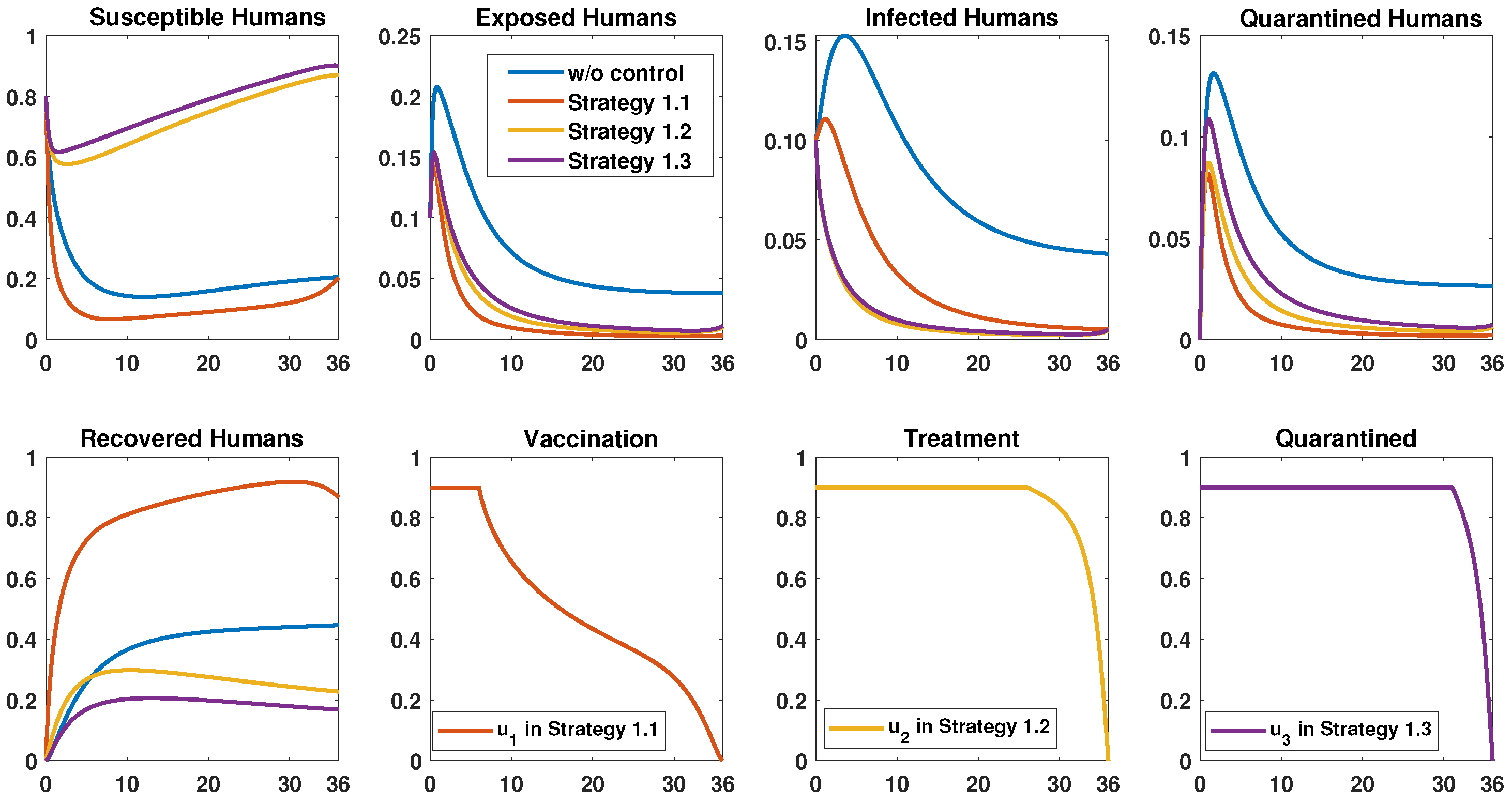
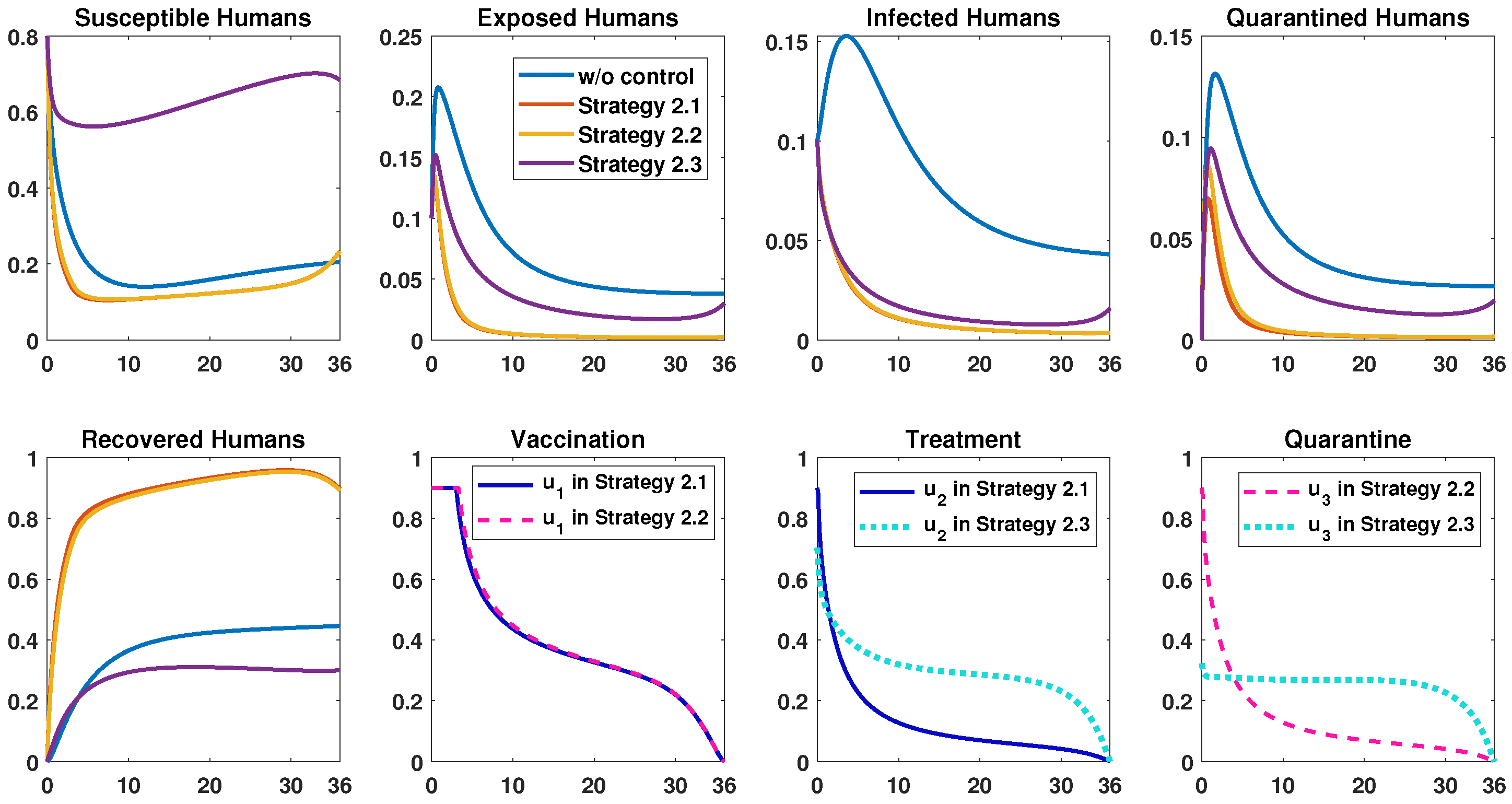
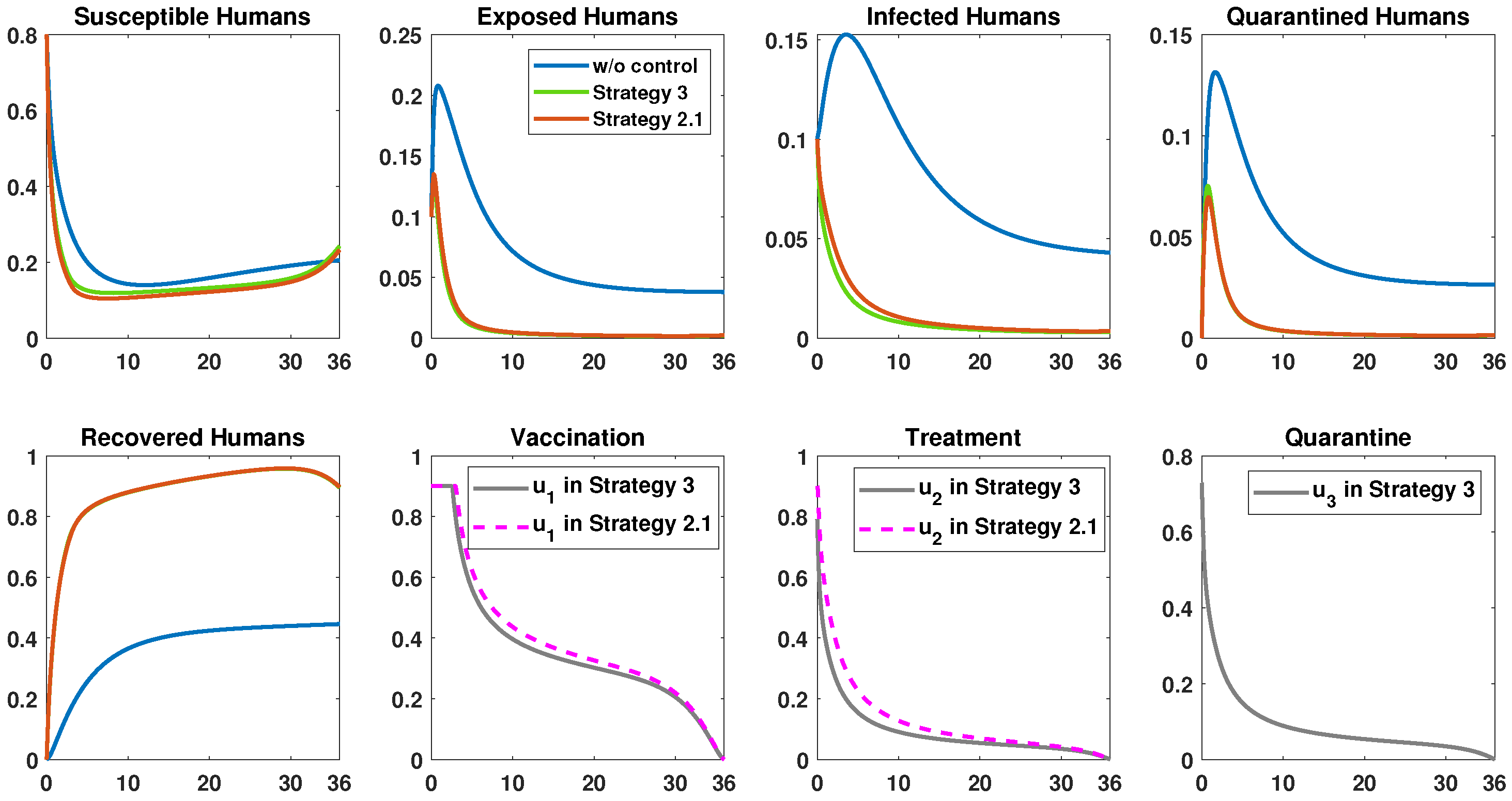
Our main purpose in these simulations is to examine the effects of vaccination, treatment, and quarantine controls on the dynamics against the spread of the monkeypox virus. Strategy 1 corresponds to the comparison of the single control effect and the uncontrolled situation. Strategy 2 reveals the effects of double control on the system. Strategy 3 includes a comparison of triple control and optimal double control strategies.

7.1. Strategy 1

In this strategy, the behavior of the single controls on the system is presented in Figure 1 with the following cases:
  • Strategy 1.1 applying only vaccination control to susceptible humans, that is, u 1 0 , u 2 = 0 , and u 3 = 0 ;
  • Strategy 1.2 applying only treatment control to infected humans, that is, u 1 = 0 , u 2 0 , and u 3 = 0 ;
  • Strategy 1.3 applying only quarantine control to infected humans, that is, u 1 = 0 , u 2 = 0 , and u 3 0 .
As seen in Figure 1, it is clear that the effect of each control separately is quite effective when compared to the uncontrolled system. Although only-treatment and only-quarantine strategies seem to produce better results for infected people, the effect of vaccination is actually too good to be ignored. Because vaccination control aims to establish permanent immunity in the population, its effect cannot be expected to be seen immediately in the infected compartment. In this context, while vaccination is effective in the long-term in the infected compartment, it increases the recovered class by reducing the susceptible and exposed compartments in a short time.

7.2. Strategy 2

In this strategy, the results of the double choices among the three controls to the system and their comparison with the uncontrolled system are presented in Figure 2 with the following cases:
  • Strategy 2.1—vaccination control u 1 of susceptible humans, treatment control u 2 of infected humans u 1 0 , u 2 0 , u 3 = 0 ;
  • Strategy 2.2—vaccination control u 1 of susceptible humans, quarantine control u 3 of infected humans u 1 0 , u 2 = 0 , u 3 0 ;
  • Strategy 2.3—treatment control u 2 of infected humans, quarantine control u 3 of infected humans u 1 = 0 , u 2 0 , u 3 0 .
In Figure 2, it is obvious that Strategies 2.1 and 2.2 show similar behavior. Also, these strategies respond better than Strategy 2.3 for each class of population. As we commented in the previous subsection Strategy 1, vaccination control greatly improves the results of the strategy in which it is incorporated.

7.3. Strategy 3

In this strategy, while investigating the effect of triple control on the system an ideal double control strategy given by Strategy 2 and the the uncontrolled system is compared. As seen in Figure 3, the simultaneous application of the three controls to the population is undoubtedly the most effective of all possible situations for infected humans. However, this result will not be the first policy selection in terms of the socio-economic structure of the countries. As the control methods applied against the disease increase, the costs will increase, posing problems for some countries. Therefore, it is desired to find an alternative ideal method by comparing the graphs with one of the double controls obtained in Strategy 2. In the previous subsection strategy 2, it was concluded that vaccination-quarantine and vaccination-treatment are effective strategies for the population. The quarantine application is a method that has many harms in terms of both state economy and folk psychology, as has been experienced with the COVID-19 epidemic in the recent past. For this reason, Strategy 2.1 u 1 0 , u 2 0 , u 3 = 0 , which behaves close to Strategy 2.2, is preferred for comparison.

8. Conclusions

In recent years, the rapid spread of the monkeypox virus, especially in African countries, has increased the efforts to prevent the devastating effects of the disease. Despite its importance, mathematical modeling and optimal control studies on the disease are still limited. Motivated by this need, in the present study, a monkeypox model describing the interspecific spreading of the virus has been discussed in the sense of the Atangana–Baleanu fractional derivative. In addition to revealing the mathematical model of a disease, it is also very important to determine optimal strategies with parameters that reduce its destructive effect. Hence, the main motivation of the present work has been to investigate the effect of quarantine, treatment, and vaccination controls on the model. In this context, existence-uniqueness results and stability analysis of the controlled model have been researched. It has been observed that time-dependent quarantine and treatment controls have a reducing effect on the basic reproduction number. The optimality system has been revealed by Hamiltonian formalism. To obtain numerical results, the Adams-type predictor–corrector method has been implemented. Single, double, and triple control effects on the model have been illustrated with graphics. According to the results, it has been seen that dual-control strategies including vaccination are more effective than dual control composed of quarantine and treatment. Thus, as in chickenpox, long-term immunity should be the primary control strategy in the fight against monkeypox disease. On the other hand, as expected, the triple control application yields the best results in declining the number of infected and exposed humans. But, of course, at the onset of the disease, other control strategies will continue to exert the optimum effect, as the vaccine is not yet available. As a continuation of the study, the effects of different incidence and treatment rates on the model are considered for examination. Additionally, the model can be developed by considering other interactive diseases with monkeypox.

Author Contributions

Conceptualization, E.B. and D.A.; methodology, M.Y., D.Y. and D.A.; software, M.Y., D.Y. and B.B.İ.E.; validation, E.B., D.A., B.B.İ.E. and D.F.M.T.; formal analysis, M.Y., D.Y. and D.A.; investigation, M.Y., D.Y., E.B., B.B.İ.E., D.A. and D.F.M.T.; writing—original draft preparation, M.Y., D.Y., D.A. and D.F.M.T.; writing—review and editing, M.Y., D.Y., D.A. and D.F.M.T.; visualization, M.Y. and D.Y.; supervision, D.A. and D.F.M.T.; funding acquisition, D.F.M.T. All authors have read and agreed to the published version of the manuscript.

Funding

This research was funded by Fundação para a Ciência e a Tecnologia (FCT), grant numbers UID/04106/2025 (https://doi.org/10.54499/UID/04106/2025) and UID/PRR/04106/2025 (https://doi.org/10.54499/UID/PRR/04106/2025), and by FCT project Mathematical Modelling of Multiscale Control Systems: Applications to Human Diseases (CoSysM3), reference 2022.03091.PTDC (https://doi.org/10.54499/2022.03091.PTDC).

Data Availability Statement

Data are contained within the article.

Conflicts of Interest

The authors declare no conflicts of interest.

References

  1. World Health Organization. Monkeypox [Online]. Available online: https://www.who.int/news-room/fact-sheets/detail/monkeypox (accessed on 21 May 2024).
  2. World Health Organization. WHO Director-General’s Statement at the Press Conference Following IHR Emergency Committee Regarding the Multi-Country Outbreak of Monkeypox—23 July 2022 [Online]. Available online: https://www.who.int/news-room/speeches/item/who-director-general-s-statement-on-the-press-conference-following-IHR-emergency-committee-regarding-the-multi--country-outbreak-of-monkeypox--23-july-2022 (accessed on 21 May 2024).
  3. Hatmal, M.M.M.; Al-Hatamleh, M.A.; Olaimat, A.N.; Ahmad, S.; Hasan, H.; Ahmad Suhaimi, N.A.; Mohamud, R. Comprehensive literature review of monkeypox. Emerg. Microbes Infect. 2022, 11, 2600–2631. [Google Scholar] [CrossRef]
  4. Bernoulli, D. Essai d’une nouvelle analyse de la mortalité causée par la petite vérole, et des avantages de l’inoculation pour la prévenir. Mem. Math. Phys. 1760, 1–45. [Google Scholar]
  5. Kermack, W.O.; McKendrick, A.G. A contribution to the mathematical theory of epidemics. Proc. R. Soc. London. Ser. A Contain. Pap. Math. Phys. Character 1927, 115, 700–721. [Google Scholar] [CrossRef]
  6. Rodrigues, H.S.; Monteiro, M.T.T.; Torres, D.F.M. Sensitivity analysis in a dengue epidemiological model. In Conference Papers in Mathematics; Hindawi Publishing Corporation: London, UK, 2013; Volume 2013, pp. 1–7. [Google Scholar]
  7. Bolaji, B.; Onoja, T.; Agbata, C.; Omede, B.I.; Odionyenma, U.B. Dynamical analysis of HIV-TB co-infection transmission model in the presence of treatment for TB. Bull. Biomath. 2024, 2, 21–56. [Google Scholar] [CrossRef]
  8. Gao, W.; Baskonus, H.M.; Shi, L. New investigation of bats-hosts-reservoir-people coronavirus model and application to 2019-nCoV system. Adv. Differ. Equ. 2020, 2020, 391. [Google Scholar] [CrossRef]
  9. Bhunu, C.P.; Garira, W.; Magombedze, G. Mathematical analysis of a two strain HIV/AIDS model with antiretroviral treatment. Acta Biotheor. 2009, 57, 361–381. [Google Scholar] [CrossRef]
  10. Bhunu, C.; Mushayabasa, S. Modelling the transmission dynamics of pox-like infections. Iaeng Int. J. Appl. Math. 2011, 41, 141–149. [Google Scholar]
  11. Usman, S.; Adamu, I.I. Modeling the transmission dynamics of the monkeypox virus infection with treatment and vaccination interventions. J. Appl. Math. Phys. 2017, 5, 2335. [Google Scholar] [CrossRef]
  12. Emeka, P.; Ounorah, M.; Eguda, F.; Babangida, B. Mathematical model for monkeypox virus transmission dynamics. Epidemiology 2020, 8, 1000348. [Google Scholar]
  13. Peter, O.J.; Kumar, S.; Kumari, N.; Oguntolu, F.A.; Oshinubi, K.; Musa, R. Transmission dynamics of Monkeypox virus: A mathematical modeling approach. Model. Earth Syst. Environ. 2022, 8, 3423–3434. [Google Scholar] [CrossRef]
  14. Yapışkan, D.; Yurtoğlu, M.; Avcı, D.; Eroxgxlu, B.B.İ.; Bonyah, E. A Novel Model for Monkeypox Disease: System Analysis and Optimal Preventive Strategies. Iran. J. Sci. 2023, 47, 1665–1677. [Google Scholar] [CrossRef]
  15. Baltaeva, U.; Babajanova, Y.; Agarwal, P.; Ozdemir, N. Solvability of a mixed problem with the integral gluing condition for a loaded equation with the Riemann-Liouville fractional operator. J. Comput. Appl. Math. 2023, 425, 115066. [Google Scholar] [CrossRef]
  16. Muhammad, S.; Anwar, T.; Asifa; Yavuz, M. Comprehensive investigation of thermal and flow features of alloy based nanofluid considering shape and Newtonian heating effects via new fractional approach. Fractal Fract. 2023, 7, 150. [Google Scholar] [CrossRef]
  17. Tajani, A.; El Alaoui, F.Z. Boundary Controllability of Riemann-Liouville Fractional Semilinear Evolution Systems. J. Optim. Theory Appl. 2023, 198, 767–780. [Google Scholar] [CrossRef]
  18. Sabatier, J.; Farges, C. Time-Domain Fractional Behaviour Modelling with Rational Non-Singular Kernels. Axioms 2024, 13, 99. [Google Scholar] [CrossRef]
  19. Ullah, S.; Altaf Khan, M.; Farooq, M. Modeling and analysis of the fractional HBV model with Atangana-Baleanu derivative. Eur. Phys. J. Plus 2018, 133, 313. [Google Scholar] [CrossRef]
  20. Li, X.P.; Al Bayatti, H.; Din, A.; Zeb, A. A vigorous study of fractional order COVID-19 model via ABC derivatives. Results Phys. 2021, 29, 104737. [Google Scholar] [CrossRef]
  21. Becker, N.; Yip, P. Analysis of variations in an infection rate. Aust. J. Stat. 1989, 31, 42–52. [Google Scholar] [CrossRef]
  22. Avcı, D.; Soytürk, F. Optimal control strategies for a computer network under virus threat. J. Comput. Appl. Math. 2023, 419, 114740. [Google Scholar] [CrossRef]
  23. Yurtoğlu, M.; Avcı, D. Optimal Antivirus Strategies for A Virus Propagation Modelled with Mittag-Leffler Kernel. In Fractional Dynamics in Natural Phenomena and Advanced Technologies; Baleanu, D., Hristov, J., Eds.; Cambridge Scholars Publishing: Newcastle upon Tyne, UK, 2024; pp. 113–130. [Google Scholar]
  24. Eroğlu, B.B.İ.; Yapışkan, D. Comparative analysis on fractional optimal control of an SLBS model. J. Comput. Appl. Math. 2023, 421, 114840. [Google Scholar] [CrossRef]
  25. Yapışkan, D.; Eroğlu, B.B.İ. Fractional-order brucellosis transmission model between interspecies with a saturated incidence rate. Bull. Biomath. 2024, 2, 114–132. [Google Scholar] [CrossRef]
  26. Kaplan, E.H.; Craft, D.L.; Wein, L.M. Emergency response to a smallpox attack: The case for mass vaccination. Proc. Natl. Acad. Sci. USA 2002, 99, 10935–10940. [Google Scholar] [CrossRef]
  27. Peter, O.J.; Oguntolu, F.A.; Ojo, M.M.; Oyeniyi, A.O.; Jan, R.; Khan, I. Fractional order mathematical model of monkeypox transmission dynamics. Phys. Scr. 2022, 97, 084005. [Google Scholar] [CrossRef]
  28. El-Mesady, A.; Elsonbaty, A.; Adel, W. On nonlinear dynamics of a fractional order monkeypox virus model. Chaos Solitons Fractals 2022, 164, 112716. [Google Scholar] [CrossRef]
  29. Okyere, S.; Ackora-Prah, J. Modeling and analysis of monkeypox disease using fractional derivatives. Results Eng. 2023, 17, 100786. [Google Scholar] [CrossRef]
  30. Okposo, N.I.; Addai, E.; Apanapudor, J.S.; Gómez-Aguilar, J.F. A study on a monkeypox transmission model within the scope of fractal-fractional derivative with power-law kernel. Eur. Phys. J. Plus 2023, 138, 684. [Google Scholar] [CrossRef]
  31. Zhang, N.; Addai, E.; Zhang, L.; Ngungu, M.; Marinda, E.; Asamoah, J.K.K. Fractional modeling and numerical simulation for unfolding marburg-monkeypox virus co-infection transmission. Fractals 2023, 31, 2350086. [Google Scholar] [CrossRef]
  32. Agrawal, O.P. A general formulation and solution scheme for fractional optimal control problems. Nonlinear Dyn. 2004, 38, 323–337. [Google Scholar] [CrossRef]
  33. Agrawal, O.P. A formulation and numerical scheme for fractional optimal control problems. J. Vib. Control 2008, 14, 1291–1299. [Google Scholar] [CrossRef]
  34. Bahaa, G.M.; Atangana, A. Necessary and sufficient optimality conditions for fractional problems involving Atangana-Baleanu’s derivatives. In Fractional Derivatives with Mittag-Leffler Kernel; Gomez, J., Torres, L., Escobar, R., Eds.; Studies in Systems, Decision and Control; Springer: Cham, Switzerland, 2019; Volume 194. [Google Scholar]
  35. Majee, S.; Jana, S.; Barman, S.; Kar, T.K. Transmission Dynamics of Monkeypox Virus with Treatment and Vaccination Controls: A Fractional Order Mathematical Approach. Phys. Scr. 2023, 98, 024002. [Google Scholar] [CrossRef]
  36. Peter, O.J.; Abidemi, A.; Ojo, M.M.; Ayoola, T.A. Mathematical model and analysis of monkeypox with control strategies. Eur. Phys. J. Plus 2023, 138, 242. [Google Scholar] [CrossRef]
  37. Lemos-Paiao, A.P.; Maurer, H.; Silva, C.J.; Torres, D.F. A SIQRB delayed model for cholera and optimal control treatment. Math. Model. Nat. Phenom. 2022, 17, 25. [Google Scholar] [CrossRef]
  38. Eroğlu, B.B.İ.; Yapışkan, D. Optimal Strategies to Prevent COVID-19 from Becoming a Pandemic. In Mathematical Modeling and Intelligent Control for Combating Pandemics; Springer Optimization and Its Applications; Hammouch, Z., Lahby, M., Baleanu, D., Eds.; Springer: Cham, Switzerland, 2023; pp. 39–55. [Google Scholar]
  39. Yurtoğlu, M.; Avcı, D. An optimal vaccination scenario for COVID-19 transmission between children and adults. In Mathematical Modeling and Intelligent Control for Combating Pandemics; Springer: Berlin/Heidelberg, Germany, 2023; pp. 93–108. [Google Scholar]
  40. Ammi, M.R.S.; Zinihi, A.; Raezah, A.A.; Sabbar, Y. Optimal control of a spatiotemporal SIR model with reaction-diffusion involving p-Laplacian operator. Results Phys. 2023, 52, 106895. [Google Scholar] [CrossRef]
  41. Kilbas, A.A.; Marichev, O.; Samko, S. Fractional Integral and Derivatives: Theory and Applications; Gordon and Breach: Basel, Switzerland, 1993. [Google Scholar]
  42. Baleanu, D.; Fernandez, A. On some new properties of fractional derivatives with Mittag-Leffler kernel. Commun. Nonlinear Sci. Numer. Simul. 2018, 59, 444–462. [Google Scholar] [CrossRef]
  43. Atangana, A.; Baleanu, D. New fractional derivatives with non-local and non-singular kernel: Theory and application to Heat transfer model. Therm. Sci. 2016, 20, 763–769. [Google Scholar] [CrossRef]
  44. Diekmann, O.; Dietz, K.; Heesterbeek, J.A.P. The basic reproduction ratio for sexually transmitted diseases: I. Theoretical considerations. Math. Biosci. 1991, 107, 325–339. [Google Scholar] [CrossRef]
  45. Van den Driessche, P.; Watmough, J. Reproduction numbers and sub-threshold endemic equilibria for compartmental models of disease transmission. Math. Biosci. 2002, 180, 29–48. [Google Scholar] [CrossRef]
  46. Ahmed, E.; El-Sayed, A.M.A.; El-Saka, H.A. Equilibrium points, stability and numerical solutions of fractional-order predator-prey and rabies models. J. Math. Anal. Appl. 2007, 325, 542–553. [Google Scholar] [CrossRef]
  47. Lukes, D.L. Differential Equations: Classical to Controlled; Academic Press: Waltham, MA, USA, 1982. [Google Scholar]
  48. Fleming, W.H.; Rishel, R.W. Deterministic and Stochastic Optimal Control; Springer Science & Business Media: Heidelberg, Germany, 2012; Volume 1. [Google Scholar]
  49. Diethelm, K.; Ford, N.J.; Freed, A.D. A predictor-corrector approach for the numerical solution of fractional differential equations. Nonlinear Dyn. 2002, 29, 3–22. [Google Scholar] [CrossRef]
  50. Baleanu, D.; Jajarmi, A.; Sajjadi, S.S.; Mozyrska, D. A new fractional model and optimal control of a tumor-immune surveillance with non-singular derivative operator. Chaos Interdiscip. J. Nonlinear Sci. 2019, 29, 083127. [Google Scholar] [CrossRef]
Figure 1. A comparison for Strategy 1: Single control versus uncontrolled effects for α = 0.90 .
Fractalfract 10 00044 g001
Figure 2. A comparison for Strategy 2: double control versus uncontrolled effects for α = 0.90 .
Fractalfract 10 00044 g002
Figure 3. A comparison for Strategy 3: Triple control strategy versus the best double control strategy for α = 0.90 .
Fractalfract 10 00044 g003
Disclaimer/Publisher’s Note: The statements, opinions and data contained in all publications are solely those of the individual author(s) and contributor(s) and not of MDPI and/or the editor(s). MDPI and/or the editor(s) disclaim responsibility for any injury to people or property resulting from any ideas, methods, instructions or products referred to in the content.