Next Article in Journal
Complementary Metal-Oxide Semiconductor (CMOS) Circuit Realization of Elliptic Low-Pass Filter of Order (1 + α)
Previous Article in Journal
Composite Fractal Index for Assessing Voltage Resilience in RES-Dominated Smart Distribution Networks
error_outline You can access the new MDPI.com website here. Explore and share your feedback with us.
 
 
Article

Weighted Random Averages and Recursive Interpolation in Fibonacci Sequences

by
Najmeddine Attia
1,* and
Taoufik Moulahi
2
1
Department of Mathematics and Statistics, College of Science, King Faisal University, P.O. Box 400, Al-Ahsa 31982, Saudi Arabia
2
Department of Mathematics, College of Science and Humanities in Al-Kharj, Prince Sattam Bin Abdulaziz University, P.O. Box 173, Al-Kharj 11942, Saudi Arabia
*
Author to whom correspondence should be addressed.
Fractal Fract. 2026, 10(1), 33; https://doi.org/10.3390/fractalfract10010033
Submission received: 8 December 2025 / Revised: 21 December 2025 / Accepted: 29 December 2025 / Published: 5 January 2026

Abstract

We investigate the multifractal geometry of irregular sets arising from weighted averages of random variables, where the weights ( w n ) form a positive sequence with exponential growth. Our analysis applies in particular to sequences generated by linear recurrence relations of Fibonacci type, including higher-order generalizations such as the Tetranacci sequence ( T n ) . Using a Cantor-type construction built from alternating free and forced blocks, we show that the associated exceptional sets may attain full Hausdorff and packing dimension, independently of the precise form of the recurrence. We further develop a probabilistic interpretation of ( T n ) through an appropriate Markov representation that encodes its combinatorial evolution and yields sharp asymptotic behavior. Finally, given n + 1 consecutive terms of a Fibonacci-type sequence, one may construct a polynomial P n ( x ) of degree at most n via Lagrange interpolation; we show that this polynomial admits an implicit recursive representation consistent with the underlying recurrence.

1. Introduction and Main Results

In recent years, numerous researchers have shown interest in studying number sequences and recurrence relations. The Fibonacci sequence ( F n ) n is the most prominent example of recursive sequences characterized by rich and remarkable structural properties. Originating from the pioneering work of Leonardo Fibonacci, it is defined by the series of numbers generated by the pattern
1 , 1 , 2 , 3 , 5 , 8 , 13 , 21 , 34 , 55 , 89 ,
Each subsequent term is computed as the sum of its two preceding terms. The pervasiveness of these numerical entities in natural phenomena enhances their allure. Furthermore, they hold significant importance in diverse academic disciplines including but not limited to algebra, geometry, and number theory. Many researchers have investigated the properties and applications of this sequence in diverse fields. Moreover, it was proved that the sequence ( F n ) n 0 is closely related to the golden ratio σ = ( 1 + 5 ) / 2 = 1.61803398 .
Numerous authors have undertaken the task of generalizing the Fibonacci sequence by either keeping the original recurrence relation while altering the initial terms or by maintaining the initial terms while slightly modifying the recurrence relation (see, for instance, [1,2,3]). The reader can consult also [4,5] for the study of the m-Fibonacci-like sequence for a positive integer m. Furthermore, one of the most important variations of the Fibonacci sequence is the k-step Fibonacci sequence, commonly denoted by ( T k , n ) n 0 (or simply by ( T n ) n if context allows clarity), in which each number is the sum of the preceding k-numbers [6,7,8,9]. In particular, when k = 3 , one has the Tribonacci sequence, originally introduced by Feinberg in 1963 [10], this topic has since inspired numerous generalizations, each exhibiting fascinating properties such as Binet formulas, summation formulas and generating functions [11].
Motivated by these developments, we investigate how such recursive sequences behave when used as weights in probabilistic or dynamical constructions. Recent works show that weighted sums involving Fibonacci-type weights may display unexpected oscillatory and fractal features, particularly when the weights grow exponentially [12]. This motivates the study of the multifractal structure of weighted averages driven by general recursive sequences. In this paper, we adopt a probabilistic viewpoint and consider weighted sums of independent random variables. To formalize the setting, let ( Ω , F , P ) be a probability space, and let ( X n ) n 1 be a sequence of independent and identically distributed (i.i.d.) real-valued random variables with non-degenerate law. Given a sequence of positive weights ( w n ) n 1 , we consider the W n = k = 1 n w k and the weighted averages
Y n = k = 1 n w k X k W n , n 1 .
Such quantities arise naturally in probability theory, statistics, ergodic theory, and the study of non-uniform random walks. A fundamental question concerns the almost sure convergence of Y n . When the weights are sufficiently “diffuse”, in the sense that
max 1 k n w k W n 0 ,
the behavior of ( Y n ) is well understood. Classical results of Chow [13,14], Stout [15,16], Padgett–Taylor [17], Rosalsky–Sreehari [18], Bai–Cheng [19], and Cuzick [20], among others, show that Y n converges almost surely to E [ X 1 ] under mild moment assumptions. Further extensions to various forms of dependence were later obtained by Etemadi [21], Shen [22], and related works.
A completely different behavior emerges when the weights grow exponentially, that is,
w n + 1 w n φ > 1 ,
see Lemma 1. In this regime, the contribution of the last weight w n does not vanish in the normalization W n ; in fact, it converges to a strictly positive proportion of the total mass. Consequently, the diffuseness condition underlying the classical weighted law of large numbers fails, and almost-sure convergence of ( Y n ) cannot hold whenever X 1 is non-degenerate; see, for instance, ([12], Theorem 2). Exponentially growing weights arise naturally in recursive random walks whose increments satisfy Fibonacci or more generally k–bonacci-type recursions. Recent works [6,12,23] show that such walks display persistent oscillations and generate full-dimensional fractal sets of exceptional trajectories. Beyond the classical law of large numbers for i.i.d. sequences and the convergence theory for Birkhoff sums [15,24], recent research has focused on the fractal geometry of the irregular sets where such averages fail to converge, revealing that these exceptional sets often have large or even full dimension [25,26].
Motivated by these phenomena, we study in this paper the weighted averages Y n defined by (1) in the general setting where the random variables X k take values in a finite alphabet
B = { x 0 < x 1 < < x r } , r 1 ,
and where the weights satisfy the sole assumption (3). In this regime, the averages typically oscillate rather than converge. For any pair a , b B with a < b , we introduce the set
C ( a , b ) = ω Ω : lim inf n Y n ( ω ) = a , lim sup n Y n ( ω ) = b ,
which describes trajectories whose oscillation interval is prescribed. The analysis of these sets is partly motivated by earlier work on branching random walks on supercritical Galton–Watson trees, where quantities analogous to Y n have been investigated [27,28]. A related form of the oscillation set C ( a , b ) was also examined in [29], where the normalized sums were shown to oscillate between two prescribed limits a and b. In that setting, the proofs rely on the construction of a Mandelbrot-type multiplicative cascade supported on the boundary of the tree, which provides probabilistic control over the Hausdorff and packing dimensions of the corresponding exceptional sets [30,31]. These techniques, however, fundamentally depend on independence and on the use of homogeneous weights ( a k = 1 ) and thus cannot be extended to non-independent scenarios or to non-stationary weight sequences such as the Fibonacci case. Furthermore, the study of the global irregular set I is naturally linked to earlier developments in multifractal analysis and ergodic theory.
A central result of this paper is Theorem 1, which establishes that exponential growth of the weights alone is sufficient to generate irregular sets of maximal fractal size. More precisely, we show that for any prescribed oscillation interval [ a , b ] contained in the alphabet, the corresponding oscillation set C ( a , b ) has full Hausdorff and packing dimension. In the special case X k { 0 , 1 } and w n = F n , this was previously proved ([12], Theroem 2) using the identity
i = 1 n F i = F n + 2 1 ,
which allows exact control of weighted blocks. We show here that no such exact formula is needed: the conclusion remains valid for any weight sequence with geometric growth.
Theorem 1. 
Assume that the weights satisfy (3) and let x 0 a < b x r . Then, the set C ( a , b ) is non-empty, and for every ε > 0 , it contains a compact Cantor set K such that
dim H K 1 ε .
Consequently,
dim H C ( a , b ) = dim P C ( a , b ) = 1 ,
where dim H and dim P denote the Hausdorff and packing dimension, respectively.
A key feature of Theorem 1 is that the structure of the irregular sets C ( a , b ) is governed exclusively by the exponential growth of the weights. In particular, no further arithmetic or combinatorial assumption on the weights is required. The only assumption needed is (3), which guarantees that the last part of the weighted sum carries a fixed positive proportion of the total mass, thereby violating the classical diffuseness condition underlying weighted laws of large numbers. This property is precisely what allows us to force the weighted averages to oscillate between prescribed values and ultimately to construct Cantor subsets of full the Hausdorff and packing dimension. The exponential ratio property w n + 1 / w n φ > 1 is well known to hold for the Fibonacci sequence and, more generally, for all k-step Fibonacci-type recurrences through their Binet-type representations. Thus, classical linear recurrences naturally generate exponentially growing weights satisfying the assumptions of Theorem 1. In the present work, we investigate this phenomenon for the Tetranacci sequence, whose structure admits both an algebraic (Binet-type) description and a probabilistic interpretation. We consider the recurrence
T n + 4 = T n + T n + 1 + T n + 2 + T n + 3 , n 0 ,
with initial values T 0 = 0 , T 1 = 1 , T 2 = 2 , and T 3 = 4 . As shown in [32], T n admits a closed Binet-type formula in terms of the roots of the characteristic polynomial
x 4 x 3 x 2 x 1 = 0 ,
which possesses a unique real root p ( 0 , 1 ) . This yields algebraic asymptotics of the Tetranacci sequence ( T n ) n . We develop a probabilistic viewpoint based on a color/Markov model (Section 3 and Section 4) that encodes the combinatorial structure of the recurrence. This method yields both an exact identity and an asymptotic expansion.
Theorem 2. 
Let ( T n ) n 0 be the Tetranacci sequence defined by (5). Then
n = 2 T n 4 n = 399 684 .
Moreover, letting ς = 1 + p 2 + 2 p 3 + 2 p 4 1 , then we have the asymptotic estimate
T n ς p n , n ,
and in particular
lim n T n + 1 T n = p 1 > 1 .
Theorem 2 shows in particular that T n = o ( 4 n ) , and the probabilistic model leads to a second asymptotic characterization in Section 4. Following the approach of [33,34], we encode the sequence into a Markov chain and extract the limiting distribution, obtaining the following refinement.
Theorem 3. 
Let ( T n ) be the Tetranacci sequence with initial values T 0 = T 1 = 0  and  T 2 = T 3 = 1 . Then
lim n p n 2 T n 1 = 1 2 p p 2 p 3 ( 1 p ) 2 ,
where p is the real root of 1 p p 2 p 3 p 4 = 0 . Consequently, (6) holds.
Theorem 3 confirms that the Tetranacci sequence grows exponentially according to
T n = O ( β n ) , β = p 1 = 1.92756 ,
in agreement with the algebraic asymptotics obtained in [32], but now derived through a fully probabilistic mechanism. Such exponential behavior mirrors the classical Fibonacci case, where the ratio F n + 1 / F n converges to the Golden Ratio σ = ( 1 + 5 ) / 2 , a phenomenon with deep geometric and analytic implications (see, e.g., [35,36]). More generally, this convergence property extends to the broad family of k–Fibonacci and k-Fibonacci-like sequences, whose successive ratios converge to the real dominant root of the corresponding characteristic polynomial.
The final part of this paper is devoted to a complementary and somewhat independent perspective: the polynomial reconstruction of Fibonacci sequences. Given n + 1 consecutive values of a k-step Fibonacci-like sequence, we show in Section 5 that one may construct a polynomial P n ( x ) of degree at most n via Lagrange interpolation, which recovers these values exactly. We prove that this interpolating polynomial admits both an implicit and a recursive description; more precisely,
P n + 1 ( x ) P n ( x ) + α n x ( x 1 ) ( x n ) ,
where α n denotes the leading coefficient of P n + 1 .
The article is organized around three complementary themes, unified by the role played by Fibonacci–type recursions and exponential growth. In Section 2, we first investigate exponentially weighted random averages and show that the sole assumption of geometric growth of the weights is sufficient to generate large irregular sets, culminating in the proof of Theorem 1. Section 3 and Section 4 are then devoted to a detailed probabilistic analysis of the Tetranacci sequence: using color models and Markov chain representations, we derive sharp asymptotic estimates and limit formulas, without resorting to explicit Binet-type formulas or the resolution of Vandermonde systems, thereby illustrating how classical linear recurrences naturally produce the exponential regimes required in Section 2. Finally, Section 5 explores a complementary perspective by studying polynomial reconstruction associated with Fibonacci–type sequences, showing that consecutive values of such recursions admit an implicit and recursive Lagrange interpolation scheme.

2. Irregular Sets via Weighted Random Sequences

In this section we analyse the emergence of irregular behaviour in exponentially weighted averages and construct Cantor-type subsets of the oscillation sets C ( a , b ) . The key mechanism is that geometric growth of the weights forces the most recent symbols to carry a fixed positive proportion of the total weight. This phenomenon leads to almost-sure oscillations of the averages between the extreme values of the alphabet, and ultimately allows the construction of large fractal subsets inside the irregular set C ( a , b ) . Before turning to the Cantor construction, we first show that the classical diffuseness condition fails in the exponentially growing regime, the following result will be proved in Appendix A.
Lemma 1. 
Let ( X k ) k 1 be i.i.d. real-valued random variables taking values in a finite alphabet B defined by (4). Let ( w n ) n 1 be a sequence of positive weights satisfying (3).
1. 
The diffuseness condition (2) does not hold. More precisely,
max 1 k n w k i = 1 n w i = w n i = 1 n w i φ 1 φ > 0 .
2. 
The exponentially weighted averages Y n do not converge almost surely. More precisely,
lim sup n   Y n = x r , lim inf n   Y n = x 0 , a . s . .
The proof of Theorem 1 is based on the fact that exponential growth of the weights implies that the last block of terms contributes a fixed positive proportion of the total weight. This allows us to force the weighted average Y n to approach prescribed values and to construct a Cantor-type subset of C ( a , b ) with full Hausdorff and packing dimensions. We will start by considering the case when a , b B in the following result.
Proposition 1. 
Assume that the weights satisfy (3). Let a < b be elements of B . Then, the set C ( a , b ) is non-empty, and for every ε > 0 it contains a compact Cantor set K such that
dim H K 1 ε .
Consequently,
dim H C ( a , b ) = dim P C ( a , b ) = 1 .
Proof. 
First observe, using (A2), that, for m 1 , the tail block { n m + 1 , , n } carries a fixed positive proportion of the total weight. Forcing m consecutive symbols equal to x r = b makes the average Y n exponentially close to b, and similarly for x 0 = a . In the following, we construct inductively a compact set K Ω consisting of trajectories whose weighted averages oscillate between a and b. To this end, for each j 1 , we choose:
  • a free block of length m j , where X k may take any value in B ;
  • a forced block of length t j , where all symbols are fixed, equal either to x 0 = a or to x r = b .
These two blocks are represented schematically as:
free block of length m j all choices allowed forced block of length t j X k = x 0 or x r .
The sequences ( m j ) and ( t j ) are chosen so that
m j , t j , t j m j 0 .
Thus, the free blocks generate the combinatorial branching, while the forced blocks control the oscillation of Y n . Define,
M J = j = 1 J m j , T J = j = 1 J t j , L J = M J + T J .
At stage J, the construction produces exactly 2 M J cylinders of length L J . For each j, we define the admissible blocks:
B j a = ( free block of length m j ) followed by t j copies of x 0 = a ,
B j b = ( free block of length m j ) followed by t j copies of x r = b .
We then define
K = B 1 σ 1 B 2 σ 2 B 3 σ 3 : σ j { a , b } .
Let N = L j be the endpoint of the jth forced block. If σ j = b , then the last t j symbols are all equal to x r = b , and by (A2),
Y N = k = 1 N t j w k X k + b k = N t j + 1 N w k W N = b + O ( φ t j ) .
Similarly, if σ j = a , then
Y N = a + O ( φ t j ) .
Since t j , the errors decay exponentially. Thus, every ω K satisfies
lim inf n   Y n ( ω ) = a , lim sup n   Y n ( ω ) = b .
Therefore,
K C ( a , b ) .
The Hausdorff dimension of K is computed using the standard formula for inhomogeneous Cantor constructions ([37], Chapter 4):
dim H K = lim inf J log ( 2 M J ) log ( 2 L J ) = lim inf J M J L J .
Using (7), we obtain
M J L J = M J M J + T J 1 .
Thus, dim H K 1 ε for all ε > 0 . On the other hand, since the packing dimension satisfies dim P ( C ( a , b ) ) 1 , it follows that
dim H C ( a , b ) = dim P C ( a , b ) = 1 .
Proof of Theorem 1. 
Fix x 0 a < b x r and ε > 0 . The proof relies on constructing a Cantor-type subset K C ( a , b ) using free blocks (which generate combinatorial branching) and forced blocks (which push the weighted average close to a or to b). To this end, choose sequences ( m j ) and ( t j ) satisfying (7). Block j consists of:
  • a free part of length m j (all symbols in B allowed);
  • a forced tail of length t j (symbols fixed, chosen to approximate a or b).
Recall (8) and consider the forced block of length t j ending at L j :
{ L j t j + 1 , , L j } .
For integers m = 0 , , t j , define normalized partial tail sums
R j ( m ) = n = L j t j + 1 L j t j + m w n n = L j t j + 1 L j w n .
Since w n k / w n φ k and the weights decay geometrically along the tail, the increments satisfy
R j ( m + 1 ) R j ( m ) = w L j t j + m + 1 w n ( φ 1 ) φ ( t j m ) 0
uniformly in m as t j . Thus ( R j ( m ) ) m = 0 t j becomes asymptotically dense in [ 0 , 1 ] . Hence, for any p [ 0 , 1 ] and any δ > 0 , if t j is large enough, there exists m j ( p ) { 0 , , t j } such that
| R j ( m j ( p ) ) p | < δ .
Let
p j = a if block j is of type a , b if block j is of type b .
Choose δ j = 1 / ( 3 j ) in (9). Then, the forced tail of block j is chosen so that
n = L j t j + 1 L j w n X n n = L j t j + 1 L j w n p j < 1 3 j .
Meanwhile, the free part of length m j contributes
n = L j 1 + 1 L j t j w n X n n = L j t j + 1 L j w n 0 ,
because its total weight is O ( φ t j ) times the tail weight (by (A2) with m = t j ). Combining (10) and (11) gives
| Y L j p j | < 1 j for all sufficiently large j .
Define
K = B 1 σ 1 B 2 σ 2 B 3 σ 3 : σ j { a , b } .
Using (12), we get
lim inf n   Y n ( ω ) = a , lim sup n Y n   ( ω ) = b , ω K ,
so K C ( a , b ) . Finally, the computation of the Hausdorff and packing dimensions proceeds exactly as in the proof of Proposition 1. □

3. Approximation of T n : Color Model

Beyond their classical algebraic and combinatorial features, Fibonacci sequences and their higher-order extensions naturally arise in probabilistic and number–theoretic settings. From a number–theoretic perspective, probabilistic constructions offer an effective framework for modeling Fibonacci-type linear recurrences, in which the arithmetic nature of the coefficients influences both the growth behavior and the statistical distribution of the sequences. Such an approach allows one to recover key arithmetic properties, including Binet-type formulas, the influence of dominant algebraic roots, and sharp asymptotic estimates, without relying on the explicit resolution of Vandermonde systems. Within this framework, the sequence (5) admits a natural interpretation in terms of stochastic processes, and in particular through connections with Markov chains, which have been widely explored in the literature [6,7,34,38].
In this section, using a probabilistic approach, we will prove Theorem 2 below, which provides an asymptotic approximation of T n for sufficiently large n. Let { s n } n 1 denote the number of sequences of ones, twos, threes, and fours that sum to n. In particular, one has s 1 = T 1 = 1 , s 2 = T 2 = 2 , s 3 = T 3 = 4 , and s 4 = T 4 = 7 . Additionally, note that
s n = s n 4 + s n 3 + s n 2 + s n 1 , n 5
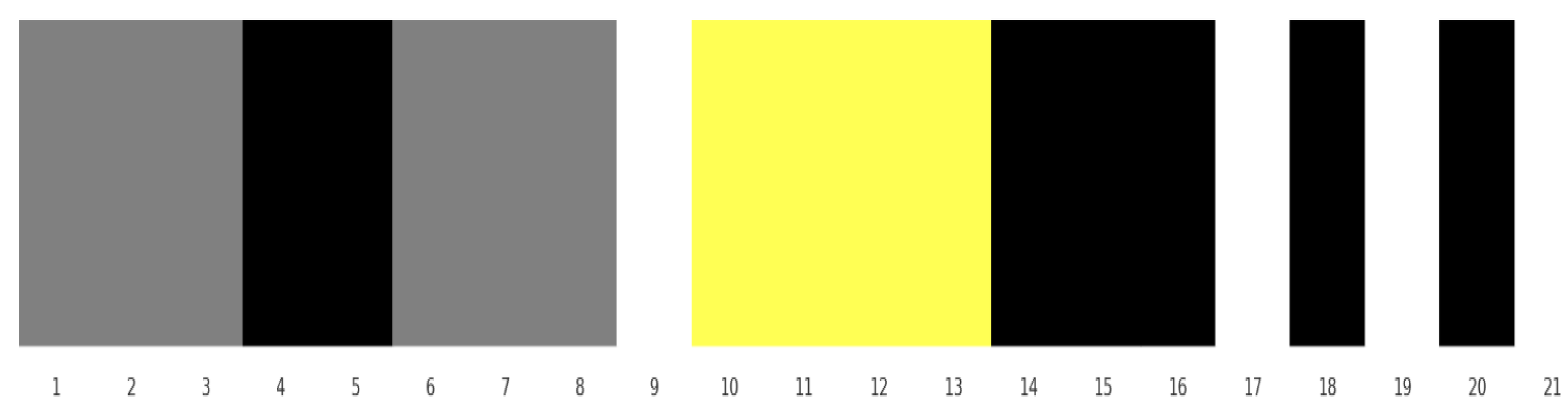
which implies first that s n = T n and then T n can be combinatorially interpreted as the number of ways to tile a board of length n 1 using tiles of size 1, 2, 3 and 4 cells. To illustrate this, consider an infinite board with cells labeled 1 , 2 , 3 , , where each cell is independently colored black (B), white (W), gray (G), or yellow (Y) with probability 1 / 4 as shown in Figure 1. Moreover, any coloring of the first n cells has a probability of ( 1 / 4 ) n .
An infinite tiling can be described as a repeating pattern of sequences composed of black, white, gray, and yellow cells, each of varying length. For example, the tiling in Figure 1 begins with a gray sequence of length 3, followed by a black sequence of length 2, another gray sequence of length 3, then a white sequence of length 1, a yellow sequence of length 4, a black sequence of length 2, and so on.
We define the random variable X given the position of the end of the first black string that is not a multiple of two or the first gray string that is not a multiple of three or the first yellow string that is not a multiple of four. For example, in Figure 1, we have X = 16 . Let n 1 , note that { X = n } occurs if and only if:
1.
Cell n is covered by B, and cell n + 1 is covered by B ¯ (a white, gray, or yellow cell), or cell n is covered by G, and cell n + 1 is covered by G ¯ or Cell n is covered by Y, and cell n + 1 is covered by Y ¯ .
2.
Cells 1 through n 1 are covered using any combination of white cells, black double cells, gray triple cells, and yellow quadruple cells.
Let n G (resp. n Y ) denotes the number of last gray (resp; Yellow) tiles. It follows that
(i)
If tile number n is black, we will have T n 1 ways from 1 to n 1 .
(ii)
If tile number n is gray and n G = 3 m + 2 , for some m N , we will have T n 2 ways from 1 to n 2 . However, if n G = 3 m + 1 , we will have T n 1 ways from 1 to n 1 .
(iii)
If tile number n is yellow and n Y = 4 m + 3 , for some m N , we will have T n 3 ways from 1 to n 3 . If n Y = 4 m + 2 , we will have T n 2 ways from 1 to n 2 . However, if n Y = 4 m + 1 , we will have T n 1 ways from 1 to n 1 .
Since each irregular block occurs with strictly positive probability and the colorings are independent and identically distributed, the probability that no irregular block ever appears is zero. Consequently, X < almost surely. Moreover, P ( X = 1 ) = 9 16 , P ( X = 2 ) = 15 64 , P ( X = 3 ) = 27 256 , P ( X = 4 ) = 51 1024 , and for all n 5 one has
P ( X = n ) = T n 1 4 n 1 1 4 3 4 + T n 2 4 n 2 1 4 2 3 4 + T n 1 4 n 1 1 4 3 4 + T n 3 4 n 3 1 4 3 3 4 + T n 2 4 n 2 1 4 2 3 4 + T n 1 4 n 1 1 4 3 4 = 9 T n 1 + 6 T n 2 + 3 T n 3 4 n + 1 .
It follows, since n 3 P ( X = n ) = 1 , that
n = 5 + P ( X = n ) = n = 5 + 9 T n 1 + 6 T n 2 + 3 T n 3 4 n + 1 = 1 n = 1 4 P ( X = n ) = 49 1024 .
This directly yields Theorem 2.
Now, we tile an infinite board by independently placing cells, double cells, triple cells, and quadruple cells with probability p , p 2 , p 3 , and p 4 , respectively, where p is defined in Theorem 3. In this model, the probability that a tiling begins with any particular length n of cells is p n . Let ς n be the probability that a random tiling is breakable at cell n , i.e, that a cell or double cell, triple cell or quadruple cells begins at cell n . The example in Figure 1 is breakable at cells
3 , 5 , 8 , 9 , 13 , 16 , .
Since there are T n 1 different ways to tile the first n 1 cells,
ς n = T n 1 p n 1 .
For a tilling to be unbreakable at n , it must be
(i)
breakable at n 1 followed by a double, triple or quadruple cell.
(i)
breakable at n 2 followed by a triple cell.
(iii)
breakable at n 3 followed by a quadruple cell.
Thus, for n 5 , one has
1 ς n = ς n 1 p 2 + ς n 1 p 3 + ς n 1 p 4 + ς n 2 p 3 + ς n 3 p 4 .
Let ς = lim n + ς n . Taking a limit in (14) gives
1 ς = ς p 2 + 2 ς p 3 + 2 ς p 4 .
Then, ς = 1 + p 2 + 2 p 3 + 2 p 4 1 and T n ς p n .
Remark 1. 
Most classical proofs of Tetranacci or Fibonacci sums use generating functions, recurrences, or combinatorial arguments. In particular, consider the generating function
G ( x ) = n = 0 T n x n = T 0 + ( T 1 T 0 ) x + ( T 2 T 1 T 0 ) x 2 + ( T 3 T 2 T 1 T 0 ) x 3 1 x x 2 x 3 x 4 .
We want to compute
n = 5 P ( X = n ) = n = 5 9 T n 1 + 6 T n 2 + 3 T n 3 4 n + 1 = 1 4 n = 5 9 T n 1 + 6 T n 2 + 3 T n 3 4 n .
Using the function G with x = 1 / 4 , shifting indices, and substituting G ( x ) , we obtain
n = 5 P ( X = n ) = 49 1024 .

4. Approximation of T n : Graph Model

4.1. Markov Chain

A family of random variables ( X 0 , X 1 , ) is referred to as a Markov chain if, given a specific value x n 0 , the variables ( X 0 , X 1 , , X n 0 1 ) and ( X n 0 + 1 , , ) are independent of each other. Consequently, a straightforward way to characterize a Markov chain is to define the distribution of X n 1 conditioned on the value of X n , for each n. Let us consider the following Markov chain:
1.
B 1 = B 2 = B 3 = B 4 = 0 .
2.
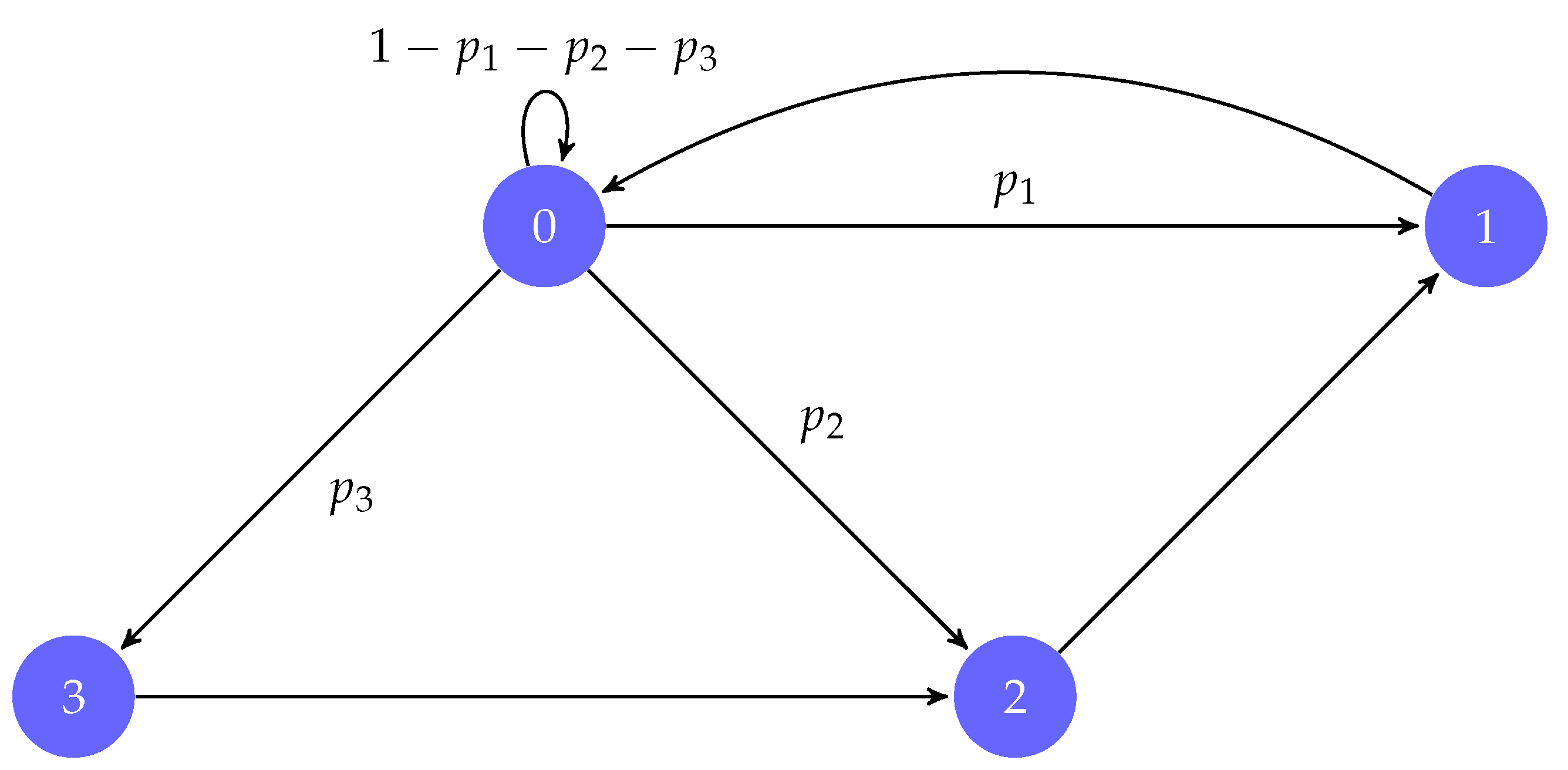
P ( B i + 1 = 1 | B i = 0 ) = p 1 , P ( B i + 1 = 2 | B i = 0 ) = p 2 , P ( B i + 1 = 3 | B i = 0 ) = p 3 and P ( B i + 1 = 0 | B i = 0 ) = 1 p 1 p 2 p 3 .
3.
P ( B i + 1 = 0 | B i = 1 ) = P ( B i + 1 = 1 | B i = 2 ) = P ( B i + 1 = 2 | B i = 3 ) = 1 .
Specifically, we have the transitive probabilities shown in Table 1, which can also be illustrated visually with a transition graph (Figure 2).
Notice that each Markov chain is irreducible (it can move from any state to any other state with positive probability) and aperiodic (as is any chain that contains a state with positive probability of moving back to itself) will have a limiting distribution. To this end, we have lim n P ( B n = k ) exists for all k = 0 , 1 , 2 , 3 . Moreover, one has
P ( B n + 1 = 1 ) = p 1 P ( B n = 0 ) + P ( B n = 2 ) P ( B n + 1 = 0 ) = ( 1 p 1 p 2 p 3 ) P ( B n = 0 ) + P ( B n = 1 ) P ( B n + 1 = 2 ) = p 2 P ( B n = 0 ) + 1 P ( B n = 0 ) P ( B n = 1 ) P ( B n = 2 ) .
We denote lim n P ( B n = 0 ) = α 0 , lim n P ( B n = 1 ) = α 1 , and lim n P ( B n = 2 ) = α 2 ; then, using (15), we get
α 1 = p 1 α 0 + α 2 α 0 = ( 1 p 1 p 2 p 3 ) α 0 + α 1 α 2 = p 2 α 0 + 1 α 0 ( p 1 α 0 + α 2 ) α 2 and then α 1 = p 1 S 123 1 α 1 + α 2 α 0 = S 123 1 α 1 3 α 2 = 1 + ( p 2 p 1 1 ) α 0 .
where S 123 = p 1 + p 2 + p 3 . It follows that
α 1 = p 1 S 123 1 α 1 + 1 3 + 1 3 ( p 2 p 1 1 ) S 123 1 α 1 α 0 = S 123 1 α 1 3 α 2 = 1 + ( p 2 p 1 1 ) S 123 1 α 1
α 1 = 1 3 1 2 3 p 1 S 123 1 1 3 ( p 2 1 ) S 123 1 1 α 0 = S 123 1 α 1 α 2 = 1 3 + 1 3 ( p 2 p 1 1 ) S 123 1 α 1 .
We define the event A n = B n + 1 = B n + 2 = 0 . Then,
P ( A n ) = P ( B n + 2 = 0 | B n + 1 = 0 ) P ( B n + 1 = 0 ) = ( 1 S 123 ) ( 1 S 123 ) P ( B n = 0 ) + P ( B n = 1 ) = ( 1 S 123 ) 2 P ( B n = 0 ) + ( 1 S 123 ) P ( B n = 1 ) ,
which implies that lim n P ( A n ) exists and depends on p 1 , p 2 , and p 3 . More precisely, using (16), we have
lim n P ( A n ) = ( 1 S 123 ) 2 α 0 + ( 1 S 123 ) α 1 .
Example 1. 
Take p 1 = p 2 = 0.25 and p 3 = 0.125 then, S 123 = 0.625 and from (17), we obtain α 1 = 0.2941 , α 0 = 0.4705 , and α 2 = 0.2353 , which implies that
P ( A n ) = 0.1406 P ( B n = 0 ) + 0.375 P ( B n = 1 ) .
Moreover, it follows, using (15), that
P ( B n + 1 = 0 ) = 0.375 P ( B n = 0 ) + P ( B n = 1 ) P ( B n + 1 = 1 ) = 0.25 P ( B n = 0 ) + P ( B n = 2 ) P ( B n + 1 = 2 ) = 1 0.75 P ( B n = 0 ) P ( B n = 1 ) P ( B n = 2 ) .
In Table 2, we will calculate the first few probabilities of the event A n .
After only 14 steps in the chain, the probability P ( A n ) reaches a point where it remains constant from step to step. However, one can compute this limiting value using (16) and obtain
lim n P ( A n ) = 0.1406 α 0 + 0.375 α 1 = 0.1764 .
Table 2. Calculation of P ( A n ) for p 1 = p 2 = 0.25 and p 3 = 0.125 .
n P ( B n = 0 ) P ( B n = 1 ) P ( B n = 2 ) P ( A n )
1–4100 0.1406
5 0.375 0.25 0 0.0525
6 0.3906 0.0934 0.4687 0.089
7 0.2398 0.5663 0.1449 0.246
8 0.6562 0.2048 0.1089 0.169
9 0.4508 0.2729 0.1941 0.1657
10 0.4419 0.3068 0.1949 0.1771
11 0.4725 0.3053 0.1668 0.1809
12 0.4824 0.2849 0.1735 0.1746
13 0.4658 0.2941 0.1787 0.1757
14 0.4687 0.2951 0.1787 0.1765
Remark 2. 
We have
P ( B 1 , , B 8 ) = ( 0 , 0 , 0 , 0 , 3 , 2 , 1 , 0 , 0 , 3 , 2 ) = p 3 2 ( 1 p 1 p 2 p 3 ) .
1. 
Whenever a 3 appears in the sequence b 5 , , b n , there is a probability factor of p 3 . Following the 3, a 2 occurs with probability one, then a 1 follows the 2 with probability one, and finally, a 0 follows the 1 with probability one.
2. 
If we observe a 0 that is following another 0, the probability factor is 1 p 1 p 2 p 3 .
Let s 3 , s 2 , and s 1 represent the number of threes, twos and ones in ( b 5 , , b n , 0 , 0 ) , respectively. Then, the number of 0, denoted by s 0 , is given by s 0 = n + 2 4 ( s 1 + s 2 + s 3 ) . Furthermore, applying Remark 2 along with the assumption of the event A n : = { B n + 1 = B n + 2 = 0 } , we have
(1) the number of 2 that are preceded by 3 is s 3 and then the number of 2 that preceded by 0 is s 2 s 3 ;
(2) the number of 1 that are preceded by a 2 is s 2 and then the number of 1 that preceded by 0 is s 1 s 2 ;
(3) the number of 0 that preceded by a 1 is s 1 and then the number of 0 that preceded by 0 is n 2 ( s 1 + s 2 + s 3 ) s 1 = n 2 s 2 s 3 2 s 1 .

4.2. Distribution of ( B 1 , B 2 , , B n )

In this section, we will study the distribution of ( B 1 , B 2 , , B n ) conditioned on the event A n . Notice, if b 1 = b 2 = b 3 = b 4 = 0 , that
P ( ( B 1 , , B n ) = ( b 1 , , b n ) | A n ) = P ( B 1 , , B n + 2 ) = ( b 1 , , b n , 0 , 0 ) P ( A n ) = i = 5 n P B i = b i | B i 1 = b i 1 P B n + 1 = 0 | B n = b n P B n + 2 = 0 | B n + 1 = 0 P ( A n ) = p 3 s 3 p 2 s 2 s 3 p 1 s 1 s 2 ( 1 p 1 p 2 p 3 ) n 2 s 2 s 3 2 s 1 P ( A n ) .
Proposition 2. 
Let p ( 0 , 1 ) the golden probability; that is, the unique solution of g ( p ) : = 1 p p 2 p 3 p 4 = 0 . Take p 1 = p 2 , p 2 = p 3 and p 3 = p 4 , we have
1. 
P ( A n + 4 ) = p P ( A n + 3 ) + p 2 P ( A n + 2 ) + p 3 P ( A n + 1 ) + p 4 P ( A n ) , for all n 2 .
2. 
P ( ( B 1 , , B n ) = ( b 1 , , b n ) | A n ) = 1 T n 1
and then
lim n p n 2 T n 1 = 1 2 p p 2 p 3 ( 1 p ) 2 .
Proof. 
First, observe that g has a unique solution in ( 0 , 1 ) (since g is a continuous and decreasing function with g ( 1 ) lim x 0 + g ( x ) < 0 ) .
1.
Notice, for k = 0 , 1 , , that
P ( A n + k ) = P ( B n + k + 2 = 0 | B n + k + 1 = 0 ) P ( B n + k + 1 = 0 ) = p P ( B n + k + 1 = 0 ) .
Then
P ( A n + 4 ) = p P ( B n + 5 = 0 ) = p p P ( B n + 4 = 0 ) + P ( B n + 4 = 1 ) = ( 20 ) p P ( A n + 3 = 0 ) + P ( B n + 4 = 1 ) = p P ( A n + 3 = 0 ) + p p 2 P ( B n + 3 = 0 ) + P ( B n + 3 = 2 ) = ( 20 ) p P ( A n + 3 = 0 ) + p 2 P ( A n + 2 = 0 ) + p 3 P ( A n + 1 = 0 ) + p 4 P ( A n ) .
As a consequence, if we define the sequence { Γ n } n by Γ 0 = 1 and Γ n = P ( A n + 1 ) p n 1 , for all n 1 . Then,
Γ n + 4 = P ( A n + 5 ) p n + 3 = P ( A n + 4 ) p n + 2 + P ( A n + 3 ) p n + 1 + P ( A n + 2 ) p n + P ( A n + 1 ) p n 1 = Γ n + 3 + Γ n + 2 + Γ n + 1 + Γ n ,
which implies that { Γ n } n is Tetranacci sequence.
2.
Using (19) and ( p 1 , p 2 , p 3 ) = ( p 2 , p 3 , p 4 ) , we get
P ( ( B 1 , , B n ) = ( b 1 , , b n ) | A n ) = ( 1 p 1 p 2 p 3 ) n 2 P ( A n ) · p 3 s 3 p 2 s 2 s 3 p 1 s 1 s 2 ( 1 p 1 p 2 p 3 ) s 2 s 3 2 s 1 = ( 1 p 2 p 3 p 4 ) n 2 P ( A n ) 1 p 2 p 3 p 4 p s 2 s 3 2 s 1 = p n 2 P ( A n ) 1 p 2 p 3 p 4 p s 2 s 3 2 s 1 = p n 2 P ( A n ) ,
which does not depends of s 0 , s 1 , s 2 , and s 3 . Therefore, each of the elements of Ω n 1 with b n { 2 , 3 } is equally likely to appear. We calculate the first values of P ( A n ) in Table 3.
Since T 0 = T 1 = 0 , T 2 = T 3 = 1 , we obtain
P ( A 4 ) p 2 = 1 = T 3 , P ( A 5 ) p 3 = 2 = T 4 , P ( A 6 ) p 4 = 4 = T 5 , and P ( A 7 ) p 5 = 8 = T 6 .
Therefore
T n 1 = P ( A n ) p n 2 .
Notice, under our hypothesis on p 1 , p 2 , and p 3 , that S 123 = 1 p and the value of α 1 in (16) is reduced to
α 1 = 1 3 1 2 3 p 2 1 p 1 3 p 3 1 1 p 1 = 1 3 2 p 2 + p 3 1 + 3 p 3 3 ( 1 p ) 1 = p 1 p 3 + 2 p 2 + 3 p 4 .
In addition, again by (16), we get
α 1 = p 1 p 3 + 2 p 2 + 3 p 4 α 0 = 1 4 p 3 2 p 2 3 p α 2 = 1 3 + 1 3 p 3 p 2 1 4 p 3 2 p 2 3 p .
Recall (18), we deduce that
lim n p n 2 T n 1 = p 2 4 p 3 2 p 2 3 p + p 2 p p 3 + 2 p 2 + 3 p 4 = p 4 p 3 2 p 2 3 p
lim n p n 2 T n 1 = 1 2 ( 1 S 123 ) 1 p 1 S 123 1 1 S 123 1 = 1 2 ( S 123 1 1 ) 1 p 1 S 123 1 1 .
By definition of p , one has S 123 = 1 p , and then
lim n p n 2 T n 1 = 1 2 p p 2 p 3 ( 1 p ) 2 .
Remark 3. 
The parameters p 1 = p 2 , p 2 = p 3 , and p 3 = p 4 are chosen in accordance with the random tiling model, where the probability that the tiling starts with a tile of length k is proportional to p k . These transition probabilities therefore capture the probabilistic structure governing the tile-length distribution.

5. Recursive Polynomial Interpolation Associated with Fibonacci-Type Sequences

Over the last decade, there have been several developments regarding the Fibonacci sequence ( F n ) with F 0 = F 1 = 1 . In particular, several new approaches exist to construct polynomials based on the Fibonacci sequence. One can cite, for instance, Fibonacci coefficient polynomials [39], which are generated by putting Fibonacci sequence as the coefficient, and Fibonacci polynomials [40], which are generated recursively, similar to the Fibonacci sequence. A novel approach can be devised to construct a polynomial using interpolation techniques. The proposed methodology involves identifying the Fibonacci points ( n , F n ) , n = 0 , 1 , and subsequently devising a polynomial that intersects these points through various interpolation techniques, such as Lagrange and Newton interpolations, as discussed in [41,42]. In this section, we present an independent but complementary contribution to the present work. Specifically, this section explores an algebraic viewpoint, showing how consecutive values of Fibonacci-type sequences can be reconstructed via recursive Lagrange interpolation, thereby highlighting the versatility of these sequences across different mathematical frameworks.
First, observe that in [41], for all n 1 , we have
F n = 1 5 ( σ n + 1 φ n + 1 )
where σ = 1 + 5 2 and φ = 1 5 2 . Let
{ A n : = ( n , ( 1 ) n F n ) , n = 0 , 1 , } ,
we prove that the Lagrange interpolation can be obtained implicitly and recursively. The introduction of the alternating factor ( 1 ) n in the interpolation points is motivated by two main reasons. First, it yields a particularly simple recursive relation for the polynomials P n , namely
P n + 1 ( x ) P n ( x ) = α n x ( x 1 ) ( x n ) .
Second, this choice allows the combinatorial identity
i = 0 n n i F i = F 2 n
to be used in its most transparent form when computing the leading coefficient. Our first main result in this section is the following.
Theorem 4. 
The Lagrange interpolation of order n of is given
P n ( x ) = ( 1 ) n n ! i = 0 n n i F i j i n ( x j ) ,
where n i = n ! i ! ( n i ) ! . Moreover, the leading coefficient α n of P n ( x ) is ( 1 ) n n ! F 2 n .
Remark 4. 
1. 
Observe, from the proof of Theorem 4, that
i = 0 n n i F i = F 2 n , ( n 0 ) .
It follows that
P n ( n + 1 ) = ( 1 ) n n ! i = 0 n n i F i j i n ( n + 1 j ) = ( 1 ) n n ! i = 0 n n ! i ! ( n i ) ! ( n + 1 ) ! n + 1 i F i = ( 1 ) n i = 0 n ( n + 1 ) ! i ! ( n + 1 i ) ! F i = ( 1 ) n i = 0 n i n + 1 F i = ( ) ( 1 ) n F 2 n + 2 F n + 1 .
This implies that
P n + 1 ( n + 1 ) P n ( n + 1 ) = ( 1 ) n + 1 F n + 1 ( 1 ) n F 2 n + 2 F n + 1 = ( 1 ) n + 1 F 2 n + 2 .
2. 
Using Binet’s formula, F 2 n = ( σ 2 n + 1 φ 2 n + 1 ) / 5 . Since, for large n, we have φ 2 n + 1 0 , we can deduce from the asymptotic behavior that the leading coefficient of P n ( x ) is
α n ( 1 ) n 5 n ! σ 2 n + 1 .
Thus, the leading coefficient grows essentially like σ 2 n + 1 / n ! , showing that the golden ratio directly governs the exponential growth rate of the polynomial’s leading term.
Theorem 5. 
There exists, for each n N , a polynomial function Q n of degree n such that
P n + 1 ( x ) = 1 + i = 1 n ( 1 ) i + 1 ( i + 1 ) ! F 2 i + 2 Q i ( x ) .
Proof. 
Observe that P n + 1 and P n pass through the n + 1 same points: A 0 , A 1 , , A n , where A i = ( i , ( 1 ) i F i ) . Consequently, we can write a relation
P n + 1 ( x ) P n ( x ) = α n x ( x 1 ) ( x n ) : = α n Q n ( x ) ,
where α n = ( 1 ) n + 1 ( n + 1 ) ! F 2 n + 2 is the leading coefficient of P n + 1 . Hence, we may deduce an implicit formula as follows
P n + 1 ( x ) = P n ( x ) + ( 1 ) n + 1 ( n + 1 ) ! F 2 n + 2 Q n ( x ) = P 1 ( x ) + i = 1 n ( 1 ) i + 1 ( i + 1 ) ! F 2 i + 2 Q i ( x ) = 1 + i = 1 n ( 1 ) i + 1 ( i + 1 ) ! F 2 i + 2 Q i ( x ) .
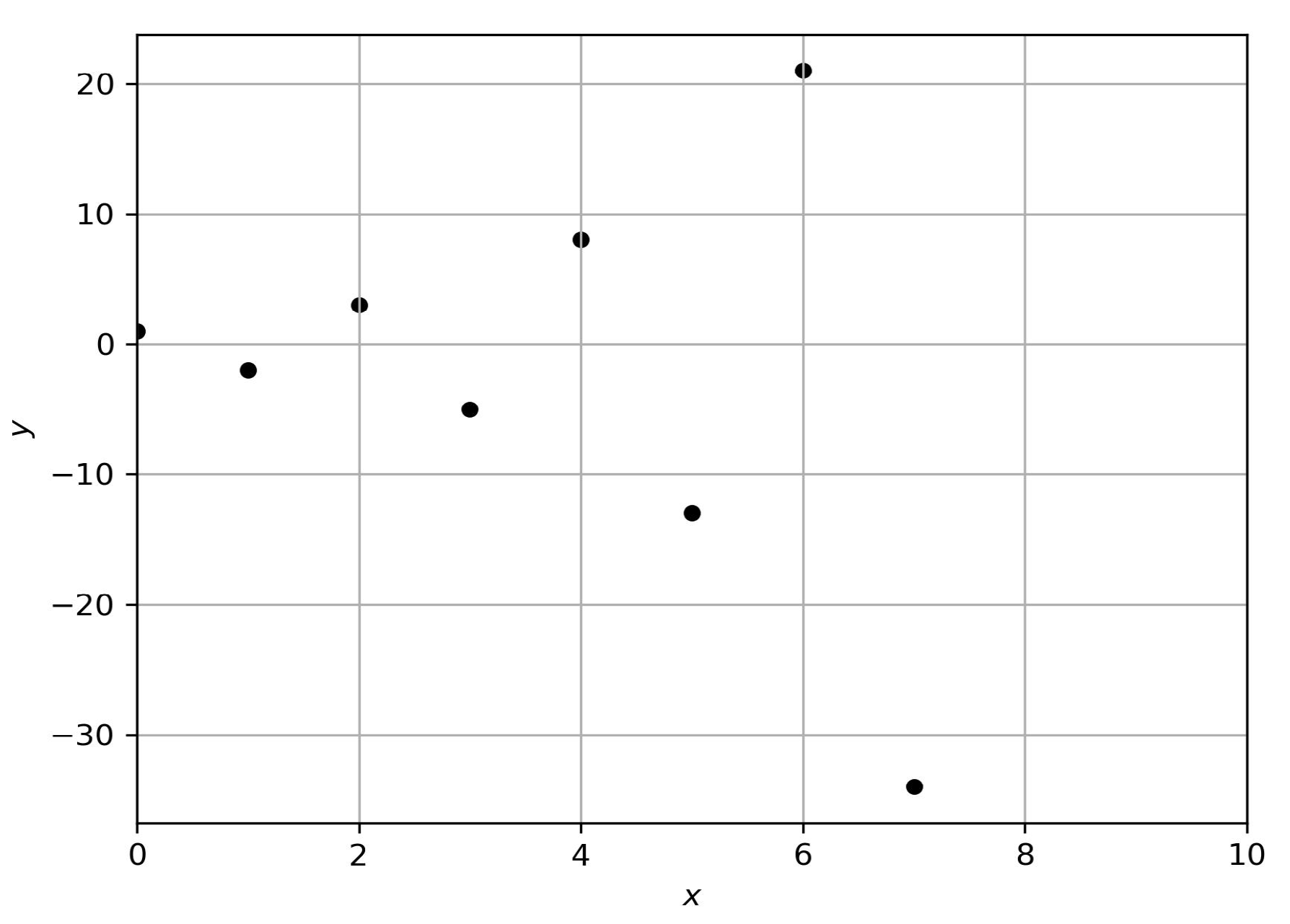
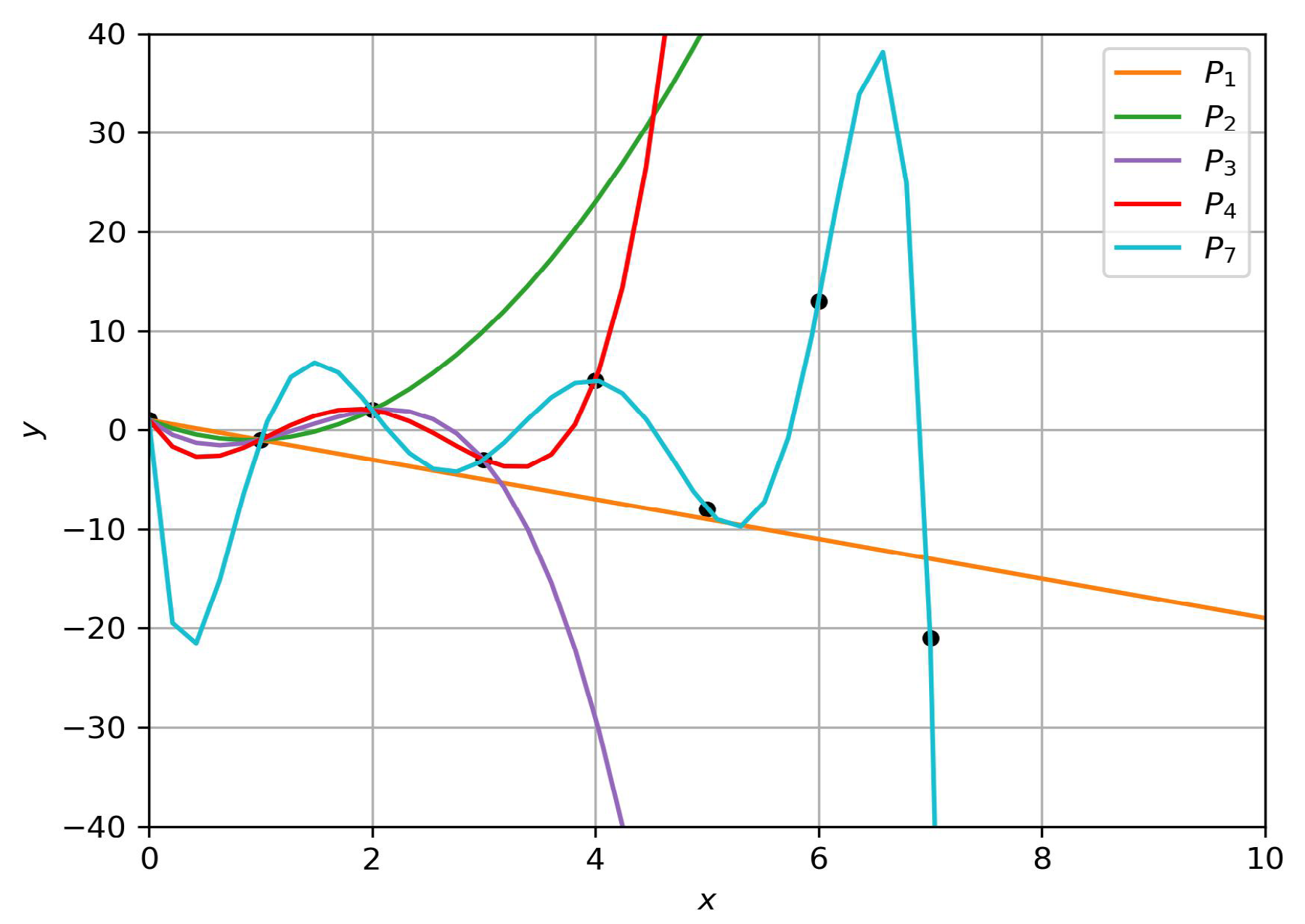
As an example, from Theorem 5, we can derive P n ( x ) for n = 1 , 2 as follows (see Figure 3 and Figure 4).
P 1 ( x ) = 1 2 x P 2 ( x ) = 5 2 x 2 9 2 x + 1 .

6. Conclusions

In this work, we investigated probabilistic, geometric, and algebraic aspects of Fibonacci-type sequences. The main contribution of this paper is Theorem 1, which shows that the assumption of exponential growth of the weights suffices to generate irregular sets of full Hausdorff and packing dimension for weighted random averages. We further illustrated this general mechanism through a probabilistic analysis of the Tetranacci sequence. Using color models and Markov chain representations, we derived sharp asymptotic estimates for T n and established its exponential growth behavior without resorting to explicit Binet-type formulas. Finally, we introduced an independent but complementary algebraic contribution based on recursive Lagrange interpolation, showing that consecutive values of Fibonacci-type sequences admit an implicit polynomial reconstruction. Several questions remain open and deserve further investigation:
1.
A natural problem is to determine whether the methods developed in this work can be extended to more general recursive sequences, such as generalized Lucas sequences or k-step Fibonacci sequence T k , n . In particular, it would be of interest to study whether similar interpolation schemes and probabilistic representations can be constructed in this context and whether there are suitable Markov or branching structures to describe their growth and limiting behavior.
2.
The color and Markov models introduced in this work may also be viewed as potential tools for stochastic simulation. In particular, their connection with Fibonacci-type recursions suggests possible applications to Monte Carlo methods and pseudo-random number generation, which we leave for future investigation.

Author Contributions

Conceptualization, N.A. and T.M.; writing—original draft preparation, N.A. and T.M.; Writing—review and editing, N.A. and T.M.; project administration, N.A. and T.M.; funding acquisition, N.A. and T.M. All authors have read and agreed to the published version of the manuscript.

Funding

This work was supported by the Deanship of Scientific Research, Vice Presidency for Graduate Studies and Scientific Research, King Faisal University, Saudi Arabia [Grant No. KFU254840]. This study is supported via funding from Prince Sattam bin Abdulaziz University project number (PSAU/2025/R/1147).

Data Availability Statement

The original contributions presented in this study are included in the article. Further inquiries can be directed to the corresponding author.

Conflicts of Interest

The authors declare no conflicts of interest.

Appendix A

Appendix A.1. Proof of Lemma 1

1.
Assume that w n + 1 / w n φ > 1 . Then, by a standard ratio test argument,
w k = w n φ k n ( 1 + o ( 1 ) ) , k < n .
Hence
i = 1 n w i = w n 1 + φ 1 + φ 2 + + φ ( n 1 ) ( 1 + o ( 1 ) ) = w n φ φ 1 ( 1 + o ( 1 ) ) .
Therefore
w n i = 1 n w i w n w n φ φ 1 = φ 1 φ > 0 .
Since the maximum in (2) is attained at k = n , it follows that
max 1 k n w k i = 1 n w i = w n i = 1 n w i φ 1 φ > 0 ,
so the diffuseness condition (2) cannot hold.
2
Under (3), the last weight never becomes negligible and we have
W n = k = 1 n w k φ φ 1 w n , n .
Fix m 1 and observe, for any fixed j { 0 , , m 1 } , that
w n j w n = k = 0 j 1 w n k 1 w n k φ j .
Thus
k = n m + 1 n w k = w n j = 0 m 1 φ j + o ( w n ) = w n 1 φ m 1 φ 1 + o ( w n ) .
On the other hand, by (A1), we have
W n = φ φ 1 w n + o ( w n ) .
Dividing the two asymptotics yields
k = n m + 1 n w k W n 1 φ m .
Now, we consider the events E j ( m ) = { X j m + 1 = = X ( j + 1 ) m = x r } . These events are independent and satisfy
P ( E j ( m ) ) = P ( X 1 = x r ) m > 0 and then j 0 P ( E j ( m ) ) = ,
the Borel–Cantelli lemma gives that E j ( m ) occurs infinitely often almost surely. Thus, for infinitely many n, we have X n m + 1 = = X n = x r , and for such n, we have
Y n k = n m + 1 n w k x r W n = x r k = n m + 1 n w k W n .
Using (A2),
lim sup n E j ( m ) occurs Y n x r ( 1 φ m ) .
Letting m gives lim sup n Y n = x r a.s. An identical argument applied to the events Z j ( m ) = { X j m + 1 = = X ( j + 1 ) m = x 0 } yields lim inf n Y n = x 0 a.s. Thus Y n oscillates between the extreme values of B almost surely, and it cannot converge.

Appendix A.2. Proof of Theorem 4

Given the points A 0 , A 1 , , A n with A i = ( i , ( 1 ) i F i ) , the Lagrange Interpolation polynomial is defined as follows
P n ( x ) = i = 0 n ( 1 ) i F i j i n x j i j .
Observe that the product of n non-zero consecutive integers in which there are i positive integers:
j i n ( i j ) = ( 1 ) n i n ! n i .
It follows, by substituting the previous equation in (A3), that
P n ( x ) = ( 1 ) n n ! i = 0 n n i F i j i n ( x j ) .
We now prove that the leading coefficient α n of P n ( x ) is ( 1 ) n n ! i = 0 n n i F i = ( 1 ) n n F 2 n . It follows from (21) that
( 1 ) n n ! i = 0 n n i F i = ( 1 ) n n ! 5 i = 0 n n i σ i + 1 φ i + 1 = ( 1 ) n n ! 5 σ i = 0 n n i σ i φ i = 0 n n i φ i = ( 1 ) n n ! 5 σ ( σ + 1 ) n φ ( φ + 1 ) n .
Using the fact that both σ and φ are roots of the equation x 2 x 1 = 0 , we obtain
( 1 ) n n ! i = 0 n n i F i = ( 1 ) n n ! σ 2 n + 1 φ 2 n + 1 5 = ( 1 ) n n ! F 2 n ,
where we use the fact that σ and φ are solutions of the equation x 2 x 1 = 0 .

Appendix A.3. Hausdorff and Packing Measures

In this appendix, we recall the classical definitions of Hausdorff and packing measures used throughout this paper. We refer the reader to Falconer’s monograph [43] for further details. Let U R n be non-empty. Its diameter is defined by
| U | = sup { | x y | : x , y U } .
Let F R n be non-empty, and let ( U i ) i I be a family of sets indexed by a finite or countable set I N . We say that ( U i ) i I is a δ -covering of F if
F i I U i , 0 < | U i | δ for all i I .
The s-dimensional Hausdorff measure of F is defined by
H s ( F ) = lim δ 0 + inf i I | U i | s : ( U i ) i I is a δ covering of F .
The Hausdorff dimension of F is then
dim H ( F ) = inf { s > 0 : H s ( F ) = 0 } = sup { s > 0 : H s ( F ) = } ,
with the conventions inf = and sup = 0 .
To define the packing measure, let ( B i ) i I be a finite or countable family of pairwise disjoint balls centred in F and satisfying | B i | δ . Such a family is called a δ -packing of F. The s-dimensional packing measure of F is then
P s ( F ) = inf δ 0 + sup i I | B i | s : ( B i ) i I is a δ packing of F .
The packing dimension of F is defined by
dim P ( F ) = inf { s > 0 : P s ( F ) = 0 } = sup { s > 0 : P s ( F ) = } .
It is well known (see [43]) that
dim H ( F ) dim P ( F ) .
The following classical result gives the Hausdorff dimension of general inhomogeneous Cantor-type constructions.
Theorem A1 
(Dimension of nested self-similar constructions [43]). Let K R be constructed by a nested sequence of cylinder sets such that:
  • at stage J, each cylinder is subdivided into N J sub-cylinders;
  • each sub-cylinder at stage J has diameter δ J , possibly depending on J.
Then
dim H K = lim inf J log N J log δ J .

References

  1. Uygun, S. The (s,t)-Jacobsthal and (s,t)-Jacobsthal Lucas Sequences. Appl. Math. Sci. 2015, 9, 3467–3476. [Google Scholar] [CrossRef]
  2. Uygun, S.; Eldogan, H. Properties of k-Jacobsthal and k-Jacobsthal Lucas Sequences. Gen. Math. Notes 2016, 36, 34–47. [Google Scholar]
  3. Uygun, S. Bi-Periodic Jacobsthal Lucas Matrix sequence. Acta Univ. Apulensis 2021, 66, 53–69. [Google Scholar]
  4. Koshy, T. Fibonacci and Lucas Number; Wiley: New York, NY, USA, 2001. [Google Scholar]
  5. Salas, A.H. About k-Fibonacci numbers and their associated numbers. Int. Math. Forum 2011, 6, 2473–2479. [Google Scholar]
  6. Attia, N.; Souissi, C.; Saidi, N.; Ali, R. A Note on k-Bonacci Random Walks. Fractal Fract. 2023, 7, 280. [Google Scholar] [CrossRef]
  7. Mouline, M.; Rachidi, M. Suites de Fibonacci généralisées et chaînes de Markov. Revista de la Real Academia de Ciencias Exactas Físicas y Naturales 1995, 89, 61–77. [Google Scholar]
  8. Rajae, B.T.; Rachidi, M. On the E-algorithm for polynomial roots and linear recurrence relations. Fibonacci Q. 2004, 42, 98–105. [Google Scholar]
  9. Ostrowski, A.M. Soluçoes de Equacoes em Espaços Euclidianos e de Banach; Academic Press: Cambridge, MA, USA, 1973. [Google Scholar]
  10. Feinberg, M. Fibonacci-Tribonacci. Fibonacci Q. 1963, 1, 71–74. [Google Scholar] [CrossRef]
  11. Taşyurdu, Y. On the Sums of Tribonacci and Tribonacci-Lucas Numbers. Appl. Math. Sci. 2019, 13, 1201–1208. [Google Scholar] [CrossRef]
  12. Attia, N.; Moulahi, T. Multifractal Structure of Irregular Sets via Weighted Random Sequences. Fractal Fract. 2025, 9, 793. [Google Scholar] [CrossRef]
  13. Chow, Y.S. Some convergence theorems for independent random variables. Ann. Math. Stat. 1966, 37, 1482–1493. [Google Scholar] [CrossRef]
  14. Chow, Y.S.; Lai, T.L. Limiting behavior of weighted sums of independent random variables. Ann. Probab. 1973, 1, 810–824. [Google Scholar] [CrossRef]
  15. Stout, W.F. Almost Sure Convergence, 2nd ed.; Academic Press: New York, NY, USA, 1974. [Google Scholar]
  16. Stout, F.W. Some results on the complete and almost sure convergence of linear combinations of independent random variables and martingale differences. Ann. Math. Stat. 1968, 39, 1549–1562. [Google Scholar] [CrossRef]
  17. Padgett, W.J.; Taylor, R.L. Convergence of weighted sums of independent random variable and extension to Banach space-valued random variables. Intrnat. J. Math. Math. Sci. 1979, 2, 309–323. [Google Scholar] [CrossRef]
  18. Rosalsky, A.; Sreehari, M. On the limiting behavior of randomly weighted partial sums. Stat. Probab. Lett. 1998, 40, 403–410. [Google Scholar] [CrossRef]
  19. Bai, Z.D.; Cheng, P.E. Marcinkiewicz strong laws for linear statistics. Stat. Probab. Lett. 2000, 46, 105–112. [Google Scholar] [CrossRef]
  20. Cuzick, J. A strong law for weighted sums of i.i.d. random variables. J. Theor. Probab. 1995, 8, 625–641. [Google Scholar] [CrossRef]
  21. Etemadi, N. Convergence of weighted average of random variables revisited. Proc. Am. Math. Soc. 2006, 134, 2739–2744. [Google Scholar] [CrossRef]
  22. Shen, A. On the strong law of large number for weighted sums of negatively superadditive dependent random variables. J. Korean Math. Soc. 2016, 53, 45–55. [Google Scholar] [CrossRef]
  23. Neunhauserer, J. Return of Fibonacci random walks. Stat. Prob. Lett. 2017, 121, 51–53. [Google Scholar] [CrossRef]
  24. Billingsley, P. Probability and Measure, 3rd ed.; Wiley-Interscience: New York, NY, USA, 1995. [Google Scholar]
  25. Käenmäki, A.; Reeve, H.W.J. Multifractal analysis of Birkhoff averages for typical infinitely generated self-affine sets. J. Fractal Geom. 2014, 1, 177–215. [Google Scholar] [CrossRef]
  26. Bomfim, T.; Varandas, P. Multifractal analysis for weak Gibbs measures: From large deviations to irregular sets. Ergod. Theory Dyn. Syst. 2017, 37, 79–111. [Google Scholar] [CrossRef]
  27. Attia, N. On the multifractal analysis of branching random walk on Galton–Watson tree with random metric. J. Theor. Probab. 2021, 34, 90–102. [Google Scholar] [CrossRef]
  28. Attia, N. On the multifractal analysis of covering number on the Galton–Watson tree. J. Appl. Probab. 2019, 56, 265–281. [Google Scholar] [CrossRef]
  29. Attia, N. On the multifractal analysis of a non-standard branching random walk. Acta Sci. Math. 2022, 88, 697–722. [Google Scholar] [CrossRef]
  30. Attia, N. On the exact dimension of Mandelbrot measure. Probab. Math. Stat. 2019, 39, 299–314. [Google Scholar] [CrossRef]
  31. Attia, N. Hausdorff and packing dimensions of Mandelbrot measure. Int. J. Math. 2020, 31, 2050068. [Google Scholar] [CrossRef]
  32. Zaveri, N.M.N.; Patel, J.K. Binet’s Formula for the Tetranacci Sequence. Int. J. Sci. Res. 2016, 5, 1911–1914. [Google Scholar]
  33. Attia, N. Some remarks on recursive sequence of fibonacci type. AIMS Math. 2024, 9, 25834–25848. [Google Scholar] [CrossRef]
  34. Hachicha, S.; Attia, N. Probabilistic approaches to exploring Binet’s type formula for the Tribonacci sequence. AIMS Math. 2025, 10, 11957–11975. [Google Scholar] [CrossRef]
  35. Krot, E. An introduction to finite fibonomial calculus. Centr. Eur. J. Math. 2004, 2, 754–766. [Google Scholar] [CrossRef]
  36. Livio, M. The Golden Ratio; Golden Books: New York, NY, USA, 2002. [Google Scholar]
  37. Falconer, J.K. Fractal Geometry: Mathematical Foundations and Applications; John Wiley & Sons: Hoboken, NJ, USA, 1990. [Google Scholar]
  38. Benazouz, H.; Mouline, M.; Rachidi, M. On the Fibonacci Markov chains. J. Interdiscip. Math. 2008, 11, 89–98. [Google Scholar] [CrossRef]
  39. Garth, D.; Mills, D.; Mitchell, P. Polynomials generated by the Fibonacci sequence. J. Integer. Seq. 2007, 10, 07.6.8. [Google Scholar]
  40. Amdeberhan, T.; Chen, X.; Moll, V.; Sagan, B. Generalized Fibonacci polynomials and fibonomial coefficients. Ann. Comb. 2014, 18, 541–562. [Google Scholar] [CrossRef]
  41. Mufid, M.S.; Asfihani, T.; Hanaf, L. On The Lagrange Interpolation of Fibonacci Sequence. Int. J. Comput. Sci. Appl. Math. 2016, 2, 38–40. [Google Scholar] [CrossRef]
  42. Ebadi, M.; Haghkhah, S. Investigation of the Properties of a New Class of Interpolation Polynomials Based on Fibonacci Numbers. Sahand Commun. Math. Anal. (SCMA) 2023, 20, 133–146. [Google Scholar]
  43. Falconer, K.J. Fractal Geometry: Mathematical Foundations and Applications, 2nd ed.; Wiley: Hoboken, NJ, USA, 2003. [Google Scholar]
Figure 1. A random black-white-gray board.
Fractalfract 10 00033 g001
Figure 2. Transition graph of the Markov chain ( B i ) . Vertices correspond to the states { 0 , 1 , 2 , 3 } , while directed edges represent the admissible transitions together with their associated probabilities.
Fractalfract 10 00033 g002
Figure 3. A n for n { 1 , 2 , 3 , 4 , 7 } .
Fractalfract 10 00033 g003
Figure 4. P n ( x ) for n { 1 , 2 , 3 , 4 , 7 } .
Fractalfract 10 00033 g004
Table 1. Calculation of P ( B i = b i | B i 1 = b i 1 ) .
b i 1 0000123
b i 0123012
P ( B i = b i | B i 1 = b i 1 ) 1 p 1 p 2 p 3 p 1 p 2 p 3 111
Table 3. Calculation of P ( A n ) .
n P ( B n = 0 ) P ( B n = 1 ) P ( B n = 2 ) P ( B n = 3 ) P ( A n ) = p P ( B n + 1 = 0 )
41000 p 2
5 p p 2 p 3 p 4 2 p 3
6 2 p 2 2 p 3 2 p 4 p 5 4 p 4
7 4 p 3 4 p 4 3 p 5 2 p 6 8 p 5
8 8 p 4 7 p 5 6 p 6 4 p 7 15 p 6
Disclaimer/Publisher’s Note: The statements, opinions and data contained in all publications are solely those of the individual author(s) and contributor(s) and not of MDPI and/or the editor(s). MDPI and/or the editor(s) disclaim responsibility for any injury to people or property resulting from any ideas, methods, instructions or products referred to in the content.