

Modeling of Heat Distribution in Porous Aluminum Using Fractional Differential Equation






Abstract
1. Introduction
2. Fractional Heat Conduction Equation
3. Formulation of the Problem
4. Method of Solution
4.1. Solution of the Direct Problem
4.2. Minimum of the Functional
| minimized function, | |
| n | dimension (number of variables) |
| number of threads | |
| number of ants in population | |
| I | number of iterations |
| L | number of pheromone spots |
| parameters of the algorithm |
| Algorithm 1: Parallel Real ACO algorithm | |
| Initialization of the algorithm | |
| 1. | Setting input parameters of the algorithm L, M, I, , q, . |
| 2. | Randomly generate L pheromone spots (solutions) and assign them to set (starting archive). |
| 3. | Calculate values of the minimized function F for each pheromone spot and sort the archive from best to worst solution. |
| Iterative process | |
| 4. | Assigning probabilities to pheromone spots (solutions) according to the following formula:
|
| 5. | Ant chooses a random l-th solution with probability . |
| 6. | Ant transforms the j-th coordinate () of l-th solution by sampling proximity with the probability density function (Gaussian function)
|
| 7. | Repeat steps 5–6 for each ant. We obtain M new solutions (pheromone spots). |
| 8. | Divide new solutions on groups. Calculate values of minimized function F for each new solution (parallel computing). |
| 9. | Add to the archive new solutions, sort the archive by quality of solutions, remove M worst solution. |
| 10. | Repeat steps 4–9 I times. |
5. Results
- —modified thermal conductivity coefficient,
- —initial condition,
- —heat transfer coefficient,
- —order of derivative,
6. Conclusions
Acknowledgments
Author Contributions
Conflicts of Interest
References
- Podlubny, I. Fractional Differential Equations; Academic Press: San Diego, CA, USA, 1999. [Google Scholar]
- Guo, B.; Pu, X.; Huang, F. Fractional Partial Differential Equations and Their Numerical Solutions; World Scientific: Singapore, 2015. [Google Scholar]
- Ortigueira, M.D. Fractional Calculus for Scientists and Engineers; Springer: Berlin, Germany, 2011. [Google Scholar]
- Das, S. Functional Fractional Calculus for System Identification and Controls; Springer: Berlin, Germany, 2008. [Google Scholar]
- Povstenko, Y.; Klekot, J. The Cauchy problem for the time-fractional advection diffusion equation in a layer. Tech. Sci. 2016, 19, 231–244. [Google Scholar]
- Abdeljawat, T. On conformable fractional calculus. J. Comput. Appl. Math. 2015, 279, 57–66. [Google Scholar] [CrossRef]
- Liu, H.Y.; He, J.H.; Li, Z.B. Fractional calculus for nanoscale flow and heat transfer. Int. J. Numer. Methods Heat Fluid Flow 2014, 24, 1227–1250. [Google Scholar] [CrossRef]
- Atangana, A. On the new fractional derivative and application to nonlinear Fisher’s reaction–diffusion equation. Appl. Math. Comput. 2016, 273, 948–956. [Google Scholar] [CrossRef]
- Freeborn, T.J.; Maundy, B.; Elwakil, A.S. Fractional-order models of supercapacitors, batteries and fuel cells: A survey. Mater. Renew. Sustain. Energy 2015, 4. [Google Scholar] [CrossRef]
- Błasik, M.; Klimek, M. Numerical solution of the one phase 1D fractional Stefan problem using the front fixing method. Math. Methods Appl. Sci. 2014, 38, 3214–3228. [Google Scholar] [CrossRef]
- Mitkowski, W.; Skruch, P. Fractional-order models of the supercapacitors in the form of RC ladder networks. J. Pol. Acad. Sci. 2013, 61, 581–587. [Google Scholar] [CrossRef]
- Matušů, R. Application of fractional order calculus to control theory. Int. J. Math. Models Methods Appl. Sci. 2011, 5, 1162–1169. [Google Scholar]
- Povstenko, Y.Z. Fractional heat conduction equation and associated thermal stress. J. Therm. Stresses 2004, 28, 83–102. [Google Scholar] [CrossRef]
- Yang, X.J.; Baleanu, D. Fractal heat conduction problem solved by local fractional variation iteration method. Therm. Sci. 2013, 17, 625–628. [Google Scholar] [CrossRef]
- Murio, D.A. Time fractional IHCP with Caputo fractional derivatives. Comput. Math. Appl. 2008, 56, 2371–2381. [Google Scholar] [CrossRef]
- Brociek, R.; Słota, D. Reconstruction of the boundary condition for the heat conduction equation of fractional order. Therm. Sci. 2015, 19, 35–42. [Google Scholar] [CrossRef]
- Murio, D.A. Implicit finite difference approximation for time fractional diffusion equations. Comput. Math. Appl. 2008, 56, 1138–1145. [Google Scholar] [CrossRef]
- Liu, J.J.; Yamamoto, M.; Yan, L.L. On the reconstruction of unknown time-dependent boundary sources for time fractional diffusion process by distributing measurement. Inverse Probl. 2016, 32. [Google Scholar] [CrossRef]
- Zhuag, Q.; Yu, B.; Jiang, X. An inverse problem of parameter estimation for time-fractional heat conduction in a composite medium using carbon–carbon experimental data. Physica B 2015, 456, 9–15. [Google Scholar] [CrossRef]
- Obrączka, A.; Kowalski, J. Modelowanie rozkładu ciepła w materiałach ceramicznych przy użyciu równań różniczkowych niecałkowitego rzędu. In Proceedings of the Materiały XV Jubileuszowego Sympozjum “Podstawowe Problemy Energoelektroniki, Elektromechaniki i Mechatroniki”, Gliwice, Poland, 11–13 December 2012; Volume 32. (In Polish). [Google Scholar]
- Brociek, R. Implicite finite difference metod for time fractional diffusion equations with mixed boundary conditions. Zesz. Naukowe Politech. Śląskiej 2014, 4, 73–87. (In Polish) [Google Scholar]
- Brociek, R.; Słota, D. Application of real ant colony optimization algorithm to solve space and time fractional heat conduction inverse problem. Inf. Technol. Control 2017, 46, 5–16. [Google Scholar] [CrossRef]
- Socha, K.; Dorigo, M. Ant Colony Optimization in continuous domains. Eur. J. Oper. Res. 2008, 185, 1155–1173. [Google Scholar] [CrossRef]
- Hetmaniok, E.; Hristov, J.; Słota, D.; Zielonka, A. Identification of the heat transfer coefficient in the two-dimensional model of binary alloy solidification. Heat Mass Transf. 2017, 53, 1657–1666. [Google Scholar] [CrossRef]
- Zielonka, A.; Hetmaniok, E.; Słota, D. Inverse alloy solidification problem including the material shrinkage phenomenon solved by using the bee algorithm. Int. Commun. Heat Mass Transf. 2017, 87, 295–301. [Google Scholar] [CrossRef]
- Zhang, B.; Qi, H.; Ren, Y.-T.; Sun, S.-C.; Ruan, L.-M. Application of homogenous continuous Ant Colony Optimization algorithm to inverse problem of one-dimensional coupled radiation and conduction heat transfer. Int. J. Heat Mass Transf. 2013, 66, 507–516. [Google Scholar] [CrossRef]
- Grysa, K.; Leśniewska, R. Different finite element approaches for inverse heat conduction problems. Inverse Probl. Sci. Eng. 2010, 18, 3–17. [Google Scholar] [CrossRef]
- Hristov, J. An inverse Stefan problem relevant to boilover: Heat balance integral solutions and analysis. Therm. Sci. 2007, 11, 141–160. [Google Scholar] [CrossRef]
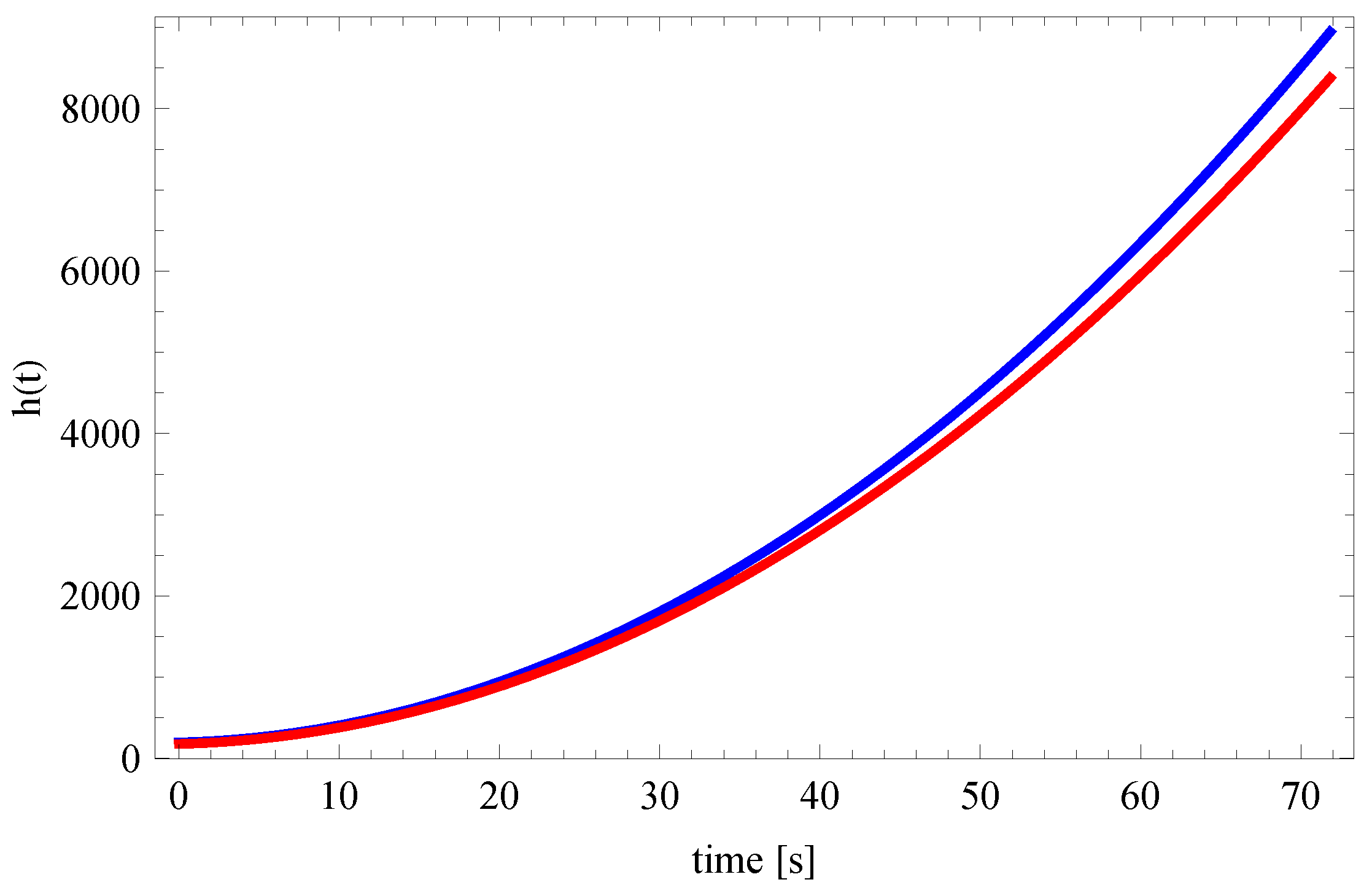
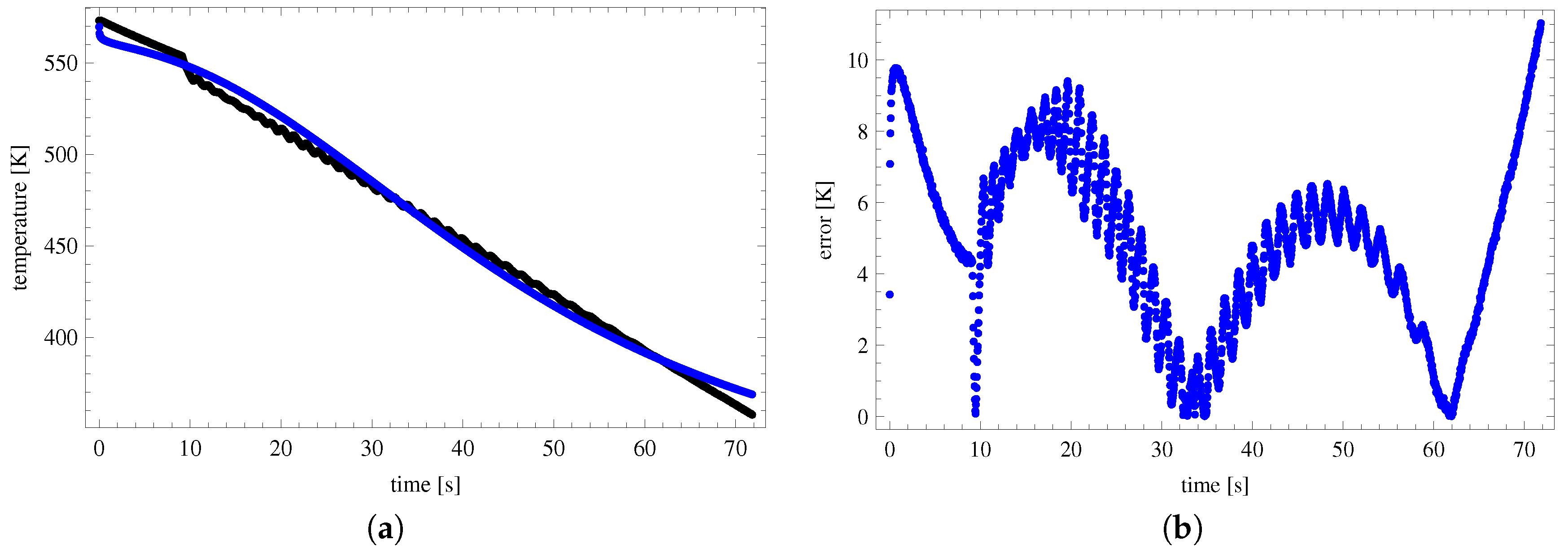
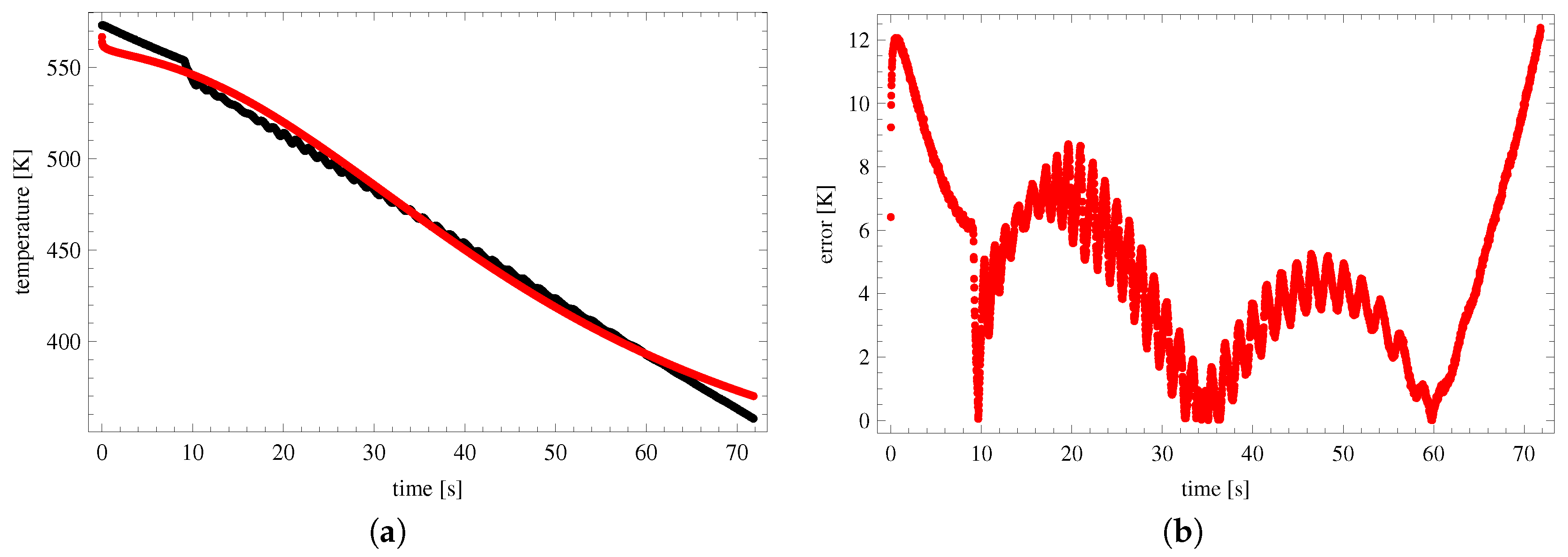

| 100 × 1995 | 100 × 3990 | |||
|---|---|---|---|---|
| 300.00 | 69.74 | 237.91 | 67.78 | |
| 569.73 | 2.02 | 566.74 | 3.80 | |
| 1.63 | 0.40 | 1.52 | 2.20 | |
| 4.72 | 0.67 | 5.00 | 4.27 | |
| 198.02 | 46.05 | 178.05 | 51.73 | |
| 0.20 | 0.05 | 0.21 | 0.09 | |
| value of the functional | 246.98 | 352.88 | ||
| 100 × 1995 | 100 × 3990 | |
|---|---|---|
| 4.92 | 4.77 | |
| 11.04 | 12.38 | |
| 1.06 | 1.02 | |
| 3.08 | 3.46 |
© 2017 by the authors. Licensee MDPI, Basel, Switzerland. This article is an open access article distributed under the terms and conditions of the Creative Commons Attribution (CC BY) license (http://creativecommons.org/licenses/by/4.0/).
Share and Cite
Brociek, R.; Słota, D.; Król, M.; Matula, G.; Kwaśny, W. Modeling of Heat Distribution in Porous Aluminum Using Fractional Differential Equation. Fractal Fract. 2017, 1, 17. https://doi.org/10.3390/fractalfract1010017
Brociek R, Słota D, Król M, Matula G, Kwaśny W. Modeling of Heat Distribution in Porous Aluminum Using Fractional Differential Equation. Fractal and Fractional. 2017; 1(1):17. https://doi.org/10.3390/fractalfract1010017
Chicago/Turabian StyleBrociek, Rafał, Damian Słota, Mariusz Król, Grzegorz Matula, and Waldemar Kwaśny. 2017. "Modeling of Heat Distribution in Porous Aluminum Using Fractional Differential Equation" Fractal and Fractional 1, no. 1: 17. https://doi.org/10.3390/fractalfract1010017
APA StyleBrociek, R., Słota, D., Król, M., Matula, G., & Kwaśny, W. (2017). Modeling of Heat Distribution in Porous Aluminum Using Fractional Differential Equation. Fractal and Fractional, 1(1), 17. https://doi.org/10.3390/fractalfract1010017

