1. Introduction
The rapid proliferation of cryptocurrencies and blockchain technologies has fundamentally disrupted traditional financial systems, drawing significant attention from investors, policymakers, and academics [
1,
2,
3]. However, this explosive growth has been accompanied by intense scrutiny regarding the environmental sustainability of digital assets [
4]. Cryptocurrencies that rely on Proof-of-Work (PoW) consensus mechanisms, such as Bitcoin, require massive computational power to secure the network and validate transactions, resulting in substantial electricity consumption and a corresponding carbon footprint [
5,
6]. Consequently, a growing body of academic literature has focused on quantifying the energy demands of cryptocurrency mining and evaluating its broader implications for global climate change and ecological degradation [
7,
8].
As the environmental cost of cryptocurrency mining becomes a prominent global concern, public discourse surrounding the topic has intensified. Previous research has begun to explore these societal reactions, often utilizing sentiment analysis and topic modeling on mainstream social media platforms to gauge general public opinion on Bitcoin’s environmental impact [
9]. Furthermore, recent studies indicate that environmental attention, climate risks, and energy consumption dynamics now actively influence cryptocurrency market behavior, investor sentiment, and the volatility of digital assets [
10,
11].
Despite the growing literature on energy consumption metrics and general public perception, a critical research gap persists regarding the internal narratives of the core cryptocurrency community. While mainstream social media provides a broad overview of public opinion, it often lacks technical depth and is highly susceptible to external noise and broader cultural trends [
9]. Prior research has shown that social-network-based communication can shape sustainable purchase behavior and eco-friendly attitudes, underscoring the broader influence of online platforms on sustainability-related judgments [
12]. Currently, there is a distinct lack of empirical research examining how the actual stakeholders of the blockchain ecosystem—such as miners, developers, and early adopters—perceive, frame, and debate the sustainability of their own industry. Understanding the defensive narratives, counterarguments, and underlying sentiment within specialized, highly technical communities is essential, as these grassroots actors directly influence network participation, hardware deployment, and the industry’s potential transition toward renewable energy infrastructures.
To bridge this gap, this study systematically investigates the insider perspectives on the environmental sustainability of cryptocurrency by analyzing long-form, technically focused discussions from Bitcointalk.org. Utilizing Natural Language Processing (NLP) and the Valence Aware Dictionary and sEntiment Reasoner (VADER), this research quantitatively evaluates the prevailing attitudes and thematic arguments constructed by cryptocurrency advocates against external environmental criticisms. By doing so, this study contributes to the literature on technological sustainability by examining a localized, highly homogeneous narrative space and the rhetorical strategies used to justify the operational energy costs of cryptographic networks. In this article, the term ‘echo chamber’ is used cautiously and only in a linguistic sense—namely, to describe a discursive environment marked by strongly aligned sentiment, recurrent rebuttal of external criticism, and repeated reinforcement of insider counter-narratives, rather than a network-structural demonstration of segregated interaction.
While traditional sentiment analysis and frequency modeling provide a macro-level understanding of community attitudes, they often fall short in identifying the precise linguistic drivers that dictate these sentiments. To address this limitation and elevate the analysis from descriptive to predictive, this study integrates Machine Learning in social-media-style data [
13] and Explainable Artificial Intelligence (XAI). Specifically, by employing a Random Forest classifier paired with SHapley Additive exPlanations (SHAP), this research mathematically isolates the hidden predictive weight of specific defensive arguments and terminology. This novel methodological approach not only quantifies the overarching community sentiment but explicitly reveals the exact rhetoric and underlying features that fuel the localized “echo chambers” justifying blockchain energy consumption. Specifically, this study addresses the following research questions:
RQ1: What is the prevailing sentiment and stance within the sampled Bitcointalk sustainability discussion regarding the environmental impact and sustainability of blockchain technologies?
RQ2: What are the most frequent arguments, counterarguments, and themes used by users when discussing cryptocurrency energy consumption?
RQ3: What do the engagement level and average sentiment polarity of the sampled sustainability-focused mega-thread reveal about the intensity and internal consistency of the discussion?
RQ4: Which specific linguistic features and keywords are the primary explanatory drivers of VADER-derived positive versus non-positive sentiment labels in the sampled discussion, as identified through Explainable AI?
Motivation and Contributions
The motivation for this study stems from a gap in the existing literature: although prior work has quantified cryptocurrency energy use and explored broader public opinion on social media, there remains limited empirical evidence on how technically engaged insiders rhetorically frame sustainability criticism within specialized forum discussions. This matters because such long-form discourse may shape community norms, technical justification strategies, and perceptions of reputational risk around blockchain sustainability. The study makes three contributions. First, it constructs and analyzes a dataset of 3000 long-form comments from Bitcointalk.org focused on environmental sustainability, providing a rare case study of insider discourse in a technical cryptocurrency forum. Second, it combines sentiment analysis and n-gram extraction to map the dominant argumentative patterns within the sampled discussion, including high-frequency themes such as “electricity consumption,” “environmentally friendly,” and “mining industry”. Third, it uses a Random Forest model trained on VADER-derived labels together with SHAP values to identify the most influential lexical features associated with sentiment polarity, while explicitly framing this model as an explanatory proxy rather than a substitute for human annotation.
2. Related Works
While blockchain sustainability is a broad interdisciplinary field, the present study is specifically positioned at the intersection of three streams: research on environmental critiques of cryptocurrency, research on online discourse and public opinion, and research using NLP/XAI methods to interpret language-based patterns in digital communities. Accordingly, the most relevant literature for this article is not only technical work on energy efficiency, but also scholarship that helps explain how sustainability claims are framed, defended, or contested in public and semi-specialized communication spaces.
2.1. Green Cryptocurrencies and Market Dynamics
The environmental footprint of digital assets has catalyzed a growing body of literature focused on “green” cryptocurrencies and stablecoins. Arora et al. [
14] systematically evaluates the extant research on green cryptocurrency, identifying critical thematic clusters such as environmental impact, green blockchain initiatives, and portfolio diversification to guide sustainable investments. Addressing the environmental footprint of digital assets directly, Koemtzopoulos et al. [
15] investigates the role of stablecoins, concluding that they provide an essential mechanism for transforming the decentralized financial sector into a more inclusive and ecologically friendly ecosystem. Building on this, Wolfson et al. [
16] conduct a comparative sustainability assessment and find that stablecoins mitigate the severe economic volatility and low transparency of traditional cryptocurrencies, ultimately resulting in greater overall sustainability.
From a market dynamics perspective, Almeida et al. [
17] employs a Time-Varying Parameter Vector Autoregression (TVP-VAR) model to reveal that sustainability-linked cryptocurrencies consistently act as net transmitters of influence within the broader market, particularly shaping dynamics during bearish conditions. Similarly, Yildirim and Mejri [
18] demonstrate through a Multivariate Quantile-on-Quantile Regression approach that the co-movements between green cryptocurrencies and ESG indices are highly conditional and intensify primarily during periods of elevated market uncertainty. Expanding the scope to physical assets, Karim et al. [
19] examine the asymmetric spillovers between blockchain-backed currencies and environmentally supported resources, highlighting that energy-efficient metals play a dominant role in attaining sustainable supply chains.
2.2. Algorithmic Optimization for Energy Efficiency
A second prominent strand of research focuses on resolving the inherent scalability and energy consumption limitations of decentralized networks through technical innovation. To address these challenges, Jhariya et al. [
20] propose an Adaptive Global Best–Worst Particle Swarm Optimization (AGBWPSO) algorithm integrated with dynamic sharding. They show that this approach improves transaction throughput while reducing energy consumption by up to 20% compared with existing methods. In the specialized context of electronic voting, Marouan et al. [
21] develop a sustainable hybrid cryptographic framework integrating ECDSA, EdDSA, and BLS signatures. Their experimental results show that this optimized design cuts per-transaction energy consumption by nearly 50% and significantly enhances network scalability without compromising security.
2.3. Eco-Environmental Sustainability and Resource Governance
Beyond financial assets, researchers are increasingly exploring how distributed ledger technologies can be deployed to address broader eco-environmental challenges. Meinhold et al. [
22] provides a review of the intersection between digital sustainability and eco-environmental sustainability, warning against the resource depletion caused by emerging technologies while advocating for cross-sector policy alignment. Focusing on specific industries, Hawashin et al. [
23] introduce a private Ethereum blockchain solution designed for the dairy industry. They demonstrate how an immutable, events-based ledger ensures traceability and significantly reduces organic food waste by holding supply chain participants accountable. Extending this to the circular economy, Bala et al. [
24] design a framework integrating smart contracts with IoT connectivity. They show that platforms like Hyperledger Fabric can successfully automate recycling incentives and ensure transparent resource management with minimal latency.
In the renewable energy sector, Ranasinghe and Rodrigo [
25] systematically synthesizes existing research on blockchain implementation for solar energy trading, concluding that despite a lack of real-world projects, the technology holds immense potential for mitigating carbon emissions and supporting green transitions. At the macro level of climate governance, Gurgu [
26] details how blockchain can resolve historical inefficiencies in water trading and disaster recovery, acting as a foundational technology for equitable ecological resource distribution. Finally, at the organizational level, Tian [
27] argues that Decentralized Autonomous Organizations (DAOs) are uniquely positioned to enforce environmental sustainability across complex supply chains by equitably distributing benefits to all stakeholders.
2.4. XAI, Blockchain, and Sustainability
The convergence of XAI and blockchain technology provides a robust framework for sustainability by ensuring both the interpretability of complex algorithms and the integrity of the data they process. Mavrogiorgos et al. [
28] emphasizes that while XAI clarifies AI-driven policy decisions, blockchain is necessary to secure these explanations against external tampering, thereby establishing a trustworthy foundation for data-driven governance. This synergy is particularly transformative in smart agriculture, where Chen et al. [
29] highlights that the integration of XAI and blockchain improves food safety and supply chain transparency, fostering a more efficient and sustainable global food system.
Furthermore, these technologies address the socio-economic dimensions of digital assets and environmental management. Le Nguyen et al. [
30] demonstrates how combining behavioral models with XAI techniques like SHAP provides deep insights into the trust and perceived risks driving cryptocurrency adoption in emerging markets. On a macro level, Caganova and Das [
31] argue that the synergy between AI’s predictive power and blockchain’s immutable ledgers is essential for building a decentralized green economy, enabling fraud-resistant carbon credits and peer-to-peer energy trading. Together, these studies suggest that a sustainable digital transition requires dual pillars of algorithmic transparency and decentralized verification to align technological innovation with social and ecological boundaries.
The work in [
13] shows that machine learning can successfully model user behavior from online social platform data, reporting high predictive performance in a microeconomic setting. Their study supports the broader use of interpretable classification methods for extracting patterns from platform-based textual and behavioral data. Ebrahimi et al. [
32] further demonstrates that reasoning-enabled AI systems and XAI can improve perceived transparency, trust, and behavioral intentions in sustainable decision contexts, underscoring the value of explainable modeling in sustainability-related research.
Taken together, the reviewed studies show that the environmental implications of digital assets have been examined from market, engineering, and governance perspectives, but much less attention has been paid to the rhetorical construction of sustainability narratives within insider communities. This gap is particularly relevant because sustainability controversies are not shaped only by objective energy metrics but also by the language communities use to justify, reinterpret, or reject those metrics. The present study therefore narrows its contribution to discourse-focused analysis of one highly active Bitcointalk thread, rather than attempting to represent the cryptocurrency ecosystem as a whole.
3. Methodology
The primary objective of this study was to systematically examine user perspectives on the environmental sustainability of cryptocurrency and blockchain technologies. Bitcointalk.org was selected as the designated data source because it represents the most historically significant, technically focused, and active forum for cryptocurrency discussions globally. Unlike mainstream social media platforms, Bitcointalk hosts long-form, highly detailed dialogues directly from miners, developers, and early blockchain adopters, making it an optimal repository for assessing granular, unfiltered user perspectives on energy consumption and environmental impact.
The data collection process utilized a custom web-scraping workflow implemented in Python 3.12 using the Requests and BeautifulSoup libraries. The scraper targeted Bitcointalk discussions explicitly centered on sustainability, energy consumption, and environmental criticism of Bitcoin mining, and the collection was halted when a threshold of 3000 valid textual comments was reached. The collected comments were obtained in a single scrape conducted in February 2026, and the resulting dataset reflects the forum content available at that time. In the resulting sample, all 3000 comments originated from a single highly active topic (Topic ID 5325350), posted by 104 unique authors, which makes the dataset a localized case study of one mega-thread rather than a randomized sample of the wider cryptocurrency ecosystem. The work in [
33] also shows that model performance in domain-specific tasks depends strongly on data availability, which is relevant here because our study works with a single-thread dataset and therefore should be interpreted as a localized case study rather than a broadly generalizable benchmark.
Following extraction, the raw HTML was parsed to isolate the topic identifier, author username, and main post body, while comments shorter than ten characters were discarded. The final cleaned dataset therefore consisted of 3000 comments from one thread and 104 authors. This sampling characteristic is methodologically important and is explicitly acknowledged as a major limitation of scope and external validity. The unstructured text was subsequently ingested into a Pandas DataFrame to facilitate natural language processing.
To ensure ethical data collection and prevent server overload, the algorithm incorporated customized user-agent headers, dynamic pagination offsets, and randomized temporal delays between server requests. Only publicly accessible forum content was collected; no attempt was made to access private or restricted material, and the analysis focused on publicly visible usernames and post text already exposed on the platform. In reporting the findings, the study treats the dataset as user-generated public discourse and refrains from disclosing additional personally identifying information beyond what is already publicly displayed on Bitcointalk.
To evaluate underlying user sentiment, the study employed the Valence Aware Dictionary and sEntiment Reasoner (VADER), a lexicon- and rule-based sentiment analyzer commonly used for short and informal digital text. VADER was selected because Bitcointalk posts often contain emphatic capitalization, informal language, evaluative phrasing, and rhetorical rebuttals that can be partially captured through lexicon-based polarity scoring. VADER computed a normalized compound score from −1 to +1, which was then discretized using the standard thresholds: scores greater than or equal to 0.05 were classified as Positive, scores less than or equal to −0.05 as Negative, and the remainder as Neutral.
At the same time, VADER is not domain-specialized for technical cryptocurrency discourse. For that reason, the revised manuscript supplements the aggregate sentiment statistics with representative comment examples from each class to increase interpretive transparency and to avoid overstating sentiment polarity as a direct proxy for ideology.
To systematically extract prevailing arguments and counterarguments, the text underwent preprocessing to remove standard English stopwords together with domain-specific high-frequency noise words such as ‘bitcoin,’ ‘crypto,’ ‘would,’ and ‘people,’ which were unlikely to be analytically informative in isolation. In the revised analysis, URLs, date-like tokens, isolated numbers, punctuation artifacts, and residual non-alphabetic strings were also removed prior to generating the cleaned n-gram table, in order to reduce artifacts such as ‘https www’ and ‘may 06’ that appeared in the initial frequency output. A CountVectorizer was subsequently applied to generate bigrams and trigrams, isolating the highest-frequency contiguous word sequences. The frequency counts of these multi-word constructs serve as quantitative, objective proxies for the community’s core rhetorical themes and primary avenues of argumentation.
To provide an explanatory modeling layer, the study trained a Random Forest classifier on VADER-derived sentiment labels rather than on human-annotated ground truth. Prior studies have similarly combined social-network data with machine learning approaches to uncover structured behavioral patterns in online user communities [
34]. For this step, the text was vectorized using TF-IDF with a maximum of 800 features and English stopword removal. The resulting feature matrix was split into training and test partitions using an 80/20 hold-out split with stratification and random_state = 42. The Random Forest model was configured with 100 estimators and a maximum depth of 10 (n_estimators = 100, max_depth = 10, random_state = 42).
Because the sentiment labels are derived from VADER, the purpose of this model is not to establish an independently supervised sentiment benchmark, but to identify which lexical features most strongly align with the sentiment labeling pattern and can therefore be interpreted with SHAP values as explanatory proxies. To improve statistical rigor under class imbalance, performance was assessed not only with overall accuracy but also with balanced accuracy, macro precision, macro recall, macro F1-score, per-class scores, a confusion matrix, and a majority-class baseline comparison. In addition, 5-fold cross-validation was used to assess the stability of the classifier, producing a mean accuracy of 0.9667 and a mean Macro F1-score of 0.9125 across folds.
4. Results
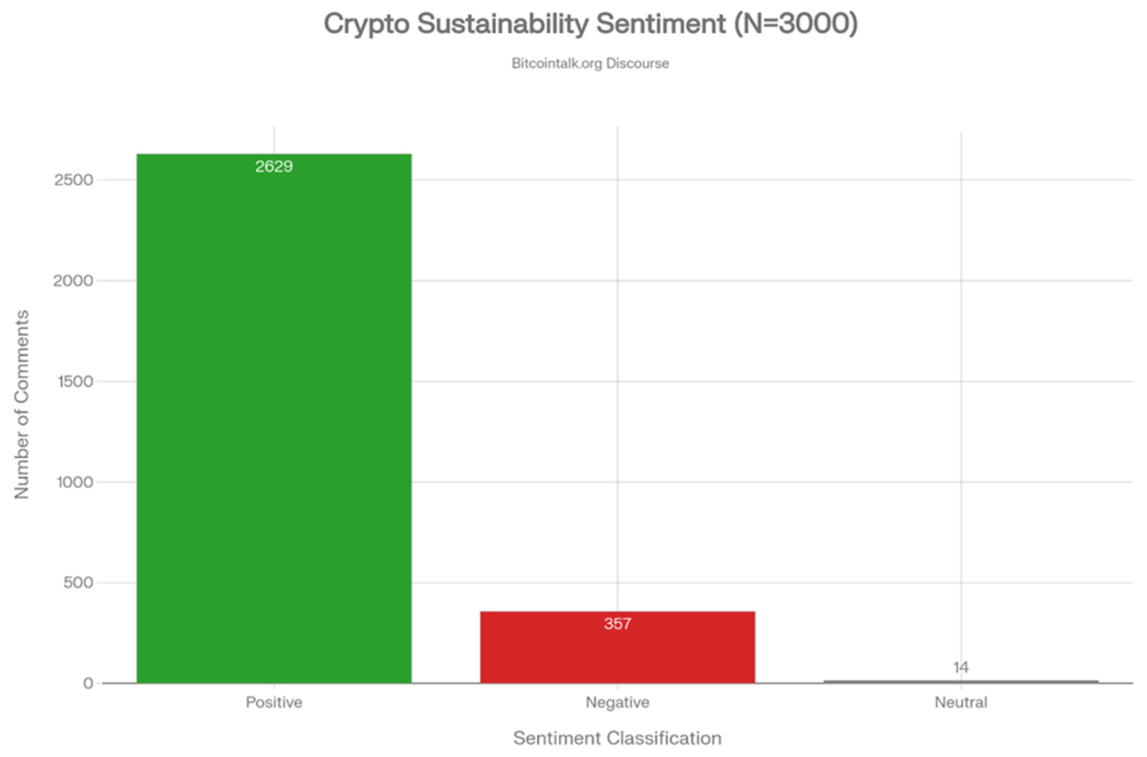
Analysis of the 3000 extracted comments reveals a profoundly defensive and optimistic sentiment landscape within the cryptocurrency community regarding sustainability, directly addressing the first research question. Based on the VADER compound polarity scores summarized in
Table 1 and
Figure 1, 2629 comments (87.63%) were categorized as demonstrating Positive sentiment, while only 357 comments (11.90%) were Negative, and a mere 14 comments (0.47%) were Neutral. This indicates that the community largely rejects the premise that blockchain technology is an inherent environmental disaster. Instead, users actively frame energy consumption as a necessary utility that secures a decentralized financial network, frequently expressing optimism about the industry’s ongoing transition toward renewable energy sources. The overwhelming positive skew, visualized in the accompanying distribution plot, highlights a unified communal stance that prioritizes the systemic value of cryptographic networks over traditional environmental critiques, utilizing affirmative language to justify operational energy costs.
Regarding the second research question, top topic/thread engagement (
Table 2) and thematic modeling via n-gram extraction (
Table 3) uncover the specific linguistic frameworks and counterarguments deployed by these users. To better capture the underlying thematic structure and address systemic artifacts present in the raw data (such as hyperlinks and date stamps), the dataset underwent rigorous secondary preprocessing to remove URLs, dates, and non-alphabetic characters. As detailed in
Table 3, the highest-frequency substantive phrases in the cleaned data include ‘electricity consumption’ (963 occurrences) and ‘environmentally friendly’ (838 occurrences). This demonstrates that users are not ignoring the environmental debate but are confronting its terminology directly. Furthermore, the prominence of phrases such as ‘efficient sustainable’ (810 occurrences) and ‘mining industry’ (686 occurrences) illustrates a concerted effort to recharacterize cryptocurrency mining. Users frequently argue that mining operations absorb surplus grid energy or incentivize the development of green infrastructure, thereby portraying the industry as a catalyst for environmental efficiency rather than a detriment.
The formulation of the third research question focuses on the engagement intensity and internal consistency of the sampled mega-thread rather than cross-thread comparison, because the final dataset contains only one topic. Specifically, all 3000 comments were drawn from Topic ID 5325350, which had an average sentiment score of +0.623 and involved 104 unique authors. These figures show that the sampled discussion was both highly active and strongly sentiment-skewed, but they do not support comparative inference across multiple threads. Accordingly, the present evidence is best interpreted as indicating a highly concentrated and internally reinforcing narrative space within one Bitcointalk conversation rather than a forum-wide or ecosystem-wide consensus. To address the fourth research question, a Random Forest classifier was trained (
Table 4) to reproduce VADER-derived sentiment labels from TF-IDF text features, with the goal of identifying explanatory lexical patterns rather than establishing a human-supervised predictive benchmark. Because the dataset is highly imbalanced, model quality was evaluated with multiple class-sensitive metrics in addition to accuracy. On the held-out test set, the model achieved 96.83% accuracy, 0.8716 balanced accuracy, 0.9826 macro precision, 0.8716 macro recall, 0.9175 Macro F1-score, and 0.9663 weighted F1-score. By comparison, a majority-class baseline achieved only 87.67% accuracy, 0.5000 balanced accuracy, and 0.4671 Macro F1-score, indicating that the classifier learned more than simply defaulting to the dominant positive class.
The confusion matrix further clarifies this performance: among 74 non-positive cases in the test set, 55 were correctly identified and 19 were misclassified as positive, while all 526 positive cases were correctly classified. This pattern indicates that the model is highly reliable on the dominant class but still less sensitive to minority-class instances, which reinforces the importance of reporting Macro F1 and balanced accuracy rather than relying on accuracy alone.
Because lexicon-based classifiers like VADER are not explicitly optimized for the irony, quotation, and adversarial framing typical of technical cryptocurrency forums, relying on aggregate polarity scores alone may lack analytical depth. To increase interpretive transparency and illustrate how VADER categorizes domain-specific technical discourse,
Table 5 provides representative examples of comments classified as positive, negative, and neutral. These examples demonstrate that while positive comments generally champion green infrastructure, many ‘negative’ comments actually reflect insiders discussing regulatory threats, taxes, and public backlash, rather than necessarily agreeing with environmental critiques. Representative examples help contextualize these labels. A positive-scored post argued that “Bitcoin helps the efficiency of the energy industry” and framed mining as a mechanism for using otherwise wasted energy and supporting low-carbon infrastructure. By contrast, a negative-scored post warned that governments may “tax btc to death” using environmental reasons as a public justification, illustrating how risk-oriented or regulatory language can drive negative polarity even within a generally defensive conversation. Neutral examples included link-only posts or statements with borderline polarity scores, such as a comment scored at 0.0493 that strongly defended Bitcoin rhetorically but remained just below the positive threshold.
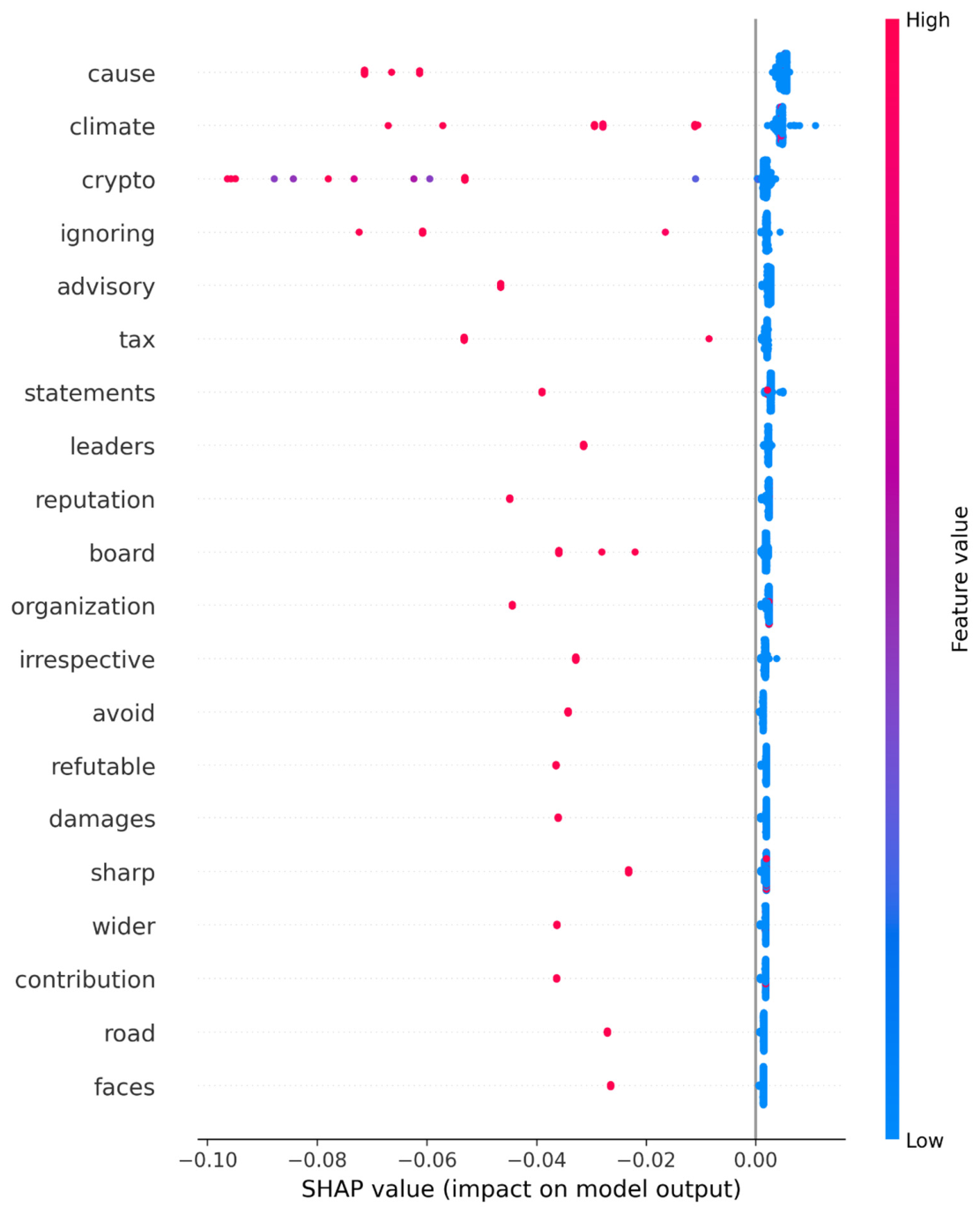
To interpret the model’s decision-making process, SHAP were applied, extracting the top predictive linguistic features that dictate sentiment polarity within the community’s echo chambers.
Figure 2 visualizes the SHAP summary plot, where the vertical axis ranks the features by their overall importance to the model, and the horizontal axis represents the impact of each feature on the model’s sentiment prediction. The color gradient indicates the original feature value, with red signifying a high frequency of the word in a comment and blue signifying a low frequency.
The SHAP analysis reveals a distinct linguistic pattern regarding how negative sentiment is framed within the cryptocurrency community. The most influential predictive words—including cause (SHAP impact: 0.0099), climate (0.0068), crypto (0.0056), and ignoring (0.0050)—predominantly push the model toward a negative prediction when they appear frequently (indicated by red dots clustered on the negative side of the x-axis). Similarly, terms associated with institutional consequence and risk, such as tax, reputation, organization, and damages, also act as strong negative drivers.
This indicates that negative discourse within the forum is not typically directed at the technology itself, but rather emerges when users are actively engaging with, quoting, or refuting external institutional criticisms regarding “climate damages” and “reputation.” Conversely, the absence of these risk-associated terms (indicated by the dense clusters of blue dots slightly to the right of the zero-line) gently contributes to the baseline positive, defensive sentiment that dominates the forum. Consequently, the SHAP values suggest that this localized narrative space is sustained not only by repeated positive framing, but also by the clustering of external risk vocabulary—such as “climate,” “damages,” “tax,” and “reputation”—within comments assigned non-positive polarity by VADER. Because these explanations are derived from a model trained on VADER labels and from a single-thread dataset, they should be interpreted as localized explanatory signals rather than generalizable evidence for the entire cryptocurrency ecosystem.
5. Discussion
The findings reveal a meaningful divergence between the insider rhetoric observed in the sampled Bitcointalk thread and the outsider environmental critiques commonly documented in mainstream discourse. While previous studies using mainstream social media reported more balanced or critical public sentiment (Mankala et al., 2023 [
9]), the sampled Bitcointalk mega-thread shows a strongly positive and defensive sentiment profile, with 87.63% of comments labeled positive and an average sentiment score of +0.623. This group does not ignore energy consumption but proactively rebrands it as a necessary cost for decentralized security, often citing empirical indices like the Cambridge Bitcoin Electricity Consumption Index to validate their stance against what they perceive as uninformed media narratives.
One plausible explanation for the divergence is platform composition and discourse format. Bitcointalk is a long-form, technically oriented forum populated by comparatively engaged users, whereas mainstream platforms often include broader publics, shorter posts, and higher exposure to external contestation. The stronger positivity observed here may therefore reflect both self-selection into a specialized forum and the specific argumentative function of the analyzed thread, which was explicitly organized around countering environmental criticism.
The SHAP analysis further illuminates the mechanics of this highly homogeneous narrative space. However, the present study does not establish an echo chamber in the full network-sociological sense, because it does not analyze interaction structure, exposure patterns, or comparative insider-versus-outsider networks. Instead, the evidence is linguistic and intra-thread: negative or non-positive polarity is disproportionately associated with terms invoking institutional risk, public criticism, or reputational threat, whereas the dominant tone of the thread remains defensive and justificatory. This supports a moderated interpretation in which the thread operates as a rhetorically reinforcing discursive space, even if structural echo-chamber claims require further network-based validation. This defensive posture aligns with the “stewardship” narratives identified in recent green business literature, where technological advocates frame their industry as a catalyst for green infrastructure rather than a driver of resource depletion [
14,
22].
This study provides a multi-dimensional contribution to the literature on blockchain sustainability and digital sociology. Methodologically, it extends the application of XAI beyond market prediction [
30] by utilizing SHAP values to mathematically isolate the linguistic drivers of communal sentiment. This extends descriptive frequency modeling toward an explanatory understanding of how lexical cues align with VADER-derived sentiment labels within the sampled discussion, without claiming a fully supervised predictive benchmark.
Thematically, the research shifts the focus from “quantifying” energy metrics [
6,
8] to “qualifying” the social justification of those metrics. By identifying the specific terms that trigger negative sentiment, this work provides a foundational framework for understanding how localized echo chambers maintain ideological cohesion in the face of global ecological crises. It bridges the gap between technical consensus mechanisms and the socio-technical narratives that sustain them, offering a more nuanced view of the “human layer” of blockchain governance [
27].
5.1. Practical Implications
Although limited to one Bitcointalk mega-thread, the results offer useful exploratory insights for policymakers, ESG investors, and blockchain developers. For regulators, the findings suggest that traditional “top-down” environmental messaging may be ineffective or even counterproductive, as the community perceives terms like “climate damages” as external institutional attacks rather than constructive feedback. Communication strategies should instead focus on “green infrastructure” and “efficiency” metrics, which the community already views as positive drivers.
For investors and developers, the high focus on “efficient sustainable” mining and renewable energy transitions underscores a growing demand for “green” blockchain innovations [
20,
25]. Developers can leverage this internal optimism to accelerate the adoption of energy-optimized frameworks—such as dynamic sharding or hybrid cryptographic signatures—knowing that the community is receptive to efficiency as a core value [
21]. Finally, the study highlights a possible reputational risk dynamic visible in this thread-level discourse: when environmental critique is processed primarily as external attack, institutional vocabulary such as “tax,” “reputation,” and “damages” may become focal points of defensive response rather than openings for substantive sustainability dialogue.
5.2. Limitations and Future Research
This study has several important limitations. First, the dataset is not a representative sample of the cryptocurrency ecosystem or even of Bitcointalk as a whole. All 3000 comments in the final sample were drawn from a single hyper-active mega-thread (Topic ID 5325350), posted by 104 authors, which means the analysis should be interpreted as a localized case study of one concentrated discussion rather than a macro-level account of “the cryptocurrency community”.
Second, the study does not establish an echo chamber in the full structural sense used in network sociology. The evidence presented here is linguistic and sentiment-based: strong positivity, repeated justificatory framing, and the concentration of external risk vocabulary in non-positive comments. Demonstrating structural echo chambers would require interaction-network analysis, exposure mapping, or comparison with outsider discussion spaces.
Third, the explanatory machine learning layer is based on VADER-derived labels rather than human-annotated sentiment ground truth. The Random Forest and SHAP results are therefore best interpreted as showing which lexical features align with VADER’s polarity assignments in this dataset, not as definitive evidence of human sentiment classification performance.
Fourth, although VADER is practical for informal online discourse, it is not specifically optimized for technical cryptocurrency discussions, where irony, quotation, rebuttal, and adversarial framing may complicate polarity interpretation.
Fifth, the exact time period (Day of scraping) covered by the collected comments could not be determined from the scraping output, as timestamp metadata was not retained during data collection. This represents a limitation for reproducibility, as future researchers cannot precisely replicate the temporal scope of the dataset.
Future research should expand the dataset across multiple Bitcointalk threads, broader time windows, and comparative platforms such as Reddit, Telegram, Discord, or X. Comparative insider-versus-outsider designs, manual annotation, transformer-based benchmarking, and network analysis would make it possible to test whether the linguistic patterns identified here persist across contexts and whether stronger claims about echo chambers can be empirically justified.
6. Conclusions
This study has mapped the internal rhetorical landscape of one highly active Bitcointalk sustainability discussion, providing a localized empirical view of insider discourse around blockchain environmental criticism. By shifting the analytical focus from external energy metrics to the socio-technical discourse on Bitcointalk.org, the research reveals a community that is not merely passive in the face of environmental criticism but actively engaged in a sophisticated re-framing of the industry’s ecological footprint. The integration of sentiment analysis with an explanatory XAI layer helped identify the lexical patterns most strongly associated with VADER-derived polarity labels, especially terms linked to institutional risk, climate critique, and reputational concern.
The findings underscore a fundamental disconnect between the technical justifications of the blockchain elite and the regulatory expectations of the broader public. While the community views energy consumption as an essential trade-off for decentralized security and a catalyst for green infrastructure, external observers often perceive the same data points as indicators of environmental degradation. The use of SHAP values to isolate the linguistic triggers of negative sentiment demonstrates that the community perceives institutional “risk” and “climate” terminology as external threats to be managed rather than internal failures to be rectified. This suggests that the industry’s path toward true sustainability will require more than just algorithmic optimizations; it will necessitate a profound reconciliation between these insulated defensive narratives and the universal imperatives of climate action.
Ultimately, this research provides a cautious methodological template for combining lexicon-based sentiment analysis, frequency modeling, and explainable machine learning to study the discourse surrounding emerging technologies at the thread level. By quantifying the hidden drivers of communal sentiment, this work offers a foundational understanding of how technical communities build ideological cohesion in the face of existential challenges. As blockchain sustainability debates continue to evolve, a key challenge will be whether technically engaged communities can move beyond defensive narrative reinforcement and engage more directly with external environmental critique in transparent, evidence-based dialogue.
Author Contributions
Conceptualization, P.B., M.F.-F. and Z.G.S.; Methodology, P.B. and Z.G.S.; Software, P.B.; Validation, M.F.-F. and Z.G.S.; Formal analysis, P.B.; Investigation, M.F.-F. and Z.G.S.; Data curation, P.B.; Writing–original draft, P.B., M.F.-F. and Z.G.S.; Writing–review & editing, P.B., M.F.-F. and Z.G.S.; Supervision, Z.G.S.; Project administration, M.F.-F.; Funding acquisition, M.F.-F. All authors have read and agreed to the published version of the manuscript.
Funding
This research received no external funding.
Institutional Review Board Statement
Under GDPR Article 4(1), personal data is defined as any information relating to an identified or identifiable natural person. Furthermore, GDPR Recital 26 explicitly states that data protection principles “should not apply to anonymous information, namely information which does not relate to an identified or identifiable natural person.” It further specifies that “this Regulation does not therefore concern the processing of such anonymous information, including for statistical or research purposes.” Hungarian Act CXII of 2011 on the Right of Informational Self-Determination and on Freedom of Information (as amended by Act XXXVIII of 2018), which implements GDPR provisions into Hungarian national law, similarly defines personal data as information relating to an identifiable natural person. Since no such data were collected or processed in this study, the data protection provisions of this Act do not apply to the present research. Based on the above, we respectfully confirm that this study is exempt from formal ethics review under both EU and Hungarian law, as it solely involves the analysis of anonymous, pre-existing, publicly available textual content with no identifiable individuals involved.
Informed Consent Statement
Under GDPR Article 4(1), personal data is defined as any information relating to an identified or identifiable natural person. Furthermore, GDPR Recital 26 explicitly states that data protection principles “should not apply to anonymous information, namely information which does not relate to an identified or identifiable natural person.” It further specifies that “this Regulation does not therefore concern the processing of such anonymous information, including for statistical or research purposes.” Hungarian Act CXII of 2011 on the Right of Informational Self-Determination and on Freedom of Information (as amended by Act XXXVIII of 2018), which implements GDPR provisions into Hungarian national law, similarly defines personal data as information relating to an identifiable natural person. Since no such data were collected or processed in this study, the data protection provisions of this Act do not apply to the present research. Based on the above, we respectfully confirm that this study is exempt from formal ethics review under both EU and Hungarian law, as it solely involves the analysis of anonymous, pre-existing, publicly available textual content with no identifiable individuals involved.
Data Availability Statement
The data presented in this study are available on request from the corresponding author. data is collected from YouTube with API request.
Acknowledgments
The authors used Gemini Pro 3.1 solely for grammar correction, language refinement, and improvement of manuscript readability. No AI tools were used for study design, data collection, data generation, data analysis, data interpretation, or the development of scientific conclusions. All scientific content, results, interpretations, and conclusions presented in this manuscript are the sole responsibility of the authors.
Conflicts of Interest
The authors declare no conflicts of interest.
Abbreviations
The following abbreviations are used in this manuscript:
| POW | Proof-of-Work |
| NLP | Natural Language Processing |
| VADER | Valence Aware Dictionary and sEntiment Reasoner |
| XAI | Explainable Artificial Intelligence |
| SHAP | SHapley Additive exPlanations |
| TVP-VAR | Time-Varying Parameter Vector Autoregression |
| AGBWPSO | Adaptive Global Best–Worst Particle Swarm Optimization |
| DAOs | Decentralized Autonomous Organizations |
| PoS | Proof-of-Stake |
References
- Elsayed, R.A.A. Unveiling the black box: Understanding digital assets’ complexity. Future Bus. J. 2025, 11, 31. [Google Scholar] [CrossRef]
- Secinaro, S.; Lanzalonga, F.; Oppioli, M.; de Nuccio, E. The effects of disruptive technologies on accountability in fintech industry: Using bibliometric analysis to develop a research agenda. Res. Int. Bus. Financ. 2025, 76, 102816. [Google Scholar] [CrossRef]
- Tang, H.W.; Härdle, W.K.; Osterrieder, J.; Pele, D.T.; Baals, L.J.; Papavassiliou, V.; Bolesta, K.; Kabašinskas, A.; Filipovska, O.; Thomaidis, N.S.; et al. Digital assets: Risks, regulations, mitigation. Financ. Innov. 2026, 12, 65. [Google Scholar] [CrossRef] [PubMed]
- Bouzari, P.; Fekete-Farkas, M.; Szalay, Z.G. Intelligent sustainability: Evaluating transformers for cryptocurrency environmental claims. Information 2025, 16, 1022. [Google Scholar] [CrossRef]
- Sasani, F.; Moghareh Dehkordi, M.; Ebrahimi, Z.; Dustmohammadloo, H.; Bouzari, P.; Ebrahimi, P.; Lencsés, E.; Fekete-Farkas, M. Forecasting of Bitcoin illiquidity using high-dimensional and textual features. Computers 2024, 13, 20. [Google Scholar] [CrossRef]
- Zhang, D.; Chen, X.H.; Lau, C.K.M.; Xu, B. Implications of cryptocurrency energy usage on climate change. Technol. Forecast. Soc. Change 2023, 187, 122219. [Google Scholar] [CrossRef]
- de Vries, A. Bitcoin’s energy consumption is underestimated: A market dynamics approach. Energy Res. Soc. Sci. 2020, 70, 101721. [Google Scholar] [CrossRef]
- Sarkodie, S.A.; Amani, M.A.; Ahmed, M.Y.; Owusu, P.A. Assessment of Bitcoin carbon footprint. Sustain. Horiz. 2023, 7, 100060. [Google Scholar] [CrossRef]
- Mankala, S.; Durai, A.; Padiyar, A.; Gkountouna, O.; Mahabir, R. Understanding public discourse surrounding the impact of Bitcoin on the environment in social media. GeoJournal 2023, 88, 4243–4267. [Google Scholar] [CrossRef] [PubMed]
- Ben Omrane, W.; Saadi, S.; Savaser, T. Sustainable energy practices and cryptocurrency market behavior. Energy Econ. 2024, 139, 107937. [Google Scholar] [CrossRef]
- Zribi, W.; Boufateh, T.; Guesmi, K. Climate uncertainty effects on Bitcoin ecological footprint through cryptocurrency environmental attention. Financ. Res. Lett. 2023, 58, 104584. [Google Scholar] [CrossRef]
- Ebrahimi, P.; Khajeheian, D.; Fekete-Farkas, M. A SEM-NCA Approach towards Social Networks Marketing: Evaluating Consumers’ Sustainable Purchase Behavior with the Moderating Role of Eco-Friendly Attitude. Int. J. Environ. Res. Public Health 2021, 18, 13276. [Google Scholar] [CrossRef] [PubMed]
- Ebrahimi, P.; Schneider, J. Fine-tuning image-to-text models on Liechtenstein tourist attractions. Electron. Mark. 2025, 35, 55. [Google Scholar] [CrossRef]
- Arora, R.; Kapoor, M.; Singh, N.; Yaqub, M.Z. Green cryptocurrency and business strategies: Framework and insights from a stewardship literature review. Bus. Strategy Environ. 2025, 34, 804–829. [Google Scholar] [CrossRef]
- Koemtzopoulos, D.; Zournatzidou, G.; Sariannidis, N. Can Cryptocurrencies Be Green? The Role of Stablecoins Toward a Carbon Footprint and Sustainable Ecosystem. Sustainability 2025, 17, 483. [Google Scholar] [CrossRef]
- Wolfson, A.; Khaladjan, G.; Lurie, Y.; Mark, S. The Greater Sustainability of Stablecoins Relative to Other Cryptocurrencies. J. Risk Financ. Manag. 2025, 18, 161. [Google Scholar] [CrossRef]
- Almeida, J.; Gaio, C.; Gonçalves, T.C. Sustainability or artificial intelligence? Returns and volatility connectedness in crypto assets. J. Risk Financ. 2025, 26, 177–212. [Google Scholar] [CrossRef]
- Yildirim, R.; Mejri, S. Dynamic interactions between green cryptocurrencies and ESG indices: A Multivariate Quantile-on-Quantile Regression approach. J. Sustain. Financ. Invest. 2026, 1–35. [Google Scholar] [CrossRef]
- Karim, S.; Naeem, M.A.; Tiwari, A.K.; Ashraf, S. Examining the avenues of sustainability in resources and digital blockchains backed currencies: Evidence from energy metals and cryptocurrencies. Ann. Oper. Res. 2025, 355, 765–782. [Google Scholar] [CrossRef]
- Jhariya, M.K.; Dehalwar, V.; Bharti, J.; Kumar, L. Energy efficient transactions for blockchain networks using adaptive global best–worst particle swarm optimization. Sci. Rep. 2026, 16, 1643. [Google Scholar] [CrossRef] [PubMed]
- Marouan, A.; Badrani, M.; Zannou, A.; Kannouf, N.; Chetouani, A. A sustainable hybrid cryptographic framework for energy optimization and scalability in blockchain-based e-voting. Sci. Afr. 2026, 31, e03191. [Google Scholar] [CrossRef]
- Meinhold, R.; Wagner, C.; Dhar, B.K. Digital sustainability and eco-environmental sustainability: A review of emerging technologies, resource challenges, and policy implications. Sustain. Dev. 2025, 33, 2323–2338. [Google Scholar] [CrossRef]
- Hawashin, D.; Salah, K.; Jayaraman, R.; Ahmad, R.W.; Kanhere, S.; Damiani, E. Enhancing sustainability in dairy industry: Blockchain-based waste reduction. Sustain. Futures 2025, 9, 100529. [Google Scholar] [CrossRef]
- Bala, P.M.; Usharani, S.; Devi, A. Smart contracts and blockchain architectures for sustainable resource management through decentralized traceability, transparency, and circular value creation. In Blockchain Innovations for a Sustainable Circular Economy (Studies in Big Data, Vol. 180); Kumar, A., Batta, P., Rathore, P.S., Kumar, T.A., Ramírez, J.R.J., Eds.; Springer: Berlin/Heidelberg, Germany, 2026; pp. 299–323. [Google Scholar] [CrossRef]
- Ranasinghe, D.S.; Rodrigo, N. Implementation of blockchain for sustainable solar energy trading: A systematic review. Smart Sustain. Built Environ. 2026, 15, 231–252. [Google Scholar] [CrossRef]
- Gurgu, E. Blockchain systems for ecological sustainability: Advancing resource governance and climate resilience. In Blockchain Technology for Water and Environmental Systems, 1st ed.; Eslamian, S., Eslamian, F., Eds.; CRC Press: Boca Raton, FL, USA, 2025; p. 12. [Google Scholar] [CrossRef]
- Tian, X. DAOs and environmental sustainability. In The Palgrave Handbook of Blockchain Technology for Business; Sarkis, J., Ed.; Palgrave Macmillan: London, UK, 2026. [Google Scholar] [CrossRef]
- Mavrogiorgos, K.; Gur, S.; Kalantzis, N.; Tzelaptsis, K.; Papageorgiou, X.S.; Karabetian, A.; Manias, G.; Mavrogiorgou, A.; Kyriazis, D.; Cano, C.P. Combining explainable artificial intelligence (XAI) with blockchain towards trustworthy data-driven policies. In Proceedings of the 2025 21st International Conference on Distributed Computing in Smart Systems and the Internet of Things (DCOSS-IoT); IEEE: New York, NY, USA, 2025; pp. 1042–1049. [Google Scholar] [CrossRef]
- Chen, H.-Y.; Sharma, K.; Sharma, C.; Sharma, S. Integrating explainable artificial intelligence and blockchain to smart agriculture: Research prospects for decision making and improved security. Smart Agric. Technol. 2023, 6, 100350. [Google Scholar] [CrossRef]
- Le Nguyen, T.; Kien Pham, V.; Le Phuong Giao, L. Bridging behavioural models and explainable AI in cryptocurrency adoption: A study of emerging markets with evidence from Vietnam. J. Decis. Syst. 2025, 34, 2593248. [Google Scholar] [CrossRef]
- Caganova, D.; Das, S. Blockchain and AI: Building a decentralized green economy. In Generative AI for a Net-Zero Economy; Mondal, S.R., Vartiak, L., Das, S., Eds.; Springer: Berlin/Heidelberg, Germany, 2025. [Google Scholar] [CrossRef]
- Ebrahimi, P.; Hoffmann, S.; Schneider, J. Opening the black box: How reasoning-enabled AI agents influence user perceptions and behavior in sustainable consumption. Int. J. Inf. Manag. 2026, 90, 103075. [Google Scholar] [CrossRef]
- Ebrahimi, P.; Hassani, M.N.; Khansari, S.M.; Salamzadeh, A.; Fekete-Farkas, M. A machine learning decision tree model to predict consumer purchase behaviour: A microeconomic view from online social platforms in Iran. Int. J. Bus. Glob. 2025, 40, 289–302. [Google Scholar] [CrossRef]
- Ebrahimi, P.; Basirat, M.; Yousefi, A.; Nekmahmud, M.; Gholampour, A.; Fekete-Farkas, M. Social Networks Marketing and Consumer Purchase Behavior: The Combination of SEM and Unsupervised Machine Learning Approaches. Big Data Cogn. Comput. 2022, 6, 35. [Google Scholar] [CrossRef]
| Disclaimer/Publisher’s Note: The statements, opinions and data contained in all publications are solely those of the individual author(s) and contributor(s) and not of MDPI and/or the editor(s). MDPI and/or the editor(s) disclaim responsibility for any injury to people or property resulting from any ideas, methods, instructions or products referred to in the content. |