1. Introduction
With the growth of containerization and its increasing importance in global supply chains, the factors affecting the competitiveness of container terminals are becoming a priority area of research, while intensifying competition makes such studies particularly relevant for port managers and policymakers seeking to ensure targeted sectoral development [
1]. Container terminals play a vital role in international trade by facilitating cargo flows and contributing to regional economic development [
2]. In recent years, global container flows have recovered after the pandemic-induced downturn, and increasing cargo volumes have made port management, infrastructure planning, and logistics coordination significantly more complex [
3,
4].
At the same time, external disruptions such as the 2009 global financial crisis, the COVID-19 pandemic, and the geopolitical consequences of the war in Ukraine have substantially affected global supply chains and maritime transport systems [
5,
6,
7]. These developments have highlighted the importance of analytical frameworks capable not only of forecasting throughput volumes but also of identifying structural shifts and competitive changes within regional port systems. Consequently, container throughput forecasting has become increasingly important for port management and transport logistics because throughput dynamics directly influence operational planning, infrastructure utilisation, resource allocation, and investment decisions [
8,
9,
10].
Container throughput forecasting and port competitiveness analysis have been widely examined in previous research. Existing studies have applied a wide range of statistical, econometric, and machine-learning approaches for container throughput forecasting and port competitiveness analysis [
11,
12,
13,
14,
15,
16,
17]. At the same time, several studies have investigated port competitiveness and logistics efficiency in the Baltic Sea region [
18,
19,
20,
21]. In particular, the study by Locaitienė and Čižiūnienė [
18] assessed Baltic seaport logistics efficiency using DEA-BCC and spatial analysis methods. Although such approaches provide valuable insights into operational efficiency and regional interdependence, they primarily evaluate relative efficiency at a specific analytical level and do not explicitly analyse long-term market-share redistribution or temporal competitive dynamics among ports.
The Baltic Sea region represents a particularly relevant environment for such analysis because the ports of Klaipeda, Riga, and Tallinn operate within partially overlapping hinterlands while simultaneously competing for regional cargo flows, feeder-network integration, and liner-service connectivity. Changes in market shares within this regional system may therefore reflect not only aggregate demand fluctuations but also shifts in shipping-line strategies, route restructuring, infrastructure investments, operational efficiency, and geopolitical realignments.
Despite the growing body of literature, the Baltic region still lacks a compact and reproducible analytical framework that jointly evaluates throughput evolution, market-share redistribution, and medium-term planning trajectories using routinely available throughput statistics. Existing studies often focus either on absolute throughput forecasting or on static efficiency assessment while offering limited insight into whether observed changes primarily reflect overall market cycles or competitive redistribution among ports. From a strategic planning perspective, this distinction is particularly important because infrastructure investments, capacity planning, and logistics policy decisions depend not only on aggregate market growth but also on the relative competitive positioning of individual ports.
The aim of this study is to develop a replicable analytical framework for analysing container throughput and market-share dynamics in the ports of Klaipeda, Riga, and Tallinn during 2005–2024 and for preparing baseline forecasts to 2030. The framework combines descriptive statistical analysis, normalized market-share assessment, growth-rate analysis, and ordinary least-squares trend estimation with prediction intervals.
Unlike advanced machine-learning forecasting systems intended for high-frequency operational optimisation, the proposed framework is intentionally positioned as a transparent and interpretable baseline approach suitable for medium-term comparative assessment under conditions of limited but consistent annual throughput data. The objective is not to replace advanced econometric or artificial-intelligence forecasting methods but rather to provide an analytical structure capable of distinguishing aggregate market cycles from port-specific competitive dynamics while maintaining interpretability for policymakers and infrastructure planners. The study addresses the following research questions:
How have market shares evolved among the ports of Klaipeda, Riga, and Tallinn during 2005–2024?
To what extent do observed throughput changes reflect common regional demand shocks versus port-specific competitive redistribution?
Can normalized market-share analysis combined with trend-based forecasting provide a transparent baseline framework for strategic planning under conditions of regional volatility?
What differences in growth stability and forecast uncertainty can be identified among the three ports?
Based on these questions, the study advances the following assumptions:
H1: Market-share dynamics in Baltic ports reflect not only aggregate regional demand fluctuations but also persistent competitive reallocation among ports.
H2: Klaipeda demonstrates stronger long-term competitive accumulation relative to Riga and Tallinn.
H3: Forecast uncertainty differs substantially across ports because of differences in throughput volatility and structural instability.
The contribution of this study is threefold. First, it proposes a reproducible analytical framework that separates aggregate throughput dynamics from relative market-share redistribution. Second, it applies normalized market-share analysis to identify competitive shifts within the Baltic container-port system. Third, it provides interpretable medium-term forecasting trajectories with explicit uncertainty considerations that may support infrastructure evaluation, investment prioritisation, and regional logistics policy discussions.
Although the present study relies on annual aggregated throughput statistics and interpretable baseline forecasting, the proposed framework is conceptually compatible with future cognitive-computing extensions involving AIS-derived maritime traffic streams, high-frequency terminal operational data, adaptive forecasting architectures, and machine-learning-based anomaly detection systems applicable to large-scale maritime logistics analytics.
The proposed framework should therefore be interpreted primarily as an interpretable baseline decision-support structure for medium-term strategic planning rather than as a high-frequency predictive optimisation model.
2. Literature Review
Containerization has revolutionized global supply chains and shipping by standardizing the weight of bulk cargo and creating conditions for more efficient logistics. Since 1956, the container trade has grown rapidly because containers have enabled the mechanization of cargo handling, significantly improving the performance of seaports and the entire supply chain [
22]. Containers make it possible to organize efficient door-to-door delivery, as they can be easily transferred between different modes of transport, ships, railways, and cars, without requiring additional cargo handling, including packing or unpacking processes [
23,
24]. Containerization has been the most dynamic aspect of globalization, surpassing the growth in export value and GDP, as confirmed by statements that no other technical improvement has contributed more to globalization than containerization [
25,
26].
The introduction of digital and communication technologies has become one of the most important factors in the success of the modern port industry, such as increasing productivity, customer service quality, efficiency, and competitiveness [
27,
28]. Their ecosystem consists of connected platforms, cloud computing, mobile applications, IoT sensors, augmented reality, autonomous transport, blockchain, big data analytics, and sustainable innovation [
29]. Despite AI and digital transformation, global economic growth is driven by the increasing flow of physical goods. The global port network and container transport system are critical links in these flows, making accurate container throughput forecasting an essential tool for strategic planning and operational efficiency [
3,
30]. Container flows are most often defined as the sum of export and import TEUs, and this indicator is closely linked to economic dynamics [
31]. Forecasts are influenced by macroeconomic cycles, maritime transport trends, model limitations, and private sector strategies [
8]. Global container transport has grown significantly in recent decades, with an annual growth rate of around 2.4% forecast for 2022–2026 [
32].
Port container transport is an important guarantee of international trade and is closely linked to the economic interests of companies and countries; therefore, container throughput is considered one of the most important indicators of port economic development [
33,
34]. In this context, the policies and strategies developed over the past decades to increase the efficiency of port operations have further highlighted the importance of forecasts, which are widely recognized as a measure of port competitiveness and productivity, encouraging market trend analysis and the implementation of forecasting practices [
35,
36,
37,
38]. Indicative baseline forecasts allow decision makers to accurately assess changes in container terminal flows over time [
39,
40].
At the operational level, the main flows at container terminals consist of incoming and outgoing containers, which makes forecasting accuracy particularly important because more accurate forecasts improve infrastructure utilization, reliability, and flexibility, shorten delivery times, and reduce supply chain costs [
41]. Looking more broadly at logistics and transport, forecasting freight demand is a key factor for effective management, planning, operation, and resource optimization [
42].
Methodologically, container throughput forecasting commonly relies on statistical, econometric, and time-series approaches, including regression-based models and trend-analysis techniques [
33,
43,
44,
45,
46,
47,
48]. Forecasting methods are typically selected according to data frequency, forecasting horizon, and the structural stability of the analysed transport system. From a strategic perspective, forecasts are aligned with infrastructure development and investment, as throughput reflects infrastructure development and helps justify national and regional decisions [
49,
50,
51], while measures to reduce container dwell time in ports, such as digitalization and advanced terminal planning, are becoming a policy priority [
52].
The dynamics of cargo flows and the container market in Baltic ports should be interpreted not only through absolute TEU changes, but also through the lenses of port logistics efficiency, infrastructural capacity, and regional interdependence [
21,
53]. This approach is particularly important for distinguishing whether observed changes primarily reflect the overall market cycle or result from competitive reallocation among ports [
54]. Cargo flows depend on infrastructure, berth parameters, and handling capacity, while the inclusion of spatial analysis enables an assessment of how port performance is correlated across the region and how this relates to the distribution of flows [
18,
54].
At the container-terminal level, competitive dynamics become even more apparent because aggregated port throughput indicators do not always explain changes in market share [
55,
56]. Recent efficiency assessments of container terminals in the Baltic Sea region relate throughput dynamics to infrastructure and operational characteristics; consequently, shifts in market share can be interpreted as the outcome of interactions among capacity, efficiency, and the service network, rather than solely as a consequence of macroeconomic fluctuations [
57,
58].
Regional reallocation is further shaped by the structure of the Baltic container network. The literature highlights the importance of feeder services and the strengthening hub role of certain ports, which can alter flow directions and the market share captured by individual ports [
59,
60]. As a result, market shares may change even under similar macroeconomic conditions, driven by liner shipping decisions, route rotations, and the increasing centrality of hubs in the regional system [
59,
61]. Long-term flow dynamics are also influenced by infrastructure decisions and terminal expansion opportunities, which are constrained or enabled by maritime spatial planning. The development of new terminals and deep-water infrastructure can create structural increases in capacity that later translate into competitive shifts and market-share redistribution [
62].
Finally, when discussing competitiveness drivers, it is important to recognize that investments and modernization are often associated with stronger port positions, yet the effects of specific policy measures are not necessarily direct. Evidence suggests that certain “green” measures do not automatically yield statistically significant competitiveness gains when competitiveness is assessed via port-choice probabilities. Therefore, policy recommendations should be grounded in empirical evidence and clearly distinguished from statements that extend beyond the applied methodology and available data [
63,
64].
Reliable container throughput forecasts for Baltic ports are essential for strategic capacity and investment decisions, operational planning, and maintaining competitiveness, as they reduce the risks of inefficient capacity utilization, waiting times, and container diversion.
3. Materials and Methods
The analytical framework of the study is presented in
Figure 1. The framework integrates throughput-data processing, market-share normalization, growth-rate analysis, structural-break diagnostics, trend forecasting, uncertainty assessment, and forecast-validation procedures in order to evaluate competitive dynamics and medium-term throughput tendencies within the Baltic container-port system.
Although the literature on container-throughput forecasting includes advanced approaches such as ARIMA, SARIMA, machine-learning, hybrid, and state-space models, the present study intentionally applies ordinary least-squares linear trend estimation as a transparent baseline framework for comparative medium-term assessment. The choice of OLS was motivated by the relatively small annual dataset, the emphasis on interpretability for strategic planning, and the objective of distinguishing aggregate market cycles from possible competitive redistribution among ports rather than maximizing short-term predictive accuracy. More complex nonlinear and high-frequency forecasting approaches may provide additional analytical value when larger datasets or operational-level observations become available.
A. Data and variable definitions
i ∈ {Klaipeda, Riga, Tallinn}–port.
t ∈ {2005, …, 2024}–year.
Annual container throughput data for Klaipeda, Riga, and Tallinn were compiled from official port statistics and consolidated into a consistent time series for 2005–2024. Throughput values are reported in thousand TEU. The analysis uses the most recent revisions published by the respective port authorities, and no data imputation was performed .
B. Market share normalization and competitive dynamics
yi,t = 1000 · ki,t–cargo in TEU units.
The market share dynamics chart presents normalized throughput time series for the three analysed ports, where the total annual throughput of Klaipeda, Riga, and Tallinn is set to 100%. This approach allows relative competitive dynamics to be separated from aggregate market fluctuations and helps identify long-term competitive redistribution among ports. The total market volume in year
t is defined as:
where
kj,t is the annual container throughput of port j in thousands of TEU in year
t.
The market share of an individual port is defined as the ratio of the volume of the port in question to the total market.
Percentage-form market shares were used for comparative interpretation across ports and years. Annual percentage change was calculated to evaluate year-to-year throughput dynamics and identify periods of accelerated growth, decline, or structural disruption:
Additionally, logarithmic growth rates were calculated in order to evaluate continuously compounded annual change and improve comparability across periods:
C. Trend modelling and forecasts to 2030
Linear trend forecasting was applied in order to estimate medium-term throughput trajectories for Klaipeda, Riga, and Tallinn until 2030. The method approximates annual throughput using a linear time trend and extrapolates the resulting trajectory into the forecast horizon.
The linear trend model is defined as:
where
y(
i,
t−1) is the annual throughput (level) of ports in the previous year, expressed in TEU.
The slope coefficient
β was estimated using ordinary least squares regression:
Fitted values were calculated as:
The resulting trend trajectories were used to evaluate long-term throughput evolution and comparative growth stability among the analysed ports.
D. Forecast uncertainty and structural-break diagnostics
Forecast uncertainty was evaluated using residual dispersion and prediction intervals. Wider prediction intervals indicate lower forecast stability and greater sensitivity to external disruptions.
Structural-break diagnostics are commonly applied in transport and time-series analysis in order to identify potential regime changes and discontinuities in observed dynamics.
In addition to visual diagnostics, Chow breakpoint tests were applied for the years 2018 and 2022 in order to evaluate potential structural changes in the Klaipeda throughput series. These years correspond to the largest observed deviations in throughput and market-share dynamics during the analysed period.
Residuals were calculated as:
Residual dispersion was estimated using the standard error of regression:
Forecast values for future periods were obtained using linear extrapolation:
Prediction intervals were calculated in order to evaluate forecast uncertainty and planning ranges under conditions of market volatility.
E. Out-of-sample forecast validation and model limitations
In order to evaluate the robustness of the proposed forecasting framework, an out-of-sample validation procedure was performed. Linear trend models were estimated using the 2005–2020 observations, while the period 2021–2024 was reserved as a hold-out sample for forecast evaluation.
Forecast accuracy was assessed using root mean square error (RMSE) and mean absolute percentage error (MAPE), allowing comparative evaluation of predictive stability among the analysed ports.
Because the study relies on annual observations and a transparent baseline forecasting structure, the proposed framework is intentionally positioned as an interpretable medium-term comparative assessment tool rather than as a formal econometric inference model or a high-frequency predictive optimisation system.
Several standard diagnostic procedures were additionally considered in order to evaluate the robustness and limitations of the baseline forecasting structure. First, Augmented Dickey–Fuller (ADF) tests were applied to assess the stationarity properties of the annual throughput series. The results indicated the presence of trend-related non-stationarity, which is commonly observed in long-term transport-demand and throughput data. Given the objective of medium-term trend interpretation rather than stochastic inference, the series were retained in level form for comparative baseline forecasting.
Second, residual autocorrelation was evaluated using the Durbin–Watson statistic. The diagnostics indicated moderate serial dependence typical of annual transport time series; therefore, the forecast results and prediction intervals should be interpreted as indicative planning ranges rather than precise econometric forecasts.
Because the proposed framework is intentionally based on a relatively small annual dataset and prioritises transparency and interpretability for strategic planning purposes, more advanced econometric corrections and stochastic specifications—including HAC/Newey–West estimators, structural time-series models, regime-switching approaches, and machine-learning forecasting architectures—were considered beyond the scope of the present analysis and are proposed for future research.
4. Results and Discussion
A. Market share dynamics and competitive shifts
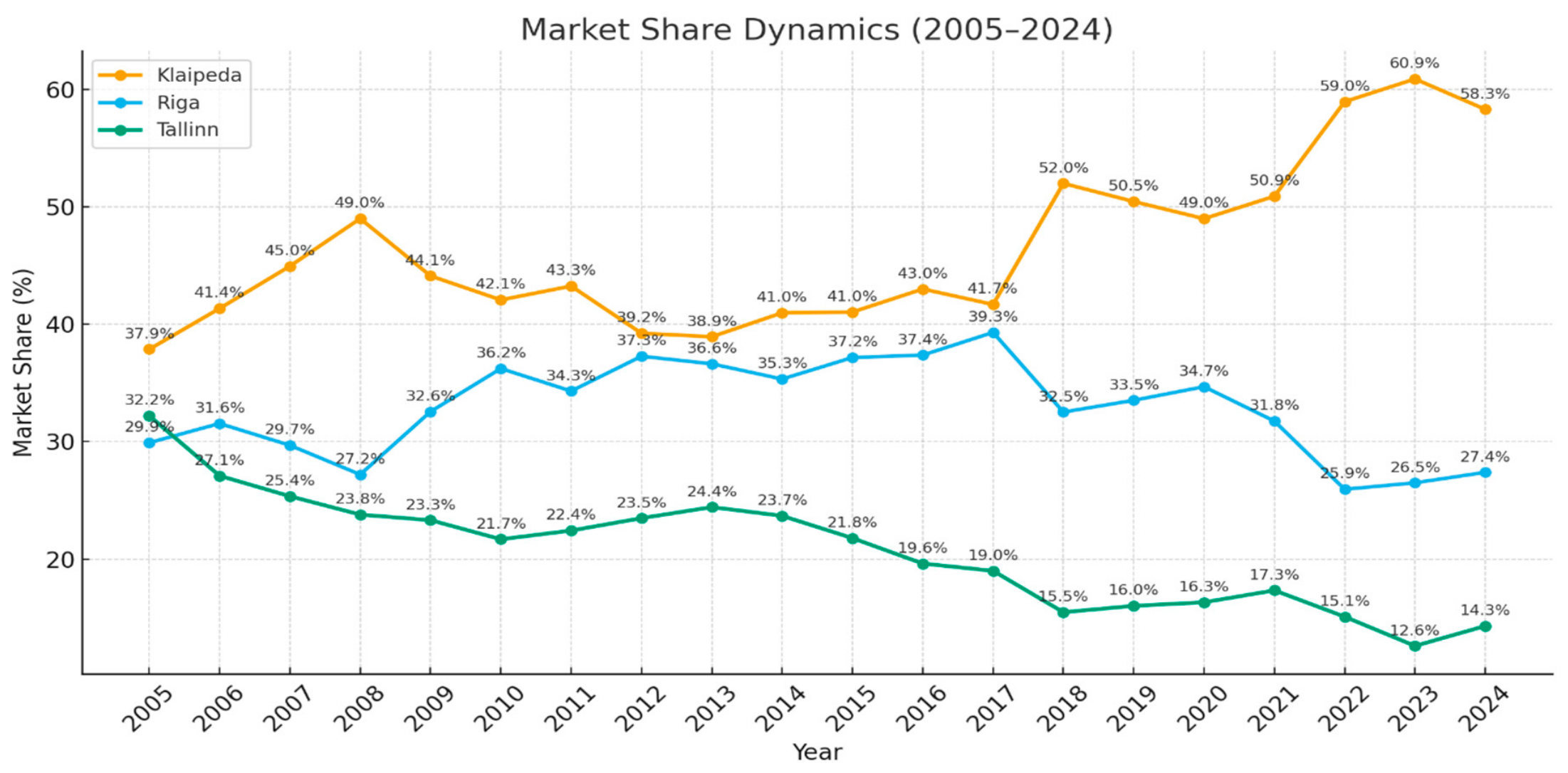
The linear diagram of market (
Figure 2) share dynamics shows the normalized time series of the three ports, where the total volume for each year is set to 100%, and each year separates the relative competitive dynamics from the overall fluctuations in demand. The results show whether the port is actually gaining traffic at the expense of its competitors or is simply moving in line with the market, thus highlighting potential structural breaks that may be associated with changes in routes, corridors, or capacity developments. The results obtained allow for more preliminary capacity and investment planning and enable the use of top-down logic in forecasting: assessing the overall market trajectory separately and how much of it is likely to go to each port.
Market share dynamics for the period 2005–2024 in
Figure 2 show a significant increase in concentration in favor of the Port of Klaipeda: its share rose from ~38% at the beginning of the period to ~58% at the end, with a clear structural break recorded in 2017–2018, when the share jumped by ~10 percentage points in one year and then stabilized above 50%. This indicates a non-cyclical, but rather a compositional accumulation of advantage—a consistent takeover of traffic at the expense of competitors—likely related to the effect of route offerings, connections, operational reliability, and cost structure. After peaking in 2011–2014 (at approximately 36–38%), Riga experienced a decline to ~27% in 2024, reflecting a structural weakening of competitiveness, most likely driven by route rotations, reallocations, or changes in commercial conditions. Tallinn’s share declined from ~32% to ~14%, indicating long-term erosion in this three-port segment. Market share analysis separates relative dynamics from the overall demand cycle; therefore, the changes recorded should be interpreted as a realignment of competitive positions rather than a reflection of overall market fluctuations. From a management perspective, this justifies Klaipeda’s strategy of maintaining its leadership in terms of capacity, infrastructure, and connections, while also signaling that Riga and Tallinn need targeted interventions, as a cyclical rebound in volumes alone will not restore their lost relative position.
Additional breakpoint diagnostics were performed in order to verify whether the observed changes in Klaipeda throughput dynamics represented statistically significant structural shifts rather than normal cyclical fluctuations. Chow breakpoint tests were applied for the years 2018 and 2022, corresponding to the largest observed deviations in the throughput dynamics.
The results indicated statistically significant structural breaks in both periods. For 2022, the Chow test produced F = 16.77 with p < 0.001, while for 2018 the test produced F = 11.18 with p < 0.001. These findings are consistent with the interpretation that the observed throughput increases in Klaipeda were associated not only with ordinary market growth but also with possible competitive redistribution and possible regional logistics adjustments.
These atypical positive deviations may also be associated with broader geopolitical and logistics-system changes in the Baltic region, including cargo-flow redistribution following sanctions affecting Russian and Belarusian trade routes, adjustments in feeder-service configurations, and changes in regional shipping-network connectivity after 2022. Although the present analysis does not directly model these external factors, the observed throughput dynamics are consistent with the possibility of partial cargo reallocation within the regional port system.
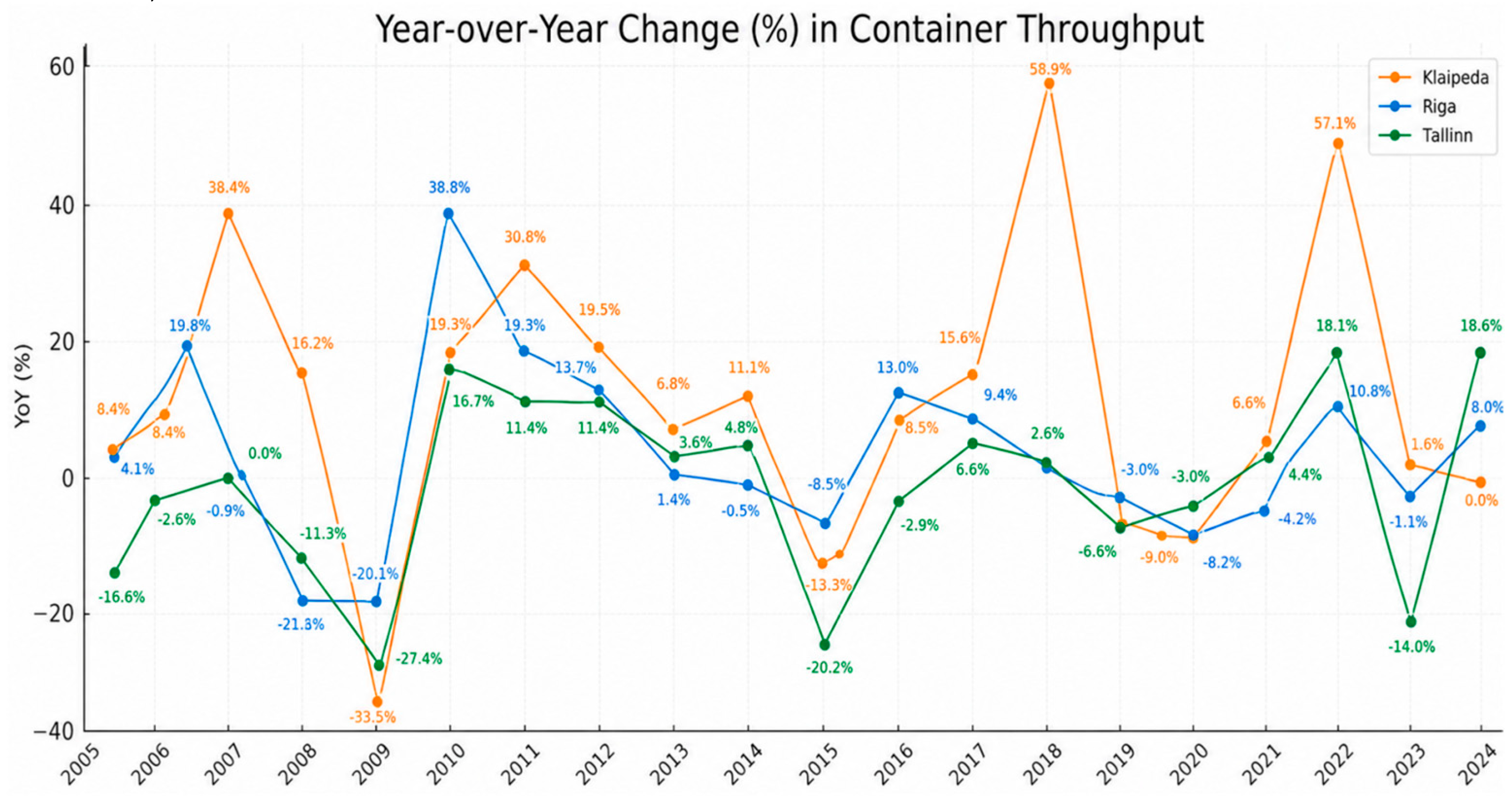
The annual change chart (
Figure 3) converts absolute volumes into growth rates, allowing for the assessment of dynamics rather than just levels. This transformation is invariant in terms of scale, allowing for a direct comparison of ports of different sizes, and we measured the speed and strength of the reaction rather than the differences in the base. The annual change chart helps to reliably identify turning points, shocks, and regime changes, provides an early warning of deviations from the normal course, and provides a stable basis for forecasting, as growth rates are generally considered more suitable for comparative volatility analysis. The results are useful for capacity planning, risk management, and commercial adjustments.
The data show significant fluctuations with clear extremes and regime shifts in
Figure 3. The Klaipeda series is characterized by two large positive jumps—about +59% in 2018 and ~+57% in 2022—and a sharp decline in 2009 (~−33%). Riga has an average standard deviation; the most pronounced was recorded in 2010 (~+39%), while a longer but more moderate decline can be seen in the period 2015–2021 (several consecutive negative years). Tallinn’s dynamics are dominated by greater downside risk: sharp declines in 2009 (~−28%) and 2015 (~−20%) and several short recoveries (e.g., approximately +18% in 2022 and 2024).
There is a clear synchronization of common shocks between ports: the negative changes in all three ports in 2009 and 2020 reflect external cyclical shocks (the global financial crisis and the COVID-19 pandemic), while 2022 shows faster positive volume growth. At the same time, there are shifts that cannot be explained by common factors: Klaipeda’s positive “jumps” in 2018 and 2022 significantly exceed the amplitude of its neighbors, which indicates not only the effect of overall demand but also the redistribution of routes/corridors or operational decisions.
B. Trend forecasts to 2030 and forecast uncertainty
The results provide three values: (i) diagnostics of dynamics and sensitivity to external factors, (ii) a comparative profile between ports, and (iii) a more reliable basis for short-term forecasting and early warning, because growth rates are more likely to reveal deviations from the normal course.
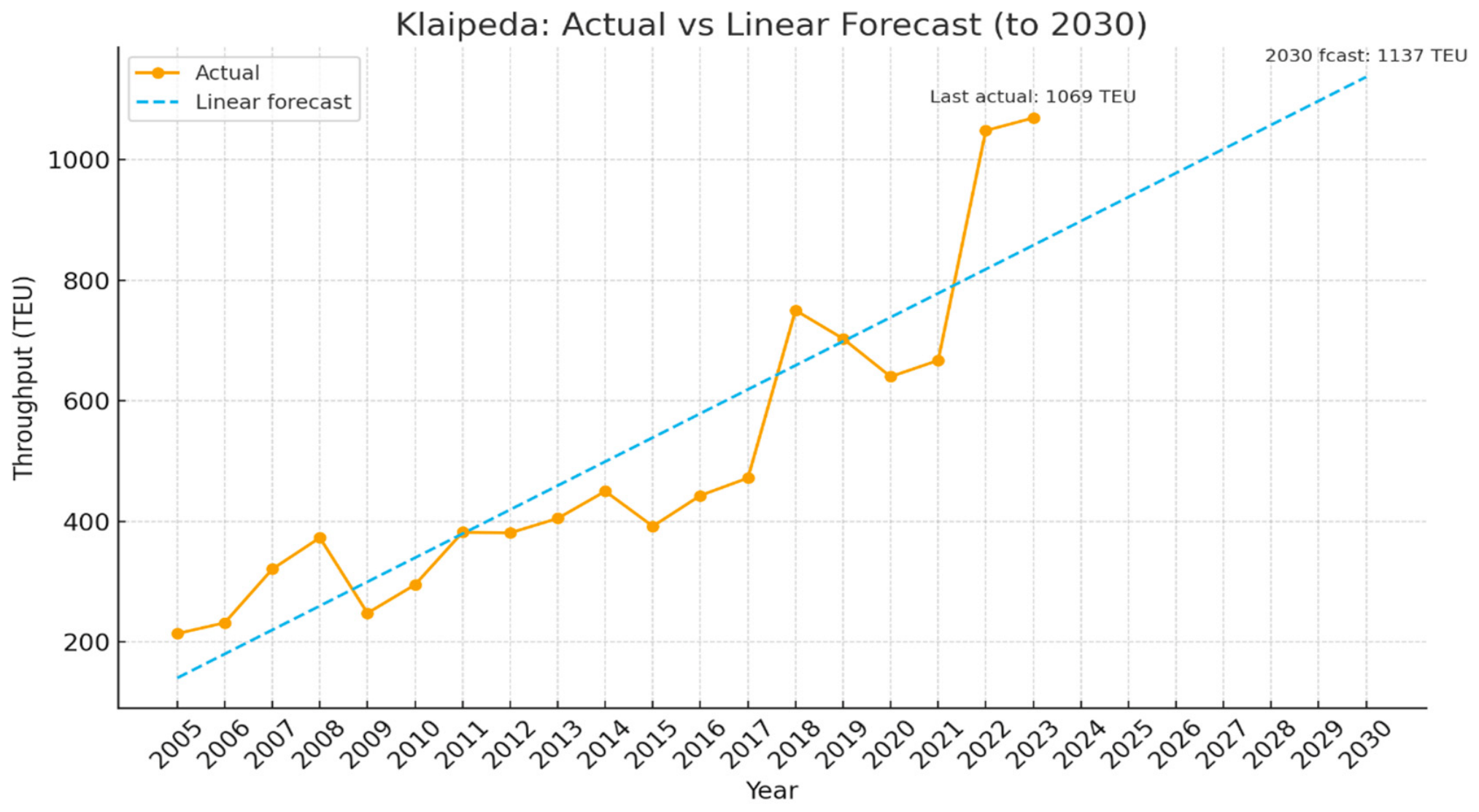
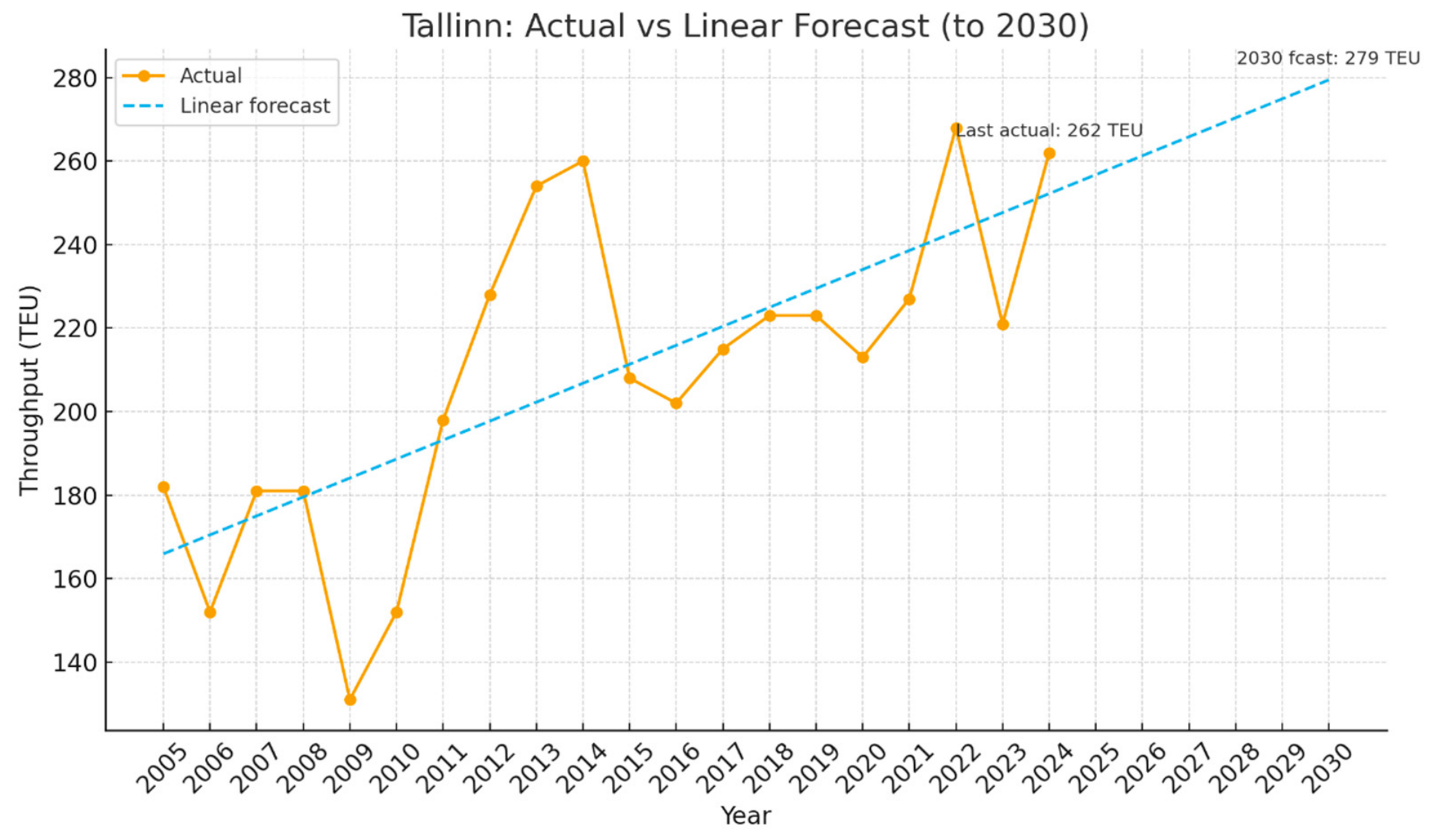
Linear trend forecasts (
Figure 4) were made for container handling at the ports of Klaipeda, Riga, and Tallinn. The orange line shows the actual annual volumes (2005–2024), while the blue dotted line shows the linear regression extrapolation until 2030.
An analysis of container handling statistics at the Port of Klaipeda in
Figure 4 shows consistent growth—the linear regression slope is approximately 39.86 thousand TEU per year, and the forecast handling volume for 2030 is approximately 1137 thousand TEU. This means that despite fluctuations in cargo flows during the period under review, Klaipeda–for example, a sharp decline in 2009, a significant jump in 2018, and rapid growth in 2022–2023–maintains a positive growth trend in the long term. Although the model’s coefficient of determination R
2 is average (0.796), the linear projection still shows slow but persistent long-term growth trend, which suggests that if favorable conditions persist, Klaipeda may maintain a positive medium-term throughput trajectory under the assumptions of the applied baseline framework.
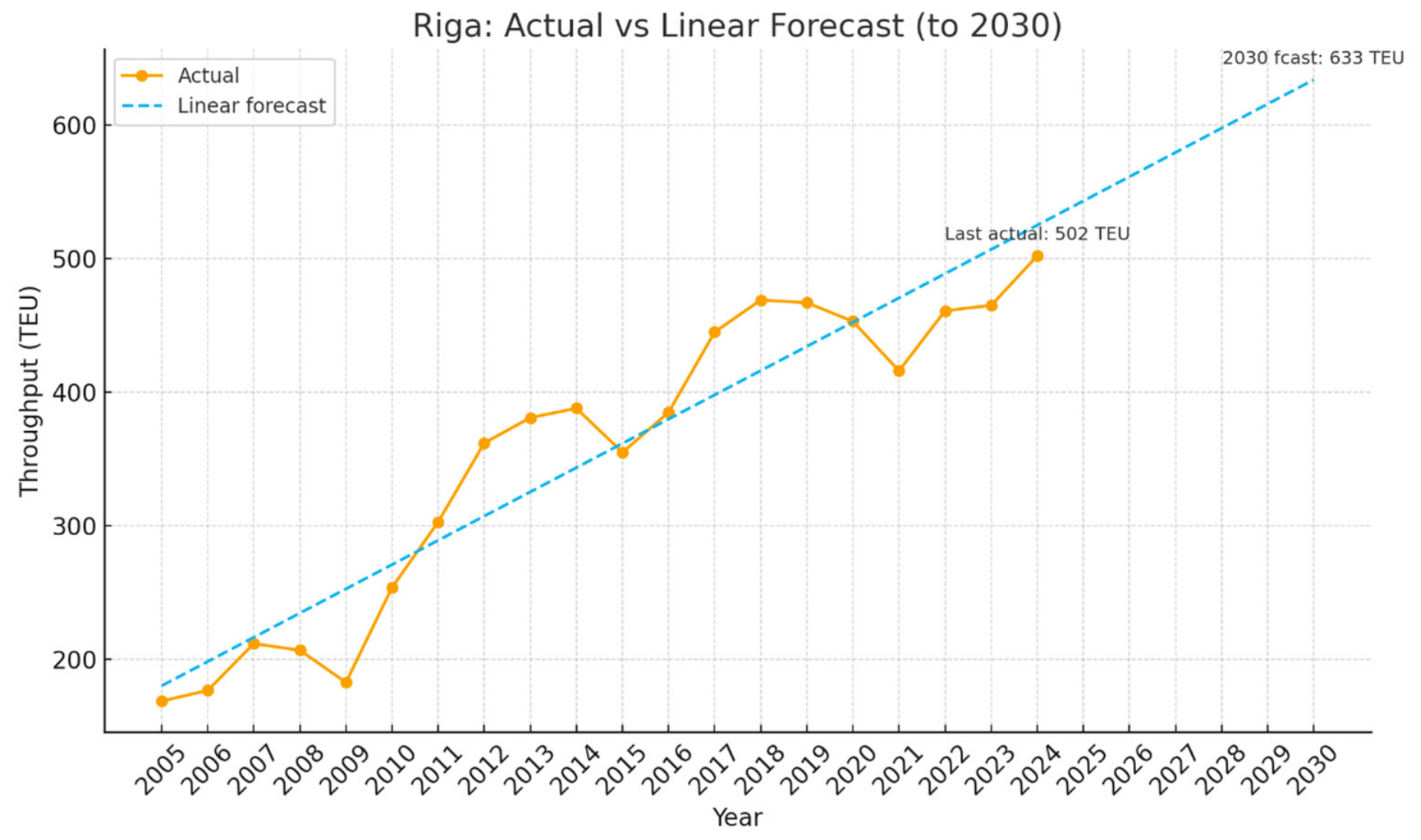
Although the model’s coefficient of determination (R
2 = 0.796) indicates moderate explanatory consistency within the analysed sample, the linear projection remains conditional on historical throughput dynamics and should be interpreted as a baseline medium-term tendency rather than a deterministic forecast (
Figure 5). The linear projection suggests that container throughput in Riga may reach approximately 634 thousand TEU by 2030, representing an increase relative to 2024 levels. These results are consistent with moderate long-term growth tendencies under the assumptions of the applied baseline forecasting framework.
Container-handling data for the Port of Tallinn show greater volatility, with R
2 reaching only 0.503, indicating that the linear model is not particularly accurate for this port in
Figure 6. Nevertheless, the forecast predicts a small but positive growth from 262 thousand TEU in 2024 to approximately 279 thousand TEU in 2030. This means that the growth of container handling in Tallinn is rather slow, and the results may be strongly affected by individual markets or geopolitical fluctuations.
Forecast uncertainty is quantified using 80% and 95% prediction intervals. Wider intervals indicate higher year-to-year variability and lower predictability, which is critical for capacity and investment planning. Accordingly, the intervals should be interpreted as planning ranges rather than point estimates.
C. Descriptive statistics
Forecast models (
Figure 4,
Figure 5 and
Figure 6) show that container handling in Klaipeda maintains regional competitiveness and has the potential for further growth. Riga shows the most stable and predictable growth trend, while Tallinn requires a more detailed analysis using nonlinear models, as linear forecasting oversimplifies real fluctuations. Such an analysis helps to assess long-term market dynamics and plan infrastructure and logistics development to ensure efficient transport flows and exploit the potential of the region’s ports. Descriptive statistics for annual container throughput (2005–2024) are summarized in
Table 1.
D. Implications and sustainability-oriented recommendations
An analysis of the linear regression results and forecasts for 2030 reveals clear trends in the cargo handling dynamics of the three Baltic ports (Klaipeda, Riga, and Tallinn) and their long-term development. The regression model obtained for the port of Klaipeda showed consistent and relatively rapid growth, with a slope of approximately 39.86 thousand TEU per year. This confirms that Klaipeda has a strong growth trajectory, allowing it to reach a cargo volume of more than 1130 thousand TEU by 2030. This model was also confirmed by a sufficiently high coefficient of determination (R2 = 0.796), indicating that almost 80% of the variation in cargo data can be explained by this model. This suggests a relatively stable long-term upward trajectory under current market conditions and indicates that the proposed framework may provide a useful baseline for medium-term planning.
The analysis of the Port of Riga revealed even greater data stability, with a slope of 18.13 thousand TEU per year, and the coefficient of determination was as high as 0.889, which indicates the stronger linear consistency of the linear model. The forecast suggests that by 2030, container handling in Riga will reach around 634 thousand TEU, which indicates consistent growth and a strengthening market share. The results suggest relatively stable medium-term throughput dynamics.
E. Out-of-sample validation
To assess the robustness of the proposed linear-trend framework, an out-of-sample validation procedure was performed. The models were estimated using the 2005–2020 observations, while the period 2021–2024 was reserved as a hold-out sample for forecast evaluation.
Forecast accuracy was evaluated using root mean square error (RMSE) and mean absolute percentage error (MAPE). The results indicate substantial differences in predictive stability among the analysed ports (in
Table 2).
Klaipeda demonstrated the highest forecast deviation (RMSE = 281.89 thousand TEU; MAPE = 23.26%), reflecting the strong structural shifts and atypical throughput jumps observed after 2021. Riga showed moderate forecast accuracy (RMSE = 88.55 thousand TEU; MAPE = 19.28%), consistent with its comparatively stable medium-term growth trajectory. Tallinn exhibited the lowest forecast error (RMSE = 19.82 thousand TEU; MAPE = 7.57%), although this partly reflects its smaller throughput scale and lower long-term growth intensity.
The validation results confirm that linear trend extrapolation may provide a useful baseline planning framework for medium-term strategic analysis; however, forecast reliability decreases under conditions of structural breaks, geopolitical disruptions, and rapidly changing logistics flows. These findings further support the potential value of future extensions based on nonlinear, regime-switching, or machine-learning forecasting approaches.
The results for the Port of Tallinn stand out because of the lower model fit, with R2 reaching approximately 0.503, which indicates that the linear model explains only half of the data variation. This indicates that Tallinn’s cargo data are more volatile, and possibly more sensitive to geopolitical and market changes. Nevertheless, the slope is positive (approximately 3.6 thousand TEU per year) and the projected cargo volume for 2030 is approximately 279 thousand TEU. This suggests that the Port of Tallinn will remain an important, but not dominant, player in the region.
Overall, linear forecasts indicate that the ports of Klaipeda and Riga will maintain their growth trajectory and increase their cargo volumes until 2030, whereas Tal-linn’s growth will be slower and more dependent on external factors. This analysis is important for infrastructure and logistics evaluation, as it allows for the anticipation of infrastructure development needs, logistics process optimization directions, and investment priorities that ensure the effective operation of the region’s transport chain.
In summary, linear analysis and forecasts up to 2030 provide not only quantitative information on port development, but also a basis for planning sustainable logistics solutions, from reducing emissions and noise control to optimizing transport flows. This allows for the creation of a long-term strategy in which growth is reconciled with environmental commitments, and ports become regional sustainable logistics centres.
From a sustainability perspective, the forecasting analysis can be linked to measurable, investment-based decarbonisation pathways. The Port of Klaipeda has announced a EUR 775 million investment programme through 2029, positioned to sup-port competitiveness, throughput growth, and sustainability objectives. At the operational level, the electrification agenda is already being implemented: in 2025, infra-structure works were initiated to supply electricity to vessels at berth, and the first electrification phase at the Port Authority’s fleet base was delivered as a standalone project with an estimated value of approximately EUR 0.601 million. For emissions management, the Port of Klaipeda applies the Gisgro software (Gisgro Ltd., Jyväskylä, Finland) to quantify emissions from ships, cargo-handling equipment, and transport in line with the European Environment Agency methodology, thereby providing a practical basis for continuous CO2 monitoring and transparent reporting.
Building on these developments, further decarbonisation should prioritise the expansion of terminal electrification through the deployment of electric RTG cranes and electric terminal tractors, accompanied by a phased reduction of diesel-powered equipment. In parallel, intermodality should be strengthened by increasing the share of containers transported by rail and optimising connections with Lithuanian rail corridors, which would reduce road traffic volumes and associated emissions. Digitalisation should be framed as an operational enabler of these objectives: the implementation of smart terminal operating systems and Port Community System solutions can reduce truck idle time and support real-time planning of handling schedules. This direction is supported by the 2024 deployment of an automated gate and truck-flow management solution at the Klaipeda Container Terminal (with a publicly reported project value exceeding EUR 1 million). Finally, to enhance transparency and comparability, it is advisable to institutionalise continuous CO2 and noise monitoring and to publish sustainability indicators on a regular basis.
Riga’s growth prospects can be credibly framed through green logistics by focusing on two interrelated directions: (i) the expansion of renewable-energy infrastructure and (ii) electrification measures that reduce emissions while improving energy efficiency. A key element of this pathway is the solar-energy project planned within the port area, initiated in 2024, with publicly reported investments of approximately EUR 60–80 million. This provides a concrete basis for arguing that the electrification of cargo-handling activities (e.g., electric handling equipment) can be supported by locally generated renewable electricity. In parallel, the Port of Riga is in the planning and development phase for shore power (OPS) solutions. This enables port electrification to target not only internal operations but also the reduction of emissions and noise from vessels while alongside. Such measures are particularly relevant for ports aiming to mitigate local air-quality and noise impacts in densely populated areas.
Building on these investment preconditions, Riga should pursue a systematic in-crease in energy efficiency by prioritising energy renovation of terminal buildings and progressively shifting to renewable energy sources (solar and wind), with the objective of reducing energy intensity per unit of cargo handled. At the operational level, additional benefits can be achieved through green cargo-handling technologies, such as electric container handlers and—where economically justified—autonomous vehicles, which can lower greenhouse-gas emissions and improve process efficiency. Finally, to ensure that decarbonisation measures translate into market outcomes, cooperation with cargo owners should be strengthened by introducing green tariffs and incentive schemes that encourage the adoption of less-polluting transport solutions and logistics chains. In this way, investments in renewable energy and electrification would be complemented by demand-side instruments that reinforce both competitiveness and the achievement of sustainability outcomes.
The development of the Port of Tallinn as a “smart and green” port should be grounded in implemented measures and a rigorous impact-assessment framework. An empirically supported starting point is quay electrification: in September 2020, shore-to-ship power infrastructure was installed on five piers in the Old City Harbour, with total investments of EUR 3.5 million, explicitly targeting reductions in emissions and noise during vessel berthing. In parallel, the port maintains a documented and periodically updated greenhouse-gas (GHG) inventory, which provides a methodological basis for tracking emissions over time and for assessing whether infrastructure and digital interventions translate into measurable CO2 reductions.
Building on this accountability framework, further development should prioritise both operational efficiency and environmental performance. Digital technologies—such as IoT sensors for asset and container tracking, energy-consumption optimisation, and traffic/yard management—should be framed as operational tools to reduce idle time, stabilise process flows, and decrease energy intensity. Their effectiveness, however, should be evaluated only when such deployments are linked to clearly defined key performance indicators (KPIs) and consistently specified GHG accounting boundaries. Moreover, green infrastructure measures—particularly the expansion of shore power systems and the electrification of port operations—can directly reduce vessel emissions within the port area, thereby improving local air quality and lowering noise levels. Finally, to achieve more systemic sustainability outcomes, the port may integrate circular-economy measures (e.g., packaging recycling, waste segregation, and waste-stream reduction), extending sustainability management be-yond energy and emissions towards more efficient resource use across the port’s operational cycle.
Such a comprehensive approach not only reduces the environmental footprint of ports but also strengthens their competitive advantage by aligning with the EU’s Green Deal objectives and the growing environmental requirements of the logistics market.