
Human-Centered AI for Decision Support Systems: A Systematic Review of Application Domains, Architecture Designs, Current Trends and Future Directions




Abstract
1. Introduction
- Provide an updated and comprehensive (although not exhaustive) overview of the research literature on the exploitation of HCAI in DSS (HCAI+DSS) on multiple domains, highlighting the impact of proposed solutions, the employed techniques, and the practices used to validate them.
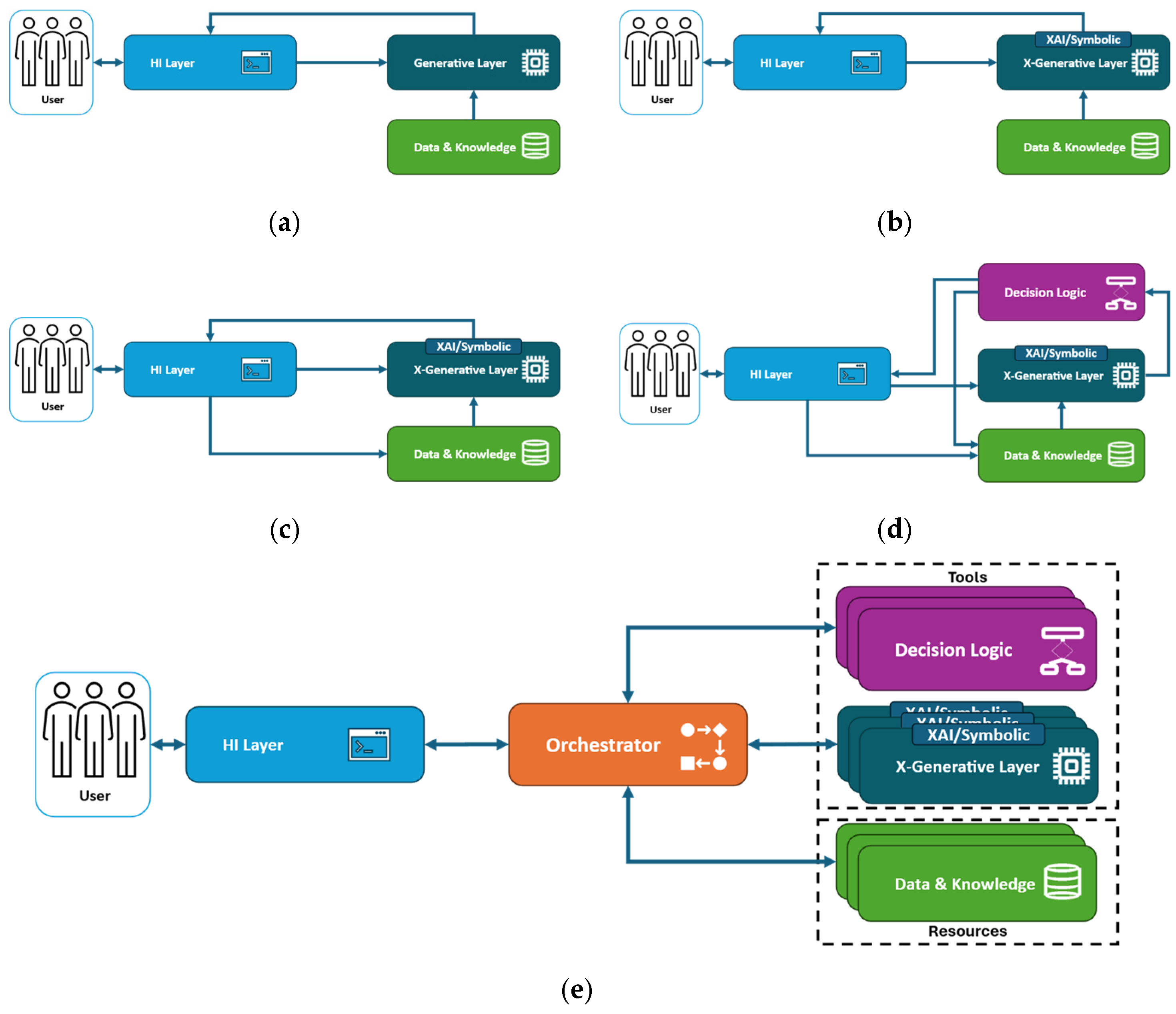
- Provide a layer-based architectural overview of HCAI systems: a multi-layer interactive architecture with loop-feedback has been identified, summarizing key functionalities, enabling technologies, and typical implementations of HCAI + DSS systems.
- Provide a mapping of the main HCAI + DSS literature contributions with the SDGs to highlight which societal priorities have been addressed and where further studies are required to fill research gaps. Additionally, the temporal evolution of the most relevant topics has been analyzed, identifying more studied subjects and less investigated areas.
- Present a comprehensive discussion on current limits and future directions of HCAI to provide researchers with useful insights and opportunities to guide forthcoming works.
2. Architecture
2.1. The Five Layers of HCAI Systems
2.1.1. Human Interaction Layer
2.1.2. X-Generative Layer
2.1.3. Data and Knowledge Layer
2.1.4. Decision Logic Layer
2.1.5. Orchestrator Layer
3. Review of HCAI + DSS Solutions
3.1. Healthcare and Clinical Decision-Making
3.2. Mobility and Transportation
3.3. Smart Industry and Production
3.4. Smart Environment, Climate and Agriculture
3.5. Smart Energy Management
3.6. Smart Governance and Public Administration
3.7. Smart Economy
3.8. Smart Living and Infrastructures
3.9. Safety, Security, Defense and Space
4. Contribution to the United Nations Sustainable Development Goals
5. Evolution of Keywords over Time
6. Discussion on Current Limitations and Future Directions
7. Conclusions
Supplementary Materials
Author Contributions
Funding
Institutional Review Board Statement
Informed Consent Statement
Data Availability Statement
Acknowledgments
Conflicts of Interest
Appendix A. Summary of Included Studies

| Study | Domain | SDG | Task | Techniques/Methods | Impact | Validation |
|---|---|---|---|---|---|---|
| Yun et al., 2021 [38] | Smart industry and production | NC | DSS for industrial applications | Data mining | NC | Case study |
| Su et al., 2023 [30] | Healthcare and clinical decision-making | NC | HCI interfaces guided by usability principles | Dashboard design; knowledge management | High-performance AI tools that can be effectively integrated into clinical workflows | Surveys and health-data measurements of interactivity, convenience, accuracy, and satisfaction |
| Jaunzemis et al., 2020 [55] | Safety, security, defense and space | NC | Space situational awareness (SSA) and decision support in space operations | Modeling of operational scenarios in space environments | Ensure security and reliability in high-risk missions, such as space operations | Conceptual validation through use cases, hypothesis-based planning, and covariance-based planning approaches |
| Pinto et al., 2021 [30] | Mobility and transportation | SDG 11 | Fleet composition, routing, and scheduling in urban freight logistics | Mathematical optimization algorithms and stochastic models for fleet composition and routing | Improve operational efficiency in urban freight transport | NC |
| Grover et al., 2020 [57] | Safety, security, defense and space | NC | Automated Task Planning; | Planning Domain Definition Language (PDDL) | Reduced planning time, increased user satisfaction | Ablation studies with human subjects |
| Jin et al., 2025 [54] | Smart environment, climate and agriculture | NC | Human–model interaction frameworks for food safety and risk assessment (e.g., infant food) | Data-driven scenario analysis and stochastic/Monte Carlo simulation for food safety risk assessment | Improve food safety risk assessment by integrating models and expert knowledge | Application/case study on infant food assessment |
| Gou et al., 2024 [48] | Healthcare and clinical decision-making | SDG 3–SDG 11 | Diagnostic decision support in clinical settings | Machine learning and deep learning | - | Experimental analysis using performance metrics |
| Ltifi et al., 2015 [81] | Healthcare and clinical decision-making | NC | DSS for nosocomial infections/ICU | Knowledge Discovery in Databases | Managing Uncertainty/Complexity in KDD | Utility and usability evaluations |
| Reis et al., 2025 [60] | Smart economy | NC | Selecting XAI methods in business AI contexts | ML and XAI techniques with a DSS that supports the selection of XAI techniques based on context of use | Maintain interpretability and comprehensibility of decision-making models | Decision-making performance measures; test on a real-world supply-chain demand problem with real data and real users |
| Conde et al., 2024 [43] | Smart environment, climate and agriculture | SDG 6–SDG 13–SDG 14 | Predictive/adaptive irrigation integrating models, weather data, humidity sensors, and human preferences | Control-oriented modeling and forecasting, including model-based control/Model Predictive Control approaches | Increase productivity and reduce resource waste (water, fertilizers, and energy) in agriculture | Water-saving assessment in irrigation management; sweet corn field in Florida |
| Abbas et al., 2025 [42] | Smart industry and production | NC | Industrial control rooms for chemical processes | Hidden Markov Models, dynamic influence diagrams, and reinforcement learning to monitor plant status | Reduce the risk of human errors and accidents in complex industrial plants | Realistic control-room simulators, workload, situational awareness, and interaction-style measures (eye-tracking, questionnaires, interaction logs) |
| Miller et al., 2020 [118] | Safety, security, defense and space | NC | Extravehicular activities (EVA) under strong safety constraints | Cognitive Systems Engineering techniques for designing DSS in safety-critical environments | Reduce human error and increase situational awareness in highly complex environments | Laboratory studies with operators in simulated EVA scenarios |
| Liang et al., 2024 [65] | Smart governance and public administration | SDG 11 | Extravehicular activities (EVA) under strong safety constraints | Cognitive Systems Engineering techniques for designing DSS in safety-critical environments | Reduce human error and increase situational awareness in highly complex environments | Laboratory studies with operators in simulated EVA scenarios |
| Zhang et al., 2024 [86] | Mobility and transportation | NC | Pilot decision support for diversions and continuous vs. recommendation-centric support | Mixed-methods user study with pilots | Support pilot decision-making in aviation contexts | Professional pilots in simulated flight scenarios |
| Agudo et al., 2024 [96] | Smart governance and public administration | NC | Decision support in criminal justice | Human-in-the-loop experiment with AI-support timing manipulation | Help explain how AI errors influence human judgments and decision-making performance | NC |
| Yu et al., 2025 [73] | Healthcare and clinical decision-making | NC | Decision support for triage and patient management | AI-assisted radiology study with explainability/control | Improve patient safety and overall quality of care, including in highly critical contexts | Mixed-methods study with 42 medical professionals |
| Hu et al., 2024 [47] | Smart industry and production | SDG 9–SDG 12 | Decision-making frameworks integrated into plant operational systems (e.g., container terminals) | Advanced human–machine interface (HMI) and visual analytics | Improve efficiency, productivity, and quality in industrial processes | Improvements observed in operational KPIs |
| Cao et al., 2024 [77] | Healthcare and clinical decision-making | NC | Skin-cancer screening | ResNet binary classifier | AI systems are made explainable to increase user trust in their use | Experimental evaluations |
| Schoeffer et al., 2025 [97] | Smart governance and public administration | NC | Assessment of defendants | Mathematical modeling | Support judgments about defendants | NC |
| Siegel et al., 2024 [119] | Safety, security, defense and space | NC | DeepFake detection and media forensics | Forensic analytics frameworks and regulatory/ethical assessments of AI systems in security (risk analysis and governance) | Address the risks of disinformation associated with deepfakes and similar technologies | NC |
| Gomez et al., 2025 [128] | Cross-domain | NC | Survey of human–AI collaboration | Survey | NC | NC |
| Muehlbauer et al., 2018 [114] | Smart living and infrastructures | NC | Generative and interactive tools for urban design/aesthetics, with human-in-the-loop aesthetic evaluation | Generative algorithms and interactive evolutionary design with hybrid aesthetic evaluation | Support complex urban design decisions (configurations and aesthetics) while keeping the designer in the loop | Urban designers exploring urban design spaces |
| Ramirez-Atencia et al., 2018 [58] | Mobility and transportation | NC | Decision support for mission planning and operator interaction | Interactive interfaces for planning and simulation | Enhance human supervision and decision-making over UAV mission plans | Simulated environment using QGroundControl and DSS |
| Cao et al., 2023 [76] | Healthcare and clinical decision-making | NC | Decision-making phases under time pressure | Experimental study, simulated AI suggestions, spatial reasoning tasks | Improve understanding of how time pressure affects AI-assisted decision-making | Experimental study of decision-making phases under time pressure |
| Van Berkel et al., 2023 [28] | Healthcare and clinical decision-making | NC | Electronic Health Records (EHRs), high-volume clinical data with XAI techniques | Pragmatic embedding of XAI in EHR/CDSS workflows | Trust and reliance | Trust/reliance measures in real-world cases (trust in CDSS and AI) |
| Holzinger et al., 2024 [91] | Smart environment, climate and agriculture | SDG 12 | Smart farming/Agriculture 5.0, sustainable crop, and soil management | Knowledge representation and reasoning (KRR), including ontologies and knowledge graphs; ML predictive modeling for agricultural processes and smart farming systems | Increase productivity and reduce resource waste (water, fertilizers, and energy) in agriculture | Conceptual frameworks and research perspectives rather than empirical system validation |
| Boboc et al., 2015 [90] | Smart industry and production | NC | Pointing-gesture and speech-based interaction for assistive object-fetching tasks | Object detection, Dynamic Time Warping (DTW), fuzzy-logic | Use a longer-battery robot to improve interaction time and naturalness | NC |
| Kwan et al., 2015 [53] | Safety, security, defense and space | NC | Knowledge-based and relevance-feedback systems for fingerprint identification and other forensic applications | Data-driven relevance-feedback approaches with visual analytics and adaptive knowledge bases for biometric systems | Increase the accuracy and transparency of forensic tools | Experimental evaluations of DSS accuracy for fingerprint identification |
| Mustafa et al., 2025 [88] | Cross-domain: smart energy management; safety, security, defense and space | NC | Industrial cyber-physical systems (ICPS); control rooms for electrical networks/critical infrastructure | Integration of simulators, industrial control systems (ICS) testbeds, cyber-physical systems, and cognitive metrics (eye-tracking) | Reduce operator errors and reaction times in energy control rooms; increase the resilience and security of critical energy systems | Professional electricity-grid operators or students; performance, accuracy, and cognitive measures; cyber-power system performance metrics |
| Ivanov et al., 2024 [109] | Smart economy | NC | AI-supported decision-making in hospitality and tourism settings | Experimental methods with hypothetical scenarios (surveys and simulated decision-making tasks) | Address trust in AI-supported decision-making | Hospitality professionals in decision-making scenarios |
| Li et al., 2024 [59] | Smart industry and production | SDG 17 | Interpretable systems for resource-allocation planning (e.g., crane planning) on construction sites | Deep learning models | Make AI models interpretable so that their results are directly accessible to decision-makers, such as engineers and managers | Decision support performance assessed in industrial planning applications such as crane planning |
| Zhang et al., 2022 [87] | Mobility and transportation | NC | Cockpit layout evaluation | Interactive interfaces for planning and simulation; forward vs. backward AI support in cockpits | Support pilots in complex decision-making situations | Subjective feedback on understandability and workload |
| Raddatz et al., 2025 [107] | Smart economy | NC | Tax-advisory decision support using generative models | Generative models | Examine when and for which decisions managers are willing to delegate to AI | Experimental evaluations |
| Goh et al., 2016 [69] | Healthcare and clinical decision-making | SDG 3 | Treatment- and medication-related decision support | Survey of fuzzy logic, ontologies, data mining, and Bayesian networks | Reduce potential clinical errors and support complex clinical decision-making | Satisfaction and acceptance measures (perceived trust, usefulness, and intention to use) |
| Wang et al., 2024 [127] | Cross-domain | NC | Evaluating how XAI explanation strategy and agent autonomy affect human–AI decision-making | XAI techniques | NC | Mixed-design experiment with 48 participants measuring workload, trust, social presence, and decision confidence |
| Azadi et al., 2025 [79] | Healthcare and clinical decision-making | SDG 3 | CDSS data management with HCI in clinical decision support | Qualitative literature synthesis; CDSS data-entry control, standardization/normalization, integration, and automated text generation | Improve CDSS usability, data quality, decision accuracy, and clinician trust | Practical case studies and comparative analysis of manual vs. automated data entry |
| Ghavami et al., 2019 [61] | Cross-domain: Smart environment, climate and agriculture; Safety, security, defense and space | SDG 9 | DSS and agents for multi-stakeholder decisions in disaster management (e.g., strategic roads in floods) | Multi-agent systems/agent-based modeling and negotiation-based decision support for multi-stakeholder decision-making | Support critical-infrastructure planning | Disaster-management scenarios involving multiple stakeholders |
| Nandy et al., 2025 [126] | Smart industry and production | NC | AI-assisted multi-objective engineering design | Example-based explanations | Reliance on AI advice | Experimental evaluations |
| Lu et al., 2024 [41] | Cross-domain | NC | AI-assisted sentiment-analysis decision-making | Classification task; fine-tuned RoBERTa | Reduce over-reliance on AI and increase appropriate reliance when AI advice is correct | Pre-registered randomized experiments |
| Hesselmann et al., 2024 [100] | Smart governance and public administration | NC | Plagiarism-screening tools in editorial decision-making | Screening software | Analyze how algorithms shape the decision-making space | Empirical analysis of editor–software interactions |
| Helldin et al., 2025 [80] | Healthcare and clinical decision-making | NC | Sepsis diagnosis support | ML models; LIME and SHAP explanations | NC | Cognitive-load and workload measures (mental workload and interaction fluency) |
| Lash et al., 2024 [136] | Cross-domain | NC | Generating explanations for ML-based decisions | Example-based explanation | Provide explanations based on preferred features and reliability | Benchmark evaluation and randomized controlled laboratory experiment |
| Soltanshahi et al., 2025 [44] | Smart living and infrastructures | NC | Metaverse/Web3.0 architectures and human-in-the-loop RL for intelligent smart contracts | Human-in-the-loop RL | Reduction in gas consumption | Experimental evaluations |
| Rundo et al., 2020 [70] | Healthcare and clinical decision-making | SDG 3 | Physiological-signal-based decision support | HCI interfaces guided by usability principles; user-centered design; usability studies | Improve the accuracy and timeliness of diagnosis | Studies with doctors, nurses, pharmacists, therapists, and sometimes non-expert users |
| Li et al., 2015 [92] | Smart environment, climate and agriculture | NC | Visual decision support for quantitative and visual forest thinning (2D/3D before/after simulation) | Visual decision support | Simulate the effects of forestry decisions (e.g., thinning) through interpretable visual analysis | Forest-stand structure in forestry decision support systems; Chinese fir plantation |
| Comes et al., 2024 [94] | Cross-domain: smart environment, climate and agriculture; smart governance and public administration; safety, security, defense and space | NC | Disaster management in scenarios | Survey of AI applications in crisis management | Balance efficiency, fairness, and protection of the most vulnerable | NC |
| Borghoff et al., 2025 [33] | Cross-domain | SDG 3 | Modeling human–AI interaction in agentic AI systems | Multi-agent systems (MAS), Centaurian systems | NC | NC |
| Miao et al., 2025 [105] | Smart economy | NC | Business innovation and human–machine collaborative decision-making | Hierarchical regression | Support exploratory and exploitative innovation through human–AI collaboration | Questionnaire study with corporate innovators |
| Tariq et al., 2025 [32] | Safety, security, defense and space | NC | Managing uncertainty in human–AI team decision-making | Large Language Model | Improve adaptability and robustness | NC |
| Agarwal et al., 2023 [29] | Healthcare and clinical decision-making | NC | Handling human behavioral biases in active learning | Active learning | NC | Real-world experiments |
| Ren et al., 2023 [129] | Smart industry and production | NC | Human–machine collaboration based on cognitive intelligence | Survey | NC | NC |
| Sontakke et al., 2023 [89] | Smart industry and production | SDG 3 | Fault detection | XAI is used for describing rationale of the detected faults | NC | Survey/discussion |
| Nota et al., 2024 [115] | Smart living and infrastructures | NC | Monitoring of historic villages | Human-in-the-loop approach | Improve the management and use of historical/urban infrastructure through human-in-the-loop methods | Real-world experiments |
| Shen et al., 2022 [72] | Healthcare and clinical decision-making | NC | Prognostic support for assessing severity and clinical outcomes | Integration and visualization of heterogeneous biomedical data and multiple signals | Support clinical interpretation | Semi-synthetic data based on real-world patient record processing from the UK National Cancer Registry |
| Wu et al., 2025 [64] | Smart living and infrastructures | SDG 3 | Adaptive task-assignment frameworks | Reinforcement learning (Deep Q-Networks with attention) with human supervision to partition task streams | Increase the efficiency of distributed urban tasks | Real-world experiments |
| Chong et al., 2022 [78] | Healthcare and clinical decision-making | NC | AI-assisted decision-making and adoption of AI advice | Quantitative confidence model; logistic regression | Use explainable AI to increase user trust | Cognitive study and quantitative model |
| Sztandar-Sztanderska et al., 2025 [98] | Smart governance and public administration | NC | Assess frontline caseworkers’ capacity to oversee ADM profiling in welfare/PES administration | Context-sensitive analytical framework | NC | Human oversight in automated decision-making |
| Enarsson et al., 2022 [99] | Smart governance and public administration | NC | Analyze legal requirements and dependencies | Legal/doctrinal and contextual comparative analysis | Proposes a research agenda for contextual legal analysis | Conceptual analysis based on three illustrative contexts; no empirical or quantitative validation |
| Erten et al., 2025 [93] | Smart environment, climate and agriculture | SDG 2 | Hybrid ML–geostatistical models for territorial/environmental applications, such as mineral-grade estimation in mining | Hybrid ML–geostatistical ensemble models | Improve prediction accuracy | Human experts guide or validate hybrid ML–geostatistical ensemble models |
| Yousefi et al., 2025 [46] | Smart industry and production | SDG 3 | Shared-autonomy systems for industrial robots and high-level tasks | Hierarchical Markov decision process for adaptive human–robot policies | Enable shared autonomy and adaptive human–robot policies under human supervision | Performance and control-preference measures |
| Kumar et al., 2024 [63] | Smart industry and production | NC | Review of human-in-the-loop learning applications, challenges, and future directions | Survey/review of HITL methodologies, including active learning, iterative ML, reinforcement learning, XAI, and crowdsourcing | NC | Survey |
| Lee et al., 2023 [75] | Healthcare and clinical decision-making | NC | Trust and reliance in AI-assisted decision-making | XAI techniques | Use explainable AI to increase user trust | Trust/reliance measures in real-world cases (trust in CDSS and AI) |
| Amaliah et al., 2025 [104] | Smart economy | NC | Selecting XAI methods in business AI contexts | DSS supporting the selection of XAI techniques based on the context of use | Align the use of XAI and DSS with business objectives and constraints | NC |
| Judkins et al., 2025 [106] | Smart economy | NC | IT project-selection decision support for IT leaders | AI recommendation system | NC | Survey of IT leaders |
| Park et al., 2025 [95] | Smart energy management | SDG 11 | Decision support for nuclear emergencies using virtual reality (VR) and causal models | Causal models and what-if simulations in a VR environment to evaluate emergency strategies | Support complex decisions in high-risk nuclear emergencies through human-centered decision support tools | Controlled experiments in simulated nuclear emergency scenarios with participants making decisions through VR |
| Kennedy et al., 2022 [103] | Smart governance and public administration | NC | Trust in public-sector algorithms | Analysis of trust in public-sector algorithms | Trust in algorithms | Studies focusing on trust in public-sector algorithms |
| Sentouh et al., 2019 [83] | Mobility and transportation | NC | Shared control and driver–automation cooperation in lane-keeping assistance systems | Hybrid human–automation control algorithms (shared control and driver–automation cooperation) | Reduce cognitive load through driver–automation cooperation | Subjective feedback on understandability and workload |
| Green et al., 2022 [101] | Smart governance and public administration | NC | Policies on algorithms and human oversight of government algorithms | Analysis of human oversight of government algorithms | Propose a shift from individual human oversight to institutional forms of oversight | Studies on oversight and policy (mainly conceptual and qualitative analysis, without numerical experimental validation) |
| Mamodiya et al., 2025 [31] | Smart energy management | NC | Digital twins and integrated frameworks for photovoltaic and smart energy infrastructures | Digital twins, physical models, and immersive visualization for control and training | Facilitate the control and understanding of complex photovoltaic systems through interactive digital twins | Proof-of-concept and initial usability studies for interaction with the digital twin |
| Gaczek et al., 2025 [110] | Smart economy | NC | AI-assisted decision-making | Large language models (LLMs) | Acceptability of AI use in decision-making | NC |
| Kahr et al., 2024 [111] | Smart economy | NC | AI-assisted decision-making | Experimental methods with hypothetical scenarios (surveys and simulated decision-making tasks) | Perceptions of responsibility for the decision (locus of causality/responsibility) | Trust, acceptance, and perceived responsibility in DSS |
| Koulu et al., 2020 [102] | Smart governance and public administration | NC | Policies on algorithms | Transparency and human oversight in algorithmic systems | Ensure accountability, transparency, and democratic control over governmental algorithms | Studies on oversight and policy (mainly conceptual and qualitative analysis, without numerical experimental validation) |
| Sayyadnejad et al., 2025 [112] | Smart economy | NC | Case studies of explainable AI in business contexts | Qualitative analysis of case studies | NC | Analysis of case studies and practical business problems |
| Klingbeil et al., 2024 [125] | Cross-domain | NC | Trust and reliance on AI advice in assisted decision-making | Large language models (LLMs); logit regression | Trust and reliance | Domain-independent incentivized interactive behavioral experiment |
| Gomez et al., 2024 [71] | Healthcare and clinical decision-making | NC | Physiological-signal-based decision support | XAI interfaces; telehealth | Improve the accuracy and timeliness of diagnosis | Explainable clinical support settings |
| Di Vito et al., 2020 [85] | Mobility and transportation | NC | Automatic Dependent Surveillance–Broadcast (ADS-B)-based separation assurance and collision avoidance for RPAS | Integration of ADS-B data with collision-prediction logic for RPAS | Improve safety in RPAS operations; support automatic separation assurance and collision avoidance | Real-time hardware-in-the-loop and human-in-the-loop simulations |
| Rosemarin et al., 2021 [56] | Healthcare and clinical decision-making | NC | Online assignment of patients/medical studies to medical professionals | Learning-Based Assignment; simulation | Improve triage or timeliness in urgent decision support | Real-world data and input from medical experts |
| Bao et al., 2025 [117] | Smart living and infrastructures | NC | Recommendation and layout optimization for mobile/e-commerce applications | Deep learning with RNNs, DNNs, and cosine/Euclidean similarity | Reliance and trust | Experimental results in real-world scenarios |
| Herrera et al., 2025 [113] | Smart economy | NC | Practical business cases | Discussion of practical business cases | NC | Analysis of case studies and practical business problems |
| Strauch et al., 2017 [84] | Mobility and transportation | NC | Operator interaction and supervisory control in remotely piloted aircraft systems (RPAS) or unmanned aerial vehicles (UAVs) | Conceptual automation framework | NC | NC |
| De Croon et al., 2025 [74] | Healthcare and clinical decision-making | NC | Healthy food recommendations | Hybrid recommender system | Support healthier food choices through personalized recommendations | Design/evaluation in a food-catering app |
| Rajkumar et al., 2020 [116] | Smart living and infrastructures | NC | E-learning systems that classify learning styles via chatbots | Traditional ML for learning-style classification | Personalize training courses based on behavior and cognitive style | Experimental studies with students/learners |
| Mazhar et al., 2022 [108] | Cross-domain: Smart living and infrastructures; Smart Economy | NC | Sentiment analysis across reviews, films, and marketing contexts; facial emotion recognition for human-behavior analysis | CNN, Hierarchical Convolutional Recurrent Neural Network (HCRNN), and Random Forest pipelines for facial emotion recognition | Increase the effectiveness of data-driven strategies in business contexts (e.g., supply chain and marketing) | Tests on standard datasets with comparisons against other ML algorithms |
| Ashraf et al., 2024 [45] | Healthcare and clinical decision-making | NC | Treatment- and medication-related decision support | Physiological signals | Reduce potential clinical errors and support complex clinical decision-making | Real-world evaluation across platforms/deployment scenarios |
| Yang et al., 2022 [26] | Smart energy management | SDG 4–SDG 7 | Optimizing We-Energy operation under cost–security trade-offs | Dual-objective energy optimization; multipolicy convex-hull reinforcement learning; RBFNN Q-function approximation; two-channel HITL evaluation/regulation; Q-learning from expert scores; Energy Internet/We-Energy simulation | Avoid decision-making risks | Simulation studies |
| Hidayat-ur-Rehman et al., 2025 [121] | Smart economy | SDG 1–SDG 10 | Adoption of digital robo-advisory systems by investors | Survey | Intention to use robo-advisors, sustainability, and trust | NC |
| Chen et al., 2017 [122] | Healthcare and clinical decision-making | SDG 5 | Diagnosis support | Bayesian network reasoning | Improve the efficiency and quality of medical diagnosis | NC |
| Tarzia et al., 2018 [124] | Healthcare and clinical decision-making | SDG 16 | Comparison of online vs. face-to-face support for women experiencing intimate partner violence | Survey | Support victims of intimate partner violence | Qualitative interviews |
| Gioia et al., 2023 [123] | Smart economy | SDG 8 | Stock portfolio selection and optimization | Adapted Markowitz mean–variance model | Reduce model complexity | Experimental results on the US stock market |
| Lee et al., 2023 [40] | Smart environment, climate and agriculture | SDG 15 | UX-oriented demonstration prototypes for reducing disaster risk in communities through digital services | Formal development process | Support multi-stakeholder decisions in environmental disasters | Prototype demonstrator, participatory evaluation, and qualitative self-reflection |
References
- Hai Stanford Edu. Available online: https://hai.stanford.edu/ai-index/2025-ai-index-report/economy (accessed on 23 December 2025).
- Busnatu, Ș.; Niculescu, A.-G.; Bolocan, A.; Petrescu, G.E.D.; Păduraru, D.N.; Năstasă, I.; Lupușoru, M.; Geantă, M.; Andronic, O.; Grumezescu, A.M.; et al. Clinical Applications of Artificial Intelligence—An Updated Overview. J. Clin. Med. 2022, 11, 2265. [Google Scholar] [CrossRef]
- Botarelli, T.; Fanfani, M.; Nesi, P.; Pinelli, L. Using Physics-Informed neural networks for solving Navier-Stokes equations in fluid dynamic complex scenarios. Eng. Appl. Artif. Intell. 2025, 148, 110347. [Google Scholar] [CrossRef]
- Bellini, P.; Cenni, D.; Palesi, L.A.I.; Nesi, P.; Pantaleo, G. A Deep Learning Approach for Short Term Prediction of Industrial Plant Working Status. In Proceedings of the 2021 IEEE Seventh International Conference on Big Data Computing Service and Applications (BigDataService), Oxford, UK, 23–26 August 2021; pp. 9–16. [Google Scholar] [CrossRef]
- Bilotta, S.; Palesi, L.A.I.; Nesi, P. Exploiting open data for CO2 estimation via artificial intelligence and eXplainable AI. Expert Syst. Appl. 2025, 291, 128598. [Google Scholar] [CrossRef]
- Kamalov, F.; Santandreu Calonge, D.; Gurrib, I. New Era of Artificial Intelligence in Education: Towards a Sustainable Multifaceted Revolution. Sustainability 2023, 15, 12451. [Google Scholar] [CrossRef]
- Bilotta, S.; Fereidooni, Z.; Palesi, L.A.I.; Nesi, P. Macroscopic GA-based Multi-Objective Traffic Light Optimization prioritizing tramways. Appl. Soft Comput. 2025, 178, 113269. [Google Scholar] [CrossRef]
- Szymoniak, S.; Depta, F.; Karbowiak, Ł.; Kubanek, M. Trustworthy Artificial Intelligence Methods for Users’ Physical and Environmental Security: A Comprehensive Review. Appl. Sci. 2023, 13, 12068. [Google Scholar] [CrossRef]
- Collini, E.; Nesi, P.; Raffaelli, C.; Scandiffio, F. Explainable Artificial Intelligence for Agile Mediation Propensity Assessment. IEEE Access 2024, 12, 37782–37798. [Google Scholar] [CrossRef]
- Bellini, P.; Palesi, L.A.I.; Nesi, P.; Pantaleo, G. Multi Clustering Recommendation System for Fashion Retail. Multimed. Tools Appl. 2023, 82, 9989–10016. [Google Scholar] [CrossRef]
- Li, H.; Tian, F. Advancing Decision-Making through AI-Human Collaboration: A Systematic Review and Conceptual Framework. Group Decis. Negot. 2026, 35, 26. [Google Scholar] [CrossRef]
- Salvagno, M.; Taccone, F.S.; Gerli, A.G. Artificial intelligence hallucinations. Crit. Care 2023, 27, 180. [Google Scholar] [CrossRef]
- Shah, N. State of Problem. In Artificial Intelligence and Social Ethics; Springer: Singapore, 2025. [Google Scholar] [CrossRef]
- Ferrara, E. Fairness and Bias in Artificial Intelligence: A Brief Survey of Sources, Impacts, and Mitigation Strategies. Sci 2024, 6, 3. [Google Scholar] [CrossRef]
- Montag, C.; Ali, R.; Davis, K.L. Affective neuroscience theory and attitudes towards artificial intelligence. AI Soc. 2025, 40, 167–174. [Google Scholar] [CrossRef]
- Report on Safety and Liability Implications of AI. Available online: https://commission.europa.eu/publications/commission-report-safety-and-liability-implications-ai-internet-things-and-robotics-0_en (accessed on 7 April 2026).
- Martini, B.; Bellisario, D.; Coletti, P. Human-Centered and Sustainable Artificial Intelligence in Industry 5.0: Challenges and Perspectives. Sustainability 2024, 16, 5448. [Google Scholar] [CrossRef]
- Green, B.; Chen, Y. The principles and limits of algorithm-in-the-loop decision making. Proc. ACM Hum. Comput. Interact. 2019, 3, 1–24. [Google Scholar] [CrossRef]
- Sprague, R.H., Jr. A framework for the development of decision support systems. MIS Q. 1980, 4, 1–26. [Google Scholar] [CrossRef]
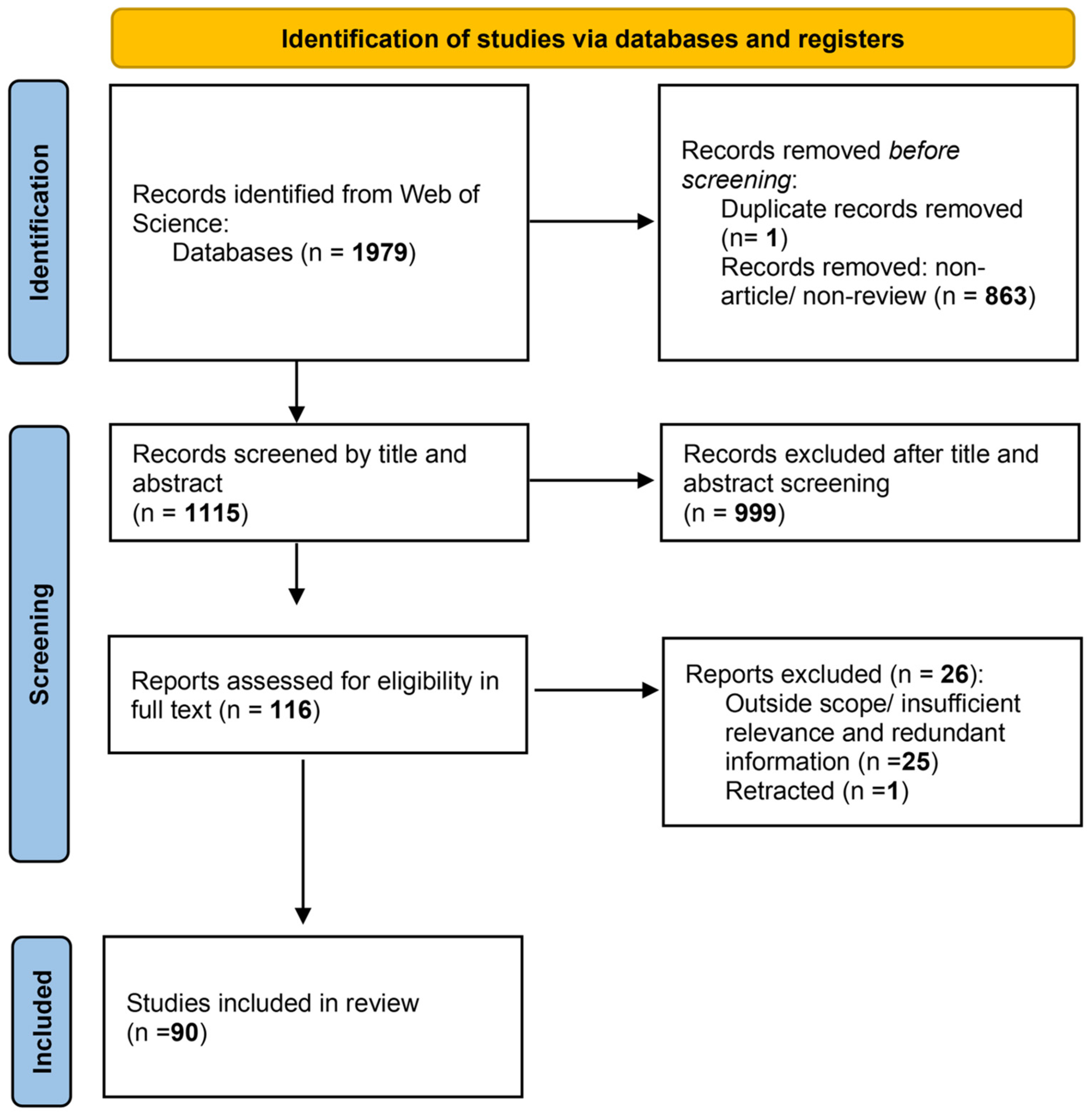
- Page, M.J.; McKenzie, J.E.; Bossuyt, P.M.; Boutron, I.; Hoffmann, T.C.; Mulrow, C.D.; Shamseer, L.; Tetzlaff, J.M.; Akl, E.A.; Brennan, S.E.; et al. The PRISMA 2020 statement: An updated guideline for reporting systematic reviews. BMJ 2021, 372, 71. [Google Scholar] [CrossRef]
- Web of Science. Available online: https://www.webofscience.com/ (accessed on 14 January 2026).
- Scimago Journal Rank Index. Available online: https://www.scimagojr.com/journalrank.php (accessed on 16 January 2025).
- UN-GGMI Report. Resolution Adopted by the General Assembly on 6 July 2017. 2017. Available online: https://ggim.un.org/documents/a_res_71_313.pdf (accessed on 23 December 2025).
- Shneiderman, B. Human-centered artificial intelligence: Reliable, safe & trustworthy. Int. J. Hum.-Comput. Interact. 2020, 36, 495–504. [Google Scholar]
- Fereidooni, Z.; Palesi, L.A.I.; Nesi, P. Multi-Agent Optimizing Traffic Light Signals Using Deep Reinforcement Learning. IEEE Access 2025, 13, 106974–106988. [Google Scholar] [CrossRef]
- Yang, L.; Sun, Q.; Zhang, N.; Liu, Z. Optimal Energy Operation Strategy for We-Energy of Energy Internet Based on Hybrid Reinforcement Learning with Human-in-the-Loop. IEEE Trans. Syst. Man Cybern. Syst. 2022, 52, 32–42. [Google Scholar] [CrossRef]
- Metsch, J.; Saranti, A.; Angerschmid, A.; Pfeifer, B.; Klemt, V.; Holzinger, A.; Hauschild, A. CLARUS: An Interactive Explainable AI Platform for Manual Counterfactuals in Neural Networks. J. Biomed. Inform. 2024, 150, 104600. [Google Scholar] [CrossRef] [PubMed]
- Van Berkel, N.; Bellio, M.; Skov, M.; Blandford, A. Measurements, Algorithms, and Presentations of Reality: Framing Interactions with AI-Enabled Decision Support. ACM Trans. Comput.-Hum. Interact. 2023, 30, 1–33. [Google Scholar] [CrossRef]
- Agarwal, D.; Natarajan, B. Tracking and Handling Behavioral Biases in Active Learning Frameworks. Inf. Sci. 2023, 641, 119117. [Google Scholar] [CrossRef]
- Pinto, R.; Lagorio, A. Supporting the Decision Making Process in the Urban Freight Fleet Composition Problem. Int. J. Prod. Res. 2021, 59, 3861–3879. [Google Scholar] [CrossRef]
- Mamodiya, U.; Kishor, I.; Sinha, D.; Guler, N.; Naik, N. Cognitive Digital Twin Framework with Virtual Reality for Interactive Control of Solar PV Infrastructure. IEEE Access 2025, 13, 181874–181898. [Google Scholar] [CrossRef]
- Tariq, S.; Chhetri, M.; Nepal, S.; Paris, C. A2C: A Modular Multi-Stage Collaborative Decision Framework for Human-AI Teams. Expert Syst. Appl. 2025, 282, 127318. [Google Scholar] [CrossRef]
- Borghoff, U.; Bottoni, P.; Pareschi, R. Human-Artificial Interaction in the Age of Agentic AI: A System-Theoretical Approach. Front. Hum. Dyn. 2025, 7, 1579166. [Google Scholar] [CrossRef]
- Alex Roney, M.; Aayad, A.H.; Ahmed, A.A. Human-computer interaction (HCI): An overview. In Proceedings of the 2011 IEEE International Conference on Computer Science and Automation Engineering, Shanghai, China, 10–12 June 2011; pp. 99–100. [Google Scholar]
- Bellini, P.; Fanfani, M.; Nesi, P.; Pantaleo, G. Snap4City dashboard manager: A tool for creating and distributing complex and interactive dashboards with no or low coding. SoftwareX 2024, 26, 101729. [Google Scholar] [CrossRef]
- Chowdhary, K.R. Natural language processing. In Fundamentals of Artificial Intelligence; Springer: Berlin/Heidelberg, Germany, 2020; pp. 603–649. [Google Scholar]
- Minh, D.; Wang, H.X.; Li, Y.F.; Nguyen, T.N. Explainable artificial intelligence: A comprehensive review. Artif. Intell. Rev. 2022, 55, 3503–3568. [Google Scholar] [CrossRef]
- Yun, Y.; Ma, D.; Yang, M. Human-Computer Interaction-Based Decision Support System with Applications in Data Mining. Future Gener. Comput. Syst.-Int. J. Escience 2021, 114, 285–289. [Google Scholar] [CrossRef]
- Su, Y. Visualization Design of Health Detection Products Based on Human-Computer Interaction Experience in Intelligent Decision Support Systems. Math. Biosci. Eng. 2023, 20, 16725–16743. [Google Scholar] [CrossRef]
- Lee, A. What Is It Like to Make a Prototype? Practitioner Reflections on the Intersection of User Experience and Digital Humanities/Social Sciences during the Design and Delivery of the “Getting to Mount Resilience” Prototype. Informatics 2023, 10, 70. [Google Scholar] [CrossRef]
- Lu, Z.; Wang, D.; Yin, M. Does More Advice Help? The Effects of Second Opinions in AI-Assisted Decision Making. Proc. ACM Hum. Comput. Interact. 2024, 8, 1–31. [Google Scholar] [CrossRef]
- Abbas, A.; Amazu, C.; Mietkiewicz, J.; Briwa, H.; Perez, A.; Baldissone, G.; Demichela, M.; Chasparis, G.; Kelleher, J.; Leva, M. Analyzing Operator States and the Impact of AI-Enhanced Decision Support in Control Rooms: A Human-in-the-Loop Specialized Reinforcement Learning Framework for Intervention Strategies. Int. J. Hum.-Comput. Interact. 2025, 41, 7218–7252. [Google Scholar] [CrossRef]
- Conde, G.; Guzmán, S.; Athelly, A. Adaptive and Predictive Decision Support System for Irrigation Scheduling: An Approach Integrating Humans in the Control Loop. Comput. Electron. Agric. 2024, 217, 108640. [Google Scholar] [CrossRef]
- Soltanshahi, M.; Maier, M. Metaversal Intelligence: Unifying Human-AI Interactions in Human-in-the-Loop AIB-Metaverse. Comput. Netw. 2025, 269, 111425. [Google Scholar] [CrossRef]
- Ashraf, A.; Somogyi-Vegh, A.; Merczel, S.; Gyimesi, N.; Fittler, A. Leveraging Code-Free Deep Learning for Pill Recognition in Clinical Settings: A Multicenter, Real-World Study of Performance across Multiple Platforms. Artif. Intell. Med. 2024, 150, 102844. [Google Scholar] [CrossRef] [PubMed]
- Yousefi, E.; Chen, M.; Sharf, I. Baseline Policy Adapting and Abstraction of Shared Autonomy for High-Level Robot Operations. IEEE Trans. Robot. 2025, 41, 4574–4587. [Google Scholar] [CrossRef]
- Hu, C.; Wang, L.; Chen, M.; Pei, C. A Real-Time Interactive Decision-Making and Control Framework for Complex Cyber-Physical-Human Systems. Annu. Rev. Control 2024, 57, 100938. [Google Scholar] [CrossRef]
- Gou, H.; Zhang, G.; Medeiros, E.; Jagatheesaperumal, S.; de Albuquerque, V. A Cognitive Medical Decision Support System for IoT-Based Human-Computer Interface in Pervasive Computing Environment. Cogn. Comput. 2024, 16, 2471–2486. [Google Scholar] [CrossRef]
- Bellini, P.; Branchi, E.; Collini, E.; Palesi, L.A.I.; Nesi, P.; Pantaleo, G. Certifying entity models, entities and data messages on IoT/WoT platforms via blockchain. Comput. Netw. 2025, 265, 111281. [Google Scholar] [CrossRef]
- Zhang, P.; Ding, S.; Zhao, Q. Exploiting Blockchain to Make AI Trustworthy: A Software Development Lifecycle View. ACM Comput. Surv. 2024, 56, 1–31. [Google Scholar] [CrossRef]
- Fanfani, M.; Palesi, L.A.I.; Nesi, P. Microservices’ libraries enabling server-side business logic visual programming for digital twins. SoftwareX 2024, 27, 101805. [Google Scholar] [CrossRef]
- Bellini, P.; Collini, E.; Fanfani, M.; Palesi, L.A.I.; Nesi, P. Smart City Digital Twin Platform Architecture for Mobility and Transport Decision Support Systems. In Proceedings of the 2024 IEEE International Conference on Big Data (BigData), Washington, DC, USA, 15–18 December 2024; pp. 5486–5495. [Google Scholar] [CrossRef]
- Kwan, P.; Welch, M.; Foley, J. A Knowledge-Based Decision Support System for Adaptive Fingerprint Identification That Uses Relevance Feedback. Knowl.-Based Syst. 2015, 73, 236–253. [Google Scholar] [CrossRef]
- Jin, C.; Xiao, Y.; Wu, H.; Ji, X.; Li, G.; Shuai, J.; Yang, P.; Xiong, L. Human-Model Interaction-Based Decision Support System for Optimizing Food Safety Assessment. Food Res. Int. 2025, 208, 116156. [Google Scholar] [CrossRef] [PubMed]
- Jaunzemis, A.; Feigh, K.; Holzinger, M.; Minotra, D.; Chan, M. Cognitive Systems Engineering Applied to Decision Support in Space Situational Awareness. J. Cogn. Eng. Decis. Mak. 2020, 14, 3–33. [Google Scholar] [CrossRef]
- Rosemarin, H.; Rosenfeld, A.; Lapp, S.; Kraus, S. LBA: Online Learning-Based Assignment of Patients to Medical Professionals. Sensors 2021, 21, 3021. [Google Scholar] [CrossRef]
- Grover, S.; Sengupta, S.; Chakraborti, T.; Mishra, A.; Kambhampati, S. RADAR: Automated Task Planning for Proactive Decision Support. Hum.-Comput. Interact. 2020, 35, 387–412. [Google Scholar] [CrossRef]
- Ramirez-Atencia, C.; Camacho, D. Extending QGroundControl for Automated Mission Planning of UAVs. Sensors 2018, 18, 2339. [Google Scholar] [CrossRef]
- Li, R.; Chen, J.; Chi, H.; Wang, D.; Fu, Y. Interpretable Decision Support System for Tower Crane Layout Planning: A Deep Learning-Oriented Approach. Adv. Eng. Inform. 2024, 62, 102714. [Google Scholar] [CrossRef]
- Reis, M.; Gonçalves, J.; Cortez, P.; Carvalho, M.; Fernandes, J. A Context-Aware Decision Support System for Selecting Explainable Artificial Intelligence Methods in Business Organizations. Comput. Ind. 2025, 165, 104233. [Google Scholar] [CrossRef]
- Ghavami, S.; Maleki, J.; Arentze, T. A Multi-Agent Assisted Approach for Spatial Group Decision Support Systems: A Case Study of Disaster Management Practice. Int. J. Disaster Risk Reduct. 2019, 38, 101223. [Google Scholar] [CrossRef]
- Kodali, P. Agentic Commerce: Architectural Frameworks and Governance Models for AI-Driven Retail Transactions. J. Comput. Anal. Appl. 2025, 34, 567–579. [Google Scholar] [CrossRef]
- Kumar, S.; Datta, S.; Singh, V.; Datta, D.; Singh, S.; Sharma, R. Applications, Challenges, and Future Directions of Human-in-the-Loop Learning. IEEE Access 2024, 12, 75735–75760. [Google Scholar] [CrossRef]
- Wu, Q.; Li, Y.; Yan, J.; Zhang, M.; Xu, J.; Xu, M. Adaptive Task Assignment in Spatial Crowdsourcing: A Human-in-The-Loop Approach. IEEE Trans. Mob. Comput. 2025, 24, 2726–2739. [Google Scholar] [CrossRef]
- Liang, X.; Brainerd, B.; Hicks, T.; Andris, C. Lessons from a Human-in-the-Loop Machine Learning Approach for Identifying Vacant, Abandoned, and Deteriorated Properties in Savannah, Georgia. J. Plan. Educ. Res. 2024, 46, 332–344. [Google Scholar] [CrossRef]
- Wang, Y.; Lin, Q.; Shi, J.; An, Y.; Liu, J.; Wei, B.; Jiang, X. Explainable visual question answering: A survey on methods, datasets and evaluation. Inf. Fusion 2026, 132, 104215. [Google Scholar] [CrossRef]
- Marchetti, M.; Traini, D.; Ursino, D.; Virgili, L. Multiplex network-based representation of vision transformers for visual explainability. Neural Comput. Appl. 2025, 37, 24385–24420. [Google Scholar] [CrossRef]
- Holzinger, A.; Langs, G.; Denk, H.; Zatloukal, K.; Müller, H. Causability and explainability of artificial intelligence in medicine. WIREs Data Min. Knowl. Discov. 2019, 9, e1312. [Google Scholar] [CrossRef]
- Goh, W.; Tao, X.; Zhang, J.; Yong, J. Decision Support Systems for Adoption in Dental Clinics: A Survey. Knowl.-Based Syst. 2016, 104, 195–206. [Google Scholar] [CrossRef]
- Rundo, L.; Pirrone, R.; Vitabile, S.; Sala, E.; Gambino, O. Recent Advances of HCI in Decision-Making Tasks for Optimized Clinical Workflows and Precision Medicine. J. Biomed. Inform. 2020, 108, 103479. [Google Scholar] [CrossRef]
- Gomez, C.; Smith, B.; Zayas, A.; Unberath, M.; Canares, T. Explainable AI Decision Support Improves Accuracy during Telehealth Strep Throat Screening. Commun. Med. 2024, 4, 149. [Google Scholar] [CrossRef]
- Shen, C.; Qian, Z.; Uyuk, A.; van der Schaar, M. MARS: Assisting Human with Information Processing Tasks Using Machine Learning. ACM Trans. Comput. Healthc. 2022, 3, 1–19. [Google Scholar] [CrossRef]
- Yu, X.; Chen, Y.; Zhao, Q.; Li, H. Research and Analysis of Trust and Control in Human-AI Interaction for Decision-Making Systems in Optimizing Public Health Service. J. Organ. End User Comput. 2025, 37, 1–15. [Google Scholar] [CrossRef]
- De Croon, R.; Segovia-Lizano, D.; Finglas, P.; Vanden Abeele, V.; Verbert, K. An Explanation Interface for Healthy Food Recommendations in a Real-Life Workplace Deployment: User-Centered Design Study. JMIR mHealth uHealth 2025, 13, e51271. [Google Scholar] [CrossRef] [PubMed]
- Lee, M.; Chew, C. Understanding the Effect of Counterfactual Explanations on Trust and Reliance on AI for Human-AI Collaborative Clinical Decision Making. Proc. ACM Hum. Comput. Interact. 2023, 7, 1–22. [Google Scholar] [CrossRef]
- Cao, S.; Gomez, C.; Huang, C. How Time Pressure in Different Phases of Decision-Making Influences Human-AI Collaboration. Proc. ACM Hum. Comput. Interact. 2023, 7, 1–26. [Google Scholar] [CrossRef]
- Cao, S.; Liu, A.; Huang, C. Designing for Appropriate Reliance: The Roles of AI Uncertainty Presentation, Initial User Decision, and User Demographics in AI-Assisted Decision-Making. Proc. ACM Hum. Comput. Interact. 2024, 8, 1–32. [Google Scholar] [CrossRef]
- Chong, L.; Zhang, G.; Goucher-Lambert, K.; Kotovsky, K.; Cagan, J. Human Confidence in Artificial Intelligence and in Themselves: The Evolution and Impact of Confidence on Adoption of AI Advice. Comput. Hum. Behav. 2022, 127, 107018. [Google Scholar] [CrossRef]
- Azadi, A.; García-Peñalvo, F. A Synergistic Bridge Between Human-Computer Interaction and Data Management Within CDSS. Data 2025, 10, 60. [Google Scholar] [CrossRef]
- Helldin, T.; Norrie, C. Designing for Human-Centered AI-Lessons Learned from a Case Study in the Clinical Domain. Int. J. Hum.-Comput. Stud. 2025, 205, 103623. [Google Scholar] [CrossRef]
- Ltifi, H.; Kolski, C.; Ben Ayed, M. Combination of Cognitive and HCI Modeling for the Design of KDD-Based DSS Used in Dynamic Situations. Decis. Support Syst. 2015, 78, 51–64. [Google Scholar] [CrossRef]
- ISO 9241. Available online: https://en.wikipedia.org/wiki/ISO_9241 (accessed on 22 January 2026).
- Sentouh, C.; Nguyen, A.; Benloucif, M.; Popieul, J. Driver-Automation Cooperation Oriented Approach for Shared Control of Lane Keeping Assist Systems. IEEE Trans. Control Syst. Technol. 2019, 27, 1962–1978. [Google Scholar] [CrossRef]
- Strauch, B. The Automation-by-Expertise-by-Training Interaction: Why Automation-Related Accidents Continue to Occur in Sociotechnical Systems. Hum. Factors 2017, 59, 204–228. [Google Scholar] [CrossRef] [PubMed]
- Di Vito, V.; Torrano, G. RPAS Automatic ADS-B Based Separation Assurance and Collision Avoidance System Real-Time Simulation Results. Drones 2020, 4, 73. [Google Scholar] [CrossRef]
- Zhang, Z.; Feger, S.; Dullenkopf, L.; Liao, R.; Susslin, L.; Liu, Y.; Butz, A. Beyond Recommendations: From Backward to Forward AI Support of Pilots’ Decision-Making Process. Proc. ACM Hum. Comput. Interact. 2024, 8, 1–32. [Google Scholar] [CrossRef]
- Zhang, X.; Sun, Y.; Zhang, Y. Evolutionary Game and Collaboration Mechanism of Human-Computer Interaction for Future Intelligent Aircraft Cockpit Based on System Dynamics. IEEE Trans. Hum.-Mach. Syst. 2022, 52, 87–98. [Google Scholar] [CrossRef]
- Mustafa, H.; Patari, N.; Basumallik, S.; Srivastava, A. Augmenting Decision-Making of Human-in-the-Loop Operators for Resilient Cyber-Power Systems. IEEE Trans. Ind. Cyber-Phys. Syst. 2025, 3, 525–536. [Google Scholar] [CrossRef]
- Sontakke, M.; Okpanum, J.; Yerimah, L.; Rebmann, A.; Ghosh, S.; Bequette, B. Decision Making for Safety and Risk in Healthcare and Process Systems. Chem. Eng. Sci. 2023, 277, 118866. [Google Scholar] [CrossRef]
- Boboc, R.; Dumitru, A.; Antonya, C. Point-and-Command Paradigm for Interaction with Assistive Robots. Int. J. Adv. Robot. Syst. 2015, 12. [Google Scholar] [CrossRef]
- Holzinger, A.; Fister, I.J.; Fister, I.S.; Kaul, H.; Asseng, S. Human-Centered AI in Smart Farming: Toward Agriculture 5.0. IEEE Access 2024, 12, 62199–62214. [Google Scholar] [CrossRef]
- Li, Y.; Zhang, H.; Ju, H.; Wang, G. Visual simulation of quantitative thinning in a chinese fir plantation based on workflow foundation. Appl. Eng. Agric. 2015, 31, 339–349. [Google Scholar] [CrossRef]
- Erten, G.; Mokdad, K.; Nisenson, J.; Brandao, G.; Boisvert, J. Human-AI Interaction: Machine Learning-Based Geostatistical Hybrid Models. Appl. Soft Comput. 2025, 182, 113580. [Google Scholar] [CrossRef]
- Comes, T. AI for Crisis Decisions. Ethics Inf. Technol. 2024, 26, 12. [Google Scholar] [CrossRef]
- Park, Y.; Kim, J.; Kim, B.; Lee, H.; Ahn, Y.; Kim, N. Causal Effect Estimation Framework for Early Human Decision-Making under Nuclear Emergencies: Integrating Virtual Reality and Machine Learning. Expert Syst. Appl. 2025, 271, 126703. [Google Scholar] [CrossRef]
- Agudo, U.; Liberal, K.; Arrese, M.; Matute, H. The Impact of AI Errors in a Human-in-the-Loop Process. Cogn. Res.-Princ. Implic. 2024, 9, 1. [Google Scholar] [CrossRef] [PubMed]
- Schoeffer, J.; Jakubik, J.; Vössing, M.; Kühl, N.; Satzger, G. AI Reliance and Decision Quality: Fundamentals, Interdependence, and the Effects of Interventions. J. Artif. Intell. Res. 2025, 82, 471–501. [Google Scholar] [CrossRef]
- Sztandar-Sztanderska, K. How Context Matters: Human Oversight of Automated -Decision-Making Systems in Welfare Administration. J. Eur. Soc. Policy 2025. [Google Scholar] [CrossRef]
- Enarsson, T.; Enqvist, L.; Naarttijärvi, M. Approaching the Human in the Loop—Legal Perspectives on Hybrid Human/Algorithmic Decision-Making in Three Contexts. Inf. Commun. Technol. Law 2022, 31, 123–153. [Google Scholar] [CrossRef]
- Hesselmann, F. Scaffolding Decision Spaces in Decision Support Systems: Using Plagiarism Screening Software in Editorial Offices. Big Data Soc. 2024, 11. [Google Scholar] [CrossRef]
- Green, B. The Flaws of Policies Requiring Human Oversight of Government Algorithms. Comput. Law Secur. Rev. 2022, 45, 105681. [Google Scholar] [CrossRef]
- Koulu, R. Human Control over Automation: Eu Policy and Ai Ethics. Eur. J. Leg. Stud. 2020, 12, 9–46. [Google Scholar] [CrossRef]
- Kennedy, R.; Waggoner, P.; Ward, M. Trust in Public Policy Algorithms. J. Politics 2022, 84, 1132–1148. [Google Scholar] [CrossRef]
- Amaliah, N.; Tjahjono, B.; Palade, V. Human-in-the-Loop XAI for Predictive Maintenance: A Systematic Review of Interactive Systems and Their Effectiveness in Maintenance Decision-Making. Electronics 2025, 14, 3384. [Google Scholar] [CrossRef]
- Miao, B.; Zhang, J.; Zhang, J.; Li, L.; Hou, Y. Research on the Impact and Path of Human-Machine Collaborative Decision-Making on Dualistic Innovations. IEEE Access 2025, 13, 88065–88077. [Google Scholar] [CrossRef]
- Judkins, J.; Hwang, Y.; Kim, S. Human-AI Interaction: Augmenting Decision-Making for IT Leader’s Project Selection. Inf. Dev. 2025, 41, 1009–1035. [Google Scholar] [CrossRef]
- Raddatz, N.; Raddatz, P.; Ogunade, K.; Kim, S.; Williams, D. Beyond Algorithms: A Multifaceted Exploration of Trust, Confidence, and Blame in Generative AI-Assisted Advice. Account. Horiz. 2025, 40, 135–150. [Google Scholar] [CrossRef]
- Mazhar, T.; Malik, M.; Nadeem, M.; Mohsan, S.; Haq, I.; Karim, F.; Mostafa, S. Movie Reviews Classification through Facial Image Recognition and Emotion Detection Using Machine Learning Methods. Symmetry 2022, 14, 2607. [Google Scholar] [CrossRef]
- Ivanov, S.; Webster, C. Automated Decision-Making: Hoteliers’ Perceptions. Technol. Soc. 2024, 76, 102430. [Google Scholar] [CrossRef]
- Gaczek, P.; Leszczynski, G.; Kot, M.; Pozharliev, R. How Locus of Causality Shapes Human-AI Decision-Making. Manag. Decis. 2025, 63, 522–544. [Google Scholar] [CrossRef]
- Kahr, P.; Rooks, G.; Willemsen, M.; Snijders, C. Understanding Trust and Reliance Development in AI Advice: Assessing Model Accuracy, Model Explanations, and Experiences from Previous Interactions. ACM Trans. Interact. Intell. Syst. 2024, 14, 1–30. [Google Scholar] [CrossRef]
- Sayyadnejad, M.; Asgari, A.; Sami, A.; Tahayori, H. Exploring the Black Box: Analysing Explainable AI Challenges and Best Practices through Stack Exchange Discussions. Empir. Softw. Eng. 2025, 30, 176. [Google Scholar] [CrossRef]
- Herrera, F. Reflections and Attentiveness on eXplainable Artificial Intelligence (XAI). The Journey Ahead from Criticisms to Human-AI Collaboration. Inf. Fusion 2025, 121, 103133. [Google Scholar] [CrossRef]
- Muehlbauer, M. Towards Typogenetic Tools for Generative Urban Aesthetics. Smart Sustain. Built Environ. 2018, 7, 20–32. [Google Scholar] [CrossRef]
- Nota, G.; Petraglia, G. The Design of Human-in-the-Loop Cyber-Physical Systems for Monitoring the Ecosystem of Historic Villages. Smart Cities 2024, 7, 2966–2994. [Google Scholar] [CrossRef]
- Rajkumar, R.; Ganapathy, V. Bio-Inspiring Learning Style Chatbot Inventory Using Brain Computing Interface to Increase the Efficiency of E-Learning. IEEE Access 2020, 8, 67377–67395. [Google Scholar] [CrossRef]
- Bao, X. Deep Learning-Driven Personalized Recommendations and Layout Optimization for UI Interaction Design. Prog. Artif. Intell. 2025. [Google Scholar] [CrossRef]
- Miller, M.; Feigh, K. Assessment of Decision Support Systems for Envisioned Human Extravehicular Activity Operations: From Requirements to Validation and Verification. J. Cogn. Eng. Decis. Mak. 2020, 14, 54–74. [Google Scholar] [CrossRef]
- Siegel, D.; Kraetzer, C.; Seidlitz, S.; Dittmann, J. Media Forensic Considerations of the Usage of Artificial Intelligence Using the Example of DeepFake Detection. J. Imaging 2024, 10, 46. [Google Scholar] [CrossRef]
- Sustainable Development Goals. Available online: https://incites.zendesk.com/hc/en-gb/articles/22586106727185-Sustainable-Development-Goals#h_01HPQADEW9ERJDAB3NYQVEEZKA (accessed on 12 January 2026).
- Hidayat-Ur-Rehman, I.; Alam, M.N.; Alsolamy, M.; Alharbi, S.H.H.; AlAnazi, T.M.B.; Bhuiyan, A.B. Examining Investor Interaction with Digital Robo-Advisory Systems: Green Value and Interface Quality in a Socio-Technical Context. Systems 2025, 13, 787. [Google Scholar] [CrossRef]
- Chen, R.; Hua, Q.; Ji, X.; Liu, Y.; Wang, H.; Li, J.; Liu, J.; Feng, J. An Interactive Task Analysis Framework and Interactive System Research for Computer Aided Diagnosis. IEEE Access 2017, 5, 23413–23424. [Google Scholar] [CrossRef]
- Gioia, D.G.; Fior, J.; Cagliero, L. Early Portfolio Pruning: A Scalable Approach to Hybrid Portfolio Selection. Knowl. Inf. Syst. 2023, 65, 2485–2508. [Google Scholar] [CrossRef]
- Tarzia, L.; Cornelio, R.; Forsdike, K.; Hegarty, K. Women’s Experiences Receiving Support Online for Intimate Partner Violence: How Does It Compare to Face-to-Face Support from a Health Professional? Interact. Comput. 2018, 30, 433–443. [Google Scholar] [CrossRef]
- Klingbeil, A.; Gruetzner, C.; Schreck, P. Trust and Reliance on AI—An Experimental Study on the Extent and Costs of Overreliance on AI. Comput. Hum. Behav. 2024, 160, 108352. [Google Scholar] [CrossRef]
- Nandy, A.; Herrera, D.; Goucher-Lambert, K. Adopting “Blackbox” Engineering Advice: The Influence of Imperfect Suggestions during AI-Assisted Decision-Making with Multiple Objectives. Artif. Intell. Eng. Des. Anal. Manuf. 2025, 39, e7. [Google Scholar] [CrossRef]
- Wang, B.; Yuan, T.; Rau, P. Effects of Explanation Strategy and Autonomy of Explainable AI on Human-AI Collaborative Decision-Making. Int. J. Soc. Robot. 2024, 16, 791–810. [Google Scholar] [CrossRef]
- Gomez, C.; Cho, S.; Ke, S.; Huang, C.; Unberath, M. Human-AI Collaboration Is Not Very Collaborative yet: A Taxonomy of Interaction Patterns in AI-Assisted Decision Making from a Systematic Review. Front. Comput. Sci. 2025, 6, 1521066. [Google Scholar] [CrossRef]
- Ren, M.; Chen, N.; Qiu, H. Human-Machine Collaborative Decision-Making: An Evolutionary Roadmap Based on Cognitive Intelligence. Int. J. Soc. Robot. 2023, 15, 1101–1114. [Google Scholar] [CrossRef]
- Alla, S.; Adari, S.K. What Is MLOps? In Beginning MLOps with MLFlow; Apress: Berkeley, CA, USA, 2021. [Google Scholar] [CrossRef]
- Nesi, P. Data Analytics on Snap4City, Machine Learning Operation MLOps on Snap4City via ClearML CPU/GPU—HPC: Developers’ Manual. From Snap4City, DISIT lab UNIFI, Version 1.8. Available online: https://www.snap4city.org/download/video/Snap4City-MLOps-Manual.pdf (accessed on 5 April 2026).
- Bellini, P.; Palesi, L.A.I.; Mereu, F.; Nesi, P. Scalable Framework for Behavior Execution of Mobility and Transport Digital Twins. In Proceedings of the 11th IEEE International Conference on Big Data Computing Service and Machine Learning Applications, Tucson, AZ, USA, 21–24 July 2025. [Google Scholar]
- Meduri, K.; Nadella, G.S.; Gonaygunta, H.; Kumar, D.; Addula, S.R.; Satish, S.; Maturi, M.H.; Rehman, S.U. Human-centered AI for personalized workload management: A multimodal approach to preventing employee burnout. J. Infrastruct. Policy Dev. 2024, 8, 6918. [Google Scholar] [CrossRef]
- Abou Ali, M.; Dornaika, F.; Charafeddine, J. Agentic AI: A comprehensive survey of architectures, applications, and future directions. Artif. Intell. Rev. 2026, 59, 11. [Google Scholar] [CrossRef]
- Langgraph. Available online: https://github.com/langchain-ai/langgraph (accessed on 22 January 2026).
- Lash, M. HEX: Human-in-the-Loop Explainability via Deep Reinforcement Learning. Decis. Support Syst. 2024, 187, 114304. [Google Scholar] [CrossRef]
- Bai, Y.; Jones, A.; Ndousse, K.; Askell, A.; Chen, A.; DasSarma, N.; Drain, D.; Fort, S.; Ganguli, D.; Henighan, T.; et al. Training a helpful and harmless assistant with reinforcement learning from human feedback. arXiv 2022, arXiv:2204.05862. [Google Scholar]
- Kaufmann, T.; Weng, P.; Bengs, V.; Hüllermeier, E. A survey of reinforcement learning from human feedback. arXiv 2025, arXiv:2312.14925. [Google Scholar]
- Gupta, B.; Dusane, A.; Patil, N.P.; Mane, Y.D.; Raut, S.; Agrawal, A. Enhancing adaptive learning and decision-making systems using swarm intelligence and deep learning for advanced ai applications. ICTACT J. Soft Comput. 2024, 15, 3482–3490. [Google Scholar] [CrossRef]
- Mahmoud, H.A.; Ibrahim, I.M. Adaptive Hybrid Algorithms for Real-Time Decision-Making in Autonomous Systems. Asian J. Res. Comput. Sci. 2025, 18, 55–64. [Google Scholar] [CrossRef]
- Sheth, A.; Roy, K. Neurosymbolic Value-Inspired Artificial Intelligence (Why, What, and How). IEEE Intell. Syst. 2024, 39, 5–11. [Google Scholar] [CrossRef]
- Sheth, A.P.; Roy, K.; Venkataramanan, R.; Nadimuthu, V. C3 AN: Custom, Compact and Composite AI Systems—A NeuroSymbolic Approach: 4th-Generation Evolution of Intelligent Systems. 2025. Available online: https://scholarcommons.sc.edu/aii_fac_pub/625/?trk=public_post_comment-text (accessed on 22 January 2026).




| Research Question | Information Analyzed | Outputs | Main Evidence |
|---|---|---|---|
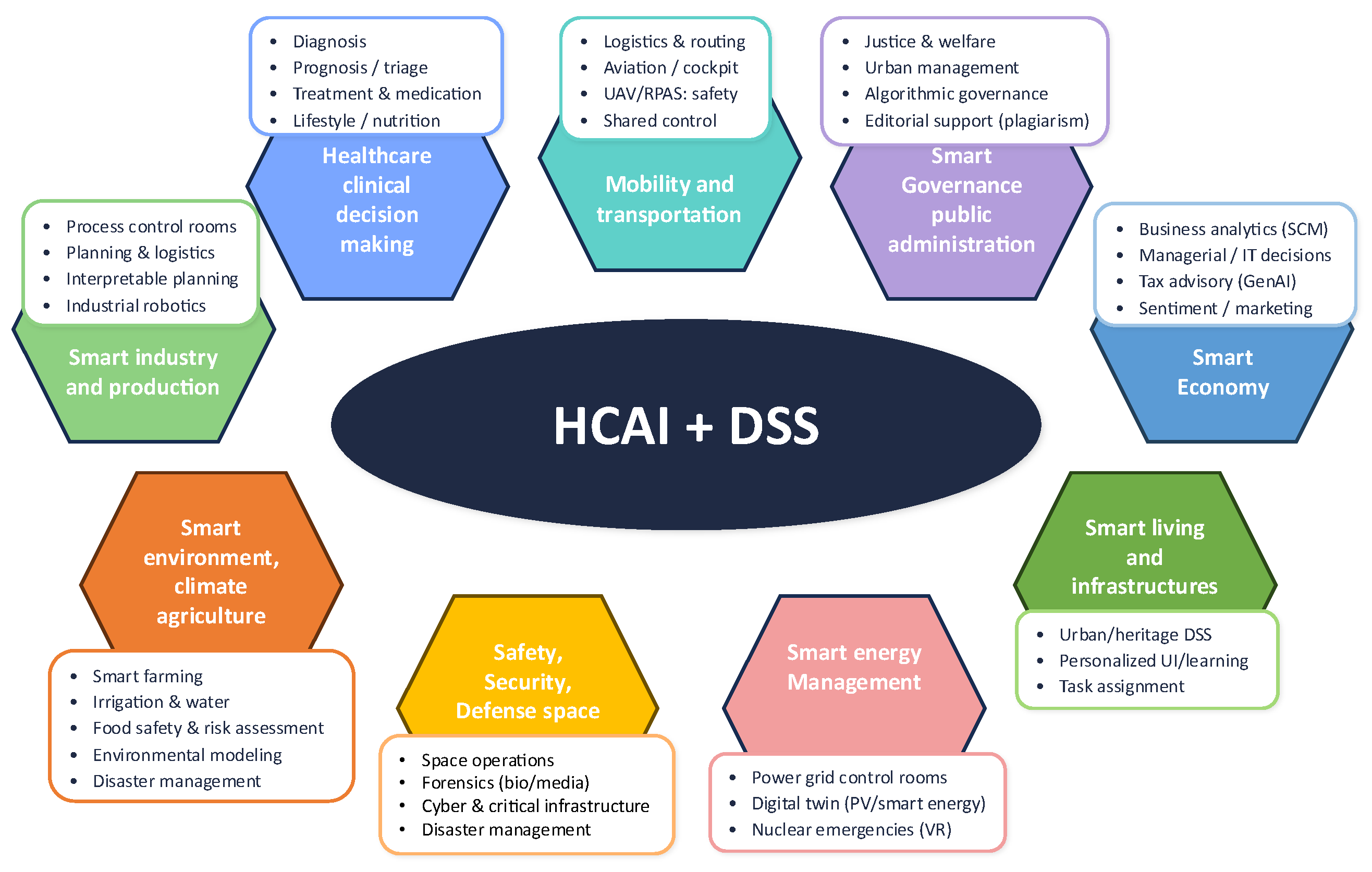
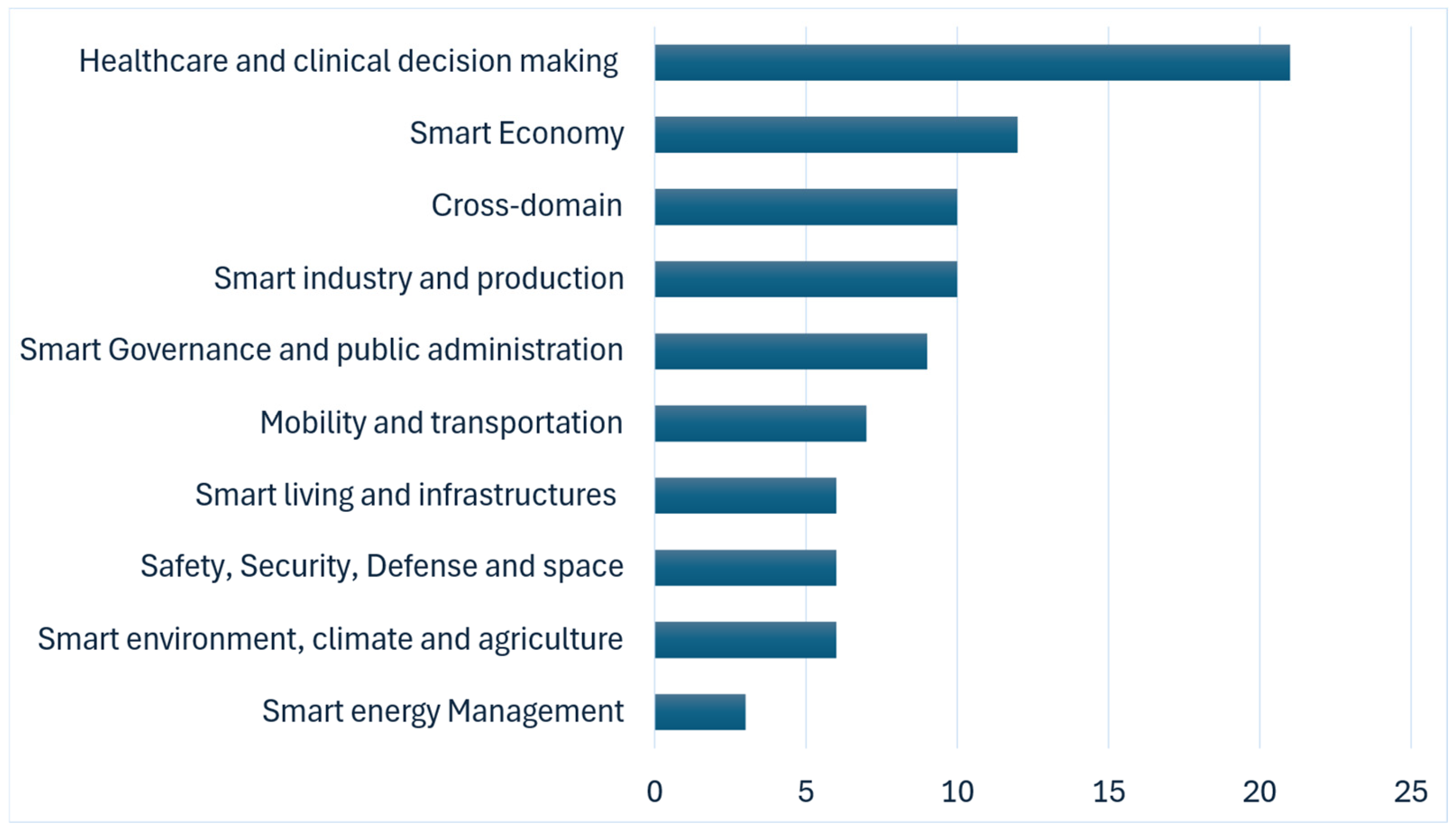
| RQ1 | Application domain, specific use context, impact, and connection with the SDGs. | Section 3, Figure 4, Figure 5, Section 4, Table 4 | Identification of 9 main application domains, distribution across the reviewed literature, reported impacts, and connection with the SDGs. |
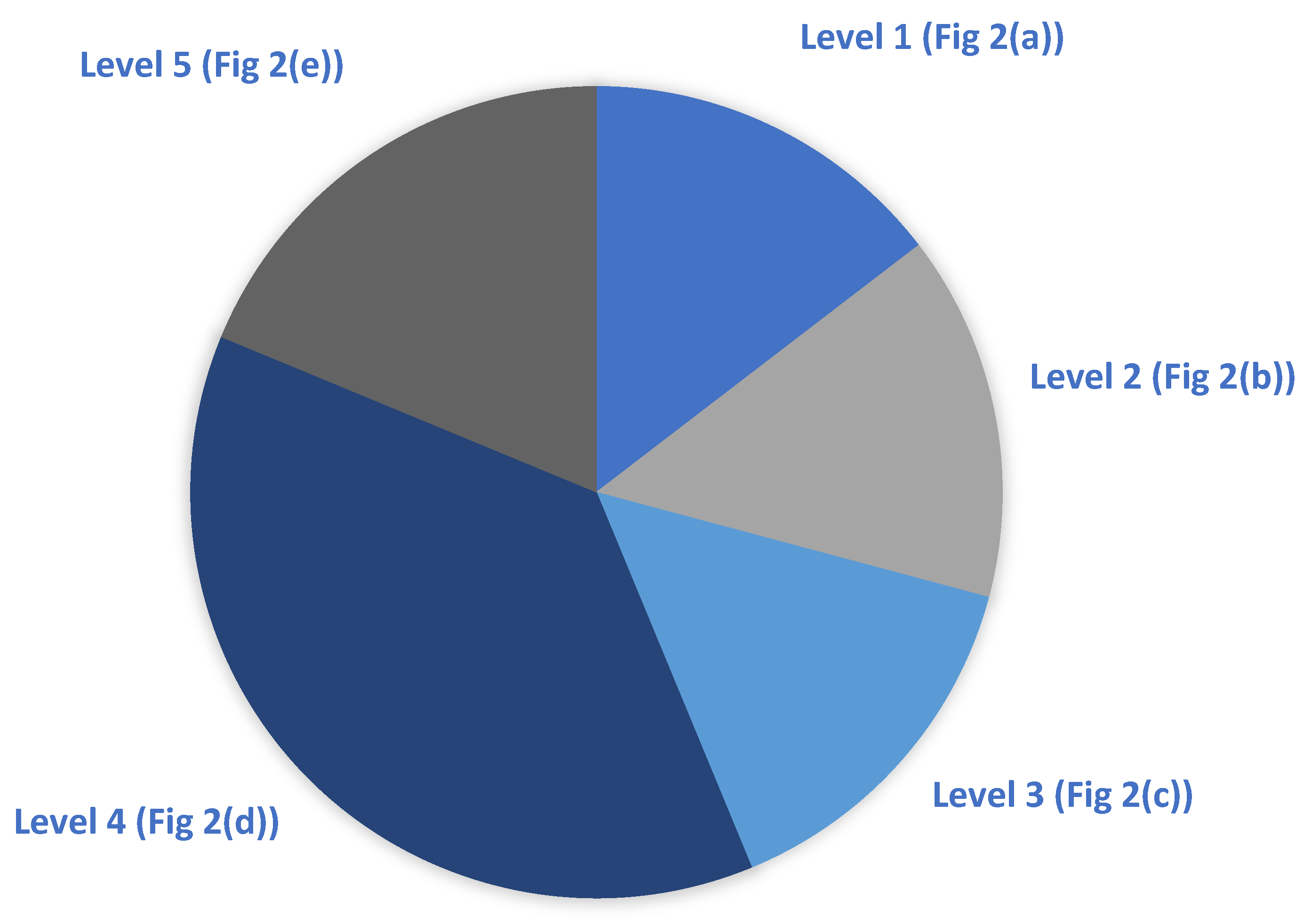
| RQ2 | Dominant architecture level (a–e); presence of Human Interaction, X-Generative, Data & Knowledge, Decision Logic and Orchestrator layers; feedback-loop type. | Section 2, Figure 2, Figure 3, Table 2 | Definition of the layer architectural taxonomy and mapping of reviewed systems to architecture layers. |
| RQ3 | The AI methods adopted, the human-centered and explainability approaches used, and the way each system was validated. | Section 3, Table 3 | Cross-domain synthesis of AI methods, explainability and validation practices. |
| Layer | Main Role | Typical Inputs | Typical Outputs | Enabling Technologies |
|---|---|---|---|---|
| 1. Human Interaction | Interface between users and the system; captures input, presents recommendations and explanations, and enables structured feedback. | Natural-language queries, parameters, constraints, preferences, corrections/labels, confirmations. | Recommendations, dashboards, “why/why-not” explanations, clarification questions, captured feedback. | HCI/UI dashboards, natural-language interfaces, explanation UIs, uncertainty communication patterns. |
| 2. X-Generative | Computational intelligence that produces estimates and candidates (predictions, diagnoses, simulations, reconstructions, recommendations). | Data/features, environment state, task specification/prompts, (soft) constraints, context. | Predictions, candidate plans/actions, scenarios/simulations, uncertainty estimates, explanatory artifacts. | ML/DL models, RL/policies, Bayesian, planning engines, agent-based models, numerical models, hybrid neuro-symbolic methods. |
| 3. Data and Knowledge | Manages structured/unstructured data and semantic knowledge; supports continuous updates and quality/uncertainty metadata. | Sensor/log streams, datasets, documents, knowledge graphs/ontologies, human labels, realized outcomes. | Curated datasets, feature stores, updated knowledge graphs, system state, quality and uncertainty metadata. | Data lake/warehouse knowledge graphs/ontologies, streaming platforms, IoT ingestion, digital-twin synchronization. |
| 4. Decision Logic | Evaluates, filters, and ranks candidates; enforces constraints; optimizes trade-offs; produces justifiable recommendations and alternatives. | Candidate outputs from X-Generative, hard/soft constraints, objective weights, policies, rules. | Scores/rankings, selected solutions, alternatives, scenario/constraint adjustments, decision rationale. | Optimization, multi-criteria decision-making, rule/constraint systems, constraint solving, automated planning, interpretable decision structures. |
| 5. Orchestrator | Decomposes complex tasks, selects tools/resources, manages iterative workflows, calibrates autonomy/roles, and closes feedback loops. | User request, system state, intermediate outputs, orchestration/assignment policies. | Executed workflows, tool calls, user queries for refinement, final ranked solutions with KPIs. | Workflow engines, tool/API calling, policy graphs, monitoring and continuous-learning hooks, deployment pipelines. |
| Domain | Technical Explainability | Functional Explainability |
|---|---|---|
| Healthcare and clinical decision-making | XAI interfaces, counterfactuals, uncertainty communication and interpretable clinical visualizations. | Evaluated through trust, reliance, cognitive load, acceptance and clinician-facing workflow integration. |
| Mobility and transportation | Collision-prediction logic, cockpit decision support, shared-control rationale and simulation traces. | Assessed through simulated understandability, workload and pilot/operator feedback; field evidence remains limited. |
| Smart industry and production | Fault rationale, interpretable resource planning, operator-state monitoring and visual analytics. | Related to control-room workload, situational awareness and operator intervention. |
| Smart environment, climate and agriculture | Visual thinning simulations, predictive irrigation models, scenario analysis and human-model interaction. | Often domain-expert-facing; transfer to non-expert stakeholders is less systematically evaluated. |
| Smart energy management | Causal models, what-if simulations, digital twins and immersive emergency visualization. | Relevant in high-risk settings, but usually validated in proof-of-concept or simulated settings. |
| Smart governance and public administration | Algorithmic transparency, oversight mechanisms and accountability-oriented explanations. | Mainly institutional rather than only individual; human oversight alone may not be sufficient. |
| Smart economy | Context-aware XAI selection, business-oriented explainability and trust/responsibility studies. | Evaluated through managerial trust, delegation, perceived responsibility and business decision usefulness. |
| Smart living and infrastructures | Personalized interaction models, learning-style classification, UI optimization and workload-management feedback. | Related to personalization, feedback and user self-regulation; evidence remains heterogeneous. |
| Safety, security, defense and space | Relevance feedback, forensic decision support, mission constraints and Cognitive Systems Engineering. | Related to accountability and safety under high uncertainty; empirical validation is often scenario-based. |
| SDG | #WoS | #Selected | SDG Density (%) | Coverage Ratio (%) | References |
|---|---|---|---|---|---|
| SDG 1-No Poverty | 7 | 1 | 4.55 | 14.29 | [121] |
| SDG 2-Zero Hunger | 17 | 1 | 4.55 | 5.88 | [93] |
| SDG 3-Good Health and Well Being | 308 | 8 | 36.36 | 2.60 | [33,46,48,64,69,70,79,89] |
| SDG 4-Quality Education | 64 | 1 | 4.55 | 1.56 | [26] |
| SDG 5-Gender Equality | 13 | 1 | 4.55 | 7.69 | [122] |
| SDG 6-Clean Water and Sanitation | 8 | 1 | 4.55 | 12.50 | [43] |
| SDG 7-Affordable and Clean Energy | 20 | 1 | 4.55 | 5.00 | [26] |
| SDG 8-Decent Work and Economic Growth | 4 | 1 | 4.55 | 25.00 | [123] |
| SDG 9-Industry, Innovation and Infrastructure | 75 | 2 | 9.09 | 2.67 | [47,59] |
| SDG 10-Reduced Inequality | 8 | 1 | 4.55 | 12.50 | [121] |
| SDG 11-Sustainable Cities and Communities | 144 | 4 | 18.18 | 2.8 | [30,48,65,95] |
| SDG 12-Responsible Consumption and Production | 66 | 2 | 9.09 | 3.03 | [47,91] |
| SDG 13-Climate Action | 30 | 1 | 4.55 | 3.33 | [43] |
| SDG 14-Life Below Water | 13 | 1 | 4.55 | 7.69 | [43] |
| SDG 15-Life on Land | 16 | 1 | 4.55 | 6.25 | [40] |
| SDG 16-Peace, Justice and Strong Institutions | 4 | 1 | 4.55 | 25.00 | [124] |
| SDG 17-Partnerships for the Goals | 13 | 1 | 4.55 | 14.29 | [59] |
| Layer | Criticalities |
|---|---|
| 1. Human Interaction | Reliance Black box use Adaptive explanations Error awareness Diagnostic and correction tools Active collaboration or co-construction Clear roles and rules for the human-in-the-loop Real-world case studies |
| 2. X-Generative | Reliance Black box use Clear roles and rules for the human-in-the-loop Exploitation of MLOPS Deployment accountability |
| 3. Data and Knowledge | Real-world case studies Quality controls & bias mitigation |
| 4. Decision Logic | Active collaboration or co-construction Clear roles and rules for the human-in-the-loop MLOPS |
| 5. Orchestrator | Diagnostic and correction tools MLOPS Agentic AI |
Disclaimer/Publisher’s Note: The statements, opinions and data contained in all publications are solely those of the individual author(s) and contributor(s) and not of MDPI and/or the editor(s). MDPI and/or the editor(s) disclaim responsibility for any injury to people or property resulting from any ideas, methods, instructions or products referred to in the content. |
© 2026 by the authors. Licensee MDPI, Basel, Switzerland. This article is an open access article distributed under the terms and conditions of the Creative Commons Attribution (CC BY) license.
Share and Cite
Fanfani, M.; Palesi, L.A.I.; Nesi, P. Human-Centered AI for Decision Support Systems: A Systematic Review of Application Domains, Architecture Designs, Current Trends and Future Directions. Big Data Cogn. Comput. 2026, 10, 186. https://doi.org/10.3390/bdcc10060186
Fanfani M, Palesi LAI, Nesi P. Human-Centered AI for Decision Support Systems: A Systematic Review of Application Domains, Architecture Designs, Current Trends and Future Directions. Big Data and Cognitive Computing. 2026; 10(6):186. https://doi.org/10.3390/bdcc10060186
Chicago/Turabian StyleFanfani, Marco, Luciano Alessandro Ipsaro Palesi, and Paolo Nesi. 2026. "Human-Centered AI for Decision Support Systems: A Systematic Review of Application Domains, Architecture Designs, Current Trends and Future Directions" Big Data and Cognitive Computing 10, no. 6: 186. https://doi.org/10.3390/bdcc10060186
APA StyleFanfani, M., Palesi, L. A. I., & Nesi, P. (2026). Human-Centered AI for Decision Support Systems: A Systematic Review of Application Domains, Architecture Designs, Current Trends and Future Directions. Big Data and Cognitive Computing, 10(6), 186. https://doi.org/10.3390/bdcc10060186