
Article

Context-Oriented Method for Resolving Lexical Ambiguities in Speech Synthesis for a Low-Resource Language
by
Elisa Izrailova
1,2,
Andrey Ronzhin
3,*,
Salaudin Umarkhadzhiev
1,2,
Arslanbek Astemirov
1,2,
Aleksandra Figurek
4,* and
Zelimkhan Sultanov
1
1
Department of Applied Semiotics, Center for Problems of Materials Science, Academy of Sciences of the Chechen Republic, 364020 Grozny, Russia
2
Sector of Artificial Intelligence, Laboratory of Applied Mathematics, Department of Physical and Mathematical Research, Kh. Ibragimov Complex Institute of the Russian Academy of Sciences (Cl RAS), 364020 Grozny, Russia
3
St. Petersburg Institute for Informatics and Automation of the Russian Academy of Sciences, St. Petersburg Federal Research Center of the Russian Academy of Sciences (SPC RAS), 199178 St. Petersburg, Russia
4
School of Business, GNOSIS Mediterranean Institute for Management Science, University of Nicosia, 24005 Nicosia, Cyprus
*
Authors to whom correspondence should be addressed.
Big Data Cogn. Comput. 2026, 10(6), 181; https://doi.org/10.3390/bdcc10060181
Submission received: 12 March 2026 / Revised: 25 April 2026 / Accepted: 20 May 2026 / Published: 1 June 2026
(This article belongs to the Special Issue Natural Language Processing Applications in Big Data)

Abstract

Disambiguation resolution in speech synthesis is one of the main challenges in text-to-speech conversion. Machine learning methods and artificial neural networks have been successfully applied to this problem in synthesis systems for English, Spanish, and other common languages. For low-resource languages, the available data are insufficient to train artificial neural networks, so heuristic methods for context analysis and selection of the correct homonym for polysemantic words should be used. The purpose of this study is to develop a word sense disambiguation (WSD) method for the low-resource Chechen language and to introduce it into a speech synthesis system. The study presents the developed method and three algorithms: AWEN (based on Euclidean distance), AWA (weighted average), and AWN (weighted normalized distance) for word sense disambiguation. A corpus of Chechen texts, CheWSData, was compiled, containing 15,035 manually selected sentences derived from 5 million annotated words and reflecting the natural frequency of polysemy across grammatical categories. Experimental results show that the proposed AWN method achieves the best performance, with an F1-score of 0.78 and an accuracy of 0.80, outperforming AWA (F1: 0.74) and AWEN (F1: 0.40). For specific parts of speech, AWN reaches F1-scores of 0.82 for nouns, 0.83 for verbs, and 0.85 for adverbs. Comparative analysis with existing WSD methods for low-resource languages (Kashmiri, Hausa, Assamese, Urdu, and Vietnamese) demonstrates that AWN is competitive, ranking second after ViConBERT (F1: 0.87) and ahead of XLM-R for Hausa (F1: 0.79). The developed software module for homonym recognition was integrated into the Chechen speech synthesis system, contributing to more natural synthesized speech.

1. Introduction

Disambiguation resolution in speech synthesis is one of the main challenges in text-to-speech conversion. Modern speech synthesis methods are actively developing due to advances in machine learning and neural networks. The main approaches include concatenative, parametric, and neural network speech synthesis, each of which has its own characteristics and applications. Machine learning methods and artificial neural networks are successfully applied to this problem in synthesis systems for English, Chinese, Spanish, and other common languages.
Neural network methods and models have become very popular and are widely used in modern research and in the development of speech synthesis systems for various languages, including speech synthesis based on long-term neural networks (LSTM) [1], generative adversarial networks (generative adversarial network, GAN) [2], end-to-end automatic speech synthesis system (WaveNet, developed by Google [3,4], SampleRNN based on the hierarchy of several layers of a neural network [5], the Tacotron model with the “attention” module [6], and Deep Voice, consisting of deep neural networks [7]. In 2023, the Massively Multilingual Speech (MMS) project was created [8]. The main components are a new set of data based on reading publicly available religious texts and the effective use of self-study. An automatic speech synthesis model was created for 1107 languages, including the synthesis of Chechen speech.
Neural network-based models require the input of large amounts of training text and audio data, which are not available for most low-resource languages.
The development of automatic speech synthesis systems for low-resource languages is associated with certain challenges, often related to the lack of training speech corpora and text databases [9,10]. Section 2.1 below is an overview of research papers on modern speech synthesis methods for some low-resource languages.
Lexical ambiguity is an inherent property of all natural languages. The problem of word sense disambiguation (WSD), defined as the process of recognizing the precise interpretation of an ambiguous word given its context, is relevant to all languages, including those with limited resources. WSD methods can be classified according to the source of knowledge used in disambiguation: knowledge-based methods, which use electronic dictionaries and lexical knowledge bases (for example, WordNet and BabelNet); supervised methods of machine learning, which work on the basis of a pre-marked database and include decision trees, support vector machines, and neural networks; and semi-controlled and uncontrolled methods, which use both labeled and unlabeled data.
In speech synthesis systems, WSD helps interpret words correctly, especially in cases of homonymy (when the same spelling corresponds to different sound forms) or polysemy (when one word has several related meanings). This improves the quality of synthesized speech by reducing the likelihood of pronunciation errors and misunderstandings of the meaning of the message. Incorrect identification of the features of a homograph word can make it difficult to perceive the meaning of the entire sentence. For low-resource languages, the available data are insufficient to train artificial neural networks; therefore, heuristic methods for context analysis and selection of the correct homonym for polysemantic words must be used.
The purpose of this study is to eliminate graphical homonymy in texts intended for speech synthesis and improve the qualitative characteristics of speech synthesized by the TTS system. To achieve this goal, the following tasks were solved:
-
A CheWSData sentence corpus wasa created, containing homonyms in various contexts;
-
The corpus was marked up by linguists according to meanings, since homographs in the Chechen language differ in the length of vowels or in the presence of diphthongs;
-
Three parametric homonymy recognition algorithms were developed, and experimental studies of these algorithms were carried out;
-
A software module for recognizing homonyms in Chechen were created and integrated into the Chechen speech synthesis system.

2. Related Work

2.1. Speech Synthesis for Low-Resource Languages

This section provides an overview of scientific papers on modern speech synthesis methods for some languages with limited resources.
The study in [11] proposed the SRC-IT2 model for emotional synthesis of Mongolian speech, based on a modified Tacotron 2 architecture. The advantages of the proposed model of synthesis of Mongolian speech are: high-speed speech synthesis, speech rate control and emotional expressiveness. The acoustic model of the language is based on G2P-Seq2Seq and is used to achieve accurate mapping of graphemes with phonemes of Mongolian characters [11].
According to [12], a complete TTS system was introduced for the efficient production of natural-sounding Kurdish speech. The approach employs a variational autoencoder (VAE) that is initially trained to rebuild the audio signal and is further enhanced through incorporating adversarial training. The model also includes a pre-trained encoder, followed by the distribution of text encodings into latent variables. In addition, a stochastic duration predictor is used to impart various rhythms into the synthesized Kurdish speech [12].
Research [13] proposed a practical deep learning approach for text-to-speech synthesis in Macedonian. The first open-source Macedonian voice synthesizer, named MAKEDONKA, was built using an end-to-end speech generation method based on a fully convolutional acoustic sequence-to-sequence model enhanced with an attention-boosting mechanism, specifically Deep Voice 3 [13].
The study in [14] describes an emotional speech synthesis framework tailored for low-resource languages with scarce training data. The system, named SMAL-ET2, integrates transfer learning, supervised learning, and a resilient attention mechanism to better capture emotional vocal characteristics during fine-tuning. A tuning procedure that balances trade-off parameters and employs pseudo-labeling via loss functions enables more efficient guidance of the learning process, resulting in well-structured emotional speech output. The training regime, which makes use of incremental monotonic attention and supervised attention loss, reduces overfitting and strengthens the generalization capability of the text-to-speech model. Although English is not a low-resource language, emotional speech synthesis faces a severe shortage of labeled emotional data, making it a de facto low-resource problem. We included reference [14] as an example of transfer learning and semi-supervised methods applicable to our context.
The exploration of a Mongolian text-to-speech framework based on Ghost and ILPCnet is presented in [15]. The preprocessing of phonetic features is built on the Bang pre-training model, which reduced the error rate in word synthesis. The proposed Mongolian speech synthesis model based on Ghost and ILPCnet, called the Ghost-ILPCnet model, was improved on the basis of the Para-WaveNet acoustic model, in which conventional convolution blocks were replaced with multilayer Ghost modules to parallelize the generation of Mongolian acoustic features and improve speech generation speed. According to the experimental findings, the Ghost-ILPCnet model features a straightforward architecture, a reduced number of trainable parameters, and lower hardware demands, while also supporting parallel training. These characteristics help preserve the naturalness and clarity of the generated speech, accelerate synthesis, and enhance the overall performance of the Mongolian text-to-speech system [15].
The use of transfer learning for speech synthesis in the low-resource Dungan language is described in the study [16]. To prepare the training corpus for the Tacotron2 + WaveRNN neural network model, a pre-trained Mandarin acoustic model was fine-tuned using a limited Dungan language dataset together with an acoustic model of the Dungan language. The approach presented in the paper first involves building a transformer-based text analyzer for Dungan, which can produce sequences of units that carry embedded prosodic information from input sentences. Then, a speech synthesis strategy for low-resource languages is introduced that incorporates prosodic information and leverages a related high-resource language corpus via translation-based training [16].
The creation and experimental assessment of a parallel multilingual speech corpus intended for low-resource Turkic languages, including Kazakh, Uzbek, and Tatar, are described in [17]. This corpus is intended to support speech synthesis and automatic translation tasks. Its construction employed a cascade generation approach integrating AI techniques with text-to-speech (TTS) systems to produce both audio and textual data, along with quality evaluation of the generated outputs. As a result, a multimodal corpus was obtained comprising Kazakh paired with Turkish, Tatar, and Uzbek. It includes high-quality natural Kazakh audio with corresponding transcriptions and translations, as well as synthetic speech in Turkish, Tatar, and Uzbek. These corpora serve as valuable assets for research in speech and text processing, facilitating the combination of automatic speech recognition (ASR), machine translation (MT), TTS, and speech-to-speech (STS) systems [17].
The study in [18] offers an overview of current speech recognition and synthesis models and platforms tailored to the Kazakh language, along with a thorough examination of how well they can be adapted to the Kazakh language. It focuses on linguistic and technical challenges, such as the agglutinative nature of the language, its rich vowel inventory, and phonemic variation. Both open-source and commercial systems—including Whisper, GPT-4 Transcribe, ElevenLabs, OpenAI TTS, Voiser, KazakhTTS2, and TurkicTTS—were assessed. The experimental outcomes indicate that Soyle performed best for speech-to-text (STT) tasks on domain-relevant data. For text-to-speech (TTS), KazakhTTS2 yielded the highest natural perceptual quality (DNSMOS scores of 8.79–8.96), whereas OpenAI TTS achieved the highest spectral accuracy, with an MCD of 123.44–117.11 and a PESQ of 1.14 [18].
Table 1 presents a comparative analysis of current research on automatic speech synthesis for low-resource languages. Common problems across all languages include a lack of training data and the adaptation of existing speech synthesis models to the specific characteristics of a particular language. To address these issues, approaches based on the creation of acoustic models, phonetic preprocessing modules, and the use of parallel language corpora during training, have been proposed. However, unresolved issues in speech synthesis systems for low-resource languages include the synthesis of polysemantic homographs and the dependence of developed TTS models on open-source neural network models.
Table 1 summarizes the key challenges and solution approaches.

2.2. Word Sense Disambiguation for Low-Resource Languages

Below is a review of current work on WSD for resource-poor languages.
The development of the WordNet corpus, which contains a standard WSD dataset for word sense disambiguation in Kashmiri, is described in [19]. The raw data used to build the annotated dataset came from multiple sources and include roughly one million tokens across 124 commonly used ambiguous words. The Kashmiri WordNet corpus, which features sense-tagged meanings, is varied in content and comprises 19,854 sentences. Using this annotated corpus, researchers performed lexical pattern disambiguation experiments on Kashmiri by applying several machine learning classifiers, namely J48, IBk, Naive Bayes, Dl4jMlpClassifier, and SVM [19].
The study in [20] describes the creation of a high-quality dataset for word sense disambiguation in Hausa, including 2021 manually selected and labeled lemmas. Hausa, one of the primary languages spoken in the Republic of Chad and by more than 60 million people, still lacks well-structured lexical resources for resolving word ambiguity. This dataset is intended to support the training and evaluation of both supervised and semi-supervised WSD models for Hausa and to provide a foundational benchmark for various natural language processing tasks [20].
The construction of an annotated database for Assamese word sense disambiguation task is described in the study [21]. The paper presents the process of generating ambiguous terms with multiple meanings (ASI) and the SeAnDa training dataset for implementing WSD tasks using supervised methods. A list of 100 ambiguous terms with different interpretations in both Assamese and English was prepared, along with a dataset of annotated meanings of ambiguous words with a minimum size of 2000 sentences. The authors analyzed ambiguous words while taking into account parameters—parts of speech and the number of meanings. ASI and SeAnDa act as preliminary resources for implementing WSD tasks with iterative training and a pre-scoring strategy. A Naive Bayes classifier was trained on the prepared data, and evaluation of ambiguous word recognition results showed an accuracy of 71% [21].
Urdu word meaning disambiguation is described in the work [22]. The developed multilayer software system for WSD MAKS is presented, consisting of four main layers: corpus creation, preprocessing, a data transfer module, and a classifier module. The data transfer module uses advanced techniques, including XLM tokenization and XLM-RoBERTa, for feature extraction and data preprocessing. To classify the tokenized data and enhance word sense disambiguation (WSD) accuracy, the classifier adopts a hybrid method that combines support vector machines (SVMs) with random forests (RFs). By systematically integrating these levels, MAKS provides robustness and contextual awareness in determining the meaning of words in Urdu text [22].
A study of word sense disambiguation using transformer models for two different Indic language families, Dravidian and Devanagari, is described in the article [23]. The paper reviews the current state of WSD for Dravidian and Devanagari languages, exploring modern methods, tools, and pre-trained language models such as BERT and CTRL. Disambiguation for Dravidian and Devanagari languages presents many challenges due to their large vocabulary and the complex aspects of their morphology and syntax [23].
A new approach to data collection for WSD using gamified crowdsourcing is discussed in the study [24]. To engage a wide and diverse audience in the creation of high-quality WSD data, a bot-based messaging method was used. By employing a multiplayer game format, native speakers supplied various meanings for ambiguous words and assessed the inputs provided by other players. Combined with the introduced enhancements, this platform attracted a remarkably diverse pool of participants, spanning different ages, occupations, and genders at a rate 20 times higher than that achieved by a similar crowdsourcing approach for another NLP task, while also sustaining their involvement over an extended period. In contrast with conventional academic crowdsourcing platforms, this method prioritizes engaging individuals from a variety of backgrounds, including not only academia but also AI-focused communities. The findings suggest that game-based crowdsourcing can serve as an effective means for building WSD corpora [24].
Article [25] analyzes word meaning disambiguation methods and attempted to apply well-known WSD models to the Bengali language. The WSD problem is particularly relevant for Bengali as a resource-poor language for several reasons, like other Indian languages, Bengali has a rich and complex word-formation system. Root words can be inflected according to aspects such as tense, gender, number, and case, significantly increasing the volume of data required to train WSD models [25].
A novel framework, ViConBERT, for Vietnamese word disambiguation that combines contrastive learning (SimCLR) with gloss-based classification to improve word meaning understanding is described in [26]. The study also presents ViConWSD, the first synthetic dataset for assessing semantic understanding in Vietnamese, covering both WSD and contextual similarity. Experimental results show that the ViConBERT model’s accuracy metrics outperforms WSD baselines (F1 = 0.87) and rival those of ViCon (AP = 0.88), demonstrating its effectiveness in modeling both discrete meanings and graded semantic relations.
Table 2 presents a comparative analysis of current research on lexical polysemy in resource-poor languages. A common problem for all languages is the lack of data for implementing WSD methods and models. To address this issue, approaches based on machine learning using large data corpora for languages from the same language family and engaging online users through gamified crowdsourcing have been proposed. Unresolved issues include high error rates in automated text data tagging and data imbalance for most polysemantic words, which depend on the size of the original text corpus.
In contrast to the works listed above, our method:
-
does not rely on pre-trained multilingual models (e.g., XLM-R and mBERT), which often underperform for extremely low-resource languages like Chechen;
-
uses a purely context-driven positional weighting scheme that requires only a few hundred labeled sentences per homonym;
-
is explicitly designed for integration into a speech synthesis front-end, where the disambiguation result directly selects pronunciation variants.
Unlike the gamified crowdsourcing approach [24], our annotation is expert-based and requires significantly less effort (15k sentences vs. larger corpora). Compared to ViConBERT [26], we operate without contrastive learning or glosses, making our method more portable to languages with no WordNet.
The purpose of this study is to develop a WSD method for the low-resource Chechen language and to introduce it into a speech synthesis system. The study presents the AWEN method, an algorithm for recognizing homonyms based on the Euclidean metric. Unlike standard WSD models, the proposed method analyzes the distance between vector representations of sentences and homonyms within their contexts. The primary contributions of this work is the development of an effective TTS architecture with an integrated homograph recognition and correct reading module.
The main practical contributions of this work are:
  • The relevance of developing and applying parametric methods for analyzing and resolving lexical ambiguity in low-resource languages, as well as for designing automatic speech synthesis systems, is substantiated using the Chechen language as a case study.
  • A corpus of Chechen texts, CheWSData, was compiled, containing 15,035 manually selected sentences derived from the analysis of 5 million annotated words. This corpus reflects the natural frequency of polysemy across various grammatical categories of the Chechen language, exemplified by 100 identified homonyms.
  • A method and a set of algorithms for estimating the positional occurrence of unique context words were developed. These enable the unambiguous determination of homonym meanings for each processed word exhibiting lexical ambiguity within a sentence.
  • The software implementation of the proposed method made it possible to estimate weight coefficients and the significant range of words within the context of processed homonyms. It also facilitated a comparative analysis of the results against existing methods for word sense disambiguation in low-resource languages.
The paper is organized as follows. Section 2 provides a literature review of existing methods for solving word sense disambiguation and an analysis of their limitations. Section 3 describes the developed method for assessing the positional occurrence of polysemous words, the created Chechen speech corpus, and the algorithmic complex for resolving lexical ambiguities. Section 4 presents the experimental results, Section 5 discusses them, and Section 6 contains the conclusions and outlines future research plans.

3. Materials and Methods

3.1. Method for Assessing the Positional Occurrence of Polysemantic Words for Resolving Lexical Ambiguities

The mathematical notation used throughout this section is summarized in Table A1 (Appendix A). Readers are encouraged to consult this table for definitions of symbols and indices.
First, let us give a formal description of the developed method. Let there be a set of processed words W = {w(1), w(2), …, w(wi), …, w(WN)}, w i [ 1 , W N ] , where WN is a natural number. Considering that language is an open system and each word may potentially acquire several meanings or pronunciation variants over time, and for the purpose of unification, each word w(wi) is associated with a corresponding set of homonyms O(wi) = {o(1,wi), o(2,wi), …, o(oj,wi), …, o(ON,wi)}, where o j [ 1 , O N ] and ON is a natural number.
For the functioning of the speech synthesis system, databases B(wi) = {B(1,wi), B(2,wi), …, B(oj,wi), …, B(ON,wi)} are formed with representative sets of sentences for each processed homonym. For example, the sentence database B(oj,wi) = {P(1,oj,wi), P(2,oj,wi), …, P(p,oj,wi), …, P(PN,oj,wi)} includes a set of sentences with the homonym o(oj,wi) of the word w(wi), p [ 1 , P N ] , where PN is a natural number. To identify a specific homonym in the description of the processed word, the concept of a tag word is introduced, which is a word located nearby that characterizes the contextual dependence of the homonym within the sentence. In fact, the speech synthesis system does not store all words in the description of a sentence, but only contextually significant ones. Therefore, each sentence P(p,oj,wi) contains N elements: P(p,oj,wi) = {SP(1,p,oj,wi), SP(2,p,oj,wi), …, SP(n,p,oj,wi), …, SP(N,p,oj,wi)}. The position of each tag word relative to the homonym is formed using a homonym-centric coordinate axis.
Thus, the objective of the research is to optimize the contextual description of a homonym within a sentence in order to correctly select its meaning for a processed word with lexical ambiguity, as well as to develop a method for estimating the positional occurrence of all unique context words, which allows for the unambiguous determination of the homonym meaning for the processed word. To solve this problem, the study formulates an analytical description of the proposed word sense disambiguation approach.
For each sentence database B(oj, wi) for the homonym o(oj, wi) of the word w(wi), the positional occurrence of all tag words SP(oj, wi) in the contextual environment of the homonym o(oj, wi) is estimated. Each tag word SP(n_cur, p_cur, oj, wi) from the database B(oj, wi) is assigned a numerical vector of estimates of the positional occurrence of the current tag word TV(n_cur, p_cur, oj, wi) в in the contextual environment of the homonym ooj_wi. Initially, a zero-valued estimate vector TV(n_cur, p_cur, oj, wi) is formed for the positional occurrence of the tag word SP(n_cur, p_cur, oj, wi). Then, the positional occurrence estimates of the tag word SP(n_cur, p_cur, oj, wi) from the sentence P(p_cur,oj,wi) are determined by comparing it with each tag word in the sentence P(p,oj,wi), located at positions [ 1 , N ] , as follows:
T V ( g , n _ c u r , p _ c u r ,   o j ,   w i ) = 1 ,   if   SP ( g , p , o j , w i ) = SP ( n _ c u r , p _ c u r , o j , w i ) 0 ,   else   , g [ 1 , N ] .
Thus, for each tag word SP(n, p_cur, oj, wi) in the contextual environment of the homonym o(oj, wi) a numerical vector of estimates of positional occurrence is formed based on the analysis of the sentence P(p,oj,wi):
TV(n_cur,p_cur,oj,wi) = (TV(1,n_cur,p_cur,oj,wi), TV(2,n_cur,p_cur,oj,wi, …, TV(g,n_cur,p_cur,oj,wi, …, TV(N,n_cur,p_cur,oj,wi) = {TV(g,n_cur,p_cur,oj,wi)},
where g [ 1 , N ] , N is a natural number.
As a result of analyzing all sentences P(oj, wi) from the database B(oj,wi), a total numerical estimate vector is formed for the tag word SP(n_cur, p_cur, oj, wi):
S T V ( g , n _ c u r , p _ c u r ,   o j ,   w i ) = p = 1 P N ( o j ,   w i )   1 ,   if   SP ( g , p , o j , w i ) = SP ( n _ c u r , p _ c u r , o j , w i ) 0 ,   e l s e   , g [ 1 , N ] .
STV (g, oj, wi) quantifies how often a specific tag word appears at a specific relative position g across all sentences in database B(oj,wi).
This procedure is scaled to account for all tag words SP(n_cur, p_cur, oj, wi) from the sentence P(p_cur, oj, wi), located at positions [1, N]. Thus, the summation of estimates is performed over positions, tag words, and sentences:
S T V ( g , o j ,   w i ) = p _ c u r P N ( o j , w i ) n _ c u r = 1 N p = 1 P N ( o j ,   w i )   1 ,   if   SP ( g , p , o j , w i ) = SP ( n _ c u r , p _ c u r , o j , w i ) 0 ,   else   , g [ 1 , N ] .
Thus, the sentence database B(oj, wi), containing the contextual description of each homonym o(oj,wi) of the word w(wi), is characterized by a total numerical vector of positional occurrence estimates of tag words: STV(oj,wi) = {STV(g, oj, wi)}. This representation subsequently allows word sense disambiguation during the processing of words in a test input sentence. STV (g, oj, wi) quantifies how often a specific tag word appears at a specific relative position g across all sentences in the database B(oj,wi).
This completes the description of the preliminary database preparation stage for the speech synthesis system with lexical ambiguity resolution. Next, we consider the main operational stage of the speech synthesis system when processing an input sentence TP(wi) containing an ambiguous word w(wi).
Initially, a similar calculation of the total numerical vector of positional occurrence estimates for tag words for the ambiguous word w(wi) in the input sentence TP(wi) is performed across all sentence databases B(wi) at once:
S T P V ( g , w i ) = o j = 1 O N ( w i ) n t _ c u r = 1 N p = 1 P N ( o j ,   w i )   1 ,   if   SP ( g , p , o j , w i ) = TP ( n t _ c u r ,   w i ) 0 ,   else   , g [ 1 , N ] .
STPV (g, wi) quantifies how often a specific tag word appears at a specific relative position g in the test input sentence TP(wi).
The obtained estimates of the positional occurrence of tag words from the databases and the test input sentence are represented as numerical vectors in an N -dimensional space. To determine the meaning of the homonym o(oj,wi) for the analyzed word w(wi), a weighted estimate of the distance between the obtained vectors is calculated. It is natural to assume that the farther a tag word is located from the homonym in the sentence, the less its influence. Therefore, the introduced weight vector of estimates of the positional occurrence of tag words Q = q 1 , q 2 ,   , q N has the following value constraints:
0 < q 1 q 2 q N 2 = 1 = q N 2 + 1 q N 2 + 2 q N > 0 .
Then, the weighted root mean square estimate of the distance between the vector S T P V ( w i ) of the test input sentence and S T V ( o j ,   w i ) for the sentence database B(oj, wi) is calculated as follows:
r o j , w i = 1 / P N g = 1 N q g S T P V ( g , w i ) S T V ( g , o j ,   w i ) 2 .
Since the sentence databases B(wi) have different numbers of sentences, a normalization factor 1 / P N is applied in the formula. To find the index o w i * of the homonym meaning for the word w(wi), an optimization function that selects the minimum distance between the vectors is used:
o w i * = argmin oj r ( o j , w i ) .
In exceptional cases where equal distances are obtained, preference is given to the homonym with a larger number of sentences in the database, as this confirms a greater occurrence of the homonym in speech.

3.2. Creation of the CheWSData Dataset

To configure and test the developed context-oriented method for word sense disambiguation in speech synthesis for a low-resource language, a corpus of Chechen texts was collected. The data preparation process for lexical ambiguity resolution consisted of the following stages:
(1)
Preparation of the initial data in the form of an array of texts of various genres totaling 5 million words.
(2)
Compilation of dictionaries containing lists of homonyms and their possible meanings.
(3)
Homonym extraction: a list of homonyms requiring further analysis due to their polysemy was selected from an array of texts. A list of 100 homonyms was prepared.
(4)
Indexing and annotation: each homonym from the selected set underwent indexing and annotation within the general text bank to facilitate the subsequent extraction of all usage contexts.
(5)
Creation of context databases: for each homonym, a separate sentence database containing all context in which this homonym appears was formed.
(6)
Sense classification: The final stage is the classification of sentences within each database B(oj, wi). Each sentence is classified according to the specific meaning in which the homonym is used in that context.
The basis of the proposals is the basis for the development and implementation of the proposed method. Sentences with homonyms were collected automatically from the prepared text bank. The result of the program is an Excel spreadsheet in which all sentences with homonyms are in the first column. Further work was carried out manually. The database of sentences with a specific homonym was divided into several columns, depending on the meaning or pronunciation of the homonym/homograph (mainly by the length of the vowel letter). In writing, the longitude of vowel phonemes is not indicated in any way, which is why the problem of synthesizing homographs in Chechen speech has arisen. The markup of each sentence database was carried out independently by two linguistic experts (inter-annotator agreement: Cohen kappa = 0.82). All disputed cases were resolved by a third expert.
From the prepared list of 100 homonyms, the 13 most frequent homonyms were selected. Sentences containing these homonyms in various contexts were then collected from the prepared text corpus. Thus, for the homonym “dan,” the database contains 3150 sentences; “de”—973; “bala”—482; “belira”—800; “yakha”—196; “yolu”—2130; “ben”—1511; “dala”—1301; “dak’a”—490; “shun”—543; “tsIe”—2000; “cha”—288; and “lar”—1171. In this way, a dataset named CheWSData was prepared, with a total of 15,035 sentences (Table 3).
To ensure broad lexical coverage, words from different parts of speech were taken. The distribution is presented in Table 4. The largest number of homonyms was found among verbs (52%), including dala, dan, and belira. Nouns (37%) included homonyms such as cha, tsIe, and shun. Adjectives constitute for 8% among polysemous words and include yekha and mela. Adverbs (1%) include words such as ben and kuyga. Pronouns (0.6%) include san and shun. Other parts of speech (1.4%) include particles, conjunctions, and rare functional categories. This distribution reflects the natural frequency of polysemy across different grammatical categories of the Chechen language.

3.3. Three Developed Algorithms for Homonym Sense Recognition

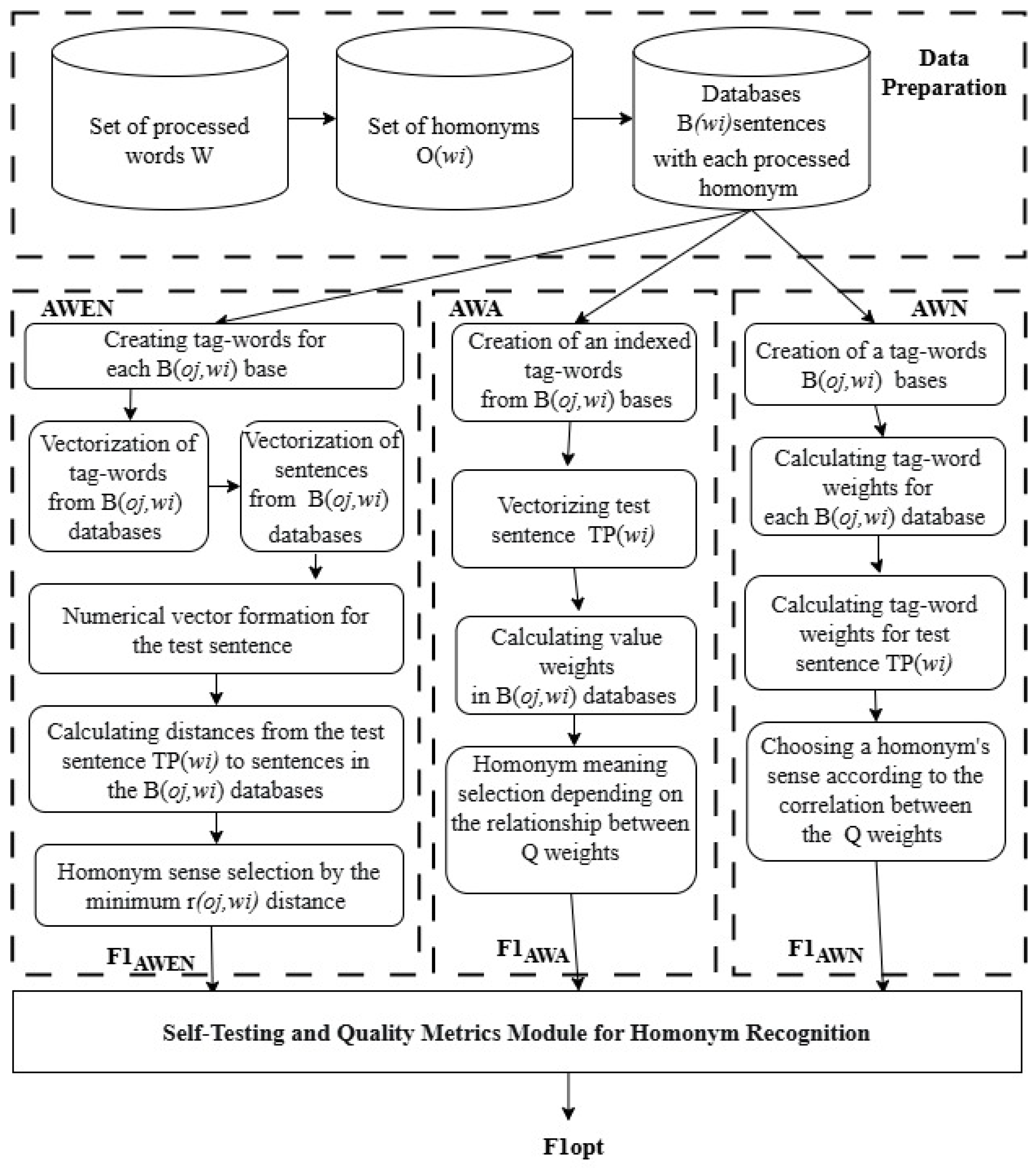
The developed method was implemented using three algorithms presented in Figure 1. The input data for all three algorithms are identical:
-
Test sentence: a sentence potentially containing a homonym whose meaning needs to be determined.
-
Sentence databases: a set of reference databases, each containing sentences that include one of the possible meanings of the homonym.
-
Word databases: a set of dictionaries or word databases associated with the corresponding sentence databases and used to form context vectors.
Next, we consider the specific features of each of the three developed algorithms.
In the AWEN algorithm, all sentences from the reference databases, together with the test sentence, are transformed into numerical vectors. The next step involves distance calculation, where the Euclidean distance metric is computed between the numerical vector of the test sentence TPwi and each labeled database (B1_wi, B2_wi, …, Boj_wi, …, BON_wi). Each database is represented as a set of sentence vectors, and the distance to this set is calculated as the average distance to all vectors in the database. Subsequently, the minimum distance is selected: the algorithm chooses the reference database Boj_wi for which the distance to the test sentence is minimal. This method is based on the hypothesis that sentences in which the homonym is used with the same meaning are semantically closer (exhibit smaller vector distances) to each other than sentences where the homonym is used with different meanings.
In the AWA algorithm, homonym sense recognition is based on positional estimates of all words in the sentence. The operation of the algorithms can be described as follows. The test sentence TPwi undergoes an indexing stage. Simultaneously, words in multiple sentence databases (B1_wi, B2_wi, …, Boj_wi, …, BON_wi) are indexed. Each database Boj_wi contains a set of sentences illustrating the use of a specific meaning of the homonym. Each database (B1_wi, B2_wi, …, Boj_wi, …, BON_wi) contains its own set of words that serve as contextual tags characterizing a particular homonym meaning. Based on the indexing process, weights (q1, q2, … q N _ p _ o j _ w i ) are calculated for each homonym meaning. These weights reflect the degree of proximity between the context of the test sentence and the tags stored in the corresponding databases. In the final stage, the correct homonym meaning is selected. This decision is made based on analyzing the relationship between the calculated weights q 1 , q 2 ,   , q N . The method selects the meaning associated with the database having the highest weight.
The third algorithm, AWN, takes several parameters into account. It allows the specification of any number of words for contextual analysis within a sentence, as well as the selection of word positions relative to the homonym (to the right or left). The AWN algorithm performs homonym recognition as follows.
Figure 1 presents a diagram describing the architecture of a word sense disambiguation system implemented by three parallel methods: AWEN, AWA, and AWN. The overall structure includes stages of data preparation, processing using different vectorization and weighting approaches, and a quality evaluation module.
The initial dataset consists of a set of homonyms O(wi). For each currently processed homonym o(oj,wi), several sentence databases are formed (three are shown in this diagram): B(1, wi), B(2, wi), …, B(oj, wi). Subsequently, the process branches according to each homonym resolution method:
  • AWEN method (based on Euclidean distance in vector space). This method involves the extraction and vectorization of word tags for each base B(oj, wi), followed by the construction of a numeric vector for the current test sentence TP(wi). Distances are then computed between the vector of TP(wi) and the sentence vectors from all bases B(oj, wi). The final step is selecting the homonym sense associated with the minimum distance roj_wi.
  • AWA method (based on weighted matching with indexed tags). This method comprises the preparation of indexed word tags for each base B(oj, wi), vectorization of the test sentence TP(wi) and selection of the homonym sense based on the ratio of the weights Q.
  • AWN method, which resolves homonyms based on the number of words neighboring the homonym and the word’s position relative to the homonym, involves the following steps: extracting word tags for each base B(oj, wi), computing the weights of word tags for each base B(oj, wi), and selecting the homonym sense according to the ratio between the weights Q(n_cur, p_cur, oj, wi).
Thus, all three methods operate independently using the same input bases but differ in their feature extraction and decision-making strategies.
The final block in the lexical homonym resolution diagram is the self-testing and quality evaluation module for homonym recognition. After processing by each method, the quality metric—the F1-score (the harmonic mean of precision and recall)—is computed. This module enables automated evaluation and allows either the selection of the best method or the combination of results (F1opt estimation).
The diagram illustrates a hybrid system that combines three distinct approaches to homonym resolution while providing the ability to compare their performance. Such an architecture enables experimentation with different vectorization- and weighting-based methods using a unified sentence base created for each homonym sense.
The calculation of tag weights for each database is performed as follows. For each tag, its statistical weight is computed within each sentence database B(oj, wi). This allows the assessment of the significance of each feature for a specific tag or thematic domain represented by the database.
Based on the calculated tag weights, aggregated weights are then computed. These weights represent a total or average estimate of how well the test sentence corresponds to one meaning of the homonym or another. A comparison of these two values is performed. The final decision regarding the meaning of the homonym in the analyzed sentence is made based on the relationship between the weights, with the algorithm selecting the meaning associated with the larger weight.

4. Results

4.1. Results of Testing Homonymy Recognition Algorithms

To test the algorithms and calculate accuracy metrics, one sentence was randomly selected from the source database, while the remaining sentences were used to calculate tag weights. After each test, accuracy metrics were derived for the selected sentence, and average values were calculated at the end of the cycle (Table 5). We adopted this testing approach to avoid reducing the amount of data in the limited databases of a low-resource language. The number of testing cycles was chosen to be 100, 300, and 1500 (although this number could be any value), and the same number of sentences was used for testing the algorithm. For testing, we used leave-one-out cross-validation at the sentence level. For each of the 13 homonyms, one sentence from the base B(oj, wi) was alternately used as a test sentence, while the rest were used as training sentences. This eliminates data leakage, since the test proposal is never involved in calculating tag weights.
Table 5 shows an example of the recognition g accuracy for the homonym “bala” using the AWN algorithm, where C is the number of algorithm testing cycles; N is the number of words adjacent to the homonym; L is the number of words to the left of the homonym; and Q is a weight vector indicating the influence of a word depending on its position relative to the homonym.
Accuracy metrics were calculated using the Scikit-learn Python version3.8 machine learning library. Table 4 shows that the optimal ratio of parameters is C = 1500, N = 4, L = 2, which had a significant impact on increasing the quality and accuracy metrics of the algorithm, achieving an F1-score = 92.96 and an accuracy = 92.97.
This experiment demonstrates that increasing the number of input databases required for processing and calculating algorithm parameters leads to improved homonymy recognition accuracy.

4.2. Perceptual Evaluation

Here is the result of the homonymy recognition program created using the AWN algorithm presented in the article: sample sentences processed by the program, in which homonymous/homographic words are highlighted and the correct transcriptions of homographs are placed on the right (in square brackets), or a suitable translation of homonyms (in parentheses):
  • Ткъа, хӀун де [die~] ас, нана, иштта дакъа [da~k@] кхаьчна-кх сoьга?—элира кӀанта. (It means in English: Well, what should I do, Mom, since such a share has fallen?—Said the boy).
  • Цундела азаллера абаде кхаччалц йoлчу хана и хьайн дакъа [dak@] кху лахьти чoхь делхo деза хьан, цуьнга хьайна къинтӀерадалар дoьхуш, тӀаккха бен [bian] цӀанлур дац хьo, я ялсамани дахийта а, я хьайн дегӀана юха хьуo чудиллина иза къoн а деш, хьoьх кхин цкъа а адам дан (сделать) а. (It means in English: Therefore, for a time from eternity to eternity, you love your part in this lump, asking for its forgiveness, and only then will you be able to purify yourself, or enter paradise, or rejuvenate your body, making it human again).
  • Вайн искусствехь—муьлхха дакъа [da~k@] ахь схьаэцча а, бен-башха а дац: музыка, театр, суртдиллар, литература—бoхь баьккхина-баьрччехь хетарш, мoттарш. (It means in English: In our art, no matter what field you choose, it doesn’t matter: music, theater, painting, literature—the peak in it is the peak of opinions, illusions).
  • Цхьа хӀума дара тӀамна кӀелхьара адмашший, кхин йoлу [yol] садoлу хӀумнашший вoвшех къастoш: oйланаш яр, кхетам дала [da~l] адмашний бен [bian] белла ца хилар. (It means in English: There was something during the war that distinguished humans from animals: that thinking and reason were given by God only to humans).
  • Иза а Бек Сараевс цхьа кoг кoша а бахана йoлу [yol] дела дӀахецнера, мел тиша белахь а, "кара ца вoгӀу oбарг" чу леста и бен [bie~] кхузахь латтийта дагахь. (It means in English: She was also released by Bek Saraev because “she had one foot in the grave,” and no matter how old she was, she was only going to stand here so as not to surrender to abrek).
The created algorithms and the software module for recognizing and correctly voicing homographs in the automatic synthesis of Chechen speech were experimentally tested. In the conducted experiment, carried out as part of the dissertation research and practical work, the speech synthesis software system voiced 834 test sentences before the introduction of the homonym recognition module and after the introduction of this module into the system. The percentages of correctly and erroneously synthesized homographs are presented in Table 6.

5. Discussion

This section describes the development of three supervised WSD methods: AWEN, AWA and AWN, and the results obtained from experiments on the implementation of these algorithms in the software architecture of speech synthesis. The AWA and AWN methods are adaptations of well-known approaches (based on weighted states and contextual vectors) for conditions with extremely limited data, where neural network methods do not work.
Table 7 shows that the AWN method achieved the highest overall F1-score (0.82 and 0.83), significantly outperforming the other methods for nouns and verbs, categories in which lexical ambiguity is more prevalent. Although the AWA method slightly outperformed AWN in pronoun recognition accuracy (0.73 vs. 0.71), the AWN model provided more balanced performance across all parts of speech.
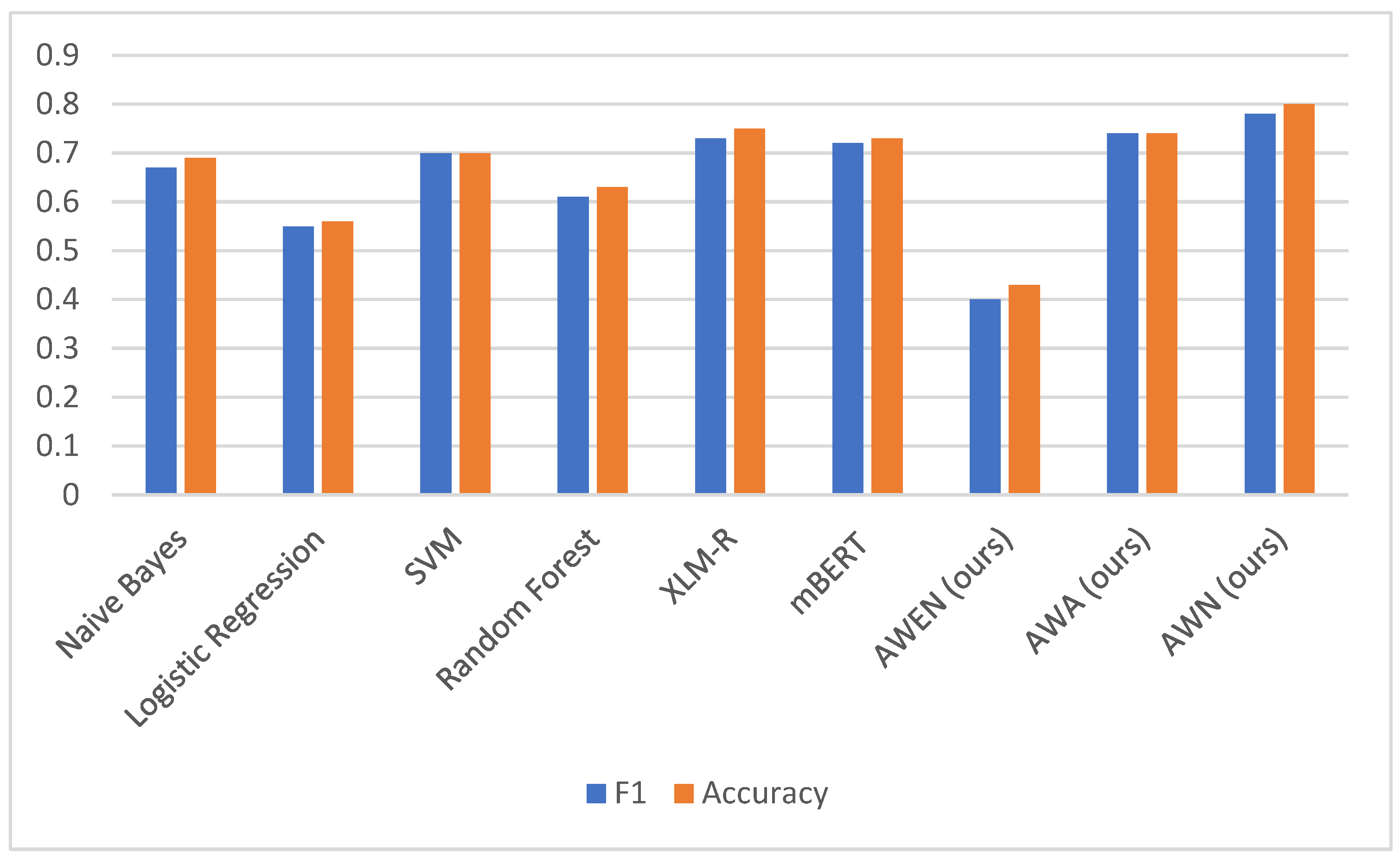
A comparative analysis of the accuracy of various WSD methods for several low-resource languages was conducted (see Table 8 and Figure 2).
The analysis of the performance of various methods for several low-resource languages showed that the methods proposed in this paper are competitive. The AWA method achieved recognition accuracy metrics of F1: 0.74 and accuracy of 0.74. The AWEN homonym recognition method based on the Euclidean metric for the same homonyms, showed an accuracy result of F1: 0.40 and accuracy of 0.43. The proposed AWN (F1 = 0.78) method for solving the WSD problem in the Chechen language was superior to the XLM-R (F1 = 0.73) and mBERT (F1 = 0.72) transformer models under conditions of limited data. This highlights the advantages of parametric methods for small amounts of source data. Among the WSD methods presented in the table, the Vikonbert model showed the highest accuracy rates, with F1: 0.87 and accuracy of 0.88. The XLM-R method for the Hausa language ranks second in terms of recognition accuracy, with F1: 0.79 and accuracy of 0.83.

6. Conclusions and Future Work

The experimental study of the developed AWN algorithm, which represents an adaptation of well-known approaches (based on weighted distances and contextual vectors) to extremely limited data conditions, established an empirical dependence between lexical disambiguation accuracy and the main model parameters using the homonym “bala” as an example. Analysis of the metrics calculated using the Scikit-learn library showed that the highest recognition efficiency was achieved with context window configurations of N = 4 (L = 2) and N = 6 (L = 3), indicating the existence of an optimal contextual analysis range. A key factor determining the increase in classification quality is the number of input data processing cycles С: increasing С from 300 to 1500 is accompanied by an increase in F1-score from 86.69 to 92.96. These results confirm that expanding the volume of analyzed databases and increasing the number of computational iterations contribute to more accurate statistical modeling of contextual dependencies and significantly improve homonym recognition accuracy in low-resource languages.
The developed AWN method demonstrated the best overall F1-scores (0.82 and 0.83), significantly outperforming other approaches when processing nouns and verbs, which are parts of speech most susceptible to lexical ambiguity. Although the AWA method slightly outperformed AWN in pronoun recognition accuracy (0.73 vs. 0.71), the AWN model provided the most balanced and stable result across all parts of speech, confirming its effectiveness for solving the homonymy resolution task in the Chechen language.
A comparative analysis of the performance of various word sense disambiguation methods for several low-resource languages confirms the competitiveness of the methods and algorithms proposed in this work. Among the considered models, ViConBERT demonstrated the best results (F1: 0.87 and accuracy of 0.88). The developed AWN method ranked second, with F1 0.78 and accuracy of 0.80, ahead of the XLM-R method for Hausa (F1: 0.79 and accuracy of 0.83) in integral assessment, and significantly surpassing the AWA (F1: 0.74 and accuracy of 0.74) and AWEN (F1: 0.40 and accuracy of 0.43) methods. The obtained results indicate that the proposed approach provides high homonym recognition accuracy and can be effectively applied to automatic speech synthesis tasks under limited linguistic resources, particularly for the Chechen language.
It is necessary to emphasize certain limitations of this research. Although valuable for a language with limited resources, the CheWSData corpus still includes only the most frequent homonyms and a relatively limited set of textual contexts. In addition, this method relies on manually annotated data, which requires significant involvement of language experts and may limit its rapid application to a larger number of words or to other languages.
Future research plans include expanding the CheWSData corpus with more diverse texts and additional homonyms to improve the statistical robustness of the developed method. The integration of the proposed WSD module with neural network speech synthesis architectures will also be explored to assess its impact on the naturalness of generated speech. Furthermore, we plan to explore semi-supervised and transfer learning methods to reduce the labor required for manual annotation and to facilitate the adaptation of the method to other languages in the Caucasus region with limited speech and text corpora. Finally, real-time performance optimization will be considered to ensure the feasibility of deployment in embedded speech synthesis systems. We plan to explore hybrid approaches where our context-oriented method provides hard constraints or prior probabilities for fine-tuning small multilingual Transformer models (e.g., XLM-R). This could reduce the amount of labeled data needed while leveraging cross-lingual transfer from related languages (e.g., Russian or Avar).

Author Contributions

Conceptualization, E.I., A.R., S.U., A.A. and Z.S.; Methodology, E.I., A.R., S.U., A.A. and Z.S.; Software, E.I., A.R., S.U., A.A. and Z.S.; Validation, E.I., A.R., S.U. and Z.S.; Formal Analysis, E.I., A.R., S.U., A.A., A.F. and Z.S.; Investigation, E.I., A.R., S.U., A.A., A.F. and Z.S.; Resources, E.I., A.R., S.U., A.A. and Z.S.; Data Curation, E.I., A.R. and S.U.; Writing—Original Draft, E.I., A.R., S.U., A.A., A.F. and Z.S.; Writing—Review and Editing, E.I., A.R., S.U., A.A. and Z.S.; Visualization, E.I., A.R., S.U., A.A. and A.F.; Supervision, A.R. and S.U. All authors have read and agreed to the published version of the manuscript.

Funding

The study was conducted as part of the Year of Unity of the Peoples of Russia, held in the Russian Federation.

Institutional Review Board Statement

Not applicable.

Informed Consent Statement

Not applicable.

Data Availability Statement

The original contributions presented in this study are included in the article. The Chechen text data can be provided upon request. Further inquiries can be directed to the corresponding author.

Conflicts of Interest

The authors declare no conflicts of interest.

Appendix A

Let us introduce the main terms used in the description of the results obtained in the course of the research and provide a formal formulation of the problem of resolving lexical homonymy and speech synthesis for the Chechen language. Table A1 summarizes the notations and descriptions of the parameters used. Due to the large number of hierarchically nested parameters—such as database–sentence–word–homonym–tag word–context position—the table uses two notation variants: a parameter with a combined index and a parameter-function, where the arguments are represented by indices.
Table A1. List of parameters used.
DesignationName
WNNumber of words being processed
wiNumber of the currently processed word
w (wi)Currently processed word
W = {w(1), w(2), …, w (wi), …, w(WN)}Set of words being processed
ON(wi)Number of homonyms for the word w(wi)
oj(wi)Number of the currently processed homonym for the word wi
o(oj,wi)Currently processed homonym oj for the word w(wi)
O(wi) = {o(1,wi), o(2,wi), …, o(oj,wi), …, o(ON,wi)}Set of homonyms being processed for the word wi
oj(wi)Number of the currently processed database of sentences with the homonym o(oj,wi)for the word w(wi)
B(oj,wi)Currently processed database of sentences with the homonym o(oj,wi).
B(wi) = {B(1,wi), B(2,wi), …, B(oj,wi), …, B(ON,wi)} }Set of processed databases of sentences with the homonym o(oj,wi).
PN(oj,wi)Number of sentences being processed with the homonym o(oj,wi).
p(oj,wi)Number of the currently processed sentence with the homonym o(oj,wi) for the word w(wi).
P(p,oj,wi)Currently processed sentence with the homonym o(oj,wi) for the word w(wi).
B(oj,wi) = {P(1,oj,wi), P(2,oj,wi), …, P(p,oj,wi), …, P(PN,oj,wi)}Currently processed database of sentences P(p,oj,wi) with the homonym o(oj,wi).
NNumber of tag words closest to the homonym o(oj,wi) in the sentence P(p,oj,wi), which will be used to identify the meaning of the homonym. This value is fixed for all processed words in one version of the speech synthesis system.
n(p, oj, wi)Number of the currently processed tag word in the sentence P(p,oj,wi) (1…N).
SP(n, p, oj, wi)Currently processed tag word at position n in the sentence P(p,oj,wi) in the database B(oj,wi).
P(p,oj,wi) = {SP(1,p,oj,wi), SP(2,p,oj,wi), …, SP(n,p,oj,wi), …, SP(N,p,oj,wi)}Sentence as a set of N tag words, establishing the context of the homonym o(oj,wi).
TN(oj, wi)Number of unique tag words contained in sentences from the database B(oj,wi).
t(oj, wi)Currently processed tag word from the sentence database B(oj,wi).
TV(g, t, p, oj, wi)Positional occurrence score of the currently processed tag word t(oj, wi) at position g(1..N) in sentence P(p,oj,wi).
TV(t,p,oj,wi) = (TV(1,t,p,oj,wi), TV(2,t,p,oj,wi), …, TV(g,t,p,oj,wi), …, TV(N,t,p,oj,wi)Numeric vector of positional occurrence scores of the currently processed tag word t(oj, wi) at position g(1..N) in sentence P(p,oj,wi).
STV(oj, wi)Total numerical vector of positional occurrence scores aggregated over all tag words t = 1..N(oj,wi) in the context of homonym o(oj,wi) (vector of length N).
TP(wi)Test input sentence containing the polysemantic word w(wi).
nt(wi)Index of the currently processed tag word in sentence TP(wi) (1..N(wi)).
TSP(nt_cur, wi)Currently processed tag word in sentence TP(wi).
TP(wi) ={TSP(1,wi), TSP(2,wi), …, TSP(nt_cur,wi), …, TSP(N,wi)}Set of tag words in the input test sentence TP(wi).
STPV(oj,wi)Total numerical vector of positional occurrence scores of tag words {TSP(nt_cur, wi)} in the contextual environment of the polysemantic word wi (vector of length N).
Q = q 1 , q 2 ,   , q N Vector of positional occurrence score weights of tag words.
o w i * Calculated index of the homonym value for the word w(wi) in the input test sentence TP(wi).

References

  1. Zen, H.; Sak, H. Unidirectional long short-term memory recurrent neural network with recurrent output layer for low-latency speech synthesis. In Proceedings of the 2015 IEEE International Conference on Acoustics, Speech and Signal Processing (ICASSP), Brisbane, QLD, Australia, 19–24 April 2015; IEEE: New York, NY, USA, 2015; pp. 4470–4474. [Google Scholar] [CrossRef] [Scilit]
  2. Saito, Y.; Takamichi, S.; Saruwatari, H. Statistical parametric speech synthesis incorporating generative adversarial networks. IEEE/ACM Trans. Audio Speech Lang. Process. 2018, 26, 84–96. [Google Scholar] [CrossRef] [Scilit]
  3. Okamoto, T.; Toda, T.; Shiga, Y.; Kawai, H. Real-Time Neural Text-to-Speech with Sequence-to-Sequence Acoustic Model and WaveGlow or Single Gaussian WaveRNN Vocoders. In Proceedings of the INTERSPEECH, Graz, Austria, 15–19 September 2019; ISCA: White Oak, MN, USA, 2019; pp. 1308–1312. [Google Scholar]
  4. Wang, Y.; Chen, T.; Zhou, S.; Zhang, F.; Zou, R.; Hu, Q. An improved Wavenet network for multi-step-ahead wind energy forecasting. Energy Convers. Manag. 2023, 278, 116709. [Google Scholar] [CrossRef] [Scilit]
  5. Pascual, S.; Bhattacharya, G.; Yeh, C.; Pons, J.; Serrà, J. Full-band general audio synthesis with score-based diffusion. In Proceeding of the ICASSP 2023—2023 IEEE International Conference on Acoustics, Speech and Signal Processing (ICASSP), Rhodes Island, Greece, 4–10 June 2023; IEEE: New York, NY, USA, 2023; pp. 1–5. [Google Scholar]
  6. Weiss, R.J.; Skerry-Ryan, R.J.; Battenberg, E.; Mariooryad, S.; Kingma, D.P. Wave-tacotron: Spectrogram-free end-to-end text-to-speech synthesis. In Proceedings of the ICASSP 2021—2021 IEEE International Conference on Acoustics, Speech and Signal Processing (ICASSP), Toronto, ON, Canada, 6–11 June 2021; IEEE: New York, NY, USA, 2021; pp. 5679–5683. [Google Scholar]
  7. Arık, S.Ö.; Chrzanowski, M.; Coates, A.; Diamos, G.; Gibiansky, A.; Kang, Y.; Li, X.; Miller, J.; Ng, A.; Raiman, J.; et al. Deep voice: Real-time neural text-to-speech. In Proceedings of the International Conference on Machine Learning, PMLR 2017, Sydney, NSW, Australia, 6–11 August 2017; JMLR: Norfolk, MA, USA, 2017; pp. 195–204. [Google Scholar]
  8. Pratap, V.; Tjandra, A.; Shi, B.; Tomasello, P.; Babu, A.; Kundu, S.; Elkahky, A.; Ni, Z.; Vyas, A.; Fazel-Zarandi, M.; et al. Scaling speech technology to 1,000+ languages. J. Mach. Learn. Res. 2024, 25, 97. [Google Scholar]
  9. Kipyatkova, I.; Kagirov, I.; Dolgushin, M. Use of Pre-Trained Multilingual Models for Karelian Speech Recognition. Inform. Autom. 2025, 24, 604–630. [Google Scholar] [CrossRef] [Scilit]
  10. Janardana Naidu, G.; Seshashayee, M. Sentiment Analysis Framework for Telugu Text Based on Novel Contrived Passive Aggressive with Fuzzy Weighting Classifier (CPSC-FWC). Inform. Autom. 2024, 23, 39–64. [Google Scholar] [CrossRef] [Scilit]
  11. Ren, Q.; Bo, Q.; Zhou, C.; Ji, Y.; Wu, N. SRC-IT2: Speech Rate-Controllable Mongolian Emotional Speech Synthesis Based on Improved Tacotron2. Electronics 2025, 14, 3835. [Google Scholar] [CrossRef] [Scilit]
  12. Ahmad, H.A.; Rashid, T.A. Central Kurdish Text-to-Speech Synthesis with Novel End-to-End Transformer Training. Algorithms 2024, 17, 292. [Google Scholar] [CrossRef] [Scilit]
  13. Mishev, K.; Karovska Ristovska, A.; Trajanov, D.; Eftimov, T.; Simjanoska, M. MAKEDONKA: Applied deep learning model for text-to-speech synthesis in Macedonian language. Appl. Sci. 2020, 10, 6882. [Google Scholar] [CrossRef] [Scilit]
  14. Zhang, J.; Wushouer, M.; Tuerhong, G.; Wang, H. Semi-supervised learning for robust emotional speech synthesis with limited data. Appl. Sci. 2023, 13, 5724. [Google Scholar] [CrossRef] [Scilit]
  15. Ren, Q.D.E.J.; Wang, L.; Zhang, W.; Li, L. Research on a Mongolian Text to Speech Model Based on Ghost and ILPCnet. Appl. Sci. 2024, 14, 625. [Google Scholar] [CrossRef] [Scilit]
  16. Liu, M.; Jiang, R.; Yang, H. Using Transfer Learning to Realize Low Resource Dungan Language Speech Synthesis. Appl. Sci. 2024, 14, 6336. [Google Scholar] [CrossRef] [Scilit]
  17. Karibayeva, A.; Karyukin, V.; Tukeyev, U.; Abduali, B.; Amirova, D.; Rakhimova, D.; Aliyev, R.; Shormakova, A. The Development and Experimental Evaluation of a Multilingual Speech Corpus for Low-Resource Turkic Languages. Appl. Sci. 2025, 15, 12880. [Google Scholar] [CrossRef] [Scilit]
  18. Karibayeva, A.; Karyukin, V.; Abduali, B.; Amirova, D. Speech Recognition and Synthesis Models and Platforms for the Kazakh Language. Information 2025, 16, 879. [Google Scholar] [CrossRef] [Scilit]
  19. Mir, T.A.; Lawaye, A.A. Word sense disambiguation corpus for Kashmiri. Nat. Lang. Process. 2025, 31, 631–654. [Google Scholar] [CrossRef] [Scilit]
  20. Aminu, H.; Saidu, I.R.; Odion, P.O. Curation of a polysemous word dataset for word sense disambiguation in Hausa language. J. Stat. Sci. Comput. Intell. 2025, 1, 175–186. [Google Scholar] [CrossRef] [Scilit]
  21. Sarmah, J.; Kumar Barman, A.; Kumar Sarma, S. Little Wins: Collecting, Preparing, and Publishing Resources for Assamese Word Sense Disambiguation. Comput. Sist. 2025, 29, 1317–1327. [Google Scholar] [CrossRef] [Scilit]
  22. Bibi, S.; Asghar, S.; Zubair, M. Breaking Barriers in URDU WSD: The Transfer Learning Enriched MAKS Framework. ACM Trans. Asian Low-Resour. Lang. Inf. Process. 2025, 24, 88. [Google Scholar] [CrossRef] [Scilit]
  23. Patil, C.S.; Patil, V.B. A Multilingual Exploration of Word Sense Disambiguation Using Transformer Models: “Dravidian and Devanagari Languages”. In Recent Advances in Computing Sciences; CRC Press: Boca Raton, FL, USA, 2025; pp. 158–160. [Google Scholar]
  24. Torunoğlu Selamet, D.; Şentaş, A.; Eryiğit, G. Gamified Crowd-sourcing for Word Sense Disambiguation of Turkish. ACM Trans. Asian Low-Resour. Lang. Inf. Process. 2025, 24, 130. [Google Scholar] [CrossRef] [Scilit]
  25. Barai, A.; Das, M.; Bhowmick, P.; Dey, U.; Dey, P.; Chowdhury, S. A Comprehensive Analysis of Word Sense Disambiguation in a Regional Language”. In Proceedings of the 2025 International Conference on Inventive Computation Technologies (ICICT), Kirtipur, Nepal, 23–25 April 2025; IEEE: New York, NY, USA, 2025; pp. 1260–1265. [Google Scholar] [CrossRef] [Scilit]
  26. Huynh, K.T.; Nguyen, D.H.; Nguyen, B.T. ViConBERT: Context-Gloss Aligned Vietnamese Word Embedding for Polysemous and Sense-Aware Representations. arXiv 2025, arXiv:2511.12249. [Google Scholar] [CrossRef] [Scilit]
Figure 1. A set of algorithms for resolving lexical ambiguities.
Bdcc 10 00181 g001
Figure 2. Results of the proposed methods on the WSD task in comparison with analogs (F1 and accuracy) for the Chechen language.
Bdcc 10 00181 g002
Table 1. Automatic speech synthesis systems for low-resource languages.
ReferenceLanguageDataset PropertiesModelQualityNotes
[12]KurdishKurdish speech corpus: 6078 utterances/13.63 hKTTSMOS 3.94Pre-training with a variational autoencoder (VAE)
[18]KazakhAudio–text pair (271 h)Kazakh TTS2DNSMOS 8.79–8.96Other models: Whisper, GPT-4 Transcribe, ElevenLabs, OpenAI TTS, Voiser, and TurkicTTS
[11]MongolianMongolian emotional speech corpus (2.25 h/2100 utterances)SRC-IT2MOS 3.7Seven emotional categories
[13]Macedonian20 h Macedonian high-quality speech
audio dataset
TTS MACEDONKAMOS 3.93Deep learning-based
method—Deep Voice 3
[14]EnglishESD dataset (350 utterances for each seven emotions)SMAL-ET2MOS 3.77–4.15
EMOS
3.75–4.03
The acoustic model Tacotron2 and the
HiFi-GAN vocoder
[15]MongolianThe Mongolian speech text dataset (NMLR-Mon2Chs ST) 21,478 audio files/25 hGhost-ILPCnetMOS 4.48With the Bang phoneme pre-training model
[16]DunganDungan corpus
(4615 sentences/6 h)
MDSD-Tacotron2 + WaveRNNMOS 4.17
DMOS 4.16
The TTS framework of Tacotron2 + WaveRNN-based model
Table 2. Word sense disambiguation systems for low-resource languages.
ReferenceLanguageDataset PropertiesModelQuality MetricsNotes
[19]KashmiriWSD corpus for Kashmiri (19,854 sentences)J48
IBk
Naive Bayes
Dl4jMlpClassifier
SVM
F1: 0.64
F1: 0.70
F1: 0.66
F1: 0.70
F1: 0.70
Corpus for 124 polysemantic words
[20]HausaHausa polysemous WSD dataset (2000 sentence)XLM-RF1: 0.79Zero-shot and fine-tuned XLM-R models
[21]Assamese Training dataset for SeAnDa
(2000 sentence)
Naive Bayes ClassifierF1: 0.71List of 100 polysemantic words ASI
[22] UrduExtended Urdu Corpus (EU): 25,000 wordsXLM-RoBERTa
SVM-RF
XLM-RF
XLM-SVM
F1: 0.63
F1: 0.68
F1: 0.69
F1: 0.68
Multi-module software system for WSD MAKS
[23]Dravidian
Devanagari
BERT, CTRLNo dataNo data
[25]Bengali No dataNo data
[26]VietnameseViConWSD (100,160 words)ViConBERTF1: 0.87With framework for contrastive learning
Table 3. Comprehensive statistics of our dataset.
StatisticsValue
Number of synsets 15,035
Number of words 152,204
Average words per synset3
Average sentences per word44.3
Total number of polysemous and homonyms6918 (4.5%)
Table 4. Statistics of our dataset on parts of speech.
Part of SpeechApproximateCount (%)
Noun~2560~37
Verb~3590~52
Adjective~550~8
Adverb~70~1
Pronoun~40~0.6
Others~100~1.4
Table 5. Results of calculating accuracy metrics using the AWN algorithm for the homonym “bala” (F1 and accuracy %).
The Homonym “Bala”
Number of Sentences in the Database481
CNLQF1Accuracy
10042[0.9, 1, 1, 0.9]80.3380.05
63[0.8, 0.9, 1, 1, 0.9, 0.8]85.4985.24
62[0.9, 1, 1, 0.9, 0.8, 0.7]74.2175.23
64[0.7, 0.8, 0.9, 1, 1, 0.9]83.5182.77
84[0.7, 0.8, 0.9, 1, 1, 0.9, 0.8, 0.7]79.4279.87
85[0.6, 0.7, 0.8, 0.9, 1, 1, 0.9, 0.8]72.9572.17
83[0.8, 0.9, 1, 1, 0.9, 0.8, 0.7, 0.6]82.8982.74
CNLQF1Accuracy
30042[0.9, 1, 1, 0.9]81.6381.63
63[0.8, 0.9, 1, 1, 0.9, 0.8]86.6986.69
62[0.9, 1, 1, 0.9, 0.8, 0.7]75.8576.09
64[0.7, 0.8, 0.9, 1, 1, 0.9]83.5583.56
84[0.7, 0.8, 0.9, 1, 1, 0.9, 0.8, 0.7]80.480.62
85[0.6, 0.7, 0.8, 0.9, 1, 1, 0.9, 0.8]74.9174.91
83[0.8, 0.9, 1, 1, 0.9, 0.8, 0.7, 0.6]84.5284.54
CNLQF1Accuracy
150042[0.9, 1, 1, 0.9]92.9692.97
63[0.8, 0.9, 1, 1, 0.9, 0.8]91.0791.09
62[0.9, 1, 1, 0.9, 0.8, 0.7]91.5691.60
64[0.7, 0.8, 0.9, 1, 1, 0.9]90.3490.42
84[0.7, 0.8, 0.9, 1, 1, 0.9, 0.8, 0.7]89.489.42
85[0.6, 0.7, 0.8, 0.9, 1, 1, 0.9, 0.8]90.1190.22
83[0.8, 0.9, 1, 1, 0.9, 0.8, 0.7, 0.6]91.4591.45
Table 6. Comparison of homographs synthesis results produced by the system.
Homographs SKPKmPmPm-P
Бала–give/die1122974%1686%12%
елира–gave/died751679%791%12%
Бен–only/nest522062%885%23%
Дакъа–part/corpse852670%1879%9%
Дала–God/give1183868%2480%12%
Дан–to make/lose421564%783%19%
Де–a day/kill31971%584%13%
Йаха–to go/live1054458%3765%7%
Йoлу–having/a growing1134065%2776%11%
Лар–trail/endure21672%481%9%
Шун–your/tray1122181%1289%8%
Where S—number of sentences with homographs voiced by the speech synthesizer; K—number of homographs incorrectly voiced by the speech synthesizer without the homonymy recognition module; P—percentage of homographs correctly voiced by the speech synthesizer without homonymy recognition; Km—number of homographs incorrectly voiced by the speech synthesizer with the homonymy recognition module; Pm—percentage of homographs correctly voiced with the homonymy recognition module; Pm-P—increase in the number of homographs correctly voiced by the speech synthesizer. On average, the increase in homographs correctly voiced by the human speech synthesis system was 12%, which undoubtedly improved the quality of speech reproduced by the synthesizer.
Table 7. Results of the proposed methods on the WSD task across different parts of speech in comparison with analogs (F1).
MethodTest DatasetDifferent POS of Test Datasets
NounVerbAdverbPronoun
Naive Bayes0.670.690.660.490.59
Logistic Regression0.550.560.600.520.54
SVM0.700.560.580.520.54
Random Forest0.610.630.630.500.52
AWEN (Ours)0.400.360.500.300.29
AWA (Ours)0.740.760.760.820.73
AWN (Ours)0.780.820.830.850.71
Table 8. Results of the proposed methods on the WSD task in comparison with analogs (F1 and accuracy).
LanguageDataset
Properties
ModelF1Accuracy
KashmiriWSD corpus for Kashmiri (19,854 sentences)J480.640.65
IBk0.700.71
Naive Bayes0.660.68
SVM0.700.72
Dl4jMlpClassifier0.700.72
HausaHausa Polysemous WSD dataset (2000 sentence)XLM-R0.790.83
Assamese SeAnDa
(2000 sentence)
Naive Bayes Classifier 0.710.72
UrduCorpus of Urdu texts (EU) 25,000 words XLM-RoBERTa0.630.71
SVM-RF0.680.72
XLM-RF0.690.77
XLM-SVM0.680.78
VietnameseViConWSD (100,160 words)ViConBERT0.870.88
ChechenCheWSData (15,035 sentences)Naive Bayes0.670.69
Logistic Regression0.550.56
SVM0.700.70
Random Forest0.610.63
XLM-R0.730.75
mBERT0.720.73
AWEN (Ours)0.400.43
AWA (Ours)0.740.74
AWN (Ours)0.780.80
Disclaimer/Publisher’s Note: The statements, opinions and data contained in all publications are solely those of the individual author(s) and contributor(s) and not of MDPI and/or the editor(s). MDPI and/or the editor(s) disclaim responsibility for any injury to people or property resulting from any ideas, methods, instructions or products referred to in the content.