1. Introduction
Deep saturation diving is essential for offshore engineering, rescue, and scientific exploration. At depths exceeding 50 m, divers must breathe a helium–oxygen mixture (heliox) to avoid nitrogen narcosis and oxygen toxicity. However, the physical properties of helium, including its low density and high sound speed, significantly alter speech acoustics. Under the vocal tract tube model, formant frequencies are approximately proportional to the speed of sound in the medium. In typical diving conditions, the sound speed in heliox can be around 2.6 times that in air, which shifts formants upward, while the fundamental frequency, or pitch, determined by vocal-fold vibration remains largely unchanged. This severe source–filter mismatch yields speech that sounds sharp and highly distorted, and is commonly referred to as the “Donald Duck” effect [
1].
Traditional heliox speech intelligibility enhancement relies on analog devices or digital signal processing (DSP) techniques [
2], such as pitch-synchronous overlap-and-add (PSOLA)-based voice conversion methods [
3], aiming to map shifted formants back to a normal-air frequency range. With the development of modern AI, automatic speech recognition (ASR) becomes a key enabling technology for diver communication safety and automated logging. When heliox distortion prevents reliable transcription, it also limits automatic command logging, post-mission documentation, and the integration of diver speech into intelligent monitoring or decision-support systems. However, mainstream ASR models, including Whisper [
4] and WeNet [
5], are trained on large-scale normal-air speech and can fail catastrophically under the extreme acoustic shift in heliox speech.
In recent years, deep-learning-based heliox speech processing has attracted growing attention. Representative work often follows a restoration-then-recognition view by formulating the problem as speech correction or domain conversion and learning mappings between heliox and normal-air speech [
6,
7,
8,
9]. However, this direction typically assumes a relatively stable cross-domain correspondence. In real diving data collection, recordings of the same text in normal and high-pressure conditions are often obtained via independent re-reading. Differences in speaking rate, pausing patterns, and breathing introduce non-linear temporal mismatches between paired recordings.
This issue is particularly pronounced in the low-resource and non-strictly aligned setting studied in this paper. Waveform-level or spectrogram-level regression must implicitly address both spectral correction and time compensation, and the learning objective can be easily affected by pairing errors. Even if a front-end output subjectively sounds closer to normal speech, it does not necessarily preserve acoustic structures that matter most for ASR. Therefore, this paper turns to model adaptation methods that directly optimize recognition performance.
This paper proposes a robust heliox ASR framework, termed PRL-DAS (Physics-informed Resampling and LoRA with Duration-Adaptive Speed). PRL-DAS consists of three components: physics-inspired linear resampling (PhysSpeed), Low-Rank Adaptation (LoRA), and duration-adaptive speed (DAS) inference enhancement. The key idea is to first use a simple physics-informed linear resampling operation to mitigate the dominant spectral shift, and then leverage parameter-efficient fine tuning [
10,
11] to adapt a Whisper foundation model with LoRA, absorbing residual non-linear distortions and prosodic differences without relying on waveform-level reconstruction supervision. The main contributions are as follows:
PRL-DAS framework: A robust heliox speech recognition framework that integrates physics-inspired linear resampling, parameter-efficient LoRA adaptation, and DAS inference enhancement for low-resource, non-strictly aligned paired data.
Soft-DAS inference enhancement: A smooth DAS schedule that improves recognition without additional training cost, motivated by the relationship between utterance duration and the preferred resampling factor.
Evaluation under strict leave-one-speaker-out (LOSO): A strict LOSO benchmark on 1048 paired Chinese normal-air/heliox recordings, together with ablations and statistical analysis to verify the role of each component.
2. Background and Task Definition
2.1. Acoustic Prior and Limits of Linear Correction
From the source–filter theory, heliox primarily affects speech through a global shift in vocal tract resonances rather than a fundamental change in the vocal-fold excitation mechanism [
1]. In human speech production, the glottal source determines the fundamental frequency and harmonic structure, while the vocal tract shapes the spectral envelope via formants. Approximating the vocal tract as a uniform tube closed at the glottis and open at the lips, the
n-th formant frequency
can be written as
where
L is the vocal tract length and
c is the speed of sound in the medium. With approximately fixed
L, formant locations are roughly proportional to
c. Replacing air with heliox, therefore, induces a significant formant shift.
The sound speed in air is about
m/s, while the sound speed in a heliox mixture
depends on gas composition and can be approximated as
where
is the adiabatic index,
R is the gas constant,
T is the absolute temperature, and
is the mean molar mass of the mixture. Because helium has a much smaller molar mass than air,
is typically much higher than
, and the idealized ratio
can fall in the range of 2.0–3.0 under typical conditions. The precise value varies with mixture ratio, pressure, and recording conditions.
Importantly, the theoretical k should not be directly equated with the optimal correction factor in an ASR system. Real recordings include changes in speaking rhythm, pauses, and breathing, and linear resampling also changes pitch and duration. In this paper, linear resampling is treated as a coarse physics-informed front-end correction to alleviate the dominant formant shift, and the resampling factor is selected on the development set for recognition performance rather than derived as a fixed physical constant. The selected factor therefore represents a development-calibrated compromise: it partially compresses the shifted spectral envelope while avoiding excessive duration stretching and pitch lowering that would move the signal away from the speech distribution expected by the pretrained recognizer.
2.2. Related Work
Existing studies on heliox speech processing can be broadly grouped into three directions. The first direction focuses on classic speech correction or unscrambling methods, relying on analog devices, spectral transformations, and parametric acoustic models to compensate or normalize formants, spectral envelopes, or related acoustic parameters [
2,
12,
13].
The second direction treats heliox speech processing as speech correction, speech enhancement, or domain conversion by learning mappings between heliox and normal-air speech. For example, adversarial training has been used for helium speech correction [
6]. More general frameworks such as Wave-U-Net [
7] and CycleGAN [
8,
9] can also be applied for spectrogram-level or waveform-level cross-domain transformation. This direction emphasizes learning domain mappings through paired regression or unpaired transfer objectives.
The third direction directly targets recognition by training deep models for heliox speech unscrambling or recognition and evaluating with recognition metrics such as word error rate or character error rate [
14,
15]. In addition, parameter-efficient fine-tuning methods such as adapters [
10] and LoRA [
11] have shown advantages for adapting speech models, offering practical tools for low-resource heliox adaptation. Unlike general low-resource Whisper adaptation, the present setting combines an extreme medium-induced spectral shift with paired but non-strictly aligned recordings. Therefore, PRL-DAS couples LoRA adaptation with a physics-informed front-end and a duration-adaptive inference schedule, rather than relying on model adaptation alone.
Overall, the above three directions correspond to front-end compensation, domain mapping, and task-driven model adaptation, respectively.
2.3. Task Definition
This paper studies heliox speech recognition under low-resource and non-strictly aligned paired recordings. The dataset is denoted as
where
and
are the normal-air and heliox recordings corresponding to the same transcript
. Here, paired means text-level pairing only, and
and
are not required to be strictly aligned on the time axis. Therefore, supervision is available only between each recording and its transcript, rather than frame-level alignment between the two recordings.
Under this setting, the goal is not to recover a normal-air waveform, but to learn a recognition function using the recording–transcript supervision. Evaluation follows the LOSO protocol, requiring robustness to dominant spectral shifts in heliox speech and stable generalization when training data are limited, pairs are not strictly aligned, and the test speaker is unseen.
3. Method
3.1. Overview
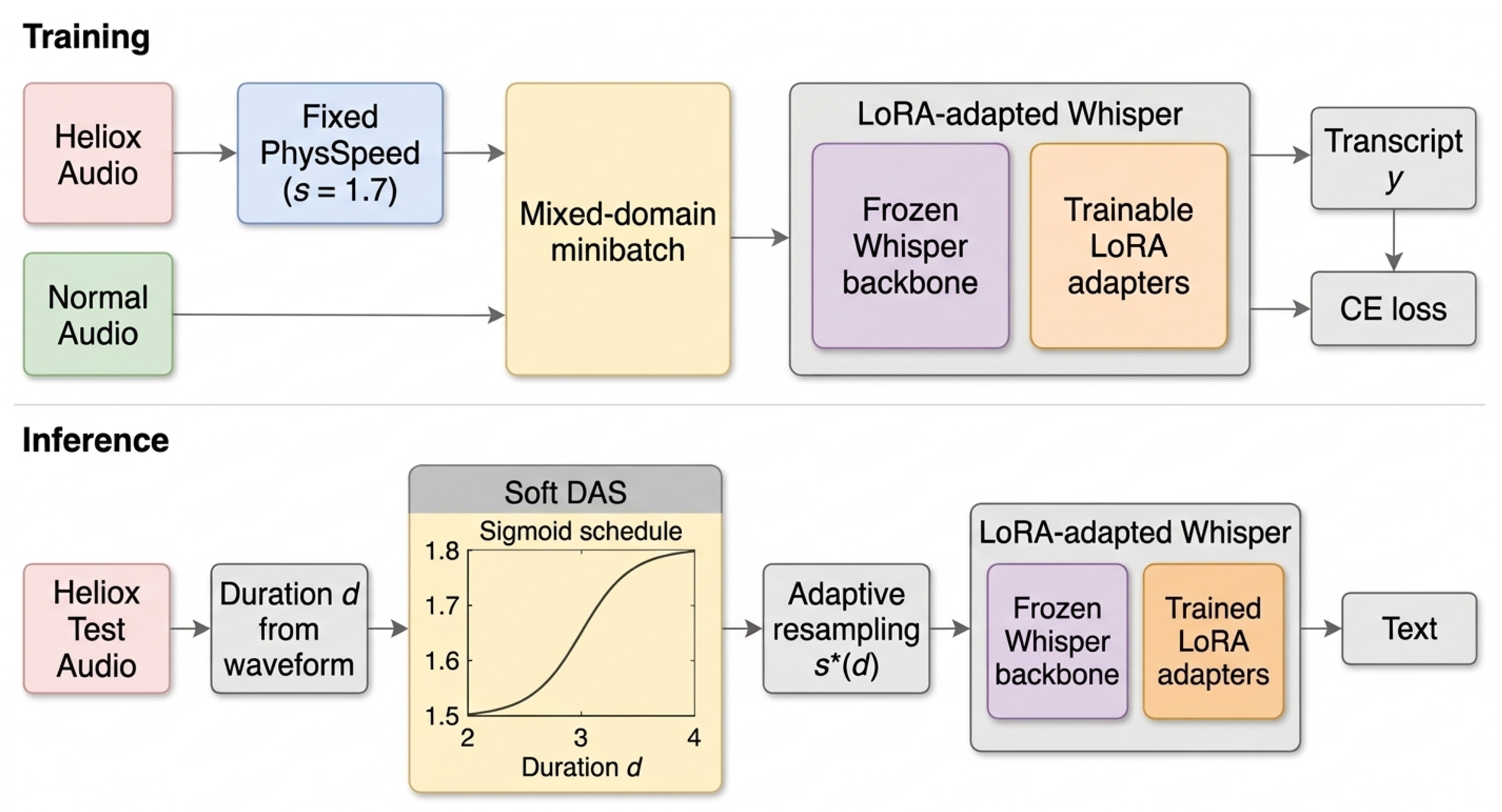
Figure 1 illustrates the overall PRL-DAS framework. In the training stage, heliox speech is first processed with a fixed PhysSpeed resampling step. Then, while keeping the main Whisper parameters frozen, LoRA is applied to adapt the recognition model. In the inference stage, model parameters remain unchanged, and Soft-DAS selects an adaptive resampling factor according to utterance duration. Recognition is performed after a single front-end resampling.
3.2. Training Stage
The training stage includes PhysSpeed preprocessing, LoRA adaptation, and a training objective, corresponding to coarse front-end correction, parameter-efficient adaptation, and supervised optimization.
3.2.1. PhysSpeed Preprocessing
During training, linear resampling is applied only to the heliox branch, while the normal-air branch is fed to the model in its original form. Let the raw heliox waveform be
. The preprocessed waveform is
where
denotes linear resampling with speed factor
s. In the frequency domain, it can be approximated as
which compresses the spectrum to
of the original. Under an idealized tube model, if
s is close to the formant shift ratio
k, the major formant shift can be moved back toward the normal-air range. In this paper, resampling is not used to precisely invert heliox distortion, but as a simple, stable, and controllable front-end operation for coarse acoustic correction. Because real speech also varies in speaking style, pauses, breathing, and recording conditions, and resampling itself changes pitch and duration,
s is treated as a global preprocessing parameter tuned on the development set for recognition performance rather than analytically derived from gas physics.
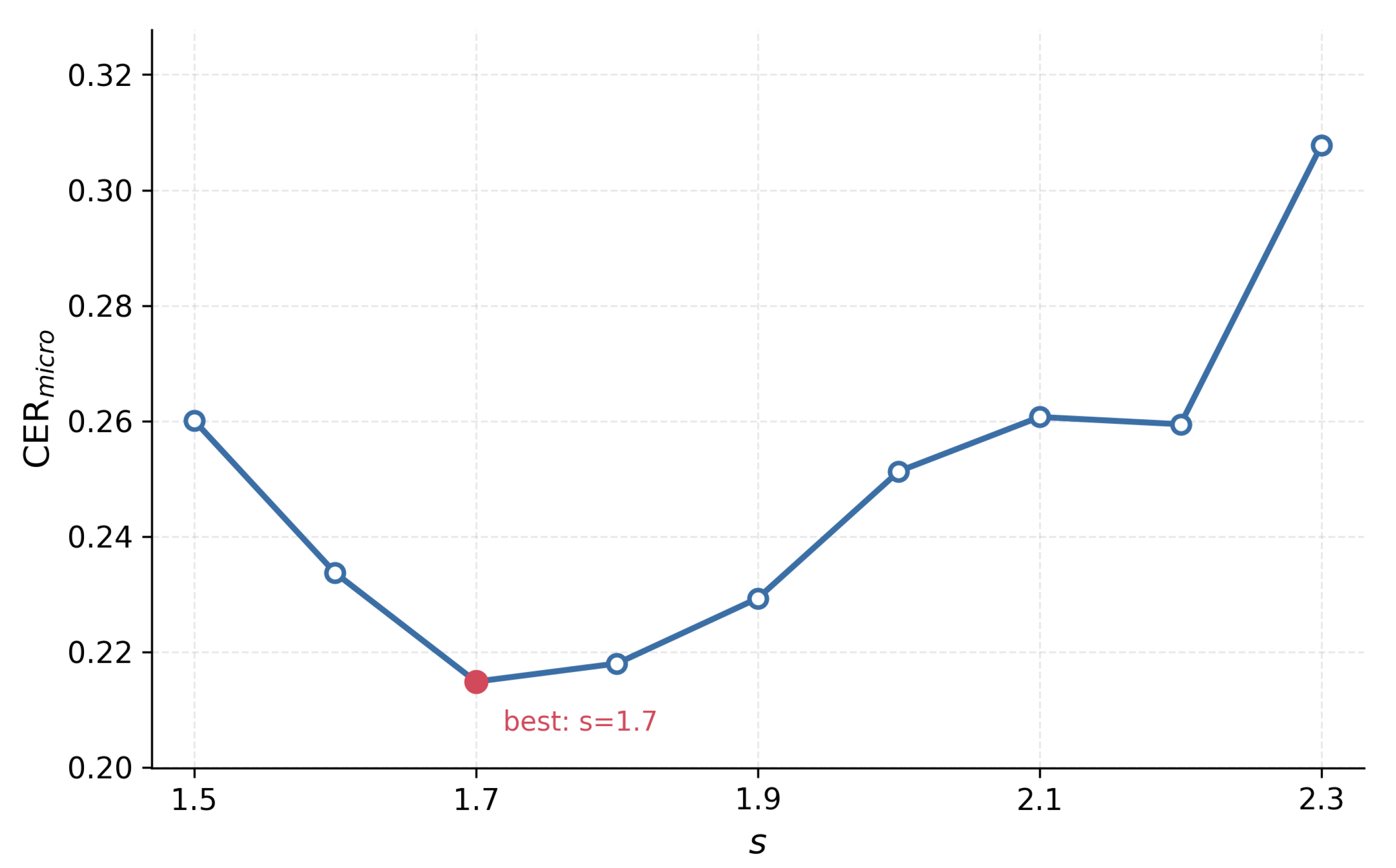
Only applying the preprocessing to heliox while keeping normal speech unchanged confines PhysSpeed to a unified correction of the dominant heliox spectral shift and preserves the original normal-air acoustic distribution. This mixed-domain setup encourages LoRA adaptation to model residual differences after preprocessing. To determine the fixed PhysSpeed factor used during training, we first perform a fixed speed sweep on the development set using the raw Whisper-Large baseline on heliox sentence utterances, aggregating CER
micro over the three LOSO development folds (
Figure 2). The minimum aggregated CER on the development set is obtained at
, which we therefore use as the uniform warm-start preprocessing factor during LoRA training. This value should be read as an ASR-optimized operating point under the present corpus and model configuration: it balances partial spectral compression against the duration stretching and pitch lowering introduced by stronger resampling.
3.2.2. LoRA Adaptation
After PhysSpeed preprocessing, residual domain differences remain between heliox and normal speech due to prosody, articulation style, and recording conditions. To model these differences, we adopt LoRA [
16] for parameter-efficient Whisper adaptation. Whisper is an encoder–decoder model pretrained on large-scale multilingual speech and provides strong language modeling and robustness. In the low-resource setting considered here, full fine tuning is prone to overfitting and incurs substantial memory and compute cost. LoRA freezes the original weight matrix
and introduces a low-rank update in the Query and Value projections of self-attention:
where
is frozen,
,
, and
. Matrix
A projects the input from
to an
r-dimensional subspace, and
B maps the low-dimensional representation back to
, avoiding learning a full
update. Consequently, the number of trainable parameters is reduced from
to
. In our implementation, LoRA is attached to the Query and Value projections of encoder self-attention as well as decoder self-attention and cross-attention, rather than updating the full model. For the main Whisper-Medium setting (
,
, dropout
), this amounts to about 4.72 M trainable parameters, i.e., approximately 0.62% of the full model. This allows PRL-DAS to adapt attention to heliox inputs with a small parameter footprint while largely preserving the pretrained language modeling capacity.
3.2.3. Training Objective
Training uses both preprocessed heliox speech
and raw normal-air speech
, with their transcripts serving as unified supervision. Let
denote a mixed-domain minibatch. The training loss is the standard cross-entropy
where
x is an input utterance,
is the transcript token sequence,
denotes the transcript tokens before position
t,
is the conditional distribution predicted by the model with parameters
, and
corresponds to the LoRA-adapted parameters above. The loss is equivalent to minimizing the negative log-likelihood of the ground-truth transcript, with
being the supervision label at step
t. For conciseness, normalization constants, for example by batch size or token count, are omitted. This does not change the optimization target. The objective requires only that each training utterance matches its transcript, and does not rely on frame-level alignment between the heliox and normal recordings, making it suitable for paired data that are text-matched but not strictly time-aligned.
In training sampling, both preprocessed heliox speech and raw normal speech are retained. We additionally increase the sampling ratio of sentence utterances to strengthen learning of long context and continuous speech flow, which improves recognition stability in inference.
3.3. Inference Stage
In inference, parameters of the LoRA-adapted Whisper model remain fixed, and only the front-end resampling speed is adjusted according to utterance duration. Fixed-speed comparisons show a duration dependence of the preferred resampling factor: shorter utterances tend to favor a larger speed factor, while longer utterances tend to favor a smaller factor. This indicates that the unified training-time preprocessing factor
provides stable overall correction but cannot simultaneously optimize for utterances of different durations. Therefore, PRL-DAS introduces Soft-DAS in inference, modeling the resampling speed as a continuous function of utterance duration to apply a more suitable front-end adjustment without changing model parameters. Quantitative results are reported in
Section 4.3.3. The following describes the Soft-DAS function and the parameter selection and inference procedure.
3.3.1. Soft-DAS Function
To avoid a discontinuous speed jump near a duration boundary, PRL-DAS adopts a continuous function of duration
d:
where
and
are the upper and lower endpoints for short and long utterances,
controls the transition center, and
controls the steepness. These endpoints and the transition window are not fixed physical constants. They are scheduling parameters selected for recognition performance based on development set comparisons in each LOSO split. To illustrate the meaning of the parameters, we use the Sigmoid configuration selected on the development set as an example:
,
, and transition window
seconds. An excessively small
s may fail to sufficiently mitigate the prominent formant shift in heliox speech, while an excessively large
s may further lower formants but also introduce stronger duration stretching and pitch changes, increasing deviation from the pretrained Whisper acoustic distribution. Based on fixed speed comparisons in
Figure 2, we use
as a reasonable search interval that balances frequency-domain correction and time-domain stability. For the configuration above, we set
Thus, the midpoint
s is a consequence of the transition window selected on the development set rather than a manually imposed universal acoustic boundary. To make the Sigmoid transition approximately 1% → 99% within the window, we set
and define
This smooth transition avoids abrupt speed changes for utterances near the boundary and yields a smoother front-end processing across neighboring samples.
3.3.2. Parameter Selection and Inference Procedure
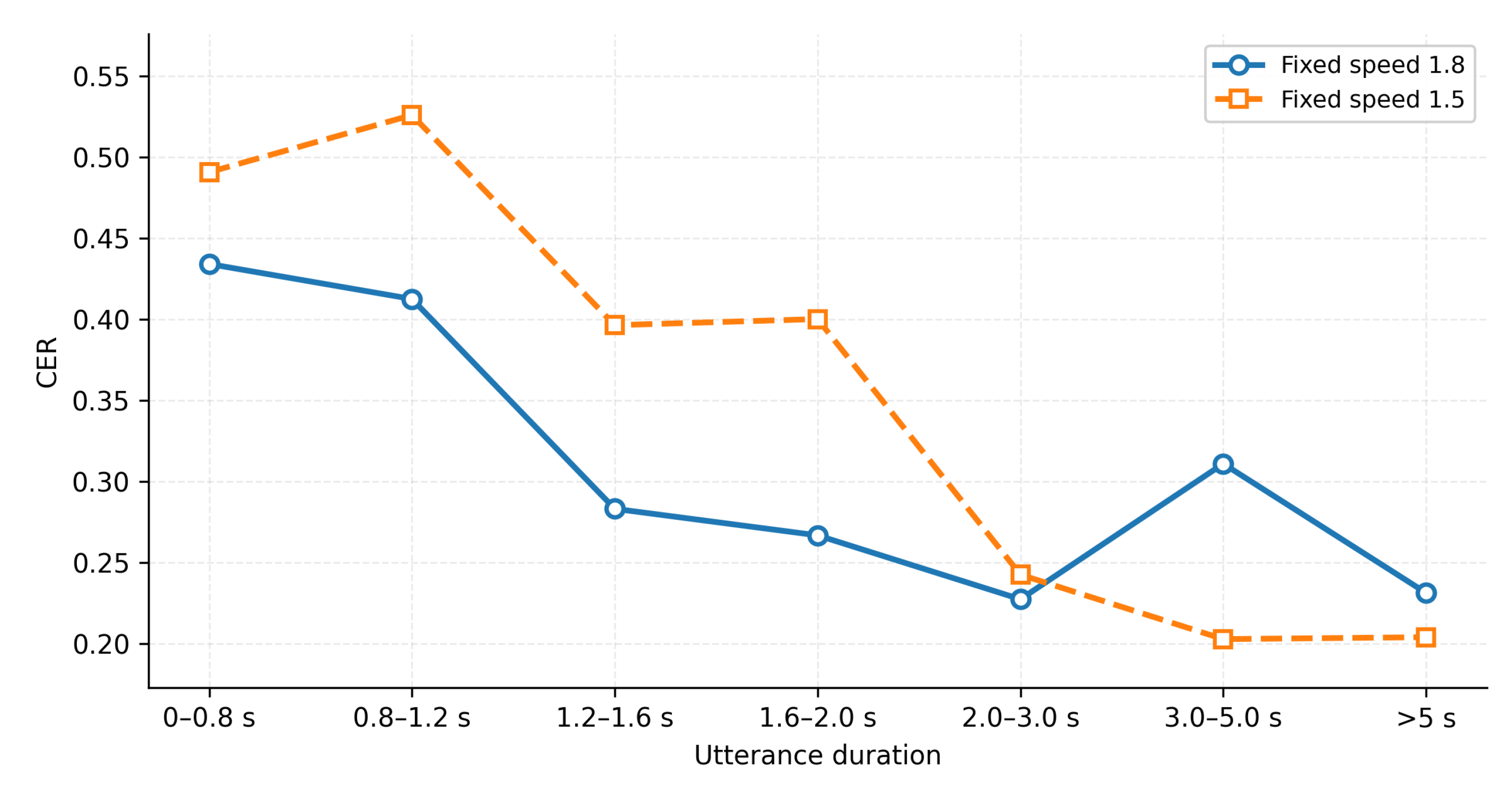
CER is used as the parameter selection metric, and parameters are selected independently on the development set of each LOSO split. We first compare fixed resampling factors across duration intervals to identify where the preferred speed changes. The comparison in
Figure 3 shows that the relative advantage of
and
changes around
s. Guided by this observation, we then tune candidate Soft-DAS configurations on the development set, including endpoint speeds, transition windows, and function forms. The selected Sigmoid configuration uses the window
seconds, whose midpoint is
s. The development set configuration comparison and final test set comparison are reported later in
Section 4.3.3.
In inference, a duration variable d is extracted from the input heliox utterance to determine the resampling factor. By default, d is defined as the total duration of the raw waveform. To examine whether silence affects duration estimation, we additionally run a control setting where an energy-based voice activity detector is used to estimate voiced duration and replace total duration as d. Next, d is fed into to obtain an adaptive resampling factor, a single resampling is applied to the waveform, and the processed audio is sent to the LoRA-adapted Whisper model for recognition. Restricting the duration-based adjustment to a single front-end transformation reduces potential accumulated error and acoustic uncertainty from repeated signal processing. In our tests, only 9 out of 1048 test utterances changed their selected speed under voiced-duration-based d, and overall CER remained essentially unchanged. This suggests that Soft-DAS decisions are mainly influenced by effective speech duration rather than being dominated by silence duration.
4. Experiments
and Results Analysis
4.1. Experimental Setup
4.1.1. Dataset and Evaluation Protocol
We use an in-house Chinese heliox speech corpus recorded from three divers recruited for this study, comprising 1048 text-paired normal-air/heliox recording pairs.
Table 1 summarizes basic statistics. Importantly, pairing refers to recordings of the same text content in normal and heliox conditions, but not strictly time-aligned parallel recordings. All results are therefore obtained under this realistic non-strict alignment condition.
We adopt strict LOSO cross-validation. In each split, all samples from one speaker are used as the test set, and the three test set sizes are 340, 353, and 355. Samples from the remaining two speakers are randomly split into training and development sets at an approximately 9:1 ratio. Across the three splits, the training/development/test sizes are 625/83/340, 629/66/353, and 613/80/355, respectively. All hyperparameters are tuned on the corresponding development set, and the test set is used only for the final evaluation. Because this corpus was collected under one operational depth/pressure and breathing-gas condition, the fixed PhysSpeed factor and Soft-DAS endpoints should be regarded as parameters calibrated on the development set for the present condition. Deployment under substantially different pressure profiles or gas mixtures would require recalibration with representative development data.
4.1.2. Text Normalization and Metric
To reduce evaluation bias caused by text formatting differences, we apply the same deterministic normalization to reference transcripts and model outputs. Specifically, we apply Unicode NFKC normalization, lowercase Latin letters, remove whitespace and punctuation, retaining only Chinese characters, Latin letters, and Arabic digits, and convert Traditional Chinese characters to Simplified Chinese using OpenCC (opencc-python-reimplemented v0.1.7). Evaluation is performed on three test subsets: characters, words, and sentences, and we also report an overall metric on the full test set.
The main metric is the character error rate (CER), defined as
where
is the edit distance at the character level between prediction
and reference
, and
is the reference length in characters. The subset names words and sentences refer only to the segmentation unit. The basic unit for error counting is always a single character. For samples with extremely short references, insertion errors can make the local CER exceed 100%, which is a normal statistical outcome.
4.1.3. Training and Inference Settings
We implement LoRA fine tuning with PyTorch v2.5.1, HuggingFace Transformers v5.1.0, and the parameter-efficient fine tuning (PEFT) library v0.18.1, and use faster-whisper v1.2.1 with a CTranslate2 v4.7.1 backend to accelerate inference. During training, we fix the random seed to 1337 and use the AdamW optimizer. Beyond the main hyperparameters listed below, the remaining training settings follow the library defaults, with weight decay set to 0.0, maximum gradient norm set to 1.0, and gradient checkpointing enabled. In both training and testing, we set the language to Chinese and the task to transcription. Unless otherwise noted, test-time decoding uses the default faster-whisper transcription configuration under float16, namely, beam_size = 5 and best_of = 5, a temperature schedule {0.0, 0.2, 0.4, 0.6, 0.8, 1.0}, and condition_on_previous_text = True.
Table 2 lists the main configuration and hardware.
Unless otherwise specified, main results refer to the Medium configuration in
Table 2.
4.2. Results
4.2.1. Baselines Without Adaptation
Table 3 summarizes baselines without parameter adaptation.
Without fine tuning, PhysSpeed preprocessing substantially improves both Whisper base models. For Whisper-Medium, PhysSpeed reduces CER on the sentence subset from 100.07% to 28.98%, and reduces overall CER from 107.24% to 49.33%. For Whisper-Large, the corresponding metrics decrease from 90.27% and 98.74% to 22.90% and 43.62%. These results indicate that a larger Whisper model has some robustness advantage without fine tuning, and that physics-inspired resampling is critical for both models. As a strong Chinese ASR reference outside the Whisper family, Paraformer-zh also benefits substantially from speed correction, with overall CER decreasing from 103.85% on raw heliox input to 33.36% after applying the same correction factor (). Its CER on the sentence subset reaches a highly competitive 17.47%, showing that it can make effective use of linguistic context in longer utterances. However, diver communication in operational scenarios often involves short, isolated commands, status reports, and terms specific to the diving domain, where limited linguistic context is available. On the practically important short word subset and character subset, Paraformer-zh still degrades substantially, with CERs of 78.64% and 120.62%, respectively. As a result, its overall CER remains substantially higher than the adapted Whisper results reported below. This contrast suggests that strong contextual modeling can compensate for heliox distortion in longer utterances, whereas physics-informed acoustic preprocessing and adaptation to the recognition task remain essential for robust recognition across heterogeneous utterance lengths.
4.2.2. Front-End Restoration and Enhancement Baselines
To further examine whether a stronger front-end can replace model adaptation, we evaluate several restoration or enhancement alternatives before recognition with the same Whisper-Large backend. These alternatives include a learned waveform mapper, a simple spectral equalization front-end, a frequency warping front-end based on vocal tract length normalization (VTLN), a complex mask spectrogram mapper, and a pretrained MetricGAN+ speech enhancement model [
18]. The results are summarized in
Table 4.
The comparison shows that front-end restoration is not a reliable substitute for recognition-oriented adaptation in the present data condition. PhysSpeed is already a strong baseline because it directly targets the dominant spectral shift with a stable operation. Learned mapping front-ends can improve over raw heliox speech in some subsets, but they do not outperform PhysSpeed in overall CER under the same Whisper-Large backend. They also remain far behind the PRL-DAS result reported below. This supports the motivation for using PhysSpeed as a stable warm-start front-end and assigning the remaining recognition problem to LoRA-based model adaptation.
4.2.3. Main Results and Comparisons
Table 5 reports adaptation results on different base models.
Using overall CER as the key metric, PRL-DAS on Whisper-Medium achieves the lowest overall CER of 24.37%. Compared with the unadapted Whisper-Medium baseline with PhysSpeed preprocessing in
Table 3, which yields an overall CER of 49.33%, LoRA adaptation with fixed
already reduces overall CER to 25.79%. This shows that, after linear resampling performs coarse formant correction, parameter-efficient LoRA adaptation can further improve recognition.
On top of LoRA adaptation, DAS in inference provides an additional gain in the tested setting. For both Whisper-Medium and Whisper-Large, Soft-DAS with a smooth transition outperforms fixed speed inference and binary switching in overall CER. Specifically, Soft-DAS improves overall CER to 24.37% and 25.00% for the two base models, respectively. This indicates that adjusting the resampling speed according to utterance duration is an effective inference refinement without additional training cost.
Comparing model scales in
Table 5, Whisper-Large achieves the lowest sentence-subset CER under PRL-DAS, at 18.74%, but its word-subset and character-subset CERs remain higher than those of Whisper-Medium. Consequently, the best overall CER is obtained by PRL-DAS on Whisper-Medium, at 24.37%. This suggests that the larger model converts more of its capacity into gains on longer utterances, whereas Whisper-Medium remains more balanced across heterogeneous utterance lengths.
To better understand this model-scale behavior at the error-type level,
Table 6 decomposes representative fixed speed LoRA outputs into substitution, deletion, and insertion rates. The comparison is made under the same PhysSpeed factor
, so that the effect mainly reflects model scale rather than a different inference schedule. The final CER column corresponds to the fixed speed LoRA rows in
Table 5, rounded to one decimal place. For each subset, substitution, deletion, and insertion are component rates at the character level normalized by the number of reference characters; therefore, their sum equals CER up to rounding.
Table 6 shows that substitutions dominate the errors for both model sizes, especially on the word and character subsets. Under fixed speed LoRA, Whisper-Large has a lower CER than Whisper-Medium on the sentence subset, 20.1% versus 22.0%, mainly because its insertion rate is lower on sentence utterances, 4.1% versus 7.1%, despite a slightly higher substitution rate. On short inputs, however, Whisper-Large has much higher substitution rates on the word and character subsets, 38.5% versus 29.8% and 83.5% versus 66.7%, which leads to higher CERs on these subsets and a higher overall CER. Thus, the extra errors of Whisper-Large on short inputs are driven mainly by substitutions rather than insertions. Under the current unified decoding setting, Whisper-Large benefits more from richer context, whereas Whisper-Medium remains more balanced on short inputs. A more specialized decoding configuration for Whisper-Large remains future work.
4.3. Ablations and Analysis
4.3.1. Gain Decomposition
Table 7 decomposes overall CER gains under the Whisper-Medium main configuration. CER reduction denotes the decrease relative to the previous row.
The gain decomposition shows a clear layered structure. PhysSpeed preprocessing yields the largest reduction, decreasing overall CER from 107.24% to 49.33%, indicating that the global formant shift is the primary acoustic factor affecting recognition. Under the same front-end, adding LoRA adaptation further reduces overall CER from 49.33% to 25.79%, suggesting that linear resampling alone cannot cover remaining prosodic changes, articulation differences, and residual domain differences. In comparison, Soft-DAS provides a smaller additional reduction from 25.79% to 24.37% but incurs the lowest cost because it is applied only in inference and does not add any training overhead. Overall, PhysSpeed, LoRA, and Soft-DAS play different roles and yield complementary gains when combined.
4.3.2. Training Strategy Ablations
To verify key components of the LoRA training setup on Whisper-Medium, we compare variants that remove normal-domain mixing or remove sentence oversampling. All comparisons use fixed inference speed and follow the same LOSO protocol.
Table 8 shows that both components are effective. Removing normal-domain mixing increases overall CER to 32.55%, indicating that keeping normal speech as a reference domain helps stabilize adaptation. Removing sentence oversampling further lowers performance, with overall CER and CER on the sentence subset increasing to 35.50% and 27.55%, respectively, suggesting that increasing the proportion of sentence utterances helps learning long context and prosodic information.
Beyond the heliox ablations in
Table 8, we also perform a complementary normal-domain check to ensure that mixed-domain adaptation does not damage recognition of ordinary speech. The Whisper-Medium LoRA model trained with the same mixed-domain recipe is evaluated on normal-air recordings with
. It obtains a CER of 7.42% on the sentence subset and an overall CER of 7.91%, compared with 14.55% and 22.91% for the raw Whisper-Medium baseline under the same evaluation setting. Together with the degradation observed when normal-domain mixing is removed, this result suggests that mixed-domain training stabilizes heliox adaptation while preserving, and in this setup improving, normal-domain recognition.
4.3.3. Soft-DAS Analysis
To analyze the relationship between the preferred resampling factor and utterance duration, we use the Whisper-Medium LoRA model with fixed
and compare fixed resampling factors
and
across duration intervals on the development set. We compute 95% bootstrap confidence intervals, and the results are shown in
Figure 3. Shorter utterances tend to prefer a larger resampling factor. In the 3–5 s range,
yields lower error, and as duration increases further, the gap between the two settings becomes smaller. This pattern suggests that a single global resampling factor is unlikely to be optimal across all durations, providing direct evidence for duration-adaptive scheduling.
Table 9 summarizes the development set comparison used for Soft-DAS selection. Here, LOSO dev 1–3 denote the development sets associated with the three leave-one-speaker-out splits. Rows with fixed speeds provide anchor results for candidate resampling speeds. The comparison by duration in
Figure 3 further shows that larger speed factors are more favorable for short utterances, whereas smaller factors become more competitive for longer utterances. These observations define the endpoint search range rather than an a priori physical constant. The duration-adaptive rows then report selected configurations for different schedule families. For consistency with the smooth schedules, the hard binary schedule uses the same endpoint speeds,
; because binary switching has no transition window, it switches at the midpoint
s. The smooth schedules use the same endpoint speeds and the transition window
seconds, so that their only difference is the schedule form. Under this comparison, Sigmoid obtains the lowest aggregate development set CER of 20.75%, followed by Smoothstep, Linear, and Binary. Therefore, the final Soft-DAS configuration uses a Sigmoid schedule with
,
, and the transition window
seconds. The midpoint of this selected window is
s.
We further compare different function forms under the same development set selection and test set evaluation setting.
Table 10 summarizes CER on the three subsets and the overall metric for different Soft-DAS configurations.
Figure 3 suggests that the preferred resampling factor changes with duration rather than remaining fixed for all utterances. Soft-DAS therefore uses smooth scheduling to model this relationship, avoiding the discontinuities caused by hard switching.
Table 10 reports the final test set comparison using the configuration selected on the development set for each Soft-DAS form. The selected Sigmoid configuration achieves the lowest overall CER of 24.37%. Although the numerical differences among smooth schedules are modest, the results support the usefulness of duration-aware speed scheduling. We adopt the Sigmoid schedule as the default implementation because it provides the best aggregate result among the tested configurations and gives a bounded, monotonic transition between the speed regimes for short and long utterances.
4.4. Cross-Speaker and Representation Analysis
4.4.1. Held-Out Speaker Results
To further examine performance under the held-out speaker condition, we report overall CER for each LOSO test split. Results are shown in
Table 11.
Table 11 shows overall CER for each held-out speaker using the Whisper-Medium base model. PRL-DAS consistently outperforms the corresponding PhysSpeed-only baseline across all three LOSO splits, suggesting that gains are not concentrated on a single held-out speaker. Since the dataset currently contains three speakers, these results primarily reflect cross-speaker consistency within the present LOSO setting. Performance on a larger speaker population remains to be validated with future data.
Different speakers exhibit noticeably different difficulty levels in the heliox condition. For Speaker 1, the PhysSpeed baseline overall CER is 61.51%, substantially higher than the other two speakers. Manual listening inspection identified a more pronounced accent and stronger articulation variability for this speaker, which is consistent with the higher baseline difficulty. Because each speaker appears in only one held-out test split in the current LOSO setting, we avoid attributing this gap to accent alone and interpret it as speaker-dependent difficulty under the present heliox condition. With PRL-DAS, Speaker 1 decreases to 34.46%, an absolute CER reduction of 27.05%, indicating that the proposed method remains effective even for the most challenging held-out speaker in the current corpus.
4.4.2. Encoder Representation Distance
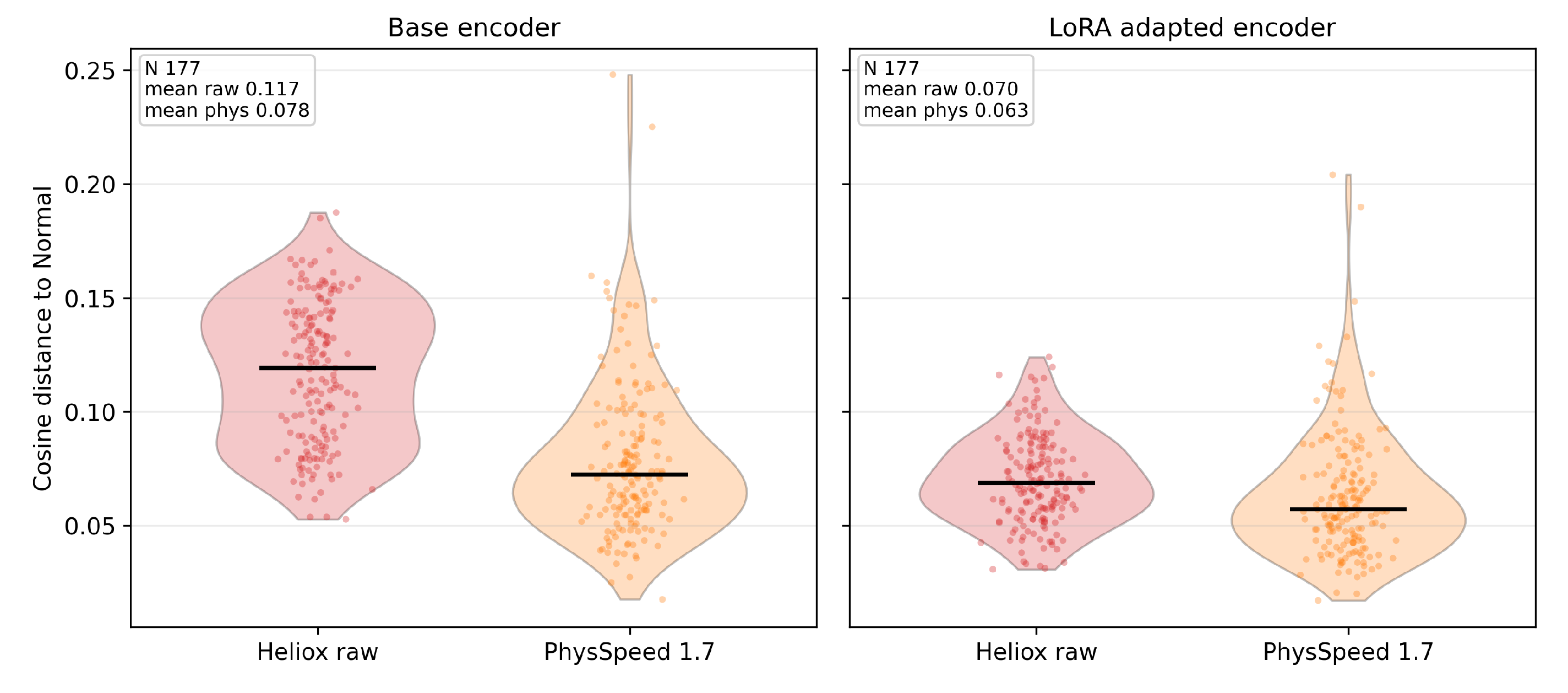
After establishing cross-speaker consistency, we analyze the effect of PhysSpeed preprocessing and LoRA adaptation at the representation level. For sentence utterances in the three LOSO test splits, we use the best LoRA adapter for each split to extract encoder outputs for normal-air speech, raw heliox speech, and PhysSpeed-preprocessed heliox speech. We apply time-mean pooling over valid encoder frames of the last-layer hidden states to obtain utterance-level representations, and compute cosine distances between each heliox representation, either raw or PhysSpeed-preprocessed, and its paired normal-air representation.
Figure 4 shows the aggregated distance distributions across the three LOSO splits. The left panel uses the base Whisper encoder, and the right panel uses the LoRA-adapted encoder for each split. In the base encoder space, PhysSpeed-preprocessed heliox speech has smaller cosine distances to paired normal speech than raw heliox speech, with the mean distance decreasing from 0.117 to 0.078. This indicates that linear resampling can already reduce the representation gap in encoder space. After LoRA adaptation, the mean distances for raw heliox and PhysSpeed heliox further decrease to 0.070 and 0.063, and the mean distance gap shrinks from 0.039 to 0.007. Together with recognition results, this suggests that PhysSpeed mainly provides coarse front-end correction and LoRA further improves encoder representations. Note that cosine distances are computed on mean-pooled encoder outputs and are used to reflect representation trends. They should not be interpreted as perceptual similarity or a strict acoustic distance.
5. Conclusions and Outlook
This paper proposes PRL-DAS for low-resource and non-strictly aligned paired heliox data. PRL-DAS uses physics-inspired resampling as a coarse front-end correction, LoRA adaptation of Whisper as the main recognition enhancement, and Soft-DAS as a smooth speed schedule at inference for utterances of different durations. Under LOSO evaluation, PRL-DAS reduces overall CER to 24.37%, demonstrating that combining preprocessing, parameter-efficient adaptation, and lightweight inference enhancement is effective under the current task setting. Experimental results indicate that PhysSpeed primarily mitigates the dominant spectral shift, LoRA provides the main recognition gain, and Soft-DAS adds an additional improvement without extra training cost. Overall, PRL-DAS provides a practical step toward heliox speech recognition under low-resource and non-strictly aligned conditions. Accordingly, the current system should be viewed as a substantial improvement under an extremely low-resource recognition setting, while fully autonomous safety-critical diver communication will require further reductions in recognition errors and validation under broader operating conditions.
The main limitation of this study is limited corpus coverage. The current dataset contains three speakers and was collected under a single operational depth/pressure and breathing-gas condition with re-read speech and limited text coverage. The prompts are organized as scripted utterances at word, character, and sentence levels and include diver-operation terms, but they are not spontaneous conversational speech. This limitation should be interpreted in light of the practical constraints of heliox speech collection. Unlike ordinary ASR corpora, heliox recordings require saturation-diving operations, prepared breathing-gas mixtures, pressure-compatible recording procedures, and strict safety constraints, which make large-scale spontaneous conversational data collection difficult. Therefore, although the corpus is limited in speaker number and text diversity, the paired normal-air/heliox recordings still provide a controlled low-resource benchmark for studying robust heliox ASR. The optimal schedule endpoints and adaptation effects mainly reflect cross-speaker behavior under the current setting, and stability under more speakers, more natural conversational speech, more diverse text, and different environmental conditions require further validation. Future work will expand the corpus, include more natural diver speech and operating conditions, evaluate calibration under different pressure and gas-mixture profiles, and explore more general multi-speed training and adaptive scheduling strategies.
Author Contributions
Conceptualization, Y.C. and G.Z.; methodology, G.Z. and W.W.; software, G.Z. and W.W.; validation, G.Z. and W.W.; formal analysis, G.Z. and S.Z.; investigation, Y.C., G.Z. and W.W.; resources, Y.C. and S.Z.; data curation, G.Z. and W.W.; writing—original draft preparation, G.Z.; writing—review and editing, Y.C., W.W. and S.Z.; supervision, Y.C. and S.Z.; funding acquisition, Y.C. and S.Z. All authors have read and agreed to the published version of the manuscript.
Funding
This work was supported by the National Natural Science Foundation of China under Grant 61371112, the “Qinglan Project” of Jiangsu universities for the training of young and middle-aged academic leaders, the “Qinglan Project” of Jiangsu universities for the Excellent Teaching Team, and Nantong Key Laboratory of Artificial Intelligence New Quality Technology, Jiangsu College of Engineering and Technology.
Institutional Review Board Statement
Ethical review and approval were waived for this study in accordance with local institutional requirements because the work involved non-invasive speech recordings collected for engineering research and did not include medical intervention procedures. Under Article 32 of the Measures for the Ethical Review of Life Science and Medical Research Involving Humans (Guo Wei Ke Jiao Fa [2023] No. 4), research using anonymized human information data under low-risk circumstances may be exempted from ethical review. This study meets these conditions and does not involve sensitive personal information or commercial interests. Informed consent was obtained from all participants in compliance with Articles 33, 35, and 36 of the same Measures.
Informed Consent Statement
Informed consent was obtained from all subjects involved in the study.
Data Availability Statement
The data presented in this study are available from the corresponding author on reasonable request. The recordings are not publicly released because they contain human speech data collected under controlled experimental conditions.
Conflicts of Interest
The authors declare no conflicts of interest.
Abbreviations
| ASR | automatic speech recognition |
| CER | character error rate |
| DAS | duration-adaptive speed |
| LOSO | leave-one-speaker-out |
| LoRA | low-rank adaptation |
| PEFT | parameter-efficient fine tuning |
| PRL-DAS | physics-informed resampling and LoRA with duration-adaptive speed |
| PSOLA | pitch-synchronous overlap-and-add |
| VAD | voice activity detection |
| VTLN | vocal tract length normalization |
References
- Belcher, E.O.; Hatlestad, S. Formant frequencies, bandwidths, and Qs in helium speech. J. Acoust. Soc. Am. 1983, 74, 428–432. [Google Scholar] [CrossRef] [Scilit] [PubMed]
- Richards, M.A. Helium Speech Enhancement Using the Short-Time Fourier Transform. Ph.D. Thesis, Georgia Institute of Technology, Atlanta, GA, USA, 1982. [Google Scholar]
- Moulines, E.; Charpentier, F. Pitch-synchronous waveform processing techniques for text-to-speech synthesis using diphones. Speech Commun. 1990, 9, 453–467. [Google Scholar] [CrossRef] [Scilit]
- Radford, A.; Kim, J.W.; Xu, T.; Brockman, G.; McLeavey, C.; Sutskever, I. Robust Speech Recognition via Large-Scale Weak Supervision. arXiv 2022, arXiv:2212.04356. [Google Scholar] [CrossRef] [Scilit]
- Yao, Z.; Wu, D.; Wang, X.; Zhang, B.; Yu, F.; Yang, C.; Peng, Z.; Chen, X.; Xie, L.; Lei, X. WeNet: Production Oriented Streaming and Non-Streaming End-to-End Speech Recognition Toolkit. Proc. Interspeech 2021, 2021, 4054–4058. [Google Scholar] [CrossRef] [Scilit]
- Li, H.; Chen, Y.; Ji, H.; Zhang, S. A Helium Speech Correction Method Based on Generative Adversarial Networks. Big Data Cogn. Comput. 2024, 8, 158. [Google Scholar] [CrossRef] [Scilit]
- Stoller, D.; Ewert, S.; Dixon, S. Wave-U-Net: A Multi-Scale Neural Network for End-to-End Audio Source Separation. In Proceedings of the 19th International Society for Music Information Retrieval Conference; ISMIR: Paris, France, 2018; pp. 334–340. [Google Scholar]
- Zhu, J.; Park, T.; Isola, P.; Efros, A.A. Unpaired Image-to-Image Translation using Cycle-Consistent Adversarial Networks. In Proceedings of the 2017 IEEE International Conference on Computer Vision (ICCV); IEEE: Piscataway, NJ, USA, 2017; pp. 2242–2251. [Google Scholar] [CrossRef] [Scilit]
- Kaneko, T.; Kameoka, H. CycleGAN-VC: Non-parallel Voice Conversion Using Cycle-Consistent Adversarial Networks. In Proceedings of the 2018 26th European Signal Processing Conference (EUSIPCO); IEEE: Piscataway, NJ, USA, 2018; pp. 2100–2104. [Google Scholar] [CrossRef] [Scilit]
- Inoue, N.; Otake, S.; Hirose, T.; Ohi, M.; Kawakami, R. ELP-Adapters: Parameter Efficient Adapter Tuning for Various Speech Processing Tasks. arXiv 2024, arXiv:2407.21066. [Google Scholar] [CrossRef] [Scilit]
- Liu, W.; Qin, Y.; Peng, Z.; Lee, T. Sparsely Shared LoRA on Whisper for Child Speech Recognition. arXiv 2023, arXiv:2309.11756. [Google Scholar] [CrossRef] [Scilit]
- Brown, D.D.; Feinstein, S.H. An evaluation of three helium speech unscramblers to a depth of 1000 feet. J. Sound. Vib. 1976, 48, 123–135. [Google Scholar] [CrossRef] [Scilit]
- Podhorski, A.; Czepulonis, M. Helium speech normalisation by codebook mapping. In Proceedings of the 7th European Conference on Speech Communication and Technology (Eurospeech 2001), Aalborg, Denmark, 3–7 September 2001; pp. 1519–1523. [Google Scholar] [CrossRef] [Scilit]
- Chen, Y.; Zhang, S. A Helium Speech Unscrambling Algorithm Based on Deep Learning. Information 2023, 14, 189. [Google Scholar] [CrossRef] [Scilit]
- Chen, Y.; Zhang, S.; Li, D. Helium Speech Recognition Method Based on Spectrogram with Deep Learning. Big Data Cogn. Comput. 2025, 9, 136. [Google Scholar] [CrossRef] [Scilit]
- Hu, E.J.; Shen, Y.; Wallis, P.; Allen-Zhu, Z.; Li, Y.; Wang, S.; Wang, L.; Chen, W. LoRA: Low-Rank Adaptation of Large Language Models. arXiv 2021, arXiv:2106.09685. [Google Scholar] [CrossRef] [Scilit]
- Gao, Z.; Zhang, S.; McLoughlin, I.; Yan, Z. Paraformer: Fast and Accurate Parallel Transformer for Non-autoregressive End-to-End Speech Recognition. Proc. Interspeech 2022, 2063–2067. [Google Scholar] [CrossRef] [Scilit]
- Fu, S.; Yu, C.; Hsieh, T.; Plantinga, P.; Ravanelli, M.; Lu, X.; Tsao, Y. MetricGAN+: An Improved Version of MetricGAN for Speech Enhancement. Proc. Interspeech 2021, 2021, 201–205. [Google Scholar] [CrossRef] [Scilit]
| Disclaimer/Publisher’s Note: The statements, opinions and data contained in all publications are solely those of the individual author(s) and contributor(s) and not of MDPI and/or the editor(s). MDPI and/or the editor(s) disclaim responsibility for any injury to people or property resulting from any ideas, methods, instructions or products referred to in the content. |