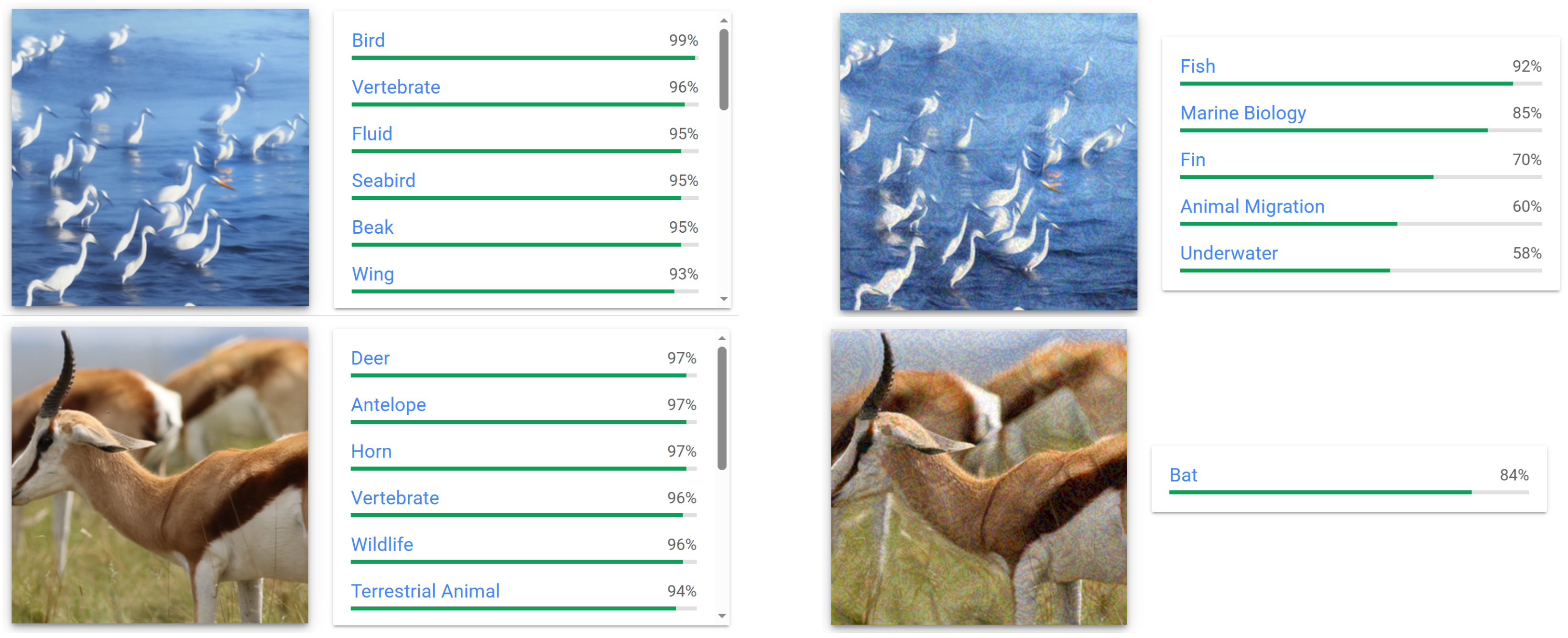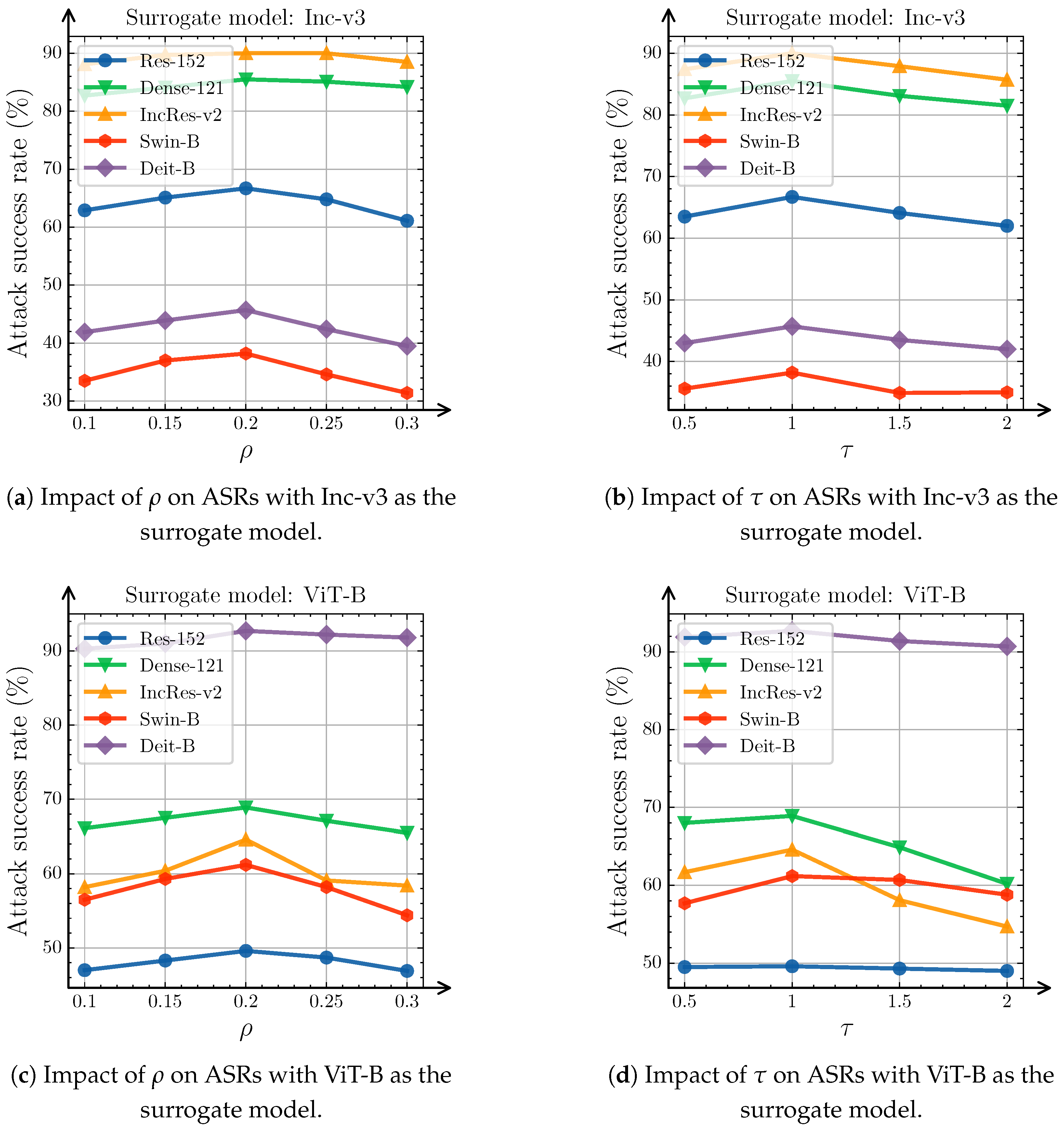

Enhancing Adversarial Transferability via Fourier-Based Input Transformation



Abstract
1. Introduction
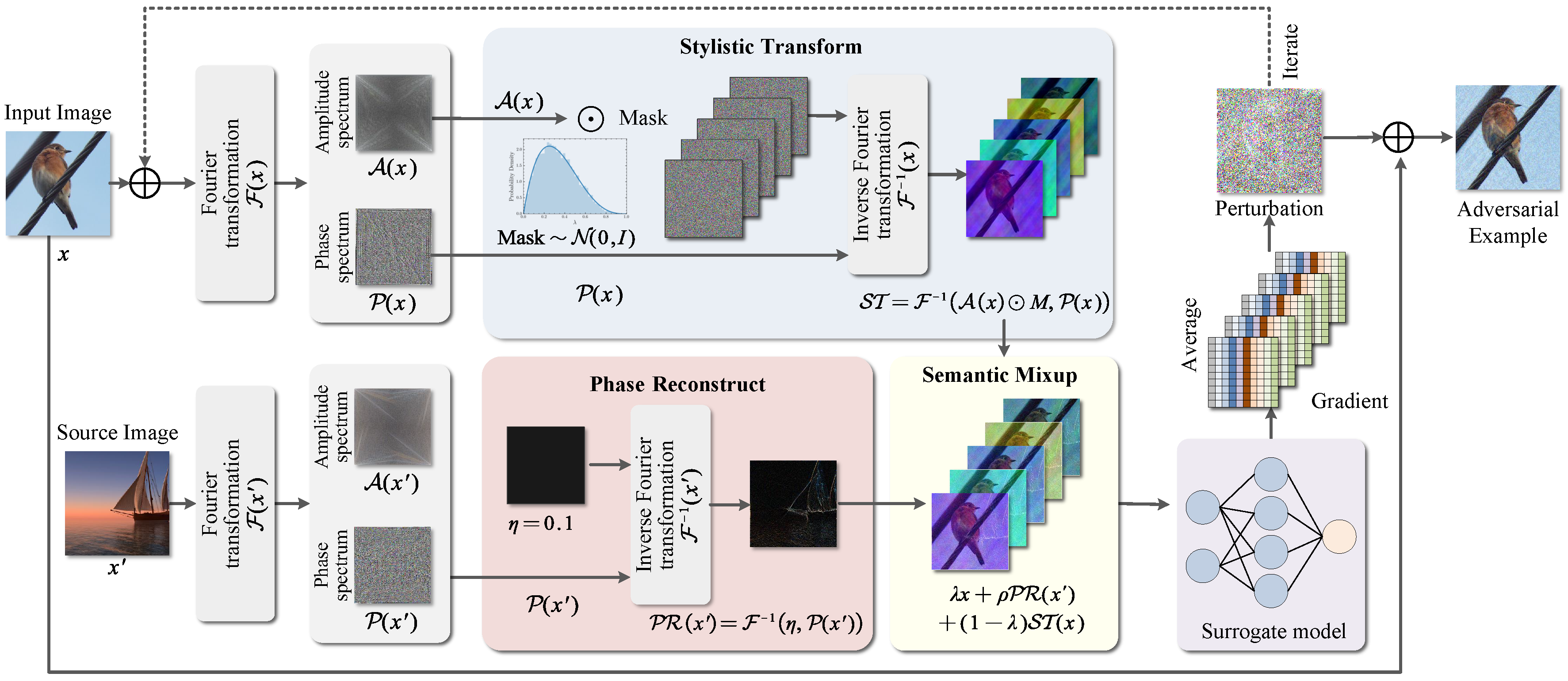
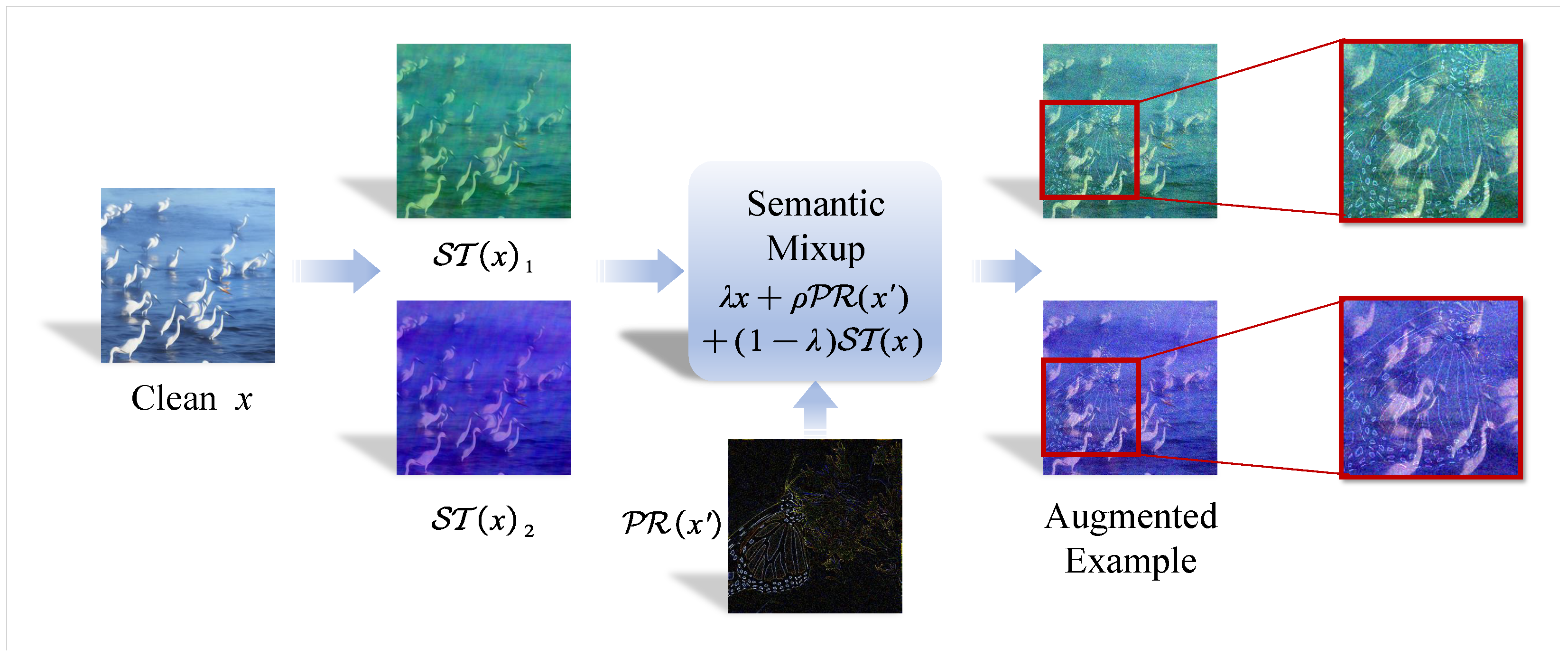
- We propose a novel Fourier-based input transformation (FIT) strategy. FIT manipulates amplitude and phase components to achieve both stylistic transformation and semantic mixup.
- We integrate FIT into the adversarial attack framework and propose a new black-box attack method. The adversarial examples generated by this innovative approach obtain enhanced transferability.
- The extensive experiments conducted on the ImageNet-compatible dataset demonstrate that the FIT attack has significant advantages over the baseline.
2. Related Work
2.1. Transfer-Based Attack
2.2. Frequency-Based Analysis and Attacks
3. Methodology
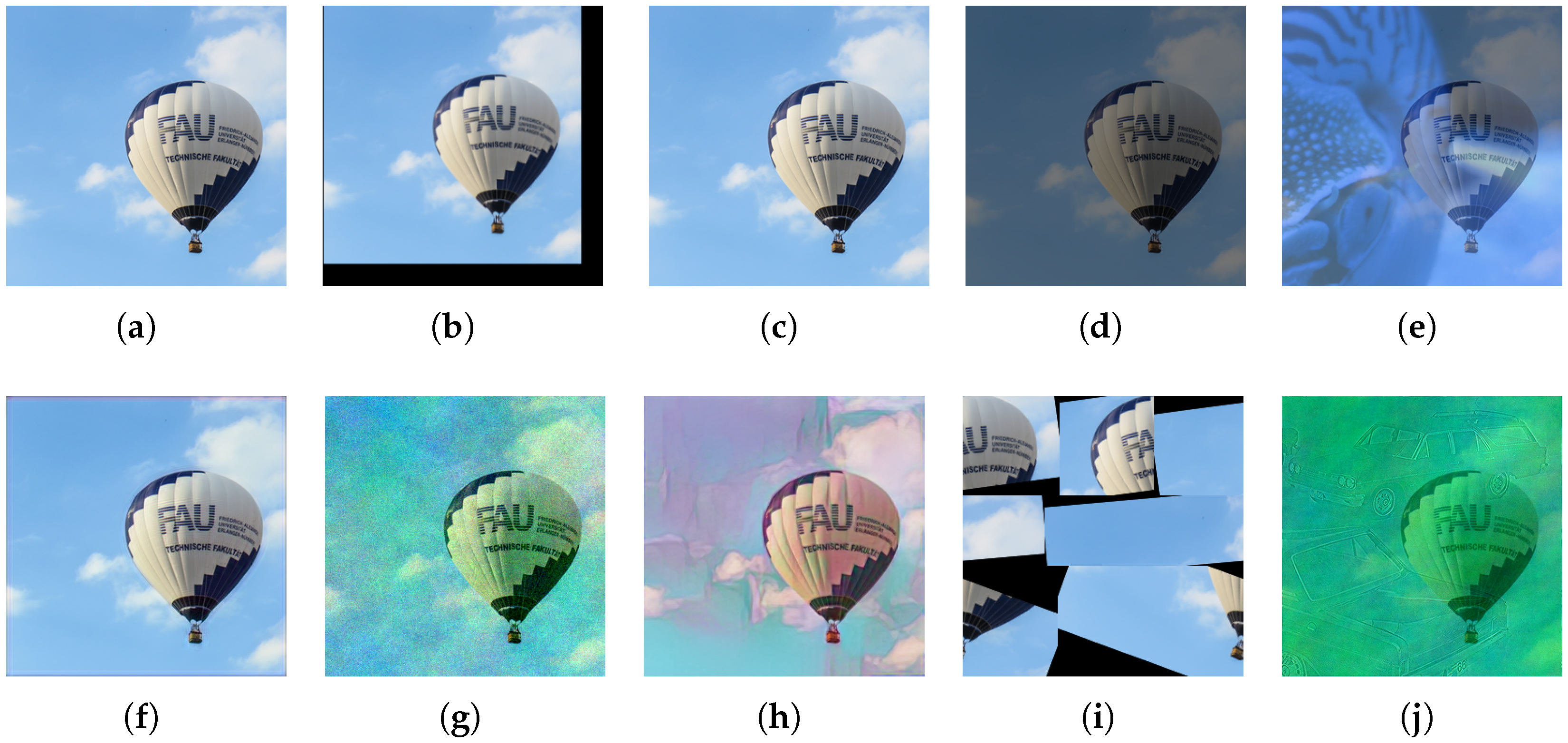
3.1. Motivation
3.2. Preliminaries
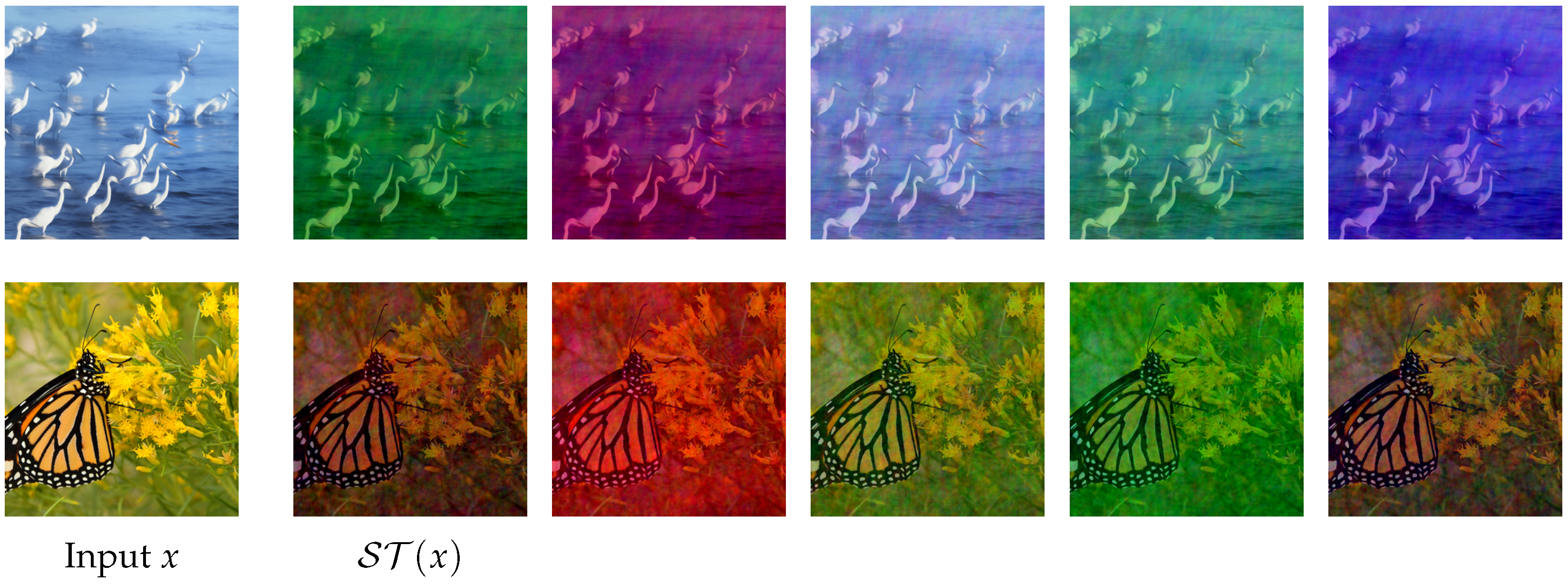
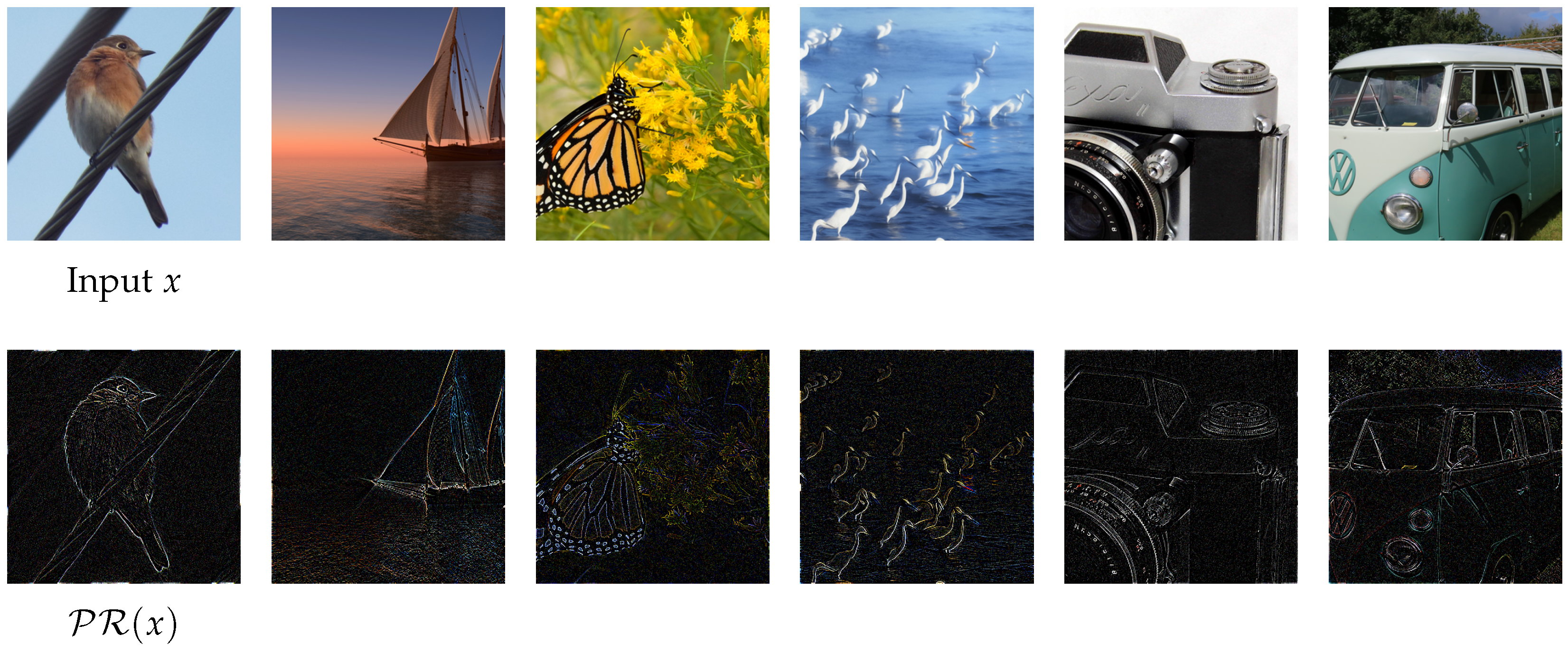
3.3. Fourier-Based Input Transformation
3.4. Fourier-Based Input Attack
| Algorithm 1: Fourier-based input transformation (FIT) attack method |
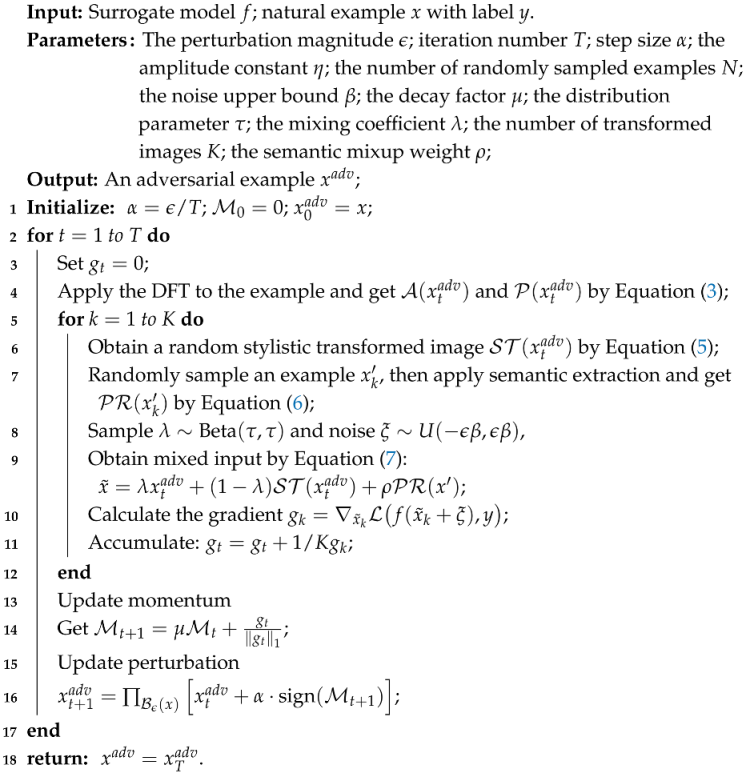 |
4. Experiments
4.1. Experimental Setup
4.2. Attacks on Normally Trained Models
4.3. Attacks on Advanced Defense Methods
4.4. Attacks on Ensemble of Models
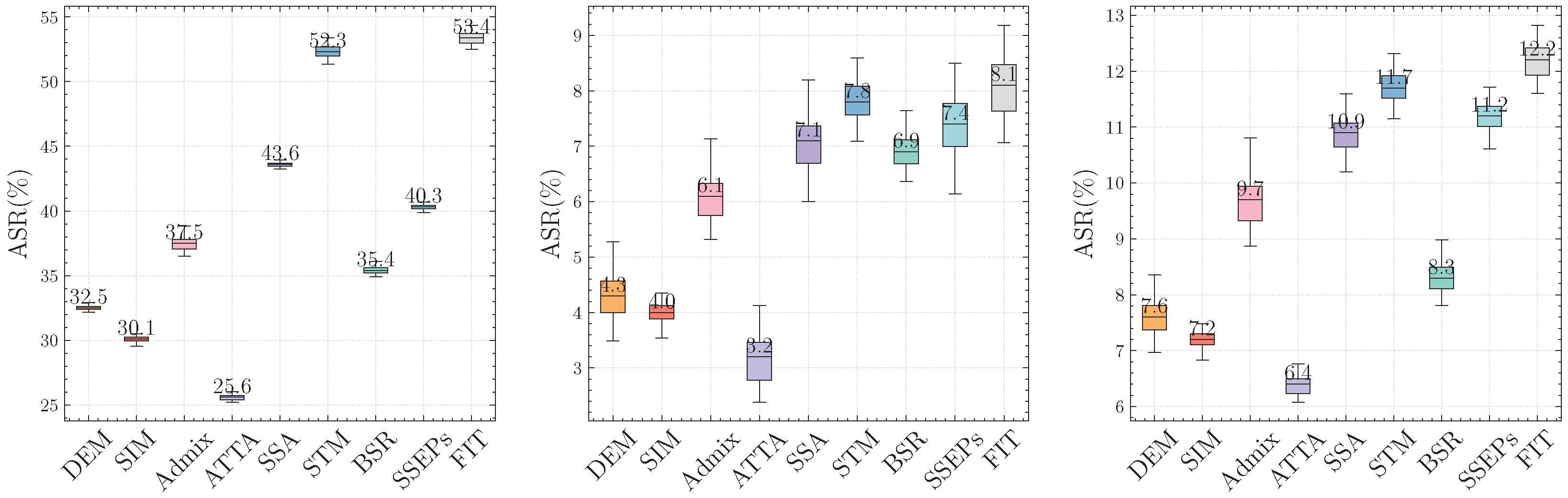
4.5. Efficiency Analysis
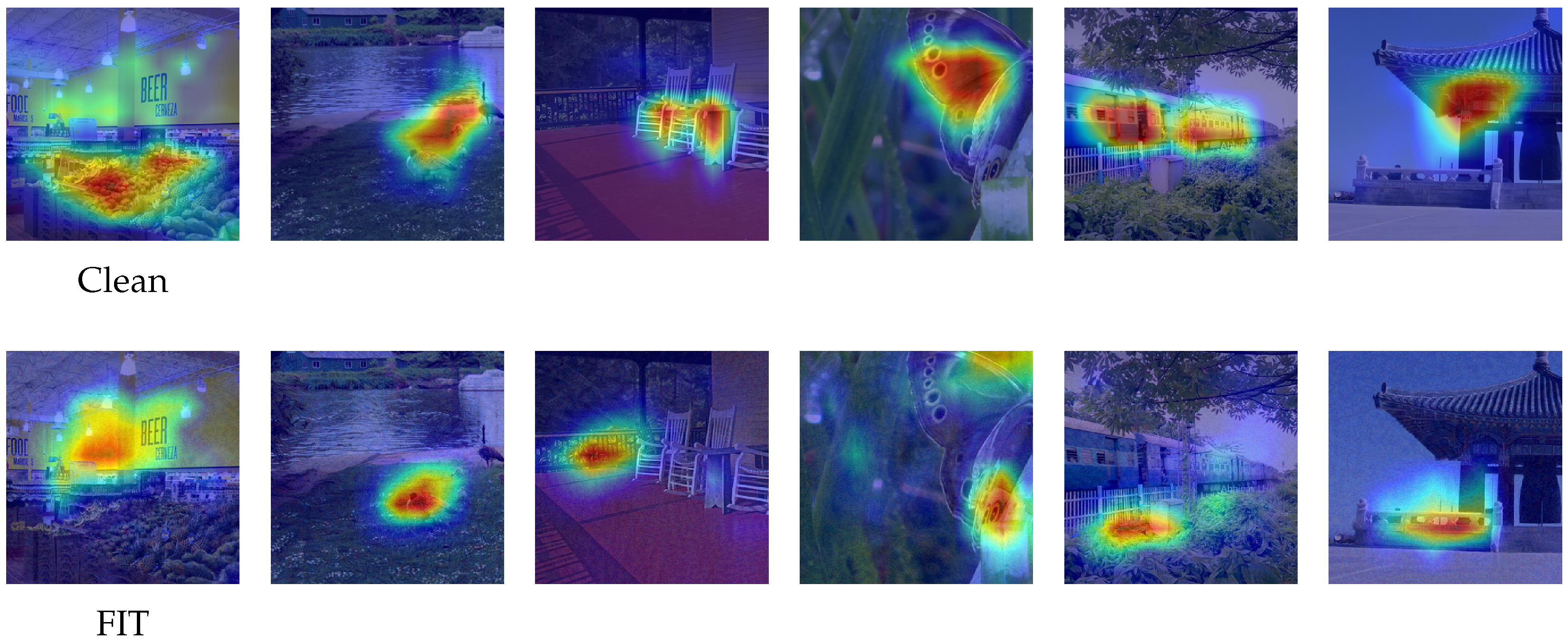
4.6. Visualization of Attack Influence
4.7. Evaluation in Real World Applications
4.8. Ablation Study
5. Conclusions
Author Contributions
Funding
Institutional Review Board Statement
Informed Consent Statement
Data Availability Statement
Conflicts of Interest
References
- Zhan, Y.; Zheng, B.; Liu, D.; Deng, B.; Yang, X. Exploring black-box adversarial attacks on Interpretable Deep Learning Systems. Comput. Vis. Image Underst. 2025, 259, 104423. [Google Scholar] [CrossRef]
- Riaz, K.; Anjum, M.L.; Hussain, W.; Manzoor, R. Targeted adversarial attack on classic vision pipelines. Comput. Vis. Image Underst. 2024, 249, 104140. [Google Scholar] [CrossRef]
- Szegedy, C.; Zaremba, W.; Sutskever, I.; Bruna, J.; Erhan, D.; Goodfellow, I.J.; Fergus, R. Intriguing properties of neural networks. In Proceedings of the ICLR, Banff, AB, Canada, 14–16 April 2014. [Google Scholar]
- Dong, Y.; Liao, F.; Pang, T.; Su, H.; Zhu, J.; Hu, X.; Li, J. Boosting Adversarial Attacks With Momentum. In Proceedings of the CVPR, Salt Lake City, UT, USA, 18–22 June 2018; pp. 9185–9193. [Google Scholar]
- Wang, X.; He, K. Enhancing the Transferability of Adversarial Attacks Through Variance Tuning. In Proceedings of the CVPR, Virtual, 19–25 June 2021; pp. 1924–1933. [Google Scholar]
- Wang, X.; Lin, J.; Hu, H.; Wang, J.; He, K. Boosting Adversarial Transferability through Enhanced Momentum. In Proceedings of the BMVC, Online, 22–25 November 2021; p. 272. [Google Scholar]
- Chen, H.; Zhang, Y.; Dong, Y.; Yang, X.; Su, H.; Zhu, J. Rethinking Model Ensemble in Transfer-based Adversarial Attacks. In Proceedings of the ICLR, Vienna, Austria, 7–11 May 2024. [Google Scholar]
- Tang, B.; Wang, Z.; Bin, Y.; Dou, Q.; Yang, Y.; Shen, H.T. Ensemble diversity facilitates adversarial transferability. In Proceedings of the CVPR, Seattle, WA, USA, 16–22 June 2024; pp. 24377–24386. [Google Scholar]
- Ge, Z.; Shang, F.; Liu, H.; Liu, Y.; Wan, L.; Feng, W.; Wang, X. Improving the Transferability of Adversarial Examples with Arbitrary Style Transfer. In Proceedings of the ACM MM, Ottawa, ON, Canada, 29 October–3 November 2023; pp. 4440–4449. [Google Scholar]
- Goodfellow, I.J.; Shlens, J.; Szegedy, C. Explaining and Harnessing Adversarial Examples. In Proceedings of the ICLR, San Diego, CA, USA, 7–9 May 2015. [Google Scholar]
- Kurakin, A.; Goodfellow, I.J.; Bengio, S. Adversarial examples in the physical world. In Proceedings of the ICLR 2017 Workshop Track, Toulon, France, 24–26 April 2017. [Google Scholar]
- Long, Y.; Zhang, Q.; Zeng, B.; Gao, L.; Liu, X.; Zhang, J.; Song, J. Frequency Domain Model Augmentation for Adversarial Attack. In Proceedings of the ECCV, Tel Aviv, Israel, 23–27 October 2022; pp. 549–566. [Google Scholar]
- Wang, K.; He, X.; Wang, W.; Wang, X. Boosting Adversarial Transferability by Block Shuffle and Rotation. In Proceedings of the CVPR, Seattle, WA, USA, 16–22 June 2024. [Google Scholar]
- Xie, C.; Zhang, Z.; Zhou, Y.; Bai, S.; Wang, J.; Ren, Z.; Yuille, A.L. Improving transferability of adversarial examples with input diversity. In Proceedings of the CVPR, Long Beach, CA, USA, 16–20 June 2019; pp. 2730–2739. [Google Scholar]
- Dong, Y.; Pang, T.; Su, H.; Zhu, J. Evading Defenses to Transferable Adversarial Examples by Translation-Invariant Attacks. In Proceedings of the CVPR, Long Beach, CA, USA, 16–20 June 2019; pp. 4312–4321. [Google Scholar]
- Lin, J.; Song, C.; He, K.; Wang, L.; Hopcroft, J.E. Nesterov Accelerated Gradient and Scale Invariance for Adversarial Attacks. In Proceedings of the ICLR, Addis Ababa, Ethiopia, 26–30 April 2020. [Google Scholar]
- Wu, W.; Su, Y.; Lyu, M.R.; King, I. Improving the Transferability of Adversarial Samples With Adversarial Transformations. In Proceedings of the CVPR, Virtual, 19–25 June 2021; pp. 9024–9033. [Google Scholar]
- Wang, X.; He, X.; Wang, J.; He, K. Admix: Enhancing the Transferability of Adversarial Attacks. In Proceedings of the ICCV, Montreal, QC, Canada, 10–17 October 2021; pp. 16138–16147. [Google Scholar]
- Qian, Y.; Chen, K.; Wang, B.; Gu, Z.; Ji, S.; Wang, W.; Zhang, Y. Enhancing transferability of adversarial examples through mixed-frequency inputs. IEEE Trans. Inf. Forensics Secur. 2024, 19, 7633–7645. [Google Scholar] [CrossRef]
- Oppenheim, A.; Lim, J.; Kopec, G.; Pohlig, S. Phase in speech and pictures. In Proceedings of the ICASSP’79. IEEE International Conference on Acoustics, Speech, and Signal Processing; IEEE: Washington, DC, USA, 2–4 April 1979; Volume 4, pp. 632–637. [Google Scholar]
- Oppenheim, A.V.; Lim, J.S. The importance of phase in signals. Proc. IEEE 2005, 69, 529–541. [Google Scholar] [CrossRef]
- Piotrowski, L.N.; Campbell, F.W. A demonstration of the visual importance and flexibility of spatial-frequency amplitude and phase. Perception 1982, 11, 337–346. [Google Scholar] [CrossRef] [PubMed]
- Hansen, B.C.; Hess, R.F. Structural sparseness and spatial phase alignment in natural scenes. J. Opt. Soc. Am. A 2007, 24, 1873–1885. [Google Scholar] [CrossRef] [PubMed]
- Xu, Q.; Zhang, R.; Zhang, Y.; Wang, Y.; Tian, Q. A fourier-based framework for domain generalization. In Proceedings of the CVPR, Virtual, 19–25 June 2021; pp. 14383–14392. [Google Scholar]
- Zhou, D.; Wang, N.; Yang, H.; Gao, X.; Liu, T. Phase-aware adversarial defense for improving adversarial robustness. In Proceedings of the ICML, Honolulu, HI, USA, 23–29 July 2023; pp. 42724–42741. [Google Scholar]
- Li, F.; Li, K.; Wu, H.; Tian, J.; Zhou, J. DAT: Improving Adversarial Robustness via Generative Amplitude Mix-up in Frequency Domain. Adv. Neural Inf. Process. Syst. 2024, 37, 127099–127128. [Google Scholar]
- Xiang, W.; Su, H.; Liu, C.; Guo, Y.; Zheng, S. Improving the robustness of adversarial attacks using an affine-invariant gradient estimator. Comput. Vis. Image Underst. 2023, 229, 103647. [Google Scholar] [CrossRef]
- Guo, S.; Wang, B.; Li, X.; Zhu, P.; Wu, L.; Wu, W.; Jia, L. ALDA: Enhancing the transferability of adversarial attacks with attention-guided look-ahead and data augmentation. Pattern Recognit. 2025, 172, 112686. [Google Scholar] [CrossRef]
- Lin, Z.; Wang, B.; Wang, X.; Zhang, Y.; Wang, X.; Deng, K.; Peng, A.; Tang, J.; Yang, X. Improving adversarial transferability via semantic-style joint expectation perturbations. Pattern Recognit. 2026, 172, 112474. [Google Scholar] [CrossRef]
- Qin, Z.; Fan, Y.; Liu, Y.; Shen, L.; Zhang, Y.; Wang, J.; Wu, B. Boosting the Transferability of Adversarial Attacks with Reverse Adversarial Perturbation. In Proceedings of the NeurIPS, New Orleans, LA, USA, 28 November–9 December 2022. [Google Scholar]
- Ge, Z.; Liu, H.; Xiaosen, W.; Shang, F.; Liu, Y. Boosting adversarial transferability by achieving flat local maxima. In Proceedings of the NeurIPS, New Orleans, LA, USA, 10–16 December 2023; pp. 70141–70161. [Google Scholar]
- Gan, F.; Wo, Y. Boosting the Transferability of Adversarial Examples Through Gradient Aggregation. IEEE Trans. Inf. Forensics Secur. 2025, 20, 5563–5576. [Google Scholar] [CrossRef]
- Peng, J.; Tao, Z.; Wang, H.; Wang, M.; Wang, Y. Boosting Adversarial Transferability via Residual Perturbation Attack. In Proceedings of the ICCV, Honolulu, HI, USA, 19–23 October 2025; pp. 1261–1270. [Google Scholar]
- Xiong, Y.; Lin, J.; Zhang, M.; Hopcroft, J.E.; He, K. Stochastic Variance Reduced Ensemble Adversarial Attack for Boosting the Adversarial Transferability. In Proceedings of the CVPR, New Orleans, LA, USA, 18–24 June 2022; pp. 14963–14972. [Google Scholar]
- Chen, B.; Yin, J.; Chen, S.; Chen, B.; Liu, X. An adaptive model ensemble adversarial attack for boosting adversarial transferability. In Proceedings of the ICCV, Paris, France, 1–6 October 2023; pp. 4489–4498. [Google Scholar]
- Wang, H.; Wu, X.; Huang, Z.; Xing, E.P. High-Frequency Component Helps Explain the Generalization of Convolutional Neural Networks. In Proceedings of the CVPR, Seattle, WA, USA, 13–19 June 2020; pp. 8681–8691. [Google Scholar]
- Yin, D.; Lopes, R.G.; Shlens, J.; Cubuk, E.D.; Gilmer, J. A Fourier Perspective on Model Robustness in Computer Vision. In Proceedings of the NeurIPS, Vancouver, BC, Canada, 8–14 December 2019; pp. 13255–13265. [Google Scholar]
- Sharma, Y.; Ding, G.W.; Brubaker, M.A. On the Effectiveness of Low Frequency Perturbations. In Proceedings of the IJCAI, 2019, Macao, China, 10–16 August 2019; pp. 3389–3396. [Google Scholar]
- Duan, R.; Chen, Y.; Niu, D.; Yang, Y.; Qin, A.K.; He, Y. AdvDrop: Adversarial Attack to DNNs by Dropping Information. In Proceedings of the ICCV, Montreal, QC, Canada, 10–17 October 2021; pp. 7486–7495. [Google Scholar]
- Wang, Y.; Wu, Y.; Wu, S.; Liu, X.; Zhou, W.; Zhu, L.; Zhang, C. Boosting the Transferability of Adversarial Attacks with Frequency-Aware Perturbation. IEEE Trans. Inf. Forensics Secur. 2024, 19, 6293–6304. [Google Scholar] [CrossRef]
- Zeiler, M.D.; Fergus, R. Visualizing and understanding convolutional networks. In Proceedings of the ECCV, Zurich, Switzerland, 6–12 September 2014; pp. 818–833. [Google Scholar]
- Baker, N.; Lu, H.; Erlikhman, G.; Kellman, P.J. Deep convolutional networks do not classify based on global object shape. PLoS Comput. Biol. 2018, 14, e1006613. [Google Scholar] [CrossRef] [PubMed]
- Zhang, H.; Cissé, M.; Dauphin, Y.N.; Lopez-Paz, D. mixup: Beyond Empirical Risk Minimization. In Proceedings of the ICLR, Vancouver, BC, Canada, 30 April–3 May 2018. [Google Scholar]
- K, A.; Hamner, B.; Goodfellow, I. NIPS 2017: Non-Targeted Adversarial Attack. Kaggle. 2017. Available online: https://kaggle.com/competitions/nips-2017-non-targeted-adversarial-attack (accessed on 2 October 2017).
- Wightman, R. PyTorch Image Models. 2019. Available online: https://github.com/rwightman/pytorch-image-models (accessed on 30 December 2025).
- Huang, G.; Liu, Z.; Van Der Maaten, L.; Weinberger, K.Q. Densely connected convolutional networks. In Proceedings of the CVPR, Honolulu, HI, USA, 21–26 July 2017; pp. 4700–4708. [Google Scholar]
- He, K.; Zhang, X.; Ren, S.; Sun, J. Deep residual learning for image recognition. In Proceedings of the CVPR, Las Vegas, NV, USA, 27–30 June 2016; pp. 770–778. [Google Scholar]
- Liu, Z.; Lin, Y.; Cao, Y.; Hu, H.; Wei, Y.; Zhang, Z.; Lin, S.; Guo, B. Swin transformer: Hierarchical vision transformer using shifted windows. In Proceedings of the ICCV, Montreal, QC, Canada, 10–17 October 2021; pp. 10012–10022. [Google Scholar]
- Szegedy, C.; Ioffe, S.; Vanhoucke, V.; Alemi, A. Inception-v4, inception-resnet and the impact of residual connections on learning. In Proceedings of the AAAI, San Francisco, CA, USA, 4–9 February 2017; pp. 2818–2826. [Google Scholar]
- Touvron, H.; Cord, M.; Douze, M.; Massa, F.; Sablayrolles, A.; Jégou, H. Training data-efficient image transformers & distillation through attention. In Proceedings of the ICML, Virtual Event, 18–24 July 2021; pp. 10347–10357. [Google Scholar]
- Tramèr, F.; Kurakin, A.; Papernot, N.; Goodfellow, I.J.; Boneh, D.; McDaniel, P.D. Ensemble Adversarial Training: Attacks and Defenses. In Proceedings of the ICLR, Vancouver, BC, Canada, 30 April–3 May 2018. [Google Scholar]
- Nie, W.; Guo, B.; Huang, Y.; Xiao, C.; Vahdat, A.; Anandkumar, A. Diffusion Models for Adversarial Purification. In Proceedings of the ICML, Baltimore, MD, USA, 17–23 July 2022; pp. 16805–16827. [Google Scholar]
- Chen, H.; Dong, Y.; Wang, Z.; Yang, X.; Duan, C.; Su, H.; Zhu, J. Robust Classification via a Single Diffusion Model. In Proceedings of the ICML, Vienna, Austria, 21–27 July 2024. [Google Scholar]
- Naseer, M.; Khan, S.; Hayat, M.; Khan, F.S.; Porikli, F. A self-supervised approach for adversarial robustness. In Proceedings of the CVPR, Seattle, WA, USA, 13–19 June 2020; pp. 262–271. [Google Scholar]
- Szegedy, C.; Vanhoucke, V.; Ioffe, S.; Shlens, J.; Wojna, Z. Rethinking the inception architecture for computer vision. In Proceedings of the CVPR, Las Vegas, NV, USA, 27–30 June 2016; pp. 2818–2826. [Google Scholar]
- Dosovitskiy, A.; Beyer, L.; Kolesnikov, A.; Weissenborn, D.; Zhai, X.; Unterthiner, T.; Dehghani, M.; Minderer, M.; Heigold, G.; Gelly, S.; et al. An Image is Worth 16×16 Words: Transformers for Image Recognition at Scale. In Proceedings of the ICLR, Virtual Event, Austria, 3–7 May 2021. [Google Scholar]
- Selvaraju, R.R.; Cogswell, M.; Das, A.; Vedantam, R.; Parikh, D.; Batra, D. Grad-CAM: Visual Explanations from Deep Networks via Gradient-Based Localization. In Proceedings of the ICCV, Venice, Italy, 22–29 October 2017; pp. 618–626. [Google Scholar]



| A clean image and its ground truth label. | |
| The generated adversarial example at the t-th iteration. | |
| f | The classify model mapping input variables to label variables. |
| The cross-entropy loss of the classify model w.r.t . | |
| The adversarial perturbation. | |
| The step size. | |
| The calculated gradient at the t-th iteration | |
| The accumulation of gradients at the t-th iteration. | |
| The discrete Fourier transform (DFT) functions. | |
| The inverse discrete Fourier transform (IDFT) functions. | |
| The amplitude spectrum of x. | |
| The phase spectrum of x. | |
| A random mask sampled from Gaussian distribution. | |
| A small constant replaces the original amplitude spectrum. | |
| The mixing coefficient in the Fourier-based input attack. | |
| The decay factor. | |
| The weight controlling the semantic mixup. |
| Surrogate Model | Target Models | Attack Success Rates (%) | |||||||||
|---|---|---|---|---|---|---|---|---|---|---|---|
| DIM | TIM | SIM | Admix | ATTA | SSA | STM | BSR | SSEPs | FIT | ||
| Inc-v3 | Res-152 | 42.3 | 18.9 | 55.0 | 52.1 | 32.6 | 56.8 | 63.0 | 65.6 | 56.8 | 66.7 |
| Dense-121 | 66.3 | 39.9 | 67.1 | 76.7 | 55.6 | 76.9 | 85.0 | 89.6 | 79.7 | 85.5 | |
| IncRes-v2 | 66.2 | 33.0 | 69.0 | 81.9 | 52.2 | 84.3 | 90.4 | 87.2 | 84.5 | 90.0 | |
| Swin-B | 17.0 | 9.0 | 18.3 | 22.1 | 14.4 | 29.2 | 36.1 | 28.9 | 25.4 | 38.2 | |
| DeiT-B | 25.9 | 17.6 | 26.9 | 30.6 | 18.3 | 35.0 | 46.5 | 36.1 | 33.3 | 45.7 | |
| Avg. | 43.5 | 23.7 | 44.6 | 52.7 | 34.6 | 56.4 | 64.2 | 61.5 | 55.9 | 65.2 | |
| Inc-v4 | Res-152 | 46.8 | 22.7 | 54.3 | 64.7 | 38.7 | 65.4 | 70.0 | 62.7 | 65.8 | 70.1 |
| Dense-121 | 67.5 | 41.5 | 75.0 | 80.7 | 57.0 | 81.2 | 85.5 | 86.6 | 84.5 | 86.9 | |
| IncRes-v2 | 68.8 | 32.2 | 73.6 | 85.9 | 52.4 | 83.8 | 89.3 | 78.5 | 86.4 | 88.4 | |
| Swin-B | 21.0 | 10.7 | 27.8 | 34.6 | 17.6 | 34.9 | 44.3 | 23.9 | 37.9 | 45.4 | |
| DeiT-B | 26.5 | 17.4 | 34.2 | 38.1 | 21.4 | 37.2 | 50.0 | 29.2 | 40.3 | 50.4 | |
| Avg. | 46.1 | 53.5 | 53.0 | 60.8 | 37.4 | 60.5 | 67.8 | 56.2 | 63.0 | 68.2 | |
| Res-101 | Res-152 | 66.4 | 34.6 | 72.7 | 84.5 | 61.5 | 80.7 | 85.7 | 90.2 | 86.0 | 87.7 |
| Dense-121 | 60.9 | 37.9 | 66.5 | 78.3 | 55.1 | 78.4 | 83.6 | 90.6 | 81.7 | 86.2 | |
| IncRes-v2 | 40.5 | 17.8 | 32.8 | 48.0 | 23.1 | 62.5 | 72.4 | 72.1 | 53.9 | 76.9 | |
| Swin-B | 21.3 | 10.0 | 19.9 | 24.6 | 13.8 | 38.4 | 32.2 | 31.7 | 29.8 | 49.2 | |
| DeiT-B | 22.1 | 17.3 | 18.8 | 23.9 | 14.4 | 36.7 | 33.5 | 36.8 | 27.1 | 50.5 | |
| Avg. | 42.2 | 62.3 | 42.1 | 51.9 | 33.6 | 59.3 | 61.5 | 64.3 | 55.7 | 70.1 | |
| ViT-B | Res-152 | 40.3 | 22.3 | 38.3 | 41.1 | 31.1 | 45.6 | 49.7 | 49.3 | 43.3 | 49.6 |
| Dense-121 | 55.1 | 40.2 | 55.2 | 60.2 | 46.9 | 63.5 | 64.6 | 68.5 | 62.6 | 68.9 | |
| IncRes-v2 | 41.8 | 19.4 | 37.4 | 44.3 | 29.8 | 53.2 | 57.5 | 64.3 | 48.9 | 64.6 | |
| Swin-B | 44.8 | 14.1 | 39.1 | 48.3 | 37.7 | 54.8 | 60.9 | 52.8 | 51.2 | 61.2 | |
| DeiT-B | 72.8 | 35.6 | 76.8 | 83.9 | 67.9 | 89.1 | 91.4 | 76.6 | 85.8 | 92.7 | |
| Avg. | 51.0 | 26.3 | 49.4 | 55.6 | 42.7 | 61.2 | 64.8 | 62.3 | 58.4 | 67.4 | |
| Model | DEM | SIM | Admix | ATTA | SSA | STM | BSR | SSEPs | FIT |
|---|---|---|---|---|---|---|---|---|---|
| Inc-v3adv | 47.1 | 43.8 | 53.2 | 29.8 | 59.2 | 69.4 | 48.6 | 55.6 | 73.5 |
| Inc-v3ens3 | 35.3 | 37.3 | 45.4 | 23.8 | 50.5 | 56.1 | 48.5 | 48.3 | 66.5 |
| Inc-v3ens4 | 34.6 | 38.2 | 45.6 | 23.3 | 51.3 | 55.5 | 46.9 | 48.7 | 65.0 |
| Inc-v2ens | 19.3 | 21.7 | 26.4 | 11.8 | 29.8 | 33.1 | 28.1 | 30.2 | 42.7 |
| Attack | Surrogate Models: Inc-v3, Inc-v4, Res-101 | ||||||||||
|---|---|---|---|---|---|---|---|---|---|---|---|
| DIM | TIM | DEM | SIM | Admix | ATTA | SSA | STM | BSR | SSEPs | FIT | |
| Res-152 | 80.8 | 39.7 | 93.4 | 79.6 | 88.2 | 67.3 | 89.1 | 91.7 | 93.7 | 90.7 | 94.0 |
| Dens-121 | 86.2 | 58.4 | 95.9 | 88.5 | 93.8 | 76.4 | 93.7 | 95.5 | 97.4 | 94.9 | 97.7 |
| IncR-v2 | 87.4 | 48.5 | 98.1 | 86.9 | 93.6 | 72.7 | 95.2 | 96.7 | 93.9 | 96.8 | 98.2 |
| Swin-B | 40.6 | 13.1 | 45.1 | 42.7 | 53.4 | 30.1 | 61.0 | 65.8 | 51.3 | 57.2 | 71.9 |
| DeiT-B | 54.0 | 26.3 | 64.5 | 52.7 | 63.0 | 40.4 | 70.2 | 78.9 | 62.6 | 65.4 | 79.6 |
| Avg. | 69.8 | 37.2 | 79.4 | 70.1 | 78.4 | 57.4 | 81.8 | 85.7 | 79.8 | 81.0 | 88.3 |
| Inc-v3adv | 85.1 | 58.8 | 96.4 | 85.1 | 92.2 | 67.7 | 92.7 | 96.1 | 91.0 | 94.5 | 96.9 |
| Inc-v3ens3 | 80.8 | 55.7 | 94.2 | 81.5 | 89.4 | 61.1 | 90.5 | 95.2 | 87.6 | 90.8 | 95.9 |
| Inc-v3ens4 | 80.1 | 56.9 | 93.6 | 80.8 | 88.7 | 60.7 | 90.0 | 94.7 | 84.3 | 91.1 | 95.0 |
| Inc-v2ens | 73.4 | 47.4 | 88.3 | 72.1 | 81.7 | 50.2 | 84.9 | 91.0 | 77.1 | 85.5 | 91.6 |
| Avg. | 79.8 | 54.7 | 93.1 | 79.9 | 88.0 | 59.9 | 89.5 | 94.3 | 85.0 | 90.5 | 94.9 |
| Attacks | Admix | ATTA | SSA | STM | BSR | FIT |
|---|---|---|---|---|---|---|
| Runtime (s) | 0.99 | 1.66 | 1.18 | 1.49 | 0.73 | 1.35 |
Disclaimer/Publisher’s Note: The statements, opinions and data contained in all publications are solely those of the individual author(s) and contributor(s) and not of MDPI and/or the editor(s). MDPI and/or the editor(s) disclaim responsibility for any injury to people or property resulting from any ideas, methods, instructions or products referred to in the content. |
© 2026 by the authors. Licensee MDPI, Basel, Switzerland. This article is an open access article distributed under the terms and conditions of the Creative Commons Attribution (CC BY) license.
Share and Cite
Tian, Z.; Wang, X.; Long, Y.; Zhang, L. Enhancing Adversarial Transferability via Fourier-Based Input Transformation. Big Data Cogn. Comput. 2026, 10, 135. https://doi.org/10.3390/bdcc10050135
Tian Z, Wang X, Long Y, Zhang L. Enhancing Adversarial Transferability via Fourier-Based Input Transformation. Big Data and Cognitive Computing. 2026; 10(5):135. https://doi.org/10.3390/bdcc10050135
Chicago/Turabian StyleTian, Zilin, Xin Wang, Yunfei Long, and Liguo Zhang. 2026. "Enhancing Adversarial Transferability via Fourier-Based Input Transformation" Big Data and Cognitive Computing 10, no. 5: 135. https://doi.org/10.3390/bdcc10050135
APA StyleTian, Z., Wang, X., Long, Y., & Zhang, L. (2026). Enhancing Adversarial Transferability via Fourier-Based Input Transformation. Big Data and Cognitive Computing, 10(5), 135. https://doi.org/10.3390/bdcc10050135