Article

A Physically Regularized Control-Oriented State Model and Nonlinear Model Predictive Control Framework for an Ice Rink Refrigeration System

by
Alexander A. Karmanov
* and
Petr V. Nikitin
*
Department of Artificial Intelligence, Faculty of Information Technology and Big Data Analysis, Financial University Under the Government of the Russian Federation, Moscow 125993, Russia
*
Authors to whom correspondence should be addressed.
Big Data Cogn. Comput. 2026, 10(5), 134; https://doi.org/10.3390/bdcc10050134
Submission received: 14 March 2026 / Revised: 20 April 2026 / Accepted: 23 April 2026 / Published: 26 April 2026
(This article belongs to the Section Data Mining and Machine Learning)

Abstract

Energy-intensive refrigeration systems require predictive models that remain informative under counterfactual control trajectories, not only on archived operation. This paper develops a control-oriented multi-step state model and a nonlinear model predictive control framework for an indoor ice-rink refrigeration system. Historical state, control, and exogenous variables are encoded jointly with an admissible future control trajectory, and a normalized thermal-balance residual is added to the training objective. A lightweight conditioned transformer predicts ice temperature, return-glycol temperature, supply-glycol temperature, and compressor power over a 30 min horizon. The selected weakly regularized model with regularization coefficient λ p h y s =   0.001 decreases the normalized thermal-balance root-mean-square error on the horizon tail by 30.29% relative to the base model while increasing the average ice-temperature root-mean-square error by only 1.90%. In a surrogate-based counterfactual four-day evaluation, the resulting nonlinear model predictive controller reduces predicted daily energy by 4.84%, terminal violation share by 17.32%, mean absolute terminal ice-temperature deviation by 18.74%, and the mean objective value by 30.82% relative to historical admissible setpoint tracking. The mean full control cycle time is 0.0311 s, confirming real-time feasibility for a 5 min supervisory update interval. All controller results are surrogate-based rather than field-deployed and therefore represent receding-horizon benchmark results under learned-model evaluation, not realized field savings.

1. Introduction

Large thermal-energy systems are increasingly managed as data-rich engineered processes in which sensing, prediction, optimization, and supervisory control are tightly coupled. This tendency is especially visible in intelligent buildings, district-scale energy infrastructure, and industrial energy systems, where digital data streams are used not only for retrospective diagnostics but also for active decision support and closed-loop operation [1,2,3,4,5]. The challenge is no longer simply to predict load or design a controller in isolation. It is to construct a predictive representation of system dynamics that remains informative under admissible future control trajectories and disturbance regimes that differ from the historical archive.
This challenge is particularly acute for thermal systems. Compared with purely electrical processes, thermal-energy objects combine inertia, delayed responses, strong exogenous forcing, intermittent operating modes, and hard technological constraints. A predictive model for this setting must remain accurate on multi-step horizons, numerically tractable under repeated optimizer calls, responsive to candidate control inputs, and resistant to implausible responses that can degrade downstream control quality. Studies on energy forecasting in buildings and engineering systems show that exogenous variables and multi-horizon sequence structure improve forecast quality, but they also show that lower archival error does not automatically translate into better operational usefulness [6,7,8,9,10,11,12].
The practical relevance of this issue becomes even clearer in systems in which energy use is coupled with a quality-of-service variable. In such cases, the operator must not only reduce consumption but also preserve a technological target. For indoor ice rinks, this target is ice temperature. The refrigeration plant, the glycol circuit, and the slab form a thermally inert nonlinear object whose performance depends on resurfacing events, indoor microclimate, outdoor conditions, and equipment limitations. Prior work on ice-rink energy use shows that the physics of the slab and the refrigeration load are strongly coupled and that both annual energy requirements and short-term load profiles are sensitive to operating mode, facility configuration, and environmental conditions [13,14,15,16]. From the control viewpoint, this makes the ice rink a representative case of a wider class of constrained thermal-energy systems rather than an isolated niche application.
At the same time, the existing literature suggests that the predictive and control layers are still often developed with partially different objectives. On the prediction side, the state of the art has moved toward deep sequence models, transformer architectures, and hybrid feature pipelines for multi-building or multi-zone energy forecasting [1,10,11,12,17,18]. On the control side, model predictive control has become one of the dominant formulations for energy-efficient operation of thermal systems, buildings, and refrigeration equipment because it naturally accommodates constraints, disturbances, and multi-criteria objectives [19,20,21,22,23]. Yet many practical studies still connect the two stages in a loose manner: a model is chosen primarily on the basis of forecast metrics, and only afterward is it inserted into a predictive controller. Such a workflow leaves unresolved whether the selected model is structurally appropriate for counterfactual control evaluation.
The gap becomes more evident when considering physically informed modeling. Recent studies on control-oriented thermal modeling emphasize that hybrid and gray-box approaches can improve robustness under noisy measurements and better align a learned model with the dominant physical mechanisms of the object [24,25,26,27]. That matters because an optimizer will exploit whatever structure the predictive model makes available inside NMPC, including patterns that may be statistically valid on historical data but physically inconsistent under unseen control trajectories. In practice, a weak physical prior may be more useful than an excessively flexible black-box model if it yields smoother and more structurally plausible horizon trajectories inside the controller.
Another active line of research moves from isolated algorithms to executable decision workflows. In the digital-twin and intelligent infrastructure literature, the value of a model is increasingly tied to its role inside an operational computation loop rather than to standalone descriptive power [4,5,28,29,30,31,32,33]. The same shift appears in benchmarking and software-in-the-loop studies, which emphasize reproducibility, runtime feasibility, and the consistent alignment of data preparation, model training, controller evaluation, and diagnostics [34,35]. For work at the intersection of forecasting, optimization, and energy informatics, this computational layer is part of the scientific argument, not an auxiliary engineering detail.
Against this background, the paper examines whether weak physical regularization of a control-oriented state model improves downstream nonlinear model predictive control for an indoor ice-rink refrigeration system. The study develops a controlled multi-step predictor with a normalized thermal-balance residual and evaluates it against both historical operation and an NMPC variant driven by the non-regularized base model in a surrogate-based receding-horizon closed-loop benchmark. This benchmark is informative for model selection, but it does not establish realized field savings.
The paper makes three main contributions. First, it introduces a physically regularized controlled state model in which historical state, control, and exogenous variables are encoded jointly with an admissible future control trajectory, while a normalized aggregated thermal-balance residual is included in the training objective. Second, it formulates a nonlinear model predictive control method around that model with explicit penalties on energy use, terminal ice-temperature deviation, and constraint violations. Third, it implements the full workflow as a reproducible software pipeline with explicit runtime assessment under controlled data access, which is essential for demonstrating operational feasibility in data-centric energy control studies [2,4,5,30,35].
The remainder of the paper is structured as follows. Section 2 reviews the literature most closely connected to the proposed work and formulates the research gap. Section 3 describes the data protocol, the controlled state model, the physical regularization term, and the nonlinear model predictive control formulation. Section 4 reports the forecasting, control, and runtime results. Section 5 discusses the implications of the findings and their limitations. Section 6 concludes the paper.

2. Related Work and Research Gap

2.1. Multi-Step Energy Forecasting for Controlled Thermal Systems

The forecasting literature most relevant here spans short-term and multi-horizon load forecasting in energy systems, building energy forecasting with deep sequence models and transformer architectures, and operational energy-management platforms that evaluate prediction together with software architecture, inference cost, and deployment context [1,2,3,7,8,9,10,11,12,17,18].
Across this literature, multi-horizon forecasting has become the natural formulation for operational problems in which disturbances, decisions, and constraint violations matter over a finite horizon [1,10,11]. Transformer-like architectures can process heterogeneous exogenous variables and long-range temporal structure, but comparative studies continue to highlight trade-offs among predictive gains, interpretability, and computational cost [9,11,12,18]. Many formulations nevertheless remain forecast-centric even in control-related applications: future demand, load, or energy use is reconstructed without explicitly conditioning on admissible future control trajectories.
If a forecasting model is to be embedded in a predictive controller, the future control profile should enter the predictive mapping explicitly. Otherwise, the model is trained for a different task from the one it later serves. Building energy forecasting studies provide rich evidence on model classes and feature engineering, but fewer studies formulate multi-step prediction directly as a response to a candidate control trajectory under technological bounds [11,12,18]. This mismatch motivates the controlled state-model formulation adopted here.

2.2. Physics-Informed, Physically Consistent, and Gray-Box Modeling

The second relevant literature block concerns the incorporation of physical knowledge into learned or semi-learned dynamic models. In thermal systems, this line has developed through gray-box building models, energy-balance-based predictors, and physics-informed machine learning. Gray-box models remain attractive because they retain interpretable thermal states and parameters while still being estimable from data and usable inside predictive control [25]. Physics-informed control-oriented models extend this logic by embedding conservation laws or reduced-order physical balances directly into the training or identification objective [24,26,27]. In that setting, structural priors are used not only for description, but also to improve identifiability, robustness under noisy measurements, and generalization under counterfactual scenarios that depart from the empirical operating archive.
For NMPC, physical consistency has to be judged relative to intended use. A predictor for offline simulation may tolerate heavy regularization and high computational cost; one intended for NMPC must remain fast, differentiable, and sufficiently accurate on the operational horizon while suppressing dynamic responses that contradict the dominant heat-balance structure. Recent work on physics-informed predictive control with noisy data shows that this balance is nontrivial and that moderate structural bias may be preferable to either an unconstrained black box or a rigid first-principles formulation [24,26]. This observation informed the weak-regularization strategy adopted here.
The physical literature on indoor ice rinks provides an additional justification for introducing a balance-based regularization term. Studies on annual energy requirements, refrigeration load components, and operating differences between indoor and outdoor facilities consistently show that the slab heat balance is a compact but informative representation of the object physics [15,16]. More recent work on energy-efficient predictive control in indoor ice rinks likewise treats thermal and humidity dynamics as coupled constrained processes and highlights the practical importance of physically meaningful state representation [13]. These findings support the use of an aggregated thermal-balance residual as a regularizer for the learned state model.

2.3. Predictive Control for Thermal and Refrigeration Systems

Model predictive control is the natural reference framework for the control part of this study because it accommodates state constraints, manipulated-variable limits, disturbance forecasts, and multi-criteria objectives in a unified optimization problem. Reviews dedicated to buildings and HVAC systems show that MPC and NMPC have matured well beyond proof-of-concept status and now cover a broad spectrum of control architectures, objective functions, and implementation strategies [19,20,21]. The same reviews also stress that the choice of predictive model remains one of the most decisive factors for closed-loop performance, especially under nonlinear dynamics and partial observability.
In parallel, the literature on data-driven predictive control has argued that forecasting and control should be co-designed rather than loosely stacked. This is particularly clear in reviews of building energy flexibility and data-driven MPC, where the predictive core, the optimization layer, and the deployment constraints are treated as one integrated design problem [22,36,37]. Final model selection in the present study is therefore based on a control-in-the-loop comparison rather than on forecast RMSE alone.
Refrigeration systems provide an even stronger argument for that integrated view. Work on model predictive control for flexible refrigeration loads has shown that thermal inertia can be exploited as an operational resource and that predictive optimization can shift or reduce power consumption while maintaining product or process constraints [23]. For indoor ice rinks, recent studies have started to combine prediction and optimization more directly. One line focuses on predictive control of humidity and fog prevention [13]; another focuses on cooling load prediction and allocation optimization in indoor rinks [14]. These studies confirm the practical value of predictive decision-making in this domain but still leave open the specific question addressed here: whether a physically regularized control-oriented state model yields a measurable advantage over a purely data-driven predictive core inside an NMPC loop.
It is also worth noting that the broader data-centric control literature increasingly evaluates predictive models inside executable benchmarking and control-design workflows rather than as isolated regressors [22,23,35,38]. Although these studies are not devoted specifically to refrigeration slabs, they reinforce two methodological points that are directly relevant here: first, prediction and decision quality have to be assessed together; second, a control-oriented model must be judged not only by average accuracy, but also by how stably and consistently it behaves when queried repeatedly by an optimizer.

2.4. Digital Twins, Reproducibility, and Computational Workflows

The final literature block needed for this paper concerns software and computational architecture. Digital twins are frequently invoked in energy management, but the term is often used loosely. Conceptual and survey studies argue that a digital twin should be distinguished from a static or purely descriptive model by its executable link to the physical object, its data synchronization, and its role in supporting decisions or operations [31,32,33]. In the energy domain, this perspective extends to management workflows in which prediction, optimization, and monitoring are continuously connected [4,5,28,29].
In this context, a data-centric control study is defined not only by its equations but also by the reproducible way in which archived data are aligned, models are trained, tuning parameters are selected, and evaluation results are generated. Meta-surveys on edge intelligence and green artificial intelligence, together with benchmarking frameworks such as BOPTEST, treat model size, inference cost, runtime feasibility, and reproducible testing as substantive parts of predictive-control research [9,30,34,35]. The present paper therefore treats the software workflow as part of the method.

2.5. Research Gap and Position of the Present Study

Several gaps remain. Forecasting studies often optimize predictive accuracy without explicitly conditioning on admissible future control trajectories, even when the intended use case is operational decision support [1,11,12]. In predictive-control work, the model is often simplified or selected exogenously, so the effect of a control-oriented structural prior on model selection itself is rarely tested [19,22,36]. Digital-twin and workflow papers emphasize architecture and deployment, but they rarely anchor the pipeline in a control-oriented state model with explicit physical regularization [4,5,31,35]. For indoor ice rinks, existing work either emphasizes physical energy analysis or combines forecasting and optimization only partially [13,14,15,16].
These gaps motivate the unified state-model-plus-NMPC framework developed below.

3. Materials and Methods

3.1. System, Variables, and Data Protocol

The study considers a minute-resolution operational archive of an industrial ice rink refrigeration system. The raw archive contains 306,364 observations collected from 1 September 2024 to 1 April 2025. Because compressor power exhibited an abnormal downward drift in March 2025, only the interval up to 28 February 2025 23:59:59 was retained for model development and control evaluation. The resulting dataset contains 260,285 one-minute observations. The split is chronological: 70% for training, 15% for validation, and 15% for testing.
The data protocol follows the intended receding-horizon use of the model. The chronological split was preserved without random reshuffling, and the March 2025 interval was excluded rather than down-weighted because the compressor-power drift would distort the relation between refrigeration state and the energy term in the control objective. The final cutoff, therefore, keeps model training, hyperparameter selection, and control evaluation on a thermodynamically coherent archive.
The modeled state vector is
x t = T t i c e T t r e t T t s u p P t c o m p T ,
where T t i c e is the ice temperature, T t r e t is the return-glycol temperature, T t s u p is the supply-glycol temperature, and P t c o m p is compressor power. The manipulated variable u t is the admissible return-glycol setpoint. The exogenous vector d t contains measured indoor and outdoor conditions and engineered features derived from them: indoor and outdoor temperature, indoor and outdoor humidity, motion and illumination indicators, water temperature, heating power, ventilation power, calendar harmonics, short-term derivatives, and moving averages. After feature engineering, the history encoder receives 31 input features per minute. The full feature list is reported in Appendix A.
The chosen state vector is the smallest set of coordinates that still links energy use, slab thermal response, and operator action. Ice temperature is the controlled technological variable. Return- and supply-glycol temperatures summarize the dominant thermal interaction between the slab and the refrigeration circuit. Compressor power serves both as a state coordinate and as a proxy for the energetic consequence of a given control action. The manipulated variable is kept separate because the task is not simple trajectory continuation, but prediction of the future state under admissible setpoint changes. The exogenous variables account for thermal disturbances and occupancy-related effects that are not directly governed by the supervisory controller but still alter heat gains and operating regime.
The historical window length is L = 180 min and the prediction horizon is H = 30 min. The control update period is 5 min; therefore, the control trajectory on the horizon is represented by six piecewise-constant control blocks. Table 1 summarizes the resulting dataset and evaluation protocol.
For the NMPC study, representative full-day panels were selected by a diversity-based procedure over daily event count, ice-temperature range, mean compressor power, and mean control level. The resulting validation panel comprised 6 January 2025, 14 January 2025, and 16 January 2025; the final test panel comprised 2 February 2025, 9 February 2025, 14 February 2025, and 21 February 2025. These panel days were fixed before the final policy comparison and without using downstream control outcomes. The focus day used for visualization was 2 February 2025 because, within the selected test panel, it combined the highest resurfacing load with high thermal variability.
A 180 min historical context is long enough to capture the slow thermal drift of the slab and the delayed response of the glycol loop, while a 30 min forecast horizon remains operationally meaningful for supervisory intervention. The 5 min control step matches the intended update frequency of the upper control layer: short enough to react to disturbances such as resurfacing and regime changes, yet long enough to leave a wide computational margin for repeated nonlinear optimization.

3.2. Controlled Multi-Step State Model

At each decision time t , the model receives the historical tensor
Z t = { x t L + 1 : t , u t L + 1 : t , d t L + 1 : t }
and an admissible future control candidate
U t c a n d = u t + 1 u t + 2 u t + H T
The predictive task is to approximate the transition operator
X ^ t + 1 : t + H = Φ θ Z t , U t c a n d ,
where X ^ t + 1 : t + H is the full future trajectory of all state coordinates on the horizon. This formulation is deliberately control-aware: the model is not trained as an autonomous forecaster of observed time series, but as an approximation of the future system response under candidate control actions.
The chosen architecture is a light-conditioned transformer implemented in PyTorch. The history branch projects the 31 historical features to a latent space of dimension 32, augments them with sinusoidal positional encoding, and processes them with a one-layer transformer encoder with four attention heads and feed-forward width 64. The future control branch embeds the candidate control sequence together with a normalized time coordinate τ 0 , 1 . A feed-forward head then decodes the full 30-step trajectory of the four target variables. The compact architecture was selected intentionally to preserve fast re-evaluation inside the control loop.
The architecture is compact by design, balancing explicit control conditioning, differentiability of the horizon mapping, and low inference cost under repeated optimizer calls.
Earlier benchmarking on the same archive had already identified the compact controlled transformer as the strongest practical lightweight baseline for multi-step forecasting. The present comparison therefore focuses on whether weak physical regularization improves that baseline for downstream NMPC. Appendix B summarizes the earlier benchmark under the same archive cutoff, chronological split, 180 min history, 30 min horizon, and evaluation KPIs.
The forecast component of the training loss is
L f o r e c a s t = 1 H h = 1 H ω h W y x ^ t + h x t + h 2 2 ,
where ω h are horizon weights increasing from 1.0 to 1.5, and W y = d i a g 2 , 1 , 1 , 1 increases the contribution of ice temperature relative to the remaining state coordinates. The model is trained with AdamW, a learning rate of 10 3 , batch size 128, and early stopping with patience 4 over a maximum of 16 epochs.
The loss weighting reflects the control task. The later optimization problem depends on coordinated prediction of the full state vector, with slightly greater emphasis on the ice-temperature trajectory and the end of the horizon. The diagonal weight matrix therefore emphasizes the state coordinate that appears in the terminal control penalties, while the increasing horizon weights discourage the predictor from concentrating capacity on the earliest and easiest forecast minutes.

3.3. Physical Regularization Through a Normalized Thermal-Balance Residual

The physical prior is introduced not through a full first-principles model of the slab and the refrigeration plant, but through an aggregated balance on the target coordinate, i.e., ice temperature. For each horizon step, the residual is written as
r t + h p h y s = T ^ t + h i c e T ^ t + h 1 i c e Δ t α p h y s T ^ t + h r e t T ^ t + h i c e β p h y s , h = 1 , , H ,
where Δ t = 60 s, α p h y s is an aggregated heat-exchange coefficient, and β p h y s represents unresolved external heat gains.
To make the physical term numerically commensurate with the forecast loss, the residual is normalized by a robust scale identified on calm night-time intervals:
r ~ t + h p h y s = r t + h p h y s σ p h y s .
The physical loss is then
L p h y s = 1 H h = 1 H ω t + h p h y s r ~ t + h p h y s 2 ,
with event-sensitive weights ω t + h p h y s that amplify resurfacing intervals. The total training objective is
L = L f o r e c a s t + λ p h y s L p h y s .
Normalization makes the physical term dimensionless and comparable across candidate regularization strengths. The robust scale σ p h y s expresses the residual relative to calm-interval variability, so λ p h y s can be interpreted as a relative weighting coefficient.
Resurfacing starts were marked automatically from the ice-temperature signal. The raw ice-temperature series was first cleaned within the admissible physical range and smoothed with a 60 min exponentially weighted mean. A candidate resurfacing start was registered when the smoothed derivative exceeded 0.03 °C /min. Accepted starts had to be separated by at least 30 min, and each accepted start was then dilated symmetrically by 10 min to form the binary resurfacing mask used in diagnostics and in the physical-loss weighting.
Calm identification segments for the physical prior were defined as 1 min points with a valid 59–61 s sampling step, time-of-day between 23:00 and 06:00, outside the dilated resurfacing mask, ice temperature within [−10, 3] °C, absolute return-glycol temperature rate not exceeding 0.05 °C /min, and absolute compressor-power rate not exceeding 5000 W/min. Nights with fewer than 120 valid points were discarded. This protocol yielded 55,519 valid points across 179 nights. Appendix C reports the retained counts and robust coefficients.
The thermal-balance parameters were identified from calm night segments and then fixed during model training:
α p h y s = 5.6553 × 10 5 s 1 , β p h y s = 2.1841 × 10 4 ° C s 1 , σ p h y s = 5.1948 × 10 4 ° C s 1 .
The final coefficients were taken as medians of the nightwise least-squares estimates rather than as a single global fit, which reduced sensitivity to unusually disturbed nights. In the physical loss, nominal horizon steps received weight 1.0, and resurfacing-labeled steps received weight 4.0. Exploratory scans on validation data over regularization coefficients λ p h y s   0.01 reduced the normalized balance residual but degraded forecast quality too sharply. The final weak-regularization selection was therefore carried out on validation data, and λ p h y s =   0.001 was selected because it was the weakest value that materially improved physical consistency while preserving near-base forecast accuracy. The test split is used below only for final out-of-sample reporting, not for selecting λ _ p h y s .
The balance relation is estimated from quiet intervals where the dominant slab dynamics are easier to isolate, then used as a weak prior during training on the full operational archive, including disturbed periods. The physical term constrains the data-driven model rather than replacing it, which is why the selected regularization coefficient remains weak: larger coefficients imposed too much bias on the predictor and degraded the learned representation of disturbed operating regimes.

3.4. NMPC Formulation

The control problem is solved on a receding horizon with a piecewise-constant control parameterization. Let u t b l k R 6 denote the six 5 min control blocks over the 30 min prediction horizon. For a fixed model bundle, the objective is
J u t b l k = w t r a c k J t r a c k + w t a i l J t a i l + w v i o l J v i o l + w t e r m J t e r m + ρ E J e n e r g y + w s m o o t h J s m o o t h ,
where the terms are defined over the predicted horizon as follows:
J t r a c k = 1 H h = 1 H ω h T ^ t + h i c e T r e f Δ T s c a l e 2 , J t a i l = 1 H t a i l h = H H t a i l + 1 H T ^ t + h i c e T r e f Δ T s c a l e 2 , J v i o l = 1 H h = 1 H ω h m a x 0 , T l o w T ^ t + h i c e Δ T v i o l 2 + m a x 0 , T ^ t + h i c e T h i g h Δ T v i o l 2 , J t e r m = T ^ t + H i c e T r e f Δ T s c a l e 2 + m a x 0 , T l o w T ^ t + H i c e Δ T v i o l 2 + m a x 0 , T ^ t + H i c e T h i g h Δ T v i o l 2 , J e n e r g y = 1 H h = 1 H P ^ t + h c o m p P s c a l e , J s m o o t h = 1 6 b = 1 6 u t , b b l k u t , b 1 b l k Δ u m a x 2 .
The reference and bounds are T r e f = 1.7 °C, T l o w = 2.2 °C, and T h i g h = 1.2 °C. The admissible setpoint is constrained to 8.5 u t 3.0 °C. Additional linear inequality constraints enforce bounds on step-to-step changes of the blockwise input. The fixed weights are w t r a c k = 0.12 , w t a i l = 0.60 , w v i o l = 1.20 , w t e r m = 0.80 , and w s m o o t h = 0.08 . The energy weight ρ E and the admissible blockwise change Δ u m a x are tuned on a three-day validation panel through Pareto filtering and minimum distance to the ideal point over daily energy, terminal violation share, mean absolute terminal ice-temperature deviation, and mean objective value.
The normalization constants are fixed as Δ T s c a l e =   0.5   ° C , Δ T v i o l =   0.2   ° C , and P s c a l e =   80.14   kW . Their role is purely dimensional: they keep the tracking, violation, and energy terms numerically commensurate so that the controller weights remain interpretable. Controller tuning used the validation panel comprising 6 January 2025, 14 January 2025, and 16 January 2025.
The resulting controller settings are ρ E , Δ u m a x = 0.18 ,   0.8 °C for the base model and 0.26 ,   1.2 °C for the physically regularized model. The optimization problem is solved with the SLSQP method using analytical gradients from PyTorch automatic differentiation and warm-started from the shifted solution of the previous control step.
The computational pipeline was implemented in Python 3.12.8 using PyTorch 2.6.0 for model training and automatic differentiation, NumPy 1.26.4 and pandas 2.2.3 for data processing, SciPy 1.13.1 for the SLSQP optimization routine, and Matplotlib 3.10.0 for visualization.
The physically regularized predictor tolerated a larger admissible blockwise setpoint change and a stronger weight on the energy term without losing terminal control quality. This suggests that the added physical structure reshaped the optimization landscape rather than merely changing an auxiliary metric. Warm starting serves the same objective: in a receding-horizon setting, the previous optimal block sequence carries useful information about the neighborhood of the next optimum and improves numerical efficiency.

3.5. Reproducible Software Workflow and Evaluation Protocol

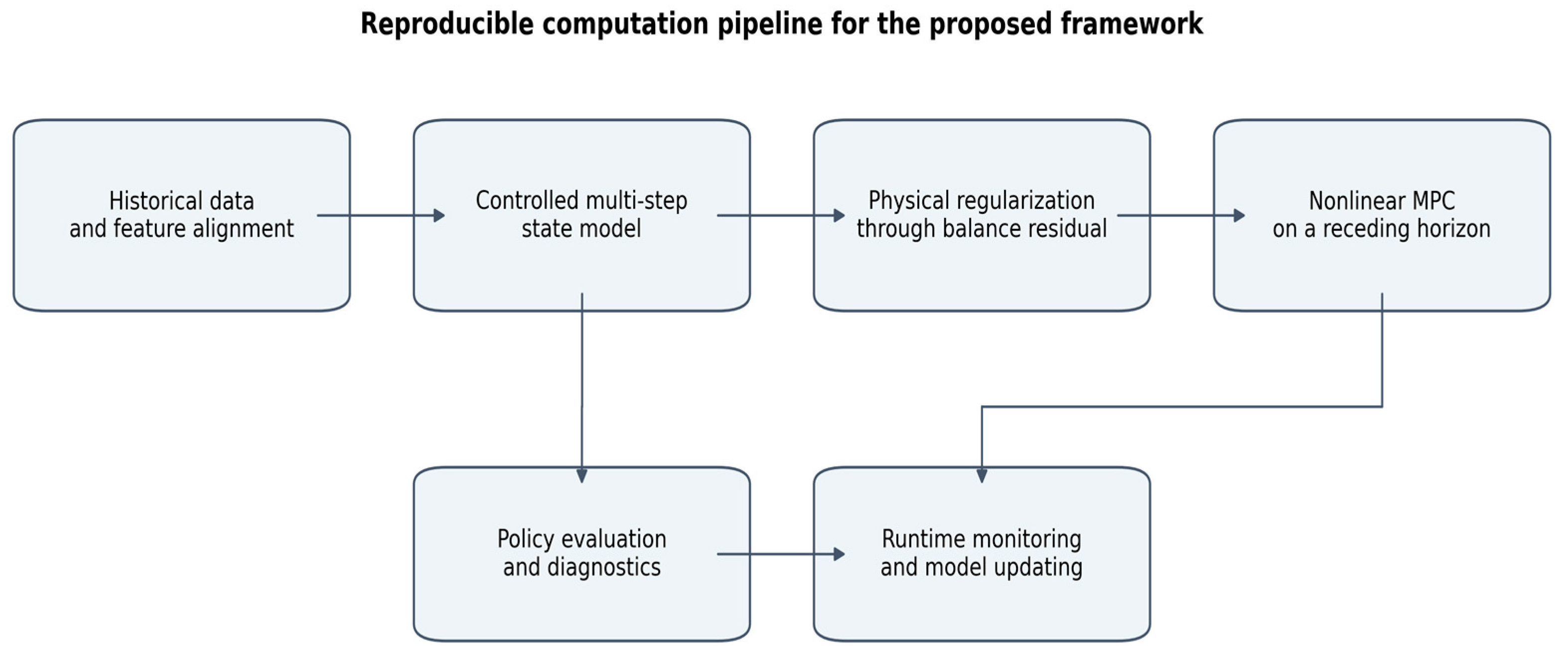
The study is organized as a reproducible computation pipeline linking data preparation, model training, controller tuning, policy evaluation, and runtime diagnostics. Figure 1 summarizes the workflow. Consistent data alignment, reuse of the identified physical parameters, synchronized model artifacts, and a shared temporal protocol are all necessary for a valid comparison, so the software workflow is treated as part of the method [4,5,31,35]. The present workflow is reproducible in the computational sense under controlled access rather than fully open in the raw-data sense, because the archived measurements originate from an industrial facility and remain confidential.
The workflow also addresses a common reproducibility problem in predictive-control studies. When training, tuning, figure generation, and control evaluation are carried out in loosely connected notebooks or scripts, small mismatches in time alignment, scaling, feature definitions, or model artifacts can contaminate the comparison. Here the exact data cutoff, training outputs, controller parameters, and evaluation summaries are stored as synchronized artifacts, so the comparison between the historical strategy, NMPC with the base model, and NMPC with the physically regularized model can be regenerated without reinterpretation of intermediate processing steps. Appendix E summarizes the controlled-access artifact inventory.
In this study, surrogate-based closed-loop comparison refers to a receding-horizon policy benchmark. It does not represent plant deployment or a free-running first-principles simulation. At each decision time, each controller is optimized with its designated predictive model, the first 5 min control block is applied, and the resulting policy is then scored under both learned evaluators. The main-text summary reports the arithmetic mean of each controller metric under the base and physically regularized evaluators to avoid a self-favoring comparison. Appendix F reports the corresponding evaluator-specific aggregate summaries.
The benchmark uses repeated archive-context re-initialization rather than a recursively propagated full-day surrogate rollout. When the next 5 min decision time arrives, the controller is re-initialized from the newly available measured 180 min archive window rather than from surrogate-predicted states carried over from the previous step. Surrogate rollouts are confined to each local 30 min decision horizon and to evaluator-side scoring; between decision steps the history is reset from the measured archive.
No separate future exogenous forecast is supplied on the 30 min horizon. Exogenous influence enters through the measured historical encoder window, while the future trajectory is driven only by the candidate control sequence. This setup isolates the effect of the predictive model used inside NMPC under a common information set instead of assuming perfect disturbance foresight on a short horizon. The measured future archive is used only for diagnostic comparison and model-gap analysis.

3.6. Evaluation Metrics and Ablation Logic

The evaluation protocol addresses two separate questions: how physical regularization changes the predictive behavior of the model, and whether that change helps once the model is embedded in nonlinear model predictive control. The study therefore uses both forecast-level and control-level metrics.
At the forecast level, three indicators are emphasized. The average ice-temperature root-mean-square error over the horizon measures the accuracy of the main technological coordinate. The event-tail state root-mean-square error measures the difficulty of disturbed periods and the late part of the horizon, where prediction is more relevant for control than for immediate one-step continuation. The normalized thermal-balance root-mean-square error on the horizon tail measures physical inconsistency relative to the identified balance scale. Together, these metrics describe the trade-off between statistical fit and structural coherence.
At the control level, the daily predicted energy, the terminal violation share, the mean absolute terminal ice-temperature deviation, and the mean objective value are reported on multi-day panels. The terminal metrics matter because, in the proposed NMPC formulation, the end of the horizon summarizes whether the current control sequence drives the system toward a favorable future state rather than only toward a favorable immediate response. A controller that looks good near the current time but systematically deteriorates the horizon end would be unreliable for receding-horizon use.
The model ablation follows three stages. First, exploratory regularization screening and final weak-region selection are performed on validation data rather than the final test split. Second, the selected weak-regularization candidate and the base model are reported on the test split using forecasting and physical-consistency metrics. Third, both models are embedded into their own tuned NMPC configurations and compared against historical admissible operation and against each other on the preselected four-day test panel.

4. Results

4.1. Forecasting–Physics Trade-Off

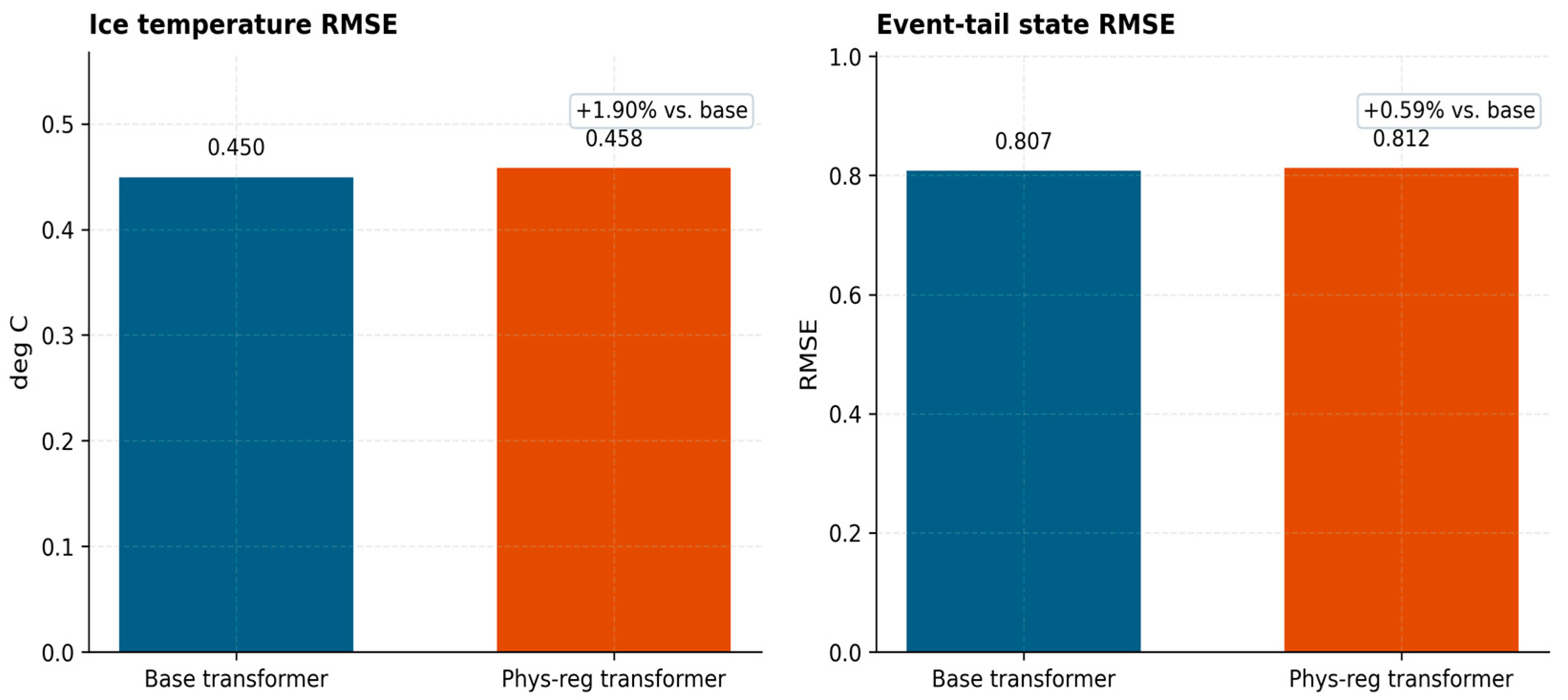
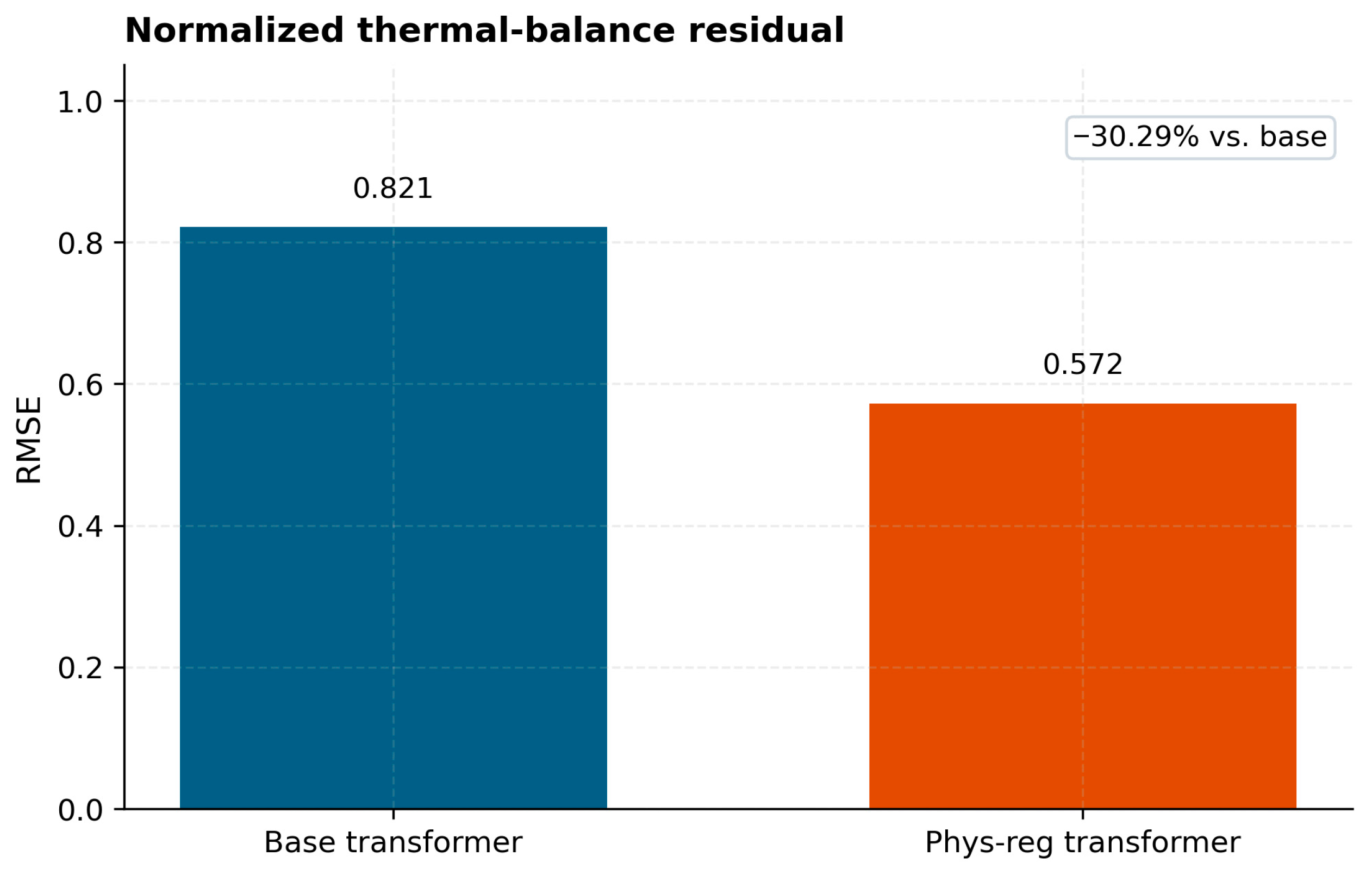
Table 2 and Figure 2 and Figure 3 show the final out-of-sample comparison between the base controlled transformer and the weak physically regularized variant. Because λ p h y s =   0.001 was selected on validation data, these test-split results are reported only as final evaluation. The physically regularized model does not dominate the base model on all forecast metrics, which makes the comparison more informative for control-oriented model selection. The average ice-temperature root-mean-square error increases from 0.450 °C to 0.458 °C, i.e., by 1.90%. The event-tail state root-mean-square error increases only by 0.59%. At the same time, the normalized thermal-balance root-mean-square error on the horizon tail decreases from 0.821 to 0.572, i.e., by 30.29%.
Weak regularization substantially reduces physical inconsistency while preserving near-base forecast accuracy. It narrows the admissible trajectory family without inducing the over-constrained behavior observed at larger regularization coefficients.

4.2. Focus-Day Prediction Diagnostics

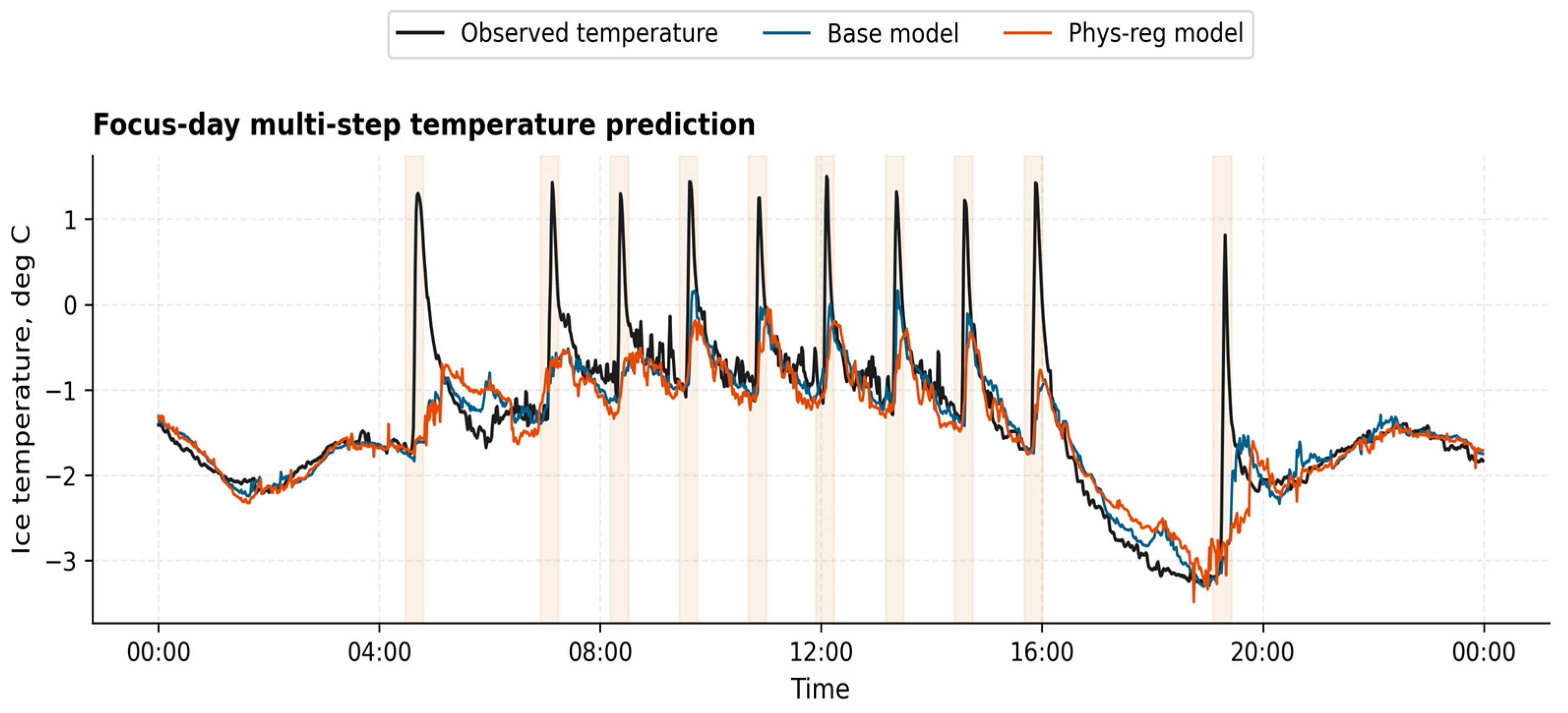
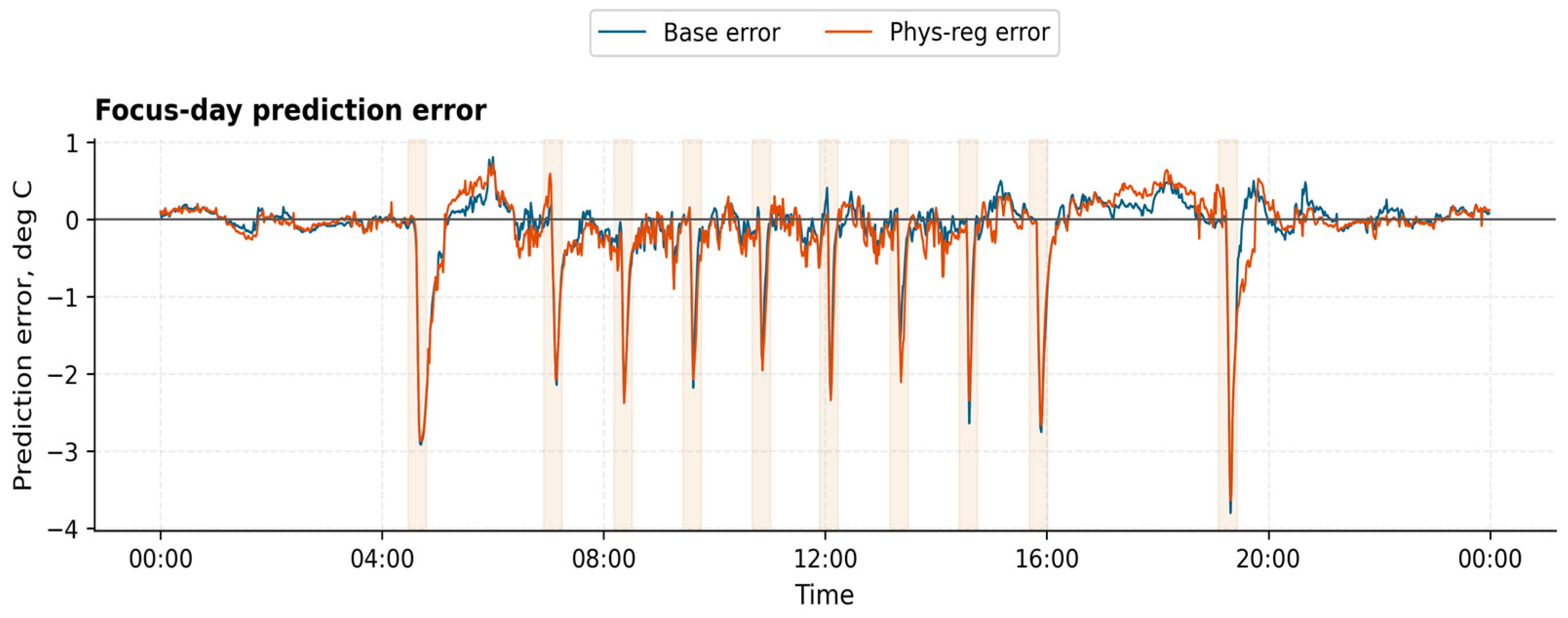
Figure 4 and Figure 5 provide a focus-day view of ice-temperature prediction. The shaded intervals correspond to resurfacing-related disturbances. Outside the event windows, both models track the slow thermal drift closely. During resurfacing, the physically regularized model tends to produce a smoother and more conservative response. This is consistent with the role of the physical term: it does not inject an external physical simulator, but it suppresses trajectory shapes that would violate the identified thermal-balance structure too strongly.
The error does not simply become smaller pointwise; the regularized model redistributes part of it away from short-lived aggressive excursions and toward a smoother mismatch. For a pure forecasting task this may or may not be beneficial. For a controller that repeatedly optimizes over future trajectories, such smoothing can improve the numerical and structural behavior of the optimization problem.

4.3. Counterfactual Control Performance

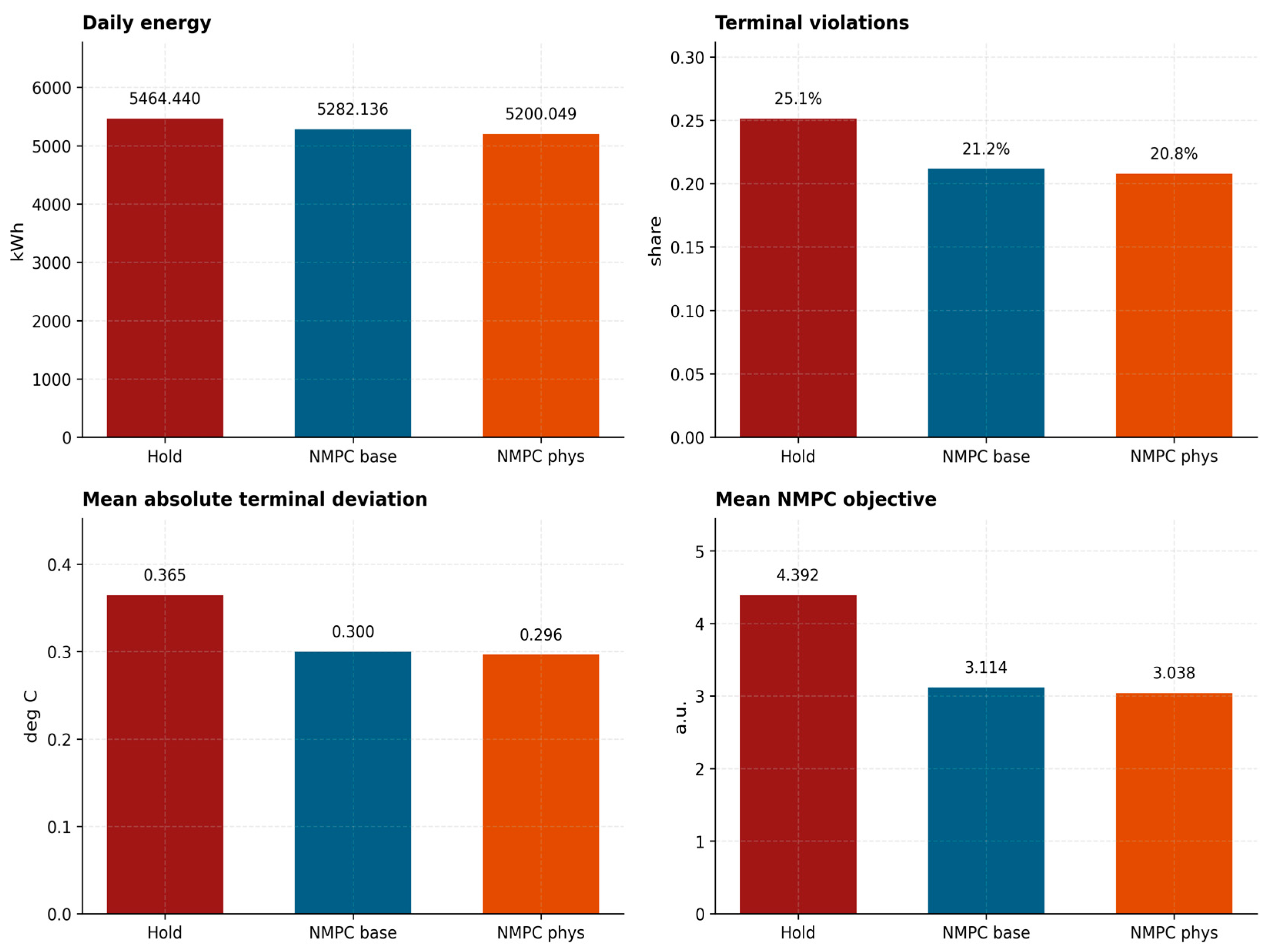
The control study compares three strategies on a preselected four-day test panel: historical admissible setpoint tracking, NMPC driven by the base model, and NMPC driven by the physically regularized model. Table 3 and Figure 6 summarize the four-day panel-average policy comparison, Appendix D reports the same indicators day by day for 2 February 2025, 9 February 2025, 14 February 2025, and 21 February 2025, and Appendix F reports the evaluator-specific aggregate summaries. On the aggregate panel, the physically regularized controller achieves the best overall compromise. Relative to historical admissible setpoint tracking, it reduces predicted daily energy by 4.84%, terminal violation share by 17.32%, mean absolute terminal ice-temperature deviation by 18.74%, and the mean objective value by 30.82%. On the four-day aggregate, relative to NMPC driven by the base model, it further improves the same indicators by 1.55%, 1.87%, 1.19%, and 2.43%, respectively. The gains over NMPC (base) are modest in absolute terms, but they remain engineering-relevant because they appear consistently across all four aggregate indicators for an already tuned lightweight baseline.
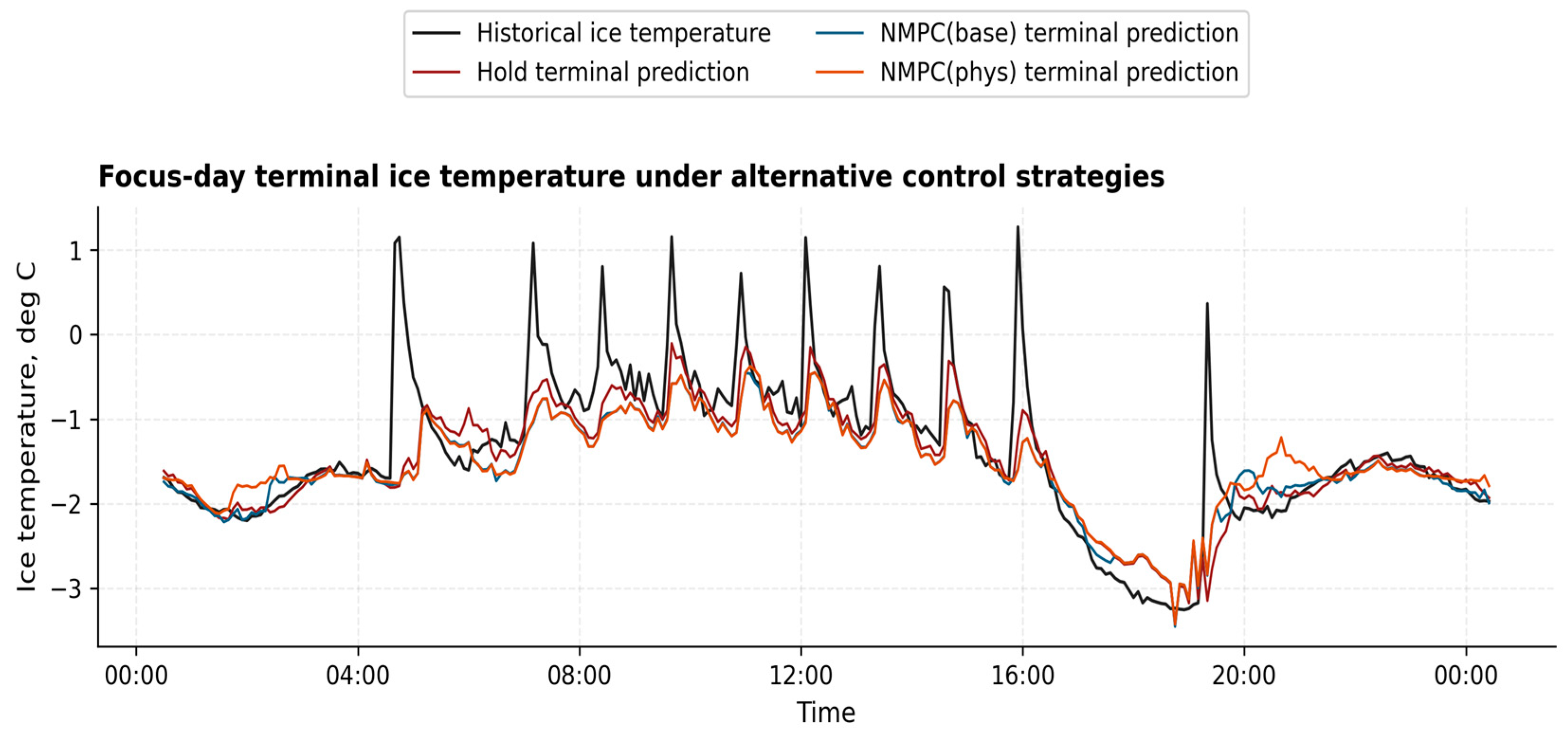
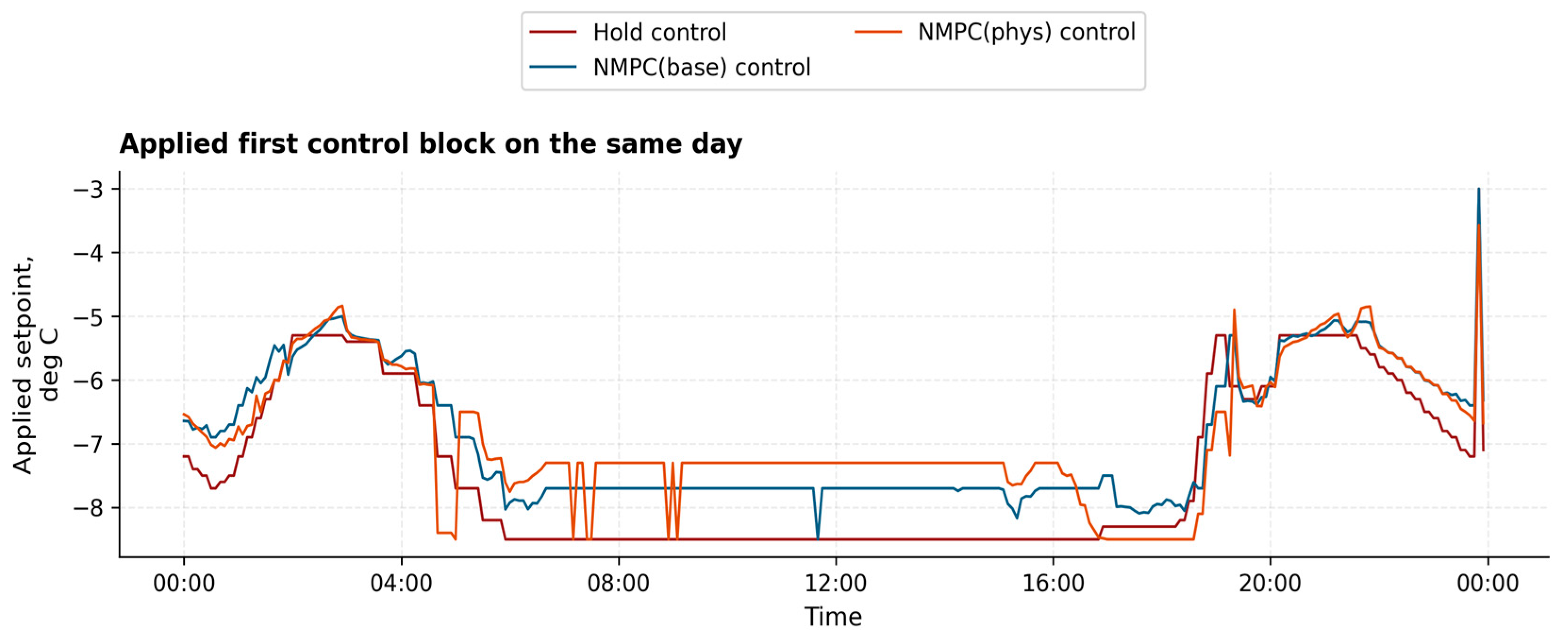
These aggregate results are complemented by the focus-day trajectories in Figure 7 and Figure 8. The first reports the predicted terminal ice temperature, while the second shows the applied first control block at each decision time. The historically applied admissible setpoint is comparatively coarse and remains saturated for extended periods. NMPC based on either learned model adjusts the setpoint more adaptively. The physically regularized controller is slightly more aggressive in some periods, but it translates that freedom into lower daily energy and lower terminal deviation over the whole panel rather than into erratic local behavior.
The comparison shows that control-oriented model selection cannot be reduced to a single archival forecast metric. The base model is marginally better as a pure forecast instrument, yet the weak physically regularized model performs better once it becomes part of the optimization loop. A model that is slightly worse in prediction but structurally more coherent may therefore be preferable for controller use.
All four aggregate control indicators move in the same favorable direction for the physically regularized controller, so the result is not a by-product of a simple energy-quality trade. The regularized predictor yields a better compromise between the energetic and technological terms already present in the objective. That advantage would not be visible in a forecast-only comparison. Appendix D also shows that the gain is not uniform day by day, yet the panel-average ranking remains favorable.

4.4. Runtime Feasibility

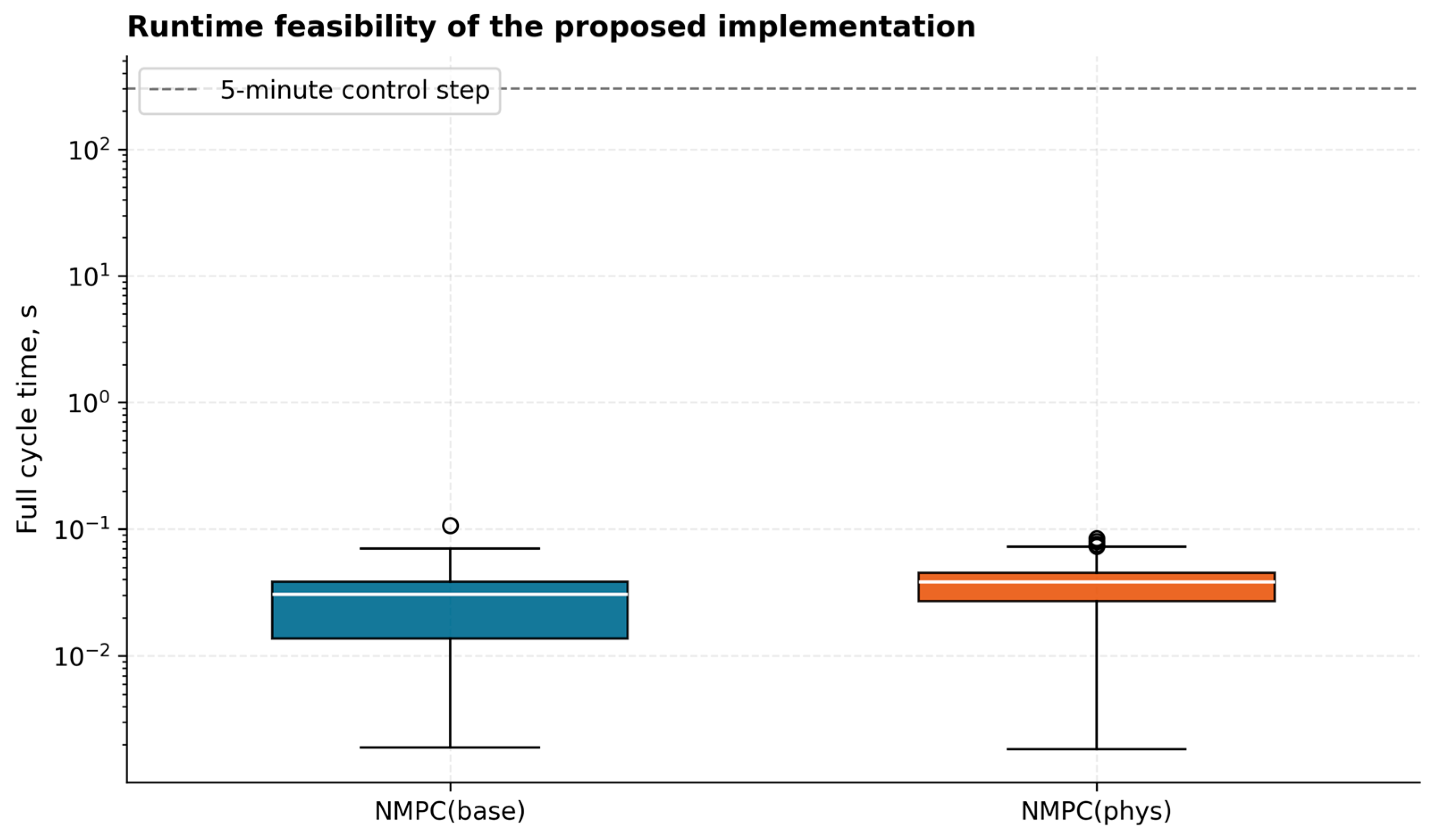
For a practical control-oriented pipeline, numerical performance is part of the scientific result. Table 4 and Figure 9 summarize the runtime profile of the final implementation. The mean full control cycle time is 0.0311 s, the 95th percentile is 0.0522 s, and the maximum observed value is 0.1064 s. All values remain far below the 5 min control update interval.
The reported cycle times are fully compatible with real-time supervisory use.
The numerical margin is substantial. Even the maximum observed cycle time remains orders of magnitude below the five-minute control update step. This leaves room for data validation, logging, alarm checks, and more sophisticated warm-start or fallback logic without threatening real-time feasibility. The practical bottleneck is therefore not the nonlinear optimization itself, but reliable integration with the operational information system.

5. Discussion

The results suggest that physical regularization is useful only in a weak regime. Strong regularization damages forecasting quality, whereas weak regularization reduces structural inconsistency while preserving enough flexibility to represent disturbed operating regimes. This is consistent with the broader literature on control-oriented physics-informed learning, which argues for balancing structural priors against data fidelity rather than replacing one with the other [24,25,26,27]. In the present case, the selected coefficient acts as a calibrated bias toward thermally plausible trajectories, not as an attempt to recover a full first-principles simulator.
Archival forecasting accuracy alone is an incomplete criterion for a model that will later be queried under optimization. The base model retained a slight advantage in average ice-temperature RMSE, but the physically regularized model yielded the best policy once embedded in NMPC. This outcome matches the broader argument in data-driven predictive-control research that the predictive model and the optimization layer should be evaluated jointly rather than sequentially [22,23,36,38]. The physical term appears to reshape admissible horizon trajectories in a way that makes the control objective easier to optimize. The gain over NMPC (base) is modest in absolute terms, but it is consistent across all reported control indicators and therefore relevant for model selection.
Indoor ice rinks are difficult control objects because they combine strongly disturbed periods, narrow technological requirements, and expensive refrigeration operation. The present experiments suggest that a state model informed by an aggregated heat balance is useful in this context because the ice slab behaves as an inertial buffer whose response cannot be represented adequately by a pure continuation model. Earlier physical studies of ice-rink energy use and more recent work on predictive environmental control in rinks both point in the same direction: the thermal structure of the object matters for both energy efficiency and service quality [13,14,15,16]. The contribution here is to embed that insight directly into a learned multi-step state model used for receding-horizon optimization.
Reproducibility is part of the same methodological picture. In many applied control studies, it is discussed only briefly, even though the final conclusions depend on a chain of linked steps: data cutoff, feature engineering, model training, controller tuning, and policy evaluation. The digital-twin and benchmarking literature suggests that this chain should be treated as part of the method, not as an implementation appendix [4,5,31,32,33,35]. The present workflow follows that view. The same artifact chain generates the figures, tables, and control summaries reported in the paper, which reduces the risk that the comparison is affected by silent mismatches between experimental stages.
Several limitations remain. First, the control study is counterfactual: the policies are evaluated with learned surrogate models rather than by direct online deployment on the industrial facility. This is a useful intermediate step for method development, but it is not a substitute for full field validation. Accordingly, the reported gains should be interpreted as benchmark evidence for control-oriented model selection rather than as realized operational savings. Second, the present study uses one facility and one manipulated variable, so transferability to other refrigeration plants, other slab constructions, or other supervisory degrees of freedom still has to be established. Third, the physical prior is intentionally aggregated. It captures the dominant thermal structure of the slab-glycol interaction, but it does not represent all heat-gain channels explicitly. Fourth, the short-horizon benchmark does not inject an explicit future exogenous forecast. This isolates the effect of the predictive model used inside NMPC under a common information set, but future studies should test whether explicit disturbance forecasts change the relative ranking of the predictive models. Adding richer disturbance channels, state-estimation layers, or adaptive physical coefficients may improve performance, but such extensions must preserve the computational economy that makes the present NMPC loop feasible.
These limitations point naturally toward future work. The most immediate next step is online or hardware-in-the-loop validation of the controller on the actual supervisory system. A second direction is the extension of the control input space to coordinated management of refrigeration, ventilation, or humidity-related subsystems, which would connect the present slab-focused model to the broader environmental control problem already emerging in the ice-rink literature [13]. A third direction concerns model adaptation: because the present workflow already stores synchronized training and evaluation artifacts, it provides a practical basis for future studies on periodic re-identification, seasonal adaptation, and concept-drift handling under operational constraints.

6. Conclusions

This paper proposed and evaluated a physically regularized control-oriented state model for an ice rink refrigeration system, together with an NMPC framework and a reproducible software workflow. The model conditions the forecast on an admissible future control trajectory and adds a normalized thermal-balance residual to the training objective. The selected weak-regularization model reduced the normalized thermal-balance error on the horizon tail by 30.29% while increasing the average ice-temperature RMSE by only 1.90%.
Within the surrogate-based counterfactual NMPC evaluation, the physically regularized model outperformed both historical admissible setpoint tracking and NMPC driven by the base model on the four-day aggregate panel. Relative to historical operation, the proposed controller reduced predicted daily energy by 4.84%, terminal violation share by 17.32%, mean absolute terminal ice-temperature deviation by 18.74%, and the mean objective value by 30.82%. Relative to NMPC based on the base model, it produced additional aggregate gains across all four indicators. The implementation remained computationally lightweight, with a mean full control cycle time of 0.0311 s and a maximum of 0.1064 s.
Taken together, these results show that weak physical regularization can improve surrogate-based receding-horizon energy optimization under learned-model evaluation, even when it does not dominate every forecast metric. More broadly, the study shows that control-oriented model selection should be based on predictive accuracy, structural consistency, and performance inside the optimization loop.
For energy-intensive thermal processes, predictive models should be designed with the control problem in mind from the outset. A model trained only to reproduce archived trajectories may remain suboptimal or even misleading when used for nonlinear predictive control under counterfactual setpoint candidates. A weakly regularized control-oriented model can preserve adequate forecasting quality while supplying the optimizer with horizon trajectories that are more compatible with the dominant thermal structure of the object in a surrogate-based receding-horizon setting.
Digital, data-centric control studies benefit from being reported as executable workflows rather than as disconnected algorithmic blocks. In this paper, the data protocol, predictive model, physical prior, tuning procedure, control evaluation, and runtime diagnostics were treated as one coherent computational experiment. That perspective is especially relevant for journals in the BDCC scope because it aligns the machine-learning, optimization, and software-engineering aspects of the contribution instead of isolating them artificially.
The same combination of inertial dynamics, exogenous disturbances, tight operational limits, and energy-quality trade-offs appears in broader classes of refrigeration, cooling, and thermal-management systems. The proposed framework may therefore also be useful beyond indoor ice rinks. Field validation remains the next necessary step before the reported gains can be interpreted as realized operational savings.


Author Contributions

Conceptualization, P.V.N.; methodology, P.V.N.; software, A.A.K.; validation, A.A.K.; formal analysis, A.A.K.; investigation, A.A.K.; data curation, A.A.K.; writing—original draft preparation, A.A.K.; writing—review and editing, P.V.N.; visualization, A.A.K. All authors have read and agreed to the published version of the manuscript.

Funding

This research received no external funding.

Institutional Review Board Statement

Not applicable.

Informed Consent Statement

Not applicable.

Data Availability Statement

The raw operational data used in this study are not publicly available because they originate from an industrial facility and contain commercially sensitive information. Under confidential peer review and reasonable request, the corresponding authors can provide the code archive, data-cutoff metadata, feature-generation scripts, trained model artifacts, controller-tuning outputs, day-wise evaluation tables, figure-generation scripts, and the execution-environment snapshot needed to rerun the workflow, subject to confidentiality restrictions. The present study should therefore be understood as a reproducible computational workflow under controlled access rather than as a fully open-data replication package.

Conflicts of Interest

The authors declare no conflicts of interest.

Abbreviations

MPCModel predictive control
NMPCNonlinear model predictive control
RMSERoot-mean-square error
SLSQPSequential least-squares quadratic programming

Appendix A. Full Engineered Feature List

Table A1 reports the full list of the 31 engineered input features used by the history encoder. In feature names, the suffix ‘1m’ denotes a one-minute difference and is not a unit of length.
Table A1. Full list of the 31 engineered features used by the history encoder.
No.FeatureDescription
1temp_iceIce surface temperature.
2temp_return_glycolReturn-glycol temperature.
3temp_supply_glycolSupply-glycol temperature.
4power_compressorsTotal compressor power.
5temp_insideIndoor air temperature.
6temp_outsideOutdoor air temperature.
7hum_insideIndoor relative humidity.
8hum_outsideOutdoor relative humidity.
9motion_insideIndoor motion indicator.
10illum_insideIndoor illuminance.
11temp_waterWater-loop temperature.
12power_heatAggregated heating power.
13power_ventilationVentilation power.
14setpoint_temp_return_glycolSupervisory return-glycol setpoint.
15hour_sinSine encoding of hour of day.
16hour_cosCosine encoding of hour of day.
17dow_sinSine encoding of day of week.
18dow_cosCosine encoding of day of week.
19deltaT_glycolReturn-minus-supply glycol temperature difference.
20deltaT_room_outIndoor-minus-outdoor air temperature difference.
21d_temp_ice_1m1 min difference in ice temperature.
22d_temp_return_glycol_1m1 min difference in return-glycol temperature.
23d_temp_supply_glycol_1m1 min difference in supply-glycol temperature.
24d_power_compressors_1m1 min difference in compressor power.
25d_motion_inside_1m1 min difference in the indoor motion indicator.
26d_illum_inside_1m1 min difference in indoor illuminance.
27d_temp_water_1m1 min difference in water-loop temperature.
28d_setpoint_temp_return_glycol_1m1 min difference in the return-glycol setpoint.
29temp_ice_ma_55 min moving average of ice temperature.
30power_compressors_ma_55 min moving average of compressor power.
31setpoint_temp_return_glycol_ma_55 min moving average of the return-glycol setpoint.

Appendix B. Earlier Lightweight Baselines

The present article does not repeat the full model-class benchmark in the main body because its methodological focus is the effect of physical regularization on the selected compact control-oriented baseline. This appendix is included to separate the contribution of physical regularization from gains already inherited from earlier model-class selection. For completeness, Table A2 summarizes the earlier lightweight benchmark on the same archive cutoff, chronological split, horizon definition, and evaluation metrics used to motivate the compact controlled transformer in the present study.
Table A2. Earlier lightweight baseline benchmark on the same archive and split.
ModelKPI_RMSE_AvgRMSE_Tail_VecTemp.-Event Tail Ratio
Naive (const)0.64990.71882.0055
Ridge0.49470.59212.2517
Ridge one-step + rollout0.52820.61421.9811
MLP0.47030.56782.2927
LSTM0.51450.59502.1841
Transformer0.46160.54242.1740

Appendix C. Physical Identification Protocol

Table A3 reports the retained counts at each filtering stage of the calm-night identification protocol. Table A4 reports the resulting robust physical parameters. The same resurfacing mask used in the main diagnostics also defines the event-sensitive physical-loss weighting; nominal horizon steps receive weight 1.0 and resurfacing-labeled steps receive weight 4.0.
Table A3. Filter stages for the calm-night identification sample.
Filter StageCountShare of Full Archive
Finite calculated quantities260,2840.999996
Valid 1 min time step260,2840.999996
Night window75,6640.290697
Outside dilated resurfacing mask73,3190.281687
Ice temperature within admissible identification range73,3190.281687
Slow return-glycol temperature change57,6570.221515
Final identification sample55,5190.213301
Table A4. Robust physical parameters identified from calm night-time segments.
ParameterValue
α p h y s 5.6553 × 10 5 s 1
β p h y s 2.1841 × 10 4   ° C   s 1
σ p h y s 5.1948 × 10 4   ° C   s 1
h e f f 0.02 m
C 38,514   J   m 2 K 1
k 2.1781   W   m 2 K 1
q 0 8.4119   W   m 2
Number of retained nights179

Appendix D. Day-Wise NMPC Results

Table A5 reports the day-wise results for the preselected four-day test panel. The appendix shows that the aggregate superiority of NMPC (phys) does not imply metric-wise dominance on every individual day, but it does support the panel-average conclusion reported in the main text.
Table A5. Day-wise surrogate-based closed-loop results on the four-day test panel.
DayStrategyEnergy, kWhTerminal Violation, %Mean Abs. Dev., °CObjective
2 February 2025Historical admissible setpoint1446.0842.860.54010.430
2 February 2025NMPC (base)1390.7539.590.4467.051
2 February 2025NMPC (phys)1396.8336.730.4256.918
9 February 2025Historical admissible setpoint1292.9426.210.3744.213
9 February 2025NMPC (base)1268.2918.350.2902.815
9 February 2025NMPC (phys)1243.9022.180.3132.770
14 February 2025Historical admissible setpoint1407.8617.770.2771.453
14 February 2025NMPC (base)1351.4214.840.2431.422
14 February 2025NMPC (phys)1334.2915.630.2501.471
21 February 2025Historical admissible setpoint1317.5614.690.2681.473
21 February 2025NMPC (base)1271.6712.790.2201.168
21 February 2025NMPC (phys)1225.039.540.1970.995

Appendix E. Controlled-Access Reproducibility Material

The present study should be understood as a reproducible computational workflow under controlled access rather than as a fully open-data replication package. Table A6 summarizes the artifact categories that can be provided for confidential peer review and that are sufficient to regenerate the reported tables and figures under the same data-access restrictions.
Table A6. Controlled-access artifact inventory for confidential peer review.
Artifact CategoryContent
Data-cutoff and split metadataExact archive cutoff, chronological split, selected validation/test panels, and focus-day metadata
Feature-generation materialFeature definitions, feature-generation scripts, and the finalized 31-feature history-encoder specification
Model artifactsTrained checkpoints, model configuration files, and synchronized forecasting summaries
Controller-tuning outputsPareto-filtered validation results, selected controller settings, and runtime summaries
Evaluation tablesDay-wise and panel-wise NMPC summaries, model-gap diagnostics, and control-rollout aggregates
Figure-generation materialFigure-generation scripts and synchronized manuscript-export assets
Environment snapshotPackage versions and execution-environment information needed to rerun the workflow

Appendix F. Evaluator-Specific Aggregate Summaries

Table A7 reports the four-day test-panel control indicators separately under the base and physically regularized surrogate evaluators. The main text reports the evaluator-consensus mean in order to avoid self-favoring evaluation, whereas this appendix makes the dependence of the aggregate summary on the chosen evaluator explicit.
Table A7. Evaluator-specific aggregate surrogate summaries on the four-day test panel.
EvaluatorStrategyEnergy, kWhTerminal Violation, %Mean Abs. Dev., °CObjective
BaseHistorical admissible setpoint5423.5326.410.3915.035
Physically regularizedHistorical admissible setpoint5505.3523.840.3583.749
BaseNMPC (base)5231.1519.490.2863.113
Physically regularizedNMPC (base)5333.1222.850.3303.115
BaseNMPC (phys)5180.8123.740.3393.391
Physically regularizedNMPC (phys)5219.2917.800.2762.685

References

  1. Baul, A.; Sarker, G.C.; Sikder, P.; Mozumder, U.; Abdelgawad, A. Data-Driven Short-Term Load Forecasting for Multiple Locations: An Integrated Approach. Big Data Cogn. Comput. 2024, 8, 12. [Google Scholar] [CrossRef]
  2. Santos-Dominguez, M.; Hernandez Flores, N.; Parra-Ramirez, I.A.; Arroyo-Figueroa, G. AI–Big Data Analytics Platform for Energy Forecasting in Modern Power Systems. Big Data Cogn. Comput. 2025, 9, 272. [Google Scholar] [CrossRef]
  3. Islam, M.B.; Guerrieri, A.; Gravina, R.; Fortino, G. A Meta-Survey on Intelligent Energy-Efficient Buildings. Big Data Cogn. Comput. 2024, 8, 83. [Google Scholar] [CrossRef]
  4. Lesnyak, E.; Belkot, T.; Hurka, J.; Hörding, J.P.; Kuhlmann, L.; Paulau, P.; Schnabel, M.; Schönfeldt, P.; Middelberg, J. Applied Digital Twin Concepts Contributing to Heat Transition in Building, Campus, Neighborhood, and Urban Scale. Big Data Cogn. Comput. 2023, 7, 145. [Google Scholar] [CrossRef]
  5. Corradini, F.; Pettinari, S.; Re, B.; Rossi, L.; Tiezzi, F. Executable Digital Process Twins: Towards the Enhancement of Process-Driven Systems. Big Data Cogn. Comput. 2023, 7, 139. [Google Scholar] [CrossRef]
  6. Waseem, M.; Lin, Z.; Yang, L. Data-Driven Load Forecasting of Air Conditioners for Demand Response Using Levenberg–Marquardt Algorithm-Based ANN. Big Data Cogn. Comput. 2019, 3, 36. [Google Scholar] [CrossRef]
  7. Criado-Ramón, D.; Ruiz, L.G.B.; Pegalajar, M.C. An Improved Pattern Sequence-Based Energy Load Forecast Algorithm Based on Self-Organizing Maps and Artificial Neural Networks. Big Data Cogn. Comput. 2023, 7, 92. [Google Scholar] [CrossRef]
  8. Al-Aboosi, A.F.; Muñoz Vazquez, A.J.; Al-Aboosi, F.Y.; El-Halwagi, M.; Zhan, W. Solar and Wind Data Recognition: Fourier Regression for Robust Recovery. Big Data Cogn. Comput. 2024, 8, 23. [Google Scholar] [CrossRef]
  9. Balderas, L.; Lastra, M.; Benítez, J.M. An Efficient Green AI Approach to Time Series Forecasting Based on Deep Learning. Big Data Cogn. Comput. 2024, 8, 120. [Google Scholar] [CrossRef]
  10. Runge, J.; Zmeureanu, R. A Review of Deep Learning Techniques for Forecasting Energy Use in Buildings. Energies 2021, 14, 608. [Google Scholar] [CrossRef]
  11. Zheng, P.; Zhou, H.; Liu, J.; Nakanishi, Y. Interpretable Building Energy Consumption Forecasting Using Spectral Clustering Algorithm and Temporal Fusion Transformers Architecture. Appl. Energy 2023, 349, 121607. [Google Scholar] [CrossRef]
  12. Gu, Y.; Jazizadeh, F.; Wang, X. Toward Large Energy Models: A Comparative Study of Transformers’ Efficacy for Energy Forecasting. Appl. Energy 2025, 384, 125358. [Google Scholar] [CrossRef]
  13. Liu, W.; Song, J.; Ji, J.; Yan, R.; Yin, Z.; Li, Y.; Zhang, D. A Machine Learning Based Predictive Control Framework for Energy Efficient Fog Prevention and Humidity Management in Indoor Ice Rinks. Energy Build. 2026, 354, 116888. [Google Scholar] [CrossRef]
  14. Du, Z.; Liu, Y.; Xue, Y.; Cheng, B.; Liu, B. Research on Cooling Load Prediction and Allocation Optimization for Refrigeration System in Indoor Ice Rink: Evidence from China. Sci. Rep. 2026; advance online publication. [CrossRef]
  15. Seghouani, L.; Daoud, A.; Galanis, N. Prediction of Yearly Energy Requirements of Indoor Ice Rinks. Energy Build. 2009, 41, 500–511. [Google Scholar] [CrossRef]
  16. Khalid, W.; Rogstam, J. Energy Usage Prediction Model Comparing Outdoor vs. Indoor Ice Rinks. Energy Build. 2013, 67, 195–200. [Google Scholar] [CrossRef]
  17. Moveh, S.; Merchán-Cruz, E.A.; Abuhussain, M.; Dodo, Y.A.; Alhumaid, S.; Alhamami, A.H. Deep Learning Framework Using Transformer Networks for Multi Building Energy Consumption Prediction in Smart Cities. Energies 2025, 18, 1468. [Google Scholar] [CrossRef]
  18. Huang, J.; Kaewunruen, S. Forecasting Energy Consumption of a Public Building Using Transformer and Support Vector Regression. Energies 2023, 16, 966. [Google Scholar] [CrossRef]
  19. Drgoňa, J.; Arroyo, J.; Cupeiro Figueroa, I.; Blum, D.; Arendt, K.; Kim, D.; Perarnau Ollé, E.; Oravec, J.; Wetter, M.; Vrabie, D.L.; et al. All You Need to Know about Model Predictive Control for Buildings. Annu. Rev. Control 2020, 50, 190–232. [Google Scholar] [CrossRef]
  20. Yao, Y.; Shekhar, D.K. State of the Art Review on Model Predictive Control (MPC) in Heating Ventilation and Air-Conditioning (HVAC) Field. Build. Environ. 2021, 200, 107952. [Google Scholar] [CrossRef]
  21. Taheri, S.; Hosseini, P.; Razban, A. Model Predictive Control of Heating, Ventilation, and Air Conditioning (HVAC) Systems: A State-of-the-Art Review. J. Build. Eng. 2022, 60, 105067. [Google Scholar] [CrossRef]
  22. Kathirgamanathan, A.; De Rosa, M.; Mangina, E.; Finn, D.P. Data-Driven Predictive Control for Unlocking Building Energy Flexibility: A Review. Renew. Sustain. Energy Rev. 2021, 135, 110120. [Google Scholar] [CrossRef]
  23. Hovgaard, T.G.; Larsen, L.F.S.; Edlund, K.; Jørgensen, J.B. Model Predictive Control Technologies for Efficient and Flexible Power Consumption in Refrigeration Systems. Energy 2012, 44, 105–116. [Google Scholar] [CrossRef]
  24. Gokhale, G.; Claessens, B.; Develder, C. Physics Informed Neural Networks for Control Oriented Thermal Modeling of Buildings. Appl. Energy 2022, 314, 118852. [Google Scholar] [CrossRef]
  25. Klanatsky, P.; Veynandt, F.; Heschl, C. Grey-Box Model for Model Predictive Control of Buildings. Energy Build. 2023, 300, 113624. [Google Scholar] [CrossRef]
  26. Alhajeri, M.S.; Abdullah, F.; Wu, Z.; Christofides, P.D. Physics-Informed Machine Learning Modeling for Predictive Control Using Noisy Data. Chem. Eng. Res. Des. 2022, 186, 34–49. [Google Scholar] [CrossRef]
  27. Wu, Z.; Rincon, D.; Luo, J.; Christofides, P.D. Machine Learning Modeling and Predictive Control of Nonlinear Processes Using Noisy Data. AIChE J. 2021, 67, e17164. [Google Scholar] [CrossRef]
  28. D’Amico, R.D.; Addepalli, S.; Erkoyuncu, J.A. Industrial Insights on Digital Twins in Manufacturing: Application Landscape, Current Practices, and Future Needs. Big Data Cogn. Comput. 2023, 7, 126. [Google Scholar] [CrossRef]
  29. Suárez-Román, M.; Sanz-Rodrigo, M.; Marín-López, A.; Arroyo, D. A Digital Twin Threat Survey. Big Data Cogn. Comput. 2025, 9, 252. [Google Scholar] [CrossRef]
  30. Barbuto, V.; Savaglio, C.; Chen, M.; Fortino, G. Disclosing Edge Intelligence: A Systematic Meta-Survey. Big Data Cogn. Comput. 2023, 7, 44. [Google Scholar] [CrossRef]
  31. Yu, W.; Patros, P.; Young, B.R.; Klinac, E.; Walmsley, T.G. Energy Digital Twin Technology for Industrial Energy Management: Classification, Challenges and Future. Renew. Sustain. Energy Rev. 2022, 161, 112407. [Google Scholar] [CrossRef]
  32. VanDerHorn, E.; Mahadevan, S. Digital Twin: Generalization, Characterization and Implementation. Decis. Support Syst. 2021, 145, 113524. [Google Scholar] [CrossRef]
  33. Wright, L.; Davidson, S. How to Tell the Difference between a Model and a Digital Twin. Adv. Model. Simul. Eng. Sci. 2020, 7, 13. [Google Scholar] [CrossRef]
  34. Pachon, C.; Pedraza, C.; Ballesteros, D. PruneEnergyAnalyzer: An Open-Source Toolkit for Evaluating Energy Consumption in Pruned Deep Learning Models. Big Data Cogn. Comput. 2025, 9, 200. [Google Scholar] [CrossRef]
  35. Blum, D.; Arroyo, J.; Huang, S.; Drgoňa, J.; Jorissen, F.; Walnum, H.T.; Chen, Y.; Benne, K.; Vrabie, D.; Wetter, M.; et al. Building Optimization Testing Framework (BOPTEST) for Simulation-Based Benchmarking of Control Strategies in Buildings. J. Build. Perform. Simul. 2021, 14, 586–610. [Google Scholar] [CrossRef]
  36. Tang, R.; Fan, C.; Zeng, F.; Feng, W. Data-Driven Model Predictive Control for Power Demand Management and Fast Demand Response of Commercial Buildings Using Support Vector Regression. Build. Simul. 2022, 15, 317–331. [Google Scholar] [CrossRef]
  37. Bamdad, K.; Mohammadzadeh, N.; Cholette, M.; Perera, S. Model Predictive Control for Energy Optimization of HVAC Systems Using EnergyPlus and ACO Algorithm. Buildings 2023, 13, 3084. [Google Scholar] [CrossRef]
  38. Hewing, L.; Wabersich, K.P.; Menner, M.; Zeilinger, M.N. Learning-Based Model Predictive Control: Toward Safe Learning in Control. Annu. Rev. Control Robot. Auton. Syst. 2020, 3, 269–296. [Google Scholar] [CrossRef]
Figure 1. Reproducible computation pipeline for the proposed framework.
Bdcc 10 00134 g001
Figure 2. Comparison of the main forecasting metrics for the base and physically regularized models.
Bdcc 10 00134 g002
Figure 3. Comparison of the normalized thermal-balance residual on the horizon tail.
Bdcc 10 00134 g003
Figure 4. Focus-day multi-step ice-temperature prediction relative to the measured archive trajectory for the base and physically regularized models. The shaded intervals mark the dilated resurfacing mask used in diagnostics and in the physical-loss weighting.
Bdcc 10 00134 g004
Figure 5. Focus-day prediction error relative to the measured archive temperature for the base and physically regularized models. The shaded intervals mark resurfacing-related disturbance periods.
Bdcc 10 00134 g005
Figure 6. Aggregate surrogate-based closed-loop performance comparison for the evaluated control strategies.
Bdcc 10 00134 g006
Figure 7. Focus-day surrogate-predicted terminal ice-temperature trajectories for the compared strategies. The historical strategy follows the measured admissible archive setpoint, whereas the NMPC trajectories are counterfactual receding-horizon policy evaluations.
Bdcc 10 00134 g007
Figure 8. Focus-day applied first control block for the compared strategies. The historical series is the measured archive setpoint, whereas the NMPC series are counterfactual control actions generated by the learned models in the surrogate-based benchmark.
Bdcc 10 00134 g008
Figure 9. Distribution of full control cycle time for the selected NMPC implementations. The dashed line marks the 5 min control update interval.
Bdcc 10 00134 g009
Table 1. Dataset and evaluation protocol.
ItemValue
Archive after cutoff260,285 one-minute observations from 1 September 2024 05:55 to 28 February 2025 23:59
Chronological split182,199 train rows, 39,043 validation rows, 39,043 test rows
State coordinatesIce temperature, return-glycol temperature, supply-glycol temperature, compressor power
Manipulated variableReturn-glycol temperature setpoint
History and forecast horizons180 min history, 30 min forecast, 10 min tail horizon
Control parametrization6 piecewise-constant blocks of 5 min each
Evaluation panelsValidation days: 6 January 2025, 14 January 2025, and 16 January 2025; test days: 2 February 2025, 9 February 2025, 14 February 2025, and 21 February 2025
Table 2. Final comparison of the base and physically regularized forecasting models on the test split.
ModelPhys. Reg. Coeff.Ice RMSEEvent-Tail State RMSENorm. Residual Tail RMSE
Base controlled transformer0.0000.4500.8070.821
Physically regularized transformer0.0010.4580.8120.572
Table 3. Surrogate-based closed-loop comparison on the four-day test panel.
StrategyEnergy, kWhTerminal Violation, %Mean Abs. Terminal Dev., °CObjectiveMean Solve Time, s
Historical admissible setpoint5464.4425.120.3654.3920.0000
NMPC (base)5282.1421.170.3003.1140.0272
NMPC (phys)5200.0520.770.2963.0380.0350
Table 4. Runtime profile of the reproducible implementation.
StageMean Time, s95th Percentile, sMaximum Time, s
Pre-processing0.00000.00000.0000
Optimization0.03110.05220.1064
Full cycle0.03110.05220.1064
Disclaimer/Publisher’s Note: The statements, opinions and data contained in all publications are solely those of the individual author(s) and contributor(s) and not of MDPI and/or the editor(s). MDPI and/or the editor(s) disclaim responsibility for any injury to people or property resulting from any ideas, methods, instructions or products referred to in the content.