

Data-Driven Life-Cycle Assessment of Household Air Conditioners: Identifying Low-Carbon Operation Patterns Based on Big Data Analysis

Abstract
1. Introduction
2. Materials and Methods
2.1. Data Collection and Preprocessing
- To ensure consistent calculation of the annual operating hours and annual electricity consumption with complete coverage of both cooling and heating seasons, we extracted data for 2020, which had the fewest missing records in the dataset.
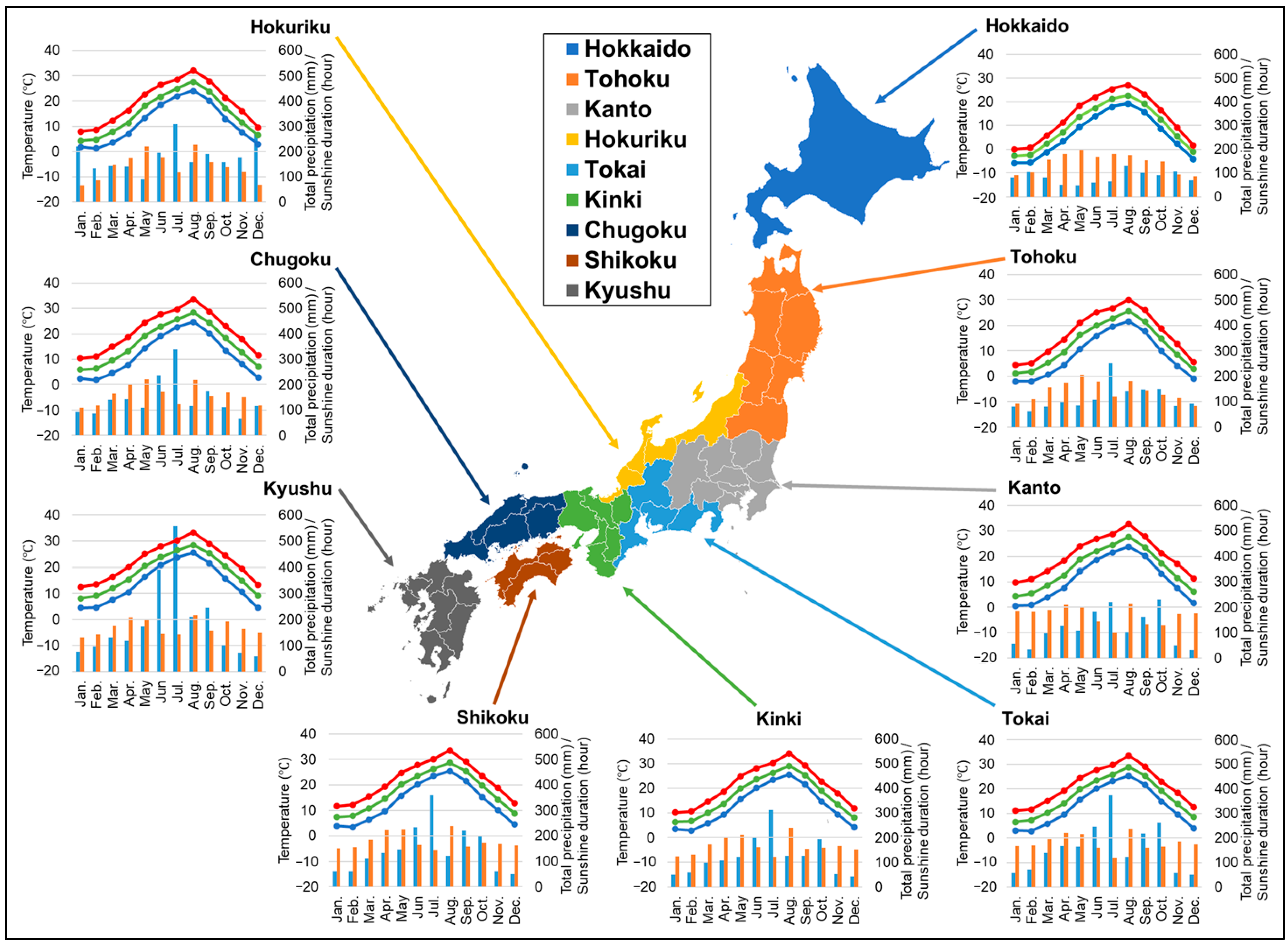
- To characterize the regional usage patterns, we restricted the sample to units whose installation regions could be identified.
- To eliminate differences in equipment characteristics by rated capacity and compare patterns driven solely by actual usage, we limited the analysis to units with a cooling capacity of 5.6 kW, which was the class with the largest number of units in the dataset.
- To exclude units that were not in service, we removed air conditioners with annual total operating hours of less than one.
- To remove outliers and capture general usage tendencies, we excluded units whose annual electricity consumption laid outside the mean ± 3 standard deviations after a logarithmic transformation.
2.2. Regional Classification and Climatic Characteristics
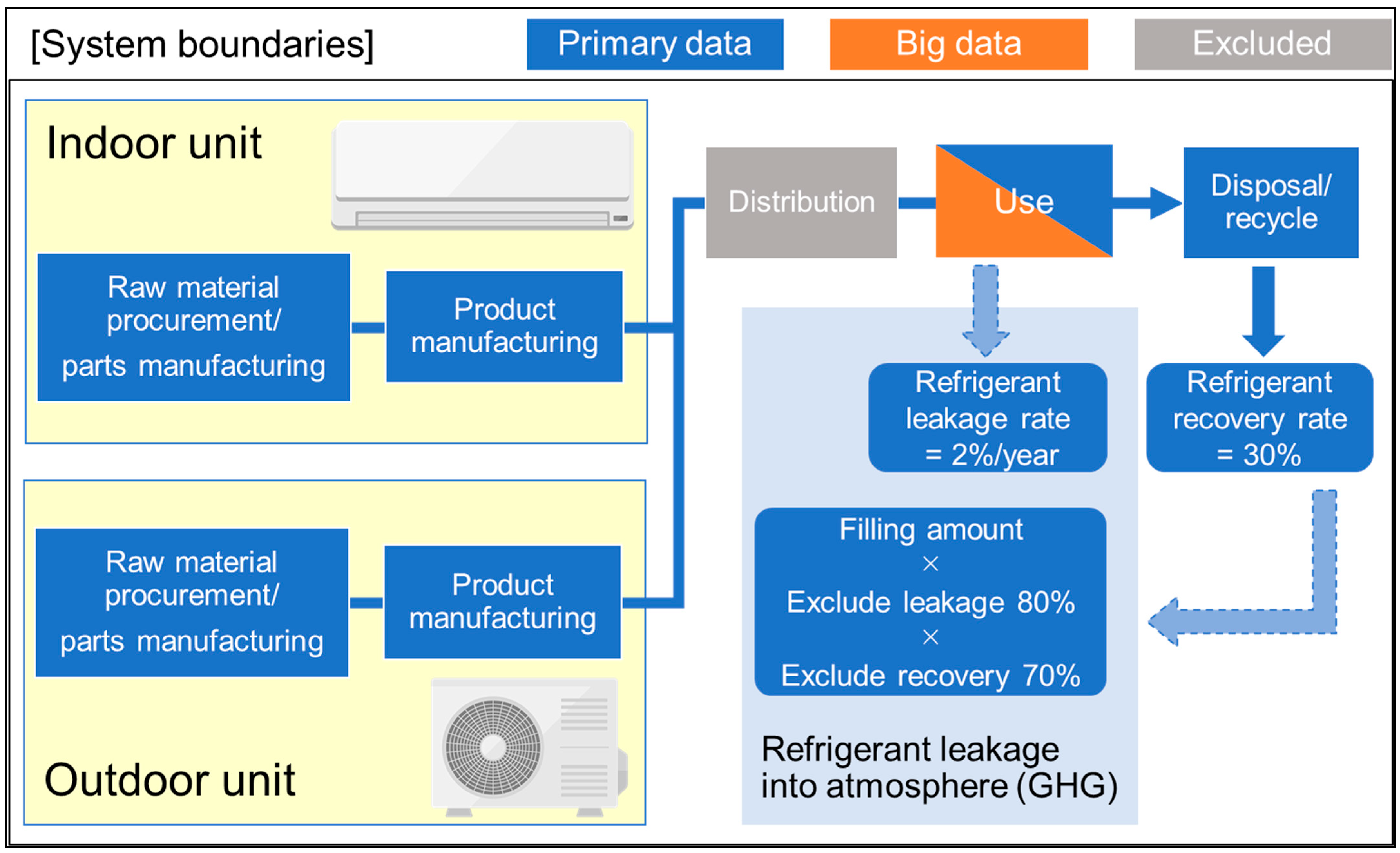
2.3. LCCP
2.3.1. Direct Emissions
2.3.2. Indirect Emissions from Operation
2.3.3. Indirect Embodied Emissions
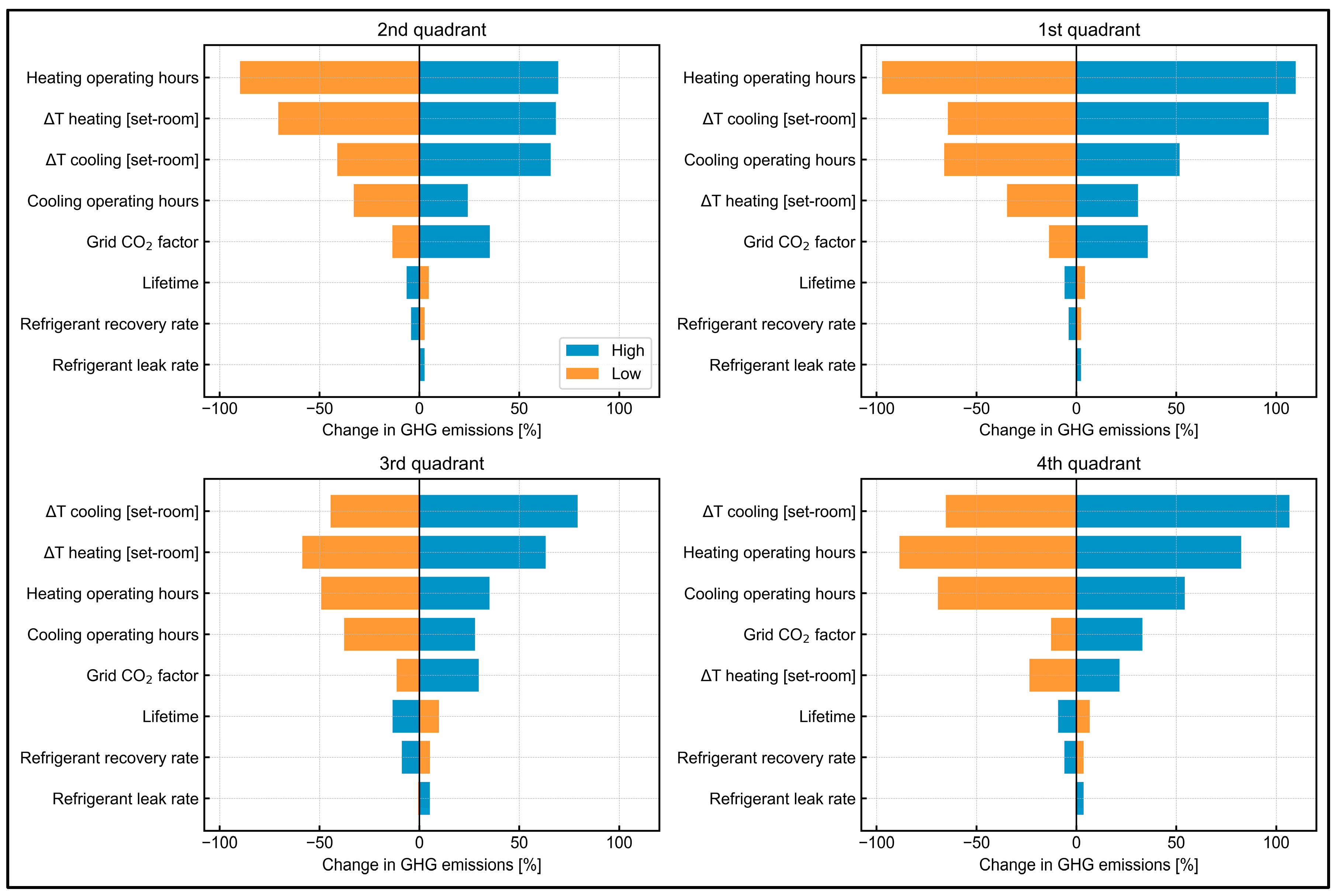
2.4. Sensitivity Analysis
3. Results
3.1. LCA Results Reflecting Real-World Air-Conditioner Use
3.2. Cluster-Specific Operating Profile Analysis
3.3. Sensitivity Analysis of LCA Results
4. Discussion
4.1. Comparison Between JIS Values and Big-Data-Based Measurements
4.2. Comparison with Previous LCA Studies of Air Conditioners
4.3. Influence of Occupant Behavior and Operating Patterns
4.4. Operating-Pattern-Specific Low-Carbon Strategies
4.5. Limitations and Future Directions
5. Conclusions
Author Contributions
Funding
Institutional Review Board Statement
Informed Consent Statement
Data Availability Statement
Conflicts of Interest
Abbreviations
| IPCC | Intergovernmental Panel on Climate Change |
| GHG | Greenhouse gas |
| IEA | International Energy Agency |
| LCA | Life-cycle assessment |
| LCCP | Life-cycle climate performance |
| GWP | Global warming potential |
| AC | Air conditioner |
| SEER | Seasonal Energy Efficiency Ratio |
| AHRI | Air-conditioning, Heating, and Refrigeration Institute |
| ASHRAE | American Society of Heating, Refrigerating and Air-Conditioning Engineers |
| EER | Energy Efficiency Ratio |
| ANSI | American National Standards Institute |
| JIS | Japanese Industrial Standard |
| TEWI | Total Equivalent Warming Impact |
| IREC | Indirect Regenerative Evaporative Cooling |
| VCRM | Vapor Compression Refrigerating Machine |
| COP | Coefficient of Performance |
| HVAC | Heating, ventilation, and air-conditioning |
| IIR | International Institute of Refrigeration |
| IDEA | Inventory Database for Environmental Analysis |
| OAT | One-at-a-time |
| APF | Annual performance factor |
References
- Mora, C.; Dousset, B.; Caldwell, I.R.; Powell, F.E.; Geronimo, R.C.; Bielecki, C.R.; Counsell, C.W.W.; Dietrich, B.S.; Johnston, E.T.; Louis, L.V.; et al. Global Risk of Deadly Heat. Nat. Clim. Change 2017, 7, 501–506. [Google Scholar] [CrossRef]
- Ebi, K.L.; Capon, A.; Berry, P.; Broderick, C.; de Dear, R.; Havenith, G.; Honda, Y.; Kovats, R.S.; Ma, W.; Malik, A.; et al. Hot Weather and Heat Extremes: Health Risks. Lancet 2021, 398, 698–708. [Google Scholar] [CrossRef] [PubMed]
- Masson-Delmotte, V.; Zhai, P.; Pirani, A.; Connors, S.L.; Péan, C.; Berger, S.; Caud, N.; Chen, Y.; Goldfarb, L.; Gomis, M.I.; et al. (Eds.) Working Group I Contribution to the Climate Change 2021: The Physical Science Basis. Contribution of Working Group I to the Sixth Assessment Report of the Intergovernmental Panel on Climate Change; Cambridge University Press: Cambridge, UK; New York, NY, USA, 2021. [Google Scholar]
- Macintyre, H.L.; Murage, P.; Fučkar, N.S.; Hajat, S.; Heaviside, C.; Vardoulakis, S.; Cordiner, R. Health Effects of Climate Change (HECC) in the UK: 2023 Report Chapter 2. Temperature Effects on Mortality in a Changing Climate; UK Health Security Agency: London, UK, 2023. [Google Scholar]
- Gasparrini, A.; Guo, Y.; Hashizume, M.; Lavigne, E.; Zanobetti, A.; Schwartz, J.; Tobias, A.; Tong, S.; Rocklöv, J.; Forsberg, B.; et al. Mortality Risk Attributable to High and Low Ambient Temperature: A Multicountry Observational Study. Lancet 2015, 386, 369–375. [Google Scholar] [CrossRef]
- DeMarco, M.; Fortier, M.-O.P. Functional Unit Choice in Space Conditioning Life Cycle Assessment: Review and Recommendations. Energy Build. 2022, 255, 111626. [Google Scholar] [CrossRef]
- Litardo, J.; Gomez, D.; Boero, A.; Hidalgo-Leon, R.; Soriano, G.; Ramirez, A.D. Air-Conditioning Life Cycle Assessment Research: A Review of the Methodology, Environmental Impacts, and Areas of Future Improvement. Energy Build. 2023, 296, 113415. [Google Scholar] [CrossRef]
- IEA. The Future of Cooling; IEA: Paris, France, 2018. [Google Scholar]
- Mastrucci, A.; van Ruijven, B.; Byers, E.; Poblete-Cazenave, M.; Pachauri, S. Global Scenarios of Residential Heating and Cooling Energy Demand and CO2 Emissions. Clim. Change 2021, 168, 14. [Google Scholar] [CrossRef]
- Mastrucci, A.; Boza-Kiss, B.; van Ruijven, B. Towards Net-Zero Emissions in Global Residential Heating and Cooling: A Global Scenario Analysis. Clim. Change 2025, 178, 85. [Google Scholar] [CrossRef]
- Yan, C.; Ogata, S. Changes in Residential Heating and Cooling Energy Consumption in Nine Major Cities of Japan’s Warm Climate Regions under Future Climate Conditions. Energy Build. 2025, 344, 115990. [Google Scholar] [CrossRef]
- Romanello, M.; McGushin, A.; Di Napoli, C.; Drummond, P.; Hughes, N.; Jamart, L.; Kennard, H.; Lampard, P.; Solano Rodriguez, B.; Arnell, N.; et al. The 2021 Report of the Lancet Countdown on Health and Climate Change: Code Red for a Healthy Future. Lancet 2021, 398, 1619–1662. [Google Scholar] [CrossRef]
- Karkour, S.; Ihara, T.; Kuwayama, T.; Yamaguchi, K.; Itsubo, N. Life Cycle Assessment of Residential Air Conditioners Considering the Benefits of Their Use: A Case Study in Indonesia. Energies 2021, 14, 447. [Google Scholar] [CrossRef]
- Li, G. Investigations of Life Cycle Climate Performance and Material Life Cycle Assessment of Packaged Air Conditioners for Residential Application. Sustain. Energy Technol. Assess. 2015, 11, 114–125. [Google Scholar] [CrossRef]
- Almutairi, K.; Thoma, G.; Burek, J.; Algarni, S.; Nutter, D. Life Cycle Assessment and Economic Analysis of Residential Air Conditioning in Saudi Arabia. Energy Build. 2015, 102, 370–379. [Google Scholar] [CrossRef]
- Shah, V.P.; Debella, D.C.; Ries, R.J. Life Cycle Assessment of Residential Heating and Cooling Systems in Four Regions in the United States. Energy Build. 2008, 40, 503–513. [Google Scholar] [CrossRef]
- Zhou, X.; Yan, D.; Feng, X.; Deng, G.; Jian, Y.; Jiang, Y. Influence of Household Air-Conditioning Use Modes on the Energy Performance of Residential District Cooling Systems. Build. Simul. 2016, 9, 429–441. [Google Scholar] [CrossRef]
- Ross, S.A.; Cheah, L. Uncertainty Quantification in Life Cycle Assessments: Interindividual Variability and Sensitivity Analysis in LCA of Air-Conditioning Systems. J. Ind. Ecol. 2017, 21, 1103–1114. [Google Scholar] [CrossRef]
- Goldsworthy, M. Towards a Residential Air-Conditioner Usage Model for Australia. Energies 2017, 10, 1256. [Google Scholar] [CrossRef]
- Deng, Z.; Chen, Q. Simulating the Impact of Occupant Behavior on Energy Use of HVAC Systems by Implementing a Behavioral Artificial Neural Network Model. Energy Build. 2019, 198, 216–227. [Google Scholar] [CrossRef]
- Wan, H.; Cao, T.; Hwang, Y.; Radermacher, R.; Andersen, S.O.; Chin, S. A Comprehensive Review of Life Cycle Climate Performance (LCCP) for Air Conditioning Systems. Int. J. Refrig. 2021, 130, 187–198. [Google Scholar] [CrossRef]
- Choi, S.; Oh, J.; Hwang, Y.; Lee, H. Life Cycle Climate Performance Evaluation (LCCP) on Cooling and Heating Systems in South Korea. Appl. Therm. Eng. 2017, 120, 88–98. [Google Scholar] [CrossRef]
- Gheewala, S.H.; Nielsen, P.H. Central and Individual Air-Conditioning Systems—A Comparison of Environmental Impacts and Resource Consumption in a Life Cycle Perspective. Int. J. Sustain. Dev. World Ecol. 2003, 10, 149–155. [Google Scholar] [CrossRef]
- Joudi, K.A.; Al-Amir, Q.R. Experimental Assessment of Residential Split Type Air-Conditioning Systems Using Alternative Refrigerants to R-22 at High Ambient Temperatures. Energy Convers. Manag. 2014, 86, 496–506. [Google Scholar] [CrossRef]
- Nishijima, D. The Role of Technology, Product Lifetime, and Energy Efficiency in Climate Mitigation: A Case Study of Air Conditioners in Japan. Energy Policy 2017, 104, 340–347. [Google Scholar] [CrossRef]
- Wan, H.; Cao, T.; Hwang, Y.; Radermacher, R.; Chin, S. Comprehensive Investigations on Life Cycle Climate Performance of Unitary Air-Conditioners. Int. J. Refrig. 2021, 129, 332–341. [Google Scholar] [CrossRef]
- Andrade, A.; Zapata-Mina, J.; Restrepo, A. Exergy and Environmental Assessment of R-290 as a Substitute of R-410A of Room Air Conditioner Variable Type Based on LCCP and TEWI Approaches. Results Eng. 2024, 21, 101806. [Google Scholar] [CrossRef]
- Aljolani, O.; Heberle, F.; Brüggemann, D. Thermo-Economic and Environmental Analysis of a CO2 Residential Air Conditioning System in Comparison to HFC-410A and HFC-32 in Temperate and Subtropical Climates. Appl. Energy 2024, 353, 122073. [Google Scholar]
- Marcinkowski, A.; Levchenko, D. Comparative Life Cycle Analysis for Duct Air Conditioning Systems Based on Evaporative and Vapor Compression Technologies. Energies 2025, 18, 3475. [Google Scholar] [CrossRef]
- ANSI/ASHRAE 37-2009; Methods of Testing for Rating Electrically Driven Unitary Air Conditioning and Heat Pump Equipment. American National Standards Institute: Washington, DC, USA, 2009.
- ANSI/AHRI Standard 210/240-2008; Standard for Performance Rating of Unitary Air-Conditioning & Air-Source Heat Pump Equipment. American National Standards Institute: Washington, DC, USA, 2008.
- JIS C 9612:2013; Room Air Conditioner. Japanese Industrial Standards Committee: Tokyo, Japan, 2013.
- ANSI/AHRI Standard 210/240-2017; Standard for Performance Rating of Unitary Air-Conditioning & Air-Source Heat Pump Equipment. American National Standards Institute: Washington, DC, USA, 2017.
- ANSI/ASHRAE Standard 34-2019; Designation and Safety Classification of Refrigerants. American National Standards Institute: Washington, DC, USA, 2019.
- ISO 5151:2017; Non-Ducted Air Conditioners and Heat Pumps—Testing and Rating for Prerformance. International Organization for Standardization: Geneva, Switzerland, 2017.
- ISO 16358-1:2013; Air-Cooled Air Conditioners and Airto-Air Heat Pumps—Testing and Calculating Methods for Seasonal Performance Factors—Part 1: Cooling Seasonal Performance Factor. International Organization for Standardization: Geneva, Switzerland, 2013.
- EN 14825–2013; Air Conditioners, Liquid Chilling Packages and Heat Pumps, with Electrically Driven Compressors, for Space Heating and Cooling—Testing and Rating at Part Load Conditions and Calculation of Seasonal Performance. European Committee for Standardization: Brussels, Belgium, 2013.
- Delzendeh, E.; Wu, S.; Lee, A.; Zhou, Y. The Impact of Occupants’ Behaviours on Building Energy Analysis: A Research Review. Renew. Sustain. Energy Rev. 2017, 80, 1061–1071. [Google Scholar] [CrossRef]
- Ahmed, O.; Sezer, N.; Ouf, M.; Wang, L.; Hassan, I.G. State-of-the-Art Review of Occupant Behavior Modeling and Implementation in Building Performance Simulation. Renew. Sustain. Energy Rev. 2023, 185, 113558. [Google Scholar]
- An, J.; Yan, D.; Hong, T. Clustering and Statistical Analyses of Air-Conditioning Intensity and Use Patterns in Residential Buildings. Energy Build. 2018, 174, 214–227. [Google Scholar] [CrossRef]
- Yan, L.; Liu, M.; Xue, K.; Zhang, Z. A Study on Temperature-Setting Behavior for Room Air Conditioners Based on Big Data. J. Build. Eng. 2020, 30, 101197. [Google Scholar] [CrossRef]
- Liu, H.; Sun, H.; Mo, H.; Liu, J. Analysis and Modeling of Air Conditioner Usage Behavior in Residential Buildings Using Monitoring Data during Hot and Humid Season. Energy Build. 2021, 250, 111297. [Google Scholar] [CrossRef]
- Hong, T.; Yan, D.; D’Oca, S.; Chen, C.-F. Ten Questions Concerning Occupant Behavior in Buildings: The Big Picture. Build. Environ. 2017, 114, 518–530. [Google Scholar] [CrossRef]
- Japan Meteorological Agency General Information on Climate of Japan. Available online: https://www.data.jma.go.jp/cpd/longfcst/en/tourist.html (accessed on 12 July 2025).
- Hwang, Y.; Infante Ferreira, C.; Piao, C.C.; Aute, V.; Troch, S. Guideline for Life Cycle Climate Performance; International Institute of Refrigeration: Paris, France, 2016. [Google Scholar]
- Ministry of the Environment Publication of Basic Emission Factors and Adjusted Emission Factors for Each Electric Utility for FY2020 (Partially Added and Updated). Available online: https://www.env.go.jp/press/press_00216.html (accessed on 27 September 2025).
- Agency for Natural Resources and Energy, Ministry of Economy, Trade and Industry Product Search: Air Conditioner Target Year 2027. Available online: https://seihinjyoho.go.jp/search.html?cat=%E3%82%A8%E3%82%A2%E3%82%B3%E3%83%B3&ty=2027 (accessed on 25 September 2025).
- Research Laboratory for IDEA. RISS, AIST LCI Database, AIST-IDEA Ver.3.5.1; Standard Edition; National Institute of Advanced Industrial Science and Technology (AIST): Tokyo, Japan, 2025.
- Yasaka, Y.; Karkour, S.; Shobatake, K.; Itsubo, N.; Yakushiji, F. Life-Cycle Assessment of Refrigerants for Air Conditioners Considering Reclamation and Destruction. Sustainability 2022, 15, 473. [Google Scholar] [CrossRef]
- Ministry of Finance of Japan. Ministerial Ordinance Concerning the Useful Life of Depreciable Assets; ID: 340M50000040015; Ministry of Finance of Japan: Tokyo, Japan, 1965; Volume e-GoLaw. Available online: https://laws.e-gov.go.jp/law/340M50000040015 (accessed on 21 November 2025).
- Department of Business Statistics Economic and Social Research Institute Cabinet Office, Government of Japan. Consumer Confidence Survey; Department of Business Statistics Economic and Social Research Institute Cabinet Office, Government of Japan: Tokyo, Japan, 2025.
- Bjønness, K.L.; Gustafsson, T.; Ishikawa, J.; Maione, M. 2019 Refinement to the 2006 IPCC Guidelines for National Greenhouse Gas Inventories Volume 3 Industrial Processes and Product Use; The Intergovernmental Panel on Climate Change: Geneva, Switzerland, 2019. [Google Scholar]
- Longo, S.; Palomba, V.; Beccali, M.; Cellura, M.; Vasta, S. Energy Balance and Life Cycle Assessment of Small Size Residential Solar Heating and Cooling Systems Equipped with Adsorption Chillers. Sol. Energy 2017, 158, 543–558. [Google Scholar] [CrossRef]
- Byrd, E.; Netzel, B.; Adams, D.B.; Zhang, H. Life Cycle GHG Assessment of Magnetic Bearing and Oil Lubricated Bearing Water Cooled Chillers. J. Ind. Ecol. 2021, 25, 1222–1235. [Google Scholar] [CrossRef]
- Fukami, R.; Hagishima, A.; Tanimoto, J.; Ikegaya, N. Stochastic Nature of Occupants’ Behavior toward Air-conditioning Operation in Residential Buildings. Jpn. Archit. Rev. 2022, 5, 649–660. [Google Scholar] [CrossRef]
- Xu, X.; Yu, H.; Sun, Q.; Tam, V.W.Y. A Critical Review of Occupant Energy Consumption Behavior in Buildings: How We Got Here, Where We Are, and Where We Are Headed. Renew. Sustain. Energy Rev. 2023, 182, 113396. [Google Scholar] [CrossRef]
- Jazaeri, J.; Gordon, R.L.; Alpcan, T. Influence of Building Envelopes, Climates, and Occupancy Patterns on Residential HVAC Demand. J. Build. Eng. 2019, 22, 33–47. [Google Scholar] [CrossRef]
- Happle, G.; Fonseca, J.A.; Schlueter, A. A Review on Occupant Behavior in Urban Building Energy Models. Energy Build. 2018, 174, 276–292. [Google Scholar] [CrossRef]
- Jung, W.; Wang, Z.; Hong, T.; Jazizadeh, F. Smart Thermostat Data-Driven U.S. Residential Occupancy Schedules and Development of a U.S. Residential Occupancy Schedule Simulator. Build. Environ. 2023, 243, 110628. [Google Scholar] [CrossRef]
- Niamir, L.; Ivanova, O.; Filatova, T.; Voinov, A.; Bressers, H. Demand-Side Solutions for Climate Mitigation: Bottom-up Drivers of Household Energy Behavior Change in the Netherlands and Spain. Energy Res. Soc. Sci. 2020, 62, 101356. [Google Scholar] [CrossRef]
- Luo, X.J.; Oyedele, L.O. A Data-Driven Life-Cycle Optimisation Approach for Building Retrofitting: A Comprehensive Assessment on Economy, Energy and Environment. J. Build. Eng. 2021, 43, 102934. [Google Scholar] [CrossRef]
- Decorte, Y.; Steeman, M.; Van Den Bossche, N. Integrating the Energy Performance Gap into Life Cycle Assessments of Building Renovations. Sustainability 2024, 16, 7792. [Google Scholar] [CrossRef]
- Macintyre, H.L.; Cordiner, R.; Israelsson, J.; Petrou, G.; Davies, M.; Mitsakou, C.; Thompson, S.; Taylor, T.; Green, R.; Milner, J.; et al. Health Effects of Climate Change (HECC) in the UK: 2023 Report Chapter 14. Net Zero: Health Impacts of Policies to Reduce Greenhouse Gas Emissions; UK Health Security Agency: London, UK, 2023. [Google Scholar]
- Obringer, R.; Nateghi, R.; Maia-Silva, D.; Mukherjee, S.; Cr, V.; McRoberts, D.B.; Kumar, R. Implications of Increasing Household Air Conditioning Use across the United States under a Warming Climate. Earths Future 2022, 10, e2021EF002434. [Google Scholar] [CrossRef]
- Morales, M.F.D.; Kouhirostamkolaei, M.; Ries, R.J. Retrospective Dynamic Life Cycle Assessment of Residential Heating and Cooling Systems in Four Locations in the United States. Energy Build. 2023, 295, 113272. [Google Scholar] [CrossRef]
- Zhao, L.; Zeng, W.; Yuan, Z. Reduction of Potential Greenhouse Gas Emissions of Room Air-Conditioner Refrigerants: A Life Cycle Carbon Footprint Analysis. J. Clean. Prod. 2015, 100, 262–268. [Google Scholar] [CrossRef]
- Malatesta, T.; Breadsell, J.K. Identifying Home System of Practices for Energy Use with K-Means Clustering Techniques. Sustainability 2022, 14, 9017. [Google Scholar] [CrossRef]
- Toosty, N.T.; Hagishima, A.; Bari, W.; Zaki, S.A. Behavioural Changes in Air-Conditioner Use Owing to the COVID-19 Movement Control Order in Malaysia. Sustain. Prod. Consum. 2022, 30, 608–622. [Google Scholar] [CrossRef]




| Source | Region | Evaluation Target | Product Lifetime (Years) | Energy Consumption Calculation Type | Method for Calculating Energy Consumption | Main Findings |
|---|---|---|---|---|---|---|
| Gheewala & Nielsen (2003) [23] | Thailand | Central vs. split AC 1 systems | 10 | Measured and standards-based | Central systems: measured data; split systems: company-average data | Results are highly dependent on the electricity generation technology mix. |
| Shah et al. (2008) [16] | United States (4 regions) | Residential heating/cooling systems | 35 | Simulation and standards-based | Operation simulated using efficiency indicators (SEER 2) | Most environmental impacts arise from the system’s operational phase. |
| Joudi & Qusay (2014) [24] | Iraq | Residential AC | 15 | Standard and measurement-based | Measurements conducted under ASHRAE 3 Standard 37 test conditions [30] | Direct impacts from refrigerants account for approximately 5–9% of total impacts; the remainder is due to electricity use during operation. |
| Almutairi et al. (2015) [15] | Saudi Arabia | Residential window and split AC units | 10/15 | Standard-based | Calculated from efficiency indicators (EER 4) and prescribed operating hours | Environmental impacts are driven by electricity consumption in the use phase. |
| Li (2015) [14] | United States (7 cities) | Residential packaged AC | 15 | Standard and modeling-based | Annual energy consumption calculated from SEER under prescribed operating hours based on ANSI 5/AHRI 6 Standard 210/240 [31] | More than 90% of LCCP 7 emissions are attributable to indirect emissions during operation. |
| Nishijima (2017) [25] | Japan | Residential AC | 12.6 | Standard and modeling-based | Calculated from catalogue values under conditions specified by JIS 8 C 9612 [32] | Improvements in energy efficiency are more important than extending product lifetime for reducing CO2 emissions. |
| Choi et al. (2017) [22] | South Korea (5 cities) | Residential heating/cooling systems | 15 | Standard and modeling-based | Calculated from temperature distributions under AHRI 210/240 Standard conditions [31] | Heating energy use accounts for approximately half of total emissions, and cooling energy use accounts for approximately 30%. |
| Karkour et al. (2021) [13] | Indonesia (Jakarta) | Residential AC | 10 | Standard-based | Calculated from manufacturer-specified operating hours | More than 90% of GWP 9 is due to electricity consumption during the use phase. |
| Wan et al. (2021) [26] | Worldwide (11 cities) | Unitary AC | 15 | Standard and simulation-based | Calculated based on AHRI Standard 210/240 [33] test conditions and ASHRAE Standard 34-2019 [34] | In countries with high grid emission factors, efficiency is critical; in countries with low grid emission factors, refrigerant leakage becomes the dominant contributor. |
| Andrade et al. (2024) [27] | Colombia | Variable and fixed-type AC | 15 | Standard and measurement-based | Measurements conducted under ISO 5151 [35] and ISO 16358-1 [36] test conditions | The choice of calculation method for energy consumption results in significant variations in TEWI 10 values. |
| Aljolani et al. (2024) [28] | Europe (3 cities) | Residential AC | 15 | Simulation and standards-based | Cooling demand simulated with ASPEN PLUS v10 and HAP v5.11, and annual consumption calculated according to EN 14825:2013 [37] | Electricity consumption accounts for most life-cycle GHG 11 emissions from air-conditioner use. |
| Marcinkowski & Levchenko (2025) [29] | Ukraine (Sumy) | IREC 12 vs. VCRM 13 system | 10 | Simulation-based | Calculated from summer weather data and performance indicators (COP 14) | Electricity consumption during operation accounts for 88–95% of total life-cycle impacts. |
| Hokkaido | Tohoku | Kanto | Hokuriku | Tokai | Kinki | Chugoku | Shikoku | Kyushu | Total |
|---|---|---|---|---|---|---|---|---|---|
| 24 | 86 | 2322 | 140 | 386 | 777 | 55 | 82 | 216 | 4092 |
| Item | Cooling | Heating |
|---|---|---|
| Outside temperature | Modeled outside temperatures for Tokyo (Extended Automated Meteorological Data Acquisition System (AMeDAS) Weather Data 2000) | |
| Setting temperature | 27 °C | 20 °C |
| Operation start temperature | Above 24 °C | Below 16 °C |
| Operation period | May 23–October 4 (135 days) | November 8–April 16 (159 days) |
| Operation time | 6:00–24:00 (18 h/day) | |
| Parameter | Unit | Low Value | Baseline Value | High Value | Definition of Low/High Scenario | Source |
|---|---|---|---|---|---|---|
| Product lifetime | year | 6 | 10 | 14 | Low: statutory durable years; high: average service life of room ACs in Japan | [50,51] |
| Annual refrigerant leakage rate | %/year | 1 | 2 | 10 | Range of lower and upper leakage rates is reported for residential ACs | 2006 IPCC Guidelines (2019 Refinement) [52] |
| Refrigerant recovery rate at end-of-life | % | 0 | 30 | 80 | Range of lower and upper recovery rates is reported for residential ACs | |
| Grid CO2 emissions factor | kg-CO2/kWh | 0.362 | 0.453 | 0.601 | Low: minimum among nine utilities (Kansai Electric); high: maximum (Hokkaido Electric) | Utility-specific GHG intensity data [46] |
| Cooling/heating operating hours per unit | h/unit/year (°C) | 25th percentile of observed hours | Mean of observed hours | 75th percentile of observed hours | Percentile values calculated from the nationwide AC big data set | Statistical analysis of monitoring data |
| ΔTemperature (setting–indoor) | 25th percentile of ΔT | Mean ΔT | 75th percentile of ΔT | Difference between setpoint and indoor air temperature; percentile values from monitoring data |
Disclaimer/Publisher’s Note: The statements, opinions and data contained in all publications are solely those of the individual author(s) and contributor(s) and not of MDPI and/or the editor(s). MDPI and/or the editor(s) disclaim responsibility for any injury to people or property resulting from any ideas, methods, instructions or products referred to in the content. |
© 2026 by the authors. Licensee MDPI, Basel, Switzerland. This article is an open access article distributed under the terms and conditions of the Creative Commons Attribution (CC BY) license.
Share and Cite
Sugiyama, G.; Honda, T.; Itsubo, N. Data-Driven Life-Cycle Assessment of Household Air Conditioners: Identifying Low-Carbon Operation Patterns Based on Big Data Analysis. Big Data Cogn. Comput. 2026, 10, 32. https://doi.org/10.3390/bdcc10010032
Sugiyama G, Honda T, Itsubo N. Data-Driven Life-Cycle Assessment of Household Air Conditioners: Identifying Low-Carbon Operation Patterns Based on Big Data Analysis. Big Data and Cognitive Computing. 2026; 10(1):32. https://doi.org/10.3390/bdcc10010032
Chicago/Turabian StyleSugiyama, Genta, Tomonori Honda, and Norihiro Itsubo. 2026. "Data-Driven Life-Cycle Assessment of Household Air Conditioners: Identifying Low-Carbon Operation Patterns Based on Big Data Analysis" Big Data and Cognitive Computing 10, no. 1: 32. https://doi.org/10.3390/bdcc10010032
APA StyleSugiyama, G., Honda, T., & Itsubo, N. (2026). Data-Driven Life-Cycle Assessment of Household Air Conditioners: Identifying Low-Carbon Operation Patterns Based on Big Data Analysis. Big Data and Cognitive Computing, 10(1), 32. https://doi.org/10.3390/bdcc10010032