
Article

Reactive Experimental PIV Analysis of Pulsating Flow Exiting from Cyclic Deflagrative Pressure Gain Combustion

1
Department of Energy, Politecnico di Torino, Corso Duca degli Abruzzi 24, 10129 Torino, Italy
2
Institut Pprime, CNRS-ENSMA—University of Poitiers, Avenue Clément Ader 1, 86961 Chasseneuil, France
*
Author to whom correspondence should be addressed.
Int. J. Turbomach. Propuls. Power 2026, 11(2), 24; https://doi.org/10.3390/ijtpp11020024
Submission received: 24 October 2025 / Revised: 12 May 2026 / Accepted: 12 May 2026 / Published: 1 June 2026

Abstract

In spite of the intense research interest in the integration of Pressure Gain Combustion (PGC) systems with a turbomachinery module, limited studies have been conducted regarding the experimental investigation of the strong spatio-temporal perturbations of these unconventional machines’ outflow. This paper focuses on experimentally characterizing the perturbing exhaust flow of a Constant-Volume Combustor (CVC). Preceding numerical analysis offers a transition duct able to attenuate the CVC’s produced unsteadiness and connect this PGC with a turbomachinery module. In fact, the transition duct is manufactured, while a pair of windows are introduced allowing for high-frequency Particle Image Velocimetry (PIV) analysis. In addition, fast-response pressure sensors in the combustion chamber, upstream and downstream of the transition duct, are implemented. A parametric analysis of the rotational frequency of the inlet–outlet rotary valve pair is conducted. The perturbing outflow of this PGC is characterized and experimentally visualized for the first time. Moreover, the attenuation performance of the transition duct on the CVC’s produced unsteadiness is evaluated for different cycle frequencies. The transition duct is proved to be able to alleviate the spatial and time-dependent unsteadiness by CVC, offering crucial evidence and conclusions for the future industrial integration of the CVC with a High-Pressure Turbine stage.

1. Introduction

Pressure Gain Combustion (PGC) systems utilize alternative combustion modes, either isochoric deflagrative or detonative, leading to profound benefits for the theoretical thermal efficiency of Gas Turbines. The first case involves a subsonic combustion wave, while typical deflagrative PGC systems include the Wave Rotor [1], Resonant Pulse Combustor [2], Shockless Explosion Combustor [3], and Constant Volume Combustor (CVC) [4]. In contrast, detonation is characterized by a supersonic combustion wave [5,6], with the Pulse Detonation Engine (PDE) [7] and Rotating Detonation Engine (RDE) [8] as the major representative machines. Both phenomena are eventually associated with high temperature and pressure compared to the conventional burners operating with a quasi-isobaric process. Constant-volume combustion is interpreted using the Humphrey cycle, whereas the Zeldovich–von Neumann–Döring (ZND) model and the Fickett–Jacobs cycle are widely used to represent the complex phenomenon of detonation [9]. The fundamental work by Heiser et al. [10] provided a comparative study of the Brayton cycle, Humphrey cycle and ZND cycle, while benefits of PGC cycles for low cycle temperature ratios were stressed. Several 1D thermodynamic models including the presence of a turbomachinery module downstream of the PGC proved the thermodynamic superiority of these unconventional machines for low–moderate pressure ratios [11,12,13].
Some interesting research studies have focused on the integration of PGC with an axial High-Pressure Turbine (HPT) stage. Rasheed et al. [14] attempted to experimentally investigate the performance of a hybrid PDE–turbine system of eight tubes in can-annular configuration using a mixture of air–ethane. A benefit of 25% was achieved for the whole system’s efficiency, while the superiority of simultaneous firing, instead of the sequential one, was highlighted. Under the same context, a test rig of six PDE tubes connected with a JFS-100-13A single axial turbine stage was constructed in the University of Cincinnati. The simultaneous operation of PDEs proved again beneficial for the turbine, while visualization of PDE exhaust flow before entering the turbine with shadowgraph uncovered interesting flow structure phenomena (e.g., shock pattern propagation and reflections, generation of vortices, etc.) [15]. Later, they investigated the turbine’s efficiency under pulsating non-reactive flow conditions using a dedicated test rig [16]. Results showed that variations in corrected mass flow had a greater impact on performance than pulsation frequency. In reactive PDE tests, the turbine reached a peak efficiency of only 15%, which was just one-quarter of the efficiency measured in the earlier non-reactive case [17].
For the RDE case, Naples et al. [18] integrated the T63 gas turbine with a deflagrative burner and with RDE separately for the same mixture. It was demonstrated that the HPT stage reduced the unsteadiness by 26%, while the level of HPT adiabatic efficiency was at a similar level for the deflagrative case, denoting the promising benefits of the integration of an RDE with an axial turbine. More recent experimental studies focused on characterizing the interactions of the propagating oblique shock of the RDE with downstream inclined supersonic IGVs [19,20,21]. In particular, Bach et al. [22] investigated the influence of the downstream stagger angle of the IGVs on the RDE operation. The reflection shock patterns were identified as the cause of this effect, which was also confirmed numerically [23]. The experimental activities revealed that the rapid oscillations of the RDE exhaust flow allowed for the installation of only wall pressure taps at the exhaust, limiting detailed characterization of the unique RDE outflow. In addition, several numerical analyses were typically associated with the downstream effective geometry. Integrating a supersonic axial turbine stage directly downstream of the RDE induces strong rotating shock patterns in the IGV channels and leaves little room for advanced cooling schemes, making it less viable. Braun et al. [24] numerically tested different downstream geometries. They found that a converging–diverging diffusive passage yielded the lowest pressure losses and recommended integration with a transonic vane. Consequently, the integration of a transition duct and a HPT vane featuring diffusive endwalls is deemed the optimal configuration. Various advanced CFD-based shape optimizations have been conducted to determine the optimum airfoil profile combined with the most effective diffusive endwalls [25,26,27], revealing significantly enhanced secondary flows for this type of pioneering vane design.
Notwithstanding the continuous and intense research interest of PGC-HPT integration, several questions are still to be answered. Perhaps the most important and crucial revolves around the nature and conditions of the PGC outflow. In order to design efficient exhaust systems for these unconventional machines, it is crucial to accurately characterize in detail their strong pulsating outflow, in spite of the related challenges for the experimental campaigns. Against that background, the present research study attempts to contribute to the experimental characterization of the PGC outflow. The topic of this paper is the CVC prototype developed in PPrime Institute [4]. A pair of inlet–outlet rotary valves operating at a rotational frequency of (5–60 Hz) ensures sequential isochoric combustion events inside a confined chamber. The term constant volume in the CVC refers to the combustion process itself. However, strong perturbing outflow is generated for the downstream exhaust system. The nominal configuration of the CVC rig’s exhaust system includes a rectangular plenum connected with a circular converging–diverging nozzle.
The characterization of the peculiar flow field pattern inside of the chamber was performed with the help of Large-Eddy Simulations (LES) [28]. The dominant role of the local spark timing velocity and the residual burned gas in the operation of the machine was uncovered. In particular, the CVC test rig provided sequential piston-less isochoric combustion events which promoted cycle-to-cycle variation due to the presence of residual burned gases. This cycle variability was experimentally observed as well [29]. A parametric analysis was performed by varying the cycle frequency, exhaust section volume, and nozzle throat size, reporting pressure gains of up to 37% within the chamber.
Later, efforts were concentrated on the possible integration of CVC with an axial HPT stage. Since the outflow of CVC is difficult to assess, a 1D model of the whole test rig is developed and validated [30] focusing on the specification of the time-dependent conditions downstream of the exhaust valves. The new conceptual exhaust system consists of an exhaust plenum, a transition duct and an annular cascade with the airfoil of VKI LS-89 [31]. In particular a can-annular configuration of 15 CVCs–plenums–transition ducts connected with 45 vanes is designed. The geometry of the transition ducts was derived by an unsteady numerical optimization process. Transient 3D CFD simulations of simultaneous firing at 25 Hz demonstrated that the newly designed exhaust system guaranteed 10.6% of total pressure attenuation over 2.96% of stagnation pressure losses [32].
The transition duct was manufactured and placed downstream of the exhaust plenum in the existing experimental test rig of CVC [33]. Downstream of the transition duct, a converging–diverging nozzle similar to the one used in the previous experimental setup [29] was placed for simplicity in these preliminary tests. The fast rotation of the valves was preserved, while a non-reactive experimental campaign was conducted for two different test rig pressure ratios ( 0.25 and 0.51 ). Low-frequency Particle Image Velocimetry (PIV) and fast-response pressure measurements offered for the first time a visualization of the inert but fast oscillating outflow of the CVC. At the inlet of the transition duct, several perturbing flow non-uniformities were observed, which were successfully suppressed by the transition duct. This paper is the continuation of the non-reactive experimental campaign. In particular, the combustion system is activated and a parametric analysis of several cycle frequencies is conducted. The high-frequency PIV system and fast-response pressure measurements in the exhaust system offer for the first time a detailed characterization and visualization of this PGC outflow. The transition duct has been demonstrated to effectively attenuate the flow unsteadiness generated by the CVC. Consequently, this work lays the foundation for the future industrial integration of the CVC with a HPT stage.

2. Experimental Apparatus

In this chapter, the experimental test rig is thoroughly described. In particular, in Section 2.1 the major components of the test rig are introduced, while Section 2.2 focuses on the utilized sensors for the measurements. In the end, Section 2.3 enlists the conditions and the set of the presented experimental tests.

2.1. Test Rig

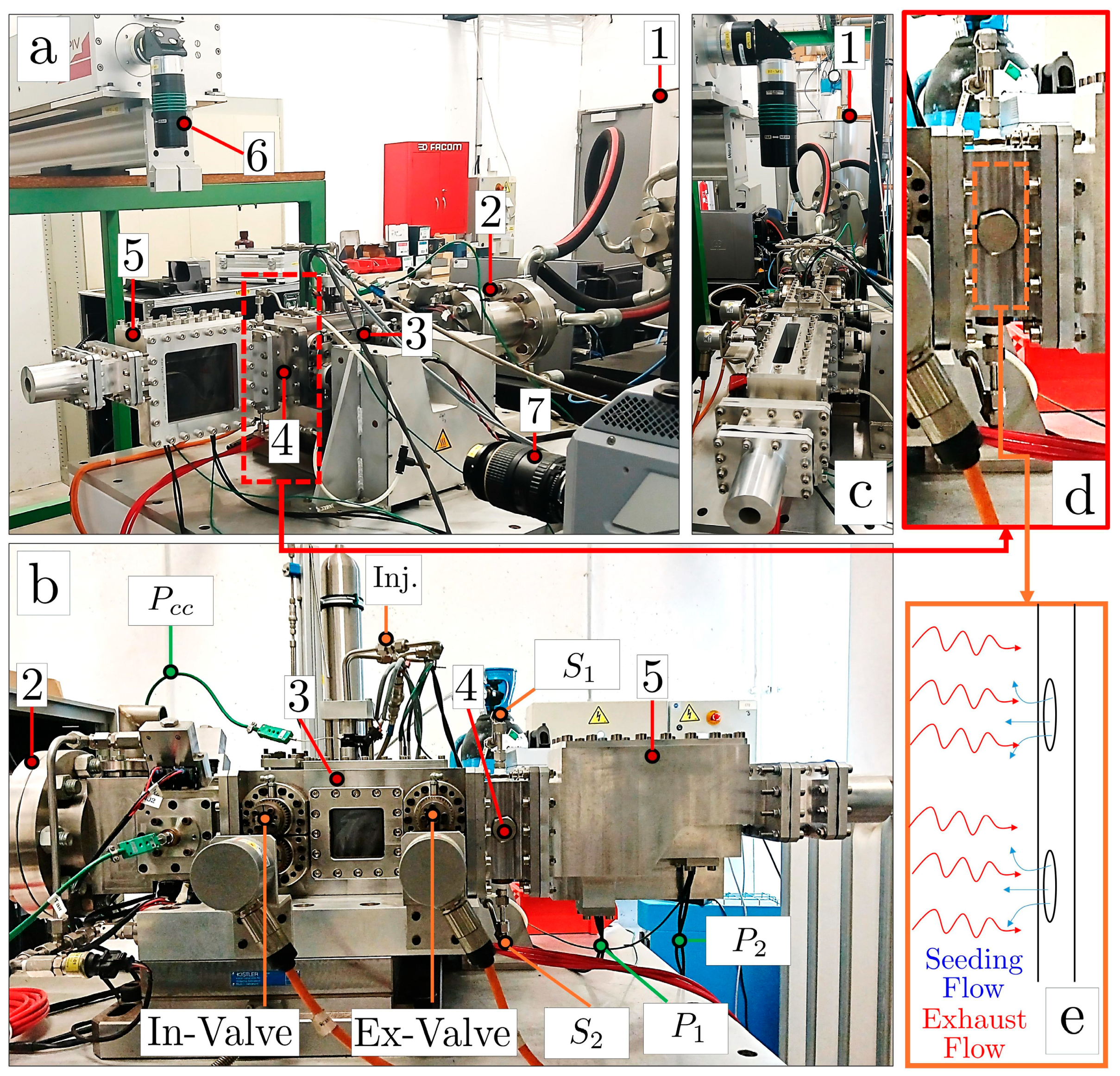
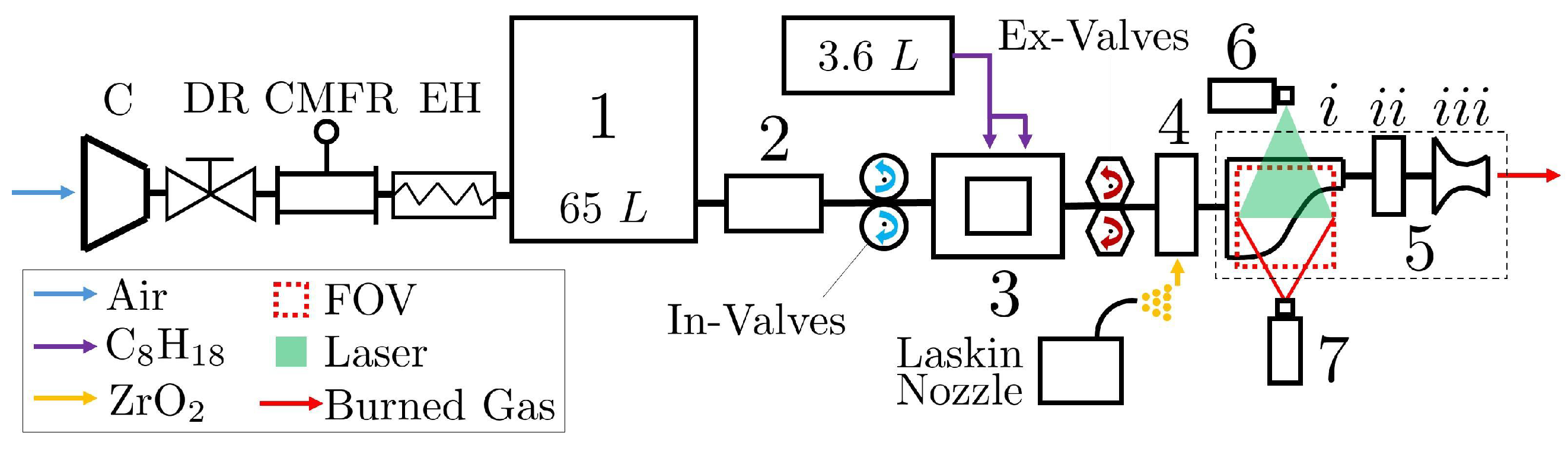
In Figure 1, a schematic representation of the test rig is depicted. Moreover, photos of the rig are included in Figure 2a–c as well. The system starts with compressed air (C in Figure 1), a dome pressure regulator (up to 0.5 MPa, DR in Figure 1), a Coriolis mass flow meter (Endress-Hauser 80F40, 0.5% uncertainty, CMFR in Figure 1) and an electrical heater (100 kW, up to 200 °C, EH in Figure 1). These components model the conditions of the incoming air to the intake tank (1). Subsequently, the air is brought inside the intake plenum (2). When the inlet pair of rotary valves (In-Valve) is open, airflow is permitted inside of the combustion chamber (3, V c c = 0.65 L). Considering that both the pair of inlet rotary valves and the pair of exhaust valves (Ex-Valve) are closed, injection of liquid iso-octane takes place inside of the chamber. For this purpose, a fuel vessel of 3.6 L pressurized by 10 MPa nitrogen is used, while fuel is introduced inside of the combustor by two GDI injectors (Bosch HDEV 5.2 , Inj. in Figure 2b) flush-mounted to the chamber upper wall. Fuel massflow rate is set to 20 g/s. After a certain time period under which air and fuel mix together under stoichiometric conditions, a plugged automobile ignitor (100 mJ) is used to trigger a spark inside of the chamber and promote isochoric combustion. Later the exhaust valves open and the burnt gas is expanded through the exhaust system in atmospheric conditions. The outtake system consists of the exhaust plenum (4), which is a rectangular duct (0.3 L), and the new exhaust system (5). During the last part of the cycle when the exhaust valves are opened, the inlet valves open, promoting the scavenging process. Then, the exhaust valves close, the chamber is supplied again with fresh air and the cycle starts again.
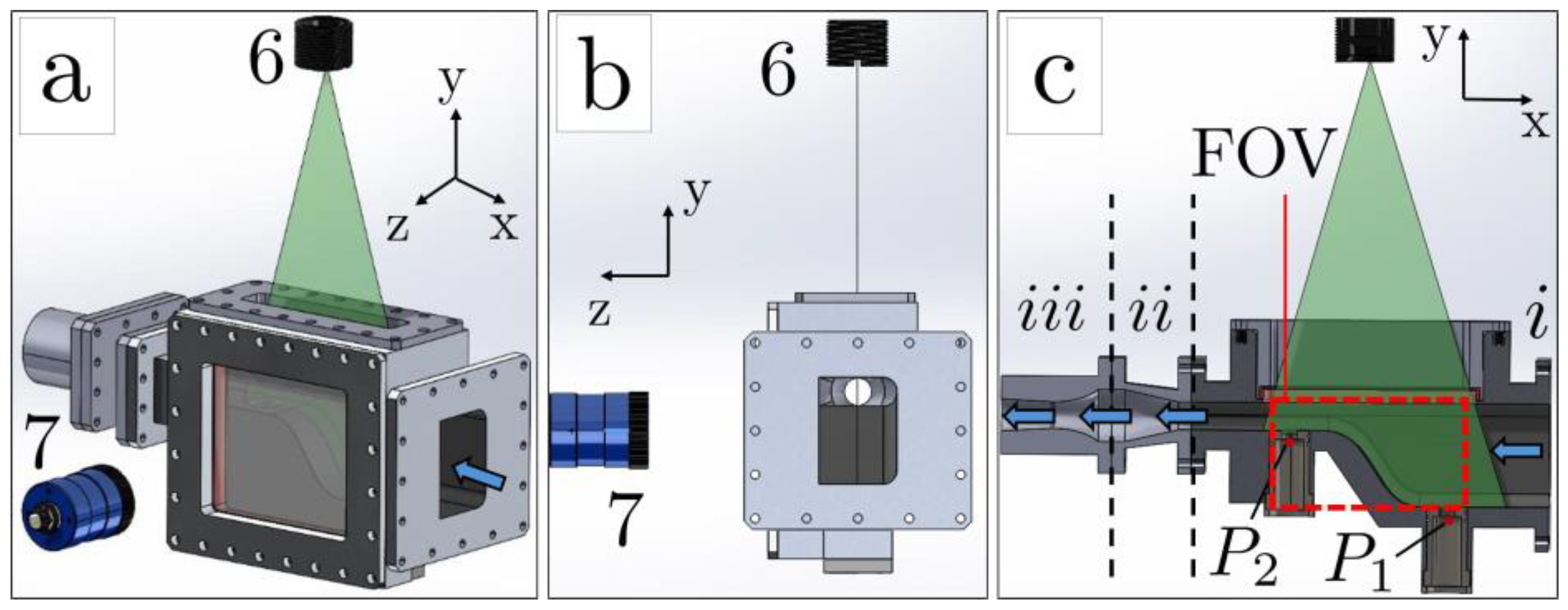
The new exhaust system is shown in Figure 3. In particular, the cross-section view reported in Figure 3c shows that the exhaust system is divided into a transition duct (i), a change area duct (ii) and a converging–diverging nozzle (iii). The transition duct came as a major result of the preceding numerical activity [32], which focused on the integration of the CVC with a HPT vane. Nonetheless, a cascade is not added downstream of the duct. The change area duct serves for isometrically altering the rectangular cross-section of the transition duct to circular for the subsequent nozzle. In particular, the nozzle’s design is based on the ISO-9300 norm [34] with a throat diameter of 20 mm, which corresponds to an equivalent area of the LS89 annular cascade that was previously numerically simulated and assessed downstream of the CVC [32]. Moreover, the same nozzle design was used in preceding experimental campaigns, where the exhaust system consisted only of the rectangular plenum and the circular nozzle [4,29].
Regarding the diagnostics of the experimental campaign, several sensors are employed. First of all, a fast-response pressure sensor ( P c c ) monitors the pressure variation inside of the combustion chamber (Figure 2b). In addition, two pressure sensors P 1 and P 2 are located upstream and downstream of the restriction of the transition duct (Figure 2b and Figure 3c). Concerning the velocity field visualization, a Laskin nozzle is used to seed the medium inside the exhaust flow (Figure 1). In particular, the medium is brought inside the exhaust plenum through an upper tube and lower tube ( S 1 and S 2 in Figure 2b respectively). In fact, through two orifices the seeding particles are injected at the exhaust system in counter-flow configuration, as indicated in Figure 2d,e. Thus, the CVC’s outflow enters the inside of the exhaust plenum, mixes with the seeding particles, crosses the new exhaust system and later is expanded at atmospheric conditions.
In detail, the visualization of seeding particles inside the pulsating exhaust flow is achieved with the help of a laser source for the PIV (6) and the camera (7) which are positioned in a 90° configuration. The laser sheet illuminates the middle section of the transition duct as indicated in Figure 3b. In particular, quartz ( SiO 2 ) glass windows are placed. The upper glass window ( 160 × 37 × 10 in mm) allows for the laser penetration, whereas the lateral glass window ( 150 × 127 × 20 in mm) permits optical diagnostics of the exhaust flow. The resulting Field of View (FOV) is delineated in Figure 3c, covering most of the transition duct, as well as the location of pressure sensors P 1 and P 2 located upstream and downstream of the restriction of the transition duct respectively.

2.2. Measurement Instrumentation

Regarding the measurement instrumentation, the experimental campaigns are characterized with fast-response pressure sensors and a high-frequency PIV system. In fact, a Kistler 4011 recessed sensor ( P c c in Figure 2b) is implemented inside of the combustion chamber. In parallel, two sensors ( P 1 and P 2 of Figure 2b and Figure 3c) are positioned upstream and downstream of the restriction of the transition duct. P 1 is a Kistler 4007 recessed sensor, whereas P 2 is a Kistler 4049 flush-mounted sensor. For all the sensors the sampling frequency is 100 kHz, while their uncertainty level is at 0.2 % of measuring value. Focusing on the location of P 1 (Figure 3c), it is placed upstream of the exhaust system restriction, where the cross-sectional area is significantly larger compared to the nozzle throat. Therefore, the flow velocity at P 1 is expected to be low, and the static pressure can be assumed to be close to the stagnation pressure. Consequently, although the sensor measures static pressure, it can be interpreted as indicating the stagnation pressure upstream of the exhaust nozzle (iii in Figure 3c). In addition, it can inform if the exhaust nozzle is choked or not during the operation of the rig, by comparing the exhaust nozzle’s time-dependent pressure ratio (Equation (1)) and its critical pressure ratio (Equation (2)). It must be underlined that since the composition’s medium varies in time, the heat capacity ratio ( γ ) value is assumed to be constant at 1.3 .
π N o z z l e = P a t m P t , 1 P a t m P 1
π c r = ( γ + 1 2 ) γ γ 1
Concerning the PIV system, CONTINUUM-Mesa (6 in Figure 3a,b) generates at 10 kHz a laser sheet with wavelength of 532 nm. In particular, the divergent laser sheet has thickness of 400 nm. Moreover, a Photron SAZ camera (7 in Figure 3a,b) is used, offering a wide FOV of 1024 × 1024 pixels with 128 μm/pixel. Altogether, the Programmable Timing Unit (PTU X) coordinates the synchronization between the laser sheet and the camera. After the end of the experimental test, the DaVis commercial software [35] is used for the post-processing of the PIV field using an interrogation window of 16 × 16 pixels with 25% overlap. The use of overlapping interrogation windows does not reduce the physical size of the measuring volume, but allows a more continuous sampling of the velocity field. This reduces interpolation uncertainties between vectors, improving the practical quality and accuracy of the velocity field measurement. This choice is justified by theoretical computations [36], as excessively high overlap ratios with small window sizes relative to particle displacement would lead to less accurate results. The determination of velocity vectors is obtained by the standard cross-correlation algorithm included in LaVision Davis 10.2 software, while additional processing steps are implemented to detect and remove erroneous velocity vectors. The cross-correlation validation criterion rejects vectors with a Q-factor (ratio between the 2 correlation peaks) less than 1.2 . Then, an in-built median filter is applied. This filter removes an erroneous vector that would differ from its neighbors by more than 1.5 times their standard deviation, and replaces it using its 2nd or 3rd correlation peak. Such post-processing steps are usual ways to obtain relevant velocity fields without spurious vectors.
For seeding purposes, solid particles of zirconium dioxide ( ZrO 2 with d < 15 μm) are used, ensuring their survival under the high temperature of the CVC exhaust burned gas. The counter-flow seeding with two orifices ensures the proper mixing of the seeding particles inside the main flow before reaching the FOV of the transition duct (Figure 2d,e). The cycle average ratio between the seeding particle mass flow and the hot exhaust outflow by the CVC is assumed to be close to 20%. Due to the sequential isochoric combustion events inside of the chamber and the fast closing–opening of the exhaust rotary valves, the transition duct experiences strong pulsating inflow conditions. Thus, it is important to ensure that the seeding quantity will be enough for all the moments of the cyclic operation of the rig including the minimum and maximum CVC outflow rate.

2.3. Set of Experimental Tests

The experimental campaign includes reactive tests at nominal inlet stagnation conditions ( 3 bar and 450 K ). Thus, the ensemble pressure ratio of the rig (Equation (3)) is set to 0.338 . It must be underlined that for both the inlet and outlet rotary valves, during one rotation they open and close twice. As a result, the effective cycle frequency ( f c y c l e ) is double the valve’s rotational frequency ( f v a l v e ). This study focuses on a parametric investigation of the cycle frequency. Following the evidence of a previous experimental campaign [29] in which the exhaust section consisted only of the ISO-9300 nozzle [34], the cycle frequency of tests varies from 15 Hz up to 40 Hz with steps of 5 Hz. In this research work, multiple tests for each cycle frequency that include pressure measurements are performed. Nonetheless, for each cycle frequency only one test includes both pressure and PIV measurements. The set of the experimental tests is reported in Table 1.
π r i g = P a t m P t , i n
An experimental test which includes both pressure and PIV measurements is characterized by a sequence of events. First, the valve of the inlet supply system opens and air is flown through the entire test rig. After a certain period in which the intake tank (1 in Figure 1 and Figure 2a,c) reaches the appropriate prescribed pressure and temperature levels, the inlet and outlet valves are set into motion. Then, a trigger signal is given to the seeding system releasing the zirconium dioxide particles to the exhaust plenum (4 in Figure 2). A subsequent signal is sent to the fast-response pressure sensors, promoting their recording. Now, the injection and ignition systems trigger sequential isochoric combustions. After 0.25 s, a final signal is sent to PTU X to start the recording of images for the PIV analysis. The recording of reactive operation of CVC lasts 2 s. Then, the PIV system stops to record and the ignition system of the machines is turned off. Afterwards, the recording of pressure sensors finishes and the valves’ motor stops as well. Pressurized air is allowed to flow through the rig, removing soot and seeding particles from the test bench, thus preparing it for the next reactive test.

3. Post-Processing Methodology

This chapter is devoted to the methodology that is applied to the experimental results of the campaign. Section 3.1 describes the uncertainty sources of PIV fields, whereas Section 3.2 presents the assessment analysis of the transition duct’s performance.

3.1. Uncertainty Quantification of Measurements

Uncertainty quantification describes the variance of samples with respect to the mean behavior of a periodic phenomenon, accounting for both instrumentation effects and stochastic sources. Therefore, defining the average periodic behavior of the signal is required before assessing uncertainty. Phase-Locked Averaging (PLA) is used when a periodic phenomenon with a known constant period is measured with a sensor sampling at a fixed frequency. The signal is expressed in non-dimensional time with respect to the period; each cycle is divided into equally spaced clusters, and samples within the same phase interval across cycles are averaged to obtain the phase-averaged signal.
PLA is applied to both the rig pressure signals and the PIV measurements to determine the average cyclic behavior of pressure and velocity fields. The number of clusters is selected considering the phenomenon frequency and the sensor sampling rate. While increasing the number of clusters improves temporal resolution, each cluster must contain at least one sample per period. Accordingly, 200 clusters are used for the pressure sensors due to their higher sampling frequency, whereas 100 clusters are adopted for the PIV measurements.
For both pressure and PIV measurements, the uncertainty level can be split into the bias and the precision contributions. The first term is associated with the difference of the measuring and true value due to various systematic factors during the measurement process. On the other hand, the precision uncertainty characterizes the stochastic nature of a measurement. In other words, this term attempts to assess the random or unpredicted variation of a repeated measuring phenomenon keeping the conditions of experiments constant in time. In particular, the precision uncertainty can be assessed on the variation of the clustering values for a specific cycle time point of te PLA process with respect to the corresponding PLA value of this cycle time.
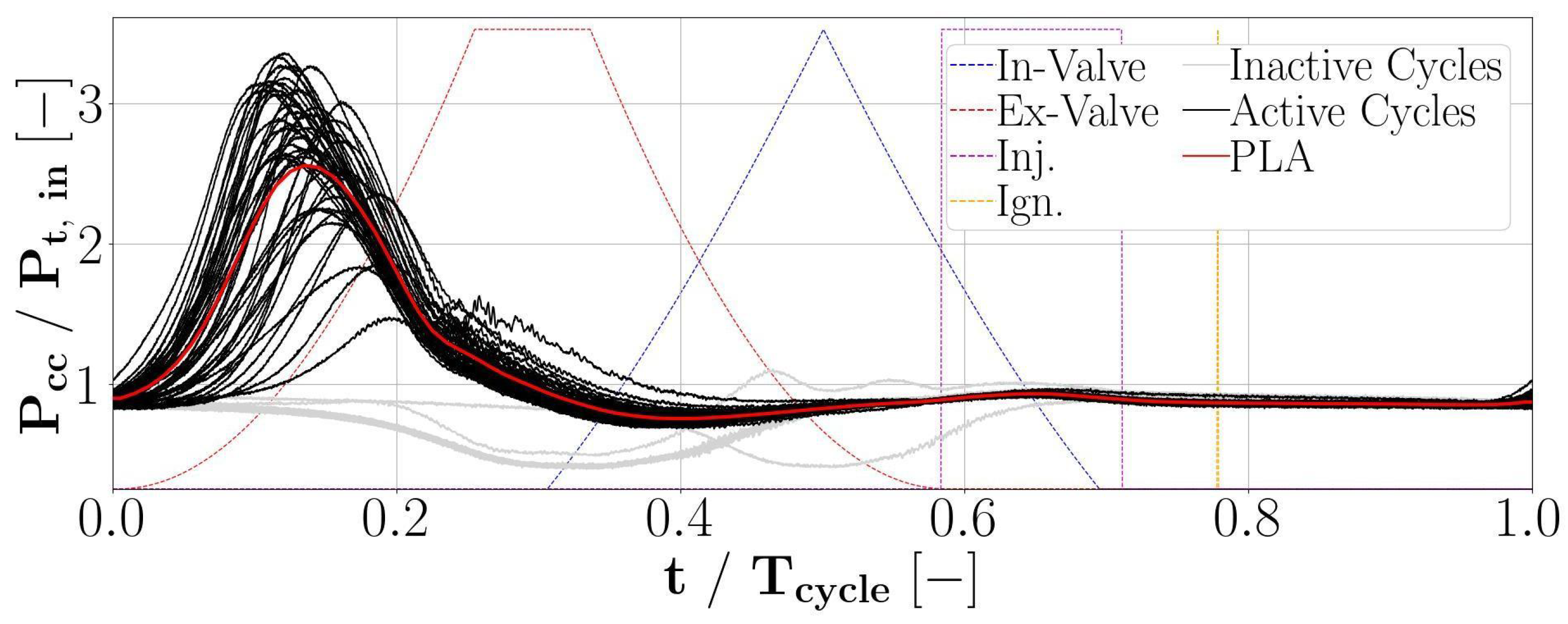
Figure 4 shows the continuous pressure signal of the CVC chamber sampled at 25 Hz . Qualitative lift law graphs of the rotary inlet (blue) and exhaust (red) valves are included, along with the fuel injection duration (purple) and ignition moment (yellow peak). The x-axis is normalized to the cycle period ( 0.04 s ). Black curves indicate active combustion cycles, while grey curves correspond to initial, final, or inactive cycles. Residual burned gas from one cycle can quench the next under certain conditions [28,29], making it essential to separate active and quenched cycles. For active cycles, PLA is applied and shown in red. The chamber behavior is consistent with previous experiments [29], and strong cycle-to-cycle variations during sequential isochoric combustion (0–40% of the cycle) notably increase the stochastic uncertainty of the pressure measurements.
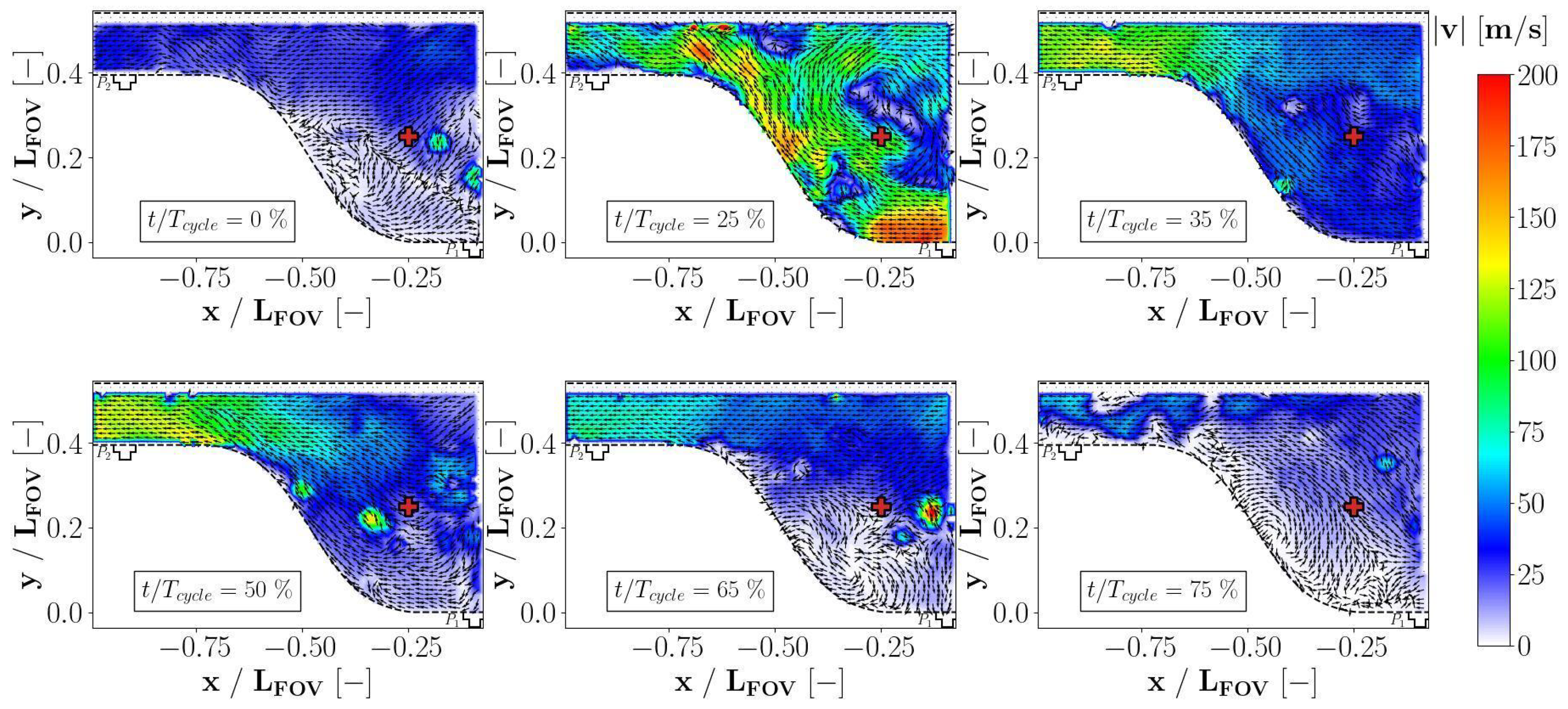
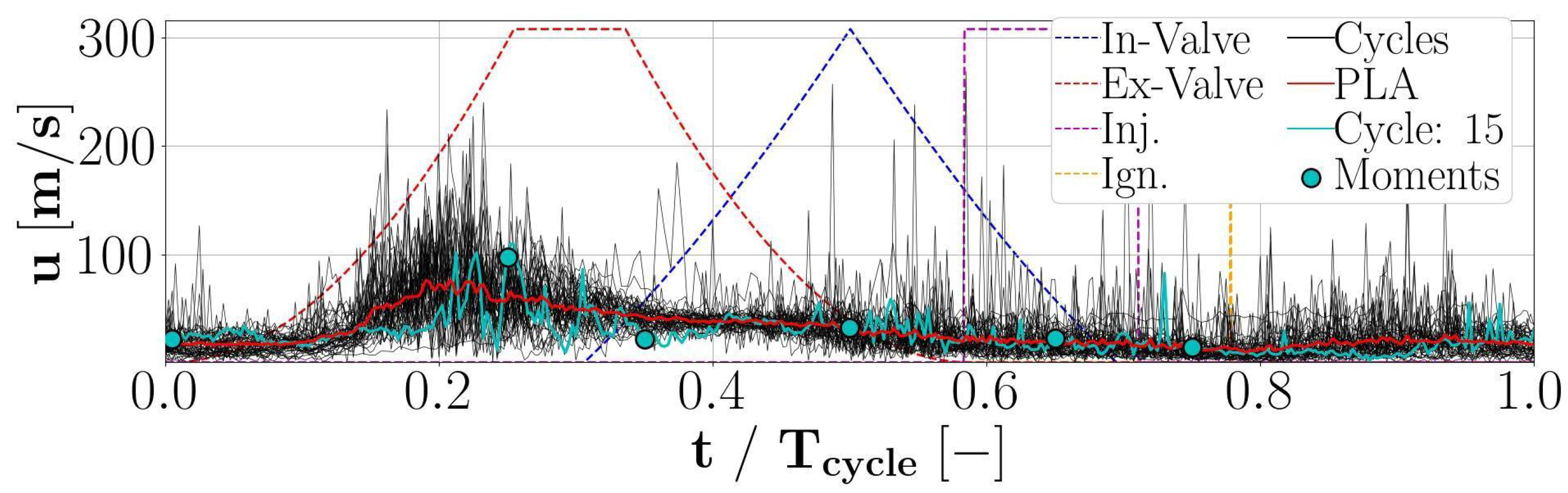
For the same cycle frequency, instantaneous PIV flow fields at 0%, 25 % , 35 % , 50 % , 65 % , and 75 % of the 15th cycle are shown in Figure 5. In addition, Figure 6 presents the continuous velocity signal at [ 0.25 · L F O V , 0.25 · L F O V ] , where black curves represent all active cycles, the red curve shows the PLA signal, and the cyan curve corresponds to the 15th cycle, with symbols marking the frames in Figure 5. At 0 % , the exhaust valves are closed and the velocity field is highly decelerated. At 25 % , fully open exhaust valves accelerate the flow, forming a strong clockwise recirculation at the FOV inlet. At 35 % , inlet valves open and scavenging dissolves the vortical structure. From 50 to 75 % , the exhaust valves close and the transition duct experiences gradual deceleration. The duct, located downstream of the CVC, reflects inherent flow variability, as seen in Figure 6. Significant unsteadiness appears between cycles during 15– 40 % of the cycle, and the highly turbulent flow introduces greater stochastic variability throughout the cycle compared to wall pressure measurements.
Precision uncertainty could, in principle, be applied to both the pressure and PIV signals (Figure 4 and Figure 6), but a quantitative evaluation is not performed. This is due to the high cycle-to-cycle variability observed in the combustion chamber and the new exhaust system, as reported in previous studies [4,28,29,30]. As shown in Figure 6, the velocity at the selected location varies significantly between cycles, with fluctuations arising from factors such as misfires and residual burned gases. Such variability makes quantitative precision assessment challenging, so the study focuses on a qualitative evaluation, which better reflects the nature of the observed fluctuations.
On the other hand, the bias uncertainty for both pressure and PIV measurements can be evaluated. First of all, for the combustion chamber sensor (Kistler 4011 recessed) and the upstream (Kistler 4007 recessed) and downstream transition duct pressure sensors (Kistler 4049 flush-mounted), the bias uncertainty level is specified at 0.2 % of the measuring value by the manufacturer. For the PIV measurements, the uncertainty bias sources are multiple and are associated with the system components (e.g., installation and alignment, timing and synchronization, particle tracing capabilities, illumination), the flow, and the evaluation techniques [36]. The aforementioned uncertainty quantification can been seen in Equation (4), in which the uncertainty of the velocity vector ( δ v ) is split into the uncertainty due to the particle displacement ( ( δ v ) Δ X ), that due to laser pulse separation ( ( δ v ) Δ t ) and that due to magnification ( ( δ v ) M ).
δ v = ( δ v ) Δ X + ( δ v ) Δ t + ( δ v ) M
First, ( δ v ) Δ t is related to the temporal difference between the two laser pulses ( Δ t l ), typically around 1 ns . In this analysis, with Δ t on the order of 7– 15 μ s , this contribution is negligible. Similarly, because the FOV is much larger than microfluidic dimensions, uncertainty due to magnification is almost zero. Thus, PIV uncertainty is dominated by particle displacement ( δ v ) Δ X . DaVis software [35] calculates uncertainty for each instantaneous velocity vector using statistical correlation methods [37]. For each PIV field, the cross-correlation peak of every interrogation window is analyzed, and the corresponding velocity vector uncertainty is evaluated statistically.
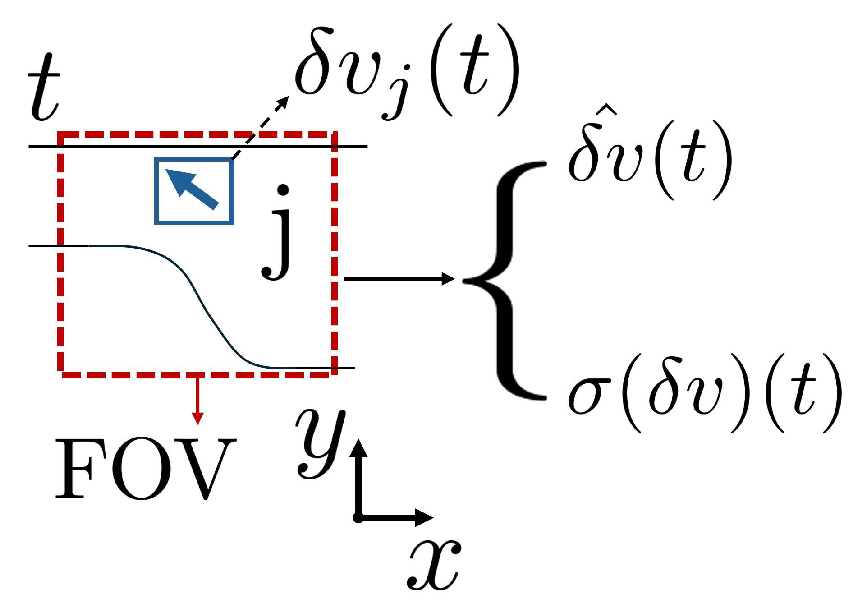
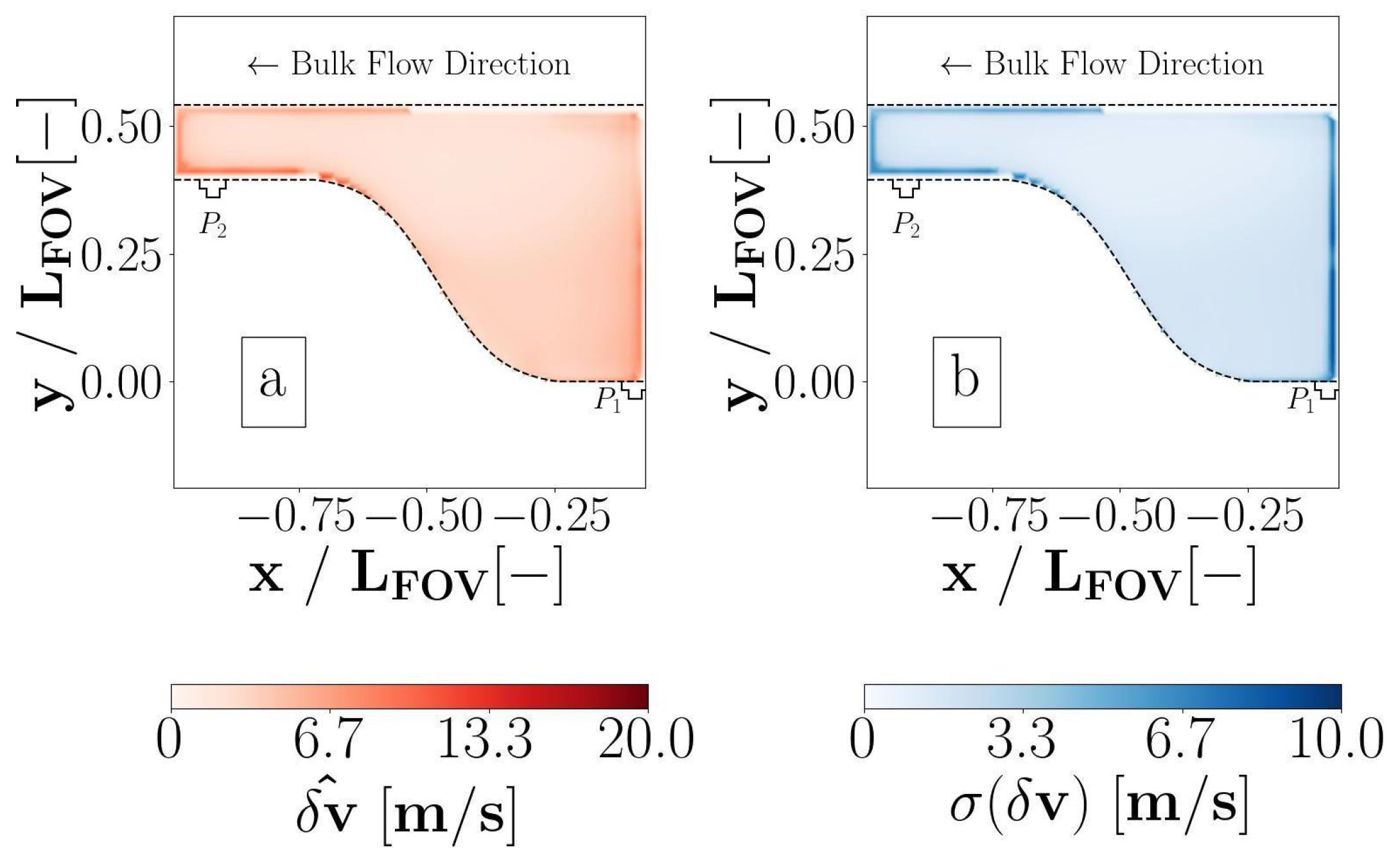
In Figure 7, a schematic illustration of an interrogation window j over time inside the FOV of this analysis is shown. For every time moment t, the PIV system records a velocity vector and evaluates its displacement uncertainty ( δ v j ( t ) ) with the help of the aforementioned statistical assessment of the correlation peaks. Since the measurement varies in time, the displacement uncertainty also changes over time. In order to quantify the displacement uncertainty of a test over its whole duration, the time-average uncertainty δ v ^ j (Equation (5)) and the time standard deviation σ ( δ v j ) (Equation (6)) of the N i time moments of the test can be deduced. It is worth mentioning that the test duration Δ T t e s t for every investigated cycle frequency is 2 s. Consequently, for every analyzed cycle frequency, a flow field of time-averaged and time-standard-deviation velocity uncertainty is obtained.
δ v j ^ = 1 Δ T t e s t 0 Δ T t e s t δ v j ( t ) d t
σ ( δ v j ) = 1 N t i = 1 N t δ v j ( t i ) δ v j ^ 2
An example of this analysis for a cycle frequency of 15 Hz is shown in Figure 8, presenting the time-averaged field (a) and the time standard deviation of velocity uncertainty. In general, uncertainty is around 3 m/s with a standard deviation of 1.8 m/s, though higher levels occur in some regions. The inlet and outlet of the transition duct show elevated uncertainty as they are at the edges of the FOV, while the upper and lower walls also increase velocity uncertainty. This is due to laser reflection from the walls and oil accumulation used for valve lubrication, which reduces the quality of cross-correlation in the affected areas.
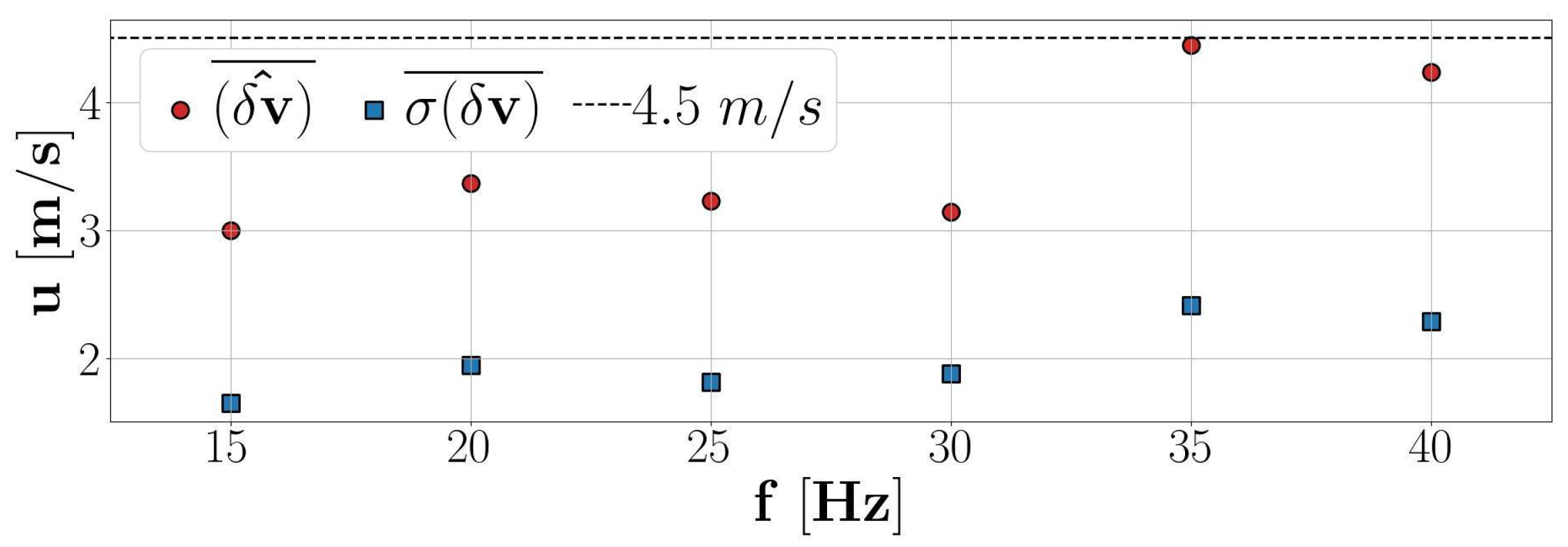
For each experimental test at different cycle frequencies, a corresponding time-averaged uncertainty field is obtained. Spatial averaging of these fields (Equations (7) and (8)) provides metrics to evaluate PIV measurement quality. Figure 9 shows the spatial average of both the time-averaged and time-standard-deviation uncertainty fields for all tested frequencies. As cycle frequency increases, velocity uncertainty rises due to higher pressure and velocity levels in the exhaust section [29], yet the spatial average uncertainty remains below 4.5 m/s and its standard deviation below 2.5 m/s.
( δ v ^ ) ¯ = 1 A F O V x y δ v ^ j d x d y
σ ( δ v ) ¯ = 1 A F O V x y σ ( δ v j ) d x d y

3.2. Performance Assessment

After the completion of the experimental test and the post-processing of data, an evaluation process is followed. First, the assessment of pressure gain performance is conducted. Thus, for every investigated cycle frequency, the pressure signal of the combustion chamber and the inlet of the transition duct are monitored, constituting the pressure gain level through Equation (9). For the case of the CVC chamber, the P i of Equation (9) is substituted by P c c (Figure 2), whereas P 1 (Figure 2) is used for the transition duct case.
P g a i n = P i P t , i n P t , i n · 100 %
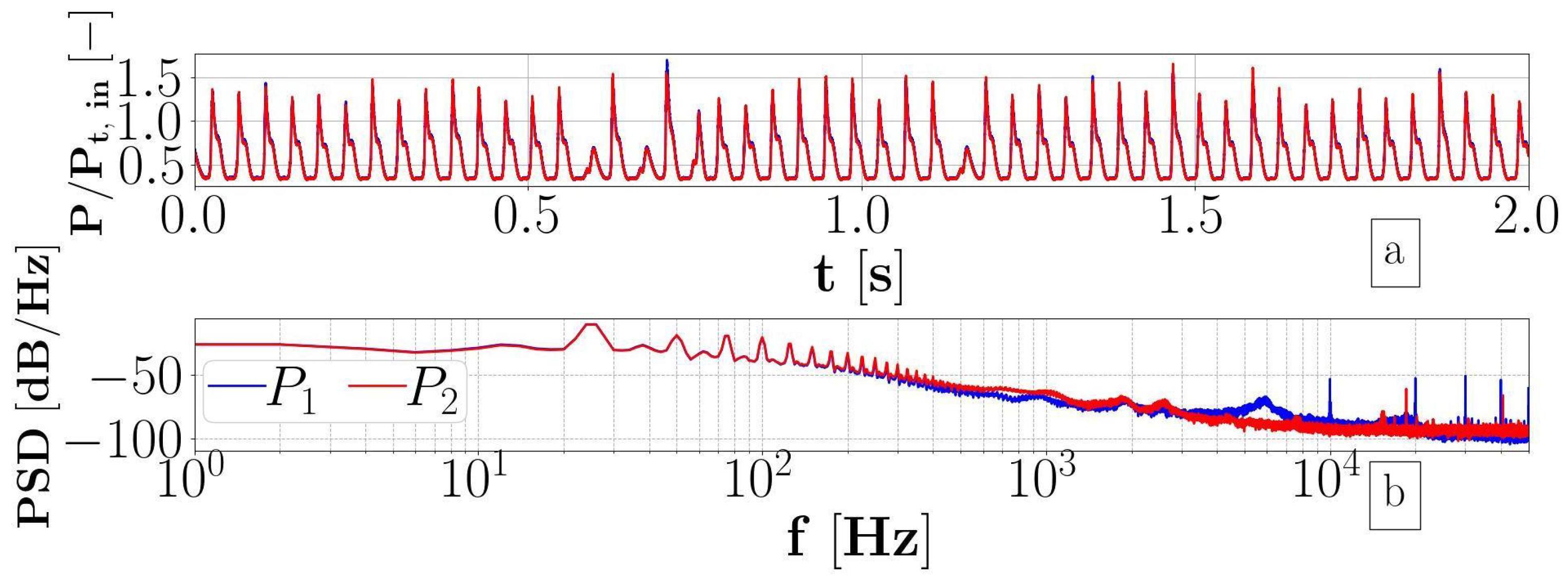
The new exhaust system is examined to determine whether the pressure signal is attenuated or amplified through this component. Since the sampling frequency of the exhaust pressure sensors (100 kHz) is much higher than the investigated cycle frequencies (15–40 Hz), the pressure signal and its frequency content are well resolved. Therefore, the oscillation behavior can be assessed by comparing the upstream and downstream pressure signals of the transition duct. Figure 10a presents the non-dimensional pressure signals at the inlet and outlet of the transition duct for the 25 Hz case, while Figure 10b shows the corresponding Power Spectral Density (PSD). The results indicate that pressure fluctuations are transferred downstream without significant alteration, with most of the signal energy concentrated near the operating cycle frequency rather than at higher frequencies. This suggests that the machine operation primarily governs the exhaust-section dynamics, and the attenuation provided by the transition duct is therefore evaluated around the cycle frequency.
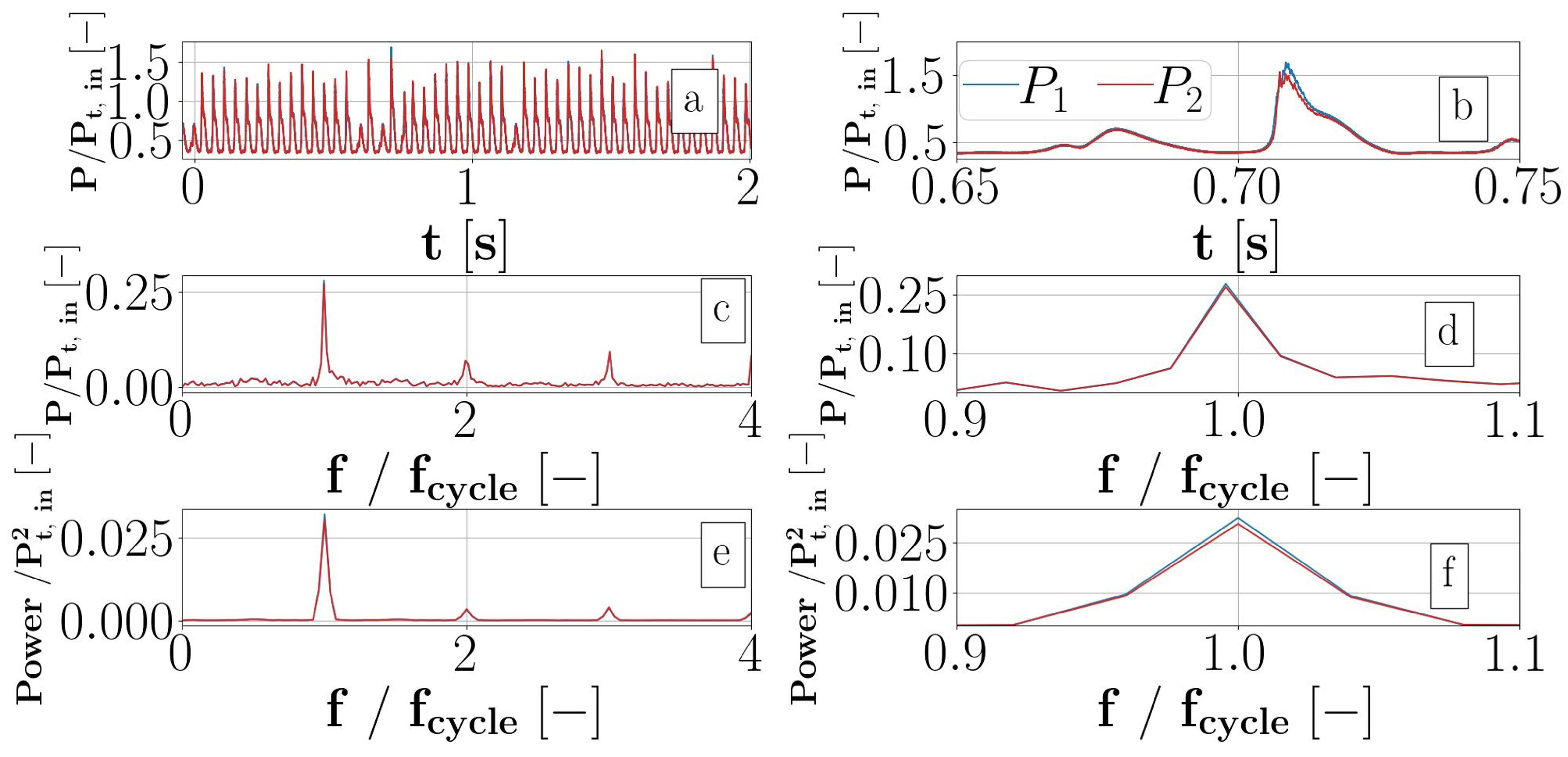
In addition, the continuous non-dimensional pressure signals at the inlet and outlet of the transition duct, along with a detailed view of a specific time window, are shown in Figure 11a,b. Similarly, Figure 11c,d present the Fast-Fourier Transform (FFT) of these signals, including a detailed view near the cycle frequency, with the x-axis non-dimensionalized with respect to the cycle frequency of this case (25 Hz). Figure 11e,f display the FFT in terms of power. In all cases from Table 1, the dominant FFT peak aligns with the cycle frequency, confirming its primary role in pressure dynamics. The detailed views (Figure 11b,d,e) illustrate that oscillation amplitudes, both in the time domain and at the cycle frequency, differ between inlet and outlet, indicating a slight attenuation of the power signal at this frequency (Figure 11f).
This processing should be extended to all other tested cases in order to evaluate the signal attenuation across all investigated cycle frequencies. The power signal ( P Power ) up to two and a half times the harmonic cycle frequency is assessed according to Equation (10), since the signal energy is primarily near the cycle frequency. The damping factor ( D P Power ) indicates attenuation if positive, and excitation if negative. Even though the amplitude difference between the two pressure signals is generally small, it exceeds the Kistler sensor uncertainty ( 0.2 % ). For example, the two pressure peaks in Figure 11b differ by 8.5 % (0.428 bar) of the maximum P 1 value (5.0366 bar), which is over two orders of magnitude above the sensor uncertainty ( 0.2 % · 5.0366 bar 0.001 bar ). In this 25 Hz case, the transition duct attenuates the pressure fluctuation by 4.6 %.
P Power = f i = 0 2.5 · f cycle Power ( f i ) D P Power = P Power , 1 P Power , 2 P Power , 1
For the case of the PIV fields, the evaluation of the samples is concentrated on the PLA vector fields that are retrieved. First of all, for every specific time moment of the cycle, the inlet and outlet spatial average velocity value is calculated in accordance to Equation (11). In addition, the spatial non-uniformities of the velocity profiles in the inlet and outlet are assessed by the coefficient of variance (COV), as indicated in Equation (12).
u ¯ = 1 y m a x y m i n y m i n y m a x u ( x i , y ) d y
C O V x i , y = σ [ u ( x i , y ) ] u ¯
Moreover, it would be useful to assess if the spatial non-uniformities of the velocity vector field are attenuated or excited through the exhaust system. Thus, the instantaneous damping factor ( D R v x , y ( t ) ) of the reduced range ( R v x i , y ( t ) ) of inlet–outlet velocity profiles is calculated during each PLA cycle moment for all the investigated cycle frequencies by Equation (13). By time-averaging this damping factor, the time-averaged damping factor ( D ¯ R v x , y ) of the spatial non-uniformities of the velocity field inside of the new exhaust system can be given by Equation (14). After characterizing the spatial oscillations of the velocity vector field, the time-dependent analysis follows. Equation (11) offers the inlet–outlet spatial average velocity magnitude for each time moment of the PLA cycle. It is obvious that considering the sequential isochoric combustion events by the CVC chamber, the spatial average inlet–outlet velocity level strongly varies in time. Thus, their reduced range ( R v t , i ) and the resulting damping factor ( D R v t ) can be computed in accordance with Equation (15).
R v x i , y ( t ) = Range [ v ( x i , y , t ) ] v ¯ i ( t ) D R v x , y ( t ) = R v x I n , y ( t ) R v x O u t , y ( t ) R v x I n , y ( t )
D ¯ R v x , y = 1 T 0 T D R v x , y ( t ) d t
R v t , i = R a n g e [ v ¯ i ( t ) ] 1 T 0 T v ¯ i d t D R v t = R v t , I n R v t , O u t R v t , I n
In conclusion, the post-processing evaluates the behavior of both the combustion chamber and the exhaust system. It examines pressure development and determines whether the transition duct attenuates or amplifies fluctuations. For the PIV measurements, the analysis considers velocity magnitude and spatial uniformity across the FOV. Overall, the goal of the parametric study is to explore how different operating conditions affect the cyclic operation of the system, the pressure gain, and the oscillations in the exhaust flow field, in order to identify the optimal cycle frequency for the system comprising the combustion chamber and the new exhaust component.

4. Results

This chapter presents the results of the experimental campaign. In Section 4.1, the results of the pressure signals are shown, while Section 4.2 focuses on the velocity vector fields during a CVC cycle. Ultimately, Section 4.3 concludes the comparative study of the different cycle frequencies and identifies the overall optimal cyclic period of the machine.

4.1. Pressure Measurements

4.1.1. PLA Pressure Signals

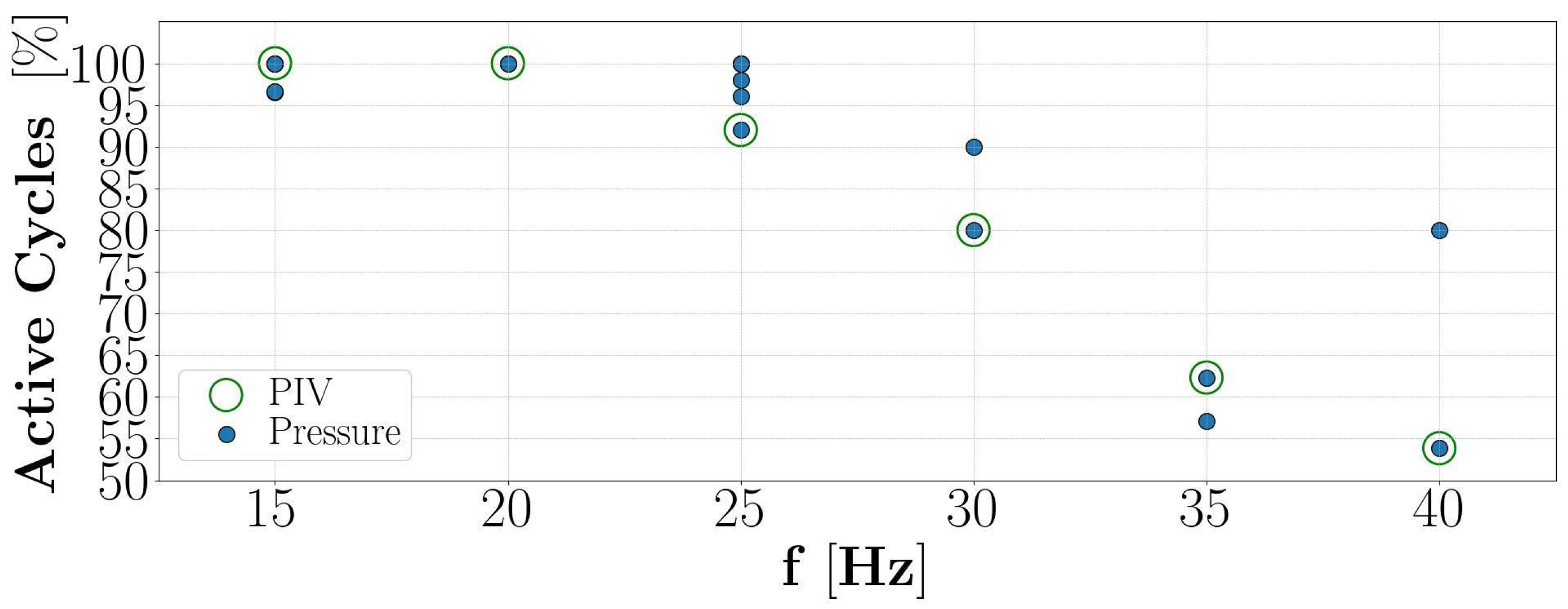
Before proceeding with a more in-depth analysis of the pressure and velocity measurement signals, misfiring cycles must be detected and excluded from the PLA analysis for all cases listed in Table 1. In Figure 12, a graph of the success rate of active cycles for all the tests is displayed. Specific symbol is used for the case in which PIV measurements are performed. For low cycle frequency (<30 Hz), the CVC chamber is characterized by at least a 90% success rate. Nonetheless, misfiring events start being evident for higher cycle frequencies (≥30 Hz). In fact, for the PIV case of 40 Hz almost every active cycle is followed by an inactive cycle. These results are in accordance with the preceding experimental campaign [29] of the old exhaust system. As frequency rises, cycle period reduces, decreasing the scavenging time window. Thus, more burned gas is trapped in the chamber, promoting misfiring events.
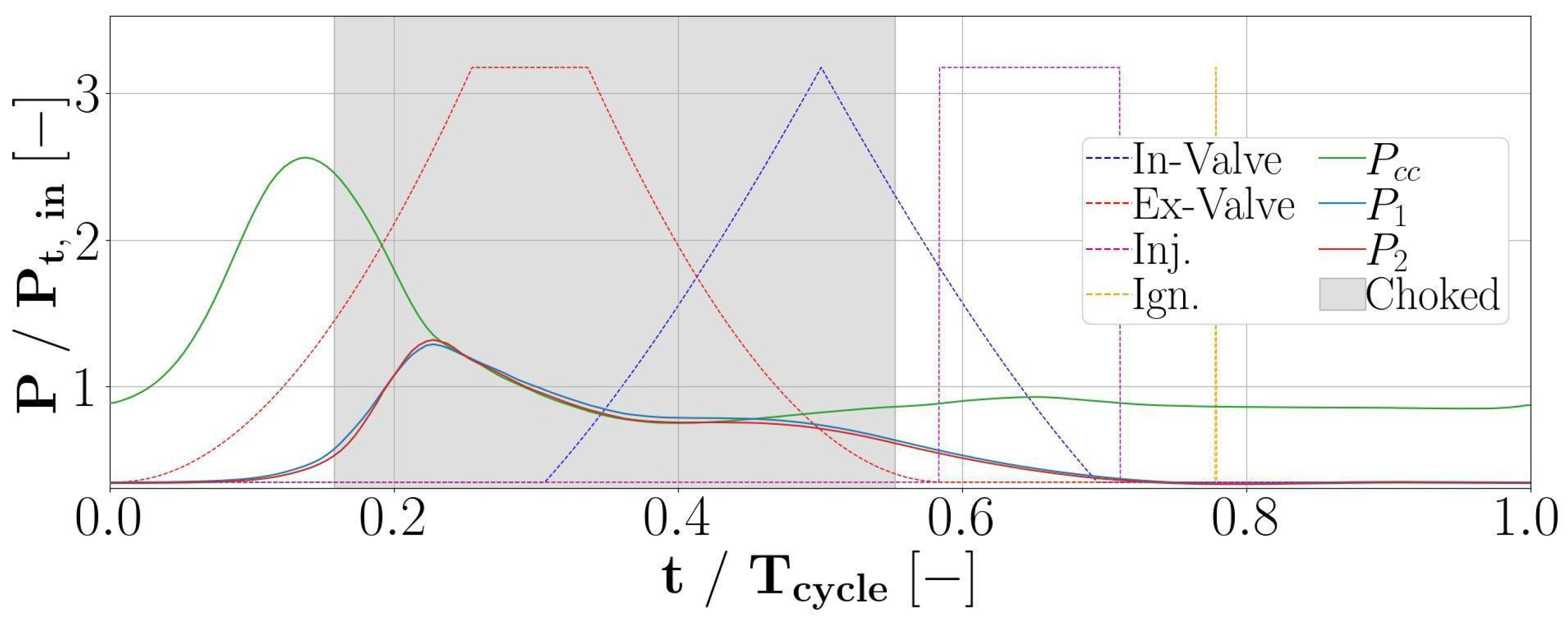
Following the analysis of 25 Hz for the continuous combustion chamber’s pressure presented in Figure 4, the PLA process is extended to the upstream (1) and downstream (2) pressure sensors of transition ducts ( P 1 and P 2 in Figure 3 respectively), as shown in Figure 13. Again, the values of P 1 can be used to calculate the varying pressure ratio (Equation (1)) of the exhaust nozzle ( i i i in Figure 3c) uncovering the moments when the nozzle is choked. The cycle starts with the combustion phase leading to an elevation of pressure inside the chamber. Nonetheless, the opening of exhaust valves results in pressure increment in exhaust section sensors. Since the outflow rate by the chamber rises, the pressure in the chamber drops. When the inlet valves open whilst having the exhaust valves open as well (≈30% of cycle), the chamber and the transition duct experience an increase in pressure. However, after the closing of both valves (≈70% of cycle) the chamber maintains a pressure level close to the stagnation inlet pressure, whereas the transition duct approaches the atmospheric pressure, denoting a fully empty exhaust section volume. During the cycle, the pressure rise inside of the chamber reaches two and a half times the stagnation inlet pressure (≈15% of cycle). However, the exhaust systems reaches only 1.3 times the inlet total pressure when the exhaust valves are opened (≈23% of cycle).
P ˜ = P / P t , i n
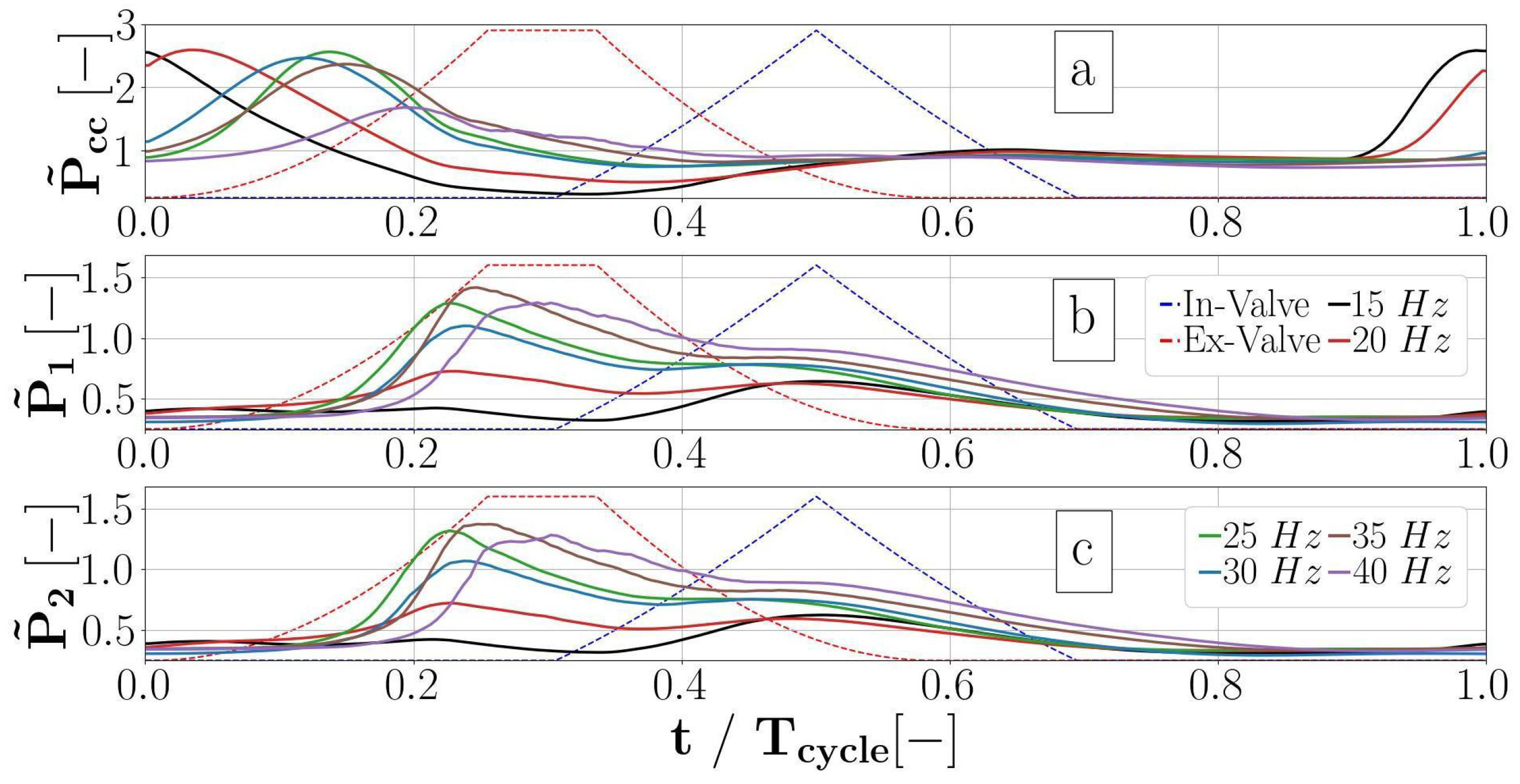
The PLA pressure signals for all frequency tests in Table 1, where PIV measurements were performed, are shown in Figure 14. Figure 14a shows the chamber pressure ( P c c ), Figure 14b the upstream transition duct sensor ( P 1 ), and Figure 14c the downstream sensor ( P 2 ). The y-axis is normalized to the rig inlet total pressure ( P ˜ , Equation (16)), and the x-axis to the cycle period. Two main observations can be made. As cycle frequency increases, the chamber pressure peak shifts toward the period when the exhaust valves are open. At low frequency, there is sufficient time for air and iso-octane to mix and react, while at higher frequency, the reduced time between ignition and valve opening causes combustion to continue after the exhaust valves open.
Second, as the frequency increases, the chamber’s maximum pressure decreases. Shorter cycle periods reduce scavenging time, diluting the following cycle with residual burned gas and lowering the pressure peak. At higher frequencies, combustion occurs while the exhaust valves are open, limiting isochoric deflagration and reducing the chamber pressure peak. Simultaneously, the transition duct experiences higher pressure for longer, effectively choking the exhaust nozzle. In conclusion, increasing cycle frequency results in milder chamber pressure peaks and higher pressure levels in the exhaust section.
The frequency dependency of the quality of combustion was investigated in detail in prior experimental studies [29], and the results shown in Figure 14 are consistent with those findings. This dependency is closely linked to the size of the CVC chamber and the new exhaust system, and the performance observed in Figure 14 could differ for chambers of different dimensions. The timing of injection, ignition, and combustion is critical for CVC operation, and changes in machine size would shift the optimal timing accordingly. Moreover, the quality of the scavenging process in a piston-less configuration is affected by both the CVC chamber size and the exhaust system volume. Therefore, it should be emphasized that the cycle frequency performances reported here are specific to the size of the current experimental test rig.

4.1.2. Pressure Signal Assessments

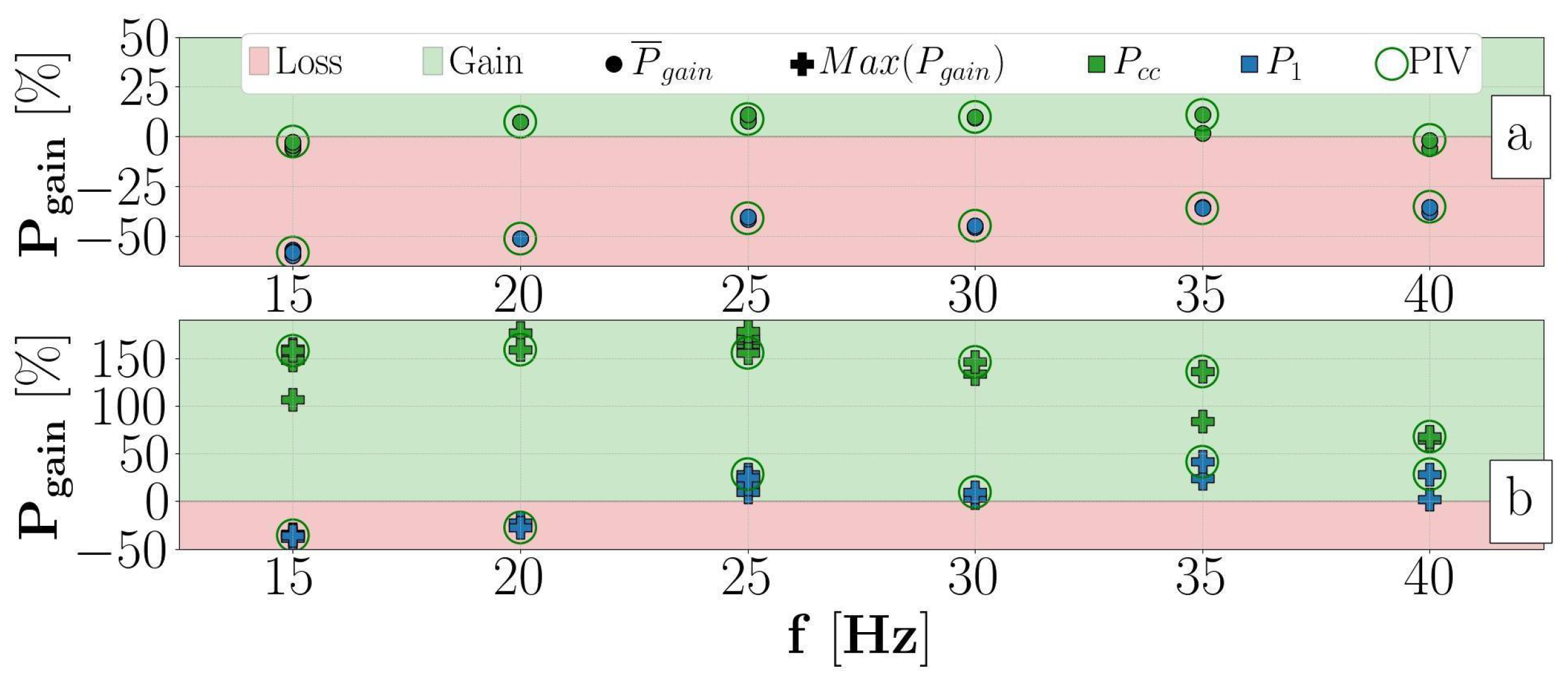
The PLA process in different tests can provide a characterization of the test rig in terms of pressure gain for both CVC chamber and transition duct. In Figure 15a, the cycle average pressure gain retrieved from the PLA process for the tests of Table 1 is presented, whilst the maximum pressure gain of the cycle is shown in Figure 15b. Starting with the low-frequency case of 15 Hz, there is enough time for the reactants to mix, ignite and react, resulting in an isochoric combustion process finished before the opening of the exhaust valves. Thus, the transition duct does not experience a significant rise in total pressure, resulting in cycle average pressure loss. Moreover, there is enough time for the chamber to be scavenged, leading to a full emptying process ( t / T c y c l e > 70 %) and reducing significantly its pressure in this period.
As cycle frequency increases (25–30 Hz), there is insufficient time for complete scavenging, and the chamber is highly pressurized outside the isochoric combustion time window. Combustion is not finished during the closed-valve period, so it extends into the exhaust valve opening, as seen in Figure 14, resulting in higher pressure in the transition duct. At higher frequencies (≥35 Hz), scavenging worsens and residual burned gas is more significant, producing milder combustion events, yet transition duct pressure remains elevated due to combustion occurring mostly with open valves. Overall, the chamber performs best in terms of pressure gain at 20–30 Hz, while increasing cycle frequency further raises pressure in the transition duct. Table 2 summarizes the best and worst performances of the chamber and transition duct.
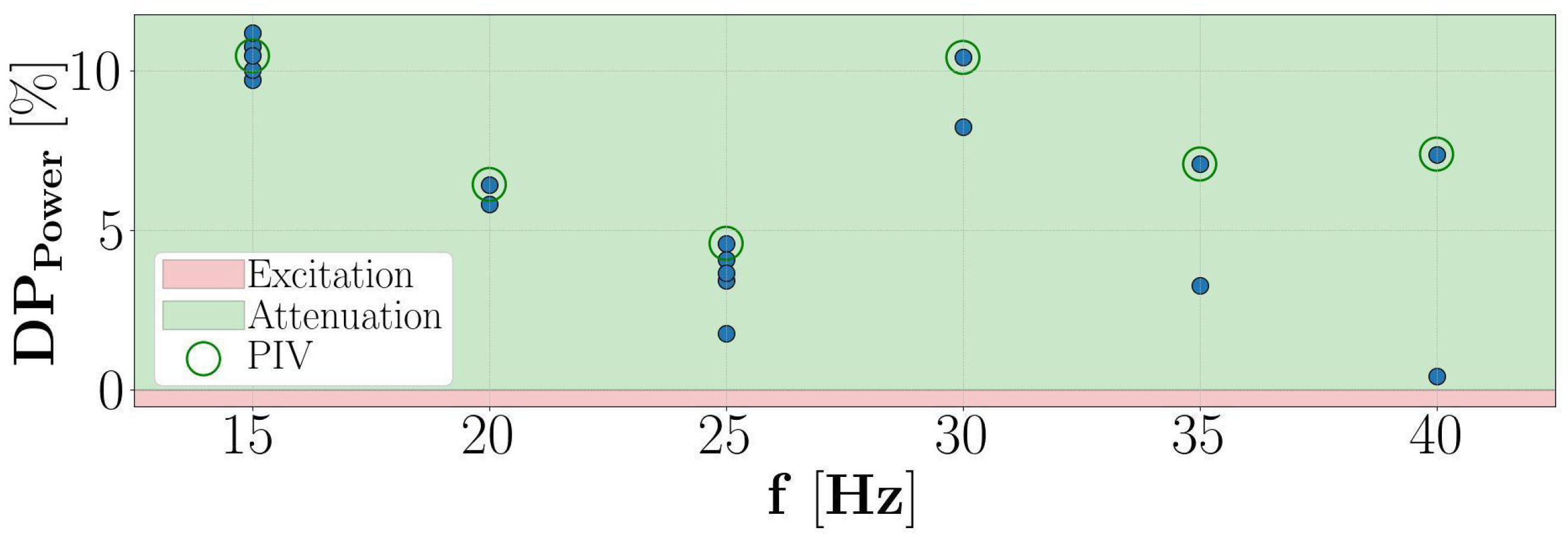
Figure 16 shows the attenuation of the continuous pressure signal power through the transition duct for all tested cycle frequencies. All cases exhibit attenuation without a clear trend, with the best performance at 15 Hz, reaching 11.18 % (Table 3). Variability in the experimental results is consistent across active cycle analysis (Figure 12), pressure gain (Figure 15), and attenuation evaluation (Figure 16). At low to moderate frequencies (≤25 Hz), longer scavenging windows reduce cycle-to-cycle variations, so results are more consistent. At higher frequencies (>30 Hz), shorter cycles increase residual burned gas, producing stronger cycle-to-cycle variations and greater disparity between tests at the same frequency.

4.2. PIV Measurements

4.2.1. PLA PIV Fields

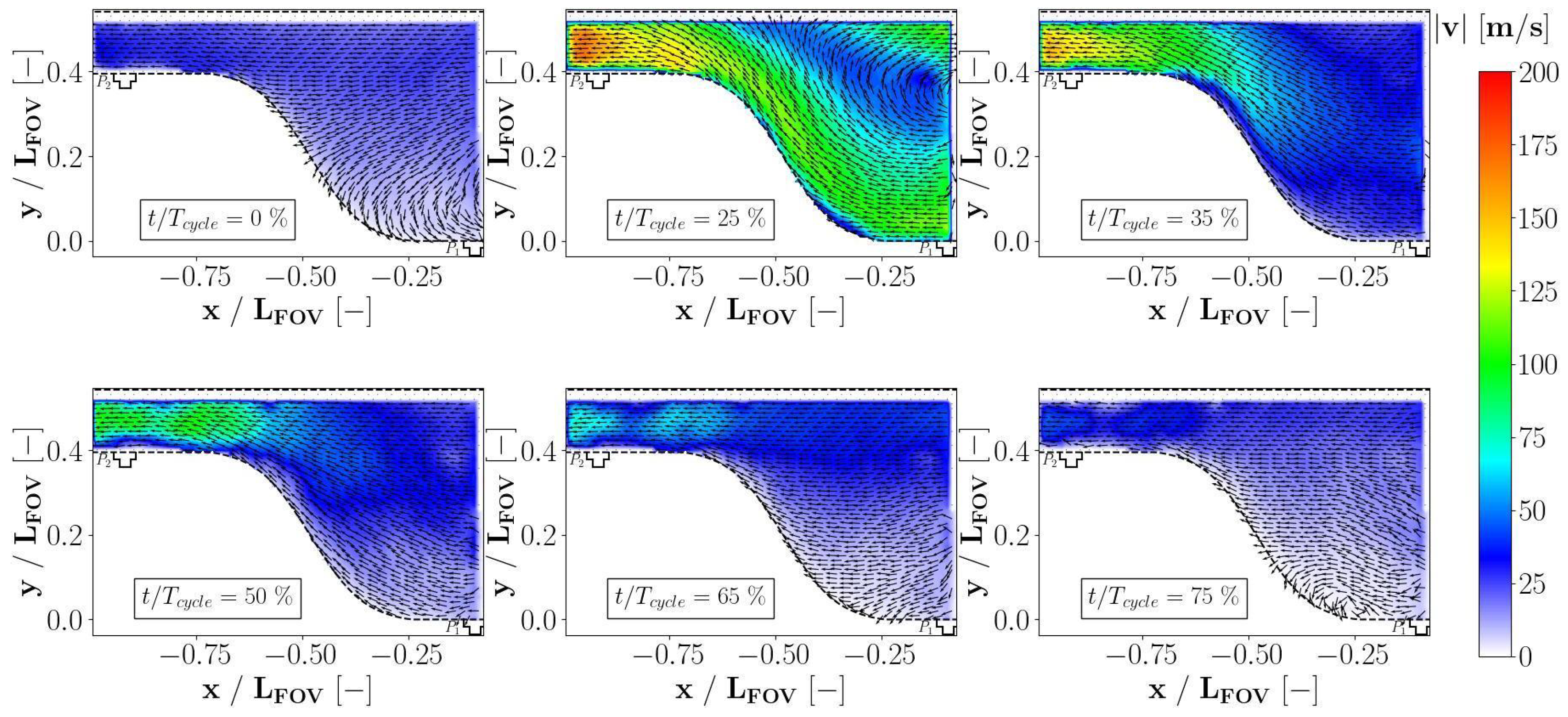
Similarly to the analysis of the continuous PIV signals at 25 Hz in Figure 5, the results of the PLA PIV measurements for 0%, 25%, 35%, 50%, 65% and 75% of the same cycle are shown in Figure 17. When the exhaust valves are closed and the exhaust system is supplied with the limited leakage flow by the valves (0% of the cycle), an extensive mild counterclockwise recirculation zone can be identified at the bottom of the transition duct entrance. In fact, only the left part of this zone is evident in the FOV. As it is also observed for the non-reactive experimental campaign [33], the opening of the exhaust valves significantly affects the exhaust section. A strong acceleration (25% and 35% of the cycle) is followed by the generation of a clockwise-rotating vortex. The sign of vortex rotation is similar for the non-reactive experimental campaign [33] with lower test rig pressure ratio ( 0.25 ). Afterwards, the effect of inlet valves is evident for the exhaust field with a re-acceleration of the flow. Nonetheless, after the exhaust valves are closed (50% and 65% of the cycle), the flow field is significantly decelerated. When the exhaust valves are closed, only the leakage flow by the exhaust valves’ gaps crosses the FOV with a smaller velocity (75% of the cycle). At the start of the lower wall of the transition duct, the recirculation zone that will subsequently cover the entire lower part (as seen for 0% of the cycle) can be detected. Later, the exhaust valves open again and the new cycle starts. In general, the evolution of flow field in Figure 17 for the case of 25 Hz can be found in all the other investigated frequencies as well. However, the magnitude of the velocity and the level of unsteadiness differ for each case.
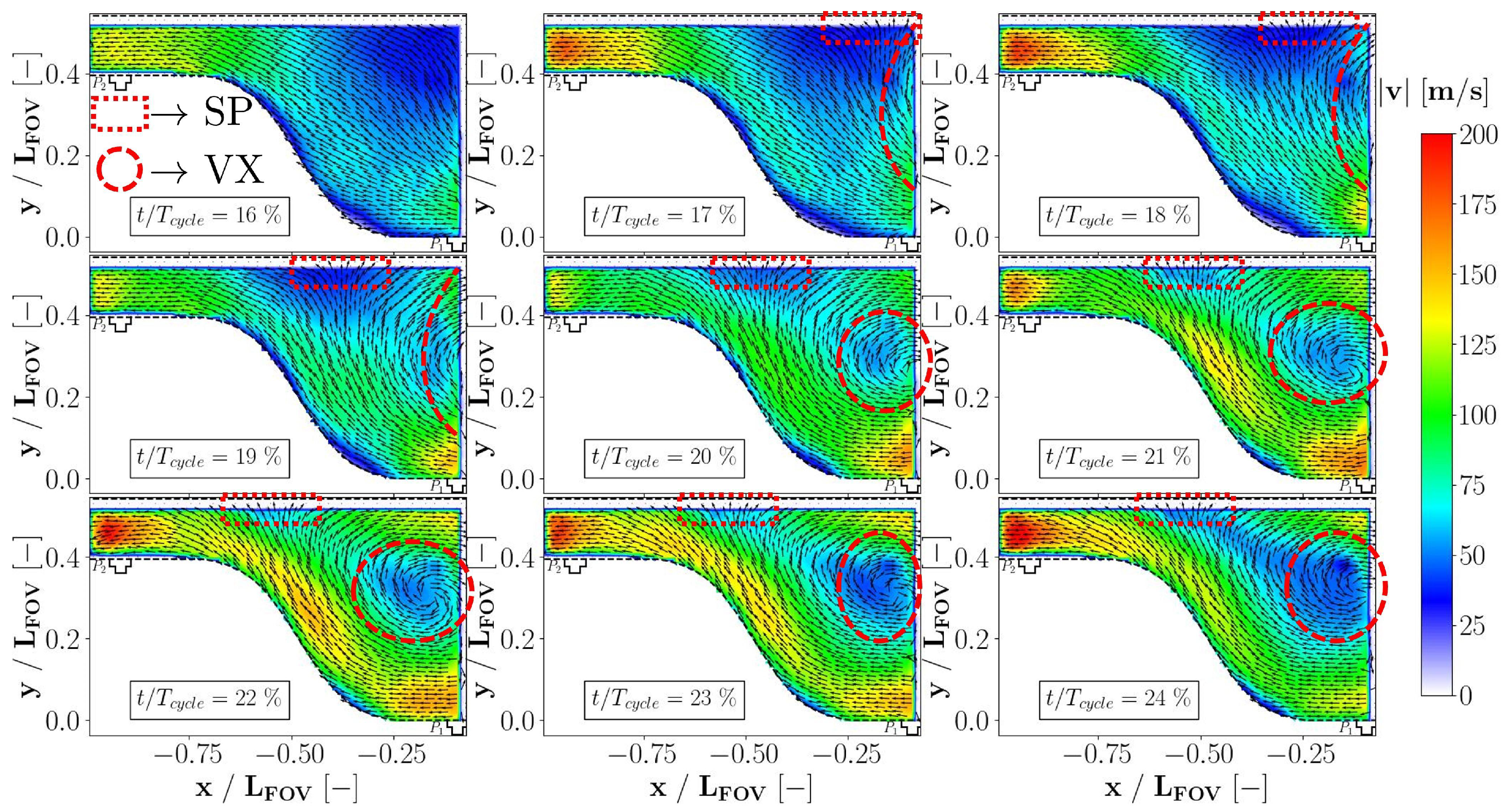
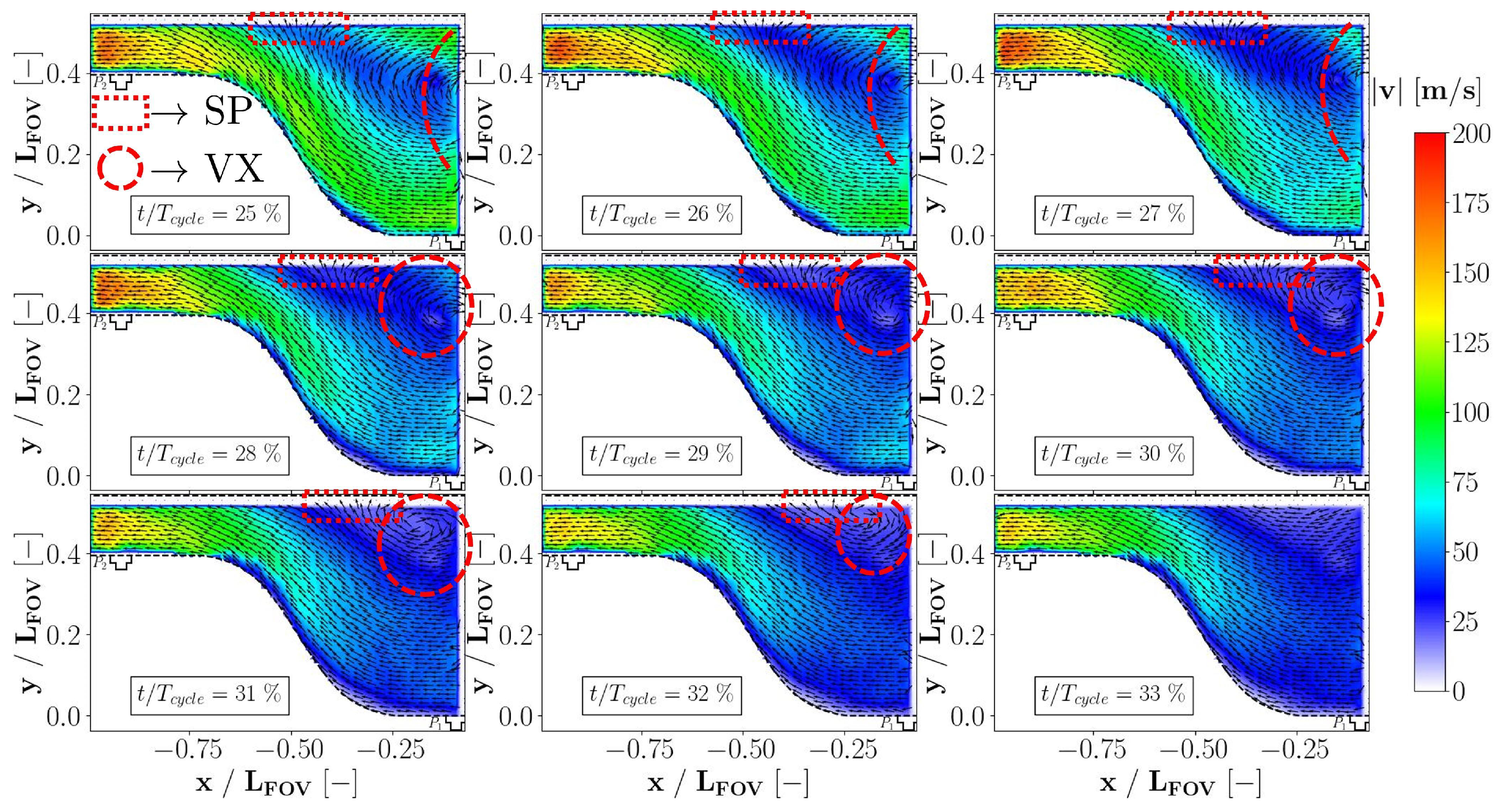
Without any doubt, the clockwise vortex at 25% of the cycle differentiates among the other cycle moments of Figure 17. Therefore, it is worthwhile to analyze the moments when the exhaust valves are open since their influence is predominant at the exhaust section (16–33% in Figure 13). Starting from the moment of 16% of the cycle in Figure 18, the accelerated outflow in the exhaust section can be seen. In the very next time frame of 17 % of the cycle, the left edge of a vortex (VX) can be identified. At the beginning of the FOV, the left portion of a clockwise vortex formed in the exhaust plenum by the sudden expansion of burned gas through the exhaust valves is observed. Moreover, the vortex is concentrated in the upper part, since a clear stagnation point (SP) is highlighted at the upper wall. In the next frames (18–19% of the cycle), the size of left part of the vortex increases, while the stagnation point moves downstream. The continuous acceleration of the exhaust section brings the center of the vortex inside of the FOV, whereas the stagnation point is moved almost at the half of the transition duct, as shown in 20–24% of the cycle. During this time window, the outflow of the duct reaches very high levels of velocity magnitude, whereas the vortex seems to expand in space, losing its intensity.
In the very next frames of 25–27% of the cycle in Figure 19, the inlet part of the transition duct reduces the velocity magnitude and the intensity of the vortex, which moves upstream, offering again only its left part to the FOV. Nonetheless, the outflow velocity of the duct remains at a high level. After 28% of the cycle, the closing of exhaust valves effectively decreases the size of the vortex, which is located on the upper wall. Both the vortex and its stagnation point are very close to the upper inlet part of the FOV. The open inlet valves (>30% of the cycle) result in a rise in pressure, both in the combustion chamber and in the exhaust section, keeping the transition duct’s outflow velocity around 125 m/s. However, the size of the vortex continuously decreases as seen in frames of 29–32% of the cycle. Finally, the aforementioned vortical structure is absent at 33% of the cycle. The same vortical generation, trajectory and behavior are noticed for all the other investigated cycle frequencies. Its path covers mainly the upper part of the inlet wall of the transition duct, while its position oscillates inside and outside of the FOV twice.
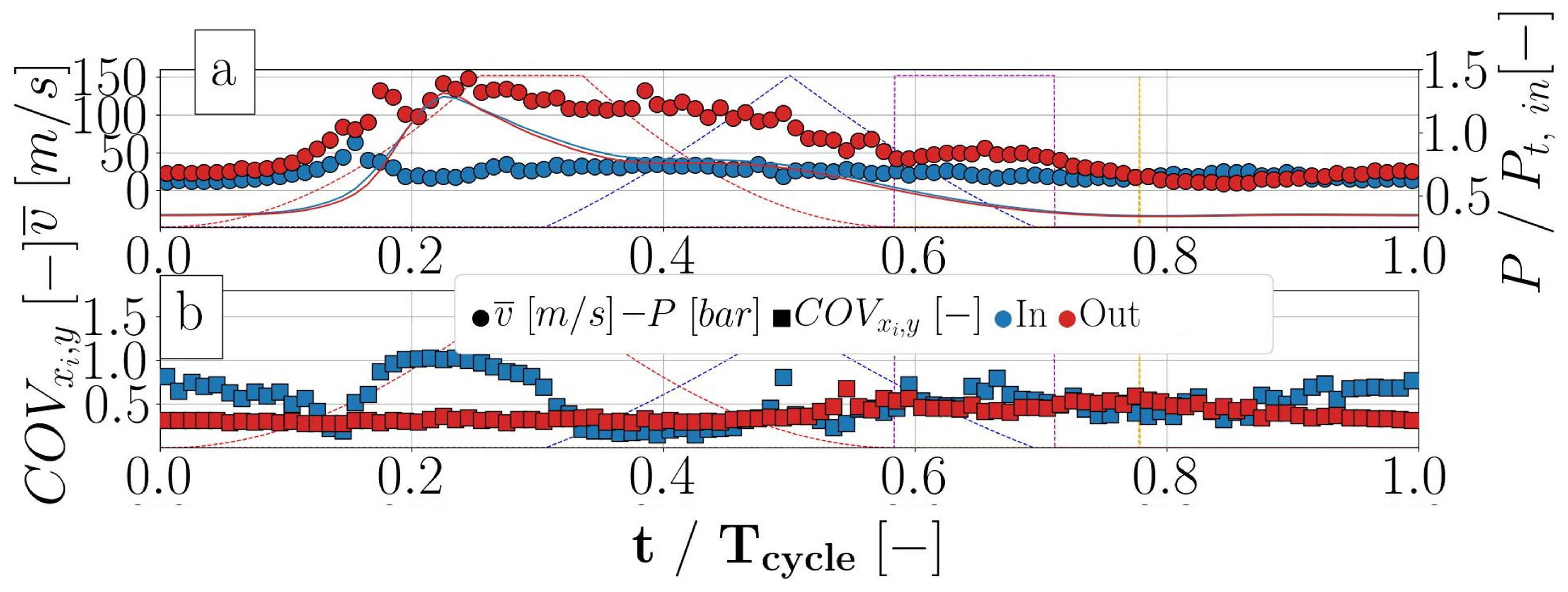
The PLA evolution of pressure, spatial average velocity magnitude ( u ¯ of Equation (11)) and the spatial coefficient of variance ( C O V x i , y of Equation (12)) for the inlet and outlet of the transition duct are shown in Figure 20 of the cycle frequency of 25 Hz. For this case, the outlet spatial average velocity does not exceed 150 m/s. It is evident in Figure 20b that the inlet of the transition duct suffers due to the closing–opening of exhaust valves. Huge variations in C O V x i , y are reported, which reach the maximum of 100% for three cycle time instances. On the other hand, the outlet of the transition duct provides a C O V x i , y that remains almost constant at around 25%. This implies that for the case of 25 Hz the transition duct is able to subtract the spatial non-uniformities of velocity. The periodic generation and the pulsation of the clockwise vortex are alleviated by the transition duct, as it is illustrated in Figure 18 and Figure 19. Furthermore, the presence of an extensive mild recirculation zone, observed under conditions of highly decelerated inflow in the transition duct, does not prevent the system from delivering a uniform outflow.
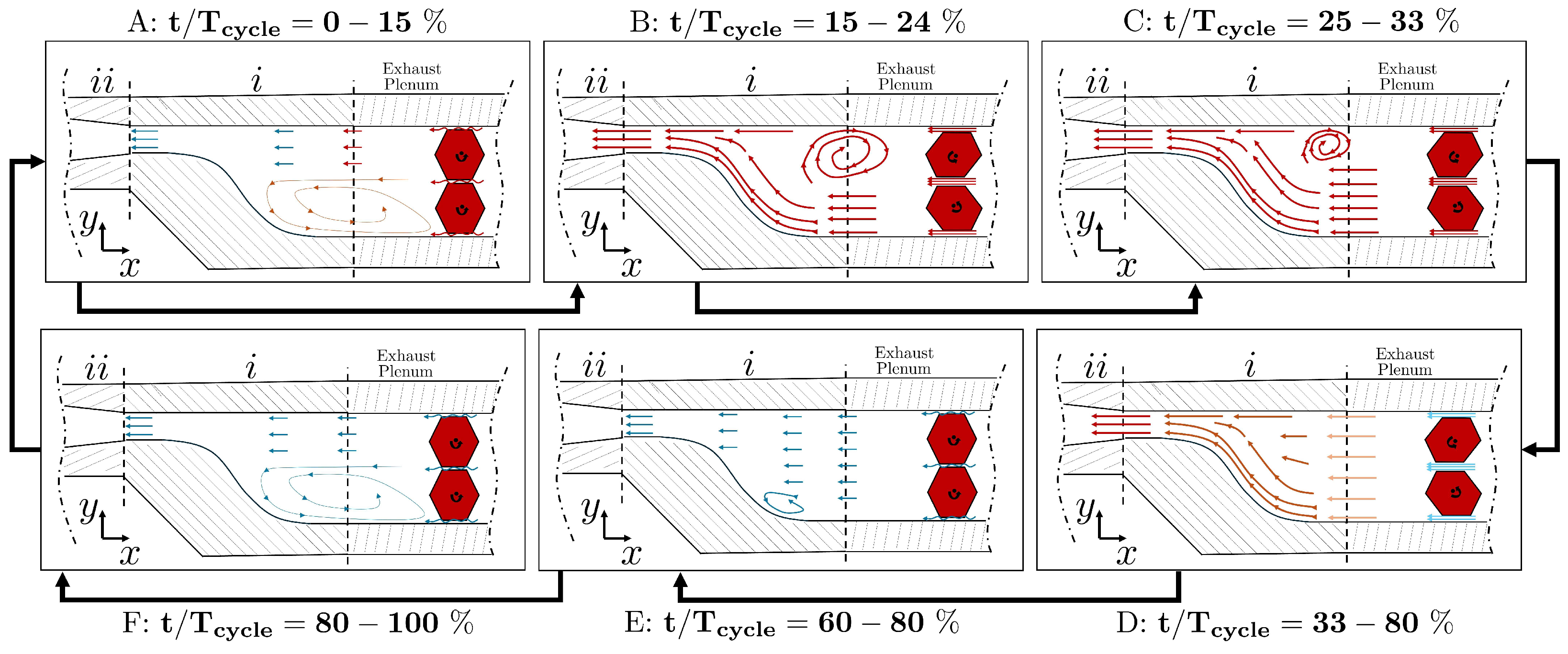
Since the PIV measurements are limited to the transition duct, Figure 21 provides a schematic overview of the governing phenomena in the exhaust section. At the start of the cycle (period A), combustion occurs in the chamber while the exhaust valves are slightly open, supplying a limited mass flow. The expansion of this flow in the exhaust plenum and duct inlet generates a mild counterclockwise recirculation at the lower part (0% of the cycle, Figure 17). With fully open exhaust valves and completed isochoric combustion (periods B and C), a highly accelerated flow forms a restricted, intense clockwise vortex, whose behavior is detailed in Figure 18 and Figure 19. After scavenging with both inlet and outlet valves open (period D, 35% of the cycle), the vortex weakens while the duct maintains high velocity. During the remainder of the cycle, restricted leakage from the combustion chamber expands as the exhaust valves close, reducing velocity and creating a mild lower-wall recirculation (65–75%, period E). Finally, further reduction in velocity extends the counterclockwise recirculation (period F), completing the cycle.
The schematic behavior in Figure 21 is similar across all investigated cycle frequencies, despite differences in timing and magnitude. The large recirculation zone at the lower part of the transition duct (periods A, E, and F) is confined downstream of the exhaust valves, where the chamber pressure is much higher than at the exhaust sensors (0–15 and 80–100% of the cycle, Figure 14). The rotation direction of the recirculation zones and the intense vortex is influenced by the non-uniform pressure distribution at the transition duct entrance. Although the exhaust valves create three equal vertical flow areas, the duct restriction occurs only in the upper part, producing different mass flow rates through the valve sections. The exact reasons for clockwise or counterclockwise rotation would require additional experimental visualization including the plenum or advanced transient CFD analysis of the valve bodies.

4.2.2. Velocity Field Assessment

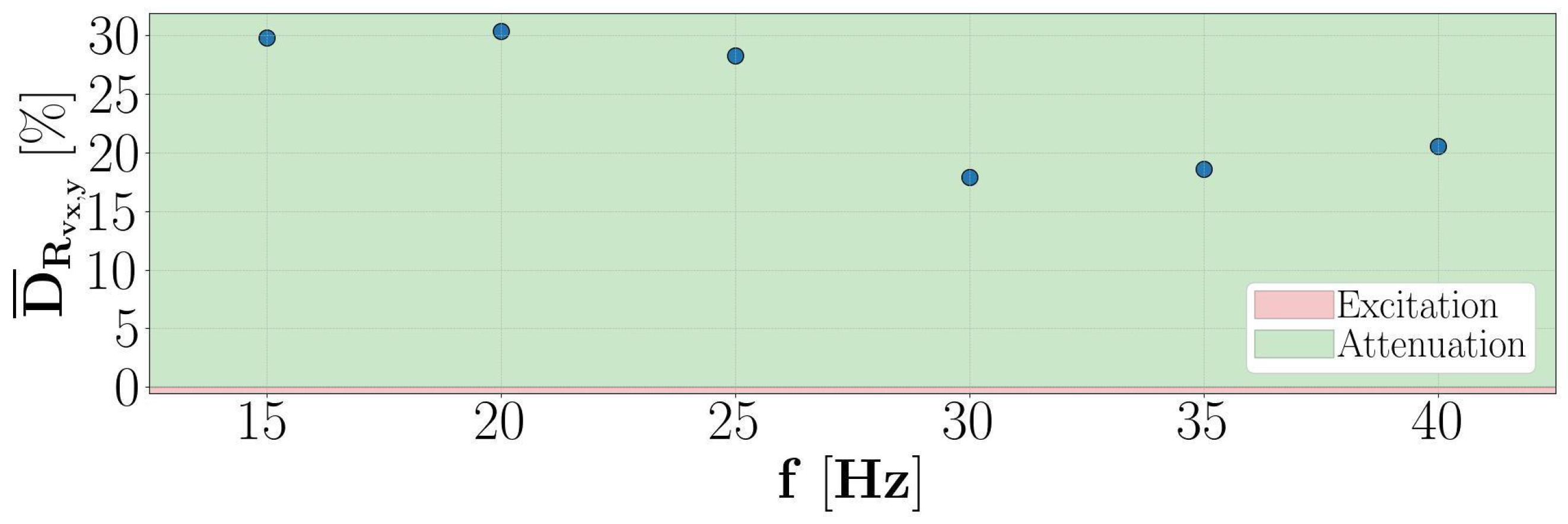
Figure 20b shows that the spatial coefficient of variance of inlet and outlet velocity changes over time, making it important to evaluate the time-averaged attenuation of spatial oscillations. The time-dependent damping coefficient of the spatial average velocity, D R v x , y ( t ) (Equation (13)), is computed for all cycle frequencies, and its time average D ¯ R v x , y (Equation (14)) is reported in Figure 22, with best and worst cases in Table 4. The transition duct attenuates spatial oscillations at all frequencies, achieving a maximum of 30.33 % at 20 Hz. The outflow remains largely unaffected by inlet distortions, and vortex dynamics do not influence the duct exit, as confirmed in Figure 18 and Figure 19. Attenuation decreases with increasing frequency, dropping below 25% for frequencies ≥ 30 Hz due to elevated spatial non-uniformities in the exhaust section.
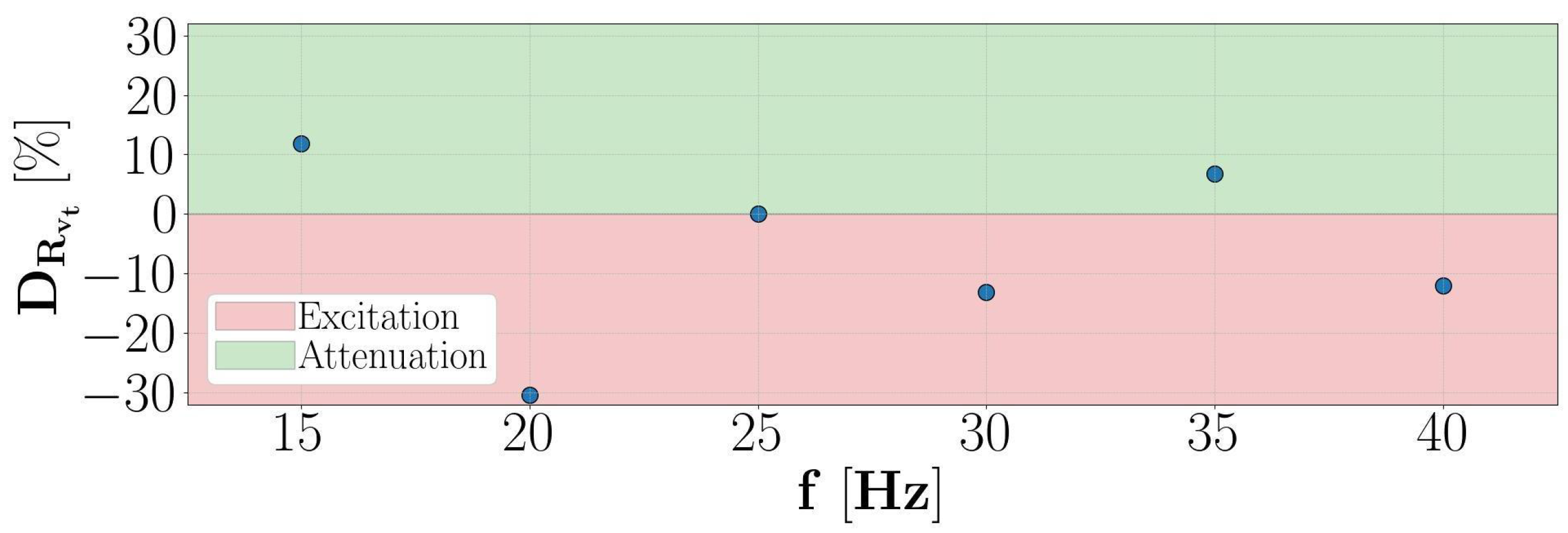
In addition, the damping factor of the temporal evolution of the spatial average velocity for a PLA cycle for all the cycle frequencies is calculated and presented in Figure 23. The damping factor for this analysis is given by Equation (15). The range of the PLA spatial average velocity is compared with its cycle average value for both inlet and outlet. The cases of 15 Hz, 25 Hz and 35 Hz offer attenuation, whereas 20 Hz, 30 Hz and 40 Hz exhibit excitation. The best performance of the transition duct with respect to D R v t happens at 15 Hz (see Table 5). It can be concluded that the transition duct reduces the temporal variation in the spatial average velocity to half of the tested frequencies, while no profound regression is observed.

4.3. Overall Performance Evaluation

This paper aims, for the first time, to visualize the CVC exhaust flow (Figure 17) and provide a velocity field map of its behavior based on PIV measurements (Figure 21). In addition, the goal of this work is to identify the overall optimal cycle frequency through the experimental parametric analysis presented in Table 1. Following the post-processing of the pressure (Section 4.1) and PIV measurements (Section 4.2), the cycle frequency that delivers the best CVC performance can be determined. Optimal operation is defined by a minimal number of misfires, high pressure gain in both the CVC chamber and exhaust plenum, and simultaneous attenuation of pressure fluctuations, spatial velocity non-uniformities, and temporal velocity unsteadiness in the exhaust system.
Among the cycle frequencies tested in Table 1, 25 Hz provides the best overall performance. This period allows sufficient time for reactant mixing and combustion, avoiding both early closure and full opening of the exhaust valves (Figure 14). The scavenging process is highly effective, with an active cycle success rate above 90% (Figure 12). At 25 Hz, the chamber achieves the highest average pressure gain ( 10.8 %, Figure 15a), while the exhaust system performance ( P ¯ g a i n = 41 %, M A X ( P g a i n ) = 28.4 %) is close to the best observed at 40 Hz ( P ¯ g a i n = 35.5 %, M A X ( P g a i n ) = 28.5 %, Table 2). The new exhaust system attenuates pressure fluctuations up to 5% (Figure 16) and reduces velocity spatial non-uniformities by 28.28 % (Figure 22), with minor reduction in temporal velocity unsteadiness (Figure 23). In conclusion, the CVC test rig performs optimally at 25 Hz, combining high pressure gain, minimal misfiring, and reduced pressure and velocity unsteadiness in the new exhaust system.

5. Conclusions

The current manuscript describes a reactive experimental campaign of the CVC test rig focusing on the characterization of the strong pulsating outflow at its exhaust. The combustion chamber and the inlet and outlet of the transition duct of the outtake system are equipped with fast-response pressure sensors. In addition, high-frequency PIV analysis is conducted at the transition duct. The operating conditions in terms of mixture of air/fuel and inlet conditions (stoichiometric, π r i g = 0.338 and T t , i n = 450 K ) are kept the same, whilst a parametric analysis on the cycle frequency (15–40 Hz) of the CVC is performed.
The pressure signals denote that when the cycle frequency rises and the scavenging process duration reduces, less time is left for the reactants to mix. Thus, combustion in the chamber becomes milder and occurs with the exhaust valves open, limiting its isochoric deflagrative nature. Altogether, an increase in cycle frequency leads to a delayed and milder combustion event, which reduces the pressure peak in the combustion chamber but increases the pressure peak in the transition duct. For the combustion chamber, the best performance in terms of cycle average pressure gain ( 10.8 %) is reported for 25 Hz, whereas at 40 Hz the transition duct performed best ( 35.34 %). The transition duct is able to attenuate the pressure signal for all frequencies, reaching up to 11.18 % of attenuation for 15 Hz.
The PIV measurements uncovered for the first time the evolution and behavior of the strong perturbing CVC outflow. When the exhaust valves are closed, a mild, though spatially extended, counterclockwise recirculation zone occurs in the lower part of the inlet of transition duct. The opening of the exhaust valves accelerates the exhaust domain, leading to a clockwise-rotating vortex at the upper part of the inlet of the transition duct. Its sign and trajectory correspond to the case of the inactive experimental campaign for low rig pressure ratio ( 0.25 ). The transition duct is able to alleviate the inlet velocity non-uniformities for all the cycle times for every cycle frequency. We observed maximum attenuation of 30.33 % for the case of 30 Hz.
In conclusion, this study provides a detailed characterization and visualization of the CVC exhaust flow. Strong perturbing flow phenomena occur at the entrance of the transition duct. Nonetheless, the transition duct is able to suppress them, always providing more uniform flow at the outlet. These results are crucial for the future industrial integration of the CVC with a HPT stage. The CVC’s outflow is successfully characterized, allowing for a proper numerical design and future experimental integration of an efficient subsequent turbomachinery module. Moreover, the compromise of pressure gain, pressure signal attenuation and velocity fluctuation suppression confirms that the case of 25 Hz is the most appropriate cycle frequency for the overall optimum performance of the system in the present configuration.

Author Contributions

Conceptualization, P.G., D.A.M., B.B., M.B. and S.S.; methodology, P.G., B.B. and M.B.; software, P.G. and B.B.; validation, P.G. and B.B.; investigation, P.G. and B.B.; resources, B.B. and M.B.; data curation, B.B. and M.B.; writing—original draft preparation, P.G.; writing—review and editing, P.G.; visualization, P.G.; supervision, D.A.M., B.B., M.B. and S.S. All authors have read and agreed to the published version of the manuscript.

Funding

The present activity is performed in the frame of the INSPIRE project (Grant Agreement 956803) funded by the European Commission through a Marie Sklodowska-Curie action.

Institutional Review Board Statement

Not applicable.

Data Availability Statement

The original contributions presented in this study are included in the article. Further inquiries can be directed to the corresponding author.

Acknowledgments

The authors would like to deeply thank Alain Claverie for his support and contribution to the experimental campaign. Region Nouvelle Aquitaine is acknowledged for financial support allowing high-speed PIV diagnostic equipment to be used.

Conflicts of Interest

The authors declare no conflicts of interest.

Abbreviations

The following abbreviations are used in this manuscript:
CVCConstant-Volume Combustor
PIVParticle Image Velocimetry
PGCPressure Gain Combustion
PDEPulse Detonation Engine
RDERotating Detonation Engine
ZNDZeldovich–von Neumann–Döring
HPTHigh-Pressure Turbine
LESLarge-Eddy Simulations
FOVField of View
PTU XProgrammable Timing Unit
PLAPhase-Locked Averaging
PSDPower Spectral Density
FFTFast-Fourier Transform
COVCoefficient of Variance
VXVortex
SPStagnation Point

References

  1. Akbari, P.; Nalim, R.; Mueller, N. A Review of Wave Rotor Technology and Its Applications. J. Eng. Gas Turbines Power 2006, 128, 717–735. [Google Scholar] [CrossRef]
  2. Meng, X.; de Jong, W.; Kudra, T. A State-of-the-Art Review of Pulse Combustion: Principles, Modeling, Applications and R&D Issues. Renew. Sustain. Energy Rev. 2016, 55, 73–114. [Google Scholar] [CrossRef]
  3. Reichel, T.G.; Schäpel, J.S.; Bobusch, B.C.; Klein, R.; King, R.; Oliver Paschereit, C. Shockless Explosion Combustion: Experimental Investigation of a New Approximate Constant Volume Combustion Process. J. Eng. Gas Turbines Power 2016, 139, 021003. [Google Scholar] [CrossRef]
  4. Boust, B.; Michalski, Q.; Bellenoue, M. Experimental Investigation of Ignition and Combustion Processes in a Constant-Volume Combustion Chamber for Air-Breathing Propulsion. In Proceedings of the 52nd AIAA/SAE/ASEE Joint Propulsion Conference, Salt Lake City, UT, USA, 25–27 July 2016. AIAA paper 2016-4699. [Google Scholar] [CrossRef]
  5. Glassman, I.; Yetter, R.A.; Glumac, N.G. Flame phenomena in premixed combustible gases. In Combustion, 5th ed.; Academic Press: Waltham, MA, USA, 2015; pp. 147–254. [Google Scholar] [CrossRef]
  6. Lee, J.H.S. Gasdynamic Theory of Detonations and Deflagrations. In The Detonation Phenomenon, 1st ed.; Cambridge University Press: Cambridge, UK, 2008; Chapter 2; pp. 26–52. [Google Scholar] [CrossRef]
  7. Kailasanath, K. Recent Developments in the Research on Pulse Detonation Engines. AIAA J. 2003, 41, 145–159. [Google Scholar] [CrossRef]
  8. Lu, F.K.; Braun, E.M. Rotating Detonation Wave Propulsion: Experimental Challenges, Modeling, and Engine Concepts. J. Propuls. Power 2014, 30, 1125–1142. [Google Scholar] [CrossRef]
  9. Radulescu, M.I.; Sharpe, G.J.; Law, C.K.; Lee, J.H.S. The Hydrodynamic Structure of Unstable Cellular Detonations. J. Fluid Mech. 2007, 580, 31–81. [Google Scholar] [CrossRef]
  10. Heiser, W.H.; Pratt, D.T. Thermodynamic Cycle Analysis of Pulse Detonation Engines. J. Propuls. Power 2002, 18, 68–76. [Google Scholar] [CrossRef] [PubMed]
  11. Stathopoulos, P. Comprehensive Thermodynamic Analysis of the Humphrey Cycle for Gas Turbines with Pressure Gain Combustion. Energies 2018, 11, 3521. [Google Scholar] [CrossRef]
  12. Sousa, J.; Paniagua, G.; Collado Morata, E. Thermodynamic Analysis of a Gas Turbine Engine with a Rotating Detonation Combustor. Appl. Energy 2017, 195, 247–256. [Google Scholar] [CrossRef]
  13. Wintenberger, E.; Shepherd, J.E. Thermodynamic Cycle Analysis for Propagating Detonations. J. Propuls. Power 2006, 22, 694–698. [Google Scholar] [CrossRef]
  14. Rasheed, A.; Furman, A.H.; Dean, A.J. Experimental Investigations of the Performance of a Multitube Pulse Detonation Turbine System. J. Propuls. Power 2011, 27, 586–596. [Google Scholar] [CrossRef]
  15. Caldwell, N.; Brunet, R.; Gutmark, E.; Drouin, B. Experimental Analysis of a Hybrid Pulse Detonation Combustor/Gas Turbine Engine. In Proceedings of the 46th AIAA Aerospace Sciences Meeting and Exhibit, Reno, NV, USA, 7–10 January 2008. AIAA paper 2008-121. [Google Scholar] [CrossRef]
  16. George, A.S.; Driscoll, R.; Gutmark, E.; Munday, D. Experimental Comparison of Axial Turbine Performance Under Steady and Pulsating Flows. J. Turbomach. 2014, 136, 111005. [Google Scholar] [CrossRef]
  17. Anand, V.; St. George, A.; Knight, E.; Gutmark, E. Investigation of Pulse Detonation Combustors—Axial Turbine System. Aerosp. Sci. Technol. 2019, 93, 105350. [Google Scholar] [CrossRef]
  18. Naples, A.; Hoke, J.; Battelle, R.; Schauer, F. T63 Turbine Response to Rotating Detonation Combustor Exhaust Flow. J. Eng. Gas Turbines Power 2018, 141, 021029. [Google Scholar] [CrossRef]
  19. Zhou, S.; Ma, H.; Li, S.; Liu, D.; Yan, Y.; Zhou, C. Effects of a Turbine Guide Vane on Hydrogen-Air Rotating Detonation Wave Propagation Characteristics. Int. J. Hydrogen Energy 2017, 42, 20297–20305. [Google Scholar] [CrossRef]
  20. Zhou, S.; Ma, H.; Ma, Y.; Zhou, C.; Liu, D.; Li, S. Experimental Study on a Rotating Detonation Combustor with an Axial-Flow Turbine. Acta Astronaut. 2018, 151, 7–14. [Google Scholar] [CrossRef]
  21. Wu, Y.; Weng, C.; Zheng, Q.; Wei, W.; Bai, Q. Experimental Research on the Performance of a Rotating Detonation Combustor with a Turbine Guide Vane. Energy 2021, 218, 119580. [Google Scholar] [CrossRef]
  22. Bach, E.; Paschereit, C.O.; Stathopoulos, P.; Bohon, M.D. Rotating Detonation Wave Direction and the Influence of Nozzle Guide Vane Inclination. AIAA J. 2021, 59, 5276–5287. [Google Scholar] [CrossRef]
  23. Asli, M.; Stathopoulos, P.; Paschereit, C.O. Aerodynamic Investigation of Guide Vane Configurations Downstream a Rotating Detonation Combustor. J. Eng. Gas Turbines Power 2021, 143, 061011. [Google Scholar] [CrossRef]
  24. Braun, J.; Paniagua, G.; Ferguson, D. Aero-Thermal Characterization of Accelerating and Diffusing Passages Downstream of Rotating Detonation Combustors. In Turbo Expo: Power for Land, Sea, and Air; Paper GT2021-59111; American Society of Mechanical Engineers: New York, NY, USA, 2021. [Google Scholar] [CrossRef]
  25. Grasa, S.; Paniagua, G. Design, Multi-Point Optimization, and Analysis of Diffusive Stator Vanes to Enable Turbine Integration Into Rotating Detonation Engines. J. Turbomach. 2024, 146, 111002. [Google Scholar] [CrossRef]
  26. Gallis, P.; Salvadori, S.; Misul, D.A. Numerical Analysis of a Flow Control System for High-Pressure Turbine Vanes Subject to Highly Oscillating Inflow Conditions. J. Turbomach. 2025, 147, 121008. [Google Scholar] [CrossRef]
  27. Nastasi, R.; Labrini, G.; Salvadori, S.; Misul, D.A. Shape Optimization of a Diffusive High-Pressure Turbine Vane Using Machine Learning Tools. Energies 2024, 17, 5642. [Google Scholar] [CrossRef]
  28. Labarrere, L.; Poinsot, T.; Dauptain, A.; Duchaine, F.; Bellenoue, M.; Boust, B. Experimental and Numerical Study of Cyclic Variations in a Constant Volume Combustion Chamber. Combust. Flame 2016, 172, 49–61. [Google Scholar] [CrossRef]
  29. Boust, B.; Bellenoue, M.; Michalski, Q. Pressure Gain and Specific Impulse Measurements in a Constant-Volume Combustor Coupled to an Exhaust Plenum. In Active Flow and Combustion Control; Springer: Cham, Switzerland, 2021. [Google Scholar] [CrossRef]
  30. Gallis, P.; Misul, D.A.; Bellenoue, M.; Boust, B.; Salvadori, S. Development of 1D Model of Constant-Volume Combustor and Numerical Analysis of the Exhaust Nozzle. Energies 2024, 17, 1191. [Google Scholar] [CrossRef]
  31. Arts, T.; Lambert de Rouvroit, M. Aero-Thermal Performance of a Two-Dimensional Highly Loaded Transonic Turbine Nozzle Guide Vane: A Test Case for Inviscid and Viscous Flow Computations. J. Turbomach. 1992, 114, 147–154. [Google Scholar] [CrossRef]
  32. Gallis, P.; Misul, D.A.; Boust, B.; Bellenoue, M.; Salvadori, S. Numerical Analysis and Design of New Exhaust Section Downstream of Constant Volume Combustor. J. Eng. Gas Turbines Power 2024, 147, 021010. [Google Scholar] [CrossRef]
  33. Gallis, P.; Misul, D.A.; Boust, B.; Bellenoue, M.; Salvadori, S. Non-Reactive Experimental Analysis of an Exhaust Section downstream of a CVC. In 16th European Conference on Turbomachinery Fluid Dynamics & Thermodynamics; European Turbomachinery Conference, Hannover, Germany, ETC2025-270; European Turbomachinery Society: Florence, Italy, 2025. [Google Scholar]
  34. ISO Standard 9300; Measurement of Gas Flow by Means of Critical Flow Venturi Nozzles. International Organization for Standardization: Geneva, Switzerland, 2005.
  35. LaVision GmbH. Manual No. 1003001 for DaVis Software; Anna Vandenhoeck-Ring 19: Göttingen, Germany, 2024. [Google Scholar]
  36. Sciacchitano, A. Uncertainty quantification in particle image velocimetry. Meas. Sci. Technol. 2019, 30, 092001. [Google Scholar] [CrossRef]
  37. Wieneke, B. PIV uncertainty quantification from correlation statistics. Meas. Sci. Technol. 2015, 26, 074002. [Google Scholar] [CrossRef]
Figure 1. Schematic representation of CVC experimental test rig.
Ijtpp 11 00024 g001
Figure 2. CVC experimental test rig iso-view 1 (a), lateral view (b), iso-view 2 (c), isolated view of exhaust plenum (d) and schematic representation of seeder (e).
Ijtpp 11 00024 g002
Figure 3. New exhaust system iso-view (a), rear view (b) and cross-section view (c).
Ijtpp 11 00024 g003
Figure 4. Continuous pressure signal of CVC chamber and PLA signal for a cycle period for case of 25 Hz.
Ijtpp 11 00024 g004
Figure 5. PLA PIV velocity flow fields for 0%, 25%, 35%, 50%, 65% and 75% of the 15th cycle for 25 Hz.
Ijtpp 11 00024 g005
Figure 6. Continuous velocity signal and PLA signal for the specific point ( [ 0.25 · L F O V , 0.25 · L F O V ] ) of Figure 5 for case of 25 Hz.
Ijtpp 11 00024 g006
Figure 7. Retrieval of time-average uncertainty δ v ^ j and time standard deviation σ ( δ v j ) of a specific interrogation window j during test time Δ T t e s t .
Ijtpp 11 00024 g007
Figure 8. Time average (a) and time standard deviation (b) of velocity uncertainty for the case of 15 Hz.
Ijtpp 11 00024 g008
Figure 9. Evolution of uncertainty level for all investigated cycle frequencies.
Ijtpp 11 00024 g009
Figure 10. Entire test pressure signals (a) and PSD (b) for cycle frequency at 25 Hz.
Ijtpp 11 00024 g010
Figure 11. Entire test pressure signals (a) and their detailed view (b). FFT analysis of the pressure signals (c) and their detailed view (d). Power of pressure signals (e) and their detailed view (f). Cycle frequency of test is 25 Hz.
Ijtpp 11 00024 g011
Figure 12. Success rate of combustion events for different operating frequencies.
Ijtpp 11 00024 g012
Figure 13. PLA signals of chamber (cc), upstream (1) and downstream (2) sensor of the transition duct for 25 Hz.
Ijtpp 11 00024 g013
Figure 14. PLA signals of chamber (a), upstream transition duct sensor (b) and downstream transition duct sensor (c) for all the investigated cycle frequencies.
Ijtpp 11 00024 g014
Figure 15. CVC experimental parametric analysis on cycle average (a) and maximum (b) pressure gain values retrieved from the PLA process.
Ijtpp 11 00024 g015
Figure 16. Evaluation of power pressure signal attenuation through the transition duct.
Ijtpp 11 00024 g016
Figure 17. PLA PIV velocity flow fields for 0%, 25%, 35%, 50%, 65% and 75% of the cycle for 25 Hz.
Ijtpp 11 00024 g017
Figure 18. PLA PIV velocity flow fields for 16–24% of the cycle for 25 Hz.
Ijtpp 11 00024 g018
Figure 19. PLA PIV velocity flow fields for 25–33% of the cycle for 25 Hz.
Ijtpp 11 00024 g019
Figure 20. Evolution of (a) spatial average velocity and static pressure; (b) C O V x i , y for cycle frequency of 25 Hz.
Ijtpp 11 00024 g020
Figure 21. Schematic operational representation of the governing phenomena at the exhaust section during one cycle of the CVC.
Ijtpp 11 00024 g021
Figure 22. Time-average evolution of the damping coefficient of spatial average velocity retrieved by PIV PLA process for all cycle frequencies.
Ijtpp 11 00024 g022
Figure 23. Temporal damping coefficient of spatial average velocity retrieved by PIV PLA process for all cycle frequencies.
Ijtpp 11 00024 g023
Table 1. Conditions of reactive experimental tests.
Case N o Pressure N o PIVReactive P t , in T t , in π rig f cycle
A51Yes3 bar450 K0.33815 Hz
B21Yes3 bar450 K0.33820 Hz
C61Yes3 bar450 K0.33825 Hz
D21Yes3 bar450 K0.33830 Hz
E21Yes3 bar450 K0.33835 Hz
F21Yes3 bar450 K0.33840 Hz
Total196
Table 2. Best and worst pressure gain performance for the combustion chamber (CVC) and the exhaust section (Exhaust).
PartCasef P ¯ gain Max ( P gain )
CVCWorst40 Hz 6.08 % 64.66 %
Best25 Hz 10.8 % 178.86 %
ExhaustWorst15 Hz 59.67 % 38.53 %
Best40 Hz 35.34 % 28.37 %
Table 3. Best and worst pressure attenuation performance for the transition duct.
Casef DP Power
Worst40 Hz 0.44 %
Best15 Hz 11.18 %
Table 4. Best and worst attenuation performance for the transition duct in terms of D ¯ R v x , y .
Casef D ¯ R v x , y
Worst30 Hz 17.86 %
Best20 Hz 30.33 %
Table 5. Best and worst attenuation performance for the transition duct in terms of D R v t .
Casef D R v t
Worst20 Hz 30.42 %
Best15 Hz 11.79 %
Disclaimer/Publisher’s Note: The statements, opinions and data contained in all publications are solely those of the individual author(s) and contributor(s) and not of MDPI and/or the editor(s). MDPI and/or the editor(s) disclaim responsibility for any injury to people or property resulting from any ideas, methods, instructions or products referred to in the content.