
Article

Two-Dimensional Flow in a Linear Cascade of Throttling Nozzles for an Adaptive Turbine Stage †

by
Reinhard Willinger
1,*,
Khoiri Rozi
2 and
Mohammad Reza Kariman
1
1
Institute for Energy Systems and Thermodynamics, TU Wien, Getreidemarkt 9, A-1060 Vienna, Austria
2
Mechanical Engineering Department, Diponegoro University, Semarang 50275, Indonesia
*
Author to whom correspondence should be addressed.
This manuscript is an extended version of paper ETC2025-177, published in the Proceedings of the 16th European Turbomachinery Conference, Hannover, Germany, 24–28 March 2025.
Int. J. Turbomach. Propuls. Power 2026, 11(1), 13; https://doi.org/10.3390/ijtpp11010013
Submission received: 9 October 2025 / Revised: 22 January 2026 / Accepted: 3 February 2026 / Published: 2 March 2026

Abstract

Steam turbines with controlled extraction require a flow control device to keep extraction pressure constant when the extraction mass flow rate is changed. An attractive option is an adaptive turbine stage with throttling nozzles. Flow measurements with a throttling nozzle are performed in a cascade wind tunnel. A linear cascade with seven blades is operated at an inlet flow angle of 90° and an exit Reynolds number of about 4 × 10⁵. Since the maximum exit Mach number is about 0.2, flow is essentially incompressible. A three-hole pressure probe is traversed at half span over one blade pitch 0.33 axial chord lengths downstream of the cascade. Degree of closing is gradually changed from zero (fully open) to 0.3 (partially closed). Two principal options, closing to the suction side as well as closing to the pressure side, are investigated. Local flow quantities as well as pitchwise mass averaged quantities are extracted from the measurement data. The major outcomes are as follows: If the throttling nozzle is closed, depth and width of the blade wake increase. With increasing degree of closing, pitchwise mass averaged flow angle decreases and total pressure losses increase. Concerning total pressure losses, closing to the pressure side is the preferred option. A semi-empirical flow model is presented to explain the influence of degree of closing on exit flow angle and total pressure loss.

1. Introduction

Industrial steam turbines are still important for a large variety of applications. Different turbine types have to cover a wide range of live steam pressures and temperatures as well as mass flow rates. Industrial steam turbines can be of condensing or back-pressure type. Steam turbines for independent supply rates of mechanical power and heat have to be equipped with controlled extraction. Typical applications of such steam turbines are industrial use or district heating. Compared with a steam turbine with uncontrolled extraction, the extraction mass flow rate in relation to the inlet mass flow rate is higher. To keep the pressure at the extraction chamber constant, these turbines have to be equipped with a flow control device just downstream of the extraction point. Various concepts have been established to realize such a control device. The most important are external throttle valves, internal throttle valves, control stages with partial admission, sliding valves and adaptive stages [1]. Each design has advantages and disadvantages in its specific application range.
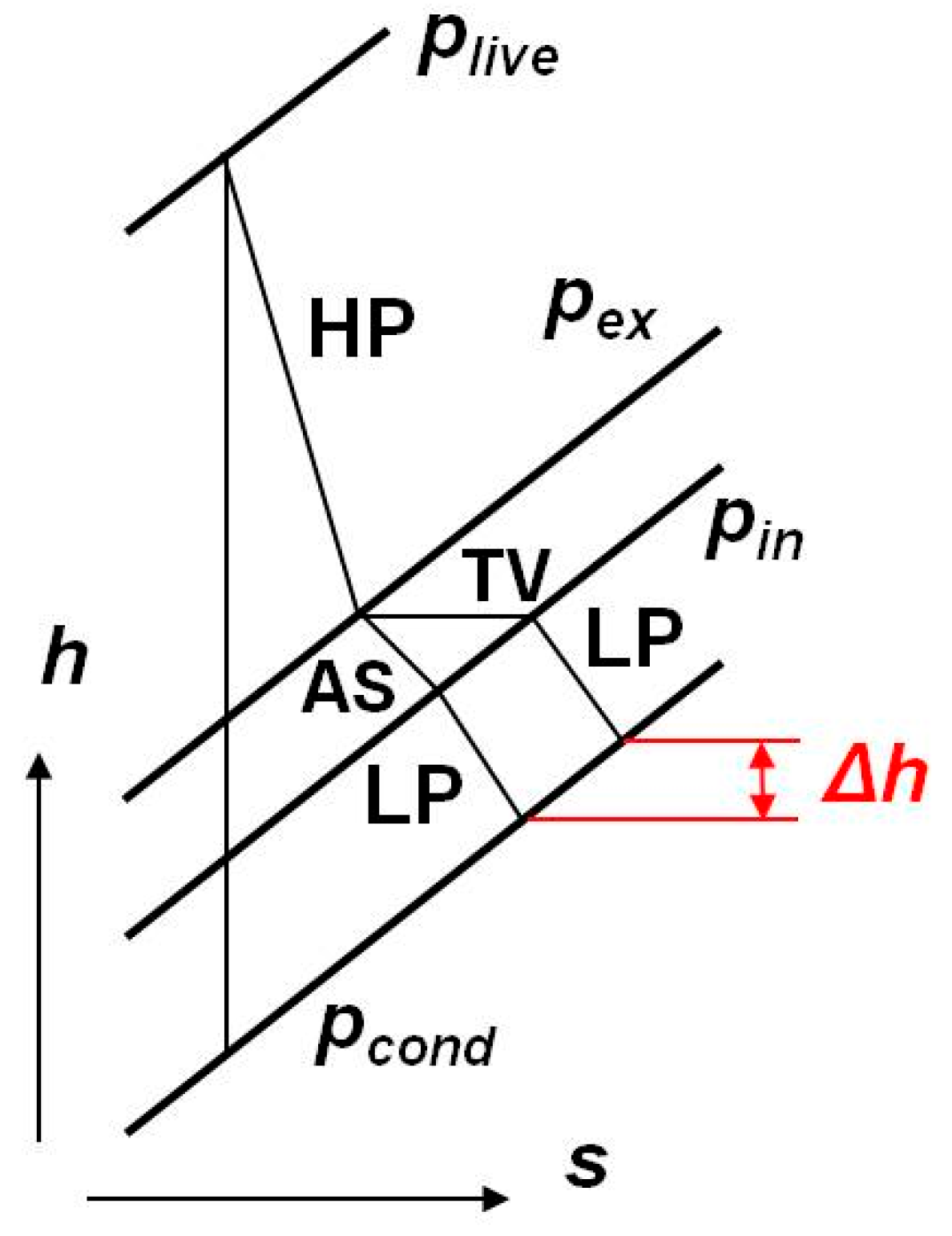
The present work, which is based on a version previously presented at the 16th European Turbomachinery Conference [2], focuses on the adaptive turbine stage, equipped with a throttling nozzle. The adaptive stage is arranged just downstream of the extraction chamber. Its stator blade row is designed as a throttling nozzle. This means that the stator blade row is cut by a plane perpendicular to the axis of rotation into two sections. These are a fixed trailing edge section and a leading edge section, which can be rotated to change the open cross section of the blade channels. In contrast to a throttle valve, the kinetic energy downstream of the variable cross section can be used while the flow is turned in the circumferential direction. Downstream of the throttling nozzle, a conventional rotor blade row is admitted. Figure 1 shows the enthalpy/entropy diagram of a steam turbine with controlled extraction. Live steam parameters (pressure, temperature, mass flow rate) as well as extraction pressure are fixed. At a certain extraction mass flow rate, defined by the inlet pressure of the low-pressure turbine (LP), the adaptive turbine stage (AS) leads to a power gain, which is proportional to the enthalpy difference Δh. In the fully open position of the throttling nozzle, the adaptive stage operates as a conventional impulse stage. Therefore, the gain compared to the throttle valve will be Δh ≈ 2·u2. For a typical circumferential speed u = 150 m/s this will result in Δh ≈ 45 kJ/kg.

2. Literature Review

Early information on the application of sliding valves for extraction steam turbines can be found in Speicher and Mietsch [3]. The sliding valve can be categorized as a predecessor of the adaptive turbine stage. It consists of a fixed rear plate and a rotatable (sliding) front plate. Both plates have open windows, arranged in a periodic manner in circumferential direction. The sliding valve is positioned just upstream of the first stage of the low-pressure turbine. Various design options (axial flow, radial flow) are presented in the paper. Forces are acting on the front plate due to pressure difference and change in momentum. To compensate for these forces, a design of a pressure-balanced sliding valve is presented.
Information about throttling nozzles for application in steam turbines can be found for the first time in the textbook of Dejc and Trojanovskij [4]. The authors provide loss coefficients versus degree of closing and pressure ratio for three different blade shapes. In terms of losses, it is stated that the throttling nozzle should be operated by closing to the pressure side. The authors state that the exit flow angle of the throttling nozzle decreases progressively if the cascade is closed. Efficiency of an adaptive stage with throttling nozzles versus degree of closing is presented. Semi-empirical equations are provided for the calculation of mass flow rate of throttling nozzles as a function of degree of closing.
Various designs of throttles to control the extraction mass flow rate in steam turbines are presented by Speicher et al. [5]. A qualitative comparison of simple sliding valves with throttling nozzles is given. Innovative designs for throttling nozzles are presented, discussing patents from the period 1961 to 1985. Another important topic is the pressure balance of throttling nozzles. The reason is that high axial forces act on the leading edge section of the throttling nozzle if the cascade is closed. As a result, high friction forces are observed in the contact plane between the leading edge section and trailing edge section, resulting in high manipulation torques and surface wear. To eliminate these negative effects, the concept for a pressure-balanced sliding valve is presented.
Boos [6] describes results from experiments performed in an air turbine test stand. The turbine is designed as an adaptive stage with throttling nozzles. Five-hole pressure probe traverses are performed, mainly downstream of the throttling nozzle. Based on the measured loss coefficient of the throttling nozzle, it is stated that closing to the pressure side is the preferred mode of operation. The exit flow angle of the throttling nozzle decreases when the cascade is closed. Efficiencies of the turbine stage as a function of degree of closing are presented.
A redesign of the adaptive stage of a 25 MW extraction steam turbine is documented by Puzyrewski et al. [7]. The throttling nozzle is replaced by variable guide vanes, where the leading edge section is fixed and the trailing edge section can be turned to change the open throat area. The design is called a “flap nozzle”. Some preliminary results of experiments performed in an air turbine are presented. Concerning flow losses and stage efficiency, the flap nozzle shows favourable performance compared to the throttling nozzle.
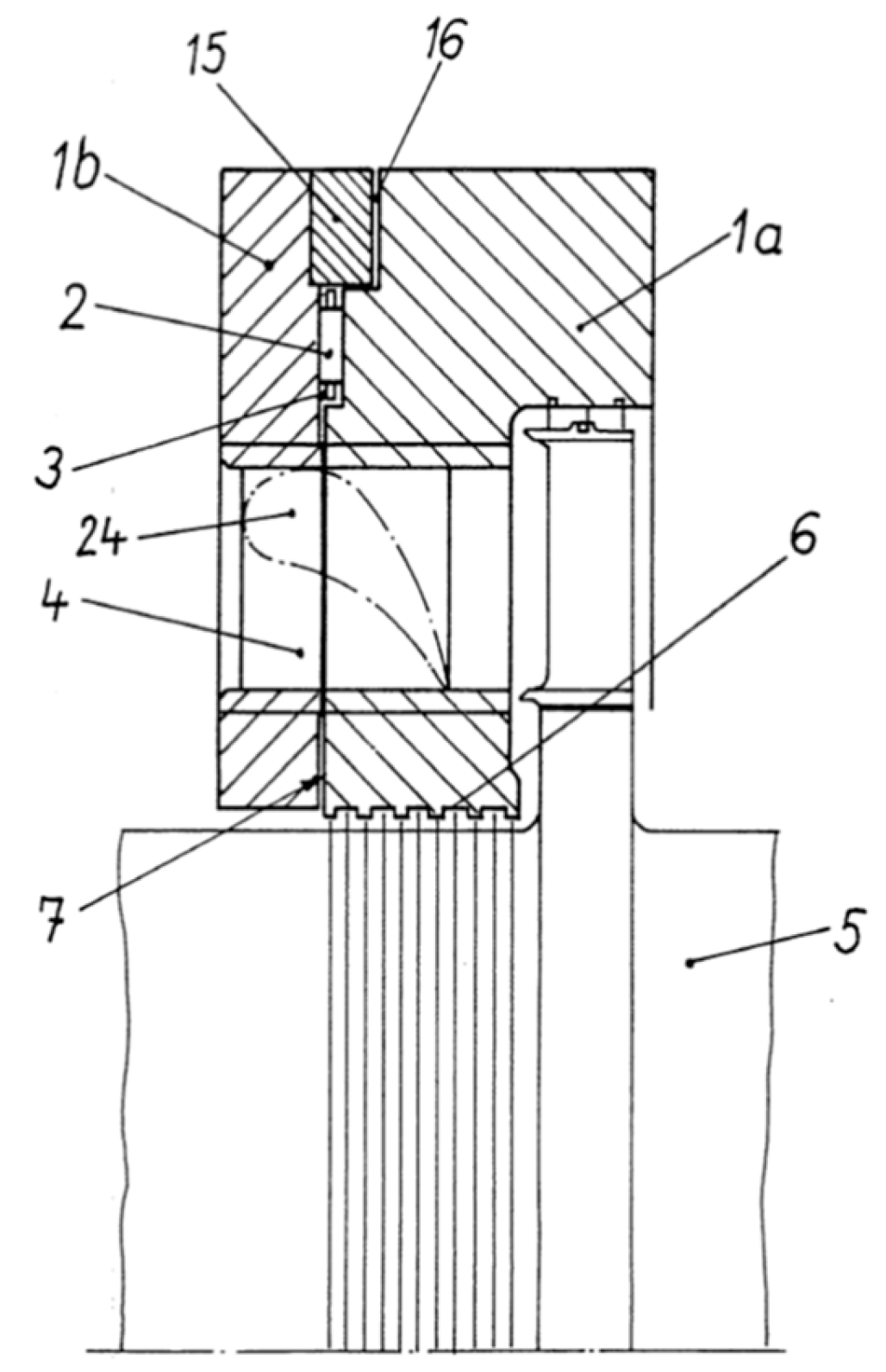
The patent of Geist and Jürke [8] provides some information on throttling nozzles for adaptive stages in steam turbines, addressing also mechanical considerations. Figure 2 gives an impression of the design of the adaptive turbine stage with throttling nozzles. In the main flow channel (4), the nozzle profile (24) is split into a fixed rear part (1a) and a rotatable front part (1b). The ring (15) in the groove (16) is responsible for centring the front part relative to the fixed rear part. To prevent friction and wear due to the high axial forces on the leading edge section, an axial needle bearing (2) is positioned in the groove (3) to keep the axial gap (7) between the front part and rear part. The axial gap is designed to guarantee a save operation, even when the throttling nozzle experiences deformations due to high axial pressure differences and temperature gradients. On the one hand, this gap should be as small as possible to minimise leakage flow through the throttling nozzle. On the other hand, the gap has to be large enough to prevent mechanical contact between the leading edge section and trailing edge section over the entire operating range. It is stated that the position of the cutting plane between both sections should be chosen according to the condition of the equal section modulus. Finally, the adaptive stage is composed of the turbine shaft with rotor blade row (5) and the labyrinth seal (6).
One outcome of the literature review is that the available information on adaptive turbine stages with throttling nozzles is rather limited. This is probably due to the fact that this is mainly knowledge related to steam turbine manufacturers. The present investigation provides experimental results of the flow in a generic throttling nozzle for adaptive turbine stages. The objective is to improve our understanding of flow behaviour in such a control device. Results should also support the meanline design of industrial steam turbines with adaptive stages.

3. Experimental Apparatus and Procedures

3.1. Test Cascade and Test Section

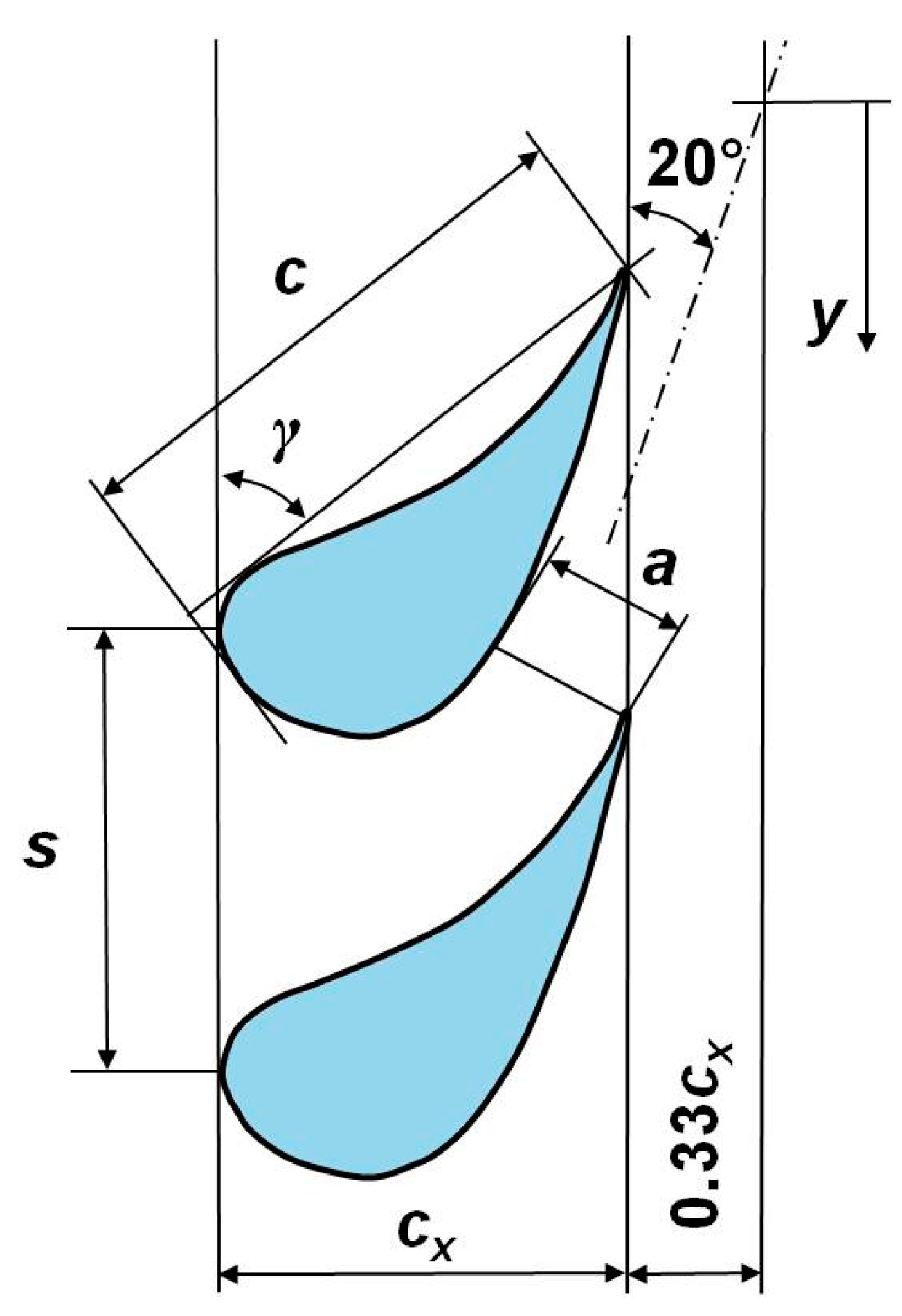
Figure 3 shows the blade profile and the arrangement of the blades in the original cascade. The profile shape corresponds to a typical cylindrical blade of an industrial steam turbine.
Blades with chord length c = 100 mm and blade length l = 150 mm are milled from aluminium alloy. Design surface roughness is Ra = 0.2 µm. If the throttling nozzle is fully opened, it is expected that the influence of surface roughness on profile losses is the same as in a conventional turbine blade row. If the cascade is closed, as will be seen later, losses due to the separation will dominate over boundary layer losses. Therefore, it is expected that surface roughness will not play an important role if the throttling nozzle is closed. Further geometrical details of the original cascade arrangement are summarized in Table 1.
The original cascade is modified to operate as a throttling nozzle. Concerning a “throttling nozzle optimized design”, the following objective functions can be defined: (1) profile loss in a fully open condition; (2) increase in profile loss when the throttling nozzle is closed. A combination of (1) and (2) should result in an objective function to design a throttling nozzle with low profile losses at a fully open position and a wide operating range with low profile losses for closed positions. The variable geometry parameters will be: profile shape, stagger angle, and pitch to chord ratio. These are the same for a conventional turbine blade row. For the throttling nozzle, an additional geometry parameter will be the location of the cutting plane parallel to the leading edge plane.
In the present investigation, neither the original blade shape nor the parameters of the original cascade arrangement are changed. This means that the blade shape and cascade arrangement are not optimized for the operation in a throttling nozzle. First, the cutting plane has to be defined. The cutting plane divides the blade profile in a leading edge section (front section) and a trailing edge section (rear section), respectively. The throttling nozzle requires usually a low ratio of pitch to chord. This is due to the fact that the blade channel should be fully captured by the front section when the nozzle is fully closed. As a result, profile losses are high for the fully open throttling nozzle due to the large wetted surface (criterion of Zweifel). From a flow point of view, the optimal cutting position could be the location of maximum blade thickness in a circumferential direction. If this condition is fulfilled, the cascade pitch would be as large as possible. In the present investigation, the position of the cutting plane is chosen with respect to mechanical considerations. The leading edge section as well as the trailing edge section are modelled as bending beams, which are clamped at the root (hub) and tip (casing). When the cascade is fully closed, the same pressure difference (p0p1) acts as a constant load on both bending beams. According to the Euler–Bernoulli theory, the maximum deflection at half span in an axial direction due to the pressure difference is
f ~ ( p 0 p 1 ) s l 4 E J ,
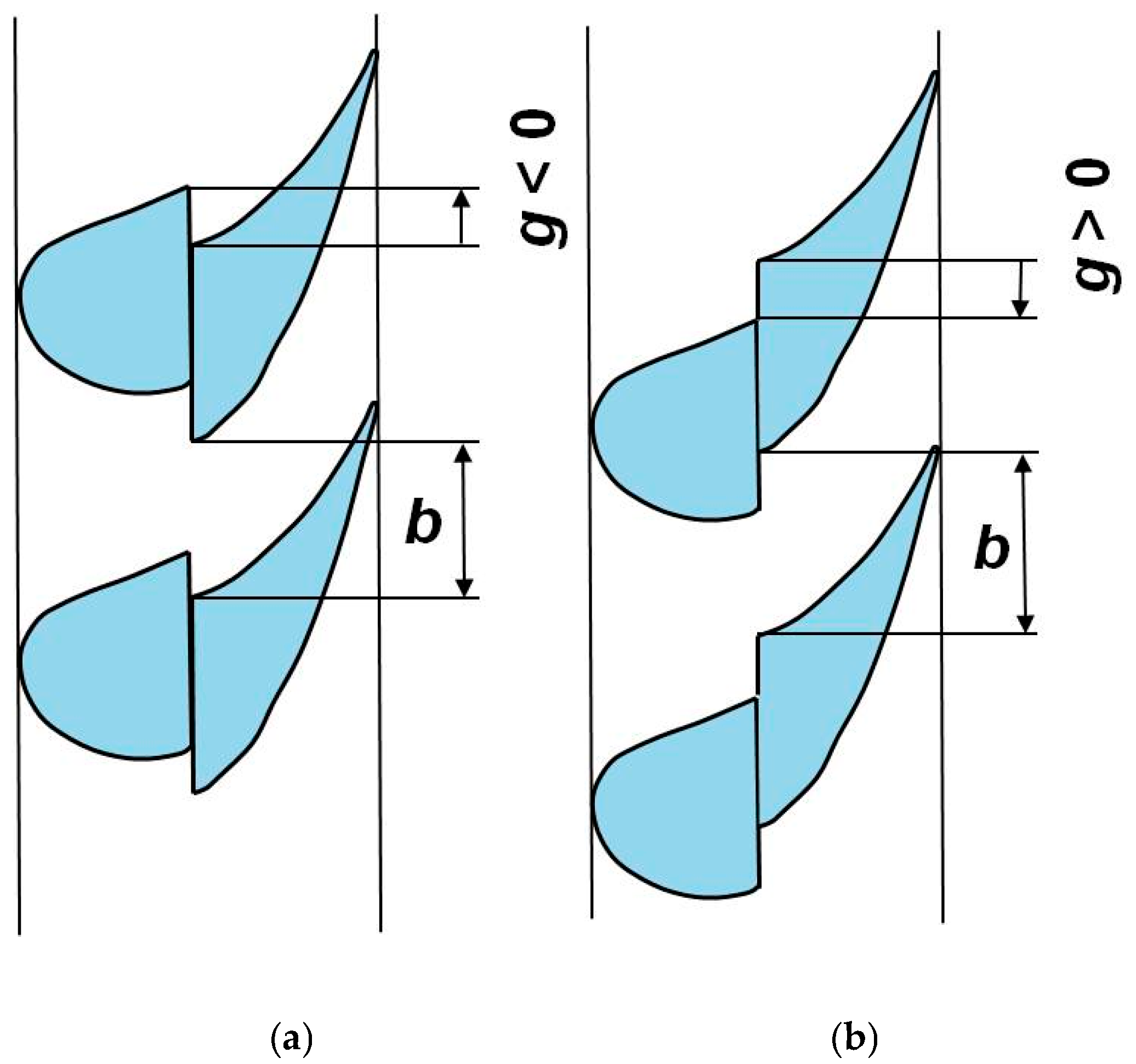
independent of the clamping condition. In Equation (1), s is blade pitch, l is blade length and E is Young’s modulus of the blade material. To avoid a collision between the leading edge section and trailing edge section when the cascade is closed, maximum deflections of both bending beams should be identical. According to Equation (1), this requires that the axial geometrical moment of inertia J is the same for both bending beams. As a result, Figure 4 shows the cascade with the cutting plane at an axial position of 0.47 cx.
In principle, two different closing positions of the cascade are possible. To quantify these closing positions, the degree of closing is defined as
δ = g b .
In Equation (2), g is the distance which the leading edge section is moved in a circumferential direction and b is the channel width at the cutting plane position. For the cascade under investigation, b = 40 mm. This corresponds to a half blade pitch of s = 80 mm, which was a prerequisite for the derivation of Equation (1). This means that the cascade is just closed at δ = 1, whereas the fully open cascade is characterized by δ = 0. Principal closing directions are closing to the suction side (δ < 0) or closing to the pressure side (δ > 0). Both closing positions are shown in Figure 4. In the present setup, the axial gap between the front section and rear section is set to zero. In a real throttling nozzle, this axial gap will be larger than zero. The gap has to be designed to guarantee the save operation, even when the throttling nozzle experiences deformations due to high axial pressure differences and temperature gradients. On the one hand, the gap should be as small as possible to minimise leakage flow through the throttling nozzle. On the other hand, the gap has to be large enough to prevent mechanical contact between the leading edge section and trailing edge section over the entire operating range.
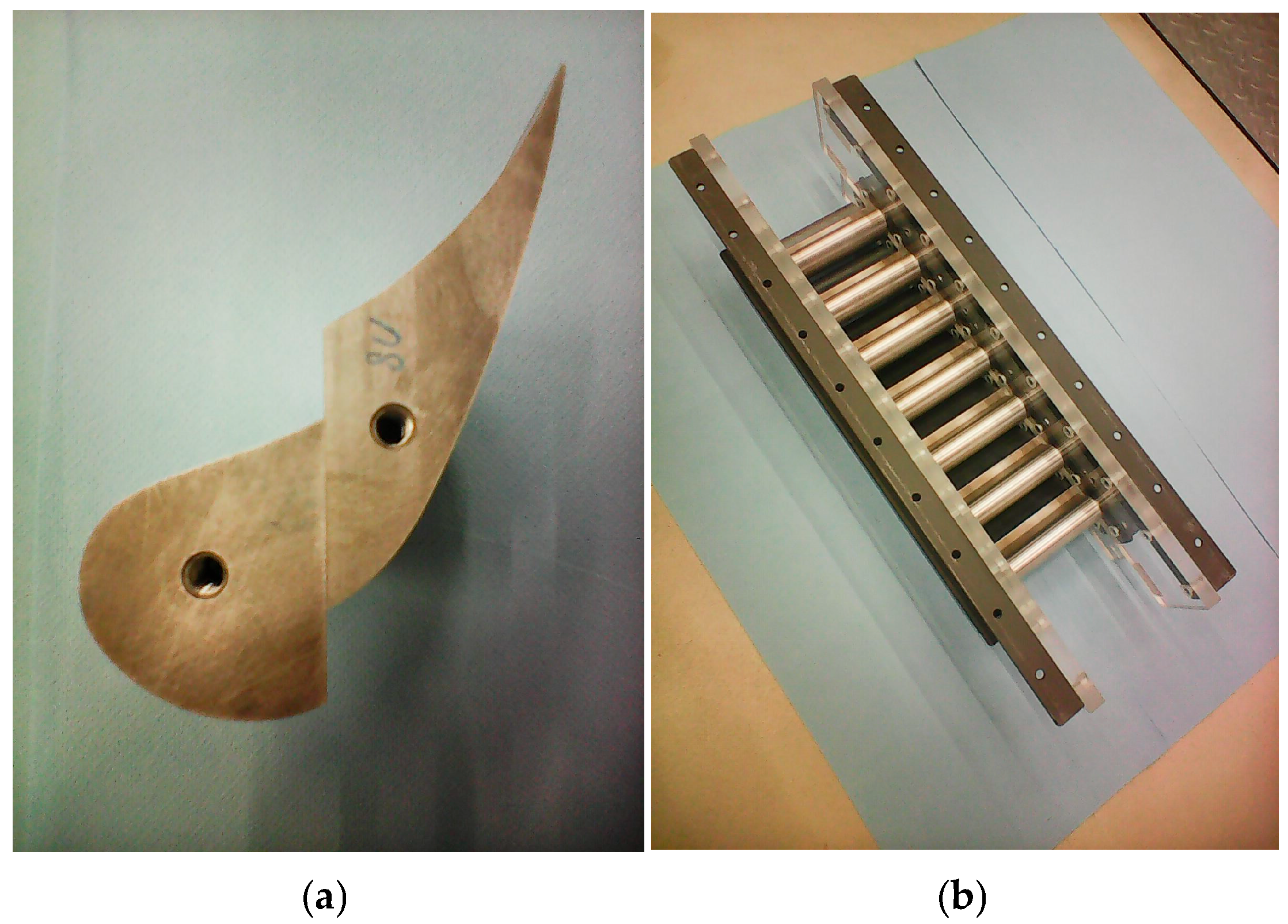
The cascade of throttling nozzles with a total of seven blades is positioned at the nozzle of a linear cascade wind tunnel, which operates in pressure mode. Blade length and maximum number of blades are defined by the cross section of the cascade wind tunnel nozzle. Air from outside the laboratory building is supplied to the cascade by an axial blower, driven by a three-phase asynchronous motor (30 kW) with constant rotational speed (3000 rpm). Downstream of the axial blower, a diffuser and a settling chamber with flow straightener and turbulence screen are arranged. Further downstream, the flow is accelerated by the nozzle to achieve an inlet flow field with thin endwall boundary layers and low turbulence intensity. Endwalls of the cascade can be turned to adjust different inlet flow angles. Figure 5 shows photographs of an isolated blade and the cascade arrangement, dismantled from the wind tunnel. Both are in a condition of closing to the pressure side (δ ≈ 0.3).

3.2. Instrumentation

The inlet measurement plane is equipped with the following instrumentation: Pitot tube at half span (outer diameter of 3 mm, inner diameter of 1 mm), static wall pressure taps (diameter of 1 mm), and a Pt-100 resistor thermometer (diameter of 3 mm). This inlet measurement plane is located 1.4 axial chord lengths upstream of the cascade. In a previous experimental campaign, endwall boundary layers were measured by traversing a Pitot tube at the inlet measurement plane. Since inlet the boundary layer thickness (99%-thickness) is about 23 mm, extension of the two-dimensional flow region around the midspan is sufficient. Turbulence intensity is measured at half span by means of a Dantec 55P11 single hot-wire probe. The probe is operated by a Dantec 90N10 StreamLine hot-wire anemometry system.
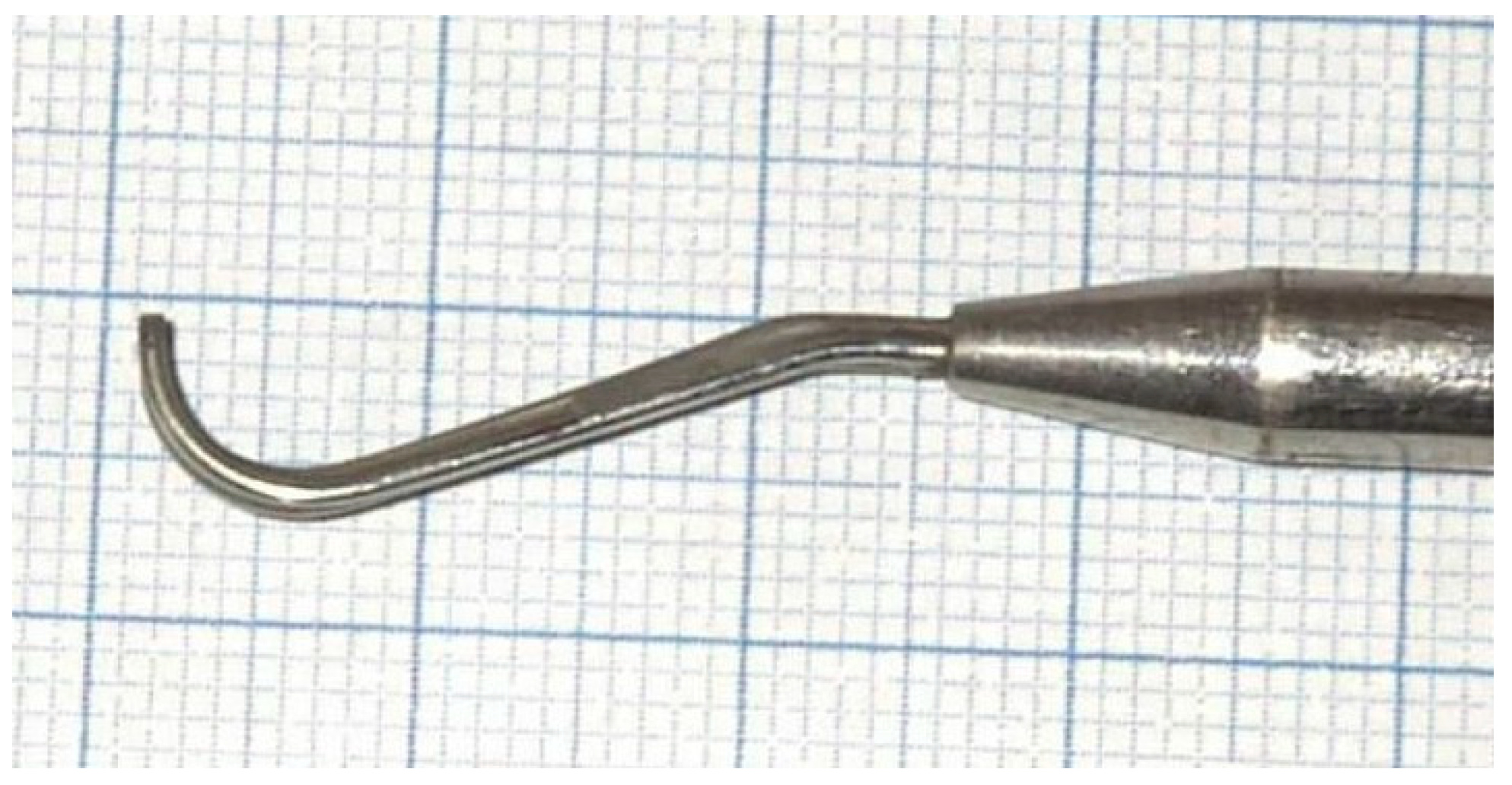
The exit measurement plane is positioned 0.33 axial chord lengths downstream of the cascade trailing edge plane (Figure 3). A three-hole cobra probe is traversed at half span over one blade pitch. Figure 6 shows a photograph of the probe with head dimensions of 0.8 mm by 2.4 mm and a total wedge angle of 60°. The probe is aligned at an angle of 20° with respect to the circumferential direction. A total of 33 equidistant measurement points are set by a computer-controlled linear traversing system (isel-automation). The three-hole probe is used in the non-nulling mode according to the procedure described by Treaster and Yocum [9]. Prior to the measurements, the three-hole probe was calibrated in a free-jet wind tunnel at an expected probe Reynolds number of Re ≈ 11,000 in a yaw angle range of ±30°. If the cascade is closed, the probe Reynolds number decreases from Re ≈ 10,100 to Re ≈ 9500. In this region, the Reynolds number influence on the calibration curves of the three-hole probe can be neglected.
One blade of the original cascade is equipped with 29 static pressure taps (diameter of 0.3 mm) at half span. Fifteen pressure taps are arranged at the blade suction side and 14 pressure taps at the blade pressure side, respectively. The blade static pressure measurement is limited to the original cascade arrangement, which is representative of the fully opened cascade (δ = 0).
All pressures are collected by a scanning box (Furness Controls FCO91), taking into account the settling time of pressure probe and connecting tubes. The scanning box switches the pressure signals to a single piezoresistive pressure transducer (Honeywell 143PC01D). Control of the traversing system and the scanning box as well as the conversion of the analogue voltages to digital signals is performed by a HP 3852A data acquisition system. The system is controlled by a personal computer running LabVIEW (National Instruments). Table 2 presents details of the installed sensors, including their range. For the differential pressure sensor, nominal full-scale accuracy is provided. Details about random uncertainty and its propagation are given in Appendix A. Accuracy of the circumferential position of the trailing edge section relative to the leading edge section is estimated to ±0.25 mm.

4. Experimental Results

4.1. Operating Conditions

The front section of the cascade is mounted to the wind tunnel nozzle to guarantee an undisturbed inlet flow field, independent of closing position. The rear section of the cascade can be moved in a pitchwise direction to set different degrees of closing. This is in contrast to the situation in a real adaptive stage, where the rear section is fixed in the turbine casing and the front section can be turned in a circumferential direction. The pitchwise position of the rear section is varied from g = −12 mm to g = +12 mm in steps of 2 mm. This results in 13 different closing setups, with the degree of closing ranging from δ = −0.3 (closing to suction side) to δ = 0.3 (closing to pressure side). The fully open position is characterized by δ = 0. This rather narrow range of degrees of closing is a consequence of the operating requirements of the axial blower of the cascade wind tunnel. For higher degrees of closing, the operating point of the axial blower reaches the surge line and a save operation of the wind tunnel is not possible. In a real steam turbine, the throttling nozzle is placed just downstream of the extraction chamber, where the flow is at rest. Therefore, a constant inlet flow angle is set to α0 = 90°. Since the cascade wind tunnel has no heat exchanger, the air temperature in the experimental setup depends on the ambient temperature outside the laboratory building. In the present experiments, the cascade inlet temperature is in the range of t0 = 23–27 °C. In the inlet measurement plane, streamwise turbulence intensity at midspan is about 4%. The blade Reynolds number is defined according to pitchwise mass averaged exit velocity and blade chord length. When the cascade is closed, the blade Reynolds number decreases from Re1 ≈ 4.2 × 10⁵ to 4 × 10⁵. In an industrial steam turbine, the Reynolds numbers are higher. A typical range of 5 × 10⁵–1 × 10⁷ is expected, whereas the Reynolds number decreases during the expansion process. Since the application of the adaptive stage is limited to rather low extraction pressure, the Reynolds numbers of the present investigation are representative. Since the maximum exit Mach number is about 0.2, conditions are essentially incompressible. In an industrial steam turbine, the Mach numbers are somewhat higher. A typical range of 0.3–0.5 is expected. This is also true for the fully opened throttling nozzle. If the throttling nozzle is closed, higher exit Mach numbers and even choking conditions are expected. Choking will appear at the cutting plane, since this is the minimum cross section for higher closing conditions. At constant turbine back pressure, the pressure at the exit of the throttling nozzle has to decrease if the mass flow rate through the low-pressure turbine section should decrease (Stodola’s law). Therefore, the pressure at the exit of the throttling nozzle can be lower than the critical pressure and the flow will be choked.

4.2. Pitchwise Mass Averaged Flow Quantities

To get an overview of the influence of degree of closing on the behaviour of the cascade, pitchwise mass averaged quantities are presented first. These are pitchwise mass averaged exit flow angle
α ¯ 1 = 0 s α 1 c 1 sin α 1 d y 0 s c 1 sin α 1 d y
and pitchwise mass averaged total pressure coefficient
C ¯ p t 1 = 0 s C p t 1 c 1 sin α 1 d y 0 s c 1 sin α 1 d y .
In Equation (4), the local total pressure coefficient in the downstream measurement plane is defined as
C p t 1 = p t 1 p t 0 1 2 ρ c 0 2 .
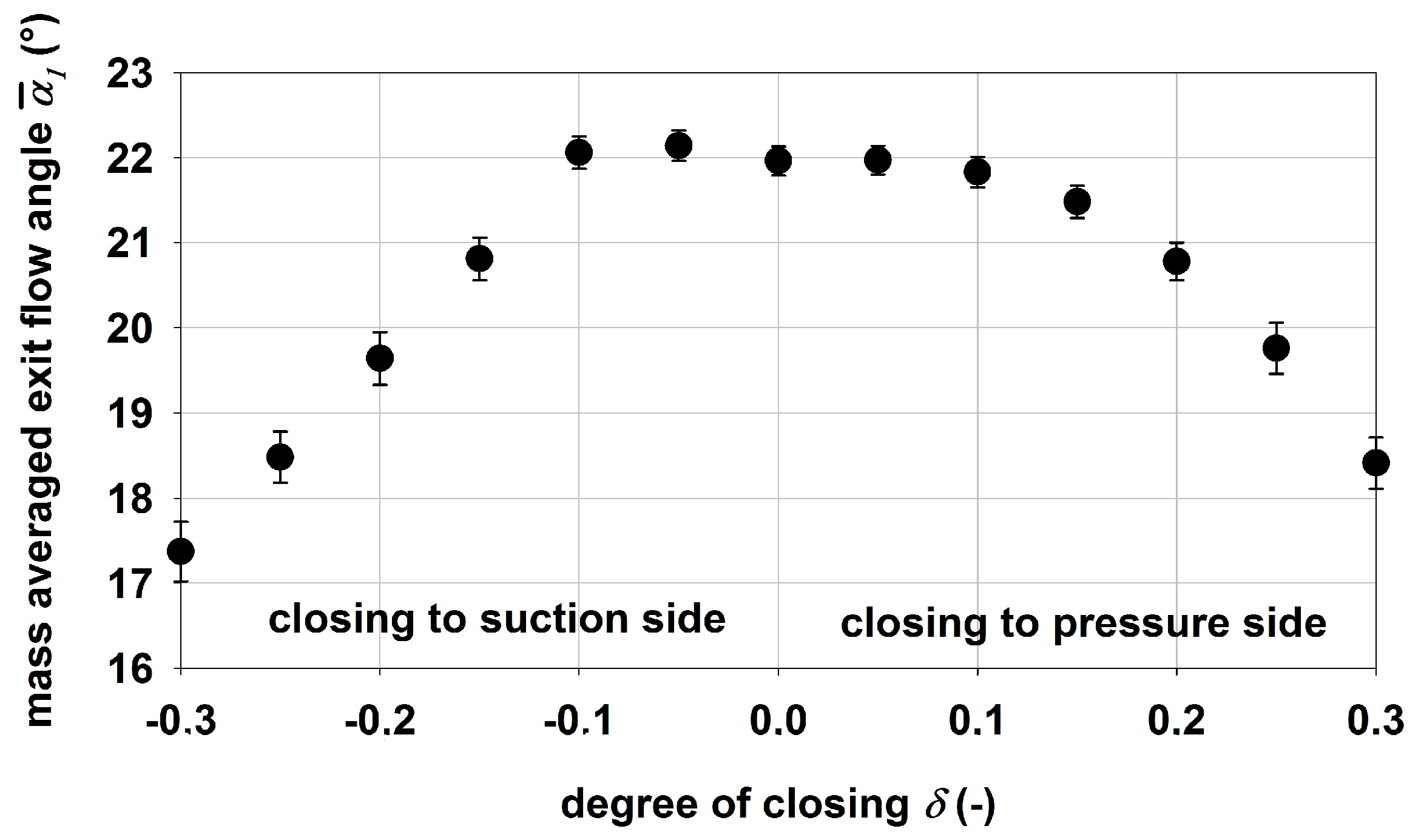
Figure 7 shows the pitchwise mass averaged exit flow angle versus degree of closing. Negative degrees of closing (δ < 0) indicate closing to the suction side, whereas positive degrees of closing (δ > 0) stand for closing to the pressure side. The exit flow angle of the fully open cascade (δ = 0) is 22°. When the cascade is closed, the exit flow angle stays nearly constant for absolute degrees of closing lower than about 0.1. Further closing of the cascade results in a decrease in the exit flow angle. Distribution is linear for closing to the suction side. For closing to the pressure side, the exit flow angle decreases progressively with degree of closing. This behaviour with respect to closing to the pressure side has been documented by Decj and Trojanovskij [4] and Boos [6]. A physical explanation of the reduction in the exit flow angle with degree of closing will be given later.
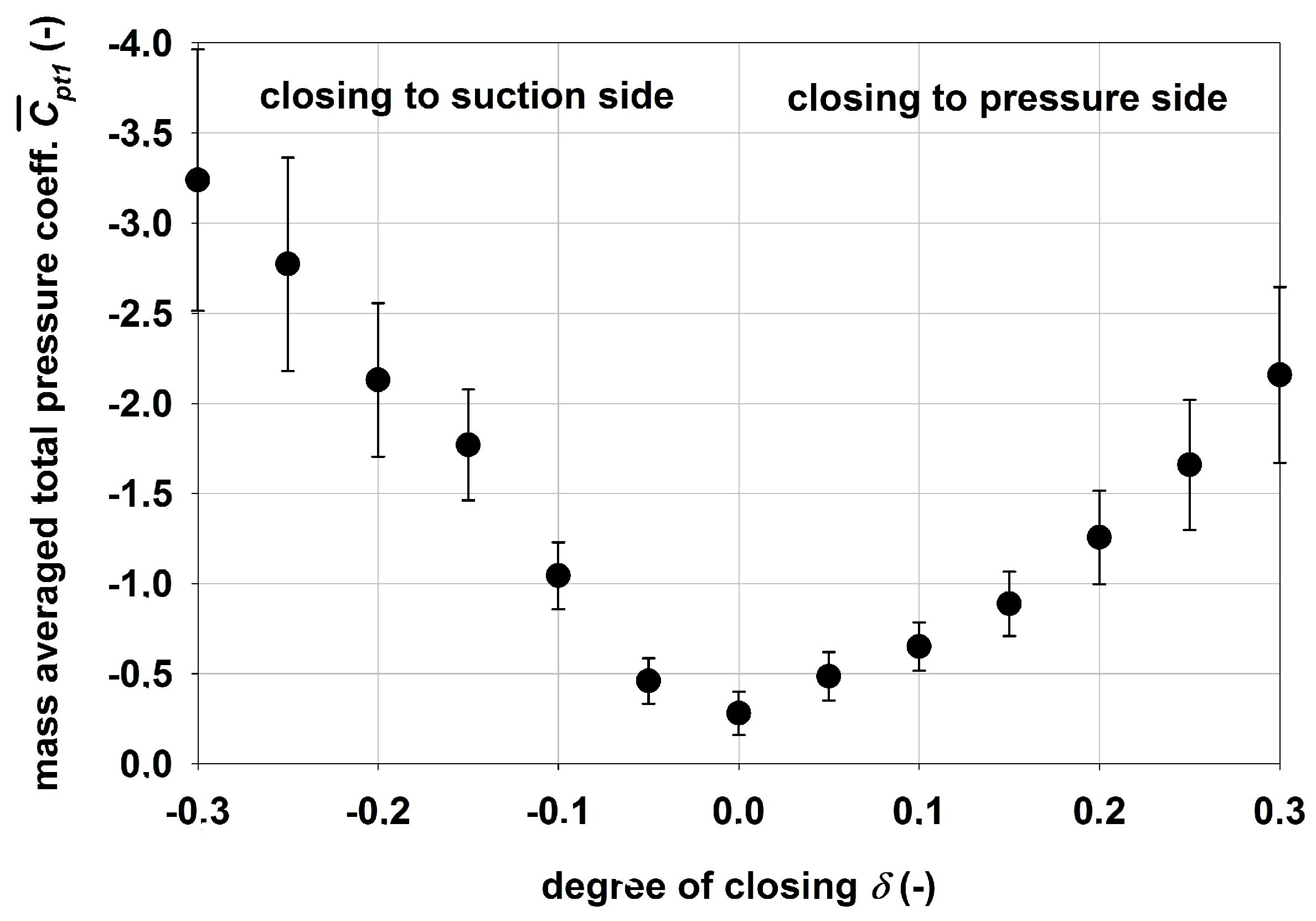
Figure 8 shows the pitchwise mass averaged total pressure coefficient versus degree of closing. According to its definition, the absolute value of the total pressure coefficient is a measure of profile loss. When the cascade is fully opened (δ = 0), profile loss is at a minimum. Closing of the cascade results in a steep increase in profile loss. At the same absolute degree of closing, profile losses are higher for closing to the suction side compared to closing to the pressure side. This is the reason why closing to the pressure side is the preferred operating regime of a throttling nozzle for an adaptive turbine stage [4,6]. Therefore, the results presented in the remaining part of the paper will focus on this operating regime.
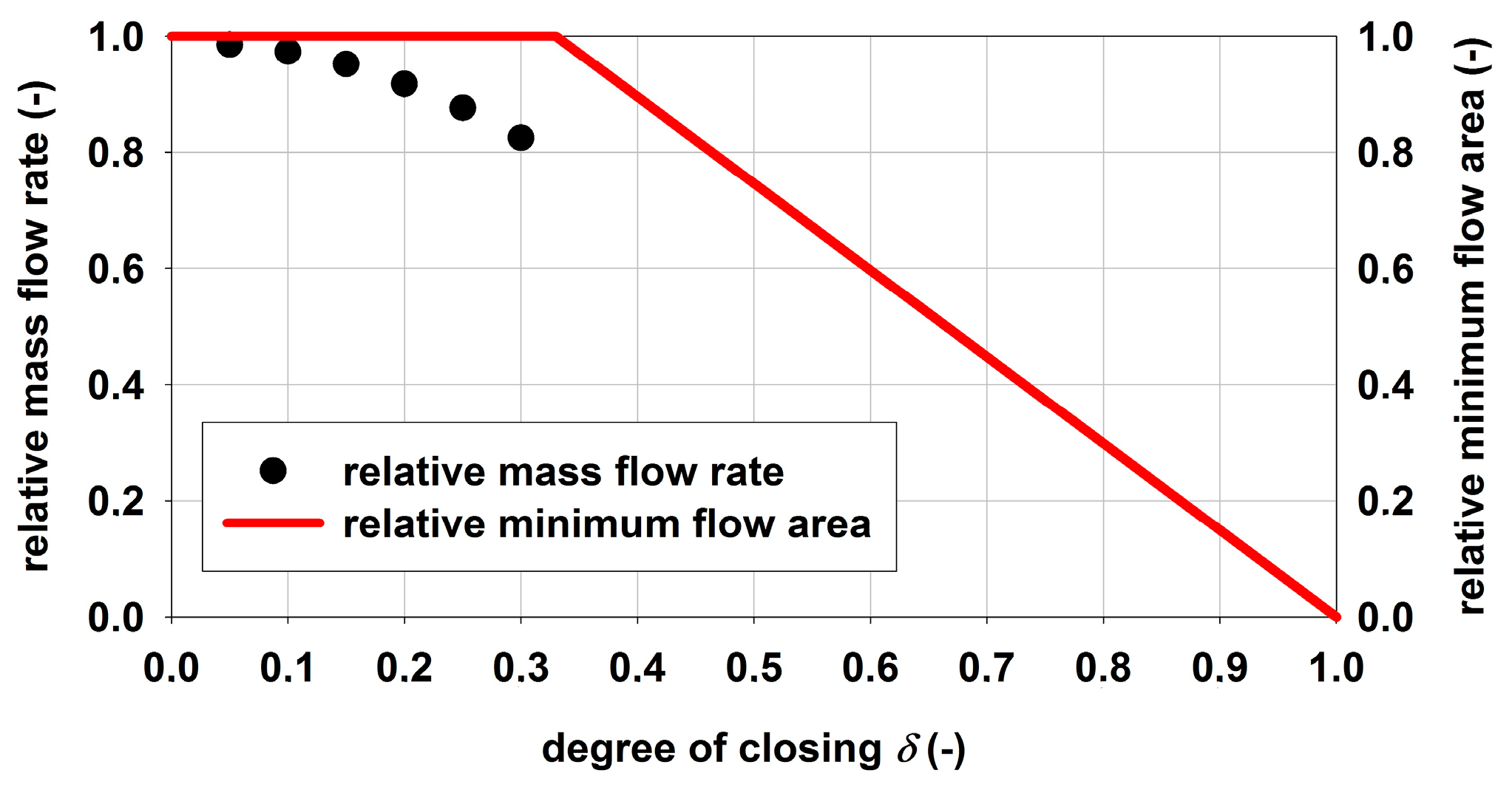
Figure 9 shows relative mass flow rate versus degree of closing. Mass flow rate per unit blade height is calculated by integrating the axial velocity component at the exit measurement plane over one blade pitch. This mass flow rate per unit blade height is related to the corresponding value for a fully open cascade. Therefore, relative mass flow rate is equal to one for a fully open cascade (δ = 0). If the cascade is closed to the pressure side, the relative mass flow rate decreases continuously. At δ = 0.3, mass flow rate decreases by nearly 20%, compared to the fully open cascade. At a constant pressure difference across the cascade, mass flow rate depends on the minimum flow area. In a linear turbine cascade, the minimum flow area is defined by the throat width. For the cascade under investigation, this is true for degrees of closing δ < 0.33. For higher degrees of closing, the cutting plane between the front and rear section defines the minimum flow area. In this region, the minimum flow area decreases linearly with the degree of closing. The distribution of the relative minimum flow area over the whole range of degrees of closing to the pressure side is presented in Figure 9 as a red line. All the experiments have been performed in the region where throat width defines the minimum flow area. As can be seen from Figure 9, relative mass flow rate is reduced without any change in minimum flow area. This means that a reduction in mass flow rate is not a result of changing minimum flow area but a result of cascade aerodynamics.

4.3. Local Flow Quantities

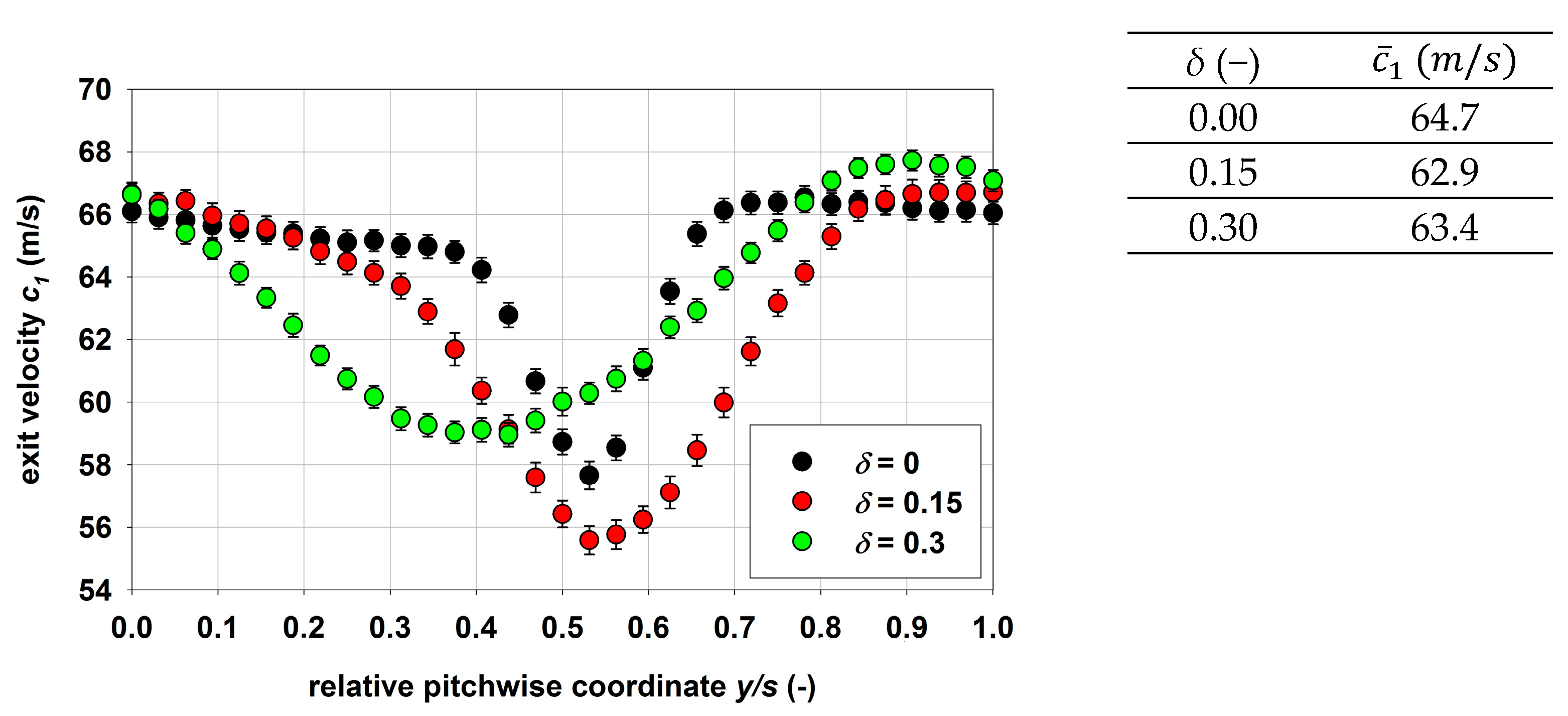
After pitchwise mass averaged results, local flow quantities measured in the downstream plane are presented. Figure 10 shows exit velocity versus the relative pitchwise coordinate. The relative pitchwise coordinate corresponds to probe traversing position y related to cascade pitch s. It should be noted that the three-hole probe is traversed from the blade pressure side to the blade suction side and the trace of the blade trailing edge cuts the measurement plane at y/s ≈ 0.5 (Figure 3). For a fully opened cascade (δ = 0), typical velocity distribution with nearly constant velocity and a local blade wake downstream of the blade trailing edge is observed. At δ = 0.15, the velocity deficit in the wake increases, especially behind the blade suction side. Further closing of the cascade to δ = 0.3 shifts the minimum velocity from the blade suction side to the blade pressure side and the width of the wake increases. Pitchwise mass averaged exit velocities are depicted in the table on the right-hand side of Figure 10.
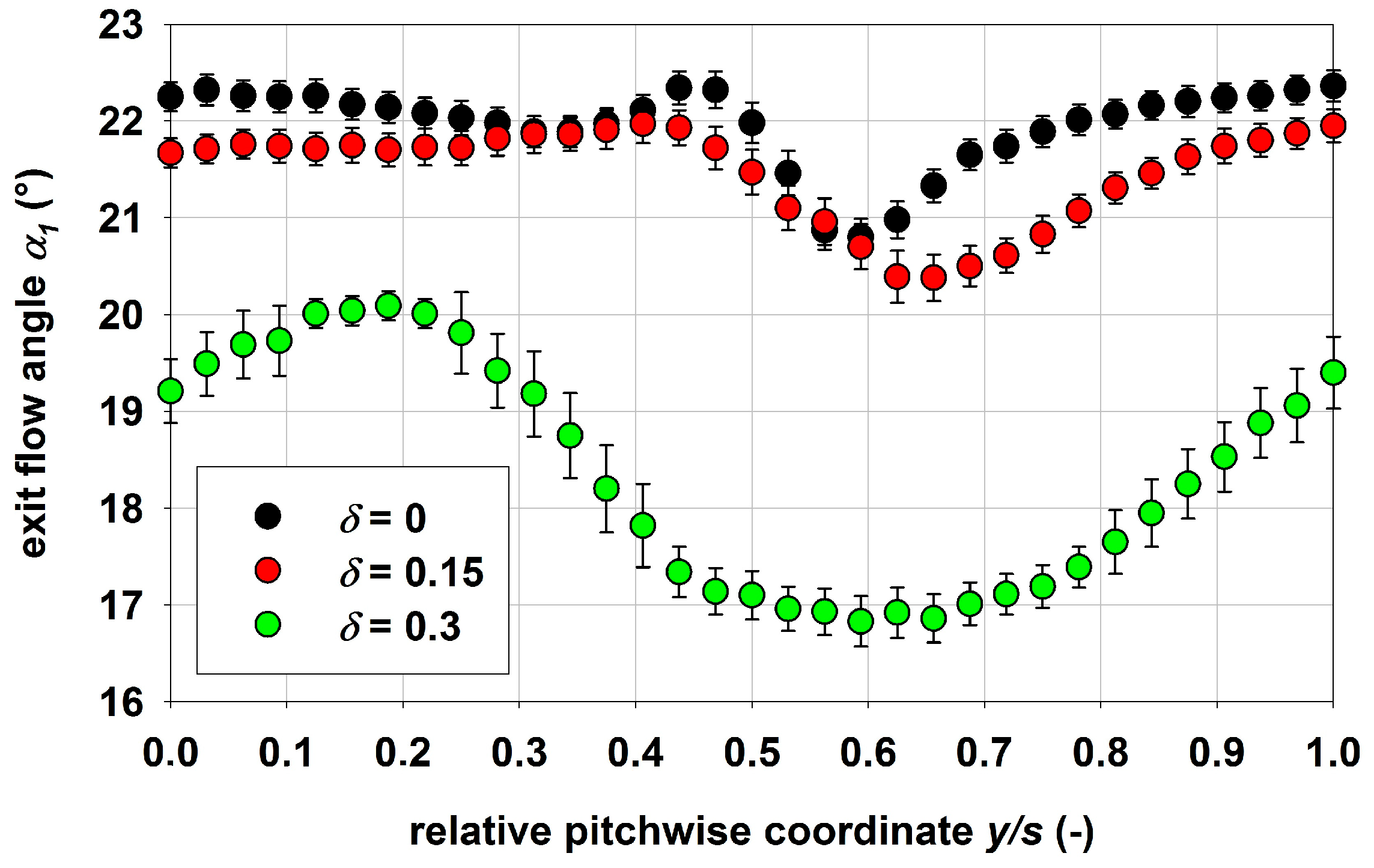
Figure 11 shows the exit flow angle versus the relative pitchwise coordinate. The flow angle is directly extracted from measured probe pressures using three-hole probe calibration data. For a fully opened cascade (δ = 0), the exit flow angle is nearly constant around a mean value of 22°. An exception is the region 0.4 < y/s < 0.7, where an overshot and, respectively, an undershot can be observed. The origin is a systematic error of the flow angle which is induced by the velocity gradients of the blade wake. Therefore, a velocity gradient correction is applied to the data of Figure 11.
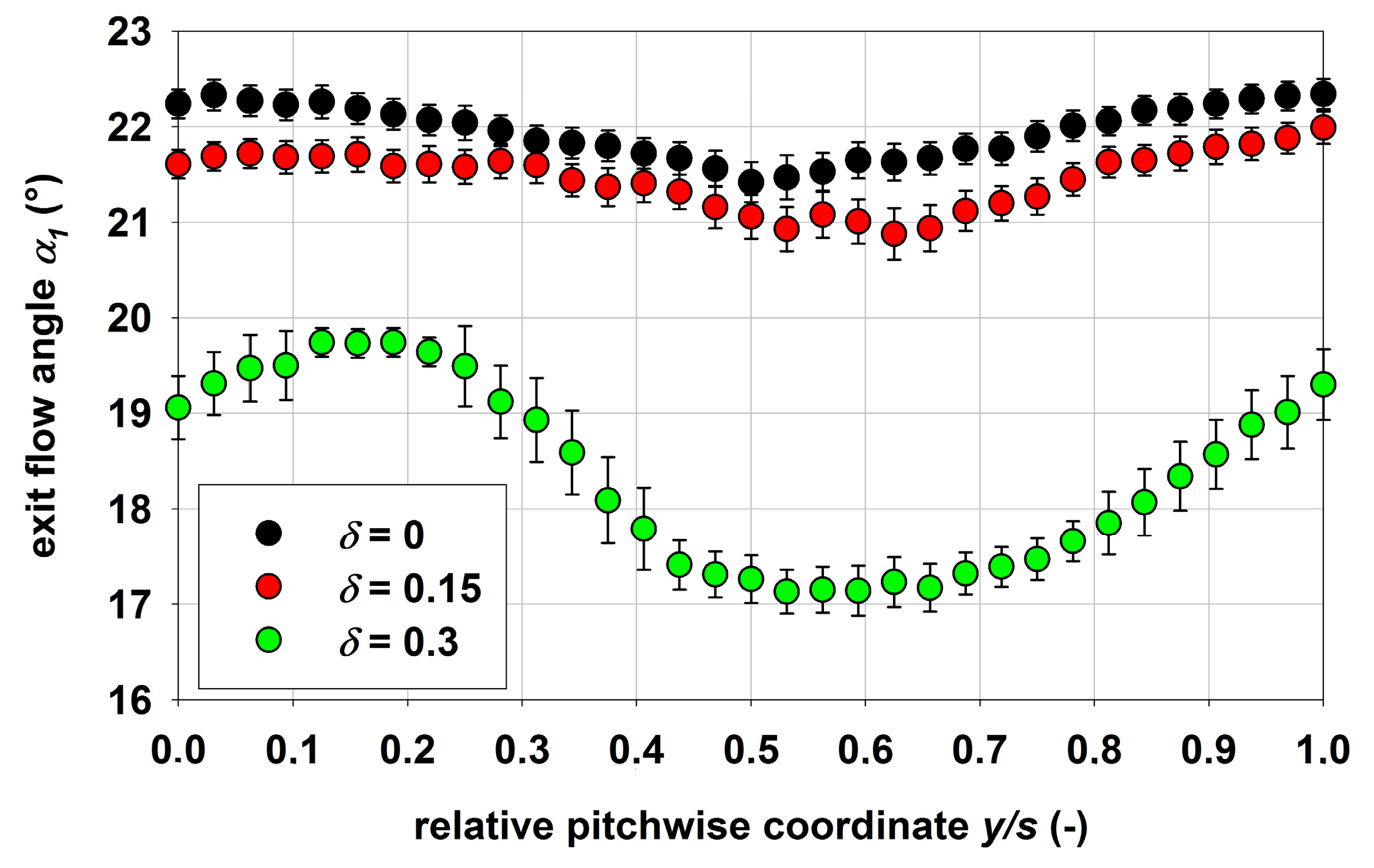
The flow angle correction according to [10] makes use of the nondimensional gradient of the measured velocity distribution. A flow angle increment, which is proportional to the local velocity gradient, is added to the measured flow angle. This flow angle increment can be negative, zero or positive, depending on the sign of the velocity gradient. Figure 12 shows the corrected exit flow angle versus the relative pitchwise coordinate. As can be seen, overshoots and, respectively, undershoots in the region 0.4 < y/s < 0.7 have been eliminated, mainly for small degrees of closing. When the cascade is closed, the mean level of the exit flow angle decreases and its variation increases.
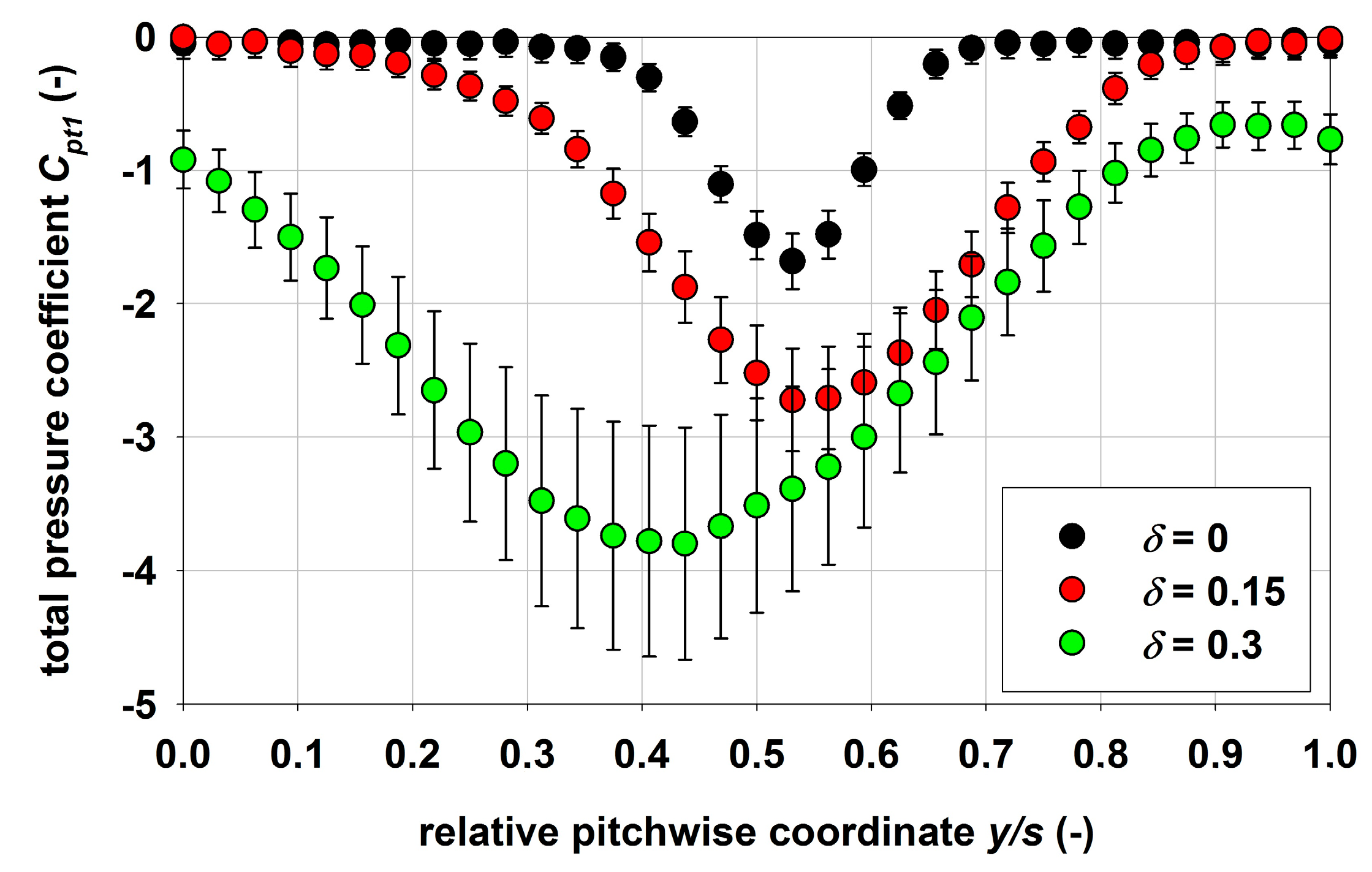
Figure 13 shows the total pressure coefficient (Equation (5)) versus the relative pitchwise coordinate. For a fully opened cascade (δ = 0), the behaviour is typical for the flow downstream of a turbine cascade. Flow losses are concentrated in the blade wake and no losses appear outside of the wake. At δ = 0.15, the depth of the loss region increases and the wake captures just the whole blade pitch. A shift of the wake towards the blade suction side can be observed. At δ = 0.3, the depth of the loss region increases further and no loss-free region can be seen anymore. A shift of the wake towards the blade pressure side can be observed.
Finally, blade static pressure coefficient
C p = p p 0 1 2 ρ c 0 2
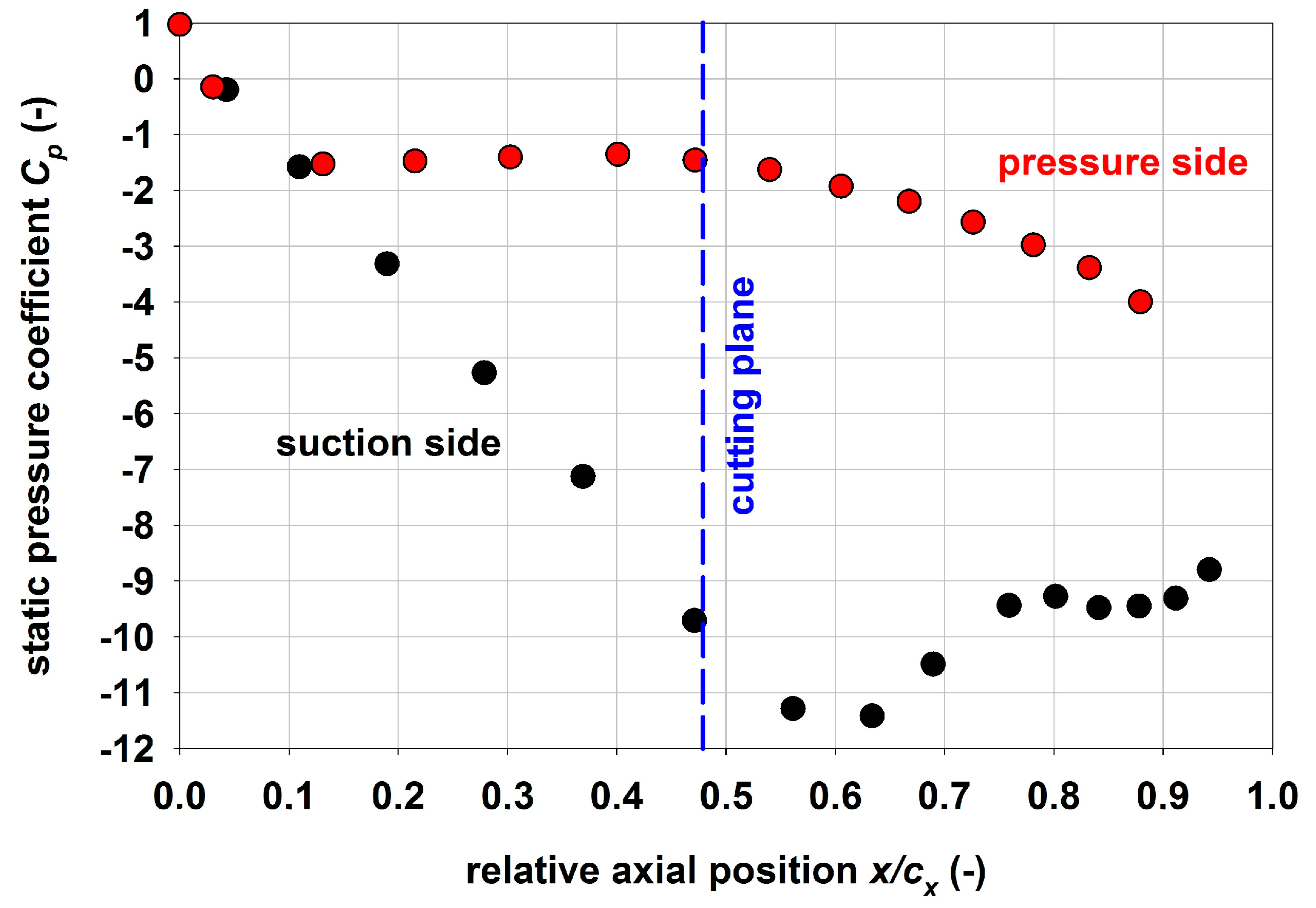
is presented. In Equation (6), p is the local static pressure at the blade surface and p0 is static pressure with respect to the inlet measurement plane. Figure 14 shows the distribution of the blade static pressure coefficient versus relative axial position x/cx for the original cascade geometry (δ = 0). According to the definition, Cp = 1.0 characterizes the stagnation point at the blade leading edge. The position of the cutting plane is indicated as a dashed blue line at x/cx = 0.47.

5. Semi-Empirical Flow Models

5.1. Exit Flow Angle

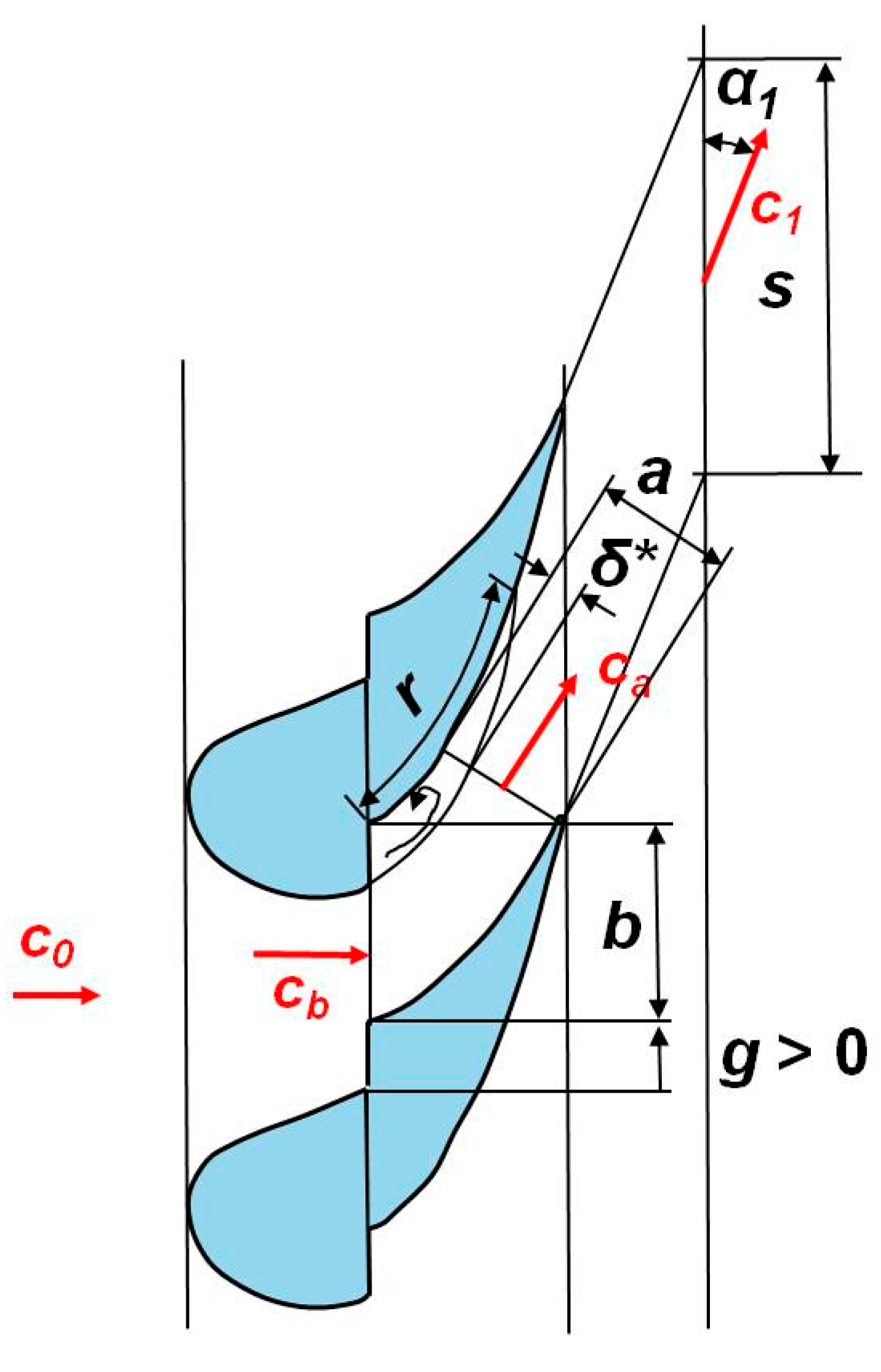
A semi-empirical flow model is presented to explain the influence of degree of closing on the pitchwise mass averaged exit flow angle, as presented in Figure 7. The model, which imposes incompressible flow, captures the case of closing to the pressure side. Figure 15 presents the cascade in a partially closed condition. At the entrance of the cascade, flow is accelerated from inlet velocity c0 to velocity cb in the cutting plane section. Downstream of the cutting plane, the backward-facing step at the blade suction side forces the flow to separate. The height of the backward-facing step corresponds to cascade closing shift g. At the throat section, displacement thickness due to the separation on the suction side is δ*. Preliminary RANS simulations of the two-dimensional flow field in the throttling nozzle at degree of closing δ = 0.125 have shown the displacement effect of the boundary layers downstream of the cutting plane. At the throat, the displacement thickness on the suction side is considerably higher than on the pressure side. Therefore, the displacement thickness on the pressure side is neglected. The reattachment length of the flow at the blade suction side is r. For small degrees of closing, it can be assumed that the reattachment length is short and the flow is fully mixed out before it reaches the throat. Downstream of the throat, the situation does not differ from the flow in the fully opened cascade. This means that the exit flow angle does not change for small degrees of closing and it corresponds to the value of the fully opened cascade. When the degree of closing is increased, the recirculation zone just reaches the throat. This happens at a certain degree of closing (threshold value) δ0. For larger degrees of closing, displacement thickness δ* is observed at the throat section. The basic idea is to apply a mass balance to the control volume shown in Figure 15. This control volume is bounded by the throat section, the suction side downstream of the throat, two periodic stream lines downstream of the cascade and the downstream exit plane.
The mass flow rate per unit blade height at the inlet and exit, respectively, of the control volume is
ρ ( a δ * ) c a = ρ s c 1 sin α 1 .
Under the assumption that the pressure in the control volume is constant and no losses appear, it is ca = c1. In combination with Equation (7), the exit flow angle is
sin α 1 = a δ * s .
For a fully opened cascade, there is neither a backward-facing step nor flow separation and the exit flow angle according to Equation (8) is
sin α 1 , 0 = a s .
At a certain degree of closing δ0, the reattachment length just reaches the throat section. For higher degrees of closing, a linear relationship between displacement thickness and degree of closing according to
δ * a = δ δ 0 1 δ 0 .
is assumed. Finally, the combination of Equations (8) and (10) gives for the exit flow angle
sin α 1 sin α 1 , 0 = 1 δ 1 δ 0 .
Since the exit flow angle of a turbine cascade is usually a small quantity, Equation (11) can be linearized to
α 1 α 1 , 0 1 δ 1 δ 0 .
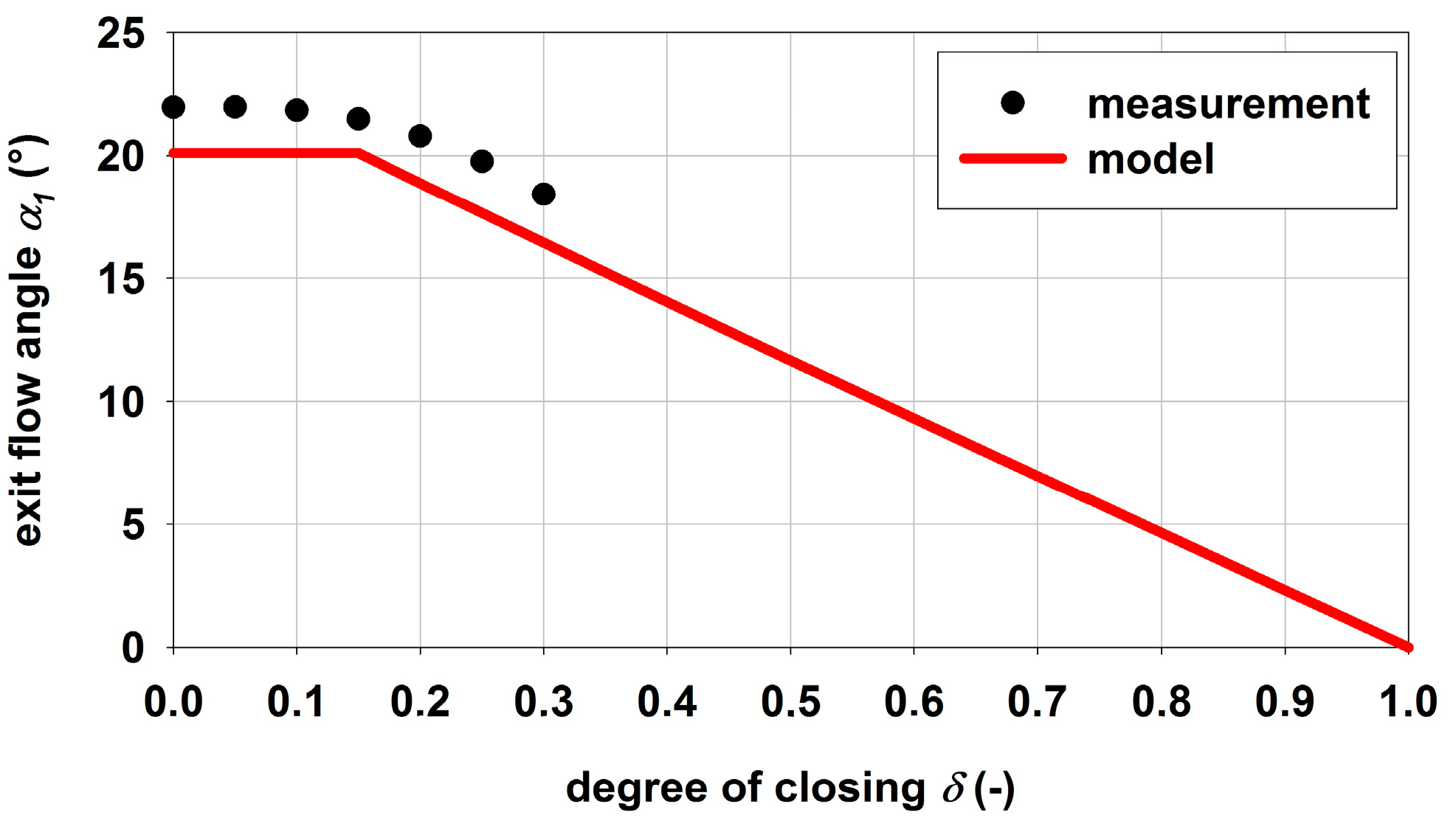
One remaining question is the reattachment length r of the separation zone downstream of the cutting plane. Nadge and Govardhan [11] summarize a number of experimental data with respect to flow over a backward-facing step. Results are given for step Reynolds numbers Reg = cbg/ν > 5000. Under this condition, reattachment length r related to step height g is in the range of 5 < r/g < 8. The blade channel of the fully opened turbine cascade differs from the straight channel in that a streamwise pressure gradient exists. As can be seen from Figure 14, a strong favourable pressure gradient exists on the blade suction side at the cutting plane position. It can be expected that this pressure gradient stabilizes the separation zone and the reattachment length is somewhat lower than the range given in [11]. In combination with the geometry of the present cascade, this results in a degree of closing δ0 ≈ 0.15, where the exit flow angle will start to decrease. Figure 16 shows the distribution of exit flow angle versus degree of closing. The diagram shows the measurement results according to Figure 7 (black dots) as well as the results from the flow model (red line). For degrees of closing δ < δ0 = 0.15, the model gives a nearly constant exit flow angle. This is exit flow angle α1,0 = 20.1° of the fully opened cascade according to Equation (9). For degrees of closing δ > δ0 = 0.15, the predicted exit flow angle varies according to Equation (11) with a degressive behaviour, which can be approximated as linear.

5.2. Total Pressure Loss

A semi-empirical flow model is presented to explain the influence of degree of closing on the pitchwise mass averaged total pressure coefficient, as presented in Figure 8. The model, which imposes incompressible flow, captures the case of closing to the pressure side. A comprehensive discussion of losses arising in axial turbomachinery blading is given by Denton [12]. Excluding gas dynamic effects and heat transfer, entropy production in boundary layers and due to mixing processes are the main loss sources. According to this categorization, three main loss regions are expected in a partially closed throttling nozzle: (1) boundary layer losses in the blade channel, (2) mixing losses downstream of the backward-facing step at the blade suction side, and (3) mixing losses downstream of the forward-facing step at the blade pressure side. The total pressure losses are related to the dynamic pressure of a reference velocity. In the present case, this is flow velocity cb at the cutting plane section. This velocity can be related to inlet velocity c0 by means of a mass balance, as follows:
c b c 0 = s / b 1 δ .
Boundary layer losses in the blade channel are characterized by loss coefficient ξ. This is the loss coefficient for the fully opened cascade. Mixing losses downstream of the backward-facing step at the blade suction side are modelled according to the losses in a straight channel with a sudden expansion (Carnot loss). Finally, mixing losses downstream of the forward-facing step at the blade pressure side are modelled according to the losses in a straight channel with a sudden contraction [13]. Application of these models results in the following equation for the total pressure coefficient:
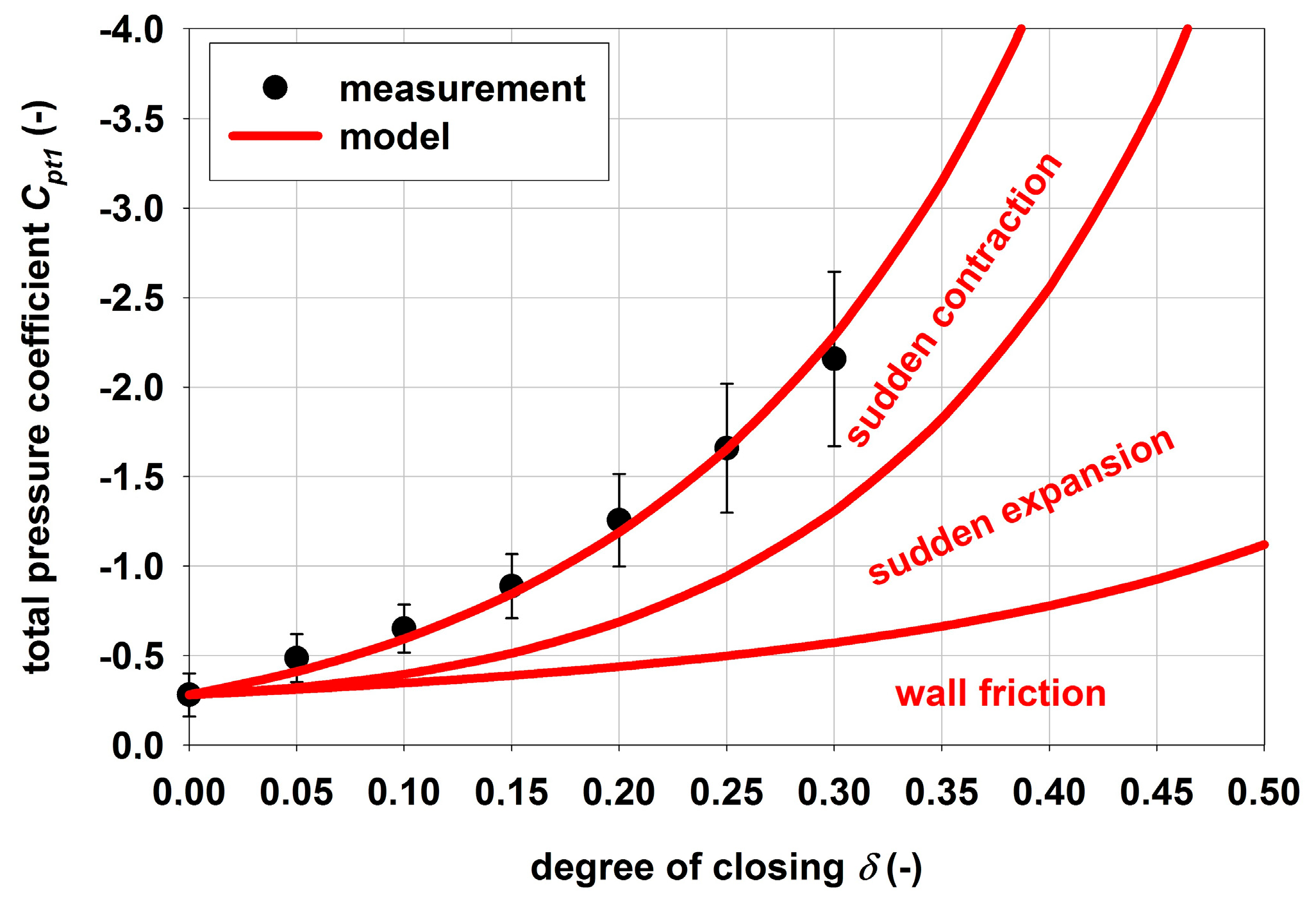
C p t 1 = ( ξ + δ 2 + 0.4 δ ) ( s / b 1 δ ) 2 .
The term of the first bracket in Equation (14) contains the influence of the three different loss sources. The second term expresses the influence of the velocity ratio according to Equation (13) on the dynamic pressure. Results of Equation (14) together with the measurement results (Figure 8) are plotted in Figure 17.
The loss coefficient ξ of the model is calibrated by the measured profile loss of the fully opened cascade. Losses due to wall friction increase with increasing degree of closing. This is a result of increasing reference velocity cb according to Equation (13). As can be seen from Figure 17, good agreement between measurement data and loss model is achieved. Furthermore, the loss model provides a decomposition of the total loss according to the terms in the first bracket of Equation (14). As can be seen, different fractions depend on degree of closing. At δ = 0.3, the contribution of wall friction, sudden expansion and sudden contraction on the total loss is 25%, 32% and 43%, respectively.

6. Conclusions and Outlook

The geometry of a linear turbine cascade was modified to operate as a throttling nozzle for an adaptive turbine stage. Flow measurements were performed downstream of the turbine cascade using a three-hole pressure probe. Due to the lower loss level, closing to the pressure side is the preferred mode of operation. Exit flow angle decreases when the cascade is closed. Both observations are in agreement with sparse information from the open literature. The behaviour of the exit flow angle is explained by means of a semi-empirical flow model. When the cascade is closed, profile loss increases. Three loss components are identified by means of a semi-empirical model: (1) boundary layer losses, (2) mixing losses downstream of the backward-facing step at the blade suction side, and (3) mixing losses downstream of the forward facing-step at the blade pressure side. Good agreement between the semi-empirical model and measurement data is achieved.
The outlook discusses some ideas to bridge the gap between actual measurements and the conditions in an extraction steam turbine: (1) Investigation of higher degrees of closing: This would require a modification of the cascade wind tunnel. In the present investigation, the degree of closing is limited by the operation range of the axial blower to δ = ±0.3. (2) Investigation of compressibility effects: This would require a cascade wind tunnel operating at higher pressure ratios. (3) Influence of an axial gap between the front section and rear section: It can be expected that the blade pressure difference at the cutting plane drives a leakage flow which influences the flow field in the blade channel.

Author Contributions

Conceptualization, R.W.; methodology, R.W.; software, R.W., K.R. and M.R.K.; validation, R.W., K.R. and M.R.K.; formal analysis, R.W.; investigation, R.W., K.R. and M.R.K.; resources, R.W.; data curation, R.W.; writing—original draft preparation, R.W.; writing—review and editing, K.R. and M.R.K.; visualization, R.W.; supervision, R.W.; project administration, R.W. All authors have read and agreed to the published version of the manuscript.

Funding

This research received no external funding.

Data Availability Statement

Data are contained within the article.

Acknowledgments

The stay of K.R. at TU Wien in the period October 2014 to October 2018 was supported by scholarship Ref. S-1/6/LPDP/2014 from the Indonesia Endowment Fund for Education, Government of Indonesia. This support is greatly acknowledged.

Conflicts of Interest

The authors declare no conflicts of interest.

Nomenclature

athroat widthm
bchannel width at cutting planem
cchord lengthm
cxaxial chord lengthm
cflow velocitym/s
Cpstatic pressure coefficient-
Cpttotal pressure coefficient-
EYoung’s modulusN/m2
fmaximum deflectionm
gcascade closing shiftm
hspecific enthalpyJ/kg
Δhspecific enthalpy differenceJ/kg
Jgeometrical moment of inertiam4
ksstatic pressure coefficient of three-hole probe-
kttotal pressure coefficient of three-hole probe-
kαyaw angle coefficient of three-hole probe-
lblade lengthm
pstatic pressurePa
pttotal pressurePa
rreattachment lengthm
ReReynolds number-
sblade pitchm
sspecific entropyJ/(kg·K)
ttemperature°C
ucircumferential speedm/s
xaxial coordinatem
ypitchwise coordinatem
Greek Symbols
αflow angle°
γstagger angle°
δdegree of closing-
δ*displacement thicknessm
νkinematic viscositym2/s
ξboundary layer loss coefficient-
ρdensitykg/m3
Subscripts
0inlet plane
0threshold value
1exit plane
Icentre hole of three-hole probe
II, IIIside holes of three-hole probe
athroat plane
bcutting plane
exextraction pressure
ininlet pressure of low-pressure turbine
livelive steam pressure
stdstandard deviation
Superscripts
( . ) ¯ pitchwise mass averaged value
Abbreviations
ASadaptive stage
FSfull scale
HPhigh-pressure turbine
LPlow-pressure turbine
TVthrottle valve

Appendix A

This section provides information about the random uncertainty of the pressure measurements and its propagation with respect to the results, with a focus on the downstream three-hole probe measurements. The uncertainty investigation is based on the calibration curves of the three-hole probe with its calibration coefficients according to Treaster and Yocum [9]. These are yaw angle coefficient
k α = p I I p I I I p I p ¯ ,
total pressure coefficient
k t = p I p t p I p ¯
and static pressure coefficient
k s = p ¯ p p I p ¯ ,
respectively. Pressure pI is measured at the centre hole, whereas pII and pIII are measured at the side holes of the probe head. In Equations (A1)–(A3), the arithmetic mean value of the side hole pressures is
p ¯ = p I I + p I I I 2 .
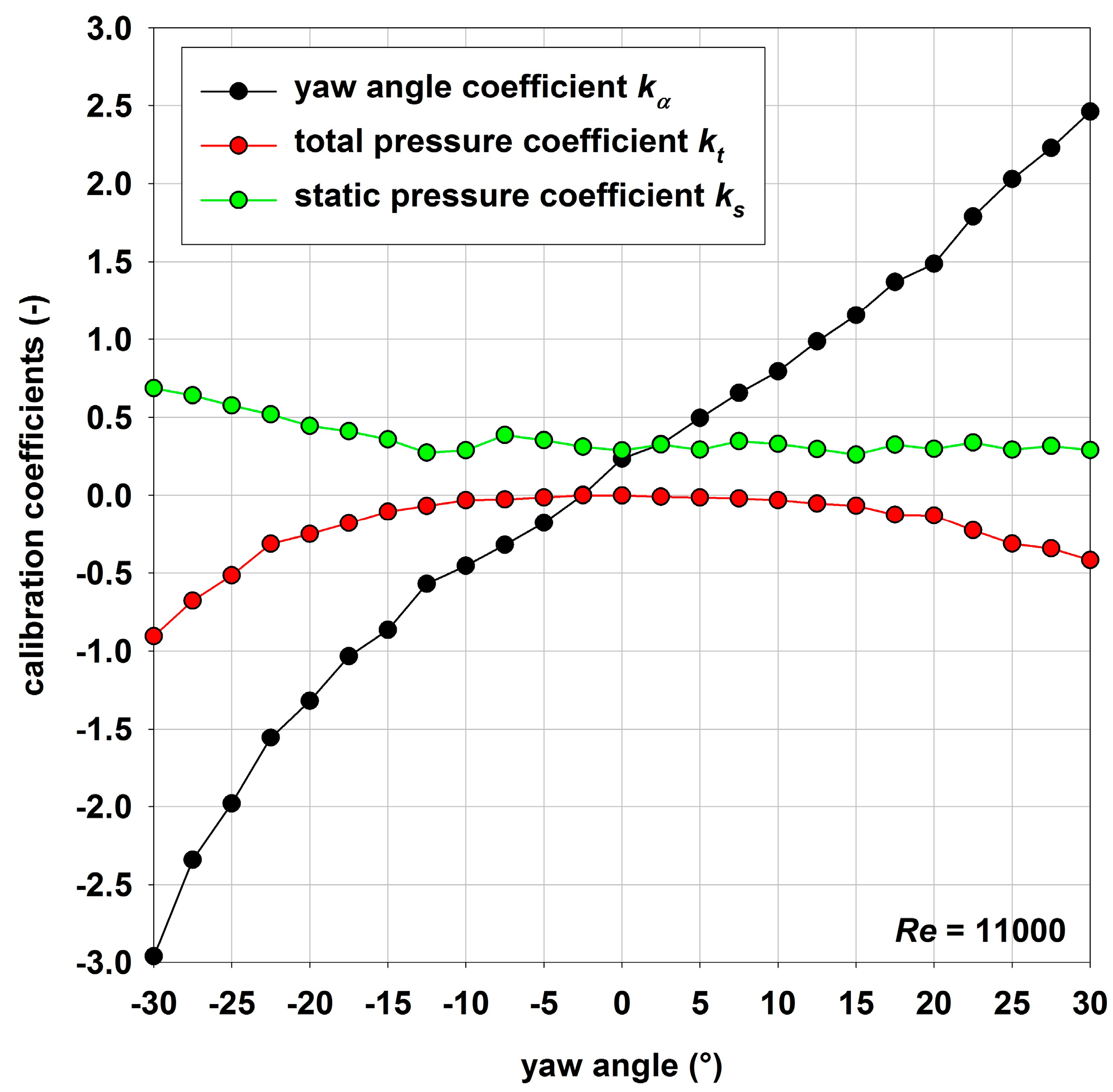
Figure A1 shows the calibration curves in the yaw angle range of ±30°. These calibration curves have been obtained in the free-jet wind tunnel at a probe Reynolds number of Re ≈ 11,000 and a yaw angle increment of 2.5°. Measured data points are connected by straight lines to indicate the linear interpolation applied during the process of flow field reconstruction. It is assumed that the calibration curves have no uncertainty.
Figure A1. Three-hole probe calibration coefficients versus yaw angle.
Ijtpp 11 00013 g0a1
At each pitchwise probe position, 30 data points are scanned with a sampling rate of about 6 Hz. The LabVIEW-based data acquisition program provides arithmetic mean values as well as standard deviations of probe pressures pI, pII and pIII. Arithmetic mean values of the probe pressures are used to calculate yaw angle, total pressure and static pressure according to the standard procedure for a probe in non-nulling mode. Additionally, standard deviations of the probe pressures are used to calculate the random uncertainties of yaw angle, total pressure and static pressure. Based on the concept of error propagation [14], the random uncertainty of the yaw angle coefficient gets, in accordance to Equation (A1),
k α , std = ( k α p I p I , std ) 2 + ( k α p II p II , std ) 2 + ( k α p III p III , std ) 2 = ( p II p III ) 2 p I , std 2 + ( p I p III ) 2 p II , std 2 + ( p I p II ) 2 p III , std 2 ( p I p ¯ ) 2 .
The random uncertainty of the yaw angle is obtained from the random uncertainty of the yaw angle coefficient by linear interpolation of the relevant calibration curve (Figure A1). In the next step, random uncertainty of total pressure can be calculated. According to Equation (A2), it is
p t , std = ( p t p I p I , std ) 2 + ( p t p II p II , std ) 2 + ( p t p III p III , std ) 2 = ( ( 1 k t ) p I , std ) 2 + k t 2 4 ( p II , std 2 + p III , std 2 ) .
Finally, random uncertainty of static pressure can be calculated. According to Equation (A3), it is
p std = ( p p I p I , std ) 2 + ( p p II p II , std ) 2 + ( p p III p III , std ) 2 = ( k s p I , std ) 2 + ( 1 + k s ) 2 4 ( p II , std 2 + p III , std 2 ) .
Random uncertainties of total and static pressure at the inlet plane are directly provided from measured standard deviations by the data acquisition. The concept of pitchwise mass averaging is used to calculate the random uncertainty of an averaged quantity from the local uncertainties. For example, the pitchwise mass averaged random uncertainty of the exit flow angle gets
α ¯ 1 , std = 0 s α 1 , std c 1 sin α 1 d y 0 s c 1 sin α 1 d y .
Random uncertainties are provided in the diagrams using error bars.

References

  1. aus der Wiesche, S.; Joos, F. Handbuch Dampfturbinen—Grundlagen, Konstruktion, Betrieb; Springer: Berlin/Heidelberg, Germany, 2018. [Google Scholar]
  2. Willinger, R.; Rozi, K.; Kariman, M.R. Two-Dimensional Flow in a Linear Cascade of Throttling Nozzles for an Adaptive Turbine Stage. In Proceedings of the 16th European Turbomachinery Conference, Paper ETC2025-177, Hannover, Germany, 24–28 March 2025. [Google Scholar]
  3. Speicher, K.; Mietsch, E. Der Drehschieber als Regelorgan für Entnahme-Dampfturbinen. Maschinenbautechnik 1966, 15, 185–190. [Google Scholar]
  4. Dejc, M.E.; Trojanovskij, B.M. Investigation and Calculation of Axial-Turbine Stages; Air Force Systems Command, Foreign Technology Division: Dayton, OH, USA, 1967. [Google Scholar]
  5. Speicher, K.; Mietsch, E.; Havemann, J. Zur Entwicklung von Niederdruck-Dampfsteuerorganen, derzeitiger Stand und künftige Möglichkeiten. Maschinenbautechnik 1989, 38, 17–20. [Google Scholar]
  6. Boos, B. Untersuchungen an einer Turbinen-Modellstufe mit Regulierleitrad. Maschinenbautechnik 1993, 40, 109–112. [Google Scholar]
  7. Puzyrewski, R.; Malec, A.; Gardzilewicz, A. Redesign of Adaptive Stage for 25 MW Cogeneration Turbine. In Proceedings of the 10th Conference on Steam and Gas Turbines for Power and Cogeneration Plants, Karlovy Vary, Czech Republic, 18–20 October 1994. [Google Scholar]
  8. Geist, R.; Jürke, S. Drehschieber mit Mindestens Einem Axialnadeldrehkranz als Drehbewegliches Lagerelement. German Patent DE4425344A1, 25 January 1996. [Google Scholar]
  9. Treaster, A.L.; Yocum, A.M. The Calibration and Application of Five-hole Probes. ISA Trans. 1979, 18, 23–34. [Google Scholar]
  10. Willinger, R.; Haselbacher, H. A Three-Hole Pressure Probe Exposed to Velocity Gradient Effects—Experimental Calibration and Numerical Investigation. In Proceedings of the Conference on Modelling Fluid Flow (CMFF’03), Budapest, Hungary, 3–6 September 2003. [Google Scholar]
  11. Nadge, P.M.; Govardhan, R.N. High Reynolds number flow over a backward-facing step: Structure of the mean separation bubble. Exp. Fluids 2014, 55, 1657. [Google Scholar] [CrossRef]
  12. Denton, J.D. Loss Mechanisms in Turbomachines. ASME J. Turbomach. 1993, 115, 621–656. [Google Scholar] [CrossRef]
  13. Idelchik, I.E. Handbook of Hydraulic Resistance, 3rd ed.; Begell House: New York, NY, USA, 1996. [Google Scholar]
  14. Kline, S.J.; McClintock, F.A. Describing Uncertainties in Single-Sample Experiments. Mech. Eng. 1953, 75, 3–8. [Google Scholar]
Figure 1. Comparison of the throttle valve (TV) and adaptive stage (AS) of a steam turbine with controlled extraction in the h/s diagram.
Ijtpp 11 00013 g001
Figure 2. Adaptive turbine stage with throttling nozzles according to Geist and Jürke [8].
Ijtpp 11 00013 g002
Figure 3. Turbine blades in original cascade arrangement.
Ijtpp 11 00013 g003
Figure 4. Cascade throttling nozzles: (a) closing to suction side (δ < 0); (b) closing to pressure side (δ > 0).
Ijtpp 11 00013 g004
Figure 5. Photographs of experimental arrangement: (a) isolated blade; (b) cascade arrangement dismantled from the wind tunnel.
Ijtpp 11 00013 g005
Figure 6. Side view of head of three-hole cobra probe.
Ijtpp 11 00013 g006
Figure 7. Pitchwise mass averaged exit flow angle versus degree of closing.
Ijtpp 11 00013 g007
Figure 8. Pitchwise mass averaged total pressure coefficient versus degree of closing.
Ijtpp 11 00013 g008
Figure 9. Relative mass flow rate and relative minimum flow area versus degree of closing.
Ijtpp 11 00013 g009
Figure 10. Exit velocity versus relative pitchwise coordinate.
Ijtpp 11 00013 g010
Figure 11. Exit flow angle without gradient correction versus relative pitchwise coordinate.
Ijtpp 11 00013 g011
Figure 12. Exit flow angle with gradient correction versus relative pitchwise coordinate.
Ijtpp 11 00013 g012
Figure 13. Total pressure coefficient versus relative pitchwise coordinate.
Ijtpp 11 00013 g013
Figure 14. Blade static pressure coefficient versus relative axial position.
Ijtpp 11 00013 g014
Figure 15. Cascade in partially closed condition.
Ijtpp 11 00013 g015
Figure 16. Exit flow angle versus degree of closing.
Ijtpp 11 00013 g016
Figure 17. Total pressure coefficient versus degree of closing.
Ijtpp 11 00013 g017
Table 1. Original cascade geometry data.
chord lengthc = 100 mm
axial chord lengthcx = 73.05 mm
blade lengthl = 150 mm
blade pitchs = 80 mm
throat widtha = 27.5 mm
aspect ratiol/c = 1.5
solidityc/s = 1.25
stagger angleγ = 51.5°
Table 2. Installed sensors with ranges and accuracies.
QuantityProductRangeAccuracy
pressureHoneywell 143PC01D±69 mbar±0.8% FS
temperatureTesto Pt-100 ±0.3 °C
Disclaimer/Publisher’s Note: The statements, opinions and data contained in all publications are solely those of the individual author(s) and contributor(s) and not of MDPI and/or the editor(s). MDPI and/or the editor(s) disclaim responsibility for any injury to people or property resulting from any ideas, methods, instructions or products referred to in the content.