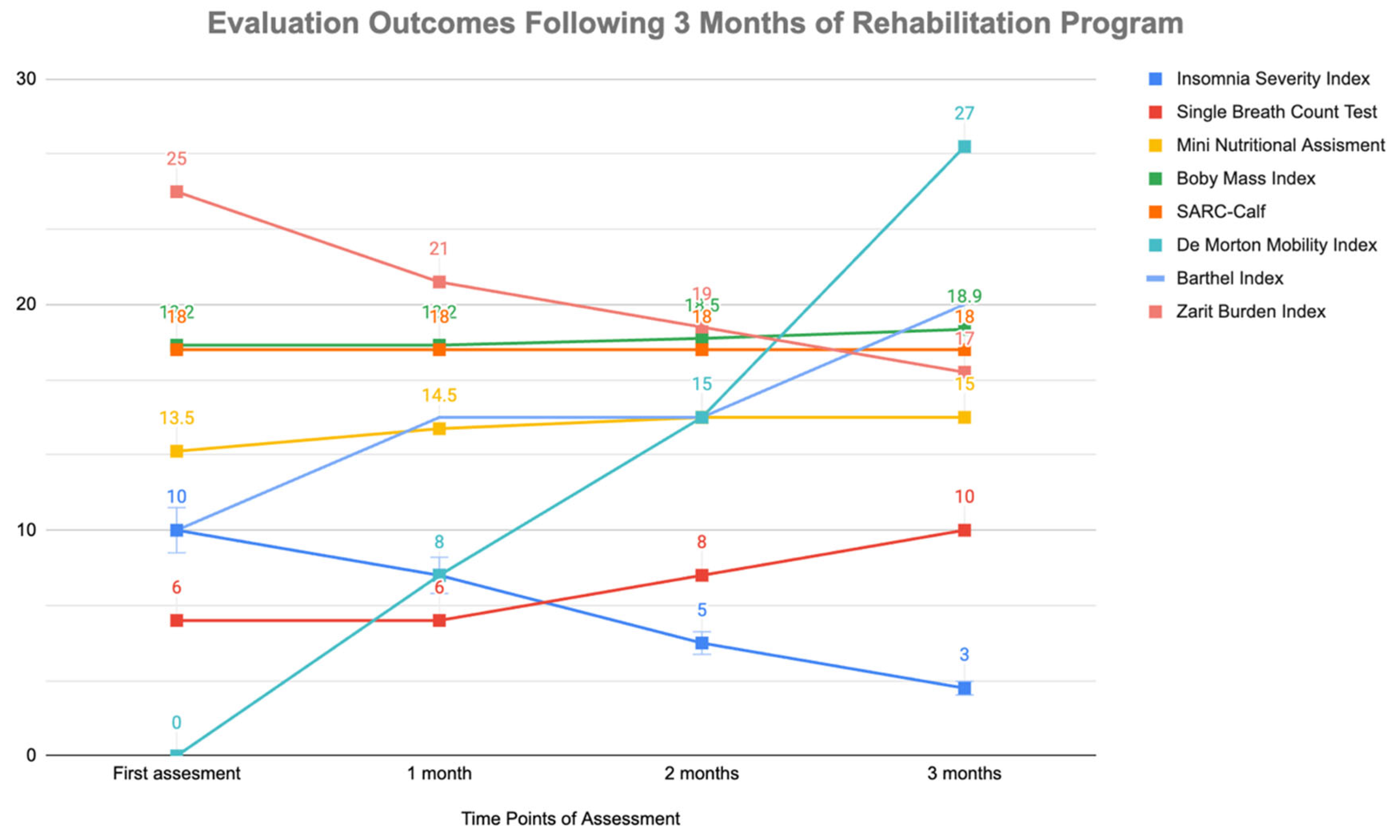

Rehabilitation Outcomes and Caregiver Stress in Elderly Patient with End-Stage Parkinson’s Disease

 , , , and
Abstract
1. Introduction
2. Case Presentation
3. Discussion
4. Conclusions
Author Contributions
Funding
Institutional Review Board Statement
Informed Consent Statement
Data Availability Statement
Acknowledgments
Conflicts of Interest
References
- Aarsland, D.; Marsh, L.; Schrag, A. Neuropsychiatric symptoms in Parkinson’s disease. J. Mov. Disord. 2009, 24, 2175–2186. [Google Scholar] [CrossRef] [PubMed]
- Chaudhuri, K.R.; Healy, D.G.; Schapira, A.H.V. Non-motor symptoms of Parkinson’s disease: Diagnosis and management. Lancet Neurol. 2006, 5, 235–245. [Google Scholar] [CrossRef] [PubMed]
- Morley, J.E.; Vellas, B.; van Kan, G.A.; Anker, S.D.; Bauer, J.M.; Bernabei, R.; Cesari, M.; Chumlea, W.; Doehner, W.; Evans, J.; et al. Frailty consensus: A call to action. J. Am. Med. Dir. Assoc. 2013, 14, 392–397. [Google Scholar] [CrossRef] [PubMed]
- Abbruzzese, G.; Marchese, R.; Avanzino, L.; Pelosin, E. Rehabilitation for Parkinson’s disease: Current outlook and future challenges. Park. Relat. Disord 2016, 22, S60–S64. [Google Scholar] [CrossRef] [PubMed]
- Pociecha, A.; Kozikowska, M.; Kmak, B. Pallidotomy—Outdated procedure or modern therapeutic alternative?—A review. J. Educ. Health Sport 2024, 67, 55077. [Google Scholar] [CrossRef]
- Pinquart, M.; Sörensen, S. Differences between caregivers and noncaregivers in psychological health and physical health: A meta-analysis. Psychol. Aging 2003, 18, 250–267. [Google Scholar] [CrossRef] [PubMed]
- Bloem, B.R.; Okun, M.S.; Klein, C. Parkinson’s disease. Lancet 2021, 397, 2284–2303. [Google Scholar] [CrossRef] [PubMed]
- Nonnekes, J.; Timmer, M.H.M.; de Vries, N.M.; Rascol, O.; Helmich, R.C.; Bloem, B.R. Unmasking levodopa resistance in Parkinson’s disease. Mov. Disord. 2016, 31, 1602–1609. [Google Scholar] [CrossRef] [PubMed]
- Gross, R.E. What Happened to Posteroventral Pallidotomy for Parkinson’s Disease and Dystonia? Neurotherapeutics 2008, 5, 281–293. [Google Scholar] [CrossRef] [PubMed]
- Favre, J.; Burchiel, K.J.; Taha, J.M.; Hammerstad, J. Outcome of Unilateral and Bilateral Pallidotomy for Parkinson’s Disease: Patient Assessment. Neurosurgery 2000, 46, 344–355. [Google Scholar] [CrossRef] [PubMed]
- Marrinan, S.; Emmanuel, A.V.; Burn, D.J. Delayed gastric emptying in Parkinson’s disease. J. Mov. Disord. 2014, 29, 23–32. [Google Scholar] [CrossRef] [PubMed]
- Ramazzina, I.; Bernazzoli, B.; Costantino, C. Systematic review on strength training in Parkinson’s disease: An unsolved question. Clin. Interv. Aging 2017, 12, 619–628. [Google Scholar] [CrossRef] [PubMed]
- Kathia, M.M.; Bommarito, J.C.; Hinks, A.; Leake, E.; Shannon, J.; Pitman, J.; Connolly, B.; Burr, J.F.; Vallis, L.A.; Power, G.A.; et al. Physiological and clinical responses to cycling 7850 km over 85 days in a physically active middle-aged man with idiopathic Parkinson’s disease. Physiol. Rep. 2023, 11, e15772. [Google Scholar] [CrossRef] [PubMed]
- Hrytsuliak, B.; Ostapiak, Z.; Polataiko, Y.; Herych, R.; Lisovskyi, B.; Lapkovskyi, E.; Karpenko, H.; Vojchyshyn, L.; Zastavna, O.; Sheremeta, L.; et al. Dynamics of balance indicators, activities of daily living, and quality of life of elderly suffering from Parkinson’s disease and frailty after proximal humerus fracture following physiotherapeutic functional training. J. Med. Life 2022, 15, 98–103. [Google Scholar] [CrossRef] [PubMed]
- Jose, A.; Bhargavan, A.; Appireddy, R.; Raghunath, P.S.; Rajan, R.; Iype, T. Neuropsychiatric Symptoms and Caregiver’s Burden in Parkinson’s Disease Patients in a Tertiary Care Teaching Hospital in South India. Neurol. India 2021, 69, 1706–1710. [Google Scholar] [CrossRef] [PubMed]


| Function | Items | Result |
|---|---|---|
| Mental Function | ||
| Orientation, attention, memory function | MoCA-Blind | 18/22 (mild cognitive impairment) |
| Sleep function | ISI | 10/28 (subthreshold insomnia) |
| Emotional function | GDS-15 | 4/15 (no depression) |
| UCLA-3 Item | 3/9 (some degree of loneliness) | |
| EQ-5D-3L | Mobility 3 (extreme problem), self-care 3 (extreme problem), usual activities 3 (extreme problem), pain/discomfort 1 (no problem), anxiety/depression 1 (no problem) | |
| Sensory Function | ||
| Seeing function | Visual Acuity | Uncorrected presbyopia |
| Cardiorespiratory and Respiratory Function | ||
| Respiratory function | Depth of respiration | Limited chest expansion |
| Respiratory muscle function | Additional respiratory function | Single Breath Count Test: 6 Inadequate cough ability |
| Exercise tolerance function | General physical endurance |
|
| Fatigability |
| |
| Digestive Function | ||
| Swallowing | Oral Swallowing | Prolonged oral phase for solid consistency due to edentulism |
| Pharyngeal swallowing | GUSS: 20/20 | |
| Defecation Function | Elimination of feces | Via Stoma |
| Fecal consistency | Bristol stool type 5–6 | |
| Weight maintenance functions | MNA | 13.5/30 (malnutrition) |
| BMI | 18.2 kg/m2 (underweight) | |
| Neuromusculoskeletal and Movement Functions | ||
| Mobility of joint functions |
| Limitation in all direction |
| Limitation on bilateral shoulder, elbow and wrist; left phalangeal flexion contracture | |
| Limitation on bilateral hip flexion, knee flexion and ankle | |
| Muscle power function |
| Muscle weakness on bilateral shoulder, elbow, forearm and wrist |
| Muscle weakness on left hip, knee, ankle and toes | |
| Involuntary movement reaction functions | Hughes criteria | Present resting tremor, rigidity, bradykinesia, and postural instability |
| Sarcopenia screening | AWGS | Possible sarcopenia (calf circumference 26 cm, SARC-F 8/10, SARC-calf 18/20) |
| Activity and Participation | ||
| Mobility | DEMMI | 0/100 (immobile) |
| MFS | 75/125 (high fall risk) | |
| Self Care | Barthel Index | 10/100 (total dependent) |
| Community life | SSII | 2/5 (socially isolated) |
| Environmental Factors | ||
| Support and relationship | ZBI | 25/88 (mild to moderate caregiver burden) |
| CFS | 7 (severe frailty) | |
| PPS | 40% (mainly in bed, unable to do most activities, extensive disease, self-care mainly assistance required, normal or reduced intake, full or drowsy consciousness) | |
| PPI | 3.5 (median survival >6 weeks) | |
| Problems | Target | Programs |
|---|---|---|
| Mobilization Disturbance | Prevent complications (osteoporosis, contracture, ulcers) | Program: Sitting endurance, isotonic open-chain exercise for all extremities. Education: Immobilization effects, energy conservation. Follow programs for fatigue, ADL, joint stiffness, malnutrition, frailty, sarcopenia. |
| Joint Stiffness | Increase ROM in neck, upper/lower extremities | Program: Cervical orthosis, flexibility exercise for neck, shoulder, hip, knee, ankle (daily, 10 reps × 2 sets with 5 s hold). |
| Fatigue—Cardio pulmonary | Reduce FSS < 36 | Program: Deep breathing, cardiopulmonary exercise (3×/week, 30–40% HRR, 10–30 min using arm ergo cycle with support). Education: Immobilization effects, energy conservation. Incorporate malnutrition, frailty, sarcopenia programs. |
| Cardiopulmonary Disturbance | Reduce FSS < 36 | Program: Cardiopulmonary training (3×/week, 30–40% HRR, 10–30 min), deep breathing exercises. Education: Immobilization effects, energy conservation. Home Program: Gradual walking, large muscle exercise. |
| Psychosocial Disturbance—Loneliness | Decrease UCLA < 2, caregiver burden | Program: Psychologist consult, social engagement activities, and discussions for companionship. |
| ADL Disturbance | Partial dependence improvement | Program: ADL self-care in sitting |
| Malnutrition | Improve MNA > 17.5, better mobility, psychological state, appetite, posture | Program: Nutritional education on food composition (protein, fluids), increase meal frequency, proper sitting position, prosthodontist/nutritionist consult, and psychological support. |
| Postural Disturbance | Prevent further stooped posture, avoid falls | Program: Include exercises for joint stiffness, psychological support, caregiver burden, and fatigue. |
| Communication Disturbance | Increased volume | Program: Address fatigue through targeted activities. |
| Sarcopenia and Frailty | Maintain scores | Program: Include malnutrition and mobilization programs. |
| Parkinson’s Disease Management | Maintain PPI < 4, increase mobility | Palliative Care: Advanced care planning, social worker assessment, fall prevention (home modifications), spiritual support. |
Disclaimer/Publisher’s Note: The statements, opinions and data contained in all publications are solely those of the individual author(s) and contributor(s) and not of MDPI and/or the editor(s). MDPI and/or the editor(s) disclaim responsibility for any injury to people or property resulting from any ideas, methods, instructions or products referred to in the content. |
© 2026 by the authors. Published by MDPI on behalf of the Italian Society of Gerontology and Geriatrics (SIGG). Licensee MDPI, Basel, Switzerland. This article is an open access article distributed under the terms and conditions of the Creative Commons Attribution (CC BY) license.
Share and Cite
Bilqistiputri, F.; Desiana, I.; Defi, I.R.; Goesasi, R.Z.; Sungkar, E.; Pranata Gunanegara, A. Rehabilitation Outcomes and Caregiver Stress in Elderly Patient with End-Stage Parkinson’s Disease. J. Gerontol. Geriatr. 2026, 74, 5. https://doi.org/10.3390/jgg74010005
Bilqistiputri F, Desiana I, Defi IR, Goesasi RZ, Sungkar E, Pranata Gunanegara A. Rehabilitation Outcomes and Caregiver Stress in Elderly Patient with End-Stage Parkinson’s Disease. Journal of Gerontology and Geriatrics. 2026; 74(1):5. https://doi.org/10.3390/jgg74010005
Chicago/Turabian StyleBilqistiputri, Farah, Istingadah Desiana, Irma Ruslina Defi, Rachmat Zulkarnain Goesasi, Ellyana Sungkar, and Aggi Pranata Gunanegara. 2026. "Rehabilitation Outcomes and Caregiver Stress in Elderly Patient with End-Stage Parkinson’s Disease" Journal of Gerontology and Geriatrics 74, no. 1: 5. https://doi.org/10.3390/jgg74010005
APA StyleBilqistiputri, F., Desiana, I., Defi, I. R., Goesasi, R. Z., Sungkar, E., & Pranata Gunanegara, A. (2026). Rehabilitation Outcomes and Caregiver Stress in Elderly Patient with End-Stage Parkinson’s Disease. Journal of Gerontology and Geriatrics, 74(1), 5. https://doi.org/10.3390/jgg74010005