
An Update on the Role of Sirtuins in the Prevention of the Aging Process: A Narrative Review
 ,
,  and
and
Abstract
1. Introduction
2. Materials and Methods
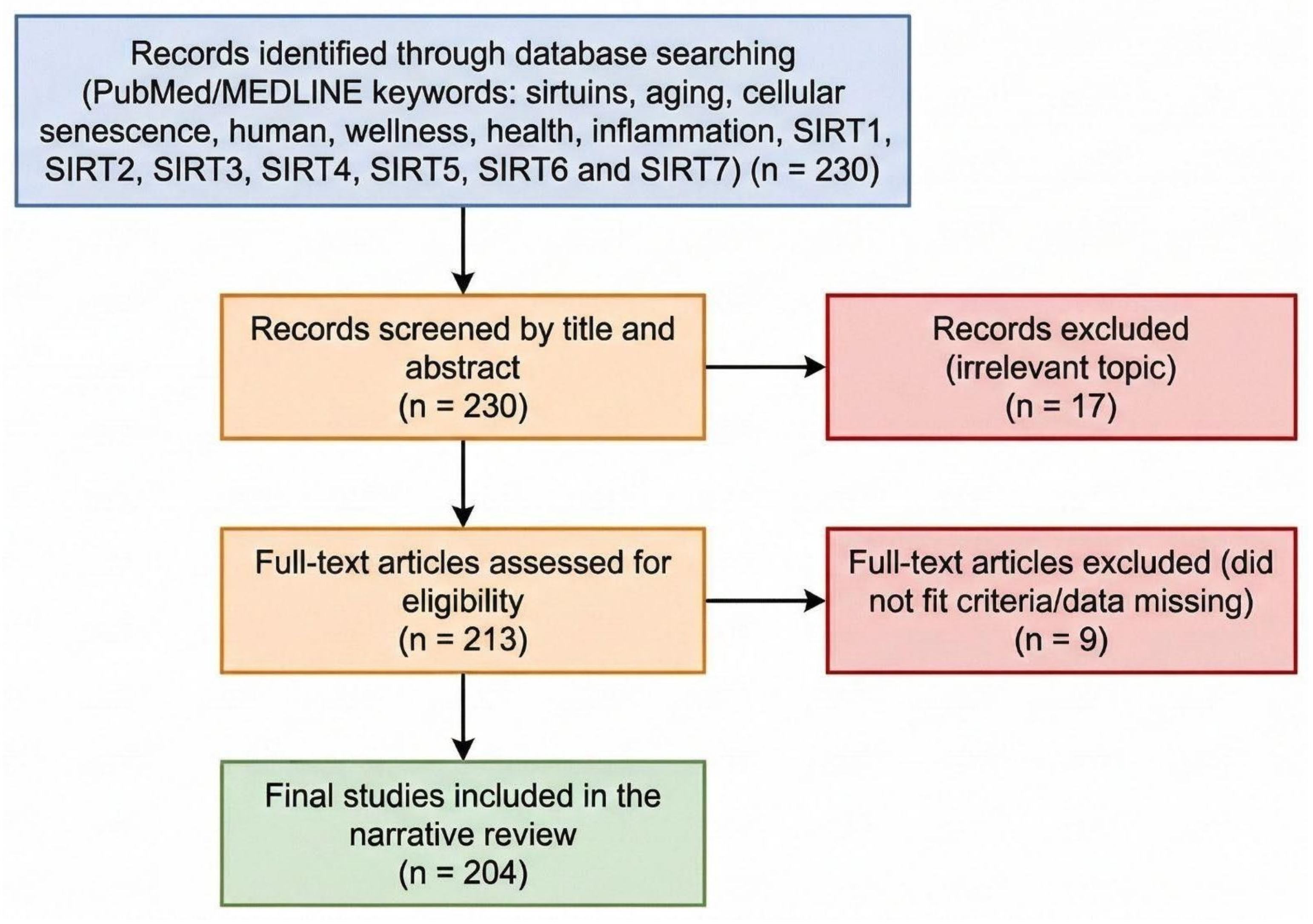
2.1. Search Strategy
2.2. Study Selection and Inclusion Criteria
2.3. Evidence Appraisal
3. Molecular Structure of Sirtuins
4. Functions of Sirtuins
4.1. Effects on DNA
4.2. Effects on Inflammation
5. Effects on Metabolism
5.1. Glucose Metabolism
5.2. Lipid Metabolism
5.3. Oxidative Stress
5.4. Sirtuins and Mitochondrial Function
5.5. Apoptosis
5.6. Specific Roles of SIRT7 in Aging and Metabolism
6. Regulation of Sirtuins
6.1. Transcriptional Regulation
6.2. Post-Translational Regulation
6.3. Complex Formation
6.4. Substrate Availability
7. Sirtuin-Activity Regulating Compounds
7.1. Sirtuin Activating Compounds (STACs)
7.1.1. Main Sirtuin-Activating Compounds (STACs)
Resveratrol
Honokiol
Curcumin
Quercetin
Ferulic Acid
Fisetin
7.1.2. Synthetic STACs
Metformin
Cilostazol
Statins
7.1.3. Novel Synthetic STACs
- SRT1720—Originally developed as a synthetic activator of SIRT1, this imidazothiazole derivative has been widely studied in preclinical models. While early debates questioned its specificity (suggesting potential off-target effects or assay artifacts), subsequent studies in mice demonstrated that SRT1720 improves insulin sensitivity, mitochondrial function, and endurance, mimicking the effects of caloric restriction via SIRT1 activation [62]. Supported by preclinical evidence, its human use remains uncertain as it has not yet translated into established clinical use. Its target specificity remains a point of repeated debate in the literature.
- SRT2104—This compound is a potent SIRT1 activator with the same imidazothiazole core. It has shown potential in modulating metabolic pathways in preclinical models, particularly in modulating metabolic and longevity-related pathways [119]. It crosses the blood-brain barrier, providing therapeutic benefit in certain neurodegenerative conditions [170]. One study found that it improves endothelial function and reduces serum LDL cholesterol levels in healthy smokers, suggesting its potential to counteract vascular aging in humans [171]. This compound is supported by early human clinical data (Phase I/II) alongside preclinical models. While its oral dosing is clinically realistic, efficacy signals remain heterogeneous and largely biomarker-based, with no definitive proof of disease-modifying or longevity benefits in humans.
- 1,4-Dihydropyridines—These heterocyclic pyridine derivatives are calcium channel blockers and potent selective activators of SIRT3 and SIRT5 [121]. SIRT3 activation counteracts cardiac hypertrophy in mice and reduces β-amyloid levels in vitro, alleviating cognitive deficits in Alzheimer’s models. SIRT5 activation protects against ischemia-reperfusion oxidative injury, offering therapeutic perspectives for heart failure, neurodegenerative diseases, and metabolic dysfunctions [16]. Evidence is currently preclinical, and no established human dosing regimen exists for sirtuin-targeted therapy. It remains unresolved whether their benefits reflect true isoform-selective activation or broader class effects.
- MDL-800, MDL-801, MDL-811—These small molecules, derived from 2-methylaniline, are SIRT6 activators with antitumor and protective effects on cardiovascular and neurodegenerative diseases [122,123]. These agents are in the preclinical stage, and their human dosing realism is entirely unknown. As experimental compounds, they currently lack any controlled human safety or efficacy data.
7.1.4. Other Natural STACs
7.1.5. Indirect Strategies for Regulating Sirtuin Activity
Rapamycin
NAD+ Boosting
Sirtuin Inhibitors
Nicotinamide (NAM)
Splitomicin
Sirtinol
Cambinol
Salermide
AGK2
Tenovins
Suramin
Novel Synthetic Modulators and Probes
8. Modulation of Sirtuin Activity Through Lifestyle Factors
8.1. Diet
8.2. Physical Exercise
9. Conclusions
Supplementary Materials
Author Contributions
Funding
Institutional Review Board Statement
Data Availability Statement
Conflicts of Interest
Correction Statement
References
- Wu, Q.J.; Zhang, T.N.; Chen, H.H.; Yu, X.-F.; Lv, J.-L.; Liu, Y.-Y.; Liu, Y.-S.; Zheng, G.; Zhao, J.-Q.; Wei, Y.-F.; et al. The sirtuin family in health and disease. Signal Transduct. Target. Ther. 2022, 7, 402. [Google Scholar] [CrossRef] [PubMed] [PubMed Central]
- Houtkooper, R.H.; Pirinen, E.; Auwerx, J. Sirtuins as regulators of metabolism and healthspan. Nat. Rev. Mol. Cell Biol. 2012, 13, 225–238. [Google Scholar] [CrossRef] [PubMed] [PubMed Central]
- Sah, P.; Rai, A.K.; Syiem, D. Sirtuin activators as an anti-aging intervention for longevity. Explor. Drug Sci. 2025, 3, 100881. [Google Scholar] [CrossRef]
- Michishita, E.; Park, J.Y.; Burneskis, J.M.; Barrett, J.C.; Horikawa, I. Evolutionarily conserved and nonconserved cellular localizations and functions of human SIRT proteins. Mol. Biol. Cell 2005, 16, 4623–4635. [Google Scholar] [CrossRef] [PubMed] [PubMed Central]
- You, Y.; Liang, W. SIRT1 and SIRT6: The role in aging-related diseases. Biochim. Biophys. Acta Mol. Basis Dis. 2023, 1869, 166815. [Google Scholar] [CrossRef] [PubMed]
- van de Ven, R.A.H.; Santos, D.; Haigis, M.C. Mitochondrial Sirtuins and Molecular Mechanisms of Aging. Trends Mol. Med. 2017, 23, 320–331. [Google Scholar] [CrossRef] [PubMed] [PubMed Central]
- Khan, D.; Sarikhani, M.; Dasgupta, S.; Maniyadath, B.; Pandit, A.S.; Mishra, S.; Ahamed, F.; Dubey, A.; Fathma, N.; Atreya, H.S.; et al. SIRT6 deacetylase transcriptionally regulates glucose metabolism in heart. J. Cell. Physiol. 2018, 233, 5478–5489, Erratum in J. Cell. Physiol. 2022, 237, 2288. https://doi.org/10.1002/jcp.30722. [Google Scholar] [CrossRef] [PubMed]
- Khan, R.I.; Nirzhor, S.S.R.; Akter, R. A Review of the Recent Advances Made with SIRT6 and its Implications on Aging Related Processes, Major Human Diseases, and Possible Therapeutic Targets. Biomolecules 2018, 8, 44. [Google Scholar] [CrossRef] [PubMed] [PubMed Central]
- Lagunas-Rangel, F.A. SIRT7 in the aging process. Cell. Mol. Life Sci. 2022, 79, 297. [Google Scholar] [CrossRef] [PubMed] [PubMed Central]
- Yoshizawa, T.; Sato, Y.; Sobuz, S.U.; Mizumoto, T.; Tsuyama, T.; Karim, F.; Miyata, K.; Tasaki, M.; Yamazaki, M.; Kariba, Y.; et al. SIRT7 suppresses energy expenditure and thermogenesis by regulating brown adipose tissue functions in mice. Nat. Commun. 2022, 13, 7439. [Google Scholar] [CrossRef] [PubMed] [PubMed Central]
- Seto, E.; Yoshida, M. Erasers of histone acetylation: The histone deacetylase enzymes. Cold Spring Harb. Perspect. Biol. 2014, 6, a018713. [Google Scholar] [CrossRef] [PubMed] [PubMed Central]
- Rogina, B.; Tissenbaum, H.A. SIRT1, resveratrol and aging. Front. Genet. 2024, 15, 1393181. [Google Scholar] [CrossRef] [PubMed] [PubMed Central]
- Min, J.; Landry, J.; Sternglanz, R.; Xu, R.-M. Crystal structure of a SIR2 homolog-NAD complex. Cell 2001, 105, 269–279. [Google Scholar] [CrossRef] [PubMed]
- Zhao, K.; Harshaw, R.; Chai, X.; Marmorstein, R. Structural basis for nicotinamide cleavage and ADP-ribose transfer by NAD(+)-dependent Sir2 histone/protein deacetylases. Proc. Natl. Acad. Sci. USA 2004, 101, 8563–8568. [Google Scholar] [CrossRef] [PubMed] [PubMed Central]
- Jackson, M.D.; Denu, J.M. Structural identification of 2′- and 3′-O-acetyl-ADP-ribose as novel metabolites derived from the Sir2 family of beta -NAD+-dependent histone/protein deacetylases. J. Biol. Chem. 2002, 277, 18535–18544. [Google Scholar] [CrossRef] [PubMed]
- Chen, M.; Tan, J.; Jin, Z.; Jiang, T.; Wu, J.; Yu, X. Research progress on Sirtuins (SIRTs) family modulators. Biomed. Pharmacother. 2024, 174, 116481. [Google Scholar] [CrossRef] [PubMed]
- Grozinger, C.M.; Chao, E.D.; Blackwell, H.E.; Moazed, D.; Schreiber, S.L. Identification of a class of small molecule inhibitors of the sirtuin family of NAD-dependent deacetylases by phenotypic screening. J. Biol. Chem. 2001, 276, 38837–38843. [Google Scholar] [CrossRef] [PubMed]
- Dai, H.; Sinclair, D.A.; Ellis, J.L.; Steegborn, C. Sirtuin activators and inhibitors: Promises, achievements, and challenges. Pharmacol. Ther. 2018, 188, 140–154. [Google Scholar] [CrossRef] [PubMed] [PubMed Central]
- Tao, Z.; Jin, Z.; Wu, J.; Cai, G.; Yu, X. Sirtuin family in autoimmune diseases. Front. Immunol. 2023, 14, 1186231. [Google Scholar] [CrossRef] [PubMed] [PubMed Central]
- Cantó, C.; Sauve, A.A.; Bai, P. Crosstalk between poly(ADP-ribose) polymerase and sirtuin enzymes. Mol. Asp. Med. 2013, 34, 1168–1201. [Google Scholar] [CrossRef] [PubMed] [PubMed Central]
- Mathias, R.A.; Greco, T.M.; Oberstein, A.; Budayeva, H.G.; Chakrabarti, R.; Rowland, E.A.; Kang, Y.; Shenk, T.; Cristea, I.M. Sirtuin 4 is a lipoamidase regulating pyruvate dehydrogenase complex activity. Cell 2014, 159, 1615–1625. [Google Scholar] [CrossRef] [PubMed] [PubMed Central]
- Tan, M.; Peng, C.; Anderson, K.A.; Chhoy, P.; Xie, Z.; Dai, L.; Park, J.; Chen, Y.; Huang, H.; Zhang, Y.; et al. Lysine glutarylation is a protein posttranslational modification regulated by SIRT5. Cell Metab. 2014, 19, 605–617. [Google Scholar] [CrossRef] [PubMed] [PubMed Central]
- Yang, J.; Lu, Y.; Zhao, Y.; Wang, X. Mechanisms of SIRT3 Regulation of Aging and Aging-Related Diseases and Advances in Drug Therapy. Gerontology 2025, 71, 974–989. [Google Scholar] [CrossRef] [PubMed]
- Varghese, B.; Chianese, U.; Capasso, L.; Sian, V.; Bontempo, P.; Conte, M.; Benedetti, R.; Altucci, L.; Carafa, V.; Nebbioso, A. SIRT1 activation promotes energy homeostasis and reprograms liver cancer metabolism. J. Transl. Med. 2023, 21, 627. [Google Scholar] [CrossRef] [PubMed] [PubMed Central]
- Li, Y.; Kang, K.; Bao, H.; Liu, S.; Zhao, B.; Hu, G.; Wu, J. Research Progress on the Interaction Between SIRT1 and Mitochondrial Biochemistry in the Aging of the Reproductive System. Biology 2025, 14, 643. [Google Scholar] [CrossRef] [PubMed] [PubMed Central]
- Kolesnikova, O.; Zaprovalna, O.; Radchenko, A.; Bondar, T. Association of SIRT1 with metabolic parameters and aging rate. Biomed. Res. Ther. 2023, 10, 5575–5583. [Google Scholar] [CrossRef]
- Yang, J.; Félix-Soriano, E.; Martínez-Gayo, A.; Ibañez-Santos, J.; Sáinz, N.; Martínez, J.A.; Moreno-Aliaga, M.J. SIRT1 and FOXO1 role on MASLD risk: Effects of DHA-rich n-3 PUFA supplementation and exercise in aged obese female mice and in post-menopausal overweight/obese women. J. Physiol. Biochem. 2024, 80, 697–712. [Google Scholar] [CrossRef] [PubMed] [PubMed Central]
- Li, Y.; Han, L.; Fu, Y.; Zhang, Y.; Zou, Z.; Luo, J.; Tang, X.; Tian, L.; Lu, Y.; Huang, Y.; et al. The role of SIRT2 in homeostatic medicine and aging intervention. Oral Sci. Homeost. Med. 2025, 1, 9610009. [Google Scholar] [CrossRef]
- Ren, H.; Hu, F.; Wang, D.; Kang, X.; Feng, X.; Zhang, L.; Zhou, B.; Liu, S.; Yuan, G. Sirtuin 2 Prevents Liver Steatosis and Metabolic Disorders by Deacetylation of Hepatocyte Nuclear Factor 4α. Hepatology 2021, 74, 723–740, Erratum in Hepatology 2022, 75, 1358–1359. https://doi.org/10.1002/hep.32243. [Google Scholar] [CrossRef] [PubMed] [PubMed Central]
- Wang, F.; Nguyen, M.; Qin, F.X.; Tong, Q. SIRT2 deacetylates FOXO3a in response to oxidative stress and caloric restriction. Aging Cell 2007, 6, 505–514. [Google Scholar] [CrossRef] [PubMed]
- Zhang, Y.; Wang, X.; Li, X.K.; Lv, S.-J.; Wang, H.-P.; Liu, Y.; Zhou, J.; Gong, H.; Chen, X.-F.; Ren, S.-C.; et al. Sirtuin 2 deficiency aggravates ageing-induced vascular remodelling in humans and mice. Eur. Heart J. 2023, 44, 2746–2759. [Google Scholar] [CrossRef] [PubMed] [PubMed Central]
- Garmendia-Berges, M.; Sola-Sevilla, N.; Mera-Delgado, M.; Puerta, E. Age-Associated Changes of Sirtuin 2 Expression in CNS and the Periphery. Biology 2023, 12, 1476. [Google Scholar] [CrossRef] [PubMed] [PubMed Central]
- Ma, X.R.; Zhu, X.; Xiao, Y.; Gu, H.-M.; Zheng, S.-S.; Li, L.; Wang, F.; Dong, Z.-J.; Wang, D.-X.; Wu, Y.; et al. Restoring nuclear entry of Sirtuin 2 in oligodendrocyte progenitor cells promotes remyelination during ageing. Nat. Commun. 2022, 13, 1225. [Google Scholar] [CrossRef] [PubMed]
- Zhang, Z.; Zhang, L.; Zhang, Y.; Zhao, Y.; Gao, Y.; Zhang, C.; Li, D.; Zhang, X.; Yang, G.; Zhang, J. Inhibition of Sirtuin 2 enhances autophagy and restores neuronal function in aged hippocampal neurons. Brain Res. Bull. 2025, 230, 111501. [Google Scholar] [CrossRef] [PubMed]
- Fernández-Ruiz, I. Sirtuin 2 protects against cardiac ageing. Nat. Rev. Cardiol. 2023, 20, 796. [Google Scholar] [CrossRef] [PubMed]
- Ji, Z.; Liu, G.H.; Qu, J. Mitochondrial sirtuins, key regulators of aging. Life Med. 2025, 4, lnaf019. [Google Scholar] [CrossRef] [PubMed] [PubMed Central]
- Šimunić, E.; Podgorski, I.I.; Pinterić, M.; Hadžija, M.P.; Belužić, R.; Paradžik, M.; Dončević, L.; Balog, T.; Kaloper, M.; Habisch, H.; et al. Sirtuin 3 drives sex-specific responses to age-related changes in mouse embryonic fibroblasts. Mech. Ageing Dev. 2024, 222, 111996. [Google Scholar] [CrossRef] [PubMed]
- Šešelja, K.; Šimunić, E.; Sobočanec, S.; Podgorski, I.I.; Pinterić, M.; Hadžija, M.P.; Balog, T.; Belužić, R. SIRT3-Mediated Mitochondrial Regulation and Driver Tissues in Systemic Aging. Genes 2025, 16, 1497. [Google Scholar] [CrossRef] [PubMed] [PubMed Central]
- You, Y.; Wang, Z. Roles of SIRT3 in aging and aging-related diseases. Int. J. Biol. Sci. 2025, 21, 5135–5163. [Google Scholar] [CrossRef] [PubMed] [PubMed Central]
- Hashimova, U.; Kvetnoy, I.; Gaisina, A.; Safikhanova, K.; Mironova, E.; Galandarli, I.; Hasanli, L. SIRT1/3/6 Landscape of Human Longevity: A Sex- and Health-Stratified Pilot Study. Biology 2025, 14, 1353. [Google Scholar] [CrossRef] [PubMed] [PubMed Central]
- He, L.; Liu, Q.; Cheng, J.; Cao, M.; Zhang, S.; Wan, X.; Li, J.; Tu, H. SIRT4 in ageing. Biogerontology 2023, 24, 347–362. [Google Scholar] [CrossRef] [PubMed]
- Haigis, M.C.; Mostoslavsky, R.; Haigis, K.M.; Fahie, K.; Christodoulou, D.C.; Murphy, A.J.; Valenzuela, D.M.; Yancopoulos, G.D.; Karow, M.; Blander, G.; et al. SIRT4 inhibits glutamate dehydrogenase and opposes the effects of calorie restriction in pancreatic beta cells. Cell 2006, 126, 941–954. [Google Scholar] [CrossRef] [PubMed]
- Zhao, Q.; Jing, Y.; Jiang, X.; Zhang, X.; Liu, F.; Huang, H.; Zhang, Z.; Wang, H.; Sun, S.; Ma, S.; et al. SIRT5 safeguards against primate skeletal muscle ageing via desuccinylation of TBK1. Nat. Metab. 2025, 7, 556–573. [Google Scholar] [CrossRef] [PubMed]
- Lu, Y.; Peng, Q.; Liu, B.; Xie, B. SIRT5 affects lipid accumulation in cells of a metabolic-associated fatty liver disease model by regulating the succinylation status of HSPD1. BMC Immunol. 2025, 26, 95. [Google Scholar] [CrossRef] [PubMed] [PubMed Central]
- Gorbunova, V.; Seluanov, A. SIRT5 slows skeletal muscle ageing by alleviating inflammation. Nat. Metab. 2025, 7, 447–449. [Google Scholar] [CrossRef] [PubMed]
- Hou, W.; Zhao, Y.; Yang, L.; Duan, C.; Li, F.; Liu, X.; Sun, W.; Gao, L. SIRT5-mediated desuccinylation prevents mitochondrial dysfunction in alveolar epithelial cells senescence and pulmonary fibrosis. Cell. Signal 2025, 132, 111830. [Google Scholar] [CrossRef] [PubMed]
- Grzeczka, A.; Graczyk, S.; Kordowitzki, P. Unveiling the importance of SIRT5 for cardiac health and disease in an era of increasing longevity. Geroscience 2025. Epub ahead of print. [Google Scholar] [CrossRef] [PubMed]
- Yang, K.; Schmiady, M.; Kraler, S.; Melo, M.; Akhmedov, A.; Puspitasari, Y.; Robert, J.; Camici, G.; Luescher, T. Sirt5 in mediating endothelial and vascular dysfunction: A novel target in aging-related vascular diseases. Eur. Heart J. 2025, 46, ehaf784.4925. [Google Scholar] [CrossRef]
- Lu, Y.; Yang, J.; Wu, Q.; Wang, X. The Role and Molecular Pathways of SIRT6 in Senescence and Age-related Diseases. Adv. Biol. 2025, 9, e2400469. [Google Scholar] [CrossRef] [PubMed]
- Kaluski-Kopatch, S.; Stein, D.; Venzor, A.G.; Campos, A.M.F.; Planque, M.; Goldstein, B.; De Allende-Becerra, E.; Smirnov, D.; Zaretsky, A.; Eremenko, E.; et al. Histone deacetylase SIRT6 regulates tryptophan catabolism and prevents metabolite imbalance associated with neurodegeneration. Nat. Commun. 2025, 17, 320. [Google Scholar] [CrossRef] [PubMed] [PubMed Central]
- Pan, H.; Guan, D.; Liu, X.; Li, J.; Wang, L.; Wu, J.; Zhou, J.; Zhang, W.; Ren, R.; Zhang, W.; et al. SIRT6 safeguards human mesenchymal stem cells from oxidative stress by coactivating NRF2. Cell Res. 2016, 26, 190–205. [Google Scholar] [CrossRef] [PubMed] [PubMed Central]
- Guo, Z.; Li, P.; Ge, J.; Li, H. SIRT6 in Aging, Metabolism, Inflammation and Cardiovascular Diseases. Aging Dis. 2022, 13, 1787–1822. [Google Scholar] [CrossRef] [PubMed] [PubMed Central]
- Smirnov, D.; Eremenko, E.; Stein, D.; Kaluski, S.; Jasinska, W.; Cosentino, C.; Martinez-Pastor, B.; Brotman, Y.; Mostoslavsky, R.; Khrameeva, E.; et al. SIRT6 is a key regulator of mitochondrial function in the brain. Cell Death Dis. 2023, 14, 35. [Google Scholar] [CrossRef] [PubMed] [PubMed Central]
- Sheikholmolouki, E.; Sharifi, F.; Nickhah, Z.; Vahidi, A.; Lajevardi, R.; Haghpanah, V.; Amoli, M.M. The association of the SIRT6 rs117385980 variant with frailty and longevity: An exploratory study. Sci. Rep. 2025, 15, 40251. [Google Scholar] [CrossRef] [PubMed] [PubMed Central]
- Kuznetsov, V.I.; Liu, W.H.; Klein, M.A.; Denu, J.M. Potent Activation of NAD+-Dependent Deacetylase Sirt7 by Nucleosome Binding. ACS Chem. Biol. 2022, 17, 2248–2261. [Google Scholar] [CrossRef] [PubMed] [PubMed Central]
- Kibria, M.G.; Yoshizawa, T.; Zhang, T.; Ono, K.; Mizumoto, T.; Sato, Y.; Sawa, T.; Yamagata, K. SIRT7 Is a Lysine Deacylase with a Preference for Depropionylation and Demyristoylation. Int. J. Mol. Sci. 2025, 26, 3153. [Google Scholar] [CrossRef] [PubMed] [PubMed Central]
- Yoshizawa, T.; Karim, M.F.; Sato, Y.; Senokuchi, T.; Miyata, K.; Fukuda, T.; Go, C.; Tasaki, M.; Uchimura, K.; Kadomatsu, T.; et al. SIRT7 controls hepatic lipid metabolism by regulating the ubiquitin-proteasome pathway. Cell Metab. 2014, 19, 712–721. [Google Scholar] [CrossRef] [PubMed]
- Haigis, M.C.; Sinclair, D.A. Mammalian sirtuins: Biological insights and disease relevance. Annu. Rev. Pathol. 2010, 5, 253–295. [Google Scholar] [CrossRef] [PubMed] [PubMed Central]
- Wątroba, M.; Szukiewicz, D. The role of sirtuins in aging and age-related diseases. Adv. Med. Sci. 2016, 61, 52–62. [Google Scholar] [CrossRef] [PubMed]
- Michan, S.; Sinclair, D. Sirtuins in mammals: Insights into their biological function. Biochem. J. 2007, 404, 1–13. [Google Scholar] [CrossRef] [PubMed] [PubMed Central]
- Chen, C.; Zhou, M.; Ge, Y.; Wang, X. SIRT1 and aging related signaling pathways. Mech. Ageing Dev. 2020, 187, 111215. [Google Scholar] [CrossRef] [PubMed]
- Bursch, K.L.; Goetz, C.J.; Smith, B.C. Current Trends in Sirtuin Activator and Inhibitor Development. Molecules 2024, 29, 1185. [Google Scholar] [CrossRef] [PubMed] [PubMed Central]
- Bonkowski, M.S.; Sinclair, D.A. Slowing ageing by design: The rise of NAD+ and sirtuin-activating compounds. Nat. Rev. Mol. Cell Biol. 2016, 17, 679–690. [Google Scholar] [CrossRef] [PubMed] [PubMed Central]
- Thapa, R.; Moglad, E.; Afzal, M.; Gupta, G.; Bhat, A.A.; Almalki, W.H.; Kazmi, I.; Alzarea, S.I.; Pant, K.; Singh, T.G.; et al. The role of sirtuin 1 in ageing and neurodegenerative disease: A molecular perspective. Ageing Res. Rev. 2024, 102, 102545. [Google Scholar] [CrossRef] [PubMed]
- Cohen, H.Y.; Miller, C.; Bitterman, K.J.; Wall, N.R.; Hekking, B.; Kessler, B.; Howitz, K.T.; Gorospe, M.; de Cabo, R.; Sinclair, D.A. Calorie restriction promotes mammalian cell survival by inducing the SIRT1 deacetylase. Science 2004, 305, 390–392. [Google Scholar] [CrossRef] [PubMed]
- Vachharajani, V.T.; Liu, T.; Wang, X.; Hoth, J.J.; Yoza, B.K.; McCall, C.E. Sirtuins Link Inflammation and Metabolism. J. Immunol. Res. 2016, 2016, 8167273. [Google Scholar] [CrossRef] [PubMed] [PubMed Central]
- Liu, G.; Bi, Y.; Xue, L.; Zhang, Y.; Yang, H.; Chen, X.; Lu, Y.; Zhang, Z.; Liu, H.; Wang, X.; et al. Dendritic cell SIRT1-HIF1α axis programs the differentiation of CD4+ T cells through IL-12 and TGF-β1. Proc. Natl. Acad. Sci. USA 2015, 112, E957-65. [Google Scholar] [CrossRef] [PubMed] [PubMed Central]
- Jiang, X.; Yao, Z.; Wang, K.; Lou, L.; Xue, K.; Chen, J.; Zhang, G.; Zhang, Y.; Du, J.; Lin, C.; et al. MDL-800, the SIRT6 Activator, Suppresses Inflammation via the NF-κB Pathway and Promotes Angiogenesis to Accelerate Cutaneous Wound Healing in Mice. Oxid. Med. Cell. Longev. 2022, 2022, 1619651. [Google Scholar] [CrossRef] [PubMed] [PubMed Central]
- Woo, S.J.; Noh, H.S.; Lee, N.Y.; Cheon, Y.-H.; Yi, S.M.; Jeon, H.M.; Bae, E.J.; Lee, S.-I.; Park, B.-H. Myeloid sirtuin 6 deficiency accelerates experimental rheumatoid arthritis by enhancing macrophage activation and infiltration into synovium. EBioMedicine 2018, 38, 228–237. [Google Scholar] [CrossRef] [PubMed] [PubMed Central]
- Tak, P.P.; Firestein, G.S. NF-kappaB: A key role in inflammatory diseases. J. Clin. Investig. 2001, 107, 7–11. [Google Scholar] [CrossRef] [PubMed] [PubMed Central]
- Silvestre, M.F.; Viollet, B.; Caton, P.W.; Leclerc, J.; Sakakibara, I.; Foretz, M.; Holness, M.; Sugden, M. The AMPK-SIRT signaling network regulates glucose tolerance under calorie restriction conditions. Life Sci. 2014, 100, 55–60. [Google Scholar] [CrossRef] [PubMed]
- Muraleedharan, R.; Dasgupta, B. AMPK in the brain: Its roles in glucose and neural metabolism. FEBS J. 2022, 289, 2247–2262. [Google Scholar] [CrossRef] [PubMed]
- Carling, D. AMPK signalling in health and disease. Curr. Opin. Cell Biol. 2017, 45, 31–37. [Google Scholar] [CrossRef] [PubMed]
- Gouranton, E.; Romier, B.; Marcotorchino, J.; Tourniaire, F.; Astier, J.; Peiretti, F.; Landrier, J.-F. Visfatin is involved in TNFα-mediated insulin resistance via an NAD(+)/Sirt1/PTP1B pathway in 3T3-L1 adipocytes. Adipocyte 2014, 3, 180–189. [Google Scholar] [CrossRef] [PubMed] [PubMed Central]
- Liu, Y.; Dentin, R.; Chen, D.; Hedrick, S.; Ravnskjaer, K.; Schenk, S.; Milne, J.; Meyers, D.J.; Cole, P.; Iii, J.Y.; et al. A fasting inducible switch modulates gluconeogenesis via activator/coactivator exchange. Nature 2008, 456, 269–273. [Google Scholar] [CrossRef] [PubMed] [PubMed Central]
- Rodgers, J.T.; Lerin, C.; Haas, W.; Gygi, S.P.; Spiegelman, B.M.; Puigserver, P. Nutrient control of glucose homeostasis through a complex of PGC-1alpha and SIRT1. Nature 2005, 434, 113–118. [Google Scholar] [CrossRef] [PubMed]
- Hammer, S.S.; Vieira, C.P.; McFarland, D.; Sandler, M.; Levitsky, Y.; Dorweiler, T.F.; Lydic, T.A.; Asare-Bediako, B.; Adu-Agyeiwaah, Y.; Sielski, M.S.; et al. Fasting and fasting-mimicking treatment activate SIRT1/LXRα and alleviate diabetes-induced systemic and microvascular dysfunction. Diabetologia 2021, 64, 1674–1689. [Google Scholar] [CrossRef] [PubMed] [PubMed Central]
- Horton, J.D.; Goldstein, J.L.; Brown, M.S. SREBPs: Activators of the complete program of cholesterol and fatty acid synthesis in the liver. J. Clin. Investig. 2002, 109, 1125–1131. [Google Scholar] [CrossRef] [PubMed] [PubMed Central]
- Ponugoti, B.; Kim, D.H.; Xiao, Z.; Smith, Z.; Miao, J.; Zang, M.; Wu, S.-Y.; Chiang, C.-M.; Veenstra, T.D.; Kemper, J.K. SIRT1 deacetylates and inhibits SREBP-1C activity in regulation of hepatic lipid metabolism. J. Biol. Chem. 2010, 285, 33959–33970. [Google Scholar] [CrossRef] [PubMed] [PubMed Central]
- Picard, F.; Kurtev, M.; Chung, N.; Topark-Ngarm, A.; Senawong, T.; de Oliveira, R.M.; Leid, M.; McBurney, M.W.; Guarente, L. Sirt1 promotes fat mobilization in white adipocytes by repressing PPAR-gamma. Nature 2004, 429, 771–776, Erratum in Nature 2004, 430, 921. [Google Scholar] [CrossRef] [PubMed] [PubMed Central]
- Purushotham, A.; Schug, T.T.; Xu, Q.; Surapureddi, S.; Guo, X.; Li, X. Hepatocyte-specific deletion of SIRT1 alters fatty acid metabolism and results in hepatic steatosis and inflammation. Cell Metab. 2009, 9, 327–338. [Google Scholar] [CrossRef] [PubMed] [PubMed Central]
- Hirschey, M.D.; Shimazu, T.; Goetzman, E.; Jing, E.; Schwer, B.; Lombard, D.B.; Grueter, C.A.; Harris, C.; Biddinger, S.; Ilkayeva, O.R.; et al. SIRT3 regulates mitochondrial fatty-acid oxidation by reversible enzyme deacetylation. Nature 2010, 464, 121–125. [Google Scholar] [CrossRef] [PubMed] [PubMed Central]
- Singh, C.K.; Chhabra, G.; Ndiaye, M.A.; Garcia-Peterson, L.M.; Mack, N.J.; Ahmad, N. The Role of Sirtuins in Antioxidant and Redox Signaling. Antioxid. Redox Signal. 2018, 28, 643–661. [Google Scholar] [CrossRef] [PubMed] [PubMed Central]
- Kobayashi, A.; Kang, M.I.; Okawa, H.; Ohtsuji, M.; Zenke, Y.; Chiba, T.; Igarashi, K.; Yamamoto, M. Oxidative stress sensor Keap1 functions as an adaptor for Cul3-based E3 ligase to regulate proteasomal degradation of Nrf2. Mol. Cell. Biol. 2004, 24, 7130–7139. [Google Scholar] [CrossRef] [PubMed] [PubMed Central]
- Wu, Y.T.; Wu, S.B.; Wei, Y.H. Roles of sirtuins in the regulation of antioxidant defense and bioenergetic function of mitochondria under oxidative stress. Free Radic. Res. 2014, 48, 1070–1084. [Google Scholar] [CrossRef] [PubMed]
- Chen, Z.; Yu, J.; Fu, M.; Dong, R.; Yang, Y.; Luo, J.; Hu, S.; Li, W.; Xu, X.; Tu, L. Dipeptidyl peptidase-4 inhibition improves endothelial senescence by activating AMPK/SIRT1/Nrf2 signaling pathway. Biochem. Pharmacol. 2020, 177, 113951. [Google Scholar] [CrossRef] [PubMed]
- Zhao, M.; Zhang, X.; Tao, X.; Zhang, B.; Sun, C.; Wang, P.; Song, T. Sirt2 in the Spinal Cord Regulates Chronic Neuropathic Pain Through Nrf2-Mediated Oxidative Stress Pathway in Rats. Front. Pharmacol. 2021, 12, 646477. [Google Scholar] [CrossRef] [PubMed] [PubMed Central]
- Guo, Z.; Tuo, H.; Tang, N.; Liu, F.-Y.; Ma, S.-Q.; An, P.; Yang, D.; Wang, M.-Y.; Fan, D.; Yang, Z.; et al. Neuraminidase 1 deficiency attenuates cardiac dysfunction, oxidative stress, fibrosis, inflammatory via AMPK-SIRT3 pathway in diabetic cardiomyopathy mice. Int. J. Biol. Sci. 2022, 18, 826–840. [Google Scholar] [CrossRef] [PubMed] [PubMed Central]
- Fan, Y.; Yang, Q.; Yang, Y.; Gao, Z.; Ma, Y.; Zhang, L.; Liang, W.; Ding, G. Sirt6 Suppresses High Glucose-Induced Mitochondrial Dysfunction and Apoptosis in Podocytes through AMPK Activation. Int. J. Biol. Sci. 2019, 15, 701–713. [Google Scholar] [CrossRef] [PubMed] [PubMed Central]
- Yang, H.; Zhang, W.; Pan, H.; Feldser, H.G.; Lainez, E.; Miller, C.; Leung, S.; Zhong, Z.; Zhao, H.; Sweitzer, S.; et al. SIRT1 activators suppress inflammatory responses through promotion of p65 deacetylation and inhibition of NF-κB activity. PLoS ONE 2012, 7, e46364. [Google Scholar] [CrossRef] [PubMed] [PubMed Central]
- Mouchiroud, L.; Houtkooper, R.H.; Moullan, N.; Katsyuba, E.; Ryu, D.; Canto, C.; Mottis, A.; Jo, Y.S.; Viswanathan, M.; Schoonjans, K.; et al. The NAD(+)/Sirtuin Pathway Modulates Longevity through Activation of Mitochondrial UPR and FOXO Signaling. Cell 2013, 154, 430–441. [Google Scholar] [CrossRef] [PubMed] [PubMed Central]
- Rius-Pérez, S.; Torres-Cuevas, I.; Millán, I.; Ortega, Á.L.; Pérez, S. PGC-1α, Inflammation, and Oxidative Stress: An Integrative View in Metabolism. Oxid. Med. Cell. Longev. 2020, 2020, 1452696. [Google Scholar] [CrossRef] [PubMed] [PubMed Central]
- de Kreutzenberg, S.V.; Ceolotto, G.; Papparella, I.; Bortoluzzi, A.; Semplicini, A.; Dalla Man, C.; Cobelli, C.; Fadini, G.P.; Avogaro, A. Downregulation of the longevity-associated protein sirtuin 1 in insulin resistance and metabolic syndrome: Potential biochemical mechanisms. Diabetes 2010, 59, 1006–1015. [Google Scholar] [CrossRef] [PubMed] [PubMed Central]
- van Leeuwen, I.; Lain, S. Sirtuins and p53. Adv. Cancer Res. 2009, 102, 171–195. [Google Scholar] [CrossRef] [PubMed]
- Liu, X.; Fan, L.; Lu, C.; Yin, S.; Hu, H. Functional Role of p53 in the Regulation of Chemical-Induced Oxidative Stress. Oxid. Med. Cell. Longev. 2020, 2020, 6039769. [Google Scholar] [CrossRef] [PubMed] [PubMed Central]
- Zhang, T.; Wang, L.; Duan, X.; Niu, Y.; Li, M.; Yun, L.; Sun, H.; Ma, Y.; Guo, Y. Sirtuins mediate mitochondrial quality control mechanisms: A novel therapeutic target for osteoporosis. Front. Endocrinol. 2024, 14, 1281213. [Google Scholar] [CrossRef] [PubMed] [PubMed Central]
- Chang, H.; Li, J.; Luo, Y.; Wu, B.; Yuan, C.; Geng, X. TFB2M activates aerobic glycolysis in hepatocellular carcinoma cells through the NAD+ /SIRT3/HIF-1α signaling. J. Gastroenterol. Hepatol. 2021, 36, 2978–2988. [Google Scholar] [CrossRef] [PubMed]
- Tomaselli, D.; Steegborn, C.; Mai, A.; Rotili, D. Sirt4: A Multifaceted Enzyme at the Crossroads of Mitochondrial Metabolism and Cancer. Front. Oncol. 2020, 10, 474. [Google Scholar] [CrossRef] [PubMed] [PubMed Central]
- Betsinger, C.N.; Cristea, I.M. Mitochondrial Function, Metabolic Regulation, and Human Disease Viewed through the Prism of Sirtuin 4 (SIRT4) Functions. J. Proteome Res. 2019, 18, 1929–1938. [Google Scholar] [CrossRef] [PubMed] [PubMed Central]
- Ji, Z.; Liu, G.H.; Qu, J. Mitochondrial sirtuins, metabolism, and aging. J. Genet. Genom. 2022, 49, 287–298. [Google Scholar] [CrossRef] [PubMed]
- Vaziri, H.; Dessain, S.K.; Ng Eaton, E.; Imai, S.-I.; Frye, R.A.; Pandita, T.K.; Guarente, L.; Weinberg, R.A. hSIR2(SIRT1) functions as an NAD-dependent p53 deacetylase. Cell 2001, 107, 149–159. [Google Scholar] [CrossRef] [PubMed]
- Rifaï, K.; Judes, G.; Idrissou, M.; Daures, M.; Bignon, Y.-J.; Penault-Llorca, F.; Bernard-Gallon, D. SIRT1-dependent epigenetic regulation of H3 and H4 histone acetylation in human breast cancer. Oncotarget 2018, 9, 30661–30678. [Google Scholar] [CrossRef] [PubMed] [PubMed Central]
- Fan, H.; Le, J.W.; Sun, M.; Zhu, J.-H. Sirtuin 3 deficiency promotes acute kidney injury induced by sepsis via mitochondrial dysfunction and apoptosis. Iran. J. Basic Med. Sci. 2021, 24, 675–681. [Google Scholar] [CrossRef] [PubMed] [PubMed Central]
- Yamagata, K.; Mizumoto, T.; Yoshizawa, T. The Emerging Role of SIRT7 in Glucose and Lipid Metabolism. Cells 2023, 13, 48. [Google Scholar] [CrossRef] [PubMed] [PubMed Central]
- Miyasato, Y.; Yoshizawa, T.; Sato, Y.; Nakagawa, T.; Miyasato, Y.; Kakizoe, Y.; Kuwabara, T.; Adachi, M.; Ianni, A.; Braun, T.; et al. Sirtuin 7 Deficiency Ameliorates Cisplatin-induced Acute Kidney Injury Through Regulation of the Inflammatory Response. Sci. Rep. 2018, 8, 5927. [Google Scholar] [CrossRef] [PubMed] [PubMed Central]
- Sobuz, S.U.; Sato, Y.; Yoshizawa, T.; Karim, F.; Ono, K.; Sawa, T.; Miyamoto, Y.; Oka, M.; Yamagata, K. SIRT7 regulates the nuclear export of NF-κB p65 by deacetylating Ran. Biochim. Biophys. Acta Mol. Cell Res. 2019, 1866, 1355–1367. [Google Scholar] [CrossRef] [PubMed]
- Wyman, A.E.; Nguyen, T.T.T.; Karki, P.; Tulapurkar, M.E.; Zhang, C.-O.; Kim, J.; Feng, T.G.; Dabo, A.J.; Todd, N.W.; Luzina, I.G.; et al. SIRT7 deficiency suppresses inflammation, induces EndoMT, and increases vascular permeability in primary pulmonary endothelial cells. Sci. Rep. 2020, 10, 12497. [Google Scholar] [CrossRef] [PubMed] [PubMed Central]
- Noriega, L.G.; Feige, J.N.; Canto, C.; Yamamoto, H.; Yu, J.; A Herman, M.; Mataki, C.; Kahn, B.B.; Auwerx, J. CREB and ChREBP oppositely regulate SIRT1 expression in response to energy availability. EMBO Rep. 2011, 12, 1069–1076. [Google Scholar] [CrossRef] [PubMed] [PubMed Central]
- Chen, W.Y.; Wang, D.H.; Yen, R.C.; Luo, J.; Gu, W.; Baylin, S.B. Tumor suppressor HIC1 directly regulates SIRT1 to modulate p53-dependent DNA-damage responses. Cell 2005, 123, 437–448. [Google Scholar] [CrossRef] [PubMed]
- Yamakuchi, M.; Ferlito, M.; Lowenstein, C.J. miR-34a repression of SIRT1 regulates apoptosis. Proc. Natl. Acad. Sci. USA 2008, 105, 13421–13426. [Google Scholar] [CrossRef]
- Giralt, A.; Hondares, E.; Villena, J.A.; Ribas, F.; Díaz-Delfín, J.; Giralt, M.; Iglesias, R.; Villarroya, F. Peroxisome proliferator-activated receptor-gamma coactivator-1alpha controls transcription of the Sirt3 gene, an essential component of the thermogenic brown adipocyte phenotype. J. Biol. Chem. 2011, 286, 16958–16966. [Google Scholar] [CrossRef] [PubMed] [PubMed Central]
- Gong, H.; Chen, H.; Xiao, P.; Huang, N.; Han, X.; Zhang, J.; Yang, Y.; Li, T.; Zhao, T.; Tai, H.; et al. miR-146a impedes the anti-aging effect of AMPK via NAMPT suppression and NAD+/SIRT inactivation. Signal Transduct. Target. Ther. 2022, 7, 66. [Google Scholar] [CrossRef] [PubMed] [PubMed Central]
- Yang, Y.; Liu, Y.; Wang, Y.; Chao, Y.; Zhang, J.; Jia, Y.; Tie, J.; Hu, D. Regulation of SIRT1 and Its Roles in Inflammation. Front. Immunol. 2022, 13, 831168. [Google Scholar] [CrossRef] [PubMed] [PubMed Central]
- Nasrin, N.; Kaushik, V.K.; Fortier, E.; Wall, D.; Pearson, K.J.; De Cabo, R.; Bordone, L. JNK1 phosphorylates SIRT1 and promotes its enzymatic activity. PLoS ONE 2009, 4, e8414. [Google Scholar] [CrossRef] [PubMed] [PubMed Central]
- Guo, X.; Williams, J.G.; Schug, T.T.; Li, X. DYRK1A and DYRK3 promote cell survival through phosphorylation and activation of SIRT1. J. Biol. Chem. 2010, 285, 13223–13232. [Google Scholar] [CrossRef] [PubMed] [PubMed Central]
- Kim, E.J.; Kho, J.H.; Kang, M.R.; Um, S.-J. Active regulator of SIRT1 cooperates with SIRT1 and facilitates suppression of p53 activity. Mol. Cell 2007, 28, 277–290, Erratum in Mol. Cell 2007, 28, 513. [Google Scholar] [CrossRef] [PubMed]
- Nemoto, S.; Fergusson, M.M.; Finkel, T. Nutrient availability regulates SIRT1 through a forkhead-dependent pathway. Science 2004, 306, 2105–2108. [Google Scholar] [CrossRef] [PubMed]
- Wang, Y.; He, J.; Liao, M.; Hu, M.; Li, W.; Ouyang, H.; Wang, X.; Ye, T.; Zhang, Y.; Ouyang, L. An overview of Sirtuins as potential therapeutic target: Structure, function and modulators. Eur. J. Med. Chem. 2019, 161, 48–77. [Google Scholar] [CrossRef] [PubMed]
- Chang, N.; Li, J.; Lin, S.; Zhang, J.; Zeng, W.; Ma, G.; Wang, Y. Emerging roles of SIRT1 activator, SRT2104, in disease treatment. Sci. Rep. 2024, 14, 5521. [Google Scholar] [CrossRef] [PubMed] [PubMed Central]
- Pillai, V.B.; Samant, S.; Sundaresan, N.R.; Raghuraman, H.; Kim, G.; Bonner, M.Y.; Arbiser, J.L.; Walker, D.I.; Jones, D.P.; Gius, D.; et al. Honokiol blocks and reverses cardiac hypertrophy in mice by activating mitochondrial Sirt3. Nat. Commun. 2015, 6, 6656. [Google Scholar] [CrossRef] [PubMed] [PubMed Central]
- Suenkel, B.; Valente, S.; Zwergel, C.; Weiss, S.; Di Bello, E.; Fioravanti, R.; Aventaggiato, M.; Amorim, J.A.; Garg, N.; Kumar, S.; et al. Potent and Specific Activators for Mitochondrial Sirtuins Sirt3 and Sirt5. J. Med. Chem. 2022, 65, 14015–14031. [Google Scholar] [CrossRef] [PubMed] [PubMed Central]
- Ren, S.C.; Chen, X.; Gong, H.; Wang, H.; Wu, C.; Li, P.-H.; Chen, X.-F.; Qu, J.-H.; Tang, X. SIRT6 in Vascular Diseases, from Bench to Bedside. Aging Dis. 2022, 13, 1015–1029. [Google Scholar] [CrossRef] [PubMed] [PubMed Central]
- Shang, J.; Zhu, Z.; Chen, Y.; Song, J.; Huang, Y.; Song, K.; Zhong, J.; Xu, X.; Wei, J.; Wang, C.; et al. Small-molecule activating SIRT6 elicits therapeutic effects and synergistically promotes anti-tumor activity of vitamin D3 in colorectal cancer. Theranostics 2020, 10, 5845–5864. [Google Scholar] [CrossRef] [PubMed] [PubMed Central]
- Lu, Z.; Wang, H.; Ishfaq, M.; Han, Y.; Zhang, X.; Li, X.; Wang, B.; Lu, X.; Gao, B. Quercetin and AMPK: A Dynamic Duo in Alleviating MG-Induced Inflammation via the AMPK/SIRT1/NF-κB Pathway. Molecules 2023, 28, 7388. [Google Scholar] [CrossRef] [PubMed] [PubMed Central]
- Khan, N.; Syed, D.N.; Ahmad, N.; Mukhtar, H. Fisetin: A dietary antioxidant for health promotion. Antioxid. Redox Signal 2013, 19, 151–162. [Google Scholar] [CrossRef] [PubMed] [PubMed Central]
- Buler, M.; Andersson, U.; Hakkola, J. Who watches the watchmen? Regulation of the expression and activity of sirtuins. FASEB J. 2016, 30, 3942–3960. [Google Scholar] [CrossRef] [PubMed]
- Tarantini, S.; Valcarcel-Ares, M.N.; Toth, P.; Yabluchanskiy, A.; Tucsek, Z.; Kiss, T.; Hertelendy, P.; Kinter, M.; Ballabh, P.; Süle, Z.; et al. Nicotinamide mononucleotide (NMN) supplementation rescues cerebromicrovascular endothelial function and neurovascular coupling responses and improves cognitive function in aged mice. Redox Biol. 2019, 24, 101192. [Google Scholar] [CrossRef] [PubMed] [PubMed Central]
- Guarente, L. Calorie restriction and sirtuins revisited. Genes Dev. 2013, 27, 2072–2085. [Google Scholar] [CrossRef] [PubMed] [PubMed Central]
- Cho, S.Y.; Chung, Y.S.; Yoon, H.K.; Roh, H.-T. Impact of Exercise Intensity on Systemic Oxidative Stress, Inflammatory Responses, and Sirtuin Levels in Healthy Male Volunteers. Int. J. Environ. Res. Public Health 2022, 19, 11292. [Google Scholar] [CrossRef] [PubMed] [PubMed Central]
- Zhou, L.; Pinho, R.; Gu, Y.; Radak, Z. The Role of SIRT3 in Exercise and Aging. Cells 2022, 11, 2596. [Google Scholar] [CrossRef] [PubMed] [PubMed Central]
- Hoseini, A.; Namazi, G.; Farrokhian, A.; Reiner, Ž.; Aghadavod, E.; Bahmani, F.; Asemi, Z. The effects of resveratrol on metabolic status in patients with type 2 diabetes mellitus and coronary heart disease. Food Funct. 2019, 10, 6042–6051. [Google Scholar] [CrossRef] [PubMed]
- Rauf, A.; Imran, M.; Butt, M.S.; Nadeem, M.; Peters, D.G.; Mubarak, M.S. Resveratrol as an anti-cancer agent: A review. Crit. Rev. Food Sci. Nutr. 2018, 58, 1428–1447. [Google Scholar] [CrossRef] [PubMed]
- Öztürk, E.; Arslan, A.K.K.; Yerer, M.B.; Bishayee, A. Resveratrol and diabetes: A critical review of clinical studies. Biomed. Pharmacother. 2017, 95, 230–234. [Google Scholar] [CrossRef] [PubMed]
- Zeng, L.; Hu, P.; Wang, X.; Ding, X.; Wang, Q.; Luo, L.; Zhang, Y.; Li, M.; Zhao, Y.; Li, S.; et al. Sirtuin-3 activation by honokiol attenuated anesthesia/surgery-induced cognitive impairment and neuronal ferroptosis via inhibiting mitochondrial GPX4 acetylation. J. Nanobiotechnol. 2025, 23, 414. [Google Scholar] [CrossRef] [PubMed] [PubMed Central]
- Wang, D.; Cao, L.; Zhou, X.; Wang, G.; Ma, Y.; Hao, X.; Fan, H. Mitigation of honokiol on fluoride-induced mitochondrial oxidative stress, mitochondrial dysfunction, and cognitive deficits through activating AMPK/PGC-1α/Sirt3. J. Hazard. Mater. 2022, 437, 129381. [Google Scholar] [CrossRef] [PubMed]
- Debsharma, S.; Pramanik, S.; Bindu, S.; Mazumder, S.; Das, T.; Saha, D.; De, R.; Nag, S.; Banerjee, C.; Siddiqui, A.A.; et al. Honokiol, an inducer of sirtuin-3, protects against non-steroidal anti-inflammatory drug-induced gastric mucosal mitochondrial pathology, apoptosis and inflammatory tissue injury. Br. J. Pharmacol. 2023, 180, 2317–2340. [Google Scholar] [CrossRef] [PubMed]
- Hu, M.; Jiang, W.; Ye, C.; Hu, T.; Yu, Q.; Meng, M.; Sun, L.; Liang, J.; Chen, Y. Honokiol attenuates high glucose-induced peripheral neuropathy via inhibiting ferroptosis and activating AMPK/SIRT1/PGC-1α pathway in Schwann cells. Phytother. Res. 2023, 37, 5787–5802. [Google Scholar] [CrossRef] [PubMed]
- Shi, J.; Liu, M.; Zhao, J.; Tan, Y.; Jiang, C. Honokiol protects against diabetic retinal microvascular injury via sirtuin 3-mediated mitochondrial fusion. Front. Pharmacol. 2024, 15, 1485831. [Google Scholar] [CrossRef] [PubMed] [PubMed Central]
- Zhou, Q.; Yi, G.; Chang, M.; Li, N.; Bai, Y.; Li, H.; Yao, S. Activation of Sirtuin3 by honokiol ameliorates alveolar epithelial cell senescence in experimental silicosis via the cGAS-STING pathway. Redox Biol. 2024, 74, 103224. [Google Scholar] [CrossRef] [PubMed] [PubMed Central]
- Anamika; Trigun, S.K. Sirtuin-3 activation by honokiol restores mitochondrial dysfunction in the hippocampus of the hepatic encephalopathy rat model of ammonia neurotoxicity. J. Biochem. Mol. Toxicol. 2021, 35, e22735. [Google Scholar] [CrossRef] [PubMed]
- Li, H.; Sun, J.; Wu, Y.; Yang, Y.; Zhang, W.; Tian, Y. Honokiol relieves hippocampal neuronal damage in Alzheimer’s disease by activating the SIRT3-mediated mitochondrial autophagy. CNS Neurosci. Ther. 2024, 30, e14878. [Google Scholar] [CrossRef] [PubMed] [PubMed Central]
- Jia, N.; Sun, Q.; Su, Q.; Chen, G. SIRT1-mediated deacetylation of PGC1α attributes to the protection of curcumin against glutamate excitotoxicity in cortical neurons. Biochem. Biophys. Res. Commun. 2016, 478, 1376–1381. [Google Scholar] [CrossRef] [PubMed]
- Zendedel, E.; Butler, A.E.; Atkin, S.L.; Sahebkar, A. Impact of curcumin on sirtuins: A review. J. Cell. Biochem. 2018, 119, 10291–10300. [Google Scholar] [CrossRef] [PubMed]
- Zhao, S.T.; Qiu, Z.C.; Xu, Z.Q.; Tao, E.-D.; Qiu, R.-B.; Peng, H.-Z.; Zhou, L.-F.; Zeng, R.-Y.; Lai, S.-Q.; Wan, L. Curcumin attenuates myocardial ischemia-reperfusion-induced autophagy-dependent ferroptosis via Sirt1/AKT/FoxO3a signaling. Int. J. Mol. Med. 2025, 55, 51. [Google Scholar] [CrossRef] [PubMed] [PubMed Central]
- Hou, D.; Liao, H.; Hao, S.; Liu, R.; Huang, H.; Duan, C. Curcumin simultaneously improves mitochondrial dynamics and myocardial cell bioenergy after sepsis via the SIRT1-DRP1/PGC-1α pathway. Heliyon 2024, 10, e28501. [Google Scholar] [CrossRef] [PubMed] [PubMed Central]
- Ye, H.; Long, Y.; Yang, J.M.; Wu, Y.-L.; Dong, L.-Y.; Zhong, Y.-B.; Luo, Y.; Wang, M.-Y. Curcumin regulates autophagy through SIRT3-SOD2-ROS signaling pathway to improve quadriceps femoris muscle atrophy in KOA rat model. Sci. Rep. 2024, 14, 8176. [Google Scholar] [CrossRef] [PubMed] [PubMed Central]
- Hosseini, A.; Razavi, B.M.; Banach, M.; Hosseinzadeh, H. Quercetin and metabolic syndrome: A review. Phytother. Res. 2021, 35, 5352–5364. [Google Scholar] [CrossRef] [PubMed]
- Salau, V.F.; Erukainure, O.L.; Olofinsan, K.A.; Msomi, N.Z.; Ijomone, O.K.; Islam, S. Ferulic acid mitigates diabetic cardiomyopathy via modulation of metabolic abnormalities in cardiac tissues of diabetic rats. Fundam. Clin. Pharmacol. 2023, 37, 44–59. [Google Scholar] [CrossRef] [PubMed] [PubMed Central]
- Li, D.; Rui, Y.X.; Guo, S.D.; Luan, F.; Liu, R.; Zeng, N. Ferulic acid: A review of its pharmacology, pharmacokinetics and derivatives. Life Sci. 2021, 284, 119921. [Google Scholar] [CrossRef] [PubMed]
- Dong, X.; Zhao, D. Ferulic acid as a therapeutic agent in depression: Evidence from preclinical studies. CNS Neurosci. Ther. 2023, 29, 2397–2412. [Google Scholar] [CrossRef] [PubMed] [PubMed Central]
- Karademir, Y.; Mackie, A.; Tuohy, K.; Dye, L. Effects of Ferulic Acid on Cognitive Function: A Systematic Review. Mol. Nutr. Food Res. 2024, 68, e2300526. [Google Scholar] [CrossRef] [PubMed]
- Singh, S.S.B.; Patil, K.N. SIRT1/AMPK-mediated pathway: Ferulic acid from sugar beet pulp mitigating obesity-induced diabetes-linked complications and improving metabolic health. Biochim. Biophys. Acta Mol. Cell Biol. Lipids 2024, 1869, 159511. [Google Scholar] [CrossRef] [PubMed]
- DiNicolantonio, J.J.; McCarty, M.F.; Assanga, S.I.; Lujan, L.L.; O’KEefe, J.H. Ferulic acid and berberine, via Sirt1 and AMPK, may act as cell cleansing promoters of healthy longevity. Open Heart 2022, 9, e001801. [Google Scholar] [CrossRef] [PubMed] [PubMed Central]
- Hou, T.; Zhang, L.; Yang, X. Ferulic acid, a natural polyphenol, protects against osteoporosis by activating SIRT1 and NF-κB in neonatal rats with glucocorticoid-induced osteoporosis. Biomed. Pharmacother. 2019, 120, 109205. [Google Scholar] [CrossRef] [PubMed]
- Monceaux, K.; Gressette, M.; Karoui, A.; Da Silva, J.P.; Piquereau, J.; Ventura-Clapier, R.; Garnier, A.; Mericskay, M.; Lemaire, C. Ferulic Acid, Pterostilbene, and Tyrosol Protect the Heart from ER-Stress-Induced Injury by Activating SIRT1-Dependent Deacetylation of eIF2α. Int. J. Mol. Sci. 2022, 23, 6628. [Google Scholar] [CrossRef] [PubMed] [PubMed Central]
- Du, K.; Fang, X.; Li, Z. Ferulic acid suppresses interleukin-1β-induced degeneration of chondrocytes isolated from patients with osteoarthritis through the SIRT1/AMPK/PGC-1α signaling pathway. Immun. Inflamm. Dis. 2021, 9, 710–720. [Google Scholar] [CrossRef] [PubMed] [PubMed Central]
- Moghadam, F.H.; Mesbah-Ardakani, M.; Nasr-Esfahani, M.H. Ferulic Acid exerts concentration-dependent anti-apoptotic and neuronal differentiation-inducing effects in PC12 and mouse neural stem cells. Eur. J. Pharmacol. 2018, 841, 104–112. [Google Scholar] [CrossRef] [PubMed]
- Zhou, Z.S.; Kong, C.F.; Sun, J.R.; Qu, X.-K.; Sun, J.-H.; Sun, A.-T. Fisetin Ameliorates Alcohol-Induced Liver Injury through Regulating SIRT1 and SphK1 Pathway. Am. J. Chin. Med. 2022, 50, 2171–2184. [Google Scholar] [CrossRef] [PubMed]
- Xing, X.; Liang, Y.; Li, Y.; Zhao, Y.; Zhang, Y.; Li, Z.; Li, Z.; Wu, Z. Fisetin Delays Postovulatory Oocyte Aging by Regulating Oxidative Stress and Mitochondrial Function through Sirt1 Pathway. Molecules 2023, 28, 5533. [Google Scholar] [CrossRef]
- Wang, X.; Li, X.; Zhou, J.; Lei, Z.; Yang, X. Fisetin suppresses chondrocyte senescence and attenuates osteoarthritis progression by targeting sirtuin 6. Chem. Biol. Interact. 2024, 390, 110890. [Google Scholar] [CrossRef] [PubMed]
- Kim, S.C.; Kim, Y.H.; Son, S.W.; Moon, E.-Y.; Pyo, S.; Um, S.H. Fisetin induces Sirt1 expression while inhibiting early adipogenesis in 3T3-L1 cells. Biochem. Biophys. Res. Commun. 2015, 467, 638–644, Erratum in Biochem. Biophys. Res. Commun. 2018, 506, 306. https://doi.org/10.1016/j.bbrc.2018.10.068. [Google Scholar] [CrossRef] [PubMed]
- Kim, A.; Lee, W.; Yun, J.M. Luteolin and fisetin suppress oxidative stress by modulating sirtuins and forkhead box O3a expression under in vitro diabetic conditions. Nutr. Res. Pract. 2017, 11, 430–434. [Google Scholar] [CrossRef] [PubMed] [PubMed Central]
- Cottart, C.H.; Nivet-Antoine, V.; Laguillier-Morizot, C.; Beaudeux, J.L. Resveratrol bioavailability and toxicity in humans. Mol. Nutr. Food Res. 2010, 54, 7–16. [Google Scholar] [CrossRef] [PubMed]
- Galdieri, L.; Gatla, H.; Vancurova, I.; Vancura, A. Activation of AMP-activated Protein Kinase by Metformin Induces Protein Acetylation in Prostate and Ovarian Cancer Cells. J. Biol. Chem. 2016, 291, 25154–25166. [Google Scholar] [CrossRef] [PubMed] [PubMed Central]
- Zheng, Z.; Bian, Y.; Zhang, Y.; Ren, G.; Li, G. Metformin activates AMPK/SIRT1/NF-κB pathway and induces mitochondrial dysfunction to drive caspase3/GSDME-mediated cancer cell pyroptosis. Cell Cycle 2020, 19, 1089–1104. [Google Scholar] [CrossRef] [PubMed] [PubMed Central]
- Sung, J.Y.; Kim, S.G.; Kang, Y.J.; Choi, H.C. Metformin mitigates stress-induced premature senescence by upregulating AMPKα at Ser485 phosphorylation induced SIRT3 expression and inactivating mitochondrial oxidants. Mech. Ageing Dev. 2022, 206, 111708. [Google Scholar] [CrossRef] [PubMed]
- Gao, P.; You, M.; Li, L.; Zhang, Q.; Fang, X.; Wei, X.; Zhou, Q.; Zhang, H.; Wang, M.; Lu, Z.; et al. Salt-Induced Hepatic Inflammatory Memory Contributes to Cardiovascular Damage Through Epigenetic Modulation of SIRT3. Circulation 2022, 145, 375–391. [Google Scholar] [CrossRef] [PubMed]
- Razick, D.I.; Akhtar, M.; Wen, J.; Alam, M.; Dean, N.; Karabala, M.; Ansari, U.; Ansari, Z.; Tabaie, E.; Siddiqui, S. The Role of Sirtuin 1 (SIRT1) in Neurodegeneration. Cureus 2023, 15, e40463. [Google Scholar] [CrossRef] [PubMed] [PubMed Central]
- Khayatan, D.; Razavi, S.M.; Arab, Z.N.; Khanahmadi, M.; Momtaz, S.; Butler, A.E.; Montecucco, F.; Markina, Y.V.; Abdolghaffari, A.H.; Sahebkar, A. Regulatory Effects of Statins on SIRT1 and Other Sirtuins in Cardiovascular Diseases. Life 2022, 12, 760. [Google Scholar] [CrossRef] [PubMed] [PubMed Central]
- Jiang, M.; Zheng, J.; Peng, Q.; Hou, Z.; Zhang, J.; Mori, S.; Ellis, J.L.; Vlasuk, G.P.; Fries, H.; Suri, V.; et al. Sirtuin 1 activator SRT2104 protects Huntington’s disease mice. Ann. Clin. Transl. Neurol. 2014, 1, 1047–1052. [Google Scholar] [CrossRef] [PubMed] [PubMed Central]
- Kida, Y.; Goligorsky, M.S. Sirtuins, Cell Senescence, and Vascular Aging. Can. J. Cardiol. 2016, 32, 634–641. [Google Scholar] [CrossRef] [PubMed] [PubMed Central]
- Zhang, S.; Cai, G.; Fu, B.; Feng, Z.; Ding, R.; Bai, X.; Liu, W.; Zhuo, L.; Sun, L.; Liu, F.; et al. SIRT1 is required for the effects of rapamycin on high glucose-inducing mesangial cells senescence. Mech. Ageing Dev. 2012, 133, 387–400. [Google Scholar] [CrossRef] [PubMed]
- Ha, C.W.; Huh, W.K. Rapamycin increases rDNA stability by enhancing association of Sir2 with rDNA in Saccharomyces cerevisiae. Nucleic Acids Res. 2011, 39, 1336–1350. [Google Scholar] [CrossRef] [PubMed] [PubMed Central]
- Chen, P.; Chen, F.; Lei, J.; Li, Q.; Zhou, B. Activation of the miR-34a-Mediated SIRT1/mTOR Signaling Pathway by Urolithin A Attenuates D-Galactose-Induced Brain Aging in Mice. Neurotherapeutics 2019, 16, 1269–1282. [Google Scholar] [CrossRef] [PubMed] [PubMed Central]
- Villalba, J.M.; Alcaín, F.J. Sirtuin activators and inhibitors. Biofactors 2012, 38, 349–359. [Google Scholar] [CrossRef] [PubMed] [PubMed Central]
- Bedalov, A.; Gatbonton, T.; Irvine, W.P.; Gottschling, D.E.; Simon, J.A. Identification of a small molecule inhibitor of Sir2p. Proc. Natl. Acad. Sci. USA 2001, 98, 15113–15118. [Google Scholar] [CrossRef] [PubMed] [PubMed Central]
- Alcaín, F.J.; Villalba, J.M. Sirtuin inhibitors. Expert Opin. Ther. Pat. 2009, 19, 283–294. [Google Scholar] [CrossRef] [PubMed]
- Heltweg, B.; Gatbonton, T.; Schuler, A.D.; Posakony, J.; Li, H.; Goehle, S.; Kollipara, R.; DePinho, R.A.; Gu, Y.; Simon, J.A.; et al. Antitumor activity of a small-molecule inhibitor of human silent information regulator 2 enzymes. Cancer Res. 2006, 66, 4368–4377. [Google Scholar] [CrossRef] [PubMed]
- Lara, E.; Mai, A.; Calvanese, V.; Altucci, L.; Lopez-Nieva, P.; Martinez-Chantar, M.L.; Varela-Rey, M.; Rotili, D.; Nebbioso, A.; Ropero, S.; et al. Salermide, a Sirtuin inhibitor with a strong cancer-specific proapoptotic effect. Oncogene 2009, 28, 781–791. [Google Scholar] [CrossRef]
- Outeiro, T.F.; Kontopoulos, E.; Altmann, S.M.; Kufareva, I.; Strathearn, K.E.; Amore, A.M.; Volk, C.B.; Maxwell, M.M.; Rochet, J.-C.; McLean, P.J.; et al. Sirtuin 2 inhibitors rescue alpha-synuclein-mediated toxicity in models of Parkinson’s disease. Science 2007, 317, 516–519. [Google Scholar] [CrossRef] [PubMed]
- Wawruszak, A.; Luszczki, J.; Czerwonka, A.; Okon, E.; Stepulak, A. Assessment of Pharmacological Interactions between SIRT2 Inhibitor AGK2 and Paclitaxel in Different Molecular Subtypes of Breast Cancer Cells. Cells 2022, 11, 1211. [Google Scholar] [CrossRef] [PubMed] [PubMed Central]
- Bhaskar, A.; Pahuja, I.; Negi, K.; Verma, A.; Ghoshal, A.; Mathew, B.; Tripathi, G.; Maras, J.S.; Chaturvedi, S.; Dwivedi, V.P. SIRT2 inhibition by AGK2 enhances mycobacteria-specific stem cell memory responses by modulating beta-catenin and glycolysis. iScience 2023, 26, 106644. [Google Scholar] [CrossRef] [PubMed] [PubMed Central]
- Yu, H.B.; Jiang, H.; Cheng, S.T.; Hu, Z.-W.; Ren, J.-H.; Chen, J. AGK2, A SIRT2 Inhibitor, Inhibits Hepatitis B Virus Replication In Vitro And In Vivo. Int. J. Med. Sci. 2018, 15, 1356–1364. [Google Scholar] [CrossRef] [PubMed] [PubMed Central]
- Kim, J.; Ha, J.; Song, C.; Sajjad, M.A.; Kalsoom, F.; Kwon, H.; Park, J.; Park, S.; Kim, K. Sirtuin 2 inhibitor AGK2 exerts antiviral effects by inducing epigenetic suppression of hepatitis B virus covalently closed circular DNA through recruitment of repressive histone lysine methyltransferases and reduction of cccDNA. Front. Cell. Infect. Microbiol. 2025, 15, 1537929. [Google Scholar] [CrossRef] [PubMed] [PubMed Central]
- Lain, S.; Hollick, J.J.; Campbell, J.; Staples, O.D.; Higgins, M.; Aoubala, M.; McCarthy, A.; Appleyard, V.; Murray, K.E.; Baker, L.; et al. Discovery, in vivo activity, and mechanism of action of a small-molecule p53 activator. Cancer Cell 2008, 13, 454–463. [Google Scholar] [CrossRef] [PubMed] [PubMed Central]
- Schlicker, C.; Boanca, G.; Lakshminarasimhan, M.; Steegborn, C. Structure-based development of novel sirtuin inhibitors. Aging 2011, 3, 852–872. [Google Scholar] [CrossRef] [PubMed] [PubMed Central]
- Barger, J.L.; Walford, R.L.; Weindruch, R. The retardation of aging by caloric restriction: Its significance in the transgenic era. Exp. Gerontol. 2003, 38, 1343–1351. [Google Scholar] [CrossRef] [PubMed]
- Hall, J.A.; Dominy, J.E.; Lee, Y.; Puigserver, P. The sirtuin family’s role in aging and age-associated pathologies. J. Clin. Investig. 2013, 123, 973–979. [Google Scholar] [CrossRef] [PubMed] [PubMed Central]
- Alcaín, F.J.; Villalba, J.M. Sirtuin activators. Expert Opin. Ther. Pat. 2009, 19, 403–414. [Google Scholar] [CrossRef] [PubMed]
- Cantó, C.; Auwerx, J. PGC-1alpha, SIRT1 and AMPK, an energy sensing network that controls energy expenditure. Curr. Opin. Lipidol. 2009, 20, 98–105. [Google Scholar] [CrossRef] [PubMed] [PubMed Central]
- Vargas-Ortiz, K.; Pérez-Vázquez, V.; Macías-Cervantes, M.H. Exercise and Sirtuins: A Way to Mitochondrial Health in Skeletal Muscle. Int. J. Mol. Sci. 2019, 20, 2717. [Google Scholar] [CrossRef] [PubMed] [PubMed Central]
- Kittana, M.; Apostolopoulos, V.; Stojanovska, L. The Role of Calorie Restriction in Modifying the Ageing Process through the Regulation of SIRT1 Expression. Subcell. Biochem. 2024, 107, 173–181. [Google Scholar] [CrossRef] [PubMed]
- Donniacuo, M.; Urbanek, K.; Nebbioso, A.; Sodano, L.; Gallo, L.; Altucci, L.; Rinaldi, B. Cardioprotective effect of a moderate and prolonged exercise training involves sirtuin pathway. Life Sci. 2019, 222, 140–147. [Google Scholar] [CrossRef] [PubMed]
- Liu, W.; Xue, X.; Xia, J.; Liu, J.; Qi, Z. Swimming exercise reverses CUMS-induced changes in depression-like behaviors and hippocampal plasticity-related proteins. J. Affect. Disord. 2018, 227, 126–135. [Google Scholar] [CrossRef] [PubMed]
- Tunca, U.; Saygin, M.; Ozmen, O.; Aslankoc, R.; Yalcin, A. The impact of moderate-intensity swimming exercise on learning and memory in aged rats: The role of Sirtuin-1. Iran. J. Basic Med. Sci. 2021, 24, 1413–1420. [Google Scholar] [CrossRef] [PubMed] [PubMed Central]
- Zurgil, U.; Ben-Ari, A.; Atias, K.; Isakov, N.; Apte, R.; Livneh, E. PKCη promotes senescence induced by oxidative stress and chemotherapy. Cell Death Dis. 2014, 5, e1531. [Google Scholar] [CrossRef] [PubMed] [PubMed Central]
- Borrego-Ruiz, A.; Borrego, J.J. Epigenetic Mechanisms in Aging: Extrinsic Factors and Gut Microbiome. Genes 2024, 15, 1599. [Google Scholar] [CrossRef] [PubMed] [PubMed Central]
- Li, Y.; Tollefsbol, T.O. Age-related epigenetic drift and phenotypic plasticity loss: Implications in prevention of age-related human diseases. Epigenomics 2016, 8, 1637–1651. [Google Scholar] [CrossRef] [PubMed] [PubMed Central]
- Campagna, R.; Mazzanti, L.; Pompei, V.; Alia, S.; Vignini, A.; Emanuelli, M. The Multifaceted Role of Endothelial Sirt1 in Vascular Aging: An Update. Cells 2024, 13, 1469. [Google Scholar] [CrossRef] [PubMed] [PubMed Central]
- Imai, S.; Guarente, L. NAD+ and sirtuins in aging and disease. Trends Cell Biol. 2014, 24, 464–471. [Google Scholar] [CrossRef] [PubMed] [PubMed Central]
- Bruzzone, S.; Parenti, M.D.; Grozio, A.; Ballestrero, A.; Bauer, I.; Del Rio, A.; Nencioni, A. Rejuvenating sirtuins: The rise of a new family of cancer drug targets. Curr. Pharm. Des. 2013, 19, 614–623. [Google Scholar] [CrossRef] [PubMed] [PubMed Central]
- Kwon, J.W. Exercise and the hepatic sirtuin network: Rethinking the research focus on SIRT1, SIRT3, and SIRT6. Front. Physiol. 2026, 17, 1755772. [Google Scholar] [CrossRef] [PubMed] [PubMed Central]
- Zhou, L.; Lan, X.; Wang, M.; Li, X.; Zeng, X.; Peng, S.; Zhang, J.; Li, J.; Dong, L.; Yu, X.; et al. Restoring NAD+-Sirtuins Signaling: A Novel Approach to Combat Male Reproductive Aging. World J. Mens Health 2026. [Google Scholar] [CrossRef] [PubMed]
- Voros, C.; Chatzinikolaou, F.; Papadimas, G.; Polykalas, S.; Mavrogianni, D.; Koulakmanidis, A.-M.; Athanasiou, D.; Kanaka, V.; Bananis, K.; Athanasiou, A.; et al. Oxidative Stress and SIRT1-Nrf2 Anti-Ferroptotic Pathways in Granulosa Cells: A Molecular Key to Follicular Atresia and Ovarian Aging. Int. J. Mol. Sci. 2026, 27, 950. [Google Scholar] [CrossRef] [PubMed] [PubMed Central]



| Isoform | Normal Subcellular Location | Enzymatic Activity | Major Substrates and Sentinel Pathways | Key Human Associations and Functions | Intervention Evidence Level |
|---|---|---|---|---|---|
| SIRT1 | Nucleus/Cytoplasm [11] | NAD+-dependent deacetylase (major); deacylase (reported). | p53, PGC-1α, FOXO1/3, NF-κB, eNOS, LXR, PPARγ, HIF-1α, BMAL1, Ku70. Regulates mitochondrial biogenesis, autophagy, inflammation, and glucose/lipid homeostasis [1,2,23,24]. | Metabolic syndrome/T2D, NAFLD, neurodegeneration, vascular dysfunction. Central mediator of caloric restriction and stress-adaptation programs; supports DNA repair and circadian regulation [1,25]. | High: extensive preclinical evidence; multiple early-phase human trials with SIRT1-targeting STACs and NAD+ boosting strategies, with mixed efficacy [1,26]. |
| SIRT2 | Cytoplasm (shuttles to nucleus) | NAD+-dependent deacetylase [27]. | α-Tubulin, FOXO1, PEPCK, NF-κB. Controls cytoskeleton dynamics, mitosis, gluconeogenesis and inflammatory signalling [28,29,30]. | Neuro-degeneration, cancer, metabolic and/or inflammatory disorders. Context-dependent roles (tumor suppressor vs. promoter) and links to insulin resistance pathways [28,29,31,32,33]. | Moderate: strong preclinical evidence; selective inhibitors widely used as chemical probes (e.g., AGK2), limited human interventional data [28,29,32,33,34]. |
| SIRT3 | Mitochondria | NAD+-dependent deacetylase (major mitochondrial deacetylase) [22,35]. | SOD2, IDH2, LCAD, PDH, OPA1. Master regulator of mitochondrial acetylome: ROS detoxification, TCA/FAO, and mitochondrial dynamics [1,6,36,37]. | Cardiovascular and metabolic diseases, neurodegeneration. Protects against oxidative stress and mitochondrial dysfunction; implicated in healthspan regulation [1,22,36,37,38]. | Moderate: robust preclinical data for activators (e.g., honokiol) and NAD+ boosting; limited direct clinical interventional evidence [1,39]. |
| SIRT4 | Mitochondria (matrix) | NAD+-dependent deacetylase; mono-ADP-ribosyl-transferase; lipoamidase; deacylase (weak/variable) [35,40]. | GDH (ADP-ribosylation), PDH complex (lipoamidase), MCCC. Regulates amino-acid flux, anaplerosis, insulin secretion and stress responses [20,35,36]. | Cancer metabolism, insulin secretion and metabolic stress adaptation. Often described as a tumor-suppressive metabolic “brake” (context-dependent) [20,35,36]. | Low: mainly mechanistic and disease-model studies; no established direct activators/inhibitors in clinical use [20,36,40]. |
| SIRT5 | Mitochondria (also cytosol/nucleus) | Desuccinylase, demalonylase, deglutarylase (major); weak deacetylase [41,42]. | CPS1, SDH and multiple metabolic enzymes. Controls urea cycle, TCA/glycolysis and redox metabolism via lysine acylation [21,43]. | Inborn metabolic phenotypes, cardiac stress responses; skeletal muscle aging; alveolar-epitheial cells senescence; vascular dysfunction; context-dependent roles in cancer metabolism [21,41,44,45,46]. | Low: emerging preclinical evidence; pharmacology largely at probe stage (few selective, cell-active modulators) [21,41]. |
| SIRT6 | Nucleus | Deacetylase (H3K9ac, H3K56ac); mono-ADP- ribosyltransferase; efficient deacylase/defatty- acylase (regulates TNF-α secretion) [47,48]. | Histones (H3K9ac/H3K56ac), PARP1, NF-κB; TNF-α (defatty- acylation). Genome stability, inflammatory tone, glucose/lipid homeostasis [8,49,50]. | Progeroid syndromes, inflammation, metabolic disease, cancer. Neuro-degeneration. Longevity and DNA repair node; links chromatin state to systemic metabolism [8,48,49,51]. | Moderate: strong genetic/animal-model evidence; multiple small-molecule activators/inhibitors in preclinical development [8,49,52,53,54]. |
| SIRT7 | Nucleus (nucleolus; chromatin-associated) | Deacetylase; RNA-stimulated lysine deacylase activity; deacylation events implicated in chromatin compaction [55,56]. | H3K18ac (DSB repair/transcription), ATM; ribosome biogenesis factors; lineage factors. Coordinates NHEJ repair, ribosome biogenesis, and metabolic programs [9,10,57]. | Cardiomyopathy, hepatic steatosis, cancer and immune regulation. Genomic stability safeguard [9,10,57]. | Low: evidence mainly from cellular/animal models and genetics; emerging interest in inhibitors in oncology [9,10,57]. |
| Compound/Intervention | Class | Primary Sirtuin Target(s) | Evidence Level | Investigated Potential Effects |
|---|---|---|---|---|
| Resveratrol | Natural STAC (polyphenol) | SIRT1 | Preclinical + mixed clinical | Metabolic/inflammatory modulation; endothelial function and biomarkers of SIRT1 activation [1]. |
| Piceatannol & Butein | Natural STACs | SIRT1 | Preclinical | SIRT1 activation and downstream metabolic/anti-inflammatory effects; used as SIRT1-activating probes in disease models [16,118]. |
| Pterostilbene | Natural STAC (stilbene) | SIRT1 (putative) | Preclinical; limited human | Metabolic and anti-inflammatory effects; improved PK vs. resveratrol (evidence heterogeneous) [1]. |
| SRT2104 | Synthetic SIRT1 activator | SIRT1 | Clinical phase I/II | Safety/tolerability; biomarker effects; cardiometabolic endpoints variably neutral/heterogeneous [119]. |
| SRT1720 | Synthetic STAC | SIRT1 | Preclinical | Improved healthspan/lifespan in some murine models; mechanistic specificity debated [62]. |
| Honokiol | Natural STAC | SIRT3 | Preclinical | Mitochondrial protection, neuro/cardioprotection; reduced oxidative stress [120]. |
| Cyanidin | Natural STAC (anthocyanidin) | SIRT6 | Preclinical | In vitro SIRT6 activation and increased SIRT6 expression reported; anti-inflammatory effects in disease models [16,118]. |
| 1,4-Dihydropyridines | Synthetic STAC | SIRT3, SIRT5 | Preclinical | Protection in ischemia–reperfusion and mitochondrial stress models [121]. |
| MDL-800 | Synthetic activator | SIRT6 | Preclinical | Enhanced DNA repair/genome stability; anti-inflammatory and metabolic effects [122,123]. |
| UBCS039 | Synthetic activator (probe) | SIRT6 | Preclinical | Autophagy modulation; anti-inflammatory and organ-protective effects in animal models [18,62]. |
| Quercetin | Flavonoid | SIRT1/SIRT6 | Preclinical; early human | Senescence/inflammation pathways; pleiotropic effects beyond sirtuins [124]. |
| Fisetin | Flavonol | SIRT1/SIRT6 | Preclinical; early human | Senescence modulation and anti-inflammatory effects; pleiotropic mechanisms [125]. |
| Nicotinamide (NAM) | Vitamin B3 | Pan-sirtuin inhibitor | Human/Preclinical | Context-dependent: may blunt sirtuin activity; relevant when discussing NAD+/sirtuin axis [58]. |
| Selisistat (EX-527) | Selective inhibitor | SIRT1 | Clinical | Well-characterized clinical safety in Huntington’s disease trials; useful tool for probing SIRT1 biology [18,62]. |
| AGK2 | Selective inhibitor (probe) | SIRT2 | Preclinical | Neuroinflammation/cytoskeleton and metabolic signaling modulation in disease models [34,126]. |
| 3-TYP | Selective inhibitor (probe) | SIRT3 | Preclinical | Mitochondrial acetylome/oncology models; tool compound [18,62]. |
| OSS-128167 | Selective inhibitor (probe) | SIRT6 | Preclinical | Tool compound used to interrogate SIRT6 biology; effects depend on disease model [18,62]. |
| NR/NMN | NAD+ precursors | Pan-sirtuin (indirect) | Clinical | Increase NAD+ availability; downstream effects on multiple sirtuins and metabolism [127]. |
| Caloric restriction | Lifestyle | SIRT1/SIRT3 (indirect) | Human/Animal | Improved metabolic flexibility, inflammation reduction; classic upstream activator [2,128]. |
| Exercise | Lifestyle | SIRT1/SIRT3 (indirect) | Human | Mitochondrial biogenesis and insulin sensitivity; interacts with NAD+ metabolism [129,130]. |
Disclaimer/Publisher’s Note: The statements, opinions and data contained in all publications are solely those of the individual author(s) and contributor(s) and not of MDPI and/or the editor(s). MDPI and/or the editor(s) disclaim responsibility for any injury to people or property resulting from any ideas, methods, instructions or products referred to in the content. |
© 2026 by the authors. Published by MDPI on behalf of the Italian Society of Gerontology and Geriatrics (SIGG). Licensee MDPI, Basel, Switzerland. This article is an open access article distributed under the terms and conditions of the Creative Commons Attribution (CC BY) license.
Share and Cite
Lucà, F.; Fioravanti, L.; Scevola, S.; Arpino, A.; Saler, M.; Nicoletti, G. An Update on the Role of Sirtuins in the Prevention of the Aging Process: A Narrative Review. J. Gerontol. Geriatr. 2026, 74, 6. https://doi.org/10.3390/jgg74010006
Lucà F, Fioravanti L, Scevola S, Arpino A, Saler M, Nicoletti G. An Update on the Role of Sirtuins in the Prevention of the Aging Process: A Narrative Review. Journal of Gerontology and Geriatrics. 2026; 74(1):6. https://doi.org/10.3390/jgg74010006
Chicago/Turabian StyleLucà, Francesco, Luca Fioravanti, Silvia Scevola, Aldo Arpino, Marco Saler, and Giovanni Nicoletti. 2026. "An Update on the Role of Sirtuins in the Prevention of the Aging Process: A Narrative Review" Journal of Gerontology and Geriatrics 74, no. 1: 6. https://doi.org/10.3390/jgg74010006
APA StyleLucà, F., Fioravanti, L., Scevola, S., Arpino, A., Saler, M., & Nicoletti, G. (2026). An Update on the Role of Sirtuins in the Prevention of the Aging Process: A Narrative Review. Journal of Gerontology and Geriatrics, 74(1), 6. https://doi.org/10.3390/jgg74010006