


Abstract
Dementia has a significant impact on individuals, families, communities, and the economy. Alzheimer’s disease (AD) accounts for 60–80% of dementia cases. The APOE e4 allele is well known as the primary genetic risk factor for AD and dementia. Studies have also shown that sleep apnea increases the risk of dementia. Some research further suggests a possible interaction between sleep apnea and the APOE in dementia development; however, this relationship remains unclear. The purpose of this study is to synthesize evidence from the existing literature and report findings on the relationship between APOE, sleep apnea, and dementia. A systematic search of multiple databases was conducted using selected keywords. Articles were screened and selected according to predefined inclusion criteria. Only original, peer-reviewed articles published between 2000 and 2021 in English were included. Data from the included studies were extracted and summarized descriptively, including information on population characteristics, study design, key findings, and other relevant variables. Of the 328 records identified, 3 studies met inclusion criteria and were included in the final analysis. Their findings suggest a potential interaction between sleep apnea and APOE that may influence dementia risk. This review highlights the need for further research to clarify the role of sleep apnea in the APOE pathway and its contribution to dementia.
1. Introduction
Dementia is one of the leading causes of death and disability in the U.S. and globally [1]. It is estimated that about 6.9 million people aged 65 and older in the United States are living with Alzheimer’s Disease-related dementia [2]. By 2060, this number is projected to reach 14 million people, with Black and Hispanic populations disproportionately affected [3]. Alzheimer’s disease accounts for 60–80% of all dementia cases. Caring for individuals with dementia places a substantial burden on family and caregivers and has both direct and indirect economic consequences [4]. As the worldwide population is aging, there is an urgent need to improve the diagnosis and treatment of dementia. In recent years, efforts to identify biomarkers for Alzheimer’s disease have intensified, with APOE being one of the most extensively studied candidates [5,6].
Apolipoprotein E (APOE) is a lipoprotein produced in the liver and brain that plays a critical role in cholesterol transport and deposition. APOE polymorphic alleles are the primary genetic risk factors for Alzheimer’s disease (AD) and dementia [7]. The three major APOE alleles—e2, e3, e4 [8]—are associated with different levels of risk for AD. The presence of one e4 allele increases the risk of AD by approximately 20%, while having two e4 alleles increases this risk by up to 90% [9]. Approximately 40% of individuals with AD carry at least one e4 allele [4]. Identifying factors that interact with genetic predispositions like APOE ɛ4 is essential for targeting clinical interventions.
Recent research has highlighted the role of sleep quality as a risk factor for Alzheimer’s disease [10,11]. Sleep apnea, a common age-associated sleep disorder, is characterized by symptoms such as loud snoring, breathing pauses (e.g., choking or gasping), morning headaches, insomnia, and excessive daytime sleepiness [12,13,14,15]. It affects 20–50% of older adults [13], and an estimated 17% of men and 9% of women aged 50–70 have moderate-to-severe sleep-disordered breathing (SDB) [16,17]. Sleep apnea and its associated risks, including obesity, have become critical public health concerns [12,13,18,19,20,21]. Sleep apnea has been linked to cognitive impairment and dementia in older populations [22,23]. Emerging evidence suggests a bidirectional relationship between sleep apnea and AD, with sleep apnea potentially serving as a modifiable risk factor for AD [24,25,26].
Although sleep apnea and the APOE e4 allele have each been identified as predictors of Alzheimer’s disease (AD)/dementia, the potential interaction between these two factors and their combined effect on AD/dementia risk has not been thoroughly investigated and remains unclear. The purpose of this study is to synthesize evidence from the existing literature and report findings on the relationship between sleep apnea, APOE, and risk of dementia.
2. Method
This study is a review that references the PRISMA guidelines to promote transparency in reporting (Supplementary Materials). While elements of PRISMA were used to guide the literature identification process, the review does not meet all criteria for a systematic review and, therefore, presents a narrative synthesis of the existing evidence.
2.1. Search Strategy
A literature search of PubMed/MEDLINE, Web of Science, and the Cochrane Library was conducted to identify studies published between 2000 and 2021 that examined the following question: In individuals with sleep apnea and varying APOE genotypes (P), how does the interaction between sleep apnea and APOE influence the risk of dementia (O) compared with individuals with sleep apnea or APOE alone (C)? Search terms were developed through a review of the current literature and in consultation with a medical librarian and a senior researcher. The search terms included: (APOE OR APOE4 OR APOE3 OR APOE2 OR APOE-E OR apolipoprotein OR apolipoproteins OR apoprotein OR apoproteins) AND (sleep apnea OR hypopnea OR hypersomnia OR SDB OR sleep-disordered breathing OR SHS OR sleep apnea syndromes OR OSA OR OSAH OR OSAHS OR apnea OR apnoea OR respiratory disturbance index OR hypoxia OR anoxia).
Each database was searched individually using the selected terms, and all identified studies were imported into EndNote X9. Additionally, a manual search of the reference lists of included articles was performed to identify relevant studies not captured by the automated search. Duplicate records were then removed in EndNote X9.
2.2. Selection Criteria
Eligible studies had to meet all the following criteria:
- Original research examining the interaction between sleep apnea and APOE on cognition, cognitive decline, and dementia/AD.
- Studies conducted with human adults.
- Studies that used polysomnography or clinical diagnosis to identify sleep apnea.
Studies that only examined the association between sleep apnea and APOE without focusing on their interactive effect on the risk of dementia were excluded. Studies conducted in animals, as well as those that examined the association between sleep apnea and APOE without investigating their interaction on the risk of dementia, were excluded.
2.3. Reviewing Procedure, Data Extraction
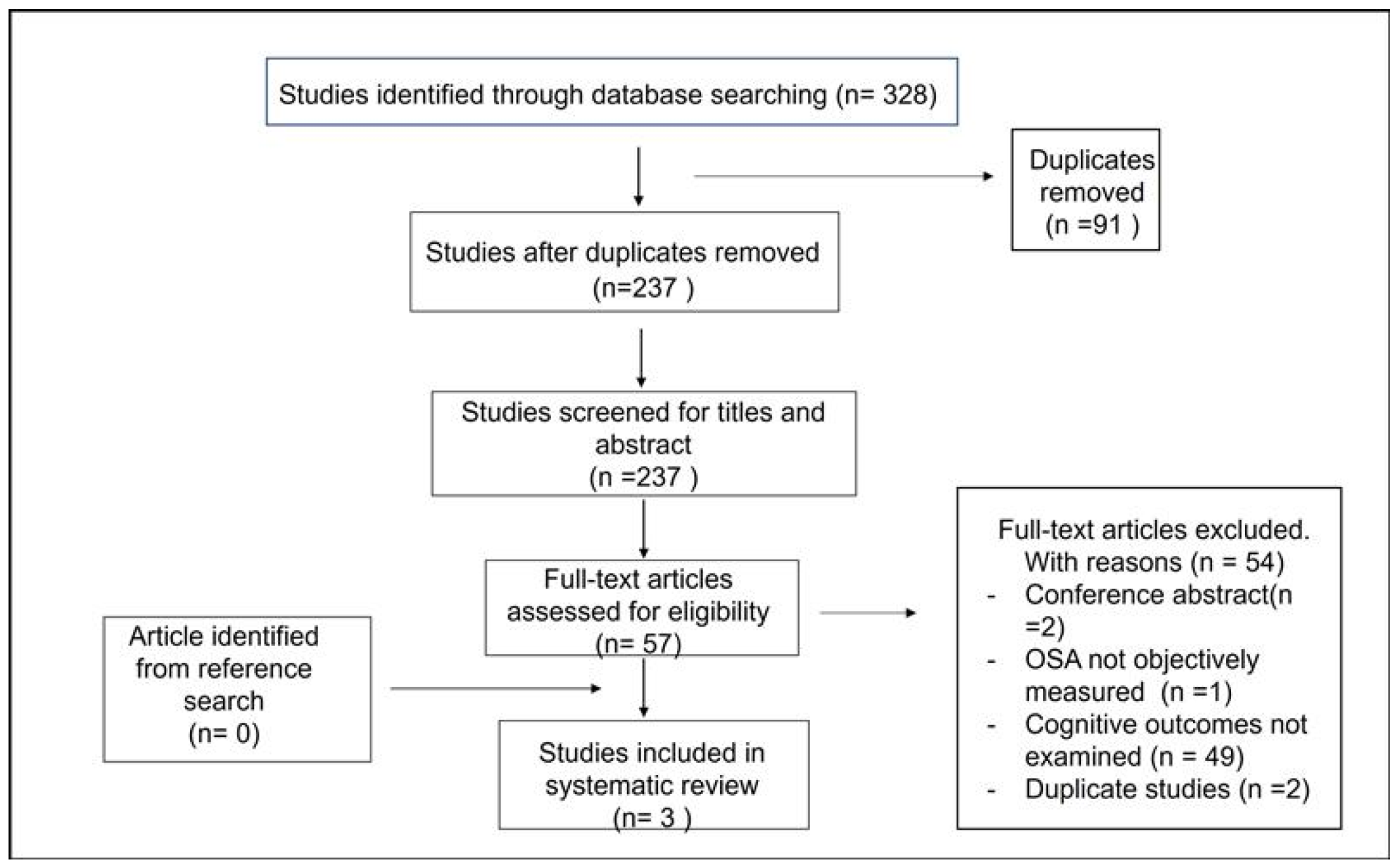
Three authors (AP, BM, and LE) independently reviewed the titles and abstracts of all identified studies using EndNote X9. Disagreements regarding study inclusion were resolved by two additional authors (XD and CW). XD performed data extraction for each eligible study. Extracted information included authors, year of publication, study design, study population, age, sleep apnea measurement, APOE measurement, outcome assessment, statistical analysis methods, covariates, and main findings. Figure 1 illustrates the study selection process.
Figure 1.
Study procedure. Flowchart depicting the study selection process for the systematic review. Arrows indicate the progression from initial identification of studies through database searching (n = 328) to final inclusion (n = 3). The process includes removing duplicates, screening studies by title and abstract, assessing full-text articles for eligibility, and excluding studies based on various criteria (e.g., conference abstracts, not measuring OSA objectively).
2.4. Quality Assessment and Analysis
The methodological quality of the included studies was evaluated using the Joanna Briggs Institute (JBI) Critical Appraisal Tools, which provide design-specific criteria for cohort and cross-sectional studies. For each study, key domains were assessed, including study design and setting, key strengths, and key limitations. Strengths across the studies included objective APOE measurement and standardized cognitive assessments, while limitations included potential residual confounding, variable assessment of sleep apnea, and limited generalizability for clinic-based samples. These quality assessments guided the interpretation of the evidence but did not influence study inclusion. Furthermore, given the limited number of studies included in this review (n = 3), a quantitative meta-analysis was not feasible. Instead, a narrative synthesis was conducted to summarize and interpret the findings. Key study characteristics—including study design, population, setting, APOE assessment, sleep apnea assessment, and dementia/cognitive outcomes—were extracted and compared across studies. The relationships between APOE, sleep apnea, and cognitive outcomes were evaluated by identifying patterns, consistencies, and discrepancies in the evidence.
3. Results
Figure 1 illustrates the study selection process. Initially, 328 studies were identified. After removing duplicate records, 237 studies remained for screening based on titles and abstracts. Following this screening, 57 full-text articles were retrieved for further evaluation. Ultimately, three studies met the inclusion and exclusion criteria outlined in the Section 2 and were selected for analysis.
Table 1 shows results for the quality assessment of three studies. The cohort study by Lim et al. allowed for temporal assessment of the relationship between APOE genotype, sleep apnea, and subsequent cognitive outcomes, while the cross-sectional studies provided snapshots of associations at a single time point. Overall, study quality was moderate across all studies. Strengths included objective APOE genotyping, standardized cognitive assessments, and, in some cases, polysomnography-based evaluation of sleep apnea. Limitations were primarily related to study design and setting: cross-sectional designs prevented causal inference, clinic-based sampling reduced generalizability, and some studies had incomplete adjustment for potential confounders, including cardiovascular risk factors. Overall, the findings suggest that sleep apnea interacts with APOE to influence the risk of AD or cognitive outcomes.
Table 1.
Quality Assessment Table for the Three Studies.
Table 2 presents the information extracted from eligible studies. Lim et al. reported that better sleep consolidation reduced the effect of the APOE e4 allele on AD risk. Specifically, the hazard ratio for AD among APOE e4 carriers compared with non-carriers decreased from 4.1 for poor sleep consolidation to 2.5 for median sleep consolidation and 1.8 for good sleep consolidation [27]. Nikodemova et al. found that sleep-disordered breathing—defined as increased resistance to airflow through the upper airway, loud snoring, reduced airflow (hypopnea), or complete cessation of breathing (apnea)—was associated with poorer performance on memory tests (Auditory Verbal Learning Test) and verbal fluency (Controlled Oral Word Association Test) among APOE e4 carriers, whereas no significant effects were observed in non-carrier [28]. Similarly, correlation analyses in O’Hara et al. indicated that the number of respiratory events was negatively associated with memory performance only in APOE e4 carriers [29].
Table 2.
General characteristics of study participants for selected study and main findings.
4. Discussion
This study reviewed observational research conducted over the past two decades on the interaction between APOE and sleep apnea and their impact on cognition and the risk of mild cognitive impairment (MCI) or Alzheimer’s disease (AD) in adults. Evidence on this topic is limited, with only three studies identified during that period. Nonetheless, these studies indicate that APOE and sleep apnea may interact to influence cognitive function and the likelihood of MCI or AD. Another study by Ding et al. [30] concluded that baseline sleep apnea was associated with the development of dementia, but only in APOE-e4 non-carriers. However, since the sleep apnea measurement in this study was self-reported, it was excluded from this review. Interest in this topic has been increasing, with several recent studies focusing on the issue. Yiallourou et al. found no consistent association between sleep architecture and incident dementia after pooling five U.S. cohort studies and adjusting for APOE e4 [31]. Sun et al. reported that sleep EEG-based brain age index (BAI) was positively associated with the risk of incident dementia using pooled data from community-based longitudinal cohorts [32]. Fonseca et al. found that, among American Indians, midlife sleep characteristics were correlated with cognitive performance [33]. However, these studies did not investigate the interaction between sleep and APOE. Marchi et al. examined the moderating effect of APOE on the association between obstructive sleep apnea (OSA) and cognitive function. They concluded that severe OSA was associated with lower Stroop test performance among APOE e4 carriers, but not among non-carriers [34]. Similarly, Gara et al. found that APOE e4 carriers with moderate-to-severe OSA demonstrated worse episodic memory, whereas non-carriers did not [35]. Notably, both studies were cross-sectional and had small sample sizes, which limits the strength of their conclusions.
It is well-established that Apolipoprotein E (APOE) is one of the most important genetic risk factors for Alzheimer’s disease (AD), primarily through its influence on amyloid-beta (Aβ) pathology [9,36,37,38,39]. The association between sleep apnea and cognitive decline, as well as the development of mild cognitive impairment (MCI), AD, or dementia, has been widely investigated in observational studies [27,40,41,42,43,44,45]. There are three common APOE alleles—e2, e3, and e4. Individuals carrying one or more e4 alleles have an increased risk of developing LOAD. Evidence suggests that the APOE genotype may affect Aβ clearance and aggregation, leading to Aβ accumulation and deposition [7,46,47]. Human studies have shown that Aβ deposition is more likely in AD patients who are APOE e4-carriers than in those who are APOE e4 non-carriers [48,49,50].
Studies using transgenic mice to model Aβ deposition have provided evidence that APOE influences Aβ accumulation in terms of both amount and distribution. Bales et al. used APOE knockout mice and demonstrated that, in the absence of APOE, in vivo Aβ deposition was dramatically reduced [51]. Bubu et al. conducted a systematic review integrating findings from studies on sleep apnea, cognition, and AD over the past three decades. They concluded that the association between sleep apnea and cognitive function is more evident in younger adults than in older adults, independent of study design [52]. They also found that sleep apnea is associated with the development of MCI or AD in older adults. Duan et al. reported that taking a nap at noon affects the risk of MCI depending on APOE status [53]. Turner et al. conducted stratified analyses based on race and found that the interaction between OSA and APOE e4 was significantly associated with white matter hyperintensities (WMHs) and hippocampal volume in Black/African American participants, but not in White participants [54]. Furthermore, adjusting for confounders is essential in studies involving older populations to ensure accurate and meaningful results. Lim et al. found that the interaction between sleep and APOE remained unchanged after adjusting for vascular diseases, vascular risk factors, stroke, Parkinson’s disease (PD), and psychotropic medications [27]. Nikodemova et al. [28] assessed various covariates, including medical history, medication use, alcohol consumption, and CPAP treatment, and found that only sleep, APOE4 status, age, sex, education, and BMI had a significant effect on cognitive scores. However, no additional covariates were available in O’Hara’s study [29].
Several plausible mechanisms may explain these associations, including disrupted sleep, intermittent hypoxia, and reduced slow-wave sleep (SWS), all of which can affect amyloid-beta (Aβ) metabolism [55,56]. In humans, the sleep/wake cycle regulates Aβ levels. Sleep deprivation studies have shown that lack of sleep may increase Aβ production by approximately 30% overnight [44,57]. Increased wakefulness under sleep deprivation also reduces Aβ clearance via the glymphatic system, thereby increasing Aβ levels [58]. Observations of greater sleep disturbances in amyloid-positive versus amyloid-negative cognitively normal, late-middle-aged adults suggest that sleep disruption may contribute to Aβ accumulation even in the preclinical phase of AD [11,59]. Chronic intermittent hypoxia resulting from sleep apnea may further promote Aβ deposition, as oxidative stress increases Aβ production and accumulation [60,61,62,63]. Mouse studies have demonstrated that intermittent hypoxia is associated with increased Aβ production [64,65]. Reduced SWS is another potential mechanism linking sleep apnea to AD pathogenesis [66], as SWS has been shown to correlate with Aβ levels [67,68,69,70].
This review has several limitations. First, only three studies met the inclusion criteria, which limits the breadth of available evidence and prevents robust comparisons across study populations, methods, or outcomes. Second, the small number of studies precluded the use of meta-analysis and restricted the review to a narrative synthesis. Third, the included studies varied in design, setting, and measurement of sleep apnea, APOE genotype, and cognitive outcomes, which may introduce heterogeneity and limit the generalizability of findings. Finally, publication bias cannot be ruled out, as studies with null findings may be less likely to be published.
5. Conclusions
In conclusion, the available evidence suggests a potential interaction between sleep apnea and APOE ε4 status in relation to cognitive function and dementia, although findings remain limited and heterogeneous. This study suggests that limited research has explored the interaction between APOE and sleep in Alzheimer’s disease (AD), likely due to challenges in study design, the high cost of longitudinal studies, and data availability issues, as older sleep studies often lacked APOE testing. Publication bias may also play a role, as studies with negative or inconclusive results are less likely to be published. This review highlights a growing interest in this area, with more recent studies pooling data from multiple cohorts. However, future research should focus on understanding the underlying mechanisms, such as how sleep may influence APOE-related AD pathology. As AD-related changes, like amyloid-beta accumulation, can begin 15–20 years before dementia symptoms appear, alterations in sleep patterns at younger ages may serve as early biomarkers for AD prediction and intervention.
Supplementary Materials
The following supporting information can be downloaded at: https://www.mdpi.com/article/10.3390/jgg74010004/s1, PRISMA 2020 Checklist.
Author Contributions
X.D. designed and oversaw the study. C.W. conducted a literature search, screened titles and abstracts for eligibility, and extracted data from the full-text articles. A.P., K.H., B.M. and L.E. screened literature titles and abstracts, and extracted the full articles. J.N.-S. reviewed the manuscript and provided critical feedback. All authors have read and agreed to the published version of the manuscript.
Funding
This work was supported by the WKU Research & Creative Activities Program (RCAP) and by grant P20GM103436-22 (KY INBRE) from the National Institute of General Medical Sciences at the National Institutes of Health.
Data Availability Statement
No new data were created in this study. However, data may be available upon reasonable request from the corresponding author, subject to ethical approval and privacy restrictions.
Conflicts of Interest
The authors have no conflicts of interest to declare.
References
- WHO. Dementia Fact sheet and Details; WHO: Geneva, Switzerland, 2025. [Google Scholar]
- Better, M.A. Alzheimer’s disease facts and figures. Alzheimer’s Dement. 2024, 20, 3708–3821. [Google Scholar]
- Matthews, K.A.; Xu, W.; Gaglioti, A.H.; Holt, J.B.; Croft, J.B.; Mack, D.; McGuire, L.C. Racial and ethnic estimates of Alzheimer’s disease and related dementias in the United States (2015–2060) in adults aged ≥65 years. Alzheimer’s Dement. 2019, 15, 17–24. [Google Scholar] [CrossRef] [Scilit]
- Alzheimer’s Association. New Alzheimer’s Association Report Reveals Sharp Increases in Alzheimer’s Prevalence, Deaths, Cost of Care; Alzheimer’s Association: Chicago, IL, USA, 2018. [Google Scholar]
- Serrano-Pozo, A.; Das, S.; Hyman, B.T. APOE and Alzheimer’s disease: Advances in genetics, pathophysiology, and therapeutic approaches. Lancet Neurol. 2021, 20, 68–80. [Google Scholar] [CrossRef] [Scilit]
- Shang, L.; Dong, L.; Huang, X.; Wang, T.; Mao, C.; Li, J.; Wang, J.; Liu, C.; Gao, J. Association of APOE ε4/ε4 with fluid biomarkers in patients from the PUMCH dementia cohort. Front. Aging Neurosci. 2023, 15, 1119070. [Google Scholar] [CrossRef] [Scilit] [PubMed]
- Liu, C.C.; Liu, C.C.; Kanekiyo, T.; Bu, G. Apolipoprotein E and Alzheimer disease: Risk, mechanisms and therapy. Nat. Rev. Neurol. 2013, 9, 106–118. [Google Scholar] [CrossRef] [Scilit]
- Bateman, R.M.; Sharpe, M.D.; Jagger, J.E.; Ellis, C.G.; Solé-Violán, J.; López-Rodríguez, M.; Herrera-Ramos, E.; Ruíz-Hernández, J.; Borderías, L.; Horcajada, J.; et al. 36th International Symposium on Intensive Care and Emergency Medicine: Brussels, Belgium. 15–18 March 2016. Crit. Care 2016, 20, 94. [Google Scholar] [CrossRef] [Scilit] [PubMed]
- Corder, E.H.; Saunders, A.M.; Strittmatter, W.J.; Schmechel, D.E.; Gaskell, P.C.; Small, G.W.; Roses, A.D.; Haines, J.L.; Pericak-Vance, M.A. Gene dose of apolipoprotein E type 4 allele and the risk of Alzheimer’s disease in late onset families. Science 1993, 261, 921–923. [Google Scholar] [CrossRef] [Scilit]
- Gonzales, P.N.G.; Villaraza, S.G.; Rosa, J.C.D. The association between sleep and Alzheimer’s disease: A systematic review. Dement. Neuropsychol. 2024, 18, e20230049. [Google Scholar] [CrossRef] [Scilit]
- Ju, Y.-E.S.; McLeland, J.S.; Toedebusch, C.D.; Xiong, C.; Fagan, A.M.; Duntley, S.P.; Morris, J.C.; Holtzman, D.M. Sleep quality and preclinical alzheimer disease. JAMA Neurol. 2013, 70, 587–593. [Google Scholar] [CrossRef] [Scilit]
- Jiang, Q.; Lee, C.D.; Mandrekar, S.; Wilkinson, B.; Cramer, P.; Zelcer, N.; Mann, K.; Lamb, B.; Willson, T.M.; Collins, J.L.; et al. ApoE promotes the proteolytic degradation of Abeta. Neuron 2008, 58, 681–693. [Google Scholar] [CrossRef] [Scilit]
- Ancoli-Israel, S.; Kripke, D.F.; Klauber, M.R.; Mason, W.J.; Fell, R.; Kaplan, O. Sleep-disordered breathing in community-dwelling elderly. Sleep 1991, 14, 486–495. [Google Scholar] [CrossRef] [Scilit]
- Phillips, B.; Cook, Y.; Schmitt, F.; Berry, D. Sleep apnea: Prevalence of risk factors in a general population. South Med. J. 1989, 82, 1090–1092. [Google Scholar] [CrossRef] [Scilit]
- Tseng, C.-Y.; Morris, E.J.; Sekhon, V.K.; Albrecht, J.S.; Wickwire, E.M.; Spira, A.P.; Gross, A.L.; Malhotra, A.; Blinka, M.D.; Kaufmann, C.N. Clinical characteristics and medication use patterns of middle-aged and older adults with sleep apnea with and without comorbid insomnia. Sleep Breath. 2025, 29, 167. [Google Scholar] [CrossRef] [Scilit]
- Grandner, M.A.; Martin, J.L.; Patel, N.P.; Jackson, N.J.; Gehrman, P.R.; Pien, G.; Perlis, M.L.; Xie, D.; Sha, D.; Weaver, T.; et al. Age and sleep disturbances among American men and women: Data from the U.S. Behavioral Risk Factor Surveillance System. Sleep 2012, 35, 395–406. [Google Scholar] [CrossRef] [Scilit]
- Peppard, P.E.; Young, T.; Barnet, J.H.; Palta, M.; Hagen, E.W.; Hla, K.M. Increased prevalence of sleep-disordered breathing in adults. Am. J. Epidemiol. 2013, 177, 1006–1014. [Google Scholar] [CrossRef] [Scilit]
- Osorio, R.S.; Ayappa, I.; Mantua, J.; Gumb, T.; Varga, A.; Mooney, A.M.; Burschtin, O.E.; Taxin, Z.; During, E.; Spector, N.; et al. The interaction between sleep-disordered breathing and apolipoprotein E genotype on cerebrospinal fluid biomarkers for Alzheimer’s disease in cognitively normal elderly individuals. Neurobiol. Aging 2014, 35, 1318–1324. [Google Scholar] [CrossRef] [Scilit] [PubMed]
- Bixler, E.O.; Vgontzas, A.N.; Lin, H.M.; Ten Have, T.; Rein, J.; Vela-Bueno, A.; Kales, A. Prevalence of sleep-disordered breathing in women: Effects of gender. Am. J. Respir. Crit. Care Med. 2001, 163, 608–613. [Google Scholar] [CrossRef] [Scilit]
- Durán, J.; Esnaola, S.; Rubio, R.; Iztueta, Á. Obstructive sleep apnea–hypopnea and related clinical features in a population-based sample of subjects aged 30 to 70 yr. Am. J. Respir. Crit. Care Med. 2001, 163, 685–689. [Google Scholar] [CrossRef] [Scilit] [PubMed]
- Ip, M.S.; Lam, B.; Lauder, I.J.; Tsang, K.W.; Chung, K.-F.; Mok, Y.-W.; Lam, W.-K. A community study of sleep-disordered breathing in middle-aged Chinese men in Hong Kong. Chest 2001, 119, 62–69. [Google Scholar] [CrossRef] [Scilit] [PubMed]
- Spira, A.P.; Blackwell, T.; Stone, K.L.; Redline, S.; Cauley, J.A.; Ancoli-Israel, S.; Yaffe, K. Sleep-disordered breathing and cognition in older women. J. Am. Geriatr. Soc. 2008, 56, 45–50. [Google Scholar] [CrossRef] [Scilit]
- Martin, M.S.; Sforza, E.; Roche, F.; Barthélémy, J.C.; Thomas-Anterion, C. Sleep breathing disorders and cognitive function in the elderly: An 8-year follow-up study. the proof-synapse cohort. Sleep 2015, 38, 179–187. [Google Scholar]
- Rosenzweig, I.; Glasser, M.; Crum, W.R.; Kempton, M.J.; Milosevic, M.; McMillan, A.; Leschziner, G.D.; Kumari, V.; Goadsby, P.; Simonds, A.K.; et al. Changes in Neurocognitive Architecture in Patients with Obstructive Sleep Apnea Treated with Continuous Positive Airway Pressure. EBioMedicine 2016, 7, 221–229. [Google Scholar] [CrossRef] [Scilit] [PubMed]
- Ungvari, Z.; Fekete, M.; Lehoczki, A.; Munkácsy, G.; Fekete, J.T.; Zábó, V.; Purebl, G.; Varga, P.; Ungvari, A.; Győrffy, B. Sleep disorders increase the risk of dementia, Alzheimer’s disease, and cognitive decline: A meta-analysis. GeroScience 2025, 47, 4899–4920. [Google Scholar] [CrossRef] [Scilit] [PubMed]
- Guay-Gagnon, M.; Vat, S.; Forget, M.; Tremblay-Gravel, M.; Ducharme, S.; Nguyen, Q.D.; Desmarais, P. Sleep apnea and the risk of dementia: A systematic review and meta-analysis. J. Sleep Res. 2022, 31, e13589. [Google Scholar] [CrossRef] [Scilit] [PubMed]
- Lim, A.S.P.; Kowgier, M.; Yu, L.; Buchman, A.S.; Bennett, D.A. Sleep Fragmentation and the Risk of Incident Alzheimer’s Disease and Cognitive Decline in Older Persons. Sleep 2013, 36, 1027–1032. [Google Scholar] [CrossRef] [Scilit]
- Nikodemova, M.; Finn, L.; Mignot, E.; Salzieder, N.; Peppard, P.E. Association of sleep disordered breathing and cognitive deficit in APOEε4 carriers. Sleep 2013, 36, 873–880. [Google Scholar] [CrossRef] [Scilit]
- O’Hara, R.; Schröder, C.M.; Kraemer, H.C.; Kryla, N.; Cao, C.; Miller, E.; Schatzberg, A.F.; Yesavage, J.A.; Murphy, G.M., Jr. Nocturnal sleep apnea/hypopnea is associated with lower memory performance in APOE epsilon4 carriers. Neurology 2005, 65, 642–644. [Google Scholar] [CrossRef] [Scilit]
- Ding, X.; Kryscio, R.J.; Turner, J.; Jicha, G.A.; Cooper, G.; Caban-Holt, A.; Schmitt, F.A.; Abner, E.L. Self-Reported Sleep Apnea and Dementia Risk: Findings from the Prevention of Alzheimer’s Disease with Vitamin E and Selenium Trial. J. Am. Geriatr. Soc. 2016, 64, 2472–2478. [Google Scholar] [CrossRef] [Scilit]
- Yiallourou, S.; Baril, A.-A.; Wiedner, C.; Misialek, J.R.; E Kline, C.; Harrison, S.; Cannon, E.; Yang, Q.; Bernal, R.; Bisson, A.; et al. Sleep architecture and dementia risk in adults: An analysis of 5 cohorts from the Sleep and Dementia Consortium. Sleep 2025, 48, zsaf129. [Google Scholar] [CrossRef] [Scilit]
- Sun, H.; Milton, S.; Fang, Y.; Taha, H.B.; Shiju, S.; Thomas, R.J.; Ganglberger, W.; Pase, M.P.; Hughes, T.; Purcell, S.; et al. Dementia Risk and Machine Learning-Derived Brain Age Index from Sleep Electroenceph-alography: A Pooled Cohort Analysis of Over 7000 Individuals Across Five Community Cohorts. medRxiv 2025, Preprint. [Google Scholar]
- Fonseca, L.M.; Finlay, M.G.; Chaytor, N.S.; Morimoto, N.G.; Buchwald, D.; Van Dongen, H.P.A.; Quan, S.F.; Suchy-Dicey, A. Mid-life sleep is associated with cognitive performance later in life in aging American Indians: Data from the Strong Heart Study. Front. Aging Neurosci. 2024, 16, 1346807. [Google Scholar] [CrossRef] [Scilit]
- Marchi, N.A.; Berger, M.; Solelhac, G.; Bayon, V.; Haba-Rubio, J.; Legault, J.; Thompson, C.; Gosselin, N.; Vollenweider, P.; Marques-Vidal, P.; et al. Obstructive sleep apnea and cognitive functioning in the older general population: The moderating effect of age, sex, ApoE4, and obesity. J. Sleep Res. 2024, 33, e13938. [Google Scholar] [CrossRef] [Scilit]
- Gara, E.M.; Goya, T.T.; Ferreira-Silva, R.; Matheus, L.; Jordão, R.M.; Araújo, M.L.; Silva, A.J.; Guerra, R.S.; Lorenzi-Filho, G.; Ueno-Pardi, L.M. APOE Polymorphism, Obstructive Sleep Apnea, and Cognitive Function. Sleep Sci. 2024, 18, e17–e24. [Google Scholar] [CrossRef] [Scilit] [PubMed] [PubMed Central]
- Strittmatter, W.J.; Saunders, A.M.; Schmechel, D.; Pericak-Vance, M.; Enghild, J.; Salvesen, G.S.; Roses, A.D. Apolipoprotein E: High-avidity binding to beta-amyloid and increased frequency of type 4 allele in late-onset familial Alzheimer disease. Proc. Natl. Acad. Sci. USA 1993, 90, 1977–1981. [Google Scholar] [CrossRef] [Scilit]
- Poirier, J.; Bertrand, P.; Kogan, S.; Gauthier, S.; Davignon, J.; Bouthillier, D. Apolipoprotein E polymorphism and Alzheimer’s disease. Lancet 1993, 342, 697–699. [Google Scholar] [CrossRef] [Scilit]
- Saunders, A.M.; Strittmatter, W.J.; Schmechel, D.; George-Hyslop, P.H.S.; Pericakvance, M.A.; Joo, S.H.; Rosi, B.L.; Gusella, J.F.; Crapper-MacLachlan, D.R.; Alberts, M.J.; et al. Association of apolipoprotein E allele epsilon 4 with late-onset familial and sporadic Alzheimer’s disease. Neurology 1993, 43, 1467–1472. [Google Scholar] [CrossRef] [Scilit] [PubMed]
- Suri, S.; Emir, U.; Stagg, C.J.; Near, J.; Mekle, R.; Schubert, F.; Zsoldos, E.; Mahmood, A.; Singh-Manoux, A.; Kivimäki, M.; et al. Effect of age and the APOE gene on metabolite concentrations in the posterior cingulate cortex. NeuroImage 2017, 152, 509–516. [Google Scholar] [CrossRef] [Scilit] [PubMed]
- Blackwell, T.; Yaffe, K.; Ancoli-Israel, S.; Schneider, J.L.; Cauley, J.A.; Hillier, T.A.; Fink, H.A.; Stone, K.L.; Study of Osteoporotic Fractures Group. Poor sleep is associated with impaired cognitive function in older women: The study of osteoporotic fractures. J. Gerontol. Ser. A 2006, 61, 405–410. [Google Scholar] [CrossRef] [Scilit]
- Blackwell, T.; Yaffe, K.; Ancoli-Israel, S.; Redline, S.; Ensrud, K.E.; Stefanick, M.L.; Laffan, A.; Stone, K.L.; Osteoporotic Fractures in Men Study Group. Associations between sleep architecture and sleep-disordered breathing and cognition in older community-dwelling men: The Osteoporotic Fractures in Men Sleep Study. J. Am. Geriatr. Soc. 2011, 59, 2217–2225. [Google Scholar] [CrossRef] [Scilit]
- Yaffe, K.; Laffan, A.M.; Harrison, S.L.; Redline, S.; Spira, A.P.; Ensrud, K.E.; Ancoli-Israel, S.; Stone, K.L. Sleep-disordered breathing, hypoxia, and risk of mild cognitive impairment and dementia in older women. JAMA 2011, 306, 613–619. [Google Scholar] [CrossRef] [Scilit]
- Lim, A.S.P.; Yu, L.; Costa, M.D.; Leurgans, S.E.; Buchman, A.S.; Bennett, D.A.; Saper, C.B. Increased fragmentation of rest-activity patterns is associated with a characteristic pattern of cognitive impairment in older individuals. Sleep 2012, 35, 633–640. [Google Scholar] [CrossRef] [Scilit]
- Kang, J.-E.; Lim, M.M.; Bateman, R.J.; Lee, J.J.; Smyth, L.P.; Cirrito, J.R.; Fujiki, N.; Nishino, S.; Holtzman, D.M. Amyloid-beta; dynamics are regulated by orexin and the sleep-wake cycle. Science 2009, 326, 1005–1007. [Google Scholar] [CrossRef] [Scilit] [PubMed]
- Holtzman, D.M.; Morris, J.C.; Goate, A.M. Alzheimer’s disease: The challenge of the second century. Sci. Transl. Med. 2011, 3, 77sr1. [Google Scholar] [CrossRef] [Scilit]
- Huynh, T.-P.V.; Davis, A.A.; Ulrich, J.D.; Holtzman, D.M. Apolipoprotein E and Alzheimer’s disease: The influence of apolipoprotein E on amyloid-β and other amyloidogenic proteins. J. Lipid Res. 2017, 58, 824–836. [Google Scholar] [CrossRef] [Scilit]
- Kim, J.; Lee, S.; In, K.; Kim, J.; You, S.; Kang, K.; Sim, J.; Lee, S.; Yoon, D.; Lee, J.; et al. Increase in serum haptoglobin and apolipoprotein M in patients with obstructive sleep apnoea. J. Sleep Res. 2009, 18, 313–320. [Google Scholar] [CrossRef] [Scilit]
- Rebeck, G.W.; Reiter, J.S.; Strickland, D.K.; Hyman, B.T. Apolipoprotein E in sporadic Alzheimer’s disease: Allelic variation and receptor interactions. Neuron 1993, 11, 575–580. [Google Scholar] [CrossRef] [Scilit]
- Morris, J.C.; Roe, C.M.; Xiong, C.; Fagan, A.M.; Goate, A.M.; Holtzman, D.M.; Mintun, M.A. APOE predicts amyloid-beta but not tau Alzheimer pathology in cognitively normal aging. Ann. Neurol. 2010, 67, 122–131. [Google Scholar] [CrossRef] [Scilit] [PubMed]
- Reiman, E.M.; Chen, K.; Liu, X.; Bandy, D.; Yu, M.; Lee, W.; Ayutyanont, N.; Keppler, J.; Reeder, S.A.; Langbaum, J.B.S.; et al. Fibrillar amyloid-beta burden in cognitively normal people at 3 levels of genetic risk for Alzheimer’s disease. Proc. Natl. Acad. Sci. USA 2009, 106, 6820–6825. [Google Scholar] [CrossRef] [Scilit] [PubMed]
- Bales, K.R.; Verina, T.; Dodel, R.C.; Du, Y.; Altstiel, L.; Bender, M.; Hyslop, P.; Johnstone, E.M.; Little, S.P.; Cummins, D.J.; et al. Lack of apolipoprotein E dramatically reduces amyloid beta-peptide deposition. Nat. Genet. 1997, 17, 263–264. [Google Scholar] [CrossRef] [Scilit]
- Bubu, O.M.; Andrade, A.G.; Umasabor-Bubu, O.Q.; Hogan, M.M.; Turner, A.D.; de Leon, M.J.; Ogedegbe, G.; Ayappa, I.; Jean-Louis G, G.; Jackson, M.L.; et al. Obstructive sleep apnea, cognition and Alzheimer’s disease: A systematic review integrating three decades of multidisciplinary research. Sleep Med. Rev. 2020, 50, 101250. [Google Scholar] [CrossRef] [Scilit]
- Duan, H.; Sun, Y.; Liu, Q.; Fu, J.; Huang, L.; Wang, Z.; Zhao, J.; Li, Z.; Li, W.; Liu, H.; et al. Apolipoprotein E polymorphism ε4-stratified longitudinal association between daytime naps, sleep apnea and mild cognitive impairment: A prospective cohort study. Eur. J. Neurol. 2022, 29, 1385–1393. [Google Scholar] [CrossRef] [Scilit]
- Turner, A.D.; Locklear, C.E.; Oruru, D.; Briggs, A.Q.; Bubu, O.M.; Seixas, A. Exploring the combined effects of sleep apnea and APOE-e4 on biomarkers of Alzheimer’s disease. Front. Aging Neurosci. 2022, 14, 1017521. [Google Scholar] [CrossRef] [Scilit]
- Sanchez-Espinosa, M.P.; Atienza, M.; Cantero, J.L. Sleep deficits in mild cognitive impairment are related to increased levels of plasma amyloid-β and cortical thinning. NeuroImage 2014, 98, 395–404. [Google Scholar] [CrossRef] [Scilit] [PubMed]
- Olsson, M.; Ärlig, J.; Hedner, J.; Blennow, K.; Zetterberg, H. Sleep deprivation and cerebrospinal fluid biomarkers for Alzheimer’s disease. Sleep 2018, 41, zsy025. [Google Scholar] [CrossRef] [Scilit]
- Lucey, B.P.; Hicks, T.J.; McLeland, J.S.; Toedebusch, C.D.; Boyd, J.; Elbert, D.L.; Patterson, B.W.; Baty, J.; Morris, J.C.; Ovod, V.; et al. Effect of sleep on overnight cerebrospinal fluid amyloid β kinetics. Ann. Neurol. 2018, 83, 197–204. [Google Scholar] [CrossRef] [Scilit] [PubMed]
- Xie, L.; Kang, H.; Xu, Q.; Chen, M.J.; Liao, Y.; Thiyagarajan, M.; O’Donnell, J.; Christensen, D.J.; Nicholson, C.; Iliff, J.J.; et al. Sleep drives metabolite clearance from the adult brain. Science 2013, 342, 373–377. [Google Scholar] [CrossRef] [Scilit] [PubMed] [PubMed Central]
- Winer, J.R.; Mander, B.A.; Kumar, S.; Reed, M.; Baker, S.L.; Jagust, W.J.; Walker, M.P. Sleep Disturbance Forecasts β-Amyloid Accumulation across Subsequent Years. Curr. Biol. 2020, 30, 4291–4298.e3. [Google Scholar] [CrossRef] [Scilit]
- Guglielmotto, M.; Tamagno, E.; Danni, O. Oxidative stress and hypoxia contribute to Alzheimer’s disease pathogenesis: Two sides of the same coin. Sci. World J. 2009, 9, 781–791. [Google Scholar] [CrossRef] [Scilit]
- Zhang, X.; Zhou, K.; Wang, R.; Cui, J.; Lipton, S.A.; Liao, F.-F.; Xu, H.; Zhang, Y.-W. Hypoxia-inducible factor 1alpha (HIF-1alpha)-mediated hypoxia increases BACE1 expression and beta-amyloid generation. J. Biol. Chem. 2007, 282, 10873–10880. [Google Scholar] [CrossRef] [Scilit]
- Paola, D.; Domenicotti, C.; Nitti, M.; Vitali, A.; Borghi, R.; Cottalasso, D.; Zaccheo, D.; Odetti, P.; Strocchi, P.; Marinari, U.M.; et al. Oxidative stress induces increase in intracellular amyloid beta-protein production and selective activation of betaI and betaII PKCs in NT2 cells. Biochem. Biophys. Res. Commun. 2000, 268, 642–646. [Google Scholar] [CrossRef] [Scilit]
- Misonou, H.; Morishima-Kawashima, M.; Ihara, Y. Oxidative stress induces intracellular accumulation of amyloid beta-protein (Abeta) in human neuroblastoma cells. Biochemistry 2000, 39, 6951–6959. [Google Scholar] [CrossRef] [Scilit]
- Ng, K.-M.; Lau, C.-F.; Fung, M.-L. Melatonin reduces hippocampal beta-amyloid generation in rats exposed to chronic intermittent hypoxia. Brain Res. 2010, 1354, 163–171. [Google Scholar] [CrossRef] [Scilit]
- Shiota, S.; Takekawa, H.; Matsumoto, S.-E.; Takeda, K.; Nurwidya, F.; Yoshioka, Y.; Takahashi, F.; Hattori, N.; Tabira, T.; Mochizuki, H.; et al. Chronic intermittent hypoxia/reoxygenation facilitate amyloid-β generation in mice. J. Alzheimer’s Dis. 2013, 37, 325–333. [Google Scholar] [CrossRef] [Scilit]
- Varga, A.W.; Wohlleber, M.E.; Giménez, S.; Romero, S.; Alonso, J.F.; Ducca, E.L.; Kam, K.; Lewis, C.; Tanzi, E.B.; Tweardy, S.; et al. Reduced Slow-Wave Sleep Is Associated with High Cerebrospinal Fluid Aβ42 Levels in Cognitively Normal Elderly. Sleep 2016, 39, 2041–2048. [Google Scholar] [CrossRef] [Scilit]
- Ngo, H.-V.V.; Claassen, J.; Dresler, M. Sleep: Slow Wave Activity Predicts Amyloid-β Accumulation. Curr. Biol. 2020, 30, R1371–R1373. [Google Scholar] [CrossRef] [Scilit]
- Andrade, A.G.; Bubu, O.M.; Varga, A.W.; Osorio, R.S. The Relationship between Obstructive Sleep Apnea and Alzheimer’s Disease. J. Alzheimer’s Dis. 2018, 64, S255–S270. [Google Scholar] [CrossRef] [Scilit] [PubMed]
- Ju, Y.-E.S.; Ooms, S.J.; Sutphen, C.; Macauley, S.L.; Zangrilli, M.A.; Jerome, G.; Fagan, A.M.; Mignot, E.; Zempel, J.M.; Claassen, J.A.; et al. Slow wave sleep disruption increases cerebrospinal fluid amyloid-β levels. Brain 2017, 140, 2104–2111. [Google Scholar] [CrossRef] [Scilit] [PubMed]
- Ju, Y.S.; Zangrilli, M.A.; Finn, M.B.; Fagan, A.M.; Holtzman, D.M. Obstructive sleep apnea treatment, slow wave activity, and amyloid-β. Ann. Neurol. 2019, 85, 291–295. [Google Scholar] [CrossRef] [Scilit] [PubMed]

Disclaimer/Publisher’s Note: The statements, opinions and data contained in all publications are solely those of the individual author(s) and contributor(s) and not of MDPI and/or the editor(s). MDPI and/or the editor(s) disclaim responsibility for any injury to people or property resulting from any ideas, methods, instructions or products referred to in the content. |
© 2026 by the authors. Published by MDPI on behalf of the Italian Society of Gerontology and Geriatrics (SIGG). Licensee MDPI, Basel, Switzerland. This article is an open access article distributed under the terms and conditions of the Creative Commons Attribution (CC BY) license.