Article

Vellum of Lies: Designing and Evaluating a Multimodal Tangible Interaction System for Embodied Serious Historical Narratives

Edinburgh College of Art, University of Edinburgh, Edinburgh EH3 9DF, UK
*
Author to whom correspondence should be addressed.
Multimodal Technol. Interact. 2026, 10(9), 96; https://doi.org/10.3390/mti10090096 (registering DOI)
Submission received: 15 August 2026 / Revised: 14 September 2026 / Accepted: 15 September 2026 / Published: 20 September 2026

Abstract

Many existing historical narrative experiences still rely on screen-based viewing and limited multimodal interaction, which tends to keep users in a passive receiving role and limits their cognitive understanding, reflective thinking, user engagement, and emotional response. To address this, we designed Vellum of Lies, an immersive tangible user interface for anti-feudal historical narratives. The work integrates physical props, sensors, motion-based input, and projection mapping, organizing the story into continuous interaction nodes that allow users to participate in narrative progression through embodied interaction, including spatial movement, object manipulation, and final choice-making. The final choice mechanism operationalizes Tragic Agency by allowing users to make meaningful choices while constraining their ability to alter the final tragic outcome, with the aim of evoking tension between perceived choice and narrative inevitability. A mixed-methods user experience evaluation (N = 32) compared Vellum of Lies with a video-watching narrative experience. In this small-scale exploratory study, the experimental condition showed significant advantages in the HUQ Overall score, Reflection, the UES-SF Overall score, Aesthetic Appeal, Interest/Enjoyment, Pleasure/Valence, and Arousal, while also showing lower NASA-TLX Overall scores, Mental Demand, and Effort. Other measured subdimensions did not reach statistical significance. These preliminary findings suggest that multimodal tangible interaction may function not only as a presentation technique, but also as a narrative mechanism that coordinates physical input, bodily movement, projected feedback, and constrained choice-making to support selected aspects of understanding, engagement, and emotional reflection in serious historical narratives.

1. Introduction

With the development of digital media, the ways young audiences engage with historical content have changed significantly. Unlike traditional systematic education, historical content today is often presented through social media, short videos, and platform recommendations in fragmented and visualized forms [1]. Although this shift improves the accessibility and dissemination efficiency of historical information, it also weakens narrative continuity, explanatory depth, and value transmission. As a result, young audiences’ understanding of history often remains at the level of fragmented event recognition and memory, making it difficult to form deeper psychological involvement and identification with historical narratives [2]. This issue is especially evident in grand historical narratives, where young audiences often remain spectators. Although these forms may attract users through visual and auditory stimulation, the reception process is still largely sensory and passive, lacking active user engagement and reflection. In this context, historical content can be delivered, but deeper situated experience, emotional connection, cognitive understanding and reflection, and emotional response remain limited [3]. From the perspectives of narratology and embodied cognition, this limitation is closely related to the media forms and interaction mechanisms of existing historical narratives. Although historical communication has expanded from text to image, and from static display to digital interaction, it still largely follows a presentation-oriented model with limited participation [4]. Most interactions remain at the level of clicking, swiping, and selecting, rather than mapping user behavior onto historical logic, situated construction, and meaning-making [5]. Therefore, audiences may access, watch, or even operate history, but still struggle to develop deep understanding and emotional internalization through participation.
Against this background, gamified narrative provides a more engaging and participatory path for historical communication. Compared with relatively traditional modes of reception, gamified narrative uses task progression, role embodiment, and situated feedback to move audiences beyond passive information reception, allowing them to actively enter the narrative context through interaction and understand the developmental logic of historical events and the situations of historical figures [6]. For young audiences in particular, gamified forms can enhance attention, user engagement, and immersion. Through experiential and operable interaction, they strengthen the perceptibility of historical content and transform relatively abstract or distant historical issues into experiences that are easier to understand and accept [7]. Furthermore, the advantage of gamification lies not only in communicative appeal, but also in its capacity for narrative organization. Through rules, goals, feedback, and choice mechanisms, gamification can transform historical content into a process-based experience, enabling users to form an understanding of the situation through action and judgment, rather than merely obtaining conclusions through watching or reading [8]. This participatory narrative approach helps enhance users’ sense of involvement in historical situations and deepens their cognitive understanding and reflection on character fates, social relations, and event causality [9]. Therefore, gamification has strong potential in historical communication, especially in digital narratives for young audiences. However, in serious historical expression, it may also risk entertainment-oriented simplification; thus, balancing engagement and understanding remains important [10]. Based on this, this study takes gamification as an entry point to explore its value in anti-feudal historical communication.
Although existing historical-cultural games include basic interactive features such as narrative, characters, viewing, clicking, and choosing, these designs mainly allow users to access historical content and perform limited operations, but remain insufficient for deeper participation. Such interactions are therefore difficult to transform into embodied experiences corresponding to historical situations, and users’ participation may not naturally extend into a direct perception of historical processes and action consequences [11]. Based on this, embodied cognition and motion-based interaction provide a further participatory path for historical communication. Embodied cognition emphasizes that the body is not merely a tool for executing information, but an important medium for cognitive formation and meaning-making. By introducing bodily movement, physical contact, and spatial perception, audiences move beyond information reception, enter the narrative context through action, and gradually build an understanding of historical situations through continuous action loops [12]. For serious historical narratives, this body-based interaction has stronger expressive potential. On the one hand, embodied interaction can shorten the psychological distance between audiences and history, enhancing presence, role awareness, and situated understanding [13]. On the other hand, it directly maps physical behavior onto narrative progression, allowing users to perceive the causal relationship between action, consequences and plot development during operation, thus shifting from watching history to experiencing history [14]. Therefore, this study focuses on an integrated tangible–digital interaction system for historical communication, exploring how tangible interaction, bodily input, projection mapping, sensor integration, and real-time feedback can jointly transform static space into a dynamic narrative system, thereby enhancing the expressive power and reflective depth of anti-feudal historical narratives. Building on the above research background and problems, we designed and implemented Vellum of Lies, an immersive tangible user interface that explores how serious historical narratives can enhance users’ cognitive understanding and reflection, user engagement, and emotional response through multimodal interaction, embodied interaction, and Tragic Agency. The narrative is presented as a fictionalized and symbolic case developed through the selective recombination and artistic interpretation of historical and literary sources concerning rain-praying rituals, ritual violence, material culture, and feudal ethics. Taking a rain-praying ritual as the narrative thread, the system integrates tabletop tangible props, sensor recognition, Kinect-based motion recognition, projection mapping, and real-time audio feedback. Through continuous interaction tasks such as searching, placing, triggering, and choosing, users engage in object manipulation, spatial exploration, and motion-based input, gradually entering the historical situation and understanding the characters’ circumstances and the formation of tragedy. The contributions of this study are threefold. First, we propose a multimodal tangible interaction architecture that maps physical manipulation, spatial movement, sensor-triggered events, projection, and audio feedback onto narrative progression, turning historical content into a sequence of actionable interaction nodes. Second, we develop an embodied interaction strategy in which users’ bodily actions are not only used as system input, but are gradually transformed into perceived participation in historical causality. Third, drawing on existing theories of tragedy and game studies, we adapt and operationalize Tragic Agency as a design strategy for tangible interactive historical narratives. Through constrained final choice-making, this strategy connects perceptible action consequences with moral reflection and historical inevitability. To evaluate the system, we conducted a controlled mixed-methods user experience evaluation comparing Vellum of Lies with a video-watching narrative experience. This research revolves around the following three research questions:
RQ1: 
Can Vellum of Lies enhance users’ cognitive understanding and reflection of serious historical narratives?
RQ2: 
Can Vellum of Lies strengthen user engagement and spatial presence in the narrative context?
RQ3: 
Can Vellum of Lies promote users’ emotional response, empathy, and real-world association?
This study provides a new path for interactive narrative design in serious historical communication.

2. Related Work

2.1. Digital Narrative Presentation

Traditional historical and cultural exhibitions are usually based on museum displays, using artifacts, written explanations, images, audio guides, and expert interpretation to communicate historical content. Although these methods can present historical facts and cultural backgrounds in a stable way, their narrative organization is often static, with audiences mainly receiving information through reading, viewing, and listening. Traditional exhibitions often rely on one-way interpretation, such as wall texts, audio guides, and expert commentary, which can easily repeat exhibition labels and become tedious [15]. Thus, their limitation lies not only in a relatively single media form, but also in the lack of plot structure, process guidance, and participatory mechanisms that organize audience understanding. Digital historical narratives in serious contexts also face rigid narrative structures. Chang and Suh argue that digital storytelling depends not only on technology, but also on an effective story arc that organizes narrative progression through introduction, conflict, climax, and ending [16]. Chourmouziadi similarly notes that some exhibitions claim to be narrative-based, but still present objects and information as isolated arrangements, making it difficult for audiences to perceive them as meaningful wholes or develop cognitive understanding and reflection and emotional response [17]. Moreover, many historical narratives still follow a linear retelling of background, event, and outcome. Although this structure can explain what happened, it offers limited guidance for users to consider meaning and value. As a result, users may feel fatigued, remain at a surface-level understanding, and struggle to enter the story or reflect on the social structures, collective behavior, and individual responsibility behind historical tragedy. With digital media, historical and cultural content has gradually shifted from static presentation to video-based and image-based presentation. Compared with traditional exhibitions, video narratives use images, sound, editing, and plot organization to make history more vivid [18]. In short videos, documentary clips, and online historical communication, history is repackaged as a visually attractive and emotionally engaging viewing experience [19]. However, video-based presentation is often fragmented and discontinuous, simplifying complex backgrounds, character relationships, and causal logic, thereby weakening narrative integrity and reflective depth [19].
Therefore, digital historical narratives need not only new media forms, but also better plot organization, process guidance, and reflective space. This motivates later studies on interactive narrative design and Tragic Agency, enabling users to understand and reflect on history through participation.

2.2. Gamified Interactive Narratives

Some museum and cultural heritage designs have shifted from one-way display to interactive and participatory story experiences. Wang et al. show that virtual cultural heritage exhibitions increasingly combine VR/AR, 3D reconstruction, interactive narrative, game-based tasks, and personalized experience, enabling users to understand cultural content through tasks, interaction, and feedback [20]. Dal Falco and Vassos further propose Museum Experience Design, using interaction design, AI, IoT, and chatbots to transform artifacts, historical figures, buildings, and events into conversational and extensible story experiences [21]. Similarly, Bowen, Rowling, and Kirk’s Story Inspiration Station shows that museum interaction is not only about providing information, but also about supporting historical understanding through observation, imagination, and writing [22].
This shift can also be explained through gamified narrative theory. Existing studies suggest that game mechanics and narrative content are not separate layers, but can jointly support meaning-making. Naul and Liu further note that narratives in serious games should not be merely background information, but should be integrated with game mechanics and learning content to enhance immersion, user engagement, learning motivation, and learning outcomes [15].
In historical-cultural projects, gamification is often used to organize history as an experience that can be played, explored, reasoned through, and chosen. Valete Vos Viatores allows players to enter Roman history as inscription copyists [11], while White Bastion uses a narrator and virtual space to guide users through the history of Sarajevo’s fortress [23]. Other works further transform historical narratives into tasks, reasoning, and feedback. For example, Alfred Daniel J and Santhosh R propose a VR gamified model for historical learning [24], while InHeritage combines AR, VR, 3D artifacts, virtual tours, educational games, quizzes, and rewards [25]. Tracers of the Past emphasizes clues, teamwork, site exploration, and suspect reasoning, showing that history can become an edutainment experience with analytical processes [26].
Gamified historical narratives can also deepen understanding through emotionalized character fates and player choices. Valiant Hearts: The Great War uses ordinary wartime experiences, historical materials, and affective audiovisual design to foster emotional understanding of World War I [27], while The Elder Scrolls V: Skyrim uses open-world exploration, role-playing, faction choices, and moral decisions to support active narrative participation [28]. These studies demonstrate how player agency can support narrative involvement and moral engagement; however, agency in tragic narratives may also operate through actions whose outcomes remain structurally constrained.
Zhang describes Tragic Agency as a form of agency in which individuals remain capable of action, although their actions ultimately fail before the finality of fate [29]. Building on this account, the present study operationally defines Tragic Agency in multimodal tangible historical narratives as a condition in which users perform real, perceptible, and morally meaningful actions that generate local narrative consequences, while remaining unable to alter the final tragic outcome shaped by historical and social structures. In Vellum of Lies, this condition is materialized through prop placement, bodily movement, sensor-triggered progression, and final choice-making, which together form a continuous causal process through which users perform the ritual, uncover concealed violence, and confront the conflict between individual action and structural inevitability. Because users’ preceding actions still produce perceptible consequences and moral involvement, the design extends beyond a simple false choice and transforms Tragic Agency from an analytical concept in game studies into an implementable design strategy connecting tangible action, historical inevitability, moral responsibility, and reflection.
However, most existing designs still rely on virtual interaction and screen interfaces, limiting bodily movement, tangible interaction, and spatial participation. To address this limitation, this study introduces bodily movement and tangible interaction in real space to enhance users’ cognitive understanding and reflection, user engagement, and emotional response.

2.3. Embodied Interaction in Narrative Experiences

Embodied interaction can deepen users’ cognitive understanding and reflection in narrative experiences through bodily participation. Zhou, Xu, and Yao’s So Long allows users to become Voyager 1, travel through the solar system, decode the Golden Record, and leave personal voices through picking up, touching, blowing, and voice input [30]. This turns users from receivers of space-exploration memory into participants who reflect on their relation to collective human memory. Similarly, Shashwat et al.’s KaavadBits creates a multi-ending interactive narrative through NFC story blocks, replaceable character figures, branch-pulling choices, and fruit tokens for asking questions [31]. Across different domains, embodied interaction connects physical and virtual elements to transform abstract knowledge into perceptible and interactive experiences. Urban’s Kresy asks players to act as Soviet ethnographers in 1929, exploring villages, collecting household objects, and interpreting cultural meanings through rotation, zooming, X-ray analysis, annotation, and archival explanation [32]. Zheng et al.’s UE5- and IoT-based Touhu system maps throwing force, angle, speed, and hand posture onto virtual arrow trajectories, scoring feedback, and historical scene changes [33]. Ji, Zhong, Zhang, and Clark’s Guangcai porcelain prototype also shows how touching, grasping, moving, observing tools, and later making physical artifacts can support understanding of cultural processes, symbols, and aesthetics [34]. In museum and cultural heritage research, tangible and embodied interaction has become an established direction. Duranti et al.’s survey of more than 120 projects developed since 2000 shows that physical replicas, bodily actions, and multimodal feedback have been widely used in cultural communication and visitor-experience design [35]. Chu and Mazalek further propose a design framework for embodied engagement with cultural heritage artifacts, illustrated through projects such as Mapping Place and Multi-Sensory Prayer Nuts [36]. The Mastic Villages project uses 3D-printed objects to trigger audiovisual stories projected onto a physical model [37], while Sail with Columbus integrates sensor-equipped navigational tools into an interactive museum story to support learning about medieval navigation [38].
However, compared with other domains, historical-cultural narratives still show limited perceptible interaction, especially in tangible interaction design. Due to the complex cognitive barriers in this field, existing studies mostly focus on enhancing lower-level cognition, without fully advancing cognitive depth or emotional participation. Therefore, although interactive design can make historical content initially perceptible, the overall narrative experience and user engagement remain relatively superficial, failing to support deeper cognitive understanding and emotional resonance.
Overall, prior work provides useful embodied interaction strategies for this study. These studies demonstrate the value of tangible objects, projection, bodily action, and multimodal feedback for cultural interpretation, knowledge learning, story exploration, and visitor participation. Building on this foundation, Vellum of Lies organizes prop placement, bodily movement, sensor-triggered progression, projection, audio feedback, and final choice-making into a continuous narrative causal chain corresponding to ritual performance, the discovery of concealed violence, and final decision-making. Its principal distinction lies in making tangible and embodied interaction part of the causal and moral structure of a serious historical tragedy. In this structure, users’ physical actions are connected with perceived responsibility, historical inevitability, and reflection, allowing Tragic Agency to function as an implementable design mechanism.

3. Design of Vellum of Lies

3.1. Design Rationale

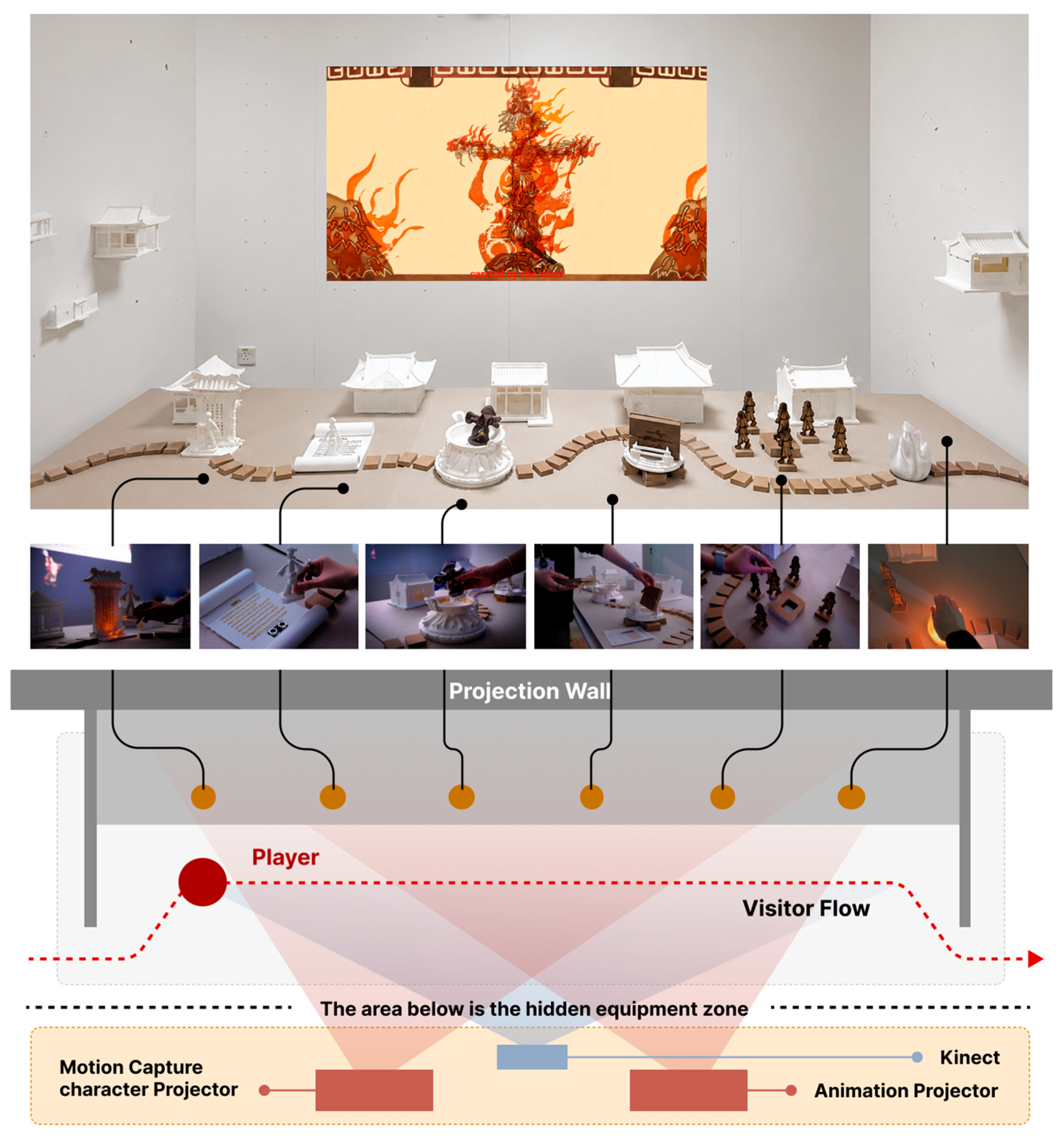
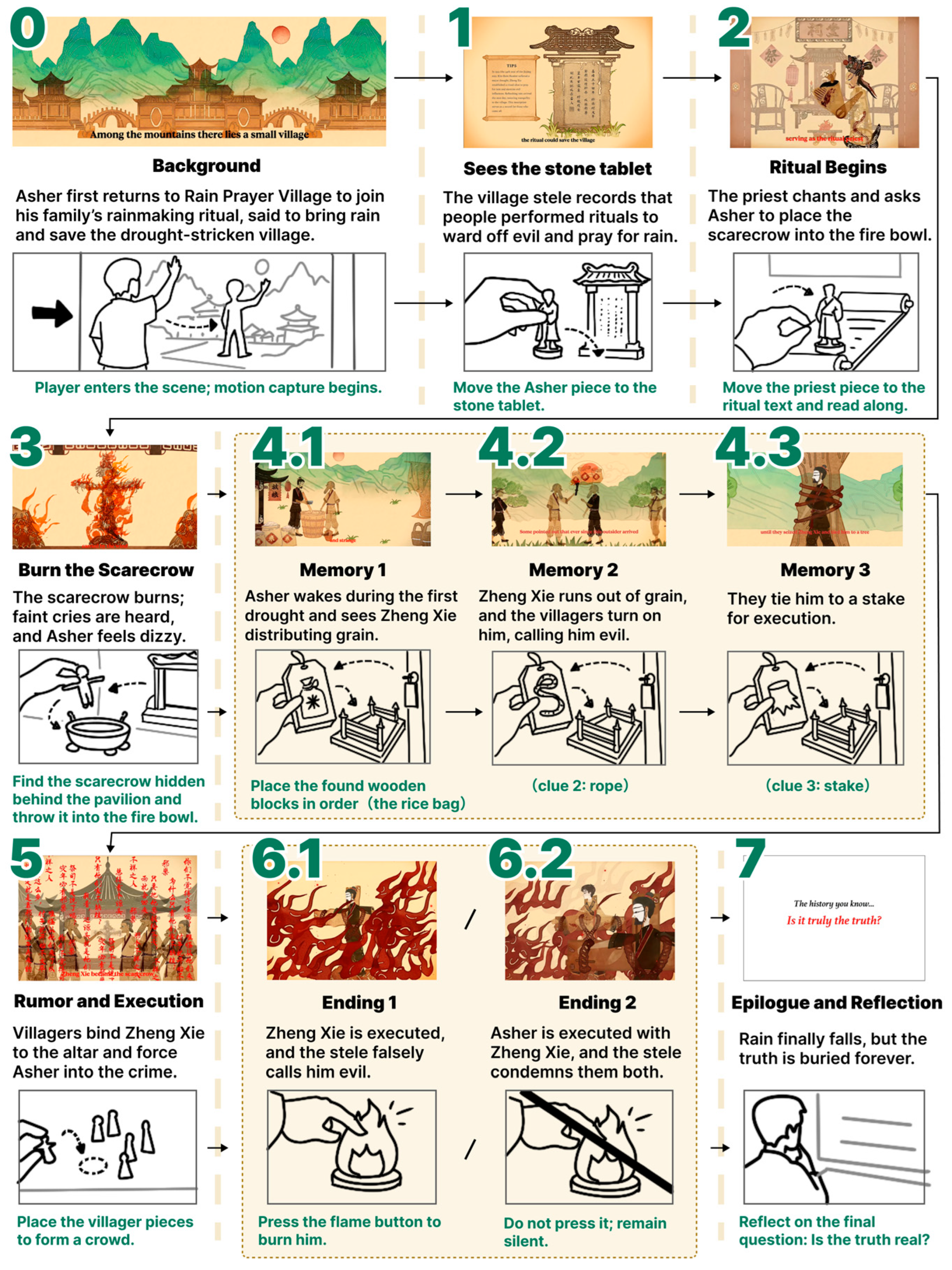
We designed and implemented Vellum of Lies, an immersive interactive game space that explores the spatialized and gamified expression of anti-feudal narratives through embodied interaction, including tabletop game operations, tangible device interaction, and body movement recognition. The narrative does not reconstruct a single historical incident but combines materials from different historical periods and cultural contexts. Its central rain-praying premise draws on research into Shang-dynasty rain rituals recorded in oracle bone inscriptions, including burnt-offering rites and accounts of ritual victims being burned in attempts to obtain rain [39]. The organization of the ritual community was informed by studies of rain-praying practices in Ming- and Qing-dynasty Guizhou, where local officials, Daoist ritual specialists, and self-organized local groups could participate in the performance of such rites [40]. The narrative’s thematic relationship among hierarchical authority, superstition, collective conformity, and individual submission was further informed by literary analysis of feudal ethics and individual awakening in Ba Jin’s Family [41]. The spatial and material design of ritual altars, offerings, sacred objects, and collective performance also referred to ethnographic documentation of the Miao zhuiniu ritual [42]. These heterogeneous references were selectively recombined into the fictional Rain-Praying Village as a symbolic and artistic interpretation of the relationship among ritual authority, collective participation, victimization, and violence. Players enter a drought-stricken village and gradually discover that the legend of exorcising evil and praying for rain conceals an act of collective violence in which an innocent person becomes the victim (Figure 1). Unlike traditional historical propaganda, documentaries, or exhibitions, this study does not position audiences as spectators who merely receive historical information. Instead, it transforms players into participants in the ritual process through tangible operation, spatial projection, and bodily participation. Players place props, trigger sensors, move their bodies, and make choices, while their actions are translated in real time into visual, auditory, and narrative feedback. In this way, history is no longer only an object to be watched, but becomes an interactive event directly connected to player behavior. This design reduces the psychological distance between audiences and historical tragedy, and encourages reflection on feudal systems, collective violence, and individual responsibility.

3.2. Implementation of Vellum of Lies

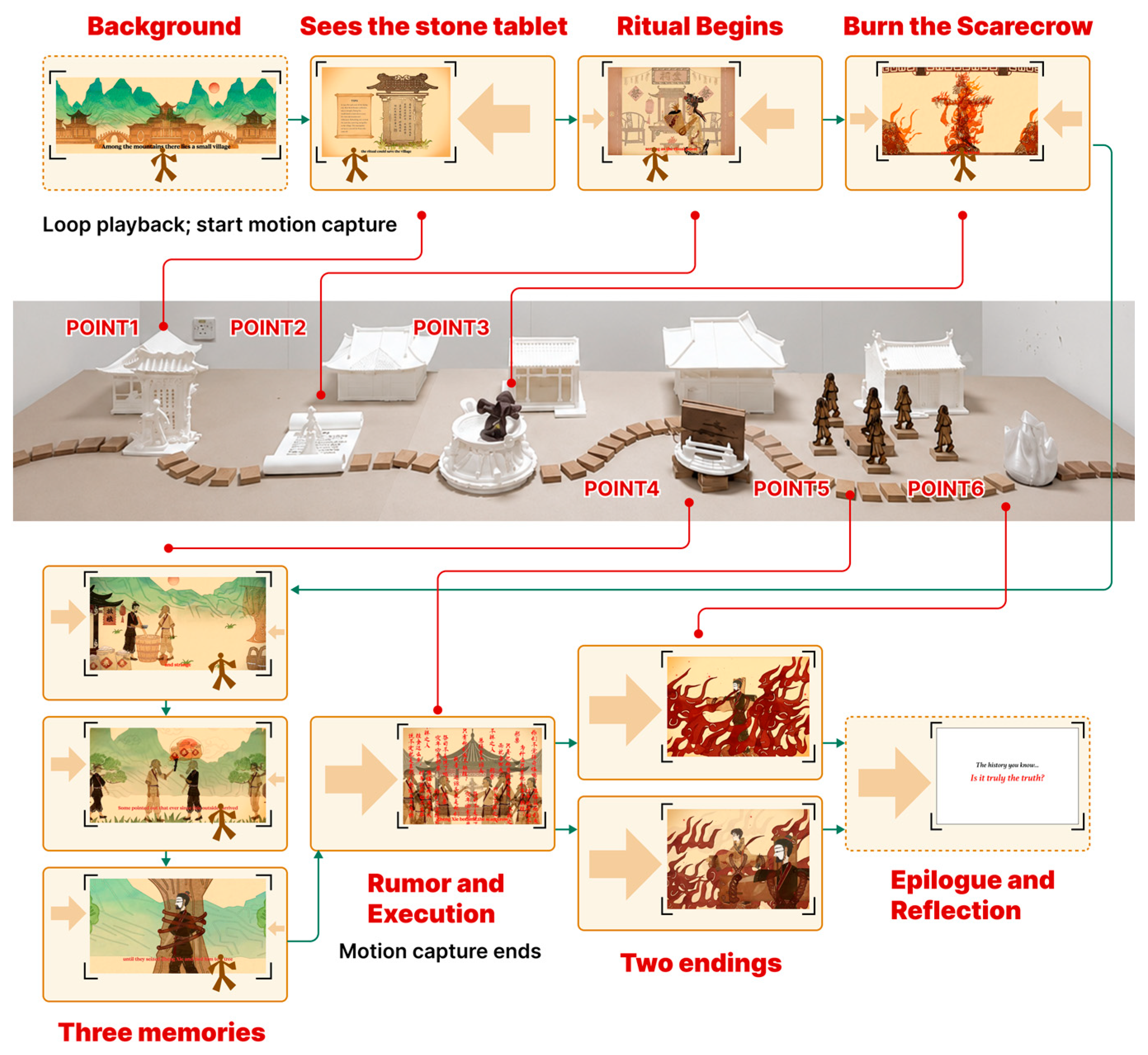
As shown in Figure 2, the game space is divided into two main areas: a tabletop tangible interaction scene and an environmental narrative wall. The horizontal tabletop serves as the primary area for players to complete game tasks, including prop placement, map exploration, and ritual operations. The vertical wall functions as the narrative feedback interface, using projection to present visual and auditory content triggered by player actions in real time. The user experience is organized as a continuous interaction chain, moving from entering the situation, performing the ritual, and revealing the truth to making the final choice.
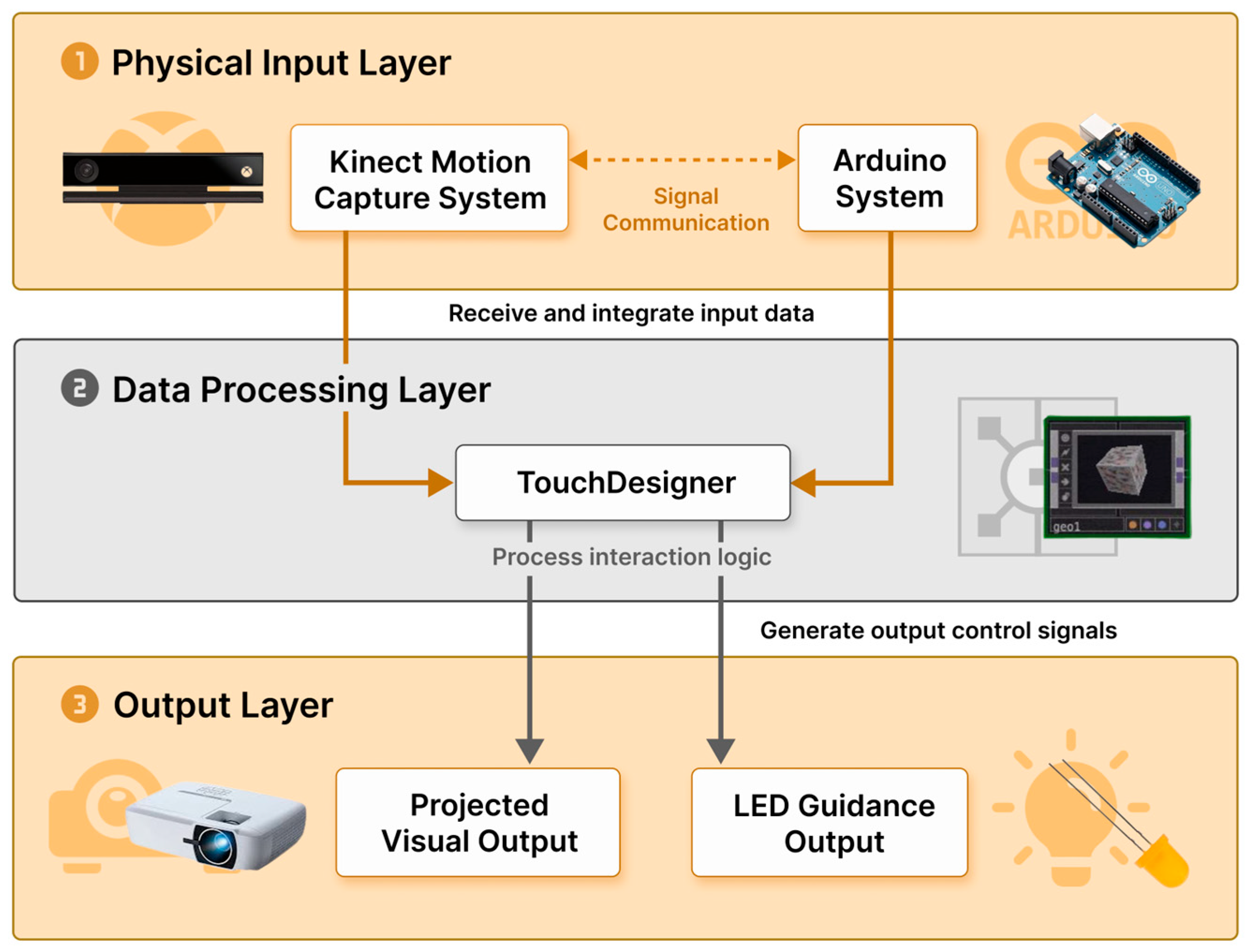
As shown in Figure 3, to enable real-time mapping between tangible interaction and digital narrative, the system constructs a layered interaction architecture. Arduino and Kinect serve as the input layer, respectively collecting interaction data such as prop placement, pressure changes, button choices, and body movements. TouchDesigner functions as the core processing layer, integrating input signals, determining the current narrative state, and driving the projection and audio systems to generate corresponding feedback.
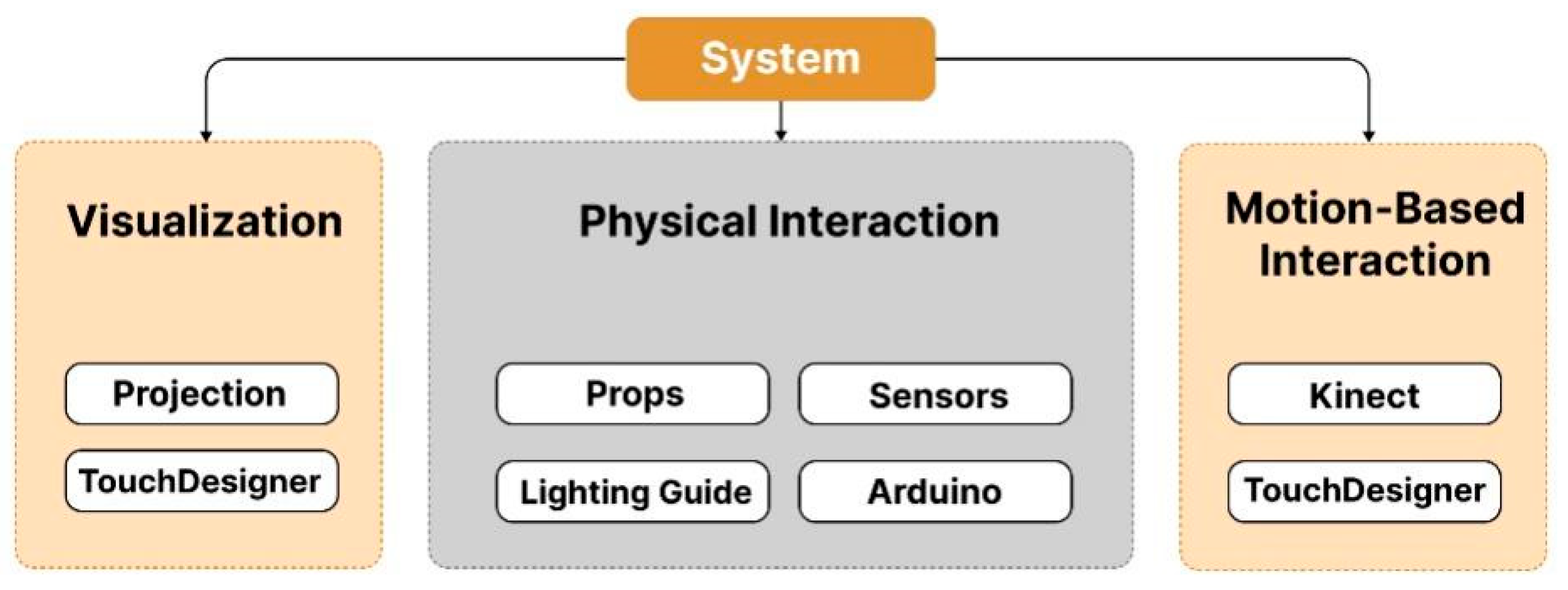
Building on this architecture, the system is further divided into three main modules, as shown in Figure 4: the visualization system, the physical interaction system, and the motion-based interaction system. To clarify the technical implementation and improve reproducibility, Table 1 summarizes how each modality was implemented and mapped to narrative functions. Rather than operating as independent systems, the visualization, physical interaction, and motion-based interaction systems are coordinated as an integrated tangible–digital interaction chain that connects user actions, narrative-state changes, and audiovisual feedback.
Before the formal user study, each sensor-triggered interaction node was calibrated and repeatedly tested. For the ultrasonic sensors, the distance readings obtained when the interaction area was empty and when the target prop was correctly placed were compared to determine an effective detection range for each node. Because the tangible props differed in their dimensions, weight, and placement positions, the two pressure sensors were calibrated separately for their corresponding props. During calibration, sensor outputs were recorded under both unloaded and correctly loaded conditions, and repeated placement tests were conducted to identify a range that could consistently distinguish between the two states. During operation, Arduino continuously collected the raw sensor readings, compared them with the calibrated range assigned to each node, and converted the results into discrete states, with 0 indicating that the target prop had not been placed and 1 indicating that it had been correctly placed. These discrete states were then transmitted to TouchDesigner through serial communication, where they were interpreted in relation to the current narrative stage to control state transitions and the corresponding projection and audio feedback. Button input, Kinect motion capture, and the end-to-end response process from user operation to projection and audio feedback were also repeatedly tested. Response latency was checked during these tests to ensure that each interaction node could operate stably and follow the intended narrative sequence.

3.2.1. Visualization System

The visualization module mainly consists of wall-based animated projection and the TouchDesigner visual scheduling system. Its function is not simply to display the storyline, but to translate players’ actions on the tabletop device into real-time environmental narrative feedback. The system built in TouchDesigner adopts a layered interaction architecture, including an input acquisition layer, a state logic layer, a content scheduling layer, and a visual output layer. First, the system receives real-time input data from Arduino sensors and the Kinect motion capture module. It then segments and processes these data to determine whether the player has completed specific interaction nodes, such as prop placement, button pressing, or body movement. TouchDesigner subsequently converts these input signals into discrete interaction states through node-based logic, and determines the next feedback content according to the current narrative stage. When a key node is triggered, the system calls the corresponding animation clips and sound effects, allowing the player’s physical actions to be immediately transformed into narrative changes on the wall projection. Finally, the visual content is accurately projected onto the environmental narrative wall and designated display areas through projection mapping, forming a continuous interaction chain.
In terms of spatial presentation, as shown in Figure 5, the wall projection functions as a medium for narrative manifestation. When the player moves to the next interaction node, the projected content is adjusted accordingly to keep the narrative animation within the player’s frontal view. After the player completes prop placement, button selection, or key-node triggering on the tabletop map, the animation changes synchronously. In this way, the player’s physical actions are amplified into perceptible narrative events.

3.2.2. Physical Interaction System

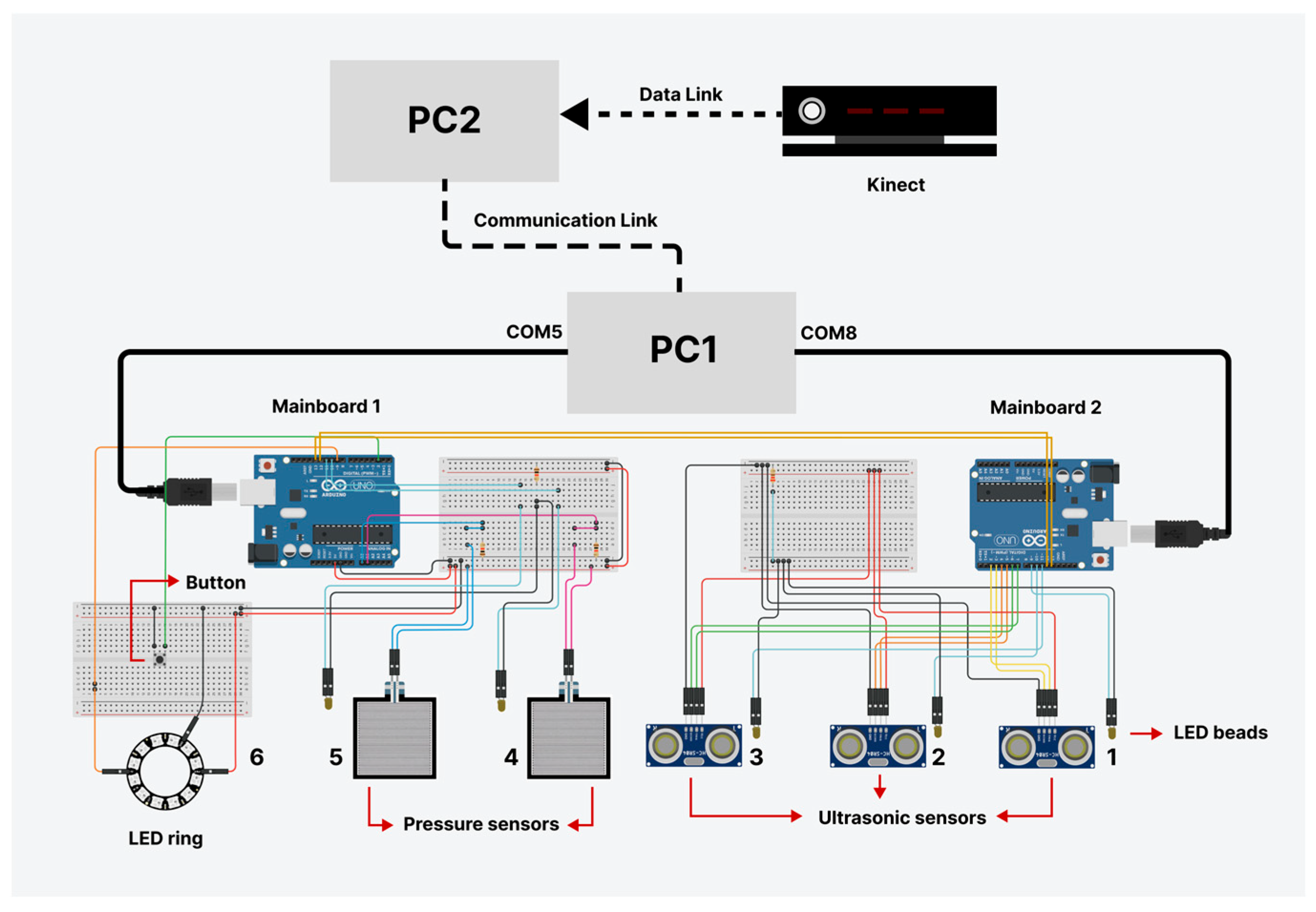
The physical interaction system is centered on a miniature map of the Rain-Praying Village and consists of village scene props, sensors, lighting components, and an Arduino control system. In the technical implementation, Arduino serves as the core control unit. Three ultrasonic sensors, two pressure sensors, and one button are connected as the main input devices to identify the player’s operation states at different narrative nodes, as shown in Figure 6.
Specifically, the ultrasonic sensors are used to detect whether the player has completed prop placement in designated areas. The pressure sensors detect changes in weight and identify cumulative placement actions during the interaction process. The button serves as the input device for the final choice node, triggering the ending branch. During signal processing, the Arduino converts the continuous sensor readings into discrete operation states according to the independently calibrated detection range of each interaction node and transmits these states to the main computer through serial communication. After receiving the data, TouchDesigner interprets each state in relation to the current narrative stage. Only the state corresponding to the active interaction node can trigger the associated projection and audio feedback, while inputs from inactive nodes do not advance the narrative. Once the active node is completed, the system updates the narrative state and begins evaluating the condition associated with the next node.

3.2.3. Motion-Based Interaction System

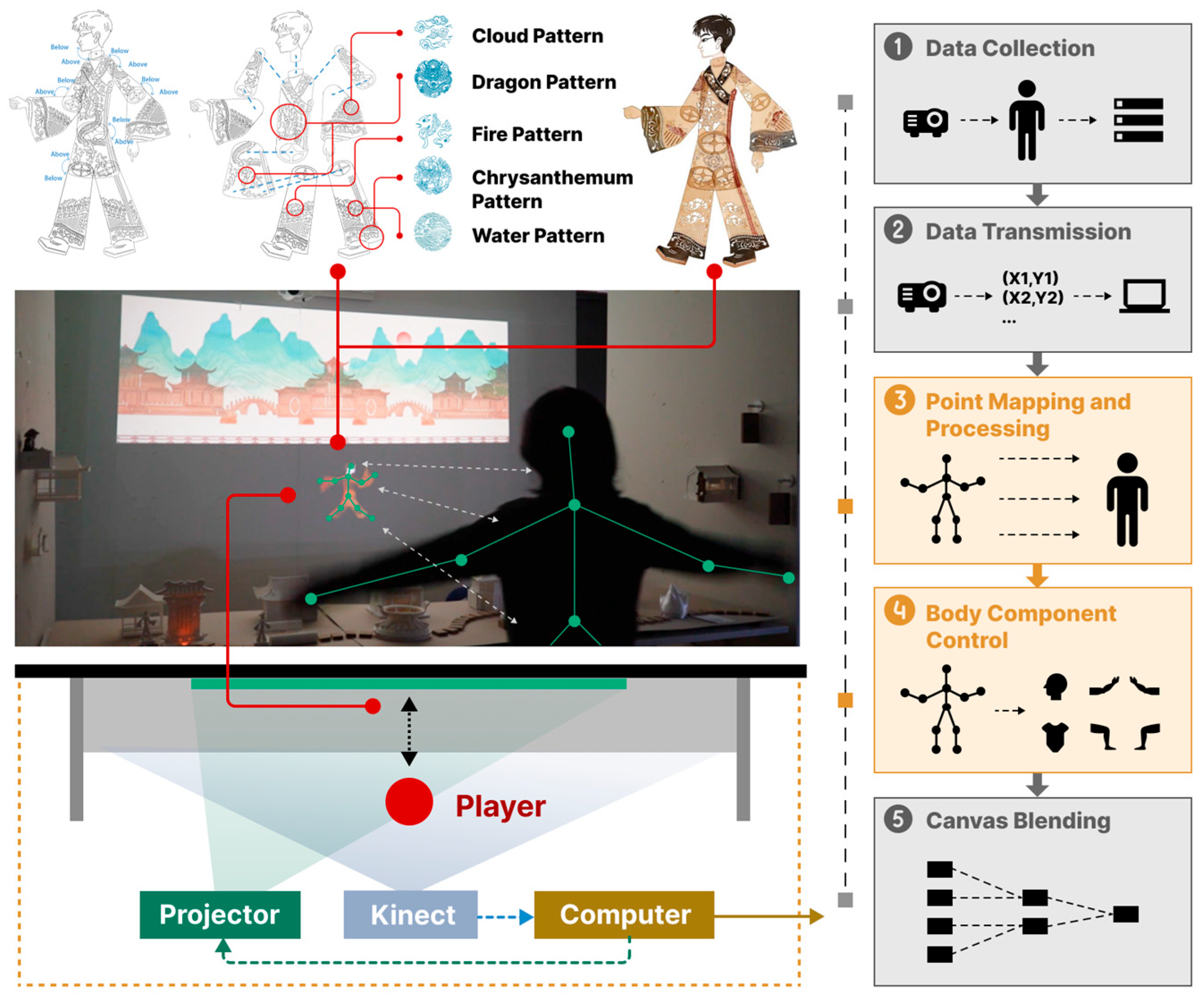
The motion-based interaction module is designed to establish a real-time mapping between the player’s bodily actions and the projected character. Overall, this module uses Kinect as the body movement capture device and TouchDesigner as the data processing and visual control platform. It translates the player’s body posture within the interaction area into dynamic changes in a two-dimensional shadow-puppet character, thereby expanding the player’s mode of participation in the narrative space, as shown in Figure 7.
Specifically, Kinect first captures the player’s skeletal tracking data, including positional changes in key body joints such as the head, torso, arms, and legs. TouchDesigner then reads and transforms these body-joint data and maps them onto different body parts of the two-dimensional character in the projected image. The shadow-puppet character is divided into independently controllable image layers, including the head, torso, upper limbs, and lower limbs. TouchDesigner transforms the Kinect skeletal joint coordinates into the two-dimensional coordinate system of the projected image. Changes in joint positions control the displacement of the corresponding character layers, while the directional relationships between adjacent joints determine limb rotation. For example, the shoulder-to-elbow relationship controls the upper-arm layer, the elbow-to-hand relationship controls the forearm layer, and the hip-to-knee and knee-to-foot relationships control the lower-limb layers. These position and rotation values are continuously applied to the independent image layers, producing visual changes synchronized with the player’s movement. This real-time mapping is enabled only during the designated motion-interaction node and within the predefined Kinect capture area.
In addition, the motion-based interaction module receives stage-state signals from the main computer to control the projection content at different narrative stages. When the game enters the fourth interaction node, the narrative shifts from the real ritual space to past historical memory. At this point, the player no longer influences the character as an external controller, but is instead drawn into the historical event and gradually becomes a participant in the causal chain. Therefore, after receiving the corresponding stage signal, TouchDesigner temporarily disables the Kinect-driven real-time character projection and switches to the preset historical narrative animation. This transition allows the player to recognize that their embodied character has entered the animation itself, rather than remaining only as a controllable figure outside the story. In this way, the system transforms the relationship between embodied interaction and narrative representation: the player’s role is no longer merely mapped onto a projected character, but is incorporated into the unfolding historical causality, preparing for the later connection between player action and tragic narrative consequence.

3.2.4. Design Details

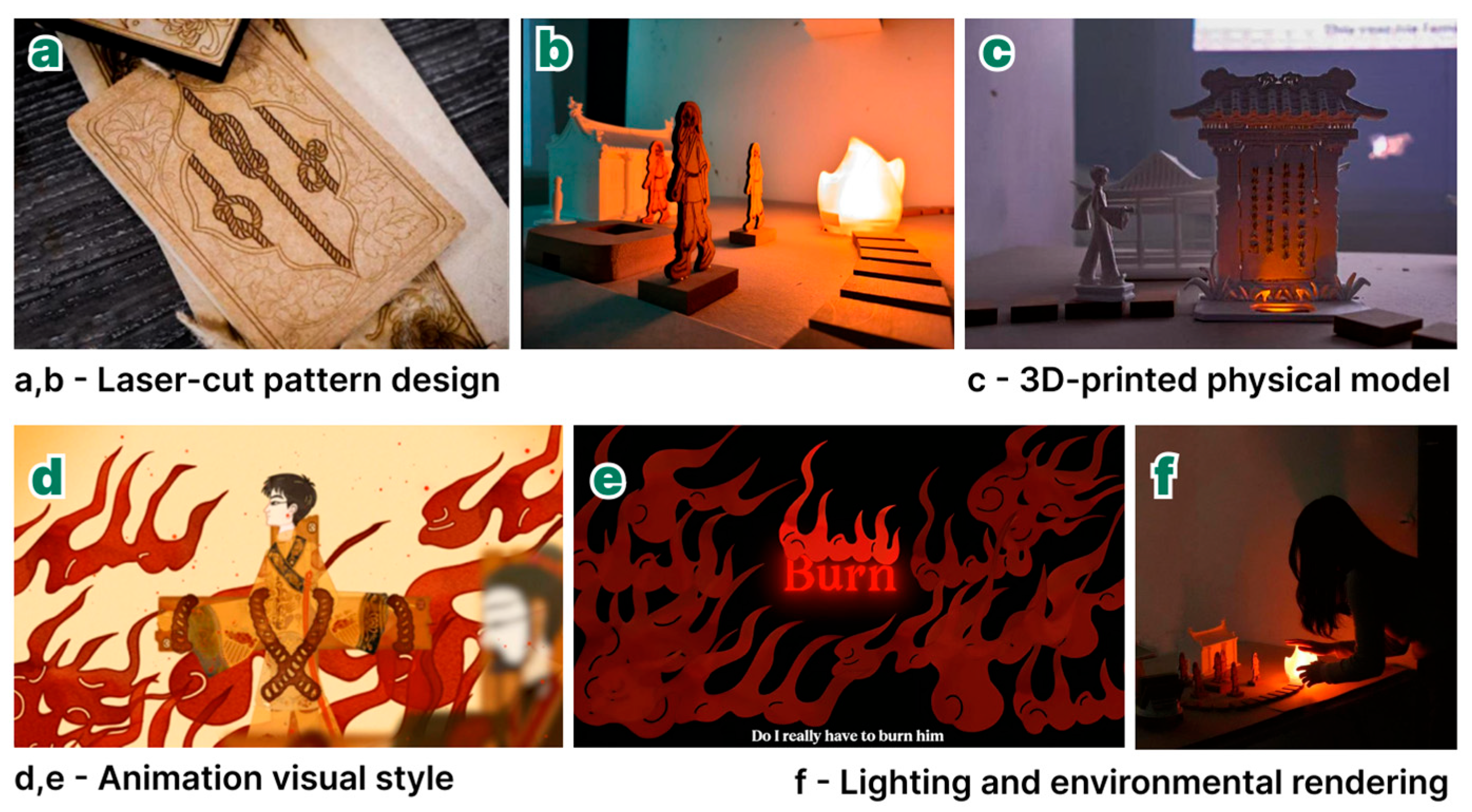
To align with the overall interaction form, the wall-projection animation adopts a shadow-puppet-inspired silhouette style, as shown in Figure 8. This visual approach, which expresses character relationships through outlines and movements, fits the projection medium and allows narrative information to be clearly recognized within the spatial projection. As a form of Chinese traditional intangible cultural heritage, shadow puppetry also carries a strong theatrical and narrative quality, reinforcing the historical and cultural context of the work. To maintain visual consistency with the wall projection, the tabletop interaction scene adopts a three-dimensional paper-cut style, creating a unified visual language between the physical props and the projected narrative.
In terms of sound design, the system draws on the musical rhythm and percussion structure of Peking Opera. This allows the audio to form dramatic rhythmic changes during narrative progression, maintaining consistency with the visual narrative.
In terms of causal mapping, considering that historical narratives often involve fixed outcomes, and that this study aims to reflect on feudal systems, the system constructs a narrative mechanism based on inevitable tragedy. After understanding the story, players discover that no matter what final choice they make, whether attempting to save the victim or being forced to submit, they cannot change the tragic ending. This design logic of Tragic Agency aims to make players realize that, through their seemingly ordinary operations, they have already become part of the tragic narrative, or even a kind of historical accomplice. By preventing players from avoiding moral examination, the design emphasizes that no one can remain untouched under the oppression of a feudal system. Through this irreversible narrative ending, the work encourages players to reconsider the relationship between individual actions and historical structures, thereby generating deeper moral warning and reflection.

4. Experiment

Based on the functional prototype, we planned a comparative experiment to evaluate the effectiveness of Vellum of Lies in serious historical narrative experiences. We also aimed to collect users’ feedback on the integrated tangible–digital experience of Vellum of Lies, including their perceptions of tangible interaction, bodily participation, audiovisual feedback, and constrained choice-making, through questionnaires and semi-structured interviews. This study adopted a between-subjects comparative design with 16 participants in the experimental condition and 16 in the control condition, comparing users’ experiences of watching linear digital narrative content versus experiencing the interactive Vellum of Lies system. The study was guided by the following hypotheses:
H1. 
The integrated tangible–digital interaction system can effectively support users’ cognitive understanding and reflection of serious historical narratives.
H2. 
The integrated tangible–digital interaction system of Vellum of Lies can significantly enhance user engagement in historical narrative contexts.
H3. 
The integrated tangible–digital interaction and narrative experience of Vellum of Lies can enhance users’ emotional response.

4.1. Participants

To improve recruitment efficiency, this study recruited 32 participants through extended personal networks and snowball sampling, and randomly assigned them to the experimental or control condition. The experimental group included 16 participants, including 8 males and 8 females, and the control group included 16 participants, including 8 males and 8 females. Participants were aged between 20 and 35 years old ( M = 24.16 , S D = 2.60 ). Participants in the experimental group were coded as “E1, E2…E16,” while those in the control group were coded as “C1, C2…C16.” Most participants were recruited in the United Kingdom and were students or university staff. During recruitment, a pre-screening questionnaire was used to confirm that they had no systematic knowledge of the Chinese historical and folk-cultural narratives involved in this study, while possessing basic experience in using digital media. These criteria helped reduce differences in prior knowledge and technological familiarity and improved comparability within the sample and between the two conditions. All participants reported normal or corrected-to-normal vision and hearing, no history of epilepsy, and normal physical condition on the day of the experiment, enabling them to complete tasks such as watching, moving, operating tangible props, and participating in interviews. Before the experiment, all participants read the study information sheet and provided written informed consent. Participants were informed of the study procedures, the emotionally sensitive narrative content, the dynamic visual and projection stimuli, and their right to pause or withdraw at any time. Screening excluded individuals with a history of epilepsy or photosensitive epilepsy, or sensitivity to flashing images or intense visual stimuli. All participants received a brief debriefing after the experiment. Written permission was also obtained from the relevant participants for the use of identifiable images in research documentation and academic publication.

4.2. Setup and Procedure

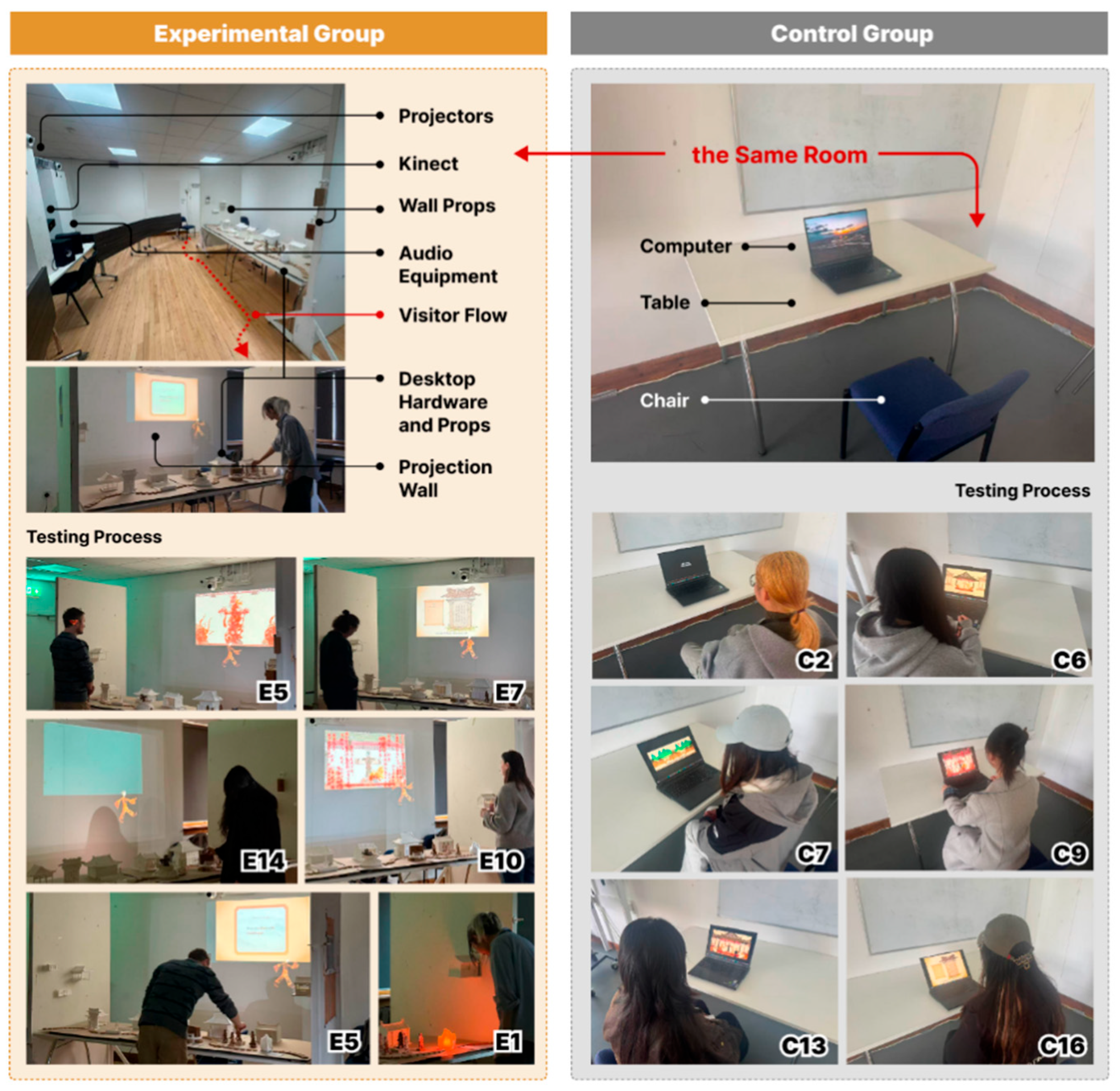
This study used a video-watching narrative condition as the control condition to clearly distinguish it from the interactive system of Vellum of Lies. As shown in Figure 9, the experiment was conducted in a private, soundproof classroom. Through preliminary testing, the projection position, tabletop device, sensor recognition range, Kinect capture area, and audio playback were calibrated to simulate a safe, stable exhibition space suitable for an immersive narrative experience. To improve comparability between the two conditions, the narrative script, written content, visual style, major plot points, core audiovisual materials, experience duration, experimental instructions, and measurement procedures were kept as consistent as possible. The background noise level was controlled below 45 dB to reduce environmental interference. Because the projection and computer screen differed in physical size and viewing mode, preliminary testing was conducted to adjust the viewing distance and ambient lighting. Participants in the experimental condition remained farther from the projected image to allow tangible manipulation and bodily movement, while those in the video condition viewed the computer screen from a shorter conventional distance. This arrangement allowed the main narrative image to occupy a broadly comparable proportion of the participants’ visual field. Ambient lighting was also adjusted so that the perceived image contrast, text readability, character movements, and key visual information remained as comparable and clearly visible as possible across the two conditions.
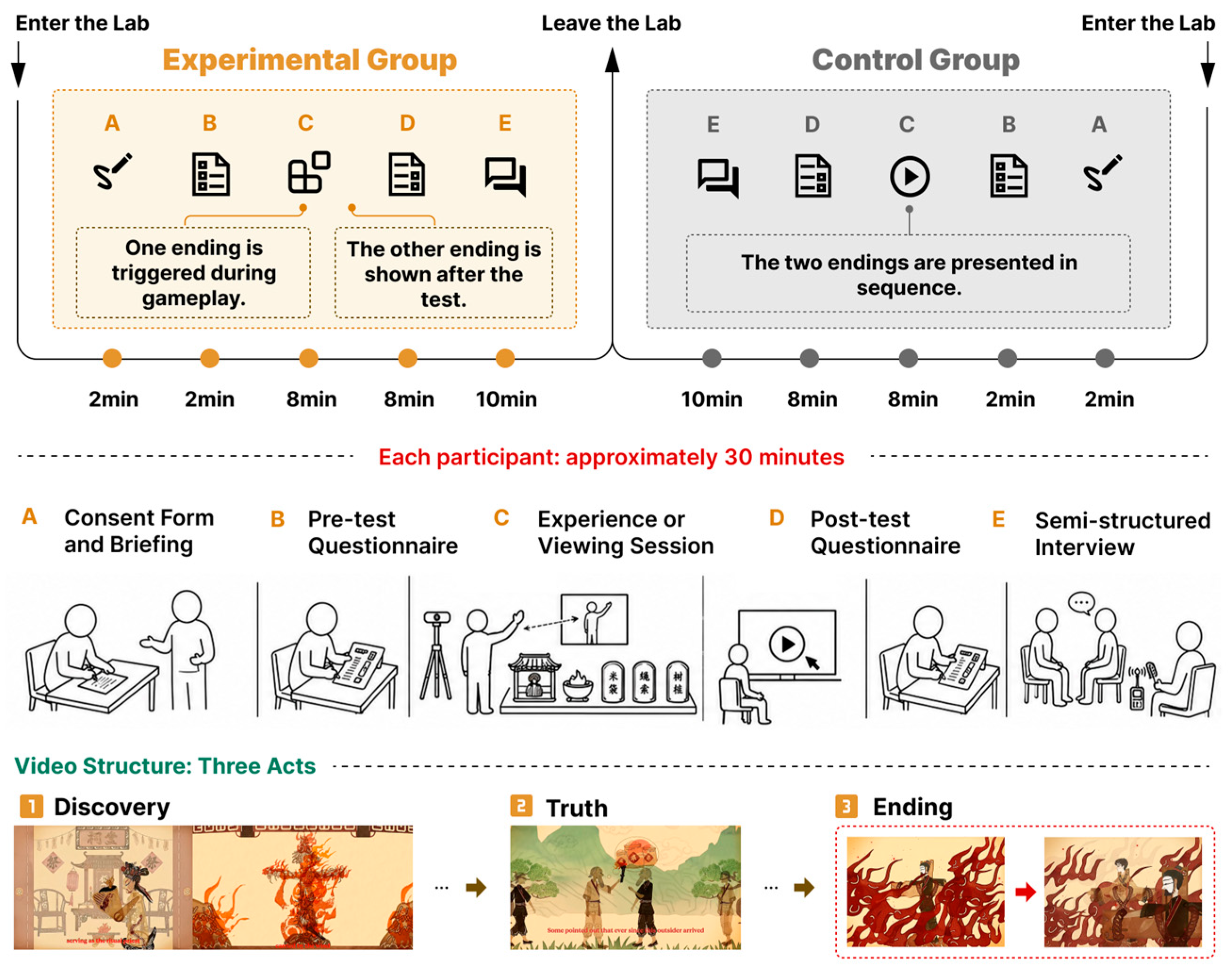
As shown in Figure 10, this study adopted a between-subjects comparative design, with participants recruited separately for the control group and the experimental group. Each participant completed a testing session of approximately 30 min, including a pre-test questionnaire, experimental experience, post-test questionnaire, and semi-structured interview. Before the experiment, participants first read and signed the informed consent form. The experimenter then explained the procedure, precautions, and tasks to be completed. Participants then completed the pre-test questionnaire, which lasted approximately 2 min and included demographic information and the Self-Assessment Manikin (SAM). During the formal experience stage, the control group watched a linear video with the same visual style and narrative content as Vellum of Lies, while the experimental group experienced the full Vellum of Lies interactive system. This included moving their bodies, searching for and placing tangible props, triggering sensors, observing projection feedback, and making the final choice. The experience duration for both groups was controlled at approximately 8 min to ensure comparability between conditions. After the experience, participants completed the post-test questionnaire, which lasted approximately 8 min. The questionnaire included the Self-Assessment Manikin (SAM), Narrative Understanding Questionnaire (HUQ), NASA Task Load Index (NASA-TLX), User Engagement Scale—Short Form (UES-SF), and Intrinsic Motivation Inventory (IMI). Finally, the experimenter conducted a semi-structured interview of approximately 10 min to further understand participants’ subjective feedback on the narrative content, interaction mode, spatial experience, emotional response, and reflection process.
This comparison was designed to evaluate the overall experiential effect of Vellum of Lies as an integrated multimodal tangible narrative system, rather than to isolate the contribution of each individual modality. Therefore, the control condition provided a linear video-based narrative with comparable visual style and narrative content, while the experimental condition combined tangible manipulation, spatial movement, motion capture, projection feedback, audio cues, and final choice-making as a complete interactive experience. The participants in the experimental group were required to make a final choice during the interaction; each participant only triggered one of the two endings in the formal experience. To ensure that participants in the experimental group could understand the alternative ending, the experimenter explained it with the support of a brief video composed of text and still images displayed on the wall after the main experience. In the control condition, the two endings were presented sequentially within the linear video, with the alternative ending introduced through the same brief explanatory video composed of concise text and still images. Thus, both groups received the same text and visual information about the alternative ending, while only the experimental group reached the main ending through an interactive choice.

4.3. Data Collection

4.3.1. Quantitative Data Collection

Throughout the experiment, both quantitative and qualitative data were collected. The quantitative data corresponded to three aspects: cognitive understanding and reflection, user engagement, and emotional response. After being organized, all questionnaire data were imported into the SPSSAU online platform (version 26.0) for statistical analysis.
For H1, which focused on cognitive understanding and reflection, this study used a self-developed Narrative Understanding Questionnaire (HUQ) and the NASA Task Load Index (NASA-TLX). The HUQ was developed specifically for this study based on the main plot, character relationships, event causality, key details, and reflection objectives of Vellum of Lies. The complete HUQ items, response options, and intended answers are provided in Appendix A. An initial item pool was generated from the narrative script and research objectives, after which experts in relevant fields reviewed the content relevance, wording clarity, and category assignment of the items. Before the formal experiment, five testers who did not participate in the main study completed a pilot test to examine wording clarity, option ambiguity, completion time, and coverage of the main narrative information. Based on their feedback, several items were revised in terms of wording, distractors, and order. To reduce the potential influence of option position, the response options were randomly ordered. Each item contained four options and was scored as 1 for a correct answer and 0 for an incorrect answer. The Overall score was calculated as the proportion of correct responses across all items, while the Details and Reflection scores were calculated from the corresponding item sets. Using the formal sample, the HUQ achieved an overall KR-20 coefficient of 0.76, indicating acceptable internal consistency. NASA-TLX was used to evaluate participants’ subjective workload during the experience, including six dimensions: Mental Demand, Physical Demand, Temporal Demand, Performance, Effort, and Frustration Level. This study used a 0–20 rating scale rather than the more commonly used 0–100 scale, with higher scores indicating greater workload in the corresponding dimension [43].
For H2, which focused on user engagement, this study used the User Engagement Scale—Short Form (UES-SF). This scale was used to assess participants’ overall engagement and immersive experience during the interaction, including dimensions such as Focused Attention, Perceived Usability, Aesthetic Appeal, and Reward. The questionnaire adopted a 5-point Likert scale, where 1 indicated strongly disagree and 5 indicated strongly agree [44].
For H3, which focused on emotional response, this study used the Intrinsic Motivation Inventory (IMI) and the Self-Assessment Manikin (SAM). IMI was used to assess participants’ intrinsic motivation and emotional involvement during the experience, including dimensions such as Interest/Enjoyment, Perceived Competence, Perceived Choice, and Pressure/Tension, using a 7-point Likert scale [45]. SAM was used to measure participants’ emotional changes, including three dimensions: Pleasure/Valence, Arousal, and Dominance, using a 1–9 pictorial rating scale [46].

4.3.2. Qualitative Data Collection

For the qualitative data, this study collected participants’ subjective feedback on Vellum of Lies through semi-structured interviews. The interviews focused on three themes. First, cognitive understanding and reflection, which examined whether participants understood the story content, character situations, and event causality. For example, participants were asked: “How do you understand the key turning point between the two endings in the story?” Second, user engagement, which focused on participants’ feedback on space, props, projection, motion capture, and time perception. For example: “During the experience, did you have a moment when you were fully focused and ignored the surrounding environment? What helped you enter this state?” Third, emotional response, which examined participants’ tension, empathy, helplessness, and real-world association. For example: “Did you feel empathy or identification with any character in the story? How was this feeling established?”
During the interviews, one researcher was responsible for asking questions and guiding the conversation, another researcher recorded the experimental process and took field notes, and a third researcher used an audio recorder to capture the interview audio. The recordings were then initially transcribed using iFlytek (version 7.0.5057, iOS) and manually checked by the researchers to ensure semantic accuracy.

4.4. Data Analysis

4.4.1. Quantitative Analysis

Descriptive statistics were first conducted for each scale and its subdimensions, including the means and standard deviations of the experimental and control groups. The Shapiro–Wilk test was used to examine the normality of each scale, after which independent-samples t-tests were used for between-group comparisons. To account for multiple comparisons, the p-values reported are the final Holm–Bonferroni-adjusted p-values obtained within five scale-specific families of comparisons: SAM (3 tests), HUQ (3 tests), NASA-TLX (7 tests), UES-SF (5 tests), and IMI (4 tests), including the overall-score comparisons for HUQ, NASA-TLX, and UES-SF: statistical significance was evaluated using these adjusted values at α = 0.05. For each comparison, the mean difference and its 95% confidence interval were reported together with the t statistic and adjusted p-value. To ensure consistency with the independent-group design (n = 16 per group), Cohen’s d was recalculated from the independent-samples t statistic and group sizes; Hedges’ g was obtained using the corresponding small-sample correction with df = 30, and eta squared was calculated as η 2 = t 2 / ( t 2 + 30 ) . SAM was analyzed using change scores calculated by subtracting the pre-test score from the post-test score and comparing these changes between groups. As an additional non-parametric sensitivity check, two-sided Mann–Whitney U tests were conducted for the same outcomes; for SAM, the tests used the participant-level post-minus-pre change scores. These sensitivity checks were used to assess robustness to the analytical approach, while the adjusted independent-samples t-test results remained the primary basis for inference.

4.4.2. Qualitative Analysis

For the qualitative data, thematic analysis was conducted on the semi-structured interview transcripts. Based on the research objectives and the three experimental hypotheses, cognitive understanding and reflection, user engagement, and emotional response were initially established as broad analytical directions. Two researchers independently and repeatedly reviewed the interview transcripts and conducted open coding of participants’ expressions concerning story understanding, task flow, spatial perception, bodily participation, emotional changes, and real-world associations. Rather than assigning all responses directly to the predefined analytical directions, specific meaning units were first identified from the transcripts and subsequently grouped according to similarities and relationships among the emerging codes. The two researchers then compared their coding results, consolidated overlapping codes, and developed a shared codebook containing theme names, definitions, and representative excerpts. Coding disagreements were resolved by returning to the original transcripts and reaching consensus through discussion. Negative, mixed, and ambiguous responses were retained during the analysis to ensure that the resulting themes reflected the diversity of participants’ experiences.

5. Results

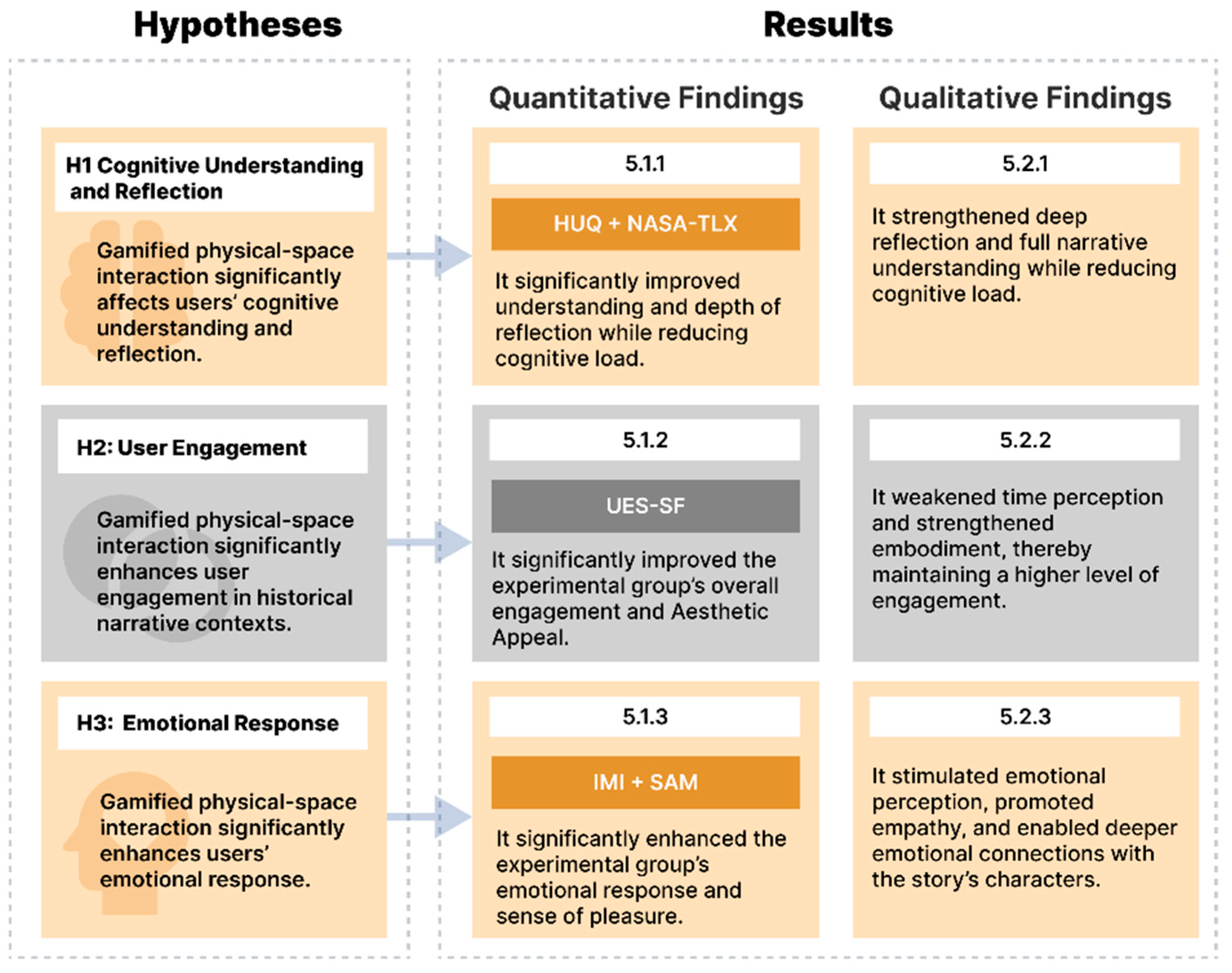
Figure 11 presents the quantitative and qualitative findings used to examine the research hypotheses. In the following sections, these findings are reported in detail. Table 2 summarizes the evaluation results of SAM, HUQ, NASA-TLX, UES-SF, and IMI, and reports the results of the independent-samples t-tests.

5.1. Quantitative Findings

All p-values reported in Table 2 are Holm–Bonferroni-adjusted values. Statistical significance is evaluated using these adjusted p-values rather than the unadjusted p-values corresponding to the reported t statistics.

5.1.1. Facilitating Cognitive Understanding and Reflection

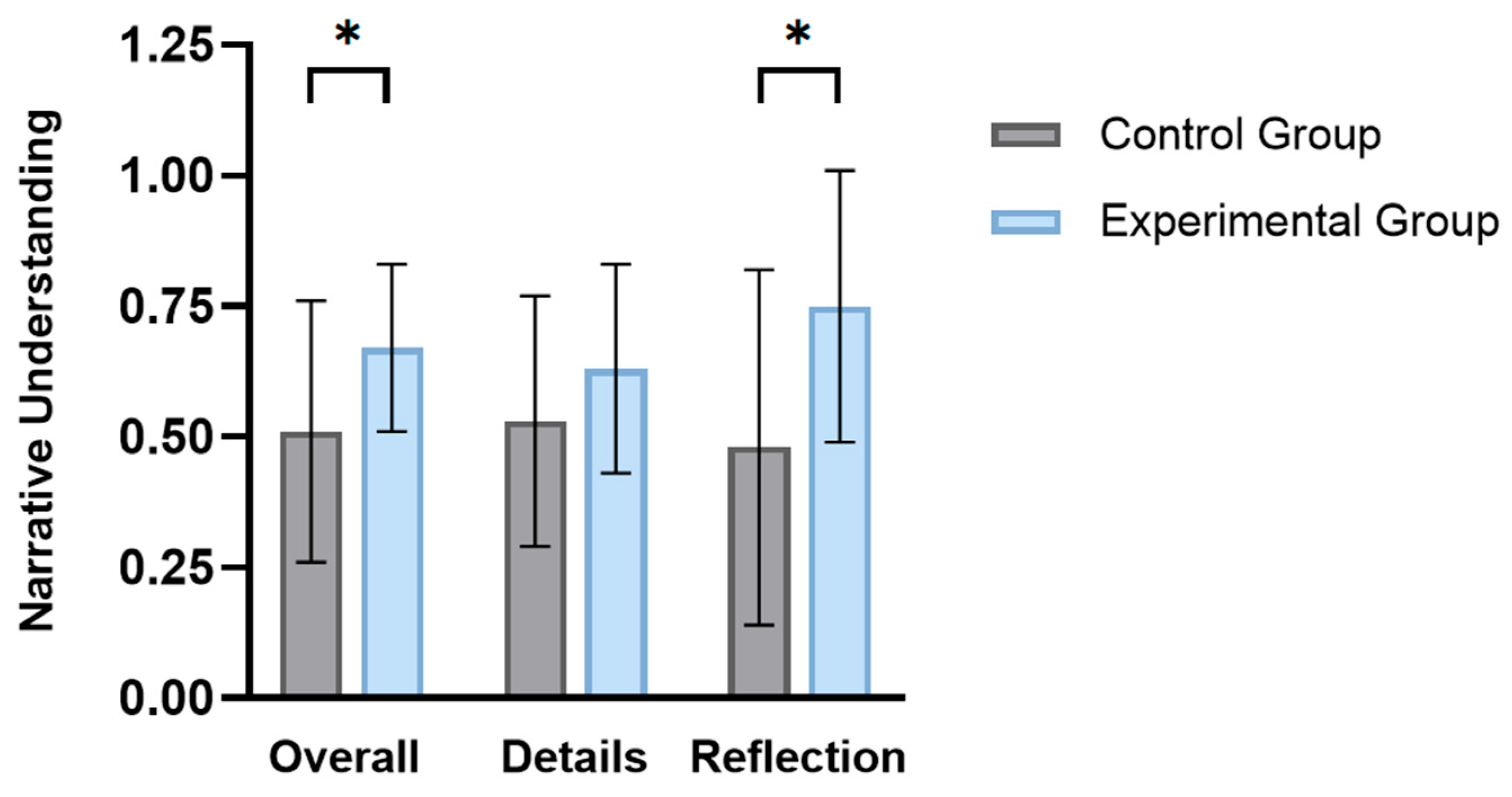
As shown in Figure 12, the independent-samples t-test results for HUQ showed significant differences between the experimental and control groups in Overall and Reflection, while no significant difference was found in Details.
Overall. Participants in the experimental group achieved a higher HUQ Overall score ( M   =   0.67 , S D   =   0.16 ) than those in the control group ( M   =   0.51 , S D   =   0.25 ). The difference was statistically significant, t = 2.894, p = 0.011, mean difference = 0.16, 95% CI [0.041, 0.271], Cohen’s d = 1.023, Hedges’ g = 0.997, η2 = 0.218.
Details. For the Detail dimension, the experimental group showed a modest advantage ( M   =   0.63 , S D   =   0.20 ) over the control group ( M   =   0.53 , S D   =   0.24 ). However, the difference was not statistically significant, t = 1.772, p = 0.097, mean difference = 0.11, 95% CI [−0.022, 0.236], Cohen’s d = 0.626, Hedges’ g = 0.611, η2 = 0.095.
Reflection. The biggest difference appeared in the Reflection score. Participants in the experimental group achieved a higher score ( M   =   0.75 , S D   =   0.26 ) than those in the control group (M = 0.48, S D   =   0.34 ). The difference was statistically significant, t = 2.931, p = 0.010, mean difference = 0.27, 95% CI [0.074, 0.468], Cohen’s d = 1.036, Hedges’ g = 1.010, η2 = 0.223.
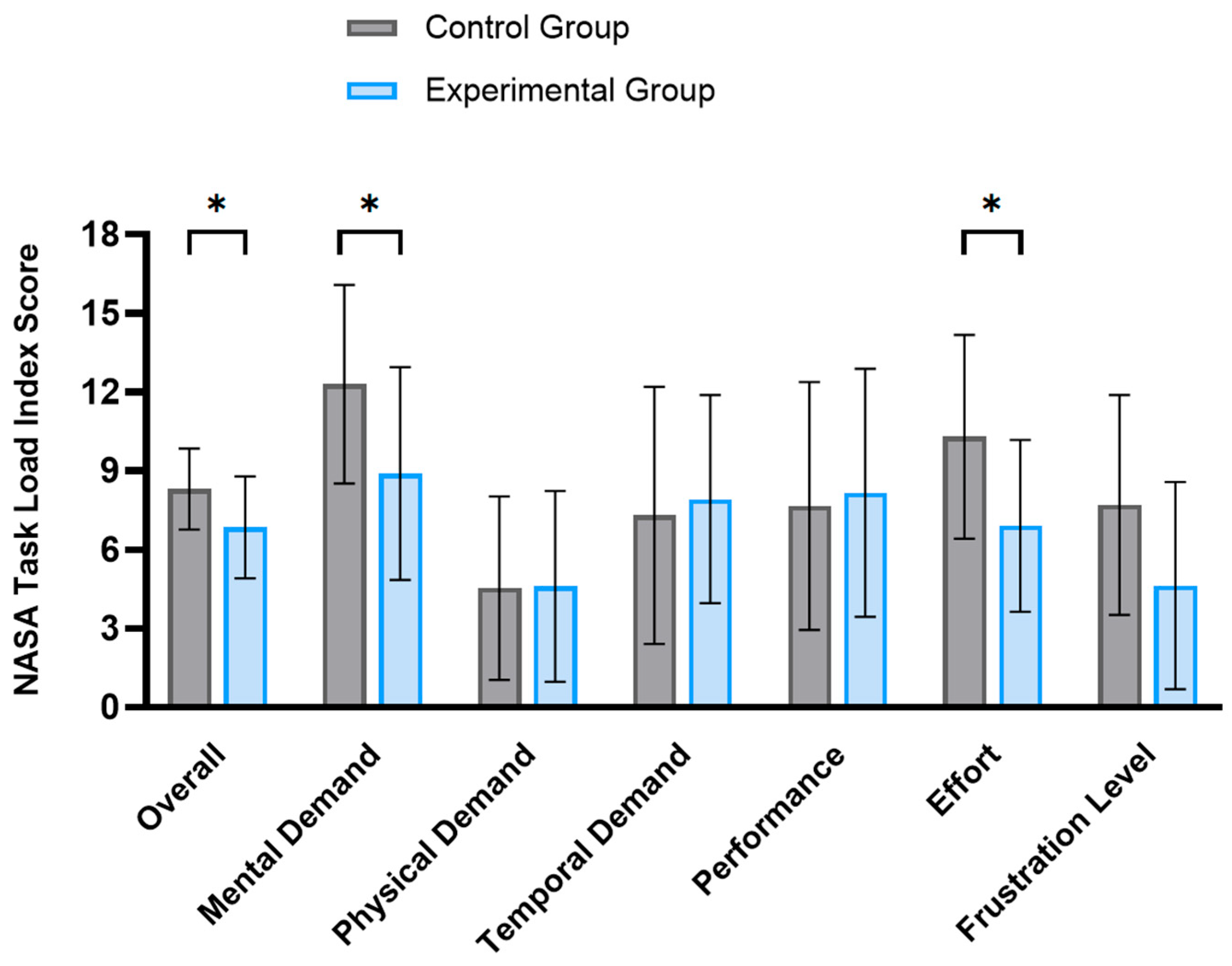
As shown in Figure 13, the independent-samples t-test results for NASA-TLX showed significant differences in Overall, Mental Demand, and Effort.
Overall. The experimental group reported a lower NASA-TLX Overall score ( M   =   6.85 , S D   =   1.94 ) than the control group ( M   =   8.30 , S D   =   1.54 ), indicating a significant reduction in perceived task load, t = −3.917, p = 0.001, mean difference = −1.45, 95% CI [−2.234, −0.659], Cohen’s d = 1.385, Hedges’ g = 1.350, η2 = 0.338.
Mental Demand. A similar pattern was found for Mental Demand. Participants in the experimental group experienced lower mental workload ( M   =   8.89 , S D   =   4.05 ) compared with those in the control group ( M   =   12.30 , S D   =   3.78 ), and the difference was statistically significant, t = −2.187, p = 0.045, mean difference = −3.41, 95% CI [−6.726, −0.086], Cohen’s d = 0.773, Hedges’ g = 0.754, η2 = 0.138.
Physical Demand. Physical Demand remained almost the same across the two conditions, with the experimental group ( M   =   4.60 , S D   =   3.63 ) and the control group ( M   =   4.53 , S D   =   3.49 ) showing no significant difference, t = 0.069, p = 0.946, mean difference = 0.07, 95% CI [−2.048, 2.185], Cohen’s d = 0.024, Hedges’ g = 0.024, η2 = 0.000.
Temporal Demand. The experimental group showed a slightly higher Temporal Demand score ( M   =   7.92 , S D   =   3.96 ) than the control group ( M   =   7.30 , S D   =   4.89 ). However, this difference was not statistically significant, t = 0.429, p = 0.674, mean difference = 0.62, 95% CI [−2.452, 3.690], Cohen’s d = 0.152, Hedges’ g = 0.148, η2 = 0.006.
Performance. Performance scores were also comparable between the experimental group ( M   =   8.16 , S D   =   4.73 ) and the control group ( M   =   7.66 , S D   =   4.72 ), with no significant difference observed, t = 0.321, p = 0.753, mean difference = 0.50, 95% CI [−2.819, 3.819], Cohen’s d = 0.113, Hedges’ g = 0.111, η2 = 0.003.
Effort. Effort showed a clearer difference between the two conditions. The experimental group reported a notably lower Effort score ( M   =   6.90 , S D   =   3.27 ) than the control group ( M   =   10.29 , S D   =   3.88 ), and this reduction was statistically significant, t = −2.815, p = 0.013, mean difference = −3.39, 95% CI [−5.963, −0.824], Cohen’s d = 0.995, Hedges’ g = 0.970, η2 = 0.209.
Frustration Level. Frustration Level was lower in the experimental group ( M   =   4.63 , S D   =   3.95 ) than in the control group ( M   =   7.70 , S D   =   4.19 ). Although this suggests a decreasing trend, the difference did not reach statistical significance, t = −2.119, p = 0.051, mean difference = −3.07, 95% CI [−6.156, 0.018], Cohen’s d = 0.749, Hedges’ g = 0.730, η2 = 0.130.
Overall, the HUQ and NASA-TLX results suggest that Vellum of Lies supported selected aspects of cognitive understanding and reflection while reducing specific aspects of perceived workload. The experimental group performed significantly better in Overall and Reflection scores, although no significant difference was found in Detail scores. Meanwhile, the NASA-TLX results showed that the experimental group reported significantly lower Overall, Mental Demand, and Effort scores. No significant differences were observed in Physical Demand, Temporal Demand, Performance, or Frustration Level. Given the small sample size (n = 16 per condition), the study may have had limited statistical power to detect small or moderate between-group effects; therefore, these non-significant findings should be interpreted cautiously. This suggests that, under the present comparison, the integrated tangible–digital interaction system was associated with lower perceived task burden on selected workload dimensions. In this sense, the system enabled users to understand the serious historically grounded narrative with lower cognitive pressure and less perceived effort.

5.1.2. Enhancing User Engagement in Interactive Experiences

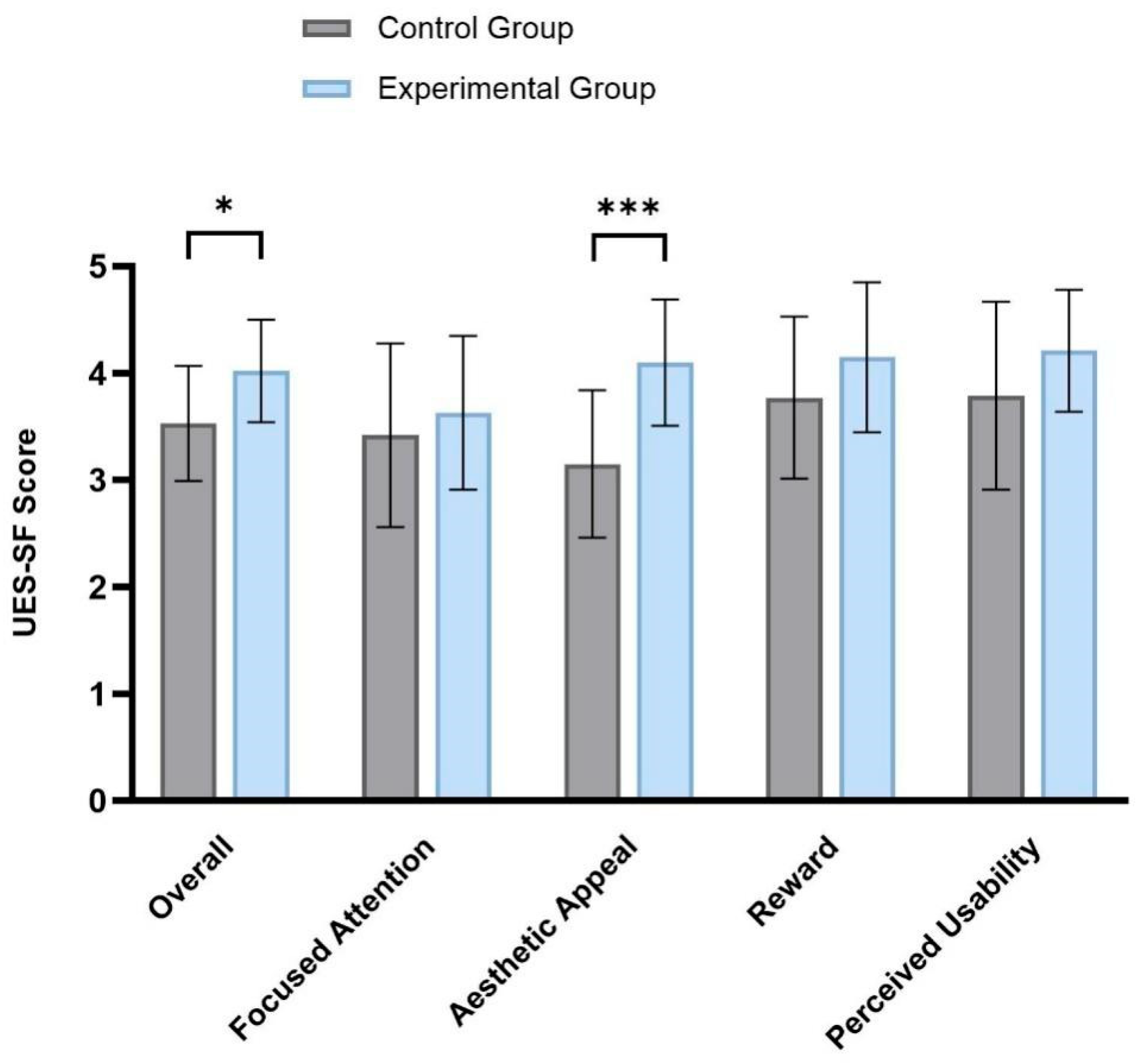
As shown in Figure 14, the independent-samples t-test results for UES-SF showed significant differences in Overall and Aesthetic Appeal.
Overall. The experimental group showed a higher UES-SF Overall score ( M   =   4.02 , S D   =   0.48 ) than the control group ( M   =   3.53 , S D   =   0.54 ), indicating a significant improvement in user engagement, t = 2.722, p = 0.016, mean difference = 0.49, 95% CI [0.106, 0.873], Cohen’s d = 0.962, Hedges’ g = 0.938, η2 = 0.198.
Focused Attention. For Focused Attention, the experimental group obtained a slightly higher score ( M   =   3.63 , S D   =   0.72 ) than the control group ( M   =   3.42 , S D   =   0.86 ). However, this difference was not statistically significant, t = 0.850, p = 0.409, mean difference = 0.21, 95% CI [−0.314, 0.731], Cohen’s d = 0.301, Hedges’ g = 0.293, η2 = 0.024.
Aesthetic Appeal. The most pronounced difference was observed in Aesthetic Appeal. Participants in the experimental group rated this dimension substantially higher ( M   =   4.10 , S D   =   0.59 ) than those in the control group ( M   =   3.15 , S D   =   0.69 ), with the difference reaching a high level of significance, t = 4.701, p < 0.001, mean difference = 0.96, 95% CI [0.524, 1.393], Cohen’s d = 1.662, Hedges’ g = 1.620, η2 = 0.424.
Reward. The experimental group also reported a higher Reward score ( M   =   4.15 , S D   =   0.70 ) than the control group ( M   =   3.77 , S D   =   0.76 ), but this difference did not reach statistical significance, t = 1.424, p = 0.175, mean difference = 0.37, 95% CI [−0.186, 0.936], Cohen’s d = 0.503, Hedges’ g = 0.491, η2 = 0.063.
Perceived Usability. Perceived Usability followed a similar positive trend. Participants in the experimental group gave higher ratings ( M   =   4.21 , S D   =   0.57 ) than those in the control group ( M   =   3.79 , S D   =   0.88 ), although the difference was not statistically significant, t = 1.746, p = 0.101, mean difference = 0.42, 95% CI [−0.092, 0.925], Cohen’s d = 0.617, Hedges’ g = 0.602, η2 = 0.092.
Overall, the UES-SF results indicate that the experimental group experienced stronger user engagement than the control group, particularly in the Overall and Aesthetic Appeal. The significant improvement in Overall suggests that participants in the experimental condition were more actively involved in the experience as a whole. Although Focused Attention, Reward, and Perceived Usability also showed higher mean scores in the experimental group, these differences were not statistically significant. Among all dimensions, Aesthetic Appeal showed the most prominent difference, suggesting that the integrated visual, tangible, and digital presentation of Vellum of Lies played an important role in shaping user engagement. The combination of wall projection, tangible props, physical operation, and real-time digital feedback created an integrated narrative environment, allowing participants to engage with the historical story through coordinated visual and tangible interaction.

5.1.3. Stimulating Emotional Response Through Interactive Elements

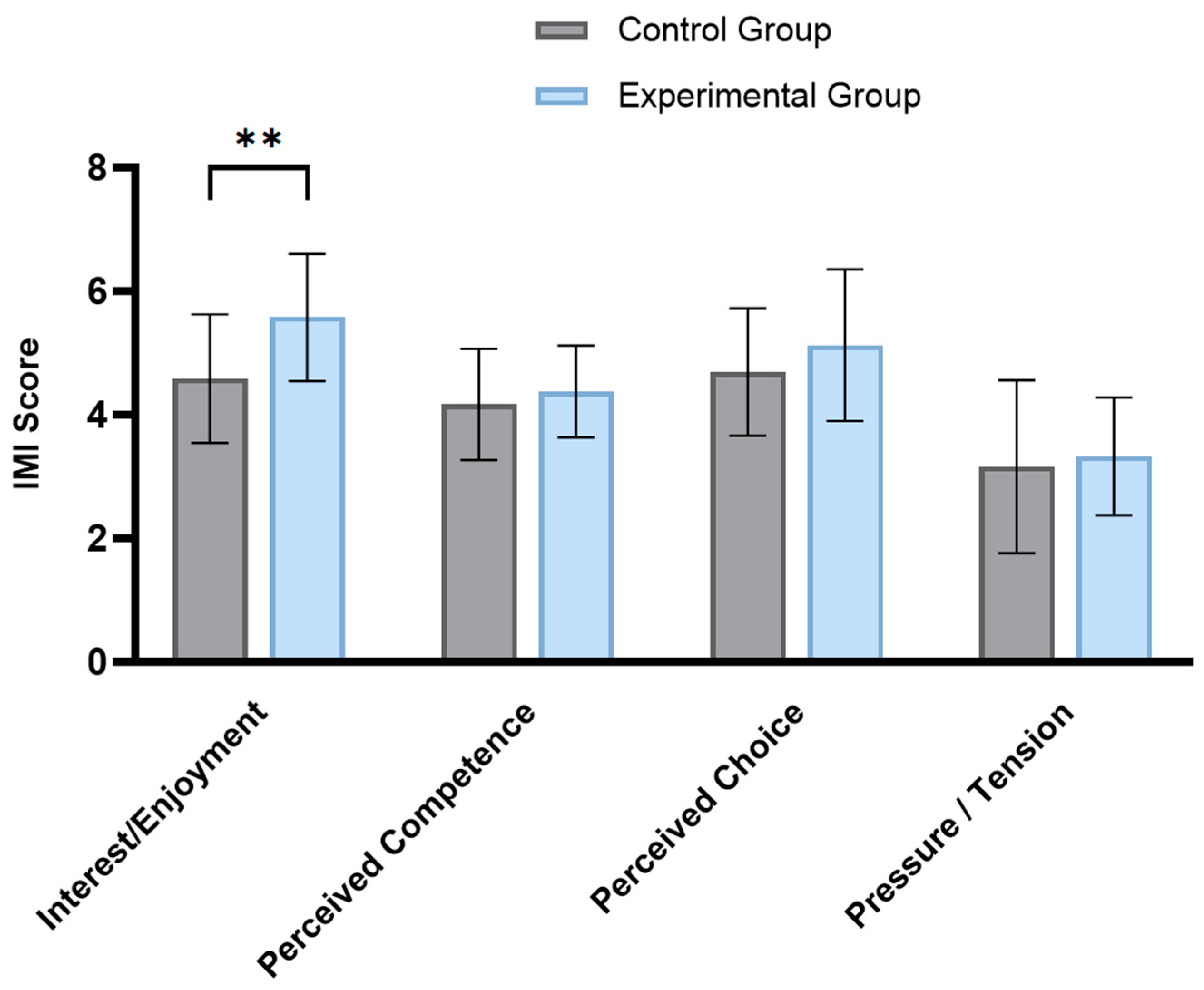
As shown in Figure 15, the independent-samples t-test results for IMI showed a significant difference in Interest/Enjoyment.
Interest/Enjoyment. The experimental group reported a clearly higher Interest/Enjoyment score ( M   =   5.58 , S D   =   1.03 ) than the control group ( M   =   4.59 , S D   =   1.04 ), indicating a significant increase in intrinsic enjoyment, t = 3.096, p = 0.007, mean difference = 0.99, 95% CI [0.309, 1.673], Cohen’s d = 1.095, Hedges’ g = 1.067, η2 = 0.242.
Perceived Competence. Perceived Competence showed a slight increase in the experimental group ( M   =   4.38 , S D   =   0.74 ) compared with the control group ( M   =   4.17 , S D   =   0.90 ). However, this difference was not statistically significant, t = 0.786, p = 0.444, mean difference = 0.21, 95% CI [−0.353, 0.765], Cohen’s d = 0.278, Hedges’ g = 0.271, η2 = 0.020.
Perceived Choice. Participants in the experimental group also reported a higher Perceived Choice score ( M   =   5.13 , S D   =   1.23 ) than those in the control group ( M   =   4.69 , S D   =   1.03 ), but the difference did not reach statistical significance, t = 1.403, p = 0.181, mean difference = 0.43, 95% CI [−0.224, 1.086], Cohen’s d = 0.496, Hedges’ g = 0.484, η2 = 0.062.
Pressure/Tension. Pressure/Tension scores remained relatively similar across the two conditions. Although the experimental group showed a marginally higher score ( M   =   3.33 , S D   =   0.95 ) than the control group ( M   =   3.16 , S D   =   1.40 ), no significant difference was found, t = 0.454, p = 0.656, mean difference = 0.17, 95% CI [−0.623, 0.960], Cohen’s d = 0.161, Hedges’ g = 0.156, η2 = 0.007.
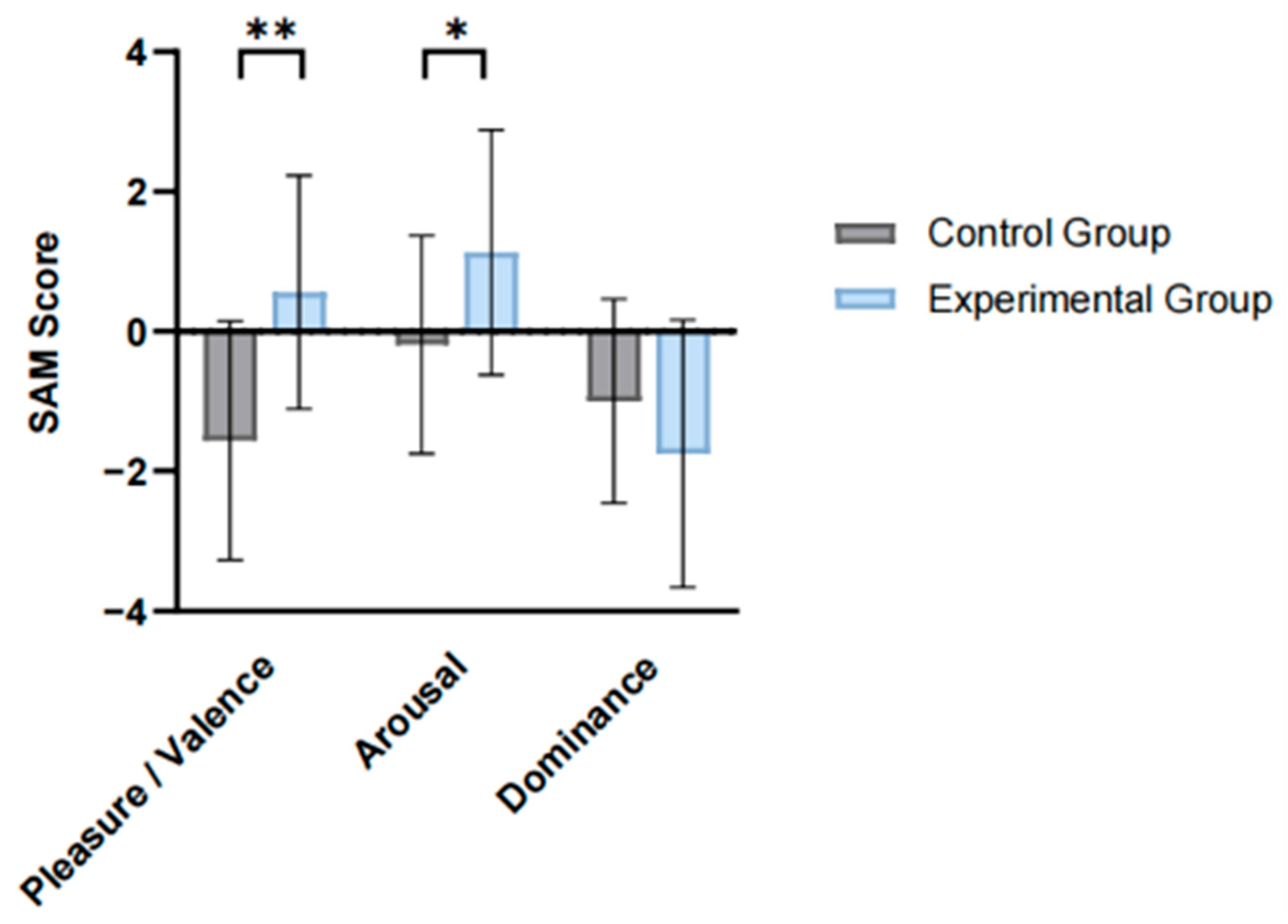
As shown in Figure 16, the independent-samples t-test results for SAM showed significant differences in Pleasure/Valence and Arousal.
Pleasure/Valence. For Pleasure/Valence, the experimental group showed a positive change score ( M   =   0.56 , S D   =   1.67 ), whereas the control group showed a negative change score ( M   =   1.56 , S D   =   1.71 ). This contrast indicates a significant difference in Pleasure/Valence change between the two groups, t = 3.555, p = 0.003, mean difference = 2.13, 95% CI [0.851, 3.399], Cohen’s d = 1.257, Hedges’ g = 1.225, η2 = 0.296.
Arousal. Arousal also increased more strongly in the experimental group ( M   =   1.13 , S D   =   1.75 ) than in the control group ( M   =   0.19 , S D   =   1.56 ), with the difference reaching statistical significance, t = 2.683, p = 0.017, mean difference = 1.31, 95% CI [0.270, 2.355], Cohen’s d = 0.949, Hedges’ g = 0.925, η2 = 0.194.
Dominance. Dominance decreased in both groups, with the experimental group showing a lower change score ( M   =   1.75 , S D   =   1.91 ) than the control group ( M   =   1.00 , S D   =   1.46 ). However, this difference was not statistically significant, t = −1.488, p = 0.158, mean difference = −0.75, 95% CI [−1.825, 0.325], Cohen’s d = 0.526, Hedges’ g = 0.513, η2 = 0.069.
Taken together, the IMI results showed that the experimental group reported higher scores across all dimensions, with a significant difference in Interest/Enjoyment. This indicates that participants in the experimental condition experienced stronger interest and enjoyment during the task. The significant result in Interest/Enjoyment suggests that the integrated tangible–digital experience of Vellum of Lies helped make the experience more engaging and emotionally involving, rather than being perceived merely as a task to complete. Although the differences in Perceived Competence, Perceived Choice, and Pressure/Tension were not statistically significant, their mean scores were still slightly higher in the experimental group.
The SAM results further support this pattern, especially in Pleasure/Valence and Arousal. The significant difference in Pleasure/Valence suggests that the experimental group experienced a more positive emotional shift than the control group. Meanwhile, the significant increase in Arousal indicates that the integrated tangible–digital interaction experience, combining tangible operation, bodily movement, and real-time audiovisual feedback, elicited stronger emotional activation. Overall, the IMI and SAM results suggest that Vellum of Lies showed promising effects on selected aspects of emotional experience, particularly Interest/Enjoyment, Pleasure/Valence, and Arousal, while no significant differences were found in Perceived Competence, Perceived Choice, Pressure/Tension, or Dominance.

5.1.4. Non-Parametric Sensitivity Check

As an additional robustness check, two-sided Mann–Whitney U tests were conducted for the same quantitative outcomes. For SAM, the analysis used participant-level post-minus-pre change scores. This sensitivity analysis was used to assess whether the interpretation depended on the parametric testing approach; the adjusted independent-samples t-test results reported above remained the primary basis for inference.

5.2. Qualitative Findings

In this section, we categorize and analyze participants’ feedback collected from the semi-structured interviews. Participants in the experimental group are coded as E1–E16, while those in the control group are coded as C1–C16. The interviews mainly covered participants’ subjective feedback on the narrative content, interaction process, spatial experience, motion capture, tabletop materials, and emotional experience.

5.2.1. Deeper Comprehension and Reducing Cognitive Load

The interview results showed that participants in both the experimental and control groups were able to understand the main storyline. However, differences emerged in the completeness of information reception. During the interactive tasks, participants in the experimental group needed to continuously attend to the projected visuals, tabletop materials, and operation prompts, which made them more focused on the narrative process. One participant stated, “Because I had to complete the interaction step by step, I paid more attention to the later plot and wanted to know what would happen next.” (E4) Another participant mentioned, “When I pressed the button, I felt that I had performed an action that pushed the story forward.” (E6) In contrast, although participants in the control group could grasp the general plot and theme, the passive viewing process caused some key details to be overlooked. One participant noted, “I could understand roughly what it was about, but I could not remember some parts. After watching it, I only remembered an overall feeling.” (C3) Another participant said, “I could understand it, but some parts passed quickly, and I may not have thought carefully about what they meant.” (C6)
Some participants in the experimental group also reported that the interaction process encouraged them to think about the story rather than merely receive information. One participant explained, “I would think about why I had to make this choice here, and how it related to the situation in the story.” (E9) This suggests that interaction encouraged participants to attend to narrative causality and character situations.
At the same time, the experimental group reported lower workload than the control group, suggesting that they could complete the task more easily. For example, one participant stated, “It was quite easy to play. The prompts were clear, and there was nothing difficult to understand.” (E4) This edutainment-oriented design allowed the experimental group to maintain a relatively high level of understanding without adding extra cognitive burden. By contrast, participants in the control group generally felt that prolonged viewing was passive and somewhat tiring. One participant commented, “Watching it for that long was a bit tiring, and I could not really get into it.” (C2) Similar feedback was also found among several other control-group participants, who felt that their passive role increased the burden and made it harder to focus on the story.
However, participants’ responses also showed some variation. Some participants in the experimental group noted that the operational tasks occasionally distracted them from the narrative. One participant stated, “I did feel involved, but sometimes I kept thinking about what I should do next, so I missed some parts of the story.” (E16) Meanwhile, some control-group participants felt that the continuous video structure helped them maintain attention to the storyline. One participant explained, “Because I only needed to watch the screen, I could focus on the story itself and follow the main plot more easily.” (C15) These mixed responses suggest that the two formats provided different attentional experiences: tangible interaction could deepen participation, although operational demands occasionally shifted attention away from narrative details, while continuous video viewing sometimes helped participants remain focused on the storyline.
Overall, despite these individual differences, the experimental group showed stronger performance in comprehension depth and ease of task completion. The interactive design helped participants pay closer attention to the storyline and reflection process while maintaining a lower cognitive load.

5.2.2. Reducing Time Perception and Enhancing Embodiment

The interview results showed clear differences between the two groups in terms of immersive experience. The interactive design changed participants’ perception of task duration. Guided by interactive tasks, tabletop materials, and embodied actions, participants in the experimental group needed to continuously observe, operate, and wait for feedback. As a result, they were more focused on narrative progression and the interaction process, and did not feel that the task lasted too long. Instead, they maintained a relatively high level of user engagement. One participant stated, “Because I had to operate things myself during the process, I felt that the experience passed quite quickly.” (E7) Another participant noted, “I had just started to get into it, and then it ended. It made me feel that the experience was a little short.” (E12) By contrast, participants in the control group generally felt that the viewing process was too long, and their attention tended to decline in the later stage. One participant said, “The video was a little long, and I became a bit distracted.” (C2) Another participant commented, “If I saw the length of this video while scrolling, I might not have the patience to keep watching.” (C8)
In addition, the interactive design effectively strengthened participants’ sense of embodiment. Through spatialized and tangible interaction, participants were better able to perceive the connection between their actions, the surrounding environment, and the narrative. The experimental group engaged with the story through non-single-modal interaction, such as visual and tactile experience, which helped them more clearly understand how each choice influenced the plot. This interaction mode shifted them from passive viewers to active participants in the narrative situation. One participant stated, “It was not just watching an animation. Because there were physical objects and buttons on the table, I felt that I was also inside the story space.” (E2) Another participant mentioned, “The texture of the wooden blocks felt real. Touching them made me feel that this thing was not virtual, but something that had really happened.” (E5)
Meanwhile, the need to constantly observe and search for the next interaction point strengthened participants’ sense of spatial scale, allowing them to perceive the real presence of objects and experience a sense of situated exploration. One participant said, “I needed to look at different positions on the tabletop and find the next place to interact with. This made me feel like I was exploring.” (E10) Motion capture further enhanced participants’ virtual body perception by mapping their bodily movements onto the projected character. This made them feel directly connected to the character’s actions in the story, thereby deepening their sense of immersion and control. One participant explained, “I could understand that the little figure was related to my movements, which made me feel that my body was mapped into the story.” (E3) This enhanced sense of embodiment ultimately contributed to stronger user engagement, as participants experienced narrative progression through bodily action and became more immersed in the story.
Some participants also identified limitations in the current system. Recognition delays occasionally required the wooden blocks to be repositioned, briefly interrupting the narrative flow. One participant noted, “I could understand the story, but if there were more background information, I might understand more clearly why it developed in this way.” (E13) Another participant commented, “The prompts could be more obvious, especially at the beginning. I needed some time to understand what I should do.” (E2) These comments show that device stability, interaction guidance, and cultural context still require improvement.
Overall, the experimental group reported stronger feedback in terms of time perception and embodiment than the control group. Through interactive design, participants in the experimental group became more focused on the task process, perceived the experience as shorter, and maintained stronger engagement. Moreover, participants frequently associated their sense of embodiment with the integrated tangible–digital interaction process, in which tangible manipulation and bodily movement were continuously connected with corresponding visual and auditory feedback. They described this coordinated form as supporting deeper engagement with the storyline, immersion, and overall user engagement.

5.2.3. Enhancing Emotional Engagement, Empathy, and Real-Life Connections

In terms of emotional perception, the experimental group showed stronger emotional connection, especially in relation to tension and pressure. Participants in the experimental group had clear emotional responses during the choice-making and countdown stages. Some also felt that pressing the button, placing objects, or completing actions made them take the key narrative moments more seriously. One participant stated, “I felt a little nervous during the countdown because I had to make a decision in a very short time.” (E6) Another noted, “When making the choice, I felt a lot of pressure and guilt about my own thoughts.” (E15) A third participant said, “When I pressed the button, there was a sense of ritual, as if I had really made a decision.” (E1)
Based on this stronger emotional perception, some participants in the experimental group still felt emotionally affected after the experience, indicating the emotional impact of the design. One participant mentioned, “Even ten minutes after the experience ended, my emotions were still affected. I felt blocked inside and uncomfortable.” (E14) By contrast, emotional responses in the control group were more superficial. Many participants described themselves as spectators and felt limited emotional connection with the characters. One participant stated, “I could understand what it wanted to express, but I felt like I was only a bystander and did not have a strong connection with the characters.” (C4) Another noted, “The impact was a little weak. I was mainly spending effort trying to understand the story.” (C7)
Beyond basic emotional reactions, participants in the experimental group also showed stronger empathy and connected the story with real-life situations, leading to deeper reflection. One participant explained, “Because I participated in the operation myself, it was easier to empathize, and I could empathize with every harmed character.” (E9) Another participant said, “I felt that some people in the story were similar to people in real life, all being forced to make choices under pressure.” (E13) One participant also expressed uncertainty about the influence of the final choice: “I felt pressure when pressing the button, but I also felt that, no matter what I chose, the ending might already have been decided.” (E10) This response suggests that the final choice generated pressure and helplessness, while its limited scope was also perceptible to some participants.
Overall, the experimental group showed a stronger emotional response than the control group, especially in emotional perception, empathy, and reflection. Participants’ accounts suggest that the integrated interactive process, including tangible actions, narrative progression, digital feedback, and final choice-making, supported their emotional involvement, deeper understanding of the story, and empathy with the characters.

5.3. Opportunities and Challenges

In this experiment, participants provided valuable feedback on Vellum of Lies and identified several directions for future improvement.
Interaction Space and Visual Feedback. Regarding the expansion of interaction space and visual enhancement, some participants expected the system to provide a more open interaction space, especially in terms of narrative choices. The current interaction range appeared limited in some narrative stages, and users hoped to have more choices to strengthen their sense of presence and user engagement. For example, one participant stated, “If I could walk to more places or discover hidden clues, I would feel more like I was exploring the village myself.” (E8) Future designs could therefore expand the interaction space and allow users to make more choices within the story, thereby enhancing immersion. In addition, some participants noted that the tabletop scene was not clear enough in the dark environment. Enhancing tabletop projection could help users better understand the narrative situation while increasing interaction interest. The motion-captured character could also be integrated into the environmental animation, becoming part of the interactive storyline rather than only a visual mapping of body movement. One participant suggested, “If the little figure’s movements could really affect the plot later, I would feel more connected to it.” (E12) This indicates that motion-capture feedback could further develop from bodily correspondence to narrative participation, allowing body movements to contribute more directly to plot progression.
Device Recognition and Stability. Regarding device improvement, some participants reported that recognition delays varied depending on the placement angle of the wooden blocks, affecting the smoothness of interaction. To improve recognition accuracy, future iterations could increase the number of sensors or optimize their positions, ensuring that a wider range of placement angles can be detected accurately. This would help reduce delay and improve the stability and precision of the experience.
Personalization and Scalability. The interviews also revealed diverse user needs. One participant noted, “I could understand the story, but if there were more background information, I might understand more clearly why it developed in this way.” (E13) Another participant commented, “The prompts could be more obvious, especially at the beginning. I needed some time to understand what I should do.” (E2) Therefore, future versions of the system could further develop personalization mechanisms to adapt to different user types and narrative themes. In terms of personalization, AI could adjust the narrative, language, and interaction guidance according to users’ age, knowledge background, and interests. For younger users, the system could use simpler language and provide more operational prompts; for users with relevant expertise, it could offer denser historical information and deeper plot interpretation. The system could also adjust the pace of information disclosure, prompt intensity, and task difficulty based on user responses, ensuring a suitable experience for different users. In addition, the system has strong potential for scalability. By combining generative AI and 3D printing, future work could develop a reusable content production pipeline in which AI generates images and hardware models, while 3D printing transforms them into tangible props. In this way, the system could be extended to different serious historical narrative themes and support rapid production of embodied narrative experiences.
Overall, participants’ feedback provides useful directions for future system improvement. Expanding the interaction space, improving device accuracy, and strengthening personalization and scalability could further enhance users’ immersion and user engagement, laying the groundwork for broader application scenarios.

6. Discussion

Many existing digital historical narratives still remain at the level of linear viewing with limited multimodal interaction. For serious historical topics, if a narrative is presented only as a chronological and static sequence, without conflict, turning points, narrative progression, or entry points for deeper embodied user experience, users’ effective understanding and reflection on historical situations can be weakened [47]. In contrast, this study uses TUI as a core method for organizing the narrative process, helping users understand story logic and event causality. TUI integrates digital narrative, tangible props, button triggering, sensor recognition, and projection mapping, so that story information is not only watched through images but gradually understood through a tangible interaction process. Interview results also showed that when users completed each tangible operation, they were also confirming a narrative node. In this way, the integrated tangible–digital system transforms abstract historical information into perceptible and operable cognitive cues, which may support users’ understanding of story structure and event causality. In addition, the integrated tangible–digital interaction provides users with a more natural and accessible task form, especially in tasks requiring sustained attention, and may help reduce anxiety and cognitive burden [48]. Traditional screen interfaces often require users to stare at a display for precise operations over a long period, which may cause visual fatigue and cognitive overload. Tangible props and tabletop TUI devices provide external cognitive scaffolding: users do not need to rely entirely on memory to track story clues, but can understand the current narrative stage through object positions, button feedback, and projection changes. By using users’ embodied actions as interaction media, the tangible–digital system supports understanding through coordinated interaction, making the task more intuitive and natural and reducing perceived mental effort. At the same time, to adapt to TUI interaction, this study redesigned the narrative into clearer nodes and procedures, making the narrative structure less rigid and better suited to the reflective nature of serious history. The story is no longer a simple video playback, but is organized into narrative segments such as entering the situation, performing the ritual, revealing the truth, and making the final choice. Through the integration of tangible props, sensors, button-based input, and projection mapping, users can more easily understand the relationship between tabletop operations and screen feedback. This design aligns with users’ mental models: physical props carry user actions, while screen projection presents narrative feedback, and together they form a clear mechanism of narrative progression. In this process, users gradually understand why characters act, how the tragedy is pushed forward, and where they themselves are positioned. Within the integrated tangible–digital narrative process, the final choice button provides a tangible expression of Tragic Agency and connects physical action with the system’s intended reflective function. Users are given opportunities for choice and action during the interaction, while their ability to alter the final tragic outcome remains constrained. This distinction may help explain why the experimental group showed a descriptively higher Perceived Choice score, although the between-group difference was not statistically significant. The interactive and game-like format may have strengthened participants’ sense of choice at the level of immediate action, whereas the unavoidable ending may simultaneously have limited their sense of control over the final outcome. However, the current measures do not directly distinguish between perceived choice during action and perceived control over the narrative outcome. Therefore, this interpretation remains tentative, and the present IMI and SAM results should not be treated as a direct measurement of Tragic Agency. Similarly, the more positive Pleasure/Valence shift should not be interpreted as indicating a positive response to the tragic outcome itself. It may instead reflect participants’ overall evaluation of the interactive experience, including its game-like interaction, aesthetic presentation, and sense of active participation. Compared with simply clicking on a screen, this design makes the importance of decision-making easier to perceive and helps users realize that they have already been drawn into the tragic structure [49]. Therefore, the button is not only an input device, but also a reflective device: it creates tension between “making a choice by hand” and “being unable to reverse the ending,” thereby encouraging users to think about the relationship between individual action, group pressure, and feudal tragedy, and further promoting self-reflection, narrative reflection, and real-world association.
Most existing gamified historical narrative designs still rely mainly on screen-based interaction with limited multimodal interaction. They often lack sufficient integration of embodied interaction, tangible interaction, and spatial exploration, and therefore fail to fully mobilize users’ multimodal sensory participation [50]. In contrast, the findings suggest that the integrated tangible–digital form of Vellum of Lies has the potential to transform historical narrative into a more actionable, perceptible, and participatory experience through task progression, tangible prop manipulation, bodily movement, motion-based input, and real-time feedback. Thus, the potential value of this gamified form lies in supporting enjoyment and participation while also contributing to an immersive narrative experience. In the tangible–digital design of this study, tangible manipulation, bodily movement, projected animation, and audio feedback operate as interconnected parts of the narrative experience. Users establish connections with the digital story through physical action and receive immediate audiovisual responses from the system. [48]. Interview participants frequently referred to this coordinated process when describing their involvement, embodiment, and immersion. The tangible and digital elements therefore function together as an integrated experiential form throughout the narrative. Compared with traditional interaction design, the integrated tangible–digital system may help overcome the limitations of 2D screen interaction or pseudo-3D interfaces, enabling users to enter the story situation more naturally.
Some existing embodied historical narrative designs still tend to treat embodied interaction as a short-term perceptual mechanism. Users usually complete limited operations through a specific device, single scene, or local task, and gain experiential cognition through immediate feedback [36]. However, these interactions often lack a continuously unfolding narrative timeline and rarely embed user behavior consistently into character relationships, plot progression, and emotional change. As a result, users may struggle to remain within the narrative structure over a longer period or develop progressive emotional involvement as the story unfolds. In contrast, this study does not treat embodied interaction as an experiential supplement outside the narrative, but designs it as a core mechanism for driving the complete narrative. Within the integrated tangible–digital system, bodily participation is continuously connected with narrative progression, allowing users’ emotional experience to develop alongside the unfolding plot and supporting sustained participation throughout the experience. Specifically, the tasks have strong continuity and are closely connected to linear narrative progression. Users need to follow the story timeline and complete a series of tasks, including understanding the story, tangible prop searching, object placement, sensor-triggered input, projection feedback, and choice-making. Through this structure, interaction behavior, task goals, and narrative development form a clear causal relationship, allowing users to maintain engagement through continuous action and further mobilize emotional response. Furthermore, the design of narrative nodes and task transitions in this study makes user participation more active and may strengthen emotional attraction throughout the single-session narrative experience. Each node creates a new problem situation through suspense, clues, and staged goals. While completing the current task, users also form expectations and judgments about the following plot and interaction. This task-driven structure is not an external reward mechanism, but comes from the intrinsic appeal of narrative games. As a result, this structure may support users’ task motivation during the experience. This active participation, jointly driven by narrative suspense and interactive tasks, may help maintain emotional involvement throughout the unfolding narrative experience [51]. Overall, participants’ accounts suggest that their emotional responses changed across successive narrative stages as interaction and plot progression unfolded together. In the early stage, users are mainly attracted by the visual style, spatial atmosphere, and operational interest. As the ritual progresses and the truth is revealed, users begin to perceive the characters’ situations, pressure, and emotional changes. At the final choice stage, users further realize that their own operations are related to the characters’ fate. Especially in the design of Tragic Agency, users have opportunities for action and choice, but cannot truly change the tragic ending. Therefore, the emotional experience is no longer merely sympathy for the characters’ suffering, but is transformed into a more complex sense of involvement, tension, helplessness, and moral pressure [49]. Users not only see characters being pushed toward tragedy, but also feel that their choices, actions, or silence are related to this process. Participants’ accounts suggest that this emotional contradiction brought by active participation may have encouraged some users to connect the emotional experience of the story with real-life situations and consider how individuals may be forced to choose under group pressure, rumor transmission, and institutional oppression, or even become part of harm unconsciously. Thus, the qualitative findings suggest that active participation within the integrated tangible–digital system may support emotional involvement, empathy, real-world association, and emotional reflection.
Nevertheless, this study has several limitations. The small convenience sample, composed mainly of students and university staff familiar with digital media, limits the generalizability of the findings to broader populations [52]. Future studies should therefore recruit participants from a wider range of age groups, educational backgrounds, and cultural contexts. Participants’ short-term evaluations may also have been influenced by the novelty of the tangible installation and multimodal interaction [53], and the use of a single immediate post-experience assessment prevents conclusions about whether narrative understanding, emotional response, and real-world association would persist over time. In addition, the Chinese historical and folk-cultural context may have shaped participants’ interpretations and experiences [54]. Finally, because the experiment compared the complete tangible–digital interaction system with a linear video condition, it could not isolate the independent contributions of tangible manipulation, bodily movement, projection, audio feedback, and Tragic Agency. Future multi-condition or ablation studies could further examine the relative contribution of these interconnected components. Future studies should also develop or adopt a dedicated measure of Tragic Agency that distinguishes perceived choice during interaction from perceived control over the final narrative outcome, while directly assessing perceived constraint and helplessness. Future research can be further developed from three aspects: TUI prototype optimization, content generation, and user experimental design. First, in terms of prototype design, the system still needs to improve interaction stability and spatial expressiveness, such as optimizing sensor recognition, projection clarity, and prop feedback, so as to reduce the impact of technical delay on immersion. Future versions can also expand the interaction space, allowing users to explore, move, and make choices in a more open environment, thereby supporting greater continuity across the narrative experience. Second, the system can further combine generative AI and 3D printing to support personalized narrative and systematic expansion. AI can generate materials such as animations and models, and adjust textual content, prompts, task difficulty, and narrative rhythm according to users’ age, knowledge background, and interests. 3D printing can rapidly produce tangible interface components. In this way, the system can move beyond a single historical story prototype and become a reusable embodied narrative framework, adaptable to diverse user groups and more historical, cultural, or social topics. Finally, future experimental design also needs further refinement. This study mainly verified the basic effectiveness of the current prototype. Future work can conduct longer-term field studies by placing the system in exhibitions, classrooms, or public cultural spaces, observing users’ dwell time, participation behavior, and subsequent reflection in real environments. More detailed comparative experiments can also be conducted, such as comparing the effects of different game types, task complexity, and single-session duration on immersion, emotional involvement, and reflective depth. In addition, the experimental environment should be made more stable by reducing external factors such as lighting, sound, and spatial interference, so as to improve the reliability of the results.

7. Conclusions

This study introduced Vellum of Lies, an immersive tangible interactive narrative system that addresses three key challenges in serious historical narratives: limited cognitive understanding and reflection, difficulty in entering the narrative situation, and weak emotional participation. In response, the system proposes three design layers: a tangible user interface and spatialized interaction that support active exploration, embodied interaction that connects bodily actions with narrative progression, and Tragic Agency that links constrained choice-making with moral reflection. Together, these layers transform historical narrative from passive media reception into a continuous embodied and multimodal experience that can be operated, explored, and participated in. In this small-scale exploratory study, the results suggest that Vellum of Lies showed promising effects on selected aspects of narrative understanding and reflection within the designed historically grounded story, as well as on user engagement and emotional experience, while other measured subdimensions did not reach statistical significance. More broadly, this study argues that the design of serious historical narratives should move beyond media presentation or formal innovation alone. Instead, it can integrate tangible exhibition space, embodied participation, and narrative structure to guide users from passively viewing a historically grounded narrative toward actively understanding its story logic, engaging with its situated experience, and reflecting on the historical and social themes it represents.

Author Contributions

Writing, software and hardware technical implementation, organization and execution of experiments, Y.H.; pattern design, experiment execution, animation production, experiment execution, S.W.; hardware implementation, data organization, experiment execution, Z.S.; motion-capture technical implementation, laser cutting, equipment coordination, L.B.; modeling and 3D printing, X.Y.; experimental operation, participant recruitment and organization, Y.Z. All authors have read and agreed to the published version of the manuscript.

Funding

This research received no external funding.

Institutional Review Board Statement

This study was undertaken as part of Digital Media Studio Project (2025–2026, Semester 2; course identifier: ARCH110062025-6SV1SEM2) at Edinburgh College of Art, University of Edinburgh. The study was reviewed and approved before its commencement through the ethics review procedure applicable to the course. Under this course-based procedure, individual projects were not assigned separate numerical ethics approval codes; therefore, no study-specific ethics approval code is available. The study involved adult participants in a comparative evaluation of an interactive narrative experience and video viewing, with data collected through questionnaires and interviews. Before the experiment, all participants read the study information sheet and provided written informed consent. They were informed of the study procedures, the emotionally sensitive narrative content, the dynamic visual and projection stimuli, and their right to pause or withdraw at any time. Screening excluded individuals with a history of epilepsy or photosensitive epilepsy, or sensitivity to the relevant visual stimuli. All participants received a brief debriefing after the experiment. Written permission was also obtained from the relevant participants for the use of identifiable images in research documentation and academic publication.

Informed Consent Statement

Written informed consent was obtained from all participants involved in the study. Before the experiment, participants were informed of the study procedure, the emotionally sensitive narrative content, the dynamic visual and projection stimuli, and their right to pause or withdraw at any time. Individuals with a history of epilepsy or photosensitive epilepsy, or sensitivity to flashing images or intense visual stimuli, were excluded from the study. Written permission was also obtained from the relevant participants for the use of identifiable images in research documentation and academic publication. All participants received a brief debriefing after the experiment.

Data Availability Statement

The data presented in this study are available on request from the corresponding author due to restrictions related to user privacy.

Acknowledgments

During the preparation of this study, the authors used SPSSAU online platform for the purposes of statistical analysis. The authors have reviewed and edited the output and take full responsibility for the content of this publication.

Conflicts of Interest

The authors declare no conflicts of interest.

Appendix A

The Narrative Understanding Questionnaire (HUQ) was developed specifically for this study to assess participants’ understanding of and reflection on the narrative content of Vellum of Lies. The questionnaire consisted of 10 multiple-choice items, with seven items assigned to the Details dimension (Items 1–7) and three items assigned to the Reflection dimension (Items 8–10). Each item contained four response options, with one response designated as the intended answer according to the narrative design. Correct responses were scored as 1 and incorrect responses as 0. The Overall score was calculated as the proportion of correct responses across all 10 items, while the Details and Reflection scores were calculated from their corresponding item sets.
Table A1. HUQ items, response options, and intended answers.
ItemDimensionQuestion and Response OptionsIntended Answer
1DetailsWhat is the most crucial object in the rain-praying ritual?
A. Fire basin
B. Scarecrow
C. Rope
D. Villagers’ testimonies
B
2DetailsAccording to the story, in what kind of space was the earliest ritual held?
A. Ancestral hall
B. Sacrificial square
C. An open area in the middle of the fields
D. An open area at the foot of the mountain
B
3DetailsWho is responsible for carrying out the ritual process?
A. The priest
B. The village chief
C. The local gentry
D. You/Asher
A
4DetailsAccording to the stone stele, what was the earliest purpose of performing the rain-praying ritual?
A. To pray for a good harvest
B. To welcome the ancestral spirits
C. To suppress an evil spirit
D. To punish sinners
C
5DetailsIn the story, the scarecrow is more like:
A. A decoration placed by the priest to create atmosphere
B. The embodiment of a real person’s soul
C. A prop temporarily made by the villagers for the ritual
D. A prop used to intimidate outsiders (or you)
B
6DetailsWhat did Zheng Xie once do during the drought?
A. Voluntarily sacrificed himself to pray to the gods for rain
B. His arrival brought disaster to the village
C. Distributed food to the villagers
D. Used sorcery to deceive the villagers out of their food
C
7DetailsIn the event of “burning Zheng Xie,” your/Asher’s position is closest to:
A. A listener to the story
B. A judge of right and wrong
C. A coerced participant
D. A rescuer
C
8ReflectionBased on what the story reveals, the “history” recorded on the stone stele is closer to:
A. A complete preservation of the village’s collective memory
B. An emotional reproduction of real experience
C. An objective record of past events by the villagers
D. A single-perspective narrative version of a period of history
D
9ReflectionThe core meaning this story most wants to express is closer to:
A. Although traditional rituals are cruel, they are essentially a way for villagers to seek order in times of disaster
B. The tragedy stemmed primarily from the misunderstandings and blind obedience of ordinary people.
C. Feudal power and collective violence are not only the makers of tragedy, but also the main forces that rewrite history and bury the truth
D. The tragedy does not come from one individual’s fault, but because everyone is merely a victim of the times
C
10ReflectionThe story sets up two different endings mainly to emphasize that:
A. Different choices lead to completely different destinies
B. Whether an action is meaningful cannot be judged only by whether it changes the final outcome
C. Under feudal order, people are often unable to preserve the truth, their conscience, and their own safety at the same time
D. Uncovering the truth behind the story is the most important thing
C

References

  1. Peters, C.; Schrøder, K.C.; Lehaff, J.; Vulpius, J. News as They Know It: Young Adults’ Information Repertoires in the Digital Media Landscape. Digit. Journal. 2022, 10, 62–86. [Google Scholar] [CrossRef] [Scilit]
  2. Petousi, D.; Katifori, A.; Servi, K.; Roussou, M.; Ioannidis, Y. History Education Done Different: A Collaborative Interactive Digital Storytelling Approach for Remote Learners. Front. Educ. 2022, 7, 942834. [Google Scholar] [CrossRef] [Scilit]
  3. Igaeva, K.V.; Nikolai, F.V. Mediatization of communicative memory and crisis of critical thinking in digital age. Nauchnyi Dialog 2024, 13, 189–205. [Google Scholar] [CrossRef] [Scilit]
  4. Koenitz, H. Interactive Digital Narrative: History, Theory and Practice, 1st ed.; Routledge Studies in European Communication Research and Education Ser; Taylor & Francis Group: London, UK, 2015. [Google Scholar]
  5. Okanovic, V.; Ivkovic-Kihic, I.; Boskovic, D.; Mijatovic, B.; Prazina, I.; Skaljo, E.; Rizvic, S. Interaction in eXtended Reality Applications for Cultural Heritage. Appl. Sci. 2022, 12, 1241. [Google Scholar] [CrossRef] [Scilit]
  6. Scholz, K.W.; Komornicka, J.N.; Moore, A. Gamifying History: Designing and Implementing a Game-Based Learning Course Design Framework. Teach. Learn. Inq. 2021, 9, 99–116. [Google Scholar] [CrossRef]
  7. Nofal, E.; Panagiotidou, G.; Reffat, R.M.; Hameeuw, H.; Boschloos, V.; Vande Moere, A. Situated Tangible Gamification of Heritage for Supporting Collaborative Learning of Young Museum Visitors. J. Comput. Cult. Herit. 2020, 13, 1–24. [Google Scholar] [CrossRef] [Scilit]
  8. Chen, L.; Dowling, D.; Goetz, C. At the Nexus of Ludology and Narratology: Advances in Reality-Based Story-Driven Games. F1000Research 2023, 12, 45. [Google Scholar] [CrossRef] [Scilit]
  9. Boom, K.H.J.; Ariese, C.E.; Van Den Hout, B.; Mol, A.A.A.; Politopoulos, A. Teaching through Play: Using Video Games as a Platform to Teach about the Past. In Communicating the Past in the Digital Age: Proceedings of the International Conference on Digital Methods in Teaching and Learning in Archaeology (12th–13th October 2018); Hageneuer, S., Ed.; Ubiquity Press: London, UK, 2020; pp. 27–44. [Google Scholar]
  10. Marques, C.G.; Pedro, J.P.; Araújo, I. A Systematic Literature Review of Gamification in/for Cultural Heritage: Leveling up, Going Beyond. Heritage 2023, 6, 5935–5951. [Google Scholar] [CrossRef] [Scilit]
  11. Camuñas-García, D.; Cáceres-Reche, M.P.; Cambil-Hernández, M.D.L.E.; Lorenzo-Martín, M.E. Digital Game-Based Heritage Education: Analyzing the Potential of Heritage-Based Video Games. Educ. Sci. 2024, 14, 396. [Google Scholar] [CrossRef] [Scilit]
  12. Vossoughi, S.; Jackson, A.; Chen, S.; Roldan, W.; Escudé, M. Embodied Pathways and Ethical Trails: Studying Learning in and through Relational Histories. J. Learn. Sci. 2020, 29, 183–223. [Google Scholar] [CrossRef] [Scilit]
  13. Škola, F.; Rizvić, S.; Cozza, M.; Barbieri, L.; Bruno, F.; Skarlatos, D.; Liarokapis, F. Virtual Reality with 360-Video Storytelling in Cultural Heritage: Study of Presence, Engagement, and Immersion. Sensors 2020, 20, 5851. [Google Scholar] [CrossRef] [Scilit]
  14. Ioannides, M.; Magnenat-Thalmann, N.; Papagiannakis, G. (Eds.) Mixed Reality and Gamification for Cultural Heritage; Springer International Publishing: Cham, Switzerland, 2017. [Google Scholar]
  15. Naul, E.; Liu, M. Why Story Matters: A Review of Narrative in Serious Games. J. Educ. Comput. Res. 2020, 58, 687–707. [Google Scholar] [CrossRef] [Scilit]
  16. Chang, S.; Suh, J. The Impact of Digital Storytelling on Presence, Immersion, Enjoyment, and Continued Usage Intention in VR-Based Museum Exhibitions. Sensors 2025, 25, 2914. [Google Scholar] [CrossRef] [Scilit]
  17. Chourmouziadi, A. Museums and Narrative. from ‘Grand Narratives’ and Objects Biographies to Exhibition Storytelling. Mus. Manag. Curatorship 2026, 41, 127–142. [Google Scholar] [CrossRef] [Scilit]
  18. Luo, D.; Doucé, L.; Nys, K. Multisensory Museum Experience: An Integrative View and Future Research Directions. Mus. Manag. Curatorship 2026, 41, 212–239. [Google Scholar] [CrossRef] [Scilit]
  19. Zhang, Y. The Impact of Short Videos on the Creation and Dissemination of Intangible Cultural Heritage. Commun. Humanit. Res. 2024, 32, 140–146. [Google Scholar] [CrossRef] [Scilit]
  20. Wang, H.; Gao, Z.; Zhang, X.; Du, J.; Xu, Y.; Wang, Z. Gamifying Cultural Heritage: Exploring the Potential of Immersive Virtual Exhibitions. Telemat. Inform. Rep. 2024, 15, 100150. [Google Scholar] [CrossRef] [Scilit]
  21. Dal Falco, F.; Vassos, S. Museum Experience Design: A Modern Storytelling Methodology. Des. J. 2017, 20, S3975–S3983. [Google Scholar] [CrossRef] [Scilit]
  22. Bowen, S.; Rowling, H.; Kirk, D. Story Inspiration Station: Deeper Engagement with Museum Objects via Participatory Interpretation. J. Comput. Cult. Herit. 2026, 19, 1–22. [Google Scholar] [CrossRef] [Scilit]
  23. Rizvic, S.; Okanovic, V.; Prazina, I.; Sadzak, A. 4D Virtual Reconstruction of White Bastion Fortress. In Eurographics Workshop on Graphics and Cultural Heritage; Eurographics Association: Goslar, Germany, 2016; 4p. [Google Scholar]
  24. J, A.D.; Santhosh, S. Designing an Immersive Game Environment for the Raja Raja Chola -I Conquest. In Proceedings of the 2024 International Conference on Emerging Research in Computational Science (ICERCS), Coimbatore, India, 12–14 December 2024; IEEE: New York, NY, USA, 2024; pp. 1–5. [Google Scholar]
  25. Srdanović, P.; Skala, T.; Maričević, M. InHeritage—A Gamified Mobile Application with AR and VR for Cultural Heritage Preservation in the Metaverse. Appl. Sci. 2024, 15, 257. [Google Scholar] [CrossRef] [Scilit]
  26. Malegiannaki, I.A.; Daradoumis, T.; Retalis, S. Teaching Cultural Heritage through a Narrative-Based Game. J. Comput. Cult. Herit. 2020, 13, 1–28. [Google Scholar] [CrossRef] [Scilit]
  27. Anderson, S.L. The Interactive Museum: Video Games as History Lessons through Lore and Affective Design. E-Learn. Digit. Media 2019, 16, 177–195. [Google Scholar] [CrossRef] [Scilit]
  28. Melnic, V. The Remediation of the Epic in Digital Games: The Elder Scrolls V: Skyrim. Am. Br. Can. Stud. 2018, 30, 153–170. [Google Scholar] [CrossRef] [Scilit]
  29. Zhang, X. Oedipus at the Crossroads: Tragic Agency in Contemporary Videogames. In Abstract Proceedings of DiGRA 2025: Games at the Crossroads; Digital Games Research Association (DiGRA): Tampere, Finland, 2025. [Google Scholar] [CrossRef] [Scilit]
  30. Zhou, T.; Xu, C.; Yao, X. So Long: Interactive Storytelling, Embodying Collective Historical Memory, and Participatory Archiving in a VR Voyage. In Proceedings of the 33rd ACM International Conference on Multimedia, Dublin Ireland, 27–31 October 2025; ACM: New York, NY, USA, 2025; pp. 13594–13596. [Google Scholar]
  31. Shashwat, S.; Padmagirwar, A.; Arora, S.; Srivastava, A. KaavadBits: Exploring Tangible Interactive Storytelling of Branching Narratives through a Kaavad-Inspired Installation. In Proceedings of the Eighteenth International Conference on Tangible, Embedded, and Embodied Interaction, Cork Ireland, 11–14 February 2024; ACM: New York, NY, USA, 2024; pp. 1–6. [Google Scholar]
  32. Urban, A. Interactive Artifacts and Stories: Design Considerations for an Object-Based Learning History Game. Technol. Knowl. Learn. 2023, 28, 1803–1813. [Google Scholar] [CrossRef] [Scilit]
  33. Zheng, Y.; Wu, R.; Xiang, W.; Chen, Z.; Kuang, L. Research on the Digital Interaction of Cultural Heritage Game Driven by UE5 and IoT Technologies: A Case Study of Pitch-Pot. In Proceedings of the 2025 6th International Conference on Computer Science and Management Technology, Xiamen, China, 26–28 December 2025; ACM: New York, NY, USA, 2025; pp. 1173–1180. [Google Scholar]
  34. Ji, Y.; Zhong, S.; Zhang, B.; Sean, C. Constructing Embodied Interaction of Intangible Cultural Heritage Course through Immersive Virtual Reality. In Proceedings of the Ninth International Symposium of Chinese CHI, Online, Hong Kong, 16–17 October 2021; ACM: New York, NY, USA, 2021; pp. 133–138. [Google Scholar]
  35. Duranti, D.; Spallazzo, D.; Petrelli, D. Smart Objects and Replicas: A Survey of Tangible and Embodied Interactions in Museums and Cultural Heritage Sites. J. Comput. Cult. Herit. 2024, 17, 1–32. [Google Scholar] [CrossRef] [Scilit]
  36. Chu, J.H.; Mazalek, A. Embodied Engagement with Narrative: A Design Framework for Presenting Cultural Heritage Artifacts. Multimodal Technol. Interact. 2019, 3, 1. [Google Scholar] [CrossRef] [Scilit]
  37. Nikolakopoulou, V.; Printezis, P.; Maniatis, V.; Kontizas, D.; Vosinakis, S.; Chatzigrigoriou, P.; Koutsabasis, P. Conveying Intangible Cultural Heritage in Museums with Interactive Storytelling and Projection Mapping: The Case of the Mastic Villages. Heritage 2022, 5, 1024–1049. [Google Scholar] [CrossRef] [Scilit]
  38. Ciotoli, L.; Alinam, M.; Torre, I. Sail with Columbus: Navigation through Tangible and Interactive Storytelling. In Proceedings of the CHItaly 2021: 14th Biannual Conference of the Italian SIGCHI Chapter, Bolzano, Italy, 11–13 July 2021; ACM: New York, NY, USA, 2021; pp. 1–6. [Google Scholar]
  39. Kim, H. Shang Dynasty Ritual Activities for Rain as Seen in Oracle Bone Inscriptions. J. Chin. Stud. 2020, 70, 1–26. [Google Scholar] [CrossRef]
  40. Chen, Z. Interaction Between Humans and Gods: How Rain-praying Ceremonies Worked in Guizhou During the Ming and Qing Dynasties. Commun. Humanit. Res. 2025, 75, 162–171. [Google Scholar] [CrossRef] [Scilit]
  41. Wang, Q. Re-Examining Feudal Ethics and Individual Awakening in Ba Jin’s Family. Adv. Humanit. Res. 2025, 12, 25–28. [Google Scholar] [CrossRef] [Scilit]
  42. Riccio, T. Zhuiniu Water Buffalo Ritual of the Miao: Cultural Narrative Performed. Religions 2022, 13, 303. [Google Scholar] [CrossRef] [Scilit]
  43. Hart, S.G. Nasa-Task Load Index (NASA-TLX); 20 Years Later. In Proceedings of the Human Factors and Ergonomics Society Annual Meeting; Sage Publications: Los Angeles, CA, USA, 2006; Volume 50, pp. 904–908. [Google Scholar] [CrossRef] [Scilit]
  44. O’Brien, H.L.; Cairns, P.; Hall, M. A Practical Approach to Measuring User Engagement with the Refined User Engagement Scale (UES) and New UES Short Form. Int. J. Hum.-Comput. Stud. 2018, 112, 28–39. [Google Scholar] [CrossRef] [Scilit]
  45. Ryan, R.M. Control and Information in the Intrapersonal Sphere: An Extension of Cognitive Evaluation Theory. J. Personal. Soc. Psychol. 1982, 43, 450–461. [Google Scholar] [CrossRef]
  46. Bradley, M.M.; Lang, P.J. Measuring Emotion: The Self-Assessment Manikin and the Semantic Differential. J. Behav. Ther. Exp. Psychiatry 1994, 25, 49–59. [Google Scholar] [CrossRef] [Scilit]
  47. Boyd, R.L.; Blackburn, K.G.; Pennebaker, J.W. The Narrative Arc: Revealing Core Narrative Structures through Text Analysis. Sci. Adv. 2020, 6, eaba2196. [Google Scholar] [CrossRef] [Scilit]
  48. Li, X.; Zheng, C.; Pan, Z.; Huang, Z.; Niu, Y.; Wang, P.; Geng, W. Comparative Study on 2D and 3D User Interface for Eliminating Cognitive Loads in Augmented Reality Repetitive Tasks. Int. J. Hum.–Comput. Interact. 2024, 40, 8008–8024. [Google Scholar] [CrossRef] [Scilit]
  49. Foust, C.R.; O’Shannon Murphy, W. Revealing and Reframing Apocalyptic Tragedy in Global Warming Discourse. Environ. Commun. 2009, 3, 151–167. [Google Scholar] [CrossRef] [Scilit]
  50. Hammady, R.; Ma, M.; Strathearn, C. Ambient Information Visualisation and Visitors’ Technology Acceptance of Mixed Reality in Museums. J. Comput. Cult. Herit. 2020, 13, 1–22. [Google Scholar] [CrossRef] [Scilit]
  51. Ferguson, C.; Van Den Broek, E.L.; Van Oostendorp, H. On the Role of Interaction Mode and Story Structure in Virtual Reality Serious Games. Comput. Educ. 2020, 143, 103671. [Google Scholar] [CrossRef] [Scilit]
  52. Henrich, J.; Heine, S.J.; Norenzayan, A. The Weirdest People in the World? Behav. Brain Sci. 2010, 33, 61–83. [Google Scholar] [CrossRef] [Scilit]
  53. Karapanos, E.; Zimmerman, J.; Forlizzi, J.; Martens, J.-B. User Experience over Time: An Initial Framework. In Proceedings of the SIGCHI Conference on Human Factors in Computing Systems, Boston, MA, USA, 4–9 April 2009; ACM: New York, NY, USA, 2009; pp. 729–738. [Google Scholar]
  54. Clemmensen, T.; Hertzum, M.; Hornbæk, K.; Shi, Q.; Yammiyavar, P. Cultural Cognition in Usability Evaluation. Interact. Comput. 2009, 21, 212–220. [Google Scholar] [CrossRef] [Scilit]
Figure 1. Narrative and interaction flow of Vellum of Lies. Chinese text decoratively represents rumors and gossip.
Mti 10 00096 g001
Figure 2. Overview of Vellum of Lies.
Mti 10 00096 g002
Figure 3. Interaction architecture of Vellum of Lies.
Mti 10 00096 g003
Figure 4. Three-part system architecture of Vellum of Lies.
Mti 10 00096 g004
Figure 5. Mapping between interaction points and projection areas. Chinese text decoratively represents rumors and gossip.
Mti 10 00096 g005
Figure 6. Circuit diagram of the physical interaction module. Numbers 1–6 indicate the six interaction points.
Mti 10 00096 g006
Figure 7. Motion capture mechanism of the motion-based interaction module.
Mti 10 00096 g007
Figure 8. Design details and prototype. The inscription in panel (c) is decorative and has no semantic meaning.
Mti 10 00096 g008
Figure 9. Experimental setup. Chinese text decoratively represents rumors and gossip.
Mti 10 00096 g009
Figure 10. Experimental procedure.
Mti 10 00096 g010
Figure 11. Structure of Section 5.
Mti 10 00096 g011
Figure 12. The results of the understanding score. Asterisks denote Holm–Bonferroni-adjusted p-values. * p ≤ 0.05.
Mti 10 00096 g012
Figure 13. The results of the NASA Task Load Index score. Asterisks denote Holm–Bonferroni-adjusted p-values. * p ≤ 0.05.
Mti 10 00096 g013
Figure 14. The results of the UES-SF score. Asterisks denote Holm–Bonferroni-adjusted p-values. * p ≤ 0.05, *** p ≤ 0.001.
Mti 10 00096 g014
Figure 15. The results of the IMI score. Asterisks denote Holm–Bonferroni-adjusted p-values. ** p ≤ 0.01.
Mti 10 00096 g015
Figure 16. The results of the SAM score. Asterisks denote Holm–Bonferroni-adjusted p-values. * p ≤ 0.05, ** p ≤ 0.01.
Mti 10 00096 g016
Table 1. Multimodal components and interaction mappings in Vellum of Lies.
ComponentHardware/SoftwareInput/OutputNarrative Function
Tangible mapArduino (DFRobot, Shanghai, China) + ultrasonic sensors (DFRobot, Shanghai, China)Prop placementTriggers ritual-related narrative nodes
Pressure sensingPressure sensors (DFRobot, Shanghai, China) + ArduinoWeight and placement stateDetects cumulative placement actions during the ritual
Choice inputButton + ArduinoFinal decision inputTriggers the ending branch and supports Tragic Agency
Motion captureKinect (Microsoft Corporation, Redmond, WA, USA) + TouchDesigner (version 2025.32820)Skeletal tracking dataDrives the shadow-puppet character and supports embodied participation
Projection feedbackProjector (Seiko Epson Corporation, Suwa, Japan) + TouchDesignerVisual outputPresents real-time narrative changes and environmental feedback
Audio feedbackAudio playback system (Beijing Edifier Technology Co., Ltd., Beijing, China) + TouchDesignerSound outputProvides Peking Opera-inspired rhythm, tension, and emotional cues
Table 2. Descriptive statistics and independent-samples t-test results for SAM, HUQ, NASA-TLX, UES-SF, and IMI. Values are presented as M (SD). All reported p-values are adjusted for multiple comparisons using the Holm–Bonferroni method. Asterisks indicate statistical significance based on the adjusted p-values: * p ≤ 0.05, ** p ≤ 0.01, *** p ≤ 0.001.
M (SD)Independent-Samples t-Test
MeasuresControl GroupExperimental Grouptpadj
H1 Cognitive Understanding and Reflection
Narrative Understanding Questionnaire (HUQ)
Overall0.51 (0.25)0.67 (0.16)2.8940.011 *
Details0.53 (0.24)0.63 (0.20)1.7720.097
Reflection0.48 (0.34)0.75 (0.26)2.9310.010 *
NASA Task Load Index
Overall8.30 (1.54)6.85 (1.94)−3.9170.001 *
Mental Demand12.30 (3.78)8.89 (4.05)−2.1870.045 *
Physical Demand4.53 (3.49)4.60 (3.63)0.0690.946
Temporal Demand7.30 (4.89)7.92 (3.96)0.4290.674
Performance7.66 (4.72)8.16 (4.73)0.3210.753
Effort10.29 (3.88)6.90 (3.27)−2.8150.013 *
Frustration Level7.70 (4.19)4.63 (3.95)−2.1190.051
H2 User Engagement
User Engagement Scale—Short Form (UES-SF)
Overall3.53 (0.54)4.02 (0.48)2.7220.016 *
Focused Attention3.42 (0.86)3.63 (0.72)0.850.409
Aesthetic Appeal3.15 (0.69)4.10 (0.59)4.701<0.001 ***
Reward3.77 (0.76)4.15 (0.70)1.4240.175
Perceived Usability3.79 (0.88)4.21 (0.57)1.7460.101
H3 Emotional Response
Intrinsic Motivation Inventory (IMI)
Interest/Enjoyment4.59 (1.04)5.58 (1.03)3.0960.007 **
Perceived Competence4.17 (0.90)4.38 (0.74)0.7860.444
Perceived Choice4.69 (1.03)5.13 (1.23)1.4030.181
Pressure/Tension3.16 (1.40)3.33 (0.95)0.4540.656
Self-Assessment Manikin (SAM)
Pleasure/Valence−1.56 (1.71)0.56 (1.67)3.5550.003 **
Arousal−0.19 (1.56)1.13 (1.75)2.6830.017 *
Dominance−1.00 (1.46)−1.75 (1.91)−1.4880.158
Disclaimer/Publisher’s Note: The statements, opinions and data contained in all publications are solely those of the individual author(s) and contributor(s) and not of MDPI and/or the editor(s). MDPI and/or the editor(s) disclaim responsibility for any injury to people or property resulting from any ideas, methods, instructions or products referred to in the content.