Systematic Review

Parental Communication Strategies During Screen Time in Early Childhood: A Scoping Review of Joint Media Engagement


1
Department of Audiology and Speech Language Pathology, Kasturba Medical College Mangalore, Manipal Academy of Higher Education, Manipal 575001, India
2
Department of Audiology and Speech Language Pathology, Nitte Institute of Speech and Hearing, Nitte Deemed to be University, Mangalore 575018, India
3
Department of Pediatrics, Kasturba Medical College Mangalore, Manipal Academy of Higher Education, Manipal 575001, India
*
Authors to whom correspondence should be addressed.
Multimodal Technol. Interact. 2026, 10(6), 66; https://doi.org/10.3390/mti10060066
Submission received: 4 April 2026 / Revised: 2 May 2026 / Accepted: 13 May 2026 / Published: 4 June 2026

Abstract

Background: This scoping review aimed to systematically identify communication strategies used during Joint Media Engagement (JME) and examine their associations with developmental outcomes and contextual factors. Methods: A systematic search of seven databases (up to April 2025) was conducted using Rayyan, following PRISMA-ScR guidelines; 26 studies met inclusion criteria and were synthesized to categorize parent communication strategies and their theoretical underpinnings. Results: Fifteen distinct communication strategies were identified and organized into four theoretical frameworks; Social Learning, Sociopragmatic, Behaviourist, and Theory of Mind along with a fifth category for technical scaffolding. Strategies aligned with Social Learning were most frequently reported and consistently associated with improvements in children’s language, cognitive, and socio-emotional outcomes. Findings also showed that JME strategies vary based on contextual factors, including parent type, geography, device type, media content, and child characteristics. Although most studies did not explicitly focus on JME, those employing mixed methods provided deeper insights. Conclusions: JME is shaped by both interaction quality and context, with Social Learning-based strategies playing a central role in supporting child development. The findings highlight the need for more rigorous, JME-focused research across diverse digital formats to strengthen the evidence-based parent coaching approaches to optimize JME practices in early childhood.

1. Introduction

The rapid evolution of the digital media landscape has led to increased exposure for young children, with many beginning to engage with digital platforms from infancy [1,2]. The growing reliance on screens has raised concerns regarding its potential impact on children’s cognitive, linguistic, and socio-emotional development [3]. Although digital media has evolved to support learning, communication, and information dissemination, excessive and unregulated use has been associated with a range of adverse developmental outcomes [3,4]. These include an increased risk of obesity, behavioral difficulties, sleep disturbances, and poorer academic performance [3,4,5,6]. In view to these concerns, several international organizations, including the World Health Organization and American Academy of Pediatrics, have issued guidelines promoting healthy screen use, often emphasizing limits on screen time and the importance of adult supervision and guidance [7,8]. In this context, there is growing recognition that the quality of media use, particularly parental involvement during children’s media exposure, may play an important role in mitigating the potential negative effects of screen time in early childhood [9].
Parental involvement in children’s media use is broadly categorized into parental mediation practices, including restrictive mediation (setting rules or limits), active or instructive mediation (discussing media content), and social co-viewing (sharing media experiences without necessarily engaging in active dialogue) [10]. Within these, Joint Media Engagement (JME) stands out as a critical form of active mediation where parents and young children actively share digital media experiences, such as playing digital games together or discussing TV content [11,12]. The key distinction between coviewing and JME lies in the nature of engagement: coviewing involves the parent’s mere presence while consuming media, whereas JME incorporates adult guidance or scaffolding. This guidance is essential for helping children learn effectively from digital media, much like they do when sharing picture books with adults [11,13]. The interaction between parents and children lies at the core of JME and is considered a form of mediated interaction that supports learning and socioemotional bonding [9]. Although research on JME has grown in recent years, it remains in an early stage of theoretical and empirical development. Current studies continue to explore which specific forms of engagement or scaffolding within parent–child media interactions most effectively promote learning and developmental gains in children [9,14]. For example, a study among preschoolers in four Middle Eastern countries found that regular viewing of Ahlan Simsim (“Welcome Sesame” in Arabic) an educational program designed to support emotional development along with active explanation of the content by mothers led to significant gains in children’s expressive emotional vocabulary and improved emotion regulation in real-life situations [15]. Similarly, infants who viewed Baby Einstein’s Baby Wordsworth DVD with parents actively describing, labeling, and directing their attention to the media showed increased vocabulary growth compared to passive viewing [16]. Other studies highlight that educational content such as ‘The Endless Reader’ app, when combined with parental encouragement, praise, questioning, and guidance on device use during tablet activities, enhanced children’s learning experiences [17]. Additionally, toddlers demonstrated improved vocabulary acquisition from electronic books, with parental engagement and attention mediating this effect [18]. When parents explained television content and discussed the positive and negative behaviors of characters, parent–child attachment was strengthened, which helped reduce the negative effects of screen time on children. Overall, a wide range of parental communication and interactions occur during media viewing, supporting different facets of child development.
Effective parent–child communication while watching media could align with several developmental theories. Vygotsky’s sociocultural theory emphasizes that guided interactions, or scaffolding, enable children to achieve higher levels of thinking within their zone of proximal development, beyond what they could do unaided. This concept of scaffolding aligns closely with the core mechanism JME where parents provide support during shared media use to enhance children’s learning and development [17,19]. Bandura’s social cognitive theory highlights learning through modelling and observational learning, where parental modelling of attention and responsiveness to media content sets up a crucial learning situation for children [20]. Tomasello’s Sociopragmatic theory underscores the importance of social cues and shared intentionality in learning, which are inherently supported by JME and crucial for language acquisition [21]. The Theory of Mind is also relevant, as discussions during JME about characters’ actions, motivations, desires, and emotions (Mental State Talk-MST) can foster children’s understanding of others’ mental states [22]. While direct support for Skinner’s Behaviorist theory in the context of JME is not explicitly provided but the concept of parental feedback and reinforcement (e.g., praise and encouragement) within affective scaffolding could be broadly aligned with Behaviorist principles of shaping children’s responses [23,24]. Ultimately, these interactive components highlight the multifaceted nature of parent–child communication during media engagement. Since the nature and quality of such interactions are described differently across theoretical frameworks and disciplinary perspectives, diverse interpretations continue to influence this field.
The nature of parent–child interaction could be shaped by a range of factors. Research has shown that parental gender differences can influence the quality of these interactions. For instance, mothers tend to use more soothing techniques, whereas fathers are more likely to pose wh-questions during interactions [25,26]. Cultural and geographical contexts could also contribute to variations in interaction styles. For example, Thai mothers tended to focus on vocabulary learning during interactions by using labeling, open-ended questions, and reframing, whereas American mothers often used positive feedback and recasts to support the development of their children’s narrative skills [27]. Similarly, African American mothers tend to focus on literacy-related concepts, whereas Chinese mothers emphasize mathematical concepts [28]. In another study, Japanese mothers tend to use more emotional vocalisation and mutual gaze emphasising socialisation whereas European mothers used more information-oriented speech and praise to foster autonomy [29]. Gender of the child may also influence paternal interaction styles; fathers of daughters were found to be more attentive and nurturing, singing more to their daughters and using more analytical, emotional, and body-related language, whereas fathers of sons engaged in more rough-and-tumble play and used more achievement-oriented language [30]. Parental interaction could also vary based on the child’s age. For instance, parents of younger children tend to sing more, read more stories, and discuss problems more frequently than parents of older children [31]. Regarding media-based interactions, parents seem to interact differently with their children based on the nature or content of media. For instance, when parents and children watched educational animated cartoons such as ‘Daniel Tiger’s Neighborhood’ together, parents often repeated key phrases, described the content, responded to the characters’ questions, and used emotional language to engage their children [32]. In a contingent live video chat, parents used more modeling behaviors prompted by the on-screen actress, such as clapping, touching their child’s head, and singing [33]. While playing with Endless Reader, a literacy game app, parents asked questions, expanded, repeated words, emphasized key vocabulary, and offered positive encouragement to help complete tasks along with supporting the children in operating the iPad [24]. Collectively, these studies highlighted that parent–child interactions could vary based on several attributes. Such differences in interactional patterns may also extend to JME, with variations depending on the type and content of media being used.

The Current Study

Research has explored the parent–child interactions during media use; however, this area remains in its infancy. Although several studies have examined aspects of parent–child interaction during media use, these findings have not been systematically collated. Given the growing importance of media in early childhood contexts, mapping the strategies parents use during JME and examining their associations with children’s developmental outcomes is essential to advance both research and practice. It is also important to explore how communication strategies used during JME may vary according to parent type, child’s age, gender, device type, media content, or geographical/cultural context.
Accordingly, the primary objective of this study was to systematically identify and map the range and nature of communication strategies employed by parents during JME in early childhood. To address this objective, the review was guided by three specific research questions:
  • RQ1: What communication strategies are employed by parents during JME in early childhood?
  • RQ2: How does the use of these communication strategies during JME relate to children’s developmental outcomes?
  • RQ3: Do the communication strategies used during JME vary according to parent type, child’s age, gender, device type, media content, or geographical/cultural context?

2. Materials and Methods

2.1. Study Design

This scoping review was conducted following the PRISMA extension for Scoping Reviews [34] and the updated methodological guidance by Peters et al. [35].

2.2. Inclusion and Exclusion Criteria

To address the objectives of this review, studies were considered eligible if they (1) examined parents or caregivers engaging in JME with children under six years of age using any form of digital media, such as television, tablets, mobile phones, or desktop devices; (2) demonstrated an explicit focus on parental communication strategies during JME, including scaffolding, mediation, questioning, narrating, labeling, or other forms of verbal interaction; (3) were conducted in any setting, including home, laboratory, or educational environments; and (4) constituted empirical research (qualitative, quantitative, or mixed-methods) published in peer-reviewed journals and were written in English. No start date restrictions were applied to the search, and all studies published up to 2 April 2025 were included.
Studies were excluded if they (1) focused on children with special needs, as their patterns of digital access, usage, and parental mediation strategies may differ substantially from those of typically developing populations, limiting comparability, (2) examined general media use without investigating parental communication strategies, and (3) focused on joint engagement with video games or shared book reading, since these represent distinct modes of interaction outside the scope of dynamic digital multimedia.

2.3. Search Strategies

The literature search was conducted in April 2025 across seven academic databases, PubMed, Web of Science, Embase, EBSCO, PsycNET, ProQuest and ACM digital library. The selected databases were chosen to ensure broad and complementary coverage of the multidisciplinary literature relevant to joint media engagement (e.g., health, psychology, education, and communication), and because they have been commonly used in prior JME-related studies. These databases were also accessible to the research team. The search strategy combined three clusters of key terms using Boolean operators (AND/OR): (“mother*” OR “father*” OR “parent–child” OR “caregiver”) AND (“JM” OR “co-view*” OR “shared view*” OR “shared media” OR “media interaction” OR “media engagement” OR “screen time”) AND (“communication strategies” OR “scaffolding” OR “mediation” OR “guidance” OR “language development” OR “speech” OR “vocabulary” OR “parent–child interaction” OR “strategies” OR “reciprocity” OR “verbal*”). The development of the search terms was iterative: an initial set of “test articles” was identified through exploratory searching, and the final search string was refined to maximize sensitivity and specificity [35]. Importantly, the search approach was informed by the recommendations of Ewin et al. [9], who noted that earlier reviews had limited search terms and risked omitting studies addressing specific parental strategies such as scaffolding, mediation, and guidance. To address this gap, the present review deliberately incorporated these terms to ensure a more comprehensive exploration of the type and range of parental communication strategies used during JME.

2.4. Selection and Synthesis

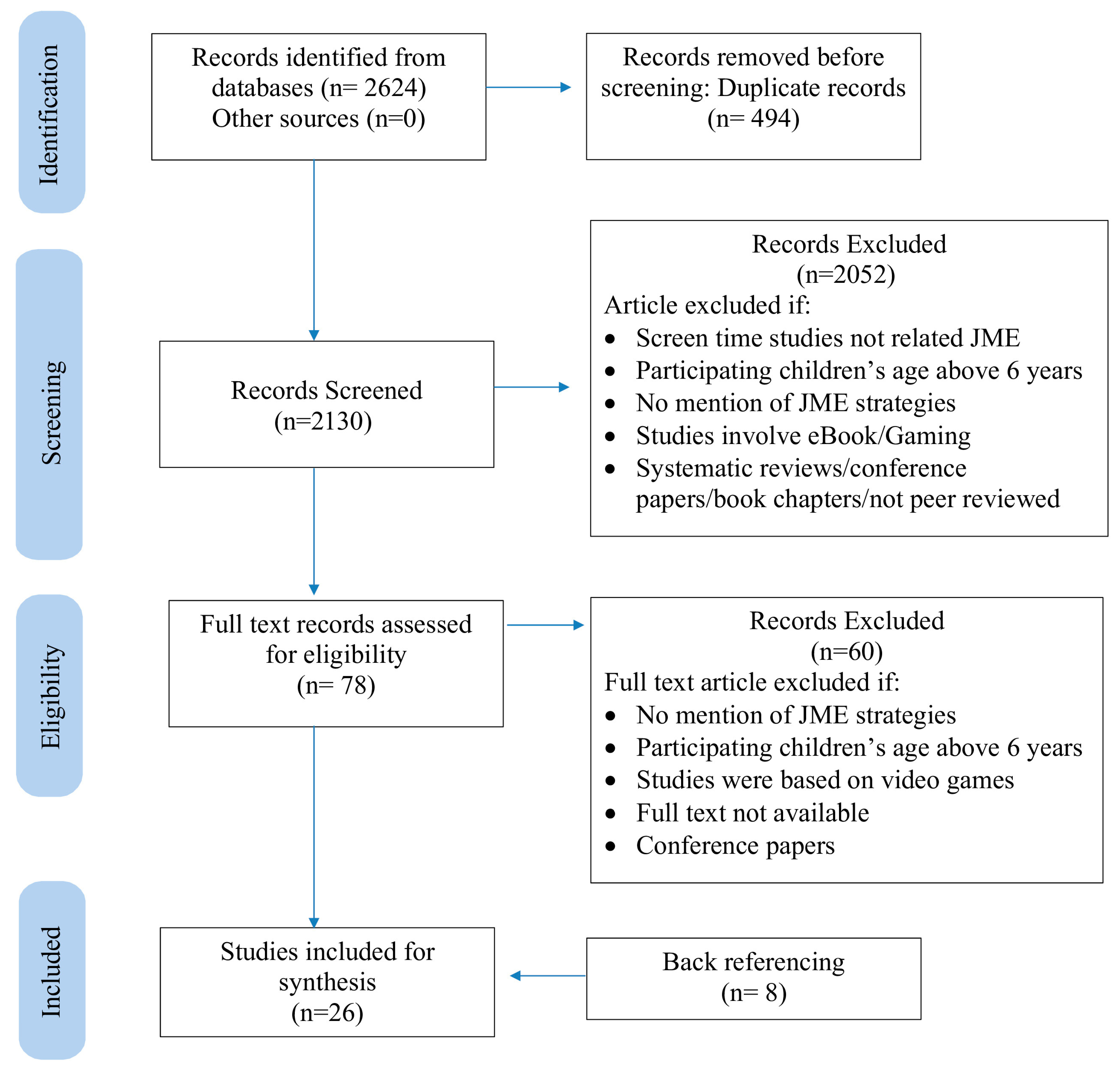
A total of 2624 records were retrieved and imported into Rayyan software [36] on 2 April 2025, after which 494 duplicates were removed (Figure 1). Screening was conducted in two stages using predefined inclusion and exclusion criteria. In the first stage, two reviewers independently screened the titles and abstracts of 2130 records in a blind manner, with conflicts resolved by a third reviewer. Of these, 2052 records were excluded based on the predefined exclusion criteria, including studies focusing solely on screen time without reference to JME, studies involving children older than 6 years, studies not explicitly describing JME strategies, studies centered on e-book reading or gaming contexts, and publications such as systematic reviews, conference papers, book chapters, or those not published in peer-reviewed journals. This resulted in 78 articles being retained for full-text review. In the second stage, the same process was applied to these 78 full-text articles, of which 60 were excluded due to the inclusion of children above 6 years (n = 29), absence of explicit JME strategies (n = 20), unavailability of full-text articles (n = 3), focus on video game contexts (n = 3), and classification as conference papers (n = 5). This resulted in 18 articles being included, with an additional eight identified through backward referencing, yielding a final sample of 26 studies.
Data extraction was carried out in Microsoft Excel using the standardized JME Framework developed by Yu et al. [37]. This framework offers a comprehensive perspective on JME, highlighting the mechanisms of engagement (how engagement occurs) as shaped by the dimensions of participants (who engages), media types (what media are used), and use of contexts (where—within physical and sociocultural environments) [37].
The findings were synthesized descriptively and presented in Table 1, Table 2 and Table 3 in alignment with the three research questions. For RQ1 (“What communication strategies are employed by parents during JME with children aged 0–6 years?”), the strategies were synthesized using speech and language interaction terminologies from Assessment in Speech-Language Pathology: A Resource Manual [38] and further categorized according to four theoretical frameworks. Two reviewers independently conducted the synthesis, with discrepancies resolved through discussion with a third reviewer. For RQ2 (“How does the use of these communication strategies during JME relate to children’s developmental outcomes?”), each study was categorized based on the developmental outcomes associated with parental communication strategies, grouped into language and behavioural domains. For RQ3 (“Do the communication strategies used during JME vary according to parent type, child age, gender, device type, media content, or geographical/cultural context?”), studies were organized according to their theoretical foundations and classified by key characteristics, including child factors (age, gender), parental factors (parent type), media factors (device type, content), and geographical or cultural context.

3. Results

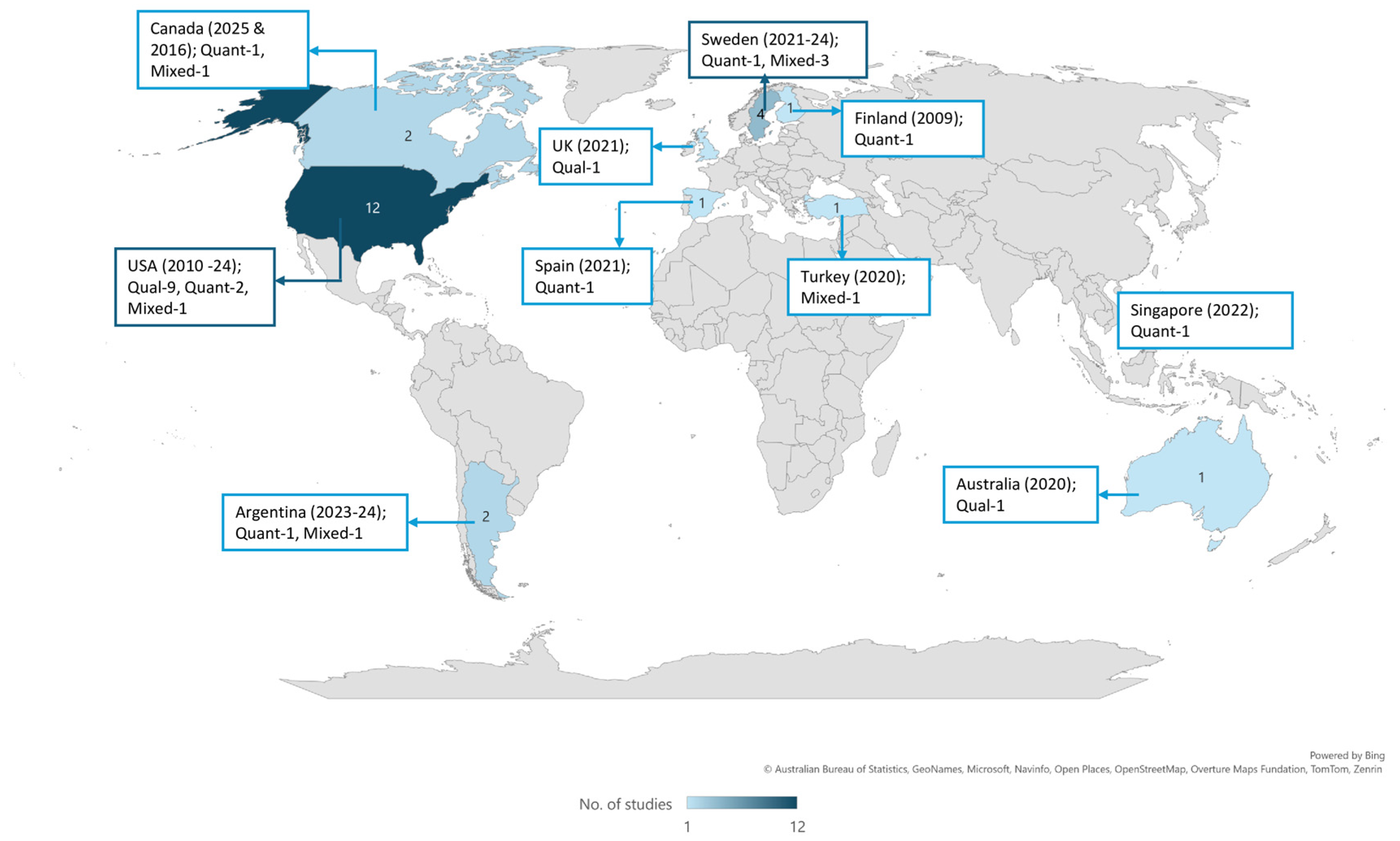
Of the 26 articles included, 11 used qualitative observational designs, 8 employed quantitative survey methods, and 7 adopted mixed-methods approaches. Geographically, JME research has now gained traction across multiple regions. Most studies were from North America (United States n = 12; and Canada n = 2), followed by Europe (Sweden n = 4; United Kingdom, Spain, Finland, and Turkey n = 1 each). Additional studies came from South America (Argentina n = 2), Asia (Singapore n = 1), and Oceania (Australia n = 1), reflecting that JME research is emerging across diverse cultural and geographic contexts. Publication trends show that 10 studies were published between 2009 and 2018 and 16 between 2020 and 2025, indicating a sharp rise in scholarly attention as contemporary screen media is increasingly recognized as a valuable context for supporting children’s communication and learning (Figure 2). A detailed mapping of the included studies using the JME framework is presented in Supplementary File S1.

3.1. RQ1: What Communication Strategies Are Employed by Parents During JME in Early Childhood?

As depicted in Table 1, parents employed a variety of communication strategies during JME. These strategies were identified and described from the perspective of speech-language pathologists (SLPs) and were classified according to four theoretical frameworks. Most strategies aligned with Social Learning theories. Among these, expansions and parallel talk (n = 10) [11,39,40,41,42,43,44,45,46,47] were the most frequently used strategies, followed by modelling (n = 8) [11,17,32,48,49,50,51,52] repetition (n = 7) [32,43,46,50,53,54,55] asking questions (n = 7) [11,17,32,43,47,55,56] labelling (n = 6) [17,32,43,55,57,58] prompts (n = 5) [17,39,50,55,56], and pointing (n = 5) [11,39,54,55,57]. Under the Sociopragmatic theory, strategies such as joint attention (n = 11) [39,40,45,47,48,50,52,53,57,58,59], conversational turn-taking (n = 3) [42,47,52] and contingent responses (n = 6) [32,43,46,47,53,60] were identified. In the context of Behaviorist theory, commonly used strategies included social reinforcers (n = 7) [17,43,47,48,52,54,56] and corrective feedback (n = 3) [17,54,56]. According to the Theory of Mind, strategies such as mental state talk (n = 9) [11,17,32,41,50,53,60,61] and cognitive scaffolding (n = 6) [11,32,41,42,54,57] were prominently featured. Additionally, a miscellaneous category was included to capture strategies not directly tied to these theories, where parents primarily provided technical scaffolding (n = 5) [17,48,54,55,60] to guide children on how to use media tools effectively. A detailed description of how these strategies are defined with examples are described in the Supplementary File S2.
Table 1. Parental communication strategies during Joint Media Engagement (JME).
TheoryCommunication StrategiesArticles
Sociocultural, Social Learning & LASSExpansionsand Parallel Talk.
(Describing or commenting on what the child is doing during play activities and expanding a child’s incomplete or telegraphic statements into grammatically correct utterances)
[11,39,40,41,42,43,44,45,46,47]
Repetition
(An indirect or informal language stimulation technique where a targeted sound, word, phrase or sentence is said more than one time; Providing many opportunities for child to use or process a new target)
[32,43,46,50,53,54,55]
Modelling:
(Modelling involves providing the child with well-formed examples of language structures, often without any expectation for the child to respond or imitate)
[11,17,32,48,49,50,51,52]
Prompts:
(Prompting is the act of providing a cue or hint, verbal, visual, or physical to encourage a child to produce a specific behavior or response)
[17,39,50,55,56]
Asking Questions.
( Wh-Questions: Questions that begin with wh-; interrogative statements that begin with what, when, where, and who)
Polar questions: solicit information by expressing a proposition that describes a possible situation, and invite the recipient to affirm or deny it)
[11,17,32,43,47,55,56]
Pointing:
(Is a deictic gesture that serves to direct another person’s attention toward an object or event, often accompanied by gaze alternation and vocalization)
[11,39,54,55,57]
Labelling
(Labelling refers to an adult providing the name of an object or action in the child’s immediate environment, helping the child to associate the spoken word with its referent)
[17,32,43,55,57,58]
Socio pragmatic theoryJoint Attention.
( Joint attention is the ability to coordinate attention between a social partner and an object or event of mutual interest)
[39,40,45,47,48,50,52,53,57,58,59]
Conversational Turn Taking:
(involves appropriate exchange of speaker and listener roles during conversation)
[42,47,52]
Contingent response
(It is one that is immediate, relevant, and appropriate to the child’s preceding communication or action)
[32,43,46,47,53,60]
Behaviourist TheorySocial Reinforcers/warmth.
(A variety of conditioned reinforcers frequently used in treatment sessions; include verbal praise, attention, touch, eye contact, and facial expressions)
[17,43,47,48,52,54,56]
Corrective Feedback.
(Response-contingent feedback from the clinician that reduces the frequency of undesirable responses of clients;
Give corrective feedback as soon as you detect an incorrect response
● Give Verbal Corrective Feedback (“No.” or “That is not correct.”) for all incorrect responses
● Give Nonverbal Corrective Feedback when appropriate (gestures that show disapproval of a response)
[17,54,56]
Theory of Mind Mental state talk
(Includes Desires (want, like), Cognitions (know, think), Emotions (happy, sad), and Modulations of assertion (maybe, perhaps))
[11,17,32,41,50,53,60,61]
Cognitive scaffolding
(Helps children solve problems, gain content knowledge and understandings about their world)
[11,32,41,42,54,57]
MiscellaneousTechnical scaffolding
(supports children in their operation of the digital device and helps them navigate successfully through the app task)
[17,48,54,55,60]

3.2. RQ2: How Does the Use of These Communication Strategies During JME Relate to Children’s Developmental Outcomes?

Out of the 26 articles reviewed, 10 reported that JME positively influenced developmental outcomes in children aged 0–6 years. The communication strategies employed during JME are closely linked to specific developmental domains, including language acquisition, cognitive skills, and socio-emotional competence. These outcomes were broadly classified under learning gains and behavioral changes according to the JME checklist developed by Yu et al. [37].

3.2.1. Learning Gains

Parental mediation strategies during JME are strongly associated with children’s semantic, syntactic, pragmatic, and cognitive development. Several studies highlight how specific communication strategies enhance language acquisition and cognitive transfer. Sundqvist et al. [61] found that mental state talk and conversational turn-taking were positively correlated with vocabulary growth, fully mediating the negative effects of video exposure on language development. Similarly, Strouse et al. [49] demonstrated that even minimal scaffolding such as pointing out relationships between labeled video objects and real-world items significantly improved toddlers’ ability to transfer learned words from media to real-life contexts. Fender et al. [56] emphasized that including active labeling and varied vocabulary use during co-viewing led to children producing a greater number and diversity of target words. Strouse et al. [51] further showed that parental modeling of attention and responsiveness supported word learning and generalization, regardless of video interactivity. Munzer et al. [55] found that co-viewing practices fostered conversational reciprocity, with children more likely to respond to parents during tablet use when exposed to higher levels of co-viewing. Sundqvist et al. [61] also noted that JME characterized by parental explanation and discussion of media uniquely predicted the development of pragmatic language skills in children. Additionally, Zack et al. [52] observed that infants in high-quality interactional dyads which included parents using modeling, cues, warmth, and shared focus were significantly more successful in transferring learning between touchscreen and real-world objects. Heimann et al. [45] concluded that JME, in which parents described ongoing content and directed the child’s attention, improved children’s development by providing better support for learning. This resulted in significantly higher memory recall scores for tasks learned from two-dimensional media compared to passive viewing without parental interaction (Table 2).
Table 2. JME communication strategies and development in children.
OutcomesArticleFindings
1. Learning Gains[61]Parental JME, through mental state talk and conversational turn-taking was positively associated with 2-year-olds’ vocabulary and fully mediated the negative effect of video content exposure. (Semantics)
 [49]Parental scaffolding during JME significantly improved children’s word learning and transfer. (Semantics)
 [58]Children whose parents showed a high teaching focus during JME used significantly more target words and said more new words. (Semantics)
 [51]Children who experienced JME with parent modeling learned significantly more words than those without it. (Semantics)
 [55]Children exposed to greater coviewing responded more to nursery rhyme verbalizations with the E + A tablet. (Syntax)
 [42]JME showed a positive correlation with children’s pragmatic development. (Pragmatics)
 [52]Infants in high interactional quality dyads (characterized by diverse maternal verbal input, emotional responsiveness, and structured teaching) were 19 times more likely to succeed in transferring learning across formats and completed the task significantly faster. (Generalization/ transfer skills)
 [45]Children in the JME 2D video condition had higher memory recall scores compared to those who passively viewed the same videos. (Cognitive skills)
2. Behavioural changes[41]Active mediation buffered TV’s negative impact on attachment. (Social skills)
 [32]Household active mediation significantly predicted higher empathy and amplified the benefits of prosocial content. (Affective skills)

3.2.2. Behavioral Changes

Beyond language and cognition, communication strategies during JME also play a vital role in shaping children’s behavioral and emotional development. Linder et al. [41] found that active mediation such as helping children understand content and explaining the difference between good and bad served as a protective factor. It effectively neutralized the negative association between television exposure and attachment security in young children. Rasmussen et al. [32] reported that frequent parental mediation such as reminding children of lessons, relating content to their experiences, summarizing key messages, and encouraging imitation of positive behaviors during educational television viewing was associated with improved emotional competencies in preschoolers. This was especially evident with prosocial content like Daniel Tiger’s Neighborhood, with children showing higher empathy, self-efficacy, and emotion recognition (Table 2).

3.3. RQ3: Do the Communication Strategies Used During JME Vary According to Parent Type, Child’s Age, Gender, Device Type, Media Content, or Geographical/Cultural Context?

Communication strategies during JME varied across contextual factors (geography), parental (parent type), child (age and gender), and media characteristics (device type and content).

3.3.1. Geographical/Cultural Context

Communication strategies, as represented across different theoretical frameworks, varied according to geographical context. The study from Australia (n = 1) demonstrated the widest scope, incorporating communication strategies from all five frameworks. In contrast, studies from Turkey (n = 1) and Finland (n = 1) were limited to strategies aligned with the Social Learning and Behaviorist frameworks, respectively. The United States (n = 12), the most represented region, included all five frameworks, with a predominance of communication strategies grounded in Social Learning theory. Singapore (n = 1), the only Asian country represented, incorporated strategies from four frameworks: Social Learning, Sociopragmatic, Behaviorist, and technical scaffolding.

3.3.2. Parent Type

The application of communication strategies varied based on parental characteristics. Studies involving mothers only and those including both parents (predominantly mothers; n = 17) were the most comprehensive, incorporating communication strategies across all five frameworks, including technical scaffolding. In contrast, the single study with an equal mother–father distribution (n = 1) included only strategies aligned with Social Learning theory.

3.3.3. Device Type

Communication strategies, as represented within theoretical frameworks, varied based on the type of device used during JME. Studies involving television (n = 9), the most frequently used device, incorporated strategies from four frameworks, with technical scaffolding notably absent. In contrast, tablet-based studies (n = 6) demonstrated greater comprehensiveness, using strategies from all five frameworks. The single study focusing on smartphones (n = 1) included strategies aligned with only the Social Learning and Sociopragmatic frameworks. Similarly, studies involving shared PC and television use (n = 1), as well as those utilizing more than two media types (n = 6), represented strategies from three frameworks, excluding the Sociopragmatic and Behaviorist frameworks, respectively.

3.3.4. Media Content

Communication strategies belonging to different theoretical frameworks varied based on the purpose of the media. In studies focusing on educational content (n = 13), as well as those where the content was not specified (n = 8), communication strategies were drawn from all five frameworks, reflecting the greatest breadth. In contrast, studies centered on entertainment content (n = 5) included communication strategies from only three frameworks, Social Learning, Sociopragmatic, and technical scaffolding.

3.3.5. Child Age/Gender

The age of the child did not limit the use of communication strategies across theoretical frameworks. Although the majority of studies focused on children aged 2–4 years, all three age groups, 0–2 years (n = 14), 2–4 years (n = 23), and 4–6 years (n = 10) included studies that applied strategies from all five major theoretical frameworks. However, differences in the use of strategies were observed across child gender distributions. Studies involving a majority male sample (n = 9) utilized strategies from four frameworks (Social Learning, Sociopragmatic, Behaviorist, and Theory of Mind), with strategies related to technical scaffolding absent. In contrast, studies involving majority female (n = 5) and equal gender distributions (n = 8) incorporated strategies from all five frameworks.
Communication strategies aligned with Social Learning theory emerged as the most frequently represented, appearing across nearly all research contexts. These strategies were identified in 23 of the 26 studies (excluding [59,60,61]). This was followed by communication strategies within the Sociopragmatic framework, which were reported in 16 studies. Communication strategies aligned with Theory of Mind were the third most frequently represented, appearing in 11 studies. Subsequently, strategies associated with the Behaviorist framework were identified in 7 studies. Communication strategies related to technical scaffolding were the least represented, appearing in only 5 studies [17,48,54,55,60] (Table 3).
Table 3. JME communication strategies across geography, parent, child, and media variables.
FactorSubgroupSociocultural, Social Learning & LASSSocial-PragmaticBehaviouristToMTechnical Scaffolding
GeographyUSA (n = 12)[32,41,43,46,49,50,51,52,53,55,58][32,43,46,50,52,53,58,60][43,52][32,41,50,53,60][55,60]
Sweden (n = 4)[11,42,45][45,61] [11,42,61] 
Canada (n = 2)[56,57][57][56][57] 
Argentina
(n = 2)
[39,54][39][54][54][54]
Spain (n = 1)[40][40]   
Singapore (n = 1)[48][48][48] [48]
Turkey (n = 1)[59]    
Finland (n = 1)  [50]  
UK (n = 1)[47][47][47]  
Australia (n = 1)[17] [17][17][17]
Parent TypeMothers only (n = 5)[43,46,52,54,57][43,46,52,57][54,57][54,57][54]
Both parents’ (majority mothers (n = 12))[11,17,32,40,41,42,45,47,50,55,56][32,40,45,47,50,61][17,47,56][11,17,32,41,42,50,61][11,17,32,41,42,50,61]
Caregiver (n = 1)[39][39]   
 Parents not specified (n = 7)[44,48,49,51,53,58][48,53,58,60][48][53,60][48,60]
Equal mother father (n = 1) [59]   
Device TypeTV (n = 9)[11,32,43,44,49,50,51,57,58][11,32,43,50,57][11,32,43,50,57][11,32,50,57] 
Smartphone (n = 1)[39][39]   
Shared PC & TV
(n = 1)
[54] [54][54][54]
More than 2 media (n = 6)[40,41,42,46][40,46,59,60] [41,42,60][60]
Tablet (n = 6)[17,45,47,55,56][45,47,61][17,47,56][17,61][17,55]
17 inch touchscreen monitor (n = 1)[52][52][52]  
Not specified (n = 2)[48,53][48,53][48][53][48]
Child Age0–2 years (n = 14)[11,17,39,40,41,43,46,49,50,52,53,54,58][39,43,46,50,52,58,60][17,43,52,54][11,17,41,50,53,54][17,54,60]
2–4 years (n = 23)[11,17,32,39,40,41,42,43,45,46,47,48,49,50,51,53,54,55,56,57,58][32,40,43,45,46,47,48,50,53,57,58,60,61][17,43,47,48,54,56][11,17,32,41,42,50,53,54,57,60,61][17,48,54,55,60]
4–6 years (n = 10);[11,17,32,43,44,48,56,57][32,43,57,59,60][17,43,48,56][11,17,32,56,57,60][17,48,60]
Child gender Majority Male
(n = 9)
[11,17,32,39,41,42,43,56][32,39,43,45,61]A14, A16 [43,56][11,32,41,42,61] 
Majority Female
(n = 5)
[17,47,48,55,58][47,48,58][17,47,48][17][17,48,55]
Equal
(n = 8)
[49,50,51,52,53,54,57][50,52,53,57,59][52,54][50,53,54,57][54]
Not mentioned (n = 4)[40,46,48][40,46,60] [60][60]
Content TypeEducational (n = 13)[17,32,43,45,47,49,50,51,52,53,56,58][32,43,45,47,50,52,53,58,61][17,43,47,52,56][17,32,50,53,61][17]
Entertainment (n = 5)[39,44,46,55][39,59,60]  [55]
Not mentioned (n = 8)[11,40,42,48,54,57,59][40,57,60][48,54][11,41,42,54,57,60][48,54,60]

4. Discussion

The primary aim of this review was to identify and synthesize the communication strategies employed by parents during JME with young children. Building on this, the review further examined which studies reported positive developmental outcomes and the specific communication strategies associated with these benefits. To provide a more nuanced understanding, the analysis also explored whether these strategies varied according to key contextual factors, including child age and gender, parent characteristics, geographical context, device type, and media content.
Diverse forms of parent–child interaction occur during media use, making it essential to systematically identify and categorize this range of interactions. Accordingly, the parental interactions with their children during JME, as reported across the 26 included studies, were classified into 15 distinct strategies. These were further organized under four major theoretical frameworks: Social Learning, Sociopragmatic, Behaviorist, and Theory of Mind alongside a fifth category of miscellaneous which included technical scaffolding. Communication strategies such as expansion, parallel talk, modeling, repetition, prompting, questioning, labeling, and pointing categorised under the Social Learning theoretical framework were frequently observed [19,20]. Research indicates that children whose parents engaged in modeling during JME demonstrated better vocabulary acquisition and transfer skills. Additionally, high-quality JME practices such as asking direct questions, singing along to rhymes, describing content, and providing prompts were associated with improved verbalization and greater word learning [18,42,44]. Sociopragmatic strategies, including joint attention, conversational turn-taking, and contingent responding, were also widely reported, emphasizing the interactive and reciprocal nature of JME as a socially mediated learning context [21,22]. Research indicates that children whose parents actively directed their attention to on-screen content, responded to questions posed by television characters, and engaged in turn-taking demonstrated better transfer skills and enhanced prosocial development [32,52]. Additionally, strategies grounded in Theory of Mind, such as mental state talk and cognitive scaffolding, were found to promote higher-order cognitive processes, including perspective-taking and inferencing [22]. Research suggests that parental questioning and explaining about characters’ thoughts and emotions during media use are associated with improvements in vocabulary and empathy skills [32,61]. Behaviorist strategies like reinforcement and corrective feedback further contributed to shaping children’s responses during interaction [23]. Supporting studies indicate that maternal affectionate communication style, particularly characterized by frequent praise and emotionally responsive interactions, enhances children’s ability to generalize and transfer learning across contexts [52]. Technical scaffolding, defined as parental support in navigating digital interfaces, was the least represented strategy. However, studies suggest that when format-related talk is combined with other communication strategies such as asking questions, singing along, and pointing out, it contributes to greater verbalization skills in children [55].
The review also revealed that JME strategies are significantly influenced by contextual factors, including geography, parent type, device type, media content, and child characteristics. Communication strategies in Social Learning theoretical framework emerged as the most universally applied strategies across contexts, highlighting its foundational role in parent–child interaction. Parental involvement was predominantly maternal, indicating a gap in understanding paternal contributions to JME [32]. This also suggests that mothers are the most common JME partners and caregivers in most families [9]. Device type also influenced interaction patterns, with television being the most commonly studied medium, likely due to its larger screen size and shared viewing affordances, which facilitate co-engagement [62]. Media content further shaped engagement, with educational programs such as Sesame Street and Daniel Tiger’s Neighborhood consistently associated with richer communicative exchanges and developmental gains [32,63]. This indicates that quality content is also necessary for effective outcomes [64]. Interestingly, age and gender did not show substantial variation in the application of strategies, suggesting that JME communication strategies may be broadly applicable across early childhood. Together, these findings justify the need for more contextually nuanced and inclusive approaches to better understand how these interacting factors optimize JME outcomes. Building on these insights, the current evidence base is largely centered on video-based media, and extending this to interactive formats such as gaming and e-books could further enrich understanding of JME, particularly the role of technical scaffolding.
Most included studies did not explicitly examine JME as their primary focus; however, a smaller yet critical subset employing mixed-method designs provided deeper, more nuanced insights into JME processes. These studies collectively underscore the pivotal role of parent–child interaction quality during media use. For instance, Sundqvist et al. [61] demonstrated that mental state talk encompassing discussions of desires, emotions, and thoughts alongside conversational turn-taking, significantly enhanced children’s vocabulary while buffering the adverse effects of screen exposure. Similarly, Wood et al. [56] identified multidimensional parental scaffolding strategies spanning verbal (e.g., questioning, instructing), physical (e.g., guiding device use), and emotional (e.g., praise, encouragement), illustrating how parents dynamically support engagement with touchscreen media. Heiman et al. [45] further highlighted the effectiveness of verbal scaffolding techniques such as labeling, narration, and description, showing superior learning and memory outcomes in children engaged in JME compared to passive viewing. Complementing this, Zack et al. [52] emphasized that high-quality interaction characterized by maternal modeling, structured guidance, and emotional responsiveness enhances children’s ability to transfer learning across 2D and 3D contexts. Taken together, these findings position mixed-method approaches as uniquely valuable in capturing the complexity and ecological validity of JME. More importantly, they converge on a central insight that it is not mere co-viewing, but the quality, intentionality, and responsiveness of parental interaction that drive developmental gains. This underscores a clear research priority, with a need for more rigorous, JME-focused studies to strengthen the evidence base and optimize children’s learning in digital contexts.
The findings emphasize that digital media, when used interactively, can serve as a meaningful context for language learning rather than a barrier, with important implications for clinical practice, parent training, and policy development in an era where screen exposure is ubiquitous.

5. Conclusions

This scoping review maps the existing literature to underscore that JME is not merely about screen time, but about the quality and intentionality of parent–child interactions during media use. By synthesizing diverse evidence, the study identified current patterns, contextual influences, and research gaps related to JME. Core communication strategies such as expansion, labeling, questioning, joint attention, and mental state talk align with established learning theories and can be naturally extended into digital contexts, thereby supporting language, cognitive, and socio-emotional development in early childhood. Active, thoughtful JME may buffer potential risks of early media exposure and enhance memory, vocabulary, and comprehension when parents co-view, explain content, and connect media to real-world experiences.
The findings further highlight that JME is shaped by contextual factors such as device type, content quality, cultural background, and parent characteristics, reinforcing that how media is used may matter more than how much time is spent. The study also offers several important recommendations for future research. While most studies did not explicitly focus on JME, a smaller subset employing mixed-methods approaches provided deeper insights, highlighting the need for more rigorous, JME-focused research. Future studies could further examine the structured nature of JME across diverse geographical and cultural contexts and prioritize well-designed designs that link JME practices with measurable child developmental outcomes.
With respect to practice and policy, the findings of the present review support a shift from screen time restrictions toward evidence-based parental guidance that emphasizes effective engagement during media use. At a systems level, parents could be encouraged to adopt a range of JME strategies during everyday media interactions by professionals working with young children, including speech-language pathologists, pediatricians, psychologists, and early childhood educators, who can integrate these strategies into their practice and parental counseling related to screen use. By reframing media as a potentially language-rich extension of everyday interactions rather than an inherent risk, this review lays the groundwork for future research, interventions, and guidelines aligned with children’s digital realities.

Supplementary Materials

The following supporting information can be downloaded at: https://www.mdpi.com/article/10.3390/mti10060066/s1.

Author Contributions

Conceptualization, and Methodology: L.A.V. and G.B.; Software, Validation, and Formal Analysis, L.A.V., G.B. and M.M.; Investigation, and Data Curation, L.A.V., G.B. and M.M.; Writing—Original Draft Preparation, L.A.V. and G.B.; Writing—Review and Editing, L.A.V., G.B., M.M., J.S.B., J.K. and A.L.V.; Visualization, and Supervision, G.B.; Funding Acquisition, G.B. All authors have read and agreed to the proofread and published version of the manuscript.

Funding

This research was funded by Indian Council of Medical Research (ICMR), grant number EMTR/SG-DEL/2025/04-26.

Data Availability Statement

No new data was created or analyzed in this study. Data sharing is not applicable to this article.

Conflicts of Interest

The authors declare no conflicts of interest. The funders had no role in the design of the study; in the collection, analyses, or interpretation of data; in the writing of the manuscript; or in the decision to publish the results.

Abbreviations

The following abbreviations are used in this manuscript:
JMEJoint Media Engagement
SLPsSpeech Language Pathologists

References

  1. Bolten, M.; Unternaehrer, E. Editorial: Digital media use in early childhood—Contextual factors, developmental outcomes, and pathways. Front. Child Adolesc. Psychiatry 2025, 4, 1627511. [Google Scholar] [CrossRef] [PubMed]
  2. Durham, K.; Wethmar, D.; Brandstetter, S.; Seelbach-Göbel, B.; Apfelbacher, C.; Melter, M.; Kabesch, M.; Kerzel, S.; The KUNO Kids Study Group. Digital media exposure and predictors for screen time in 12-month-old children: A cross-sectional analysis of data from a German birth cohort. Front. Psychiatry 2021, 12, 737178. [Google Scholar] [CrossRef]
  3. Muppalla, S.K.; Vuppalapati, S.; Pulliahgaru, A.R.; Sreenivasulu, H. Effects of excessive screen time on child development: An updated review and strategies for management. Cureus 2023, 15, e40608. [Google Scholar] [CrossRef]
  4. Liu, J.; Riesch, S.; Tien, J.; Lipman, T.; Pinto-Martin, J.; O’Sullivan, A. Screen media overuse and associated physical, cognitive, and emotional/behavioral outcomes in children and adolescents: An integrative review. J. Pediatr. Health Care 2022, 36, 99–109. [Google Scholar] [CrossRef]
  5. Hale, L.; Guan, S. Screen time and sleep among school-aged children and adolescents: A systematic literature review. Sleep Med. Rev. 2014, 21, 50. [Google Scholar] [CrossRef]
  6. Radesky, J.S.; Christakis, D.A. Increased screen time: Implications for early childhood development and behavior. Pediatr. Clin. N. Am. 2016, 63, 827–839. [Google Scholar] [CrossRef]
  7. Council on Communications and Media; Hill, D.; Ameenuddin, N.; Chassiakos, Y.R.; Cross, C.; Hutchinson, J.; Levine, A.; Boyd, R.; Mendelson, R.; Moreno, M.; et al. Media and young minds. Pediatrics 2016, 138, e20162591. [Google Scholar] [CrossRef]
  8. World Health Organization. Guidelines on Physical Activity, Sedentary Behaviour and Sleep for Children Under 5 Years of Age; World Health Organization: Geneva, Switzerland, 2019; Available online: https://www.who.int/publications/i/item/9789241550536 (accessed on 2 May 2026).
  9. Valkenburg, P.M.; Krcmar, M.; Peeters, A.L.; Marseille, N.M. Developing a scale to assess three styles of television mediation: “Instructive mediation,” “restrictive mediation,” and “social coviewing”. J. Broadcast. Electron. Media 1999, 43, 52–66. [Google Scholar] [CrossRef]
  10. Koch, F.S.; Barr, R.; Sundqvist, A. The joint media engagement scale (JMES): An instrument for measuring shared media use with children aged 1 to 5 years old. Br. J. Dev. Psychol. 2025, 43, 98–110. [Google Scholar] [CrossRef]
  11. Walsh, E. Joint media engagement. In The SAGE Encyclopedia of Out-of-School Learning; Seel, N.M., Ed.; SAGE Publications: Thousand Oaks, CA, USA, 2017; pp. 394–398. [Google Scholar]
  12. Takeuchi, L.; Stevens, R. The New Coviewing: Designing for Learning Through Joint Media Engagement; Joan Ganz Cooney Center: New York, NY, USA, 2011. [Google Scholar]
  13. Ewin, C.A.; Reupert, A.E.; McLean, L.A.; Ewin, C.J. The impact of joint media engagement on parent–child interactions: A systematic review. Hum. Behav. Emerg. Technol. 2021, 3, 230–254. [Google Scholar] [CrossRef]
  14. Chen, X.; Yeung, W.-J.J. Association between preschool children’s media use, parental joint media engagement and prosocial behavior: A longitudinal cohort study. BMC Public Health 2026, 26, 561. [Google Scholar] [CrossRef]
  15. Foulds, K. Co-viewing mass media to support children and parents’ emotional ABCs: An evaluation of Ahlan Simsim. Early Child Educ. J. 2022, 51, 1479–1488. [Google Scholar] [CrossRef]
  16. Richert, R.A.; Robb, M.B.; Fender, J.G.; Wartella, E. Word learning from baby videos. Arch. Pediatr. Adolesc. Med. 2010, 164, 432–437. [Google Scholar] [CrossRef]
  17. Neumann, M.M. Parent scaffolding of young children’s use of touch screen tablets. Early Child Dev. Care 2018, 188, 1652–1662. [Google Scholar] [CrossRef]
  18. Strouse, G.A.; Ganea, P.A. Parent–toddler behavior and language differ when reading electronic and print picture books. Front. Psychol. 2017, 8, 677. [Google Scholar] [CrossRef]
  19. Vygotsky, L.S. Thought and Language; MIT Press: Cambridge, MA, USA, 1986; p. 354. [Google Scholar]
  20. Bandura, A. Social Learning Theory; Prentice-Hall: Englewood Cliffs, NJ, USA, 1977. [Google Scholar]
  21. Tomasello, M. The social-pragmatic theory of word learning. Pragmatics 2000, 10, 401–413. [Google Scholar] [CrossRef]
  22. Kim, Y.S.G.; Dore, R.; Cho, M.; Golinkoff, R.; Amendum, S. Theory of mind, mental state talk, and discourse comprehension: Theory of mind process is more important for narrative comprehension than for informational text comprehension. J. Exp. Child Psychol. 2021, 209, 105181. [Google Scholar] [CrossRef] [PubMed]
  23. Skinner, B.F. Science and Human Behavior, 2nd ed.; Macmillan: New York, NY, USA, 1953. [Google Scholar]
  24. Neumann, M.M.; Merchant, G. “That’s a big bad wolf!”: Learning through teacher–child talk during shared reading of a storybook app. Early Child. Educ. J. 2021, 49, 515–525. [Google Scholar] [CrossRef]
  25. Dayton, C.J.; Walsh, T.B.; Oh, W.; Volling, B. Hush now baby: Mothers’ and fathers’ strategies for soothing their infants and associated parenting outcomes. J. Pediatr. Health Care 2015, 29, 145–155. [Google Scholar] [CrossRef] [PubMed]
  26. Leech, K.; Chandler-Campbell, I.L.; Alton, J.; Corriveau, K.H. What would happen if?: A comparison of fathers’ and mothers’ questions to children during a science activity. Front. Psychol. 2023, 14, 1078994. [Google Scholar] [CrossRef]
  27. Rochanavibhata, S.; Marian, V. Cross-cultural differences in mother–preschooler book sharing practices in the United States and Thailand. J. Child Lang. 2020, 48, 834. [Google Scholar] [CrossRef]
  28. Tamis-LeMonda, C.S.; Sze, I.N.L.; Ng, F.F.Y.; Kahana-Kalman, R.; Yoshikawa, H. Maternal teaching during play with four-year-olds: Variation by ethnicity and family resources. Merrill Palmer Q. 2013, 59, 361–398. [Google Scholar] [CrossRef]
  29. Bornstein, M.H.; Cote, L.R.; Haynes, O.M.; Suwalsky, J.T.D.; Bakeman, R. Modalities of infant–mother interaction in Japanese, Japanese American immigrant, and European American dyads. Child Dev. 2012, 83, 2073. [Google Scholar] [CrossRef]
  30. Mascaro, J.S.; Rentscher, K.E.; Hackett, P.D.; Mehl, M.R.; Rilling, J.K. Child gender influences paternal behavior, language, and brain function. Behav. Neurosci. 2017, 131, 262. [Google Scholar] [CrossRef]
  31. Twork, K.; Ludwig, J.; Kiess, W.; Poulain, T. Parent–child interaction frequency: Associations with age, sibling presence, and child health. Pediatr. Res. 2024, 98, 114–120. [Google Scholar] [CrossRef]
  32. Rasmussen, E.E.; Shafer, A.; Colwell, M.J.; White, S.; Punyanunt-Carter, N.; Densley, R.L.; Wright, H. Relation between active mediation, exposure to Daniel Tiger’s Neighborhood, and US preschoolers’ social and emotional development. J. Child. Media 2016, 10, 443–461. [Google Scholar] [CrossRef]
  33. Troseth, G.L.; Strouse, G.A.; Verdine, B.N.; Saylor, M.M. Let’s chat: On-screen social responsiveness is not sufficient to support toddlers’ word learning from video. Front. Psychol. 2018, 9, 2195. [Google Scholar] [CrossRef] [PubMed]
  34. Tricco, A.C.; Lillie, E.; Zarin, W.; O’Brien, K.K.; Colquhoun, H.; Levac, D.; Moher, D.; Peters, M.D.J.; Horsley, T.; Weeks, L.; et al. PRISMA extension for scoping reviews (PRISMA-ScR): Checklist and explanation. Ann. Intern. Med. 2018, 169, 467–473. [Google Scholar] [CrossRef] [PubMed]
  35. Peters, M.D.J.; Marnie, C.; Tricco, A.C.; Pollock, D.; Munn, Z.; Alexander, L.; McInerney, P.; Godfrey, C.M.; Khalil, H. Updated methodological guidance for the conduct of scoping reviews. JBI Evid. Synth. 2020, 18, 2119–2126. [Google Scholar] [CrossRef]
  36. Ouzzani, M.; Hammady, H.; Fedorowicz, Z.; Elmagarmid, A. Rayyan—A web and mobile app for systematic reviews. Syst. Rev. 2016, 5, 210. [Google Scholar] [CrossRef] [PubMed]
  37. Yu, J.; Qi, X.; Yang, S. Parent–child joint media engagement within HCI: A scoping analysis of the research landscape. In Proceedings of the Conference on Human Factors in Computing Systems, Honolulu, HI, USA, 11–16 May 2024. [Google Scholar] [CrossRef]
  38. Shipley, K.G.; McAfee, J.G. Assessment in Speech-Language Pathology: A Resource Manual, 4th ed.; Cengage Learning: Boston, MA, USA, 2021. [Google Scholar]
  39. Gago-Galvagno, L.G.; del Pilar Castillo, M.; Fernández, M.A.; Tabullo, A.J.; Millere, S.E.; Elgier, A.M.; Azzollini, S.C. Dyadic interactions, communication and regulation skills: Associations with screen use in toddlers from Buenos Aires. Psychol. Russ. State Art 2024, 17, 39–59. [Google Scholar] [CrossRef]
  40. Ramírez-García, A.; González-Fernández, N.; Salcines-Talledo, I. Parental mediation and use of mobile devices—Smartphones and tablets—In Spanish families. J. Fam. Issues 2023, 44, 825–849. [Google Scholar] [CrossRef]
  41. Linder, L.K.; McDaniel, B.T.; Stockdale, L.; Coyne, S.M. The impact of parent and child media use on early parent–infant attachment. Infancy 2021, 26, 551–569. [Google Scholar] [CrossRef]
  42. Sundqvist, A.; Koch, F.S.; Birberg Thornberg, U.; Barr, R.; Heimann, M. Growing up in digital media and the association with the child’s language development at two years of age. Front. Psychol. 2021, 12, 569920. [Google Scholar] [CrossRef]
  43. Nathanson, A.I.; Rasmussen, E.E. TV viewing compared to book reading and toy playing reduces responsive maternal communication with toddlers and preschoolers. Hum. Commun. Res. 2011, 37, 465–487. [Google Scholar] [CrossRef]
  44. Paavonen, E.J.; Roine, M.; Pennonen, M.; Lahikainen, A.R. Do parental co-viewing and discussions mitigate TV-induced fears in young children? Child Care Health Dev. 2009, 35, 773–780. [Google Scholar] [CrossRef] [PubMed]
  45. Heimann, M.; Hedendahl, L.; Ottmer, E.; Kolling, T.; Koch, F.S.; Birberg Thornberg, U.; Sundqvist, A. 2-year-olds learning from 2D media with and without parental support: Comparing two forms of joint media engagement with passive viewing and learning from 3D. Front. Psychol. 2021, 11, 576940. [Google Scholar] [CrossRef] [PubMed]
  46. Thompson, D.A.; Jimenez-Zambrano, A.M.; Ringwood, H.; Tschann, J.M.; Clark, L. Parenting a toddler in the era of pervasive screens: Interviews with low-income Mexican American parents. Int. J. Environ. Res. Public Health 2023, 20, 5461. [Google Scholar] [CrossRef]
  47. Carr, A.; Dempster, T. Parent–child interactions during joint engagement with touchscreen technology: A comparison of younger versus older toddlers. Infant Behav. Dev. 2021, 64, 101587. [Google Scholar] [CrossRef]
  48. Sun, H.; Lim, V.; Low, J.; Kee, S. The development of a parental questionnaire (QQ-MediaSEED) on bilingual children’s quantity and quality of digital media use at home. Acta Psychol. 2022, 229, 103668. [Google Scholar] [CrossRef]
  49. Strouse, G.A.; Troseth, G.L. Supporting toddlers’ transfer of word learning from video. Cogn. Dev. 2014, 30, 47–64. [Google Scholar] [CrossRef]
  50. Padilla-Walker, L.M.; Coyne, S.M.; Booth, M.A.; Domoff, S.E.; Summers, K.; Schvaneveldt, E.; Stockdale, L. Parent–child joint media engagement in infancy. Infancy 2020, 25, 552–570. [Google Scholar] [CrossRef] [PubMed]
  51. Strouse, G.A.; Troseth, G.L.; O’Doherty, K.D.; Saylor, M.M. Co-viewing supports toddlers’ word learning from contingent and noncontingent video. J. Exp. Child Psychol. 2018, 166, 310–326. [Google Scholar] [CrossRef]
  52. Zack, E.; Barr, R. The role of interactional quality in learning from touch screens during infancy: Context matters. Front. Psychol. 2016, 7, 1264. [Google Scholar] [CrossRef]
  53. Shawcroft, J.; Coyne, S.M.; Linder, L.; Clifford, B.N.; McDaniel, B.T. Attachment security and problematic media use in infancy: A longitudinal study in the United States. Infancy 2024, 29, 137–154. [Google Scholar] [CrossRef]
  54. Medawar, J.; Tabullo, Á.J.; Gago-Galvagno, L.G. Early language outcomes in Argentinean toddlers: Associations with home literacy, screen exposure and joint media engagement. Br. J. Dev. Psychol. 2023, 41, 13–30. [Google Scholar] [CrossRef] [PubMed]
  55. Munzer, T.G.; Miller, A.L.; Weeks, H.M.; Kaciroti, N.; Radesky, J. Parent–toddler social reciprocity during reading from electronic tablets vs print books. JAMA Pediatr. 2019, 173, 1076. [Google Scholar] [CrossRef]
  56. Wood, E.; Petkovski, M.; De Pasquale, D.; Gottardo, A.; Evans, M.A.; Savage, R.S. Parent scaffolding of young children when engaged with mobile technology. Front. Psychol. 2016, 7, 690. [Google Scholar] [CrossRef]
  57. Mao, W.; Pesco, D. Chinese mothers’ perspectives on supporting young children’s language development through dialogic reading and co-viewing. J. Child Fam. Stud. 2025, 34, 724–736. [Google Scholar] [CrossRef]
  58. Fender, J.G.; Richert, R.A.; Robb, M.B.; Wartella, E. Parent teaching focus and toddlers’ learning from an infant DVD. Infant Child. Dev. 2010, 19, 613–627. [Google Scholar] [CrossRef]
  59. Konca, A.S.; Tantekin Erden, F. Young children’s social interactions with parents during digital activities at home. Child Indic. Res. 2021, 14, 1365–1385. [Google Scholar] [CrossRef]
  60. Domoff, S.E.; Radesky, J.S.; Harrison, K.; Riley, H.; Lumeng, J.C.; Miller, A.L. A naturalistic study of child and family screen media and mobile device use. J. Child Fam. Stud. 2018, 28, 401–410. [Google Scholar] [CrossRef] [PubMed]
  61. Sundqvist, A.; Koch, F.S.; Söderberg, M.; Barr, R.; Heimann, M. Qualitative and quantitative aspects of child-directed parental talk and the relation to 2-year-old’s developing vocabulary. Infancy 2022, 27, 682–699. [Google Scholar] [CrossRef] [PubMed]
  62. Linebarger, D.L.; Vaala, S.E. Screen media and language development in infants and toddlers: An ecological perspective. Dev. Rev. 2010, 30, 176–202. [Google Scholar] [CrossRef]
  63. Fisch, S.M. Children’s learning from television. In Encyclopedia of the Sciences of Learning; Goldstein, N., Ed.; Springer: New York, NY, USA, 2012; pp. 532–534. [Google Scholar] [CrossRef]
  64. Dore, R.A.; Purtell, K.M.; Lin, T.J.; Justice, L.M. Exploring children’s naturalistic educational media use: Prevalence, domains, and correlates. J. Appl. Dev. Psychol. 2025, 99, 101814. [Google Scholar] [CrossRef]
Figure 1. PRISMA ScR flowchart detailing study selection process.
Mti 10 00066 g001
Figure 2. Distribution of JME studies across different countries.
Mti 10 00066 g002
Disclaimer/Publisher’s Note: The statements, opinions and data contained in all publications are solely those of the individual author(s) and contributor(s) and not of MDPI and/or the editor(s). MDPI and/or the editor(s) disclaim responsibility for any injury to people or property resulting from any ideas, methods, instructions or products referred to in the content.