
Parental Communication Strategies During Screen Time in Early Childhood: A Scoping Review of Joint Media Engagement

 , ,
, ,
Abstract
1. Introduction
The Current Study
- RQ1: What communication strategies are employed by parents during JME in early childhood?
- RQ2: How does the use of these communication strategies during JME relate to children’s developmental outcomes?
- RQ3: Do the communication strategies used during JME vary according to parent type, child’s age, gender, device type, media content, or geographical/cultural context?
2. Materials and Methods
2.1. Study Design
2.2. Inclusion and Exclusion Criteria
2.3. Search Strategies
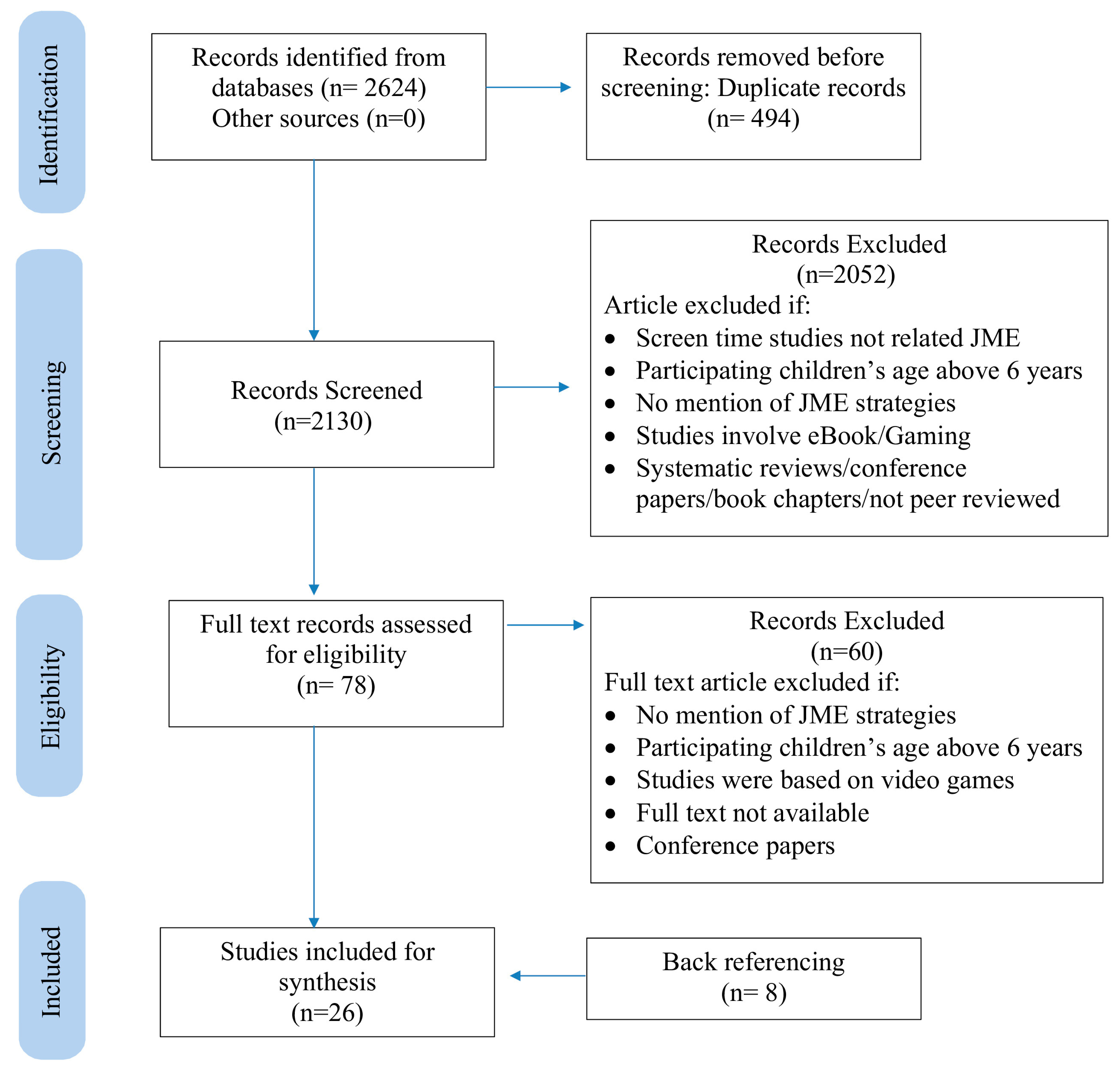
2.4. Selection and Synthesis
3. Results
3.1. RQ1: What Communication Strategies Are Employed by Parents During JME in Early Childhood?

| Theory | Communication Strategies | Articles |
|---|---|---|
| Sociocultural, Social Learning & LASS | Expansionsand Parallel Talk. (Describing or commenting on what the child is doing during play activities and expanding a child’s incomplete or telegraphic statements into grammatically correct utterances) | [11,39,40,41,42,43,44,45,46,47] |
| Repetition (An indirect or informal language stimulation technique where a targeted sound, word, phrase or sentence is said more than one time; Providing many opportunities for child to use or process a new target) | [32,43,46,50,53,54,55] | |
| Modelling: (Modelling involves providing the child with well-formed examples of language structures, often without any expectation for the child to respond or imitate) | [11,17,32,48,49,50,51,52] | |
| Prompts: (Prompting is the act of providing a cue or hint, verbal, visual, or physical to encourage a child to produce a specific behavior or response) | [17,39,50,55,56] | |
| Asking Questions. ( Wh-Questions: Questions that begin with wh-; interrogative statements that begin with what, when, where, and who) Polar questions: solicit information by expressing a proposition that describes a possible situation, and invite the recipient to affirm or deny it) | [11,17,32,43,47,55,56] | |
| Pointing: (Is a deictic gesture that serves to direct another person’s attention toward an object or event, often accompanied by gaze alternation and vocalization) | [11,39,54,55,57] | |
| Labelling (Labelling refers to an adult providing the name of an object or action in the child’s immediate environment, helping the child to associate the spoken word with its referent) | [17,32,43,55,57,58] | |
| Socio pragmatic theory | Joint Attention. ( Joint attention is the ability to coordinate attention between a social partner and an object or event of mutual interest) | [39,40,45,47,48,50,52,53,57,58,59] |
| Conversational Turn Taking: (involves appropriate exchange of speaker and listener roles during conversation) | [42,47,52] | |
| Contingent response (It is one that is immediate, relevant, and appropriate to the child’s preceding communication or action) | [32,43,46,47,53,60] | |
| Behaviourist Theory | Social Reinforcers/warmth. (A variety of conditioned reinforcers frequently used in treatment sessions; include verbal praise, attention, touch, eye contact, and facial expressions) | [17,43,47,48,52,54,56] |
| Corrective Feedback. (Response-contingent feedback from the clinician that reduces the frequency of undesirable responses of clients; Give corrective feedback as soon as you detect an incorrect response ● Give Verbal Corrective Feedback (“No.” or “That is not correct.”) for all incorrect responses ● Give Nonverbal Corrective Feedback when appropriate (gestures that show disapproval of a response) | [17,54,56] | |
| Theory of Mind | Mental state talk (Includes Desires (want, like), Cognitions (know, think), Emotions (happy, sad), and Modulations of assertion (maybe, perhaps)) | [11,17,32,41,50,53,60,61] |
| Cognitive scaffolding (Helps children solve problems, gain content knowledge and understandings about their world) | [11,32,41,42,54,57] | |
| Miscellaneous | Technical scaffolding (supports children in their operation of the digital device and helps them navigate successfully through the app task) | [17,48,54,55,60] |
3.2. RQ2: How Does the Use of These Communication Strategies During JME Relate to Children’s Developmental Outcomes?
3.2.1. Learning Gains
| Outcomes | Article | Findings |
|---|---|---|
| 1. Learning Gains | [61] | Parental JME, through mental state talk and conversational turn-taking was positively associated with 2-year-olds’ vocabulary and fully mediated the negative effect of video content exposure. (Semantics) |
| [49] | Parental scaffolding during JME significantly improved children’s word learning and transfer. (Semantics) | |
| [58] | Children whose parents showed a high teaching focus during JME used significantly more target words and said more new words. (Semantics) | |
| [51] | Children who experienced JME with parent modeling learned significantly more words than those without it. (Semantics) | |
| [55] | Children exposed to greater coviewing responded more to nursery rhyme verbalizations with the E + A tablet. (Syntax) | |
| [42] | JME showed a positive correlation with children’s pragmatic development. (Pragmatics) | |
| [52] | Infants in high interactional quality dyads (characterized by diverse maternal verbal input, emotional responsiveness, and structured teaching) were 19 times more likely to succeed in transferring learning across formats and completed the task significantly faster. (Generalization/ transfer skills) | |
| [45] | Children in the JME 2D video condition had higher memory recall scores compared to those who passively viewed the same videos. (Cognitive skills) | |
| 2. Behavioural changes | [41] | Active mediation buffered TV’s negative impact on attachment. (Social skills) |
| [32] | Household active mediation significantly predicted higher empathy and amplified the benefits of prosocial content. (Affective skills) |
3.2.2. Behavioral Changes
3.3. RQ3: Do the Communication Strategies Used During JME Vary According to Parent Type, Child’s Age, Gender, Device Type, Media Content, or Geographical/Cultural Context?
3.3.1. Geographical/Cultural Context
3.3.2. Parent Type
3.3.3. Device Type
3.3.4. Media Content
3.3.5. Child Age/Gender
| Factor | Subgroup | Sociocultural, Social Learning & LASS | Social-Pragmatic | Behaviourist | ToM | Technical Scaffolding |
|---|---|---|---|---|---|---|
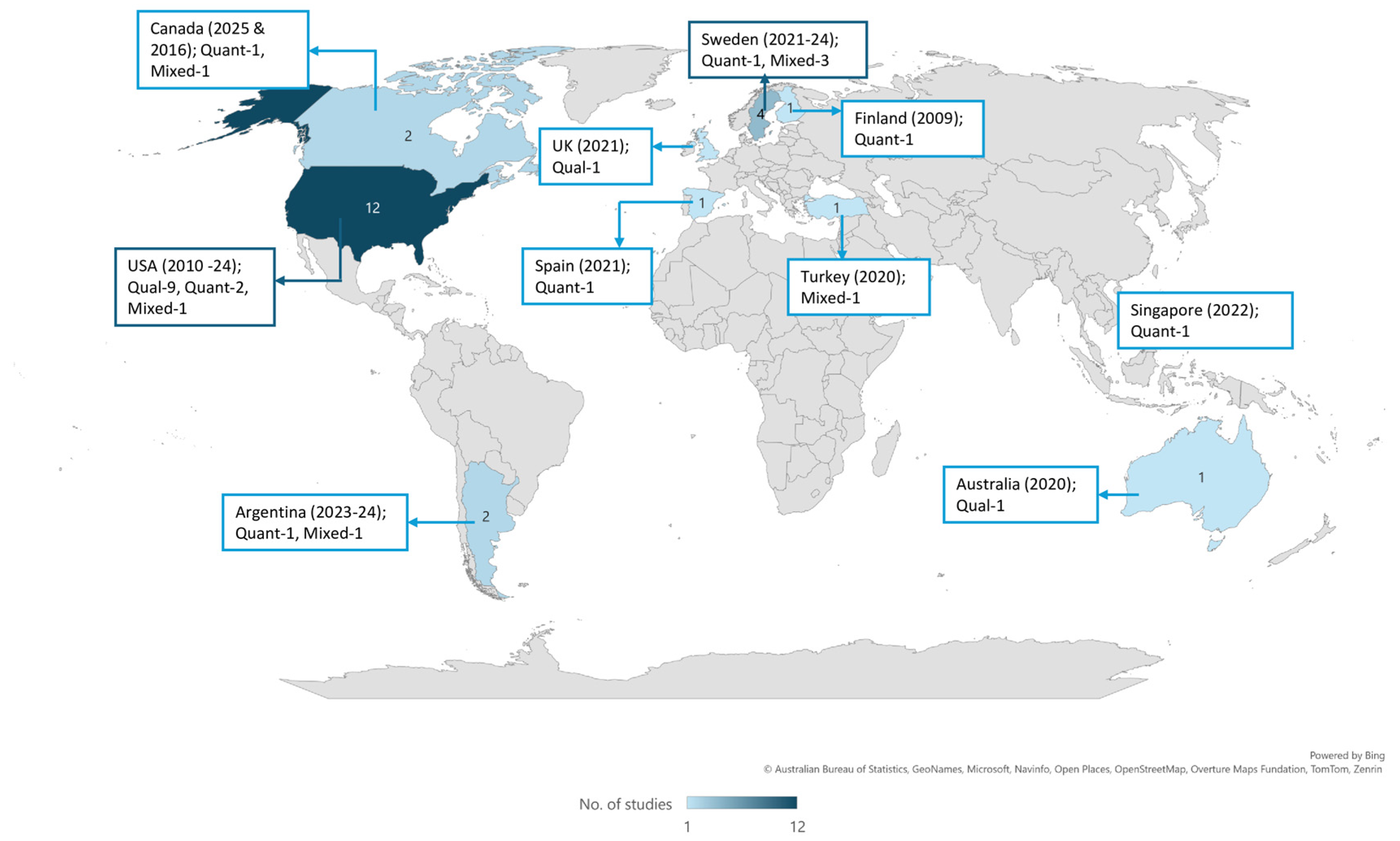
| Geography | USA (n = 12) | [32,41,43,46,49,50,51,52,53,55,58] | [32,43,46,50,52,53,58,60] | [43,52] | [32,41,50,53,60] | [55,60] |
| Sweden (n = 4) | [11,42,45] | [45,61] | [11,42,61] | |||
| Canada (n = 2) | [56,57] | [57] | [56] | [57] | ||
| Argentina (n = 2) | [39,54] | [39] | [54] | [54] | [54] | |
| Spain (n = 1) | [40] | [40] | ||||
| Singapore (n = 1) | [48] | [48] | [48] | [48] | ||
| Turkey (n = 1) | [59] | |||||
| Finland (n = 1) | [50] | |||||
| UK (n = 1) | [47] | [47] | [47] | |||
| Australia (n = 1) | [17] | [17] | [17] | [17] | ||
| Parent Type | Mothers only (n = 5) | [43,46,52,54,57] | [43,46,52,57] | [54,57] | [54,57] | [54] |
| Both parents’ (majority mothers (n = 12)) | [11,17,32,40,41,42,45,47,50,55,56] | [32,40,45,47,50,61] | [17,47,56] | [11,17,32,41,42,50,61] | [11,17,32,41,42,50,61] | |
| Caregiver (n = 1) | [39] | [39] | ||||
| Parents not specified (n = 7) | [44,48,49,51,53,58] | [48,53,58,60] | [48] | [53,60] | [48,60] | |
| Equal mother father (n = 1) | [59] | |||||
| Device Type | TV (n = 9) | [11,32,43,44,49,50,51,57,58] | [11,32,43,50,57] | [11,32,43,50,57] | [11,32,50,57] | |
| Smartphone (n = 1) | [39] | [39] | ||||
| Shared PC & TV (n = 1) | [54] | [54] | [54] | [54] | ||
| More than 2 media (n = 6) | [40,41,42,46] | [40,46,59,60] | [41,42,60] | [60] | ||
| Tablet (n = 6) | [17,45,47,55,56] | [45,47,61] | [17,47,56] | [17,61] | [17,55] | |
| 17 inch touchscreen monitor (n = 1) | [52] | [52] | [52] | |||
| Not specified (n = 2) | [48,53] | [48,53] | [48] | [53] | [48] | |
| Child Age | 0–2 years (n = 14) | [11,17,39,40,41,43,46,49,50,52,53,54,58] | [39,43,46,50,52,58,60] | [17,43,52,54] | [11,17,41,50,53,54] | [17,54,60] |
| 2–4 years (n = 23) | [11,17,32,39,40,41,42,43,45,46,47,48,49,50,51,53,54,55,56,57,58] | [32,40,43,45,46,47,48,50,53,57,58,60,61] | [17,43,47,48,54,56] | [11,17,32,41,42,50,53,54,57,60,61] | [17,48,54,55,60] | |
| 4–6 years (n = 10); | [11,17,32,43,44,48,56,57] | [32,43,57,59,60] | [17,43,48,56] | [11,17,32,56,57,60] | [17,48,60] | |
| Child gender | Majority Male (n = 9) | [11,17,32,39,41,42,43,56] | [32,39,43,45,61] | A14, A16 [43,56] | [11,32,41,42,61] | |
| Majority Female (n = 5) | [17,47,48,55,58] | [47,48,58] | [17,47,48] | [17] | [17,48,55] | |
| Equal (n = 8) | [49,50,51,52,53,54,57] | [50,52,53,57,59] | [52,54] | [50,53,54,57] | [54] | |
| Not mentioned (n = 4) | [40,46,48] | [40,46,60] | [60] | [60] | ||
| Content Type | Educational (n = 13) | [17,32,43,45,47,49,50,51,52,53,56,58] | [32,43,45,47,50,52,53,58,61] | [17,43,47,52,56] | [17,32,50,53,61] | [17] |
| Entertainment (n = 5) | [39,44,46,55] | [39,59,60] | [55] | |||
| Not mentioned (n = 8) | [11,40,42,48,54,57,59] | [40,57,60] | [48,54] | [11,41,42,54,57,60] | [48,54,60] |
4. Discussion
5. Conclusions
Supplementary Materials
Author Contributions
Funding
Data Availability Statement
Conflicts of Interest
Abbreviations
| JME | Joint Media Engagement |
| SLPs | Speech Language Pathologists |
References
- Bolten, M.; Unternaehrer, E. Editorial: Digital media use in early childhood—Contextual factors, developmental outcomes, and pathways. Front. Child Adolesc. Psychiatry 2025, 4, 1627511. [Google Scholar] [CrossRef] [PubMed]
- Durham, K.; Wethmar, D.; Brandstetter, S.; Seelbach-Göbel, B.; Apfelbacher, C.; Melter, M.; Kabesch, M.; Kerzel, S.; The KUNO Kids Study Group. Digital media exposure and predictors for screen time in 12-month-old children: A cross-sectional analysis of data from a German birth cohort. Front. Psychiatry 2021, 12, 737178. [Google Scholar] [CrossRef]
- Muppalla, S.K.; Vuppalapati, S.; Pulliahgaru, A.R.; Sreenivasulu, H. Effects of excessive screen time on child development: An updated review and strategies for management. Cureus 2023, 15, e40608. [Google Scholar] [CrossRef]
- Liu, J.; Riesch, S.; Tien, J.; Lipman, T.; Pinto-Martin, J.; O’Sullivan, A. Screen media overuse and associated physical, cognitive, and emotional/behavioral outcomes in children and adolescents: An integrative review. J. Pediatr. Health Care 2022, 36, 99–109. [Google Scholar] [CrossRef]
- Hale, L.; Guan, S. Screen time and sleep among school-aged children and adolescents: A systematic literature review. Sleep Med. Rev. 2014, 21, 50. [Google Scholar] [CrossRef]
- Radesky, J.S.; Christakis, D.A. Increased screen time: Implications for early childhood development and behavior. Pediatr. Clin. N. Am. 2016, 63, 827–839. [Google Scholar] [CrossRef]
- Council on Communications and Media; Hill, D.; Ameenuddin, N.; Chassiakos, Y.R.; Cross, C.; Hutchinson, J.; Levine, A.; Boyd, R.; Mendelson, R.; Moreno, M.; et al. Media and young minds. Pediatrics 2016, 138, e20162591. [Google Scholar] [CrossRef]
- World Health Organization. Guidelines on Physical Activity, Sedentary Behaviour and Sleep for Children Under 5 Years of Age; World Health Organization: Geneva, Switzerland, 2019; Available online: https://www.who.int/publications/i/item/9789241550536 (accessed on 2 May 2026).
- Valkenburg, P.M.; Krcmar, M.; Peeters, A.L.; Marseille, N.M. Developing a scale to assess three styles of television mediation: “Instructive mediation,” “restrictive mediation,” and “social coviewing”. J. Broadcast. Electron. Media 1999, 43, 52–66. [Google Scholar] [CrossRef]
- Koch, F.S.; Barr, R.; Sundqvist, A. The joint media engagement scale (JMES): An instrument for measuring shared media use with children aged 1 to 5 years old. Br. J. Dev. Psychol. 2025, 43, 98–110. [Google Scholar] [CrossRef]
- Walsh, E. Joint media engagement. In The SAGE Encyclopedia of Out-of-School Learning; Seel, N.M., Ed.; SAGE Publications: Thousand Oaks, CA, USA, 2017; pp. 394–398. [Google Scholar]
- Takeuchi, L.; Stevens, R. The New Coviewing: Designing for Learning Through Joint Media Engagement; Joan Ganz Cooney Center: New York, NY, USA, 2011. [Google Scholar]
- Ewin, C.A.; Reupert, A.E.; McLean, L.A.; Ewin, C.J. The impact of joint media engagement on parent–child interactions: A systematic review. Hum. Behav. Emerg. Technol. 2021, 3, 230–254. [Google Scholar] [CrossRef]
- Chen, X.; Yeung, W.-J.J. Association between preschool children’s media use, parental joint media engagement and prosocial behavior: A longitudinal cohort study. BMC Public Health 2026, 26, 561. [Google Scholar] [CrossRef]
- Foulds, K. Co-viewing mass media to support children and parents’ emotional ABCs: An evaluation of Ahlan Simsim. Early Child Educ. J. 2022, 51, 1479–1488. [Google Scholar] [CrossRef]
- Richert, R.A.; Robb, M.B.; Fender, J.G.; Wartella, E. Word learning from baby videos. Arch. Pediatr. Adolesc. Med. 2010, 164, 432–437. [Google Scholar] [CrossRef]
- Neumann, M.M. Parent scaffolding of young children’s use of touch screen tablets. Early Child Dev. Care 2018, 188, 1652–1662. [Google Scholar] [CrossRef]
- Strouse, G.A.; Ganea, P.A. Parent–toddler behavior and language differ when reading electronic and print picture books. Front. Psychol. 2017, 8, 677. [Google Scholar] [CrossRef]
- Vygotsky, L.S. Thought and Language; MIT Press: Cambridge, MA, USA, 1986; p. 354. [Google Scholar]
- Bandura, A. Social Learning Theory; Prentice-Hall: Englewood Cliffs, NJ, USA, 1977. [Google Scholar]
- Tomasello, M. The social-pragmatic theory of word learning. Pragmatics 2000, 10, 401–413. [Google Scholar] [CrossRef]
- Kim, Y.S.G.; Dore, R.; Cho, M.; Golinkoff, R.; Amendum, S. Theory of mind, mental state talk, and discourse comprehension: Theory of mind process is more important for narrative comprehension than for informational text comprehension. J. Exp. Child Psychol. 2021, 209, 105181. [Google Scholar] [CrossRef] [PubMed]
- Skinner, B.F. Science and Human Behavior, 2nd ed.; Macmillan: New York, NY, USA, 1953. [Google Scholar]
- Neumann, M.M.; Merchant, G. “That’s a big bad wolf!”: Learning through teacher–child talk during shared reading of a storybook app. Early Child. Educ. J. 2021, 49, 515–525. [Google Scholar] [CrossRef]
- Dayton, C.J.; Walsh, T.B.; Oh, W.; Volling, B. Hush now baby: Mothers’ and fathers’ strategies for soothing their infants and associated parenting outcomes. J. Pediatr. Health Care 2015, 29, 145–155. [Google Scholar] [CrossRef] [PubMed]
- Leech, K.; Chandler-Campbell, I.L.; Alton, J.; Corriveau, K.H. What would happen if?: A comparison of fathers’ and mothers’ questions to children during a science activity. Front. Psychol. 2023, 14, 1078994. [Google Scholar] [CrossRef]
- Rochanavibhata, S.; Marian, V. Cross-cultural differences in mother–preschooler book sharing practices in the United States and Thailand. J. Child Lang. 2020, 48, 834. [Google Scholar] [CrossRef]
- Tamis-LeMonda, C.S.; Sze, I.N.L.; Ng, F.F.Y.; Kahana-Kalman, R.; Yoshikawa, H. Maternal teaching during play with four-year-olds: Variation by ethnicity and family resources. Merrill Palmer Q. 2013, 59, 361–398. [Google Scholar] [CrossRef]
- Bornstein, M.H.; Cote, L.R.; Haynes, O.M.; Suwalsky, J.T.D.; Bakeman, R. Modalities of infant–mother interaction in Japanese, Japanese American immigrant, and European American dyads. Child Dev. 2012, 83, 2073. [Google Scholar] [CrossRef]
- Mascaro, J.S.; Rentscher, K.E.; Hackett, P.D.; Mehl, M.R.; Rilling, J.K. Child gender influences paternal behavior, language, and brain function. Behav. Neurosci. 2017, 131, 262. [Google Scholar] [CrossRef]
- Twork, K.; Ludwig, J.; Kiess, W.; Poulain, T. Parent–child interaction frequency: Associations with age, sibling presence, and child health. Pediatr. Res. 2024, 98, 114–120. [Google Scholar] [CrossRef]
- Rasmussen, E.E.; Shafer, A.; Colwell, M.J.; White, S.; Punyanunt-Carter, N.; Densley, R.L.; Wright, H. Relation between active mediation, exposure to Daniel Tiger’s Neighborhood, and US preschoolers’ social and emotional development. J. Child. Media 2016, 10, 443–461. [Google Scholar] [CrossRef]
- Troseth, G.L.; Strouse, G.A.; Verdine, B.N.; Saylor, M.M. Let’s chat: On-screen social responsiveness is not sufficient to support toddlers’ word learning from video. Front. Psychol. 2018, 9, 2195. [Google Scholar] [CrossRef] [PubMed]
- Tricco, A.C.; Lillie, E.; Zarin, W.; O’Brien, K.K.; Colquhoun, H.; Levac, D.; Moher, D.; Peters, M.D.J.; Horsley, T.; Weeks, L.; et al. PRISMA extension for scoping reviews (PRISMA-ScR): Checklist and explanation. Ann. Intern. Med. 2018, 169, 467–473. [Google Scholar] [CrossRef] [PubMed]
- Peters, M.D.J.; Marnie, C.; Tricco, A.C.; Pollock, D.; Munn, Z.; Alexander, L.; McInerney, P.; Godfrey, C.M.; Khalil, H. Updated methodological guidance for the conduct of scoping reviews. JBI Evid. Synth. 2020, 18, 2119–2126. [Google Scholar] [CrossRef]
- Ouzzani, M.; Hammady, H.; Fedorowicz, Z.; Elmagarmid, A. Rayyan—A web and mobile app for systematic reviews. Syst. Rev. 2016, 5, 210. [Google Scholar] [CrossRef] [PubMed]
- Yu, J.; Qi, X.; Yang, S. Parent–child joint media engagement within HCI: A scoping analysis of the research landscape. In Proceedings of the Conference on Human Factors in Computing Systems, Honolulu, HI, USA, 11–16 May 2024. [Google Scholar] [CrossRef]
- Shipley, K.G.; McAfee, J.G. Assessment in Speech-Language Pathology: A Resource Manual, 4th ed.; Cengage Learning: Boston, MA, USA, 2021. [Google Scholar]
- Gago-Galvagno, L.G.; del Pilar Castillo, M.; Fernández, M.A.; Tabullo, A.J.; Millere, S.E.; Elgier, A.M.; Azzollini, S.C. Dyadic interactions, communication and regulation skills: Associations with screen use in toddlers from Buenos Aires. Psychol. Russ. State Art 2024, 17, 39–59. [Google Scholar] [CrossRef]
- Ramírez-García, A.; González-Fernández, N.; Salcines-Talledo, I. Parental mediation and use of mobile devices—Smartphones and tablets—In Spanish families. J. Fam. Issues 2023, 44, 825–849. [Google Scholar] [CrossRef]
- Linder, L.K.; McDaniel, B.T.; Stockdale, L.; Coyne, S.M. The impact of parent and child media use on early parent–infant attachment. Infancy 2021, 26, 551–569. [Google Scholar] [CrossRef]
- Sundqvist, A.; Koch, F.S.; Birberg Thornberg, U.; Barr, R.; Heimann, M. Growing up in digital media and the association with the child’s language development at two years of age. Front. Psychol. 2021, 12, 569920. [Google Scholar] [CrossRef]
- Nathanson, A.I.; Rasmussen, E.E. TV viewing compared to book reading and toy playing reduces responsive maternal communication with toddlers and preschoolers. Hum. Commun. Res. 2011, 37, 465–487. [Google Scholar] [CrossRef]
- Paavonen, E.J.; Roine, M.; Pennonen, M.; Lahikainen, A.R. Do parental co-viewing and discussions mitigate TV-induced fears in young children? Child Care Health Dev. 2009, 35, 773–780. [Google Scholar] [CrossRef] [PubMed]
- Heimann, M.; Hedendahl, L.; Ottmer, E.; Kolling, T.; Koch, F.S.; Birberg Thornberg, U.; Sundqvist, A. 2-year-olds learning from 2D media with and without parental support: Comparing two forms of joint media engagement with passive viewing and learning from 3D. Front. Psychol. 2021, 11, 576940. [Google Scholar] [CrossRef] [PubMed]
- Thompson, D.A.; Jimenez-Zambrano, A.M.; Ringwood, H.; Tschann, J.M.; Clark, L. Parenting a toddler in the era of pervasive screens: Interviews with low-income Mexican American parents. Int. J. Environ. Res. Public Health 2023, 20, 5461. [Google Scholar] [CrossRef]
- Carr, A.; Dempster, T. Parent–child interactions during joint engagement with touchscreen technology: A comparison of younger versus older toddlers. Infant Behav. Dev. 2021, 64, 101587. [Google Scholar] [CrossRef]
- Sun, H.; Lim, V.; Low, J.; Kee, S. The development of a parental questionnaire (QQ-MediaSEED) on bilingual children’s quantity and quality of digital media use at home. Acta Psychol. 2022, 229, 103668. [Google Scholar] [CrossRef]
- Strouse, G.A.; Troseth, G.L. Supporting toddlers’ transfer of word learning from video. Cogn. Dev. 2014, 30, 47–64. [Google Scholar] [CrossRef]
- Padilla-Walker, L.M.; Coyne, S.M.; Booth, M.A.; Domoff, S.E.; Summers, K.; Schvaneveldt, E.; Stockdale, L. Parent–child joint media engagement in infancy. Infancy 2020, 25, 552–570. [Google Scholar] [CrossRef] [PubMed]
- Strouse, G.A.; Troseth, G.L.; O’Doherty, K.D.; Saylor, M.M. Co-viewing supports toddlers’ word learning from contingent and noncontingent video. J. Exp. Child Psychol. 2018, 166, 310–326. [Google Scholar] [CrossRef]
- Zack, E.; Barr, R. The role of interactional quality in learning from touch screens during infancy: Context matters. Front. Psychol. 2016, 7, 1264. [Google Scholar] [CrossRef]
- Shawcroft, J.; Coyne, S.M.; Linder, L.; Clifford, B.N.; McDaniel, B.T. Attachment security and problematic media use in infancy: A longitudinal study in the United States. Infancy 2024, 29, 137–154. [Google Scholar] [CrossRef]
- Medawar, J.; Tabullo, Á.J.; Gago-Galvagno, L.G. Early language outcomes in Argentinean toddlers: Associations with home literacy, screen exposure and joint media engagement. Br. J. Dev. Psychol. 2023, 41, 13–30. [Google Scholar] [CrossRef] [PubMed]
- Munzer, T.G.; Miller, A.L.; Weeks, H.M.; Kaciroti, N.; Radesky, J. Parent–toddler social reciprocity during reading from electronic tablets vs print books. JAMA Pediatr. 2019, 173, 1076. [Google Scholar] [CrossRef]
- Wood, E.; Petkovski, M.; De Pasquale, D.; Gottardo, A.; Evans, M.A.; Savage, R.S. Parent scaffolding of young children when engaged with mobile technology. Front. Psychol. 2016, 7, 690. [Google Scholar] [CrossRef]
- Mao, W.; Pesco, D. Chinese mothers’ perspectives on supporting young children’s language development through dialogic reading and co-viewing. J. Child Fam. Stud. 2025, 34, 724–736. [Google Scholar] [CrossRef]
- Fender, J.G.; Richert, R.A.; Robb, M.B.; Wartella, E. Parent teaching focus and toddlers’ learning from an infant DVD. Infant Child. Dev. 2010, 19, 613–627. [Google Scholar] [CrossRef]
- Konca, A.S.; Tantekin Erden, F. Young children’s social interactions with parents during digital activities at home. Child Indic. Res. 2021, 14, 1365–1385. [Google Scholar] [CrossRef]
- Domoff, S.E.; Radesky, J.S.; Harrison, K.; Riley, H.; Lumeng, J.C.; Miller, A.L. A naturalistic study of child and family screen media and mobile device use. J. Child Fam. Stud. 2018, 28, 401–410. [Google Scholar] [CrossRef] [PubMed]
- Sundqvist, A.; Koch, F.S.; Söderberg, M.; Barr, R.; Heimann, M. Qualitative and quantitative aspects of child-directed parental talk and the relation to 2-year-old’s developing vocabulary. Infancy 2022, 27, 682–699. [Google Scholar] [CrossRef] [PubMed]
- Linebarger, D.L.; Vaala, S.E. Screen media and language development in infants and toddlers: An ecological perspective. Dev. Rev. 2010, 30, 176–202. [Google Scholar] [CrossRef]
- Fisch, S.M. Children’s learning from television. In Encyclopedia of the Sciences of Learning; Goldstein, N., Ed.; Springer: New York, NY, USA, 2012; pp. 532–534. [Google Scholar] [CrossRef]
- Dore, R.A.; Purtell, K.M.; Lin, T.J.; Justice, L.M. Exploring children’s naturalistic educational media use: Prevalence, domains, and correlates. J. Appl. Dev. Psychol. 2025, 99, 101814. [Google Scholar] [CrossRef]


Disclaimer/Publisher’s Note: The statements, opinions and data contained in all publications are solely those of the individual author(s) and contributor(s) and not of MDPI and/or the editor(s). MDPI and/or the editor(s) disclaim responsibility for any injury to people or property resulting from any ideas, methods, instructions or products referred to in the content. |
© 2026 by the authors. Licensee MDPI, Basel, Switzerland. This article is an open access article distributed under the terms and conditions of the Creative Commons Attribution (CC BY) license.
Share and Cite
Varghese, L.A.; Bajaj, G.; Mohan, M.; Bhat, J.S.; Kanthila, J.; Varghese, A.L. Parental Communication Strategies During Screen Time in Early Childhood: A Scoping Review of Joint Media Engagement. Multimodal Technol. Interact. 2026, 10, 66. https://doi.org/10.3390/mti10060066
Varghese LA, Bajaj G, Mohan M, Bhat JS, Kanthila J, Varghese AL. Parental Communication Strategies During Screen Time in Early Childhood: A Scoping Review of Joint Media Engagement. Multimodal Technologies and Interaction. 2026; 10(6):66. https://doi.org/10.3390/mti10060066
Chicago/Turabian StyleVarghese, Litna A, Gagan Bajaj, Megha Mohan, Jayashree S. Bhat, Jayashree Kanthila, and Aiswarya Liz Varghese. 2026. "Parental Communication Strategies During Screen Time in Early Childhood: A Scoping Review of Joint Media Engagement" Multimodal Technologies and Interaction 10, no. 6: 66. https://doi.org/10.3390/mti10060066
APA StyleVarghese, L. A., Bajaj, G., Mohan, M., Bhat, J. S., Kanthila, J., & Varghese, A. L. (2026). Parental Communication Strategies During Screen Time in Early Childhood: A Scoping Review of Joint Media Engagement. Multimodal Technologies and Interaction, 10(6), 66. https://doi.org/10.3390/mti10060066