

An HCI-Centered Experiences of ICT Integration and Its Impact on Professional Competencies Supporting Formative Assessment in Higher Education e-Learning

Abstract
1. Introduction
2. Theoretical and Conceptual Framework
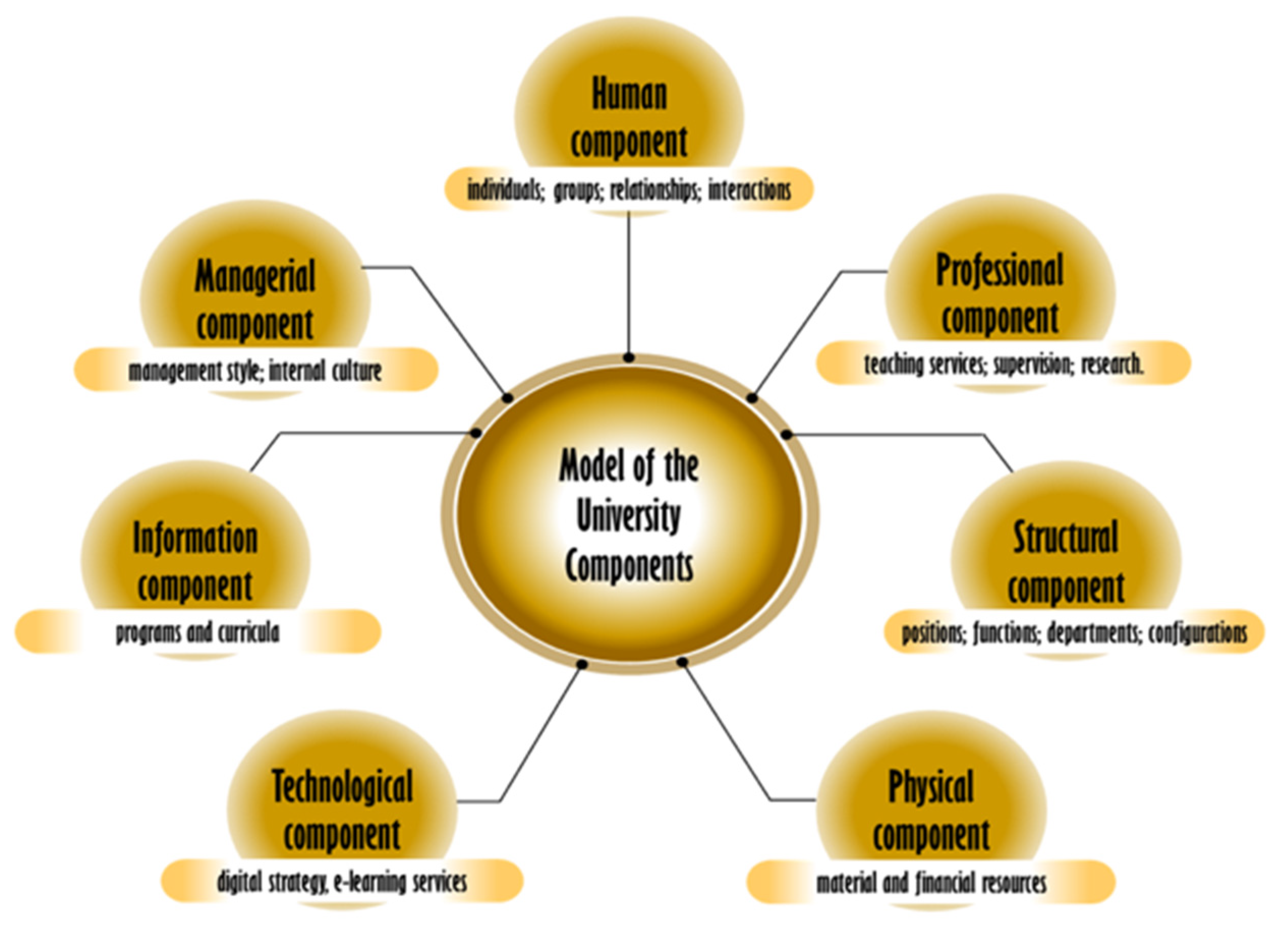
2.1. The Place of Digital Technology in the University Model
2.2. Aim of the Assessment
2.3. Online Assessment in the COVID-19 Era
3. Research Methodology
3.1. Scope and Nature of the Study
3.2. Evaluation Tool
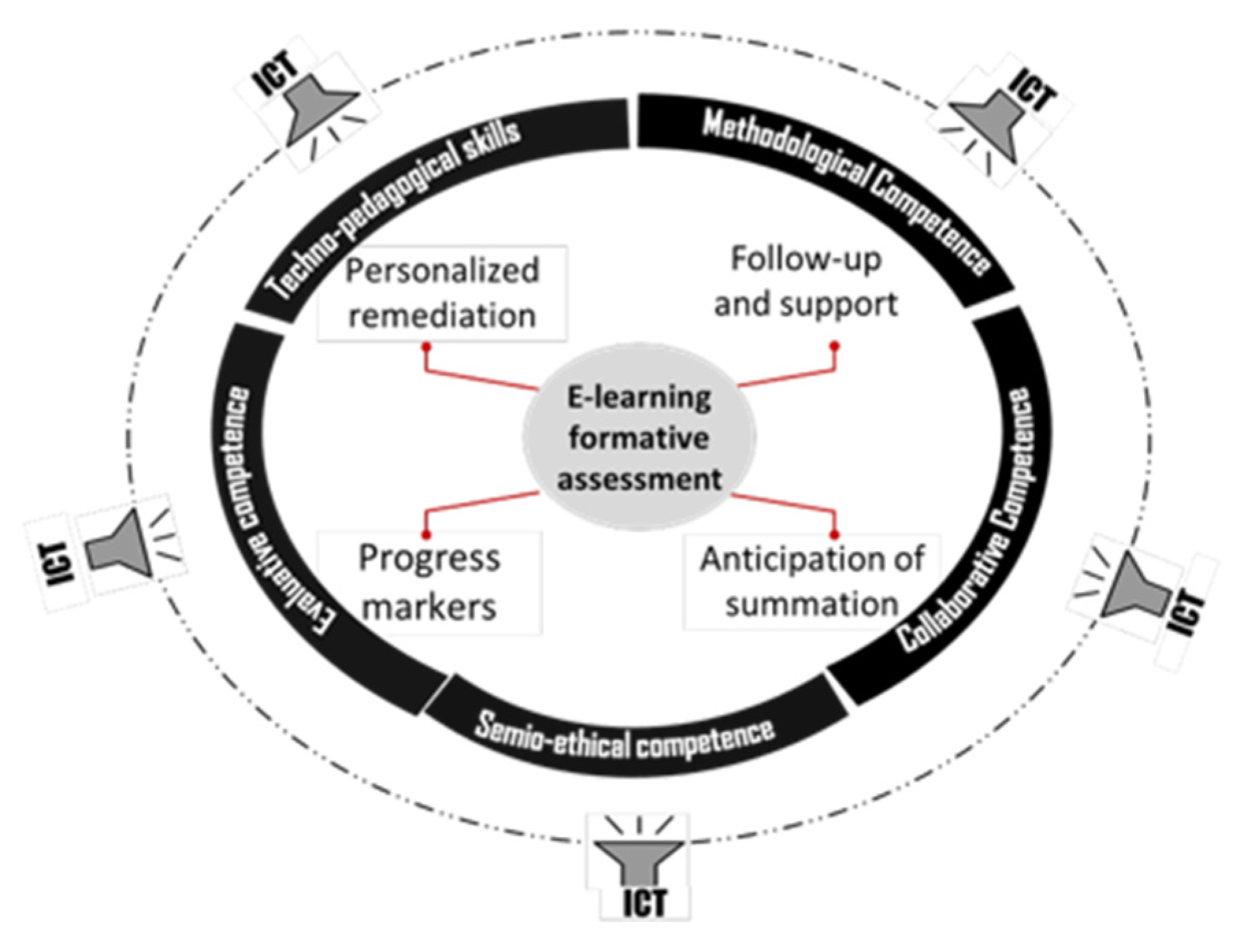
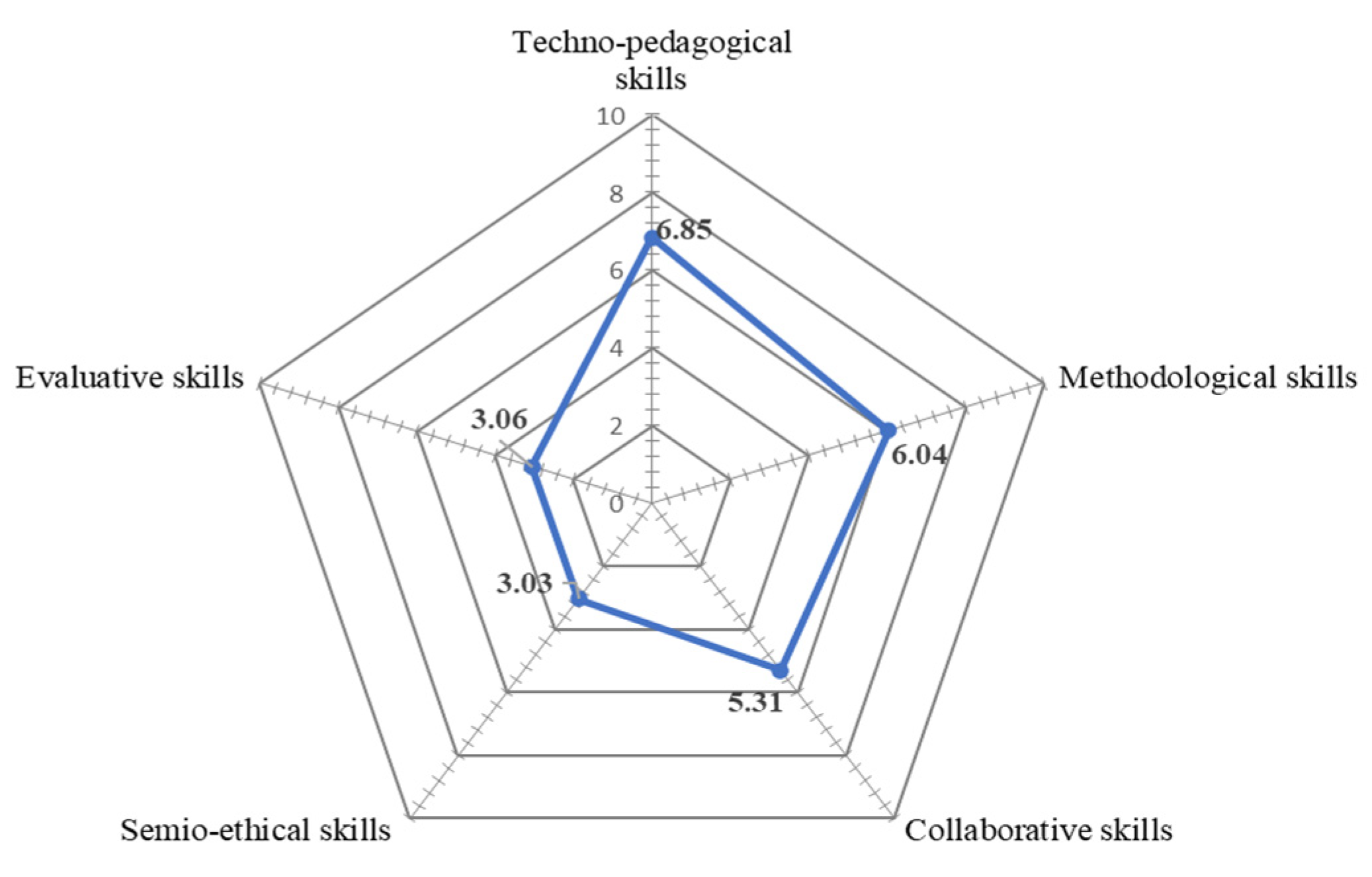
- Techno-pedagogical skills: from variable T1 to T7.
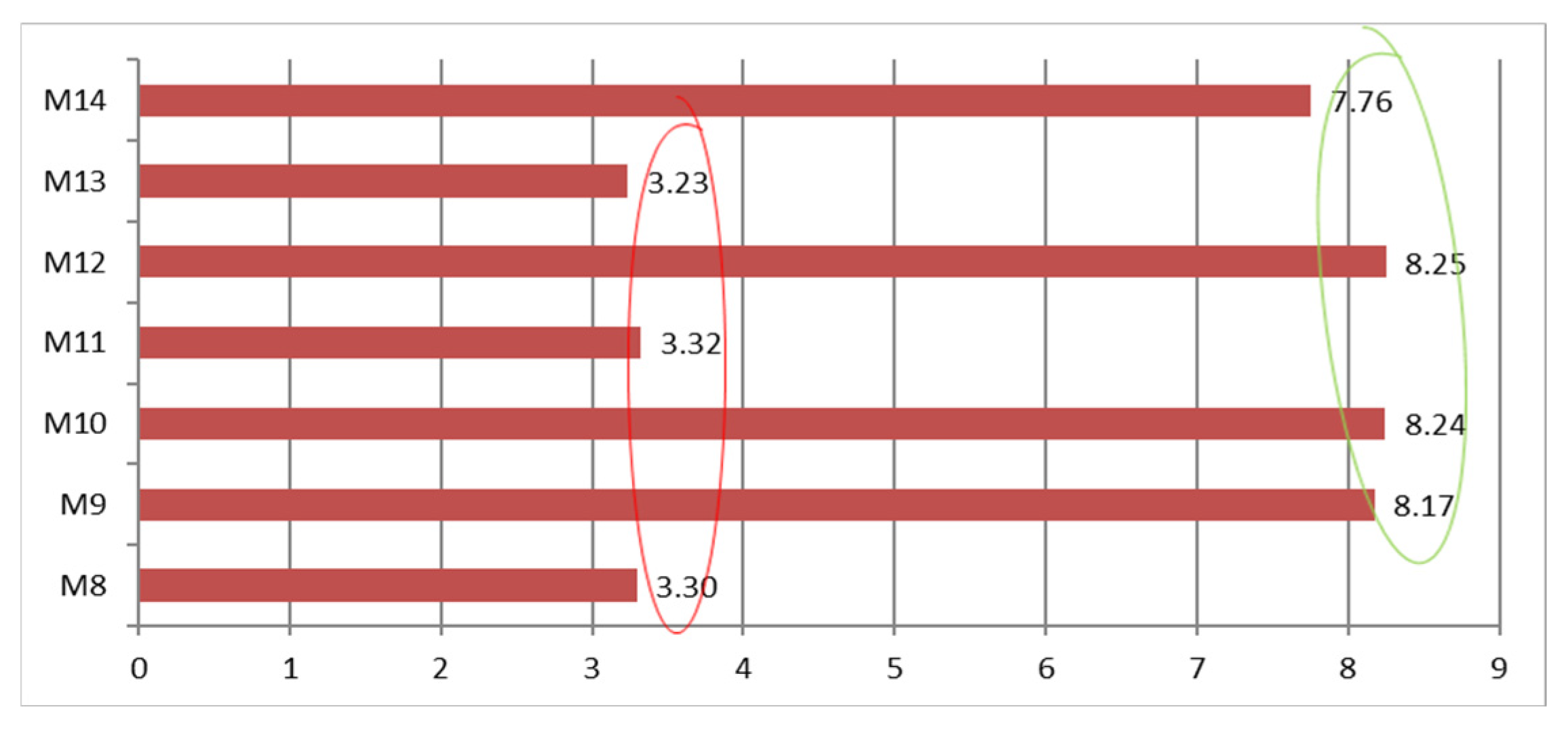
- Methodological skills: from variable M8 to M14.
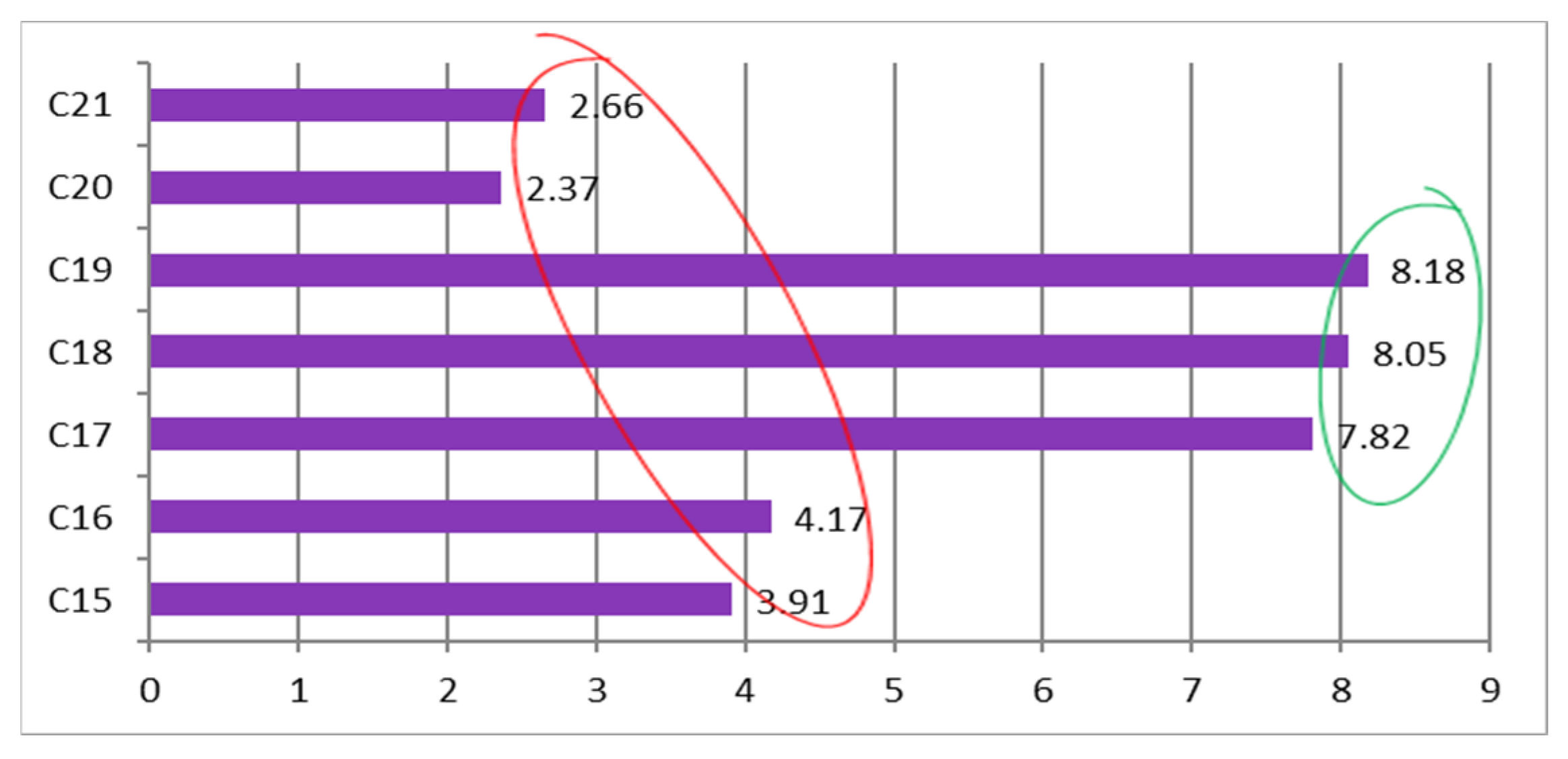
- Collaborative skills: from variable C15 to C21.
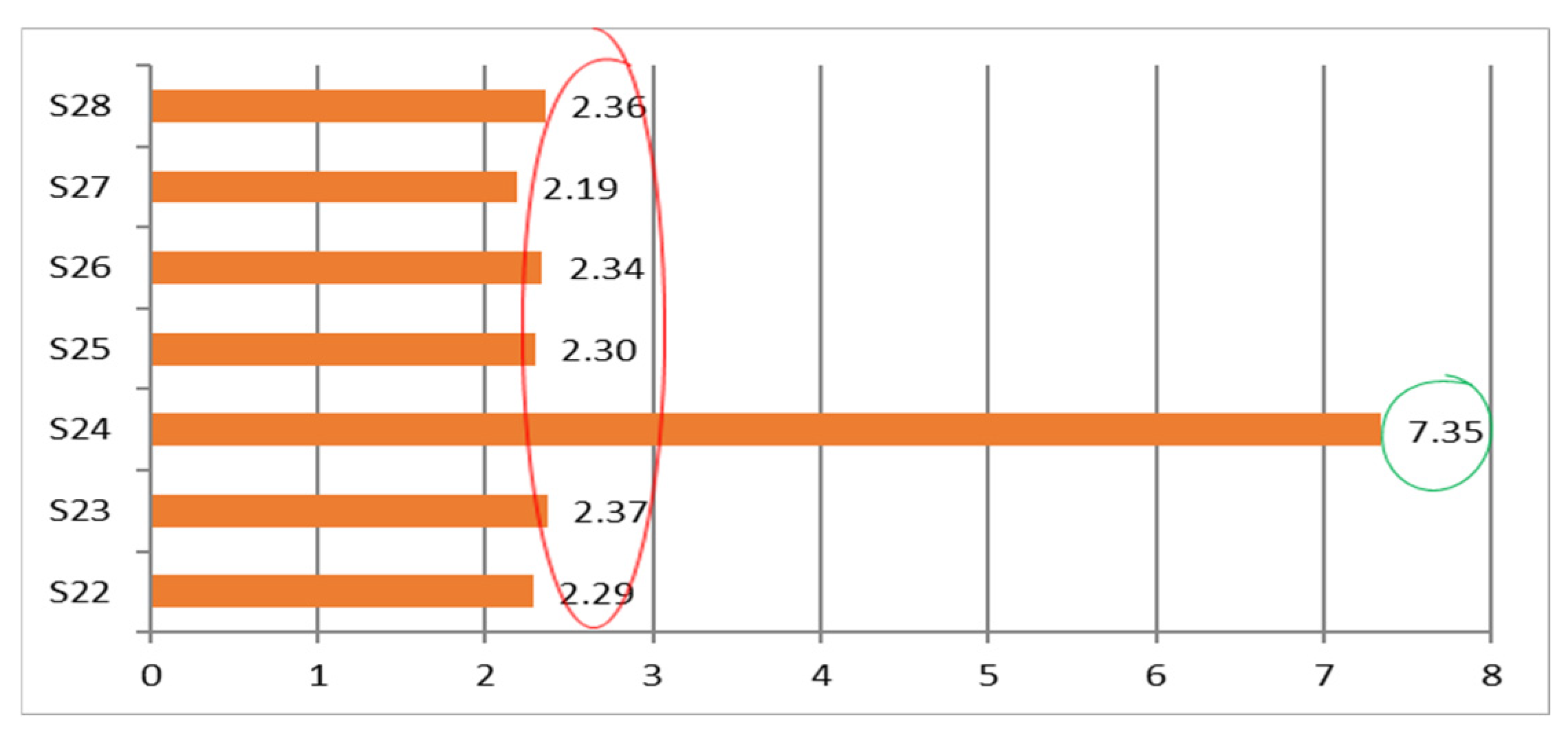
- Semio-ethical skills: from variable S22 to S28.
- Evaluative skills: from variable E29 to E35.
3.3. Participants and Sampling Procedure
3.4. Data Collection and Scoring
3.5. Ethical Considerations
3.6. Data Analysis
4. Results and Discussion
4.1. Frequency Analysis
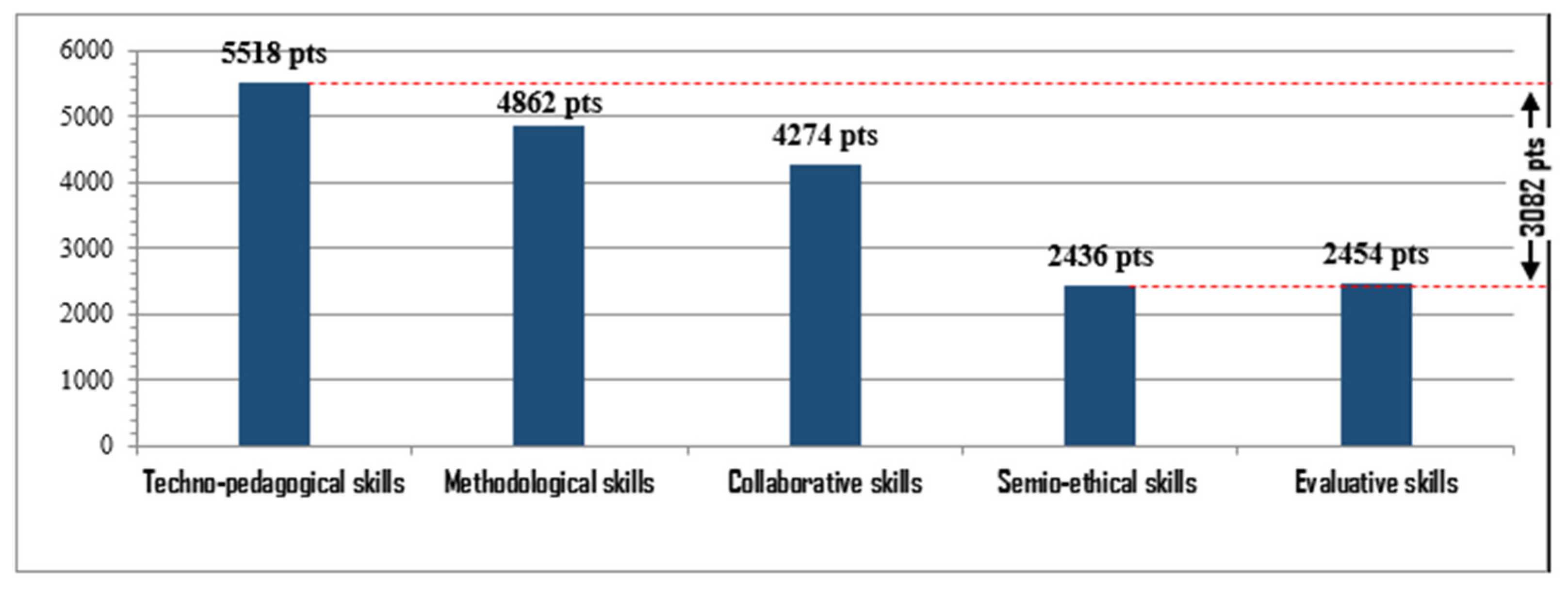
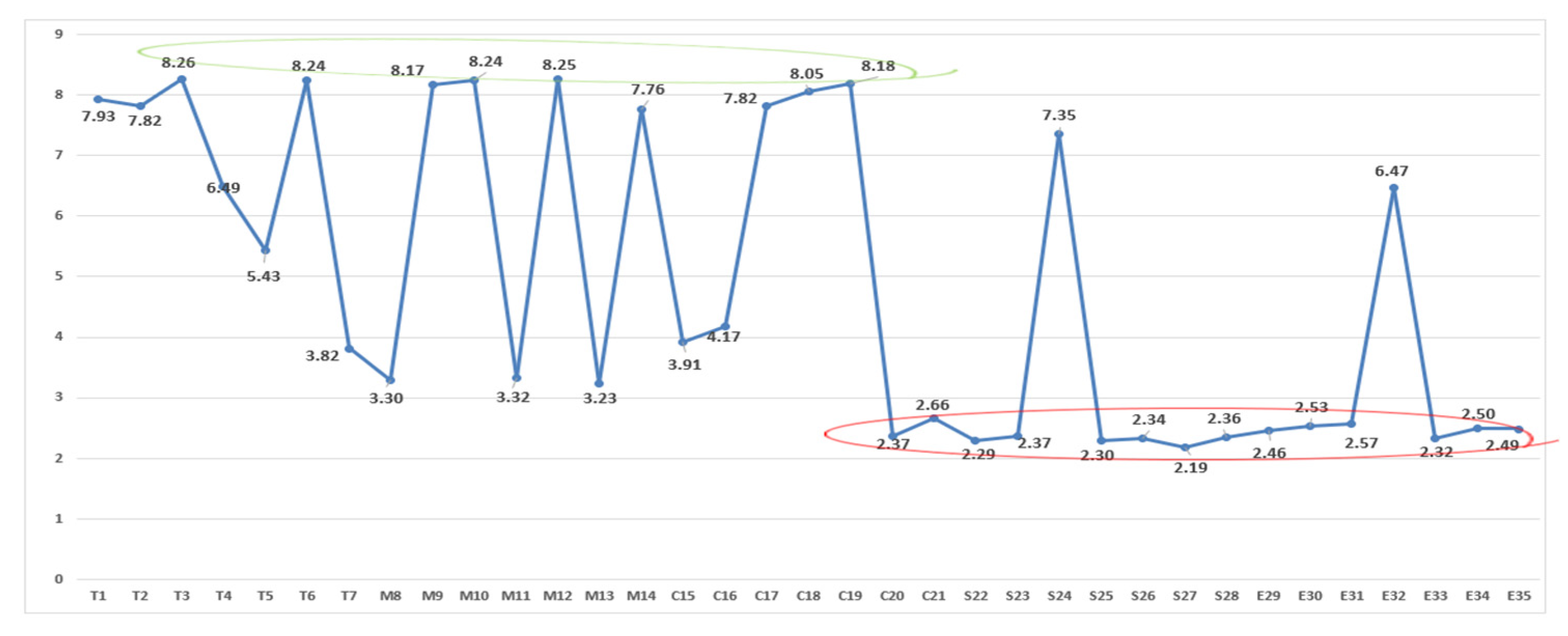
4.1.1. Total Scores and Averages for the Five Professional Skills in an Online Training Mode
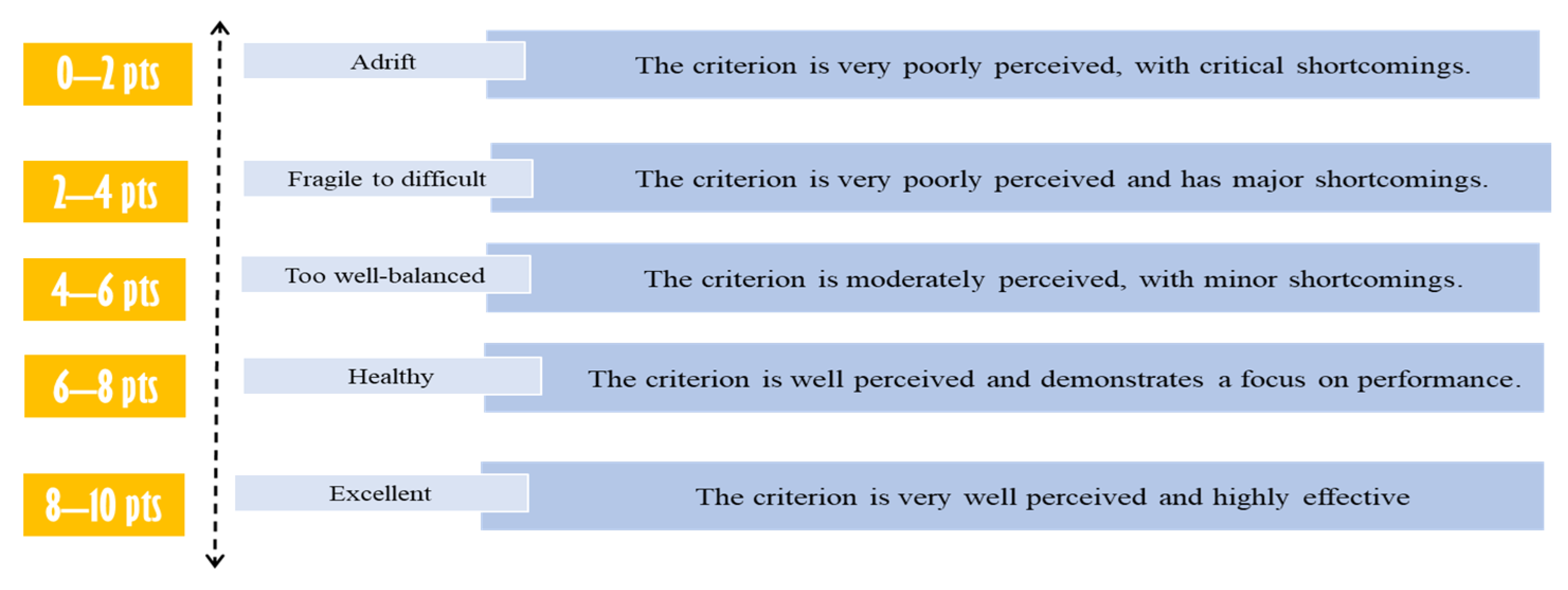
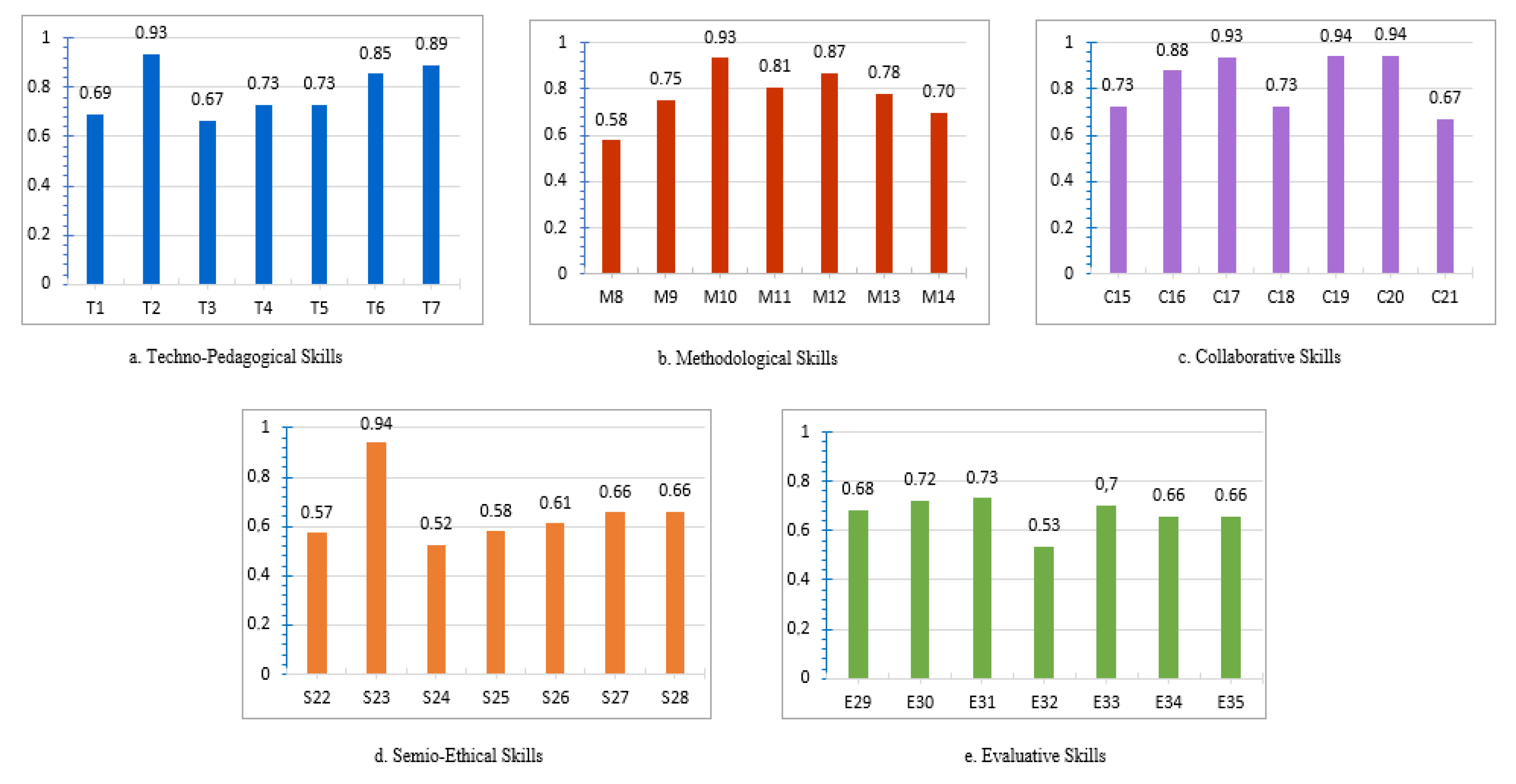
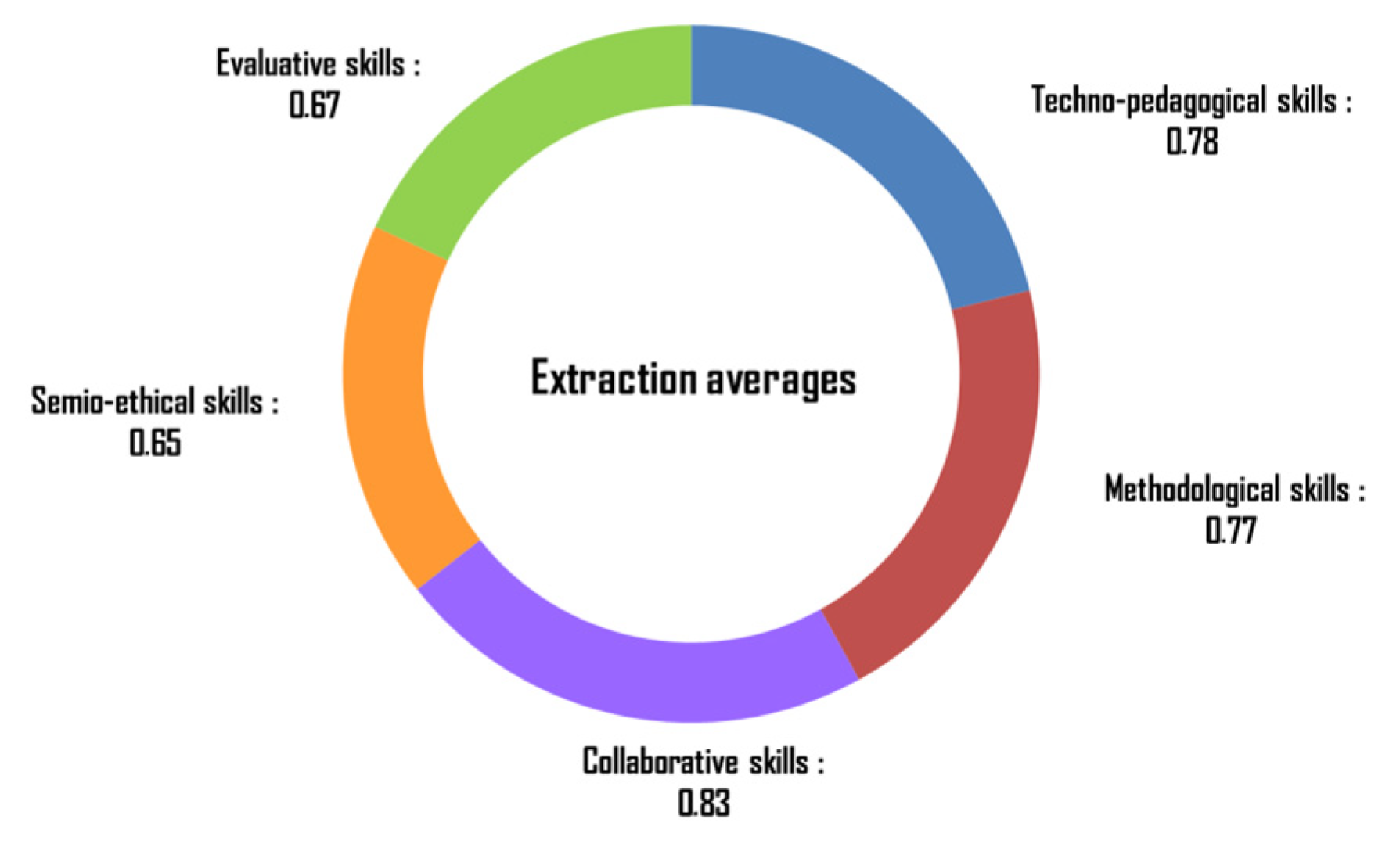
4.1.2. Average Assessment Indicators for the Five Professional Skills
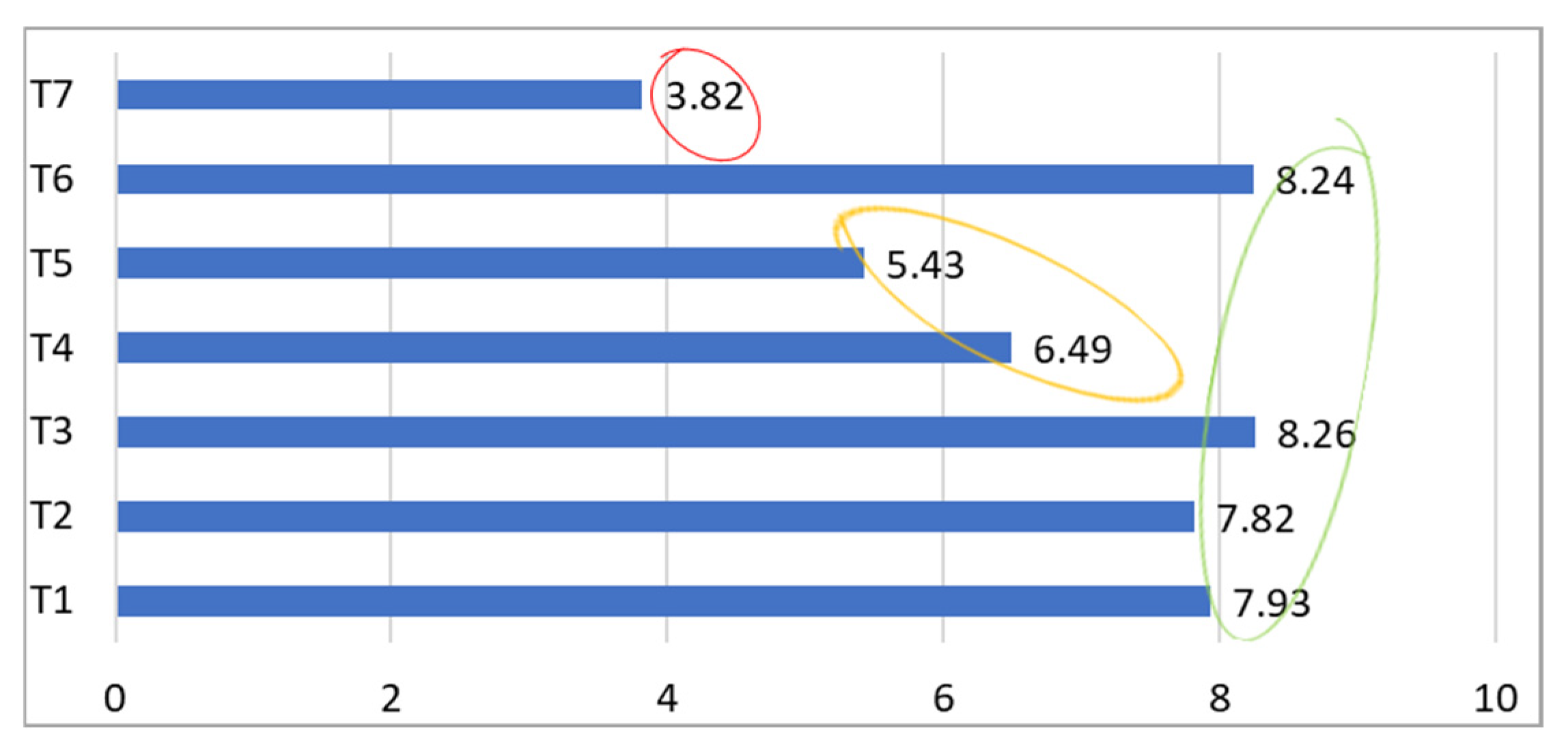
Techno-Pedagogical Skills
Methodological Skills
Collaborative Skills
Semio-Ethical Skills
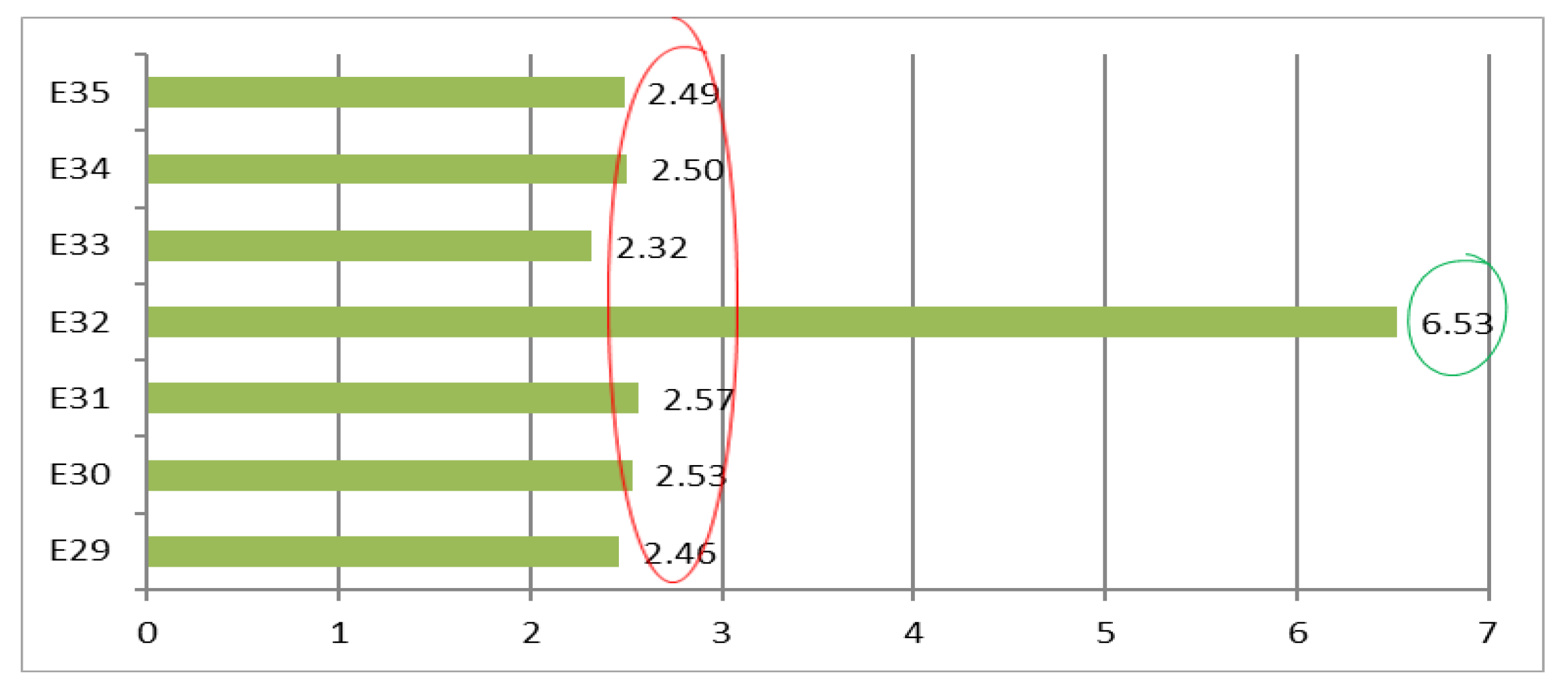
Evaluative Skills
4.1.3. Distribution of the Most Influential Variables
Cluster of the Most Constraining Variables
- Six variables for evaluative skills: E29, E30, E31, E33, E34, E35;
- Six variables for semio-ethical skills: S22, S23, S25, S26, S27, S28;
- Two variables for collaborative skills: C20, C21.
- The Constraints of Evaluative Skills
- The Constraints of Semio-Ethical Skills
- -
- A positive commitment to self-motivation and self-discipline makes it possible to grasp the interests and challenges of the digital transition and overcome the obstacles without the risk of confining distance learning in a too-tight straitjacket of cumbersome procedures, which are supposed to closely monitor the implementation of this resolution, in vain.
- -
- Introduce innovative forms of formative assessment that involve a strong visual, vocal, and gestural presence on the part of students. These perennial assessments meet the convergence criteria of coherence, continuity, and methodological complementarity about the pedagogical scenario, based on “three essential characteristics: its place in learning, its relationship with the student, and the remediation it engenders” [35].
- -
- To ensure that digital learning environments flourish, a close and regular collaboration between the pedagogical and technological authorities is called for, given that it can align the efforts of pedagogues and designers to develop digital platforms, equipped with tools that also enable certain aspects of collaboration to be evaluated (interactions, collective activities...).
- The Constraints of Collaborative Skills
High-Performance Variable Clusters
- Three variables for methodological skills: M9, M10, M12;
- Two variables for techno-pedagogical skills: T3, T6;
- Two variables for collaborative skills: C18, C19.
4.2. Inferential Analysis
4.2.1. Type of Measurement Model
4.2.2. Study of Bivariate Correlations
Correlation: M10—Providing a Variety of Entertaining Materials and C19—Offer Personalized Feedback
- Significance is less than 0.05;
- Spearman correlation is very strong: 92.4%.
Correlation: M11—Reduce Preparation Time for Learning Activities and M13—Classroom Management
- Significance is less than 0.05;
- Spearman correlation is medium to fairly strong: 54.4%.
Correlation: T6—Technological Training and Assistance and M12—Innovative Pedagogical Scripting
- Significance is less than 0.05;
- Spearman correlation is strong: 69.5%.
Correlation: T7—Confidence in ICT and C16—Performance of Dynamic and Interactive Tasks
- Significance is less than 0.05;
- Spearman correlation is very strong: 82.2%.
4.2.3. Factor Analysis: PCA
Variable Representation Qualities
- C17: Carry out collaborative designs;
- C19: Provide personalized feedback;
- C20: Generate greater pedagogical equity;
- C16: Perform dynamic tasks: interactions.
- M10: Enable the use of fun and varied media: videos, interactive formats, podcasts...;
- M11: Reduce preparation time for learning activities;
- M12: Design innovative teaching scenarios.
- T2: Think critically about the advantages and limitations of ICT;
- T6: Feeling the need for training and technological assistance to provide pedagogical services;
- T7: Have confidence in the use of ICT.
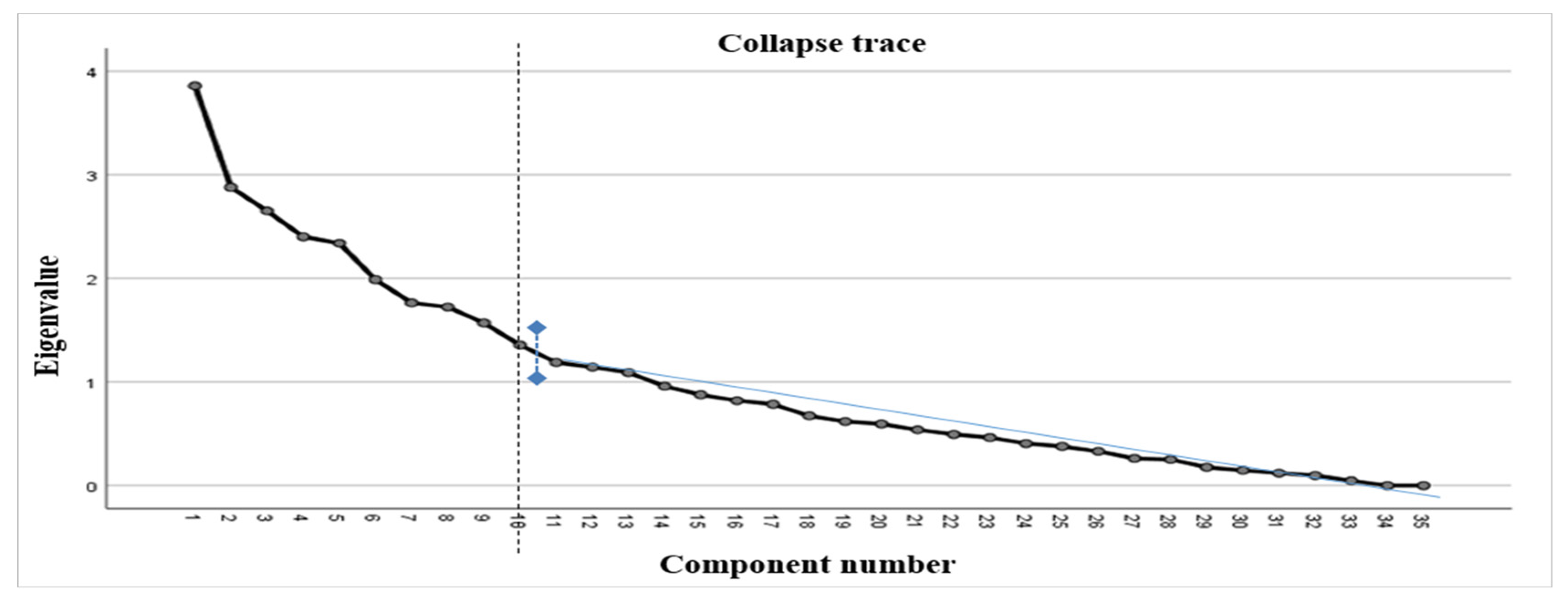
Total Variance Explained
Examination of the Component Matrix After Rotation
- Identifying the Highest Weight for Each Variable
- Components Labelling
- a.
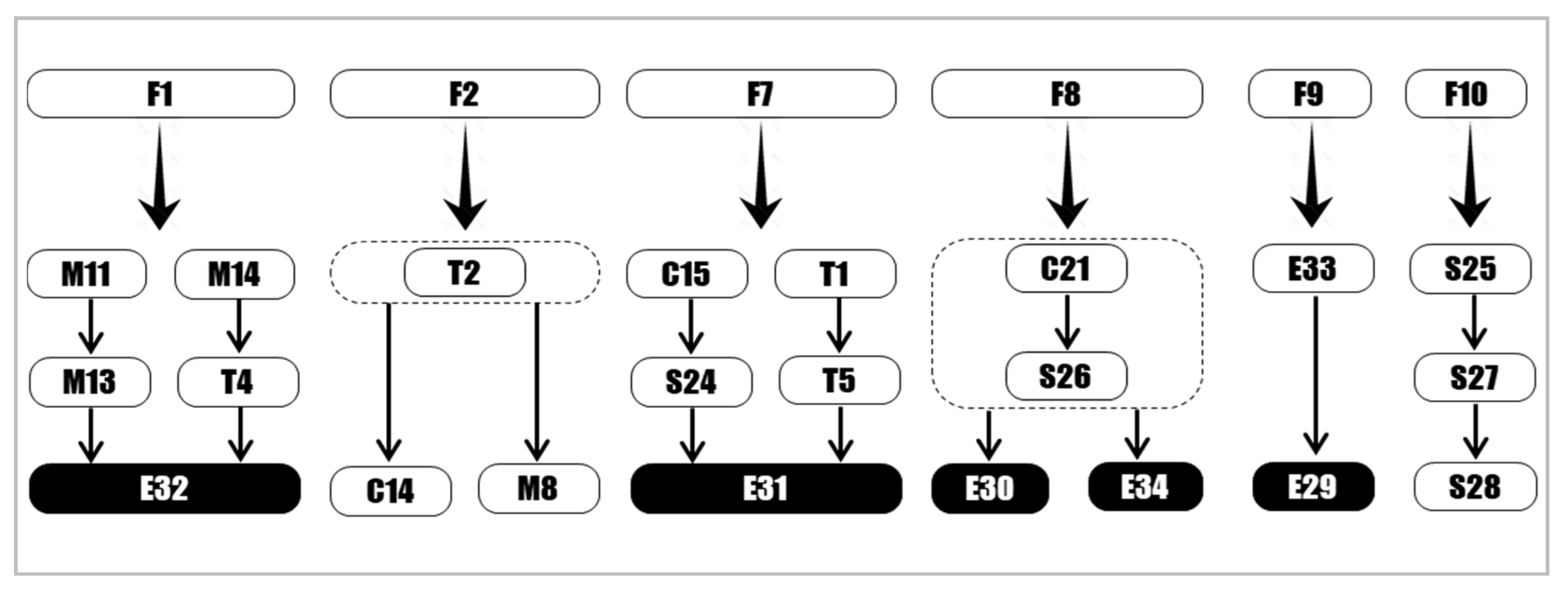
- Variables of component 1 (F1):
- M11: Reduce preparation time for learning activities;
- M13: Enable efficient class management;
- M14: Adopt digital tools and practices to develop creative teaching methods;
- T4: Be able to produce digital resources: capsules, mind maps, etc.;
- E32: Make assessments more efficient by using benchmarks and communicating invariants.
- b.
- Variables of component 2 (F2):
- T2: Keep a critical watch on the benefits and limitations of ICTs;
- C17: Creating collaborative designs;
- M8: Allowing plenty of room for pedagogical maneuver.
- c.
- Variables of component 7 (F7):
- C15: Dynamic tasks: Group animation;
- T5: Learning to cope with technical failures and poor management of digital environments;
- E31: Making assessment systems more flexible;
- S24: Identify signs of lack of interest and help resolve them: Connectivity time;
- T1: Promote the best approaches for the successful infusion of ICT into teaching and learning practices.
- d.
- Variables of component 8 (F8):
- C21: Improve learner engagement and motivation;
- S26: Identify the signs of student dishonesty and contribute to its resolution: Plagiarism;
- E34: Increase the accuracy of results through monitoring and support;
- E30: Make assessment systems more adaptable.
- e.
- Variables of component 9 (F9):
- E33: Reducing the disruptive effects of correction: over- and under-valuation bias;
- E29: Make assessment systems more objective.
- f.
- Variables of component 10 (F10):
- S25: Identify the signs of student dishonesty and contribute to its resolution: Contemplative presenteeism;
- S27: Identify the signs of student dishonesty and contribute to its resolution: Identity theft;
- S28: Identify the signs of student dishonesty and contribute to its resolution: Cheating.
- Logical Links Between Constructs
4.3. Limits of the Technological Contribution
5. Conclusions
- -
- The first correlation, with a very high intensity, associates the availability of digital resources and the potential for personalized feedback. Certainly, the highlight of the digital contribution is that it enables learners to find their learning comforts in one of the resources from the digital range on offer, whether static or dynamic.
- -
- The second correlation is medium to strong and relates to the reduction in preparation time for learning activities and good classroom management. Starting from the premise that technology accelerates the pace of work and optimizes academic time, this precious time can be used to rethink teaching practices and the implementation of mastery strategies to generate more motivation toward firm student commitment. At this level, we assume that the university evolves in an open system, connected to the universal technological market. So, why not take advantage of these trends to produce teaching resources and prepare adaptable, transferable scenarios?
- -
- The third strong correlation is between the perceived and expressed need for training and technical assistance, on the one hand, and the ability to implement innovative teaching scenarios, on the other. This seems logical, since creativity and pedagogical innovation are conditional on a firm commitment to introducing new ways of thinking that break away from archaic pedagogical practices. Indeed, building technological skills in a constantly evolving context can only be achieved through ongoing training and technical assistance throughout the entire pedagogical engineering process, from analysis to evaluation.
- -
- The fourth strong correlation links confidence in ICT with dynamic, interactive task performance. Remaining wary of technological contingency components deprives teachers of an inexhaustible source of internal synergy. Teachers should not delay in adhering to this new paradigm if they are to perform well in transmitting pedagogical innovations, on the one hand, and communicate successfully with a supposedly well-informed public of learners, on the other hand.
Author Contributions
Funding
Institutional Review Board Statement
Informed Consent Statement
Data Availability Statement
Conflicts of Interest
Abbreviations
| ICT | Information communication Technology |
| HCI | Human–Computer Interaction |
| LMS | Learning Management System |
| PCA | Principal Component Analysis |
| KMO | Kaiser–Meyer–Olkin |
| F | Commitment (Factors) |
Appendix A

| Techno-pedagogical skills | T1: Promote the best approaches for the successful infusion of ICT into teaching and learning practices. |
| T2: Keep a critical watch on the benefits and limitations of ICTs. | |
| T3: Use techno-pedagogical structures to plan spatio-temporal arrangements adapted to training courses. | |
| T4: Be able to produce digital resources: capsules, mind maps, etc. | |
| T5: Learning to cope with technical failures and poor management of digital environments. | |
| T6: Identify the need for training and technological assistance in the delivery of educational services. | |
| T7: Confidence in the use of ICT. | |
| Methodological skills | M8: Allowing plenty of room for pedagogical maneuver. |
| M9: Provide the resources needed to understand and develop the teaching process. | |
| M10: Make a variety of entertaining media available: videos, interactive formats, podcasts… | |
| M11: Reduce preparation time for learning activities. | |
| M12: Designing innovative teaching scenarios. | |
| M13: Enable efficient class management. | |
| M14: Adopt digital tools and practices to develop creative teaching methods. | |
| Collaborative skills | C15: Performing dynamic tasks: Group animation. |
| C16: Performing dynamic tasks: Group animation. | |
| C17: Creating collaborative designs. | |
| C18: Contribute to reinforcing student autonomy. | |
| C19: Offer personalized feedback. | |
| C20: Generate greater educational equity. | |
| C21: Improve learner engagement and motivation. | |
| Semio-Ethics Skills | S22: Identify signs of lack-of-interest behavior and contribute to its resolution: Student attention spans. |
| S23: Identify the signs of CMI and contribute to its resolution: Respecting work handover deadlines. | |
| S24: Identifying the signs of student dishonesty and contributing to its resolution: Connectivity time. | |
| S25: Identifying the signs of EBD and contributing to its resolution: Contemplative presenteeism. | |
| S26: Identify the signs of GCE and contribute to its resolution: Plagiarism. | |
| S27: Identify the signs of CEM and contribute to its resolution: Identity theft. | |
| S28: Identify the signs of GCE and help resolve it: Cheating. | |
| Evaluative skills | E29: Making assessment systems more objective. |
| E30: Making assessment systems more adaptable. | |
| E31: Making assessment systems more flexible. | |
| E32: Make assessments more efficient by using benchmarks and communicating invariants. | |
| E33: Reducing the disruptive effects of correction: Over- and under-evaluation bias. | |
| E34: Increase the accuracy of results through monitoring and support. | |
| E35: Exposing the personal potential of appraisees. |
Appendix B
| Initial Eigenvalues | Sums Extracted from Load Squares | |||||
|---|---|---|---|---|---|---|
| Component | Total | % of Variance | % Cumulative | Total | % of Variance | % Cumulative |
| 1 | 3.860 | 11.029 | 11.029 | 3.860 | 11.029 | 11.029 |
| 2 | 2.880 | 8.230 | 19.258 | 2.880 | 8.230 | 19.258 |
| 3 | 2,652 | 7.576 | 26.835 | 2.652 | 7.576 | 26.835 |
| 4 | 2.403 | 6.866 | 33.701 | 2.403 | 6.866 | 33.701 |
| 5 | 2.340 | 6.687 | 40.387 | 2.340 | 6.687 | 40,387 |
| 6 | 1.989 | 5.682 | 46.069 | 1.989 | 5.682 | 46,069 |
| 7 | 1.764 | 5.039 | 51.109 | 1.764 | 5.039 | 51.109 |
| 8 | 1.724 | 4.926 | 56.035 | 1.724 | 4.926 | 56.035 |
| 9 | 1.570 | 4.486 | 60.521 | 1.570 | 4.486 | 60.521 |
| 10 | 1.356 | 3.875 | 64.396 | 1.356 | 3.875 | 64.396 |
| 11 | 1.189 | 3.398 | 67.794 | 1.189 | 3.398 | 67.794 |
| 12 | 1.143 | 3.266 | 71.059 | 1.143 | 3.266 | 71.059 |
| 13 | 1.091 | 3.118 | 74.177 | 1.091 | 3.118 | 74.177 |
| 14 | 0.959 | 2.739 | 76.916 | |||
| 15 | 0.877 | 2.505 | 79.421 | |||
| 16 | 0.820 | 2.343 | 81.764 | |||
| 17 | …. | …. | …… | |||
| ….. | …. | … | …. | |||
| 35 | ….. | ….. | 100.000 | |||
| Component | |||||||||||||
|---|---|---|---|---|---|---|---|---|---|---|---|---|---|
| 1 | 2 | 3 | 4 | 5 | 6 | 7 | 8 | 9 | 10 | 11 | 12 | 13 | |
| M11 | −0.860 | −0.049 | −0.033 | −0.033 | −0.124 | −0.028 | 0.150 | 0.074 | 0.039 | 0.037 | 0.075 | 0.038 | 0.094 |
| M13 | −0.812 | 0.048 | −0.070 | −0.224 | −0.190 | 0.070 | −0.030 | −0.017 | 0.116 | 0.031 | 0.060 | 0.030 | 0.004 |
| M14 | 0.665 | −0.068 | −0.230 | 0.074 | 0.014 | 0.097 | 0.163 | −0.143 | 0.340 | 0.043 | −0.060 | 0.090 | −0.090 |
| T4 | 0.611 | −0.068 | 0.185 | −0.074 | −0.109 | −0.012 | −0.082 | −0.035 | 0.130 | 0.136 | 0.491 | 0.116 | −0.022 |
| E32 | 0.500 | 0.091 | −0.090 | 0.018 | −0.065 | −0.193 | 0.145 | 0.359 | 0.226 | 0.069 | −0.015 | −0.142 | 0.014 |
| T2 | −0.034 | 0.953 | −0.021 | −0.111 | −0.041 | −0.041 | 0.000 | 0.033 | 0.001 | 0.037 | −0.029 | 0.023 | −0.073 |
| C17 | −0.034 | 0.953 | −0.021 | −0.111 | −0.041 | −0.041 | 0.000 | 0.033 | 0.001 | 0.037 | −0.029 | 0.023 | −0.073 |
| M8 | 0.105 | 0.498 | −0.230 | 0.032 | −0.080 | −0.181 | 0.032 | 0.098 | 0.079 | −0.229 | 0.045 | −0.325 | 0.220 |
| S23 | 0.007 | −0.058 | 0.952 | −0.041 | −0.025 | 0.004 | 0.040 | −0.002 | 0.132 | −0.110 | 0.031 | −0.001 | −0.022 |
| C20 | 0.007 | −0.058 | 0.952 | −0.041 | −0.025 | 0.004 | 0.040 | −0.002 | 0.132 | −0.110 | 0.031 | −0.001 | −0.022 |
| T7 | 0.112 | −0.105 | −0.026 | 0.914 | 0.053 | −0.082 | −0.024 | −0.008 | −0.012 | 0.108 | 0.034 | −0.054 | 0.039 |
| C16 | 0.136 | −0.114 | −0.056 | 0.887 | 0.130 | −0.058 | −0.054 | −0.070 | 0.056 | 0.120 | 0.070 | −0.072 | 0.018 |
| C19 | 0.085 | −0.060 | −0.012 | 0.088 | 0.953 | −0.064 | −0.002 | −0.019 | 0.035 | 0.010 | 0.024 | −0.062 | −0.032 |
| M10 | 0.093 | −0.051 | −0.037 | 0.076 | 0.950 | −0.070 | −0.012 | 0.020 | 0.053 | −0.031 | 0.036 | −0.005 | −0.040 |
| T6 | 0.009 | −0.068 | −0.032 | −0.073 | −0.063 | 0.905 | −0.065 | 0.023 | 0.006 | −0.070 | −0.042 | 0.071 | −0.056 |
| M12 | −0.033 | −0.073 | 0.046 | −0.051 | −0.083 | 0.899 | −0.018 | 0.039 | −0.067 | −0.003 | 0.101 | −0.017 | 0.159 |
| C15 | 0.087 | 0.031 | 0.090 | −0.081 | −0.067 | −0.072 | 0.763 | 0.068 | 0.025 | 0.041 | 0.287 | 0.075 | 0.127 |
| T5 | 0.441 | −0.089 | 0.062 | 0.254 | −0.180 | 0.010 | −0.549 | 0.048 | 0.114 | −0.026 | 0.178 | 0.123 | −0.247 |
| E31 | 0.275 | −0.045 | 0.106 | −0.147 | −0.111 | −0.017 | −0.501 | 0.199 | −0.171 | 0.134 | 0.074 | 0.424 | 0.290 |
| S24 | 0.155 | −0.265 | 0.061 | 0.129 | −0.006 | −0.058 | 0.501 | 0.377 | 0.035 | −0.013 | 0.017 | −0.087 | 0.066 |
| T1 | 0.104 | −0.121 | −0.081 | 0.088 | 0.145 | 0.086 | −0.496 | 0.043 | 0.122 | −0.138 | 0.219 | −0.264 | 0.473 |
| C21 | −0.062 | −0.012 | −0.293 | −0.193 | 0.036 | 0.052 | −0.026 | 0.705 | −0.045 | −0.125 | 0.071 | −0.004 | 0.131 |
| E34 | −0.064 | 0.111 | 0.111 | 0.059 | 0.042 | −0.103 | 0.042 | 0.621 | −0.406 | −0.043 | 0.203 | 0.010 | 0.130 |
| E30 | −0.030 | 0.054 | 0.218 | 0.189 | −0.201 | 0.160 | 0.185 | 0.571 | 0.068 | −0.030 | 0.086 | 0.417 | −0.146 |
| S26 | 0.000 | −0.120 | −0.187 | 0.146 | −0.062 | −0.254 | 0.021 | −0.515 | −0.131 | −0.117 | 0.096 | 0.102 | 0.396 |
| E33 | 0.083 | −0.156 | 0.166 | −0.006 | 0.133 | −0.108 | 0.118 | −0.080 | 0.766 | 0.066 | −0.029 | −0.045 | −0.035 |
| E29 | 0.059 | 0.227 | 0.175 | 0.055 | −0.035 | 0.035 | −0.120 | 0.012 | 0.735 | −0.013 | −0.135 | 0.024 | 0.131 |
| S28 | −0.032 | 0.066 | −0.079 | 0.282 | −0.012 | 0.116 | 0.089 | −0.067 | 0.004 | 0.734 | −0.054 | −0.020 | −0.018 |
| S25 | 0.022 | −0.028 | −0.215 | −0.006 | 0.002 | −0.111 | −0.093 | 0.049 | 0.151 | 0.670 | 0.090 | −0.169 | −0.035 |
| S27 | 0.179 | −0.070 | 0.109 | −0.026 | −0.064 | −0.338 | 0.160 | −0.177 | −0.278 | 0.542 | −0.236 | 0.062 | 0.030 |
| E35 | 0.011 | −0.107 | 0.030 | 0.230 | −0.036 | 0.007 | 0.022 | 0.064 | −0.211 | −0.239 | 0.683 | −0.102 | −0.097 |
| S22 | −0.115 | 0.135 | 0.024 | −0.036 | 0.186 | 0.125 | 0.267 | 0.188 | −0.129 | 0.136 | 0.566 | 0.090 | 0.142 |
| M9 | 0.045 | 0.034 | −0.032 | −0.108 | −0.075 | 0.035 | 0.017 | −0.029 | −0.030 | −0.399 | −0.053 | 0.735 | 0.156 |
| T3 | 0.198 | 0.242 | 0.201 | 0.184 | −0.105 | 0.039 | 0.069 | −0.030 | −0.133 | −0.240 | −0.393 | −0.460 | 0.189 |
| C18 | −0.234 | −0.040 | −0.006 | 0.016 | −0.094 | 0.114 | 0.166 | 0.066 | 0.065 | −0.005 | −0.084 | 0.105 | 0.770 |
References
- Paas, F.; Sweller, J. Implications of Cognitive Load Theory for Multimedia Learning. In The Cambridge Handbook of Multimedia Learning, 2nd ed.; Mayer, R.E., Ed.; Cambridge University Press: Cambridge, UK, 2014; pp. 27–42. [Google Scholar] [CrossRef]
- Sweller, J. Cognitive Load During Problem Solving: Effects on Learning. Cogn. Sci. 1988, 12, 257–285. [Google Scholar] [CrossRef]
- Hollan, J.; Hutchins, E.; Kirsh, D. Distributed cognition: Toward a new foundation for human-computer interaction research. ACM Trans. Comput.-Hum. Interact. 2000, 7, 174–196. [Google Scholar] [CrossRef]
- Hutchins, E. Cognition in the Wild, 1995. Available online: https://direct.mit.edu/books/monograph/4892/Cognition-in-the-Wild (accessed on 21 November 2025).
- Engeström, Y. Learning by Expanding: An Activity-Theoretical Approach to Developmental Research, 2nd ed.; Cambridge University Press: Cambridge, UK, 2014. [Google Scholar] [CrossRef]
- Kaptelinin, V.; Nardi, B. Acting with technology: Activity theory and interaction design. First Monday 2007, 12, 4. [Google Scholar] [CrossRef]
- Dix, A. (Ed.) Human-Computer Interaction, 3rd ed.; [6. Nachdr.]; Pearson Prentice-Hall: Harlow, UK, 2010. [Google Scholar]
- Nielsen, J. Usability Engineering; Morgan Kaufmann Publishers Inc.: San Francisco, CA, USA, 1994. [Google Scholar]
- Marquez-Carpintero, L.; Viejo, D.; Cazorla, M. Enhancing Engineering and STEM Education with Vision and Multimodal Large Language Models to Predict Student Attention. IEEE Access 2025, 13, 114681–114695. [Google Scholar] [CrossRef]
- Hang, C.N.; Ho, S.M. Personalized Vocabulary Learning through Images: Harnessing Multimodal Large Language Models for Early Childhood Education. In Proceedings of the 2025 IEEE Integrated STEM Education Conference (ISEC), Princeton, NJ, USA, 15 March 2025; pp. 1–7. [Google Scholar] [CrossRef]
- Strivens, J.; Baume, D.; Grant, S.; Owen, C.; Ward, R.; Nicol, D. The Role of e-Portfolios in Formative and Summative Assessment Practices. 2009. Available online: https://www.academia.edu/30102961/The_role_of_e_portfolios_in_formative_and_summative_assessment_practices (accessed on 23 November 2025).
- Yerly, G.; Scallon, G. Des savoirs aux compétences. Explorations en évaluation des apprentissages. Montréal, Québec: Éditions du Renouveau Pédagogique Inc. (ERPI). Rev. Sci. L’éducation 2016, 42, 219–220. [Google Scholar] [CrossRef][Green Version]
- Chen, L.-L.; Chen, C.-M. Formative E-Assessment Design in Online Learning Environments. Int. J. Educ. 2023, 15, 36–49. [Google Scholar] [CrossRef]
- Guerrero-Roldán, A.-E.; Noguera, I. A model for aligning assessment with competences and learning activities in online courses. Internet High. Educ. 2018, 38, 36–46. [Google Scholar] [CrossRef]
- Cañadas, L. Contribution of formative assessment for developing teaching competences in teacher education. Eur. J. Teach. Educ. 2023, 46, 516–532. [Google Scholar] [CrossRef]
- Parmigiani, D.; Nicchia, E.; Murgia, E.; Ingersoll, M. Formative assessment in higher education: An exploratory study within programs for professionals in education. Front. Educ. 2024, 9, 1366215. [Google Scholar] [CrossRef]
- Zenouzagh, Z.M. The effect of online summative and formative teacher assessment on teacher competences. Asia Pac. Educ. Rev. 2019, 20, 343–359. [Google Scholar] [CrossRef]
- Balbi, A.; Bonilla, M.; Curione, K.; Ibarra, A.; Menese, P. Impact of a professional development program in formative assessment for mathematics teachers. Prof. Dev. Educ. 2025, 51, 7–22. [Google Scholar] [CrossRef]
- Li, J.; Gu, P.Y. Formative assessment for self-regulated learning: Evidence from a teacher continuing professional development programme. System 2024, 125, 103414. [Google Scholar] [CrossRef]
- Bulletin Officiel, B.O N° 4800 du 1er Juin 2000, Dahir n° 1-00-199 du 15 Safar 1421 (19 Mai 2000), 2000. Available online: https://www.encgs.ac.ma/wp-content/uploads/2025/01/loi_01-00.pdf (accessed on 22 November 2025).
- De Ketele, J.-M. La recherche en évaluation: Propos synthétiques et prospectifs. Mes. Évaluation Éducation 2006, 29, 99. [Google Scholar] [CrossRef]
- Vial, M. Se Repérer Dans les Modèles de l’évaluation. Méthodes—Dispositifs—Outils; De Boeck Supérieur: Wallonia, Belgium, 2012. [Google Scholar] [CrossRef]
- Rodriguez, E.G. Réflexions sur L’évaluation en Ligne et son Éventuel Potentiel Formatif. Une étude de cas en Anglais LANsad. Available online: https://adjectif.net/spip.php?article555 (accessed on 22 November 2025).
- Perrenoud, P. Évaluation Formative: Mais non, ce n’est pas du Chinois, Même les Parents en Font! 1992. Available online: https://www.unige.ch/fapse/SSE/teachers/perrenoud/php_main/php_1992/1992_01.html (accessed on 22 November 2025).
- Dionne, E.; Scallon, G. L’évaluation des Apprentissages dans une Approche par Compétences. Montréal: Renouveau Pédagogique. Rev. Sci. L’éducation 2006, 32, 815–816. [Google Scholar] [CrossRef]
- Carey, K. Everybody Ready for the Big Migration to Online College? Actually, No. The New York Times. 2020. Available online: https://www.nytimes.com/2020/03/13/upshot/coronavirus-online-college-classes-unprepared.html?smid=url-shar (accessed on 22 November 2025).
- Delacroix, E.; Jolibert, A.; Monnot, É.; Jourdan, P. Chapitre 5. La construction d’une échelle de mesure. In Marketing Research: Research Methods and Marketing Studies; Dunod: Malakoff, France, 2021; pp. 121–148. [Google Scholar] [CrossRef]
- Rogers, P.; Gervais, M. 12. Le renforcement des capacités en évaluation. In Approches et Pratiques en Évaluation de Programmes; Dagenais, C., Ridde, V., Eds.; Presses de l’Université de Montréal: Montréal, QC, Canada, 2012; pp. 213–232. [Google Scholar] [CrossRef]
- Gerard, F.-M. L’indispensable subjectivité de l’évaluation. Antipodes 2002, 156, 26–34. [Google Scholar]
- Nizet, I.; Leroux, J.L.; Deaudelin, C.; Béland, S.; Goulet, J. Bilan de pratiques évaluatives des apprentissages à distance en contexte de formation universitaire. Rev. Int. Pédagogie L’enseignement Supérieur 2016, 32. [Google Scholar] [CrossRef]
- Favale, T.; Soro, F.; Trevisan, M.; Drago, I.; Mellia, M. Campus Traffic and e-Learning during COVID-19 Pandemic. Comput. Netw. 2020, 176, 107290. [Google Scholar] [CrossRef]
- Lassoued, Z.; Alhendawi, M.; Bashitialshaaer, R. An Exploratory Study of the Obstacles for Achieving Quality in Distance Learning during the COVID-19 Pandemic. Educ. Sci. 2020, 10, 232. [Google Scholar] [CrossRef]
- Chauvin, C. La Compétence Éthique et le Gestionnaire, Ordre des Administrateurs Agréés du Québec. 2018. Available online: https://www.adma.qc.ca/outils/integration-des-nouveaux-arrivants/outils/ethique-en-gestion-1/la-competence-ethique-et-le-gestionnaire-en-contexte-quebecois/ (accessed on 22 November 2025).
- Bonfils, P. Repenser les dispositifs de formation à l’aune de la pandémie? Distance Mediat. Knowl. 2020, 31. [Google Scholar] [CrossRef]
- Forestier, A.; Martel, M. Évaluation Formative et Mise en Place d’une Pédagogie Différenciée Efficace, 2012. 58. Available online: https://dumas.ccsd.cnrs.fr/dumas-00756724 (accessed on 22 November 2025).
- Lapitan, L.D., Jr.; Tiangco, C.E.; Sumalinog, D.A.G.; Sabarillo, N.S.; Diaz, J.M. An effective blended online teaching and learning strategy during the COVID-19 pandemic. Educ. Chem. Eng. 2021, 35, 116–131. [Google Scholar] [CrossRef]
- Salem, P.; Mohamed, A.; Ali, D.; Aal, F.A.A.; Abd El Galiel, A.M.E.S. Effet de l’emploi de l’apprentissage hybride sur le dévéloppement des compétences de la production écrit du français chez les étudiants du cycle secondaire public. BSU-J. Pedagog. Curric. 2022, 1, 39–62. [Google Scholar] [CrossRef]
- Peltier, C. Le e-Learning n’est qu’une Simple Transposition d’un Cours Présentiel; Laboratoire d’innovation pédagogique, Université de Genève: Geneva, Switzerland, 2020. Available online: https://www.lip-unige.ch/2020/04/01/infox7-le-e-learning-nest-quune-simple-transposition-dun-cours-presentiel/ (accessed on 22 November 2025).
- Jennings, P.A. Jennings—2015—Mindfulness For Teachers PDF|PDF|Mindfulness|Classroom, Scribd. 2015. Available online: https://fr.scribd.com/document/403144983/Jennings-2015-Mindfulness-for-Teachers-pdf (accessed on 22 November 2025).
- Carle, S. Ralentir l’enseignement: Des pauses cognitives pour favoriser l’apprentissage. Pédagogie Collégiale 2017. [Google Scholar]
- Coman, C.; Țîru, L.G.; Meseșan-Schmitz, L.; Stanciu, C.; Bularca, M.C. Online Teaching and Learning in Higher Education during the Coronavirus Pandemic: Students’ Perspective. Sustainability 2020, 12, 10367. [Google Scholar] [CrossRef]
- Owusu-Fordjour, C.; Koomson, C.K.; Hanson, D. THE IMPACT OF COVID-19 ON LEARNING—THE PERSPECTIVE OF THE GHANAIAN STUDENT. Eur. J. Educ. Stud. 2020, 7, 88–101. [Google Scholar] [CrossRef]
- Gaudreau, N. Gérer Efficacement sa Classe: Les Cinq Ingrédients Essentiels. 2017. Available online: https://www.researchgate.net/publication/341254791_Gerer_efficacement_sa_classe_les_cinq_ingredients_essentiels (accessed on 22 November 2025).
- Tang, Y.M.; Chen, P.C.; Law, K.M.Y.; Wu, C.H.; Lau, Y.; Guan, J.; He, D.; Ho, G.T.S. Comparative analysis of Student’s live online learning readiness during the coronavirus (COVID-19) pandemic in the higher education sector. Comput. Educ. 2021, 168, 104211. [Google Scholar] [CrossRef]
- Zhang, C. Who bypasses the Great Firewall in China? First Monday 2020, 25. [Google Scholar] [CrossRef]
- Martin, A.J. How to Optimize Online Learning in the Age of Coronavirus (COVID-19): A 5-Point Guide for Educators, ResearchGate. 2020. Available online: https://www.researchgate.net/publication/339944395_How_to_Optimize_Online_Learning_in_the_Age_of_Coronavirus_COVID-19_A_5-Point_Guide_for_Educators (accessed on 22 November 2025).
- Martins, J. Le Secret d’une Bonne Dynamique D’équipe [2025] • Asana, Asana. 2025. Available online: https://asana.com/fr/resources/improving-group-dynamics (accessed on 22 November 2025).
- Liguori, E.; Winkler, C. From Offline to Online: Challenges and Opportunities for Entrepreneurship Education Following the COVID-19 Pandemic. Entrep. Educ. Pedagog. 2020, 3, 346–351. [Google Scholar] [CrossRef]
- Raby, C.; Karsenti, T.; Meunier, H.; Villeneuve, S. Usage des TIC en pédagogie universitaire: Point de vue des étudiants. Rev. Int. Technol. Pédagogie Univ. 2011, 8, 6–19. [Google Scholar] [CrossRef]
- Endrizzi, L. Les Technologies Numériques Dans L’enseignement Supérieur, Entre Défis et Opportunités. 2012. Available online: https://ens-lyon.hal.science/ensl-01651604 (accessed on 29 January 2026).
- Rapport_annuel_REFAD_2018-2019. 2018. Available online: https://www.refad.ca/wp-content/uploads/2019/06/Rapport_annuel_REFAD_2018-2019.pdf (accessed on 22 November 2025).
- Activités de Perfectionnement du REFAD, REFAD. 2020. Available online: https://refad.ca/activites-de-perfectionnement/activites-de-perfectionnement-du-refad-2020-2021/ (accessed on 22 November 2025).
- Pradnyadewi, D.A.M.; Dewi, N.L.P.E.S.; Marsakawati, N.P.E.; Paramartha, A.A.G.Y. Formative Assessment Practices in Online Learning for Assessing Studentsâ€TM Writing Competence. Indones. J. Lang. Teach. Linguist. 2022, 7, 101–122. [Google Scholar] [CrossRef]
- Ogange, B.O.; Agak, J.O.; Okelo, K.O.; Kiprotich, P. Student Perceptions of the Effectiveness of Formative Assessment in an Online Learning Environment. Open Prax. 2021, 10, 29–39. [Google Scholar] [CrossRef]
- Abd Halim, H.; Hamzah, M.I.; Zulkifli, H. Secondary School Teachers’ Formative Assessment Competencies in the Digital Environment: A Systematic Review. Pertanika Proc. 2025, 1, 7–11. [Google Scholar] [CrossRef]
- Gikandi, J.; Njuguna, A.M. Formative E-assessment as a Tool for Promoting Competence-Based E-Learning in Universities: A Contextualized Perspective. In Handbook of Research on Digital-Based Assessment and Innovative Practices in Education; IGI Global Scientific Publishing: Hershey, PA, USA, 2020. [Google Scholar]
- Shmigirilova, I.B.; Kopnova, O.L. Formative assessment of students in conditions of distance learning. Aktual. Vopr. Obraz. 2021, 121–125. [Google Scholar] [CrossRef]
- van Gog, T.; Sluijsmans, D.M.A.; Brinke, D.J.-T.; Prins, F.J. Formative assessment in an online learning environment to support flexible on-the-job learning in complex professional domains. Educ. Tech. Res. Dev. 2010, 58, 311–324. [Google Scholar] [CrossRef]
- Sudakova, N.E.; Savina, T.N.; Masalimova, A.R.; Mikhaylovsky, M.N.; Karandeeva, L.G.; Zhdanov, S.P. Online Formative Assessment in Higher Education: Bibliometric Analysis. Educ. Sci. 2022, 12, 209. [Google Scholar] [CrossRef]






| M10–C19 | Variable C19: Offer personalized feedback | |
| Variable M10: Make a variety of entertaining media available: videos, interactive formats, podcasts, etc. | Spearman correlation | 0.924 ** |
| Sig. (bilateral) | 0.000 | |
| N | 115 | |
| M11–M13 | Variable M13: Enabling good classes management | |
| Variable M11: Reduce preparation time for learning activities | Spearman correlation | 0.544 ** |
| Sig. (bilateral) | 0.000 | |
| N | 115 | |
| M12–T6 | Variable T6: Identify the need for training and technological assistance in the delivery of educational services | |
| Variable M12: Designing innovative teaching scenarios | Spearman correlation | 0.695 ** |
| Sig. (bilateral) | 0.000 | |
| N | 115 | |
| T7–C16 | Variable C16: Performing dynamic tasks: interactions | |
| Variable T7: Confidence in ICT | Spearman correlation | 0.822 ** |
| Sig. (bilateral) | 0.000 | |
| N | 115 | |
Disclaimer/Publisher’s Note: The statements, opinions and data contained in all publications are solely those of the individual author(s) and contributor(s) and not of MDPI and/or the editor(s). MDPI and/or the editor(s) disclaim responsibility for any injury to people or property resulting from any ideas, methods, instructions or products referred to in the content. |
© 2026 by the authors. Licensee MDPI, Basel, Switzerland. This article is an open access article distributed under the terms and conditions of the Creative Commons Attribution (CC BY) license.
Share and Cite
Boumahdi, A.; Ammari, F.; Ammari, M. An HCI-Centered Experiences of ICT Integration and Its Impact on Professional Competencies Supporting Formative Assessment in Higher Education e-Learning. Multimodal Technol. Interact. 2026, 10, 14. https://doi.org/10.3390/mti10020014
Boumahdi A, Ammari F, Ammari M. An HCI-Centered Experiences of ICT Integration and Its Impact on Professional Competencies Supporting Formative Assessment in Higher Education e-Learning. Multimodal Technologies and Interaction. 2026; 10(2):14. https://doi.org/10.3390/mti10020014
Chicago/Turabian StyleBoumahdi, Abdelaziz, Fadwa Ammari, and Mohammed Ammari. 2026. "An HCI-Centered Experiences of ICT Integration and Its Impact on Professional Competencies Supporting Formative Assessment in Higher Education e-Learning" Multimodal Technologies and Interaction 10, no. 2: 14. https://doi.org/10.3390/mti10020014
APA StyleBoumahdi, A., Ammari, F., & Ammari, M. (2026). An HCI-Centered Experiences of ICT Integration and Its Impact on Professional Competencies Supporting Formative Assessment in Higher Education e-Learning. Multimodal Technologies and Interaction, 10(2), 14. https://doi.org/10.3390/mti10020014