
Neuroception of Psychological Safety and Attitude Towards General AI in uHealth Context

 , , and
Abstract
1. Introduction
2. Materials and Methods
2.1. Tools for Data Collection: Scales and Variables
2.2. Data Analysis
2.3. Statistical Power and Sample Size
3. Results
3.1. General Characteristics of Respondents
3.2. Respondents’ Characteristics Across Demographic Cohorts
3.3. Connection Between NPS and Perception of General AI
3.4. Sensitivity Analysis
3.4.1. Univariate Multiple Linear Regression Analysis
3.4.2. Alternative SEM Analysis with Gender as a Grouping Factor
4. Discussion
Limitations
5. Conclusions
Supplementary Materials
Author Contributions
Funding
Institutional Review Board Statement
Informed Consent Statement
Data Availability Statement
Acknowledgments
Conflicts of Interest
Abbreviations
| AI | Artificial Intelligence |
| AIAS4 | Four-item AI Attitude Scale (AIAS-4) |
| 95% CI | 95% Confidence Interval |
| GPT | Generative Pre-trained Transformers |
| ICC | Intraclass Correlation Coefficient |
| LLM | Large Language Model |
| NPS | Neuroception of Psychological Safety |
| NPSS | Neuroception of Psychological Safety Scale |
| SD | Standard Deviation |
| SEM | Structural Equation Modeling |
References
- Maslej, N.; Fattorini, L.; Perrault, R.; Gil, Y.; Parli, V.; Kariuki, N.; Capstick, E.; Reuel, A.; Brynjolfsson, E.; Etchemendy, J.; et al. The AI Index 2025 Annual Report; Stanford HAI: Stanford, CA, USA, 2025. [Google Scholar]
- Grassini, S. Development and Validation of the AI Attitude Scale (AIAS-4): A Brief Measure of General Attitude toward Artificial Intelligence. Front. Psychol. 2023, 14, 1191628. [Google Scholar] [CrossRef]
- Bhatt, P.; Liu, J.; Gong, Y.; Wang, J.; Guo, Y. Emerging Artificial Intelligence–Empowered MHealth: Scoping Review. JMIR Mhealth Uhealth 2022, 10, e35053. [Google Scholar] [CrossRef]
- Motwani, A.; Shukla, P.K.; Pawar, M. Ubiquitous and Smart Healthcare Monitoring Frameworks Based on Machine Learning: A Comprehensive Review. Artif. Intell. Med. 2022, 134, 102431. [Google Scholar] [CrossRef]
- Smits Serena, R.; Hinterwimmer, F.; Burgkart, R.; von Eisenhart-Rothe, R.; Rueckert, D. The Use of Artificial Intelligence and Wearable Inertial Measurement Units in Medicine: Systematic Review. JMIR Mhealth Uhealth 2025, 13, e60521. [Google Scholar] [CrossRef]
- Tan, J.Y.; Choo, J.S.H.; Iyer, S.C.; Lim, B.S.Y.; Tan, J.J.-R.; Ng, J.M.Y.; Lian, T.T.Y.; Hilal, S. A Cross Sectional Study of Role of Technology in Health for Middle-Aged and Older Adults in Singapore. Sci. Rep. 2024, 14, 18645. [Google Scholar] [CrossRef]
- Woll, S.; Birkenmaier, D.; Biri, G.; Nissen, R.; Lutz, L.; Schroth, M.; Ebner-Priemer, U.W.; Giurgiu, M. Applying AI in the Context of the Association Between Device-Based Assessment of Physical Activity and Mental Health: Systematic Review. JMIR Mhealth Uhealth 2025, 13, e59660. [Google Scholar] [CrossRef] [PubMed]
- Xiao, C.; Zhao, Y.; Li, G.; Zhang, Z.; Liu, S.; Fan, W.; Hu, J.; Yao, Q.; Yang, C.; Zou, J.; et al. Clinical Efficacy of Multimodal Exercise Telerehabilitation Based on AI for Chronic Nonspecific Low Back Pain: Randomized Controlled Trial. JMIR Mhealth Uhealth 2025, 13, e56176. [Google Scholar] [CrossRef] [PubMed]
- Sedlakova, J.; Trachsel, M. Conversational Artificial Intelligence in Psychotherapy: A New Therapeutic Tool or Agent? Am. J. Bioeth. 2023, 23, 4–13. [Google Scholar] [CrossRef]
- Poudel, U.; Jakhar, S.; Mohan, P.; Nepal, A. AI in Mental Health: A Review of Technological Advancements and Ethical Issues in Psychiatry. Issues Ment. Health Nurs. 2025, 46, 693–701. [Google Scholar] [CrossRef] [PubMed]
- Boucher, E.M.; Harake, N.R.; Ward, H.E.; Stoeckl, S.E.; Vargas, J.; Minkel, J.; Parks, A.C.; Zilca, R. Artificially Intelligent Chatbots in Digital Mental Health Interventions: A Review. Expert Rev. Med. Devices 2021, 18, 37–49. [Google Scholar] [CrossRef]
- Ryan, K.; Hogg, J.; Kasun, M.; Kim, J.P. Users’ Perceptions and Trust in AI in Direct-to-Consumer MHealth: Qualitative Interview Study. JMIR Mhealth Uhealth 2025, 13, e64715. [Google Scholar] [CrossRef]
- Yang, Y.; Ngai, E.W.T.; Wang, L. Resistance to Artificial Intelligence in Health Care: Literature Review, Conceptual Framework, and Research Agenda. Inf. Manag. 2024, 61, 103961. [Google Scholar] [CrossRef]
- Wilson, J.; Heinsch, M.; Betts, D.; Booth, D.; Kay-Lambkin, F. Barriers and Facilitators to the Use of E-Health by Older Adults: A Scoping Review. BMC Public Health 2021, 21, 1556. [Google Scholar] [CrossRef]
- Ng, S.W.T.; Zhang, R. Trust in AI Chatbots: A Systematic Review. Telemat. Inform. 2025, 97, 102240. [Google Scholar] [CrossRef]
- Ardon, O.; Schmidt, R.L. Clinical Laboratory Employees’ Attitudes Toward Artificial Intelligence. Lab. Med. 2020, 51, 649–654. [Google Scholar] [CrossRef]
- Goetz, J.L.; Keltner, D.; Simon-Thomas, E. Compassion: An Evolutionary Analysis and Empirical Review. Psychol. Bull. 2010, 136, 351–374. [Google Scholar] [CrossRef]
- Porges, S.W. Polyvagal Theory: A Journey from Physiological Observation to Neural Innervation and Clinical Insight. Front. Behav. Neurosci. 2025, 19, 1659083. [Google Scholar] [CrossRef]
- Porges, S.W. Polyvagal Theory: Current Status, Clinical Applications, and Future Directions. Clin. Neuropsychiatry 2025, 22, 169–184. [Google Scholar] [CrossRef]
- Morton, L.; Cogan, N.; Kolacz, J.; Calderwood, C.; Nikolic, M.; Bacon, T.; Pathe, E.; Williams, D.; Porges, S.W. A New Measure of Feeling Safe: Developing Psychometric Properties of the Neuroception of Psychological Safety Scale (NPSS). Psychol. Trauma 2024, 16, 701–708. [Google Scholar] [CrossRef]
- Cogan, N.; Campbell, J.; Morton, L.; Young, D.; Porges, S. Validation of the Neuroception of Psychological Safety Scale (NPSS) Among Health and Social Care Workers in the UK. Int. J. Environ. Res. Public Health 2024, 21, 1551. [Google Scholar] [CrossRef]
- Cogan, N.; Morton, L.; Campbell, J.; Irvine Fitzpatrick, L.; Lamb, D.; De Kock, J.; Ali, A.; Young, D.; Porges, S. Neuroception of Psychological Safety Scale (NPSS): Validation with a UK Based Adult Community Sample. Eur. J. Psychotraumatol. 2025, 16, 2490329. [Google Scholar] [CrossRef]
- Spinoni, M.; Zagaria, A.; Pecchinenda, A.; Grano, C. Factor Structure, Construct Validity, and Measurement Invariance of the Neuroception of Psychological Safety Scale (NPSS). Eur. J. Investig. Health Psychol. Educ. 2024, 14, 2702–2715. [Google Scholar] [CrossRef]
- Møgelvang, A.; Bjelland, C.; Grassini, S.; Ludvigsen, K. Gender Differences in the Use of Generative Artificial Intelligence Chatbots in Higher Education: Characteristics and Consequences. Educ. Sci. 2024, 14, 1363. [Google Scholar] [CrossRef]
- Chan, C.K.Y.; Lee, K.K.W. The AI Generation Gap: Are Gen Z Students More Interested in Adopting Generative AI Such as ChatGPT in Teaching and Learning than Their Gen X and Millennial Generation Teachers? Smart Learn. Environ. 2023, 10, 60. [Google Scholar] [CrossRef]
- Rudolph, C.W.; Zacher, H. Considering Generations From a Lifespan Developmental Perspective. Work Aging Retire. 2017, 3, waw019. [Google Scholar] [CrossRef]
- Vera-Toscano, E.; Meroni, E.C. An Age–Period–Cohort Approach to Disentangling Generational Differences in Family Values and Religious Beliefs: Understanding the Modern Australian Family Today. Demogr. Res. 2021, 45, 653–692. [Google Scholar] [CrossRef]
- Grassini, S.; Thorp, S.; Sævild Ree, A.; Sevic, A.; Cipriani, E. Attitudes Toward Technology and Artificial Intelligence: The Role of Demographic and Personality Factors. In Proceedings of the 36th Annual Conference of the European Association of Cognitive Ergonomics, Tallinn, Estonia, 7–10 October 2025; ACM: New York, NY, USA, 2025; pp. 1–5. [Google Scholar]
- Poli, A.; Miccoli, M. Validation of the Italian Version of the Neuroception of Psychological Safety Scale (NPSS). Heliyon 2024, 10, e27625. [Google Scholar] [CrossRef] [PubMed]
- Grossman, P.; Taylor, E.W. Toward Understanding Respiratory Sinus Arrhythmia: Relations to Cardiac Vagal Tone, Evolution and Biobehavioral Functions. Biol. Psychol. 2007, 74, 263–285. [Google Scholar] [CrossRef] [PubMed]
- Taylor, E.W.; Wang, T.; Leite, C.A.C. An Overview of the Phylogeny of Cardiorespiratory Control in Vertebrates with Some Reflections on the ‘Polyvagal Theory. Biol. Psychol. 2022, 172, 108382. [Google Scholar] [CrossRef] [PubMed]
- Balzarotti, S.; Biassoni, F.; Colombo, B.; Ciceri, M.R. Cardiac Vagal Control as a Marker of Emotion Regulation in Healthy Adults: A Review. Biol. Psychol. 2017, 130, 54–66. [Google Scholar] [CrossRef]
- Grossman, P. Fundamental Challenges and Likely Refutations of the Five Basic Premises of the Polyvagal Theory. Biol. Psychol. 2023, 180, 108589. [Google Scholar] [CrossRef]
- Talik, W.; Talik, E.B.; Grassini, S. Measurement Invariance of the Artificial Intelligence Attitude Scale (AIAS-4): Cross-Cultural Studies in Poland, the USA, and the UK. Curr. Psychol. 2025, 44, 15758–15766. [Google Scholar] [CrossRef]
- Korkmaz, S.; Goksuluk, D.; Zararsiz, G. MVN: An R Package for Assessing Multivariate Normality. R J. 2014, 6, 151. [Google Scholar] [CrossRef]
- Rosseel, Y. Lavaan: An R Package for Structural Equation Modeling. J. Stat. Softw. 2012, 48, 1–36. [Google Scholar] [CrossRef]
- Kline, R.B. Principles and Practice of Structural Equation Modeling, 4th ed.; Kenny, D.A., Little, T.D., Eds.; The Guilford Press: New York, NY, USA, 2016; ISBN 978-1-4625-2334-4. [Google Scholar]
- Moshagen, M.; Bader, M. SemPower: General Power Analysis for Structural Equation Models. Behav. Res. Methods 2023, 56, 2901–2922. [Google Scholar] [CrossRef]
- McLeod, E.; Gupta, S. The Role of Psychological Safety in Enhancing Medical Students’ Engagement in Online Synchronous Learning. Med. Sci. Educ. 2023, 33, 423–430. [Google Scholar] [CrossRef]
- Shrestha, A.K.; Barthwal, A.; Campbell, M.; Shouli, A.; Syed, S.; Joshi, S.; Vassileva, J. Navigating AI to Unpack Youth Privacy Concerns: An In-Depth Exploration and Systematic Review. In Proceedings of the 2024 IEEE 15th Annual Information Technology, Electronics and Mobile Communication Conference (IEMCON), Berkeley, CA, USA, 24–26 October 2024; IEEE: New York, NY, USA; pp. 116–123. [Google Scholar]
- Holtzman, I.; Nimrod, G. Forgiveness in Human-Machine Interaction. Front. Comput. Sci. 2025, 7, 1617471. [Google Scholar] [CrossRef]
- Lee, C.-H.; Wang, Z.; Wang, D.; Lyu, S.; Chen, C.-H. Artificial-Intelligence-Driven Governance: Addressing Emerging Risks with a Comprehensive Risk-Prevention-Centred Model for Public Health Crisis Management. Health Res. Policy Syst. 2025, 23, 115. [Google Scholar] [CrossRef]
- Byrnes, J.P.; Miller, D.C.; Schafer, W.D. Gender Differences in Risk Taking: A Meta-Analysis. Psychol. Bull. 1999, 125, 367–383. [Google Scholar] [CrossRef]



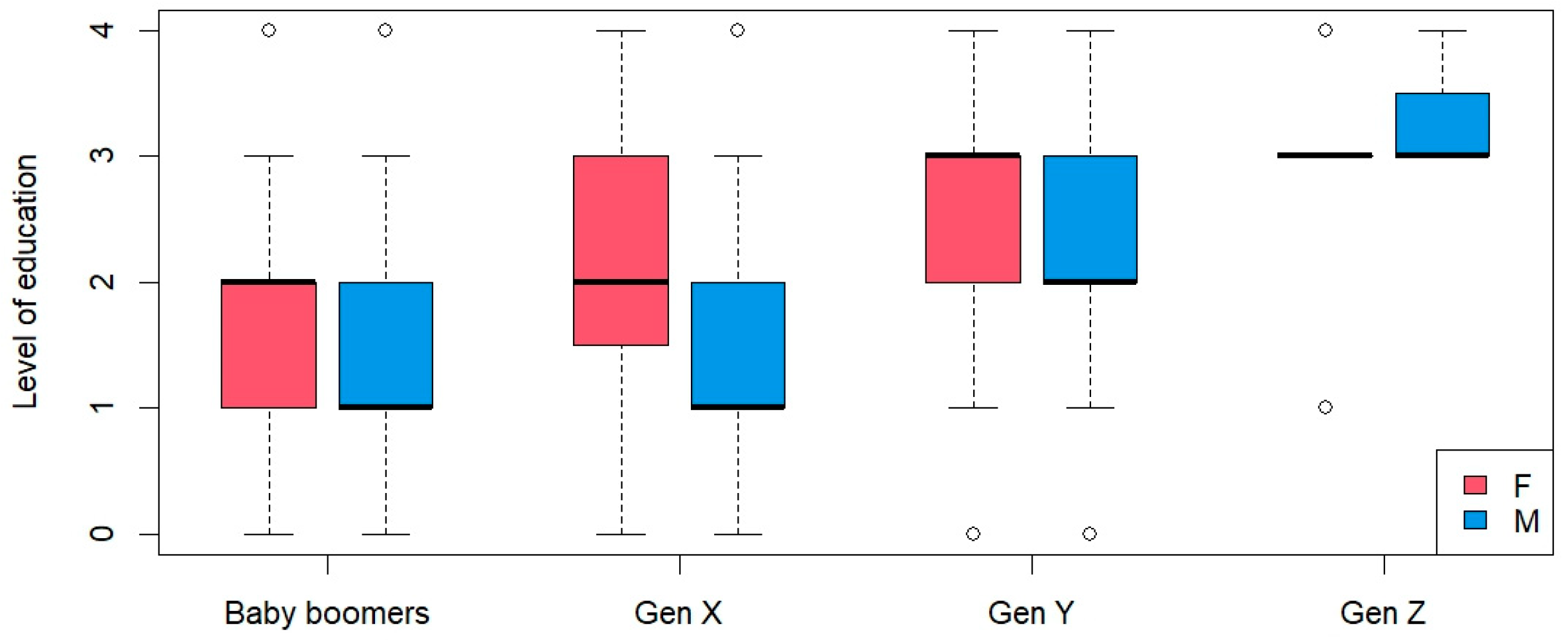
| Level of Education | N = 201 Respondents in Total |
|---|---|
| 0 (basic formal education) | 24 (11.9%) |
| 1 | 42 (20.9%) |
| 2 | 54 (26.9%) |
| 3 | 55 (27.4%) |
| 4 (master’s degree) | 26 (12.9%) |
| Demographic Cohort | N = 201 Respondents in Total |
|---|---|
| Baby boomers | 68 (33.8%) |
| Generation X | 56 (27.9%) |
| Generation Y (Millennials) | 56 (27.9%) |
| Generation Z | 21 (10.4%) |
| Scale (N = 201 Answers) | No Items | Cronbach’s Alpha | ICC (95% CI) |
|---|---|---|---|
| NPSS | 29 | 0.956 | 0.428 (0.380–0.482) |
| NPSS social engagement | 14 | 0.946 | 0.557 (0.506–0.612) |
| NPSS compassion | 7 | 0.945 | 0.712 (0.665–0.757) |
| NPSS body sensations | 8 | 0.930 | 0.623 (0.571–0.676) |
| AIAS4 | 4 | 0.888 | 0.666 (0.608–0.721) |
| Scale (a) | N = 201 Respondents in Total |
|---|---|
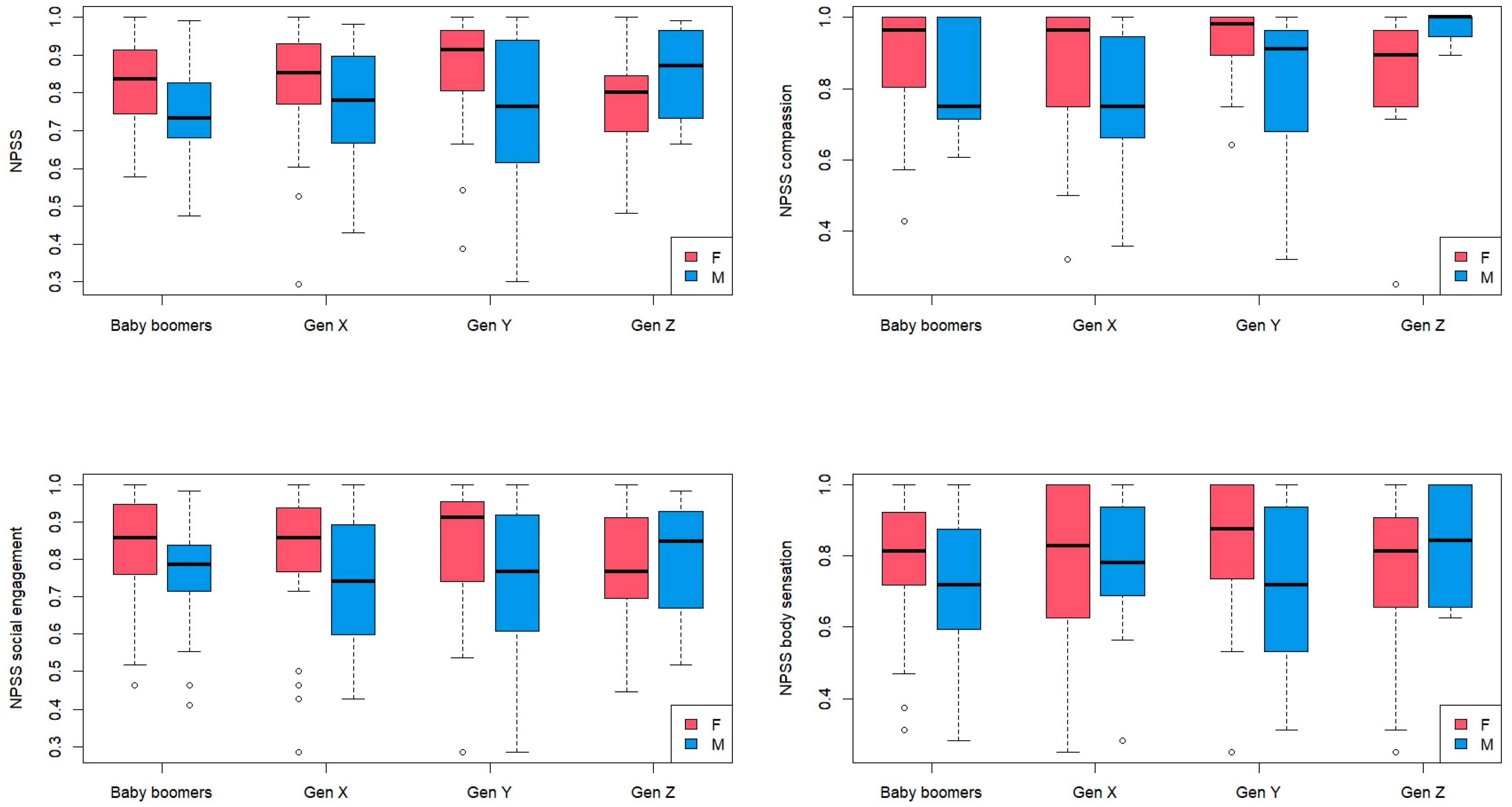
| NPSS average; rescaled [0–1] | 0.80 ± 0.15 |
| NPSS social engagement average; rescaled [0–1] | 0.80 ± 0.17 |
| NPSS compassion average; rescaled [0–1] | 0.87 ± 0.16 |
| NPSS body sensations average; rescaled [0–1] | 0.77 ± 0.20 |
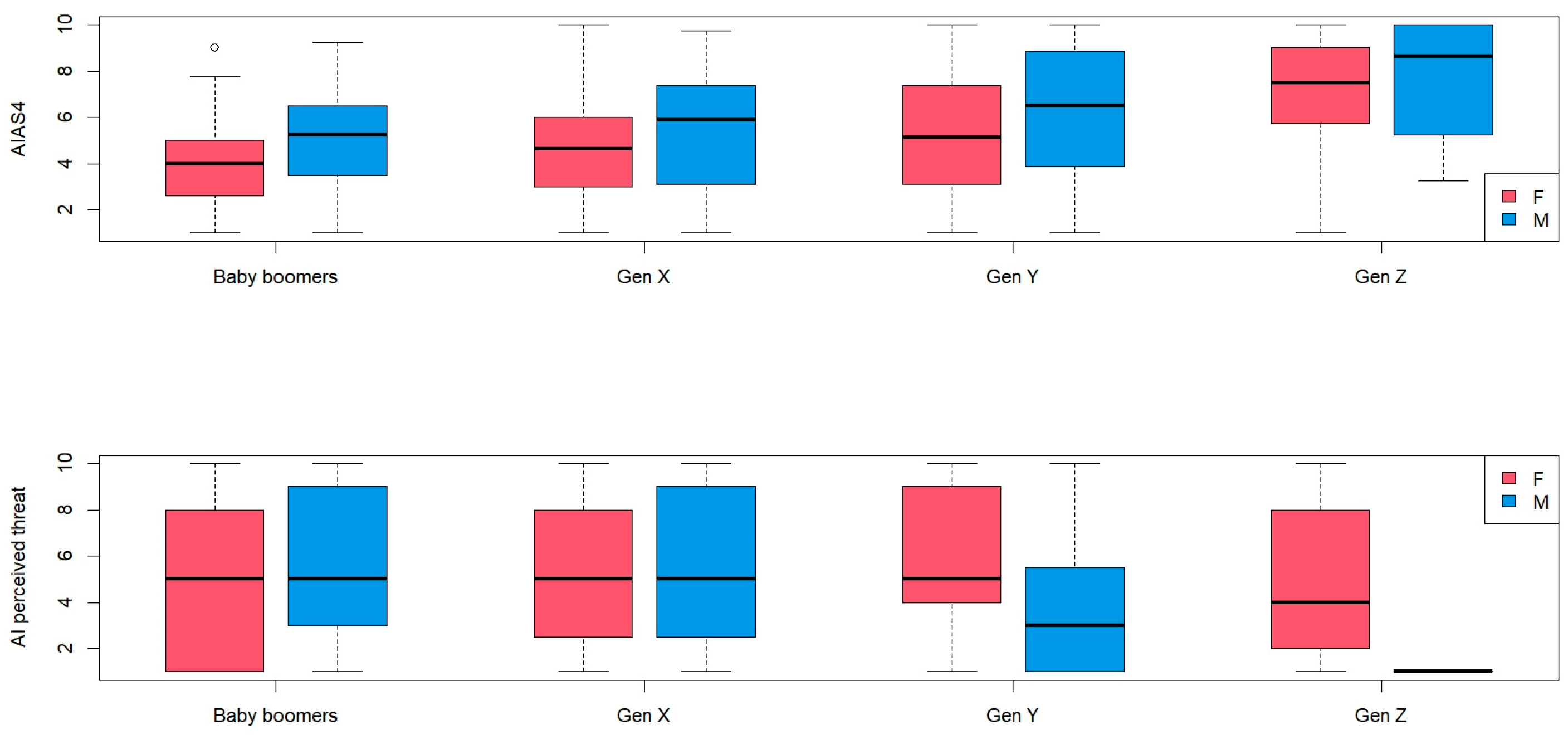
| AIAS4 average; scale [1–10] | 5.11 ± 2.59 |
| AI perceived threat; scale [1–10] | 5.13 ± 3.17 |
| N = 201 Respondents in Total | Demographic Cohort | |||
|---|---|---|---|---|
| Variable | Baby Boomers (N = 68) | Gen X (N = 56) | Gen Y (N = 56) | Gen Z (N = 21) |
| Gender (a) | ||||
| F | 43 (63.2%) | 32 (57.1%) | 36 (64.3%) | 17 (81%) |
| M | 25 (36.8%) | 24 (42.9%) | 20 (35.7%) | 4 (19%) |
| Level of education (a) | ||||
| 0 (basic formal education) | 12 (17.6%) | 6 (10.7%) | 6 (10.7%) | – |
| 1 | 22 (32.4%) | 16 (28.6%) | 3 (5.4%) | 1 (4.8%) |
| 2 | 20 (29.4%) | 19 (33.9%) | 15 (26.8%) | – |
| 3 | 11 (16.2%) | 9 (16.1%) | 20 (35.7%) | 15 (71.4%) |
| 4 (master’s degree) | 3 (4.4%) | 6 (10.7%) | 12 (21.4%) | 5 (23.8%) |
| NPSS average (b) | 0.81 ± 0.12 | 0.80 ± 0.16 | 0.82 ± 0.17 | 0.80 ± 0.14 |
| NPSS social engagement average (b) | 0.80 ± 0.15 | 0.78 ± 0.18 | 0.81 ± 0.18 | 0.79 ± 0.16 |
| NPSS compassion average (b) | 0.86 ± 0.15 | 0.84 ± 0.18 | 0.90 ± 0.15 | 0.87 ± 0.18 |
| NPSS body sensations average (b) | 0.76 ± 0.18 | 0.79 ± 0.20 | 0.79 ± 0.22 | 0.64 ± 0.23 |
| AIAS4 average (b) | 4.30 ± 2.05 | 4.31 ± 2.49 | 5.50 ± 2.82 | 7.04 ± 2.73 |
| AI perceived threat (b) | 5.10 ± 3.14 | 5.39 ± 3.18 | 5.30 ± 3.12 | 4.10 ± 3.40 |
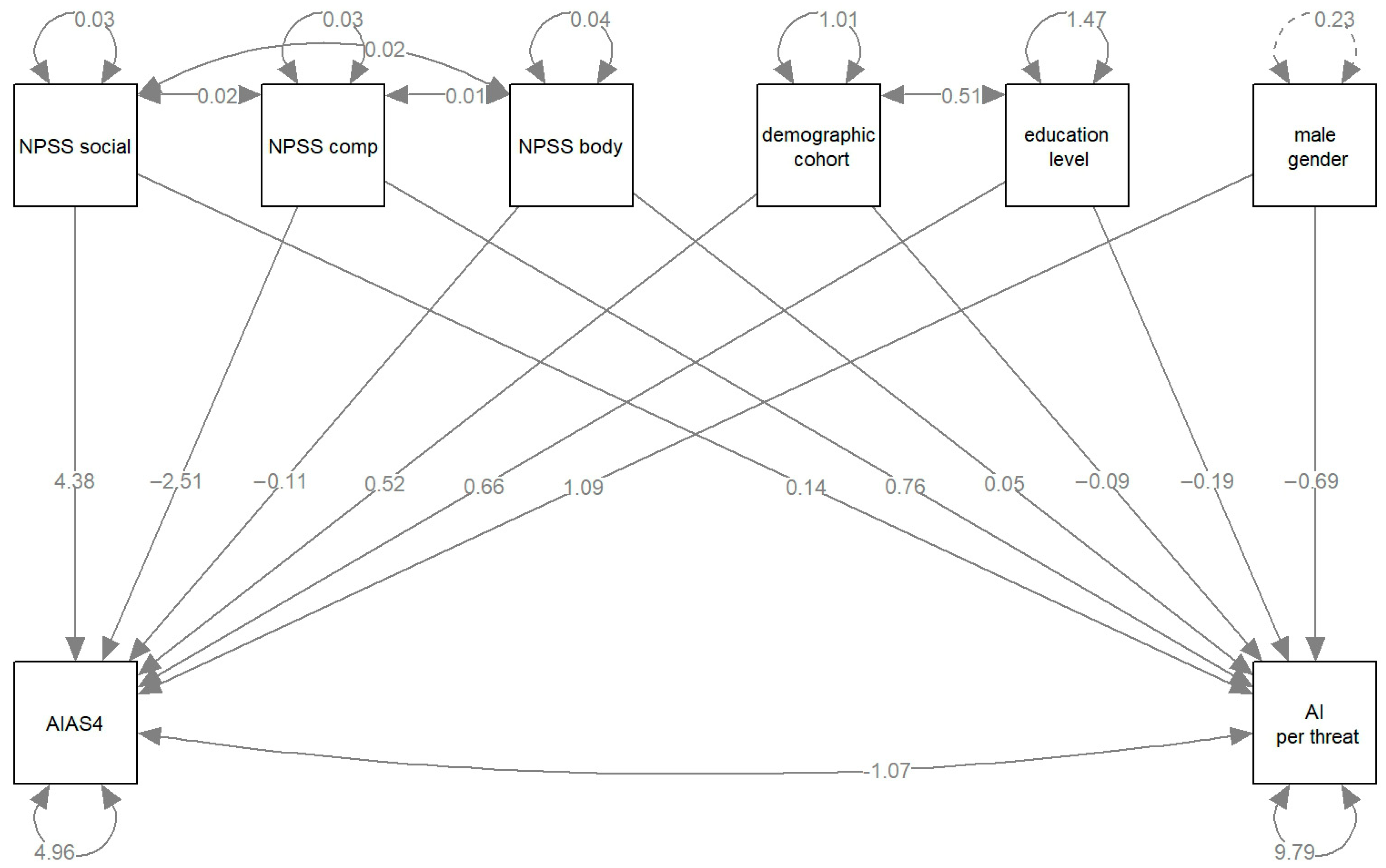
| Covariance-based SEM for perception of general AI in connection with NPSS and demographic factors | |||
| AIAS4 ~ NPSSsocial + NPSScompassion + NPSSbody + demoCohort + education + genderM AI perceived threat ~ NPSSsocial + NPSScompassion + NPSSbody + demoCohort + education + genderM AIAS4 ~~ AI perceived threat NPSSsocial ~~ NPSScompassion + NPSSbody NPSScompassion ~~ NPSSbody demoCohort ~~ education | |||
| Fit indices (201 observations) | |||
| Chi-square test | CFI | RMSEA | SRMR |
| 21.341 (df = 11) p = 0.03 * | 0.962 | 0.068 90% CI (0.021; 0.111) | 0.071 |
| Parameter estimates (a) | |||
| Regressions | estimate ± standard error | z-score (p-value) | |
| AIAS4 ~ | NPSSsocial | 4.383 ± 1.335 | 3.283 (0.001 **) |
| NPSScompassion | −2.505 ± 1.283 | −1.952 (0.051) | |
| NPSSbody | −0.111 ± 0.910 | −0.121 (0.903) | |
| demoCohort | 0.515 ± 0.172 | 2.992 (0.003 **) | |
| education | 0.661 ± 0.143 | 4.622 (<0.001 **) | |
| genderM | 1.087 ± 0.327 | 3.325 (0.001 **) | |
| AI perceived threat ~ | NPSSsocial | 0.139 ± 1.875 | 0.074 (0.941) |
| NPSScompassion | 0.759 ± 1.802 | 0.421 (0.674) | |
| NPSSbody | 0.047 ± 1.279 | 0.037 (0.971) | |
| demoCohort | −0.094 ± 0.242 | −0.387 (0.699) | |
| education | −0.194 ± 0.201 | −0.967 (0.334) | |
| genderM | −0.689 ± 0.459 | −1.501 (0.133) | |
| Covariances | |||
| AIAS4 ~~ AI perceived threat | −1.071 ± 0.497 | −2.152 (0.031 *) | |
| NPSSsocial ~~ NPSScompassion | 0.017 ± 0.002 | 7.670 (<0.001 **) | |
| NPSSsocial ~~ NPSSbody | 0.018 ± 0.003 | 6.601 (<0.001 **) | |
| NPSScompassion ~~ NPSSbody | 0.012 ± 0.002 | 5.001 (<0.001 **) | |
| demoCohort ~~ education | 0.515 ± 0.093 | 5.510 (<0.001 **) | |
| Covariance-based SEM for perception of general AI in connection with NPSS and demographic factors | |||
| AIAS4 ~ NPSSsocial + NPSScompassion + NPSSbody + demoCohort + education AI perceived threat ~ NPSSsocial + NPSScompassion + NPSSbody + demoCohort + education AIAS4 ~~ AI perceived threat NPSSsocial ~~ NPSScompassion + NPSSbody NPSScompassion ~~ NPSSbody demoCohort ~~ education | |||
| Fit indices (128 + 73 observations) | |||
| Chi-square test | CFI | RMSEA | SRMR |
| 15.953 (df = 12) p = 0.193 | 0.986 | 0.057 90% CI (0.000; 0.124) | 0.050 |
| Parameter estimates (a) | |||
| Female group (128 observations) | |||
| Regressions | estimate ± standard error | z-score (p-value) | |
| AIAS4 ~ | NPSSsocial | 2.243 ± 1.601 | 1.401 (0.161) |
| NPSScompassion | −3.718 ± 1.617 | −2.299 (0.022 *) | |
| NPSSbody | −0.216 ± 1.086 | −0.198 (0.843) | |
| demoCohort | 0.604 ± 0.203 | 2.968 (0.003 **) | |
| education | 0.524 ± 0.169 | 3.093 (0.002 **) | |
| AI perceived threat ~ | NPSSsocial | 1.333 ± 2.294 | 0.581 (0.561) |
| NPSScompassion | 1.215 ± 2.318 | 0.524 (0.600) | |
| NPSSbody | 0.190 ± 1.557 | 0.122 (0.903) | |
| demoCohort | 0.439 ± 0.292 | 1.507 (0.132) | |
| education | −0.376 ± 0.243 | −1.550 (0.121) | |
| Covariances | |||
| AIAS4 ~~ AI perceived threat | −2.090 ± 0.622 | − 3.362 (0.001 **) | |
| NPSSsocial ~~ NPSScompassion | 0.012 ± 0.002 | 5.472 (<0.001 **) | |
| NPSSsocial ~~ NPSSbody | 0.016 ± 0.003 | 4.929 (<0.001 **) | |
| NPSScompassion ~~ NPSSbody | 0.007 ± 0.003 | 2.656 (<0.001 **) | |
| demoCohort ~~ education | 0.590 ± 0.128 | 5.510 (<0.001 **) | |
| Male group (73 observations) | |||
| Regressions | estimate ± standard error | z-score (p-value) | |
| AIAS4 ~ | NPSSsocial | 8.741 ± 2.189 | 3.992 (0.001 **) |
| NPSScompassion | −2.766 ± 2.089 | −1.324 (0.185) | |
| NPSSbody | 0.135 ± 1.526 | −0.089 (0.929) | |
| demoCohort | 0.444 ± 0.291 | 1.528 (0.127) | |
| education | 0.688 ± 0.239 | 2.876 (0.004 **) | |
| AI perceived threat ~ | NPSSsocial | −3.233 ± 2.986 | −1.083 (0.279) |
| NPSScompassion | 1.398 ± 2.849 | 0.491 (0.624) | |
| NPSSbody | −0.081 ± 2.082 | −0.039 (0.969) | |
| demoCohort | −1.299 ± 0.396 | −3.276 (0.001 **) | |
| education | 0.271 ± 0.326 | 0.831 (0.406) | |
| Covariances | |||
| AIAS4 ~~ AI perceived threat | 1.039 ± 0.728 | 1.427 (0.154) | |
| NPSSsocial ~~ NPSScompassion | 0.022 ± 0.004 | 4.999 (<0.001 **) | |
| NPSSsocial ~~ NPSSbody | 0.020 ± 0.005 | 4.224 (<0.001 **) | |
| NPSScompassion ~~ NPSSbody | 0.019 ± 0.005 | 4.024 (<0.001 **) | |
| demoCohort ~~ education | 0.358 ± 0.126 | 2.851 (0.004 **) | |
Disclaimer/Publisher’s Note: The statements, opinions and data contained in all publications are solely those of the individual author(s) and contributor(s) and not of MDPI and/or the editor(s). MDPI and/or the editor(s) disclaim responsibility for any injury to people or property resulting from any ideas, methods, instructions or products referred to in the content. |
© 2025 by the authors. Licensee MDPI, Basel, Switzerland. This article is an open access article distributed under the terms and conditions of the Creative Commons Attribution (CC BY) license.
Share and Cite
Panfil, A.-L.; Tamasan, S.C.; Vasilian, C.C.; Horhat, R.; Lungeanu, D. Neuroception of Psychological Safety and Attitude Towards General AI in uHealth Context. Multimodal Technol. Interact. 2026, 10, 4. https://doi.org/10.3390/mti10010004
Panfil A-L, Tamasan SC, Vasilian CC, Horhat R, Lungeanu D. Neuroception of Psychological Safety and Attitude Towards General AI in uHealth Context. Multimodal Technologies and Interaction. 2026; 10(1):4. https://doi.org/10.3390/mti10010004
Chicago/Turabian StylePanfil, Anca-Livia, Simona C. Tamasan, Claudia C. Vasilian, Raluca Horhat, and Diana Lungeanu. 2026. "Neuroception of Psychological Safety and Attitude Towards General AI in uHealth Context" Multimodal Technologies and Interaction 10, no. 1: 4. https://doi.org/10.3390/mti10010004
APA StylePanfil, A.-L., Tamasan, S. C., Vasilian, C. C., Horhat, R., & Lungeanu, D. (2026). Neuroception of Psychological Safety and Attitude Towards General AI in uHealth Context. Multimodal Technologies and Interaction, 10(1), 4. https://doi.org/10.3390/mti10010004