
On Eight Structural Conditions Hampering Urban Green Transitions in the EU




Abstract
1. Introduction
1.1. Gaps and Objective
1.2. Background
1.3. Structure
2. Materials and Methods
2.1. Scoping Literature Review
Reports on the European Green Deal
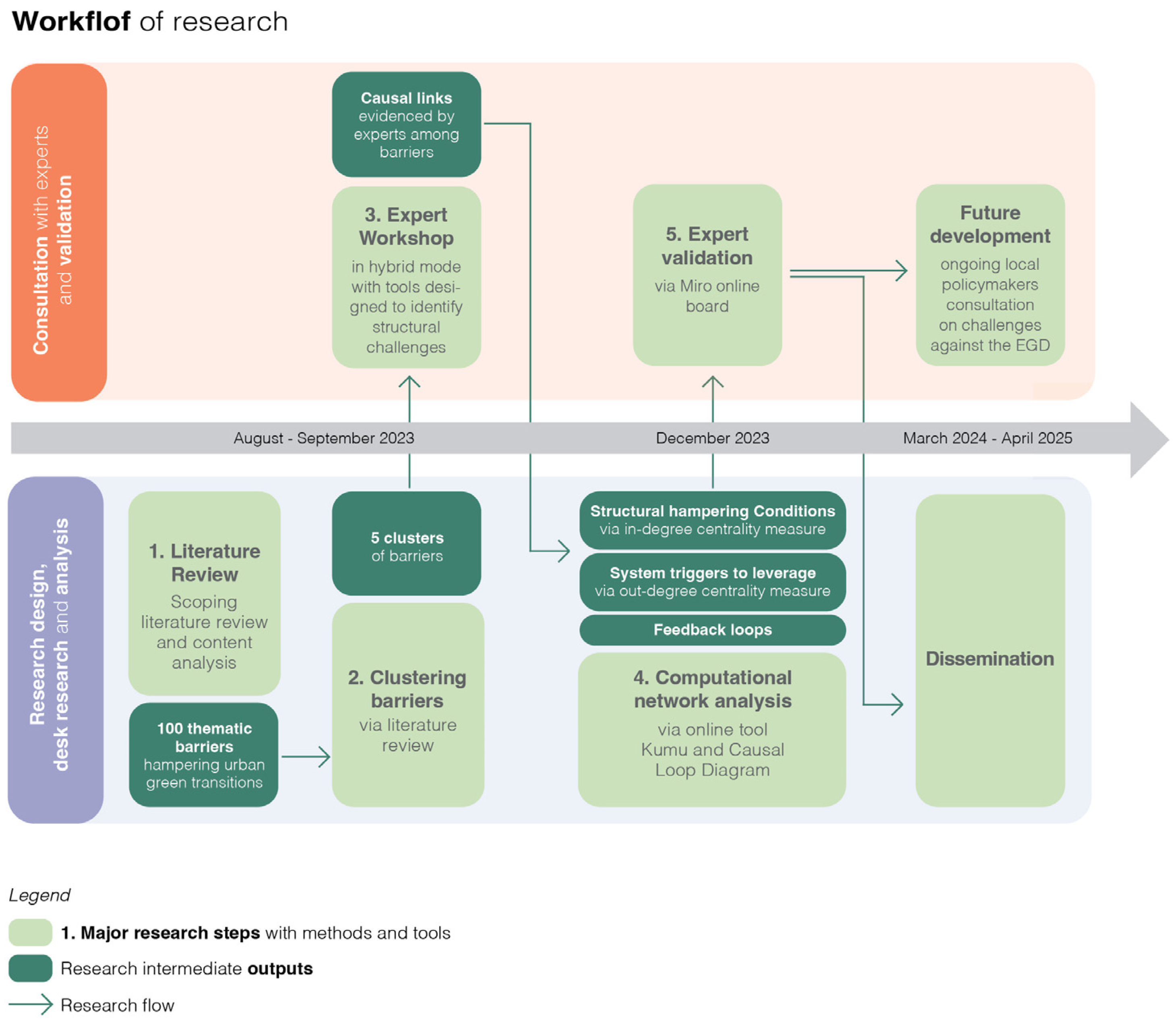
2.2. Clustering Barriers
- Economic/Financial Barriers relate to the costs, investments, and funding necessary to support the transition. These include inability to access funding [46,47] and high upfront costs for technological innovations [48], uncertainty regarding long-term returns on investment [49], and expenses tied to established design projects and technologies.
- Socio-Cultural/Behavioral barriers encompass societal norms, values, attitudes, and individual behaviors that influence the acceptance and implementation of sustainable policies [50,51,52,53]. These barriers include resistance to change [47], divergent understanding among stakeholders, and cognitive biases that hinder pro-environmental behavior [26,54].
- Knowledge/Operational barriers pertain to deficits in information accessibility for policy implementation. These include inadequate education, training, and awareness programs [55,56], unreliable or asymmetrical information [57,58], and communication challenges in translating scientific evidence into actionable knowledge [12,26,59,60] and dissemination [61].
- Technological/Infrastructural barriers reflect limitations in available technologies and supporting infrastructure. These might include a lack of technological advancement and maturity, insufficient research and innovation [62], and infrastructural lock-ins that reinforce existing industrial networks and delay the adoption of cleaner technologies [20].
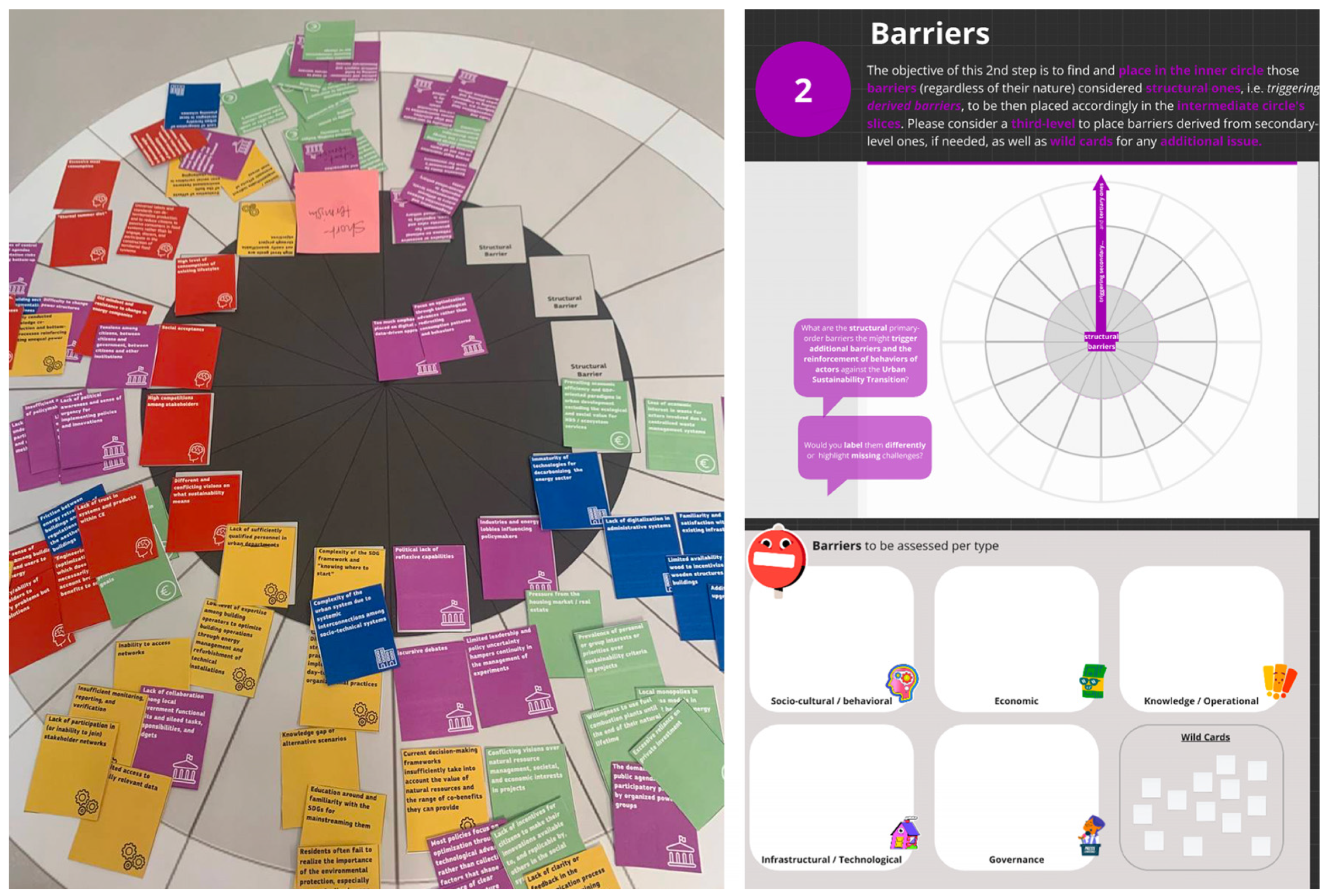
2.3. Experts Workshop
2.4. Computational Network Analysis
Identifying Structural Hampering Conditions, Leverages, and Feedback Loops
3. Results
3.1. Descriptive Analysis
3.2. Barriers to Urban Green Transitions
Barriers to Localizing the European Green Deal
3.3. Structural Conditions Hampering Urban Green Transitions
System Triggers
4. Discussions
4.1. Lessons Learnt
4.2. Leverage Points for System Transformation
4.3. Policy Implications
- Leveraging system triggers. Addressing nodes with high systemic influence (i.e., those from which the most causal relationships emanate and have the greatest potential to disrupt reinforcing hampering mechanisms) could constitute strategic areas of intervention for policymaking. Cities frequently lack the specialized knowledge required to navigate complex sustainability policies, apply for EU funding, and implement innovative climate strategies. Many sustainability trade-offs stem from the fact that urban planning and investment decisions remain primarily driven by short-term economic efficiency metrics mostly due to knowledge gaps of alternative scenarios. This paradigm reinforces spatial competition and limits experimentation with circular and regenerative economies. Consequently, the following are noted:
- -
- Addressing highlighted knowledge gap through dedicated capacity-building programs, knowledge-sharing, and urban policy learning networks could act as a systemic enabler, improving governance efficiency and enhancing cities’ abilities to formulate and execute long-term transition plans.
- -
- Investing in urban leadership development, peer-learning initiatives among cities, and governance innovation models (e.g., urban climate assemblies) could counteract the reinforcing feedback loop that perpetuates centralized control and governance fragmentation.
- -
- Policy interventions should focus on expanding urban economic performance indicators beyond GDP to incorporate climate resilience, well-being, and ecosystem services into urban decision-making frameworks to capture broader sustainability dimensions envisaged by the EGD [96]. In addition, such complementary beyond-GDP metrics could be reflected in EU funding opportunities and financing schemes.
- Enhancing Policy Coherence. Many urban sustainability initiatives suffer from piecemeal funding that lacks continuity. Establishing clearer links between EGD objectives, national funding schemes, local priorities, and budgets would improve cities’ ability to secure stable, multi-year financing. This could be achieved by mainstreaming EGD targets into regional and urban development plans and local agenda setting, reducing reliance on fragmented, project-based grants and ensuring better access to fundings.
- Allow for experimentation, replicability, and scaling up. Urban experimentation has emerged as a key strategy in the literature review for advancing the green transition, with Urban Living Labs and small-scale pilot projects serving as critical testbeds for innovation [97,98]. These initiatives enable cities to trial innovative solutions in controlled settings, addressing local challenges while generating knowledge transferred to broader settings. However, urban experimentation in projects and processes should be embedded within innovative governance structures [15] to facilitate scaling up beyond niches. Experimentation alone is insufficient unless mechanisms for institutional learning, policy integration, and financial support are in place. This implies the support of the following:
- −
- Adaptive and iterative monitoring exercises to assess how pilots align with and contribute to systemic sustainability transition goals [99].
- −
- Institutionalized reflexivity in governance [100] that allow cities to dynamically refine strategies based on real-world feedback.
- −
- −
- Enhancing local strategic autonomy [10], since cities serve as hubs of innovation [103], but their ability to scale up and replicate successful transition models might also depend on how urban-level experiments are connected to the EU policymaking level. Initiatives like the EU Mission for 100 Climate-Neutral and Smart Cities have proven how direct EU-city engagement benefits the engagement with social parties in co-creation process. Similar initiative for localizing the EGD, beyond a solely GHG emission-related paradigm, could enhance cities’ potential towards broader natural capital preservation in the EU and enhance experimentation.
4.4. Limitations
5. Conclusions
Author Contributions
Funding
Data Availability Statement
Acknowledgments
Conflicts of Interest
Appendix A

| Cluster | Barriers | Reference |
|---|---|---|
| Socio-cultural/Behavioral | Different and conflicting visions on what sustainability means | [104] |
| Actors’ own cognitive lock-in (no perceived need for transition) | [67] | |
| Lack of trust and collaboration among stakeholders and/or incumbent/entrant actors | [70,83,105] | |
| High level of consumption of existing lifestyles | [105] | |
| Lack of trust in systems and products within CE | [105] | |
| “Universal labels and standards can de-territorialize production and to reduce citizens to passive consumers in food systems” | [75] | |
| “Eternal summer diet” | [68] | |
| Excessive meat consumption | [68] | |
| Lack of sense of urgency among building owners and users to save energy | [66] | |
| Frustration and unfulfilled expectations by stakeholders in a participation process of participation | [106] | |
| “Participants recurrence in discussions might limit democratization of sustainability transition agendas, motivation, innovative solutions, resource mobilization” | [106,107] | |
| Emotions and negative effects of negotiation processes | [106] | |
| Tendency/ability of stakeholders to identify problems but not solutions | [106] | |
| “Lack of path dependence, i.e., active memory determined by past decisions having influence on future decision-making, leading to repeat errors again and again” | [108] | |
| ‘Engineering mindset’ (optimization) prevails which does not necessarily take into account broader benefits to society | [65] | |
| Reluctance to share data by stakeholders in networks | [9,109] | |
| Lack of trust and collaboration in stakeholder networks | [14] | |
| High competitions among stakeholders | [69] | |
| “Old mindset and resistance to change in energy companies” | [83] | |
| Social acceptance | [83] | |
| Insufficient awareness of citizens | [9,14] | |
| Knowledge/ Operational | Education around and familiarity with the SDGs for mainstreaming them | [71] |
| Complexity of the SDG framework and “knowing where to start” | [1,71] | |
| Limited access to locally relevant data | [71,110] | |
| High level goals are not easily quantifiable through project objectives | [111] | |
| Unclear/unquantifiable indirect economic effects of heat stress | [111] | |
| “Evaluation of effects of the built environment features over social variables is highly challenging” | [111] | |
| Social concerns are not reflected in criteria used within built environment management | [111] | |
| “Circularity and climate adaptation objectives not consistently included in the initial stages of urban planning” | [111] | |
| Little knowledge about CE concepts among key stakeholders | [72,105] | |
| “Poorly conducted knowledge co-production and bottom-up processes reinforcing existing unequal power” | [76] | |
| “Low level of expertise among building operators to optimize building operations through energy management and refurbishment of technical installations” | [66] | |
| “Lack of clarity or feedback in the communication process further undermining motivation to engage” | [106] | |
| “Lack of participation in (or inability to join) stakeholder networks” | [19,69,112] | |
| “Knowledge gap of alternative scenarios” | [81] | |
| Limited capacity to engage in transdisciplinary research collaborations | [69] | |
| Decision-making frameworks insufficiently consider the value of natural resources and co-benefits they can provide | [19] | |
| Difficulty of translating strategic visions to practical implementation | [73] | |
| “Residents often fail to realize the importance of the environmental protection, especially in marginalized areas” | [113] | |
| Lack of sufficiently qualified personnel in urban departments | [9,14] | |
| Insufficient monitoring, reporting, and verification | [9,14] | |
| Political/Institutional | Fear of loss of control of political agendas and/or reputation risks in promoting bottom-up approaches | [114] |
| Lack of collaboration among local government functional units and siloed tasks, responsibilities, and budgets | [9,14,19,73,108,111,114] | |
| Too much emphasis placed on digital and data-driven approaches | [115] | |
| Incremental focus on optimization through technological advances rather than consumption patterns and behaviours | [115,116] | |
| Lack of interest or underestimation for participatory process and new governance methods | ||
| Lack of interest in CE | [105] | |
| Exclusive or excessive reliance on national government for concrete rules and laws, especially in centralized unitary states | [82,105] | |
| Uncertain and changing regulatory framework | [9,14,83,105] | |
| Strong legal restriction on the use of waste because of public health concerns (e.g., food waste) | [72] | |
| Absence of clear governance structure for urban sustainability transitions and initiatives | [69,77] | |
| Tensions among citizens, between citizens and government, between citizens and other institutions | [69,77] | |
| Fragmentation and disconnection between actors in different implementation levels, especially in decentralised unitary states or specific domains (e.g., energy) | [14,74,82] | |
| Difficulty in coordinating and aligning activities across municipalities to address horizontal cross-domain challenges, especially in decentralized unitary states | [9,82] | |
| Lack of governmental support beyond “seeding” transition initiatives | [82] | |
| Misalignment between local specific challenges, regionalized guidelines, and nationally focused goals | [9,14,71] | |
| Difficulty to change power structures | [81] | |
| Limited leadership and policy uncertainty hampers continuity in the management of experiments | [69] | |
| The domain of the public agenda and participatory processes by organized power groups | [106] | |
| Political need to demonstrate success | [69,73] | |
| Political lack of reflexive capabilities | [69] | |
| Over-bureaucracy and excessive regulations can hamper collaborative governance processes | [14,106] | |
| Discursive debates | [81] | |
| Policies’ focus on optimization through technological advances rather than collective factors that shape behaviours | [116] | |
| Industries and energy lobbies influencing policymakers | [83] | |
| Insufficient awareness of policymakers | [83] | |
| Tasks and responsibilities (and budgets) are ‘siloed’, leading to fragmented urban planning and development efforts | [9,14,19,73,108,111,114] | |
| Lack of political awareness and sense of urgency for implementing policies and innovations | [9,14,73,83,108] | |
| “Policies and regulations typically designed for existing problems and current technologies and approaches” | [19] | |
| “Limited community engagement, empowerment, and participation and public will” | [14,108] | |
| Excessive limits to local government’s room for menoeuvre | [7,9,14] | |
| Financial/Economic | Loss of economic interest in waste for actors involved due to centralized waste management systems | [72] |
| Prevalence of personal or group interests or priorities over sustainability criteria in projects | [105,111] | |
| Inability to access funding | [7,9,10,14] | |
| Conflicting environmental-economic interests in planning | [14,105] | |
| Excessive reliance on private investment | [105] | |
| Difficulty of financing deep retrofits or small-scale energy retrofit (‘creditworthiness’) | [66] | |
| High upfront and instalment costs of deep retrofits | [66] | |
| Limited financial resources to structure and facilitate the processes of collaborative governance | [106,114] | |
| Lack of incentives for citizens to make their innovations available to, and replicable by, others in the social system | [67] | |
| Lack of resources for monitoring | [9,69] | |
| Choices mostly reflect short-term private costs and benefits but not long-term socio-ecological ones | [66,81] | |
| Possible negative financial consequences due to change | [81] | |
| Willingness to use fuel combustion plants until the end of their natural lifetime | [83] | |
| “Projectification of funding” leading to more easily obtainable funds for short-term, project-based funding than long-term decision-making needed to sustain transition initiatives | [81,82,106,117] | |
| Local monopolies in business models in district heating energy providers | [83] | |
| Risks of the investment | [83] | |
| National energy pricing schemes/Low energy price discourages investments in energy efficiency | [66] | |
| Prevailing economic efficiency and GDP-oriented paradigms in urban development excluding the ecological and social value for NBS/ecosystem services | [19,108,113,118] | |
| Potentially competing issues between social and environmental priorities and project goals | [9,73,107,119] | |
| Limited funding, budget cuts, austerity | [14,19,65,105,108,112,120] | |
| Pressure from the housing market | [19,65] | |
| Conflicting visions over natural resource management, societal, and economic interests in projects | [9,14,65,73,105,107,119] | |
| Technological/Infrastructural | Lack of digitalization in administrative systems | [14] |
| Limited availability of wood to incentivize wooden structures in buildings | [121] | |
| Lack of statutory requirements for the energy performance of existing buildings makes it difficult to incentivize building owners to invest in energy efficiency | [66] | |
| Friction between energy retrofitting of buildings and local regulations regarding the aesthetics of buildings | [66] | |
| Complex permit procedures for building retrofitting | [66] | |
| No regulatory structures to address the split-incentives problem in shared buildings | [66] | |
| Additional costs for upgrading energy labels | [66] | |
| “Building sector fragmentation and lack of business collaboration platforms between market actors to develop integrated solutions” | [66] | |
| Difficulties in engaging with physical change of the built environment in cities (due to socio-technical regimes involved and as result of high investment costs) | [122] | |
| Complexity of the urban system due to its systemic interconnections | [40,83] | |
| Immaturity of technologies for decarbonizing the energy sector | [83] | |
| Familiarity and satisfaction with existing infrastructures | [81] | |
| Lack of integration of urban forestry strategies in local planning schemes | [81] | |
| Need for large-scale infrastructure for electrification | [73] | |
| Cybersecurity issues and loss of confidence in new technologies | [14] |
References
- Trane, M.; Marelli, L.; Siragusa, A.; Pollo, R.; Lombardi, P. Progress by Research to Achieve the Sustainable Development Goals in the EU: A Systematic Literature Review. Sustainability 2023, 15, 7055. [Google Scholar] [CrossRef]
- European Commission (2019), COM/2019/640 The European Green Deal. Available online: https://ec.europa.eu/info/sites/default/files/european-green-deal-communication_en.pdf (accessed on 13 May 2024).
- European Union. Regulation (EU) 2021/1119 of the European Parliament and of the Council of 30 June 2021 Establishing the Framework for Achieving Climate Neutrality and Amending Regulations (EC) No 401/2009 and (EU) 2018/1999 (‘European Climate Law’), 243 OJ L (2021). 2021. Available online: http://data.europa.eu/eli/reg/2021/1119/oj/eng (accessed on 17 April 2025).
- European Commission: Joint Research Centre; Marelli, L.; Trane, M.; Barbero Vignola, G.; Gastaldi, C.; Guerreiro Miguel, M.; Delgado Callicó, L.; Borchardt, S.; Mancini, L.; Sanye Mengual, E.; et al. Delivering the EU Green Deal—Progress Towards Targets; Black, C., Cisternino, S., Eds.; Publications Office of the European Union: Luxembourg, 2025; JRC140372; Available online: https://data.europa.eu/doi/10.2760/3105205 (accessed on 17 April 2025).
- Oberthür, S.; von Homeyer, I. From Emissions Trading to the European Green Deal: The Evolution of the Climate Policy Mix and Climate Policy Integration in the EU. J. Eur. Public Policy 2023, 30, 445–468. [Google Scholar] [CrossRef]
- Trane, M.; Borchardt, S.; Marelli, L.; Siragusa, A.; Pollo, R.; Lombardi, P. What Role for Cities in the EU Green Deal? Analysis of Policy Framework, Interlinkages and Contribution to the 2030 Agenda. Sustain. Dev. 2025, 33, 5949–5967. [Google Scholar] [CrossRef]
- European Committee of the Regions (CoR). The State of Regions and Cities—EU annual Report 2024, European Committee of the Regions. 2024. Available online: https://data.europa.eu/doi/10.2863/802688 (accessed on 5 April 2025).
- European Commission Ninth Report on Economic, Social and Territorial Cohesion. Online. 2024. Available online: https://ec.europa.eu/regional_policy/information-sources/cohesion-report_en (accessed on 14 February 2025).
- European Committee of the Regions, The Future of the Green Deal: Taking Stock and Looking Ahead. Online. Available online: https://cor.europa.eu/en/engage/Documents/RegHub/green-deal-taking-stock-looking-ahead.pdf (accessed on 12 April 2024).
- European Committee of the Regions Regions and Cities Shaping the European Green Deal 2.0; Publications Office of the European Union: Luxembourg, 2024; ISBN 978-92-895-3487-1.
- Official Journal of the European Union. C 364, 28 October 2020 (2020/C 364/10, Opinion of the European Economic and Social Committee on ‘European Climate Pact’ (Exploratory opinion), p. 67). 2020. Available online: https://eur-lex.europa.eu/legal-content/EN/TXT/?uri=uriserv%3AOJ.C_.2020.364.01.0067.01.ENG&toc=OJ%3AC%3A2020%3A364%3ATOC (accessed on 17 April 2025).
- Matti, M.; Jensen, K.; Bontoux, L.; Goran, P.; Pistocchi, A.; Salvi, M. Towards a Fair and Sustainable Europe 2050: Social and Economic Choices in Sustainability Transitions; Publications Office of the European Union: Luxembourg, 2023. [Google Scholar]
- European Commission. Commission Staff Working DocumentImpact Assessment Report Part 1 Accompanying the Document Communication from the Commission to the European Parliament, the Council, the European Economic and Social Committee and the Committee of the Regions. Securing Our Future Europe’s 2040 Climate Target and Path to Climate Neutrality by 2050 Building a Sustainable, Just and Prosperous Society. Available online: https://eur-lex.europa.eu/legal-content/EN/TXT/?uri=CELEX%3A52024SC0063 (accessed on 7 February 2025).
- Ulpiani, G.; Vetters, N. On the Risks Associated with Transitioning to Climate Neutrality in Europe: A City Perspective. Renew. Sustain. Energy Rev. 2023, 183, 113448. [Google Scholar] [CrossRef]
- Matti, C.; Bontoux, L.; Jensen, K. Strategic Foresight Framework for Addressing Agency in Sustainability Transitions: A Co-Creation Approach. Front. Sustain. 2025, 6, 1507708. [Google Scholar] [CrossRef]
- Räsänen, A.; Sarkki, S.; Haanpää, O.; Isolahti, M.; Kekkonen, H.; Kikuchi, K.; Koukkari, V.; Kärkkäinen, K.; Miettinen, J.; Mäntymaa, E.; et al. Bridging the Knowledge-Action Gap: A Framework for Co-Producing Actionable Knowledge. Environ. Sci. Policy 2024, 162, 103929. [Google Scholar] [CrossRef]
- Von Homeyer, I.; Oberthür, S.; Jordan, A.J. EU Climate and Energy Governance in Times of Crisis: Towards a New Agenda. J. Eur. Public Policy 2021, 28, 959–979. [Google Scholar] [CrossRef]
- Von der Leyen, U. Europe’s Choice. Political Guidelines for the next European Commission 2024–2029. 2024. Available online: https://commission.europa.eu/document/download/e6cd4328-673c-4e7a-8683-f63ffb2cf648_en (accessed on 4 March 2025).
- Dorst, H.; van der Jagt, A.; Runhaar, H.; Raven, R. Structural Conditions for the Wider Uptake of Urban Nature-Based Solutions—A Conceptual Framework. Cities 2021, 116, 103283. [Google Scholar] [CrossRef]
- Geels, F.W. Socio-Technical Transitions to Sustainability: A Review of Criticisms and Elaborations of the Multi-Level Perspective. Curr. Opin. Environ. Sustain. 2019, 39, 187–201. [Google Scholar] [CrossRef]
- Sala, S.; Crenna, E.; Secchi, M.; Sanyé-Mengual, E. Environmental Sustainability of European Production and Consumption Assessed against Planetary Boundaries. J. Environ. Manag. 2020, 269, 110686. [Google Scholar] [CrossRef]
- Hölscher, K.; Wittmayer, J.M.; Loorbach, D. Transition versus Transformation: What’s the Difference? Environ. Innov. Soc. Transit. 2018, 27, 1–3. [Google Scholar] [CrossRef]
- Rotmans, J.; Kemp, R.; van Asselt, M. More Evolution than Revolution: Transition Management in Public Policy. Foresight 2001, 3, 15–31. [Google Scholar] [CrossRef]
- Stirling, A. Emancipating Transformations: From Controlling ‘the Transition’ to Culturing Plural Radical Progress. In The Politics of Green Transformations; Routledge: London, UK, 2015; ISBN 978-1-315-74737-8. [Google Scholar]
- Geels, F.W.; Schot, J. Typology of Sociotechnical Transition Pathways. Res. Policy 2007, 36, 399–417. [Google Scholar] [CrossRef]
- Terzi, A. Crafting an Effective Narrative on the Green Transition. Energy Policy 2020, 147, 111883. [Google Scholar] [CrossRef]
- Hodson, M.; Geels, F.W.; McMeekin, A. Reconfiguring Urban Sustainability Transitions, Analysing Multiplicity. Sustainability 2017, 9, 299. [Google Scholar] [CrossRef]
- Markard, J.; Raven, R.; Truffer, B. Sustainability Transitions: An Emerging Field of Research and Its Prospects. Res. Policy 2012, 41, 955–967. [Google Scholar] [CrossRef]
- Frantzeskaki, N.; Hölscher, K.; Wittmayer, J.M.; Avelino, F.; Bach, M. Transition Management in and for Cities: Introducing a New Governance Approach to Address Urban Challenges. In Co-Creating Sustainable Urban Futures; Frantzeskaki, N., Hölscher, K., Bach, M., Avelino, F., Eds.; Future City; Springer International Publishing: Cham, Switzerland, 2018; Volume 11, pp. 1–40. ISBN 978-3-319-69271-5. [Google Scholar]
- Köhler, J.; Geels, F.W.; Kern, F.; Markard, J.; Onsongo, E.; Wieczorek, A.; Alkemade, F.; Avelino, F.; Bergek, A.; Boons, F.; et al. An Agenda for Sustainability Transitions Research: State of the Art and Future Directions. Environ. Innov. Soc. Transit. 2019, 31, 1–32. [Google Scholar] [CrossRef]
- Suitner, J.; Haider, W.; Krisch, A. Socially Innovative Experiments for Transformative Local Development: Putting More-than-Growth-Oriented Local Interventions in Spatial Context. Reg. Sci. Policy Pract. 2024, 16, 100035. [Google Scholar] [CrossRef]
- Blondeel, M. The European Green Deal in the Age of Volatility. In Progressive Yearbook; Foundation of European Progressive Studies (FEPS): Brussels, Belgium, 2024. [Google Scholar]
- Local Alliance. Joint Letter to EU Leaders. 2024. Available online: https://iclei-europe.org/fileadmin/user_upload/Pdfs/2024/Final_Local_Alliance_Letter_to_EU_Leaders.pdf (accessed on 4 January 2025).
- Ulpiani, G.; Rebolledo, E.; Vetters, N.; Florio, P.; Bertoldi, P. Funding and Financing the Zero Emissions Journey: Urban Visions from the 100 Climate-Neutral and Smart Cities Mission. Humanit. Soc. Sci. Commun. 2023, 10, 1–14. [Google Scholar] [CrossRef]
- Bianchi, G.; Matti, C.; Pontikakis, D.; Reimeris, R.; Haegeman, K.H.; Miedzinski, M.; Sillero Illanes, C.; Mifsud, S.; Sasso, S.; Bol, E.; et al. (Eds.) Innovation for Place-Based Transformations; Publications Office of the European Union: Luxembourg, 2024; JRC135826. [Google Scholar] [CrossRef]
- Croci, E.; Lucchitta, B.; Molteni, T. Low Carbon Urban Strategies: An Investigation of 124 European Cities. Urban Clim. 2021, 40, 101022. [Google Scholar] [CrossRef]
- Pūķis, M.; Bičevskis, J.; Gendelis, S.; Karnītis, E.; Karnītis, Ģ.; Eihmanis, A.; Sarma, U. Role of Local Governments in Green Deal Multilevel Governance: The Energy Context. Energies 2023, 16, 4759. [Google Scholar] [CrossRef]
- Dobravec, V.; Matak, N.; Sakulin, C.; Krajačić, G. Multilevel Governance Energy Planning and Policy: A View on Local Energy Initiatives. Energ Sustain. Soc. 2021, 11, 2. [Google Scholar] [CrossRef]
- Van Der Heijden, E.A.; Van Mierlo, B.C.; Majoor, S.J.H.; Beers, P.J. Controlling the Valves: Dealing with Conflict in a Transition Initiative for Public–Private Water Governance in Amsterdam. In Sustainable Urban Transitions: Research, Policy and Practice; Allam, Z., Ed.; Springer Nature: Singapore, 2023; pp. 125–148. ISBN 978-981-9926-95-4. [Google Scholar]
- Breitschopf, B.; Grimm, A.; Billerbeck, A.; Wydra, S.; Köhler, J. Towards Understanding Interactions between Socio-Technical Systems in Sustainability Transitions. Energy Res. Soc. Sci. 2023, 106, 103323. [Google Scholar] [CrossRef]
- Temper, L.; Walter, M.; Rodriguez, I.; Kothari, A.; Turhan, E. A Perspective on Radical Transformations to Sustainability: Resistances, Movements and Alternatives. Sustain. Sci. 2018, 13, 747–764. [Google Scholar] [CrossRef]
- Schebesta, H.; Candel, J.J.L. Game-Changing Potential of the EU’s Farm to Fork Strategy. Nat. Food 2020, 1, 586–588. [Google Scholar] [CrossRef]
- Mak, S.; Thomas, A. Steps for Conducting a Scoping Review. J. Grad Med. Educ. 2022, 14, 565–567. [Google Scholar] [CrossRef]
- Newman, M.; Gough, D. Systematic Reviews in Educational Research: Methodology, Perspectives and Application. In Systematic Reviews in Educational Research: Methodology, Perspectives and Application; Zawacki-Richter, O., Kerres, M., Bedenlier, S., Bond, M., Buntins, K., Eds.; Springer Fachmedien: Wiesbaden, Germany, 2020; pp. 3–22. ISBN 978-3-658-27602-7. [Google Scholar]
- Munn, Z.; Peters, M.D.J.; Stern, C.; Tufanaru, C.; McArthur, A.; Aromataris, E. Systematic Review or Scoping Review? Guidance for Authors When Choosing between a Systematic or Scoping Review Approach. BMC Med. Res. Methodol. 2018, 18, 143. [Google Scholar] [CrossRef]
- Kiefer, C.P.; Del Río González, P.; Carrillo-Hermosilla, J. Drivers and Barriers of Eco-Innovation Types for Sustainable Transitions: A Quantitative Perspective. Bus. Strategy Environ. 2019, 28, 155–172. [Google Scholar] [CrossRef]
- Corsi, A.; de Souza, F.F.; Pagani, R.N.; Kovaleski, J.L. Technology Transfer Oriented to Sustainable Development: Proposal of a Theoretical Model Based on Barriers and Opportunities. Scientometrics 2021, 126, 5081–5112. [Google Scholar] [CrossRef]
- Long, T.B.; Blok, V.; Coninx, I. Barriers to the Adoption and Diffusion of Technological Innovations for Climate-Smart Agriculture in Europe: Evidence from the Netherlands, France, Switzerland and Italy. J. Clean. Prod. 2016, 112, 9–21. [Google Scholar] [CrossRef]
- Gupta, H.; Kusi-Sarpong, S.; Rezaei, J. Barriers and Overcoming Strategies to Supply Chain Sustainability Innovation. Resour. Conserv. Recycl. 2020, 161, 104819. [Google Scholar] [CrossRef]
- Ciplet, D.; and Harrison, J.L. Transition Tensions: Mapping Conflicts in Movements for a Just and Sustainable Transition. Environ. Politics 2020, 29, 435–456. [Google Scholar] [CrossRef]
- Horcea-Milcu, A.-I.; Abson, D.J.; Apetrei, C.I.; Duse, I.A.; Freeth, R.; Riechers, M.; Lam, D.P.M.; Dorninger, C.; Lang, D.J. Values in Transformational Sustainability Science: Four Perspectives for Change. Sustain Sci 2019, 14, 1425–1437. [Google Scholar] [CrossRef]
- White, K.; Habib, R.; Hardisty, D.J. How to SHIFT Consumer Behaviors to be More Sustainable: A Literature Review and Guiding Framework. J. Mark. 2019, 83, 22–49. [Google Scholar] [CrossRef]
- Saari, U.A.; Damberg, S.; Frömbling, L.; Ringle, C.M. Sustainable Consumption Behavior of Europeans: The Influence of Environmental Knowledge and Risk Perception on Environmental Concern and Behavioral Intention. Ecol. Econ. 2021, 189, 107155. [Google Scholar] [CrossRef]
- Clayton, S.; Manning, C. (Eds.) Introduction: Psychology and Climate Change. In Psychology and Climate Change; Academic Press: Cambridge, MA, USA, 2018; pp. 1–10. [Google Scholar] [CrossRef]
- Gottinger, A.; Ladu, L.; Quitzow, R. Studying the Transition towards a Circular Bioeconomy—A Systematic Literature Review on Transition Studies and Existing Barriers. Sustainability 2020, 12, 8990. [Google Scholar] [CrossRef]
- Bohnenberger, K. Greening Work: Labor Market Policies for the Environment. Empirica 2022, 49, 347–368. [Google Scholar] [CrossRef]
- Weber, K.M.; Rohracher, H. Legitimizing Research, Technology and Innovation Policies for Transformative Change: Combining Insights from Innovation Systems and Multi-Level Perspective in a Comprehensive ‘Failures’ Framework. Res. Policy 2012, 41, 1037–1047. [Google Scholar] [CrossRef]
- Golubchikov, O.; Deda, P. Governance, Technology, and Equity: An Integrated Policy Framework for Energy Efficient Housing. Energy Policy 2012, 41, 733–741. [Google Scholar] [CrossRef]
- Samuel, G.; Stowell, A.; Williams, A.; Irwin, R. Transferring Interdisciplinary Sustainability Research to Practice: Barriers and Solutions to the Practitioner-Academic Gap. In Interdisciplinary Research for Sustainable Business: Perspectives of Women Business Scholars; Springer: Berlin/Heidelberg, Germany, 2022. [Google Scholar]
- Chan, K.M.A.; Boyd, D.R.; Gould, R.K.; Jetzkowitz, J.; Liu, J.; Muraca, B.; Naidoo, R.; Olmsted, P.; Satterfield, T.; Selomane, O.; et al. Levers and Leverage Points for Pathways to Sustainability. People Nat. 2020, 2, 693–717. [Google Scholar] [CrossRef]
- Cubilla-Montilla, M.I.; Galindo-Villardón, P.; Nieto-Librero, A.B.; Vicente Galindo, M.P.; García-Sánchez, I.M. What Companies Do Not Disclose about Their Environmental Policy and What Institutional Pressures May Do to Respect. Corp. Soc. Responsib. Environ. Manag. 2020, 27, 1181–1197. [Google Scholar] [CrossRef]
- Luthra, S.; Kumar, S.; Kharb, R.; Ansari, M.F.; Shimmi, S.L. Adoption of Smart Grid Technologies: An Analysis of Interactions among Barriers. Renew. Sustain. Energy Rev. 2014, 33, 554–565. [Google Scholar] [CrossRef]
- Kim, J.H.; Keane, T.D.; Bernard, E.A. Fragmented Local Governance and Water Resource Management Outcomes. J. Environ. Manag. 2015, 150, 378–386. [Google Scholar] [CrossRef]
- Geels, F.W.; Ayoub, M. A Socio-Technical Transition Perspective on Positive Tipping Points in Climate Change Mitigation: Analysing Seven Interacting Feedback Loops in Offshore Wind and Electric Vehicles Acceleration. Technol. Forecast. Soc. Change 2023, 193, 122639. [Google Scholar] [CrossRef]
- Dorst, H.; van der Jagt, A.; Toxopeus, H.; Tozer, L.; Raven, R.; Runhaar, H. What’s behind the Barriers? Uncovering Structural Conditions Working against Urban Nature-Based Solutions. Landsc. Urban Plan. 2022, 220, 104335. [Google Scholar] [CrossRef]
- van Doren, D.; Driessen, P.P.J.; Runhaar, H.A.C.; Giezen, M. Learning within Local Government to Promote the Scaling-up of Low-Carbon Initiatives: A Case Study in the City of Copenhagen. Energy Policy 2020, 136, 111030. [Google Scholar] [CrossRef]
- Trischler, J.; Svensson, P.O.; Williams, H.; Wikström, F. Citizens as an Innovation Source in Sustainability Transitions–Linking the Directionality of Innovations with the Locus of the Problem in Transformative Innovation Policy. Public Manag. Rev. 2022, 25, 2093–2115. [Google Scholar] [CrossRef]
- Van Poeck, K.; Östman, L. Learning to Find a Way out of Non-Sustainable Systems. Environ. Innov. Soc. Transit. 2021, 39, 155–172. [Google Scholar] [CrossRef]
- van Waes, A.; Nikolaeva, A.; Raven, R. Challenges and Dilemmas in Strategic Urban Experimentation an Analysis of Four Cycling Innovation Living Labs. Technol. Forecast. Soc. Change 2021, 172, 121004. [Google Scholar] [CrossRef]
- Fischer, L.B.; Newig, J. Importance of Actors and Agency in Sustainability Transitions: A Systematic Exploration of the Literature. Sustainability 2016, 8, 476. [Google Scholar] [CrossRef]
- Leavesley, A.; Trundle, A.; Oke, C. Cities and the SDGs: Realities and Possibilities of Local Engagement in Global Frameworks. Ambio 2022, 51, 1416–1432. [Google Scholar] [CrossRef] [PubMed]
- Varjú, V.; Óvári, Á.; Mezei, C.; Suvák, A.; Vér, C. Efforts and Barriers Shifting a City Region Towards Circular Transition—Lessons from a Living Lab from Pécs, Hungary. Future Cities Environ. 2022, 8, 1–12. [Google Scholar] [CrossRef]
- Bush, J. The Role of Local Government Greening Policies in the Transition towards Nature-Based Cities. Environ. Innov. Soc. Transit. 2020, 35, 35–44. [Google Scholar] [CrossRef]
- Giovanardi, M.; Konstantinou, T.; Pollo, R.; Klein, T. Internet of Things for Building Façade Traceability: A Theoretical Framework to Enable Circular Economy through Life-Cycle Information Flows. J. Clean. Prod. 2023, 382, 135261. [Google Scholar] [CrossRef]
- Anderson, C.R.; Bruil, J.; Chappell, M.J.; Kiss, C.; Pimbert, M.P. From Transition to Domains of Transformation: Getting to Sustainable and Just Food Systems through Agroecology. Sustainability 2019, 11, 5272. [Google Scholar] [CrossRef]
- Huttunen, S.; Ojanen, M.; Ott, A.; Saarikoski, H. What about Citizens? A Literature Review of Citizen Engagement in Sustainability Transitions Research. Energy Res. Soc. Sci. 2022, 91, 102714. [Google Scholar] [CrossRef]
- Baer, D.; Lindkvist, C. Planning for Sharing Neighbourhoods—Negotiating Sustainable Transition with Adaptive Governance Models. IOP Conf. Ser. : Earth Environ. Sci. 2022, 1078, 012113. [Google Scholar] [CrossRef]
- Meadowcroft, J. What about the Politics? Sustainable Development, Transition Management, and Long Term Energy Transitions. Policy Sci. 2009, 42, 323–340. [Google Scholar] [CrossRef]
- Weiss, C.; and Bonvillian, W.B. Legacy Sectors: Barriers to Global Innovation in Agriculture and Energy. Technol. Anal. Strateg. Manag. 2013, 25, 1189–1208. [Google Scholar] [CrossRef]
- Ehnert, F.; Frantzeskaki, N.; Barnes, J.; Borgström, S.; Gorissen, L.; Kern, F.; Strenchock, L.; Egermann, M. The Acceleration of Urban Sustainability Transitions: A Comparison of Brighton, Budapest, Dresden, Genk, and Stockholm. Sustainability 2018, 10, 612. [Google Scholar] [CrossRef]
- Brauers, H. Natural Gas as a Barrier to Sustainability Transitions? A Systematic Mapping of the Risks and Challenges. Energy Res. Soc. Sci. 2022, 89, 102538. [Google Scholar] [CrossRef]
- Ehnert, F.; Kern, F.; Borgström, S.; Gorissen, L.; Maschmeyer, S.; Egermann, M. Urban Sustainability Transitions in a Context of Multi-Level Governance: A Comparison of Four European States. Environ. Innov. Soc. Transit. 2018, 26, 101–116. [Google Scholar] [CrossRef]
- Reda, F.; Ruggiero, S.; Auvinen, K.; Temmes, A. Towards Low-Carbon District Heating: Investigating the Socio-Technical Challenges of the Urban Energy Transition. Smart Energy 2021, 4, 100054. [Google Scholar] [CrossRef]
- Franco, G.; Mauri, S. Reconciling Heritage Buildings’ Preservation with Energy Transition Goals: Insights from an Italian Case Study. Sustainability 2024, 16, 712. [Google Scholar] [CrossRef]
- Sustainable Urban Transitions: Research, Policy and Practice; Allam, Z., Ed.; Urban Sustainability; Springer Nature: Singapore, 2023; ISBN 978-981-9926-94-7. [Google Scholar]
- Li, Y.; Beeton, R.J.S.; Zhao, X.; Fan, Y.; Yang, Q.; Li, J.; Ding, L. Advancing Urban Sustainability Transitions: A Framework for Understanding Urban Complexity and Enhancing Integrative Transformations. Humanit. Soc. Sci. Commun. 2024, 11, 1–14. [Google Scholar] [CrossRef]
- Urban Sustainability Transitions; Frantzeskaki, N., Broto, V.C., Coenen, L., Loorbach, D., Eds.; Routledge: New York, NY, USA, 2017; ISBN 978-1-315-22838-9. [Google Scholar]
- De Smedt, P.; Borch, K.; Fuller, T. Future Scenarios to Inspire Innovation. Technol. Forecast. Soc. Change 2013, 80, 432–443. [Google Scholar] [CrossRef]
- Fiala, V.; Jacob, K. Combining the Multi-Level Perspective Framework with Participatory Scenario Development to Explore the Many Facets of Food System Transitions in Germany. Sustain. Sci. 2024, 19, 1259–1275. [Google Scholar] [CrossRef]
- To, L.S.; Seebaluck, V.; Leach, M. Future Energy Transitions for Bagasse Cogeneration: Lessons from Multi-Level and Policy Innovations in Mauritius. Energy Res. Soc. Sci. 2018, 35, 68–77. [Google Scholar] [CrossRef]
- Borchardt, S.; Trane, M.; Cisternino, S.; Marelli, L. Perceptions of the European Green Deal: Understanding public sen-timent. Soc. Media + Soc. 2025. Accepted for publication-forthcoming. [Google Scholar] [CrossRef]
- Konefal, J. Governing Sustainability Transitions: Multi-Stakeholder Initiatives and Regime Change in United States Agriculture. Sustainability 2015, 7, 612–633. [Google Scholar] [CrossRef]
- European Commission. New European Bauhaus Beautiful, Sustainable, Together. 2021. Available online: https://eur-lex.europa.eu/legal-content/EN/TXT/?uri=celex:52021DC0573 (accessed on 6 March 2025).
- ICLEI The Aalborg Conditions. 10th European Conference on Sustainable Cities & Towns. Available online: https://iclei-europe.org/fileadmin/user_upload/Our_Work/Advocacy/Aalborg_Conditions/The-Aalborg-Conditions.pdf (accessed on 17 April 2025).
- Dupoux, M.; Martens, D. Barriers to Implementing EU Green Policies. Available online: https://publications.jrc.ec.europa.eu/repository/handle/JRC139792 (accessed on 22 April 2025).
- European Commission: Joint Research Centre; Benczur, P.; Boskovic, A.; Giovannini, E.; Pagano, A.; Sandor, A.M. Measuring Sustainable and Inclusive Wellbeing: A Multidimensional Dashboard Approach. Publications Office of the European Union: Luxembourg, 2025; JRC140456; Available online: https://data.europa.eu/doi/10.2760/4186342 (accessed on 17 April 2025).
- Nevens, F.; Frantzeskaki, N.; Gorissen, L.; Loorbach, D. Urban Transition Labs: Co-Creating Transformative Action for Sustainable Cities. J. Clean. Prod. 2013, 50, 111–122. [Google Scholar] [CrossRef]
- Frantzeskaki, N.; van Steenbergen, F.; Stedman, R.C. Sense of place and experimentation in urban sustainability transitions: The Resilience Lab in Carnisse, Rotterdam, The Netherlands. Sustain. Sci. 2018, 13, 1045–1059. [Google Scholar] [CrossRef] [PubMed]
- European Commission: Joint Research Centre; Siragusa, A.; Vizcaino, M.P.; Proietti, P.; Lavalle, C. European Handbook for SDG Voluntary Local Reviews; Publications Office of the European Union: Luxembourg, 2020. JRC118682. Available online: https://data.europa.eu/doi/10.2760/670387 (accessed on 17 April 2025).
- Voss, J.-P.; Bauknecht, D.; Kemp, R. (Eds.) Reflexive Governance for Sustainable Development; Edward Elgar: Cheltenham, UK, 2006. [Google Scholar]
- Hildén, M.; Jordan, A.; Huitema, D. Special issue on experimentation for climate change solutions editorial: The search for climate change and sustainability solutions—The promise and the pitfalls of experimentation. J. Clean. Prod. 2017, 169, 1–7. [Google Scholar] [CrossRef]
- Heldeweg, M.A. Legal Regimes for Experimenting with Cleaner Production—Especially in Sustainable Energy. J. Clean. Prod. 2017, 169, 48–60. [Google Scholar] [CrossRef]
- Genta, C.; Sanyé-Mengual, E.; Sala, S.; Lombardi, P. The Consumption Footprint as Possible Indicator for Environmental Impact Evaluation at City Level. Case Study Turin (Italy). Sustain. Cities Soc. 2022, 79, 103679. [Google Scholar] [CrossRef]
- Hallin, A.; Karrbom-Gustavsson, T.; Dobers, P. Transition towards and of Sustainability—Understanding Sustainability as Performative. Bus. Strategy Environ. 2021, 30, 1948–1957. [Google Scholar] [CrossRef]
- Yalçın, N.G.; Foxon, T.J. A Systemic Approach to Transitions towards Circular Economy: The Case of Brighton and Hove. Clean. Environ. Syst. 2021, 3, 100038. [Google Scholar] [CrossRef]
- De Melo Conti, D.; De Hoyos Guevara, A.J.; Heinrichs, H.; Da Silva, L.F.; Quaresma, C.C.; De Souza Beté, T. Collaborative Governance towards Cities Sustainability Transition. Urbe 2019, 11, e20190046. [Google Scholar] [CrossRef]
- Sauermann, H.; Vohland, K.; Antoniou, V.; Balázs, B.; Göbel, C.; Karatzas, K.; Mooney, P.; Perelló, J.; Ponti, M.; Samson, R.; et al. Citizen Science and Sustainability Transitions. Res. Policy 2020, 49, 103978. [Google Scholar] [CrossRef]
- Lara, Á.; Del Moral, L. Nature-Based Solutions to Hydro-Climatic Risks: Barriers and Triggers for Their Implementation in Seville (Spain). Land 2022, 11, 868. [Google Scholar] [CrossRef]
- Ganeshu, P.; Fernando, T.; Keraminiyage, K. Barriers to, and Enablers for, Stakeholder Collaboration in Risk-Sensitive Urban Planning: A Systematised Literature Review. Sustainability 2023, 15, 4600. [Google Scholar] [CrossRef]
- Bansard, J.S.; Hickmann, T.; Kern, K. Pathways to Urban Sustainability: How Science Can Contribute to Sustainable Development in Cities. GAIA—Ecol. Perspect. Sci. Soc. 2019, 28, 112–118. [Google Scholar] [CrossRef]
- Rincón, C.A.R.; Santos, J.; Volker, L.; Rouwenhorst, R. Identifying Institutional Barriers and Enablers for Sustainable Urban Planning from a Municipal Perspective. Sustainability 2021, 13, 1–24. [Google Scholar] [CrossRef]
- Gustafsson, S.; Mignon, I. Municipalities as Intermediaries for the Design and Local Implementation of Climate Visions. Eur. Plan. Stud. 2020, 28, 1161–1182. [Google Scholar] [CrossRef]
- Fu, J.; Xiao, G.; Wu, C. Urban Green Transition: Conceptual Change and Stakeholder Involvement in Depth. Procedia Eng. 2017, 198, 781–789. [Google Scholar] [CrossRef]
- Oliver, T.H.; Benini, L.; Borja, A.; Dupont, C.; Doherty, B.; Grodzińska-Jurczak, M.; Iglesias, A.; Jordan, A.; Kass, G.; Lung, T.; et al. Knowledge Architecture for the Wise Governance of Sustainability Transitions. Environ. Sci. Policy 2021, 126, 152–163. [Google Scholar] [CrossRef]
- Fratini, C.F.; Georg, S.; Jørgensen, M.S. Exploring Circular Economy Imaginaries in European Cities: A Research Agenda for the Governance of Urban Sustainability Transitions. J. Clean. Prod. 2019, 228, 974–989. [Google Scholar] [CrossRef]
- Goggins, G.; Fahy, F.; Jensen, C.L. Sustainable Transitions in Residential Energy Use: Characteristics and Governance of Urban-Based Initiatives across Europe. J. Clean. Prod. 2019, 237, 117776. [Google Scholar] [CrossRef]
- Traill, H.; Cumbers, A. The State of Municipal Energy Transitions: Multi-Scalar Constraints and Enablers of Europe’s Post-Carbon Energy Ambitions. Eur. Urban Reg. Stud. 2022, 30, 93–106. [Google Scholar] [CrossRef]
- Merikoski, T.; Staffans, A.; Syrman, S. Growth Target as a Barrier to Knowledge Integration and Provision of Alternative Scenarios in Urban Planning. IOP Conf. Ser. Earth Environ. Sci. 2022, 1122, 012012. [Google Scholar] [CrossRef]
- Koller, M.; Eckert, K.; Ferber, U.; Gräbe, G.; Verbücheln, M.; Wendler, K. Resource Management as Part of Sustainable Urban District Development. Sustainability 2022, 14, 4224. [Google Scholar] [CrossRef]
- Mitić-Radulović, A.; Lalović, K. Multi-Level Perspective on Sustainability Transition towards Nature-Based Solutions and Co-Creation in Urban Planning of Belgrade, Serbia. Sustainability 2021, 13, 7576. [Google Scholar] [CrossRef]
- Mast, H.S. Conflicting Sociotechnical Imaginaries of the Future Built Environment. GAIA—Ecol. Perspect. Sci. Soc. 2022, 31, 151–157. [Google Scholar] [CrossRef]
- Nielsen, J.; Farrelly, M.A. Conceptualising the Built Environment to Inform Sustainable Urban Transitions. Environ. Innov. Soc. Transit. 2019, 33, 231–248. [Google Scholar] [CrossRef]


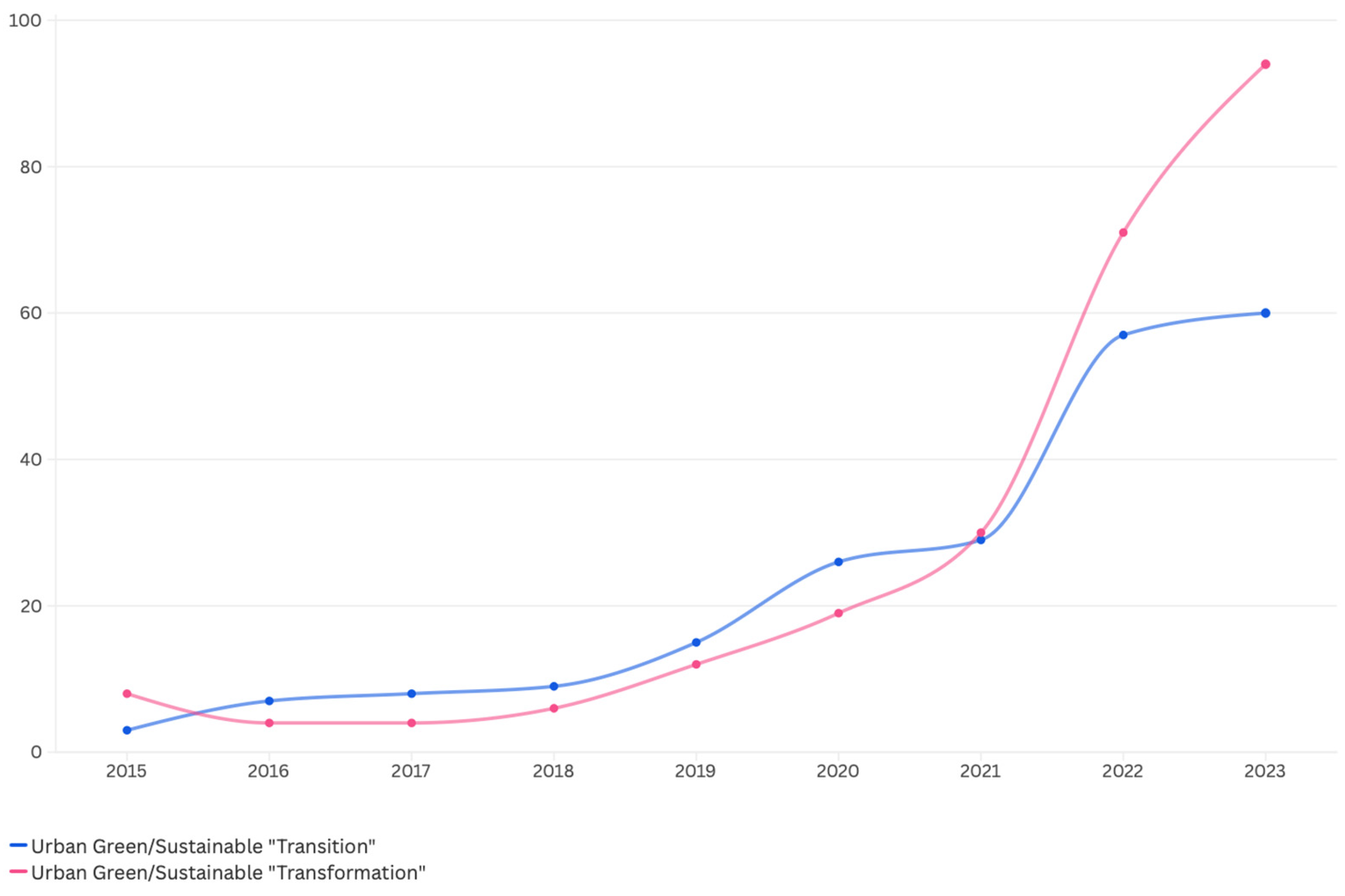
| Search String | Number of Papers in Scopus | Selecter Papers in Scopus | Number of Papers in Scholar | Selected Papers in Scholar |
|---|---|---|---|---|
| “urb*” OR “cit*” OR “built environment*” AND “green transition*” OR “sustainable transition*” | 205 | 72 | 440 | 36 |
| “urb*” OR “cit*” OR “urban environment*” AND “sustainability transformation*” OR “sustainabl* transformation*” OR “green transformation*” | 217 | 27 | 340 | 17 |
| Rank | Label | Value |
|---|---|---|
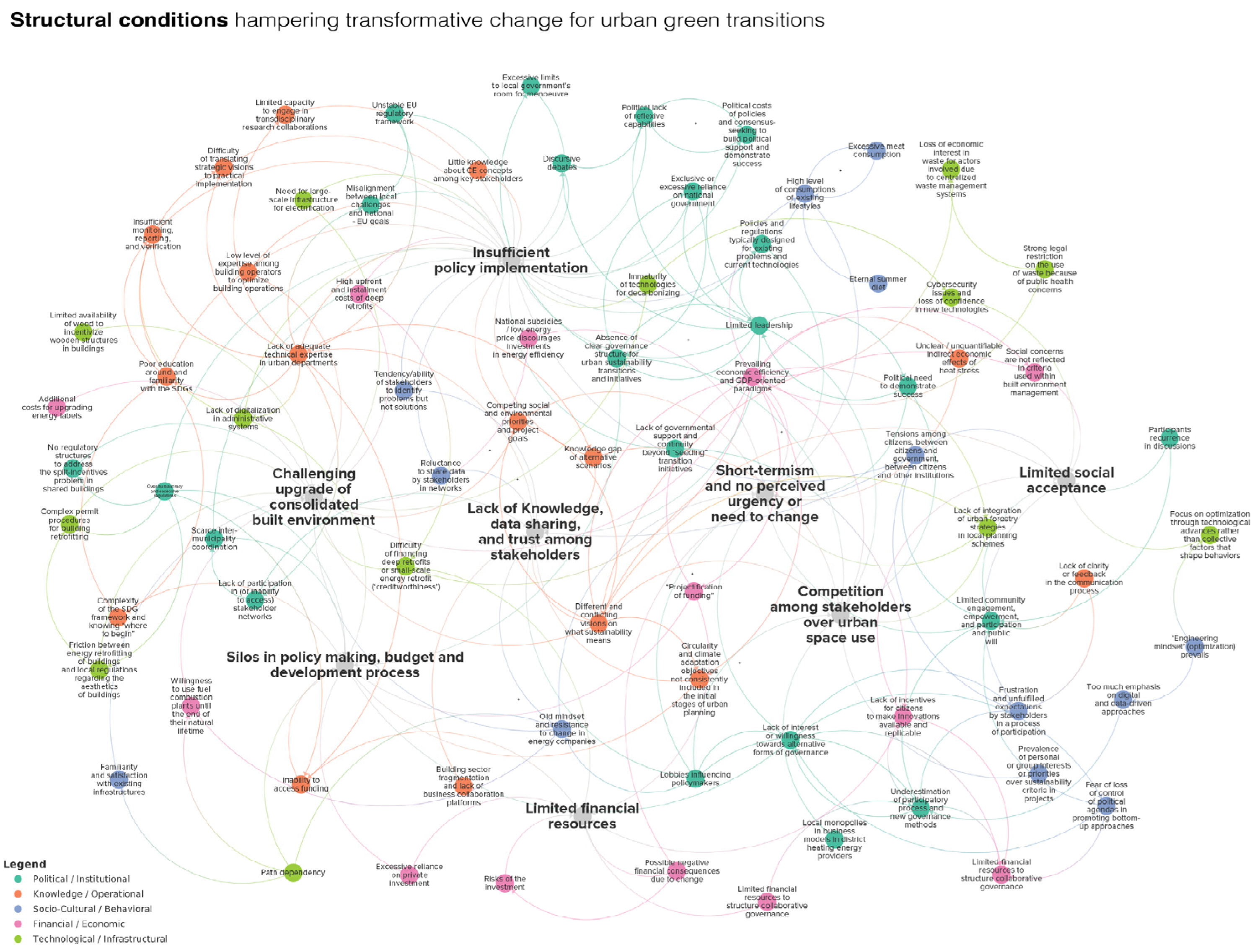
| #1 | Insufficient policy implementation | 29 |
| #2 | Challenging upgrade of consolidated built environment layout | 17 |
| #3 | Short-termism and no perceived urgency or need to change | 13 |
| #4 | Lack of knowledge, data sharing, and trust among stakeholders | 12 |
| #5 | Silos in policymaking, budget and development process | 11 |
| #6 | Competition among stakeholders over urban space use | 10 |
| #7 | Limited social acceptance | 9 |
| #8 | Limited financial resources | 8 |
| Rank | Label | Value |
|---|---|---|
| #1 | Lack of adequate technical expertise in urban departments | 11 |
| #2 | Limited leadership | 10 |
| #3 | Prevailing economic efficiency and GDP-oriented paradigms | 10 |
| #4 | Different and conflicting visions on what sustainability means | 9 |
| #5 | Over-bureaucracy and excessive regulations | 6 |
| #6 | Lobbies influencing policymakers | 6 |
| #7 | Underestimation of participatory process and new governance methods | 5 |
| #8 | Lack of interest or willingness towards alternative forms of governance | 5 |
| #9 | Absence of clear governance structure for urban sustainability transitions and initiatives | 5 |
Disclaimer/Publisher’s Note: The statements, opinions and data contained in all publications are solely those of the individual author(s) and contributor(s) and not of MDPI and/or the editor(s). MDPI and/or the editor(s) disclaim responsibility for any injury to people or property resulting from any ideas, methods, instructions or products referred to in the content. |
© 2025 by the authors. Licensee MDPI, Basel, Switzerland. This article is an open access article distributed under the terms and conditions of the Creative Commons Attribution (CC BY) license (https://creativecommons.org/licenses/by/4.0/).
Share and Cite
Trane, M.; Marelli, L.; Pollo, R.; Lombardi, P. On Eight Structural Conditions Hampering Urban Green Transitions in the EU. Urban Sci. 2025, 9, 340. https://doi.org/10.3390/urbansci9090340
Trane M, Marelli L, Pollo R, Lombardi P. On Eight Structural Conditions Hampering Urban Green Transitions in the EU. Urban Science. 2025; 9(9):340. https://doi.org/10.3390/urbansci9090340
Chicago/Turabian StyleTrane, Matteo, Luisa Marelli, Riccardo Pollo, and Patrizia Lombardi. 2025. "On Eight Structural Conditions Hampering Urban Green Transitions in the EU" Urban Science 9, no. 9: 340. https://doi.org/10.3390/urbansci9090340
APA StyleTrane, M., Marelli, L., Pollo, R., & Lombardi, P. (2025). On Eight Structural Conditions Hampering Urban Green Transitions in the EU. Urban Science, 9(9), 340. https://doi.org/10.3390/urbansci9090340