Systematic Review

Exploring the Intersection of Environmental Justice and Urban Green Space Planning: A Systematic Review


Discipline of Civil Engineering, Sustainable Transportation Research Group (STRg), University of KwaZulu-Natal, Durban 4041, South Africa
Urban Sci. 2025, 9(12), 540; https://doi.org/10.3390/urbansci9120540
Submission received: 7 November 2025 / Revised: 5 December 2025 / Accepted: 10 December 2025 / Published: 16 December 2025

Abstract

While urban green spaces (UGS) are essential sources of environmental, social, and health benefits, their inequitable distribution is representative of deeply entrenched socio-economic and racial inequalities that exacerbate environmental justice (EJ) challenges in the planning of UGS. Based on a systematic literature review and case studies, this paper examines the intersection of EJ and UGS issues, including evidence of environmental racism, procedural exclusion of marginalised groups, the process of green gentrification, and the marginalisation of vulnerable populations. Results show that greening efforts often favour higher-income neighbourhoods at the expense of the most vulnerable residents in low-income areas. Utilising an EJ framework, including distributive, procedural, and recognitional dimensions, strategies for equitable urban greening include community-led planning and inclusive zoning, targeted funding, and nature-based solutions to address EJ concerns. This paper emphasises the importance of embedding justice and inclusion into the core of urban sustainability processes, noting that planning frameworks must give precedence to social equity if ecological goals are to result in fair access for all.

1. Introduction

Urban green spaces (UGS) include parks, gardens, and all other vegetated areas. They are important to the livability of cities for physical and mental health, social cohesion, ecological sustainability, and strengthening of urban resilience [1,2,3]. It is argued that harmonising accessible design with biodiversity including UGS planning ensures that all communities benefit from connected, high-quality green spaces. Because biodiversity underpins key aspects of urban livability, its integration into planning is essential for distributing ecological and health benefits more equitably [4]. However, benefits from this have increasingly become disproportionate with growth. Most marginalised and socioeconomically disadvantaged communities are often left with fewer, poorer-quality green spaces, perpetuating conditions of exclusion and environmental inequity [5,6,7].
These inequities in environmental goods are at the core of the Environmental Justice (EJ) movement, which aims to make access to environmental amenities equitable for everyone, irrespective of race, income, or social standing. In the case of UGS, EJ is not about incorporating parks in equitable number or manner but involves planning processes that take into consideration the voices of marginalised people on design and distribution, with decision-making regarding the area’s long-term management in their hands [5,8,9]. Achieving such equity in green space within rapidly urbanising regions, especially those of the Global South and underdeveloped or developing countries of Asia, Africa, and Latin America, is complex.
Evidence shows that UGS are better maintained in more affluent communities, while low-income areas often have scant and poorly maintained green spaces [10]. This has been identified as environmental racism in many cities around the world. For instance, in São Paulo, Brazil, the GDP and HDI are directly correlated with disparities in access to urban green spaces [11]. The impact of such inequity goes beyond aesthetics. Limited UGS access in poorer neighbourhoods adds to health disparities by reducing opportunities for physical activity, stress release, and social interaction [11,12]. While proximity to green and blue spaces is associated with improvements in certain health indicators, evidence suggests their influence on mental health could be less direct [12].
Significant barriers remain to addressing UGS disparities. The greening of underserved areas may induce gentrification and raise property values, displacing the very residents it serves [10,13]. “Green regeneration” and luxury effect initiatives have the potential to increase inequity if marginalised populations are excluded from planning because the resulting benefits accrue to more affluent individuals or communities [14,15]. Moreover, the luxury effect in which wealthier neighbourhoods tend to have higher biodiversity, greener landscapes, and better environmental quality constitutes an additional structural driver of such disparities. This pattern reflects underlying socioeconomic inequities, where access to nature becomes a privilege tied to income rather than a universal right. Furthermore, vulnerable groups, such as refugee children, often face even higher barriers in terms of limited mobility, environmental hazards, and a lack of culturally welcoming spaces [16].
The existing green space equity discourse, framed by EJ theory, defines justice in three dimensions: distributive, procedural, and recognitional. Distributive justice ensures an equitable spatial distribution, while procedural justice guarantees meaningful participation, and recognitional justice recognises the particular needs, values and rights of marginalised groups [17,18,19,20,21]. The combination of these three dimensions can enable EJ in UGS. Therefore, to address the EJ concerns in planning UGS, a comprehensive approach is needed to balance ecological sustainability with social inclusion and minimise inequities, integrating the voices of the community at every level in urban green development.

1.1. Current Trends and Existing Similar Studies

Recent studies suggest that persistent inequities in access to UGS continue to be a global concern. In many contexts, higher GDP and HDI levels coincide with environmental racism, where economic growth without equity measures deepens spatial disparities [11]. In the U.S.A., for example, historical segregation and redlining continue to influence the distribution of green spaces [22]. Globally, green gentrification further exacerbates inequity, as revitalisation projects in underserved areas often raise property values and displace residents [10,11,13]. Vulnerable groups such as refugee children and immigrants also face mobility and inclusion barriers that restrict their access to green amenities [16]. Despite increasing attention to these issues, the mechanisms linking green space justice to well-being remain underexplored [12].
Studies in the Global South reinforce these patterns. A systematic review of 72 publications on green infrastructure and environmental justice in South Africa highlights those inequities extend beyond spatial distribution to include participation, recognition, and governance. This work documents contested access to parks, alienation from green space, unequal perceptions of equity, and the exclusion of marginalised groups from design and decision-making processes. Although relevant to issues of access, vulnerability, and social justice, it gives less attention to gentrification risks or displacement resulting from green interventions [23,24].
Complementing this, scholarship in the Global North has examined how greening initiatives meant to improve public health can unintentionally cause gentrification. Wolch et al. (2014) [13] show that green amenities can increase property values and push out lower-income and minority communities, arguing instead for “just green enough” approaches that balance ecological and social needs. Extending this critique, Lewartowska et al. (2024) [25] illustrate how new green infrastructure projects in North American and European cities may reproduce “compounded environmental racisms,” reinforcing exclusion and displacement rather than alleviating historic injustices.
More recent work introduces additional nuance by assessing whether green space availability aligns with communities’ socio-environmental needs. Tian et al. (2024) [26] adopt a supply–demand framework to show that disadvantaged neighbourhoods often receive less green space despite facing greater vulnerability, revealing inequities that persist beyond absolute measures of provision.
Taken together, these studies underscore those inequities in UGS access are multifaceted—shaped by historical segregation, governance shortcomings, socio-cultural barriers, and new waves of displacement driven by green regeneration. However, most existing research addresses only parts of this complexity, leaving gaps in understanding how environmental racism, gentrification pressures, access challenges, and well-being outcomes intersect within the same urban contexts.
Further, the inequities in UGS access also intersect strongly with global sustainability priorities. These challenges align closely with several United Nations’ Sustainable Development Goals (SDGs), particularly SDG 11, which emphasises inclusive, safe, resilient, and sustainable cities, and SDG 10, which focuses on reducing inequalities across social groups. The links between green space access, health, and environmental well-being correspond to SDG 3, while concerns around exclusion, marginalisation, and governance relate to SDG 16 on justice and strong institutions. By addressing environmental racism, gentrification risks, and the specific needs of vulnerable populations, the present study contributes to understanding how equitable UGS planning can support progress toward global sustainability priorities as envisaged by these interconnected SDGs.

1.2. Research Gaps

Studies on green space equity in emerging economies, including those in Africa, Central and South Asia, and Latin America, are very limited, with few comprehensive studies [27]. Further investigation is needed regarding spatial equity in UGS across diverse socioeconomic contexts and geographic regions [28]. Longitudinal data, which is a critical element for any causal analysis between sociodemographic factors and accessibility to green space, is lacking in many such studies. Some key variables that are particularly required for nuanced analysis, such as political governance and cultural influences, are also omitted frequently [11].
While green gentrification has been documented, research concerning effective countermeasures against this phenomenon is scant. Specifically, quantitative studies assessing Nature-Based Solutions (NbS) to address displacement and other negative impacts are lacking [11,29]. There is also a need for deeper inquiry regarding how equity, diversity, and inclusivity are embedded within UGS planning and policy, particularly around participatory mechanisms in decision-making by diverse voices [30]. The present study directly addresses the latter knowledge gap and explores strategies to bring about equity, diversity, and inclusivity in the planning of UGS.

1.3. Conceptualising EJ and Theoretical Underpinnings for UGS

EJ in UGS addresses inequities in the distribution of environmental benefits and the inclusion of diverse communities in governance. Rooted in the broader EJ movement, it emphasises fair treatment and active participation of all people, regardless of race, income, or nationality, in environmental decision-making [18,21,31].
EJ in UGS planning is framed through three dimensions: distributional justice, ensuring fair spatial allocation of green spaces; procedural justice, promoting transparent and inclusive decision-making; and recognitional justice, acknowledging cultural identities and historical contexts in policy design [17,20]. However, evidence shows that affluent areas consistently enjoy higher-quality UGS, while lower-income and minority communities face scarcity and neglect [10,21,22].
Theoretical perspectives include environmental justice theory, which examines systemic inequities in resource distribution, and NbS, which integrate ecological systems into urban development. However, without equity safeguards, such interventions can unintentionally exacerbate inequalities through green gentrification, where environmental improvements increase property values and displace existing residents [10,18,32].
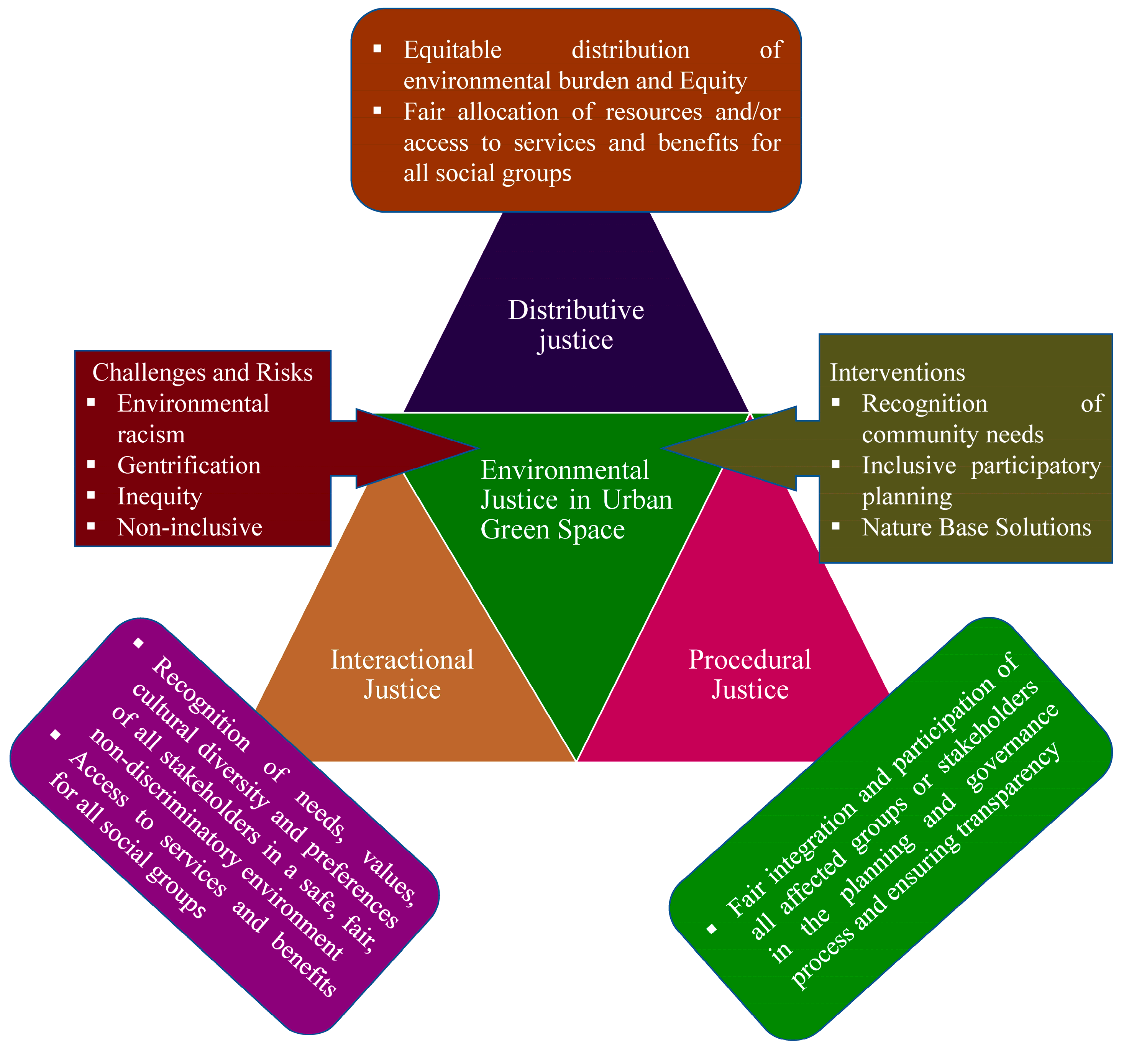
Figure 1 presents a conceptualisation of EJ and associated challenges in UGS planning and development. As illustrated, the interaction of the three justice dimensions with challenges such as environmental racism, health disparities, and gentrification underscores the complexity of equitable UGS planning. Mitigating these risks requires strategies that embed EJ principles into planning, engage marginalised groups early in decision-making, and balance ecological sustainability with social equity [8,10]. Such an approach is essential for creating urban environments that are greener, accessible, inclusive and just.

1.4. Objectives and Research Questions

The objectives of the study were to examine the intersection of EJ and UGS planning by synthesising recent research and case studies on critical issues, including environmental racism, equitable access, the effects of green regeneration projects, and the implications of green space accessibility for vulnerable populations, with the goal of promoting inclusive UGS planning.
For this purpose, the following research questions were investigated:
  • RQ1: How does environmental racism manifest in UGS distribution and accessibility, especially in the Global South?
  • RQ2: How can gentrification risks be mitigated, ensuring green space improvements do not displace marginalised communities?
  • RQ3: What specific UGS access challenges do vulnerable groups face, and how can strategies adapt for inclusivity?
  • RQ4: How do green regeneration projects impact social injustices, and what strategies promote their inclusivity and equity?
Although environmental injustice in UGS planning is especially critical in many cities of the Global South, the study adopts a cross-regional perspective that includes evidence from both the Global South and Global North. This approach enables the comparison of shared structural inequities alongside contextual differences in policy responses, planning frameworks, and lived experiences. In doing so, the study retains a specific focus on Global South inequities (as reflected in RQ1) while situating them within a broader, global discussion of EJ mechanisms. While RQ1 focuses specifically on how environmental racism manifests in UGS distribution in the Global South, the remaining research questions (RQ2–RQ4) intentionally draw on evidence from both the Global South and Global North. This mixed geographical scope reflects the study’s broader aim of identifying structural EJ patterns and strategies that emerge across diverse socio-political contexts. Accordingly, the systematic review and case studies incorporate examples from multiple regions to enable cross-contextual insights.

2. Methodological Approach

This study employed a qualitative research method, combining a systematic literature review (SLR) with case study analysis to investigate EJ in UGS planning.

2.1. Literature Review Process and Reporting (PICOSO and PRISMA Frameworks)

The PICOSO framework (Population, Intervention, Comparator, Outcomes, Study Characteristics, and Others) and Preferred Reporting Items for Systematic Reviews and Meta-Analyses (PRISMA) framework shaped the literature review process to ensure methodological transparency, rigour, and minimisation of bias [33,34,35].
The literature review encompassed quality peer-reviewed studies and reports from both the Global North and Global South, examining definitions, conceptual frameworks, and dimensions of EJ—including distributive, procedural, recognition, and interactional justice—in the context of UGS planning. Particular attention was given to topics such as environmental racism, unequal access to green spaces, gentrification risks, urban policy responses, the impacts of green regeneration projects, and inclusive planning strategies. The PRISMA stages—identification, screening, eligibility, and inclusion—structured the review process conducted between June 2024 and August 2025. Case studies were selected based on scholarly literature and publicly available sources. The PRISMA checklist is provided in Supplementary File S1.

2.1.1. Research Protocol for SLR

A detailed research protocol was developed before the review commenced, including the objectives, search strategy, inclusion criteria, and planned methods of analysis. This framework provided the basis for this review, ensuring quality and consistency, and minimising bias. The research protocol for this study is presented in Table 1 below.

2.1.2. Search Strategy

The literature search incorporated a diverse range of sources, including peer-reviewed journal articles, books, conference proceedings, and credible web articles and reports. Searches were conducted using the relevant databases listed in Table 1, with search strings tailored to each database’s syntax, incorporating keywords alongside inclusion and exclusion criteria. The following representative search string was used to search articles from the databases (also refer to File S6).
“(Environmental justice OR procedural justice OR distributive justice OR recognition justice OR interactional justice) AND (Green space OR Open Space OR recreational space) AND (development OR planning OR Management) AND (Urban area OR cities)”.
Identification
The identification phase included the development and refinement of an inclusive set of search terms and their synonyms that would maximise retrieval across various databases. The search incorporated a broad range of terms around the concept of EJ in UGS. Keywords and their synonyms were carefully chosen to cover a wide range of different EJ-related themes, as mentioned in Table 1. Additionally, keyword co-occurrence was investigated to maximise the search coverage. The next stage involved developing the search strings in the specific format required by each database (e.g., Scopus or Web of Science). A sample of the developed search strings for all databases is presented in Section 2.1.2. File S6 illustrates snapshots of the Scopus and Web of Science advanced search processes with the total number of retrieved records.
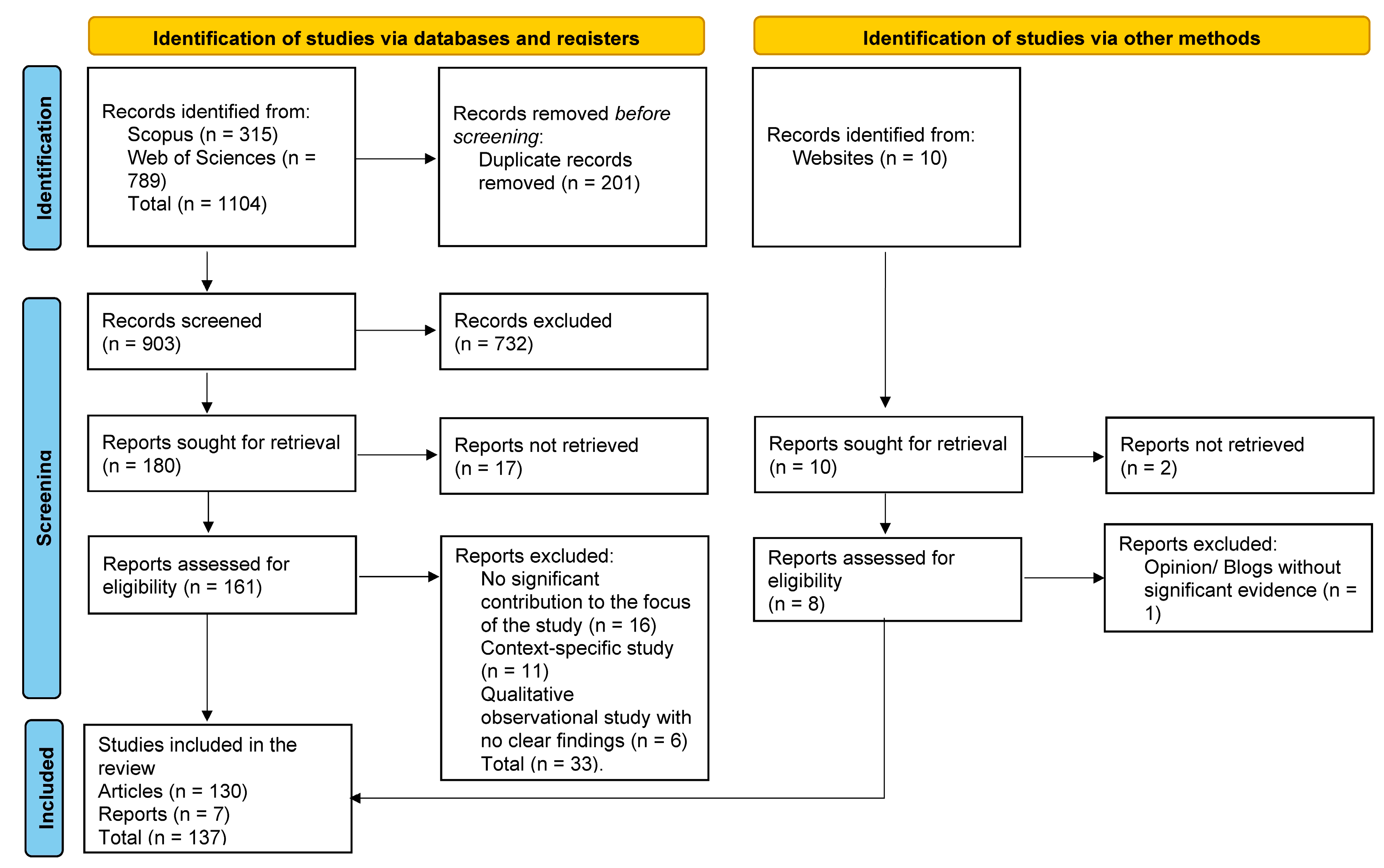
A total of 1104 articles were identified from both databases through a detailed search, while 10 reports were also retrieved from websites. After removing duplicates and irrelevant entries, 903 articles and 10 reports went through the second level of screening.
Screening Process
In the second phase, predefined inclusion and exclusion criteria were systematically applied to refine the selection. Articles were screened using comprehensive criteria derived from the inclusion and exclusion parameters detailed in the research protocol (Table 1), based on the PICOSO framework. The principal investigator and a research assistant jointly conducted the initial title and abstract screening, followed by a full-text review. Regular meetings ensured consistency and resolved any disagreements.
Included documents comprised empirical and review articles from peer-reviewed journals, conference proceedings, books, book chapters, reports, and relevant web or newspaper sources. Eligible studies focused on the Global South and North, particularly in urban contexts addressing EJ, UGS, Planning, Policies, Strategies, Development, and Nature-Based Solutions.
Exclusion criteria were applied to enhance precision, eliminating irrelevant non-peer-reviewed articles, patents, laws, treaties, studies unrelated to UGS or EJ, selective or context-specific reports, qualitative observational studies, and opinion-based sources without empirical support. In total, 171 records from databases and 10 from other sources (e.g., websites and reports) were screened for eligibility. The review included publications from 2001 to 2025.
Data Extraction and Quality Appraisal
A standardised data extraction form was used to extract essential information from each identified source, including publication details like authors and date, objectives, methodologies, key findings, contributions, interventions, controls, limitations, future research, and funding sources. The investigator and the research assistant independently extracted data and cross-checked entries to ensure consistency. The data extracted were compiled into a Microsoft Excel spreadsheet for analysis. The characteristics of the studies are outlined in Supplementary File S2.
The Cochrane RoB 2 and Cohen’s Kappa (K) were used for quality assessment. All studies were independently reviewed, and disagreements were resolved by discussion and, if necessary, by arbitration by a senior peer reviewer. The majority of the studies had a low risk of bias. The Risk of Bias Results (Supplementary File S3 and Risk of Bias Summary Supplementary File S4).
Eligibility and Inclusion in the Study
In the third phase, eligibility was assessed by carefully reviewing every article’s title, abstract, objectives, methodology, results, and discussion to ensure consistency with the inclusion criteria (Table 1) established for this study and its primary focus. Articles that meet both inclusion and exclusion criteria are considered eligible and included in this study.

2.2. Case Studies Selection

Six case studies were selected to extend the literature review by illustrating how EJ principles apply in the planning of UGS and the challenges encountered in practice. Case selection involves six cities across four continents, including Washington, D.C., Seattle, Amsterdam, Rio de Janeiro, Mexico City, and Bhubaneswar. These cities were purposively chosen for their geographic diversity, representation of both the Global North and Global South, and active engagement with EJ and UGS planning initiatives. Each city provides a unique socio-political and planning context.
Washington, D.C. and Seattle, in the United States of America, demonstrate progressive policy regimes and community engagement for addressing disparities in access to urban green spaces. Amsterdam offers a European perspective on integrated planning approaches that promote equality. Rio de Janeiro, a city in the Global South, and Mexico City in North America are cities that are pursuing options to expand equal access to urban green space in the face of rapid urbanisation and deep socioeconomic inequality. Further, Bhubaneswar, an emerging Indian smart city, links urban greening to both climate resilience and inclusive development.
While each city has unique historical, socio-economic, and governance characteristics that cannot be fully unpacked within the scope of this review, the cases are presented to highlight salient EJ–UGS interactions rather than to provide exhaustive contextual analysis. These six cities were selected as illustrative examples that represent diverse socio-political and planning contexts across the Global North and South. The aim was not to provide deep ethnographic detail for each case, but rather to demonstrate how recurring EJ dynamics manifest across contrasting settings.
Together, these case studies draw on academic, scholarly, planning, and policy sources to illustrate the variety of strategies, approaches to implementation, challenges, and innovations in advancing EJ through UGS planning. This comparative breadth supports the study’s objective of identifying global patterns and shared challenges in UGS planning. To avoid overlap with the systematic review findings, insights from the case studies are reported separately in Section 4, while Section 3.1, Section 3.2, Section 3.3, Section 3.4 and Section 3.5 reflect only evidence extracted through the literature review.

2.3. Analysis and Synthesis

Data from the literature review were analysed under two aspects, such as Record search analysis and Thematic analysis.

2.3.1. Record Search Analysis

The search results were analysed using descriptive statistics, including the total number of records identified, duplicates removed, records screened, retrieved, and assessed, following the PRISMA framework. Additionally, the number and proportion of articles ultimately included in the study were recorded and examined.

2.3.2. Thematic Analyses

The reviewed documents underwent a systematic review followed by a deductive thematic analysis. Each document was carefully coded to identify key concepts, recurring patterns, and issues relevant to the study’s research questions. The coding process captured the theme, subtheme/code, definition, illustrative evidence from the text, and supporting references, ensuring transparency and traceability in how subthemes and overarching themes were derived. For example, under the theme “Gentrification Risks and Urban Planning & Policy,” the subtheme “Green gentrification” was defined as displacement caused by greening, with the illustrative extract: “Greening in Seattle raised property values and displaced long-term residents” [10]. This and other codes, such as “Anti-displacement policies” and “Community participation,” were grouped to reflect broader patterns in urban green space development and associated social risks.
The thematic framework included five main themes and several subthemes (Table 2). Definitions and concepts of EJ addressed distributional, procedural, and recognitional dimensions. Environmental racism and unequal access to UGS captured structural inequalities, governance failures, and barriers faced by vulnerable groups. Gentrification risks and urban planning for green space development encompassed green gentrification, anti-displacement policies, governance mechanisms, zoning, and community participation. Challenges faced by vulnerable groups in accessing UGS included physical barriers, safety concerns, cultural inclusivity, and participatory planning, as well as policies ensuring inclusivity. Green regeneration and social justice focused on inclusive, community-driven regeneration and the risks of eco-gentrification.
Each theme, subtheme/code, including definitions, example evidence, and references, demonstrating how the coding and thematic analysis systematically informed the derivation of robust main themes and subthemes that underpin the study’s findings and conclusions, is detailed in Supplementary File S5.
Case study findings were incorporated to contextualise the thematic insights, highlighting both location-specific challenges and common strategies for promoting EJ in UGS planning.
Also, the thematic analysis and case-study review were explicitly structured around the four RQs. Themes related to environmental racism and spatial inequity directly informed RQ1, while material on green gentrification, anti-displacement tools, and policy mechanisms addressed RQ2. RQ3 was examined evidence concerning the barriers to UGS faced by vulnerable populations, and RQ4 was addressed by assessing how green regeneration projects influence social justice outcomes. The systematic review findings were integrated with case studies to enable a multi-scalar response to EJ concerns in UGS based on all four RQs.

3. Results from Literature Review

The results of the analysis are presented across four dimensions: (i) environmental racism and unequal access to UGS; (ii) gentrification risks and the role of urban planning; (iii) challenges faced by vulnerable groups in accessing UGS; and (iv) the social justice implications of green regeneration projects and strategies for inclusivity, all aligned with the study’s research questions. Prior to presenting these results, the characteristics of the reviewed documents are summarised to provide an overview of the literature and to indicate the level of agreement between assessors regarding the risk of bias.
However, the results in this section are derived exclusively from the systematic literature review. Any city-specific examples referenced here serve only as supporting illustrations sourced from published literature and not from the six case studies analysed in Section 4.

3.1. Characteristics of Documents Used for Review

The database search resulted in 315 records from Scopus and 789 records from Web of Science. When combined and duplicates removed using Biblioshiny in R, there were 903 unique records to screen. Of these, 137 sources were selected for in-depth analysis, consisting of 109 journal articles, of which one was a preprint, two conference papers, six books, 10 book chapters, three theses and seven reports (including web or newspaper articles) (Table 3). The selection is summarised in the PRISMA flow diagram (Figure 2).
RoB2 assessment showed low risk of bias. Inter-rater agreement was high, as reflected in Cohen’s Kappa, which indicated substantial agreement (k = 0.792, ASE = 0.079) [36] and statistically significant (T ≈ 9.219, p < 0.001), confirming that any concordance was unlikely to be due to chance (Table 4). These articles were used for thematic analysis.

3.2. Environmental Racism and the Unequal Access to UGS

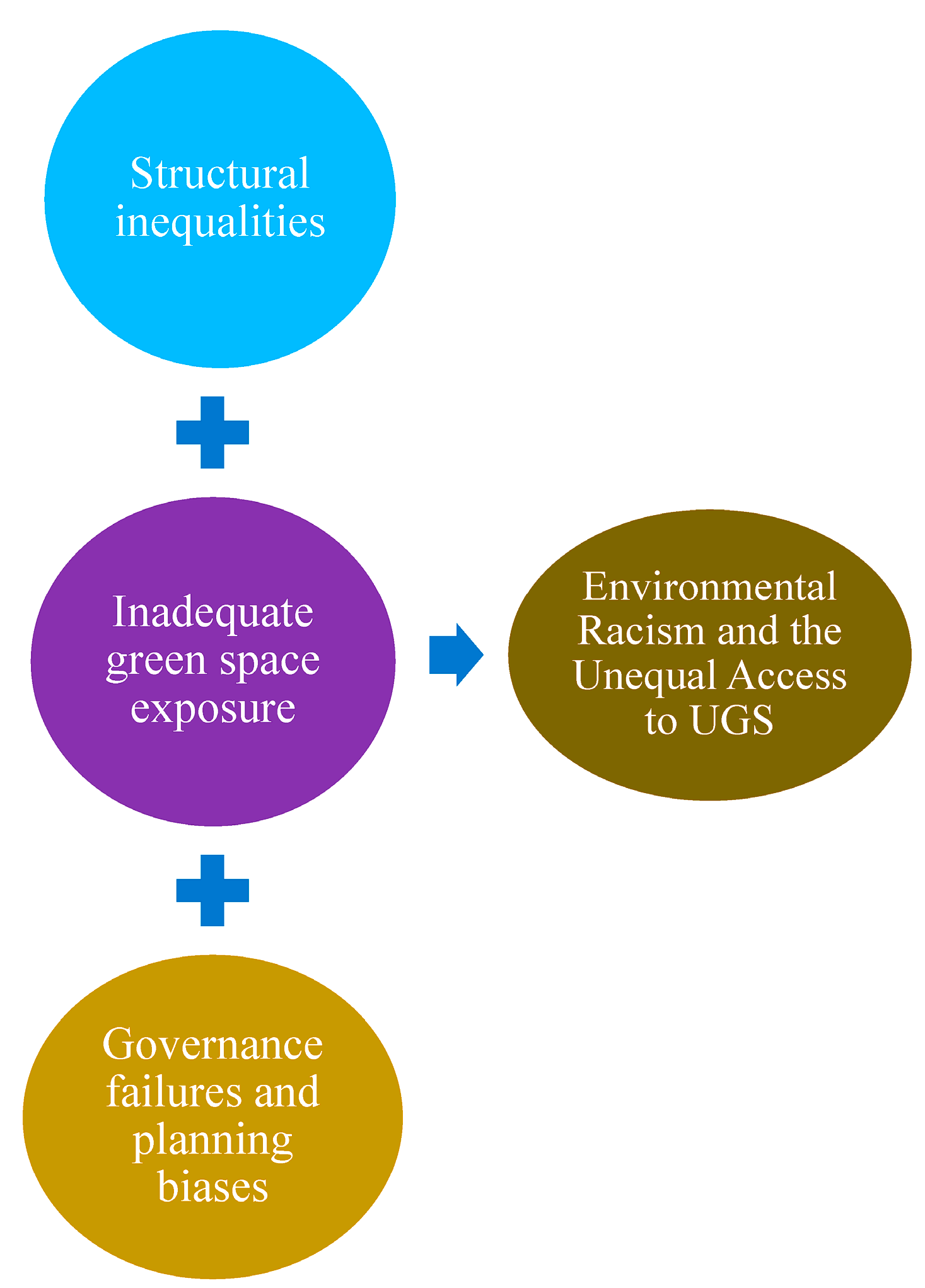
Environmental racism refers to a disproportionate exposure of the disadvantaged and marginalised racial and ethnic communities to environmental hazards because of the denial, in a systematic manner, of their access to essential natural resources. It is fitting that historical and structural inequities result in disadvantaged communities bearing more environmental risks, such as pollution, heat stress, and toxic waste, compared to others who have more access to decision-making processes that influence the environment [37,38]. Within the Global South context, environmental racism plays a significant role in inequity in UGS distribution [11]. Figure 3 illustrates how rapid urbanisation, economic inequality, and governance failures have deepened social inequities while limiting opportunities for vulnerable populations to benefit from the environmental, social, and health advantages of urban greenery. Environmental racism and unequal access to green space are not isolated problems; they stem from interconnected systemic issues. Structural inequalities, coupled with biased planning practices and ineffective governance, directly contribute to the inadequate provision and accessibility of green spaces for marginalised communities, reinforcing patterns of environmental injustice.
Structural inequalities are at the core of UGS distribution in uneven ways. Marginalised communities have long been relegated to areas marked by high exposure to environmental hazards and lesser accessibility to green infrastructure. For instance, municipalities with higher GDP and HDI show greater disparities in the provision of green spaces in São Paulo [11]. The poor neighbourhoods of Dhaka continue to be deprived despite their proximity to UGS [39], while poor areas in Bhubaneswar usually lack infrastructures that can utilise the existing green resources [40]. Such spatial marginalisation underlines the structural inequities entailed in economic development and traditional master plans for cities.
The cities of the Global South have just one-third of green space exposure compared to cities in the Global North; the inequality levels in the former are nearly twice as high [41]. Rapid urban growth has further reduced per capita green space below the standards recommended by the WHO [42,43]. In Nairobi, Rio de Janeiro, and many other cities, green spaces are being concentrated in wealthy neighbourhoods, while poorer areas face severe heat exposure. In Delhi, children and farm workers are two demographic groups threatened by a lack of vegetation and green cover [44]. Similar concerns are expressed in Aligarh regarding the impacts of insufficient greening on disadvantaged communities [45]. However, the example of Kigali demonstrates that community-led, local greening schemes can be crucial in promoting environmental equity.
Governance failures and planning biases also perpetuate inequities in green spaces. This ranges from an unfair distribution through systemic planning practices in Mumbai [46] to environmental racism concretised in governance structures impeding progress towards SDGs in Bangalore [47]. Most policy documents related to green spaces lack procedural and substantive justice, as they fail to consider participatory planning and cultural inclusion [21].
Equally, access to UGS is integral to climate justice. While green space can ameliorate climate risks by cooling, improving air quality, and reducing health vulnerabilities, marginalised groups often do not have these protections. In response, addressing these injustices requires equity-focused urban greening strategies. Community-driven approaches are suggested to ensure inclusive management [5]. For example, community-led initiatives would nurture ownership at the local level [5], and multi-stakeholder partnerships enhance capacities [48]. Geospatial mapping will identify and address gaps in green spaces [49]. Policies also need to address the risk of green gentrification by promoting inclusive planning that integrates environmental benefits with social equity. Thus, integrated policies, active community participation, a strong regulatory framework, and responsive urban design to climatic conditions become urgent requirements for bridging the green equity gap [17,50,51].

3.3. Gentrification Risks and Urban Planning for Green Space Development

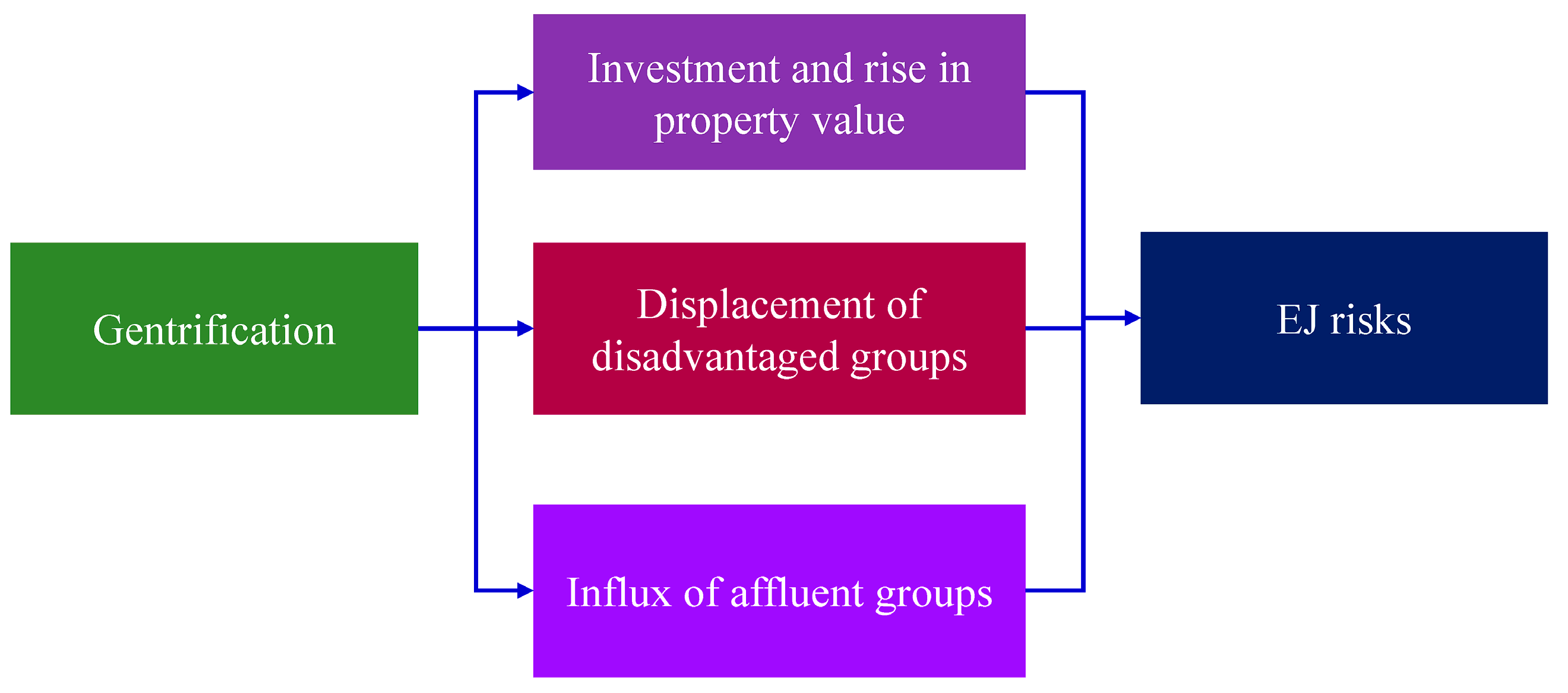
Gentrification is a process of urban change in which historically low-income or disinvested neighbourhoods experience transformation through the influx of more affluent residents and increased investment. This process often raises property values and rents, thus displacing long-term, lower-income residents and changing the area’s socio-economic and cultural character [13,52,53]. When driven by urban greening initiatives, this phenomenon, known as green gentrification, has important implications for social and environmental justice, as shown in Figure 4. While high-quality green spaces might improve wealthier neighbourhoods, poor communities run the risk of exclusion or displacement, which further entrenches existing inequalities [10]. It thus becomes an important function of urban planning to ensure that improvements in the environment are not made at the expense of vulnerable populations.
Green gentrification can be seen as a process wherein projects aimed at improving environmental quality and liveability have the unintended consequence of increasing property values and housing costs. Such processes have been identified in cities as varied as Istanbul and Chongqing, where greening projects induced substantial socio-economic transformations [54,55]. Often, these types of projects form part of larger redevelopment initiatives. For instance, green infrastructure in Canadian cities often emerges alongside or after gentrification, thus functioning as both a cause and a consequence of urban transformation [56,57]. The degree of displacement will vary greatly depending on the local context, especially considering the specifics of housing policy, existing green infrastructure, and urbanisation levels. For example, in Chicago, the presence of public housing and legacy parks reduced the degree of gentrification [58]. At the same time, in Chinese cities, the stage of urban development determined how greening altered demographic structure [59].
Policy and strategic interventions are therefore crucial in mitigating the risks of green gentrification. In Genova, Italy, for instance, property tax subsidies for low- and middle-income households, combined with zoning buffers around green spaces, have proven effective in preventing displacement without promoting sprawl [60]. Mixed approaches, therefore, need to integrate economic incentives, planning tools, and public information campaigns to further promote a more equitable distribution of benefits.
Equity-centred frameworks, such as the ‘Just Green Enough’ model, are centred on small-scale, community-driven actions that improve environmental quality without large-scale redevelopment. These approaches focus on protecting affordable housing, diversifying leadership within park management, and designing green spaces to address longstanding community needs [61]. Providing equitably distributed infrastructure and avoiding the creation of ‘green sacrifice zones’ in already disadvantaged neighbourhoods is key to ensuring that greening efforts do not favour wealthy areas over poor ones [25,56]. If unconscious and inequitable in design and practice, urban greening threatens to perpetuate environmental racism by forcing historically marginalised populations to relocate to less preferable areas. Innovative analytical tools like the Green Gentrification Vulnerability Index (GGVI) and Fuzzy-Set Qualitative Comparative Analysis (QCA) can inform the creation of tailored policies by identifying communities vulnerable to gentrification and mapping the ways in which the availability of green space interacts with gentrification dynamics [62,63].
Empowerment at the community level is similarly critical. In USA cities, grass-roots coalitions have successfully marshalled local resources to address housing and environmental pressures, advocating for equity in access to green infrastructure [64]. Authentic engagement with marginalised communities imbues a sense of ownership and can prevent socio-cultural displacement [61]. Collaborative governance, including planners, housing experts, and civil society, can connect the goals of sustainability and equity by preserving affordability, addressing anti-displacement policies, and providing inclusive engagement [57,65]. These kinds of integrated approaches will be important in order to avoid the risks of green gentrification and achieve environmentally just UGS- the basis for a resilient and socially just urban future.

3.4. Specific Challenges Faced by Vulnerable Groups in Accessing UGS, and Urban Strategies to Ensure Inclusivity

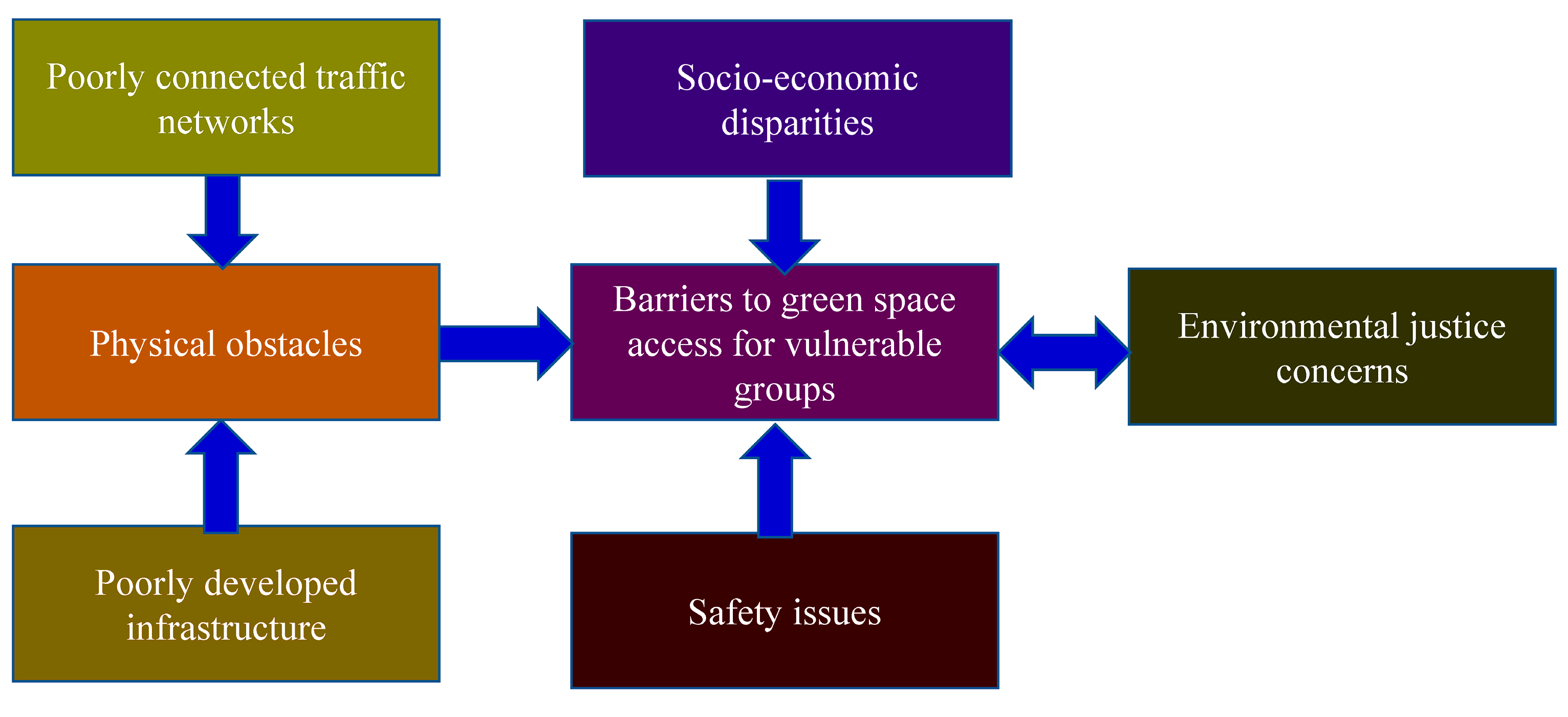
Vulnerable populations, including refugee children, the elderly, the differently abled, etc., have a number of access barriers to green spaces that include physical obstacles, poor infrastructure, transportation and traffic issues, socio-economic disparities, and safety concerns (Figure 5). For example, most parks lack inclusive features for people with disabilities, such as ramps, sensory options, and navigable pathways [66,67]. Refugee children also face other mobility barriers due to traffic networks that are not well-connected [30]. Finally, other barriers to use include uneven terrain, such as gravel paths, for older adults and those with limited mobility [66].
Accessibility is also related to socioeconomic inequities. Poor condition and lack of facilities within green spaces in areas with low incomes decrease their usability and attractiveness [68]. For example, while Auckland’s more disadvantaged neighbourhoods may have a greater total quantity of green space, residents commonly experience major use barriers, such as safety issues for parents accompanying children, lack of accessibility for adolescents, and difficulties for elderly people [69].
All of the above is exacerbated by EJ concerns like environmental racism and disproportionate ecological burdens, impeding equitable access in areas with significant black, indigenous, or refugee populations [11,15]. Another major deterrent concerns safety. A high crime rate coupled with a lack of security features leads to a perception of insecurity that deters vulnerable groups from using the spaces [67,70]. Thus, barriers to UGS access are not only the result of inadequate infrastructure or isolated incidents of neglect, but also a manifestation of larger structural inequalities (Figure 5).
The challenges facing vulnerable groups in accessing urban green spaces require a multi-faceted approach that integrates inclusive design, participatory planning, equity in policies, and data-driven approaches. Inclusive urban planning needs to incorporate EJ through multisectoral collaboration, considering social, economic, and environmental factors. This is achieved by standardising inclusive design features like ramps, tactile paths, and auditory cues that enhance accessibility while reducing future adaptation costs [71]. The focus of strategies should be on ensuring equitable distribution, especially in high-density areas and underserved communities where the demand from vulnerable groups is relatively high [72]. Public–private partnerships are, therefore, critical in aligning development with inclusivity goals [70].
Furthermore, inclusive participatory planning makes sure that green spaces reflect the particular needs of the most vulnerable groups and are characterised by aspects of ownership and sustainability [1,72,73,74,75]. Land use and planning practices should counteract historical trends of favouring affluent areas and strive to create equal access to high-quality green spaces in the most disadvantaged communities [10,19]. Principles for universal design-a construction philosophy that takes into account safety, cultural behaviours, and emotional responses-make the spaces more usable for people with disabilities [66,67,76].
Strategic investments in the development and maintenance of green space improve access and ensure that key health and environmental outcomes are achieved [73,77,78]. Mechanisms to avoid displacement include rent control and the provision of affordable housing; all these mechanisms are critical in preventing green gentrification [10]. The inclusion of sustainable funding models involves community-based initiatives and public–private partnerships that hold the key to achieving success in the long run [1,78]. In addition, smart technologies from accessible navigation apps to sensor-based facilities increase usability [71,79,80]. Furthermore, GIS tools, spatial analysis, and equity-focused frameworks enable gap identification to facilitate the creation of inclusive policies and strategic measures [15,30,70,81].

3.5. Impact of Green Regeneration Projects on Social Justice and Strategies for Inclusivity

Green regeneration projects renew urban areas by linking environmental upgrade with social and economic development, enhancing the quality of life. They utilise green infrastructure to reduce the urban heat island effect, pollution, and stormwater, creating both environmental and economic benefits, as evidenced in Houston [82]. NbS further support carbon sequestration, biodiversity, and public health. For example, New York City’s High Line links urban greening to increased mental and physical health benefits [83,84]. Such interventions have particular benefits to vulnerable populations by reducing hazard exposure and also the heat island effect of cities [85,86,87]. Cities such as Atlanta and Los Angeles combine green initiatives along with health equity strategies through food security, walkability, and local employment opportunities [86].
Green regeneration also promotes social equity and EJ by enhancing access to green spaces in disadvantaged neighbourhoods. Participatory mechanisms, such as enhanced environmental impact assessments, provide a platform for diverse community voices and reduce the risk of displacement due to eco-gentrification [21,88,89,90]. In Baltimore, for example, community-led initiatives enhance ownership, procedural justice, and social cohesion [64,91]. Economically, such projects generate renewable energy and conservation jobs, while providing an incentive to attract investment into distressed areas, such as Washington, D.C. [85,92,93].
However, green regeneration can further exacerbate social inequity by intensifying socioeconomic segregation and environmental racism; greening benefits the wealthy neighbourhoods of the city more than others [11,14,94,95,96]. These inequities are particularly pronounced in the Global South, where access to green space is highly unequal [18]. Other spatial injustices, such as waste dumping in proximity to marginalised communities in Kinshasa, point to inequity [97]. In the absence of inclusive planning, systemic barriers may well exclude marginalised groups and further reinforce such inequalities [10,25].
UGS often reflect dominant cultural norms, low socio-economic sectors, marginalising migrants, 2SLGBTQ+ communities, and racial minorities, who may face hostility or restricted access [98,99]. Procedural injustices persist as marginalised communities are often excluded from planning processes [14,100]. Refugee and displaced populations are at heightened risk; many cannot safely access green spaces, even in cities with formal standards such as Berlin, underscoring the need for inclusive planning, particularly in the Global South [16,101,102]. Thus, given recent attention to the role that green regeneration is playing in many large urban centres, it is clear that, despite its many promises, the social and equity outcomes for green regeneration will depend on inclusive, community-centric planning centred on environmental justice.

4. Findings from Case Studies

Several countries have made notable progress in integrating EJ considerations into UGS development through targeted policy and planning interventions. In this context, the cases of Washington, D.C., Seattle, Amsterdam, Mexico City, Rio de Janeiro, and Bhubaneswar illustrate both the persistent challenges faced by marginalised communities and the diverse strategies employed to promote equity and sustainability. The subsections that follow provide a detailed discussion of these dynamics.
This section draws exclusively on findings from the six case study assessments conducted for this research. These insights are distinct from the literature review presented in Section 3 and are included to contextualise the thematic patterns identified through the systematic review.

4.1. Washington, D.C: Anacostia River Revitalisation

The revitalisation of the Anacostia River in Washington, D.C., has emerged as a model for EJ. The river has suffered from industrial pollution, urban runoff, and poor waste management for many years. Historically, African American and other marginalised communities living along its banks have borne the full force of this environmental deterioration. Currently, efforts are underway to redevelop the river into a healthy, accessible green space that will foster a sustainable urban environment and reduce public health disparities. Improvements have also sparked concerns about green gentrification, where rising property values threaten to displace low-income residents.
Pollution in the Anacostia comes from diverse sources including industrial wastes, combined sewer overflows, and contaminated stormwater runoff laden with toxic contaminants such as Polychlorinated Biphenyls (PCBs) and PAHs. Restoration efforts, initiated by the 1984 Anacostia Watershed Restoration Agreement, are ongoing today including projects such as the Clean Rivers Project and the Northeast Boundary Tunnel that seek to reduce sewage overflows and improve water quality through novel approaches including active capping [103].
In January 2025, the District of Columbia sued the U.S. federal government over the decades of environmental damage that have disproportionately affected communities of colour [104,105]. This lawsuit brings attention to EJ concerns related to the river and calls for urban design that addresses past injustices without creating new forms of exclusion.
However, different from past redevelopment efforts, these new plans have a much greater focus on social equity and EJ through measures of community engagement and equitable access to green infrastructure [106]. Though not without their challenges, the revitalisation of the Anacostia presents a critical opportunity whereby ecological restoration could be combined with social justice, with long-time residents benefiting from a cleaner, healthier river [107].

4.2. Seattle: Urban Greening and Community Displacement

Urban greening in Seattle is emblematic of the tension between EJ and community displacement. While parks, gardens, and greenways improve environmental quality and public well-being, they often contribute to “green gentrification”, property value increases that displace long-term low-income residents. That dynamic is unmistakable across historically underserved neighbourhoods, where greening initiatives have priced out communities they were meant to support [10].
Examples include the P-Patch community gardens that, while preserved through resident activism, represent a success in community-driven green space preservation but have simultaneously increased neighbourhood desirability, further exacerbating gentrification and housing pressures [108]. Similarly, Seattle’s Central District, once primarily African American, is undergoing significant demographic change through the arrival of higher-income, predominantly white people, forcing out long-standing communities [109].
Simultaneously, industrial restructuring intensifies vulnerability by combining pollution exposure with economic precarity and displacement pressures [110]. Environmental risks also continue to impact areas around Seattle-Tacoma International Airport. A lawsuit filed in November 2024 alleged that aircraft emissions disproportionately impact health in surrounding low-income and minority communities [111,112].
To mitigate these challenges, urban planners and community organisations have proposed a series of strategies aimed at preventing displacement by supporting equitable greening. It includes strategies such as resident involvement in planning processes, directing green investment into existing communities, and protecting affordable housing via targeted policy, among others [64]. Grass-roots mobilisation is essential; it entails coalition-building in resisting displacement to press for justice-centred greening [64].
Greening in Seattle reveals deep-seated social injustice, underscoring the need to decolonise planning and move toward emancipatory green justice, so that sustainability initiatives do not perpetuate historical exclusionary processes [113,114].

4.3. Amsterdam: Green Space Development and Social Equity

Access to green space areas is significantly unevenly distributed across Amsterdam, despite providing some relief to the intense urbanity. Urban greening strategies run the risk of promoting “green gentrification,” whereby improved parks increase property values and displace low-income residents, thereby reinforcing existing inequalities [1,115,116].
In response, the city has implemented measures to promote affordable housing and encourages community participation in green planning, ensuring that the benefits of environmental improvement are equitably distributed to all. Green spaces are expected to support health, well-being, and inclusion, most especially for the marginalised groups such as the elderly, those with mental health challenges, and residents of disadvantaged neighbourhoods [1,117].
Despite these, many pockets of high-quality parks exist only in high-income areas, thus reducing access and health benefits in low-income areas [116,118]. While environmental regulations have reduced exposure to hazards such as pollution, access to green spaces continues to favour affluent communities [18,119].
The key thus lies in addressing these disparities through a better alignment of the provision of green space and socio-environmental vulnerabilities. The demand-driven planning of small-scale interventions, such as rain gardens, pocket parks, and green walls, will help increase accessibility within dense, underserved neighbourhoods [26,77,116]. Equitable strategies need to consider the contribution of informal green spaces. Alternative approaches, such as the transformative Doughnut Economy model, strike a balance between ecological sustainability and social equity [120]. Inclusive urban greening of Amsterdam can be truly accomplished through systemic, justice-oriented planning that incorporates environmental objectives and social equity.

4.4. Mexico City: Distribution of Green Spaces and Environmental Injustice

Inequality in the distribution of green public spaces in Mexico City is biased towards affluent neighbourhoods, leaving marginal and highly populated areas underserved. The inequality can be contextualised with the historical urban planning that has left fewer green spaces in low-income areas, reinforcing environmental injustice, increasing public health disparities [121].
Studies have shown that 74% of green spaces are under one hectare, and over half are grouped into three predominantly middle- and high-income municipalities [121]. A strong negative correlation between marginality and access to green space supports evidence that the wealthiest areas receive more provision and the poor neighbourhoods less [98,121]. Urban development remains biased towards wealthier districts, hence leaving the disadvantaged without investment in green infrastructure and depriving them of health, recreational, and social benefits associated with these areas [122,123].
Mexico City also falls short of the WHO’s recommendation of 12 m2 of green space per person, as the deficit is more pronounced in peripheral and low-income areas [124]. The Urban Environmental Sustainability Index provides further evidence of decreased sustainability from the centre to the periphery, thus highlighting the necessity for area-specific interventions [125].
Disparities in these areas necessitate systemic reforms that integrate equity into planning and urban development. Equity requires active participation by a community that can ensure that the fruits of environmental amelioration accrue to all residents, not just the privileged few. Such a perspective, framed by justice, will be necessary to further both inclusivity and sustainability in Mexico City’s urban future.

4.5. Rio de Janeiro: Community-Led Reforestation Amidst Socioeconomic Challenges

Rio de Janeiro has made significant improvements in reforestation through activities like Refloresta Rio, initiated in 1986, which has trained thousands of people and planted millions of seedlings. However, large environmental projects in the context of high vulnerability persistently bear the hallmarks of resource limitation, community disengagement, and violence [126].
Community-led reforestation has become increasingly important, especially in unplanned favelas. Grassroots initiatives restore local ecosystems while improving living standards. Community gardens in Parque Sitie (Vidigal) and General Glicerio (Laranjeiras) transform underused areas into urban commons that are valuable both ecologically and socially [127]. The Sustainable Favela Network, begun in 2018, enables such work through workshops, capacity-building programmes, and knowledge sharing [128].
This forest, one of the largest in the world to be fully within an urban area, continues to play a core role in Rio’s conservation plan. In Vale Encantado, ecotourism and community caretaking demonstrate ecological restoration in symbiosis with the local population [129,130]. The restoration of disconnected ecosystems through the planting of native flora, along with green infrastructure, illustrates several participatory approaches for biodiversity and cultural conservation [131].
The programmes and schemes at the community level, such as Carbono Compensado and the Community Protection Program, integrate agroforestry with disaster risk management by leveraging local knowledge to build resilience [132,133]. However, accessibility of such institutional support remains constrained by structural inequalities and marginalisation of favelas. Long-term success is based on embedding grassroots views in urban policy and has lessons for inclusive, justice-oriented sustainability [134].

4.6. Bhubaneswar, India: Environmental Injustice in Organised Green Spaces

The distribution of organised green space in Bhubaneswar reflects severe injustice. High-income classes have access to many advanced parks, while marginalised and poorer sections mostly do not receive these facilities at all [5,40,135]. This is no different from the global patterns where socioeconomic and demographic variables determine both quantitative and qualitative accessibility to green space itself [10,11,19].
These disadvantages are further exacerbated by the lack of inclusive urban planning, resulting in issues of distributional (inaccessibility), procedural (exclusion from decision-making processes), and recognitional injustices, including neglect in concerned communities [5]. Poor accessibility negatively impacts physical, mental, and social well-being, particularly among vulnerable populations [19,20,45].
Although Indian law formally supports EJ, bureaucratic inertia, weak enforcement, and a lack of public engagement result in partial effectiveness in implementing the latter approach. Marginalised groups often lack sufficient political power to defend their interests [45]. Secondly, investment in green infrastructure runs the risk of producing green gentrification-a rise in living costs that can displace the very communities it aims to serve [1,10].
Integrated strategies comprising equitable planning, more vigorous enforcement, and meaningful community participation are now imperatives for the progress of EJ in Bhubaneswar. Voices from underrepresented groups must be centred, and safeguards against displacement put in place if there is any hope for more just, inclusive urban greening [5].
Across these six cases, several common patterns emerge despite significant contextual differences. The persistent inequities driven by historical segregation, differential investment, and procedural exclusion continue to afflict cities across both the Global North and South. However, the scale, governance structures, and socio-political pressures underpinning EJ outcomes differ significantly. For instance, displacement pressures dominate the Global North cities, while access deficits and governance constraints are more accentuated in Global South contexts.

5. Discussion and Strategies for More Inclusive and Equitable Green Regeneration Projects

5.1. Discussion

The discussion synthesises findings on environmental inequities (RQ1), gentrification and displacement risks (RQ2), barriers faced by vulnerable groups (RQ3), and the equity implications of green regeneration (RQ4). It draws cases from both the Global South and Global North, reflecting the study’s objective to develop cross-regional insights. However, a specific focus on inequities in the Global South, as articulated in RQ1, has been kept.
Findings show that, while UGS provide essential ecological, health, and social benefits, their design, distribution, and governance are deeply inequitable across both the Global North and South. Evidence from cities worldwide suggests that there is a concentration of UGS in affluent neighbourhoods, while poor neighbourhoods have scant or incomplete green infrastructure [11,39]. Such spatial disparities depict environmental racism, especially within socioeconomically and racially segregated urban areas in which marginalised groups are systematically excluded from green development. Even when green spaces exist in lower-income neighbourhoods, they often lack basic amenities such as lighting, benches, or pathways, hence making them functionally inaccessible [40] and reflecting the gap between nominal availability and actual usability [42].
Procedural exclusion is equally common. Most urban greening initiatives take a technocratic or aesthetic approach at the expense of participatory governance, thus disregarding the interests of vulnerable groups [46,95]. Recognitional justice also rarely materialises; for instance, in Toronto and London, 2SLGBTQ+ people and ethnic minorities report often feeling unsafe or alienated culturally in the typical public green space [136].
Green gentrification is another challenge where greening and environmental improvement cause property values to increase and displace low-income, long-time residents. Case studies from Seattle and Amsterdam illustrated the way in which sustainability-driven greening worsens unaffordable housing [1,10,13,25,112]. Ecological gains from the revitalisation of the Anacostia River in Washington, D.C., were accompanied by increasing pressures of displacement in historically marginalised African American communities.
EJ, framed through distributive, procedural, and recognitional dimensions, provides a critical lens on the impacts of urban greening for vulnerable populations. These include promising approaches centred on community-led initiatives for improving access to green spaces while fostering a sense of local stewardship [48] and participatory planning that incorporates local knowledge to yield more inclusive and context-sensitive outcomes [63].
The “Just Green Enough” model can advance moderate and community-led greening that improves environmental quality without inducing displacement. Community-led strategies for greening have managed to avoid processes of gentrification. Zoning buffers with tax relief measures, as devised in Genoa, express a balance between green development and anti-displacement policies.
Urban greening can only be said to be “just” if informed by equitable values and inclusive decision-making with attention paid to power dynamics; otherwise, it risks reinforcing existing environmental and social inequalities. Effective targeting of interventions by using tools such as the Green Gentrification Vulnerability Index and GIS-based spatial equity models has to be combined with participatory planning and long-term social investment.
The case studies of Washington, D.C., Seattle, Amsterdam, Mexico City, Rio de Janeiro, and Bhubaneswar emphasise that embedding social equity and EJ in the development of UGS is critical. Without explicit, justice-driven planning and deep community involvement, greening could continue to exacerbate inequities, especially in the Global South. Only through systemic reforms and inclusive strategies can the benefits of urban nature be distributed more equitably, enabling cities everywhere to be sustainable, just, and resilient.
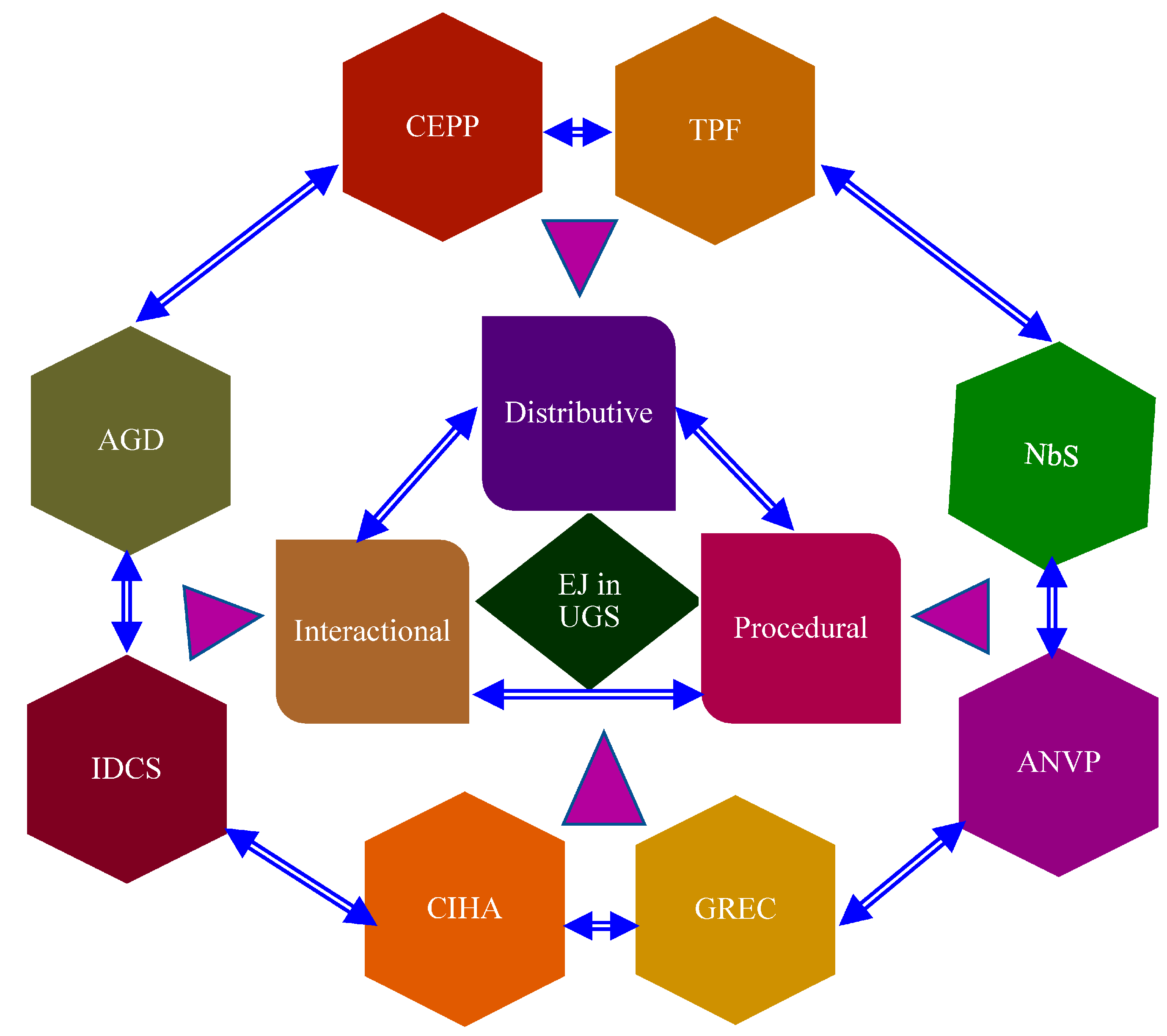
In this context, an EJ framework that encompasses distributive, procedural, and recognitional dimensions provides, as illustrated in Figure 6, a necessary recalibration toward just, sustainable, and inclusive urban futures.

5.2. Strategies for More Inclusive and Equitable Green Regeneration

5.2.1. Community Engagement and Participatory Planning (CEPP)

Meaningful community involvement ensures green spaces meet the needs of all residents. For example, in São Paulo, increased community participation in UGS management has led to a reduction in socio-environmental inequality [11]. Urban planners should adopt participatory approaches—such as community-led design workshops and inclusive decision-making—to ensure that marginalised groups have a significant influence on greening initiatives [137].

5.2.2. Targeted Policies and Funding for Equitable UGS Distribution (TPF)

Policies should focus on UGS development in those underserved areas. For example, China’s National Forest City policy has reduced inequities in green space distribution by emphasising environmental equity [69,138]. In South Tangerang, Indonesia, the reform of Public Green Open Space (PGOS) planning and the establishment of alternative funding sources have been crucial in increasing public access to green spaces [139].

5.2.3. Addressing Gentrification and Displacement (AGD)

To reduce green gentrification, safeguarding the tenure of low-income residents requires pairing greening initiatives with explicit anti-displacement tools. Community land trusts, rent controls, and cooperative ownership models can help maintain long-term affordability, while inclusionary zoning and rent-stabilisation policies ensure that housing near new green spaces remains accessible to low-income households [10]. The Race and Social Justice Initiative in Seattle and San Francisco illustrates how equity-focused policy design can help identify and address inequalities in urban forest planning [131]. Additional measures—such as property-tax abatements, long-term residency subsidies, and participatory co-design processes—enable residents to influence greening projects before decisions that may increase property values are made. Spatial risk-screening tools, including the GGVI and GIS-based equity mapping, further support planners in identifying and protecting communities most vulnerable to displacement. Together, these strategies ensure that environmental improvements enhance neighbourhoods without producing new forms of socio-economic exclusion [17,30,70,81].

5.2.4. Inclusive Design and Cultural Sensitivity (IDCS)

Green spaces should reflect the cultural and social needs of diverse communities. Recognition of the cultural role that nature plays and consideration of diverse views can help these areas become more inclusive [136]. For example, addressing the systemic barriers facing 2SLGBTQ+ groups or children, including hostile park environments, is a crucial direction forward for inclusivity [140].

5.2.5. Civic Involvement and Heterogeneous Approaches (CIHA)

Integrating procedural justice involves involving all stakeholders in the decision-making process. Approaches such as “right tree, right place” prioritise societal needs over market-driven solutions [93]. Spatially heterogeneous strategies in neighbourhoods with inequitable park access, as in Detroit, would enable targeted interventions [58].

5.2.6. Global and Regional Equity Considerations (GREC)

Targeted greening policies are necessary to reduce inequities in Global South cities. International cooperation and funding can furthermore enable equitable and sustainable programmes [41]. Policies need to consider the issue of spatial heterogeneity in accessibility by incorporating both physical and socio-economic factors [141].

5.2.7. Addressing the Needs of Vulnerable Populations (ANVP)

Special attention is needed for refugee children, among other vulnerable groups. Ensuring the availability of appealing and safe green spaces near refugee accommodations is relevant for refugees’ well-being [16]. As in Auckland, prioritisation of accessibility first for children, adolescents, and older people prevents further disparities [69].

5.2.8. Nature-Based Solutions (NbS)

NbS can mitigate the impacts of green gentrification by fostering equitable development. They use green infrastructure to boost resilience while addressing social and economic disparities [11,17,60,84]

6. Conclusions, Contributions, Limitations and Future Directions

Urban greening offers substantial potential to enhance climate resilience, public health, and social cohesion. However, as this study demonstrates, the benefits of green infrastructure continue to be unevenly distributed, particularly along lines of race, class, and geography. Systemic barriers to inclusion, such as environmental racism, green gentrification, and procedural exclusion, continue to marginalise vulnerable communities in both the Global North and South.
Equitable urban greening is more than a matter of increasing the quantity or amenity value of green space; it requires a transformative shift in how cities are planned, centred on justice. This includes elevating the perspectives of long-marginalised communities, embedding procedural and recognitional justice into governance, and using place-based strategies that avoid displacement and enhance access.
Community-led approaches, like “Just Green Enough,” supported by anti-displacement measures, equitable zoning, and inclusive design, can provide effective routes toward social justice in green regeneration. Technological tools, such as GIS-based equity models and green gentrification vulnerability indices, can support the identification of areas at risk; however, these need to be used within participatory, rights-based approaches to ensure legitimacy and effectiveness. Also, mitigating gentrification requires integrating greening with anti-displacement housing policies, inclusive zoning, long-term affordability protections, and community governance mechanisms. Without these safeguards, UGS investments risk perpetuating the very inequities they aim to address.
Integrated and inclusive planning should, thus, form the bedrock of sustainable urban development. Policymakers should dismantle structural barriers to equitable access to green spaces and ensure that environmental improvements do not compromise the well-being of long-standing, underserved communities. Thus, justice-driven, participatory, and context-specific planning is essential to enable greening and foster equitable and sustainable urban futures, as envisaged in interconnected SDGs 3, 10, 11, and 16. In other words, by embedding community engagement, targeted policies, inclusive design, and procedural justice, cities can ensure that green spaces become accessible, equitable, and beneficial to all—particularly marginalised communities.
This study enhances the growing EJ discourse by synthesising scholarly research and global case studies that illustrate the complex interplay between green space planning and social equity. It extends EJ’s conceptual framework to urban greening. It proposes strategic interventions—such as community-driven planning, anti-gentrification tools, and data-informed governance —as pathways toward inclusive and equitable urban environments.
One of the key limitations is that it relies on a secondary literature review, primarily from Scopus and Web of Science, as well as selected case studies. This may exclude relevant grey literature, regional publications, and other examples that could represent a variety of perspectives. This study also lacks primary empirical data and longitudinal analysis, which are important in establishing causality regarding greening initiatives and their social outcomes.
Future research is needed to develop robust, context-sensitive metrics of impacts from equity and expand empirical studies to underrepresented regions, especially in the Global South. Moreover, exploring locally grounded, participatory methods that will be crucial in ensuring that urban greening is utilised as a tool for justice, rather than as a means to further entrench existing inequities, is also a future scope of research. Despite this, the study contributes to the EJ discourse by extending its conceptual framework to urban greening, identifying strategies for more equitable planning that include community-led initiatives, inclusive zoning, anti-displacement measures, and participatory governance.

Supplementary Materials

The following supporting information can be downloaded at: https://www.mdpi.com/article/10.3390/urbansci9120540/s1, File S1: PRISMA checklist; File S2: Study Characteristics; File S3: Risk of Bias Results; File S4: Risk of Bias Summary; File S5: Coding for themes and subthemes; File S6: Snapshots of Search process in WoS and Scopus databases.

Funding

This research received no external funding.

Institutional Review Board Statement

Not applicable.

Informed Consent Statement

Not applicable.

Data Availability Statement

Data is contained within the article.

Acknowledgments

The author acknowledges the assistance of research assistants and colleagues who assisted in the study. The author also declares that AI-assisted writing tools, specifically ChatGPT versions 4 and 5, were utilised to refine the language and enhance readability. Also, Scispace was used to access literature. All substantive content, including data interpretation, conclusions, and manuscript structure, was generated and validated by the author.

Conflicts of Interest

The authors declare no conflicts of interest.

References

  1. De Haas, W.; Hassink, J.; Stuiver, M. The Role of Urban Green Space in Promoting Inclusion: Experiences from The Netherlands. Front. Environ. Sci. 2021, 9, 618198. [Google Scholar] [CrossRef]
  2. Kwon, O.H.; Hong, I.; Yang, J.; Woo, S.; Kim, J. Urban Green Space and Happiness in Developed Countries. EPJ Data Sci. 2021, 10, 28. [Google Scholar] [CrossRef] [PubMed]
  3. Paudel, P.; States, S.L. Urban green spaces and sustainability: Exploring the ecosystem services and disservices of grassy lawns versus floral meadows. Urban For. Urban Green. 2023, 84, 127932. [Google Scholar] [CrossRef]
  4. Hazbei, M.; Yesayan, T.; Yu, N.; Hutt-Taylor, K.; Ziter, C.D. Lessons from Exploring the Relationship between Livability and Biodiversity in the Built Environment. Urban For. Urban Green. 2025, 113, 129110. [Google Scholar] [CrossRef]
  5. Das, D. Factors and strategies for environmental justice in organised urban green space development. Urban Plan. 2022, 7, 160–173. [Google Scholar] [CrossRef]
  6. Haaland, C.; van den Bosch, C.K. Challenges and strategies for urban green-space planning in cities undergoing densification: A review. Urban For. Urban Green. 2015, 14, 760–771. [Google Scholar] [CrossRef]
  7. Mohapatra, B.; Mohamed, A.R. The effect of social and spatial processes on the provision of urban open spaces. Int. J. Green Econ. 2015, 9, 1–23. [Google Scholar] [CrossRef]
  8. Jennings, V.; Johnson Gaither, C.; Schulterbrandt Gragg, R. Promoting environmental justice through urban green space access: A synopsis. Environ. Justice 2012, 5, 1–7. [Google Scholar] [CrossRef]
  9. Kronenberg, J.; Haase, A.; Taszkiewicz, E.; Antal, A.; Bara-vikova, A.; Biernacka, M.; Dushkova, D.; Filčák, R.; Haasee, D.; Ignatieva, M.; et al. Environmental justice in the context of urban green space availability, accessibility, and attractiveness in post-socialist cities. Cities 2020, 106, 102862. [Google Scholar] [CrossRef]
  10. Chang, C. Urban green-space: Environmental justice & green gentrification. Appl. Comput. Eng. 2024, 61, 193–199. [Google Scholar] [CrossRef]
  11. Bressane, A.; Loureiro, A.I.S.; Negri, R.G. Environmental racism in the accessibility of urban green space: A case study of a metropolitan area in an emerging economy. Urban Sci. 2024, 8, 224. [Google Scholar] [CrossRef]
  12. Tian, D.; Zhong, Q.; Yue, B. How green space justice in urban built-up areas affects public mental health: A moderated chain mediation model. Front. Public Health 2024, 12, 1442182. [Google Scholar] [CrossRef]
  13. Wolch, J.R.; Byrne, J.; Newell, J.P. Urban Green Space, Public Health, and Environmental Justice: The Challenge of Making Cities “Just Green Enough”. Landsc. Urban Plan. 2014, 125, 234–244. [Google Scholar] [CrossRef]
  14. Haase, A. Inequalities and injustices of urban green regeneration: Applying the conflict analysis perspective. Land 2024, 13, 296. [Google Scholar] [CrossRef]
  15. Eyster, H.N.; Rodríguez González, M.I.; Gould, R.K. Green Gentrification & the Luxury Effect: Uniting Isolated Ideas towards Just Cities for People & Nature. Ecosyst. People 2024, 20, 2399621. [Google Scholar] [CrossRef]
  16. Chen, S.; Knöll, M. Environmental justice in the context of access to urban green spaces for refugee children. Land 2024, 13, 716. [Google Scholar] [CrossRef]
  17. Bauer, W. Reframing urban nature-based solutions through perspectives of environmental justice and privilege. Urban Plan. 2022, 8, 334–345. [Google Scholar] [CrossRef]
  18. Chen, Y.; Jing, X.; Ma, R.-F.; Wang, X.-Q.; Li, G. Study on the equity of urban green space: Origin, progress, and enlightenment. Chin. J. Appl. Ecol. 2023, 34, 2006–2016. [Google Scholar] [CrossRef]
  19. Jennings, V.; Browning, M.H.E.M.; Rigolon, A. Urban green space at the nexus of environmental justice and health equity. In Green Cities: Good Health; Maddock, J.E., Ed.; Springer: Cham, Switzerland, 2019; pp. 47–69. [Google Scholar] [CrossRef]
  20. Nesbitt, L.; Quinton, J.E. Invited perspective: Nature is unfairly distributed in the United States—But that’s only part of the global green equity story. Environ. Health Perspect. 2023, 131, 11301. [Google Scholar] [CrossRef] [PubMed]
  21. Thuy, N.N.; Nguyen, L.V. Disentangling environmental justice dimensions of urban green spaces in cities of the Global South. In World Sustainability Series; Springer Nature: Singapore, 2023; pp. 149–178. [Google Scholar] [CrossRef]
  22. Owusu, O.; Rigolon, A. What has contributed to green space inequities in U.S. cities? A narrative review. J. Plan. Lit. 2024, 40, 59–76. [Google Scholar] [CrossRef]
  23. Pasgaard, M.; Breed, C.; Engemann Jensen, K.; Brom, P. Connecting Urban Green Infrastructure and Environmental Justice in South Africa: Integrating Social Access, Ecology, and Design. J. Political Ecol. 2025, 32, 6213. [Google Scholar] [CrossRef]
  24. Rigolon, A.; Browning, M.H.E.M.; Lee, K.; Shin, S. Access to Urban Green Space in Cities of the Global South: A Systematic Literature Review. Urban Sci. 2018, 2, 67. [Google Scholar] [CrossRef]
  25. Lewartowska, E.; Anguelovski, I.; Oscilowicz, E.; Triguero-Mas, M.; Cole, H.; Shokry, G.; Perez-del-Pulgar, C.; Connolly, J.J.T. Racial Inequity in Green Infrastructure and Gentrification: Challenging Compounded Environmental Racisms in the Green City. Int. J. Urban Reg. Res. 2024, 48, 294–322. [Google Scholar] [CrossRef]
  26. Tian, Y.; van Leeuwen, E.; Tsendbazar, N.; Jing, C.; Herold, M. Urban green inequality and its mismatches with human demand across neighbourhoods in New York, Amsterdam, and Beijing. Landsc. Ecol. 2024, 39, 60. [Google Scholar] [CrossRef]
  27. Absatarov, R.; Uulu, A.M. The influence of urban green areas on the health of citizens: A review. Hum. Ecol. 2024, 31, 95–106. [Google Scholar] [CrossRef]
  28. Lu, Y.; Chen, R.; Chen, B.; Wu, J. Inclusive green environment for all? An investigation of spatial access equity of urban green space and associated socioeconomic drivers in China. Landsc. Urban Plan. 2024, 241, 104926. [Google Scholar] [CrossRef]
  29. Cucca, R.; Friesenecker, M.; Thaler, T. Green gentrification, social justice, and climate change in the literature: Conceptual origins and future directions. Urban Plan. 2023, 8, 283–295. [Google Scholar] [CrossRef]
  30. Suárez, E.N.R.; Desrosiers, F.; Prokop, L.J.; Dupéré, S.; Diallo, T. Exploring the equitable inclusion of diverse voices in urban green design, planning and policy development: A scoping review protocol. BMJ Open 2024, 14, e078396. [Google Scholar] [CrossRef]
  31. Walker, G. Environmental Justice: Concepts, Evidence and Politics; Routledge: London, UK, 2012. [Google Scholar]
  32. Ning, Y. Urban green space and human health: An environmental justice perspective. Int. J. Nat. Resour. Environ. Stud. 2024, 3, 44–53. [Google Scholar] [CrossRef]
  33. Kronlid, C.; Brantnell, A.; Elf, M.; Borg, J.; Palm, K. Sociotechnical analysis of factors influencing IoT adoption in healthcare: A systematic review. Technol. Soc. 2024, 78, 102675. [Google Scholar] [CrossRef]
  34. Moher, D.; Liberati, A.; Tetzlaff, J.; Altman, D.G. Preferred reporting items for systematic reviews and meta-analyses: The PRISMA statement. PLoS Med. 2009, 6, e1000097. [Google Scholar] [CrossRef] [PubMed]
  35. Page, M.J.; McKenzie, J.E.; Bossuyt, P.M.; Boutron, I.; Hoffmann, T.C.; Mulrow, C.D.; Shamseer, L.; Tetzlaff, J.M.; Akl, E.A.; Brennan, S.E.; et al. The PRISMA 2020 statement: An updated guideline for reporting systematic reviews. BMJ 2021, 372, n71. [Google Scholar] [CrossRef]
  36. Landis, J.R.; Koch, G.G. The measurement of observer agreement for categorical data. Biometrics 1977, 33, 159–174. [Google Scholar] [CrossRef]
  37. Herrera, M.T.; Girma, B.; Ghassabian, A.; Trasande, L. Environmental Racism and Child Health. Acad. Pediatr. 2024, 24, S167–S172. [Google Scholar] [CrossRef]
  38. Holifield, R. Environmental Racism. In The Blackwell Encyclopedia of Sociology; Turner, B.S., Ed.; Wiley: Hoboken, NJ, USA, 2024; pp. 1–4. [Google Scholar] [CrossRef]
  39. Ahmed, N.; Lee, J.; Liu, D.; Kan, Z.; Wang, J. Identifying urban green space deserts by considering different walking distance thresholds for healthy and socially equitable city planning in the Global South. Urban For. Urban Green. 2023, 84, 128123. [Google Scholar] [CrossRef]
  40. Dash, M.; Chakraborty, M. Distribution of green spaces across socio-economic groups: A study of Bhubaneswar, India. J. Archit. Urban. 2023, 47, 57–67. [Google Scholar] [CrossRef]
  41. Chen, B.; Wu, S.; Song, Y.; Webster, C.; Xu, B.; Gong, P. Contrasting inequality in human exposure to greenspace between cities of Global North and Global South. Nat. Commun. 2022, 13, 5502. [Google Scholar] [CrossRef]
  42. Anwar, M.M.; Aziz, A.; Stocco, A.F.; Abdo, H.G.; Almohamad, H.; Dughairi, A.A.A.; Al-Mutiry, M. Urban green spaces distribution and disparities in congested populated areas: A geographical assessment from Pakistan. Sustainability 2023, 15, 8059. [Google Scholar] [CrossRef]
  43. Moussa, Y.; Diop, I.; Soulé, M.; Nafiou, M.M. Urban Green Spaces Accessibility: The Current State in Niamey City, Niger. J. Glob. Ecol. Environ. 2022, 15, 1–16. [Google Scholar] [CrossRef]
  44. Mitchell, B.R.; Chakraborty, J.; Basu, P. Social inequities in urban heat and greenspace: Analysing climate justice in Delhi, India. Int. J. Environ. Res. Public Health 2021, 18, 4800. [Google Scholar] [CrossRef] [PubMed]
  45. Sidique, U. Towards just cities: An environmental justice analysis of Aligarh, India. Dev. Pract. 2024, 35, 493–514. [Google Scholar] [CrossRef]
  46. Sathyakumar, V.; Ramsankaran, R.; Bardhan, R. Linking remotely sensed urban green space (UGS) distribution patterns and socio-economic status (SES)—A multi-scale probabilistic analysis based in Mumbai, India. Gisci. Remote Sens. 2019, 56, 645–669. [Google Scholar] [CrossRef]
  47. Udvardi, M. Bangalore: Urban Development and Environmental Injustice. Honours Thesis, Wellesley College, Wellesley, MA, USA, 2014. [Google Scholar]
  48. Ngome, C.S.; Yeom, C. Charting sustainable paths: Balancing urban green dilemmas in East Africa. Asia Pac. J. Convergent Res. Interchang. 2024, 10, 283–301. [Google Scholar] [CrossRef]
  49. Pal, T.; Paul, A.; Maiti, C. Analysis of urban green spaces using geospatial techniques: A case study of Chandannagar Municipal Corporation, Hugli, West Bengal, India. World J. Adv. Res. Rev. 2023, 19, 370–390. [Google Scholar] [CrossRef]
  50. Chen, B.; Tu, Y.; Huang, S. Beyond green environments: Multi-scale difference in human exposure to greenspace in China. Environ. Int. 2022, 166, 107348. [Google Scholar] [CrossRef] [PubMed]
  51. Li, X.; Svenning, J.; Zhou, W.; Zhu, K.; Abrams, J.F.; Lenton, T.M.; Teng, S.N.; Dunn, R.R. Global Inequality in Cooling from Urban Green Spaces and its Climate Change Adaptation Potential. arXiv 2023, arXiv:2307.09725. [Google Scholar] [CrossRef]
  52. Brueckner, J. Gentrification: J. Brueckner. In Selected Topics in Migration Studies; Bean, F.D., Brown, S.K., Eds.; Springer: Cham, Switzerland, 2023. [Google Scholar] [CrossRef]
  53. Wyly, E. Gentrification. In The Planetary Gentrification Reader; Lees, L., Slater, T., Wyly, E., Eds.; Routledge: Abingdon, UK, 2022; pp. 9–17. [Google Scholar] [CrossRef]
  54. Pala, Ö.N.; Acar, S. Assessing a greening tool through the lens of green gentrification: Socio-spatial change around the Nation’s Gardens of Istanbul. Cities 2024, 147, 105023. [Google Scholar] [CrossRef]
  55. Zhou, Y.; Xie, C. Identifying green gentrification in Chongqing Central Park based on price feature model. BCP Bus. Manag. 2022, 33, 147–156. [Google Scholar] [CrossRef]
  56. Quinton, J.E.; Nesbitt, L.; Connolly, J.J.T.; Wyly, E. How common is greening in gentrifying areas? Urban Geogr. 2023, 45, 1029–1051. [Google Scholar] [CrossRef]
  57. Quinton, J.; Nesbitt, L.; Sax, D.; Harris, L. Greening the Gentrification Process: Insights and Engagements from Practitioners. Environ. Plan. E Nat. Space 2024, 7, 1893–1917. [Google Scholar] [CrossRef]
  58. Kim, J.; Kim, Y.; Stuhlmacher, M. The Green Space Dilemma: Pathways to Greening with and without Gentrification. J. Urban Aff. 2024, 47, 3236–3257. [Google Scholar] [CrossRef]
  59. Zhang, J.; Wu, L. Gentrification outcomes of greening in different urbanisation stages: A longitudinal analysis of Chinese cities, 2012–2020. Environ. Plan. B Urban Anal. City Sci. 2024, 52, 231–246. [Google Scholar] [CrossRef]
  60. Mendonça, R.; Roebeling, P.; Fidélis, T.; Saraiva, M. Can policy instruments enhance the benefits of nature-based solutions and curb green gentrification? The case of Genova, Italy. Environ. Dev. 2024, 50, 100995. [Google Scholar] [CrossRef]
  61. Rigolon, A.; Fernandez, M.; Harris, B.; Stewart, W. An Ecological Model of Environmental Justice for Recreation. Leisure Sci. 2019, 44, 655–676. [Google Scholar] [CrossRef]
  62. Assaad, R.; Jezzini, Y. Green gentrification vulnerability index (GGVI): A novel approach for identifying at-risk communities and promoting environmental justice at the census-tract level. Cities 2024, 145, 104858. [Google Scholar] [CrossRef]
  63. Droste, J.; Gianoli, A. Green gentrification: A fuzzy-set qualitative comparative analysis of greened neighbourhoods in Berlin. J. Environ. Plan. Manag. 2024, 68, 3193–3218. [Google Scholar] [CrossRef]
  64. Oscilowicz, E.; Anguelovski, I.; García-Lamarca, M.; Cole, H.; Shokry, G.; Pérez-del-Pulgar, C.; Argüelles, L.; Connolly, J.J.T. Grassroots mobilisation for a just, green urban future: Building community infrastructure against green gentrification and displacement. J. Urban Aff. 2023, 47, 347–380. [Google Scholar] [CrossRef] [PubMed]
  65. Castro, J. Policy Implications of Urban Greening to Sustainable Gentrification: A Case Study of Quezon City, Philippines. Ph.D. Thesis, Chulalongkorn University, Bangkok, Thailand, 2024. [Google Scholar] [CrossRef]
  66. Wojnowska-Heciak, M.; Suchocka, M.; Błaszczyk, M.; Muszyńska, M. Urban parks as perceived by city residents with mobility difficulties: A qualitative study with in-depth interviews. Int. J. Environ. Res. Public Health 2022, 19, 2018. [Google Scholar] [CrossRef]
  67. Zou, Y. A study on urban park design from the perspective of environmental perception: Exploring future landscapes to enhance well-being and social inclusion for vulnerable groups. Appl. Comput. Eng. 2025, 122, 71–76. [Google Scholar] [CrossRef]
  68. Hoffimann, E.; Barros, H.; Ribeiro, A.I. Socioeconomic inequalities in green space quality and accessibility—Evidence from a Southern European city. Int. J. Environ. Res. Public Health 2017, 14, 916. [Google Scholar] [CrossRef]
  69. Zhang, Y.; Zhao, J.; Mavoa, S.; Smith, M. Inequalities in urban green space distribution across priority population groups: Evidence from Tāmaki Makaurau, Auckland, Aotearoa New Zealand. Cities 2024, 149, 104972. [Google Scholar] [CrossRef]
  70. Bao, Z.; Bai, Y.; Geng, T. Examining spatial inequalities in public green space accessibility: A focus on disadvantaged groups in England. Sustainability 2023, 15, 13507. [Google Scholar] [CrossRef]
  71. Ovsiankin, O.; Nosal, S. Inclusive urban planning initiatives. Space Dev. 2024, 8, 111–129. [Google Scholar] [CrossRef]
  72. Rahman, K.M.A.; Zhang, D. Analysing the level of accessibility of public urban green spaces to different socially vulnerable groups of people. Sustainability 2018, 10, 3917. [Google Scholar] [CrossRef]
  73. Rigolon, A.; Christensen, J. Examining facilitators and challenges to implementing equitable green space policies: Lessons from Los Angeles County. J. Urban Aff. 2023, 47, 488–509. [Google Scholar] [CrossRef]
  74. Pineda, V.S. What is inclusive and accessible public space? J. Public Space 2022, 7, 5–8. [Google Scholar] [CrossRef]
  75. Pineda, V.S.; Meyer, S.W.; Cruz, J.P. The Inclusion Imperative: Forging an Inclusive New Urban Agenda. J. Public Space 2017, 2, 1–20. [Google Scholar] [CrossRef][Green Version]
  76. Selanon, P.; Chuangchai, W. Improving Accessibility to Urban Greenspaces for People with Disabilities: A Modified Universal Design Approach. J. Plan. Lit. 2023, 39, 79–83. [Google Scholar] [CrossRef]
  77. Biernacka, M. Green Space Provision and Equity in the City. In Equity in the Urban Built Environment; Bereitschaft, B., Ed.; Routledge: London, UK, 2024; pp. 79–94. [Google Scholar] [CrossRef]
  78. Zong, W.; Qin, L.; Jiao, S.; Zhang, R. An innovative approach for equitable urban green space allocation through population demand and accessibility modelling. Ecol. Indic. 2024, 160, 111861. [Google Scholar] [CrossRef]
  79. Petríková, D.; Petríková, L. Inclusive and Accessible SMART City for All. In Smart Governance for Cities: Perspectives and Experiences; Lopes, N., Ed.; Springer: Cham, Switzerland, 2020; pp. 73–82. [Google Scholar] [CrossRef]
  80. da Silveira, A.O.; Bichueti, R.S. Cidades inteligentes e neurodiversidade: Discussão sobre a necessidade de espaços urbanos inclusivos para todos (ensaio). Cidades. Comunidades E Territ. 2024, 48, 132–147. [Google Scholar] [CrossRef]
  81. Froehlich, J.E.; Eisenberg, Y.; Hosseini, M.; Azenkot, S.; Bigham, J.P.; Campbell, H.; Chava, V.; D’Souza, R.; Ferres, L.; Goodchild, M.; et al. The future of urban accessibility for people with disabilities: Data collection, analytics, policy, and tools. In Proceedings of the International ACM SIGACCESS Conference on Computers and Accessibility, Athens, Greece, 9–12 October 2022; ACM: New York, NY, USA, 2022. [Google Scholar] [CrossRef]
  82. Newman, G.; Dongying, L.; Rui, Z.; Dingding, R. Resilience through regeneration: The economics of repurposing vacant land with green infrastructure. Landsc. Archit. Front. 2018, 6, 10–23. [Google Scholar] [CrossRef] [PubMed]
  83. Barnes, C. The impact of urban regeneration and environmental improvements on well-being. Int. J. Educ. Humanit. 2024, 16, 442–449. [Google Scholar] [CrossRef]
  84. van der Zaan, T.; van ‘t Hof, S. Regeneration of Degraded Land with Nature-Based Solutions. In Design for Regenerative Cities and Landscapes; Roggema, R., Ed.; Springer: Cham, Switzerland, 2022. [Google Scholar] [CrossRef]
  85. Dunn, A.D. Siting green infrastructure: Legal and policy solutions to alleviate urban poverty and promote healthy communities. BC Envtl. Aff. L. Rev. 2010, 37, 41. [Google Scholar]
  86. Jennings, V.; Baptiste, A.; Jelks, N.; Skeete, R. Urban green space and the pursuit of health equity in parts of the United States. Int. J. Environ. Res. Public Health 2017, 14, 1432. [Google Scholar] [CrossRef]
  87. Yang, H.; Jin, C.; Li, T. Megacity urban green space equity evaluation and its driving factors from supply and demand perspective: A case study of Tianjin. J. Clean. Prod. 2024, 474, 143583. [Google Scholar] [CrossRef]
  88. Haase, A.; Koprowska, K.; Borgström, S. Green regeneration for more justice? An analysis of the purpose, implementation, and impacts of greening policies from a justice perspective in Łódź Stare Polesie (Poland) and Leipzig’s inner east (Germany). Environ. Sci. Policy 2022, 136, 726–737. [Google Scholar] [CrossRef]
  89. Rainisio, N.; Boffi, M.; Piga, B.E.A.; Stancato, G.; Fumagalli, N. Community-based participatory research for urban regeneration: Bridging the dichotomies through the EIA method. J. Community Appl. Soc. Psychol. 2024, 34, e2877. [Google Scholar] [CrossRef]
  90. Vander, W. Striving for just green enough. Agora 2017, 62, 62–66. [Google Scholar]
  91. Crowley, D.; Marat-Mendes, T.; Falanga, R.; Henfrey, T.; Penha-Lopes, G. Towards a Necessary Regenerative Urban Planning: Insights from Community-Led Initiatives for Ecocity Transformation. Cidades Comunidades e Territórios 2021, 21, 83–104. [Google Scholar] [CrossRef]
  92. Mell, I.C. Examining the role of green infrastructure as an advocate for regeneration. Front. Sustain. Cities 2022, 4, 731975. [Google Scholar] [CrossRef]
  93. Sokolnicki, J.; Woodhatch, A.L.; Stafford, R. Assessing environmentally effective post-COVID green recovery plans for reducing social and economic inequality. Anthr. Sci. 2022, 1, 375–383. [Google Scholar] [CrossRef]
  94. Anguelovski, I.; Brand, A.L.; Ranganathan, M.; Hyra, D. Decolonising the green city: From environmental privilege to emancipatory green justice. Environ. Justice 2022, 15, 1–10. [Google Scholar] [CrossRef]
  95. Elderbrock, E.; Russel, K.; Ko, Y.; Budd, E.; Gonen, L.; Enright, C. Evaluating urban green space inequity to promote distributional justice in Portland, Oregon. Land 2024, 13, 720. [Google Scholar] [CrossRef]
  96. Yazar, M.; Hestad, D.; Mangalagiu, D.; Saysel, A.K.; Ma, Y.; Thornton, T.F. From urban sustainability transformations to green gentrification: Urban renewal in Gaziosmanpaşa, Istanbul. Clim. Change 2020, 160, 637–653. [Google Scholar] [CrossRef]
  97. Kubanza, N.S.; Das, D.K.; Simatele, D. Some happy, others sad: Exploring environmental justice in solid waste management in Kinshasa, the Democratic Republic of Congo. Local Environ. 2016, 22, 595–620. [Google Scholar] [CrossRef]
  98. Fernández-Álvarez, R. Inequitable distribution of green public space in Mexico City: An environmental injustice case. Econ. Soc. Territ. 2017, 17, 399–428. [Google Scholar] [CrossRef]
  99. Hoover, F.A.; Scarlett, R. Escaping the practice of exclusion. In Just Green Enough; Oxford University Press: Oxford, UK, 2023; pp. 25–46. [Google Scholar] [CrossRef]
  100. Breyer, B.; Mohr, H. Right tree, right place for whom? Environmental Justice and Practices in Urban Forest Assessment. Local Environ. 2023, 28, 1082–1096. [Google Scholar] [CrossRef]
  101. Anguelovski, I.; Connolly, J.J.T.; Pearsall, H.; Shokry, G.; Checker, M.; Maantay, J.; Gould, K.; Lewis, T.; Maroko, A.; Roberts, J.T. Opinion: Why green “climate gentrification” threatens poor and vulnerable populations. Proc. Natl. Acad. Sci. USA 2019, 116, 26139–26143. [Google Scholar] [CrossRef]
  102. Hendricks, M.D.; Van Zandt, S. Unequal protection revisited: Planning for environmental justice, hazard vulnerability, and critical infrastructure in communities of colour. Environ. Justice 2021, 14, 87–97. [Google Scholar] [CrossRef]
  103. Lombard, N.; Bokare, M.; Harrison, R.; Yonkos, L.T.; Pinkney, A.E.; Murali, D.; Ghosh, U. Codeployment of passive samplers and mussels reveals major source of ongoing PCB inputs to the Anacostia River in Washington, DC. Environ. Sci. Technol. 2023, 57, 1320–1331. [Google Scholar] [CrossRef]
  104. Raymond, N. DC Sues the US government over Anacostia River pollution. Reuters, 10 January 2025. [Google Scholar]
  105. Washington Post DC. Attorney general sues federal government over Anacostia River pollution. The lawsuit claims that the U.S. government for decades used the Anacostia as a “cost-free toxic dumping ground”. Washington Post, 10 January 2025. [Google Scholar]
  106. Avni, N.; Fischler, R. Social and environmental justice in waterfront redevelopment: The Anacostia River, Washington, D.C. Urban Aff. Rev. 2020, 56, 1779–1810. [Google Scholar] [CrossRef]
  107. Arnold, C.A.; Green, O.O.; DeCaro, D.A.; Chase, A.; Ewa, J.G. Resilience of the Anacostia River Basin: Institutional, social, and ecological dynamics. In Resilience in Ecology and Urban Design; Springer: Cham, Switzerland, 2018; pp. 33–46. [Google Scholar] [CrossRef]
  108. Glennie, C. Gardens in the growth machine: Seattle’s P-Patch program and the pursuit of permanent community gardens. In Urban Agriculture and the Struggle for Land; NYU Press: New York, NY, USA, 2020; pp. 154–176. [Google Scholar] [CrossRef]
  109. McGee, H. Seattle’s Central District, 1990–2006: Integration or displacement. Urban Lawyer 2007, 39, 167–256. Available online: https://ssrn.com/abstract=970310 (accessed on 1 November 2025).
  110. Abel, T.D.; White, J.; Clauson, S. Risky business: Sustainability and industrial land use across Seattle’s gentrifying riskscape. Sustainability 2015, 7, 15718–15753. [Google Scholar] [CrossRef]
  111. Raymond, N. Alaska Air and Delta must face lawsuit over Seattle airport pollution. Reuters, 27 November 2024. [Google Scholar]
  112. Shaw, C. Alaska Air and Delta targeted in Seattle airport pollution lawsuit. FOXBusiness, 28 November 2024. [Google Scholar]
  113. Anguelovski, I.; Connolly, J.J.T.; Cole, H.; Pearsall, H.; Zografos, C.; Shi, L.; Sekulova, F.; Alier, M.; Del Pulgar, C.P.; Oscilowicz, E.; et al. Green gentrification in European and North American cities. Nat. Commun. 2022, 13, 31572. [Google Scholar] [CrossRef]
  114. Klingle, M. Emerald City: An Environmental History of Seattle; Yale University Press: New Haven, CT, USA, 2007. [Google Scholar] [CrossRef]
  115. Dommerholt, T. Environmental (In)justice in Amsterdam Greening Policy: A Case Study on the Social Impact of Green Interventions. Master’s Thesis, Wageningen University & Research, Wageningen, The Netherlands, 2022. [Google Scholar]
  116. Pellerey, V.; Giezen, M. More green but less just? Analysing urban green spaces, participation, and environmental justice in Amsterdam. J. Environ. Plan. Manag. 2024, 1–35. [Google Scholar] [CrossRef]
  117. Kabisch, N.; Strohbach, M.; Haase, D.; Kronenberg, J. Urban Green Space Availability in European Cities. Ecol. Indic. 2016, 70, 586–596. [Google Scholar] [CrossRef]
  118. De Vries, S.; Buijs, A.; Snep, R.P.H. Environmental justice in The Netherlands: Presence and quality of greenspace differ by socioeconomic status of neighbourhoods. Sustainability 2020, 12, 5889. [Google Scholar] [CrossRef]
  119. Kruize, H.; Driessen, P.P.J.; Glasbergen, P.; van Egmond, K.; Dassen, T. Environmental equity in the vicinity of Amsterdam Airport: The interplay between market forces and government policy. J. Environ. Plan. Manag. 2007, 50, 699–726. [Google Scholar] [CrossRef]
  120. Cator, C. Transforming the City for Sustainable Futures? Contestation and Alternatives in Amsterdam. Ph.D. Thesis, University of Amsterdam, Amsterdam, The Netherlands, 2024. [Google Scholar] [CrossRef]
  121. Ayala-Azcárraga, C.; Díaz, D.; Fernández, T.; Córdova-Tapia, F.; Zambrano, L. Uneven distribution of urban green spaces in relation to marginalisation in Mexico City. Sustainability 2023, 15, 12652. [Google Scholar] [CrossRef]
  122. Moreno-Mata, A. Urban sprawl, environmental justice and equity in the access to green spaces in the metropolitan area of San Luis Potosí, Mexico. In Urban Transformations; Springer: Cham, Switzerland, 2018; pp. 499–516. [Google Scholar] [CrossRef]
  123. Maldonado-Bernabé, G.; Chacalo-Hilu, A.; Nava-Bolaños, I.; Meza-Paredes, R.M.; Zaragoza-Hernández, A.Y. Changes in the surface of green areas in two city halls of Mexico City between 1990–2015. Polibotánica 2019, 48, 205–230. [Google Scholar] [CrossRef]
  124. Aguilar, M.; del Carmen, M. The Trees of Mexico City: Guardians of Their Image and of the Environment. Bitácora Arquit. 2015, 31, 96–102. [Google Scholar] [CrossRef]
  125. Gutiérrez, D.D.L.H.; Martínez, S.A.; Vargas, E.C.; Alanís, J.C. Análisis espacial del Índice de Sustentabilidad Ambiental Urbana en la Megalópolis de México. Invest. Geogr. 2020, 73, 147–169. [Google Scholar] [CrossRef]
  126. Malleret, C. I think, boy, I’m a part of all this’: How local heroes reforested Rio’s green heart. The Guardian, 10 October 2024. [Google Scholar]
  127. Fontes, A.S.; Galarce, F.E.; do Valle, L.M.; Motta, V.F.; da Faria, T.S. Táticas cidadãs para ativação de áreas subutilizadas: O caso das hortas comunitárias do Rio de Janeiro. Rev. Arq. Urb. 2018, 23, 135–156. [Google Scholar]
  128. Vílchez Ponce, L.A. Participatory action research in Rio de Janeiro’s sustainable favela network. In The City is an Ecosystem Sustainable Education, Policy, and Practice; Mutnick, D., Cuonzo, M., Griffiths, C., Leslie, T., Shuttleworth, J.M., Eds.; Routledge: Abingdon, UK, 2022; pp. 177–189. [Google Scholar] [CrossRef]
  129. Barros, O.A.; Melo, M.E. Do mito à realidade: A experiência de turismo sustentável na comunidade do Vale Encantado, Floresta de Tijuca, Rio de Janeiro, Brasil. Field Actions Sci. Rep. 2011, 1–5. [Google Scholar]
  130. Drummond, J.A.L. O jardim dentro da máquina: Breve história ambiental da Floresta da Tijuca. Estud. Hist. 1988, 1, 276–298. [Google Scholar]
  131. Herzog, C.P. A multifunctional green infrastructure design to protect and improve native biodiversity in Rio de Janeiro. Landsc. Ecol. Eng. 2016, 12, 141–150. [Google Scholar] [CrossRef]
  132. de Andrade, C.F.S.; Rodacoski, J.L.; Collesi, G.S.P.; de Faria, S.P. Recuperação da cobertura vegetal do Quilombo do Cabral em Paraty, RJ—Bases de um projeto socio-ambiental de extensão. Rev. Ciência Extensão 2013, 9, 7–20. [Google Scholar] [CrossRef]
  133. Motta, M.; Abranches Abelheira, M.; Gomes, O.S.; Fonseca, W.; Besen, D. Rio de Janeiro Community Protection Program. Procedia Econ. Finance 2014, 18, 128–135. [Google Scholar] [CrossRef]
  134. Grant, A.; Edge, S.; Millward, A.A.; Roman, L.A.; Teelucksingh, C. Centering community perspectives to advance recognitional justice for sustainable cities: Lessons from urban forest practice. Sustainability 2024, 16, 4915. [Google Scholar] [CrossRef]
  135. Ray, M.; Swain, M.J.; Prusty, M. Urban green space management and planning: A case study of Bhubaneswar. Int. J. Sci. Technol. Eng. 2024, 12, 5525–5528. [Google Scholar] [CrossRef]
  136. Snaith, B.; Odedun, A. Weeds, wildflowers, and White privilege: Why recognising nature’s cultural content is key to ethnically inclusive urban greenspaces. J. Race Ethn. City 2023, 5, 1–27. [Google Scholar] [CrossRef]
  137. Vaňo, S.; Olafsson, A.S.; Mederly, P. Advancing urban green infrastructure through participatory integrated planning: A case from Slovakia. Urban For. Urban Green. 2021, 58, 126957. [Google Scholar] [CrossRef]
  138. Zhang, Z.; Cenci, J.; Zhang, J. Policies for Equity in Access to Urban Green Space: A Spatial Perspective of the Chinese National Forest City Policy. Forests 2024, 15, 608. [Google Scholar] [CrossRef]
  139. Kurniawan, H.B.; Roychansyah, M.S. The Social Equity of Public Green Open Space Accessibility: The Case of South Tangerang, Indonesia. Geogr. Environ. Sustain. 2023, 16, 45–54. [Google Scholar] [CrossRef]
  140. Haider, J. Inclusive design: Planning public urban spaces for children. Proc. Inst. Civ. Eng. Munic. Eng. 2007, 160, 83–88. [Google Scholar] [CrossRef]
  141. Long, X.; Chen, Y.; Zhang, Y.; Zhou, Q. Visualising green space accessibility for more than 4,000 cities across the globe. Environ. Plann. B Urban Anal. City Sci. 2022, 5, 1578–1581. [Google Scholar] [CrossRef]
Figure 1. Conceptualisation of Environmental Justice for Urban Green Space Development Planning.
Urbansci 09 00540 g001
Figure 2. PRISMA Flow chart of the search and selection process.
Urbansci 09 00540 g002
Figure 3. Drivers of Environmental Racism and the Unequal Access to UGS.
Urbansci 09 00540 g003
Figure 4. Gentrification Risks and EJ in UGS.
Urbansci 09 00540 g004
Figure 5. Barriers to green space access and EJ for vulnerable groups of society.
Urbansci 09 00540 g005
Figure 6. A Conceptual EJ Framework for Urban Green Space Planning.
Urbansci 09 00540 g006
Table 1. Research Protocol.
ItemDetails
Research Questions
  • RQ1: How does environmental racism manifest in UGS distribution and accessibility, especially in the Global South?
  • RQ2: How can gentrification risks be mitigated, ensuring green space improvements do not displace marginalised communities?
  • RQ3: What specific UGS access challenges do vulnerable groups face, and how can policies adapt for inclusivity?
  • RQ4: How do green regeneration projects impact social injustices, and what strategies promote their inclusivity and equity?
Database used Scopus and Web of Science
Publication period 2001–2025
KeywordsEnvironmental Justice, Procedural Justice, Distributive Justice, Recognition Justice, Interactional Justice, Environmental Racism, Gentrification, Green Space, Open Space, Recreational Space, Equity, Inclusivity, Vulnerable Groups, Development, Planning, Management, Urban Area, Cities
Timeframe for literature searchJune 2024 and August 2025
Inclusion criteria (premised on PICOSO framework)Population: Peer-Reviewed Journals, Books, Book Chapters, Theses, Conference Proceedings
Interventions: Environmental Justice, Urban Green Space, Planning, Policies, Strategies, Development, Nature-Based Solutions
Context (Comparison): Global South, Global North, Urban Areas/Cities
Outcomes: Accessible, Inclusivity, Equity, Justice, Sustainability, Resiliency.
Others (Language): English, French, Spanish, or Portuguese,
Exclusion criteriaNon-Peer-Reviewed Articles, Patents, Laws, Treaties, Not Aligned to Urban Green Spaces, Environmental Justice, Selective Reporting, Specific Contextual Studies, Qualitative Observational Studies, Blogs/Opinions Without Evidence
Data extractionUsed a standardised form (spreadsheet) to capture all relevant data
Quality assessment Used the 27 PRISMA checklist to assess methodological quality, Risk of Bias (ROB2) analysis and Cohen’s Kappa analysis
Analytical approach Use narrative and thematic analysis to synthesise the data.
Software used Biblioshiny in the R software Package
Table 2. Themes and subthemes for thematic analyses.
Sl NoThemesSub-Themes
1Definitions and concepts of EJDimensions of EJ: Distributional, Procedural and recognition EJ
2Environmental Racism and the Unequal Access to UGS Accessibility & Equity
Structural inequality
Governance failures
3Gentrification Risks and Urban Planning for Green Space DevelopmentGreen gentrification
Distribution of UGS and Anti-displacement policies
Governance and Zoning & Regulation
4Specific challenges faced by vulnerable groups in accessing UGS, and urban policies to ensure inclusivityCommunity participation and Vulnerable groups’ access
Cultural inclusivity
Physical barriers
Safety & exclusion
5Green Regeneration & Social Justice Inclusive regeneration
Risks of eco-gentrification
Table 3. Summary of Literature Reviewed.
Literature SourceNumbers Share (%)
Journal articles10979.56
Conference Proceedings21.46
Books64.38
Book chapters107.30
Thesis32.19
Web articles/Reports75.11
Total 137100.00
Table 4. Level of Agreement between the Assessors (Risk of Bias).
MeasureValueStd. ErrorApprox. TN of Valid Cases
Cohen’s Kappa (k)0.7920.0799.219128 *
(Note: * Two articles were excluded from the risk of bias analyses because of a lack of adequate information to measure the level of agreement).
Disclaimer/Publisher’s Note: The statements, opinions and data contained in all publications are solely those of the individual author(s) and contributor(s) and not of MDPI and/or the editor(s). MDPI and/or the editor(s) disclaim responsibility for any injury to people or property resulting from any ideas, methods, instructions or products referred to in the content.