
Sustaining Urban Water and Sanitation in Beira, Mozambique: From Policy to Practice Through Local Perspectives




Abstract
1. Introduction
2. Materials and Methods
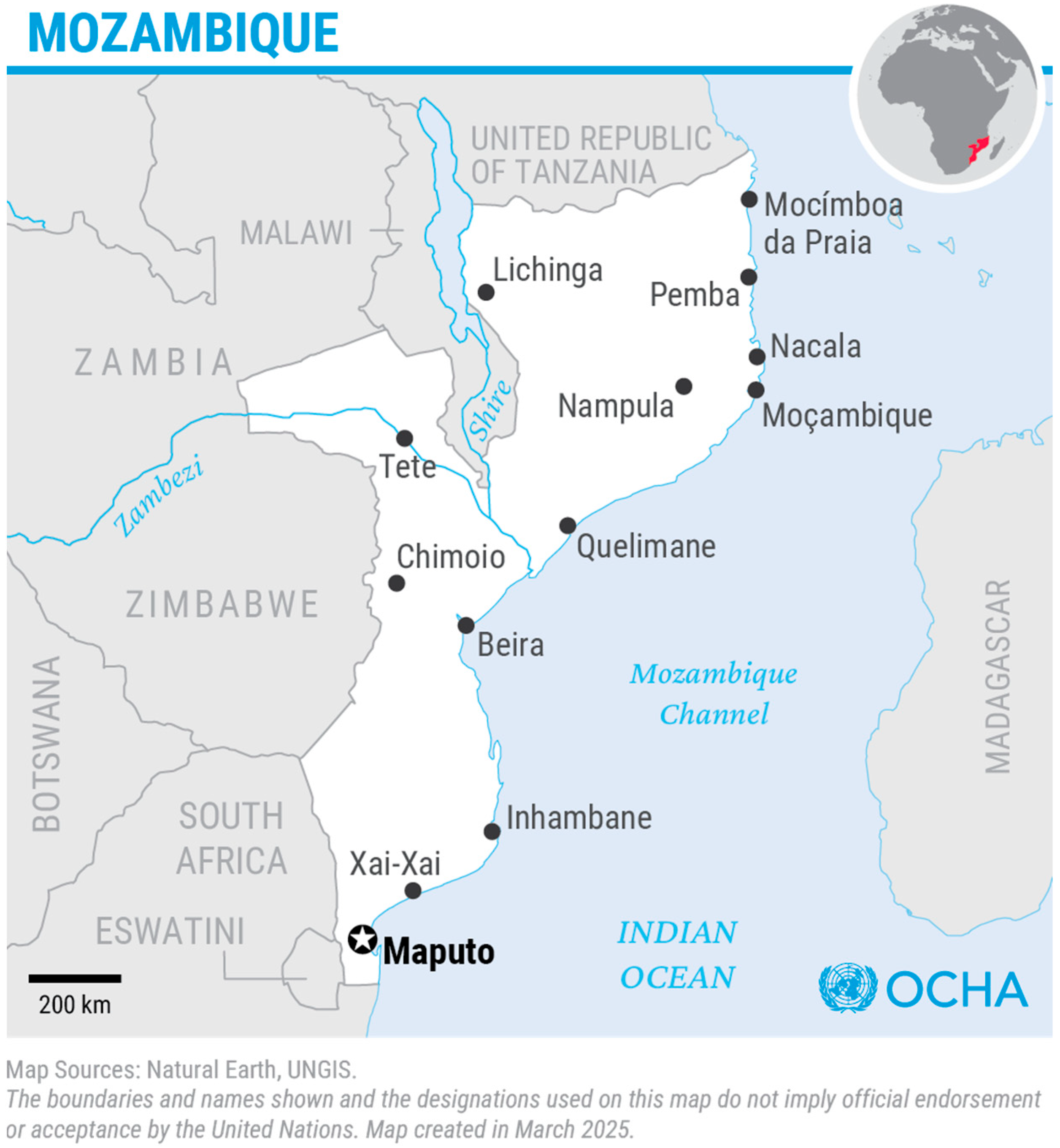
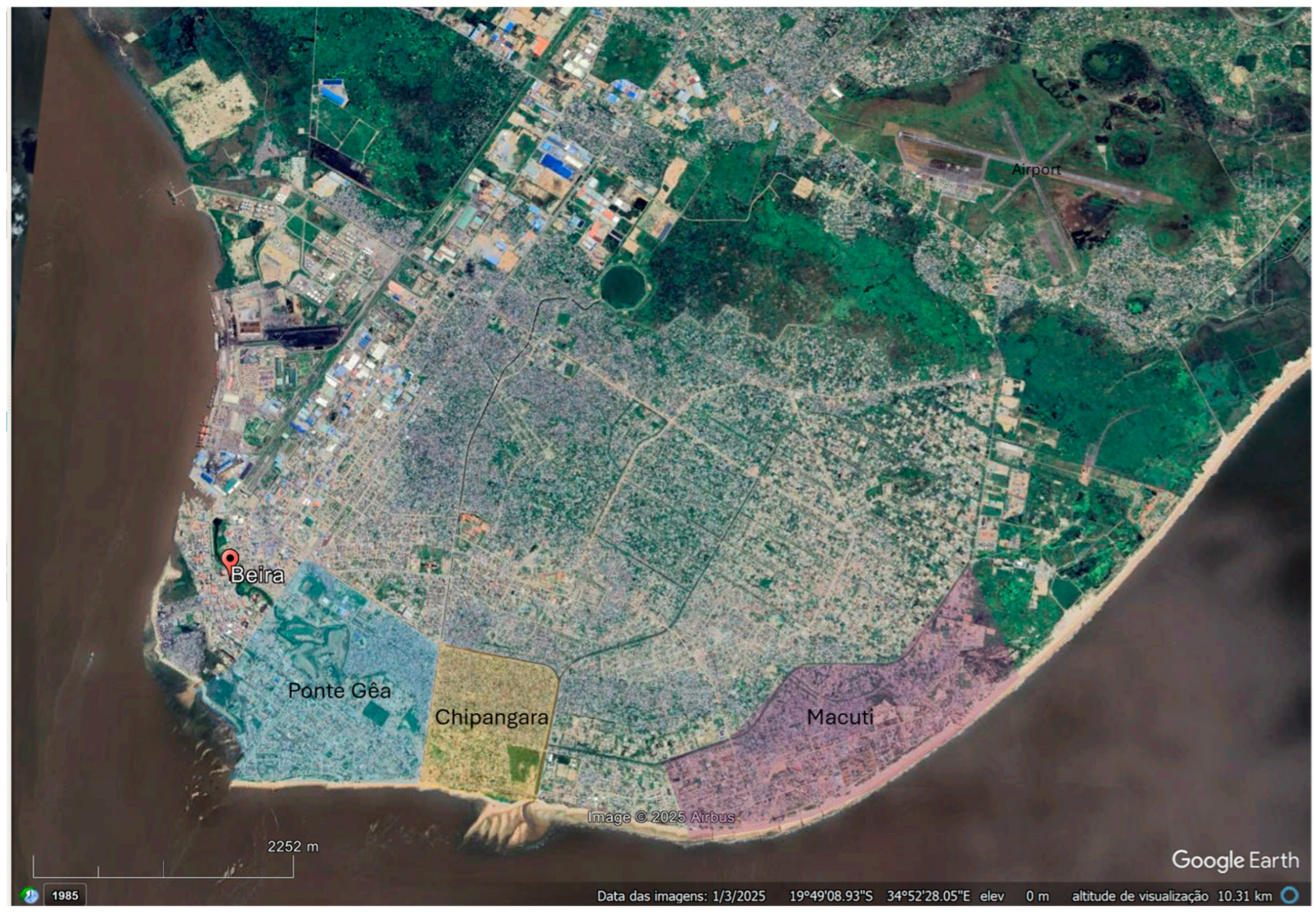
2.1. Background on Beira
2.2. Research Design


2.3. Study Context
2.4. Participants and Sampling
- Institutional actors (n = 3): representatives from Serviços de Água e Saneamento da Beira (SASB, Water and Sanitation Services of Beira), Águas da Região Centro (AdRC, Waters of the Central Region), and Administração de Infraestruturas de Água e Saneamento (AIAS, Water and Sanitation Infrastructure Administration). These participants were selected through purposive sampling given their strategic roles in water supply and sanitation management in Beira.
- Community leaders (n = 3): recognised leaders from the neighbourhoods of Ponta Gêa, Chipangara, and Macuti. These participants were identified via snowball sampling starting with local water committees, ensuring diverse perspectives from areas with varying levels of service coverage and vulnerability to climate risks.
2.5. Data Collection
2.6. Data Analysis
2.7. Research Rigour
- Credibility was enhanced through member checking with four participants;
- Transferability was supported through thick description of the study context and participant profiles;
- Dependability was addressed by maintaining an audit trail of coding decisions and reflections;
- Confirmability was ensured through reflexive journaling and peer debriefing during analysis [27].
3. Results
3.1. Governance and Institutional Coordination
“When a pipe bursts, sometimes two different institutions claim responsibility, and sometimes nobody comes. The community does not know who to call.”(Institutional actor, July 2025)
“The law will not solve things if there is no daily cooperation between institutions.”(Institutional actor, June 2025)
3.2. Infrastructure Robustness and Maintenance
“In December 2024, a major pipe in Inhamízua broke, and it took more than a week to repair. People survived with water from neighbours’ wells and informal vendors.”(Community leader, June 2025)
“We manage to replace small parts, but when the pipes underground collapse, it is out of our hands.”(Community leader, July 2025)
3.3. Community Participation and Empowerment
“We try to mobilise neighbours to contribute small amounts, but without recognition from the authorities, our work is limited.”(Community leader, July 2025)
“Here in Ponta Gêa, when something breaks, we have funds collected from users to fix it quickly. We don’t wait for the Municipality.”(Community leader, June 2025)
3.4. Climate Resilience to Extreme Events
“The drainage system is being improved, but adaptation projects depend on external funding. They are not yet part of our routine planning.”(Institutional actor, July 2025)
“Every rainy season we are afraid. The water rises quickly, and our wells are contaminated.”(Community leader, July 2025)
3.5. Financial Sustainability
“The social tariff is necessary for poor families, but it does not cover operational costs. Without external funding, the system cannot survive.”(Institutional actor, June 2025)
“We are asked to pay more, but the water does not come every day. People lose trust.”(Community leader, July 2025)
4. Discussion
4.1. Governance and Institutional Complexity
4.2. Infrastructure: From Rehabilitation to Sustainable Maintenance
4.3. Community Participation: Between Informality and Innovation
4.4. Climate Resilience and the Challenge of Mainstreaming
4.5. Financial Viability: Balancing Affordability and Cost Recovery
4.6. Comparative Analysis Across Neighbourhoods
“We went more than a year without piped water but still received bills. We complained, but nothing changed.”(Community leader, Chipangara, July 2025)
“We have a committee in Ponta Gêa, and even though we lack formal support, we manage our standpipe and make sure people don’t misuse the water.”(Community leader, Ponta Gêa, July 2025)
“When the floods come, sewage mixes with rainwater in the streets. It happened during Idai and still happens today.”(Community leader, Macuti, June 2025)
“We report issues, but no one knows if it’s the municipality, AIAS or AdRC who should fix it. It’s always unclear.”(Community leader, Chipangara, June 2025)
4.7. Integrating the Five Dimensions: Towards Systemic Reform
4.8. Contribution to Knowledge and Policy Relevance
- Historical depth: By highlighting the colonial legacies that continue to shape institutional fragmentation, it extends analyses that often treat governance challenges as contemporary administrative issues [14].
- Everyday perspective: By triangulating policy documents with the voices of community leaders, it bridges the gap between official frameworks and lived experiences, often overlooked in Mozambique-focused research.
- Resilience integration: It demonstrates that resilience in secondary cities like Beira is still fragmented and donor-driven, reinforcing the need for systemic integration into planning.
5. Conclusions
- Clarify institutional mandates and formalise inter-agency coordination through operational planning platforms, performance monitoring, and accountability frameworks.
- Embed preventive maintenance and infrastructure asset management into municipal and utility-level plans and budgets, supported by decentralised repair capacity.
- Recognise and strengthen community-based water committees as partners in service provision, including through legal recognition, training, and modest operational funding.
- Mainstream climate adaptation—including Nature-Based Solutions—into city-wide WASH strategies, with stable financing and alignment across infrastructure, housing, and environmental sectors.
- Enhance financial transparency and participatory tariff-setting to balance affordability with cost recovery, including clear reinvestment mechanisms to improve public trust.
Author Contributions
Funding
Institutional Review Board Statement
Informed Consent Statement
Data Availability Statement
Acknowledgments
Conflicts of Interest
Abbreviations
| AIAS | Administração de Infraestruturas de Água e Saneamento (Water and Sanitation Infrastructure Administration) |
| AdRC | Águas da Região Centro (Central Region Water Utility) |
| CMB | Conselho Municipal da Beira (Beira Municipal Council) |
| CRA | Conselho de Regulação de Águas (Water Regulatory Council) |
| DNAAS | Direção Nacional de Abastecimento de Água e Saneamento (National Directorate of Water Supply and Sanitation) |
| FIPAG | Fundo de Investimento e Património do Abastecimento de Água (Water Supply Investment and Asset Fund) |
| NBS | Nature-Based Solutions |
| ODS/SDG | Sustainable Development Goals |
| SASB | Serviços de Água e Saneamento da Beira (Beira Water and Sanitation Services) |
| UN | United Nations |
| UNICEF | United Nations International Children’s Fund |
| WASH | Water, Sanitation and Hygiene |
| WHO | World Health Organization |
Appendix A. Semi-Structured Interview Guide
Appendix A.1. Institutional Actors (Water and Sanitation Governance Bodies)
- What is your institution’s role in managing or supporting urban water and/or sanitation services in Beira?
- How is coordination conducted with other relevant entities (e.g., AdRC, AIAS, the Municipality, DNAAS)?
- Are there existing plans or strategies to promote sustainability of water supply and/or urban drainage services?
- How does your institution address the challenges of service delivery in informal or peri-urban settlements?
- What are the key approaches for ensuring technical and financial sustainability of water and sanitation infrastructure?
- How are maintenance and rehabilitation projects planned and financed?
- Are communities involved in decision-making or implementation of water-related projects?
- What are the observed impacts of climate-related events (e.g., cyclones, floods) on your operations?
- What are the main challenges and opportunities for achieving long-term sustainability in Beira, including in neighbourhoods like Ponta Gêa?
Appendix A.2. Community Leaders/Neighbourhood Councils (Peri-Urban and Informal Zones)
- What are the main problems related to water access in your neighbourhood?
- Are there formally managed water points? Who is responsible for their maintenance?
- Is there any collaboration with institutions such as AdRC, AIAS, or the Municipality?
- Does the population participate in decisions about water or sanitation infrastructure?
- What are your priorities for improving local water and sanitation services?
- How do you understand the concept of “sustainability” in relation to water access?
- What are the main challenges and opportunities for improving WASH services in your neighbourhood and in Beira more broadly?
Appendix B. Summaries of Institutional Actor Interviews
Appendix B.1. SASB—Serviços de Água e Saneamento da Beira (Beira Water and Sanitation Services)—(June 2025)
Appendix B.2. AIAS—Administração de Infraestruturas de Água e Saneamento (Water and Sanitation In-Frastructure Administration)—(June 2025)
Appendix B.3. AdRC—Águas da Região Centro (Central Region Water Utility)—(June 2025)
Appendix C. Summaries of Community Leader Interviews
Appendix C.1. Bairro Chipangara (July 2025)
Appendix C.2. Bairro Ponta Gêa (July 2025)
Appendix C.3. Bairro Macuti (July 2025)
References
- United Nations General Assembly. The Human Right to Water and Sanitation-Resolution Adopted by the UN General Assembly [A/RES/64/292]; United Nations General Assembly: New York, NY, USA, 2010; Available online: https://digitallibrary.un.org/record/687002?v=pdf (accessed on 21 July 2025).
- Adams, E.A.; Zulu, L.C. Participants or Customers in Water Governance? Community-Public Partnerships for Peri-Urban Water Supply. Geoforum 2015, 65, 112–124. [Google Scholar] [CrossRef]
- Chitonge, H.; Mokoena, A.; Kongo, M. Water and Sanitation Inequality in Africa: Challenges for SDG 6. In Africa and the Sustainable Development Goals; Ramutsindela, M., Mickler, D., Eds.; Sustainable Development Goals Series; Springer International Publishing: Cham, Switzerland, 2020; pp. 207–218. [Google Scholar] [CrossRef]
- Hlongwa, N.; Nkomo, S.L.; Desai, S.A. Barriers to Water, Sanitation, and Hygiene in Sub-Saharan Africa: A Mini Review. J. Water Sanit. Hyg. Dev. 2024, 14, 497–510. [Google Scholar] [CrossRef]
- Tseole, N.P.; Mindu, T.; Kalinda, C.; Chimbari, M.J. Barriers and Facilitators to Water, Sanitation and Hygiene (WaSH) Practices in Southern Africa: A Scoping Review. PLoS ONE 2022, 17, e0271726. [Google Scholar] [CrossRef]
- UNICEF; WHO. Progress on Household Drinking Water, Sanitation and Hygiene 2000–2022: Special Focus on Gender; DNAAS: New York, NY, USA, 2023. [Google Scholar]
- Direção Nacional de Abastecimento de Água e Saneamento (DNAAS). Relatório Anual Do Setor de Água e Saneamento 2023–2024 (Annual Report of the Water and Sanitation Sector 2023–2024); Boletim da República: Maputo, Mozambique, 2024. [Google Scholar]
- Instituto Nacional de Estatística (INE). Dados Preliminares Do Inquérito Demográfico e de Saúde 2023 (Preliminary Data from the 2023 Demographic and Health Survey); Instituto Nacional de Estatística (INE): Maputo, Mozambique, 2023. [Google Scholar]
- Assembleia da República. Lei n.o 16/91, de 3 de Agosto. Aprova a Lei de Águas. Boletim Da República, I Série, 31; Boletim da República: Maputo, Mozambique, 1991. [Google Scholar]
- Conselho de Ministros de Moçambique. Resolução n.o 42/2016, de 30 de Dezembro. Aprova a Política de Águas. Boletim Da República, I Série, 156; Boletim da República: Maputo, Mozambique, 2016. [Google Scholar]
- Nhaurire, A.; Capurchande, R. The Sustainability of Water Access Services in Mozambique: From Policy to Practice. Sci. Technol. Public Policy 2025, 9, 14–26. [Google Scholar] [CrossRef]
- Schubert, J. Maintaining a City against Nature: Climate Adaptation in Beira. Build. Cities 2024, 5, 35–49. [Google Scholar] [CrossRef]
- Williamson, C.; McCordic, C.; Doberstein, B. The Compounding Impacts of Cyclone Idai and Their Implications for Urban Inequality. Int. J. Disaster Risk Reduct. 2023, 86, 103526. [Google Scholar] [CrossRef]
- Santos, M.M.; Ferreira, A.V.; Lanzinha, J.C.G. Colonial Moorings on Spatial Planning of Mozambique. Cities 2022, 124, 103619. [Google Scholar] [CrossRef]
- Herslund, L.B.; Jalayer, F.; Jean-Baptiste, N.; Jørgensen, G.; Kabisch, S.; Kombe, W.; Lindley, S.; Nyed, P.K.; Pauleit, S.; Printz, A.; et al. A Multi-Dimensional Assessment of Urban Vulnerability to Climate Change in Sub-Saharan Africa. Nat. Hazards 2016, 82, 149–172. [Google Scholar] [CrossRef]
- Pasquini, L. The Urban Governance of Climate Change Adaptation in Least-Developed African Countries and in Small Cities: The Engagement of Local Decision-Makers in Dar Es Salaam, Tanzania, and Karonga, Malawi. Clim. Dev. 2020, 12, 408–419. [Google Scholar] [CrossRef]
- Bishoge, O.K. Challenges Facing Sustainable Water Supply, Sanitation and Hygiene Achievement in Urban Areas in Sub-Saharan Africa. Local Environ. 2021, 26, 893–907. [Google Scholar] [CrossRef]
- Adams, E.A.; Sambu, D.; Smiley, S.L. Urban Water Supply in Sub-Saharan Africa: Historical and Emerging Policies and Institutional Arrangements. Int. J. Water Resour. Dev. 2019, 35, 240–263. [Google Scholar] [CrossRef]
- Creswell, J.W.; Poth, C.N. Qualitative Inquiry and Research Design; Sage: Thousand Oaks, CA, USA, 2023. [Google Scholar]
- Dickin, S.; Bisung, E.; Nansi, J.; Charles, K. Empowerment in Water, Sanitation and Hygiene Index. World Dev. 2021, 137, 105158. [Google Scholar] [CrossRef]
- Johannessen, Å.; Wamsler, C. What Does Resilience Mean for Urban Water Services? Ecol. Soc. 2017, 22. [Google Scholar] [CrossRef]
- Mozambique: Location Map (2025)|OCHA. Available online: https://www.unocha.org/publications/map/mozambique/mozambique-location-map-2025 (accessed on 31 October 2025).
- Guest, G.; Bunce, A.; Johnson, L. How Many Interviews Are Enough? Field Methods 2006, 18, 59–82. [Google Scholar] [CrossRef]
- Van Der Byl, W.; Carter, R.C. An Investigation of Private Operator Models for the Management of Rural Water Supply in Sub-Saharan Africa. Waterlines 2018, 37, 155–174. [Google Scholar] [CrossRef]
- Braun, V.; Clarke, V. Using Thematic Analysis in Psychology. Qual. Res. Psychol. 2006, 3, 77–101. [Google Scholar] [CrossRef]
- Swiderska, K.; Roe, D.; Siegele, L.; Grieg-Gran, M. The Governance of Nature and the Nature of Governance: Policy That Works for Biodiversity and Livelihoods; Biodiversity and Livelihoods Issue Paper; IIED: London, UK, 2008; p. 184. [Google Scholar]
- Lincoln, Y.S.; Guba, E.G. Naturalistic Inquiry; SAGE Publications, Inc.: Thousand Oaks, CA, USA, 1985; ISBN 9780803924314. [Google Scholar]
- Girotto, C.D.; Behzadian, K.; Musah, A.; Chen, A.S.; Djordjević, S.; Nichols, G.; Campos, L.C. Analysis of Environmental Factors Influencing Endemic Cholera Risks in Sub-Saharan Africa. Sci. Total Environ. 2024, 926, 171896. [Google Scholar] [CrossRef]
- Abrams, A.L.; Carden, K.; Teta, C.; Wågsæther, K. Water, Sanitation, and Hygiene Vulnerability among Rural Areas and Small Towns in South Africa: Exploring the Role of Climate Change, Marginalization, and Inequality. Water 2021, 13, 2810. [Google Scholar] [CrossRef]
- Madon, S.; Malecela, M.N.; Mashoto, K.; Donohue, R.; Mubyazi, G.; Michael, E. The Role of Community Participation for Sustainable Integrated Neglected Tropical Diseases and Water, Sanitation and Hygiene Intervention Programs: A Pilot Project in Tanzania. Soc. Sci. Med. 2018, 202, 28–37. [Google Scholar] [CrossRef] [PubMed]
- Santos, M.M.; Ferreira, A.V.; Lanzinha, J.C.G.G. The Possibilities of Capturing Rainwater and Reducing the Impact of Floods: A Proposal for the City of Beira, Mozambique. Sustainability 2023, 15, 2276. [Google Scholar] [CrossRef]
- Kiribou, R.; Djene, S.; Bedadi, B.; Ntirenganya, E.; Ndemere, J.; Dimobe, K. Urban Climate Resilience in Africa: A Review of Nature-Based Solution in African Cities’ Adaptation Plans. Discov. Sustain. 2024, 5, 94. [Google Scholar] [CrossRef]
- Atanga, R.A.; Wang, Y.; Ayambire, R.A.; Wang, C.; Xu, M.; Li, J. Sister City Partnerships and Sustainable Development in Emerging Cities: Empirical Cases from Ghana and Tanzania. Habitat. Int. 2024, 154, 103208. [Google Scholar] [CrossRef]
- Azunre, G.A.; Azerigyik, R.A.; Amponsah, O.; Kpeebi, Y. The Jugaad Urbanism-Sustainable Circular Cities Nexus: Insights from Sub-Saharan Africa’s Informal Settlements. Habitat. Int. 2025, 158, 103349. [Google Scholar] [CrossRef]
- Carbonell, L.; Hofmann, P.; Srikissoon, N.; Campos, L.C.; Mbatha, S.; Lakhanpaul, M.; Mabeer, V.; Steenmans, I.; Parikh, P. Localisation of Links between Sanitation and the Sustainable Development Goals to Inform Municipal Policy in EThekwini Municipality, South Africa. World Dev. Sustain. 2023, 2, 100038. [Google Scholar] [CrossRef]
- Shrestha, A.; Bhattarai, T.N.; Acharya, G.; Timalsina, H.; Marks, S.J.; Uprety, S.; Paudel, S.R. Water, Sanitation, and Hygiene of Nepal: Status, Challenges, and Opportunities. ACS ES&T Water 2023, 3, 1429–1453. [Google Scholar] [CrossRef]
- Shi, C.; Li, Y.; Li, H.; Qiu, H.; Xu, T. Towards Sustainable Urban Water Management: An Ecological Compensation Framework for Sponge Cities. Environ. Res. Lett. 2024, 19, 123002. [Google Scholar] [CrossRef]

| Component | Description |
|---|---|
| Type of study | Qualitative, phenomenological approach |
| Main objective | To analyse the sustainability of urban water and sanitation services in Beira, based on policies and local perceptions |
| Unit of analysis | City of Beira, focusing on three neighbourhoods: Ponta Gêa, Chipangara, and Macuti |
| Data collection period | 10 June to 25 July 2025 |
| Data collection method | Semi-structured interviews in-person |
| Instrument used | Interview guide based on five sustainability dimensions [24] |
| Number of participants | 6 (3 institutional representatives + 3 community leaders) |
| Sampling criteria | Purposive sampling for institutions; snowball sampling for community leaders. |
| Languages used | Portuguese, with translation assistance to Sena in community settings. |
| Data analysis | Hybrid thematic coding (deductive and inductive), supported by an Excel-based matrix. |
| Validation and reliability | Member checking; coding audit; reflective memoing; inter-coder reliability verified (Cohen’s Kappa = 0.81). |
| Ethical considerations | Verbal and written informed consent obtained; anonymity and voluntary participation ensured. |
| Dimension | Ponta Gêa | Chipangara | Macuti | Indicative Data [7,8] |
|---|---|---|---|---|
| Water Coverage | Partial, relatively stable | Severely limited, frequent disruptions | Moderate, impacted by flooding | 64% of urban households connected; 38% of informal areas with access. |
| Infrastructure Condition | Ageing but functional | Very poor, frequent pipe failures | Moderate, damaged during floods | Average 9–14 service disruptions per year (citywide). |
| Community Participation | Active self-management, local committees | Weak, informal and under-resourced | Occasional participation in meetings | 41% of households report community-based involvement. |
| Climate Vulnerability | Moderate | High (flood-prone) | Very high (coastal erosion and tidal surges) | 17 cyclones and 27 floods recorded 1980–2017. |
| Institutional Response | Moderate to high | Low | Moderate, mostly reactive | 5 agencies overlapping mandates; 70% of budget donor funded. |
Disclaimer/Publisher’s Note: The statements, opinions and data contained in all publications are solely those of the individual author(s) and contributor(s) and not of MDPI and/or the editor(s). MDPI and/or the editor(s) disclaim responsibility for any injury to people or property resulting from any ideas, methods, instructions or products referred to in the content. |
© 2025 by the authors. Licensee MDPI, Basel, Switzerland. This article is an open access article distributed under the terms and conditions of the Creative Commons Attribution (CC BY) license (https://creativecommons.org/licenses/by/4.0/).
Share and Cite
Santos, M.M.; Ferreira, A.V.; Lanzinha, J.C.G.; Collado, B.R. Sustaining Urban Water and Sanitation in Beira, Mozambique: From Policy to Practice Through Local Perspectives. Urban Sci. 2025, 9, 480. https://doi.org/10.3390/urbansci9110480
Santos MM, Ferreira AV, Lanzinha JCG, Collado BR. Sustaining Urban Water and Sanitation in Beira, Mozambique: From Policy to Practice Through Local Perspectives. Urban Science. 2025; 9(11):480. https://doi.org/10.3390/urbansci9110480
Chicago/Turabian StyleSantos, Michael M., Ana Vaz Ferreira, João C. G. Lanzinha, and Beatriz Reyes Collado. 2025. "Sustaining Urban Water and Sanitation in Beira, Mozambique: From Policy to Practice Through Local Perspectives" Urban Science 9, no. 11: 480. https://doi.org/10.3390/urbansci9110480
APA StyleSantos, M. M., Ferreira, A. V., Lanzinha, J. C. G., & Collado, B. R. (2025). Sustaining Urban Water and Sanitation in Beira, Mozambique: From Policy to Practice Through Local Perspectives. Urban Science, 9(11), 480. https://doi.org/10.3390/urbansci9110480