
Travel Behaviour and Carbon Emissions of Residents of Public Housing Areas in Aotearoa, New Zealand
 , , and
Abstract
1. Introduction
2. Materials and Methods
2.1. New Zealand Household Travel Survey
2.2. Identifying Areas with High Concentration of Kāinga Ora Residents
2.3. Calculating Carbon Emissions for Private Motor Vehicle Travel
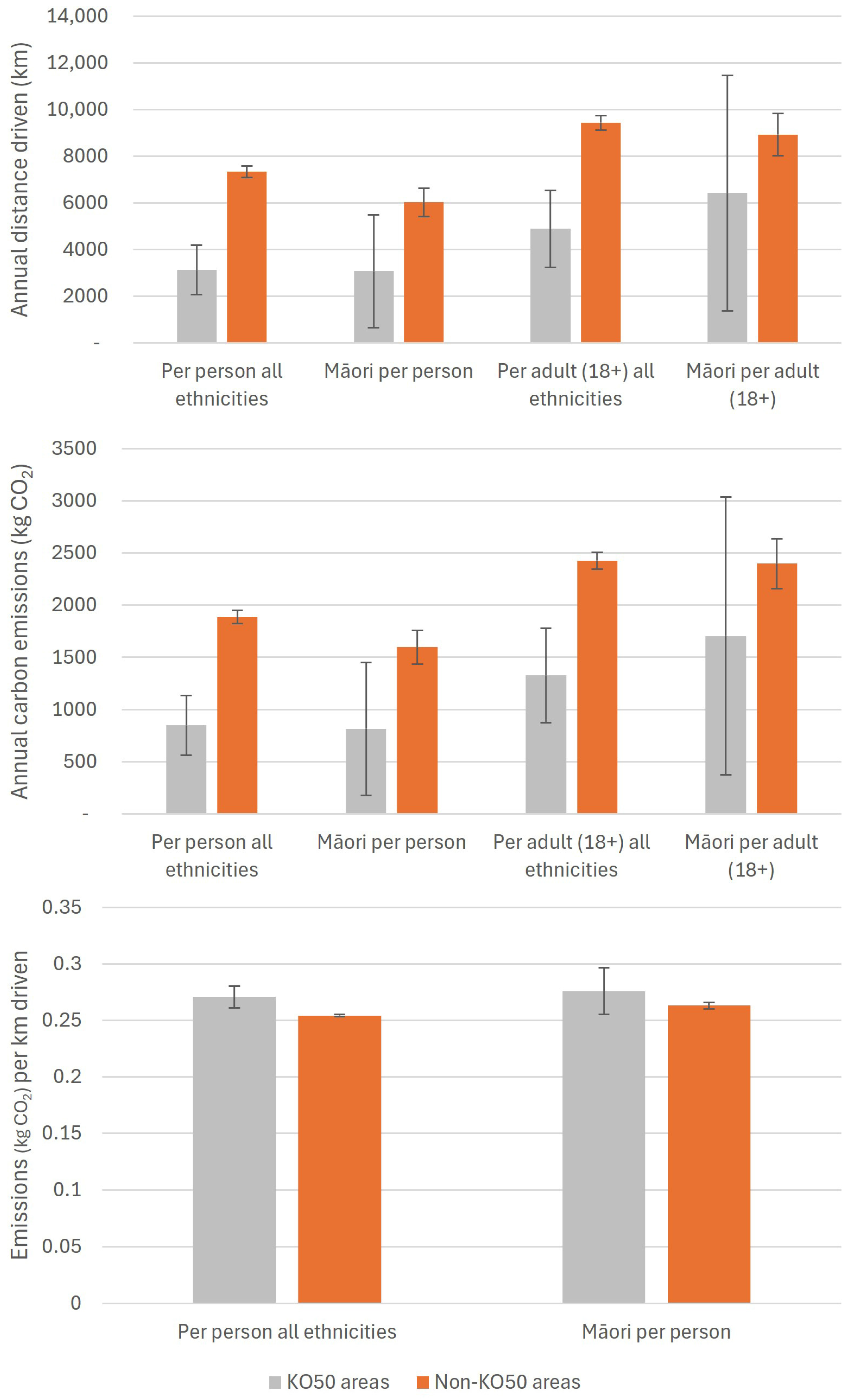
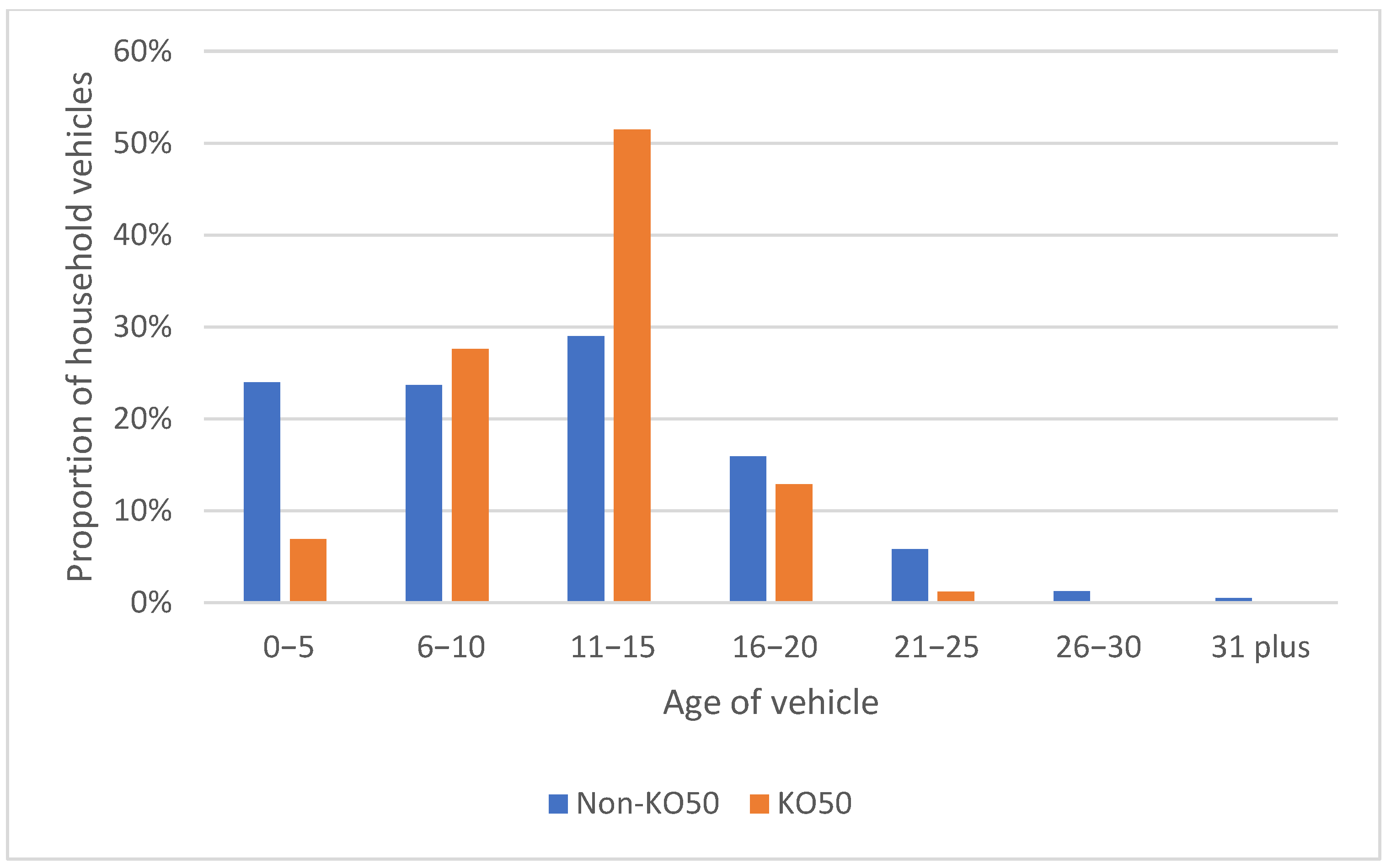
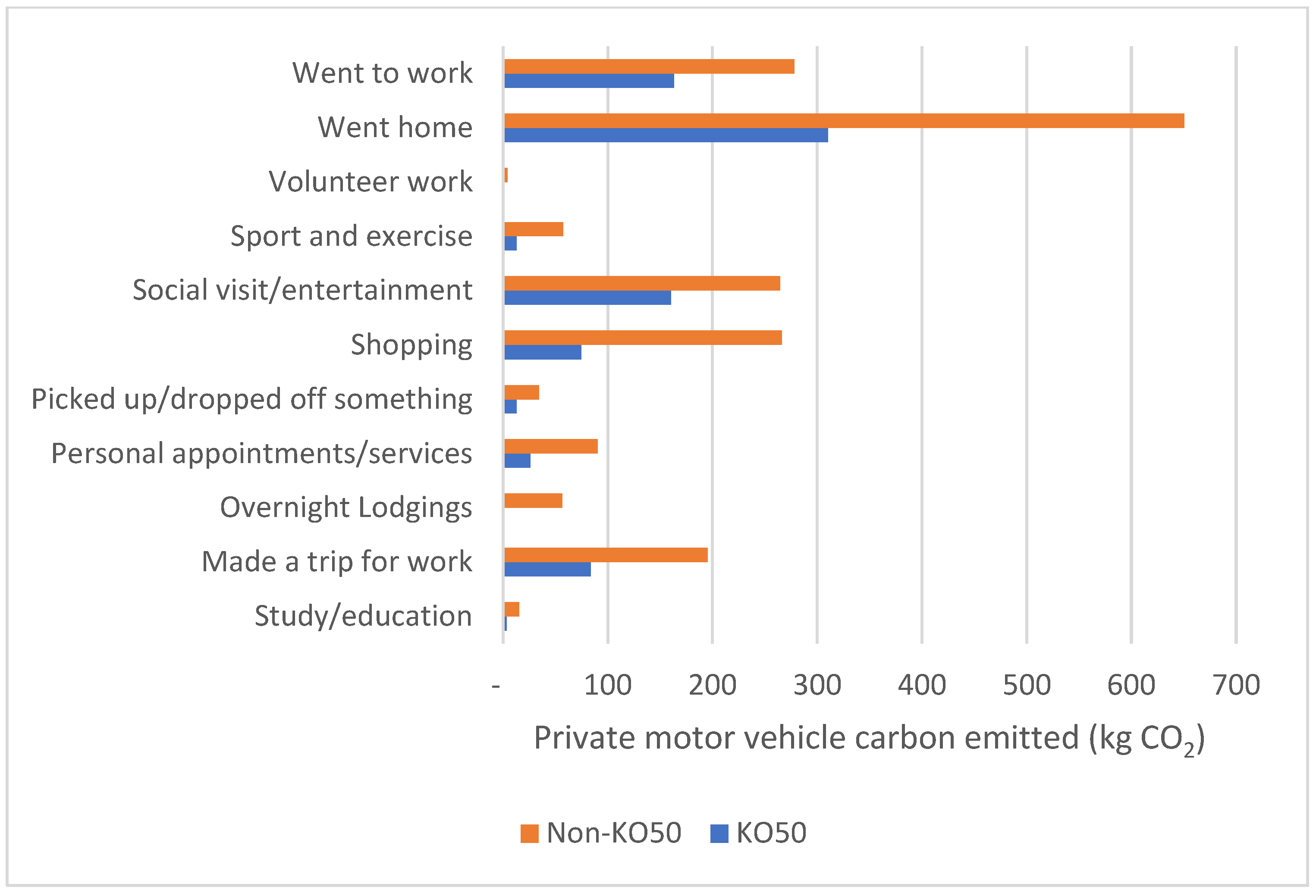
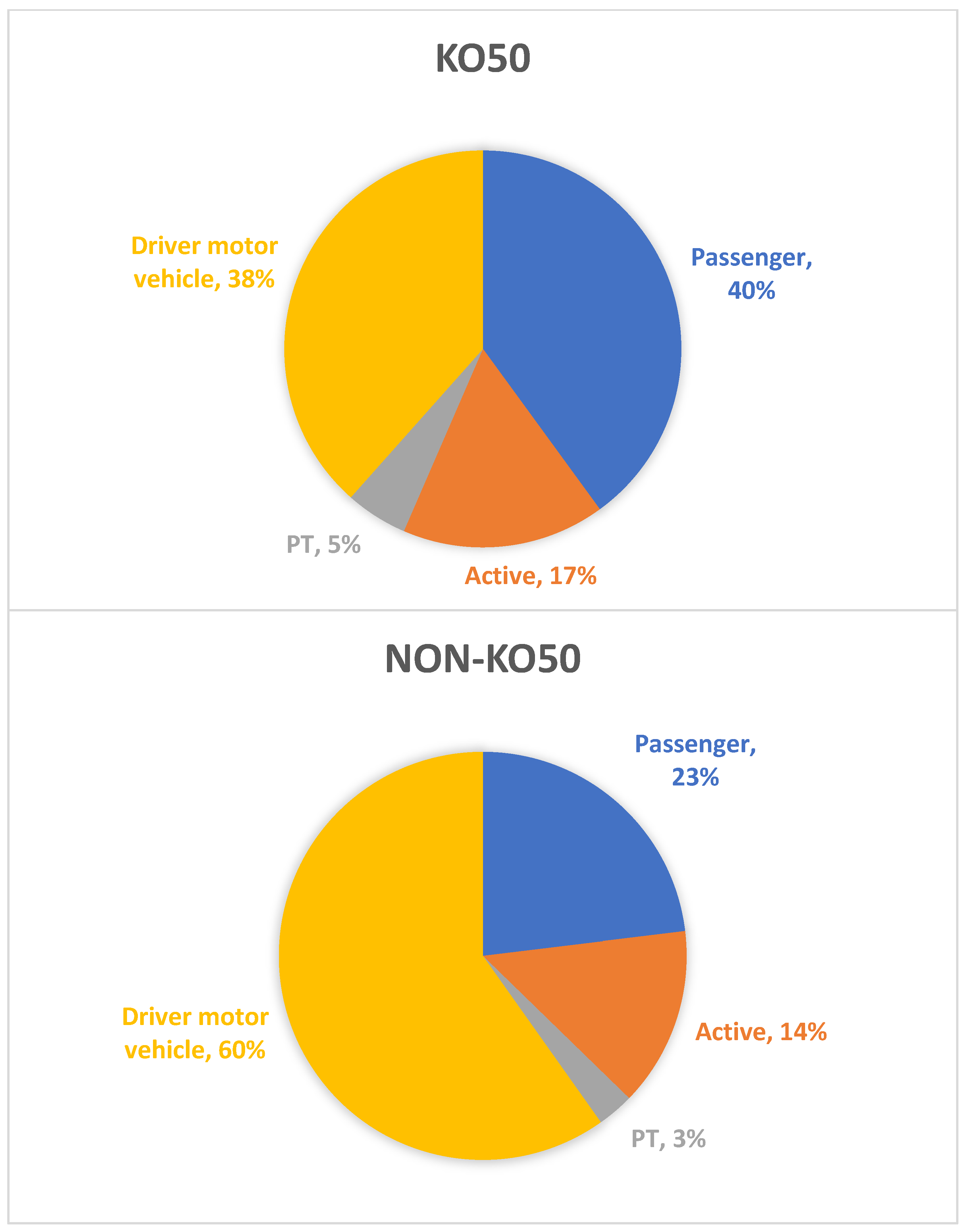
3. Results
4. Discussion
4.1. Generalisability
4.2. Constraints on Travel
4.3. Implications for Climate Change Policy
4.4. Limitations and Sensitivity Analyses
4.5. Imputation for Missing Values
4.6. Carbon Emissions per Person
5. Conclusions
Author Contributions
Funding
Institutional Review Board Statement
Informed Consent Statement
Data Availability Statement
Acknowledgments
Conflicts of Interest
References
- Dodson, J.; Sipe, N. Oil vulnerability in the australian city: Assessing socioeconomic risks from higher urban fuel prices. Urban Stud. 2007, 44, 37–62. [Google Scholar] [CrossRef]
- Mercado, R.G.; Antonio, P.; Steven, F.; Roorda, M.J.; Morency, C. Explaining transport mode use of low-income persons for journey to work in urban areas: A case study of ontario and quebec. Transportmetrica 2012, 8, 157–179. [Google Scholar] [CrossRef]
- Shaw, C.; Gage, R.; McLeod, M.; Jones, R.; Mizdrak, A.; Woodward, A. Socioeconomic inequalities in greenhouse gas emissions from household travel in aotearoa/new zealand. Travel Behav. Soc. 2024, 37, 100820. [Google Scholar] [CrossRef]
- Zhang, S.; Yang, Y.; Zhen, F.; Lobsang, T.; Li, Z. Understanding the travel behaviors and activity patterns of the vulnerable population using smart card data: An activity space-based approach. J. Transp. Geogr. 2021, 90, 102938. [Google Scholar] [CrossRef]
- Hine, J.; Kamruzzaman, M.; Blair, N. Weekly activity-travel behaviour in rural northern ireland: Differences by context and socio-demographic. Transportation 2012, 39, 175–195. [Google Scholar] [CrossRef]
- Lucas, K.; Jones, P. Social impacts and equity issues in transport: An introduction. J. Transp. Geogr. 2012, 21, 1–3. [Google Scholar] [CrossRef]
- Creutzig, F.; McGlynn, E.; Minx, J.; Edenhofer, O. Climate policies for road transport revisited (i): Evaluation of the current framework. Energy Policy 2011, 39, 2396–2406. [Google Scholar] [CrossRef]
- Climate Change Commission. Climate Change Commission: 2021 Draft Advice for Consultation; Climate Change Commission: Wellington, New Zealand, 2021.
- Curl, A.; Watkins, A.; McKerchar, C.; Exeter, D.J.; Macmillan, A. Social Impact Assessment of Mode Shift; Waka Kotahi NZ Transport Agency: Wellington, New Zealand, 2020.
- Keall, M.; Chapman, R.; Howden-Chapman, P.; Witten, K.; Abrahamse, W.; Woodward, A. Increasing active travel: Results of a quasi-experimental study of an intervention to encourage walking and cycling. J. Epidemiol. Community Health 2015, 69, 1184–1190. [Google Scholar] [CrossRef] [PubMed]
- Keall, M.; Randal, E.; Abrahamse, W.; Chapman, R.; Shaw, C.; Witten, K.; Woodward, A.; Howden-Chapman, P. Equity and other effects of a program facilitating and promoting active travel. Transp. Res. Part D Transp. Environ. 2022, 108, 103338. [Google Scholar] [CrossRef]
- Chapman, R. Transitioning to low-carbon urban form and transport in new zealand. Political Sci. 2008, 60, 89–98. [Google Scholar] [CrossRef]
- Gao, S.; Johnston, R.A. Public versus private mobility for low-income households: Transit improvements versus increased car ownership in the sacramento, california, region. Transp. Res. Rec. 2009, 2125, 9–15. [Google Scholar] [CrossRef]
- OECD. Social Housing: A Key Part of Past and Future Housing Policy; OECD: Paris, France, 2020. [Google Scholar]
- Randal, E.; Shaw, C.; McLeod, M.; Keall, M.; Woodward, A.; Mizdrak, A. The impact of transport on population health and health equity for māori in aotearoa new zealand: A prospective burden of disease study. Int. J. Environ. Res. Public Health 2022, 19, 2032. [Google Scholar] [CrossRef] [PubMed]
- Kāinga Ora. Annual Report 2023–2024; Kāinga Ora: Wellington, New Zealand, 2024.
- Kāinga Ora. Oia 30 January 2019 Tenant Demographic Statistics; Kāinga Ora: Wellington, New Zealand, 2019.
- Stats NZ. 2023 Census Population Counts (by Ethnic Group, Age, and Māori Descent) and Dwelling Counts; Stats NZ|Tatauranga Aotearoa: Wellington, New Zealand, 2024.
- Randal, E.; Shaw, C.; Woodward, A.; Howden-Chapman, P.; Macmillan, A.; Hosking, J.; Chapman, R.; Waa, A.M.; Keall, M. Fairness in transport policy: A new approach to applying distributive justice theories. Sustainability 2020, 12, 10102. [Google Scholar] [CrossRef]
- Penny, G.; Logan, A.; Olin, C.V.; O’Sullivan, K.; Robson, B.; Pehi, T.; Davies, C.; Wall, T.; Howden-Chapman, P. A whakawhanaungatanga māori wellbeing model for housing and urban environments: New zealand journal of social sciences online. Kotuitui 2024, 19, 105–131. [Google Scholar]
- Teariki, M.A.; Leau, E. Understanding pacific worldviews: Principles and connections for research. Kōtuitui N. Z. J. Soc. Sci. Online 2024, 19, 132–151. [Google Scholar] [CrossRef]
- Ministry of Health. Annual Update of Key Results 2018/19: New Zealand Health Survey; Ministry of Health: Wellington, New Zealand, 2019.
- Randal, E.; Logan, A.; Penny, G.; Teariki, M.A.; Chapman, R.; Keall, M.; Howden-Chapman, P. Transport and wellbeing of public housing tenants—A scoping review. Urban Sci. 2025, 9, 206. [Google Scholar] [CrossRef]
- Ministry of Transport. New Zealand Household Travel Survey 2018–2020 Methodology Report; Ministry of Transport: Wellington, New Zealand, 2022; Published in April 2022 by the Ministry of Transport, PO Box 3175, Wellington 6140. Available online: https://www.transport.govt.nz/assets/Uploads/Research/NZHTS_Methodology_Report_2018_2020-v2.pdf (accessed on 29 October 2025).
- Statistics New Zealand. Integrated Data Infrastructure. 2022. Available online: https://www.stats.govt.nz/integrated-data/integrated-data-infrastructure/ (accessed on 23 July 2022).
- Salmond, C.E.; Crampton, P. Development of new zealand’s deprivation index (nzdep) and its uptake as a national policy tool. Can. J. Public Health/Rev. Can. De Sante’e Publique 2012, 103, S7–S11. [Google Scholar]
- Ministry for the Environment. Measuring Emissions: A Guide for Organisations: 2022 Detailed Guide; Ministry for the Environment: Wellington, New Zealand, 2022.
- MBIE. Energy in New Zealand 2023 Shows Renewable Electricity Generation Increased to 87%; Ministry of Business, Innovation and Employment: Wellington, New Zealand, 2023.
- Haerewa, N.; Stephenson, J.; Hopkins, D. Shared mobility in a māori community. Kotuitui 2018, 13, 233–245. [Google Scholar] [CrossRef]
- Raerino, K.; Macmillan, A.K.; Jones, R.G. Indigenous maori perspectives on urban transport patterns linked to health and wellbeing. Health Place 2013, 23, 54–62. [Google Scholar] [CrossRef]
- Jones, R.; McLeod, M.; Gage, R.; Woodward, A.; Shaw, C. Inequities in patterns and determinants of travel for māori in aotearoa/new zealand. J. Transp. Health 2025, 40, 101959. [Google Scholar] [CrossRef]
- Russell, E.; McKerchar, C.; Berghan, J.; Curl, A.; Fitt, H. Considering the importance of transport to the wellbeing of māori social housing residents. J. Transp. Health 2024, 36, 101809. [Google Scholar] [CrossRef]
- Awaworyi Churchill, S.; Smyth, R. Transport poverty and subjective wellbeing. Transp. Res. Part A Policy Pract. 2019, 124, 40–54. [Google Scholar] [CrossRef]
- Bruno, M.; Kouwenberg, M.; van Oort, N. Addressing transport related social exclusion through transportation policy. Transp. Res. Interdiscip. Perspect. 2024, 26, 101177. [Google Scholar] [CrossRef]
- Mattioli, G. ‘Forced car ownership’ in the UK and Germany: Socio-spatial patterns and potential economic stress impacts. Soc. Incl. 2017, 5, 147–160. [Google Scholar] [CrossRef]
- Curl, A.; Clark, J.; Kearns, A. Household car adoption and financial distress in deprived urban communities: A case of forced car ownership? Transp. Policy 2018, 65, 61–71. [Google Scholar] [CrossRef]
- Thompson, S. Easy Access and Sustainable Transport: Survey Report; Kāinga Ora: Wellington, New Zealand, 2022.
- Sanchez, T.W. Poverty, policy, and public transportation. Transp. Res. Part A Policy Pract. 2008, 42, 833–841. [Google Scholar] [CrossRef]
- Gwilliam, K. A review of issues in transit economics. Res. Transp. Econ. 2008, 23, 4–22. [Google Scholar] [CrossRef]
- Dodson, J.; Sipe, N. Shocking the suburbs: Urban location, homeownership and oil vulnerability in the australian city. Hous. Stud. 2008, 23, 377–401. [Google Scholar] [CrossRef]
- Mattioli, G.; Wadud, Z.; Lucas, K. Vulnerability to fuel price increases in the uk: A household level analysis. Transp. Res. Part A Policy Pract. 2018, 113, 227–242. [Google Scholar] [CrossRef]
- Tortosa, E.V.; Lovelace, R.; Heinen, E.; Mann, R.P. Cycling behaviour and socioeconomic disadvantage: An investigation based on the english national travel survey. Transp. Res. Part A Policy Pract. 2021, 152, 173–185. [Google Scholar] [CrossRef]
- Glazener, A.; Sanchez, K.; Ramani, T.; Zietsman, J.; Nieuwenhuijsen, M.J.; Mindell, J.S.; Fox, M.; Khreis, H. Fourteen pathways between urban transportation and health: A conceptual model and literature review. J. Transp. Health 2021, 21, 101070. [Google Scholar] [CrossRef]
- Armoogum, J.; Wittwer, R.; Madre, J.-L.; Gopal, Y. Sampling, nonresponse, and quality in travel surveys. Transp. Res. Procedia 2024, 76, 638–643. [Google Scholar] [CrossRef]
- Ministry for the Environment; Stats NZ. Our Atmosphere and Climate 2020; Ministry for the Environment: Wellington, New Zealand, 2020. Available online: http://www.stats.govt.nz (accessed on 4 May 2024).
- New Zealand Ministry of Transport. 2018 New Zealand Vehicle Fleet Statistics. Available online: http://www.transport.govt.nz/research/newzealandvehiclefleetstatistics/ (accessed on 4 May 2024).
- Ministry of Transport. Our Plan to Reduce Transport Emissions; Ministry of Transport: Wellington, New Zealand, 2023.



| KO50 n (People) = 285 | Non-KO50 n (People) = 38,289 | |
|---|---|---|
| Time period (survey years) | ||
| 2012 to 2016 | 38.9% | 41.2% |
| 2016 to 2020 | 61.1% | 58.8% |
| Gender | ||
| Female | 52.7% | 50.7% |
| Male | 47.3% | 49.3% |
| Age group | ||
| 0–14 | 31.0% | 18.8% |
| 15–24 | 14.6% | 11.7% |
| 25–34 | 17.2% | 15.0% |
| 35–44 | 9.7% | 14.2% |
| 45–54 | 11.4% | 13.6% |
| 55–64 | 9.5% | 11.7% |
| 65+ | 6.6% | 15.0% |
| Self-identified ethnicity (respondents may select more than one) | ||
| European | 18.4% | 73.5% |
| Māori | 27.0% | 10.7% |
| Pacific peoples | 49.5% | 5.4% |
| Other | 18.7% | 13.9% |
| Income ranges (16+-year-old respondents only) | ||
| Under $10,000 | 25% | 12% |
| $10,001–$30,000 | 22% | 20% |
| $30,001–$50,000 | 14% | 14% |
| $50,001–$70,000 | 7% | 11% |
| $70,000+ | 3% | 13% |
| Do not know/object to state | 30% | 30% |
| Household type | ||
| Person living alone | 8.3% | 12.2% |
| Couple only | 9.5% | 21.6% |
| Other adults only | 7.7% | 7.0% |
| Family with children | 49.8% | 39.9% |
| Family with adults only | 10.7% | 13.7% |
| Single adult living with children | 10.5% | 4.8% |
| Other | 3.6% | 0.9% |
| Children (age < 18) in household | 60.3% | 44.7% |
| Number of household vehicles (households) | ||
| 0 | 17.0% | 6.8% |
| 1 | 50.3% | 40.4% |
| 2 | 21.2% | 38.2% |
| 3+ | 11.5% | 14.6% |
| Number of household bicycles * (households) | ||
| 0 | 74.5% | 55.0% |
| 1 | 13.7% | 15.7% |
| 2 | 5.9% | 13.6% |
| 3+ | 5.9% | 15.7% |
| Socioeconomic deprivation quintile (households) | ||
| 1 (low deprivation) | 0% | 19% |
| 2 | 0% | 21% |
| 3 | 0% | 22% |
| 4 | 2% | 20% |
| 5 (high deprivation) | 98% | 18% |
| Total number of weighted individuals | ||
| Sum of weights | 242,319 | 32,640,000 |
| Trip Purpose | Proportion of Trips for KO50 Residents | Proportion of Trips for Non-KO50 Residents | Ratio of Trip Proportions, KO50/Non-KO50 (95% CI) |
|---|---|---|---|
| Accompanied someone | 14% | 8% | 1.66 (1.11, 2.48) |
| Went to work | 13% | 12% | 1.11 (0.75, 1.65) |
| Went home | 35% | 31% | 1.11 (0.97, 1.26) |
| Study/education | 1% | 1% | 1.09 (0.27, 4.44) |
| Picked up/dropped off something | 2% | 2% | 0.99 (0.38, 2.63) |
| Social visit/entertainment | 11% | 11% | 0.98 (0.68, 1.41) |
| Shopping | 15% | 18% | 0.82 (0.62, 1.09) |
| Made a trip for work | 6% | 8% | 0.76 (0.25, 2.33) |
| Sport and exercise | 1% | 3% | 0.54 (0.21, 1.39) |
| Personal appointments/services | 2% | 5% | 0.45 (0.22, 0.89) |
| Volunteer work | 0% | 0% | 0.19 (0.01, 2.48) |
| Overnight lodgings | 0% | 1% | (not calculable) |
| Total | 100% | 100% |
Disclaimer/Publisher’s Note: The statements, opinions and data contained in all publications are solely those of the individual author(s) and contributor(s) and not of MDPI and/or the editor(s). MDPI and/or the editor(s) disclaim responsibility for any injury to people or property resulting from any ideas, methods, instructions or products referred to in the content. |
© 2025 by the authors. Licensee MDPI, Basel, Switzerland. This article is an open access article distributed under the terms and conditions of the Creative Commons Attribution (CC BY) license (https://creativecommons.org/licenses/by/4.0/).
Share and Cite
Keall, M.; Chapman, R.; Love, K.; Penny, G.; Randal, E.; Howden-Chapman, P. Travel Behaviour and Carbon Emissions of Residents of Public Housing Areas in Aotearoa, New Zealand. Urban Sci. 2025, 9, 469. https://doi.org/10.3390/urbansci9110469
Keall M, Chapman R, Love K, Penny G, Randal E, Howden-Chapman P. Travel Behaviour and Carbon Emissions of Residents of Public Housing Areas in Aotearoa, New Zealand. Urban Science. 2025; 9(11):469. https://doi.org/10.3390/urbansci9110469
Chicago/Turabian StyleKeall, Michael, Ralph Chapman, Keren Love, Guy Penny, Edward Randal, and Philippa Howden-Chapman. 2025. "Travel Behaviour and Carbon Emissions of Residents of Public Housing Areas in Aotearoa, New Zealand" Urban Science 9, no. 11: 469. https://doi.org/10.3390/urbansci9110469
APA StyleKeall, M., Chapman, R., Love, K., Penny, G., Randal, E., & Howden-Chapman, P. (2025). Travel Behaviour and Carbon Emissions of Residents of Public Housing Areas in Aotearoa, New Zealand. Urban Science, 9(11), 469. https://doi.org/10.3390/urbansci9110469