
Proximity and Active Accessibility to Urban Green Spaces in Porto Through the Lens of the 15-Minute City


Abstract
1. Introduction
1.1. The 15-Minute City Concept
1.2. Urban Green Spaces in the 15-Minute City: Benefits and Key Issues
1.3. Research Gaps
1.4. Aims and Objectives of the Study
2. Materials and Methods
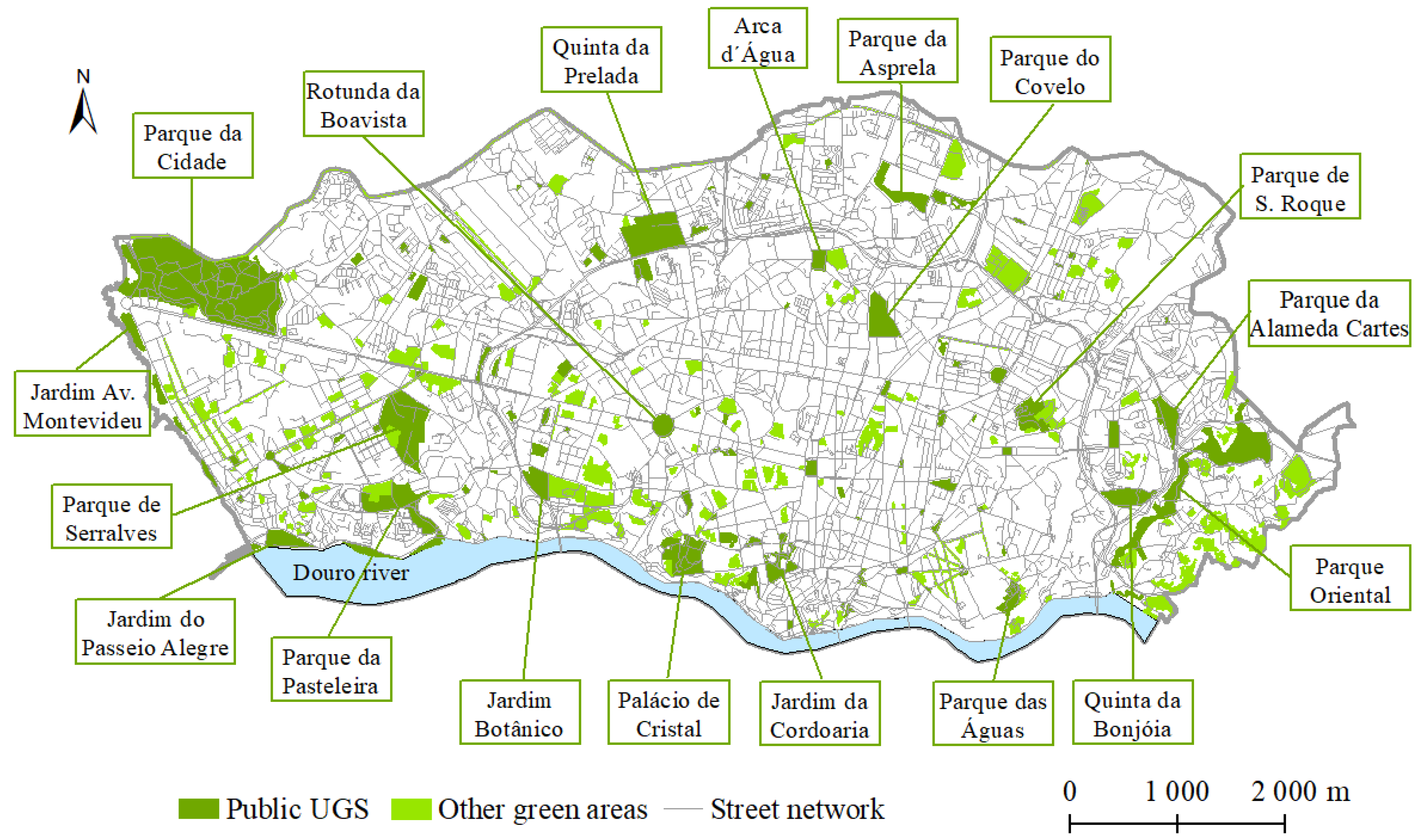
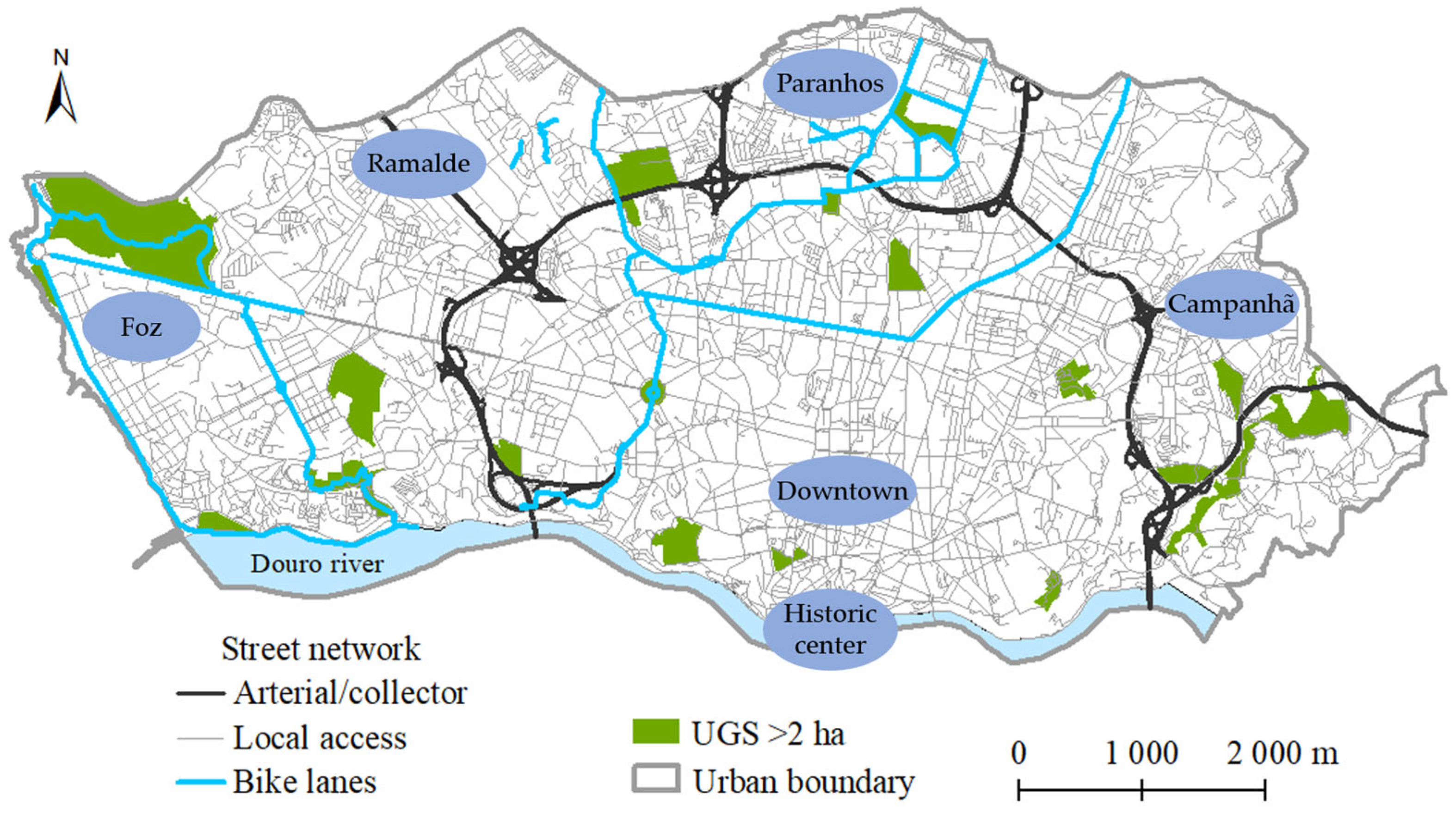
2.1. The Case of Porto
2.2. Objective Approach
2.3. Subjective Approach
3. Results
3.1. Objective Evaluation
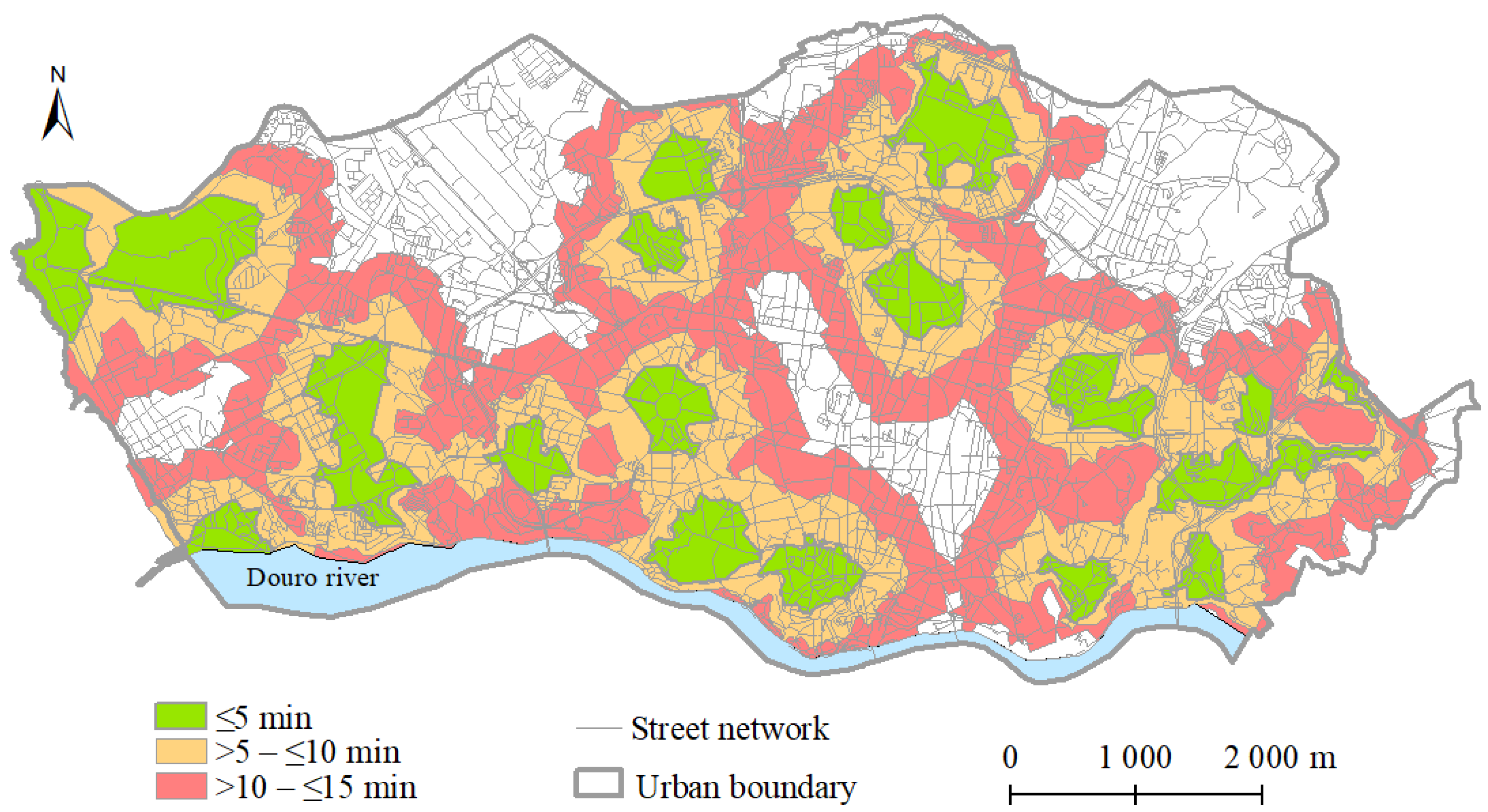
3.1.1. Pedestrian Accessibility to Urban Green Spaces
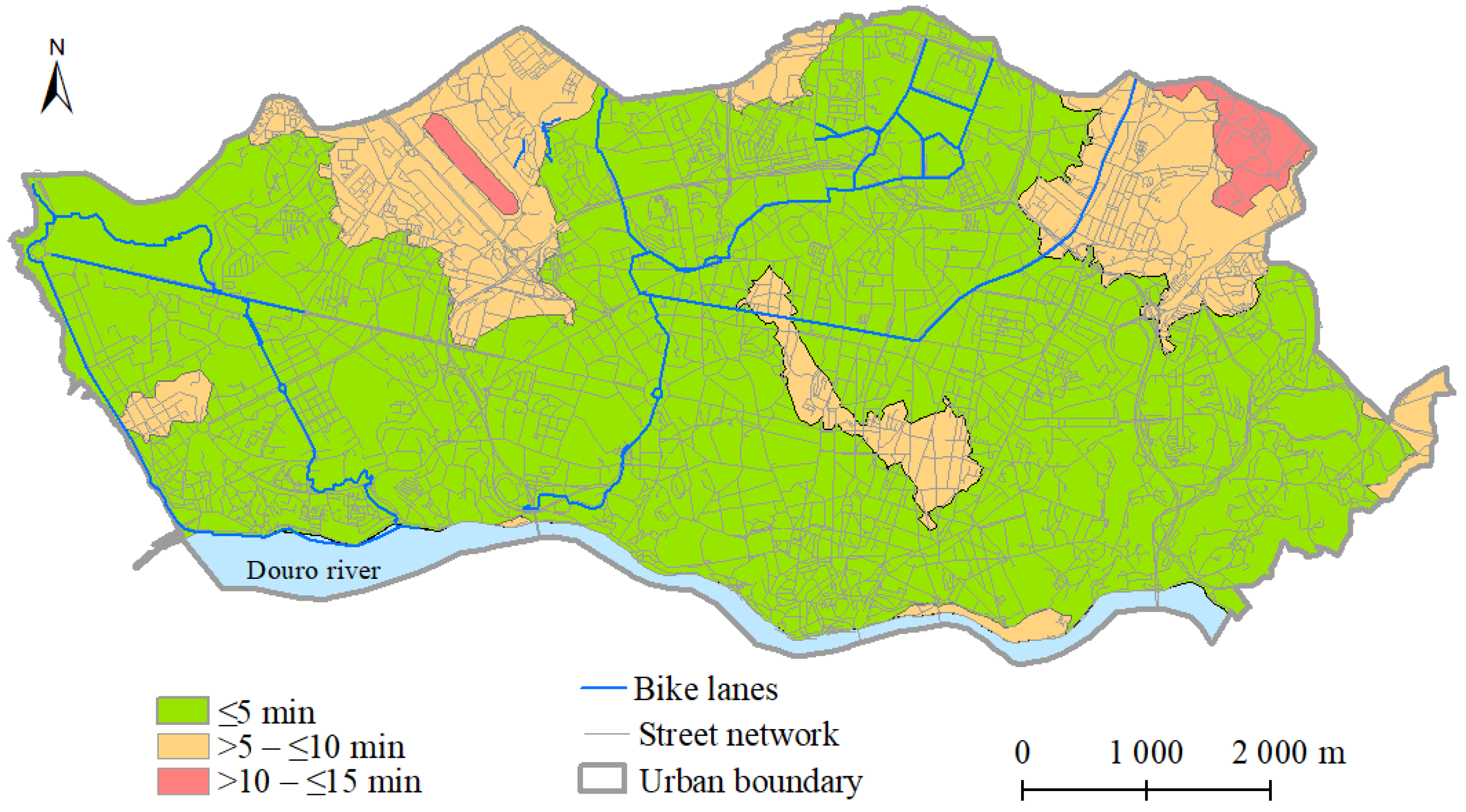
3.1.2. Cycling Accessibility to Urban Green Spaces
3.2. Complementary Subjective Evaluation
3.2.1. Sample Description
3.2.2. Usage of Urban Green Spaces and Preferences
3.2.3. Travel Experiences and Perceptions
4. Discussion
4.1. Discussion of the Objective Evaluation
- (i)
- Expanding and strategically locating green spaces: new UGSs should be created and existing ones expanded, prioritizing residential areas currently outside walking catchment zones. Such interventions should be carefully planned to mitigate green gentrification, a phenomenon that can significantly raise land and housing prices, particularly in the case of large-scale projects [24];
- (ii)
- Improving active mobility infrastructure and connections: pedestrian and cycling connections between UGS and residential areas, should be improved, preferably through safe, direct, and comfortable green corridors. This is crucial for vulnerable users (seniors, children) but also benefits the general population, as evidence shows cyclists prefer tree-lined routes that offer attractive landscapes and reduce exposure to pollution and noise [79]. To counter the rainy winter conditions that discourage active modes, infrastructure should be weather-resilient, including sheltered paths and permeable pavements. Cycling must be supported through an expanded and better-connected network, complemented by adequate facilities like secure bicycle parking near UGS and transport nodes. Finally, the barrier posed by steeper gradients in parts of the city (historic center and eastern zones) should be mitigated through alternative routes, improved public transport connections, or mechanical aids such as elevators;
- (iii)
- Addressing cultural reliance on private vehicles: the strong cultural reliance on private vehicles, which fundamentally shapes accessibility patterns, must be progressively addressed. This can be achieved through awareness and educational campaigns, as well as incentives for active travel, particularly cycling, since these measures have proven effective in encouraging behavioral change [15];
- (iv)
- Integrating needs through participatory planning: it is essential to incorporate population needs and preferences into planning through participatory approaches, ensuring that policies are understood as supportive rather than restrictive. This is particularly important given recent misinterpretations of the 15M model, which has been portrayed in some public debates as anti-car or limiting personal freedom [80]. In reality, the 15MC framework seeks to broaden opportunities for all by integrating multiple transport modes and enhancing local accessibility, thereby promoting inclusive and sustainable mobility.
4.2. Discussion of the Complementary Subjective Evaluation
4.3. Future Research and Limitations
5. Conclusions
Author Contributions
Funding
Institutional Review Board Statement
Informed Consent Statement
Data Availability Statement
Acknowledgments
Conflicts of Interest
Abbreviations
| 15MC | 15-minute city |
| GIS | Geographic Information Systems |
| SDG | Sustainable Development Goals |
| UGS | Urban Green Space |
| WHO | World Health Organization |
References
- Shakeri, S.; Motieyan, H.; Azmoodeh, M. Comparative analysis of 15-minute neighborhoods through different cumulative-based accessibility measures. GeoJournal 2024, 89, 222. [Google Scholar] [CrossRef]
- Liu, D.; Kwan, M.; Wang, J. Developing the 15-minute city: A comprehensive assessment of the status in Hong Kong. Travel Behav. Soc. 2024, 34, 100666. [Google Scholar] [CrossRef]
- Moreno, C.; Allam, Z.; Chabaud, D.; Gall, C.; Pratlong, F. Introducing the “15-minute city”: Sustainability, resilience and place identity in future post-pandemic cities. Smart Cities 2021, 4, 93–111. [Google Scholar] [CrossRef]
- Gaglione, F.; Gargiulo, C.; Zucaro, F.; Cottrill, C. Urban accessibility in a 15-minute city: A measure in the city of Naples, Italy. Transp. Res. Proc. 2022, 60, 378–385. [Google Scholar] [CrossRef]
- Caprotti, F.; Duarte, C.; Joss, S. The 15-minute city as paranoid urbanism: Ten critical reflections. Cities 2024, 155, 105497. [Google Scholar] [CrossRef]
- Khavarian-Garmsir, A.; Sharifi, A.; Hajian, M.; Moradi, Z. From garden city to 15-minute city: A historical perspective and critical assessment. Land 2023, 12, 512. [Google Scholar] [CrossRef]
- Pinto, B.; Chamusca, P. The 15-minute city in Portugal: Reality, aspiration, or utopia? Urban Sci. 2025, 9, 330. [Google Scholar] [CrossRef]
- Mouratidis, K. Time to challenge the 15-minute city: Seven pitfalls for sustainability, equity, livability, and spatial analysis. Cities 2024, 153, 105274. [Google Scholar] [CrossRef]
- Fonseca, F.; Ribeiro, P.; Conticelli, E.; Jabbari, M.; Papageorgiou, G.; Tondelli, S.; Ramos, R. Built environment attributes and their influence on walkability. Int. J. Sustain. Transp. 2022, 16, 660–679. [Google Scholar] [CrossRef]
- Fonseca, F.; Ribeiro, P.; Neiva, C. A planning practice method to assess the potential for cycling and to design a bicycle network in a starter cycling city in Portugal. Sustainability 2023, 15, 4534. [Google Scholar] [CrossRef]
- Iqbal, A.; Nazir, H.; Qazi, A. Exploring the 15-minutes city concept: Global challenges and opportunities in diverse urban contexts. Urban Sci. 2025, 9, 252. [Google Scholar] [CrossRef]
- Tapiador, L.; Gomez, J.; Vassallo, J. Exploring the relationship between public transport use and COVID-19 infection: A survey data analysis in Madrid Region. Sustain. Cities Soc. 2024, 104, 105279. [Google Scholar] [CrossRef]
- Hunter, R.; Akaraci, S.; Wang, R.; Reis, R.; Hallal, P.; Pentland, S.; Millett, C.; Garcia, L.; Thompson, J.; Nice, K.; et al. City mobility patterns during the COVID-19 pandemic: Analysis of a global natural experiment. Lancet Public Health 2024, 9, e896–e906. [Google Scholar] [CrossRef] [PubMed]
- Akrami, M.; Sliwa, M.; Rynning, M. Walk further and access more! Exploring the 15-minute city concept in Oslo, Norway. J. Urban Mobil. 2024, 5, 100077. [Google Scholar] [CrossRef]
- Dias, C. Accessibility and Availability of Urban Green Areas Within the 15-minute City Scope: Lisbon Case Study. Master’s Thesis, Universidade Nova de Lisboa, Lisbon, Portugal, 2023. [Google Scholar]
- Jeon, Y.; Jung, S. Spatial equity of urban park distribution: Examining the floating population within urban park catchment areas in the context of the 15-minute city. Land 2024, 13, 24. [Google Scholar] [CrossRef]
- Silva, L.; Fonseca, F.; Pires, M.; Mendes, B. SAUS: A tool for preserving urban green areas from air pollution. Urban For. Urban Green. 2019, 46, 126440. [Google Scholar] [CrossRef]
- Fonseca, F.; Silva, L.; Martins, S.; Almeida, M.; Reis, C.; Lopes, H. The role of vegetation in attenuating the urban heat island (UHI): A case study in Guimarães, Portugal. In Studies in Systems, Decision and Control; Springer: Cham, Switzerland, 2025; Volume 230, pp. 497–510. [Google Scholar] [CrossRef]
- Silva, L.; Lopes, H.; Silva, J.; Reis, C.; Fonseca, F. The nexus of nature-based solutions and sustainability in cities: Vegetation’s impact on particulate matter capture and traffic noise reduction. In Studies in Systems, Decision and Control; Springer: Cham, Switzerland, 2025; Volume 230, pp. 411–422. [Google Scholar] [CrossRef]
- Silva, R.; Zanocco, C. Assessing public attitudes towards urban green spaces as a heat adaptation strategy: Insights from Germany. Landsc. Urban Plan. 2024, 245, 105013. [Google Scholar] [CrossRef]
- Ma, F. Spatial equity analysis of urban green space based on spatial design network analysis (sDNA): A case study of central Jinan, China. Sustain. Cities Soc. 2020, 60, 102256. [Google Scholar] [CrossRef]
- González-Marín, A.; Garrido-Cumbrera, M. Did the COVID-19 pandemic influence access to green spaces? Results of a literature review during the first year of pandemic. Landsc. Ecol. 2024, 39, 23. [Google Scholar] [CrossRef]
- Kolimenakis, A.; Solomou, A.; Proutsos, N.; Avramidou, E.; Korakaki, E.; Karetsos, G.; Maroulis, G.; Papagiannis, E.; Tsagkari, K. The socioeconomic welfare of urban green areas and parks; a literature review of available evidence. Sustainability 2021, 13, 7863. [Google Scholar] [CrossRef]
- Pinto, L.V.; Pereira, P. Relevant landscape components in a large urban green space in Oporto (Portugal). Urban For. Urban Green. 2024, 99, 128421. [Google Scholar] [CrossRef]
- Taylor, L.; Hochuli, D. Defining greenspace: Multiple uses across multiple disciplines. Landsc. Urban Plan. 2017, 158, 25–38. [Google Scholar] [CrossRef]
- Kabisch, N.; Qureshi, S.; Haase, D. Human-environment interactions in urban green spaces—A systematic review of contemporary issues and prospects for future research. Environ. Impact Assess. Rev. 2015, 50, 25–34. [Google Scholar] [CrossRef]
- Fors, H.; Molin, J.; Murphy, M.; van den Bosch, C. User participation in urban green spaces–For the people or the parks? Urban For. Urban Green. 2015, 14, 722–734. [Google Scholar] [CrossRef]
- Liu, Y.; Fagerholm, N.; Skov-Petersen, H.; Beery, T.; Wagner, A.; Olafsson, A. Shortcuts in urban green spaces: An analysis of incidental nature experiences associated with active mobility trips. Urban For. Urban Green. 2023, 82, 127873. [Google Scholar] [CrossRef]
- Van Den Bosch, M.; Egorov, A.; Mudu, P.; Uscila, V.; Barrdahl, M.; Kruize, H.; Kulinkina, A.; Staatsen, B.; Swart, W.; Zurlyte, I. Development of an urban green space indicator and the public health rationale. Scand. J. Public Health 2016, 44, 159–167. [Google Scholar] [CrossRef] [PubMed]
- Fan, P.; Xu, L.; Yue, W.; Chen, J. Accessibility of public urban green space in an urban periphery: The case of Shanghai. Landsc. Urban Plan. 2017, 165, 177–192. [Google Scholar] [CrossRef]
- Comber, A.; Brunsdon, C.; Green, E. Using a GIS-based network analysis to determine urban greenspace accessibility for different ethnic and religious groups. Landsc. Urban Plan. 2008, 86, 103–114. [Google Scholar] [CrossRef]
- Tian, Y.; Jim, C.; Wang, H. Assessing the landscape and ecological quality of urban green spaces in a compact city. Landsc. Urban Plan. 2014, 121, 97–108. [Google Scholar] [CrossRef]
- Mears, M.; Brindley, P.; Maheswaran, R.; Jorgensen, A. Understanding the socioeconomic equity of publicly accessible greenspace distribution: The example of Sheffield, UK. Geoforum 2019, 103, 126–137. [Google Scholar] [CrossRef]
- Schipperijn, J.; Bentsen, P.; Troelsen, J.; Toftager, M.; Stigsdotter, U. Associations between physical activity and characteristics of urban green space. Urban For. Urban Green. 2013, 12, 109–116. [Google Scholar] [CrossRef]
- Giles-Corti, B.; Broomhall, M.; Knuiman, M.; Collins, C.; Douglas, K.; Ng, K.; Lange, A.; Donovan, R. Increasing walking: How important is distance to, attractiveness, and size of public open space? Am. J. Prev. Med. 2005, 28, 169–176. [Google Scholar] [CrossRef] [PubMed]
- Kaczynski, A.; Potwarka, L.; Saelens, P. Association of park size, distance, and features with physical activity in neighborhood parks. Am. J. Public Health 2008, 98, 1451–1456. [Google Scholar] [CrossRef] [PubMed]
- Cao, X.; Onishi, A.; Chen, J.; Imura, H. Quantifying the cool island intensity of urban parks using ASTER and IKONOS data. Landsc. Urban Plan. 2010, 96, 224–231. [Google Scholar] [CrossRef]
- Grahn, P.; Stigsdotter, U. Landscape planning and stress. Urban For. Urban Green. 2003, 2, 1–18. [Google Scholar] [CrossRef]
- Cardinali, M.; Beenackers, M.; van Timmeren, A.; Pottgiesser, U. The relation between proximity to and characteristics of green spaces to physical activity and health: A multi-dimensional sensitivity analysis in four European cities. Environ. Res. 2024, 241, 117605. [Google Scholar] [CrossRef]
- World Health Organization. Healthy cities for building back better. Political statement of the WHO European Healthy Cities Network; WHO Regional Office for Europe: Copenhagen, Denmark, 2021. [Google Scholar]
- Kabisch, N.; Strohbach, M.; Haase, D.; Kronenberg, J. Urban green space availability in European cities. Ecol. Indic. 2016, 70, 586–596. [Google Scholar] [CrossRef]
- Ståhle, A. More green space in a denser city: Critical relations between user experience and urban form. Urban Des. Int. 2010, 15, 47–67. [Google Scholar] [CrossRef]
- World Health Organization. Urban Green Spaces: A Brief for Action; WHO: Copenhagen, Denmark, 2017. [Google Scholar]
- European Environment Agency. Who Benefits from Nature in Cities? Social Inequalities in Access to Urban Green and Blue Spaces Across Europe (Briefing No. 15/2021); EEA: Copenhagen, Denmark, 2022. [Google Scholar]
- Cook, E.; Kabasinguzi, I.; Randhawa, G.; Ali, N. Factors influencing urban greenspace use among a multi-ethnic community in the UK: The Chalkscapes Study. Urban For. Urban Green. 2024, 92, 128210. [Google Scholar] [CrossRef]
- Büttner, B.; Seisenberger, S.; McCormick, B.; Silva, C.; Teixeira, J.; Papa, E.; Cao, M. Mapping of 15-minute city practices overview on strategies, policies and implementation in Europe and beyond. Report from DUT’s 15-minute City Transition Pathway; Driving Urban Transitions. Vienna, Austria, 2024. Available online: https://dutpartnership.eu/news/new-publication-mapping-15-minute-city-practices (accessed on 30 September 2025).
- Shoina, M.; Voukkali, I.; Anagnostopoulos, A.; Papamichael, I.; Stylianou, M.; Zorpas, A. The 15-minute city concept: The case study within a neighbourhood of Thessaloniki. Waste Manag. Res. 2024, 42, 694–710. [Google Scholar] [CrossRef]
- Luo, J.; Zhai, S.; Song, G.; He, X.; Song, H.; Chen, J.; Liu, H.; Feng, Y. Assessing inequity in green space exposure toward a “15-minute city” in Zhengzhou, China: Using deep learning and urban big data. Int. J. Environ. Res. Public Health 2022, 19, 5798. [Google Scholar] [CrossRef]
- Guzman, L.; Oviedo, D.; Cantillo-Garcia, V. Is proximity enough? A critical analysis of a 15-minute city considering individual perceptions. Cities 2024, 148, 104882. [Google Scholar] [CrossRef]
- Rocha, H.; Ferreira, S. Advancing sustainable urban mobility: An empirical travel time analysis of the 15-minute city model in Porto. Case Stud. Transp. Policy 2025, 21, 101551. [Google Scholar] [CrossRef]
- Statistics Portugal. Census 2021; Statistics Portugal: Lisbon, Portugal, 2021. [Google Scholar]
- Portuguese Institute for Sea and Atmosphere. Climate normal of Porto (1991–2020); IPMA: Lisbon, Portugal, 2021. [Google Scholar]
- Municipality of Porto. Municipal Master Plan of Porto (Strategy for a network of cycle routes for the Greater Porto Area: The case of Porto). Available online: https://pdm.cm-porto.pt/documents/44/Rede_de_circuitos_ciclaveis_Caso_do_Porto_2014.pdf (accessed on 30 September 2025).
- Alves, F.; Cruz, S.; Ribeiro, A.; Silva, A.; Martins, J.; Cunha, I. Walkability index for elderly health: A proposal. Sustainability 2020, 12, 7360. [Google Scholar] [CrossRef]
- Lopes, H.; Vidal, D.; Cherif, N.; Silva, L.; Remoaldo, P. Green infrastructure and its influence on urban heat island, heat risk, and air pollution: A case study of Porto (Portugal). J. Environ. Manag. 2025, 376, 124446. [Google Scholar] [CrossRef] [PubMed]
- Madureira, H.; Andresen, T.; Monteiro, A. Green structure and planning evolution in Porto. Urban For. Urban Green. 2011, 10, 141–149. [Google Scholar] [CrossRef]
- Marques, P.; Alves, P.; Fernandes, C.; Guilherme, F.; Gonçalves, C. Revision of the Municipal Master Plan of Porto: Biophysical Support and Environment. Ecological Structure and Biodiversity. Characterization and Diagnosis Report; Municipality of Porto: Porto, Portugal, 2018. (In Portuguese) [Google Scholar]
- Municipality of Porto. Municipal Master Plan of Porto (Urban Parks and Gardens). Available online: https://portalgeo.cm-porto.pt/arcgis/apps/sites/#/mapas-do-porto/apps/da2e7cbb6f384514856211466bf68609/explore (accessed on 9 June 2025).
- Municipality of Porto. Municipal Master Plan of Porto (Mobility). Available online: https://portalgeo.cm-porto.pt/arcgis/apps/sites/#/mapas-do-porto/apps/507724d6cfeb4038b19e862b6ca8cb1f/explore (accessed on 12 May 2025).
- Papadopoulos, E.; Sdoukopoulos, A.; Politis, I. Measuring compliance with the 15-minute city concept: State-of-the-art, major components and further requirements. Sustain. Cities Soc. 2023, 99, 104875. [Google Scholar] [CrossRef]
- Martins, B.; Pereira, A. Index for evaluation of public parks and gardens proximity based on the mobility network: A case study of Braga, Braganza and Viana do Castelo (Portugal) and Lugo and Pontevedra (Spain). Urban For. Urban Green. 2018, 34, 134–140. [Google Scholar] [CrossRef]
- Ribeiro, P.; Fonseca, F. Students’ home-university commuting patterns: A shift towards more sustainable modes of transport. Case Stud. Transp. Policy 2022, 10, 954–964. [Google Scholar] [CrossRef]
- Kang, B.; Moudon, A.; Hurvitz, P.; Saelens, B. Differences in behavior, time, location, and built environment between objectively measured utilitarian and recreational walking. Transp. Res. D 2017, 57, 185–194. [Google Scholar] [CrossRef]
- Parkin, J.; Rotheram, J. Design speeds and acceleration characteristics of bicycle traffic for use in planning, design and appraisal. Transp. Policy 2010, 17, 335–341. [Google Scholar] [CrossRef]
- Raza, A.; Zhong, M.; Akuh, R.; Safdar, M. Public transport equity with the concept of time-dependent accessibility using Geostatistics methods, Lorenz curves, and Gini coefficients. Case Stud. Transp. Policy 2023, 11, 100956. [Google Scholar] [CrossRef]
- Fang, D.; Liu, D.; Kwan, M.-P. Evaluating spatial variation of accessibility to urban green spaces and its inequity in Chicago: Perspectives from multi-types of travel modes and travel time. Urban For. Urban Green. 2025, 104, 128593. [Google Scholar] [CrossRef]
- Fonseca, F.; Rodrigues, A.; Silva, H. Pedestrian perceptions of sidewalk paving attributes: Insights from a pilot study in Braga. Infrastructures 2025, 10, 79. [Google Scholar] [CrossRef]
- Fonseca, F.; Papageorgiou, G.; Conticelli, E.; Jabbari, M.; Ribeiro, P.; Tondelli, S.; Ramos, R. Evaluating attitudes and preferences towards walking in two European cities. Future Transp. 2024, 4, 475–490. [Google Scholar] [CrossRef]
- Aboulnaga, M.; Ashour, F.; Elsharkawy, M.; Lucchi, E.; Gamal, S.; Elmarakby, A.; Haggagy, S.; Karar, N.; Khashaba, N.; Abouaiana, A. Urbanization and drivers for dual capital city: Assessment of urban planning principles and indicators for a ‘15-minute city’. Land 2025, 14, 382. [Google Scholar] [CrossRef]
- Badiu, D.; Iojă, C.; Pătroescu, M.; Breuste, J.; Artmann, M.; Niță, M.; Grădinaru, S.; Hossu, C.; Onose, D. Is urban green space per capita a valuable target to achieve cities’ sustainability goals? Romania as a case study. Ecol. Indic. 2016, 70, 53–66. [Google Scholar] [CrossRef]
- Schindler, M.; Le Texier, M.; Caruso, G. How far do people travel to use urban green space? A comparison of three European cities. Appl. Geogr. 2022, 141, 102673. [Google Scholar] [CrossRef]
- Handley, J.; Pauleit, S.; Slinn, P.; Barber, A.; Baker, M.; Jones, C.; Lindley, S. Accessible natural green space standards in towns and cities: A review and toolkit for their implementation. Engl. Nature Res. Rep. 2003, 526, 98. [Google Scholar]
- Croeser, T.; Sharma, R.; Weisser, W.; Bekessy, S. Acute canopy deficits in global cities exposed by the 3-30-300 benchmark for urban nature. Nat. Commun. 2024, 15, 9333. [Google Scholar] [CrossRef]
- Nieuwenhuijsen, M.; Dadvand, P.; Márquez, S.; Bartoll, X.; Barboza, E.; Cirach, M.; Borrell, C.; Zijlema, W. The evaluation of the 3-30-300 green space rule and mental health. Environ. Res. 2022, 215, 114387. [Google Scholar] [CrossRef] [PubMed]
- Hwang, B.; Ko, C.; Im, D.; Kang, W. Network-based assessment of urban forest and green space accessibility in six major cities: London, New York, Paris, Tokyo, Seoul, and Beijing. Urban For. Urban Green. 2025, 107, 128781. [Google Scholar] [CrossRef]
- Staricco, L. 15-, 10-or 5-minute city? A focus on accessibility to services in Turin, Italy. J. Urban Mobil. 2022, 2, 100030. [Google Scholar] [CrossRef]
- Félix, R.; Moura, F.; Clifton, K. Maturing urban cycling: Comparing barriers and motivators to bicycle of cyclists and non-cyclists in Lisbon, Portugal. J. Transp. Health 2019, 15, 100628. [Google Scholar] [CrossRef]
- Cruz, R.; Bandeira, J.; Vilaça, M.; Rodrigues, M.; Fernandes, J.; Coelho, M. Introducing new criteria to support cycling navigation and infrastructure planning in flat and hilly cities. Transp. Res. Proc. 2020, 47, 75–82. [Google Scholar] [CrossRef]
- Stoia, N.; Niţă, M.; Popa, A.; Iojă, I. The green walk—An analysis for evaluating the accessibility of urban green spaces. Urban For. Urban Green. 2022, 75, 127685. [Google Scholar] [CrossRef]
- Vlahov, D.; Kurth, A. The “15-Minute City” Concept in the Context of the COVID-19 Pandemic and Climate Change. J. Urban Health 2024, 101, 669–671. [Google Scholar] [CrossRef]
- Madureira, H.; Nunes, F.; Oliveira, J.; Cormier, L.; Madureira, T. Urban residents’ beliefs concerning green space benefits in four cities in France and Portugal. Urban For. Urban Green. 2015, 14, 56–64. [Google Scholar] [CrossRef]
- Madureira, H.; Nunes, F.; Oliveira, J.; Madureira, T. Preferences for urban green space characteristics: A comparative study in three Portuguese cities. Environments 2018, 5, 23. [Google Scholar] [CrossRef]
- Schipperijn, J.; Ekholm, O.; Stigsdotter, U.; Toftager, M.; Bentsen, P.; Kamper-Jørgensen, F.; Randrup, T. Factors influencing the use of green space: Results from a Danish national representative survey. Landsc. Urban Plan. 2010, 95, 130–137. [Google Scholar] [CrossRef]
- Gozalo, G.; Morillas, J.; González, D. Perceptions and use of urban green spaces on the basis of size. Urban For. Urban Green. 2019, 46, 126470. [Google Scholar] [CrossRef]
- Neuvonen, M.; Sievänen, T.; Tönnes, S.; Koskela, T. Access to green areas and the frequency of visits–A case study in Helsinki. Urban For. Urban Green. 2007, 6, 235–247. [Google Scholar] [CrossRef]
- Viebrantz, P.; Fernandes-Jesus, M. Visitors’ perceptions of urban green spaces: A study of Lisbon’s Alameda and Estrela Parks. Front. Sustain. Cities 2021, 3, 755423. [Google Scholar] [CrossRef]
- Romelli, C.; Anderson, C.; Fagerholm, N.; Hansen, R.; Albert, C. Why do people visit or avoid public green spaces? Insights from an online map-based survey in Bochum, Germany. Ecosyst. People 2025, 21, 2454252. [Google Scholar] [CrossRef]
- Egea-Cariñanos, P.; Calaza-Martínez, P.; Roche, D.; Cariñanos, P. Uses, attitudes and perceptions of urban green spaces according to the sociodemographic profile: An exploratory analysis in Spain. Cities 2024, 150, 104996. [Google Scholar] [CrossRef]
- Žlender, V.; Thompson, C. Accessibility and use of peri-urban green space for inner-city dwellers: A comparative study. Landsc. Urban Plan. 2017, 165, 193–205. [Google Scholar] [CrossRef]
- Jalón, S.; Chiabai, A.; Mc Tague, A.; Artaza, N.; Ayala, A.; Quiroga, S.; Kruize, H.; Suárez, C.; Bell, R.; Taylor, T. Providing access to urban green spaces: A participatory benefit-cost analysis in Spain. Int. J. Environ. Res. Public Health 2020, 17, 2818. [Google Scholar] [CrossRef]
- Silva, H.; Fonseca, F.; Rodrigues, A.; Palha, C. Engineering-based evaluation of sidewalk pavement materials: Implications for pedestrian safety and comfort. Int. J. Pavement Res. Technol. 2025, 1–22. [Google Scholar] [CrossRef]


| Time Intervals | Walking | Cycling | ||
|---|---|---|---|---|
| Total Inhabitants | Cumulative Area (ha) | Total Inhabitants | Cumulative Area (ha) | |
| <5 min | 32,774 | 618.7 | 180,745 | 3208.4 |
| 5–10 min | 63,038 | 1177.2 | 49,886 | 742.4 |
| 10–15 min | 98,230 | 1284.7 | 1169 | 74.0 |
| >15 min | 37,758 | 944.2 | 0 | 0.0 |
| Total | 231,800 | 4024.8 | 231,800 | 4024.8 |
| Variables | Attributes | Total | Percentage |
|---|---|---|---|
| Gender | Female | 103 | 75.2 |
| Male | 34 | 24.8 | |
| Age | 15–24 | 63 | 46.0 |
| 25–64 | 55 | 40.1 | |
| 65 or more | 19 | 13.9 | |
| Activity | Employed | 66 | 48.2 |
| Student | 52 | 37.9 | |
| Retirees | 16 | 11.7 | |
| Unemployed | 3 | 2.2 |
| Reasons | % | Actions | % |
|---|---|---|---|
| Walking | 27.0 | Increased proximity | 27.1 |
| Resting/Relaxing | 18.6 | More events | 17.8 |
| Spending time with friends | 17.1 | Additional facilities | 14.8 |
| Enjoying the view | 12.5 | Improved maintenance | 14.4 |
| Being with nature | 11.0 | Improved access | 13.6 |
| Exercising | 5.9 | Increased safety | 12.3 |
| Walking a dog | 4.6 | ||
| Using the children’s playground | 2.8 | ||
| Other | 0.5 |
| Transport Mode | Walking Attributes | Average Evaluation | Max. Score | Min. Score | SD |
|---|---|---|---|---|---|
| Walking | Sidewalk width and layout | 3.23 | 5 | 1 | 1.17 |
| Sidewalk surface quality | 3.04 | 5 | 1 | 1.08 | |
| Sidewalk continuity | 3.31 | 5 | 1 | 1.19 | |
| Connectivity with public transport | 3.26 | 5 | 1 | 1.15 | |
| Street trees and shade | 3.19 | 5 | 1 | 1.15 | |
| Traffic safety | 3.37 | 5 | 1 | 1.04 | |
| Personal security | 3.20 | 5 | 1 | 1.08 | |
| Environmental quality | 2.93 | 5 | 1 | 1.03 | |
| Cycling | Availability of cycle lanes | 2.12 | 5 | 1 | 1.09 |
| Quality of cycle lanes | 2.21 | 5 | 1 | 1.07 | |
| Continuity of cycle lanes | 2.01 | 5 | 1 | 1.00 | |
| Bicycle parking | 2.50 | 5 | 1 | 1.14 | |
| Traffic safety | 2.20 | 5 | 1 | 0.98 | |
| Environmental quality | 2.56 | 5 | 1 | 1.06 |
Disclaimer/Publisher’s Note: The statements, opinions and data contained in all publications are solely those of the individual author(s) and contributor(s) and not of MDPI and/or the editor(s). MDPI and/or the editor(s) disclaim responsibility for any injury to people or property resulting from any ideas, methods, instructions or products referred to in the content. |
© 2025 by the authors. Licensee MDPI, Basel, Switzerland. This article is an open access article distributed under the terms and conditions of the Creative Commons Attribution (CC BY) license (https://creativecommons.org/licenses/by/4.0/).
Share and Cite
Almeida, M.J.; Fonseca, F. Proximity and Active Accessibility to Urban Green Spaces in Porto Through the Lens of the 15-Minute City. Urban Sci. 2025, 9, 458. https://doi.org/10.3390/urbansci9110458
Almeida MJ, Fonseca F. Proximity and Active Accessibility to Urban Green Spaces in Porto Through the Lens of the 15-Minute City. Urban Science. 2025; 9(11):458. https://doi.org/10.3390/urbansci9110458
Chicago/Turabian StyleAlmeida, Maria José, and Fernando Fonseca. 2025. "Proximity and Active Accessibility to Urban Green Spaces in Porto Through the Lens of the 15-Minute City" Urban Science 9, no. 11: 458. https://doi.org/10.3390/urbansci9110458
APA StyleAlmeida, M. J., & Fonseca, F. (2025). Proximity and Active Accessibility to Urban Green Spaces in Porto Through the Lens of the 15-Minute City. Urban Science, 9(11), 458. https://doi.org/10.3390/urbansci9110458